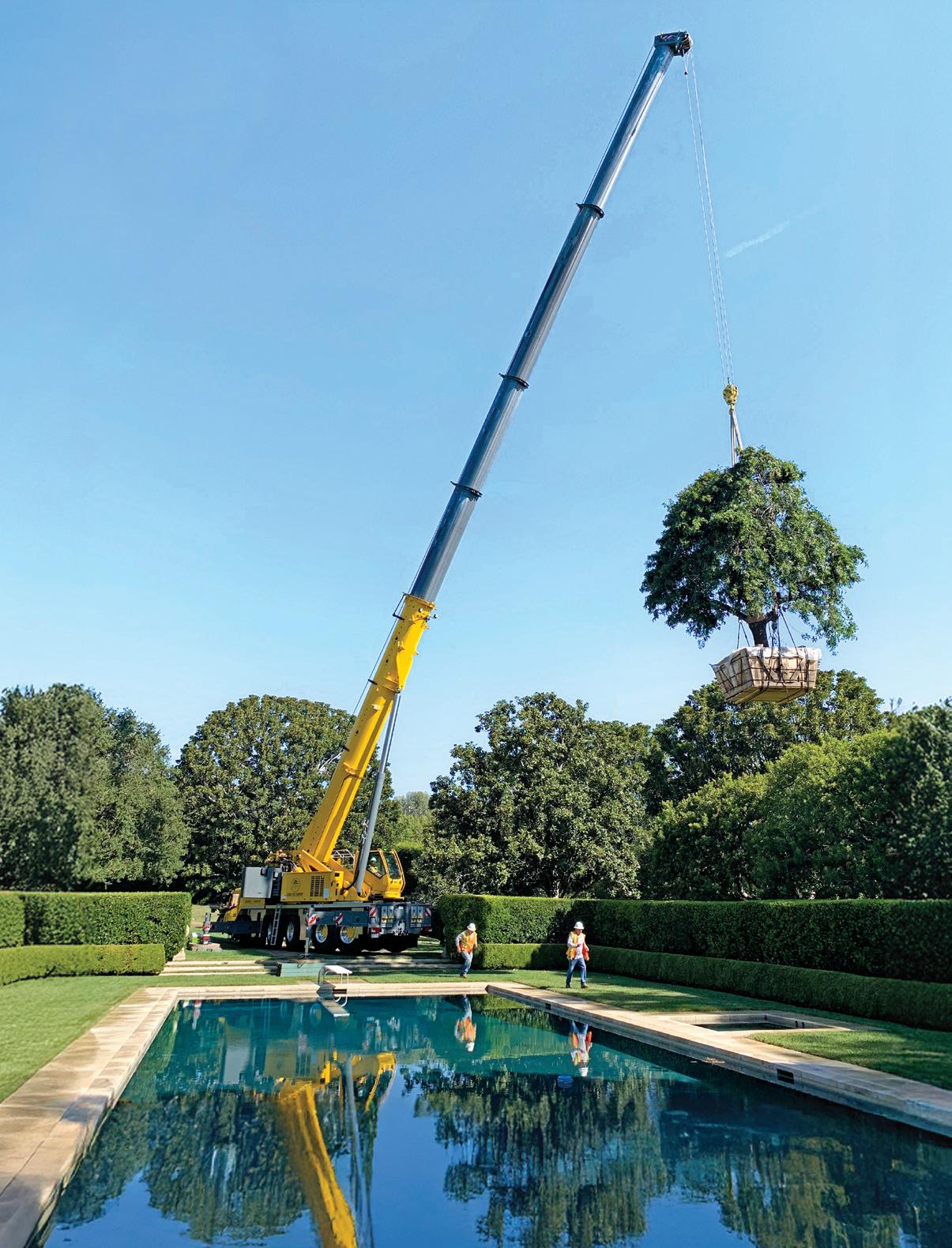
One Mission: Setting the Standard for Tree Relocation and Preservation
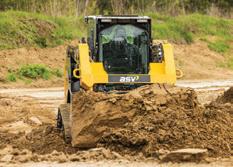
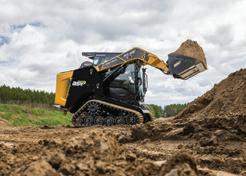
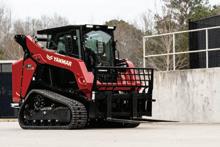
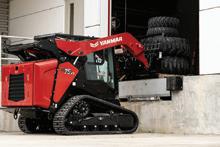
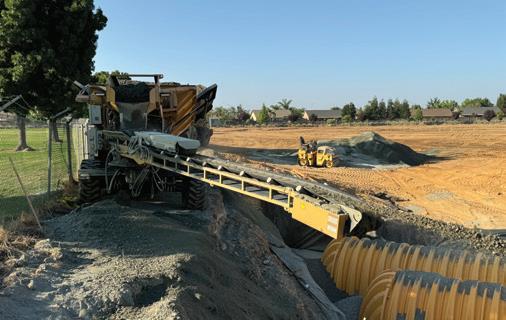
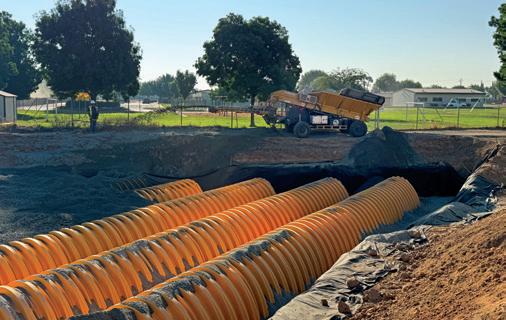
The ASV RT-65-1C delivers impressive power and traction with its vertical-lift design, exceptional ground clearance, and smooth suspended undercarriage—built for reliable performance in tough work environments.
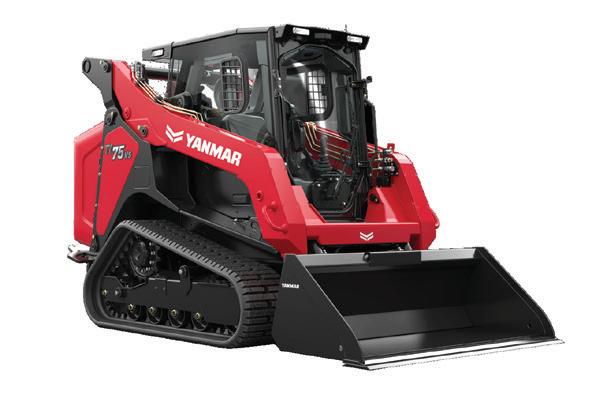
The Yanmar TL75VS-1C is powered by a 71.5-hp Yanmar diesel engine and features a 2,555-lb rated operating capacity, premium 360° visibility, a standard suspended seat, a 7-inch color display, and durable steel-embedded undercarriage components—backed by Yanmar’s industry-trusted 2-year / 2,000-hour warranty.
Choose the machine that fits your work. Both deliver the performance today’s crews rely on.
◊
◊
◊ Place
◊
◊
SENNA TREE COMPANY
MOVERS & SUPPLIERS OF SPECIMEN TREES
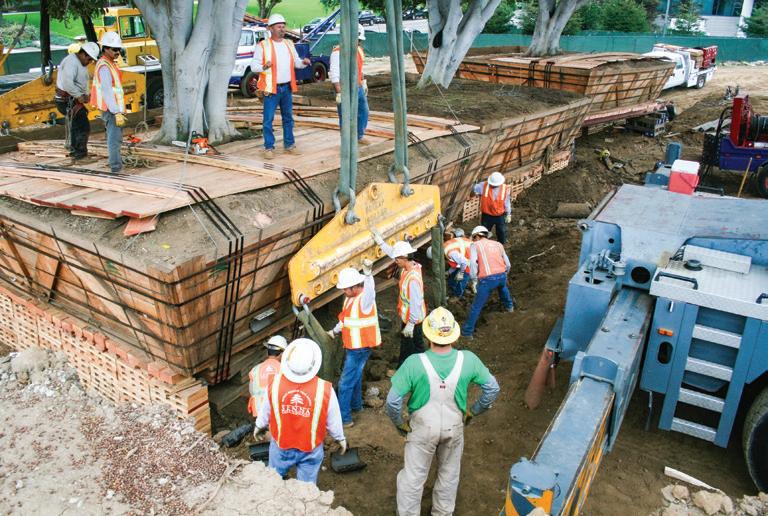
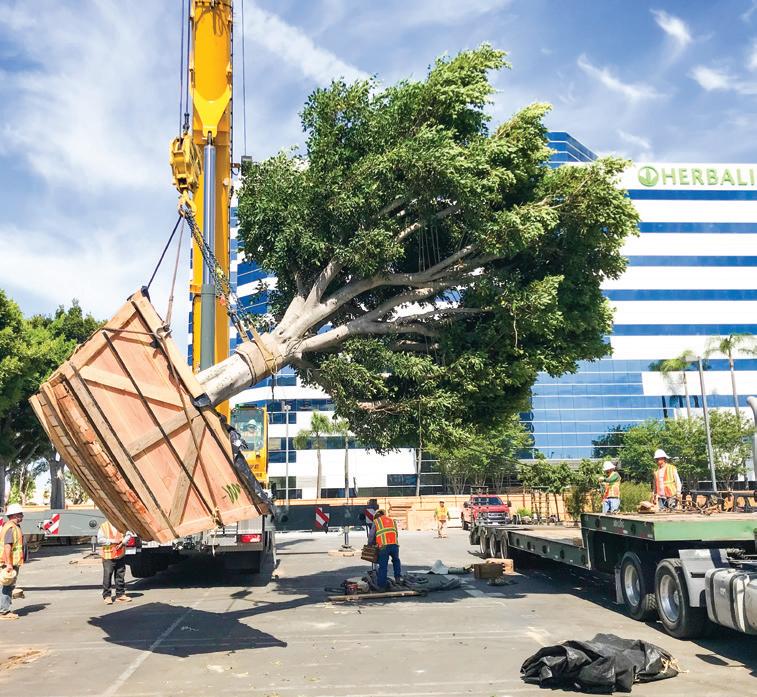
Left: 264” box, 240,000 lb. Ficus microcarpa on Senna’s Prime Mover and 140-ton repurposed Kalyn Military M1 Abrams Tank transport trailer.
SENNA TREE COMPANY – THREE GENERATIONS
One Mission: Setting the Standard for Tree Relocation and Preservation, from World Record Size Specimens to Everyday Projects
Three generations and more than 60 years define Senna Tree Company. What began in 1962 with Charlie Mote’s residential tree care business in La Crescenta and La Cañada has grown into a highly specialized operation dedicated to relocating, preserving, selling, and installing specimen trees across California.
The Formative Years
John Mote, Sr. grew up in the trade by working early and learning in the field. “My father, Charlie, was in the tree trimming business, so I grew up in that business and started working there when I was 13,” he said. The work included trimming, firewood, hillside clearing, cleanups, and removals. His father’s
business enabled him to watch climbers, from across the country, perform tree trimming. John became determined to master the craft. By his mid-teens he was climbing trees, and by 18 he began taking on difficult removals as a freelance climber.
That early experience shaped his career path. “For ten years as
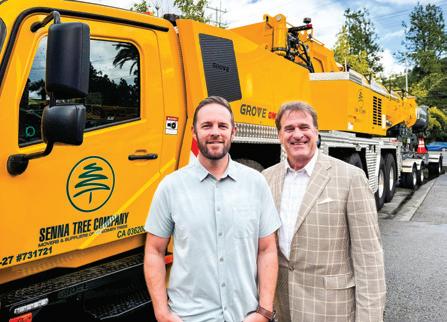
Above: John Mote Jr., (left), and John Mote Sr., Owners, Senna Tree Company.
a climber I cut down a lot of really beautiful trees,” he said. “I love trees and understand that removal is sometimes part of development, but I wanted to focus my career on preserving them.” That shift came in 1984 when he joined the specimen division at Valley Crest Tree Company, where he worked on relocating and selling large trees. “Now we had a company that could actually save trees,” he said. “I just fell in love with the business.”
John spent 12 years at Valley Crest and helped grow contract tree moving sales from roughly $20,000 a month to $500,000 a month. As the company expanded, internal changes prompted him to consider striking out on his own.
“Leaving a secure job, having a mortgage and two kids, was really scary,” he said. After two years of planning, he made the leap.
In 1997, backed by a $100,000 SBA loan, John founded Senna Tree Company with one small crane, a semi-truck, and a backhoe. He hired two experienced operators and relied on relationships built over years in the field, sending roughly 500 letters to contacts announcing the new venture.
“Some of the people I expected to help didn’t,” he said. “And the people I didn’t expect did.”
Left: General Superintendent, Arnaldo “Cano” Martinez, giving crane hand signals (on box facing crane) while crew attaches rigging to box.
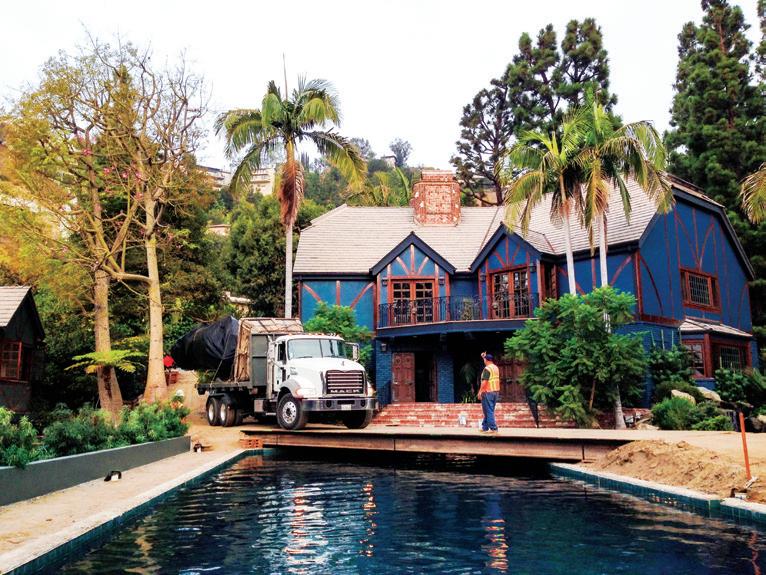
Below: Engineered bridge built over pool to create access for our 60-ton crane and trucks to install trees up to 25,000 lbs.
The response was immediate. In its first year, Senna generated approximately $750,000 in sales, with early projects ranging from moving an 80,000-pound oak to relocating palms and smaller specimens. The company doubled in its second year and continued growing into the early 2000s, reaching $4 million in annual revenue by 2002 and climbing to more than $6 million before the 2008 downturn.
WEATHERING THE RECESSION
The Great Recession marked one of the company’s most challenging periods. “We took a big hit and
were forced to downsize,” John said. At the time, Senna employed about 55 people, and layoffs were difficult. “It was one of the most painful things I’ve been through,” he said. Recovery took several years, with the company stabilizing again around 2011 or 2012.
Despite the downturn, Senna’s specialization helped it remain resilient. Much of its work involves high-value properties and projects where mature trees are integral to the project’s character and budget. “In that sense, a good portion our work is kind of recession-proof today,” John said.
ALMOST 30 YEARS LATER AND THE THIRD GENERATION
Now nearly three decades into business and firmly in its third generation, Senna Tree Company is recognized for its expertise in tree relocation, preservation, and the sale of large specimen trees, supported by an unusually deep in-house capability for a firm of its size. “Our company punches well above our weight and owns the equipment to move trees up to 360,000 lbs., “In House,” says John. Senna Tree Wholesale Nursery inventory ranges from 60-inch box material up to 132” box field specimen trees, and offers operated crane rental to its landscape contractor clients.
John Mote, Jr. grew up around the business long before holding a formal role. “I’ve been around this business my whole life, driving around in a pickup truck with my dad,” he said. “He’d point things out and say, that’s a Ips Beetle, that palm has fusarium, that’s a structural defect. As a teenager, John Jr. worked summers with the crews, learning the physical demands of the work. He later moved into equipment operation, earned crane certification, and transitioned into sales and client coordination. “It was at times intimidating, being a young man operating a million-dollar crane and lifting trees that weigh 80,000 pounds,” he said.
John Jr. remains committed to preservation. “It’s nice to preserve a living thing,” he said. “We save a lot of trees that would otherwise be demolished.” He also sees the work as endlessly technical. “You’re always learning, from cranes and rigging to speciesspecific behavior and timing.”
THE SCIENCE BEHIND THE WORK
Tree relocation is far more than digging and lifting. Senna’s team provides the experience to achieve the best possible result on an individual tree basis factoring health, vigor, physiological and phenological attributes, soil type and preventative treatments for opportunistic insects and pathogens into their workplan to balance survivability and cost. Trees are often relocated with a significantly reduced root system, creating drought stress that must be carefully managed. “What we’re really good at is mitigating drought stress,” John Sr. said.
John Sr. explains that the process depends on execution rather than additives. Immediate watering after root cutting is critical, as is long-term maintenance to support reestablishment. Maintenance plans can last for years, and warranties, when provided, are tied to monthly maintenance agreements and written on a case-by-case basis.
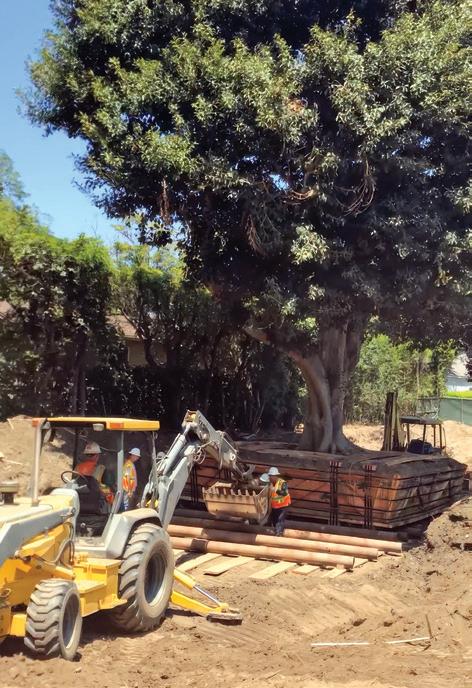
Two John Deere 710 backhoes using hydraulic digging booms to pull and push 220,000 lb. boxed Ficus 100’on 8” steel pipe.
OLD GLORY
Over the years, Senna has relocated thousands of trees, some with canopy spreads exceeding 100 feet, including the Guinness World Record Valley Oak. Senna’s most visible project remains “Old Glory,” a Valley Oak relocated in 2002 after becoming the focus of international media attention. In 2024 old glory was recognized as a LA county historic monument.
Positioned in the path of a future highway, the tree was slated for removal until activists intervened. Senna was ultimately called in to execute the move, relocating the 916,000-pound tree a quarter mile to its current home at Pico Canyon Park in Santa Clara. The tree thrives today, over 20 years later. In 2006, Guinness World Records recognized the effort as the largest tree ever successfully moved. The relocation required extensive planning, including structural support, (16) 8-wheel dollies, and engineered crossings over infrastructure not designed for such loads. “It wasn’t just a tree move,” John said. “It was a temporary infrastructure project.”
CRANES, EQUIPMENT, AND SUPPORT
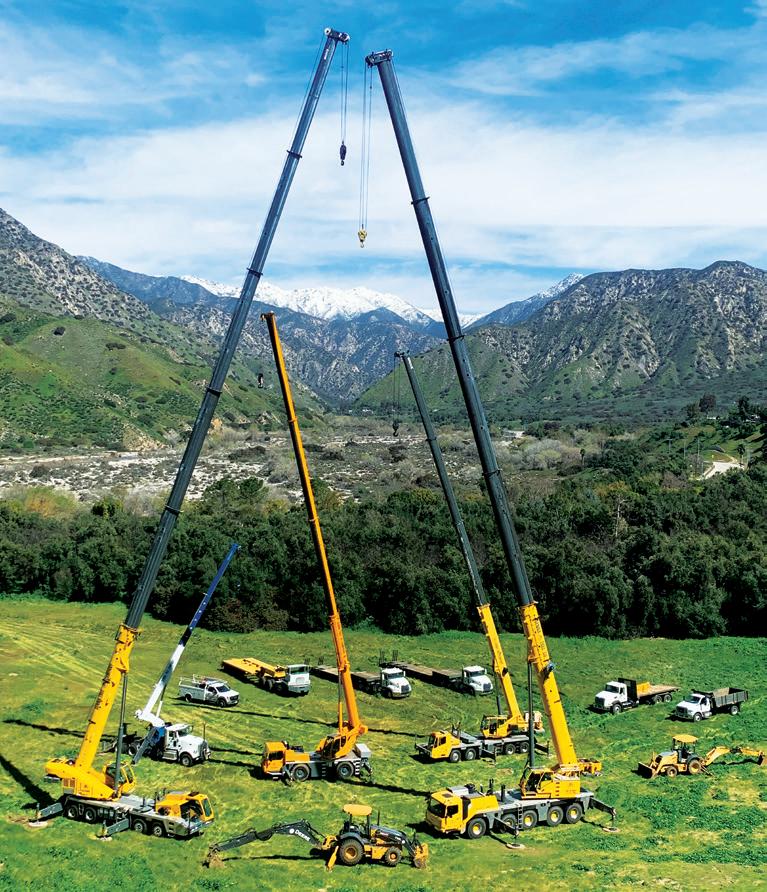
Day-to-day operations are supported by full-time experienced crews and specialized equipment. Senna operates five in-house hydraulic cranes, including a Manitex 3051T 30-ton tractor-mounted crane,
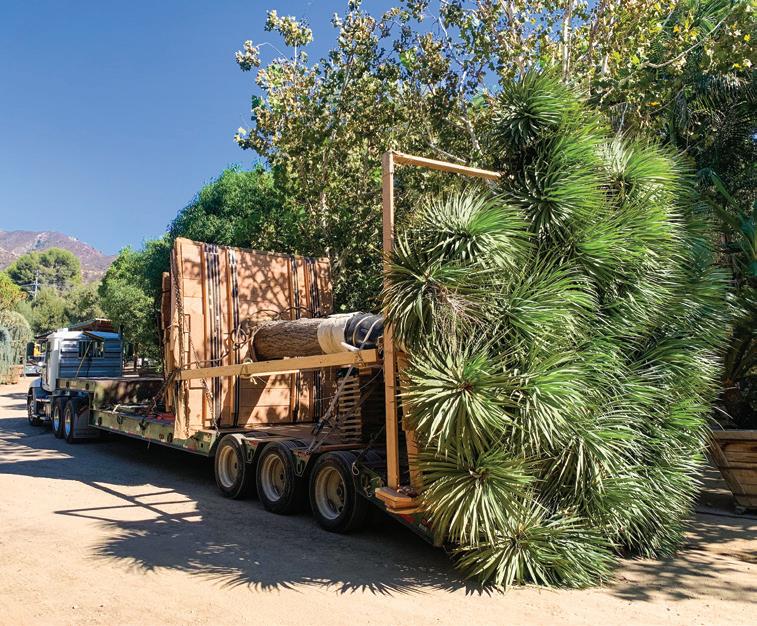
Left: 120” box dracaena draco loaded and ready for shipment to customer.
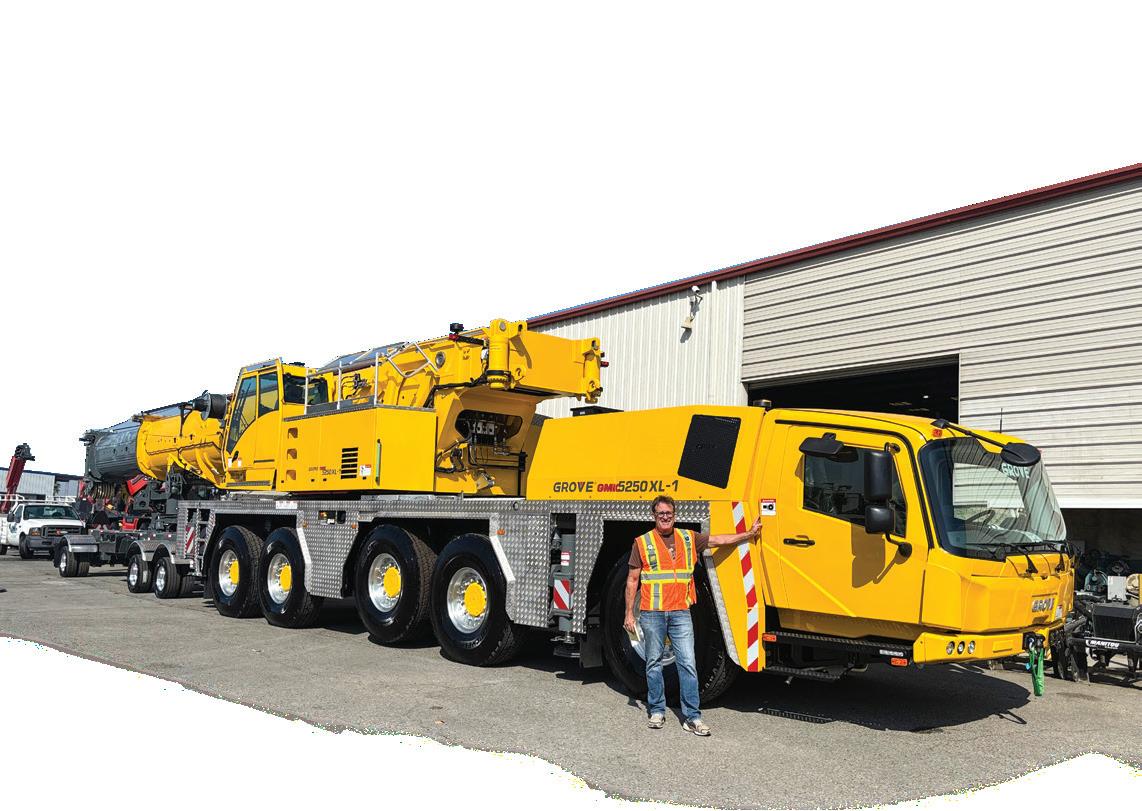
Below: John Mote sr. takes delivery of new 2025 Grove GMK 5250 XL-1, 300-ton crane with 257’ main boom.
Bottom: Loading 84” box Ficus nitida for STC nursery inventory.
{ Continued from page 8 }
Liebherr 1040-2 all-wheel-steer cranes in the 35/45-ton class, a Grove TMS9000-2 available in 75 or 115-ton capacity, and a Grove 5250XL-1 all-wheel-steer crane in the 200- to 300-ton class. This fleet allows Senna to self-perform 99% of its contracts, in addition to offering operated crane rental to landscape contractors. “We also rent semi-truck-trailers, dump trucks and backhoe loaders. We own nine John Deere machines,” continues John. “My favorites are our two John Deere 710 loader backhoes. We use them like small cranes and the 710’s can set an 8,000 lb. tree with its digging
boom or move an 11,000 lb. tree in its loader bucket.”
John Sr. credits much of the company’s equipment reliability to its long-standing relationship with Coastline Equipment, Senna’s John Deere dealer. “We used to run machines with plenty of power, but they didn’t hold up for what we do,” he said. “With John Deere, we’ve never had a boom break.” He added that Coastline’s responsiveness and understanding of Senna’s operation are critical. “Downtime isn’t an option in our business, and Coastline understands that.”
NURSERIES AND INVENTORY
Senna operates a seven-acre specimen tree nursery in Sunland, featuring unique, one-of-a-kind 60”
to 132” box trees with a wholesale inventory value of $4.5 million. “We supply mature specimen trees primarily to landscape contractors and landscape architects, but we’re not just selling trees,” John said. “We sell time,” referring to the decades of growth and character a mature specimen brings to a project the moment it’s installed.
PEOPLE AND THE FUTURE
Through every phase, both John Sr. and John Jr. emphasize people as the company’s greatest asset. John Sr. points to long-term team members including general superintendent Arnaldo “Cano” Martinez, and operations manager, Manny Covian, who supports the company’s commitment to train and promote from within.
John Jr. also emphasizes the company’s focus on safety, proficiency, and continuity. “This work demands experience and consistency,” he said. “We’re dealing with heavy cranes, big trees, and tight sites, so having trained crews who specialize in their craft is what keeps people safe and jobs running smoothly. Proof that this approach works is the company’s excellent safety record and current X-MOD of .60%.
Succession planning is already in place, with John Sr. gradually stepping back as John Jr. takes on a larger leadership role. Growth opportunities remain, including a new field growing in Camarillo, and potential Northern California operations, but not at the expense of quality. “Size is overrated,” John Sr. said. “Quality, safety and customer service matter more.”
For California contractors, Senna Tree Company occupies a unique space where arboriculture meets heavy construction. From roadway projects to estate preservation and internationally recognized relocations, the company’s work underscores that some of the most complex lifts on a jobsite are living systems that must survive long after construction is complete. CL
For more information on Senna Tree Company, please visit their website at www.sennatree.com.
Left: Group photo of Senna Tree Company’s fleet, minus (7) John Deere tractors and all Ford pickups - out on jobs.
Turfworks, Inc.
Transforms Historic Stonegate Model Home With $125,000 Landscape Overhaul
By Brian Hoover, Editor
Greg Anderson didn’t set out to build a multimillion-dollar landscape design-build company. He just liked mowing lawns.
“I’d always had this affinity for landscape maintenance,” Anderson said. “Even as a kid, I just really enjoyed my time mowing lawns.”
That early interest eventually led to the inception of TurfWorks, Inc., a Northern California residential landscape contractor founded in 2001 and now known for high-end, large-scale residential
transformations throughout Napa, Solano, Yolo and western Sacramento counties.
But Anderson’s path into the industry wasn’t entirely linear.
After growing up working in landscape maintenance through his teens and early 20s, Anderson decided to move from Vacaville to Sacramento in 1995. For a few years, he stepped away from landscaping and worked as a barista at Starbucks, eventually becoming a shift lead. He later took a job in Wells Fargo’s telephone banking division.
“I lasted about four months,” he said. “I hated that so much that I began having dreams of mowing lawns.”
At the same time, Anderson was deeply involved in competitive road cycling. He trained extensively, often riding five days a week, and needed flexible work that would allow him to support himself while pursuing his racing aspirations.
“I needed something where I could work a couple days a week and train the rest,” he said.
He returned to mowing lawns, picking up former clients and
Greg Anderson, Owner, TurfWorks, Inc.
keeping his overhead minimal, at one point operating out of a salvaged Volvo station wagon pulling a small trailer made out of the back end of a Datsun pickup truck.
What began as a way to fund cycling soon evolved into something more substantial.
Anderson would often go on informal but competitive group rides common in road cycling circles. During one such weekly high-speed adventure, a rider dropped a frame pump in the road and continued on with the group. Anderson turned around, retrieved it and managed to catch back up to return it.
“I couldn’t see why he would just leave it there,” Anderson said. “I knew I could catch back up.”
That rider turned out to be a project manager connected to a large apartment development group. The introduction led to maintenance contracts for four or five apartment complexes, instantly expanding Anderson’s client base. A fortuitous experience indeed.
“That was where I kind of went from a guy mowing lawns to having a reasonable business model to grow from,” he said.
In order to legitimize the growing operation and qualify for larger contracts, Anderson obtained his C-27 landscape contractor license in 2001 and formally established TurfWorks, Inc.
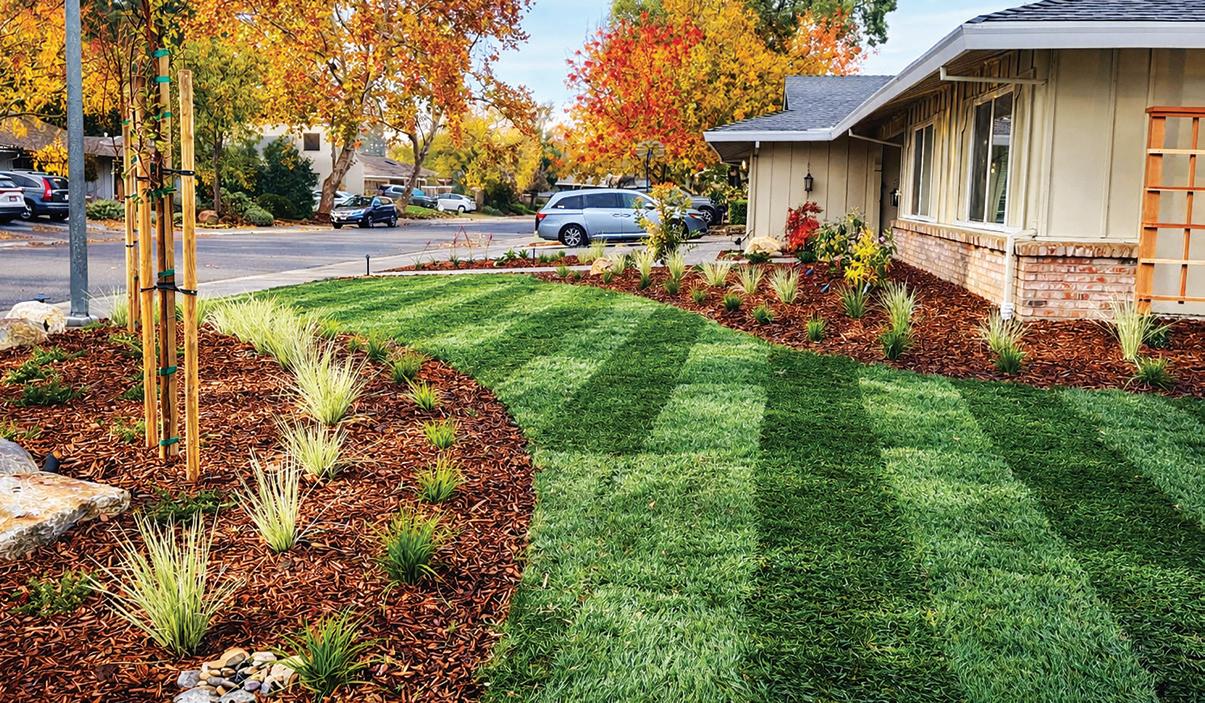
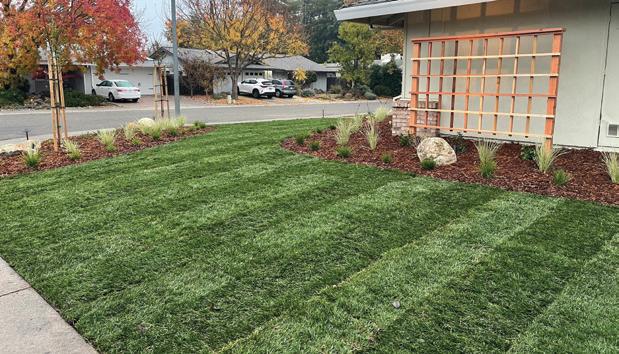
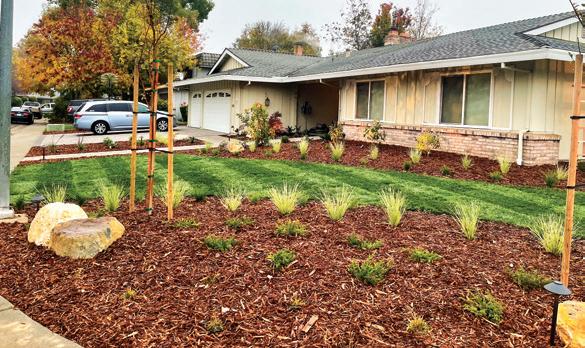
The updated planting palette prioritized drought-tolerant species while preserving a generous front lawn at the homeowner’s request.
Initially focused on maintenance, the company transitioned into design-build work in the early 2000s. Anderson briefly partnered with a friend to help navigate larger install projects before ultimately taking full ownership of the business and continuing to grow it organically.
Today, nearly 25 years later, TurfWorks, Inc. routinely delivers six-figure residential landscape projects, including a recent $125,000 renovation of a prominent home in the Stonegate community.
A LANDMARK HOME IN STONEGATE
The 2,000-square-foot single-story home was built in 1973 as part of the original Stonegate development, created by local developer Al Smith. Smith, who also owned a home in the neighborhood until his death in the early 2000s, developed approximately 1,000 homes surrounding a 17-acre manmade water feature known as Stonegate Lake.
According to the homeowner, Smith took inspiration from Westlake Village in Southern California, a master-planned community centered around a 150-acre manmade lake straddling the Los AngelesVentura County line.
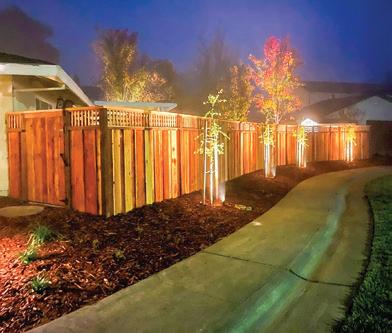
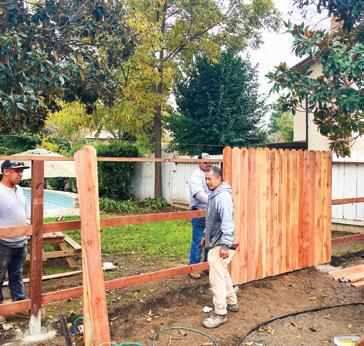
Updated fencing added texture and visual depth to the front yard.
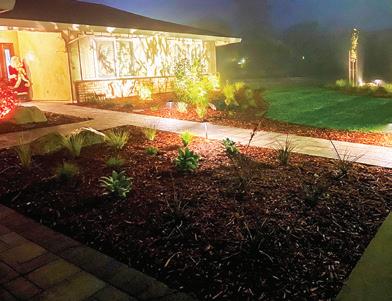
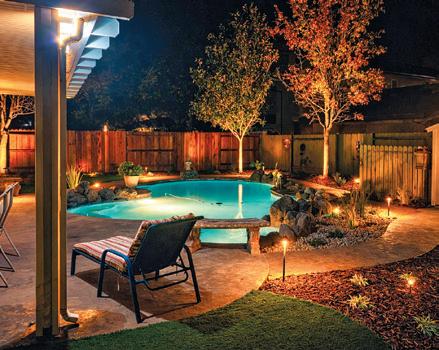
Extensive low-voltage lighting was installed throughout the property.
A former 1973 Stonegate model home, the residence has been reimagined with a modern landscape design that enhances its highly visible corner-lot presence. Completed in December 2025, the project stands as a testament to collaboration, craftsmanship and community integration.
The residence originally served as a model home for the development and has held a visible role in the neighborhood for decades. It has functioned at times as a polling place and as a gathering location for annual neighborhood events.
Located at the top of a cul-desac on a corner lot, the fourbedroom, two-bathroom residence occupies one of the most prominent positions in the community. A pool and spa were added years after the home’s original construction.
The property is part of a homeowner’s association governed by an architectural committee that must approve all exterior modifications prior to construction. Quarterly HOA dues include access to the Stonegate Country Club, a multiuse facility on the lake that features a clubhouse, ballfield, fitness center, three pools and other amenities.
A previous landscape improvement, limited to the backyard, was completed in 2015 by Mark Carroll, who also performed a major landscape renovation at the Stonegate Country Club in the late 1990s.
HOA COORDINATION AND NEIGHBORHOOD BUY-IN
Before beginning construction, the homeowner, a former president of the Stonegate HOA, submitted detailed landscape plans to the HOA management company. The architectural committee approved the project the same week.
Travis Milner, entrepreneur and co-founder of the ComediansToGo.com entertainment booking service, also serves as volunteer president of the Stonegate Homeowners Association in West Davis. He also happens to live on the same street as the home that underwent the landscape renovation. Milner states that the approval process was smooth and consistent with the community’s standards. “As a neighborhood of about 1,000 homes, we don’t get
too involved in people’s yards and homes and the upkeep, but we do approve plans for major work, and we ask that people submit plans to a committee,” Milner said. “Landscaping definitely falls into that category. We probably get two or three plans a month to approve.”
Milner noted that many homes in Stonegate have transitioned toward xeriscape or reduced-lawn designs in response to water conservation trends. With any major project, he said, there can be concerns about neighborhood impact, aesthetics and construction timelines.
“In this case, the design was very thoughtful,” he said. “There’s always some concern about neighbors — how it’s going to impact them, the look of the neighborhood, as well as the length of the project. This is one project that went very well and we’re extremely happy with the final outcome and the look.”
To further maintain goodwill, the homeowner distributed fliers
to nearby neighbors and posted one on a light pole in front of the property. The flier outlined the scope of work, anticipated schedule and potential disruptions, including tree removal, grading, construction noise and material deliveries. Renderings of the finished design were also included.
“It is certainly an extra step that is not required,” Milner said, “but effective communication makes for a smooth process when everyone is aware. You never know, someone might be doing a project at a similar time, or worried about kids biking to and from school. That always goes a long way toward making everyone feel comfortable.”
According to Milner, the construction activity even brought a sense of energy to the quiet culde-sac.
“With this particular project, a lot of people came out to watch it happen, talked to the owners, talked to the crew,” he said. “That led to conversations with neighbors doing similar things with their own
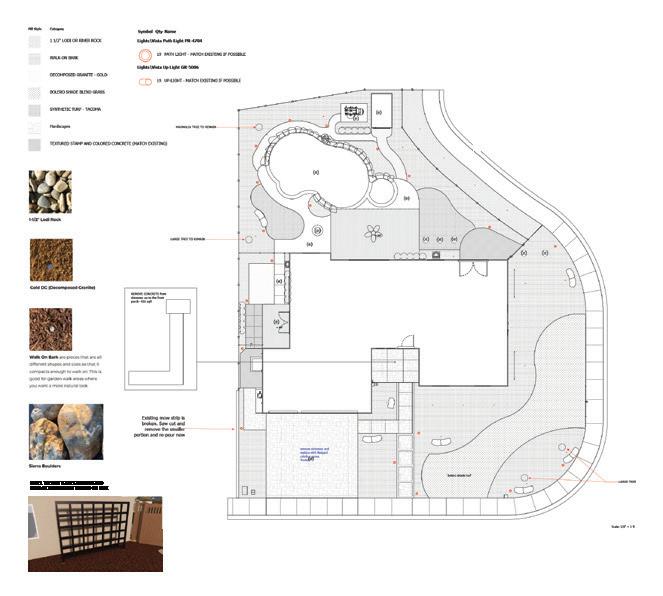
Above: Detailed plans and proactive communication helped ensure smooth HOA approval and strong neighborhood support throughout construction.
yards. We had a hands-on view of what it’s like to go through that construction phase, but also ideas around design. Everyone was very well-informed, and that made for a smooth project.”
Now that construction is complete, Milner said the transformation reflects the evolution of the neighborhood itself.
“We live in a neighborhood that dates back to the early 1970s,” he said. “Over the years, watching homes get updated, the landscaping is probably what has changed most. It was fascinating to watch. And in talking to the homeowners, I had no idea the project also involved a significant redo of the backyard, so that was exciting to see afterward as well.”
A COMPREHENSIVE EXTERIOR UPDATE
When TurfWorks, Inc. began work in September 2025, the landscape reflected decades of natural growth and earlier improvements. While the property
had a strong layout and mature elements, the homeowner was ready for a comprehensive update that would better match the home’s prominence within the community.
“My impression was that he wanted something that would really be impressive,” Anderson said. “Something meaningful that could be enjoyed every day.”
Work began with selective clearing. Approximately a dozen trees, primarily overgrown or poorly positioned species, were removed to open sightlines and reset the design framework.
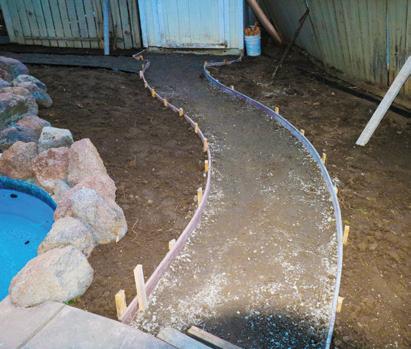
The backyard remained largely intact due to the existing pool, though concrete areas were refreshed and pathways improved to enhance circulation and usability.
The front yard, however, underwent a full transformation.
Initially, plans called for replacing only the walkway while leaving the driveway intact. Anderson encouraged a more unified approach.
“You’re just going to have this one older element in an otherwise
fully updated project,” he told the homeowner.
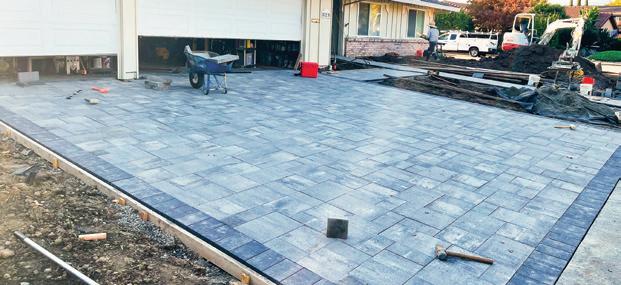
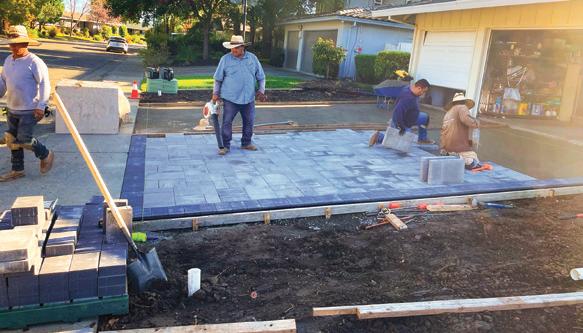
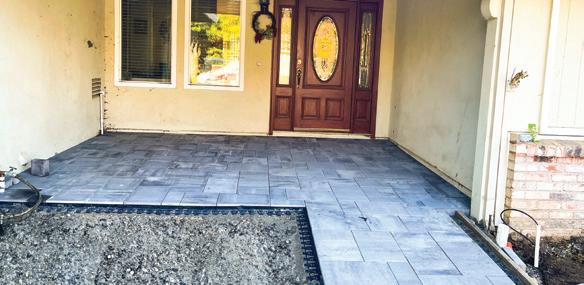
The decision was made to completely renovate the driveway and front hardscape with Belgard pavers, dramatically elevating curb appeal and cohesion.
“Sometimes people stop halfway, like leaving the driveway, and it really diminishes the effect,” Anderson said. “Taking it all the way made a huge difference.”
Additional work included decomposed granite pathways, trellis-style wood features, replacement of roughly half the fencing and extensive low-voltage lighting throughout the property.
CONTEMPORARY PLANTING AND EFFICIENT IRRIGATION
The planting design emphasized texture and structure over heavy floral color. Many selections were drought-tolerant, though the homeowner requested a substantial front lawn, which was incorporated into the design.
Above: Belgard pavers replaced the aging driveway and walkways as part of a complete renovation that unified the home’s exterior design, creating a cohesive, elevated front entry and significantly enhancing curb appeal.
“Color came more from foliage than flowers,” Anderson said. “A lot of grasses and plants with different leaf textures and tones.”
Given the corner lot’s size, mass plantings were used for impact without visual clutter.
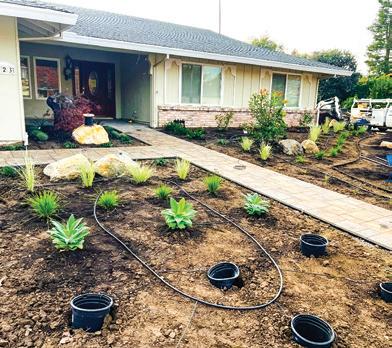
All irrigation was replaced. Turf areas received pop-up spray heads, while planting beds were served by drip irrigation. The system included six or seven valves and utilized Rain Bird or Hunter components, with Hunter controllers preferred.
EQUIPMENT THAT DELIVERS
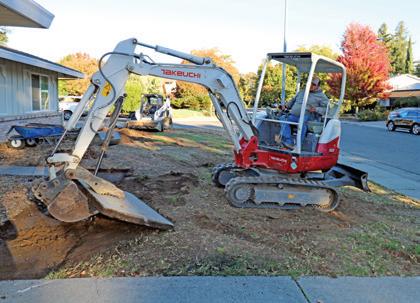
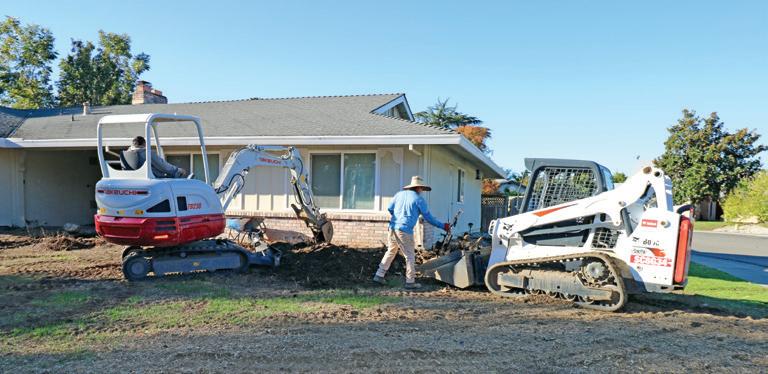
TurfWorks, Inc. owns its equipment fleet, which includes multiple Bobcat mini excavators, a mid-size Takeuchi excavator, a Bobcat MT52 mini track loader, a larger Bobcat track loader and a skid steer.
On the Stonegate project, larger machines worked to remove root
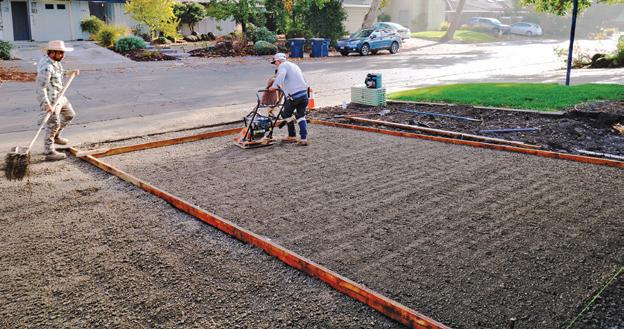
balls after tree clearing to prevent future trenching complications. Track loaders handled soil preparation, while mini excavators performed trenching and detailed grading.
“The mini excavator is a Swiss army knife,” Anderson said. “We made great use of it on this project and just about every job we take on.”
BUILT ON LONGEVITY
TurfWorks, Inc. employs approximately nine field staff, many of whom have been with the company for more than 15 years.
For the Stonegate project, Anderson alternated between two four-person crews and a single eight-person crew depending on the phase of work.
“My guys are very efficient,” he said. “It makes life very easy for me and our clients.”
A DREAM PROJECT
Construction wrapped up in early December 2025. Anderson said the project stands out for its dramatic transformation and strong collaboration between contractor, homeowner and HOA.
“This was a dream project for both our client and our company,” he said. “It’s the kind of work you hope for in this business, and we truly appreciate the trust the client placed in us throughout the process.”
CL
Above and Below: Turfworks’ fleet of mini excavators and track loaders handled tree removal, trenching and precision grading throughout the project.
Above: New fencing, granite pathways and custom lighting introduce warmth and structure to the redesigned backyard landscape.
THE QUAD AT SADDLEBACK:
A TIMELESS CAMPUS VISION REALIZED THROUGH COLLABORATIVE DESIGN AND CONSTRUCTION
By Brian Hoover, Editor / Photos provided by Icon-West and Architect, Kimley-Horn
When Saddleback College set out to revitalize its central quad, the goal was far more ambitious than a surface-level improvement. Years of incremental development had left the campus core with disjointed pathways, mismatched paving, and a lack of cohesive identity. It functioned, but Saddleback College was looking for a design that would better reflect the spirit of a modern higher-education environment. What the college needed was a complete re-imagining of one of its most important outdoor spaces. That transformation began with landscape architect Michael Ledbetter of Kimley-Horn, whose team was tasked with bringing clarity, flow, and purpose back to the quad. “The area had become
a patchwork of decades of construction,” Ledbetter explained. “The area did not connect well to its surrounding facilities. It didn’t feel unified, and it didn’t guide people the way a true campus heart should.”
Although Ledbetter joined Kimley-Horn three and a half years ago, the project’s origins date earlier. Design studies began around 2020–2021, when the quad was still tied to a broader campus ADA-improvement package.
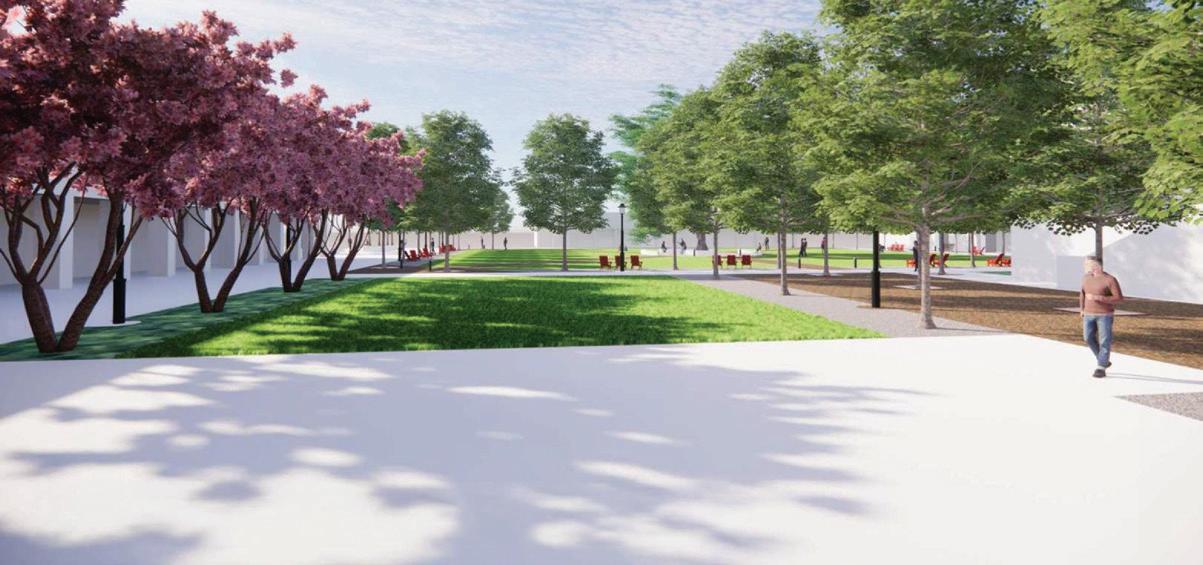
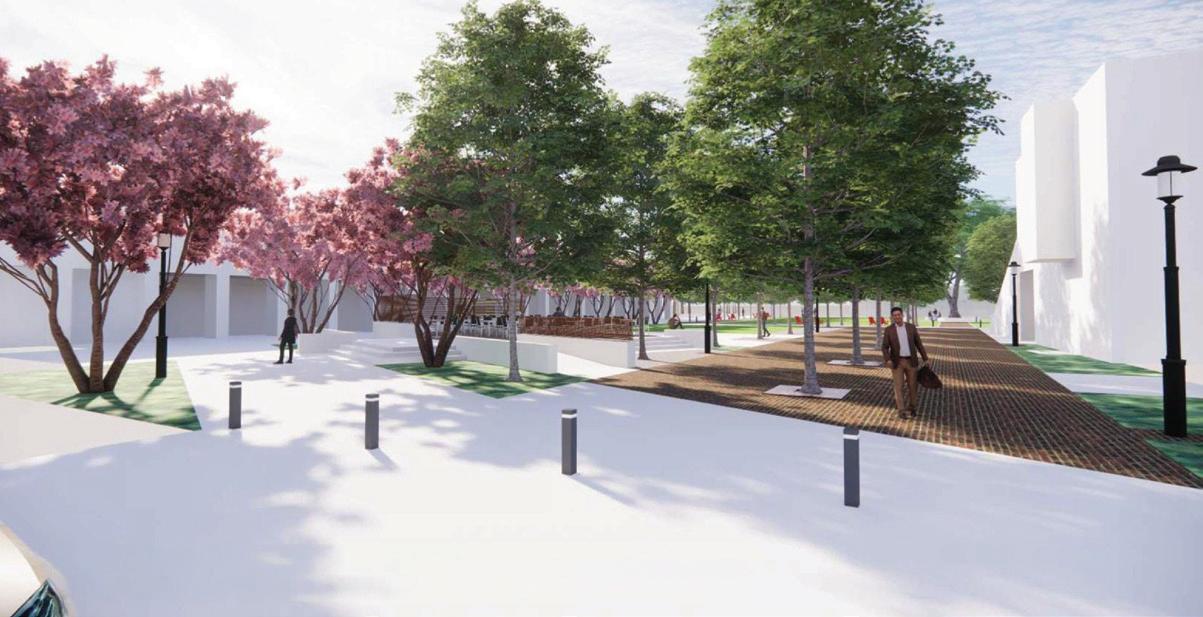
3-D rendering from design development phase. View from elevated dining patio / stage.
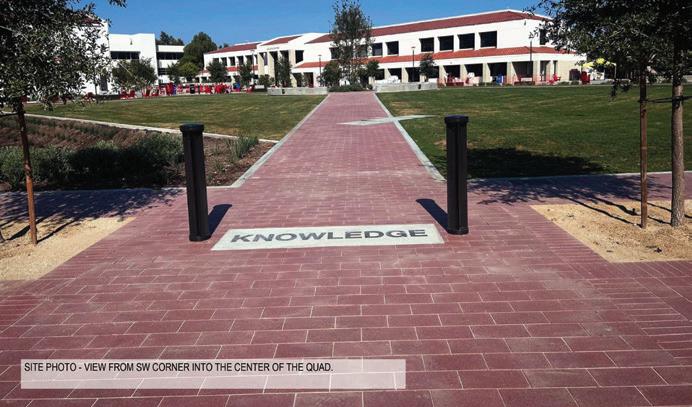
Site photo - view from SW corner into the center of the quad.
But as soon as the design team evaluated the site, it became clear that the area deserved its own focused effort. “When we showed the college just how much of the quad needed ADA work, it shifted the conversation,” Ledbetter said. “It became obvious this wasn’t just a few adjustments. It was an opportunity to redefine the entire space.”
The project was delayed multiple times as Saddleback sequenced large capital improvements elsewhere on campus, including reconstruction of major academic buildings and the addition of a new
gateway facility. By the time the quad broke ground in summer 2024, the design team had spent years refining a vision that balanced timelessness with function. Substantial completion arrived by May–June 2025.
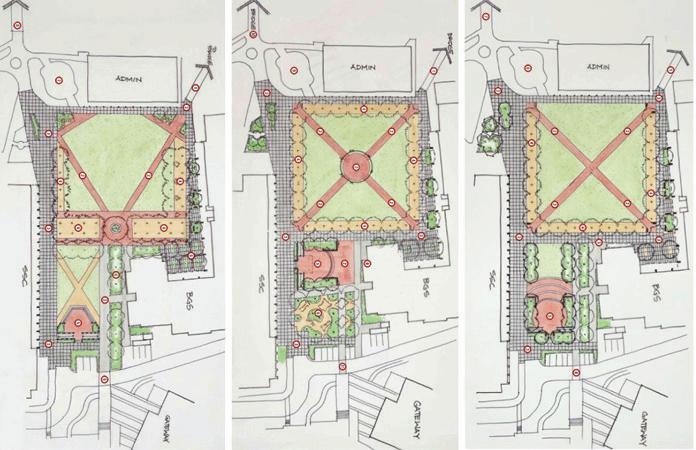
From the beginning, Saddleback’s leadership imagined a classic campus quad, simple, symmetrical, and enduring. Kimley-Horn explored several configurations, including more modern geometric solutions, but the college gravitated toward a traditional square. The challenge, however, was that the surrounding
buildings were not parallel, which created awkward angles. “We had to design a space that felt perfectly ordered while still respecting the reality of the site,” Ledbetter said. “The central square gave us the structure we needed, and then the surrounding walkways transition into the angled geometry of the campus. It creates this beautiful harmony between old and new conditions.”
Materials played an equally important role in establishing unity. The college had admired the red interlocking pavers KimleyHorn previously used in the Fine
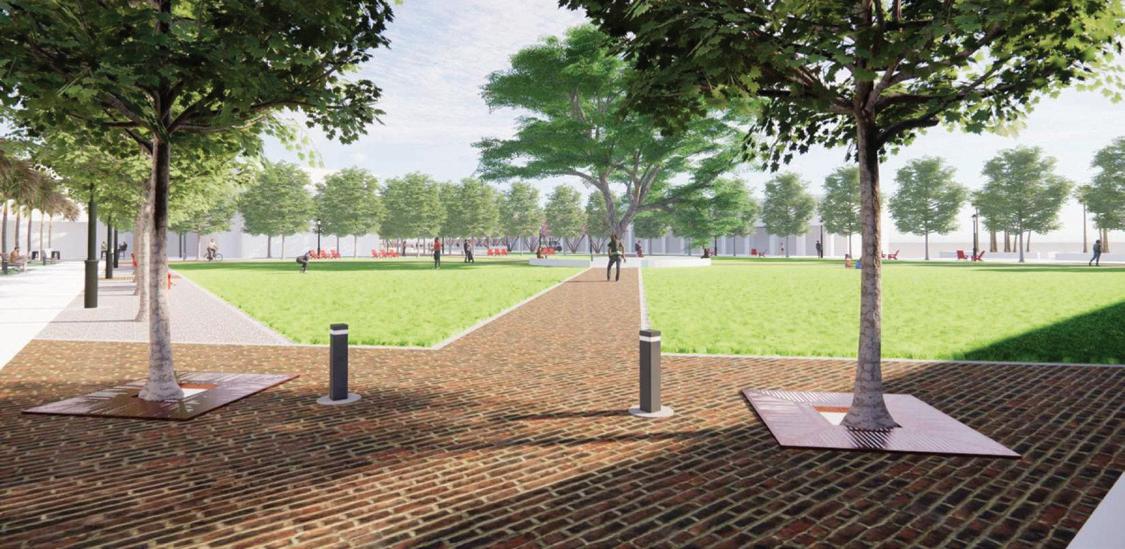
3-D rendering from design development phase. View from gateway building down main axis.
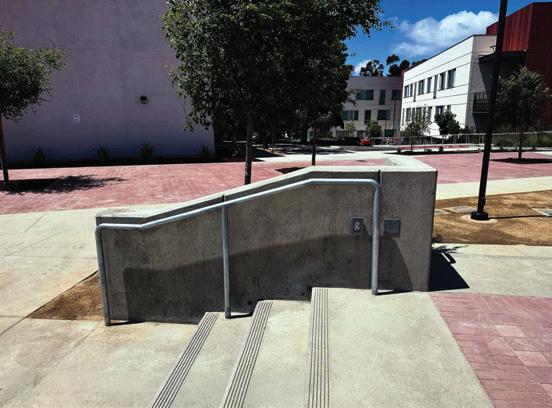
Site photo - view of handrail detail, top of wall is raked to hide the handrail from view, corner of pavers and wall aligned.
3-D render from design development phase. View from SW corner into the center of the quad.
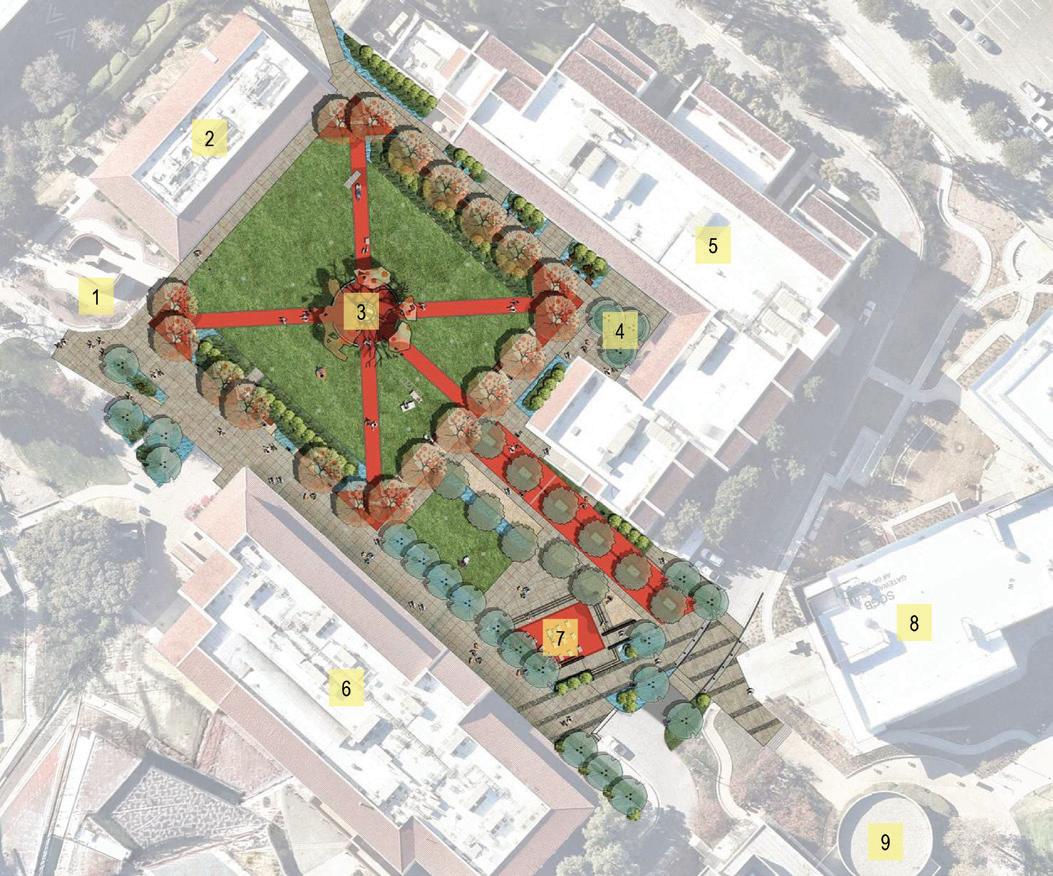
Site Plan - Final Rendering Veteran’s Memorial Administration Building Central Gathering Seating Area BGS Bldg. Student Services Bldg. Elevated Dining Patio / Stage Gateway Bldg. Health & Science Bldg.
Arts Plaza, so those became the signature paving material for the quad’s main corridors. Surrounding surfaces incorporated natural gray concrete and decomposed granite, creating a clean and costeffective palette that supported both circulation and aesthetics. The quad’s open turf area was intentionally preserved as a flexible gathering space. “Students need places to sit, lounge, study, play, and a real lawn gives them freedom,” Ledbetter noted.
A defining feature of the new quad is its signature tree, a mature multi-trunk oak selected specifically to anchor the space. Finding it required a lengthy search through multiple nurseries until Icon West’s
Three site plans from schematic design phase showing some of the options that were considered when trying to finalize the geometry of the quad.
landscape subcontractor located the perfect specimen at a tree farm in Ojai. The 96-inch box oak was brought to campus and installed as the quad’s central landmark. Additional oaks were planted along the perimeter, forming a canopy that will grow increasingly dramatic with time. “Twenty years from now, this whole space is going to be under shade,” Ledbetter said. “That was a big part of the longterm vision.”
Students also played an active role in shaping the design. They requested seating, outdoor dining, and charging stations for laptops and phones, features that reflect the all-day lifestyle of today’s campus environment. The final plan included seating terraces, wood-clad concrete benches with integrated charging, and an elevated dining area connected to a future cafeteria. “The college really wanted to give students a place to feel anchored,” Ledbetter explained. “Somewhere inviting, somewhere to stay, not just pass through.”
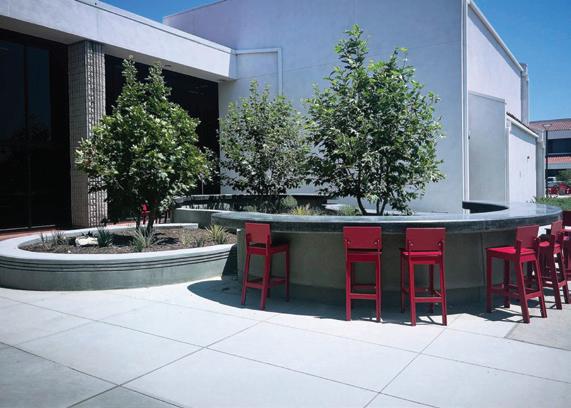
One of the most distinctive hardscape elements is the figureeight shaped raised planter located along the edge of the quad. Originally designed as cast-inplace concrete, it evolved through
collaboration between the designer and the construction team. “Icon West suggested that a block-andplaster approach might simplify fabrication while achieving a similar look,” Ledbetter said. “That kind of feedback is invaluable. It makes the final product better.”
Once construction documents were complete and approved, the project went out to bid, and Icon West was selected as the general contractor. Already working elsewhere on the campus, the firm brought a deep understanding of Saddleback’s logistics and rhythms. Icon West is widely regarded for its steady, detail-driven approach to complex public projects and for fostering a culture where communication, accountability, and professionalism guide the workday. The firm’s crews are known for being handson, responsive, and genuinely invested in maintaining strong relationships with clients, designers, and subcontractors. “A project like this only succeeds when everyone is aligned. The college, the design team, our field crews, and the subcontractors all approached it with a shared sense of purpose, says Ed Segovia, Vice President, Icon West. “That spirit
of partnership is what made the quad such a success.”
Segovia points out that IconWest served as the general contractor on this project. “We subcontracted the landscape work to Rey Art Landscape, Inc. who installed all of the plant material, the turf, trees (including the signature 96” box oak tree), the irrigation and other softscape elements,” explains Segovia. “The concrete and hardscape installation was subcontracted to Ramirez Concrete, who installed the walkways and other paving elements. They also performed the cast-in-place concrete features, the raised planter and seat wall structure and the hardscape connections surrounding the quad. Both Rey Art Landscape and Ramirez Concrete did a great job and were instrumental to the success of this project.”
Jeff Wright was the Superintendent and Project Engineer running the field operations and handling the engineering and paperwork side of the Saddleback Quad project. “My wife and I both attended Saddleback College, so working on this project felt very close to home. Seeing what we turned this space into, and knowing
3-D rendering from design development phase. View from SW corner into the center of the quad.
future generations will enjoy it, was incredibly rewarding,” says Wright. “The biggest challenge was working around existing and often unknown conditions. The quad area had been modified several times before, so we encountered unlocated utilities and unforeseen conditions that required constant adaptation.”
That collaborative spirit proved essential on an active campus where construction had to blend seamlessly with student life. Icon West carefully coordinated movement of equipment, concrete pours, material deliveries, and grading operations around class transitions and high-traffic periods. Their field teams communicated daily with the campus and design staff to ensure that work progressed without disrupting students. The professionalism of the crew, combined with their calm, organized approach, helped keep the project on schedule even as challenges arose. “Building in the center of an active campus requires precision. We had to schedule our work around class changes, manage heavy equipment movement carefully, and always keep student and faculty safety at the forefront,” continues Segovia. “It demanded strong communication and coordination every single day.”
Wright remembers his days on campus and what the quad
represented in those days. “Before, the quad was really just a passthrough space. Now it’s a place where people can gather, spend time before and after class, and actually connect; it’s become the heart of the campus,” continues Wright. “Our subcontractors really stepped up. Despite design changes, weather impacts, RFIs, and existing conditions, everyone worked hard, adapted quickly, and stayed focused on delivering a quality finished product.”
Unforeseen utilities and other typical renovation surprises required the team to collaborate quickly and creatively, but both Icon West and Kimley-Horn emphasized that the project transitioned smoothly from design to installation. “Like any modernization project, we encountered existing conditions that didn’t match the drawings,” says Segovia. “Our priority was to team up with the college and the design group, solve each issue quickly, and keep the project moving without disruption.” Many of Icon West’s subcontractors were already working on another project on campus, which created continuity in manpower, scheduling, and on-site familiarity.
From the earliest concept sketches to the final planting, the shared commitment between Saddleback, Kimley-Horn, and Icon West shaped the outcome. “This project only worked because everyone was invested in the same goal,” Ledbetter said. “The campus leaders, the construction team, the subs, everyone wanted this space to feel important. And it does.”
As the quad opened, students and faculty immediately responded to its simplicity, clarity, and comfort. Movement now feels intuitive, with pathways that guide rather than confuse. The open lawn invites gathering and reflection, while new seating areas and shade trees create a welcoming outdoor living room for the entire campus. “Seeing students and faculty using the quad the way it was intended is incredibly rewarding,” concludes Segovia. “The positive feedback from the campus community really affirmed the effort that went into this project.” Icon West’s senior leadership noted that the project’s success was rooted in partnership, a quality the company views as foundational to its work. Their steady leadership and respectful collaboration helped the quad become not just a construction project, but a meaningful campus renewal.
What began as an ADA upgrade evolved into one of the college’s signature improvements: a timeless quad built with intention, crafted through teamwork, and designed to serve future generations of students. “It’s incredibly rewarding to see it come to life,” Ledbetter said. “We designed it for the long view—and now it’s ready for the next chapter of Saddleback College.” CL
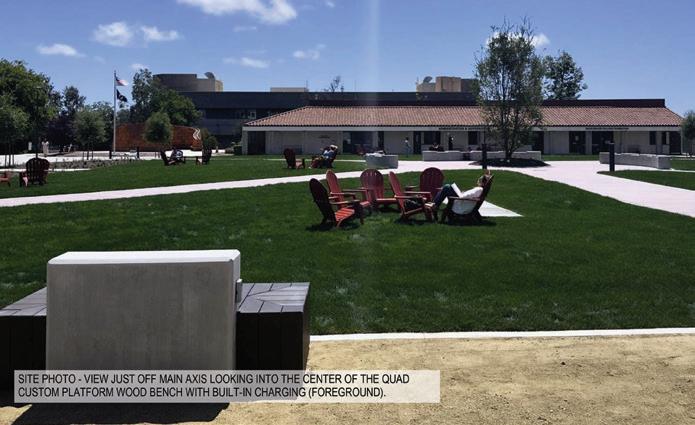
Site photo - view just off main axis looking into the center of the quad custom platform wood bench with built-in charging (foreground).