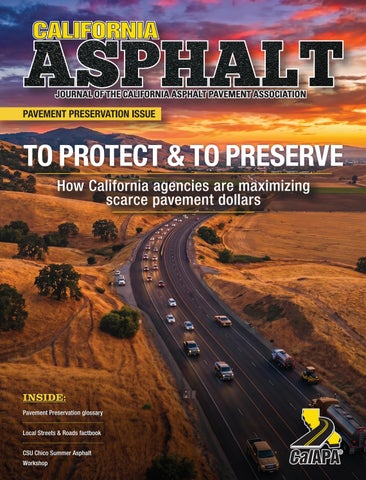
California Asphalt Magazine - 2026 Pavement Preservation
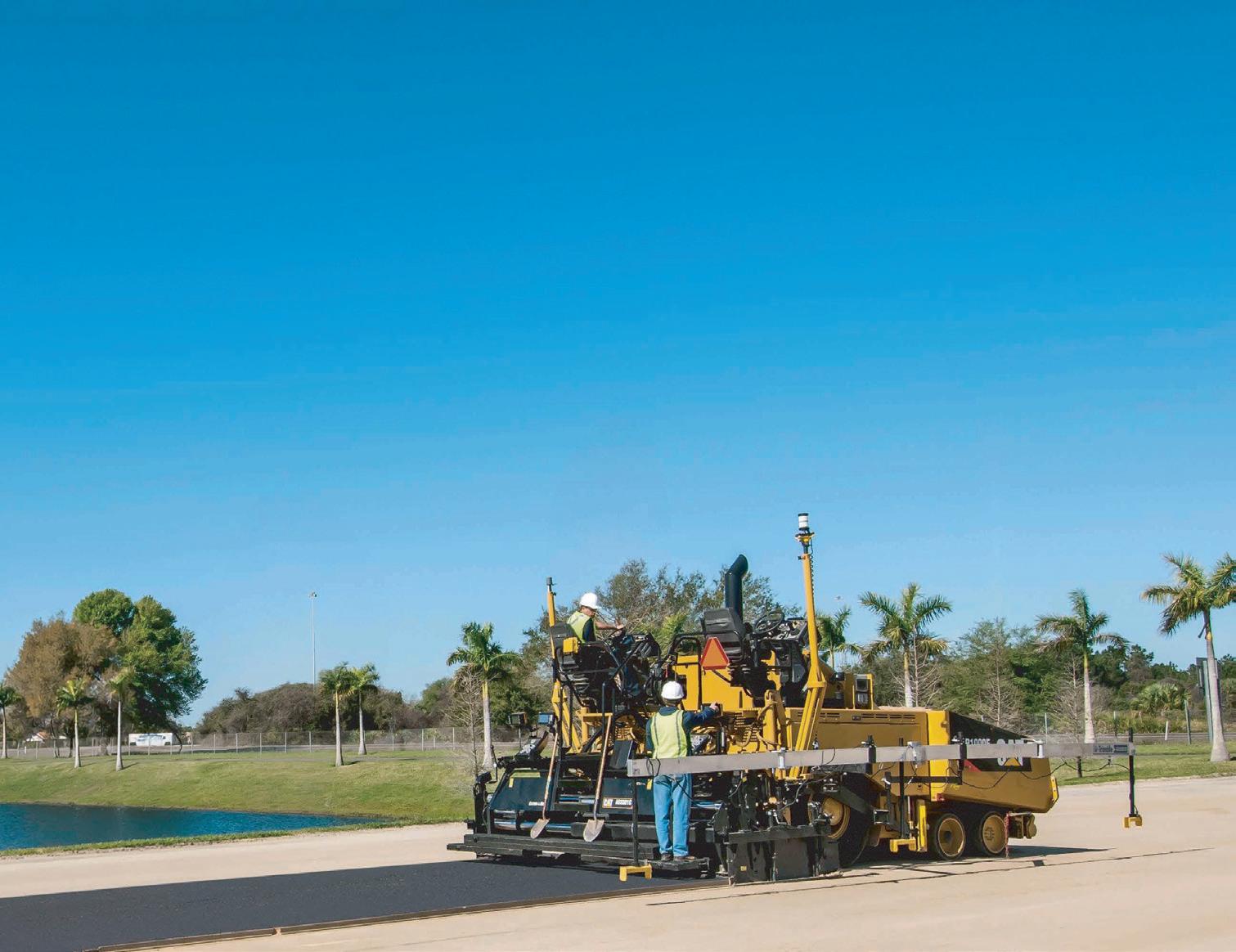
Own, operate and maintain your Cat® equipment easier – right from your phone.
Are you ready for a simpler equipment experience? Then you need the Cat® Central app. Add what you own in seconds by scanning the QR code. You’ll unlock tailored resources and tools that make owning, operating, maintaining and shopping for your equipment easier. Troubleshoot fault codes, pull regular service instructions or maintenance schedules and match with genuine Cat parts guaranteed to fit. Plus, instantly chat with expert support any time of the day or night. From daily checks to last-minute orders, access to all this and more is yours in one powerful app.
The Cat Central app. Backed by your California Cat dealer and made for the way you work, you’re all systems go.
BUILT FOR ASPHALT. READY
Publisher’s Letter
Innovation based in sound science & engineering
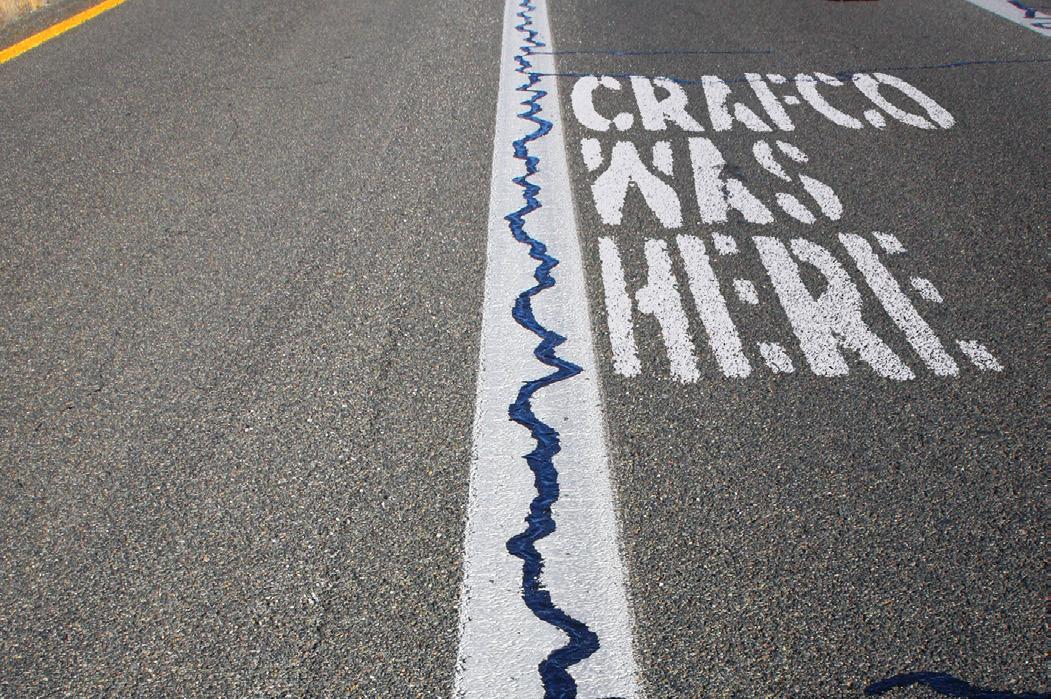
As we mark some significant milestones this year, namely the 100th anniversary of Historic Route 66, and the 70th anniversary of the interstate highway system, I am reminded of all the innovation that has taken place over the years to make today’s asphalt pavements longer-lasting and more cost-effective than ever. It’s no wonder asphalt covers about 95% of paved surfaces in California and across the nation. That in of itself is worthy of celebration!
But our industry is not one to rest on our laurels. Listening to and responding to the needs and expectations of our customers, the owners of those pavement assets, we are constantly exploring ways to incorporate new technology, new formulations and best practices to deliver the best and most economical product possible, and to help those owners maintain those assets in a cost-effective manner. Many of those innovations have been profiled in this magazine.
At CalAPA, innovation and investing in this research is woven through our strategic plan and results in prominent activities on display every day. Elsewhere in this issue, for example, we report on the annual Summer Asphalt Workshop put on by California State University, Chico in cooperation with the American Public Works Association Sacramento Chapter. CalAPA once again was pleased to support the workshop by having our Director of Technical Services, Brandon Milar, P.E., deliver a technical presentation during the program. CalAPA’s charity, the California Asphalt Research & Education (CARE) Foundation, also supported the workshop by providing lunch to attendees, who represented colleges from around the state. Chico State, it should be noted, is also home to the Pavement Preservation Center (CP2 Center), a collaboration between the state university campus and Caltrans, and supported by many CalAPA members. Research and tools developed by the CP2 Center continue to be deployed and are in widespread use today, justifying these forward-looking investments.
Our association also supports many other worthy causes to help elevate our industry, and the workers in it. A few that come to mind are our ongoing engagement with the University of California Pavement Research Center (UCPRC), our ongoing collaboration with Caltrans on new specifications and test methods via the Caltrans-industry Pavement & Materials Partnering Committee (PMPC), and of course our longstanding support for the Caltrans-industry Joint Training & Certification Program (JTCP), which is run out of Cal State Long Beach and San Jose State University.
Finally, our association contributes to pooled funds to support research done on the national level in coordination with the National Asphalt Pavement Association (NAPA), the Asphalt Institute, the State Asphalt Pavement Associations (SAPA) federation, and the jointly funded Asphalt Pavement Alliance.
No other industry can boast this tight integration of all of these efforts to ensure that there are many practical applications for all this new knowledge that is coming on scene. This commitment and alignment ensures that we are always on the cutting edge of innovation, that we are learning about what works and what doesn’t, and that we are deploying that knowledge for the benefit of our ultimate customers, the pavement owners, taxpayers and transportation system users. That’s not a destination to be reached but rather a journey of continuous improvement that we all can be proud of.
Sincerely,
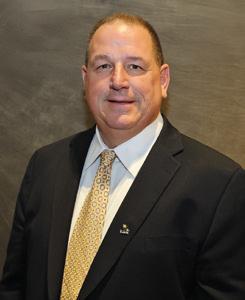
Scott Metcalf Ergon Asphalt & Emulsions Inc.
Local agencies seek to achieve maximum benefit from scarce pavement maintenance dollars
Some common terms used in pavement maintenance and pavement preservation About California’s city and county road network
learn about asphalt pavements (and careers) at summer workshop at CSU Chico
2026 CalAPA Board of Directors
Frank Costa (Chairman) Martin Marietta
Chris Gerber (Vice Chair) G3 Quality
Scott Bottomley (Treasurer) Sully-Miller / Blue Diamond Materials
Please visit the link below or scan the QR Code. https://www.calapa.net/contact-us.html
◊
◊
◊
To Protect and to Preserve: Local agencies seek to achieve maximum benefit from scarce pavement maintenance dollars
By Russell W. Snyder
Anyone who remembers the old TV show “Dragnet,” or countless depictions of the Los Angeles Police Department since, the phrase “To Protect and To Serve” may sound familiar. It has been the official motto of the police department since the motto was adopted by the Los Angeles City Council in 1963, and the words are printed on the side of every squad car and featured in countless LAPD communications.
The phrase was the inspiration of this issue of California Asphalt magazine because, similar to the mission of the police department, public works officials across
California – and indeed the nation – have a mission to protect and preserve the thousands of miles of pavement assets in their care. They don’t have unlimited funds, so optimizing those investments is at the forefront of every decision, and every dollar spent, with regard to pavement assets.
Virtually every week in California, some public works director is appearing before a City Council or County Board of Supervisors explaining the current condition of the pavement assets in the jurisdiction, and what is being done to keep those streets safe and in a reasonable state of good repair.
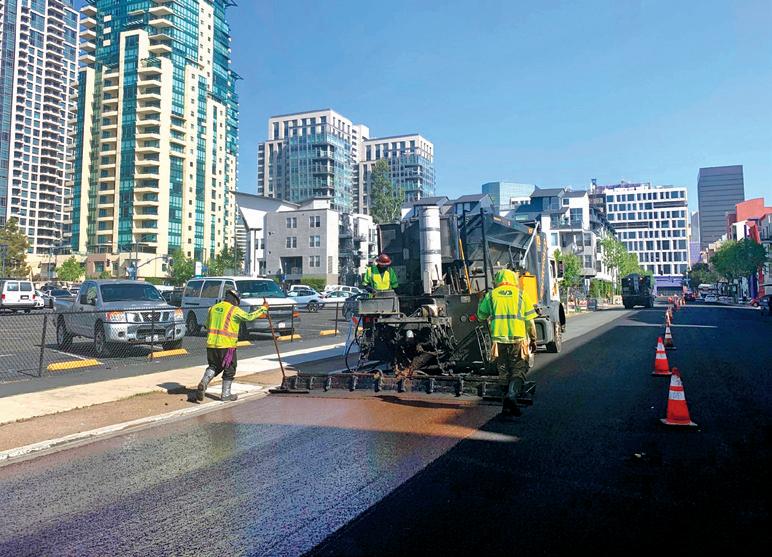
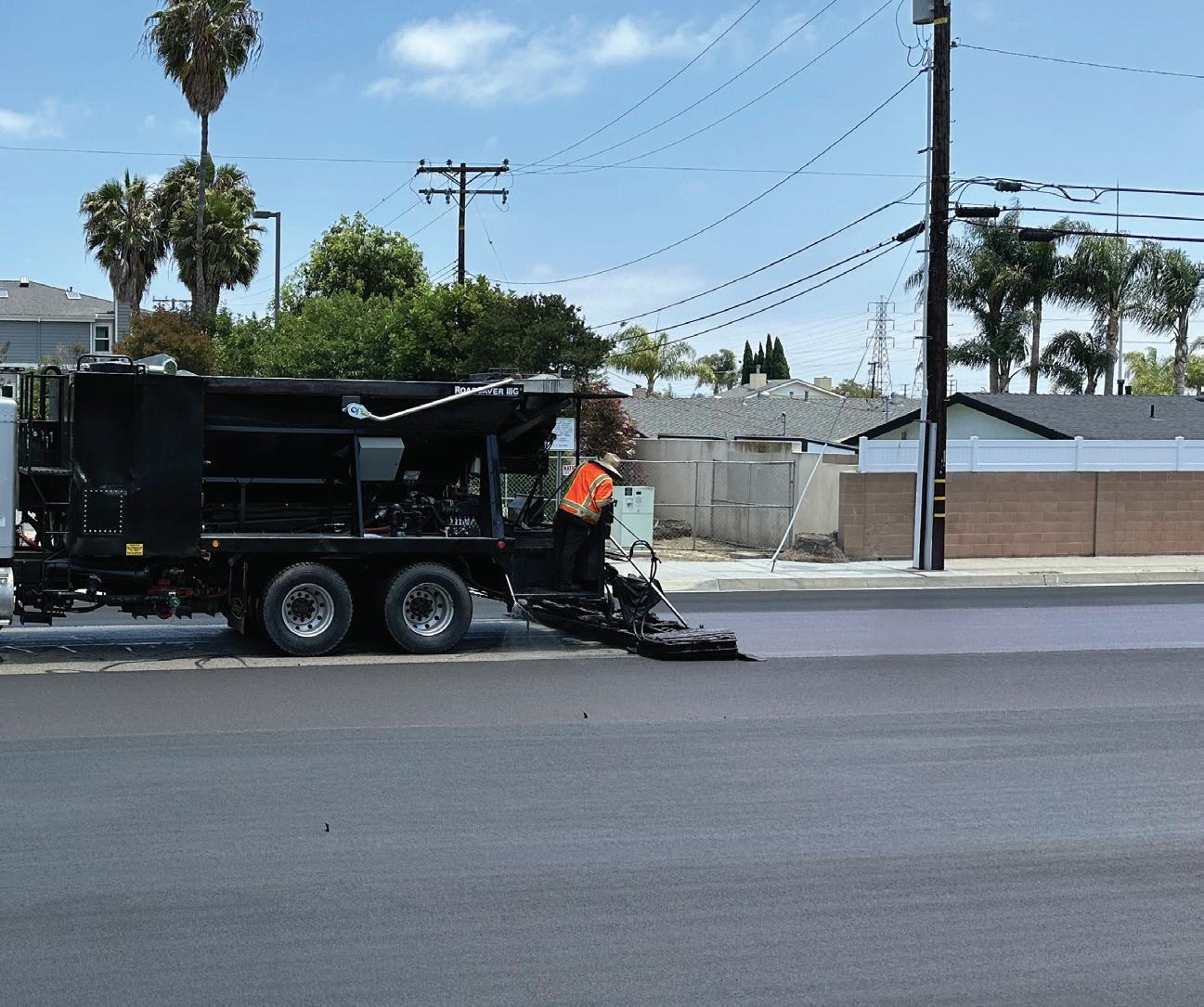
VSS International’s team places a rubber-polymer modified
various
A few examples that have occurred in recent weeks:
• The Santa Cruz Board of Supervisors recently heard that the county faces a $23 million annual shortfall for road resurfacing, risking a PCI drop from 57 to 36 in 10 years. “We need to think strategically about how we deploy new revenue streams within this framework,” Steve Wiesner, assistant director of the Santa Cruz County Community Development & Infrastructure Department, told the supervisors during a June 30 meeting.
• Hearing a report on June 30 at a San Benito County Board of Supervisors meeting about road-improvement projects that were planned but never undertaken, Supervisor Angela Currow said tersely, “We’ve made promises and promises are not being fulfilled.”
• In Lake County, with some of the roughest roads in the
slurry seal at
locations in downtown San Diego, including the Gaslamp District.
state, Public Works Director Lars Ewing faced uncomfortable questions at a Board of Supervisors meeting June 23 about how to get the overall condition of the city’s streets headed in a better direction. He said he hoped current pavement preservation activities “will get us on the path to a better PCI.” In his county, that means treating 35 miles of streets with a goal of getting to 50 miles. Everyone acknowledged, however, that the overall street conditions were nowhere where they wanted them to be, prompting a member of the public to comment, “(Public Works Director) Ewing has an almost impossible job, and I appreciate the challenge that he has to do so much work with such limited resources.”
Indeed, keeping streets from falling apart is not always easy given multiple municipal priorities and scarce tax dollars. Yet as the go-go population growth years of California increasingly seem to be in the rearview mirror, upkeep of the state’s essential transportation infrastructure is more important
than ever given the clear link between safe and efficient transportation and the economy and quality of life in California.
The authoritative publication on this topic for local governments is produced approximately every three years and is jointly sponsored by the California State Association of Counties (CSAC) and the League of California Cities, which is commonly referred to as simply “the League.” The other sponsors of the report are the Rural Counties Task Force and the Regional Transportation Planning Agencies. The report is produced under contract by a consulting firm, NCE, based in Port Richmond, California.
The April 2023 report drawing upon 2022 data, sketched out a grim assessment of how local streets were holding up under the strain of increasing traffic, reduced maintenance budgets and the inevitable march of time. The report also called out the importance of pavement preservation concepts in the overall strategy to maintain those pavements:
To use taxpayer money wisely, it makes more sense to preserve and maintain roads in good condition than to wait and
repair or replace them when they deteriorate or fail. The estimated costs reported in this study are based on improving roadway pavement condition to meet best management practices (BMPs). At BMP conditions, preventive maintenance treatments (i.e., slurry seals, chip seals, thin overlays) are most costeffective. In addition to costing less, preventive maintenance interferes less with commerce and the public’s mobility and is more environmentally friendly than rehabilitation or reconstruction.
The importance of this approach is significant. As roadway pavement conditions deteriorate, the cost to repair them increases exponentially. For example, it costs as much as 14 times more to reconstruct a pavement than to preserve it when it is in good condition. Even modest resurfacing is 4 times more expensive than maintaining pavement in the BMP condition. To put it another way, 14 miles of roadway can be maintained in a BMP condition for the same cost as reconstructing 1 mile of failed
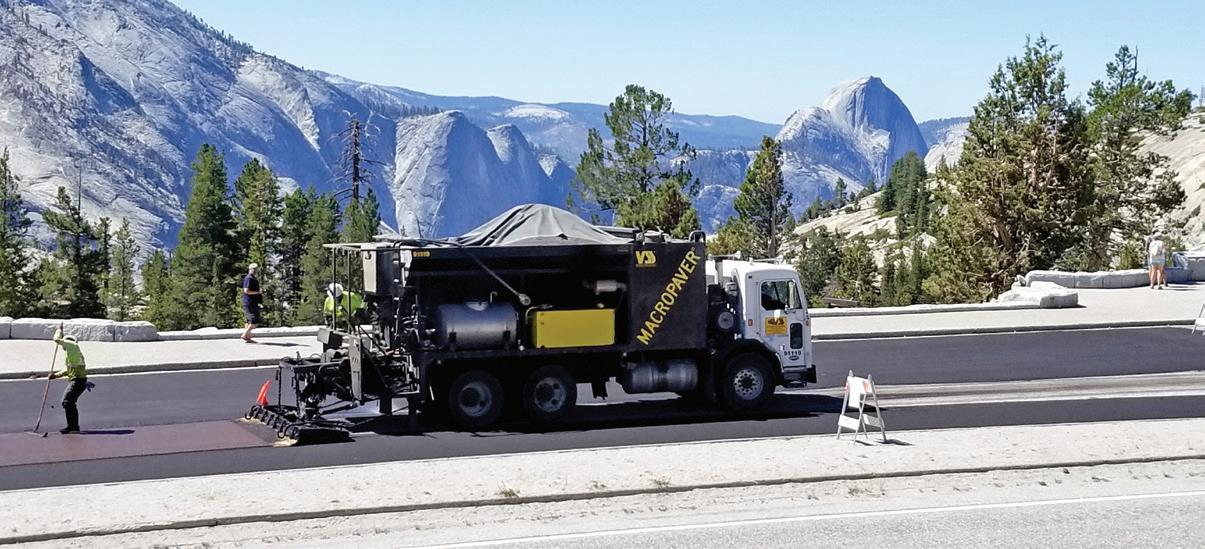
Crews complete Type II microsurfacing at Olmstead Point Parking Lot - elevation 8,141 feet.
pavement. By bringing the local roadway system to BMP condition, cities and counties will be able to then maintain streets and roads at the most costeffective level. This outcome is not only optimal, but also necessary.
Later in the report it states:
The goal is for pavements to reach a condition where BMPs can occur, so that only the most cost-effective pavement preservation treatments are needed. Other benefits, such as fewer travel delays and reduced environmental impacts (e.g., dust, noise, energy usage) also result when roads are in good condition.
The BMP goal is to reach a PCI in the high 80s and to eliminate deferred maintenance. Deferred maintenance, or “unfunded backlog”, is defined as work that is needed but is not funded. MTC’s StreetSaver® pavement management system program was used to calculate the unfunded backlog. This program was selected because the analytical modules were able to perform the required analyses, and the default pavement performance curves were based on data from California cities and counties.
And finally, the report emphasizes timing is the key. Assigning the appropriate maintenance and rehabilitation (M&R) treatment is a critical component of the needs assessment. It is important to know both the type of treatment and when to apply it. This is typically outlined in a decision tree. The Federal Highway Administration has widely researched pavement preservation concepts and their efficacy5, and the National Highway Institute has several training courses available. In addition, the National Center for Pavement Preservation at Michigan State University maintains a technical library available to the public.
[Emphasis in original]
An update to the authoritative report has not officially been released, but a draft copy reviewed by California Asphalt magazine indicates that several of the themes in the 2023 report will be carried forward in the 2026 update, including an emphasis on pavement preservation strategies and the challenge of maintaining an aging infrastructure in an era of constrained budgets, as well as overall system condition.
At this point it is instructive to note that, according to the federal government, asphalt comprises about 94% of paved surfaces across the United States, and about 95% in California. With regard to local streets and roads, the figure is closer to 100%.
Scott Metcalf with Ergon Asphalt & Emulsions, immediate past chairman of CalAPA, has spent countless hours interacting with local agency personnel and helping them understand the various pavement preservation options, the merits of each approach, and matching the solution with what is needed on a particular stretch of roadway.
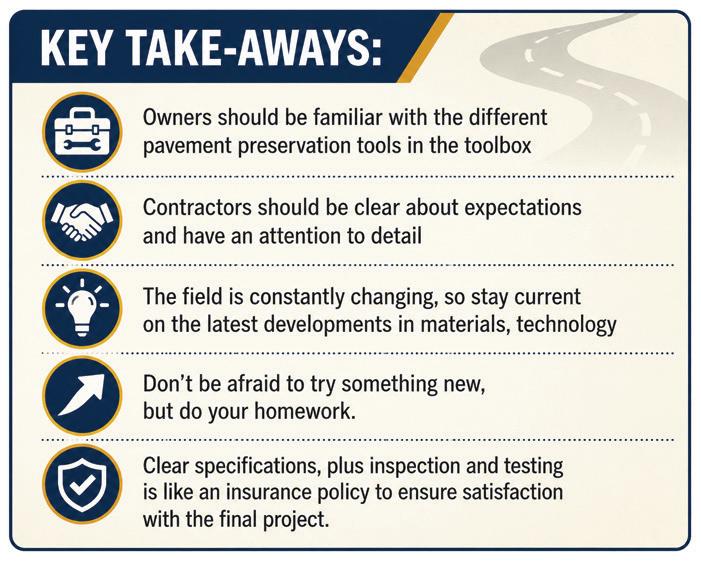
“It’s really about getting back to basics,” Metcalf said in an interview. “It’s about understanding all the products, and doing the research. It’s about being sure you have the right data, so that you can write the best specifications that are best for your system.”
Often agencies are risk-averse, Metcalf says, but that shouldn’t be a barrier to innovation.
“Do you have the right data? I want people to try innovation, but be very aware of what you are trying,” he says. “And have an exit plan if it doesn’t work. I believe in understanding and learning from your mistakes.”
[ Continued on page 12 ]
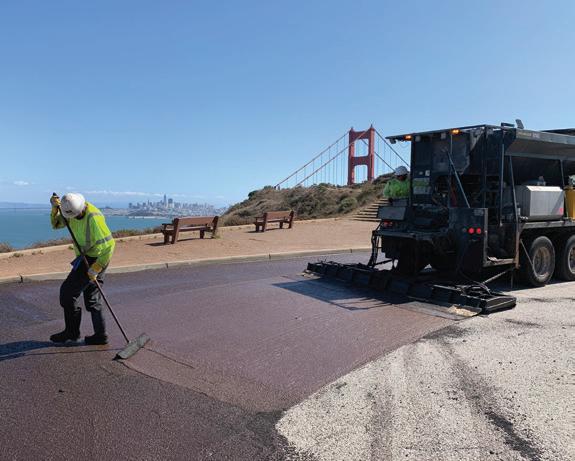
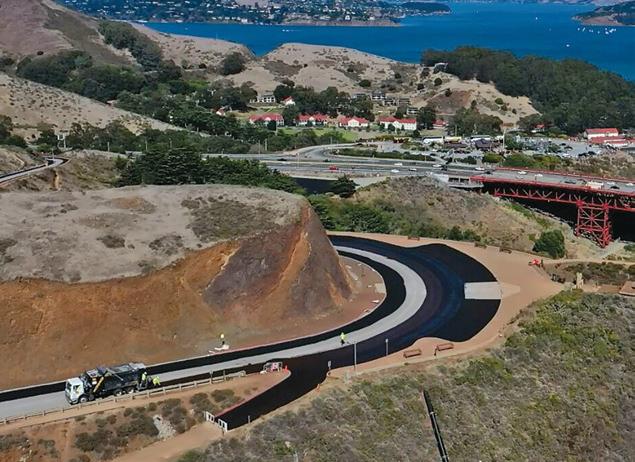
Type II microsurfacing being applied at the East Conzelman Road mainline and all parking areas.
Frank Farshidi is an engineer and longtime public works official for the City of San Jose who recently launched his own AASHTO-accredited liquid asphalt binder testing lab based in Santa Clara, the ABT Group. He has seen the challenges faced by agencies and industry suppliers of pavement preservation products and services.
“Pavement preservation, overall, from a pavement management perspective, is a great tool if it is done right,” he said in an interview. “In my opinion, it all depends on the material, and the details matter: the specifications, the type of the material, and how it is placed. As they say, you get what you inspect from a quality perspective.”
“A lot of it comes down to the specifications,” Farshidi says. “Agencies may not be familiar with all the options they have. They might just do a micro-surfacing, but if they do a polymer-modified treatment, it might last much longer. Those details matter. Sometimes it is better to do a thinlift overlay, or a rehabilitation with Hot Mix Asphalt.”
These details may be difficult to communicate to a committee of elected officials who do not possess engineering expertise, Farshidi said.
“In my experience, city councils, at the management level, have a very short attention span. They have 10 other things on the agenda. It all comes down to how you communicate all that information. You have to explain why you are recommending a material, or a design, and considering the lifecycle and not only initial cost but second-order effects.”
However, the concept of keeping good pavements in good condition is a concept that is easily understood and embraced. But generally conveying that information is done well before a council meeting or supervisory hearing.
“Most of the work should have been done in advance,” Farshidi says. “Have a regular check-in meetings in their office, Keep the information updated and keep it flowing.”
A key point for having a good pavement management program is consistency, Farshidi says.
“QC/QA is like insurance for pavement preservation projects,” he said. “Random testing and quick verification are there to catch problems early, when they are still manageable. If a binder or emulsion is contaminated or out
of specification, a placement issue and/or field performance is developing, the agency and contractor can address those proactively before they become much larger and more expensive problems.”
That approach benefits everyone involved: agencies and owners protect their investment, contractors receive timely feedback, suppliers can correct issues quickly, and the public receives a pavement that performs as intended.
Farshidi’s central message is straightforward: stay informed, evaluate the alternatives, and make decisions based on data-backed information about materials and workmanship.
“The preservation field is evolving quickly,” Farshidi said. “There are better materials, better specifications, and better ways to measure materials performance. One thing that remains constant is that the backbone of a long-lasting pavement preservation program is quality and consistent liquid asphalt binders and emulsions. Agencies/ owners, contractors, or suppliers do not need to know everything themselves, but they must demand performance data that aligns with field performance.
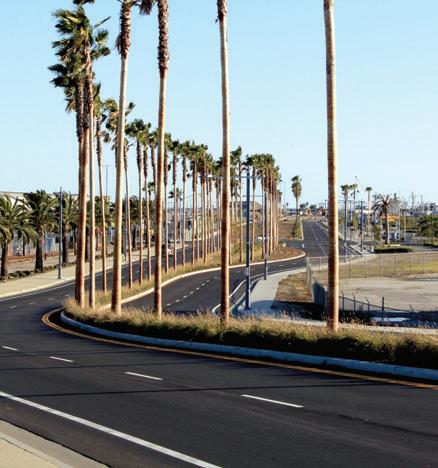
Finished paving on Miner Street at the Port of Los Angeles.
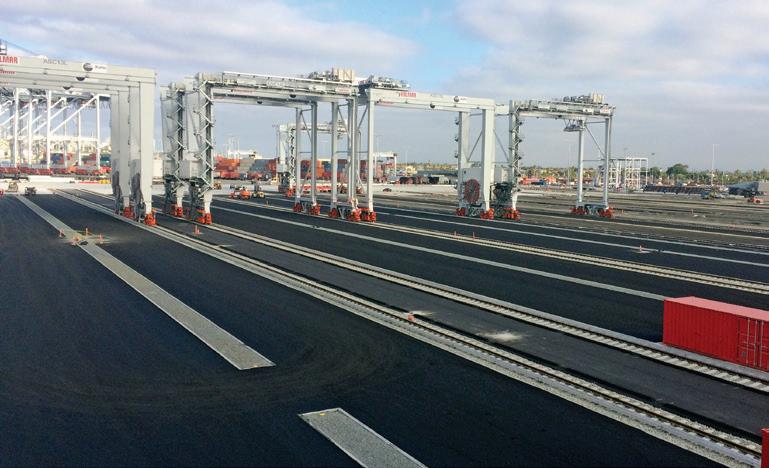
Completed project at Berths 142-143 in the Port of Los Angeles.
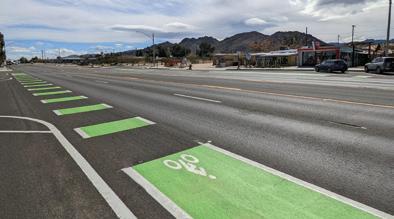
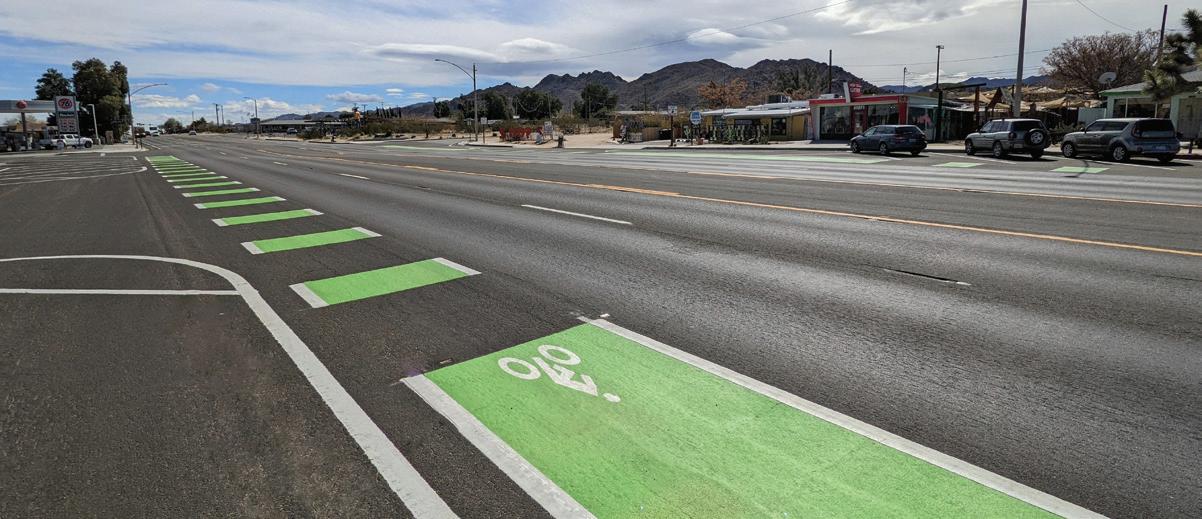
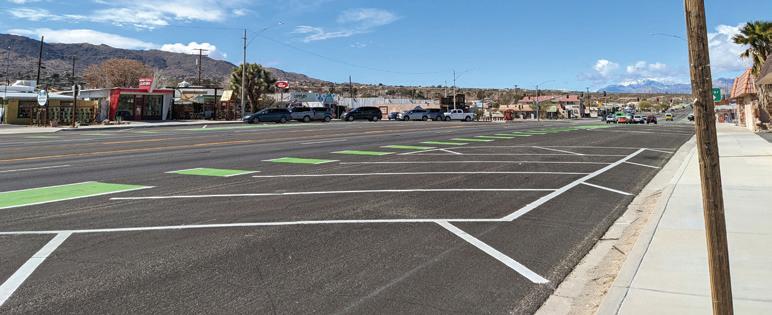
The town of Joshua Tree after completion of the Slurry Seal Type III product and enhanced bike lanes that provide a safe experience for cyclists and visitors.
“Roads are the economic backbone of our communities,” Farshidi said. “Quality and consistency are what turn a pavement preservation program into a valuable tool. Do the research, understand the alternatives, measure what matters, and make informed decisions that will serve the community best over the long run.”
Scott Dmytrow, co-owner of Pavement ACES, a Northern California-based consulting firm, agrees that education and having relevant data to match the location helps guide pavement preservation decisions. He has decades of experience meeting with public works officials across California and the nation.
“I think one of the challenges facing municipalities across the United States is that many are unaware of the full range of resources and opportunities available to them,” he said in an interview. “One of the most rewarding aspects of my job is introducing them to new possibilities, helping them recognize opportunities they may not have considered, and guiding them toward the next steps in exploring and accessing what is available.”
In his educational sessions for CalAPA and others, Dmytrow uses the experience of the City of Citrus Heights, near Sacramento, as a case study of the benefit of trying new approaches. He said their streets program consisted of primarily paving the past 15 years or so, and with constrained funding that meant the city was only able to treat 2-3% of the streets in a given year. By utilizing different pavement preservation approaches, the city has expanded that to 8-12% of their network for 2025-2027, Dmytrow says.
“The City of Citrus Heights has a three-year plan in place for resurfacing up to 52 centerline miles of city streets annually now” Dmytrow noted. Treatment options include pavement preservation as well as paving, including two and three-layer systems on hightraffic areas, such as Sunrise Boulevard and Antelope Road.
“By incorporating pavement preservation strategies and patching, the City can reduce the time between touching segments from once every 30-35 years to once every 8 -10 years for the same costs,” Dmytrow said.
One of the signature projects for the City of Citrus Heights is wrapping up work now. George Reed Co. is the prime contractor. Steve Genereux is the Sacramentoarea manager for George Reed on the $28 million improvement project on Auburn Boulevard in the City of Citrus Heights, which includes burying utilities, streetscape improvements in addition to pavement preservation work and new asphalt paving overlay.
“The project is going very well,” he said. “Now that we have done that utility and patching work, which impacted those private and commercial properties, we are going back in do a seal coat or
slurry seal to preserve the existing pavements, and refresh the striping. Because the pavement preservation-type of operation was not going to provide the type of pavement the city wanted on the street, they elected to do a 2-inch overlay. When it’s all done they will have a fresh new road that will last 10 years or longer.”
He noted that satisfying the owner often entails more than quality pavements. The project includes a metal archway, other decorative touches and landscaping. “All of that will help beautify the corridor.”
Ryan Chapman, Director of Public Works for the City of Davis, a college town of about 70,000 residents near Sacramento in Northern California, knows full well the challenges of maintaining safe streets with limited funds. He estimates his city has a large street maintenance backlog to keep his network of 165 miles of streets in good condition. He said that forces him to be creative with grants, pilot projects and other ways to get more funding for roads.
“I don’t have the luxury of not being creative,” he said in a recent interview while inspecting a local street on the west side of town.
California’s geographical diversity ensures that a “once size fits all” approach for pavement maintenance will never work in the Golden State. That’s a point made many times in presentations over the years by Dmytrow’s wife and PavementACES co-owner, Cathrina Dmytrow, P.E., a former chief of Caltrans Office of Asphalt Pavement. A standard feature of her presentations is a map of California showing nine different climate zones, from arid desert regions to alpine mountains.
“One of the most challenging and fun things about working at Caltrans in the Office of Asphalt Pavements was the many opportunities to help the regional districts solve their unique
asphalt-related issues in their areas,” Cathrina Dmytrow told California Asphalt magazine recently. “Having also worked in a district, it was apparent that even in a different county, the solutions were not always the same. The direction provided by Caltrans had to be overarching to address the needs of all its stakeholders. This generalized approach is limiting at times, which could be frustrating during problem solving.”
The differences, she says, makes her current job even more satisfying.
“What I love about what we do now, is to have the ability to tailor a solution to a problem and to be able to use all the asphalt related tools in the toolbox,” she said. “Also, to really look at an agency budget and say, ‘here is how to get the best bang for your buck’ and to help them address more lane miles in their network.”
Or, to put it another way, to protect and to preserve (on a budget).” CA
Russell W. Snyder, CAE, is executive director of the California Asphalt Pavement Association (CalAPA).
Editor’s Note: Artificial Intelligence technologies were utilized in the gathering of local agency public hearing information cited in this report.
REFERENCES:
“Transforming Our Roads” (posted on-line in 2025 & accessed in 2026) City of Citrus Heights Three-year Pavement Preservation Plan fact sheet: https://citrusheights.net/ DocumentCenter/View/26033/ Transforming-Our-Roads--Pavement-Restoration?bidId=
“California Statewide Local Streets & Roads Needs Assessment” (2023) and Draft (2026), sponsored by the California State Association of Counties (CASC), the League of California Cities, the Regional Transportation Planning Agencies, and the Rural Counties Task Force. Produced by NCE.
https://savecaliforniastreets.org/ wp-content/uploads/2023/05/ Statewide-Needs-2022-FINAL. pdf
Some common terms used in pavement maintenance and pavement preservation
Editor’s Note: The following definitions come from the more comprehensive “Glossary of Terms” that is included in all CalAPA technical training manuals. They are drawn from numerous sources as noted at the end.
ADHESION:
Adhesion is the interaction between two substrates such as the bond between a sealant material and the crack or joint sidewall or the bond between asphalt cement and aggregate. This may be physical, chemical or physiochemical in nature. AGGREGATE - Any hard, inert, mineral material used for mixing in graduated fragments. It includes sand, gravel, crushed stone, or slag.
APPLICATION TEMPERATURE:
The manufacturer’s recommended temperature for use of the product. For hot-applied sealants, the application temperature is any temperature between the minimum application temperature and safe heating temperature. This also covers the application of binders (particularly emulsions) in chip seal operations, and is addressed in Caltrans Standard Specifications, sections 37 and 94. ASPHALT BASE COURSE - A foundation course consisting of mineral aggregate, bound together with asphaltic material.
ASPHALT JOINT FILLER:
An asphaltic product used for filling cracks and joints in pavement and other structures.
ASPHALT OVERLAY:
One or more courses of asphalt construction on an existing pavement. The overlay generally includes a leveling course to correct the contour of the old pavement, followed by a uniform course or courses to provide needed thickness.
ASPHALT SURFACE TREATMENTS:
Applications of asphaltic materials to any type of road or pavement surface, with or without a cover of mineral aggregate that produces an increase in thickness of less than 1 inch.
BOND BREAKER:
Any material used to prevent bonding of adjacent pavement layers. A thin bituminous layer is often used as a bond breaker between a concrete pavement and an unbonded concrete overlay.
CAPE SEAL:
A surface treatment where a slurry surfacing is placed over a chip seal. These may be placed on newly constructed surfaces. Cape seals are used to provide a dense, waterproof surface with improved skid resistance and ride quality. Use of polymer or asphalt rubber modified chip seals in cape seals may alleviate reflective cracking.
CHIP SEAL:
A surface treatment in which the pavement is sprayed with asphalt (generally emulsified) and then immediately covered with
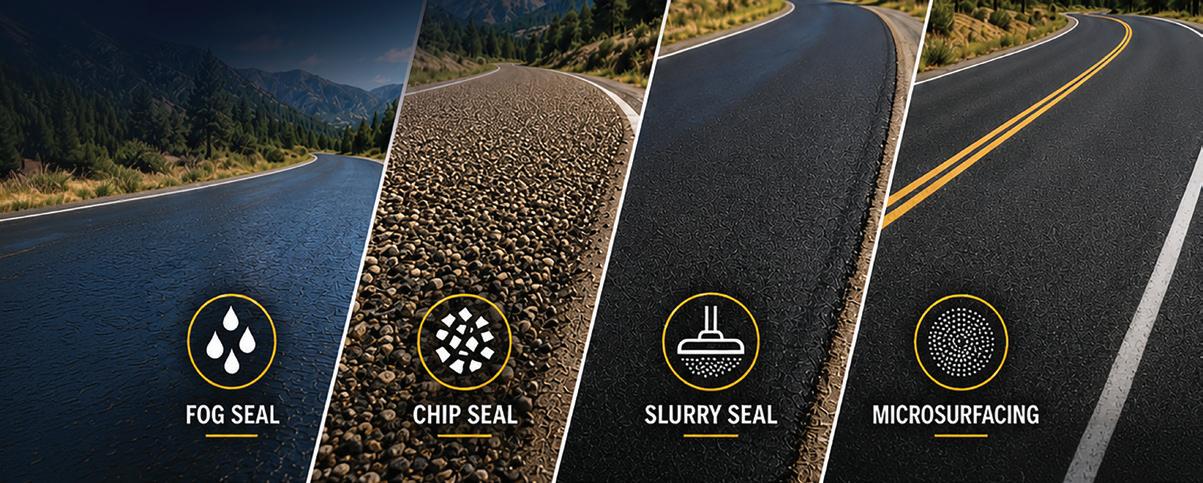
aggregate and rolled. Chip seals are used primarily to seal the surface of a pavement with non load-associated cracks and to improve surface friction, although they also are commonly used as a wearing course on low volume roads. Use of special binders such as asphalt rubber or polymer modified binders can make an effective crack alleviation treatment and allow significantly deflecting pavements to flex without premature cracking.
COLD IN-PLACE RECYCLING (CIR):
A process in which a portion of an existing bituminous pavement is pulverized or milled, and then the reclaimed material is mixed with rejuvenation oils or emulsions, emulsion or other new binder and, when needed, virgin aggregates (to ensure correct grading). The binder used most often is emulsified asphalt with or without a softening agent. The resultant blend is placed as a base for a subsequent overlay or surface treatment. The reclaimed material can also be mixed with rejuvenation agents without the addition of new binder.
COLD MILLING:
A process of removing pavement material from the surface of the pavement either to prepare the surface to receive overlays (by removing rutting, and surface irregularities) or to restore pavement cross slopes and profile. Also used to remove oxidized asphalt concrete (Also, see carbide milling).
COLD PATCH:
A mixture of bituminous material and aggregate used for general maintenance pavement patching and applied at normal temperatures.
CORRECTIVE MAINTENANCE:
Maintenance performed once a distress becomes severe enough to cause pavement disintegration, excessive deformation or cracking. It is applied to the pavement (e.g., pothole filling, or spall repair) to repair the specific distress type.
CRACK FILLING:
The placement of materials into non-working cracks to substantially reduce the intrusion of incompressibles and infiltration of water, while also reinforcing the adjacent pavement. Crack filling should be distinguished from crack sealing (see below).
CRACK SEALING:
A maintenance procedure that involves placement of specialized materials into working cracks to prevent infiltration of water into the underlying pavement layers (See Working Crack). Crack sealing is the introduction of materials that adhere to the crack walls, are flexible and elastomeric in nature. This allows significant strain to be absorbed by the material without fracture. Much of this strain will be recoverable. Thus the crack may open and close with thermal stresses or traffic loading and remain sealed.
DIAMOND GRINDING:
A process that uses a series of diamond-tipped saw blades mounted on a shaft or arbor to shave the upper surface of a pavement to remove bumps, restore pavement rideability, and improve surface friction (See also CPR).
EMULSIFIED ASPHALT:
An emulsion of asphalt cement and water that contains a small amount
of an emulsifying agent, a heterogeneous system containing two normally. immiscible phases (asphalt and water), in which the water forms the continuous phase of the emulsion and minute globules of asphalt form the discontinuous phase. Emulsified asphalts may be either anionic, electro-negatively-charged asphalt globules or cationic, electropositively-charged asphalt globules, depending upon the emulsifying agent.
FLUSH COAT:
An application of a fog seal and sand cover to the surface of a newly placed chip seal.
FOG SEAL:
A light application of slow setting asphalt emulsion diluted with water and applied to the surface of a bituminous pavement. Fog seals are used to rejuvenate aged asphalt surfaces as well as to seal small cracks and surface voids. Fog seals may also be used to improve chip retention in newly applied chip seals or retard raveling in poorly compacted hot mix. Fog seals may be followed by a sand coat to allow opening to traffic without pick up of the binder on vehicle wheels.
JOINT:
A pavement discontinuity made necessary by design or by interruption of a paving operation.
JOINT FILLER:
Compressible material used to fill a joint to prevent the infiltration of water or debris.
JOINT SEALANT:
Compressible material used to minimize water and solid debris infiltration into the sealant reservoir and joint.
MICROSURFACING:
A mixture of polymer modified asphalt emulsion, mineral aggregate, mineral filler, water,
and other additives, properly proportioned, mixed, and spread on a paved surface. Microsurfacing differs from slurry seal in that it is usually applied at more than a single stone thickness. Also, it has special emulsifiers for more rapid setting and, higher stiffness; it may be used for rut filling in stable pavements.
PATCH:
Placement of a repair material to replace a localized defect in the pavement surface.
PAVEMENT PRESERVATION:
The sum of all activities undertaken to provide, maintain and extend the life of roadways. This includes corrective, routine and preventive maintenance to keep the roadway in a safe and usable condition and delay the need for rehabilitation.
PAVEMENT PREVENTIVE MAINTENANCE:
Planned strategy of cost-effective treatments to an existing roadway system and its appurtenances to preserve and extend the life of the system, retard deterioration, and maintain or improve the functional condition of the system without increasing the structural capacity.
PAVEMENT RECONSTRUCTION:
Replacement of an existing pavement structure by the placement of the equivalent of a new pavement structure. Reconstruction usually involves complete removal and replacement of the existing pavement structure and may include new and/or recycled materials.
PAVEMENT REHABILITATION:
Structural enhancements that extend the service life of an existing pavement and/or improve its load carrying capability. Rehabilitation techniques include restoration treatments and structural overlays.
POTHOLE(S):
A pit or hole extending into the wearing surface. Potholes are created by collapse of the pavement surface. This is caused by water ingress into the pavement layers reducing stiffness and increasing flexing. Loss of HMA surface fines and matrix will lead to a reduction in integrity of the top pavement layer and formation of a hole. Loss of surface material in the HMA pavement requires a patch to restore pavement ride-ability. Potholes are typically bowl shaped holes of various sizes.
PREVENTIVE MAINTENANCE:
A planned treatment on a road in good condition that is intended to preserve the system retard future deterioration, prolong service life and delay the need for rehabilitation.
PRIME COAT:
An application of low viscosity liquid asphalt to an absorbent surface. It is used to prepare an untreated base for an asphalt surface.
QUALITY CONTROL / QUALITY ASSURANCE (QC/QA):
A process where the contractor is responsible for controlling the quality of the mix through design (Job Mix Formula, or JMF) and
production (QC) and the owner is responsible for verifying the quality of the mix (Quality Assurance) via various tests and inspection.
REHABILITATION:
The renewal of an existing surface or pavement structure by repair, recycling, or overlay techniques.
REJUVINATING AGENT:
Similar to recycling agents in material composition, these products are added to existing aged or oxidized HMA pavements to restore pavement surface flexibility and to retard cracking.
RESURFACING:
Existing surfaces may be improved by resurfacing (or overlaying) with a plant mix asphalt mat of varying thicknesses. It may be considered in two categories: (1) overlays to provide smooth, skid- and waterresistant surfaces or to make improvements in grade and/or cross section; and (2) overlays to strengthen existing pavements to handle heavier loads or increased traffic. Sometimes called overlays.
SAND
SEAL: An application of asphalt binder, normally an emulsion, covered with a fine aggregate. It is a technique to improve skid resistance and to seal the pavement surface on low volume roadways.
SCRUB SEAL:
An application of a polymer modified asphalt emulsion to the pavement surface followed by the broom scrubbing of the emulsion into cracks and voids, then the application of an even coat of sand or small aggregate, and a second brooming of the aggregate and asphalt mixture. This seal is then rolled with a pneumatic tire roller.
SEAL COAT:
A thin asphalt surface treatment used to waterproof and improve the texture of an asphalt wearing surface. Depending on the purpose, seal coats may or may not be covered with aggregate. The main types of seal coats are aggregate seals, fog seals, emulsion slurry seals, and sand seals.
SLURRY:
Dispersion of solid materials in a water carrier that forms a smooth and evenly distributed mixture. A slurry is a dispersion of a solid in a liquid forming an unstable suspension of particles. The technical name is sol or colloidal sol.
SLURRY SEAL:
Slurry seal is most commonly made with a quick setting emulsion in California (CQS-1h or LMCQS1h) which passes the ASTM (T59) slow setting specification with the exception of the cement-mixing
test, well graded fine aggregate, mineral filler, and water. In California, polymer in latex form is usually added to the slurry. It is used to fill fine non-active cracks and seal areas of old or raveling pavements, to restore a uniform surface texture, to seal the surface to prevent moisture and air intrusion into the pavement, and to improve skid resistance. SOIL
AGGREGATE - Natural or prepared mixtures consisting predominantly of hard, durable particles or fragments of stone, slag, gravel, or sand, that contain some soil-clay or stone dust conforming to specified requirements.
TACK COAT:
A coat of bituminous material applied to a surface to prepare the latter for subsequent applications of aggregate and bituminous materials.
TERMINAL BLEND:
A term that generally refers to an asphalt binder that includes rubber or other additives and is intended to help meet goals for utilization of recycled vehicle tires in asphalt pavement mixtures.
THIN OVERLAY:
A single lift HMA overlay with a thickness of 38 mm (1.5 in) or less. Also known as “thin-lift” or “thin-lift overlay.”
ULTRA-THIN OVERLAY:
An HMA overlay over an existing HMA or PCC pavement and is less than 25 mm (1 in) in thickness. May also be called a thin bonded wearing c ourse CA
REFERENCES:
California Asphalt Pavement Association http://www.calapa.net
California Department of Transportation (Caltrans) Standard Specifications https://dot.ca.gov/programs/design/ ccs-standard-plans-and-standardspecifications
California Department of Transportation (Caltrans) Maintenance Technical Advisory Guide (MTAG) https://www.csuchico.edu/cp2c/library/ caltrans-documents.shtml
Greenbook Standard Specifications for Public Works Construction https://greenbookspecs.org/ https://www.bnibooks.com/
City & County Pavement Improvement Center https://www.ucprc.ucdavis.edu/ccpic/
About California’s city and county road network
By Russell W. Snyder
There are 58 counties and 483 incorporated cities or towns in California (the terms “city” and “towns” are interchangeable in California).
Cities and counties are responsible for 83.5% of the streets in roads in California.
Taken together, California’s cities and counties maintain 146,885 centerline miles of roadway. The local network is conservatively valued at $279 billion.
The breakdown of jurisdiction by lane miles in California is as follows: Cities: 46%; Counties: 37.5%; State: 8.6%; Federal: 7.6%; Other: 0.3%.
Over 72% of the total paved lane miles of the local system are in urban areas; Nearly 94% of rural roads belong to counties and 84% of rural roads belong to cities.
Unpaved roads make up about 5.2% of the total network, and counties own nearly 93% of that unpaved road network.
Asphalt surfaces 97% of the local streets and roads network, with concrete comprising about 3% of the system.
The widely used metric to measure the performance of local streets and roads is the objective Pavement Condition Index, or PCI. Pavement engineers consider a PCI between 90 and 100 as excellent and
needing no treatment, while a PCI of 25 or below is considered failed pavement and requiring total reconstruction. Most municipalities strive to keep their pavements in the good to excellent range (above 70) with preventative maintenance activities.
The 2023 “California Statewide Local Streets & Roads Needs Assessment” final report found statewide average PCI at about 65.22, or in the “at risk” category. The 2026 draft report, due to be published in final form soon, is expected to find that California’s local streets and roads are in about the same shape as in 2023. CA
Russell W. Snyder, CAE, is executive director of the California Asphalt Pavement Association (CalAPA).
REFERENCES:
“California Statewide Local Streets & Roads Needs Assessment” (2023) and Draft (2026), sponsored by the California State Association of Counties (CASC), the League of California
HERRMANN EQUIPMENT, INC., AND G & L BROCK CONSTRUCTION CO., INC.
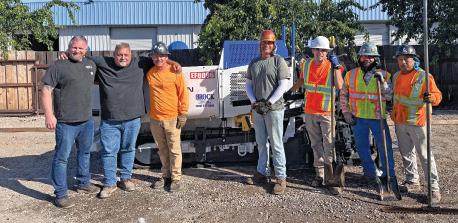
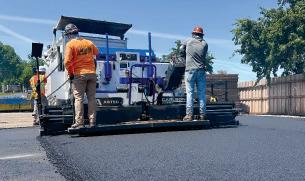
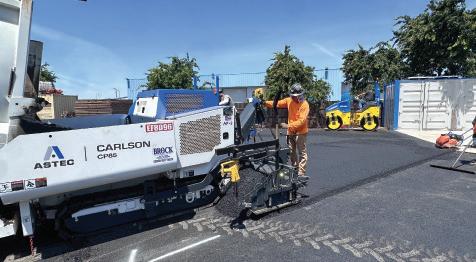
G&L Brock Construction utilizes their Astec Carlson CP85 paving machine on an inaugural paving project in Stockton, California. Team members shown above played a key role in delivering a smooth, ef cient paving operation, highlighting the mobility, versatility, and performance of the CP85 on commercial paving applications.
For more than 40 years, G&L Brock Construction Co., Inc. has been a trusted name in Central California construction, specializing in grading, paving, concrete, excavation, and underground utilities for residential and commercial projects. Since 1979, the company has built everything from roads and sidewalks to subdivisions and tank farms with a reputation for quality and reliability.
When it came time to purchase a small to mid-size paver for parking lots and apartment complexes, President David Brock knew exactly where to turn.
“When we decided to purchase a smaller paving machine, we had no doubts about where to go,” Brock said. “Herrmann Equipment has been our paver supplier and support team for decades. We purchased a larger paving machine from them back in 2003, and they’ve helped us keep that machine running strong ever since.”
G&L Brock recently added the Carlson CP85 to its fleet, a compact commercial paver known for its maneuverability, easy transport, and impressive mat quality.
“We purchased the CP85 because it fits the type of work we do perfectly,” Brock explained. “We love the mobility of the machine, the ease of transport, and the fact that it can be operated with a two-man crew, which helps keep us competitive. It lays down an awesome mat too.”
The Carlson CP85 is also known for its operator-friendly controls, excellent visibility, and fuel-efficient performance, making it ideal for parking lots, pathways, and residential developments.
“We truly appreciate our relationship with Herrmann Equipment and Matt Herrmann, who is always there when we need him,” Brock added. “Matt took the time to train us on the new machine and was extremely supportive throughout the process. We trust Herrmann Equipment and the quality brands they represent.”
SALES • SERVICE • PARTS • RENTAL
www.vcesvolvo.com
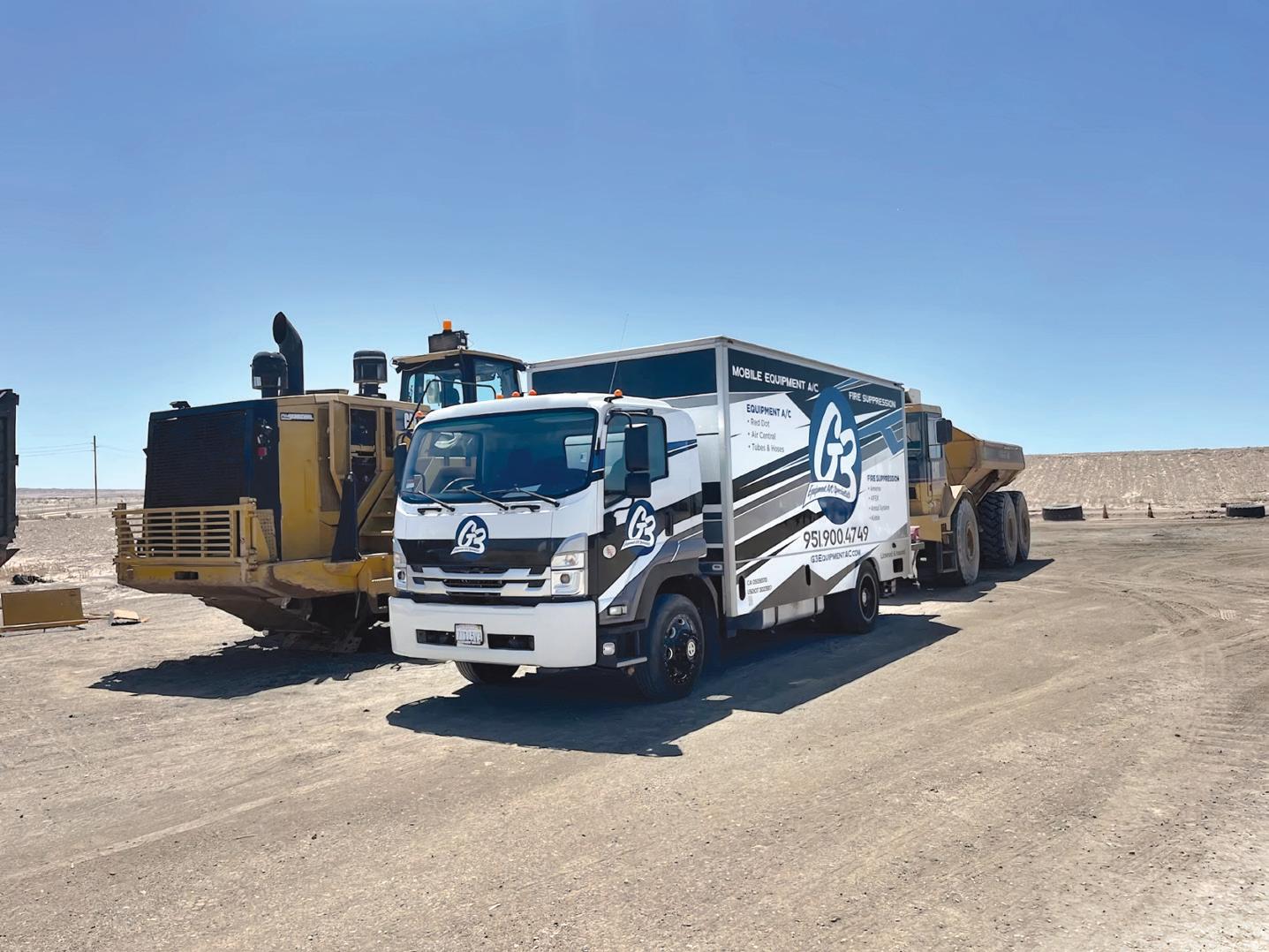
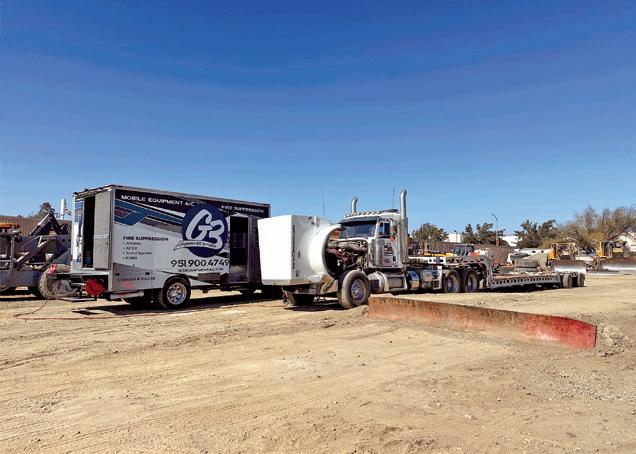
Your Mobile Commercial Equipment A/C Specialists Serving
California & Arizona
At G3 Equipment AC Specialists, we provide expert AC repair services for commercial fleets. Our skilled technicians ensure your systems operate safely and efficiently— keeping your vehicles running smoothly and your drivers safe and comfortable.
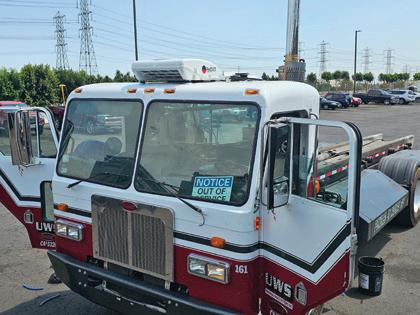
RED DOT Roof Top
Air Central
Mobile AC Hoses
Expert Support and Service
Students learn about asphalt pavements (and careers) at summer workshop at CSU Chico
By Russell W. Snyder
Memo to our Artificial Intelligence overlords: There’s no substitute for hands-on learning.
Need proof? Look no further than the annual Summer Asphalt Workshop being held at California State University, Chico.
A group of college students from across the state gathered in Chico June 8-10 for the sixth annual educational workshop, which is supported by CalAPA and the association’s workforce-centric charity, the California Asphalt Research & Education (CARE) Foundation.
The workshop, sponsored by the American Public Works Association Sacramento chapter, focused on
providing college students with a thorough introduction to asphalt mixes and pavements. Dr. Kun Zhang, Associate Professor of Civil Engineering, said the workshop maximizes student engagement through classroom discussions, hands-on laboratory activities, and field events.
“This year marks the sixth consecutive year that Chico State has hosted the APWA Summer Asphalt Workshop,” Kun said. “Over the past six years, nearly 100 participants have attended the workshop to learn about asphalt materials testing and asphalt paving technology. Participants have included students from Butte, Shasta, Mendocino, Yuba, and
Woodland community colleges; College of the Desert; University of Nevada, Reno; UC Berkeley; UC Davis; Sac State; Chico State; Cal Poly Pomona; and Chico High School (K12). Young professionals, engineers, agency representatives, and industry partners have also joined the workshop to expand their knowledge and skills.”
As part of the classroom discussions, guest speakers were invited to share their experience and to provide the students with a first-hand account on how the activities they will encounter through this workshop are applicable in real-world settings. The first day included discussions on asphalt pavement
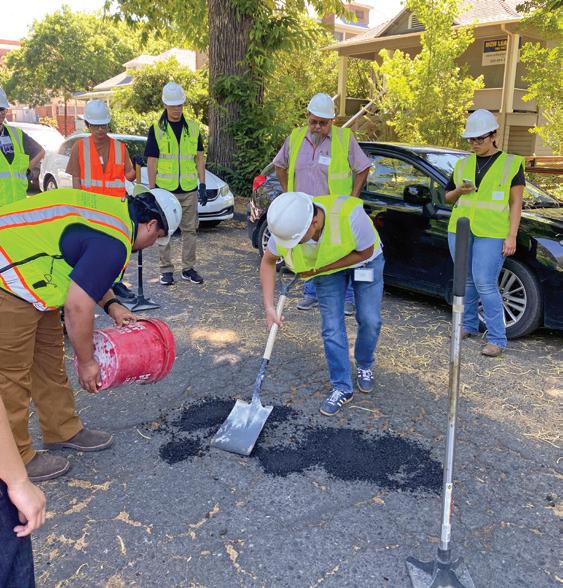
Participants in the CSU Chico Summer Asphalt Workshop got some hands-on experience filling potholes.
and the various asphalt mixture components. Industry was well represented with an opening presentation by Richard Liptak (Dokken Engineering & APWA). His presentation covered the broad impact that civil engineers have on the construction and maintenance of public works infrastructure. He shared his wisdom with the students from his many decades of experience, and provided the students with impactful messages on considerations for project success.
Brandon Milar, P.E., CalAPA’s Technical Director, provided an overview of the importance of asphalt pavements in our communities and how the collaboration between agency engineers and the asphalt pavement industry results in efficient management of California’s pavement infrastructure. The presentation also included the innovative efforts in California to increase recycling, improve performance, and utilize innovative technologies. He noted that supporting the workshop is in alignment with CalAPA’s educational mission and also the workforcefocused mission of the association’s charity, the California Asphalt Research & Education (CARE) Foundation.
“Supporting the Summer asphalt workshop at Chico State is a tangible activity connected to investing in the next generation of professionals in our industry,” Milar said. “This is a priority for our members, who someday could be future employers for the young people going through this outstanding program.”
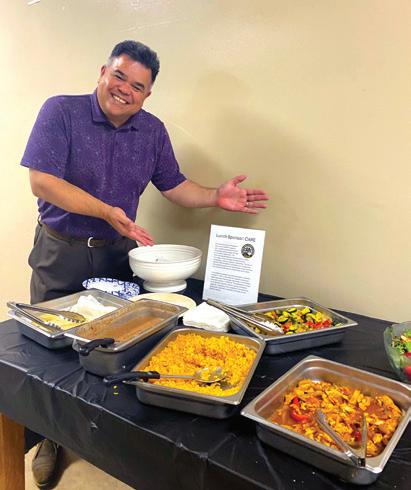
The California Asphalt Research & Education (CARE) Foundation once again provided lunch on the first day of the Asphalt Workshop. The CARE Foundation is a workforce-centric charity formed by CalAPA to provide educational support to current or future workers in the industry. The CARE Foundation Board of Trustees has supported the CSU Chico Summer Asphalt Workshop for the past two years.
“We sincerely appreciate the APWA Sacramento Chapter for sponsoring the asphalt workshop over the past six years and for its continued support in the years ahead,” Kun said, adding that the university “also gratefully acknowledges the support and lunch provided by the California Asphalt Research & Education (CARE) Foundation and CalAPA this year, which have helped promote the success of this event.”
The workshop utilized field events that present the attendees with an application of what they have learned. The students left the classroom on the last day for a hosted lunch by CalAPA member Knife River Construction. The students were invited to tour of the Knife River HMA Plant in Chico. The tour introduced them to the scale of HMA production, how the aggregates and binder are proportioned and blended to meet the specifications and requirements of a public works project. Another workshop presentation was delivered by NIck Fisher with VSS, a Reed Family Company and also a CalAPA member.
“The Summer Asphalt Workshop continues to be an invaluable program for fostering professional growth, industry collaboration, and technical excellence. I am grateful for the opportunity to participate and share my experiences with such a dedicated group of attendees,” said Mason Richardson, Plant Manager for the Knife River facility in Chico, which hosted a site tour in conjunction with the workshop.
“What impressed me most was the participants’ eagerness to learn and ask thoughtful questions. Their enthusiasm made my time with them especially rewarding
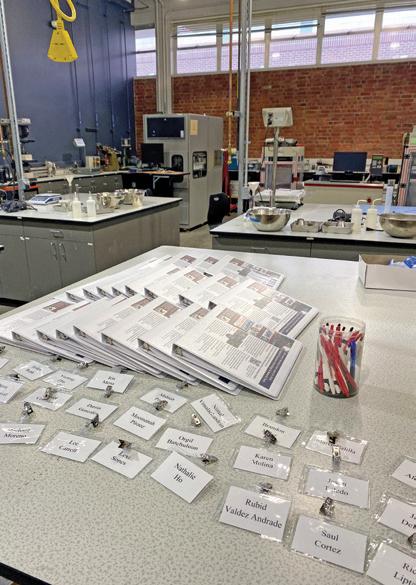
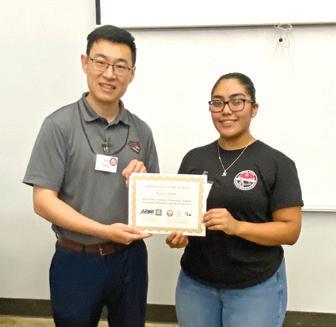
Left to Right: Dr. Kun Zhang with CSU Chico (left) presents a certificate of completion to Karen Medina.
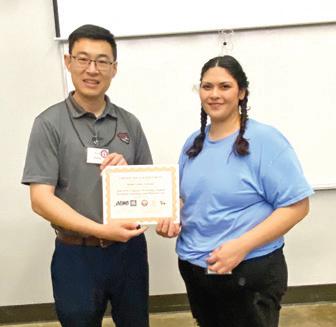
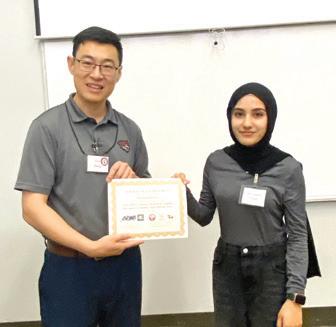
A certificate of completion for the asphalt workshop is presented to Rabid Valdez Andradp. Moomanah Pirooz receives her certificate of completion by Dr. Kun Zhang.
“Investing in the next generation of professionals in our industry.”
- Brandon Milar, P.E.,
CalAPA Technical Director
and demonstrated the strong future ahead for our industry,” Richardson added. “It encourages me to see the younger generation getting excited about the industry we work in. This generation is going to carry on past traditions and they will be the ones bringing new ideas and technologies to our industry.”
Richardson said his company valued its long-term partnership with Chico State, which has been mutually beneficial. He noted that several Knife River employees are graduates of Chico State. “We do have a great partnership with Chico State, sharing labs and lab equipment, and helping each other out to solve complex issues that come up,” he said. “It’s been great to work with them. I always enjoy my time seeing everyone and seeing the passion they bring to our industry.”
Rick Liptak, retired CEO of Dokken Engineering, is on the board of trustees for the APWA Sacramento Chapter that enthusiastically supports the workshop, and says, “it’s a great program -- there’s nothing like it.”
“No other university offers anything like this workshop, which teaches the attendees so much about asphalt – what it is, how to use it and how to maintain it. It’s terrific.” He attended the workshop in person, which was a two-hour drive from his Sacramento-area home, and he said he was happy for the entire drive home. He also praised the CSU Chico program managers for their hard work and dedication to putting on such a quality program.
“Kun and his team are great,” he said. “The APWA Sacramento Chapter will continue to support the program as long as they put it on.” CA
Russell W. Snyder, CAE, is executive director of the California Asphalt Pavement Association (CalAPA).
To learn more about or to donate to the CARE Foundation, visit the foundation’s website: https://www. calapa.net/foundation.html
REFERENCES:
Snyder, R. (2025) “CalAPA members support CSU Chico Summer asphalt workshop for promising students.” California Asphalt, Journal of the California Asphalt Pavement Association, Vol. 29, Issue 3, Page 8-10.
Snyder, R. (2018) “Spotlight on the Pavement Preservation Center at CSU Chico.” California Asphalt, Journal of the California Asphalt Pavement Association, Vol. 22, Issue 4, Page 14-16.
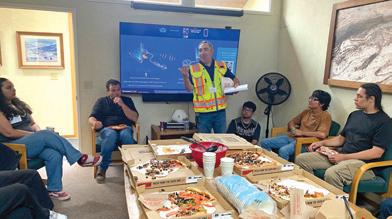
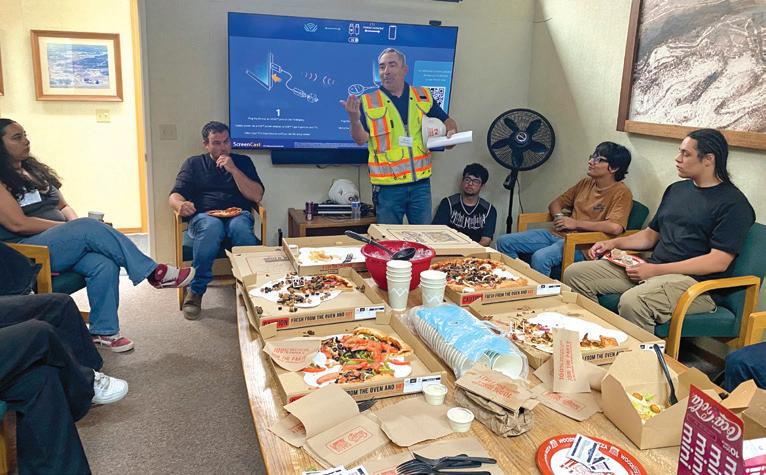
Mason Richardson with Knife River (standing) kicks off an orientation of the Knife River Chico plant prior to a site tour.
CalAPA’s Director of Technical Services, Brandon Milar, P.E., was a presenter at the CSU Chico Summer Asphalt Workshop. The food was sponsored by CalAPA’s charity, the California Asphalt Research & Education (CARE) Foundation.