Issue 9 - 2026
MAGAZINE
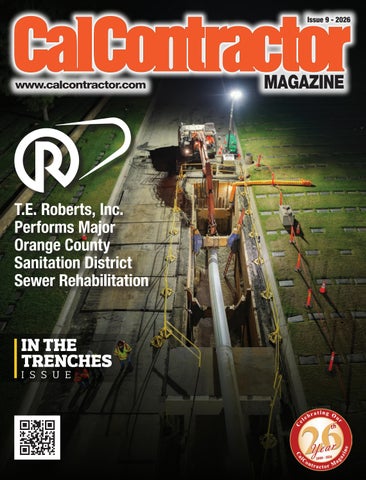
T.E. Roberts, Inc. Performs Major Orange County Sanitation District Sewer Rehabilitation
IN THE TRENCHES
I S S U E
GET MORE WHEN YOU NEED IT MOST Getting rentals right takes more than machines. It takes know-how to show up right on every jobsite, service that keeps equipment at its peak, and people who keep projects moving forward.
Lorem ipsum
Whether you’re digging deep or reaching high, we’re here to make sure you have everything you need to get the job done right—and so much more.
When you choose Cat Rentals you get more than a rental provider—you get a team that: SM
Understands your industry and your jobsites. Asks the right questions to deliver the right solutions. Makes quick calls to keep your projects on track. Maintains quality you can rely on from brands you trust. Delivers service and support that keeps you running strong.
SINCE 1956
SINCE 1919
hawthornecat.com San Diego County 866-326-7145
QuinnCatRentals.com Central & Southern California 888-608-5064
© 2026 Caterpillar. All Rights Reserved. CAT, CATERPILLAR, LET’S DO THE WORK, their respective logos, “Caterpillar Corporate Yellow”, the “Power Edge” and Cat “Modern Hex” trade dress as well as corporate and product identity used herein, are trademarks of Caterpillar and may not be used without permission. www.cat.com / www.caterpillar.com
m
JOHN DEERE 230 P-TIER POWER. PRECISION. PROVEN DEERE PERFORMANCE. Built for production earthmoving, trenching and site prep, the John Deere 230 P-Tier delivers the power, control and operator comfort crews need to stay productive all day long. With dependable performance, smooth hydraulics and the durability to handle demanding jobsites, it's ready to go to work.
COASTLINE Equipment
Long Beach, CA (HQ) (562) 272-7400 www.coastlineequipment.com
MORE THAN MACHINES. A STRONGER TOMORROW YOUR AUTHORIZED JOHN DEERE DEALER FOR THESE CA COUNTIES: Long Beach Branch – Los Angeles and Orange Oxnard Branch – Northern Los Angeles, Ventura and Santa Barbara Santa Maria Branch – San Luis Obispo and Santa Barbara Bakersfield Branch – Kern, Inyo, Mono and Eastern Los Angeles Lake Forest and Sylmar Branches – Parts Only Stores
CONTENTS 2026 In The Trenches T.E. ROBERTS, INC.
PUBLISHER: Kerry Hoover khoover@calcontractor.com
W.A. RASIC CONSTRUCTION
EDITOR: Brian Hoover, Senior Editor
Major Orange County Sanitation District Sewer 06 Performs Rehabilitation to Extend Service Life for Decades to Come Rasic Goes Deep to Build San Diego’s Montezuma/ 16 W.A. Mid-City Pipeline
ELECTRICAL SERVICES 22 PRIME Prime Electrical Services Takes Its Work Underground
ART DIRECTOR/GRAPHIC DESIGNER Aldo Myftari
NO ROOM TO SPARE:
SOCIAL MEDIA MANAGER: Gerald De Guzman
AGC SAN DIEGO
FOR ADVERTISING INFORMATION: Please call: (909) 772-3121
Slide Rail Solution Threads a Tank Into the 28 AnL.A.Engineered Civic Center San Diego’s 87th Annual Affiliate Day Golf Tournament 32 AGC Brings Construction Industry Together at Singing Hills
PURE WATER MEANS MILES OF PIPE
California’s push toward potable reuse is creating a 36 How new generation of large-diameter pipeline, tunneling and underground construction work
CalContractor is published 12 times each year by Construction Marketing Services, LLC. Copyright © 2025. All rights reserved. Reproduction in whole or in part without permission is prohibited. P.O. Box 892977, Temecula, CA 92589
GREAT 42 CALIFORNIA’S UNDERGROUNDING BOOM EXCAVATION: WHEN A TRENCH BOX 44 DEEP ISN’T ENOUGH
46 INDUSTRY NEWS 50 06
4
www.CalContractor .com
ADVERTISER’S INDEX 16
I N T H E T R E N C H E S / 2 0 26
24
C A LCO N T R AC TO R .CO M
A passion for performance The Volvo EC160E Excavator delivers the power, precision and control to take on demanding jobs in a versatile 16-ton-class package. Strong digging performance, responsive hydraulics and proven Volvo efficiency help crews move more and get more done.
Contact your nearest VCES location today.
Bakersfield 661.387.6090
Fresno 559.834.4420
Redding 530.255.8008
San Leandro 510.357.9131
Corona 951.277.7620
Lakeside 619.441.3690
Sacramento 916.504.2300
Turlock 209.410.6710
Find us on social media:
www.vcesvolvo.com
facebook.com/volvoces
VolvoCES
volvoces
volvoces
T.E. Roberts, Inc. Performs Major Orange County Sanitation District Sewer Rehabilitation to Extend Service Life for Decades to Come Complex pipe bursting, deep excavations, extensive sewer bypass operations and carefully planned shoring are helping T.E. Roberts, Inc. rehabilitate miles of aging sewer infrastructure while minimizing disruption to surrounding communities. By Brian Hoover | Photos provided by CMS Media Pros
R
eplacing an underground sewer line is challenging enough when crews can simply open a trench and work their way down the alignment. Doing the same work beneath active streets, residential neighborhoods and even a cemetery requires an entirely different approach. T.E. Roberts, Inc. (T.E. Roberts) is currently putting that approach to work on the Los Alamitos Sub Trunk and Westside Relief Interceptor Rehabilitation Project, a major sewer rehabilitation effort extending through portions of La Palma, Cypress and Los Alamitos, along with an easement through Forest Lawn Cemetery in Cypress.
6
I N T H E T R E N C H E S / 2 0 26
The existing regional sewer infrastructure is approximately 50 years old and requires both rehabilitation and additional capacity to meet current and future demands. Portions of the existing system are being replaced with larger diameter pipe, while other segments are receiving rehabilitation designed to extend their service life for decades. For T.E. Roberts, the approximately $35 million project brings together nearly every discipline the Orange County underground contractor has developed over more than two decades in business. The scope includes approximately 4,500 feet of pipe bursting, with
roughly 2,500 feet increasing existing 18 inch vitrified clay pipe to 26 inch HDPE and another 2,000 feet increasing 18 inch pipe to 24 inch HDPE. The work also includes approximately 400 feet of open cut construction, cured in place lining, rehabilitation of manholes and diversion structures, full and partial manhole replacements, along with nearly 29,800 feet of pipe joint air testing and chemical grout injection. According to Justin Roberts of T.E. Roberts, the objective is straightforward. “The purpose is to rehabilitate the pipelines and meet the capacity needs of today,” says Roberts. Getting there, however, is anything but simple.
C A LCO N T R AC TO R .CO M
Pictured: T.E. Roberts crews work the night shift at Forest Lawn Cemetery in Cypress. The 500-foot pipe bursting pull was completed in a single evening shift following nearly a month of preparation, including excavation and shoring of the pulling and receiving pits, sewer bypass setup, equipment positioning, replacement pipe assembly, and extensive planning and coordination.
Bursting Through Forest Lawn One of the project’s most interesting operations is taking place beneath Forest Lawn Cemetery in Cypress, where traditional open trench excavation through the property would have created significant disruption. Rather than excavating continuously along the sewer alignment, the project team elected to use pipe bursting, allowing T.E. Roberts and its trenchless subcontractor to replace and enlarge the existing sewer through strategically located excavations. “The stakeholders did not want to disrupt the cemetery during their daytime hours,” says Roberts. “It was decided that the least disruptive way to replace the pipe was to pipe burst it at night.” CALCON TRAC TOR.CO M
The same technology will also be used within a residential neighborhood where avoiding a continuous trench provides obvious benefits. Instead of excavating across driveways and maintaining an open trench through the neighborhood, crews can complete the installation through pits spaced approximately 500 feet apart. Pipe bursting works by pulling the new pipeline directly through the alignment of the existing sewer. In the Forest Lawn operation, a large anchor chain is installed through the existing pipeline and connected to a hydraulic pipe bursting machine. At the front of the replacement HDPE pipe is a tapered bursting head that is larger
than the pipe itself. As hydraulic force pulls the assembly forward, the bursting head fractures the existing vitrified clay pipe and displaces the fragments into the surrounding soil. The new HDPE pipe follows directly behind, occupying essentially the same alignment while increasing the diameter and capacity of the sewer. Lubrication is continually introduced as the replacement pipe moves through the ground, helping reduce resistance during the pull. “There is a great deal of pulling force,” says Roberts. “The nose cone on the front of the HDPE pipeline is tapered, and it is larger than the pipe behind it. We are constantly lubricating as we are pulling the new pipe through.” I N T H E T R E N C H E S / 2 0 26
7
The hydraulic rams move the pipeline approximately three feet during each cycle. The system then releases from the chain, resets and pulls another three feet. During the Forest Lawn operation observed by CalContractor, crews completed an approximately 500-foot pull in one evening, the maximum planned length for an individual pull on this portion of the project. Although the actual pipe bursting operation itself was completed during a single
shift, the preparation required to make that one shift successful can take weeks. T.E. Roberts spent approximately one month preparing the Forest Lawn location before the pipe was pulled. That preparation included excavating and shoring the receiving and pulling pits, establishing sewer bypass systems, positioning the bursting equipment, assembling the replacement pipe and coordinating the operation so the entire pull could be completed
within the available nighttime work window. “The goal was to complete the stretch all in one night,” says Roberts. “You do a lot of preparation ahead of time because the longer you leave it sitting, the harder it is to move it again.” The strategy worked. The entire Forest Lawn pull was completed during a single night. Before the cemetery reopened, excavations were secured with steel plates and traffic could once again move across the work area.
Above: T.E. Roberts scope of work included approximately 4,500 feet of pipe bursting where roughly 2,500 feet of 18-inch vitrified clay pipe was replaced with 26-inch HDPE and another 2,000 feet increased from 18-inch clay to 24-inch HDPE.
8
I N T H E T R E N C H E S / 2 0 26
C A LCO N T R AC TO R .CO M
THE BEST WHEEL LOADER AND EXCAVATOR YOU HAVEN’T EXPERIENCED YET. Power. Productivity. Operator comfort. Built for contractors who expect more from their equipment.
SCHEDULE A DEMO. ASK YOUR OPERATOR.
JCB 457 WHEEL LOADER HIGH PRODUCTIVITY. TOTAL VERSATILITY.
Operating Weight 44,090 lb
Engine Power 282 hp
Bucket Capacity 4.6 yd 3
JCB 370X EXCAVATOR STRENGTH. REACH. RELIABILITY.
Operating Weight 87,417 lb
Engine Power 322 hp
Bucket Capacity 2.7 yd 3
SOCAL JCB’S PARTS & SERVICE TEAM IS 100% DEDICATED TO SUPPORTING OUR CUSTOMERS’ FLEETS — NOT OUR OWN. That means our focus is where it belongs: keeping your equipment working and your crews productive.
2860 S Iowa Ave. Colton, CA 92324
866-522-7225
14480 Alondra Blvd LaMirada, CA 90638
sales@socaljcb.com
CALCON TRAC TOR.CO M
SoCalJCB.com
I N T H E T R E N C H E S / 2 0 26
9
Above: T.E. Roberts crews work from the receiving pit at Forest Lawn Cemetery in Cypress. The company is utilizing both beam-and-plate systems and slide rail shoring supplied by Trench Shoring Company throughout the project. Right: Located at the front of the new HDPE pipe is a tapered bursting head which is larger than the existing pipe. As the pipe is pulled hydraulically, the bursting head fractures the existing vitrified clay pipe, displacing the fragments into the surrounding soil.
Going Deep with Trench Shoring Company Creating the access points required for pipe bursting represents a substantial construction operation by itself. T.E. Roberts excavated pits ranging from approximately 14 to 22 feet in depth. Depending on their purpose and configuration, the excavations can range from about 32 feet long to as much as 80 feet long. The reason for the additional length is that some of the pits allow crews to pull pipe in both directions, requiring additional working room. With excavations of this size and depth, shoring becomes one of the most important elements of the project. T.E. Roberts is utilizing both beam and plate systems and slide rail shoring supplied by Trench Shoring Company. At any given time, Roberts says five or six excavations may be open along the project.
10
I N T H E T R E N C H E S / 2 0 26
The relationship between T.E. Roberts and Trench Shoring Company goes back to the contractor’s earliest years. “Their knowledge and their service are the reasons we go with Trench Shoring Company,” says Roberts. “They specialize in trench shoring and trench safety. When you are focused on one aspect of construction, you tend to do it better.” Planning for the shoring began long before excavation. Roberts and his project team worked with Trench Shoring Company representatives James Roland and Jim White to develop a strategy for each excavation. Pit dimensions, shoring types and anticipated field conditions were reviewed, followed by engineered shoring plans for the individual locations. “We were working
on the shoring plans more than six months in advance of the excavation,” says Roberts. That level of advance planning has paid dividends as construction has progressed. Roberts also points to Trench Shoring Company’s inventory and responsiveness as an important part of the relationship, particularly because T.E. Roberts performs significant emergency underground work in addition to scheduled construction. “They answer the phone after hours and help us in all aspects of our job,” says Roberts. “They also maintain a massive inventory of all sizes and types of shoring, support and safety equipment, along with trench plates, manhole boxes, pipe testing equipment, traffic control and other accessories. They have it all.”
C A LCO N T R AC TO R .CO M
ALUMINUM HYDRAULIC
SHORING & ROAD PLATES
TrenchShoring.com Bakersfield 661-396-9160
Banning
951-849-1611 N E WSacramento
916-290-4020
Compton - Corporate Office - 310-327-5554 Corona Fresno Fullerton Lake Forest 951-734-4290
San Diego
858-530-2500
559-691-4123
714-879-1005
San Leandro 510-900-0595
949-454-0858
Las Vegas
702-651-0920
Moorpark
805-529-4614
Above: The receiving pit houses the hydraulic ram that moves the pipeline approximately three feet during each cycle. The system then releases from the chain, resets and pulls another three feet.
Keeping the Sewer Flowing While the pipe bursting operation may provide the project’s most dramatic visuals, one of the most technically challenging aspects of the work is something most people passing by the project will never see. The existing sewer cannot simply be shut down while crews work. Flow has to continue around the active construction zone, requiring an extensive bypass pumping system. T.E. Roberts subcontractor, Charles King Company, is performing the sewer bypass work, with multiple pumps operating continuously to redirect flow around individual work areas. At one location alone, T.E. Roberts had approximately 14 sewer bypass pumps operating 24 hours a day. In the project’s most demanding bypass configuration, Roberts says the number has reached approximately 20 pumps operating simultaneously. “The sewer bypassing is one of the most challenging parts of the 12
I N T H E T R E N C H E S / 2 0 26
project because of the volume of sewer and how many directions the sewer is coming toward us,” says Roberts. Maintaining that flow while crews excavate deep pits, install shoring, perform pipeline rehabilitation and work within public streets requires constant coordination between T.E. Roberts, its subcontractors and the owners. Multiple Crews Moving at Once The size and geographic reach of the project means construction is occurring at several locations at the same time. T.E. Roberts may have two or three of its own crews working simultaneously, along with one or two subcontractor crews. One crew focuses on excavating and preparing the pits. Another works alongside the trenchless contractor during pipe bursting. Other crews handle manhole rehabilitation, replacements and miscellaneous repairs throughout the project. Morrow Trenchless is the subcontractor performing the
pipe bursting work. Sancon Technologies is involved with sewer manhole lining and rehabilitation, while Performance Pipeline Technologies is performing pipe cleaning, grouting, testing and related rehabilitation work. Charles King Company is responsible for sewer bypass operations. At peak activity, approximately two dozen workers can be involved across the project. General Superintendent Dave Pope is overseeing field operations, while Josh Solorio leads the project management team. Roberts gives much of the credit for the project’s progress to the men and women responsible for planning and executing the work every day. “Everything has really gone smoothly,” says Roberts. “I give credit to the whole project team, from the office to the field, for keeping it running that way. There is a lot of planning involved. Our team members and subcontractors are always thinking ahead and executing.” C A LCO N T R AC TO R .CO M
Bringing Out the Heavy Iron Deep underground utility construction requires substantial equipment, and T.E. Roberts has deployed a variety of machines throughout the project. Among the primary excavators are approximately 80,000 pound class machines, including a Caterpillar 335 and a Hitachi 345 excavator. John Deere 644 and 544 wheel loaders are also being utilized along with backhoes, trucks, boom trucks, traffic control equipment and specialized confined space equipment.
For beam and plate shoring installations, T.E. Roberts uses their owned and operated excavator mounted Movax system to drive the structural members required for the deep excavations. Since their inception, T.E. Roberts has amassed a sizeable company fleet that has grown steadily as the company has expanded. Roberts estimates the company now operates approximately 25 wheel loaders,
Top L-R: Inder S., Benjamin W., Justin Roberts, Tim Roberts, Erik S., Dave Pope, Rudy G., Jeff B., Angel V. and Gerardo R. Above: CKC Bypass Pumps in Action. Left L-R: Jeff B., Dave Pope, Anthony R., Tim Roberts, Justin Roberts and Jaime P.
Above: Erik S. (left), Inder S., Mike F., Warren L., Justin Roberts, Tim Roberts, and Dave Pope.
35 backhoes and 30 excavators, along with additional compact equipment and a substantial fleet of dump trucks, crew trucks and support vehicles. That growth reflects the trajectory T.E. Roberts has followed since his father Tim and Justin, founded the company in 2000. Underground construction was already part of the family long before they opened their doors. Justin’s father spent more than 20 years working for his father-in-law’s underground pipeline company. Justin followed the same path, going to work with his father on weekends and spending summers on underground construction projects beginning around age 14. Eventually, father and son launched T.E. Roberts together. More than 25 years later, the company continues to grow, although Roberts says the goal is not expansion simply for the sake
14
I N T H E T R E N C H E S / 2 0 26
of becoming larger. “We would definitely like to continue growing,” says Roberts. “We have been on an uphill trajectory since inception, and we would like to keep that going at a nice, consistent pace so things stay in control and sustainable.” The 500-foot Forest Lawn pipe pull witnessed by CalContractor went according to plan and was completed within the scheduled nighttime window. “I am happy to say, that stretch went flawlessly,” says Roberts. On a project involving deep excavations, aging infrastructure, active sewer flows, public streets, residential neighborhoods and even a cemetery, flawlessly is a word every underground contractor looks forward to using. The work at Forest Lawn is just one part of a much larger effort that demonstrates the complexity of rehabilitating
critical underground infrastructure while keeping the communities above it moving. Throughout the project, T.E. Roberts and its subcontracting partners are simultaneously managing deep excavations, engineered shoring systems, sewer bypass operations, manhole rehabilitation, pipeline testing and trenchless replacement work across multiple cities and active work zones. For the T.E. Roberts team, the smooth execution taking place in the field is the product of work that began long before the first excavator arrived. The Los Alamitos Sub Trunk and Westside Relief Interceptor Rehabilitation Project is a reminder that some of California’s most important construction work takes place where few people will ever see it, but they will enjoy the benefits for decades to come. Cc
C A LCO N T R AC TO R .CO M
GENERAL ENGINEERING CONTRACTOR
W.A. Rasic Goes Deep to Build San Diego’s Montezuma/Mid-City Pipeline 66-inch steel water main, deep shafts and a freeway microtunnel bring heavy construction into a tightly confined urban corridor. By Brian Hoover | Photos provided by W.A. Rasic Construction
Left: W.A. Rasic excavating and installing the jacking shaft in preparation for the microtunneling operation under Interstate 8.
F
orty feet below a restaurant parking lot near Interstate 8, the work of building a major water transmission line takes on a different scale. Above ground are businesses, neighborhood streets, freeway traffic and an operating rail corridor. Below ground, W.A. Rasic Construction crews have been excavating through difficult material and persistent groundwater, constructing the shafts needed to carry a new 66-inch pipeline beneath the transportation corridor. The City of San Diego’s approximately $40.1 million Montezuma/Mid-City Pipeline Phase 2 and 70th Alvarado to Saranac Sidewalk project combines large-diameter pipeline installation with microtunneling, utility relocations, treatment plant connections and extensive surface improvements. W.A. Rasic Construction Company, Inc. is the prime contractor, with Senior Project Manager Ryan Plunk and Project Manager Moses Vallejo helping oversee an assignment that packs considerable underground work into less than a mile of alignment.
16
I N T H E T R E N C H E S / 2 0 26
C A LCO N T R AC TO R .CO M
The scope includes approximately 4,880 linear feet of 66-inch-diameter cement-mortar-lined and coated welded steel transmission pipe, along with approximately 646 linear feet of 8-inch PVC distribution water main. The large line provides an additional water transmission connection to the Alvarado Water Treatment Plant. The smaller pipe serves a different purpose: relocating portions of the Helix Water District distribution system that conflict with the new construction. Rasic received its notice to proceed on August 26, 2024, and began fieldwork later that year. The project team anticipates completion in mid- to late 2027. Although the formal project name identifies Phase 2 of the overall pipeline program, Rasic’s field sequence is divided into two principal portions. The southern work follows the Mohawk and 70th Street corridor toward Alvarado Road and the freeway crossing. From there, microtunneling subcontractor J.W. Fowler will connect the alignment beneath the San Diego Metropolitan Transit System rail corridor and Interstate 8. North of the freeway, open-cut construction continues toward the treatment plant. The crossing stretches more than 700 feet between the launch and receiving locations. The launch shaft occupies part of the Denny’s restaurant parking lot south of the freeway, immediately adjacent to the transportation corridor. The receiving shaft sits north of Interstate 8 near Lake Murray Boulevard, the continuation of 70th Street across the freeway. Getting those shafts ready has required a substantial construction operation of its own. Rasic excavated the launch shaft approximately 40 feet deep, beginning with a square footprint measuring approximately 40 feet by 40 feet. The receiving shaft extends approximately 45 feet CALCON TRAC TOR.CO M
Above: W.A. Rasic crew is preparing the foundation for installation of the precast vault that will house the 66” butterfly valve on Alvarado Road.
below ground. Both excavations use a combination of shoring systems selected to address changing subsurface conditions. Crews supported the upper portion of each shaft with conventional steel soldier beams and plates, then transitioned to a circular liner-plate system as excavation advanced into the Stadium Conglomerate, where perched groundwater was anticipated. The circular lining fit within the square upper excavation, creating a distinct change in the shaft’s shape and support system.
JENNMAR supplied the liner plate, while W.A. Rasic furnished the temporary steel for the upper beam-and-plate shoring. “We have a circle inside of the square,” says Plunk. “The circular liner plate provides high structural strength and superior load resistance.” Crews used this same combination of shoring systems at both ends of the freeway crossing to accommodate the changing ground conditions as the shafts deepened. Installing the soldier beams presented its own challenges. Crews used a LoDril mounted on a Hitachi I N T H E T R E N C H E S / 2 0 26
17
Top: Looking at the face of the microtunneling machine. Above: Microtunneling subcontractor, J.W. Fowler, completes the Interstate 8 operation as it daylights into the receiving shaft.
18
I N T H E T R E N C H E S / 2 0 26
ZX470LC-6 excavator to drill the beam holes through alternating layers of hard conglomerate and softer material prone to caving into the holes. Each hole required crews to work through the drilling resistance while managing unstable layers—a demanding step that had to be completed before shaft excavation could proceed. Excavation methods also changed with depth. A Cat 349 excavator handled the upper approximately 20 feet of shaft excavation. Below that elevation, Rasic used a Cat 308 excavator at the bottom of the shaft and a 90-ton Link-Belt crane to hoist excavated material to the surface. The combination allowed a smaller machine to work within the confined excavation while the crane handled the vertical movement of spoils. “We had to adjust our approach as we went deeper,” says Vallejo. “The 349 handled the upper portion, then we worked with the smaller 308 down in the shaft and used the crane to bring the material out. Between the hard conglomerate, softer layers and persistent groundwater, excavation, shoring and dewatering all had to work together.” Groundwater added another continuing task. Along with installing the beams, crews installed dewatering wells, including a well inside the pit. Water continued entering the excavation, requiring ongoing pumping as work proceeded. The team described the water as perched groundwater, trapped above less-permeable layers rather than readily draining farther into the formation. For the crews, the significance was straightforward: excavation and shoring had to proceed with a dependable means of removing the water entering the shafts. Difficult ground, changing support systems and persistent inflow all had to be managed before the tunneling subcontractor could make use of the excavations.
The microtunnel provides the connection beneath the active rail and freeway corridor without an open trench across those facilities. J.W. Fowler’s operation starts from the southern launch shaft, passes beneath the MTS rail corridor and continues beneath Interstate 8 to the northern receiving shaft. The shafts provide the access needed to lower the tunneling equipment into position and recover it at the opposite end. The freeway crossing is only one of the underground obstacles. Farther north, the new alignment crosses an existing 108-inch steel San Diego County Water Authority pipeline. A separate short tunnel, estimated by the project team at approximately 30 feet, will carry the new line beneath that facility before the alignment continues into the treatment plant. At the plant, the work includes connecting the new 66-inch pipeline to an existing valve structure and replacing an existing butterfly valve identified by the team as approximately 72 inches in diameter. Three additional 66-inch butterfly valves are included along the pipeline alignment. These large components extend the installation work beyond straight pipe runs to the connections and control points needed to integrate the main into the water system. Above the open-cut portions, Rasic’s equipment spread includes Cat 349 and Cat 335 excavators, a Cat 966 wheel loader, a Cat 450 backhoe loader and a 2,000-gallon water truck. The mainline equipment supports excavation, pipe handling, backfill and the daily movement of materials within temporary street work zones. Pipe procurement brings another layer of logistics. Approximately 2,000 feet of the 66-inch pipe had already been fabricated by Thompson Pipe Group in Texas. Rasic’s scope included transporting that material to the project. Northwest Pipe C A LCO N T R AC TO R .CO M
COMMAND THE GRADE. PC490LCi-11
359 HP. Up to 110,220 lbs. Built to Move Serious Dirt.
Hydraulic excavator
When production matters and finish grade counts, the Komatsu PC490LC-11 delivers the power, precision and durability California contractors demand. For those ready to take it further, the PC490LCi-11 with Intelligent Machine Control 2.0 helps minimize over-excavation and maximize every pass.
From rough cut to finish grade, the 490 is built to keep crews moving and projects on schedule. Built for High-Production Work • • • •
359 net HP @ 1,900 rpm Up to 110,220 lbs operating weight Bucket capacities from 1.47–4.15 yd³ Power Max digging force boost
Precision Without Guesswork (LCi-11) • • • •
Intelligent Machine Control 2.0 Semi-automatic grading Bucket angle hold control Minimize over-dig and costly rework
NT EQU I MO
87
1- 8
00
ENT PM
CLAIR E
Your Southern California Komatsu Dealer
-956 - 62
CORPORATE 7651 Ronson Road San Diego, CA 92111
(858) 278-8351
BAKERSFIELD (661) 641-4500
FONTANA (909) 429-9100
INDIO (760) 863-5558
ESCONDIDO (760) 739-9100
IMPERIAL (760) 355-7700
SAN DIEGO (858) 278-8338
Right: W.A. Rasic performing additional mainline installation of 66” welded steel pipe during nightshift. Installation hours occur on both night and day shifts and are determined by specific traffic control conditions.
Top Left: 66” welded steel pipe mainline and fabric wrap installation on Mohawk Street. Above: Excavating on the front and backfilling and compacting on the back end of mainline trench along Murray Blvd.
20
I N T H E T R E N C H E S / 2 0 26
Company is manufacturing the balance of the large-diameter pipe. Coordinating those supplies with the installation sequence is part of moving a large transmission main through an alignment with limited working room. The 8-inch water-main relocations are distributed among several conflict locations. In certain areas, crews first establish a temporary water bypass, commonly called a highline, so the existing service can be maintained while the 66-inch main is installed. The smaller permanent distribution line is then relocated to an alignment clear of the new transmission pipe. An existing La Mesa sewer line also must be relocated to make room for the northern receiving shaft. Each of these smaller installations affects access to the larger work. A shaft cannot simply occupy the space required for tunneling until the utilities already in that space have been addressed.
That interdependence makes coordination one of the project’s most demanding responsibilities. The alignment involves the cities of San Diego and La Mesa, Caltrans, MTS, the San Diego County Water Authority, Helix Water District, treatment plant personnel and adjacent businesses and residents. Different portions of the work carry different access, permitting and operating requirements. “The challenge is fitting all of these operations into a very small footprint while keeping the surrounding infrastructure functioning,” says Plunk . “We have large-diameter pipe, deep shafts, utility relocations and a freeway crossing, and each operation depends on something else being ready. Coordinating that sequence is every bit as important as the excavation itself.” For Rasic, keeping the construction sequence moving requires matching excavation and pipe installation to those C A LCO N T R AC TO R .CO M
Below Right: Installation of the precast concrete butterfly vault on Alvarado Road. Right: 40 foot deep launch shaft occupies part of the Denny’s restaurant parking lot immediately adjacent to Interstate 8 freeway.
requirements. The restaurant parking lot must accommodate a deep shaft and the equipment serving it. The freeway and rail crossing require coordination with their respective agencies. Water-line relocations and the sewer relocation must be integrated with the mainline and shaft work, while the treatment plant connection requires coordination with plant operations. Street construction adds a daily restoration obligation. Excavated material is exported from the project, and the open-cut work areas are returned to trench plates at the end of the workday. With temporary work zones rather than continuous street closures, the crew’s daily assignment includes reopening the roadway as well as advancing the pipeline. The finished project also includes sewer improvements, roadway reconstruction, accessible sidewalks and curb ramps, curb and gutter, retaining walls, fencing, bike-lane work and pavement restoration. Rasic is self-performing much of the construction, with specialty subcontractors supporting tunneling, concrete, paving and striping. The surface work will complete the corridor after the underground installations are in place. The range of construction fits Rasic’s broader utility background. Founded by Walter A. Rasic and incorporated in 1978, the family business has grown into a major utility contractor serving the western United States. Its capabilities include water transmission, sewer and storm drain, tunneling, site utilities, civil construction, power delivery, communications, gas and oil infrastructure, design-build and emergency services. CALCON TRAC TOR.CO M
On Montezuma/Mid-City, that experience is being applied across a concentrated series of construction challenges: 66-inch steel pipe in neighborhood streets, 40- and 45-foot-deep shafts, a tunnel beneath rail and freeway traffic, and another crossing below a 9-foot-diameter water main. Each operation must fit the ground conditions and the utilities around it. As those connections come together, the work will leave a new water transmission link beneath a restored urban corridor. Cc
W.A. RASIC CONSTRUCTION PROJECT TEAM: Project Management Staff: Ryan Plunk, Moses Vallejo, Mike Finan, Chris Nicola and Joel Metoyer Site Supervision Staff: Mark Stewart, Diego Grenados, Luis Garcia, Homero Castro and Raul Ramirez Division Manager: Jeremy Juarez Estimating: Chief Estimator, Ben Sebat
I N T H E T R E N C H E S / 2 0 26
21
By Brian Hoover | Photos by Prime Electrical Services
Prime Electrical Services Takes Its Work Underground From San Diego research campuses to a new French Valley charter school, Prime builds the utility systems that connect the job, with SoCal Shield helping keep crews moving.
Top Right: James Billburg of SoCal Shield, left, with Casey Flanagan, Underground Superintendent for Prime Electrical Services, Inc.
B
efore a research laboratory can open its doors or a school can welcome its first students, someone has to make the connections underground. For Prime Electrical Services, Inc., that work can begin at the bottom of a building excavation, continue into the street and before returning months later for another phase of construction. Getting it done takes an electrical crew that knows its way around a trench and suppliers ready to answer when the job takes unexpected turns. The San Marcos contractor has spent more than two decades building those capabilities and relationships. Founded in 2002 by Richard King and Chris Rozenko, Prime started in commercial and industrial electrical construction and grew into a company whose work now extends across San Diego, Riverside and Orange counties. Along the way, its underground department has taken on increasingly substantial utility packages for research campuses, schools and industrial developments. { Continued on page 24 }
22
I N T H E T R E N C H E S / 2 0 26
C A LCO N T R AC TO R .CO M
Built on trust. Backed by steel. Southern California’s Go-To for Trench Safety Equipment Rentals
What We Offer Steel & Aluminum Trench Shields Rugged, reliable, and job-ready
Hydraulic Shoring Systems Fast, safe, and user-friendly
Manhole Boxes & Trench Plates All sizes available — non-skid options too
Custom Solutions Need training? We’ve got your crew covered.
NEW MORENO VALLEY BRANCH! | OPENING SEPTEMBER 15 FULL-SERVICE TRENCH SAFETY RENTALS The same trusted trench safety rental solutions and service you know from our San Diego location - now serving Moreno Valley and the Inland Empire.
NEW LOCATION. SAME GREAT SERVICE. 2115 Box Spring Rd. Moreno Valley, CA 92557 SAN DIEGO
315 Cypress Ln, El Cajon, CA 619.334.3900 | info@socalshield.com SoCalShield.com Ask for Dana - Director of Sales 760.704.9997 | dana.fredette@socalshield.com
Where Safety Meets Service. No excuses. No shortcuts.
Left: Prime Electrical Services’ James Prahm works inside a trench shield, provided by SoCal Shield, at the 5150 University project in San Diego. Above: Underground construction at CP7 within the Campus Point development in San Diego, where Prime Electrical Services is installing dry-utility infrastructure.
King and Rozenko had worked together in the electrical industry for years before partnering on Prime Electrical Services (Prime). They wanted to build a company where employees were treated well and customers would keep coming back. That approach remains evident in the general contractors Prime works with today and in the field relationships its crews depend on. Underground installations were part of Prime’s electrical work from the beginning, but around 2014 the company committed more heavily to longer utility runs and larger infrastructure assignments. Today, its crews handle excavation, conduit installation, precast manholes, transformer pads and backfill, along with the potholing, pavement cutting, traffic control and plating needed to complete the work. Building the connections at Campus Point One of Prime’s most extensive assignments is at Alexandria Real Estate Equities’ Campus Point development in San Diego. 24
I N T H E T R E N C H E S / 2 0 26
Alexandria began acquiring property there in 2010, gradually transforming the site into a major life science campus. By mid-2025, Campus Point contained approximately 1.3 million rentable square feet in operation, with future development and redevelopment opportunities that could eventually double its size. Prime is working with general contractor DPR Construction, a company with a long history of building laboratories and other technically demanding facilities. Founded in 1990 by Doug Woods, Peter Nosler and Ron Davidowski, DPR has completed life science projects for customers including Alexandria and Bristol Myers Squibb. At Campus Point, the construction reaches well beyond the laboratory buildings themselves. Building 3, known as CP3, includes a roughly 450,000-square-foot Bristol Myers Squibb research hub. Pacific Rim Mechanical’s warm-shell and central utility plant scope includes water-cooled and heatrecovery chillers, gas-fired boilers, cooling towers, and chilled- and hot-water distribution. Laboratory air handling and exhaust systems, utility shafts and specialized
research equipment add to the building’s complexity. Shell-andcore construction overlapped with tenant improvements under another general contractor, requiring coordination between the teams. The underground work is equally substantial. At the separate CP5 portion of the campus, where DPR is general contractor and Michael Baker International is consulting engineer, a stormwater basin beneath a grassy field incorporates 141 precast StormTrap units. The system holds 66,294 cubic feet of water beneath 10 to 13 feet of soil cover. Prime’s assignment centers on the dry utilities connecting multiple buildings. Its scope includes utility electrical infrastructure, private feeders, communications and gas infrastructure, with underground connections extending to central plant areas and chiller yards. The company began its Campus Point work in 2022 and expects to remain involved through 2028 as construction advances across the property. For Casey Flanagan, Prime’s Underground Superintendent, that means following each building from C A LCO N T R AC TO R .CO M
its early underground work through the final site lighting. One recent phase put the crew at basement level within an approximately 30-foot-deep building excavation. From there, the installation moves toward the street to connect utilities to the building, then branches out to serve other campus facilities. “We’re on and off the job as various phases are completed,” says Flanagan. The work continues through parking lot lighting before the crew moves to another part of the campus and starts the sequence again. Prime has also handled dry utility installations at One Alexandria Square and another Alexandria campus, adding to its experience working across large properties with multiple construction phases. Prime’s utility trenches at Campus Point range from approximately 5
to 12 feet deep where shoring is used. The overall utility runs extend thousands of feet, with crews working in sections that may reach a couple hundred feet at a time. Manhole installations require wider excavations and a different arrangement of protective equipment. Equipment that follows the work Prime uses a combination of owned and rented equipment to keep those installations moving. Caterpillar 315 and 308 excavators handle much of the digging, supported by loaders, skid steers and ten-wheel dump trucks. At Campus Point, excavated material is hauled to staging areas elsewhere on the property and brought back as the work progresses. Loaders and skid steers move material and help keep the roadways clean.
SoCal Shield supplies hydraulic shoring, trench plates and modular boxes for Prime’s underground operations. Depending on the phase, the job may require 15 to 20 hydraulic shores and 20 to 60 plates in the street. A box used for a manhole installation can remain on site for about a month. Flanagan favors the lighter hydraulic shoring and modular aluminum boxes for much of Prime’s dry utility work because they can be moved more easily with the equipment already on the job. As crews shift from trenching to setting structures, the protective equipment changes with them. The installation schedule also has to accommodate the utility
Right: Prime Electrical Services crews perform underground piping work at the Bioterra project in San Diego. Bottom Right: A shored utility trench at Prime Electrical Services’ Via Vera Cruz project in San Marcos, led by Cole Knutson.
Greg Thrasher operates the mini excavator as Dave Morua works from the trench plate during a Prime Electrical Services underground installation.
CALCON TRAC TOR.CO M
I N T H E T R E N C H E S / 2 0 26
25
Left: Prime Electrical Services’ Caterpillar 315 and 308 excavators and Super 10 work the OAS project in La Jolla, led by Brian Moritz.
connection. Prime works with San Diego Gas & Electric on cutovers, including night work, and the tie-in can follow approximately 30 to 45 days after installation is complete. During that period, the excavation remains shored and plated as needed. For Prime and SoCal Shield, that means keeping the equipment in place until the connection can be made and the work closed up. SoCal Shield answers the call Flanagan’s relationship with SoCal Shield sales representative, James Billburg, goes many years. He has continued working with Gilbert because he knows what to expect when he picks up the phone, especially when the crew is working after hours. “If I’m on the street, I have a contact, which is huge for me at night,” Flanagan says. “In this business, you must have reliable suppliers who will be there for you at a moments notice. SoCal Shield has proven to be such a company.” When a night crew needs another trench plate or hydraulic shore, waiting until morning can mean leaving traffic control in place and delaying the work. Flanagan credits SoCal Shield’s responsiveness and trucking support with getting equipment to the crew when those unexpected needs arise. 26
I N T H E T R E N C H E S / 2 0 26
He also appreciates equipment that arrives ready to use, with the necessary components included. Just as valuable is the supplier’s willingness to look over an order and ask whether the crew needs something else to complete the setup. Catching a missing item before the truck leaves can save another trip and a delay in the field. “Their knowledge base is pretty key for us as well,” says Flanagan. “They are the experts and we rely on them to help in choosing the right shoring system for each individual project.” Inventory is always a concern when working with any shoring company. Gilbert assured Flanagan that SoCal Shield would have the equipment or get it when Prime needed it. Flanagan confirms that SoCal Shield has always followed through on that commitment. A new home for Temecula Valley Charter School Farther north, Prime is bringing its underground experience to Temecula Valley Charter School’s new campus in the French Valley area of Winchester. Working with general contractor Dempsey Construction, the company is helping establish the electrical and communication infrastructure for a school designed to serve 900 students in transitional kindergarten through eighth grade.
The 12-acre site at Washington Street and Yates Road will contain 53,992 square feet of buildings, a short distance from the school’s existing campus. An approximately 17,000-square-foot main building will house administration offices, a meal-preparation kitchen, a performing arts center and a science lab. Thirty modular classrooms, a dedicated TK/kindergarten area, playgrounds, concrete sports courts and two large turf fields round out the development. The campus is targeting a spring 2027 opening. For Prime, the job starts with bringing utilities from the public right-of-way onto the school property. From there, the underground systems branch out to serve the buildings and modular classrooms. It is a familiar type of assignment for the company, which has also completed charter school work in the High Desert. Prime has completed the school’s under-slab installation, allowing that portion of the project to advance into slab and tilt-up construction. Electricians remained on site as crews formed and poured slabs, while the underground operation moved between excavation phases. The remaining street connections and structure installations bring Prime back into the ground as the job progresses. C A LCO N T R AC TO R .CO M
Hydraulic shoring from SoCal Shield has already been used for secondary electrical installations. Communication connections in the street will require trench plates, and modular aluminum boxes are planned for vault and manhole work. These are the same types of changing field requirements that make SoCal Shield’s equipment availability and delivery support useful to Prime throughout a project. . Growing the underground team Prime’s work with Dempsey also extends to a development near the border serving trucking, shipping and receiving operations. That assignment includes electrical and communication infrastructure, gas work and street lighting along roads serving the distribution lots. With an overall workforce ranging from approximately 130 to 170
employees, Prime is expanding its underground department and bringing apprentices into the operation. Training through AGC supports that growth, while the underground team’s preparation includes OSHA 30-hour, competent person and confined space training. “Working with AGC of San Diego’s apprenticeship program is an investment in the future of our underground division,” says Carissa Snyder, Program Manager for Prime Electrical Services. “We’re helping apprentices develop the skills and field experience to become the people we’ll depend on as the division grows.” The construction market has become more competitive, and some developers are taking longer to commit to projects. Even so, repeat work from established general contractors has helped keep
Prime’s crews busy, with backlog extending into the next year and hiring underway for selected positions. “We have a backlog of work, and we’re hiring for certain positions as things pick up,” continues Snyder. “We’re continuing to grow our underground department and expand the services we can offer.” For Prime, growth has meant taking on more of the work that connects a building to the property around it. At Campus Point, that can involve years of moving between buildings and utility phases. At Temecula Valley Charter School, it means getting a new campus ready for its students. Flanagan’s crews bring the underground experience, and suppliers like SoCal Shield help make sure the equipment is there when the next trench opens. Cc
BARE AND OPERATED
HEAVY EQUIPMENT FOR SOUTHERN CALIFORNIA
IN THE TRENCHES. ON THE JOB. READY WHEN YOU ARE.
EQUIPMENT WE OFFER • Track Excavators • Mini Excavators • Loaders • Dozers • Scrapers • Rollers / Compactors • Backhoes • Blades • Skip Loaders
ATTACHMENTS • Breakers • Pulverizers • Thumbs • Skeleton Buckets
MBE – WBE
800.672.8252 949.552.1859 SAVALA.com 16402 Construction Circle East, Irvine, CA 92606 26340 Lester Circle, Corona, CA 92883
CALCON TRAC TOR.CO M
HOUR EMERGENCY SERVICE
Serving: Los Angeles • Ventura • San Diego Orange • San Bernardino • Riverside Counties
I N T H E T R E N C H E S / 2 0 26
27
NO ROOM TO SPARE:
An Engineered Slide Rail Solution Threads a Tank Into the L.A. Civic Center By Sunstate Equipment Trench Safety
S
ome excavation projects are challenging because of depth. Others are challenging because of access. At the Los Angeles Civic Center Central Utility Plant, the project team faced both. A prefabricated fiberglass storage tank measuring approximately 10 feet in diameter and 24 feet long needed to be placed into an excavation roughly 18 feet deep. The work was located adjacent to an active facility, beneath overhead bridges connecting nearby buildings, and surrounded by severe space constraints that limited staging, spoil storage, and equipment access. For Sunstate Equipment Trench Safety, the project presented a familiar but highly complex challenge: how to engineer a protective excavation system that would safely accommodate the installation of a large underground structure when conventional trench protection simply would not work. Working alongside excavation contractor Zarp Inc., the team developed a customized slide rail solution that enabled the installation to be completed safely and efficiently in one of Southern California’s most constrained urban work environments. Engineering the Solution Before the Excavation Began Founded in 1989, Zarp Inc. has become one of Southern California’s leading structural and footing excavation contractors, serving projects ranging from hospitals and schools to entertainment venues 28
I N T H E T R E N C H E S / 2 0 26
and parking structures. Operations Manager Chris Zarp led field operations for the Civic Center project and understood immediately that the excavation would require a highly engineered approach.
The fiberglass tank had to be installed in one piece and in a specific location within the facility. Relocating the tank was not an option.
C A LCO N T R AC TO R .CO M
“If a workable shoring approach couldn’t be found, the project faced a redesign with nowhere better to go,” Zarp explained. As excavation planning progressed, the team also encountered additional site obstacles, including an existing chilled-water line that required rerouting during a scheduled facility shutdown and a previously undiscovered foundation corner that had to be demolished before excavation could continue. Those challenges reinforced the need for an excavation support system that could adapt to changing field conditions while maintaining worker safety and project schedules. When a Trench Box Won’t Cut It One of the first decisions involved determining which trench protection system could safely accommodate the tank installation. A traditional trench box configuration would have restricted the clear opening required to lower the 24-foot-long tank into the excavation. For Zarp, the preferred solution became apparent early in the planning process. “We’re big fans of slide rail systems, especially with this type of work. A lot of contractors are intimidated by it. It doesn’t scare us. We looked at the size of the tank going in, and slide rail was immediately the first option.” That decision shifted the project from a standard excavation to an engineered trench safety solution. Sunstate Trench Safety developed an initial slide rail design to meet project requirements. However, as planning continued, another challenge emerged. The CALCON TRAC TOR.CO M
original single-bay design required 28-foot panels, and the confined site could not accommodate a machine capable of safely handling components of that size. Rather than forcing the project to adapt to the design, Sunstate’s engineering team adapted the design to the project. The system was redesigned into a two-bay slide rail configuration utilizing tiebacks and a sacrificial beam. While this approach required additional components and installation steps, it allowed the contractor to construct the excavation safely using the equipment that could realistically operate within the site constraints. “The most successful excavation projects start long before the first bucket of dirt is moved,” says Lee Levy, Trench Safety Specialist for Sunstate Equipment. “Our role is to understand the site’s constraints, evaluate the risks, and engineer a protective system that allows the contractor to perform the work safely and efficiently. On this project, the challenge wasn’t just depth. It was finding a solution that worked within extremely limited space and
equipment restrictions while still giving the customer the opening they needed to install the tank.” The revision illustrates a key advantage of engineered trench safety systems: the ability to tailor protection to field conditions rather than relying on one-size-fits-all solutions. “Every excavation is different,” Levy adds. “When contractors engage us early, we can help identify potential challenges, evaluate options, and develop a plan before those challenges impact the schedule. That’s where engineered systems like slide rail can provide tremendous value.” Engineering at the Speed of Construction Planning for the excavation began approximately two months before mobilization. The lead time wasn’t driven by engineering complexity alone but by the need to coordinate equipment availability, secure project approvals, and align construction schedules with the tank manufacturing and delivery timeline. I N T H E T R E N C H E S / 2 0 26
29
The two-bay slide rail system incorporated heavier components, tiebacks, and multiple lifts, requiring careful rigging, material handling, and crew communication throughout installation. For Zarp, trench safety is not a project-specific initiative but a company-wide commitment. Every operator and labor foreman receives competent-person excavation training, with certifications renewed regularly. Project teams evaluate soil conditions, excavation depth, protective systems, nearby structures, groundwater concerns, and other site-specific risks before excavation activities begin. For Levy, that’s exactly where successful excavations begin.
The value of that advanced planning became clear when both design modifications from the tank manufacturer and the revised slide rail configuration required updated engineering documentation and approvals.
In excavation work, the ability to respond quickly to changing conditions can determine whether a project stays on schedule or experiences costly delays. For this project, rapid engineering support allowed construction to proceed without disruption.
Slide rail panels, posts, and beams had to arrive in the exact reverse order of installation. Once materials were unloaded, there was little opportunity to reposition them. Crews began work at 4:00 a.m. to avoid downtown Los Angeles traffic and minimize disruption to the active facility. Every delivery was coordinated in advance, and excavated material was loaded directly into trucks because stockpiling on site wasn’t possible. The installation required approximately six days of field work, supported by experienced operators, field supervision, and close coordination between the contractor and Sunstate Trench Safety team.
Logistics Become Part of the Safety Plan With virtually no room available for material storage or equipment maneuvering, delivery sequencing became a critical component of the overall project plan.
Safety in a Space With No Margin for Error While the confined work area created logistical challenges, it also elevated the importance of hazard recognition and safe work practices.
“Sunstate had the engineered drawing the next day, and we got approval. You’ve got to be able to pivot on the fly. That’s important in these situations.”
30
I N T H E T R E N C H E S / 2 0 26
“Equipment is only one part of a safe excavation,” he says. “Success comes from planning, communication, and selecting the right protective system for the site conditions. When engineering, contractor expertise, and safety practices come together, projects like this can be executed safely even in extremely challenging environments.” That commitment paid off. “It went incredibly smoothly for as challenging as it was. We couldn’t have done it any quicker. First, we did it safely: no injuries, no near misses. And I’m proud of our crew for pulling this off with that little laydown space and limited equipment.” A Partnership Built on Trust and Experience The Civic Center project was not the first collaboration between Zarp and Sunstate. C A LCO N T R AC TO R .CO M
Chris Zarp had maintained a relationship with Sunstate’s general rental division for nearly two decades and previously worked with Trebor Shoring before its acquisition by Sunstate. When the project required an engineered trench safety solution, Sunstate Trench Safety was a natural partner. Of Sunstate representative Lee Levy, Zarp offers high praise: “Fantastic. Incredibly thorough, very passionate about taking care of us as a customer. He’s very involved, and the back of house follows up to make sure trucks are loaded correctly. He’s done a great job on our most challenging projects to date.”
The Value of an Engineered Approach The Los Angeles Civic Center project demonstrates that successful excavation work is about far more than equipment. It requires engineering expertise, planning, responsive support, and a commitment to safety from every stakeholder involved. “When you’re working in a congested urban environment, there isn’t much room for assumptions,” Levy says. “Success comes from planning, communication, and having the right protective system for the conditions. Watching Zarp’s team execute this project safely and efficiently is exactly what a strong contractor and trench
safety partnership should look like.” For contractors facing complex excavations where space is limited, schedules are tight, and conventional methods may not work, engineered trench safety solutions can create a path forward. Zarp’s advice is straightforward: “Reach out to your sales rep. They’ve seen it all, and they’ll have a solution that will work.” By combining field experience with engineered trench protection systems, contractors and trench safety professionals can safely overcome even the most challenging excavation environments. Cc
WE’RE IN THE TRENCHES WITH YOU. Shoring, Shielding & Safety Solutions • Hydraulic Shoring • Aluminum Shielding • Bedding Boxes • Sifter Screens
CALCON TRAC TOR.CO M
• Slide Rail • Confined Space Equipment • Pipe Testing • Safety Training
Baldwin Park San Bernardino San Diego Romoland
(714) 994-8728 (909) 381-0244 (800) 321-5285 (951) 221-3486
Hablamos Español Proud Member of
SunstateEquip.com I N T H E T R E N C H E S / 2 0 26
31
AGC San Diego’s 87th Annual Affiliate Day Golf Tournament Brings Construction Industry Together at Singing Hills By Brian Hoover
1
Golfers wait in anticipation for the 10:30 a.m. shotgun start at Singing Hills Golf Club at Sycuan, gearing up for play across both the Willow and Oak Glen courses.
N
early 300 golfers and dozens of exhibitors, sponsors and volunteers gathered at Singing Hills Golf Club at Sycuan on Friday, August 7, for the 87th Annual AGC San Diego Affiliate Day Golf Tournament, one of the chapter’s largest and longest-running networking events of the year. The annual tournament once again took over both the Willow Glen and Oak Glen courses at Singing Hills, bringing together contractors, equipment dealers, suppliers and other construction industry professionals for a full day of golf, networking and entertainment. Theme was “America 250” to celebrate America’s 250th birthday this year. Red, white and blue could be seen throughout the courses,
with committee members and exhibitors getting into the spirit with flags, decorations and patriotic displays. Serving as tournament chairman was Michael Burrell, Territory Manager for San Diego and Imperial counties with Volvo Construction Equipment & Services, a longtime member of the AGC tournament committee. The day began with registration and refreshments before a 10:30 a.m. shotgun start, with activities continuing through the afternoon and into the post-tournament dinner. Title sponsors for the 2026 tournament were Alliant Insurance Services and Baker Tilly. Numerous additional sponsors provided food, beverages,
2
3
1. Ryan Sherwood and Eric Marburger of Volvo Construction Equipment & Services, ready for an exciting day on the course! 2. West Coast Group Benefits’ Harrison Cooney (right) and Joe Rubio of Blue Nose Construction (left) are the first to hit the course on Oak Glen! 3. R.D. Reed Transport and Condon-Johnson & Associates get up close and personal with their exhibitor truck.
32
I N T H E T R E N C H E S / 2 0 26
C A LCO N T R AC TO R .CO M
Dynalectric Company team (Edgar Solis, Seth Gill, Gordon Walsh, Delaney Tol, Morgan Smith, Lacey Ryan, Kim Milstead) dresses the part with no detail unchecked at their Willow Glen exhibitor booth.
Juan Cisneros and Michael Burrell of Volvo Construction Equipment & Services cheese it up with recently retired, long-time (25year) AGC staffer Rae Krushensky and Teague Insurance’s Chris Krushensky.
Vulcan Materials Company’s Jeff Turner and Harrington Process Solutions’s Scott Marshall prepare for their next swing on Willow Glen.
The band on Volvo’s hole brought the good vibes for the second year in a row.
Volvo Construction Equipment & Services’ Ana Durazo, Aaron Anderson, and Juan Cisneros make a special appearance on the Willow Glen course.
Volvo’s Juan Cisneros, PNC’s Jennifer Phillips, and Volvo’s Ana Durazo settle in for a long day at the exhibitor booth.
contests and giveaways throughout the day. Helix Electric sponsored the morning Bloody Mary and Mai Tai bar, while Collins Plumbing and Tower Glass sponsored refreshments later in the day. Finch, Thornton & Baird, LLP provided sliders for lunch and a bench cooler tee prize, while FuturePlan and West Coast Group Benefits sponsored Dilly’s Ice Cream Truck. Entertainment and exhibitor activities have become as much a part of Affiliate Day as the golf itself. A live rock-and-roll band performed near the first hole by the clubhouse as golfers teed off, continuing a tradition that Burrell said has become popular enough that attendees now expect it each year.
Exhibitors also created games and interactive stops throughout the courses. Among the more unusual challenges were a golfchip-into-a-portable-toilet contest and a lasso-the-cow game. Cooling mister stations offered some relief from the August heat as foursomes made their way around the courses. Construction equipment was also part of the landscape. Volvo Construction Equipment & Services displayed the Volvo L120 Electric wheel loader near registration, giving attendees a close look at one of Volvo CE’s latest batteryelectric machines. The L120 Electric is a full-size battery-electric wheel loader designed to deliver performance comparable to its diesel counterpart while producing
CALCON TRAC TOR.CO M
Sun Diego Portables’s Alexis and Ashley Aaron “give a poop” with plenty of fun swag and a chipping game into one of their port-a-potties from their exhibitor booth.
zero exhaust emissions and significantly reducing operating noise. Other equipment displays included machines from Hawthorne Cat and specialty trucks and equipment positioned at various exhibitor locations. Following golf, attendees gathered for a barbecue-style dinner featuring fried chicken, hot dogs, macaroni and cheese, salads and other picnic-style offerings—a change from the more traditional steak-and-chicken menu of previous years. A large raffle followed, with prizes that included an electric bicycle, golf packages, gift cards and cash prizes. On the course, Finch, Thornton & Baird, LLP took first place on Willow Glen, while R.J. Noble Company I N T H E T R E N C H E S / 2 0 26
33
Trench Shoring Company’s Jim Potts and Barry Correa bring the fun with an array of exciting swag items and a donated raffle prize of a branded paddleboard!
Chris Jadwin, Austin Finch, David Frazier, and Mark Finch golf for Johnson, Finch, and McClure Construction at Affiliate Day Golf.
Hawthorne Cat’s Alan Elia and Sandra Torres represent on Oak Glen 10, with equipment and all staged nearby.
Scholefield Construction Law and OnSite Pro Development bring a popular game to the course with OnSite Pro Rodeo, lassoing an unlikely guest at the tournament...
Volvo’s Michael Burrell takes his shot at the porta potty on Sun Diego Portables’ hole.
Cable Pipe and Leak Detection’s Rachel Lamke and Rylee Dillard don some exciting hats along the Oak Glen course as an exhibitor.
Volvo’s Eric Marburger, Tracy Zepeda, Tony Papania, Ryan Sherwood, and Juan Cisneros make their way out onto the course, taking a quick group photo as they pass their exhibitor hole.
Dynalectric’s other hole on Oak Glen (Sierra Senn, Parker Bell, Mike Tremonte, Mayra Soto, Mikeala Norton, Lorena Cloke) similar donned their patriotic gear to the excitement of the golfers.
AGC San Diego’s newest silver sponsor Erickson-Hall Construction brings Cinthia Gutierrez and Hanna Kent to the Willow Glen course for a day of fun in the sun.
finished first on Oak Glen. Alliant Insurance Services and Cass Arrieta rounded out the top three on Willow Glen, while Cavignac and Griffith Company took second and third, respectively, on Oak Glen. Behind the scenes, Burrell credited the tournament committee and volunteers with making an event of this size appear effortless. “It looks smooth out in front, but it’s definitely not in the background,” Burrell said, noting the extensive coordination required to organize golfers, exhibitors, sponsors and activities across two golf courses. “Special thanks 34
I N T H E T R E N C H E S / 2 0 26
to Katie Hammock, AGC Vice President of Operations, for her hard work and dedication in helping make the tournament a success,” continues Burrell. “I would also like to thank the entire AGC staff, and the many volunteers who contributed their time and effort to the event.” That teamwork will take on added significance next year as AGC San Diego celebrates its 100th anniversary in 2027. The chapter is planning a major Centennial Celebration aboard the USS Midway on August 28, 2027, while Burrell and the Affiliate
Day committee are already discussing ways to incorporate the centennial into next year’s golf tournament. For an event now approaching nine decades of tradition, Affiliate Day Golf remains much more than a day on the course. It continues to provide San Diego’s construction community with an informal setting to reconnect with longtime colleagues, develop new business relationships and celebrate the people and companies that keep the region’s construction industry moving forward. Cc C A LCO N T R AC TO R .CO M
REDEFINING HEAVY HAUL EXCELLENCE rich@redhaulexp.com www.redhaulexp.com
Why Choose Red Haul? We understand what it takes to move you. With our expertise, experience, and dedication to safety, we ensure your cargo gets there safely and on time. Serving Southern California with pride and professionalism.
OUR EQUIPMENT AND SERVICES • 9 Axle Trailers • 7 Axle Trailers • 5 Axle Trailers
• Short Trailer/Specialty Trailer • Landoll/Hydraulic Trailers • Scraper Jeep & Basket / Dolly
EXTEND THE LIFE OF YOUR PAVEMENT. ALL WHILE STRETCHING YOUR DOLLAR. In construction, each day brings new challenges. Choose your partner wisely. PAVEMENTRECYCLING.COM
CALCON TRAC TOR.CO M
I N T H E T R E N C H E S / 2 0 26
35
Pure Water Means Miles of Pipe How California’s push toward potable reuse is creating a new generation of large-diameter pipeline, tunneling and underground construction work By Brian Hoover / Photos by CMS Media Pros
C
alifornia’s water-reuse revolution is usually described in terms of reverse osmosis, membrane filtration and advanced purification. For contractors, however, there is another side to the story. Somebody has to move all that water. As California shifts from traditional recycled-water systems used primarily for irrigation and industrial purposes toward purified water that can supplement drinking-water supplies, enormous new conveyance systems are being planned and built beneath some of the most developed areas of the state. The result is a growing market for large-diameter pipeline construction, deep excavation, shoring, tunneling, microtunneling, pump stations, shafts, utility relocation, dewatering and surface restoration. And some of California’s largest potable-reuse projects are only beginning. Turning California’s Plumbing Upside Down There is an interesting engineering challenge behind many of these projects. Historically, much of Southern California’s imported water arrives from higher elevations through aqueducts, reservoirs and gravityfed systems. Water reuse can turn that relationship around. Major wastewater treatment facilities are often located closer to the coast and at relatively low elevations because historically their treated 36
I N T H E T R E N C H E S / 2 0 26
effluent was discharged toward the ocean. Now California wants to capture much more of that water, purify it and send it back inland to groundwater basins, spreading grounds, reservoirs and drinkingwater systems. That requires pumps, and a tremendous amount of pipe. Perhaps nowhere is that challenge more evident than Pure Water Southern California, Metropolitan Water District’s proposed partnership with the Los Angeles County Sanitation Districts. The program would take cleaned wastewater from the A.K. Warren Water Resource Facility in Carson, further purify it and ultimately produce as much as 150 million gallons per day. From there, purified water would be moved north and east toward groundwater recharge facilities and other parts of Metropolitan’s regional water system. In other words, water that historically flowed toward the Pacific would instead be pumped back inland. More Than 60 Miles of New Conveyance For underground contractors, the scale is impressive. Metropolitan currently describes Pure Water Southern California as including a new conveyance system more than 60 miles long. Conceptual engineering divides the backbone pipeline into multiple reaches extending from Carson toward groundwater recharge
facilities in the San Gabriel Valley. And these are not ordinary water mains. Conceptual plans call for approximately 25 miles of the southern portion of the backbone to use seven-foot-diameter pipe, capable of conveying about 150 million gallons per day. Portions farther north could ultimately be upsized to as much as nine feet in diameter. The first proposed reach alone consists of approximately six miles of 84-inch pipeline through Carson. That means major excavations, pipe handling and installation, large valves and appurtenances, launch and receiving shafts, traffic control and utility coordination on a scale considerably different from conventional municipal water-main work. Two major pump stations are also contemplated along the backbone system, including facilities near the Whittier Narrows and Santa Fe Spreading Grounds. More Than 150 Trenchless and Tunnel Crossings The alignment presents another challenge: much of it travels through one of the most congested urban regions in the country. You cannot simply open-cut your way across every freeway, railroad, flood-control channel, river, major arterial and existing utility corridor between Carson and the San Gabriel Valley. Engineering consultant Delve Underground says alternatives studied for Pure Water C A LCO N T R AC TO R .CO M
1
2
3
Background: Dual crane barges installing segmented installation of the HDPE subaqueous pipeline along the Miramar Reservoir lake bottom.
1 One of two Ballard Marine crane barges on Miramar Reservoir.
4
A scenic view of the main section of the 54-inch subaqueous mainline floating 2 pipe. The line would later be filled with water and deployed along the lake bottom.
5
3 W.A. Rasic crew installing concrete pipe weights and blind flanges to allow & segments to be transported out to barges and then placed at the lake bottom by 4 Ballard Marine. Removal of micro-tunnel boring machine (MTBM) working slab in advance of 5 permanent concrete structure scope at 40-ft. ID by 95-ft. deep access structure.
Southern California have included more than 150 trenchless and tunneled crossings. That means combinations of traditional opencut construction and techniques such as microtunneling, tunnel boring, jack-and-bore and other trenchless methods, depending on geology, depth, crossing length and what already occupies the underground right-of-way. Metropolitan reached an important milestone on February CALCON TRAC TOR.CO M
10, 2026, when its Board certified the project’s Final Environmental Impact Report. The action completed the environmental analysis, although future decisions concerning phasing, funding, design and construction are still required. Metropolitan’s current capital planning also includes $150 million for planning and final design of an initial 45-milliongallon-per-day stage of Pure Water Southern California. I N T H E T R E N C H E S / 2 0 26
37
Right: Sukut installing 48-inch mainline pipe through Clairemont communities.
Los Angeles Could Add Another 42 Miles Across the city, Pure Water Los Angeles represents another potentially enormous underground construction program. Led by LADWP and LA Sanitation and Environment, the program would further treat water from the Hyperion Water Reclamation Plant and develop it as a new local drinking-water supply. LADWP estimates that implementation could require up to 42 miles of new distribution pipelines across Los Angeles, along with modifications to existing treatment and distribution infrastructure. The first phase could eventually produce up to 50 million gallons per day. Metropolitan has even considered additional capacity in portions of Pure Water Southern California that could potentially accommodate future integration with Pure Water Los Angeles. CalContractor Has Seen This Work Before CalContractor readers have already seen firsthand how complex potable-reuse pipeline construction can become. In a previous In the Trenches issue, we took an in-depth look at W.A. Rasic Construction’s work on the North City Pure Water Pipeline, Dechlorination Facility and Subaqueous Pipeline portion of Pure Water San Diego. W.A. Rasic’s work included approximately 7.4 miles of 48inch welded-steel pipeline and six major trenchless crossings. Northwest Pipe supplied approximately 39,480 linear feet of 48-inch engineered steel pipe for the North City alignment 38
I N T H E T R E N C H E S / 2 0 26
alone. The completed system is designed to convey approximately 30 million gallons of purified water per day from the North City Pure Water Facility to Miramar Reservoir. Getting the pipeline to the reservoir was one of the project’s most unusual construction challenges. Crews tunneled more than 1,100 feet to reach Miramar Reservoir, including construction of a secant-pile launch shaft approximately 100 feet deep. One tunnel boring machine actually completed its drive beneath the reservoir and had to be recovered underwater using divers, a temporary bulkhead and specialized flotation equipment. From there, the project transitioned into more than one mile of subaqueous HDPE pipeline installed on the bottom of Miramar Reservoir. The branched underwater system was assembled and fused in sections, moved onto the reservoir using barges and floating pipe strings, and then carefully lowered to the
lakebed. The main trunk was sunk in January 2024, with specialized divers continuing underwater assembly of the branch piping into the summer. The underwater distribution system itself is impressive. Its design includes approximately 0.63 miles of large-diameter HDPE mainline, with pipe diameters stepping down from roughly 54 inches to 48, 42, 36 and 30 inches. Another 11 underwater branches totaling approximately 0.4 miles range from 8 to 24 inches in diameter. Diffusers along those branches are designed to spread the purified water throughout the reservoir rather than discharge it at one location. Portions of the system sit in water approximately 50 to 110 feet deep. Pure Water San Diego showed CalContractor readers what this new generation of water infrastructure can require: miles of large-diameter pipe, deep shafts, trenchless crossings, tunneling, specialty marine construction and even permanent underwater C A LCO N T R AC TO R .CO M
916.440.8090
2025 BRODERSON IC280 STK #116756 $320,000 SALE – RENT RPO
2025 TADANO GR800XL
www.coastlinecd.com
Crane Division
Headquartered: Sacramento, CA cranesales@coastlineequipment.com
STK #122418 $825,000
“Your Crane and Boom Truck Headquarters”
SALE – RENT RPO
SALES | RENTAL | PARTS & SERVICE
2025 ELLIOTT G85R STK #119050 – 85FT WORK PLATFORM CALL FOR PRICE
2023 MANITEX 3051T STK #106097 – $360,000 SALE – RENT – RPO
2024 TADANO GR550XL STK #118408 – $575,000 SALE – RENT – RPO
2023 TADANO GR350XL STK #95487 – $395,000 SALE – RENT – RPO
2024 MANITEX 1970C STK #114070 – $225,000 SALE – RENT – RPO
2026 MANITEX 40124SHL STK #123053 – $615,000 MOUNTED ON PETERBUILT 567 AUTO TRANS
2025 MANITEX 22101S STK #123051 – CALL FOR PRICE MACHINE IN STOCK
2023 MANITEX 30100C STK #106082 – $295,000 SALE – RENT – RPO
construction marketing services
Publishers of: Layout & Design Services Advertising Specialties Distributor
July/August 2025
HART-PARR
C
MAGAZINE
L
L
E
C
T
O
Social Media Creator and Distributor
R
2026
Issue 2 - 2026
O
CalLandscaper Volume 1, Issue 3
CalLandscaper.com
A publication of the California Construction and Industrial Materials Association
FORECAST ISSUE
Growth Rooted in Quality with Decades of Unmatched Client Care
WHITE FARM EQUIPMENT
OC-4 Crawler Tractor
SMARA: 50 YEARS 50 Years of Responsible Resource Stewardship
NOR-CAL
EQUIPMENT RENTALS
C O L L E C T O R
NAVIGATING
2026
March/April 2026
HART-PARR
ENVIRONMENTAL / SUSTAINABILITY ISSUE
Magazine
The Official Magazine for the Hart-Parr Oliver Collectors Association
WINTER EDITION
Honoring SMARA and California’s Aggregates Industry
RENTAL EQUIPMENT
I S S U E
INSIDE: 2026 UCLA Anderson economic forecast for the U.S., California CalAPA’s exclusive ‘Better’Worse’ survey Annual Awards Dinner & Installation of Officers
SEE INSIDE: 8 12
FEATURE STORY AB 978 RECYCLED MATERIALS
16
NONCOMBUSTIBLE MATERIALS
24
EDUCATION CONFERENCE RECAP
Call Kerry Hoover at Construction Marketing Services – (909) 772-3121 or email khoover@calcontractor.com
CALCON TRAC TOR.CO M
I N T H E T R E N C H E S / 2 0 26
39
Right: Sukut crews installing 48-inch cement mortar-lined and coated steel pipelines.
pipelines. Now, similar, and in some cases substantially larger systems are moving toward construction throughout Southern California. East County Shows the Work Happening Now While the Los Angeles megaprojects advance through planning and design, another large potable-reuse system is nearing completion in San Diego County. The East County Advanced Water Purification Program includes more than 30 miles of purified-water and wastewater pipelines, along with treatment facilities, pump stations and related infrastructure. Purifiedwater production is scheduled to begin in late 2026. One major component is a 10-mile purified-water pipeline running from the advanced treatment facility near Santee Lakes to Lake Jennings. Other work includes a 3.5-mile force main, pump-station improvements and residuals infrastructure. Crews have also been working through Mission Trails Regional Park, installing a new nine-mile residuals pipeline while rehabilitating approximately eight miles of existing sewer. The work illustrates what these projects look like at ground level: keeping existing infrastructure operational while crews excavate, shore, install new pipelines, make connections, construct vaults, perform testing and eventually restore the surface. Beyond the Purple Pipe California has used recycled water for decades. The familiar purple-pipe systems deliver recycled water to golf courses, parks, landscaping, industrial users and other nonpotable customers. 40
I N T H E T R E N C H E S / 2 0 26
Potable reuse raises the scale considerably. Instead of constructing relatively localized distribution systems around individual recycledwater customers, agencies are developing major conveyance networks capable of moving tens or even hundreds of millions of gallons per day. California’s Direct Potable Reuse regulations became effective October 1, 2024, opening another pathway for highly purified recycled water to ultimately become part of a public drinking-water supply. Many of the large projects under construction today still use indirect potable reuse, where purified water first enters a reservoir or groundwater basin before eventually returning to the drinking-water system. But the direction California is heading is clear. A Major Underground Construction Market Put the pieces together and the scale becomes significant. Pure Water Southern California is contemplating more than 60 miles
of conveyance. Pure Water Los Angeles anticipates up to 42 miles of new distribution pipelines. East County includes more than 30 miles of purified-water and wastewater pipelines. And these are only three programs. Construction conditions will vary tremendously. Crews may be installing giant-diameter steel pipe in one location and working around a maze of existing utilities in another. Projects can require deep shoring, trench shields, secant-pile shafts, dewatering, microtunneling, boring beneath freeways and railroads, major pump stations, concrete structures, traffic handling and complete roadway reconstruction. California’s push toward water reuse may have begun as a response to drought, importedwater dependence and the need to stop sending valuable treated water into the ocean. But from a construction perspective, it is becoming something else as well. One of California’s next great water stories may be happening almost entirely underground. Cc C A LCO N T R AC TO R .CO M
Construction Marketing Services INFORM • CONNECT• BUILD INDUSTRY
Trusted Construction Industry Media & Marketing Solutions for a Stronger California
Providing California With Current And Trending Civil General Engineering Construction News, Job Stories And Industry Announcements For 26 Years! THE INFORMATION THAT KEEPS CALIFORNIA BUILDING
OUR SERVICES & PUBLICATIONS CalContractor Magazine (Civil General Engineering News)
California Asphalt Magazine
(Publication for the California Asphalt Pavement Association)
The Conveyor Magazine
(Publication for California Construction and Industrial Materials Association)
CalLandscaper Magazine
(Serving the California landscape and hardscape contractor)
Hart-Parr Oliver Collector Magazine
(Official publication of the Hart-Parr Oliver Collectors Assocation)
Social Media Creator and Distributor Layout & Design Services Advertising Specialties Distributor O UR BRAN DS
July/August 2025
HART-PARR
C
O
L
L
E
C
T
O
R
GET IN TOUCH Call Kerry Hoover at Construction Marketing Services (909) 772-3121 or email khoover@calcontractor.com
CMSMEDIAPROS.COM
California’s Great Undergrounding Boom By Brian Hoover
Above: AI-generated illustration showing utility crews installing underground electrical conduit in a wildfire-prone California community as part of efforts to harden the electric grid and reduce wildfire risk. AI-generated images for illustrative purposes only.
Wildfire mitigation is creating major underground electrical work from Placer County to Malibu California’s effort to reduce wildfire risk is moving an increasing amount of electrical infrastructure underground, and creating substantial excavation, trenching and utility construction work in the process. For underground contractors, this isn’t simply a matter of burying cable. These projects can involve potholing, trench excavation, directional boring, conduit and duct-bank installation, vaults, manholes, shoring, traffic control, cable installation, paving and final surface restoration. And some 42
I N T H E T R E N C H E S / 2 0 26
of the projects now underway are measured in dozens, or even hundreds of miles. From Placer County to Altadena and Malibu PG&E remains the state’s most aggressive utility when it comes to wildfire undergrounding. The company says it has completed and energized more than 1,300 miles of underground power lines since launching its program in 2021 and plans to complete another 400 miles during 2026. Its current goal is more than 1,900 miles in highfire-risk areas by the end of 2027. Placer County alone provides some idea of the scale. PG&E currently plans to complete
approximately 139 miles of undergrounding in Placer County during 2026 and 2027, following 79 miles completed through the end of 2025. Individual projects typically move through surveying, design, permitting and construction over a 12- to 24-month period. Southern California Edison is also putting major work underground. In Altadena, following the devastating Eaton Fire, SCE is planning approximately 63 circuit miles of underground distribution lines in severely damaged neighborhoods. Farther west, SCE plans to underground more than 90 circuit miles in Malibu and neighboring areas affected by the Palisades Fire, C A LCO N T R AC TO R .CO M
including high-fire-risk portions along Pacific Coast Highway and surrounding canyon communities. The work is already visible on the ground. Along approximately 3.2 miles of Latigo Canyon Road in Malibu, SCE’s Merlin Circuit project includes trenching, utility potholing, conduit installation, vaults and manholes, cable installation and asphalt restoration. Lane closures, traffic control and construction access are all part of getting the underground system built. Trenching Isn’t the Only Option Undergrounding doesn’t always mean opening a continuous trench. Depending on terrain, environmental constraints and existing infrastructure, utilities and their contractors can also use horizontal directional drilling and other trenchless methods to get beneath roads, sensitive areas, vegetation and congested utility corridors. PG&E says it has also been working to reduce construction costs with equipment and methods including chain trenchers, rockwheel saws and slinger trucks, while reducing standard trench depth and width where engineering requirements allow. That equipment choice becomes particularly important in California, where one undergrounding project may encounter decomposed granite, another solid rock and another a heavily congested urban street. The Price of Going Underground Undergrounding is highly effective, but it isn’t inexpensive. Recent CPUC data puts utility distribution undergrounding costs generally in the range of approximately $2.3 million to $5.6 million per mile, depending on the utility and conditions. PG&E reports that its own undergrounding costs have averaged approximately $3.25 million per mile during the past three years, after falling substantially as its program has scaled up. CALCON TRAC TOR.CO M
Right: A new piece of equipment called the Single Pass Trencher is transforming the way we underground powerlines in some areas. In many cases, it can complete work five times faster, reduce costs by $20,000 a day and keep worksites cleaner.
Costs can climb quickly when crews encounter rock, difficult access, environmental restrictions, existing utilities, right-of-way issues or complicated urban conditions. Permitting can be just as important as production. Road closures, Caltrans approvals, environmental clearances, easements and private-property access can all affect when crews can begin digging and how quickly a project progresses. San Diego Is Already Mostly Underground SDG&E offers a glimpse at where California could eventually be headed. Approximately 63 percent of its regional electric distribution system, more than 15,254 miles, is already underground, reflecting decades of underground construction and conversion programs. Its longerterm wildfire planning calls for approximately 1,000 additional miles of strategic undergrounding between 2026 and 2037, although funding constraints have essentially paused much of that strategic work during 2026 and 2027, with additional undergrounding currently planned to resume in 2028.
California is also creating a longer runway for this type of construction. Senate Bill 884, which became law in 2023, established a process allowing PG&E, SCE and SDG&E to develop comprehensive 10-year electrical distribution undergrounding plans focused largely on reducing wildfire risk. The CPUC updated that program again in late 2025 with additional cost, risk-reduction and oversight requirements. Today, only about 33 percent of California’s roughly 220,590 miles of electric distribution lines are underground. Not every overhead line will or should be buried. Covered conductor, stronger poles and other system-hardening methods remain less expensive options in many locations. But from the Sierra foothills to Altadena and the canyons of Malibu, California’s wildfire battle is increasingly becoming an underground construction story. And for the contractors doing the trenching, boring, shoring, conduit installation and restoration, there is a tremendous amount of work still below the surface. Cc
I N T H E T R E N C H E S / 2 0 26
43
DEEP EXCAVATION: WHEN A TRENCH BOX ISN’T ENOUGH By Brian Hoover
T
rench boxes are one of the most familiar forms of protection on underground construction projects. They are designed primarily to shield workers from a cave-in. But as excavations become deeper, wider or more complicated, simply placing a trench box in the hole may not address all of the forces and risks involved. That is where engineered shoring systems come into play. A trench shield protects employees inside the box, but it generally does not prevent the surrounding soil from moving. On a straightforward utility installation in an open area, that may be acceptable. On a deep excavation alongside a roadway, building, existing utility or other structure, even relatively small amounts of ground movement can become a major concern. California’s excavation requirements recognize that distinction. Cal/OSHA requires employees in excavations five feet deep or greater to be protected from cave-ins unless the excavation is entirely in stable rock. Protective systems can include sloping, benching, shoring or shielding depending on the conditions. For excavations greater than 20 feet deep, Cal/OSHA’s excavation guidance calls for protective systems to be designed by a registered professional engineer. Manufacturers’ tabulated data and engineered system requirements must also be followed when manufactured shoring or shielding equipment is used. Going Beyond the Box Deep and complex excavations can require systems such as soldier piles and lagging, sheet piling, hydraulic bracing, slide rail systems, secant or tangent pile walls and other engineered support systems. Unlike a trench shield, many of these systems are intended to support the excavation walls themselves and limit soil movement. That becomes especially important when crews are digging next to structures, highways, utilities or other 44
I N T H E T R E N C H E S / 2 0 26
C A LCO N T R AC TO R .CO M
improvements that cannot be allowed to settle or shift. Cal/OSHA also requires support systems such as shoring, bracing or underpinning when excavation operations could endanger adjoining buildings, walls or other structures. Depth isn’t the only deciding factor. Contractors and engineers must also consider soil conditions, groundwater, surcharge loads from nearby equipment, traffic, adjacent foundations, buried utilities and the amount of room available around the excavation. A wide-open site may allow the contractor to slope the excavation back. That option can disappear quickly on an urban project where the excavation is squeezed between a roadway, building and existing utilities. Monitoring Movement and Water Groundwater control and site monitoring may also be critical parts of the shoring plan. Dewatering wells, wellpoints or sump systems can help keep water from entering the excavation, but lowering the water table must be carefully evaluated because it can contribute to settlement beyond the excavation. Survey points, inclinometers and vibration monitors may also be used to detect movement early, allowing the contractor and engineer to respond before nearby roads, utilities or structures are damaged. The Competent Person Still Matters Even with an engineered shoring system in place, conditions can change. California requires a competent person to inspect excavations, adjacent areas and protective systems before work begins and as needed throughout the shift. Additional inspections are required after rainstorms or other events that could increase the hazard. CALCON TRAC TOR.CO M
The basic lesson is simple: the deeper and more constrained the excavation, the more the solution becomes an engineered system rather than simply a piece of equipment placed in the trench. Trench boxes remain an essential underground construction tool. But on today’s deeper and increasingly congested California jobsites, sometimes protecting the worker also means supporting everything surrounding the hole. Cc I N T H E T R E N C H E S / 2 0 26
45
Industry News New Cat 319 Hydraulic Excavator Adds Compact-Radius Versatility Caterpillar has introduced the new Cat 319 Hydraulic Excavator, a compact-radius machine designed to combine the digging and lifting capabilities of a larger excavator with the maneuverability needed for congested jobsites. Positioned between the Cat 315 and 325 compact-radius models, the 319 provides contractors with a new option in the 19- to 20-metric-ton class. The 319 is powered by a Cat C3.6 engine producing 133 net horsepower and features an advanced hydraulic system designed to balance power, efficiency and precise machine control. Operators can choose from Power, Smart and Eco operating modes to match engine and hydraulic performance to the application, helping maximize production or reduce fuel consumption depending on jobsite conditions. A key advantage of the new excavator is its compact-radius configuration. With a tail swing radius of approximately 5.7 feet, the machine is well suited for roadwork, utility construction, commercial sites and other applications where working space may be limited. A wider undercarriage increases stability while maintaining a transport width of approximately 9.5 feet. The North American configuration has an operating weight of approximately 44,100 pounds. The Cat 319 offers a maximum digging depth of 21.5 feet, maximum ground-level reach of 30.2 feet and maximum loading 46
I N T H E T R E N C H E S / 2 0 26
height of 21.1 feet. A heavy-lift feature further enhances lifting capability when handling pipe, structures and other heavy materials. Available configurations include multiple stick lengths, track shoe choices, a blade and variable-angle boom options, allowing contractors to tailor the machine for specific applications. Technology is also a major component of the 319. Standard features include Cat Grade with 2D, Cat Payload, Cat Assist, VisionLink, Remote Flash and Remote Troubleshoot. Available technologies include Cat Grade with 3D, Advanced Payload,
Operator Coaching, 360-degree visibility and Cat Detect People Detection. With its compact working envelope, strong lifting capability, integrated technology and 20-tonclass performance, the new Cat 319 gives contractors another versatile option for excavation, utility, roadbuilding and general construction work where productivity and maneuverability are equally important. Cc
C A LCO N T R AC TO R .CO M
Industry News John Deere Introduces New-Generation 210, 230 and 260 P-Tier Excavators John Deere has introduced its new-generation 210, 230 and 260 P-Tier midsize excavators, bringing increased power, redesigned hydraulics, upgraded operator environments and a new level of integrated technology to the company’s 20-metric-tonclass lineup. The machines were redesigned from the ground up, with the 230 representing an entirely new model and the 260 replacing the previous 250 P-Tier. Performance improvements include increased digging force and lifting capacity for applications ranging from trenching and grading to pipe placement, truck loading and material handling. Refined hydraulic tuning is designed to provide faster, smoother cycle times, while Dig, Lift and Eco operating modes allow operators to match machine performance to the task and manage fuel consumption. Electrohydraulic controls also allow hydraulic speed and response to be adjusted for different applications and operator preferences. The three excavators cover a broad range of performance requirements. The 210 P-Tier delivers approximately 157 net horsepower and an operating weight of about 51,500 pounds. The new 230 P-Tier increases output to 170 horsepower and approximately 55,700 pounds, while the 260 P-Tier provides 202 horsepower and weighs approximately 60,300 pounds. Maximum digging depth ranges from approximately 21 feet, 10 inches on the 210 and 230 to as CALCON TRAC TOR.CO M
much as 25 feet, 7 inches on the 260, depending on configuration. Technology is a major part of the new design. Deere-designed 2D Grade Control is standard and can be upgraded to integrated 3D SmartGrade. Additional features include Virtual Fence, Machine Damage Avoidance, SmartWeigh, Attachment Manager and EZ Control, providing operators with tools designed to improve accuracy, productivity and machine protection. An optional 360-degree camera system with
advanced object detection further improves jobsite visibility. Inside the cab, operators get more than 27 inches of legroom, additional storage, expanded seat adjustment and a new 12.8-inch G5 Plus touchscreen display. The display provides access to machine information, attachment settings, grade-control functions and camera views. Serviceability also receives attention, with engine oil, batteries, filters and fluid-sampling ports accessible from ground level. Extended hydraulic-oil service intervals and redesigned undercarriage components are intended to reduce maintenance time and help keep the machines productive. With greater power, integrated grade technology, improved attachment versatility and an operator-focused cab, the new 210, 230 and 260 P-Tier excavators represent a substantial update to John Deere’s midsize excavator lineup. Cc I N T H E T R E N C H E S / 2 0 26
47
Industry News All-New Volvo EC560 Excavator Targets Heavy Production Applications Volvo Construction Equipment has introduced the all-new EC560 crawler excavator, a 56-ton-class machine designed for demanding heavy construction, mass excavation, quarry, aggregate and large-scale earthmoving applications. The new model expands Volvo CE’s large excavator range with additional digging power, loading capacity and production capability while incorporating the company’s latest electro-hydraulic technology and operator-focused design. With an operating weight of approximately 126,550 pounds, the EC560 is designed around a large 6-cubic-yard bucket, providing contractors with substantial material-moving capacity for high-production digging and truck-loading applications. The machine also delivers approximately 3% more digging force and 10% more swing torque, along with a heavier counterweight to improve stability during demanding excavation and lifting operations. A new electro-hydraulic system regulates engine speed and hydraulic flow according to the task being performed. Electronic sensors monitor operator inputs and communicate with the machine’s control system to manage hydraulic functions, helping deliver smoother boom, arm and bucket movements while reducing unnecessary energy use. Engine-pump optimization further adjusts hydraulic flow and pressure according to load requirements, helping reduce fuel 48
I N T H E T R E N C H E S / 2 0 26
consumption without sacrificing machine performance. The EC560 also incorporates advanced machine-control technology aimed at improving productivity and accuracy. Volvo Active Control can automate portions of boom and bucket movement, while Dig Assist provides machine guidance for more precise excavation and grading. On-Board Weighing gives operators real-time bucket-load information to help improve truck-loading accuracy and minimize overloading or underloading. Boundary functions can establish depth, height and swing limits to help protect underground utilities, overhead hazards and surrounding structures. Operator controls include electric joysticks and electric travel pedals designed for fast
response, along with boom and swing priority functions that allow machine performance to be tailored to specific applications. The modernized cab and human-machine interface are designed to improve visibility, comfort and ease of operation during long production shifts. Serviceability has also been addressed with synchronized 1,000-hour service intervals for several major maintenance items, grouped filters, ground-level DEF filling and easier access to cooling-system components. The new EC560 is scheduled for commercial availability in early 2027, giving heavy civil and earthmoving contractors a new high-production option between Volvo CE’s existing large excavator classes. Cc C A LCO N T R AC TO R .CO M
Industry News JCB Expands Heavy Excavator Lineup with New 420X and 520X
JCB has expanded the upper end of its X-Series crawler excavator lineup with the new 420X and 520X, giving contractors two new heavy-duty machines designed for mass excavation, large earthmoving projects, demolition, aggregate production, quarrying and high-production material handling. The additions extend JCB’s Heavyline range above the established 370X. The 420X enters the 40-ton class with a six-cylinder diesel engine producing 321 horsepower. A reinforced boom and arm, larger hydraulic cylinders and upgraded slew components are designed to provide greater breakout force, lifting capability and durability in demanding applications. A standard Earthmoving Pro package includes a 2.6-cu.-meter heavy-duty bucket, while an available Heavy Duty Pro package CALCON TRAC TOR.CO M
adds additional protection for severe working conditions. A larger undercarriage and wider track gauge increase stability when digging, lifting and handling attachments. Compared with the 370X, the 420X provides an 11% improvement in over-the-side lifting capability and 21% greater tractive effort, helping the machine work effectively on rough terrain and in highproduction loading applications. At the top of the range, the 520X moves JCB into the 50-ton excavator class. Operating weight ranges from approximately 52 to 57 metric tons, depending on configuration, while a Cummins X12 diesel engine produces 400 horsepower. Contractors can choose a 6.9-meter reach boom for greater versatility or a 6.5-meter mass-excavation boom for high-
output digging and loading. Bucket capacities range from approximately 2.8 to 3.4 cubic meters. Both machines incorporate JCB’s CommandPlus cab and JCB UX operator interface, providing customizable machine settings through a 10-inch touchscreen. High-definition 360-degree camera systems improve visibility around the machine, while JCB LiveLink telematics allows owners and fleet managers to monitor machine location, fuel use, idle time and maintenance requirements remotely. With the addition of the 420X and flagship 520X, JCB is extending its X-Series into heavier production applications while maintaining the operator comfort, machine technology and serviceability found throughout the excavator range. Cc I N T H E T R E N C H E S / 2 0 26
49
ADVERTISER
IN DEX
Bridgewater . . . . . . . . . . . . . . . . . . . . . . . . . . . . . . . . . . . . . . . . . . 27 27
Quinn CAT . . . . . . . . . . . . . . . . . . . . . . . . . . . . . . . . . . . . . . . . . . . . . . 22
Clairemont Equipment . . . . . . . . . . . . . . . . . . . . . . . . . . 19 19
RedHaul Express . . . . . . . . . . . . . . . . . . Express . . . . . . . . . . . . . . . . . . 35 35
Coastline Equipment . . . . . . . . . . . . . . . . Equipment . . . . . . . . . . . . . . . . 33
Savala Equipment Rentals . . . . . . . . . . .27 .27
Coastline Equipment Crane Division. . . . Division. . . . 39 39
SoCal JCB . . . . . . . . . . . . . . . . . . . . . . . . JCB . . . . . . . . . . . . . . . . . . . . . . . . 99
CMS . . . . . . . . . . . . . . . . . . . . . CMS . . . . . . . . . . . . . . . . . . . . . 39, 41, 50
SoCal Shield . . . . . . . . . . . . . . . . . . . . . Shield . . . . . . . . . . . . . . . . . . . . . 23 23
G3 Equipment . . . . . . . . . . . . . . . . . . . . Equipment . . . . . . . . . . . . . . . . . . . . 15 15
Sonsray Machinery . . . . . . . . . . . . . . . . Machinery . . . . . . . . . . . . . . . . 51 51
Graniterock . . . . . . . . . . . . . . . . . . . . . . Graniterock . . . . . . . . . . . . . . . . . . . . . . 50 50
Standard Emulsions . . . . . . . . . . . . . . . . . . . . . . . . . . . . . . 12 12
Hawthorne Cat . . . . . . . . . . . . . . . . . . . . . . . . . . . . . . . . . . . . . . . . 22
Sunstate Equipment . . . . . . . . . . . . . . . . . . . . . . . . . . . . . . 31 31
Nixon-Egli Equipment Co. . . . . Co. . . . . Back Cover
Trench Shoring Company . . . . . . . . . . . Company . . . . . . . . . . . 11 11
Pavement Recycling Systems . . . . . . . . . . . . . . . . 35 35
Volvo Construction Equip. & Services. . . . Services. . . . 55
WANT TO BE FEATURED IN CALCONTRACTOR?
Building a better future for our families, our communities and our region since 1900.
50
I N T H E T R E N C H E S / 2 0 26
Call Kerry Hoover now for Advertising Rates & Info.
C A LCO N T R AC TO R .CO M
THE NEW
SUPER 800
COMPACT SIZE. BIG OPPORTUNITIES. The new VÖGELE SUPER 800 delivers the performance, versatility and high-quality results you expect — in a compact-class paver designed for today’s challenging jobsites. COMPACT DESIGN
Perfect for tight jobsites and urban applications.
PROVEN TECHNOLOGY
Reliable VÖGELE performance and high-quality mats.
RELIABLE RESULTS
From city streets and parking lots to pathways and small roadways, the SUPER 800 gives you maximum flexibility without compromising on quality.
HIGH PRODUCTIVITY Powerful, efficient and easy to operate.
INTUITIVE OPERATION
OPERATOR COMFORT
Ergonomic controls and excellent visibility for all-day productivity.
VERSATILE APPLICATIONS
Ideal for municipal, commercial and specialty projects.
PRECISION IN TIGHT SPACES
California's Largest General Line Construction and Municipal Equipment Dealer.
SO. CALIFORNIA: 2044 S. Vineyard Ave., Ontario, CA 91761 (909) 930-1822
NO. CALIFORNIA: 800 E. Grant Line Rd., Tracy, CA 95304 (209) 830-8600
NEVADA: 2750 Marion Drive, Las Vegas, NV 89115 (702) 342-8100