Issue 10 - 2026
MAGAZINE
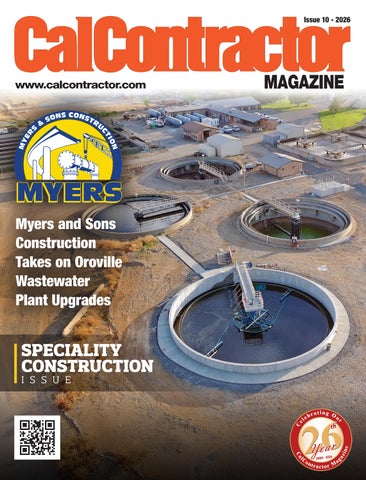
Myers and Sons Construction Takes on Oroville Wastewater Plant Upgrades
SPECIALITY CONSTRUCTION
I S S U E
OWN & GROW ADVANTAGE
O
$ DOWN % FINANCING
FOR UP TO 60 MONTHS*
Contact your California Cat dealer today for details.
SINCE 1956
SINCE 1919
hawthornecat.com San Diego County 866-834-3299
quinncompany.com Central & Southern California 888-608-5064
Financing provided by Caterpillar Financial Services Corporation. *Offer valid through December 31, 2026. Offer only available on purchases of new mini excavators, micro excavators, skid steer loaders, compact track loaders, and compact wheel loaders sold by participating Cat dealers to customers in the USA. Purchase and machine delivery must occur by December 31, 2026. Offer subject to machine availability. Offer is subject to credit approval by Caterpillar Financial Services Corporation for US customers. Not all customers will qualify. Offer may change without prior notice and cannot be combined with any other offers. Additional terms and conditions may apply. Contact your Cat dealer for more details.
ROLL INTO YEAR-END
SAVINGS
End the year with the right equipment and real savings. 0% for 60 months on John Deere compact machines, plus Section 179 tax benefits that help you save even more. Upgrade your fleet, reduce your tax burden, and get ready for the year ahead.
0%
FOR 60 MONTHS + SECTION 179 TAX BENEFITS
*Offer valid on qualifying purchases made 01 October 2026 through 04 January 2027 from participating dealer inventory. Subject to approved installment credit with John Deere Financial, for commercial use only. Down payment may be required. Average down payment is 10%. 0% APR for 60 months only. Taxes, freight, setup, insurance, fees, and delivery charges could increase monthly payment. Available at participating U.S. dealers. Prices and models may vary by dealer. Offer not available to customers receiving Governmental or Strategic Account discounts.
COASTLINE Equipment
Long Beach, CA (HQ) (562) 272-7400 www.coastlineequipment.com
YOUR AUTHORIZED JOHN DEERE DEALER FOR THESE CA COUNTIES: Long Beach Branch – Los Angeles and Orange Oxnard Branch – Northern Los Angeles, Ventura and Santa Barbara Santa Maria Branch – San Luis Obispo and Santa Barbara Bakersfield Branch – Kern, Inyo, Mono and Eastern Los Angeles Lake Forest and Sylmar Branches – Parts Only Stores
CONTENTS
2026 Specialty Construction AND SONS CONSTRUCTION 06 MYERS Takes on Oroville Wastewater Plant Upgrades SORACCO, INC.
Sewer Upgrades in Sacramento and 14 Tackles Stockton
SILL EXCAVATING
Cat Machines. Precise Work. 20 Compact Strong Relationships.
JCB
PUBLISHER: Kerry Hoover khoover@calcontractor.com EDITOR: Brian Hoover, Senior Editor ART DIRECTOR/GRAPHIC DESIGNER Aldo Myftari SOCIAL MEDIA MANAGER: Gerald De Guzman
Hydromax Brought Record-Breaking 26 JCB Hydrogen Power to Malibu Pier
FOR ADVERTISING INFORMATION: Please call: (909) 772-3121
CALIFORNIA RESPONDS 28 SOUTHERN TO COASTAL EROSION
CalContractor is published 12 times each year by Construction Marketing Services, LLC.
34 STEEL, CONCRETE & POLITICS
Copyright © 2025. All rights reserved. Reproduction in whole or in part without permission is prohibited. P.O. Box 892977, Temecula, CA 92589
LONG ROAD BACK: 40 THE Why Los Angeles Fire Victims Still Have Empty Lots
44 DISMANTLING SAN ONOFRE www.CalContractor .com 06
4
16
S P E C I A LT Y CO N S T R U C T I O N / 2 0 26
20
C A LCO N T R AC TO R .CO M
Smarter Solutions for Maximum Uptime VCES delivers Volvoʼs smart solutions to take your operation beyond hauling. With innovative tools like Haul Assist, Connected Map, CareTrack, and Volvo Service Contracts, VCES helps you make smarter decisions, extend machine life, and lower operating costs — all while maximizing uptime and productivity. Contact your nearest VCES location today.
Bakersfield 661.387.6090
Fresno 559.834.4420
Redding 530.255.8008
San Leandro 510.357.9131
Corona 951.277.7620
Lakeside 619.441.3690
Sacramento 916.504.2300
Turlock 209.410.6710
Find us on social media:
www.vcesvolvo.com
facebook.com/volvoces
VolvoCES
volvoces
volvoces
Myers and Sons Construction Takes on Oroville Wastewater Plant Upgrades Heavy groundwater, rocky excavation and a carefully staged transition to new equipment shape a roughly $17 million project for the Sewerage Commission–Oroville Region By Brian Hoover | Photos provided by Myers and Sons Construction
B
efore Myers and Sons Construction could build a new secondary clarifier at Oroville’s wastewater treatment plant, crews had to get control of the water already in the ground. Groundwater sat about eight feet below the surface, while the excavation would reach approximately 22 feet deep. In the site’s highly permeable cobblefilled soil, an open excavation would quickly fill with water. That challenge set the pace for the Sewerage Commission–Oroville Region’s Wastewater Treatment Plant Upgrade Package 1. For Myers and Sons, the work involved building new treatment facilities and connecting them to an existing operating wastewater treatment plant, all while managing difficult excavation conditions and helping operators transition to modern equipment. Robert Barton, senior project manager for Myers and Sons Construction, said work began April 1, 2025. At the time of the interview, the project was nearing substantial completion, with a final value expected to reach approximately $17.1 million.
6
The centerpiece was a fourth secondary clarifier, supported by a new mixed liquor distribution box and a retrofit of the return activated sludge pump station. The scope also included bypassing and retrofitting the headworks grit-removal system, adding onto the existing filtration facilities with two additional tertiary filters, and building a new septage receiving facility. With underground utilities, structural concrete, mechanical installations, bypass work and minor site civil improvements, the
project brought a broad mix of construction work into an operating treatment plant. Barton explained that the new clarifier would help the plant manage the additional wastewater flows it experiences during wet weather, when groundwater enters the collection system. But getting that new equipment into service required a carefully ordered progression through excavation, concrete construction, underground piping and pump station modifications.
Fully installed and commissioned (bottom) 4th Secondary Clarifier (SC4) alongside three previously existing Secondary Clarifiers.
S P E C I A LT Y CO N S T R U C T I O N / 2 0 26
C A LCO N T R AC TO R .CO M
Controlling the Groundwater Myers and Sons brought in Malcolm Drilling for the dewatering work. Initially, Barton said, pumping ran at approximately 800 gallons per minute before settling to about 350 gallons per minute, or roughly half a million gallons each day. Maintaining that system was essential while crews excavated and constructed the new clarifier. “We had to incorporate a pretty extensive dewatering system,” Barton said. Managing the discharge required just as much coordination as removing the groundwater. According to Barton, the project team had to route the pumped water back through the wastewater treatment plant, adding to the flow operators were already handling. The contractor and plant staff 1
SC4 Mass excavation with CAT 340 Excavator.
worked through the process together as the actual pumping rate became established. Barton credited the owner’s willingness to work with the construction team as an important part of resolving
that challenge. As pumping levels stabilized, the additional water proved more manageable than the initial groundwater dewatering calculations suggested, allowing the work to proceed accordingly.
2 Progress photos of SC4: 1. Completing mass excavation. 2. Driving SC4 steel H-piles for the foundation. 3. Pouring and stripping the center column slabon-grade (SOG) while forming the remaining SC4 SOGs.
3
4
7
4. Concrete slab-on-grade pours 60% complete. 5. Completing the final slab-on-grade pour while forming the circular perimeter walls.
8 5
6
9
6. Installing rebar and formwork for the circular perimeter walls. 7. Following a rain event, forming the effluent trough decks adjacent to the fully poured and stripped perimeter walls. 8. Completing SC4 concrete work and structural backfill; staging materials for the SC4 mechanism. 9. Fully installed and commissioned SC4.
CALCON TRAC TOR.CO M
S P E C I A LT Y CO N S T R U C T I O N / 2 0 26
7
Left: Using the fully installed SC4 mechanism to screed the topping grout on the slab-on-grade. Above: Installing rebar for the 6-foot-deep SC4 center column slab-on-grade.
Excavating Through the Cobbles With dewatering in place, Myers and Sons self-performed the major excavation using a Cat 340 excavator equipped with a rock bucket used to load three enddump trucks. The trucks made short hauls to an available staging area, keeping material moving as the excavation continued. “We ended up moving about 20,000 yards,” Barton said. That total included roughly 4,000 additional cubic yards needed to create an access ramp for the pile-driving equipment. The clarifier foundation called for driven steel piles, and getting the rig down to the bottom of the excavation required a ramp approximately 100 feet long. Crews used an open-cut excavation with sloped sides for the main structure. The soil presented a second challenge when it came time to backfill. Large cobbles made much of the excavated material unsuitable for backfill without screening. Myers and Sons used a Cat 336 excavator with a skeleton bucket to separate reusable material,
8
then placed and compacted it in manageable lifts with loaders and rollers. Barton estimated that only 40 to 50 percent of the material could be reused. Fortunately, the plant had an approximately five-acre area available for staging and screening, and a nearby rock-crushing operation accepted the oversized material. That arrangement gave the contractor a practical outlet for the rock while allowing crews to recover suitable backfill on site. BUILDING THE NEW CLARIFIER Once the foundation piles were installed, Myers and Sons began constructing the approximately 70-foot-diameter clarifier. The work included underground piping encased in concrete, the base slab, walls and collection troughs, followed by installation of the secondary clarifier mechanism. A secondary clarifier allows solids to settle out of wastewater after biological treatment. The new distribution box directs the wastewater and treatment
S P E C I A LT Y CO N S T R U C T I O N / 2 0 26
microorganisms, known together as mixed liquor, toward the clarifier. The equipment inside the secondary clarifier collects the settled material while clarified water moves onto the disinfection stage. For the construction crews, that process translated into a series of closely coordinated concrete and mechanical installations. Barton estimated that the clarifier required more than 450 cubic yards of concrete, including a substantial six-foot-thick center foundation to support its clarifier mechanism. Pacific Steel Group handled reinforcing steel, while Myers and Sons formed and poured the structure and installed the mechanical equipment. Testing was built into the sequence. Crews tested piping before encasing it in concrete and performed a leak test on the completed concrete structure before backfilling around it. Throughout construction, the dewatering system continued operating below the work. { Continued on page 10 }
C A LCO N T R AC TO R .CO M
GO ELECTRIC.
PUT CA CORE TO WORK. Explore CA CORE incentives for your next equipment purchase.
JCB 505-20E
JCB 19C-1E
ELECTRIC TELEHANDLER
ELECTRIC MINI EXCAVATOR
As low as
As low as
48,000
$
+
Cab and canopy available
tax*
26,000
$
+
tax*
Cab and canopy available
FINANCE THE REMAINING BALANCE. Financing available on the remaining balance after CA CORE subsidy, subject to credit approval.
Contact SoCal JCB for eligibility and application timing. Learn about the program: CaliforniaCORE.org *Advertised pricing reflects CA CORE subsidy. Subject to eligibility, voucher approval, funding availability and equipment configuration. Tax additional. Contact SoCal JCB for details.
2860 S Iowa Ave. Colton, CA 92324
866-522-7225
14480 Alondra Blvd LaMirada, CA 90638
sales@socaljcb.com
CALCON TRAC TOR.CO M
SoCalJCB.com
S P E C I A LT Y CO N S T R U C T I O N / 2 0 26
9
{ Continued from page 8 }
MAKING THE UNDERGROUND CONNECTIONS Connecting the new facilities to the existing plant brought another set of excavation challenges. Myers and Sons installed piping between the distribution box and clarifier, back to the return activated sludge pump station, and onward to the existing chlorine contact basin. Although individual runs were relatively short, the ground conditions complicated the work. “The cobbles were a lot more unpredictable than we anticipated,” Barton said. “Everyone did an amazing job of managing the numerous challenges on this project.” Along one alignment, the crew initially expected a conventional trenching operation with hydraulic shoring. As excavation progressed, the loose material required a wider, open-cut sloped excavation, with trench boxes used for worker protection. A run the team had expected to complete in a few days took over two weeks. Another alignment crossed an area crowded with existing plant utilities. Gravel backfill around older pipelines loosened as crews excavated nearby, causing the opening to widen beyond the planned trench. The conditions required changes to the excavation and backfill approach as the team worked through the utility crossings. UPGRADING THE PUMP STATION AND BRINGING THE CLARIFIER ONLINE Those underground connections led to one of the project’s most important operational steps: bypassing and retrofitting the return activated sludge pump station while maintaining service. These pumps move settled biological material back into the biological treatment process, where the microorganisms continue breaking down incoming waste. 10
CAT 340 mass excavating Mixed Liquor Distribution Box (MLDB) and CAT 305 excavating MLDB footprint conflicting with existing underground utilities.
The station had two existing pumps, and the project called for three new pumps. Barton said the team determined that removing all the old equipment at once would not work for the operating plant. Developing a workable transition took extensive planning with plant personnel. The solution was a staged changeover. Myers and Sons removed one existing pump and installed two new units, then commissioned them and confirmed they could handle the required flows. Once the operators were comfortable with the new arrangement, crews removed the remaining old pump and installed the third new unit.
S P E C I A LT Y CO N S T R U C T I O N / 2 0 26
The upgrade also introduced new automated controls to a system that operators had long managed manually. That meant commissioning involved both proving the equipment and helping plant staff become familiar with a different way of running the station. For a period, new automated equipment had to function alongside the older system. With the pump station changes in place, the team could bring the fourth clarifier online. Barton said the new clarifier was commissioned in August 2026. Its operating characteristics differed from those of the plant’s three existing units, making coordination with operators an important part of that startup as well. C A LCO N T R AC TO R .CO M
1). 95% progress of Return Sludge Pump Station installation. 2). Mixed Liquor Distribution Box (MLDB) interior wall forming and installing wall rebar.
2
3). Walls poured and stripped.
1
UPGRADING THE REMAINING TREATMENT SYSTEMS While the clarifier and pump station drove the main construction sequence, Myers and Sons advanced the other improvements around them. Crews retrofitted the existing filtration facilities with two additional tertiary filters, including their supporting concrete and mechanical piping, and built a new receiving facility for material delivered by septic tank haulers. The septage facility used a packaged stainless steel equipment system from Lakeside Equipment Corporation, with a rock trap, screening equipment and conveyor. Myers and Sons installed the underground utilities and concrete slab, set the equipment, and completed the pipe connections. The system removes rocks and debris from incoming material before it moves farther into the plant’s handling process. At the headworks, where incoming wastewater first enters the treatment process, Myers and Sons bypassed and retrofitted the grit-removal system. Barton said the replacement equipment took about a year to move through CALCON TRAC TOR.CO M
3
submittals, fabrication and delivery. Once it arrived, crews removed the existing equipment and installed the new system,
which separates sand and grit before those materials can reach downstream processes.
Link-Belt 90-Ton RT Crane placing one of two Tertiary Filter Vessels.
S P E C I A LT Y CO N S T R U C T I O N / 2 0 26
11
Left: Drone photo of fully installed and commissioned Septage Receiving Facility. Above: Progress photo of the new Grit Washer and Classifier retrofit at the existing Grit Removal Facility.
COORDINATING THE WORK THROUGH COMPLETION Across the project, Myers and Sons self-performed excavation, concrete forming and placement, underground and mechanical piping, and equipment installation. A company-owned Link-Belt crane supported the work, with specialty subcontractors providing services that included pile driving, reinforcing steel, dewatering, electrical work and coatings. Barton estimated the field crew reached approximately 12 to 15 people at peak. He singled out jobsite superintendent Adam Smith and general superintendent Nick Baer for their contributions. Smith’s daily work with plant personnel was especially valuable as the project moved through construction and startup. Barton praised him for “working with the client day in and day out,” helping explain the construction process and what each upcoming step would involve. As the project approached completion, Oroville’s treatment plant had its fourth clarifier in service and a rebuilt pump station operating with automated controls. Close coordination 12
between Myers and Sons and the Sewerage Commission allowed the modernization to proceed while the plant continued serving the community. Myers and Sons Construction’s capabilities span water and wastewater treatment facilities, heavy civil construction, bridges and structures, road and bridge
restoration, and emergency response. Its ability to selfperform excavation, underground utilities, structural concrete and mechanical installations supports complex projects such as the Oroville plant upgrade. For more information about Myers and Sons Construction and its services, visit www.myers-sons.com. Cc
Rerouting and underground utility tie-in of Mixed Liquor process piping into completed MLDB.
S P E C I A LT Y CO N S T R U C T I O N / 2 0 26
C A LCO N T R AC TO R .CO M
CALIFORNIA’S LARGEST INVENTORY OF FORD TRUCKS & VANS
CalContractor Specials $65,542*
$65,926*
2025| F-350
4x4
$61,927*
2025 | F-350
$68,197*
2025 | F-550
2025 | F-450
12’ Stakebed
10’ Contractor
12’ Flatbed
12’ Contractor
6.7L V8, PWR Pkg, Bluetooth, Rear Cam | #SEE11626
7.3L V8, PWR Pkg, Bluetooth, Rear Cam | #SEE09756
7.3L V8, PWR Pkg, Bluetooth, Rear Cam | #SDA18860
7.3L V8, PWR Pkg, Bluetooth, Rear Cam | #SED91201
After $11,250 in Total Discounts**
After $12,000 in Total Discounts**
After $10,500 in Total Discounts**
After $12,250 in Total Discounts**
$59,995*
$74,926*
2026 | F-250
$85,149*
2026 | F-350
$96,507*
2026 | F-450
2026 | F-550
8’ Utility
9’ Plumber
11’ Welder Body
14’ Combo
6.8L V8, PWR Pkg, Bluetooth, Rear Cam | #TEF41809
7.3L V8, PWR Pkg, Bluetooth, Rear Cam | #TEC07054
6.7L V8, PWR Pkg, Bluetooth, Rear Cam | #TDA21325
6.7L V8, PWR Pkg, Bluetooth, Rear Cam | #TDA10693
After $7,500 in Total Discounts**
After $13,000 in Total Discounts**
After $10,750 in Total Discounts**
After $13,500 in Total Discounts**
$104,454*
$105,264*
2027| F-650
$102,854*
2026 | F-750
$83,342*
2027 | F-650
2027 | F-650
5/7 Yard Dump
2,000 Gal Water Tank
16’ Dump
20’ Stakebed
7.3L V8, PWR Pkg, Bluetooth, Rear Cam | #VDF02996
7.3L V8, PWR Pkg, Bluetooth, Rear Cam | #TDF07933
7.3L V8, PWR Pkg, Bluetooth, Rear Cam | #VDF02303
7.3L V8, PWR Pkg, Bluetooth, Rear Cam | #VDF05105
After $13,000 in Total Discounts**
After $14,000 in Total Discounts**
After $13,250 in Total Discounts**
After $9,500 in Total Discounts**
See all of our inventory at www.kengrodyfleet.com ORANGE COUNTY (714) 228-6179
SAN DIEGO (760) 935-8967
INLAND EMPIRE (909) 363-9587
*Plus government fees & taxes, any document preparation charge and any emission testing charge. **”Total Discounts” includes dealer discount and all Ford Retail Incentives, including Ford Retail Cash, Bonus Cash, and other Retail Rebates. Some Bonus Cash rebates may require you to Finance with Ford Credit. Creditworthiness determined by Ford Motor Credit, not all customers will qualify. Rebates are subject to change without notice.
Tackles Sewer Upgrades in Sacramento and Stockton From protecting historic surroundings to managing a 25 million gallon per day bypass, two projects demonstrate the planning and field experience behind successful underground construction By Brian Hoover, CMS Editor / Photos by Soracco, Inc.
R
eplacing a sewer line can mean working around far more than the pipe itself. Historic features, busy sidewalks, unmarked utilities and wastewater that must keep moving all influence how a contractor approaches the work. For Soracco, Inc., two recent municipal sewer projects brought those challenges into focus, requiring different construction
methods and carefully coordinated field operations. In Sacramento, the company used pipe bursting to replace and enlarge a sewer line near the city's historic waterfront while limiting excavation. In Stockton, a relatively short trunk line replacement required an extensive temporary bypass capable of handling 25 million gallons per day. Together,
the projects illustrate how the right plan, equipment and crew can make complicated underground improvements manageable. Richard Soracco, President and Owner of Soracco, Inc., discussed both projects and the decisions that helped his crews carry the work from excavation through restoration.
Mario Nieto, Sergio Ochoa and Carlos Nadal excavate for a deep manhole using a Cat M322 wheeled excavator. 14
S P E C I A LT Y CO N S T R U C T I O N / 2 0 26
C A LCO N T R AC TO R .CO M
Left: Soracco’s sewer crew excavates for a new 10-inch sewer main using a Cat 420F2 backhoe. Above: The crew installs a 10-inch sewer main inside an 18-inch steel casing beneath the proposed light rail tracks.
Replacing Combined Sewer Infrastructure in Sacramento The approximately $1.5 million Block Six Combined Sewer Replacement Project for the City of Sacramento involved roughly 1,500 linear feet of combined sewer improvements. Work began in fall 2025 and wrapped up in May 2026. Sacramento's combined system carries both stormwater and sewage. Part of the project redirected flow collected along Capitol Mall to a different manhole and line. Another portion involved replacing a main line in Powerhouse Alley and updating numerous lateral connections serving a couple of city blocks. Soracco, Inc. self-performed nearly all of the construction, including the sewer installation, concrete work and asphalt restoration. Specialty subcontractors assisted with slurry abandonment of existing lines. The setting added another layer of responsibility. Crews worked near Old Sacramento, with historic features, businesses, a parking structure and the Tower Bridge surrounding portions of the operation. Opening a continuous trench through sensitive areas would have increased both the disruption and the restoration work. CALCON TRAC TOR.CO M
The City looked to Soracco, Inc. for options. Richard and his team proposed pipe bursting for a suitable section of the alignment, and the City agreed to the approach. Pipe Bursting Protects Historic Surroundings The selected section consisted of approximately 400 feet of existing 8-inch clay pipe. Soracco, Inc. replaced it with a 10-inch line, connecting the new pipe to existing manholes while avoiding a continuous open trench. The alignment offered favorable conditions for the method. The clay pipe broke readily under the pulling pressure of the tapered edge of the pipe bursting head. There were no lateral connections along the segment to complicate the pull, as crews excavated a receiving pit approximately 8 feet by 8 feet and about 12 feet deep, along with an insertion pit roughly 5 feet by 5 feet. A ramped approach allowed the new pipe to transition from the surface down to the installation elevation. The pits were shored appropriately for the work. Using its own hydraulic pulling equipment, Soracco, Inc. completed the actual pull in a little more than
two hours. A Cat 299 compact track loader supplied hydraulic power, eliminating the need to mobilize a separate power pack for that operation. The result was a larger replacement line installed with limited surface disturbance in an area where protecting existing features mattered. “It has a time and a place,” Richard says of pipe bursting. “ He explains that a short replacement segment with multiple utility crossings may offer little advantage over open-cut construction once crews complete the necessary utility investigation and excavation. Longer, straightforward runs can present a much better opportunity. For suitable applications, Richard estimates potential savings of approximately 30 to 40 percent compared with conventional open-cut replacement. Those savings depend on the conditions and come from reducing excavation, bedding, backfill, compaction testing and surface restoration. On Block Six, the method also helped the crew avoid disturbing historic features along the route.
S P E C I A LT Y CO N S T R U C T I O N / 2 0 26
15
Matching Equipment to a Tight Urban Site Other portions of the Sacramento project called for a different equipment solution. Across from the Embassy Suites on Capitol Mall, crews needed to excavate for a manhole approximately 22 feet deep while working partly on the sidewalk. Positioning a tracked excavator in that location would have complicated the operation and required additional measures to protect the surrounding surfaces. Soracco, Inc. instead rented a Cat wheeled excavator from Holt of California. “Honestly, it worked out perfect,” Richard says. “We loved working with that Cat wheeled excavator so much, we are seriously considering adding one to our fleet.” The Cat machine provided the digging capability the crew needed while allowing easier movement around the work area. Richard
appreciated its mobility and the ability to work around curbs and concrete improvements with less concern about damage from tracks. The experience made a wheeled excavator a priority for future fleet consideration. Backhoes, a small excavator and the Cat 299 also supported the project. At peak, the Sacramento crew consisted of two operators and five laborers. Richard credited project foreman Mario Nieto with managing the demands of the downtown location, including encounters with older, unmarked utilities. Traffic and pedestrian control required ongoing attention, particularly when motorists wandered into the work zone. With businesses, visitors and city activity close by, maintaining an organized operation was an essential part of the job.
Swenson Park 42-Inch Trunk Line - A Major Bypass for a Short Stockton Replacement
Top: Sergio excavates with a Cat 420XE backhoe in preparation for asphalt placement. Center: A Soracco crew member applies tack coat along the existing asphalt edges. Above: Sergio compacts fresh asphalt with a Cat CB14B tandem steel drum roller, with the Tower Bridge in the background. 16
The Swenson Park 42-inch trunk line upsize in Stockton presented a different challenge. The approximately $1.1 million project for the City of Stockton on Alexandria Place continued sewer improvements Soracco, Inc. had worked on several years earlier. The scope involved replacing approximately 120 linear feet of existing 36-inch sanitary sewer trunk line with 42-inch pipe at a depth of roughly 15 feet. Although the replacement length was relatively short, maintaining flow around the work required a substantial temporary system. The bypass was the more demanding part of the assignment. Rated at 25 million gallons per day, it was among the largest Soracco, Inc. had set up. The company established three temporary lift stations and tied two separate systems into one larger system to carry wastewater around the replacement area.
S P E C I A LT Y CO N S T R U C T I O N / 2 0 26
Thousands of feet of 24-inch bypass piping ran through the park. Before installing that network, the team had to work through its effects on sidewalks, pedestrian routes and surrounding traffic. A high school across the street added another consideration to the planning. A field meeting brought together representatives responsible for sewer operations, parks, streets and public works. The group reviewed the route and the measures needed to accommodate construction. Soracco, Inc. mapped out sidewalk crossings and installed a temporary pedestrian bridge and walkway to maintain access around the bypass. The job demonstrated how much preparation can be required before the first section of permanent replacement pipe goes into the ground. The temporary infrastructure extended well beyond the limits of the sewer excavation itself. { Continued on page 18 } C A LCO N T R AC TO R .CO M
Left: Cast-in-place manhole base installation. Center: A 70-ton hydraulic pipebursting puller is set in the pulling pit. Soracco used a 4-inch pre-bursting head to fracture the existing 4-inch clay sewer main, followed by a 6-inch bursting head to install the new 6-inch HDPE sewer main. Right: Jacob Gruenwald operates a 30-ton hydraulic pipe-bursting puller powered by a Cat 301.7 mini excavator.
{ Continued from page 16 }
Installing the New Line and Restoring the Park Work took place in June 2026 over approximately three weeks. Crews spent about a week establishing the bypass, followed by roughly five to six days of sewer replacement work. Removing the temporary system and completing restoration required approximately another five days. Steel trench shields were utilized for the excavation, as crews encountered a 15-inch concrete storm drain that conflicted with the new sewer installation. The team
plugged and temporarily removed the affected section, installed the 42-inch sewer line, then returned to replace the storm drain. The Stockton operation included three operators, seven laborers and two cement masons. Equipment included Cat 335 and 315 excavators, a Cat 299 compact track loader and a Cat 420 backhoe loader. A rough terrain forklift helped place the bypass pumps, while haul trucks, a water truck and other support vehicles also served the operation. Foreman Jed Smith and fellow foreman Andrew Crago helped
oversee the work. As the bypass route and access requirements developed, the amount of concrete removal proved greater than originally anticipated. Soracco, Inc. brought in its own cement masons to handle the sidewalk, curb and gutter restoration. That ability to perform multiple scopes was useful on both projects. Sewer installation was only part of the assignment; demolition, temporary access, concrete replacement and paving also had to be coordinated to return the work areas to service.
Soracco crew members work through multiple phases of manhole construction, including installation of the cast-in-place base, barrel sections and cone.
18
S P E C I A LT Y CO N S T R U C T I O N / 2 0 26
C A LCO N T R AC TO R .CO M
Preparing for the Next Round of Work As Soracco, Inc. looks toward 2027, Richard describes a busy but increasingly competitive market. The company has worked with a workforce of approximately 50 employees, and revenue has increased. However, Richard emphasizes that higher revenue does not automatically translate into stronger profits. He has seen and influx of contractors pursuing work in Sacramento and the Central Valley, including firms coming from the Bay Area. That competition makes careful bidding and attention to operating costs particularly important. Maintaining backlog remains a priority, but Richard
is also focused on avoiding overextension. Along with a possible wheeled excavator purchase, the company is considering additional wheel loaders. Its workload includes Caltrans work, levee work for the City of Sacramento and a sizable water project for San Joaquin County. The Sacramento and Stockton sewer projects reflect the capabilities Soracco, Inc. brings to those assignments: evaluating site conditions, selecting an appropriate construction method and carrying the work through final restoration. In one location, that meant pulling a larger sewer line beneath sensitive surroundings. In the other, it
meant building an extensive temporary bypass to make a short but substantial trunk line upgrade possible. Based in Lodi, Soracco, Inc. offers underground utility construction, pipe bursting, pump stations, site civil improvements, grading and paving, public infrastructure construction, general building, sawcutting and core drilling, and 24/7 on-call emergency service work. Its ability to selfperform sewer construction and related concrete and asphalt work supports projects with demanding access, sequencing and restoration requirements. For more information about Soracco, Inc. and its services, visit www.soraccoinc.com. Cc
Soracco’s sewer crew installs a new 42-inch sewer trunk line using a Cat 335 excavator, Cat 315 excavator and Cat 420XE backhoe. Multiple temporary lift stations were set up to bypass 25 million gallons per day of sewer flow. CALCON TRAC TOR.CO M
S P E C I A LT Y CO N S T R U C T I O N / 2 0 26
19
Compact Cat Machines. Precise Work. Strong Relationships. Allen Sill builds Sill Excavating through skilled operation, personal service and dependable support from Hawthorne Cat’s Escondido compact equipment store. By Brian Hoover, CMS Editor | Photos by Nathan Hoover, CMS and Sill Excavating
F
or Allen Sill, a well-excavated trench is about more than moving dirt. It is about leaving the next contractor ready to work. The grade needs to be right, the work area needs to be organized, and the excavation needs to reflect an understanding of everything that comes next. That attention to detail has helped Allen Sill, owner of Sill Excavating, build a business serving plumbers, electricians, concrete contractors, developers and homeowners throughout the greater San Diego area. Whether he is excavating underground plumbing for a multifamily housing project or working within the tight confines of a residential backyard, Sill brings the same approach: understand the assignment, make the most of the equipment, and take care of the people counting on him. “I’m just working hard, trying to take care of people,” says Sill. “And the work just keeps coming.” Operating from Valley Center, Sill has spent more than a decade building Sill Excavating primarily as an owner-operator. His recent purchases of new Cat 305 CR and Cat 306 CR mini excavators from Hawthorne Cat represent another
20
step forward, giving him additional flexibility today while preparing the business for future growth. Getting Started with Cat Equipment In 2013, Sill purchased a 2008 Cat 420E backhoe loader from Hawthorne Cat’s rental fleet. The machine had approximately 2,100 hours, and he remembers paying around $64,000. The backhoe was a practical choice for a contractor starting with one machine. Its versatility allowed him to accept different assignments as he established his customer base. Just as important, Sill says, it gave him the reliability he needed during those early building years. “That Cat backhoe gave me my start,” he says. “It never broke down.” Finding Opportunity in Smaller Work Today, Sill Excavating’s assignments range from utility trenching and commercial plumbing and electrical excavation to foundation footings, block wall footings and residential drainage improvements. Much of that work comes through other contractors. Sill has longstanding relationships with plumbers, electricians and
S P E C I A LT Y CO N S T R U C T I O N / 2 0 26
concrete professionals who call when they need an experienced operator. Some of those connections reach back to his early years working for larger companies. The company often works on an hourly basis, providing the machine and operating experience needed for a particular portion of the project. That arrangement lets his contractor customers draw on his expertise while their own crews handle other responsibilities. Accessory dwelling units have become another productive market. Even a relatively small residential building can require excavation for footings, plumbing and electrical service. With existing homes, fences and landscaping surrounding the work area, access and maneuverability can be as important as digging capacity. Sill’s relationships with the trades put him in a good position to serve those projects. A plumber or electrician gets the assignment, recognizes the excavation requirements and calls someone whose work they already know. “I’m not big and I’m not fancy,” Sill says. “But I’m entrenched in San Diego, and I know and have worked for a lot of good people.” C A LCO N T R AC TO R .CO M
From left: Matt Higgins, machine sales representative for Hawthorne Cat and Allen Sill, owner of Sill Excavating.
Two New Cat Excavators with a Clear Purpose Sill Excavating’s latest equipment purchases were deliberate investments in the work that has proven most successful for his business. He recently purchased the new Cat 305 CR and Cat 306 CR mini excavators approximately one month apart through Hawthorne Cat’s Escondido Compact Equipment location. These new Cat machines join an existing Cat 306 CR, bringing his excavator fleet to three compact machines. The older Cat 306 CR, a 2020 model with approximately 4,000 hours at the time of the interview, has steel tracks equipped with rubber pads. For the two newer machines, Sill chose rubber tracks, which he prefers for many of his residential and tighteraccess assignments. The different machines give him options when matching equipment to a project. CALCON TRAC TOR.CO M
His existing Cat 306 CR remains useful on larger dirt assignments, while the new additions support the residential and confined-space work that regularly fills his schedule. That fleet reflects lessons learned through experience. Sill previously owned a Cat 308 CR mini excavator but found himself looking for larger projects to keep it working. Meanwhile, demand continued arriving for smaller, more detailed assignments. “I’ve found, for me, my success has been in smaller work,” he says. “As an owner operator, this is where I shine. Big or small, the goal is always the same. Bring your best and leave the client with a reason to ask you back for another job.” On one block wall footing project, for example, the toe of a slope was approximately 12 feet from the house. Sill needed to excavate in that narrow corridor
while a supporting Cat track loader removed material. There was little room for equipment that could not maneuver efficiently within the available space. Jobs like that have reinforced his preference for mini excavators and compact track loaders. He can position the machines for excavation, change buckets as the work progresses and coordinate material handling without the front bucket of a backhoe occupying additional space. “You can put on a 3-foot or 5-foot bucket on these Cat mini excavators, and you can pull grade with it, or you can load trucks,” Sill says. “I support these Cat mini excavators with Cat compact track loader rentals from Hawthorne Cat Rentals. While renting is a good solution for now, I have plans of adding a new Cat 255 compact track loader from Hawthorne Cat very soon.”
S P E C I A LT Y CO N S T R U C T I O N / 2 0 26
21
Keeping Multiple Projects Moving Three excavators might appear unusual for a business whose owner does most or all the operating. Sill’s schedule explains the investment. Excavation work rarely progresses continuously from start to finish. After he completes a trench, another contractor may need to install material. An inspection may follow. Only then can Sill return for backfill. Moving one machine between every stage of every project
would add transportation, loading and scheduling demands to an already full workweek. With multiple excavators, Sill can leave equipment at an active project and move himself to another location. When the first customer is ready for him again, the machine and attachments are already there. “I often work on multiple ongoing projects in one workday, and having a Cat mini excavator on each job
saves an enormous amount of time and money,” says Sill. “I’m able to complete a lot more work this way.” This approach allows him to own the equipment he uses most often while obtaining additional rented machines from Hawthorne Cat Rentals as needed. It also gives him an existing equipment foundation for hiring contract and full-time operators as the business grows.
Precision on a San Marcos Multifamily Unit Construction Project A multifamily housing assignment in San Marcos demonstrates how Sill’s equipment strategy supports his customers. Working for a San Diego plumbing contractor within a Lennar community, Sill has been excavating the underground plumbing trenches serving the residential multiunit buildings. For one recently completed eight-unit multifamily
building, he estimated approximately 120 linear feet of excavation per unit, or roughly 1,000 linear feet overall. The footage tells only part of the story. Each trench must follow the plumbing layout and required grade, with connections extending toward the street. Sill described portions of the excavation beginning at approximately 18 inches deep and
progressing to tie-in points roughly 4½ to 5 feet deep. The work also requires attention to the space surrounding the trench. Plumbers need to establish their lines and move through the building footprint. Excavated material left in the wrong place can create unnecessary work for the crew following him. { Continued on page 24 }
Allen Sill with Roxanne and Hazel, whose encouragement and support at home are an important part of his success.
22
S P E C I A LT Y CO N S T R U C T I O N / 2 0 26
C A LCO N T R AC TO R .CO M
Built on trust. Backed by steel. Southern California’s Go-To for Trench Safety Equipment Rentals
What We Offer Steel & Aluminum Trench Shields Rugged, reliable, and job-ready
Hydraulic Shoring Systems Fast, safe, and user-friendly
Manhole Boxes & Trench Plates All sizes available — non-skid options too
Custom Solutions Need training? We’ve got your crew covered.
NEW MORENO VALLEY BRANCH! | OPENING SEPTEMBER 15 FULL-SERVICE TRENCH SAFETY RENTALS The same trusted trench safety rental solutions and service you know from our San Diego location - now serving Moreno Valley and the Inland Empire.
NEW LOCATION. SAME GREAT SERVICE. 2115 Box Spring Rd. Moreno Valley, CA 92557 SAN DIEGO
315 Cypress Ln, El Cajon, CA 619.334.3900 | info@socalshield.com SoCalShield.com Ask for Dana - Director of Sales 760.704.9997 | dana.fredette@socalshield.com
Where Safety Meets Service. No excuses. No shortcuts.
{ Continued from page 22 }
Hawthorne Cat’s Compact Equipment Focus in Escondido Sill’s latest purchases came as Hawthorne Cat strengthened the compact equipment sales focus at its existing Escondido branch. Hawthorne’s dedicated Cat Compact website identifies the Escondido store at 1620 Mission Road as its local Cat Compact dealership. The program brings together new and used equipment, rentals, financing and ongoing support, with an emphasis on the needs of smaller and growing businesses. Customers can compare machines in person, discuss applications with the local team and explore equipment choices that fit their work and budget. For Sill, the change was visible on the ground. He described an
increased presence of compact equipment at the location, including excavators, skid steers and compact track loaders, and a sales operation focused on the machines contractors like him use every day. His purchase also carried a distinction. According to Sill, Matt Higgins, Hawthorne’s machine sales representative, told him his Cat 305 purchase was the first completed through the location’s new compact equipment sales setup. Sill recalls being in Higgins’ office when the salesperson recognized the milestone and brought it to the attention of a visiting Cat corporate representative.
A Dealer Relationship Built Over Time Sill has worked with Matt Higgins since approximately 2015 and values the practical equipment knowledge he brings to the relationship. According to Sill, Higgins’ background includes service management and hands-on mechanical experience within the service department. That perspective has helped them discuss more than the initial purchase price of a machine. “He’s turned wrenches,” Sill says. “He knows all the specs, which makes him such a valuable partner for a small company like mine.” Higgins also helped Sill think through the transition from backhoes to compact excavators. Their conversations included maintenance requirements, warranty costs and the operating expenses that affect profitability over time. Sill has noticed a substantial difference in fuel consumption on his own 24
assignments. He estimates that his compact excavators may use approximately 7½ gallons during a workday, compared with close to 20 gallons for a backhoe in his experience. Those figures reflect his specific work and operating conditions, but they also help explain why he has committed more of his business to Cat excavators. Parts and service support are equally important. Sill has developed relationships with Hawthorne Cat personnel who understand how much a delayed repair can affect a small operation. He points to after-hours parts pickup as a practical example. When a needed component is placed in the overnight bin, he can retrieve it before the normal business day begins and continue to his project. “It could be 4:30 in the morning,” Sill explains. “I go out, I put it on, and I’m rocking and rolling.”
S P E C I A LT Y CO N S T R U C T I O N / 2 0 26
The Cat 305 mini excavator delivers impressive performance in a compact package, combining fuel efficiency, versatility and productivity on a wide range of jobs.
C A LCO N T R AC TO R .CO M
1
2
From setting tanks to removing curb and gutter, Cat mini excavators provide Sill with the versatility, precision and operator comfort needed to complete projects efficiently and deliver quality results.
3
4
Growing Without Losing the Personal Connection Sill’s business also takes him beyond conventional construction projects. He has helped homeowners improve drainage, worked on ranch properties and even performed custom tasks like utilizing existing boulders to create landscape features and low rock walls. These assignments reinforce what he enjoys about the work: someone has a problem or an idea, and he can bring the equipment and experience to help. Every successful project generates referrals. Sill believes that leaving a customer satisfied with the entire experience is one of the most effective ways to keep the phone ringing. He credits his Christian faith, hard work and the relationships around him for the opportunities he has received. Looking ahead, he wants to build on that foundation. His plans include CALCON TRAC TOR.CO M
pursuing a general engineering “A” license and bringing in employees. “I’m working on having all my infrastructure dialed in and ready for new operator hires,” Sill says. “Everything moves so fast that it requires anticipating what is next and having everything prepped and ready for that transition. That includes having the right equipment.” Sill has mentored younger operators and is eager to continue sharing what he has learned, but he also understands the importance of hiring carefully. Anyone joining his company will help serve customers whose trust he has spent years earning. With that responsibility in mind, Sill researches leadership strategies and listens to podcasts on accountability and team development as he considers how to grow the business beyond his
own time behind the controls. His bachelor’s degree in business management has also helped shape his approach to running and growing the company. The new Cat excavators are part of that preparation. They improve his ability to serve customers now and provide equipment for the people he hopes to bring into the business. For Sill, the next stage of Sill Excavating will depend on the same qualities that carried him from a used backhoe to a busy three-excavator operation: careful work, dependable equipment and relationships worth protecting. “I like going out there and helping people,” Sill says. “I love what I do.” For more information on Sill Excavating, please call the Valley Center office at (951) 760-4152. Cc
S P E C I A LT Y CO N S T R U C T I O N / 2 0 26
25
JCB Hydromax Brought Record-Breaking Hydrogen Power to Malibu Pier Labor Day weekend display connected a 406-mph achievement with JCB’s development of hydrogen-powered construction equipment. By Brian Hoover / Photos provided by JCB
JCB Record setting Hydromax vehicle displayed at Malibu Pier over Labor Day weekend.
J
CB brought its record-setting Hydromax vehicle to Malibu Pier over Labor Day weekend, giving Southern California visitors a close look at the hydrogen technology behind its 406.320-mph run at Utah’s Bonneville Salt Flats. Held September 3–7 at Ranch at the Pier, the event launched the JCB Hydromax Great American Run tour and combined an engineering showcase with family activities. The display connected an extraordinary motorsports achievement with a practical construction industry objective: developing hydrogen-
26
powered equipment capable of performing the work traditionally handled by diesel machines. The Malibu presentation featured Hydromax alongside displays of its engine technology and JCB’s commercial hydrogen engine. According to event information supplied by JCB, the program also included a children’s play area and exclusive merchandise developed with LA Authority at the Ranch at the Pier Cabana. A hand-painted JCB 3TS-8T Teleskid added a charitable component. The machine was
S P E C I A LT Y CO N S T R U C T I O N / 2 0 26
displayed in support of VetsAid, the veterans-focused nonprofit founded by Rock and Roll Hall of Fame inductee Joe Walsh. The JCB 3TS-8T Teleskid will be auctioned on November 10, 2026, with proceeds benefiting the organization. Hydromax arrived in Malibu just weeks after its August 11 performance at Bonneville. Driven by Wing Commander Andy Green, the 32-foot streamliner completed runs of 400.623 and 412.135 mph, producing a two-way average of 406.320 mph. The runs were C A LCO N T R AC TO R .CO M
Hand-painted JCB 3TS-8T Teleskid.
JCB’s Hydrogen Combustion Engine.
JCB representatives answer questions to interested visitors.
Alice Bamford with JCB Hydromax driver, Andy Green.
Alice Bamford in the cockpit of the record-setting JCB Hydromax.
Alice Bamford greeting guests at the Malibu Pier showcase event.
conducted in opposite directions within an hour under FIA rules. JCB’s announcement identified the achievement as a new hydrogenpowered land speed record, subject to official FIA ratification. The vehicle’s connection to construction equipment extended beneath its streamlined body. Hydromax used two specially developed engines based on JCB’s production hydrogen engine technology, delivering a combined 1,600 horsepower. Engineering partner Ricardo increased each engine’s output from approximately 74 to 800 horsepower and modified the systems so the engines could operate on their sides, helping lower the vehicle’s center of gravity and improve aerodynamics. For contractors, the more relevant development was how that engine technology had progressed into working equipment. In May 2026, JCB announced the formal launch
of its first production 3CX Hydrogen Backhoe Loader, following more than $132 million in hydrogen development investment and customer trials involving backhoes, Loadall telescopic handlers and power-generation equipment. The production backhoe used a 55-kW hydrogen combustion engine and three roof-mounted hydrogen tanks. JCB reported power and torque comparable to the diesel version, similar maintenance intervals and fuel storage intended to support all-day operation. The company also developed a mobile refueling system with HYKIT to bring hydrogen directly to machines on the jobsite. That approach addressed a familiar contractor priority: keeping equipment working without lengthy interruptions for replenishing its energy supply. JCB’s development program had explored multiple ways to use hydrogen. The company unveiled a
hydrogen fuel-cell 220X excavator prototype in 2020 before advancing its hydrogen combustion engine program. Its subsequent emphasis centered on familiar engine technology, rapid refueling and the ability to deliver fuel to equipment in the field. JCB described the combustion engine’s carbon benefit as eliminating CO2 emissions at the point of use. At Malibu Pier, the record car provided the attraction, while the accompanying engine displays brought the discussion back to construction. Together, they illustrated how JCB had advanced hydrogen from experimental equipment to a production backhoe, and used a landmark performance at Bonneville to bring that work to a broader audience. Contact JCB for more information on the all of the new and upcoming hydrogen powered machines from JCB. Cc
CALCON TRAC TOR.CO M
S P E C I A LT Y CO N S T R U C T I O N / 2 0 26
27
Southern California Responds to Coastal Erosion Emergency repairs and major shoreline projects put contractors at the center of efforts to protect homes beaches and transportation infrastructure By Brian Hoover, CMS Editor
S
outhern California’s latest coastal erosion emergency has put contractors to work protecting homes, rebuilding shoreline defenses and stabilizing a critical rail corridor. September 2026 high tides and powerful surf, including swells from Hurricane Marie offshore, stripped away beach sand and exposed foundations,
seawalls and transportation infrastructure from Malibu to San Clemente. Why the Coast Is Eroding Waves and currents move sand offshore and along the coast, narrowing the buffer that protects development. Dams, development and shoreline structures have also
altered the natural sediment supply. Long-term sea-level rise, driven by warming seawater and melting landbased ice, allows waves to reach farther inland, but officials have not quantified its specific contribution to September’s damage. Conditions vary by beach, and nourishment has helped some shorelines gain sand even as others suffer severe erosion.
Where the Damage Occurred Malibu Road Access and Shoreline Repairs Malibu’s Sea Level Drive failure turned coastal erosion into a neighborhood access emergency. The Sept. 8 incident damaged the only vehicle route serving the affected area, leaving 31 properties under evacuation orders and red tags as of Sept. 11. The loss of access also prevented normal emergency response and evacuation. The property count reflects those access restrictions as well as unsafe site conditions; it does not represent 31 destroyed homes. The homeowners association is overseeing repair efforts through licensed engineers and contractors,
while the city coordinates permits for permanent work and monitors site safety. As of Sept. 11, Malibu had not announced a repair schedule or identified the firms. Restoring safe access remains the condition for lifting restrictions. A separate stabilization effort along Pacific Coast Highway in the Palisades Fire burn area involves exposed utilities and failing shoreline structures. Inspections of 320 beachfront parcels had identified 23 red-tagged parcels by Aug. 10. At a critical location, seawall and crib-wall failures exposed a septic tank and utilities. Caltrans repaired the seawall and filled severe erosion at the
highway’s edge. Its August update also identified K-rail among the interim measures under consideration, with protection tailored to each site. Caltrans and SoCalGas were monitoring the corridor as the city pressed for permanent stabilization before winter storms. Long Beach Emergency Sand Berms On the Long Beach Peninsula, waves breached a seawall, damaged the beachfront boardwalk and carried water and sand into the neighborhood. Approximately 20 homes along Seaside Walk between 63rd and
67th places were evacuated Sept. 7 after responders discovered cracked and buckled concrete slabs, including fissures extending toward or beneath exterior walls. Inspectors were called to determine whether foundations had been compromised. The immediate response combined sand movement with flood cleanup. Crews built and reinforced protective berms, concentrating sand placement near 62nd Place, while other crews cleared deposited sand and pumped water from flooded areas. Garages and porches required cleanup, and street closures complicated neighborhood access. These were emergency protective and recovery operations; the reviewed updates did not establish a permanent seawall or boardwalk reconstruction contract. The city lifted mandatory Peninsula evacuation orders Sept. 9. Public reporting identified city response crews but did not name a private general contractor or subcontractors, quantify the sand placed, or provide a repair budget. Laguna Beach Seawall and Parking Lot Damage Laguna Beach’s south-facing coves absorbed some of the region’s most dramatic sand loss. High surf beginning Sept. 2 stripped sand from Aliso Beach, exposing rocks and undermining the west parking lot. The lot was closed after portions of its pavement and edges failed; the city estimated damage to public infrastructure at roughly $500,000. City crews and an unnamed oncall contractor removed electrical lines from palm trees threatened by the eroding edge, demolished failed pavement and moved sand into the undermined areas. The parking lot remains closed while staff monitor wave activity and evaluate nearby infrastructure. The south end of Lagunita Beach, Pearl Street Beach and the
Location: San Clemente, California (along the LOSSAN rail corridor adjacent to the beach). Project: The Orange County Transportation Authority (OCTA) emergency shoreline stabilization project. Heavy machinery (excavators by EXCO / Hitachi and CAT) is placing large boulders (riprap) along the slope between the ocean and the active Metrolink / Amtrak railway tracks above to prevent coastal erosion from undercutting the railbed.
Christmas Cove footpath also were temporarily closed. The city declared a local emergency to speed shoreline protection, sand placement, debris removal, assessments and repairs without ordinary contracting delays. That authority is important as forecasters call for a very strong El Niño, which could bring additional high surf and rainfall before the displaced sand returns. City staff also are helping homeowners inspect compromised seawalls, locate contractors and secure emergency permits. Six oceanfront homes along Ocean Way and Lagunita Drive remain yellow-tagged for limited access. Dana Point Emergency Revetment Work Along Dana Point’s Beach Road, damage extended from collapsed decks to threatened building foundations. The city reported nine red-tagged homes and seven yellow-tagged homes as of Sept. 9. Earlier inspections documented an undermined slab foundation, and ABC7 reported that one redtagged home had been demolished
after waves breached its seawall. Two additional homes were described by the district’s general manager as being at extreme risk. Emergency work focused on rebuilding the shoreline barrier with a boulder revetment. Trucks delivered rock to the beach, where an excavator placed individual boulders in front of exposed properties. Homeowners obtained emergency coastal permits, but high water limited opportunities to position the material. The operation required coordinating deliveries and equipment access with the tide while surf continued to attack the shoreline. ABC7 interviewed Rich Holt of Holt Rock, identifying him as a contractor with years of work in the Capistrano Beach community. The report did not specify his firm’s current contract limits or establish that it performed all emergency rock placement. The city’s updates likewise did not name the complete construction team. Emergency protection is an interim step, with permanent work still subject to follow-up coastal review.
Contractors operating bulldozers move freshly dredged sand into place Jan. 31 at Solana Beach, California.
How Contractors Are Protecting the Coast San Clemente Rail Corridor Stabilization For the construction industry, the most consequential transportation damage has again occurred in San Clemente. OCTA reported September 8 that waves overtopped the tracks, further eroded the adjoining slope and damaged some previously installed protective rock. The resulting closure affected passenger and freight movements. Crews placed additional riprap and continued stabilization as conditions allowed. An ensuing project update kept passenger service closed through the September 12–13 weekend, with reopening dependent on safe conditions. That emergency response is occurring alongside a much larger effort to reinforce four vulnerable areas along San Clemente’s coastal railroad. OCTA placed the overall package at approximately $310 million in September 2025, with proposed sand placement totaling up to 540,000 cubic yards. Rock repairs in the initial areas were completed in June 2025. The sand program requires separate sourcing and permitting, so its planned quantity should not be confused with material already delivered. The corridor requires protection from both directions. Ocean-side erosion threatens the support beneath the tracks, while unstable slopes inland can send soil and debris onto the railroad. At Mariposa Point, the Area 3 project includes
a 1,400-foot catchment wall extending from El Portal Beach access to Linda Lane, together with restoration of the pedestrian beach trail. September updates showed trail surfacing, irrigation, landscaping and cleanup continuing, with landscaping expected through October and the trail anticipated to reopen in fall 2026. A catchment wall addresses debris from the bluff; it does not replace the beach’s protection against ocean waves. Condon-Johnson & Associates is the contractor identified in OCTA’s Area 3 contract records. The work also illustrates how coastal stabilization can draw underground utilities into the construction sequence. An April 2026 approved action provided for a $690,911 change order for a sewer bypass supporting rehabilitation of an existing sewer within the project limits. Maintaining service while stabilizing the corridor adds another operation to an already confined jobsite. That documented assignment concerns the Area 3 project; it should not be read as confirmation that the company performed every September emergency repair along the railroad. Del Mar Bluffs Stabilization At Del Mar, Condon-Johnson & Associates is also the general contractor for Phase 5 of the Del Mar Bluffs Stabilization Project. The work covers approximately 1.6 miles of railroad right-of-way between
Coast Boulevard and Torrey Pines State Beach. SANDAG’s procurement documents described up to 180 new soldier piles, a continuous concrete grade beam 5 feet deep between piles, tieback anchors and approximately 2,100 feet of new seawalls at the bluff toe. Other work includes drainage pipelines, regrading, revegetation and access improvements. The original base bid was approximately $51.18 million. SANDAG now identifies the overall Phase 5 project cost at roughly $88 million, with construction extending from spring 2024 through 2027. Those figures describe different measures: the original construction base bid and the broader project budget. The agency describes the stabilization as an effort to protect the railroad over the next 30 years while longer-term rail realignment is pursued. The documented subcontracting team includes West Coast General, SRK Engineering, Golden State Boring and Nor Cal Pipeline Services, all listed with CondonJohnson on Laborers Local 89’s January 2025 Del Mar project roster. The roster does not assign individual work packages, so specific drilling, drainage or concrete scopes cannot be attributed to those firms from that record alone. Their inclusion nevertheless identifies a broader construction team behind a project often described publicly only by the sponsoring agencies.
D51PXi-24
Productivity is the key to job site
success
GNSS antenna GNSS receiver
Control box
Stroke sensing hydraulic cylinders
Factory installed machine control system for quality and durability
Machine control system components are factory installed and designed as an integral part of the machine.
Enhanced inertial measuring unit (IMU+)
Crawler dozer
Net horsepower 131 HP @ 2,200 rpm
Operating weight 31,438 lbs.
Blade capacity Power angle tilt (PAT) dozer 4.4 yd3
NT EQU I MO
87
1- 8
00
ENT PM
CLAIR E
stop by your nearest clairemont equipment dealer
-956 - 62
BAKERSFIELD, CA (661) 641-4500
FONTANA, CA (909) 429-9100
INDIO, CA (760) 863-5558
ESCONDIDO, CA (760) 739-9100
IMPERIAL, CA (760) 355-7700
SAN DIEGO, CA (858) 278-8338
CORPORATE (858) 278-8351
Access is a defining constraint at Del Mar. The work occupies areas above and below a 50- to 70-foot coastal bluff alongside an operating railroad. SANDAG identified limited access, ocean tides and restricted rail work windows as factors in the construction pricing. The resulting scope combines deep foundation work with surface drainage and protection at the bottom of the bluff. Supporting the track bed, conveying runoff and reducing wave attack each addresses a different part of the stability problem. Solana Beach and Encinitas Beach Nourishment Beach nourishment provides another major construction response. In Solana Beach and Encinitas, Manson Construction performed the initial sand placement for a federal coastal storm damage reduction program in 2024. The project placed approximately 700,000 cubic yards along 7,200 feet of Solana Beach shoreline and 340,000 cubic yards along 7,800 feet in Encinitas, a combined 1.04 million cubic yards. Completion was celebrated in May 2024. This was a previously planned protection project, separate from the September 2026 emergency repairs farther north. Manson deployed its hopper dredge BAYPORT to collect material from an approved offshore borrow site and pump it onto the shoreline. Excavators and dozers then spread and graded the sand. After the Solana Beach work, the operation moved north to Encinitas. The federal design at Solana Beach
called for a 150-foot-wide beach fill, while the Encinitas placement was intended to widen approximately 1.5 miles of beach by about 50 feet. The restored beach provides a sacrificial buffer: waves can move sand without immediately attacking the base of a bluff or a structure. These programs therefore involve recurring nourishment, rather than a single placement expected to remain unchanged indefinitely. Surfside Sunset Regional Sand Placement Manson was also awarded the Surfside-Sunset Stage 13 nourishment contract in October 2023. The $23.13 million project called for about 1.1 million cubic yards of sand at Surfside and approximately 100,000 cubic yards backpassed from Newport Beach. The Surfside placement area was designed to extend about 4,500 feet along the coast. Natural transport was expected to carry sand toward adjoining beaches, supporting a broader shore protection program extending from the San Gabriel River to Newport Bay. The Corps specifically identifies this program as mitigation for erosion associated substantially with federal floodcontrol, navigation and defense projects, another reason to avoid assigning all Southern California erosion to rising seas alone. Sustaining Shoreline Protection Taken together, these projects show why the construction response must match the failure mechanism. A damaged access road requires a different repair from a depleted
beach. A bluff-side catchment wall serves a different purpose from ocean-side rock protection. Drainage improvements can address water moving through and over a slope, while beach nourishment restores material between that slope and breaking waves. The work ranges from emergency pavement removal and backfilling to deep foundations, sewer bypasses and offshore dredging. September’s damage has made the immediate task clear: restore safe access, protect exposed infrastructure and prevent additional loss while permanent repairs are designed. The larger construction challenge is sustaining that protection through repeated storms and changing shoreline conditions. For Southern California’s contractors, success will depend on how effectively structural repairs, drainage and sediment management work together, and whether the next wave finds a functioning beach buffer or the edge of an already exposed foundation. Cc
Research credits: This article draws on public agency reports, construction records, contractor materials and news coverage from the cities of Malibu, Dana Point, Laguna Beach, Long Beach and Solana Beach; Orange County Transportation Authority; San Diego Association of Governments; NOAA; U.S. Geological Survey; U.S. Army Corps of Engineers; Laborers Local 89; Manson Construction; FOX 11 Los Angeles; ABC7 Los Angeles; North Coast Current; and Long Beach Post. Sources reviewed through Sept. 13, 2026.
Below: A split-hull trailing suction hopper dredge, linked to a tugboat, operates Jan. 31 off the shore of Solana Beach, California.
Left: Orange County Transportation Authority crews work on wavedamaged tracks through San Clemente on Sept. 8. (OCTA photo).
WHEN THE JOB IS TOO BIG, THE TIMELINE IS TOO SHORT, OR THE BUDGET IS TOO TIGHT. CHALLENGE ACCEPTED. In construction, each day brings new challenges. Choose your partner wisely. PAVEMENTRECYCLING.COM
916.440.8090
2025 TADANO GR800XL
www.coastlinecd.com
Crane Division 2024 MANITEX 26101C STK #113272 – $295,000 SALE – RENT – RPO
Headquartered: Sacramento, CA cranesales@coastlineequipment.com
“Your Crane and Boom Truck Headquarters”
SALES | RENTAL | PARTS & SERVICE
STK #122418 $825,000 SALE – RENT RPO
2025 ELLIOTT G85R STK #119050 – 85FT WORK PLATFORM CALL FOR PRICE
2026 MANITEX 2281T STK #127143 – $440,000 SALE – RENT – RPO
2023 TADANO GR550XL STK #110021 – $495,000 SALE – RENT – RPO
2023 TADANO GR350XL STK #95487 – $395,000 SALE – RENT – RPO
2024 MANITEX 1970C STK #114070 – $225,000 SALE – RENT – RPO
2026 MANITEX 40124SHL STK #123053 – $615,000 MOUNTED ON PETERBUILT 567 AUTO TRANS
2025 MANITEX 22101S STK #123051 – CALL FOR PRICE MACHINE IN STOCK
2023 MANITEX 30100C STK #106082 – $295,000 SALE – RENT – RPO
CALCON TRAC TOR.CO M
S P E C I A LT Y CO N S T R U C T I O N / 2 0 26
33
STEEL, CONCRETE & POLITICS Inside California’s Multibillion-Dollar Border Wall Construction Program Border barrier stretches across the U.S. Army Corps of Engineers South Pacific Border District's San Diego 4 border barrier project near Otay Mesa, California
By Brian Hoover, Editor, CMS, LLC
C
alifornia’s border wall is under construction again, and this time the work extends far beyond simply erecting steel barriers along the United States-Mexico boundary. Across San Diego and Imperial counties, contractors are working on several major federal border wall projects involving billions of dollars in new primary and secondary barriers, patrol and access roads, earthwork, drainage improvements, electrical systems, underground fiber-optic communications, lighting, cameras, sensors and other border-security infrastructure. In the rugged mountains east of San Diego, new sections of steel border wall are being constructed across terrain that would challenge almost any heavy-civil contractor. Roads climb steep ridges. Rock must be excavated and, in some locations, blasted. Heavy equipment, concrete, fabricated steel and construction crews have to reach remote sections of the international boundary where simply establishing access can become a major part of the project.
34
Farther east in Imperial County, the terrain changes from mountains to open desert, but the scale of the work continues. Current federal plans call for new and replacement barriers along with dozens of miles of secondary vehicle barrier and supporting technology throughout the El Centro Border Patrol Sector. Taken together, the current California border wall projects represent one of the state’s largest and most unusual ongoing heavycivil construction programs. They are also among the most politically divisive. Supporters view the new wall, roads and detection systems as long-overdue infrastructure needed to give Border Patrol agents greater control of the international boundary. Critics question the cost, environmental consequences and necessity of expanding physical barriers at a time when unauthorized border crossings have fallen dramatically. For CalContractor, however, there is another story behind that argument: Who is actually building California’s new border wall, how much work is underway, what is
S P E C I A LT Y CO N S T R U C T I O N / 2 0 26
being constructed, and what does it take to build hundreds of millions of dollars’ worth of infrastructure through some of the most difficult terrain in the state? The answers begin with nearly $3 billion currently obligated across four major San Diego and El Centro construction orders. BILLIONS MOVING INTO CALIFORNIA The current construction surge traces back to the federal budget reconciliation legislation signed into law July 4, 2025. Section 90001 provided U.S. Customs and Border Protection (CBP) $46.55 billion through fiscal year 2029 for new and replacement primary, secondary and waterborne barriers, access roads, cameras, lights, sensors and other work necessary to prepare and maintain the border infrastructure system. The language is important because what CBP now calls a “Smart Wall” is considerably more than a line of steel. In September 2025, CBP awarded San Diego 1 to BCCG Joint Venture for $483.49 million, with an announced scope C A LCO N T R AC TO R .CO M
of approximately nine miles of new Smart Wall and about 52 miles of associated system attributes in the San Diego Sector. During the same round of awards, Fisher Sand & Gravel Co. received the $574 million El Centro 1 project, initially consisting of approximately eight miles of new primary Smart Wall and roughly 63 miles of system attributes in California’s El Centro and San Diego sectors. Both contracts have since evolved. Federal award records now show approximately $506.61 million obligated to the San Diego 1 BCCG contract after modifications. The Fisher El Centro 1 contract has grown much more dramatically, from its original $574 million award to approximately $1.225 billion in current obligations. A March 10, 2026 modification alone added $629.7 million for additional access roads, new vertical barrier, a new alignment and other requirements. Fisher subsequently received another $847.04 million San Diego construction order on April 26, 2026, followed by the $345.04 million El Centro 2 design-build award on May 4. Federal records place both projects in California.
U.S. Army Corps of Engineers leadership views construction activity on the San Diego 4 border barrier project near Otay Mesa.
Taken together, those four principal San Diego and El Centro delivery orders reviewed by CalContractor currently represent approximately $2.924 billion in federal obligations. That figure means money legally committed under the contracts, not necessarily money already paid to the contractors, and it can change as active contracts are modified. Still, nearly $3 billion in four California orders provides some perspective on the scale of the work. MORE THAN A WALL Trying to calculate the cost simply by dividing contract dollars by wall mileage can create a badly distorted picture. Consider El Centro 1. Dividing its current $1.225 billion obligation by the eight miles of primary wall identified in the original award would suggest a staggering cost of more than $150 million per mile. But that is not what the government is purchasing. The contract has expanded to include additional vertical barrier, access roads, alignment changes and other infrastructure. The original award itself contained approximately 63 miles of system attributes beyond the eight miles
of primary wall. The distinction becomes even clearer in CBP’s latest planning for the El Centro Sector. CBP says it plans approximately nine miles of primary barrier, 71 miles of secondary barrier and 63 miles of system attributes there. The planned secondary system uses vehicle barriers consisting of six-inch-square, six-foot-tall steel posts connected by continuous steel rails rather than 30-foot pedestrian bollards throughout the entire alignment. Associated work can include patrol roads, access roads, underground fiber and power, cameras, lighting, automated vehicle gates, drainage gates and utility structures. That is linear infrastructure construction, not simply fence installation. San Diego presents a different construction environment. While much of the El Centro work stretches across open desert, the San Diego projects move through rugged mountain terrain near Campo, Marron Valley and Tecate, where steep grades, rock excavation and limited access can make simply reaching the wall alignment a major part of the job.
An excavator fitted with a panel-rack attachment positions four steel barrier panels into the installation trench.
That difficult terrain helps explain the scale of the contractor mobilization. BCCG A Joint Venture is the federal prime contractor for San Diego 1. AIS Infrastructure has identified its subsidiary BCSS as part of the BCCG team with Caddell Construction and Gibraltar, with HDR leading engineering. AIS describes the California work near Marron Valley and Campo as design-build construction involving vertical barriers, mountain access and patrol roads, and security and detection systems. Across four border projects in California, Arizona and Texas, AIS said it expected to add 350 to 400 workers and nearly 100 additional pieces of heavy equipment. Those workforce and equipment figures apply to the contractor's multistate program, not San Diego alone, but they offer some indication of the resources required to execute work of this scale. BUILDING IN DIFFICULT COUNTRY The geography alone makes California’s border work unusual. In the San Diego backcountry, crews encounter steep grades, rock and limited access. CBP’s own description of border construction encompasses staging areas, 36
earthwork, excavation, fill, site preparation, roads, drainage, erosion controls, lighting, cameras and sensors in addition to the physical barrier. Move east and the environment changes. The El Centro Sector covers roughly 71 miles of international boundary from the Jacumba Mountains toward the Imperial Sand Dunes. CBP describes a landscape of mountains, desert and agricultural lands where summer temperatures can exceed 120 degrees. For contractors, that creates familiar but magnified logistical problems: water and dust control, worker heat exposure, equipment cooling, fueling, maintenance, trucking, staging and moving crews across a jobsite measured in dozens of miles instead of acres. It is one reason the wall itself tells only part of the construction story. Before steel can go vertical, contractors first have to create a workable construction corridor. WHEN POLITICS REACHES THE JOBSITE Border wall construction remains politically divisive, particularly in California, where environmental groups and other opponents have raised concerns about portions of
S P E C I A LT Y CO N S T R U C T I O N / 2 0 26
the work. The Trump administration, however, has made border security a top federal priority and has taken steps to prevent the projects from becoming delayed for years by permitting requirements and legal challenges. Using authority previously granted by Congress, the Department of Homeland Security has waived certain regulatory requirements to expedite construction in portions of the San Diego Sector. The administration’s position is that securing an international border is a federal responsibility that requires the ability to move critical infrastructure projects forward without prolonged delays. For the construction industry, that decision has translated into billions of dollars in active and planned work, creating jobs and putting contractors, engineers, equipment operators, truck drivers, suppliers and skilled trades to work on one of the most significant infrastructure programs currently underway in Southern California. Whatever the political debate surrounding the border wall, the federal government has made its direction clear: the projects are funded, contracts have been awarded and construction is moving forward. C A LCO N T R AC TO R .CO M
SPECIALTY JOBS. ENGINEERED SHORING.
Tight access, zero clearance, one-shot installs: we’re in the trenches with you.
Shoring, Shielding & Safety Solutions • Engineered Slide Rail Systems • Custom Shoring Designs • Hydraulic Shoring • Aluminum Shielding
Proud Member of
• Confined Space Equipment • Bedding Boxes • Pipe Testing • Competent Person Training
Hablamos Español
Baldwin Park San Bernardino San Diego Romoland
(714) 994-8728 (909) 381-0244 (800) 321-5285 (951) 221-3486
SunstateEquip.com
construction marketing services
Publishers of: Layout & Design Services Advertising Specialties Distributor
July/August 2025
HART-PARR
C
MAGAZINE
L
L
E
C
T
O
Social Media Creator and Distributor
R
2026
Issue 2 - 2026
O
CalLandscaper Volume 1, Issue 3
CalLandscaper.com
A publication of the California Construction and Industrial Materials Association
FORECAST ISSUE
Growth Rooted in Quality with Decades of Unmatched Client Care
WHITE FARM EQUIPMENT
OC-4 Crawler Tractor
SMARA: 50 YEARS 50 Years of Responsible Resource Stewardship
NOR-CAL
EQUIPMENT RENTALS
C O L L E C T O R
NAVIGATING
2026
March/April 2026
HART-PARR
ENVIRONMENTAL / SUSTAINABILITY ISSUE
Magazine
The Official Magazine for the Hart-Parr Oliver Collectors Association
WINTER EDITION
Honoring SMARA and California’s Aggregates Industry
RENTAL EQUIPMENT
I S S U E
INSIDE: 2026 UCLA Anderson economic forecast for the U.S., California CalAPA’s exclusive ‘Better’Worse’ survey Annual Awards Dinner & Installation of Officers
SEE INSIDE: 8 12
FEATURE STORY AB 978 RECYCLED MATERIALS
16
NONCOMBUSTIBLE MATERIALS
24
EDUCATION CONFERENCE RECAP
Call Kerry Hoover at Construction Marketing Services – (909) 772-3121 or email khoover@calcontractor.com
CALCON TRAC TOR.CO M
S P E C I A LT Y CO N S T R U C T I O N / 2 0 26
37
LONG-TERM BORDER CONTROL The need for additional border wall construction may seem less obvious today because illegal crossings have fallen to historically low levels. But the two administrations have taken fundamentally different approaches to border security. The Biden years saw historically high levels of migration across the southern border. The Trump administration returned to a much more enforcement-focused
approach in January 2025, tightening entry policies, ending several parole and appointment programs and emphasizing detention and removal. Border crossings subsequently fell even further, reaching levels not seen in decades. That helps explain the administration’s push to complete the wall now. Immigration policies can change dramatically when political control changes in
Washington. Permanent barriers, patrol roads, lighting, cameras and detection systems remain in place regardless of which party is in power. From the administration’s perspective, the objective is not simply to address today’s crossing numbers, but to put infrastructure in place that will help Border Patrol maintain control of the border for decades to come.
Building the border wall is much more than placing steel panels, it includes many other construction disciplines, including digging trench in preparation for the panels, moving thousands of yards of dirt, pouring concrete into foundation trench, while breaking through a lot of hard rock along the way.
38
S P E C I A LT Y CO N S T R U C T I O N / 2 0 26
C A LCO N T R AC TO R .CO M
Steep and difficult terrain is just one of the many challenges contractors are facing on the border wall construction projects.
ARIZONA SHOWS THE LARGER SCALE California is only one part of the program. Immediately to the east, Arizona has become an even larger construction market. Fisher Sand & Gravel received a $1.495 billion Tucson 2 contract for primary and secondary barriers and detection technology, while a June 2026 Tucson 5 delivery order to SLS Federal Services carries approximately $1.313 billion currently obligated, with potential value exceeding $2.2 billion if all options are exercised. The 62-mile Tucson 5 project is also at the center of a major dispute with the Tohono O’odham Nation, illustrating that the construction-versus-culturalresource conflict occurring in California is playing out across the Southwest. For CalContractor readers, Arizona matters primarily because it shows just how large the broader program has become. CALCON TRAC TOR.CO M
CONSTRUCTION THAT WILL OUTLAST THE ARGUMENT Few people are likely to change their political views because of a construction article. That is not the purpose of this one. Whether the reader believes the current border program represents essential security infrastructure or unnecessary federal spending, the physical scale of what is happening in California deserves attention. Nearly $3 billion is currently obligated across four major San Diego and El Centro orders reviewed for this article. Contractors are building across mountains, wilderness and desert. Roads are being graded. Rock is being excavated. Barriers are being erected. Power, fiber and surveillance systems are being installed. That debate may last for decades. The infrastructure being placed into California soil today could last even longer. Cc
RESEARCH NOTE Information in this article was compiled from U.S. Customs and Border Protection, the U.S. Department of Homeland Security, federal contracting and spending records, congressional legislation and appropriations, contractor announcements, construction-industry publications and independent news and research organizations. Contract values, project scopes and construction details were cross-checked against multiple sources whenever possible. Because these are active federal contracts, award values and project scopes may change through future modifications.
S P E C I A LT Y CO N S T R U C T I O N / 2 0 26
39
THE LONG ROAD BACK: Why Los Angeles Fire Victims Still Have Empty Lots Right: Nearly 100 fixed-wing and rotary aircraft were put into service to contain the January 2025 Los Angeles Fires.
By Brian Hoover, CMS Editor
N
early two years after the Palisades and Eaton fires erupted across Los Angeles County, thousands of burnedout lots remain empty. In some neighborhoods, the most visible sign of recovery is not a completed home but a construction fence, a portable restroom or a freshly poured foundation. The January 2025 fires were among the most destructive disasters in California history. They killed at least 31 people, destroyed approximately 13,000 homes and residential properties, and damaged or destroyed more than 16,000 total structures. The Palisades and Eaton fires burned approximately 37,500 acres combined. When the smaller January fires are included, the total area burned exceeded 57,000 acres. The firestorm also erased billions of dollars in real estate value. Redfin estimated that approximately 11,000
homes in the city of Los Angeles were damaged or destroyed, representing $51.7 billion in property value. The typical affected home was valued at approximately $3.7 million before the fires. That figure is not an official average for every destroyed home, and it does not include all of Altadena, Malibu or other affected communities. The broader economic damage has been estimated much higher. Early estimates from AccuWeather placed the total cost of the disaster between $250 billion and $275 billion, while Verisk estimated approximately $28 billion in damage from the Palisades and Eaton fires. The difference reflects the way analysts calculate losses: some estimates include lost economic activity, temporary housing, infrastructure and indirect costs, while others focus primarily on insured property damage.
As many as 14,000 personnel from local, state, national, and international firefighting sources were put into service.
40
S P E C I A LT Y CO N S T R U C T I O N / 2 0 26
The damage by fire The Eaton Fire burned approximately 14,021 acres in and around Altadena and Pasadena. It destroyed 9,418 structures and damaged another 1,073, according to final fire data. The Palisades Fire burned approximately 23,448 acres across Pacific Palisades, Malibu and surrounding areas. It destroyed approximately 6,837 structures and damaged another 1,017. Combined, the two fires destroyed approximately 16,255 structures and damaged more than 2,000 others. Those totals include homes, businesses, schools, religious buildings and accessory structures—not only single-family residences. The smaller fires that burned during the same period, including the Kenneth, Hurst, Sunset, Lidia and Hughes fires, added acreage and evacuations but accounted for a much smaller share of the structural damage. The causes have also become clearer. In August 2026, the Los Angeles County Fire Department and CAL FIRE concluded that electrical arcing from an out-ofservice Southern California Edison transmission tower caused the Eaton Fire. The investigation remains subject to legal and criminal review. The Palisades Fire has been attributed by investigators to human activity and alleged arson. A criminal case remains separate from the civil lawsuits and insurance claims arising from the fire. C A LCO N T R AC TO R .CO M
Approximately 16,000 structures including 13,000 residential properties were damaged or destroyed.
Why rebuilding has been so slow It is tempting to blame a single person, agency or political party for the empty lots. The reality is more complicated. The rebuilding delay is the result of several systems failing, or simply moving too slowly, at the same time. The first obstacle was cleanup. Burned properties contained hazardous materials, including ash, lead, asbestos, contaminated soil, damaged septic systems and underground utility remnants. Before construction could begin, debris had to be removed, soil had to be tested, and lots had to be cleared. The U.S. Army Corps of Engineers and private contractors removed enormous quantities of debris from the affected communities. But debris removal was only the beginning. A cleared lot still required surveys, geotechnical investigations, architectural plans, engineering, utility coordination, insurance documentation and a building permit. The second obstacle was insurance. California Insurance Commissioner Ricardo Lara reported that insurers had paid more than $22.4 billion to Southern California wildfire survivors by the end of 2025. Approximately 94% of reported claims had been fully or partially paid. That sounds substantial, and it is, but a partially
paid claim is not the same as a completed settlement or enough money to rebuild. Many homeowners discovered that their policy limits did not reflect the current cost of construction. A home that may have sold for $3 million or $4 million before the fire could require far more money to replace once demolition, design, code upgrades, foundations, retaining walls, fire-resistant materials, permits and labor were included. Construction costs in the Los Angeles market rose sharply after the fires. Contractors faced extraordinary demand for architects, engineers, framers, electricians, plumbers, roofers, concrete crews and specialty subcontractors. Even homeowners who had adequate insurance could find themselves waiting for contractors or competing for available crews. The third obstacle was financing. Insurance payments are often released in stages. A homeowner may receive an initial payment for the structure, followed by additional payments after submitting estimates, invoices or proof of construction. That process can leave a homeowner unable to begin work without borrowing or using retirement savings. For wealthier homeowners, the gap may be uncomfortable but manageable. For retirees, working
families and longtime Altadena residents with limited savings, the same gap can make rebuilding impossible. The permitting debate Local officials have made real efforts to accelerate approvals. Gov. Gavin Newsom issued emergency orders designed to suspend or streamline selected environmental and permitting requirements. Los Angeles Mayor Karen Bass issued emergency executive orders and created recovery centers intended to speed rebuilding in Pacific Palisades. The city and county also promoted “like-for-like” rebuilding, preapproved plans, one-stop permit centers and digital review tools. By early 2026, state officials reported that approximately 3,000 rebuilding permits had been approved across the affected areas, with more than 1,000 homes under construction. By August, Los Angeles officials reported that more than 1,400 permits had been issued for properties in the Palisades area. Those numbers show progress, but they also reveal the scale of the problem. Approximately 13,000 residential properties were destroyed. A permit is not a completed home, and a home under construction may still be years from occupancy. Critics argue that City Hall and county
agencies promised a fast-track rebuilding process but delivered a process that remained too bureaucratic for a disaster of this magnitude. Supporters of Bass and Newsom counter that local governments were processing thousands of applications while dealing with damaged infrastructure, staffing shortages, legal exposure and complicated hillside and coastal regulations. Both arguments contain some truth. Permitting contributed to the delay, particularly for homeowners seeking larger homes, different layouts, additions or multiple units. But permitting alone does not explain why so many lots remain vacant. Even a permit issued quickly does not solve an insurance shortfall, a construction loan, a shortage of qualified workers or an unresolved lawsuit. What will happen to the burned lots? The future will probably differ from one neighborhood to another. In Pacific Palisades, many high-
value lots will eventually receive large custom homes. Some will be rebuilt by the original owners, while others will be sold to developers or investors. Because land remains extremely valuable, the incentive to rebuild there is strong, provided the owner can obtain insurance and finance the project. The new homes will likely be more fire-resistant, with Class A roofs, ember-resistant vents, enclosed eaves, noncombustible exterior materials, upgraded windows, improved defensible space and stronger attention to landscaping. Some hillside properties may require substantial foundation work, retaining walls or slope stabilization. Altadena will likely experience a more varied outcome. Many longtime homeowners will rebuild smaller or more modest homes. Some lots may receive accessory dwelling units, duplexes or other additional housing permitted under California law. Other properties may be purchased by investors and converted into rentals or small
The January 2025 L.A. Fires damaged and/or contaminated underground and surface utility networks.
multifamily developments. That possibility has caused concern among residents who fear that the disaster could accelerate gentrification and permanently change Altadena’s historically diverse character. The concern is not speculative in the abstract: investors have already purchased multiple burned lots, and state housing laws may make additional units easier to build in some locations. Some owners will sell simply because they no longer want to live in a fire-prone area. Others will sell because they cannot afford the difference between their insurance settlement and the actual cost of reconstruction. Those properties could become custom homes, rental housing, smaller infill projects or, temporarily, vacant land. When will people be able to return? A reasonable expectation is that the first wave of completed homes will continue appearing during 2026 and 2027. Homeowners who already have adequate insurance, approved plans and financing may complete construction within 18 to 30 months. For a typical custom rebuild, however, three to five years from the date of the fire is more realistic. The full reconstruction of entire neighborhoods, including homes, schools, businesses, parks, roads, utilities and commercial services, could take five to 10 years. Some lots may remain vacant much longer. The most likely future is not a complete return to exactly what existed before January 2025. The Palisades will probably become a rebuilt but more fire-resistant community with many expensive custom homes. Altadena may become a mixture of reconstructed older neighborhoods, new smaller homes, accessory units, rentals and denser projects.
Political failure or something else? The slow recovery is thought to be partly political, but it is not only political. Newsom and Bass deserve scrutiny because they promised an expedited rebuilding process and because government decisions affect permitting, infrastructure, insurance regulation and disaster funding. Their administrations also deserve credit for emergency orders, debrisremoval assistance and efforts to reduce approval times. The deeper problem is structural. California has placed millions of people in high-risk fire zones while allowing insurance markets to deteriorate, construction costs to rise and housing regulations to remain difficult to navigate. Local governments were not prepared to process thousands of complex rebuilds simultaneously. Insurance policies frequently did not match actual replacement costs. Homeowners were left to coordinate contractors, insurers, engineers, lenders and government agencies while dealing with displacement and trauma. The fires exposed a system built for individual losses, not the simultaneous destruction of entire communities. That is why the vacant lots should not automatically be interpreted as proof that homeowners do not want to return or that city leaders intentionally prevented rebuilding. In many cases, the empty foundations represent a homeowner still waiting for an insurance settlement, a permit, financing, a contractor, or the financial ability to make up the difference. The more uncomfortable conclusion by many is that several interests may have benefited from the slow pace of recovery, even if there was never a formal conspiracy. Insurance companies had more time to contest claims.
Between 57 (Altadena/Eaton) to 74 (Pacific Palisades) percent of single-family residential lots remain vacant or without a rebuilding permit application filed.
Wealthier buyers and developers gained opportunities to purchase distressed properties. Housing advocates gained leverage to challenge local zoning restrictions. Politicians gained the ability to claim progress through permit statistics while many families remained displaced. That does not prove that the rebuilding process was deliberately slowed. It does suggest, however, that the system’s results may have favored people and institutions with money, lawyers, political access and time. The first year after a disaster is often measured in emotional time. Survivors want their homes back immediately. Construction, insurance and government operate on a slower timetable. The real test for Los Angeles will not be whether a few showcase homes are completed. It will be whether ordinary homeowners, especially retirees, working families and longtime Altadena residents, can afford to rebuild before the empty lots become permanent evidence that recovery was available only to those with enough money to wait. What rebuilding means for local contractors For Southern California’s construction industry, the rebuilding effort represents a
potentially substantial, multiyear workload. As projects move from planning into construction, demand will extend across grading, excavation, foundations, concrete, framing, roofing, electrical, plumbing and landscaping. Replacing damaged utilities, roads and other infrastructure will also require specialized contractors. That work can help local companies retain crews, hire additional workers, train apprentices and support the equipment dealers, material suppliers and trucking businesses that serve them. Although the scale of reconstruction has the makings of a rebuilding boom, its pace will depend on homeowners securing insurance settlements, financing and approvals. Contractors must balance that potential demand with workforce availability, material costs and the challenges of working in recovering neighborhoods. For an industry built around getting difficult projects done, the most meaningful measure of this work will be more than new contracts or added jobs. It will be helping displaced families return home and restoring the communities where many of those contractors and their employees also live and work. Cc
Dismantling San Onofre
Exterior demolition of the domes is expected to begin in early 2027, starting with Unit 3, with main dismantlement scheduled for completion by the end of 2028.
Heavy demolition and controlled material handling reshape a Southern California landmark By Brian Hoover, CMS Editor
B
ehind San Onofre’s familiar twin domes, crews are cutting apart equipment, removing reinforced structures and loading debris for shipment to distant disposal facilities. The job brings together excavators, specialized cutting equipment, temporary enclosures and rail
logistics on a site where controlling contamination is part of every demolition decision. Southern California Edison’s (SCE) August 2026 update reported 52 of 66 structures removed, 731 million pounds of material shipped offsite and 3,085 railcars used. More than one billion
pounds of concrete, rebar and industrial waste are expected to leave before the project is finished. Exterior demolition of the domes is expected to begin in early 2027, starting with Unit 3, with main dismantlement scheduled for completion by the end of 2028.
The contractors and equipment SCE oversees the work, with SONGS Decommissioning Solutions serving as general contractor. Originally formed by AECOM and EnergySolutions, SDS handles dismantlement, decontamination and management of removed material. Brandenburg Industrial Service Co. completed a Phase 1 package involving 14 ancillary buildings, asbestos abatement, universalwaste removal and structural demolition. Its crews used excavators equipped with hydraulic shears and grapples to bring down buildings. Skid-steer loaders supported selective demolition alongside structures designated to remain, while wire saws and excavators fitted with hydraulic 44
hammers created containment openings. Brandenburg reports a crew of 70 and more than 130,000 work hours without a lost-time injury on that package. The combination of selective removal and heavy demolition illustrates the demands of working around facilities that must remain functional throughout dismantlement. Taking the plant apart from the inside Retirement of Units 2 and 3 was announced in 2013, and transfer of their spent fuel into dry storage was completed in August 2020. Preparing the site for dismantlement required improvements to access roads, rail infrastructure and staging
S P E C I A LT Y CO N S T R U C T I O N / 2 0 26
areas, along with asbestos removal and restoration of lighting, cranes and ventilation. Those support systems matter throughout the demolition sequence. Workers still need access, lifting capacity and controlled ventilation as the structures housing that equipment are progressively removed. Much of the major component work has taken place inside the containment buildings. SCE’s 2025 progress report records removal of large components from both units and segmentation of the Unit 3 reactor vessel. By August 2026, SCE reported the steam generators and reactor vessels had been removed. Crews continued stripping interior structures and systems to prepare the domes for exterior demolition. C A LCO N T R AC TO R .CO M
Containing dust and debris At San Onofre, breaking concrete and cutting steel and removing equipment requires controls matched to the material and the task. The environmental review describes isolating work areas, restricting access and applying coatings or fixatives to hold loose contamination on surfaces. Depending on the operation, measures can include wetting debris, covering stockpiles, wrapping components and working
within temporary enclosures under negative air pressure. The project plan also identifies highefficiency particulate air ventilation equipment. These controls address contamination during cutting, demolition and handling; they do not mean every activity takes place inside a sealed enclosure. SCE’s 2025 report documents a decommissioning isolation enclosure for processing Unit 3 material and delivery of materials for a corresponding Unit 2
enclosure. These facilities provide controlled processing space as the original plant structures disappear. The handling sequence extends from the demolition area to staging and loading. Keeping material contained through those transitions is as important as controlling dust at the point of demolition. SCE also maintains envirotnmental sampling of air, water, soil, sediment and other media to monitor conditions around the site.
Brandenburg Industrial Service Co. has completed the Phase 1 package involving 14 ancillary buildings, asbestos abatement, universal-waste removal and structural demolition.
CALCON TRAC TOR.CO M
S P E C I A LT Y CO N S T R U C T I O N / 2 0 26
45
Southern California Edison’s (SCE) August 2026 update reported 52 of 66 structures removed, 731 million pounds of material shipped offsite and 3,085 railcars used.
Moving the concrete and steel Disposal requirements shape the work well before a truck or railcar leaves. Material must be characterized, separated and packaged for its designated destination. Radioactive rubble requires an appropriate disposal pathway, while eligible material can be recycled. SCE reports 108 million pounds recycled through the end of 2025. Brandenburg reports recycling all steel within its Phase 1 scope and processing and disposing of 29,611 tons of concrete. Its steel-recycling
figure does not establish that the concrete was recycled as ordinary aggregate. According to SCE’s 2025 progress report, more than 90% of the project’s radioactive waste is expected to go by rail to Clive, Utah. The remaining radioactive disposal stream identified in the report goes by truck to Andrews, Texas. Nonradioactive disposal material is trucked to La Paz, Arizona. Rail infrastructure and staging areas therefore serve a central construction function,
connecting demolition production with packaging and outbound shipments. Most shipments were planned to leave by rail, reducing truck traffic on surrounding roads. Below grade, the plan generally calls for removal to at least three feet beneath local grade, with deeper removal where needed, followed by backfilling and treatment of voids. Some structures can remain if they meet applicable requirements, so completion does not require excavating every foundation to its lowest point.
Most shipments were planned to leave by rail, reducing truck traffic on surrounding roads.
46
S P E C I A LT Y CO N S T R U C T I O N / 2 0 26
C A LCO N T R AC TO R .CO M
ALUMINUM HYDRAULIC
SHORING
& ROAD PLATES Building a better future for our families, our communities and our region since 1900.
WANT TO BE FEATURED IN CALCONTRACTOR? Call Kerry Hoover now for Advertising Rates & Info.
TrenchShoring.com Compton - Corporate Office - 310-327-5554 Bakersfield Banning Corona Fresno 661-396-9160
Fullerton
714-879-1005
949-454-0858
San Diego
858-530-2500
CALCON TRAC TOR.CO M
951-849-1611 951-734-4290 559-691-4123
Lake Forest
Moorpark
805-529-4614
San Leandro 510-900-0595
NEW
Sacramento 916-290-4020
Las Vegas
702-651-0920
S P E C I A LT Y CO N S T R U C T I O N / 2 0 26
47
Managing demolition water Dust suppression also creates water that must be managed. SCE says remaining demolition water consists of rainwater and suppression water collecting in building basements, where contact with rubble can introduce trace radioactivity, mainly tritium. Processing includes filtration, pH adjustment and sampling to confirm discharge requirements before release. Calculated from SCE’s 2025 effluent report, wastewater before dilution totaled approximately 2.27 million gallons, equivalent to about 6,200 gallons per day or 188,800 gallons per month. These are annual averages, not constant daily flows or 2026 discharge rates. Separately, dilution water totaled approximately 989 million gallons, averaging 2.71 million gallons daily. The Unit 2 discharge conduit extends more than 8,000 feet offshore. Cost and the finished site A July 2025 California Public Utilities Commission hearing identified an approximately $4.7
billion decommissioning estimate for Units 2 and 3, expressed in 2014 dollars. It is a planning estimate, not a final price in today’s dollars. Specialized labor, controlled processing, component handling and long-distance disposal all contribute to the scope. After main dismantlement, the site will retain its spent-fuel storage installation, which holds 123 canisters. The environmental review also identifies facilities expected to remain, including switchyards, the seawall, public walkway, riprap, slope protection and portions of rail and utility infrastructure. Some below-grade structures remain subject to survey and later disposition. Final restoration depends on spent-fuel removal, regulatory approvals and requirements of the landowner, the U.S. Navy. For the demolition contractors, the immediate assignment is substantial: take apart the plant while maintaining control of the material through processing, transport and disposal.
As crews dismantle San Onofre, the work closes a chapter in Southern California’s energy history. SCE reports that Unit 1 generated 53 billion kilowatthours during its approximately 25-year operating life. The larger Units 2 and 3 supplied power for nearly three decades, together producing approximately 16 billion kilowatt-hours annually in the years before their shutdown, according to research published in the American Economic Journal: Applied Economics. That record of production provides context for the scale of the facilities now being removed. Cc Sources: Southern California Edison’s SONGS project updates and 2025 decommissioning and effluent reports; Brandenburg Industrial Service Co.; EnergySolutions; California State Lands Commission environmental review; and California Public Utilities Commission proceedings. Information reviewed Sept. 17, 2026.
After main dismantlement, the site will retain its spentfuel storage installation, which holds 123 canisters.
48
S P E C I A LT Y CO N S T R U C T I O N / 2 0 26
C A LCO N T R AC TO R .CO M
Construction Marketing Services INFORM • CONNECT• BUILD INDUSTRY
Trusted Construction Industry Media & Marketing Solutions for a Stronger California
Providing California With Current And Trending Civil General Engineering Construction News, Job Stories And Industry Announcements For 26 Years! THE INFORMATION THAT KEEPS CALIFORNIA BUILDING
OUR SERVICES & PUBLICATIONS CalContractor Magazine (Civil General Engineering News)
California Asphalt Magazine
(Publication for the California Asphalt Pavement Association)
The Conveyor Magazine
(Publication for California Construction and Industrial Materials Association)
CalLandscaper Magazine
(Serving the California landscape and hardscape contractor)
Hart-Parr Oliver Collector Magazine
(Official publication of the Hart-Parr Oliver Collectors Assocation)
Social Media Creator and Distributor Layout & Design Services Advertising Specialties Distributor OU R B R AND S
July/August 2025
HART-PARR
C
O
L
L
E
C
T
O
R
GET IN TOUCH Call Kerry Hoover at Construction Marketing Services (909) 772-3121 or email khoover@calcontractor.com
CMSMEDIAPROS.COM
IN DEX
ADVERTISER CMS . . . . . . . . . . . . . . . . . . . . . . 37,,49, 50 CMS
Quinn CAT . . . . . . . . . . . . . . . . . . . . . . . 2
Clairemont Equipment . Equipment . . . . . . . . . . . . . 31
RedHaul Express . Express . . . . . . . . . . . . . . . . . 51
Coastline Equipment . Equipment . . . . . . . . . . . . . . . 3
SoCal JCB . . . . . . . . . . . . . . . . . . . . . . . 9
Coastline Equipment Crane Division. . Division. . . 33
SoCal Shield . Shield . . . . . . . . . . . . . . . . . . . . . 23
Graniterock . . . . . . . . . . . . . . . . . . . . . 47
Sonsray Machinery . . . . . . . . . . . . . . . 39
Hawthorne Cat . . . . . . . . . . . . . . . . . . . 2
Sunstate Equipment . . . . . . . . . . . . . . 37
Ken Grody Ford . . . . . . . . . . . . . . . . . . 13
Trench Shoring Company . Company . . . . . . . . . . . 47
Nixon-Egli Equipment Co. . . . Back Cover
Trinity Equipment . Equipment . . . . . . . . . . . . . . . . . 17
Pavement Recycling Systems . . . . . . . 33
Volvo Construction Equip. & Services. . Services. . . 5
Construction Marketing Services
Products We We Offer Products Offer Volume
1, Issue
Construction Magazines Construction Magazines Printing Services Printing Services DirectDirect Mailing Services Mailing Services Advertising Specialties Advertising Specialties Graphic Design Services Graphic Design Services Website Services Rat Website Services SocialSocial MediaMedia Production Production and Launching Services Products We Offer and Launching Services
1
Volume
1, Issue
1
ation on form rmati s & In Rate g & Info s dscapin Rate ABC Lan meer Ver Utilizing Steers Mini Skid New to Install for Landscape es Hom Coastal libu in Ma
g dscapin ABC Lan Vermeer Utilizing Steers Mini Skid New to Install for Landscape es Hom Coastal in Malibu
ABC Utiliz Mini to In Lan Co in
Construction Magazines Printing Services Ra Direct Mailing Services Construction Magazines Advertising Specialties Printing Services Graphic Design Services Direct Mailing Services Website Services Advertising Specialties Social Media Production C A LCO N T R AC TO R .CO M Graphic Design Services and Launching Services Website Services Volume
CalLandscaper.com
fo s & In Rate ping
50
dsca ABC Lan r Vermee Utilizing Steers Mini Skid New to Install for pe Landsca Homes Coastal ibu Mal in
S P E C I A LT Y CO N S T R U C T I O N / 2 0 26
1, Issue
1
on rmati
1
Products We Offer CalLandscaper tes &
Volume
1, Issue
ation Inform
dscaping ABC Lan r Vermee Utilizing Steers Mini Skid New to Install for pe Landsca es Hom Coastal in Malibu
Magazine
REDEFINING HEAVY HAUL EXCELLENCE
Why Choose Red Haul? We understand what it takes to move you. With our expertise, experience, and dedication to safety, we ensure your cargo gets there safely and on time. Serving Southern California with pride and professionalism.
OUR EQUIPMENT AND SERVICES 9 Axle Trailers 7 Axle Trailers Landoll/Hydraulic Trailers Flat Beds Visit us at redhaulexp.com or contact Rich at rich@redhaulexp.com
5 Axle Trailers Short Trailer/Specialty
909-712-6982
BIG ENOUGH TO SUPPORT YOU, SMALL ENOUGH TO KNOW YOU
8608
Asphalt Paver
HD 12e VV
Tandem roller with two vibrating roller drums
D47i
Digger Derrick
PM11 Aluminum Lube Body
LV600 pro Green Climber
XL 4100 V Hydraulic Excavator
ADDITIONAL EQUIPMENT AVAILABLE: PROVIDING CONTRACTORS AND MUNICIPALITIES WITH Dulevo, East, Felling Trailers, Gradall, HTC, Hamm, Hi-Way, Kleemann, Leeboy, Lincoln, Link-Belt, Maintainer, Midland, Miller THE BEST PRODUCTS AND SUPPORT SINCE 1965 Curber, Raymo, Rosco, Trinity, Vogele, Wirtgen and Zieman Trailers.
California’s Largest General Line Construction and Municipal Equipment Dealer. So. California: 2044 S. Vineyard Ave., Ontario, CA 91761 • (909) 930-1822 No. California: 800 E. Grant Line Rd., Tracy, CA 95304 • (209) 830-8600 Nevada: 2750 Marion Drive, Las Vegas, NV 89115 • (702) 342-8100 www.nixonegli.com