Issue 10 - 2026
MAGAZINE
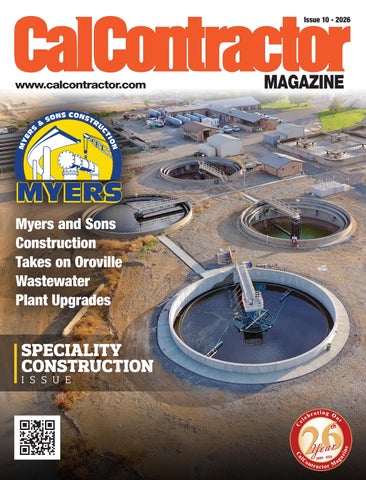
Myers and Sons Construction Takes on Oroville Wastewater Plant Upgrades
SPECIALITY CONSTRUCTION
I S S U E
OWN & GROW ADVANTAGE
O
$ DOWN % FINANCING
FOR UP TO 60 MONTHS*
Contact your California Cat dealer today for details.
SINCE 1956
SINCE 1919
hawthornecat.com San Diego County 866-834-3299
quinncompany.com Central & Southern California 888-608-5064
Financing provided by Caterpillar Financial Services Corporation. *Offer valid through December 31, 2026. Offer only available on purchases of new mini excavators, micro excavators, skid steer loaders, compact track loaders, and compact wheel loaders sold by participating Cat dealers to customers in the USA. Purchase and machine delivery must occur by December 31, 2026. Offer subject to machine availability. Offer is subject to credit approval by Caterpillar Financial Services Corporation for US customers. Not all customers will qualify. Offer may change without prior notice and cannot be combined with any other offers. Additional terms and conditions may apply. Contact your Cat dealer for more details.
ROLL INTO YEAR-END
SAVINGS
End the year with the right equipment and real savings. 0% for 60 months on John Deere compact machines, plus Section 179 tax benefits that help you save even more. Upgrade your fleet, reduce your tax burden, and get ready for the year ahead.
0%
FOR 60 MONTHS + SECTION 179 TAX BENEFITS
*Offer valid on qualifying purchases made 01 October 2026 through 04 January 2027 from participating dealer inventory. Subject to approved installment credit with John Deere Financial, for commercial use only. Down payment may be required. Average down payment is 10%. 0% APR for 60 months only. Taxes, freight, setup, insurance, fees, and delivery charges could increase monthly payment. Available at participating U.S. dealers. Prices and models may vary by dealer. Offer not available to customers receiving Governmental or Strategic Account discounts.
COASTLINE Equipment
Long Beach, CA (HQ) (562) 272-7400 www.coastlineequipment.com
YOUR AUTHORIZED JOHN DEERE DEALER FOR THESE CA COUNTIES: Long Beach Branch – Los Angeles and Orange Oxnard Branch – Northern Los Angeles, Ventura and Santa Barbara Santa Maria Branch – San Luis Obispo and Santa Barbara Bakersfield Branch – Kern, Inyo, Mono and Eastern Los Angeles Lake Forest and Sylmar Branches – Parts Only Stores
CONTENTS
2026 Specialty Construction
PUBLISHER: Kerry Hoover khoover@calcontractor.com
06 MYERS AND SONS CONSTRUCTION Takes on Oroville Wastewater Plant Upgrades
EDITOR: Brian Hoover, Senior Editor
14 SORACCO, INC.
Tackles Sewer Upgrades in Sacramento and Stockton
ART DIRECTOR/
Aldo Myftari
Compact Cat Machines. Precise Work. Strong Relationships.
SOCIAL MEDIA MANAGER: Gerald De Guzman
28 JCB
JCB Hydromax Brought Record-Breaking Hydrogen Power to Malibu Pier
CalContractor is published 12 times each year by Construction Marketing Services, LLC. Copyright © 2025. All rights reserved. Reproduction in whole or in part without permission is prohibited.
GRAPHIC DESIGNER
20 SILL EXCAVATING
FOR ADVERTISING INFORMATION: Please call: (909) 772-3121
P.O. Box 892977, Temecula, CA 92589
www.CalContractor .com
SPECIALTY JOBS. ENGINEERED SHORING.
Tight access, zero clearance, one-shot installs: we’re in the trenches with you.
Shoring, Shielding & Safety Solutions • Engineered Slide Rail Systems • Custom Shoring Designs • Hydraulic Shoring • Aluminum Shielding
4
• Confined Space Equipment • Bedding Boxes • Pipe Testing • Competent Person Training
S P E C I A LT Y CO N S T R U C T I O N / 2 0 26
Proud Member of
Hablamos Español
Baldwin Park San Bernardino San Diego Romoland
(714) 994-8728 (909) 381-0244 (800) 321-5285 (951) 221-3486
SunstateEquip.com C A LCO N T R AC TO R .CO M
Smarter Solutions for Maximum Uptime VCES delivers Volvoʼs smart solutions to take your operation beyond hauling. With innovative tools like Haul Assist, Connected Map, CareTrack, and Volvo Service Contracts, VCES helps you make smarter decisions, extend machine life, and lower operating costs — all while maximizing uptime and productivity. Contact your nearest VCES location today.
Bakersfield 661.387.6090
Fresno 559.834.4420
Redding 530.255.8008
San Leandro 510.357.9131
Corona 951.277.7620
Lakeside 619.441.3690
Sacramento 916.504.2300
Turlock 209.410.6710
Find us on social media:
www.vcesvolvo.com
facebook.com/volvoces
VolvoCES
volvoces
volvoces
Myers and Sons Construction Takes on Oroville Wastewater Plant Upgrades Heavy groundwater, rocky excavation and a carefully staged transition to new equipment shape a roughly $17 million project for the Sewerage Commission–Oroville Region By Brian Hoover | Photos provided by Myers and Sons Construction
B
efore Myers and Sons Construction could build a new secondary clarifier at Oroville’s wastewater treatment plant, crews had to get control of the water already in the ground. Groundwater sat about eight feet below the surface, while the excavation would reach approximately 22 feet deep. In the site’s highly permeable cobblefilled soil, an open excavation would quickly fill with water. That challenge set the pace for the Sewerage Commission–Oroville Region’s Wastewater Treatment Plant Upgrade Package 1. For Myers and Sons, the work involved building new treatment facilities and connecting them to an existing operating wastewater treatment plant, all while managing difficult excavation conditions and helping operators transition to modern equipment. Robert Barton, senior project manager for Myers and Sons Construction, said work began April 1, 2025. At the time of the interview, the project was nearing substantial completion, with a final value expected to reach approximately $17.1 million.
6
The centerpiece was a fourth secondary clarifier, supported by a new mixed liquor distribution box and a retrofit of the return activated sludge pump station. The scope also included bypassing and retrofitting the headworks grit-removal system, adding onto the existing filtration facilities with two additional tertiary filters, and building a new septage receiving facility. With underground utilities, structural concrete, mechanical installations, bypass work and minor site civil improvements, the
project brought a broad mix of construction work into an operating treatment plant. Barton explained that the new clarifier would help the plant manage the additional wastewater flows it experiences during wet weather, when groundwater enters the collection system. But getting that new equipment into service required a carefully ordered progression through excavation, concrete construction, underground piping and pump station modifications.
Fully installed and commissioned (bottom) 4th Secondary Clarifier (SC4) alongside three previously existing Secondary Clarifiers.
S P E C I A LT Y CO N S T R U C T I O N / 2 0 26
C A LCO N T R AC TO R .CO M
Controlling the Groundwater Myers and Sons brought in Malcolm Drilling for the dewatering work. Initially, Barton said, pumping ran at approximately 800 gallons per minute before settling to about 350 gallons per minute, or roughly half a million gallons each day. Maintaining that system was essential while crews excavated and constructed the new clarifier. “We had to incorporate a pretty extensive dewatering system,” Barton said. Managing the discharge required just as much coordination as removing the groundwater. According to Barton, the project team had to route the pumped water back through the wastewater treatment plant, adding to the flow operators were already handling. The contractor and plant staff 1
SC4 Mass excavation with CAT 340 Excavator.
worked through the process together as the actual pumping rate became established. Barton credited the owner’s willingness to work with the construction team as an important part of resolving
that challenge. As pumping levels stabilized, the additional water proved more manageable than the initial groundwater dewatering calculations suggested, allowing the work to proceed accordingly.
2 Progress photos of SC4: 1. Completing mass excavation. 2. Driving SC4 steel H-piles for the foundation. 3. Pouring and stripping the center column slabon-grade (SOG) while forming the remaining SC4 SOGs.
3
4
7
4. Concrete slab-on-grade pours 60% complete. 5. Completing the final slab-on-grade pour while forming the circular perimeter walls.
8 5
6
9
6. Installing rebar and formwork for the circular perimeter walls. 7. Following a rain event, forming the effluent trough decks adjacent to the fully poured and stripped perimeter walls. 8. Completing SC4 concrete work and structural backfill; staging materials for the SC4 mechanism. 9. Fully installed and commissioned SC4.
CALCON TRAC TOR.CO M
S P E C I A LT Y CO N S T R U C T I O N / 2 0 26
7
Left: Using the fully installed SC4 mechanism to screed the topping grout on the slab-on-grade. Above: Installing rebar for the 6-foot-deep SC4 center column slab-on-grade.
Excavating Through the Cobbles With dewatering in place, Myers and Sons self-performed the major excavation using a Cat 340 excavator equipped with a rock bucket used to load three enddump trucks. The trucks made short hauls to an available staging area, keeping material moving as the excavation continued. “We ended up moving about 20,000 yards,” Barton said. That total included roughly 4,000 additional cubic yards needed to create an access ramp for the pile-driving equipment. The clarifier foundation called for driven steel piles, and getting the rig down to the bottom of the excavation required a ramp approximately 100 feet long. Crews used an open-cut excavation with sloped sides for the main structure. The soil presented a second challenge when it came time to backfill. Large cobbles made much of the excavated material unsuitable for backfill without screening. Myers and Sons used a Cat 336 excavator with a skeleton bucket to separate reusable material,
8
then placed and compacted it in manageable lifts with loaders and rollers. Barton estimated that only 40 to 50 percent of the material could be reused. Fortunately, the plant had an approximately five-acre area available for staging and screening, and a nearby rock-crushing operation accepted the oversized material. That arrangement gave the contractor a practical outlet for the rock while allowing crews to recover suitable backfill on site. BUILDING THE NEW CLARIFIER Once the foundation piles were installed, Myers and Sons began constructing the approximately 70-foot-diameter clarifier. The work included underground piping encased in concrete, the base slab, walls and collection troughs, followed by installation of the secondary clarifier mechanism. A secondary clarifier allows solids to settle out of wastewater after biological treatment. The new distribution box directs the wastewater and treatment
S P E C I A LT Y CO N S T R U C T I O N / 2 0 26
microorganisms, known together as mixed liquor, toward the clarifier. The equipment inside the secondary clarifier collects the settled material while clarified water moves onto the disinfection stage. For the construction crews, that process translated into a series of closely coordinated concrete and mechanical installations. Barton estimated that the clarifier required more than 450 cubic yards of concrete, including a substantial six-foot-thick center foundation to support its clarifier mechanism. Pacific Steel Group handled reinforcing steel, while Myers and Sons formed and poured the structure and installed the mechanical equipment. Testing was built into the sequence. Crews tested piping before encasing it in concrete and performed a leak test on the completed concrete structure before backfilling around it. Throughout construction, the dewatering system continued operating below the work. { Continued on page 10 }
C A LCO N T R AC TO R .CO M
GO ELECTRIC.
PUT CA CORE TO WORK. Explore CA CORE incentives for your next equipment purchase.
JCB 505-20E
JCB 19C-1E
ELECTRIC TELEHANDLER
ELECTRIC MINI EXCAVATOR
As low as
As low as
48,000
$
+
Cab and canopy available
tax*
26,000
$
+
tax*
Cab and canopy available
FINANCE THE REMAINING BALANCE. Financing available on the remaining balance after CA CORE subsidy, subject to credit approval.
Contact SoCal JCB for eligibility and application timing. Learn about the program: CaliforniaCORE.org *Advertised pricing reflects CA CORE subsidy. Subject to eligibility, voucher approval, funding availability and equipment configuration. Tax additional. Contact SoCal JCB for details.
2860 S Iowa Ave. Colton, CA 92324
866-522-7225
14480 Alondra Blvd LaMirada, CA 90638
sales@socaljcb.com
CALCON TRAC TOR.CO M
SoCalJCB.com
S P E C I A LT Y CO N S T R U C T I O N / 2 0 26
9
{ Continued from page 8 }
MAKING THE UNDERGROUND CONNECTIONS Connecting the new facilities to the existing plant brought another set of excavation challenges. Myers and Sons installed piping between the distribution box and clarifier, back to the return activated sludge pump station, and onward to the existing chlorine contact basin. Although individual runs were relatively short, the ground conditions complicated the work. “The cobbles were a lot more unpredictable than we anticipated,” Barton said. “Everyone did an amazing job of managing the numerous challenges on this project.” Along one alignment, the crew initially expected a conventional trenching operation with hydraulic shoring. As excavation progressed, the loose material required a wider, open-cut sloped excavation, with trench boxes used for worker protection. A run the team had expected to complete in a few days took over two weeks. Another alignment crossed an area crowded with existing plant utilities. Gravel backfill around older pipelines loosened as crews excavated nearby, causing the opening to widen beyond the planned trench. The conditions required changes to the excavation and backfill approach as the team worked through the utility crossings. UPGRADING THE PUMP STATION AND BRINGING THE CLARIFIER ONLINE Those underground connections led to one of the project’s most important operational steps: bypassing and retrofitting the return activated sludge pump station while maintaining service. These pumps move settled biological material back into the biological treatment process, where the microorganisms continue breaking down incoming waste. 10
CAT 340 mass excavating Mixed Liquor Distribution Box (MLDB) and CAT 305 excavating MLDB footprint conflicting with existing underground utilities.
The station had two existing pumps, and the project called for three new pumps. Barton said the team determined that removing all the old equipment at once would not work for the operating plant. Developing a workable transition took extensive planning with plant personnel. The solution was a staged changeover. Myers and Sons removed one existing pump and installed two new units, then commissioned them and confirmed they could handle the required flows. Once the operators were comfortable with the new arrangement, crews removed the remaining old pump and installed the third new unit.
S P E C I A LT Y CO N S T R U C T I O N / 2 0 26
The upgrade also introduced new automated controls to a system that operators had long managed manually. That meant commissioning involved both proving the equipment and helping plant staff become familiar with a different way of running the station. For a period, new automated equipment had to function alongside the older system. With the pump station changes in place, the team could bring the fourth clarifier online. Barton said the new clarifier was commissioned in August 2026. Its operating characteristics differed from those of the plant’s three existing units, making coordination with operators an important part of that startup as well. C A LCO N T R AC TO R .CO M
1). 95% progress of Return Sludge Pump Station installation. 2). Mixed Liquor Distribution Box (MLDB) interior wall forming and installing wall rebar.
2
3). Walls poured and stripped.
1
UPGRADING THE REMAINING TREATMENT SYSTEMS While the clarifier and pump station drove the main construction sequence, Myers and Sons advanced the other improvements around them. Crews retrofitted the existing filtration facilities with two additional tertiary filters, including their supporting concrete and mechanical piping, and built a new receiving facility for material delivered by septic tank haulers. The septage facility used a packaged stainless steel equipment system from Lakeside Equipment Corporation, with a rock trap, screening equipment and conveyor. Myers and Sons installed the underground utilities and concrete slab, set the equipment, and completed the pipe connections. The system removes rocks and debris from incoming material before it moves farther into the plant’s handling process. At the headworks, where incoming wastewater first enters the treatment process, Myers and Sons bypassed and retrofitted the grit-removal system. Barton said the replacement equipment took about a year to move through CALCON TRAC TOR.CO M
3
submittals, fabrication and delivery. Once it arrived, crews removed the existing equipment and installed the new system,
which separates sand and grit before those materials can reach downstream processes.
Link-Belt 90-Ton RT Crane placing one of two Tertiary Filter Vessels.
S P E C I A LT Y CO N S T R U C T I O N / 2 0 26
11
Left: Drone photo of fully installed and commissioned Septage Receiving Facility. Above: Progress photo of the new Grit Washer and Classifier retrofit at the existing Grit Removal Facility.
COORDINATING THE WORK THROUGH COMPLETION Across the project, Myers and Sons self-performed excavation, concrete forming and placement, underground and mechanical piping, and equipment installation. A company-owned Link-Belt crane supported the work, with specialty subcontractors providing services that included pile driving, reinforcing steel, dewatering, electrical work and coatings. Barton estimated the field crew reached approximately 12 to 15 people at peak. He singled out jobsite superintendent Adam Smith and general superintendent Nick Baer for their contributions. Smith’s daily work with plant personnel was especially valuable as the project moved through construction and startup. Barton praised him for “working with the client day in and day out,” helping explain the construction process and what each upcoming step would involve. As the project approached completion, Oroville’s treatment plant had its fourth clarifier in service and a rebuilt pump station operating with automated controls. Close coordination 12
between Myers and Sons and the Sewerage Commission allowed the modernization to proceed while the plant continued serving the community. Myers and Sons Construction’s capabilities span water and wastewater treatment facilities, heavy civil construction, bridges and structures, road and bridge
restoration, and emergency response. Its ability to selfperform excavation, underground utilities, structural concrete and mechanical installations supports complex projects such as the Oroville plant upgrade. For more information about Myers and Sons Construction and its services, visit www.myers-sons.com. Cc
Rerouting and underground utility tie-in of Mixed Liquor process piping into completed MLDB.
S P E C I A LT Y CO N S T R U C T I O N / 2 0 26
C A LCO N T R AC TO R .CO M
CALIFORNIA’S LARGEST INVENTORY OF FORD TRUCKS & VANS
CalContractor Specials $65,542*
$65,926*
2025| F-350
4x4
$61,927*
2025 | F-350
$68,197*
2025 | F-550
2025 | F-450
12’ Stakebed
10’ Contractor
12’ Flatbed
12’ Contractor
6.7L V8, PWR Pkg, Bluetooth, Rear Cam | #SEE11626
7.3L V8, PWR Pkg, Bluetooth, Rear Cam | #SEE09756
7.3L V8, PWR Pkg, Bluetooth, Rear Cam | #SDA18860
7.3L V8, PWR Pkg, Bluetooth, Rear Cam | #SED91201
After $11,250 in Total Discounts**
After $12,000 in Total Discounts**
After $10,500 in Total Discounts**
After $12,250 in Total Discounts**
$59,995*
$74,926*
2026 | F-250
$85,149*
2026 | F-350
$96,507*
2026 | F-450
2026 | F-550
8’ Utility
9’ Plumber
11’ Welder Body
14’ Combo
6.8L V8, PWR Pkg, Bluetooth, Rear Cam | #TEF41809
7.3L V8, PWR Pkg, Bluetooth, Rear Cam | #TEC07054
6.7L V8, PWR Pkg, Bluetooth, Rear Cam | #TDA21325
6.7L V8, PWR Pkg, Bluetooth, Rear Cam | #TDA10693
After $7,500 in Total Discounts**
After $13,000 in Total Discounts**
After $10,750 in Total Discounts**
After $13,500 in Total Discounts**
$104,454*
$105,264*
2027| F-650
$102,854*
2026 | F-750
$83,342*
2027 | F-650
2027 | F-650
5/7 Yard Dump
2,000 Gal Water Tank
16’ Dump
20’ Stakebed
7.3L V8, PWR Pkg, Bluetooth, Rear Cam | #VDF02996
7.3L V8, PWR Pkg, Bluetooth, Rear Cam | #TDF07933
7.3L V8, PWR Pkg, Bluetooth, Rear Cam | #VDF02303
7.3L V8, PWR Pkg, Bluetooth, Rear Cam | #VDF05105
After $13,000 in Total Discounts**
After $14,000 in Total Discounts**
After $13,250 in Total Discounts**
After $9,500 in Total Discounts**
See all of our inventory at www.kengrodyfleet.com ORANGE COUNTY (714) 228-6179
SAN DIEGO (760) 935-8967
INLAND EMPIRE (909) 363-9587
*Plus government fees & taxes, any document preparation charge and any emission testing charge. **”Total Discounts” includes dealer discount and all Ford Retail Incentives, including Ford Retail Cash, Bonus Cash, and other Retail Rebates. Some Bonus Cash rebates may require you to Finance with Ford Credit. Creditworthiness determined by Ford Motor Credit, not all customers will qualify. Rebates are subject to change without notice.
Tackles Sewer Upgrades in Sacramento and Stockton From protecting historic surroundings to managing a 25 million gallon per day bypass, two projects demonstrate the planning and field experience behind successful underground construction By Brian Hoover, CMS Editor / Photos by Soracco, Inc.
R
eplacing a sewer line can mean working around far more than the pipe itself. Historic features, busy sidewalks, unmarked utilities and wastewater that must keep moving all influence how a contractor approaches the work. For Soracco, Inc., two recent municipal sewer projects brought those challenges into focus, requiring different construction
methods and carefully coordinated field operations. In Sacramento, the company used pipe bursting to replace and enlarge a sewer line near the city's historic waterfront while limiting excavation. In Stockton, a relatively short trunk line replacement required an extensive temporary bypass capable of handling 25 million gallons per day. Together,
the projects illustrate how the right plan, equipment and crew can make complicated underground improvements manageable. Richard Soracco, President and Owner of Soracco, Inc., discussed both projects and the decisions that helped his crews carry the work from excavation through restoration.
Mario Nieto, Sergio Ochoa and Carlos Nadal excavate for a deep manhole using a Cat M322 wheeled excavator. 14
S P E C I A LT Y CO N S T R U C T I O N / 2 0 26
C A LCO N T R AC TO R .CO M
Left: Soracco’s sewer crew excavates for a new 10-inch sewer main using a Cat 420F2 backhoe. Above: The crew installs a 10-inch sewer main inside an 18-inch steel casing beneath the proposed light rail tracks.
Replacing Combined Sewer Infrastructure in Sacramento The approximately $1.5 million Block Six Combined Sewer Replacement Project for the City of Sacramento involved roughly 1,500 linear feet of combined sewer improvements. Work began in fall 2025 and wrapped up in May 2026. Sacramento's combined system carries both stormwater and sewage. Part of the project redirected flow collected along Capitol Mall to a different manhole and line. Another portion involved replacing a main line in Powerhouse Alley and updating numerous lateral connections serving a couple of city blocks. Soracco, Inc. self-performed nearly all of the construction, including the sewer installation, concrete work and asphalt restoration. Specialty subcontractors assisted with slurry abandonment of existing lines. The setting added another layer of responsibility. Crews worked near Old Sacramento, with historic features, businesses, a parking structure and the Tower Bridge surrounding portions of the operation. Opening a continuous trench through sensitive areas would have increased both the disruption and the restoration work. CALCON TRAC TOR.CO M
The City looked to Soracco, Inc. for options. Richard and his team proposed pipe bursting for a suitable section of the alignment, and the City agreed to the approach. Pipe Bursting Protects Historic Surroundings The selected section consisted of approximately 400 feet of existing 8-inch clay pipe. Soracco, Inc. replaced it with a 10-inch line, connecting the new pipe to existing manholes while avoiding a continuous open trench. The alignment offered favorable conditions for the method. The clay pipe broke readily under the pulling pressure of the tapered edge of the pipe bursting head. There were no lateral connections along the segment to complicate the pull, as crews excavated a receiving pit approximately 8 feet by 8 feet and about 12 feet deep, along with an insertion pit roughly 5 feet by 5 feet. A ramped approach allowed the new pipe to transition from the surface down to the installation elevation. The pits were shored appropriately for the work. Using its own hydraulic pulling equipment, Soracco, Inc. completed the actual pull in a little more than
two hours. A Cat 299 compact track loader supplied hydraulic power, eliminating the need to mobilize a separate power pack for that operation. The result was a larger replacement line installed with limited surface disturbance in an area where protecting existing features mattered. “It has a time and a place,” Richard says of pipe bursting. “ He explains that a short replacement segment with multiple utility crossings may offer little advantage over open-cut construction once crews complete the necessary utility investigation and excavation. Longer, straightforward runs can present a much better opportunity. For suitable applications, Richard estimates potential savings of approximately 30 to 40 percent compared with conventional open-cut replacement. Those savings depend on the conditions and come from reducing excavation, bedding, backfill, compaction testing and surface restoration. On Block Six, the method also helped the crew avoid disturbing historic features along the route.
S P E C I A LT Y CO N S T R U C T I O N / 2 0 26
15
Matching Equipment to a Tight Urban Site Other portions of the Sacramento project called for a different equipment solution. Across from the Embassy Suites on Capitol Mall, crews needed to excavate for a manhole approximately 22 feet deep while working partly on the sidewalk. Positioning a tracked excavator in that location would have complicated the operation and required additional measures to protect the surrounding surfaces. Soracco, Inc. instead rented a Cat wheeled excavator from Holt of California. “Honestly, it worked out perfect,” Richard says. “We loved working with that Cat wheeled excavator so much, we are seriously considering adding one to our fleet.” The Cat machine provided the digging capability the crew needed while allowing easier movement around the work area. Richard
appreciated its mobility and the ability to work around curbs and concrete improvements with less concern about damage from tracks. The experience made a wheeled excavator a priority for future fleet consideration. Backhoes, a small excavator and the Cat 299 also supported the project. At peak, the Sacramento crew consisted of two operators and five laborers. Richard credited project foreman Mario Nieto with managing the demands of the downtown location, including encounters with older, unmarked utilities. Traffic and pedestrian control required ongoing attention, particularly when motorists wandered into the work zone. With businesses, visitors and city activity close by, maintaining an organized operation was an essential part of the job.
Swenson Park 42-Inch Trunk Line - A Major Bypass for a Short Stockton Replacement
Top: Sergio excavates with a Cat 420XE backhoe in preparation for asphalt placement. Center: A Soracco crew member applies tack coat along the existing asphalt edges. Above: Sergio compacts fresh asphalt with a Cat CB14B tandem steel drum roller, with the Tower Bridge in the background. 16
The Swenson Park 42-inch trunk line upsize in Stockton presented a different challenge. The approximately $1.1 million project for the City of Stockton on Alexandria Place continued sewer improvements Soracco, Inc. had worked on several years earlier. The scope involved replacing approximately 120 linear feet of existing 36-inch sanitary sewer trunk line with 42-inch pipe at a depth of roughly 15 feet. Although the replacement length was relatively short, maintaining flow around the work required a substantial temporary system. The bypass was the more demanding part of the assignment. Rated at 25 million gallons per day, it was among the largest Soracco, Inc. had set up. The company established three temporary lift stations and tied two separate systems into one larger system to carry wastewater around the replacement area.
S P E C I A LT Y CO N S T R U C T I O N / 2 0 26
Thousands of feet of 24-inch bypass piping ran through the park. Before installing that network, the team had to work through its effects on sidewalks, pedestrian routes and surrounding traffic. A high school across the street added another consideration to the planning. A field meeting brought together representatives responsible for sewer operations, parks, streets and public works. The group reviewed the route and the measures needed to accommodate construction. Soracco, Inc. mapped out sidewalk crossings and installed a temporary pedestrian bridge and walkway to maintain access around the bypass. The job demonstrated how much preparation can be required before the first section of permanent replacement pipe goes into the ground. The temporary infrastructure extended well beyond the limits of the sewer excavation itself. { Continued on page 18 } C A LCO N T R AC TO R .CO M
CALL US TODAY!
909-463-4886
www.trinityequipmentinc.com 2650 S La Cadena Drive, Colton, CA 92324
Left: Cast-in-place manhole base installation. Center: A 70-ton hydraulic pipebursting puller is set in the pulling pit. Soracco used a 4-inch pre-bursting head to fracture the existing 4-inch clay sewer main, followed by a 6-inch bursting head to install the new 6-inch HDPE sewer main. Right: Jacob Gruenwald operates a 30-ton hydraulic pipe-bursting puller powered by a Cat 301.7 mini excavator.
{ Continued from page 16 }
Installing the New Line and Restoring the Park Work took place in June 2026 over approximately three weeks. Crews spent about a week establishing the bypass, followed by roughly five to six days of sewer replacement work. Removing the temporary system and completing restoration required approximately another five days. Steel trench shields were utilized for the excavation, as crews encountered a 15-inch concrete storm drain that conflicted with the new sewer installation. The team
plugged and temporarily removed the affected section, installed the 42-inch sewer line, then returned to replace the storm drain. The Stockton operation included three operators, seven laborers and two cement masons. Equipment included Cat 335 and 315 excavators, a Cat 299 compact track loader and a Cat 420 backhoe loader. A rough terrain forklift helped place the bypass pumps, while haul trucks, a water truck and other support vehicles also served the operation. Foreman Jed Smith and fellow foreman Andrew Crago helped
oversee the work. As the bypass route and access requirements developed, the amount of concrete removal proved greater than originally anticipated. Soracco, Inc. brought in its own cement masons to handle the sidewalk, curb and gutter restoration. That ability to perform multiple scopes was useful on both projects. Sewer installation was only part of the assignment; demolition, temporary access, concrete replacement and paving also had to be coordinated to return the work areas to service.
Soracco crew members work through multiple phases of manhole construction, including installation of the cast-in-place base, barrel sections and cone.
18
S P E C I A LT Y CO N S T R U C T I O N / 2 0 26
C A LCO N T R AC TO R .CO M
Preparing for the Next Round of Work As Soracco, Inc. looks toward 2027, Richard describes a busy but increasingly competitive market. The company has worked with a workforce of approximately 50 employees, and revenue has increased. However, Richard emphasizes that higher revenue does not automatically translate into stronger profits. He has seen and influx of contractors pursuing work in Sacramento and the Central Valley, including firms coming from the Bay Area. That competition makes careful bidding and attention to operating costs particularly important. Maintaining backlog remains a priority, but Richard
is also focused on avoiding overextension. Along with a possible wheeled excavator purchase, the company is considering additional wheel loaders. Its workload includes Caltrans work, levee work for the City of Sacramento and a sizable water project for San Joaquin County. The Sacramento and Stockton sewer projects reflect the capabilities Soracco, Inc. brings to those assignments: evaluating site conditions, selecting an appropriate construction method and carrying the work through final restoration. In one location, that meant pulling a larger sewer line beneath sensitive surroundings. In the other, it
meant building an extensive temporary bypass to make a short but substantial trunk line upgrade possible. Based in Lodi, Soracco, Inc. offers underground utility construction, pipe bursting, pump stations, site civil improvements, grading and paving, public infrastructure construction, general building, sawcutting and core drilling, and 24/7 on-call emergency service work. Its ability to selfperform sewer construction and related concrete and asphalt work supports projects with demanding access, sequencing and restoration requirements. For more information about Soracco, Inc. and its services, visit www.soraccoinc.com. Cc
Soracco’s sewer crew installs a new 42-inch sewer trunk line using a Cat 335 excavator, Cat 315 excavator and Cat 420XE backhoe. Multiple temporary lift stations were set up to bypass 25 million gallons per day of sewer flow. CALCON TRAC TOR.CO M
S P E C I A LT Y CO N S T R U C T I O N / 2 0 26
19
Compact Cat Machines. Precise Work. Strong Relationships. Allen Sill builds Sill Excavating through skilled operation, personal service and dependable support from Hawthorne Cat’s Escondido compact equipment store. By Brian Hoover, CMS Editor | Photos by Nathan Hoover, CMS and Sill Excavating
F
or Allen Sill, a well-excavated trench is about more than moving dirt. It is about leaving the next contractor ready to work. The grade needs to be right, the work area needs to be organized, and the excavation needs to reflect an understanding of everything that comes next. That attention to detail has helped Allen Sill, owner of Sill Excavating, build a business serving plumbers, electricians, concrete contractors, developers and homeowners throughout the greater San Diego area. Whether he is excavating underground plumbing for a multifamily housing project or working within the tight confines of a residential backyard, Sill brings the same approach: understand the assignment, make the most of the equipment, and take care of the people counting on him. “I’m just working hard, trying to take care of people,” says Sill. “And the work just keeps coming.” Operating from Valley Center, Sill has spent more than a decade building Sill Excavating primarily as an owner-operator. His recent purchases of new Cat 305 CR and Cat 306 CR mini excavators from Hawthorne Cat represent another
20
step forward, giving him additional flexibility today while preparing the business for future growth. Getting Started with Cat Equipment In 2013, Sill purchased a 2008 Cat 420E backhoe loader from Hawthorne Cat’s rental fleet. The machine had approximately 2,100 hours, and he remembers paying around $64,000. The backhoe was a practical choice for a contractor starting with one machine. Its versatility allowed him to accept different assignments as he established his customer base. Just as important, Sill says, it gave him the reliability he needed during those early building years. “That Cat backhoe gave me my start,” he says. “It never broke down.” Finding Opportunity in Smaller Work Today, Sill Excavating’s assignments range from utility trenching and commercial plumbing and electrical excavation to foundation footings, block wall footings and residential drainage improvements. Much of that work comes through other contractors. Sill has longstanding relationships with plumbers, electricians and
S P E C I A LT Y CO N S T R U C T I O N / 2 0 26
concrete professionals who call when they need an experienced operator. Some of those connections reach back to his early years working for larger companies. The company often works on an hourly basis, providing the machine and operating experience needed for a particular portion of the project. That arrangement lets his contractor customers draw on his expertise while their own crews handle other responsibilities. Accessory dwelling units have become another productive market. Even a relatively small residential building can require excavation for footings, plumbing and electrical service. With existing homes, fences and landscaping surrounding the work area, access and maneuverability can be as important as digging capacity. Sill’s relationships with the trades put him in a good position to serve those projects. A plumber or electrician gets the assignment, recognizes the excavation requirements and calls someone whose work they already know. “I’m not big and I’m not fancy,” Sill says. “But I’m entrenched in San Diego, and I know and have worked for a lot of good people.” C A LCO N T R AC TO R .CO M
From left: Matt Higgins, machine sales representative for Hawthorne Cat and Allen Sill, owner of Sill Excavating.
Two New Cat Excavators with a Clear Purpose Sill Excavating’s latest equipment purchases were deliberate investments in the work that has proven most successful for his business. He recently purchased the new Cat 305 CR and Cat 306 CR mini excavators approximately one month apart through Hawthorne Cat’s Escondido Compact Equipment location. These new Cat machines join an existing Cat 306 CR, bringing his excavator fleet to three compact machines. The older Cat 306 CR, a 2020 model with approximately 4,000 hours at the time of the interview, has steel tracks equipped with rubber pads. For the two newer machines, Sill chose rubber tracks, which he prefers for many of his residential and tighteraccess assignments. The different machines give him options when matching equipment to a project. CALCON TRAC TOR.CO M
His existing Cat 306 CR remains useful on larger dirt assignments, while the new additions support the residential and confined-space work that regularly fills his schedule. That fleet reflects lessons learned through experience. Sill previously owned a Cat 308 CR mini excavator but found himself looking for larger projects to keep it working. Meanwhile, demand continued arriving for smaller, more detailed assignments. “I’ve found, for me, my success has been in smaller work,” he says. “As an owner operator, this is where I shine. Big or small, the goal is always the same. Bring your best and leave the client with a reason to ask you back for another job.” On one block wall footing project, for example, the toe of a slope was approximately 12 feet from the house. Sill needed to excavate in that narrow corridor
while a supporting Cat track loader removed material. There was little room for equipment that could not maneuver efficiently within the available space. Jobs like that have reinforced his preference for mini excavators and compact track loaders. He can position the machines for excavation, change buckets as the work progresses and coordinate material handling without the front bucket of a backhoe occupying additional space. “You can put on a 3-foot or 5-foot bucket on these Cat mini excavators, and you can pull grade with it, or you can load trucks,” Sill says. “I support these Cat mini excavators with Cat compact track loader rentals from Hawthorne Cat Rentals. While renting is a good solution for now, I have plans of adding a new Cat 255 compact track loader from Hawthorne Cat very soon.”
S P E C I A LT Y CO N S T R U C T I O N / 2 0 26
21
Keeping Multiple Projects Moving Three excavators might appear unusual for a business whose owner does most or all the operating. Sill’s schedule explains the investment. Excavation work rarely progresses continuously from start to finish. After he completes a trench, another contractor may need to install material. An inspection may follow. Only then can Sill return for backfill. Moving one machine between every stage of every project
would add transportation, loading and scheduling demands to an already full workweek. With multiple excavators, Sill can leave equipment at an active project and move himself to another location. When the first customer is ready for him again, the machine and attachments are already there. “I often work on multiple ongoing projects in one workday, and having a Cat mini excavator on each job
saves an enormous amount of time and money,” says Sill. “I’m able to complete a lot more work this way.” This approach allows him to own the equipment he uses most often while obtaining additional rented machines from Hawthorne Cat Rentals as needed. It also gives him an existing equipment foundation for hiring contract and full-time operators as the business grows.
Precision on a San Marcos Multifamily Unit Construction Project A multifamily housing assignment in San Marcos demonstrates how Sill’s equipment strategy supports his customers. Working for a San Diego plumbing contractor within a Lennar community, Sill has been excavating the underground plumbing trenches serving the residential multiunit buildings. For one recently completed eight-unit multifamily
building, he estimated approximately 120 linear feet of excavation per unit, or roughly 1,000 linear feet overall. The footage tells only part of the story. Each trench must follow the plumbing layout and required grade, with connections extending toward the street. Sill described portions of the excavation beginning at approximately 18 inches deep and
progressing to tie-in points roughly 4½ to 5 feet deep. The work also requires attention to the space surrounding the trench. Plumbers need to establish their lines and move through the building footprint. Excavated material left in the wrong place can create unnecessary work for the crew following him. { Continued on page 24 }
Allen Sill with Roxanne and Hazel, whose encouragement and support at home are an important part of his success.
22
S P E C I A LT Y CO N S T R U C T I O N / 2 0 26
C A LCO N T R AC TO R .CO M
Built on trust. Backed by steel. Southern California’s Go-To for Trench Safety Equipment Rentals
What We Offer Steel & Aluminum Trench Shields Rugged, reliable, and job-ready
Hydraulic Shoring Systems Fast, safe, and user-friendly
Manhole Boxes & Trench Plates All sizes available — non-skid options too
Custom Solutions Need training? We’ve got your crew covered.
NEW MORENO VALLEY BRANCH! | OPENING SEPTEMBER 15 FULL-SERVICE TRENCH SAFETY RENTALS The same trusted trench safety rental solutions and service you know from our San Diego location - now serving Moreno Valley and the Inland Empire.
NEW LOCATION. SAME GREAT SERVICE. 2115 Box Spring Rd. Moreno Valley, CA 92557 SAN DIEGO
315 Cypress Ln, El Cajon, CA 619.334.3900 | info@socalshield.com SoCalShield.com Ask for Dana - Director of Sales 760.704.9997 | dana.fredette@socalshield.com
Where Safety Meets Service. No excuses. No shortcuts.
{ Continued from page 22 }
Hawthorne Cat’s Compact Equipment Focus in Escondido Sill’s latest purchases came as Hawthorne Cat strengthened the compact equipment sales focus at its existing Escondido branch. Hawthorne’s dedicated Cat Compact website identifies the Escondido store at 1620 Mission Road as its local Cat Compact dealership. The program brings together new and used equipment, rentals, financing and ongoing support, with an emphasis on the needs of smaller and growing businesses. Customers can compare machines in person, discuss applications with the local team and explore equipment choices that fit their work and budget. For Sill, the change was visible on the ground. He described an
increased presence of compact equipment at the location, including excavators, skid steers and compact track loaders, and a sales operation focused on the machines contractors like him use every day. His purchase also carried a distinction. According to Sill, Matt Higgins, Hawthorne’s machine sales representative, told him his Cat 305 purchase was the first completed through the location’s new compact equipment sales setup. Sill recalls being in Higgins’ office when the salesperson recognized the milestone and brought it to the attention of a visiting Cat corporate representative.
A Dealer Relationship Built Over Time Sill has worked with Matt Higgins since approximately 2015 and values the practical equipment knowledge he brings to the relationship. According to Sill, Higgins’ background includes service management and hands-on mechanical experience within the service department. That perspective has helped them discuss more than the initial purchase price of a machine. “He’s turned wrenches,” Sill says. “He knows all the specs, which makes him such a valuable partner for a small company like mine.” Higgins also helped Sill think through the transition from backhoes to compact excavators. Their conversations included maintenance requirements, warranty costs and the operating expenses that affect profitability over time. Sill has noticed a substantial difference in fuel consumption on his own 24
assignments. He estimates that his compact excavators may use approximately 7½ gallons during a workday, compared with close to 20 gallons for a backhoe in his experience. Those figures reflect his specific work and operating conditions, but they also help explain why he has committed more of his business to Cat excavators. Parts and service support are equally important. Sill has developed relationships with Hawthorne Cat personnel who understand how much a delayed repair can affect a small operation. He points to after-hours parts pickup as a practical example. When a needed component is placed in the overnight bin, he can retrieve it before the normal business day begins and continue to his project. “It could be 4:30 in the morning,” Sill explains. “I go out, I put it on, and I’m rocking and rolling.”
S P E C I A LT Y CO N S T R U C T I O N / 2 0 26
The Cat 305 mini excavator delivers impressive performance in a compact package, combining fuel efficiency, versatility and productivity on a wide range of jobs.
C A LCO N T R AC TO R .CO M
1
2
From setting tanks to removing curb and gutter, Cat mini excavators provide Sill with the versatility, precision and operator comfort needed to complete projects efficiently and deliver quality results.
3
4
Growing Without Losing the Personal Connection Sill’s business also takes him beyond conventional construction projects. He has helped homeowners improve drainage, worked on ranch properties and even performed custom tasks like utilizing existing boulders to create landscape features and low rock walls. These assignments reinforce what he enjoys about the work: someone has a problem or an idea, and he can bring the equipment and experience to help. Every successful project generates referrals. Sill believes that leaving a customer satisfied with the entire experience is one of the most effective ways to keep the phone ringing. He credits his Christian faith, hard work and the relationships around him for the opportunities he has received. Looking ahead, he wants to build on that foundation. His plans include CALCON TRAC TOR.CO M
pursuing a general engineering “A” license and bringing in employees. “I’m working on having all my infrastructure dialed in and ready for new operator hires,” Sill says. “Everything moves so fast that it requires anticipating what is next and having everything prepped and ready for that transition. That includes having the right equipment.” Sill has mentored younger operators and is eager to continue sharing what he has learned, but he also understands the importance of hiring carefully. Anyone joining his company will help serve customers whose trust he has spent years earning. With that responsibility in mind, Sill researches leadership strategies and listens to podcasts on accountability and team development as he considers how to grow the business beyond his
own time behind the controls. His bachelor’s degree in business management has also helped shape his approach to running and growing the company. The new Cat excavators are part of that preparation. They improve his ability to serve customers now and provide equipment for the people he hopes to bring into the business. For Sill, the next stage of Sill Excavating will depend on the same qualities that carried him from a used backhoe to a busy three-excavator operation: careful work, dependable equipment and relationships worth protecting. “I like going out there and helping people,” Sill says. “I love what I do.” For more information on Sill Excavating, please call the Valley Center office at (951) 760-4152. Cc
S P E C I A LT Y CO N S T R U C T I O N / 2 0 26
25
WHEN THE JOB IS TOO BIG, THE TIMELINE IS TOO SHORT, OR THE BUDGET IS TOO TIGHT. CHALLENGE ACCEPTED. In construction, each day brings new challenges. Choose your partner wisely. PAVEMENTRECYCLING.COM
916.440.8090 www.coastlinecd.com
Crane Division 2024 MANITEX 26101C STK #113272 – $295,000 SALE – RENT – RPO
26
Headquartered: Sacramento, CA cranesales@coastlineequipment.com
“Your Crane and Boom Truck Headquarters”
SALES | RENTAL | PARTS & SERVICE
2025 TADANO GR800XL STK #122418 $825,000 SALE – RENT RPO
2025 ELLIOTT G85R STK #119050 – 85FT WORK PLATFORM CALL FOR PRICE
2026 MANITEX 2281T STK #127143 – $440,000 SALE – RENT – RPO
2023 TADANO GR550XL STK #110021 – $495,000 SALE – RENT – RPO
2023 TADANO GR350XL STK #95487 – $395,000 SALE – RENT – RPO
2024 MANITEX 1970C STK #114070 – $225,000 SALE – RENT – RPO
2026 MANITEX 40124SHL STK #123053 – $615,000 MOUNTED ON PETERBUILT 567 AUTO TRANS
2025 MANITEX 22101S STK #123051 – CALL FOR PRICE MACHINE IN STOCK
2023 MANITEX 30100C STK #106082 – $295,000 SALE – RENT – RPO
S P E C I A LT Y CO N S T R U C T I O N / 2 0 26
C A LCO N T R AC TO R .CO M
D51PXi-24
Productivity is the key to job site
success
GNSS antenna GNSS receiver
Control box
Stroke sensing hydraulic cylinders
Factory installed machine control system for quality and durability
Machine control system components are factory installed and designed as an integral part of the machine.
Enhanced inertial measuring unit (IMU+)
Crawler dozer
Net horsepower 131 HP @ 2,200 rpm
Operating weight 31,438 lbs.
Blade capacity Power angle tilt (PAT) dozer 4.4 yd3
NT EQU I MO
87
1- 8
00
ENT PM
CLAIR E
stop by your nearest clairemont equipment dealer
-956 - 62
BAKERSFIELD, CA (661) 641-4500
FONTANA, CA (909) 429-9100
INDIO, CA (760) 863-5558
ESCONDIDO, CA (760) 739-9100
IMPERIAL, CA (760) 355-7700
SAN DIEGO, CA (858) 278-8338
CORPORATE (858) 278-8351
JCB Hydromax Brought Record-Breaking Hydrogen Power to Malibu Pier Labor Day weekend display connected a 406-mph achievement with JCB’s development of hydrogen-powered construction equipment. By Brian Hoover / Photos provided by JCB
JCB Record setting Hydromax vehicle displayed at Malibu Pier over Labor Day weekend.
J
CB brought its record-setting Hydromax vehicle to Malibu Pier over Labor Day weekend, giving Southern California visitors a close look at the hydrogen technology behind its 406.320-mph run at Utah’s Bonneville Salt Flats. Held September 3–7 at Ranch at the Pier, the event launched the JCB Hydromax Great American Run tour and combined an engineering showcase with family activities. The display connected an extraordinary motorsports achievement with a practical construction industry objective: developing hydrogen-
28
powered equipment capable of performing the work traditionally handled by diesel machines. The Malibu presentation featured Hydromax alongside displays of its engine technology and JCB’s commercial hydrogen engine. According to event information supplied by JCB, the program also included a children’s play area and exclusive merchandise developed with LA Authority at the Ranch at the Pier Cabana. A hand-painted JCB 3TS-8T Teleskid added a charitable component. The machine was
S P E C I A LT Y CO N S T R U C T I O N / 2 0 26
displayed in support of VetsAid, the veterans-focused nonprofit founded by Rock and Roll Hall of Fame inductee Joe Walsh. The JCB 3TS-8T Teleskid will be auctioned on November 10, 2026, with proceeds benefiting the organization. Hydromax arrived in Malibu just weeks after its August 11 performance at Bonneville. Driven by Wing Commander Andy Green, the 32-foot streamliner completed runs of 400.623 and 412.135 mph, producing a two-way average of 406.320 mph. The runs were C A LCO N T R AC TO R .CO M
Hand-painted JCB 3TS-8T Teleskid.
JCB’s Hydrogen Combustion Engine.
JCB representatives answer questions to interested visitors.
Alice Bamford with JCB Hydromax driver, Andy Green.
Alice Bamford in the cockpit of the record-setting JCB Hydromax.
Alice Bamford greeting guests at the Malibu Pier showcase event.
conducted in opposite directions within an hour under FIA rules. JCB’s announcement identified the achievement as a new hydrogenpowered land speed record, subject to official FIA ratification. The vehicle’s connection to construction equipment extended beneath its streamlined body. Hydromax used two specially developed engines based on JCB’s production hydrogen engine technology, delivering a combined 1,600 horsepower. Engineering partner Ricardo increased each engine’s output from approximately 74 to 800 horsepower and modified the systems so the engines could operate on their sides, helping lower the vehicle’s center of gravity and improve aerodynamics. For contractors, the more relevant development was how that engine technology had progressed into working equipment. In May 2026, JCB announced the formal launch
of its first production 3CX Hydrogen Backhoe Loader, following more than $132 million in hydrogen development investment and customer trials involving backhoes, Loadall telescopic handlers and power-generation equipment. The production backhoe used a 55-kW hydrogen combustion engine and three roof-mounted hydrogen tanks. JCB reported power and torque comparable to the diesel version, similar maintenance intervals and fuel storage intended to support all-day operation. The company also developed a mobile refueling system with HYKIT to bring hydrogen directly to machines on the jobsite. That approach addressed a familiar contractor priority: keeping equipment working without lengthy interruptions for replenishing its energy supply. JCB’s development program had explored multiple ways to use hydrogen. The company unveiled a
hydrogen fuel-cell 220X excavator prototype in 2020 before advancing its hydrogen combustion engine program. Its subsequent emphasis centered on familiar engine technology, rapid refueling and the ability to deliver fuel to equipment in the field. JCB described the combustion engine’s carbon benefit as eliminating CO2 emissions at the point of use. At Malibu Pier, the record car provided the attraction, while the accompanying engine displays brought the discussion back to construction. Together, they illustrated how JCB had advanced hydrogen from experimental equipment to a production backhoe, and used a landmark performance at Bonneville to bring that work to a broader audience. Contact JCB for more information on the all of the new and upcoming hydrogen powered machines from JCB. Cc
CALCON TRAC TOR.CO M
S P E C I A LT Y CO N S T R U C T I O N / 2 0 26
29
ALUMINUM HYDRAULIC
SHORING
& ROAD PLATES Building a better future for our families, our communities and our region since 1900.
WANT TO BE FEATURED IN CALCONTRACTOR? Call Kerry Hoover now for Advertising Rates & Info.
TrenchShoring.com Compton - Corporate Office - 310-327-5554 Bakersfield Banning Corona Fresno 661-396-9160
Fullerton
714-879-1005
949-454-0858
San Diego
858-530-2500
30
951-849-1611 951-734-4290 559-691-4123
Lake Forest
Moorpark
805-529-4614
San Leandro 510-900-0595
NEW
Sacramento 916-290-4020
Las Vegas
702-651-0920
S P E C I A LT Y CO N S T R U C T I O N / 2 0 26
C A LCO N T R AC TO R .CO M
REDEFINING HEAVY HAUL EXCELLENCE
Why Choose Red Haul? We understand what it takes to move you. With our expertise, experience, and dedication to safety, we ensure your cargo gets there safely and on time. Serving Southern California with pride and professionalism.
OUR EQUIPMENT AND SERVICES 9 Axle Trailers 7 Axle Trailers Landoll/Hydraulic Trailers Flat Beds Visit us at redhaulexp.com or contact Rich at rich@redhaulexp.com
5 Axle Trailers Short Trailer/Specialty
909-712-6982
BIG ENOUGH TO SUPPORT YOU, SMALL ENOUGH TO KNOW YOU
8608
Asphalt Paver
HD 12e VV
Tandem roller with two vibrating roller drums
D47i
Digger Derrick
PM11 Aluminum Lube Body
LV600 pro Green Climber
XL 4100 V Hydraulic Excavator
ADDITIONAL EQUIPMENT AVAILABLE: PROVIDING CONTRACTORS AND MUNICIPALITIES WITH Dulevo, East, Felling Trailers, Gradall, HTC, Hamm, Hi-Way, Kleemann, Leeboy, Lincoln, Link-Belt, Maintainer, Midland, Miller THE BEST PRODUCTS AND SUPPORT SINCE 1965 Curber, Raymo, Rosco, Trinity, Vogele, Wirtgen and Zieman Trailers.
California’s Largest General Line Construction and Municipal Equipment Dealer. So. California: 2044 S. Vineyard Ave., Ontario, CA 91761 • (909) 930-1822 No. California: 800 E. Grant Line Rd., Tracy, CA 95304 • (209) 830-8600 Nevada: 2750 Marion Drive, Las Vegas, NV 89115 • (702) 342-8100 www.nixonegli.com