





3841 North Freeway Blvd., Suite 130
Sacramento, CA 95834
PRESIDENT
Rick Roberti, Loyalton
FIRST VICE PRESIDENT
Mike Williams, Acton
SECOND VICE PRESIDENTS
James Henderson, Woodlake
Steve Lambert, Oroville
Anthony Stornetta, Atascadero
TREASURER
Beverly Bigger, Ventura
EXECUTIVE VICE PRESIDENT
Billy Gatlin
VICE PRESIDENT OF GOVERNMENT AFFAIRS
Kirk Wilbur
DIRECTOR OF FINANCE
Lisa Brendlen
DIRECTOR OF COMMUNICATIONS
Katie Roberti
MEMBERSHIP & EVENTS COORDINATOR
Gracie LeCheminant
OFFICE ADMINISTRATOR
Katherine Dickinson
PUBLICATION SERVICES
OFFICE & CIRCULATION
CCA Office: (916) 444-0845 Fax: (916) 444-2194
MANAGING MAGAZINE EDITOR
Stevie Ipsen | (208) 996-4922 stevie.ipsen@gmail.com
ADVERTISING SALES/FIELD SERVICES
Matt Macfarlane | (916) 803-3113 m3cattlemarketing@gmail.com
BILLING SERVICES
Lisa Brendlen lisa@calcattlemen.org
SERVING CALIFORNIA BEEF PRODUCERS SINCE 1917
Bolded names and businesses in editorial represent only current members of the California Cattlmen’s Association or California CattleWomen, Inc. For questions about membership status, contact the CCA office at (916) 444-0845.
The California Cattleman (Publication #8-3600) is published monthly except May/June is combined by the California Cattlemen’s Association, for $20/year, or as part of the annual membership dues. All material and photos within may not be reproduced without consent of publisher.
Periodical postage paid at Lubbock, Texas, 79402. Publication # 8-3600
National Advertising Group:
The Cattle Connection/The Powell Group, 4162-B Carmichael Ct, Montgomery, AL 36106 (334) 271-6100.
POSTMASTER: Send address changes to: California Cattleman, 3841 North Freeway Blvd., Suite 130 Sacramento, CA 95834
San Luis Obispo Cattlemen’s Meeting
Feb. 18
Paso Robles Fairgrounds, Frontier Building
Monterey County Cattlemen’s Meeting
Feb. 19
Butte County Cattlemen’s Red Meat Dinner
Feb. 20
Gold Country Casino, Oroville
Santa Clara Cattlemen’ sMeeting
Feb. 23
Old City Hall Restaurant, Gilroy
Humbolt/Del Norte Dinner Dance
March 7
Humboldt County Fairgrounds, Ferndale
CCA Executive Committee Meeting
March 10
Sacramento
Steak & Eggs Breakfast
March 11
Sutter Club | Sacramento

The Parnell family
CALIFORNIA REPRESENTATIVES
Jake Parnell 916-662-1298
Walter Schalla, Manager ........... 719-252-6607
George Gookin ...............................209-482-1648
Rex Whittle...................................... 209-996-6994
Mark Fischer 209-768-6522
Kris Gudel 916-208-7258
Steve Bianchi ................................. 707-484-3903
Jason Dailey .....................................916-439-7761
Bowdy Griffin .................................. 530-906-5713
Brett Friend 510-685-4870
NEVADA REPRESENTATIVE
Tod Radelfinger .............................. 775-901-3332
WEDNESDAY WEEKLY SCHEDULE
Butcher Cows ............................................... 8:30 a.m.
Cow-Calf Pairs/Bred Cows ................. 11:30 a.m.
Feeder Cattle .................................................... 12 p.m.
AUCTION MARKET
12495 E. STOCKTON BLVD., GALT, CA 95632
Office....................................................209-745-1515
Fax ........................................................ 209-745-1582
Website/Market Report .......... www.clmgalt.com
Web Broadcast .................. www.lmaauctions.com
Top Consignments from throughout California and Nevada will be Showcased in these Specials:
SPECIAL FEEDER SALES WEDNESDAY, FEBRUARY 25
WEDNESDAY, MARCH 18
WEDNESDAY, APRIL 15
FEEDER SALES
EVERY WEDNESDAY Join Us Ringside at 12 p.m.
PAIR & BRED COW SALES
WEDNESDAY, JUNE 24 SATURDAY, JULY 25

CALL TO CONSIGN TO THESE WESTERN VIDEO MARKET SALES:
February 27 – Cottonwood, CA
CONSIGNMENT DEADLINE: FEBRUARY 19
March 20 – Cottonwood, CA
CONSIGNMENT DEADLINE: MARCH 12
April 10 – Cottonwood, CA
CONSIGNMENT DEADLINE: MARCH 26
May 1 – Coalinga, CA
CONSIGNMENT DEADLINE: APRIL 23
May 20 – Galt, CA – Broadcast Live from Cattlemen’s Livestock Market –CONSIGNMENT DEADLINE: MAY 12




10
12 16 34 42 46 50
CATTLEMEN’S COLUMN
New officer brings valuable experience
BUNKHOUSE
Ranching not for the faint of heart
DUES DOLLARS SERVING YOU
CCA lobbies in second year of 2025-2026 legislative session
COUNCIL COMMUNICATOR
Beef Council adopts new priorities and policies for 2026
RANGELAND TRUST TALK
Murphy ranch preserved by longtime ranch family
NATIONAL STAGE
NCBA celebrates successes of past, looks forward to serving you
VET VIEWS
Consider combination deworming protocols for your herd
CATTLEFAX ANALYSIS
Signs of a turning cycle
REMEMBERING AN ADVOCATE
CCA member recount Rep. LaMalfa’s steadfast support to agriculture
GRASSHOPPER CITY
What remains of Gold Rush settlement in Calaveras County
MATERNAL HETEROSIS
Hereford research shows more baldy benefits
SCREWWORM STATUS
Symptoms and reporting guidelines for NWS
PROTEIN ON TOP
USDA puts meat at top of food pyramid
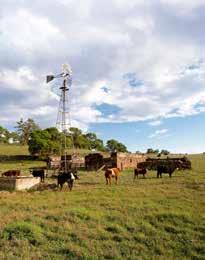
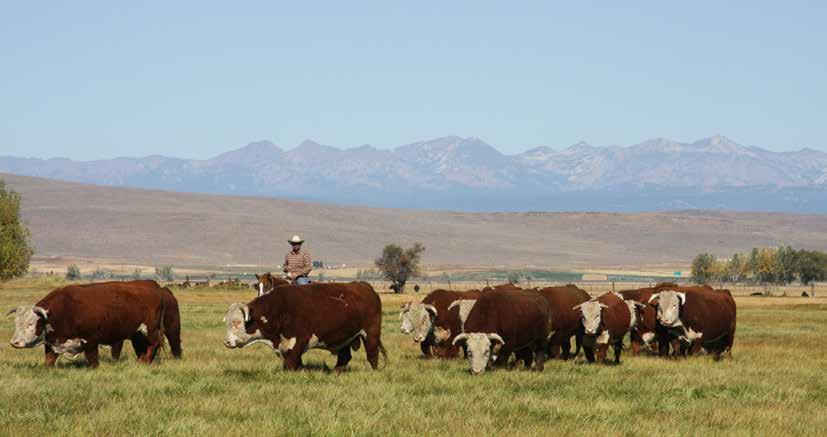
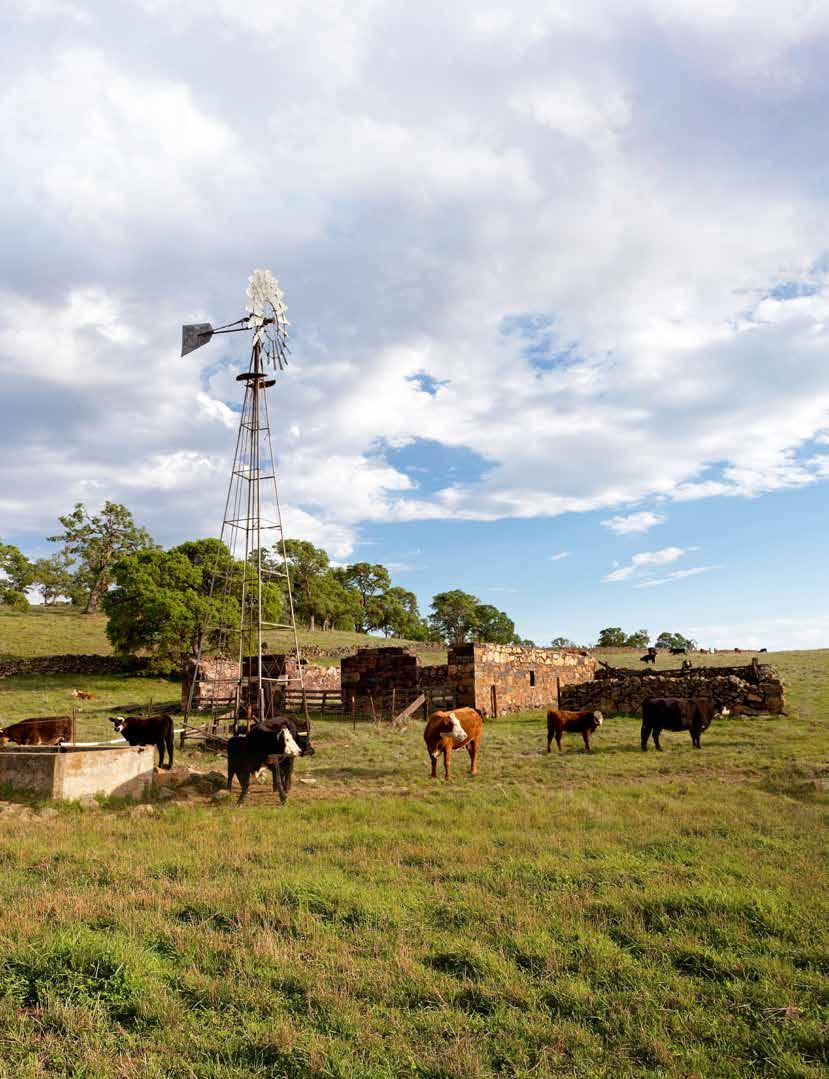
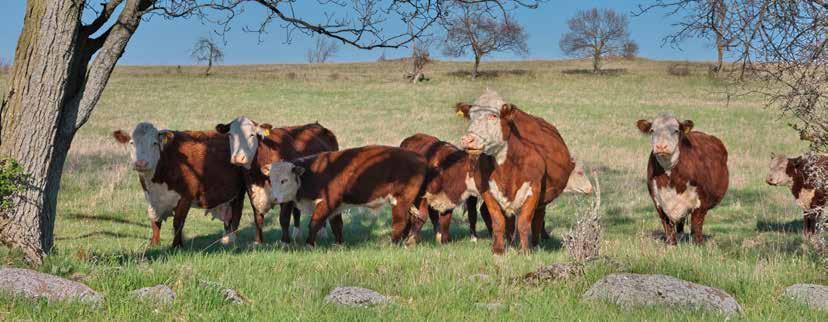
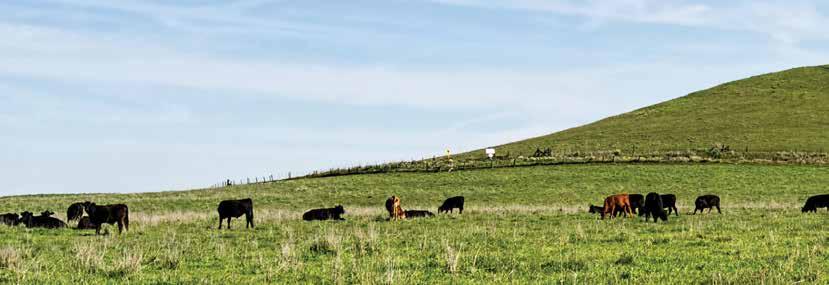
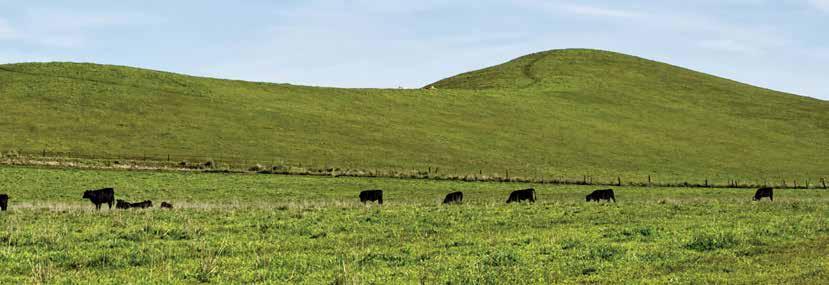
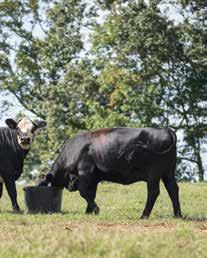
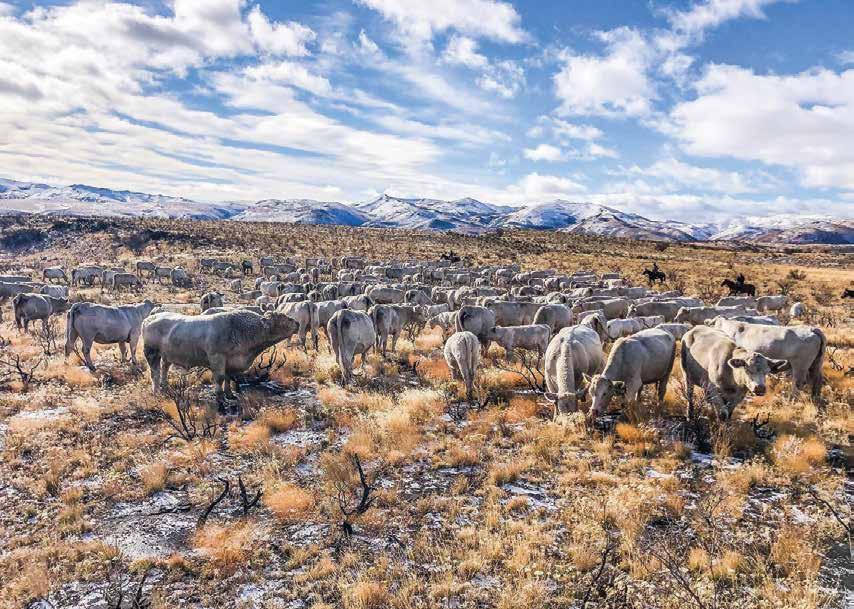
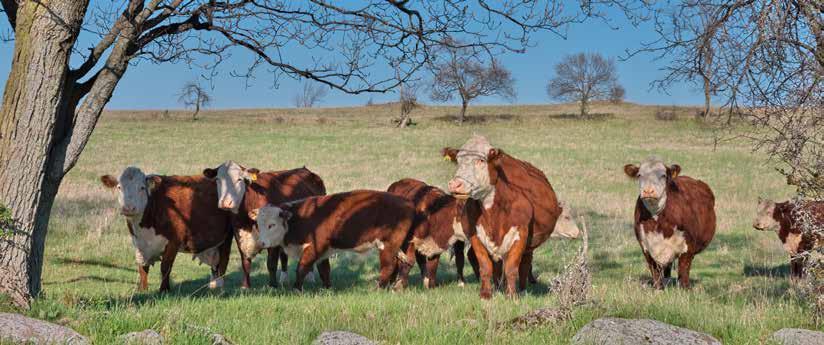
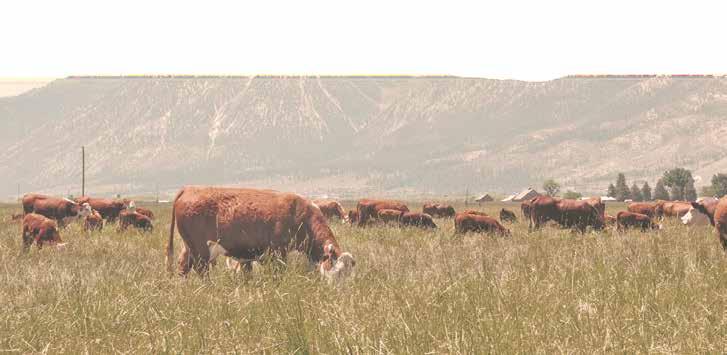
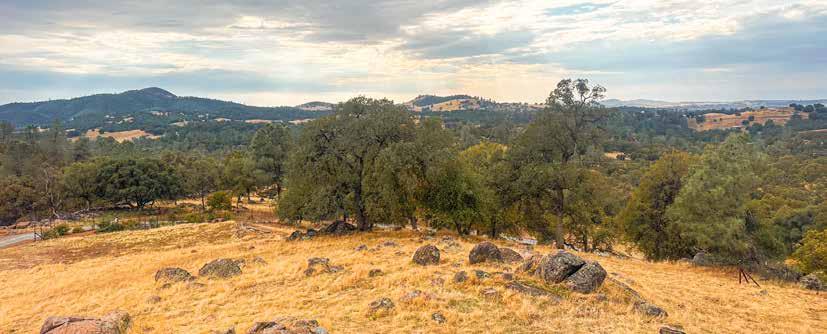
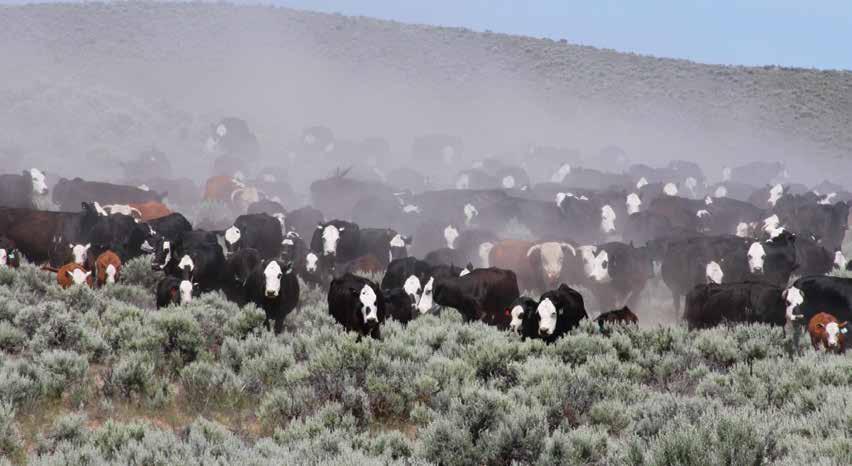
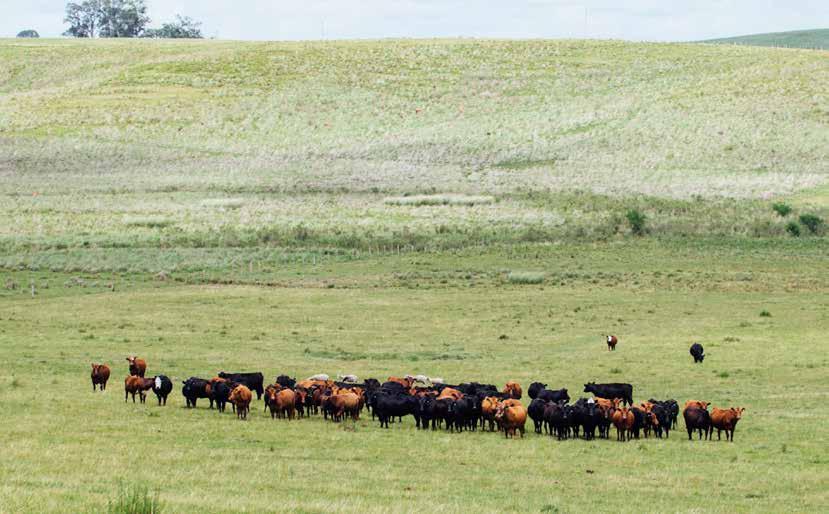
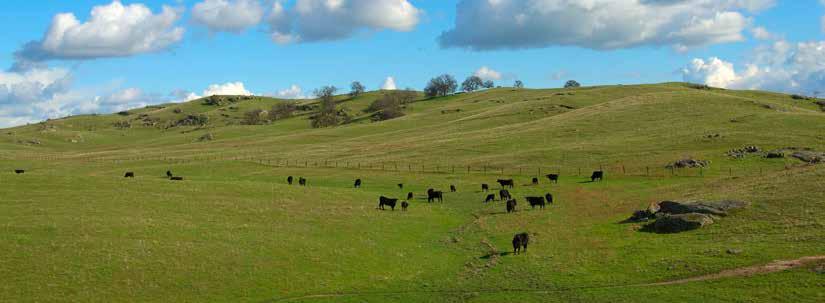
This month’s cover photo features a herd of commerical Herefordinfluenced cattle on early spring pasture in Calaveras County. Taken by Rick Pisio, this photo also features remnants of Telegraph City, an unincorporated area near Copperopolis. To learn more about what remains of this rural ghost town, see the article on page 30. RANCH FAMILY
Obituaries
BUYER'S GUIDE
Services from breeders and beef industry experts




by CCA Second Vice President James Henderson
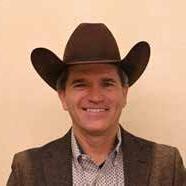
Hello CCA members! I am James Henderson from Tulare County and was recently selected to serve as Second Vice President. I was raised in the small West Texas town of Snyder, where our family ran stocker cattle and cows. After high school, I attended Texas Tech University, where I earned my degree in animal production.
After graduating, I joined CattleFax as an analyst, working across the feedlot, cow-calf, and stocker segments. That experience gave me a broad, data-driven view of the cattle industry and reinforced what I already knew from the ranch: good decisions matter, margins matter, and producers must constantly adapt to forces beyond their control.
My wife, Nicky, and I eventually moved to California, where I served as a territory manager for Cargill. In 2009, I founded Prime Dirt, an ag company that provides biological solutions in both agronomy and animal sectors. We also run a Red Angus/Angus operation in Tulare County. Like many of you, we are not a large producer—running fewer than 100 cows—but we are fully invested in the future of this industry.
For the past 15 years, I have been actively involved in supporting pro-agriculture candidates at the local, state, and federal levels here in Tulare County. Nicky continues that commitment through her work for former Congressman Devin Nunes. Our children are following agricultural paths of their own—our son Reagan is majoring in Agricultural Economics at Texas Tech, and our daughter Jessica is on a pre-veterinary medicine path at Montana State University.
While I may not be a large producer, it’s important to recognize that within CCA membership, operations like mine represent 64% of members and 49% of member revenue. Small and mid-sized producers are the backbone of this organization—and of California cattle production. It doesn’t take much effort to recognize that California’s political landscape is increasingly hostile to production agriculture, and at times, openly anticattle. To make matters worse, the groups pushing
these agendas are extremely well funded and highly organized. As individual producers, we cannot compete with that alone.
But as members of California Cattlemen’s Association, we can— and we do.
For me, CCA membership has never been a cost. It has always been an investment. If your neighbor isn’t a member, I encourage you to have that conversation and invite them to join the cause. In addition, ALL OF US have busy lives, but it is vital that we get active in our local association. More members that are active in California Cattlemens is great recipe for success!
Why does unity matter? Because the greatest asset our opposition can leverage is a divided industry. We won’t agree 100 percent of the time— with neighbors, coworkers, or even family—and it’s unrealistic to expect complete alignment within our association. Healthy debate is fine. What’s not fine is turning those disagreements inward. The fight should never be among ourselves; it should be focused on the external forces working to end our way of life.
Under President Rick Roberti’s leadership, CCA has taken a firm and steady stance, particularly on wolf predation and the many other challenges that seem to arise daily. That kind of leadership matters, and it deserves our support.
It is truly an honor to serve as Second Vice President of California Cattlemen’s Association, and I want to sincerely thank John Austel for his leadership and service over the past two years. Stepping into this role, I do so with humility and a clear understanding of what is at stake.
I look forward to serving over the next two years and welcome open, honest conversations about how we can continue moving this vital industry forward—together.

by CCA Director of Communications Katie Roberti
January sure went by fast. If the rest of 2026 follows at that pace, this year might fly by even quicker than 2025, which was a whirlwind. There are a few crises (I’m sure you can think of one large and fluffy predator I’m referring to) that took hold of ranchers’ and CCA staff’s time in 2025. While they aren’t going away any time soon, we will continue working side by side with our members on these challenging, at times all-consuming issues and keep pushing for meaningful progress.
Something I am confident about is that we will continue to have great partners and friends step in to help us through the trials we face. For example, take Jeff Aiello, producer of the Emmy Award-winning agricultural series American Grown: My Job Depends On Ag, which runs on PBS. Jeff called me late last summer, interested in doing an episode highlighting Sierra Valley ranchers’ nightmare experience with wolves.
I had no idea at the time how important the stories he captured would be a few months later. Now I do, as they aired in a two-episode series just a few weeks ago, and the wolf-livestock conflicts in California continue to rage on, as we’ve already seen this year. Jeff and his team didn’t have to spend almost a week in Sierra Valley and make multiple trips up to capture the story. But they did, and as a result, more people are aware of the realities ranchers are facing on this issue because of their great storytelling. Jeff showed up just at
the right time.
The Clarity and Leadership for Environmental Awareness and Research Center (CLEAR Center) at UC Davis is another partner I have enjoyed working with over the last few months, and I look forward to doing more with this year. In September (as you may have read in one of the fall issues of the California Cattleman or heard about on Sorting Pen), the California Cattlemen’s Foundation got to celebrate agriculture, livestock and California’s ranchers and farmers by participating in the UC Davis “Salute to Ag” football game sponsored by the CLEAR Center.

At the game, the Foundation’s booth highlighted how cattle ranching is part of a resilient California and provided opportunities to learn more about the ranchers in our state. The Foundation got to partner with the CLEAR Center again in December, with support from the California Cattle Council, by hosted an environmental media training for ranchers focused on sharing the story that ranchers are climate champions.
...CONTINUED ON PAGE 14




...CONTINUED FROM PAGE 12
Just at the start of the new year, while talking with Tracy Sellers, the CLEAR Center’s Senior Content Writer and Media Strategist, I was also reminded of the great responsibility we have to share our ranching stories. This conversation just happened to be recorded on the CLEAR Center’s podcast called Clear Conversations— which “aims to bring together voices from across the agricultural and scientific communities to spark meaningful dialogue about farming, food and sustainability.”
In the episode, Tracy and I discuss the importance of telling the stories of agriculture and communicating what we do. Throughout this new year, I am striving to do more— through the Foundation with the support of the California Cattle Council—to get more Californians in touch with who California’s ranching families and producers are and why they play an irreplaceable role in our state. We have great stories to tell, and if you’ve ever read the comments section of any mainstream media story about wolves, you know we have a lot of work to do to get our truths out there about what we do and why we do it.
I bring these examples up to remind you that 1) there are great people who want to help us tell our stories. And 2) to encourage you to keep telling your stories with those you meet throughout your days this year. Whether it’s on the plane to CattleCon or in line at the grocery store, you have a great story to tell and one that, during a time where
protein keeps getting more popular, most people would love to hear firsthand about where their beef comes from.
I hope to see many of you in March at CCA’s Steak and Eggs Breakfast and lobby day. There, too, legislators and leaders will be excited to meet you and hear your stories about how you and your ranch are feeding the world and making the Golden State a better place.
Anaplasmosis is an infectious parasitic disease in cattle, spread primarily by ticks and blood sucking insects like mosquitoes. The killed anaplasmosis vaccine protects cows and bulls of any age from infection and requires a booster given 4 to 6 weeks after the inital vaccination. Find out below if you should order the vaccine!
Do you own cattle?

You don’t need it, but should still support the California Cattlemen’s Association
Do they graze in areas where Anaplasmosis is a problem?
Do you want to prevent the effects of the disease including severe anemia, weakness, fever lack of appetite, depression, constipation, decreased milk production, jaundice, abortion and possibly death?
TODAY BY CALLING (916) 444-0845!
or

You don’t need to

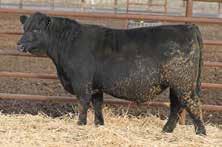
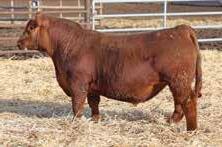
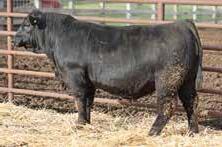
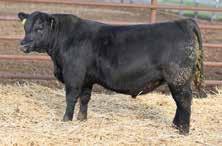

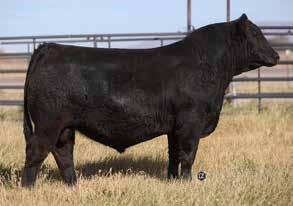
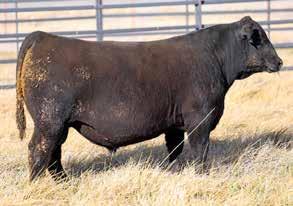
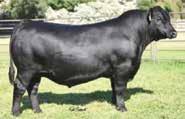
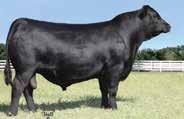
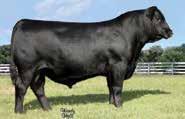
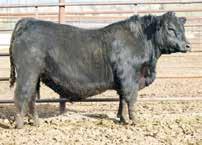
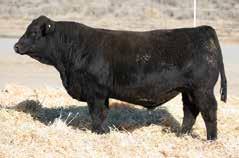
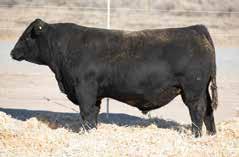
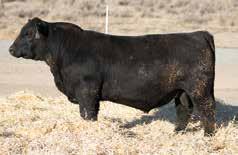
HCC WHITEWATER 9010 • GB FIREBALL 672 B A R DYNAMIC


SITZ ACCOMPLISHMENT 720F
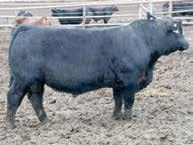
SITZ ESSENTIAL 731J
G A R HOME TOWN
SYDGEN ENHANCE G A R APEX


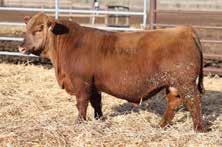
FEDDES DRIFTER 181- 3201


BIEBER JUMPSTART J137 • STRA RANCH HAND 2010 • KJL/CLZB COMPLETE 7000E DKK REMARKABLE 3017
BIEBER CHECKMATE K126
BIEBER PAYCHECK K102 • TJS LAREDO H247
DKK GRINDSTONE 2044 • NIO PALERMO 2273







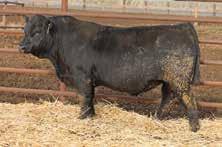

LCDR PROGRESSIVE 106G WS ENHANCEMENT 25H • CCR BOULDER TJ ARROWHEAD 263G
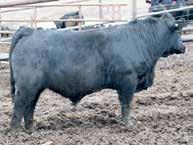
TEHAMA TAHOE B767

SITZ ACCOMPLISHMENT 720F
SITZ ESSENTIAL 731J • G A R HOME TOWN B A R DYNAMIC






by CCA Vice President of Government Affairs Kirk Wilbur
Legislators returned to Sacramento on Jan. 5 to kick off the second year of the 202526 Legislative Session, bringing a close to the “Interim Study Recess” which began Sept. 12 at the end of the 2025 legislative year.
The opening weeks of the legislative year saw a flurry of activity in Sacramento, including legislative leaders reshuffling committee assignments, legislators rushing to tackle ‘twoyear’ bills, Governor Gavin Newsom unveiling his Proposed Budget for the 2026-27 Fiscal Year and even early signs that there may be political interest in better addressing human-wildlife issues (including wolf-livestock conflict). This month’s “Your Dues Dollars at Work” column unpacks what the opening days of the legislative year mean for California’s cattle producers.
The Senate began the legislative session under new leadership, with Sen. Monique Limón (D-Santa Barbara) having taken the reins as Senate President pro Tempore in November. Limón’s predecessor, Sen. Mike McGuire (D-North Coast), is term limited at the end of this year and stepped down from his leadership role ahead of announcing his candidacy last year for the newlyredrawn 1st Congressional District.
Just before Christmas, Limón announced her leadership team, noting that Sen. Angelique Ashby (D-Sacramento) will serve as the Senate Majority Leader. Limón also announced her appointments to the Senate’s standing committees, with changes to the Budget
Committee, Budget subcommittees and Natural Resources & Water Committee (which Limón herself previously chaired) taking effect immediately and all other transitions occurring Feb. 1 after standing committees have dispensed with their two-year bill loads.

Of note given CCA’s legislative priorities, Sen. Anna Caballero (D-Merced) will become Chair of the Senate Agriculture Committee, taking the helm from Sen. Melissa Hurtado (D-Sanger); Sen. John Laird (D-Santa Cruz) takes over from Sen. Scott Wiener (D-San Francisco) as Chair of the Senate Budget & Fiscal Review Committee; and Sen. Josh Becker (D-Menlo Park) takes over Limón’s role as Chair of Natural Resources & Water. Senators Catherine Blakespear (D-Encinitas) and Dave Cortese (D-San Jose) will continue to lead the Environmental Quality and Transportation committees, respectively.
In mid-January, Assembly Speaker Robert Rivas (D-Hollister) announced changes he had made to the standing committees of the Assembly. Rivas’ appointments largely left committee chairs in place, mostly shifting which Republicans will act as committee vice chairs and making minor changes to committee
memberships. Of greatest note to CCA, Assemblymember Heather Hadwick (R-Alturas) will replace Asm. Juan Alanis (R-Modesto) as Vice Chair of the Assembly Agriculture Committee and Assemblymember Stan Ellis (R-Bakersfield) will replace Alanis as Chair of the Assembly Natural Resources Committee.
Legislators’ first order of business in the second year of Session was dispensing with ‘twoyear’ bills which had not advanced out of the chamber in which they were introduced in the 2025 legislative year. January 31 was the deadline for such bills to clear their house of origin to remain viable.
CCA continues to actively lobby three twoyear bills, none of which are subject to the Jan. 31 deadline because they each advanced out of their chamber of origin last year.
CCA-opposed Assembly Bill 1156 (Wicks) would allow the conversion of Williamson Act contracts to solar-use easements without payment of the existing exit fee for contract cancellations. The bill would allow conversion of agricultural land to solar use if water deliveries to the land have been “reduced or curtailed” – a threshold which most agricultural lands in the state meet. While AB 1156 passed both the Assembly and Senate, it was placed on the inactive file on the final day of session last year before the Assembly could vote to concur in Senate amendments.
CCA-opposed Senate Bill 601 (Allen) would apply state protections to all wetlands and other waters which lost federal protections under the U.S. Supreme Court’s 2023 Sackett v. EPA decision, which limited the regulatory jurisdiction of the federal Environmental Protection Agency and Army Corps of Engineers. In short, SB 601 would reimpose at the state level onerous regulatory burdens that ranches and other land stewards long sought relief from at the federal level. The bill was held in the Assembly Appropriations Committee last year but is likely to be taken back up this year.
Finally, CCA is keeping a watchful eye on Senate Joint Resolution 5 (Becker), which is currently parked in the Assembly Natural Resources Committee. SJR 5 relates to enteric methane emissions reductions. While joint resolutions are non-binding, they can inform subsequent legislative efforts at the state and federal level. For this reason, CCA and our partners have sought amendments to SJR 5 emphasizing that enteric methane emission solutions must be voluntary, cost-effective and acceptable to consumers, among other provisions.
While legislators are likely to introduce nearly two thousand bills ahead of the Feb. 20 bill introduction deadline, only about 100 measures had been introduced as of press time (two weeks into the legislative year). This trickle of 2026 bills reflects legislators’ early focus on two-year priorities as well as the need to vet new bill concepts through the Office of Legislative Counsel.
CCA staff is closely monitoring legislation as it is introduced and will keep members apprised of major threats and opportunities in future editions of California Cattleman. Fortunately, as of press time, no major threats to California’s cattle industry had yet been introduced this year in the Legislature.
On Jan. 9, California Director of Finance Joe Stephanshaw unveiled Governor Newsom’s Proposed Budget for Fiscal Year 2026-27. The Governor’s spending plan totals $349 billion and aims to close what the Department of Finance projects to be a $2.9 billion deficit – a much rosier outlook than the $18 billion deficit forecasted in November by the nonpartisan Legislative Analyst’s Office. The Proposed Budget would set aside $3 billion for the state’s “Rainy Day Fund,” partially refilling a reserve fund which the state has drawn upon during recent deficit cycles.
...CONTINUED ON PAGE 18
The Governor’s initial budget proposes to allocate approximately $2.1 billion from the $10 billion Climate Bond approved by voters in 2024, leaving roughly $4.6 billion to be allocated in future budget cycles after $3.3 billion in bond funds were appropriated last year. Of that $2.1 billion, the largest appropriation – $792 million –would be for water resilience projects. Another $314 million would be targeted at wildfire resilience, while $199 million would be earmarked for biodiversity and nature-based solutions and $89 million would be appropriated for climatesmart agriculture.
The Governor’s Proposed Budget is simply the first volley in a monthslong effort between the Administration and Legislature to craft the state budget ahead of the July 1 start of the fiscal year. The Governor will revise his budget proposal in May (the “May Revise”) and the Legislature must approve a budget bill by June 15.
Before the Proposed Budget was released, CCA unveiled the Association’s 2026-27 Budget priority in a letter addressed to Governor Newsom and legislative leaders, requesting that lawmakers allocate just over $30 million to the California Department of Fish and Wildlife’s Wolf Program. CCA has partnered with the California Farm Bureau, Rural Counties Representatives of California and the Office of Kat Taylor, among others, to advance the request.
Most significantly, the request seeks $25 million for the Wolf-Livestock Compensation Program to ensure that California can assist ranchers to deter wolf conflict and to appropriately compensate ranchers for the true toll wolf presence has on cattle herds. The request also calls for:
• $300,000 to assist U.C. Cooperative Extension agents with ongoing research and rancher outreach efforts;
• $500,000 to continue funding the U.C.
Berkeley California Wolf Project;
• $960,000 to support CDFW’s efforts to collar gray wolves in the state, including funding for aerial capture;
• $1 million to augment CDFW’s Wolf
Program staff; and
• $3 million in additional discretionary funding for the Wolf Program.
In late January, CCA staff had an early opportunity to highlight the need for adequate Wolf Program funding when CCA Vice President of Government Affairs Kirk Wilbur was invited to serve as a panelist at an Assembly Water, Parks and Wildlife Committee informational hearing on “human-wildlife coexistence.” Stay tuned to CCA’s publications for additional details of the hearing, which took place after press time.
The 2026 legislative year is young. Stay tuned to California Cattleman and CCA’s other publications as CCA’s legislative priorities for the year develop. And mark your calendars for the CCA Steak and Eggs Breakfast and lobby day on March 11, where members are encouraged to advocate on a grassroots basis to advance the Association’s legislative and policy priorities.





The U.S. beef and cattle markets are entering a pivotal phase in the cattle cycle as prices find cyclical peaks and supplies turn towards a gradual recovery. Historically, cyclical price peaks come before production lows by six to 12 months, and this cycle appears no different. Tight cattle inventories and exceptional beef demand defined 2025, and while these fundamentals remain positive, the dynamics of supply rebuilding and demand moderation will shape the outlook for 2026 and beyond.
On the supply side, the long-anticipated herd expansion is finally underway, albeit at a slower pace than previous cycles. After six consecutive years of contraction, the beef cow herd is expected to begin 2026 about 150,000 head larger, near 28 million. Low culling rates and modest heifer retention signal the start of rebuilding, but structural headwinds—high input costs, aging producer demographics, and landuse competition—will temper aggressive growth. The dramatic tightening of feeder supplies seen in the last cycle is unlikely to repeat. Meanwhile, dairy cow numbers are projected to start the year above 9.5 million, the largest since 1993, supported by beef-on-dairy adoption
by CattleFax’s Patrick Linnell for the Beef Checkoff Program
“The underlying rhythm of tight supplies, strong demand, and gradual herd rebuilding suggests profitability will return to the cowcalf sector and set the stage for renewed expansion into 2027 and beyond.”
that has added roughly one million head to feeder supplies in recent years. However, this contribution is expected to flatten going forward. The 2025 calf crop likely marked the cycle low, but with only a slight increase forecast for 2026. Feeder cattle outside feedyards will remain historically tight, and feedyard inventories are projected to start the year down 400,000 head from 2025. Placements will be constrained by limited calf availability, modest heifer retention, and the continued absence of Mexican feeder imports—a wildcard that could shift the supply picture dramatically once the border reopens. Current expectations are for a phased reopening sometime in 2026, potentially adding 1.2 million head annually. Until then, fed cattle slaughter will remain tight, falling another 600,000 head in 2026 after a 1.4 million head drop in 2025. Carcass weights are forecast five pounds larger following an increase of over 50-lbs. over the prior two years. Cow slaughter will remain tight with a slight decline in beef cows offsetting a small increase in dairy cows. In total, beef production is forecast to contract 2 percent in 2026 following a 3.5 percent decline in 2025.
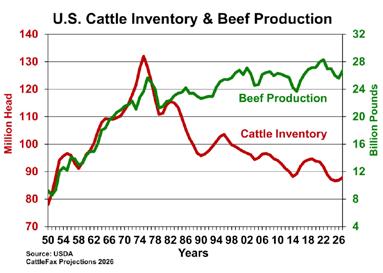
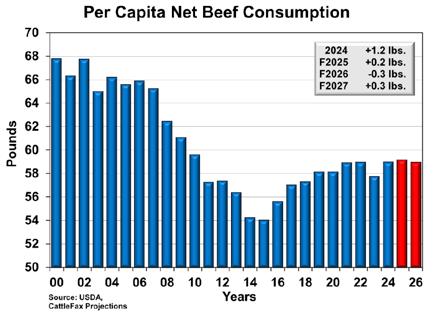
Despite these supply constraints, percapita beef availability remains near 59
...CONTINUED ON PAGE 22



















pounds—historically strong—thanks to heavier carcass weights and elevated imports. Imports of lean beef will stay robust to meet ground beef demand as U.S. lean beef production remains tight. Exports for U.S. beef will remain strong but will be limited by tight domestic production. This balance underscores the resilience of consumer demand, which delivered record performance in 2025. Retail beef prices surged past $9 per pound, and the composite cutout averaged $357/cwt., briefly topping $400, reflecting the culmination of a multiyear demand growth phase that began in 2020.
Looking ahead, 2026 is expected to usher in a period of demand consolidation after the rapid growth of recent years. Retail beef prices should stabilize between $9.00 and $9.50 per pound, while the composite cutout averages near $350/cwt. The first half of the year will likely see continued strength as tight supplies support wholesale values, but moderation is anticipated later as affordability pressures mount. Historical patterns suggest this pause is cyclical: demand growth phases typically last five to six years, followed by consolidation periods of similar length.
Even so, demand fundamentals remain historically strong. Quality improvements have transformed beef’s competitive position, with 84 percent of fed cattle grading Choice or higher and 12 percent achieving Prime in 2025. This quality shift, combined with cultural emphasis on protein, positions beef favorably with consumers. For now, volatility may increase as markets digest the cyclical transition, but the underlying rhythm of tight supplies, strong demand, and gradual herd rebuilding suggests profitability will return to the cow-calf sector and set the stage for renewed expansion into 2027 and beyond.




by CCA Director of Communications Katie Roberti
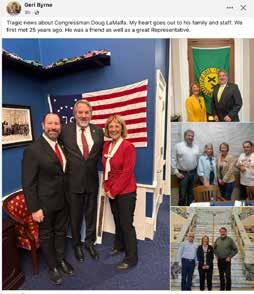
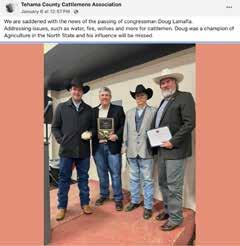
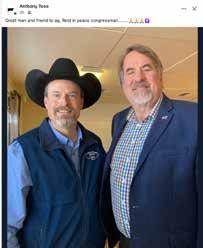
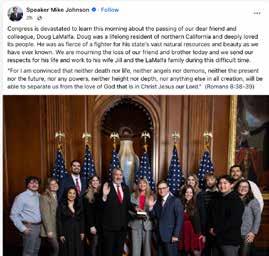
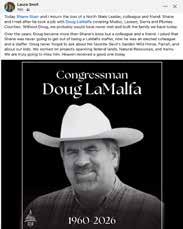
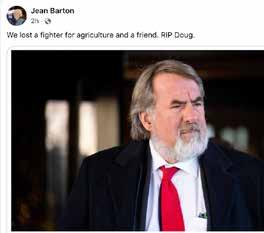
Less than a week into 2026, Northern Californians woke up to the news of Congressman Doug LaMalfa’s passing. As someone who was once his constituent (before district lines were redrawn a few years ago) and who remained my family’s go-to representative in Washington, D.C., his passing saddened me, as I know it did many of our readers. Sadness for his family, for all who knew him well, and for those just like me who didn’t quite know him well enough to call him my friend, but who knew he cared about me and my issues as if I were a friend of his.
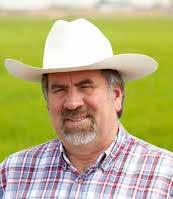
“Right away, I found out he was just kind of one of us,” CCA President and Northern California rancher Rick Roberti said.
One July day about five years ago, a sports car drove down our family’s dirt road and onto our ranch. Behind the wheel was Congressman LaMalfa. That morning, around a kitchen table, he talked with our family about ranching and farming issues and how he could represent us in Washington, D.C. While I knew who he was and had probably even met him before, this unexpected visit was the first time I got to speak with our representative in a small setting. This was when I saw firsthand that Congressman LaMalfa was authentically himself. Despite the weight his position held, he was Doug.
I wouldn’t be surprised if many of our members and readers in his district got to know him over coffee or a similar meeting at their home. Many of you probably also had conversations with him at local cattlemen’s meetings or farm bureau dinners, which he consistently attended in his district. After all, he was a fourth-generation rice farmer.
“I started watching some of Doug’s speeches on C-SPAN,” Rick said. “And I thought, he’s exactly the person we need in this position. To say he’ll be missed is an understatement. I’m
going to remember Doug as a fighter and one of us.”
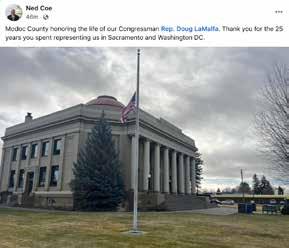
Modoc County Supervisor and rancher Ned Coe was a constituent and friend of Doug’s. Over the last 25 years, starting back when Doug aspired to be elected to the California Legislature, Ned watched his leadership evolve.
“I first met Doug when he was just beginning his campaign for the Assembly seat,” Ned said. “I got to observe his character and leadership early in the campaign the day we spent together in May of 2001 at the Klamath Project Bucket Brigade where a line of people using true peaceful protest passed buckets of water half a mile from the Klamath River to the A Canal, after it was announced that there wouldn’t be any water for the Klamath Project that year. Over the last 25 years, we became close friends and worked together on many agricultural and resource issues affecting Northeastern California.”
Doug represented the rural north state for nearly a quarter-century. He served six years in the California Assembly and two years in the Senate before being elected to Congress in 2012, as noted in the January editions of California Cattleman Weekly.
“Doug worked hard over the 13 years in Congress to build relationships,” Ned said. “He had become a very effective leader, not just for his district of Northeastern California, but all of



























































agriculture and resource-based communities of the western United States.”
He served on the House Agriculture Committee, as chair of the Forestry Subcommittee, and on the Natural Resources Committee, providing a powerful voice for his constituents, particularly on issues related to water and forestry. In November of 2024, Doug was unanimously elected to serve as chairman of the Congressional Western Caucus.
“Doug understood that it takes time and hard work to be a leader, and there are few others who put in the hours that he did,” Ned said. “He wasn’t afraid to get his hands dirty to get the job done.”
He strongly advocated for ranchers regarding threats posed by gray wolves, recently voting in favor of federal legislation to delist the species from the federal Endangered Species Act. Just the day before he passed, Sierra County Supervisor and rancher Paul Roen communicated with him about the ongoing escalation of wolf-livestock conflicts in California and planned to speak with him again the next day. Even after redistricting, Doug still showed
up for his constituents and for those former constituents who were cut out of his district, including my family and community.
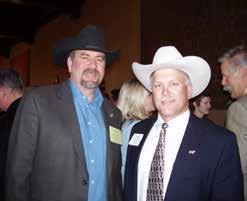
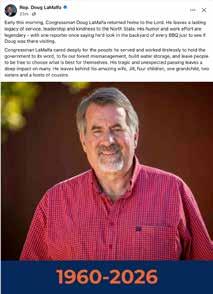
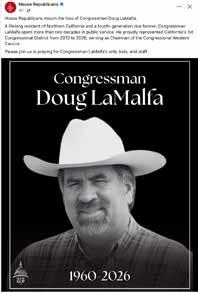
Knowing there was a representative in Congress who cared about agriculture and the ranching way of life in California was a peace I didn’t realize I had until he was gone. Congressman LaMalfa’s friendship, leadership, and authenticity will be greatly missed by so many in California’s agricultural community. A few of the many tributes I saw on social media right after his passing are included with this editorial. To learn more about his life, please read his obituary, also featured in this issue.
Rep. Doug LaMalfa with then CCA President Kevin Kester at a CCA Steak & Eggs Breakfast.
On Jan. 16, Gov. Gavin Newsom proclaimed that a special election would be held Tuesday, Aug. 4 to fill the vacancy in California’s 1st Congressional District caused by the passing of Rep. Doug LaMalfa.
California law requires the governor to proclaim a special election no later than two weeks after a vacancy arises, and the special election ordinarily must happen no more than 140 days after the proclamation is made. Sacramento political observers widely believed that Governor Newsom would consolidate the special election with the June 2 Primary Election, placing the primary for the special election in late March.
However, an exception in the California Elections Code allows the governor to hold a special election up to 200 days after the proclamation in order to consolidate the special election or its primary with an existing election. Governor Newsom has opted to consolidate the special election’s primary with the June 2 statewide Primary Election to take full advantage of this 200day window – Aug. 4 is the last Tuesday on which the special election may legally be held under
applicable state law.
Rep. Richard Hudson (R-NC), the Chair of the National Republican Congressional Committee, panned Newsom’s move as “a disservice to the people of California’s First District” which denies them “a voice in Congress…for purely political reasons.”
The special election for the vacant 1st Congressional District will occur within the current, pre-Proposition-50 district boundaries and will determine who serves the District for the current term ending in January of 2027. Assemblyman James Gallagher (R-Yuba City) has announced he will run in the special election.
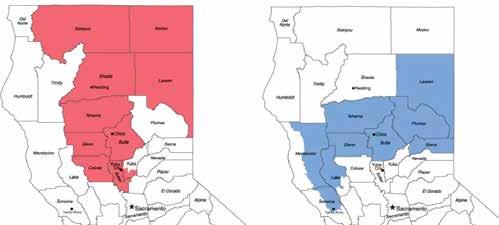



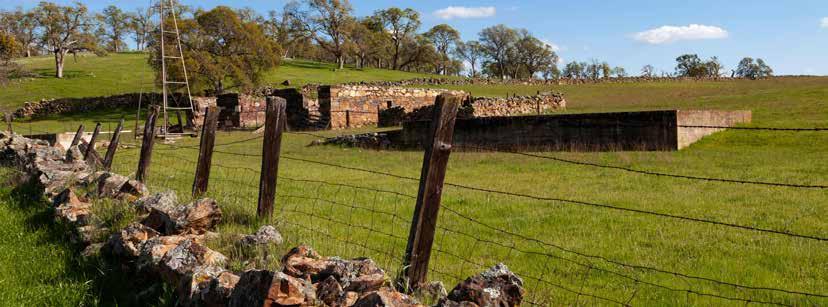
Telegraph City, is a small but fascinating chapter in the rich tapestry of Gold Country history. Located in Calaveras County, this former settlement rose and fell with the tides of mining and communication developments in the mid19th century. Today it is remembered as a nearabandoned ghost town, with only remnants of its past hinting at a once-bustling community.
Originally established in the early 1860s, Telegraph City began under the unlikely name of Grasshopper City. According to historical accounts, the name may have been inspired by the abundance of grasshoppers in the surrounding foothills during the spring and summer months, when the area’s rich green hills drew miners and settlers alike. The community grew up along Shirley Creek, just off the Stockton Road, a key overland route connecting mining camps and supply centers in the Sierra Nevada foothills.
The early boom of Grasshopper City was driven in part by mineral discoveries. In 1860, a prospector and his young son found copper ore in the nearby hills, setting off interest among miners and investors. While copper mining in the region was never quite as prolific as at larger nearby districts like Copperopolis, the discovery helped anchor the local economy and drew enough people to sustain a settlement.
By the 1870s, as communication lines expanded across California, the town’s identity shifted with the installation of a telegraph line between Stockton and Sonora that passed through the community. In recognition of this
by Managing Editor Stevie Ipsen
technological milestone, Grasshopper City was renamed Telegraph City. The telegraph was critical infrastructure in the era, linking remote mining communities to markets, news, and broader national communications networks.
During its heyday, Telegraph City supported its own post office from 1862 to 1894, a sign of its importance as a local hub for miners, ranchers, and travelers along the Stockton Road. The community also thrived on sheep and cattle ranching, taking advantage of the hilly pastures of Calaveras County after the initial mineral rush waned.
However, like many mining towns of the Gold Rush and early industrial era, Telegraph City’s fortunes declined as nearby districts drew more sustained interest and transportation routes evolved. By the late 19th century, the post office closed and the settlement was gradually abandoned. Today, visitors to the site can still find fieldstone walls, foundations, and other subtle traces of the buildings that once stood.
Telegraph City’s story is emblematic of countless small communities that flourished briefly during California’s rapid expansion, driven by mining, communication and the enduring human urge to explore and settle new frontiers.
Today, the historic landmark is frequented by local ranchers whose cattle benefit from the lush spring grass and the occasional photographer who visits to capture the unique landscape and what remains of the short lived existence of this Gold Rush Era settlement.



On Jan. 21, U.S. Secretary of Agriculture Brooke Rollins announced the launch of the New World Screwworm (NWS) Grand Challenge. This funding opportunity marks a pivotal step in USDA’s comprehensive strategy to combat NWS and prevent its northward spread.
“This is a strategic investment in America’s farmers and ranchers and is an important action to ensure the safety and future success of our food supply, which is essential to our national security,” said Secretary Brooke Rollins. “These are the kinds of innovations that will help us stay ahead of this pest and protect our food supply and our economy, protecting the way of life of our ranchers and go towards rebuilding our cattle herd to lower consumer prices on grocery store shelves. We know we have tried-and-true tools and methods to defeat this pest, but we must constantly look for new and better methods and innovate our way to success. Together, through science, innovation, and collaboration, we can ensure we’re utilizing the latest tools and technology to combat NWS in Mexico and Central America and keep it out of the United States.”
As part of the Grand Challenge, USDA’s Animal and Plant Health Inspection Service (APHIS) will make up to $100 million available to support innovative projects that enhance sterile NWS fly production, strengthen preparedness and response strategies, and safeguard U.S. agriculture,
animal health, and trade.
PRIORITY AREAS FOR FUNDING
APHIS invites proposals that support one or more of the following objectives:
• Enhance sterile NWS fly production
• Develop novel NWS traps and lures
• Develop and increase understanding of NWS therapeutics/treatments (i.e. products that could treat, prevent, or control NWS) for animals
• Develop other tools to bolster preparedness or response to NWS
The notice of funding opportunity, including application instructions, eligibility, and program requirements, is available on the NWS Grand Challenge webpage.
Applicants can also find information on the ezFedGrants website or Grants.gov by searching USDA-APHIS-10025-OA000000-26-0001.
Eligible applicants are invited to submit proposals that align with and support these priorities by the deadline on Feb.23, 2026 at 11:59 p.m. Eastern time.
Entities interested in submitting a proposal should ensure they are registered with the U.S. Government System for Award Management (SAM). Learn more about the basics of the funding process and how to get ready to apply.
For more information about NWS, visit screwworm.gov
In late January, the U.S. Meat Export Federation announced a partnership with Taiwanese importer Yu-Ho Foods on a retail seminar about U.S. beef for Yu-Ho and its retail customer PX Mart. The retailer, already Taiwan’s largest supermarket chain with 1,200 outlets, had recently purchased a 20-outlet hypermart chain and expressed interest to Yu-Ho in seeing a wider range of U.S. beef items to consider for both chains.
USMEF conducted a technical seminar for the fresh foods department staff of PX Mart and Yu-Ho Foods at Yu-Ho’s headquarters. The first half of the seminar included an industry overview about U.S. production, grading standards and the quality characteristics of U.S. beef. USMEF Senior Marketing Manager Alex Sun and Kevin Ho, sales manager of Yu-Ho Foods, were also on hand to answer questions about Taiwan’s beef import market, available U.S. beef products and new marketing ideas.
“Inflation continues to impact consumer spending in Taiwan,” said Sun. “The seminar was
an opportunity to sell the quality of U.S. beef and present a wide range of affordable, alternative cuts.”
USMEF conducted a cutting seminar for the under blade of the chuck for staff of Taiwanese importer Yu-Ho Foods and its retail customer PX Mart, who recently purchased a hypermart chain.
The second half of the seminar included a cutting demonstration of an alternative cut that USMEF and Yu-Ho believes to have strong potential for the retail and hypermart chains. Ho demonstrated the cutting process and discussed various commercialization options for the under blade of the chuck. The session showed different ways to hand-cut the steak and included explanations about how to use chilled U.S. beef items to generate revenue and improve profitability.
The seminar was made possible with funding from the Beef Checkoff Program and USDA’s Regional Agricultural Promotion Program.

from the California Beef Council
Amid the industry sector reports, budget discussions, and CBC staff updates at the California Beef Council (CBC) annual meeting held in late 2025 at the Chowchilla-Madera Fairgrounds, the overriding theme was “collaboration.”
“When the CBC’s experienced, businesssavvy council members get together to meet like we did this past November, the outlook for the future of the council is positive,” said Bill Dale, the CBC’s Executive Director. “Then you add the extensive professional backgrounds of the CBC staff to the mix, the resulting exchange of ideas about program directions and outcomes leads to a very dynamic discussion. Between staff updates on outcomes of 2025 programs, the launch of programs for 2026, and the establishment of a new set of strategic priorities, our agenda was packed with items that will impact both the short and long-term direction of the council.”
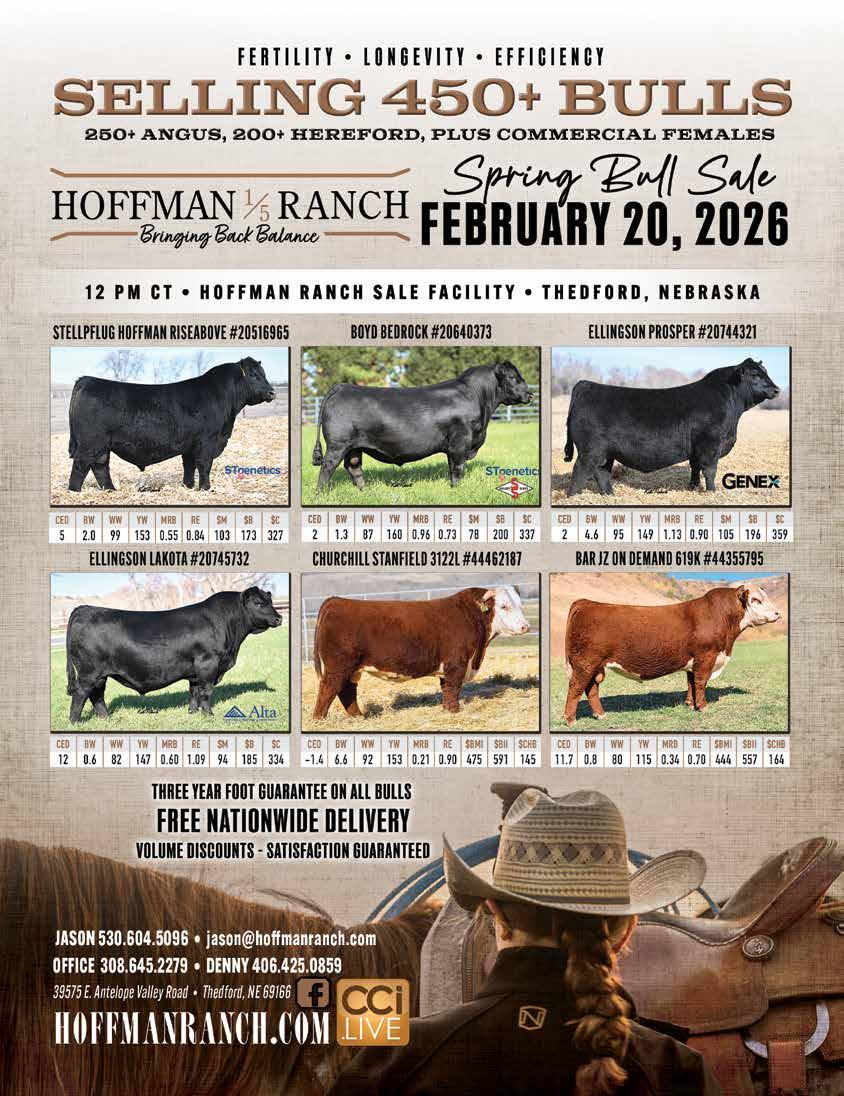
Every three years, Council members review and revise the strategic priorities in a collaborative process with CBC staff. These priorities are the lens through which the staff focus their programs and campaigns. 2026 kicks off a new three-year cycle for the strategic priorities that will be in effect from 2026 through 2028. This new set of strategic priorities was established by the Council at the June 2025 mid-year meeting, and formed the basis of staff-proposed programs presented at the November meeting.
When CBC staff develop their program concepts for the coming year, they conceive and create their programs either within their departments or in collaboration with each other. At the November meeting, staffers presented their proposals as a group, highlighting the ways in which each department’s programs intersect and complement the other departments.
Registered dietitian Kori Dover, who heads the CBC’s Food and Nutrition Outreach program, reiterated to the Council the importance of
maintaining a credible, science-based voice within the nutrition landscape. As Dover noted in her summary of proposed 2026 programs, nutrition is increasingly recognized as essential to well-being throughout a person’s lifespan, with conversations focusing on how food choices influence physical health, cognitive development, and overall quality of life. “There is a growing understanding that meaningful health outcomes rely on collaboration among those who shape how people learn about and experience food,” Dover said. For 2026, Dover is focusing on program strategies implemented across three areas:
• Engage and Inform—engaging in professional and community conversations about nutrition by sharing credible, research-based information and producer perspectives that connect food, health, and agriculture.
• Advancing Nutrition Education—continuing to engage and inform by actively promoting the CBC’s nutrition education resources to school nutrition professionals, healthcare providers, educators, and community partners.
• Scientific Engagement and Influence— ensuring that beef is accurately represented and considered within broader discussions on protein, balanced diets, and the food system through ongoing relationships with healthcare providers, educators, and community leaders.
...CONTINUED ON PAGE 36

A portion of Dover’s programs continues to be supported in-part through financial contributions from the Nebraska Beef Council, the Kansas Beef Council, and the California Cattle Council.
The Retail, Foodservice & Influencer Marketing program headed by Christie Van Egmond, Director of Retail & Foodservice Marketing, focuses on building beef’s business proposition at retail and foodservice, as well as strengthening food and culinary influencer relationships. “Through our relationships and partnerships with retail, foodservice, and influencers, we will help consumers navigate the economic pressures of purchasing beef, while supporting their health and well-being goals,” Van Egmond said. For 2026, Van Egmond is implementing four key strategies:
• Integrated Marketing Campaigns/Strategic Partnerships/E-commerce—works cohesively with the consumer marketing department. These omnichannel campaigns include multifaceted advertising strategies combining the Consumer Marketing Tactic, strategic partnerships with retail grocery store chains, complementary brands, e-commerce, and digital shopping platforms to reach consumers on their path-to-purchase.
• Food & Culinary Influencer Marketing—a powerful tool for building cattle production and beef product visibility on social platforms. Consumers are increasingly basing their food perceptions, purchase behavior, and eating habits on the content from influencers.
Immersion Experiences—a long-standing way in which the CBC has engaged retail and foodservice leaders. Immersing these supply chain professionals into the beef industry for a couple of hours up to multiple days has long-proved successful in establishing trusted relationships with these stakeholders.
• Content, Outreach & Engagement—positions the CBC as the expert resource on beef cut education, production, sustainability, value, convenience, versatility, nutrition, and marketing to beef consumers.
The Consumer Marketing & Outreach program, overseen by Annette Kassis, Director of Consumer & Brand Marketing, focuses on understanding and reaching consumers based on their concerns, outlook, and need. “Focusing on beef’s taste, convenience, versatility, and value form the core of driving beef demand,” Kassis said. For 2026,
Kassis is implementing four key strategies:
• Integrated Marketing Campaigns—works cohesively with the retail & foodservice marketing department to execute a series of campaigns. These campaigns combine multiple touchpoints between media strategy, consumer engagement, retailer execution, and e-commerce outreach.
• Consumer Outreach Campaigns—enhance consumer trust by responding to questions, needs, and concerns. These campaigns feature an increased emphasis on storytelling and personal engagement.
• Public Relations & Earned Media—media outreach and press release distribution amplifying the CBC’s news and boosting measurable earned media results.
Content Marketing—creating and distributing relevant and consistent content across channels and platforms to reach and attract a specific audience.
The Producer Education & Engagement program, implemented collaboratively by the CBC staff, will continue to focus on keeping producer stakeholders informed about CBC and Beef Checkoff initiatives. Additionally, the CBC will continue to partner with advocates and industry organizations including the California CattleWomen, California Cattle Council, California Cattlemen’s Association, and the California Farm Bureau Federation. Updates will be periodically provided through trade media, subscribed email, printed Cattlemen’s Beef Board-generated Checkoff materials, California-specific inserts in “The Drive,” across the CBC’s social media platforms, and in the CBC’s annual report.
The CBC’s Annual Report for 2025 should be available on the CalBeef.org website by late spring, and printed in the “California Cattleman” magazine. Past Annual Reports through 2024 are currently available to view at: www.calbeef.org/about.







�
�
�




�
�















































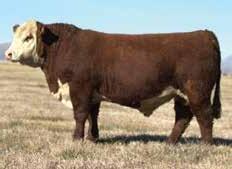
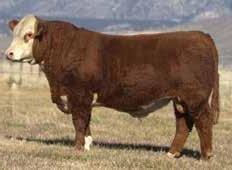
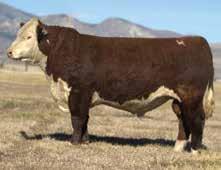
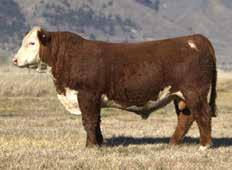
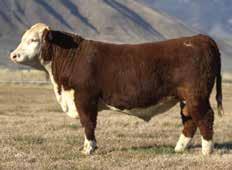
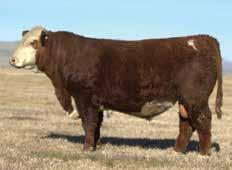
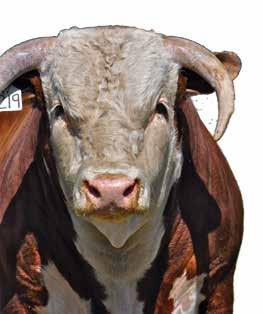
Crossbreeding and Hereford cattle have gone together ever since the breed first came to the U.S. in 1817 to improve the nation’s native cattle herd.
Specific benefits from direct and maternal heterosis are well documented, too, with much of the seminal research conducted at the Meat Animal Research Center (MARC) in the 1960s. What continues to evolve, however, is quantifying the magnitude of advantages associated with utilizing Hereford genetics in strategic, complementary crossbreeding. That’s the goal of the American Hereford Association’s (AHA) ongoing multiyear collaborative research with the University of Illinois Urbana- Champaign (UIUC). More specifically, Dan Shike, interim head of the UIUC department of animal sciences explains, “The objective is to characterize the performance of Hereford genetics in a commercial Angus operation that retains replacements and finishes out all steer progeny.”
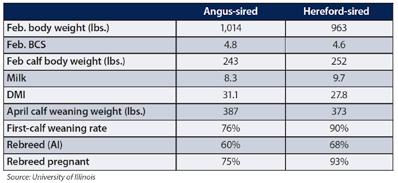
Results from the project thus far serve as a literal textbook example of the production and economic power yielded by maternal heterosis. Hereford-sired females, compared to those bred to Angus bulls, were more moderate in size, consumed less feed, weaned more calves, bred
by
back more efficiently and had increased longevity.
For context, the study began with 600 commercial Angus cows. Half were bred to six different Hereford bulls; the other half to Angus bulls. All bulls used represented the top 15 percent of each breed for it maternal and terminal indexes. This is a fallcalving herd.
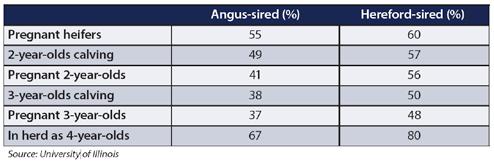
Although the results are expected, the differences (Table 1) underscore the significant advantages enabled by Hereford genetics and maternal heterosis. Shane Bedwell, AHA chief operations officer and director of breed improvement, pointed out during the Forum that Hereford provide additional heterosis due to the fact they are the least related of the Bos Taurus breeds, as documented by MARC.
“I’m not looking for the cow that wins in one year. I’m looking for the cow that wins over her lifetime and stays in the herd, stays in production, because she has some built-in fertility, some resilience, which leads to longevity,” Shike says.
Although the advantages ofmaternal heterosis are noteworthy each year of reproduction, Shike notes how brightly they shine for the 2-year-olds with a heifer at side (Table 2 on page 42), which breed back on time for the next calf. As cattle producers have long-known, that’s when so many expensive replacement females are lost, unable to breed back with their second calf at one of the most stressful developmental periods of their lives.
...CONTINUED ON PAGE

Considering the 14 percent advantage in first-calf weaning rate of the Hereford-sired females at 2 years of age, Shike explains, “In a 100-head cow herd, that’s 14 more calves. If you put a $2,000 price tag on each weaned calf, that’s $28,000. That’s $280 more per cow. That’s a lot of dollars.”
That’s before considering that Herefordsired females needed fewer groceries. Pricing hay at $150 per ton, the advantage equates to about $90 less feed cost per cow per year, according to the data.
Seventy percent of the feed resources in the beef industry go to the cow herd, and 70 percent of that feed that goes to the cow herd goes to her maintenance.
Multiply those two numbers. It’s 0.49. I’m going to round that to 50 percent. Half of the feed in the beef industry goes to just maintaining the cow, and I haven’t produced anything.”
Bottom line, Shike explained, “They wean more calves, and more of them breed back. That’s Hereford genetics, that’s maternal heterosis.”
Perhaps unsurprising, given the Angus breed’s relentless pursuit of pounds and marbling, the Angus-sired steers in the project resulted in heavier carcasses and graded higher on average. For instance, based on a subset, the Hereford-sired hot carcass weight was 876 pounds, compared to 901 pounds for Angus-sired steers.
Marbling score for Hereford-sired steers averaged 479 versus 557 for the Angus-sired steers. Ribeye area was the same for both groups at 14.1 square inches.
Bedwell cautions the data is also influenced by the unique management system employed at the
University of Illinois. Calves are weaned at about 90 days of age and moved to a backgrounding facility. Think about the reproductive efficiency in the Hereford-sired heifers and cows versus heavier weights in the Angus-sired ones.
Greg Thoma, AgNext director for agricultural modeling and lifecycle assessment, used the data to conduct a lifecycle assessment for a 1,000-head operation over 10 years. Generally speaking, the model considered a 1,000-cow commercial Angus herd using Hereford bulls and retaining its own replacement heifers or using Angus bulls and retaining its own replacement heifers.
More weaned calves over time yielded 45,728 more pounds of steers and open heifers to sell in the herd utilizing Hereford bulls.
“The feedlot side of the business pays the bills, but the female side keeps us in the business,” Shike says. Based on preliminary AgNext results, carbon intensity was also 8 percent less in the modeled herd employing Hereford bulls.
“Achieving the performance metrics documented for the Hereford breed in this trial by any means – genetic or management — shows clear benefits,” Thoma says.




by the California Rangeland Trust
A few generations ago, if you asked someone on the street whether they or their family worked in agriculture, chances are the answer would have been yes. Today, that connection has largely faded. Many people are now generations removed from the land, feeling increasingly disconnected from where their food comes from and from the people who produce it.
But sometimes that connection runs so deep that, even after years away from the land, it still calls you back—to your roots and your family’s legacy—no matter how many years have passed.
This sentiment rings true for Robert Mackey, owner of the Murphy Ranch in the hills of Tuolumne County. Robert is a descendant of the Murphy family, who have owned the nearly 430-acre property since the Homestead Act of 1865.
He recalls childhood trips to the ranch and days spent working alongside his family, but as life and career opportunities pulled him elsewhere, those moments gradually shifted from lived experiences to cherished memories.
But in the early 2000s, the land came calling.
“I had always loved my time at the ranch,” Robert explained. “I always wanted to come back to it, call it a ‘romantic attraction’ to the lifestyle. So, it seemed like the right move both for my family’s heritage and me personally.”
After the last of the five Murphy brothers passed away, the ranch was left in need of
renewal and consistent stewardship. Years of limited management and a large wildfire decades prior had taken their toll—fences had fallen into disrepair, weeds had overtaken the pastures, buildings were gone, and the onceproductive agricultural operation had faded. To put it simply, the ranch needed a little TLC to restore it to the vibrant, working property it had once been.
With limited experience and little idea of what lay ahead, Robert and his family jumped in wholeheartedly. Bit by bit, they began bringing the ranch back to life. Over the years, they rebuilt fences, added essential infrastructure, and introduced cattle, sheep, and goats back to rotationally graze the land, steadily restoring both its productivity and vitality.
“There’s still a lot of work to do,” Robert shared. “It has taken a lot of time and, frankly, a lot of funds to get this place back to being functional and operating. But, we are proud of where we are at.”
Now that the family has found their footing in the management of the ranch, their focus has shifted to protecting it for the future. In just the short time they’ve been back, they’ve watched the surrounding area transform into a kind of boomtown, with development pressing in from every direction. Robert recalls how different the landscape looked when he was a kid visiting the ranch compared to the rapid change he sees today.
...CONTINUED ON PAGE 44

































SALE MANAGER: Matt Macfarlane
(916) 803-3113 (cell)
m3cattlemarketing@gmail.com www.m3cattlemarketing.com
























SATURDAY 12 NOON • VALE, OREGON
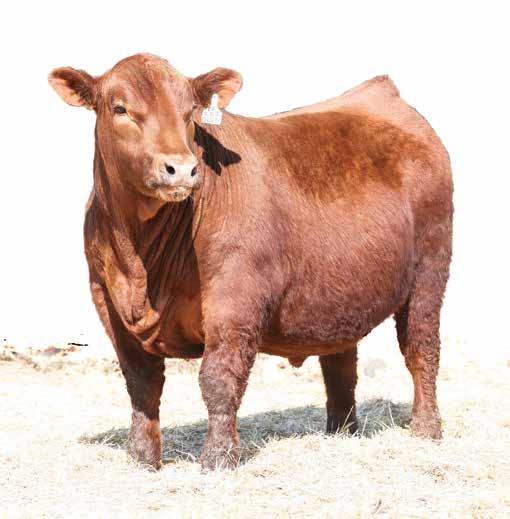
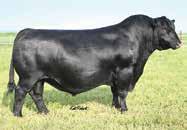
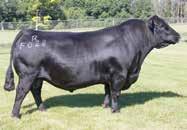
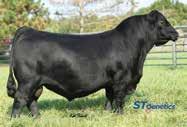
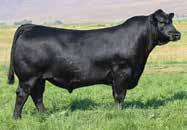
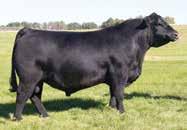
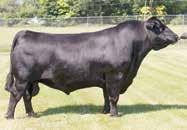
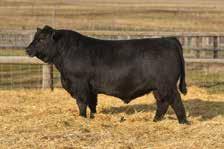
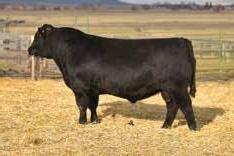
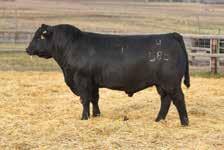
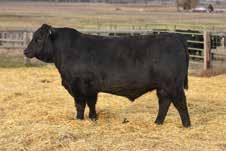
18-MONTH OLD ANGUS BULLS ALSO INCLUDING A DOZEN SIMANGUS BULLS AND A SELECT GROUP OF BRED AND OPEN FEMALES
Our age-advantaged bulls are available in volume! These bulls out of top sires can increase consistency and marketability in your calf crops.
As the second-largest registered Angus cowherd in Oregon calving out 600-plus females a year, you get the Advantage of only the cream-of-the-crop! The top 50% of our bulls have extremely large contemporary groups to increase predictability, consistency and quality for our customers, and are from a cowherd that has been around for nearly 40 years.
Ruthless culling for feet and legs, plus structure gives you the Advantage when it comes to bull selection. Our bulls are extremely athletic. They run in big pastures over the summer after weaning. They are developed in extremely large lots that require them to travel up and down hills over rocky, hard ground everyday between a high-roughage feed source and water to ensure soundness and longevity.

Our intense AI program utilizes the most current and sought-after genetics in the Angus breed, with herdsires infused and utilized that rival the most popular AI sires in the breed for genetic value and potency.
Volume and repeat discounts are available, and delivery is free. Bulls are backed by a Zoetis HD50K DNA evaluation, ultrasounded with complete performance and fertility evaluation, and backed by an industry best guarantee. Many bulls qualify for the CAB Targeting the Brand Program.
AUCTIONEER Rick Machado (805) 801-3210 2175
Jerry Baker
(208) 739-3449
Samuel Mahler, Herdsman (208) 739-0475



Since 1980, Tuolumne County’s population has grown by more than 20,000 people, with much of that growth happening in the 1980s and 1990s. Even though population increases have slowed in recent years, the pressure on open space hasn’t. Rising land values and the growing demand for five-acre ranchettes continue to put working lands at risk—lands that provide food and fiber, support local economies, and sustain clean air, water, and wildlife habitat.
“We are nearly surrounded by these fiveacre ranchettes,” Robert reflected. “Every time I come and go from the ranch—particularly on the Sonora side—there’s more and more development encroaching on what used to be large cattle operations.”
In 2013, the neighboring Sardella Ranch became the first property in Tuolumne County to be conserved by the California Rangeland Trust. Since then, the organization has permanently protected nearly 1,500 acres in the county, with another 3,200 acres currently in progress.
Inspired by their neighbors’ success, the Mackeys decided to pursue a conservation easement of their own to safeguard the Murphy Ranch from the steady wave of development surrounding them. In October 2025, their efforts came to fruition as they finalized the easement, permanently conserving 425 acres of their property and creating a continuous stretch of more than 900 acres of protected working rangeland alongside the Sardella Ranch. The project also marked a milestone for the California Rangeland Trust: the 100th ranch conserved—a true cause for celebration.
“All of us really love this ranch and this area,” Robert shared. “The decision to put the easement on the ranch was a family decision, none of us wanted to see this place lost to development like many of the properties around us. It means a great deal that our ranch is contiguous with the Sardella Ranch, ensuring that a large chunk of land is protected in our local area. It’s humbling to know our decision contributes to something bigger than ourselves.”
The completion of this conservation effort was made possible through strong partnerships dedicated to preserving California’s working lands. Funding for the easement was secured through collaboration with the California Department of Conservation and the California Strategic Growth Council through its Sustainable Agricultural Lands Conservation Program.* The Mackey family also generously donated a portion of the conservation easement’s value by completing a bargain sale agreement to ensure the long-term protection of their land.

With the easement in place, the Mackeys are focusing on continuing to restore and enhance their land so it remains a viable working ranch for generations to come. The effort has truly become a family endeavor, with each member building their own connection to the land and sharing a common goal of seeing it thrive well into the future.
For them, the conservation of Murphy Ranch is more than a milestone; it is a commitment to the land that shaped them and to the generations who will follow. Their story shows that even after years away, the bond with the land can endure, guiding decisions that protect both heritage and habitat. By conserving their property, the Mackeys have not only safeguarded a piece of their family’s history but also strengthened the network of California’s working ranches, ensuring that the landscapes that provide food, livelihood, and a connection to the natural world remain vibrant and accessible.
In the end, their journey is a reminder that no matter how far removed we may be, the land always has a way of calling us home.
Though not everyone has a direct connection to the land, families like the Mackeys—and the 99 other ranching families who have chosen to conserve their land through the California Rangeland Trust—are ensuring that the connection remains possible. Their decisions keep open space open, preserve the legacy of ranching in California, and demonstrate that even in a changing landscape, choosing to care for the land endures.
*SALC is part of California Climate Investments, a statewide initiative that directs Cap-and-Trade dollars toward projects that reduce greenhouse gas emissions, strengthen the economy, and improve public health and the environment— particularly in disadvantaged communities.
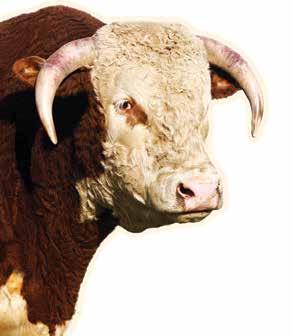

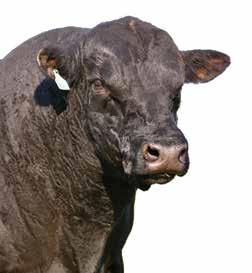



» 140 Hereford Bulls
» 60 Angus Yearling Bull
» 30 Hereford Reg. Heifers
» 80 Comm’l Hereford/Black Baldy Heifers
» 25 Harrell-Mackenzie Quarter Horses Perfomance Bred for Ranch & Arena
Bob Harrell, Jr. 541/403-2210 Ranch 541/523-4402 Baker City, Oregon
Jay George, ULB, Inc.605/391-6230 M3 Marketing, Matt Macfarlane, 916/803-3113
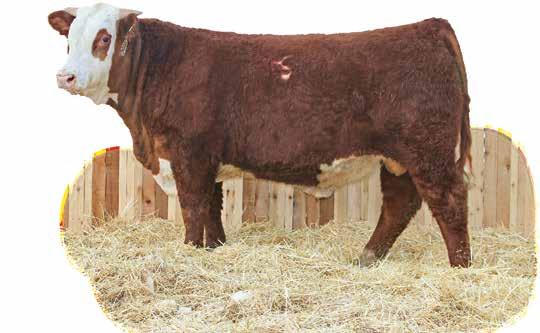


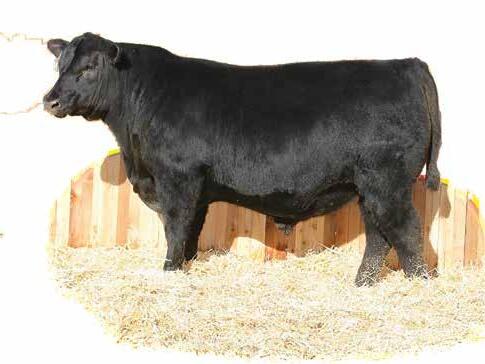

by National Cattlemen’s Beef Association President Buck Wehrbein
I know, I know. Time goes by fast. We all say it, but still, it’s hard to believe I’m sitting down to write my final column to NCBA members.
NCBA has existed for more than 125 years for one simple but vital reason: to stand up for America’s cattle producers — the men and women who care for the land, raise cattle and put in long days to keep this business moving forward. None of that work happens without engaged cattlemen and women like you. Your involvement is the foundation of everything we do and, as I close my term as president, I’ve never been more proud to stand alongside you as members of this association.
Because of that strong grassroots presence, NCBA was able to deliver meaningful results this past year. Together, we have voiced strong opposition to increased beef imports from Argentina, secured tax relief to help producers keep more of what they earn, and defended private property rights by pushing back against regulatory overreach through WOTUS.
We’ve fought for common-sense reforms to the Endangered Species Act, worked to create a more favorable tax and regulatory environment for future generations of cattle producers, led the effort, along with our state affiliate partners, to keep New World Screwworm out of the U.S., and advanced trade opportunities that promise long-term benefits — including Australia opening its doors to imports of U.S. fresh beef. We made some meaningful progress with Secretary Rollins as our government works with grassroots
producers to understand the true needs of rural America and how our business contributes to the fabric of our communities.
This past year also reminded us that market signals matter. We’re experiencing record prices for cattle and beef, reflecting both historically low cattle numbers and strong demand for our product. For generations, cattle producers have worked to deliver the safest, highest-quality beef in the world, and today we are finally seeing fair prices for our products.
Even amid market turbulence and political rhetoric surrounding prices, our markets proved resilient, just as they always do. To witness this level of demand is truly remarkable. It’s something I wish my dad could see. For everyone to recognize what we’ve always known — that our product is exceptional — is nothing short of incredible.
Of course, our work as an association is never finished. There will always be more to accomplish, especially as we continue to invest in the next generation of leaders, because the future depends on them just as much as it depends on us. At the same time, NCBA continues to grow and adapt, evolving to meet the changing needs of our members and
...CONTINUED ON PAGE 48
the business we serve. As the German proverb reminds us, “Food is never eaten as hot as it’s cooked.” In other words, things often seem more daunting in the moment than they truly are. We can get bent out of shape and scared to death, but when we arrive at the challenge, it’s rarely as bad — or as good — as it first appeared. Perspective matters, and with steady leadership and collaboration, we navigate uncertainty and keep moving forward.
When I began this year, I wrote that I was truly honored to serve as your NCBA president. That hasn’t changed. Your trust in me has been humbling, and I am deeply grateful for it. From day one, I said my confidence didn’t come from what I could accomplish alone, but from the incredible people I stand alongside and you have proven that true at every turn.
The true strength of this association lies in its members. You are the backbone of our industry, the driving force behind our advocacy,
and the reason we continue to grow and adapt. Your engagement, insight and commitment to our shared mission — to improve the business climate, grow beef demand, and expand the world’s access to U.S. beef — are what make NCBA so effective.
This year reinforced something I said early on: leadership is about listening. I’ve endeavored to hear you, to respect every voice and to lead with honesty. Together, we’ve faced emerging threats, navigated policy shifts, and secured wins that will shape the future of our industry. As I prepare to pass the gavel, I’ll leave you with this: your membership matters more than ever. Every voice and every perspective strengthens our ability to fight for your interests. Stay engaged. Share your ideas. Encourage young producers to get involved.
Thank you for allowing me the privilege of serving as your president. It has truly been the honor of a lifetime.
God bless, and happy trails.
Through its Patriots’ Pledge program, Zoetis has contributed over $2 million to Folds of Honor in a four-year span, advancing the organization’s mission to provide academic scholarships for the families of fallen or disabled members of the U.S. Armed Forces and First Responders.
Since 2022, Zoetis has supported Folds of Honor by donating a portion of select cattle product sales, and in early 2025, expanded the program to include select pork and poultry products as well.
“Many of our customers have ties to a military service member or a first responder, or they know someone who does,” says Kristin Kasselman, Senior Vice President of the U.S. Livestock Business for Zoetis. “The animal agriculture industry takes pride in our country. Our customers also share a foundation of hard work, resilience and commitment to community, making this collaboration with Folds of Honor a natural fit for Zoetis.”
Lt. Col. Dan Rooney, Folds of Honor founder and CEO, couldn’t agree more.
“Our collaboration and partnership with Zoetis is so powerful because of our common ground rooted in shared values,” Rooney says. “That’s the flawlessly authentic point of connection between Zoetis and Folds of Honor. I can’t think of a better way to say, ‘thank you’ to our military and first responder families, or a better way to invest in
America and its future.”
To date, Zoetis has helped support 361 scholarships. Providing scholarships for students who are pursuing agricultural and animal production studies is important to Zoetis and reiterates its commitment to supporting the future of agriculture and industry leaders.
For Oklahoma State University animal science student Erica Wells-Kleman, support from Patriots’ Pledge will allow her to graduate debt-free. She appreciates the commitment from Zoetis to support dedicated service members through select product sales and was eager to meet Lt. Col. Dan Rooney at a recent National Cattlemen’s Beef Association convention.
“I grew up using Zoetis products on our cattle at home, and I’ve been using them in my animal science classes as well,” says Wells-Kleman, who comes from an eighth-generation cow-calf ranch near Glencoe, Oklahoma. “It’s great to see that connection between Zoetis and the Folds of Honor scholarship program.”
Throughout 2026, Zoetis will continue to donate a portion of sales of select cattle, poultry and pork products to Folds of Honor. The Patriots’ Pledge program continues to expand, with Synovex implants recently being added to the eligible product lineup. Visit ZoetisUS.com/PatriotsPledge to learn more about the program and read Folds of Honor scholarship recipient stories.




by Boehringer Ingelheim
Parasites are a hidden drain on cattle performance, quietly stealing productivity and profit from herds across the country.
For producers, the cost isn’t just in lost weight gain, but also in overall herd health and efficiency. That’s why veterinarians and ranchers alike are turning to improved parasite control strategies, like combination treatment.
“Combination treatment is the use of two or more dewormers from different classes, each with a different mode of action, to get more effective control,” said Matt Washburn, DVM, Boehringer Ingelheim.
The advantage? Each dewormer targets parasites in a different way. When used in combination, they can help reduce the number of parasites left behind. In fact, fecal egg counts in cattle herds have been shown to drop by nearly 99 percent when using dewormers from different classes.
To get the most out of combination
treatment, it helps to understand how each class of dewormer works.
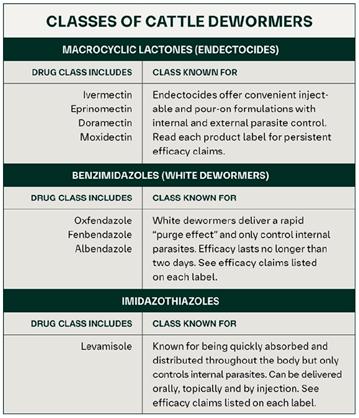
Dewormers can be divided into three different classes, based on their chemical structure and mechanism of action: macrocyclic lactones (endectocides), benzimidazoles (white dewormers) and imidazothiazoles. Each class controls a distinct spectrum of parasites, and for a different amount of time (see Figure 1).
“Some classes of dewormer do a better job controlling certain parasites than others,” stated Washburn. “Endectocides provide strong coverage against both internal and external parasites, while white dewormers work well against only internal parasites.
There are also differences in how long the dewormers will persist in the animal.
“Most of our macrocyclic lactones have a persistence of about 28 to 30 days, with the exception of the extended-release dewormer, with which we can get out to 150 days,” shared Dr. Washburn. “On the other side of that, you’ve got the benzimidazoles, which are also known as purge dewormers, because they’re going to clean the animal out, and in two days, they’re gone.”
Near Okemah, Okla., rancher Buck Rich has been using combination treatment for several years under the guidance of his veterinarian, Dr. Tyler Thomas, to protect his nearly 2,000 cowcalf pairs, as part of his deworming protocol at Leaning Oak Ranch.
“We’ll normally use an injectable, and then we’ll do an oral drench,” said Rich. “It seems to work really well for us, and cleans those cattle up a little quicker. That’s our go-to protocol now.”
Depending on the time of the year, Rich may apply a pour-on dewormer to the calves instead of an injectable, as part of his combination treatment protocol for additional coverage.
Strategic timing can also make combination treatment even more effective, especially when cattle are carrying their highest parasite loads. “Using combination treatment, you get a better clean-out up front, and you’ll see it on the cattle, particularly coming out of winter, when our highest parasite load occurs,” said Thomas. “They’ll shed that winter coat off, they get fat, and they look good.”
...CONTINUED ON PAGE 52


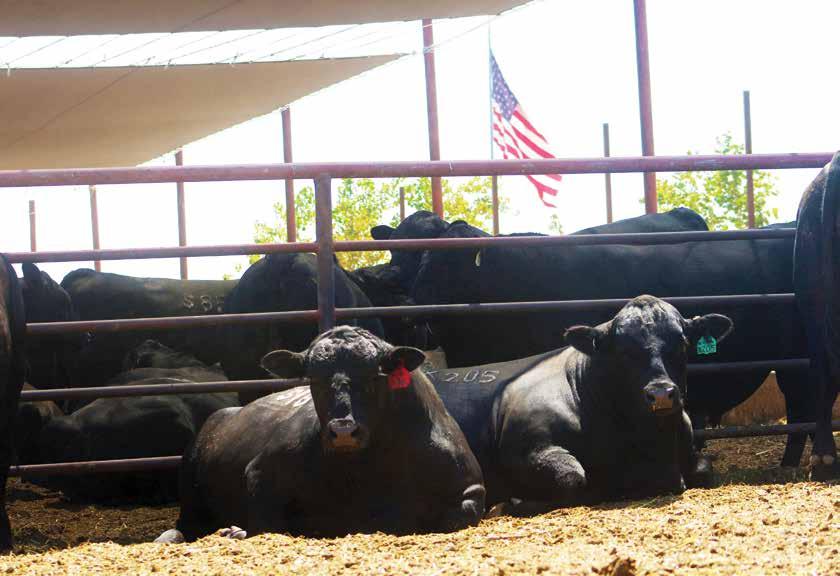




Recommending combination treatment to producers for the first time can sometimes be a tough conversation, because of the additional cost of another dewormer.
“Going from a single class to combination therapy, producers are almost always on a macrocyclic lactone, and they’re adding a white dewormer to it,” noted Thomas. “I would just tell them it’s well worth it, it’s very economical, and it doesn’t take much more effort. If anybody tries combination treatment, they can see the results in the cattle.”
Rich is one of the producers Dr. Thomas has worked with who has seen benefits from implementing a combination treatment protocol.
“We’ve seen a drastic change,” said Rich. “The cattle look better. Their hair coat is better. I really think combination treatment is worth it for our operation.”
Healthy cattle that put on weight and stay in condition are reason enough for Rich to continue implementing combination treatment and other deworming practices advised by Thomas.

“We’re getting paid for pounds of beef at the end of the day,” related Rich. “Using a quality deworming program helps put on more pounds, which is always a benefit in our business.”
For long-term success that helps drive performance and profitability, combination treatment should be part of a broader parasite control plan that includes:
Diagnostic testing: Performing routine diagnostic tests, such as fecal egg count reduction tests (FECRT) and coprocultures, can help assess the effectiveness of a deworming program and identify the parasites that may be surviving treatment.
Refugia: Intentionally not deworming a small percentage of the herd is recognized as an important factor in delaying the onset of parasite resistance.
Management: Producers can increase overall herd immunity through routine vaccinations and enhanced nutrition. Limit overgrazing, maintain appropriate forage height, and rotate pastures, if possible.
When evaluating deworming practices, be sure to include a veterinarian in the process, similar to how Buck Rich and Dr. Thomas have collaborated to develop a parasite control plan for Leaning Oak Ranch.
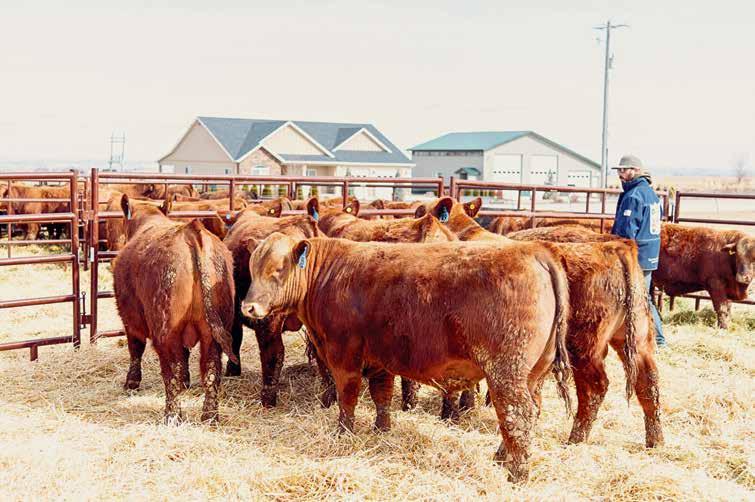

Tuesday, March 3 , 1 p.m. rd At the Ranch

Monday, March 2
Cattle available for viewing, all day Tuesday, March 3
11 a.m. Complimentary Lunch


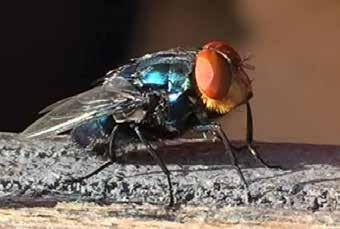
Earlier this fall, the New World screwworm – the flesh-burrowing larva of a blowfly (Cochliomyia hominivorax) – was detected in cattle in Mexico just 70 miles from the U.S. border. Most recently, in late November, another case was confirmed in Nuevo León, a state of Mexico adjacent to Texas.
While the screwworm is not currently present in the U.S., Mexico and Central American countries have been reeling due to the resurgent parasite. There have been more than 144,000 cases in animals and over 1,100 in humans during this outbreak dating to 2023 – and the cases continue to track northward.
by Michael Hsu for the University of California Department of Ag and Natural Resources
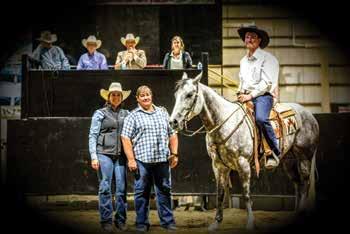
Members of the California agriculture community are just as worried as their counterparts in Texas, where an outbreak could cost livestock producers $732 million per year and cause up to $1.8 billion in losses for the Texas economy, according to U.S. Department of Agriculture estimates.
Among California’s top gross-value commodities in 2024, dairy products/milk are number one ($8.61 billion) and cattle and calves are number four ($4.98 billion) – both categories that could be most affected by the screwworm.
“Controlling for and preventing impact from the New World screwworm are the majority of the questions I’m receiving now,” said Brooke Latack, University of California Cooperative Extension livestock advisor for Imperial, Riverside and San Bernardino counties. Imperial County, adjacent to Mexico, houses about 329,000 head of cattle.
“There is definitely concern about the screwworm down here for producers, industry members and the veterinarians that serve the area,” Latack said.
For dairy, the risk is especially severe, as even small disruptions can lead to major financial losses, said Daniela Bruno, UCCE dairy advisor for Fresno, Madera and Kings counties.
dumped,” Bruno explained.
She said that producers should look into diversifying processing options, reviewing their insurance coverage and bolstering biosecurity against threats like screwworm and avian flu, which has reemerged in California dairies.
It’s not just the economic impact that is particularly unnerving about New World screwworm. While mortality rates vary based on the species and other factors, it can be up to 100% in newborn calves.
“It can affect and kill any warm-blooded animal – any bird, any mammal, including humans,” said Gaby Maier, Cooperative Extension specialist for beef cattle herd health and production at the UC Davis School of Veterinary Medicine. “But we are particularly concerned about our cattle here.”
Maier pointed to recent data from the outbreak in Panama, which indicated that 83 percent of screwworm cases were in bovines, with all other animals trailing far behind (human cases are relatively rare).
The progression of an infestation is especially alarming. After finding an opening on the host (which can be wounds as small as a tick bite, or body openings like the eyes or nose), the fly lays several hundred eggs in the animal’s body. The larvae then use their strong mouth hooks to burrow or “screw” head-first into the flesh.
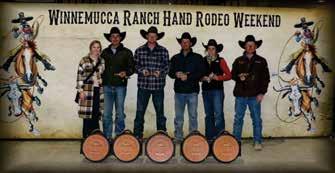
“Unlike beef cattle, which can be held back from market during a quarantine, dairy cows produce milk every day that must be processed immediately – if a farm is quarantined or a plant shuts down, milk spoils quickly and has to be
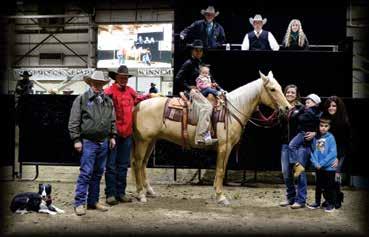
As the larvae feed on the tissue, the wound enlarges and invites infestation by other fly species, accelerating cell death and eventually leading to secondary bacterial infection, sepsis and death within seven to 14 days.
“I have talked to people who have seen these infestations in person, and they remember it from when they were young,” Maier said. “They say it was horrible – the smell of decomposing flesh in a live animal.”
There have been documented cases – such as in deer in the wild – where the larvae obliterate the entire brain of the animal.


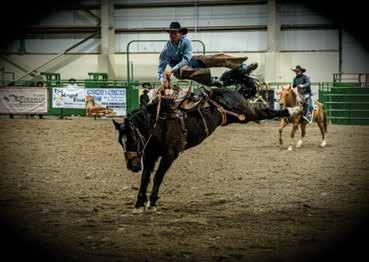

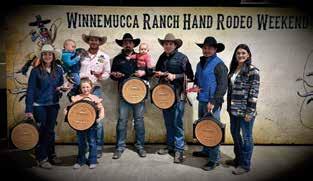
...CONTINUED FROM PAGE 54
“They just keep digging; they just keep eating away at the tissue,” Maier said. “It’s really out of a horror movie.”
Although it was endemic to California and the southern U.S., the New World screwworm was eradicated in the U.S. in the 1960s through the release of sterile male flies that produce no viable offspring.
A USDA facility in Panama – COPEG (PanamaUnited States Commission for the Eradication and Prevention of Screwworm) – produces about 110 million sterilized screwworm flies every week, of which about 50% are males. Sterile flies are strategically released to contain spread of New World screwworm, and for the past 60 years the screwworm was largely contained to Central and South America.
Theories abound as to why it has breached the eradication zone – from illegal cattle trading across borders to fewer inspections during COVID to deforestation of the Darién Gap, a treacherous natural barrier between Colombia and Panama.
But the screwworm again has the full attention of the USDA and state and local agencies. In response, the U.S. southern land border has been closed to the movement of cattle and horses. Surveillance efforts have ramped up. Confirmed cases are met with highly effective sterile fly releases. New drugs for the prevention and treatment have been conditionally authorized.
And a new website was recently launched to provide updates for producers and the broader public: screwworm.gov.
UC COOPERATIVE EXTENSION EXPERTS: STAY INFORMED, STAY ALERT
For people in the beef and dairy industries (as well as producers with small ruminants like sheep and goats), keeping informed is the most important thing to do, according to Maier and Latack.
“Monitor the situation and stay up-todate – if the screwworm is detected, it will be widely publicized so just watch out for those announcements,” said Maier, who recommended checking the USDA website and the California Department of Food and Agriculture screwworm page.
She also cautioned producers to avoid unnecessary use of dewormers or other medications – before a confirmed detection in California or neighboring states – to slow the parasite from developing resistance to those products.
During a late 2025 screwworm webinar, Maier; Rosie Busch, UCCE specialist in small ruminant herd health and production at UC Davis; Amy Murillo, a veterinary entomologist at UC Riverside; and veterinarian/rancher Tom Talbot,
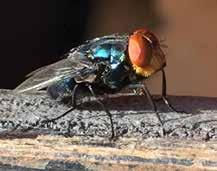
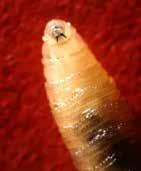
The New World screwworm fly is about the size of a common housefly (or slightly larger), with orange eyes, metallic blue or green body and three dark stripes down its back. Larvae cause severe damage by tearing at their hosts’ tissue with sharp mouth hooks. Photos courtesy of USDA.
DVM, presented. Murillo and Alec Gerry, a UCCE specialist at UC Riverside, are leading a project to monitor the state for signs of the fly’s return.
More than 100 people attended the webinar, organized by UCCE livestock and natural resources advisor Morgan Doran in partnership with the California Cattlemen’s Association and California Wool Growers Association.
Maier also urged producers to keep a close eye on their herd for distressed animals – cattle, for example, that exhibit droopy ears or are lagging behind or not eating. The rotting flesh odor is another telltale sign of a possible screwworm infestation.
“They say you smell it before you see it,” Maier said.
UC Cooperative Extension livestock advisors across the state have been actively sharing key resources with their clientele. Latack, who has been working with UCCE entomology advisor Arun Babu to update communities in Southern California, said producers should try to prevent wounds to their animals to the greatest extent possible.
Potential entry sites for the parasite also open during the production cycle – the results of dehorning, castration or ear tagging, for example – and should be scrutinized closely. The newborn umbilicus (navel) is a favorite target of the screwworm, Maier said, and producers might consider moving their calving season outside the time of highest fly burden in their area as the screwworm does not thrive in extreme cold or heat.
If New World screwworm infestation is suspected, Maier and Latack said the producer should immediately contact their veterinarian for treatment options and notify CDFA.
“This is definitely something we want to keep out at all cost,” Maier emphasized. “It’s an animal welfare problem, it’s an animal movement problem, and it will probably be a trade problem – overall, there is nothing good about it.”
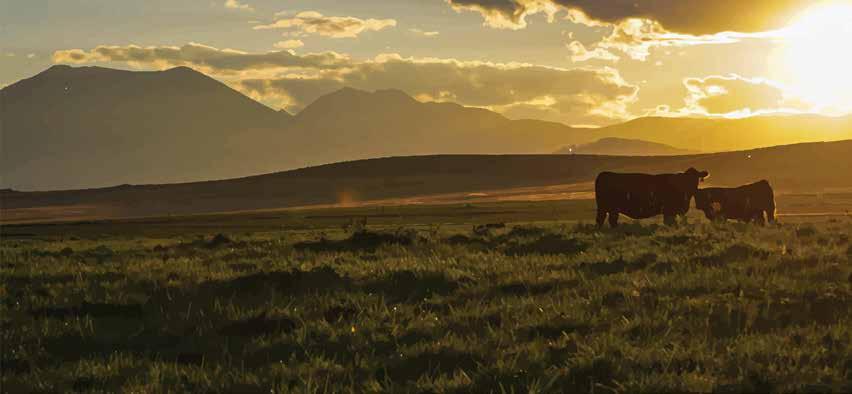
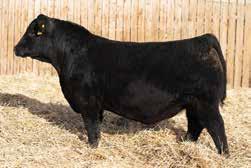
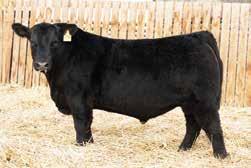
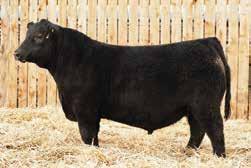
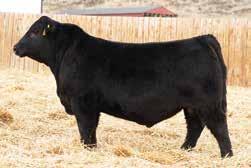
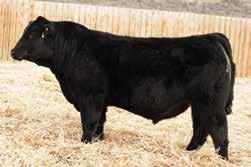
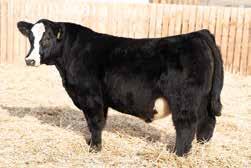




In early January, U.S. Department of Health and Human Services Secretary Robert F. Kennedy, Jr. and U.S. Department of Agriculture Secretary Brooke Rollins released the Dietary Guidelines for Americans, 2025–2030, marking the most significant reset of federal nutrition policy in decades. The new Guidelines deliver a clear, common-sense message to the American people: eat real food.
The U.S. faces a national health emergency. Nearly 90 percent of health care spending goes toward treating chronic disease, much of it linked to diet and lifestyle. More than 70% of American adults are overweight or obese, and nearly 1 in 3 adolescents has prediabetes. Diet-driven chronic disease now disqualifies many young Americans from military service, threatening national readiness and limiting opportunity.
“These Guidelines return us to the basics,” Secretary Kennedy said. “American households must prioritize whole, nutrient-dense foods— protein, dairy, vegetables, fruits, healthy fats, and whole grains—and dramatically reduce highly processed foods. This is how we Make America Healthy Again.”
“Thanks to the bold leadership of President Trump, this edition of the Dietary Guidelines for Americans will reset federal nutrition policy, putting our families and children first as we move towards a healthier nation,” Secretary Rollins said. “At long last, we are realigning our food system to support American farmers, ranchers, and companies that grow and produce real food. Farmers and ranchers are at the forefront of the solution, and that means more protein, dairy, vegetables, fruits, healthy fats, and whole grains on American dinner tables.”
Under President Trump’s leadership, the Administration is restoring scientific integrity, accountability and common sense to federal health guidance. The 2025–2030 Guidelines reestablish food—not pharmaceuticals—as the foundation of health and reclaim the food pyramid as a tool for nourishment and education.
The Guidelines emphasize simple, flexible guidance rooted in modern nutrition science:
• Prioritize protein at every meal
• Consume full-fat dairy with no added sugars
• Eat vegetables and fruits throughout the day, focusing on whole forms
• Incorporate healthy fats from whole foods such as meats, seafood, eggs, nuts, seeds, olives and avocados
• Focus on whole grains, while sharply reducing refined carbohydrates
• Limit highly processed foods, added sugars and artificial additives
• Eat the right amount for you, based on age, sex, size and activity level
•Choose water and unsweetened beverages to support hydration
•Limit alcohol consumption for better overall health
The Guidelines also provide tailored recommendations for infants and children, adolescents, pregnant and lactating women, older adults, individuals with chronic disease, and vegetarians and vegans, ensuring nutritional adequacy across every stage of life.















Friday, March 13
2
4:30
Saturday, March 14
8
Sunday, March 15th
8
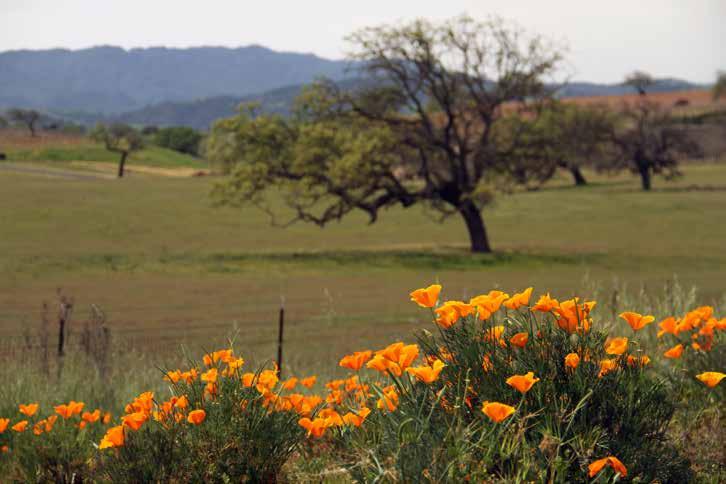
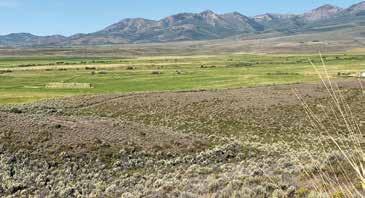

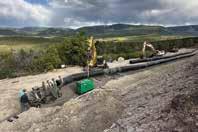
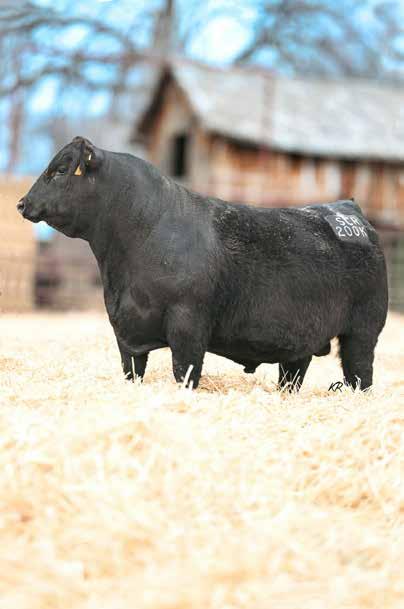
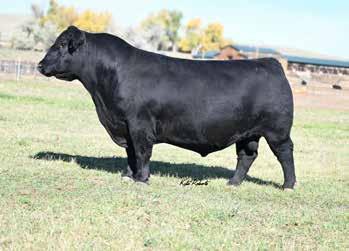
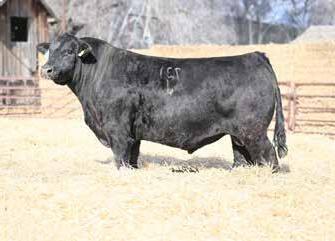
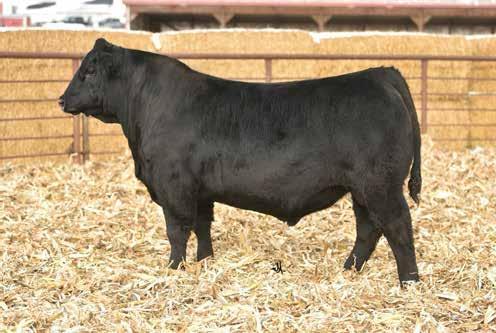


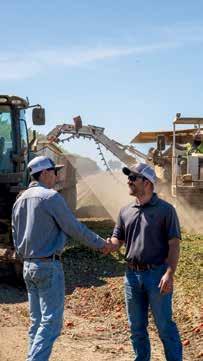






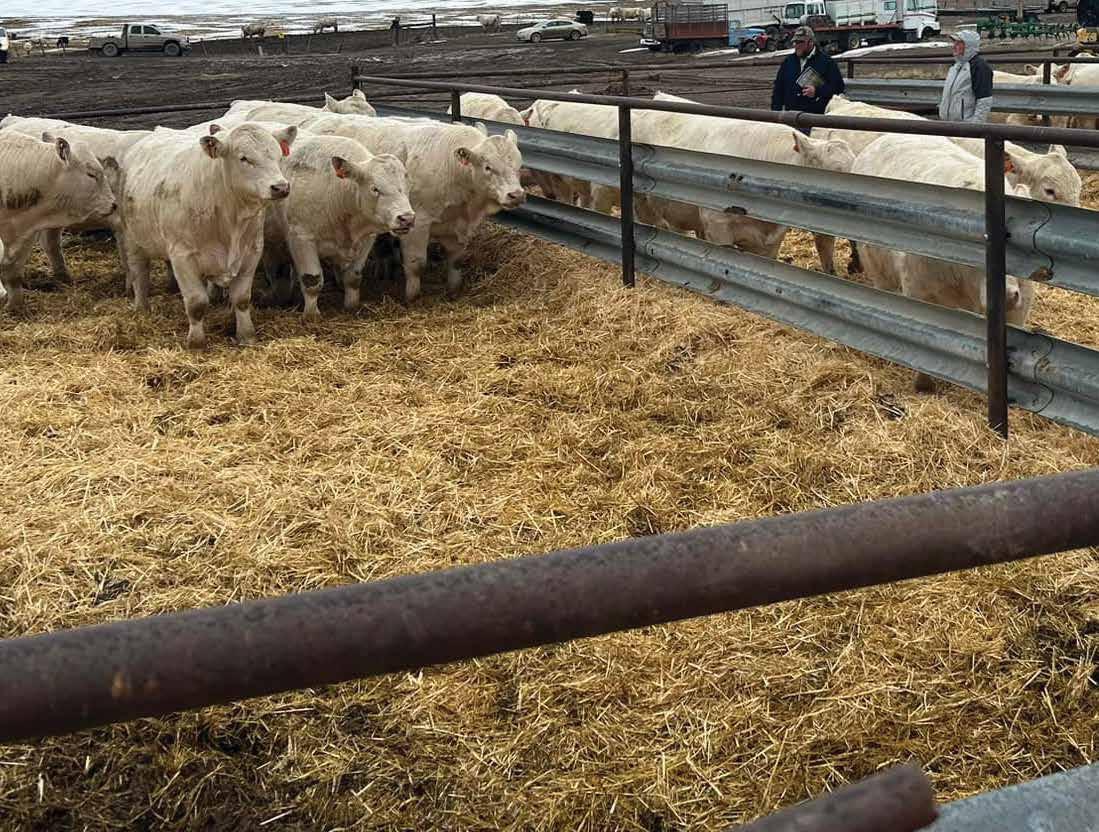


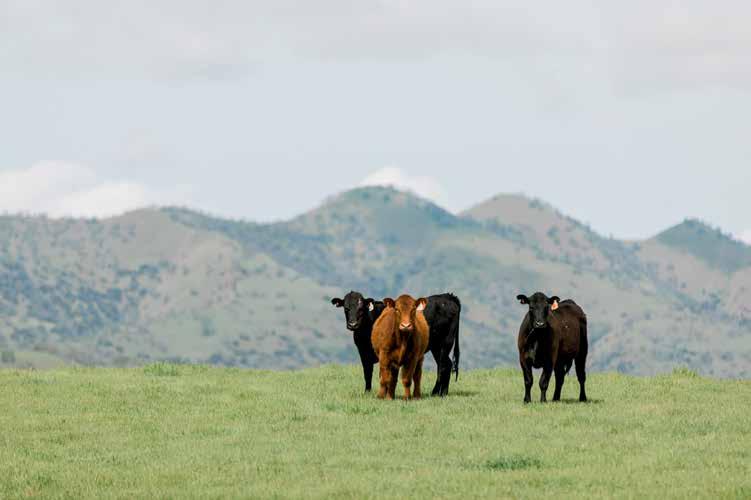
Selling
DOUG LAMALFA
Douglas Lee LaMalfa, a dedicated public servant and fourth-generation rice farmer, passed away on January 6,, at the age of 65. His death, occurring during emergency surgery following a medical emergency at his home in Chico, marked the end of a distinguished career in both state and federal politics. LaMalfa was widely respected for his steadfast advocacy for California’s rural North State and his pragmatic approach to complex issues.
Born on July 2, 1960, in Oroville, LaMalfa’s roots were deeply embedded in the agricultural landscape he would later champion. He graduated from Biggs High School in 1978 and earned a bachelor’s degree in agricultural business from Cal Poly, San Luis Obispo, in 1982. This background as a rice farmer provided him with unique insights into the challenges faced by rural communities, shaping his political priorities throughout his career.
LaMalfa began his political journey in the California State Assembly, representing the 2nd district from 2002 to 2008. During this time, he
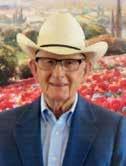
James R. Flanagan, 94 passed away on November 9, 2025. James was born September 1931 in Schenectady, New York and was a resident of San Luis Obispo, for over 70 years.
Jim graduated from South Glens Falls Central High School, South Glens Falls, NY in 1949. He served in the U.S. army from 1952 thru 1954 during the Korean conflict and graduated with a BS Degree in Animal Husbandry in 1959 and a M.S. degree in Agricultural Science in 1974, both from California Polytechnic State University in San Luis Obispo.
In 1960 he joined the faculty of the Animal Science Department at Cal Poly, teaching Beef Cattle and Equine Science classes while managing the University’s Commercial Cattle ranching operations over the next 35 years. He
authored and successfully passed California’s Forest Fire Protection Act of 2004, demonstrating an early commitment to addressing critical issues facing his constituents. He then served in the California State Senate for the 4th district from 2010 to 2012, further solidifying his reputation as a voice for agricultural and natural resource interests.
In 2012, LaMalfa was elected to the U.S. House of Representatives, taking office on January 3, 2013, to represent California’s 1st congressional district. As a seven-term congressman, he became known for his work on water access, forestry management, and advocating for tax relief for wildfire victims. In 2025, his colleagues unanimously elected him Chairman of the Congressional Western Caucus, a testament to his leadership and dedication to rural issues.
Doug LaMalfa was a devoted family man, survived by his wife, Jill, their four children, and one grandchild. His passing prompted a bipartisan outpouring of grief, with leaders acknowledging his principled conservative stance and tireless efforts on behalf of his district. He leaves behind a legacy of dedicated public service, marked by a deep understanding of and commitment to the people and land of Northern California.
enjoyed working with cattle, training horses and dogs and his association with the many students participating on the Cal Poly Escuela Ranch projects over the years.
Retiring in 1995 he studied studio art and traveled extensively through out the western U.S. James never married, he was proceeded in death by his parents, Charles W. and Helen M. Flanagan.
Jim had fond memories of working on a dude and livestock ranch post high school. He considered his artwork a hobby, however the outcome was that of a professional.
Jim will be dearly missed by his friends. A Celebration of Life was held at Madonna Inn on Jan.22, 2025.
In lieu of flowers donations can be made to the French Hospital Medical Center Foundation, Simulation Learning Center or the Educational Advancement Endowment Fund.
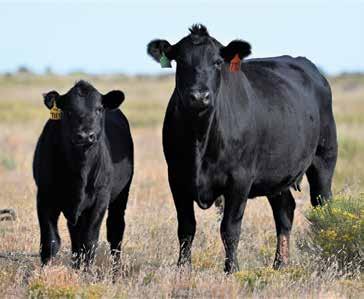
Temperment • Soundness
Life Cycle Efficiency • Moderate Size
Post Weaning Growth • Carcass Merit
Low PAP • Focus on $RANCH Selection
Free delivery • Ultrasound IMF, REA, BF
Select bulls PAP tested upon request
Every bull feed efficiency tested since 2010
All sale bulls’ averages rank in top 13%.
Mothers calve every year in 45 days or they are gone.
All sale bulls’ averages rank in top 13% for Fertility.
All sale bulls’ averages rank in in 10% for Teat and Udder.

Balancer
Balancer x SimAngus
Southern Balancer 25 Angus & High% Angus 70 Calving Ease Specialists
150 Blacks • 50 Reds
Utilize the most proven database in the industry for traits that go directly to your bottom line and give you a marketing advantage.
Now is the time to invest in bulls that excel at maternal traits and will improve your fertility, longevity and profitability . Bulls out of the most proven range cow herd in the Southwest.


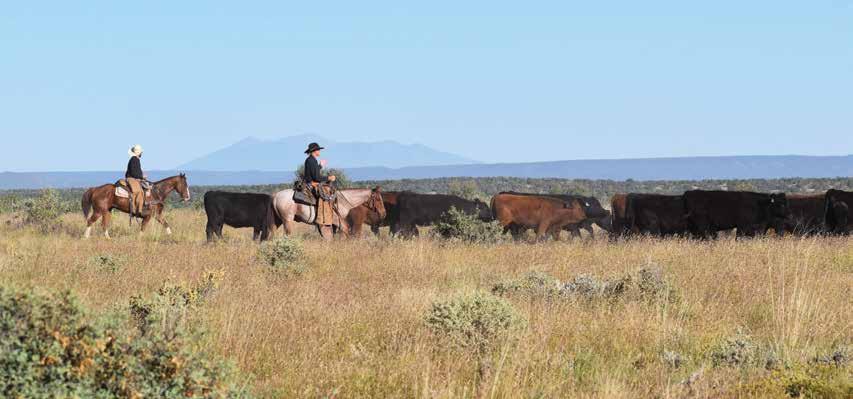





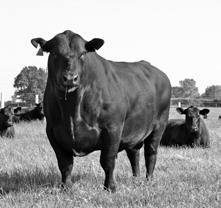


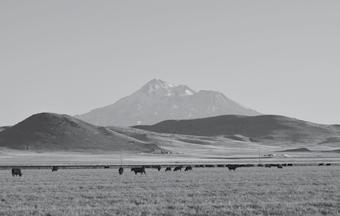









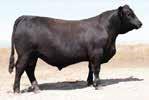




John Teixeira: (805) 448-3859
Allan Teixeira: (805) 310-3353
Tom Hill: (541) 990-5479
www.teixeiracattleco.com | cattle@thousandhillsranch.com








(707)

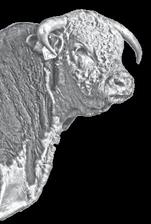


BALD MOUNTAIN BRANGUS, SONORA (209) 768-1712
RUNNING STAR RANCH, LINCOLN (916) 257-5517
SUNSET RANCH, OROVILLE (530) 990-2580
DEER CREEK RANCH, LOS MOLINOS (541) 817-2335 THE SPANISH RANCH, NEW CUYAMA (805) 245-0434
GLASGOW BRANGUS, SANTA YSABEL (760) 789-2488
RANCHES, GREELEY HILL (209) 591-0630
Source for Brangus and Ultrablack Genetics in the West!

THE DOIRON FAMILY
& Pamela Doiron 805-245-0434 Cell doiron@spanishranch.net www.spanishranch.net



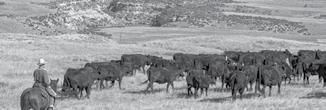

422± acres of pasture, timbered hills and draws. Multiple water sources for stock & wildlife. Great hunting! $2,350,000 LEMHI ROAD RANCH
357± acres near Salmon, Idaho with irrigated pasture, barns, corrals, and adjacent to BLM. $1,990,000