T H E P R E M I E R R E S O U R C E F O R C O M M U N I T Y A S S O C I AT I O N S
FA L L 2 0 2 6 A Publication of CAI San Diego
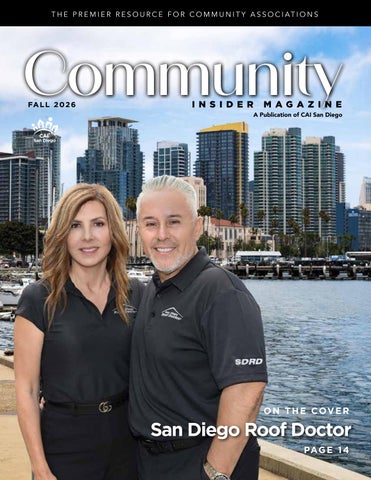
O N T H E C OV E R
San Diego Roof Doctor PAG E 1 4 FA L L 2 0 2 6 | C O M M U N I T Y I N S I D E R M A G A Z I N E
1
Pinnacle Pe
CAI SAN DIEGO 2026 MA
Titanium Sponsors
Gold Sponsors Accurate Termite & Pest Control Antis Roofing & Waterproofing Ben’s Asphalt, LLC Berding Weil Bergeman Group Construction Management CM2 & Associates Golden Alliance Insurance GuardTop, LLC by Sustainable Emulsions Harvest Landscape Enterprises, Inc. Labarre Oksnee Insurance Life Deck Coating Installations Lloyd Pest Control 2
C O M M U N I T Y I N S I D E R M A G A Z I N E | FA L L 2 0 2 6
Modern Masters Painting Monarch Landscape Companies N.N. Jaeschke Nissho of California PrimeCo Remedy Rooter Ross Construction Management San Diego Backflow Testing, Inc. SAX Insurance Agency Splash Plumbing Tinnelly Law Group Tree Life CA
erformance
ARKETING PLAN SPONSORS
Platinum Sponsors
Silver Sponsors Available Termite & Pest Control Inc. Bar-B-Clean San Diego South Bemus Landscape Inc. California Commercial Coatings Clean Earth Restorations Costa Roofing Dunn-Edwards Corporation Enterprise Coatings Inc. Fenn Termite and Pest Control Fenton Grant Kaneda & Litt, LLP Fiore Racobs & Powers, A PLC
Generation Contracting & Emergency Services Heritage Bank of Commerce LaBahn’s Landscaping Landscapes USA Major League Pest McKenzie Mena, LLP Modern Pipe Solutions, Inc. The Naumann Law Firm, PC O’Connell Landscape Maintenance Pacific Coast Construction & Waterproofing, Inc.
Pacific Green Landscape Pacific Standard Plumbing Parking Squad Rayco Exteriors Reconstruction Experts Riley Pasek Canty Seltzer LLP Rose Paving Saddleback Fence and Vinyl Products, Inc. SBS Lien Services Trash Day Can Carriers WM of San Diego
FA L L 2 0 2 6 | C O M M U N I T Y I N S I D E R M A G A Z I N E
3
In this issue 19
The Value of Professional Inspectors of Elections for California HOAs
8
Aging Communities, Smarter Reserve Planning
By Kurtis Peterson, CMCA
By Mallory Paproth
16
27
The Sewer Line Broke– Now What?
Loss Control Strategies: Protecting Your Community and Your Budget
A guide to emergency special assessments
By Chris Gardner
Delegating Decisions Through Executive Committees
By Cecilia Chung, Esq.
San Diego Roof Doctor NCE THROUG : BUILDIN G CONFIDE MORE THAN ROOFING ACCOUN TABILITY EDUCAT ION, AND
By Lindsay Anderson, Esq.
their employees who expand in also recognize and reward in our people is an investment expertise because investing every project we complete.
R ON THE COVE
30
our extends to how we structure Our commitment to quality crews roofing companies compensate workforce. While many are paid hourly many of our employees primarily by the project, p, safety, and to focus on craftsmanshi or salary, allowing them inspect than speed. We routinely attention to detail rather due to rushed installations, roofs that have failed prematurely shortcuts taken during drainage, or improper flashing, poor mistakes long run, correcting those previous repairs. In the first time. doing the job right the often costs far more than
H EXPERIE NCE,
A legacy built on family values. , this approach is especially For community associations histories, has unique maintenance valuable. Every property ns, and reserve funding consideratio environmental conditions, all solutions, than offering one-size-fitslong-term goals. Rather to managers and boards we work closely with community ations and develop recommend evaluate each roofing system and the community’s objectives. based on actual conditions
more than a roofing an Diego Roof Doctor is tion, family-owned company—we are a third-genera work, integrity, and lasting business built on hard helped than 45 years, we have relationships. For more property owners, and community homeowners, commercial one of Southern California protect associations throughout roofs. their their most valuable assets:
S
our and technology have evolved, While roofing materials education, craftsmanship, continuing commitment to quality service has never changed. and exceptional customer San Angelica and Emilio Lopez, Under the leadership of built its reputation by putting Diego Roof Doctor has is simple: provide honest customers first. Our philosophy workmanship, and long-term recommendations, skilled fix. quickest or least expensive solutions—not simply the
14
4
COMMUNITY INS
IDER MAGAZINE
roof inspections, preventative Today, we specialize in and complete roof maintenance, repairs, restorations, systems, a wide variety of roofing replacement projects for TPO, shingle, built-up roofing, including tile, composition San Through our sister company, PVC, and roof coatings. gutter also provide professional Diego Rain Gutters, we maintenance services throughout installation, repair, and Southern California. What truly sets San Diego people behind the work.
Roof Doctor apart, however,
is the
labor shortages, we have In an industry facing ongoing t and professional developmen made employee education are encouraged to earn a priority. Team members , complete advanced technical manufacturer certifications education because training, and pursue continuing provide better inspections, s knowledgeable professional We ations, and better results. more accurate recommend
on, detailed project documentati Clients also benefit from options, manufacturer-backed warranty strong safety programs, members services. We are proud and fully licensed and insured and Contractors Association of the Western States Roofing the Better Business Bureau. maintain an A+ rating with
We’re here to help.
with 51% female ownership, As a women-owned business creating to fostering diversity and we are equally committed believe construction industry. We opportunities within the our organization and enhance diverse perspectives strengthen every client. the service we provide has remained San Diego Roof Doctor For nearly half a century, roofing delivering exceptional focused on one mission: accountability, trust through education, solutions while building a roof is about p. Because protecting and quality craftsmanshi the a building—it is about protecting more than safeguarding investments beneath it. and , communities people,
| FA L L 2 0 2 6
C O M M U N I T Y I N S I D E R M A G A Z I N E | FA L L 2 0 2 6
SanDiegoRoofDoctor.com .com Service@SanDiegoRoofDoctor 760-471-7131 MUNITY INS FA L L 2 0 2 6 | C O M
IDER MAGAZINE
15
14
ON THE COVER: San Diego Roof Doctor
35
Getting Your Community Off the Fannie Mae Blacklist By Natalie Stewart
Departments
37 Social Media: A Helpful Tool or a Potential Headache? By Elaine Gower, CCIP
7 12
President’s Message
17 18 21 26 29 32 34
New Professional Designations
Super Heroes vs. Villains Golf Tournament New Chapter Members Your Career. Your Credentials. Your Future. CAI-CLAC Buck a Door – or More! Tiki Night Highlights Recap of HOA Academy’s Summer Session Learn About CAI
FA L L 2 0 2 6 | C O M M U N I T Y I N S I D E R M A G A Z I N E
5
The official quarterly publication of CAI San Diego 2026 CAI SAN DIEGO BOARD OF DIRECTORS PRESIDENT Amanda Francis, CCAM-LS, CMCA, AMS Renaissance Owners Association VICE PRESIDENT Liron Shalom-Hickey SERVPRO of Sorrento Valley TREASURER Amber Hall Choice Management Solutions SECRETARY Rei Takeda Normal Heights Community Association BOARD DIRECTORS Tim Flanagan, Esq. Flanagan Law, APC John MacDowell, Esq., CCAL Fiore Racobs & Powers, A PLC Bridgette Tabor Bridging Communities, LLC Heather Wiltshire, CCAM, CMCA, AMS, PCAM N.N. Jaeschke, Inc. – An Associa Company EXECUTIVE DIRECTOR Carissa Mace executivedirector@cai-sd.org COMMUNITY INSIDER PUBLICATIONS COMMITTEE CHAIR Carrie Heieck, Esq. Roseman Law, APC VICE CHAIR Johanna Deleissegues, Esq. Adams I Stirling, PLC BOARD LIASON Rei Takeda Normal Heights Community Association Jeffrey French, Esq. Green Bryant & French, LP Alma Galindo, CMCA, AMS Action Property Management Rhonda Goldblatt, Esq. Epsten, APC
Elaine Gower The Naumann Law Firm, PC Brian Kalmenson, CIRMS Gemini Insurance Agency, Inc. Tyler Kerns, Esq Kriger Shuber Anja Potenza LaBahn’s Landscaping Shannon Smith AD Magellan Vivian Tran, Esq. Roseman Law, APC Emily Whittemore, PCAM FirstService Residential
DESIGN & PRODUCTION REY ADVERTISING & DESIGN Editorial and advertisements represent the opinions of the authors and advertisers and not necessarily the opinion of Community Insider Magazine or CAI San Diego. Information contained herein should not be construed as a recommendation for any course of action regarding financial, legal, real estate, accounting or other professional services and should not be relied upon without consulting legal counsel, financial and accounting professionals, or other expert business advisors. CAI San Diego Chapter encourages submission of news and articles, subject to space limitations and editing. All articles submitted for publication become the property of the CAI San Diego Chapter. Non-commercial reproduction of published articles or columns permitted with the following requirement of acknowledgement “Reprinted with permission from Community Insider Magazine, a publication of CAI San Diego.” ADVERTISING AND CORRESPONDENCE Community Insider Magazine CAI - San Diego Chapter 9920 Pacific Heights Blvd., Ste. 150, San Diego, CA 92121 858-836-1119 | www.cai-sd.org © 2026 CAI San Diego Chapter, all rights reserved.
6
C O M M U N I T Y I N S I D E R M A G A Z I N E | FA L L 2 0 2 6
What Makes a Great Community?
While attending the CAI National Conference earlier this year, I took some time to visit the bookstore and picked up a tote bag printed with the phrase “Love Where You Live”. That simple phrase spoke to me because, in many ways, it perfectly sums up how I think about community: creating a place you truly love to call home. Recently, someone saw me carrying this bag and asked what the phrase meant to me. That conversation led to an even bigger question: What makes a community great? Is it beautiful landscaping? Wellmaintained common areas? Great amenities? Strong property values? Healthy reserves? Certainly, all those things contribute to a successful community, but I think the real answer goes a little deeper: great communities are built by people. They are built by volunteer board members who give their time and energy to make thoughtful decisions on behalf of their neighbors. They are supported by community managers who balance an extraordinary number of responsibilities while keeping their communities moving forward. And they rely on business partners and industry professionals who bring their expertise to everything from long-term planning and maintenance to insurance, legal matters, landscaping, construction, and countless other needs. Most importantly, great communities are built when all of those people work together. That may sound simple, but anyone who works (or volunteers) in our industry knows that community association living isn’t always easy. Boards face difficult decisions. Managers navigate competing priorities. Homeowners don’t always agree. Costs continue to rise, buildings and infrastructure continue to age, and California associations are facing increasingly complex challenges surrounding insurance, maintenance, reserves, legislation, and more. There is rarely a perfect answer, but there can be an informed answer. There can be respectful dialogue. There can be transparency. There can be thoughtful planning. And there can be a willingness to listen to one another and work toward the common goal of making our communities better places to live. That is where I believe CAI plays such an important role. CAI gives us opportunities to learn from one another, to build relationships with professionals who understand the unique challenges of community associations, and to stay informed about issues affecting our industry.
Whether you are a homeowner leader, community manager, or business partner, the knowledge and relationships you develop through CAI ultimately make their way back into the communities we serve. And that impact matters because it’s what helps build community and supports the idea behind “Love Where You Live”. As we head into the final months of the year, I Amanda Francis, CCAM-LS, CMCA, AMS 2026 Chapter President encourage each of us to think about what we can do to help create and strengthen great communities, not only within the associations we serve, but within our own CAI San Diego community. Maybe it’s sharing your knowledge with someone newer to the industry. Maybe it’s inviting a non-member to an event so they can experience firsthand what CAI has to offer. Maybe it’s attending an educational program, volunteering for a committee, mentoring a colleague, or simply taking the time to listen to a different perspective. Great communities don’t happen by accident. They are created over time through countless decisions, conversations, relationships, and people who care enough to get involved. So perhaps the answer to “What makes a community great?” isn’t found in its landscaping, amenities, or property values after all. Maybe it’s found in the people who show up, work together, and care about making their corner of the world a little better. Thank you to our board members, homeowner members, community managers, business partners, and volunteers for everything you do to strengthen communities throughout San Diego, and for helping make CAI San Diego a great community of its own. I hope you enjoy the turn of the season, and I look forward to seeing you at an upcoming CAI San Diego event.
Amanda Francis, CCAM-LS, CMCA, AMS 2026 Chapter President
FA L L 2 0 2 6 | C O M M U N I T Y I N S I D E R M A G A Z I N E
7
8
C O M M U N I T Y I N S I D E R M A G A Z I N E | FA L L 2 0 2 6
BY MALLORY PAPROTH
Aging Communities, Smarter Reserve Planning Reserve studies themselves are nothing new; what has evolved is our understanding of their value. While reserve studies have long been a cornerstone of responsible association planning, they are increasingly being recognized for their value beyond compliance, serving as essential tools for informed decision-making and long-term financial success. And, with budget season right around the corner, now is the perfect time to dive into your reserve study. Continued on page 10
FA L L 2 0 2 6 | C O M M U N I T Y I N S I D E R M A G A Z I N E
9
Aging Communities, Smarter Reserve Planning Continued from page 9
Reserve studies are comprised of two halves, a physical analysis followed by a financial analysis. The physical analysis involves the common area assets the association is required to maintain. We put together a plan of anticipated, predictable expenses for the repair, restoration, replacement, and maintenance of common area elements with estimated life cycles and costs. Reserve studies are dynamic reports that are meant to change with the needs and practices of the association. One of the most common questions we receive is how we determine our cost estimates. Rather than relying solely on published cost data, we use contractor proposals and invoices from projects completed in nearby communities. This approach helps ensure our estimates reflect current market conditions and the actual costs associations are experiencing in the local area. However, the best information we can receive is that which is specifically provided for your community. If a contractor
10
provides a bid for your association’s common area, share that with your reserve analyst and they will be able to incorporate that work or those prices into the reserve study. I think of components like building blocks in that they are the foundation for the report. It is beneficial for the board to be familiar with these components and their respective categories at a minimum. While many components are very common amongst associations, others are less so and leave room for subjectivity and specificity to your situation. Components such as pool filters and gate operators are much more standardized compared to landscape renovations or stucco repairs which can vary greatly year to year and association to association. In my early days learning about reserves, ‘life of project’ was a common term. Nowadays, fewer and fewer components qualify. How long is a project expected to last? Thirty years ago, we would have said 75100 years. Now, as our communities hit 50- 60- 70- year marks, do we see the end in sight? I can’t imagine. Instead, we are looking for ways to prolong our common area for as long as possible with the softest blow to our wallets. That starts with
C O M M U N I T Y I N S I D E R M A G A Z I N E | FA L L 2 0 2 6
mitigating issues when they arise and being well funded. When the components and expenses have been established, we can take a closer look at the real meat of reserve studies: the funding. The financial portion of the reserve study explains the association’s current reserve standing, what it takes to overcome anticipated expenses, and a roadmap to a more successful reserve standing. The current state of reserves is explained through two main factors: accumulation and allocation. Accumulation measures how much money is in the reserve account to the ideal amount. Essentially, this is where everyone’s favorite reserve calculation comes in, percent funded! Percent funded is popular for a reason, we can all understand a percentage. The confusion arises with interpretation. Percent funded is a measure of your reserve balance and the 100% funded figure; not current cost. If a community is 50% funded, they likely have not accumulated 50% of the common area’s value, but instead are actually only 50% accumulated to what would be considered ‘on track’. Two very different calculations in most cases! We often get asked what a good percent funded would be,
aging buildings and infrastructure, increasing repair costs, and heightened expectations from homeowners, long-term strategic planning is more important than ever. A reserve study is more than a budgeting tool, it is a roadmap for preserving the community’s assets and financial stability. As our communities continue to mature, reserve study education provides boards and managers with the knowledge and confidence to make informed decisions that benefit both current and future homeowners.
A reserve study is more than a budgeting tool, it is a roadmap for preserving the community’s assets and financial stability.
unfortunately, it’s not an easy answer. An association’s funding level is ultimately a measure of its financial risk. The major risks are unstable budgets, inconsistent increases, lower property values, and a higher chance of special assessment. As community associations age, the challenges they face become increasingly complex. A higher percent funded provides a greater margin of financial security, helping associations manage the increased risk of unforeseen repairs or conditions that may fall outside the assumptions of the reserve study. There’s a very fine line between what’s likely to happen and what will happen. Pinpointing exactly what the problem will be, when that will occur, and at what cost are impossible to say. It’s important to pay attention to signs and make repairs when needed. The second part to determine the current state of reserves is allocation. The allocation factor is much more straightforward, and measures if your current reserve contribution is adequate. In most cases, I would define adequate as meeting current needs, or to remain in a state of equilibrium. In reserves, the straightline allocation defines how much value is lost per component every
year; if you sum those numbers, you will get the annual deterioration. If an association is contributing at least what the components cost per year, they are usually allocating sufficiently. Once a board understands their current reserve standing, they can work to improve it. With
Mallory Paproth is a Reserve Analyst at SCT Reserve Consultants. She can be reached at mallory.p@sctreserve.com.
FA L L 2 0 2 6 | C O M M U N I T Y I N S I D E R M A G A Z I N E
11
DELUXE HOLE SPONSORS
Held at the Rancho Bernardo Inn Golf Course on May 14, the soldout tournament brought superheroes and villains to the links, with creatively decorated sponsor holes adding to the day’s theme. Golfers also enjoyed a putting contest, Bloody Mary bar, awards luncheon, and plenty of fun on the course.
VIEW THE ONLINE GALLERY
HOLE SPONSORS Ascent Roofing Costa Roofing Dunn-Edwards Corporation Eagle Paving Flanagan Law, APC Golden Alliance Insurance Life Deck Coating Installations Lloyd Pest Control Modern Masters Painting Park West Precision Construction and Painting PrimeCo POTTY SPONSORS The Arbor Group LaBahn’s Landscaping BLOODY MARY SPONSOR EmpireWorks PUTTING CONTEST Tree Life CA TEAM PHOTO SPONSORS A. Preman Roofing & Solar Behr Process LLC Bemus Landscape, Inc. Citizens Bank Rainscape Environmental Management Rose Paving BREAKFAST SPONSORS Andre Landscape CM2 & Associates Diamond Roofing Gothic Landscape GuardTop, LLC by Sustainable Emulsions Rayco Exteriors Reconstruction Experts
12
C O M M U N I T Y I N S I D E R M A G A Z I N E | FA L L 2 0 2 6
DRINK TICKET SPONSORS Four Seasons Tree Care Modern Pipe Solutions, Inc. Nissho of California
First Place: SAX Insurance Agency
Putting Contest Winner: Justin Michna, BRR Contractors
Second Place: Pro-Tech Painting
Third Place: Proform Construction, Inc. Team 1
Best Dressed Players: Ian Navarro and Eve Howard from FirstService Residential
FOURSOME PACKAGES Pacific Backflow Corporation A. Preman Roofing & Solar Precision Construction and Painting Andre Landscape Proform Interiors Construction, Inc. Antis Roofing & Waterproofing Pro-Tech Painting Berding Weil Reconstruction Experts BRR Contractors, LLC Ross Construction Management (2) California Commercial Coatings SavATree, LLC Enhanced Landscape & Arbor Management SAX Insurance Agency Harvest Landscape Enterprises Inc. Servpro San Diego City SW Kriger & Schuber Splash Plumbing Labarre Oksnee Insurance Strata Landscape Services MC Contracting Vantaca Modern Pipe Solutions, Inc. Western Fire Protection Monarch Landscape Companies WM of San Diego Nautilus General Contractors NPG Asphalt
Best Booth: San Diego Roof Doctor FA L L 2 0 2 6 | C O M M U N I T Y I N S I D E R M A G A Z I N E
13
ON THE COVER
San Diego Roof Doctor
M OR E T H A N R OOF I NG: B UI LDI NG CON FID E N CE T H ROU GH E XP E RIE N CE , ED U CAT I ON, AND AC C OUNTAB I LIT Y
S
an Diego Roof Doctor is more than a roofing company—we are a third-generation, family-owned business built on hard work, integrity, and lasting relationships. For more than 45 years, we have helped homeowners, commercial property owners, and community associations throughout Southern California protect one of their most valuable assets: their roofs. While roofing materials and technology have evolved, our commitment to quality craftsmanship, continuing education, and exceptional customer service has never changed. Under the leadership of Angelica and Emilio Lopez, San Diego Roof Doctor has built its reputation by putting customers first. Our philosophy is simple: provide honest recommendations, skilled workmanship, and long-term solutions—not simply the quickest or least expensive fix.
14
C O M M U N I T Y I N S I D E R M A G A Z I N E | FA L L 2 0 2 6
Today, we specialize in roof inspections, preventative maintenance, repairs, restorations, and complete roof replacement projects for a wide variety of roofing systems, including tile, composition shingle, built-up roofing, TPO, PVC, and roof coatings. Through our sister company, San Diego Rain Gutters, we also provide professional gutter installation, repair, and maintenance services throughout Southern California. What truly sets San Diego Roof Doctor apart, however, is the people behind the work. In an industry facing ongoing labor shortages, we have made employee education and professional development a priority. Team members are encouraged to earn manufacturer certifications, complete advanced technical training, and pursue continuing education because knowledgeable professionals provide better inspections, more accurate recommendations, and better results. We
also recognize and reward employees who expand their expertise because investing in our people is an investment in every project we complete. Our commitment to quality extends to how we structure our workforce. While many roofing companies compensate crews primarily by the project, many of our employees are paid hourly or salary, allowing them to focus on craftsmanship, safety, and attention to detail rather than speed. We routinely inspect roofs that have failed prematurely due to rushed installations, improper flashing, poor drainage, or shortcuts taken during previous repairs. In the long run, correcting those mistakes often costs far more than doing the job right the first time.
A legacy built on family values. For community associations, this approach is especially valuable. Every property has unique maintenance histories, environmental conditions, reserve funding considerations, and long-term goals. Rather than offering one-size-fits-all solutions, we work closely with community managers and boards to evaluate each roofing system and develop recommendations based on actual conditions and the community’s objectives. Clients also benefit from detailed project documentation, strong safety programs, manufacturer-backed warranty options, and fully licensed and insured services. We are proud members of the Western States Roofing Contractors Association and maintain an A+ rating with the Better Business Bureau. As a women-owned business with 51% female ownership, we are equally committed to fostering diversity and creating opportunities within the construction industry. We believe diverse perspectives strengthen our organization and enhance the service we provide every client. For nearly half a century, San Diego Roof Doctor has remained focused on one mission: delivering exceptional roofing solutions while building trust through education, accountability, and quality craftsmanship. Because protecting a roof is about more than safeguarding a building—it is about protecting the people, communities, and investments beneath it.
We’re here to help.
SanDiegoRoofDoctor.com Service@SanDiegoRoofDoctor.com 760-471-7131 FA L L 2 0 2 6 | C O M M U N I T Y I N S I D E R M A G A Z I N E
15
The Sewer Line Broke—Now What? A Guide to Emergency Special Assessments BY CECILIA CHUNG, ESQ.
1) Court Order – An extraordinary expense required by a court order; 2) Personal Health or Safety Threat – The association discovers a condition that poses a threat to the health or safety of persons on the property and must incur an extraordinary expense to address it; 3) Hazardous Condition or Circumstance – The association discovers a hazardous condition or circumstance on the property that requires immediate action and an extraordinary expense to repair, maintain, or operate the common area; or 4) Unforeseen Expense – The association incurs an extraordinary repair or maintenance expense that could not have been reasonably anticipated when the annual budget report was prepared and distributed.
I
t can happen to any association. Things are going great, assessments are being paid regularly, the budget is on track, and the association is keeping up with its maintenance obligations. Suddenly, a common area sewer line goes out. Reserves are adequately funded, but this expense could not have been anticipated. Your association is now facing the need for emergency funds, and fast. So, how do you handle this? Depending on the circumstances, a board may be able to levy a type of special assessment—an emergency special assessment. If the situation falls within one of the circumstances below, the association may be able to levy an emergency assessment without obtaining a membership vote under Civil Code section 5610:
16
C O M M U N I T Y I N S I D E R M A G A Z I N E | FA L L 2 0 2 6
Even where an emergency assessment is permitted, the association must provide proper notice under Civil Code section 5615, requiring individual notice to the membership between thirty and sixty days before the assessment is due. Because the applicability of Civil Code section 5610 depends heavily on the specific facts and circumstances involved, boards should consult with legal counsel before levying an emergency assessment. Counsel can help determine whether the situation falls within one of the statutory exceptions and identify any additional procedural requirements that may apply. For example, levying an emergency assessment for an unforeseen expense requires the board to
first pass and distribute a resolution containing written findings as to the expense’s necessity and lack of foreseeability. Depending on the circumstances, the association may also wish to obtain supporting documentation from a qualified expert to substantiate the need for an emergency assessment. Even when a board believes an emergency assessment is justified, members may challenge the assessment if they believe the statutory requirements have not been satisfied. Accordingly, boards should carefully document the basis for the assessment in board meeting minutes, maintain supporting evidence, and strictly comply with applicable notice and procedural requirements. Lastly, boards should remember that emergency assessments are intended for extraordinary circumstances and should not be used as a substitute for proper budgeting or reserve planning. While no board wants to be faced with an unexpected expense, understanding the statutory requirements can help ensure the association responds quickly, appropriately, and in compliance with the law. Cecilia S. Chung, Esq. is a Senior Attorney at Tinnelly Law Group. She can be reached at cchung@tinnellylaw.com.
New Professional Designations Cory Neubauer, CIRMS NEXTIER Insurance Services, Inc. Mindy Grimming, EBP CES - An AquaFinity Company Noah Jackson, EBP Third Party Voting Dilip Khatri, EBP Khatri Int. Civil & Structural Engineers, Architects Kevin Milligan, CIRMS The McGowan Companies Andrew Stoutenburg, EBP Reserve Advisors, LLC
www.sandiegobackflowtesting.com
Call Us:
877-363-8378
Licensed, Bonded, Insured
Testing Repairs Replacements Installations Cages test@sandiegobackflowtesting.com
Text us:
619-937-2323 FA L L 2 0 2 6 | C O M M U N I T Y I N S I D E R M A G A Z I N E
17
New Chapter Members MANAGERS Sylvia Ascencio Vintage Group Jerry Bice Chelsea Castro The Prescott Companies Kayla Clark Clark Cares HOA Management Sean Collier Castle Breckenridge Management
Josue Sanchez RealManage Alan Smith Armitage Properties Inc., DBA SDHOA Janet Steele Action Property Management, Inc. Chao Yang The Prescott Companies
Cindy Cruz Walters Management
BUSINESS PARTNERS
Janet Cunningham The Prescott Companies
Access Professional Systems Bill Scheibeler
Daniela Enck Action Property Management, Inc.
Alliant Insurance Services Amy Nelson
Jennifer Figgers JMJ Community Management, Inc.
Axela Technologies
Andres Eduardo Franco Velasco Seabreeze Management Company, Inc. Alina Frigerio-Swain NN Jaeschke, Inc. Candice Gorges, CMCA, AMS Professional Community Management Yna Ibong Seabreeze Management Company, Inc.
18
Tina Rozycki Silverado Community Management Service, Inc.
Boyce’s Roofing and Repair Meagan Thomson Bridging Communities, LLC Bridgette Tabor BTS Trustee Services Kamila Sabirova Central Valley Environmental Ryan Cebulski Commercial Asphalt Joshua Peterson
Aaron Levine, CMCA, AMS Curamus Management
Facilities Advisors International, LLC Vike Ovanessoff
Jennifer Lopez FirstService Residential
First Call Plumbing and Restoration Todd Tyler
Norma Maynard Property Management Consultants, Inc.
G.B. Group Construction and Painting Teresa Agnew
Kyle Merritt Keystone Pacific Property Management
Huntington National Bank Vincent Affinito
Devon Morse, CMCA Equity Management & Realty Services
Malki Construction, Inc. James Malki
Josephine Perez, CMCA, AMS The Management Trust
Sunlite Landscape Inc. Jeff Fink
C O M M U N I T Y I N S I D E R M A G A Z I N E | FA L L 2 0 2 6
Urban Landcare Andrew Martin Village Management Software Sheri Renaldo
HOMEOWNERS Darrell Echard Wendy Leeman Atlas Owners Association Susan Carson David Flaten Gary Hagney Keith Honea Anthony Munday Madrid Manor Homeowners Association, Inc. Ray Tregembo Meridian Residential Association Ronald Groden Mission Verde Owners Association Bryan Coreas Cheryl Durst Mary Enderson Samantha Rosenberg Carole Thompson Pennant Village Homeowners Association John Cano Pepperwood Meadows Gisela Lagos-young Robinhood Point Association David Sommers Villa Trieste At Del Oro Hills Master Association Randall Reynolds Ann Ridyard Vista Mar Collection Community Corporation Maria Jimena Montes De Oca
The Value of Professional Inspectors of Elections for California HOAs Professional inspectors manage all aspects of the election process, including ballot preparation, voter registration, voter verification, and result tabulation. BY KURTIS PETERSON, CMCA
board is running for re-election or when contentious issues divide the community. Professional inspectors provide the neutral oversight necessary to build resident confidence in electoral outcomes, reducing post-election disputes and fostering community trust.
H
omeowner associations in California manage significant assets and make important decisions that affect residents’ quality of life. With these responsibilities comes the need for fair, transparent governance—particularly during elections. Hiring a professional inspector of elections can provide associations with numerous advantages that strengthen their democratic processes and reduce liability. Ensuring Legal Compliance – California’s homeowner association laws, particularly those outlined in the Davis-Stirling Common Interest Development
Act, impose strict requirements on election procedures. Professional inspectors of elections possess specialized knowledge of these regulations, ensuring that every election meets state requirements. This expertise helps associations to avoid costly legal disputes and potential violations that could jeopardize the legitimacy of elected boards. Impartiality and Credibility – When an independent, thirdparty professional oversees elections, it helps eliminate the perception of bias or favoritism. This objectivity is crucial, especially when the
Protecting Against Fraud – Professional inspectors of elections implement rigorous verification procedures to prevent voting irregularities. They verify voter eligibility, maintain chainof-custody for ballots, and verify signatures on voting materials. These safeguards protect associations from fraudulent votes that could invalidate results and trigger costly litigation or the need for repeat elections. Reducing Association Liability – By delegating election oversight to qualified professionals, associations shift liability to the inspector’s insurance coverage. If election disputes arise, the association can demonstrate it followed proper procedures and had competent oversight, significantly reducing legal exposure and potential damages. Continued on page 20
FA L L 2 0 2 6 | C O M M U N I T Y I N S I D E R M A G A Z I N E
19
n
d
kurtis@tieivote.com.
General Counsel • ADA & DFEH Compliance • CC&R & Bylaw Amendments • Architectural Matters • Contracts & Insurance • Elections & Recalls • Employment Law • Legal Opinions
The Value of Professional Inspectors of Elections... Continued from page 19
Streamlining the Election Process – Professional inspectors manage all aspects of the election process, including ballot preparation, voter registration, voter verification, and result tabulation. This comprehensive oversight frees management and board members to focus on governance rather than administrative election duties, thereby improving operational efficiency.
Community Legal Advisors Inc. COMMUNITY ASSOCIATION ATTORNEYS
Assessment Collection • Timely Status Reports • Responsive Paralegals • Collectability Analysis • Judicial or Non-Judicial Foreclosures • Money Judgment Lawsuits • Small Claims Assistance • Post Judgment Recovery
Serving San Diego County, Orange County, Inland Empire and Coachella Valley
Toll Free 833.938.1877 AttorneyforHOA.com
S P R I N G 2 0 2 5 | C O M M U N I T Y I N S I D E R M AG A Z I N E
Our Specialty Services Lighting Maintenance, Light Pole Inspections, New Construction, Electrical Panels, Switchgear and Lighting Installation Contact The Main Office (949) 336-4336 2351 McGaw Avenue Irvine, CA 20
C O M M U N I T Y I N S I D E R M A G A Z I N E | FA L L 2 0 2 6
17
Managing Complex Situations – Many California associations face unique circumstances—absentee voting, multiple property owners, unique voting structures, or first-time elections. Professional inspectors have experience navigating these complexities and can implement appropriate solutions that maintain integrity while accommodating voters’ needs. Takeaway – For California associations seeking to strengthen governance, hiring a professional inspector of elections represents a sound investment. The cost of this service pales in comparison to potential litigation expenses, regulatory fines, or reputational damage from election disputes. By ensuring compliance, impartiality, and legitimacy, professional election inspectors help associations maintain the trust and confidence essential to effective community governance. Kurtis Peterson, CMCA, is a professional inspector of elections with the Inspectors of Election, LLC and can be reached at kurtis@tieivote.com.
Your Career. Your Credentials.
Your Future. From your first certification to the industry’s highest designation, CAI provides the education, experience, and support to help you become a confident, respected community association management professional.
STEP
STEP
STEP
STEP
CCIDM – Certified Common Interest Development Manager (California Specific Designation) Build a strong foundation in California community association management by learning the laws, governance, ethics, and operational practices that every successful manager needs. Requirements: • Complete 30 hours of curriculum required by California law. • Complete the M-100 California Edition, including the CID Law course. • Complete four (4) on-demand webinars. CMCA® – Certified Manager of Community Associations The CMCA is the industry’s nationally recognized entry-level credential, demonstrating your knowledge of the core principles of community association management. Requirements: • Complete the M100 California Edition, including the CID Law course. • Complete and submit the CMCA application. • Pass the CMCA examination. • Comply with CAMICB Standards of Professional Conduct. AMS® – Association Management Specialist Demonstrate your growing expertise through professional experience, continuing education, and commitment to ethical community management. Requirements: • Pass the CMCA examination. • Complete two or more years of community association management experience. • Successfully complete CAI M200-level courses. • Pay the application fee and agree to comply with the CAI Professional Manager Code of Ethics. PCAM® – Professional Community Association Manager The highest professional designation available in community association management, recognizing experienced leaders who have demonstrated advanced knowledge, professionalism, and practical application. Requirements: • Pass the CMCA examination. • Complete five or more years of community association management experience. • Successfully complete CAI M200-level courses. • Meet the requirements for CAI industry-related education. • Register for and successfully complete the PCAM Case Study. (See application for details.)
Your Professional Journey Starts Here
Whether you’re beginning your career or pursuing your next designation, your local CAI chapter is here to support your success with education, networking, and professional development opportunities every step of the way. Ready to take the first step? Learn more about upcoming courses and start building your future today. Email executivedirector@cai-sd.org for more information.
cai-sd.org | 858.836.1119
FA L L 2 0 2 6 | C O M M U N I T Y I N S I D E R M A G A Z I N E
21
How to Get (and Stay) Insured Presented by Keith Ciceron, Esq., Ciceron Law; and Brian Kalmenson, CIRMS, Gemini Insurance Agency, Inc. How Poor Maintenance Destroys HOA Coverage and Insurance Premiums Presented by Greg Borzilleri, Accurate Termite and Pest Control; and Bridgette Tabor, Bridging Communities, LLC The conference also featured a packed trade show floor with the opportunity for managers and homeowners to meet Business Partners with a wide variety of services.
VIEW THE ONLINE GALLERY
O
ver 250 attendees gathered for “Momentum: From Risk to Resilience” on June 25 at Paradise Point Resort for the Chapter’s annual Education Conference. Attendees had opportunities to participate workshops offering a wide variety of pertinent information for everyone in the industry. At the Keynote Luncheon, Dawn Bauman, CAE, Chief Executive Officer of CAI National, presented a state of industry overview. The four education sessions featured: Insurance and Claim Pitfalls – Avoiding the Same Mistakes Presented by Arthur Hopkins, CMCA, AMS, CIRMS, Click2Bind Insurance Services, Inc.; and Laura Kwiatkowski, Esq., CCAL, Law Office of Laura V. Kwiatkowski Using Loans & Assessments to Fund Reconstruction Projects Presented by Aaron Preman, A. Preman Roofing, Inc.; Kieran J. Purcell, Esq., CCAL, Epsten, APC; and Jolen Zeroski, First Citizens Bank
22
C O M M U N I T Y I N S I D E R M A G A Z I N E | FA L L 2 0 2 6
THANK YOU TO OUR SPONSORS! KEYNOTE SESSION SPONSOR
EXHIBITORS AND BREAKOUT ED SESSION SPONSORS
EXHIBITORS
(*CLAC Upgrade Sponsors)
A. Preman Roofing & Solar Accurate Termite & Pest Control AD Magellan Agricultural Pest Control Alta Roofing & Waterproofing Andre Landscape Antis Roofing & Waterproofing* The Arbor Group Available Termite & Pest Control Inc. Bald Eagle Security, Inc. Bar-B-Clean San Diego South Ben’s Asphalt, LLC Bergeman Group Construction Management* Brightview Landscape Services, Inc. BuildingLink.com Clean Earth Restoration Columbia Bank Costa Roofing Eagle Paving Enhanced Landscape & Arbor Management Enterprise Coatings Inc. Fenn Termite and Pest Control Fiore Racobs & Powers, A PLC Flanagan Law, APC Four Seasons Tree Care Gothic Landscape GuardTop, LLC by Sustainable Emulsions Harvest Landscape Enterprises Inc. Kasdan Turner Thomson Booth LLP Kriger & Schuber* LaBahn’s Landscaping Life Deck Coating Installations Lloyd Pest Control Mailboxes R Us
MC Contracting Modern Masters Painting Modern Pipe Solutions, Inc. Moon Valley Nursery N.N. Jaeschke NPG Asphalt O’Connell Landscape Maintenance One Structural, Inc. Pacific Backflow Corporation Pacific Green Landscape Park West PatioShoppers - Commercial Pool & Outdoor Furniture Payne Pest Management Pilot Painting & Construction* Pinnacle Financial Partners Pipe Restoration Solutions, Inc. Precision Construction and Painting Premier Roofing CA, Inc. Prendiville Insurance Agency PrimeCo Pro Star Mechanical Services ProTec Building Services Pro-Tech Painting Remedy Rooter Riley Pasek Canty Seltzer LLP Roseman Law, APC* Saddleback Fence and Vinyl Products, Inc. San Diego Backflow Testing, Inc. San Diego Roof Doctor SavATree, LLC SAX Insurance Agency SBS Lien Services SCT Reserve Consultants* Smartstreet powered by Banc of California Splash Plumbing Tinnelly Law Group*
Trash Day Can Carriers Tree Life CA TWM Roofing Inc.* Western Towing WICR Inc. Waterproofing and Construction LUNCH SPONSORS Diamond Roofing The Secret Ballot Vantaca PHOTOGRAPHY SPONSOR EmpireWorks EDUCATIONAL HANDOUT SPONSORS Best Pool Service Nautilus General Contractor Sherwin-Williams Paint Company NETWORK SPONSORS Advance Construction Technology CM2 & Associates Groundworks Labarre Oksnee Insurance The Naumann Law Firm, PC Pipe Restoration Solutions, Inc. Rayco Exteriors SERVPRO of Sorrento Valley Servpro San Diego City SW Southern Cross Property Consultants Sunwest Bank Vantaca CLAC SPONSORS NEXTIER Insurance Services, Inc. Ryan Construction Defect Law
FA L L 2 0 2 6 | C O M M U N I T Y I N S I D E R M A G A Z I N E
23
The Business Judgment Rule & Board Decisions The business judgment rule can help guide directors through difficult decisions and alleviate concerns as to potential liability. BY TYLER KERNS, ESQ.
A
n association’s board of directors sometimes must make difficult decisions on behalf of the association. This can be an intimidating position for directors when a particular decision could have significant implications for the association. Directors may feel pressure to “get it right,” and there could be anxiety about being blamed (or worse, held personally liable if homeowners sue) if a decision turns out to be wrong. The business judgment rule can help guide directors through some of these difficult decisions and alleviate concerns as to potential liability. The business judgment rule is a legal doctrine that protects directors from personal liability for decisions they make as long as the director acts in accordance with certain standards. Essentially, directors must
24
C O M M U N I T Y I N S I D E R M A G A Z I N E | FA L L 2 0 2 6
act honestly, in what they reasonably believe to be the association’s best interests, and with due care. In California, the business judgment rule is codified at Corporations Code §7231. Subsection (a) of that statute describes the applicable three-pronged standard of care for directors as follows: “A director shall perform the duties of a director, including duties as a member of any committee of the board upon which the director may serve, [1] in good faith, [2] in a manner such director believes to be in the best interests of the corporation and [3] with such care, including reasonable inquiry, as an ordinarily prudent person in a like position would use under similar circumstances.” As to the “reasonable inquiry” prong, Corporations’ Code § 7231(b) provides, in part, “In performing the duties of a director, a director shall be entitled to rely on information, opinions, reports or statements … prepared or presented by … persons as to matters which the director believes to be within such person’s professional or expert competence.” In other words, to make informed decisions, directors may sometimes need to consult with outside professionals, such as engineers, accountants, or attorneys, and relying on the opinions of those professionals can help shield directors from personal liability. Directors who perform their duties in accordance with the business judgment rule are generally protected from personal liability for decisions they make even if those
about violence incidents, and outline the investigative procedure that will be used. It must further provide for training, procedures for identifying hazards, and procedures for timely correction, post-incident response and investigation and finally, the effectiveness of theinformed plan must be To make evaluated and revised as warranted. decisions, directors Next, employers are also maytosometimes required train employeesneed when theto plan is implemented, and then consult with outside annually thereafter. The training professionals, such as must cover the WVPP and inform employees aboutaccountants, how to obtain engineers, copies of it, inform employees how or attorneys, and relying to report violent incidents, identify on the ofeach those hazards thatopinions are specific to employee’s work environment, professionals can help identify corrective measures, advise directors fromor howshield to seek assistance to prevent respond to violence liability. while avoiding personal physical harm, and finally inform the employees about the log and how to get copiesdon’t of theturn log.out for the decisions Employers record all best. While themust business judgment incidents of violence in detail rule is ultimately a protection AB 2159 provides that associations (who, what, where, when, against personal liability, itand canwhy) also may allow their inspector of but without personal identifying be used as guidance during the elections toof conduct anprocess. election information the person providing actual decision-making by electronic secret ballot. Keep the the information forthose a log. Further, When faced with inevitable in mind that voting by email is not, classification of the circumstances tough decisions, directors can andthemselves cannot, be secret. Electronic ask the following and location of the incident must secret ballots must be cast an questions to the ensure arevia acting be included, typethey of violence, internet-based voting system and in accordanceof with appropriate consequence thethe incident (was the inspector of election must standard of care: called?), Am I acting law enforcement thein name ensure this system conforms to good with honest as wellfaith as job title of theintentions? person the requirements set forth in Code Do I believe thisentry decision to in making the log and Civil thebe date § 5110(c)(4). theentry best interests of the association? the was completed. Finally, all Online voting is the way the Do I have sufficient information to associated records (log and of training future. Online voting provides many make anmust informed decision? This records) be maintained and advantages: enhanced participation; can protect both the directors and made available to employees upon potential cost savings; real time the association. request within fifteen days. results; and the ability to vote from There is also a new law that went anywhere from the device of the into effect on January 1, 2025, that voter’s choice,Tyler justKerns, to name Esq., aisfew. makes it easier for employers to a Senior Associate In general, we find that in most obtain a workplace restraining Attorney at Kriger & order communities, given the choice, at Schuber, APC in La This Mesa on behalf of their employees. least 4 out of and 5 members will vote can be reached at law applies to all common interest online versus tkerns@krigerlawfirm.com. via paper ballot. developments with employees. This article discusses the key Continued on page 36 topics we have discussed with associations as of the signing of AB 2159 into law, which became
PROUD RECIPIENT OF: CAI-San Diego’s 2012 & 2018 Business Partner of the Year Consecutive 2009-2013 & 2015-2018 SDCAA Mark of Excellence Awards 2019 SCRHA Industry Partner of the Year 2019 IREM Industry Partner of the Year
Call us today!
License No. PPO 15264
We Make It Easy!
FINANCIAL STRENGTH MEETS INDUSTRY EXPERIENCE.
TESTING
At First Citizens Community Association Banking, we understand Caring for Our Community your unique industry. First Citizens Bank. Forever First.® REPAIR Protecting the Water Supply
Jolen Zeroski, VP, Regional Sales Officer Respected, Responsive, Reliable jolen.zeroski@firstcitizens.com 213-604-1746
INSTALLATIONS
Pacific Backflow
FIRSTCITIZENS.COM/CAB
PROTECTION
760-639-4000 pacificbackflow.com © 2025 First-Citizens AFTER HOURSBank & Trust Company. All rights reserved. MM#16366
SERVICE
Serving All of San Diego County CA Contractor License #C36-1122068
FA L L 2 0 2 6 | C O M M U N I T Y I N S I D E R M A G A Z I N E
S P R I N G 2 0 2 5 | C O M M U N I T Y I N S I D E R M AG A Z I N E
25 35
THE POWER OF A SINGLE DOLLAR.
It’s a small amount with a big impact in advocating for California HOA communities.
SERVING OVER 13 MILLION HOMEOWNERS IN 5 5 , 0 0 0 + C O M M U N I T Y A S S O C I AT I O N S T H R O U G H O U T C A L I F O R N I A
The California Legislative Action Committee (CLAC) is a volunteer committee of Community Associations Institute (CAI), consisting of homeowners and professionals serving homeowner associations (HOAs). CAI is the largest organization in America dedicated to the monitoring of legislation, educating elected state lawmakers and protecting the interests of those living in community associations. CAI-CLAC is working toward legislative solutions that are right for California homeowner associations.
To learn more about CAI-CLAC and the Buck A Door (or more!) annual fundraiser visit caiclac.com
26
C O M M U N I T Y I N S I D E R M A G A Z I N E | FA L L 2 0 2 6
Donating just a Buck A Door (or more!) allows you to participate in the legislative process. Donate today to protect HOA living and your property values.
888.909.7403 | office@caiclac.com | caiclac.com
Loss Control Strategies: Protecting Your Community and Your Budget As a community association board member or manager, protecting your community from risk is not just good governance – it is a financial imperative. BY CHRIS GARDNER
A
proactive loss control program can reduce claims, lower premiums, and keep your association compliant with the Davis-Stirling Common Interest Development Act. Here are practical strategies— from no-cost actions to larger investments—to strengthen your association’s risk profile.
Conduct Regular Property Walkthroughs
Perform monthly visual inspections of common areas. Look for trip hazards, deteriorating handrails, poor lighting, and pooling water near structures. Document everything with photos and dates. Under Davis-Stirling, boards have a fiduciary duty to maintain common areas, and
documentation proves that duty is being met.
Create an Incident Reporting System
A simple shared email or online form for residents to report hazards costs nothing and creates a critical paper trail showing the board acted promptly if a claim arises.
Continued on page 28
FA L L 2 0 2 6 | C O M M U N I T Y I N S I D E R M A G A Z I N E
27
the plan to remove and replace the panels as quickly as possible.
Plumbing: Prevent Water Damage Before It Starts
To be featured on the cover of Community Insider magazine, contact Carissa Mace, executivedirector@cai-sd.org. Loss Control Strategies Continued from page 27
Require Certificates of Insurance from Vendors
Every contractor on the association’s property should name the association and management as an additional insured. This low-cost (or no cost) step helps to shift liability back to the vendor in the event of an incident.
Know Your Electrical Risks: Panels and Recalls
Electrical failures are a serious and often overlooked community exposure. Many electrical panels that were most common between the 1970’s and 1990’s, including Federal Pacific Electric (FPE) StabLok, Zinsco, and Challenger, amongst others, have a documented history of breakers failing to trip during 28
overloads, creating significant fire risk. Many California insurers now ask about panel types during underwriting. An undisclosed recalled panel can result in coverage limitations or a denied claim after a fire loss. Have a licensed electrician audit all panels in common area structures including clubhouses, pool houses, laundry rooms, and garages. If recalled brands are identified, budget for replacement in your reserve study. Under Civil Code §5550, this falls squarely within the board’s maintenance obligation. Further, if the community insures the residential structures (as is the case with most condominium associations and certain townhome associations), problematic electrical panels within the homes pose immense challenges and the association should work with legal and its insurance broker on
C O M M U N I T Y I N S I D E R M A G A Z I N E | FA L L 2 0 2 6
Water damage is consistently among the top community association claim categories and much of it is preventable. Older communities may have galvanized steel or polybutylene pipes prone to corrosion and failure. A plumbing assessment of common area supply and drain lines is a smart investment for any community over 25 years old. Modern leak detection technology has made prevention more accessible than ever. Smart water sensors near water heaters and irrigation controls, and wholebuilding flow monitors like Flo by Moen or Phyn, can detect abnormal usage and automatically shut off water before a small leak becomes a catastrophic loss.
Larger Investments Worth the Cost
Use your required reserve study to prioritize aging roofs, electrical panel replacements, plumbing re-pipes, and ADA upgrades to common areas. For San Diego communities, wildfire mitigation, defensible space, Class A roofing, and ember-resistant vents can also qualify your association for premium credits with carriers writing in California’s challenging market. Loss control is not a one-time project. The best claim is always the one that never happens. Chris Gardner is a Commercial Insurance Specialist with the Kirk Miller Insurance Agency. Chris can be reached at chris@kirkmillerinsurance.com.
TIKI NIGHT
The Chapter’s annual Tiki Night party was held on July 17th at Kona Kai Resort. The event was sold out with over 300 attendees who escaped for a tropical evening with island flare! Tropical inspired entertainment caught the crowd’s attention, guests enjoyed a buffet based on a traditional luau, and the relaxed island vibe was a fun evening for all.
VIEW THE ONLINE GALLERY
PHOTOBOOTH SPONSORS
TIKI BAR SPONSORS A. Preman Roofing & Solar AD Magellan Eagle Paving Enhanced Landscape & Arbor Management Kriger & Schuber Pipe Restoration Solutions, Inc. LUAU SPONSORS Citizens Business Bank Diamond Roofing One Structural Inc MUSIC SPONSORS Fenton Grant Kaneda & Litt, LLP Sherwin Williams Vantaca, LLC ENTERTAINMENT SPONSORS Behr Process LLC CM2 & Associates Nissho of California Rayco Exteriors Vantaca, LLC WM of San Diego PARKING SPONSORS Advance Construction Technology Alta Roofing & Waterproofing Berding Weil Epsten, APC Generation Contracting & Emergency Services Rose Paving SERVPRO of Sorrento Valley
FA L L 2 0 2 6 | C O M M U N I T Y I N S I D E R M A G A Z I N E
29
BY LINDSAY ANDERSON, ESQ.
DELEGATING DECISIONS THROUGH EXECUTIVE COMMITTEES O
ne of the realities of serving on a board is that not everything can wait until the next scheduled meeting. Litigation deadlines, architectural applications, and ongoing construction projects keep moving outside of the board’s regular meeting schedule. Since the Open Meetings Act prohibits boards from handling association business outside of properly noticed meetings, directors are left feeling stuck between the need to act and their obligations to follow the governing document formalities and California law. How can a board keep up with day-to-day matters without convening
30
C O M M U N I T Y I N S I D E R M A G A Z I N E | FA L L 2 0 2 6
the entire board every time something comes up? An executive committee, consisting of at least two (2) current directors appointed by the board and authorized to exercise some of the board’s powers, can help the board address issues efficiently.
Formation
If a board is going to delegate its powers to a committee, the committee must be an executive committee. Under Corporations Code section 7212, executive committees must consist of at Continued on page 32
FA L L 2 0 2 6 | C O M M U N I T Y I N S I D E R M A G A Z I N E
31
Delegating Decisions Through Executive Committees Continued from page 30
later about what was actually delegated.
least two (2) current directors and shall not include any members that are not directors. Unless the governing documents say otherwise, the board needs to adopt a resolution or a more detailed charter at a properly noticed open board meeting. Even if the executive committee’s future work will be confidential, the act of creating the committee itself needs to happen in open session. The resolution or charter needs to be approved by a majority of a quorum of directors then in office per Corporations Code section 7212. Before that vote, it is worth spelling out the scope of the executive committee so that it is clear what the executive committee is authorized to decide and what still needs to come back to the full board. A vague resolution or charter invites disputes
Triggers for Executive Committees
While executive committees may be formed for a myriad of reasons, community associations often form executive committees to address time-sensitive matters, conflicts of interest, and rogue directors. Time-Sensitive Matters – The most common trigger for executive committees is a time-sensitive matter that simply cannot wait for the next scheduled meeting. Active litigation is a classic example. Litigation does not stop for the board’s meeting calendar and decisions about settlement positions, discovery, or strategy often need to happen on short notice. The same is true for a construction project mid-stream, where delays caused by waiting on board approval can cost the association money.
Architectural approvals similarly are time-sensitive with some governing documents having strict consequences if deadlines are not met. Under some CC&Rs, missed approval or denial deadlines are deemed approvals. Conflicts of Interest – Conflicts of interest are another common trigger for executive committees. If a dispute involves a sitting director, such as a neighbor complaint, a contract dispute, or litigation where the director is a party, the rest of the board cannot fully discuss the matter with the conflicted director present. Forming an executive committee of disinterested directors lets the board openly discuss and make decisions without undue influence and keeps attorney-client privileged communications and confidential documents away from the conflicted director. Rogue Directors – A less comfortable but important trigger is a rogue director. A director is
The award winning HOA Academy was presented via Zoom with a stellar line-up of speakers. LEGAL
Tim Flanagan, Esq. Flanagan Law, APC Matthew Gardner, Esq. Richardson | Ober, LLP
INSURANCE
Brian Kalmenson, CIRMS Gemini Insurance Brokers
RESERVES AND FINANCE INDIVIDUAL SESSION SPONSORS
CLAC SPONSORS
Kriger & Schuber, APC SERVPRO of Sorrento Valley Sherwin Williams
GIFT CARD SPONSORS
Bugarin Roofing & Waterproofing, LLC Citizens Business Bank Labarre Oksnee Insurance San Diego Roof Doctor SERVPRO of Sorrento Valley WICR Inc. Waterproofing and Construction WM of San Diego
32
C O M M U N I T Y I N S I D E R M A G A Z I N E | FA L L 2 0 2 6
Reserves: Mike Graves, RS SCT Reserve Consultants, Inc.
Finance: Heather Wiltshire, CMCA, AMS, PCAM, CCAM N. N. Jaeschke, Inc. – An Associa® Company Moderator: Arthur Hopkins, CIRMS, CMCA, AMS Click2Bind Insurance Services
MAINTENANCE, CONTRACTS AND BIDDING John MacDowell, Esq., CCAL Fiore, Racobs & Powers, A PLC Andy Henley ProTec Building Services
rogue when they have stopped acting in the best interests of the corporation whether by leaking confidential board discussions, undermining decisions outside of executive sessions, or simply refusing to cooperate with the rest of the board. While only the membership can remove a director from the board via a recall absent a court order or bylaw language authorizing the board to do so under certain conditions, the board can form an executive committee to handle sensitive matters like litigation strategy or personnel issues without the problematic director’s involvement, at least until the membership has a chance to weigh in directly.
Limitations & Restrictions
Quorum – If the executive committee has fewer members than it would take to make a quorum of the full board, its meetings are not legally considered board meetings, and the Open Meetings Act requirements do not apply. Conversely, if a quorum or more of the board serves on an executive committee, the Open Meetings Act applies, and all meetings must be properly noticed with an agenda and minute minutes. For matters that require speed, keeping an executive committee below quorum size will allow the executive committee to move quickly as it will not need to abide by the statutory notice requirements. Statutory Restrictions – In addition to granting boards the authority to form executive committees, Corporations Code section 7212 restricts the type of matters that can be delegated to executive committees. Among other things, the board cannot delegate anything requiring a membership vote, filling a vacancy on the board or a committee, setting director compensation, amending or adopting Bylaws, amending a resolution that says it cannot be amended or repealed, appointing committees, spending funds to support a nominee for director after more people are nominated than can be elected, or approving certain self-dealing transactions involving charitable trust assets. In a typical association, the restrictions that come up most often are Bylaw amendments, filling board vacancies, and appointing other committees. Pay your renewal Governing Document Requirements – It is possible that dues and update your an association’s governing documents may impose additional Pay your renewal community association limitations beyond what state law already requires. Be sure toand update your dues board memberinformati double-check your association’s governing documents as they community association information in one, quick transaction. may include specific requirements for formation or makeup of the Go to w board member executive committee. Some Bylaws require that certain officers information in one,orquick myinvoi be included in executive committees such as the president the transaction. Go to www.caionline.org/ treasurer. Before forming an executive committee, consult with Go to www.caionline.org/ myinvoices legal counsel about formation requirements.
Pressed for tim Pressed RENEW for time? ONLINE TODAY. IT’S EA Pressed forRENEW time? CONVENIENT, AND FAST! ONLINE TODAY. IT’S EASY, CONVENIENT, AND FAST! forRENEW time? ONLINE TODAY. IT’S EASY,
_
_
_
AND FAST! ODAY.CONVENIENT, IT’S EASY, ND FAST!
Check one more thing off you Check one more thing off your list and comple myinvoices Lindsay Anderson, Esq. is a Senior Attorney at Flanagan Law, CheckAPC. one more thing off your list and complete your renewal today! She can be reached at lindsay@flanaganhoalaw.com. thing off your list and complete your renewal today! CAIRenewalBuckslips3.5x8.5_2021.indd 3
CAIRenewalBuckslips3.5x8.5_2021.indd 3
CAIRenewalBuckslips3.5x8.5_2021.indd 3
1/26/2 1/26/21 12:19 PM
FA L L 2 0 2 6 | C O M M U N I T Y I N S I D E R M A G A Z I N E
33
ABOUT
COMMUNITY ASSOCIATIONS INSTITUTE
CAI SERVES COMMUNITY ASSOCIATIONS AND HOMEOWNERS BY: •
Advancing excellence through seminars, workshops, conferences, and education programs. Most of these events lead to professional designations for community managers and other industry professionals.
•
Publishing the largest collection of resources available on community association management and governance, including website content, books, guides, Common Ground magazine, and specialized newsletters.
•
Advocating on behalf of common interest communities and industry professionals before legislatures, regulatory bodies, and the courts.
•
Serving as an international clearinghouse for information, innovations, and best practices in community association governance and management.
CAI is an international membership organization dedicated to advancing excellence in the governance, management, and quality of life of community associations. With over 50,000 members, CAI has 65 chapters worldwide, including Canada, the Middle East, and South Africa, and relationships with housing leaders in countries around the world. CAI advances excellence in community association living by inspiring professionalism, effective leadership, and responsible citizenship. CAI establishes and promotes high standards, best practices, and state-of-the-art resources and education while also advocating for legislative and policy support. CAI members include association board members and other homeowner leaders, community managers, association management firms, and other professionals who provide products and services to community associations. We believe homeowners associations, condominium associations, and housing cooperatives should strive to exceed the expectations of their residents. We work toward this goal by identifying and meeting the evolving needs of the professionals and volunteers who serve associations, by being a trusted forum for the collaborative exchange of knowledge and information, and by helping our members learn, achieve, and excel. Our mission is to inspire professionalism, effective leadership, and responsible citizenship — ideals reflected in associations that are preferred places to call home. 34
(888) 224-4321 www.caionline.org
C O M M U N I T Y I N S I D E R M A G A Z I N E | FA L L 2 0 2 6
AboutCAI2026.indd 1
2/19/26 6:21 PM
Getting Your Community Off Fannie Mae’s Blacklist BY NATALIE STEWART
I
f you’ve spent any time around condos lately, you’ve heard someone bring up Fannie Mae’s blacklist. Most Associations don’t find out they’re on it until a buyer’s loan falls apart two weeks before closing. By then the damage is done. The sale falls through, the unit goes back on the market, and the manager starts getting phone calls. Once an association lands on the list, its units get much harder to sell or refinance, and it usually blindsides everyone, with nobody sure where to turn. Here’s how we got here, and what you can actually do about it.
A Little History
Before 2021, only a few hundred condo projects nationwide were flagged as ineligible for conventional financing. Then Champlain Towers collapsed in Surfside, Florida. Fannie Mae and Freddie Mac rewrote their condo standards and started paying much closer attention to deferred maintenance, critical repairs, insurance, and reserves. Communities that couldn’t meet the new bar started landing on what the industry calls the blacklist. Fannie Mae calls it the
unavailable list, and Freddie Mac keeps one too. The number has climbed ever since. The list isn’t public, so the figures that get around come from leaked copies and from Fannie Mae itself. One leaked copy put the named list at just over 5,000 associations, and Fannie Mae has said about 3.6 percent of the projects it tracks are marked ineligible. Against the roughly 170,000 condo associations nationwide, that’s north of 6,000, and with the 2026 changes kicking in, it’s only going to grow. What frustrates a lot of us in the industry is that both FHA and VA
maintain similar lists, but they are public. Making it easy to determine eligibility. But, Fannie Mae keeps its list private, and with the structure of the FNMA loan approval process it is always changing.
What’s Changing Right Now
On March 18, 2026, Fannie Mae issued Lender Letter LL2026-03, and Freddie Mac followed the same day. Starting with loan applications dated August 3, limited review goes away for projects with more than ten units, so nearly every condo Continued on page 36
FA L L 2 0 2 6 | C O M M U N I T Y I N S I D E R M A G A Z I N E
35
HOW TO GET OFF THE LIST 1. Find out whether you’re on it, and why. There are three ways to check: • Check the Fannie Mae portal at condostatus.fanniemae.com/landing and set up a login. Only managers, board members, and authorized advisors are allowed access. Homeowners and realtors cannot perform the search. If your association shows up as ineligible, follow the prompts provided to submit documents for review. • Ask a lender. Any lender with access to Condo Project Manager (CPM) can pull up the project and tell you where it stands. • Email Fannie Mae directly at Condo_Risk@FannieMae.com. I’d still start with the portal, since that’s the first thing the Fannie Mae condo team will ask if you have done. 2. Get the critical repairs done. If that’s what flagged you, Fannie Mae wants the work finished and documented, and settling the lawsuit won’t be enough on its own. Do the structural and life-safety items first, because that’s what they care about most. Once the only things left are minor, you’re in much better shape to get off the list. And if the damage is limited to one or a few units and doesn’t affect the safety or structure of the whole project, that alone can be enough to get you reinstated. 3. Keep the paperwork. Make sure your contractor logs every repair and the date it was finished. I’ve watched communities complete all SB 326 repairs and get stuck anyway because they had no proof it was done. Build the completion records into the scope and cost of the job up front, instead of scrambling for them later. 4. Go back and update the questionnaire once the repairs are done. This is the part that often gets communities stuck in a cycle. The Fannie Mae Form 1076 should match the current condition of the property, because an out-of-date answer can drop you right back on the list the day you come off it. The Selling Guide says that if a structural or mechanical inspection was done within three years of the lender’s review date, the lender has to pull and read that report. So an old inspection that flagged critical repairs keeps coming back to haunt you until the report has supporting completion reports.
36
C O M M U N I T Y I N S I D E R M A G A Z I N E | FA L L 2 0 2 6
Getting Your Community Off Fannie Mae’s Blacklist Continued from page 35
sale will need a full review and more paperwork. Projects with ten or fewer units are the one exception, since they can use a waiver of project review to skip it. On January 4, 2027, the minimum reserve contribution jumps from 10 to 15 percent of the budget. With the removal of the Limited Review, a lot of communities that squeaked by before are about to get a much closer look. With that, there is an incredibly good chance that a growing number of associations will soon find themselves unavailable for FNMA (and FHLMC) financing.
Keep a Backup in Place
SB 326 inspections and the special assessments that come with them have pushed a lot of California associations onto the list. The good news is that FHA tends to be more forgiving than Fannie Mae on special assessments and repair timing. We’ve gotten plenty of associations FHA certified while they were still on the Fannie Mae blacklist. I’d tell any community to keep its FHA certification current as a backup, because without one of the two, buyers are stuck with non-Qualified Mortgage loans, and that thins out the buyer pool and drags down values. Getting off the list is rarely quick, but it’s doable. Know why you’re on it, fix the right things first, and keep the paper trail to prove it. Natalie Stewart is President of FHA Review, Inc. She can be reached at natalie@fhareview.com.
Social Media: A Helpful Tool or a Potential Headache? BY ELAINE GOWER
T
here is no question that social media has changed the way we communicate. Many homeowners turn to neighborhood Facebook pages, Nextdoor, or other online groups to ask questions, share recommendations, or find out what’s happening in their community. While these platforms can help bring neighbors together, they can also create challenges for homeowners associations. One of the biggest advantages of social media is
that it encourages engagement. Residents enjoy seeing photos from community events, learning about upcoming activities, or sharing information with their neighbors. It can help build a stronger sense of community and make people feel more connected. The problem is that social media is not always used for positive conversations. Community pages can quickly become a place where frustrations are aired, rumors spread, or neighbors criticize one another. Once
misinformation is posted online, it can be difficult to correct, and discussions can escalate much faster than they would in person. Board members should be especially careful about participating in these discussions. Even when commenting as an individual homeowner, people may assume a board member is speaking on behalf of the entire Board. A personal opinion can easily be mistaken for an official position of the association, Continued on page 38
FA L L 2 0 2 6 | C O M M U N I T Y I N S I D E R M A G A Z I N E
37
Social Media: A Helpful Tool or a Potential Headache? Continued from page 37
YOUR COMMUNITY DESERVES
THE BEST PROFESSIONALS
creating confusion for residents and potentially causing unnecessary issues for the Board. For that reason, board members should avoid using social media as an official means of communicating with homeowners unless the Board has specifically approved it. Important announcements and association business are generally best communicated through established channels such as newsletters, email notices, the association website, or official meeting notices. While an association cannot control how homeowners use their personal social media accounts, it can make it clear which communications are official. If an unofficial community page exists, the association may want to include a disclaimer stating that the page is not sponsored or endorsed by the association and that the opinions expressed are those of the individuals posting, not the association. At the end of the day, social media is simply another communication tool. Used responsibly, it can help neighbors stay connected and informed. Used carelessly, it can create misunderstandings and unnecessary conflict. The key is recognizing the difference between informal online conversations and the association’s official communications, while encouraging respectful dialogue throughout the community. Elaine Gower is the Director of Business Development at The Naumann Law Firm, PC and can be reached at elaine@naumannlegal.com.
38
C O M M U N I T Y I N S I D E R M A G A Z I N E | FA L L 2 0 2 6
BOARD MEMBERS, HOMEOWNER LEADERS & COMMUNITY VOLUNTEERS
CAI is the foremost authority in community association management, governance, education, and advocacy for the 380,000 homeowners associations, condominiums, and co-ops in the United States and millions of communities worldwide. As a member of CAI, you are part of a global network of over 45,000 community managers, management company executives, homeowner leaders, and business partners.
Some of the Many Benefits of CAI Membership
MAKE THE MOST OF YOUR • Membership in the CAI San Diego chapter YOUR CAI MEMBERSHIP = VALUE MEMBERSHIP The best community associations have COMMUNITY the best boards – they’reMANAGERS educated, knowledgeable, toincrease lead their Elevateand yourprepared career and your salary communities CAI membership withsuccessfully. tailor-made education and credentials that give you a competitive edge in the provides your board members valuable community association business. resources growing and education to stay informed.
• Networking, educational and social events that connect you with local HOA experts • Free listing in PARTNERS the online and printed Membership Resource BUSINESS Directory distributed to all chapter members
Membership conveys your commitment to
• Exchange, CAI’s online members-only forum to ask questions, theanswers, community association industry and the get and share your expertise
potential regulatory, for expanding your advocacy client base! • Legislative, and media at national and local levels
MAKE THE MOST MEMBERSHIP • Free subscription to CAIOF SanYOUR Diego’s quarterly magazine, Insider MANAGEMENT EXECUTIVES Community Visit cai-sd.org regularly forCOMPANY the latest CAI Visit www.caionline.org regularly for the latest Common Ground, CAI National’s award CAI subscription happeningstoand information. happenings and information. Communities count on you for professional • Free winning magazine
management and guidance. CAI membership • Member rates CAIwebsite education courses certification Log in to thefor CAI and your and profile to helps your company credibility and Get involved with our chapterboost – attend an opportunities and chapter events is current so ensure all contact information exposure to potential clients. educationincrease or networking event and maybe you off don’t miss out onand CAI news, emails, • 40% for on all books merchandise fromand CAI Press even join a committee, where you can other important updates.on D&O insurance, energy • Member discount programs
HOMEOWNER network, learn with peers,LEADERS or meet potential service providers forand your community. Save time money with CAI education and resources and lead your community to success!
We’re Here For You! Questions?
solutions, and rental car service
Get involved with your local chapter—attend
• The Directory of Credentialed Professionals, CAI’s online an education or networking event and who have database of trusted companies and individuals maybeindustry even join a committee, where you can earned designations and certifications
network, learn with peers, or meet potential new clients.
• And much more!
Email us at membership@cai-sd.org or call 858-836-1119
JOIN NOW! Join online at www.cai-sd.org and click JOIN TODAY We’re Here For You! Questions? Email the Customer Service Center at Visit cai-info@caionline.org or call toll free at (888) 224-4321 (M–F, 9 a.m.–6 p.m. ET).
#WeAreCAI
FA L L 2 0 2 6 | C O M M U N I T Y I N S I D E R M A G A Z I N E
39
CAI - San Diego Chapter 9920 Pacific Heights Blvd. Ste. 150 San Diego, CA 92121
www.cai-sd.org
Pinnacle Performance CAI SAN DIEGO 2026 MARKETING PLAN SPONSORS
T i ta n i u m S p o n s o r s