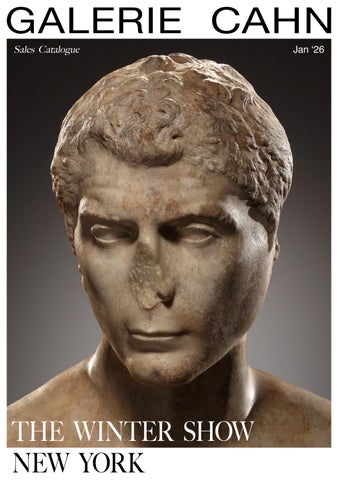
The Winter Show

Packaging, insurance and transport are at the expense of the purchaser. All prices in USD net for export.
![]()

Packaging, insurance and transport are at the expense of the purchaser. All prices in USD net for export.
PUBLIC OPENING HOURS
Friday, Saturday, Sunday, Monday, Tuesday, Wednesday, Thursday, Friday, Saturday, Sunday,
January 23
January 24
January 25
January 26
January 27
January 28
January 29
January 30
January 31
February 1
12pm – 8pm 12pm – 7pm 12pm – 6pm 12pm – 8pm 12pm – 4:30pm 12pm – 8pm 12pm – 4:30pm 12pm – 8pm 12pm – 7pm 12pm – 6pm
Dr. Ulrike Haase
ulrike.haase@cahn.ch
Tel: +41 61 561 67 04
Joffrey Nogrette
joffrey.nogrette@cahn.ch
Tel: +41 61 561 67 00
Charlotte Chauvier
charlotte.chauvier@cahn.ch
Tel: +41 61 561 67 02
Galerie Cahn
www.cahn.ch
Tel: +41 61 561 67 55


| En. | It.
| En.
|

by Jean-David Cahn
We are pleased to inform you that the gallery is now open again, and we look forward to welcoming you back. This year, we have an exciting program ahead, beginning with our participation in The Winter Show. The fair will take place from Friday, January 23, through Sunday, February 1, at the Park Avenue Armory in New York City. Held annually in the historic Park Avenue Armory on Manhattan’s Upper East Side, The Winter Show features more than 70 internationally respected dealers. Its breadth and rigor distinguishes the fair: every work on display is examined by a committee of experts to ensure authenticity, condition, and provenance, reflecting a commitment to excellence that collectors, curators, and scholars have come to appreciate.
At Galerie Cahn, we are proud to participate in the fair for the first time and are delighted to present, in this month’s catalogue, a carefully selected preview of the works we will be bringing to New York. This small selection of objects forms part of a broader context of collecting history. Thanks to our longstanding dedication to provenance research, we have been able to rediscover numerous provenances - sometimes of considerable historical interest - and we are pleased to present this material in New York, where there is a strong and well-founded interest in the history of how collections were formed. Since the 1960s in particular, we have had the privilege of accompanying many collectors and museums in the United
States, notably through a close and longstanding collaboration with the great dealer André Emmerich, from whom I learned a great deal during my time as an apprentice. From this collaboration remain fine catalogues produced for the joint exhibitions organized by Herbert Cahn and André Emmerich at the Fuller Building.
It is therefore especially meaningful for me to be back in New York for this year’s Winter Show. I look forward to welcoming you soonboth at the fair and at the gallery.


Price upon Request
7th - 6th century B.C. | Egypt, Late Period H. 35,0 cm | B. 10,4 cm | T. 21,4 cm | Granite
A male figure wearing a smooth kilt kneels on a rectangular base with rounded edges. He slightly raises his head that is covered by a wig. The facial features are carefully carved. The kneeling figure holds a naos containing a representation of the god Osiris. The dorsal pillar rises to the nape of the neck and is inscribed with hieroglyphs: „Osiris-Seti, may he be granted life, in every place of Neith, Chenti-Tep-Anch, so that his Ba may be glorified“ (rest not preserved). The naophoros, or naos-bearer, is a statue type that was introduced in the 18th Dynasty and was widely adopted in the Ramesside Period. Inscriptions from the Late Period explain the meaning of this image: by embracing or supporting the shrine, the donor shows that he wishes to protect to the
deity whilst, at the same time, seeking the god’s protection for himself. Osiris was regarded as the god of the afterlife and rebirth, and was therefore one of the most important deities in the Egyptian pantheon. He was also worshipped as a god of fertility and vegetation. According to ancient Egyptian belief, Osiris was once a just king of Egypt who was murdered and dismembered by his jealous brother Seth. His wife Isis reassembled the parts of his body and revived him with her magic. Thus, Osiris became ruler of the underworld and a symbol of eternal life after death. Head reattached, the edges of the break filled in. Small infills on the chin and upper arm. Two minor chips on the base. Slight wear in a few places, especially along the edges.
For the statue type, cf. S. Schoske - D. Wildung, Dietrich, Gott und Götter im Alten Ägypten. Sammlung Resandro (Mainz 1992) 200-203, cat. no. 128; the kneeling figure of the customs officer Nacht-Hor-Heb with a shrine of Osiris in the Ägyptisches Museum, Berlin, inv. no. ÄM 1048 (online). On the inscription, cf. the expert‘s report by the egyptologist Boris Schibler.
Formerly priv. coll. Berthe Kofler Erni (b. 1914 – d. 2016), Swiss artist, daughter of the renowned collector Kofler Truniger; acquired circa 1943 from a private collection in Geneva (see her confirmation letter dated 2000). Thereafter, Theodor Fischer (b. 1935); acquired in 2000 from the previous owner. Basel. Handwritten provenance note on the backs of photographs, and expertise report from Schibler dated 2001.


USD 9.400
7th - 1st century B.C. | Egypt, Late Period to Ptolemaic H. 4,6 cm | D. 0,5 cm | W. 2,0 cm | Red Jasper
The flat amulet depicts the pregnant goddess Taweret (“the Great One,” also known as Thoeris) standing in profile to left. Her figure combines features of three of Egypt’s most dangerous animals: the head and body of a hippopotamus, an outstretched hand that was probably meant to resemble a lion’s paw, and a crocodile’s tail that emerges from the back of her head and extends down to the base. Instead of the usual sa-scarf, she holds a scepter that rises to her slightly opened mouth. On her head the goddess wears a wig surmounted by a kalathos in the shape of a lotus blossom. Fine engravings and hatching enliven and add detail to the face, ears, wig, tail, kalathos, and scepter. The reverse is left smooth. The kalathos has a transverse perforation, allowing
the piece to be worn as an amulet or pendant on a chain. In the domestic sphere, Taweret was regarded above all as the protectress of pregnant women and was believed to ward off all evils that might befall mother and child during labour. Because of her terrifying appearance, which is further emphasized by the open mouth, the goddess was also thought to possess magical protective powers. Small chip on the scepter.


NOTE
Cf. S. Schoske - D. Wildung, Gott und Götter im alten Ägypten. Sammlung Resandro (Mainz 1992) 105, no. 72. For a necklace with pendants depicting Taweret, cf. Brookly Museum, inv. no. 16.580.201.
Formerly priv. coll. Carl Leonhard Burckhardt-Reinhard (1902-1965), collection built up since 1922, Egypt. Inherited by his son Christopher Burckhardt in 1966, Switzerland. Since then in the possession of his wife.


Price upon Request
3200 - 2800 B.C. | Early Cycladic I H. 18,9 cm | W. 4,0 cm | D. 2,0 cm | Marble
Although starkly upright, the frontality of the female body is belied here by refined anatomical details at the rear. The face is an elongated oval, mouth indicated by a horizontal line, with drilled eyes not quite aligned. Plastically rendered nose and ears (one covered by encrustations). Remarkably, the skull is sensitively modelled with a continuous line extending from the mandible towards the rear, delineating the occipital bone from the neck, which is comparatively thick and broadening towards the shoulders. The slim shoulders are squared, with arms bent at ninety-degrees at the elbow to rest beneath shallow breasts. The arms are not crossed, but instead hands are separated by a thin vertical line, with fingers summarily indicated. The abdomen is visibly swollen, with
three incised lines at the top edge perhaps indicating the loose skin of a recently post-partum woman. This physiognomic detail occurs in a small group of other known examples, although its significance in the third millennium B.C. is not well understood. Beneath the swell of the belly, a round drilled navel and slightly depressed pubic triangle. The legs are straight and carved separately along their entire length with slightly protruding knees. Block-shaped feet with flat bottoms and three toes indicated on each. The spine is rendered by a shallow groove from nape of the neck to cleft of buttocks. Slightly arched lower back with two „Venus dimples“ over the buttocks, rendered by slightly asymmetrical round drill holes. White, medium-
grained marble with encrustations, particularly at the back. Small circular divot above right eye, likely an abandoned attempt to render the right eye. Complete. Joining breaks at upper right thigh and beneath right knee reattached with minor filling. Joining break at neck with small filling laterally. Chip to right heel filled.
Formerly priv. coll. Tsekenis, Paris, since the 1960‘s. Thence by descent in the family.
Pat Getz-Preziosi, “An Early Cycladic sculptor”, Antike Kunst, vol. 18, n°2, 1975, pp. 47-50, pl. 20, 4-6; Pat GetzGentle, Personal Styles in Early Cycladic Sculpture, The University of Wisconsin Press, 2001, p. 9-10, Fig. 4.


USD 17.000
ca. 3200 - 2300 B.C. | Western Asia, Early Bronze Age H. 2,8 - 5,2 cm | W. 1,4 - 3,4 cm | D. 0,5 - 0,7 cm | Diff. types of stone
Form-typologically related group of eight abstract-schematic, almost violin-shaped idols, none of which are exactly alike. All are flat and have either a notch or a concave constriction in the middle. One idol with an neckline that resembles those found on idols with engraved faces belonging to the next stage of development. These later idols make it clear that even our undecorated type imitates the human form in a rudimentary way. Our idols belong to the Trojan type, which is widespread in northwestern Anatolia. In scholarly research, it is generally assumed that these abstract idols were used in cult rituals. Surfaces polished on both sides. Two specimens with slight sinter deposits.
For the type, cf. J. Thimme, Kunst und Kultur der Kykladeninseln im 3. Jahrtausend v. Chr., exh. cat. Badisches Landesmuseum Karlsruhe (Karlsruhe 1976) 376, 546, nos. 475-477. On the typological classification of the form, cf. p. 179, fig. 176.
Formerly priv. coll. Paul Munro Walker (d. 2016), numismatist and antique dealer between 1970-1980, Bournemouth, UK. Thereafter priv. coll. M. V., Middlesex, UK.


2500 - 2400 B.C. | Greek, Early Cycladic II, Keros-Syros-Culture
H. 12,2 cm | Marble
Head of a stylized human figure, which can be assigned to the late so called Spedos type in terms of its shape. Lyre-shaped in its basic form. Prominent nose reaching far into the lower half of the face. Chin with a rounded contour, tapering slightly towards the middle and, viewed from a side perspective, barely protruding beyond the neck. Below the chin there is a flat narrow groove that goes up to the neck and dissolves towards the middle. The upper part of the body, also set off against the neck by a flat, narrow groove, makes it clear that the shoulders sloped steeply. The formal observations mentioned here are stylistic features of the so-called Goulandris master (see also note). Bump on the upper right corner of the head. Fine brownish deposits.

NOTE
In addition to a form-typological categorization, the attempt was made by archaeological research to assign Cycladic idols to different „artist hands“; see in particular P. GetzPreziosi, Sculptors of the Cyclades. Individual and Tradition in the Third Millennium B.C. (Ann Arbor 1987); on the Goulandris master see pp. 99-108, plates 34-37; P. Getz-Gentle, Personal styles in Early Cycladic sculpture (Madison 2001). One of the best-known and most productive sculptors is the so-called Goulandris

Master (a fictional name named after the Goulandris Museum in Athens), to whom more than a hundred fragments are ascribed. Further styleforming features of the Goulandris master are according to Getz-Preziosi z. B. the small, widely spaced breasts and the horizontal hip line that closes the pubic triangle at the top.


Formerly priv. coll. Dr. Walter Veith, Solingen, Germany, 1972. Thereafter priv. coll. I. R., Rhineland, Germany. Priv. coll. J. R., Germany, acquired 2006 from Gordian Weber, Cologne (published: Cat. Antiken 10, 2006, p. 10-12, no. 5 with illus.). Old mount, dated 1960-1970.

USD 9.200
480 - 470 B.C. | Etruscan
10,1 cm | W. 3,5 cm | D. 1,9 cm |
High-quality bronze statuette of a naked youth shown in a strictly frontal pose. He stands in the characteristic archaic striding position with the left leg slightly advanced. This posture is based on Egyptian prototypes. The body is slender and its anatomy is rendered in a schematic manner, with softly modeled transitions between the shoulders, chest, and legs. The upper arms hang down, yet the rigidity of the stance is subtly softened by the left arm, which is drawn back, bent, and held slightly away from the body. The youth wears a short, cap-like coiffure that completely covers the ears and is enlivened with fine incised striations. Almond-shaped eyes, pronounced cheekbones, and the enigmatic “Archaic Smile” convey an impression of vitality and form a striking contrast
to the formal austerity of the body. The figure stands in the tradition of small Etruscan bronzes, that were produced from the 7th cent. B.C. onwards and were frequently dedicated as votive offerings in sanctuaries. The depiction of the nude male youth in the socalled kouros scheme follows Greek models and symbolizes ideal youth, beauty, and cultic purity. The figure probably represents either a deity (e.g., Apollo/Apulu) or a worshipper who dedicated the figurine as an offering to a god. Bronze statuettes of kouroi were also used in a decorative context, for example as supports for thymiateria (stands for burning incense; such a function, however, can be excluded here due to the fully modeled head). Part of the left forearm and the hand are missing. The beginning of
the right arm is preserved. Feet lost. Hair strands and some facial details executed in cold work.
Cf. E. Richardson, Etruscan Votive Bronzes. Geometric, Orientalizing, Archaic (Mainz 1983) with an extensive overview of the material. For the face, cf. esp. pl. 101, fig. 356.
Formerly priv. coll. Geoffrey Stephen Kirk (1921- 2003), British philologist and Hellenist, Cambridge. With H.A.C., TEFAF, Basel, 1996, no. 57 (see Widmer negative no. 9692). Thereafter, priv. coll. Eberhard W. Kornfeld (1923-2023), art dealer in Switzerland; acquired in 1998 from H.A.C., Basel, cat. 9, no. 7 (see invoice).


USD 8.200
Middle to Late Corinthian (570 - 550 B.C.) | Corinth H. 5,5 cm | Diam. body 5,7 cm | Diam. mouth 4,2 cm | Clay and careless execution. Abrasions. Part of the rim missing.
A spherical aryballos (H. Payne shape B 2) with a discoid rim and a vertical strap handle. The lip is decorated with tongues. Dots on the rim. On the body, a helmeted head to right is flanked by two birds in flight, converging towards it. Filling ornaments consist of blobs and rosettes. Above and below the main picture are bounding lines and tongues. The motif of a helmeted head flanked by two animals emerges during the late phase of the Corinthian ceramic development, and appear in the production of the Winged Lion Painter. However, this work cannot be ascribed to this artist. The painter‘s attention to detail, especially the careful outline of the profile eye, the scroll motif on the helmet, contrasts sharply with the Winged Lion Painter‘s rather cursory
NOTE
For iconographic comparanda, see Jack L. Benson, The Winged Lion Painter, in Antike Kunst 9, 1966, cat. nos. 6–8, pl. 4, nos. 4 and 7. See also Paris, Musée du Louvre, inv. no. N III 1536; all dated to the Late Corinthian period.
Formerly priv. coll. Lotti Hohl, Switzerland; acquired before 1987 (see declaration of honour).

USD 12.500
ca. 530 - 520 B.C. | Greece, Attic H. 13,8 cm | Diam. body 7,3 cm | Diam. foot 3,9 cm | Clay
Black-figure shoulderlekythos, with a high neck that ends in an echinusshaped mouth. The body is broad and tapers noticeably in the lower part towards a thin discoid foot. The shoulder is wide and almost horizontal. It is decorated with a goat moving to the left, flanked by two draped onlookers. On the body, the scene depicts Herakles wrestling the Nemean lion. The hero faces the lion, seizing its neck in his left arm. The lion‘s head is turned away and it claws at Heracles with its hind paw. On either side of the combat scene stand two youths, one nude and the other clothed, facing one another. Black glaze on interior and exterior of mouth, outside of handle, lower part of body and foot. Incisions for eyes, ears, garments and anatomical details.
Added red for the hair, mantle, lion‘s mane and goat‘s neck. The representation of a goat in the shoulder picture is rare. The style of the painting recalls the Painter of the Nicosia Olpe and the Wraith Painter. Although the shape has no exact parallel, it resembles one of the lekythoi in the Little Lion Class. Intact. A few minor chips on the rim and foot. Minor pitting of the surface in a few places.

For a similar iconography on smallformat shoulder lekythoi, cf. SaintOmer, Musée de l‘Hôtel Sandelin, inv. no. 4544; BAPD no. 361504, ex MuM, Basel, belonging to the Little lion Class. The scene appears also on the shoulder picture of a black-figure lekythos published among the Hearst Hillsborough vases (Raubitschek 1969, pp. 14-16) dated ca. 530 B.C., and attributed to the Painter of the Nicosia olpe (Beazley), BAPD no. 330185.
French art market, Paris, 2007. Thereafter, priv. coll. Michel Meignan (1947-2022), Paris.

USD 26.000
500 - 480 B.C. | Attic, Late Archaic
H. 20,6 cm | Diam. body 11,6 cm | Diam. foot 7,3 cm | Clay
This oinochoe is characterised by a low, rounded handle, a broad neck terminating in a trefoil lip, an ovoid body, and a torus foot with a basefillet. The shape corresponds to that of the Keyside Class (cf. ABF 425 ff.). The figural scene is flanked by stylised pomegranate net patterns and surmounted by a frieze of five encircled palmettes. On the extreme right, Hermes leads a procession of gods. He is followed by a pair of goddesses, then by Dionysos, who carries a horn-shaped rhyton. A maenad concludes the procession, distinguished by a pardalis (panther skin) draped across her torso. Vine garlands, with grapes decorate the field. Added white (faded) for women skin; some red painted enrichments on the figures and palmettes. Black
glaze fired olive. fragments reattached to the mouth and handle. Minor repairs.
NOTE
Two white ground oinochoai from the workshop of the Athena Painter feature a similar palmette frieze above the figural panel: Cambridge, Fitzwilliam Museum, inv. no. GR8.1937 (ABV 526.1; BAPD 330787); Warsaw, National Museum, inv. no. 142453 (ABV 526.2, BAPD 330788).

Formerly priv. coll. Dr. Siegfrid Zimmer (d. 2018), Traunstein, Germany, prior 1983. Thereafter, priv. coll. Eberhard W. Kornfeld (1923-2023), art dealer in Switzerland; acquired in 1983 from MuM, Basel, auction 63, lot 34. Old label: „M+M AG BASEL, Auktion 63, Juni 1983“. Pencil writing „23.1.67“
USD 21.000
Classical, ca. 425 - 375 B.C. | Attic L. 7,2 cm | W. 4,2 cm | D. 8,6 cm | Clay
A ‚plastic‘ vase combining a mouldmade terracotta head of Silenos with a wheel thrown lekythos mouth and handle covered in black gloss. The head features wide, frowning eyes beneath a deeply wrinkled forehead, large equine ears, and a snub nose. His long, curved beard is carefully combed and neatly trimmed. A wreath made of ivy leaves encircles the head, surmounted by a flared polos. The expression is wild and striking. Said to have been found in the Sanctuary of the Kabiroi, near Thebes, where an abundant coroplastic material, including a high proportion of Dionysiac and grotesque subjects, were discovered. Our vase would thus function as an offering tied to masculine maturation rites. White preparation well preserved; red paint
on the face and beard; light blue on the ivy leaves; pinkish white on the polos. The left ear is missing, as is one leaf of the wreath. Foot lost. Small retouches on the black gloss

For comparable plastic vases, see Maria Trumpf-Lyritzaki, Griechische Figurenvasen (Bonn, 1969), 69, 135, cat. nos. 219-224, pl. 26. The author sensibly notes a resemblance between the profile views of these Silenoi plastic vases and the Panticapeon gold stater types.
Formerly coll. Monsieur Elias Geladakis, Athenian antique dealer, rue Valois, Paris; sold at Drouot auction, 20.05.1904, Paris, lot 13. Thereafter, priv. coll. H. W. (b. 1931 - d. 2018), Germany; acquired prior to December 1991 from Galerie Günter Puhze, Freiburg im Breisgau.

USD 18.000
ca. 500 B.C. | Greek H. 6,6 cm | L. 9,1 cm | Bronze
Statuette of a bull standing at rest but with its head raised on the alert. Slim, plastically modelled body. Trapezoid head; long, pointed muzzle with a groove for the mouth and circular, drilled nostrils. Deeply punched, almond-shaped eyes. The horns curve upwards; very small, grooved ears below them. The dewlap, rendered as a sharp ridge, extends as far as the forelegs. The sturdy haunches with schematic contours stand out clearly from the body; small, offset hooves with a central groove. Long, drooping tail. Pronounced rendering of the genitals. Probably a votive offering. Surface at the tip of right horn slightly worn; some encrustation; figure intact.


The bronze bull statuettes found at the Cabeiros Sanctuary near Thebes provide plenty of material for stylistic comparisons, see B. Schmaltz, Metallfiguren aus dem Kabirenheiltum bei Theben (Berlin 1980). The bulls of Group 24 after Schmaltz are related to our specimen with regard to their slender, organic shape, balanced proportions and modelling. Cf. ibid. 75 ff., 109, esp. nos. 296, 302-202, 305, pls. 15-16. The schematic rendering of the haunches is reminiscent of the Archaic Period. Cf. a related Early Archaic bull: W. D. Heilmeyer, Frühe Olympische Bronzefiguren. Die Tiervotive, OF XII (Berlin 1979), 160, 260, no. 805, pl. 98.
Formerly priv. coll. Charles Ratton (1895-1986), Paris. Thereafter, priv. coll. Madeleine Meunier (1921-2009), Paris, acquired in the 1950s-1970s. With French art market, prior 2016. Thereafter, priv. coll. T. Aliot, Switzerland; acquired in 2017 from Jean-David Cahn AG, Basel.

USD 11.500

2nd half of 5th - 4th century B.C. | Greek or Western Greek

A strigil with looped handle, ending in a leaf-shaped attachment with incised linear decoration. An engraved lotus blossom adorns the exterior of the rounded transition from the front to the back part of the handle. An engraved stork (or crane) stands on a ground line on the outside of the front part of the handle. Additional incised marks, presumably Greek letters, below the ground line and bounded underneath by another line. The L-shaped blade has lobed corners where it meets the handle. Strigils were used primarily in the palaestra and at the baths. In combination with oil, they were used to clean and care for the body. Their exact use is well documented by ancient authors and, at the latest, from the end of the 6th century B.C. onwards on vases, mirrors, reliefs, and in both small- and large-scale sculpture (see, for example, the statue of an athlete known as the Apoxyomenos by Lysippos).
Depictions of the Apoxyomenos motif generally show how the skin on the upper body, back, arms, and legs is scraped. As for their archaeological context, strigils are most frequently found in graves, though the reasons
for their inclusion vary. For instance, the deceased—perhaps an athlete— may have been the owner of this everyday tool which was then buried with him to accompany him into the afterlife. Alternatively, such grave goods could express the wishes and hopes of relatives, especially in the case of someone who died young. Some examples, based on their findspots in sanctuaries (e.g., Olympia) or inscribed dedications, can be interpreted as votive offerings. Other finds, particularly from Roman times, are known from public buildings such as baths as well as private buildings, where they were used for their original, practical purpose. The slightly smaller size of our strigil suggests that it was once intended for a child. No other example with a stork or crane motif is known to us. Intact; attachment fixed to the blade. Surface corroded.

For an introduction to the strigil, cf. the fundamental study by E. KoteraFeyer, Die Strigilis (Frankfurt 1993). The typological development of the strigil’s shape can be observed, amongst other things, in the design of the handle. The looped handle with a very narrow rear section and the pointed, leaf-shaped attachment, which is found from ca. 420 B.C. onwards, indicates that our specimen probably dates from the Classical Period. Corners at the transition from the handle to the blade are attested from around 440 B.C. and, in the course of the 4th century B.C., are replaced by a flaring profile (KoteraFeyer, p. 125 f.). The fact that the fingers can still easily be passed through the handle further supports the date suggested. For contemporary examples, cf. Museum of Fine Arts, Boston, inv. no. 61.379 (online), dated around 500 B.C.; Metropolitan Museum of Art, New York, inv. no. 14.105.2 (online), dated 5th–4th century B.C., though lacking the tabs at the transition to the blade; Antikenmuseum Basel and Sammlung Ludwig, cf. D. Cahn, Waffen und Zaumzeug (Basel 1989, pp. 62 f., cat.
no. g), dated 330–300 B.C. based on associated finds. Unfortunately, the style of the bird motif does provide further clues as to the precise date of the piece. Occasionally, strigils are adorned with inscriptions and/ or decoration. Both occur either as engravings or in the form of intaglio or relief stamps, the latter being used primarily for workshop or artist names. Animal motifs are rather rare; for the depiction bird (though not a stork or crane), cf. Antikensammlung Berlin, inv. no. Misc. 8490.
Formerly priv. coll. Julien Bessonneau (1842-1916), Angers (see succession inventory, 1916). Thereafter, priv. coll. Jean-Pierre and Liliane Leveilley, Angers; acquired ca. 1970-1980 from the heirs of Julien Bessonneau. Old collection label with inv. no. “25.” on the exterior of the object.


USD 17.000
High Classical ca. 430 - 420 B.C. | Attic H. 8,0 cm | Diam. base 7,9 cm | Diam. rim 3,5 cm | Clay
A red-figured squat lekythos with a broad, flat body on a ring foot. Neck, slightly offset from the shoulder; above, a wide echinus mouth. The shape is designed to hold oil or perfume. On an egg-pattern ground line, a woman stands facing left, wearing a chiton and himation; her hair bound in a sakkos. Eros flies towards her from the left, carrying a chest. Between them, a kalathos (wool basket) signals that the scene is set in the gynaeceum. Attributed to the Washing Painter by J.D. Beazley, this lekythos exemplifies the graceful style of this painter, and his preference for wedding imagery, well attested on his pyxides, loutrophoroi and nuptial lebetes. Shiny black glaze; minor retouches of the varnish; small chip filled with toned plaster on mouth
and handle; concretions beneath the foot; otherwise intact.
NOTE
On the painter, see ARV² 1126–35; Paralipomena 453–54, 517; Addenda² 332–33. The Washing Painter takes his name from the scenes of women bathing that he painted on a group of small hydriai. Martin Robertson (The Art of Vase-Painting in Classical Athens, Cambridge 1992, 223–27) suggests that he may have trained in the Achilles Painter‘s workshop, alongside the Phiale Painter. The shape is rare and may be specific to the Washing Painter and his workshop, though it can be compared with a squat lekythos attributed to the Achilles Painter, formerly in the Philadelphia market (BAPD 4655;

J. H. Oakley, The Achilles Painter (Mainz/Rhein 1997), cat. no. 162). See also Wolf W. Rudolph, Die Bauchlekythos (Bloomington 1971), 40, category VIII.C. (‚Klasse des Washing-Malers‘).
With MuM AG, Basel, auction XVI, 30.06.1956, lot 139. Formerly priv. coll. Erika (b. 1934 - d. 2025) and Jakob (b. 1927 - d. 2025) Binkert, Binningen, Switzerland. Since then in the family. See Widmer negative no 191.
ca. 440 B.C. | Attic H. 26,0 cm | W. with Handles 29,0 cm | Diam. 31,0 cm | Clay
This medium-sized, thick-rimmed krater with short, upturned handles, stands on a double profiled foot with convex ring. Side A shows a warrior departing for battle. On the left a woman facing right, clad in a floral chiton and himation with a fillet in her hair, holding an oinochoe in her hand. The warrior in the centre faces her. He is clad in full armour with Attic helmet, lance and large round shield, and holds a phial for the parting libation in his right hand. Unusually, a shield apron drapes down from the middle of the outside of his shield. The Doric column between the two figures partially obscures the phial. Behind the warrior is the bearded master of the house with cloak and sceptre, facing left. Side B shows another valedictory scene: The
woman on the left wears a chiton and cloak. She hands a phiale to a warrior with pilos helmet who leans on a staff. A profiled edge juts out above the figural scenes. It is adorned by a band of ovolos; above it a band of ivy, both in black and finely framed. Adorning the outside of the step defining the shoulder of the vessel is a frieze of double, right-facing meanders interrupted by crossed tiles. Above the handles on either side are two palmettes leading into elaborate, volute-like coiled tendrils, some with lotus flowers. The black glaze has been unevenly fired and is discoloured greenish and orange in areas. At some point in its history, probably in the 19th or early 20th century, the vase was covered with a resin-based paint, which has since been removed, as have

the “invisible” restorations (mostly on side B). Reassembled from fragments; restoration in toned plaster along cracks and for a missing fragment of the rim; surface losses refilled; handle restored; foot not original.
For the helmet and ornamental palmettes, cf. a volute krater in Ferrara, Museo Archeologico 2652, M. Prange, Der Niobidenmaler und seine Werkstatt. Untersuchungen zu einer Vasenwerkstatt frühklassischer Zeit (Frankfurt 1989) 181, N 7, pl. 6, 1; an amphora in the Vatican, Museo Gregoriano Etrusco 17.854, ibid. 197, N 76, pl. 44; and a calyx krater fragment in Reggio di Calabria 10555, ibid. 187, N 29, pl. 50, on which the face of the female helmet wearer is almost completely covered by the helmet. For the phiale behind a column, cf. an amphora in the Vatican, Museo Gregoriano Etrusco 16528, ibid. 227, GN 98, pl. 44, in the manner of the Niobid Painter. For the hem of the mantle of the woman at left, cf. a hydria in Ferrara, Museo Archeologico 2683, ibid. 200 N 96 pl. 8; and a pelike in London, British Museum E 381, ibid. 192, N 57, pl.
15. The warrior‘s farewell in front of a Doric column occurs frequently in the work of the Niobid Painter, e.g. pelike in Würzburg, Martin von Wagner-Museum ZA 25, ibid. 194, N 64, pl. 16.
Formerly private coll., Paris, before 1970. With Auction Pierre Bergé, 17 January 2009, lot 351. With Royal Athena Galleries, New York, 2010. With Galerie Antoine Tarantino, Paris. Published: Eisenberg J., Art of the Ancient World, 2010, n° 148; Eisenberg J., One Thousand Years of Ancient Greek Vases II, 2010, n° 103. Old 19th century restorations, now removed.


USD 12.500
4th century B.C. | Greek, probably Boeotian H. 12,0 cm | W. 7,1 cm | D. 6,4 cm | Orange Clay
The grotesque-looking male figurine wears the typical costume of a comic actor, also known from Attic vase painting and the South Italian phlyax vases: a close fitting short tunic padded at the belly and buttocks, and a tied-on phallus of which the base is still preserved. On his head he wears a conical cap. The mask, with an opening for the mouth, has satyr-like facial features and ends on the sides in large protruding ears. The upper body is covered with a cloak; the bent arms and hands, completely hidden beneath it, hold it together. The still-preserved bent right thigh suggests that the actor is depicted standing in a slightly stooped posture. Made from a two-part mold, with the joining seams still clearly visible. Legs lost except for the right thigh. Head
reattached. Rests of the white slip (ground layer) preserved; the figure was once painted, and a trace of red color is still visible on the underside of the garment.
On the type, cf. Louvre, Paris, Inv. CA 376; MFA Boston, Inv. 01.8013; on the posture a terracotta figurine of an actor from Olynthos, see D. M. Robinson, Excavations at Olynthos, Part VII. The terracottas of Olynthos found in 1931 (Baltimore 1933) 78, no. 297, pl. 37. – The Greek theater has its origins in the cult of Dionysos. At the Great Dionysia, the multi-day festival held in honor of the god Dionysos, tragic and comic agones were staged in the Theater of Dionysos in Athens from the late 6th cent. B.C. onward, followed by the honoring of the victors. From the so-called Old Comedy (ca. 425–388 BC), the New Comedy (floruit ca. 320–280 BC) developed during the course of the 4th century B.C. after a brief transitional phase. Turning away from topical, often political affairs, it now focused on everyday problems within Athenian society and the humorous entanglements arising from them, drawing on a repertoire of recurring motifs and stock characters. The collective significance of the theater is reflected in contemporary monuments, especially in coroplastic art and vase painting. From the 5th
cent. B.C. onward, an standardization of actor types can be observed. In the late Classical and Hellenistic period the mould-made figurines enjoyed great popularity and appear in domestic, sacred, and also funerary contexts. A striking example of the latter use is a group of fourteen terracotta actor figurines from an Attic grave find in the Metropolitan Museum of Art, New York, Inv. 13.225.13 (as part of the group). As a literary source for the various mask types, the primary reference is the lexicon of the rhetor Julius Pollux, who lived in the 2nd cent. A.D. and, in his Greek work Onomastikon, lists several mask types from Greek tragedy, New Comedy, and the satyr play (4, 133–154).


With Galerie Brummer, Manhattan, New York; acquired 21.09.1938 from Theodoros A. Zoumpoulakis, antique dealer (active between 1920-1934) in Athens (according to an inventory card on which the actor is illustrated with inv. P15088). A 1948 photograph in the Brummer Archive shows the figurine presented in a showcase in the „Classical Room“ of the gallery. With Sotheby‘s New York, 08-09.06.1949. Thereafter Belgian priv. collection. Thence by descent.

USD 13.500
4th - 2nd century B.C. | Greek, probably Tanagra or Myrina H. 11,5 cm | Terracotta
Eros is depicted as a winged boy who strides forwards. He is completely wrapped in a cloak, beneath which his round belly is discernable. A wreath of ivy on his head. On a rectangular base. Remains of white engobe on the front. Traces of gilding (on both wings) as well as blue, yellow and pink paint. Both wings reattached. Tip of the right wing restored. Minor chipping at wreath and base.
NOTE
Related to the type S. Mollard-Besques, Catalogue Raisonné des Figurines et Reliefs en terre-cuite Grecs et Romains II. Myrina (Paris 1963) 54, M 52, pl. 65 e (from Myrina); S. Mollard-Besques, Catalogue Raisonné des Figurines et Reliefs en terrecuite Grecs et Romains III. Epoques
hellénistique et Romaine Grèce et Asie Mineure (Paris 1971) 32, D 171, pl. 39 b (from Tanagra).
Formerly priv. coll. Ernest Stanislas Le Véel (1874-1951), Paris, antiquarian and art dealer. Inherited by Ernest Armand Georges Le Véel (19052000), thereafter by his wife Louise Clémence Escoffier and finally by her daughter M. R., née Bélorgey (19352016), Paris. Since then in the family until 2024.


CHF 34.000
- 2nd century B.C. | Western Greek
H. 7,1 - 9,1 cm | W. 2,6 - 6,4 cm | Terracotta
The ensemble comprises 22 handmodelled nude, winged erotes, all depicted seated and mostly wearing a chest band. Based on the different activities they are engaged in, the merry company can be divided into the following groups: A) Four erotes holding a phiale with omphalos in the left hand; the position of the right arm varies. B) Four erotes playing musical instruments, three of them with a tambourine and one with a kithara. C) Four erotes with legs spread apart and in some cases arms extended forward, probably originally riding a dolphin.
D) Four reading erotes (in one case the tablet or scroll is lost). Six further erotes cannot be assigned to any of the four groups mentioned. Similarities in style and size suggest they belong together as a group, although three of
the riders show slightly different body proportions and a darker colouration. The childlike representation of our erotes with chubby body proportions probably originated in Boeotian Tanagra in the 4th century B.C. Eros is frequently attested in funerary contexts, usually in association with Aphrodite; a similar ensemble of terracotta statuettes is known, for example, from the Tomb of the Erotes (Eretria, Euboea). Probably Tarentum or Canosa. The heads of three erotes missing. On some figurines wings, arms, legs, and feet are either partially or entirely lost; occasionally fragments have been reattached. Some figures preserve remains of white engobe and polychromy; for instance, the wings were painted pink in the upper half and blue in the lower half.
For the terracottas from the Tomb of the Erotes (Eretria, Euboea), see MFA Boston, inv. no. 97.290–97.317 (online); on the backs of some of these figures, plaster remains bearing the impression of a cord indicate that the winged figures were once suspended. Other examples show a small hole between the wings for suspension. However, as our erotes are all seated, a different display context must be assumed for them. Two erotes in the Getty Museum, Malibu, inv. nos. 96.AD.265.1 and 96.AD.265.2 (from Canosa, online) are stylistically closely related to our figurines. Moreover, they are also seated, have a chest band (painted), and wings in corresponding colours.
Possibly old stock of MuM (19431988), Basel. Then with H.A.C. AG, Basel, until 1999. Since then in the family.


USD 12.500
4th - 2nd century B.C. | Greek or Western Greek H. 16,5 cm | L 9,1 cm | W 5,2 cm | Terracotta
A terracotta statuette of a young woman seated on a rock with her lower legs crossed. She wears a long chiton that covers only the lower part of her body. With her left hand, she appears to be removing the richly pleated himation draped over her shoulder. On the proper right side, the garment has slipped from her shoulder and is wrapped around her forearm, which is placed across her chest beneath her bare breasts. The figure is designed to be viewed in a manner that focuses on the act of undressing. Therefore, much of the left side as well as the actual back of the figure are worked in lower relief, and here too is the characteristic, rectangular firing hole, that prevents the clay from bursting during firing. The finely modeled features of the
young woman are framed by a melon coiffure and disc-shaped earrings. The unmistakably erotic connotations of the motif suggest that the figure may represent the goddess Aphrodite, although an interpretation as a nymph is also conceivable. Chignon lost. Left earring and the tip of the left foot slightly worn. Extensive sinter deposits on the surface. Remains of white engobe with traces of colour on the garment (light blue) and the rock (greyish).
In ancient art, Aphrodite is often depicted in situations where she plays with or deliberately stages her nudity. This coquettish display of her body is a hallmark of her iconography. Our statuette combines the motif of Aphrodite seated on a rock— well attested in her imagery (for a contemporary example in coroplastic art, see Metropolitan Museum of Art, New York, inv. no. 07.286.9)—with the motif of disrobing, which appears in various types of Aphrodite (cf. for instance the type Aphrodite Fréjus/ Venus Genetrix). Interestingly, the viewer is never quite certain whether the goddess is modestly covering herself or coquettishly revealing her body. Another example, Metropolitan Museum of Art, New York, inv. no. 12.232.12, likewise shows Aphrodite seated on a rock, here somewhat elevated, with her upper body already fully exposed.
Formerly priv. coll. Eberhard W. Kornfeld (1923-2023), art dealer in Switzerland, since 1960.


USD 38.000
late 1st century B.C.-1st half of 1st century A.D. | Roman H. 20,8 cm | L 48,5 cm | D. 6,1 cm | Terracotta with Large Inclusions
Fragment of a relief frieze depicting three Erotes bearing opulent garlands of fruit on a plastically offset ground line. An egg-and-dart moulding at the top of the picture field. Reverse smooth; two oval holes for attachment, profiled rim below. Mould-made. Some surface losses. Campana reliefs are special type of terracotta relief that was used to decorate buildings. They are named after the collection of Marchese Giampietro Campana (1808-1880). These painted terracotta panels decorated temples as well as public (theatres, thermal baths) and private buildings (especially columbaria). The largest and most important workshops were located in Rome and the surrounding area.
NOTE
The egg-and-dart moulding on a relief with Dionysos and a maenad in the Vatican, Museo Gregoriano Etrusco, inv. no. 14157, is stylistically related. Cf. A. Borbein, Campanareliefs. Typologische und stilkritische Untersuchungen (Heidelberg 1968) 35, pl. 4.3. Borbein‘s study also provides a useful introduction to Campana reliefs. For the type, cf. a fragment in the Museum of Fine Arts Budapest, inv. no. T.590.


Formerly Collection of the Swiss industrialist, philosopher and avid collector of antiquities Dr. Arnold Ruesch (1882-1929), Zurich. The object was displayed on a wall in the vestibule of his villa located on the Zürichberg and built in 1920-21. (photograph published in: Das Haus Arnold Ruesch: Architekten Müller & Freytag, in: Das Werk: Architektur und Kunst, vol. 17 (1930), issue 12, p. 380). With Galerie Fischer, Luzern, Sammlung A. Ruesch, Zürich, Griechische, Etruskische und Römische Altertümer, 1-2.9.1936, lot 89. With the Swiss trade; consigned to an english art market, 2018.

USD 20.000
6th - 4th century B.C. | East Greek L. 3,5 cm | L. pendant (with loop) 2.1 cm | W. 0,8 cm | Gold
The earrings are composed of a partially twisted hoop of gold wire. One end forms an eyelet into which the other end is hooked into. A human bust is soldered onto the obverse. The finely worked face is executed in delicate repoussé. The almondshaped eyes are a characteristic stylistic feature of the Archaic Period. The shape of the mouth, with somewhat stiff-looking lips that have precise, linear contours, recalls depictions of korai from the Ionian region. Above the low forehead, the hair seems to be visible. The head is crowned by a row of granulation beads, which may represent a diadem or wreath. Two granulated triangles adorn the sides of the bust’s neck. Three busts of exactly the same appearance are attached to one another at the back, forming a
pendant that is suspended from the hoop. A pyramid of granulation beads made from three gold sheets adorns both the top and the bottom of the pendant. Joint seams slightly open. Modern hangers of 900 (20k) gold.
For pyramids of granulation beads used as a decorative element in jewellery, cf., for example, a pair of spiral earrings in the British Museum, London, inv. no. 1877,0910.56 (online), and a gold earring in the Brooklyn Museum, New York, inv. no. 37.751E (online).
Formerly priv. coll., Germany; sold at the Ludwig Marx and Albert Sieck collections sale, Dr. F. X. Weizinger & Co., Munich 28-31 October 1918, lot 981, pl. 34; thereafter at Galerie Fischer, Lucerne, 14 June 1950, lot 799; afterwards, priv. coll. Ernst (b. 1903 - d. 1990) and Marthe Kofler-Truniger (b. 1918 - d. 1999), Lucerne; subsequently in a priv. coll., Lucerne, acquired from the above in 1971, and thence by descent.


late 4th century B.C. | Greek or Western Greek H. 9,2 cm | W. hoop 1.8 cm | Diam (interior) max. 7,1 cm | Gold
The open hoop, with relief decoration and a central twisted gold wire, is made from sheet gold sheet wrapped around a core of resin, copper alloy or another material. The exterior is adorned with three pairs of acanthus leaves, that are spaced at equal intervals. The ends of the bracelet are masterfully crafted into naturalistic lion’s heads. A loop is attached to each lion’s head, and these in turn are connected by an open ring. The cuffs behind the lion’s heads are richly decorated with twisted rods and petals. A particularly rare feature is the delicate frieze of Kalathiskos dancers, who usually performed at cult festivals, dancing on tiptoe with arms outstretched. They wear basketlike headdresses (kalathiskoi) and flowing garments. Clips made of gold
wire secure the cuff to the hoop. The bracelet is a masterpiece from the zenith of Greek goldsmithing. The bends of the bracelets interior are of ancient origin and were intended from the outset. Slightly dented in a few places. A few fissures. The eyes of the lions were originally inlaid.


NOTE
Accompanied by a report by Dr. Jack Ogden. - Cf. D. Williams - J. Ogden, Greek Gold. Jewellery of the Classical World (London 1994) 218, cat. no. 152. Kalathiskos dancers are known to have performed in various cultic contexts and are frequently associated with the “saltantes Lacanae” (the dancing Lacedaemonian women of Sparta), created by the Greek goldsmith and sculptor Kallimachos, active in the late 5th cent. B.C. (cf. Pliny, Nat. Hist. 34, 92).

Formerly priv. coll. Ian Thomas Roper, Bishop‘s Stortford, Hertfordshire; acquired on the London art market in the mid-1970s. With Christie’s auction, 25.10.2014, London, lot 128. Thereafter priv. coll.; acquired on 14.08.2015 from Ariadne Galleries, New York. See Jack Ogden report.
USD 23.000
5th century B.C. | Greek
H. 3,3 cm | W. 3,9 cm | T. max. 2,1 cm | Yellow light brown Chalcedony
Horizontal oval stone with a high rim tapering towards the slightly convex reverse. A magnificent bull strides to left on a ground line. Short, slightly curved horns. Powerful neck. The elongated body tapers towards the centre. The ribs and the fur on the chest are indicated by fine incisions. Long, bushy tail. Genitals indicated. An object, possibly an ear of grain, between the ground line and the bull‘s belly. A double line with short diagonal strokes in between frames the picture. Drill holes at the top and bottom, presumably to attach the intaglio to a piece of jewellery or its setting. Possibly Graeco-Persian. A crack directly above the bull that extends all the way to the rim.


The bull on the intaglio can be compared stylistically with the numerous bronze votives from the Kabeiroi sanctuary near Thebes, cf. B. Schmaltz, Metallfiguren aus dem Kabirenheiltum bei Theben (Berlin 1980). The elongated, somewhat disproportionate torso is unusual for classical depictions of bulls. It is conceivable that the craftsman may have misjudged the animal‘s proportions, but nevertheless wanted to make use of the entire picturel field. Scaraboids are a simplified form of the scarab and belong to the gem forms that were widespread in Greece in the late 6th and 5th centuries B.C.; cf. Museum of Fine Arts, Boston, inv. no. 01.7545 (also with a bull). It is interesting to note that both the top and the bottom of our specimen, are convex and that the engraving is located on the top. There are parallels for both these special features.
Formerly MuM AG, Basel, between 1942-1987. Thereafter, H. A. C., AG, between 1988-1999.
USD 6.600

4th century B.C. - 3rd century A.D. | Greek or Roman | L. 1,3 - 1,6 cm

A group of five astragaloi varying in material and size. Astragaloi imitated the shape of the ankle bones of sheep or goats and were used in Antiquity for various dice and skill games. In the five-stone game (Pentelitha), for example, five astragaloi were tossed into the air, and the player had to try to catch as many of the bones as possible on the back of the hand (cf. Poll. Onomastikon 10, 119). Playing with astragaloi has a long tradition and is even mentioned by Plato in one of his dialogues (Lysis 206 e). Early examples were found in a Late Minoan tomb as well as in Egyptian tombs dating from the New Kingdom. In the Roman Imperial Period, playing with knucklebones was very popular among children, as evidenced by finds of astragaloi in children’s graves. The so-called “Knucklebone Player” in the Antikensammlung Berlin (inv. no. Sk 494), a Roman reinterpretation of a late Hellenistic statue type enhanced with the gesture of play, provides an impressive three-dimensional example of a child playing with astragaloi, in this case a young girl. In the context of divination using astragaloi (astragalomanteia), the
bones functioned as oracles of love and fate and were there associated with the goddess Aphrodite. This explains why they are sometimes found as votive offerings in her sanctuaries. In Roman times, the best throw (when all four astragaloi landed on different sides) was known as Iactus Veneris (cf. Cic. Divinatio 1, 28). Propertius uses the metaphor of Cupid as a player with astragaloi (Prop. 3, 10, 27–28). Our astragaloi is somewhat smaller than usual, suggesting that they were originally intended for a child. Often made in terracotta, bronze, bone, or glass, the choice of materials for our set - especially in this specific combination - is unusual. Intact.


For examples of astragaloi, cf. British Museum, London; inv. no. 1867,0508.563 (rock crystal); inv. no. 1927,1115.18 (steatite); inv. no. 1772,0311.206 (agate). For very early examples of astragaloi, cf. Metropolitan Museum of Art, New York, inv. no. 16.10.505a–c. For a Hellenistic terracotta group of two girls playing with astragaloi, cf. British Museum, London, inv. no. 1867,0510.1.
On astragalomanteia, especially in connection with Aphrodite/Venus, cf. S. Constanza, Venus Playing with Astragals: Erotic Oracles and Prayers in Astragalomancy (2023).
Formerly priv. coll. Eberhard W. Kornfeld (1923-2023), art dealer in Switzerland; acquired in 2002 from Galerie Jürgen Haering, Freiburg (see invoice).

USD 9.600
2nd century A.D. | Roman H. 1,3 cm | W. 1,0 cm | D. 0,2 cm | Carnelian
This oval gem of carnelian in a rich orange hue, is incised with the bust of a woman facing right. Her hair is gathered in a low chignon, typical for the Antonine period. Elements of the facial features and coiffure are similar to coin portraits of the empress Faustina (ca. 130-176 A.D.), the wife of Marcus Aurelius. The quality of carving is exceptionally high.
NOTE
On the hairstyle, cf. K. Fittschen - P. Zanker, Katalog der römischen Porträts in den Capitolinischen Museen und den anderen kommunalen Sammlungen der Stadt Rom III. Kaiserinnen und Prinzessinnenbildnisse, Frauenporträts (Mainz 1983) no. 21, pl. 30.
Formerly priv. coll. Koppenwallner, since the 1970‘s, Cologne, Germany; thereafter by descent in the family.

USD 17.000
1st cent. B.C. - 1st cent. A.D. | Roman Egypt
H. 2,9 cm | W. 3,5 cm | D. 0,5 cm
Light blue, black, white, green, yellow and red opaque and translucent glass.
The rectangular glass inlay shows a female face against a light blue background with artfully arranged, wig-like hair that is adorned with ribbons, a string of pearls and a tiara or wreath. The face is that of a theatre mask. In his lexicon, the rhetorician Julius Pollux, who was active in Egypt in the 2nd cent. A.D., describes mask types used in the New Comedy, which was profoundly influenced by Menander, including various female masks (Onomastikon, 4, 143-154). In the mosaic glass technique that was used to make the mask, several rods of coloured glass were bundled lengthwise according to a template and fused together. Various small plaques could then be produced by making rightangled cuts with a suitable tool. The side
intended for viewing was smoothed and polished. Our plaque shows the following colour composition: face white, facial details green, black and red, hair black, hair ornaments yellow, white and red. The production of such glass elements required special skills and testifies to the high level of craftsmanship in the glass workshops of Roman Egypt. In our fragment the meticulous execution of the minute curls of hair is particularly impressive. As the mosaic glass technique made it relatively easy to produce mirrorinverted versions of the original composition, only one half of a mask was generally produced. There is fine seam in the centre of our mask where the two halves were joined together. Such inlays were used to decorate caskets, chests or furniture. Mounted
on a modern glass support. Lower part of face from the chin downwards lost. Tiny superficial chips; one flake lost in the mouth area.
NOTE
For comparative examples with a theatre mask, cf. S. M. Goldstein, Pre Roman and Early Roman Glass in the Corning Museum of Glass (New York 1979) 238, no. 691 (inv. no. 54.1.153), where our fragment is cited as a related inlay alongside other examples. Cf. also R. S. Binachi, Reflections on Ancient Glass from the Borowski Collection, Bible Lands Museum Jerusalem (Mainz 2002) 144146, no. EG-30a-c. In particular, the forehead hair and facial design of 30c are closely related to our example. For further comparative examples cf. E. M. Stern - B. Schlick-Nolte, Early Glass of the Ancient World. Ernesto Wolf Collection (Ostfildern 1994) 376-385, nos. 126-132. For a mosaic glass inlay with a theatre mask with remnants of the original object that it decorated, cf. British Museum London, inv. no. EA29396 (online).
PROVENANCE
Formerly priv. coll. Julien Gréau (1810-1895), France. Thereafter, priv. coll. John Pierpoint Morgan Sr. (18371913), London; and thence by descent to John Pierpoint Morgan Jr. (18671943), New York. Gifted in 1917 to the Metropolitan Museum of Art, New York; consigned to Anderson Galleries, New York, Cypriote & Classical Antiquities: Duplicates of the Cesnola & Other Collections [Part Two], 20-21.04.1928, lot 3 or 4 (both lots consisted of a group of 100 ancient glass fragments from the Julien Gréau collection). Thereafter, priv. coll. Joseph Klein (1899-1987), New York, collecting period 1941-1980; and thence by descent. Thereafter, priv. coll., London; acquired from Bonhams, London, The Collection of Joseph Klein, 24.10.2012, lot 21. English art market, 2024. Published: Collection Julien Gréau: Verrerie Antique, Tome I, Paris, 1903, pl. LXVII, no. 3.


USD 23.000
3rd mill. B.C. | Europe or Asia Minor, Neolithic H. 8,0 cm | W. 5,9 cm | D. 4,1 cm | Bone
Modified phalanx (finger or toe bone) whose shape is reminiscent of the stylized body of a kneeling human figure. The upper body is depicted without any indication of a head; the two bulges at the upper end may suggest either breasts or arms raised in front of the chest. The abdomen curves forward gently and has a small, shallow depression in the centre indicating the navel. The lower body consists of thighs, knees and buttocks. Between the spread thighs, a deep incision marks the female genitalia. The distinctly rounded undersides of the thighs take their shape from the natural form of the bone, as is the case with the upper end of the figure. Abstract-schematic anthropomorphic idols whose shapes are often reduced to the bare
essentials are known from various Neolithic and Bronze Age cultures. It is not uncommon for individual body parts to be omitted. However, the complete absence of a head is highly unusual. As a rule, the head remains recognizable even when depicted in a very stylized or rudimentary manner. For various reasons, including the number of known objects, it is not always possible to establish clear typologies for these early idols, which can make cultural and chronological classification challenging. In our case, the specific nature of the starting material – a finger or toe bone –allows for a typological assignment to the group of so-called phalanx idols. These may bear engraved ornamentation that is often linear in character or, as in our specimen,
remain entirely undecorated. With its detailed rendering of the softly bulging abdomen, the navel and the genitals, this example demonstrates a careful and ambitious adaptation of the predefined shape of the bone to the human, specifically female body. Whether the noticeable swelling of the abdomen is intended to suggest pregnancy, which would imply a symbolic association with fertility, cannot be determined with certainty. Phalanx idols date to the Late Neolithic or Early Chalcolithic periods. Examples are known from the Iberian Peninsula, Eastern Europe, Anatolia, and Mesopotamia, amongst other places, and thus these idols represent a transregional phenomenon. Phalanges from hoofed animals, such as horses, were frequently used for their production. Old collection patina. A few fissures closed for stabilization. Surface slightly worn in a few places. Reverse with traces of (the original?) red paint.


On the Iberian Peninsula, examples are known from Huerta de Dios, Casas de Reina, Badajoz (with an engraved face), Perdigões and the Escoural Cave. For examples of phalanx idols from Anatolia, see D. V. Campana –P. J. Crabtree, “A First Look at Equid Idols from Tepecik-Çiftlik, Southern Cappadocia, Turkey”, CPAG 29, 2019, pp. 71–76; for examples from Mesopotamia, see R. Christidou –E. Coqueugniot – L. Gourichon, “Neolithic Figurines Manufactured from Phalanges of Equids from Dja‘de el Mughara, Syria”, Journal of Field Archaeology 34/3, 2009, pp. 319–335.
Formerly priv. coll. Peter Itzvart (b.1943-d.2023), collected between 1975-1990, Paris.

USD 23.000
1st century B.C. - 1st century A.D. | Roman | H. 11,3 cm | W. 8,5 cm D. 0,9 cm | Lime-based plaster with polychromy in fresco technique
Vivid depiction of a mask like male face against a black background. A yellow cloth headdress covers the head. It is rolled together at the temples and then cascades downwards, framing the face. The absence of forehead hair suggests a bald head. The mouth is open, revealing meticulously detailed teeth. The face was probably bearded and is framed by green foliage scrolls. The mask-like face, and especially the open mouth, recalls theatrical masks, which were popular decorative elements in Roman wall painting. for example as auxiliary motifs or as part of a more complex compositions or stage scenery. Reassembled from three fragments, with breaks retouched. Preserved in a case dating to the late 18th–early 19th century.
NOTE
For the mask type, cf. a mask on the so-called Six Mask Cup from the Hildesheim Silver Treasure (late 1st cent. B.C.- early 1st cent. A.D.), U. Gehrig, Hildesheimer Silberschatz aus dem Antikenmuseum (Berlin 1980) 17 with fig. 15. There, the ivy-wreathed mask is identified as Dionysus. Representations of masks were popular in the Roman art and were used in a wide range of genres and monument types. Such ubiquity attests to the high importance that the theater, with its distinct modes of expressiontragedy, comedy, and satyr play - held in people’s lives. The presence of teeth, an element seldom found in theatrical masks, is unusual.
Formerly MuM AG, Basel, 1950s-1960s. Thereafter priv. coll. of the German-Swiss archaeologist Karl Schefold (1905-1999). Subsequently priv. coll. Mr. G., France, acquired in the 1990s or earlier. Late 18th–early 19th century case.


Expressive head of a lion that served as a waterspout. The forehead and face are surrounded by a mane composed of short tufts of fur. In the first row they curve outwards from the centre, whereas in the second row, the strands point in the opposite direction. The right ear has been preserved. Spherical eyes with plastically emphasized, drooping upper lids lie below bulging eyebrows. Two vertical wrinkles above the root of the nose. The bridge of the nose is convex in profile and widens considerably towards the bottom. Two deep vertical folds lead
to the curved upper row of teeth that mark the end of the water channel. Three curved grooves on both sides for the whiskers. Behind the mane there is an area that is flattened at the top. Possibly, it is the base of the sima. A chiseled edge behind the ear. The reverse has a shallow cavity in the centre which transitions into a shallow groove beneath the upper jaw. Sinter deposits in this area, presumably from the passage of water. Lower jaw lost or not sculpted from the outset. Slightly worn.

For the style, cf. a lion’s head waterspout from the Artemision in Ephesos: V. M. Strocka, Griechische Löwenkopfwasserspeier in Ephesos, in: B. Brandt (ed.), Synergia. Festschrift für Friedrich Krinzinger (Wien 2005) 337-348, fig. 1; the face of a lion’s head waterspout from the Temple of Despoina in Lykosura: Arachne, Database of the DAI -144578; a lion’s head waterspout from the sima of the Temple of Hera in Argos: NM Athen, inv. no. 1579 α, Arachne, Database of the DAI - 1179054; a lion’s head
waterspout from the Temple of Apollo in Delphi.
Formerly priv. coll. Jürgen Ritter (1941-2021), Münzhandlung Ritter GmbH, Düsseldorf; acquired between 1960 and 1990 on the European art market, mainly from London auction houses between 1970 and 1980.
Inherited in the family. With German art market, prior 2024.


Price upon Request
4th century B.C. | Attic | Marble H. 34,5 cm | W. 10,2 cm | Diam. foot 6,6 cm | Diam. lid 6,9 cm
The ovoid body of the loutrophoros is decorated with alternating broad and narrow ribs which are separated by incised lines. The slender neck is framed by two tall handles with inward-rolled volutes. Those at the top of the handles touch the neck whereas the smaller ones at the bottom rest on the body. Only the obverse of the volutes are worked in relief, indicating that the vessel was meant to be viewed on one side only and was perhaps placed in a niche. A separately made lid serves as the upper termination of the vessel. In the wedding ritual, loutrophoroi, many of which also survive in terracotta, were used to fetch water for the bridal bath. They also played an important role in funerary contexts and in the rites associated with them. Clay
loutrophoroi were placed in the graves of unmarried deceased individuals of both sexes. Graves were marked by marble loutrophoroi that were often large or even monumental in scale and which were decorated with figural or ornamental motifs. They are also occasionally depicted on grave stelae. Small-scale loutrophoroi like our specimen are rare and may have been placed on a trapeza, a type of funerary table in the form of a marble block with profiled edges at the top and bottom. Examples are known from the Kerameikos (cf. a loutrophoros from the grave precinct of Philoxenos of Messene; Athens, Kerameikos Inv. MG 47). An interesting detail is that, on one side of the body, the central rib is somewhat broader and flattened as the incised lines were
not fully executed. Perhaps, a painted inscription was once located here. It is also possible that our loutrophoros originally formed part of a grave relief with figures that were sculpted almost in high relief. With the ban on funerary luxury imposed by Demetrios of Phaleron (317 B.C.), the production of grave ornaments in Athens was almost entirely suppressed, which may provide a terminus ante quem for our loutrophoros. One handle, part of the neck, and one volute restored. Despite these restorations, it is evident that the handles were originally carved in openwork. This is the exception to the norm, presumably due to the high risk of breakage. Usually, in freestanding marble loutrophoroi, the area between the handles and the neck was not carved away. The original foot lost and replaced in the 18th or 19th century with a discfoot and short stem. The marble used for the restoration was carefully selected to match the original material. The reddish patina is probably due to storage in an iron oxide–rich environment.


On Attic marble loutrophoroi in general, cf. G. Kokula, Marmorlutrophoren, Mitteilungen des Deutschen Archäologischen Instituts, Athenische Abteilung, Supplement, Vol. 10 (Berlin 1984). For examples of loutrophoroi with openwork carving in the handle area, cf. National Museum, Athens, inv. no. 954 (Arachne, DAI database – 1182625). For examples of loutrophoroi depicted on grave stelai, cf. Museum of Fine Arts, Boston, inv. no. 1979.511 and the funerary stele of Eukleia, Metropolitan Museum of Art, New York, inv. no. 57.151. For a largescale funerary lekythos worked in the round, cf. Metropolitan Museum of Art, New York, inv. no. 1975.284.
Formerly priv. coll. Mr. Paul Angoulvent (1899-1976), former director of the Chalcographie du Louvre, founder and then president of Presses Universitaires de France from 1934 to 1968; acquired in 1956 (see inventory note „ach. 1956“).
late 5th - 4th century B.C. (German attribution by Prof. Raimund Wünsche) or late 1st century B.C. - early 1st century A.D.
Greek or Early Imperial | H. 21,1 cm | W. 15,4 cm | D. 19,0 cm | Marble
Life-size head of a boy who is around 2-4 years old. The high quality of the work immediately catches the eye, as does the striking contrast between the high, broad forehead and the small area taken up by the closely spaced eyes, nose and mouth in the lower half of the head. Sharply cut upper eyelids partly cover the almond-shaped eyes, creating the impression that the boy is about to close his eyes. Short nose with wide nostrils. Small mouth with full lips. Slightly chubby cheeks. The short, sickle-shaped curls lie close to the surface of the head. They spread out from an unruly whorl on the top of the back of the head, forming individual tufts divided by incisions. Only the top, back part of the neck is sculpted. The conical tang below indicates that the head was originally
inserted into a statue and mounted with a slight turn to the left. At the front, the tang extends up to the chin, suggesting that the garment, presumably a cloak, reached up this far. The expression and structure of the face are reminiscent of the socalled Arktoi, statues of young girls that were donated to the sanctuary of Artemis in Brauron in the 4th cent. B.C. However, the shape of the eyes on our head differs markedly. Furthermore, the marble sculpture has a “metallic” quality that is particularly evident in the way in which the eyelids and the crescent-shaped curls are carved. It is, therefore, worth considering whether our boy was based on a Greek bronze original. On the other hand, the strikingly pointed chin in combination with the pronounced cheekbones and

the sunken flesh around the mouth, is reminiscent of satyr depictions from the Imperial Period (cf. the head of a satyr in Castle Howard, Yorkshire). However, since the tip of the chin was filled in modern times, it is impossible to determine whether the current shape of the chin actually corresponds to the original state. Fine break through the face, extending from the chin to the middle of the top of the head. Slight surface losses at the ears. Some curls above the forehead, near the temples and on the top of the head restored. A few minor in-fills at the forehead, left eyebrow, left cheek and chin. Tip of nose, upper lip, ears and hair slightly worn.


Formerly The Merrin Gallery, New York, acquired by 1968, probably from Bud Holland in Chicago, André Emmerich in New York or a European dealer. Thereafter Canadian priv. coll., Toronto; acquired in 1990 from Merrin Gallery, New York. Possibly old stock of MuM (1943 - 1988), Basel. Then with H.A.C. AG, Basel, until 1999. Since then in the family.; acquired in 2014 from the Canadian priv. coll. and consigned to American trade, 2021.
NOTE
On representations of children in Greek art in general, cf. H. Rühfel, Das Kind in der griechischen Kunst. Von der minoisch-mykenischen Zeit bis zum Hellenismus (Mainz 1984); cf. also the head of a child in the Metropolitan Museum of Art, New York, inv. no. 1972.118.113 (online) and a child‘s head from Brauron, whose eyes are closely related to those of our boy (see Arachne, DAI Database - 1194344). Formally and stylistically related to our head, especially with regard to the shape of the eyes and eyelids, is a child‘s head in the Temple Collection, Broadlands, Hampshire, Great Britain and Northern Ireland, inv. no. 32, which Dagmar Grassinger dates to the late Hellenistic or early Augustan period (see Arachne, DAI Database - 1063281). For the satyr head in Castle Howard mentioned above, see Arachne, Database of the DAI –1064047. (DAI Database = Database of the German Archaeological Institute, https://arachne.dainst.org/)


Price upon Request
Late Republican before 1st century A.D. | Roman H. 50,0 cm | W. 30,0 cm | Diam. foot 15,0 cm | Marble
Finely carved marble vase in the shape of an amphora. The principal frieze on the vessel‘s body is sculpted in shallow relief with frontal figures, repeated, of Eros and Psyche, both winged and emerging, respectively, from acanthus leaves and a lotus flower, while holding aloft floral tendrils in each hand. Above, a narrow band of intertwining floral tendrils that rise from a base of acanthus leaves. The sloping shoulder is ribbed, with a pendant palmette at the base of each missing handle. A small, circular opening with a rill around it at the top of the neck. Ribs of neck, left arm of one of the Psyche figures and a tendril slightly worn. The foot has been restored in the 18th cent. Very close parallels can be found in a group of eight marble vases (four
amphoras and four cauldrons) which have been found in the santuary of Diana Nemorensis (Lake Nemi), all with votive inscription CHIO on the shoulder.
NOTE
Two of the mentioned marble vases from the santuary of Diana at Lake Nemi are kept in the Ny Carlsberg Glyptothek Copenhagen (inv. nos. 1518 and 1519), the others in the Penn Museum (Inv. MS3446; MS3447A; MS3449; MS3448; MS3451; published online).
Formerly priv. coll. Pierre Crozat (1661-1740), Paris, French financier and art collector; probably brought back from Italy ca. 1714-1715. Inherited by his nephew LouisFrançois Crozat, Marquis du Châtel (1691-1750), Paris. Thereafter, priv. coll. Comte de Caylus (1692-1765), Paris; acquired in 15.12.1750 from the anonymous sale titled: „Cabinet de feu Mr. Crozat“, Paris, lot 37. Then, with Pierre-Jean Mariette (1694-1794), Paris. Thereafter French private coll., from a château, since the 1920s. With Galerie Alain Chenel, Paris, prior to 2011. Thereafter priv. coll. David N. Silich (1944- 2018), Switzerland; acquired in 2013 from Jean-David Cahn AG, Basel.
Comte de Caylus, Recueil d’ Antiquités, 1752 (Vol. 1, p. 268, cat. no. IV, pl. XCVIII). F. Basan, Catalogue raisonné des différens objets de curiosités dans les sciences et arts, qui composaient le Cabinet de feu Mr. Mariette, 1775, p. 12, no. 63 (without illus.).

Price upon Request
ca 50 A.D. | Roman H. 24,0 cm | W. 16,0 cm | D. 17,0 cm | White, fine grained Marble
The youthful, idealised face is characterised by very fine, even features. Almond-shaped eyes with heavy, slightly drooping lids. The sensuous mouth is small, the opening marked by a deep groove. The wavy hair is parted in the middle and held in place by a fillet above the forehead. The ample curls, which half cover the ears, are drawn to the back of the head where they were once tied together and from where they cascade onto the shoulders in two long strands. Rings of Venus on the neck. Scaled-down Claudian marble copy of an original from the late 2nd or early 1st century
B.C.
Formerly Coll. Dr. Dietrich Schwencke, acquired when he was working for the
German Embassy in London, prior to 1939. Thence by descent, Germany. Thereafter priv. coll. Switzerland, since 2007.


Price upon Request
1st- 2nd century A.D. | Roman H. 60,0 cm | W. 43,0 cm | D. 24,0 cm | Marble
Soft, flowing transitions between the individual sections of the musculature characterise this life size torso, which, due to the absence of pubic hair, appears to be that of a boy or youth. The boyishness and the posture of our torso can be found in a statue group depicting a standing Ganymede with eagle (resp. Zeus in the guise of an eagle). This type is based on a Greek original and has come down to us in several Roman marble copies. On the left side of the back (presumably Latin) letters are recognisable. They are probably the remains of a – possibly ancient – inscription or graffito. Historical restorations to the left shoulder blade. A few superficial fillings, two larger fillings at the belly and the left shoulder blade.


With the pronounced curvature of the upper body that is caused by the distinct bend of the right hip and the curve of the linea alba, the posture breaks with the High Classical concept of harmonious contrapposto. Rather, the influence of Praxitelian sculpture is clearly discernible (Praxiteles was a Greek sculptor active in the 4th cent. B.C.). The large, four-sided dowel hole at the left waist as well as the dowel hole in the preserved part of the left upper arm and the bracket, traces of which are preserved on the upper surface of the left upper arm, served to attach the eagle reconstruction (see photo P. Arndt). The dowel holes on the right flank, below the arm pit and on hip level were presumably meant to provide the reconstructed lowered right arm additional stability. On representations of Ganymede with eagle, cf. LIMC IV (1988) 159-166, nos. 92-266, pls. 83-95 s.v. Ganymedes (H. Sichtermann). For the type of our torso cf. esp. nos. 122, 125, 131.
An undated photograph in the archive of the Classical archaeologist Paul Arndt (b. 1865-d. 1937) (since 1894 assistant to Heinrich Brunn and subsequently to Adolf Furtwängler of Munich University; since the late 1890s also active as an art dealer in Munich) depicts our torso in a reconstruction as Ganymede with an eagle. Formerly American priv. coll. F. W. R., New York, probably Frederick W. Richmond (b. 1923-d. 2019); consigned to Christie‘s, New York, 15 December 1992, lot. 29 and Sotheby‘s, New York, 4 December 1994, lot 134. Thereafter priv. coll. Barcelona; acquired from the last auction sale mentioned and consigned in the English art market, 2018.


2nd half of 1st century A.D. | Roman H. 44,5 cm | H. head 24,5 cm | W. 30,0 cm | D. 20,0 cm | Marble
This high-quality portrait of a man with gaunt features is characterised by a degree verism and strongly individualised features. Furrowed forehead. The protruding brows cast a shadow over the deep-set eyes. Sculpturally emphasised eyelids. Prominent cheekbones. Cheeks slightly sunken. The upper jaw protrudes conspiciously. Very narrow lips. Dimpled chin. The portrait was already reworked in Antiquity. This is particularly evident in the rendering of the hair. In addition to a general reduction of volume, short, closefitting strands of hair which are in part merely engraved contrast with sickleshaped curls from the first version of the head that are sculpturally emphasized, partially by deep chisel marks. The voluminous curls are
limited to the area above the centre of the forehead, where the hair is slightly raised and end at the hair whorl on the top of the head. The rendering of the hair above the forehead and the fleshy brows with curved furrows are characteristic of depictions of satyrs. Furthermore, the right ear tapers towards the top and may well have originally ended in a point. The shape of the face with the slender lower section and the small, slightly receding chin with its distinctive dimple are the result of the reworking of the head. These physiognomic features are also found in portraits of Emperor Nerva (96-98 A.D.). Mounted on a bust of the 19th century; the break runs through the upper part of the neck. The left ear and about two thirds of the nose are missing; broken surfaces


with historical restoration. Part of the right ear lost. Brows slightly worn.
Formerly priv. coll. Edouard Sarasin, prior 1917, Grand-Saconnex family estate, chemin Edouard Sarasin, Geneva. Inherited by his great-greatgrandson, prior to 1998, Cara estate, Commune of Presinge. Thence in the family.
Waldemar Deonna, (1909), „Nos Anciens et leurs oeuvres“, in Musée d‘Histoire de Genève magazine, p. 24, no. 21 (with illus.); Georges Nicole, (1914), Catalogue des sculptures grecques et romaines du Musée de Genève et des collections particulières genevoises, p. 21, nos. 1922-1923; Waldemar Deonna, (1924), Catalogue des sculptures antiques, pp. 152-153 (without illus.); Jacques Chamay, (2010) „A propos de trois portraits antiques“, in Geneva 58, pp. 25-32, no. 4 (with illus.); Jacques Chamay, (2014), „Deux sculptures antiques retrouvées dans un grenier“ in Antiquité, pp. 448-450 (without illus.).
USD 23.000
2nd century A.D. | Roman H. 28,4 cm | W. 18,4 cm | D. 8,7 cm | Marble
The fragment forms the right end of a relief or relief frieze that originally continued to the left. It depicts a young woman to left seated on a high cushion placed on an almost square stool with a slightly recessed upper edge framed by a moulding. The lower body and face of the young woman are shown in profile, while her upper body is rendered in threequarter view. She wears a long chiton, belted below the breasts, and a mantle that is draped over her left shoulder and around both legs. Her left hand rests on the cushion. Her right arm is sharply bent, the elbow resting on the raised right thigh and the hand brought to her chin, as if lost in thought. The seated pose and attitude recall similar depictions on Greek funerary reliefs. The young woman’s head
appears to be covered with a short veil, from beneath which a few wavy strands of hair emerge at the sides. The upper body of another figure is visible behind her. The person leans forwards; the left arm is bent and the hand rests on the shoulder of the seated woman, while the right arm seems to be extended forward. As far as can be discerned, this figure wears a loose garment with short sleeves. Only part of the lower edge of the cloak of a third person standing in front of the seated woman is preserved. The upper and lower edges of the relief are preserved, albeit slightly chipped. The dimensions of the relief and the manner in which the reverse is tooled suggest that the fragment once belonged to the lid of a sarcophagus. A corner acroterion may originally

have risen up behind the seated figure. Due to the fragmentary preservation of the scene, its interpretation is difficult. As the three figures are clearly interacting, a mythological scene may have been depicted. Given the veil and the distinctive gesture of the right hand, the seated woman is certainly not merely a passive or peripheral figure. The same applies to the figure standing behind her, who places a hand on her shoulder in a protective or supportive gesture while simultaneously engaged in action. Part of the upper head of the seated woman broken off. Slightly worn. The chamfered section of the reverse, as well as a strip along the lower edge of the other rear surface, has been repatinated.
Mythological scenes form one of the principal themes in the imagery found on Roman sarcophagi. Often imbued with heroic associations, such depictions typically serve as allegorical reflections on the fate of the deceased, translating mythical narratives into meaningful commentaries on the end of an individual life. It can be assumed that these myths were interpreted
and understood in their symbolic dimension by those attending the regular commemorations of the dead—usually family members of the deceased—held at the tomb or within the burial chamber, for example during the Parentalia or Rosalia. In this way, the mythological imagery offered mourners a means of consolation, allowing them to find comfort in the exemplary nature of the myth.
Formerly priv. coll. Boucquile; acquired from Jean Loiseau - Alain Schmitz auction, Saint-Germain-enLaye, 15.06.1980, lot 193 (see invoice).


USD 23.000
2nd - 4th century A.D. | Roman H. 23,0 cm | W. 23,0 cm | D. 6,2 cm | Marble
Square marble slab with a four-line inscription on the front: [...]INA POSITA / EST CVM NEPOTE / M SVVM NAONEM (Here lies ...ina with her grandson Naum?). The fourth line consists of a menorah flanked by Hebrew letters. Roughly hewn on the reverse with visible tools marks and some remains of cement, suggesting that the slab was once attached to a wall or something similar. A few sinter deposits on the surface. This important artifact bears witness to Jewish culture in the Roman Imperial Period.
NOTE
Cf. an epitaph in the Museo Nazionale Romano, inv. no. 67679 (see online database DAPICS no. 3279) with Menorah and Hebrew acclamations.
From the stock of a Munich gallery, acquired in 1999 from a French private collection.
Texts
Design
Translations
Photos
Dr. Ulrike Haase, Joffrey Nogrette, Charlotte Chauvier
Jonas Hernegger, Jean-David Cahn
Yvonne Yiu
Niklaus Bürgin
As of September 2025. The place of execution is Basel
1) Jean-David Cahn AG (hereafter „the Seller“) hereby confirms that it has the right of disposal over the objects for sale according to Art. 18 KGTG. Any further warranty is excluded.
2) The specifications and descriptions given in this catalog are provided in good faith. Nevertheless, their accuracy cannot be guaranteed.
3) The seller guarantees that the sales objects were made in Antiquity. This guarantee, which is granted to the buyer only, is valid for two years after the conclusion of the sales contract.
4) The objects are sold in the condition they were in at the time of the sale („sold as seen“). Complaints regarding the authenticity of a piece (subject to lit. 3) shall be communicated to the Seller in
writing at its domicile (Jean-David Cahn, Malzgasse 23, P.O. Box 217, 4010 Basel) upon detection and at the last two years after the conclusion of the sales contract.
Other substantiated complaints shall be communicated to the Seller in writing at its domicile, as above, within 14 days of receipt, and at least three months after the conclusion of the sales contract. Any complaints made later cannot be considered further. All liability for any loss or damage sustained during transportation is excluded. Insurance during transportation is the Buyer‘s responsibility.
5) The delivery and storage of sold objects shall be at the Buyer‘s risk and expense (costs arising from storage, packaging and transportation, any additional costs and
expenses, all plus VATs) unless otherwise agreed in writing.
6) Foreign and Swiss customs, duty and shipment shall be borne by the Buyer. Declaration fees for the import into the EU are borne by the Seller if used through the services provided by the Seller. It is the responsibility of the Buyer to comply with foreign and Swiss customs and foreign exchange regulations and to obtain an EU import license through the services of the Seller. The Buyer is aware of the relevant import and export regulations of the EU and has consulted the website of the Swiss Federal Office of Culture Bern (www. bak.admin.ch/ kgt) for details of the Swiss import and export regulations currently in force, as well as further provisions. The Seller declines all responsibility for any consequences arising from the contravention of such regulations. The Buyer acknowledges that a valid import permit is required for the importation of the artworks transferred under this purchase invoice into the European Union. If such a permit is not available at the time of purchase, the approval
process may take between four to six months. The registration and execution of the import procedure will be carried out by an art shipping agent appointed by the Seller within the EU. The Seller will organize this process in the name and on behalf of the Buyer. The Buyer is required to conduct the import procedure through the shipping agent designated by the Seller. Alternatives are the responsibility of the Buyers.
7) The Buyer is personally liable for all acquisitions made; he/she cannot claim to be acting for a third party or person. If a person acts as a representative, written proof of authorization may be requested; the Buyer as well as his/her representative can both be held jointly and severally liable for the purchase and for all other costs. The Buyer shall be liable for any damages caused by delayed payments, in particular for exchange rate and interest losses. Payments by cheque or by the internet shall be deemed to have been received only on clearance by the relevant bank.
8) Payment shall be due upon the conclusion of contract, but at the
latest 30 days after the invoice is issued. Interest of 1.5% per month will be charged for payments made after 30 days. Payments can be made in cash, by bank transfer or by cheque. The Seller may ask for proof of creditworthiness. Title shall be transferred only upon receipt of payment in full; all risks, however, shall pass to the Buyer upon conclusion of the sales contract.
9) If payment is delayed, the Seller can, after giving the Buyer due notice, withdraw from the contract forthwith. This also applies in cases where the object has already been transferred to the Buyer‘s possession at the Buyer‘s cost. The object in such a case must be handed back to the Seller upon request. Additionally, the Seller may claim further damages.
10) If the Buyer does not collect the object, the Seller can choose either to cancel the contract after 30 days and to claim compensation or to store the object at the Buyer‘s expense and to demand that the Buyer collects it.
11) ALL SALES ARE TRANSACTED IN BASEL, SWITZERLAND, WHICH IS THE-
The conclusion of contract, the quotation and the negotiations are subject to Swiss law, exclusive of the United Nations Convention on Contracts for the International Sale of Goods (CISG). By buying, the Buyer recognizes the exclusive right of the court of Canton Basel-Stadt, Switzerland, and of its jurisdiction. All sales are subject to Swiss jurisdiction. All parties recognize the exclusive choice of Swiss jurisdiction for the settlement of any matters arising from the conclusion of the sales contract.
12) All purchases and deliveries are performed solely on the basis of these conditions of sale. Any references by the Buyer to his/ her terms and conditions are herewith expressly excluded.
13) Should individual provisions become fully or partially void after the conclusion of contract due to changes in the law, the validity of the remaining provisions and of the contract shall remain unaffected. The invalid provision shall be replaced by that provi-
sion which is closest in meaning and intention to the original provision.
14) The Buyer accepts the condition of the sales as above. He/She explicitly accepts the exclusive right of the courts of Basel-Stadt, Switzerland, and their jurisdiction, exclusive of the United Nations Convention on Contracts for the International Sale of Goods (CISG), over the quotation, the negotiations, and the sale.
15) The conditions of sale are provided in German and English, the German version being the definitive and legally binding one in the event of any disputes.
Published by Galerie Cahn. Your Partner in the Antique Trade since 1863.

Cahn | Malzgasse 23 | CH-4052 Basel