
MAZE Art. Selected Works

Page 1


MAZE Art /

CONTACT US

Dr. Ulrike Haase

ulrike.haase@cahn.ch

Tel: +41 61 561 67 04

Joffrey Nogrette joffrey.nogrette@cahn.ch

Tel: +41 61 561 67 00

Charlotte Chauvier charlotte.chauvier@cahn.ch

Galerie Cahn

Tel: +41 61 561 67 55 Selected Works

Tel: +41 61 561 67 02

www.cahn.ch

Packaging, insurance and transport are at the expense of the purchaser. All prices in CHF net for export.

MAZE Art | Gstaad

Public Opening Hours Feb. 20 Feb. 21 Feb. 22 3 pm – 8pm 3 pm – 8pm 1 pm – 6pm Friday, Saturday, Sunday,

MAZE Art | St. Moritz

Public Opening Hours Feb. 27 Feb. 28 Mar. 01 3 pm – 8pm 3 pm – 8pm 1 pm – 6pm Friday, Saturday, Sunday,

FOREWORD

February 2026

This February, Galerie Cahn is delighted to be part of MAZE Art. The aim of this innovative exhibition format is to bring together fewer than 30 galleries in selected locations. This Salon d‘Art therefore unites the best in fine arts, sculpture, design, photography, video, and even gastronomy. While MAZE Art returns to the festival tent in the village centre in Gstaad for the third time, the historic rooms of the Hotel Reine Victoria in St. Moritz offer an elegant setting for visitors and collectors. Just a 25-minute walk away, past the Segantini Museum and the Engadiner Museum, Galerie Cahn maintained another exhibition space from 2006 to 2018, showing ancient art in both summer and winter in the heart of St. Moritz. It is therefore especially meaningful for us to be back to show ancient art under the slogans Art is coming to the Alps and Art Among the Peaks. Our participations also ties in with the art project ‘Gods & Heroes’, which we realised together with Brigitte Vincken in 2015. For this project, marble sculptures were flown to the summit of nearby Alp Splüga above Plaun da Leij to be photographed. We look forward to welcoming you both here in St. Moritz and in Gstaad.

A SEATED STATUE OF AMENEMPHET PRIEST OF AMUN

Price on Request

Lower Section: after 1368 B.C. | Upper Section: 6.-4. cent. B.C. Egypt, New Kingdom, 18th Dynasty and Late Period H. 68,0 cm | W. 21,0 cm | D. 34,5 cm | Black Granite

The statue was assembled in the 19th or early 20th century from two parts that did not originally belong together. The lower body dates from the New Kingdom, and an inscription reveals that the figure represented was Amenemhet, Priest of Amun. The deceased priest wears a short apron and sits hieratically on a block with a low backrest. His feet rest on a footstool that is semicircular at the front. Several columns of hieroglyphs are inscribed on a central strip of the long apron as well as on

the front, both sides (damaged on the right), and back of the seat. They record that Pharaoh Amenophis III (the father of Akhenaten) made an offering to Amun of Thebes and the goddess Mut for Amenemhet, the deceased Third Priest of Amun and Keeper of the King’s Seal, and for his daughter Meret, a singer of the god Amun. On both sides of the seat, the priest Amenemhet is depicted seated on the left while the singer Meret stands on the right. For the deceased, who continues to live in

the afterlife, bread, beer, cattle, birds, alabaster, clothing, milk, incense, and all pure things needed for daily life are to be provided. The upper part of the seated statue dates to the Late Period and shows the upper body of a man with forearms crossed over the chest. His right arm is concealed by a cloak, and only the hand of the left arm is visible. He wears a smooth wig, that transitions into the dorsal pillar. Colour-matched infills on the outer sides of the upper and lower legs, on the front of the footstool (in the lower area), at hip level (where the upper and lower body are joined), on the top of the head, and partially on the rear edges of the seat as well as on its lower right edge. the impression of dynamism. The compact breast contrasts with the lean body and elegantly sculpted legs. The rider wears a horned helmet and his raised right hand presumably held a lance. He holds the reins with his left hand. Details accentuated in colour. Reassembled. The tail, originally attached separately, is missing and the ears are worn. Only the beginnings of the rider‘s fluttering cloak have been preserved; right hand slightly worn.

NOTE

Comes with a transcription by Egyptologist Prof. Dr. Martina Ullmann. — The tomb of the priest Amenemhet mentioned in the inscription, presumably located in West Thebes, has not yet been identified. In the 20th year of the reign of Amenhotep III (1368 B.C.), Amenemhet was still in office. The care that the king lavished on the deceased high priest and official, as documented in the inscription, was granted only to members of the upper class.

PROVENANCE

Formerly priv. coll. of the publisher Diedrich Kenneweg (b. 1895 - d. 1982); acquired in Germany, before 1963. Thereafter, W. M. Muthesius, Germany; acquired in 2018 from Gorny & Mosch, Munich, auction 256, 26.06.2018, lot 395.

A HEAD OF A BOY

Price on Request

Late 5th - 4th century B.C. (att. by Prof. Raimund Wünsche) or late 1st century B.C.-early 1st cent. A.D. | Greek or Early Imperial H. 21,1 cm | W. 15,4 cm | D. 19,0 cm | Marble

Life-size head of a boy who is around 2-4 years old. The high quality of the work immediately catches the eye, as does the striking contrast between the high, broad forehead and the small area taken up by the closely spaced eyes, nose and mouth in the lower half of the head. Sharply cut upper eyelids partly cover the almond-shaped eyes, creating the impression that the boy is about to close his eyes. Short nose with wide nostrils. Small mouth with full lips. Slightly chubby cheeks. The short, sickle-shaped curls lie close to the surface of the head. They spread out from an unruly whorl on the top of the back of the head, forming individual tufts divided by incisions. Only the top, back part of the neck is sculpted. The conical tang below

indicates that the head was originally inserted into a statue and mounted with a slight turn to the left. At the front, the tang extends up to the chin, suggesting that the garment, presumably a cloak, reached up this far. The expression and structure of the face are reminiscent of the socalled Arktoi, statues of young girls that were donated to the sanctuary of Artemis in Brauron in the 4th cent. B.C. However, the shape of the eyes on our head differs markedly. Furthermore, the marble sculpture has a “metallic” quality that is particularly evident in the way in which the eyelids and the crescent-shaped curls are carved. It is, therefore, worth considering whether our boy was based on a Greek bronze original. On the other

hand, the strikingly pointed chin in combination with the pronounced cheekbones and the sunken flesh around the mouth, is reminiscent of satyr depictions from the Imperial Period (cf. the head of a satyr in Castle Howard, Yorkshire). However, since the tip of the chin was filled in modern times, it is impossible to determine whether the current shape of the chin actually corresponds to the original state. Fine break through the face, extending from the chin to the middle of the top of the head. Slight surface losses at the ears. Some curls above the forehead, near the temples and on the top of the head restored. A few minor in-fills at the forehead, left eyebrow, left cheek and chin. Tip of nose, upper lip, ears and hair slightly worn.

NOTE

On representations of children in Greek art in general, cf. H. Rühfel, Das Kind in der griechischen Kunst. Von der minoisch-mykenischen Zeit bis zum Hellenismus (Mainz 1984); cf. also the head of a child in the Metropolitan Museum of Art, New York, inv. no. 1972.118.113 (online) and a child‘s head from Brauron, whose eyes are closely related to those of our boy (see Arachne, DAI Database - 1194344). Formally and stylistically related to our head, especially with regard to the shape of the eyes and eyelids, is a child‘s head in the Temple Collection, Broadlands, Hampshire, Great Britain and Northern Ireland, inv. no. 32, which Dagmar Grassinger dates to the late Hellenistic or early Augustan period (see Arachne, DAI Database - 1063281). For the satyr head in Castle Howard mentioned above, see Arachne, Database of the DAI – 1064047. (DAI Database = Database of the German Archaeological Institute, https:// arachne.dainst.org/)

PROVENANCE

Formerly The Merrin Gallery, New York, acquired by 1968, probably from Bud Holland in Chicago, Andre Emmerich in NY or a European dealer. Thereafter Canadian priv. coll., Toronto; acquired in 1990 from Merrin Gallery, New York. Thereafter US trade; acquired in 2014 from the Canadian priv. coll. and consigned to American trade, 2021.

A HORSE AND RIDER

CHF 26.000

Ca. 300 B.C. | Western Greek, probably Canosa H. 32,9 cm | W. 12,9 cm | L. 24,8 cm | Clay

The horse is captured in mid-gallop with its forelegs vigorously lunging forwards. The fully modelled body forms and proudly reared head underscore the impression of dynamism. The compact breast contrasts with the lean body and elegantly sculpted legs. The rider wears a horned helmet and his raised right hand presumably held a lance. He holds the reins with his left hand. Details accentuated in colour. Reassembled. The tail, originally attached separately, is missing and the ears are worn. Only the beginnings of the rider‘s fluttering cloak have been preserved; right hand slightly worn.

NOTE

For the style, polychromy and rendering of the horse, cf. a sculpture with horse and rider: E. Simon, The Kurashiki Ninagawa Museum. Greek, Etruscan and Roman Antiquities, cat. Okayama (Mainz 1982) 217, no. 147 with illus.

PROVENANCE

Formerly H.A.C., Basel, May 1996 (see Widmer negative no 9686). Purchased from him by Prof. Frank Vischer (1923-2015), Professor of Laws and Rector of Basel University, at TEFAF Basel in 1996. Since then in the family.

A STATUETTE OF APHRODITE SITTING ON A ROCK

CHF 8.800

4th - 2nd century B.C. | Greek or Western Greek H. 16,5 cm | W. 5,2 cm | L. 9,1 cm | Terracotta

A terracotta statuette of a young woman seated on a rock with her lower legs crossed. She wears a long chiton that covers only the lower part of her body. With her left hand, she appears to be removing the richly pleated himation draped over her shoulder. On the proper right side, the garment has slipped from her shoulder and is wrapped around her forearm, which is placed across her chest beneath her bare breasts. The figure is designed to be viewed in a manner that focuses on the act of undressing. Therefore, much of the left side as well as the actual back of the figure are worked in lower relief, and here too is the characteristic, rectangular firing hole, that prevents the clay from bursting during firing. The finely modeled

features of the young woman are framed by a melon coiffure and discshaped earrings. The unmistakably erotic connotations of the motif suggest that the figure may represent the goddess Aphrodite, although an interpretation as a nymph is also conceivable. Chignon lost. Left earring and the tip of the left foot slightly worn. Extensive sinter deposits on the surface. Remains of white engobe with traces of colour on the garment (light blue) and the rock (greyish).

NOTE

In ancient art, Aphrodite is often depicted in situations where she plays with or deliberately stages her nudity. This coquettish display of her body is a hallmark of her iconography. Our statuette combines the motif of Aphrodite seated on a rock—well attested in her imagery (for a contemporary example in coroplastic art, see Metropolitan Museum of Art, New York, inv. no. 07.286.9)—with the motif of disrobing, which appears in various types of Aphrodite (cf. for instance the type Aphrodite Fréjus/Venus Genetrix). Interestingly, the viewer is never quite certain whether the goddess is modestly covering herself or coquettishly revealing her body. Another example, Metropolitan Museum of Art, New York, inv. no. 12.232.12, likewise shows Aphrodite seated on a rock, here somewhat elevated, with her upper body already fully exposed.

PROVENANCE

Formerly priv. coll. Eberhard W. Kornfeld (1923-2023), art dealer in Switzerland, since 1960.

A RARE MARBLE LOUTROPHOROS

CHF 45.000

4th century B.C. | Attic H. 34,5 cm | W. 10,2 cm | Diam. Foot 6,6 cm | Marble

The ovoid body of the loutrophoros is decorated with alternating broad and narrow ribs which are separated by incised lines. The slender neck is framed by two tall handles with inward-rolled volutes. Those at the top of the handles touch the neck whereas the smaller ones at the bottom rest on the body. Only the obverse of the volutes are worked in relief, indicating that the vessel was meant to be viewed on one side only and was perhaps placed in a niche. A separately made lid serves as the upper termination of the vessel. In the wedding ritual, loutrophoroi, many of which also survive in terracotta, were used to fetch water for the bridal bath. They also played an important role in funerary contexts and in the rites associated

with them. Clay loutrophoroi were placed in the graves of unmarried deceased individuals of both sexes. Graves were marked by marble loutrophoroi that were often large or even monumental in scale and which were decorated with figural or ornamental motifs. They are also occasionally depicted on grave stelae. Small-scale loutrophoroi like our specimen are rare and may have been placed on a trapeza, a type of funerary table in the form of a marble block with profiled edges at the top and bottom. Examples are known from the Kerameikos (cf. a loutrophoros from the grave precinct of Philoxenos of Messene; Athens, Kerameikos Inv. MG 47). An interesting detail is that, on one side of the body, the central rib is somewhat broader

and flattened as the incised lines were not fully executed. Perhaps, a painted inscription was once located here. It is also possible that our loutrophoros originally formed part of a grave relief with figures that were sculpted almost in high relief. With the ban on funerary luxury imposed by Demetrios of Phaleron (317 B.C.), the production of grave ornaments in Athens was almost entirely suppressed, which may provide a terminus ante quem for our loutrophoros. One handle, part of the neck, and one volute restored. Despite these restorations, it is evident that the handles were originally carved in openwork. This is the exception to the norm, presumably due to the high risk of breakage. Usually, in freestanding marble loutrophoroi, the area between the handles and the neck was not carved away. The original foot lost and replaced in the 18th or 19th century with a disc-foot and short stem. The marble used for the restoration was carefully selected to match the original material. The reddish patina is probably due to storage in an iron oxide–rich environment.

NOTE

On Attic marble loutrophoroi in general, cf. G. Kokula, Marmorlutrophoren, Mitteilungen des Deutschen Archäologischen Instituts, Athenische Abteilung, Supplement, Vol. 10 (Berlin 1984). For examples of loutrophoroi with openwork carving in the handle area, cf. National Museum, Athens, inv. no. 954 (Arachne, DAI database – 1182625). For examples of loutrophoroi depicted on grave stelai, cf. Museum of Fine Arts, Boston, inv. no. 1979.511 and the funerary stele of Eukleia, Metropolitan Museum of Art, New York, inv. no. 57.151. For a large-scale funerary lekythos worked in the round, cf. Metropolitan Museum of Art, New York, inv. no. 1975.284.

PROVENANCE

Formerly priv. coll. Mr. Paul Angoulvent (1899-1976), former director of the Chalcographie du Louvre, founder and then president of Presses Universitaires de France from 1934 to 1968; acquired in 1956 (see inventory note „ach. 1956“).

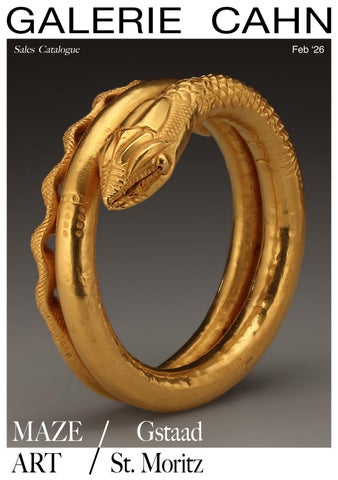
A MONUMENTAL GOLD SNAKE BRACELET

Price on Request

1st - 2nd century A.D. | Roman Egypt

H. 10,0 cm | W. 3,9 cm | Interior Diam. 7,3 cm | Gold

A monumental bracelet made of thick sheet gold sheet in the form of a snake coiled in 2¼ turns. The head and body form the beginning of the bracelet, while the undulating tail end forms its termination.

Remarkably, the tail also ends in a snake’s head, creating the impression that two creatures are joined together. A pattern of carefully executed lozenges render the snake’s skin in relief. A delicate scale pattern marks the transition to both of the snake heads which are modelled fully in the round and are richly detailed through meticulous hammering and engraving. The raised eyes have a spherical form. The underside of the larger snake’s body is enlivened by curved engraved lines. The outwardfacing and thus visible eye of each

snake was presumably once inlaid. A consistently arranged pattern of circular punch marks is found at the transition from the snake’s body and tail end to the undecorated central section of the bracelet, as well as at its center. Parts of the tail and the inward-facing eyes of both snakes are attached to the bracelet by means of cast gold. Already in the Archaic Period, snake-shaped bracelets were widespread in the Near East and in Greece. In the Hellenistic and Roman Periods, the type of spiral snake armlet documented by the present example enjoyed particular popularity in Egypt, where the addition of a second snake head at the tail end appears to have been an iconographic peculiarity of local workshops. Given the multivalent

symbolism of the snake, the precise function of such armlets remains elusive. However, they probably served primarily as protective amulets. The snake is associated with various cults, especially that of the Greek healing deity Asklepios, thereby opening up numerous further interpretative possibilities. In Egyptian religion, snakes are associated, among others, with the deities Isis and Serapis (cf., for example, a gold finger ring in the form of a snake in which the snake heads are replaced by busts of Isis and Serapis; British Museum, inv. 1926,0407.12). Mouth of the larger snake head slightly dented on one side.

NOTE

There is a smaller and more slender gold snake armlet, closely comparable in its structure and some of its details of decoration The Metropolitan Museum of Art, New York, acc. no. 18.2.19. Compare also an example in London, British Museum 1946.7-2.2, dated to the 1st cent. A.D., illustrated by R.A. Higgins, Greek and Roman Jewellery (London, 1961) pl. 61, E.

PROVENANCE

Formerly priv. coll. Ernst (b. 1903 - d. 1990) and Marthe Kofler-Truniger (b. 1918 - d. 1999), Lucerne, collection built up between 1950 -1960. Thereafter, priv coll. Albert Bollinger, Switzerland; acquired in 2000 from the heirs Anita Palfalvi-Kofler and Sylvia Kofler, Lucerne, who inherited it in 1999 after Marthe‘s death at Gesegnetenmattstrasse (see the purchase agreement dated 2002 and the document from the official gazette of the canton of Lucerne dated 2003).

A STATUETTE OF APHRODITE WITH MIRROR

CHF 24.000

1st cent. B.C. | Late Hellenistic to Early Imperial, H. 21,4 cm | W. 6,7 cm | D. 3,0 cm | Marble

Venus wears a chiton with sleeves that has slipped down from her shoulders revealing her right breast. The motif underlines the intimacy of the moment showing the goddess at her toilette. Lost in thought, she looks at herself in the mirror she holds in her left hand, unaware that someone could be watching her. With her right hand she grasps her cloak, pulling it across her pelvis just below the pubic area visible under the thin fabric of her robe. Her hair is parted in the middle and pulled to the back of the head in wavy tresses, from where it cascades down the nape of her neck. One of the numerous variants of the theme of Venus at her Toilette, in which various motifs and types associated with Aphrodite/Venus were used.

Such statuettes were used mainly to decorate private villas. The flattened reverse flattened suggests that the figure was displayed in a niche. Head with neck reattached. Minor repairs to nose and back of head. Part of the base broken off. Rim of mirror slightly worn. Surface corroded in a few places.

NOTE

Cf. A. J. M. Kropp, The Aphrodite of Emesa: miniature marble sculpture and religious life in Roman Syria, JRA 29, 2016, 193-222. On the represenations of Venus at her Toilette, cf. LIMC VIII (1997) 208210 s. v. Venus (E. Schmidt).

PROVENANCE

Formerly Fragments of Time, USA, prior 1998. Thereafter coll. Dr. med. Sylvia Legrain (1936-2022), Switzerland; acquired 13.2.1999 at KAM Zurich from H.A.C. Kunstwerke der Antike, fair list no. 344.

A TORSO OF A YOUTH POSSIBLY GANYMEDE

Price on Request

2nd century A.D. | Roman H. 58,9 cm | W. 22,5 cm | Marble

Softly modelled transitions, the reduced accentuation of musculature, the slightly protruding lower abdomen and the lack of pubic hair lend the slender, under life-sized torso a boyish appearance. When viewed from the front, there is a striking contrast between the relaxed contrapposto of the legs and the almost static torso, whose posture allows virtually no shift of the body axes. The chest is covered with a chlamys, which is fastened above the right shoulder by a round brooch and cascades diagonally across the back. A large section of the back, mainly the area with the garment, as well as the left shoulder and arm were attached by means of an iron dowel, the remains of which are still preserved. The area where

they were attached shows the typical preparatory tooling. The adjoining break surface on the right may date from a different point in time. Its edges reveal traces of a toothed chisel which continue along the edge of the prepared surface and partially over it. This tooling must, therefore, be of more recent date. A second round, but much smaller dowel hole is located on the left at the hip line, and a third that contains about one third of the dowel can be found below the right upper arm. On the lower outer part of the completely preserved left thigh, the remains of an adjoining support are visible. The beginning of the right thigh with a puntello on the outward facing side is preserved. The underside is smoothed and has an iron dowel in

the centre, which was used to attach the rest of the thigh or leg. This addition was probably made at the same time as the other attachments for which the toothed chisel was used to prepare the surfaces. The head and penis were also attached separately. At the back, a pronounced drill channel separates the small, firm buttocks. It is not easy to determine the statue type and to identify who was represented. The upright posture in combination with the accentuated boyishness of the statue permit different interpretations (cf. a small statue of Hermes in Berlin, inv. no. Sk 198; Eros type Centocelle or its reinterpretation, e.g. as Apollo). The chlamys could be a typical but at the same time unspecific addition by the Roman copyist. The question also arises as to whether the historical additions were in tune with the ancient subject matter or whether the sculpture was reinterpreted. The comparatively large attachment surface(s) on the back could indicate a larger addition (which probably made the dowel at the left hip necessary). Possibly the sculpture represented Ganymede with an eagle on his shoulder. The edges of

the folds of the chlamys are slightly chipped. Some small superficial flaking on the left side. Surface cleaned.

PROVENANCE

The old restorations (now removed) would probably have been executed in Italy 17th/18th century. On the Zurich art market, prior to 1988. With Sotheby‘s, London, 12.02.1988, lot 98; Sotheby‘s New York, 25.06.1992, lot 106; Sotheby‘s, New York, 07.12.2001, lot 78.

A TORSO OF HERMES

RICHELIEU OR PITTI-LANSDOWNE TYPE

Price on Request

1st - 2nd century A.D. | Roman, Imperial H. 82,0 cm | W. Shoulders 48,6 cm | Marble

Life-size torso of a man in contrapposto. The upper body with the base of the neck, the beginnings of both upper arms, the buttocks, one third of the right thigh, and two thirds of the left thigh are preserved. The weight rests on the left leg; the right was turned slightly outward and set a little forward. The head was originally turned toward the side of the supporting leg. The left arm was lowered and angled away from the body; the right arm hung down alongside it.

The upper body is characterized by clearly defined musculature, with a distinct hip and groin line. Pubic area indicated. Roman copy after a High- or Late-Classical statue type, whose body structure and posture show an unmistakable Polykleitan influence. If the chlamys fastened over the shoulder with a round brooch is not an addition by the Roman copyist, then our torso could be associated with two statue types: the Pitti-Lansdowne Hermes and the Richelieu, the latter probably

inspired by the former. Both types are preserved in several replicas, each reproducing the same posture with the head turned toward the side of the supporting leg, as well as the chlamys draped over the left shoulder and only touching the torso below the hip, as is the case with our sculpture. In some replicas, the cloak transitions into a support. Since the head type and the position of the feet can no longer be determined, it is not possible to say with certainty on which of the two statue types our torso is based. However, the treatment of the chlamys, with its bag-like folds of varying depth, corresponds closely to that found in the replicas of the Richelieu type. Unless the copyist had chosen to alter the design, the god would, in this case, have cradled his characteristic kerykeion in the left arm. The now lost sculptural element, the attachment points of which are visible on the chlamys below the left side of shoulder, may then have belonged to the kerykeion. The round brooch is found in replicas of both types but is not an obligatory feature. Nothing definite can be said about the now-lost head. However, as

numerous portrait-bearing examples of the Richelieu type are known, it is quite conceivable that our statue was originally fitted with a portrait head, perhaps a public (imperial) likeness, though more likely a private one. It is, of course, also possible that the copyist—depending on the commission—retained the head type of the Classical bronze original. The entire back is only cursorily worked, suggesting that the statue was originally intended for placement in a niche. On the outer side of the right thigh, there are traces of a connecting strut, apparently removed, that once supported the lowered right arm. Dowel hole at the back of the neck join. Horizontal incisions in various places, as well as stippling at the left transition from hip to groin, may represent markings made by the copyist. Crack through the right buttock. Minor surface wear and chipping.

NOTE

On the Pitti-Lansdowne type Hermes, cf. S. Kantsteiner, Der Hermes Typus Pitti-Lansdowne. Rekonstruktion, Datierung und Rezeption einer Bronzestatue des Hermes aus der Zeit der Hohen Klassik, AA 2018, 211–230; for the Richelieu type Hermes, cf. Sascha Kansteiner, Der Hermes Typus Richelieu, AA 2017, 77–98, with a list of all replicas. See also LIMC V (1990) 366 f., nos. 943–949, pls. 276 f. With regard to the drapery of the shoulder cloak, the most closely related example is the replica in the National Museum, Athens, inv. no. 241 (see Arachne, database of the DAI – 1061264), which also has a round fibula. However, Kansteiner assigns this piece to the PittiLansdowne type.

PROVENANCE

Formerly Coll. Louis Maury, Geneva, acquired Hôtel Drouot Christian Grandin, Paris, 13th February 1982, no. 198. Thence by descent.

A RED-FIGURE NECK-AMPHORA ATT. TO THE DINOS PAINTER

Price on Request

ca. 430 - 420 B.C. | Attic H. 45,0 cm | Diam. Max. 23,0 cm | Diam. Foot. 12,7 cm | Clay

A: A departure scene showing a young warrior, with the accoutrements of a warrior and traveler taking leave of his family, poignantly grasping his father‘s hand in a traditional gesture of farewell. B: A trio of youths, fully wrapped in their mantles, converse. Reassembled from fragments. Several slight areas of restoration to the figurework; rather more than half of the mouth, together with a section of the neck, and the entire left handle are modern. Some flaking of glaze retouched about the base.

PROVENANCE

Formerly Giovanni Messina, Montreal, 1980s. Thereafter Collection Jonathan Kagan, New York, prior 2000.

NOTE

For an important early work by the Dinos Painter, of like quality and date, compare the Aktaion calyx-krater now in Atlanta, GA (Emory University, Michael C. Carlos Museum 2000.6.1: BAPD no. 15540), for which see J.R. Guy in N. Leipen et al., Glimpses of Excellence: A Selection of Greek Vases and Bronzes from the Elie Borowski Collection (Toronto, 1984) 22-23, cat. no. 17, illus. The above vase is the only neck-amphora with twisted handles thus far known from the hand of the Dinos Painter, although it was a shape much favoured by Polygnotos and related artists. There is at least one example by the Dinos Painter‘s master, the Kleophon Painter (Syracuse 47834: ARV2 1146, 45; BAPD no. 215185). On the Dinos Painter, see more recently S.B. Matheson, Polygnotos and Vase Painting in Classical Athens (Madison, 1995), esp. 147161, pls. 132-139.

A LION‘S HEAD WATERSPOUT

CHF 38.000

ca. 430 - 420 B.C. | Attic H. 45,0 cm | Diam. Max. 23,0 cm | Diam. Foot. 12,7 cm | Clay

Expressive head of a lion that served as a waterspout. The forehead and face are surrounded by a mane composed of short tufts of fur. In the first row they curve outwards from the centre, whereas in the second row, the strands point in the opposite direction. The right ear has been preserved. Spherical eyes with plastically emphasized, drooping upper lids lie below bulging eyebrows. Two vertical wrinkles above the root of the nose. The bridge of the nose is convex in profile and widens considerably towards the bottom. Two deep vertical folds lead to the curved upper row of teeth that mark the end of the water channel. Three curved grooves on both sides for the whiskers. Behind the mane there is an area that is flattened at

the top. Possibly, it is the base of the sima. A chiseled edge behind the ear. The reverse has a shallow cavity in the centre which transitions into a shallow groove beneath the upper jaw. Sinter deposits in this area, presumably from the passage of water. Lower jaw lost or not sculpted from the outset. Slightly worn.

NOTE

For the style, cf. a lion’s head waterspout from the Artemision in Ephesos: V. M. Strocka, Griechische Löwenkopfwasserspeier in Ephesos, in: B. Brandt (ed.), Synergia. Festschrift für Friedrich Krinzinger (Wien 2005) 337-348, fig. 1; the face of a lion’s head waterspout from the Temple of Despoina in Lykosura:

Arachne, Database of the DAI -144578; a lion’s head waterspout from the sima of the Temple of Hera in Argos: NM Athen, inv. no. 1579 α, Arachne, Database of the DAI1179054; a lion’s head waterspout from the Temple of Apollo in Delphi.

PROVENANCE

Formerly priv. coll. Jürgen Ritter (1941-2021), Münzhandlung Ritter GmbH, Düsseldorf; formed between 1960 and 1990 within the European art market, primarily through London auction houses during the 1970s and 1980s. Thence by descent. On the German art market, prior to 2024.

A PAIR OF AMPHORAE OF PANATHENAIC SHAPE ATT. TO THE ACHELOOS PAINTER

Price on Request

Ca. 500 B.C. | Attic, Late Archaic | Clay | H. 43,0 cm

Dm. Rim. 15,4 cm | Dm. Body. 27,9 cm | Dm. Foot. 12,2 cm

Ca. 500 B.C. | Attic, Late Archaic | Clay | H. 39,6 cm

Dm. Rim. 14,8 cm | Dm. Body. 25,8 cm | Dm. Foot. 11,9 cm

This pair of amphorae, with a broad body tapering sharply downwards, follows the typology of the Panathenaic amphorae: vessels well defined by their shape, proportions, uniform iconography, and prize inscriptions. These were awarded in Athens to the victors of athletic contests held every four years in honour of the city’s patron goddess, Athena. However, these specimens do not bear the customary prize inscription, and their dimensions are smaller than those of the official prize amphorae, which generally

1

2

exceed 60 cm in height. This is characteristic of small-scale copies, likely produced for the trade and as commemorative souvenirs. On each amphora, one side depicts Athena Promachos (‚foremost in battle‘) standing between two Doric columns surmounted by cocks – ‚symbols of the fighting spirit‘, as noted by Beazley (Development of the Attic Black-figure, 1951, p. 84). The device on her round shield differs between the two vessels: on one, Pegasus; on the other, a rearing lion. The reverse presents different athletic events.

One shows a pentathlon scene, with an acontist throwing his spear to the left, a discus-thrower to the right, and a flute player, dressed in a long white chiton with a simple battlement design, to the left. The other depicts a bearded charioteer, clad in a long white chiton, driving a quadriga at full gallop to right. The chariot race was one of the most prestigious contests of the Panathenaea. In the field of both scenes, nonsense inscriptions. On both vessels, a mirrored palmette chain without incision between the handles. Black tongues at the shoulder. Rays at the base. Much of the original added white and red colour preserved. Underside of foot with an incised mark: a single letter, perhaps a lambda, gamma, or ypsilon. Both reassembled from fragments. Toned plaster along the cracks.

NOTE

Two works attributed to the Acheloos Painter, one of the foremost masters of the late Attic black-figure style and a prominent member of the Leagros Group (cf. ABV 382), the “last great group of Attic black-figured vases“. The „chariot race“ one faithfully reproduces the scheme of official prize amphorae, for instance ABV (1956), 404/6, New York, Metropolitan Museum of Art, inv. no. 07.286.79, attributed to the Kleophrades Painter. The „Pentathlon“ iconography however, is less conventional. For a very close iconography by the same painter, see a neck-amphora in Würzburg, Martin von Wagner Museum, inv. no. L204, BAPD 302401, ABV

383.8 and a ‚Type B‘ amphora in Basel, Antikenmuseum, inv. BS 1906. 294, BAPD 302861, ABV

384.16. For a discussion on pseudoPanathenaic amphorae, cf. Martin Bentz ‚Schwarzfigurige Amphoren panathenäischer Form. Typologie, Funktion und Verbreitung‘ in Panathenaïka (Mainz 1998) p. 111117For a discussion on pseudoPanathenaic amphorae, cf. Martin Bentz ‚Schwarzfigurige Amphoren

panathenäischer Form. Typologie, Funktion und Verbreitung‘ in Panathenaïka (Mainz 1998) pp. 111-117.

PROVENANCE

Formerly Michelangelo Mazarrelli (b. 1938), Italy; bought in 1972 from Alexander von der Pahlen (b. 1946), New York; inherited from his father Alexis von der Pahlen, who in turn received it as a gift from his father, Count Constantin von der Pahlen (1861-1923), Russia. The family had owned them since the 19th century. The pieces were brought to Switzerland before the First World War (see declaration of honour dated 1993). With NAAG Numismatic & Ancient art Gallery, Zurich, 1993. Publ.: Journal du Musée d‘art et d‘histoire, no. 8, May-August 1993; Bentz Martin, Norbert Eschbach, Panathenaïka: Symposion zu den Panathenäischen Preisamphoren Rauischlozhhausen, 25.11.-29.11.1998, Appendix 1, nos. 320, 321.

13 A MAGNIFICENT GOLD BRACELET WITH LION HEADS AND KALATHISKOS DANCERS

Price on Request

Late 4th century B.C. | Greek or Western Greek H. 9,2 cm | W. Hoop. 1,8 cm | Interior Diam. 7,1 cm | Gold

The open hoop, with relief decoration and a central twisted gold wire, is made from sheet gold sheet wrapped around a core of resin, copper alloy or another material. The exterior is adorned with three pairs of acanthus leaves, that are spaced at equal intervals. The ends of the bracelet are masterfully crafted into naturalistic lion’s heads. A loop is attached to each lion’s head, and these in turn are connected by an open ring. The cuffs behind the lion’s heads are richly decorated with twisted rods and petals. A particularly rare feature

is the delicate frieze of Kalathiskos dancers, who usually performed at cult festivals, dancing on tiptoe with arms outstretched. They wear basket-like headdresses (kalathiskoi) and flowing garments. Clips made of gold wire secure the cuff to the hoop. The bracelet is a masterpiece from the zenith of Greek goldsmithing. The bends of the bracelets interior are of ancient origin and were intended from the outset. Slightly dented in a few places. A few fissures. The eyes of the lions were originally inlaid.

NOTE

Accompanied by a report by Dr. Jack Ogden. - Cf. D. Williams - J. Ogden, Greek Gold. Jewellery of the Classical World (London 1994) 218, cat. no. 152. Kalathiskos dancers are known to have performed in various cultic contexts and are frequently associated with the “saltantes Lacanae” (the dancing

Lacedaemonian women of Sparta), created by the Greek goldsmith and sculptor Kallimachos, active in the late 5th cent. B.C. (cf. Pliny, Nat. Hist. 34, 92).

PROVENANCE

Formerly priv. coll. Ian Thomas Roper, Bishop‘s Stortford, Hertfordshire; acquired on the London art market in the mid-1970s. With Christie’s auction, 25.10.2014, London, lot 128. Thereafter priv. coll.; acquired on 14.08.2015 from Ariadne Galleries, New York. See Jack Ogden report.

A FEMALE FIGURE OF THE PLASTIRAS TYPE

Price on Request

3200 - 2800 B.C. | Early Cycladic I H. 18,9 cm | W. 4,0 cm | D. 2,0 cm | Marble with fingers summarily indicated. The abdomen is visibly swollen, with three incised lines at the top edge perhaps indicating the loose skin of a recently post-partum woman. This physiognomic detail occurs in a small group of other known examples, although its significance in the third millennium B.C. is not well understood. Beneath the swell of the belly, a round drilled navel and slightly depressed pubic triangle. The legs are straight and carved separately along their entire length with slightly protruding knees. Block-shaped feet with flat bottoms and three toes indicated on each. The spine is rendered by a shallow groove from nape of the neck to cleft of buttocks. Slightly arched lower back with two „Venus dimples“ over the buttocks,

Although starkly upright, the frontality of the female body is belied here by refined anatomical details at the rear. The face is an elongated oval, mouth indicated by a horizontal line, with drilled eyes not quite aligned. Plastically rendered nose and ears (one covered by encrustations). Remarkably, the skull is sensitively modelled with a continuous line extending from the mandible towards the rear, delineating the occipital bone from the neck, which is comparatively thick and broadening towards the shoulders. The slim shoulders are squared, with arms bent at ninety-degrees at the elbow to rest beneath shallow breasts. The arms are not crossed, but instead hands are separated by a thin vertical line,

rendered by slightly asymmetrical round drill holes. White, mediumgrained marble with encrustations, particularly at the back. Small circular divot above right eye, likely an abandoned attempt to render the right eye. Complete. Joining breaks at upper right thigh and beneath right knee reattached with minor filling. Joining break at neck with small filling laterally. Chip to right heel filled.

PROVENANCE

Formerly priv. coll. Tsekenis, Paris, since the 1960‘s. Thence by descent in the family. Published: Pat GetzPreziosi, “An Early Cycladic sculptor”, Antike Kunst, vol. 18, n°2, 1975, pp. 47-50, pl. 20, 4-6; Pat Getz-Gentle, Personal Styles in Early Cycladic Sculpture, The University of Wisconsin Press, 2001, p. 9-10, Fig. 4.

A HEAD OF THE YOUTHFUL DIONYSOS

Price on Request

Ca. 50 A.D. | Roman

H. 24,0 cm | W. 16,0 cm | D. 17,0 cm | White, fine-grained Marble

The youthful, idealised face is characterised by very fine, even features. Almond-shaped eyes with heavy, slightly drooping lids. The sensuous mouth is small, the opening marked by a deep groove. The wavy hair is parted in the middle and held in place by a fillet above the forehead. The ample curls, which half cover the ears, are drawn to the back of the head where they were once tied together and from where they cascade onto the shoulders in two long strands. Rings of Venus on the neck. Scaled-down Claudian marble copy of an original from the late 2nd or early 1st century B.C.

PROVENANCE

Formerly Coll. Dr. Dietrich Schwencke, acquired when he was

working for the German Embassy in London, prior to 1939. Thence by descent, Germany. Thereafter priv. coll. Switzerland, since 2007.

CONDITIONS OF SALE

September 2025. Place of execution is Basel

1) Jean-David Cahn AG (hereafter „the Seller“) hereby confirms that it has the right of disposal over the objects for sale according to Art. 18 KGTG. Any further warranty is excluded.

2) The specifications and descriptions given in this catalog are provided in good faith. Nevertheless, their accuracy cannot be guaranteed.

3) The seller guarantees that the sales objects were made in Antiquity. This guarantee, which is granted to the buyer only, is valid for two years after the conclusion of the sales contract.

4) The objects are sold in the condition they were in at the time of the sale („sold as seen“). Complaints regarding the authenticity of a piece (subject to lit. 3) shall be communicated to the Seller in writing at its domicile (Jean-David Cahn,

Malzgasse 23, P.O. Box 217, 4010 Basel) upon detection and at the last two years after the conclusion of the sales contract. Other substantiated complaints shall be communicated to the Seller in writing at its domicile, as above, within 14 days of receipt, and at least three months after the conclusion of the sales contract. Any complaints made later cannot be considered further. All liability for any loss or damage sustained during transportation is excluded. Insurance during transportation is the Buyer‘s responsibility.

5) The delivery and storage of sold objects shall be at the Buyer‘s risk and expense (costs arising from storage, packaging and transportation, any additional costs and expenses, all plus VATs) unless otherwise agreed in writing.

6) Foreign and Swiss customs, duty and shipment shall be borne by the Buyer. Declaration fees for the import into the EU are borne by the Seller if used through the services provided by the Seller. It is the responsibility of the Buyer to comply with foreign and Swiss customs and foreign exchange regulations and to obtain an EU import license through the services of the Seller. The Buyer is aware of the relevant import and export regulations of the EU and has consulted the website of the Swiss Federal Office of Culture Bern (www. bak.admin.ch/kgt) for details of the Swiss import and export regulations currently in force, as well as further provisions. The Seller declines all responsibility for any consequences arising from the contravention of such regulations. The Buyer acknowledges that a valid import permit is required for the importation of the artworks transferred under this purchase invoice into the European Union. If such a permit is not available at the time of purchase, the approval process may take between four to six months. The registration and execution of the import procedure

will be carried out by an art shipping agent appointed by the Seller within the EU. The Seller will organize this process in the name and on behalf of the Buyer. The Buyer is required to conduct the import procedure through the shipping agent designated by the Seller. Alternatives are the responsibility of the Buyers.

7) The Buyer is personally liable for all acquisitions made; he/she cannot claim to be acting for a third party or person. If a person acts as a representative, written proof of authorization may be requested; the Buyer as well as his/her representative can both be held jointly and severally liable for the purchase and for all other costs. The Buyer shall be liable for any damages caused by delayed payments, in particular for exchange rate and interest losses. Payments by cheque or by the internet shall be deemed to have been received only on clearance by the relevant bank.

8) Payment shall be due upon the conclusion of contract, but at the latest 30 days after the invoice is issued. Interest of 1.5% per month will be charged for payments made after 30 days. Payments can be made in cash, by bank transfer or

by cheque. The Seller may ask for proof of creditworthiness. Title shall be transferred only upon receipt of payment in full; all risks, however, shall pass to the Buyer upon conclusion of the sales contract.

9) If payment is delayed, the Seller can, after giving the Buyer due notice, withdraw from the contract forthwith. This also applies in cases where the object has already been transferred to the Buyer‘s possession at the Buyer‘s cost. The object in such a case must be handed back to the Seller upon request. Additionally, the Seller may claim further damages.

10) If the Buyer does not collect the object, the Seller can choose either to cancel the contract after 30 days and to claim compensation or to store the object at the Buyer‘s expense and to demand that the Buyer collects it.

11)

ALL SALES ARE TRANSACTED IN BASEL, SWITZERLAND, WHICH IS THEREFORE THE PLACE OF FULFILLMENT AND THE COURT OF JURISDICTION.

The conclusion of contract, the quotation and the negotiations are subject to Swiss law, exclusive of the United Nations Convention on

Contracts for the International Sale of Goods (CISG). By buying, the Buyer recognizes the exclusive right of the court of Canton Basel-Stadt, Switzerland, and of its jurisdiction. All sales are subject to Swiss jurisdiction. All parties recognize the exclusive choice of Swiss jurisdiction for the settlement of any matters arising from the conclusion of the sales contract.

12) All purchases and deliveries are performed solely on the basis of these conditions of sale. Any references by the Buyer to his/her terms and conditions are herewith expressly excluded.

13) Should individual provisions become fully or partially void after the conclusion of contract due to changes in the law, the validity of the remaining provisions and of the contract shall remain unaffected. The invalid provision shall be replaced by that provision which is closest in meaning and intention to the original provision.

14) The Buyer accepts the condition of the sales as above. He/She explicitly accepts the exclusive right of the courts of Basel-Stadt, Switzerland, and their jurisdiction,

exclusive of the United Nations Convention on Contracts for the International Sale of Goods (CISG), over the quotation, the negotiations, and the sale.

15) The conditions of sale are provided in German and English, the German version being the definitive and legally binding one in the event of any disputes.

IMPRINT

Texts Design

Translation

Photos

Dr. Ulrike Haase, Joffrey Nogrette, Charlotte Chauvier

Jonas Hernegger, Jean-David Cahn

Yvonne Yiu

Niklaus Bürgin

Published by Galerie Cahn. Your Partner in the Antique Trade since 1863.

CAHN

Galerie Cahn | Malzgasse 23 | CH-4052 Basel

Turn static files into dynamic content formats.
Create a flipbook