Packaging, insurance and transport are at the expense of thr purchaser. All prices in Swiss francs netto.
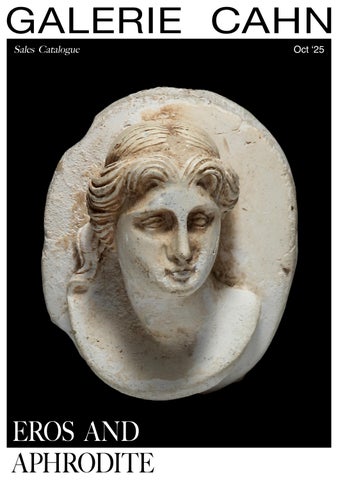
EROS AND APHRODITE
OPENING HOURS
10.00 - 13.00 and 14.00 - 18.00
FOLLOW US
DEAR CUSTOMERS
I am pleased to present to you a monthly selection of works, each dedicated to a specific theme. The first issue is titled Eros and Aphrodite and was coordinated by Joffrey Nogrette, while the design of the catalog was created by Jonas Hernegger.
The monthly issues are diverse in content and compiled exclusively for you. Each month, during the first week, you will receive the latest issue in digital form. In addition to the usual distribution networks, all past and future publications will now also be made accessible to you via issuu.
By doing so, we are consciously embracing the spirit of the times and therefore refraining from printed editions. Each issue thus becomes your digital companion, available to you anytime via smartphone or laptop.
Enjoy! Yours sincerely,
Jean-David Cahn
FOREWORD
by Joffrey Nogrette
In Hesiod’s Theogony, Aphrodite, as she emerges from the sea into the world, is immediately followed by Eros, an older deity personifying the primal force of desire and procreation. The winged god escorts the newborn goddess on her way to join the immortal gods. This inseparable companionship naturally leads to later traditions which reinterpret the ancient figure of cosmic love in a more familiar guise: as Aphrodite’s mischievous and unruly child, armed with bow and arrows – the hand through which his mother exerts her irresistible power.
Together, they inspired widespread popular devotion, expressed through a variety of votive offerings: perfume vases, mirrors, ex-votos in
terracotta, bronze, or marble, often bearing the images of the goddess and her son. Aphrodite, in particular, was called upon to guide young people toward marriage. Her power over marital fate is reflected in the association of her name with the game of astragaloi (knucklebones) (cat. 11), a childhood pastime akin to dice. Used in divinatory practices known as astragalomancy, they were believed to determine an individual’s destiny. The winning throw – one that foretold a favorable marriage for a young girl – was known as ‘the throw of Aphrodite.’
Numerous depictions of Aphrodite recall her marine origins. This applies to the well-known motif of the goddess emerging from a scallop shell (cat. 1). It does not, however,
appear in poetry or art until the late Classical period (4th century B.C.). This moment marks a turning point in the iconography of Aphrodite: the emergence of the familiar image of the goddess in triumphant nudity, exemplified by Praxiteles’ celebrated Aphrodite of Knidos. This statue established the canonical representation of Aphrodite, as a sensuous nude in a graceful, undulating pose, for subsequent centuries. Characteristic features, such as her sophisticated hairstyle, framing the face with symmetrical waves (cat. 2, 14), and the delicate folds of flesh at her neck, known as the “Venus rings” (cat. 15), became inseparably associated with her image.
The iconography of Eros also underwent significant changes over time. Initially depicted as a youth (cat. 6), this portrayal was increasingly supplanted during the Hellenistic period by the well-known image of Eros as a very young infant, depicted with the softness and plumpness characteristic of early childhood (cat. 7). Concurrently, there emerges a tendency to represent Eros not as a solitary figure, but as a company
of Erotes (cat. 8, 9). Combined with vegetal motifs and flower garlands, these playful bands of winged children are traditionally associated to the renewal of the seasons.
Today, depictions of Aphrodite and Eros continue to occupy a central place in our visual culture and often appear as familiar decorative motifs. Yet in the Greek and Roman world, these images possessed a sacred resonance: they were imbued with divine power and never existed merely as ornamentation.
A Statuette of Aphrodite kneeling in a Shell
CHF 18.000
H. 18,8 cm | Terracotta | Western Greek | 4th century B.C.
The nude goddess kneels in a scallop shell. Her bent left arm is placed against her chest and she holds a small bird, presumably a dove, in her hand. Her closed right hand rests on her thigh. Her hair is tied up in a (now lost) chignon at the top of the back of her head. She wears a wreath or diadem of discs in her hair above her forehead. According to Hesiod (Theogony 170 ff.), Aphrodite is the daughter of Uranus. At the behest of his mother Gaia, Uranus’s son Kronos cut off his father’s genitals and threw them into the sea. The sea foamed up around them and gave birth to Aphrodite. Interestingly, apart from a few late, uncertain reports, there is no written record of the goddess being born from the shell. On the other hand, “the foam-born one” is depicted kneeling in or on the open valves of a shell in Greek-Hellenistic coroplastic art. Large areas of white engobe remain on the shell and figure. Traces of red paint in the hair. Chignon and a decorative disc lost, otherwise intact.
PROVENANCE
With MuM AG, Basel, before 1985 (see Widmer negative). Formerly priv. coll. Mr. Pedro Benda (1918-2001), Lausanne; acquired in 1987 at KAM Basel, list no. 111. Since then in the family.
NOTE
On Aphrodite in a shell, cf. LIMC II (1984) 103 f., nos. 1013-1017, pls. 99100 s. v. Aphrodite (A. Delivorrias).
A Statuette of Aphrodite with Mirror
CHF 24.000
H. 22,0 cm | Marble | Eastern Mediterranean, Late Hellenistic to Early Imperial | 1th century B.C.
Venus wears a chiton with sleeves that has slipped down from her shoulders revealing her right breast. The motif underlines the intimacy of the moment showing the goddess at her toilette. Lost in thought, she looks at herself in the mirror she holds in her left hand, unaware that someone could be watching her. With her right hand she grasps her cloak, pulling it across her pelvis just below the pubic area visible under the thin fabric of her robe. Her hair is parted in the middle and pulled to the back of the head in wavy tresses, from where it cascades down the nape of her neck. One of the numerous variants of the theme of Venus at her Toilette, in which various motifs and types associated with Aphrodite/Venus were used. Such statuettes were used mainly to decorate private villas. The flattened reverse flattened suggests that the figure was displayed in a niche. Head with neck reattached. Minor repairs to nose and back of head. Part of the base broken off. Rim of mirror slightly worn. Surface corroded in a few places.
PROVENANCE
Formerly Fragments of Time, USA, prior 1998. Thereafter coll. Dr. med. Sylvia Legrain (1936-2022), Switzerland; acquired 13.2.1999 at KAM Zurich from H.A.C. Kunstwerke der Antike, no. 344.
NOTES
Cf. A. J. M. Kropp, The Aphrodite of Emesa: miniature marble sculpture and religious life in Roman Syria, JRA 29, 2016, 193-222. On the representations of Venus at her Toilette, cf. LIMC VIII (1997) 208-210 s. v. Venus (E. Schmidt).
A Statuette of Aphrodite sitting on a Rock
CHF 8.800
H. 16,5 cm | L 9,1 cm | W 5,2 cm | Terracotta Greek or Western Greek | 4th - 2nd century B.C.
A terracotta statuette of a young woman seated on a rock with her lower legs crossed. She wears a long chiton that covers only the lower part of her body. With her left hand, she appears to be removing the richly pleated himation draped over her shoulder. On the proper right side, the garment has slipped from the woman’s shoulder and is wrapped around her forearm, which is placed across her chest beneath her bare breasts. The figure is designed to be viewed in a manner that focuses on the act of undressing. Therefore, much of the left side as well as the actual back of the figure are worked in lower relief, and here too is the characteristic, rectangular firing hole, that prevents the clay from bursting during firing. The finely modeled features of the young woman are framed by a melon coiffure and disc-shaped earrings. The unmistakably erotic connotations of the motif suggest that the figure may represent the goddess Aphrodite, although an interpretation as a nymph is also be conceivable. Chignon lost. Left earring and the tip of the left foot slightly worn. Extensive sinter deposits on the surface. Remains of white engobe with traces of colour on the garment (light blue) and the rock (greyish).
PROVENANCE
Formerly priv. coll. Eberhard W. Kornfeld (1923-2023), art dealer in Switzerland, since 1960.
NOTES
In ancient art, Aphrodite is often depicted in situations where she plays with or deliberately stages her nudity. This coquettish display of her body is a hallmark of her iconography. Our statuette combines the motif of Aphrodite seated on a rock - well attested in her imagery (for a contemporary example in coroplastic art, see Metropolitan Museum of Art, New York, inv. no. 07.286.9) - with the motif of disrobing, which appears in various types of Aphrodite (cf. for instance the type Aphrodite Fréjus/Venus Genetrix). Interestingly, the viewer is never quite certain whether the goddess is modestly covering herself or coquettishly revealing her body. Another example, Metropolitan Museum of Art, New York, inv. no. 12.232.12, likewise shows Aphrodite seated on a rock, here somewhat elevated, with her upper body already fully exposed.
A Monumental Terracotta of a Semi-Nude Aphrodite
CHF 58.000
H. 62,1 cm | B. 18,5 cm | T. 12,0 cm | Yellow-brown micaceous clay Eastern Mediterranean, probably Asia Minor | 1st century B.C.
The goddess stands frontally, her left elbow resting on a partly fluted column. She holds a corner of her cloak, which is draped around her elbow and back, in her raised hand. The other end rests loosely on the thigh of her relaxed left leg. She grasps the folded edge of the cloak with her lowered right hand. The hair is combed backwards from the temples and tied together at the nape of the neck, forming a bow. Two thick spiral curls rest on her shoulders. The goddess wears a wreath with three inserted flowers and disc earrings. A long necklace with a bulla hangs around her neck, passing between her breasts and reaching down to her navel. The figure is modelled in the round. The back of the head is modelled in detail whilst the back of the body is treated in a cursory manner. A leaf-shaped firing hole on the reverse. The high rectangular base with rims is open at the base. Statuettes measuring 50 cm and above are exceedingly rare, due to their particular fragility. Reassembled; few small restorations. The layer of engobe is largely preserved but is partially sintered and has partially flaked off. Remains of polychromy, mostly discoloured; a pink band below the chest.
PROVENANCE
Formerly Prof. Bieter Wyss, Germany, prior to 1982. Thereafter, priv. coll. Mr. Pedro Benda (1918-2001), Lausanne; acquired in 1982 from MuM AG, Basel, Auction 60, 1982, lot 62. Since then in the family.
NOTES
The closest stylistic and typological parallels to our Aphrodite can be found in statuettes of Eros and Dionysos from Myrina; cf. S. Mollard-Besques, Catalogue Raisonné des Figurines et Reliefs en terre-cuite Grecs et Romains II. Myrina (Paris 1963), pl. 55 g (Myrina 681); pl. 54 f (LY 1501); pl. 93 a–f; for the distinctive shoulder curls, cf. pl. 15 d; pl. 94 e (Myrina 1134). The Leaning Aphrodite type is preserved in numerous variants, cf. in particular the so-called Urania type from Cyrene, see LIMC II (1984) 70 f. nos. 605–622, pls. 60–61 s.v. Aphrodite (A. Delivorrias). The coroplast of our terracotta modified the prototype so that the arms could be cast together with the body rather than being attached separately.
A Plastic Oinochoe shaped as a Woman‘s Head
CHF 1.600
H. 6,3 cm | Matt- brown clay, black glaze | Western Greek 1st half to mid-4th century B.C.
The mold-made body of this scented oil vessel is shaped as the head of a woman with a voluminous coiffure of vibrant curls that form a knot at the back of the head. She wears a wreath decorated with three symmetrically arranged rosettes (the right one missing) which echoes her disc-shaped earrings. A black-glazed trefoil mouth rises from the top of her head. Traces of white and red paint in the hair and on the foot of the vessel. Tip of nose slightly worn; handle and parts of the mouth restored in toned plaster; a few small glaze retouches.
PROVENANCE
Formerly priv. coll Basel, 1990s.
NOTES
For comparable plastic vases, see Maria Trumpf-Lyritzaki, Griechische Figurenvasen (Bonn 1969), 63 „Aphrodite oder Ariadne“ cat. no. 176-180.
An Attic Plastic Oinochoe shaped as Eros
CHF 4.800
H. 13,0 cm | Terracotta | Greek, Attic | ca. 350 B.C.
This „plastic“ vase combines a mold made terracotta figurine of Eros with wheel-thrown oinochoe mouth and neck covered with black gloss. Eros is depicted nude, standing on his left leg and holding a wreath (?) in his left hand, while resting his arm on a pillar. His soft fleshy torso gives him the appearance of a young boy. A crown of leaves adorns his long hair. Directly above his head, attached to the neck of the vase, is a rosette — a common decorative element on fourth-century plastic vases. These hybrid vessels made to contain scented oil were often dedicated in sanctuaries or used as tomb offerings. Restoration in tone plaster at the mouth.
PROVENANCE
With Galerie Antoine Tarantino, Paris, ca. 2000. Thereafter, priv. coll. Michel Meignan (1947-2022), Paris. Old label on the underside of the foot.
NOTES
For other plastic oinochoai in the form of Eros, cf. Toulouse, Musée SaintRaymond, inv. no. 25907; Paris, Musée du Louvre, inv. no. CA 241. On Attic plastic vases: Violaine Jeammet, „Des vases plastiques attiques pour les Athéniens du IVe siècle“ in Dossier: Des vases pour les Athéniens (Paris 2014), pp. 119-143.
A Terracotta Statuette of Eros
CHF 9.600
H. 11,5 cm | Terracotta | Greek, probably Tanagra or Myrina 4th - 2nd century B.C.
Eros is depicted as a winged boy who strides forwards. He is completely wrapped in a cloak, beneath which his round belly is discernable. A wreath of ivy on his head. On a rectangular base. Remains of white engobe on the front. Traces of gilding (on both wings) as well as blue, yellow and pink paint. Both wings reattached. Tip of the right wing restored. Minor chipping at wreath and base.
PROVENANCE
Formerly priv. coll. Ernest Stanislas Le Véel (b. 1874- d. 1951), Paris, antiquarian and art dealer. Inherited by Ernest Armand Georges Le Véel (b. 1905- d. 2000), thereafter by his wife Louise Clémence Escoffier and finally by her daughter M. R., née Bélorgey (b. 1935 - b. 2016), Paris. Since then in the family until 2024.
NOTES
Related to the type S. Mollard-Besques, Catalogue Raisonné des Figurines et Reliefs en terre-cuite Grecs et Romains II. Myrina (Paris 1963) 54, M 52, pl. 65 e (from Myrina); S. Mollard-Besques, Catalogue Raisonné des Figurines et Reliefs en terre-cuite Grecs et Romains III. Epoques hellénistique et Romaine, Grèce et Asie Mineure (Paris 1971) 32, D 171, pl. 39 b (from Tanagra).
Chorus of Erotes
CHF 24.000
H. 7,1 - 9,1 cm | W. 2,6 - 6,4 cm | Terracotta | Western Greek 4th - 2nd century B.C.
The ensemble comprises 22 hand-modelled nude, winged erotes, all depicted seated and mostly wearing a chest band. Based on the different activities they are engaged in, the merry company can be divided into the following groups: A) Four erotes holding a phiale with omphalos in the left hand; the position of the right arm varies. B) Four erotes playing musical instruments, three of them with a tambourine and one with a kithara. C) Four erotes with legs spread apart and in some cases arms extended forward, probably orig nally riding a dolphin. D) Four reading erotes (in one case the tablet or scroll is lost). Six further erotes cannot be assigned to any of the four groups mentioned. Similarities in style and size suggest they belong together as a group, although three of the riders show slightly different body proportions and a darker colouration. The childlike representation of our erotes with chubby body proportions probably originated in Boeotian Tanagra in the 4th century B.C. Eros is frequently attested in funerary contexts, usually in association with Aphrodite; a similar ensemble of terracotta statuettes is known, for example, from the Tomb of the Erotes (Eretria, Euboea). Probably Tarentum or Canosa. The heads of three erotes missing. On some figurines wings, arms, legs, and feet are either partially or entirely lost; occasionally fragments have been reattached. Some figures preserve remains of white engobe and polychromy; for instance, the wings were painted pink in the upper half and blue in the lower half.
PROVENANCE
From the estate of Herbert A. Cahn, Basel, 1990’s or earlier.
NOTES
For the terracottas from the Tomb of the Erotes (Eretria, Euboea), see MFA Boston, inv. no. 97.290–97.317 (online); on the backs of some of these figures, plaster remains bearing the impression of a cord indicate that the winged figures were once suspended. Other examples show a small hole between the wings for suspension. However, as our erotes are all seated, a different display context must be assumed for them. Two erotes in the Getty Museum, Malibu, inv. nos. 96.AD.265.1 and 96.AD.265.2 (from Canosa, online) are stylistically closely related to our figurines. Moreover, they are also seated, have a chest band (painted), and wings in corresponding colours.
A Campana Relief with Erotes and Garlands
CHF 26.000
H. 20,8 cm | L. 48,5 cm | D. 5,8 cm | Terracotta with large inclusions | Roman | late 1st cent. B.C. - 1st half of 1st cent. A.D.
9
Fragment of a relief frieze depicting three Erotes bearing opulent garlands of fruit on a plastically offset ground line. An egg-and-dart moulding at the top of the picture field. Reverse smooth; two oval holes for attachment, profiled rim below. Mould-made. Some surface losses. Campana reliefs are special type of terracotta relief that was used to decorate buildings. They are named after the collection of Marchese Giampietro Campana (1808-1880). These painted terracotta panels decorated temples as well as public (theatres, thermal baths) and private buildings (especially columbaria). The largest and most important workshops were located in Rome and the surrounding area.
PROVENANCE
Formerly Collection of the Swiss industrialist, philosopher and avid collector of antiquities Dr. Arnold Ruesch (1882-1929), Zurich. The object was displayed on a wall in the vestibule of his villa located on the Zürichberg and built in 1920-21. (photograph published in: Das Haus Arnold Ruesch: Architekten Müller & Freytag, in: Das Werk: Architektur und Kunst, vol. 17 (1930), issue 12, p. 380). With Galerie Fischer, Luzern, Sammlung A. Ruesch, Zürich, Griechische, Etruskische und Römische Altertümer, 1-2.9.1936, lot 89. With the Swiss trade; consigned to the English art market, 2018.
NOTES
The egg-and-dart moulding on a relief with Dionysos and a maenad in the Vatican, Museo Gregoriano Etrusco, inv. no. 14157, is stylistically related. Cf. A. Borbein, Campanareliefs. Typologische und stilkritische Untersuchungen (Heidelberg 1968) 35, pl. 4.3. Borbein‘s study also provides a useful introduction to Campana reliefs. For the type, cf. a fragment in the Museum of Fine Arts Budapest, inv. no. T.590.
A Large Terracotta of Hermaphroditos
CHF 28.000
H. 47,9 cm | Terracotta | Western Greek | 4th - 3rd century B.C.
Hermaphroditos, clad only in a coat, stands in a relaxed posture. The weight of the slender female body rests on the right leg, while the slightly bent left leg is placed forwards a little with only the toes touching the ground. The hip of the free leg is distinctly lowered, creating an undulating movement in the upper body. The coat draped around the lower body forms folds at the right hip and has slipped down so far that the penis is completely exposed. The folds running from the right to the left thigh end abruptly. The left leg does not seem to be covered by the garment. The other end of the cloak cascades down the left side of the hermaphrodite‘s body. Both arms are slightly raised and stretched forwards. The left forearm probably originally rested on a support, such as a tree trunk or pillar. The head is inclined slightly to the right and downwards. The long hair is parted in the centre and tied together. The hair at the front of the head forms a bow. A flower (?) above the for head. Disc-shaped earrings. Aphroditos is the male form of Aphrodite and was mainly worshipped in Cyprus. In the mythological interpretation provided by Ovid, Hermaphroditos is the son of Aphrodite and Hermes who merged with the body of the nymph Salmakis on embracing her (Metamo phoses 4, 370). Thus, he has both female and male physical characteristics. The reverse is not modelled in detail and has a round firing hole. Right arm reattached. Surface with sinter deposits. Slightly worn. Traces of polychromy.
PROVENANCE
Formerly priv. coll. Mr. Pedro Benda (1918-2001), Lausanne, prior to 2000. Since then in the family.
NOTES
Our statuette is typologically related to a Hellenistic statue type that is exemplified by a life-size marble statue from Pergamon, cf. LIMC V (1990) 273, no. 18, pl. 191 s. v. Hermaphroditos (A. Ajootian); cf. also the lower body fragment of a marble statuette in the Antikensammlung Berlin, inv. no. AvP VII 199 (Arachne, DAI database - 1149811, online). In contrast to our statuette, in both the examples cited the left free leg is covered by the garment but is clearly visible under the fine fabric of the chiton. The motif may have been misunderstood or simplified by our coroplast, as the type also makes sense in this form. A terracotta statuette in the Louvre, Paris, inv. no. 3451, is stylistically and typologically related, cf. LIMC op. cit., no. 21, pl. 192 (from Centuripe).
A Group of five Astragaloi
CHF 4.600
L. 1,3 - 1,6 cm | W. 0,9 - 1,2 cm | Rock crystal, carnelian, haematite, agate, steatite | Greek or Roman | 4th century B.C. - 3rd century A.D.
A group of five astragaloi varying in material and size. Astragaloi imitated the shape of the ankle bones of sheep or goats and were used in Antiquity for various dice and skill games. In the five-stone game (Pentelitha), for example, five astragaloi were tossed into the air, and the player had to try to catch as many of the bones as possible on the back of the hand (cf. Poll. Onomastikon 10, 119). Playing with astragaloi has a long tradition and is even mentioned by Plato in one of his dialogues (Lysis 206 e). Early examples were found in a Late Minoan tomb as well as in Egyptian tombs dating from the New Kingdom. In the Roman Imperial Period, playing with knucklebones was very popular among children, as evidenced by finds of astragaloi in children’s graves. The so-called “Knucklebone Player” in the Antikensammlung Berlin (inv. no. Sk 494), a Roman reinterpretation of a late Hellenistic statue type enhanced with the gesture of play, provides an impressive three-dimensional example of a child playing with astragaloi, in this case a young girl. In the context of divination using astragaloi (astragalomanteia), the bones functioned as oracles of love and fate and were there associated with the goddess Aphrodite. This explains why they are somet mes found as votive offerings in her sanctuaries. In Roman times, the best throw (when all four astragaloi landed on different sides) was known as Ia tus Veneris (cf. Cic. Divinatio 1, 28). Propertius uses the metaphor of Cupid as a player with astragaloi (Prop. 3, 10, 27-28). Our astragaloi is somewhat smaller than usual, suggesting that they were originally intended for a child. Often made in terracotta, bronze, bone, or glass, the choice of materials for our set - especially in this combination - is unusual. Intact.
PROVENANCE
Formerly priv. coll. Eberhard W. Kornfeld (1923-2023), art dealer in Switzerland.
NOTES
For examples of astragaloi, cf. British Museum, London; inv. no. 1867,0508.563 (rock crystal); inv. no. 1927,1115.18 (steatite); inv. no. 1772,0311.206 (agate).
For very early examples of astragaloi, cf. Metropolitan Museum of Art, New York, inv. no. 16.10.505a–c. For a Hellenistic terracotta group of two girls playing with astragaloi, cf. British Museum, London, inv. no. 1867,0510.1. On astragalomanteia, especially in connection with Aphrodite/Venus, cf. S. Constanza, Venus Playing with Astragals: Erotic Oracles and Prayers in Astragalomancy (2023).
An Intaglio with seated Aphrodite
CHF 3.400
H. 1,0 cm | B. 0,7 cm | Chrome chalcedony | Late Hellenistic to Roman Early Imperial | 1st century B.C. - 1st century A.D.
Upright oval gemstone with Aphrodite/Venus seated to the right on a profiled, garland-decorated pedestal (or altar). Her long hair is rolled up at the sides, with curls falling onto her shoulders. The goddess’s upper body is completely nude, while a diaphanous mantle is draped around her lower body. In her left hand she holds a palm branch, with her right hand she supports herself. In the background a herm on a profiled base, with a frontally rendered cock beside it. Small chip at the upper edge.
PROVENANCE
Formerly priv. coll. Rudolf and Monika Kühne, Switzerland, built up since the 1960s; acquired in 1996 from Frank Sternberg AG, Zurich, Auction XXVI, lot 541. Thence by descent.
NOTES
The depiction of the seated, half-nude Aphrodite/Venus, clothed only with a mantle loosely draped around her hips, goes back to Hellenistic prototopes; however, the goddess is usually shown seated on a rock. A plaster cast from Mit Rahine (Memphis) presents Aphrodite in a very similar pose; see LIMC (1984) 94 no. 886, pl. 88 s. v. Aphrodite (A. Delivorrias).
An Intaglio with the Bust of Aphrodite
CHF 8.500
H. 1,3 cm | B. 1,0 cm | Red Jasper | Late Hellenistic to Roman Early Imperial | 1st century B.C. - 1st century A.D.
Upright oval gemstone engraved with the bust of a woman facing left. Her diadem and the garment slipping from her left shoulder, thereby exposing the left breast, allow a secure identification as Aphrodite/Venus. The motif, unquestionably imbued with erotic connotations, derives from the Aphrodite Fréjus type. The hairstyle recurs, in combination with the diadem, in the so-called Venus of Capua: the long hair is swept sideways over a fillet and tied into a bun at the nape of the neck, while individual loosened curls fall onto the shoulders. The workmanship is of exceptionally high quality; the engraver has carefully polished the areas of flesh, while leaving hair and drapery in a matte finish. Intact, with slight wear along the edge.
PROVENANCE
Formerly priv. coll. Monika Kühne., Switzerland, collection built up since 1960; acquired from Frank Sternberg AG, Zurich, Auction XXV, 25.11.1991, lot 727.
NOTES
On the hairstyle of the Venus of Capua, cf. the eponymous marble statue discovered in the amphitheater of Capua, see LIMC II (1984) 72, no. 627, pl. 61 s. v. Aphrodite (A. Delivorrias). On the Aphrodite type Louvre–Naples (also known as the Fréjus type or Venus Genetrix), see ibid., 34–38, nos. 225–255, pls. 25–29.
Wax impression of Catalouge Number 13
Wax impression of Catalouge Number 12
A Cameo possibly showing Aphrodite
CHF 26.000
H. 3,4 cm | W. 2,7 cm | D. 2,4 cm | Silicate stone (burnt chalcedony)
Greek Hellenistic | 3rd - 1st century B.C.
The bust of a woman is worked almost in the round and emerges from a circular plaque. Her head is turned distinctly to the left. The eyes are framed by pronounced lids. The upper lids almost touch the slightly bulging brows. Viewed in profile, the low forehead and long bridge of the nose form a straight line. The contour of the broad neck echoes the outline of the face. Both the neck, that forms a slightly convex curve in profile view, as well as the heavy, slightly sagging, almost double chin, suggest a degree of corpulence. These features may indicate an individualized portrait. The wavy hair is parted in the middle, twisted together at the sides and tucked though a band. On the right side, the back sections of hair cascade onto the shoulder. Broad neck. The bust is left plain. If not a portrait, the head is most probably a depiction of Aphrodite, especially given the coiffure. The entire surface is covered with a fine, delicate beige glaze. Rim slightly worn. Glaze partially abraded.
PROVENANCE
Formerly English priv. coll., formed between 1965 and 2018.
NOTES
Many examples of cameo portraits with the bust emerging frontally from the relief ground (and with a slight turn of the head) dating from the Augustan Period onwards are known, cf. W.-R. Megow, Kameen von Augustus bis Alexander Severus (Berlin 1987) 186f, A 63, pl. 14, 11; 288f., D 2-3, pl. 7,13. 15; 294 f, D 20-21, pl. 7, 17-18. However, hardly any examples are known from the Hellenistic Period. In his preface, Megow mentions that although the majority of Hellenistic cameos are now lost, „numerous iconographic elements of early imperial cameo depictions are unquestionably taken from Hellenistic models“. A sardonyx cameo, formerly from the Fürstenberg Collection, Donauseschingen, with the portrait bust of a woman, is similar in composition to our piece, cf. M.-L. Vollenweider, Deliciae Leonis. Antike geschnittene Steine und Ringe aus einer Privatsammlung (Mainz 1984) 155, no. 264 with illus. Vollenweider identifies the figure as a Ptolemaic ruler and dates the piece to the 2nd half of the 2nd cent. B.C.-early 1st cent. B.C. The style and physiognomic details of our portrait can be compared with those on Ptolemaic jugs depicting various Ptolemaic queens, and more rarely kings, in relief, although the portraits on the jugs were made using moulds whereas our cameo was carved; cf. the fragment of a Ptolemaic jug in The Walters Art Museum, inv. no. 48. 309 (online). Similar features include the eyes that are emphasised by the pronounced shadows cast on them and the broad lids framing them, the sharp-edged brows, which merge almost at right angles into the long, narrow bridge of the nose, the small, narrow but full-lipped mouth, the small protruding chin, the elongated facial shape, the fullness of the lower half of the face in profile, which is termed trophe in connection with Hellenistic portraits of rulers, and the relatively broad neck. The bust, which shows no indication of a garment and is thus possibly intended to suggest nudity, could on the other hand speak in favour of the depiction of the goddess Aphrodite/Venus.
A Life-size Portrait of the Empress Faustina Maior
CHF 48.000
H. 32,5 cm | W. 20,8 cm | Marble | Roman Antonine Period
2nd century A.D.
Life-size or slightly larger than lifesize portrait of a woman. The head has technical features that indicate a later reworking in Antiquity. The first version originally depicted Aphrodite/Venus, whose hairstyle type corresponds to that of the Capitoline Venus. At a later point in time, probably in the early Antonine period, but certainly in the course of the 2nd century A.D., the head was reworked, turning it into a portrait. There are striking physiognomic similarities with the portraits of Faustina the Elder (105-140 A.D.), the wife of Emperor Antoninus Pius. These include the oval shape of the face, the outward sloping brows, the prominent eyelids, the small mouth with a curved upper lip that protrudes slightly over the fuller lower lip and the round, slightly receding chin, below which a slight double chin is visible. The upper eyelids do not droop quite as much as in other portraits of the empress, and the pupils are drilled slightly below the upper lids, so that her typical „sleepy“ look is lost. In order to create the portrait features, parts of the face were carved in a lower position, as can be recognized, i.e. in the flattened mouth area. The surface polish in the reworked areas differs slightly from that of the first version. Traces of the reworking can also be seen in the hair, particularly in the side sections and the two strands that are drawn back over the forehead. Here drilled channels characteristic of the Antonine period enliven the original hairstyle
with striking accents of light and shade. Traces of the first version are still recognisable in places. The former hair bow on the top of the head has been made smaller, particularly at the sides (traces of the drill used for this purpose can still be seen in places), presumably in order to make the coiffure more similar to that found in all three portrait types of Faustina which is characterized by a chignon. As the hair is parted in the centre, the hairstyle corresponds to the so-called simple portrait type. The broken surface of the nape of the neck was roughly smoothed in Antiquity (especially around the edges). It is possible that the statue to which our portrait head once belonged was originally placed in a niche, so that the back was not intended for viewing. The fact that the sculptor did not go to the trouble of reworking the hair between the forehead hair and the chignon may reflect the wish to reduce the amount of work involved, but it is also possible that this was deliberately intended. The practice of presenting oneself in the guise of various goddesses (the concept of the „Diva Augusta“),
which was a feature of the ruler‘s cult and is attested for numerous Roman empresses. The fact that Faustina was deified immediately after her early death in 140 A.D. is in tune with such an approximation, especially as portraits of Faustina were also demonstrably created posthumously. The conspicuous flattening of the forehead hair can be linked to a remarkable detail in the side sections of the hair.
On both sides, one (on the left side even a second) hole can be recognised in the strands of hair. These presumably served to attach a wreath or something similar - an important feature that speak for the identification of our portrait as a portrait of an empress. The preserved base of the neck shows that the head is turned slightly to the right. Nose reattached and probably belonging. Surface slightly worn. Brownish deposits in places.
PROVENANCE
Formerly with Pino Donati Arte Classica AG, Lugano, prior 1972. Thereafter, priv. coll. Hans Krattiger (stepfather of Heinrich Müller), Therwil; bought in 1973 from MuM AG, Basel. See letter dated 1997 between Ms. Krattiger and H.A.C. AG, Basel.
NOTES
On the portrait and portrait types of Faustina Maior, cf. M. Wegner, Das römische Herrscherbild. Die Herrscherbildnisse in antoninischer Zeit (Berlin 1939) 26-32, pls. 10-13; K. Fittschen - P. Zanker, Katalog der römischen Porträts in den Capitolinischen Museen und den anderen kommunalen Sammlungen der Stadt Rom 3. Kaiserinnen- und Prinzessinnenbildnisse (Mainz 1983) cat. nos. 13-18. On the depiction of the empress in the guise of a goddess, cf. K. Maciver, Empress and Goddess: Julio-Claudian Women in the Imperial Cult (Diss. Hamilton 2001); A. Alexandridis, Die Frauen des römischen Kaiserhauses. Eine Untersuchung ihrer bildlichen Darstellungen von Livia bis Iulia Domna (Mainz 2004) 82-92; two replica portrait heads (cat. nos. 147-148, pl. 31, 3-4), which Alexandridis associates with Iulia Titi, show the sitter with a hairstyle typical of Venus, as is the case with to our portrait head. According to Alexandridis, however, approximations to Venus are also encountered in private portraits from the Flavian period onwards at the latest. For further examples of Roman Empresses represented as goddess cf. (cf. Livia as Ceres, as a life-size marble statue in the Louvre, Paris, inv. no. MR 259; depictions of Faustina Maior with cornucopia on the so-called Parthian monument from Ephesus, Kunsthistor. Mus. Vienna, Inv. I 1656 and as a marble statue in the Capitoline Museum Rome, inv. no. 48; a bronze statuette of Isis-Aphrodite with portrait features in the Metropolitan Museum of Art, New York, inv. no. 46.2.2, for which an identification as Faustina Minor has been suggested; a group of statues of Faustina Minor and Marcus Aurelius as Aphrodite and Mars, Capitoline Museums Rome, inv. no. 652.
IMPRINT
Texts
Design
Translations
Photos
Ulrike Haase, Joffrey Nogrette, Charlotte Chauvier
Jonas Hernegger, Jean-David Cahn
Yvonne Yiu
Niklaus Bürgin
Published by Galerie Cahn. Your Partner in the Antique Trade since 1863.
CONDITIONS OF SALE
As of September 2025. The place of execution is Basel.
1) Jean-David Cahn AG (hereafter „the Seller“) hereby confirms that it has the right of disposal over the objects for sale according to Art. 18 KGTG. Any further warranty is excluded.
2) The specifications and descriptions given in this catalog are provided in good faith. Nevertheless, their accuracy cannot be guaranteed.
3) The seller guarantees that the sales objects were made in Antiquity. This guarantee, which is granted to the buyer only, is valid for two years after the conclusion of the sales contract.
Other substantiated complaints shall be communicated to the Seller in writing at its domicile, as above, within 14 days of receipt, and at least three months after the conclusion of the sales contract.
Any complaints made later cannot be considered further. All liability for any loss or damage sustained during transportation is excluded.
Insurance during transportation is the Buyer‘s responsibility.
4) The objects are sold in the condition they were in at the time of the sale („sold as seen“). Complaints regarding the authenticity of a piece (subject to lit. 3) shall be communicated to the Seller in writing at its domicile (Jean-David Cahn, Malzgasse 23, P.O. Box 217, 4010 Basel) upon detection and at the last two years after the conclusion of the sales contract.
5) The delivery and storage of sold objects shall be at the Buyer‘s risk and
expense (costs arising from storage, packaging and transportation, any additional costs and expenses, all plus VATs) unless otherwise agreed in writing.
6) Foreign and Swiss customs, duty and shipment shall be borne by the Buyer. Declaration fees for the import into the EU are borne by the Seller if used through the services provided by the Seller. It is the responsibility of the Buyer to comply with foreign and Swiss customs and foreign exchange regulations and to obtain an EU import license through the services of the Seller. The Buyer is aware of the relevant import and export regulations of the EU and has consulted the website of the Swiss Federal Office of Culture Bern (www. bak.admin.ch/kgt) for details of the Swiss import and export regulations currently in force, as well as further provisions. The Seller declines all responsibility for any consequences arising from the contravention of such regulations. The Buyer acknowledges that a valid import permit is required for the importation of the artworks transferred under this purchase invoice into the European Union. If such a permit is not available at the time of purchase, the approval process may take between four to six months. The registration and execution of the import procedure will be carried out by an art shipping agent appointed by the Seller within the EU. The Seller will organize this process in the name and on behalf of the Buyer. The Buyer is required to conduct the import procedure through the shipping agent designated by the Seller. Alternatives are the responsibility of the Buyers.
7) The Buyer is personally liable for all acquisitions made; he/she cannot claim to be acting for a third party or person. If a person acts as a representative, written proof of authorization may be requested; the Buyer as well as his/her representative can both be held jointly and severally liable for the purchase and for all other costs. The Buyer shall be liable for any damages caused by delayed payments, in particular for exchange rate and interest losses. Payments by cheque or by the internet shall be deemed to have been received only on clearance by the relevant bank.
8) Payment shall be due upon the conclusion of contract, but at the latest 30 days after the invoice is issued. Interest of 1.5% per month will be charged for payments made after 30 days. Payments can be made in cash, by bank transfer or by cheque. The Seller may ask for proof of creditworthiness. Title shall be transferred only upon receipt of payment in full; all risks, however, shall pass to the Buyer upon conclusion of the sales contract.
9) If payment is delayed, the Seller can, after giving the Buyer due notice, withdraw from the contract forthwith. This also applies in cases where the object has already been transferred to the Buyer‘s possession at the Buyer‘s cost. The object in such a case must be handed back to the Seller upon request. Additionally, the Seller may claim further damages.
10) If the Buyer does not collect the object, the Seller can choose either to cancel the contract after 30 days and to claim compensation or to store the object at the Buyer‘s expense and to demand that the
Buyer collects it.
11) ALL SALES
ARE TRANSACTED IN BASEL, SWITZERLAND, WHICH IS THEREFORE THE PLACE OF FULFILLMENT AND THE COURT OF JURISDICTION.
The conclusion of contract, the quotation and the negotiations are subject to Swiss law, exclusive of the United Nations Convention on Contracts for the International Sale of Goods (CISG). By buying, the Buyer recognizes the exclusive right of the court of Canton Basel-Stadt, Switzerland, and of its jurisdiction. All sales are subject to Swiss jurisdiction. All parties recognize the exclusive choice of Swiss jurisdiction for the settlement of any matters arising from the conclusion of the sales contract.
12) All purchases and deliveries are performed solely on the basis of these conditions of sale. Any references by the Buyer to his/her terms and conditions are herewith expressly excluded.
13) Should individual provisions become fully or partially void after the conclusion of contract due to
changes in the law, the validity of the remaining provisions and of the contract shall remain unaffected. The invalid provision shall be replaced by that provision which is closest in meaning and intention to the original provision.
14) The Buyer accepts the condition of the sales as above. He/She explicitly accepts the exclusive right of the courts of Basel-Stadt, Switzerland, and their jurisdiction, exclusive of the United Nations Convention on Contracts for the International Sale of Goods (CISG), over the quotation, the negotiations, and the sale.
15) The conditions of sale are provided in German and English, the German version being the definitive and legally binding one in the event of any disputes.
GENERAL ABBREVIATIONS
BAPD
ca.
Cat.
cent.
Coll.
DAI
H.
H.A.C
illus.
inv. no.
KAM
LIMC
MuM
pl.
W.
Beazley Archive Pottery Database
Circa
Catalogue
Century Collection
Deutsches Archäologisches Institut
Height
Herbert A. Cahn, Basel (1988 - 1999)
Illustration
Inventory number
Schweizerische Kunst- und Antiquitätenmesse (Swiss Art and Antiques Fair).