Cahn’s Quarterly 1/2021 English Edition
Editorial Dear readers I hope 2021 finds you well. Here in Basel, the calmer winter months have allowed us time to scrutinize and reorganize our archives. We are also looking forward to utilizing our enormous new showroom to present projects organized by Cahn Contemporary. Since we were all feeling the isolation of working at home, we resumed shooting videos in the gallery. Retaining the format of homespun iPhone cinematography, we have produced improvised, off-the-cuff discussions of a range of topics to share with you. It is a fun diversion for us, and we hope for you as well. We will be posting these videos on YouTube and Instagram, as well as emailing them to you on a bi-weekly basis. Also in the technological realm, we are delighted to announce the launch of a new website this spring. This will enable us to share more of our artworks, exhibitions, and musings with you. I am very honoured that Klaus Fittschen contributed an essay on photographic documentation in classical archaeology to this issue of Cahn’s Quarterly. I would like to take this as an opportunity to discuss my own experience with light and sculpture, a theme which confronts me on a daily basis. Lighting is an extremely important tool for displaying sculpture, and it is astonishing how little attention is given to it in the training of archaeologists – all the more so, as its importance was highlighted by Ernst Langlotz as long ago as the early twentieth century. Depending on the angle of the light, the added drama through shadows, and so forth, one’s impression of a sculpture changes drastically. In museums, the subject of light is all too readily delegated away to light technicians. Without critical reflection, every new technology is immediately embraced, and money spent to be up to date, although as with all new technologies, there are bound to be teething problems to be overcome. In the extreme, one could argue that the best light is, in fact, found in Greek provincial museums, where there is simply only daylight – depending on the weather either crisp or soft. We forget that in ancient contexts, sculptures were either displayed outside – thus with their appearance changing throughout the CQ
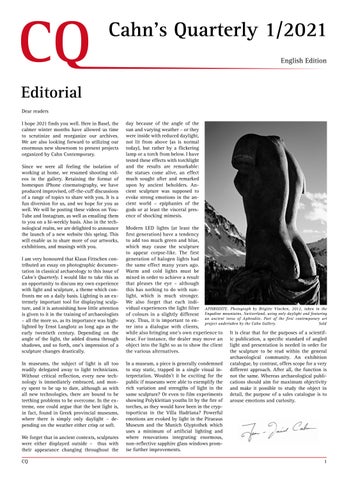
day because of the angle of the sun and varying weather – or they were inside with reduced daylight, not lit from above (as is normal today), but rather by a flickering lamp or a torch from below. I have tested these effects with torchlight and the results are remarkable: the statues come alive, an effect much sought after and remarked upon by ancient beholders. Ancient sculpture was supposed to evoke strong emotions in the ancient world – epiphanies of the gods or at least the visceral presence of shocking mimesis. Modern LED lights (at least the first generation) have a tendency to add too much green and blue, which may cause the sculpture to appear corpse-like. The first generation of halogen lights had the same effect many years ago. Warm and cold lights must be mixed in order to achieve a result that pleases the eye – although this has nothing to do with sunlight, which is much stronger. We also forget that each individual experiences the light filter APHRODITE. Photograph by Brigitte Vincken, 2012, taken in the of colours in a slightly different Engadine mountains, Switzerland, using only daylight and featuring way. Thus, it is important to en- an ancient torso of Aphrodite. Part of the first contemporary art project undertaken by the Cahn Gallery. Sold ter into a dialogue with clients, while also bringing one's own experience to It is clear that for the purposes of a scientifbear. For instance, the dealer may move an ic publication, a specific standard of angled object into the light so as to show the client light and presentation is needed in order for the various alternatives. the sculpture to be read within the general archaeological community. An exhibition In a museum, a piece is generally condemned catalogue, by contrast, offers scope for a very to stay static, trapped in a single visual in- different approach. After all, the function is terpretation. Wouldn’t it be exciting for the not the same. Whereas archaeological publipublic if museums were able to exemplify the cations should aim for maximum objectivity rich variation and strengths of light in the and make it possible to study the object in same sculpture? Or even to film experiments detail, the purpose of a sales catalogue is to showing Polykleitian youths lit by the fire of arouse emotions and curiosity. torches, as they would have been in the cryptoporticus in the Villa Hadriana? Powerful emotions are evoked by light in the Piraeaus Museum and the Munich Glyptothek which uses a minimum of artificial lighting and where renovations integrating enormous, non-reflective sapphire glass windows promise further improvements. 1