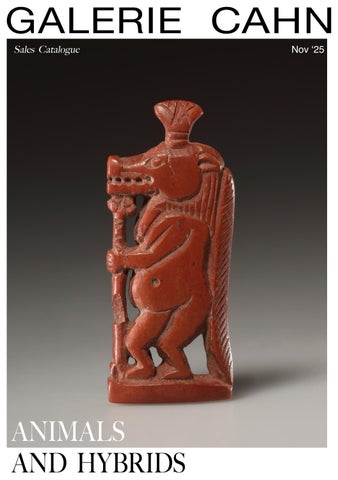
Animals and Hybrids

Packaging, insurance and transport are at the expense of the purchaser. All prices in Swiss francs netto.
![]()

Packaging, insurance and transport are at the expense of the purchaser. All prices in Swiss francs netto.
Monday to Friday
Saturday to Sunday
10.00 - 13.00 and 14.00 - 18.00
Closed
Wednesday, 12. Nov.
Thursday, 13. Nov.
Friday, 14. Nov.
Saturday, 15. Nov.
Sunday, 16. Nov.
16.00 - 20.00
11.00 - 19.00
11.00 - 19.00
11.00 - 19.00
11.00 - 17.00
During the Antike in Basel fair the gallery space in Malzgasse 23 remains open for the weekend.
Dr. Ulrike Haase
ulrike.haase@cahn.ch
Tel: +41 61 561 67 04
Joffrey Nogrette
joffrey.nogrette@cahn.ch
Tel: +41 61 561 67 00
Charlotte Chauvier
charlotte.chauvier@cahn.ch
Tel: +41 61 561 67 02
Galerie Cahn
www.cahn.ch
Tel: +41 61 561 67 55
|
|


by Jean-David Cahn
Why publish a catalogue on animals?
What makes this topic so special? For me, it is deeply personal. As a child, I was captivated by the animal world. I loved Alfred Brehm’s encyclopaedic “Tierleben” as well as the magazine “Das Tier”, both of which I read attentively. Indeed, it was my dream to become a zoologist. My path ultimately led me in a very different direction, but my fascination with animals has stayed with me to this day. I am well aware that we humans are only part of a larger whole and that we are guests here. Sadly, however, we are not always respectful guests and often act selfishly, to the detriment of the community. Too often, we show insufficient respect for our fellow living beings. Yet science has shown that animals, like us, have complex systems of interaction, experience
emotions and are capable of feeling empathy. Even plants, according to recent research, can communicate with each other.
Industrialization and urbanization have estranged us from the animal kingdom. We tend to focus mainly on their usefulness to us, whether as a source of food or as pets and companions. Conversely, we prefer to close our eyes to everything unpleasant, such as the odor of feces, the act of butchering, and the primordial violence animals are capable of.
This catalogue with representations of animals from Antiquity is a response to my desire to revitalize our bond with these fascinating creatures, which are at once so close to us and yet so distant. I find it remarkable, that as soon as humans developed
the ability to express themselves through art, they created images of the animals that were relevanant to their lives – animals they hunted for food, predators that threatened them, and later, also domestic animals. In Antiquity, animals were ubiquitous, people were constantly surrounded by them, their smells and noises. Beyond their practical uses, animals were also used as symbols and metaphors, or to represent deities. Often, human and animal forms were fused to create hybrid creatures that belonged to both realms.
The selection of art works and artefacts presented here can offer only a glimpse of the rich visual language that was inspired by the deep interconnectedness between humans and animals in ancient times.
I wish you an inspiring journey!


CHF 3.600
9th - 8th century B.C. | Luristan
H. 14,4 cm | W. 9,1 cm | Bronze
A bronze standard finial in the form of two upright, antithetical quadrupeds with curved horns, probably intended to represent caprids. The front and hind legs of the animals are connected by a ring each. The hindquarters are modeled in relief, and the backs are decorated with a corded band, possibly to indicate fur. Bronze standards are characteristic of Luristan culture. Their exact function is not clearly understood, but certain find contexts suggest that they were linked to sepulchral practices. It is also known that the two central rings served to mount the animals on a bottle- or bellshaped bronze base (also interpreted as stands). These, being hollow, could themselves be placed onto something else. In addition to caprids, panthers and horses are used to decorate
standard finials. The animals were all represented in a stylized manner. Surface slightly corroded.
For a standard finial with caprids which preserves the tube inserted into the two rings, cf. Metropolitan Museum of Art, New York, inv. no. 32.161.8 (online). For Luristan standard finials, cf. also G. Zahlhaas, Luristan. Antike Bronzen aus dem Iran (Munich 2002), 85–89, nos. 180–188; for the different types of standard stands, cf. ibid., 90, no. 189.
Formerly priv. coll. Lotti Hohl, Switzerland; acquired in 1986 from Heidi Vollmoeller, Zurich (see invoice and handwritten notes from the coll.).
CHF 5.600
8th - 7th century B.C. | Luristan | Bit L. 18,2 cm
Horses L. 9,5 cm and 9,8 cm | Horses H. 8,4 cm and 8,9 cm | Bronze
The three-part horse bit consists of a rigid mouthpiece with a square cross-section and volute-shaped, coiled ends that served to attach the reins, as well as two cheekpieces in the shape of horses walking along a ground line. The bodies of the animals are modeled in relief only on the front side; eyes, ears, and collars are rendered in raised relief. The mouthpiece could be inserted through the round opening in the chest area of each horse. Straps for better weight distribution were probably threaded through the loops attached to the head and hindquarters of the horses. Two spikes on the reverse. Horse bits belong to the characteristic repertoire of the Luristan bronzes and attest to the significance of these animals, which the wealthy upper class used
to display their prestige. Other figural motifs used to decorate the cheekpieces, besides horses, include ibexes, mouflons, birds, and various hybrid creatures. Since almost all examples have spikes on the reverse— presumably used as goads—and their size is suitable for horses, it is likely that these bits were actually used. Sometimes, the mouthpieces were later placed in graves as symbols of the deceased person’s social status. Intact. Surface partially encrusted.
NOTE
Cf. G. Zahlhaas, Luristan. Antike Bronzen aus dem Iran (Munich 2002) 103 f., cat. nos. 216-217.


Formerly priv. coll. Robert Aeschbacher (1915-1944), medical doctor, Switzerland; inherited in 1994 by his son, Herrliberg, Switzerland.

CHF 2.800
8th - 7th century B.C. | Luristan
H. 28,3 cm | W. 6,7 cm | Bronze
The bronze standard depicts the “Master of Animals,” a motif found in various ancient cultures. In this case, the tubular body of a figure with a human head is flanked by two antithetically arranged feline predators, probably lions or panthers. The front and back are identical and equally modeled in the round. The gaping jaws of the animals are connected to the oversized, zoomorphic ears of the human head. Their necks emerge from the tubular body of the human figure, above which the animals’ paws are rendered in low relief. The lower half consists of the rounded, strongly protruding hindquarters and the bent legs of the animals, each with a loop at the lower end. A distinctive feature of this example is the separately made base—often lost in comparable
pieces—which is generally interpreted as a standard stand. It has a belllike shape, though it does not flare outward at the bottom, and is hollow on the inside. Its tubular upper section terminates in a conical plate from which a small, modern sleeve emerges, allowing the figural part of the standard to be mounted. The original connecting rod is lost. The find contexts of this and other types of bronze standards suggest that the present example had a funerary association, although this may have been the object’s secondary function. The condition of the surface, which is partly reddish due to cuprite encrustation and shows isolated green oxidation, suggests that both parts originally belonged together. Intact.
Cf. G. Zahlhaas, Luristan. Antike Bronzen aus dem Iran (Munich 2002) 109-116, cat. nos. 230-240 with various examples of this standard type. On the different types of standard bases, cf. ibid., 90, cat. no. 189. For a specimen that is almost identical to the present example, cf. British Museum, London, inv. no. 1854,0401.30. The „Master of Animals“ is also found on bronze pin heads from Luristan. There, the motif is varied to an even greater degree than on the standards. Cf. Zahlhaas, ibid, 70 f., cat. nos. 141-143.
Formerly private collection Robert Aeschbacher (1915-1944), medical doctor, Switzerland; inherited in 1994 by his son, Herrliberg, Switzerland.


CHF 2.400
2nd half of 2nd mill. B.C. - 1st half of 1st mill. B.C. | Egypt, New Kingdom or Third Intermediate Period | H. 2,4 cm | L. 3,4 cm | Faience
Flat, plastically modelled head of an antelope. The mouth is opened, revealing teeth, that are rendered in detail. Horns and eyes accentuated in black. Longitudinal drill hole; probably a spout from a vessel. Left ear and horns partially preserved. Glaze abraded on one side.
NOTE
Cf. Musée du Louvre, Paris, inv. no. E 11354; likewise with longitudinal drill hole (online).
PROVENANCE
Formerly priv. coll. Saoud Al Thani (1966-2014); French art market 2019.

CHF 8.500
ca. 600 B.C. | Egypt, Late Period, 26th Dynasty
L. 65,3 cm | W. 22,5 - 22,8 cm | Linen, painted Stucco
Mummy-cover made of stuccoed and richly polychromed linen. The painting is divided into ten horizontal registers, which are further subdivided into individual fields. The second and fourth registers are adorned with cube and dot patterns. In the other fields, various deities are depicted, who were supposed to accompany and protect the deceased on his journey to the afterlife. All figures face towards the centre. The goddess Nut, who symbolises the vault of the heavens, is represented several times. In some fields, she is depicted seated with the feather of Maat, the goddess of justice. Two large fields show the god Anubis in his jackal-headed form in an antithetical arrangement. A hieroglyphic inscription runs vertically through the centre, dividing
the lower six registers into two halves. It refers to the deceased male individual: „Words to be spoken: O Osiris Tja-pa-rer-imou/Nys (?), born of Ta-cheret-toutou, justified of voice / May you live, may your name live, may you be rejuvenated, may your limbs be rejuvenated / May you go forth and return like Re, may your ba live with Osiris” (translation by Prof. Olivier Perdu). A flower with several petals in both of the lower corners. Bands of red, blue and green rectangles and bundles of black and white lines frame the painting as a whole and also separate the individual registers. Several tears, some with minor lacunae.


NOTE
The cartonnage was probably placed on the lower half of the mummy, cf. the mummy of Pacherimin in the Louvre, Paris, inv. no. N 2627 (online).
Formerly priv. coll. Alfred Reinhart (187-1935), Egypt; inherited by Carl
Leonhard Burckhardt (1902-1965) and Marianne Burckhardt-Reinhart (1905-1981), Egypt. Thereafter by descent to Rosmarin CereghettiBurckhardt (b. 1929 in Alexandriad. 2022 in Basel). By descent in the family.
CHF 5.800
mid - 1st mill. B.C. | Egypt, Late Period
H. 18,4 cm | L. 30,9 cm | D. 1,8 cm | Wood, stuccoed and painted
Long or narrow side of an ushabti box with a stuccoed and painted exterior. In the white picture field that is framed by a thin black line, the deceased — an official — is shown making an incense offering to Anubis. The jackal-headed god is depicted in a striding pose, wearing a short skirt, and holding an ankh in his right hand and a was-scepter in his left. A hieroglyphic inscription between the two figures. The area surrounding the picture field is painted red. Two trapezoidal projections on both the left and right sides. These tenons were designed to slot into matching mortises on the neighboring panels. To the left and right of each tenon, wooden dowels — remnants of which are still preserved — provided additional stability. Two further dowel
holes at the edge of the pictorial field. Deposits of clay (?) mixed with fine remains of straw along the edges of the reverse. The box was used to store ushabtis, small funerary figurines mostly made of faience, that symbolically performed various tasks in the afterlife on behalf of the deceased, especially agricultural labour. A portion of the lower edge is broken off. Minor chipping.


For an ushabti box with similar joins, cf. Vienna, Kunsthistorisches Museum, Egyptian Collection, inv. no. A 2126 (online).
Formerly priv. coll. Carl Leonhard Burckhardt-Reinhard (1902-1965), collection built up since 1922, Egypt. Inherited by his son Christopher Burckhardt in 1966, Switzerland. Since then in the possession of his wife. On the back remains of an old collection label (not legible).
CHF 6.600
7th - 1st century B.C. | Egypt, Late Period to Ptolemaic H. 4,6 cm | D. 0,5 cm | W. 2,0 cm | Red Jasper
The flat amulet depicts the pregnant goddess Taweret (“the Great One,” also known as Thoeris) standing in profile to left. Her figure combines features of three of Egypt’s most dangerous animals: the head and body of a hippopotamus, an outstretched hand that was probably meant to resemble a lion’s paw, and a crocodile’s tail that emerges from the back of her head and extends down to the base. Instead of the usual sa-scarf, she holds a scepter that rises to her slightly opened mouth. On her head the goddess wears a wig surmounted by a kalathos in the shape of a lotus blossom. Fine engravings and hatching enliven and add detail to the face, ears, wig, tail, kalathos, and scepter. The reverse is left smooth. The kalathos has a transverse perforation, allowing
the piece to be worn as an amulet or pendant on a chain. In the domestic sphere, Taweret was regarded above all as the protectress of pregnant women and was believed to ward off all evils that might befall mother and child during labour. Because of her terrifying appearance, which is further emphasized by the open mouth, the goddess was also thought to possess magical protective powers. Small chip on the scepter.


NOTE
Cf. S. Schoske - D. Wildung, Gott und Götter im alten Ägypten. Sammlung Resandro (Mainz 1992) 105, no. 72. For a necklace with pendants depicting Taweret, cf. Brookly Museum, inv. no. 16.580.201.
Formerly priv. coll. Carl Leonhard Burckhardt-Reinhard (1902-1965), collection built up since 1922, Egypt. Inherited by his son Christopher Burckhardt in 1966, Switzerland. Since then in the possession of his wife.


2nd half of 1st mill. B.C. | Egypt, Late Period to Ptolemaic


Powerful, naturalistically sculpted body. The legs lie close to the body. The crocodile raises its head slightly. Although the mouth is closed, some teeth protrude. Its scales are rendered by cross-hatching. The crocodile was a sacred animal associated with the god Sobek. The eyes were originally
inlaid. Tip of mouth, parts of all four legs and tail los.
NOTE
Cf. D. Ben-Tor, The Immortals of Ancient Egypt. From the Abraham Guterman Collection of Ancient Egyptian Art (Jerusalem, 1997) 61,

no. 54 (Israel Museum Jerusalem, inv. no. 97.63.84, online).
Formerly Kevork Aharonian, Paris, prior 1999. Thereafter, priv. coll. Alioth, Switzerland, acquired in 2006 from Jean-David Cahn AG, Basel.

CHF 3.600
2nd - 1st century B.C. | Egypt, Ptolemaic H. 6,4 cm | L. 5,5 cm | Bronze
Small votive statuette of a bull with a sun disc and uraeus between the horns. The bull stands on a rectangular plinth and has a caparison and two falcons with outstretched wings finely incised on its back. Phallos and testicles represented. In Ancient Egypt, bull deities represented the aspect of fertility or the creative power of certain gods such as Ra. Originally, the Apis bull was a fertility god in his own right, but he could also merge syncretically with other deities. For example, the creator god Ptah of Memphis found his „living repetition“ in the Apis bull. Front part and small corner at the end of the base lost.
NOTE
Cf. S. Schoske - D. Wildung, Gott und Götter im Alten Ägypten. Sammlung
Resandro (Mainz 1992) 95-97, no. 65.
Formerly Zurich art market, 1980s. Thereafter, priv. coll. Brigitte Leu, Zurich, collected between 1980 and 2003.


CHF 1.200
8th century B.C. | Greek, Geometric Period H. 4,4 cm | L. 6,5 cm | W. 2,9 cm | Bronze
Standing bull with slightly splayed legs that are fairly flat but appear broad in profile view. The muzzle tapers conically a blunt tip. The short horns curve forwards. Powerful neck with dewlap. The hindquarters are plastically accentuated. The tail hangs straight down The bull follows the formal language of geometric animal bronzes, but displays a very compact, somewhat stocky body — an impression primarily created by the fairly short torso. The bull was probably a votive offering. Intact, with superficial abrasions and encrustations in a few places.
NOTE
Comparable forms can be found among the abundant material provided by the bronze animal votives
from Olympia; see W.-D. Heilmeyer, Frühe olympische Bronzefiguren. Die Tiervotive, Olympische Forschungen XII (Berlin 1979), no. 87, pl. 14 (9th cent. B.C., Argive workshop); no. 796, pl. 97 (last quarter of the 8th cent. B.C., from an Olympian workshop).
.
Formerly priv. coll. Robert Aeschbacher (1915-1944), medical doctor, Switzerland; inherited in 1994 by his son, Herrliberg, Switzerland.


CHF 14.000
late 8th - early 7th century B.C. | Attic, Late Geometric H. with handles 10,7 cm | Clay, brown matt glaze
Wide drinking vessel with high strap handles. Rim of mouth profiled on the inside, offset base. The shoulder is decorated with registers formed by vertical and zigzag lines. Side A: A grazing stag in silhouette manner with plenty of free space around it. Side B: A wheel with spokes and crosses. Crosses, zigzags and a swastika as filling ornaments. Belly and foot with encircling lines. Diagonal crosses with dots on the handles. Concentric circles in the interior. Partially fired to a reddish hue. A small fissure sealed, a few surface losses partially filled, minor retouches in colour.
NOTE
The decoration is remarkably similar to Boeotian and Euboean vase painting. – For the vessel’s shape and
airy distribution of the decorative elements, and a wheel with spokes as main motif, cf. a kantharos in Berlin, Staatliche Museen, inv. no. 31054, BAPD 9026054. For the wheel with spokes and filling ornaments, cf. a slightly earlier pyxis in the British Museum, London, inv. no. 1910,1121.1 and a Boeotian kantharos in the Musée du Louvre, Paris, inv. CA1987. For related animals and floating filling ornaments, cf. Metropolitan Museum of Art, New York, inv. no. 74.51.965 (Euboean) and Louvre, inv. CA3304 (all online).
Formerly priv. coll. (d. 1991), London, 1960s. Inherited by his daughter, (d. 2005) and then by his son-in-law R. J. M.-P., London.


CHF 1.800
8th - 7th century B.C. | Greek, Late Geometric H. 6,5 cm | W. 4,8 cm | Bronze
Spherical body on a high, conical foot that is round at the bottom. The miniature vessel is closed with a lid that is adorned on the sides and in the centre by handle appliques in the shape of stylized bird’s head protomes. Two holes on the rim of the vessel and in the lid allowed both parts to be firmly connected, presumably with bronze wires, and the vessel to be suspended. Intact.
NOTE
For Geometric and Archaic miniature bronze vessels of similar size that are thought to be votive gifts, cf. the British Museum, London, inv. nos. 1931,1016.6 and 1814,0704.982. For the style, cf. a bronze bird from a fibula, likewise in the British Museum, inv. no. 1863,0330.33 (all online).
Formerly European art market, prior to 2000. Thereafter priv. coll. Surrey, Great Britain, acquired on the British art market.


CHF 28.000
ca. 630 - 600 B.C. | Capenate (pre-Roman Italic Culture)
H. 53,0 cm | Diam. of the Base 30,0 cm | Buccheroid Impasto
This impasto stand (holmos), originally took the form of a tripartite structure. However, it has lost its upper, cup-shaped section, which was designed to receive the olla, a vessel used for holding wine. What remains is the bulbous central portion and the large, bell-shaped foot. The piece is a characteristic example of Capena’s Orientalising production, marked by a clear predilection for the depiction of fantastical, often composite, creatures. These are rendered in exquisitely refined incised decoration. The globular section bears motifs of buds and palmettes, while the foot is adorned with three fantastic horse-like creatures. The extravagant character of these figures, with their mannerist silhouettes, is heightened by the presence of wing-like elements
grafted onto their bodies, as well as by the addition, for one of them, of an animal head at the end of its tail. This type of ceramic was a central element in aristocratic banqueting events involving ritualised wine drinking, typical of the Orientalising period. These would be used as funerary equipment to signify the status of the deceased. Minor dents and scratches. Some cracks at the base.
For a complete ensemble composed of stand and olla, cf. Metropolitan Museum of Art, New York, inv. no. 28.57.22a, b (online). Capenate wares in Copenhagen National Museum afford interesting parallels to our vase; notably the ollae inv. no. 8717 and 8718 from Capena (CVA Copenhagen 5, 1937, p. 153, pl. 195, 2 and 3.)
Formerly priv. coll. Prof. Hans Erlenmeyer (1900 -1967), Swiss chemist and his second wife, MarieLouise Erlenmeyer (1912 -1997), Basel; collected between 1943-1960s. Thereafter, acquired in 1998 by R. B., Basel, upon purchase of the property, where the object was discovered.


CHF 2.600
4th - 1st century B.C. | Iron Age Europe, Celtic L. 11,7 cm | Bronze
Decorative attachment in the form of a bull’s horn that curves upwards and ends in a spherical knob with notched underside A torus adorns the lower end of the horn; below it, the horn has a square cross-section. The slightly conical disc at the base of the horn has three perforations enabling it to be attached to the helmet, presumably with rivets. Numerous examples of Celtic helmets adorned with horns are known. Amongst these, there are several parallels for the specific shape of the bull’s horn presented here. An interpretation as a helmet ornament therefore appears plausible, especially in view of the size of our object. Surface slightly corroded.
NOTE
In his Bibliothēkē historikē, the
Greek historian Diodorus describes the weapons of the Celts as follows: „For their armour they use long shields, as tall as a man, made in a manner peculiar to them; some even wear animal figures worked in bronze, which are artfully crafted with regard both to beauty and protection. On their heads they put bronze helmets which have large embossed figures standing out from them and give an appearance of great size to those who wear them; for in some cases horns are attached to the helmet so as to form a single piece, in other cases images of the fore-parts of birds or four-footed animals.“ (5, 30, 1-2).
In Celtic art, helmets adorned with horns appear in various contexts. Cf. the famous Gundestrup Cauldron, whose relief decoration depicts
scenes from Celtic mythology, images of gods, and rituals (probably Thracian, dated 2nd–1st cent. B.C.).
On it, several figures wear helmets whose horns, with their curved shape and knob-like ends, strongly resemble our attachment. Cf. also the bronze statuette of a naked Celtic warrior wearing a horned helmet and torque in the Antikensammlung Berlin; here too, the horn attachments are very similar to those of our specimen. Cf. furthermore a relief stele from Bormio, now in the Museo Civico di Bormio (Lombardy), which may have served as a decorative panel for an altar or pillar (dated 5th–4th cent. B.C.).
The actual existence of such helmets is attested by rare finds, such as the bronze helmet from Bryastovets, now in the National Museum of Sofia, inv. no. 3454 (see L‘or des Thraces, Trésors de l‘art et de la culture thraces dans les terres bulgares, Exhib. Geneva 1980/81, Mayence 1980, 123 f., cat. no. 238, dated 4th cent. B.C.), which compares well with our horn shape, as well as the Waterloo Helmet in the British Museum, London, inv. no. 1988,1004.1, although its horns differ stylistically from those of our
crest. Predecessors can be sought in Bronze Age helmets, such as the two ceremonial helmets from Veksø, now in the National Museum of Copenhagen (dated ca. 1000–900 B.C.).
Formerly South German priv. coll., 1970s. With Hermann Historica, Auction 66, 6.05.2013, lot 2363.

CHF 16.000
4th - 1st century B.C. | Iron Age, probably La Tène Culture H. 13,7 cm | W. 9,2 cm | L. 15,1 cm | Iron
The body of the lamp forms a shallow bowl that tapers at the front, forming a rounded, not fully closed spout that held the wick. The tall, inward-curving handle is distinctively shaped as a stylized bird with large wings. The bowl-shaped lamp type with drawn-in spout and executed in metal is known from the La Tène Period. The tall, inward-curving handle in the shape of an animal, or more commonly an animal protome, continued to be produced in the Roman Imperial Period and was frequently employed on metal lamps. The perforation through the widened and flattened neck indicates that the lamp was suspended from a chain, as seen in other iron lamps of the La Tène Period. Representations of birds appear on a wide range of artifacts crafted by the various peoples
of Iron Age Europe who are often collectively referred to as “Celts.” Unlike the Greeks or Romans, the Celts left no written records of their own, so the symbolism of individual motifs can only be conjectured, or at best inferred, from the context of the object, such as its findspot, function, or iconographic associations. Furthermore, the high degree of stylization often makes it difficult to identify the species of bird with certainty. In this case, however, the distinctly rounded head, long pointed beak, elongated neck, and large wings could be those of a crane. The handle’s design is unique, or at least exceptionally rare. The surface of the bowl’s interior is corroded. The surface of its exterior was professionally sealed, presumably using a plasma process, to stabilize


and protect it from further corrosion. Minor infills. In several areas, cuprite has risen to the surface.
On the type of the lamp, cf. S. Loeschke, Lampen aus Vindonissa. Ein Beitrag zur Geschichte von Vindonissa und des antiken Beleuchtungswesens (Zurich, 1919), pp. 329–331, pl. 22 (Type XXIV: “Open, elongated, figure-of-eight-shaped iron lamps”). An impressive example of a fully three-dimensional representation of a bird that plays a prominent role in the overall design, as is in our lamp, graces the bronze helmet from the sanctuary at Tintignac (Corrèze, France), now in the Musée de Bibracte, Bourgogne. The helmet was probably used for ceremonial purposes and is shaped like a bird with a long, curved neck and elongated body (dated 3rd–1st century B.C.). There is, however, no direct stylistic relationship to our bird.
Formerly private collection in southern Germany, acquired from the father‘s collection, which he acquired in the 1970s and 1980s.


CHF 3.400
9th - 7th century B.C. | Luristan L. 12,0 cm | Bronze
Horn-shaped, hollow fixture with ibex protome. The animal‘s head with pointed muzzle, indented eyes which were probably inlaid, pointed ears and elegantly curved horns. A zigzag band and torus in high relief at the base of the fixture. Oval opening. Probably a handle of a whetstone. Small repairs on the surface.
NOTE
Cf. J.A.H. Potratz, Luristanbronzen. Die einstmalige Slg. Prof. Sarre, Berlin (1968) 14f., pl. XI, fig. 56-57; Potratz identifies them as mouflons. Cf. also A. Godard, Les Bronzes de Luristan (1931) 43f., pl. XII, 31.
With Bonham‘s London, Auction 27.04.2006, lot 402. Thereafter, priv.
coll. Alioth, Switzerland, acquired in 2006 from Jean-David Cahn AG, Basel.


CHF 2.400
5th - 1st century B.C. | Central Asia, Scythian Steppe People H. 4,9 cm | Bronze
This openwork applique of an ibex resting on its folded legs originally adorned a bridle or garment. The curved body forms an entity with the horns and legs folded below the body in a manner typical of Scythian art. Drill holes enliven the head and body. Engraved grooves on the curved horns. The reverse is slightly concave for attachment to a fabric or leather. Intact.
NOTE
For an openwork applique of an ibex whose curved body, horns and folded legs are connected in the same way, cf. Harvard Art Museums, inv. no. 1992.299. For the style and the typical drill holes, cf. the ibex protome from a standard in the Yale University Art Gallery, inv. no. 1952.52.36 (both
Formerly priv. coll. Mr. Ben Taylor, Austria. Thereafter priv. coll. Oliver Vit, Basel, collecting period 20002019, acquired from Archaeo Gallery, Australia, 26.9.2009.


mid - 6th century B.C. | Greek, Laconian

The recumbent lions with outstretched forepaws, together with the section between them, form the top of a vertical handle that was attached to the rim of a vessel. The lions turn their heads towards the beholder. Their eyes are punched, and their manes are finely engraved with short dashes and flames. The section between the lions is decorated with a finely engraved tongue frieze, below it a bead moulding and a semicircular torus. The lion’s tails dangle down the handle that is decorated in the middle with a bead pattern. Below the tails, the handle is pierced all the way through by two ancient rivets. Traces of the casting core at the vessel’s rim and in the interior of the handle. Paws of the lions partially preserved. Lower edge of the handle cropped in modern times. Cracks in the handle closed and retouched.
NOTE
This fragment of a vertical handle comes from a large bronze hydria. It is closely related to the vertical handles with paired lions, tongue frieze and beaded decoration of a complete bronze hydria in the Coll. Walter
Kropatschek, see W. Hornbostel et al., Aus Gräbern und Heiligtümern 2, Cat. Hamburg (Mainz 1980) 156 ff., no. 92 with illus.
Formerly priv. coll. Pierre Amandry, French archaeologist and excavator of Delphi and Delos. Consigned to Münzen und Medaillen AG, Basel, Kunstwerke der Antike 51, 14.15.3.1975, lot 225. Purchased there by Dr. Frank Hieronymus (19302022), Basel, bookseller and classical philologist.


CHF 2.200
late 6th - early 5th century B.C. | Greek, possibly Boeotian H. 10,1 cm | L. 9,5 cm | Terracotta
Hand-modelled horse with a slim rump and long, slightly splayed legs. In a lively and unusual movement, the horse turns its head and the tail swishes over its back. The statuette shows the stylistic characteristics typical of the Geometric Period, which, however, continued into the Archaic Period. Tip of the right ear broken off. Whole right leg restored. Traces of red paint preserved, especially in the neck area and on the left hind leg. Striped decoration visible on the left front leg.
NOTE
Cf. British Museum, London, inv. no. 1912, 0626.269 (online). The shape of the head and the striped decoration on the forelegs are particularly similar, although the posture of our specimen with its turned back head,
the placement of the tail and the rounded neck belong to a later stage of development.
Formerly priv. coll., Germany, 19752013. With German art market, 2021.


CHF 2.600
600 - 570 B.C. | Corinthian, Middle Corinthian H. 7,5 cm | Buff Clay
A spherical aryballos (H. Payne, shape B 2) with discoid rim and a vertical strap handle. The lip is decorated with four concentric glazed rings around the mouth, and dots on its flat edges. Two glazed lines border the handle. The central motif on the body is a palmette cross built on knotted tendrils forming four rings, flanked by a seated lion and a panther. Rosettes appears sporadically in the field. Applied purple on petals and here and there, on the body of the felines. Five concentric glazed rings on the bottom. A depression on the body, at the level of the lion. Abrasions; cracks; fragment of the rim reattached.
NOTE
For the design of a floral centerpiece
flanked by felines, cf. a flat-bottomed aryballos by the Painter of Gela G.9, Gela, Coll, Navarra, inv. no. G.9, CVA, Gela I (Italy 52), pl. 40. More broadly, the painter of our aryballos may have been influenced by creations of the Chimaera Group.
With Françoise Holz auction, Arles, France, 15.10.2000 (bordereau). Thereafter, priv. coll. Michel Meignan (1947-2022), Paris.


Painter
CHF 2.600
605/600 - 590/585 B.C. | Corinthian, Early to Middle Corinthian H. 8,1 cm | Dm. 6,5 cm | Clay
A spherical aryballos (H. Payne shape B 1) with discoid rim decorated with tongues on lip and dots on rim. On the body, a bird (maybe a hawfinch or a pigeon) to left with open wings. Red dots on neck and breast and applied red for upper and lower wing-coverts. Around the bird are filling ornaments: small „plus-rosettes“ and large round rosettes. Small tongue pattern on shoulder and on bottom. Attributed to the Stevens Painter, who is part of the Group of the Fledgling Painter (sub-group J). Body intact; neck and mouth reattached; handle missing. Minor abrasions.
NOTE
On the Stevens Painter (Group J), cf. Kees Neeft, „Who precisely was the Fledgling Painter?“, in: Archäologische
Studien in Kontaktzonen der antiken Welt (Göttingen 1998) p. 265-285, and especially, p. 274-275.
Formerly priv. coll. Lotti Hohl, Switzerland; probably acquired before 1987 (see declaration of honour). Notes in pencil on the neck „.56T.30 - 1889“.


CHF 22.000
540 - 530 B.C. | Greece, Attic H. 14,0 cm | Dm. 20,0 cm | Clay
The lip of this finely potted drinking cup is offset and, in profile, gently outward-curving. The figural decoration is restricted to the reserved band on each side, between the handles from whose roots spring red-hearted palmettes on stems. On the obverse is an excerpt fom the Geranomachia, the mythic battle between pygmies and cranes: two small, naked males, with markedly distended stomachs, attack three large swan-like cranes with sticks, while a third dwarf at far right triumphantly shoulders a slain bird by the neck and looks back apprehensively at his fellows who are still engaged in the mêlée. On the reverse, between two heraldic cocks, a bearded centaur canters, or rather stumbles, to left, possibly inebriated, with arms flung out to steady his balance. Some details
highlighted with added white and red. Recomposed from fragments; stem and foot restored.
NOTE
For a band-cup of like date, with comparable scenes of the Battle of Pygmies and Cranes, see P. Heesen, The J.L. Theodor Collection of Attic Black-Figure Vases (Amsterdam, 1996) 164-165, cat. no.41, figs. 123124; ibid., 165, note 7, for the small number of little-master cups decorated with this subject. This cup later in the New York market, Sotheby‘s, The J.L. Theodor Collection of Athenian Black-figure Vases, 17 December 1998, lot. no. 77, illus. The primordial Battle of the Pygmies and the Cranes (Geranomachia) is to be found in its various forms in Greek and Roman


writers from Homer (Iliad 3.1-6) to Isidore of Seville. On pygmies, see most recently M. Harari, „A short history of pygmies in Greece and Italy“ in K. Lomas (ed.), Greek Identity in the Western Mediterranean: Papers in Honour of Brian Shefton (Leiden/Boston, 2004) 163-190. In Greek legend, the Pygmies were a
tribe of diminutive humans whose height equalled that of the length of the forearm, the distance from elbow to knuckles (a pygmê, ultimately derived from the Greek word for fist). According to the Iliad, they were in constant war with the cranes, which migrated each winter to the tribe‘s homeland on the southern shores of

the earth-encircling Okeanos. One version of the story has this conflict originate in the divine wrath incurred by a Pygmy Queen, Gerana, who boasted that her beauty outshone that of Hera and Artemis. In consequence, the offended goddesses transformed Gerana into a crane, and set her fellow pygmies against her.
Formerly Galerie Gilgamesh, Paris, prior to 2013. Thereafter, priv. coll. Jacques Theodor (1926-2024), Brussels, collected between 1980 and 2018; acquired in 2014 from JeanDavid Cahn AG, Basel at TEFAF, lot 66.


Centrally placed on the bowl of the cup, just below the offset lip, is a reserved rectangular panel, the socalled „patch“, which contains the figure of a bull striding to right. With only slight variation in detail, principally in the use of added white, the animal is repeated on both sides of the vase‘s exterior, the panels standing proud against an all-black ground. This type of cup is clearly experimental and short-lived. To date, there are only thirteen recorded examples, the majority small and lipped, which are decorated in this innovative fashion, with subject matter that is remarkably varied. The style is comparable to that of little-master lip-cups and band-cups produced in Athens in the decades ca. 560-540 B.C. A narrow band in added red overlies both the exterior edge of the lip and its offset just above the figured patches. Added red for the necks of each bull; added white for the underbelly and genitals of one bull, for the mottling of the hide of the other. The cup‘s interior is all-black. Glaze on the upper half of one side has in part misfired greenish. Reassembled with minor losses, principally to the black-glazed body, made good. The
left arm of one handle, and a section of the cups‘s wall about the right root of the same, are restored.
The subject and the miniature style is to be compared to contemporary lipcups, for instance Seattle Art Museum 50.100 (BAPD no. 350731).
Formerly priv. coll. Rolf Blatter, Bern; acquired in the early 1960s. Thereafter, priv. coll. Jacques Theodor, Brussels. acquired in 2012 at TEFAF from JeanDavid Cahn AG, Basel. Published: R. Blatter, “Eine ungewöhnliche Kleinmeisterschale”, AA (1967) 1214, figs. 1-2; N. Malagardis, Coupe à lucarne à figures noires: une creation attique. Un étranger attelage au service d‘Héraclès sur une coupe à lucarne de Sellada, Théra, in E.M. Moormann and V.V. Stissi (edss.), Shapes and Images. Studies on Attic Black Figure and Related Topics in Honour of Herman A. G. Brijder, BABesch Supplement 14 (2009) 104, no 7, fig. 13a-b; Harmakhis Gallery, Brussels, Attic cups from the J.L. Theodor Collection, Brussels 2018, p. 36. BAPD no. 2473.

Signed by Sokles


A thin-walled lip-cup with an outwardturned lip, sharply offset inside on a high-stemmed foot. It features a glazed line on the offset. The lower part of the body is glazed, except for a reserved band. The tondo, bordered with glazed rings and alternating red and black tongues, depicts a siren whose plumage and facial features are delicately rendered through incisions. Her spread wings are accentuated with added red. Like all the preserved cups signed by Sokles, this one has no figurework on the exterior. In the handle-zone, between two palmettes, is the inscription ‚ΣΟΚΛΕΣΕΠΟΙΕΣΕΝ‘ (‚Sokles made it‘). The potter Sokles was part of or influenced by the ErgotimosKleitias workshop. It is likely that the potter was also the painter behind the design, meaning Sokles and the Sokles Painter may have been the same artisan. Assembled from fragments; restoration in tone plaster along cracks and for small missing pieces (at the rim). Four rivet-holes from an ancient repair are visible in the tondo; foot reattached.
Formerly priv. coll. Jacques Theodor (1926-2024), Brussels, prior to 1999 (see picture). Published: Heesen, P., Athenian Little-Master Cups, Amsterdam 2011, 264, no. 43; Harmakhis Gallery, Brussels, Attic cups from the J.L. Theodor Collection, Brussels 2018, p. 16.


A fragment of the mouth and neck of a black-figure volute-krater. It features a flared lip, reserved on the top. The inside of the neck is glazed, with a red line at the top and another one below. The side of the lip is reserved with a maeander to left between lines. The neck is divided into two sections, each reserved with figured decoration. The upper section, offset, is framed on both sides, next to the handle zones, by a sphinx and an apotropaic eye. Side A, upper frieze: to the left, next to the eye, two deities, Dionysos and Ariadne (or a maenad), each seated on a stool. Dionysos, bearded and wrapped in a himation, holds a kantharos and an ivy tendril. In the center, the struggle between Herakles and Antaios is flanked by two attendant goddesses: on the left, Athena, seated, the aegis extended; and on the right, Antaios‘ wife or his mother Gaia (the Earth). Behind her, Iolaos carries Herakles‘ club and spears. Herakles is depicted naked and unarmed, with his quiver and sword suspended above him. In the lower register, a war scene with hoplites and quadrigas marching to right. Among the soldiers, an archer dressed in a short tunic and Scythian
cap, with a quiver hanging on his back from a baldric. Side B, upper frieze: four symposiasts recline on cushions. One examines the tondo of his cup, another plays the krotala, a third plays the aulos. To the left, in front of the apotropaic eye, two standing servants: a youth clad in a himation, holding a skyphos and a maid behind him. The lower register is quite lacunose, but it features the departure of heroic warriors, with quadrigae, one of which is escorted by Hermes, who is bearded and holds the caduceus. The frequent use of white and red paint is especially striking, highlighting the vestments and elements of armor, as well as the women‘s skin. This work belongs to the Golvol Group. The body of the vessel was likely painted solid black with rays at the base. Assembled from fragments. Restoration in toned plaster along cracks and to fill the lacunae.


NOTE
For the Golvol Group, cf. Beazley, John D. ABV, pp. 194-195, 689; Para, pp. 79-80; Hitzl, Konrad, Die Entstehung und Entwicklung des Volutenkraters von den Anfängen bis zur Ausprägung des kanonischen Stils in der attisch schwarzfigurigen Vasenmalerei (Frankfurt, 1982, pp. 123-125, 129, cat. nos. 37, 45-48, 5152, 16). The scene of Herakles fighting Antaios can be compared to that of Herakles and the Nemean Lion with Iolaos in attendance, flanked by two seated goddesses, possibly Athena and Hera, on a volute-krater in the Royal Ontario Museum, Toronto, inv. no. 959.17.212, BAPD 5992.

Possibly from Charles Ratton‘s stock, Paris. 19th century label with ink inscription „Wolfram / Les Montmins / Allier / n° 2098“. Thereafter, priv. coll. Michel Meignan (1947-2022), Paris.


CHF 5.800
mid - 6th century B.C. | East Greek, Rhodian ?, Late Archaic H. 9,0 cm | L. 11,6 cm | W. 5,8 cm | Buff Clay
A mould-made vase in the form of a swimming duck. The legs are folded beneath the body. An aryballostype mouth, decorated in black with incised tongues, is set on the back. The vase is made of fine buff clay. Black paint is applied to the beak, the legs, and the outlines of the eyes. The neck, breast, and belly are decorated with fine black dots, while short black strokes mark the flanks. Incisions for the tail-feathers and the contours of the eyes. Head and wings are left reserved. Such plastic vases were used as containers for perfumed oils, representing sophisticated versions of the more common roundaryballoi. In its plastic qualities, the duck relates to the Robertson Group (ca 580 B.C.), particularly in the use of fine black dots and the short black


strokes above the legs. However, the absence of a glossy black glaze on the wings and head, together with the very restrained use of incision, suggests a workshop inspired by these productions rather than directly belonging to them. Several cracks filled with toned plaster. A loss along the edge of the mouth restored. A few glaze retouches.
Robertson, C. M., “A Group of Plastic Vases,” (JHS 58 1938), pp. 41-45; Ducat, J., Les Vases plastiques rhodiens archaïques en terre cuite (Paris 1966).
Formerly priv. coll., New York City, acquired from Fortuna Fine Arts, New York in 1980. Thereafter with Arte Primitivo auction, New York, 25.02.2014, lot 217.


ca. 500 B.C. | Greek H. 6,6 cm | L. 9,1 cm | Bronze
Statuette of a bull standing at rest but with its head raised on the alert. Slim, plastically modelled body. Trapezoid head; long, pointed muzzle with a groove for the mouth and circular, drilled nostrils. Deeply punched, almond-shaped eyes. The horns curve upwards; very small, grooved ears below them. The dewlap, rendered as a sharp ridge, extends as far as the forelegs. The sturdy haunches with schematic contours stand out clearly from the body; small, offset hooves with a central groove. Long, drooping tail. Pronounced rendering of the genitals. Probably a votive offering. Surface at the tip of right horn slightly worn; some encrustation; figure intact.


The bronze bull statuettes found at the Cabeiros Sanctuary near Thebes provide plenty of material for stylistic comparisons, see B. Schmaltz, Metallfiguren aus dem Kabirenheiltum bei Theben (Berlin 1980). The bulls of Group 24 after Schmaltz are related to our specimen with regard to their slender, organic shape, balanced proportions and modelling. Cf. ibid. 75 ff., 109, esp. nos. 296, 302-202, 305, pls. 15-16. The schematic rendering of the haunches is reminiscent of the Archaic Period. Cf. a related Early Archaic bull: W. D. Heilmeyer, Frühe Olympische Bronzefiguren. Die Tiervotive, OF XII (Berlin 1979), 160, 260, no. 805, pl. 98.
Formerly priv. coll. Charles Ratton (1895-1986), Paris. Thereafter, priv. coll. Madeleine Meunier (1921-2009), Paris, acquired in the 1950s-1970s. With French art market, prior 2016. Thereafter, priv. coll. T. Aliot, Switzerland; acquired in 2017 from Jean-David Cahn AG, Basel.


2nd half of 5th - 4th century B.C. | Greek or Western Greek

A strigil with looped handle, ending in a leaf-shaped attachment with incised linear decoration. An engraved lotus blossom adorns the exterior of the rounded transition from the front to the back part of the handle. An engraved stork (or crane) stands on a ground line on the outside of the front part of the handle. Additional incised marks, presumably Greek letters, below the ground line and bounded underneath by another line. The L-shaped blade has lobed corners where it meets the handle. Strigils were used primarily in the palaestra and at the baths. In combination with oil, they were used to clean and care for the body. Their exact use is well documented by ancient authors and, at the latest, from the end of the 6th century B.C. onwards on vases, mirrors, reliefs, and in both small- and large-scale sculpture (see, for example, the statue of an athlete known as the Apoxyomenos by Lysippos).
Depictions of the Apoxyomenos motif generally show how the skin on the upper body, back, arms, and legs is scraped. As for their archaeological context, strigils are most frequently found in graves, though the reasons
for their inclusion vary. For instance, the deceased—perhaps an athlete— may have been the owner of this everyday tool which was then buried with him to accompany him into the afterlife. Alternatively, such grave goods could express the wishes and hopes of relatives, especially in the case of someone who died young. Some examples, based on their findspots in sanctuaries (e.g., Olympia) or inscribed dedications, can be interpreted as votive offerings. Other finds, particularly from Roman times, are known from public buildings such as baths as well as private buildings, where they were used for their original, practical purpose. The slightly smaller size of our strigil suggests that it was once intended for a child. No other example with a stork or crane motif is known to us. Intact; attachment fixed to the blade. Surface corroded.

For an introduction to the strigil, cf. the fundamental study by E. KoteraFeyer, Die Strigilis (Frankfurt 1993). The typological development of the strigil’s shape can be observed, amongst other things, in the design of the handle. The looped handle with a very narrow rear section and the pointed, leaf-shaped attachment, which is found from ca. 420 B.C. onwards, indicates that our specimen probably dates from the Classical Period. Corners at the transition from the handle to the blade are attested from around 440 B.C. and, in the course of the 4th century B.C., are replaced by a flaring profile (KoteraFeyer, p. 125 f.). The fact that the fingers can still easily be passed through the handle further supports the date suggested. For contemporary examples, cf. Museum of Fine Arts, Boston, inv. no. 61.379 (online), dated around 500 B.C.; Metropolitan Museum of Art, New York, inv. no. 14.105.2 (online), dated 5th–4th century B.C., though lacking the tabs at the transition to the blade; Antikenmuseum Basel and Sammlung Ludwig, cf. D. Cahn, Waffen und
Zaumzeug (Basel 1989, pp. 62 f., cat. no. g), dated 330–300 B.C. based on associated finds. Unfortunately, the style of the bird motif does provide further clues as to the precise date of the piece. Occasionally, strigils are adorned with inscriptions and/ or decoration. Both occur either as engravings or in the form of intaglio or relief stamps, the latter being used primarily for workshop or artist names. Animal motifs are rather rare; for the depiction bird (though not a stork or crane), cf. Antikensammlung Berlin, inv. no. Misc. 8490.
Formerly priv. coll. Julien Bessonneau (1842-1916), Angers (see succession inventory, 1916). Thereafter, priv. coll. Jean-Pierre and Liliane Leveilley, Angers; acquired ca. 1970-1980 from the heirs of Julien Bessonneau. Old collection label with inv. no. “25.” on the exterior of the object.


CHF 9.800
ca. 370 - 350 B.C. | Greece, Attic H. 20,0 cm | Diam. 14,0 cm | Clay
This small Attic pelike features a squat body resting on a base ring, with ribbon-shaped handles. The thick neck leads to a flared rim, flanged inside to receive a lid (now missing). The scenes on both sides are framed above, by an egg-and-dot band and below by a reserved groundline. Beneath each handle, two fan palmettes, one above the other, framed by scrolls. The vase is decorated in the typical lively manner of the so-called Kerch Style.
Side A: On the left, a bearded satyr places the foot of his bent left leg on a rectangular altar. He leans towards a maenad, who is running away from him. She wears a belted chiton, with two broad vertical stripes on the front, and a black border at the hem. She holds a wreath in her right hand and a scarf slips out of her left hand. Side
B: A satyr in the same pose as on side A stands before a seated maenad. She wears a band in her hair (kekryphalos) and holds a dish in her raised right hand, while resting her left hand on the rim of a tambourine beside her. The figures‘ hair and beard are rendered in short hook-like strokes, a hallmark of the Painter of Athens 14627. Fine relief lines define the musculature of the satyr‘s body, as well as the details of the faces, hands and garments. The preserved corpus of this late-classical pot-painter, identified by Sir John D. Beazley (ARV2 1451), mainly consists in calyx-kraters. The glaze is applied in a very thin layer, and misfiring has caused a greenish tint on the neck of side A. A few scratches and minor chipping, otherwise intact.

The posture of the satyr, resting his foot on a small altar, appears on other vases by the Painter of Athens 14627, for instance a calyx-krater from the collection of Prof. Franz von Matsch (BAPD 12519); and calyx-krater in Tampa Museum of Art, no. 1986.076 (BAPD 340104). Pelikai with lid are rare. For an example with its lid preserved, cf. a pelike of the LC Group, Athens National Museum, no. 18746 (BAPD 218348).
Formerly priv. coll. Raphaël Collin (1850-1916), Paris; sold in 1911 to the Senator William A. Clark (18391925). Bequeathed to the Corcoran Gallery of Art, Washington D.C., 1925. Deaccessioned and gifted to the American University Museum at the Katzen Arts Center, Washington D.C., 2014. With Sands of Time Ancient Art, Washington D.C., 2021. Published: R. Collin, Collection of Antique Grecian, Egyptian and Etruscan Statuettes, Vases, Tanagras, Etc., Paris, 1911, p. 27, no. 186; Original Clark Catalog, Part II, p. 251, no. 186; The Illustrated Handbook
of the W.A. Clark Collection, The Corcoran Gallery of Art, Washington D.C., 1928, p. 124, no. 2688 (and in the 1932 edition of the same name). Exhibited: Corcoran Gallery of Art, Washington D.C., “The William A. Clark Collection,” 26 April-16 July 1978. Two old collection labels under the foot with numbers “186” and “2688”.

CHF 4.800
ca. 350 B.C. | Greece, Attic H. 13,0 cm | Terracotta
This „plastic“ vase combines a mold made terracotta figurine of Eros with a wheel-thrown oinochoe mouth and neck covered with black gloss. Eros is depicted nude, standing on his left leg and holding a wreath (?) in his left hand, while resting his arm on a pillar. His soft fleshy torso gives him the appearance of a young boy. A crown of leaves adorns his long hair. Directly above his head, attached to the neck of the vase, is a rosette — a common decorative element on fourth-century plastic vases. These hybrid vessels made to contain scented oil were often dedicated in sanctuaries or used as tomb offerings. Restoration in tone plaster at the mouth.
NOTE
For other plastic oinochoai in the
form of Eros, cf. Toulouse, Musée Saint-Raymond, inv. no. 25907; Paris, Musée du Louvre, inv. no. CA 241. On attic plastic vases: Violaine Jeammet, „Des vases plastiques attiques pour les Athéniens du IVe siècle“ in Dossier: Des vases pour les Athéniens (Paris 2014), p. 119-143.
With Galerie Antoine Tarantino, Paris, ca. 2000. Thereafter, priv. coll. Michel Meignan (1947-2022), Paris. Old label on the underside of the foot.


CHF 12.000
2nd - 1st century B.C. | Greek, Hellenistic H. 11,6 cm | Bronze
Nude satyr standing with his upper body tilted backwards, probably indicating a state of inebriation frequently encountered amongst these members of Dionysos’s entourage. Head with short hair, pointed ears and possibly short, stubby horns. A smooth cap at the back of the head. The left arm extends outwards from the body and is angled. The right arm is raised and may once have held a thyrsus. Given the characteristic arm posture, a thematic or iconographic connection to the “Pouring Satyr” attributed to Praxiteles (ca. 370–350 B.C.) is possible. The figure could also perhaps represent Pan, as his iconography is very similar to that of the satyrs. However, there is no indication of fur on the legs, which is commonly but not always

found on representation of the half goat-shaped god. The pubic area is represented. The tense, almost dramatic articulation of the musculature, which animates even the smallest muscles on both the front and back of the body, produces in a “restless” surface typical of the Late Hellenistic Period. Lower part of legs, left hand and part of the right arm missing. Surface slightly corroded in places. Cuprite patina.
For the modeling of the surface, cf. a bronze in the Walters Art Gallery, Baltimore, in: E.D. Reeder, Hellenistic Art in the Walters Art Gallery (Baltimore 1988) 156 f., no. 66.
From the estate of Dr. Roland Maly, (1927-2006), Bern; acquired from Ars Antiqua AG, Lucerne, 07.11.1964, lot 53.


CHF 18.000
4th century B.C. | Western Greek H. 18,8 cm | Terracotta
The nude goddess kneels in a scallop shell. Her bent left arm is placed against her chest and she holds a small bird, presumably a dove, in her hand. Her closed right hand rests on her thigh. Her hair is tied up in a (now lost) chignon at the top of the back of her head. She wears a wreath or diadem of discs in her hair above her forehead. According to Hesiod (Theogony 170 ff.), Aphrodite is the daughter of Uranus. At the behest of his mother Gaia, Uranus’s son Kronos cut off his father’s genitals and threw them into the sea. The sea foamed up around them and gave birth to Aphrodite. Interestingly, apart from a few late, uncertain reports, there is no written record of the goddess being born from the shell. On the other hand, “the foam-born one” is depicted
kneeling in or on the open valves of a shell in Greek-Hellenistic coroplastic art. Large areas of white engobe remain on the shell and figure. Traces of red paint in the hair. Chignon and a decorative disc lost, otherwise intact.
On Aphrodite in a shell, cf. LIMC II (1984) 103 f., nos. 1013-1017, pls. 99100 s. v. Aphrodite (A. Delivorrias).
With Sotheby‘s auction, 1213.12.1983, London, lot 562. With MuM AG, Basel, before 1985 (see Widmer negative no. 8782). Formerly priv. coll. Mr. Pedro Benda (19182001), Lausanne; acquired in 1987 at KAM Basel, list no. 111. Since then in the family.
CHF 2.800
4th century B.C. | Western Greek
H. 12,6 cm | W. 13,2 cm | Terracotta
A satyr and a maenad sit next to each other. The satyr is turned to the right with his leg stretched out so that his genitals are clearly visible. On his head he wears a wreath from which a fillet hangs down at each side. The maenad rests her upper body against the satyr‘s left shoulder and puts her right arm behind his head. A cloak is draped around her lower body leaving her upper body completely bare. The reverse is smoothed and has a firing hole. Tarentine. Reassembled from three fragments, with losses between the figures and along the edge, including the head of the maenad. Some flaking at the meanad’s lap and left breast.
NOTE
For the style of the satyr, cf. a group of
statues from Taranto: H. Herdejürgen, Götter, Menschen und Dämonen. Terrakotten aus Unteritalien (BaselMainz 1978) 61, no. A 63. An antefix from the roof of the temple of Mater Matuta in Satricum (dated 490-480 B.C.) depicts a satyr and a maenad in a similar constellation and pose. Here, the maenad holds castanets in her raised right hand, suggesting a dance movement. Furthermore, both are depicted standing and, in contrast to our group, the satyr faces the maenad.
Formerly priv. coll. Dr. B. Koelliker, Schweiz; acquired 1977 from Arete, Zurich (with invoice).


CHF 9.600
4th - 2nd century B.C. | Greek, probably Tanagra or Myrina H. 11,5 cm | Terracotta
Eros is depicted as a winged boy who strides forwards. He is completely wrapped in a cloak, beneath which his round belly is discernable. A wreath of ivy on his head. On a rectangular base. Remains of white engobe on the front. Traces of gilding (on both wings) as well as blue, yellow and pink paint. Both wings reattached. Tip of the right wing restored. Minor chipping at wreath and base.
NOTE
Related to the type S. Mollard-Besques, Catalogue Raisonné des Figurines et Reliefs en terre-cuite Grecs et Romains II. Myrina (Paris 1963) 54, M 52, pl. 65 e (from Myrina); S. Mollard-Besques, Catalogue Raisonné des Figurines et Reliefs en terrecuite Grecs et Romains III. Epoques
hellénistique et Romaine Grèce et Asie Mineure (Paris 1971) 32, D 171, pl. 39 b (from Tanagra).
Formerly priv. coll. Ernest Stanislas Le Véel (1874-1951), Paris, antiquarian and art dealer. Inherited by Ernest Armand Georges Le Véel (19052000), thereafter by his wife Louise Clémence Escoffier and finally by her daughter M. R., née Bélorgey (19352016), Paris. Since then in the family until 2024.

CHF 1.200
4th - 2nd century B.C. | Greek or Western Greek H. 4,8 cm | W. 3,4 cm | Terracotta
Head turned to the left. The delicate facial features are gender non-specific. The face is framed by a wreath of hair that is parted in the middle. Individual strands are twisted inwards. A plait runs along the middle parting to the smoothed back of the head. A thick strand of hair on each side of the broad neck. The distinctive hairstyle suggests that the head represents Eros. From a statuette. Minor surface losses on the neck and the two strands of hair flanking the neck. Fine traces of the white engobe (painting ground).
PROVENANCE
Formerly Collection Carl Leonhard Burckhardt (1902-1965), acquired before 1966. Thence by descent.

CHF 28.000
3rd - 2nd century B.C. | Western Greek, probably Canosa H. 29,3 cm | Terracotta
Ganymede is depicted naked except for his boots and cloak. The proportions of his body are slender. His left arm points upwards steeply towards the now missing eagle that flew above him, carrying him through the air and whose talons are still preserved above the youth‘s hips. The fact that both are in flight is indicated by Ganymede‘s lower body which curves backwards and by the position of his legs and feet. The right arm hangs down and the open hand originally gripped an object. His long, curly hair is tied together, with long strands cascading over his shoulders on the left and right. A wreath of ivy on his head. According to myth, Zeus fell in love with the beautiful Trojan prince and abducted him in the guise of an eagle, bringing him to
Mount Olympus. The moment of the abduction found artistic expression in a bronze statue group by the Greek sculptor Leochares (4th century B.C.) (recorded in Plin. nat. 34, 19). The sculpture was copied many times and also inspired the Hellenistic coroplastic. Stylistically, our terracotta can be attributed to the Canosan workshops; examples from related moulds are known. Remains of white engobe. Hair painted brown, wreath painted blue and boots painted red. Hands, legs and feet reattached. Wreath with minor chipping.
For the type, cf. LIMC IV (1988) 163-166, nos. 192-256, pls. 91-95 s. v. Ganymedes (H. Sichtermann). One of the most important renderings of this motif in the round is the marble group in the Vatican Museums, Galleria dei Candelabri, inv. no. 2445. It is also considered the version closest to Leochares‘ bronze sculpture
Formerly priv. coll. Mr. Pedro Benda (1918-2001), Lausanne, prior 2000. Since then in the family.

CHF 4.800
3rd - 1st century B.C. | Greek
H. 10,8 cm | D. 4,6 cm | W. 9,3 cm | Terracotta
Statuette of a swan, modelled in the round, which turns its head back and tucks its beak into its feathers. Traces of red paint on the beak and both wings, and black paint around the eye. The feet are shaped like those of a waterfowl. Eros, who is depicted as a chubby boy, stands in front of the imposing animal and grasps its right wing. The gesture may perhaps signify an embrace. Eros in nude excepr for a short cloak draped over his right shoulder and back. His feet are shod in boots. The figures stand on an elongated oval base. Eros is the constant companion of the goddess of love, Aphrodite, whose attendant animals include the swan, on which she is sometimes borne through the air. According to myth, Zeus assumed the form of a swan to seduce and impreg-
nate Leda, and consequently the swan became a symbol of erotic attraction and seductive love in Hellenistic art. Made using a two-part mould; the smoothed seams are still clearly visible. Parts of the face, cloak, and the right wing of Eros are chipped. Small fragment missing from the base. Two minor lacunae on the swan‘s neck and on the left wing of Eros date from Antiquity, as they occurred during the firing process. A few white sinter deposits.

For group compositions featuring Eros and a swan in Hellenistic coroplastic art, cf. Metropolitan Museum of Art, New York, inv. no. 74.51.1596; Louvre, Paris, inv. no. Myr 311.
With Galerie Brummer, Manhattan, New York, (see inventory card: inv. no. A78); acquired in 1926 from Theodoros A. Zoumpoulakis, antique dealer active between 1920-1934, Athens. With Piero Tozzi (1883-1974), Italian painter, restorer and antique dealer, Manhattan, New York. Acquired 07.03.1949 from Galerie Brummer, Manhattan, New York. Thereafter, Belgian priv. coll. Thence by descent. Inside of the object an old collection label „A 78“.


CHF 5.800
525 - 475 B.C. | Daunian, Subgeometric II
H. 11,5 cm | Clay, light and dark brown matt glaze
This shallow bowl with everted rim and high slung strap handle was richly decorated with painted lines on the exterior, the handle, the rim and part of the interior of the bowl. The belly and handle are also adorned with finely drawn, in part hatched geometric ornaments. One highly unusual feature is the figurine of a bull, modelled in the round and decorated with dashed lines, that the potter positioned at the centre of the bowl. The strap handle has eyeletshaped protrusions on either side and two ring-shaped eyelets at the top. Restored and retouched breaks on the body and on one handle ring, minor wear on the lip; paint abraded in a few places.
For various Daunian Subgeometric kyathoi with miniature animal appliques and very similar decoration, cf. S. Cassani (ed.), The Art of the Italic Peoples from 3000 to 300 B.C., exh. cat. Geneva, 6.11.1993–13.2.1994 (Geneva/Naples 1993) 308, 331, 314, nos. 201, 204, 206 with illus.
Formerly priv. coll. Horst Wagner (1931-2018), Berlin, acquired in the 1990s from Galerie Günther Puhze, Freiburg im Breisgau.


CHF 1.200
5th - 4th century B.C. | Achaemenid L. 3,8 cm | Bronze
Protome in the shape of a lion‘s head with deep, triangular eye sockets that were originally inlaid. The drill hole through the gaping mouth suggests that the head may have served as a spout. Grooves accentuate the muzzle. The wreath-shaped mane transitions into a rounded socket with smoothed rim. A drill hole on either side behind the mane. Probably the spout of a vessel.
NOTE
The style of the lion‘s head points to the Achaemenid region. Cf. the lion‘s head protomes of a golden jewellery pin in the British Museum, London, inv. no. 1897, 1231.122.a; a lion‘s head as a decorative part of a horse‘s harness in the Museum of Fine Arts, Boston, inv. no. 98.694 (both online).
Private coll. Switzerland, prior 1983. Thence by descent in the family.


CHF 1.600
1st - 2nd century A.D. | Roman L. 5,4 cm and 5,5 cm | W. 1,9 cm | D. 0,7 cm | Bronze
Two flat bronze plaques shaped like a plucked and trussed bird, probably a goose. The engraved lines on the reverse probably represent the string used to tie up the bird. The Roman numeral III is inscribed in the center. Plaques or tesserae with numbers are usually interpreted as admission tokens for theaters or baths, lottery tokens, or gaming counters. Such objects were made in a variety of shapes, including animals. Exact parallels for this goose form were found in various sites, for instance in the legionary camp at Mainz/ Mogontiacum (made of bone), at Ostia, and in a grave find in Athens. These tokens are often found in sets, leading scholars to propose that they served as lots to determine the seating order at Roman banquets (triclinia).
If so, the goose shape may allude thematically to the banquet setting. Intact.

For the type, cf. G. Behrens, Römische Lose in Tiergestalt, Germania 24, 1 (1940), pp. 20–22, pls. 4–7. In the grave find from Athens (National Museum, inv. 3738), twelve bronze plaques of the goose type (engraved with the numerals I to XII) were originally arranged on a twelve-pointed silver plate. For further animal-shaped tesserae inscribed with Roman numerals, cf. A. S. Walker, Animals in Ancient Art from the Leo Mildenberg Collection, Part III (Mainz 1996), pp. 12–14, nos. 15a–b (shrimps) and 17a–b (dolphins); pp. 50 f., no. 71 (hens). Numerous specimens are preserved in the Kestner Museum, Hanover, including examples of our type
Formerly priv. coll. Julien Bessonneau (1842-1916), Angers (see succession inventory, 1916). Thereafter, priv. coll. Jean-Pierre et Liliane Leveilley, Angers; acquired ca. 1970-1980 from the heirs of Julien Bessonneau.


CHF 5.800
1st century B.C. - 1st century A.D. | Alexandrian H. 19,5 cm | W. 18,0 cm | Dark brown clay
The slave, crouching with bent legs on a small base, turns his gaze and upper body towards the viewer, to whom he presents his disproportionately large, erect phallus that forms a remarkable contrast to his conspicuously bony body. A small mouse climbs up the shaft of the phallus. The slave’s right hand grasps the small cloak that covers only his upper body. He wears a cap on his head. His facial features and large ears display distinctly grotesque traits. A round firing hole in the centre of the smoothly finished back. Mouldmade. Reassembled from fragments. Restoration to the glans penis. Surface worn in places. Traces of red pigment on the lips, glans penis, and scrotum; light blue traces on the garment and mouse; remnants of pink paint on the base.
For the seated or squatting grotesque with large phallos, see J. Fischer, Griechisch-römische Terrakotten aus Ägypten,Tübinger Studien 14 (Tübingen 1994) 200, no. 359-360, pl. 32; G. Vorberg, Die Erotik der Antike in Kleinkunst und Keramik. Einhundertdreizehn Tafeln (Munich 1921) pl. 47, 50-51. For the style, cf. Fischer, loc. cit., 230, no. 452, pl. 45.
Formerly French priv. coll., 19th cent. Thereafter, part of the Erotica Collection of Christian von FaberCastell, Küsnacht ZH, Switzerland, acquired 19 March 1999 from Charles Ede Ltd, London. With Cahn Auktionen, Basel, auction 8, 10.11.2013, lot. 5.


CHF 1.200
1st - 2nd century A.D. | Roman H. 3,7 cm | L. 11,7 cm | D. 4,2 cm | Terracotta
The cylindrical patera handle, fluted with eight grooves, terminates in a ram’s head protome that is sculpted in the round. On the opposite side, a portion of the patera’s rim is preserved. The ram’s eyes and ears are pierced, allowing liquid contained in the bowl to flow out at these points. Vessels of this type were used for serving food and drink and were also employed in religious ceremonies, such as libations. This vessel type became widespread during the Roman Imperial Period and is primarily cast in bronze. Minor chipping on the muzzle and left horn. Deposits on the surface.
NOTE
Cf. National Museum Liverpool, inv. no. 1973.1.311.3; Metropolitan
Museum of Art, New York, inv. no. 17.194.1722.
Formerly priv. coll. Victor Emile Gabriel Chevallier (1889- 1969) and Marguerite Jeanne Verl (1887- 1962), Paris. Thereafter, priv. coll. M. X, since 1969 and transferred through two successive inheritances. See old label with inv. no.


CHF 1.800
1st - 2nd century A.D. | Roman H. 6,4 cm | L. 13,3 cm | D. 4,5 cm | Terracotta
Part of a pouring vessel in the shape of a boar that is rendered in a highly naturalistic manner. This is particularly evident in the carefully modelled head and the detailed depiction of the bristles. The liquid contained within the vessel could be poured out through the slightly open mouth of the boar that is framed by sharp tusks. Tips of both ears missing.
NOTE
For the style, cf. British Museum, London, inv. no. 1870,0402.18.
Formerly priv. coll. Victor Emile Gabriel Chevallier (1889-1969) et Marguerite Jeanne Verl (1887- 1962), Paris. Thereafter, priv. coll. M. X, since 1969 and subsequently passed
down through two inheritances.


CHF 1.100
6th century A.D. | Probably Avaric, Germanic or Hun
L. 4,9 cm | Silver with gilding
The duck‘s long, slightly open bill, the upper half of which is shaped like a roof, transitions into the almost spherical head. The large eyes are both offset by a pair of engraved lines that accentuate the eyes’ tear-shaped form. The neck forms the socket and is engraved with a raised zigzag band framed by fine double grooves. The protome may have served as an ornament at the terminal end of a drinking horn. Intact. Gilding partially abraded.
NOTE
For the notched decoration, cf. two silver-gilt belt buckles, see G. Bott (ed.), Germanen, Hunnen und Awaren. Schätze der Völkerwanderungszeit, exhibition catalogue of the Germanisches
Nationalmuseum Nuremberg and the Museum für Vor- und Frühgeschichte Frankfurt (Nuremberg 1987), pp. 209, 232, cat. no. 27b, and pp. 220 f., cat. no. 6b; in both examples, the pin is shaped in a roof-like form, and one is terminating in a zoomorphic tip. Both examples originate from the territory of the Gepids, an East Germanic tribe.
Formerly European art market prior to 2000. Thereafter priv. coll. Surrey, UK, acquired on the UK art market.


10th - 7th century B.C. | Near Eastern H. 1,3 cm | L. 1,7 cm | W. 1,5 cm | Steatite
A stamp seal with an offset knob that is decorated with incised lines. The knob has a square base and a concave, curved top. The square surface of the stamp is engraved in the chip carving style and depicts a quadruped striding or leaping to right. A diagonal branch above its back. A short line and a triangle in the upper right corner. Three engraved lines on each of the four outer sides of the stamp. A perforation between the knob and the stamp. Minor traces of use, otherwise intact.

For the type and style of the seal, cf. H. Keel-Leu, Vorderasiatische Stempelsiegel (Freiburg, Switzerland 1991), pp. 57 ff., nos. 67–70 with illus.; B. Buchanan – P.R.S. Moorey, Catalogue of Ancient Near Eastern Seals in the Ashmolean Museum, Vol. III, Oxford (Oxford 1988), p. 31, nos. 216–219, pl. 7. A corpus of approximately 550 seals from the Amuq region (southern Anatolia) was studied in depth by J.-W. Meyer (Die eisenzeitlichen Stempelsiegel aus dem Amuq-Gebiet, Göttingen 2008). Our specimen corresponds to the seal type IIE2.2.4.1 listed there (knob seal with rectangular seal face and rounded back); for the motif, cf. pp. 284–289, fig. 141 (Group 4.3.5.7: animal with a branch above its back).”
Formerly Coll. Prof. Hans Dahn (1919-2019), Lausanne; acquired 6 July 1953 from Sislian, Basel (see Dahn‘s inventory list no. 88). Comes with an old collection label ‘O 42’ (corresponds to the Dahn inventory).
CHF 16.000
5th century B.C. | Greek
H. 3,3 cm | W. 3,9 cm | T. max. 2,1 cm | Yellow light brown Chalcedony
Horizontal oval stone with a high rim tapering towards the slightly convex reverse. A magnificent bull strides to left on a ground line. Short, slightly curved horns. Powerful neck. The elongated body tapers towards the centre. The ribs and the fur on the chest are indicated by fine incisions. Long, bushy tail. Genitals indicated. An object, possibly an ear of grain, between the ground line and the bull‘s belly. A double line with short diagonal strokes in between frames the picture. Drill holes at the top and bottom, presumably to attach the intaglio to a piece of jewellery or its setting. Possibly Graeco-Persian. A crack directly above the bull that extends all the way to the rim.


The bull on the intaglio can be compared stylistically with the numerous bronze votives from the Kabeiroi sanctuary near Thebes, cf. B. Schmaltz, Metallfiguren aus dem Kabirenheiltum bei Theben (Berlin 1980). The elongated, somewhat disproportionate torso is unusual for classical depictions of bulls. It is conceivable that the craftsman may have misjudged the animal‘s proportions, but nevertheless wanted to make use of the entire picturel field. Scaraboids are a simplified form of the scarab and belong to the gem forms that were widespread in Greece in the late 6th and 5th centuries B.C.; cf. Museum of Fine Arts, Boston, inv. no. 01.7545 (also with a bull). It is interesting to note that both the top and the bottom of our specimen, are convex and that the engraving is located on the top. There are parallels for both these special features.
Formerly H.A.C. AG, Basel, prior 1999.
CHF 4.600

4th century B.C. - 3rd century A.D. | Greek or Roman | L. 1,3 - 1,6 cm

A group of five astragaloi varying in material and size. Astragaloi imitated the shape of the ankle bones of sheep or goats and were used in Antiquity for various dice and skill games. In the five-stone game (Pentelitha), for example, five astragaloi were tossed into the air, and the player had to try to catch as many of the bones as possible on the back of the hand (cf. Poll. Onomastikon 10, 119). Playing with astragaloi has a long tradition and is even mentioned by Plato in one of his dialogues (Lysis 206 e). Early examples were found in a Late Minoan tomb as well as in Egyptian tombs dating from the New Kingdom. In the Roman Imperial Period, playing with knucklebones was very popular among children, as evidenced by finds of astragaloi in children’s graves. The so-called “Knucklebone Player” in the Antikensammlung Berlin (inv. no. Sk 494), a Roman reinterpretation of a late Hellenistic statue type enhanced with the gesture of play, provides an impressive three-dimensional example of a child playing with astragaloi, in this case a young girl. In the context of divination using astragaloi (astragalomanteia), the
bones functioned as oracles of love and fate and were there associated with the goddess Aphrodite. This explains why they are sometimes found as votive offerings in her sanctuaries. In Roman times, the best throw (when all four astragaloi landed on different sides) was known as Iactus Veneris (cf. Cic. Divinatio 1, 28). Propertius uses the metaphor of Cupid as a player with astragaloi (Prop. 3, 10, 27–28). Our astragaloi is somewhat smaller than usual, suggesting that they were originally intended for a child. Often made in terracotta, bronze, bone, or glass, the choice of materials for our set - especially in this specific combination - is unusual. Intact.
NOTE
For examples of astragaloi, cf. British Museum, London; inv. no. 1867,0508.563 (rock crystal); inv. no. 1927,1115.18 (steatite); inv. no. 1772,0311.206 (agate). For very early examples of astragaloi, cf. Metropolitan Museum of Art, New York, inv. no. 16.10.505a–c. For a Hellenistic terracotta group of two girls playing with astragaloi, cf. British Museum, London, inv. no. 1867,0510.1.

On astragalomanteia, especially in connection with Aphrodite/Venus, cf. S. Constanza, Venus Playing with Astragals: Erotic Oracles and Prayers in Astragalomancy (2023).
Formerly priv. coll. Eberhard W. Kornfeld (1923-2023), art dealer in Switzerland; acquired in 2002 from Galerie Jürgen Haering, Freiburg (see invoice).
CHF 5.800
1st century B.C. - 1st century A.D. | Late Hellenistic / Roman Republican to Early Imperial | H. 1,7 cm | W. 1,3 cm | Red Jasper
Upright oval intaglio with bevelled edge depicting the head of Heracles in profile to left wearing a lion‘s scalp, the ends of which are knotted above his chest. The wide-open eyes are framed by pronounced upper and lower eyelids. The bridge of the nose is slightly curved and offset from the somewhat bulging forehead. Small mouth with full lips. Small, rounded chin. The lion’s scalp refers to the skin of the Nemean lion, which Heracles killed in order to complete the first labour assigned to him by King Eurystheus. The lion’s skin and scalp, which he wore as a helmet, are among the most distinctive attributes of Heracles and symbolise his superhuman strength and his role as an invincible hero. This specific symbolism was adopted,
amongst other things, in the coinage of Hellenistic rulers, most notably by Alexander the Great. Precisely cut. Originally an inlay for a piece of jewellery, probably a ring. Intact.


A carnelian intaglio in the Kunsthistorisches Museum, Vienna, is stylistically related, cf. E. ZwierleinDiehl, Die Antiken Gemmen des Kunsthistorischen Museums in Wien I. Die Gemmen von der minoischen Zeit bis zur frühen römischen Kaiserzeit (Munich 1973) 43, cat. no. 38, pl. 8, 38 (dated 1st cent. B.C.). For the motif, cf. a carnelian intaglio in a private collection, see F. Knauß, Antike unter der Lupe, Meisterwerke antiker Steinschneidekunst aus Privatbesitz (Munich 2024) 87, no. 73. The depiction of the unbearded, i.e. youthful Hercules with curly forehead hair and lion skin, the ends of which are knotted in front of the chest, is already found on Greek coins of the late 5th cent. B.C. In Hellenistic times, the type was widespread and is found on coins, gems, plastic vases and statues (cf. the Hercules Borghese). For examples from Hellenistic glyptic art, see LIMC IV (1988) pl. 451 f., nos. 100-108 s. v. Heracles (O. Palagia); D. Plantzos, Hellenistic Engraved Gems (New York 1999) cat. nos. 388-397, pl. 59.
Formerly H.A.C. AG, Basel, between 1988-1999 (label: A 4301 / Ist / 1600). Since then in the family.
CHF 1.400
1st cent. B.C.-1st cent. A.D. | Egypt, Hellenistic to Roman Early Imperial H. 1,7 cm | D. 0,2 cm | W. 2,0 cm | Green, Opaque Stone (Jasper?) with Dark Green partly Veined Inclusions
Oval gem stone with a slightly convex obverse. The reverse is bevelled along the edges. The intaglio depicts the bust of Zeus-Ammon to left with solar disk and ram’s horns, flanked by two torches or candelabra (?). Below, the Greek inscription ΑΠΟΛΙΝΑΡΙC (Apolinaris). Magical gems, most of which were worn as amulets, are engraved with syncretistic images and inscriptions (typically magical names, palindromes, or incantations, the socalled logoi). These reflect ideas on religion, superstition, cosmology, astrology, healing, and medicine derived from Egyptian, Oriental, Greco-Roman, Jewish, and Christian traditions. According to ancient belief, their efficacy depended primarily on the appropriate combination of material, imagery, magical formula,
and consecration ritual. The syncretistic oracle god Zeus-Ammon unites the supreme Greek god Zeus with the Egyptian Amun, whose principal sanctuaries include the great temple complex of Karnak near Thebes. Rim chipped on the left.

For an introduction to magical gems, cf. S. Michel, Die Magischen Gemmen. Zu Bildern und Zauberformeln auf geschnittenen Steinen der Antike und Neuzeit (Berlin 2004). Representations of Zeus-Ammon on magical gems are rare, whereas those of Sarapis, another Greco-Egyptian syncretic deity, are more common. Cf. S. Michel, Bunte Steine – Dunkle Bilder. Magische Gemmen (Munich 2001), nos. 31–35, pls. 5–6. Occasionally, Zeus-Ammon is shown with the kalathos, which is typical of Sarapis, thereby illustrating how complex the iconography and undoubtedly also the belief systems associated with these syncretistic deities must have been.
With H.A.C., (1988-1999), Basel. Two labels on the gemstone: „HAC-N 2825“ and „HAC Schm. u. Gemmen 44“.


CHF 1.200
1st - 2nd century A.D. | Roman
H. 1,3 cm | W. 1,0 cm | D. 0,2 cm | Brown Steatite (?)
Upright oval gem stone with beveled, irregularly ground edges on the reverse. On the obverse the winged Fortuna Panthea stands facing right. The goddess wears a long, sleeveless chiton belted at the waist and a helmet on her head. In her outstretched left hand, she holds an ear of grain, a poppy capsule, and a rudder. The iconography of Fortuna Panthea combines several attributes associated with other deities: the helmet of Minerva, the rudder of Tyche, the wings of Victory, and the ear of grain and poppy of Ceres. Thus, Fortuna, the goddess of luck and fate, becomes a universal deity, able to assist the owner of the intaglio in many different spheres of life. The intaglio was presumably intended to be set in a ring. Two small chips
on the outer edge (not affecting the image field), otherwise intact.
NOTE
For representations of Fortuna Panthea on intaglios, cf. LIMC VIII (1997) 137 f., nos. 191-196, pl. 109 s. v. Tyche/Fortuna (F. Rausa); cf. esp. An amethyst intaglio in the Kunsthistorisches Museum Wien, Antikensammlung, IX 2587 (online).
Formerly priv. coll. Carl Leonhard Burckhardt-Reinhard (1902-1965), collection built up since 1922, Egypt. Inherited by his son Christopher Burckhardt in 1966, Switzerland. Since then in the possession of his wife

CHF 3.800
1st - 2nd century A.D. | Roman H. 1,3 cm | W. 1,1 cm | Carnelian
Upright oval intaglio with bevelled edge. The masks of a bald, bearded Silenus and a horned Pan, shown in profile, are joined together at the back. The term gryllos, commonly used for such fusions of different motifs, is derived from Greek and originally referred to a misshapen, comic figure. Images of this kind, already found on Phoenician scarabs of the 6th century B.C., were highly popular gem motifs during the Roman Imperial period. They usually depict grotesque composite masks or figures composed of several human or animal heads. The gem was probably set in a piece of jewelry, possibly a ring. Intact.
NOTE
Cf. for the subject M. Henig, Classical Gems. Ancient and Modern Intaglios
and Cameos in the Fitzwilliam Museum Cambridge (Cambridge 1994), 167, no. 355, there a combination of a Silenus and a Paniska.
Formerly H.A.C. AG, Basel, between 1988-1999 (Label: --- Coll./ M X 301/ Kib 240-). Since then in the family.
1st - 2nd century A.D. | Roman H. 1,0 cm | W. 1,3 cm | Chalcedony
Horizontal oval. The engraving depicts a goat to left on a groundline. Intact.
With HAC AG, Basel, until 1999, date of liquidation. Since then in the family.

CHF 600
5th - 4th century B.C. | Greco-Persian H. 2,0 cm | W. 2,1 cm | D. 0,9 cm | Brownish Chalcedony
Scaraboid gemstone with a high rim that is bevelled around the image of a winged, horned horse galloping to left with sharply angled legs. The horse is engraved in the distinctive “a globolo” style. With the conquest of the Lydian Empire in the middle of the 6th century B.C., the Persian Empire expanded to the coast of the Aegean Sea. This led to a variety of interactions in the field of art which can, for instance, be observed in Graeco-Persian glyptics. Intaglios of this genre made in Achaemenid workshops were evidently influenced by Greek craftsmen in terms of form, motif and style. Longitudinal drill hole. Edge of picture field slightly chipped.
Stylistically closely related is a chalcedony scaraboid with a winged lion in St. Petersburg, see J. Boardman, Greek Gems and Finger Rings: Early Bronze Age to Late Classical (London 1970), no. 983.
With MuM AG, Basel, 1987 (see list 500, no 439); HAC AG, Basel, until 1999, date of liquidation.


CHF 2.600
620 - 550 B.C. | Lydia, Sardis
L. 1,3 cm | Wt. 3,75 g | Electrum-plated Silver
Obverse: Head of a roaring lion, to right; sun on the forehead. Reverse: Two incuse squares; four punch marks on rim, one on the lion‘s cheek. Punch marks or banker‘s marks may have been used as a mark of guarantee or to ascertain that the coin is not plated, and indeed, this is precisely the case for this coin. It is a „fourrée“, one of the earliest counterfeit coins, made of silver coated with a thin layer of electrum to make it look like a regular trite, although it is notably underweight compared with the 4.7 grams for official issues.
NOTE
Belongs to Weidauer 1975, Group XVI. Cf. Paris, BnF, M 1155
Formerly priv. coll. Dr. Frank Hieronymus (1930-2022), Basel, classical philologist, prior 1983.


CHF 2.400
470 - 445 B.C. | Lucania, Poseidonia (Paestum)
Diam. 1,7 cm | Wt. 7,99 g | Silver
Obverse: Poseidon beardless and naked, chlamys over shoulders, advancing right, brandishing the trident in upraised right hand; in field:
ΠΟΜΕ (first letters of Poseidonia). Reverse: bull standing right on linear ground-line; above: ΠΟΜΕΙ (retrograde). Old cabinet tone. Fine.
NOTE
Cf. Historia Numorum, Italy, 1114; SNG ANS 646.
PROVENANCE
With MuM AG, Basel, 1983 (see list 454, no 6). Formerly priv. coll. Dr. Frank Hieronymus (1930-2022), Basel, classical philologist, prior to 1983


CHF 2.600
ca. 445 - 439 B.C. | Sicily, Messana (Messina) Diam. 2,5 cm | Wt. 16,79 g | Silver
Obverse: Charioteer driving a biga of mules (apene), to right, Nike above crowning the mules (faded); in exergue a bay leaf (faded). Reverse: ΜΕΣΣΑ/Ν/ΙΟN; hare running to right with outstretched parallel paws; dotted circle. The chariot drawn by the mules alludes to an Olympic victory of the tyrant Anaxilas of Rhegion who ruled over Messana in the first quarter of the 5th century B.C. Old cabinet tone. Heavy wear on the obverse.
NOTE
Cf. Caltabiano 1993, 372.
PROVENANCE
Formerly priv. coll. Dr. Frank Hieronymus (b.1930 - d. 2022), Basel, classical philologist; acquired in 1992
from Münzen und Medaillen AG, Basel (see invoice no. 7).


CHF 1.200
ca. 400 - 397 B.C. | Sicily, Island of San Pantaleo, Motya (Mozzia)
Diam. 0,12 cm | Wt. 0,65 g | Silver
Obverse: Head of a nymph with loose hair, facing slightly to right, wearing a necklace, within a beaded border. Reverse: mtv‘ in punic letters; a crab with a small fish between the claws. Motya was a Phoenician settlement off the west coast of Sicily. This silver coin with very thin flan was issued shortly before the fall of Motya in 397 B.C. The assault on the city during the Third Sicilian War was led by Dionysius the Elder, tyrant of Syracuse. Dark cabinet patina. Rare. Extremely fine.
NOTE
Cf. Jenkins, Punic, pl. 23, 6. Campana 1999 Group VI series II 24; SNG ANS 508.
Formerly priv. coll. Dr. Frank Hieronymus (1930-2022), Basel, classical philologist, prior to 1983.
CHF 3.800
386 - 348 B.C. | Greek, Thrace, Maroneia
Diam. 2,3 cm | Wt. 10,51 g | Silver
Obverse: Horse galloping to left, rein trailing. Reverse: Vine with four bunches of grapes within linear square border; around the square the inscription EPI-XOP-HG-O (epi Choregos; name of the magistrate in charge of the mint) ; cicada on the upper left; all within a shallow incuse square. Two minor surface losses on the rim of the obverse. Almost extremely fine. Very rare.
NOTE
Cf. SNG VIII 325. SMG Cop. 606; BMC 126, 26; West, NNM 40 (1929), 14, 105.
PROVENANCE
Formerly Coll. Robert Sussmeyer. With Jean Elsen, Belgium, auction 56, 18.12.1998, lot 120 and auction
93, 15.09.2007, lot 87. Thereafter, priv. coll. K. W. With Dr. Busso Peus Nachf., Frankfurt a. M., Auction 25.4.2012, lot 75.


CHF 1.400
ca. 375 - 365 B.C. | Thrace, Abdera Diam. 1,6 cm | Wt. 2,42 g | Silver
Obverse: a Griffin crouching left; above ABΔ[Η]; below exergue:
ΡΙΤEΩ[Ν] (partially off-flan); reverse: laureate head of Apollo to right, within a linear square border. Around ΕΠΙ OM-HP-OY (Homeros, magistrate). Iridescent tone. Very fine. magistrate). Iridescent tone. Very fine.
NOTE
M. T. May, Abdera, Period IX; SNG Copenhagen 360; BMC 74,74. Hoover, HGC 3, 1227a. Chryssanthaki-Nagle 388,4, Tf. 9, 1 (Period IX).
PROVENANCE
German art market, 2024.


Expressive head of a lion that served as a waterspout. The forehead and face are surrounded by a mane composed of short tufts of fur. In the first row they curve outwards from the centre, whereas in the second row, the strands point in the opposite direction. The right ear has been preserved. Spherical eyes with plastically emphasized, drooping upper lids lie below bulging eyebrows. Two vertical wrinkles above the root of the nose. The bridge of the nose is convex in profile and widens considerably towards the bottom. Two deep vertical folds lead
to the curved upper row of teeth that mark the end of the water channel. Three curved grooves on both sides for the whiskers. Behind the mane there is an area that is flattened at the top. Possibly, it is the base of the sima. A chiseled edge behind the ear. The reverse has a shallow cavity in the centre which transitions into a shallow groove beneath the upper jaw. Sinter deposits in this area, presumably from the passage of water. Lower jaw lost or not sculpted from the outset. Slightly worn.

For the style, cf. a lion’s head waterspout from the Artemision in Ephesos: V. M. Strocka, Griechische Löwenkopfwasserspeier in Ephesos, in: B. Brandt (ed.), Synergia. Festschrift für Friedrich Krinzinger (Wien 2005) 337-348, fig. 1; the face of a lion’s head waterspout from the Temple of Despoina in Lykosura: Arachne, Database of the DAI -144578; a lion’s head waterspout from the sima of the Temple of Hera in Argos: NM Athen, inv. no. 1579 α, Arachne, Database of the DAI - 1179054; a lion’s head
waterspout from the Temple of Apollo in Delphi.
Formerly priv. coll. Jürgen Ritter (1941-2021), Münzhandlung Ritter GmbH, Düsseldorf; acquired between 1960 and 1990 on the European art market, mainly from London auction houses between 1970 and 1980.
Inherited in the family. With German art market, prior 2024.


CHF 1.200
2nd - 3rd century A.D. | Roman, Imperial Period
H. 9,9 cm | W. 9,5 cm | D. 2,2 cm | Coarsely grained Marble
The relief fragment shows an eagle depicted frontally with outstretched wings. Between its large talons, it holds a sphere, which may once have been supported by a column, sceptre or pole. The sphere is a symbol of power representing the world or the globe (orbis terrarum). The eagle holds a wreath in its beak it. The motif beneath it is perhaps the tip of a lance. The remains of a flower above the wreath overlaps the decorative frame at the top. The relief’s symbolism belongs to the Roman iconography of rulership and power and is often found in military contexts. The eagle was the companion animal of Jupiter, the supreme god in the Roman pantheon, and therefore was used for the highest-ranking military standard (aquila) of the Roman legions.
Already in the Roman Republic, but especially from the establishment of the Principate by Augustus onwards, symbols, rituals and visual presentations played a central role in conveying political messages. A kind of ‘state art’ emerged, which served primarily to legitimise imperial authority. Since the Roman emperors were particularly dependent on the support of the army to preserve their power, visual propaganda was omnipresent in military establishments such as the forts and castra praetoria. Our relief fragment may come from such a context. It is also conceivable that it belonged to a public building or monument. Reassembled from two fragments. Surface slightly worn.

For the symbolism, cf. a relief block from the Portico of Octavia, see Arachne, Database of the DAI database – 1100867. The eagle, here is also depicted frontally and looks to right. It rests on a globe supported by a scepter and is encircled by city walls with towers, gates, and battlements. Legionary eagles and spears appear together, for example, in adlocutio scenes in which the emperor addresses his soldiers. Cf. the adlocutio of Marcus Aurelius on the south side of the Arch of Constantine. The motif of the eagle perched on the globe, or holding it in its claws, is also found on Roman coins documenting the consecratio or posthumous deification/apotheosis of an emperor.
Formerly priv. coll. Eberhard W. Kornfeld (1923-2023), art dealer in Switzerland.
BAPD
ca.
Cat.
cent.
Coll.
DAI
D.
Diam.
H.
H.A.C
illus.
inv. no.
KAM
L.
LIMC
MuM
pl.
W.
Wt.
Beazley Archive Pottery Database
Circa
Catalogue
Century Collection
Deutsches Archäologisches Institut
Depth
Diameter
Height
Herbert A. Cahn, Basel (1988 - 1999)
Illustration
Inventory number
Schweizerische Kunst- und Antiquitätenmesse (Swiss Art and Antiques Fair).
Length
Lexicon Iconographicum Mythologiae Classicae
Münzen und Medaillen AG, Basel (1943 - 1988)
Plate
Width
Weight
Texts
Design
Translations
Photos
Ulrike Haase, Joffrey Nogrette, Charlotte Chauvier
Jonas Hernegger, Jean-David Cahn
Yvonne Yiu
Niklaus Bürgin
As of September 2025. The place of execution is Basel
1) Jean-David Cahn AG (hereafter „the Seller“) hereby confirms that it has the right of disposal over the objects for sale according to Art. 18 KGTG. Any further warranty is excluded.
2) The specifications and descriptions given in this catalog are provided in good faith. Nevertheless, their accuracy cannot be guaranteed.
3) The seller guarantees that the sales objects were made in Antiquity. This guarantee, which is granted to the buyer only, is valid for two years after the conclusion of the sales contract.
4) The objects are sold in the condition they were in at the time of the sale („sold as seen“). Complaints regarding the authenticity of a piece (subject to lit. 3) shall be communicated to the
Seller in writing at its domicile (Jean-David Cahn, Malzgasse 23, P.O. Box 217, 4010 Basel) upon detection and at the last two years after the conclusion of the sales contract. Other substantiated complaints shall be communicated to the Seller in writing at its domicile, as above, within 14 days of receipt, and at least three months after the conclusion of the sales contract. Any complaints made later cannot be considered further. All liability for any loss or damage sustained during transportation is excluded. Insurance during transportation is the Buyer‘s responsibility.
5) The delivery and storage of sold objects shall be at the Buyer‘s risk and expense (costs arising from storage, packaging and transportation, any additio-
nal costs and expenses, all plus VATs) unless otherwise agreed in writing.
6) Foreign and Swiss customs, duty and shipment shall be borne by the Buyer. Declaration fees for the import into the EU are borne by the Seller if used through the services provided by the Seller. It is the responsibility of the Buyer to comply with foreign and Swiss customs and foreign exchange regulations and to obtain an EU import license through the services of the Seller. The Buyer is aware of the relevant import and export regulations of the EU and has consulted the website of the Swiss Federal Office of Culture Bern (www. bak.admin.ch/kgt) for details of the Swiss import and export regulations currently in force, as well as further provisions. The Seller declines all responsibility for any consequences arising from the contravention of such regulations. The Buyer acknowledges that a valid import permit is required for the importation of the artworks transferred under this purchase invoice into the European Union. If such a permit is not available
at the time of purchase, the approval process may take between four to six months. The registration and execution of the import procedure will be carried out by an art shipping agent appointed by the Seller within the EU. The Seller will organize this process in the name and on behalf of the Buyer. The Buyer is required to conduct the import procedure through the shipping agent designated by the Seller. Alternatives are the responsibility of the Buyers.
7) The Buyer is personally liable for all acquisitions made; he/she cannot claim to be acting for a third party or person. If a person acts as a representative, written proof of authorization may be requested; the Buyer as well as his/ her representative can both be held jointly and severally liable for the purchase and for all other costs. The Buyer shall be liable for any damages caused by delayed payments, in particular for exchange rate and interest losses. Payments by cheque or by the internet shall be deemed to have been received only on clearance by the relevant bank.
8) Payment shall be due upon the conclusion of contract, but at the latest 30 days after the invoice is issued. Interest of 1.5% per month will be charged for payments made after 30 days. Payments can be made in cash, by bank transfer or by cheque. The Seller may ask for proof of creditworthiness. Title shall be transferred only upon receipt of payment in full; all risks, however, shall pass to the Buyer upon conclusion of the sales contract.
9) If payment is delayed, the Seller can, after giving the Buyer due notice, withdraw from the contract forthwith. This also applies in cases where the object has already been transferred to the Buyer‘s possession at the Buyer‘s cost. The object in such a case must be handed back to the Seller upon request. Additionally, the Seller may claim further damages.
10) If the Buyer does not collect the object, the Seller can choose either to cancel the contract after 30 days and to claim compensation or to store the object at the Buyer‘s expense and to demand that the Buyer collects it.
11) ALL SALES ARE TRANSACTED IN BASEL, SWITZERLAND, WHICH IS THEREFORE THE PLACE OF FULFILLMENT AND THE COURT OF JURISDICTION. The conclusion of contract, the quotation and the negotiations are subject to Swiss law, exclusive of the United Nations Convention on Contracts for the International Sale of Goods (CISG). By buying, the Buyer recognizes the exclusive right of the court of Canton Basel-Stadt, Switzerland, and of its jurisdiction. All sales are subject to Swiss jurisdiction. All parties recognize the exclusive choice of Swiss jurisdiction for the settlement of any matters arising from the conclusion of the sales contract.
12) All purchases and deliveries are performed solely on the basis of these conditions of sale. Any references by the Buyer to his/ her terms and conditions are herewith expressly excluded.
13) Should individual provisions become fully or partially void after the conclusion of contract due to changes in the law, the validity of the remaining provisions
and of the contract shall remain unaffected. The invalid provision shall be replaced by that provision which is closest in meaning and intention to the original provision.
14) The Buyer accepts the condition of the sales as above. He/She explicitly accepts the exclusive right of the courts of Basel-Stadt, Switzerland, and their jurisdiction, exclusive of the United Nations Convention on Contracts for the International Sale of Goods (CISG), over the quotation, the negotiations, and the sale.
15) The conditions of sale are provided in German and English, the German version being the definitive and legally binding one in the event of any disputes.
Published by Galerie Cahn. Your Partner in the Antique Trade since 1863.

Cahn | Malzgasse 23 | CH-4052 Basel