Packaging, insurance and transport are at the expense of the purchaser. All prices in Swiss francs net for export.
![]()

Packaging, insurance and transport are at the expense of the purchaser. All prices in Swiss francs net for export.
Monday to Friday
Saturday to Sunday
10.00 - 13.00 and 14.00 - 18.00 Closed
The gallery will be closed from 25 December 2025 until 9 January 2026. We look forward to welcoming you again on 12 January 2026.
Dr. Ulrike Haase
ulrike.haase@cahn.ch
Tel: +41 61 561 67 04
Joffrey Nogrette
joffrey.nogrette@cahn.ch
Tel: +41 61 561 67 00
Charlotte Chauvier
charlotte.chauvier@cahn.ch
Tel: +41 61 561 67 02
Galerie Cahn
www.cahn.ch
Tel: +41 61 561 67 55
|
|


by Ulrike Haase
Ancient jewellery continues to captivate us today with its exquisite craftsmanship and timeless beauty. Civilizations such as the Egyptians, Greeks, Etruscans, and Romans used it not only as adornment, but also as an expression of social status, personal identity, and religious beliefs. When decorated with figurative motifs, it served as a portable visual medium capable of conveying personal or even political messages. Items of jewellery that have come down to us from ancient times offer insight into the remarkable technical achievements of highly skilled and specialised craftsmen and provide valuable clues about the materials and processes they employed. The various manufacturing techniques attest to the impressive technical repertoire already available to goldsmiths thousands of years ago. Gold, which was highly prized for its resistance to corrosion and its symbolically charged lustre, was often alloyed with silver or copper to achieve the desired hardness or hue. In many workshops across the Mediterranean, a remarkable degree of specialization can be observed. Etruscan goldsmiths, for instance, perfected the complex technique of granulation, in which tiny gold beads were arranged with pinpoint precision and fused to the underlying surface through expertly controlled heat. As yet, the precise tools and specific metallurgical knowledge employed to apply these minute granules with such accuracy remain to be discovered. Filigree work, in which fine, often profiled wires are formed into floral, spiral, braided or tendril-like
patterns, also bears witness to the artisans’ exceptional craftsmanship and profound understanding of how materials respond to heat. In addition to these technical processes, shaping techniques also played a central role. Casting using the lost-wax method, firmly established since the Bronze Age, made it possible to produce complex hollow forms for jewellery production. Hammering, chasing, and stamping metal sheets, in turn, allowed for the creation of floral, ornamental, or figurative decoration, which could be used to embellish jewellery, that was often composed of multiple elements. These motifs were not only of artistic interest but could also imbue the items with symbolic meaning. Furthermore, abrasives such as quartz sand or pumice were employed to smooth surfaces or impart a polished finish. In many cases, traces of individual tools can still be observed on ancient jewellery. These microscopically small clues enable archaeologists and restorers to create reconstructions and revive lost knowledge. The remarkable variety of materials used also reflects the extensive trade networks of ancient cultures.
Gemstones such as lapis lazuli from Afghanistan, carnelian from India, or turquoise from the Sinai attest to farreaching commercial contacts. Stones were further worked through grinding, drilling, or engraving and set into precisely crafted mounts. Organic materials such as amber, coral, or ivory, along with glass and faience, further enriched the craftsmen’s palette of materials. The Egyptians in particular developed sophisticated glass-making techniques that allowed them to produce richly coloured beads and inlays. The colours chosen often carried symbolic significance and could be associated with specific deities or were endowed with protective magical functions.
Ancient jewellery is, therefore, far more than mere decorative adornment. It tells a story of technological ingenuity, cross-cultural contacts, and societal values. For the modern viewer, it holds a particular fascination: the finely crafted wires, the precisely cut stones, the gleaming surfaces, and the traces of past handiwork, create a lasting impression that makes us pause, fills us with awe, and might be even able to touch us emotionally.


CHF 2.600
3rd - 2nd mill. B.C. | Near Eastern L. 3,0 cm | W. 1,4 and 1,5 cm | Diam. 1,4 cm | Gold
Earrings made from a curved, semicircular piece of sheet gold that is open at the back. On one side, they are attached to the original curved gold hangers. The hammered upper surface displays a ribbed texture, and the curved edges are set off by a double moulding. Four fine cracks (one with a minor lacuna). Modern hangers made of 900 (20-karat) gold are hoo ked into the looped end of the ancient hanger.
NOTE
Related examples: K. R. MaxwellHyslop, Western Asiatic Jewellery c. 3000–612 B.C. (London 1971), 4, pl. 4; 84 pl. 59a; 158, pl. 120
PROVENANCE
Formerly priv. coll. Dr. Klaus
Marquardt (18.12.1926-13.09.2023), German businessman, North-RhineWestphalia; collected between the 1980s to 2009. With Gorny & Mosch, auction 305, Munich, lot 143.


CHF 1.800
5th - 3rd century B.C. | Europe, Iron Age, La Tène culture (La Tène I) H. 2,8 cm | W. 7,0 cm | Silver, Gold
Silver brooch with semi-circular curved bow of round cross-section. Pin head in the shape of a single spiral loop. Semi-circular pin rest. The free-standing foot is adorned with a conical, profiled element that is open at the top and may have carried an additional attachment. Ring-shaped gold inlays along the top of the bow and on the upper edge of the conical element. The rings are not entirely uniform in their width. Fibulae, like the earlier pins, are part of men’s and women’s clothes and were used to fasten garments, cloaks, and coats as clothing clasps. The large number of Iron Age finds, featuring temporally and regionally typical decorative elements, allows for the establishment of typologies of successive fibula forms and thus makes these objects
important chronological reference points. The fact that our specimen was crafted from silver with gold inlays attests to the special status of its former owner. Some of the gold inlays missing, otherwise intact. Beautiful patina.
On the various fibula types of the La Tène period, see P. C. Ramsel, Tracht und Schmuck der Frühlatènezeit, in: P. Trebsche (Hrsg.), Keltische Münzstätten und Heiligtümer. Die jüngere Eisenzeit im Osten Österreichs (ca. 450 bis 15 v. Chr.) (Vienna 2020) 334-345; M. Karwowski, Fibeln der Mittel- und Spätlatènezeit, in: ibid., 346-369. The form of the foot and its ornamentation points to a typological reliance on Certosa fibulae, which in the 6th and 5th cent. B.C. mark the transition from the Hallstatt to the La Tène period.
Formerly, priv. coll. Albert Schenck, Germany; collecting period between 1950 and 1977. Inherited in 2001 by his daughter Gisela van DriesumSchenck, Aschaffenburg who sold it the same year to B. Gackstätter, AntikenKabinett Frankfurt. Thereafter, priv. coll. Klaus Jürgen Büchler (b. 1923 - d. 2003), Baden-Baden; acquired in 2001 from the above. Since then in the family. Thereafter, German art market.


CHF 2.800
7th - 6th century B.C. | Etruscan
L. 2,6 - 2,7 cm | W. 1,2 cm | Gold
A sphere composed of two sheet gold halves is suspended from a gold wire hanger. It is decorated with bands of fine granulation which form fields in which additional gold granules are applied. Their specific arrangement, which is consistently repeated, may represent a particular motif. The hanger is inserted into the sphere on one side. On the other side it ends in am eyelet that hooks into an ingenious fastener attached to the inside the sphere. The eyelet can be secured with a small pin. The lower part of the fastener is ornamented with scroll-like coiled bands. A pyramid of granulated beads is soldered to three small loops at the bottom of the sphere. Granulation is a goldsmithing technique that is approximately 4,500 years old and is used to decorate metal surfaces. Small
metal beads, mostly gold, are arranged on a base layer and fused to it using heat. The earliest archaeological finds of jewellery decorated with granulation were discovered in the Royal Graves of Ur in Mesopotamia and date to around 2500 B.C. From there, the technique spread to Anatolia and Syria. In the 8th century B.C., the technique reached Etruria through the agency of Phoenician and Greek craftsmen. Already highly advanced in their knowledge of metallurgy and the working of precious metals, Etruscan goldsmiths adopted the technique, perfected it, and produced elaborate works of art of unparalleled complexity and beauty. Spheres with three minor lacunae and dented in two small areas. One of the two fastening pins missing.
For various examples of Etruscan gold jewellery featuring granulation, cf. M. Cristofani – M. Martelli (eds.), L’Oro degli Etruschi (Novara 1983), especially nos. 94 and 100–109. See also the granulated gold bead of an earring from an Iron Age burial mound at Jegenstorf, Switzerland (now in the Historical Museum, Bern), which is thought to be of Etruscan origin.
Formerly priv. coll. Japan, 1970s-2010.


CHF 600
5th - 4th century B.C. | Greek or Western Greek Diam. max. 1,2 cm | Gold
The curved gold wires terminate in small, hollow cones, the rims of which are decorated with a beaded wire. One of the cones has a small perforation.
NOTE
Cf. E. De Juliis, Gli ori di Taranto in età Ellenistica (Milano 1984) 151, cat. no. 59.
Formerly priv. coll. M. P., Basel, purchased in the Swiss art market between 1975 and 1979. With Cahn Auktionen AG, Auction 5, Basel, 16.09.2010, lot 348.

CHF 14.000
6th - 4th century B.C. | East Greek
L. 3,5 cm | W. 0,8 cm | Gold
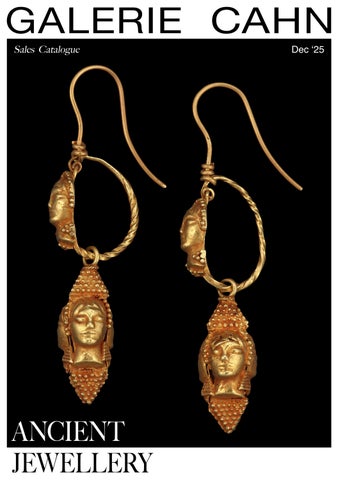
The earrings are composed of a partially twisted hoop of gold wire. One end forms an eyelet into which the other end is hooked into. A human bust is soldered onto the obverse. The finely worked face is executed in delicate repoussé. The almondshaped eyes are a characteristic stylistic feature of the Archaic Period. The shape of the mouth, with somewhat stiff-looking lips that have precise, linear contours, recalls depictions of korai from the Ionian region. Above the low forehead, the hair seems to be visible. The head is crowned by a row of granulation beads, which may represent a diadem or wreath. Two granulated triangles adorn the sides of the bust’s neck. Three busts of exactly the same appearance are attached to one another at the back, forming a
pendant that is suspended from the hoop. A pyramid of granulation beads made from three gold sheets adorns both the top and the bottom of the pendant. Joint seams slightly open. Modern hangers of 900 (20k) gold.
NOTE
For pyramids of granulation beads used as a decorative element in jewellery, cf., for example, a pair of spiral earrings in the British Museum, London, inv. no. 1877,0910.56 (online), and a gold earring in the Brooklyn Museum, New York, inv. no. 37.751E (online).
Formerly priv. coll., Germany; sold at the Ludwig Marx and Albert Sieck collections sale, Dr. F. X. Weizinger & Co., Munich 28-31 October 1918, lot 981, pl. 34; thereafter at Galerie Fischer, Lucerne, 14 June 1950, lot 799; afterwards, priv. coll. Ernst (b. 1903 - d. 1990) and Marthe Kofler-Truniger (b. 1918 - d. 1999), Lucerne; subsequently in a priv. coll., Lucerne, acquired from the above in 1971, and thence by descent.


CHF 1.400
1st half of 5th century B.C. | Northern Greek Inner Diam. max. 4,3 cm | Silver
Smoothly worked hoop ending in two stylised animal‘s heads. The lateral bulges above the ring-punched eyes that extend towards the back of the head and the engravings on the top of the head suggest that the heads are those of snake. Fine indentations on the lower edge of the heads. Engravings on the hoop. It is not clear whether they are ornamentation, perhaps representing the snake’s scales, or the remains of an inscription. Due to its dimensions, the bracelet was probably intended for a child. Slight scratches on the surface, otherwise intact.
NOTE
For the style, cf. two silver bracelets and a pair of silver earrings with snake‘s heads: E. Georgoula, Greek Jewellery.
From the Benaki Museum Collections (Athens 1999) 151-153, nos. 42-44.
Formerly priv. coll. Herbert A. Cahn, Basel, 1970s. Since then in the family.

CHF 6.800
4th - 3rd century B.C. | Greek
H. 1,8 cm | Inner Diam. 1,6 cm | Gold, Garnet, Enamel
The hoop is made from a broad sheet of gold and is set with a garnet cabochon that is framed by ivy leaves made from gold wire. Profiled gold wires are applied along the upper and lower edges. A Greek inscription, formed from gold wires, is arranged in two registers: ΘΑΔΔΑ ΟΝΑΙΟ. Both are probably names and possibly indicate a filiation. The letters retain traces of enamel inlay. The appearance of inscriptions on jewelry is exceedingly rare, particularly when rendered in gold wire set with enamel. A small lacuna where the two ends of the hoop are joined together.
PROVENANCE
Formerly priv. coll. Ernst (b. 1903d. 1990) and Marthe Kofler-Truniger (b. 1918 - d. 1999), Lucerne, acquired
before 1964. Subsequently in a priv. coll., Lucerne, acquired from the above in 1971; thence by descent. Published: Sammlung E. und M. Kofler-Truniger, Lucerne. (Kunsthaus Zürich, Exhibition 7 June – 2 August 1964) cat. no. 396, pl. 28.

Formerly priv. coll. Ernst (b. 1903d. 1990) and Marthe Kofler-Truniger (b. 1918 - d. 1999), Lucerne, acquired before 1964. Subsequently in a priv. coll., Lucerne, acquired from the above in 1971; thence by descent. Published: Sammlung E. und M. Kofler-Truniger, Lucerne. (Kunsthaus Zürich, Exhibition 7 June – 2 August 1964) cat. no. 396, pl. 28.


CHF 7.500
4th - 2nd century B.C. | Greek Diam. 3,8 cm | Gold, Enamel
Medallion-shaped gold sheet adorned with concentrical beaded gold wires and friezes of ivy leaves and olive (or laurel) leaves, also made from gold wire. The leaves preserve traces of enamel inlays. In the openwork centre there is a torch-like object with a conical lid topped by a gold bead. The Heracles knot made of gold wire directly below it indicates that the object represents the club of Heracles. Both the knot and the club were popular motifs in Late Classical and Hellenistic jewellery. Two further gold beads mark the beginning of the ivy frieze immediately above the club. On the reverse there are four eyelets, indicating that our medallion was part of a larger piece of jewellery, perhaps a double-chain necklace. Slightly bent at the edge. Some inlays missing.
Formerly priv. coll. Ernst (b. 1903 - d. 1990) and Marthe Kofler-Truniger (b. 1918 - d. 1999), Lucerne; inv. no. K 726 X (label on the reverse); acquired before 1964. Subsequently in a priv. coll., Lucerne, acquired from the above in 1971; thence by descent. Published: Sammlung E. und M. Kofler-Truniger, Lucerne. (Kunsthaus Zürich, Exhibition 7 June – 2 August 1964) cat. no. 396, pl. 28.


CHF 5.600
4th century B.C. | Greek or Western Greek Diam. 2,4 cm | Gold
Two hair or earrings made of sheet gold, each in the form a spiral with one winding that widens towards the centre. At the ends, a double human head composed of two embossed sheet gold halves above a cuff with filigree decoration. All four halfheads wear a pointed cap reminiscent of a Phrygian cap. However, it is unlikely that they represent Attis, as comparable examples show the heads wearing earrings, thus identifying them as female. Completely preserved except for a minor lacuna. Several fissures stabilised. Slightly dented in a few places. Mounted on a Plexiglas base (removable).
NOTE
Cf. E. De Juliis, Gli ori di Taranto in età Ellenistica (Mailand 1984) 180,
cat. no. 105 (described as earrings).
In the Cesnola Collection there are various Cypriot examples of this type, albeit with varying protomes, cf. Metropolitan Museum of Art, New York, inv. nos. 74.51.3368; 74.51.3347; 74.51.3373; 74.51.3370 (online).
Formerly priv. coll. T. V., Brussels, purchased in the 1980s from the art dealer Stefaan Grusenmeyer, Brussels.


CHF 6.600
3rd - 1st century B.C. | Greek, Hellenistic
H. 3,1 cm | W. 2,3 cm | T. 1,4 cm | Bronze
Solid trapezoidal bronze block, featuring both figurative and ornamental decoration in negative relief on all six sides. On the largest surface, the frontal bust of a woman wearing a high polos covered with a veil whose folds cascade over the shoulders. Her hair is parted in the center and arranged on both sides in two curly strands that frame the face and descend in front of her shoulders. The breasts are modeled in relief and, as far as can be determined, are covered by a folded garment with a hem, presumably a chiton. The way in which the figure is depicted, especially the polos, leaves no doubt that it represents a goddess, possibly Demeter or Isis. On the opposite side, another frontal bust of a woman is depicted, somewhat smaller, wearing
a chiton, high polos, and veil. The hair is not represented, which may mean that it was styled up. A necklace adorns the neck. Here too, the figure is probably a goddess. The small bust in the upper left corner wears what appears to be a radiate crown and may represent Helios. On one of the two elongated sides, a longitudinal shield with a dotted border is depicted. In its center, a thunderbolt and four dots, with additional objects or symbols on the sides (possibly wings), that are not clearly discernible. Opposite, five large dots are arranged in a row; above them, an illegible Greek inscription consisting of four letters. On one short side, two leaf-shaped elements of the same size; on the other, four presumably floral elements with a casting channel. The mould was used
for making jewellery and shows traces of use in various places, particularly on the surfaces of the negative relief. Due to the absence of casting channels (with one exception), it was employed for repoussé work: a piece of gold sheet was laid over the desired motif and pressed into the mould with a suitable tool to create a positive. The inscription may be the name of the owner, but it could also identify the mould as a dedication. This exceptionally rare piece provides a valuable contribution to the understanding of ancient jewellery production.
Formerly priv. coll. Emile Foltzer (d. 1982), Switzerland. Subsequently in another Swiss priv. coll., acquired from the above in 1979, and then passed by descent.


For an impressive example of a bronze jewellery mould, which—like our specimen—was used to produce repoussé jewellery from sheet gold, cf. the hexagonal bronze mould from Sarmisegetuza Regia (the capital of the Dacian kingdom until its destruction by the Romans in 106 A.D.). Cf. also a bronze mould from Corfu in the Ashmolean Museum, Oxford. Further literature: M. Y. Treister, Hammering Techniques in Greek and Roman Jewellery and Toreutics (Leiden 2021), with additional examples. Regarding the motifs on our mould: The thunderbolt is the primary weapon of Zeus, who, as the father of the gods, guarantees the order of the world. It symbolizes his power and simultaneously serves as a sign of divine force and punishment. As a shield emblem, the thunderbolt appears on the coins of the Macedonian kings in the late 4th cent. B.C., but also in other contexts, for example funerary ones. Cf. a group of small terracotta shields from the Tomb of the Erotes in Eretria, MFA Boston, inv. nos. 97.332–97.338 (late 4th–early 3rd cent. B.C., with the thunderbolt at the center accompanied by a Gorgoneion). In the context of jewellery production,
however, this motif is rather unusual. Repoussé female busts, by contrast, had a variety of uses, such as pendants for necklaces and earrings, or as appliqués for garments. Five dots in a row are attested as a motif for amulet pendants; cf., for example, Metropolitan Museum of Art, New York, inv. no. 74.51.3317.

CHF 12.000
century
Magnificent necklace made of polished agate beads of different, mostly elongated, shapes and sizes and with a longitudinal drill hole. In the central section of the necklace, thirteen sheet-gold pendants in the form of pomegranates are spaced evenly between the beads. Each pendant has a small beaded band at the top and is strung onto a gold wire with double eyelets. To the left and right of this section the agate beads alternate with sheet-gold beads. The outermost two beads have a cuff with granulation. Eight gold beads and five pomegranates differ slightly in colour and size and are therefore possibly not belonging, although they were made using the same technique. The necklace terminates at each end with a figure-eight eyelets, each
adorned in the center on both sides with a small gold bead. The wide geographical distribution of polished agate beads and the jewellery made from them, as well as the continuity of their production, make it difficult to assign a precise date to this piece.
If the golden pomegranate pendants and the eyelets were originally part of the piece, they strongly support the proposed dating to the Hellenistic or Roman Imperial period. Restrung. The ancient clasp hook is lost. Some pendants and gold beads slightly dented. A few agate beads with slight traces of wear.
Polished agate beads have a long tradition. They are already attested in the 3rd mill. B.C., for example in Mesopotamia and Egypt, and subsequently became widespread throughout the entire Mediterranean region. Cf. a necklace composed of similarly polished agate beads, some set in gold, in the Metropolitan Museum of Art, New York, inv. no. 74.51.3386, or examples from the Achaemenid Empire, where they were used, among other things, as seal stones, Metropolitan Museum of Art, New York, inv. nos. 1999.325.107; 1999.325.112. They continued to enjoy great popularity even in Roman times. Cf. several pairs of gold earrings in the Metropolitan Museum of Art, New York, inv. nos. 74.51.3935; 74.51.3937; 74.51.3938; and in the British Museum, London, inv. nos. 1908,0412.3; 1917,0601.2432 (all online). The pomegranate was symbolically associated with funerary and wedding rites, since in Greek mythology Persephone, having inadvertently eaten several pomegranate seeds in the Underworld, was forced to spend part of the year with Hades. Building on this myth, the fruit came to
symbolize fertility, death, and rebirth more generally. Further reading: on the significance of the pomegranate in ancient cultures, see F. Muthmann, Der Granatapfel. Symbol des Lebens in der alten Welt (Bern 1982).
Formerly priv. coll. USA, 2001 or earlier.


CHF 3.800
1st - 3rd century A.D. | Parthian L. with Hangers 5,5 cm | W. max. 1,9 cm | Diam. 1,0 cm | Gold
Each earring consists of a round, curved hoop made of gold wire, with one end inserted into the other, tubular end. A twisted gold wire is wound around the lower part of the hoop to which an elaborate, multitiered pendant made of sheet gold is soldered. The upper section of the pendant is composed of two biconical elements, of which the lower one is slightly larger. Two twisted wires encircle its widest circumference. The central section is formed by an openwork element consisting of three heart-shaped leaves (possibly ivy). The pendant terminates in another biconical element to which five small gold beads, arranged in a grapelike cluster, are attached. Parthian jewellery is characterised by its rich ornamentation, often featuring
intricate, multi-tiered compositions artfully assembled from various sheet-gold elements. From about 240 B.C. to 226 A.D., the Parthian Empire, encompassed the Iranian plateau and parts of Mesopotamia. Its geographical position fostered a fusion of cultural influences, which is also reflected in its jewellery. One of the biconical elements slightly deformed. Modern hangers made of 900 (20 kt) gold.
Related in composition and individual details: K. R. Maxwell-Hyslop, Western Asiatic Jewellery c. 3000- 612 B.C. (London 1971) 190, pl. 137
Formerly priv. coll. Dr. Klaus Marquardt (1926-2023), German businessman, North Rhine-Westphalia; collected between the 1980s and 2009. Thereafter German art market.


CHF 2.600
2nd - 3rd century A.D. | Roman, Imperial Period | W. max. 1,0 cm L. without Hangers 3,4 and 3,9 cm | Gold, Glass or Turquoise
The earrings are each made from a round, curved gold wire that gradually becomes slightly flatter and broader. One end of the hoop forms a loop into which the other end is hooked. Just below the loop, a small shield made of sheet gold with a gold bead in its centre and a finely ribbed gold wire applied around the edge, is soldered onto the hoop. The pendant is made from gold wire of circular cross-section. A loop of twisted gold wire is soldered to the top of pendant and allows it to be attached to hoop. Just below the loop, a broad gold wire that is twisted at the edges forms a double volute. A glass or turquoise bead is threaded onto the lower part of the pendant. Intact. Modern hangers made of 900 (20 kt) gold.
NOTE
Formerly priv. coll. FrançoisGeorges Pariset (1904-1980), French art historian and professor at the Université de Bordeaux; thence by descent.
For the type, cf. L. Biroli Stefanelli, L‘oro dei Romani. Gioelli di Età Imperiale (Rome 1992) 179. 255 cat. no. 155, fig. 207 bis.; Metropolitan Museum of Art, New York, inv. no. 74.51.3736 (online).

1st century A.D. | Roman, Late Hellenistic to Early Imperial Diam. max. 2,2 cm | H. 2,7 cm | W. 3,2 cm | Silver, Garnet
Upright oval intaglio set in the belonging ancient ring. Aphrodite is shown from behind, standing in threequarter profile to left. The goddess wears a diadem and is nude except for a cloak draped around her right upper arm and both lower legs. She holds a sword and baldric in her left hand and turns her head to the left, so that it appears in profile. She rests her right upper arm on a shield standing on the ground to her right. In her right hand holds a spear or lance. Eros, the constant companion of Aphrodite, is depicted as a naked, chubby child with wings. He stands to the left of the goddess and offers her a helmet with both hands. The motif of the goddess of love, Aphrodite, with the weapons of her lover Ares, the god of war, is attested both iconographically and in
literature at least since the 4th century B.C. Depending on the context, a variety of interpretations are possible. The particular appeal of the motif resides in the contrast or even clash of the inherently contradictory forces of love and war. In Sparta and Taras (Tarentum), the cult of the armed Aphrodite Areia was widespread (Pausanias 3.17.5). Similarly, the armed Aphrodite Urania was worshiped on Kythira. In an epigram attributed to the Greek lyric poet Anacreon, Ares lays down his weapons before approaching the goddess; Aphrodite then picks them up and regards them playfully (Anthologia Palatina 5.31). Here, the motif appears to reflect the subjugation of war by love. The weapons that are laid down may be read as an allegory for the powerlessness of violence
in the face of erotic attraction. The quality of the carving is high, with the gem-cutter placing particular emphasis on the careful, lifelike modeling of the body. Set in a solid silver ring. Small chip at the right edge of the gem, otherwise intact.
NOTE
Cf. a garnet intaglio from Eretria in the Museum of Fine Arts, Boston, inv. no. 21.1213 (online) on which Aphrodite likewise is only clad in a loosely draped cloak and is depicted with shield and spear. The theme is also found in sculpture, in the statue type of Aphrodite with a sword baldric which is preserved in several copies; cf. Louvre, Paris, inv. no. Ma 370, and Galleria degli Uffizi, Florence, inv. no. 611. A marble statue found in the sanctuary of Asclepius at Epidaurus (National Archaeological Museum, Athens, inv. no. 262) depicts the goddess with a sword baldric and sword but wearing a chiton and himation. The exposed breast, however, preserves the erotic connotation of the representation. Further reading: J. Lemberg, Venus armata. Zur bewaffneten Aphrodite in der griechisch-römischen Kunst, PhD. Stockholm 1991.
Formerly priv. coll. Erika (b. 1934 - d. 2025) and Jakob (b. 1927 - d. 2025) Binkert, Binningen, Switzerland. Thence by descent.


CHF 1.800
2nd - 3rd century A.D. | Roman, Imperial Period L. with Hangers 2,0 cm | W. max. 0,7 cm | Diam. 0,9 cm | Gold
The earrings are each made from a round gold wire, which gradually transitions into a rectangular crosssection. The wire is bent to form a hoop with a loop at one end, into which the other end is inserted. Just below the loop, a small sheet gold shield was soldered on, with a gold bead at its center and a fine twisted gold wire applied around the edge.. Intact. Modern hangers made of 900 (20 kt) gold.
NOTE
For the type, cf. Metropolitan Museum of Art, New York, inv. no. 74.51.3736 (online).
Formerly priv. coll. H. L., Rhineland, before 2000. Thereafter German art market.
CHF 2.600
2nd - 3rd century A.D. | Roman, Imperial Period L. without Hangers 2,8 and 2,9 cm | W. max. 0,7 cm | Gold, Green Glass
The earrings are each made from a round, curved gold wire that gradually becomes slightly flatter and broader. One end of the hoop forms a loop into which the other end is hooked. A small shield made of sheet gold is soldered onto the hoop just below the loop. The pendant is made from gold wire with a square cross-section. A loop at the top of the pendant allows it to be attached to hoop. Just below the loop, two eyelets are soldered onto the pendant, forming a double volute. A bead of green glass is threaded onto the lower part of the pendant. Intact. Modern hangers made of 900 (20 kt) gold.
NOTE
For the type, cf. Metropolitan Museum of Art, New York, inv.-no.
74.51.3718 (without hangers; online).
Formerly priv. coll. FrançoisGeorges Pariset (1904-1980), French art historian and professor at the Université de Bordeaux; thence by descent.


Approximately semicircular gold bracelet made from a square bar that was tooled into a cruciform crosssection and then twisted and curved. A beaded gold wire is set in the hollow of the spiral as an additional decorative element. A detachable fastener in the form of a double loop, adorned on the inside, on both sides, by a gold wire bent into the shape of a pelta. The difference of workmanship between the twisted bracelet, which derives its form and technology from Celtic traditions, and the detachable fastener indicates that the latter is a
later addition. The terminals of the original bracelet had to be replaced in Antiquity to accommodate this new element. The bracelet‘s small dimensions suggest that it was made for a child. Part of the wire forming one pelta lost. Two modern cylinders of 18k gold (one of them removable) secure the hinged double loop of the fastener.
Formerly English priv. coll., acquired in the late 1990s from John Moor, York, U.K.
NOTE
Compare with two Gallo-Roman arm rings from le Poiré-sur-Vie (Nantes, Musée Dobrée, inv. nos. 882-1-439; 882-1-440). For the technique, cf. H. Hautenauve and C. Besson. Persistance de techniques d‘orfèvrerie : le torque celtique de Soucy (Aisne) et les bracelets galloromains du Poiré-sur-Vie (Vendée). Revue archéologique de l‘ouest, 15 (1998) 141-150 (available on Persée: https://www.persee.fr/). There, both bracelets are dated to the 3rd-2nd cent. B.C. A pair of gold bracelets from a jewellery find at ZurichOetenbach, were produced using the same technique but left open with snake head terminals, cf. S. MartinKilcher, Der Fund mit römischem Goldschmuck von Zürich-Oetenbach, in: A. Wyss Schildknecht, Die mittelund spätkaiserzeitliche Kleinstadt Zürich/Turicum. Eine Hafenstadt und Zollstation zwischen Alpen und Rheinprovinzen (Zurich-Egg 2020) 63–88. Based on her assessment of the snake heads, the author proposes a date in the 1st cent. B.C. The pelta was originally a protective shield used by the Greek military and was described by Vergil and Pliny as a
weapon of the Amazons. In in the Roman Imperial Period it gained popularity as a decorative element, particularly for jewellery; cf., for example, Metropolitan Museum of Art, New York, inv. nos. 74.51.3764 and 74.51.3818; H. Hoffmann –V. von Claer, Antiker Gold- und Silberschmuck (Mainz 1968) 66 f., no. 43.
Texts
Design
Translations
Photos
Dr. Ulrike Haase, Joffrey Nogrette, Charlotte Chauvier
Jonas Hernegger, Jean-David Cahn
Yvonne Yiu
Niklaus Bürgin
As of September 2025. The place of execution is Basel
1) Jean-David Cahn AG (hereafter „the Seller“) hereby confirms that it has the right of disposal over the objects for sale according to Art. 18 KGTG. Any further warranty is excluded.
2) The specifications and descriptions given in this catalog are provided in good faith. Nevertheless, their accuracy cannot be guaranteed.
3) The seller guarantees that the sales objects were made in Antiquity. This guarantee, which is granted to the buyer only, is valid for two years after the conclusion of the sales contract.
4) The objects are sold in the condition they were in at the time of the sale („sold as seen“). Complaints regarding the authenticity of a piece (subject to lit. 3) shall be communicated to the Seller in
writing at its domicile (Jean-David Cahn, Malzgasse 23, P.O. Box 217, 4010 Basel) upon detection and at the last two years after the conclusion of the sales contract.
Other substantiated complaints shall be communicated to the Seller in writing at its domicile, as above, within 14 days of receipt, and at least three months after the conclusion of the sales contract. Any complaints made later cannot be considered further. All liability for any loss or damage sustained during transportation is excluded. Insurance during transportation is the Buyer‘s responsibility.
5) The delivery and storage of sold objects shall be at the Buyer‘s risk and expense (costs arising from storage, packaging and transportation, any additional costs and
expenses, all plus VATs) unless otherwise agreed in writing.
6) Foreign and Swiss customs, duty and shipment shall be borne by the Buyer. Declaration fees for the import into the EU are borne by the Seller if used through the services provided by the Seller. It is the responsibility of the Buyer to comply with foreign and Swiss customs and foreign exchange regulations and to obtain an EU import license through the services of the Seller. The Buyer is aware of the relevant import and export regulations of the EU and has consulted the website of the Swiss Federal Office of Culture Bern (www. bak.admin.ch/ kgt) for details of the Swiss import and export regulations currently in force, as well as further provisions. The Seller declines all responsibility for any consequences arising from the contravention of such regulations. The Buyer acknowledges that a valid import permit is required for the importation of the artworks transferred under this purchase invoice into the European Union. If such a permit is not available at the time of purchase, the approval
process may take between four to six months. The registration and execution of the import procedure will be carried out by an art shipping agent appointed by the Seller within the EU. The Seller will organize this process in the name and on behalf of the Buyer. The Buyer is required to conduct the import procedure through the shipping agent designated by the Seller. Alternatives are the responsibility of the Buyers.
7) The Buyer is personally liable for all acquisitions made; he/she cannot claim to be acting for a third party or person. If a person acts as a representative, written proof of authorization may be requested; the Buyer as well as his/her representative can both be held jointly and severally liable for the purchase and for all other costs. The Buyer shall be liable for any damages caused by delayed payments, in particular for exchange rate and interest losses. Payments by cheque or by the internet shall be deemed to have been received only on clearance by the relevant bank.
8) Payment shall be due upon the conclusion of contract, but at the
latest 30 days after the invoice is issued. Interest of 1.5% per month will be charged for payments made after 30 days. Payments can be made in cash, by bank transfer or by cheque. The Seller may ask for proof of creditworthiness. Title shall be transferred only upon receipt of payment in full; all risks, however, shall pass to the Buyer upon conclusion of the sales contract.
9) If payment is delayed, the Seller can, after giving the Buyer due notice, withdraw from the contract forthwith. This also applies in cases where the object has already been transferred to the Buyer‘s possession at the Buyer‘s cost. The object in such a case must be handed back to the Seller upon request. Additionally, the Seller may claim further damages.
10) If the Buyer does not collect the object, the Seller can choose either to cancel the contract after 30 days and to claim compensation or to store the object at the Buyer‘s expense and to demand that the Buyer collects it.
11) ALL SALES ARE TRANSACTED IN BASEL, SWITZERLAND, WHICH IS THE-
The conclusion of contract, the quotation and the negotiations are subject to Swiss law, exclusive of the United Nations Convention on Contracts for the International Sale of Goods (CISG). By buying, the Buyer recognizes the exclusive right of the court of Canton Basel-Stadt, Switzerland, and of its jurisdiction. All sales are subject to Swiss jurisdiction. All parties recognize the exclusive choice of Swiss jurisdiction for the settlement of any matters arising from the conclusion of the sales contract.
12) All purchases and deliveries are performed solely on the basis of these conditions of sale. Any references by the Buyer to his/ her terms and conditions are herewith expressly excluded.
13) Should individual provisions become fully or partially void after the conclusion of contract due to changes in the law, the validity of the remaining provisions and of the contract shall remain unaffected. The invalid provision shall be replaced by that provi-
sion which is closest in meaning and intention to the original provision.
14) The Buyer accepts the condition of the sales as above. He/She explicitly accepts the exclusive right of the courts of Basel-Stadt, Switzerland, and their jurisdiction, exclusive of the United Nations Convention on Contracts for the International Sale of Goods (CISG), over the quotation, the negotiations, and the sale.
15) The conditions of sale are provided in German and English, the German version being the definitive and legally binding one in the event of any disputes.
Published by Galerie Cahn. Your Partner in the Antique Trade since 1863.

Cahn | Malzgasse 23 | CH-4052 Basel