
26 | ruimteCAESUUR | ANKE LAND | CATALOGUS

Page 1


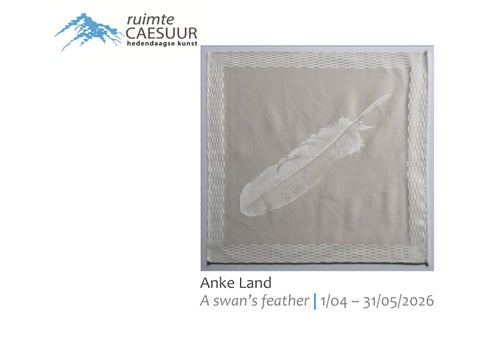
Anke Land A swan’s feather | 1/o4 – 31/05/2026

Anke Land

A swan’s feather

11/o4 – 31/05/2026

inhoud | content

introductie / introduction | Pier Pennings opening tentoonstelling / exhibition

colofon / colophon ruimteCAESUUR

introductie - introduction

Pennings | 11/04/’26

Bij de opening van A swan’s feather van Anke Land inleidende woorden | Pier Pennings

Voor een schilder is het ontwerpproces vaak tegelijkertijd uitvoeringsproces. Het werk ontwikkelt zich onder je handen op de ondergrond. Maar wanneer je, van oorsprong tekenaar/schilder meer tastbaarheid, meer tactiliteit in je werk zoekt, is textiel één van de meest uitdagende materialen die bestaan. Anke Land vond bijna 20 jaar geleden de oplossing voor dit dilemma in het TextielLab van het Textielmuseum in Tilburg.

Daarmee werd het ontwerpproces in het atelier fysiek losgezongen van het uitvoeringsproces in de werkplaats. Indachtig deze locatie kun je spreken van een caesuur, een smalle maar diepe kloof tussen atelier en werkplaats, die Anke nu al bijna 20 jaar met succes overbrugt. Soms lastig, maar in elke werkperiode ook een uitgelezen moment voor reflectie.

De twee wandkleden die hier vrij in de ruimte hangen, dragen de titel “Pirates”, en zijn geïnspireerd door kapers op de Rode Zee. De basis voor het werk is een kleine krantenfoto van een handjevol Houthi-piraten, die in een snelle sloep door de golven snijden. In de donkerbruine kleden is geen horizon of richting te zien, alleen de oplichtende contouren vol mensen, die oplost in de oor

de oplichtende contouren van een boot vol mensen, die oplost in de ruimte. Anke presenteerde deze kleden in een gelijknamige installatie in het kader van de Modebiënnale Arnhem in 2013. Het thema is hardnekkig actueel: de piraten zijn inmiddels rebellen.

Wat in het ontwerp met vaak kleine, heel directe ingrepen wordt ingevoegd, wordt in het weefproces weer opgehaald en geabstraheerd zichtbaar gemaakt: de golfslag die eeuwig is, en de mens die in die grote eeuwigheid van licht en water onder- en opgaat, verdampt, maar tegelijkertijd als Phoenix herrijst en opnieuw begint.

De bootjes staan ook voor het universele verlangen naar het groene gras aan de overkant. In het grote, heel los en transparant geweven kleed voor de wand zie je hoe het bootje, dwars door het dubbele weefsel heen geweven, de voor- en achterzijde van het kleed verbindt.

En dan is er opeens dat grote contrast: damast geweven linnen zakdoeken en servetten, sober enkelvoudig geweven, alleen de katoenen ketting met één linnen inslagdraad. Met als ontwerp een afbeelding van een zwanenveer, diagonaal geplaatst, en ingekaderd in de blokjes-rand van een theedoek.

De zakdoeken en servetten zijn niet letterlijk te nemen, maar een symbool om verlies, verdriet en verlangen denkbeeldig in te vouwen. Zoals in de Boerenbasiliek in Loppersum, waar de pastoor een opgevouwen zakdoek in de handen van Maria legt met de woorden: “Hierin vouwen wij wat is in ons hart”.

Zwanen staan in veel mythen en volksverhalen voor een onbreekbare band, voor monogamie en trouw. De veer is symbool voor lichtheid en loslaten. Maar ook voor de scherpte van het geschreven woord, voor persoonlijke communicatie. Ze verbeelden vaak het verdriet om het verlies van een geliefde, wat soms leidt tot de dood: de stervende zwaan.

Door het damast-weven bepaalt de lichtval de zichtbaarheid en zorgt voor het subtiele zie ik het wel zie ik het niet-effect.

De zwanenveer voegt hier een dimensie toe: die van trouw en duurzame liefde, en dus ook van lijden en dood. Van licht dat sprankelt, maar ook opeens weer dooft. Ze hangen hier aan ijle lusjes en bewegen kalm als een memento vivere, gedenk te leven

At the opening of A Swan’s Feather by Anke Land introductory remarks | Pier Pennings

For a painter, the design process is often simultaneously the execution process. The work develops beneath your hands on the surface. But when, as a draughtsman or painter by training, you seek greater tangibility, greater tactility in your work, textile is one of the most challenging materials in existence. Almost 20 years ago, Anke Land found the solution to this dilemma in the TextielLab at the Textielmuseum in Tilburg. This physically separated the design process in the studio from the execution process in the workshop. Bearing this location in mind, one might speak of a caesura, a narrow but deep chasm between studio and workshop, which Anke has now been successfully bridging for almost 20 years. Sometimes difficult, but in every working period also an excellent moment for reflection.

The two tapestries hanging freely in the space here are titled ‘Pirates’ and are inspired by pirates on the Red Sea. The basis for the work is a small newspaper photograph of a handful of Houthi pirates cutting through the waves in a fast sloop. In the dark brown tapestries, no horizon or direction is visible, only

sloop. In the dark brown tapestries, no horizon or direction is visible, only the glowing outline of a boat full of people, fading into the distance. Anke presented these pieces in an installation of the same name as part of the Arnhem Fashion Biennale in 2013. The theme remains strikingly relevant: the pirates have since become rebels.

What is incorporated into the design through often small, very direct interventions is reclaimed during the weaving process and made visible in an abstract form: the eternal undulation of the waves, and the human being who is absorbed into and merges with that vast eternity of light and water, evaporates, yet at the same time rises again like a Phoenix and begins anew.

The little boats also symbolise the universal longing for the green grass on the other side. In the large, very loosely and transparently woven wall hanging, you can see how the little boat, woven right through the double fabric, connects the front and back of the piece.

And then suddenly there is that stark contrast: damask-woven linen handkerchiefs and napkins, simply and plainly woven, with only the cotton warp and a single linen weft thread. The design features an image of a swan’s feather, placed diagonally, and framed by the checkered border of a tea towel.

weft thread. The design features an image of a swan’s feather, placed diagonally, and framed by the checkered border of a tea towel.

The handkerchiefs and napkins are not to be taken literally, but are a symbol into which loss, sorrow and longing can be figuratively folded. As in the Boerenbasiliek in Loppersum, where the priest places a folded handkerchief in Mary’s hands, saying: “Into this we fold what is in our hearts”.

In many myths and folk tales, swans represent an unbreakable bond, monogamy and fidelity. The feather symbolises lightness and letting go. But also the sharpness of the written word, and personal communication. They often depict the grief of losing a loved one, which sometimes leads to death: the dying swan. Through the damask weave, the play of light determines visibility and creates the subtle ‘now I see it, now I don’t’ effect.

The swan’s feather adds a dimension here: that of fidelity and enduring love, and thus also of suffering and death. Of light that sparkles, but also suddenly fades again. Here they hang from delicate loops and move calmly as a memento vivere, a reminder to live.

opening | 11/04/’26

exhibition | tentoonstelling

foto’s | photos

colophon | ruimteCAESUUR

Alle werken / All works | ©2013 & ©2026 Anke Land

Inleiding / Introduction | Pier Pennings

Photo page 23 | Josefina Eikenaar / TextielMuseumTilburg

Photos opening & back page | hans overvliet

Photos front page & exhibition | Pier Pennings

Catalogue | hans overvliet

Dank aan / thanks to all the artists

Leni van den Berge | de roofprintpers - postillon d'amour all the visitors

the happy shareholders of CAESUUR the municipality of Middelburg

ruimteCAESUUR

Since 1995, some hundred fifty plus exhibitions of contemporary art have been made in ruimteCAESUUR (spaceCAESUUR). From 1999 on at the Lange Noordstraat 67 in Middelburg.

Visual arts, in relation with the contemporary art discourse, are always the guiding principle for an exhibition, but a historical and social perspective also determine our choices.

ruimteCAESUUR stands for the autonomy of art embedded in larger systems, and puts the artist’s oeuvre at the center of organizing its (solo) exhibitions. Young, novice as well as "arrived" artists are offered a platform in order to present their work in a non-commercial environment. Real meeting and learning from each other play important roles within our annual planning.

ruimteCAESUUR is a private initiative, without any profit motive, with Willy van Houtum and visual artist Hans Overvliet as its core; they form the board of the CAESUUR foundation.

teamCAESUUR is more than completed by the artists Jorieke Rottier and Giel Louws. The exhibitions also in 2026 will be organized as much as possible in cooperation with art initiatives from other countries such as Lípa Art Collection and Luxfer Open Space, both from the Czech Republic, Gallery Durden and Ray from Los Angeles, U.S.A., Slipvillan from Sweden, Bloom Gallery in Valencia in Spain, etc.

Exchange with Dutch artists ensures reciprocity in this process.

The unique composition of this team crosses borders of art practices, gender and generations.

Visit

Would you like to visit us? Please mail us at caesuur (at) zeelandnet.nl.

Anke Land

A swan’s feather | 11/o4 – 31/05/2026

Turn static files into dynamic content formats.
Create a flipbook
26 | ruimteCAESUUR | ANKE LAND | CATALOGUS by Hans Overvliet | ruimteCAESUUR - Issuu