Cultural Guide Province of Cádiz
Cádiz
Jerez de la Frontera
El Puerto de Santa María
Puerto Real
San Fernando
Chiclana de la Frontera
Chipiona
Rota
Sanlúcar de Barrameda
Trebujena
Conil de la Frontera
Vejer
Barbate
Benalup-Casas Viejas
Medina Sidonia
Alcalá de los Gazules
Paterna de Rivera
San José del Valle
Arcos de la Frontera
Algar
Bornos
Villamartín
Espera
Ubrique
Benaocaz
Villaluenga del Rosario
Grazalema
El Bosque
Prado del Rey
Puerto Serrano
Algodonales
Setenil de las Bodegas
El Gastor
Zahara de la Sierra
Alcalá del Valle
Torre Alháquime
Olvera
Tarifa
Algeciras
La Línea de la Concepción
San Roque
Los Barrios
Jimena de la Frontera
Castellar de la Frontera
San Martín del Tesorillo









Tours through History O1
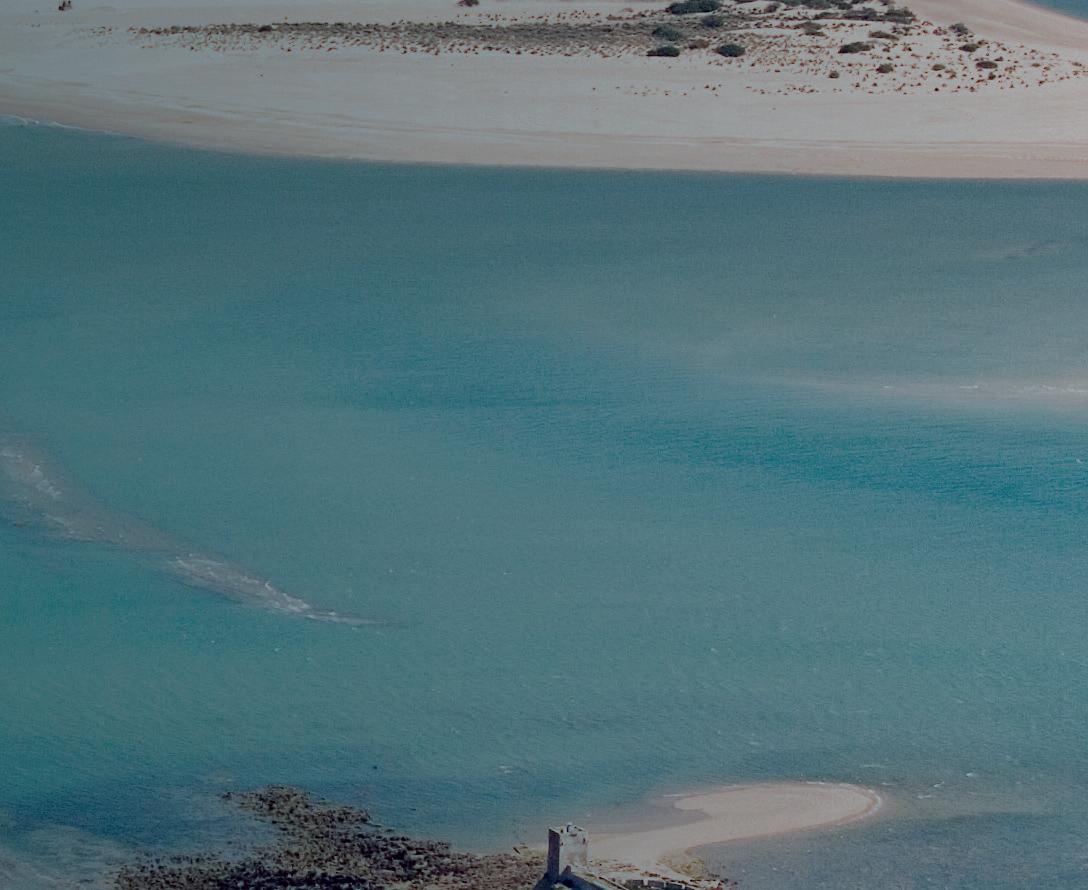
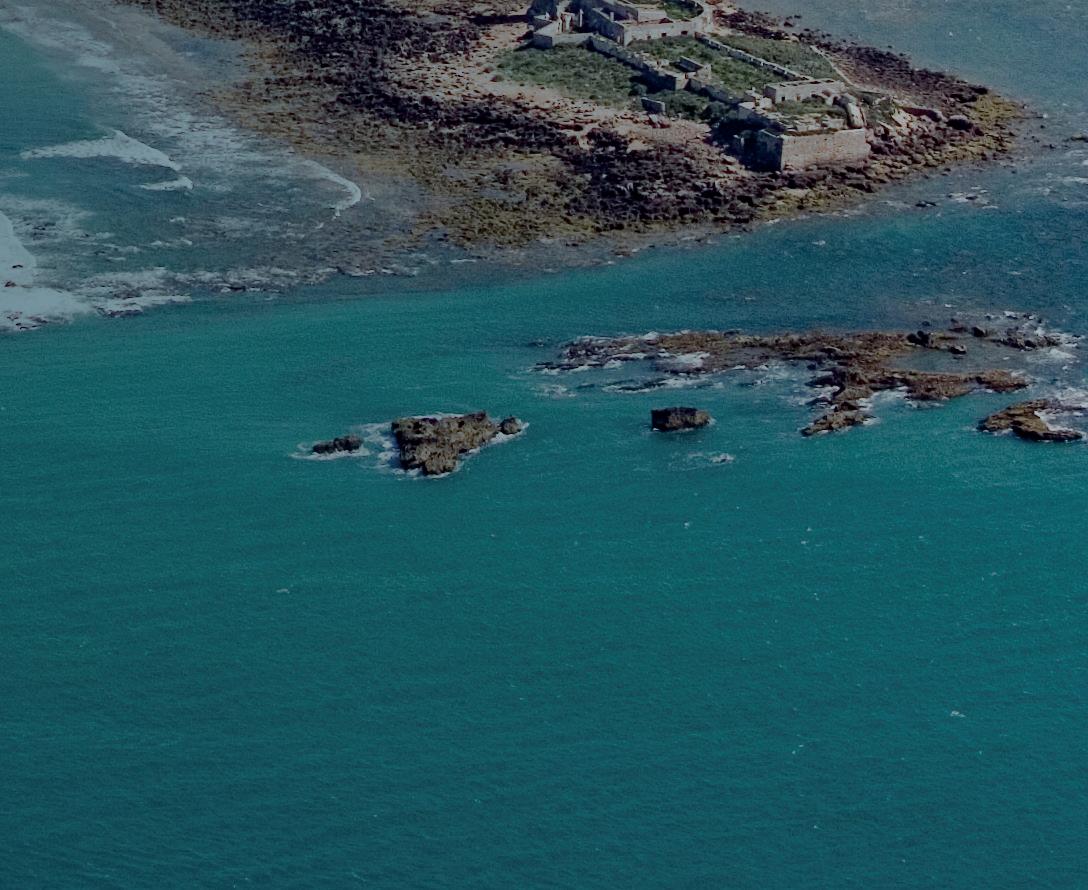
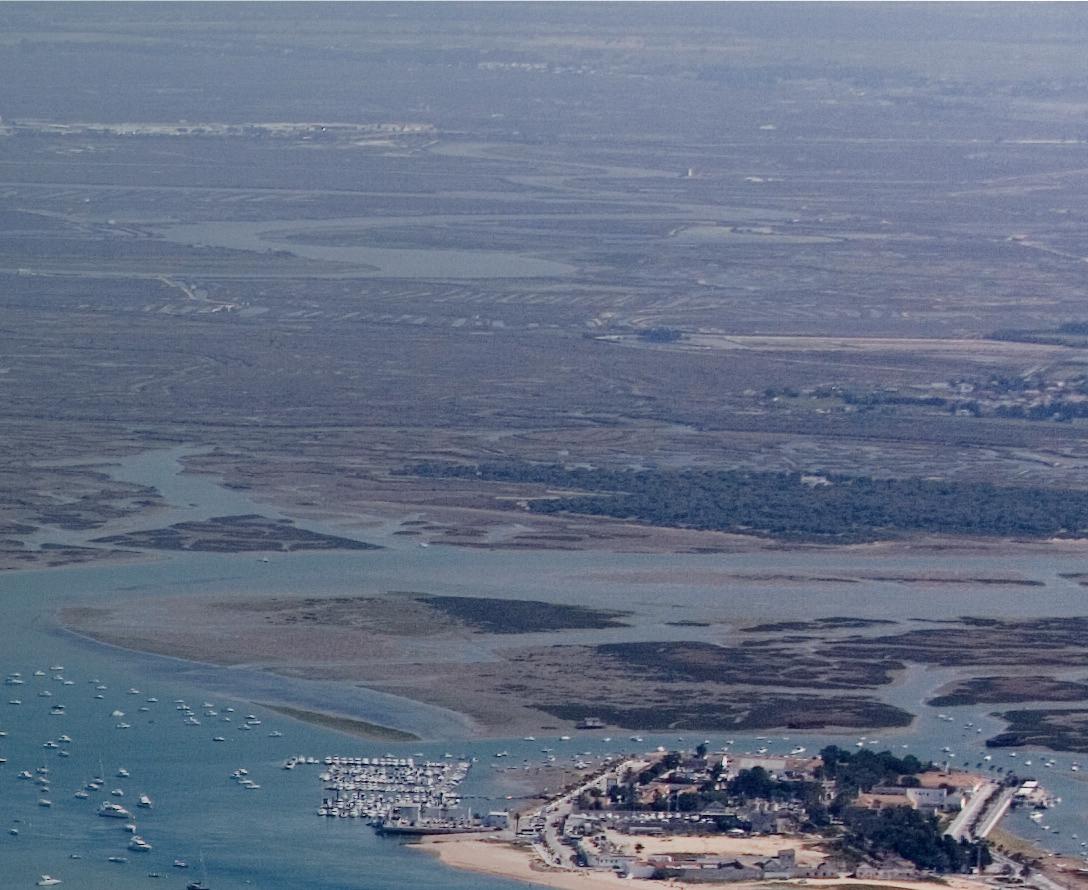
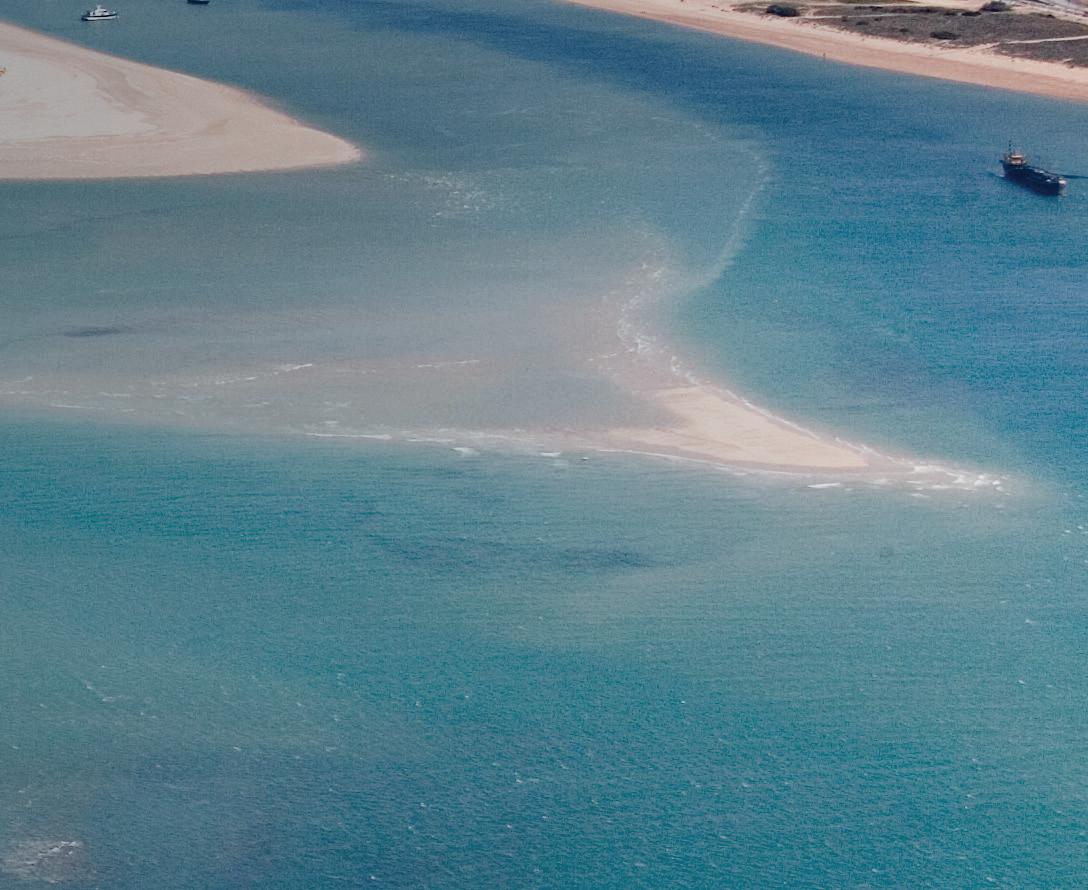
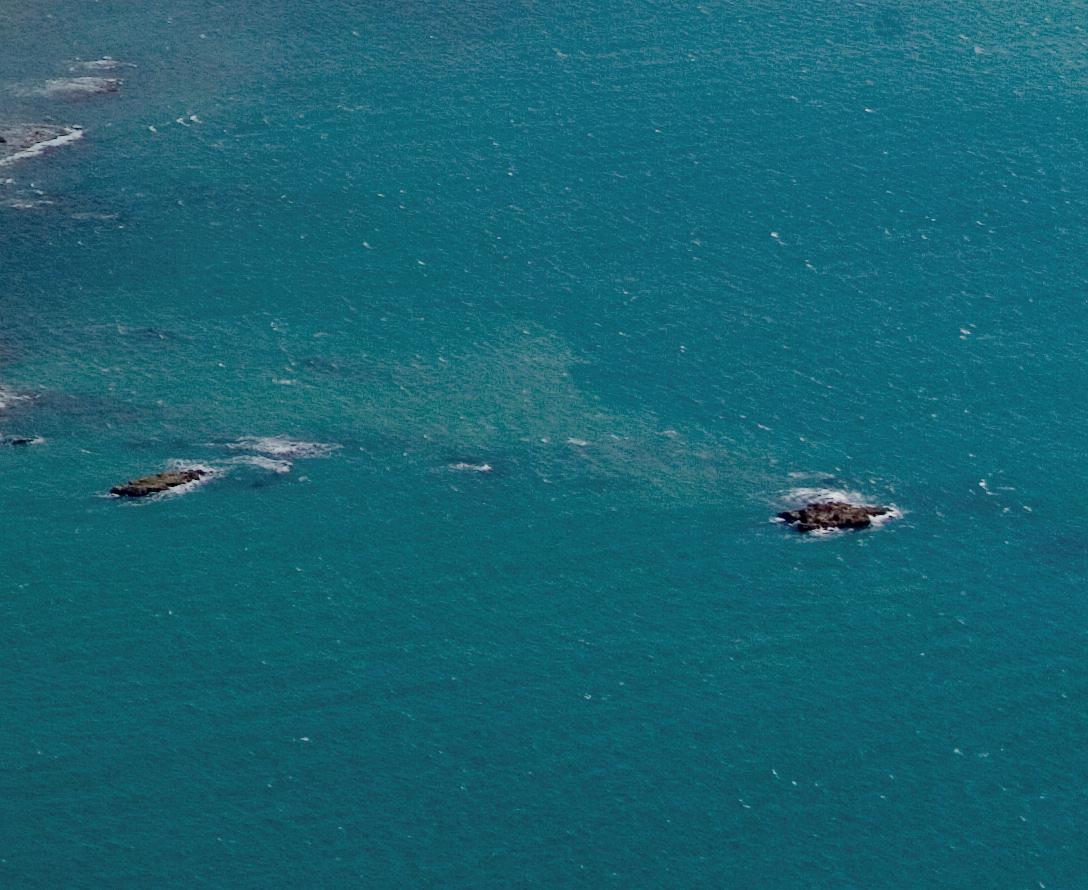
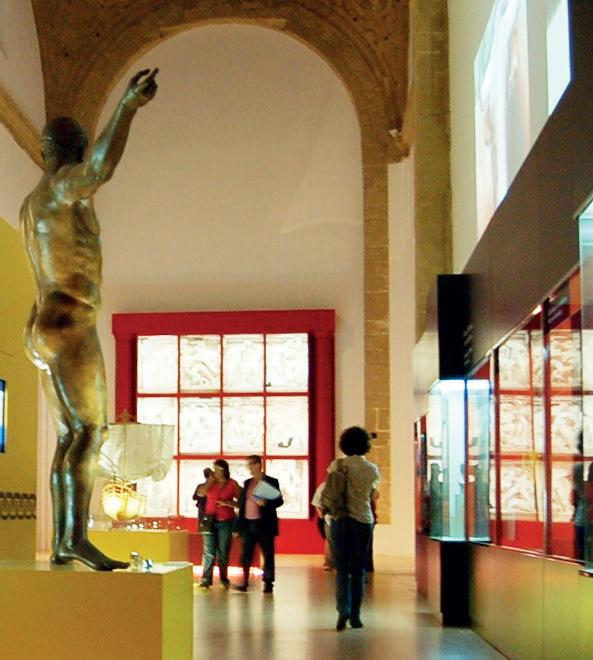

Cadiz is a land of legends and ancient civilisations. From the echoes of the kingdom of Tartessos to the exploits of Hercules, this tour invites you to explore a region where history and legend are intertwined, creating an attractive aura of mystery.
01.1 Legendary and mythological Cadiz
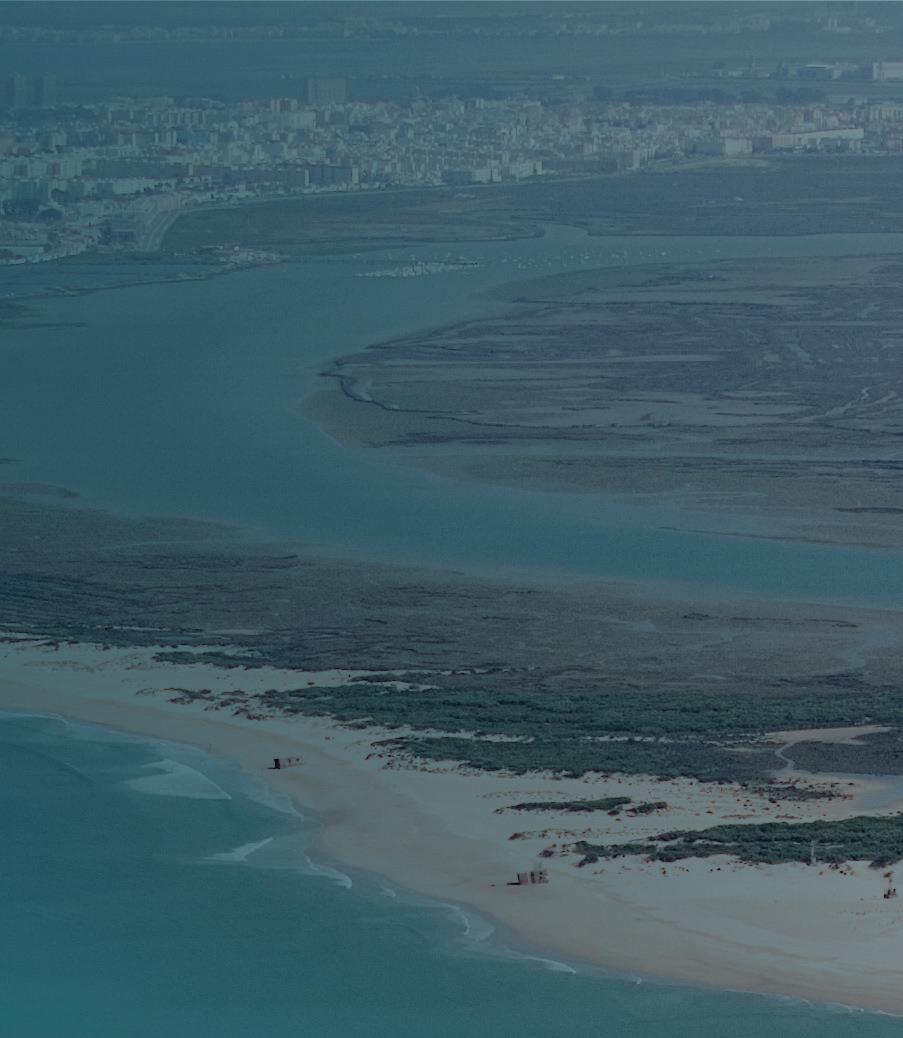
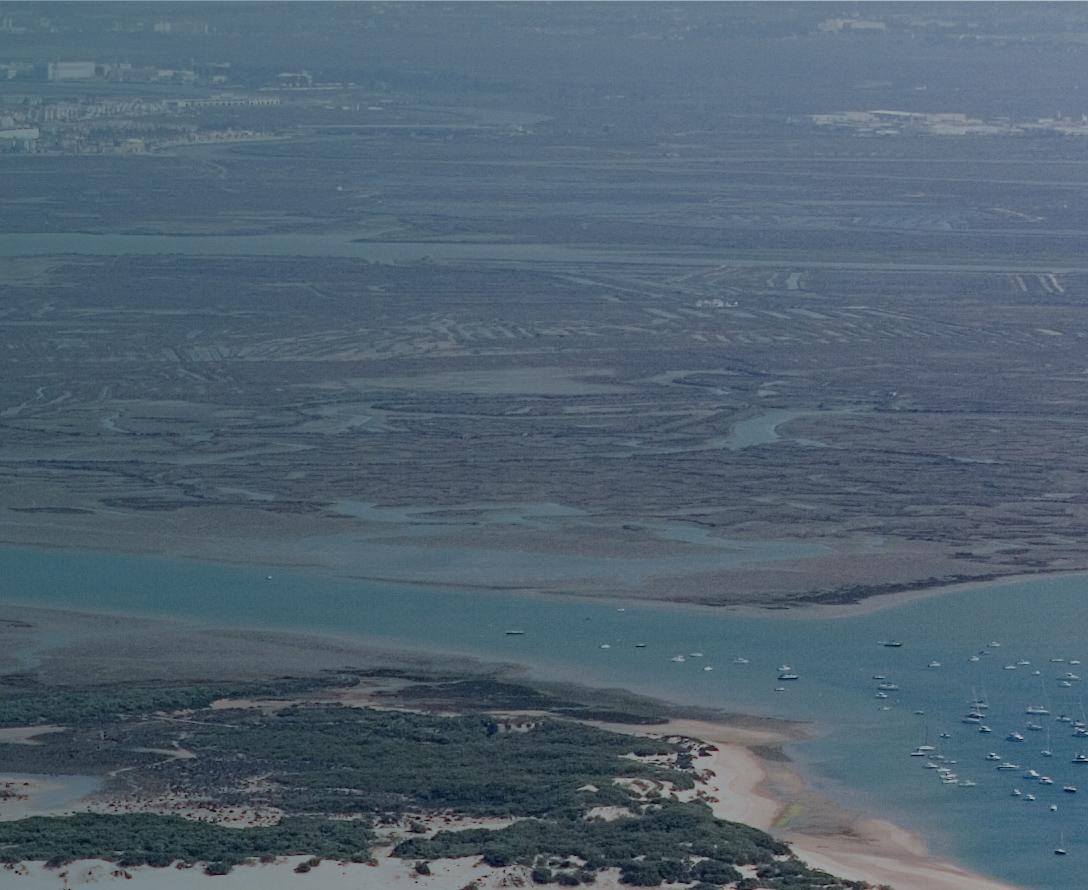
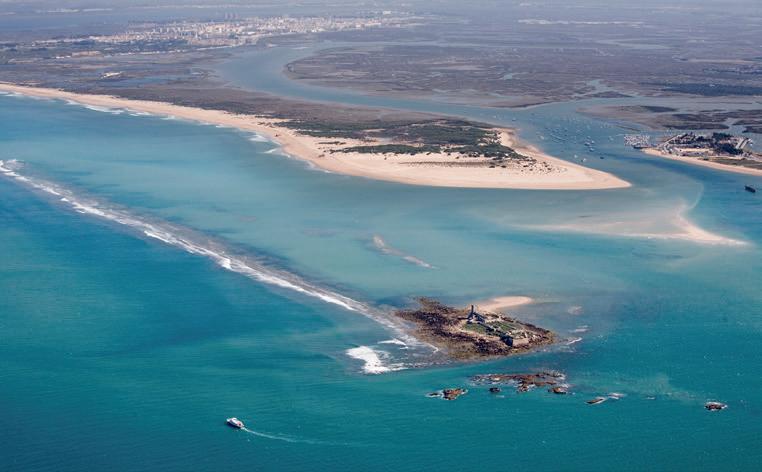
The journey begins in Sanlúcar de Barrameda, whose foundation is linked to the existence of a temple dedicated to the goddess Astarte, protector of sailors. Sanlúcar is home to the Mythological Cádiz Interpretation Centre, offering an exhibition organised into three thematic areas, the first of which is dedicated to the “Sacred Territory”, with references to the kingdom of Tartessos, cited by Herodotus as the land of the wise and generous king Argantonio. The second deals with the “Mother Goddess”. The last space focuses on what is considered the sacred place par excellence in Cadiz: the “Temple of Hercules”, which would have been located in the vicinity of the current islet of Sancti Petri, in the municipality of San Fernando, our next stop.
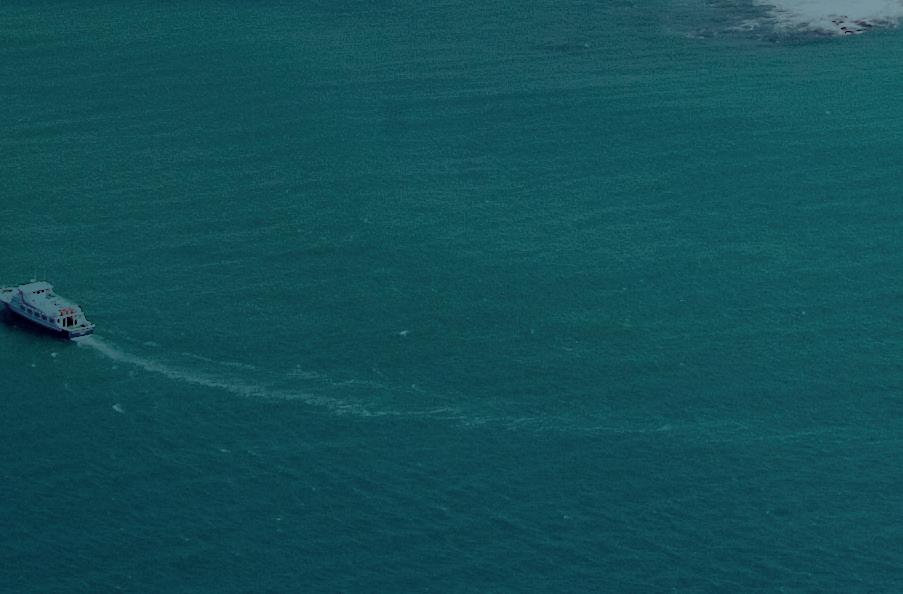
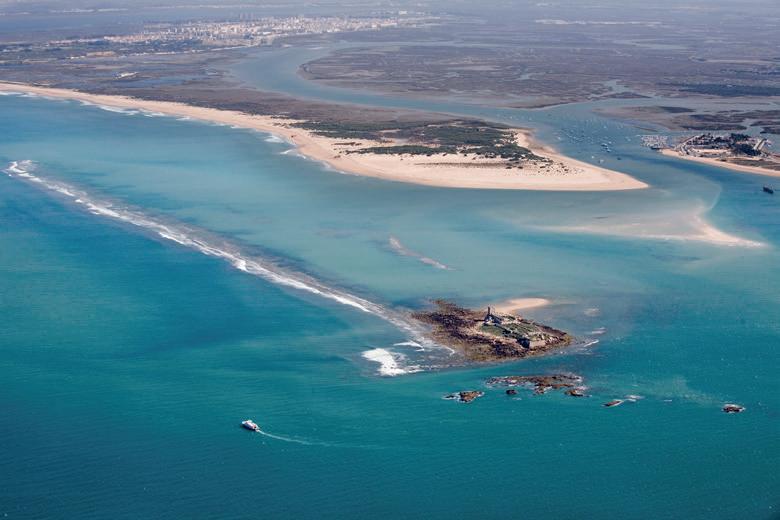
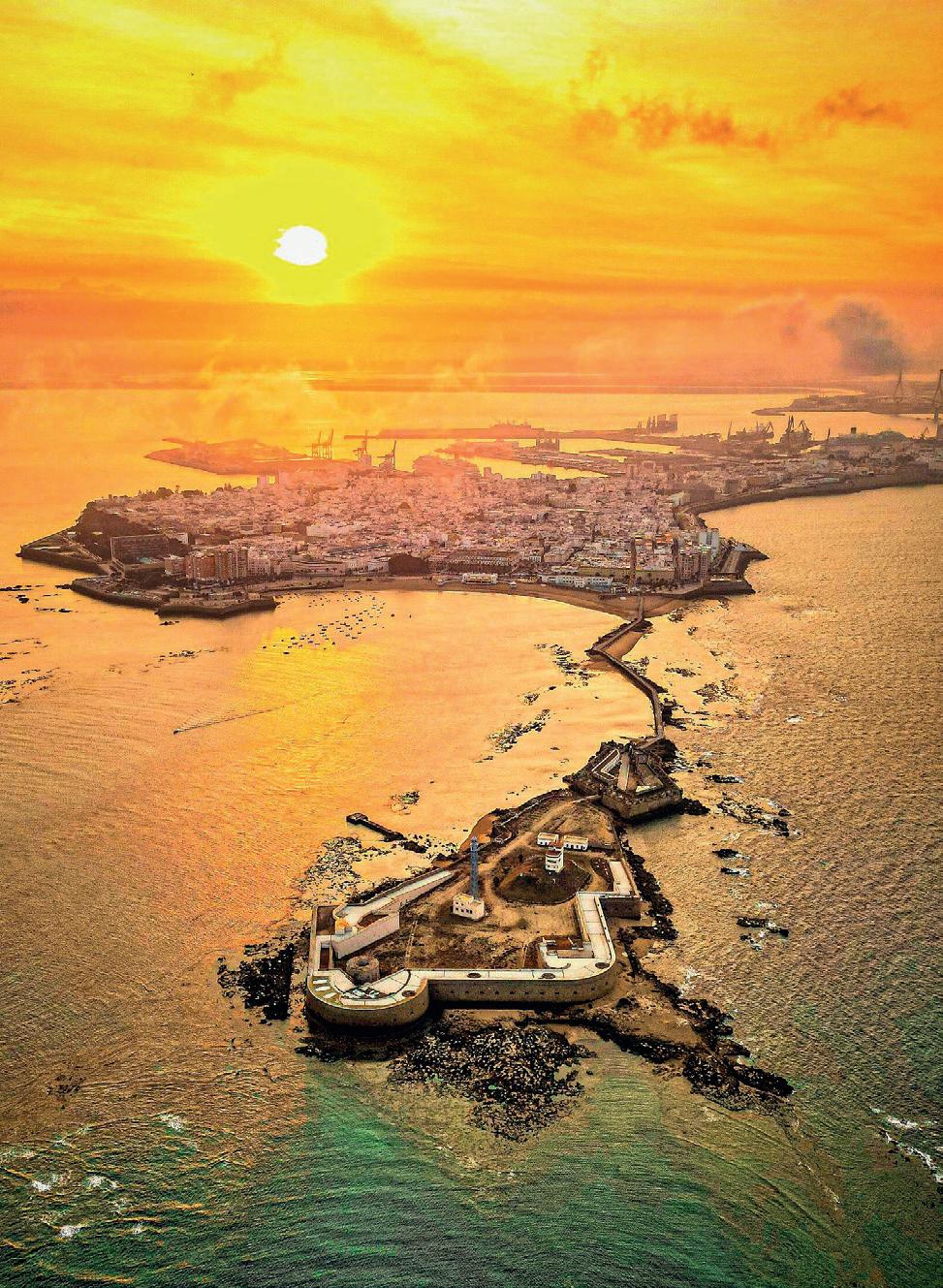
Founded by the Phoenicians around 1100 BC, this sanctuary dedicated to Melkart, an Eastern deity assimilated to Heracles and later to the Roman Hercules, was one of the great oracles of Antiquity, visited by famous figures, illustrious for their exploits or nobility, including Hannibal and Julius Caesar. According to the Latin historian Pomponius Mela, the remains of Hercules were buried under the temple, and the subsoil also housed other mythological relics such as the belt of Teucer and the tree of Pygmalion. Today, an 18th-century castle stands on the islet, restored and accessible by sea. The boat trip from the old fishing village of Sancti-Petri offers an incomparable experience steeped in symbolism in a natural setting of great beauty.
Mythological Cádiz Interpretation Centre. Sanlúcar de Barrameda
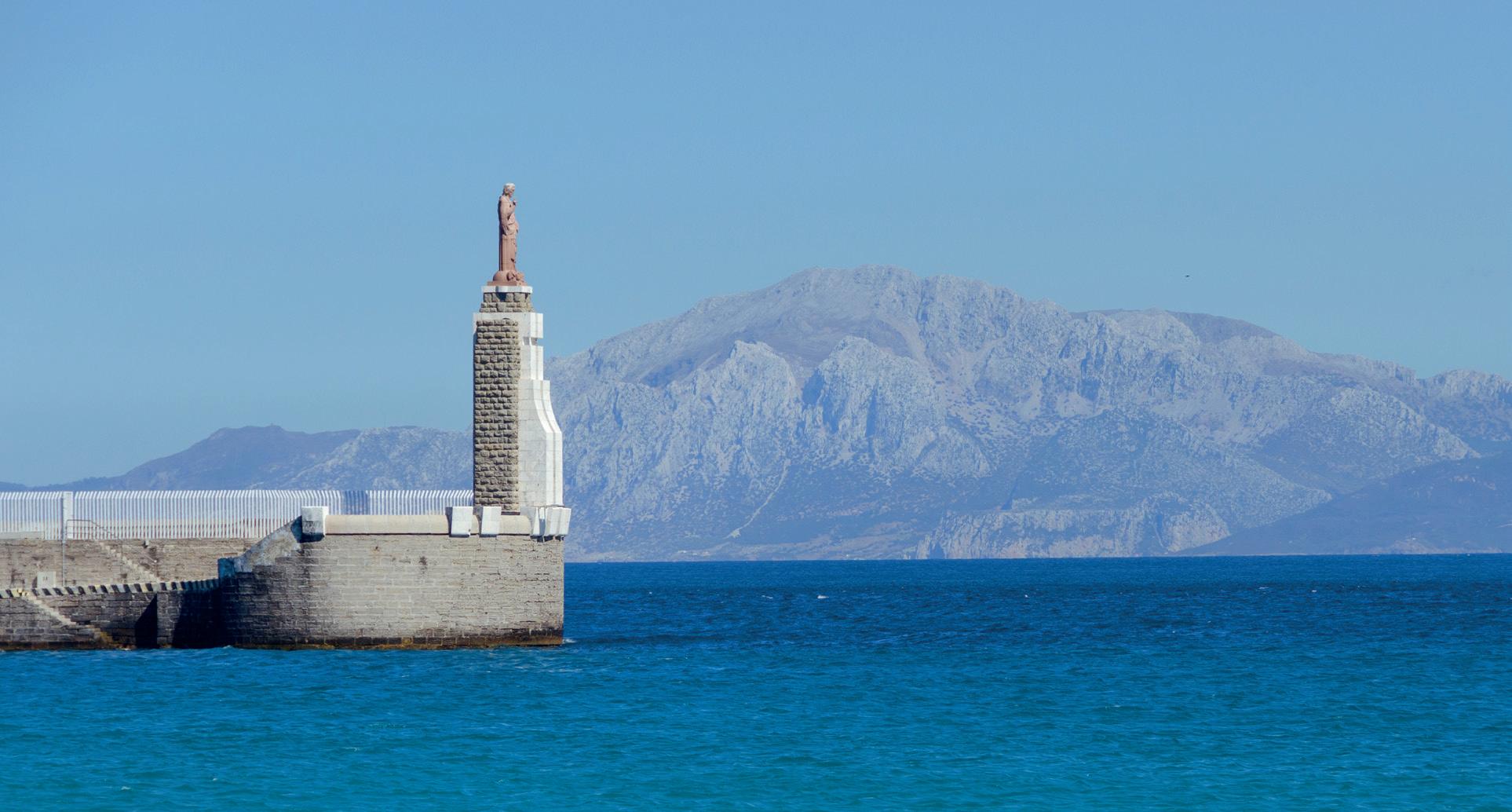
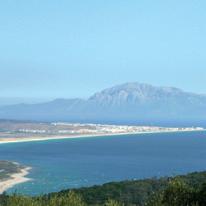
Our tour ends in the south of the province, at the Strait of Gibraltar, where geography becomes myth. It is said that when Hercules believed he had reached the ends of the world, at the edge of Iberia, he separated the Calpe (Rock of Gibraltar) and Abila (Mount Hacho) mountains and erected two columns (the Pillars of Hercules) on the peaks to reveal to future generations how far his exploits had taken him, engraving the famous inscription “Non plus ultra” on the columns. According to legend, one of the columns would be in the area of Algeciras and Tarifa, the latter offering a unique opportunity to sail through this mythical passage. Several local companies organise boat trips through the strait, where, in addition to evoking the hero’s exploits, it is possible to see dolphins and whales in the wild.
But the mysteries do not end there. Many have placed the legendary Atlantis, the circular island described by Plato beyond the Pillars of Hercules, in these waters. Researchers such as Richard Freund (professor at the University of Hartford in the United States and known for his excavations at historical sites in the Middle East) have pointed to evidence on the Cadiz coast, now reinforced by recent findings. These have shown images obtained with underwater technology, sonar and LiDAR scanners identifying concentric walls and a possible temple to Poseidon. Between history, myth and science, the enigma resurfaces on the Cadiz coast.

Strait of Gibraltar
Did you know?
The Cadiz musician Manuel de Falla devoted the last 20 years of his life to composing “La Atlántida”, a work inspired by the mythical city described by Plato and the role of Hercules as a symbol of civilisation. It is the melody played by the bells of Cadiz Town Hall every hour on the hour.
•
Tour Mythological 155
kms
2 days
1 night
Gibraltar
•
•
Sanlúcar de Barrameda
Cádiz Mythological Interpretation Centre
San Fernando
• Island and Castle of Sancti Petri
and Tarifa
Strait of Gibraltar and Tarifa
Boat trips through the Strait
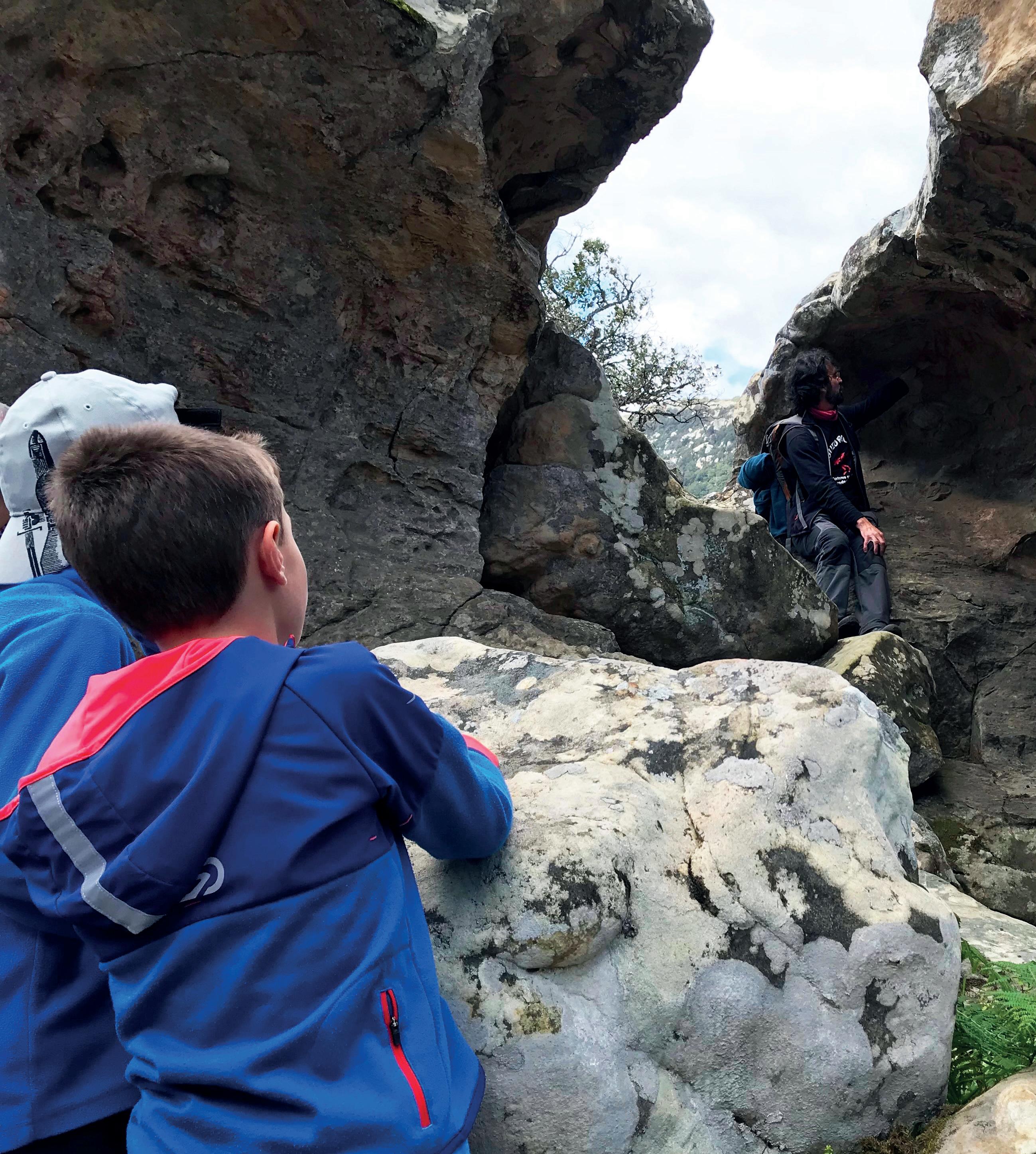
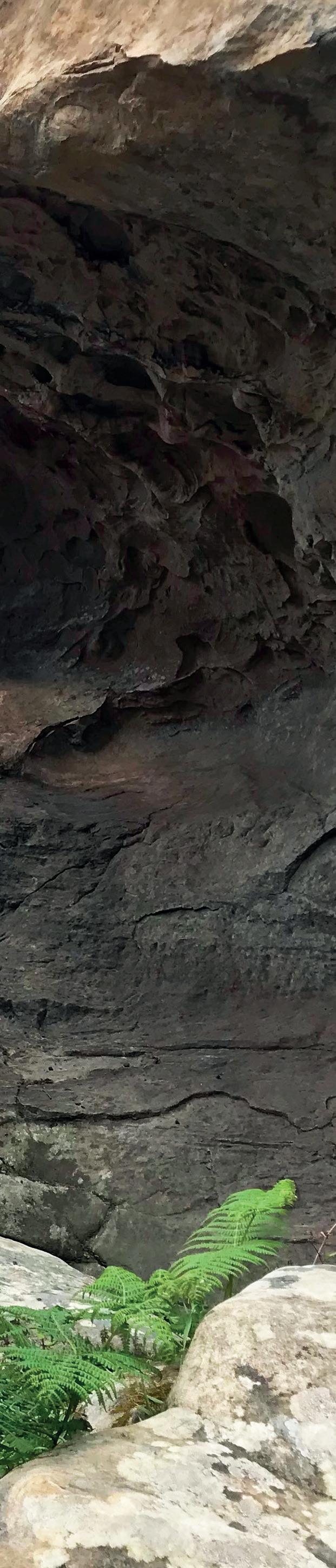
The province of Cádiz has always been a bridge between continents and seas. This explains its early settlement and the valuable archaeological legacy it houses: shelters and caves with valuable examples of rock art and megalithic constructions erected by prehistoric man as their final resting place.
01.2 Prehistoric Cadiz and its first settlers
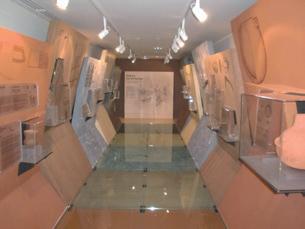
The starting point of our itinerary is the “Prehistoric Cádiz” Interpretation Centre, located in Benalup-Casas Viejas. The tour, covering eleven thematic areas, takes visitors to the first traces of the human species in the province of Cádiz, and invites them to stroll through the most important sites and finds. The museum’s narrative is supported by interactive attractions, audiovisuals, environmental recreations, models and special effects such as a Pepper Ghost, creating a realistic and immersive atmosphere. Four tours of the province also depart from the centre: the Prehistoric Janda Tour, the Strait Tour, the Serranía Tour and the Bay of Cádiz Tour.
In the municipality of Benalup and around the Janda lagoon, lie a unique group of megalithic constructions: the Celemín dolmens (Pantano Celemín recreational area). There are ten dolmen constructions, all facing northeast and very similar in configuration. These are closely related to the cave paintings in the Tajo de las Figuras area, which confirms that we are probably in a sacred place.
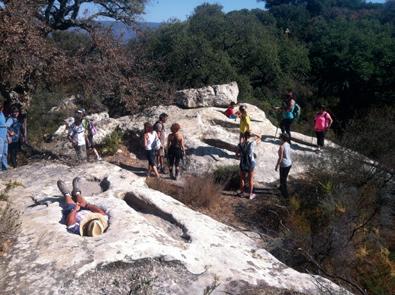
In Zahara de los Atunes, enjoy an impressive visit to the Cueva de las Orcas, with cave paintings associated with a prehistoric sanctuary related to the migration cycles of orcas and bluefin tuna. Visits are restricted to authorised companies.
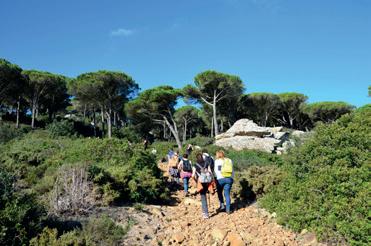
We continue our tour towards the Strait of Gibraltar, stopping at Facinas, a district of Tarifa where there are three dolmens and a menhir, located at the end of the north-western slope of the Sierra de Salaviciosa. Near the cove and dune of Valdevaqueros, on Tarifa beach, is a path marked as Los Algarbes-Betijuelo (near Punta Paloma campsite) that takes us to Los Algarbes necropolis
Exploring prehistoric caves. Los Barrios
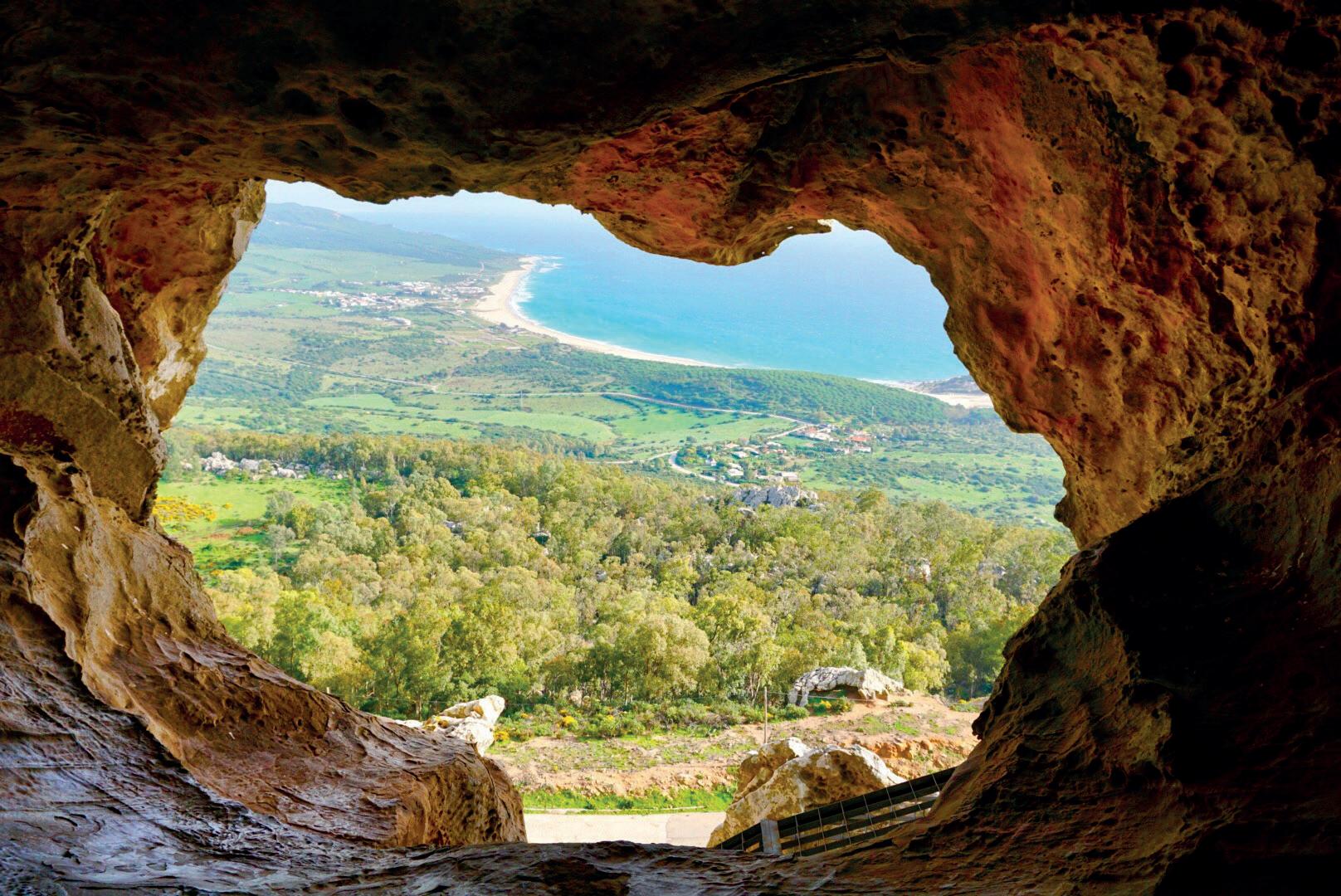
Tarifa is also home to the Cueva del Moro, the oldest site of Palaeolithic cave art in the south of the Iberian Peninsula. Its walls feature interesting naturalistic paintings and engravings.
Leaving the coast behind, the next destination is the town of Los Barrios and the Bacinete rock art site. Its main shelter stands out, with surprising scenes such as the human figure known as “El Gigante” (The Giant) due to its large size. The estate is private and permission from the owner is required.
Cueva del Moro. Tarifa
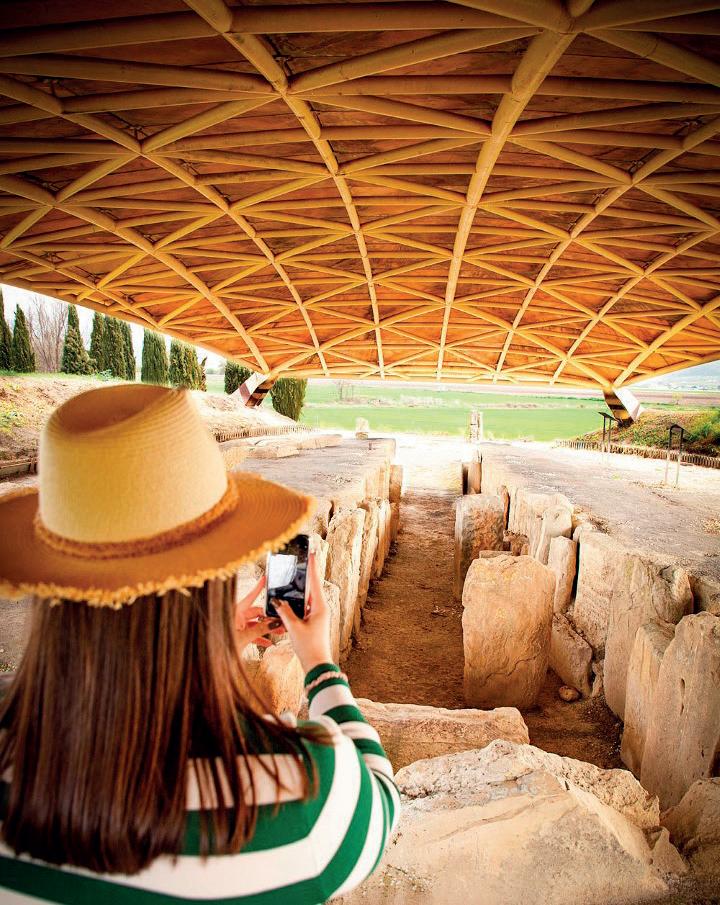
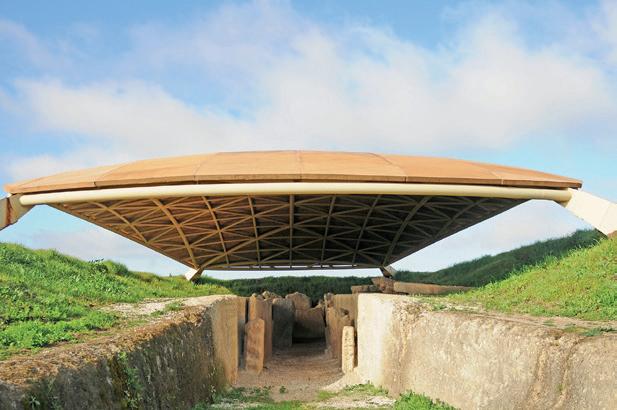
Alberite dolmen. Villamartín
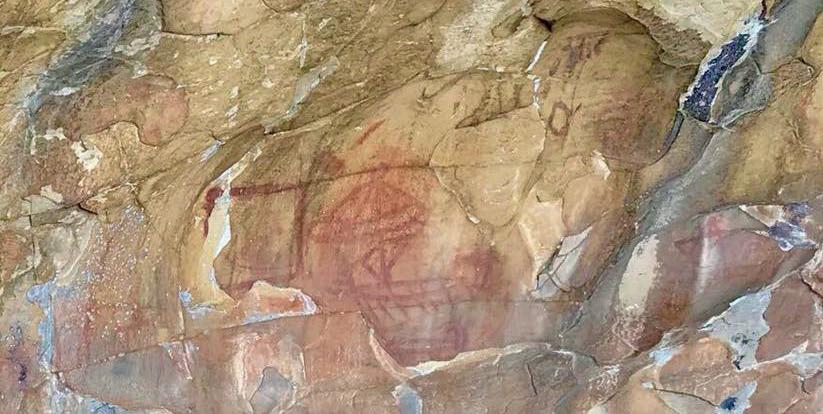


The neighbouring town of Jimena de la Frontera is also home to some interesting cave paintings.
On the last leg of our prehistoric tour, we head towards the mountains of Cádiz, where the province’s main megalithic works are concentrated. We visit the dolmen complex of Alberite (Llanos de Villamartín), over 6,000 years old, with a large gallery-type dolmen (Alberite I) (20 metres long) and a large entrance. About 15 km away, on a hill in the Puerto Serrano district, is the Fuente de Ramos site, a large necropolis in artificial caves.
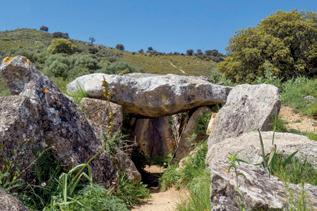
We end our tour by visiting the El Charcón dolmen (El Gastor), also known as the Giant’s Tomb due to its size, and the megalithic complex of Alcalá del Valle, known as the Tomillo dolmens, a necropolis consisting of two gallery tombs from the Chalcolithic period and a menhir.
Did you know?
The ERA Cultura facilities in Puerto Real reproduce a prehistoric village with huts that transport you to another time in close contact with nature. The centre holds workshops and activities related to prehistory and culture here.
www.eracultura.com
Cave paintings. Jimena de la Frontera
Tour Prehistoric 310 kms
5 days 4 nights
Llanos de Villamartín
• Dolmen Complex of Alberite
CAUTION
Some of the rock art remains in the province are located in areas that are difficult to access, so we recommend that before you set out to find and visit them, you always check with the nearest Tourist Office (see Practical Information, p. 102).
Puerto Serrano
• Necropolis of Fuente de Ramos
Benalup-Casas Viejas
• Prehistoric Cadiz Interpretation Centre
• Dolmens of Celemín
Zahara de los Atunes
• Cave paintings in Cuevas del las Orcas
Facinas
• Dolmens and Menhir of Facinas
Tarifa
Alcalá del Valle
• Tomillo Dolmens
El Gastor
• El Charcón Dolmen
Jimena de la Frontera
• Cave paintings
Los Barrios
• Bacinete Cave Art Complex
• Necropolis of Los Algarbes
• Cueva del Moro
The search for metals led Phoenician sailors from Tyre and Sidon to the Atlantic islands of Gadeirai, where they established their largest trading post in Europe: Gadir, the oldest city in the West. This tour invites you to discover the mark left by this civilisation on the lands of Cadiz.
01.3 Phoenician Cádiz: the ancient city of Gadir
Our starting point can be none other than the city of Cádiz. The Phoenicians tended to choose small islands or peninsulas near the coast to establish their colonies, as these were easy to defend and offered access to navigable rivers. Gadir was therefore ideal due to its distinctive geography, an archipelago formed by three islands, “las Gadeirai”: Eritheia and Kothinoussa, the two westernmost islands, joined by a tombolo, and the third island, to the east, Antípolis
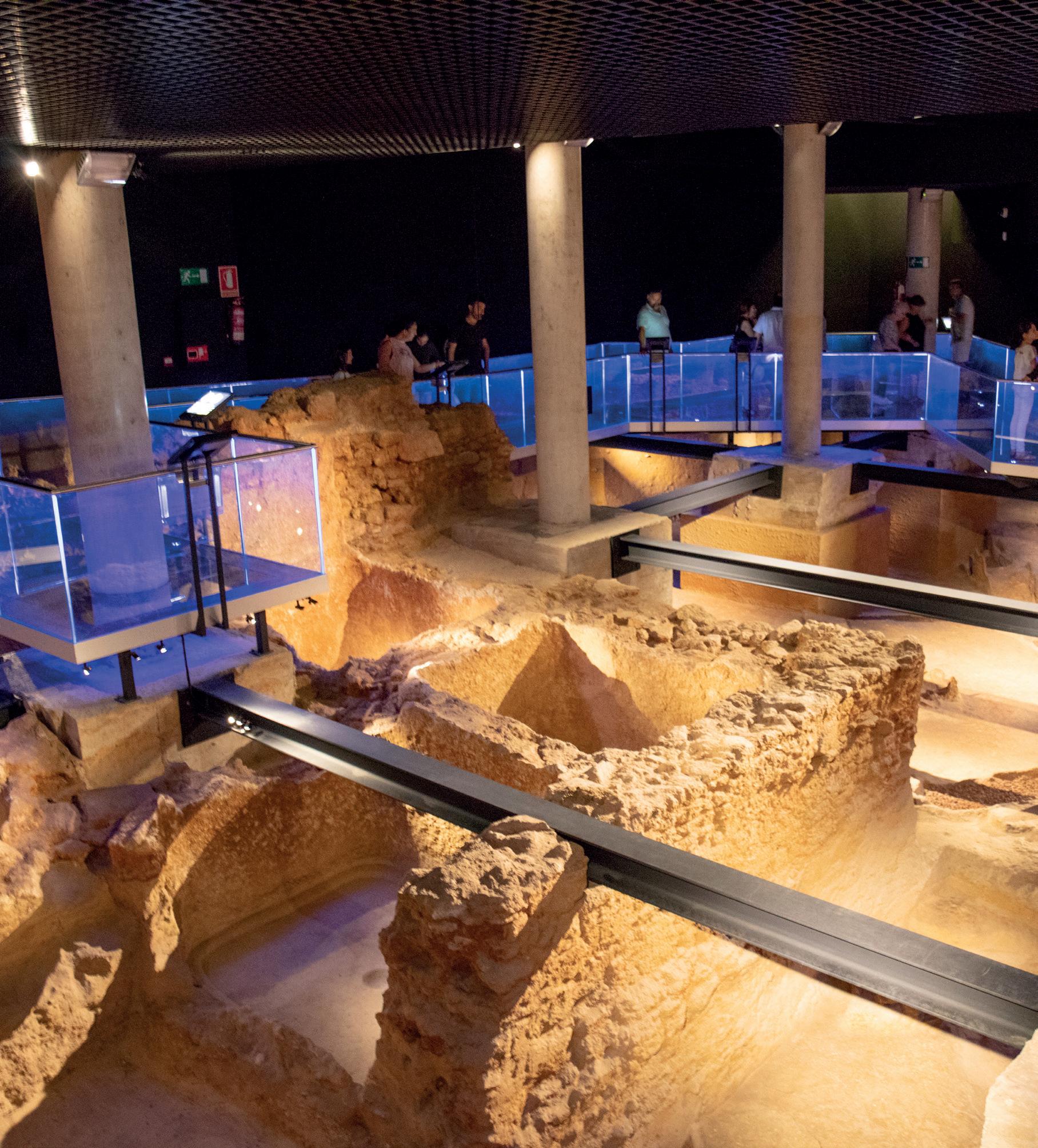
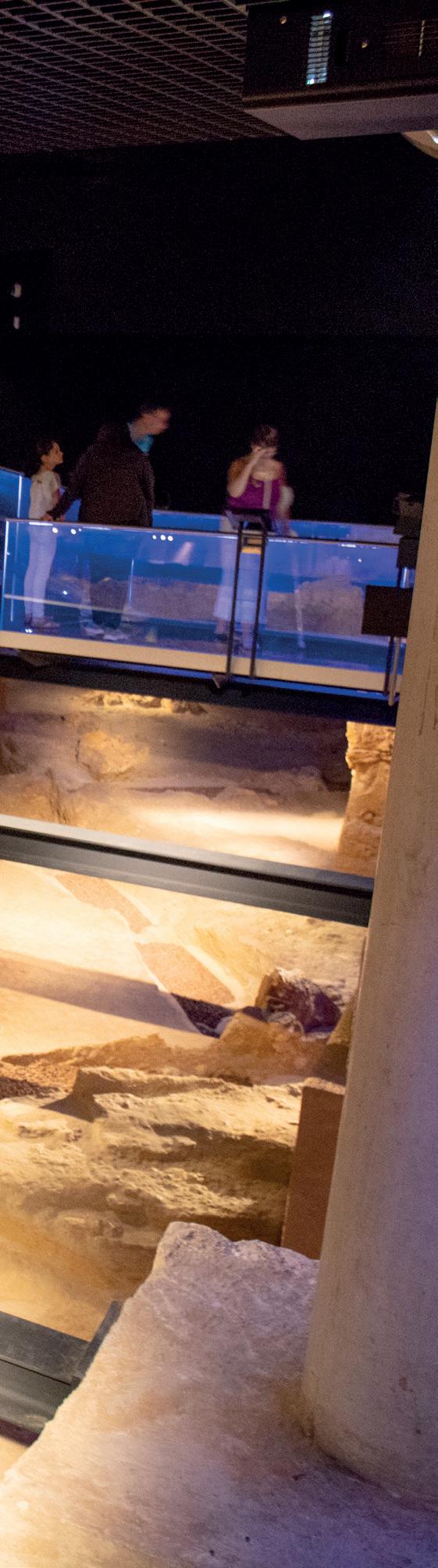
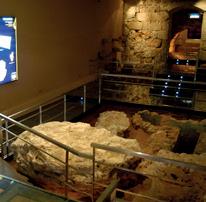
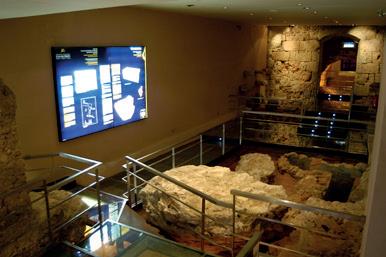
The valuable archaeological site of Gadir is an exceptional testimony to this historical period. The visit takes place via a spectacular glass walkway and its central theme revolves around the figure of the Phoenician Mattan, who died in a great fire that took place in the city back in the 7th century BC, and whose face has been reconstructed using the most advanced digital and forensic technology. This interactive tour also allows visitors to see the remains of eight dwellings organised around two clay-paved streets and the buildings of a Roman fishing factory.
Our next destination is next to Cadiz Cathedral, the Casa del Obispo archaeological site, whose remains, dating from the 8th century BC to the 18th century, are located in the basement of the old Episcopal palace. Highlights include a Phoenician funerary monument (6th century BC) and the remains of a Roman temple.
Gadir Archaeological Site. Cádiz
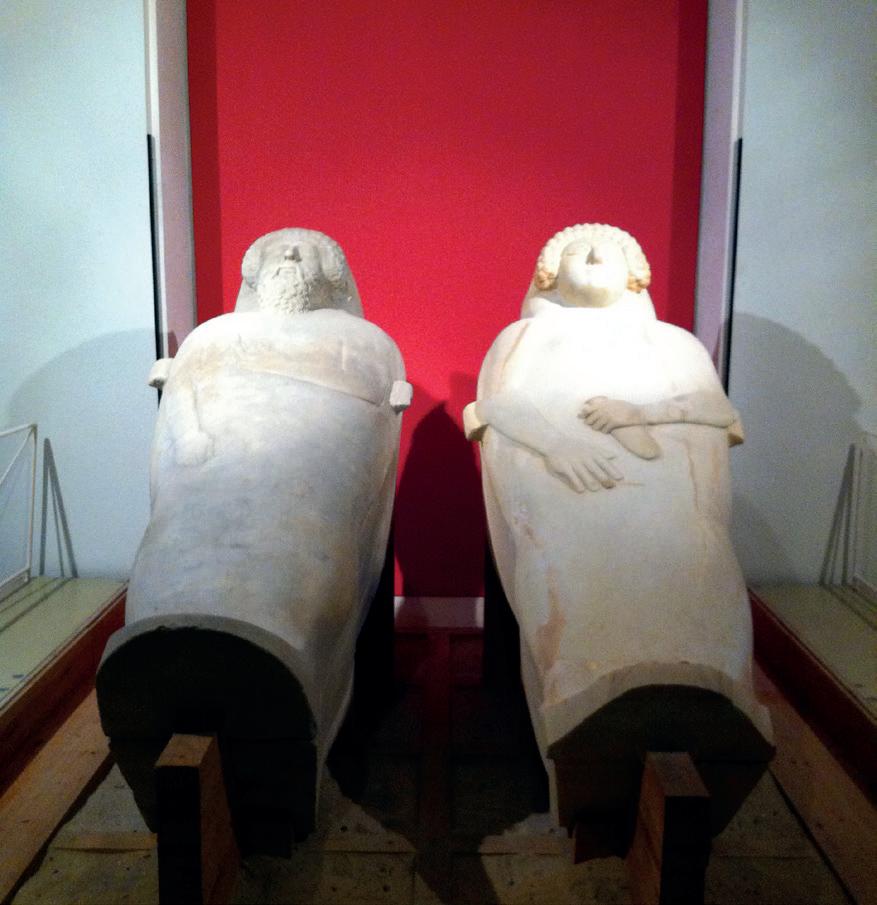
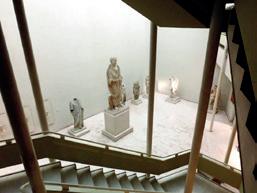
We continue our walk through the city towards Plaza de Mina, where the Museum of Cadiz is located. The museum houses a valuable archaeological collection from the Phoenician period, including amphorae, a sculpture of the goddess Astarte and bronzes dedicated to the god Melkart. However, the stars of Cádiz’s funerary world are undoubtedly the two anthropoid sarcophagi found in the city, with the most Hellenistic features of any known examples (and whose replicas can also be admired in the Entre Catedrales space). The first of these, the male sarcophagus, was found in the area known as Punta de la Vaca in 1887 and had to wait almost a hundred years (1980) for its female counterpart to join it. Only ten sarcophagi of this type have been found worldwide, and only three are female, located in the museums of Beirut, Carthage and the Louvre.
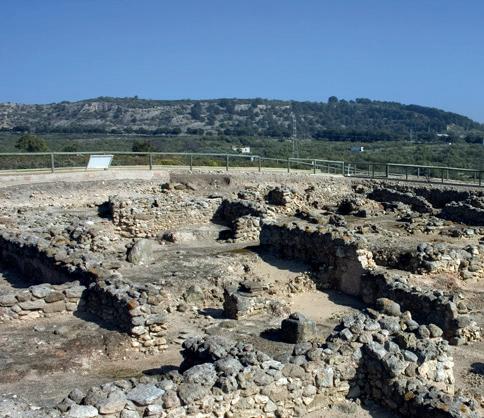
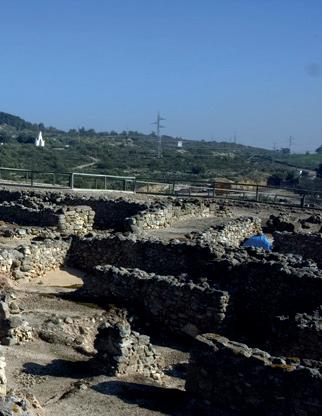
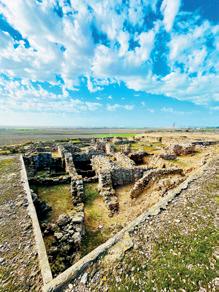
We now head to El Puerto de Santa María in search of the Doña Blanca archaeological site, located at the top and on the slopes of the San Cristóbal mountain range. Excavations have uncovered the remains of
walls, a necropolis (with Bronze Age hypogea and a burial mound with 63 graves) and dwellings of what would have been a port city that remained inhabited between the 8th and 3rd centuries BC and whose economic development was based mainly on trade. One of the oldest Phoenician wine cellars in the world is still preserved.
San Fernando harbours the island or islet of Sancti Petri, where the temple of the Phoenician god Melkart was once located. Today, the island is home to a 13th-century tower and a castle, a group of buildings constructed between the 16th and 18th centuries. These are open to visitors and are in good condition following restoration work that was completed in 2010.
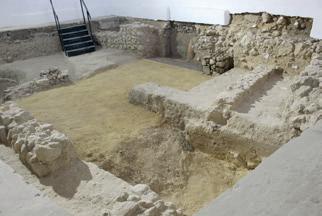
We end our tour in Chiclana, visiting the Nueva Gadeira Archaeological Site - Cerro del Castillo Interpretation Centre, with an exhibition of archaeological remains and virtual reality experiences that bring visitors closer to the history of the place.
Phoenician sarcophagi from the Museum of Cadiz
Doña Blanca archaeological site. El Puerto de Santa María
Tour Phoenicia
75 kms 2 days 1 night
Did you know?
In some of the city’s jewellery shops, you can buy reproductions of the Phoenician ring found inside a plundered tomb in the Bishop’s House in 1997. It is made of gold and has two dolphins engraved on it, a symbol of Gadir. Gadir
El Puerto de Santa María
• Doña Blanca Archaeological Site
• Gadir Archaeological Site
• Casa del Obispo Archaeological Site
• Cádiz Museum
• Entre Catedrales Space
San Fernando
• Island of Sancti Petri.
• Temple of Melkart and Castle Chiclana
• Nueva Gadeira Archaeological Site
Cádiz

In the 3rd century BC, the province of Cádiz fell into the hands of the Romans, who already controlled the Guadalquivir valley. This marked the beginning of a period of economic, political and commercial prosperity. During this tour, we can admire the extensive legacy of the Empire.
01.4 Roman Cadiz: from Gades to Baelo Claudia
The large number of archaeological remains from the Roman period and their dispersion throughout the province of Cádiz mean that this route is divided into two sections (Coast and Inland), making our trip more comfortable and practical.
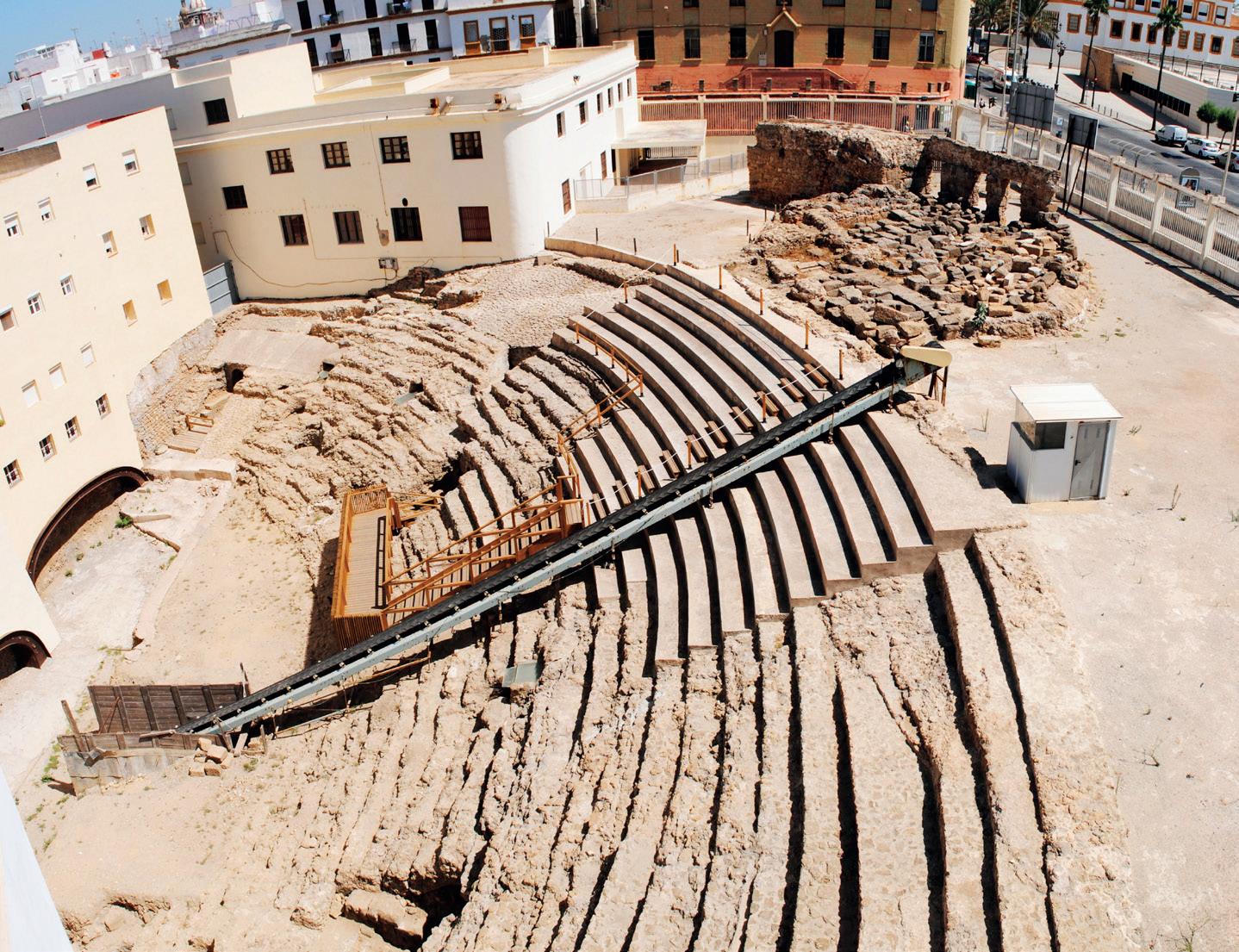
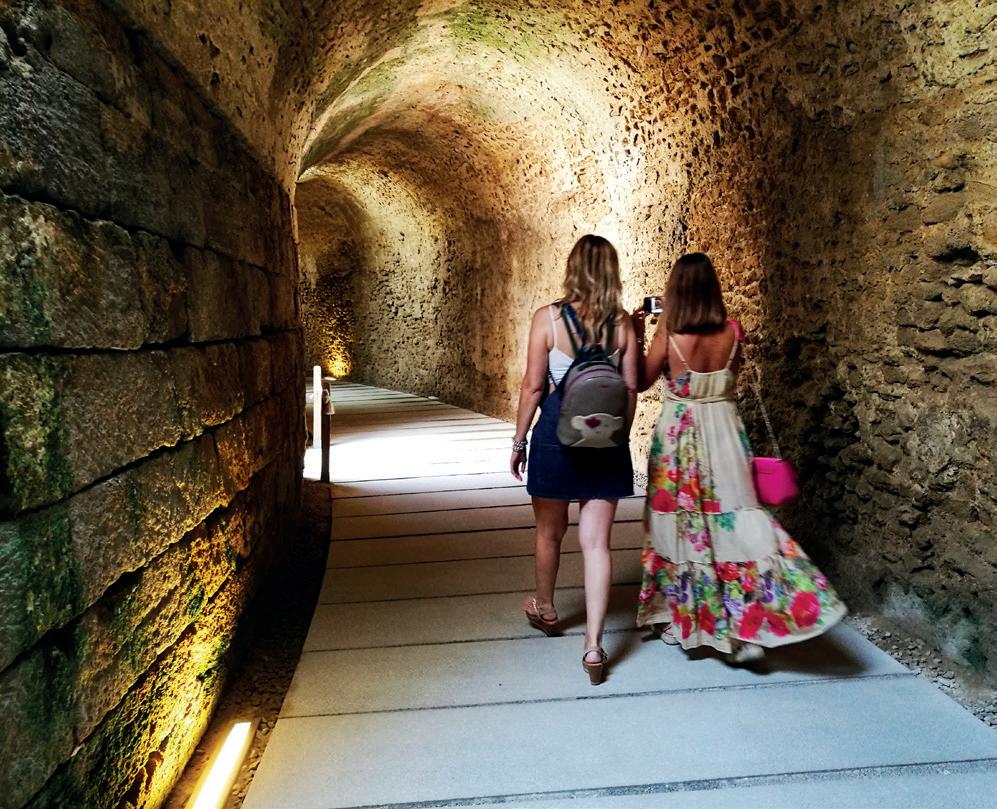
The COASTAL ITINERARY takes us first to Cadiz, the ancient Gades, which achieved great economic importance during the time of the Balbo family. Lucius Cornelius Balbus “the Younger” ordered the construction of the Roman theatre of Cadiz in the current neighbourhood of El Pópulo around 70 BC. With a diameter of 120 metres and a capacity for more than 10,000 spectators, excavations have recovered a significant part of the stands, as well as the orchestra and an annular distribution gallery. In addition to these remains, parts of the stage building are visible through boreholes drilled at the Theatrum Balbi (Balbo Theatre) Interpretation Centre, which offers a complete and contextualised view of the Roman building through explanatory panels, images, models and audiovisual resources.
Without leaving El Pópulo, we can visit the Roman remains preserved at the Casa del Obispo archaeological site, which during this period may have been used as a place of worship for the gods Apollo, Aesculapius and Hygieia. As we walk along Cuesta de Recaño Street in the old town of Cádiz, on the site of the old Andalucía theatre, we find vestiges of the Roman canning and fishing industry: a salting factory that remained in operation until the early 4th century. Charcoal drawings of the Gades lighthouse were found in one of its cisterns, and are now on display in the Museum of Cadiz, alongside other finds from this period from Baelo Claudia, Carissa Aurelia and Gades itself.
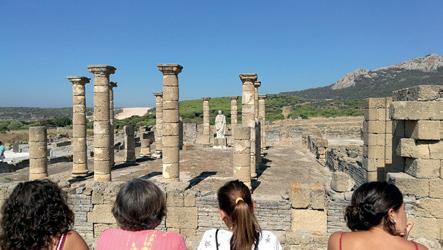
Baelo Claudia archaeological site
Outside the city walls, beyond the Puertas de Tierra gates, are the Roman columbariums, currently the only part of the necropolis that can be visited, together with the remains of the aqueduct that supplied water to the neápolis or new city built in the 1st century BC on the site now occupied by the neighbourhoods of Santa María and El Pópulo.
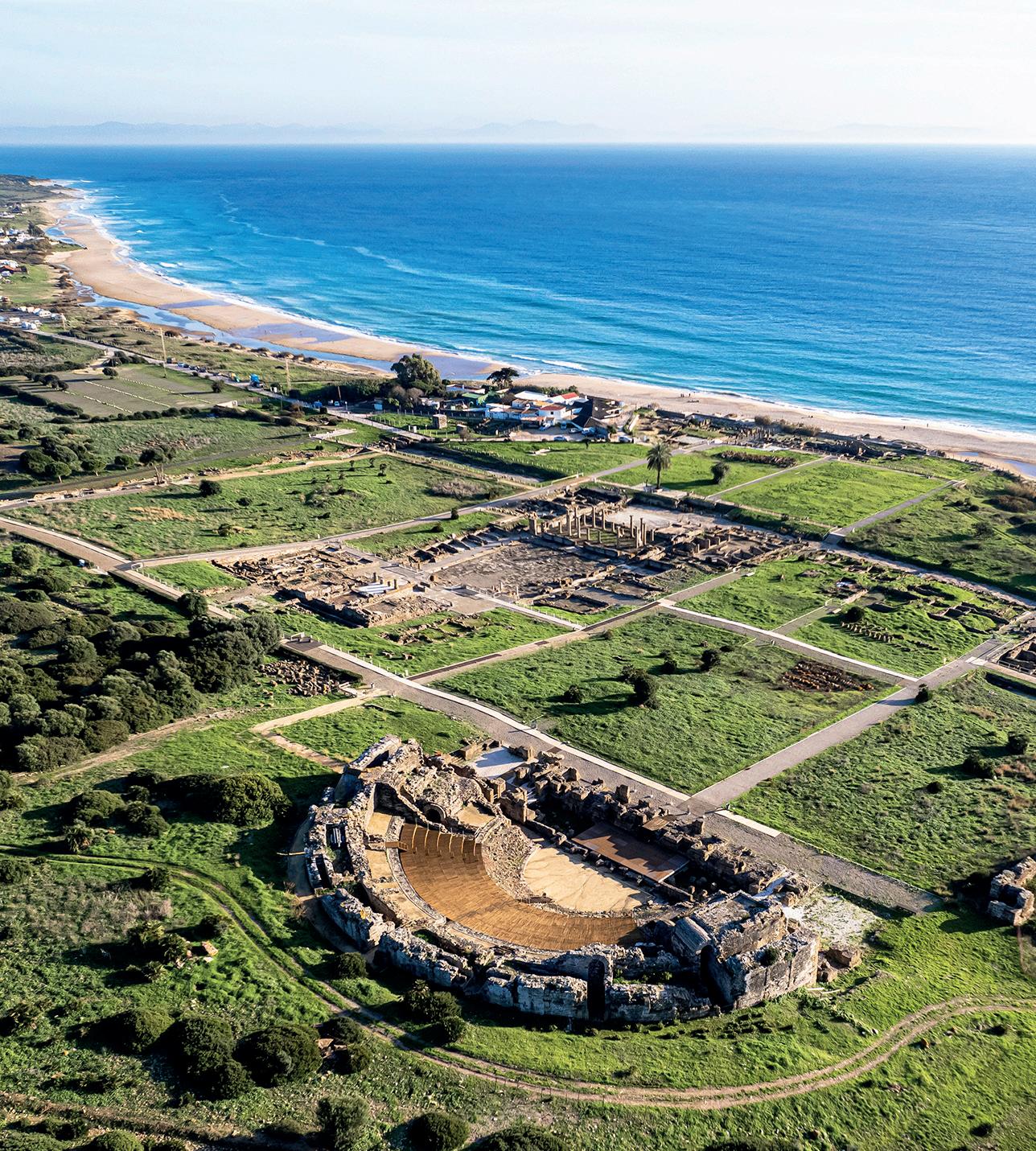
From Cádiz we head to Bolonia, a district of Tarifa and home to the archaeological site of Baelo Claudia. This consists of the Roman city itself, with a visitor circuit, and the covered museum area, which includes the Visitor Centre. Its origin and subsequent development are closely linked to the salting industries and trade with North Africa. This is a fundamental reference point for understan-
Roman Theatre. Cadiz
Roman Theatre. Cadiz
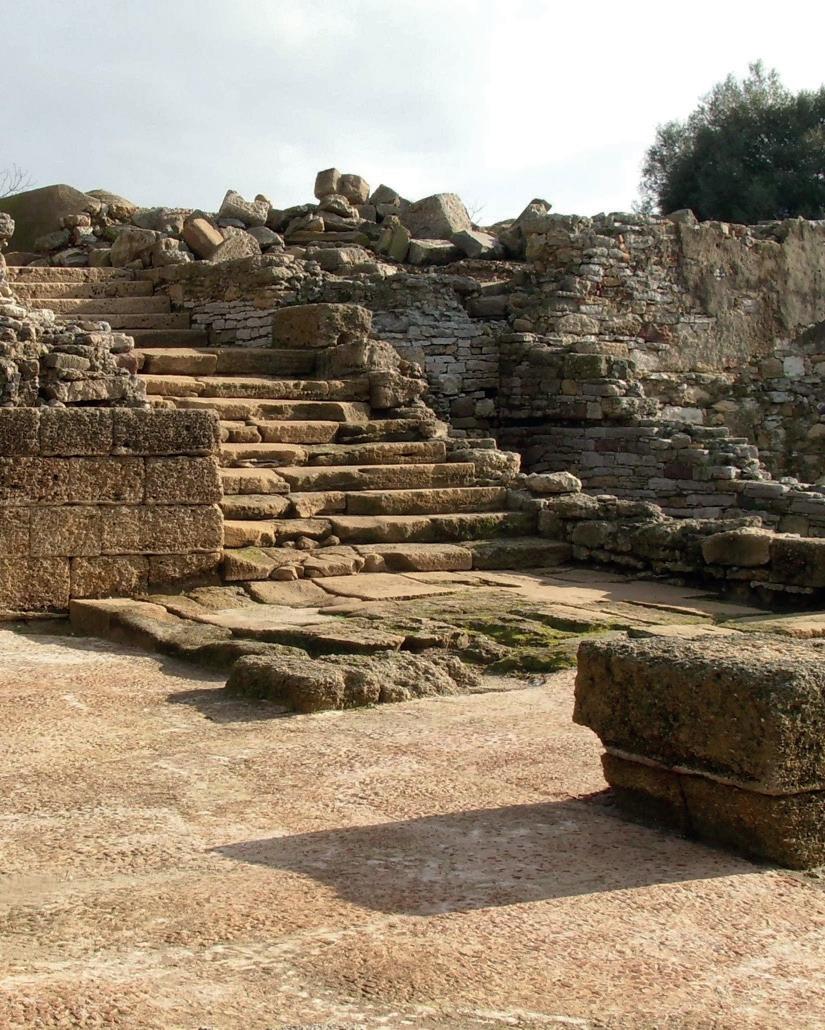
ding Roman urban planning, as it preserves all the characteristic elements: forum, Capitoline temples, temple of Isis, basilica, curia, municipal archive, market, thermal baths, industrial area, complete city wall with main gates, streets, aqueducts, and a theatre that hosts classical theatre performances in summer.
This first coastal route ends in San Roque, where the archaeological site of Carteia is located. Of Phoenician origin, in 171 BC it was declared Colonia Libertinorum Carteia, the first Latin colony outside Italy. In addition to its role as a military base and commercial port on the Strait of Gibraltar, Carteia was notable for its important canning industry. The remains of a thermal building, a ba-
silica-style swimming pool, the monumental staircase built in the time of Augustus, a Roman theatre very similar to the one in Mérida, several domus and a salting factory are of note.
The second ITINERARY for discovering the legacy of Rome takes place INLAND AND IN THE MOUNTAINS of the province of Cadiz and starts in Medina Sidonia, with an archaeological site that illustrates the exemplary sanitation and public supply infrastructures of Roman civilisation and includes the remains of the sewers and drainage system of the early Roman city. The visit starts at the Archaeological Museum, where the Roman remains are located in its basement; and just a few metres from the museum are the remains of the Roman road.
Before leaving Medina, it is worth visiting the Church of the Holy Martyrs, possibly built on the site of a Roman house belonging to a patrician named Lepero. A Roman pedestal with the Latin inscription “Lepero re vonit sed sacrv” (“Lepero renovated it and offered it to God”) makes it the oldest Visigothic chapel in Andalusia that can be visited. It dates back to 403, and was one of the first places of Christian worship in the region.
About 50 minutes away by car is the site of Carissa Aurelia, in what is now Espera, a Roman city where a walled urban enclosure and a large necropolis with underground tombs and a mausoleum have been preserved. A unique type of tomb, dug into the ground in the shape of a Greek cross, has also been found here. Visits to the site are organised by the local Tourist Office and must be booked in advance.
Archaeological site of Carteia. San Roque
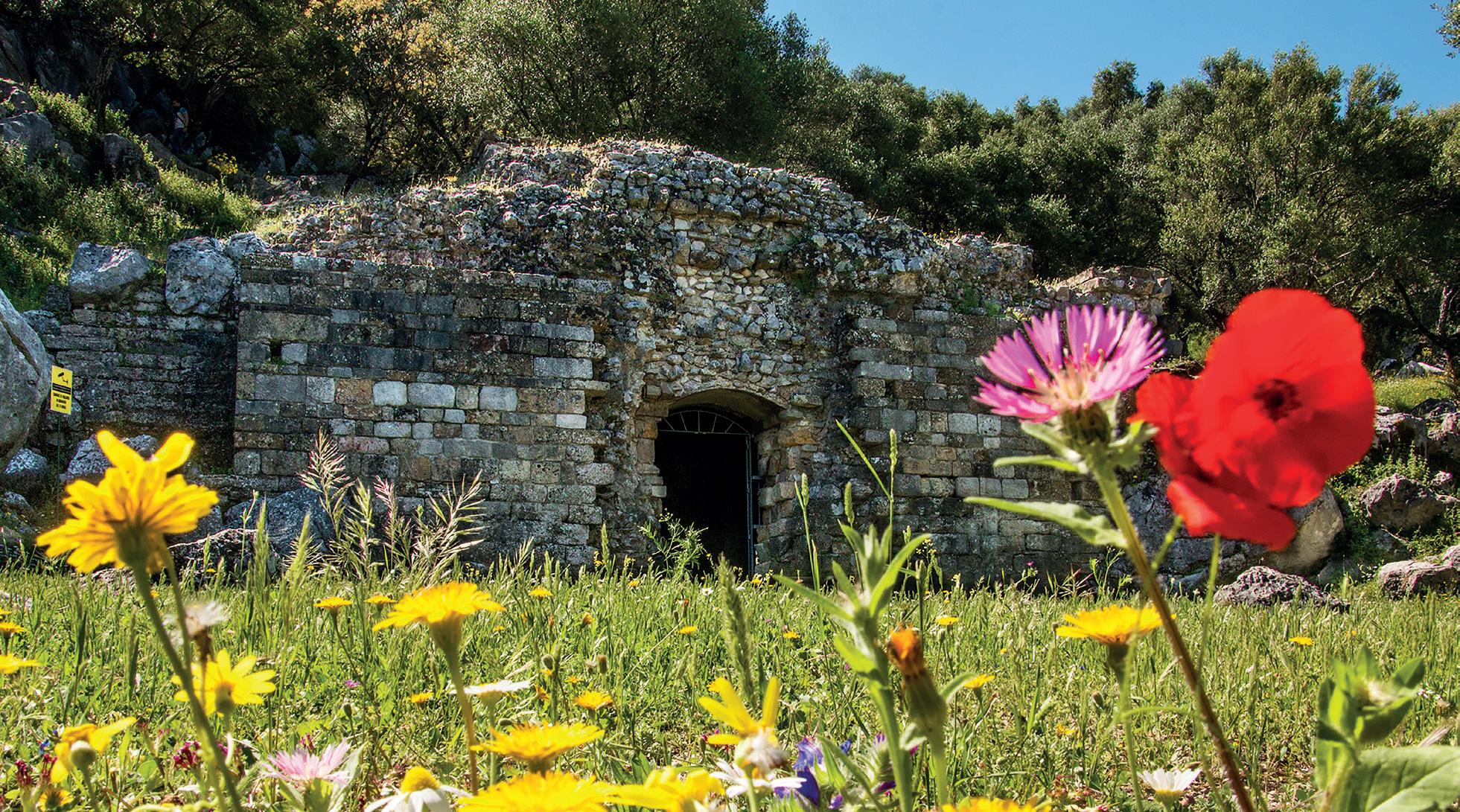
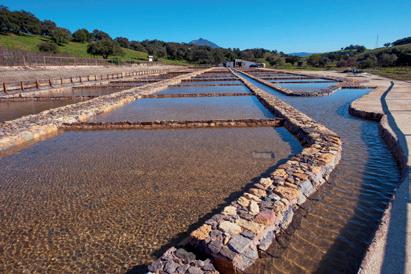
We now head towards the town of Prado del Rey. About 5 kilometres away, in Cabezo de Hortales, the Roman city of Iptuci was founded in the 2nd century BC. Remains of the walls and towers, pavements and architectural elements of dwellings are preserved. The salt deposits in the surrounding area were exploited, and salt flats were built in the heart of the Cadiz mountains. These are the only inland salt flats that can be seen and visited, as they are still in operation.
We continue our tour by visiting the Roman city of Ocuri (2nd century AD), located at the top of Salto de la Mora (Ubrique). Outside the city walls is the necropolis and its most important monument: the mausoleum. Also noteworthy are the cyclopean wall and, in the upper area, some impressive thermal baths. To arrange a visit, contact the Ubri-
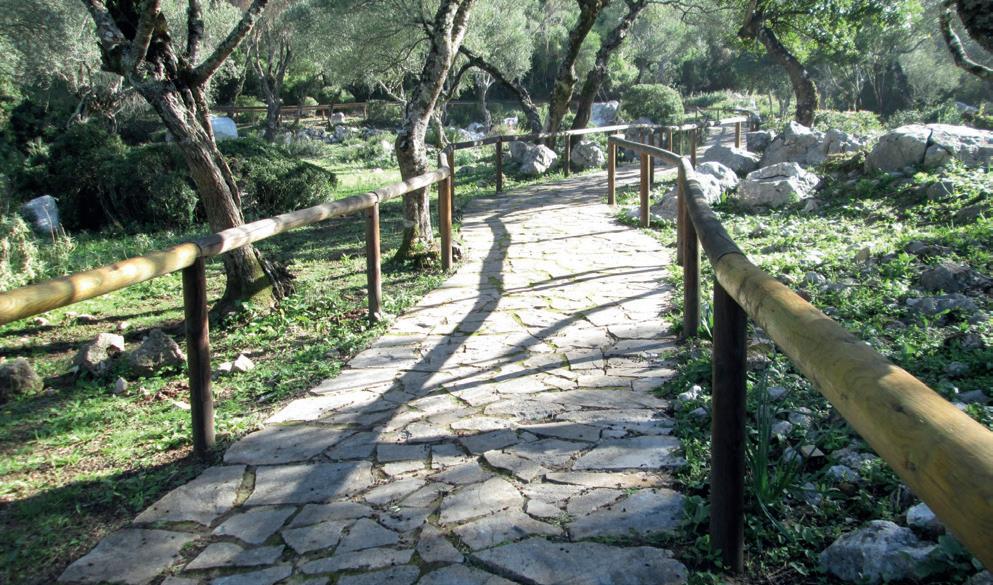

que Municipal Tourist Office. We end the tour by admiring the Roman road between Benaocaz and Ubrique, dating from the 1st century BC, which remains in a good state of conservation.
Roman road. Benaocaz-Ubrique
Roman city of Ocuri. Ubrique
Did you know?
In 1939, two inscriptions with the word Gaditanorum were found in the Colosseum in Rome. These seem to confirm that the Roman citizens of Gades had “reserved” seats in the stands, confirming the importance of Gades, especially during the time of Caesar Augustus.
Roman Tour
The Roman salt flats of IPTUCI
kms
2 days
1 night
Espera
• Carissa Aurelia archaeological site



Today, you can still buy salt directly from the ancient salt flats of Iptuci. They preserve the original pools built next to springs that flow all year round at 25°C, with a high salt content. The salt is harvested by hand during the two summer months, extracting more than 300 tonnes of salt.
Prado del Rey
Ancient Roman salt flats of Iptuci
Inland itinerary
Ubrique
• Ocuri archaeological site
Roman Baetica

Cádiz
• Roman theatre and Interpretation Centre
Medina Sidonia
• Asido Caesarina Roman archaeological site - Archaeological Museum
• Los Santos Mártires Church

• Casa del Obispo Archaeological site
• Salting Factory

The cities of Cádiz and Tarifa, along with twelve other cities in the provinces of Seville and Córdoba, form part of this signposted route that runs through the southernmost province of Roman Hispania and covers territories through which the ancient Via Augusta passed.
www.beticaromana.org
• Cádiz Museum
• Roman Columbariums
• Remains of the Roman aqueduct
Coastal itinerary
•
San Roque
• Carteia Archaeological site
Bolonia- Tarifa
Baelo Claudia Archaeological Site
As a consequence of the Islamic presence and the struggles for ownership between Muslims and Christians, the territory of Cadiz became dotted with castles, watchtowers, fortresses and alcazars of great artistic value, both on the coast and inland. We encourage you to discover them on this tour.
01.5 Cadiz of castles and fortresses
Thanks to its history and geography, the province of Cádiz has a huge quantity of military architecture, whose geographical dispersion makes it necessary to divide this cultural tour into TWO ITINERARIES that are more accessible to travellers’ time constraints.
The FIRST of these runs along the Atlantic coast, from the mouth of the Guadalquivir River to Tarifa, also entering the Alcornocales Natural Park. We begin our journey in Sanlúcar de Barrameda, where you can admire the 15th-century Castle of Santiago. This imposing Gothic-style fortress functioned as a ducal fortress until 1645, welcoming such illustrious figures as Queen Isabella the Catholic and Christopher Columbus. Just 8 km away is the fishing village of Chipiona, with its crenellated castle, which today houses the Cádiz and New World Interpretation Centre, next to its famous lighthouse, the tallest in Spain.
Continue along the coast until we reach Rota, whose most emblematic building is the 13th-century Luna Castle. Remains of the walls are also preserved, including the Puerta de Regla or Chipiona, the Puerta de Sanlúcar and the Puerta del Mar. A 20-minute drive takes you to El Puerto de Santa María, where you can visit the Castle of San Marcos, owned by Bodegas Caballero, which manages the visits.
Our next destination is Cádiz, a city that reinforced its defensive system after being raided in 1596 by the troops of the Earl of Essex. Robust walls and bastions surround part of the urban perimeter, starting the visit at the Puertas de Tierra, flanked by the semi-bastions of San Roque and Santa Elena Following the coastline through Campo del Sur, you can see the bastions of Capuchinos and Los Mártires, until you reach
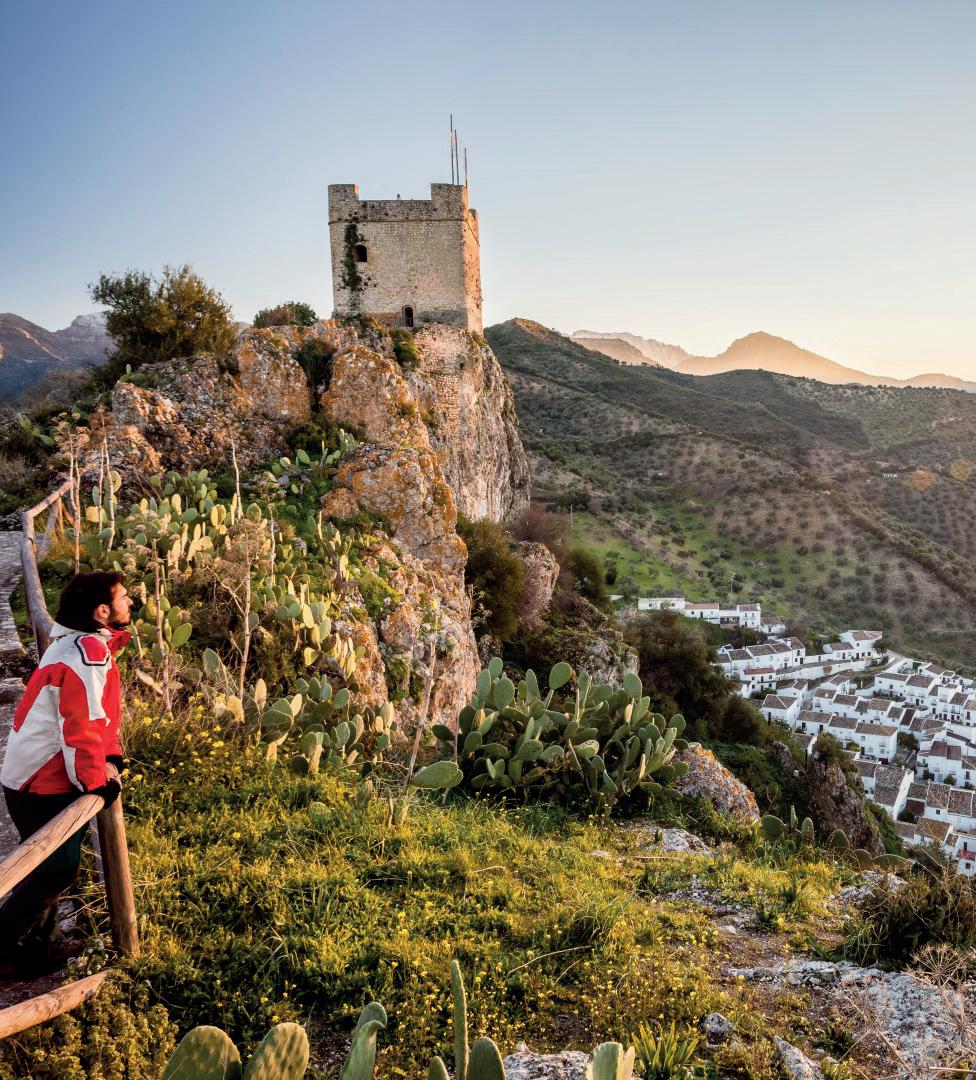
Zahara de la Sierra Castle
La Caleta beach, guarded by the castles of Santa Catalina and San Sebastián, now converted into cultural spaces. The tour of the fortified city ends at the Candelaria bastion and the San Carlos walls, next to the Apodaca boulevard.
From Cadiz, we head towards San Fernando, which has two fortresses within its municipal boundaries, the castles of San Romualdo and Sancti Petri, opposite the beaches of Chiclana de la Frontera. Continuing along the Atlantic coastline, in Conil de la Frontera we find the keep of the castle built by Guzmán El Bueno in the 16th century. Moving away from the coast, Vejer sits on a hill, with a magnificent fortified complex that still preserves its walls, towers, gates and castle.
The need to defend the fishing activities and the almadrabas (traditional tuna fishing system) owned by the Dukes of Medina Sidonia led to the construction of fortified shelters along the coast. The 16th-century Almadrabas Castle in Zahara de los Atunes (Barbate) is open to the public and served three purposes: as a castle against piracy, a residential palace and a chanca or factory where the tuna was cut, salted and prepared. From there, it takes just over half an hour to reach Tarifa, where you can find the castle of Guzmán el Bueno with its belt of walls and gates and an interpretation centre inside.
Entering the Alcornocales Natural Park, the tour takes us to the fortress of Castellar de la Frontera (12th-15th centuries), which is extraordinarily well preserved. The walled layout, the Arco de la Villa archway and the alcázar-palace, now a hotel and restaurant, are of particular note. Inside is Castellar Viejo, a residential area with narrow streets and a medieval ambience. This first itinerary ends with a visit to the neighbouring monumental complex of Jimena de la Frontera Castle
The SECOND ITINERARY runs through the countryside and mountains of Cadiz, offering magnificent monuments and a large number of
Castillo de Luna. Rota
castles built into the rock. It begins in Medina Sidonia, where the former keep of the old fortress, now known as the Torre de Doña Blanca, and three of its main gates have been preserved: the Arco de la Pastora, the Arco de Belén and the Puerta del Sol. On the road from Medina Sidonia to Arcos, just over 10 km from Paterna de Rivera, in the municipality of San José del Valle, we find the famous castle of Gigonza, of Arab origin. Although privately owned, it can be visited by appointment.
Alcázar. Jerez de la Frontera
Aerial view of Cadiz
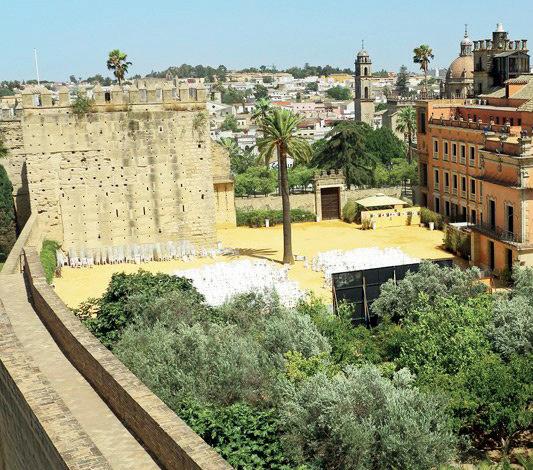
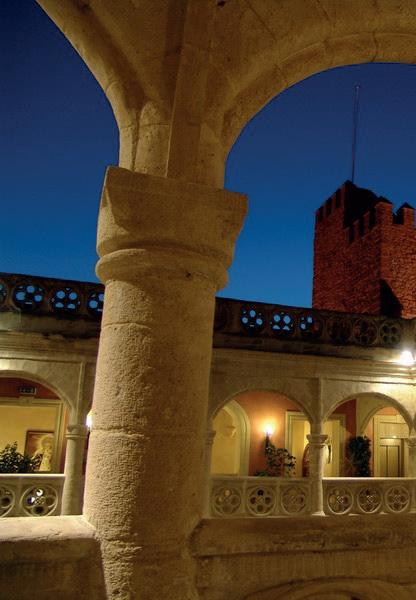
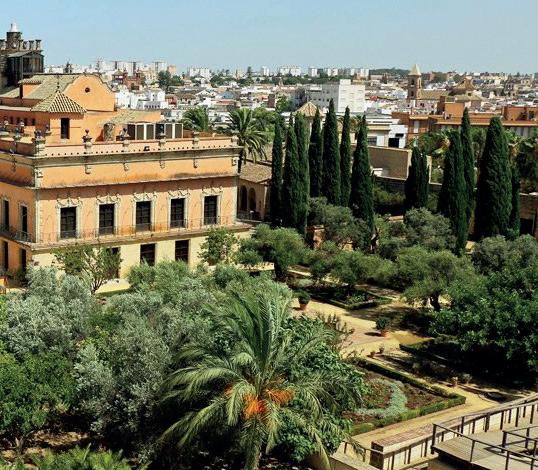
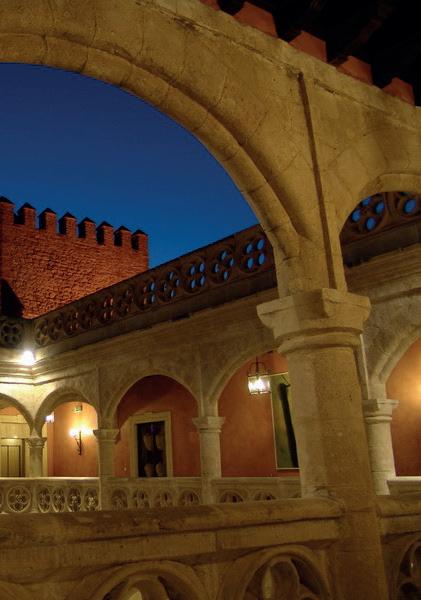
From there we head to Jerez de la Frontera, with its magnificent Almohad-style Alcázar. Its buildings include the mosque that Alfonso X converted into the Chapel of Santa María la Real and the Arab baths, as well as the garden of olive trees, in harmony with the Baroque palace of Villavicencio and whose tower houses the original camera obscura.
Deep in the mountains of Cádiz, the fortress of Arcos de la Frontera stands out in all its grandeur, with its crenellated towers. Although privately owned, it can be visited on certain days of the year by prior appointment. Continuing through the mountains, we arrive at Bornos, with the Renaissance castle-palace of the Ribera family, and home to a cultural and tourist interpretation centre. To the north is Espera, with its Fatetar Castle (13th-15th centuries), which is freely accessible. And about 20 km away, on the Cerro del Pajarete hill in the municipality of Villamartín, is Matrera Castle, whose restoration received the Architizer A+ international architecture prize.
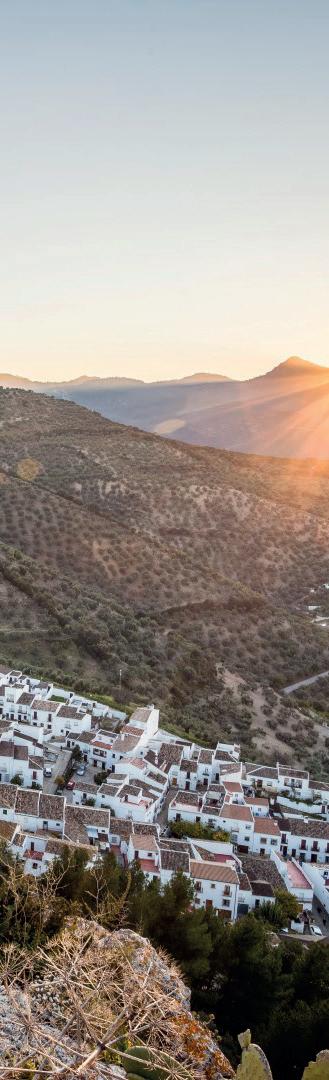
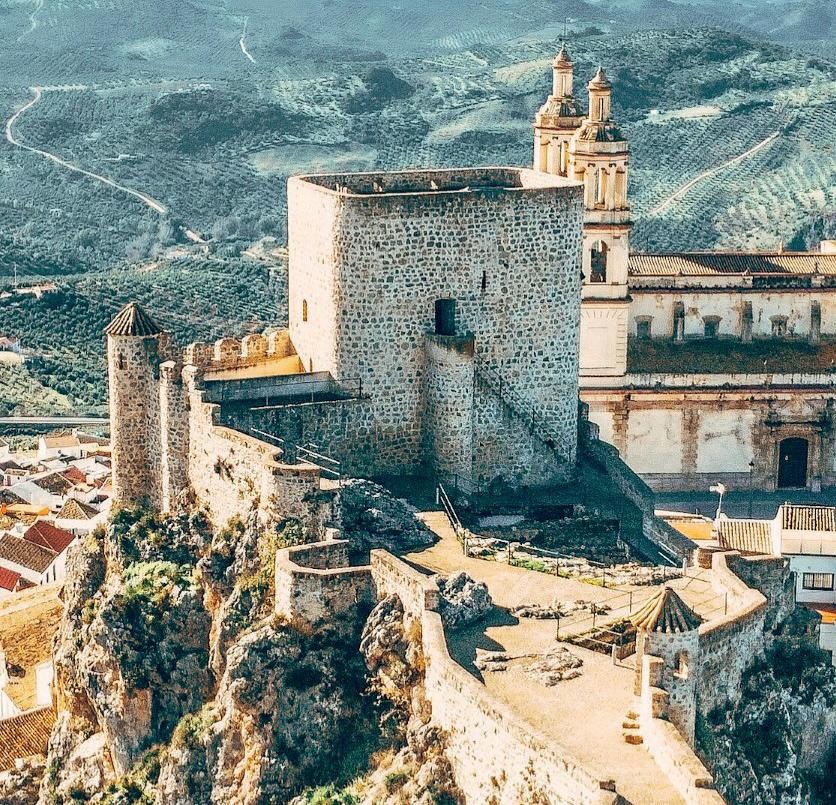
This brings us to two of the most spectacular villages in this province, Zahara de la Sierra, recognisable by the image of the graceful keep of its castle (13th-15th centuries); and Olvera, with its Nasrid castle (12th century). A visit to the Museum of the Frontier and Castles, located in the magnificent building of the Casa de la Cilla, allows visitors to learn about the important role played by the mountains of Cadiz as a frontier in the Nasrid kingdom. This second itinerary ends at Torre Alháquime and Setenil de las Bodegas, located on the north-eastern border with the neighbouring province of Málaga, and which still preserve some remains of their respective castles.
Did you know?
Tarifa Castle owes its name to the heroic deeds of Alonso Pérez de Guzmán. In 1294, as governor of the fortress and faced with a Muslim siege, he chose to sacrifice his son rather than surrender, even throwing his own knife from the tower for the execution.
THE ANDALUSIAN LEGACY

The Almoravid and Almohad Route, one of the Andalusian Legacy routes, runs through the province of Cadiz and has received the title of Major Cultural Route from the Council of Europe.
www.legadoandalusi.es
Olvera Castle
Castles and Fortresses
Coastal Route
and Alcornocales
345 kms 4 days 3 nights
Route through the countryside and mountains
215 kms 4 days 3 nights
Sanlúcar de Barrameda
• Castle of Santiago Chipiona
• Castle and Interpretation
Centre Cádiz and the New World
Rota
• Luna Castle
Cádiz
• Fortified City
Conil de la Frontera
• Torre de Guzmán
Espera
• Fatetar Castle
Arcos de la Frontera
• Arcos Castle
Jerez de la Frontera
Villamartín
• Matrela Castle
Bornos
• Ribera Castle Palace
• Monumental Complex of the Alcázar and Camera Obscura
El Puerto de Santa María
• San Marcos Castle
San Fernando
• San Romualdo Castle and Sancti Petri Castle
Vejer de la Frontera
• Vejer Castle
San José del Valle
• Gigonza Castle
Medina Sidonia
• Castle
• Tower of Doña Blanca and Gates Walled Enclosure
Zahara de los Atunes
• Las Almadrabas Castle
Tarifa
• Guzmán el Bueno Castle and Interpretation Centre
• Zahara Castle Olvera
• Castle and Museum of the Frontier and Castles
Zahara de la Sierra
Torre Alháquime
• Castle Ruins
Setenil de las Bodegas
• Castle Ruins
Jimena de la Frontera
• Jimena de la Frontera Castle
Castellar de la Frontera
• Castellar Viejo Fortress
With Columbus’s epic achievement, the bay of Cádiz became the recipient of riches from the New World. This economic prosperity gave rise to a valuable cultural and artistic legacy that strengthened the ties between southern Andalusia and Latin America, and which can be enjoyed today on this American Tour.
01.6 Cádiz and America: Port of the Indies
We begin our tour in Cádiz, which experienced one of the most splendid moments in its history after the discovery of America, becoming the port of departure for numerous commercial expeditions and, from the 18th century onwards, the headquarters of the Casa de Contratación (House of Trade).
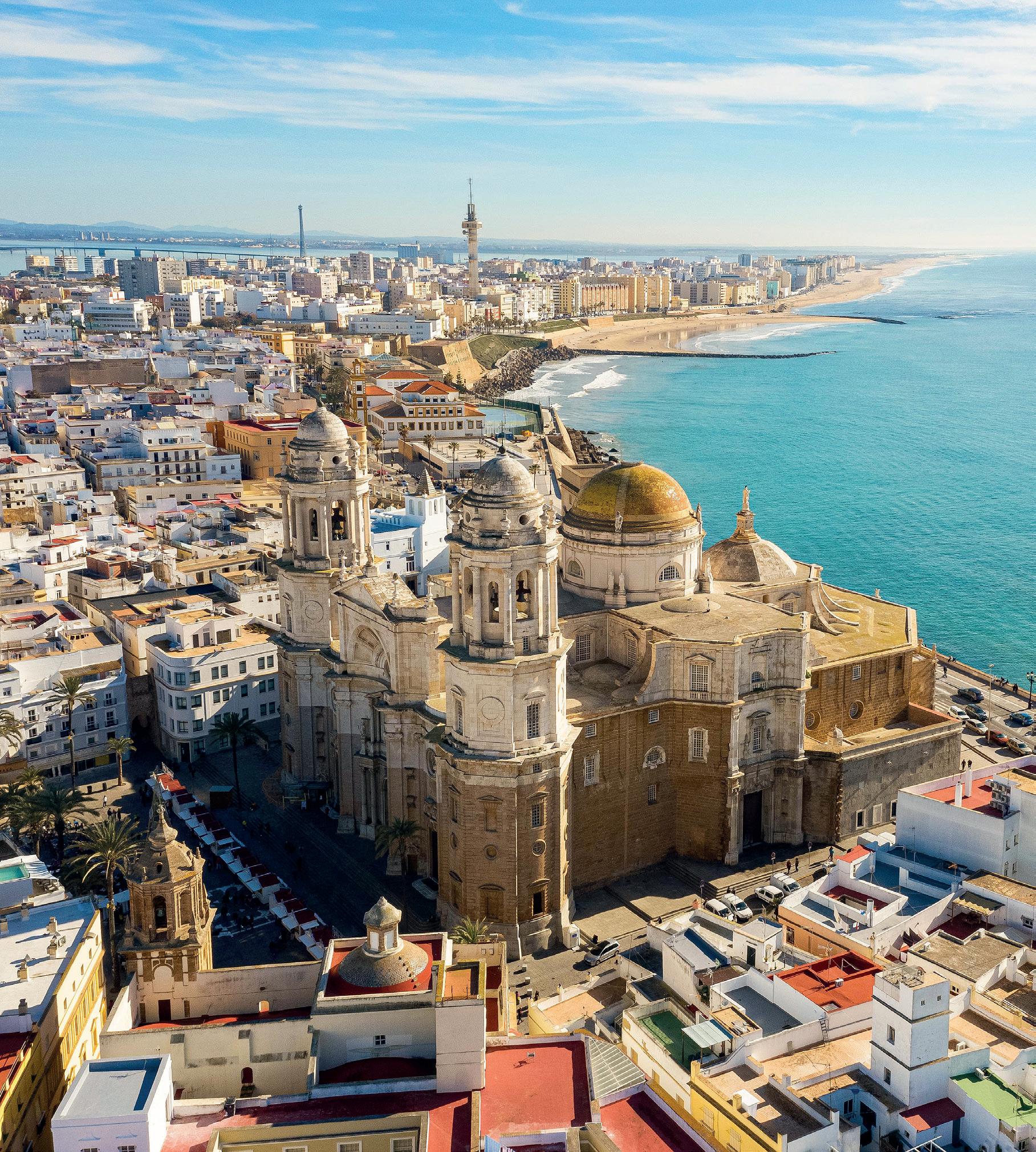
A stroll along the Cadiz seafront, from La Caleta to Campo del Sur, inevitably evokes images of the Malecón in Havana. The similarities between the two cities, which grew up on opposite sides of the Atlantic, are so striking that Cadiz has been nicknamed “Little Havana”. Twin fortifications, cathedrals that share a colonial air, narrow streets impregnated with a salty residue... From the sea, the silhouette of the New Cathedral stands out, with its golden dome and mixture of Baroque and Neoclassical styles. Its interior houses the crypt where illustrious figures such as the composer Manuel de Falla and the writer José María Pemán are laid to rest.
The prosperous bourgeoisie settled in the city and the prominent families of shippers to the Indies built their palaces and stately homes with spectacular Baroque façades in the streets near the port, so that from their watchtowers they could control the arrival of their ships. In Sopranis Street, admire the houses of the Sopranis and the Lilas families. Other magnificent examples are the Admiral’s House, the Lasquetty House, the House of Chains, the Houses of the Five Towers and the Four Towers, and the Tavira Tower, with a camera obscura inside.
Cadiz Cathedral
To protect its wealth and riches from pirate attacks, the city decided to build new, modern defences. The castles of San Sebastián and Santa Catalina, the Puertas de Tierra gates, the bastions of La Candelaria, Capuchinos and Los Mártires, and the walls of San Carlos are all in perfect condition. They are all open to visitors.
From Cadiz we head to El Puerto de Santa María, whose shipyards equipped many of the ships that sailed to the Indies. Today we can still admire the Ribera del Guadalete (which was where the dry docks, jetties and shipyards were), the old Ducal Customs House, the old Galeras quay and the Galeras Reales fountains. The Alfonso X El Sabio Cultural Centre exhibits a facsimile reproduction of Juan de la Cosa’s world map along with documents about Christopher Columbus’ stay in the city.
In the 18th century, El Puerto de Santa Maria was known as the ‘City of a Hundred Palaces’, because of the luxurious residences built by the shippers to the Indies. Many can still be admired today, such as the Araníbar palaces, home to the Shippers to the Indies Interpretation Centre, the Reinoso Mendoza, Valdiveso and Purullena palaces, among others, whose courtyards can still be visited, especially in May during the Festival of Courtyards.
We now turn to Jerez de la Frontera, which was one of the most prosperous cities in Andalusia at that time thanks to agriculture and livestock farming and the export of its wines throughout Europe and America. This splendour led to the construction of important monuments such as the cathedral, as well as palaces and stately homes, Gothic churches and centuries-old wineries.
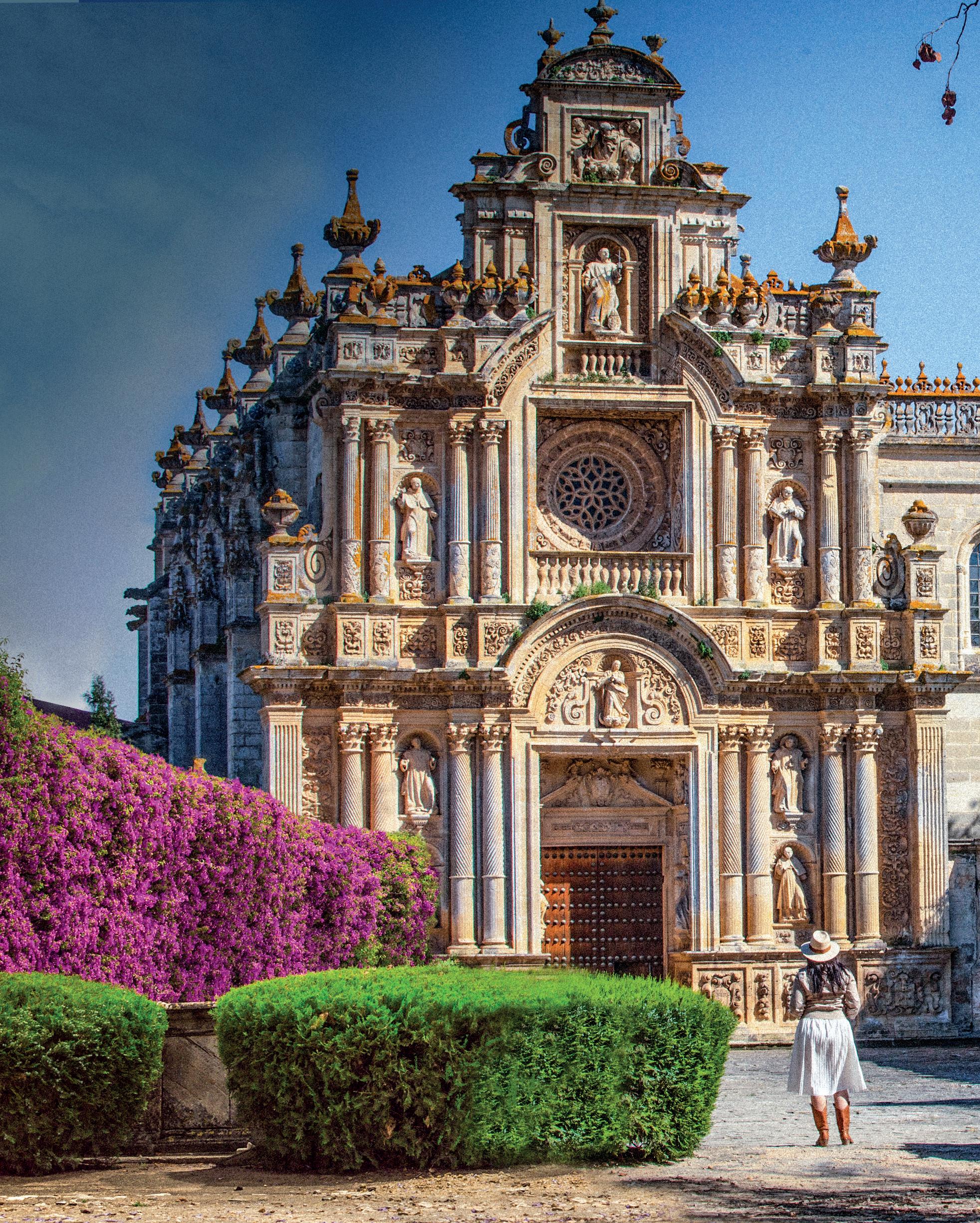
Of particular importance is the Monastery of La Cartuja de Santa María de la Defen-
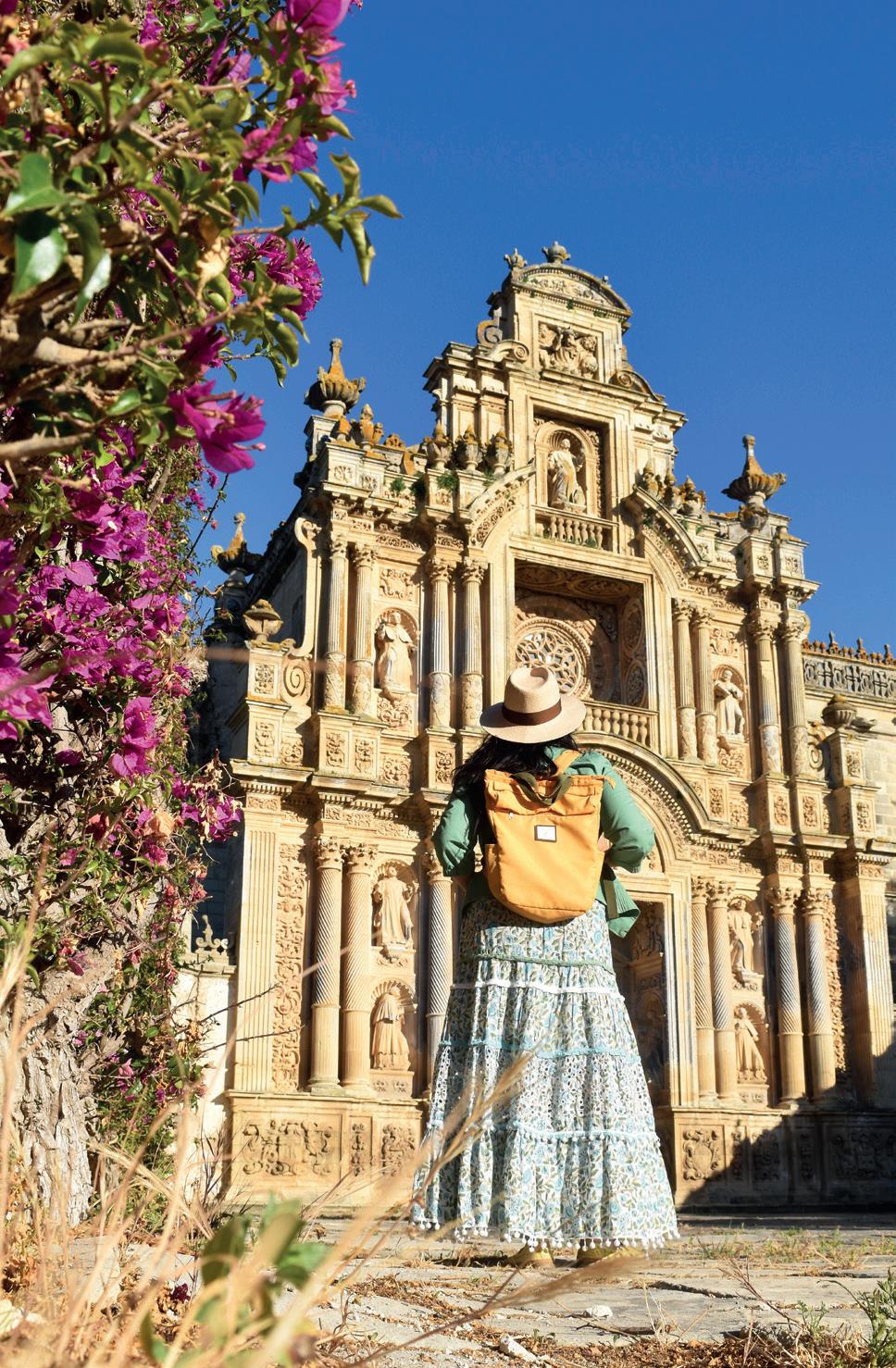
sión, a harmonious structure that combines flamboyant Gothic, Plateresque Renaissance and Baroque styles. It has particularly attractive areas such as the entrance portico, the chapel of Santa María de la Defensión, the patio de los Arrayanes, the chapel of Los Caminantes, the cloister of the lay brothers and the so-called patio de los jazmines (jasmine courtyard). The monastery is considered the most artistically valuable monumental complex in the province of Cádiz.
Our next destination is about 25 km away by road: Sanlúcar de Barrameda, an impor-
La Cartuja Monastery. Jerez de la Frontera
Did you know?
On 1 November 1755, the city of Cadiz was saved by its walled enclosure from the tsunami caused by the earthquake that completely destroyed the Portuguese city of Lisbon.
tant overseas trading enclave. The American influence can be seen throughout the historic quarter, from the residences of merchants such as the palace of the Marqués de Arizón to churches such as Santo Domingo and convents such as La Merced (now the Auditorio de la Merced) and Capuchinos. Not to mention the Renaissance palace of the Guzmanes or the Dukes of Medina Sidonia, with its magnificent art collection and valuable historical archive.
It was from the town of Sanlúcar that the sailors Ferdinand Magellan and Juan Sebastián Elcano set off on an expedition that would become the first circumnavigation of the globe. The exhibition at the New World Interpretation Centre in Chipiona revolves around this historical event, and is dedicated to the relationship between the province of Cádiz and the discovery, colonisation and exploitation of the New World, where our route ends.
America Tour
85 kms
3 days
2 nights
Sanlúcar de Barrameda
• Palace Houses
• Churches and convents
Chipiona
• New World Interpretation Centre
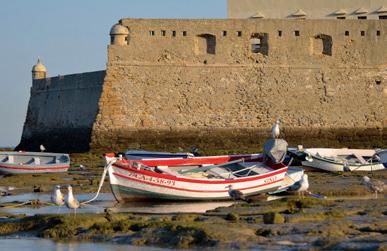
Cádiz
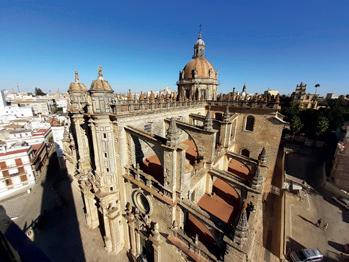
Jerez de la Frontera
• Cathedral
• Cartuja de Santa María de la Defensión
• Palaces and stately homes
• Gothic churches
El Puerto de Santa María
• Guadalete Riverbank and Old Port Area
• Alfonso X El Sabio Cultural Centre
• Palaces
New Cathedral Palace Houses
Fortified Enclosure
Tavira Tower-Camera Obscura
The province of Cádiz played a major role in the great political and cultural movements of the 19th century, importing new ideas that led to the liberal and democratic opening enshrined in the Constitution of 1812. This tour invites you to visit the places that witnessed that decisive moment.
01.7 Liberal and enlightened Cádiz: Long live La Pepa!
The year is 1812. Napoleon’s troops have invaded the country and the politicians who have escaped the siege take refuge in the province of Cádiz. First San Fernando and later Cádiz welcome the deputies who drafted the 1812 Constitution, the first liberal Magna Carta in Spain and Europe and one of the most advanced of its time. The signing of the text was celebrated by thousands of Cadiz residents with a civic procession through the city. Now we will try to follow in their footsteps.
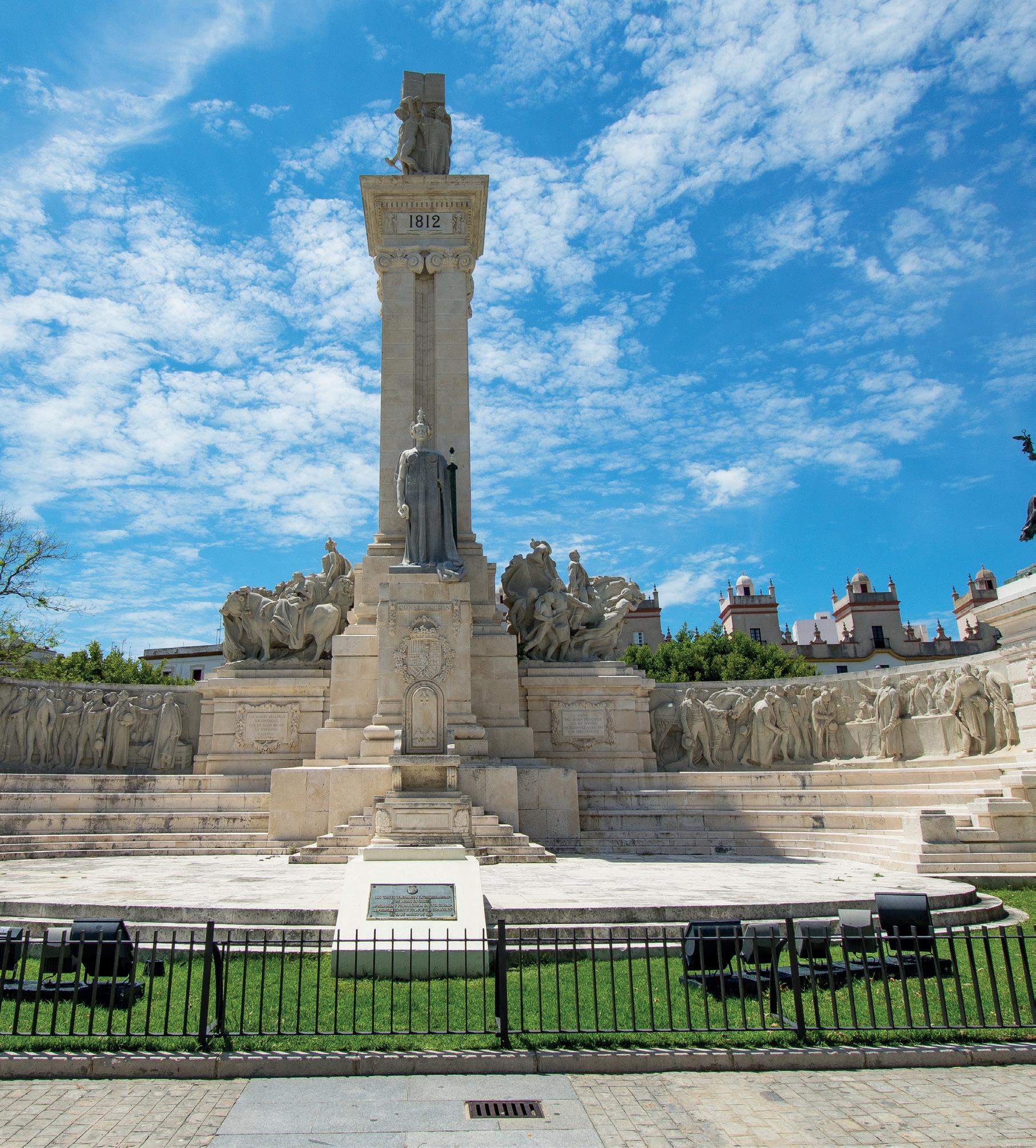
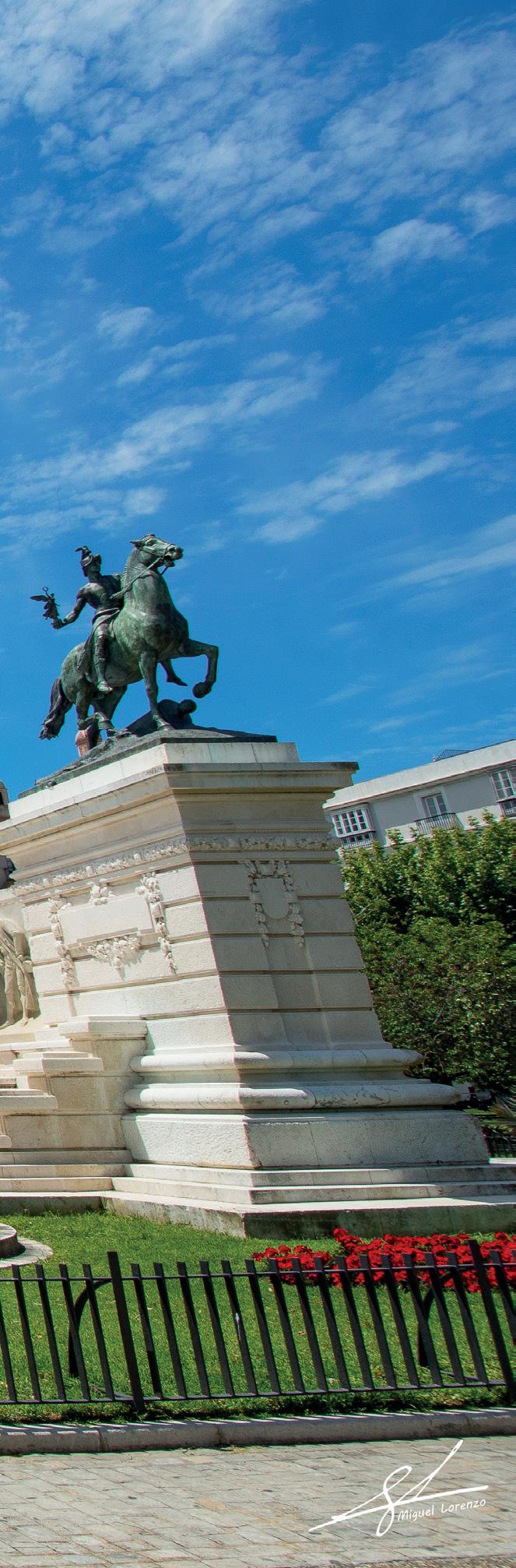
We start at Plaza España, where the monument to Las Cortes stands, built to commemorate the first centenary of the Constitution. This square is also home to the Provincial Council building, formerly the Customs House, from where the proclamation of “La Pepa” began, as the Constitution was nicknamed because it came into force on 19 March, St Joseph’s Day. After walking along Alameda Apodaca, we come to the Baroque church of El Carmen, where the “Te Deum” was celebrated in thanksgiving for the completion of the constitutional text. Nearby is Plaza del Mentidero, filled with terraces where you can enjoy a snack.
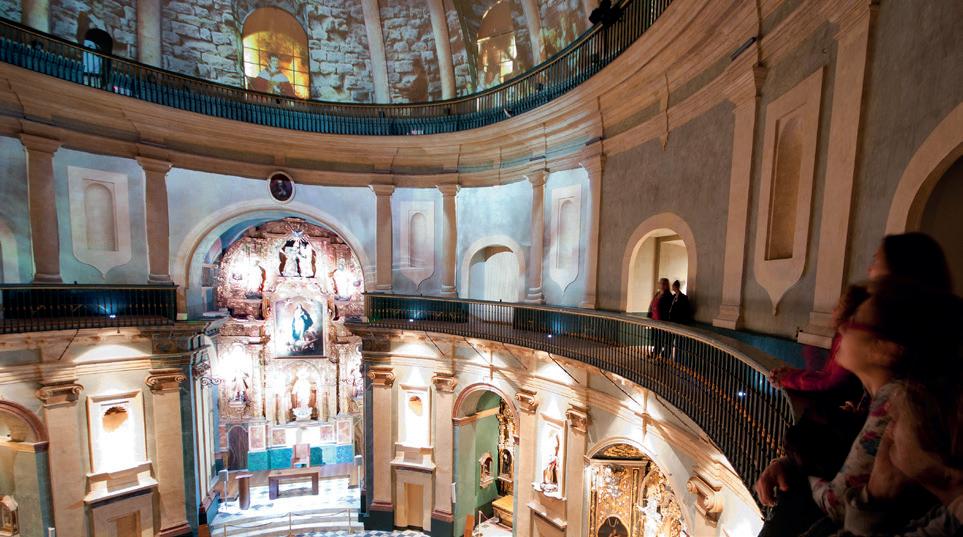
Along Calle Torre, we arrive at the Oratory of San Felipe Neri, a key feature of the route, as it was here that the Magna Carta was conceived and signed. Inside, the Chapel of the Tabernacle and the main altarpiece presided over by a painting of the Immaculate Conception by Murillo stand out. La Pepa 2012 Interpretation Centre is in an adjoining building and, nearby, the
Monument to the Cortes of Cádiz
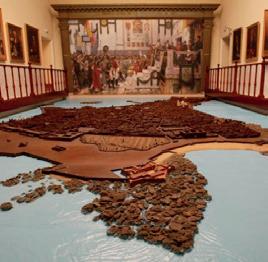
Museum of the Cortes of Cadiz, with a large model of the city in 1777. The courtyard of the nearby Women’s Hospital, a building that houses El Greco’s valuable painting (The Vision of Saint Francis), was the scene of the elections in which some of the deputies who would represent Cadiz and Algeciras in the Constituent Cortes of 1812 were chosen.
We make our way from Calle Ancha, which was the aristocratic centre of the city, to Calle Rosario, to visit Santa Cueva oratory and see three paintings by Goya. We end our tour of the capital by visiting San Francisco square and street, a shopping area with cafés, inns and kitchens that were also frequented by Cadiz society in the 18th century.
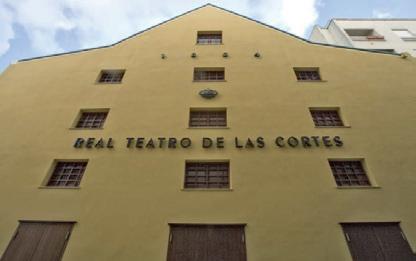
The other major city featured on this constitutional route is the former island of León, now San Fernando. The Royal Theatre of the Cortes, then called the Teatro Cómico, was where the Spanish Cortes Generales y Extraordinarias (Parliament) was first consti-
tuted in the midst of the Napoleonic invasion. It remained in session there until it moved to Cádiz in February 1811. During this period, the seat of the national government was established in what is now the Convent of the Enseñanza de María, located on Calle Real, the city’s main thoroughfare.
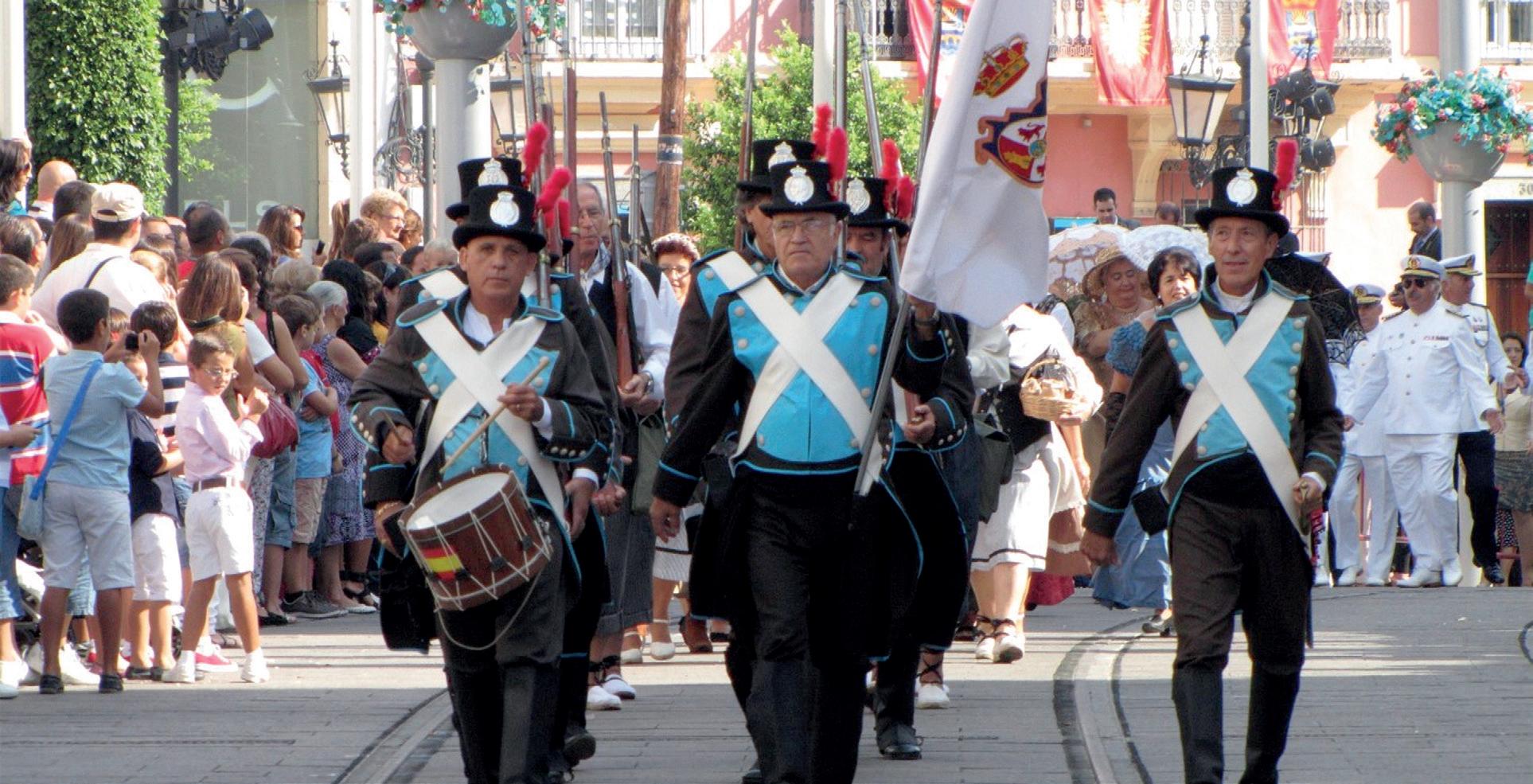
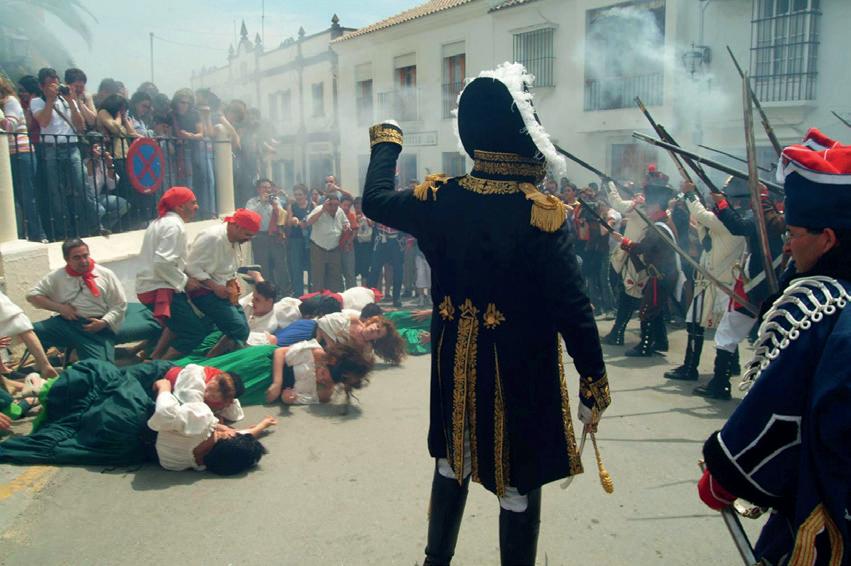
Historical re-enactment of the Naval Battle of 1808. San Fernando
Oratory of San Felipe Neri. Cádiz
Did you know?
The French omelette, or ‘la de cuando los franceses’ (the one from when the French were here), was invented in the inns near Calle San Francisco in Cadiz due to food shortages (including potatoes) during the siege by Napoleon’s troops.
SAN FERNANDO AND THE NAPOLEONIC TROOPS
The most notable events in the island’s defence are re-enacted each year by the islanders. The naval battle of 1808 is commemorated in June. The defence of Sancti Petri Castle is re-enacted in July and August, and in September, the defence of the Royal Island of León.
Cádiz
• Monument to the Cortes
• Oratory of San Felipe Neri
• La Pepa 2012 Interpretation Centre
• Museum of the Cortes
• Women’s Hospital
The 1812 Constitution Tour 15 kms
1 day 1 night
San Fernando
• Royal Theatre of the Cortes
Cadiz, a land open to the sea and history, continues to shine today as a setting where art and creativity thrive. This tour invites you to discover everything from the film sets that made it famous to the footprints of its universal figures, along with the spaces that put the province on the map of contemporary culture.
01.8 Cádiz from the 20th century to the present day
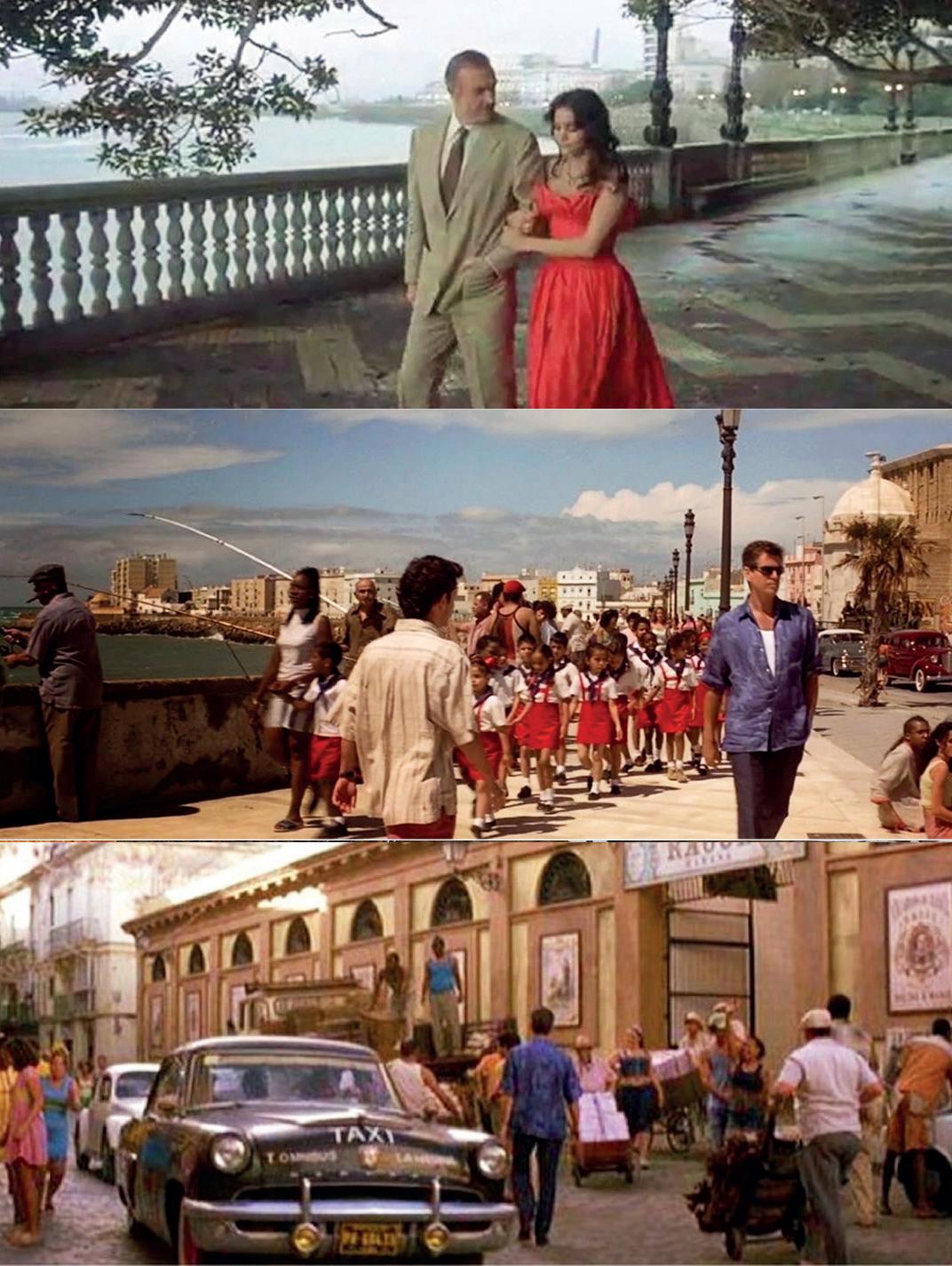
A mild climate and unique landscapes have made Cádiz an internationally renowned natural film set. The capital was transformed into Havana in Cuba (1979) and in Die Another Day (2002), with La Caleta beach and Santa Catalina Castle providing unforgettable backdrops. It also featured in Knight & Day (2010), with Tom Cruise and Cameron Diaz in a chase through the streets of the historic quarter. Steven Spielberg, fascinated by the light in Trebujena, shot Empire of the Sun (1987) there, recreating train stations, airports and even a concentration camp in the middle of the countryside. The Strait and its surroundings have also been the setting for major productions: scenes from Alatriste (2005) were shot in Tarifa and Conil, while El Niño (2014) took place largely in Algeciras. Cadiz is undoubtedly a land of cinema.
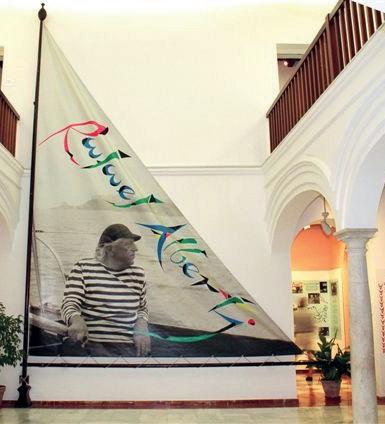
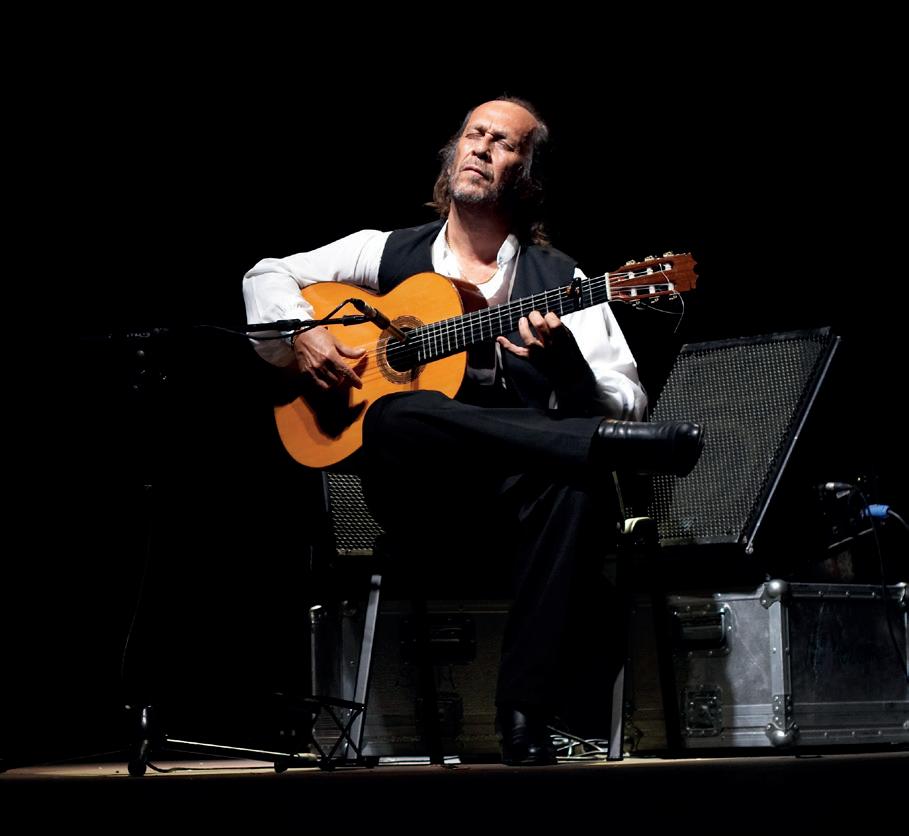
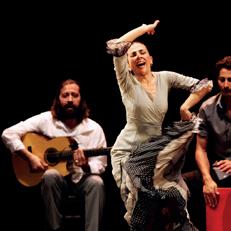
But the province is not only a film set, it is also the birthplace of great talents who have left their mark on Spanish culture. Immortal voices such as those of Camarón de la Isla, José Mercé and Rocío Jurado —whose memory is kept alive in her native Chipiona—, universal guitarists such as Paco de Lucía and Manolo Sanlúcar, and the brilliant and engaging poetry of Rafael Alberti from El Puerto. Added to these are the sculptural power of Luis Ortega Bru, the musical genius of Manuel de Falla, the
Rafael Alberti Foundation. El Puerto de Santa María
painting of Hernán Cortés, the writings of José María Pemán, Pedro Muñoz Seca and Fernando Quiñones, and the critical eye of Francisco Caballero Bonald. These artists, from their respective disciplines, have all projected the identity of Cadiz beyond its borders.
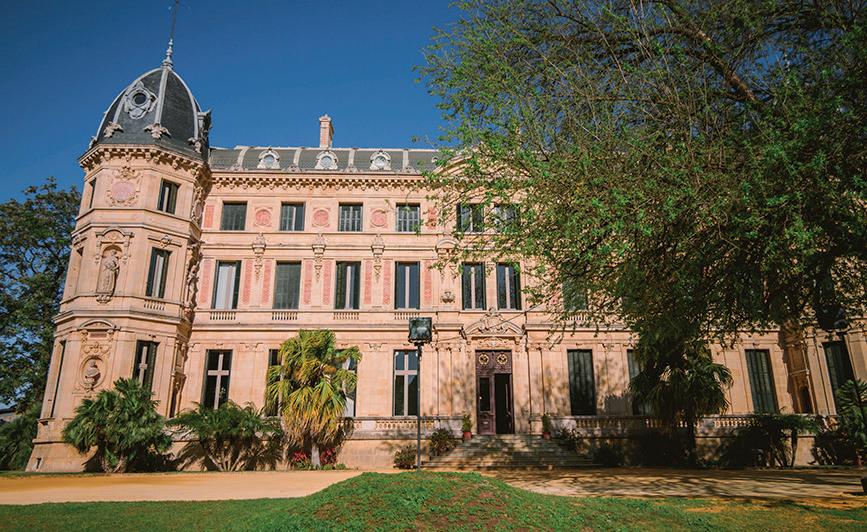
The tour also takes us closer to artistic delights that converse with universal names in architecture, such as the Palacio del Recreo de las Cadenas in Jerez de la Frontera, home to the Royal School of Equestrian Art. This is the work of architect Charles Garnier —designer of the Paris Opera House— and is a magnificent example of 19th-century eclecticism linked to the wine industry’s prosperity.
Cadiz’s heritage also embraces contemporary art, connecting art and ur-
NMAC Foundation. Vejer de la Frontera
ECCO Contemporary Cultural Space. Cadiz
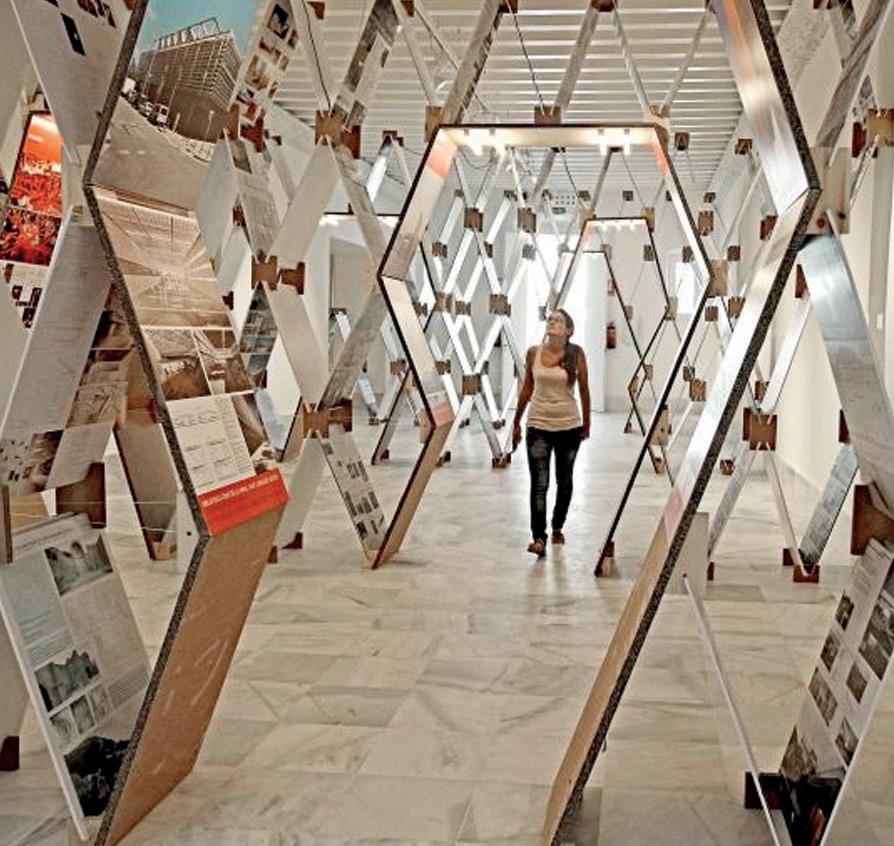
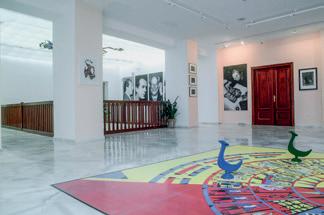
ban life. The ECCO (Espacio de Creación Contemporánea de Cádiz) offers temporary exhibitions, workshops, outdoor installations and the collection by Costus, the pseudonym of artists Enrique Naya (Cadiz) and Juan Carrero (Palma de Mallorca), iconic figures of the Movida Madrileña of the 1970s and 1980s. Other notable institutions include the Reina Sofía Cultural Centre, whose main attraction is the work of Juan Luis Vasallo, considered one of the best Spanish sculptors of the 20th century and creator of the Minerva sculpture at the Círculo de Bellas Artes in Madrid; and the Casa de Iberoamérica, which programmes contemporary art with a social and cultural focus.
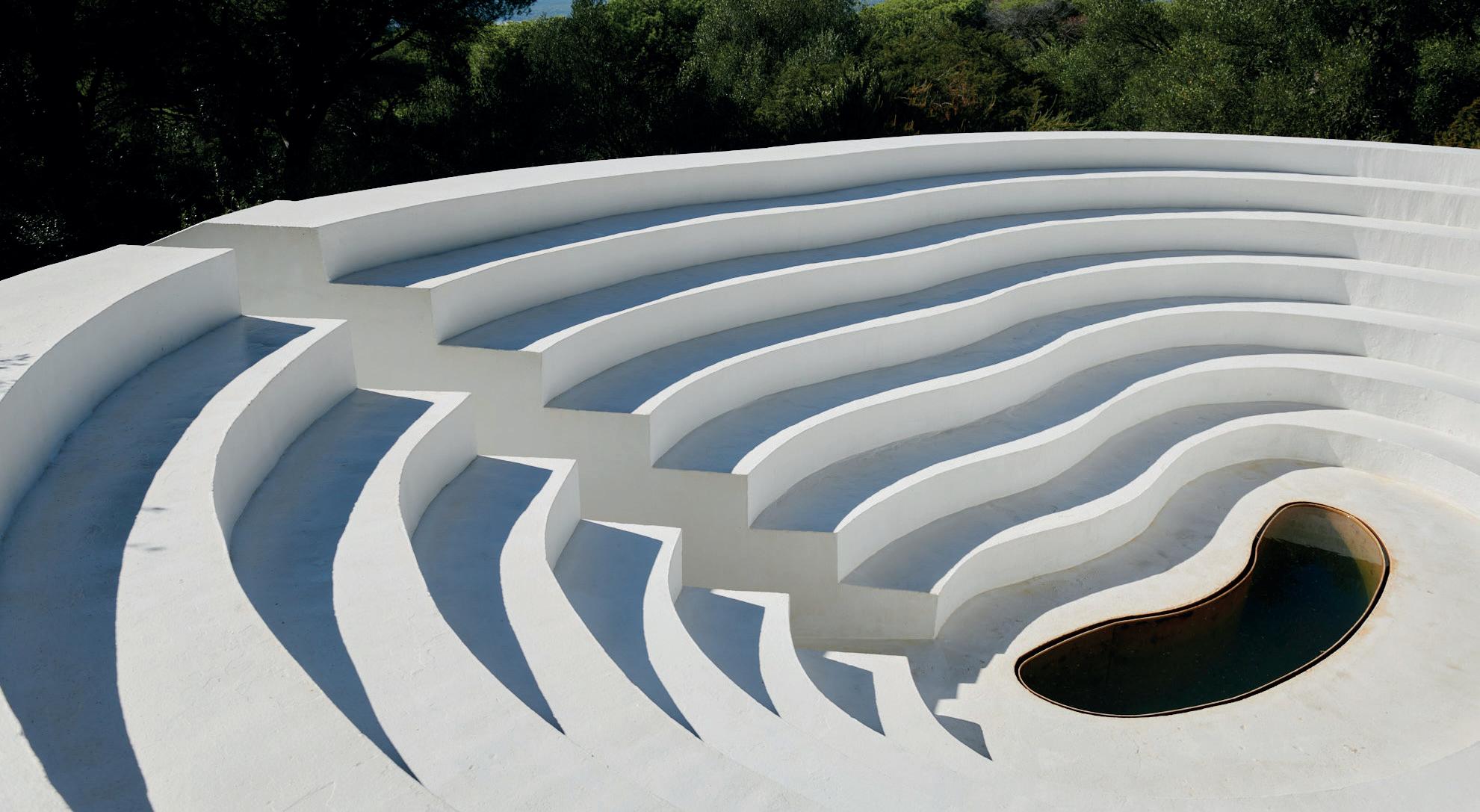
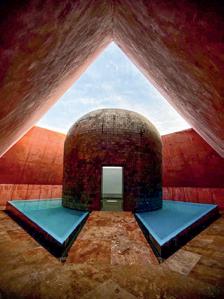
In La Janda, a must-see is the NMAC Foundation (Montenmedio Arte Contemporáneo), located near Vejer de la Frontera. Here, a Mediterranean forest has been transformed into an open-air museum with site-specific works by ar-
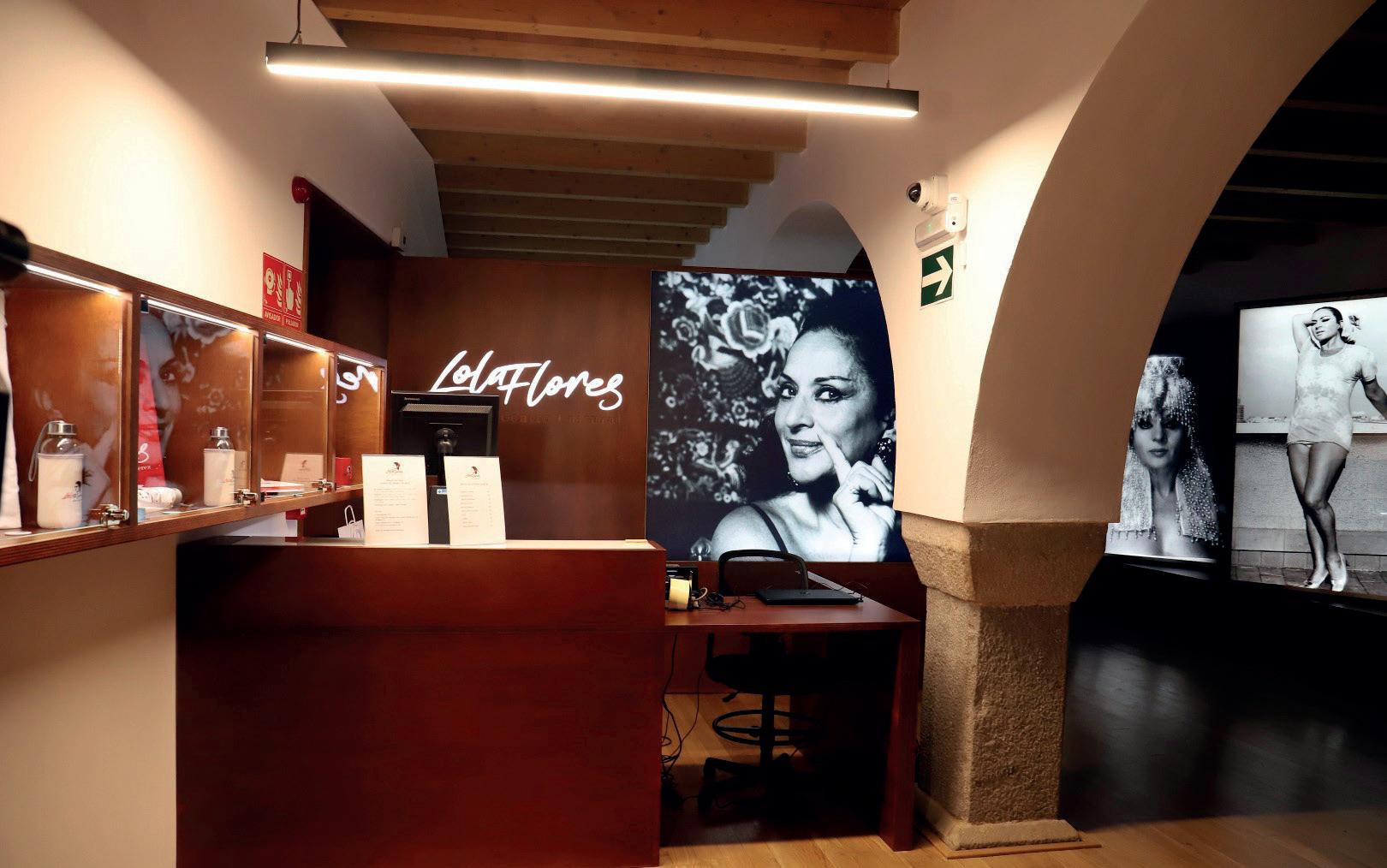
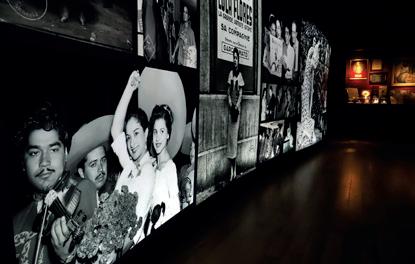
Lola Flores Cultural Centre. Jerez de la Frontera
Filming scenes in Cadiz
tists such as James Turrell and Marina Abramović, in an intimate dialogue with nature. It is a cultural reference point in southern Europe not only for its collection, but also for its educational and cultural programming.
From a region with deep local roots—flamenco, popular festivals and wineries—Cadiz has evolved into a dynamic setting, open to the world and highly diversified in its cultural offerings. Today, the coexistence of tradition and innovation is evident in film and music festivals, experiences linked to resources such as wine and crafts, international film shoots and contemporary creation cycles. This rich, professionalised and entrepreneurial cultural ecosystem projects Cadiz’s identity to a global audience.
Palacio del Recreo de las Cadenas. Jerez de la Frontera
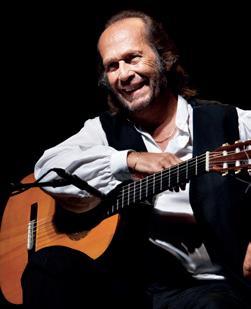
Paco de Lucía
Did you know?
The French actor of Spanish origin, Juan Moreno Jiménez, better known as Jean Reno, has held the title of Adoptive Son of the Province of Cadiz since 2006. His parents, from Jerez and Sanlúcar, fled Franco’s Spain to North Africa and later to Marseille.
Sanlúcar de Barrameda
• Manolo Sanlúcar Palace of the Andalusian People
Chipiona
• Rocío Jurado Interpretation Centre
Tour Contemporary
95 kms
4 days
3 nights
Cádiz
• Reina Sofía Cultural Centre
• Casa de Iberoamérica
• ECCO (Contemporary Creation Space of Cádiz)
Jerez de la Frontera
• Caballero Bonald Foundation
• Lola Flores Cultural Centre
• Recreo de las Cadenas Palace
El Puerto de Santa María
• Rafael Alberti Foundation Museum
• Pedro Muñoz Seca House Museum
San Fernando
• Camarón de la Isla Legend Museum
Vejer
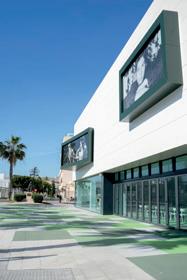
• NMAC-Montenmedio
Contemporary Art Foundation
Algeciras
• Paco de Lucía Interpretation Centre
San Roque
• Ortega Bru Museum


Cultural tours of Regional districts




Bay of Cádiz





Suggested itinerary
Día 1: Cádiz
Día 2: Jerez de la Frontera
Día 3: El Puerto de Santa María and Puerto Real
Día 4: San Fernando and Chiclana de la Frontera
The Bay of Cádiz is defined by its close relationship with the sea, an element that has shaped its history, its economy and, above all, its cultural identity. This enclave has been a crossroads of civilisations for more than three thousand years, and even today the Phoenician, Roman and Arab influences are clearly visible in its cities, monuments and traditions.
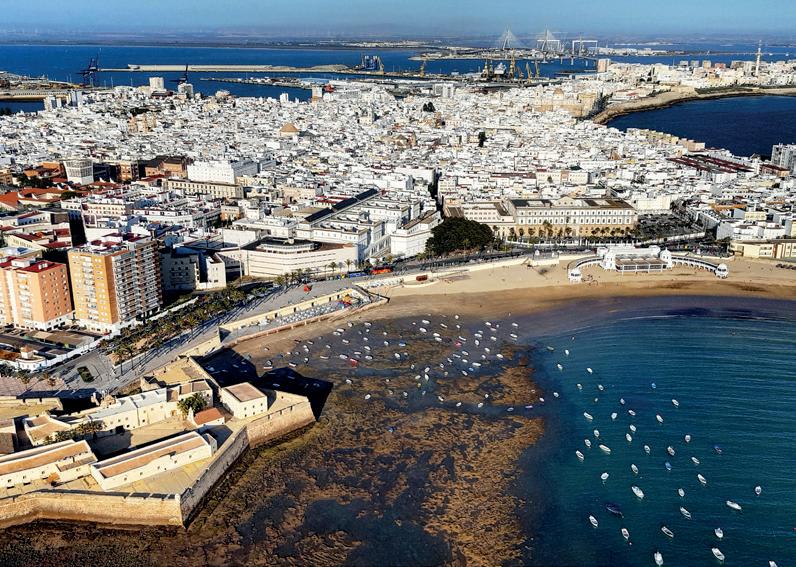
Cadiz, the legendary Tacita de Plata (Silver Cup) and considered the oldest city in the West, stands out for its monumental heritage, its architecture spanning different periods — from Neoclassical to Modern — and for its
historical significance as the setting for the proclamation of the 1812 Constitution. Its squares, bastions and golden domes interact with a festive atmosphere that reaches its peak during the famous carnival celebrations in the streets and at the Gran Teatro Falla, the epicentre of music, satire and creativity in Cadiz.
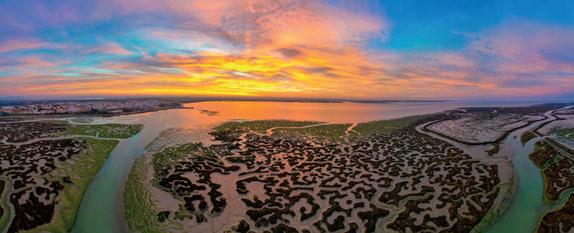
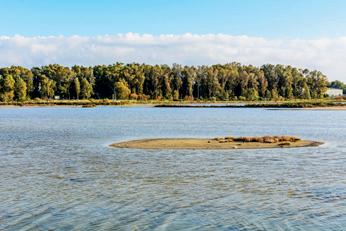
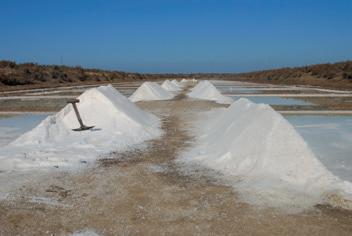
On a natural level, the Bay of Cadiz Natural Park protects a mosaic of marshes, salt flats, dunes and estuaries, where the ancient tradition of salt production is intertwined with birdlife and marine -related trades. In San Fernando, the former Isla de León, the birthplace of Camarón de la Isla recalls the universality of flamenco, while the castle of Sancti Petri evokes the legendary Phoenician temple of Melkart, the origin of Hercules in classical mythology.
Bajo Guadalquivir
Sierra de Cádiz, White Villages
Campo de Gibraltar
La Janda
Bay of Cádiz
Cádiz
El Puerto de Santa María
Puerto Real
Jerez de la Frontera
San Fernando Chiclana de la Frontera
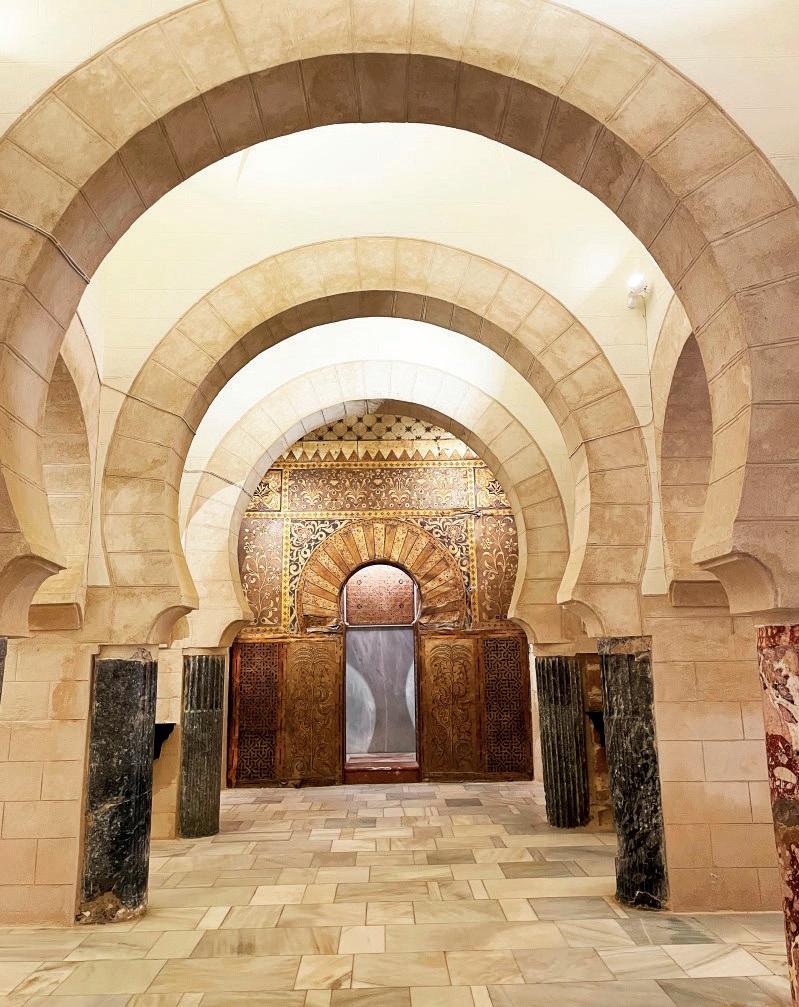
Art and literature are also part of the bay’s DNA. El Puerto de Santa María, a stately port and wine-producing city, is the birthplace of Rafael Alberti, a central figure of the Generation of ‘27, and the scene of intense cultural activity that continues with the Comedy Theatre Festival dedicated to Pedro Muñoz Seca. Its wineries and stately homes reinforce the relationship between art, music and wine.
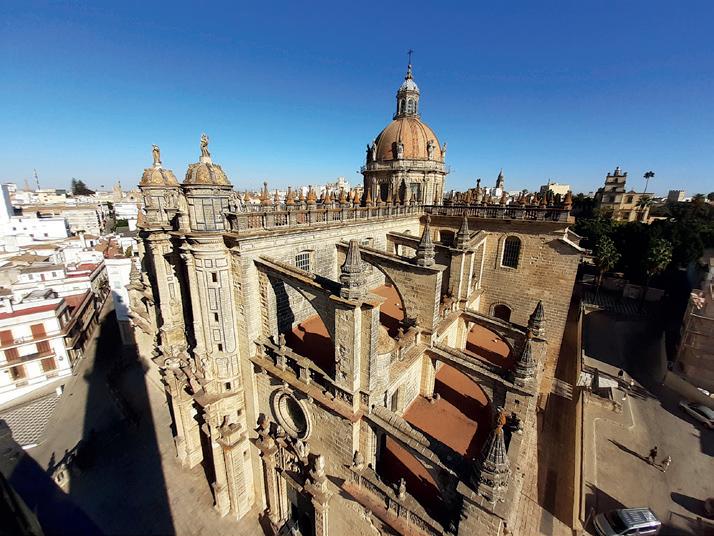
Few places in Spain enjoy international recognition like Jerez de la Frontera. The world capital of flamenco and Carthusian horses, there is a unique atmosphere where singing, dancing and guitar playing reach their maximum expression. The cathedral-like wineries not only showcase the deep culture of sherry, but have also become spaces where architecture, tradition and contemporary art converse.
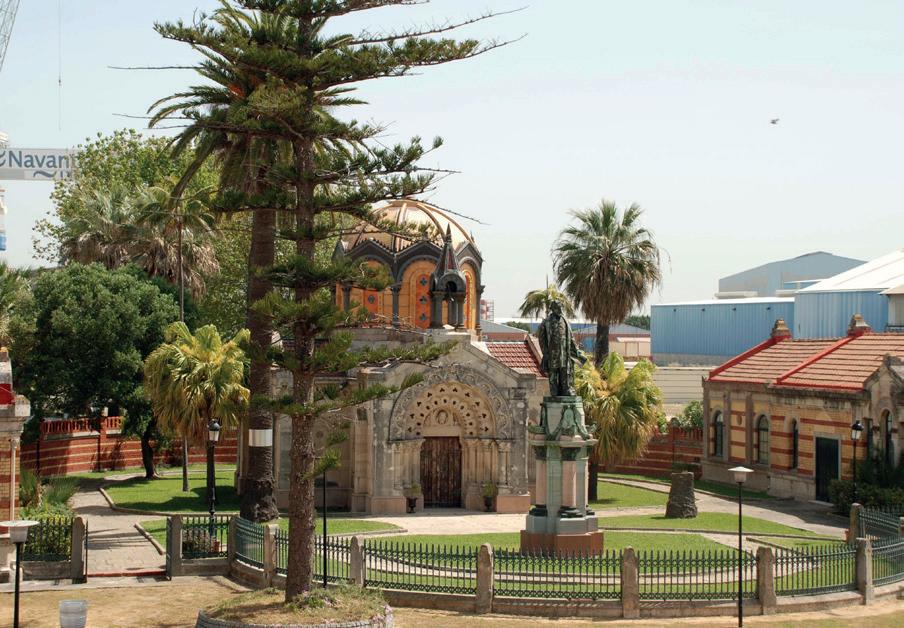
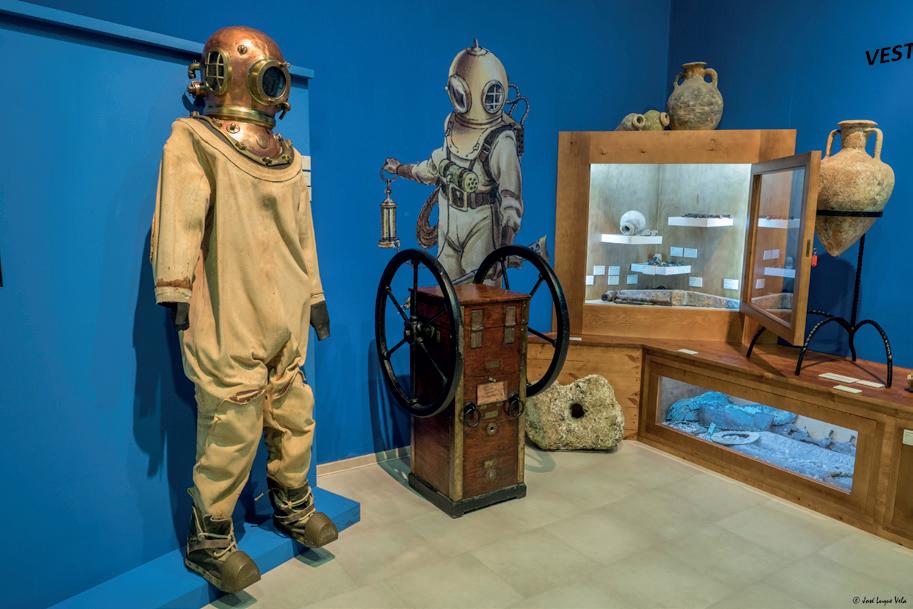
In Puerto Real, the seafaring tradition is reflected both in its shipyards—pillars of the naval industry—and in its popular roots linked to the sea and the marshlands Chiclana de la Frontera, with important Phoenician remains on display at the Nueva Gadeira Archaeological Site, invites visitors to enjoy the Atlantic coastline at beaches such as La Barrosa and Sancti Petri.
Overall, the Bay of Cádiz offers a territory where past and present coexist in harmony, combining history, art, gastronomy, nature and tradition, and offering visitors cultural, festive and sensory experiences that make this region a not-to-be-missed destination in southern Andalusia.
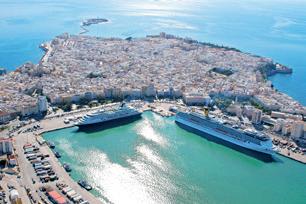
Aerial view. Cádiz
El Dique Museum. Puerto Real
Cathedral. Jerez de la Frontera
Naval Museum. San Fernando
San Marcos Castle. El Puerto de Santa María
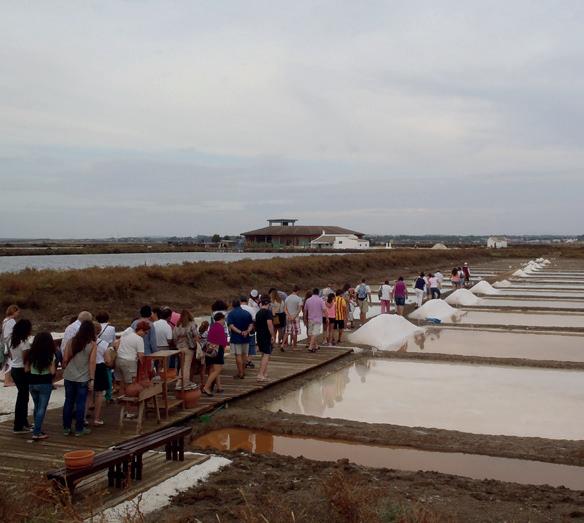
Visit to Salt Flats. Chiclana de la Frontera
Cultural heritage
Cádiz
Tangible cultural heritage
• Gadir archaeological site
• Roman theatre and Interpretation Centre
• Casa del Obispo archaeological site
• Fortified Enclosure: Castles and Bastions
• Cathedral
• Oratory of San Felipe Neri
• Oratory of la Santa Cueva
• Monument to the Cortes
• Tavira Tower-Camera Obscura
• House of the Five and Four Towers
Intangible cultural heritage and other contemporary events
• Cadiz Carnival
• Holy Week
• Corpus Christi
• Juanillos – Night of Saint John
• Ibero-American Theatre Festival of Cádiz (FIT)
• City of Cádiz International Puppet Festival
• Cádiz International Dance Festival
• Alcances Cadiz Documentary Film Festival
• Manuel de Falla Spanish Music Festival of Cádiz
• Not Without Music
• Music of the Sea
• Jazz Cádiz
• Cadiz is Flamenco
• Flamencad
Cultural facilities
• Cádiz Museum
• Museum of the Cortes
• La Pepa 2012 Interpretation Centre
• Puppet Museum
• Falla Grand Theatre
• ECCO Cultural Space
• Cathedral Museum
• Reina Sofía Cultural Centre
• Lithographic Workshop Museum
• Entre Catedrales
• Casa de Iberoamérica
Chiclana de la Frontera
Tangible cultural heritage
• Church of Saint John the Baptist
• Clock Tower of the Old Town Hall
• Bermeja and Puerco Towers
• Santa Ana Chapel
• San Telmo Church
• Jesus Nazareno Church
• San Sebastián Church
Intangible cultural heritage and other contemporary events
• Carnival
• All Saints’ Day or “Tosantos”
• Holy Week
• Procession of the Virgin of Carmen
• Autumn fish markets
• Concert Music
Cultural facilities
• Nueva Gadeira Archaeological Site
• City Museum
• Francisco Montes Paquiro Municipal Museum
• Wine and Salt Interpretation Centre
• Teatro Moderno
El Puerto de Santa María
Tangible Cultural Heritage
• Doña Blanca Archaeological Site
• Mayor Prioral Church
• Former Monastery of La Victoria
• San Marcos Castle
• Guadalete Riverbank and Old Port Area
• Vizarrón Palace
• Royal Bullring
• Hospital of Divine Providence
• Arco de la Trinidad
• Aranibar Palace
Intangible cultural heritage and other contemporary events
• Carnival
• Portuense Courtyards Festival
• Spring Fair and Fino Wine Festival
• Night procession of the Virgin of Carmen
• Festival of the Virgin of Los Milagros
• Comedy Theatre Festival
• Cabaret Festival
• Puro Latino
Cultural facilities
• Pedro Muñoz Seca House Museum
• Rafael Alberti Foundation Museum
• Municipal Museum
• Shippers to the Indies Interpretation Centre
Jerez de la Frontera
Tangible cultural heritage
• Cathedral
• Monumental Complex of the Alcázar and Camera Obscura
• Monastery of La Cartuja de Nuestra Señora de la Defensión
• Palacio del Recreo de las Cadenas
• Royal School of Equestrian Art Foundation
• Santo Domingo Cloisters
• San Dionisio Church
• Gothic churches of Santiago and San Miguel
• Palace of the Marquises of Bertemati
• El Gallo Azul
Intangible cultural heritage and other contemporary events
• Horse Fair
• Holy Week
• Grape Harvest Festival
• Christmas and Zambombas
• Flamenco Festival
• Bulería Festival
• Tío Pepe Festival
• Spring Trumpet Festival
Cultural facilities
• Lola Flores Cultural Centre
• Archaeological Museum
• Atalaya-Palacio del Tiempo Museums Carriage Museum
• Joaquín Rivero Spanish Painting Collection
• Tradición Winery
• Picasso Suite Vollard Collection
• Real Tesoro Winery
• Villamarta Theatre
• Andalusian Flamenco Museum and Andalusian Centre for Flamenco Documentation (CADF)
Puerto Real
Tangible cultural heritage
• Mayor Prioral de San Sebastián Church
• San José Church
• Food Market
• Historic Fortified Quay
• Calle y Capilla de la Cruz Verde
• Callejón del Arco
Intangible cultural heritage and other contemporary events
• Carnival
• Puerto Real Fair
• Autumn fish markets
Cultural facilities
• El Dique Museum
• Teatro Principal
• Cultural Interpretation Centre
San Fernando
Tangible cultural heritage
• Sancti Petri Island and Castle
• San Romualdo Castle
• Torre Alta
• Nuestra Señora del Carmen Church
• San Pedro and San Pablo Church
• Town Hall
• Pantheon of Illustrious Sailors
• Royal Naval Institute and Observatory
• La Carraca Arsenal
Intangible cultural heritage and other contemporary events
• Feria del Carmen y de la Sal
• Carnival
• Holy Week
• Cortes Festival
• Night of San Juan: Casería Fair
• Tosantos Festival
• Bahía Sound
• La Isla Ciudad Flamenca
Cultural facilities
• Naval Museum
• Quartel de Batallones Historical Hall
• Real Teatro de las Cortes
• Historical Museum
• Camarón de la Isla Legend Museum
02.2 Bajo Guadalquivir
Bajo Guadalquivir



Suggested itinerary
Día 1: Chipiona and Rota
Día 2: Sanlúcar de Barrameda and Trebujena

flamenco, with a tour and a museum dedicated to the singer, keeping the memory of her legacy alive.
Bajo Guadalquivir opens onto the Atlantic as a territory where nature, history and culture intertwine. Marked by the mouth of the great Andalusian river and its constant gaze towards the ocean, this region combines marshes, estuaries and extensive beaches with a rich wine-making tradition and a heritage linked to navigation and trans-Atlantic trade.
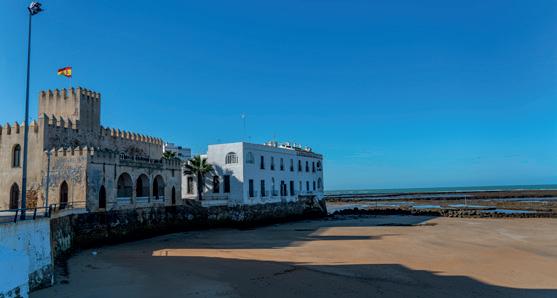
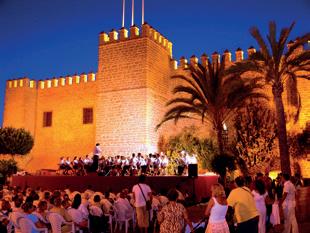
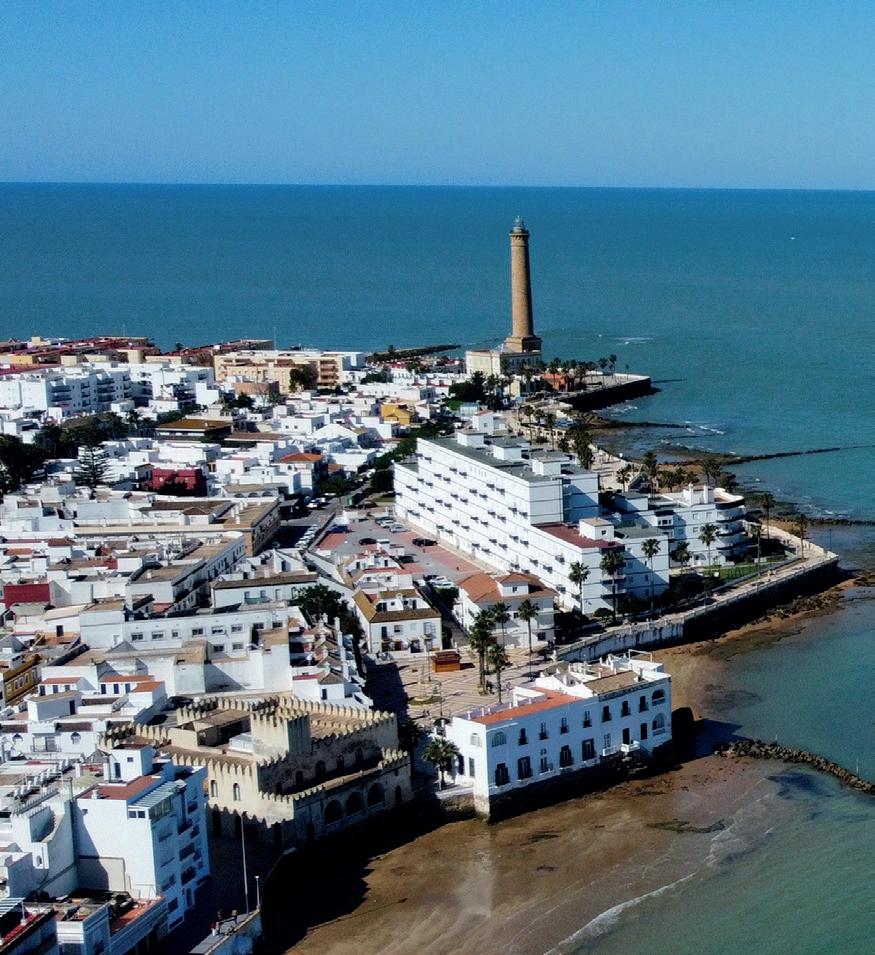
Chipiona is distinguished by its imposing lighthouse, the tallest in Spain, and the Sanctuary of Nuestra Señora de Regla, a centre of popular devotion. The town pays tribute to Rocío Jurado, the great voice of copla and
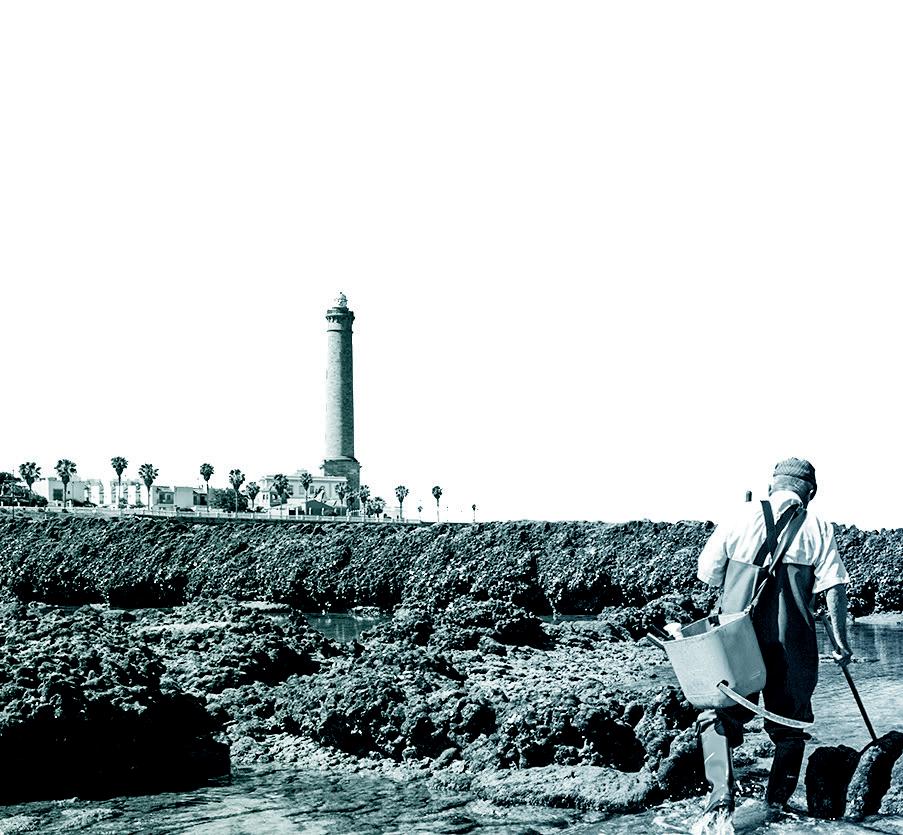
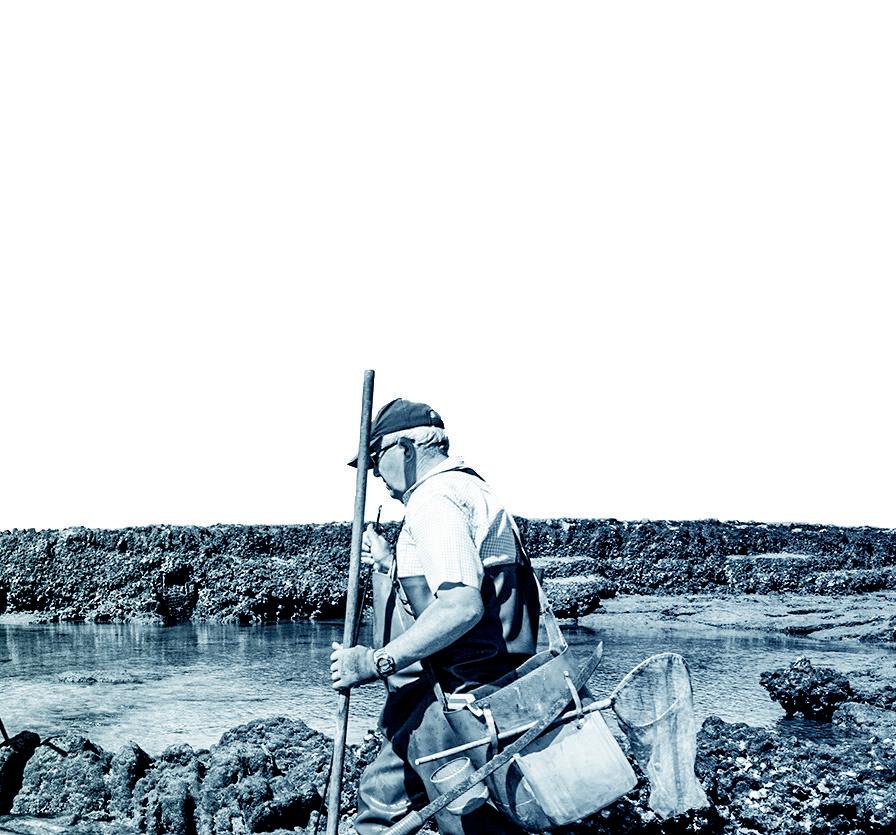
Rota preserves its agricultural tradition linked to market gardening and irrigation, as well as its unique fishing pens (corrales), a historical, cultural and scenic ensemble that recalls the heritage of ancient seafaring communities. Its identity is celebrated every year at the Feria de la Urta, declared a Festival of National Tourist Interest, and at the Arranque Roteño flamenco festival, which fills the city with music and tradition.
Sanlúcar de Barrameda, a city with a stately air and the starting point of Magellan and Elcano’s first circumnavigation of the globe, is a cultural and gastronomic reference point. Its famous wineries are concentra-
Sierra de Cádiz, White Villages
Bay of Cádiz
Campo de Gibraltar
La Janda Rota
Chipiona
Trebujena Sanlúcar de Barrameda
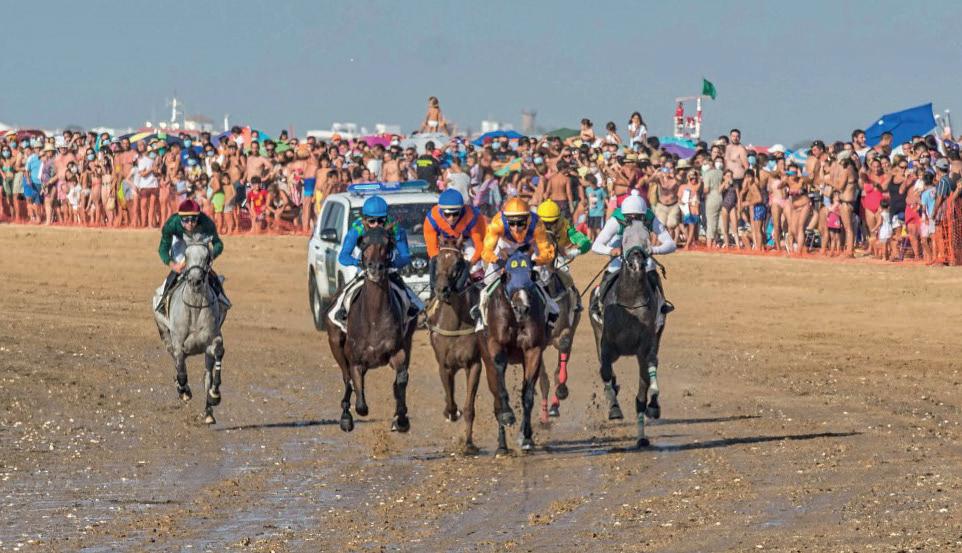
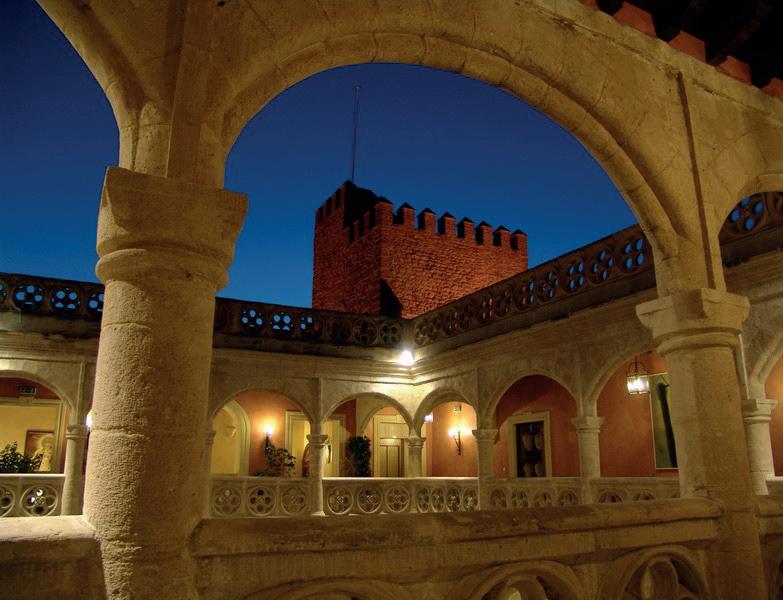
ted in the Barrio Alto, as is the Barbadillo Museum of Manzanilla, a wine that is a hallmark of the town along with its prawns. Its beaches are the venue for the famous horse races, originally sponsored by the aristocracy and bourgeoisie of 19th-century Sanlúcar, who wanted to encourage social life in the town during the summer season.
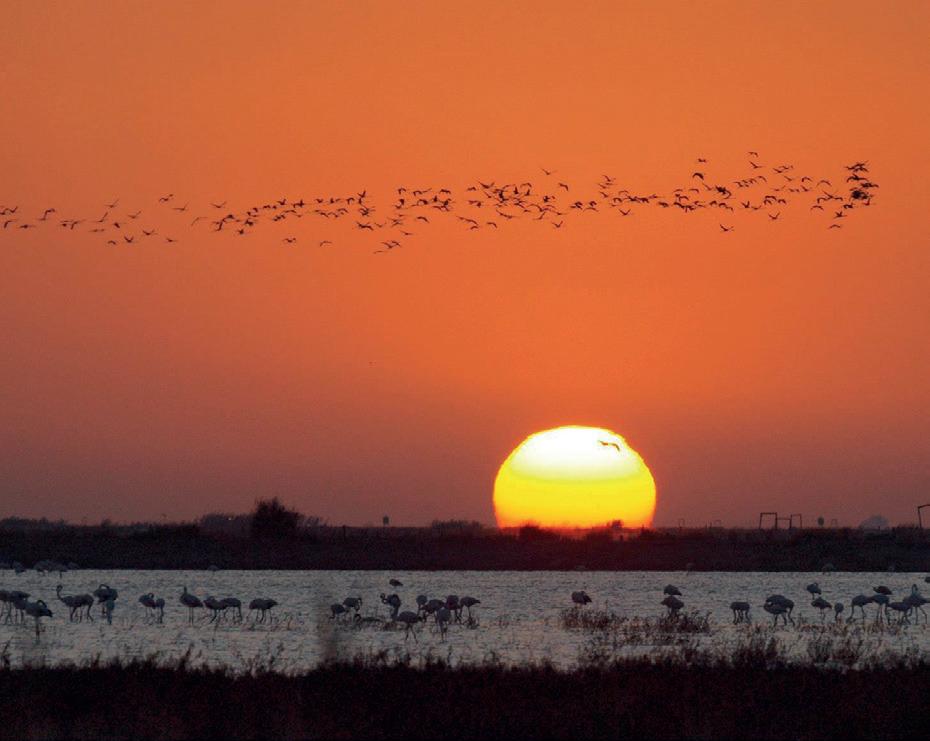
Trebujena completes the tour with its marshland landscape opposite Doñana and its
deep-rooted wine-making tradition. Famous for its grape musts, the town invites you to taste them accompanied by prawns or elvers, in an atmosphere where popular cuisine and country festivals go hand in hand. These are often celebrated in historic farmhouses, such as Alventus (from the 18th century), located in the middle of the marshlands opposite Doñana park.
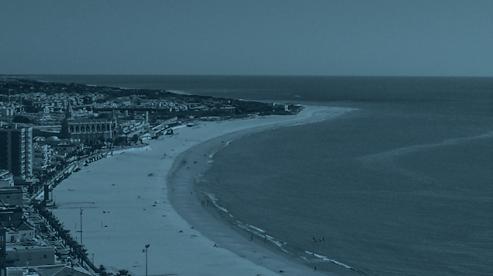
Aerial view of Chipiona
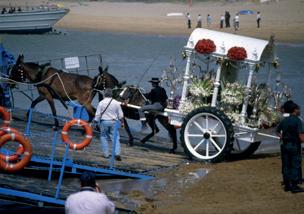
Horse racing on the beach. Sanlúcar de Barrameda
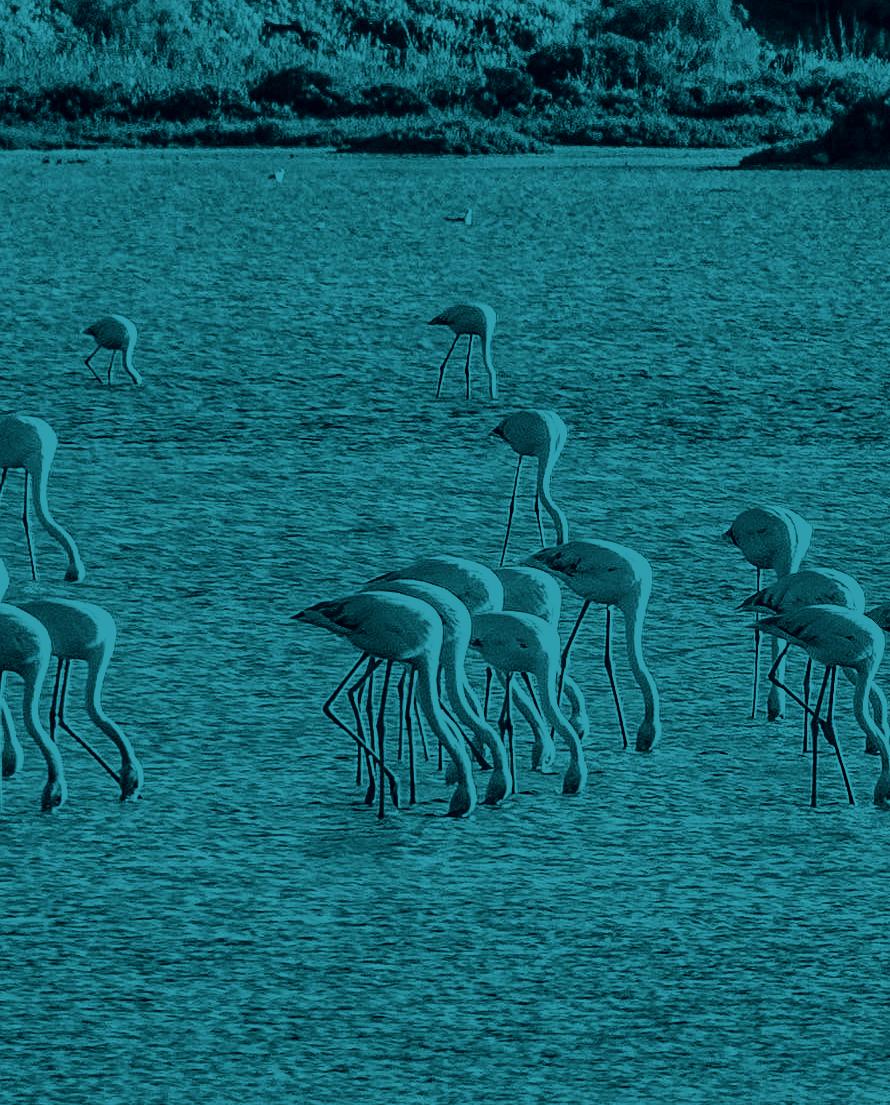
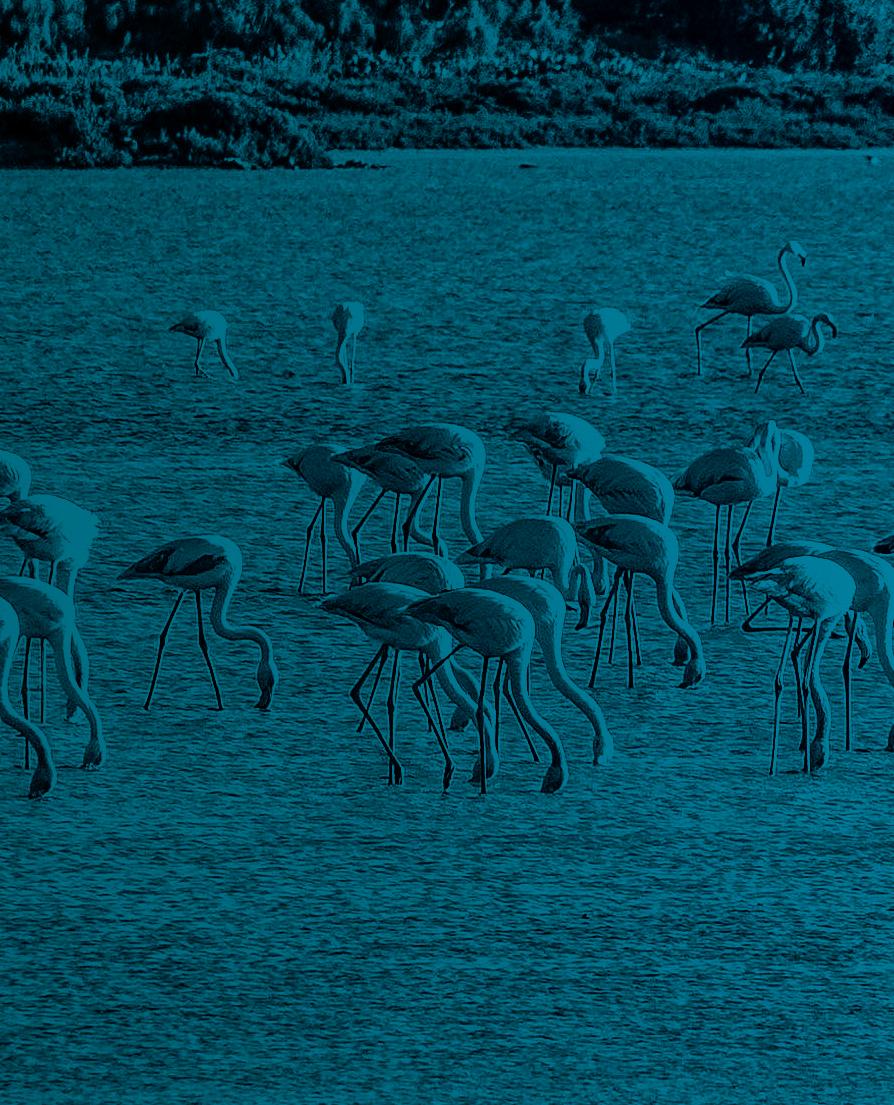
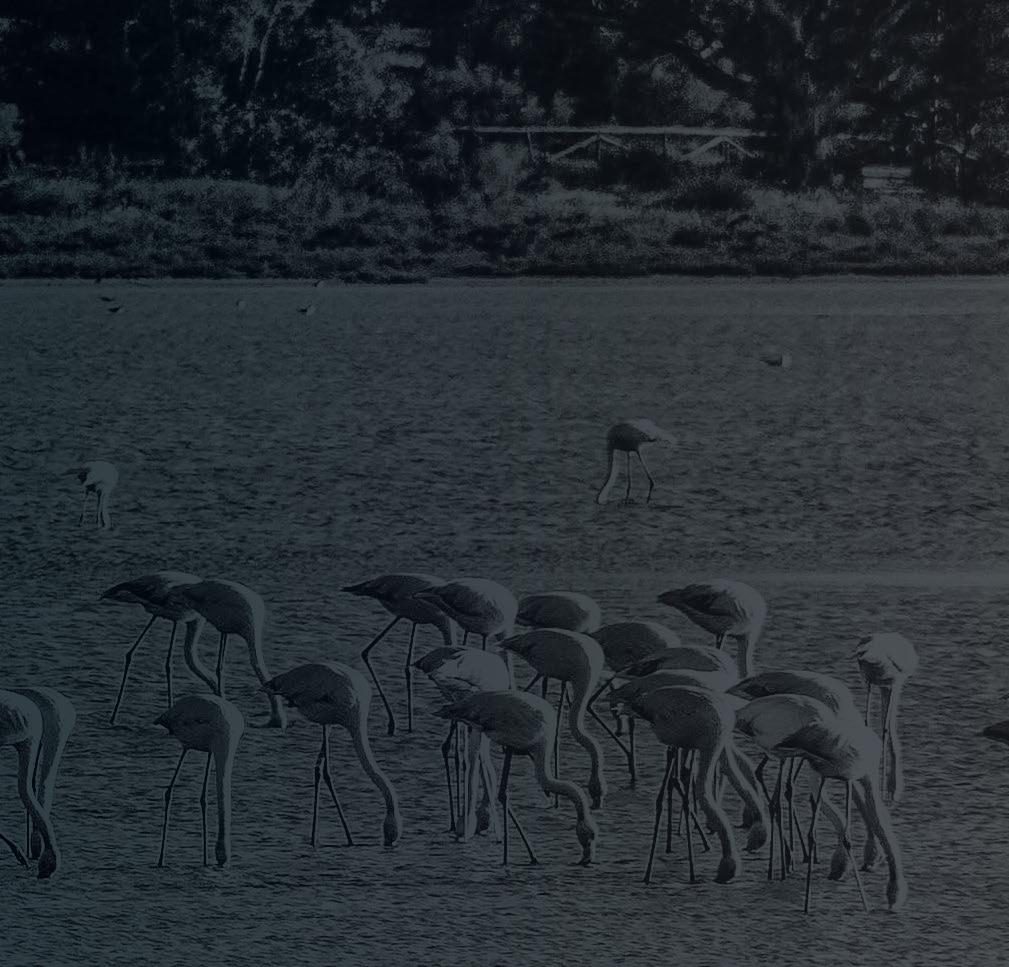
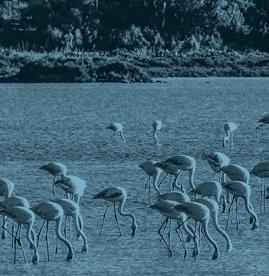
Flamingos in the marshes at sunset. Trebujena.
Castillo de Luna. Rota
Cultural heritage
Chipiona
Tangible cultural heritage
• Chipiona Lighthouse
• Regla Sanctuary
• Chipiona Castle
• Nuestra Señora de la O Church
• El Cristo de las Misericordias Chapel
• Fishing Pens
Intangible cultural heritage and other contemporary events
• Carnivals
• Nuestra Señora de Regla Patron Saint’s Day Celebrations
• Moscatel Festival
Cultural facilities
• “Cádiz and the New World” Interpretation Centre
• Museum of Regla and its Missionaries
• Rocío Jurado Museum Collection
• Moscatel Museum
Declared of international tourist interest
Declared of national tourist interest
Declared of regional tourist interest
Rota
Tangible cultural heritage
• Castillo de Luna
• Nuestra Señora de la O Church
• La Caridad Chapel
• City walls and Puerta del Mar Gate, Arco de Regla and Arco de la Villa
• Arco del Muelle and old lighthouse
• Fishing Pens
Intangible cultural heritage and other contemporary events
• Urta Festival
• Carnival
• Holy Week
• Burning of San Juan
• Ángel García López Poetry Contest
• Arranque Roteño
Cultural facilities
• Mayetería Interpretation Centre
• Felipe Benítez Auditorium
Sanlúcar de Barrameda
Tangible cultural heritage
• Santiago Castle
• Ducal Palace of Medina Sidonia
• Las Covachas
• Parish Church of Nuestra Señora de la O
• Bajo de Guía fishing district
• Bonanza Port Fish Market
Intangible cultural heritage and other contemporary events
• Carnival
• Holy Week
• Horse races in Bajo de Guía
• Guadalquivir Exaltation Festivities
• Manzanilla Fair
• Nuestra Señora de la Caridad Patron Saint’s Day celebrations
• Embarkation of the Rocío brotherhoods in Bajo Guía
• Jazz Festival
Cultural facilities
• Mythological Cádiz Interpretation Centre
• Manzanilla Interpretation Centre (CIMA)
• Manolo Sanlúcar Museum – Palace of the Andalusian People
• Barbadillo Museum of Manzanilla
Trebujena
Tangible cultural heritage
• La Purísima Concepción Parish Church
• Ntra. Señora de Palomares Shrine
• Altozano Castle
Intangible cultural heritage and other contemporary events
• Autumn fish market
• Carnival
• Patron Saint’s Fair and Grape Cluster Competition
• Trebufestival
Cultural facilities
• Altozano Castle Exhibition Space
La Janda




Suggested itinerary
Día 1: Conil de la Frontera y Vejer
Día 2: Barbate and Benalup-Casas Viejas
Día 3: Medina Sidonia and Alcalá de los Gazules
Día 4: Paterna de Rivera and San José del Valle
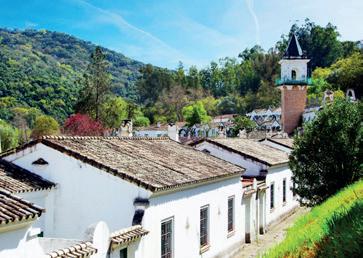
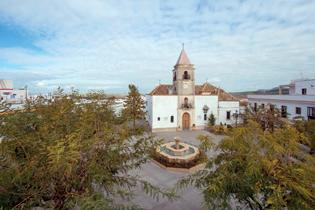
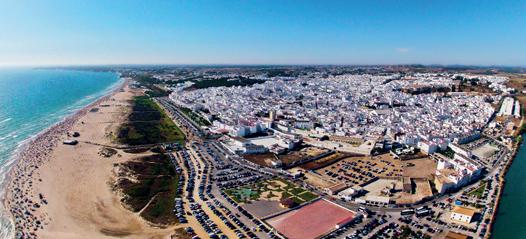
La Janda is a region defined by contrasts. It stretches from the vast coastline of unspoilt beaches and cliffs to the inland mountains and countryside, with a wealth of archaeological remains dating back to Phoenician and Roman times and white villages that seem frozen in time.
The character of La Janda can be felt in each of its towns. On the coast, Conil de la Frontera and Barbate live in close connection
Alcalá
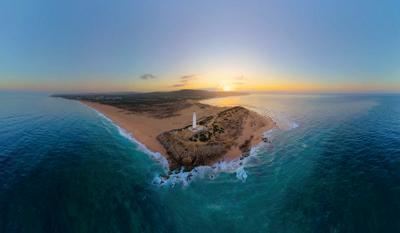
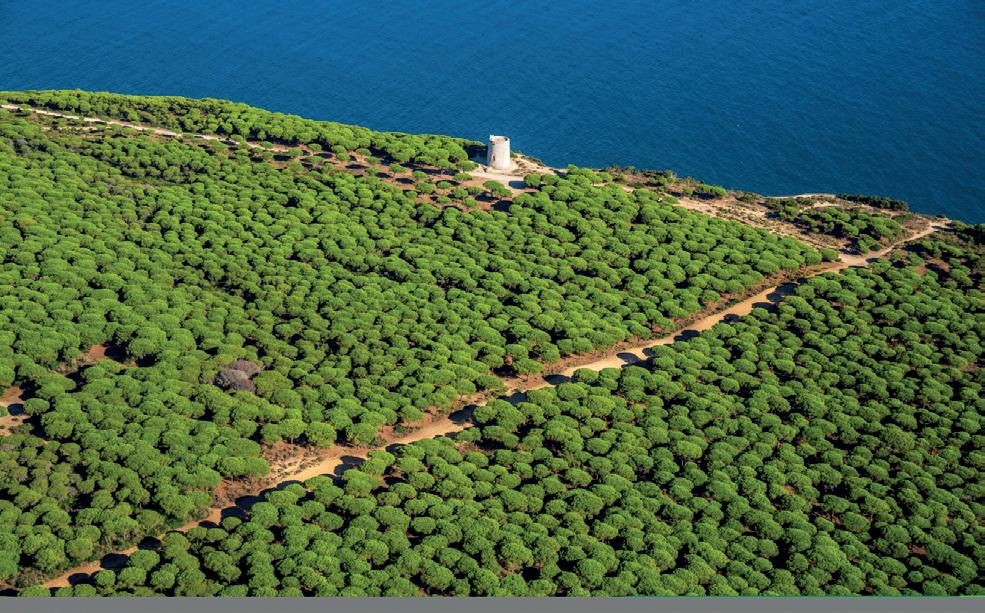
with the sea, with a fishing tradition based on the ancient technique of the almadraba for catching bluefin tuna. In Barbate, the connection with nature is reinforced by its surroundings in the Breña and Marismas del Barbate Natural Park, while Conil is noted for its pottery tradition, its seafood and traditional cuisine, and experiences that are not to be missed, such as attending a fish auction at the fish market.
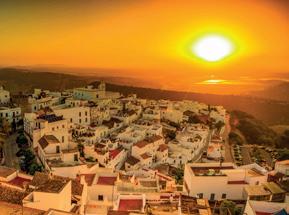
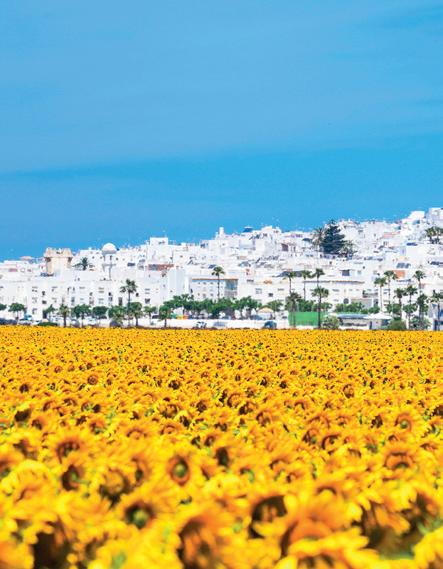
A little further inland, Vejer de la Frontera stands out as one of the most iconic white villages in Andalusia, a labyrinth of narrow, steep streets that preserves its walls, four medieval gates and castle intact. The culture of Vejer is a melting pot of influences, as evi-
Sierra de Cádiz, White Villages
Campo de Gibraltar
La Janda
Bajo Guadalquivir
San José del Valle
Paterna de Rivera
de los Gazules
BenalupCasas Viejas
Vejer de la Frontera
Barbate
Conil de la Frontera
Medina Sidonia

denced by its traditional costume, the cobijada, inherited from the tradition of its sister city, Chaouen, in Morocco.
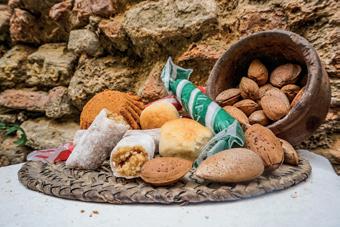
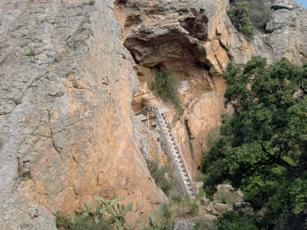
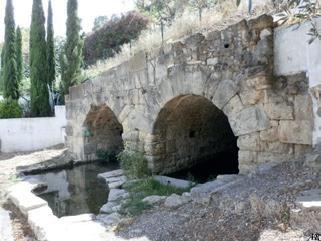
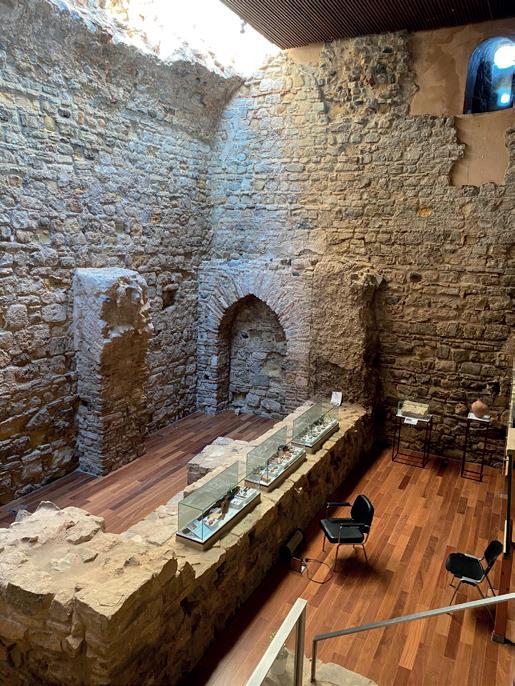
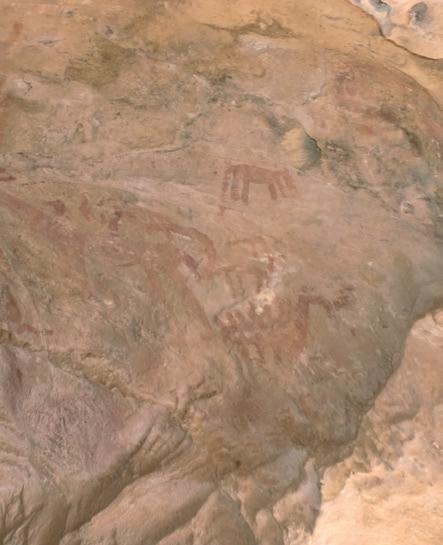
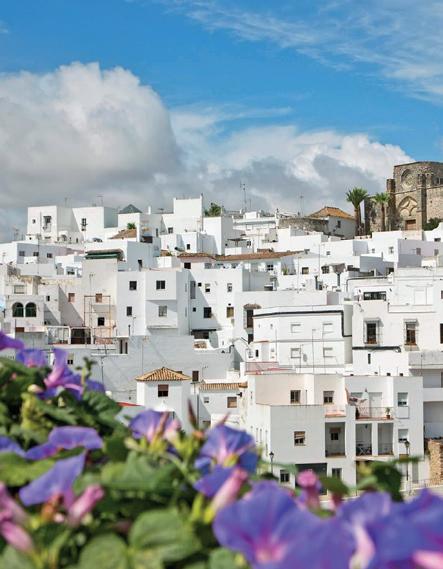
The inland region of La Janda exudes a historical atmosphere. Medina Sidonia, the ancient Phoenician and Roman capital, retains a medieval flavour in the old town and is known for the delicious alfajor de Medina, a sweet with Designation of Origin that evokes its Arab heritage. Alcalá de los Gazules surprises visitors with a rich archaeological heritage dating back to the Palaeolithic period and the passage of the Romans, while Benalup-Casas Viejas is home to the impressive rock art shelters of Tajo de las Figuras. Flamenco has its epicentre in Paterna
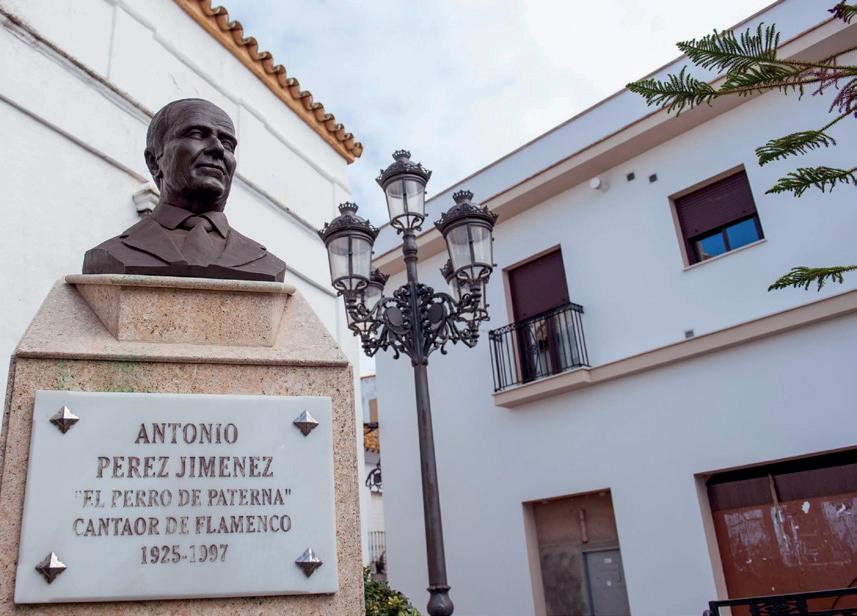
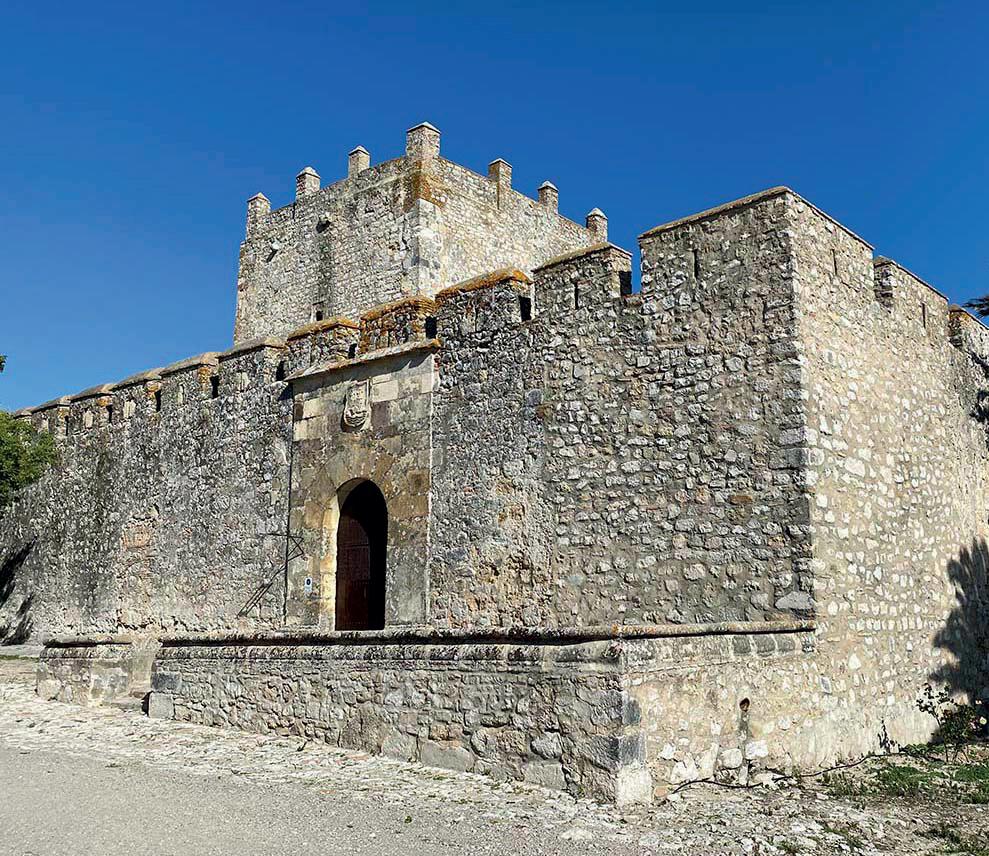
de Rivera, the birthplace of cante por peteneras, a unique style that honours the singer who gave it its name. In addition, San José del Valle connects the White Villages and Bulls Tours, guarded by the imposing Gigonza Castle
This mosaic of experiences is complemented by authentic, deeply rooted cuisine, ranging from seafood at the coast and Retinta beef to dishes featuring artichokes and cardoons, fruit of the land. La Janda, as a whole, offers a unique journey to the most genuine essence of Cadiz, combining nature, history and a deep-rooted cultural identity.
Conil de la Frontera
Interior Castle. Alcalá de los Gazules
Pinares de la Breña and Torre del Tajo. Barbate
Cave paintings. Benalup-Casas Viejas.
Vejer de la Frontera
Paterna de Rivera
Alfajores. Medina Sidonia
Gigonza Castle. San José del Valle
Cultural heritage
Alcalá de los Gazules
Tangible cultural heritage
• Castle
• Town Gate
• San Jorge Mártir Church
• La Victoria Church
• Town Hall
• Roman Reservoirs and La Salada Fountain
• Virgen de los Santos Chapel
Intangible cultural heritage and other contemporary events
• Nuestra Señora de los Santos Pilgrimage and Festivities
• Carnival
• San Jorge Festivities
• Fair
• Pal Sur Festival
Cultural facilities
• Metag - Ethnographic exhibition of Alcalá de los Gazules
• Alejandro Sanz Experience museum space
Barbate
Tangible cultural heritage
• Fishing village of Zahara de los Atunes and Almadrabas Castle
• San Ambrosio Chapel
• Palomar de la Breña
• Old Fish Market or Lonja Vieja
• Fishing port
• Nuestra Señora del Carmen Chapel
• Meca, Trafalgar and el Tajo Towers
Intangible cultural heritage and other contemporary events
• Carnival
• Feria and Fiestas del Carmen
• Fátima Pilgrimage and Festivities
• Holy Week
• Tosantos
• Tuna Gastronomic Week
• Cabo de Plata Festival
• Pacheco Viejo Flamenco Festival in Zahara de los Atunes
Cultural facilities
• La Chanca Tuna Museum
Declared of international tourist interest
Declared of national tourist interest
Benalup-Casas Viejas
Tangible cultural heritage
• Celemín Dolmens
• La Morita Tower
• Nuestra Señora del Socorro Church
• El Cuervo Monastery
Intangible cultural heritage and other contemporary events
• Carnival
• Las Lagunetas Pilgrimage and Festivities
• Independence Day
• Fair and Festivities of Santiago and Santa Ana
• Holy Week
Cultural facilities
• Prehistoric Cadiz Interpretation Centre
• Casas Viejas 1933 Memorial Site (ECCV)
Declared of regional tourist interest
• Las Cúpulas House Museum - Manuel Mañez Moya
Conil de la Frontera
Tangible cultural heritage
• Town Gate
• El Conde de las Cinco Torres House
• Torre de Guzmán
• The Bastion
• Former Convent of La Victoria or Santa Catalina Church
• Former Main Church
• Espíritu Santo Chapel
• Underwater archaeological site ‘La Piedra que revienta’
• Fishing Port and Fish Market
• Watchtowers: Torre Atalaya and Torre de Castilnovo
Intangible cultural heritage and other contemporary events
• Nuestra Señora de las Virtudes Fair and Festivities
• Night of San Juan
• Carnival
• Holy Week
• Virgen del Carmen Festivities
• Saint Sebastian Pilgrimage and Festivities
• Pal Sur Festival
• Conil Flamenco Festival
Cultural facilities
• Museum of Roots of Conil
• Interpretation and Documentation Centre for the Sea, Tuna and the Almadrabas de la Chanca
• Santa Catalina Cultural Centre
Medina Sidonia
Tangible cultural heritage
• Asido Caesarina Roman archaeological site
• Roman road
• Castle archaeological site
• Los Santos Mártires Visigothic chapel
• Walled enclosure: Arco de la Pastora, Arco de Belén and Puerta del Sol
• Santa María la Coronada Church
• The Duke’s Stables
Intangible cultural heritage and other contemporary events
• Carnival
• Holy Week
• San Isidro Pilgrimage and Festivities
• Cattle Fair and Festivities
• Live Nativity Scene
Cultural facilities
• Archaeological Museum
• Ethnographic Museum
• Historical Archives
Paterna de Rivera
Tangible cultural heritage
• House of Don Perafán de Ribera
• Nuestra Señora de la Hiniesta Parish Church
• Torreta de los Cuatro Vientos
• Monument to La Petenera
Intangible cultural heritage and other contemporary events
• National Dressage Championship
• National Peteneras Singing Competition
Cultural facilities
• Municipal Historical Archives
San José del Valle
Tangible cultural heritage
• Old Church
• Gigonza Castle
• Tempul Aqueduct and spring
Intangible cultural heritage and other contemporary events
• Carnival
• Independence Day
• San José del Valle Fair
Vejer de la Frontera
Tangible cultural heritage
• Walled enclosure: Arco de la Segur, Arco de la Villa, Arco de Sancho IV and Arco de Puerta Cerrada.
• La Corredera and El Mayorazgo Towers
• Arco de las Monjas
• Castle
• Mirador de la Cobijada
• Santa Lucía Aqueduct
• Jewish Quarter
• House of the Mayorazgo
• Divino Salvador Parish Church
• Nuestra Señora de la Oliva Chapel
• Windmills
Intangible cultural heritage and other contemporary events
• Virgen de la Oliva Evening
• Live Nativity Scene
• Night of Candles
• Patios of Vejer Week
• Las Murallas de la Segur Flamenco Night
• Jazz Vejer International Festival
• Flamenco Vejer Festival
• National Flamenco Singing Competition for Amateurs “Ciudad de Vejer”
Cultural facilities
• NMAC-Montenmedio Contemporary Art Foundation
• History and Archaeology Museum
• Municipal Museum of Customs and Traditions
• Municipal Theatre
Sierra de Cádiz White Villages
Bajo Guadalquivir


Bay of Cádiz

La Janda
Suggested itinerary

Sierra de Cádiz, White Villages
Día 1: Arcos de la Frontera and Algar
Día 2: Bornos, Villamartín and Espera
Día 3: Ubrique, Benaocaz and Villaluenga del Rosario
Día 4: Grazalema, Benamahoma and El Bosque
Día 5: Prado del Rey, Puerto Serrano and Algodonales
Día 6: Setenil de las Bodegas, El Gastor and Zahara de la Sierra
Día 7: Alcalá del Valle, Torre Alháquime and Olvera
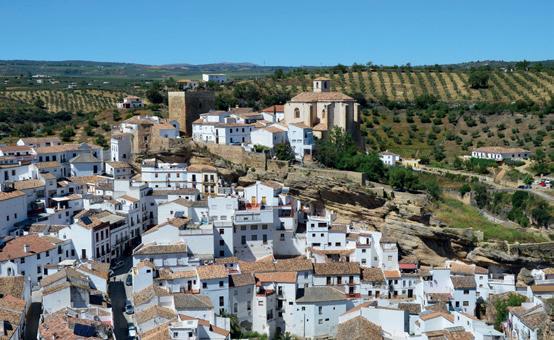
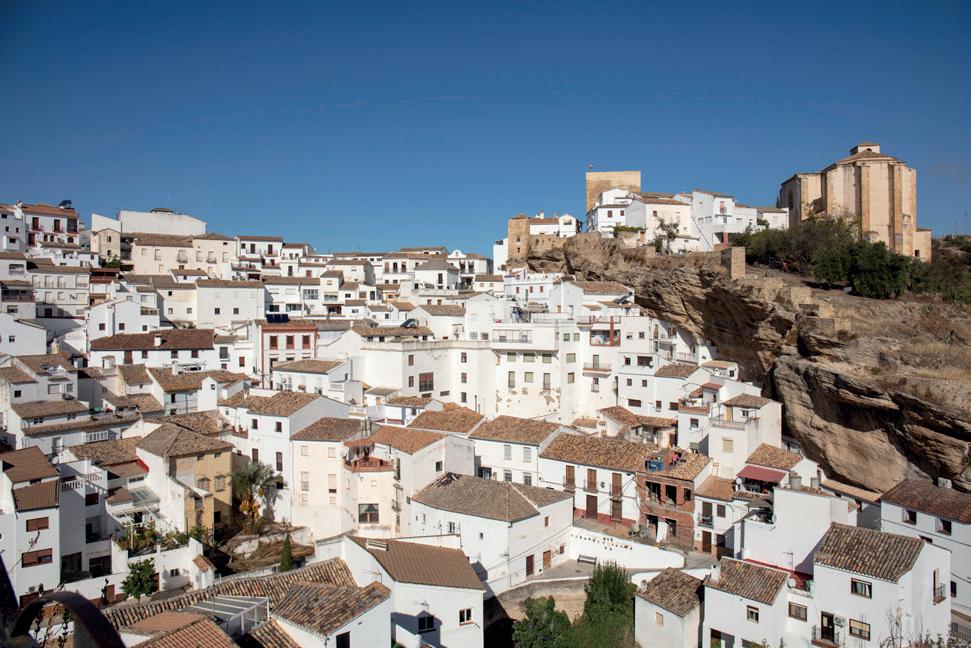
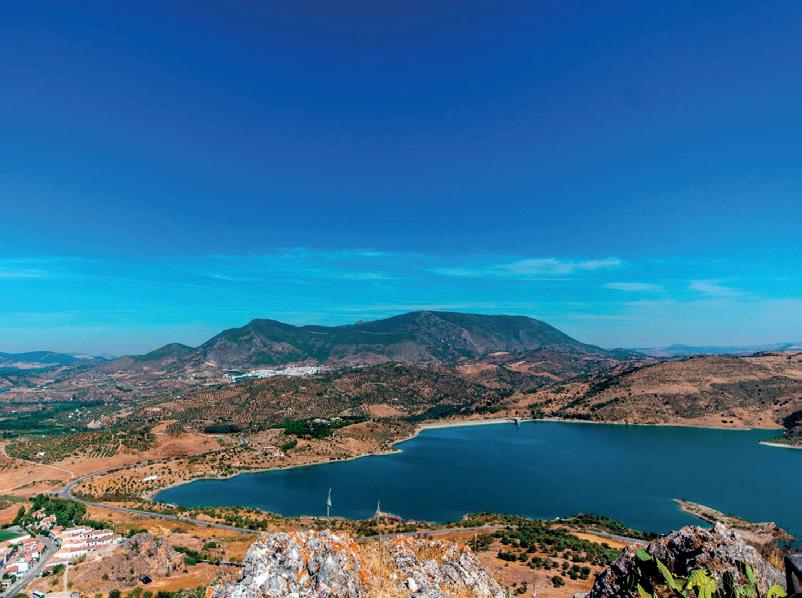
A tour of the villages in the mountains reveals bold architecture, such as that of Setenil de las Bodegas, whose houses are carved into the Trejo river canyon, giving shape to the unique streets of La Sombra (The Shadow) and El Sol (The Sun). History and nature come together in Zahara de la Sierra, perched on a hill and watched over by the castle, with the reservoir at its feet, a place that comes alive every Corpus Christi as the streets are covered in reeds and flowers.
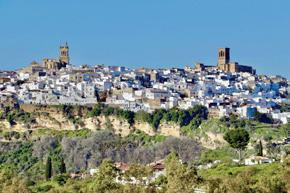
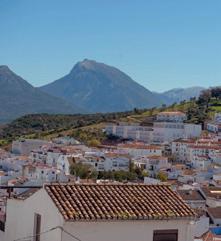
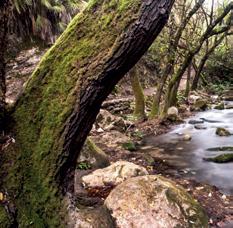
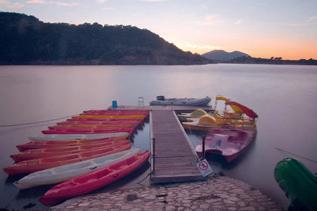
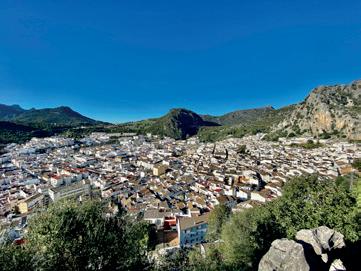
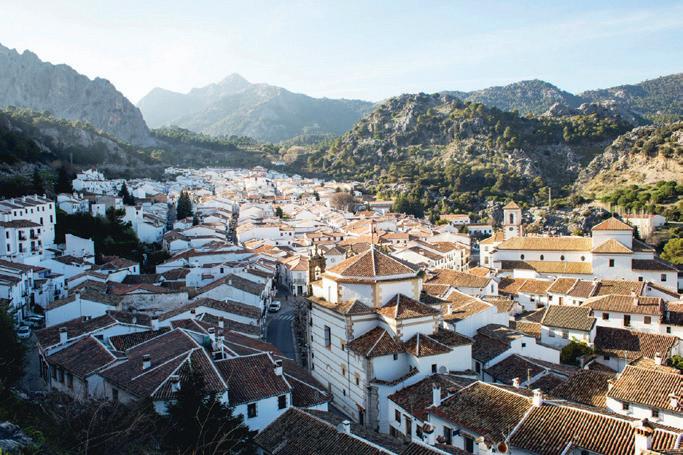
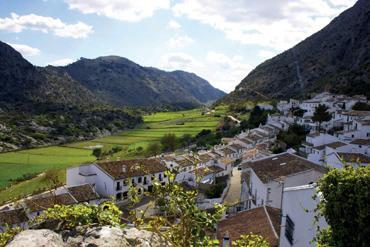
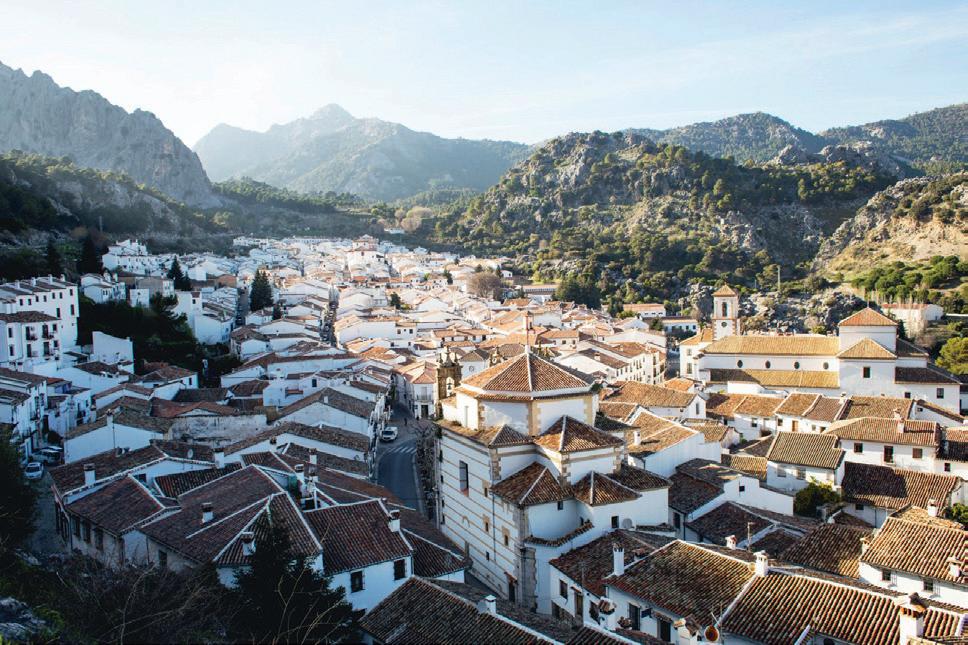
The Sierra de Cádiz is a mosaic of white villages, nestled in a landscape of rugged mountains and fertile valleys. Framed by the Sierra de Grazalema and Los Alcornocales natural parks, it is a land of fortresses, Roman roads, festivals and ancestral traditions that refuse to be forgotten.
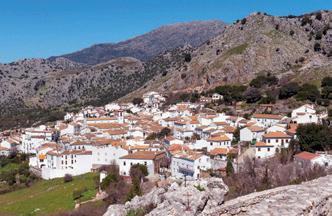
In the heart of the region, Grazalema stands out as the white village par excellence, with a unique microclimate and an excellent merino wool blanket-making industry. In turn, the unmistakable silhouette of Olvera, dominated by the castle and church, is an emblem of the mountains. The artisan and cultural
Campo de Gibraltar
Arcos de la Frontera
Algar
Bornos
Villamartín
Espera
Algodonales

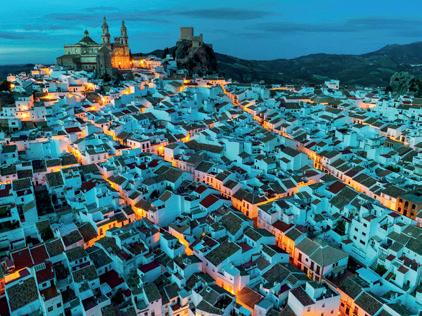
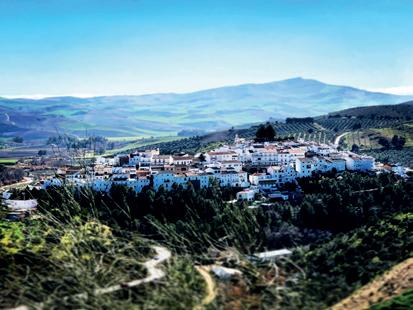
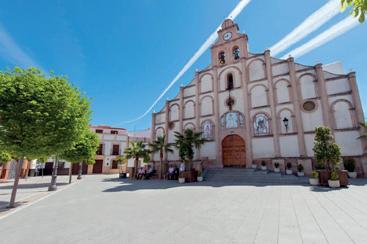
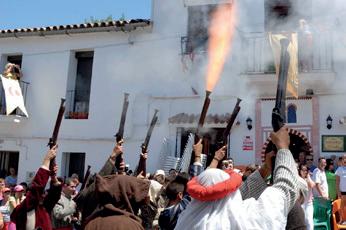
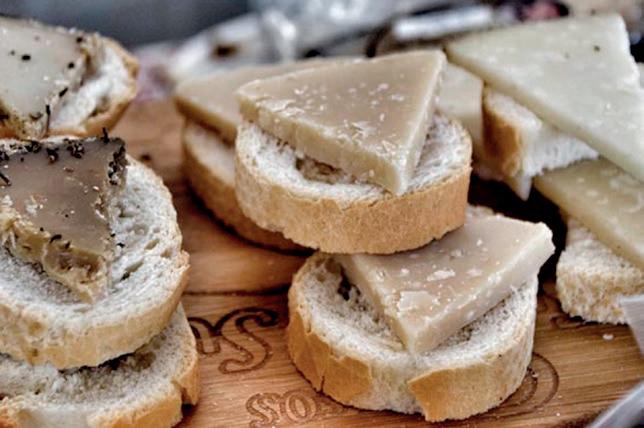
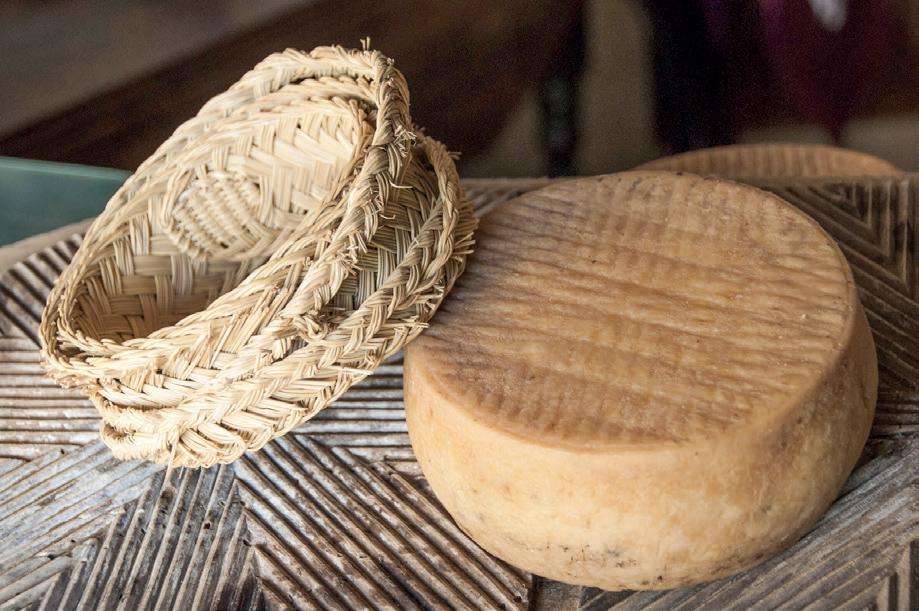
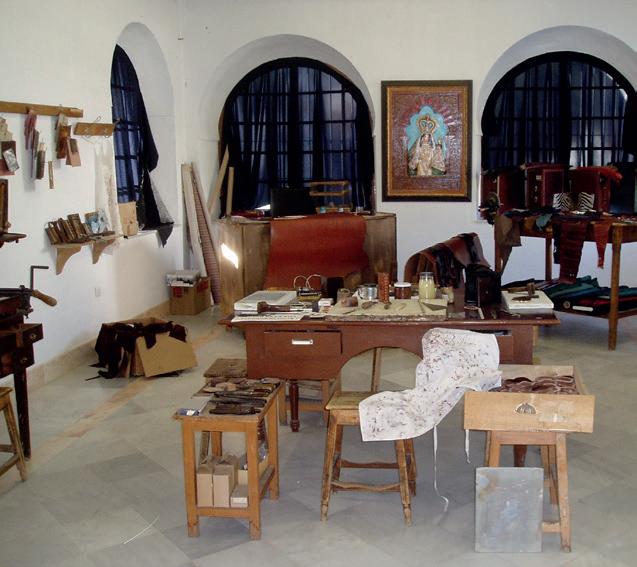
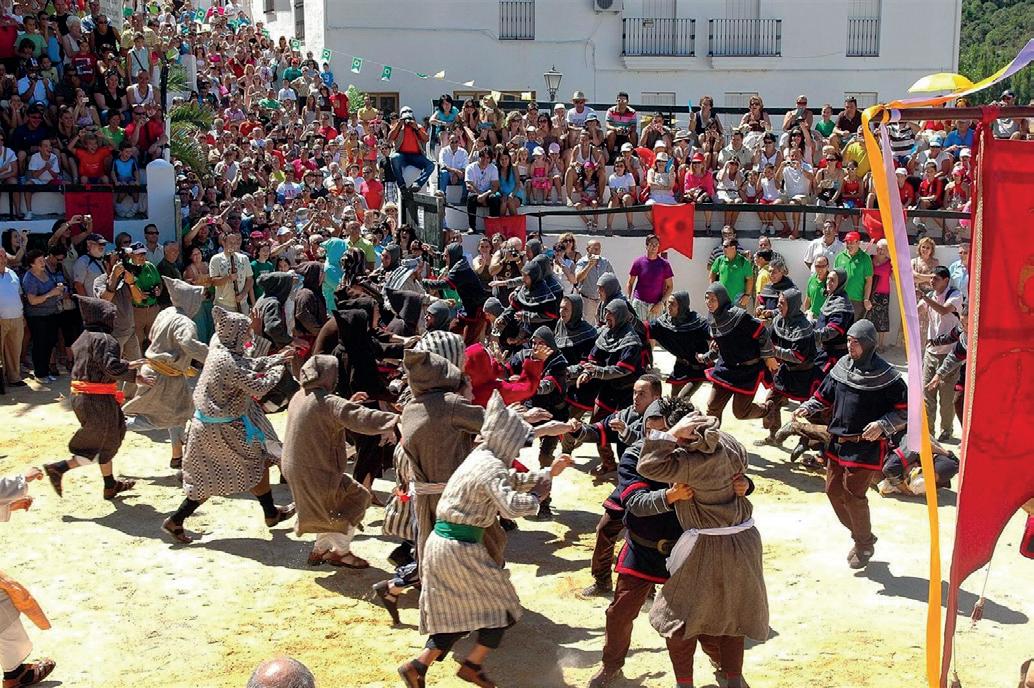
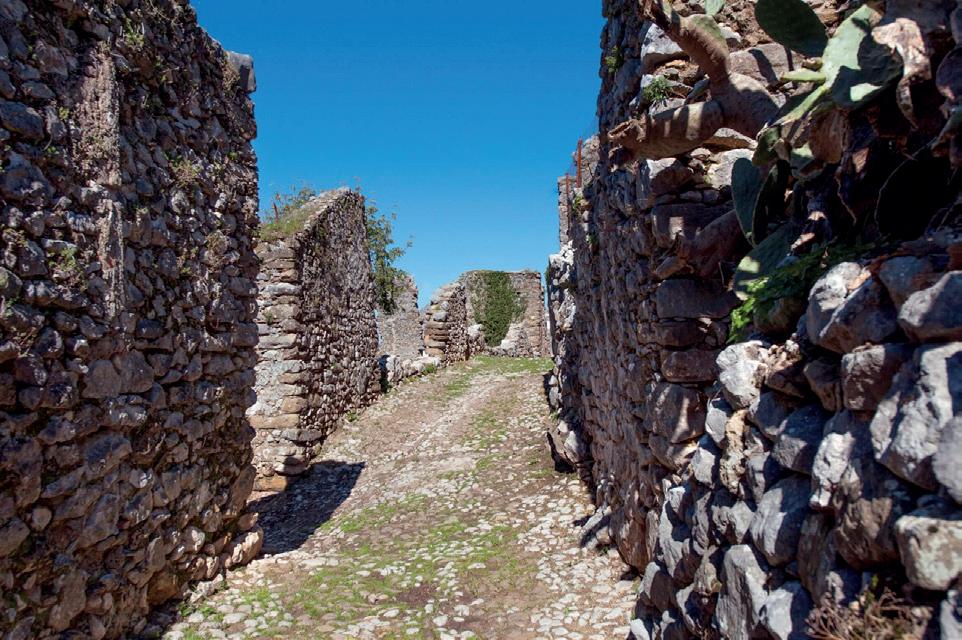
legacy extends to Ubrique, known worldwide for its high-quality leather goods, and Villaluenga del Rosario, the birthplace of the famous Payoyo cheese, made from the milk of native goats and sheep. The Arab influence is visible in the urban layout of Benaocaz, which preserves a Nasrid quarter in its original cobbled streets, and in the hamlet of Benamahoma, which celebrates the popular Moors and Christians festival every year.
Each village offers something very special. From the panoramic views of El Gastor, known as the “Balcony of the White Villages”, to the stately majesty of Arcos de la Frontera, the largest town in the region, with impressive views over the countryside and the mountains. The past lives on in the Roman ruins of Bornos, in the castle of Espera and
the bandit heritage of Torre Alháquime. The area also offers an unbeatable setting for active tourism, with hiking trails, adventure sports in Algodonales and the tranquillity of villages such as El Bosque
The Sierra de Cádiz is more than just a tour of its villages; it is an immersion in a way of life where nature, heritage and traditions are preserved with authenticity. The quality of its oils, the local cuisine and craftsmanship that has transcended borders make this region an essential destination for those seeking the most rural and genuine essence of the province of Cadiz.
El Bosque Benamahoma Grazalema
Benaocaz
Prado del Rey
El Gastor
Zahara de la Sierra
Torre de Alháquime
Puerto Serrano
Cultural heritage
Alcalá del Valle
Tangible cultural heritage
• Tomillo Dolmens
• Caños Santos Monastery
• Fuente Grande

Intangible cultural heritage and other contemporary events
• Carnival
• Virgen del Valle Pilgrimage and Festivities
• San Roque Fair
Cultural facilities
• Roman Mill Museum
Algar
Tangible cultural heritage
• Santa María de Guadalupe Parish Church
• Bullring
Intangible cultural heritage and other contemporary events
• Carnival
• Holy Week
• Santa María de Guadalupe Patron Saint Festivities
• Historical re-enactment: Mexican roots
Algodonales
Tangible cultural heritage
• Santa Ana Parish Church
• Chapels of Jesús Nazareno and La Virgencita
• Fuente Alta
Intangible cultural heritage and other contemporary events
• Historical re-enactment “Algodonales, 2 May 1810”
• Corpus Christi
Cultural facilities
• Municipal auditorium
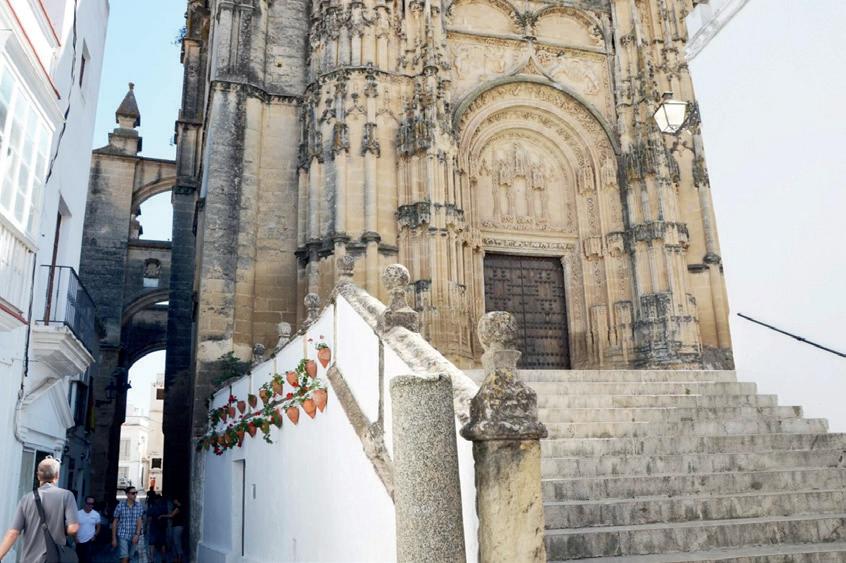
Basilica of Santa María. Arcos de la Frontera
Neolithic remains. Algar Olive-growing tradition. Espera
Fatetar Castle. Bornos Famous cheeses. Villamartín
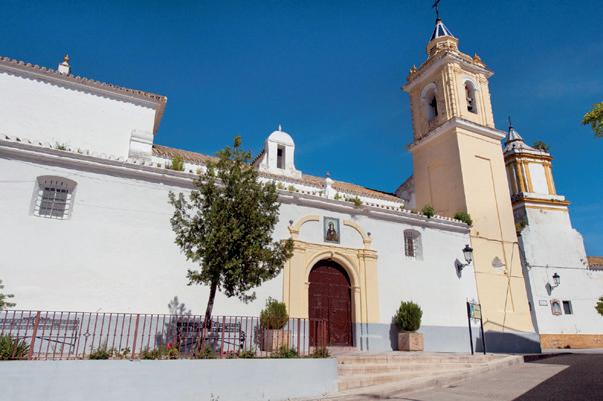
Church of Santa María Magdalena. Puerto Serrano
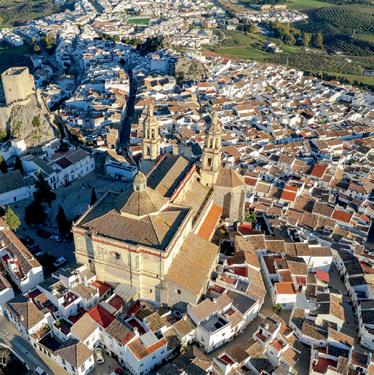
Aerial view of the Cathedral. Olvera
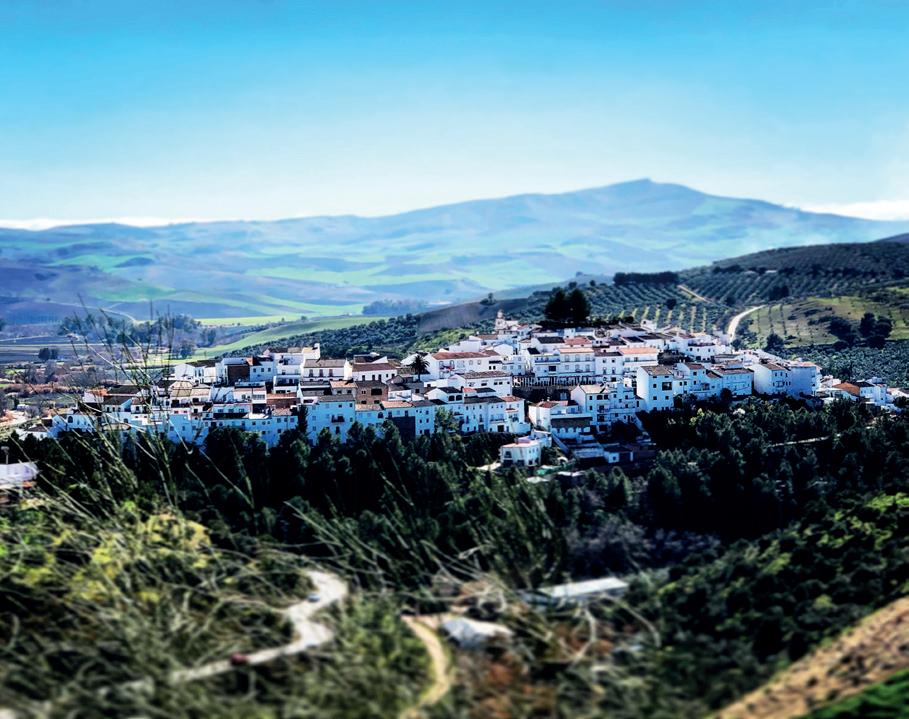
Arcos de la Frontera
Tangible cultural heritage
Santa María Basilica
San Pedro Church
Ducal Castle
Remains of the Arab wall and Matrera Gate
Mayorazgo Palace
Intangible cultural heritage and other contemporary events
• Holy Week
• Living nativity scene
• May Crosses
• San Miguel Fair
• Pal Sur Festival
Cultural facilities
• Arcos Interpretation Centre (CICA)
• Olivares Veas Theatre
Víctor Marín Foundation
Municipal Art Gallery
Tangible cultural heritage
San Antonio de Padua Chapel
Three Spouts Fountain
Fuente del Nacimiento
Intangible cultural heritage and other contemporary
• Historical re-enactment of Moors and Christians
Cultural facilities
• Water Mill Ecomuseum Benamahoma
Torre Alháquime
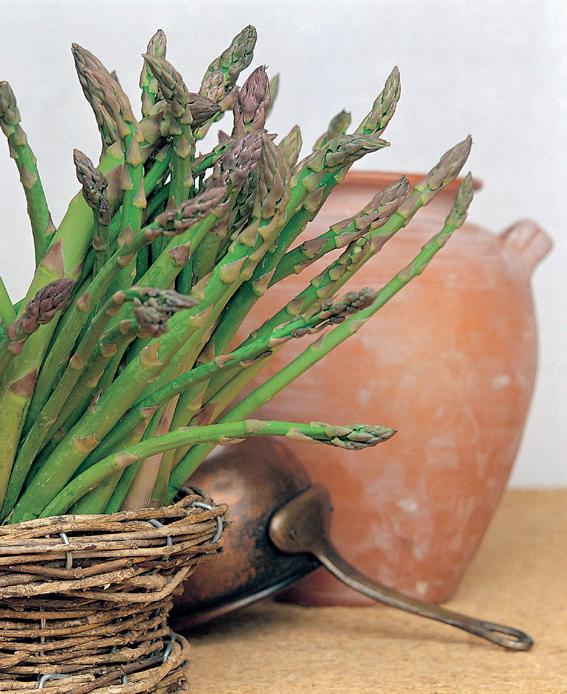
Asparagus. Alcalá del Valle
Setenil de las Bodegas
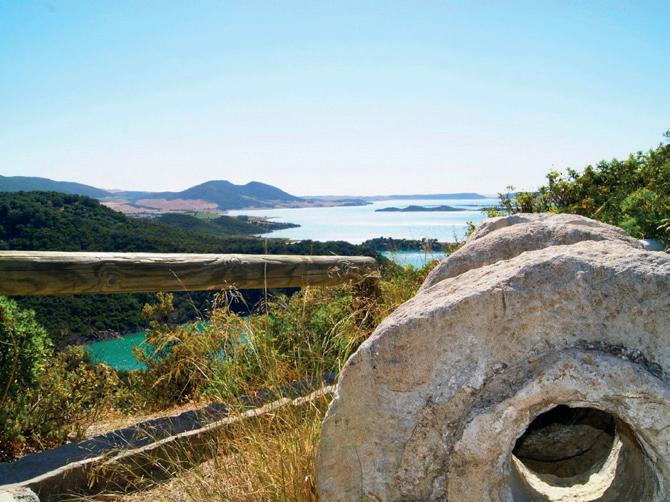
Zahara-El Gastor Reservoir
Recreation of 2 May 1810. Algodonales
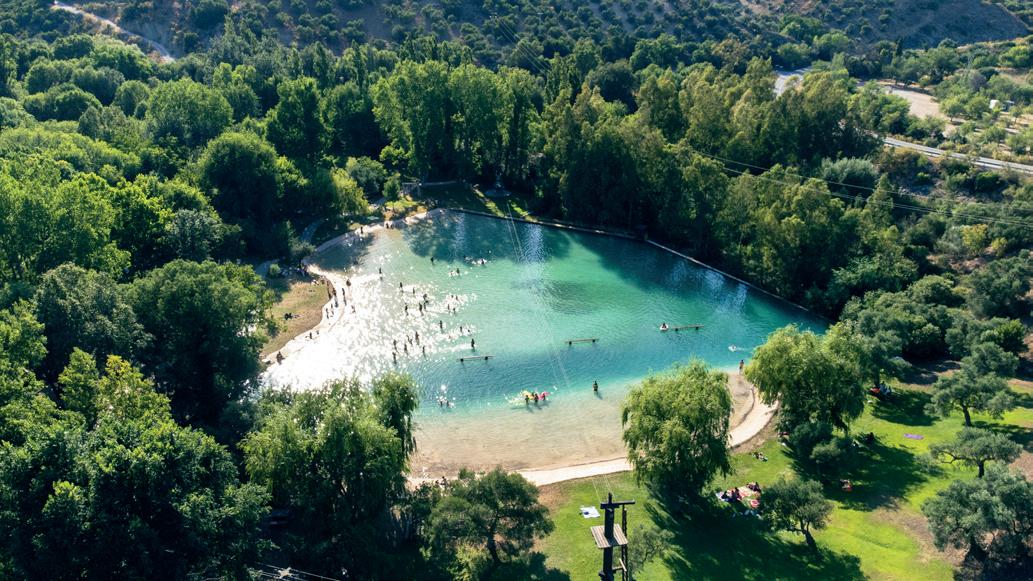
Arroyomolinos Beach. Zahara de la Sierra
Cultural heritage
Declared of international tourist interest
Declared of national tourist interest
Declared of regional tourist interest
Benaocaz
Tangible cultural heritage
• San Pedro Parish Church
• Remains of Roman road
• Remains of Aznalmara Castle
• Nazarí neighbourhood
• Allá Fountain
Intangible cultural heritage and other contemporary events
• San Blas Festival
• Holy Week
• Night of Candles
Cultural facilities
• Historical Ecomuseum
Bornos
Tangible cultural heritage
• Castle-Palace of the Ribera family and Lodge
• Santo Domingo de Guzmán Parish Church
• La Cilla and Los Ordóñez Manor houses
• Corpus Christi Convent
Intangible cultural heritage and other contemporary events
• Corpus Christi
• Carnival
• Holy Week
• Burning of Judas
Tangible cultural heritage
• Nuestra Señora de Guadalupe Parish Church
• Ducal Palace
• Calvary Chapel
• Bullring
Intangible cultural heritage and other contemporary events
• Villa de El Bosque historical re-enactment
Cultural facilities
• Cheese Interpretation Centre
El Gastor
Tangible cultural heritage
• El Charcón Dolmen or Giant’s Tomb
• Diego Fountain in El Gastor
• The Mill
El Bosque
Grazalema
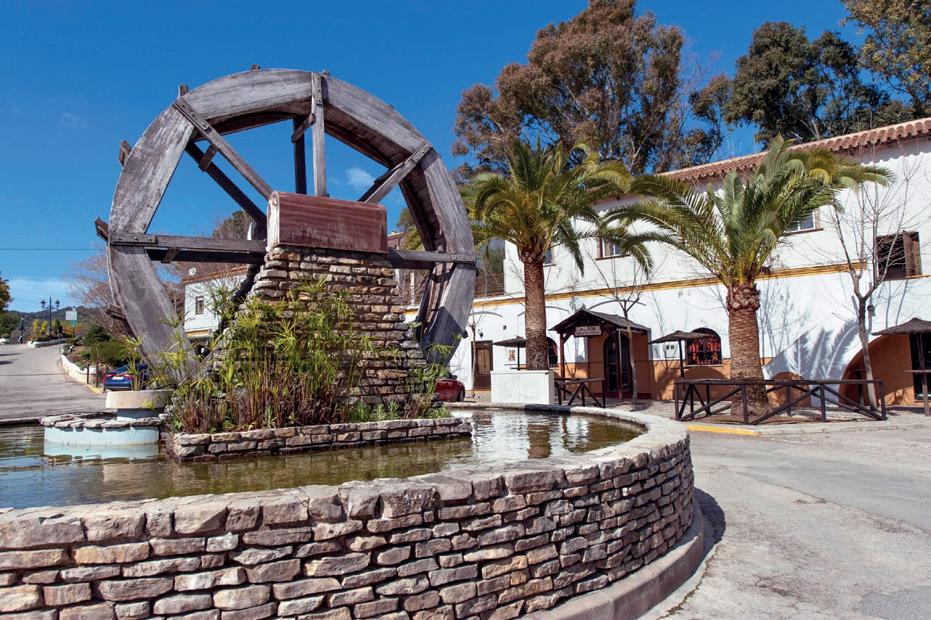
Artisanal cheese. Villaluenga del Rosario Leather Museum. Ubrique
Intangible cultural heritage and other contemporary events
• Carnival
• Holy Week
• Corpus Christi
• Living Nativity Scene
Cultural facilities
• José María “El Tempranillo” Museum of Popular Customs and Traditions
Espera
Tangible cultural heritage
• Carissa Aurelia archaeological site
• Nuestra Señora de Gracia Church
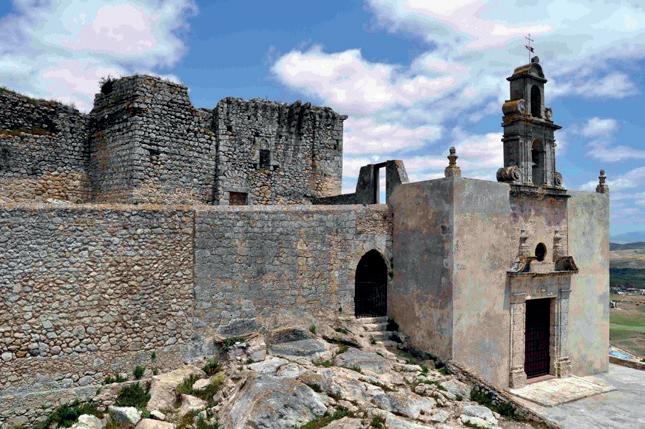
• Fatetar Castle
• Santiago Hermitage
• La Cilla or los Diezmos House
Intangible cultural heritage and other contemporary events
• Holy Week
• Santísimo Cristo de la Antigua Patron Saint’s Day celebrations
Cultural facilities
• Archaeological museum
Grazalema
Tangible cultural heritage
• Remains of Roman road
• Nuestra Señora de la Aurora Baroque church
• Nuestra Señora de la Encarnación Church
Intangible cultural heritage and other contemporary events
• Major festivals
• Holy Week
• Fiestas del Carmen
• Bull Rope Monday
• Recreation of ‘Blood and Love in the Sierra’ (Bandits)
Cultural facilities
• Textile Craft Museum
• Cultural Centre
Olvera
Tangible cultural heritage
• La Villa neighbourhood
• Arab castle and city walls
• El Pan and Los Olivillos Towers
• Nuestra Señora de la Encarnación Archpriestal Church
• La Cilla
• Peñón del Sagrado Corazón
• Chapel of Art
• Los Remedios Hermitage
• Old Jerez-Almargen railway line: Greenway
Intangible cultural heritage and other contemporary events
• Carnival
• Lunes de Quasimodo Pilgrimage and festivities
• Corpus Christi
• Royal Fair and Festivities of Saint Augustine
• Holy Week
Cultural facilities
• Olvera Museum. The Frontier and the Castles
Moors and Christians Festival. Benamahoma
Nazarí neighbourhood. Benaocaz
Cultural heritage
Prado del Rey
Tangible cultural heritage
• Ancient Roman salt flats of Iptuci
• Old farmers’ granary
• Nuestra Señora del Carmen Church
Intangible cultural heritage and other contemporary events
• Carnival
• Beekeeping Fair
• San Isidro Labrador Pilgrimage and festivities
• Living Nativity Scene
• National Serranas Singing Competition
• Pal Sur Festival
Cultural facilities
• Ethnographic Interpretation Centre of the Sierra de Cádiz
Puerto Serrano
Tangible cultural heritage
• Fuente de Ramos Necropolis
• Santa María Magdalena Parish Church
• Siré Mill
• Almendral Chapel
• Old Jerez-Almargen railway line: Greenway
Intangible cultural heritage and other contemporary events
• Carnival
• Toro de Aguardiente
• Festival of Candles
• Summer Fair and Fino Wine Festival
• Santa María Magdalena Pilgrimage and Festivities
Setenil de las Bodegas
Tangible cultural heritage
• Arab tower and wall
• Arab cistern
• Streets of Cuevas de la Sombra and Cuevas del Sol
• La Encarnación Church
• San Román Caves
• Carnival
• Holy Week
• Moors and Christians
• Virgen del Carmen Patron Saint’s Day celebrations
Cultural facilities
• Casa de la Damita museum collection
Torre Alháquime
Tangible cultural heritage
• Remains of medieval walls and Arco de la Villa
• Nuestra Señora de la Antigua Parish Church
• Sagrado Corazón de Jesús Monument
• Commemorative square dedicated to the bandit José María ‘El Tempranillo’
Intangible cultural heritage and other contemporary events
• Carnival
• Corpus Christi
• San Juan Pilgrimage and Festivities
• San Roque Festival
Ubrique
Tangible cultural heritage
• Roman city of Ocuri
• Capuchinos Convent
• Nuestra Señora de la O Parish Church
• San Antonio Chapel
El Bosque
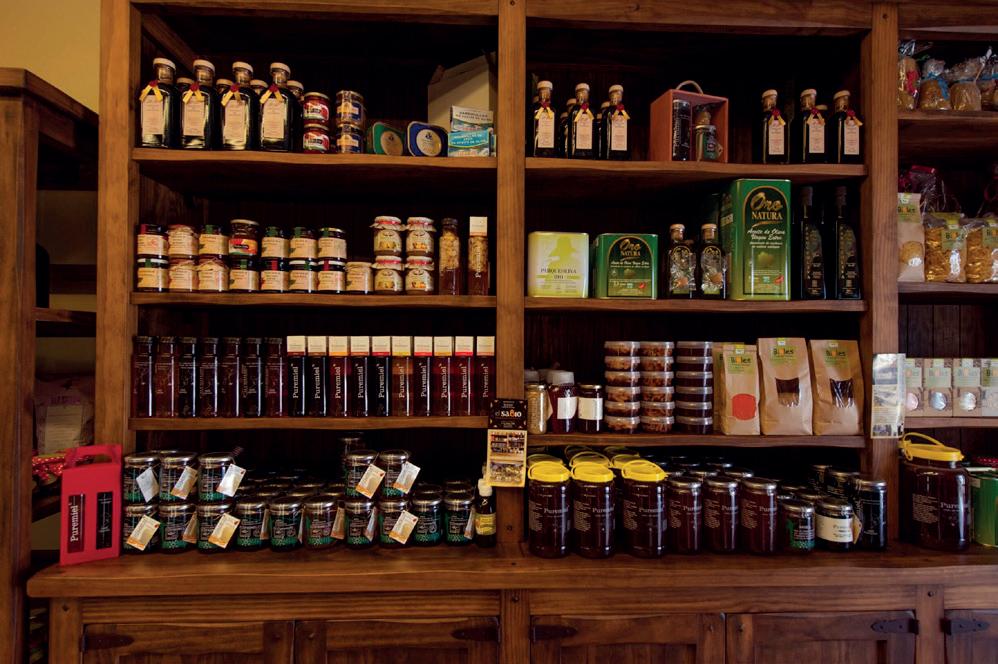
contemporary events
• May Crosses. Crujía de Gamones
• Roman road
• Living Nativity Scene
• Carnival
• Holy Week
• Villa de Ubrique Outdoor Speed Painting Competition
• Pal Sur Festival
Cultural facilities
• Permanent Exhibition ‘Hands and Magic on Leather’
• San Juan de Letrán Interpretation Centre for the History of Ubrique
Villaluenga del Rosario
Tangible cultural heritage
• Remains of medieval road
• Bullring
• San Miguel and El Salvador Churches
• Aqueduct fountain
Intangible cultural heritage and other contemporary events
• Procession of the Stones
• Holy Week
• Andalusia Artisan Cheese Fair
• Virgen del Rosario Patron Saint Festivities.
Cultural facilities
• Pedro Pérez Clotet Literature Interpretation Centre
• Cheese Museum
Villamartín
Tangible cultural heritage
• Alberite Dolmens
• Matrela Castle
• Santa María de las Virtudes Parish Church
• Nuestra Señora de las Montañas Chapel
• Monument to the 5th Centenary
Intangible cultural heritage and other contemporary events
• Livestock Fair and San Mateo Festivities
• Carnival
• Holy Week
Cultural facilities
• Municipal Archives
Zahara de la Sierra
Tangible cultural heritage
• Remains of the castle and keep
• Clock Tower
• Old Main Church
• Santa María de la Mesa Church
Intangible cultural heritage and other contemporary events
• Corpus Christi
• Carnival
• San Simón y San Judas
• San Juan Pilgrimage and Festivities
• Sierra Sur Ecofestival
Cultural facilities
• Medieval Town Interpretation Centre
• Parish Museum
Honey. Prado del Rey
Campo de Gibraltar
Bajo Guadalquivir



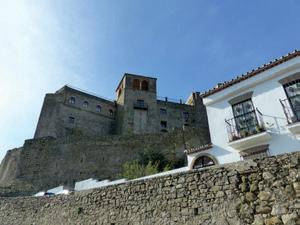
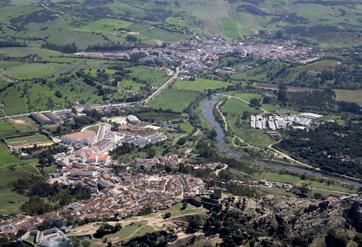
Jimena de la Frontera

Suggested itinerary
Día 1: Tarifa
Día 3: San Roque and Los Barrios

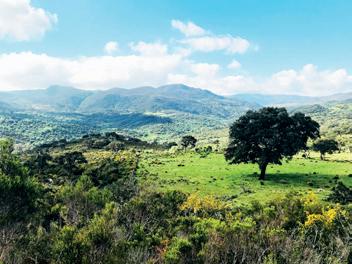
Castellar de la Frontera
San

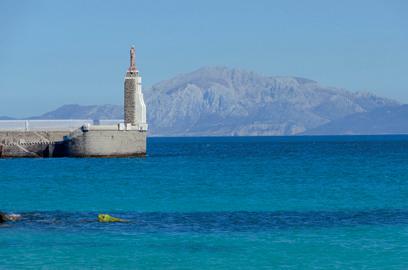
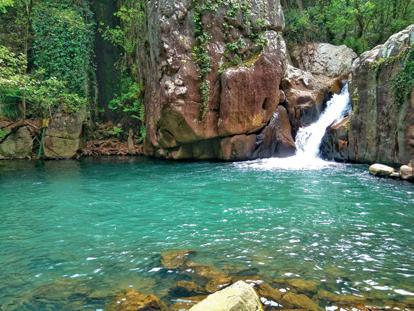
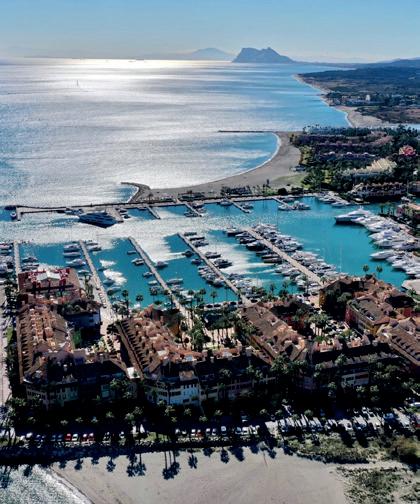
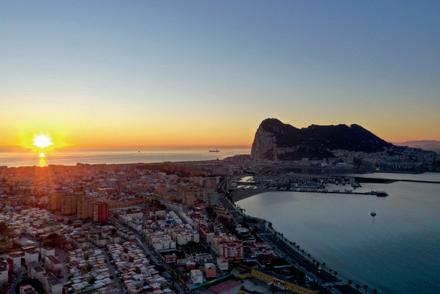
Línea de la Concepción
Algeciras
Día 2: Algeciras and La Línea de la Concepción
Día 4: Jimena de la Frontera, Castellar de la Frontera and San Martín del Tesorillo
Campo de Gibraltar is an exceptional geographical enclave, a veritable bridge between the Mediterranean and the Atlantic, and Europe’s gateway to Africa. Its strategic position has forged a unique cultural identity, marked by a rich military heritage and remarkable biodiversity. The region has the longest stretch of coastline in Andalusia, combining fine sandy beaches with wooded areas such as Los Alcornocales Natural Park, consi-
dered the last stronghold of subtropical vegetation on the continent.
The history of the area is evident in its coastal towns. Algeciras, modern and cosmopolitan thanks to its port, one of the world’s maritime hubs, preserves valuable remains from its medieval period, including the ruins of Villa Nueva and the Merinid Baths. It is also the birthplace of the legendary flamenco guitarist Paco de Lucía, whose life and art are commemorated in a cultural tour. La Línea de la Concepción, on the border with Gibraltar, reveals its military origins through the remains of the 18th-century forts from its Lines of Contravallation and its colonial-style urban planning, as well as important museums such as the Cruz Herrera Museum.
Sierra de Cádiz, White Villages
Campo de Gibraltar
La Janda
Tarifa
Los Barrios
Roque
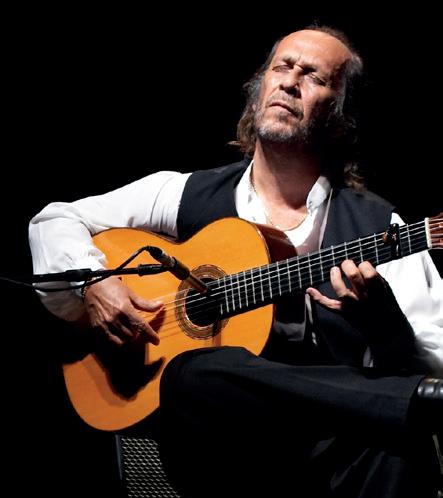
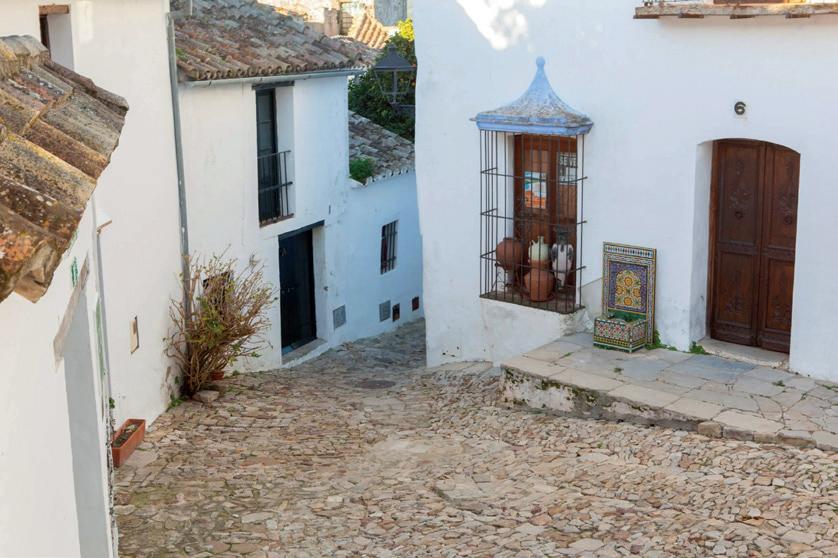
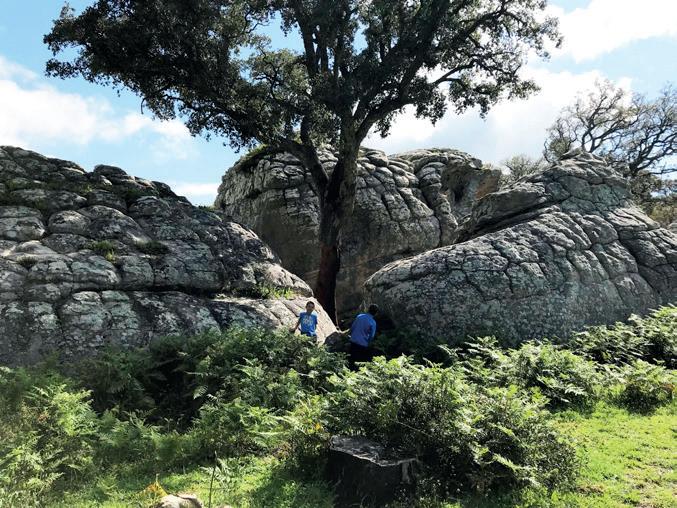
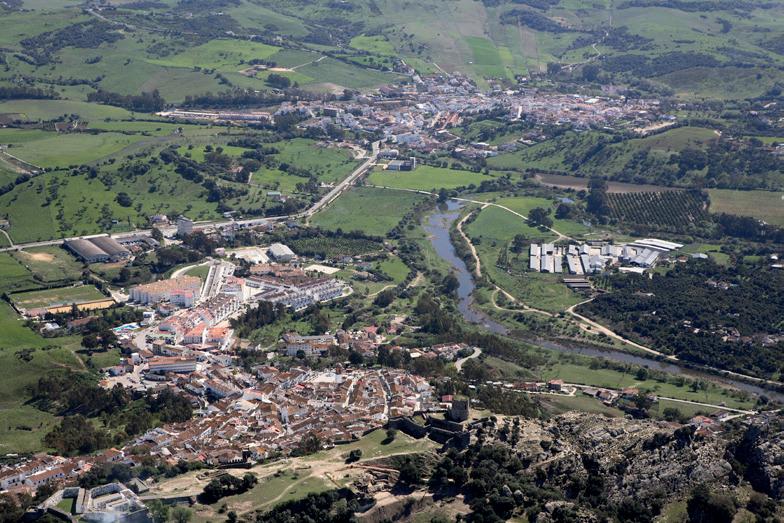
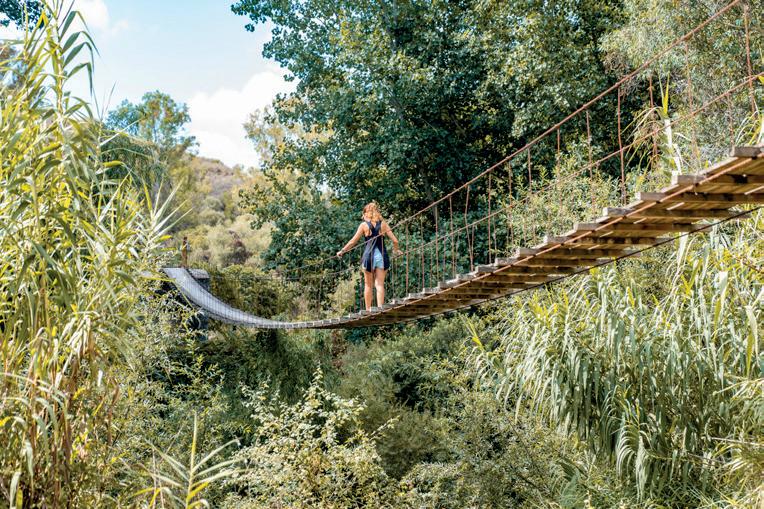
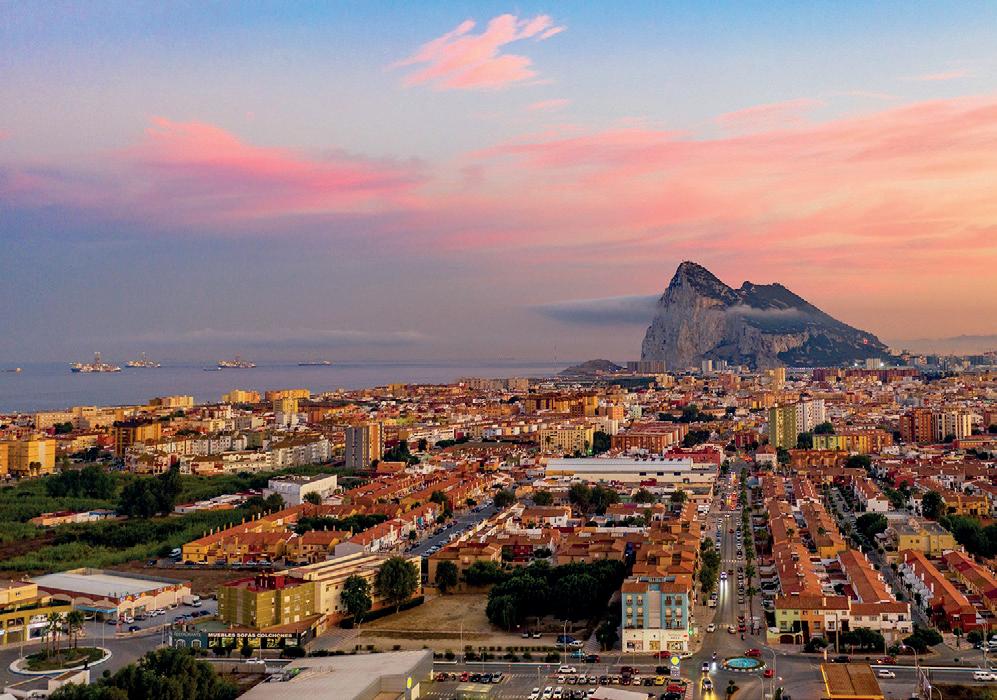
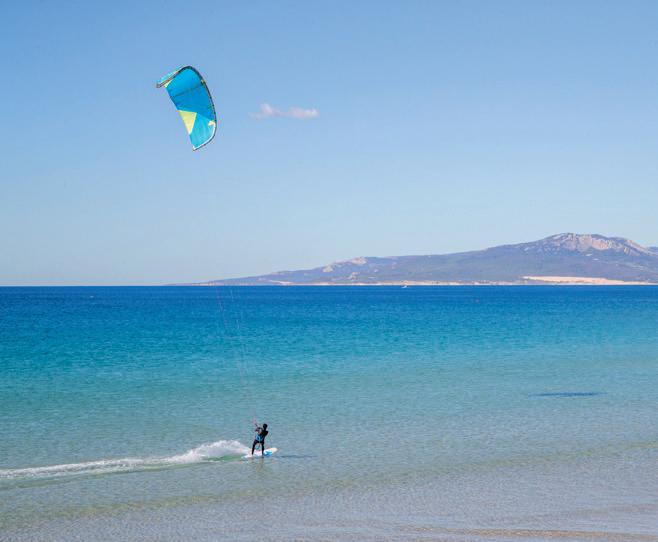
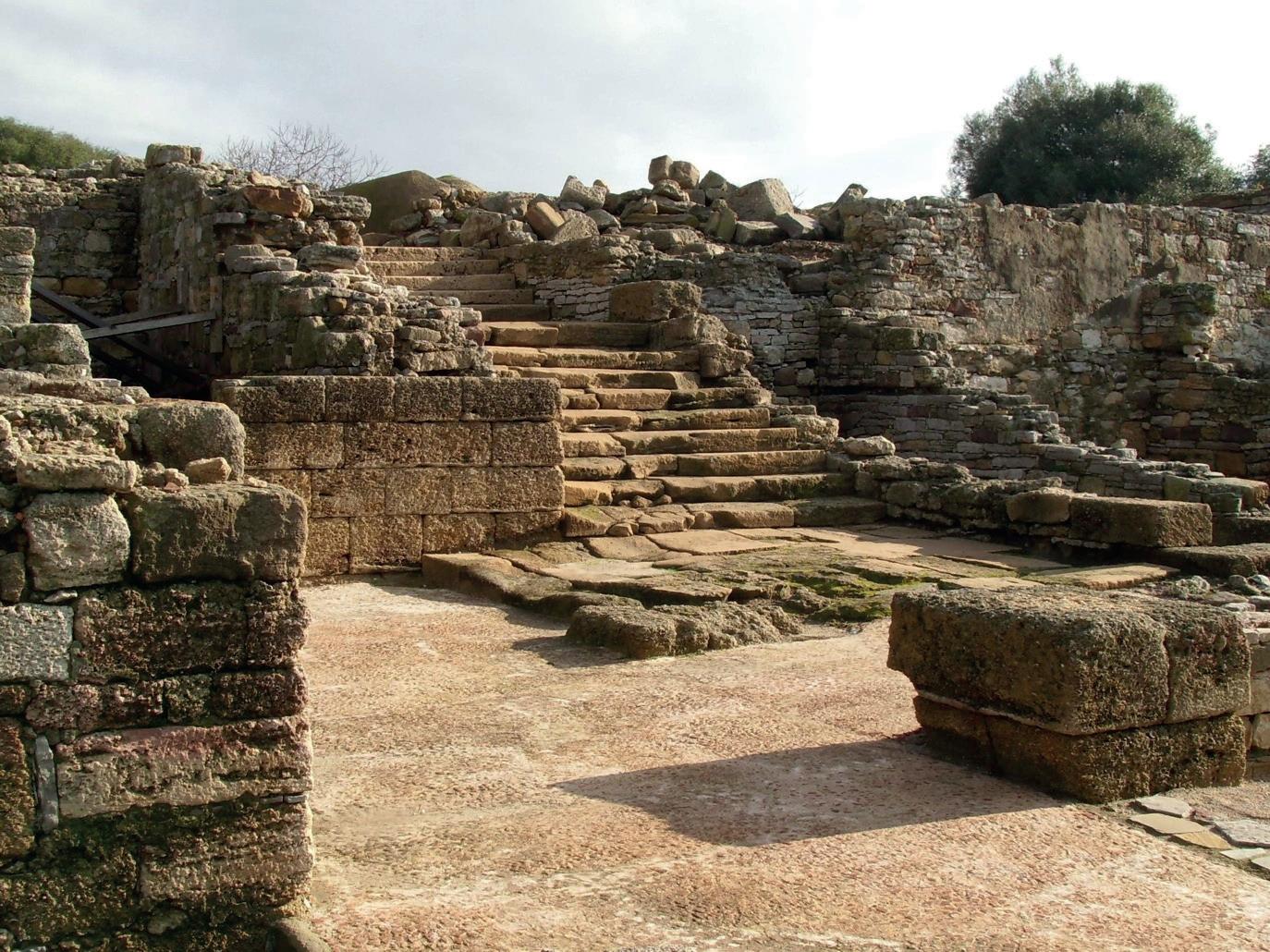
At the southern tip, Tarifa is the southern most point in Europe and has become esta blished as the kingdom of kitesurfing. Its legacy is vast: from prehistoric cave paintings and Phoenician remains to the archaeological treasure of the province, the Roman city of Baelo Claudia. The imposing Castle of Guzmán el Bueno (10th-15th centuries) crowns its defensive heritage. San Roque, situated on a natural watchtower, houses the ruins of the Roman city of Carteia and historic buildings such as the Governors’ Palace.
Inland, the character of the region becomes more rural. Castellar de la Frontera is divided between Castellar Nuevo and Castellar Viejo, a medieval fortification that is one of the few examples of a town within a castle. In Jimena de la Frontera, a town inhabited since prehistoric times and crowned by an imposing medieval castle, the Fungi-focused events of Los Alcornocales Natural
, held at the end of November, are deeLos Barrios, with deep Neolithic, Phoenician and Roman roots, celebrates the popular Romería de San Isidro Labrador every year on the last weekend of April, an event that has been declared a Festival of National Tourist Interest. Finally, San Martín del Tesorillo is the youngest municipality, an orchard dedicated to the cultivation of citrus fruits, mangoes and avocados.
In short, Campo de Gibraltar is a region where active tourism meets history. The mixture of military heritage, Roman ruins, the Islamic legacy and a vibrant flamenco culture, all framed by a spectacular natural environment, makes this region a destination of contrasts that reflects the richness of the coexistence of cultures in the Strait.
Paco de Lucía
Neolithic remains. Los Barrios
Castellar de la Frontera
Natural environment. San Martín del Tesorillo
Jimena de la Frontera
Roman remains of Carteia. San Roque
La Línea de la Concepción Tarifa
Declared
Cultural heritage
Algeciras
Tangible cultural heritage
• Villa Nueva de Algeciras archaeological site
• Roman kilns
• Archaeological park of the Merinid walls
• Remains of the Merinid Baths and Royal Baths of al-Binya
• Nuestra Señora de la Palma Church
• Nuestra Señora de Europa Chapel
• Los Arcos del Cobre Aqueduct
• Ingeniero Torroja Market
• Las Palomas Bullring
Intangible cultural heritage and other contemporary events
• Algeciras Royal Fair
• Maritime pilgrimage in honour of the Virgen de La Palma
• Dragging of cans
• Special Carnival
• Holy Week
• Paco de Lucía International Guitar Festival
Equipamientos culturales:
• Paco de Lucía Interpretation Centre
• Municipal Museum
Castellar de la Frontera
Tangible cultural heritage
• Castle, walled enclosure and Arco de la Villa
• Old Castellar
• El Divino Salvador Church
• San Miguel de la Almoraima Convent
• La Amoraima Tower
Intangible cultural heritage and other contemporary events
• Carnival
• Boyal Day
• Holy Week and Via Crucis at the Castle
• El Cristo de la Almoraima Pilgrimage and Festivities
• Full Moon Flamenco Festival at Castellar Castle
Cultural facilities
• Divino Salvador Exhibition Hall
• Municipal Theatre
Jimena de la Frontera
Tangible cultural heritage
• Castle complex: Watchtower, Keep, City walls, Clock Arch, Almohad cistern, Roman gate-bastion and Queen Mora’s Baths.
• Nuestra Señora de la Victoria Church
Intangible cultural heritage and other contemporary events
• Carnival
• Livestock market
• Marchenilla Pilgrimage and Festivities
• Holy Week
• Novena Festival
• August Fair
• Estación de Jimena Flamenco Festival
• Parque Natural de Los Alcornocales Mycological Conference
Cultural facilities
• La Sauceda House of Memory
La Línea de la Concepción
Tangible cultural heritage
• Almenara Tower or Torre Nueva
• Santa Mariana Bastion
• Santa Bárbara and San Felipe Forts
• Bullring
• Isthmus Building
• Villa de San José and Saccone Municipal Gardens
Intangible cultural heritage and other contemporary events
• Evening Events and Festivals
• Carnival
• Holy Week
• Night of San Juan
Cultural facilities
• Cruz Herrera Museum
• Pepe Cabrera Bullfighting Museum
Los Barrios
Tangible cultural heritage
• Bacinete Rock Art Complex
• San Isidro Labrador Parish Church
• La Montera Bullring
• La Verraco Locomotive
Intangible cultural heritage and other contemporary events
• San Isidro Pilgrimage and Festivities
Cultural facilities
• Isidro Gómez Cultural Centre (Casa Parody)
San Martín del Tesorillo
Tangible cultural heritage
• Casa de Larios
Intangible cultural heritage and other contemporary events
• Carnival
• Corpus Christi Fair
San Roque
Tangible cultural heritage
• Carteia Archaeological site
• Santa María La Coronada Church
• The Governors’ Palace
• Diego de Salinas Barracks
• Bullring
Intangible cultural heritage and other contemporary events
• Holy Week
• Carnival
• Bonfires of San Juan
• Virgen del Carmen
• Living Nativity
• San Roque Pilgrimage and festivities
Cultural facilities
• Contemporary Art Centre (CAC)
• World War II bunker turned museum (in Carteia Enclave)
• Luis Ortega Brú Museum
• Municipal Museum
• Bullfighting Museum
• CB Radio Amateurs Museum
• Juan Luis Galiardo Theatre and permanent exhibition
Tarifa
Tangible cultural heritage
• Algarbes Necropolis
• Dolmens and menhir of Facinas
• Baelo Claudia archaeological site
• Walls and Puerta de Jerez
• Guzmán el Bueno Castle
• Santa Catalina Castle
• Santa María Old Church
• San Mateo Apóstol Main Church
• Watchtowers or beacons
Intangible cultural heritage and other contemporary events
• Carnival
• Agricultural parade
• Bonfires and Burning of Juanillo
• Fiesta del Carmen
• Historical re-enactment of the battle against the French
• African Film Festival - FCAT
• Tarifa International Circus Festival - FEINCITA
Cultural facilities
• Tarifa Island or Las Palomas Interpretation Centre
Unique character O3




03.1
Art and Wine
Wine in the province of Cádiz transcends gastronomy to become a cultural, historical and architectural phenomenon of the first order. The famous wines of Cádiz originate in a wide geographical area stretching from the Marco de Jerez region (Jerez de la Frontera, El Puerto de Santa María, Sanlúcar de Barrameda) to the wine-producing towns of Trebujena and Chiclana de la Frontera. Protected by prestigious Designations of Origin such as the PDO ‘Jerez-Xérès-Sherry’ and the PDO ‘Manzanilla-Sanlúcar de Barrameda’, this region is home to a wide variety of wines, including the emblematic Moscatel and Pedro Ximénez, grown especially in Chipiona and Rota. Added to this diversity is a growing production of high-quality still wines
These wines are aged in spaces that are authentic living museums: the so-called ‘wine cathedrals’, their cellars. The architecture of the cellars, inherited from Moorish traditions and perfected in the 19th century with well-ventilated covered longitudinal naves, is now an inseparable part of the urban landscape. These spaces combine beauty and functionality, attracting the interest of romantic travellers since the 18th century. Now, they are centres of flourishing wine tourism and temples where art and history are preserved in barrels, having been visited by illustrious figures from the worlds of politics, art, sport and science worldwide.
Art and wine have also gone hand in hand in more recent times, with themed museums incorporated into many of the region’s winery complexes. Good examples include the Barbadillo Museum of Manzanilla and the Wine Interpretation Centre at Bodegas Delgado Zuleta, both in Sanlúcar de Barrameda, not to mention the magnificent “Joaquín Rivero” art collection at Bodegas Tradición (Jerez de la Frontera) or Picasso’s Suite Vollard, which can be admired at Bodegas Estevez, also in Jerez.
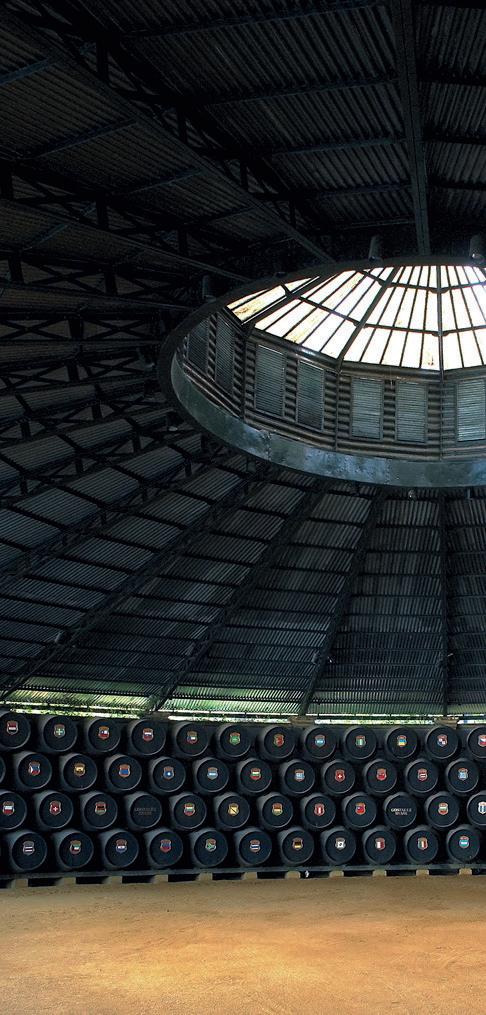
La Concha Winery, González Byass. Jerez de la Frontera
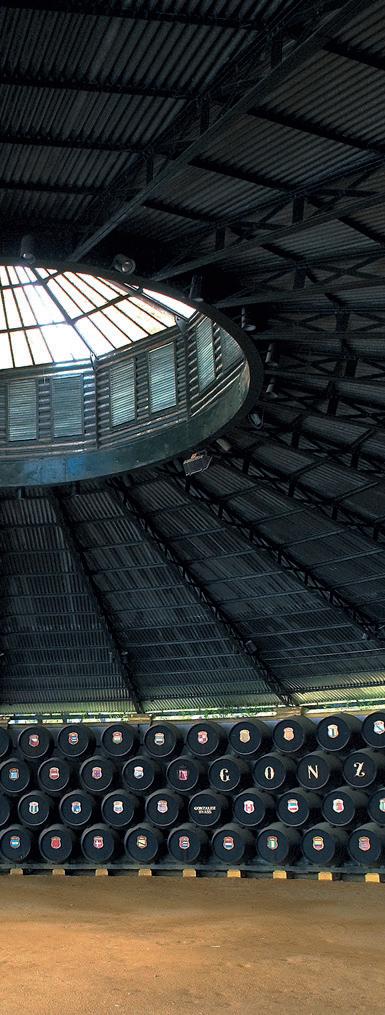
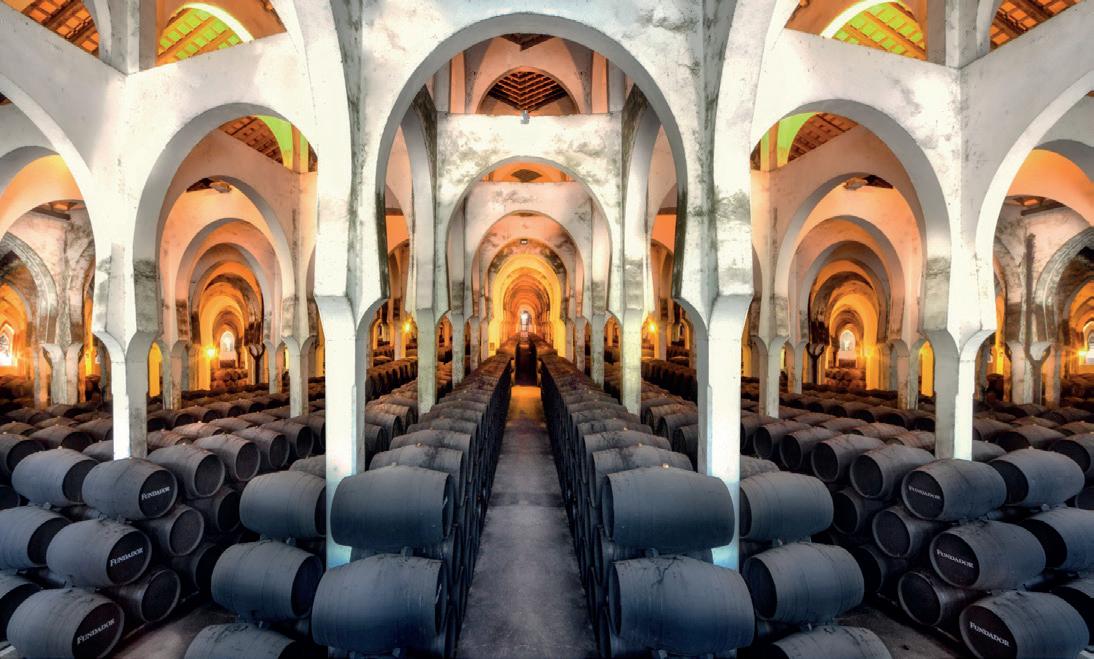
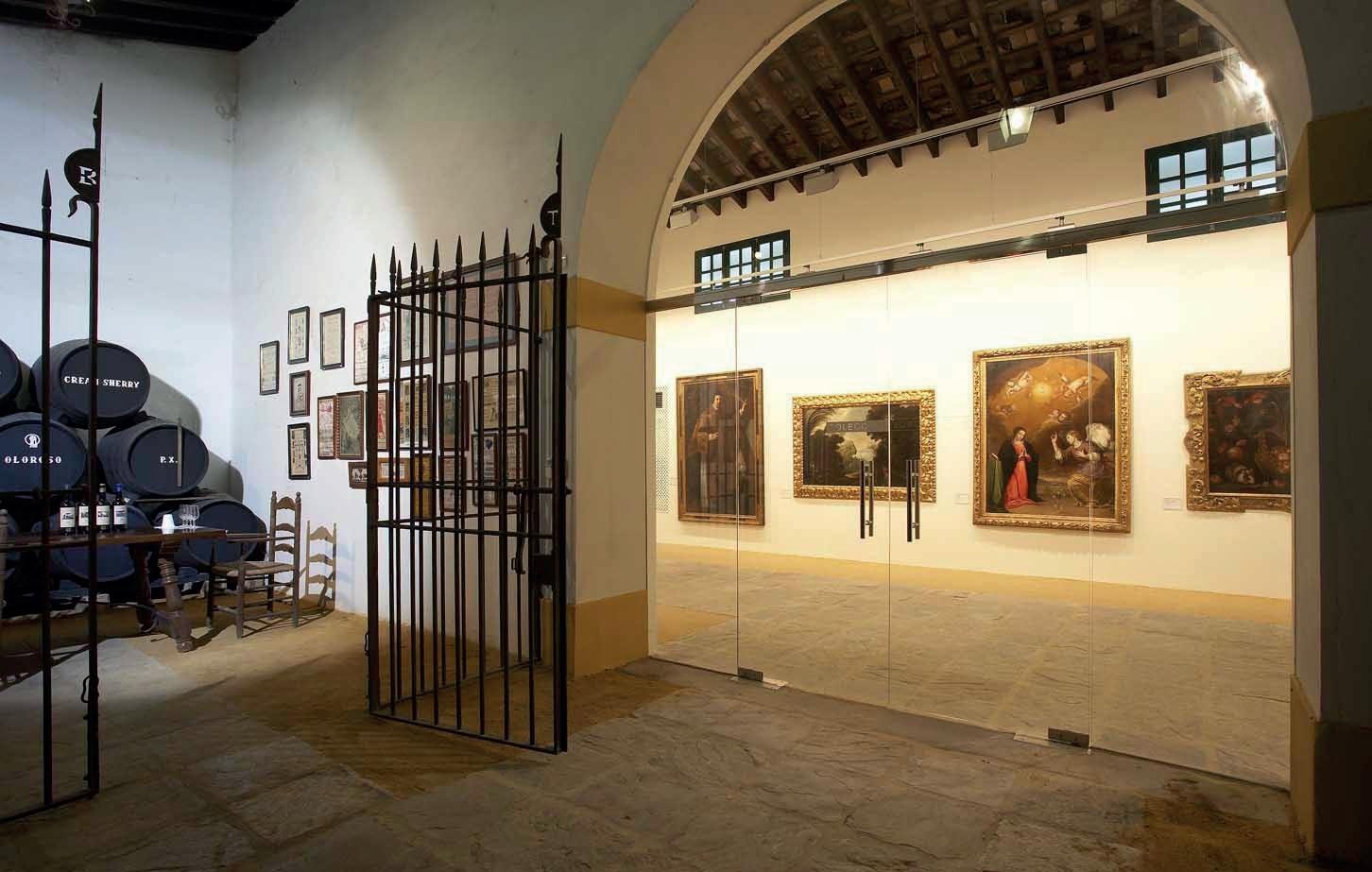
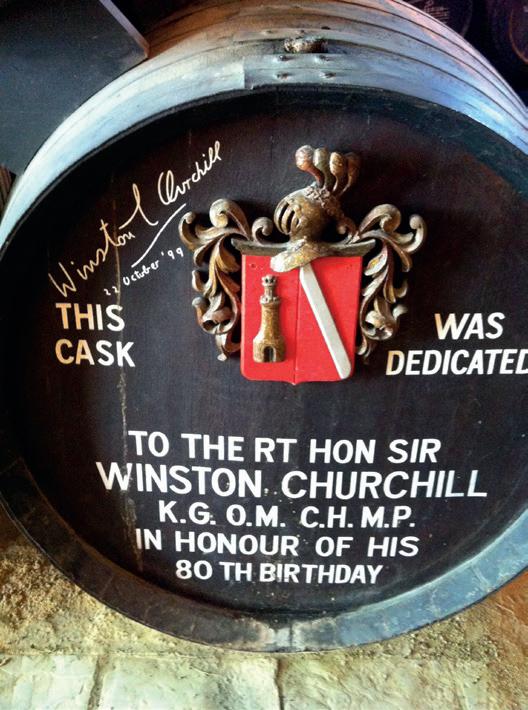
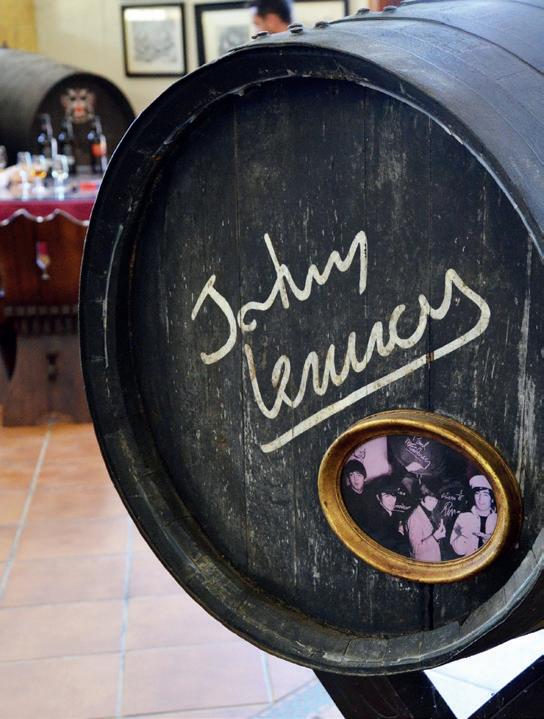
Churchill’s signature on a barrel in the winery. Jerez de la Frontera with signature
John Lennon’s signature on a barrel in the winery. Jerez de la Frontera with signature
La Mezquita Winery. Jerez de la Frontera
Bodegas Tradición Museum. Jerez de la Frontera
03.2 Horses and Bulls
The horse and the bull are symbols that are inextricably linked to the landscape, history and culture of the province of Cádiz, featuring in the main festivals and even starring in spectacular ‘ballets’.
The equestrian tradition dates back to the time of the Tartessians, more than 3,000 years ago. However, the defining milestone was the establishment of the Carthusian monastery in the 15th century in Jerez de la Frontera, where the breeding of stallions gave rise to the world-renowned Carthusian breed. The Yeguada de la Cartuja - Hierro del Bocado, which is the most important reserve of Carthusian horses in the world, can be visited on Saturdays, where you can also enjoy an equestrian show. This elegance reaches its peak at the Royal Andalusian School of Equestrian Art (Jerez de la Frontera), world-famous for its exhibition “How Andalusian Horses Dance”, an authentic equestrian ballet with purely Spanish music and 18th-century costumes.
Many of the festivals held in the province of Cádiz would be unthinkable without horses, notably the Horse Fair in Jerez de la Frontera and the Horse Races in Sanlúcar de Barrameda, both of which have been declared Festivals of International Tourist Interest.
The fighting bull, meanwhile, shapes the countryside with the Ruta del Toro (Bull Route) and is a constant source of artistic inspiration. The province is home to magnificent bullrings such as those in Jerez and El Puerto de Santa María, or the unique stone bullring in Villaluenga del Rosario (18th century). The rich bullfighting heritage is also preserved in numerous exhibition spaces, such as the Toro Gallery of the Osborne Foundation in El Puerto de Santa María, and other specialised museums including those in Jerez, La Línea and Chiclana. In addition, the Cadiz region has many livestock farms that allow tourists to admire fighting bulls living in the freedom of the pasture.
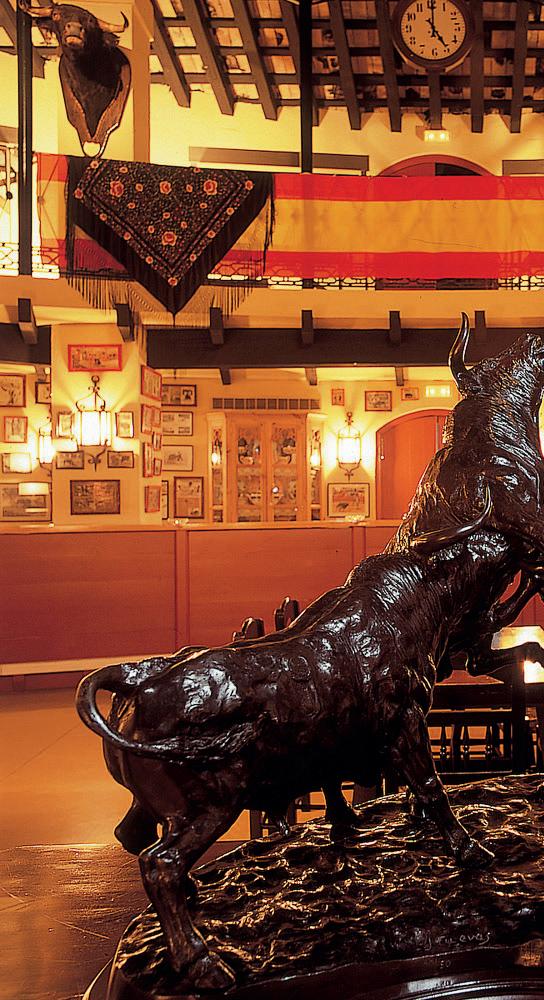
Alfonso Catering Bullfighting Museum. Jerez de la Frontera
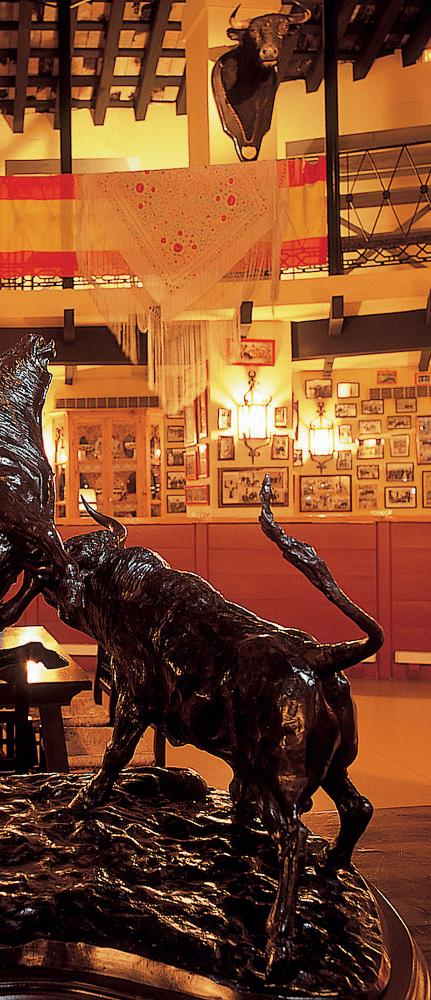
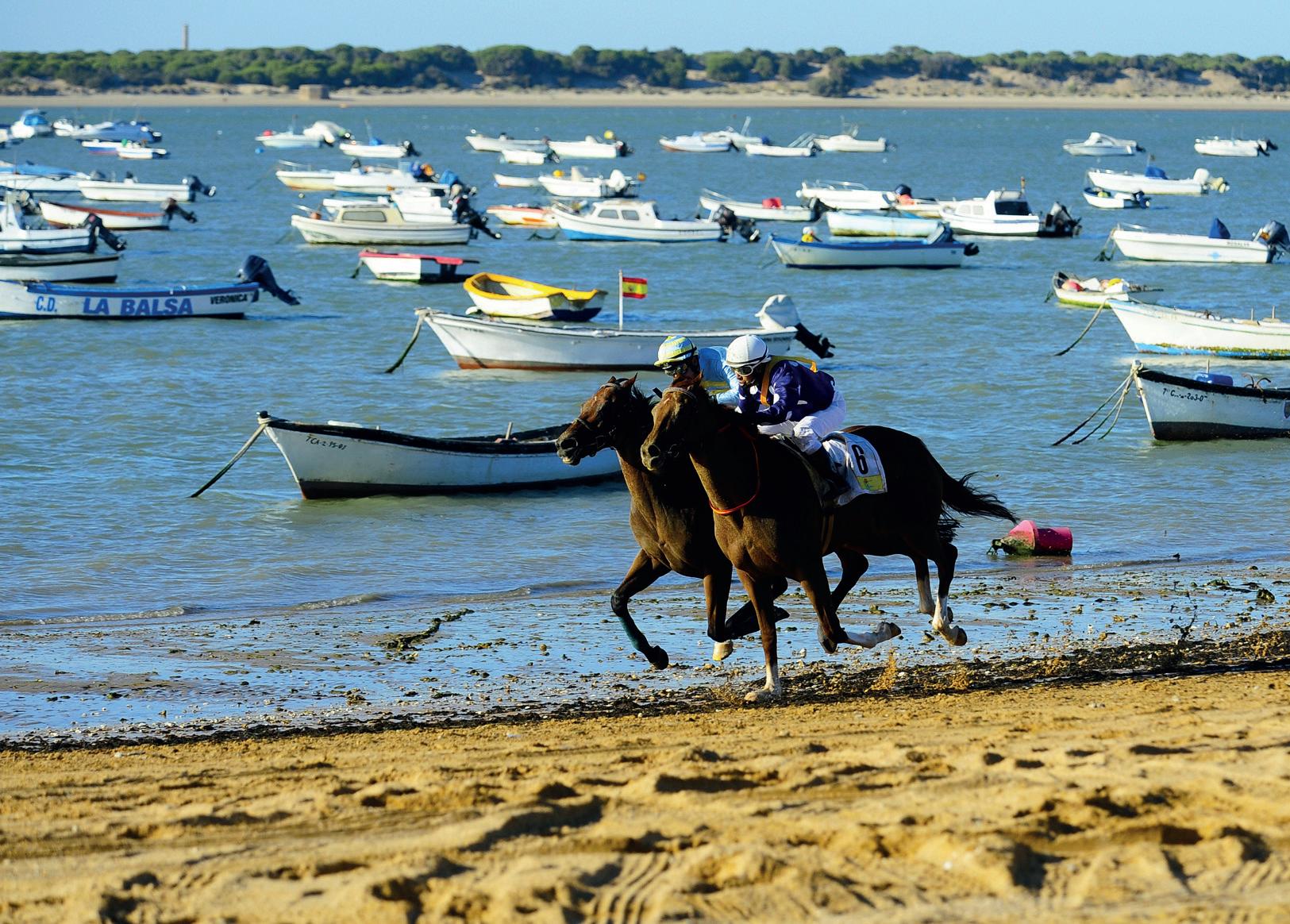
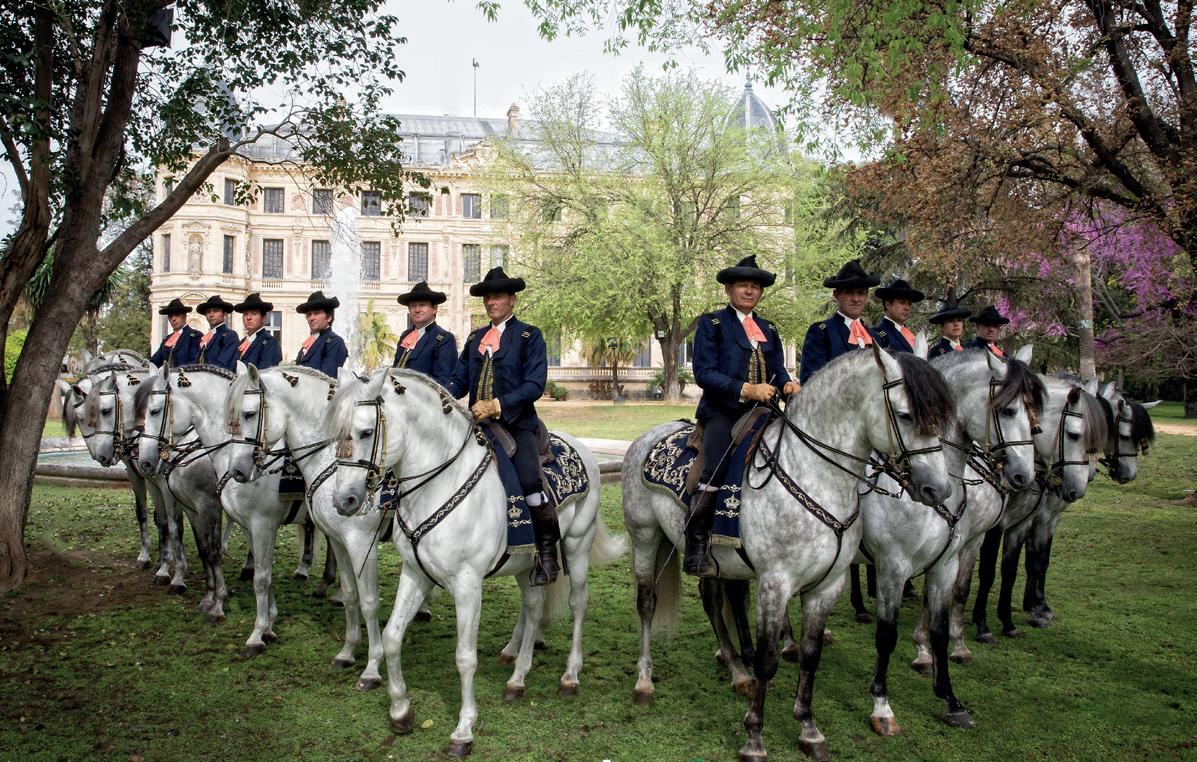
Royal Andalusian School of Equestrian Art. Jerez de la Frontera
Horse Racing. Sanlúcar de Barrameda
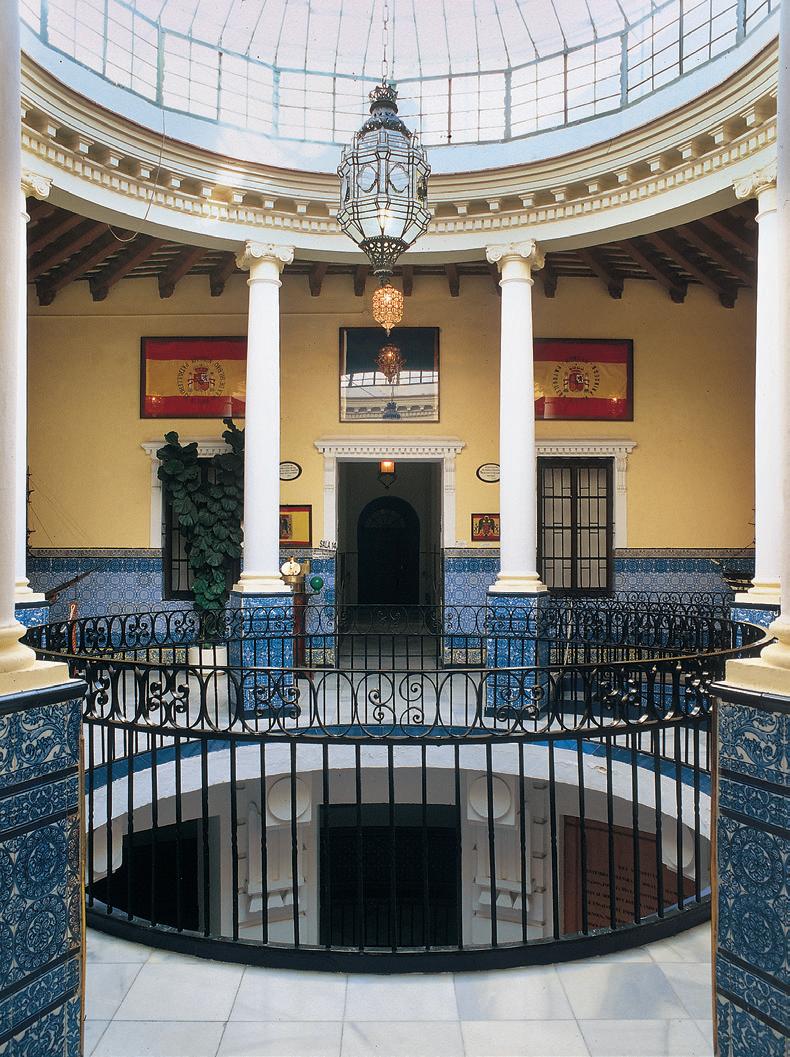
03.3 Maritime and Naval
The province of Cádiz, marked by its strategic position in the Strait of Gibraltar, has historically been a vital epicentre for maritime navigation and naval engineering. Its relationship with the sea stems not only from the economic, but also defines its identity, concentrating a heritage that honours its role in Spain’s naval expansion and defence.
This legacy is embodied in key institutions, many of them based in San Fernando, the former Isla de León. Here you will find the Naval Museum, which preserves the rich history of the Spanish Navy, and the prestigious Naval Observatory, a fundamental institution for cartography and navigation, responsible for the official time in Spain. The Pantheon of Illustrious Sailors, a temple dedicated to the historical figures who forged the Spanish naval tradition completes the complex.
The Pavilion of Marine Engineers is found in the capital, the city of Cádiz, highlighting the importance of engineering and shipbuilding, an industry that has been an economic pillar of the Bay. From the age of great discoveries to modern times, the shipyards of Cádiz have proved crucial.
The province is, in essence, a living memory of great maritime feats. From the departure of Christopher Columbus on his second and fourth voyages, and the important role played by Sanlúcar de Barrameda in Magellan and Elcano’s first circumnavigation of the Earth, to being the scene of the Battle of Trafalgar in 1805, this heritage is not only a record of battles and trade routes. It is also a testament to scientific advances in areas such as astronomy and hydrography, making Cadiz an indispensable reference point for understanding universal maritime history.
Inside the Naval Museum. San Fernando
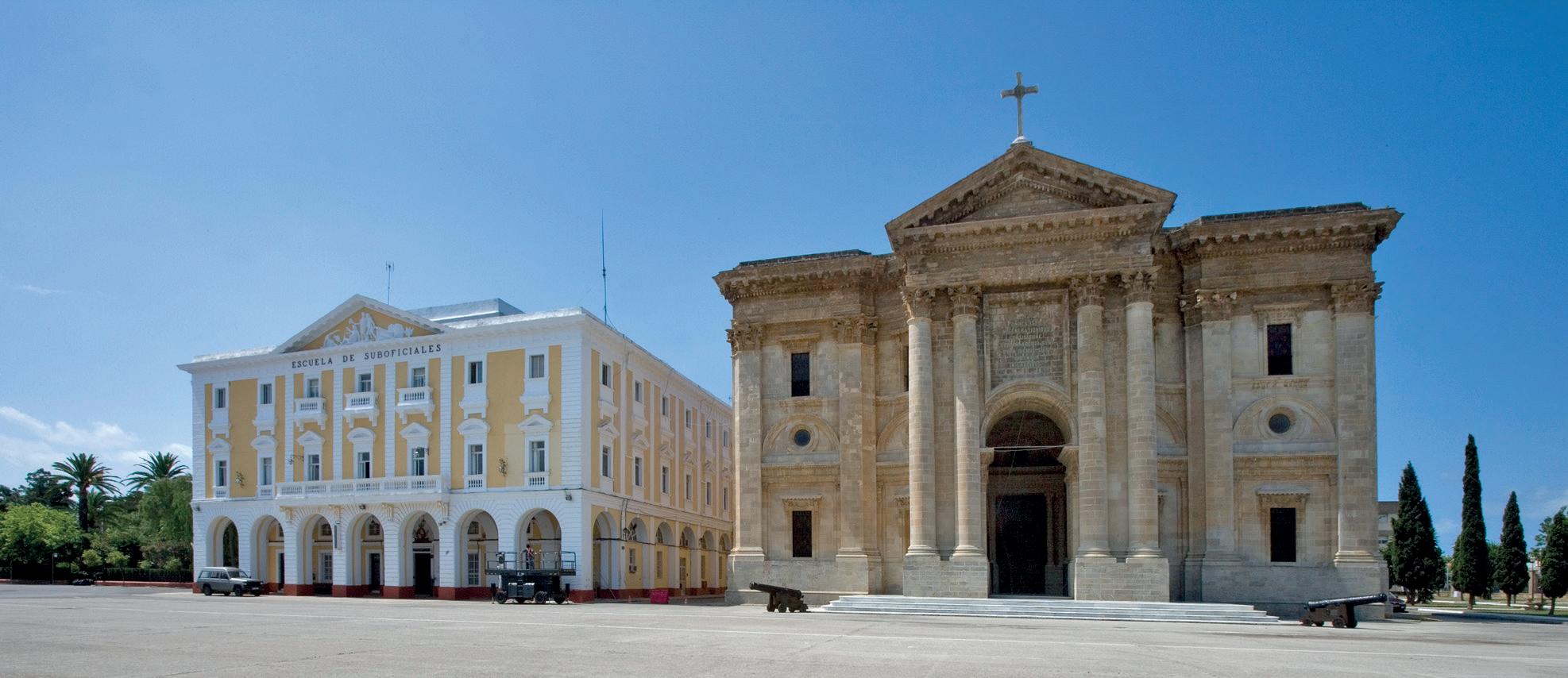
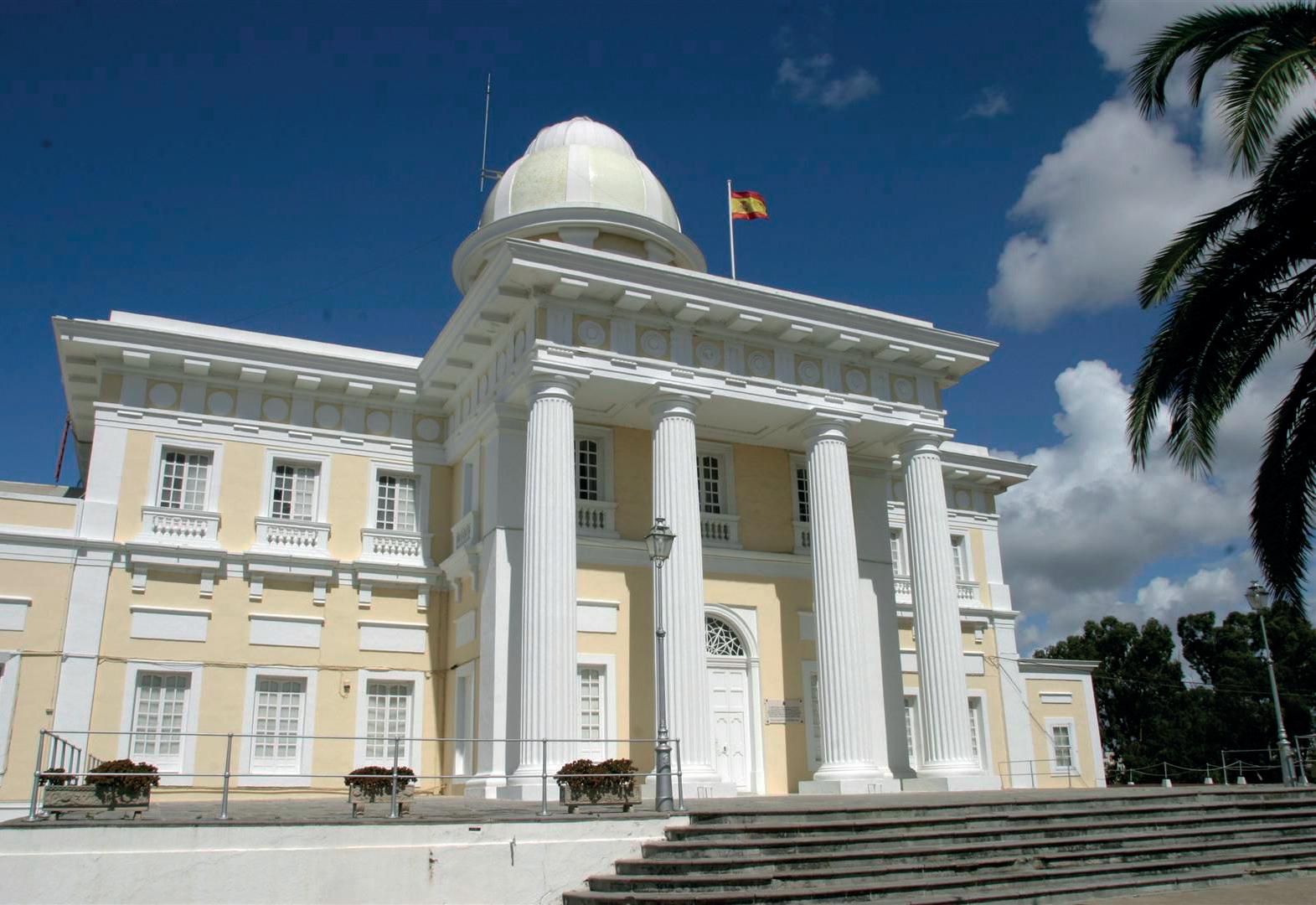
Pantheon of Illustrious Sailors. San Fernando
Royal Naval Institute and Observatory. San Fernando
03.4 Salt flats and estuaries
The Bay of Cádiz Natural Park is a vital coastal wetland, where marshes, beaches and pine forests form a landscape shaped by nature and human intervention. This unique environment is the birthplace of two ethnographic and gastronomic gems: salt and estuary fish
Since Roman times, the Bay of Cádiz has been a major centre for salt production, at one point home to more than 160 salt farms. Although activity has declined, these historic salt flats, such as those at Carboneros and the restored Santa María de Jesús (both in Chiclana), remain a testament to industrial history, offering visitors museums, viewpoints and artisanal salt. They are also an ornithological paradise, home to more than 200 species of birds.
Closely linked to the salt flats are the estuaries, saltwater reservoirs that act as natural fish breeding grounds. Here, the ancestral tradition of fish harvesting continues. This activity, dating back to Roman times, is traditionally celebrated in autumn (November is the high season), and involves emptying the reservoirs and catching species such as sea bream, sea bass and sole that have been raised in the saline ecosystem.
Today, fish harvesting has evolved from a simple complement to salt production to a true ethnographic and gastronomic spectacle. Renowned chefs, such as Ángel León, have helped to promote this estuary fish, highlighting its quality. Visitors can taste the product in one of the restaurants located next to the estuaries, or outdoors, with the fish cooked on the ground over hot coals and served on a tile. In addition, they can also actively participate in the ritual of catching the fish, becoming part of this living tradition.
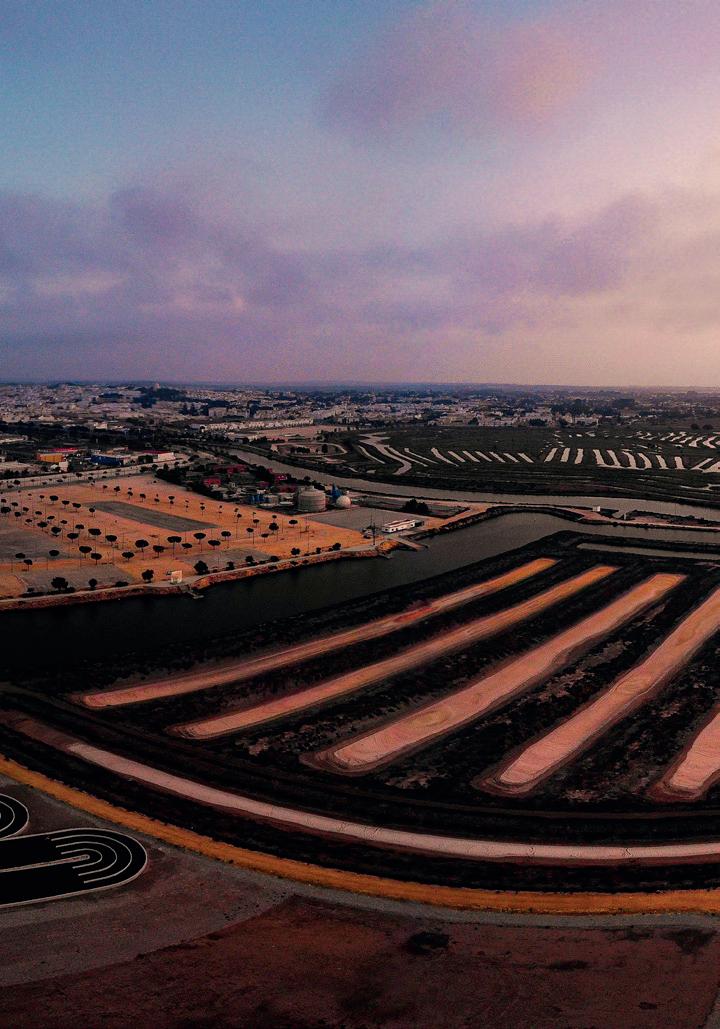
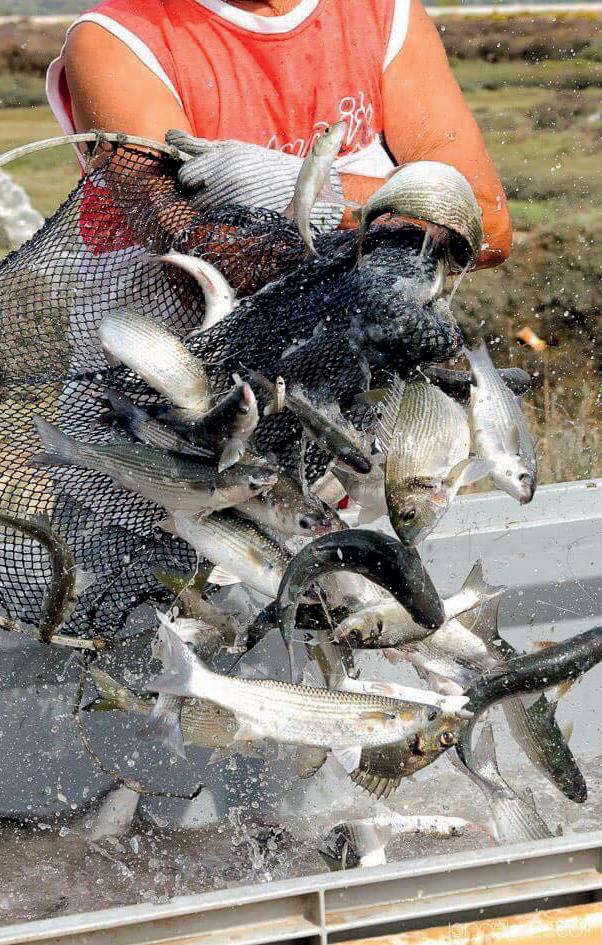
Natural Park. Bay of Cádiz
Estuary Fish. San Fernando
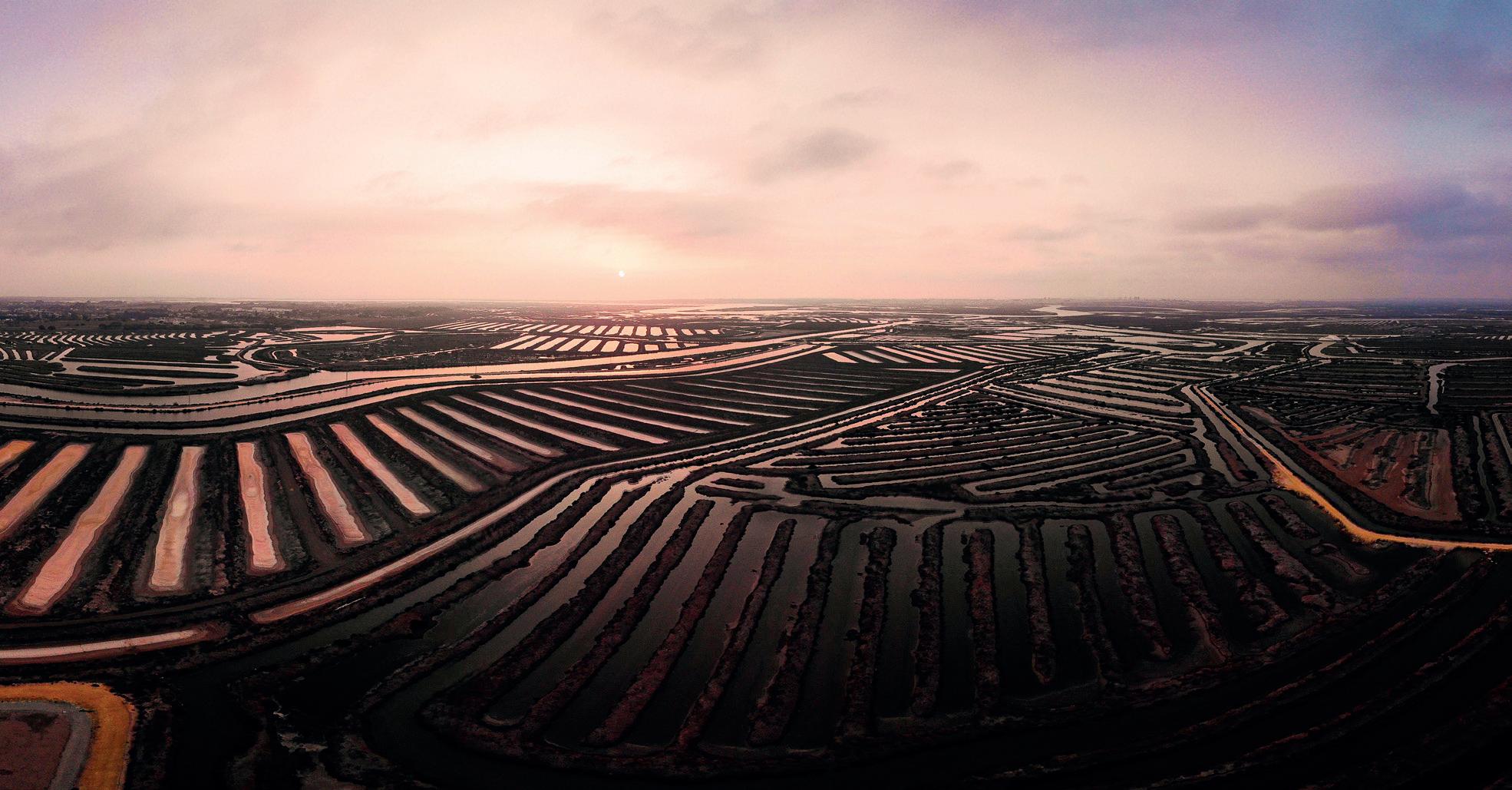
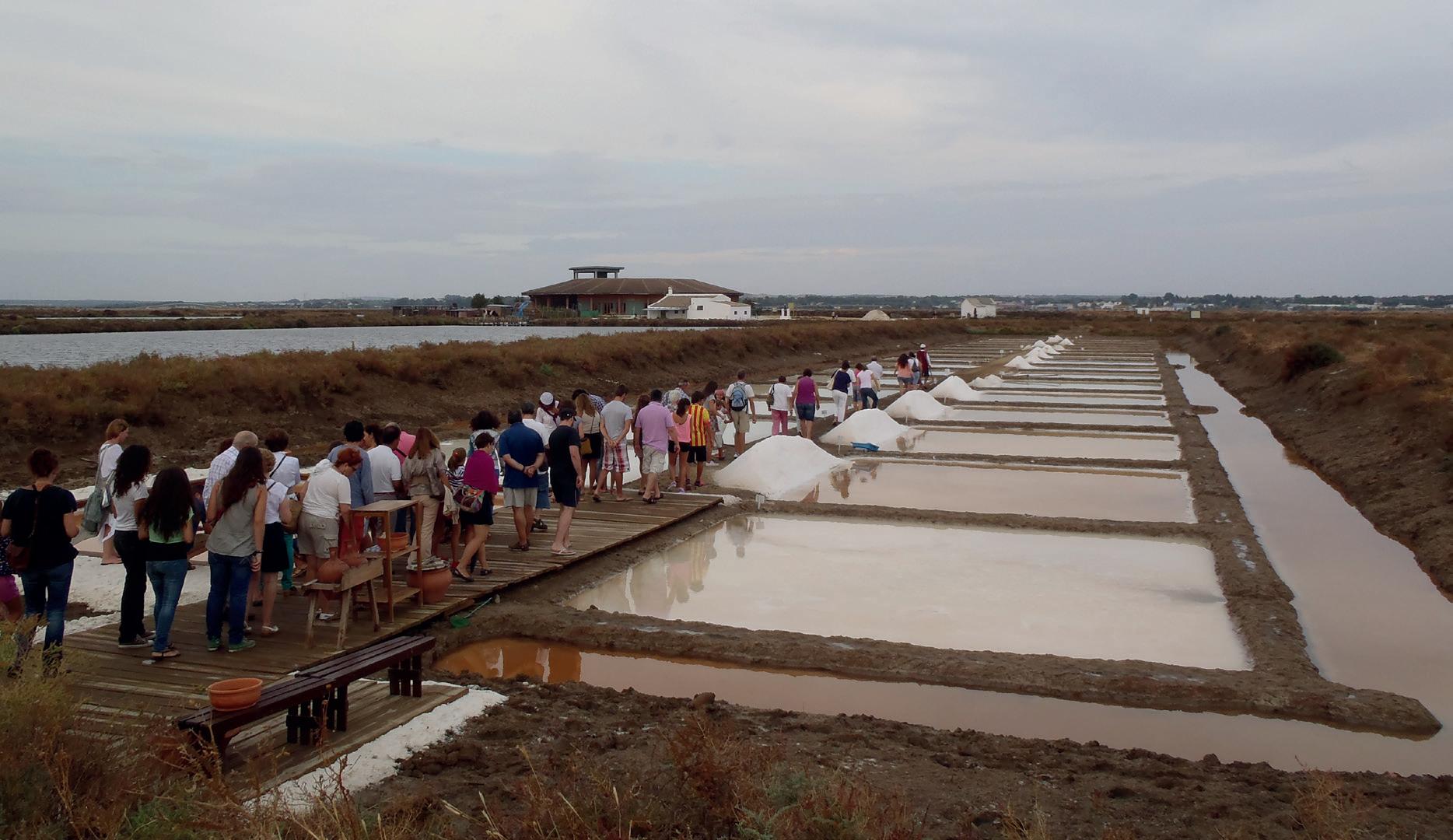
Visit to the salt flats. Chiclana de la Frontera
03.5
The tuna culture
The bluefin tuna culture in Cádiz is a legacy that dates back more than three thousand years, closely linked to the coast of La Janda and the Strait of Gibraltar. Every spring, when wild tuna cross the Strait on their way to the Mediterranean to spawn, their meat is at its fattiest in preparation for the journey, and at its most flavourful. This is the moment when an ancient fishing technique comes into action: the almadraba.
This system, whose origin is attributed to the Phoenicians, involves a spectacular labyrinth of fixed nets, strategically placed off the coasts of Barbate, Conil de la Frontera, Tarifa and Zahara de los Atunes. The climax is the levantá, the moment when the fishermen raise the net to capture the tuna in a titanic struggle that combines tradition, respect for the sea and sustainability.
The importance of tuna is such that it has shaped the landscape and heritage. Proof of this is the Roman city of Baelo Claudia (Tarifa), whose economy was based on fishing and the almadraba for the production of the famous garum. Similarly, the old Chanca de Conil de la Frontera (16th century), renovated to house a future Almadraba Museum, was the nerve centre for cutting and salting fish. In Barbate, the tradition can be explored at the Almadraba Tuna Interpretation Centre and in high-end canneries, where you can witness a ronqueo, the traditional manual cutting of tuna. This town is also known for products such as mojama, a salt-cured tuna
Tuna is the star of a rich gastronomic culture, celebrated annually with tapas routes and festivals that coincide with the catches in May and June. The so-called Almadraba Bluefin Tuna Route is a gastronomic tourism option available all year round, combining gourmet experiences, visits to canneries and showcasing the natural wealth of the surrounding parks, such as La Breña and El Estrecho, making tuna a central part of Cadiz›s maritime identity.
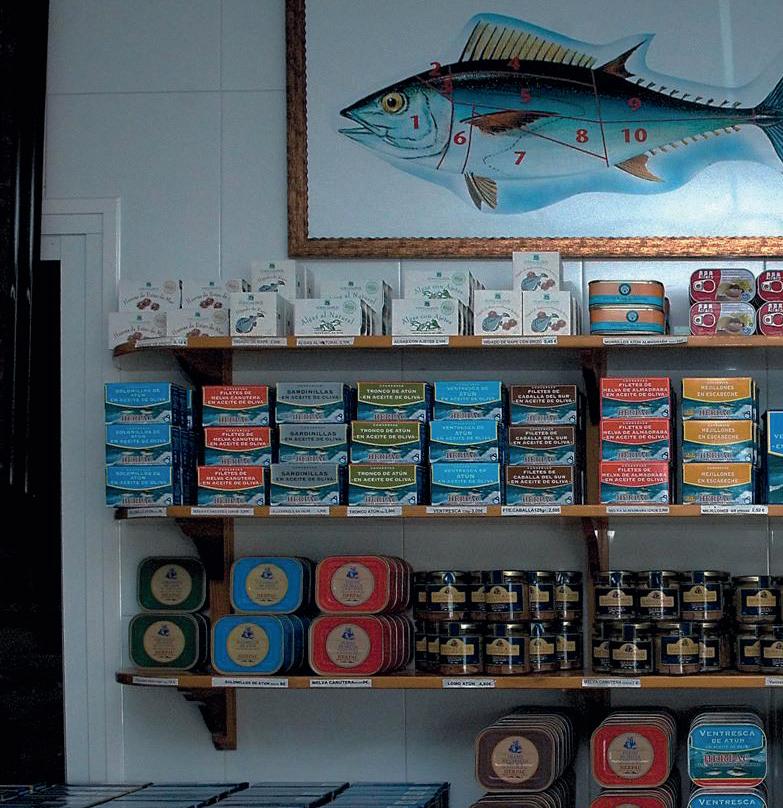
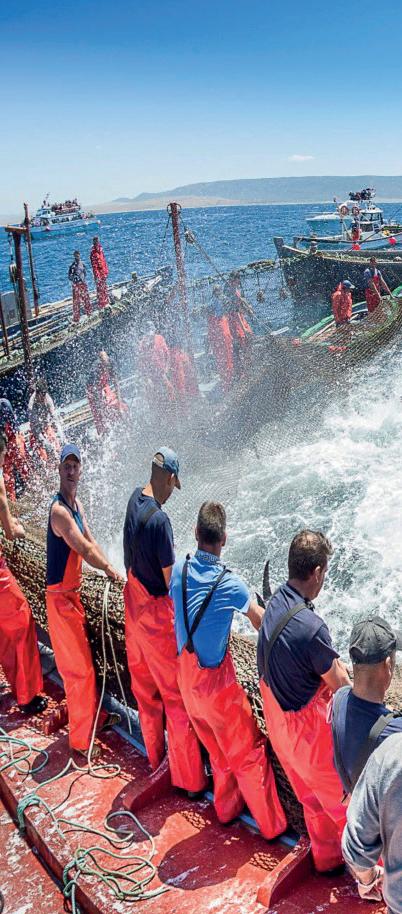
Tuna fishing in the Almadraba
Tuna preserves
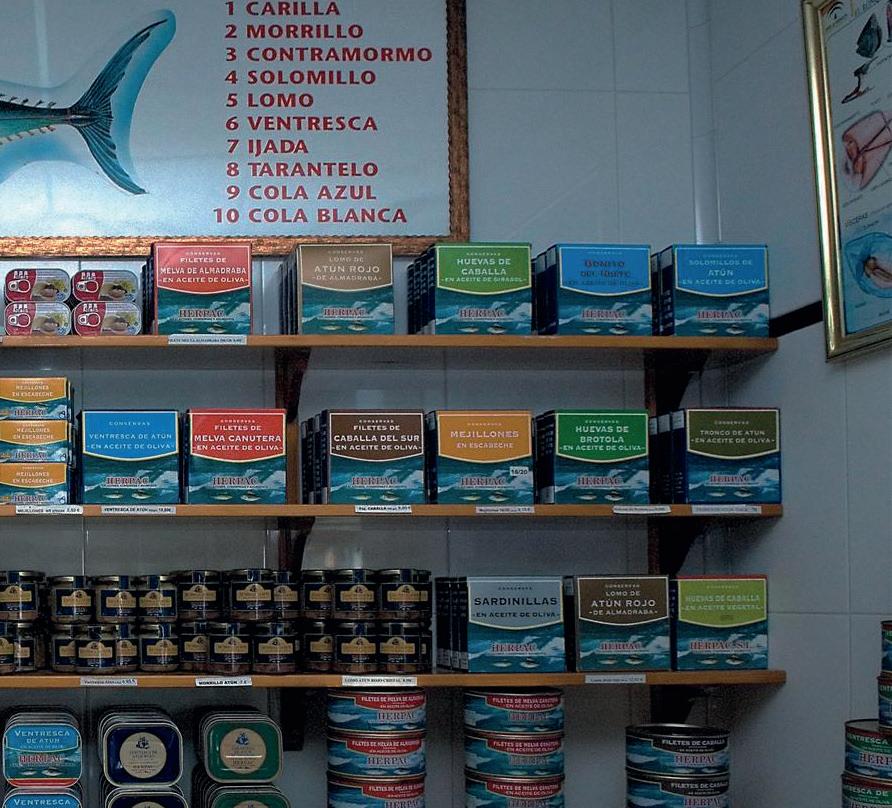
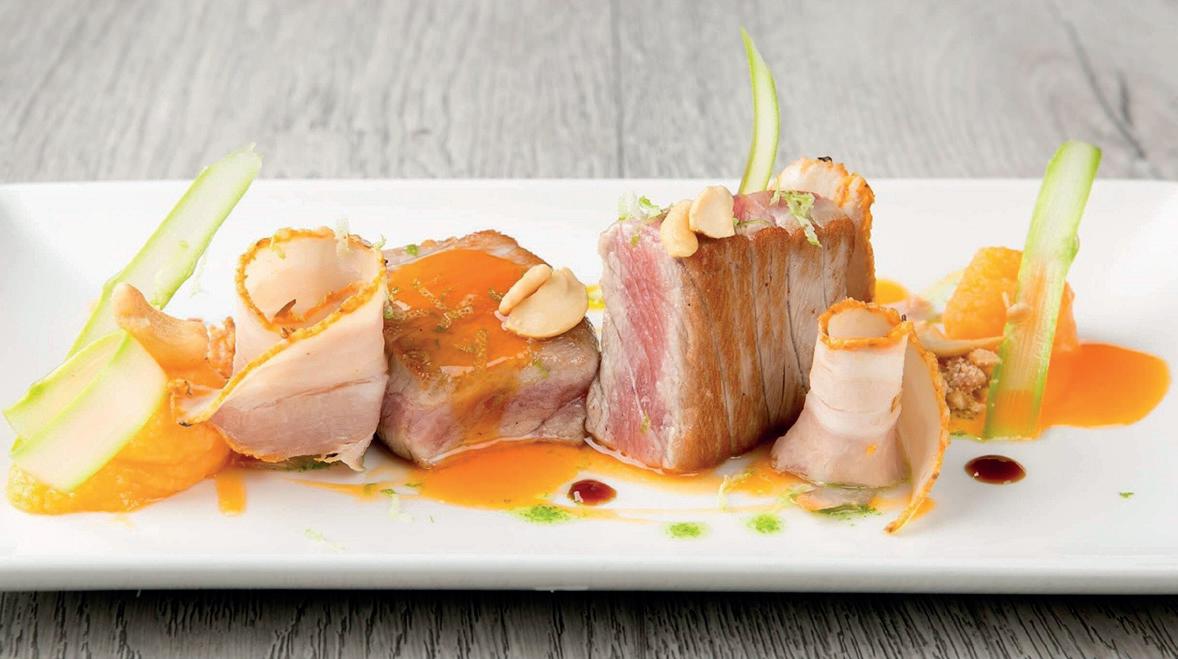
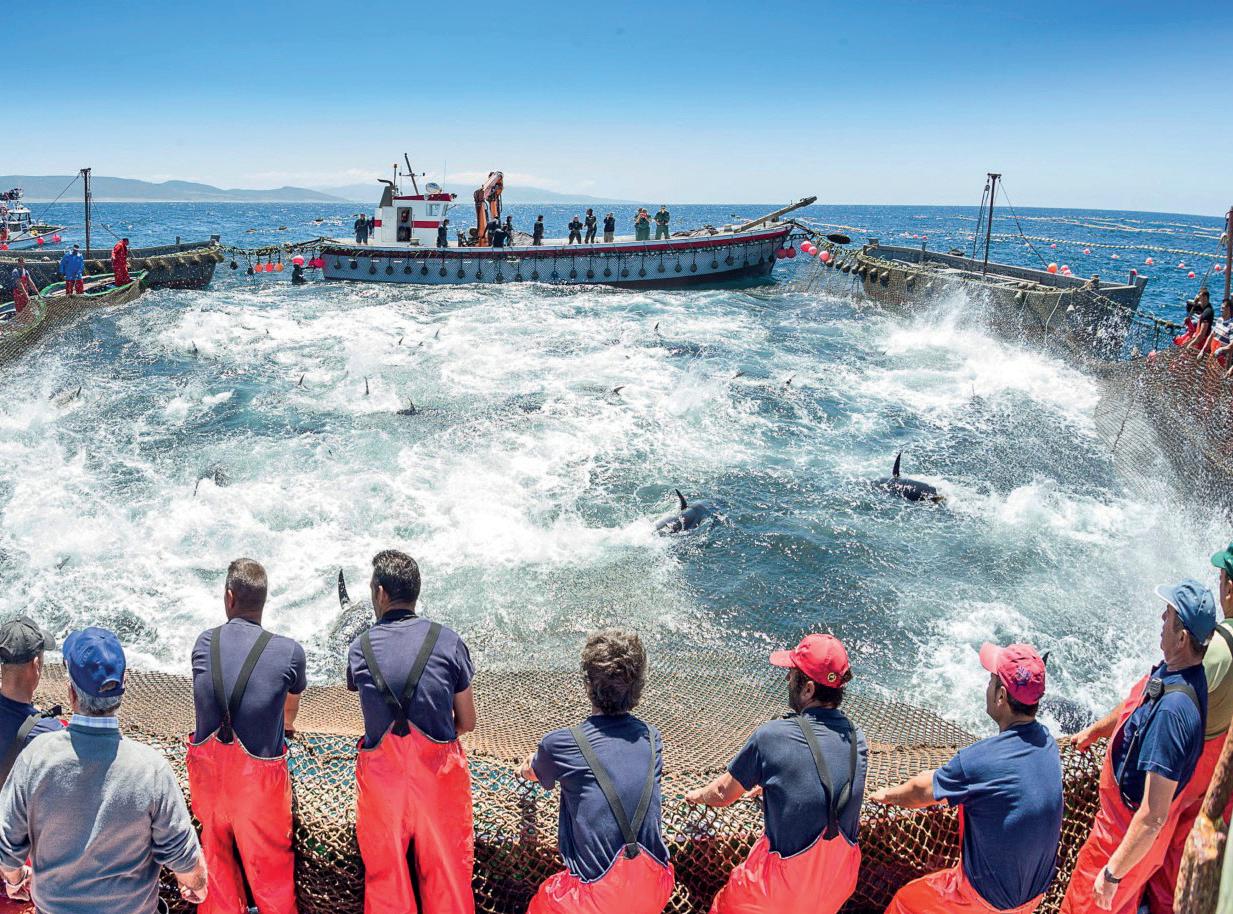
Dish cooked with tuna. El Campero
03.6
Leather goods
Leather goods are one of the most distinctive and thriving crafts and industries in the province of Cádiz, with the epicentre in the Sierra de Grazalema. The name Ubrique has become internationally synonymous with high-end leather and excellence, attracting the trust of leading global fashion brands.
The origins of this art are lost in time, but its development has made Ubrique the main European centre for artisan workshops dedicated to leatherworking. What began modestly with functional items, such as the famous tobacco pouches, tinderboxes and flints, has been transformed into a superb catalogue of pieces and accessories, crafted using the most refined techniques of fine leatherwork. The ‹Piel de Ubrique› seal of quality is a guarantee of craftsmanship and has opened the doors to the most demanding markets in the world and prestigious brands known worldwide.
The commitment to tradition and craftsmanship is celebrated in the permanent exhibition ‹Manos y Magia en la Piel› (Hands and Magic in Leather), located in the historic Capuchin Convent. This space not only documents the evolution of the craft, but also highlights the importance of an expertise that combines ancestral techniques with contemporary design.
This artisan tradition is not limited to Ubrique; other towns in the mountains, such as Prado del Rey, also actively participate in this craft, contributing to the prestige and survival of the leather craftsmanship of Cadíz. Thus, leather goods are not only an economic driver, but also a profound cultural trait that reflects the skill and perseverance of the artisans of the mountains.
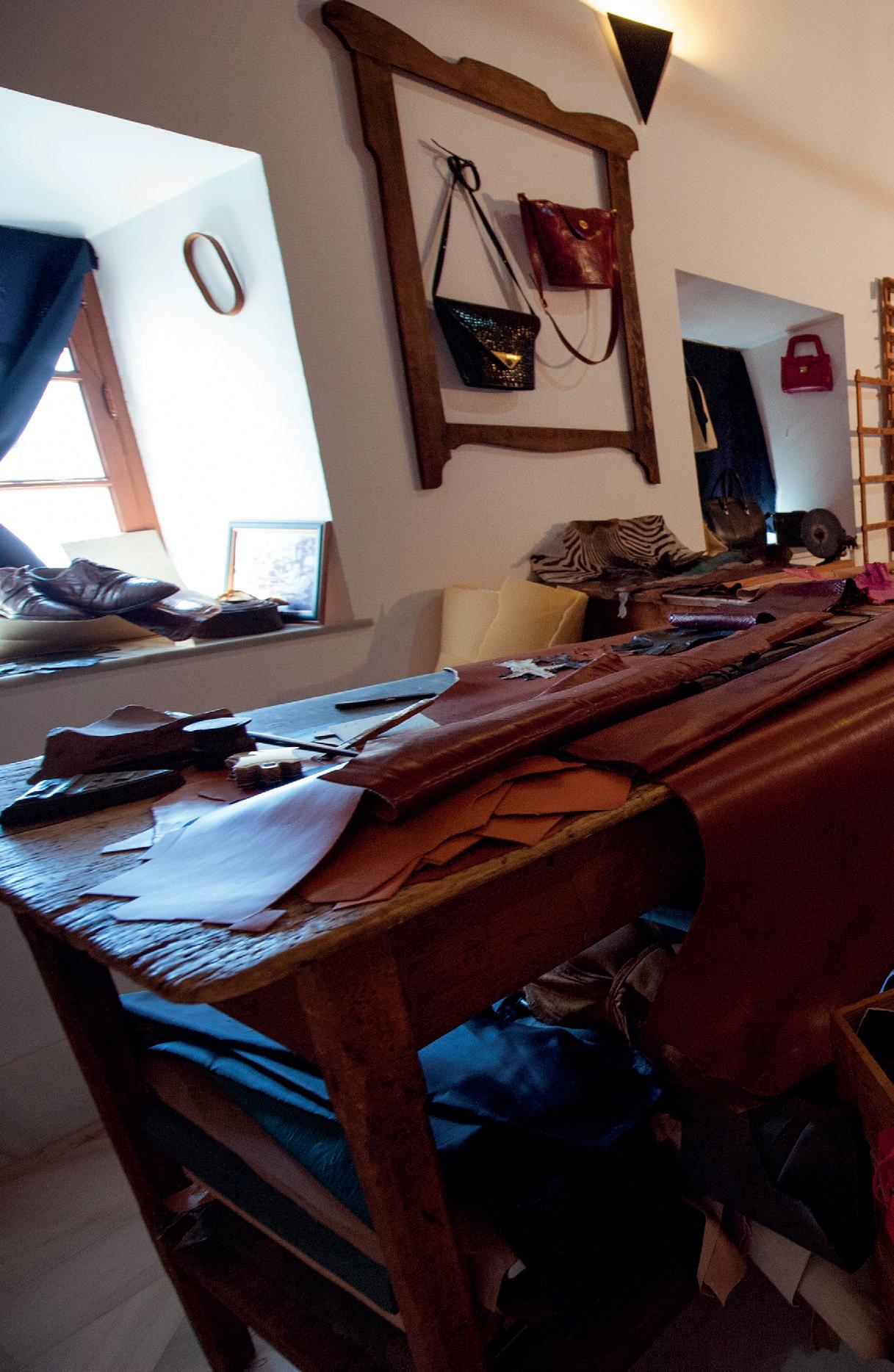
Recreation of a small workshop in the Leather Museum in Ubrique
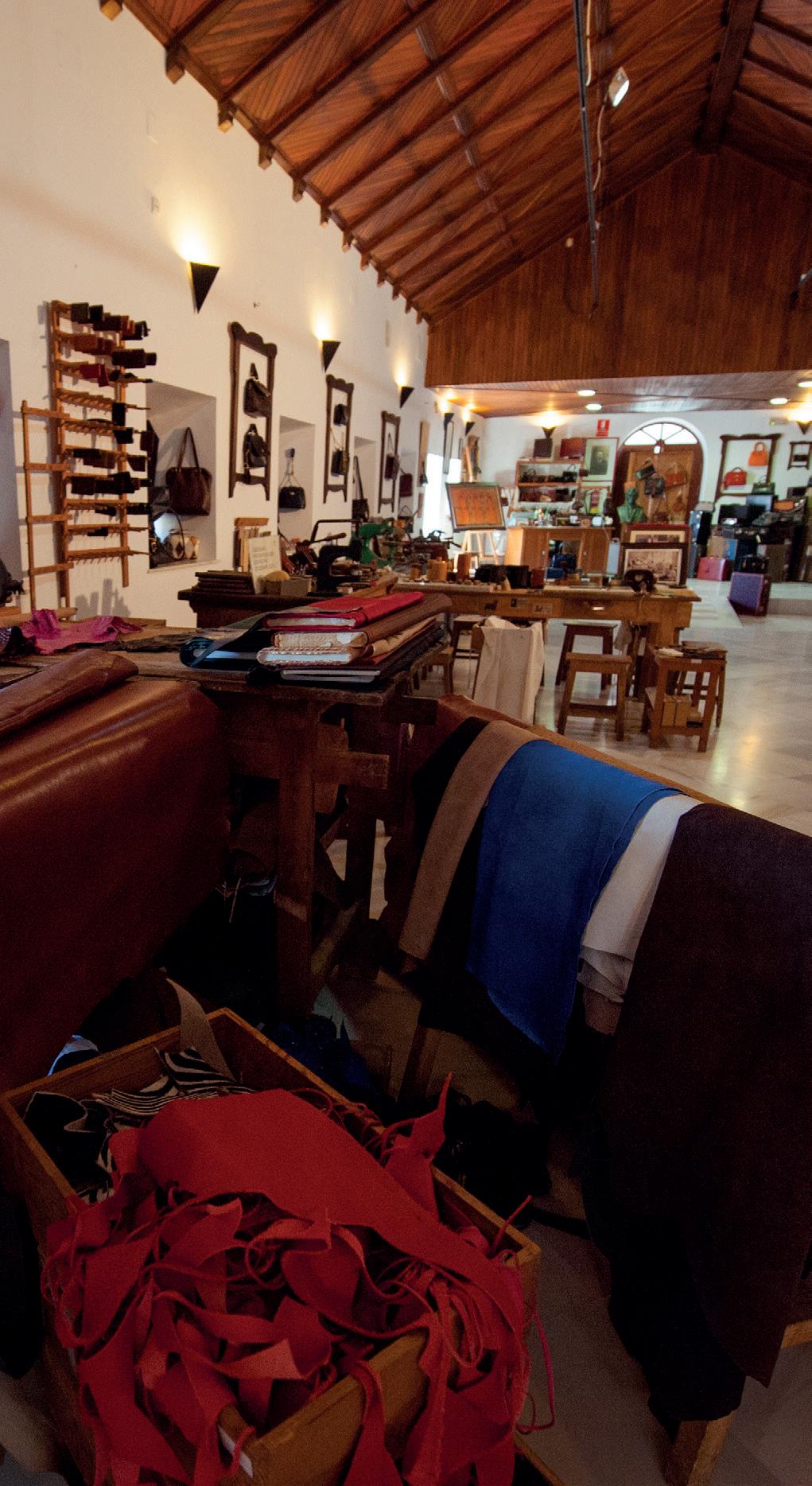
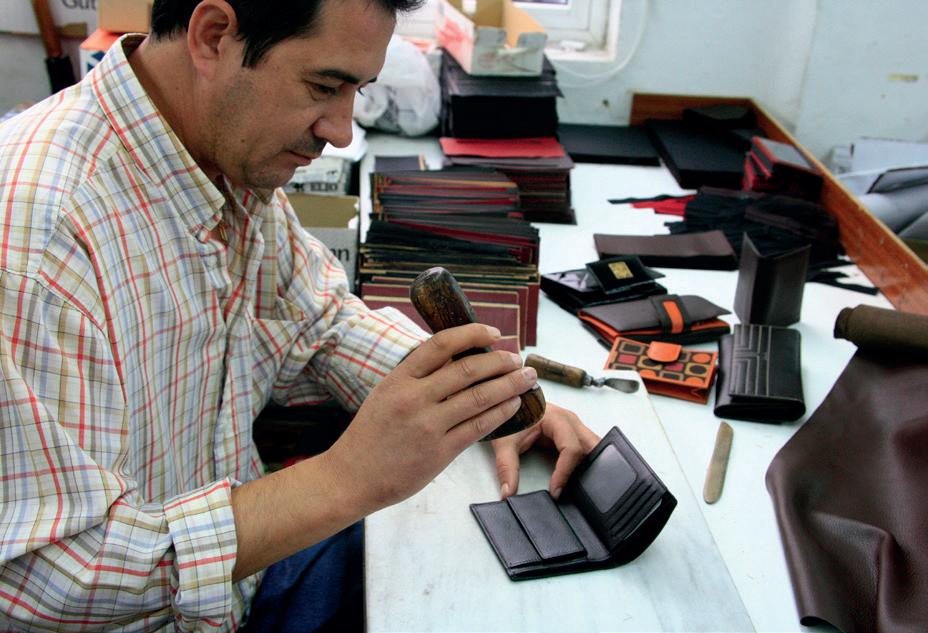
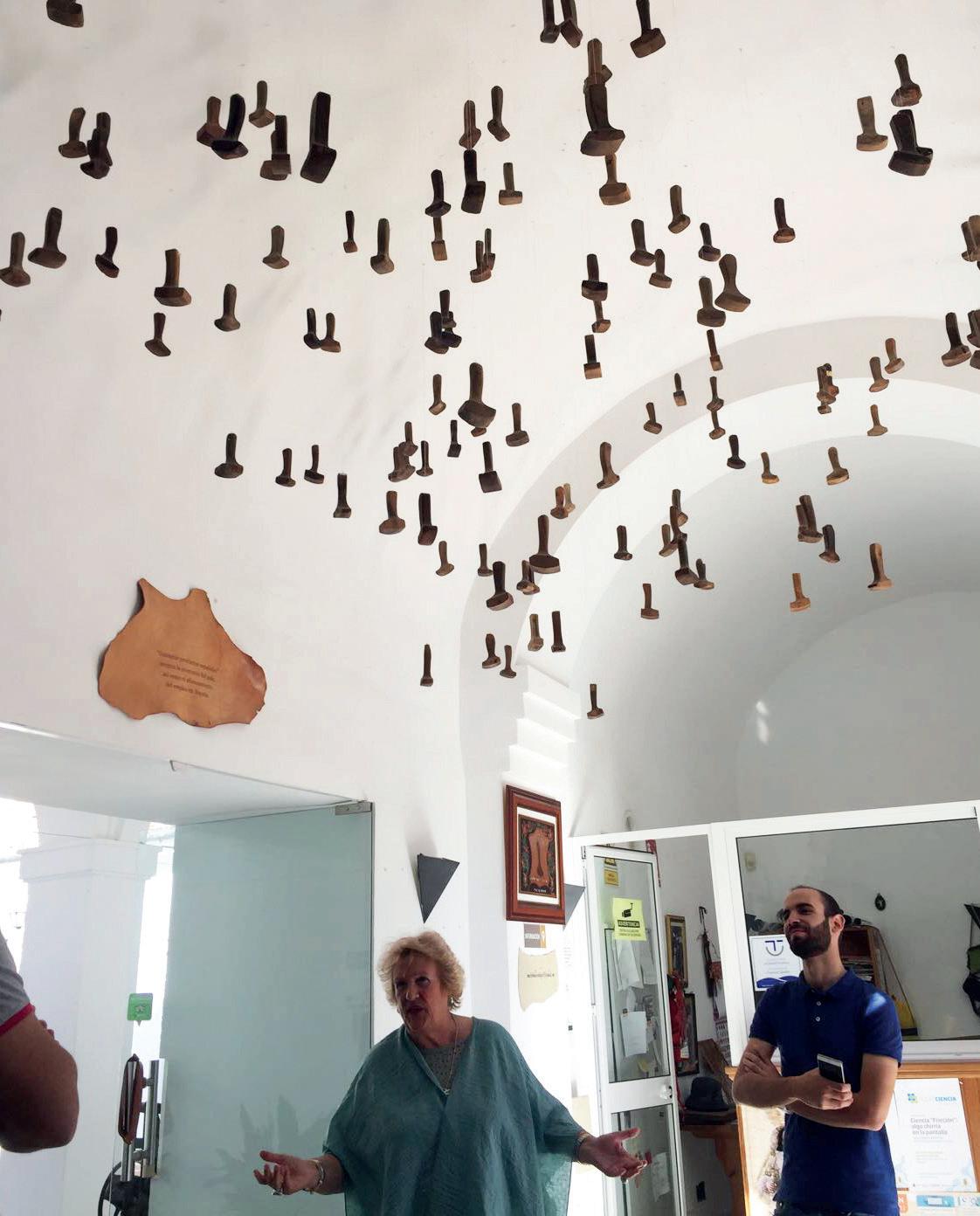
Tamping hammers at the Leather Museum in Ubrique
Setting fillets with a tamping hammer. Leather Museum in Ubrique
03.7 Pastry traditions
The province of Cádiz has a deep-rooted passion for baking, based on a rich tradition that has its roots in the Andalusian heritage. This influence is evident in the use of fine ingredients such as honey, dates and nuts, creating intense, spicy flavours that have endured over the centuries.
Medina Sidonia is the standard-bearer of this tradition, once considered the confectionery capital of the Arab world. This is where the Alfajor de Medina Sidonia comes from, an iconic sweet that has a Protected Geographical Indication. Made using a traditional process that combines pure honey, almonds, hazelnuts and spices such as cloves, aniseed and cinnamon, it has an unmistakable aroma that permeates the streets of the town.
This Arab heritage coexists with the confectionery traditions of the convents, where cloistered nuns have preserved ancestral recipes. One such example is the popular Almond Cake from the Convento de las Agustinas Recoletas in Chiclana de la Frontera. There are also typical desserts associated with festivities, such as pestiños (eaten at Christmas and Easter) and Bollos de Arcos, typical of Easter but in demand all year round.
Every corner of the province offers its own special touch: tocinos de cielo from Jerez de la Frontera, japonesas from La Línea, carmelas from El Puerto de Santa María, gañotes from Ubrique (a cylindrical sweet eaten during Lent), and cubiletes from Grazalema. In short, Cadiz›s pastries are a sensory journey through the history of the province, where every bite tells a sweet and spicy story.

Alfajores. Medina Sidonia

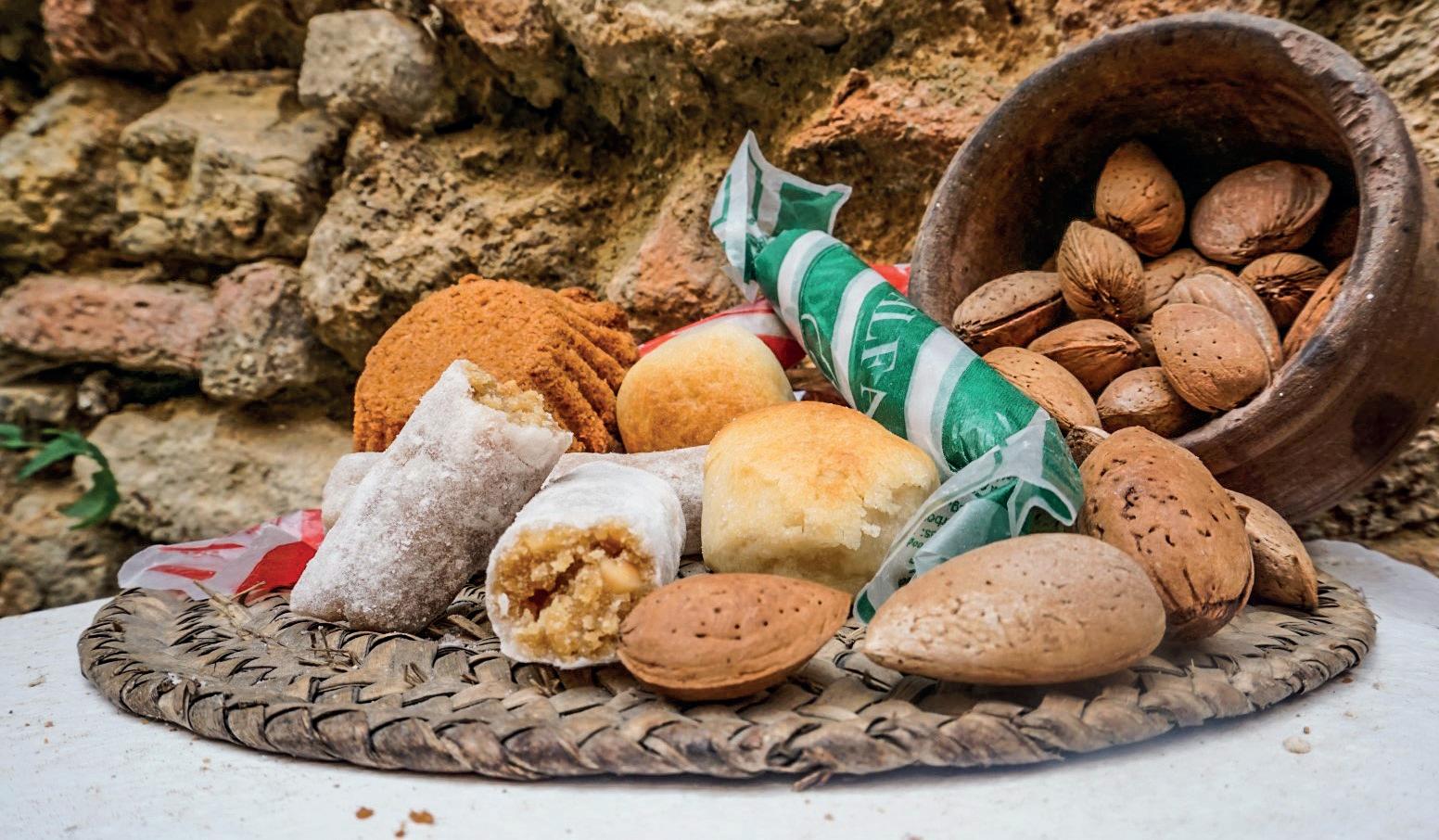
Traditional pastries. Medina Sidonia
Arab pastries
03.8
Land of Mills and Oil
The Sierra de Cádiz, with its picturesque white villages perched on the mountainside, has a deeprooted olive-growing culture that has given rise to the prestigious Sierra de Cádiz Protected Designation of Origin (PDO). Olive growing in this region is an ancient art that shapes the landscape and identity of towns such as Olvera, Zahara de la Sierra and Espera.
The olive groves in the Sierra de Cadíz are mountain olive groves, makings mechanisation difficult and encouraging more traditional and environmentally friendly cultivation, contributing to the uniqueness and high quality of the oil.
The industrial heritage of this culture can be found in the oil mills, many of which are centuries old and either still in operation or converted into interpretation centres. Examples such as the Molino Las Pilas in Olvera, in operation since 1810, or the Molino de Espera (built in 1771), are not only factories, but true living museums that explain the history and process of oil production, from animal traction to current technology. Other oil mills, such as El Callejón in Prado del Rey, with more than a century of history, preserve traditional methods, such as the stone grinding and pressing system, to obtain the precious «liquid gold».
To travel the white villages route is to immerse yourself in this cultural landscape, where olive groves mark the rhythm of the seasons and where every drop of extra virgin olive oil reflects the effort, tradition and privileged microclimate of the mountains.
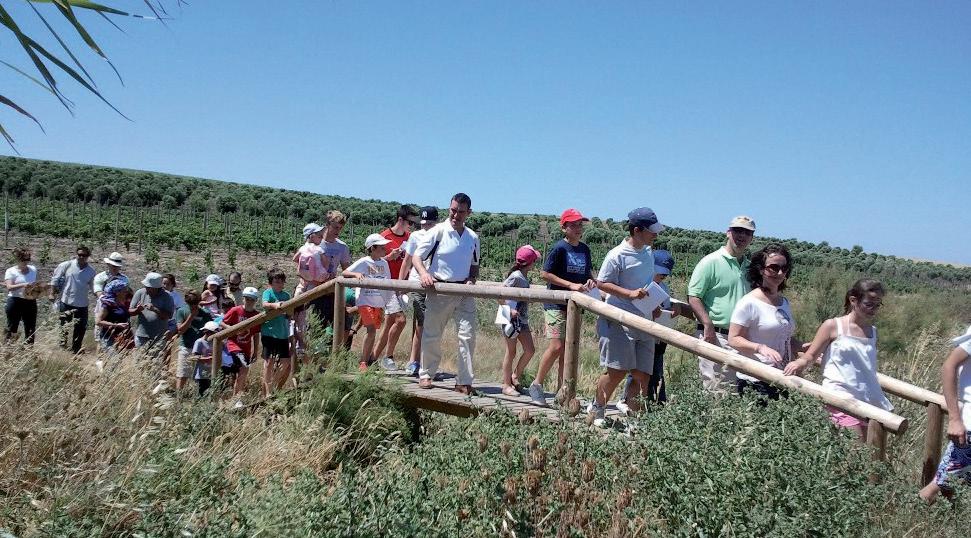
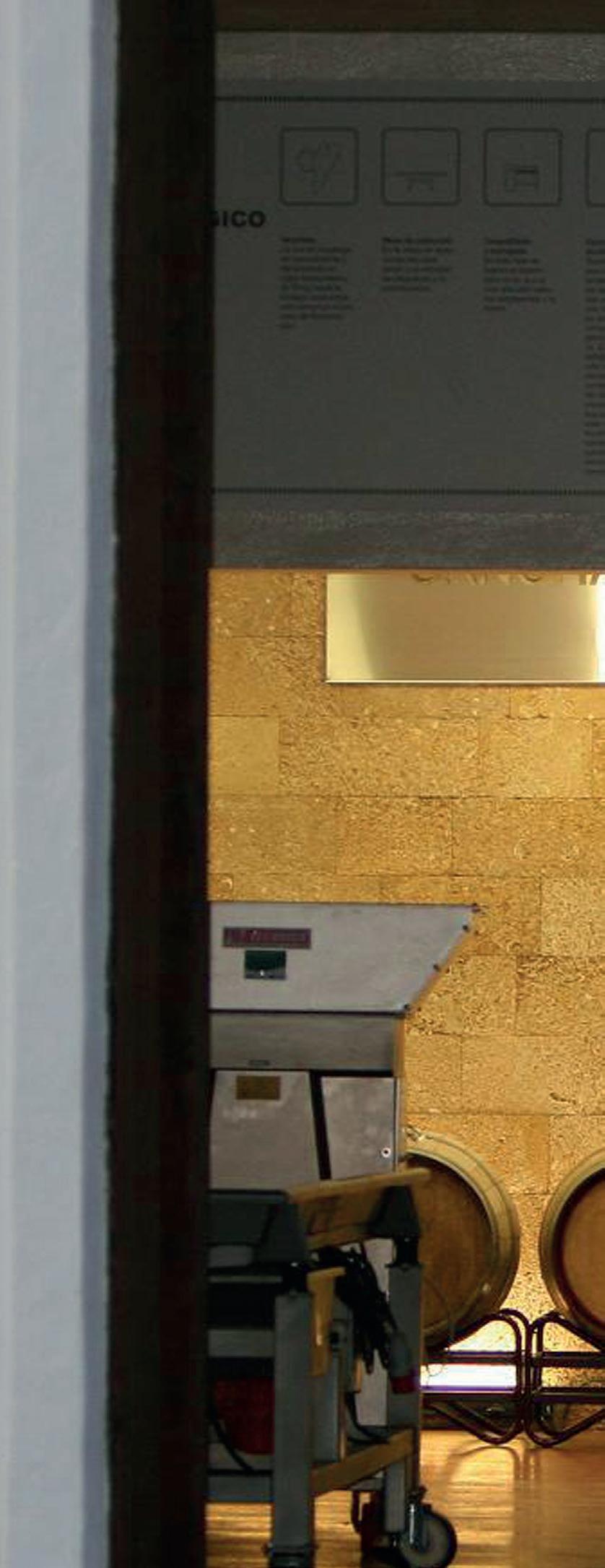
Almazara Sancha Perez Winery. Vejer
Visit to Bodega Almazara. Vejer
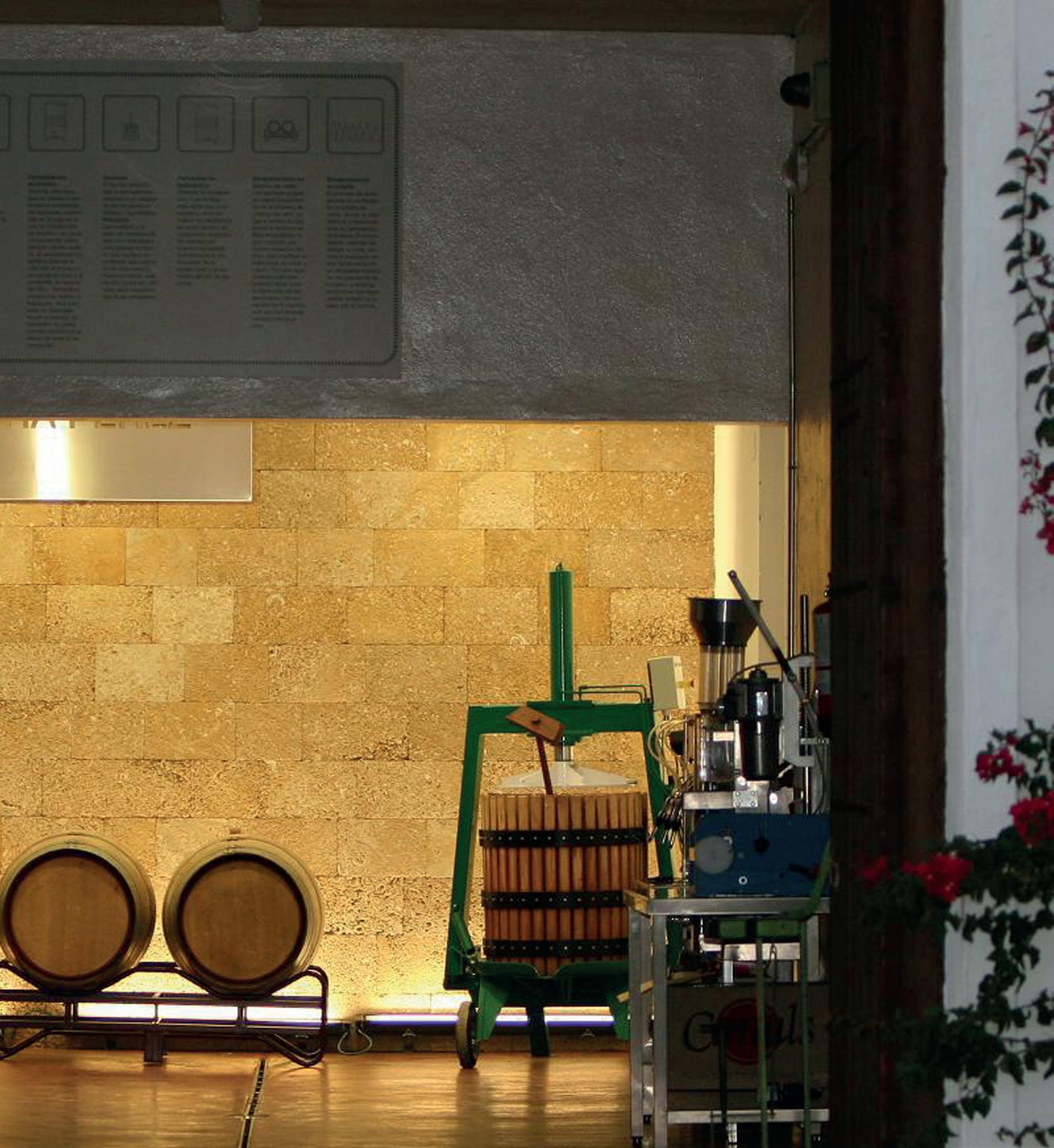
03.9 Carnaval
The Cadiz Carnival is more than just a celebration, it is a school of ingenuity, a social catharsis and a political satire, whose essence radiates throughout the Cadiz region.
The capital is the historical epicentre of this tradition, which has been declared of International Tourist Interest. Its origins date back to visits by merchants from Genoa, Venice and France, whose masks and costumes merged with popular dances and sounds brought from overseas, such as habaneras, guajiras and Cuban guarachas. This mixture forged a unique art form.
The main festive period, which lasts about ten days, begins with free tastings in the squares (pestiñada, ostionada and erizada). In the streets, the people dress up en masse, enjoying the carousels of choirs and street groups, turning the city into a vibrant and spontaneous stage. However, the main event is the Official Group Competition (COAC) at the Teatro Falla, where choirs, chirigotas, comparsas and quartets exercise social criticism through music and poetry. Legendary figures such as Paco Alba, Pedro Romero and Antonio Martín, and current figures such as Juan Carlos Aragón and Martínez Ares, are considered true popular poets.
Although the spotlight shines brightly on the Falla, Carnival also extends to other municipalities, each with its own unique flavour. In the province, the festival is celebrated with great vigour in towns such as Bornos, which has one of the oldest carnivals in Andalusia, and municipalities in the Bay of Cadiz and the north-west coast, which have their own group competitions and street celebrations. The villages of the Sierra, such as Ubrique, also enjoy an explosion of colour and humour.
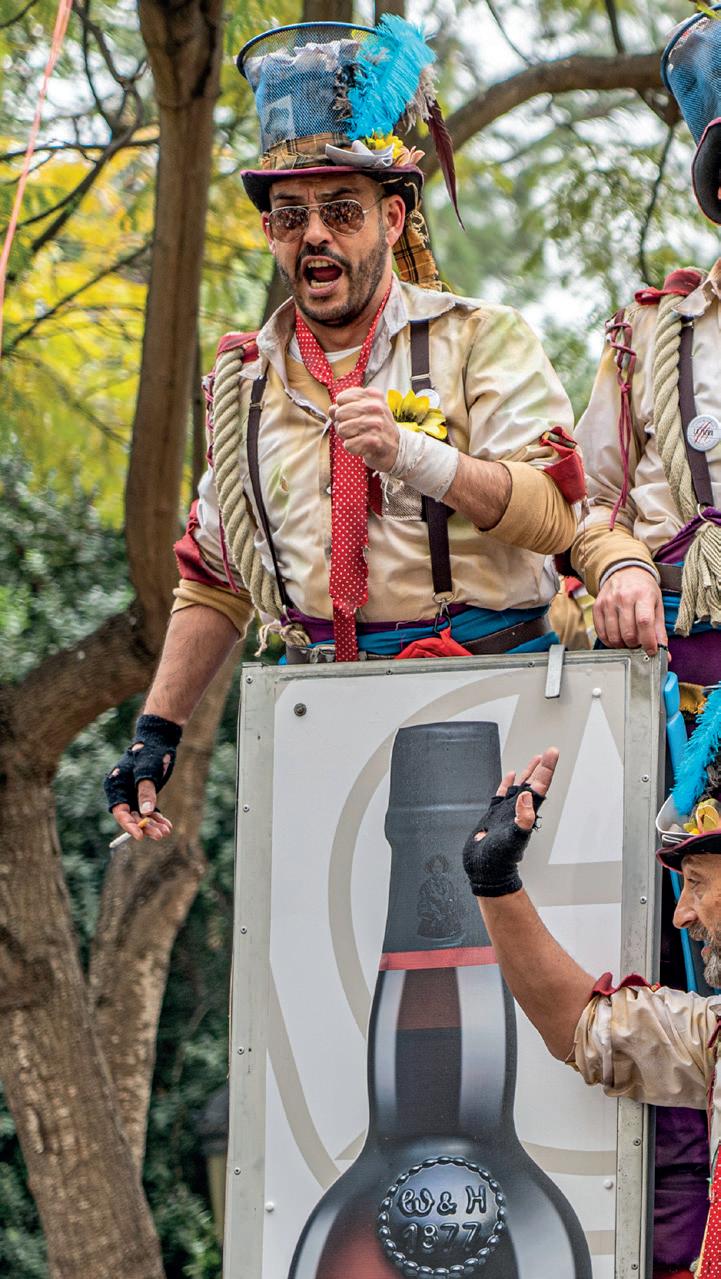
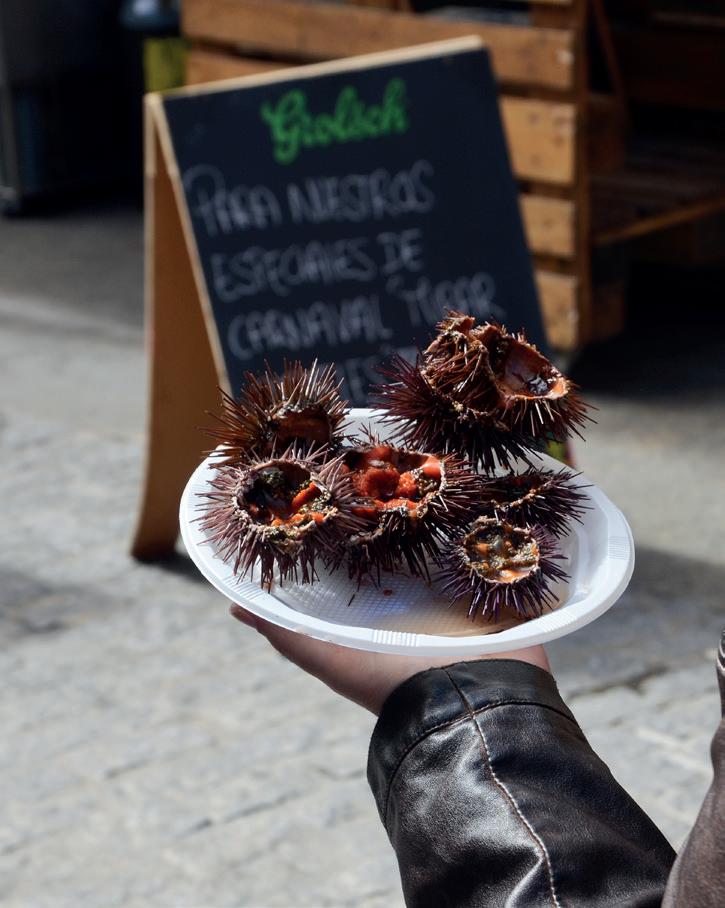
Carnival choirs in the street. Cádiz
Erizada at the carnival. Cádiz
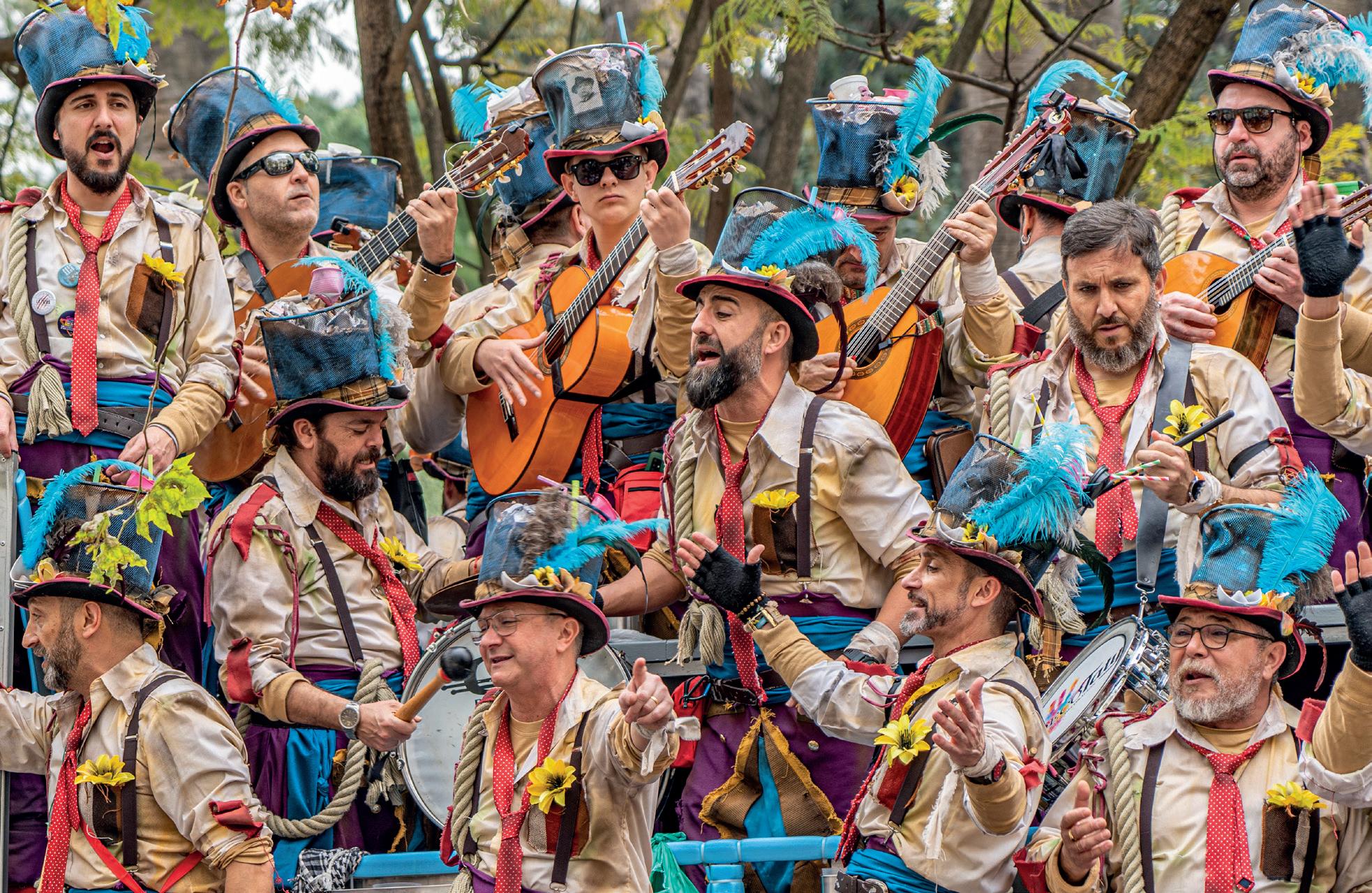

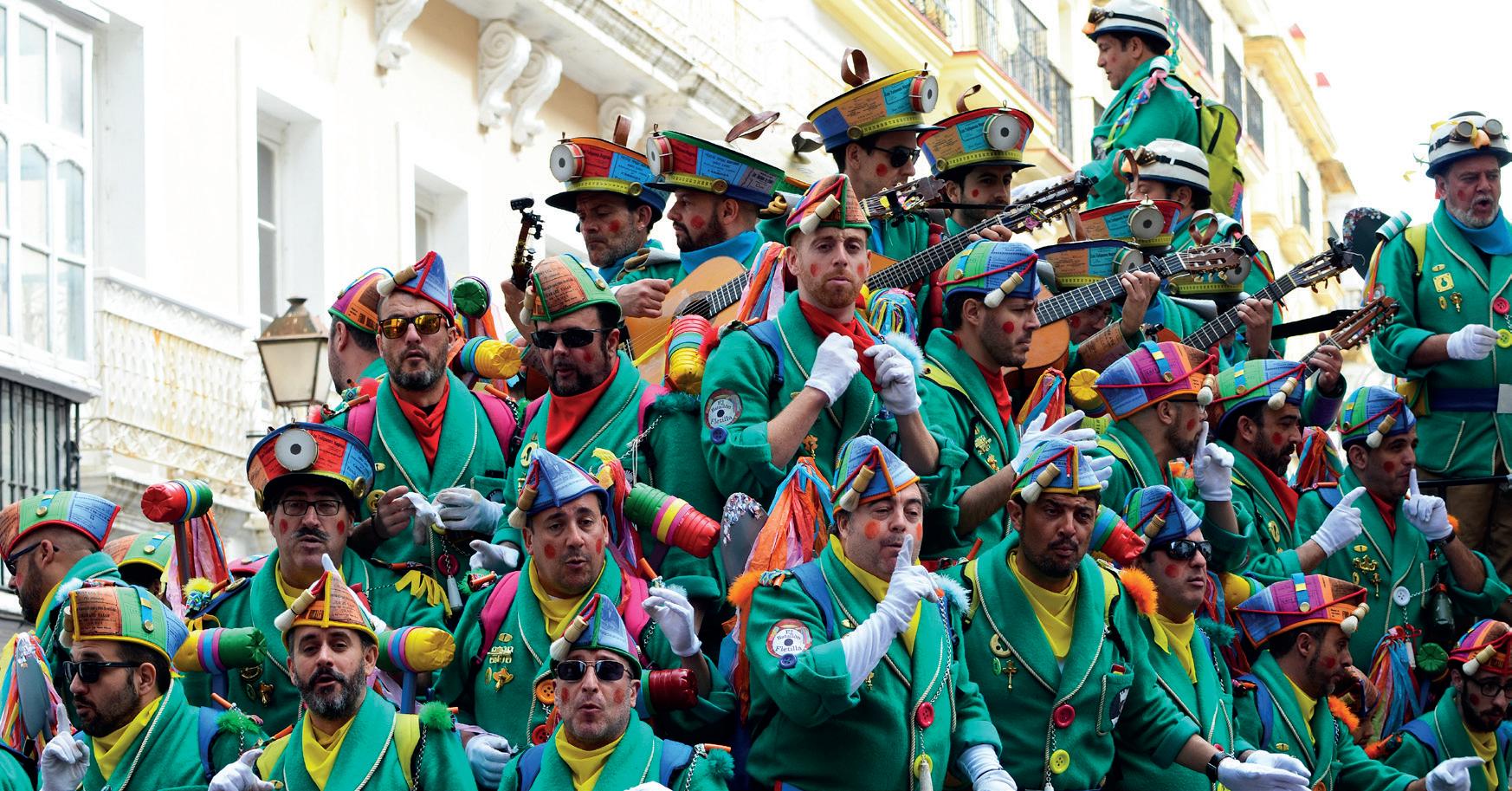
Carnival choirs in the street. Cadiz
03.10
Holy Week
Holy Week in the province of Cádiz is one of the most intense and deeply rooted expressions of popular religiosity, a liturgy of faith and art that transforms the urban landscape into a solemn setting for processions. It is celebrated with great fervour throughout the province, where silence and devotion mingle with the sound of cornets and the penetrating smell of incense.
The celebration has a unique historical significance thanks to Bornos. In 1520, Don Fadrique Enríquez de Ribera, after making a pilgrimage to the Holy Land, established the first Via Crucís in Spain in his hometown, replicating the distance of the Via Dolorosa in Jerusalem. This initiative is considered the precursor of Holy Week as we know it today.
The celebrations in Cadiz and Jerez de la Frontera are the best known, both declared of National Tourist Interest. In the capital, Holy Week is maritime and stately, characterised by the beauty of the brotherhoods that parade through the narrow old town, culminating in the Official Route in front of the Cathedral. For its part, Jerez stands out for the majesty and large number of brotherhoods, with the presence of large mystery floats and the elegant passage of the brotherhoods through the wine-producing centre.
Towns such as San Fernando also boast a deep-rooted tradition, historically linked to the Navy. In addition, the Holy Weeks of Alcalá del Valle, Arcos de la Frontera, Olvera, Espera, Setenil de las Bodegas, La Línea de la Concepción and San Roque are recognised as being of Regional Tourist Interest.
The processions, with their majestic floats carried by bearers, are a compendium of centuries of history, visible in the imagery, gold and silverwork and embroidery. Beyond the religious aspect, Holy Week in Cadiz is an essential part of the heritage for understanding the identity of the province.
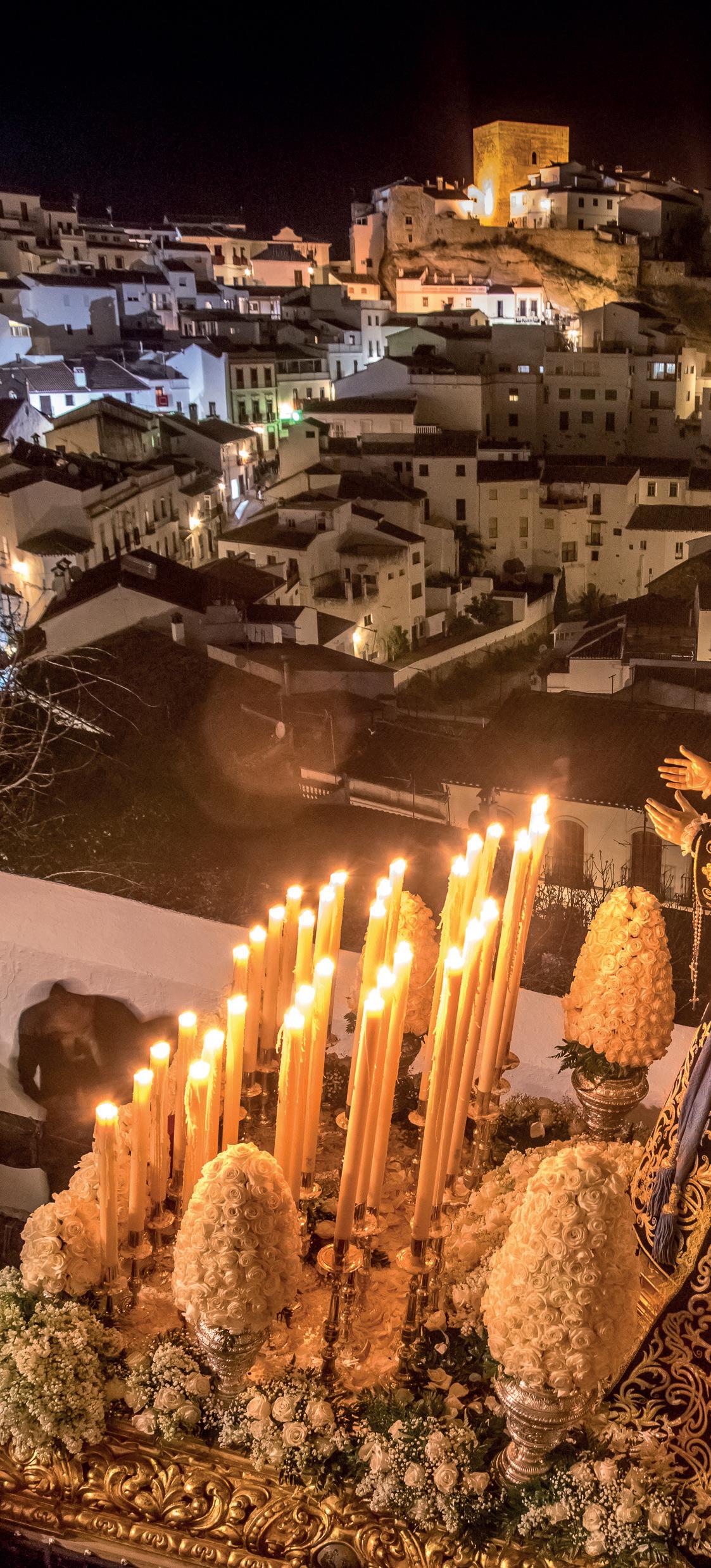
Holy Week. Setenil de las Bodegas
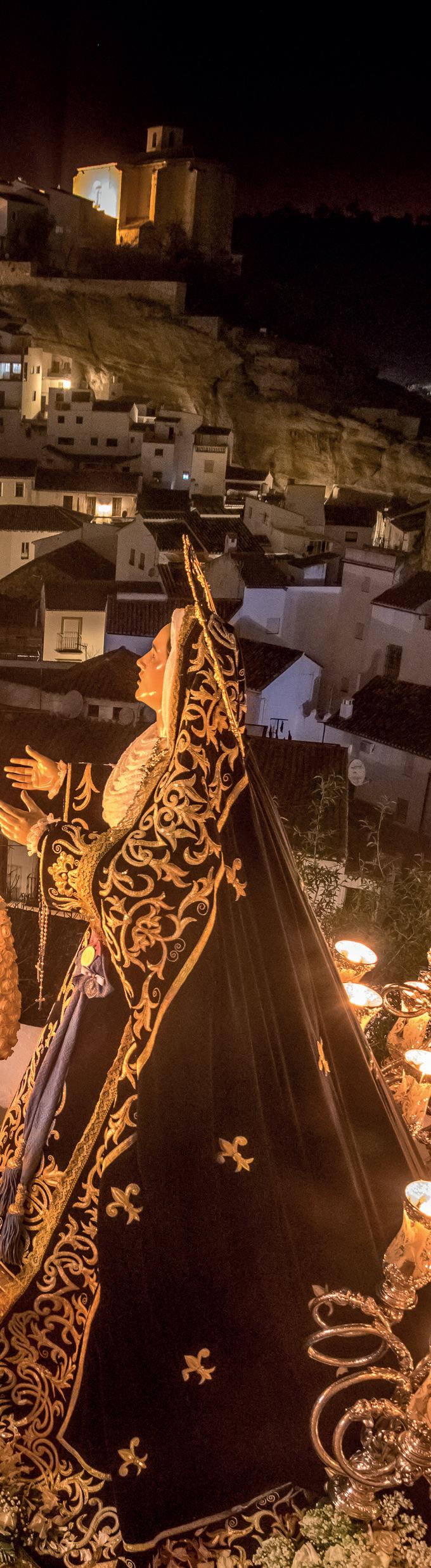
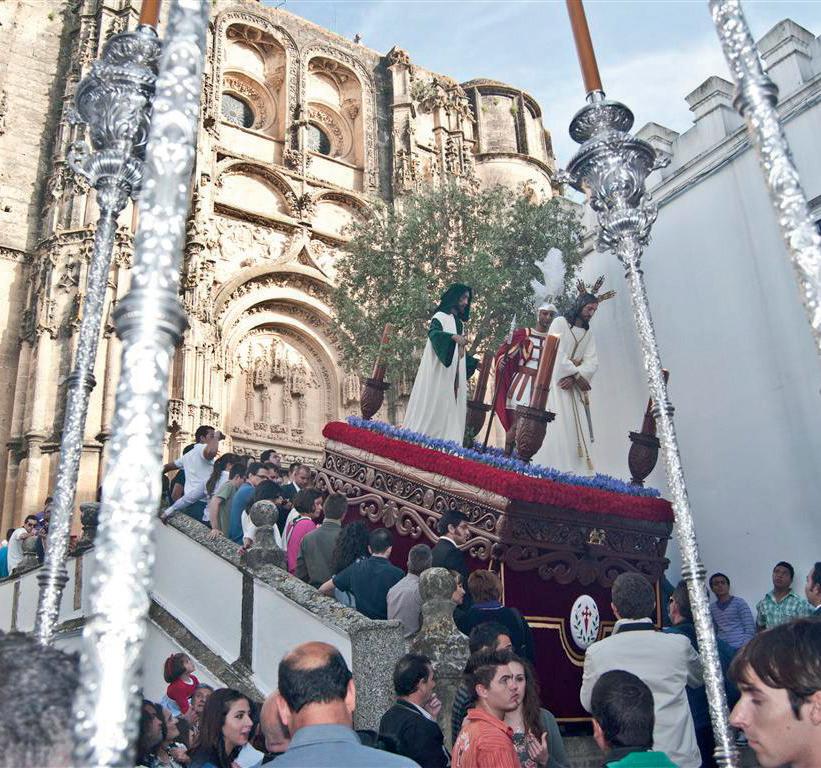
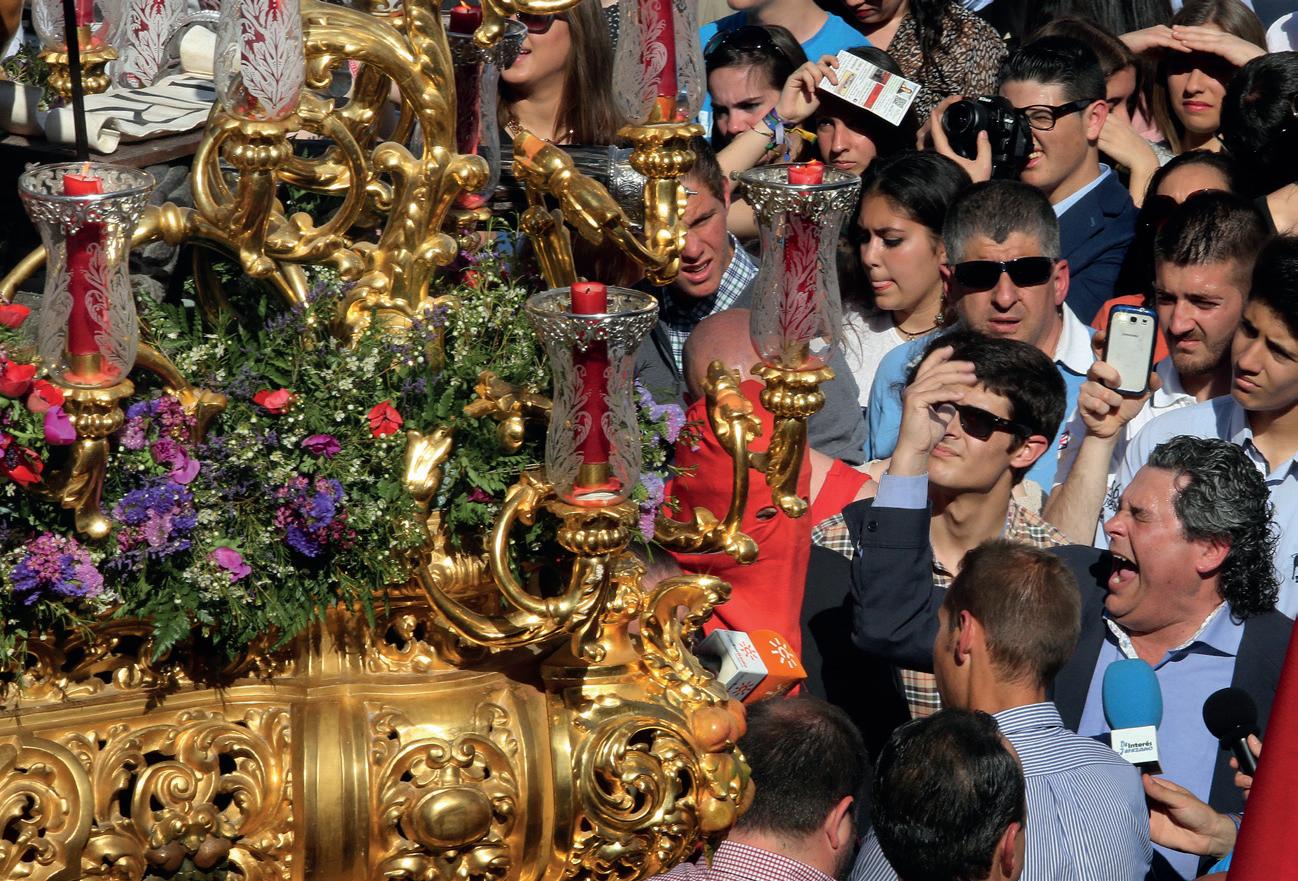
Holy Week. Arcos de la Frontera
Holy Week. Jerez de la Frontera
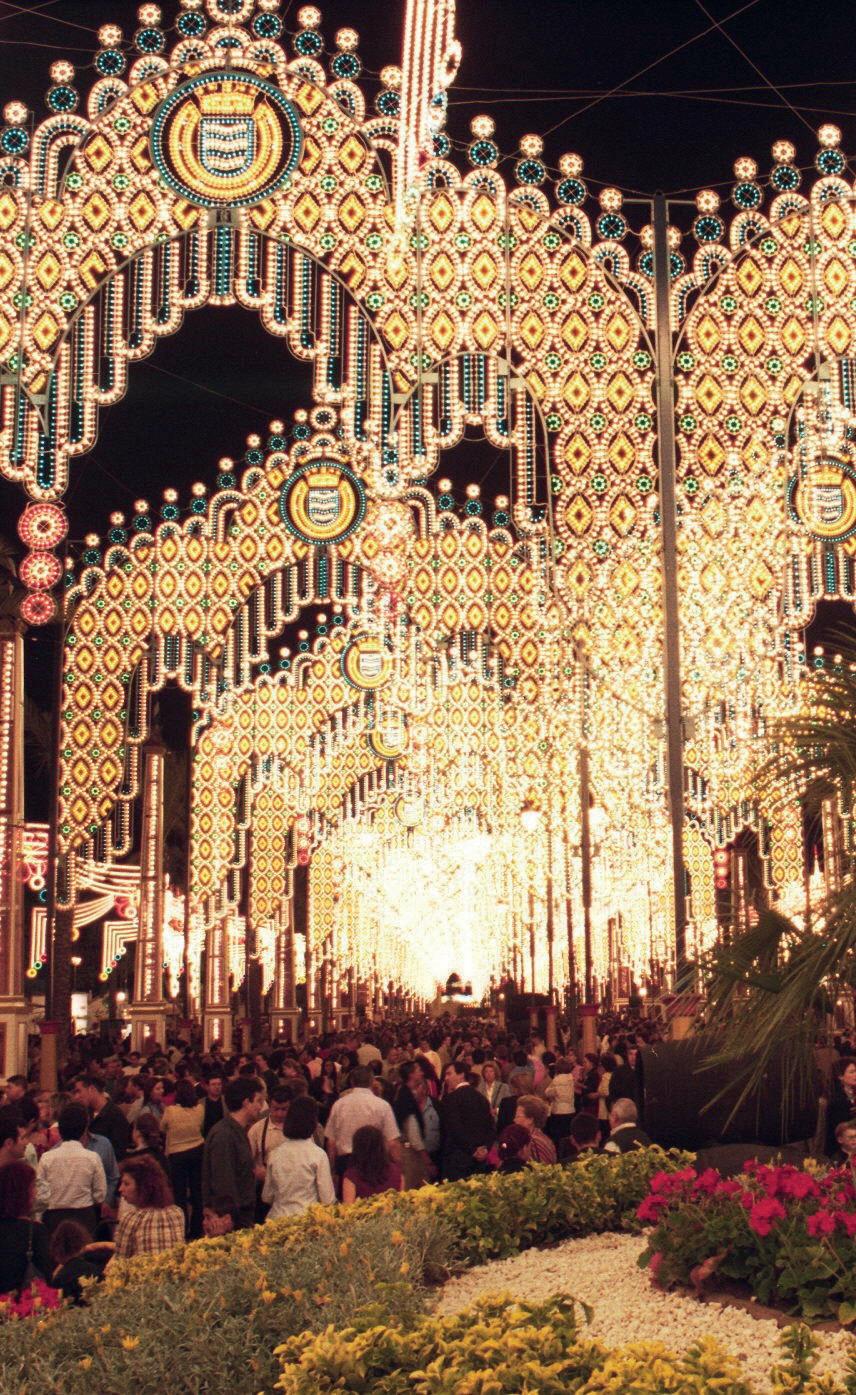
03.11 Fairs
The fairs in the province of Cádiz are a festive ritual in spring and summer, providing a space for social gatherings, equestrian culture and celebration. Descended from the old cattle markets, these festivities have evolved into major showcases of Andalusian identity, combining agricultural tradition with a festive spirit.
The best known and most important is the Horse Fair in Jerez de la Frontera, declared a Festival of International Tourist Interest. Held in González Hontoria Park, the Jerez fair is mainly a daytime event and is distinguished by the absolute prominence of the horse. The Real, with its more than 200 marquees, hosts a grand horse parade, where hundreds of riders, horsewomen and horse-drawn carriages, dressed in traditional costumes and flamenco dresses, fill the grounds with elegance and colour. In this atmosphere, sherry and flamenco take centre stage, inviting conviviality.
Other fairs, such as the Spring Fair and the Fino Wine Festival in El Puerto de Santa María, maintain strong bullfighting traditions and a vibrant atmosphere in their marquees.
The Algeciras Fair (Real Feria de Algeciras), the Sanlúcar de Barrameda Fair (known as the Manzanilla Fair), the Feria del Carmen y de la Sal in San Fernando, the Feria de Tarifa and the Fiesta de la Urta in Rota, among many others, also offer a unique atmosphere where music, local cuisine and flamenco dancing take centre stage.
Lighting at the Jerez Fair
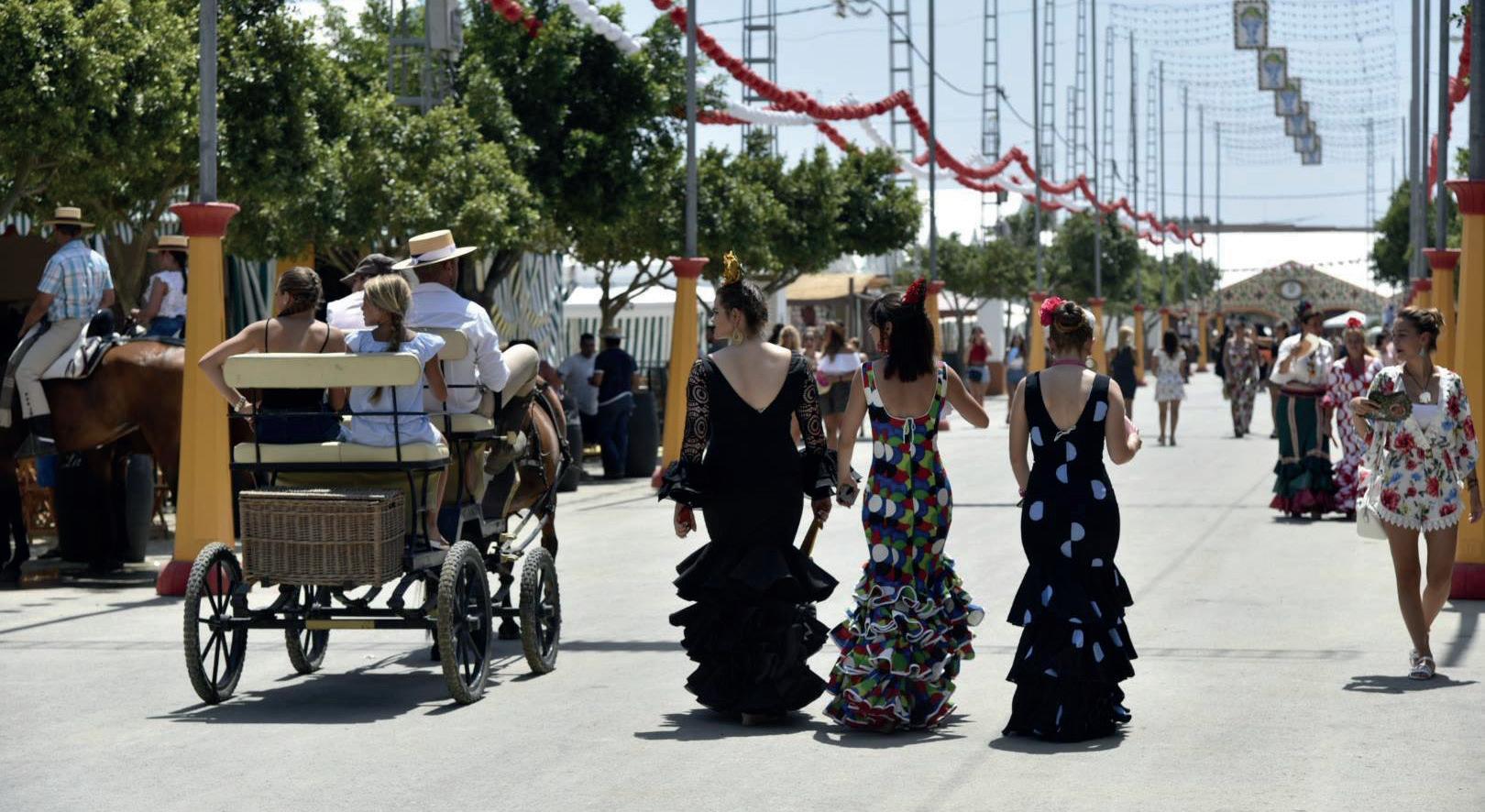
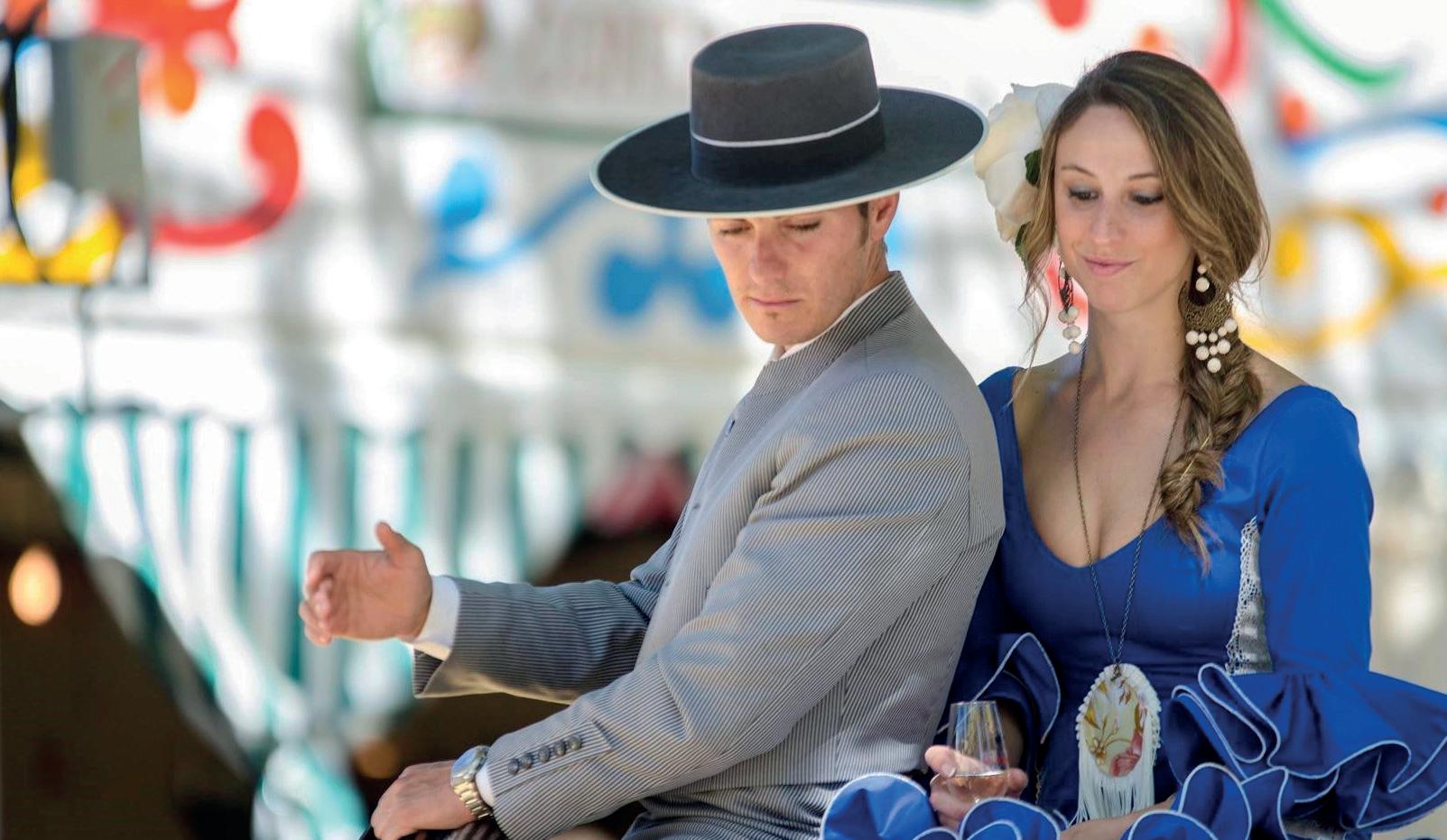
Feria del Carmen y la Sal. San Fernando
Fair. El Puerto de Santa María
03.12
Pilgrimages and festivities
The province of Cádiz is a crossroads of faith and devotion, manifested both in its traditional festive pilgrimages and in its role as the starting point for major pilgrimages. Every year, the landscape of the mountains and coastline becomes a sacred route that combines fervour, culture and conviviality.
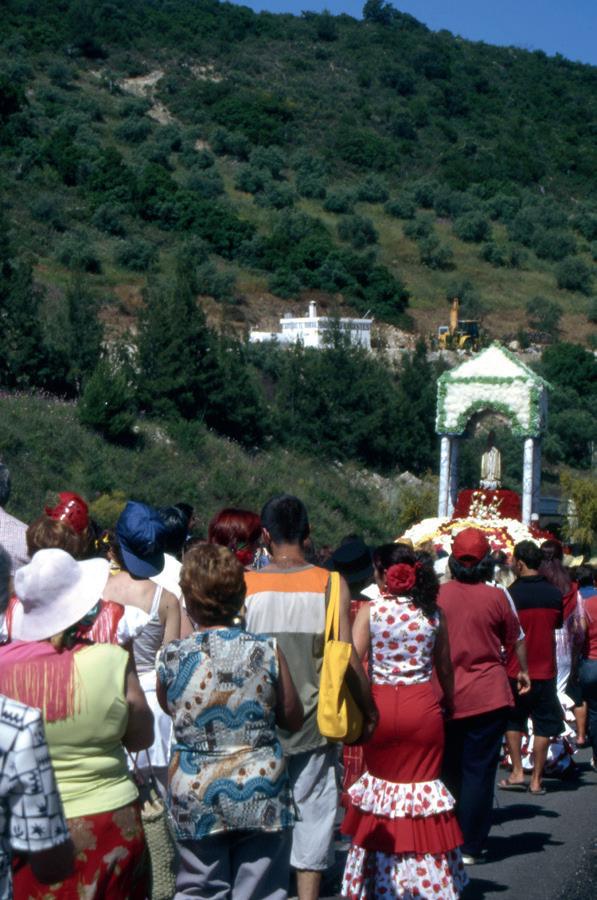
Cadiz is a key point on the routes to Santiago de Compostela. Important roads run through the region, such as the Vía Augusta, a historic Roman road that begins in the city of Cadiz and heads north along the bay (San Fernando, El Puerto de Santa María and Jerez) until it joins the Vía de la Plata in Seville. There is also the Camino de la Sierra, which makes use of greenways and old railway lines, and the Camino del Estrecho, which starts in Algeciras and crosses the Campo de Gibraltar until it joins the Vía Augusta in Puerto Real.
In addition to these pilgrimage routes, there is also the pilgrimage to the village of El Rocío. The province is the setting for the emblematic embarkation to El Rocío from Sanlúcar de Barrameda, one of the most iconic images of this festive pilgrimage. Hundreds of pilgrims from brotherhoods such as that of Jerez cross the Guadalquivir River in decorated barges, creating an emotional river procession towards the Doñana National Park.
As for local festive pilgrimages, the Lunes de Quasimodo in Olvera stands out. Declared of Regional Tourist Interest, this pilgrimage is over 300 years old, dating back to 1715 as a prayer to the Virgen de Los Remedios to ask for rain after a great drought. Other important pilgrimages include the Virgen de la Cabeza in Vejer, San Isidro in Los Barrios and the unique maritime pilgrimage in honour of the Virgen de la Palma in Algeciras.
There is a fusion of the sacred and the profane. The carts, pulled by oxen or horses, are true works of ephemeral art, richly decorated with flowers and religious motifs, and carry the devotees along the route. In this context, horses and the singing of sevillanas or fandangos become the musical thread of devotion, preserving customs that have been passed down from generation to generation.
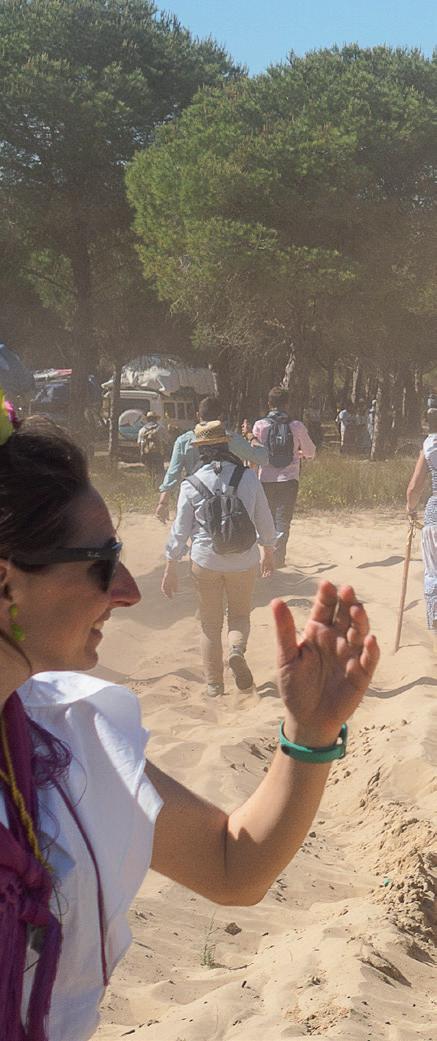

Pilgrimage of the Virgencita de la Sierra. Algodonales
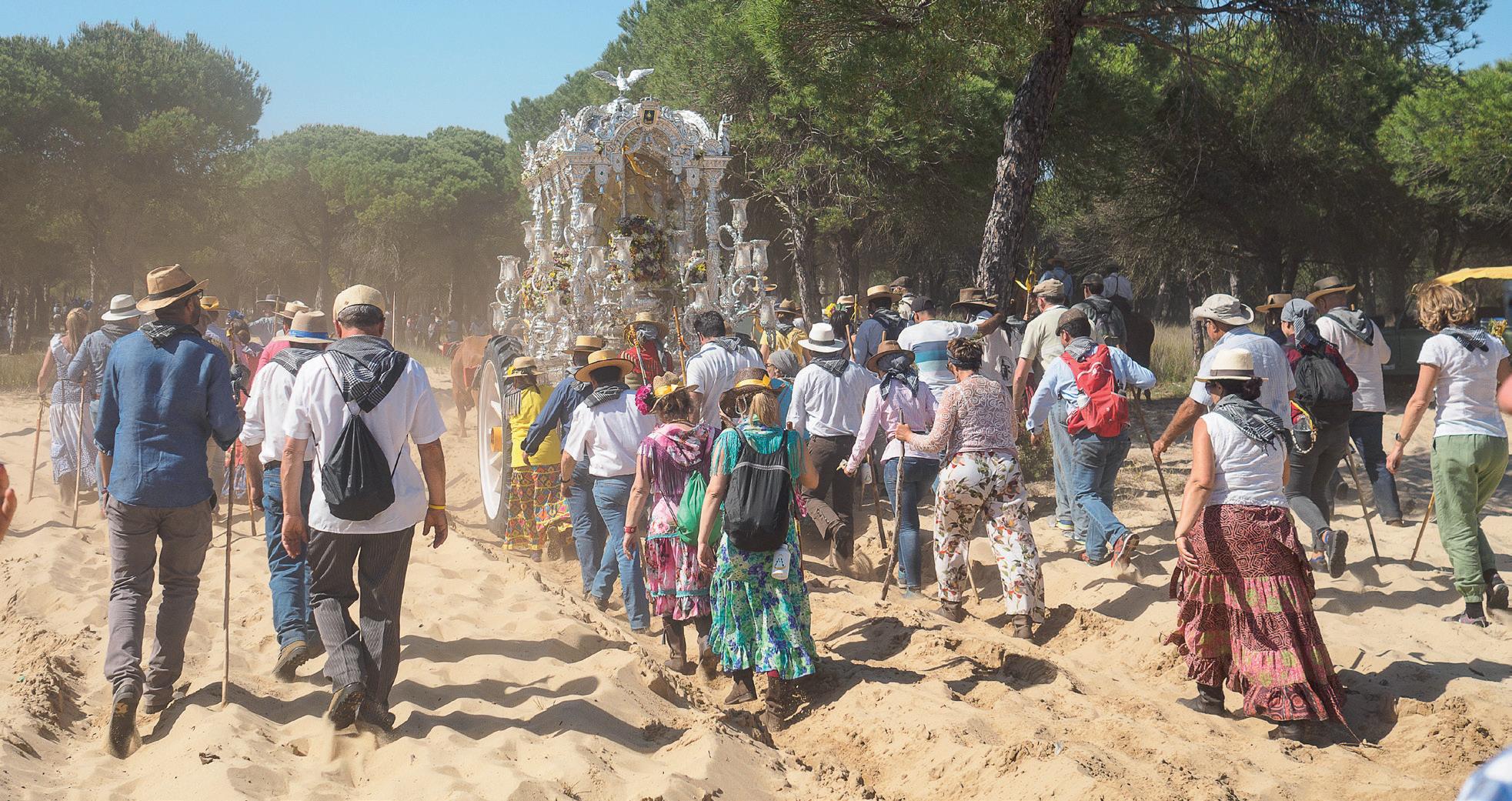
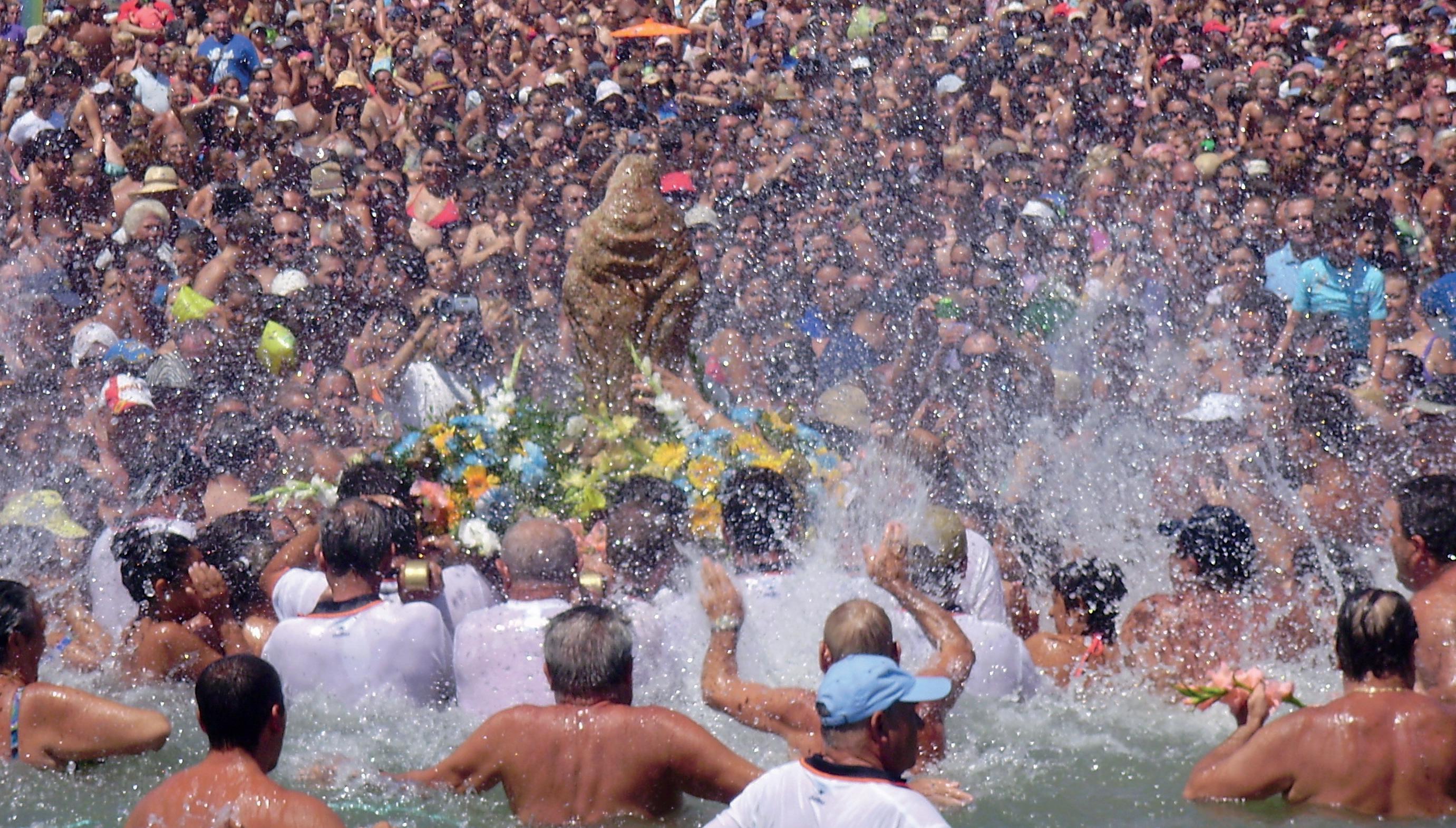
Pilgrims on their way to the village of El Rocío through Doñana National Park
Pilgrimage of the Virgen de la Palma. Algeciras
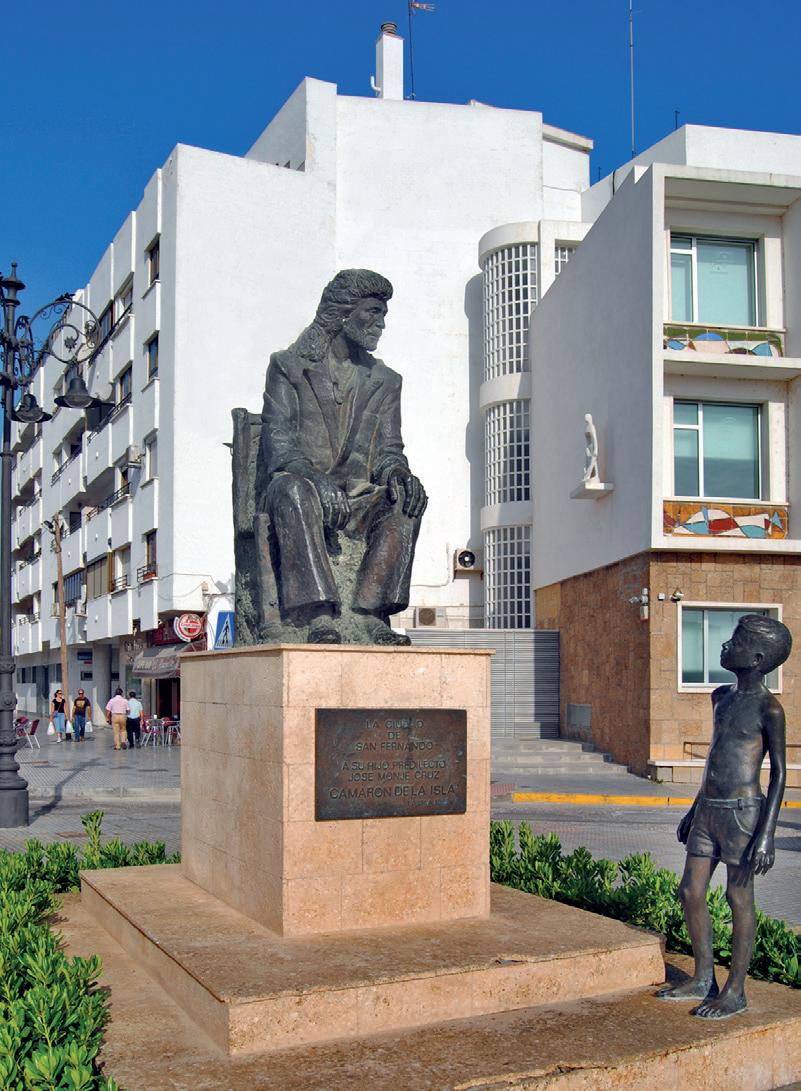
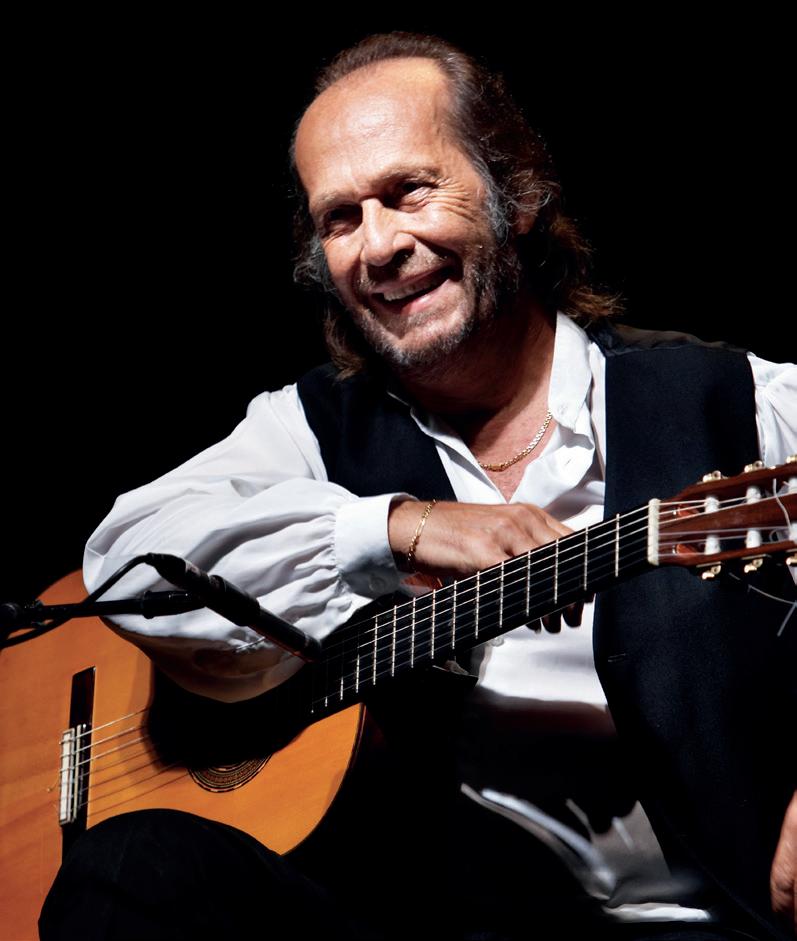
03.13
Flamenco
Declared an Intangible Cultural Heritage of Humanity by UNESCO in 2010, flamenco has its roots in the province of Cadiz, where it has risen to the status of an artistic genre and inspiration for writers, poets and musicians.
The homeland of songs such as alegrías, bulerías and tangos, and the birthplace of artists of the stature of Rocío Jurado from Chipiona, Manolo Sanlúcar from Sanlúcar de Barrameda and Antonio Chacón, José Mercé and Lola Flores from Jerez, it is here that flamenco is concentrated in its purest form, from the Bay of Cadíz to Campo de Gibraltar.
The capital is a city open to the sea and to influences from overseas, a welcoming city of cantes de ida y vuelta, cantiñas, de la sal y el salero (styles of flamenco). Santa María is its flamenco neighbourhood par excellence, where the legendary figure of Enrique el Mellizo was forged and is home to the largest number of peñas (flamenco clubs) .
Flamenco singing arrived in Jerez de la Frontera more than two centuries ago, brought by the gypsy community who were looking for work in the countryside, and it has remained here ever since. The town has perhaps one of the strongest flamenco influences in the world, found in the Santiago neighbourhood, which is home to the Andalusian Centre for Flamenco Documentation, and joined by the San Miguel neighbourhood, the origin of the bulería, the quintessential Jerez song.
And no flamenco tour of the province of Cadiz would be complete without a visit to Algeciras, the birthplace of the brilliant guitarist Paco de Lucía, who, a few kilometres away in San Fernando, left the other half of his legend: José Monge Cruz, Camarón de la Isla. Both artists have their own cultural routes.
The numerous festivals organised in the province also offer flamenco fans from all over the world the opportunity to enjoy magnificent performances.

Monument to Camarón de la Isla. San Fernando
The guitarist Paco de Lucía from Algeciras.
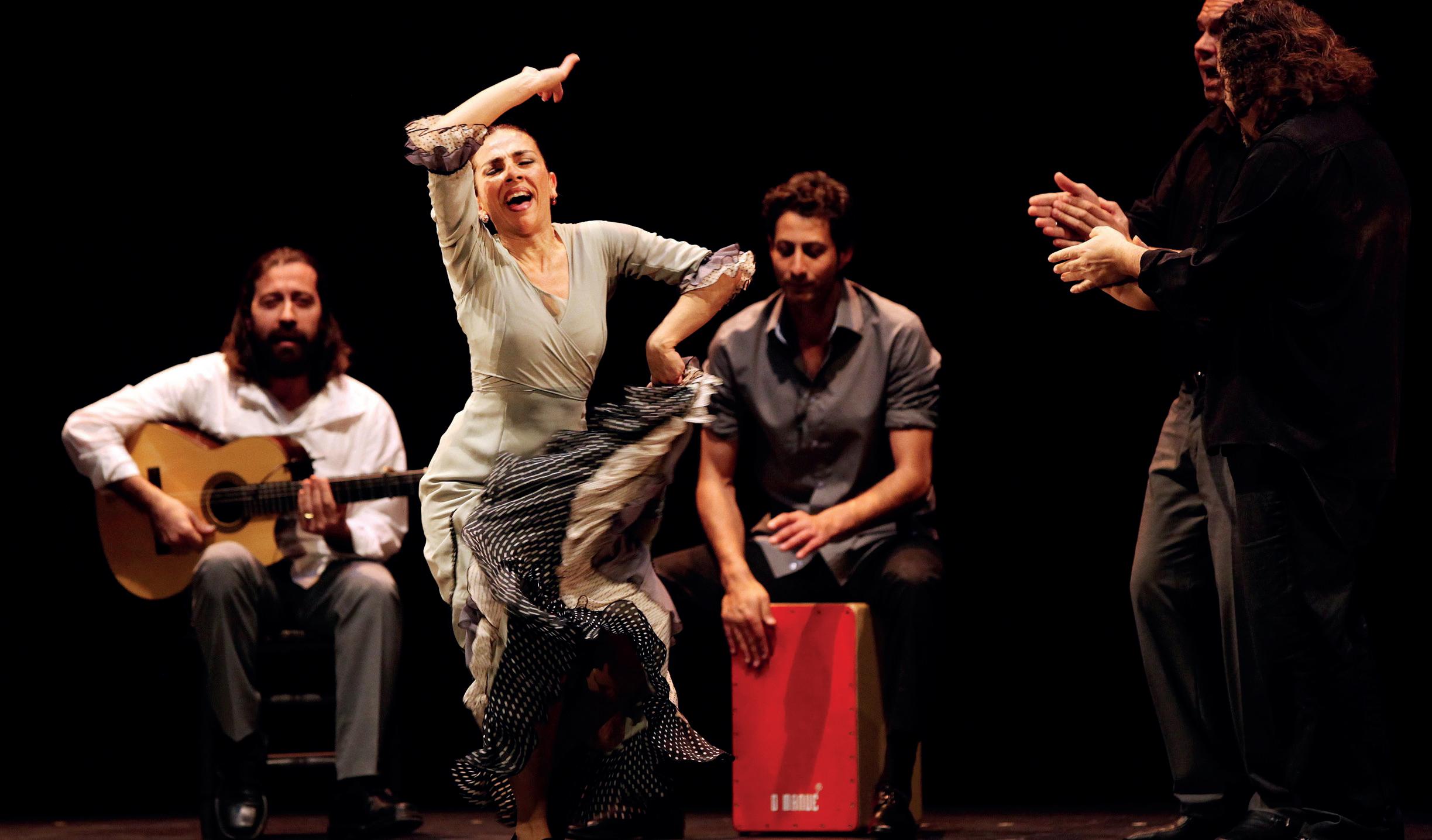
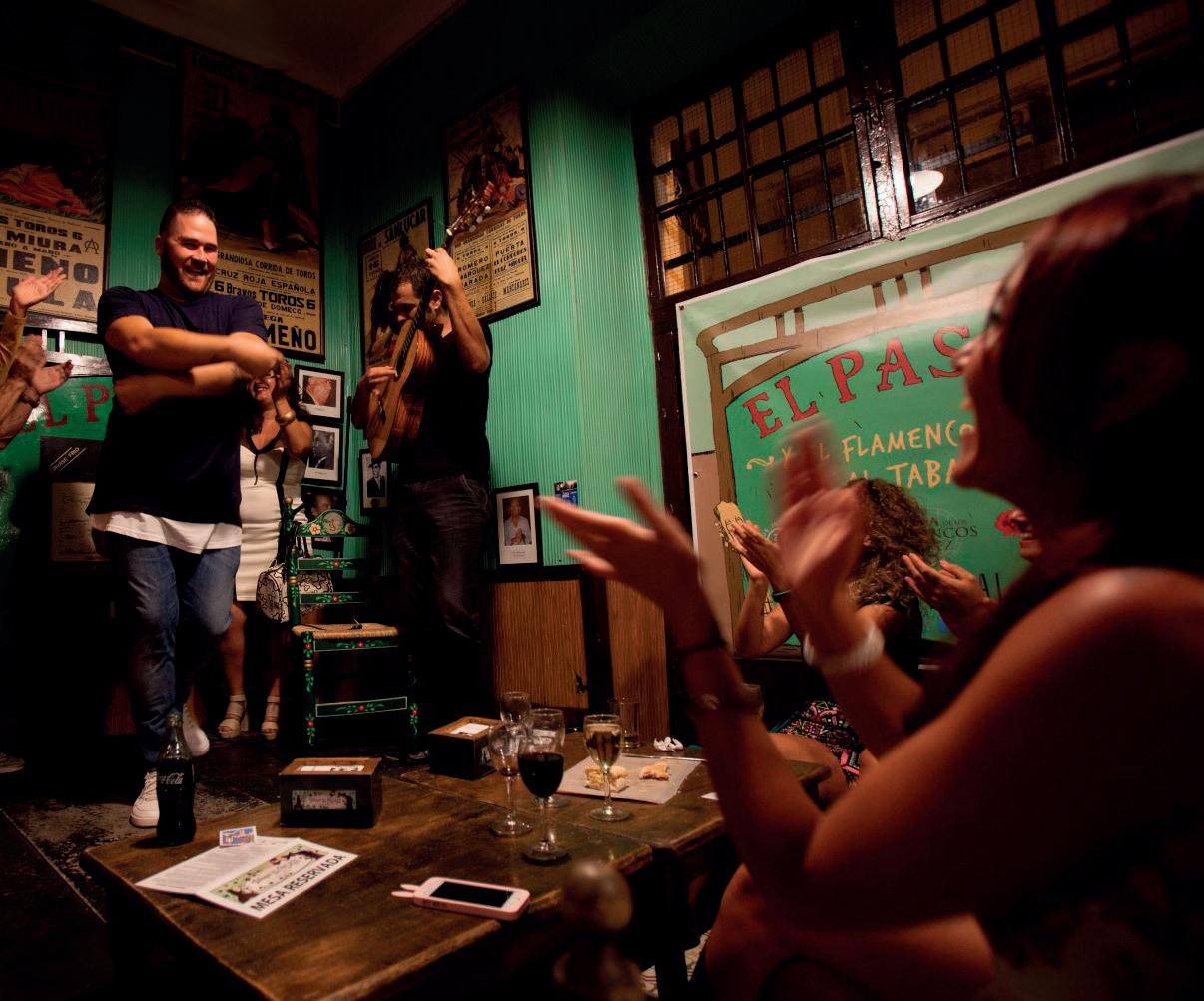
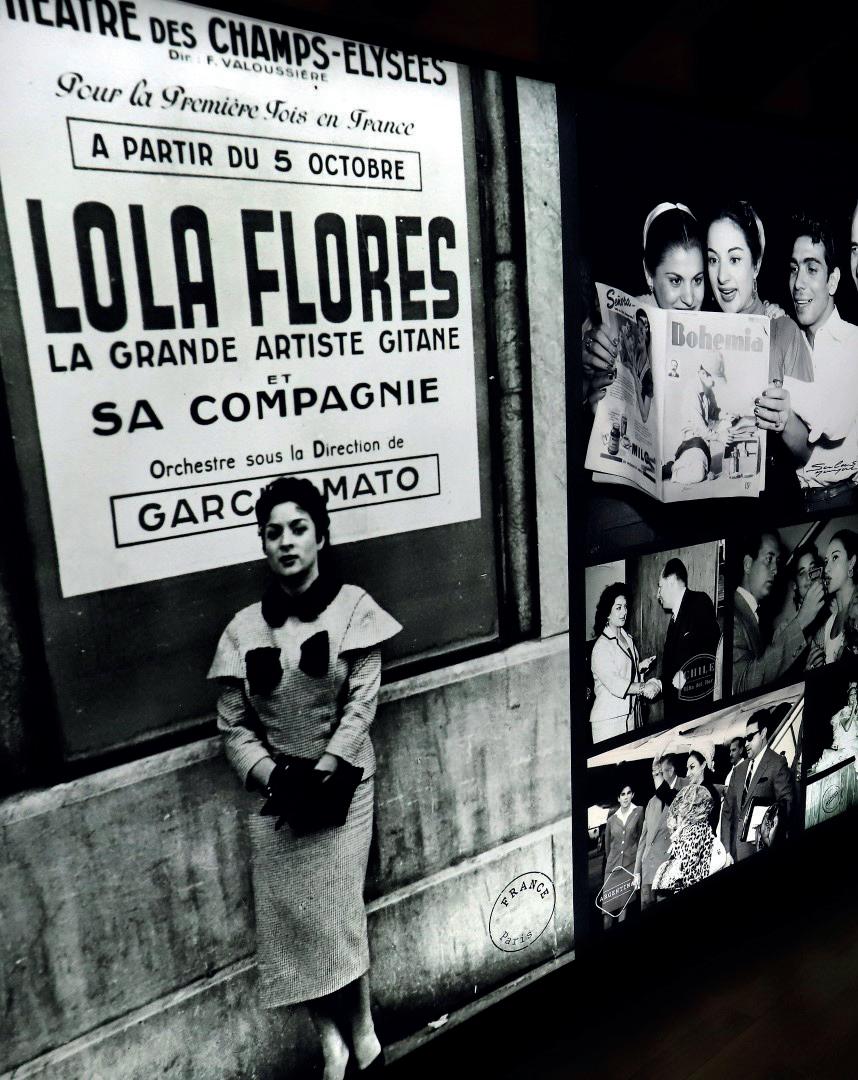
Flamenco performance
Flamenco performance in a tabanco. Jerez de la Frontera
Lola Flores Cultural Centre. Jerez de la Frontera
03.14 Music Festivals
Beyond its ancestral traditions, the province of Cádiz has established itself as a key reference point on the contemporary music circuit. Taking advantage of its unbeatable climate, extensive beaches and organisational capacity, the province has positioned itself as a cutting-edge cultural destination during the summer months.
This musical effervescence is evident in the celebration of large concert cycles and macro-events that feature prominent figures from pop-rock and other genres at national and international level. These shows take place on the coast, attracting thousands of visitors and have become an important economic and tourist driver for the Bay of Cadíz.
The offer goes beyond large outdoor stages. The province promotes music cycles that take advantage of the rich historical heritage and urban landscapes, using unique spaces such as the old castles and maritime fortifications of the capital. These events offer a unique experience where music merges with history and the unparalleled coastal landscape of Cadiz.
In addition to the large-scale events, there is a dynamic network of more specialised festivals, covering genres such as jazz and independent music, and cycles dedicated to flamenco. This rich and diverse cultural offering not only provides high-quality shows, but also promotes an atmosphere of conviviality and leisure, using music as a vehicle to showcase the modernity and cultural dynamism of the province of Cadiz.

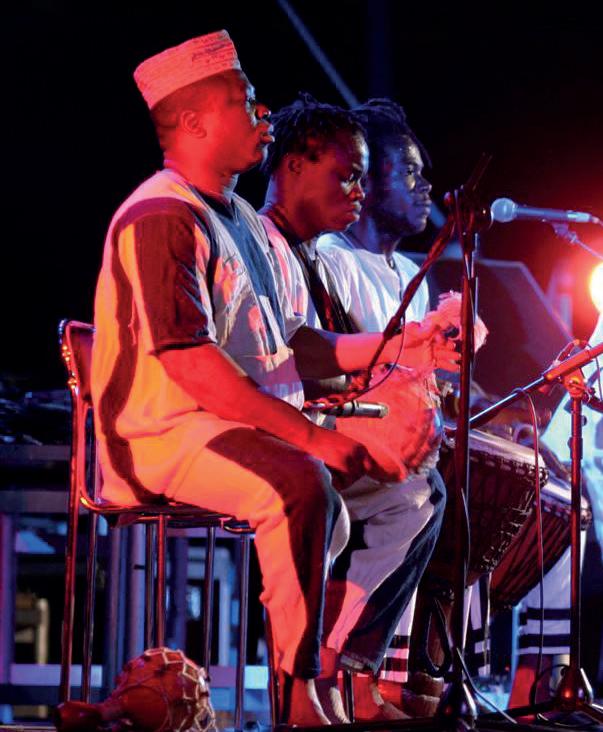
Music concert. Cadiz
Music festival. Jimena de la Frontera
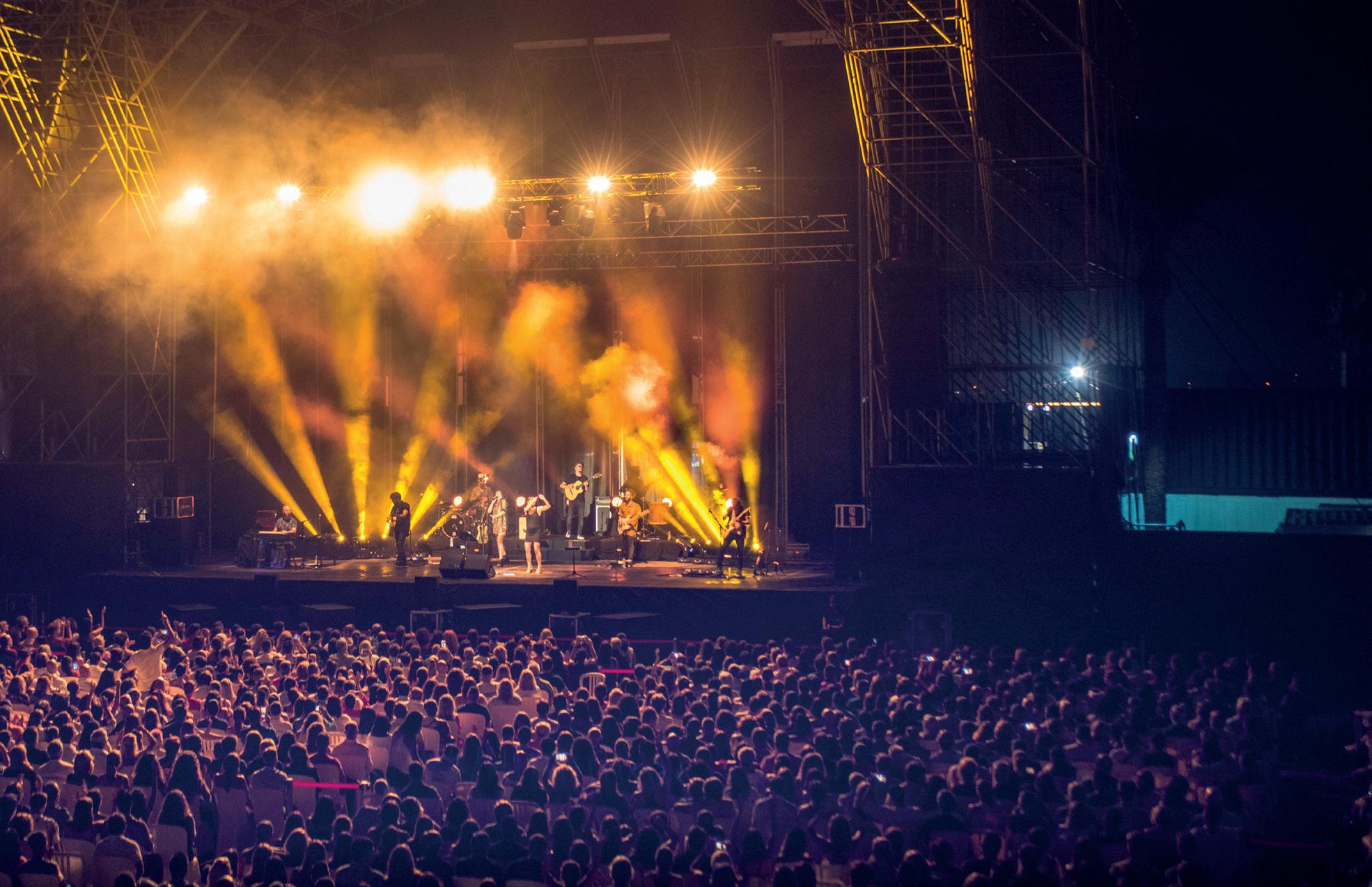
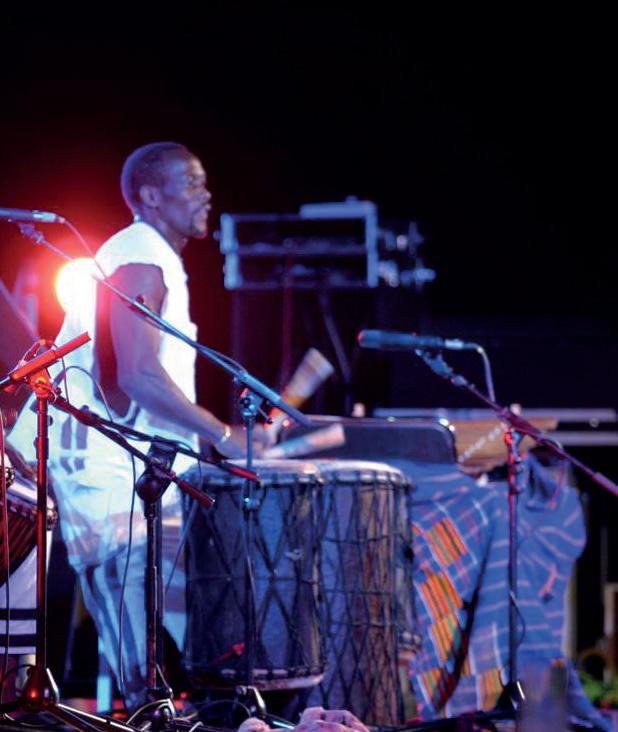
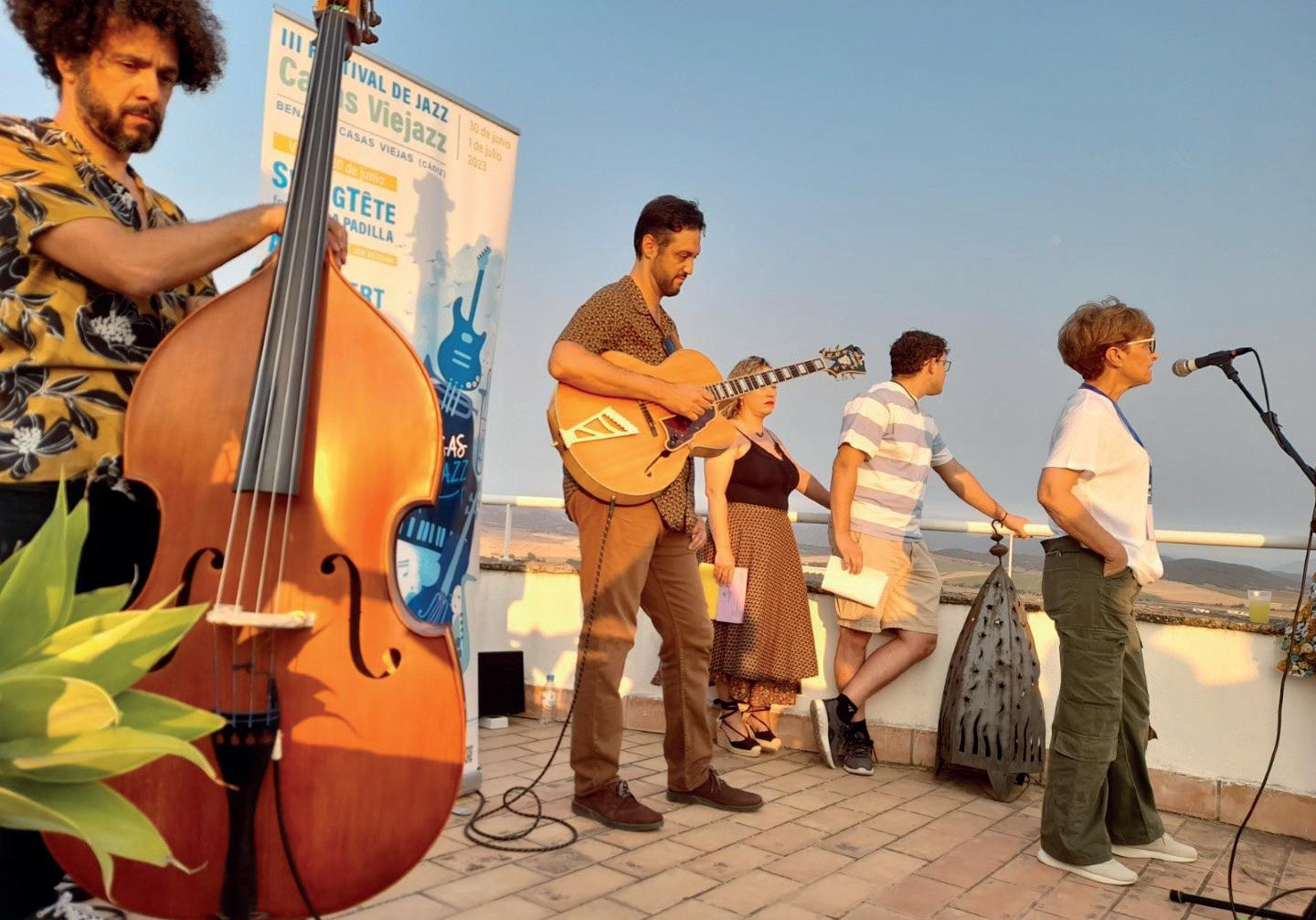
Jazz Festival. Benalup-Casas Viejas



Tourist Offices O4




























PROVINCIAL TOURIST BOARD
OF CADIZ
Plaza de Madrid s/n
Estadio Nuevo Mirandilla Fondo Sur. Planta 4ª
Tel.: 956 807 061 www.cadizturismo.com info@cadizturismo.com
CÁDIZ
TOURIST RECEPTION CENTRE
CADIZ CITY COUNCIL
Paseo de Canalejas s/n
Tel.: 956 241 001 info.turismo@cadiz.es www.turismo.cadiz.es
TOURIST OFFICE OF THE REGIONAL GOVERNMENT OF ANDALUSIA
Avenida 4 de Diciembre de 1977
Tel.: 956 203 191 otcadiz@andalucia.org www.andalucia.org
ALCALÁ DE LOS GAZULES
MUNICIPAL TOURIST OFFICE
Parque Félix Rodriguez de la Fuente
Tel.: 670 352 802 turismo@alcaladelosgazules.es www.oficinadeturismoalcaladelosgazules.es
ALCALÁ DEL VALLE
MUNICIPAL TOURIST OFFICE
Calle Real, 71
Tel.: 856 099 233 alcaladelvalleturismo@gmail.com
ALGECIRAS
ALGECIRAS TOURIST OFFICE
Paseo Rio de la Miel s/n
Tel.: 670 949 047 / 670 948 731 otalgeciras@andalucia.org / turismo@ algeciras.es www.algeciras.es
ARCOS DE LA FRONTERA
MUNICIPAL TOURIST OFFICE
Cuesta de Belén, 5 Tel.: 956 702 264 turismo@arcosdelafrontera.es www.turismoarcos.es
BARBATE
MUNICIPAL TOURIST OFFICE
Paseo Marítimo, 5 Tel.: 956 063 613 turismo@barbate.es www.barbate.es
BENALUP-CASAS VIEJAS
MUNICIPAL TOURIST OFFICE
C/ Paterna, 4 Tel.: 956 417 733 oficinaturismo@benalupcasasviejas.es www.banalupcasasviejas.es
BORNOS
MUNICIPAL TOURIST OFFICE
Palacio de los Ribera
Plza. Alcalde José González, 2 Tel.: 956 728 264 turismodebornos@bornos.es www.bornos.es
CHICLANA DE LA FRONTERA
MUNICIPAL TOURIST OFFICE
Plaza de las Bodegas s/n
Centro de Interpretación del Vino y la Sal
Tel.: 956 535 969 turismo@chiclana.es www.turismochiclana.com
MUNICIPAL TOURIST OFFICE
Urb. Novo Sancti Petri s/n. Playa de la Barrosa 1ª pista (Cerrada en invierno)
Tel.: 956 496 082
CONIL DE LA FRONTERA
MUNICIPAL TOURIST BOARD
C/ Carretera, 1
Tel.: 956 440 501 / 956 440 222 turismo@conil.org www.turismo.conil.org
CHIPIONA
MUNICIPAL TOURIST OFFICE
Castillo, 5 Tel.: 956 929 065 turismochipiona@gmail.com www.turismochipiona.es
EL PUERTO DE SANTA MARÍA
MUNICIPAL TOURIST OFFICE
Palacio de Aranibar
Plaza Alfonso X El Sabio, 9 Tel.: 956 483 714 · 956 483 715 turismo@elpuertodesantamaria.es www.turismoelpuerto.com
ESPERA
MUNICIPAL TOURIST OFFICE
Los Toros s/n Tel.: 956 720 432 turismoespera@gmail.com www.webespera.es
EL BOSQUE
VISITOR CENTRE
C/ Federico García Lorca, 1 Tel.: 660807444 Cvelbosque.amaya@juntadeandalucia.es
SIERRA DE GRAZALEMA NATURAL
PARK INFORMATION OFFICE
Avda Diputacion s/n 11670 El Bosque 600 161 916 pnsierragrazalema.csma@ juntadeandalucia.es
GRAZALEMA
TOURIST INFORMATION CENTRE
Plaza Asomadero, 3 Tel.: 956 132 052 turismograzalema@gmail.com www.grazalema.es
JEREZ DE LA FRONTERA
TOURIST INFORMATION OFFICE
Plaza del Arenal s/n Tel.: 956 149 863 turismoinfo@aytojerez.es www.turismojerez.com
LA LÍNEA DE LA CONCEPCIÓN
TOURIST OFFICE OF THE REGIONAL GOVERNMENT OF ANDALUSIA
Avda. del Ejercito, esquina con Avda. 20 de Abril s/n
Tel.: 956 784 135 otlinea@andalucia.org www.lalinea.es
MUNICIPAL TOURIST OFFICE
Avda. Príncipe de Asturias s/n Tel.: 670 330 434 turismo@lalinea.es www.turismocg.com
LOS BARRIOS
MUNICIPAL TOURIST OFFICE
Carretera Acceso a Los Barrios (salida 85) Tel.: 956 582 504 delegaciondeturismo@ayto-losbarrios.es www.losbarrios.es
MEDINA SIDONIA
MUNICIPAL TOURIST OFFICE
Plaza de Abastos Tel.: 956 412 404 turismo@medinasidonia.com www.medinasidonia.com
OLVERA
MUNICIPAL TOURIST OFFICE
Plaza de la Iglesia s/n Tel.: 956 120 816 turismolvera@gmail.com www.turismolvera.es
PRADO DEL REY
MUNICIPAL TOURIST OFFICE
Fuente s/n Tel.: 956 724 436 turismo@pradodelrey.es www.pradodelrey.es
PUERTO REAL
MUNICIPAL TOURIST OFFICE
Plaza Almudena Grandes, 1 Tel.: 856 213 362 turismo@puertoreal.es www.turismo.puertoreal.es
ROTA
MUNICIPAL TOURIST OFFICE
Torre de la Merced Tel.:956 846 345 turismo@aytorota.es descubrerota.ciceroneweb.com
SAN FERNANDO
MUNICIPAL TOURIST OFFICE
Real, 26
Tel.: 956 944 226 / 956 944 227 turismo@aytosanfernando.es www.turismosanfernando.es
SANLÚCAR DE BARRAMEDA
MUNICIPAL TOURIST BOARD
Calzada Duquesa Isabel s/n Tel.: 956 366 110 sanlucarturismo@gmail.com www.sanlucarturismo.com
SAN ROQUE
MUNICIPAL TOURIST OFFICE
Palacio de los Gobernadores C/ Rubín de Celis Tel.: 956 694 005 turismo@sanroque.es turismosanroque.es
SETENIL DE LAS BODEGAS
MUNICIPAL TOURIST OFFICE
Villa, 2
Tel.: 616 553 384 turismo@setenil.com www.turismodesetenil.com
TARIFA
MUNICIPAL TOURIST OFFICE
Paseo de la Alameda s/n Tel.: 956 680 993 / 678 904 046 turismo@aytotarifa.com turismodetarifa.com
UBRIQUE
MUNICIPAL TOURIST OFFICE
Moreno de Mora, 19 Tel.: 670 245 193 oficina.turismo@ayuntamientoubrique.es www.ubriqueturismo.es
VEJER DE LA FRONTERA
MUNICIPAL TOURIST OFFICE
Avda. de los Remedios, 2 Tel.: 956 451 736 oficinaturismovejer@hotmail.com www.turismovejer.es
VILLAMARTÍN
MUNICIPAL TOURIST OFFICE
Plaza del Ayuntamiento, 10 Tel.: 956 733 555 culturavillamartin@gmail.com www.villamartin.es
Film locations
Bahía de Cádiz
Castle, Alcazaba, Alcázar
Site of cultural interest, Churches
Site of cultural interest, civil
Archaeological site
Megalithic monument
Tourist cave and grotto
Museum
Lighthouse
Reservoir
Natural park, mountain range
Cabo de Roche
Cabo de Trafalgar
Trebujena
Sanlúcar de Barrameda
Parque Natural de Doñana
Chipiona
Rota
El Puerto de Santa María
Jerez de la Frontera
Puerto Real
San Fernando
Novo Santi Petri
Roche
Cabo de Trafalgar
Cabo
Chiclana de la Frontera
Conil de la Frontera
Vejer de la Frontera
Cádiz
Benalup-Casas
Arcos
Arcos de la Frontera
Frontera
Espera
Villamartín
Bornos Algar
Embalse de Arcos y Bornos
Embalse de Guadalcacín
Paterna de Rivera San José del Valle
Frontera
Olvera
Puerto Serrano
Prado del Rey
El Bosque
Algodonales
El Gastor
Zahara de la Sierra
Benaocaz Ubrique
Parque Natural Sierra de Grazalema
Medina Sidonia Alcalá de los Gazules
Benalup-Casas Viejas
Torre Alháquime
Alcalá del Valle
Setenil de las Bodegas
Embalse de Zahara-El Gastor
Villaluenga del Rosario Grazalema
Frontera
Frontera
Barbate
Embalse de Barbate
Parque Natural Los Alcornocales
Cuevas del Tajo de las Figutas
Dólmenes de Celemín
Parque Natural La Breña y Marisma de Barbate
Conjunto rupestre de Bacinete
Jimena de la Frontera
San Martín del Tesorillo
Castellar de la Frontera
Los Barrios
Facinas
Baelo Claudia
Cabo de Gracia
Parque Natural del Estrecho
Tarifa
Punta de Tarifa
Algeciras
San Roque
Mar Mediterráneo
La Línea de la Concepción
Carteia
Punta del Carnero
Estrecho de Gibraltar
Published
Patronato Provincial de Turismo
Diputación de Cádiz Plaza de Madrid, s/n Estadio Nuevo Mirandilla. Fondo Sur, 4-planta 11011 Cádiz Tel. 956 80 70 61 info@cadizturismo.com www.cadizturismo.com @cadizturismo
Texts
Estefanía Fernández Cano
Editing, design and layout Grupo Considera www.grupoconsidera.es
Artes Gráficas Moreno SL Legal Deposit CA 427 - 2016