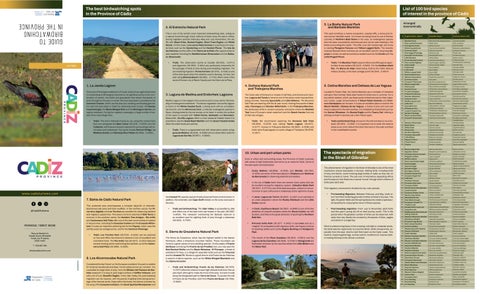
The best birdwatching spots in the Province of Cádiz
List of 100 bird species of interest in the province of Cádiz 2. El Estrecho Natural Park
5. La Breña Natural Park and Barbate Marshes
This is one of the world’s most important birdwatching sites, acting as a natural funnel through which millions of birds cross the sea to Africa. During migration periods (February–May and July–November), the sky fills with Black Kites, Booted Eagles, Short-Toed Eagles and White Storks. On the coast, Los Lances Natural Area is a sanctuary for coastal birds such as the Sanderling and the Kentish Plover. The Isla de las Palomas and the cliffs of the Sierra de la Plata offer opportunities to spot seabirds including the Mediterranean Shearwater and the Balearic Shearwater.
This park combines a marine ecosystem, coastal cliffs, a stone pine forest and an intertidal marsh. It is known for being home to one of the few colonies of Northern Bald Ibises in the area, an endangered species that has been successfully reintroduced and can be seen feeding in the fields surrounding the marsh. The cliffs, over 100 metres high, are home to nesting Peregrine Falcons and Yellow-Legged Gulls. The recently restored Barbate River marshes are an excellent spot for observing Ospreys in winter, as well as numerous waders such as the Dunlin and the Little Ringed Plover.
•
Trails: The observation points at Cazalla (36.0331, -5.5771) and Algarrobo (36.0903, -5.4841) are particularly noteworthy for the passage of birds of prey during post-breeding migration. For pre-breeding migration, Punta Carnero (36.0761, -5.4291) is one of the best spots when the westerly wind is blowing. On foot, the path along Bolonia Beach (36.0881, -5.7743) offers views of the ancient Roman city of Baelo Claudia and the Sierra de la Plata.
1. La Janda Lagoon Once one of the largest wetlands in Europe, today it is an agricultural area of outstanding ornithological importance. Its significance lies in the combination of canals, rice fields and grasslands that attract thousands of birds throughout the year. In winter, the main spectacle is provided by the Common Cranes, which use the area as a roosting and feeding ground. It is also the best place in Cádiz for observing birds of prey: the Iberian Imperial Eagle, the Black-Winged Kite and the Montagu’s Harrier are regular residents. During the migratory passages, a large number of waders find a vital refuge here. •
Trails: The trail is followed mainly by car, along the central track that runs alongside the Main Canal (36.2415, -5.8342) and the Collector, with frequent stops to explore the surroundings with binoculars and a telescope. Key spots include Pericón Bridge, La Mediana Estate and Benalup Rice Fields (36.2652, -5.8361).
•
4. Doñana Natural Park and Trebujena Marshes 3. Laguna de Medina and Endorheic Lagoons Medina Lagoon is the largest in the province and is a key site for the breeding of endangered waterbirds. The dense vegetation around the lagoon is home to the White-Headed Duck, a diving duck with an unmistakable blue bill, and the Moroccan Coot, a critically endangered species in Spain, distinguished by the red bumps on its head. In winter, the surface of the water is covered with Tufted Ducks, Gadwalls and Shovelers. Meanwhile, Zorrilla Lagoon offers a more seasonal habitat where it is possible to see the Great Reed Warbler and the Great Crested Grebe when the water levels are optimal. •
The Cadiz side of Doñana is a mosaic of salt flats, pine forests and marshes. Laguna del Tarelo is home to one of the area’s most important breeding colonies, featuring Spoonbills and Little Bitterns. The Bonanza Salt Flats are teeming with life all year round, hosting thousands of Avocets, Flamingos and Slender-Billed Gulls. In the Trebujena Marshes, the landscape shifts to ancient estuaries and plains where the Marbled Teal (one of Europe’s rarest waterfowl) and the Marsh Harrier find one of their last refuges. •
Trails: There is a signposted trail with observation points at Laguna de Medina (36.6135, -6.0585) and an observation point for Laguna de Zorrilla (36.8671, -5.8649).
Trails: We recommend exploring the Bonanza Salt Flats (36.8246, -6.3376) and visiting Tarelo Lagoon (36.8471, -6.3177). Access to Trebujena Marshes (36.8922, -6.2296) and Codo de la Esparraguera is via the village of Trebujena (36.8728, -6.1817).
10. Urban and peri-urban parks Even in urban and surrounding areas, the Province of Cádiz surprises with areas of high biodiversity that serve as an oasis for birds. Some of the best spots are listed below:
7. Bahía de Cádiz Natural Park This protected area encompasses a complex labyrinth of channels, abandoned salt pans and tidal mudflats. In the northern sector, the Pinar de la Algaida and Los Toruños are excellent for observing resident and migratory passerines. This area is home to colonies of little Terns in summer. In the southern sector, the Sendero Tres Amigos – Río Arillo and Carboneros Salt Flats offer one of the best communities of waders in the province, including the Eurasian Curlew and the Eurasian Whimbrel. It is also an important wintering site for the Osprey, which uses the salt flat posts as vantage points, and for the Common Flamingo. •
Trails: Los Toruños Park (36.5724, -6.2162) can be explored on foot and offers the chance to observe a mix of woodland and marshland birds. The Río Arillo trail (36.4573, -6.2313) features several viewing points overlooking the salt flats, as do the Carboneros Salt Flats (36.3895, -6.1830).
8. Los Alcornocales Natural Park Considered the last ‘forest’ on the European mainland, this park is notable for its dense woodlands and deep, humid valleys known as ‘canutos’. It is a paradise for large birds of prey; from the Mirador del Pantano de Barbate viewpoint, it is easy to spot large numbers of Griffon Vultures, and with a bit of luck, Bonelli’s Eagles. In the Ojén Valley, the post-breeding migration can be massive, with thousands of gliding birds taking advantage of the thermal winds. Deep within the forest, the silence is broken by the song of the Eurasian nuthatch, the Great Spotted Woodpecker and
the Crested Tit, species typical of well-preserved forest environments. In addition, the extremely rare Cape Swift breeds on the rocky outcrops in the area. •
Trails and birdwatching: The Ojén Valley is accessible by bike and offers one of the best holm oak forests in the park (36.2097, -5.5435). The viewpoint overlooking the Barbate reservoir is an excellent spot for sighting birds of prey through a telescope (36.3810, -5.7424).
•
Costa Ballena (36.6958, -6.4106) and Montijo (36.7610, -6.4004) are some of the best places in Chipiona and Sanlúcar de Barrameda for observing seabirds and waders.
•
In the city of Cádiz itself, there are several urban parks that can be excellent during the migratory season. Celestino Mutis Park (36.5247, -6.2770) is one of the best examples, where it is not uncommon to spot a Wryneck or a Blackcap at the right time of year.
•
In Jerez, Laguna de Torrox (36.6637, -6.1457) is an example of an urban adaptation where the Ruddy Shelduck and the Little Grebe coexist.
•
In Conil, Castilnovo Beach (36.2623, -6.0846) is one of the few stretches of unspoilt coastline where the Stone Curlew can still be seen, and there is the great attraction of spotting the Northern Bald Ibis.
•
Princess Sofia Park (36.1577, -5.3452) in La Línea acts as a ‘magnet’ for exhausted small migratory birds, serving as a mecca for spotting rarities such as the Pygmy Bunting and Hodgson’s Pipit.
•
The mouth of the River Guadiaro (36.2810, -5.2801) and the Laguna de las Camelias (36.2936, -5.2736) in Sotogrande are freshwater enclaves by the sea that attract the Little Bittern and the Water Rail.
9. Sierra de Grazalema Natural Park The Sierra de Grazalema, which has the highest rainfall in the Iberian Peninsula, offers a limestone mountain habitat. These mountains are home to a good variety of rock-dwelling species. On the peaks of Puerto del Boyar and along the Puerto de las Presillas trail, you may spot the Red-Backed Shrike and the Black Wheatear. El Pinsapar, a forest of prehistoric fir trees, is a refuge for specialist birds such as the Firecrest and the Crested Tit. Winter is a good time to visit Puerto de las Palomas in search of alpine species, such as the White-Winged Blackbird and the Alpine Accentor. •
Trails and birdwatching: Puerto de las Palomas (36.7876, -5.3767) offers the chance to spot high-altitude birds from the car park itself, although to make the most of the area, it is best to walk along the designated path to Cerro de Coros. To access the trail to Puerto de las Presillas, start from Puerto del Boyar (36.7556, -5.3949).
Trails: The Marshes Trail is easy to follow and offers good opportunities to see waders (36.2419, -5.9493). For the Northern Bald Ibis, the Barca de Vejer observatory, built by the Cádiz Natural History Society, is the best vantage point (36.2545, -5.9574).
6. Cetina Marshes and Dehesa de Las Yeguas Located in Puerto Real, the Cetina Marshes are a complex of industrial salt pans that maintain ideal water levels for birds even in summer. It is a key site for waders, which use these pools to feed and rest on their migratory routes. Large concentrations of Black-Tailed Godwits and Common Sandpipers can be seen. It is also an excellent place to look for the Marsh Warbler. Dehesa de las Yeguas, a forest of pine and cork oak trees is adjacent to the salt marshes. It is inhabited by forest birds such as the Iberian Wheatear, the Booted Eagle and the Tawny Owl, offering a striking contrast in species just a few metres apart. •
Trails and birdwatching: Access to the salt marshes is via a footpath (36.5631, -6.1459). It is important not to enter the reserve areas so as not to disturb the birds that nest on the walls and feed in the crystallisation ponds.
The spectacle of migration in the Strait of Gibraltar The phenomenon of migration in the Strait of Gibraltar is one of the most impressive natural spectacles in Europe. Gliding birds, including birds of prey and storks, avoid crossing large bodies of water as they rely on thermal currents to travel. The just over 14 kilometres separating Africa and Europe turn the Strait into a natural ‘funnel’ through which millions of birds pass each year. This migratory movement is divided into two main periods: •
Pre-breeding Migration: Between February and May, birds return from their wintering grounds in Africa to breed in Europe. The light, the green fields and the spring blossoms create a spectacular backdrop for enjoying the return of these species.
•
Post-breeding migration: From July to November, adult birds and this year’s young set off on their journey south. This is the period when the greatest number of birds can be observed, with skies that may literally be covered by thousands of kites, eagles and storks in a single day.
Wind is a determining factor in the crossing: with light or moderate winds, the birds take the opportunity to cross the Strait, whilst strong winds, especially from the east, tend to hold them back on the Cadiz coast. This leads to massive gatherings, as they wait for conditions to improve before making the leap to the African continent.
Arranged taxonomically #
English Name (eBird)
Scientific Name
Common Name (ES)
1 2 3 4 5 6 7 8 9 10 11 12 13 14 15 16 17 18 19 20 21 22 23 24 25 26 27 28 29 30 31 32 33
Marbled Duck Red-crested Pochard Ferruginous Duck White-headed Duck Common Quail Red-legged Partridge European Turtle-Dove Little Bustard Great Spotted Cuckoo Red-necked Nightjar Alpine Swift Pallid Swift Little Swift White-rumped Swift Red-knobbed Coot Western Swamphen Common Crane Eurasian Thick-knee Black-winged Stilt Pied Avocet Kentish Plover Curlew Sandpiper Collared Pratincole Slender-billed Gull Audouin’s Gull Mediterranean Gull Little Tern Gull-billed Tern Whiskered Tern Lesser Crested Tern Greater Flamingo Black-necked Grebe Scopoli’s Shearwater
Marmaronetta angustirostris Netta rufina Aythya nyroca Oxyura leucocephala Coturnix coturnix Alectoris rufa Streptopelia turtur Tetrax tetrax Clamator glandarius Caprimulgus ruficollis Tachymarptis melba Apus pallidus Apus affinis Apus caffer Fulica cristata Porphyrio porphyrio Grus grus Burhinus oedicnemus Himantopus himantopus Recurvirostra avosetta Charadrius alexandrinus Calidris ferruginea Glareola pratincola Chroicocephalus genei Larus audouinii Ichthyaetus melanocephalus Sternula albifrons Gelochelidon nilotica Chlidonias hybrida Thalasseus bengalensis Phoenicopterus roseus Podiceps nigricollis Calonectris diomedea
34 35 36 37 38 39 40 41 42 43
Balearic Shearwater Black Stork White Stork Glossy Ibia Northern Bald Ibis Eurasian Spoonbill Little Bittern Squacco Heron Purple Heron Osprey
Puffinus mauretanicus Ciconia nigra Ciconia ciconia Plegadis falcinellus Geronticus eremita Platalea leucorodia Botaurus minutua Ardeola ralloides Ardea purpurea Pandion haliaetus
Cerceta pardilla Pato colorado Porrón pardo Malvasía cabeciblanca Codorniz común Perdiz roja Tórtola europea Sisón común Críalo europeo Chotacabras cuellirrojo Vencejo real Vencejo pálido Vencejo moro Vencejo cafre Focha moruna Calamón común Grulla común Alcaraván común Cigüeñuela común Avoceta común Chorlitejo patinegro Correlimos zarapitín Canastera común Gaviota picofina Gaviota de Audouin Gaviota cabecinegra Charrancito común Pagaza piconegra Fumarel cariblanco Charrán bengalí Flamenco común Zampullín cuellinegro Pardela cenicienta mediterránea Pardela balear Cigüeña negra Cigüeña blanca Morito común Ibis eremita Espátula común Avetorillo común Garcilla cangrejera Garza imperial Águila pescadora
44 45 46 47 48 49 50 51 52 53 54 55 56 57 58 59 60 61 62 63 64 65 66 67 68 69 70 71 72 73 74 75 76 77 78 79 80 81 82 83 84 85 86 87 88 89 90 91 92 93 94 95 96 97 98 99
Black-winged Kite Egyptian Vulture European Honey-buzzard Rüppell’s Griffon Griffon Vulture Short-toed Snake-Eagle Booted Eagle Spanish Eagle Bonelli’s Eagle Montagu’s Harrier Eurasian Scops-Owl Eurasian Eagle-Owl Little Owl Eurasian Hoopoe European Bee-eater European Roller Iberian Green Woodpecker Lesser Kestrel Eurasian Golden Oriole Iberian Gray Shrike Woodchat Shrike Red-billed Chough European Crested Tit Thekla’s Lark Greater Short-toed Lark Calandra Lark Mediterranean Short-toed Lark Zitting Cisticola Western Olivaceous Warbler Melodious Warbler Eurasian Crag-Martin Red-rumped Swallow Common Bulbul Western Bonelli’s Warbler Iberian Chiffchaff Cetti’s Warbler Western Orphean Warbler Sardinian Warbler Western Subalpine Warbler Greater Whitethroat Spectacled Warbler Dartford Warbler Spotless Starling Rufous-tailed Scrub-Robin Common Rock-Thrush Blue Rock-Thrush European Stonechat Western Black-eared Wheatear Black Wheatear Spanish Sparrow Rock Sparrow Western Yellow Wagtail Tawny Pipit European Serin Corn Bunting Rock Bunting Cirl Bunting
Elanus caeruleus Neophron percnopterus Pernis apivorus Gyps rueppelli Gyps fulvus Circaetus gallicus Hieraaetus pennatus Aquila adalberti Aquila fasciata Circus pygargus Otus scops Bubo bubo Athene noctua Upupa epops Merops apiaster Coracias garrulus Picus sharpei Falco naumanni Oriolus oriolus Lanius meridionalis Lanius senator Pyrrhocorax pyrrhocorax Lophophanes cristatus Galerida theklae Calandrella brachydactyla Melanocorypha calandra Alaudala rufescens Cisticola juncidis Iduna opaca Hippolais polyglotta Ptyonoprogne rupestris Cecropis rufula Pycnonotus barbatus Phylloscopus bonelli Phylloscopus ibericus Cettia cetti Curruca hortensis Curruca melanocephala Curruca iberiae Curruca communis Curruca conspicillata Curruca undata Sturnus unicolor Cercotrichas galactotes Monticola saxatilis Monticola solitarius Saxicola rubicola Oenanthe hispanica Oenanthe leucura Passer hispaniolensis Petronia petronia Motacilla flava Anthus campestris Serinus serinus Emberiza calandra Emberiza cia Emberiza cirlus
Elanio común Alimoche común Abejero europeo Buitre moteado Buitre leonado Culebrera europea Águila calzada Águila imperial ibérica Águila perdicera Aguilucho cenizo Autillo europeo Búho real Mochuelo europeo Abubilla común Abejaruco europeo Carraca europea Pito ibérico Cernícalo primilla Oropéndola europea Alcaudón real Alcaudón común Chova piquirroja Herrerillo capuchino Cogujada montesina Terrera común Calandria común Terrera marismeña Cistícola buitrón Zarcero bereber Zarcero políglota Avión roquero Golondrina dáurica Bulbul naranjero Mosquitero papialbo Mosquitero ibérico Cetia ruiseñor Curruca mirlona Curruca cabecinegra Curruca carrasqueña Curruca zarcera Curruca tomillera Curruca rabilarga Estornino negro Alzacola rojizo Roquero rojo Roquero solitario Tarabilla europea Collalba rubia occ. Collalba negra Gorrión moruno Gorrión chillón Lavandera boyera Bisbita campestre Serín verdecillo Escribano triguero Escribano montesino Escribano soteño
100