From the Editor...
Country Life in North Texas & Southern Oklahoma
STAFF & CONTRIBUTORS PUBLISHERS Austin & Jennifer Lewter alewter@ntin.net EDITOR Jessica Edwards editor@ntin.net MARKETING DIRECTOR Sherrie Nelson sales@texomafarmandhome.com CONTRIBUTING WRITERS & PHOTOGRAPHERS Rhiley Montoya Caroline Crain
As we turn the pages of another spring and summer season across Texoma, we’re reminded of the simple things that make this region such a special place to call home. From sunrises over open pastures to evenings spent on front porches with family and friends, country living offers a perspective that feels increasingly valuable in today’s fast-paced world. This year carries special significance as our nation begins celebrating the 250th anniversary of the United States. For two and a half centuries, the American story has been shaped not only in large cities and historic landmarks, but also in small towns, family farms and rural communities like those that define Texoma. The values that built this country—hard work, self-reliance, faith, community and a deep connection to the land—continue to thrive here. As we commemorate this milestone, it’s worth taking a moment to appreciate the freedoms and opportunities we enjoy, as well as the people who help preserve our rural way of life. Farmers, ranchers, business owners, volunteers and neighbors all play a role in keeping our communities strong and ensuring these traditions are passed on to future generations. In this issue of Texoma Farm & Home, you’ll find stories, ideas and inspiration that celebrate the people, places and lifestyles that make our corner of the country unique. Whether you’re tending a garden, caring for livestock, improving your home or simply enjoying the beauty of the season, we hope this edition reminds you why country living remains one of America’s greatest treasures. Thank you for allowing us to be part of your community. Here’s to a season of growth, gratitude and celebrating 250 years of the American spirit. Jessica Edwards Editor- Texoma Farm & Home
LEWTER PUBLISHING
Pg. 12
Pg. 6
WHITESBORO, TEXAS
Publishers of the
Pg. 10 Texoma Farm & Home PO Box 68 - 130 East Main St. Whitesboro, Texas 76273
903.564.3565
texomafarmandhome.com 2 - texomafarmandhome.com
Texoma Farm & Home is a high quality quarterly magazine dedicated to country life in North Texas and Southern Oklahoma. We strive to give our readers and advertisers the best possible service. Our rate card is applied equally to all. This magazine reserves the right to reject any advertisement at the discretion of the publisher. The advertiser shall defend and indemnify and hold harmless Texoma Farm & Home against any claim of liability or loss asserted or established against it by reason. The company’s liability for major errors lessening the value of an advertisement shall be limited to any advertisement or any part thereof submitted by or published at discretion of the advertiser. The company’s liability for major errors lessening the value of an advertisement shall be limited to the advertisement as it shall elect.
texomafarmandhome.com - 3
H
“
Enjoy Big Adventures & Quiet Conversations Hear all the sounds of spring! Widex Allure™ combines new and updated features for crystal clear speech and accurate environmental sound. You’ll experience a natural clarity powered by a new W1 Chip that is 4x faster with 4x memory capacity. You’ll hear an improvement in speech intelligibility with the help of directional mics, noise reduction, and feedback cancellation. THE DIFFERENCE IS CLEAR
Widex Allure™ delivers every voice sound with greater balance, vibrancy and authenticity than ever before. • Precision Hearing technology
• Speech Enhancer Pro
• Bluetooth-hands free phone calls & streaming
• AI Sound Assistant- create instant listening environments
• 28-hr battery life
Jill Sheppard, B.S., SLP/Audiology, Kenneth Sheppard, Jr., LFDHI
When you have a hearing loss, it forces your brain to work harder to interpret sounds, leaving you frustrated, exhausted, and often feeling isolated. It can also lead to more rapid cognitive decline for some people, which can be frightening. The good news is that with WIDEX’s remarkable hearing aid technology coupled with brain training customized to your needs, you can stay fully engaged with your life. Imagine the joy of casual conversations, streaming music, differentiating the sounds of nature! We want to help you maintain your independence so you can engage with friends and family – with life – more easily. Call now. We want to help you hear well in the year ahead.
”
Jill Sheppard, B.S., SLP/Audiology, Licensed Fitter and Dispenser of Hearing Instruments (LFDHI), Certified Dementia Practitioner (CDP), Co-owner of HearCare & Associates
1800 N. Travis St., Suite D • Sherman, TX 75092 • 903.868.2650 | 800 E. California, Suite 4 • Gainesville, TX 76240 • 903.868.2650 | www.hearcareinc.com
Expertise • Integrity • Good Humor • Compassion
It’s worth your time. It’s about your life. 4 - texomafarmandhome.com Hearcare, Inc. & Associates, TX - SW32677 February Whitesboro Texoma Farm & Home.indd 1
1/7/2026 9:43:57 AM
HEALTH
Train Your Brain to Hear Better Sponsored Content
T
he technology – and the expertise – are here. The astounding combination of auditory training, along with innovative hearing devices, can help enhance listening skills and improve speech understanding. Which is remarkable in itself, because struggling to understand communications is exhausting. When we can’t hear, our brains work harder, possibly diverting resources from memory or critical thinking. Since research suggests that hearing loss is a common chronic health condition among older adults, it’s especially disconcerting to know that, if left untreated, it can affect cognitive function. The good news is that treating hearing loss may help prevent or slow cognitive decline. Adding auditory training is a holistic approach that addresses both sensory and cognitive needs using specialized communication techniques and advanced technology that can help you process sounds more effectively. There’s even an app designed to help train your brain. Jill Sheppard, B.S., SLP/Audiology, Licensed Fitter and Dispenser of Hearing Instruments (LFDHI), and co-owner of HearCare & Associates in Sherman and Gainesville, is now a Certified Dementia Practitioner (CDP), bringing added knowledge and skills for your highest level of care. “Nobody wants to admit their world is getting muffled or feel isolated when they can’t follow a conversation,” Sheppard said. “But there is growing evidence that auditory training, combined with hearing aids customized to your hearing loss and lifestyle, can help alleviate the strain and enhance your ability to hear in a variety of environments.” Auditory training is a clinically validated process that helps you hear with your brain, not just your ears. It improves hearing comprehension and strengthens
listening skills to support easier hearing and recognition. Even without cognitive difficulties, consider the ways hearing loss diminishes your quality of life. You may find yourself turning up the volume on the TV or struggling with phone conversations. Maybe you try to avoid asking people to repeat themselves. Some stop listening to favorite music. Crowds may become overwhelming. It’s easy to see why withdrawing from challenging environments is a common choice. What if you could hear well again, rediscovering the joys of sounds that are important to you? We don’t put off getting glasses or contacts to improve our vision. Why wait to improve your ability to hear clear, natural sounds again? There are remarkably sophisticated hearing aids available now that are practically invisible, that produce a pure spectrum of sound, that connect you with streaming devices, that hold a charge for up to 37 hours and that utilize new technology to reduce background noise, helping you focus on what you want to hear. And they come in a variety of colors! So, what’s keeping you from getting your hearing evaluated? Hearing loss is easy to deny and can be hard to adjust to. At HearCare and Associates in Sherman and Gainesville, we know that admitting you have hearing problems can be a challenge – even if you’re simply acknowledging it to yourself. “Many people are proactive about having their hearing checked, but for others, it might take having something happening in their life, or with someone they love – or they miss something very important,” said Kenneth Sheppard, Jr., Licensed Fitter and Dispenser of Hearing Instruments (LFDHI), and co-owner of HearCare & Associates.
“The first step is having your hearing assessed to determine the cause of your difficulty,” Jill Sheppard continued. “It’s an easy process that’s painless, non-threatening and, according to some of our patients, even fun! You’ll want to learn the root cause of your hearing difficulty and treat it in a way that meets your preferences, budget and lifestyle.” You’ll want to learn about all your options, including the remarkable new precision hearing technology that is clear, intuitive and future ready! For instance, the WIDEX Allure™ is powered by a W1 chip that is four times faster and has four times the memory capacity, offering the ultimate balance between clear speech and natural awareness. What that means for you is the ability to hear purer sounds with greater ease; a seamless sound quality that mirrors the natural auditory system. Features include a wind- and touch-resistant microphone, an enhanced push button for phone conversations, LE audio streaming, optional apps and accessories and a more comfortable position behind the ear – even if you wear glasses. Learn how the newest technology and the additional benefits of brain training can help you enjoy an active life again. There’s confidence that comes with hearing well; a delightful ease in connecting with friends and family. We want you to hear well again. Call HearCare & Associates at 800868-2650 today. We look forward to hearing from you.
texomafarmandhome.com - 5
EQUINE
Champions built in North Texas by Rhiley Montoya
A
mong the red dirt of Whitesboro sits a facility that has quickly grown into one of the area’s premier horse training operations. For more than two decades, Knabenshue Performance Horses has combined high-level competition with client connection, creating successful riders. What began as a leap of faith has turned into a well-known training program. After getting married, Will and Elizabeth Knabenshue knew it was time to build something of their own. Will, who had already established himself under other respected trainers, knew he was ready to branch out. The couple purchased their Whitesboro property in 2005 and has since expanded steadily. Both bring their own experience from the equine industry. Will grew up working with horses in Virginia and moved to Texas after high school to pursue a training career under a well-known trainer. Elizabeth developed her passion after receiving riding lessons as a child following a family transition from Michigan to California. Their program focuses on all-around performance horses, primarily Quarter Horses. They compete in disciplines such as trail, western riding, horsemanship, equitation, showmanship, performance halter and some hunter under saddle. Knabenshue Performance Horses has coached multiple champions through local and national competitions. “Local shows are the backbone of our industry,” Elizabeth said. “It’s important to support them.” Along with attending the local shows, the couple regularly travels across the United States for larger competitions, which often span over multiple weeks. The facility typically keeps about 20 horses in training, a size that allows for a more individualized approach. “Individuality is what sets us apart,” Elizabeth said. “We tailor our program to
6 - texomafarmandhome.com
Knabenshue Performance Horses’ Copy and Paste and Sandy Lipscomb earned Circuit Champion L1 Select Western Riding, Res Circuit Champion L2 Select WR, Reserve Champion Coast to Coast Sel WR, Reserve Champion Coast to Coast L3 Sr WR. each horse and rider.” That approach includes setting daily and long-term goals while also making sure they match horses with riders based on compatibility and skill level. “We are building a team that can grow together,” she said. The program serves a range of clients, primarily intermediate to advanced riders, including youth, amateur and select competitors. Daily operations begin early, with the couple meeting to discuss daily goals, followed by training sessions. The business is run by the Knabenshues along with a small staff, including an assistant ranch hand. Working with horses presents ongoing challenges, particularly due to their unpredictable nature. “Every day is different,” Elizabeth said. “You might have everything go as planned, or you might spend the day dealing with something unexpected.” Elizabeth explains that one of the most common misconceptions about horse training is the expectation of fixed time-
lines. “Horses are not machines,” she said. “Each one has its own timeline and learning process.” Despite this, the program has seen consistent success over the years. Among the recent successes, the couple’s daughter earned major titles at national competitions and has committed to competing on the Texas A&M equestrian team. The family’s connection to Whitesboro extends beyond the business. Their daughter attends Whitesboro High School while also continuing to be active in the community. “We’ve been here for 22 years,” Elizabeth said. Looking ahead, the Knabenshues plan to continue growing their program while maintaining its focus on individualized training. “Our goals never stop growing,” she said. “We’re always challenging ourselves and our clients to be better.” In Whitesboro, that commitment has built more than a business. It’s built a community.
texomafarmandhome.com - 7
8 - texomafarmandhome.com
texomafarmandhome.com - 9
FAMILY
Ryndi and Rowdy Lanier operate Two Peas in a Pod and Lanier Farms Country Store in Petersburg, Oklahoma.
What grew after grief:
Two Peas in a Pod Greenhouse and Lanier Farms Country Store
O
n a quiet ranch outside Petersburg, Oklahoma, life moves at a slower pace. The days begin with chores. Milk gets bottled in glass jars. Chickens are moved to fresh ground. Cattle are fed. Garden boxes are filled. The greenhouse hums during the busy season, and the family behind it all works side by side. For Ryndi Lanier, that rhythm is intentional. “We live here on the ranch,” Lanier said. “We hardly ever leave. We just kind of live our own life out here. We grow our garden. Our eggs are here. Our beef is here. So we really don’t leave.” Lanier and her husband Rowdy first met at a bonfire when they were 16 years old. Years later, after college and a move back to the area, they built a
10 - texomafarmandhome.com
By Caroline Crain
life rooted in family, ranch living and self-sufficiency. That life now centers around Two Peas in a Pod Greenhouse and Lanier Farms Country Store: businesses that grew from something far deeper than entrepreneurship. Each day on the property revolves around family labor and farm life. “We milk together. We pick the garden together. We do the greenhouse together,” Ryndi said. “If I can’t do it, Rowdy does it. We just kind of all pick up the slack.” Ryndi said the business continues to grow, and expansion is already in the works. “This year was a crazy year,” she said. “We’re actually expanding Two Peas.” Plans include a new 120-foot greenhouse that would allow the family to
grow vegetables year-round, increase plant inventory and expand offerings. “We’ll have double to triple the inventory,” Ryndi said. The greenhouse may now be full of life when open — rows of plants, families stopping by, children helping carry trays — but its roots trace back to a season marked by loss. In 2023, the Laniers welcomed twin boys. Shortly after birth, they lost one of them to spina bifida. The loss changed everything. Ryndi said grief left her to navigate a reality she never imagined. There was still a child to care for, a family to hold together and a life continuing forward, even while grief lingered in every moment. She described losing a child as something that goes against the natural order of life.
FAMILY “It’s not the way the torch is supposed to be passed in life,” Ryndi said. “I’m supposed to go before my kids.” The pain was not something she could simply move through and leave behind. She said there were days when she questioned everything. In the middle of that heartbreak, Ryndi said she searched for anything that could offer comfort or purpose. “During the grieving process, you’re searching for something that just brings you joy,” she said. That joy came unexpectedly through flowers. Ryndi said she rediscovered comfort in gardening and eventually decided to start a greenhouse. The business name carried personal meaning. “The name comes from the twins — Two Peas in a Pod,” she said. What started as a small idea quickly became something larger. “It just kind of took off,” Ryndi said. The greenhouse serves a purpose beyond selling plants. Through the business, the family funds the Tate Lanier Foundation, a nonprofit created in honor of the son they lost. The foundation primarily supports families connected to the NICU at Mercy Hospital in Oklahoma City. “We help families that are in the NICU,” Ryndi said. “If they need help with travel expenses or grocery expenses or they just need to take their kids that they have at home out for a fun day and spend quality time with them, that’s where we help.” The nonprofit also steps in during the hardest moments. “If the unfortunate event occurs, then we will step in and help with funeral expenses,” she said. For Ryndi, helping others became part of healing. She said grief reshaped her purpose. “If there is any way that I can help somebody who’s dealing with grief, absolutely,” Ryndi said. “I just want to bring joy into people’s lives.” Another piece of that healing came through writing.
Ryndi wrote a book titled “Until We Meet Again” during the grieving process. The proceeds from the book funded the startup costs of the nonprofit. The book follows Little Opossum, who learns about a brother he never knew through stories from Mamma Opossum. Ryndi said it was written to help parents explain grief and loss to children in a gentle way. The idea came from the Laniers’ surviving twin. “He would play opossum all throughout the NICU,” Ryndi said. “We would think he was asleep, and then he’d wake up and just be looking at us. So we nicknamed him the opossum.” Writing the book became both an outlet and a message. “I think it was an outlet for the grief, but I also wanted it to be able to help others to know we will see them again,” Ryndi said. “It’s just a snippet of time. If we can just get through it and see all the joys, then we’ll be okay.” Today, the family business extends beyond the greenhouse. At Lanier Farms Country Store, customers can purchase farm-raised products that reflect how the family eats at home. The shelves are stocked with beef, pork, chicken, dairy and farm goods, many sourced directly from their ranch. “We created this store to where it’s like a snippet of our life,” Ryndi said. “When you come in, you’re able to buy the goods that we eat on the daily.” After losing her son, Ryndi said she began looking more closely at health, food and lifestyle. “It made me look at everything with a different outlook,” she said. “We’ve got to choose a healthier lifestyle.” The store is meant to give others that option too. “It gives everybody an easy option to eat healthier and live better and just be there for your family a little longer,” she said. The business itself has grown beyond what she originally imagined. “The initial vision was just enough to make sure we could help the few families
that needed help,” Ryndi said. For the first couple of years, the greenhouse quietly supported the nonprofit. Then demand surged. “This year, it just went crazy,” Ryndi said. “And I’m so thankful. But at the same time, I’m like, ‘What did we create? What did we do?’ So did I ever plan on being this far into it? Absolutely not. But I’m so grateful. I’m so grateful.” Even as the business expands, Ryndi said the mission stays the same. “The joy that Tate brought to us in that short amount of time, I want to spread it,” Ryndi said. Faith remains a central part of that mission. “If somebody asked me how I made it through, I would definitely tell them, during the time, I thought I was stranded in a place of, nobody was there. I was in the middle of grief. God was not listening to me. I mean, I pleaded, like, ‘Why am I not getting to keep my son? Why are you taking him?’ And then now, I would tell anybody He’s always there. I would say my faith, when push comes to shove, if it was not for my husband and my faith, I would have never made it through the grief. I would just say my faith held me strong through it all.” When asked what she hopes people take away from her story, Ryndi returned to the same message that shaped the greenhouse, the foundation and the store. “I just hope that people see that in the darkest of times, for starters, the good Lord, even though you don’t think that He’s there, He’s holding your hand through it,” Ryndi said. “Because there are times where I was so mad and so bitter, but I didn’t see it. And I hope that people do realize, like, ‘Okay, He is there. He’s helping us. No matter what, He’s always going to be there.’” For Ryndi, Two Peas in a Pod is not simply a business. It is a family operation. A nonprofit. A place of healing. And in many ways, it is proof that something meaningful can still grow after loss.
texomafarmandhome.com - 11
Wine Country in North Texas By Jessica Edwards
Rancho Sereno celebrates the fruit of sandy soil
A
round a tree-lined bend in the quiet countryside between Whitesboro and Callisburg, just off FM 678, sits The Vineyards at Rancho Sereno. Owned by Lisa Maberry and her husband Mike, the winery offers a peaceful respite from the rush of everyday life. For years, Maberry bred and raised reining horses, a career that first brought her to the Whitesboro area. But after suffering a broken hip, not only were her horse show days over, the joy she once found in raising horses faded as well. She found herself at a crossroads. “At that point I wondered, do I want to retire and do nothing? No, I’ll get bored,” Maberry said.
12 - texomafarmandhome.com
Looking for a new hobby, Maberry turned to friends in St. Jo, who told her about the T.V. Munson Viticulture and Enology Center at Grayson College in Denison — one of the few degree-granting grape-growing and winemaking programs in the country, and the first of its kind at a Texas community college. Established in 1988, the center serves as a repository for documents and historical materials related to Munson, while also housing research, classroom and conference facilities. The grape rootstocks Munson recommended for Phylloxera resistance in Europe and California are still widely used around the world today. Maberry decided to visit the school to see whether it inter-
The Vineyards at Rancho Sereno is home to more than 2,000 grapevines, which are harvested by hand to produce high-quality wines from the fertile soil of Texoma.
ested her. It did. “It grew from there and I got carried away,” Maberry said with a laugh. “Now I have over 2,000 vines and I’m making wine.” It was there that Maberry met Krista Hartman, a former golf pro turned wine enthusiast. After moving to Dallas from Chicago, where she worked as a leasing agent for high-rise skyscrapers, Hartman and her husband developed an interest in wine. After visiting a tasting room whose wine was “okay but not stellar,” Hartman recalled her husband saying, “I think we can do this!”
Hartman attended the Texas Wine and Grape Growers Association’s grape camp in 2014 and later made a 48-bottle wine kit at home. She quickly realized she loved the process. Shortly after turning 50, she enrolled in the program at Grayson College. Through the program, Maberry and Hartman discovered they were both located within the Texoma AVA (American Viticultural Area). Across the country, the Alcohol and Tobacco Tax and Trade Bureau evaluates regions based on geography, geology and soil — the characteristics that make an area unique for grape growing and wine production. Texas is home to eight AVAs, and the Texoma AVA stretches east from the
texomafarmandhome.com - 13
WINE Sherman-Denison area past St. Jo, spanning four counties. Inspired by that discovery, both women decided to establish vineyards of their own — Maberry with The Vineyards at Rancho Sereno in Callisburg, and Hartman with Red River Wines and Provisions in Sadler. In 2023, Maberry planted 750 vines. Today, she has grown to more than 2,000. She and her husband began with two grape varieties, Tannat and Mourvèdre, and added Grenache the following year. In 2025, their vineyard produced 9,000 pounds of grapes. About three miles north of Sadler, Hartman purchased her property in 2015 specifically because it was located within the Texoma AVA. She planted her vineyard in 2016 and has now spent nearly a decade building her winemaking journey. Throughout that time, she has remained focused on one major goal. “It was important to us to grow the fruit and have the wine come from our
land and into that bottle and into that customer’s glass from our property,” Hartman said. Maberry and Hartman work closely together. Maberry grows and harvests grapes, which are then sent to Hartman for winemaking. Hartman and her husband Scott maintain 2,184 vines and harvested more than 17,000 pounds of fruit in 2025. They also contract grapes from other vineyards to create additional varieties of wine. “If you combine what Lisa harvested, what I harvested, what we bought from the High Plains and what we get from another producer in Whitesboro, Breaking Bud Vineyard, almost 40,000 pounds was processed here,” Hartman said. The wine industry, both women say, is deeply collaborative. “Everybody helps everyone else all the time,” Maberry said. The grape-growing season runs from January through August, when volunteers arrive to help harvest the fruit.
Each person receives a bucket, clippers, gloves and instructions on selecting ripe clusters. “It’s usually very straightforward,” Hartman said. “Grab a cluster, clip a stem, put them in a bucket.” At both Rancho Sereno and Red River Wines and Provisions, grapes are harvested by hand — a labor-intensive process that significantly impacts quality. Unlike mass-produced grocery store wines that rely on machine harvesting, hand harvesting allows workers to inspect fruit carefully and remove damaged grapes. Likewise, the vineyards themselves are managed with precision rather than optimized strictly for volume. Once mature, grapevines follow the same annual cycle each year, including pruning, shoot thinning, canopy management and leaf thinning. At Red River Wines and Provisions, harvested grapes are brought to the production building in half-ton bins. The fruit is emptied into
SEED & FEED INC. Specializing in Custom, Conventional Peanut Meal & Milo Based Rations for
Swine · Poultry · Goats · Cattle
MUENSTER GAINESVILLE (940) 759-2241 (940) 665-2121 14 - texomafarmandhome.com
WINE a crusher-destemmer, which separates the berries from the stems before transferring them into clean bins. From there, the juice is tested for acidity, sweetness, sugar content (brix), color and aroma before fermentation begins. White and rosé wines typically take six to nine months to complete, while red wines often spend extended time aging in oak barrels, requiring different treatments and styles of care along the way. It is a process that demands patience, precision and passion. Word is beginning to spread about Texoma’s hidden gems: its local wineries. Last fall, members of the North Texas Winery Group showcased their wines at the Texas State Fair for the first time, introducing many visitors to the idea that excellent Texas wine exists far beyond the Hill Country. “We have some really good wines out here. There are some serious, educated winemakers here,” Maberry said. Today, there are around 40 wineries in North Texas wine country, with roughly five in Whitesboro and another five in St. Jo. With favorable soil, climate conditions and growing accessibility to the rapidly expanding Dallas-Fort Worth population, many believe Texoma’s wine industry is only beginning to bloom. “I suspect 20 years from now we will have a whole lot more vineyards and wineries in our area,” Maberry said. “I joke with my friends that Sherman is turning into Silicon Valley, and we’re turning into Napa.” Maberry currently manages 80 acres, where she raises Wagyu cattle, keeps seven horses, a broodmare, several barn cats and more than 2,000 grapevines. Hartman’s 30-acre property is home not only to vineyards, but also to an apiary with 12 beehives. Both wineries offer visitors delicious wines, light bites and a peaceful retreat from the hustle and bustle of daily life. Rancho Sereno is open Friday through Sunday from 1 to 6 p.m. Reservations are appreciated but not required. Guests can enjoy tastings and a variety of wines by
Whether you’re looking for a date night opportunity or want to catch up with friends, The Vineyards at Rancho Sereno offers a variety of wines, light bites and a restful atmosphere.
the glass or bottle, including selections crafted by Hartman, French winemaker Benedicte Rhyne and renowned winemaker Michael Barton. The winery also serves handmade pizzas — in a twist of fate, the pizza maker’s wife is related to T.V. Munson — along with light snacks such as peanut butter pretzels. Red River Wines and Provisions is open Fridays at 4 p.m. and offers three seatings each on Saturdays and Sundays. Hartman typically features six to seven wines on the menu at any given time. “I don’t want things to be too complicated, and the wines I do make, I want to make them well,” Hartman said. “I want people to come back for the new vintage periodically.” The winery also offers light bites for guests seeking what Hartman calls a “food nerd/wine nerd” experience, though many visitors simply enjoy wine
samples before settling onto the patio with a glass to relax and talk with friends. “When we get to the point where we can expand, we’ll have a more public-facing tasting room,” Hartman said. “We’re making plans to expand we can continue to do the curated tasting but have a more casual offering as well.” Both wineries feature peaceful patios overlooking the vines, offering visitors a quiet place to unwind and connect. As T.V. Munson famously said, “I have found my grape paradise.” Here in Texoma, Maberry and Hartman would likely agree. Learn more about both of these wineries at www.ranchosereno.com and www. redriverwines.com and plan your visit today.
texomafarmandhome.com - 15
P
Celebrate your next event in our historic building with timeless charm and modern amenities. Our venue is perfect for all gatherings -- bridal or groom dressing rooms, meetings, parties, rehearsals, reunions, showers, vendor pop-ups and wine tastings. Rentals include tables, chairs, tablecloths, decorations and so much more! Just bring your food, drinks and specialty party wares.
16 - texomafarmandhome.com
PETS
This Month’s Featured Pet...
Annie the terrier mix Annie is a terrier mix who was recently rescued by City of Whitesboro workers after being dumped on US 377. The City relocated her to Noah’s Ark Animal Shelter in Gainesville where she soon found a forever home. She now resides in Collinsville and is getting acclimated to her new family. Learn more about Noah’s Ark by visiting www.noahsarktx.com or call for more information at 940-665-9800.
Courtesy photo
texomafarmandhome.com - 17
COVER
At ViaGen, modern cloning technology enables scientists to create genetic replicas of animals, marking a significant milestone in biotechnology and genetic research.
Animal science breakthroughs being made close to home
I
By Jessica Edwards
n 1996, the world was stunned by the announcement that scientists had successfully cloned the first mammal, Dolly the Sheep, using a technique known as somatic cell nuclear transfer. In this process, DNA from a body cell is transferred into an egg cell whose own DNA has been removed. The reconstructed embryo is then stimulated to develop, ultimately producing a genetic clone of the original animal. At the time, scientist Blake Russell was working in animal genetics and reproduction for Pig Improvement Company (PIC), an international livestock genetics
18 - texomafarmandhome.com
firm. Following the breakthrough with Dolly, entrepreneur John Sperling approached Russell about helping to commercialize cloning technology. Russell saw both the scientific challenge and its potential applications for the livestock and equine industries. He began exploring how the method could be applied to horses as well as food animals such as cattle, pigs, and sheep, and more broadly to ranch and breeding operations. Roughly a decade later, Russell, along with a chief science officer and a business partner, helped establish
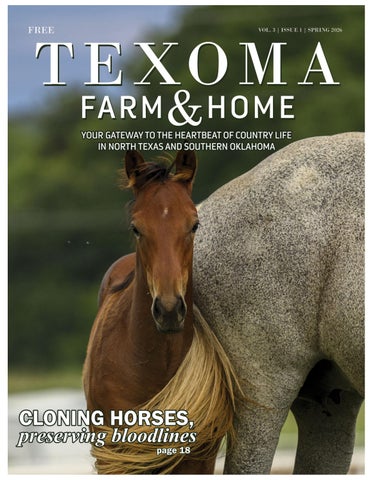
COVER ViaGen Pets and Equine. The company specializes in cloning dogs, cats, horses and select conservation species for zoos and preservation programs. Today, ViaGen produces approximately 80 foals per year at its facility in Gainesville, Texas, while pets such as puppies and kittens are born at its New York location. All of this is accomplished using the same fundamental process first demonstrated with Dolly nearly 30 years ago. The process begins with a small skin biopsy taken from the donor animal—typically a one- to two-centimeter punch that does not require surgery. The sample is sent to a cloning laboratory, where technicians grow the cells into a stable cell line. These cells are then expanded into billions of genetically identical copies and preserved in liquid nitrogen. Meanwhile, at the Gainesville facility, selected recipient mares undergo transvaginal aspiration, a procedure in which oocytes (immature egg cells) are collected directly from the ovaries. Under a microscope, the genetic material is removed from each oocyte, leaving an empty shell. A donor cell from the cultured cell line is then inserted into the egg. Through proprietary activation steps, the egg begins to divide and develop without traditional fertilization. The resulting embryos are cultured in an incubator for six to nine days before being transferred into surrogate mares. The surrogate carries the pregnancy for approximately 320 to 338 days before giving birth to the cloned foal. In essence, the client receives a genetic “twin” of their original animal, separated only by time. For many clients (including Russell himself), cloning is driven by sentimentality. His father raised racing quarter horses, including a beloved stallion named Chief Comanche, a three-time APHA world champion. After Chief’s long life in the family, he passed away at 33. A tissue biopsy was preserved with the intention of potentially cloning him in the future, preserving his genetic legacy for later generations. Beyond sentimentality, cloning also has practical applications. In equine performance and breeding, for example, a high-performing mare can be returned to competition within days rather than months required for natural breeding and recovery. Cloning also allows breeders to preserve elite genetics with a higher degree of certainty, reducing the unpredictability of traditional reproduction. In addition, sex selection techniques using semen sorting can achieve 90–95% accuracy, offering further control in breeding outcomes. About a year ago, ViaGen opened a location in Whitesboro, an area deeply rooted in the horse industry. The expansion was seen as an opportunity to contribute to local revitalization efforts.
“We’re excited to be part of an effort to perk up downtown,” said Lexie Russell, ViaGen’s contract veterinarian and Blake Russell’s daughter. “The building needed a facelift, and it took some work to get it to where it is today. But it’s fun to surround ourselves with other businesses wanting to perk up downtown as well.” Lexie acknowledges that animal cloning can be controversial but emphasizes that the company’s work needn’t be misunderstood. “Some people think we’re against animal adoption, and that’s not the case at all,” she said. “There are benefits to both. But with adoption, you can’t go back to a shelter to find a specific bloodline. We never create a clone that doesn’t already have a home, someone with a place in their heart and their home for that animal.” About six years ago, ViaGen also established the first ICSI (Intracytoplasmic Sperm Injection) laboratory in the United States. In this procedure, a single sperm is injected directly into an egg to achieve fertilization— the same type of assisted reproduction used in human IVF clinics. “Horse breeders came to us and said, if you’re able to clone horses, surely you have the technology to offer ICSI,” Lexie said. “So now we do.” Today, ViaGen offers both cloning and advanced reproductive services, giving clients options ranging from preserving genetics to achieving successful pregnancies. In October 2025, ViaGen was acquired by Colossal Biosciences, a Dallas-based biotechnology company focused on “de-extinction”—using genetic engineering and cloning technologies to recreate animals that resemble extinct species while also supporting endangered species conservation. One of Colossal’s long-term ambitions includes the possibility of cloning a woolly mammoth. “This technology opens a world of possibilities,” Lexie said. For now, ViaGen remains focused on pets and horses. The company guarantees a healthy, vet-inspected foal at 60 days of age, and for puppies and kittens, a healthy 8-week-old, vet-checked animal. Pricing varies depending on the species and program, with horse cloning averaging around $85,000, dog and cat cloning around $50,000, and ICSI services approximately $2,500. “We want our clients to know that we are as excited and invested in their hopes and dreams as they are,” Lexie said. “We would love the opportunity to be part of their animal breeding process.” For more information, visit ViaGenPetsAndEquine. com
texomafarmandhome.com - 19
World’s Largest Western Wear Outlet Store Monday-Saturday | 9AM-6PM For the BEST prices around on these GREAT brands & more... Visit our 3 stores in Justin!!! You can also find us online at www.justindiscountboots.com or visit us on Facebook & Instagram
TREAT YOUR PET TO A SWEET RETREAT
Full Grooming Service & Boarding • Each A/C & heated suite has a private run in the sun • Two outdoor play areas Resort: Open 7 days a week Salon: Open Mondays & Fridays
Gainesvil e RIDE IT OFF THE LOT. WRITE IT OFF YOUR TAXES.
SEC.179
texomafarmandhome.com - 21
22 - texomafarmandhome.com
Red River Valley Tourism Assn.
Over 300 miles of treasures just waiting for a new home!
FOR MORE INFO CALL 940-825-5330