Residential, Commercial, & TERO Certified 304 Mimosa Ln., Tahlequah, OK 74464
918-456-8192
check out our website: www.actionfloors-llc.com
“Quality Flooring at Affordable Prices”
SPECIALIZING IN:
Carpet Tile Vinyl Luxury Vinyl Plank Wood Countertops
CONTENTS 6
8 18
6
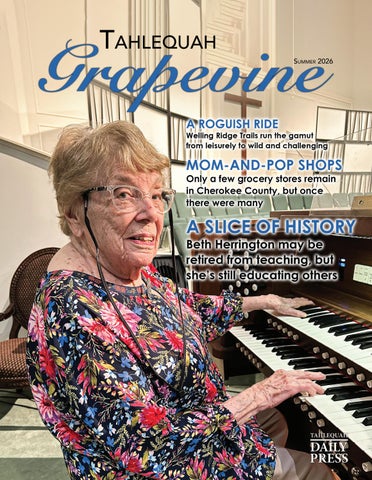
A SLICE OF HISTORY Beth Herrington may be retired from teaching, but she’s still educating others
8
MOM-AND-POP SHOPS Only a few grocery stores remain in Cherokee County, but once there were many
14 18
14 20 20
MORE OF THE TULSA SOUND Women made their marks in the genre, too: ‘Those were the days’
A ROGUISH RIDE Welling Ridge Trails run the gamut from leisurely to wild and challenging KNOW BETTER, DO BETTER Individuals can find ways to support environment
Thank You For Your Business!
We are here for all of your vision needs!
681 W. CHOCTAW • TAHLEQUAH, OK 74464 McDonald’s • 2100 Mahaney Avenue • Tahlequah, OK 74464 Next to Tahlequah Drug, Holiday Inn & Best Western • (918) 456-4740
4 Tahlequah Grapevine | Summer 2026
( 9 1 8) 4 5 6 - 2 2 5 0
WWW.TAHLEQUAHFAMILYVISION.COM
Note from the Editor
Grapevine an intriguing cooldown for a hot day
HEATHER KILPATRICK Publisher hkilpatrick@tahlequahdailypress.com
If you live near the lake or river, you can count on lots of traffic on the highways during the summer. And if you work in town, you’ll have a longer drive home than usual. First, there’s “Farmer Brown,” who could be causing congestion at any time of the year. “Farmer Brown” is a metaphor for someone who drives a tractor or old pickup 35-40 mph on Highway 10 – because he’s terrified of the curves or because his vehicle won’t go any faster. It’s important to explain Farmer Brown, because I’ve mentioned “him” periodically over my time at the Press, and several years ago, a woman called me, demanding to know who I was talking about: “Our name is Brown, and my husband is a farmer, and I was just wondering if you were aiming your insults at him.” I allowed that I might have been, if he was puttering down Highway 10 at 25 mph. She said he did his puttering on Highway 82 South, but seemed mollified. The second reason is unique to tourist season. Any caravan of traffic on 82 or 10 will likely include a “constipator” – my father’s word for someone who drives a motor home, always at about half the speed limit, and usually straddling the lanes in such a manner that other drivers can’t pass. Former elements of his definition included wealth sufficient to fund a comfortable retirement, and old age, which generally affects driving speeds. I say “former” because my dad is now almost 90 and retired himself, although I doubt this would prevent him from making fun of constipators, since he doesn’t possess the requisite vehicle. But the presence of farmers and constipators can be taken as a sign the economy is ginning along – in the case of the latter, that tourists are frequenting our area. They’ll be headed for water, where they can escape the heat summer brings to these parts. If we’re lucky, they will pick up the summer 2026 copy of Tahlequah Grapevine to put some of the “cool” back in summer. In this edition, you’ll find Renee Fite’s cover story on Beth Herrington, beloved local teacher now considered the county’s “historian in residence.” Then there’s Pam Moore’s story about women who have been prevalent in producing the “Tulsa Sound” – something Greg Combs has written about in past issues, but from the male perspective. Eddie Glenn has an intriguing piece on the Welling Ridge trail system, with some information I didn’t know. Lee Guthrie offers an interesting story on folks taking action to improve the environment around them. And Nancy Garber, tackling an assignment about grocery stores of the past, came up with a list longer than I expected. So grab a glass of iced tea, lemonade or limeade – or something a little stronger – and peruse the pages. I think you’ll like it.
MEET THE EDITOR
Kim Poindexter has been a member of the TDP news team since 1985. She is in the Oklahoma Journalism Hall of Fame and received the 2022 Oklahoma Press Association Beachy Musselman Award. She has won more than 300 journalism awards on the national and state levels, both individually and as part of the TDP team, which has been named CNHI’s Best Newspaper for five consecutive years. A noted editorial and column writer in Oklahoma, she was named OPA Editorial Writer of the Year for 2023 and this year, again for 2025, and by CNHI, Columnist of the Year. She and her husband, Chris, a facilities engineer, have an adult son, Cole, and a daughter-in-law, Dani.
KIM POINDEXTER Executive Editor kpoindexter@tahlequahdailypress.com
JOE MACK Regional Advertising Manager CONTRIBUTING WRITERS Renee Fite Nancy M. Garber Eddie Glenn Lee Guthrie Pam Moore JAY JUDAH Graphic Designer
TAHLEQUAH
Grapevine © 2026 Tahlequah Daily Press
Tahlequah Grapevine is a quarterly magazine published by the Tahlequah Daily Press. The contents of this magazine are fully protected by copyright and cannot be reproduced without express permission from CNHI, LLC.
On Beth Herrington plays the piano. She has had a lifetime love of music. The Cover Cover photo by Terri Fite Tahlequah Grapevine | Summer 2026 5
A Slice Of History:
Beth Herrington was a public school teacher, and though retired, she’s still educating others. By Renee Fite Renee Fite, a longtime feature writer for the Tahlequah Daily Press, is former editor of the Stilwell Democrat Journal. Currently she is communications director for the City of Stilwell and president of the Arts Council of Tahlequah.
T
Tahlequah has always been filled with interesting characters, and at 95, Beth Herrington has known them all, either in person or through her research. The official historian of Tahlequah, retired educator and musician brings history to life on tours through the Thompson House, and special bus tours around the city. For decades, she has been the go-to person for questions about people and events in the past, many of which she experienced during her lifetime. As a young woman, Herrington’s dream was to be an educator like her parents, and that’s what she did. Her first job was at Sequoyah Elementary in 1950. “The Board of Education was very advanced and required all new teachers to work on a master’s degree. I went to George Peabody in Nashville in the summer while still teaching,” she said. She also studied specialized music courses at the University of Tulsa and University of Arkansas. “The more you learn, the more you’re prepared, you’ll be the best teacher you can be,” she said. Herrington taught workshops for other educators as well as music clinics for middle school. She taught music at all levels, and she loved doing it for 48 years. “I wanted my students to have what they needed, and I wanted them to learn and be receptive to others. I wanted to encourage them,” she said. She wonders if young people today have what they need. They are a concern for her, because they don’t go outside, but are more in tune with technology. “They miss the human touch,” Herrington said. As a music educator, she realized certain students needed something special from different experiences. “One girl with a beautiful voice sang a solo during the Christmas show. She called me years later from California, saying life hadn’t been easy but she kept singing; it gave her something to hang on to,” Herrington said. “She said she always felt loved and safe in my class.” 6 Tahlequah Grapevine | Summer 2026
Beth Herrington greets guests from her back porch.
Her students learned everything from folk music to the scores of great composers. “My job was to teach an understanding of creativity that exists in our life. I taught Jewish children, Hispanic children, and in our Christmas concerts, we did carols,” she said. “One Jewish mom asked if they could learn about their culture and sent [material] to school to teach their traditions.” Herrington believes teaching should be a passion, not just a job. “Do not be in the teaching profession unless you like young people,” she said. “And do not write young people off the first time they don’t do what you like. Lead them into the best educational experience possible. And work with administrators and peers.” For Herrington, music was also a key part of church while growing up. Her parents were Christians. “It was an opportunity to be a church-going and trained person,” she said. In 1948, she played her first organ and piano in church, at First Baptist Church of Tahlequah, where she continues to play on Sundays. “I like the preludes. We’ve had good musical directors who let me play what I want,” she said. “I look forward to thinking about what I’ll play – what will be gratifying to the congregationand what fits what we’re looking at around the world, what the youth pastor is speaking about, graduation.” She doesn’t miss the opportunity very often. “It’s gratifying when people come up and tell me they miss me when I’m gone,” she said. It was important to Herrington to stay busy after retiring. That’s part of what led to her current reputation as local historian.
“I became editor of a national genealogical magazine that printed in Georgia. People would submit articles,” she said. “In early 2000, we had technology, but not what we have today. I learned so much about different parts of the country and people’s families.” She went to Washington, D.C., twice a year for an editors’ meeting. Traveling was part of her experiences while growing up. “I always traveled with my parents in the summer. We went to Mt. Rushmore, Carlsbad Caverns, Mammoth Cave in Kentucky, New Orleans. Culture is so important,” she said. “My parents were my best friends.” She is most proud of saving the Thompson House when it was going to be torn down in 1983. The building, on the corner of College and Choctaw, has a long and storied history. Today, it serves as a place for youth to learn about the past, and as a venue for special events such as weddings and birthday parties. In the 1990s, the group that cares for the house began History Day to teach children what it was like in a pioneer community. “They learn to shuck corn, grind corn, and make cornbread. We have a curriculum booklet, vocabulary pages, art pages, and a story they can read,” she said. “I teach indoor parlor games like they played in the rural schools and songs back to the 1700s.” Volunteering is so important, Herrington said. She served as the state president of the Daughters of American Colonists two years. “My family goes back to 1636, so far,” she said. She was also the Oklahoma president of Delta Kappa Gamma for women educators. Herrington describes herself as a “late in life” baby. Her dad was 40 and her mom 37 when she was born. “The biggest thing to me is the teaching of my parents, such as no bullying but acceptance of others. And it’s my responsibility to educate myself and make appropriate decisions in my life and profession,” she said. She’s always been independent, so she doesn’t necessarily appreciate someone telling her what to do or think. “I don’t mean I won’t listen. I’ll listen if I think it’s appropriate,” she said. “Think for yourself.” Herrington has always been
single, though she considered getting married three times. “The timing was off. The first time, I was getting my master’s. He was a teacher, but we were in different places,” she said. The second prospective mate was a pastor, but Herrington realized she wasn’t cut out to be a pastor’s wife. The third was a musician who decided to become a pastor. “That’s not for me. The Lord had not called me to be a minister’s wife. I was called to be an educator,” she said. She’s written three books on history and genealogy and has written several of articles for the Historical Society. And age has been no obstacle to keeping busy. “I’m currently working on a book of the 15 earliest homes in Tahlequah and early days that I’ll finish, if I don’t die first,” she said with a smile. G
Tahlequah Grapevine | Summer 2026 7
Hitchcock Store, east of Tahlequah, in the 1940s.
MOM-AND-POP SHOPS
Only a few grocery stores remain in Cherokee County, but once there were many By Nancy M. Garber Nancy M. Garber, a University of Florida graduate, is a lifelong journalist and photographer. A former member of the TDP editorial and advertising teams, she retired from NSU as director of Communications and Marketing and still likes to pick up the pen and camera now and then.
B
Before supermarkets and big box stores, Cherokee County folks relied on traditional mom-and-pop grocers for basic foods to supplement what they grew or produced themselves. Technology has streamlined the shopping experience, but the principles are the same as when Stapler Dry Goods served customers across from the Cherokee Capitol Building in the 1850s. Groceries are essential sustenance for life. Then, as now, people seek customer service, quality and affordability. Facebook discussion sparked a surprising depth of grocery store memories across generations. I began thinking about my own Florida childhood: picking out Sealtest ice cream from the supermarket ice box, walking to the corner grocer with my mom for a loaf of Holsum bread. The day I wandered in alone, the store owner knew exactly where to return me. Neighbors taking care of neighbors. While no one is around to tell the story and records are sparse, we know mid-1800s shoppers in Tahlequah parked their wagons on Main Street to buy staple items like beans and flour at Stapler’s. Fresh vegetables were products of the family garden, and chickens and cows provided meat. Neighbors traded surplus when they had it. The 1896 Tahlequah City Directory lists several downtown grocers, plus a meat and produce company, along Main Street. A photograph taken from the cupola atop the capitol in 1911 shows Lutz Grocery occupying the space between present-day 8 Tahlequah Grapevine | Summer 2026
BancFirst and Boomerang Diner. In those days, shoppers presented a list to the storekeeper who gathered the requested items. By the 1920s, many of the downtown mom-and-pop grocery stores people remember today were open for business, and aisle shopping was becoming the norm. Since the town’s founding, local historian Beth Herrington said, “Grocery stores were a viable and important part of the community.” They were a gathering place, especially on Saturday, when many people living in the country made what was often a long and arduous journey to town. Many of the roads we travel today didn’t exist back then. Only a few people owned cars. During the Depression, grocers offered canned goods, sugar, flour, meal, and loaves of bread, but very little fresh produce. “People didn’t have money. One thing people liked to buy when they could was canned fruit, especially peaches. That was a real treat. Many bought groceries on credit,” Herrington said. Wholesale companies out of Muskogee and Fort Smith dispatched traveling salesmen on routes with sample cases to take orders from grocers, like the ones named here. Not all existed concurrently, and some changed owners along the way. Centrally located Justus Grocery, originally Bynum’s Grocery, sat across from Liberty State Bank — now BancFirst — on the southwest corner of Muskogee Avenue and Keetoowah Street. At age 14, Etter Nottingham cleaned and stocked shelves there. A parking area and loading ramp around back was there, where her dad delivered his cooked sorghum molasses for Mr. Justus to sell. “When we went to town, I was a given a quarter to spend,” she said. “I used it to buy a 6-cent pop from the machine, a nick-
el ice cream, and the rest was spent at the Ben Franklin Store down the street.” Ann Lamons, who grew up in the Carter Community, worked with the telephone dial system located above the store. Many grocers sold meat and cheese for sandwiches, she recalled. A block south, Cochran’s Grocery stood between Choctaw Street and Chickasaw Street, by the old fire station. At the northwest corner of Muskogee Avenue and Ross Street was Daniel’s Grocery. North toward the college stood Ray’s Grocery, next to what would later become Masters Hardware — now home to Too Fond of Books. Their motto was “we deliver free.” The present-day Sam ‘N Ella’s housed Walters Grocery. Dold’s was across the street, on the northwest corner of Spring Street and Muskogee Avenue. To the east was Bell’s Grocery, and where Norris Park is today was home to Wheeler’s Grocery. In front of it was Gilliam’s Fruit Stand on Morgan Street. To the west was LaFon Grocery — near Opal’s Lunch Café, a longtime local icon. Headed west toward Depot Hill on the south side of Choctaw Street was McCollum’s Grocery, which later relocated by the old Sale Barn — the current site of Taco Bell. The store later became known as Stratton’s. Macario’s Grocery was south of town, just before “the Y,” now a traffic circle. A concrete slab still marks its former site. “Macarios was one of those small, typical old school stores [from the ‘50s and ‘60s,”] said Mike Meigs, a retired teacher and photographer. “Mac would slice up bologna and pressed ham, and some thick slices of cheese. White bread and strawberry pop set us up like kings. We would create our sandwiches on the tailgate of the old ‘65 Chevy pickup. Life was never so good.” On the east side, headed toward the Illinois River, Henry Box opened a small grocery store in 1935. During the Depression, Box allowed customers to barter, accepting ricks of wood or eggs in exchange for groceries. Box also established Food 4 Less, site of present-day A view of Lutz Grocery from the cupola atop the Cherokee Capitol Building, 1911. Photo courtesy of Kelly Agnew.
Roberta Hitchcock at an original gas pump at Hitchcock Store, east of Tahlequah.
Tahlequah Grapevine | Summer 2026 9
Larry Reasor, at the podium, with Allen Mills and Jeff Reasor in 1999. Reasor’s file photo.
Walgreens. The original location of Box IGA is now Save A Lot. Safeway came to town in the 1950s, two doors down from First National Bank, now Arvest. The store later moved to the northeast corner of Choctaw Street and Water Avenue. Many locals were employed by Safeway, including Sam Lamons, who worked there 10 years. It eventually became known as Homeland before closing several years ago. North side residents frequented the Jamestown Grocery, owned by John and Ruth Gionta, whom Beth Purdy Cohenour remembered as “an integral part of the neighborhood.” As a child, she was allowed to walk to “the little store” and pick out her own candy. “They sold gas, had a whole wall of candy and a water-cooled box of ‘pop’ in glass bottles. Mr. Gionta custom-sliced cheese and lunch meats and kept a running tab for the families of the neighborhood,” she said. Rural communities like Welling and Cookson had small grocers that shared space with the post office. Some stores remain landmarks to this day, even if they no longer exist. The Hitchcock Store in Eldon was a stopover for locals and travelers headed east; the building was allowed to remain when the highway was widened. Jo’s Red Barn north of Tahlequah is still a way-finding location, long after it was torn down. Locals often say, “Trn 10 Tahlequah Grapevine | Summer 2026
when you get to Jo’s Red Barn.” If you know, you know. Last Chance Grocery on North Vinita Street was aptly named as the final stop to shop before heading westward on what was once old State Highway 51 — today’s Allen Road. When Rick Farmer and his wife, Marjean, bought the business in 1981, it resembled a convenience store, selling soda pop and candy, gas and cigarettes. “We had a small deli and sold ‘Marjean’s Sandwiches,’” Farmer said. “We even sold a few toys at Christmas and fireworks in late June.” Farmer advertised with signs on the building and monthly flyers delivered door to door. He lived up to the store’s motto — “We have friends, not customers” — by organizing ball games with neighborhood children, known as the “Last Chance Gang.” A few years ago, Farmer was approached by a man who thanked him for those childhood experiences. In June 1963, Larry Reasor opened Reasor’s Red Bud Grocery, ushering in the supermarket era. The 8,000-squarefoot location at the corner of Muskogee Avenue and Choctaw Street was stiff competition for Safeway, which controlled the local market and had discontinued many national brands. In a 2015 interview, Larry’s son, Jeff, said: “They stopped selling the Del Monte green beans and Nabisco crackers and
A promotional ruler from Justus Grocery. Photo courtesy of Bob Hathaway. Rick Farmer behind the counter of Last Chance Grocery on North Vinita Street in the 1980s. Photo courtesy of Rick Farmer.
An advertisement for Ray’s Grocery in downtown Tahlequah.
the Keebler cookies. Everybody had a sprinkling of private labels, but Safeway trimmed the variety for some of those things people had grown up on.” Larry Reasor’s motto was, “Sell the customers what they want, not what you want them to buy.” He developed a reputation for putting the customer first. Reasor once said: “When these people come in, I don’t care if they’ve got mud on their boots, holes in their pants or if it’s one of the guys down at the bank that comes in wearing a suit. You treat every one of them just alike because you don’t know where that money’s coming from, and it doesn’t matter. They’re all our customers.” In 1972, Reasor opened a second store in Tahlequah. His zany commercials broadcast on Tulsa television stations are now the stuff of legend — still available on YouTube – and ended with the store’s slogan, “The right stuff at the right price.” Reasor could be found greeting customers as they arrived and in the checkout line until his death in 2004. The family of Reasor’s stores across Northeast Oklahoma was acquired by Texas-based Brookshire’s in 2022. Just like the days of Stapler Dry Goods, grocers exist to bring suste-
nance to customers. They offer more selection now, a factor of our consumer-oriented society. But people still buy on credit, order items to be delivered to home or vehicle, shop the aisles or drop by a store that is “convenient,” and expect good customer service and quality products at an affordable price. As they say, the more things change, the more they stay the same. G The early days of Reasor’s Discount Foods, at the corner of Choctaw and College.
Tahlequah Grapevine | Summer 2026 11
Super Spray Car Wash II Monthly UNLIMITED WASHES
SCAN & WASH TODAY
$
FROM
20
For more info, call (918) 207-9463 or visit 1581 S. Muskogee Avenue, Tahlequah everwash.com/#membership-plans/143
TWO LOCAL BOOKSTORES NEW BOOKS 162 N. Muskogee Ave. 918.456.4445
USED BOOKS 206 S. Muskogee Ave. 918.570.6300 SHOP US ONLINE!
SUPPORTING ONE NON PROFIT
Joe’s Bookcase has donated thousands of books and other materials to those in need. FOR MORE INFO, EMAIL TFOBOOKS@GMAIL.COM
12 Tahlequah Grapevine | Summer 2026
TAHLEQUAH 130 S Muskogee Ave 1204 E Ross St
Tahlequah Grapevine | Summer 2026 13
A ROGUISH RIDE Welling Ridge Trails run the gamut from leisurely to wild and challenging By R.E. “Eddie” Glenn Eddie Glenn was Tahlequah Daily Press’ final “official photographer”, and worked in that capacity and as a writer at TDP for 14 years. He and his wife, Jennifer, live in Fort Smith, where he teaches at the University of Arkansas. He has published two books: “Bigfoot Comes to Town: Theory, Myth and Alleged Truths About Eastern Oklahoma’s Most Wanted,” and “The Sovereign, the Tribe: An Essay on a Relationship.”
B
Back in 2022, volunteer workers for the Tahlequah Trails Association completed the very first section of the Welling Ridge trail system, located just a few miles east of Tahlequah. Named the Little Brother trail, it was a relatively flat, 1-1/2mile trail that provided a leisurely walk, run, or bicycle ride through some of the most serene woodlands in the Illinois River basin. Since then, the Welling Ridge trails have changed. One might go so far as to say the trail system has gotten a bit crazy and twisted, perhaps even roguish and wild. But all of that has made the Welling Ridge trail system a lot more fun than it was four years ago. A year after the Little Brother trail was completed, a shorter — about three-quarters of a mile — trail adjoining the Little Brother trail was finished – again, by local volunteer labor. That one was named Big Brother, and it, too, allows relatively flat, easy cycling and ambulation through the woods. Both of the Brother trails are great for folks who are just getting started in their outdoor athletic endeavors. Moreover, anyone who may have physical limitations that keep them from taking on steep, rugged terrain can still enjoy the Brother trails. As an example, my septuagenarian mother-in-law hiked the Little Brother trail, and was none the worse for wear once she got back to the parking lot. But beyond those two Brother trails, things start to get a bit more extreme. “In trail design, you build your easy trails closest to the trailhead,” said Mike Bingham, president of the Tahlequah Trails Association board. “Then, as you move farther out, you build your more difficult trails.” The first of those more difficult trails at Welling was constructed in 2023 by Rogue Trails, a Rogers, Arkansas-based company that specializes in building sustainable trails. Known as Wildfire, it raised the stakes a bit on the trails. The trail is named for the best-selling song by Michael Martin Murphy, who has played benefit concerts to raise construction and maintenance funds for the Welling Ridge Trail system.
14 Tahlequah Grapevine | Summer 2026
Heath Pennington, left, and Jason Proctor install trail signposts at the Welling Ridge Trail system. Photo courtesy of Mike Bingham.
The trail is mostly flat, but it dips into one steep ravine. That one ravine makes Wildfire a blue-coded trail on the available trail maps — as compared to the green-coded Brother trails, meaning care and preparation should go into walking, running, or cycling Wildfire. For several hundred yards in either direction from that ravine, the trail gets steeper as it dips toward the ravine. It makes the travel toward the ravine easier, but once you’ve made it through the more extreme cut-backs and climbs in the ravine, the exit can be more difficult – just in terms of exertion, rather than technicality of the trail. A second blue-coded trail, Rocky Rogue, was constructed in 2024. A recognition of Rogue Trails, the aforementioned company that has built the more technical Welling Ridge trails, Rocky Rogue connects with Wildfire just a couple hundred yards from the intersection of Wildfire and Little Brother. So Rocky Rogue isn’t hard to get to, but it does have some fairly steep sections. The sections of Rocky Rogue that run alongside a cliff provide some great opportunities for photographers, if you happen to be into that sort of thing. A couple of trails connect Rocky Rogue and Wildfire, includ-
ing the Hathaway Hollow trail, a relatively easy trip along the creek that runs through the trail system. The most difficult sections of the Hathaway Hollow trail are at each end, where it intersects with Wildfire, so Hathaway Hollow is still a blue-coded trail. The trail is named for Charlie Hathaway, who, for many years, was the Future Farmers of America instructor at Tahlequah High School. Students in his classes planted the trees that now constitute the woods through which the Welling Ridge trails meander. The Twister Sister trail also connects Rocky Rogue and Wildfire, and the trail definitely earns both its name and its blue-code rating. It’s steep and it cuts back on itself so often, it might make a person dizzy. But for those experienced at mountain biking, trail running, or hiking, it can be the most fun of all the Welling Ridge trails. Two other trails — Legacy Loop and Crazy Terrain — are loops that connect to the Rocky Rogue trail. Legacy Loop was partially funded by the Tahlequah Community Fund, and adjoins the Rocky Rogue trail at its highest point. Crazy Terrain’s name was proposed by members of the Kaizen Running Club of Tahlequah. Club members volunteer for maintenance on the trails, as well as trash cleanup along the county road that leads to the Welling Ridge Trails parking lot. The club also partners with the Tahlequah Trails Association to sponsor competitions on the trails, so they earned the opportunity to name a trail. Crazy Terrain is a pun on the Ozzy Osbourne song “Crazy Train,” which wasn’t a huge hit when it was first released in the early 1980s, but fared better on the U.S. charts once Osbourne had died. The trail opened around the same time as Osbourne’s passing, and some members of the Kaizen Running Club — rumor has it, co-founder Jon Bloodworth in particular — were big Ozzy fans, hence the trail name. So while Osbourne may never have performed a benefit concert for the trail system like Mi- Jill Herrlein, secretary-treasurer of the Tahlequah Trails Association, the Rocky Rogue trail at the Welling Ridge Trail system. chael Martin Murphy has, he can rest easy knowing there’s a hard-core rides Courtesy of Mike Bingham. trail in Welling, Oklahoma, honoring his song. All of these trail names and descriptions may have readers a bit confused by now. But thanks to the Cherokee County Healthy Living program and money provided by the Tobacco Settlement Endowment Trust, the Welling Ridge trails are a little less confounding. “About a month ago, we finished putting trail markers at every intersection,” said Bingham. “So trail users will be able to tell what trail they’re on, wherever they are on the trail system.” The blue-coded trails aren’t necessarily long — Wildfire and Rocky Rogue are the longest at 1.5 miles each, but the length can be deceiving to the unsuspecting. The terrain can wear people down if they aren’t accustomed to hiking, running, or cycling rugged trails. According to Tahlequah Trails Association Secretary-Treasurer Jill Herrlein, one group of hikers called 911 when they felt they were lost and unprepared to find their way back to the trailhead. While the new trail markers should help provide some peace of mind to trail users, there’s still a bit of preparation that will help make the Welling Ridge trails an enjoyable experience. “It’s important to download the map of the trail before heading out,” Herrlein said. “And always make sure to take enough water for the distance you’ll be going. The farther out you’re going, the more prepared you’ll need to be.” The Welling Ridge trails have evolved into a multi-partner community project, with the Cherokee Nation funding recently constructed bathrooms at the parking lot, volunteers keeping the trails maintained and well-marked, and multiple competitive and noncompetitive events throughout the year. To learn more about the Welling Ridge trails, and to find those maps Bloodworth, co-founder of Kaizen Running Club of Tahlequah, that will help new trail users navigate the system, visit tahlequahtrails. Jon poses with the signpost for Crazy Terrain, the Welling Ridge Trail that org. G the club helped name. Photo courtesy of Jon Bloodworth. Tahlequah Grapevine | Summer 2026 15
Family. Friends. Community. Mark Hodson, Agent 914 S Muskogee Ave Tahlequah, OK 74464 Bus: 918-456-8881 mark@markhodson.org
1801075
16 Tahlequah Grapevine | Summer 2026
We're all in this together. State Farm® has a long tradition of being there. That’s one reason why I’m proud to support Newcomers Magazine. Here to help life go right.®
State Farm, Bloomington, IL
2022 26 2022-’26
“Where You Buy the Best for Less”
THANK YOU FOR SHOPPING LOCAL! VOTED #1 FURNITURE STORE
3231 SOUTH MUSKOGEE AVENUE TAHLEQUAH, OK • 918-456-0555 bfurniture2019@gmail.com • bakersfurnitureok.com
B ILL J OHN AND S HERRY B AKER , OWNERS Tahlequah Grapevine | Summer 2026 17
KNOW BETTER, DO BETTER Individuals can find ways to support environment
W
Lee Guthrie has been a staff writer for the Tahlequah Daily Press for nearly three years, after working as a correspondent for many months. She specializes in enterprise work.
Photos by Lee Guthrie
World and national events bombard readers and viewers, creating a sense that nothing can make a difference and begging the question, “What can I do for the good of our environment?” Several residents of Tahlequah have come up with ways they can make a difference: focusing on quality soil, water catchment systems, pollinator gardens and generating enough power to live and use for transportation. Karla Smith’s entire front yard is filled with flowers and other plants, sowed over the years she’s lived in the home. It’s her way of helping the small animals claiming her yard as home and foraging area. “It started with the hibiscus in the middle, and then I started collecting flowers,” Smith said. “I saw we are on the migration path of the Monarch butterflies, and I realized I can help save the Monarch butterflies – so I said, ‘OK, let me do that.’” One side of her front yard holds the flower collection, like lilies and other bulb plants she finds interesting. Diversity is good for attracting pollinators, she said. “This side is all native species, and next I’m putting in some elderberry and beautyberry to help support our local wildlife,” Smith said. “I have this small pond, so my yard is a major hub for all the critters in the neighborhood.” She said many animals use the pond for water, seeds and grasses for food, and pollen for propagation of plants and food production by bees and other insects. “I let the birdseed grow, and the finches especially like the black oil sunflower seeds, and I get birds of all kinds,” Smith said. “I had a groundhog on my porch the other day, crunching and munching on the bird seed.”
18 Tahlequah Grapevine | Summer 2026
By Lee Guthrie
She got her start as an “eco-geek,” as her sister likes to call her, in high school, when she formed an environmental club. “It’s super-important to support our wildlife and the planet, especially with climate change getting out of control, and it could make you feel kind of helpless,” Smith said. “The only thing you can really do is find a way to support your little area.” Eli Camp of Longshadows Ranch, husband Bryan, daughter Sophie and son Bryan, believe responsible stewardship begins with making wise use of available resources. One of the ways the family puts this practice into use on their ranch is through a simple rainwater harvesting system. It captures runoff from building roofs around the property, and the water is stored in food-grade IBC totes for later use, Eli said. “Rather than allowing rainwater to run off and be lost, we collect and store it for irrigating gardens, educational growing spaces, and other agricultural projects around the ranch,” Eli said. “This reduces our dependence on treated municipal water and helps us make productive use of a resource that naturally falls on our property.” Rainwater harvesting is a practical, low-cost solution which can be implemented by families, schools, farms, and community organizations of many sizes. Though a relatively simple collection system – gutters directing rainfall into storage totes – the impact can be significant, Eli said. “In Oklahoma, where periods of heavy rainfall are often followed by drought conditions, capturing water when it is abundant helps create greater resilience during dry periods,” Eli said. Colleen Thornton, co-owner with her husband, Paul, of
Power generated from nature is the intent of Joe Guthrie, and he powers his living quarters and charging station with wind and solar power.
Heaven Sent Food & Fiber, said the family are soil farmers, first and foremost. “Everything we do goes back to how we support the soil ecosystem. With regenerative rotational multi-species grazing, adding back minerals, including trace minerals from Azomite – 70 trace minerals mined only in Utah – and mushroom compost for our gardens, we are always looking to improve the soil first,” Colleen said. The products produced on their farm – beef, pork, lamb, goat, eggs, produce, yarns, honey and goat milk – are all by-products of the soil farming, Colleen said. “Even our plant potting mix has these elements to provide for improved plant immunity and better drought resistance,” Colleen said. “We have noted by doing all of these things, our animals have less health problems, birthing is easier, plants are less stressed and we hold grass for four to six weeks longer than other ranches in the area.” When they moved to the farm in 2009, the soil was made up of less than 1% organic matter; now it registers at 5%, and the family continues to build soil, pasture and tilth. “I firmly believe many of Americans’ health problems are related to the demineralization of the soils,” Colleen said. “The American diet is very limited in the minerals, phytochemicals and micronutrients we would normally get from growing in gardens and eating from small farms, because we choose to eat heavily processed and convenience foods.” Joe Guthrie lives on a 5-acre spread with his family, Joe Guthrie works at building out a charging station in a lean-to for his electric bike.
Paul Thornton, Heaven Sent Food & Fiber, shows off one of the biggest cabbages grown by his family since changing the way they take care of the soil on their farm. To Thornton’s left is James Jones.
where they work together raising goats, mini-horses, chickens, and growing fruit, produce, and a few beehives. His current project is energy production, to run his small home and power the electric bike he put together, and modifying the power system for the bike to allow for longer trips. “I don’t have a driver’s license, which makes it difficult to get around Tahlequah, and I have an extremely limited income, and even if I had a license, there’s paying for insurance, taxes, tags, gas, tires and maintenance – pricey,” Guthrie said. He had experience generating energy for his home, and he decided to expand his efforts to include a charging station for the bike inside a lean-to. “It all started because it concerns me where my energy comes from,” Guthrie said. He said the planet is being destroyed by the use of coal for energy production, when there are easy, affordable and available methods for homeowners to utilize. “If everyone would do a small part in this, we can save our coal and big plants to run hospitals, airports and major facilities that solar cannot carry,” Guthrie said. “Residential energy use is a huge drain on the planet. Who’s using the industry? We are.” Despite his limited income, he purchased batteries, solar panels, and multiple other components needed to build an energy system for the home and charging station. For him to stay spiritually at peace, he said, he tries to follow the wisdom: “If you know better, do better.” G Karla Smith inspects her lilies, a favorite of the many varieties of plants in her front yard.
Tahlequah Grapevine | Summer 2026 19
More of
That Tulsa Sound
Barb Daily playing guitar in 2026
Women made their marks in the genre, too: ‘Those were the days’ By Pam Moore Pam Moore was the first executive director of Help In Crisis Inc., beginning in July 1982 and serving nearly a decade. She then worked eight years as victim-witness coordinator for the 27th Prosecutional District. Moore also served as subject matter expert for the Office on Violence Against Women and the Office for Victims of Crime until her retirement in 2016.
O
On May 15, 2022 in Tulsa, the Women of Song Tribute at the iconic Cain’s Ballroom honored the lives and careers of three Women of Song inductees and Tulsa Sound icons: Gus Hardin, Debbie Campbell, and Betsy Smittle. Even though their lives were tragically cut short years before, Cain’s was packed with their family, friends, and fans who reunited to experience once again the music of these incredible artists who were part and parcel of the Tulsa Sound. The executive producer of the Women of Song Tribute, Brenda Cline, has strong family connections to Tahlequah. Her parents, Pauline (Hicks) Jennings and Leroy Coursey, are from the Tahlequah area. As a child, she visited every summer to stay with her grandparents. Cline’s sister, Paula Gilmore, is an Northeastern State University graduate and the wife of Gary Gilmore, of the Tulsa Sound and Taj Mahal fame. The Gilmores also have a family-owned business, Riverside Resorts on the Illinois River. Cline shared that Tahlequah has always been a second home to her, and she plans to move back here. She is also a proud citizen of the Cherokee Nation. “Women of Song — The Heart and Spirit of Oklahoma,” the brainchild of Cline, was five years in the making. It launched in 2021 with a series of writers-in-the-round shows at Maggie’s Music Box in Jenks. The shows were packed, attracting the attention of media outlets such as Tulsa People Magazine, Oklahoma Magazine, The Tulsa World, and were featured several times on KTUL-TV Channel 8. Brenda Cline is a 30-year Nashville music industry veteran, former record label executive, and talent manager. But Cline says even while working in Nashville, the love for Oklahoma
20 Tahlequah Grapevine | Summer 2026
music has always remained in her heart – especially for the iconic women who helped pioneer the Tulsa Sound: Gus Hardin, Ann Bell, and Debbie Campbell. Honoring these incredible women, along with Betsy Smittle, inspired Cline to create the “Women of Song Tribute Concert.” Cline says it’s her mission to bring recognition to female artists and to continue producing future Women of Song events. By early 2022, plans for the Women of Song Tribute concert were complete, with 20 artists invited to perform, including two Hall of Fame inductees, Ann Bell and Becky Hobbs. Other artists were Kalyn Fay, Gracee Shriver, Monica Taylor, Martha Fields Galloway, Mallory Eagle, Cindy Scarberry, Jana Jae, Leigh Madison, Jennifer Marriot, Kellie Coffey, Gail Davies, Adlee Stump, Ken Pomeroy, and Krislyn Arthurs. One of the performers, Martha Fields Galloway, is an NSU alum. One of the honorees, Debbie Campbell, also an NSU alum, is believed to have played with Earl Clark during the heyday of the infamous Granny’s Attic. Well-known Tulsa Sound historian, John Wooley, served as emcee for the show. Cline tackled the project with vigor. “Because of my own experience in the music business, I am passionate about supporting women artists,” said Cline. “I am deeply aware of how difficult the music business can be for women, whether you’re a woman working in the music industry or an artist trying to make it in the business. Additionally, my inspiration for the Women of Song project is to bring recognition to the music of Oklahoma women artists, which, in turn, brings attention to our state.” Tahlequah is home to its own Tulsa Sound female artist:
Barb Daily. A graduate of Will Rogers High School in Tulsa, Daily was a part of the era known as the Tulsa Sound. Because of her history with Tulsa Sound artists, Daily was included as a VIP at the Women of Song Tribute concert in May 2022. She was seated in the VIP section with the Smittle family and friends. “I was so appreciative and moved to tears to be a part of the Women of Song Tribute honoring Gus Hardin and Betsy Smittle, both of whom I played with, and Debbie Campbell,” said Daily. “The music that night lifted everyone and took me back to a significant and magical time in my life.” Daily, best known locally for her work with Save The Illinois River, was inducted into the STIR Hall of Fame in 2023 for her work as a water protector and river conservationist. Elected in 2010 to the STIR board of directors, she has served as vice president since 2015. She is also a member of Spring Creek Coalition. Before she retired, Daily worked as the mail service manager at NSU after moving to Tahlequah in 2009. She also volunteers with Friends of the Library, as president for the past three years, as well as Park Hill Community Organization, and the Unitarian Universalist Church. She is also a member of the Indian Territory Genealogy and Historical Group. In 1968, Daily’s journey to become a professional musician began early with a contest for female musicians sponsored by Charlie Brown’s Music Store. “I did not make the cut. I was still a scrawny, high school kid whose mom had to drive me to the audition, but it was worth it to make friends with Bev Lewis,” Daily said. “Four years later, I was couch-surfing Betsy Smittle at Bev’s place in Oklahoma City while I found work. Bev had already met Betsy Smittle [Garth Brooks’ older sister] and the three of us, along with my good friend, Chuck Pitman, assembled a band and played local dive bars in OKC for a couple of years.” Around 1974, the three female artists – Smittle, Daily, and Lewis – caught a gig at the Ramada Inn as the house band with the late Steve Hardin on the keyboard. “Steve was Gus Hardin’s third husband, which was long before any of us had heard of Gus,” said Daily. This experience led to the formation of the Hot Ice band with Smittle, Daily, Lewis, and Oklahoma City pianist Janice Wiggins. At that time, girl bands were a novelty. “I remember while we were still in Oklahoma City, the nationally known girl-band ‘Fanny’ came through and we met them, sat around and jammed,” said Daily. “As bands go, we had the same level of experience except they had achieved recognition at the national level.” Daily pointed out, however, that the all-female band was out of character for her performance history.
“Hot Ice was the only ‘girl band’ I was part of; I played with many different bands of that era,” said Daily. “It was hard to get past the stigma of playing in an all-girl band because so many would play down the accomplishment. Female artists grow very tired of hearing, ‘You play pretty good for a girl.’ I mean, I only played in a girl band for about two years out of the 20 years I was a professional musician, yet I heard this jab hundreds of times.” Daily returned to Tulsa in ’76 and started playing with many other bands, wherein she was the only female artist. “I had too much of the estrogen overload, and I wanted to get back to bands who were deep in the music scene of Tulsa,” Daily said. Daily allows that there was a phenomenal drummer, Kathy Cochran, who played in a couple of the Tulsa bands with Daily. Unbeknownst to Daily, her return landed her smack in the middle of the Tulsa Sound scene. “I was involved with what I might call the second wave Ann Bell of the Tulsa Sound happening in the late ‘70s and early ‘80s,” she said. “My age group was so influenced by the Beatles and the British Invasion that many of us started learning guitar at the age of 12. By the time we were in our late teens, we were playing professionally.” Daily and her colleagues weren’t the only ones to jump on board the music train in that era. “Tulsa was a hotbed of musical talent and entrepreneurial endeavors during this time,” she said. “[There were] nightclubs, restaurants, poetry rooms, record stores, and recording studios all opened by people of our generation or older.” Recalling that time, Daily was extremely busy. “You know, I played in a ton of Tulsa bands,” she said. “I mean, I can’t even remember the names of them all, you know: Banner, Wet Willy, Cynch, The Mystery Band, The Windbreakers, The Mighty Kings, and with Gus Hardin when Bev Lewis and Betsy Smittle were playing for her. I even played at the original Squeeze Inn in Tahlequah with Prairie Rose. Other bands included Randy Crouch and George Barton.” Daily recalled a special memory from the ‘70s. “It was a New Year’s Eve at Magician’s Theater, probably 1976 — not a theater but a very cool, popular bar sometimes visited by Leon [Russell], J.J. Cale and George Harrison at some point — and there was a killer band fronted by singers Ann Bell and Jim Sweeney, two Tulsa legends who are still kicking it,” said Daily. “They asked me to sit in for a song or two, and I played the rest of that set with them. I think their regular bass player just wanted to party with some friends there. It just doesn’t get any better than that. Those were the days.” G Tahlequah Grapevine | Summer 2026 21
Call today for information on how you can volunteer to change the story
918-456-8788 • 403 N. Mission St.
Tahlequah, OK 74464 • www.cherokeecasa.org