Residential, Commercial, & TERO Certified 304 Mimosa Ln., Tahlequah, OK 74464
918-456-8192
check out our website: www.actionfloors-llc.com
“Quality Flooring at Affordable Prices”
SPECIALIZING IN:
Carpet Tile Vinyl Luxury Vinyl Plank Wood Countertops
CONTENTS 6
10
6 10
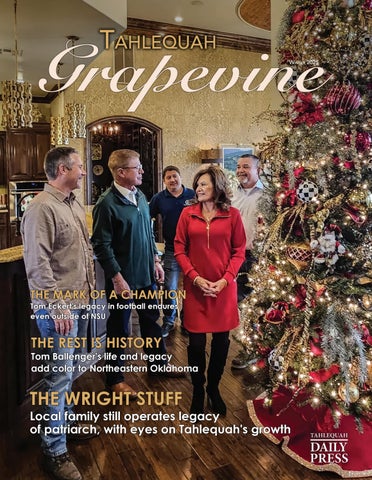
THE WRIGHT STUFF Local family still operates legacy of patriarch, with eyes on Tahlequah’s growth
12
THE REST IS HISTORY Tom Ballenger’s life and legacy add color to Northeastern Oklahoma
THE MARK OF A CHAMPION Tom Eckert’s legacy in football endures even outside of NSU
12
18
THAT TULSA SOUND Musician Gary Gilmore had plenty of company on his trek to the Hollywood Hills
20
A BROADER MISSION It’s not your grandparents’ library anymore
STIR is watching the water for you 4 Tahlequah Grapevine | Winter 2025
Note from the Editor It’s getting cold out there – although with Oklahoma weather, you never can tell what will happen. Even in December. Nevertheless, my advice is to grab a cup of coffee or hot cocoa – or if you’re so inclined, a hot buttered rum – and peruse the pages of the Winter 2025 edition of Grapevine. This is our 12th edition of the reimagined Tahlequah Grapevine Magazine, which we launched in the first quarter of 2023. I have had more compliments about it than just about any other product the TDP has published, and for good reason: Some of the best writers to ever bump shoulders with our newspaper have contributed their work. We hope the print edition will be out by Christmas, though sometimes with these things, you can’t tell. But the digital version will be online before that – and that’s what you might be reading now. Our cover story on the Wright family is written by Lee Guthrie, one of TDP’s full-time staff writers. The Wright family has made a major imprint on Tahlequah history, starting with Scott’s father, Dave. Many of you are familiar with their story, but others might not be, and now’s a good time to find out. Former TDP Sports Editor John E. Hoover joins us again, and sports fans will be thrilled by his feature on Tom Eckert, that titan who once coached NSU football. I myself didn’t know much about his background, and found it intriguing. (I have been told by former players that he said if their names appeared in TDP in a negative fashion, they’d be off the team.) Former district attorney and retired NSU educator Greg Combs has contributed the first in what promises to be a fascinating two-part series on the “Tulsa Sound.” You all know what that means; if you don’t, think “Leon Russell” – that’s a good place to start. Eddie Glenn – a 14-year TDP veteran who now teaches at the University of Arkansas – wraps up his series on noted historian Thomas Ballenger. If you know everything there is to know about this iconic character, you’ve been around way longer than I have. (I mean Mr. Ballenger; I know enough about Eddie, and I’ve been around even longer than he has.) Nancy Garber, another TDP veteran and faithful quarterly writer, tells you what’s happening at the Tahlequah Public Library. If you haven’t checked it out lately, you should; it is, as Nancy put it, “not your grandparents’ library.” We have great ambitions for Grapevine, once we build the support we need to expand its horizons. We hope you’ll let us know what you think, and give us some ideas if you have them. We want it to be fun, informative, and evocative – to take you back in history or push you forward into the future.
HEATHER KILPATRICK Publisher hkilpatrick@tahlequahdailypress.com
KIM POINDEXTER Executive Editor kpoindexter@tahlequahdailypress.com
ADVERTISING Joe Mack CONTRIBUTING WRITERS Greg Combs Nancy M. Garber Eddie Glenn Lee Guthrie John E. Hoover JAY JUDAH Graphic Designer
TAHLEQUAH
Grapevine © 2025 Tahlequah Daily Press
Tahlequah Grapevine is a quarterly magazine published by the Tahlequah Daily Press. The contents of this magazine are fully protected by copyright and cannot be reproduced without express permission from CNHI, LLC.
Poindexter has been a member of MEET THE Kim the TDP news team since 1985. She is in Oklahoma Journalism Hall of Fame EDITOR the and received the 2022 Oklahoma Press
Association Beachy Musselman Award. She has won more than 300 journalism awards on the national and state levels, both individually and as part of the team for TDP, which has been named CNHI’s Best Newspaper for five consecutive years. A noted editorial and column writer in Oklahoma, she was named OPA Editorial Writer of the Year in 2023, and by CNHI, Columnist of the Year. She and her husband, Chris, a facilities engineer, have an adult son, Cole, and a daughterin-law, Dani.
The Wright family enjoys a moment with the
newly installed Christmas tree at the family On home. In front, from left, are: Steven, Scott The and Tommye Wright. In back: Brian and Jasen Cover Wright.
Tahlequah Grapevine | Winter 2025 5
Tommye, seated, and husband Scott Wright, have been married since 1976.
6 Tahlequah Grapevine | Winter 2025
The Wright Stuff
Local family still operates legacy of patriarch, with eyes on Tahlequah’s growth
By Lee Guthrie
A
A small family real estate firm established in 1975 by Dave Wright and his wife, Faye, has endured for 50 years, and now operates as Century 21 Wright Real Estate, with a staff of 50 and offices in Cherokee and Adair counties. The Wrights arrived in Tahlequah in 1965, from Perryton, Texas, with their son, Scott, when he was 13 years old. They moved to the Burnt Cabin area at Lake Tenkiller and operated a cattle ranch. Dave and Faye realized the development of Lake Tenkiller was inevitable, and they began buying lots for as little as $100 an acre. At that time, Indian Road didn’t exist; travel to Tahlequah required driving on miles of dirt road. In 1975, Dave and Faye decided to quit the cattle business and opened a brokerage in Tahlequah known as Dave Wright Real Estate. Scott graduated from Tahlequah High School in 1971 and worked as a dock hand at Cookson Bend Marina. He attended Northeastern State University in pursuit of a business degree, and worked at a convenience store. He met his future wife, Tommye Bradshaw, at NSU, and the couple married in 1976.
Lee Guthrie has been a staff writer for the Tahlequah Daily Press for more than two years, after working as a correspondent for many months. She specializes in enterprise work.
When Scott’s mother was diagnosed with cancer in 1976, his parents asked Scott to join the business. He withdrew from NSU before completing his final year and began working with his father. “In those days, there were no fax machines, photocopiers, computers, Multi-Listing Service, or cell phones – only land lines,” Scott said. “Carbon paper was a must and was used daily for duplicating all documents, and business was conducted in person.” Scott said his dad would get confirmation of an offer by Western Union telegram. “It served as a written document,” Scott said. “We’d mail the offers, and tell them, if you accept this offer, send a telegram back, and say, ‘We accept.’” The firm had a typewriter in the hallway, then evolved to using a memory typewriter. Black-and-white Polaroid cameras were used for photos. “When the fax machine came in, we said, ‘Look at that,’” Scott said. “I recently sent a fax in the office to a client and the agents were standing around laughing at me. I just Tahlequah Grapevine | Winter 2025 7
Dave Wright Real Estate was established in 1975 by Dave Wright, father of Scott Wright, and grandfather of Jasen David Scott, Steven Scott Wright and Brian Tyler Wright. The office was at 501 S. Muskogee Ave. Tommye Wright talks to her husband, Scott Wright, as they admire the newly installed Christmas tree.
said, ‘It’s cash, so if he wants a fax, we will do a fax.’” continued uniform growth, they helped create subdivision Tommye was born in Tahlequah but raised in Muskogee. criteria and standards for the city of Tahlequah. The couple also She is the eldest child in her family of five. Her mother would initiated commercial projects, which included medical facilities, leave for work and would tell Tommye what to cook for dinner to help recruit health care professionals for Tahlequah City Hoswhen she got home from school. pital, now known as Northeastern Health System. Tommye came back to Tahlequah to go to NSU, and has The couple participate in many civic and business groups, lived here since. In March, she and Scott will celebrate their 50th and were awarded the prestigious “Community Development anniversary. Award” by the Tahlequah “I was 19; I said to my Area Chamber of Comparents, ‘I can’t believe merce. They were also you let me get married at named as NSU Centuri19 years old.’ That was two ons by the university for years after I graduated high their work in creating an school,” Tommye said. endowed scholarship for While they were enstudents. gaged, Scott got involved in Scott retired three years the business. Tommye has a ago; the three sons had Polaroid of Scott at the typealready joined the busiwriter, working on business ness 10 years ago. The daily the day they got home from operations are carried out their honeymoon. by Jasen Wright, principal “You can see on the picbroker; Steven Wright, in ture, I wrote, ‘Our first night charge of IT and marketing; home from our honeymoon, and Brian Wright, who takes Scott fast at work, 4-21-76,’” care of the day-to-day operTommye said. ations with the agents. As the business grew, Jasen is real estate Dave Wright, the founder of the Wright’s real estate business, stands with Scott Tommye completed her edadviser for the Tahlequah Wright and his two oldest sons. From left are: Dave Wright, Jasen Wright, and ucation while working at First Scott Wright, holding Steven Wright. Regional Development AuNational Bank downtown. In thority, which is in charge of 1980, she left the bank and started working with the family firm. the build-out and economic development of the Business and Although they reserved Sundays for driving around the county Technology Park. He also serves on the board of directors of First with the children and putting up real estate signs, the couple State Bank. worked six days a week at the office. As principal broker at the family’s firm, he said everything in Tommye is Cherokee, and the three sons and their children real estate is shifting – and always has. are citizens of the Cherokee Nation. All the children were born at “The rising interest rates have been a factor over the past Hastings Hospital. several years, and other shifts,” Jasen said. “But it’s an ever-movWith the help of mentor Jack Kaufman, Scott and Tommye ing industry, and the market is doing very well.” developed over a dozen subdivisions. As strong advocates for He has stayed in Tahlequah because it has a small-town feel, 8 Tahlequah Grapevine | Winter 2025
and offers an array of outdoor activities. His wife, Jennifer, works in the business as an agent, too. They have two children, ages 20 and 15, with the oldest attending the University of Oklahoma for her nursing degree. The youngest is a sophomore at Tahlequah High School and is involved in cheer. “I spend a lot of time outdoors, and my family and I go to the lake, and we hunt, fish and other activities outdoors,” Jasen said. Brian, in his work with the agents every day, said he is seeing the ever-increasing costs of construction. “Construction costs are crazy; to build a 1,000-squarefoot, two-bedroom house is $200,000,” Brian said. “There’s no way to bring these prices down when that’s the cost of building. You can’t build it for less.” He said selling real estate has required shifting more online, because that’s where buyers and sellers are going to find information, even though paper brochures of available properties are still being printed. “It’s easier to create TV commercials now; you just create an account on Hulu, upload a video you make, and we are trying that out,” Brian said. “Anyone who subscribes to Hulu or Disney+ will see your video. We are trying out new things, like YouTube, and always looking for a new way to keep our agents out front to sign up properties.” Brian is single and has no children. He said he stays out of the spotlight and works at the firm every day. Steven was a past president of TACC, and serves on the Hospital Foundation Board and Arvest Community Board. He and his wife, Bayly, have three children – two boys and one girl, ages 20, 12 and 8. “The oldest goes to Fort Lewis College in Durango, Colorado, where I graduated. The middle child is at Tahlequah Middle School and is in pom, and the youngest is at Greenwood Elementary School,” Steven said. “Pom is like cheer but dance.” Steven said he stays in Tahlequah because “it’s home,” and everybody knows everybody else. Tommye sits on the Cherokee Nation Business Board, as the first woman to serve on it, and the only woman on it for about eight years. Scott serves on the board of trustees for Tahlequah Public Works Authority, and does so because charging the best rates is important to development and residents. He said being in development, he understands the capital improvements needed for infrastructure and wanted to protect the local residents. “When I first came on board, Tahlequah had the lowest rates in Oklahoma,” Scott said. “You don’t want to have the lowest rates, and it was almost running in the red. I predicted that would happen in two years, and it did.” Tommye describes Tahlequah as a small community where a person can make connections, and said she would never go back to Muskogee. “I would tell folks in Tahlequah the importance of putting down roots and staying in Tahlequah is for the bonds, the connections and the friends, and the people are genuine here,” Tommye said. “The Cherokee Nation is here, and plus you are just 45 minutes from Tulsa or Fayetteville, Arkansas. Tahlequah wouldn’t be what it is today without the Cherokee Nation.” G
Members of the Wright family all work together at Century 21 Wright’s Real Estate, with the three brothers now in charge of the day-to-day operations. From left are: Brian, Steven, Jasen, Tommye and Scott Wright.
Scott Wright captured on a polaroid April 21, 1976 – the day he and his wife, Tommye, returned from their honeymoon.
Tommye Wright, wife of Scott Wright and mother to three sons, is a real estate professional who works at her family’s business. Tommye loves to cook and gets a birthday cake ready for a celebration of two family members.
Tahlequah Grapevine | Winter 2025 9
Tom Eckert at his home in Tahlequah.
The mark of a champion
Tom Eckert’s legacy in football endures even outside of NSU
C
From a TV in the other room, the familiar sounds of an NFL game echo softly through the house. Conversation at the kitchen island returns to the Oklahoma-LSU game from the night before — quarterback power runs, 5-techniques out of position and defensive backs missing their cues. Yes, Tom Eckert still watches football. A lot of it. And he still sees the game through a coach’s eyes. “I mean, you know, coaches notice things,” Tom said. Those eyes are 82 years old now, but no less observant than when he was coaching Northeastern State University, his football mind no less sharp than when he guided the then-Redmen to 106 career victories — among them, a No. 1 ranking, a national championship and a national runner-up. Nor has his razor wit been dulled by time. Tom Eckert has
10 Tahlequah Grapevine | Winter 2025
By John E. Hoover John E. Hoover was sports editor for TDP in the early ‘90s before spending 24 years at the Tulsa World. After a six-year run in radio, he returned to the written word as publisher of AllSooners, covering OU for Sports Illustrated/Fan Nation. John is now semi-retired and lives in Broken Arrow with his family.
been retired for 23 years now, but he still has plenty of opinions — about football, or anything else. “Football has been good to me,” he said. “You know, wouldn’t change anything.” He’s most proud to be among a trio of NSU coaches who, from 1962 to his retirement in 2002, won 273 games — a .667 winning percentage. Tom Eckert was instrumental to all three: He played quarterback for Tracy Norwood in 1965 and ’66, and Norwood brought him back in 1971 before retiring in 1974; he was George Elliott’s defensive coordinator, 1975-’86; he took over in 1987, and in 16 years, enjoyed the most victories in program history. The Redmen won 13 conference titles in that 40-year stretch, seven by Eckert. “Conference championships, they’re hard to win,” he said.
But it’s not the wins or the trophies that most impress Tom’s wife, Teensie. “He can say it was about wins and losses and all that,” Teensie said. “But for me, it’s all of the players. And I cannot tell you the closeness he had — and still has to this day — with the guys. The ones who just all of a sudden show up, or are calling on Father’s Day, you know? And then it was after he retired that the letters that came, it was just so sweet. I think they truly thought the world of him.” Coach Tom Eckert at Northeastern State Tom was born in University in 1994, with 1943 in Canton, Ohio. Of player Ricky Caesar. course he was; the Pro Football Hall of Fame is there. Canton hosted the very first meeting that gave birth to the NFL. Miami, Ohio, calls itself “The Cradle of Coaches,” but the nickname could extend to the entire state. Names like Paul Brown, Don James, Don Shula, Red Blaik, Jon Gruden, Marcus Freeman, Woody Hayes, Bo Schembechler, Lou Holtz, Sean McVay, Urban Meyer, Les Miles, Jim Tressel, the Harbaughs and the Stoopses and hundreds of other famous coaches hail from Ohio. Tom Eckert sprouted from that fertile soil. Harry Eckert sold cars. Ethel was a housewife. They settled in Massillon, eight miles east of Canton, and raised four kids: Bill, Martha, Jane and baby Tom. The brothers got hooked on sports. But youth sports in the upper Midwest of the 1950s would be unrecognizable today. “Back in the day, you know, this neighborhood played that neighborhood,” Tom said. “They didn’t have junior high stuff. You’d just play in high school. I played every sport: football, basketball, baseball. I guess it was expected of you.” Maybe inspired by an older brother, or maybe just toughened up by him, Tom blossomed into quite the quarterback at Jackson High. Head coach Bob Fife — whose name is on the football stadium today — quickly took a liking to Tom Eckert, even getting the seventh grader out of class to help him stripe the field. Playing the sport was one thing, but being constantly around it like that, immersed in the lifestyle, probably sparked something in Tom. He played on varsity as a freshman and soon grew into a
team leader and one of the best players. Nowadays, there are districts and brackets and class after class of state championships. But back then, Jackson just played the other schools in Stark County. Making the All-County Team made you immortal. “There’s little, small places and towns,” Tom said. “If you were the county champion, that was the thing you tried to do. Because there were no playoffs. We were always in that championship talk.” Tom was a good enough player that Ohio State knew who he was. So did plenty of other schools. But the one that made the biggest impression on him was Florida State, where Massillon’s own Don James was an assistant coach. Recruiting his home territory, James was able to sign Tom and bring him to Tallahassee. Tom counts James — who went on to win a national title at the University of Washington and is enshrined in the College Football Hall of Fame — as one of the biggest influences on his football life. That 1961 Seminoles team also included a wide Tom’s wife, Teensie, receiver by the name of Fred points out her husband in an NSU Redmen team Biletnikoff and another Ohio photo. quarterback, Steve Tensi, all 6-foot-5 of him, from Cincinnati. He became an FSU starter, an NFL and AFL draft pick — six seasons in the pros — and now sits in the FSU Athletics Hall of Fame. So after two years a Seminole, the 5-foot-11 Tom Eckert left Florida State and transferred to Hardin-Simmons in Abilene, Texas. But his 1963 season was wasted when Hardin-Simmons suddenly discontinued its football program, leaving him with a big dream but no team. Hardin-Simmons wasn’t a total waste, though. While in Abilene, teammate Pat Batten — a running back who became a third-round pick of Detroit in the 1964 NFL Draft — told Tom to consider NSU. Batten had played at Fort Scott Junior College with Bill Van Cleave, who went on to NSU in ’63 and played tackle on Norwood’s undefeated team. Like Tom Eckert, Van Cleave is now enshrined in the NSU Athletics Hall of Fame. “He says, ‘You need to go up to Tahlequah,” he said. “So [I] came up here and that was it. I’m glad I did.” Tom was the Redmen QB under Norwood in 1964 and ’65. He actually threw the first touchdown pass on Gable Field. The team won 16 games, lost two and tied one, shared an OCAC Tahlequah Grapevine | Winter 2025 11
title — and he fell in love with Tahlequah and NSU. “Never left,” he said. “Still here.” Tom found himself stuck between launching his coaching career and signing a free agent contract with the AFL’s Denver Broncos. Bixby High School offered him a $5,500 salary as a teacher and assistant coach. The Broncos gave him a $1,750 contract and a $3,500 bonus. He went to summer camp in Denver, then reported to Bixby. “You were only there seven weeks,” Tom said. “That was 1966. In ’65, Joe Namath got $427,000 with the Jets.” After the whole Bixby staff was let go, Tom landed at Coffeyville High School in Kansas, working for Glenn Percy. The team went 9-0 in his first season, and Percy took a job at nearby Hutchinson High School. Tom lined up an assistant gig at East Central High School in Tom Eckert and his wife, Teensie, at their home in Tahlequah. Tulsa, but the Coffeyville athletic director told him if he stayed, he’d promote Tom to head coach. So in 1967, at 24 years old, Tom Eckert was a head bull, drinking a beer,” he said. football coach. After three successful seasons in southeast KanIn the Eckert home, Christmas is in the air now. Everything sas, he returned to his alma mater in 1971 — a former Redmen looks tidy, organized, well-placed. Thoughtful decor is everyquarterback now calling defensive signals. where, from the lighted garland on the living room staircase to “He always told me, ‘I’m going to hire you,’” he said. “And the warm, inviting outdoor fireplace off the back porch to the TV when the guy left, the only job was the defensive coordinator.” tucked perfectly into a vacant cabinet space above the stainless Norwood stepped down in 1975; Elliott retired in 1986. By steel fridge. But there’s one thing conspicuously absent: football. then, Tom Eckert was the only logical choice to take the program A memorabilia room upstairs is packed with mementos. If into the next millennium, when NSU left the NAIA for the NCAA. the Eckert home was a museum, this is the “special collections” Now a member of the Mid-American Intercollegiate Athletic room. You’d need permission to view the artifacts archived there. Association — the MIAA has been called the SEC of Division II Tom doesn’t bother arguing with stairs much anymore, football — NSU struggled for more than a decade. so Teensie gives a tour. Here are some of daughter Jenny’s golf Even Tom’s son, J.J., couldn’t turn it around. He coached trophies, and a few of J.J.’s. Laminated newspaper articles hang through COVID but just didn’t have the same support or good here and there, commemorating memorable moments. And fortune his dad did. J.J., who had enjoyed tremendous success at lots of photos: the father-son/coach-quarterback pic of Tom Kilgore Junior College in Texas, was fired in 2023 after winning in a white NSU polo and J.J., kneeling, in his green No. 10 NSU just four games in four seasons. uniform. There’s a black and white shot of Derrick Moore, 1991 It hurt. But football is just that way. Just like life, football All-American and future NFL star, floating to another exciting hardships allow you to truly savor success. Through pain and touchdown. And a collage of Tom in both studio headshots and injury, defeat and disappointment, football teaches resilience, candid sideline rants. determination and resolve. The centerpiece is the framed photo of the 1994 national Now, the Eckerts revel not in victory on the field, but in the championship team, some 9 feet wide and 3 feet high, Tom Eckmany phone calls and text messages they get every day from ert’s smiling face dead center. former players and staffers. Back downstairs, it’s just another beautiful home on a sce“That’s a big thing, man,” Tom said. “Some of the best times nic golf course. Halls of fame, national titles, touchdowns and are in the locker room. I had a nickname for everybody.” trophies have no place here. And that’s on purpose. The familiar Football still takes up portions of the weekends, but nowtheme is that Teensie — for the uninitiated, her real name is Mary Jane — has kept Tom grounded all these years. She’s the adays, Teensie and Tom are doting grandparents. J.J. and wife strong sports mom, the steely coach’s wife, the family’s spiritual Amanda live nearby, with three kids who own one corner of the center and wizard behind the curtain. refrigerator door and their own space in the house. While that theme is certainly true, it also misses the mark. Tom gets around now with either a cane or a walker, deAccording to Teensie, it’s her husband who has kept the rest of pending on where he’s going. Their home overlooks the No. 5 the family grounded. green on Cherokee Springs Golf Club, but he has officially given “Tom never, ever brought work home — football home,” she up chasing birdies. The pain in his hip and back no longer persaid. “I didn’t have to deal with it. You never saw Tom — his mits a golf swing. Football injuries will take their pound of flesh. personality never changed. In the highs, he was high for a little He still makes his way to the clubhouse almost every day, while and Sunday morning; basically that was it. He would not where he gathers with friends — five to 20 of them, he says — to show us he was sad. He was always probably the cheerleader for discuss and dispute the day’s events. It’s a lot of football talk, but me, J.J. and Jenny, when we went through a season or two that “it can be anything,” Tom Eckert said. was low. He was the one that was like, ‘It’ll be all right.’” G “No politics. You know, ‘What’s the gossip?’ Shooting the
12 Tahlequah Grapevine | Winter 2025
2022-’24
2025
“Where You Buy the Best for Less” THANK YOU FOR SHOPPING LOCAL! VOTED #1 FURNITURE STORE
3231 SOUTH MUSKOGEE AVENUE TAHLEQUAH, OK • 918-456-0555 bfurniture2019@gmail.com • bakersfurnitureok.com
B ILL J OHN AND S HERRY B AKER , OWNERS
Tom Ballenger in 1947, four years before his retirement from Northeastern State Teachers College, now Northeastern State University. Tom Ballenger in 1917, three years after accepting a teaching position at Northeastern Normal, now Northeastern State University.
THE REST IS HISTORY Tom Ballenger’s life and legacy add color to Northeastern Oklahoma By R.E. “Eddie” Glenn
I
Eddie Glenn was Tahlequah Daily Press’ final “official photographer”, and worked in that capacity and as a writer at TDP for 14 years. He and his wife, Jennifer, live in Fort Smith, where he teaches at the University of Arkansas. He has published two books: “Bigfoot Comes to Town: theory, Myth and Alleged Truths About Eastern Oklahoma’s Most Wanted,” and “The Sovereign, the Tribe: An Essay on a Relationship.”
In the spring 2025 edition of the Grapevine, I wrote about Tom Ballenger’s 1935 book, “Around Tahlequah Council Fires,” and some of the local stories and myths in that book. In the fall edition, I covered Ballenger’s continuing influence on modern researchers of Cherokee Nation and Tahlequah history. Now, I’m going to discuss the history of Ballenger himself, presenting an abbreviated story of the life of, arguably, Tahlequah’s most distinguished 20th century historian. To do that, I’m relying heavily on the work and memories of yet another distinguished Tahlequah historian, Dr. Brad Agnew. Much of this article draws from a 1982 “Chronicles of Oklahoma” essay Agnew wrote about Ballenger, and from a September 2025 interview with Agnew. Born in Rover, Arkansas, in 1882, Ballenger attained a bachelor’s degree from Ouachita Baptist College in 1905 with hopes of going on to law school. However, as is often the case, finances weren’t as lofty as hopes, so he went into teaching, as it offered – in his own words – the “line of least resistance.” He taught for several years at Mountain Home and Cotton Plant, both in Arkansas, before taking a teaching position at Loco, in the south-central part of the new state 14 Tahlequah Grapevine | Winter 2025
of Oklahoma. From there, he went to Mangum as a grade school principal. But scholarly pursuits beckoned, so he used his life’s savings to enroll at the University of Chicago, where he got another bachelor’s degree, and completed much of the coursework for a master’s degree. His first job post-Chicago was teaching in Fort Smith, Arkansas — a town that seems to attract quite a few scholars with Oklahoma teaching experience – but he didn’t stay long. In 1914, he took a job at Northeastern Normal School in Tahlequah — now Northeastern State University – and to say “the rest is history” would be putting it much too simply. Ballenger was, in fact, the entire history department. When the U.S. joined the Allied forces to fight Germany in World War I, Ballenger was raring to go. Colorblindness, however, prevented him from getting very far in his war efforts. Instead of fighting in France, he became a lieutenant in the Tahlequah company of the Home Guards — an early version of the National Guard – and as such, marched women students all over the Northeastern campus and through the streets of Tahlequah in drills. As quoted in Agnew’s 1982 “Chronicles” article, Ballenger called those drills “the biggest farce in which I have been engaged.” Finally, in 1918, at age 35, Ballenger talked the
local selective service board into putting his name in a category famed Oklahoma radio personality John Erling interviewing of men much younger than himself, and he was selected for Ballenger in 1982 and being surprised at his age: Later that year, military service. Unfortunately for his war zeal — but perhaps Ballenger broke the century mark. He continued studying the fortunately for generations of future Oklahomans — he was history of the area almost up to his passing in 1987. ordered to report for service on Nov. 11, 1918, the last day of the “He was practically lame, but his mind was extremely war. sharp, and he had a very dry sense of humor that never went Tired of teaching, Ballenger took a job as a cashier at away,” Agnew said. Farmer’s State Bank in Park Hill, and on his 36th birthday, he Ballenger lived almost 105 years. The story you’re reading married Mildred Parks. Marriage always has a significant effect right now has about 900 words. Eight and a half words per year on a person, but his marriage to Mildred would influence isn’t quite enough to adequately describe a life as eventful and Ballenger’s life both personally and professionally. Mildred’s complex as Ballenger’s. father, Jefferson T. Parks, had been an official in the Cherokee If you’d like to get a more in-depth look at Ballenger’s life, national government before statehood, and he was the first visit the Oklahoma Historical Society’s “Chronicles of Oklajudge of Cherokee County afterward. homa” archives and read Agnew’s 1982 article, located here: When the vagaries of the American economy forced Balhttps://gateway.okhistory.org/ark:/67531/metadc2031439/ lenger to return to Northeastern Normal in 1923, he decided to m1/1/ jump into academia all the way, and began working on a docThis is the final in a three-part series. G torate, which he eventually received from the University of Oklahoma in 1939. His doctoral dissertation over the Cherokee legal system was heavily informed by his father-in-law, and Ballenger’s interest in Cherokee and local Northeastern Oklahoma history never waned from that point forward. While the influx of students after the end of World War II kept many academics — Ballenger included — busy with teaching, his 1951 retirement from Northeastern allowed him some time to live up to his personal philosophy of history, which was detailed in the fall edition of the Grapevine. “Of course, I’m paraphrasing here,” said Agnew, who began teaching in the NSU History Department in 1968, long after Ballenger had retired but was still active in the department, university and community. “But Dr. Ballenger believed all history is ultimately local, and I think that is very true.” Agnew said that even in his 36year retirement, Ballenger continued to gather first-hand narratives, artifacts, and documents — correspondence and records — about events that had occurred in the Cherokee Nation and Northeastern Oklahoma. He also organized groups of college students to clean up local historic cemeteries where the individuals who made Cherokee history were interred. In short, Ballenger’s focus was as much on place as events. History, for Ballenger, “was not just what he learned from books,” said Agnew, “but he actually lived the history of the area.” The graduating class of summer 1915 at Northeastern Normal School, with the Seminary Hall bell tower Agnew’s “Chronicles” article in the background. Tom Ballenger is the fifth person standing to the left of the Nowata banner. begins with a short narrative about Tahlequah Grapevine | Winter 2025 15
2100 MAHANEY AVE. • TAHLEQUAH, OK 201 W. LOCUST ST. • STILWELL,OK 1509 S. ROSS ST. • FORT GIBSON, OK
mcdonalds.com
Super Spray Car Wash II SCAN & WASH TODAY
Monthly UNLIMITED WASHES
$
FROM
20
For more info, call (918) 207-9463 or visit 1581 S. Muskogee Avenue, Tahlequah everwash.com/#membership-plans/143
Call today for information on how you can volunteer to change the story
918-456-8788 • 403 N. Mission St. Tahlequah, OK 74464 • www.cherokeecasa.org
Family. Friends. Community. Mark Hodson, Agent 914 S Muskogee Ave Tahlequah, OK 74464 Bus: 918-456-8881 mark@markhodson.org
1801075
16 Tahlequah Grapevine | Winter 2025
We're all in this together. State Farm® has a long tradition of being there. That’s one reason why I’m proud to support Newcomers Magazine. Here to help life go right.®
State Farm, Bloomington, IL
TAHLEQUAH 130 S Muskogee Ave 1204 E Ross St
Tahlequah Grapevine | Winter 2025 17
That Tulsa Sound Musician Gary Gilmore had plenty of company on his trek to the Hollywood Hills By Greg Combs Greg Combs is a retired educator and served as District Attorney during his career at Tahlequah. He formerly wrote for the Pictorial Press, a predecessor to the Tahlequah Daily Press, after serving four years in the U.S Air Force during the war in Vietnam.
G
Gary Gilmore smiled as he recounted his days in the Hollywood Hills. Just weeks into his 18th year and fresh from graduation from Tulsa’s Central High School, he found himself at the California home of Leon Russell. He had plenty of company. “There were at least 15 Tulsa musicians who were there at various times,” he said. “Leon bought a big home on Skyhill Drive and built a recording studio.” We stood recently on the deck of a cabin at Gary’s family-owned and operated Riverside Resort on Highway 10 in Cherokee County. On a sun-splashed autumn day, the Illinois River rolled lazily by. We were six decades and 1,500 miles from that Hollywood as we visited about the circumstance that found him there. This is the first of two installments of Gary Gilmore’s story. Part 2 will be included in the Spring 2026 edition of Grapevine Magazine. The summer of 1964 marked the arrival of the “Tulsa Sound” on the national stage, and it soon went worldwide. How did this happen? To understand, we will need to appreciate the Tulsa music scene six decades ago. It would be difficult to overstate the talent that poured from Central High in those years. Actor Gailard Sartain; musicians Elvin Bishop and David Gates; Miss Oklahoma Anita Bryant, who is a Will Rogers High graduate; and a piano prodigy named Claude Russell Bridges, who by graduation was known as Leon Russell. He was part of a booming young Tulsa music scene, playing in clubs and bars, making records and developing a unique sound. Guitarist J.J. Cale, another Central grad, had gone off to
18 Tahlequah Grapevine | Winter 2025
The Cale trio became a fixture on Hollywood’s Sunset Strip at the legendary Whisky A Go Go. The club itself was inducted into the Rock and Roll Hall of Fame in 2006.
the Air Force, where his technical training readied him for the production end of the business. With Russell in California as a session artist, band member and beginning producer, back in Oklahoma, young musicians honed their skills. These included Gilmore, by then a respected electric bass player. “During the summer after my junior year, I played with a Tulsa a band — Jimmy Markham and the Scamps — at a club in Lawton. It paid well and was such a great experience I decided not to go back to school,” he said. Gilmore’s mother asked him to come home and complete his senior year, which he did. Staying in Tulsa helped him catch lightning in a jar. During his senior year, he played with J.J. Cale and drummer Gary Sanders in a trio. They were regulars at the Capri Club, and by his graduation, they were well-established locally. That trio later made the first recording of Cale’s song, “After Midnight,” but did so in Los Angeles, where Russell had planted the Tulsa Sound flag. He invited Cale to manage his new in-home facility, Skyhill Studios. Cale accepted, and the trio went west together. Lightning had struck. Tulsa musicians who showed up back then stayed at Russell’s home until they found a place of their own. Gilmore, at 18, moved into a house in nearby Sherman Oaks. Cale’s trio found work, and all Tulsans regularly gathered at Skyhill. In one Cale biography, he remembered how the formerly quiet, exclusive neighborhood was jammed with musicians, cars and motorcycles. Neighbors thought “a gang had taken over,” Cale said. Meanwhile, the trio secured work at Whisky A Go Go, the
rock ‘n’ roll shrine on Sunset Strip, where Johnny Rivers was featured and top stars filtered through over the years. Cale was known as John or Johnny, but club owner Elmer Valentine suggested he use the name J.J. Cale so as not to be confused with Rivers and a local musician named John Cale. “That will be all right. I don’t care what’s on the marquee, as long as we get paid,” Cale said, after some thought. From that day on, he used the new moniker. It was about then that his band recorded “After Midnight,” a 45 rpm single, at Liberty Records. Lightning struck for Cale when Russell played the record for Eric Clapton, a British guitarist who recorded it in 1970 in London. It was a hit in Britain, the U.S. and Canada, spawning recordings by 15 artists from Chet Atkins to Sergio Mendez and Brazil. The Tulsa Sound had gone global. All was well, but tragedy struck when Gilmore’s father died in the crash of Piedmont Airlines Flight 22 in North Carolina on July 19, 1967. Into the Hollywood Hills mix arrived a Native American guitar player from Oklahoma City. He became an in-demand session player, public performer, and occupant of an extra room at Gilmore’s house. His name was Jesse Ed Davis III. As friends do, Gilmore drove Davis to the airport one day. The guitarist was flying to San Francisco with a band. Upon arrival at LAX, they met the distressed band leader. He needed a bass player. “Gary here is a bass player,” the guitarist told the man, who on Davis’ word asked Gilmore to accompany the band, whereupon he and his bass flew to San Francisco. That was a bolt from the blue. The leader was Henry St. Claire Fredericks Jr. At 25, he was about to finish his first album and had adopted the stage name Taj Mahal. Long story short, Mahal’s band for three years thereafter included Davis on guitar, Gilmore on bass, and Tulsan Chuck Blackwell on drums. The band played venues in both L.A. and the Bay Area, completed that first album, then recorded two more: “The Natch’l Blues” (1968) and “Giant Step” (1969). At Filmore West in San Francisco, they shared the stage with the likes of Led Zepplin. On Sunset Strip, they were regulars at Whisky A Go Go. Gilmore was no stranger to that club. In their final six months together, Cale’s trio had been featured at the new Whisky A Go Go in Atlanta. “One night we were playing the Whisky back in Hollywood when the Rolling Stones came in. When we took a break, the owner told us they had invited us to their table. So we joined them,” Gilmore said. “In two weeks, we were flying off to London.” As it turns out, the Rolling Stones intended to make a music video. These were young people. Mick Jagger was 25, Mahal had turned 26, and Gilmore was 22. The Stones were seeking an American blues band to join their video. In December 1968, the gathered musicians produced “The Rolling Stones Rock and Roll Circus,” an hour-long music video. Majal did four songs. In addition to the Rolling Stones, the occasion featured The Who, Jethro Tull, Maryanne Faithful and former Beatle John Lennon and wife Yoko Ono, among others. That was Brian Jones’ final performance with the Stones. The Americans returned to California to complete the “Giant Step” album, which was a double set. The second record, labeled “De Ole Folks at Home,” was Mahal solo. His interest in world music brought him 28 more albums, 17 Grammy nominations — five wins, 17 movies as an actor and many awards.
His most recent album was “Room on the Porch” in 2025. In 1970, his young blues band dissolved. At a crossroads, Gilmore needed to consider his options. What he did would surprise most musicians hoping to ride the lightning of success: He opted to get back to his roots. He returned to the Tulsa music scene. He soon bought a farmstead on Spring Creek, just upstream from Rocky Ford in Cherokee County. He was settled in the Ozarks, but only an hour from Tulsa. He and his electric bass were by no means finished making the Tulsa Sound. First in a two-part series. G
Gary Gilmore played electric bass in a popular local band, Larry Bell and the Teardrops. From left are: Tommy Tripplehorn, Bob Boaz, David Boaz, Gilmore and Bell.
A young Taj Mahal included three Oklahomans in his blues band in the late 1960s. From left are: bassist Gary Gilmore, Mahal, guitar player Jesse Ed Davis and drummer Chuck Blackwell. This group would make Mahal’s first three albums and later share a London stage with The Rolling Stones, The Who, John Lennon and Yoko Ono and Maryanne Faithful, among others, in the hour-long video “The Rolling Stones Rock and Roll Circus.”
Gary Gilmore joined J.J Cale and drummer Gary Sanders. The trio were regulars at Tulsa’s Capri Club. From left are: Sanders, Cale and Gilmore.
Tahlequah Grapevine | Winter 2025 19
A postcard dated 1910, when Tahlequah’s Carnegie Library was officially dedicated.
A broader mission
It’s not your grandparents’ library anymore By Nancy M. Garber Nancy M. Garber, a University of Florida graduate, is a lifelong journalist and photographer. A former member of the TDP editorial and advertising teams, she retired from NSU as director of Communications and Marketing and still likes to pick up the pen and camera now and then.
W
When she was 6 years old, Beth Purdy Cohenour discovered the Carnegie Library on College Street in Tahlequah was her ticket to exploring the world. “I had to walk up those steep steps and it felt like you were going into a huge castle,” she said. “The doors were tall, and once you went in, it was dark and cool and had this musty, booky smell. There were green-shaded lamps tables where adults would sit to read. It was very quiet.” To the left of the arched doorway sat a big wooden desk where longtime librarian Essa Gladney checked out books. “I was a child who loved to read,” Cohenour said. When visiting her grandparents, she was allowed to walk the short distance by herself to the iconic structure that represented freedom and adventure for a young girl’s mind. Her first stop was the children’s room to search for books about horses. Occasionally, she would pause to view the library’s vast collection of stereoscope cards, a popular form of entertainment dating to the mid-1800s. “I would spend hours there until Miss Gladney had to tell
20 Tahlequah Grapevine | Winter 2025
Portrait on display in the Essa Gladney Room of the librarian, who served from 1922 until 1973. Painted by Eloise Schellstede, 1978.
me to go home,” she said. One summer she participated in a reading challenge and completed the 25 books in her age group required to win a prize. Knowing of her love for horses, Gladney awarded Cohenour a book titled “The Frosty Filly,” which she still has today.
Her journey as a library patron began in the late 1950s, and The COVID-19 pandemic brought a resurgence in library by then, those steep library steps had seen foot traffic from local visits. citizens for more than 50 years. Back in 1905, Tahlequah had “Younger generations especially are using libraries more been granted $10,000 through the generosity of philanthropist and are interested in the technology, the programming, the Andrew Carnegie to build the town’s first library, one of 1,689 created spaces, and the sense of community,” Jones said. constructed nationwide — 24 in Oklahoma. The doors opened When he began working at the Muskogee Public Library 17 two years later. years ago, Jones discovered there was more to libraries than he In 1970, Tahlequah joined the newly formed Eastern Oklarealized. homa District Library system. Later that decade, an addition to “I directly experienced the impact, the range of services house the facility’s growing book collection and to accommothey provide, and how essential they are in connecting people date Tahlequah’s increasing population was opened adjacent with the resources they need,” he said. to the Carnegie Library. In recent years, the two buildings have His work with Adult Programming led him to understand been connected by an indoor ramp. “this wasn’t just a job, but more of a calling.” This fall, the Carnegie Foundation announced that each His conviction propelled him up the ranks, and in 2022, he of the 1,280 Carnegie Libraries still operating in the U.S. will was named manager of both the Warner and Haskell libraries. A receive a $10,000 gift in recognition of the 250th anniversary of year later, he took over management in Tahlequah. the signing of the Declaration of Independence. “Part of that move was the challenge, and part of it was the Jeremy Jones, TPL branch manager, said the funds will organization’s belief that my skills and experience would be a strengthen the library’s ability to serve the community in imstrong fit for TPL. Since arriving, I’ve seen just how deeply this pactful ways. Plans for their use are still under community values its library, and that discussion, with emphasis on “the greatest enthusiasm is infectious,” Jones said. Visiting patron George possible benefit to our patrons.” Libraries offer a “third space” — Poe, 4, tries his hand at “The Carnegie Library is a large part of with home being considered first space, the Jenga challenge, one of many games available our identity and an architectural and literwork ranked second – where everyone is for children to learn and ary landmark that shows just how long the welcome. practice skills. library has been committed to education, Unlike a business establishment, at access, and community service. This gift the public library, no purchase, membernot only honors that history but also helps ship, or specific purpose is required. ensure that TPL can continue meeting the “Patrons can read, study, rest, cool needs of Tahlequah,” Jones said. off, warm up, meet friends, or simply While the Carnegie Library no longer exist in a safe, inclusive space. That freehouses books, it has found new life in meetdom is powerful and pretty rare,” Jones ing the changing needs of local citizens as a said. location for community events, assemblies, In recent years, TPL has expanded its and classes that are open to the public. offerings to include printing services and During the past century, libraries nationeven has sewing machines for public use. wide have transitioned from being “keepers Patrons have access to hobby and craft of books” to becoming essential community supplies and online internet. For chilhubs that offer needed services and resourcdren, there are numerous puzzles and all es. These days, the public library is seldom kinds of games. the quiet space Cohenour recalled as a child. The Creative Studio is a quiet, well“Libraries have changed dramaticalequipped space that supports podcast ly,” Jones said. “They’ve always been about recording, school projects, study sesaccess to information and a space that creates sions, small group meetings, and creative a level playing field for the entire community. But as the ways exploration, used by students, podcasters and other community people access information have evolved, libraries have adaptmembers. ed right alongside them. What used to be centered mostly on A thriving early literacy program readies children 5 and books has shifted to a much broader mission. Many people under for a lifetime of reading. This includes three weekly stostill think of libraries as warehouses of books, and while that rytime programs: Baby Bookworms, Toddler Tales, and Reading remains an important part of what we do, it’s definitely not the Rockstars. GED classes are also available. whole picture.” Book-a-Librarian offers free one-on-one tech and general For instance, some years back when the need for commuhelp with devices, job applications, résumés, online forms or nity access to the fledgling internet became apparent, libraries basic computer skills. stepped in with computers to provide it. In addition, Jones said, community groups can reserve the “As technology became more essential to daily life, we beCarnegie Room, or the Rawls Room — named for Wilson Rawls, gan offering tech help, digital literacy support, e-books, stream- author of “Where the Red Fern Grows” – free of charge. ing services, and access to online learning. And as community To keep up with happenings and pursue opportunities at needs shifted, libraries became spaces for meetings, programs, the library, readers are invited to go online to the Tahlequah workshops, social connection, and creative engagement,” Jones Public Library Facebook page or visit https://eols.org/tahlesaid. quah/ G Tahlequah Grapevine | Winter 2025 21
The LOCAL plan that shares your Oklahoma values. CommunityCare is your Oklahoma choice for Medicare Advantage. You'll get the coverage and services you need d when h you're in town and when you travel... Plus thee customer service that makes you feel right at home! • $0 monthly premium* • $0 PCP copay • $0 Tier 1 drugs • Over-the-counter benefit • Dental and vision • Coverage at home and when you travel • Fitness Plus Benefit Card
“When you choose CommunityCare, your health care means more.” —Terry Hood,
Longtime Oklahoma news anchor
Call to see if you're eligible to enroll: (918) 594-5251 (TTY 1-800-722-0353), Monday – Friday, 8 a.m. – 6 p.m. ccokadvantage.com
Senior Health Plan is an HMO plan and an HMO D-SNP plan with a Medicare and Medicaid contract. Enrollment in Senior Health Plan depends on contract renewal. The Senior Health Plan service area includes Adair, Canadian, Cherokee, Cleveland, Comanche, Garvin, Grady, Haskell, Kingfisher, Latimer, LeFlore, Lincoln, Logan, McClain, Okfuskee, Oklahoma, Pottawatomie, Seminole, Craig, Creek, Delaware, Hughes, Mayes, McIntosh, Muskogee, Nowata, Okmulgee, Osage, Ottawa, Pawnee, Pittsburg, Pushmataha, Rogers, Sequoyah, Stephens, Tulsa, Wagoner and Washington counties. Please call Customer Service at 1-800-642-8065 or (918) 594-5323 (TTY: 1-800-722-0353), Monday – Sunday and some holidays from 8 a.m. – 8 p.m., October 1 – March 31 and Monday – Friday from 8 a.m. – 8 p.m., April 1 – September 30. *Other plans available H3755_2026 SHP Terry Ad 2_M