•1
C MAGAZINE October 2026 • Volume 15 Issue 1 Dear readers, Welcome to the first issue of the 2026-2027 school year! We are so excited for another incredible year of C Magazine and to kick off Volume 15. For this issue, we decided to do something slightly different. Rather than featuring one cover article, this magazine consists of a cover package made up of three stories: What’s on the TV?; Slightly More Correct; The Injection Obsession. Each of these pieces explores the ways that media has influenced our lives, either consciously or unknowingly. Writers Xuaner Duan and Danielle Hanigal explored how cable television cartoons have adapted to the rise of streaming services and short-form entertainment. “I really enjoyed working on both of my stories and couldn’t think of better group members to do so with,” Hanigal said. “I thought it was really cool to finally be able to witness and be a part of the behind the scenes of my favorite Paly publication, and it was really great to see how everyone works together to make an issue. It was surreal to be able to email renowned people like Stanford professors and actually get responses and interviews!” Additionally, writers Bahar Diner and Maria UribeEstrada dove deeper into how some members of Gen Z may withhold or modify their opinions out of concern about social judgment, conflict, or exclusion. “I really enjoyed working on this article because it gave me the opportunity to see how different people can interpret the
same generation depending on their own experience,” Diner said. On the other hand, writers Kea Chiao and Anjali Dahncke explored the more physical effects of media on aspects like health and mentality. “I enjoyed writing Injection Obsession as, while in the interviewing process, I learned just how much influence social media has on our self-image,” Chiao said. “Where there is a self-perceived issue, such as an insecurity, certain individuals and gorups on social media seem to recognize them and attempt to sell an answer.” Outside of our cover package, we have stories ranging from Bay Area’s start-up culture to the nuances of concert venues. Writers Derek Chen and Archer Sherry delved into the novel ways that Paly students make money. “It was awesome to learn all the ways Paly students are using both self-motivation and tech to bring their business ideas to life,” Sherry said. We hope that you enjoy this issue and we look forward to another amazing year of C Mag. Happy reading! Xuaner Duan, Zoe Ferring, Poppy Morrison and Maria Uribe Estrada
Web EXCLUSIVES
Find these stories and more at cmagazine.org
Inside the Vault
C Mag Reviews: Terrified
Here’s the Tea
By Kea Chiao
By Derek Chen
By Estelle Dufour
thanks TO OUR
SPONSORS
staff
Sooyang Suh David Littlefield Lee Family Aline Avzaradel Peterson Family Dahncke Family Halualani Family Mel Day Jenny Guo Molly Schmitt
Editors-in-Chief Xuaner Duan, Zoe Ferring, Poppy Morrison, Maria Uribe Estrada
Creative Directors Eileen Lee, Luna Lim Business Manager
Managing Editors
Zoe Peterson
Kyle Chen, Anjali Dahncke,
Photography Director Archer Sherry
Adrienne Lec Writing Director Anjali Dahncke
Table of Contents Archer Sherry
Online Editors-in-Chief
Adviser
Derek Chen
Brian Wilson
Social Media Manager
Back Cover Archer Sherry
Bahar Diner
Staff Writers Kea Chiao, Danielle Hanigal, Fabiana Littlefield, Serena Zhang
Vision Statement At C Magazine, Palo Alto High School’s arts and culture publication, we strive to be a diverse and authentic source of locally-driven journalism. We are committed to exploring the voices of our community through creative, principled storytelling and vibrant design. Printing & Distribution C Magazine is printed five times a year in October, December, February, April and May by aPrintis in Pleasanton, CA. C Magazine is distributed on campus and mailed to sponsors by Palo Alto High School. All C Magazine stories are available on cmagazine.org. Advertising The staff publishes advertisements with signed contracts, providing they are not deemed by the staff inappropriate for the magazine’s audience. For more information about advertising with C Magazine, please contact business manager Lily Jeffrey at businesscmagazine@gmail.com. Letters to the Editors The C Magazine staff welcomes letters to the editors but reserve the right to edit all submissions for length, grammar, potential libel, invasion of privacy and obscenity. Send all letters to cmagazine.eics@gmail.com or to 50 Embarcadero Rd., Palo Alto, CA 94301.
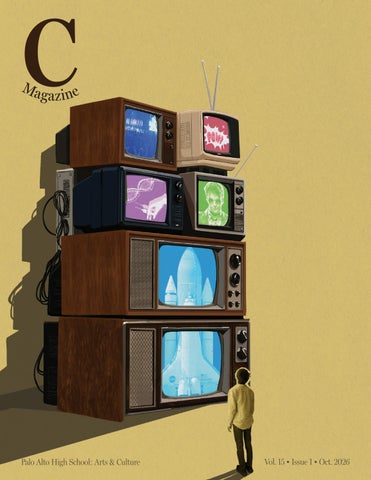
Cover Maria Uribe Estrada
Poster Eileen Lee, Luna Lim, Archer Sherry
Back Cover Xuaner Duan, Archer Sherry
CONSUMED Cover Poppy Morrison, Archer Sherry
Illustrators Derek Chen, Kea Chiao, Bahar Diner, Xuaner Duan, Stella Guo, Danielle Hanigal, Jani Jian, Eileen Lee, Luna Lim, Fabiana Littlefield, Poppy Morrison, Zoe Peterson, Maria Uribe Estrada.
Table of contents 4 • cmagazine.org
Sketching the Craze
6
CONSUMED: A C Mag Exclusive What’s on the TV?
10
Slightly More Correct
13
Injection Obsession
16
Fading Fads
20
Poster
22
Start It Up
25
Marvel-ous Resurgence
30
C Mag Tries: Pumpkin Carving
32
People Behind Paly
35
Value of the Venue
38
Film Favorites
40
Cue the Music
42
•5
ketching S the stage Junior Jani Jian draws, designs and performs her way through Paly theater.
J
unior Jani Jian rests her forehead in the palm of her hand and taps the other hand against the table. All of a sudden, a wave of inspiration hits. She swiftly reaches for her pencil, transcribing ideas onto a blank page. Once satisfied with the sketch, Jian takes a scan of her sketchbook and proceeds with textured strokes, smooth blends and solid renders, working toward a final product. As she lets the flow of the art’s story carry her through the process, the page fills with dappled trees and vast skies. “For me, I really go off of feelings and emotions when I do a drawing,” Jian said. “If I’m starting to feel something, I get that feeling in my chest of having an idea, and it makes me want to put this feeling into the artwork.” With the use of natural motifs and muted color palettes, Jian’s art creates a calming effect for her audience, a result of her desire to bring drawings to life. “I really like art because it gives me the autonomy to make things that don’t actually exist or make a copy of [things that exist],” she said. “I think it’s fun to be able to make something that you probably can’t get otherwise.” The welcoming nature that art offered drew Jian to it from a young age. “When I was little, I always really liked to draw,” she said. “At restaurants when they would have any sort of paper, I would draw on that. From then on, my mom took me to an art class, and I got all the basics down there.” Jian’s mother is quite artistic herself, drawing and crafting crystal bead bracelets
6 • cmagazine.org
in her free time. While they do share this the theater program at Paly. common interest, Jian describes pursuing “While signing up for classes, my teachart to be a product of her own passion. er said there’s a theater program at Paly,” “I think [starting art] was more of a ‘me Jian said. “So I tried out and got really inthing.’ But my mom is also pretty artistic, so vested, and I auditioned for basically every she immediately agreed,” Jian said. show.” Now and during her childhood, Jian From there, each audition brought her a enjoyed drawing animals, developing an little deeper into the world of Paly theater. intimate connection with themes related to “The audition process is actually one of nature. However, she also explores subjects the most low stress conditions I’ve ever been beyond nature. in,” Jian said. “I also really “We would be like to draw my given resources OCs [original and monologues characters] beto read through cause they’re and pick before an extension we go before the “I really like art beof myself,” teacher.” Jian said. “I Jian explains cause it gives me the can express my that acting autonomy to make own personaliserves an opporty, feelings and tunity for her to things that don’t acemotions into step into a new tually exist or make those characreality. a copy of [things that ters.” “I just like Jian is not to become … exist]” solely a visual someone else or artist, howevget immersed er. Her artistic into a different instincts for exworld, which I pression led her feel is something beyond sketchthat’s really fun es on paper. In to play around fourth grade, with,” Jian said. Jian took a great amount of interest in perUpon joining the program, Jian quickforming arts, participating in Children’s ly came to appreciate the creative liberties Theater performances such as “Alice in theater has to offer. Beyond performing, Wonderland.” Her curiosity for the stage Jian contributes to Paly’s theater program continued to grow, leading to her joining through design, creating one notable poster
Jani Jian, 11
for the “Pride and Prejudice” production. able part of the theater community. LookJian explains that she drew inspiration for ing ahead, Titus says Jian’s role in shaping the poster largely from quaint, vintage the visual side of theater can only grow. paintings with muted colors and grain. “[Her contributions are] very importWithin the poster, Jian included hints of ant,” Titus said. “I think she’s probably gopersonal insight regarding the program. ing to be designing more things for theater “Being in the show allowed me to un- as we are moving away from using any form derstand the plot and get a feeling for what of artificial intelligence or [preexisting] art this show was like,” she said. “I could also in our publicity. So she’s going to be very take pieces from the show and incorporate important in the theater community going that into the design.” forward, her and other artists.” She particularly paid great attention Being an active participant in both vito the symbolic objects in the production sual and performing arts helps Jian to unwhen designderstand more ing the poster. about her own “I really artistic identity. wanted some“I think thing soft in there are subthe poster, but tle differencalso something es [in art and “I just like to bebold, like… theater], but I gold,” Jian can’t really pincome…someone else said. “[I addpoint them,” or get immersed ed] carnations she said. “Both because that are things into a different represented where I can world, which I feel love in the just completely is something that’s show.” be myself and The poster do whatever… really fun to play features cool I want to do around with.” tones with vivwith it. I can id carnations pour my soul and silhouettes into any sort of of the protagoart.” nists, accented That freeby an intricate dom has not gold border. only shaped Adorned with how Jian does dainty vines and soft candlelight, the art- her creative work, but also how she sees work gives a timeless, storybook quality herself within it. that brings the production’s visual elements “I would say I’m an artist, because I to life. don’t only perform,” Jian said. “I feel like Over time, her peers took notice of her art comes in various forms. It can be in thoughtful contributions to the program. forms of writing, acting, drawing, sculptSenior Vakaris Titus, Jian’s peer in theater ing, all sorts of things, and I’ve been doing since her freshman year, notes the impor- a bunch of all of them.” tance of her presence in Paly’s theater comAs her presence in Paly theater grows, munity. so does the meaning she hopes to bring to “I haven’t heard of anyone else being her work. willing to do a lot of art for theater, so we “I hope for [others] to see the passion wouldn’t have as much student made art, in [my art] and the work put into it.” Jian which is something we sorely need[ed],” said. “I just want them to see the creative Titus said. “She’s very talented as an ac- process and enjoy it.” tor, so she can fill in for roles, especially Text by EILEEN LEE and SERENA ZHANG • when numbers in the theater community Art by JANI JIAN are dropping. There would be a large hole in the theater community if Jani wasn’t there.” Jian’s ability to contribute both onstage and behind the scenes has made her a valu-
Jani Jian, 11
Meeting the artist
Where else do you perform? I did a Playhouse last summer for two or three weeks. We worked on a project for little kids, and made a puppet show — it was a new experience for me because I hadn’t done one before.
Do you have a favorite play? I really liked performing in “Something Wicked This Way Comes”… here at Paly. In fourth grade, I also enjoyed when Children’s Theater came to our school and performed Alice in Wonderland.
What is your art inspired by? I get that feeling in my chest when I have an idea, and it makes me want to turn it into artwork. Or when I watch a scene and I just really love it, I want to capture that vibe for an illustration.
ARTS & CULTURE• 7
Jani’s Sketchbook
8 • cmagazine.org
CONSUMED CONSUMED CONSUMED
As our perception of the media evolves, individuals’ views of the world and themselves are molded, both intentionally and inadvertently.
Senior Oliver Reid absorbed into the contents of his phone. Photo by ARCHER SHERRY
9 • cmagazine.org
W
a h
t h n e o s ’ t
TV ?
as Traditional cable viewership of cartoons rapidly declines, animation is now adapting to a generation raised on choice, speed and divided attention.
10 • cmagazine.org a C Mag Exclusive
S
oft light from the monitor illuminates his face from be- individual networks, with its ratlow, flickering in rhythm with the vivid greens and blues ings falling 34%, while Nickelof Bluey playing on the television before him. Paly senior odeon’s declined 23% during the Kit Wendling’s 12-year-old brother rocks his Nintendo Switch COVID-19 pandemic. joystick from side to side as the television plays in the background, However, production and series ignored — as though the cartoons were playing to an empty room. orders for animated shows reached Kit looks at her brother with disappointment from the other side an all-time high in 2021, suggesting of the living room. For her, watching cartoons is now something of that children are not necessarily abanthe past, “Avatar: The Last Airbender,” “Wild Kratts” and “Oc- doning animation itself. According to Lumitonauts” has stayed with her long after she stopped watching. nate, what is happening instead is that young view“My cartoons [showed me] how the world is cool, vibrant and ers are moving away from cable television while dividing their has so many interesting things,” Wendling said. “The media I attention among streaming services, YouTube, video games and watched built my curiosity.” other digital platforms. As children’s attention begins to broaden Wendling worries that today’s cartoons leave less room for across those alternatives, animated series orders have begun to that kind of inquisitiveness. A C Magazine survey of 22 decline annually on cable networks after 2021. Paly students indicates that over the past decade, stu“The biggest change in the last couple of decades is the emerdent viewers have noticed a change in the structure gence of streaming, which changed television stories from having of cartoons. Slower-paced educational cartoons seem commercial breaks and structuring their stories around cliffhangto have been replaced by rapidly stimulating anima- ers,” Tobin said. “Movies have become more like TV in that they tion. might be franchises that have unfinished story elements at “[Fast-paced cartoons are] the end ... while TV has turned more like movvery reflective of how attention ies, where they’ll have a long story across span in general has really dethe season and be less episodic.” clined,” Wendling said. “It’s very comAs streaming reshapes how stomon to see my little brother and even ries sustain audience interest, Early [fast-paced cartoons me use split screen [and] multiple Childhood Development teachers are] very reflective monitors.” Hillary McDaniel and Jennifer of how attention span This phenomenon, also known Pierson have observed children’s as “multi-screening,” is leaving a animation using pacing, movein general has really lasting impact on the way media ment and stimulation to hold declined. is composed. Stanford professor young viewers’ attention. Adam Tobin, screenwriter of “About “The biggest difference from 15- Kit Wendling, 12 a Girl” and “Best Friend’s Date,” 20 years ago is that TV shows are notes that modern-day media is begin[now] super fast-paced,” Pierson said. ning to shift back towards traditions estab“In the past, [animation] didn’t dysregulate lished decades ago. kids to the extent it dysregulates kids’ brains now.” “Writers are now told that they need to expressly state in diaThis dysregulation resulting from fast-paced anilogue what’s going on on the screen because people might not be mation disturbs children’s sense of reality and habituates them watching closely,” Tobin said. to an unrealistic perception of the world, according to McDaniel. In Tobin’s experience, television in earlier decades functioned Since modern cartoons have sped up their pace, children have more similarly to radios. Programs relied heavily on dialogue, become increasingly accustomed to the overstimulation and connarration and verbal storytelling, allowing viewers to follow the stant sensory overload resulting from this change. plot without constantly watching the screen. “The fast pace [of cartoons] is not emulating real life,” Mc“[Screenwriters] called it the kitchen test, where you could be Daniel said. “Nothing moves that fast in real life.” in the kitchen cooking dinner and hear the show from the other Pacing is not the only element of animation that may be changroom,” Tobin said. “Now, television and film both are going back ing in response to evolving viewing habits. In an entertainment to more verbal cues because people aren’t watching as closely.” landscape where another video is always a swipe away, capturing Television changing form is only one part of this shift. As young viewers’ attention is only one part of the challenge. Filmmakers viewers’ tastes mature and new platforms compete for their atten- must also keep their stories understandable when that attention tion, many begin leaving traditional cartoons behind altogether. shifts or lapses. Wendling noticed this approach in “K-Pop De“By the time I was in middle school during COVID-19, I mon Hunters” and “Zootopia 2.” wasn’t really watching [cartoons anymore],” Wendling said. “I’d “Those two very recent movies almost felt like [they were] tellstarted watching anime and that replaced [cartoons] with long- ing the audience member what the main conflict was,” Wendform movies with better plots [and] more structured characters.” ling said. “It was really odd because rather than having subtle Wendling’s experience reflected a broader decline in tradi- themes, things below the surface that are more complicated to untional children’s television during the derstand, like emotional conflicts between two characters, [were] pandemic. According to IndieW- explicitly said.” ire, animation studios such as For Wendling, this loss of subtlety is more than an artistic Cartoon Network suffered problem. When stories explain every hidden nuance outright, the steepest drop among
ARTS & CULTURE • 11
they may leave young viewers fewer opportunities to interpret They don’t know how to wait anymore.” what they watch for themselves. For Pierson, the effects of this changing relation“The fact that [the scripts are] deliberately saying everything ship with screens do not end when children grow is definitely going to be negative for childhood development,” older. In her high school classroom, she has watched Wendling said. “Having everything spoon-fed to you, rather than students’ expectations for stimulation collide with an critically thinking, searching [and] analyzing, is detrimental to environment that asks them to remain focused on your brain development.” one subject for an extended period. Children’s media can contribute to the cognitive skills children “Years ago, [Ms. McDaniel] could show an entire develop during their earliest years. A longitudinal study published documentary in class and teens were riveted,” Pierson in Child Development found that watching educational programs said. “But now, the amount of people that get up after at ages 2 and 3 was associated with stronger vocabulary and five or six minutes to leave the class to check something or school-readiness skills three years later. twiddle with something has drastically increased.” The developmental influence of screen media also depends on Although these classroom behaviors may appear to reflect a the specific media they watch. Educational programming can in- declining ability to focus, Farina cautions against interpreting troduce language, ideas and problem-solving skills during a for- them as evidence that young people have lost their capacity for mative period. Although the absence of educational media cannot sustained attention. Instead, he points to a shift in what audiences by itself be said to affect cognitive growth, replacing thoughtful, have come to expect from the media competing for their focus. developmentally appropriate programs with pure stimulation “People’s capacity to maintain their attention has not could mean losing a valuable source of early changed even with exposure to different kinds of media learning. over time, but their expectations have,” Farina said. As students put in the survey, Rather than suggesting that people are becomolder educational programs such ing cognitively incapable of focusing, as “Wild Kratts,” “Octonauts,” Farina believes that when media “Paw Patrol,” “Daniel Tiger” continually offers faster or more As human beings, and “Dora the Explorer” felt stimulating alternatives, viewers like they frequently paused may have fewer opportuniwe’re not just or slowed their narratives, ties to exercise patience allowing children to anthrough slower molosing the capacity to attend swer questions, anticipate ments. to things; we’re just losing what came next and pro“As human beings, the habit of doing it. cess characters’ emotions. we’re not losing the Young viewers seemed to capacity to attend to - Chris Farina, psychology actively interact with the things,” Farina said. teacher environment given to them. “We’re just losing the In more recent years, carhabit of doing it.” toons have eliminated the pause The difficulty of sustainduring which children were aling students’ attention raises lowed to process and respond to concerns beyond classroom entheir favorite shows, with the intention of gagement. Because children consume speeding up the pace to keep children’s attention. Psycholmedia while forming their perspectives and ogy teacher Chris Farina sees a trade-off in that shift. thinking habits, Wendling observes that stories designed to cap“If your goal as a producer is to keep people watching your ture their attention may also shape how they understand themshows or movies, then you want a lot of action and a lot of scene selves and others. changes,” Farina said. “What you lose is ... the patience, the slow “The media that you watch influences so many things in your development of things and a lot of scene setting [and] character life,” Wendling said. “So many things come from kids’ movies, building.” and they’re not taken seriously, but they are such a foundational The screen is now less likely to wait for the child. Instead, the element of ... development in the earlier parts of your life.” child is expected to keep pace with the screen. With the introducThe impact of cartoons gives children’s media a responsibilition of handheld devices within the past two decades, technolo- ty exceeding just holding a young audience’s attention. Although gy is more frequently being used as a way to regulate children, cartoons are mainly viewed as a means of entertainment, Wendcausing concerns about an influx of constant stimulation and the ling believes their purpose extends beyond simply holding chillikelihood of lowering their attention spans. dren’s attention. “With younger kids, families are using “Kids’ movies [and] kids’ TV shows ... cannot just be somescreens as a limit-setting behavior man- thing to keep your child entertained,” Wendling said. “It has to agement tool [when] they’re in the gro- also be something that will help your child grow as a person and cery store wandering around or at a grow as an intelligent individual.” restaurant,” Pierson said. “Parents are leaning into handing a child [a] Text and design by XUANER DUAN and DANIELLE screen more, so children have less and HANIGAL • Art by XUANER DUAN and DANIELLE HANIGAL less ability to have delayed gratification.
12 • cmagazine.org 12 • cmagazine.org a C Mag Exclusive
Slightly MORECorrect
As the bar for holding the right opinion keeps rising, many students have decided the safest move is to stay quiet.
S
enior Steven Rao is an enthusiastic AI developer. At school, he tries not to say the word. “I have to constantly and proactively restrain myself from mentioning the word ‘AI,’ let alone recommending people use it,” Rao said. Rao claims it was only a couple of years ago that his classmates were open to debating how AI should be used in school. Now, he said many of them have turned against it, even for routine uses like explaining concepts or generating practice problems. To Rao, the friendly surface of Paly’s social atmosphere hides something stricter. “Superficially, everybody is having a good time talking nicely with each other,” Rao said. “But in our hearts, there is this set of guardrails constantly reminding us of where we belong and what we should not do.” British journalist Gavin Haynes popularized a name for this dynamic in his 2020 BBC Radio 4 series “The Purity Spiral.” In a purity spiral, a group that already shares the same values keeps raising the bar for what counts as the correct position. In other words, what was acceptable last year becomes unacceptable this year, and people who cannot or will not keep up often go quiet. Many students contacted for this story — a story about self-censorship — declined to be interviewed. In an anonymous C Magazine survey of 50 Paly students, 36 agreed that students feel pressure to align with the majority opinion, and only four disagreed. Just 17 agreed that students feel safe expressing diverse viewpoints, while 12 disagreed and 21 stayed neutral. “Having an opinion that is different from others in all sorts of ways can sometimes make us feel like we are doing something wrong, or [feel like] the black sheep,” one junior wrote in the survey. “Whether it is a religious, political, or moral belief, students can sometimes feel this pressure and great divide as if they have completely broken social norms.” For Jane, a senior who asked to remain anonymous due to fear of social consequences, her natural response to this pressure is not to argue, but to erase.
“I used to repost stuff [on social media], but I deleted all of them because I got scared,” Jane said. “I just feel like someone is always watching me.” In the survey, 41 out of 50 students said people are at least sometimes held accountable for things they said years ago. Five said they delete old posts to avoid scrutiny, and 11 said they rarely post opinions at all. Rao feels a similar apprehension in certain friendships. “I might be extra careful about what I say when I am texting, just to make sure another conflict does not arise,” Rao said. In his 1995 book “Private Truths, Public Lies,” economist Timur Kuran defined this behavior as preference falsification: saying what the group wants to hear while keeping your true beliefs private because the price of being honest is too high.
ARTS & CULTURE• 13
As a conservative-leaning student in a largely liberal community, Jane has experienced preference falsification firsthand. “I have to pretend to agree about all these political topics at school when in reality, I don’t agree with them all,” Jane said. “I think the people at Paly do not even care if I am faking what I believe or not. They will do anything to hear that you believe in the same things they believe.” She recalled intense backlash after she brought up a different perspective during a conversation about the 2025 New York City mayoral race. “I was talking about how I have a lot of Jewish friends in New York and that they wanted Cuomo to win,” Jane said. “When I said this, nearly everyone gave me this look of disgust.” This pressure is not unique to Paly, and it is not only felt by conservatives. A 2020 national survey by the Cato Institute, a libertarian think tank, and the polling firm YouGov found that 62% of Americans said the political climate prevented them from saying things they believed, up from 58% since 2017. The percentage of strong liberals who felt pressure to self-censor also rose from 30% to 42%. At Paly, the pressure runs in more than one direction. Sophomore Zachary Abbey, who describes himself as left leaning, said that when someone in his circle raises a controversial idea, others oftentimes dismiss it instead of engaging with it. “I feel like everyone thinks that their idea is more right than everyone else’s,” Abbey said. For Abbey, the opposite worry emerges around some of his friends. “Honestly, sometimes I’ll feel like I’m too left-leaning,” Abbey said. “I have some friends who are somewhat more right-leaning, and figuring out how much is too much to share can be tricky.” However, Abbey admits he has done the same to others before. “I’ve also been a victim of thinking that someone[‘]s idea is not as good just because it’s different,” Abbey said. Abbey recalled one conversation where he pushed back on something a classmate said about mental health, which did not end the way he wanted. “I want to say I was able to calmly explain it, but really I just kind of walked away after the conversation,” Abbey said. Still, Abbey says we must draw the line at harmful speech. “If you are hurting someone, you should be held accountable,” Abbey said. “If you’re saying racist things, or you’re making people feel unsafe at school, then that’s definitely something to be called out on.”
When no one is being hurt, he said, calmly sharing an opinion works better than telling someone, “No, you’re wrong, and you’re an idiot for thinking that.” Online, that line can blur faster. Sixteen of the 50 survey respondents said social media makes it significantly harder to express unpopular or nuanced opinions. “I’ve attended around 11 schools … I get the impression that literally everyone has the same opinions, at least on the outside,” wrote one sophomore. “When we say something that just hints at an opposition to public belief, we get absolutely berated by people, more often online than in person.” Research suggests that social media platforms speed up the purity spiral. In a 2017 paper in Nature Human Behaviour, psychologist Molly Crockett argued that social media makes expressing moral outrage easier and more rewarding than it is offline. Additionally, a 2021 study led by William Brady in Science Advances found that users who were rewarded with likes and shares for outraged posts went on to post more of the same content. At Paly, some students avoid the issue entirely by barely going online at all. “It is more of a happily oblivious kind of state, where I do not have to worry as much about what people think of me at all times,” another sophomore wrote. “Instead, I only have to worry about that when I am actually at school and with other people in person.” The silence does not always stay online. In the survey, 28 of 50 students agreed that social media dynamics affect how students interact in person. In class, it can shape who talks and who assumes the room already agrees with them. For students who choose to stay quiet, the cost is not only what they leave unsaid but who they feel they can be close to. “I do not think our connections should be defined based on our political opinions,” Jane said. “I have many liberal friends and I have no issue whatsoever with their views. However, if I were to share my views, I feel like I am going to lose my friends.” Ultimately, Jane believes the solution is empathy, not consensus. “I wish people were more open-minded and willing to hear the other side,” Jane said. “There is so much more to people, and not everything is political.” For Rao, the fix starts with changing our understanding of what morality is for. “Morality is what we use to discipline ourselves,” Rao said. “[It] should never be an evaluation system we impose on others to measure or determine how good they are.”
Morality is what we use to discipline ourselves, [it] should never be an evaluation system we impose on others to measure or determine how good they are.
14 • cmagazine.org
a C Mag Exclusive
Is there a pressure to align with the majority opinion?
Does social media make nuanced opinions harder?
Are people held accountable for things they said years ago?
“Having an opinion that is different from others can make
someone feel like they are doing something wrong, or [feel like] the black sheep.”
— Anonymous junior, survey response Text by MARIA URIBE ESTRADA • Design by BAHAR DINER and MARIA URIBE ESTRADA
ARTS & CULTURE• 15
injection
P
Unregulated supplement use is the latest social media wellness craze targeted towards teens.
obsession
ulling at the skin of his abdomen, Keith angles the needle just so; in just one swooping injection, quadrillions of peptide molecules will enter his system. Hopefully, so will all the cosmetic benefits the online seller promised. Peptides are short chains of amino acids that regulate virtually every major physiological process in the human body, from metabolism to tissue repair. While the body naturally produces thousands every day, the self-administration of synthetic peptides has rapidly evolved from a wellness trend to a multi-billion-dollar industry, accelerating significantly from 2022 onward. Fortune Business Insights projects that the global peptide market will grow from $146.34 billion in 2026 to $334.95 billion by 2034, already observing a $14.39 billion increase from just last year. Amongst American consumers, the search query “how to get peptides” surged a staggering 1019% increase from March 2025 to February 2026, according to U.S. Google Ads Data. With each vial promising unique physical enhancements, commercial peptide usage and interest has seen a unprecedently dramatic upsurge. Biochemical compounds once exclusive to medical laboratories can now be found on vanities, gym bags and websites worldwide. Even students like Keith, who wishes to remain anonymous, have been pulled into the murky waters of the online peptide market. “I first heard about peptides scrolling on TikTok,” Keith said. “I heard you could lose weight, improve recovery and maybe gain a little more muscle.” Enticed, Keith began incorporating a host of peptides into his daily routine. “I use Reta [retatrutide], which is a weight loss GLP agonist, and MT-1 [melanotan 1], which is a tanning one,” Keith said. “I also use tesamorelin and CJC1295, which help you get better sleep and lose a bit of weight; ipamorelin, which helps release greater spurts of growth hormones during sleep; and glutathione, which helps with detoxifying the liver.” While Keith has reported several tangible benefits after taking these products, such as clearer skin and improved health
16 • cmagazine.org a C Mag Exclusive
markers, the true validity of peptides is still up in the air. While the Food and Drug Administration (FDA)has tested and approved 102 peptides for medical application, millions of unregulated products are sold online. Many vendors label their products as “for research purposes only,” evading federal guidelines governing the distribution of drugs for human use. Often described as selling on the “gray market,” this method of retail operates out of legal loopholes, presenting serious concerns to experts like Dr. Jonathan Long, an Associate Professor of Pathology at Stanford University. “If it hasn’t been approved by the FDA, it therefore hasn’t been shown to be safe and effective in humans,” Long said. “You don’t know what you’re putting [in] your body, you don’t know if it’s safe and you don’t know if it actually works.” While it may appear as a mere technicality to customers, getting peptides that are approved by the FDA can be the difference between untested flukes and life-changing technology. “[Regulated] peptides really are medicines,” Long said. “If you’re diabetic, you might take insulin to control your blood sugar. If you are born with a genetic deficiency of growth hormones, you might take growth hormones as a teenager and come right back up to normal height.” Though Long champions the success FDA-approved peptides have seen in their respective functions, he has also observed a harmful, unintended consequence of peptide use among consumers. “People have begun to realize, ‘hey, I can inject myself with something and get a therapeutic effect which really works,’” Long said. “That same reasoning has now been lumped in for all these other unregulated peptides too, where the evidence is much, much less than for the approved drugs.” However, some customers still exercise caution. Sophomore
Albert Wehrman began researching the growth hormone secret- noticed among content creators surrounding their peptide use and agogue MK-677 after seeing social media content promoting it but cosmetic enhancements. was troubled by what he found. “[Influencers] are doing a lot of things that will look good in the “I’ve almost been tempted, but it’s just so untested and probably short term, a lot of things they don’t have to show you in the long has crazy side effects,” Wehrman said. “I don’t want to take the term,” Shaikh said. “Realizing this helped me see that maybe I’m chance to ruin the rest of my life just to be taller and grow a little not doing that badly.” more muscle.” As the founder and CEO of Align33 Media, Morgan DiPriAs someone who has pursued peptides despite having knowl- mo has dedicated her professional life to shifting national dialogue edge of the associated risks, Keith refutes this common uncertainty. about eating disorders and mental health so more teens come to “There’s not really any side effects as far as I’m aware from my the same conclusion as Shaikh. personal experience,” Keith said. “I 100% think “The whole conversation of wellness I understand them [peptides] deeper now. I’ve culture feels skewed to an extreme bias,” done a lot more research into what they do.” DiPrimo said. “What we’re not focusing on Despite Keith’s faith in his findings — which enough as a society is: how are we equipping he attributes largely to TikTok, medical studies our kids to love themselves and have a good and ChatGPT — Long is wary of how consumrelationship with their bodies?” er overconfidence can impact the interpretation Unfortunately, the emergence of intense of complex research. physical-improvement content creators has “If some gym bro is saying, ‘Hey, I found this only made answering DiPrimo’s questions paper from this lab at Harvard that describes more difficult. Due to an influx of hyper-masthis thing in a mouse,’ we’re back to the 1980s,” culine influencers like streamer Braden PeLong said. “You might not need to understand ters — known to fans as Clavicular — there all the stuff that must have happened between has been a rapid surge in the practice of “People have begun to realize, 1980 and now, but just understand that there’s a looksmaxxing, the optimization of physical lot more to it than finding some paper and decid- ‘hey, I can inject myself attractiveness through both non-surgical and ing it’s legitimate.” extreme methods of enhancement. Despite with something and get a Misinformation surrounding medical data therapeutic effect which really falling in the target demographic for this can be especially dangerous on social media, content, Wehrman has suspicions about the where a simple falsity or generalization can cre- works.’ That same reasoning true motivations behind the craze. has now been lumped in for ate a ripple effect. For students like Sam, who “Clavicular is all into looksmaxxing and wishes to remain anonymous, seeing some con- all these unregulated peptides, taking steroids, but he seems really insetent creators promoting peptides as part of their cure,” Wehrman said. “Even though he’s where the evidence is much, daily glamorous lives was especially damaging. got a good physique and is a good-looking “I think many can relate to the feeling of inse- much less.” dude, he probably doesn’t think that about curity when constantly seeing ‘perfect’ influenchimself.” Dr. Jonathan Long ers online,” Sam said. “Personally, I have felt this Freshman Annie Zheng has seen the reway when scrolling through Instagram. I think al-life impacts of Clavicular’s content and that the constant reaffirmation of these notions the culture it promotes. through exposure may have been detrimental to “I have some friends who [are] all really my self-image.” into looksmaxing, and I feel like that whole Only once he began taking the steps to pursue idea is kind of weird,” Zheng said. “It’s suppeptides did Sam realize how serious the situaposed to be a betterment for yourself, but it tion truly was. also can get toxic when you put other people “Dissatisfaction with my appearance and performance led down because you think you’re superior because you look better. me to research possible peptides for use, like BPC 157 [Body It’s weird to have a society that categorizes people based on physProtection Compound-157, which accelerates tissue healing], ical appeal.” CJC 1295 [ConjuChem-1295, which stimulates hormone Beyond promoting an unhealthy hierarchy based on appearproduction] and other substances,” Sam said. “I had even ance, this content has also inspired potentially dangerous escalagone so far as to access gray market sites, though I never tions in substance use. fulfilled the purchase due to concerns about health and “One of my friends was like, ‘I take peptides already, but I limited credibility.” might want to take steroids’,” Zheng said. “I was like, ‘Why would Junior Azan Shaikh’s personal introspection was sim- you take steroids?’ It’s like the more physically attractive you are, ilarly impacted by online discourse and the physical the better people treat you. A lot of people are obsessively building expectations it can set. muscle and stuff because society pressures them to fit a standard.” “Social media changed how I thought about myWhile insecurity is one possible influencer incentive behind self,” Shaikh said. “I thought I was doing poorly peptide promotion, professional necessity is another. and I thought I was stupid. But then I realized “Influencers have a job and [appearances] is part of it,” DiPriit’s staging; the people I’m seeing are not real.” mo said. “Just because someone uses something doesn’t necessarily Shaikh’s fractured sense of reality has been mean that they’re any happier or their life is any better – it’s just particularly heightened by the dishonesty he’s what they’re paid to do.”
ARTS & CULTURE • 17 CULTURE • 17
However, it can be difficult for viewers to make was advertising,” DiPrimo said. “It was very clear – there was a that important distinction. commercial break, you knew it was a commercial, you knew you “There’s a very fine line, and it gets blurred,” DiPri- were being sold to. Whereas now, you don’t necessarily know when mo said. “People will think that their wellness is the reason you’re being sold to.” why they are where they are. You’re only seeing a snapshot While DiPrimo stresses the value of staying vigilant about ad[of] their day, [so] you would think that that’s something vertising, choosing what influencers to follow is an equally importthat they incorporate into their lives daily.” ant decision when it comes to online safety. DiPrimo has observed an increasing number “There are some people who are clearly taking drugs but give of consumers turning to peptides not as potential good fitness advice and don’t advocate for other people [to take treatments for medical ailments, but as tickets to a peptides and other physically enhancing supplements],” Wehrman dangerous ideal. said. “Then there are some who link directly to a peptide store.” “If [influencers] have what seems to be the As a means of escaping the constant social pressures created perfect life, then that gets affiliated with the by social media, freshman Diana Doran personally recommends a product as well,” DiPrimo said. “[Thinking more permanent solution. that] ‘Oh, this person is doing this product “It was really hard, and there were multiple times I reinstalled and they’re traveling all over the place, they it, but I decided to delete social media for good,” Doran said. “I have a significant other, they seem happy’ all had seen so much stuff where [influencers] would say if you eat adds to the false advertising.” a certain way, you would be As a social media user, healthier and if you do your Shaikh has been privy to skincare a certain way, your similar misleading marketing skin would look better. I felt “The whole conversation of wellness tactics. like being beautiful was a culture feels skewed to an extreme bias. “What blows up online is norm, and I was outside of What we’re not focusing on enough as people at their best, not people it.” at their normal,” Shaikh said. Similarly, the heightened a society is: how are we equipping our “It’s people who are trying to show normalization of artificially kids to love themselves and have a good you all the positives of what they’re enhanced physical appearrelationship with their bodies?” doing. They don’t have to show you the ances took a toll on junior negatives of what happens, so you only Jonathan Salvador’s self-imMorgan DiPrimo see the positives, and you think, ‘I’m not age. good enough, what are they doing?’” “I’ve always felt a need Despite many teenagers turning to use steroids since both of to beauty and fitness gurus for inspiration, this with- my parents are very skinny,” Salvador said. “With my genetics, I’ll held negative perspective prevents followers from never get anywhere without steroids.” discerning the true reality of a situation presentBecause there are so many influencers across the wellness, fited online. ness and beauty internet communities promoting peptides, the “[Influencers] could be selling anything,” use of them can feel overly prevalent to viewers like Salvador. Shaikh said. “If you want to be well informed, “On TikTok, I see every guy on peptides,” Salvador you have to realize what the incentives are for said. “It makes me jealous because I want their physique, the people who are showing you this informa- but I know they’re not natural.” tion. That should help you see that they’re not Unlike some of his peers, Salvador’s interest in stealways gonna show you the whole picture. roids and other enhancers was not thwarted upon furHowever, Shaikh does not believe influ- ther research. encers are the only massive instigator of the “I just want to take them so I could look good illusory beauty standards behind the peptide and say I gave something my all,” Salvador said. boom. “If you try to get your dream body through natural “Looking at the specific physiques of actors means, it’ll take too long, and in that time, you’ll who are trying to keep looking very lean [with lose motivation.” age], they’re not going to show themselves taking However, he is well-aware of the existing risks. steroids or taking any sort of these supplements “There is definitely a lot of misconception that are unhealthy,” Shaikh said. “For those very about all the peptides because people like to lean physiques, that’s a 3% body fat percentage. say they’re just a chain of amino acids,” SalThat’s not healthy. And 10%, which is healthy, looks vador said. “But [taking] too many peptides very different than a 3%. It doesn’t look as healthy as can make you sick and almost deplete you to what is actually very unhealthy.” death.” This dangerous gap in discernment highlights To experts like Long, negative effects how difficult it can be to avoid misleading market- should never be taken lightly. Seeing paring if you do not know that you are being exposed allels to a non-peptide-related drug incito it, as DiPrimo has noticed firsthand. dent called the 1982 Frozen Addicts case, “I grew up in the ‘90s, and we knew what Long warns consumers of the dangers
18 • cmagazine.org 18 • cmagazine.org a C Mag Exclusive
of ingesting unknown substances. “Back in the 1980s, there was this rave drug [called synthetic heroin],” Long said. “In the manufacturing, there was a side product contaminant called MPTP. And what happened was all these young adults that went to these [Northern Californian] raves developed Parkinsonian-like symptoms shortly after.” Researchers were able to trace these symptoms back to the MPTP, which kills dopaminergic neurons, the same cells targeted by Parkinson’s disease. Due to a critical temperature error of the amateur backstreet chemist concocting the batch of drugs and illicitly distributing them to partygoers, the affected drug users instantly suffered the debilitating effects of an irreversible disease that traditionally takes decades to develop. “I’m not saying that anything like that has happened in the peptide world yet, but you just don’t know what you’re messing up, either acutely or in a chronic state, when your body’s changing so much,” Long said. “A lot of these peptides are hormones, which means that they intersect with your own hormonal system in complicated ways.” One such peptide is the glucagon-like peptide-1 (GLP-1), which achieves its widely known weight-suppression by stimulating the production of insulin, decreasing the production of glucagon and lowering the production of reproductive hormones like testosterone and estrogen. “If you are a teenager and you start taking GLP-1s, you’ll probably lose weight and feel less hungry,” Long said. “But even for approved peptides, there are issues of potential abuse whenever you have people who are not the population this was intended for who are taking them.” Both widely commercially available and prominent on social media, GLP-1s concern experts like DiPrimo when it comes to their impact on adolescent mental health. “Right now, we’re seeing a lot of ads when it comes to GLP-1s,” DiPrimo said. “And with people using AI to generate their images [and using] filters, all of this is giving a very skewed look for teenagers on what health is and what wellness is.” Regardless of their efficiency and perception, GLP-1s played a significant role in the peptide commercialization movement. “What kicked off this whole craze was the approval of all these GLP1 medicines, originally in 2005 – these liraglutide, semaglutide, tirzepatide, Ozempic and Wegovy type of medicines,” Long said. “They are FDA-approved drugs, so people know that they’re safe and effective for weight loss.” Though many consumers are familiar with these products, the backstories behind
them are often overlooked. “When people are taking GLP-1s, many of them don’t know that the first GLP-1 medicine ever approved was isolated from a desert reptile called a Gila monster native to Arizona,” Long said. “From a scientific perspective, we’re interested in some of these extreme animals with extreme metabolisms as a source of potentially new medicines for human metabolic disorders.” Disconnects between consumer knowledge and scientific processes are common in the field of peptides, according to Long. “People don’t understand how long it actually takes for peptides to go into science,” Long said. “The timeline to keep in your head is that GLP-1 was originally discovered in the 1980s. And it’s taken about three to four decades for that original discovery to be translated into a bona fide medicine.” As a professional in the field of peptides, Long believes the gap can be largely tied to professional guidance, or lack thereof. “My personal view is that scientists like myself have not done a good enough job communicating,” Long said. “There’s huge public interest in this and the only communication is in the form of, ‘You can take this, all these things are good for you, it will improve all these aspects of your health.’ What do you expect when there’s a huge demand, and the experts are not stepping in?” Beyond calling for an increase in scientific counsel, Long emphasizes the importance of adults supporting teenagers through this period in their lives. “People don’t tell you after you go through those years how tough it is to be a teenager,” Long said. “There’s all sorts of social pressure because you’re in this [high school] environment, but it’s hard to understand that when you’ve only been alive for 17 or 18 years.” DiPrimo believes accepting one’s stage of life is an especially critical habit to build and maintain at a young age. “I don’t think we should be trying so hard to optimize the way that we look, because the way that we look is temporary,” DiPrimo said. “We all get older, and we go through different seasons of life. When you go naturally through a different season of life, it could be shocking when you don’t fit into the optimization of what you used to be.” However, DiPrimo believes it is imperative not to allow that shock to dominate your life. “When you are at the end of your life, you’re not going to look back and think of all your wellness routines,” DiPrimo said. “You’re going to look back and hopefully think about all the memories that you’ve had with loved ones. Just think of the big picture, even though sometimes it feels like the world is so loud.” Text by KEA CHIAO and ANJALI DAHNCKE • Design by KEA CHAIO, ANJALI DAHNCKE and LUNA LIM • Art by KEA CHIAO, STELLA GUO and LUNA LIM
CULTURE • 19
The Paly community refelcts on the food trends that have come to the table over the years.
“Butter got replaced by margarine and companies created yogurt with no whole milk.”
1978-1982
Shirley Tokheim, English Teacher
Text and design by ZOE FERRING and POPPY MORRISON Years they were in high school
2023-2027 “I’m seeing it added to a lot of foods like popcorn and starbucks drinks.”
Alana Chun, 12
PROTEIN
20 • cmagazine.org
a b Bo
2012-2017
“I would see classmates come into class with boba...while they ‘went to the bathroom’”
Claudio Malagrino, Physics Teacher
FOLLOW US FOR MORE CONTENT @c_magazine & cmagazine.org
CULTURE • 21
What were once tools used for connection are evolving into a replacement for human interaction, and relationships are getting lost in the noise.
Photo of
f APRIL YUAN by ARCHER SHERRY • Art and design by EILEEN LEE and LUNA LIM
MAC BOOSTERS AD
24 • cmagazine.org
Paly students are turning new technology and Bay Area connections into businesses of their own.
ARTS &CULTURE CULTURE•• 25
F
or many Paly students, earning their first paycheck starts with technological capabilities of AI by starting University Bikes, a combing through pages upon pages of job listings on Indeed, business where he buys, repairs and resells bicycles. tirelessly filling out applications with furrowed brows and “Me and a lot of my tech friends used OpenClaw to create leaving it up to hope that a local business hires them. However, for an AI agent that automatically scrapes Craigslist and Facebook,” sophomore Selim Uyan, working for others wasn’t his choice for Wang said. “It detects flippable bikes and then sends me a message earning money. Rather than going through the painstaking process on Telegram and then I’m able to contact that person manually.” of looking for a job, he decided to turn towards entrepreneurship. Once the program identifies a profitable listing, Wang and his Two years ago, Uyan opened a shop on Etsy — an online team still have to manually purchase it, make necessary repairs and marketplace platform that allows artists and creators to sell unique find a buyer. University Bikes therefore combines AI automation goods — where he now designs and sells 3D printed products, with the hands-on work of a traditional small business. including vases, bowls and marker holders. For Uyan, starting a However, access to powerful technology only partly explains business offered control over what he created and how he worked, why more young people are choosing to build their own businesses. something a typical high schooler cannot access through a Yan said that the Bay Area’s hardworking, ambitious culture also traditional job. contributes to the rise of startups. His story represents a broader sentiment among youth in an era “The Bay Area is a lot more competitive than everywhere else,” defined by rising unemployment, mass layoffs, and uncertain job Yan said. “In college, I’ve met kids from Saudi Arabia, Korea, prospects. According to the New York Fed’s August 2026 Survey of Russia, Kazakhstan and SoCal. People here would sacrifice one Consumer Expectations, hour of sleep just to get American job anxiety that A plus, while if I reached a 13-year peak, ask a SoCal student or a with 44% of Americans person [from] Florida, expecting unemployment they would preserve to rise and only 52% [their] health [and] get confident in finding work that eight hours of sleep.” after a layoff. In these According to Yan, “If you have the passion to do it, trying times, more and this competitive mindset more students in Silicon does not stop in the ‘I need to do this, I really want Valley are taking the reins classroom — the same to and I think that I have my own into their own hands. ambition to work harder The Bay Area is the also carries over into expertise that I can place in,’ center of the startup entrepreneurship. then I think anybody could really world. Here especially, “The culture pushes be successful.” starting a business has you to do better,” Yan become increasingly said. “Hustle mentality is accessible to younger a part of business.” Selim Uyan, 10 people. In a July 2026 Yet, hustling can report, Startup Genome come with a cost for high ranked Silicon Valley school students, especially No. 1 among startup with the academic ecosystems globally environment of Palo and valued its startup Alto. For Wang, trying to ecosystem at $3 trillion. manage every part of his Much of that growth business initially made it has been fueled by the development of artificial intelligence (AI), difficult to keep up with school. which has lowered the technical barriers that once made starting a “When I initially started, I was burning out,” Wang said. “I was business difficult for students. Building a website or app previously spending 60 hours a week on work, and my grades were pretty required extensive coding knowledge and time. One major change bad. I think I had 30% in both Chemistry Honors and AP Physics has been the rise of generative AI coding agents like Claude Code homework sections.” and OpenAI’s Codex, programs that can help users code based After realizing his overwhelming workload was unsustainable, on simple typed prompts instead of manually programming code. Wang had to change how he ran his business to find a way to Jerry Yan, a 2026 Paly graduate, said AI has made it increasingly destress his schedule, rather than abandoning the project as a easy to turn ideas into reality and start a business. whole. “These coding agents are a powerful force that cuts down the “Over the summer, I started hiring a lot of people to work for moat of software,” Yan said. “You and I can make these apps [and me,” Wang said. “By outsourcing a lot of my job, I’ve been able to businesses] really quickly.” balance all of [my] school work. I try to put in anywhere from 10 This ease of access does not mean that every student has to to 20 hours a week on my bike business now.” sell a product related to AI. Rather, students can also use AI to Wang’s experience demonstrates that balancing automate parts of business operations, like creating advertising entrepreneurship with school can require more than just hard graphics, visualizing finances or doing market research to expand work. For him, that meant delegating tasks efficiently. For others, customer bases. Senior Paul Wang has taken advantage of these it can mean planning schoolwork around their businesses and
26 • cmagazine.org
extracurricular activities. While attending Still, when almost anyone can Paly, Yan said he tried to anticipate busy use AI to build an app or start a “You should find your own periods months in advance. If he knew business, Uyan said being able nic he, because if you want debate tournaments, extracurricular to create an app is not enough to to build something, build activities or work would take up more of make an impact. Rather, learning something that’s actually his time later in the semester, he would how to use this technology complete assignments or study material and deciding what is actually impactful.” ahead of schedule. worth creating has become everJerry Yan Uyan takes a similar approach with his important. Class of 2026 Etsy shop, adjusting his business around “When we take a look into his schedule rather than treating every humanity and how it develops over week the same. He said packing and time, we seem to think about the shipping existing products generally idea that we can use the latest tools requires less time than developing to build something greater,” Uyan a new product or creating a new said. “But if we don’t know how listing, allowing him to save to use the tools correctly, then larger projects for weekends, what we will end up building breaks or less demanding won’t be the right product periods of school. for people that are using Balancing the workload it.” of schoolwork and To Yan, AI should extracurriculars with the be used as a tool, but demands of running a business to actually make a can be one of the biggest challenges for student entrepreneurs. w o r t h w h i l e business, you need to use But growing up near founders, investors and existing technology critical thinking to come up with an idea and execute it. companies in the Silicon Valley can give students connections that “You have to understand when to use [AI],” Yan said. “Anyone would be far harder to find elsewhere. Venture capital firms — could go on Codex, pay $100 for Codex Pro and type in any also known as VCs — invest money in growing companies they prompt. If you want a good product, you either have to be good at believe have the potential to grow quickly. For students surrounded marketing, or you have to do deep research. You should find your by friends and adults already involved in VCs, these networks can own niche, make starting a business much more attractive. “Palo Alto itself is VC Central,” Yan said. “We border Atherton, we’re really close to Menlo Park and there’s a YC [Y Combinator, a venture capital firm] quarter in Mountain View. With some of my friends working with VCs already, it pushes you into this ecosystem where you already have this network.”
ARTS & CULTURE• 27
because if you want to build something, build something that’s Yan said that those relationships are part of what makes starting actually impactful. You have to be knee deep in the community something worthwhile, especially once students have an idea or and actually find a pain point or a problem present.” network available to them. Along with research and understanding the impact of products, “Start a business once you have enough connections or once building a startup also helps students understand the value you have a good idea,” Yan said. “When you’re knee deep in the of earnings and its contribution to social relations. culture, [the business becomes] a good experience that For Wang, entrepreneurship is important opens you up to the world.” for teaching how difficult money really In a time of rising job instability, the Bay Area is to earn, especially growing up in an can give young entrepreneurs the technology, “If we don’t affluent community like Palo Alto. culture and connections that encourage understand the sense “One of the things about Palo experimentation. However, those advantages of money, then Alto is that a lot of kids have so do not guarantee that a business will last. we can’t be true many things that they take for Uyan said that the students most likely to keep participants in granted, including getting a big a business going are those who bring genuine budget to spend at Town & Country interest and their own knowledge to what the world that we [shopping center] every week,” they are building. will live in in the Wang said. “If we don’t understand “It also comes down to passion,” Uyan future.” the sense of money, then we can’t be said. “If you have the passion to do it, ‘I need true participants in the world that we to do this, I really want to and I think that I have Paul Wang, 12 will live in in the future.” my own expertise that I can place in,’ then I think Starting a business can also be a form of anybody could really be successful.” education in itself, teaching students through decisions and interactions that are necessary in the world. For Yan, starting his own business was as much about the Text and design by DEREK CHEN and ARCHER SHERRY • Photos experience and relationships he built as the business itself. by DEREK CHEN, KMR Photohraphy, Teleyinex, Guwashi999, “Many people don’t want to start a business because they homebucket, David Schiersner, lucyrfisher, hernanpba and don’t have the fire in them,” Yan said. “In my opinion, Yoshikazu Takada • Photos courtesy of PAUL WANG and SELIM starting a business in high school is fun because you get UYAN to create your own family. For [my business], we meet in a boba shop that my friend owns, drink boba and eat malatang. It’s just a chill community.”
28 • cmagazine.org
“I founded [boundarie] sophomore year because my friends were all in a little coding club and we wanted to work on a project. For myself, I started the project because the fact that I feel like information is scarce, especially to international students. I was living in China before ninth grade, so I had a [big] lack of information. I didn’t know what the college application was like, or what even high school is like... so I started the organization because of the fact that I wanted more people to be able to access all this information. It [boundarie] gives you a wide selection of mentors from all kinds of schools, and you get to go on there, ask some questions about how their college application process was and how you can edit your essays.” Jerry Yan, Class of 2026 Boundarie
“I do a lot of 3D printing and design, and my goal is to make products that are artistically bold, yet mathematically unified. What I do is provide usefulness in a way that is elegant — so I like crafting and designing vases, sharpie holders and whatever you can think of that is functional. And I share it with the world.” Selim Uyan, 10 Selim 3D Printing
“I really enjoy my job because it gives me a better understanding of bikes, and it also allows me to join this community of people who ride bikes around the Bay Area. I feel like it’s super good just to go outside, do some exercise while getting some great views and go places that you haven’t been before.” Paul Wang, 12 University Bikes
CULTURE •• 29 ARTS & CULTURE 29
Marvel -ous
Resurgence Opinion: After five years of disappointing movies, confusing storylines and forgettable characters, Marvel finally has a chance to return to what made it special.
I
’ve only fallen asleep in a movie theater once. Heated, reclining seats, a bucket of popcorn on my lap and “Ant-Man and the Wasp: Quantumania” playing on the screen. At first, I tried to follow along but the movie was more boring than an unskippable ad. My eyelids grew heavier, and one second I’m watching an atrocious CGI floating head, the next my friend was shaking my shoulder because the movie had ended. If that were a one-time thing, it could be considered a fluke. But five of the worst-reviewed movies in Marvel’s history came out in the last five years. These included “Captain America: Brave New World,” “Quantumania,” “Eternals,” “The Marvels” and “Thor: Love and Thunder.” I paid full price for every single one. $15 popcorn and a $15 seat. I could’ve bought two poke bowls instead. The Marvel Cinematic Universe (MCU) wasn’t always like this. Growing up, every Halloween I dressed up as a different superhero. I was Captain America in first grade, Spider-Man in second grade and Deadpool in third grade. This is what I would consider peak MCU, from 2016 to 2018, when some of my favorite movies came out one after another: “Captain America: Civil War,” when the Avengers literally fought each other; “Spider-Man: Homecoming,” which ; “Thor: Ragnarok,” which combined humor with epic battle scenes; “Black Panther,” which had one the saddest villains; and “Avengers: Infinity War,” which brought nearly every major hero together for the first time. During this time, I would argue with my friends about which Spiderman actor was the best, or which Iron Man suit looked the coolest. I would rewatch the same movies again and again until I knew exactly what was going to happen next. Every time I watched a Marvel movie, I would imagine myself in that universe. After the movie ended, I could spend hours recreating fight scenes with my LEGO minifigures. I spent years growing to love not only the characters, but also the actors who brought them to life. Each movie felt carefully crafted and unique, while still contributing to a much larger story. Piece by piece, they were all painting the same picture, one that
30 • cmagazine.org
would ultimately come together in “Avengers: Endgame.” “Endgame” was ultimately a near-perfect ending. Beloved characters received deserving endings: Iron Man sacrificing himself to save the universe and Captain America growing old after finally choosing to live the life he had always missed. Like myself, many fans grew up with these superheroes. Yet, Marvel decided to kill them off for new stories with new characters. The problem with killing off characters is that, in some ways, the fan base gets killed with them. As a result, the movies that came out after “Endgame” were filled with characters no one knew or cared about. At the same time, Marvel began mass-producing shows and movies. After “Endgame,” the launch of Disney+ pushed the MCU into a constant stream of new movies and television series, like “WandaVision,” “The Falcon and the Winter Soldier” and “She-Hulk.” With so many projects being created at once, the character development and storytelling that defined Marvel’s earlier phases started to disappear. “Doctor Strange in the Multiverse of Madness,” for example, drew criticism for its rushed visual effects, while “Eternals” introduced a large cast of new characters in a My brother and I with our face painted as our favorite superheros, Iron man and spiderman
single film, leaving little time for audiences to form connections with them. Seeing Marvel change was like watching your best friend slowly drift into someone you don’t recognize. During its prime, when I was in elementary school, missing a new Marvel movie made you feel out of the loop. By my freshmen year, no one even talked about Marvel. The problem wasn’t that Marvel is incapable of making good movies. It still created crowd-pleasers, like “SpiderMan: Far From Home,” and “Spider-Man: No Way Home” which never let me down. However, a lot of those movies’ success came from the fact that Peter Parker was already a cherished character that audiences had grown attached to before “Endgame.” For me, “Shang-Chi” is another exception out of the movies that have been released since Endgame. It has one of the most complex villains in Shang Chi’s father, Wenwu, whose actions are driven by his grief over his wife, and his belief that he can bring her back. The movie is also filled with high-quality fight scenes, and an emotional plot highlighting how Shang Chi struggles to handle his complex relationship with his father. Since “Shang-Chi,” which was released in 2021, I haven’t really thought about Marvel. I occasionally saw trailers of new releases, like “Thunderbolts” and “Captain America: Brave New World”, on YouTube, but I rarely felt motivated to watch them. Until “Spider-Man: Brand New Day,” which came out just a few months ago. For the first time in a long time, Marvel made me feel something again. Something I had been missing from the
other more recent films. Spider-Man’s emotional struggle, paired with a complex villain who felt genuinely human, gave the movie a level of depth that reminded me why I fell in love with Marvel in the first place. It was one of the movies where you sit there during the credits and just think about how you just witnessed an absolute masterpiece. “Brand New Day” has already grossed more than $2.45 billion worldwide, so I wasn’t the only one who felt awestruck. V i d e o s imagining life in December 2026 have flooded social media, with users fantasizing about watching Avengers: Doomsday before heading home to play GTA VI with friends. For the first time in years, Marvel is starting to feel like it’s something big again. “Avengers: Secret Wars” is also on the way and with the Avengers being brought back together, “Doomsday” and “Secret Wars” have a real shot at turning Marvel’s current reputation around. That said, none of the hype guarantees that the future movies will be good. When I was a kid, I never sat down for a Marvel movie wondering if it’d be worth the two hours or the $20, I just needed to know the plot. Somewhere after “Endgame,” that feeling disappeared and I didn’t notice it was gone until this summer. While I sat in the theater watching, “Spider-Man: Brand New Day” I finally felt that feeling come back. So I’m confident to say that after five years of disappointment, Marvel may actually be giving me a reason to return to the theater.
I gr ow spen on ly ing t t yea th ol bu rs e t wh als cha ove n ob r o ro the acte ot ug r ht acto s, r lif t e. hem s to
S
d
2018 dp ea o
ol
2016 n ame ai
ca ri
ca p t
My marvel costumes 2017 derman pi
Text and design by KYLE CHEN • Art by KYLE CHEN and MARIA URIBE ESTRADA
ARTS & CULTURE • 31
C Mag Tries
PUMPKIN CARVING The C Mag staff competes to carve the best pumpkin!
Photos courtesy of GORDON PARKS FOUNDATION
32 • cmagazine.org
“We wanted to have a unique design that was not your typical Halloween jack-o-lantern. We thought that a spider would be cool.”
-Eileen Lee, 11
“We looked on Pinterest and we all saw the cute design for our pumpkin.”
- Serena Zhang, 10 “Our group decided to go with a Spiderman-themed design because we all thought it would be a cool pop culture reference. ”
- Kea Chiao, 11
“We really wanted to go bizarre with our pumpkin and embody the spirit and spookiness of Halloween”
- Luna Lim, 12
Design by XUANER DUAN, ZOE FERRING and POPPY MORRISON
C Mag w
ishes yo
ua ART • 33
Which Pumpkin is your
Pick of the Patch? 1) Peter Pumpkin
2) C Mag Man
3) Jerry
4) Shockin
34 34 •• cmagazine.org cmagazine.org
Vote Here!
P e op le Behin d
PALY
Behind the teachers we see everyday, dozens of other staff who help keep Paly running often go unnoticed and underappreciated.
Kendyll Owens
What do you do at Paly? I’m the wellness liaison, which means that I run the wellness center ... I also do all the marketing.
Wellness Liaison What do you enjoy about
working at Paly’s wellness center?
I like that it really calms me down, and I just love really helping students, even when they’re not feeling that great. It gives me a lot of joy and it’s really rewarding.
What do you want people to know about your occupation? You can come [to the wellness center] anytime, whether you’re sad or happy. We have a whole different range of activities that you can do, no matter how you’re feeling.
Rosa Lopez Rivas Food Administrator
What do you do here at Paly and how long have you been working here? I work in the Student Nutrition Service department at PAUSD, I have been in this department for 13 years and I am currently working here at Paly as a Kitchen Lead. My Job at Paly is to lead, do all of our food ordering, keep records, cook, and serve to provide a nutritious breakfast and lunch meal to every student.
What would you like students to know about your occupation? What I would like for students at Paly to know about my occupation is that as a food service lead, I help oversee the daily food service operation, make sure meals are prepared and served safely and on time, support my crew and make sure students receive their meals in a welcoming and organized environment.
ARTS & CULTURE ART• 35 • 35
Albert Balcita Custodian
What do you do here at Paly and how long have you been working here? I am a night custodian for Palo Alto High School, I’m up to about 30 years of experience in the district. We take care of the campus as far as keeping it clean, disinfecting and keeping it organized. We feel like we’re the backbone of Paly. A lot of people don’t see us, but we do a lot of work behind the scenes.
What do you want students to know about you or about your occupation? It’s very hard work. But we persevere. That’s one of the things to having a great team is you persevere. If one person can’t do it, you have the next person stepping up with the muscle or the ready power just to get the job done. Teamwork, to me, is where it all stands.
Do you want to add anything? I’m pretty content. As long as I have a great team behind me, the sky’s the limit over here. We can elevate what we do, as far as being part of the cleaning community.
James Hamilton School Counselor
What do you do here at Paly and how long have you been working here? I’m a school counselor. I’ve been a school counselor for 15 years. This is my 10th year at Paly.
What are some challenges you face as a counselor? I can’t fix everything, and that’s difficult. Sometimes it’s just beyond my capacity. But also, sometimes schools have limitations on what they can do. There are things that we can’t do. And I think that can be challenging.
What do you want students to know about you or about your occupation? You don’t need to wait for a crisis to come see us. If there’s something something that’s troubling you, the counseling office is a great place to just come in and talk to your counselor, and tease it out. I have Airheads in my office. You can come by and get candy and just say hello.
36 36 •• cmagazine.org cmagazine.org
Carl
How long have you been working at Paly and what do you do?
Lead Supervisor
is to] keep you guys safe. That involves breaking up fights and keeping people off campus who shouldn’t be on campus.
been working for 11 years here at Hubenthal I’ve Paly. Mainly what we’re supposed to [do
What should students know about what you do? We’re classified staff. We’re here to make sure the teachers and the admin and the students work the way it should be, helping people get to classes, helping people find lost items, recovering stuff that have been stolen. To generally be a utility player.
Why do you ride a bike instead of using a golf cart? Golf carts are too slow. I had too many situations where we would have people on e-bikes or people could sort of outrun a golf cart if they wanted to, and the bike’s a lot faster and more maneuverable
Text, design and art by KYLE CHEN and EILEEN LEE • Photos contributed by JAMES HAMILTON
Ingrid Katz
Health Technician
What do you do here at Paly and how long have you been working here? I am a health technician. I’ve been working for four years here now.
What do you love about working at Paly? I like being with the students and being able to help them as [best] as I can. If they’re getting sick or not feeling well, they can come, and I try to see what’s happening, and if they need more help, or just a little rest.
What do you want the students to know about you or about your occupation? I reduce stress and nerves [for students]. I love helping people and being able to be there if I’m needed.
ART • 37
ARTS & CULTURE • 37
Concert venues can shape the live-music experience for both performers and audience members.
A
Value of the Venue
s Cristo Hristov steps onto the stage at an anarchist The dimensions of concert sites affect artists differently delibrary in Santa Cruz, he plugs in his guitar and takes pending on the size of audience filling the space. Some artists a deep breath. He looks out at his surroundings – seem to prefer playing in smaller, indoor spaces, while others roughly 40 people fill the small venue. The crowd, loud and prefer open, outdoor venues. overwhelming, screams the songs at the top of their lungs. Jon Spurney, a keyboardist for the band “Middle Aged The air is full of adrenaline, risks and potential danger – the Dad Jam Band”, composer, writer and global performer, is most unhinged concert he had ever played. Hristov, a guitarist one of those who opt for open spaces. in his local band “Damnata,” started playing these shows at “If you play a [in a concert venue] like Red Rocks, you the beginning of the year. walk out, and you’re in this beautiful outdoor natural audi“Although the torium,” Spurney said. “You immediately feel great because whole vibe was reyou’re playing in this beautiful space, and everyone there is ally cozy, the venue conscious of the fact they’re in a beautiful space.” was no larger Spurney stresses that it is not simply the physical than the average attributes that create the venue, but the people workliving room and ing behind the scenes as well. that made things “[The] venue is kind of everything,” Spurney says. get dangerous “[But] if you’re not like Taylor Swift traveling with your fast, but in a fun , own crew, you’re at the mercy of whatever crew the venistov ue has. You’re at the mercy of the guy who’s the sound r way,” Hristov H o said. Crist a m n ata” for you and the guy who’s doing monitors.” “D Hristov has According to Silver Creek Audio, the “front of house” had experiences is where the live music is mixed and operated for the benplaying in smaller efit of the audience by adjusting and evening sound levels. locations, and with those opportunities, he has realized the efAs stated by Mixing Music Live, the monitor engineer fects that the setting of a concert has on the crowd’s vibrancy. mixes the music for the performers, sending the music straight “When playing a show, the size of the venue is super into their in-ear monitors. The mixed music will be different important,” Hristov said. “The more packed in it is, the for each performer, amplifying the sound of specific inmore fun a show is. The energy feels rawer struments during the concert to make it easier for the and more explosive. There’s more risk in performer to follow along. Singers will hear their voice the air, and that makes both the audience more loudly, and the performer have while guimore fun.”
more d n a r e w a r feels “The energyThere’s more risk in the explosive. makes both the audiair, and that e performer have more ence and th fun.”
38 • cmagazine.org
tarists will hear their own chords above all other instruments. Both artists and audience members agree that the concert experience can be changed for good or bad depending on the location, with sound being a major factor in that. Greg Vaughan, an audience member for many concerts and a local show was going well.] Now those little lights are guitar teacher, agrees. phones.” “The interior is really important,” Vaughan said. “If you Although Spurney finds it odd and slightly isolating feel like it’s going to be a good show, what it sounds like inside for the fans to hide behind their phones, he realizes it’s is really important to me since I play an instrument. Yoshi’s a habit society has adapted to and won’t be letting go Jazz Club in Oakland is awesome because there are no bad of any time soon. seats in there; the “Phones have changed the whole concert venue [and] the experience because now people watch the acoustics are concert through their phone,” Spurney amazing.” said. “[I just think that if] you’re there, Multiple it’s happening right in front of you, why aspects can do you need the kind of mediation of affect the your phone?” event, such Although performers may think that as the seating, parts of a concert’s ambiance might the historical be lost to technology, concertgoers aspect, the themselves seem to enjoy the addition “MIdd John acoustics and by digitally capturing the experience, le ag Spur ed da n the view of keeping it forever. e d jam y, band the stage. “It was cool to see all the peo” Brian ple holding up their phones, and Hoeber, an avid [the performer] made people put their concert-goer, appreciates the physicality of venues as well. lights on,” Vaughan said. “The history of the venue, how crowded it tends to be, Ultimately, Spurney believes that live the physical attributes of the venue and lighting affect the music isn’t only songs; it’s an experience ambience,” Hoeber said. “Some venues like the Great Amerthat people cherish and remember for ican Music Hall in SF [San Francisco] or the Fox Theater in years to come. Oakland are physically beautiful.” “You are with a bunch of people The size of the venue is crucial to junior Julia Walsh bethat most of whom you don’t know, and cause it creates a deeper sense of community. you are all experiencing this once-in“My favorite venue is Berkeley’s Greek Theater since it’s a-lifetime thing,” Spurney said. “What no assigned seats, it’s first come, first served and it’s really is happening is happening in real time, beautiful and intimate,” Walsh said. “I honestly prefer smaller and won’t ever happen again.” venues because it feels so much more connected and open.” All of the features for a venue–acoustics, tangible details and the dimensions of the site all have their importance, but that importance affects every person differently based on their background and interests. Many artists have experienced a gradual increase in techText by ADRIENNE LEC, nology usage during concerts, which Spurney believes to have LUNA LIM and FABIANA had a signuificant impact on the overall experience. LITTLEFIELD • Design and Art “Now, people are so attached to their phones,” Spurney by LUNA LIM • Photos Courtesaid. “The whole notion of a live experience has changed, sy of FABIANA LITTLEFIELD and it seems like people kind of prefer the virtual experiand JULIA WALSH ence to the live experience. People used to pull out cigarette lighters, and that was how you knew [the
“People use lighters, andd to pull out cigarette [the show w that was how you kn little lights a as going well]. Now th ew ose re phones.”
ARTS & CULTURE • 39
What are your top 4? Paly Students review their favorite movies.
@andrew_knapp11
@april_yuan11
@ abby_neuman11
10 THINGS I HATE ABOUT YOU (1999) My favorite movie is “10 Things I Hate About You “ because I think it’s the perfect mix between romance and comedy. I love how the movie makes you fall in love with the characters.
40 40 •• cmagazine.org cmagazine.org
@ emmett_gruin10
@greg_goody12
@ella_renazco-sperling12
@kiara_fossati-moiane10
THE NOTEBOOK (2004) The first time I watched “The Notebook”, it made me cry. It was so emotional and I liked how, as the story goes along, you start to realize who the narrator is. ARTS & CULTURE MUSIC • 41
Cue the M u s i c Behind the visuals of every film, soundtracks and scores reveal the emotional depth beyond the story.
A
s you take your seat in the movie theater — popcorn wedged between the cushions and the ever-present smell of butter wafting into your nose — sounds from the speakers begin to flood your ears. Not just the heated dialogue on the screen between two quarreling partners or the sound of footsteps running down a school hall, but the melodies and thoughtful rhythms that accompany their every move. Sound is one of the most fundamental aspects of a movie, setting the atmosphere, creating emotion and igniting the spark that brings the movie to life. Movies are often made up of small, intricate details interlaced together to create the film that we see on a theater screen. But according to the Composition and Literature of Visual Media teacher Alanna Williamson, one of the most important threads woven into a movie is its music and sound. “A scene without sound in the background feels awkward, and I think that's because we’ve come to expect it in movies,” Williamson said. “And even when there were silent films in the [19]20s, before they were able to synchronize sound [to the film], they still had a live band playing to guide the experience along.” According to the Library of Congress, from 1894 to 1929, films were largely produced without synchronized dialogue or sound. Although these movies were known as “silent films,” they were frequently accompanied by live bands,
ranging from solo pianists to full orchestras. Because audiences primarily experienced these films through visual imagery rather than spoken lines, silent films could reach viewers across different languages and cultures. While silent films demonstrated that stories could be told through visuals alone, the modern addition of synchronized sound and dialogue creates a more immersive experience for audience members. “Sound design is used to condition our experience of the film and inform how we’re meant to be feeling at that moment,” Williamson said. “But it can also be used to subvert our expectations, change things up, make us feel confused or challenge what we're supposed to be feeling at that moment.” Few elements affect the mood of a movie like music does. In her class, Williamson helps students recognize the weight that music alone carries in films. “We spend a couple of days where we just listen to different scores, and then we think, ‘okay, what adjective would I use to describe the score? What do I see in my head when I'm listening to this?’” Williamson said. “It's really wild because so many of [the students] will guess the exact thing that it’s used for, which really tells you the impact that music can have on us.” Soundtracks and scores are not accidental; both sectors of a movie’s sound design are carefully curated and considered. A soundtrack entails all audio or music present in a movie,
“There's a saying that just listening to the sounds in a scene feels much more impactful than just [looking at] the visuals, and I completely agree with that.”
— Aaron Chang, 10
42 42 •• cmagazine.org cmagazine.org
which can include both pre-existing songs or custom pieces. On the other hand, scores are specifically instrumental pieces written exclusively for the production of the film by a composer. Sophomore Kash Bhat, a musician and producer who created sound designs for San Francisco’s intensive filmmaking summer camp 48 Hills, has firsthand experience with how these important decisions affect the film’s emotional weight. “Sound can bring out the emotions of people a lot more than visuals can,” Bhat said. “If you watch ‘Obsession’ — [specifically] the scene when the person breaks into the car — if it was just happy music playing, there would be a very different interpretation, no matter how much blood there is.” For Bhat, the intuition that comes into play when determining how music should interact with each scene is meticulous because of the direct impact that music and sounds have on the viewer’s perception. “I think the most important part of the sound design is choosing the right chords,” Bhat said. “If you choose random stuff that doesn't make sense, that's how the movie's going to feel.” To capture a desired atmosphere, precise editing, notes and harmonies must be perfectly sewn together to fit into the filmed scene. The tedious process of creating and incorporating music into movies, as well as sound equalization (EQ), adds depth to movies that would not be achieved otherwise. “I think the hardest part of the process isn't actually the composing; it's the mixing and sound design with the effects you have to add,” Bhat said. “If you want to add reverb or EQ , you have to make sure it doesn't clash with any of the vocals or anything else, and you have to make sure it isn't too loud or too quiet in theaters or speakers.” When a movie’s sound isn’t carefully combed through, mistakes like the infamous trailer of “The Mummy,” starring Tom Cruise, can occur. According to Indiewire and The Independent, the background tracks for the trailer were separated and the background layer was left out, leaving an awkward watch of grunts, breaths and Cruise’s double-looped scream during an otherwise intense plane crash. The resulting unintentionally hilarious clip immediately went viral and became a notorious internet meme. However, movie sound design is more than just a technical process in a studio. Psychology and conditioning play major roles in the construction of scores and soundtracks in order to evoke the right emotions. Senior Harry Bittinger, president of the Palo Alto High School Film Club, connects movie sound
choices to the fundamental sensory experiences humans depend on to make inferences. “We're conditioned to associate different sounds with [different] people and emotions,” Bittinger said. “Something having a positive tone versus a negative tone definitely shapes how we perceive things.” Filmmakers can utilize this knowledge by intentionally placing specific pieces of music in scenes in a way that will affect the audience on a psychological level. “It’s like [sound design] is tapping into this subconscious part of the brain.” Bittinger said. The subconscious influence of sound is not limited to the movies that students watch; it also shapes the films they create. Through Paly’s Film Club, students have the opportunity to connect and experiment with how sound can transform their own work. “We do screenings of student films, and some of these student films have amazing handwritten soundtracks and original scores,” Bittinger said. Nonetheless, in some scenes, music is far less important than in others. Occasionally music is not even the primary driving force of emotion. Sophomore Aaron Chang emphasizes that scenes lacking music can sometimes invoke just as much emotion as scenes soaring with melodies and harmonies. “Some of the most impactful moments in [otherwise] action-packed movies are silent,” Chang said. “Silence can create suspense and tension; it can make the viewer pay more attention to the scene visually.” The decision over what the audience hears is just as intentional as what is seen onscreen. “There's a saying that just listening to the sounds in a scene feels much more impactful than just [looking at] the visuals, and I completely agree with that,” Chang said. “Sound adds to a movie because it immerses you, where visuals merely provide a window into the moment.”
“It’s like [sound design] is tapping into this subconscious part of the brain.”
— Harry Bittinger, 12
Text and design by DANIELLE HANIGAL, FABIANA LITTLEFIELD and ZOE PETERSON • Art by FABIANA LITTLEFIELD and ZOE PETERSON
MUSIC • 43
44 • cmagazine.org