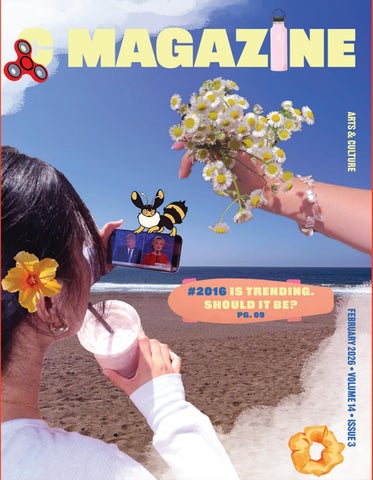
C MAGAZINE


Dear readers,
Welcome to our third issue of the school year!
This issue kicks off 2026 with a collection of articles ranging from a piece detailing a Paly glassblower to a visual guide to the perfect day in San Francisco.
Our cover story “#2016” features a throwback to a decade ago, examining the resurgence of nostalgia associated with that year. Writers Kyle Chen, Anjali Dahncke, Eileen Lee and Ella Renazco-Sperling cover the pivotal cultural and political shifts that occurred in 2016.
“I really enjoyed being on the cover story because I got to explore a lot more angles than I would in an ordinary story,” Renazco-Sperling said. “It was really interesting to see students’ opinions on controversial subjects that I wouldn’t normally get to hear.”
To be read alongside “#2016” is junior Anjali Dahncke’s perspective piece, “Growing Forward.” She describes her experience with nostalgia and the “grass is always greener” mentality, and answers the question: Should we be reliving the past, or should we be focused on the present?
“Where Art Thou?”, an article by junior Poppy Morrison and sophomore Adrienne Lec, dives into teenagers’


diminishing interest in museums and the visual arts. The writers visited the
Junior Zoe Ferring and new staffers Kea Chiao and Derek Chen covered the world of underground rap: a niche subgenre of the classic style infusing hints of synth and highpitched background vocals into tracks.
Ferring said the process of finding artists to interview was challenging — which made it all the more rewarding once the group found their sources.

“When investigating a topic that’s defined around being hard to find, it can definitely be hard to find these artists, especially in our community,” Ferring said. “However, once one person is found, it becomes a lot easier since you get introduced to a whole circle of artists who are all so passionate about their work and have incredible stories to share.”
With that, we hope you flip through this issue with anticipation of the complex articles and well-designed spreads to come!
Happy reading,


By Annie Kasanin
By Sophia Zhang
Luna Lim

thanks TO OUR SPONSORS
Allison Wong
Aynur Diner
The Boneh Family
The Egan-Lech Family
The Ferring Family
Jill Keefe
Jenny Guo
Kelvin Guo
Kirill Kuzmichev
The Dahncke Family
The Lee Family
Perry Meigs
Peggy Morrison
The Rodriguez Family

Sooyang Suh
The Sheffer Family


C Magazine, an arts and culture magazine published by the students in Palo Alto High School’s Magazine Journalism class, is a designated open forum for student expression and discussion of issues of concern to its readership. C Magazine is distributed
C Magazine is printed 5 times a year in October, December, February, April and May by aPrintis in Pleasanton, CA. C Magazine is distributed on campus and mailed to sponsors by Palo Alto High School. All C Magazine stories are available on cmagazine.org.
Advertising
The staff publishes advertisements with signed contracts, providing they are not deemed by the staff inappropriate for the magazine’s audience. For more information about advertising with C Magazine, please contact business manager Annie Kasanin at businesscmagazine@gmail.com.
Letters to the Editors
The C Magazine staff welcomes letters to the editors but reserves the right to edit all submissions for length, grammar, potential libel, invasion of privacy and obscenity. Send all letters to cmagazine.eics@gmail.com or to 50 Embarcadero Rd., Palo Alto, CA 94301.
Mission Statement
At C Magazine, we are committed to delivering stories that are both original and reflect the perspectives of our diverse student body. We promote creative freedom by providing a platform for impact, ultimately helping the Paly community critically engage with the world around them.
staff
Editors-in-Chief
Talia Boneh, Ria Mirchandani, Alice Sheffer, Amalia Tormala
Managing Editors
Estelle Dufour, Zoe Ferring, Silvia Rodriguez
Online Editors-in-Chief
Maia Lin, Sophia Zhang
Social Media Managers
Sonya Kuzmicheva, Luna Lim
Table of Contents
Staff Writers
Creative Directors
Dylan Berger, Ellis Shyamji
Business Manager
Anjali Dahncke
Multimedia Director
Maria Uribe Estrada
Outreach Specialists
Estelle Dufour, Silvia Rodriguez
Adviser
Brian Wilson
Derek Chen, Kyle Chen, Kea Chiao, Bahar Diner, Xuaner Duan, Stella Guo, Poppy Morrison, Adrienne Lec, Eileen Lee, Zoe Peterson, Ella Renazco-Sperling
Cover
Eileen Lee, Alice Sheffer, Ellis Shyamji and Amalia Tormala
Illustrators and Photographers
Poster
Dylan Berger, Talia Boneh
Dylan Berger, Talia Boneh, Ricky Cabrera, Derek Chen, Kyle Chen, Kea Chiao, Kanishka Chittor, Anjali Dahncke, Bahar Diner, Estelle Dufour, Zoe Ferring, Stephen Foug, Stella Guo, Farrah Kardwell, Sonya Kuzmicheva, Adrienne Lec, Eileen Lee, Luna Lim, Maia Lin, Charlotte Liu, Poppy Morrison, Zoe Peterson, Fallon Porter, Millie Reiter, Ella Renazco-Sperling, Alice Sheffer, Ellis Shyamji, Neveah Smith, Juni Thurston, Maria Uribe Estrada, Theodore Williams, Sophia Zhang


Photo by Stella Guo


Stella Guo, Luna Lim and Ellis Shyamji travel to San Francisco for a day trip. Readmore on pg. 44.
Photo by STELLA GUO

A simple sweet or savory sip you can make at home


hour


Cucubmer M int


Blueberry Basil Lemonade


Blueberry sparker


Text, design, art and photos by SONYA


KUZMICHEVA and MARIA URIBE ESTRADA


easy living. But, while this simplified image may be a comforting product of nostalgia, author Charlotte Lieberman said the depiction of 2016 painted by social media does not encompass everyone’s true experience.
cognitive biases that have evolved to make us feel better by remem-
One such process is retrieval induced forgetting, which Lieberman describes as the brain suppressing negative connotations paired with an event and instead favoring the positive recollection.
Palo Alto High School junior Ivanka Kumar has noticed this memory distortion present in the portrayal of 2016 in popular culture.
“2016 had its own problems, for sure, but for most of us, we were kids,” Kumar said. “We only remember the time as a very joyful time in our lives. So, right now, we want to bring back those
In addition to becoming increasingly more selective over time, memory also has the ability to become more forgiving. An example is a cognitive phenomenon known as fading affect bias, in which unfavorable experiences diminish entirely to allow good memories to intensify, according to Lieberman.
This is a recurring pattern in which students reflect more fondly on their own experiences from their childhood. When junior Chris Jeon reminisces about his life from a decade ago, there is a special emphasis on the carefree, offline days of adolescence.
“My favorite memory from 2016 is probably, in elementary school, playing with my friends on the playground during recess,” Jeon said. “I would like to see kids actually spending time outside and having real interactions [in 2026] instead of being on iPads and
Similarly, senior Isaac Telyaz has his own fair share of memories from the year that also remain rooted in simplicity.
“I actually don’t really remember if it was all that good,” Telyaz said. “I remember being really happy though, and stress-free. Because I was young, I didn’t really care about anything. … All I had were my friends and my family. School wasn’t hard. I don’t know if it was the same for high schoolers at the time, though.”
For some high schoolers at the time, their memories were just as warm. For Lia Salvatierra, a Paly graduate from the Class of 2019, memories of 2016 have remained largely positive. She said this feeling is tied to being a sophomore in high school, when the academic
“ Now people are trying to be this certain aesthetic or this certain look. Back then... the trend was just being yourself.”
The Brooklyn-based writer has seen the complexities of nostalgia in the human brain through her studies to become a licensed therapist.

Bekki Casalco, English teacher
“Nostalgia tends to be comforting to people, and it’s a form of escapism,” Lieberman said. “Your memory is always being informed by where you are in the present. Anything you’re remembering consciously is a byproduct of how you’re coming to that act of remembering.”
Additionally, her experience has helped her develop a deep, scientific understanding of memory, learning how the human brain allows nostalgia to become a source of solace for many.
“I just re member … the world felt pretty bright,” Salvatierra said. “There were a lot of new and exciting things specifically happening around the Bay Area that were really fun to participate in. There were a few new festivals at Shoreline.”
Beyond in-person experiences, another exciting development in 2016 was group video calls.


“Your memory is not just there to help you find your keys or your car or tell the doctor when your birthday is, all the ways that we use memory constantly,” Lieberman said. “There are certain
“There was this app called Houseparty [where] you would basically be … in a group FaceTime with your friends, and also strangers, and people would pop in and out,” Salvatierra said.
Although the Houseparty app was often open to strangers, the majority of Salvatierra’s peers were cautious about their online
presence and chose to be more private on platforms such as Instagram.
“It felt like the internet was being used for less evil [in 2016],” Salvatierra said. “The biggest thing was the fact that it wasn’t endless. You followed who you followed, they posted what they posted, then you looked and it was over. Now, it is just endless content and paid content in ads. I mean, there were no ads back then. It was really just for engaging with people you knew.”
English teacher Bekki Casalco, who was earning her bachelor’s degree in English language and literature in 2016, has also seen a shift in how social media operates.
“
“Regardless of what is presented, [trends are] constantly changing,” Casalco said. “Now people are trying to be this certain aesthetic or this certain look. Back then, it was just really dependent on your personality, [and] who you were.”
simpler, and that’s why some of the trends are coming back.”
While this time is remembered for its playful trends and bright aesthetics, Wilson has noticed a more serious side to 2016 that is often glossed over.

“It’s a unique circumstance that we have the same president [who was elected] in 2016 that we do now,” Wilson said. “I feel like that’s why a lot of things are similar. But I think things are definitely a lot more intense right now than in 2016.”
As a second grader during the 2016 presidential election between Hillary Clinton and Donald Trump, in which Trump was elected to his first term, Wilson recalls her life, at the time, being filled with political discourse.
“I remember a lot of my classmates were really scared going into November and the later months during the election,” Wilson said. “They knew everything going on from their parents, and what would happen if Trump got elected. I remember I would always tell my friends, ‘There’s no way he’ll be elected.’”
For Wilson, the election increased her political awareness and steered her mind away from childhood trends such as fidget spinners and slime.
Things have gotten so polarized that it’s hard to say that anybody is really in the middle anymore.”
Kate Lindstrom, 11
The personality Casalco noticed in people’s online presence relates to the unique sense of community she observed through 2016 trends.
“It was easier to make friends, and it was easier to connect with other people, because there wasn’t this idea of trying to fit into a specific thing or trend,” Casalco said. “The trend was just being yourself.”
Math teacher Quinn Basewitz said the genuine intentions behind earlier trends described by Casalco have slipped away over time.
“Now, in terms of social culture, everything is so curated, [and] people present more of an artificial representation of themselves,” Basewitz said.
One popular 2016 trend that Basewitz enjoyed was the mannequin challenge. The videos would pan to people frozen in place and were typically accompanied by the song “Black Beatles” by Rae Sremmurd and Gucci Mane, Basewitz said.
That feeling of unity and fun created by the mannequin challenge is a major proponent of why Basewitz believes people are so determined to relive this era.
“People are feeling nostalgic for what felt like an easier time, when there was less chaos in the news,” Basewitz said. “Now people are thinking back to that time ten years ago, which felt so much
“When Trump won, it was very heartbreaking,” Wilson said. “Since we were so little, we didn’t really know what was going on, but we knew from our parents and the news. ... We just knew something was not going well.”
The confusion Wilson experienced due to her
was a joke and were shocked when he was elected,” Shultz said. “Some people took it harder than others, too. I re member my history teacher came to school dressed in all black the day after the election, and then a few days later put up a map showing how Hillary won the popular vote.”
Shultz has noticed that the biggest discrepancy between his experience witnessing both Trump pres idencies is the dramatic change in political polariza tion.
“Back then, the vibe on both sides was ‘the other side is an idiot,’” Shultz said. “Now, it feels more like, ‘the other side wants to destroy our country.’”
The division Shultz has noticed growing throughout the years has not gone unnoticed by younger generations. Despite her young age in the 2016 election, junior Kate Lind strom said she feels similarly to Shultz.


“I assume a lot of theerybody that I talk to has the same political opinion as me,” Lindstrom said.
“However, when I do see signs of -
porting an opinionally believe in, it just seems so glaring. Things have gotten so polarized that it’s hard to say that anybody is really in the middle
Lindstrom attributes much of this heightened polarization to the way that political news and information are consumed.

“Social media is a huge part of politics nowadays, which honestly is a little bit frightening because social media is a place where there’s so much misinformation and so much dramati zation,” Lindstrom said. “There are a lot of stories I hear that come only from social media.”
Junior Jack January has also seen politics intertwined in social me dia, often feeling this presenta tion is more of an aggressive approach compared to usual news outlets.
Similarly to his fellow Paly students, January said, in 2016, he perceived an overall sense of fear from his classmates regarding Trump’s upcoming presidency. Yet, January did not share the same inter est in political tensions as many of his peers.
“Prior to November, or even the first half of 2016, people were really excited [about the upcoming election],” Harbath said. “There was the assumption that we were going to have our first female president, and we were coming off of Barack Obama, who was still president.”
For some, that sense of optimism quickly faltered after the election results rang out.
“People were not expecting that,” Harbath said. “People were wondering how it was that [Trump] had won, why he had won, how that had happened. It was a real change, and set the tone we’re, frankly, still in today. Our politics [have become] a lot more polarized, and [we are] dealing a lot more interference [and] disinformation.”
But, Harbath said that this polarization did not emerge overnight.
“Studies show that people were already moving to different neighborhoods that had similar political affiliations to themselves,” Harbath said. “You already had it in the media environment, even going back to the ‘80s. Republicans, when they started talk radio, were starting to create their own media ecosystems.”

Harbath highlights that 2016 was also a turning point in the relationship between politics and online platforms, as the rise of social media was entering a new territory. For example, Harbath said a large number of candidates and citizens were using Facebook, Instagram, YouTube and Twitter to communicate.
Political discourse continues to infiltrate the online world to this day, which students like Wilson do not see as an inherent negative.
“I remember ... the world felt pretty bright.”
Lia Salvatierra, Paly ’19
“I didn’t see it affecting me in my per sonal life, and I didn’t see a reason to start dis putes with others if I had differing opinions, which I felt I did,” January said. “My reaction was really neutral, because I didn’t think that … these [policies] were going to affect people as much as they thought they would.”
Through Trump’s two terms, January believes that — contrary to people’s original worries and claims surrounding Trump’s policies — these percieved fears never fully manifested. Despite this observation, he has noticed and experienced an increase in hostility towards the Republican party.
“I see more anger, more outrage, and I don’t think there’s anything inherently wrong with that because people … should be allowed to be mad,” January said. “But what I do think is wrong is when we are hurting people and we are damaging our relationships with others based on politics.”
Katie Harbath, a political analyst who began her career in the early 2000s working on political campaigns, said that this political tension was overlooked amid an overwhelming amount of support from both sides for their preferred candidate.
“Politics is everywhere in the media, especially in social media,” Wilson said. “Because of this, I think a lot of people are more aware of what’s going on in the world, and it has encouraged more conversations about it.”
One particular conversation that has re mained a pressing topic in the news over the course of the decade is the one surrounding immigration, which Harbath has seen evolve dramatically since 2016.
“There’s always been somewhat of a concern about how many undocumented immigrants might be coming across the border,” Harbath said.
“But what I’ve seen is [that] it’s gone from a posi tive conversation of, ‘OK, this is not great, but what can we do to try to make a path to make it better,’ versus now it’s much more on the negative side.”
Harbath acknowledges that although the strat egies installed surrounding immigration were not perfect, there was more unity between countries when tackling issues, such as climate change. Ma rine Biology teacher Margaret Deng believes that 2016 advocacy movements, such as “Save the Turtles,” showcased a real community effort to make a difference.
“Save the Turtles in 2016 definitely did [create real change],” Deng said. “For example, protective an ti-net legislation has been helping in Florida, [and] there have been positive trends in the numbers of sea turtles and slowly the populations are recov ering.”


The main positive takeaway Deng has observed from these trends is the increase in climate awareness since 2016, specifically in younger generations. However, Deng has drawn a distinct line between different climate conversations over the years.
“When the movement was just getting started, people were starting to become aware that we were destroying our planet, and people actually were trying to do things,” Deng said. “We were more optimistic [about climate change] in 2016.”
For that same reason, Deng has observed a decrease in climate coverage, making her believe that no one sees the urgency behind climate-related issues.
“There’s a lot less about climate change these days,” Deng said. “The list [of climate-related issues] continually grows, but no one feels urgent about it anymore, which is really sad.”
Deng said this lack of gravity surrounding climate issues cannot be tackled by individual actions alone.
“[Politicians need to] put climate change as one of the top things on their agenda,” Deng said. “In 30 years, we won’t have a planet to live on if we keep going. So, people should be looking more long-term than short-term. It will cost a lot of money. Companies are going to get really, really mad. But because we live on the planet, we should definitely prioritize it.”
Deng claims that everyone can create a positive impact on climate change, even if one is a student.
“Donating is definitely the number one thing,” Deng said. “Being able to educate yourselves and other people on it is going to really help, because if you don’t have that urgency, nothing’s going to get done. It’s all just going to be sitting in somebody’s slush pile.”
Climate change is one of many topics that have never fully faded from the past decade and are now seeing renewed attention. As conversations about both serious issues and lighthearted trends reemerge in 2026, students like sophomore Delany Vahdat are debating what aspects of 2016 are worth reviving.

“I do think that we idolize [2016] in a sense, but I think that we’re going to idolize anything,” Vahdat said. “I wouldn’t say it’s [an] accurate [representation of 2016] because social media only highlights the good. That’s what is inducing the nostalgia of 2016.”
Similarly, Lieberman said glorifying the more superficial aspects of an era forsakes the actual serious matters going on behind the scenes.
“A unicorn latte is just a unicorn latte,” Lieberman said. “A unicorn latte can’t shed light on a presidency or the problems within it. The way that nostalgia is leveraged in fashion or digital culture — that’s going to just be the highlight reel, the positives of that particular time.”
Text and design by KYLE CHEN, ANJALI DAHNCKE, EILEEN LEE and ELLA RENAZCO-SPERLING • Photos by ELLA RENAZCO-SPERLING • Art by EILEEN LEE


nostalgia outgrowing

MY PERSPECTIVE: 2026 should not be the new 2016
Ihave always believed the grass is greener on the other side.
Some interpret that phrase as stemming from a place of greed, but I could not disagree more — I feel it captures a very human hope. Sometimes something is missing from the present. That absence is not a failure of gratitude nor perspective; it is a practically inevitable experience.
At one point or another, everyone becomes aware that there is a gap between where they are and where they want to be. This space holds both our wildest dreams and the fears that we will never accomplish them. It is a double-edged sword we can wield in one of two ways: as fuel to propel us into the fu ture or as weight dragging us down into the past.
The online world has recently made it clear which direction it has chosen to run.
We are currently experiencing 2016 for the second time in a decade. It was as if we, as a society, decided to turn our clocks back just as the calendars were supposed to flip. Since New Year’s Day, a feverish infatuation with the year has spread infectiously throughout both the digital and physical worlds, with “2026 is the new 2016” ringing through social media like a celebration. Or maybe even a threat.


not be taken lightly. To recreate 2016 is to mistake nostalgia for direction, and forsake growth for solace.
For as long as I can remember, I have been a chronic reminiscer. It showed up in my life in all kinds of small ways. I would only listen to songs I knew by heart and playlists that transported me back to summers past. I would replay old conversations before bed as if I would ever get a chance to use the new lines I was creating. I would spend nights scrolling through my own camera roll as if it was a museum, revisiting old memories when I could have been making new ones.

No matter how silly and harmless it seems, a desire to relive the past can easily become a refusal to embrace the future.
For the longest time, whenever I was stressed about schoolwork, my immediate instinct was to reflect on a time where no such problems existed, and 2016 fell perfectly in that period. I only remember a hazy picture, yet I feel that encapsulates 2016 better than a clear one would. It was a colorful collage of memories pasted together like a scrapbook. Justin Bieber’s album circulating the charts. Hurling water bottles into the air, only for them to land anywhere but upside down on the table. High school felt centuries away, and college was simply an abstract concept. There was no homework, no extracurriculars and certainly no AP classes. It was so carefree.
The obsession with 2016 seems completely lighthearted. After all, what could be malicious about unicorn frappucci nos, fidget spinners and an insatiable hunger for a version of ourselves that we will never fully get back?
No matter how silly and harmless it seems, a desire to relive the past can easily become a refusal to embrace the future. It may not be an active danger, but the fact that we are passively embracing regression instead of progression should

But, I was also a child without any real awareness. Of course it felt untroubled — my biggest responsibility was being the line leader at lunch.
Until that dawned on me, I couldn’t imagine there was grass any greener than the fields I used to run through when I was seven years old. Full of sprinklers and fireflies, the only boundaries I had back then were the ones my friends and I set around the park when playing tag. As long as I stayed between the slide and the monkey bars, I didn’t have a care in the world.


It was a magical time, but it would be a disservice to that magic to assume that it could be instantly recreated at any given minute. Not every memory is a core one, and it is often very difficult to predict what bits and pieces of a moment in time will stick with you for the rest of your life. But that is exactly what makes it so special.
There is nothing inherently wrong with recognizing all the beauty memories can bring. But there is a fine line between looking back on it fondly and letting the desire to relive it consume your thoughts and present. I never saw that I was standing still until I noticed how frequently I was looking back.
That was when I realized how dangerous nostalgia can truly be. We think we are staying present when really, our heads are in the past. And because of this, we are captivated by the rearview mirror when our eyes should be on the road ahead. Nostalgia is eerily similar to evolution; both are grounded in the core belief that a better version of the present exists some where over the rainbow. And yet the fork in the road remains: will you move forward or backward to chase it?
With all the time I had spent replaying old memories, I was inhibiting myself from making so many new ones. And given this was almost 16 years worth of adventures and oppor tunities forsaken, I realized I had a lot of catching up to do. It became my goal to let myself sit with the unfamiliar and unfinished. And suddenly, I saw myself become more grounded, present and excited about both daily and future tasks, no matter how mundane. I found new favorite songs that I would have never listened to before, made memories without feeling the need to photograph them and embraced the current moment with open arms. In letting go of what was, I made space for what is.
fondest childhood memories. After all, memory can remind us who we were, but it cannot tell us where to go.
To embrace 2026 as its own year is to be present in the present. The grass may look greener behind us, but everything looks brighter with a filter on it. To me, the only grass worth watering is the lawn


Nostalgia is a lens, not a destination. And it is a very power ful lens at that. It can blur, it can blind and, most importantly, it can filter. We can see this quite literally when looking at 2016, since it was coincidentally the era of vibrant oversaturation and sunset-hued Instagram feeds. We only see that brightness, the radiance of a zeal and zest for life that we miss and mistakenly believe we lost along the way.
6-15-2016

I understand the desire to curate. I have never been much of a meticulous organizer, and yet the prospect of completely recalibrating my own life never fails to bring it out of me. Vision boards upon spreadsheets upon slideshows worth of planning and executing New Year’s resolutions? Don’t threaten me with a good time. This year was no different, especially now that my eyes were towards the future. I was looking forward to 2026 in the same way I look forward to Mondays, haircuts and mornings — like it was a fresh start.
I never wanted my 2026 to be a carbon copy of another year that already happened ten years ago. That was simply not the goal, even if that year was a great one, full of some of my


8-4-2016


7-13-2016


Text, design and art by
ANJALI DAHNCKE
AJoint MISUNDERSTANDING


Art contributed by CHARLOTTE LIU
Marijuana today is between six and seven times stronger than the marijuana that was available a few decades ago.
Jennifer Weintraub, a doctor from El Camino Health, said there has been a clear spike in Delta-9-tetrahydrocannabinol (also known as THC) use, the main active ingredient of cannabis.
“In 1995, the concentration of THC in cannabis was about 4%,” Weintraub said. “By 2017, it had risen to 17%. Today, it is common to see strains containing 30% THC.”
Historically classified as a Schedule I substance, cannabis is defined by its high risk of addiction and lack of acceptable medical use. An executive order signed by President Donald Trump in December aims to move marijuana from the same category as highly addictive sub stances like heroin and Lysergic acid diethylamide (LSD) to painkillers like Tylenol and anabolic ste roids. Though it is yet to be finalized, recent de criminalization over the past few decades resulted in widespread societal normalization.
As the strength of THC is in creasing, so is the proportion of people who are using it. According to PBS, from 1992 to 2022, the per capita rate of reported near-daily cannabis use increased 15-fold.
These drastic increases have led to greater concern about the risk of negative physical impacts. According to Har vard Medical School, canna bis use on a developing brain frequently leads to far worse performance on cognitive or behavioral tasks. Weintraub said the ad verse physical changes prolonged consumption.
This established knowledge of the negative impacts of cannabis, from cognition to hormonal changes, has pushed Palo Alto Unified School District schools to work to prevent and educate about the early use of cannabis. This push for students to refrain from using cannabis begins when students are around 11 years of age, junior Joyce Ma said.
“Ever since middle school, there have been posters that say ‘Don’t do drugs,’” Ma said. “Everyone knows you’re not supposed to do drugs, and people still do them anyway.”
For junior Maya Cheng, lessons on drugs and prevention in middle school failed to educate her on specific substances such as cannabis. Based on a survey, on a scale of one to five — where one is least knowledgeable and five is most — she rated herself at a one.

“My teacher talked pretty heavily about STI [Sexually Transmitted Infections] and STD [Sexually Transmitted Diseases] prevention back in middle school,” Cheng said.
“As for drugs, all we learned about is the science behind addiction. Beyond that, I haven’t heard much [about
There’s a risk of addiction with everything Alex
“Marijuana can affect the body’s hormonal regulation through several interacting mechanisms,” Weintraub said. “Some evidence suggests THC may indirectly increase estrogen production or its effects, causing breast tissue enlargement, or gynecomastia. Marijuana use can also lead to reduced secretion of luteinizing hormone and follicle-stimulating hormone, further decreasing testosterone production in men.”
These physical impacts paired with the increase in concentration has led to a greater concern for addiction among parents and regular users. According to DrugAbuse, cannabis use does not create a physical addiction, but people can experience physical withdrawal symptoms, which Alex, an anonymous Palo Alto parent, has noted.
“There’s a risk of addiction with everything,” Alex said. “Even if it is not physically addictive, it can be habitually addictive.”

Accurate knowledge about cannabis is important for safety, just as figuring out which age group to introduce and educate about marijuana is crucial.
“Whether or not it’s developmentally appropriate [to learn about] depends on the context of the kids,” Cheng said. “If weed is a problem at a school, even at the middle school level, students have to be aware [of risks] because they’re [at] a higher risk for being in that environment.”
But, exposure too early or too late can render the lesson useless.
“When you’re at the high school level, you have more independence and are going to meet more people in general, even outside of your school environment,” Cheng said. “It’s important to be educated about risk factors [in high school] regardless of whether or not it’s a major issue at your school.”
Kevin Boehnke, an assistant professor of anesthesiology at the University of Michigan Medical School, highlights the importance of clear and compassionate communication around cannabis.
“It’s notable that many students report using cannabis to help with mental health and sleep,” Boehnke said. “If we can talk about cannabis in an open and honest way,

marily for the perceived benefit of relax ation.
“I’m diagnosed with anxiety, so [weed] helps with that,” Charlie said. “It’s pretty beneficial [to use weed] when you’re stressed out, want to re lax or have trouble falling asleep.”
Although Charlie’s case is self-ad ministered, their perspective offers

I believe [weed] was a big factor in their life completely falling apart.
talking about the dangers of cannabis is really going to be that effective,” Reardon said. “Having [the lesson] be student-centered and project-based, with students teaching each other, is going to be more effective for helping them understand.”
After every major section of his curriculum, Reardon said he elaborates more on his personal encounters with users. From story to story, he hopes to educate and create a sympathetic learning environment, which can be seen through his experience with an old acquaintance who started using marijuana at a young age.
“They used it every day starting at age 16, which I believe was a big factor in their life completely falling apart,” Reardon said. “Grades slipped, [they] weren’t able to go to college, [they] eventually got a GED at age 21 and now work minimum wage gas station jobs. Their life was
At the end of the day, the consequences of cannabis can
“If you can’t think executively, if you lose that ability, then that makes it very difficult to be academically successful or do many of the things that the 21st century education and workplace require,” Reardon said.
But, even with Paly’s current cannabis education process, many students who haven’t taken living skills are not sufficiently knowledgeable in terms of drug safety. Fitting into this category, the only thing freshman Leon Atkins knows about marijuana is that it makes
“I didn’t realize what cannabis was until a few years ago,” Atkins said. “My parents haven’t educated me, but I know what it smells like because my parents would point it out when it [the smell] came in the car.”


But cannabis is not just a bad smell or a harmful substance — it is also used medically. California legalized medical cannabis in 1996 through the Compassionate Use Act, permitting three decades of therapeutic access since. In most cases, a small dose — an arbitrary amount which varies by medical facility — of THC is used for pain-relieving treatments of chronic pain, epilepsy and the nausea and vomiting caused by cancer treatment.
Proposition 64, enacted in California in 2016, decriminalized recreational cannabis use for adults aged 21 and older. In the decade since, communities have adapted to a broader public presence of cannabis, which in turn has raised questions about how attitudes toward and experiences with cannabis are changing within a high school community. Taylor, an anonymous senior, notes this phenomenon.
“In freshman year, ‘weed’ was barely even in my vocabulary,” Taylor said. “As junior year came around, though, I realized a lot more people were using weed than I expected. Personally, it [using] started with trying weed once, then I ended up do ing it a couple more times. Now, going into senior year, I would say it’s more popularized and common.”
In many people’s per ceptions, marijuana shift ed from a rumor to a real presence in the lives of some high schoolers.
“Some people I know rely on [marijuana] to sleep, deal with stress or cope when they’re feel ing down,” Taylor said. “Admit ting that you depend on it can be really difficult, especially with adults, because there’s a fear of being judged or looked at differently.”
nabis education is some thing that both teachers and students are looking forward to improving.
from living fully in the moment, and it can make it harder to create strong memo ries,” Taylor said. “You don’t need weed to be happy or to feel something different than what you’re already feeling.”

al legalization would move it from a Schedule I to a Sched ule III drug. According to PBS, this reclassification might

You don’t need weed to be happy or to feel something different than what you’re already feeling.
This fear contributes to why students find conversations about cannabis awkward or uncomfortable, Taylor said. However, Alex notices how the scale of the stigma against marijuana use has significantly decreased compared to older generations.
“It was more taboo,” Alex said. “Parents certainly did not do it around their kids like they do now. In addition, kids did not widely share if they used pot, and there was a stigma as sociated with ‘stoners.’”
Even though decriminalization led to broader acceptance, many physical, mental and habitual impacts continue to cre ate stigma around cannabis discussions between student and teacher. To combat this, Reardon mentions implementing an earlier in-depth cannabis education at Paly as a precaution.
“Starting last year, we had one freshman advisory lesson on tobacco and one freshman advisory lesson on cannabis,” Reardon said. “Those have been at least moderately successful and we are going to continue to do that indefinitely.”

Institutes of Health, it is yet to be seen how helpful this reclassification becomes. The legality and future of cannabis use remains unknown, but Weintraub said students should understand that “legal” doesn’t mean “safe.”
“Anything that harms your brain and your body puts you in danger,” Weintraub said. “It may be legal, it may be reclassified as ‘safer’ and it may be widely available to you in multiple forms.
Make the choice
that keeps you in the driver’s

Text and design by XUANER DUAN and ESTELLE DUFOUR Taylor


Within a $13 billion industry, students and lifelong collectors hold on to the heart of their hobby while under threat
STACKEDUP!
Theodore Williams remembers the exact moment when he and his father were opening a box of baseball cards and they pulled a Johnny Bench autograph. Only 76 of those cards existed in the world.
“It was a really special moment [pulling the Johnny Bench], because we’ve never pulled a card like that together, and when we did, we were both really excited,” Williams said. “I currently have it on my desk at home.”
For Williams, a Paly sophomore, trading cards have always been a part of the relationship between him and his father. His father
to Market Decipher. This number is only rising. But behind this fast-growing enterprise, the hobby starts the same way it always has: a parent, a child and a pack of cards.
Today, Williams and his father share a collection. For them, the hobby is simple: open boxes, rip packs with his dad, go to card shows or shops and buy individual cards from there. He does not care what he gets.
“I just collect what I like, and it’s a lot of fun,” Williams said. The fun also extends beyond the cards themselves. Collecting has allowed Williams to experience new social situations as well.
“[Trading cards have] definitely helped me branch out to new people because the trading card community is a really big one,” Williams said. “It’s definitely opened the door for me to interact with new people and do new things.”
Similarly, history teacher Stephen Foug started his childhood collection from a plastic bag of his older brother’s cards from the 1960s and 70s. A rookie-year Steve Garvey card hooked him instantly when he realized its worth.
“I remember looking it up, and I was like, ‘wow,’” Foug said. “I thought that was fantastic. Like, this piece of cardboard is worth 50 bucks.”
His collection still sits in a box in his garage, serving as a quiet reminder of a simpler era in the community, before many collectors turned to the more material aspect of the hobby.
“I just liked looking at the players,” Foug said. “The values of them and everything, I didn’t learn about until later. The more business and value [they] talked about, the less I was


interested.”
Most collectors, like Foug, are not in it for the money. Instead, they trade cards for the love of the game.
“[In] this hobby — trading cards — you’re gonna lose money,” Williams said. “You’re never gonna make money. But sometimes there are instances where you can make money on some cards.”
However, for the collectors who are invested in making money, card collecting can be a lucrative hobby. JLS seventh grader and avid Pokémon card collector Kanish Chittor is no stranger to this side of collecting.
“I collect Pokémon cards for their value,” Chittor said. “Investing in Pokémon cards is a worthwhile hobby, because many cards go up in value, while some go down. Many cards I own currently are worth hundreds of dollars.”
Chittor, who tracks card values using online webspace TCGplayer and often discusses card values at school or through Pokémon clubs, has also discovered unique strategies to make money from their hobby.
“Buy a pack that’s not too recent, like two to three sets ago, because the card value would have stabilized and try trading up by investing in good cards and selling your cards,” Chittor said. “If you can’t afford some of the newer packs, try buying one of the packs after Evolving Skies. Unless you have a really high budget on buying cards, you shouldn’t buy the newest sets, because the cards usually drop by quite a bit.”
The simplicity of the hobby, however, is getting increasingly harder to hold on to. Rising prices and demand from people seeking to make a profit are pushing younger collectors out of the game.
increasing presence of scalpers, individuals who buy large quantities of cards — such as Pokémon, Magic: The Gathering, or sports cards — at retail prices to resell at significantly higher prices.
“Scalpers are the main reason [Pokémon card] prices are going up,” Chittor said. “New Pokémon sets are bought instantly and sold at a much higher price. Recently, Pokémon center released a $50 prismatic evolutions set and resellers were selling it for $150. This is ruining the fun of younger collectors collecting Pokémon. … Many people I know have stopped collecting, simply because they can’t afford it.”


This pricing issue is worsened by the trading card grading system — the process by which collectors send their cards to a company that evaluates their condition on a scale from one to 10, then seals them in a protective case, or “slab.” Receiving a high grade, such as a 10, can multiply a card’s value exponentially, while a low grade can ruin a card’s value completely. This process however, is far from exact and can have unintentional
“Many people I know have stopped collecting simply because they can’t afford it.”
KANISHKA CHittoor JLS student
“There’s been a ridiculous spike in pricing for some players, like Cooper Flagg,” Williams said. “His cards are through the roof, and it’s hard to get. And that’s for any [cards], Pokémon is hard to find anywhere now, and that’s been marked up extensively. … It’s hard for people to collect when they’re getting priced out of the hobby.”

“You could catch [a grader] at the end of their shift who’s been working for eight hours, … and they’re looking at this card, and they’re tired,” Bates said. “It’s all subjective. It’s all whoever is looking at it that day.”
Despite these wavering grading standards, the stakes when it comes to grading are enormous. Bates points to the 1952 Topps Mickey Mantle, one of the most iconic cards in the hobby; only three PSA 10s (or virtually perfect quality cards) exist. The owner of the one in the best condition has been offered $40 million before. A PSA 9, a nearly perfect quality of the same card, would sell for only $10 million.


Greg Bates, a sports collectibles writer who has spent over 13 years covering the trading cards industry, said this shift warrants concern.
“It’s not kid friendly anymore,” Bates said. “You have to have some money.”
This is further exacerbated by the


Those price gaps carry even more weight when looking at who controls the grading process. The market is dominated by one company: Professional Sports Authenticator, or PSA, which grades all types of cards from sports to entertainment (for example, Pokémon). Collectors Holdings, its parent company, recently acquired the second and third largest grading services, giving it control of roughly 80% of the market. Collectors Holdings also owns Card Ladder, a platform that tracks pricing data. This has brought in concerns of monopoly from many parties. Bates, in particular, sees a clear conflict of interest.
“When you’re running a company that grades the cards, but then you’re going to try to sell the cards, you’re obviously going to want the highest grade to get the highest money back,” Bates said.


“The conflict of interest is certainly there.” The concern has also reached higher up, with Congressman
Despite the turbulence that threatens peoples’ access to trading, the heart of the hobby remains intact for many. Williams still sees himself collecting for years to come, and Foug still knows exactly where his Steve Garvey card is in perfect detail.
“I’m zoning out right now, just thinking about
For any student looking to jump in on the fun, Williams’s advice is simple.
“Collect what you like,” Williams said. “Don’t buy boxes instantly because you’re just gonna lose money on that, and you’d rather spend money getting individual cards that

At the end of the day, the hobby will endure because of people like Williams, who genuinely love to
“It’s good that there’s still true collectors out there that are not collecting all for the money,” Bates said.

Chittoor


Text, design and art by MARIA URIBE ESTRADA and MAIA LIN • Photos contributed by KANISHKA CHITTOR, STEPHEN FOUG, MAIA LIN and THEODORE WILLIAMS


Text and design by DYLAN BERGER and ELLA RENAZCO-SPERLING • Photos by DYLAN BERGER, TALIA BONEH, ELLA
RENAZCO-SPERLING
and ALICE SHEFFER


C Mag takes a trip to the recently opened Color Me Mine studio in Palo Alto


s the school year ramps up and deadlines pile on, C Magazine staff members took a break from assignments to get creative. Taking a trip to Color Me Mine’s new downtown Palo Alto studio to personalize their own pottery proved to be the perfect way to spend a Friday evening.
Color Me Mine opened in late summer of 2025. Before, their closest studios were in Sunnyvale and San Jose, and the trip proved to be disheartening for junior Poppy Morrison and many other students.
“I’ve been wanting to try Color Me Mine for a long time, but I would have had to go all the way to Sunnyvale, which was very inconvenient,” Morrison said.
Luckily for Morrison, and others who could not make the trip to Sunnyvale, the Palo Alto location was a great addition to the Color Me Mine chain.
“The location is super nice,” Morrison said. “It's right downtown, there's lots of food and anything you could want. In the interior, there's lots of examples which give you both inspiration and get you in the creative mindset. There's so many colors, and the music was super fun.”

for her piece, explaining that the color combination aligned with her mood and the Valentine’s season.
However, the painting process did not go exactly as planned. Kuzmicheva said she was nervous about her design turning out imperfect.

“I was scared about making my lines messed up and not straight,” Kuzmicheva said.
“We got to share stories while doing something with our hands, which lets the conversation flow naturally.”

At Color Me Mine, the instructors have a hands-off teaching technique, quickly running attendees through the basics then letting them go through their own artistic process. Naturally, the painting experience looks different for everyone. Senior Sonya Kuzmicheva began by looking at pottery posted on online platforms.
“I was scrolling on Pinterest, and I had a bunch of ideas saved, so I took that as my inspiration,” Kuzmicheva said.
After carefully looking through design possibilities, she finally landed on pink stripes and a red base
When the tape she planned to use did not stick, Kuzmicheva was forced to improvise and paint freehand, allowing her to take a more spontaneous approach. Her approach was similar to that of senior Talia Boneh, whose designs evolved naturally as she worked.
“For me, art in general is a very open-ended activity,” Boneh said.
“It’s a lot of fun to just see where your creativity takes you.”
In addition to the creative aspect, many staff members enjoyed the opportunity to connect with one another.
“It’s such a great bonding activity,” Boneh said. “We got to share stories while doing something with our hands, which lets the conversation flow naturally.”
Kuzmicheva also enjoyed participating in an activity where she could get to know her fellow staff members better while working on her pottery.
“I got to know my staff members better while bonding over our passion for creativity that brought us to join C Mag,” Kuzmicheva said.
Similar to Boneh, Kuzmicheva expressed interest in participating in similar activities again.
“I think we should do more of this in the C Mag community, since it's a good way to connect with each other outside of the classroom,” Kuzmicheva said.
Although the experience can be pricey, with an entry fee of $15 for painting and seating quickly adding up with the price of your selected pottery piece, Boneh expressed that the expense was worth it.
“[Ceramics painting is] a great way to make new friends and get a new mug or plate that you poured your heart and soul into,” Boneh said.
Junior Poppy Morrison had a great time at Color Me Mine with the C Mag staff and loved being able to talk with her friends while having an activity to participate in.
Though Morrison did not have a lot of painting experience going into the pottery studio, she did not let this hold her back.
“I'm not really an artist, … but I think because you're making something for yourself, there's no pressure to have it look amazing,”


Talia Boneh, 12
Morrison said. “You can be creative and play around with designs.”
Morrison said she enjoyed letting her creative side out while painting, though what stuck with her from this experi ence was the time spent with her staff members.
“Even though we made mistakes, I think it was just a really fun time to be able to talk with other people on staff and bond with different people in different grades,” Morrison said.


the story behind

“I think small businesses add a lot to the Paly community.”
Alessia Kalember, 10

the storefront
Palo
Alto’s
small businesses contribute to the community in a number of ways
Walking through the streets of Palo Alto, one might come across a variety of storefronts, ranging anywhere from the Apple Store to a family-owned cafe. Palo Alto is home to some of the largest tech companies in the world, a fact that tends to dominate people’s perceptions of Silicon Valley. But, while companies like those have played a considerable role in the city’s infrastructure, small businesses in the area are often overlooked. These businesses, sometimes family-owned, women-owned or independently run, are what make Palo Alto so unique and filled with cultural value.
Located in Town and Country, Hatched is a brunch-based cafe known for its egg-forward sandwich selection and creative drink menu. Craighton Poon, co-owner of Hatched, was working in the corporate world when he decided to launch a business.
“I spent 10 years doing engineering, and then I got tired,” Poon said. “I wanted to [start] my own company, so my brothers and I decided to do more restaurants, which is what we grew up doing.”


The Poon brothers also own Roost and Roast, another business in Town and Country, as well as Kurated Kitchens in Sunnyvale. The brothers’ childhood was spent balancing school and working at their parents’ restaurant, which they opened after their emigration from Cambodia and Hong Kong.
After graduating from college, Poon and his brothers decided to return to the restaurant industry and have been building their


family’s Asian heritage into their establishments ever since. By offering tried-and-true food and drinks to customers, running Hatched has proven very rewarding for Poon.
“We’re a small business, so you’re getting home-cooked meals and our own recipes,” Poon said. “Hopefully [there’s] a little bit more charm and character compared to some of the bigger chains.”
Contrary to popular belief, the size of small businesses en ables them to turn out higher-value products due to their proxim ity to the production process.
“We definitely have more quality con it’s a smaller operation for us, so we can maintain and monitor our food and sauces much more closely,” Poon said.
The high standard of the food at Hatched has spoken for itself, with news spreading of the recently opened restaurant without taking much out of the team’s pock ets.
“Honestly, we haven’t done too much ad vertising,” Poon said. “It’s been a lot of word of mouth, and then we were fortunate enough to get picked up by some local articles.”


paly perspective
Both Marigold Row and Hatched have acquired a consumer base that appreciates their unique products for the effort poured into them. Sophomore Alessia Kalem ber believes that small businesses are a welcome addition to Silicon Valley’s com petitive market.
“Something that makes me want to shop at small businesses is that it can be really beneficial for the community,” Kalember said. “It’s a lot better than shopping at big or local chains because people at small businesses can benefit a lot more.”
Kalember believes smaller establishments can also affect the Paly student body, as many are motivated to shop at them through their features in Paly journalism.

“I think [small businesses] add a lot to the Paly community, especially when we have events, like art in unusual places and other different sellers that get brought up in all the Paly publications,” Kalember said.
Many Paly students find it rewarding to purchase from smaller companies, and the local economy also benefits from their engagement. Overall, the thoughtfulness and attention to detail that many smaller businesses are trademarked for add value to the local consumer market.
“It’s a lot easier to just go to a large, mainstream business and get something that everyone else has, or something that’s popular,” Kalember said. “But small businesses, a lot of the time, [there’s] more work and thought [that] get put into the things that are being sold, and I think that’s really special.”


M“Hopefully [there’s] a little bit more charm and character compared to some of the bigger chains.”
Craighton Poon, co-owner of Hatched


arigold Row is a small business located in Town and Country. Owned and founded by Anita Mehta, their mission is to bring curated, fine textiles hand-crafted in India straight to shoppers in the form of clothes and home furnishings. Anandi Raja, an employee at Marigold Row, was drawn to work there because of the creative
“I’m extremely interested in Indian art, and art is our whole work [at Marigold Row],” Raja said. “So I think this place is perfect for me.”
When owner and founder Anita Mehta started Marigold Row, she had a vision to bring a standard of traditional clothing typically found overseas to Palo
“She [Mehta] is an Indian textile enthusiast, and she’s been very successful in the wholesale business doing beautiful scarves and jewelry,” Raja said. “That’s extended to apparel. It’s her passion that has sustained this for two and a half years now.”
Customers are often amazed by the quality of Marigold Row’s products, given their relative affordability with most items falling between sixty and a hundred dollars.
“People are very surprised that we have this range of wools, cottons, silks and linens,” Raja said. “They’re surprised by the range we have at the price points and styles that we offer.”
However, Raja has noticed that sometimes people don’t know how to care properly for their products. The clothes require more attention than a typical garment, but the benefits they offer make the additional effort appealing to consumers.
“Because people appreciate how it feels on your natural skin, and because it’s good for your skin, they’re willing to put in the work,” Raja said.
Overall, Marigold Row is a high-quality small business that hopes to leave an impact on its cus tomers through its approach to fiber arts.
“We showcase sustain able craftsmanship in our artisanal products,” Raja said.


Text, design and photos by ZOE PETERSON and ELLIS SHYAMJI • Art by TALIA BONEH and ELLIS SHYAMJI
? THOUART WHERE

Shades of green and rapid brush strokes create the picturesque, reflective effect that makes Claude Monet’s “Lily Pond” painting so recognizable. It, unsurprisingly, drew freshman Lily Chen’s attention when she visited The Metropolitan Museum of Art in New York City. Aside from the coincidental fact that she shares her name with the painting, Monet’s work of classic impressionist techniques captivated her, as it has thousands of others.
“When I was standing in front of the painting, it just felt as if I was at the Lily pond,” Chen said. “It just felt really peaceful.”
This sense of peace lives at the forefront of Chen’s mind when thinking about how art makes her feel. In Paly’s demanding environment, art has become a way for her to
Museums have so much to offer — take a look beyond teenagers’ typical view of museums
take a moment for herself.
“Usually, our life now is really fast-paced; we have a lot of things to do,” Chen said. “When I was looking at [Monet’s] work, it just made me feel like everything slowed down. I got to have a time where I felt like everything just paused and it [was] just me and the painting.”
This feeling Chen gets when looking at art is part of the unique experience that museums foster.
Advanced Place-
from all different cultures.”
For many, being fully immersed in a painting can solely be experienced in a museum. So, when it’s clear that museums have so much to offer, why are they hardly brought up in teenage conversations?
“The atmosphere inside a museum is unique.”
Youna Lee, 9
ment (AP) Art History teacher Sue La Fetra said art — and thus visiting museums — is important for all demographics, as art transcends typical preconceived notions.
“Art is a universal language,” La Fetra said. “It’s [been a] part of the human experience from the very beginning of time. To not visit a museum and see art that is made by other cultures and things that aren’t in your environment [means that] you’re missing out on information and understanding
In senior Michael Li’s eyes, the answer lies in the fact that museums lack interactiveness and do not have the ability to engage teenagers.
“I’ve been to a lot of museums that were snoozefests, where they just have an exhibition and an essay on a plaque next to it in a blank, empty room,” Li said. “I felt like I was in an insane asylum when I went to some of these museums.”
Art can also be boring or daunting for some people due to its open-ended nature. And in a competitive community like the Bay Area, it’s easy to feel deterred by this quality according to Cantor Art Museum’s Associate Director of Academic and Public Programs Vivian Sming. However, this am-
biguity pinpoints the beauty of art, Sming said.
“[Art should be] approached with a sense of openness, instead of [believing] there’s one right answer that I have to get,” Sming said.
Sming said people should avoid feeling caught up in how they think a piece of art should be perceived. Instead, viewers should allow themselves to ask the questions that art triggers for them and approach art in a similar way to how artists do themselves: with an inquisitive nature.
class, students learn about pieces of art from all over the world and go on field trips to museums which provides them with an understanding and appreciation that they otherwise may not have.
“Museums offer intellectual enrichment for people from all walks of life.”
Teresa Wang, 12
“I would just encourage asking questions,” Sming said. “[Then, they should] think, ‘What are the questions that can be answered, what are the questions that aren’t? What are the questions that the artists are posing?’”
Sming grew up in the Bay Area, where she used art as her outlet to escape the confines of such a technology-centric place. Her experience of being surrounded by technology shaped her perspective on the lack of teenage involvement in museums, going beyond simply that some teens find them boring.
“Growing up in the Bay, the focus is always tech-heavy, and it feels very homogeneous in terms of culture,” Sming said. “For me, anywhere there was art [became] such an important space for me, just to feel like I could think about things like life.”
“The students really enjoy being able to apply their knowledge, and they’ll see something they hadn’t seen before,” La Fetra said.

“They’re like, ‘Oh, I know what this is about, I know how this is made. I know why it was made,’ and it really gives them a lot of self-confidence in their abilities.”
For example, senior Teresa Wang enjoys visiting museums, especially when she is able to connect with the art and apply her knowledge.
“The fun of museums comes from having context about the con-

One way that Paly students have the opportunity to experience museums is through the AP Art History course. In the

VOYAGE • JULES OLITSKI • 1962
UNTITLED • GEORGE MIYASAKI •1958
tents of the museum,” Wang said. “An art museum can be boring if you don’t understand what the art is depicting, but if you recognize the piece and the context behind it, it becomes a lot more interesting.”
However, Wang feels that art serves more than just an educational purpose: It connects people to each other, their environment and the world.
“[Museums] help people go outside, interact with their city and come together,” Wang said. “There’s also value in seeing things in-person; everything has more impact when you see it with your own eyes. Museums offer intellectual enrichment for people from all walks of life.”

ANDERSON COLLECTION

One aspect possibly overlooked of museums is the overall environment of the building. For freshman Youna Lee, this in-person experience is what makes museums so valuable and is yet another reason to visit art face-to-face in lieu of online.
“The point of going to museums is enjoying art, but the atmosphere inside a museum is unique,” Lee said. “It can be loud and chatty, but you feel calmer inside. You get to overhear words from a tour as you walk by, and you get to see in-person how the light reflects off of certain pieces. It’s so much more than just an informational experience.”
To many teenagers, visiting a museum is seen as an all-day commitment, which may further demotivate their engagement. However, the opposite can be true.
“It’s not prescriptive — you don’t have to sit through anything,” Sming said. “You can just come for half an hour and look at one work, or [you can] spend the whole day here. It’s very unstructured and open-ended, and I do think that it is valuable for teens to have open, unstructured time in their lives.”
P ALOALTO MUSU


Even with technology making it possible to view art online, Li said there is value in continuing to visit museums in-person.
“You can look at photos or videos, but they don’t replace the feeling of actually being there.” Li said. “Beyond the art itself, museums are also shared cultural spaces where people slow down, reflect and engage with history and ideas together. That shared, in-person experience is what gives museums lasting relevance, even in the digital age.”
Oftentimes, teenagers are told that they are the future and that it is up to them to make a difference. This makes their presence at museums especially meaningful. Visiting museums is worth more than just learning about history and other cultures — it helps to maintain a space that will cultivate valuable conversations for generations to come.
“[Museums] are collections of the past, but they’re really meant for people in the future,” Sming said. “Youth and teens are really important in shaping that conversation in terms of how museums can still be a role in their lives.”

Text, design and photos by ADRIENNE LEC and POPPY MORRISON

Senior Farrah Kardwell works with molten glass to create art and connect with her community 2,000
Degrees Art at
Behind a black metal fence, the blistering heat of the glassblowing furnace causes the crucible inside to emit an intense, yellow orange light. With steady wrists, senior Farrah Kardwell removes the blowpipe from the furnace and quickly rolls it along a polished brass surface to shape the glass. The lump of molten glass at the blowpipe’s end resembles honey, a shade of translucent, bright orange. Continuing to manipulate the glass to her vision, Kardwell repeatedly moves between reheating the glass, turning the pipe and cutting off excess with shears.
Kardwell is the most seasoned glassblower at Paly, boasting an extensive portfolio of glass projects from modern vases to sculpted human hearts. Before beginning to work with glass at the Paly shop, Kardwell’s first exposure to glassblowing was through watching the competitive glassblowing TV show “Blown Away.”
“I thought it [glassblowing] looked really cool, but I thought, ‘Oh, I could never do that,’” Kardwell said. “It looked so difficult. I never thought I would get to do glassblowing.”

Yet, her prediction turned out false; Kardwell was given the opportunity to work at the glassblowing shop during the Art Spectrum elective her freshman year.
tools and extensive teamwork.
“Every time I make something, I am always working with some one else,” Kardwell said. “If we decide to make a cup, there’s the person who’s actually making the cup. They will need someone to sit behind them and blow air into the glass and to shield them from the heat with a wood paddle. You also need someone to bring you tools and bits, pieces of glass that stick onto the glass bubble. Everyone knows what they’re doing and it’s easy to communicate and do what we need to do.”
The subtle dance of balancing many hands, molten glass and blasting furnaces led Kardwell to experience a steep learning curve in glassblowing.
“Everyone who’s involved with the program has inspired each other.”
“My teacher let us try it out a couple of times, and it was really fun,” Kardwell said. “They brought us outside and had us do the simplest kinds of things, like flowers.”
During her sophomore year, Kardwell continued on the 3D Art pathway and began taking ceramics class, where she had the opportunity to develop a strong foundation in glassblowing and experimenting in the furnace. Unlike ceramics, where projects sit for days, crafting molten glass challenges Kardwell to move quickly on her feet.
“You have to do everything you want to do in one sitting,” Kardwell said. “You can’t come back to a piece once it’s done; you have to cool it down, otherwise it will break. And it’s a lot quicker than ceramics, because you have to be working faster.”

With the temperature and time constraints of glassblowing, creating functional items and artistic sculptures requires the command of specialized
“I couldn’t start making ceramics fully on my own until sophomore year,” Kardwell said. “It takes a lot of practice to even make a cup on your own. It’s defi nitely something you have to stick with for a while to get good and be self-sufficient.”
With completely new tools, and burning hot tem peratures, Kardwell had to adapt to new tech niques and rough conditions as a novice glass blower.

es are,” Kardwell said. “We load the pieces
temperatures, glassblowing also requires patience due to the glass’s susceptibility to breaking.
“I’ve had many moments where I was work ing on something and then dropped it at the very end,” Kardwell said. “That was three hours gone. But all you can do is make it again. Practice makes perfect.”
This persistent attitude has al lowed Kardwell to be creative and test out new projects without a fear of failure.
“I’m learning how to make human hearts right now for my AP portfolio. I’ve made a cou ple that didn’t break, but I just look at them and think, ‘Ooh, I want it to have more veins on it and valves, and so I’m going to do it again.’”
To stay persistent, Farrah has leaned on the support of her more experienced peers and mentors. She said Mi chael da Ponte, a Paly visual arts teacher and leader of the Fiery Arts Program, has been critical in running one of the only high school glassblow ing programs in the coun try.
“He has definitely


been the one to take control of the glass program,” Kardwell said. “All the new furnaces and reheating furnaces we have are brand new. Mr. da Ponte has been the best at helping everyone to get the proper equipment and teaching us how to create new glassblow-

With glassblowing requiring precision and a strong attention to detail, Kardwell found that insight and advice from older students in the Fiery Arts Program was also essential for developing her craft. In the same way, these valuable lessons have instilled in her the goal of guiding other students in the program.
“There were a lot of seniors who taught me,” Kardwell said. “Eli Crystal and his brother Zach taught me how to make my first flower, which was the first thing I ever made. Everyone who’s involved with the program has inspired each other. Now, I’m trying to do that too and be helpful for the juniors, sopho-
The support that Kardwell received has led her to stick with the Fiery Arts Program throughout her four years of
“There are only two people in AP 3D Art and Design this year,” Kardwell said. “The other person doesn’t do


“I’ve gifted so many glassblowing creations for birthday presents and Christmas presents,” Kardwell said. “They always appreciate that so much more than if you were to buy something because of the effort that goes into the pieces.”
Kardwell knows that the opportunity to create beautiful glass art is uncommon, especially for high school students, making the Paly program especially unique.

“I’m glad that Paly put so many resources into the Fiery Arts Program because it’s not a cheap or easy thing to run,” Kardwell said. “I’m grateful that we have that. We’re one of only two schools in California that have glassblowing studios on campus.”
Along with it being rare at high schools, glassblowing is an increasingly unique artform because glass is made by hand.
“AI [Artificial Intelligence] can’t do glass blowing,” Kardwell said. “It’s cool that glassblowing is something that only humans can do. We’re all using screens now. Glassblowing is now extra special because it’s very tactile. The College Board art portfolio now has all this screening that goes into it because they think kids are using AI for digital art. You can’t do that for glassblowing.”
“Glassblowing is extra special because it’s very tactile.”
tools,” Kardwell said. “For example, you always have to be turning the pipe when you’re working. Eventually, the goal is that they can turn the pipe and use a tool at the same time.”
Kardwell has passed down her knowledge to fellow students, but the fruits of her glassblowing labor spreads into the broader community.

Through continuing to handmake glassware, Kardwell carries on the tradition of combining art with practical techniques, creativity and attention to detail, all from the human mind, something she hopes to continue in the future.
“I would love to start a glassblowing club at whatever college I end up going to,” Kardwell said. “It is hard to get that kind of thing started because you need people who already have experience.”
As the end of Kardwell’s senior year nears, she hopes that the Paly Fiery Arts Program will continue strong.
“More people should get involved with Paly’s glassblowing program,” Kardwell. “You can do glass, filming and ceramics. A lot of people at Paly will only take one year of art, or two years, but it’s really cool to be a part of it just for fun.”
Beyond the art form, Farrah’s experience glassblowing has extended into life lessons in all aspects of her life.
“Glassblowing has taught me that under enough heat and pressure, something fragile can become strong,” Farrah said.
OUTSIDE ALGO RHYTHM
s junior Juni Thurston plugs her mini keyboard into her computer, she is immediately transported to her creative space. With her lights dimmed and headphones on, Thurston is ready to record.
From Kendrick Lamar to Travis Scott, rap has become one of the most popular genres worldwide, with over 1.85 billion listeners, according to HeadphonesAddict. However, most people are not familiar with the depth the genre offers. Smaller artists’ music is often not suggested by music algorithms without already listening, and this music is not played on the radio. These artists are also very hard to discover without
original pieces.
There are countless underground rap genres, but some of the most commonly associated with the underground are U.K.based rap and rage. Among students, music tastes and preferences inevitably vary from person to person. Ju nior Harry Bittinger tends to listen to more U.K. rap and rage, an energetic microgenre of trap music known for its high energy, heavy synths and bass.
A hidden world of rap can be discovered lying just beneath the mainstream


hand. In a world where news and media are usually hyper-focused on mainstream or most popular artists, these artists become cover. Yet, with the prevalence of discovering music online and through social media, more and more people have been introduced to derground rap,” a scene of hip-hop filled with many lesser-known artists who create diverse,
“I’m a big fan of artists like Feng, PureS now, fakemink, blimey dog and Devon Hend ryx,” Bittinger said.
Feng, PureSnow, fakemink and blimey dog are some of the most notable under ground rappers from the U.K. Devon Hend ryx, now known as JPEGMAFIA, is known for his experimental hiphop and wide range of music.
“The way we interpret the world is through art. If that art is through rap or singing or whatever, you gotta go find it.”
Michael Najar, Audio Production Teacher
Other Paly students prefer artists that create more classic lyrical rap, such as ju nior Yotam Rachman, who listens to Baby Stone Gorillas and Big Sad 1900.
Amid the rage genre, some of the most popular artists include OsamaSon, Che and Nettspend, according to senior Ricky
ideas of what the term undergroundtinger has his own interpretation of the term — opting to classify it as a group, not a singular genre.
“Overall, the genre is pretty broad, and I don’t think anyfine it,” Bittinger said. “To me, though, I’ve-
nects more established elements of hip-hop and pulls from other

The muddy definition is also partly due to debate over what numbers constitute an artist being “underground,” although underground rappers tend to have a smaller community of listeners.
“You may not understand [the music] all the time, and you may have to train yourself to listen to it.”
Ricky Cabrera, 12

“I think mainstream rap is more based on what everyone else likes, not what they feel is right,” Fusimalohi said.
Because underground rap is more specific and is usually not made to appeal to mass audiences, it often takes time to get used to the sound.
“You may not understand [the music] all the time, and you may have to train yourself to listen to it,” Cabrera said. “A lot of the time [the artists] go off beat on purpose, or they use more extravagant kinds of sounds that you won’t hear from just regular music.”
These original sounds and lyrics are often shaped by the background of the artist or what they grew up listening to. In an interview with Complex News, artist OsamaSon listed popular rap artists Playboi Carti, Lil Uzi Vert, NBA Youngboy and Chief Keef as big inspirations for both him and his music.
new things. For example, Ken tucky-based underground artist Neveah Smith, known online as Heavn0nevaeh, creates experi mental electronic and rap music. Her music, also sometimes known as sound collage music, has been shaped by how she was raised and where she grew up, which many artists may be able to relate to. The hardships she’s had to overcome wind up as motifs and inspirations in her music.
“The creative ability in the working class, [which are] the type of people who are usu ally making this underground music, is just objectively bet ter,” Smith said. “We’ve been through more as a working class, and a lot of people in the underground mu-
sic scene also have. It builds lore; it builds character.”
Not only do the stories of these artists impact their music, but the community that surrounds them does as well. Within different genres of the underground, each artist often has their own subgenre. However, artists are often categorized into different unique sounds of these subgenres, heavily influenced by their “areas” of the underground and who they take influence from.
“[Artists] usually stay in their little circles, like areas of the underground,” Smith said. “There definitely are different little micro-scenes within the scene that you can tap into. You can hear the influences within those scenes, and a lot of it does have to do with where you live.”
These nuances and special aspects of underground music attract devoted listeners, such as senior Millie Reiter.


“I love how each artist has a unique sound and style, and how it is really easy to discover more artists with different styles,” Reiter said. “I also really love that concert tickets for these artists are rarely very expensive, which makes it much easier to see so many of my favorite creators in person.”
Not only are these concerts cheaper than more mainstream ones, but they are also a completely distinctive experience. While a smaller fanbase may give the impression that an artist has less dedicated supporters, this is often not the case. Instead, most of the people who attend these concerts are diehard fans, creating a unique energy at these concerts.

“Out of all genres, underground typically is the place where a lot more experimentation happens.” Juni Thurston, 11
While this genre of music is very enjoyable for its listeners, it is also attractive for artists who want to express themselves. Thurston’s experience creating music has made her more aware of both her creative process and who she is as a person.
“[OsamaSon’s concert] was a lot better than the videos [of concerts online] because you get to actually feel the energy and all the people there,” Cabrera said. “It’s cool

“I’ve always been a person that has music playing in my head all the time in one way or another, [whether] just some random beat or some song I recently heard,” Thurston said. “I think that gives me a lot of ideas on random things that I could create and kind of bring to be something more


Through this focus, Thurston discovered a love for creating beats. While she is not an underground rapper herself, Thurston produces music on Spotify under the name of JVNLIII, where she collaborates and creates beats that bridge different
“I formed the electronic sound that I’ve been producing for a while now and transformed that into something that can work better with rap and hip hop,” Thurston
For Thurston, all it takes
“My process starts with some musical motif or something in my head that I then am lucky enough to have synthesizers, digital production tools, FL Studio and all these things to help turn the idea into music that can be published,” Thur-
ston said.
For other artists, they take a lot of influence from their friends.
“If I’m [going to] rap, I’m probably going to hop on one of my friends’ songs or one of my friends’ beats because they’re amazing producers,” Smith said. “A lot of my inspiration has come from my friends. My friends are awesome. … [They] have this passion and [they] follow it.
However, building up one’s skills in order to collaborate and create quality art requires years of hard work, not just raw talent.
“I started making music in seventh grade,” Thurston said. “Over the past years, I’ve helped build up the skills to be able to turn those ideas that I have into not only something tangible, but something that people can actually enjoy.”
For anyone looking to start creating music, all it takes is just starting, recommends audio production teacher Michael Najar.
“[The most important thing is] hitting the record button and not being afraid of judgment,” Najar said. “We all want to create. What we’re mostly worried about is this fear of judgment, especially [among] teenagers. The few people whom I know on this campus who produce things are not afraid of people judging them. Or, they are afraid of it, but they get past it.”
Many artists who are looking to start creating turn towards social media as a great way to get themselves exposed to an audience. Smith, for example, has gone viral on social media for videos explaining the process behind creating music, which has ultimately helped her attract a larger audience of listeners.
“I think social media is already the main way people discover underground music, especially rap,” Reiter said. “Putting a song from an underground artist over an Instagram post or using underground music for a TikTok gives this music more exposure and lets more people discover it.”
Artists often publicize their work through social media to open their audiences and make connections. Once their music has been created, a lot of artists use smaller streaming platforms such as SoundCloud to publish their work.
“[SoundCloud] is where a lot of rappers that are now mainstream started out, like
Lil Peep and XXXTentacion,” Thurston said. “I think that’s still a really prominent place where underground rappers put out their stuff.”
Due to the plethora of undiscovered music by small artists, these platforms are also a popular way for listeners to discover new artists.
“[I discover artists] on SoundCloud or just on Apple Music when they continue playing random artists I might like [on queue],” Cabrera said. “I’ll just add them to the playlist, and I’ll start looking into more music from them.”
Beyond social media and streaming platforms, there are many other ways to discover different rappers. Fashion and style are other factors that often draw people into the genre.
“I got into a lot of artists producing stuff adjacent to those sounds because of how tied they are to fashion, specifically avant-garde Rick Owens type stuff,” Bittinger said.
Many underground artists are known for their use of archive fashion, wearing rare designer pieces from past collections. Some of the most common designers worn include brands like Rick Owens, Balenciaga, Christian Dior, Yves Saint Laurent, Maison Margiela and Raf Simons. People


can often be drawn in by these artists’ style and aesthetic as a result. This style is especially prevalent in rage and U.K. artists, often categorized with dark undertones and exotic pieces.
While Bittinger favors the new, more experimental side of the underground scene, others gravitate towards artists who live closer to them. Fusimalohi, who listens to Lil Pete, Lou Deezi and David Rhythm, artists emblematic of the hip-hop and reggae genres, prefers music by more local artists because she feels a more personal connection to them and their music.
“They’re all from the Bay [Area],” Fusimalohi said. “I kind of resonate with them. They all grew up in the same place where I grew up, too.”
Others may also choose to listen to artists who live closer to them to support their community and their friends.
“It’s a good idea to look at smaller artists and perhaps look into your local community of musicians,” Thurston said. “If you hear an artist or a song that you like, look more into the artists [and] see what connections are there.”
While underground rap may not be everyone’s cup of tea, music is an extremely big part of many individuals’ lives, no matter the genre.

“I think people should listen to music, not just underground rap,” Najar said. “It’s a key to unlocking a part of our emotional and human experience. The way we interpret the world is through art. If that art is through rap or singing or whatever, you gotta go find it.”
At the same time, though it may be easier to gravitate towards more mainstream art, finding underground artists can be just as rewarding, if not more, for many.
“Supporting small artists and people who are working to create art is always going to be a good thing,” Thurston said. “A lot of times it’s just easier and more accessible to listen to what’s given to you by Spotify recommendations and the radio or just what’s popular. Underground music broadly has a bunch of great sounds that a bunch of people would like, but they just haven’t heard it yet.”
Text, design and art by DEREK CHEN, KEA CHIAO AND ZOE FERRING • Photos by DEREK CHEN and MARIA URIBE-ESTRADA • Photos contributed by RICKY CABRERA, MILLIE REITER, NEVEAH SMITH and JUNI THURSTON


Photo
Photo
Good Tell Us Something

Paly students had plenty to share when encouraged to reflect on what makes them happy
“My mom made me taquitos last night, and they were really good.”
Deacon Gibbs, 9
“A stranger paid for my coffee at Town & Country and that was amazing. It’s just so nice that there are good people in this world.”
Ivy Hardy, 12


“Something good is making new friends and meeting new people.”
Lilly Omar, 9


“There have been advancements in Alzheimer’s medicine.”
“Something good is that Paly gives us long breaks so I can get more sleep.”
Timmy Chi, 10


Text, design and photos by KEA CHIAO and ESTELLE DUFOUR

A day in a day in


Staff members
and
venture to San Francisco to see what the city has to offer
Text, design and photos by STELLA GUO, LUNA LIM and ELLIS SHYAMJI
STELLA GUO, LUNA LIM
ELLIS SHYAMJI


JAPANESE TEA GARDEN


CHINA TOWN CHINA TOWN
CALIFORNIAKHAVE CALIFORNIAKHAVE
STELLA LUNA
My favorite part of the trip was exploring the Haight-Ashbury area. The colorful shop windows and bright sun made my experience very vivid. We visited all sorts of stores, from jewelry to trinkets to vintage clothing. The street was bustling with energy, and no dull moment was spent. A memorable stop was Photomatica, where we were greeted with six different photo booths. We chose a booth with a vintage feel, and we ended up with six strips in total. This activity was so fun to do with my friends, and I was really happy with how it turned out. The strips not only hold photos, but memories and feelings I had with my friends during this experience.


My favorite part of the San Francisco trip was going to Chinatown and getting dim sum. The sun had just set, and the red lanterns were up and glowing in the dark; the dim sum was delicious and also very affordable — $16 was enough to get dim sum for three people. I loved the vibe of the town; it was very lively and had a beautiful view with all the different colored lights glowing in the dark. Besides all of that, it also felt very refreshing to be in a busy place like Chinatown because it really contrasts with Palo Alto, which is a quieter and more calming suburban area.
ELLIS
My favorite part of the trip was getting drinks from California Kahve in Golden Gate Park. They had a very unique menu with lots of flavors to choose from. Their seasonal specials were also one-of-a-kind, boasting flavor profiles such as elderflower matcha, spiced apple cider and a blueberry latte. My order, a matcha rose latte, was not only delicious but also beautifully presented. Complimenting the aesthetic drinks was the scenery around the cafe, with vibrant trees and nature, a carousel and spots of flowers characteristic to Golden Gate Park. We sat on a bench, snacking on a quiche and matchas while taking in our surroundings. It was a very peaceful and overall enjoyable experience.
GOLDEN GATEbridge GOLDEN GATE


Sunset over Puerto Vallarta in Mexico
Photo by ELLIS SHYAMJI