Behind the Eyes
On a nighttime shoot at the iconic Mont-Saint-Michel, DQ joins the cast and crew of Cat’s Eyes to watch filming of the final scenes of season two and find out how this action heist drama is raising the stakes with new characters, new crimes and more famous locations.
The first season of French drama Cat’s Eyes began atop the Eiffel Tower, with subsequent episodes each highlighting an iconic monument or venue in Paris as the setting for an audacious heist. So when the show returned for season two, the producers sought an equally eye-catching venue with which to continue the story of art thief siblings Tam, Sylvia and Alexia.
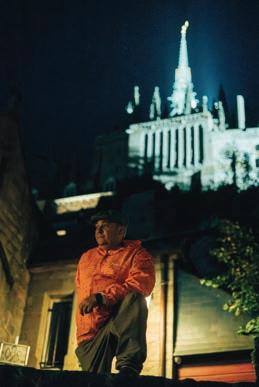
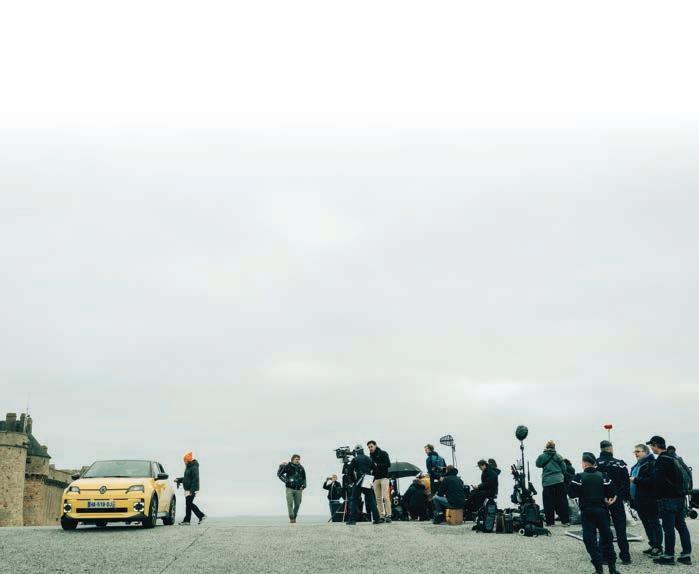
That’s why, on a cool, clear night last October, DQ is staying up late to join cast and crew filming the season’s final scenes on location at the magnificent Mont-Saint-Michel, the island commune one kilometre o the Normandy coast.
After dark, long after the last tourists have left for the evening, the cobbled streets and winding stone staircases are eerily quiet as producers Benjamin Dupont-Jubien and Mehdi Sabbar of production company Big Band Story wind a path
that ascends past a small cemetery and beneath arches to the famed 11th century Benedictine abbey that was built upon the isle’s rocky cli s.
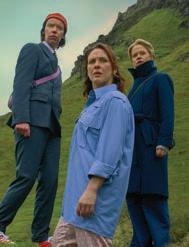
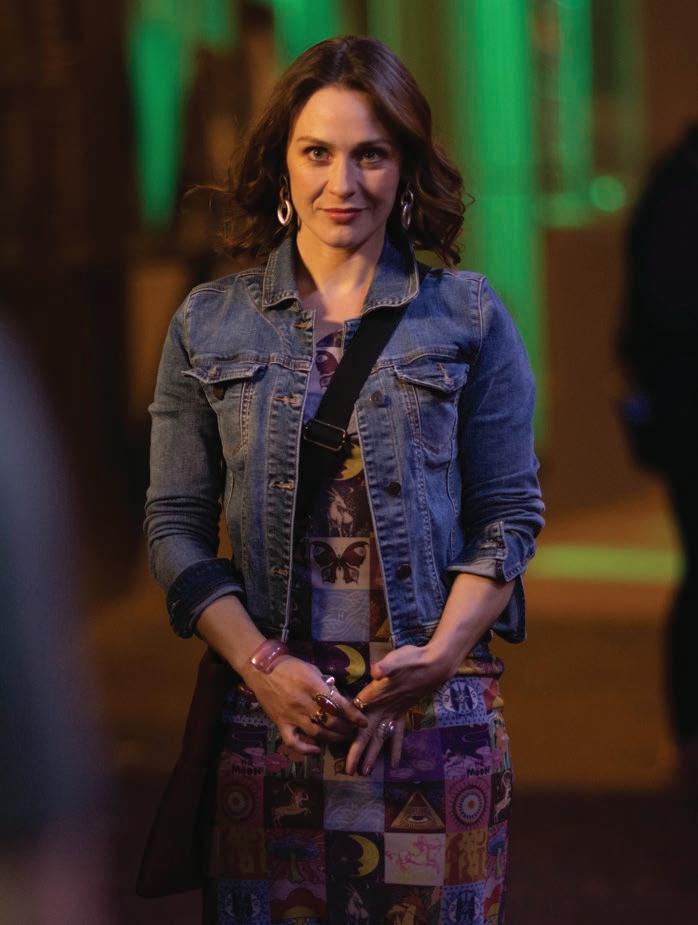
It’s here, inside the abbey, that series stars Camille Lou, Claire Romain and Constance Labbé can be found in costume as the titular Cat’s Eyes – the Chamade sisters – with Lou’s Tam on a daring rescue mission to save her sisters that involves free-abseiling from a hole in the roof of the abbey to its tiled floor, before entering the cavernous rooms and dimly lit tunnels beneath. That scene was completed earlier. Here, Lou descends beneath the abbey via a secret staircase, always watching out for approaching enemies. Then she is scrambling in near darkness down numerous passageways as she seeks Sylvia (Labbé) and Alexia (Romain). Tam is in her trademark black jumpsuit, with Sylvia in blue and Alexia in red. Meanwhile, returning director Alexandre Laurent is passing on
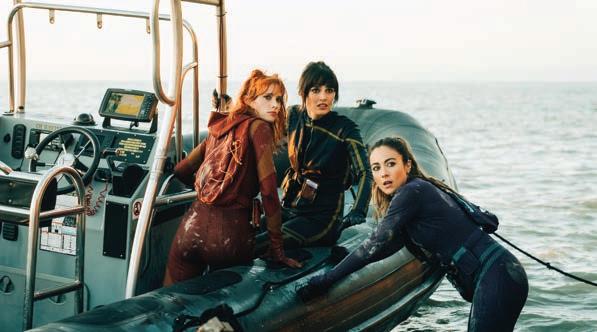
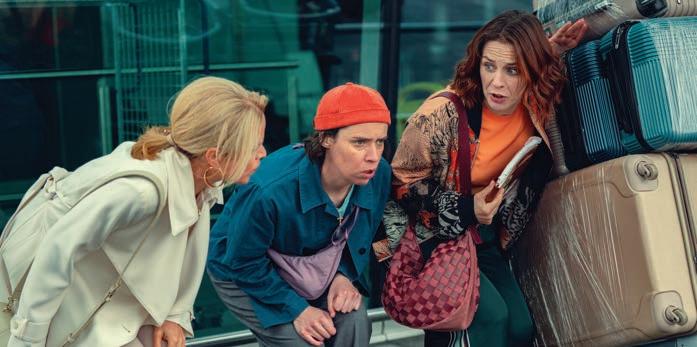
L-R: Cat’s Eyes stars Claire Romain, Camille Lou and Constance Labbé
instructions to the actors and the camera operator from behind a nearby monitor.
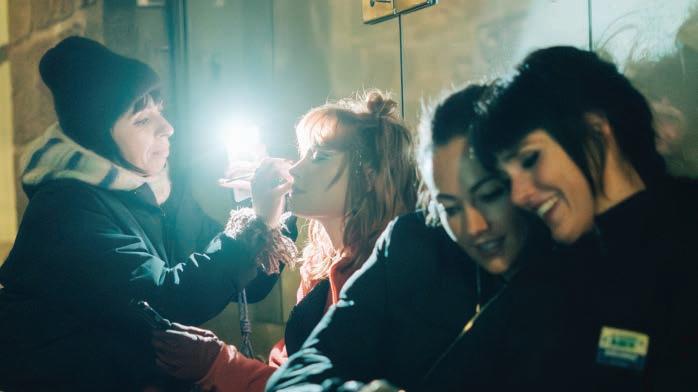
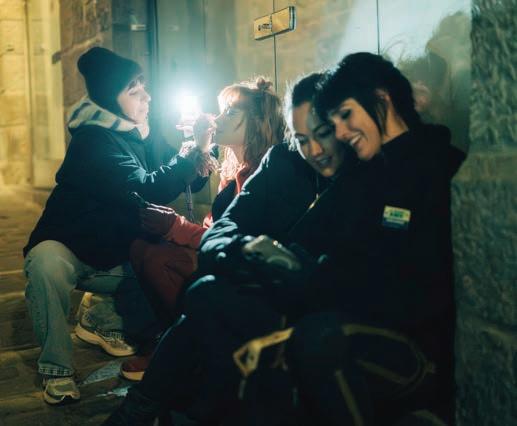
In between takes, the crew navigate their way through the dark with torches and headlamps, while the torches on mobile phones are also used to help makeup artists touch up the actors’ makeup in a neighbouring room that doubles for a green room and equipment store.
Based on the cult manga series Cat’s Eye by Tsukasa Hojo, who came to France to observe filming on S2, Cat’s Eyes centres on Tam, Sylvia and Alexia, who are on the prowl for the most beautiful artworks in Paris. After years apart, the siblings reunite to steal a work of art on display in an exhibition at the Ei el Tower, hoping it might help them solve the mystery behind their father’s disappearance years earlier.
Due to air in France after the summer this year, S2 picks up a few months after the end of S1, with the sisters following clues relating to their father’s whereabouts that lead them to Mont-Saint-Michel. But when things don’t go to plan, they realise that to save their father, they will have to take down the main criminal organisation behind art trafficking in France.
Returning for S2, “the big difference is our relationship, the three of us,” Labbé tells DQ.
“At the beginning of S1, we were more separated, and the purpose of S1 was to stick together in order to find our dad. In the beginning of S2, we are together and we’ve become the Cat’s Eyes already. The energy between the three of us is very different.”
“Also, there are new characters – like Le Marquis – and more action,” notes Romain. “We see the Cat’s Eyes outside the walls of Paris. We see them here in Mont-Saint-Michel, on a train. It’s really nice to see them outside.”
The three actors didn’t know each other at the beginning of S1, which means coming back to shoot S2 has been a “great pleasure,” Labbé says. “We really worked on the relationship in the way sisters work. We’ve learned to know each other and now we work on our pros and cons. It’s very intense shooting; it’s six months and we have a lot of nights, so sometimes we want to kick each other’s faces, and sometimes we really want to hug. We feel like sisters.”
“It’s like in a normal family,” Romain says. “That’s why we in the first season we had a lot of positive comments from people. They were like, ‘Oh, how did you create such a unique and intense chemistry between you three?’ and we were like, ‘I don’t know.’ I think it just happens because
“It’s very intense shooting; it’s six months and we have a lot of nights, so sometimes we want to kick each other’s faces, and sometimes we really want to hug. We feel like sisters.
Constance Labbé Actor
Romain gets a touch-up on location with the help of a phone torch
“< we took the time to learn about each other.”
Commissioned by TF1 in France and distributed globally by Newen Connect, Cat’s Eyes S1 was sold to Germany’s ZDF, Italy’s Rai, Belgium’s RTL and Switzerland’s RTS. Prime Video also financed a second window in France and took first-window rights in Latin America and Japan. S1 will soon be available to stream on Hulu and Hulu on Disney+ for US subscribers.
set to be part of a love triangle with Tam and police captain Quentin (Mohamed Belkhir). “This new character is inspired by the character Masato Kamiya, aka ‘The Rat,’ in Tsukusa Hojo’s original manga,” Dupont-Jubien adds. “He brings a big romantic-comedy feel to the series. He also brings fun and lightness, since he’s very funny in addition to being sexy. We hope the audience will like him as much as we do.”
After S1 took in locations including the Eiffel Tower, the Louvre and the Palace of Versailles, S2 once again showcases different thefts in each episode, each staged at a different location. Permission to film at the abbey, the second most visited attraction in France after the Eiffel Tower, was secured after 18 months of discussions.
Since the series is working outside France, we could go somewhere else in Europe, or maybe Asia. We are exploring the idea and the possibility of doing that.
Benjamin Dupont-Jubien
Big Band Story
“In S1, the driver of the series was the quest to find the truth about their father: is he really dead? Who’s behind his death? At the end, we discovered he was alive and that his disappearance was because a big art-trafficking organisation was after him,” exec Dupont-Jubien says. “On an emotional level, S1 was also the story of three sisters who grew up apart for many reasons and found a way to reunite and be inseparable again.”
This time out, the stakes are higher, with the sisters facing off against a new killer, Gabriel (Jerome Le Banner), and the returning Prudence (Élodie Fontan) who is out for revenge.
“Of course, to attack the organisation and take it down, they have to engage in new theft challenges: organise a robbery in the Mont-Saint-Michel, attack a train to steal a painting heavily protected by the police, steal a diamond necklace during a fashion show at the Centre Pompidou, attack the safe of a prestigious bank inside the Montparnasse Tower and even take down the organisation during an art show at the Musée d’Orsay. All of that makes S2 more spectacular than S1, with higher stakes and greater dangers.”
The sisters also meet Le Marquis (Tom Leeb), a charismatic and highly skilled thief who starts out as a rival and might just become an ally over the season. He’s also
”It was originally hoped the shoot could take place at the start of the S2 schedule in the spring, but that plan was scuppered due to the fact protected birds were nesting on the isle. It was then decided to dedicate the last week of the schedule – one day and four nights under the light of a full moon – to scenes needed for episode one, bringing to a close a 95-day shooting schedule. A further 30 days were completed by a second unit.
For Dupont-Jubien, filming S2 proved to be even more intense than S1. “We pushed the limit of the action scenes and there were new challenges,” he says. “When you do the first season, you surprise the audience. In second season, you wonder how you can surprise them again, since you did spectacular stu [before], and we had to imagine crazy situations. I’m pretty happy.”
He describes the location as “a village on a big rock surrounded by sea,” with people who live there and who can’t be disturbed by filming. It is also home to a community of priests who use the cloisters and the abbey every day for prayers and masses – not to mention thousands of tourists visiting every day.
Matters at Mont-Saint-Michel were complicated by the fact that, unlike the Eiffel Tower, there are no lifts to carry equipment to where it was needed. “To move inside the Mont, there are only a few narrow streets and uneven stone stairs that lead to the top without any cars,” Dupont-Jubien says. “Each move between two shooting locations takes forever. You have to plan in advance very carefully not only all the shots you have to do but all your moves and the means necessary to move the equipment and the lights. If you forget a battery or a light down in the trucks, you need 50 minutes to get down there and bring it back on the set.”
That meant organisation was the key to success, but the production also needed some welcome luck when it came to the weather, with Mont-Saint-Michel often facing stormy conditions. “The week before we arrived, a big tempest struck the Mont and threatened our shoot,” the exec says. “Luckily, a few days before we arrived, winds calmed down, the sun came back and we shot our nights without a single drop of rain.”
Then there were the tides to take into account, with one scene calling for a boat to approach the isle and dock
DQ attended filming on the tidal island of Mont-Saint-Michel
beside the rocks. “But there’s only one spot where you can do that, and there is a strong stream that you have to deal with in terms of navigation,” Dupont-Jubien notes. “More than that, the tide allows you to approach the dock for only 10 minutes before the water recedes. We had to overprepare this specific shot and rehearse a lot in order to be super ready. We needed the shot for the sisters to escape the Mont, and there was no way we could do otherwise. Luckily, everything went well and we managed to do the scene within the short time we had. Constance Labbé had to drive the boat. She was nervous but did great.”
The technical scout proved how tricky it would be to film there, as the crew had to put aside their memories of a location they might have visited as a tourist and examine it as filmmakers. “Then you discover lots of crazy corridors, stairs, traps everywhere,” Dupont-Jubien continues. “It makes your imagination go wild and you invent more situations. Then it changes the entire scenario, so you rewrite everything. Then you scout again with the light crew, with the grip, where you’re going to put the makeup, where you’re going to store the all the equipment. All these types of challenges you have to overcome. But since we did that at the end of the shoot, it was not easy, but it was well planned.
“It’s been tough, but it was very exciting to finish with Mont-Saint-Michel. Even though it’s in the first episode, it was our biggest challenge of the season, and it was nice for us to have it in the last week of shooting. It was motivation for everybody.”
Dupont-Jubien believes the secret to the show’s success is the “great alchemy” between the leading trio. “You really believe in the sisterhood, and they’re great together,” he says. “They each have a specific character. You can relate to these characters and you can love them and really be engaged in the story.
“The story is very appealing as they try to find their father. You have great locations. Paris is still a city people love. It’s the type of city that creates some desire to watch. And then the fact that we have a young cast, we had huge success among the youngest target [audience group], which was something very new for TF1.”
For that reason, the exec describes Cat’s Eyes as a “big bet and a big risk” for the broadcaster – one that paid o through its combination of young characters and actors and the “fresh energy” they brought to the show. “The alchemy between the three sisters, the fact that you are in great locations that you explore, each episode takes you in a new universe.”
A key consideration for S2 was to ensure it didn’t repeat anything viewers had seen in S1, from the show’s spectacular, glamorous and beautiful locations to the types of heists that take place. “We had to find new ideas to surprise the audience and put the characters in situations and dilemmas that were much more complicated,” Dupont-Jubien says.
“We ended S1 on a very strong cliffhanger, so we knew S2 would have to follow up on that and would have to bring answers. That was our starting point and the driver we wanted to follow: find the father and bring all the answers to the questions we posed in S1. At the same time, we didn’t want to repeat ourselves in terms of the missions and action scenes. We wanted to renew ourselves.”
With that in mind, Le Marquis became a “game changer” in not only complicating the new heists but also upsetting Tam and Quentin’s love story. “During the first season, each time the Cat’s Eyes did a robbery, their challenge was to overcome the security of the place and escape from the police – and on some occasions, Prudence. In S2, in addition to all of that, they have to face Le Marquis, who is as good as they are, if not better. That creates surprising situations and lots of fun.”
Meanwhile, it’s not just paintings the Cat’s Eyes have in their sights in S2. “They have a necklace to steal, a mysterious computer to steal from a safe in a bank,” the exec reveals. “They even have to steal a person who’s wounded and who’s heavily guarded in a hospital.”
S2 ends with the closure of the show’s main story arc, bringing resolution to the mystery behind the sisters’ father. “But after that, there’s also a big opening for us for S3, hopefully, if there is a S3,” Dupont-Jubien adds.
At Mont-Saint-Michel, when the final scene is captured and filming is completed, Lou, Labbé and Romain come together in a group hug as applause echoes through the underbelly of the abbey.
Should they get the greenlight to go again for a third season, Dupont-Jubien and Sabbar have a few ideas of other locations they would like to explore in Paris and across France. “We are also looking at foreign countries to see if we could travel,” Dupont-Jubien says. “It means a much more complicated production for us, but it could be a great challenge to have the Cat’s Eyes travelling. Since the series is working outside France, we could go somewhere else in Europe, or maybe Asia. We are exploring the idea and the possibility of doing that.”
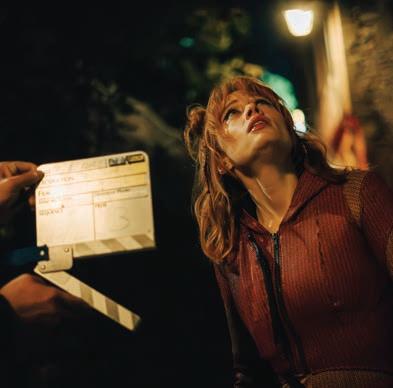
Director Alexandre Laurent pictured during the nighttime shoot – one of many during production
As The Dry prepares to bow out and How to Get to Heaven from Belfast makes its Netflix debut, actor Roísín Gallagher reflects on leaving one beloved character behind, embracing another and navigating a year of creative extremes.
W Heaven
ith the third and final season of The Dry set to air this year, Roísín Gallagher is preparing to say goodbye to Shiv Sheridan, the recovering alcoholic she has played in the ITV and RTÉ comedy since its debut in 2022.
The story sees Shiv return home to Dublin from London as she attempts to stay sober after years of partying, only to find her family isn’t entirely supportive of her new state of mind. In season three, once again written by Nancy Harris and directed by Paddy Breathnach, the Sheridans face their biggest challenge yet as a huge secret knocks them all sideways.
“Nancy always had three seasons in her head,” Gallagher tells DQ. “None of the cast or crew wanted to let it go, so there were a lot of jokes about [making] a Christmas special. But I think that was just a joke. It was great fun. I really enjoyed it. It’s a gorgeous way to say goodbye to the Sheridan family.”
Before filming began in Dublin on the final episodes of The Dry, however, Gallagher spent time in Northern Ireland shooting the recently released Netflix series How to Get to Heaven from Belfast Saying goodbye to one character and hello to another in the past 12 months, it’s safe to say it’s been a year of extremes for the actor, who is also known for roles in The Lovers, Lazarus and The Fall
“It’s a cool way to look at the cycle of these things,” she says. “Part of what makes it easier for me to let go of characters is knowing that we don’t know what’s going to land in our email next week. There’s always that little bit of hope that there’ll be another character down the road. But I went through a period of thinking, ‘I don’t know that I’m ever gonna get to do another Shiv,’ and that’s true – I won’t ever get to do another Shiv. But then you do a character like Saoirse, who’s so unique and so special and so complex as well, in her way.”
Saoirse is one of the three central characters in How to Get to Heaven from Belfast, the latest series from Derry Girls creator Lisa McGee, which debuted on Netflix in February. Alongside clever but chaotic TV writer Saoirse are glamorous, stressed-out mother-ofthree Robyn (Sinéad Keenan) and dependable but inhibited carer Dara (Caoilfhionn Dunne), who have been a tight-knit group since school.
Now in their late 30s but still as close as ever, the three friends embark on the most thrilling adventure of their lives after they receive
an email informing them of the death of the estranged fourth member of their childhood gang. A series of eerie events at her wake then sets them on a dark, dangerous and comic odyssey through Ireland and beyond as each tries to piece together the truth about the past
While Gallagher says there are few similarities between Shiv and Saoirse, she did find McGee’s writing to be in a similar vein to that of Harris, and she had zero doubts about joining a project by the Derry Girls creator. “It was so funny off the page, so pacey,” she says. “The first time I read anything of Saoirse was the first time the audience meets her as well, and it’s just a very funny meeting, a very funny scenario. I was like, ‘Yes, this is golden.’”
That first meeting takes place in a London restaurant, where Saoirse is embroiled in a battle of wills with Marnie (played by Leila Farzad), the star of her detective show, Murder Code, which Saoirse has come to despise and disparage. Marnie even suggests the next season perhaps shouldn’t feature murder at all.
“She’s a writer and she’s having a very tricky ego-versus-ego conversation, which is just hilarious. It’s brilliant,” Gallagher says. “Tracy-Ann Oberman [as agent Camille] and Leila, they were just brilliant. I knew it was brilliant on paper and, with the creative team behind it, it was going to be something special.”
But landing a role in the show came with a familiar sense of selfdoubt for Gallagher, not least when she turned up to auditions to read with potential co-stars. “I had already been cast, I had been told I had the part, and I went in to read with some other actors, which is a very normal thing,” she notes. “I remember going, ‘Did I make this up? Am I auditioning? I don’t know if I actually got the part.’ I had to double check. It’s that kind of ‘pinch me’ thing, and thankfully I hadn’t made it up. I had got the part. So it was brilliant.”
Roísín Gallagher as Shiv in
The Dry and (inset) alongside Caoilfhionn Dunne and Sinéad Keenan in How to Get to Heaven from Belfast
<
It was particularly important for casting director Carla Stronge to find the perfect “gang of three” to lead the series, and Gallagher praises the decision to put her alongside Keenan (Unforgotten) and Dunne (A Thousand Blows), with the trio finding a “natural synchronicity” on set. “The chemistry from the off was naturally there and it certainly didn’t feel like hard work,” she remembers. “The girls, for me, became such great friends, and we had a hell of a lot of respect for each other’s work and how we process things.
“Of course, those things take time. But when you’re on something like this, we ended up doing 135 shooting days. We did go for dinner and stuff at the beginning. It almost feels like you’re dating, in a weird way. Personally, I find actors and creative people a joy to be around, so it’s never hardship. But we really hit it off and still very much stay in touch. Knowing that bond developed quite early on, quite quickly, was really helpful for some of the things we went through together.”
Gallagher loves that Saoirse is “unfiltered” and that her brain works faster than her mouth. “It’s like she’s always catching up with her own thoughts,” she says of her character.
“She is totally tethered to her home country and the place that she is from, but she is having a bit of an identity crisis in the fact that she tells everyone she lives in London now, and that somehow makes her better than the people who chose to stay in Belfast.
“Her friendships are incredibly important to her, and while there’s a question mark over loyalty in some other areas in her life, these girls are just incredibly important to her.”
It’s Saoirse who propels the trio into the central mystery behind the show – the circumstances surrounding their friend’s death. And just like the TV detective she created, she is the one most determined to solve the case. “She writes about it, so because of that, she’s absolutely relishing in it,” Gallagher says. “I don’t know if she knows this, but any opportunity to show her brilliance, her brain, she wants to use that. It’s like there’s an energy about her. There’s a constant motor ticking, so she has to always be taking action on something.
“She’s also easily distracted by shiny, good-looking things and forgets about the bits in her life that really she should be not forgetting about because she’s a grown-up. I think she forgets she’s a grown-up sometimes. I love all that, because it’s so real. Certainly with female roles of a certain age, up until recently we didn’t really see or even get to celebrate that. They were often described as ‘hot messes.’ She’s just someone hurtling towards her 40s and not really knowing how she got there.”
In fact, Gallagher believes the show is about the ghosts of the characters’ past experiences, which they can’t seem to escape. It’s also a comedy, a love story and a thriller, playing out to a pop soundtrack drawn from the 1990s and early 2000s.
“It’s about the idea of having experienced a trauma, and the different ways we try to run away from that, and what happens when you come to a point in your life where you simply cannot
move forward knowing what you know and needing the truth,” she says. “What Lisa has devised is absolutely brilliant. At one point I’m thinking, ‘Am I the baddie?’ To not really be able to pin down the good cops and the bad cops the whole way through the eight episodes is a real feat, and just a testament to her and the team of writers, their creativity and their imagination.”
While Gallagher brings something of herself to each role she plays, she was able to look at McGee when it came to portraying a TV writer. There’s even a scene in the show when Saoirse visits the set of Murder Code, and Gallagher could experience firsthand the pressure facing any TV showrunner. “I would probably behave much more like Saoirse than I would like Lisa, who is very calm and gracious and generous,” the actor says. “Saoirse’s not quite able to filter what she’s thinking and saying.”
The role has fuelled Gallagher’s own ambitions to write – a creative journey that is already underway. “I feel very remedial and at the nursery school stage of that side of my career, but I do hope it might go somewhere,” she says. “Getting the opportunity to observe people like Lisa McGee and Nancy Harris, they’re [telling] the types of stories that move me. That’s the type of writing I would hope to be able to do as well. It’s just one of those things you don’t know until you try.”
After filming How to Get to Heaven from Belfast across approximately four-and-a-half months, Gallagher looks back on the production “with a rosy glow” of being part of “one big, happy family.” “Everybody was always in great form, and everybody always knew what they were doing,” she says, noting it was the longest shoot of her career so far.
“Getting the opportunity to observe people like Lisa McGee and Nancy Harris – they’re telling the types of stories that move me. That’s the type of writing I would hope to be able to do as well.
Roísín Gallagher
“There was a lot of moving around and we shot in some incredible places in Ireland – some close to home, some much further away,” she notes. The production also spent some time shooting in Malta, which doubled for scenes set in Portugal. “One of the girls said [filming] was like getting on a fast train at the start, and that was it. You were on it and you weren’t getting off until the very end. That is what it felt like, a bit of jumping on and just surrendering to this great big machine of production.”
Gallagher is now eyeing up a reunion with Saoirse. “I would absolutely love to do more, I really would,” she says. “I suppose if it was up to me, I would have us coming back every year for as long as we could.”
Could there even be a Murder Code spin-off? “If Saoirse had anything to do with it, no. She’s so done with that crap. But you never know,” she says.
”
How to Get to Heaven from Belfast follows three women investigating a mystery surrounding their childhood friend, Greta (played by Emma Canning, pictured opposite with Gallagher)
Ahead of the world premiere of Korean drama
The Legend of Kitchen Soldier at Series Mania, Studio Dragon chief producers Lee Hye-young and Kim Tae-hoon introduce this genre-bending tale of a man’s journey to becoming an elite army chef.
As dramatised in shows from US series Sweetbitter and The Bear to Iceland’s Rekjavik Fusion , Australia’s Aftertaste and the UK’s Boiling Point , there’s no end of tension, turmoil and turbulence to be found in the kitchens of busy, high-end restaurants.
Now a new Korean series is set to cook up a storm. But more than just drama, The Legend of Kitchen Soldier serves up a mix of comedy and fantasy as well as cooking – this time against the backdrop of a military setting.
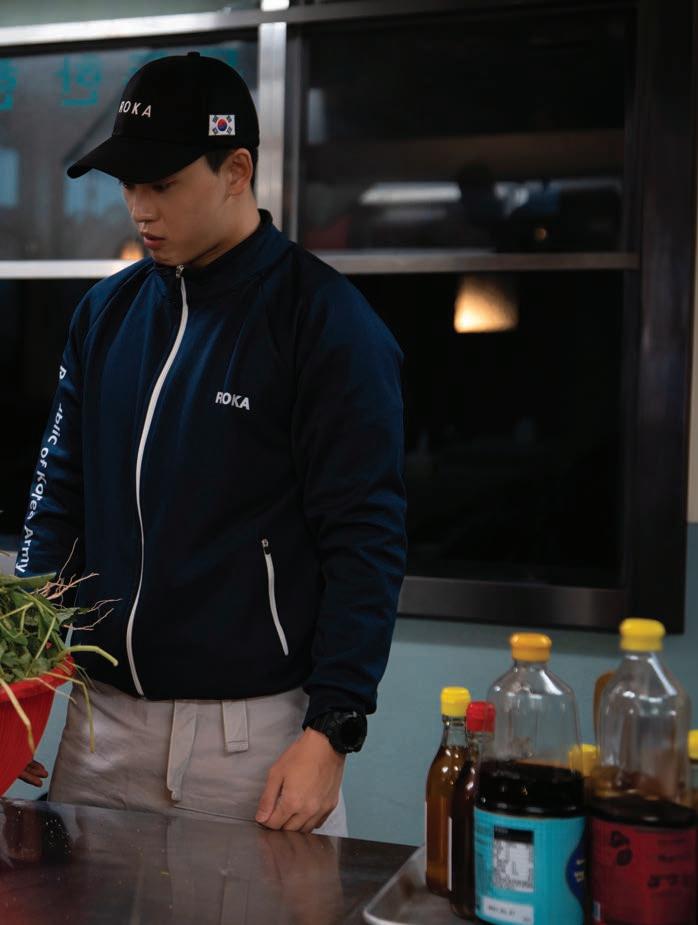
The show follows Kang Sung-jae, a man from a poor background on his way to becoming a legendary army cook. But after enlisting in the military to escape his harsh reality, he encounters a mysterious virtual ‘quest’ system that guides his path as a kitchen soldier. From the cookhouse and dormitories to the training grounds, each completed mission draws him deeper into the unit’s hidden issues. Armed with nothing but knives, pots, and spoons, his wild and unpredictable military quest begins.
Based on a Korean webtoon, the series is produced by Studio Dragon for streamer TVING and distributed internationally by CJ ENM. It is directed by Cho Nam-hyung ( Tale of the Nine-Tailed ) and written by Choi Ryong. The cast is led by Park Jihoon ( Weak Hero ) and Yoon Kyung-Ho ( Vigilante ).
Ahead of the show’s world premiere out of competition at Series Mania, Studio Dragon chief producers Lee Hyeyoung and Kim Tae-hoon tell DQ about this unique coming-of-age story, the challenge of portraying taste and smell on screen and how Korean drama is evolving through genre experimentation and cultural specificity.
Introduce us to the series.
The Legend of Kitchen Soldier is , at its core, a coming-of-age story about a young man who transforms the most hierarchical space in society, the military, through the warmest and most universal language: food. It is a story about growth, dignity and how a single meal can restore humanity within a rigid system.
How do viewers meet the main character, Kang Sung-jae, and how do they follow him through the story?
a single military outpost, creating spatial and emotional focus. Unlike the fast-paced development of a webtoon, television required deeper expansion of emotional arcs.
One key distinction lies in how we portray taste – not merely as sensory description, but as immersive imagination. Characters visually and emotionally enter imagined taste landscapes, creating a distinctive cinematic device that differentiates the series from its source material.
We first encounter Kang Sung-jae as an unfinished young man; uncertain, underestimated and socially unpolished. By circumstance rather than ambition, he becomes a military cook. What begins as survival cooking gradually evolves into cooking for people.
The audience follows him through setbacks, conflicts and incremental victories, witnessing how an individual discovers meaning within a community.
The narrative begins in frustration and disillusionment, but it ultimately arrives at solidarity and the reclamation of self-worth.
How has the show’s visual style also been inspired by its source material?
The series is described as a comedy-drama. How does it balance the two genres?
We believe the military itself contains inherent irony. Within its strict hierarchy exist deeply human vulnerabilities and absurdities. Rather than relying on situational gags, we pursued character-driven humour – comedy that emerges organically from sincerity. Laughter arises from personality and relationships, not exaggeration. Conversely, in emotional moments, we deliberately chose restraint over melodrama.
The tonal contrast, where viewers may find themselves laughing one moment and unexpectedly moved the next, is a defining characteristic of the series.
How has the series been adapted from the webtoon that inspired it?
The original property was particularly compelling for its dynamic pacing and the satisfying progression driven by game-like elements. In the adaptation, we retained the essential game system and foundational premise but localised the narrative within
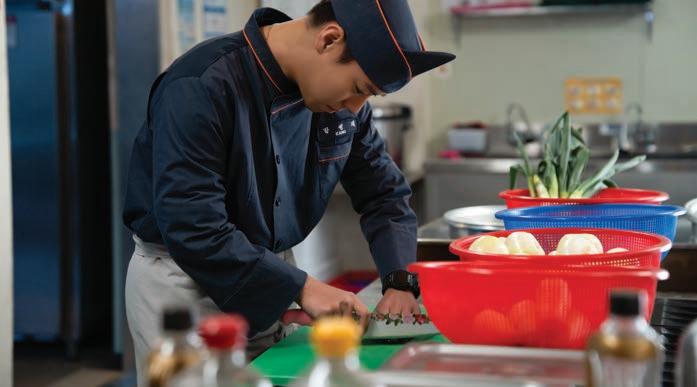
While the series is grounded in the realism of military life, we paid particular attention to a rarely depicted environment: the outpost kitchen and the cook’s confined workspace. The narrow cooking stations, intense movement lines and lived-in textures were rendered with documentary-like authenticity. In contrast, during moments when characters experience flavour, the series transitions into stylised imaginative sequences. This tension between rough realism and sensory expansion forms the visual identity of the show.
How did Park Ji-hoon join the project and what can you tell us about his performance as Kang Sung-jae?
We believed Park Ji-hoon possessed the rare ability to embody both youthful vulnerability and inner resilience, qualities essential to Sung-jae. His strength lies in emotional precision. He conveys subtle shifts without overt dramatisation. For the culinary sequences, he underwent extensive physical training to ensure credible movement and technique. In comedic scenes, his rhythmic interplay with fellow cast members elevated the ensemble dynamic. His performance grounds the series in emotional authenticity.
How does the show represent the military? Did you want to present an authentic setting, or is it heightened in any way?
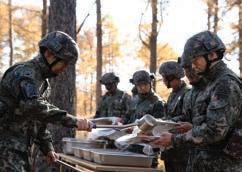
We approached the military system with a high degree of realism, particularly in the daily
>
The industry is moving toward a conviction that the more authentically Korean a story is, the more universally resonant it can become.
“ ”
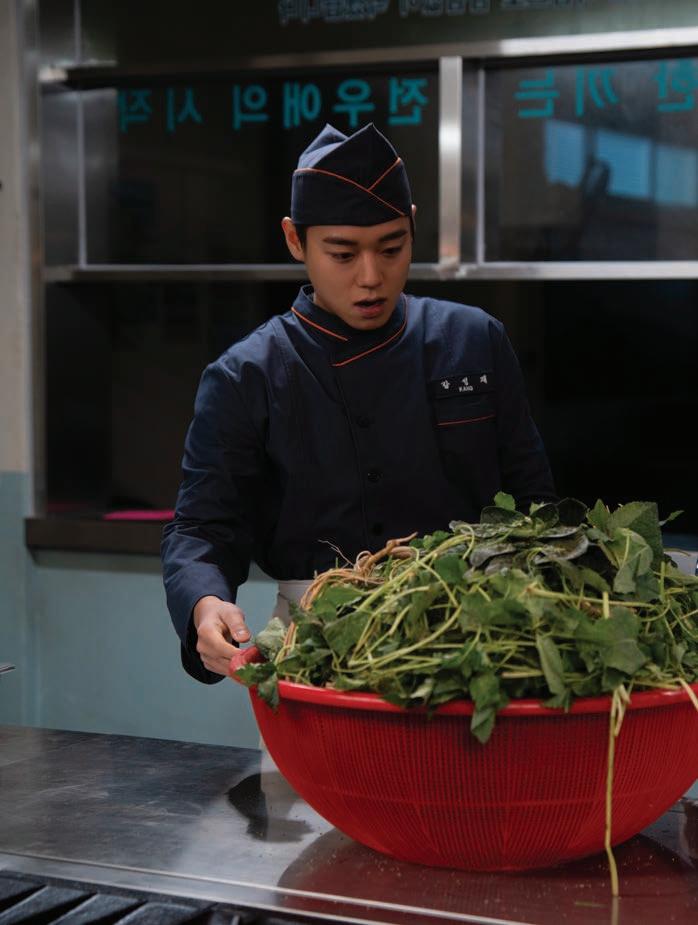
Park Ji-hoon leads the cast as Kang Sung-jae
Lee Hye-young and Kim Tae-hoon
Still hungry?
Aftertaste
When a volatile celebrity chef returns to his home town in the Adelaide Hills after his latest outburst goes viral, he seeks to reinvent his public image by partnering with his pastry chef niece.
The Bear Set to conclude with its upcoming fifth season, The Bear stars Jeremy Allen White as a New York-trained fine dining chef who returns home to Chicago to take over his late brother’s family-run sandwich shop and transform its fortunes.
Boiling Point
This small-screen follow-up to the one-take feature film of the same name is set in the intense, high-pressure world of a London restaurant where a new head chef (Vinette Robinson) struggles to balance her professional and personal lives.
Carême
Witness the rise of the world’s first celebrity chef, as Antonin Carême’s talent for gastronomy and seduction lead him to attract the attention of politicians
< operations of remote outposts – spaces more isolated and structurally distinct than standard battalions. Through consultation, we carefully constructed meal logistics, kitchen routines and living structures to distinguish the series from previous military dramas. However, selective adaptations were made for dramatic resonance. For example, in the original work, Sung-jae’s superior is a competent cook. In the series, we reimagined him as someone who cannot properly season food, creating both comedic tension and thematic depth. Through Sung-jae, he comes to understand that cooking carries sincerity, which is capable of moving hearts. This shift allowed Sung-jae’s growth to unfold relationally, not simply as technical mastery, but as emotional influence within a community.
What was it like filming the combination of military and cooking scenes?
Four further food-focused drama series to feast on rather particularly we were how and something he resists. Over time, through trust and conflict, it becomes integrated into his self-growth. Ensuring this evolution felt organic convenient attention politicians who want to use him as a spy in a fight for power in Napoleon-era France.
The Guardian functions not as a shortcut to power, but as a catalyst for internal transformation. Elevating it from a narrative device to a meaningful growth mechanism was our central creative challenge.
How does The Legend of Kitchen Soldier reflect the kinds of stories CJ ENM wants to produce?
The project aligns closely with CJ ENM’s longstanding ‘OnlyOne’ philosophy, creating di erentiated content that leads the market rather than follows it. By combining a grounded military setting with culinary storytelling and fantasy elements, the series establishes a hybrid genre. It reconfigures familiar territory into something tonally distinct.
Moreover, the project was conceived with IP scalability in mind. Beyond a single season, it builds a character-driven universe that can expand. It represents not merely exporting Korean content, but proposing a new narrative category through original development.
The set was physically demanding. Because we often prepared real food, the kitchen environment was consistently intense and fast-paced. Unlike typical culinary dramas that rely on exotic ingredients or elaborate techniques, our narrative imposed restrictions, with limited military supplies within a confined setting. Those limitations became a creative framework rather than an obstacle.
How has South Korean drama responded to being in the international spotlight? How is the industry evolving?
Korean drama has evolved by deepening both genre experimentation and cultural specificity. Where once certain genres dominated, today, comedy, thriller, romance and fantasy all compete globally.
In the streaming era, production structures increasingly take global distribution, subtitling scalability and franchise potential into account from the outset. There is a strategic awareness that domestic ratings alone are no longer the sole metric of success.
Paradoxically, what differentiates Korean drama internationally is not dilution but specificity. Local professions, social structures and cultural codes, once considered too regional, have become assets. The industry is moving toward a conviction that the more authentically Korean a story is, the more universally resonant it can become.
One particularly memorable scene involved Sung-jae’s first presentation of braised pollock. It was intentionally modest, even visually understated. We were concerned it might not translate on screen. However, when actor Yoon Kyung-ho genuinely reacted to its flavour, we recognised that the food needed to function as an emotional device rather than a mere prop. From that point forward, we refined how we captured steam, texture, utensil sounds and micro-expressions, prioritising experiential authenticity over visual glamour.
What were the biggest challenges you faced when making the show?
The greatest challenge was not designing the ‘Guardian,’ a mysterious virtual quest system, but charting how Sung-jae psychologically comes to accept and ultimately utilises it. Initially, the Guardian is disruptive, something he resists. Over time, through trust and conflict, it becomes integrated into his self-growth. Ensuring this evolution felt organic rather than convenient required extensive structural development.
With The Legend of Kitchen Soldier having its world premiere out of competition at Series Mania, why might the show appeal to international audiences?
A world premiere is a profound moment. It defines the first global impression of a work. Although the series is set within a uniquely Korean institution, the military, the emotional core is universal: growth, belonging, recognition and dignity.
The interplay between cultural specificity and genre hybridity gives the series its distinctive voice. Through this premiere, we hope to demonstrate that K-drama IP is no longer simply content, it is a globally recognised creative brand.
Twin Peaks
My first encounter with Twin Peaks was nothing short of a revelation. It was a soul-stirring meeting with a universe – and a gallery of characters – unlike anything I had experienced before. As a teenager, I felt an immediate and lasting connection to the world David Lynch and Mark Frost had created. The characters resonated with me in unexpected ways; they were strange, vulnerable, humorous and unsettling all at once. From a craft perspective, the series revealed a new level of artistic ambition for TV drama. Its cinematic language, dreamlike atmosphere and fearless blending of genres expanded my understanding of what the medium could be. Twin Peaks was mysterious, playful and unsettling – often at the same time – and its boldness continues to influence TV storytelling decades later.
Forbrydelsen (The Killing)
SIX OF THE