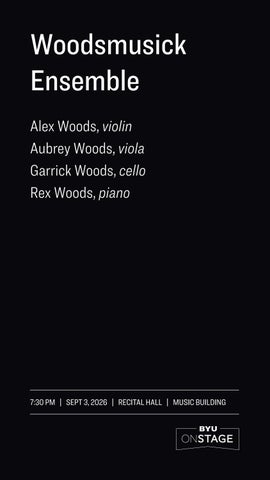
Woodsmusick Ensemble Alex Woods, violin Aubrey Woods, viola Garrick Woods, cello Rex Woods, piano
7:30 PM | SEPT 3, 2026 | RECITAL HALL | MUSIC BUILDING
Piano Trio No.25 “Gypsy” . . . . . . . . . . . . . . . . . . . . . . . FRANZ JOSEPH HAYDN Andante Poco adagio Finale-rondo all'ongarese
1732–1809
Piano Quartet no. 3 in C minor, op. 60 . . . . . . FRANZ JOSEPH HAYDN Allegro non troppo Scherzo-allegro Andante Finale-Allegro comodo
1732–1809
Piano Trio in G Major Hob. XV:25, “Gypsy” . . . . . . . . JOSEPH HAYDN Andante Poco Adagio Finale: Presto “all’ongorese”
1732–1809
Joseph Haydn was born in 1732, in Rohrau, a little town in Lower Austria. He was the second child of twelve of the wheelwright Mathias Haydn and his wife Anna Maria Koller. Theirs was a modest home, but music played an important part of everyday life. Mathias played the harp and liked to sing, and he encouraged all his children to “chime in” on the occasion of his little informal concerts. Three of the boys would later train to become professional musicians. At the very young age of six, Joseph was sent away to school in Hainburg, to prepare him for a career as clergyman. He lived at the house of the school master, a distant relative of the Haydn family and (according to an early biography) “received more thrashings than food”. He also received instruction in several instruments and was praised for his studious diligence. His fine voice opened the next door for him when he reached the age of eight and was recruited for the choir at St. Stephen’s Cathedral in Vienna. He would remain in Vienna for the next 20 years of his life, developing from choirboy to a young musician and composer, making his own way as a young freelance performer, with little support or protection. Finally, in 1761, Haydn was offered the post as Kapellmeister to Prince Nikolas Esterházy and exchanged life in the big city of Vienna, where he had spent most of his youth and young adulthood, for the countryside. Even though the palace of Esterhaza was modeled on Versailles and beautifully located on the south side of the Neusiedlersee, it was at a great distance to the capital and culturally isolated from the rest of the Austrian Empire. Nevertheless, Haydn remained in the service of the Esterházy household for 30 years, for both Prince Paul and his successor Prince Nikolaus were passionate music-lovers. It took Haydn almost ten years to get a good handle on the
complex musical operations at Esterhaza. If before he had been a freelancing artist, he was now a well-paid employee to a prince who expected a smoothly run establishment, as well as a steady stream of compositional works of the highest caliber in order to entertain his entourage and high-profile visitors, including members of the Imperial family, day in and day out. The Kapellmeister’s dress had to “… befit an honest house officer in a princely court”, and his comportment was to serve as the guiding example for the other musicians, which required that he “…avoid undue familiarity in eating and drinking or otherwise in his relations with them, lest he should lose the respect due him.” Accepting his rural and social isolation as a positive environment devoid of distractions, Haydn learned to master the constant challenges of his position with aplomb, and gradually even gained the Prince’s permission to accept outside commissions for compositions and pursue the publication of his works for personal profit. With a craftsman’s diligence he churned out work after work in every possible medium and through his steady and committed labor gradually expanded not just his own horizons, but ultimately defined and then refined the musical elements that are now summarized under the term “Classical style”. After Prince Nikolaus’ death in 1790, Haydn remained titular Kapellmeister of Esterhaza, on full salary, but without obligations of any kind. He was now, at age 58, finally free to travel, and the London impresario J. P. Salomon was quick to sign him for his popular concert series. Haydn found a ready market for new chamber music amongst English music lovers. And being given a studio at the instrument manufacturer Broadwood’s, he discovered the power of the new “forte-piano”, which rapidly had begun to replace the harpsichord as the keyboard instrument of choice. Inspired, he composed three sets of three trios which represent the pinnacle of his achievement in a genre that he himself had created
decades earlier. The Trio Hob. XV 25 in G-Major was probably composed during his second trip to London, sometime between 1791–5 and is certainly his most popular piano trio because of its charming and spirited Finale. Exoticism being rather fashionable with audiences of the day, Haydn’s “All’ Ongarese” (in the “Hungarian style”) imitates what people widely recognized as gypsy fiddling. Haydn had never been a prodigy, even though his exceptional musical talents were discovered in early childhood. His development into the icon of an entire style happened gradually and was achieved through hard work. “I was never a fast worker… and always composed carefully and diligently” he remarked to a friend and admirer with habitual modesty and honesty. Many of his manuscripts reveal this steadfastness, and there are very few incomplete works. Yet, his uplifting music is anything but laborious. It sparkles with wit, it lures with its beauty and surprises us with unexpected turns between refinement and rustic charm. – Notes by Rebecca Hang Piano Quartet in C Minor, opus 60 . . . . . . . . . . . . . . JOHANNES BRAHMS Allegro non troppo Scherzo: Allegro Andante Finale: Allegro comodo
1833–1897
Early on in his career, the German Romantic composer Johannes Brahms arrived at a personal style that transcends the boundaries of time and place in the immediacy with which it communicates. Following in the footsteps of Haydn, Mozart, Beethoven and Schubert, Brahms was adamant about maintaining a craftsman’s view of his art, which meant he was set on avoiding the romantic penchant for portraying life’s events in music. He steered clear of programmatic music with literary sources in the vein of his mentor Robert Schumann or Franz Liszt, opting for what he regarded as the more universal “absolute music”.
This said, there are several compositions in his oeuvre which have straightforward biographical reasons for coming into existence, and our Piano Quartet in C Minor is one of them. In the case of this work, Brahms was unusually outspoken about its emotional significance. In autobiographical terms, Brahms was referring to his torturous love for Clara of twenty years ago. In the wake of Robert Schumann’s attempted suicide in 1854, and his confinement in a private asylum, the 21 year-old Brahms had taken on many roles in the Schumann household, from babysitter and private tutor to the eight Schumann children, to Clara’s personal assistant in matters both private and professional. Until Robert’s death 1856, Brahms’ creative life came to a momentary standstill, and besides counterpoint and harmony exercises, the only surviving compositions from this time are drafts for his first symphony and the first two movements of our quartet. Originally conceived in the key of C sharp Minor, Brahms eventually chose to cast the work in C Minor, a key traditionally used by composers when depicting somberness or tragedy, and certainly those characters permeate the first two movements. The opening Allegro is a mix of melancholy musings and dramatic outbursts, punctuated by the obsessive use of the descending half-step, since before Bach’s time also called the “sigh-motif”. This musical sigh is elongated, so to speak, into the first theme, which the musicologist Eric Sams identified as the “Clara theme”, a combination of pitches that had first been used by Schumann to “weave” Clara’s name (represented by the notes C-B-A-G#-A) into a number of his pieces. It is here transposed by Brahms into the key of C Minor, starting on the note E flat. Sams writes on the “Clara content” of the Piano Quartet opus 60: “The first sentence of that autobiographical work is doubly expressive of Clara. Furthermore, there is direct evidence that this melodic form actually embodied her, for Brahms as for Schumann.” The Scherzo is frenetic in mood, with a contrasting second
theme only providing a brief respite to the feverish pace. The first two movements are of less “Classical” design than most of Brahms’ other chamber music works, yet, there is an undeniable control of the musical process that allows it to unfold its intense emotional content without the listener (or performer, for that matter) to be ever conscious or aware of the underlying formal design or structure. The tide turns in the third movement, in E Major, which transports us to a different world, one of tender emotion, in which serenity and lyricism prevail through broad melodies and lush harmonies. Like the fourth movement, it was newly composed in 1873-‘74, almost twenty years after Brahms had started his initial work on the quartet. The manuscript of the Andante became a treasured gift from Brahms to Elisabeth von Herzogenberg, his one-time piano student, who he became reacquainted with after her marriage to Heinrich von Herzogenberg, a composer colleague and admirer of Brahms in Leipzig. In the Finale, Brahms returns us to the home key of C Minor and to the dark mood of the opening. This movement, through impetuous rhythmic intensity and broadly flowing lyrical melodies, ties the work together and provides a convincing conclusion to this moving journey. Brahms transcends his despair and succeeds to consider the chaos of his youthful soul from the balanced perspective of the mature man: he neither judges nor ridicules his emotions, nor diminishes their impact, but simply acknowledges their force and eventual subsiding. This, of course, is a very rare and honest way to put old pain to rest, and only an artist of Brahms’ exceptional skill and personal integrity is able to perform such an act of transcendence in a way that we can experience it, as if from the inside. – Notes by Rebecca Hang
Your donations open doors for BYU School of Music students!
D O NATE N OW
Celebrating 100 years of the BYU College of Fine Arts and Communications and 150 years of Brigham Young University