BYU Organ Workshop 2026
BYU Organ Workshop 2026
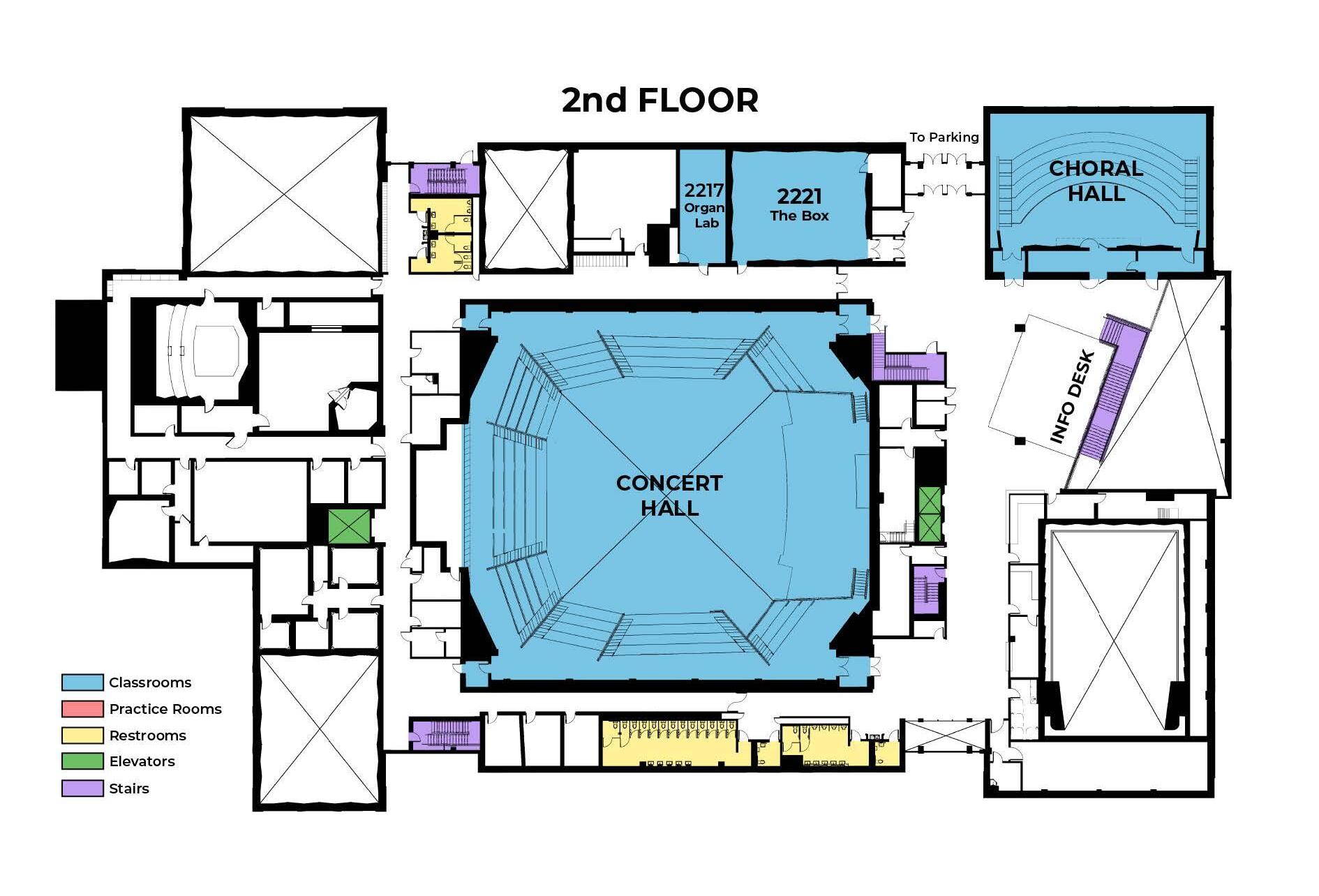
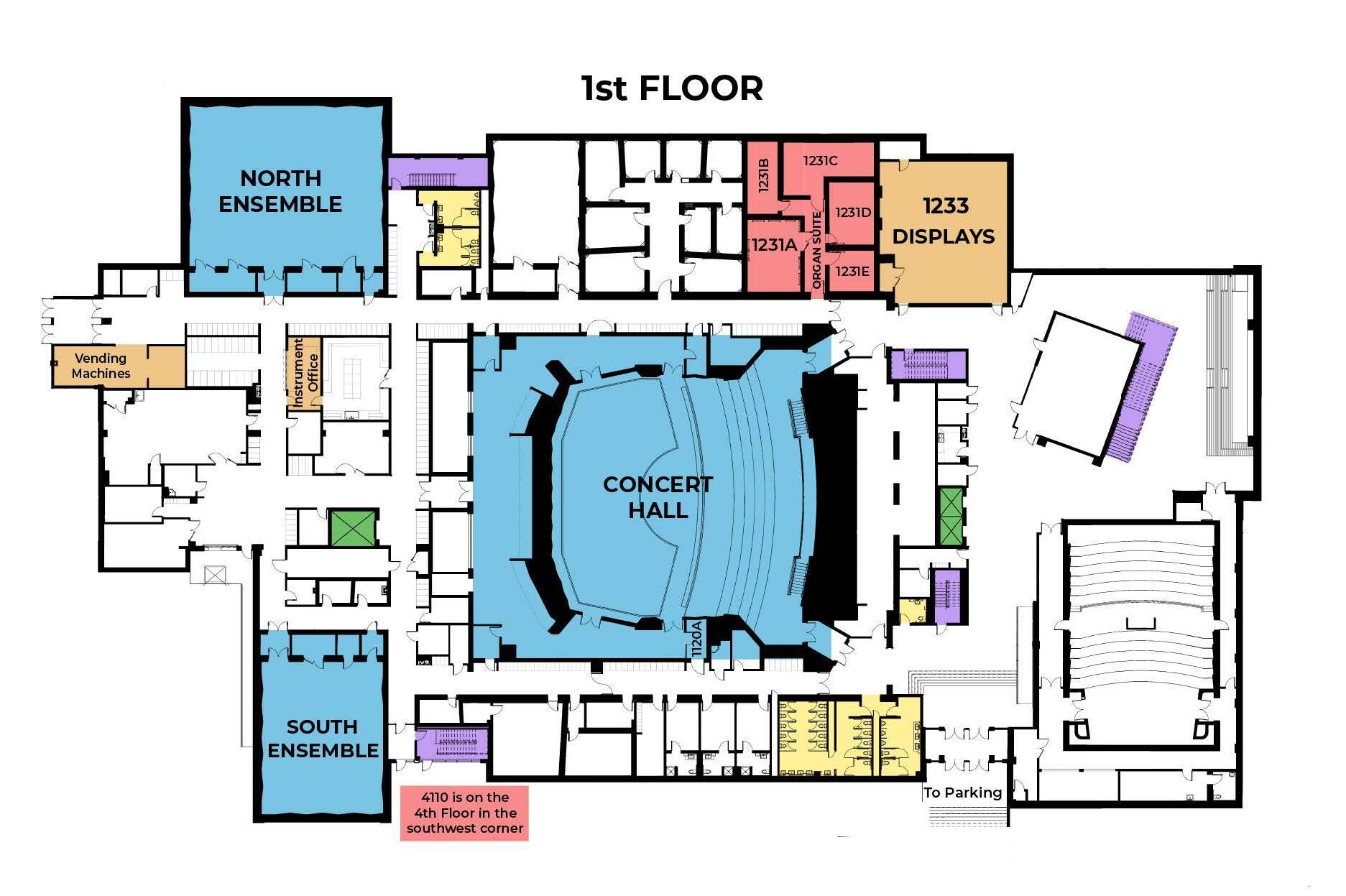
Monday, August 3
2:00-6:00 p.m.
This schedule is subject to change
Individual Consultations (scheduled, $15) Hall 1231C (Schoenstein organ), Hess 1231B (Casavant organ), Peterson 1231A (Rodgers) Private Lessons (scheduled, $60)
3:00-7:00 p.m. Registration Check-in Registration desk – 2nd Floor (East) lobby
3:00-5:00 p.m. Supervised Practice Campbell 2217 (Organ Lab) (no charge; four per hour scheduled & supervised, walk-in for unsupervised practice)
4:00-5:00 Displays open 1233
5:00-7:00 Seminar: Happy 250th Birthday! The Colors of American Organ Music Harris Choral Hall
5:00-11:00 p.m. Open Practice (organ practice rooms, and Organ Lab, unscheduled, no charge)
Anytime – Online videos: Organ Terminology Boot Camp Forsyth Making the Most of the BYU Organ Workshop Cook Stories of Your Peers Harris Virtual Organ Crawls
Tuesday, August 4
8:00 Registration Check-in 2nd Floor Lobby Displays open 8:00-8:50 1233 Breakfast, with Questions and Answers Cook North Ensemble
9:00
10:00 Pedal Technique (Part 1 – required for priority seating in a “Feet On” session) Swain Choral Hall
11:00 Registration Basics (Part 1) Larsen Choral Hall
Opening Session Cook, Karrington Concert Hall Keynote Address Craig Jessop
Organ Technique and Repertoire (Part 1) (2 hours):
Intermediate (Level 3) Boehmer 2221 (The Box)
Upper Intermed. (Level 4) Payne North Ensemble Early Advanced (Level 5) Harris South Ensemble Advanced (Level 6) Welch Concert Hall
12:00 Lunch Break Displays open (11:55-1:20; closed for the week Thursday 1:20) 1233
12:30 Lunchtime Listening Session: Prelude and Postlude for Beginners Hall North Ensemble
Supervised Practice (Lessons Beyond Level 6 Only) (Part 1) (2 hours) Kerr 2217 (Organ Lab)
“New to the Organ” track alternative: Pedal Technique “Feet On” (Part 2 – must sign up during Tue. 10:00 pedal class. Schedule only one “Feet On” session during the week. Available also Wed.-Fri. at various times.) Payne , Forsyth, A. Pickering 2217 (Organ Lab)
1:30 Organ Technique and Repertoire (Part 1) (1.5 hours):
Preparatory Level and Beginning (Level 1) Campbell Choral Hall (Attendance at this session required for Tue., Wed., or Thu. afternoon “Preparatory Level Practice”)
Early (Level 2) Forsyth South Ensemble
3:00 Registration Basics (Part 2)
Larsen Choral Hall
4:00 1. The Organist as a Teacher of the Gospel Goodliffe Choral Hall
2. Preparatory Level Practice (12 seats only for those who sign up during 1:30 class. Also at 5:00, Wed. at 2:30 or Thu. at 3:30. One space per person.) Moody, Forsyth 2217 (Organ Lab)
5:00 Preparatory Level Practice (repeat, 12 seats only for those who sign up during 1:30 class. Also Wed. at 2:30 or Thu.at 3:30. One space per person.)
7:00
Moody, Campbell 2217 (Organ Lab)
Advanced Hymn Playing (Part 1) (1.5 hours)
Boehmer North Ensemble
Developing the Next Generation of Organists Harris (1.5 hours) 2221 (The Box)
Supervised Practice (1 5 hours) Margetts 2217 (Organ Lab)
Teaching with the Organ for Primary Series
Swain North Ensemble
Modest Hymn Embellishments
Swain North Ensemble
Women Organists and Organ Music by Female Composers
Karrington South Ensemble
Organ Methods in Print Larsen South Ensemble
Supervised Practice Margetts 2217 (Organ Lab)
Displays open (5:00-6:15) 1233
Wednesday, August 5
8:30 Music Theory for the Organist (Part 1, 1.5 hours)
1. Basic (Level 1)
A. Pickering 2221 (The Box)
2. Level 2
D. Pickering Choral Hall
10:00 Hymn Playing in the Sustained Style (Part 1)
Moody Choral Hall
11:00
Chorus Registration
Larsen Choral Hall
12:00
Music Theory for the Organist (Part 1, 1.5 hours)
Levels 3-4
Hofeling North Ensemble
1. Music Theory for the Organist (Part 1, 1.5 hours)
Levels 5-6
Kerr South Ensemble
2. Composer Clinic (Part 1, 1.5 hours, for those who are confident with Level 5-6 Theory Topics)
Harmon 2217 (Organ Lab)
Organ Technique and Repertoire (Part 2):
Intermediate (Level 3) Boehmer 2221 (The Box)
Upper Intermed. (Level 4) Payne North Ensemble
Early Advanced (Level 5) Harris South Ensemble
Advanced (Level 6) Welch Concert Hall
New Hymns: Facing New Challenges (Part 1)
Kerr South Ensemble
Learning Faster and Performing Better (Part 1)
Payne North Ensemble
Lunch Break Displays open (11:55-1:20; closed for the week Thursday 1:20) 1233
12:30 Lunchtime Listening Session: Duos for Piano and Organ Welch, with Delsa Richards North Ensemble
Supervised Practice (Lessons Beyond Level 6 Only) (Part 2 – Custom Presentation)
Kerr 2217 (Organ Lab)
Supervised Practice Margetts 2217 (Organ Lab)
“New to the Organ” track alternative: Pedal Technique “Feet On” (Part 2 – must sign up during Tue. 10:00 pedal class. Schedule only one “Feet On” session during the week. Available also Thu.-Fri. at various times.) Payne , Forsyth, D. Pickering 2217 (Organ Lab)
1:30 Organ Technique and Repertoire (Part 2):
Beginning (Level 1)
Campbell Choral Hall
Early (Level 2)
Forsyth South Ensemble
2:30
1. Getting Started With the iPad – Even For “NonTechies” (also Wed. 3:30) Larsen North Ensemble
2. Preparatory Level Practice
(12 seats only for those who sign up during Tues. 1:30 class. Also Thu. at 3:30. One space per person.) Moody, D. Pickering 2217 (Organ Lab)
3:45 (prepare for Field Trip)
Advanced Hymn Playing (Part 2) Boehmer North Ensemble
Making the Most of Your Organ: Registration on the Allen LD-34 Payne Choral Hall
3:45 Buses depart from south of Music Building
4:45 Arrive at the SLC Food Court – dinner on your own
6:15 Tabernacle organ demonstration and recital
7:45 Buses depart from West Gate for BYU Music Building
What OrganTutor Tutors So the Tutor Needn’t Tutor Cook 2221 (The Box)
Supervised Practice D. Pickering 2217 (Organ Lab)
The Physics of Music for the Organist (Part 1) Margetts South Ensemble
Thursday, August 6
8:30
Music Theory for the Organist (Part 2, 1.5 hours)
1. Basic (Level 1)
A. Pickering 2221 (The Box)
2. Level 2
D. Pickering Choral Hall
10:00 Hymn Playing in the Sustained Style (Part 2)
Moody Choral Hall
11:00
Solo and Accompaniment Registration
Larsen Choral Hall
Music Theory for the Organist (Part 2, 1.5 hours)
Levels 3-4
Hofeling North Ensemble
1. Music Theory for the Organist (Part 2, 1.5 hours)
Levels 5-6
Kerr South Ensemble
2 Composer Clinic (Part 2, 1.5 hours, for those who are confident with Level 5-6 Theory Topics)
Harmon 2217 (Organ Lab)
Organ Technique and Repertoire (Part 3):
Intermediate (Level 3) Boehmer 2221 (The Box)
Upper Intermed. (Level 4) Payne North Ensemble
Early Advanced (Level 5) Harris South Ensemble
Advanced (Level 6) Welch Concert Hall
New Hymns: Facing New Challenges (Part 2)
Kerr South Ensemble
Learning Faster and Performing Better (Part 2)
Payne North Ensemble
12:00 Lunch Break Displays open (11:55-1:20; closed for the week today 1:20) 1233
Supervised Practice (Lessons Beyond Level 6 Only) (Part 3)
Kerr 2217 (Organ Lab)
Supervised Practice Swain 2217 (Organ Lab)
12:30 Lunchtime Listening Session: Lunch at the Bell Tower Cook Carillon Hill (short walk – drive/carpool if needed)
1:30 Organ Technique and Repertoire (Part 3):
Beginning (Level 1)
Campbell Choral Hall Early (Level 2)
Forsyth South Ensemble
2:30 Building Your Music Library in a Digital Age
Harmon North Ensemble
3:30 1. Getting Started With the iPad – Even For “NonTechies” (repeat)
Larsen Choral Hall
2. Preparatory Level Practice (12 seats only for those who sign up during Tues. 1:30 class. One space per person.) Moody, Karrington 2217 (Organ Lab)
4:30 Pedal Technique “Feet On” (Part 2 – must sign up during Tue. 10:00 pedal class. Schedule only one “Feet On” session during the week. Available also Fri. 12:30) Payne , Forsyth, D. Pickering 2217 (Organ Lab)
7:00
Advanced Hymn Playing (Part 3)
Boehmer North Ensemble
Making the Most of Your Organ: Registration on the Johannus WM47/WM49
Payne Choral Hall
Sightreading Tips (also Thu 4:30)
Margetts South Ensemble
Advanced iPad/forScore Features (Part 1) Hofeling 2221 (The Box)
The Physics of Music for the Organist (Part 2) Margetts South Ensemble
Form and Analysis – a Key to Learning and Performing your Music Goodliffe North Ensemble
Low-Stress Performance Opportunity (Part 1 –Prep Session – limited to 8 participants) Goodliffe 2217 (Organ Lab)
Supervised Practice D. Pickering 2217 (Organ Lab)
Sightreading Tips (repeat)
Margetts South Ensemble
Community Hymn Sing Cook, followed by reception Concert Hall
Friday, August 7
8:30 Music Theory for the Organist (Part 3, 1.5 hours)
1. Basic (Level 1)
A. Pickering 2221 (The Box)
2. Level 2
D. Pickering Choral Hall
10:00 Hymn Playing in the Sustained Style (Part 3)
Moody Choral Hall
11:00 Registration Decision Making and Score Preparation
Larsen Choral Hall
12:00 Lunch Break
12:30
Music Theory for the Organist (Part 3, 1.5 hours)
Levels 3-4
Hofeling North Ensemble
1. Music Theory for the Organist (Part 3, 1.5 hours)
Levels 5-6
Kerr South Ensemble
2. Composer Clinic (Part 3, 1.5 hours, for those who are confident with Level 5-6 Theory Topics)
Harmon 2217 (Organ Lab)
Organ Technique and Repertoire (Part 4):
Intermediate (Level 3) Boehmer 2221 (The Box)
Upper Intermed. (Level 4) Payne North Ensemble
Early Advanced (Level 5) Harris South Ensemble
Advanced (Level 6) Welch Concert Hall
Doing Your Best With the Organ You Have
Welch North Ensemble
The Organ Music of Michael Burkhardt Forsyth South Ensemble
Lunchtime Listening Session: Hymn Playing Masterclass D. Pickering North Ensemble
Supervised Practice (Lessons Beyond Level 6 Only) (Part 4 - play for one another!) Kerr 2217 (Organ Lab)
Supervised Practice Swain 2217 (Organ Lab)
“New to the Organ” track alternative: Pedal Technique “Feet On” (Part 2 – must sign up during Tue. 10:00 pedal class. Schedule only one “Feet On” session during the week) Payne , Swain, A. Pickering 2217 (Organ Lab)
1:30 Organ Technique and Repertoire (Part 4):
Beginning (Level 1)
Campbell Choral Hall
Early (Level 2)
Forsyth South Ensemble
Making Church Music “Work” –Navigating Issues and Problem Solving
Karrington North Ensemble
2:30 Update and Q&A from Church Headquarters Choral Hall
3:45
Advanced iPad/forScore Features (Part 2) Hofeling 2221 (The Box)
Closing Session Harmon, A. Pickering Concert Hall
Low-Stress Performance Opportunity (Part 2 – play for one another! Only for those in the Thu. 1:30 session) Goodliffe 2217 (Organ Lab)
Supervised Practice Karrington 2217 (Organ Lab)

Workshop classes and events are described in detail below. Each one is intended for organists at a certain level of training or range of levels. Decide which of the levels below describes your training most accurately, and then choose classes designed for that level. If you intend to work through one of the BYU Organ Study Courses (“levels”) in the months following the workshop, you will benefit directly from classes that correspond with your level. Follow these links to see the list of requirements for Levels 1-2 and Levels 3-6
Level 1: beginning (Pianists with little or no formal organ training, or who need help in applying what they have learned in their organ playing. No music theory prerequisites.)
Level 2: review basics (Those with organ training, but who would benefit from a review of basic legato organ technique, repertoire, registration, hymn playing, and registration. Should be able to sight-read single-line melodies. Music Theory prerequisites: see Theory Requirements for Level 1).
Level 3: early intermediate (Those with substantial training and fluency in legato organ technique, repertoire, registration, hymn playing, and registration. Should be able to sight-read two-part music. Music Theory prerequisites: see Theory Requirements for Levels 1-2).
Level 4: intermediate (Those with substantial training and fluency in legato organ technique, repertoire, registration, hymn playing, and registration. Have training in playing organ pieces in both legato and articulate styles. Should be able to play easy four-part vocal scores, to sight-read simple three- and four-part organ music and hymns, and to transpose hymn melodies (only) up to and including a major second up and down. Music Theory prerequisites: see Theory Requirements for Levels 1-3).
Level 5: early advanced (Those with substantial training and fluency in legato organ technique, repertoire, registration, hymn playing, registration, and in intermediate organ pieces in both legato and articulate styles. Should be able to play moderately difficult four-part vocal scores and easy choir accompaniments, to sight-read moderately difficult four-part organ music and hymns, and to transpose simple hymns into all keys up to and including a major second up and down. Music Theory prerequisites: see Theory Requirements for Levels 1-4).
Level 6: advanced (Those with substantial training and fluency in legato organ technique, repertoire, registration, hymn playing, registration, and in early advanced organ pieces in both legato and articulate styles. Should be able to play more difficult four-part vocal scores and choir accompaniments, to sight-read more difficult four-part organ music and hymns, and to transpose moderately difficult hymns into all keys up to and including a major second up and down. Music Theory prerequisites: see Theory Requirements for Levels 1-5).
ADVANCED HYMN PLAYING (3.5 hours, Levels 3-6)
This course is intended for pianists or organists who have had substantial introductory organ training and who are applying it in their hymn playing. The following topics will be covered:
Rearranging Parts (soprano solo, tenor solo, alto up an octave, soprano/tenor switch, manual only)
Advanced hymn registration
Nonharmonic Tones
An Introduction to Creative Introductions and Interludes
An Introduction to Free Accompaniments
Bring a hymnbook and receive specific direction and ideas for the coming year's practice.
Hymnbook required. Organ shoes recommended. Also recommended:
Belnap, Parley L. Hymn Studies for Organists Rev. ed Provo, UT: BYU Creative Works Office, 1992/2004. These may be available at the displays. Cook, Don. The OrganTutor Online Tutorial. Provo, UT: BYU Creative Works Office, 1998/2021 Cook, Don, with contributions by Parley L. Belnap and Richard L. Elliott. The OrganTutor Workbook. ("OTW") Spanish Fork, UT: Ard Publications, n.d. (ardpublications.com)
Dean, Carol Hymns from the L.D.S. Hymnal Marked for the Organ. Available through Printology in American Fork, UT.
You should be familiar with the concepts covered in these classes: Hymn Playing in the Sustained Style, Registration Basics, Chorus Registration, Solo and Accompaniment Registration, and Registration Decision Making Basic hymn registration is not covered in Advanced Hymn Playing.
We invite you to bring a list of the stops on the organ that you play, including pitch designations. List them under each division (for example: Great: Principal 8', Octave 4', Mixture IV, etc.; Swell: Bourdon 16', Geigen Principal 8', etc.; Pedal: Principal 16', Lieblich Gedackt 16', etc.) Refer to your list throughout the workshop
(1 hour, Levels 1-6)
This session digs deep into the iPad and forScore – the more advanced features that can make an organist’s life a little simpler and more organized. Geared for those who already use it but would like to explore more of its potential. Attend the “Getting Started With the iPad” class if you are new to this technology.
YOUR MUSIC LIBRARY IN A DIGITAL AGE (1 hour, Levels 1-6)
With the easy online availability of public-domain music scores such as imslp.org, the way we build our music library has changed dramatically. What are the best ways to make use of free online resources? What are some ways not to use them? What are their limitations? And what are our responsibilities? This class will help you understand online resources more completely and how to use them responsibly and to your advantage.
REGISTRATION (1 hour, Levels 1-2)
Once you are familiar with organ stops, how do you combine them into useful combinations for organ pieces and hymns? We use “chorus registration” when several musical lines or voices are to be played on the same sound, as when both hands play on the same manual. It is the most important type of organ registration. We will go deeper into what was introduced in the Registration Basics class. Don’t miss it!
Those attending this class should have been introduced to the organ console, families of organ tone, and pitches of organ stops.
We invite you to bring a list of the stops on the organ that you play, including pitch designations. List them under each division (for example: Great: Principal 8', Octave 4', Mixture IV, etc.; Swell: Bourdon 16', Geigen Principal 8', etc.; Pedal: Principal 16', Lieblich Gedackt 16', etc.) Refer to your list throughout the workshop
COMPOSERS CLINIC (4.5 hours, Level 6+)
This is an opportunity for composers to collaborate with Neil Harmon, whose organ compositions and arrangements are widely published and performed. Bring your compositions to get feedback or bring musical ideas to get started composing for organ.
This is a course intended for those who are confident with advanced theory topics. If you could benefit from a review of those topics, please enroll instead in a Music Theory class that would benefit you.
Maximum 12 participants. Bring staff paper or another means of music notation.
DEVELOPING THE NEXT GENERATION OF ORGANISTS (1.5 hours, Levels 1-6)
The pipe organ is probably the most fascinating instrument in the world! It is awe-inspiring and majestic. Put a young person at the helm, letting them explore the array of sounds available at their fingertips and feet, and they can be instantly hooked. In this session, discover ways to encourage youth and children to try the organ.
DOING YOUR BEST WITH THE ORGAN YOU HAVE (1 hour, Levels 1-6)
Very few of us play on an organ with generous resources. A two-manual organ with a small number of stops on each division is very common. James Welch, whose has made a career performing on organs of a wide range of types and resources, will share with us some ways to use organs with limited resources to their full potential. You will definitely leave this class armed with new ways to make use of your organ.
FORM AND ANALYSIS – A KEY TO LEARNING AND PERFORMING YOUR MUSIC (1 hour, Levels 2-6)
This class shows how understanding the structure of a composition can dramatically improve learning, memorization, interpretation, and performance. Discover how musical analysis can bring greater confidence, clarity, and artistry to your playing.
Bring your copy of the 1985 hymnbook.
GETTING STARTED WITH THE iPAD – EVEN FOR “NON-TECHIES” (1 hour, Levels 1-6)
You’ve seen them – organists who have left their paper scores behind and dare to trust the likes of their performances to an iPad! What are they doing? How are they doing it? What apps are they using? Connor Larsen will walk you through the very beginnings of his paperless way – complete with the whys, the hows, and the what-do-I-do-nows. Attend the “Advanced iPad/forScore Features” class if you want to go beyond the basics.
HOW TO MAKE THE MOST OF THE BYU ORGAN WORKSHOP (15 min, All Levels)
This video is designed to answer all your questions and help you prepare for the workshop. It is designed for all participants. Be sure to watch the video before the workshop begins!
HYMN PLAYING IN THE SUSTAINED STYLE (3 hours, Levels 1-2)
This course introduces hymn playing in the sustained legato style: evaluating the text, dealing with the repeated notes, planning fingering and pedaling, hymn registration, practicing, and hymn introductions. It is intended for pianists or organists who have had little or no formal organ training or who need help in applying that training in their hymn playing.
Bring a hymnbook and receive specific direction and ideas for the coming year's practice.
Hymnbook required. Organ shoes recommended. Also recommended: Belnap, Parley L. Hymn Studies for Organists Rev. ed Provo, UT: BYU Creative Works Office, 1992/2004. These may be available at the displays. Cook, Don. The OrganTutor Online Tutorial. Provo, UT: BYU Creative Works Office, 1998/2018. Cook, Don, with contributions by Parley L. Belnap and Richard L. Elliott. The OrganTutor Workbook. ("OTW") Spanish Fork, UT: Ard Publications, n.d. (ardpublications.com)
Dean, Carol Hymns from the L.D.S. Hymnal Marked for the Organ. Available through Printology in American Fork, UT.
We invite you to bring a list of the stops on the organ that you play, including pitch designations. List them under each division (for example: Great: Principal 8', Octave 4', Mixture IV, etc.; Swell: Bourdon 16', Geigen Principal 8', etc.; Pedal: Principal 16', Lieblich Gedackt 16', etc.) Refer to your list throughout the workshop.
HYMN PLAYING MASTERCLASS (1 hour, Levels 1-6)
Workshop instructor David Pickering will present hymns played by participants and offer comments that can be helpful for everyone. Submit your proposed hymn by email to Elena at organ@byu.edu no later than Wednesday, August 5.
If you are interested in submitting a hymn in video format, please observe these guidelines:
• Make a video recording using a good external microphone. Sound quality will be most important. Set your camera so that your hands, feet, and the stops are visible.
• For the recording, state your name, the hymn you are playing, and the make and type of organ.
• Play all verses, with registration changes, as though you were accompanying a large, enthusiastic congregation.
• Upload your video to YouTube as an unlisted video, and include the link.
• Send an email that includes the link and your name to organ@byu.edu
Video submissions are due July 27.
INDIVIDUAL CONSULTATIONS (15 min, All Levels)
Meet with a workshop instructor on Monday afternoon for up to 15 minutes to get feedback on:
• Your level placement for workshop classes
• Hymn playing tips (bring a hymn to play)
• Tips on organ pieces (bring a piece to play)
• Other organ-related questions
Pay the fee at the time of registration. Scheduling will open in mid-July. More information is available on our website.
FASTER AND PERFORMING BETTER (2 hours, Levels 1-6)
These two sessions are inspired by the book, Learn Faster, Perform Better: A Musician’s Guide to the Neuroscience of Practicing by Molly Gebrian. Part 1 covers the main concepts of the book. Part 2 is the “organist’s edition” – how those concepts apply in organ playing. Kymberly Payne will share some experiences in her own teaching studio, and will help participants create a plan for a piece they are working on.
LESSONS BEYOND LEVEL 6 (6 hours, Levels 6+)
This special advanced technique and repertoire course is available for up to 12 participants. Bring your pieces for supervised practice and customized feedback. You may choose to participate in a low-stress performance opportunity at the end of the week.
Part 1: Presentation on effective practice techniques, time for practice.
Part 2: Possible custom presentation and time for practice
Part 3: Time for practice.
Part 4: Play for one another (optional - low stress!).
LOW-STRESS PERFORMANCE OPPORTUNITY (2 hours, Levels 2-6)
So – you don’t feel like playing in front of everyone during the workshop, but you wouldn’t mind playing in front of a few of your fellow workshop goers. This is your chance! For the first session, bring your prepared piece to the Organ Lab and receive a few pointers from the instructor. Her job is to help you feel comfortable and to boost your confidence. In the second session, play it for the few others who are there to do the same. It’s designed to be fun and fulfilling – even if everything doesn’t go just right!
Limited to 8 participants.
LUNCHTIME LISTENING SESSIONS (4 hours, Levels 1-6)
Bring a lunch (on Tuesday and Friday) while you listen to experienced organists from a variety of backgrounds and perspectives play their music. Helpful lists and spoken announcements by the performers will reveal their sources – a valuable resource for all who attend. This is an excellent opportunity to hear new pieces and make choices for future study.
Tuesday session: Prelude and Postlude for Beginners.
Alena Hall will play and discuss many pieces that organ beginners might consider for prelude and postlude music.
Wednesday session: Duos for Piano and Organ.
James Welch, organ, and Delsa Richards, piano, will perform a variety of duos for piano and organ.
Thursday session: Lunch at the Bell Tower.
Don Cook will perform at the BYU Centennial Carillon Tower while you enjoy lunch (provided) on the lawn surrounding the tower.
Friday session: Hymn Playing Masterclass
MAKING CHURCH MUSIC “WORK” – NAVIGATING ISSUES AND PROBLEM SOLVING (1 hour, Levels 2-6)
Whether you are called to serve as an organist or accompanist, or as a professional church musician, the list of situations you must handle can be wide-ranging. Challenges may include interpersonal concerns, differences in musical taste, logistics, unrealistic expectations, last-minute changes, or issues with the instrument itself– to name just a few! This class will explore practical ways to manage common problems with patience, flexibility, and grace while serving effectively and confidently.
MAKING THE MOST OF YOUR ORGAN – REGISTRATION ON THE ALLEN LD34 (1 hour, Levels 1-6)
This is a rare opportunity to explore the stops and advanced features of the Allen LD34 digital organ. Kymberly Payne’s demonstration will assist both new and experienced organists in using this instrument to its full potential.
MAKING THE MOST OF YOUR ORGAN – REGISTRATION ON THE JOHANNUS WM47/WM49 (1 hour, Levels 1-6)
This is a rare opportunity to explore the stops and advanced features of the Johannus WM47 and WM49 digital organs. Kymberly Payne’s demonstration will assist both new and experienced organists in using this instrument to its full potential.
MODEST HYMN EMBELLISHMENTS (1 hour, Levels 3-6)
Mastering the fundamentals of hymn playing is the church organist’s main goal, and will bless a congregation through the organist’s life. The next step might be to introduce modest deviations from “the tyranny of the printed score.” Learn about some of them in this session. When you return home, practice and apply those that might be appropriate in your situation and enjoy a new dimension in your service as an organist.
MUSIC THEORY FOR THE ORGANIST – Basic, Level 1 (4.5 hours, Level 1)
Music theory is central to musicianship These classes provide an opportunity to go over some key concepts with an expert and serve as a springboard for further study throughout the year. We suggest that you attend the earliest level that teaches concepts with which you are not yet familiar.
Note: The Greg Steinke/Paul Harder books referenced below are programmed learning texts in music theory, designed for self-study. The courses were designed around the 10th edition for Levels 1-4, and the 12th edition for Levels 5-6. Other editions (i.e., used books or newer editions) may be used and are even encouraged, but specific chapter numbers and the frame numbers referenced in the instructor feedback of the Quizzes may be slightly inaccurate.
Basic Music Theory – Level 1 (chapters 1-5 in Paul Harder, Basic Materials in Music Theory - ideally 10th edition):
Time and sound (sound waves, pitch, intensity, timbre, harmonics, the harmonic series), The notation of pitch (symbols for tones, basic scale, treble clef, bass clef, C-clefs, ledger lines, grand staff, ottava sign, half- and whole-steps, accidentals, enharmonic notes, chromatic scale, pitch designations), Time classifications (beat, meter, simple and compound time, borrowed divisions, subdivisions of the beat), Note and rest values (relative value of notes and rests, the dot, division of dotted and undotted notes and rests, subdivision of dotted and undotted notes and rests, the unit in simple and compound time, metronome indications, terms that express tempo) Time signatures (time signatures in simple and compound time, relation of time signatures to time classification, common time, alla breve, the tie, rhythmic patterns, syncopation)
MUSIC THEORY FOR THE ORGANIST – Level 2 (4.5 hours, Levels 2)
Music theory is central to musicianship These classes provide an opportunity to go over some key concepts with an expert and serve as a springboard for further study throughout the year. We suggest that you attend the earliest level that teaches concepts with which you are not yet familiar.
Note: The Greg Steinke/Paul Harder books referenced below are programmed learning texts in music theory, designed for self-study. The courses were designed around the 10th edition for Levels 1-4, and the 12th edition for Levels 5-6. Other editions (i.e., used books or newer editions) may be used and are even encouraged, but specific chapter numbers and the frame numbers referenced in the instructor feedback of the Quizzes may be slightly inaccurate.
Level 2 (chapters 6-11 in Paul Harder, Basic Materials in Music Theory - ideally 10th edition):
Intervals (harmonic and melodic intervals, numerical classification of intervals, compound intervals, classification of intervals by quality, inversion of intervals, enharmonic intervals), The basic scales (structure of the basic scales, modes, the keynote), The major scale (structure of the major scale, use of accidentals to form major scales on any note), The minor scale (the natural, harmonic, and melodic minor scales; diatonic and chromatic intervals), Key signatures (key and tonality, major key signatures, relative keys, minor key signatures, use of accidentals to form the various minor scales, the circle of fifths),Triads (the tertian system, basic [diatonic] triads, major, minor, augmented, and diminished triads, Roman numeral identification, chord symbols)
Music theory is central to musicianship These classes provide an opportunity to go over some key concepts with an expert and serve as a springboard for further study throughout the year. We suggest that you attend the earliest level that teaches concepts with which you are not yet familiar.
Note: The Greg Steinke/Paul Harder books referenced below are programmed learning texts in music theory, designed for self-study. The courses were designed around the 10th edition for Levels 1-4, and the 12th edition for Levels 5-6. Other editions (i.e., used books or newer editions) may be used and are even encouraged, but specific chapter numbers and the frame numbers referenced in the instructor feedback of the Quizzes may be slightly inaccurate.
Level 3 (chapters 1-5 in Steinke/Harder, Harmonic Materials in Tonal Music, Part 1- ideally 10th edition):
Definitions (tonal, keynote, key, iteration, tonality, tonal center, tonal harmony, intervals, chords, triads, harmonic interval, root, diatonic triads), The structure of tonality (harmonic tonality, functional harmony, primary triads, secondary triads, neutral chord, active triad, progressions [basic, opening, closing], basic harmonic phrases, retrogression, tonal variety), Triads in root position: doubling and spacing (figured bass symbols, three- or four-part texture, voice crossing, close/open structure, vacant tone, sonority), Triads in root position: voice leading (relative motion, consecutive intervals, common tones, redistributing tones, augmented intervals, doubling principles, spacing principles), Triads in first and second inversion (root position, inverted triads, sonority, incorrect parallel motion, irregular doubling, active tone, six-four chord types, irregular resolution, nonessential function)
Level 4 (chapters 6-10 in Steinke/Harder, Harmonic Materials in Tonal Music, Part 1- ideally 10th edition):
Introduction to seventh chords and the dominant seventh (dissonance, diatonic seventh chords [major-minor, fully diminished, etc.], first/second/third inversions, dissonant elements), Phrase structure and cadences (phrase, melodic contour, cadence types [authentic, plagal, half, deceptive, final and non-final, perfect and imperfect, picardy third, Phrygian]), Nonharmonic tones (identify and know how to write the following: passing tone unaccented and accented, neighboring tone, appoggiatura, escape tone, anticipation, suspension, retardation, ornamentation, changing tone, pedal, free tone), Harmonic progression (progression & retrogression, relative strength of various types of root movement, primary triads and their secondary triads in harmonic progression, structural and embellishing harmony, relation of a basic harmonic structure to the phrase as a whole), Melody harmonization (choice of cadence, base line, tonality, harmonic rhythm, basic harmonic structure, embellishments of basic harmonic structure)
MUSIC THEORY FOR THE ORGANIST – Levels 5-6 (4.5 hours, Levels 5-6)
Music theory is central to musicianship. These classes provide an opportunity to go over some key concepts with an expert and serve as a springboard for further study throughout the year. We suggest that you attend the earliest level that teaches concepts with which you are not yet familiar.
Note: The Greg Steinke/Paul Harder books referenced below are programmed learning texts in music theory, designed for self-study. The courses were designed around the 10th edition for Levels 1-4, and the 12th edition for Levels 5-6. Other editions (i.e., used books or newer editions) may be used and are even encouraged, but specific chapter numbers and the frame numbers referenced in the instructor feedback of the Quizzes may be slightly inaccurate.
Level 5 (chapters 1-6 in Steinke/Harder, Harmonic Materials in Tonal Music, Part II- ideally 10th edition):
Seventh chords (dissonance, diatonic seventh chords [major-minor, half-diminished, inverted, etc.], dominant seventh chord, Nondominant seventh chords (passive resolution, cadence effect, sequence patterns, regular and irregular resolutions), Altered nonharmonic tones and secondary dominants (foreign tones, tonal color, alteration of scale degrees, chromatic passing tones, false [cross] relation, double neighboring tones, chromatic mediants, tonicization, dominant function, dominant relation, leading tone relation, sequence of chords), Modulation to closely related keys (transcient modulation, tonal reference, change of mode, phrase modulation, modulating sequence, pivot chord modulation, diatonic modulation, chromatic modulation), Borrowed chords (modal mixture, modal exchange, Picardy third, deceptive cadence, ambiguity of modality), Augmented sixth chords [Italian, German, French, English] (chromatic alteration, altered chords [subdominant, subdominant seventh, supertonic seventh], motive/motif
Level 6 (chapters 7-11 in Steinke/Harder, Harmonic Materials in Tonal Music, Part II- ideally 10th edition):
Neapolitan sixth chord, altered dominants, and diminished seventh chords (altered supertonic triad, tritone relationship, altered dominants, diminished seventh chords, enharmonic spellings), Chromatic third-relation harmony (tonal instability, tonal expansion, color harmony, functional/nonfunctional harmony, “chromatic stress”, ambiguous tonal effect, tonal fluidity, symmetrical relationships), Modulation to foreign [remote, distant, semirelated] keys, Ninth, eleventh, and thirteenth chords (tertian extension, incidental melodic occurrences, tone cluster, chromatic median seventh chord, dominant [eleventh, thirteenth] chord, polychord, appoggiatura chord, impressionistic music, palindrome, pandiatonicism, atonality, pantonality)
(2 hours, Levels 1-6)
The Church of Jesus Christ of Latter-day Saints is introducing many hymns that are new to Church members. Some of them come from the Children’s Songbook. Others come from the hymns of other Christian singing traditions. Many are outside of the fourpart hymn style that you may be familiar with and may be challenging to play on the organ. All of them have the potential of reaching members in ways never before seen in the Church.
These two sessions will cover some of the best practices of dealing with these new hymns at the organ such as adapting pianistic hymns to the organ, registration, playing introductions, and simplifying particularly challenging pedal lines.
ORGAN METHODS IN PRINT (1 hour, Levels 1-6)
Most organists who studied the organ with a teacher were introduced to the organ and through an organ method book. Many excellent organ methods have fallen out of print in recent years. This session will focus on some of the most important and
potentially useful organ methods that are currently in print. Learn what they teach, their strengths, their limitations, and how they might be used by organists and organ teachers in modern times.
THE ORGAN MUSIC OF MICHAEL BURKHARDT (1 hour, Levels 2-6)
This class introduce the inspiring and highly accessible music of one of America’s most beloved composers for church and concert organists. Elizabeth Forsyth will explore some of the pieces that have made Burkhardt’s music a favorite among performers and congregations alike.
ORGAN TECHNIQUE AND REPERTOIRE (4.5-5 hours, Levels 1-6)
To make best use of these classes, please read this section entirely so that you will be fully prepared!
These courses offer training for pianists or organists in basic organ manual and pedal technique, and in organ repertoire. Choose the level appropriate for your needs.
Important: to make the most of these classes, choose from and bring the materials for the appropriate level and receive specific direction and ideas for the coming year's practice. Read carefully through the list of requirements for your level (Levels 1-2 and Levels 3-6). Make a list of the materials needed in that level and acquire whatever you can. Day-Murray Music and Best in Music stock many of the titles used in BYU Organ Study courses. They charge only the actual cost of shipping.
Online workshop participants are welcome to submit recorded pieces from their level for demonstration during the session. If you do so, please observe these guidelines:
• Make a video recording using a good external microphone. Sound quality will be most important. Set your camera so that your hands, feet, and the stops are visible.
• For the recording, state your name, the piece you are playing, and the make and type of organ.
• Upload your video to YouTube as an unlisted video, and include the link.
• Send an email that includes the link and your name to organ@byu.edu Submissions are due no later than August 1 (or as arranged with the instructor).
For participants in Level 6: If you would like to play something from Level 6 during the class, please e-mail Dr. Welch in advance at james@welch.net
If you want personalized feedback or direction from an instructor, sign up for Private Lesson (fee).
We recommend bringing the following from the appropriate Organ Technique (or BYU Organ Study Course) level: One of the organ methods
Your choices of the listed repertoire pieces (See the lists for Levels 1-2 or Levels 3-6) Organ shoes
For online participants, it is highly recommended that you be seated near an organ for these sessions
ORGAN TERMINOLOGY BOOT CAMP (1 hour, Level 1)
Here’s a little self-test. Consider these terms: manual, stop, piston, reversible, expression pedal, rocker tab, Swell, Great, toe stud, rank. If the meaning behind some of these terms is not clear to you, you might want to go through this online video tutorial. It will help familiarize you with some of the basic jargon you will hear throughout the workshop.
THE ORGANIST AS A TEACHER OF THE GOSPEL (1 hour, Levels 1-6)
An organist may not be thought of as a “teacher.” But whenever we play a hymn, the organ prelude or postlude, or accompany a choir or a soloist, we have an opportunity to go beyond playing the notes and teach the gospel through our registrations, tempos, and our spiritual convictions. Tabernacle organist emeritus Bonnie Goodliffe will lead the class with some of her own thoughts, and she welcomes you to come with some of your own related experiences to share with the class.
PEDAL TECHNIQUE (1 hour, Levels 1-4)
This class covers the most important foundations of good legato pedal technique. Following this class, attend a “Pedal Technique ‘Feet-On’” session to get experience and individual guidance on your pedal technique.
Those who attend this class will be the first to be permitted to sign up for one (only) of the “Pedal Technique ‘Feet-On’” sessions described below.
PEDAL TECHNIQUE “FEET-ON” SESSION (1 hour, Levels 1-4)
This session provides an opportunity to practice the techniques covered in the Pedal Technique class (see the class description above) with the help of an instructor. Beginning organists are encouraged to schedule one of these sessions during the week, and experienced organists who want pedal technique pointers are also welcome. Bring pedal studies or music that you prepare before the workshop, or use materials provided by the instructor.
To receive priority registration for this “Feet-On” session, you must attend the Pedal Technique class described above and follow the instructions to sign up during or immediately after that class.
Organ shoes highly recommended.
(2 hours, Levels 1-6)
Discover how the laws of physics shape every sound you create at the organ console. In this fascinating class, Linda Margetts will explore acoustics, pipe speech, and more science behind tone production – all explained in practical, musician-friendly terms. Knowing the physics of music can improve your registration and performance decisions, deepening both your understanding and your artistry.
PREPARATORY LEVEL PRACTICE (1 hour, Level 1)
The Preparatory Level is introduced during the first session of the “Organ Technique and Repertoire – Level 1” class. It offers training for pianists in the most basic skills needed in classical or sacred organ playing. The Preparatory Level is designed to be learned, practiced, and completed during these Preparatory Level Practice sessions, while still allowing attendance at the Level 1 organ instruction and hymn playing classes. As an alternative, the level may be prepared during the year and played either during the next Organ Workshop or during the year with a qualified organ instructor – either in person or online
Music will be provided. Organ shoes are highly recommended. Attendance at the Tuesday 1:30 Organ Technique and Repertoire class (Level 1) is required. Sign-up for the Preparatory Level Practice will take place during that class. Class size limit: 12 students per session. Participation limit: 1 session per participant.
PRIVATE LESSONS (45 min, All Levels)
45-minute private lessons ($60 each) with a workshop instructor of your choice are available between Monday, August 3 and Friday, August 7 The lesson can be in person or online. Pay at the time of registration, and scheduling will open in mid-July. Watch for an email with scheduling details. No refunds for missed appointments.
These lessons are an excellent opportunity to receive help with hymn playing, organ pieces, BYU Organ Study Course requirements, or in any area of organ performance. Play hymns and/or organ repertoire that you have prepared for the instructor, who will comment on your preparation and provide guidance for further study.
Organ shoes highly recommended.
REGISTRATION BASICS (2 hours, Levels 1-2)
This two-part series explores several fundamentals in organ registration that must be understood by all organists. It is designed to lead into the Chorus Registration, Solo and Accompaniment Registration, and Registration Decision Making classes.
Part 1: THE ORGAN CONSOLE, and FAMILIES OF ORGAN TONE
Mysteries of the organ console are revealed, including the divisions of the organ and console devices such as thumb pistons and toe studs, expression and crescendo pedals, and other registrational aids. Dividing speaking stops into Principal, Flute, String, and Reed families is also introduced.
Part 2: PITCHES, AND QUESTIONS AND ANSWERS
The numerals (pitch designations) found on stops are explained, leading to a discussion of the basics of building a good ensemble. Couplers are also introduced.
See the “Organ Terminology Boot Camp” video before attending this class.
We invite you to bring a list of the stops on the organ that you play, including pitch designations. List them under each division (for example: Great: Principal 8', Octave 4', Mixture IV, etc.; Swell: Bourdon 16', Geigen Principal 8', etc.; Pedal: Principal 16', Lieblich Gedackt 16', etc.). Refer to your list throughout the workshop.
REGISTRATION DECISION MAKING AND SCORE PREPARATION (1 hour, Levels 1-2)
Once you understand basic organ registration principles, how do you decide just when and how to apply them in specific organ pieces or hymns? This session will present a wide variety of organ pieces (primarily) and hymns, and will follow the thinking process one uses in creating a registration plan. We will also cover various ways of marking and preparing the score.
Those attending this class should have been introduced to the organ console, families of organ tone, pitches of organ stops, chorus registration, and solo and accompaniment registration.
TIPS (1 hour, Levels 1-6)
This session offers tips used by professionals when they sight-read. While nothing will take the place of practicing these skills over a long period of time, applying some of these “secrets” will definitely speed up the process.
hour, Levels 1-2)
After learning about organ stops and chorus registration, how do you create combinations when one hand is playing a solo sound on a different manual from the first? Solo and Accompaniment Registration is very useful when playing preludes, postludes, and when improvising. Various types of solo stops and combinations are explored, along with ways to create balanced accompaniment combinations.
Those attending this class should have been introduced to the organ console, families of organ tone, pitches of organ stops, and chorus registration.
Inspired by the occasional stories shared between organ workshop participants, instructor Valerie Harris interviewed many of you in previous years and put together videos of some of those stories. Learning of the strength and determination in our fellow workshop participants can inspire us to press forward through our own journeys.
The BYU Organ Lab (room 2217 MB) offers a unique way to practice and learn about organ playing. During Supervised Practice time you may practice on your own on any of the twelve digital organs in the lab. If you want up to ten minutes with an instructor to answer questions and offer suggestions (no extra fee), sign up in mid-July for one session. This is an excellent time for “hands-on or feet-on” training. You might also consider bringing a copy of the stoplist of your organ to Supervised Practice to get a few registration tips from the instructor.
During each Supervised Practice hour, four of the organs will be reserved for these ten-minute supervised practice sessions. The other eight organs will be open for practice or study without supervision on a first-come first-served basis.
In addition, you can study selected basic organ topics in the Organ Lab through OrganTutor Online, an online tutorial. Seven of the twelve lab organs are equipped with an iPad that allows you to explore OrganTutor Online free and at your own pace such important topics as Families of Organ Tone, Pitches of Organ Stops, and Three Primary Types of Organ Registration. See various pedal and manual techniques demonstrated in full-motion video clips. Together with interactive links and self-tests, this system will help clarify these important topics at your own pace. The OrganTutor Workbook is available for purchase at the displays, and an OrganTutor Online tutorial subscription is available through organtutor.byu.edu
The iPads will also allow you to view a video of a few selected classes from previous workshops.
The Organ Lab also hosts the Free Organ Music Exchange The organ scores and books in the white crates are available for free. They have been donated by individuals who are downsizing their libraries and from estates. You are welcome to play through the scores and take those that you or your students will use. Please do not remove them with the intent to resell. If you have organ scores or books that you’d like to donate, please contact neil.harmon@byu.edu to arrange for drop-off or pick-up.
You are welcome to use the Organ Lab and the organ practice rooms (1231B, 1231C, 1231E, 4110) without supervision whenever they are not being used for classes or lessons throughout the workshop. Scheduled practice time may be available –watch your email early in the week for details.
Organ shoes highly recommended for supervised practice.
TEACHING WITH THE ORGAN FOR PRIMARY SERIES (1 hour, Levels 2-6)
Over several years, Laurie Swain has developed an innovative approach for teaching organ to young students or older beginning students. Organ for Primary is fast-paced and fun, and teaches steps for learning to play the organ using organ arrangements of children's songs from the Church of Jesus Christ of Latter-day Saints. Centering on music that is familiar to Latter-day Saint children can provide valuable motivation! Learn more about the way her system works in this interesting session.
(1 hour, Levels 1-6)
The OrganTutor Online Tutorial and Workbook are all about harnessing technology to make life easier for the teacher and student. This session will present specific ways that OrganTutor accomplishes this – especially ways that it frees the teacher to do what a teacher does best; that is, to listen to the student play and offer personalized feedback.
hour, Levels 2-6)
The world of organ composition and organ performance has historically been dominated by men while talented female organists have faced social, institutional, and cultural barriers. However, women continue to overcome these obstacles, making significant
contributions to the field. This session will highlight women organists, sharing compositions and arrangements by female composers that represent a variety of styles and difficulty levels, including some of the finest in organ repertory.
CLOSING SESSION (1 hour, All Levels)
The closing session is an opportunity to put the workshop in perspective. Enjoy some success stories involving workshop participants, a presentation by Bonnie Goodliffe about AGO Certification and some words of encouragement by the BYU organ faculty. Those who stay for this Closing Session will be richly rewarded.
COMMUNITY HYMN SING (1 hour, All Levels)
In one of the week’s highlights, the Hymn Sing, the organist will accompany a live audience (including you!) in a wonderful program of hymns. They will apply hymn playing techniques that are often described during the workshop and taught through the BYU Organ Study Courses. This is a gold mine for ideas that you might consider for either a special cultural event, worship services, or even a hymn sing in your own area.
DISPLAYS (All Levels)
A few vendors will be offering music and materials for sale during selected hours throughout the workshop. Materials recommended or required for the workshop classes may be available for purchase. The only way to be sure, however, is to order them ahead of time through Day Murray Music (see contact information below) and have them either shipped directly to you or held for you at their display table.
Some BYU-specific materials (i.e., The OrganTutor Workbook) can be ordered through Ard Publications, who will also have a table at the Workshop.
Following are some of the businesses associated with the BYU Organ Workshop. Be sure to order early if you want items in hand during the workshop!
• Day-Murray Music (in-person vendor for this year’s workshop) (including the hymn prelude volumes of Dr. Neil Harmon and Dr. Douglas Bush): 1-866-DAY-1946; daymurraymusic.com
• Best In Music: 1-801-802-8022; bestinmusic.net
• Ard Publications (OrganTutor and related items): ardpublications.com; Organtutor.byu.edu
• Heritage Church Organs: heritagechurchorgan.com
• Anderson Organ Works: andersonorganworks.com
• Music of David Chamberlin: chamberlinmusic.com
• Organ for Primary: desertsunrisepublications.com
FIELD TRIP (All Levels)
We will gather Wednesday afternoon to travel to Salt Lake City. First we’ll take time for dinner at or around the Food Court near Temple Square. Then we’ll walk to the Tabernacle, where a tabernacle organist will conduct – just for us – a demonstration/recital on the famous 206-rank five-manual Aeolian-Skinner organ.
The field trip is always a highlight of the workshop for many of our participants. Don’t miss it! Bus transportation will be available for an extra fee.
INSTRUCTOR RECITAL (1 hour, All Levels)
Several of your instructors will share some of their favorite organ pieces in this exciting recital. You’ll hear a wide variety, and maybe even some that you’ll want to learn.
OPENING SESSION (1 hour, All Levels)
The opening session features a keynote address by Craig Jessop, former director of the Tabernacle Choir. We are privileged to listen to his story and perspectives, which will set the tone for our workshop.
During the Opening Session you will also meet the instructors and hear comments from workshop organizers.
QUESTIONS AND ANSWERS (1 hour, All Levels)
While you enjoy a light breakfast and wait for the opening session, workshop organizers will answer any questions about how the workshop operates, or short-answer questions about organ playing. This is a chance to ask any burning question that you might have before the workshop even begins!
SEMINAR: HAPPY 250TH BIRTHDAY! THE COLORS OF AMERICAN ORGAN MUSIC (2 hours, All Levels)
This year’s seminar is a special observance on the occasion of the 250th birthday of this country. “The Colors of American Organ Music” is an engaging history of organ music in the United States. Those familiar with workshop instructor Valerie Harris know that her energy, preparation, and enthusiasm for anything she presents will make this seminar a great kick-off for BYU Organ Workshop 2026.
(1.25 hours, All Levels)
A representative from the Church Headquarters will make a presentation and field questions about serving as an organist in the Church of Jesus Christ. Frequent reference may be made to the music section of the General Handbook.
If you wish to be actively involved in the Organ Technique and Repertoire classes and/or a BYU Organ Study Course, choose an organ method book from which to learn organ technique. The following are recommended. You may choose any one or a combination of more than one from which to play. If you desire, you may use another method book with the approval of the course instructor. Any method you choose should develop the concepts and skills listed below using comparable exercises.
The OrganTutor Workbook and The OrganTutor Online Tutorial are required texts for the BYU Organ Study Courses Levels 1 and 2, containing materials needed for passing the written assignments and exams. If you decide also to learn organ technique through OrganTutor, you will not need to purchase the Davis, Gleason, or Keeler books.
Cook, Don, with contributions by Parley L. Belnap and Richard L. Elliott. The OrganTutor Workbook. ("OTW") Spanish Fork, UT: Ard Publications, n.d. (ardpublications.com)
This volume contains the materials developed for the Brigham Young University Group Organ Program and the BYU Organ Study Courses. Its main strength lies in the written materials, handouts, worksheets, and exercises that cover a wide range of topics. It is revised frequently to meet current needs – most recently with version 4.0 in 2022. Ideally The OrganTutor Workbook is used together with The OrganTutor Online Tutorial.
Cook, Don. The OrganTutor Online Tutorial. Provo, UT: Brigham Young University, 1998/2021. (organtutor.byu.edu)
This is an online organ tutorial that supports The OrganTutor Workbook. A subscription for the online tutorial is available for 6 months ($30) or 3 years ($50). Free 2-week subscriptions are available by emailing organ@byu.edu. The technique exercises and hymn projects appear in the workbook for practice and are demonstrated through video clips. Registration and other concepts are demonstrated through hundreds of audio clips.
Davis, Roger. The Organist's Manual. New York: W. W. Norton, 1985.
This method book is widely accepted in organ teaching circles. It provides written instruction on important topics such as part playing, phrasing and articulation, fingering, and ornamentation, with useful appendices. Davis uses a moderately thorough approach to teaching technique. The choice of repertoire and careful editing are particular strengths of this volume. Unfortunately, the book is out of print and usually expensive to acquire used.
Gleason, Harold. Method of Organ Playing. 8th ed. Englewood Cliffs, NJ: Prentice-Hall, 1995.
This has been a standard resource in organ instruction for many years. It represents a thorough approach to teaching technique, and contains generous written instruction on elements of performance practice and other important topics, with a wide range of carefully-edited repertoire. The refinement of this book reflects Harold Gleason's many years of experience during and after his tenure at the Eastman School of Music. Gleason's late wife Catharine Crozier continued with revisions in the editions published since his death. Unfortunately, the book is out of print and usually expensive to acquire used.
Keeler, J. J., and E. Donnell Blackham. Basic Organ Techniques. 3rd ed. Bryn Mawr, PA: Universe, 1998.
Many organists associated with Brigham Young University benefitted from the meticulous and thorough approach of J. J. Keeler. The technical studies in this volume represent a good approach to teaching legato technique. Some written instruction is included.
Ritchie, George H. and George B. Stauffer. Organ Technique: Modern and Early. New York: Oxford, 2000.
This method book explores two basic techniques that are particularly fitting for Level 3: “modern” and “early,” for music written since and before about 1750. Its greatest strength lies in its coverage of organ historical information, and it serves as the required text for several of the Level 3-6 lessons.
Dr. Tyler Boehmer
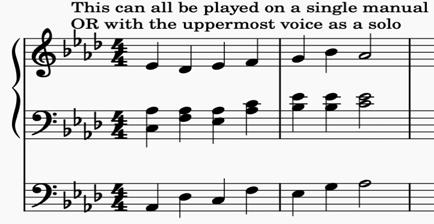
Tenor Solo
How to play: Play the tenor (L.H.) part on a separate manual with a solo stop combination. You can do it in the normal (tenor) register or play it up an octave in the soprano register.
Important Considerations: Choose a tenor line that is interesting! When playing the tenor up an octave, make sure that you don’t inadvertently create a part-writing error.
Example Hymn: Abide with Me! Hymn #166
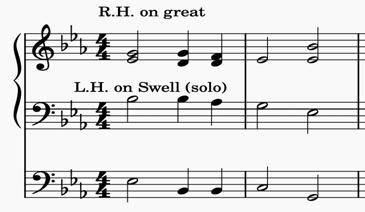
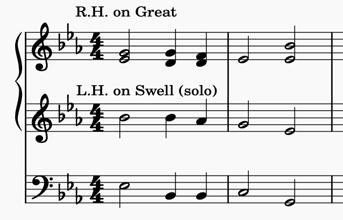
Normal Range Up an octave
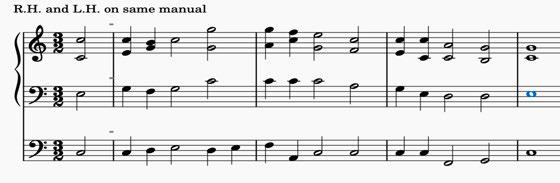
Alto up an octave
How to play: Play the alto part an octave higher than written. Keep both hands on the same manual.
Important Considerations: Choose a hymn with an interesting alto line! Always check for partwriting errors that may creep in from inverting the intervals.
Example Hymn: The Lord’s My Shepherd – Hymn #1038
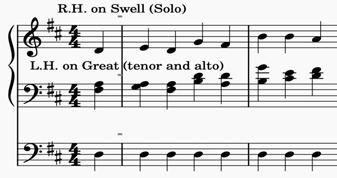
Soprano Solo
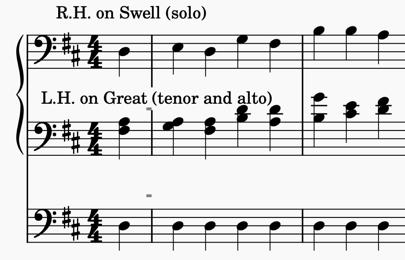
How to play: Play the soprano voice on a separate manual with a solo stop combination. You can play it in the normal register or down an octave. The left hand must play both the tenor and alto voices on an accompanimental manual/stop combination.
Important Considerations: Make sure that you keep the tenor and alto independence is clean. Taking two voices with the left hand is good practice, but it can take some time to get used to it.
Example Hymn: Behold the Wounds in Jesus’ Hands – Hymn #1016
Normal Range Down an Octave
Manuals Only
How to play: Omit the pedal; instead play the bass voice in the manuals with the other voices.
Important Considerations: Independence is key! The bass and tenor voices must maintain their independence of line.
Example Hymn: Redeemer of Israel – Hymn #6
Soprano/Tenor Switch
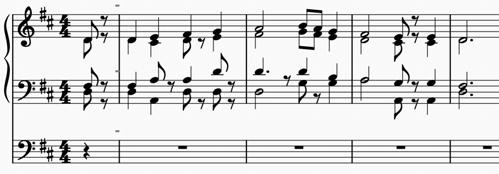
How to play: Play the tenor voice up an octave and the soprano voice down an octave. In practice, the easiest way to accomplish this is to play the “alto up an octave” technique but play it down an octave in the tenor range. Then play the tenor voice on a separate manual.
Important Considerations: This technique has a tendency to cause part-writing errors. Check carefully to avoid them. Choose a hymn with an interesting tenor and soprano voice.
Example Hymn: God of Power, God of Right – Hymn #20
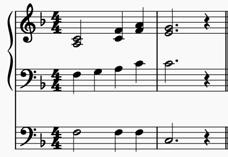
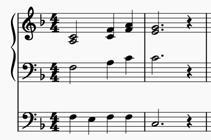
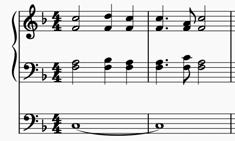
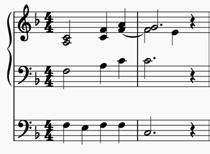
Creative Introductions, Interludes, and Free Accompaniments
Important Questions and Considerations:
1. Does this intro/interlude/free accompaniment accomplish its purpose (set the key, meter, tempo, mood, clarify the melody, encourage singing)?
2. Particularly with free accompaniments, does it match the mood? Will the congregation still be able to follow the melody?
3. Have I practiced it enough to feel confident to play it for my congregation?
4. Have I warned the music director and/or bishopric about my plans so they can prepare? Good resources: https://www.carsonhymns.com/; https://www.hymnsfororgan.org/
$500 (student rate $ 4 00)
$475 (student rate $375)
$475 (student rate $375)
$250 (student rate $150) $350 (student rate $25 0 )
JUDGING recorded –local organ recorded –local organ on site judges –exam center on site judges –exam center on site judges –exam center
June 2 , 202 7
rehearse and direct choir in performance of 3 given selections (changes each year)
none
June 3 and 4 , 202 7 June 3 and 4 , 202 7
DATES October 1, 202 6 through March 31, 202 7 Nov. 1 3 , 202 6 and May 1 4 , 202 7
1 from hymn booklet
LITERATURE 3 individual selections from 3 general groups choose 1 of 6 selections in each of 3 groups (changes every other year) choose 1 in each of 4 groups (changes each year) choose 1 in each of 4 groups (changes each year)
accompany choir in rehearsal (optional)
1 from NEW hymnbook (chosen in advance) not more than M2; no play through; not written out homophonic passage not more than M2; 8 measures or less; some preparation time passage not more than M2; play through once passage not more than M3; play through once
TRANSPOSITION
none
none
1 from standard hymnal (3 stanzas with bridge)
2 from NEW hymnbook (3 stanzas with changes)
2 from NEW hymnbook (3 stanzas with changes)
HYMN PLAYING
short passage from figured bass (at sight) from the piano accompaniment of a vocal score, arrange at sight for the organ
Accompaniment for 1 vocal solo & 1 psalm [singer required for both ] , and 1 of 5 anthems (all 3 to be prepared in advance) 1 choral selection and 1 vocal solo (both to be prepared in advance)
ACCOMPANIMENT
(a) melody; (b) progressions
(a) organ piece with manual and registration changes; (b) polyphonic passage in open score (C&F)
SIGHT READING short passage on 3 staves (minimal pedal) passage on 3 staves in trio texture longer passage in open score using G & F clefs on 4 staves
none simple hymn tune, plainsong melody, or “folkstyle” hymn tune (some preparation time) passage in 4 parts –portions of treble melody and of unfigured bass are given none
HARMONIZATION
none
Piece approximately 34 minutes in ABA form; theme A is given
3 choices, all including modulation (some preparation time) variations on ground bass, or prelude on hymn tune or chant
none
IMPROVISATION
none add missing pitches; identify comp. devices one melodic line; one 2part one 4part; one 2voice counterpoint one 2part; one identify errors
none extensive extensive extensive extensive
EAR TESTS
WRITTEN
* * Above fees are for the entire exam; fees are reduced if taking only part of the exam.
S urcharg e of $115 for nonmembers of the AG O
s tudent candidate must be a member of the AGO, and age 30 or younger wit h a valid student
Dr. Neil Harmon
1. The edition you choose can have significant influence on your interpretation and performance of the music.
2. Urtext editions
a. Avoid heavily edited editions of classical repertoire
b. Avoid subjective tastes of the editor
c. Authentic musical texts taken from manuscripts or first editions
d. Critical reports to show discrepancies in sources
e. Clear, clean scores
f. Distinguishing facts – suggestions from the editor are notated in brackets
g. Ergonomic – editors focus on the complex realities of playing the organ
h. Durability
i. High cost
3. IMSLP – International Music Score Library Project
a. 865,000 scores
b. Free PDF downloads
c. Choice of editions is often limited, rarely optimal
d. Many scores have yet to be imaged and cataloged
e. Quality of scans - IMSLP is a crowd-sourced wiki, so the quality of individual scans varies. Look at the star-ratings to find the highest-resolution, cleanest scan.
f. Copyright Variations - IMSLP operates primarily under Canadian copyright law. It is the user's responsibility to ensure that any downloaded score is in the public domain in their specific country.
4. Music copyright laws
a. Articles of Faith 1:12 “We believe in … obeying, honoring, and sustaining the law”
5. Ideals for acquiring scores for your library
a. Public domain websites: IMSLP (imslp.org), Partitura Organum (partitura.org)
b. Budget a little each month for a high-quality score
i. Use budgeting principles taught in self-reliance courses
c. Used score exchanges and sales
d. Request donations to your music score fund
e. Local libraries
f. Shop smart
i. Teacher/student discounts
ii. Retail promotions
Brigham Young University – Summer 2026
Instructor: Connor Larsen
The “Rules” of Chorus Registration:
1-Both hands will be playing on the same manual
2-We build upon an 8’ set of stops in the manual, and 16’ in the pedal. Pedal will function as the bass.
3-No part is more ‘prominent’ than another. Equally balanced.
What types of music call for chorus registration? Standard hymns, Bach Preludes/Toccatas and Fugues, etc.
What score markings should I look for? Manual indications in between the staves (even if they don’t have a line to indicate), Registration indications that indicate both hands, etc.
How to build chorus registrations:
Using our “ladder of pitches” we can “build up” our chorus registrations, beginning with the 8’ pitch in the manuals, and 16’ in the pedals. The difficulty in building these registrations is finding adequate balance between the manuals and pedals.
Here’s how I would work my way up the ladder:
1-Draw an 8’ pitched stop (often a principal) in the manuals and a 16’ in the pedal.
2-The next step would be to work our way up the ladder by adding a 4’ in the manual, and an 8’ in the pedal. Notice that a good starting place to balance is to make sure the pedal is offset by one “rung” of the ladder.
3-Next, if searching for a brighter sound, we can add a 2’ in the manual and a 4’ in the pedal.
4-From here, lots of options are available. Reeds could be added, a mixture could be added for brightness, a 16’ could be added in the manuals for richness, etc. No one option is “correct”. From here balance can be achieved by coupling manuals to the pedal using the “Swell to Pedal” or “Great to Pedal” couplers.
Some tips:
-Below I visualize the “offset rung” approach to balancing manual and pedal lines. The circles indicate which pitches I’ll use. Notice how the pedal is just one “rung” below the manual? This should give you a starting point in achieving balance.
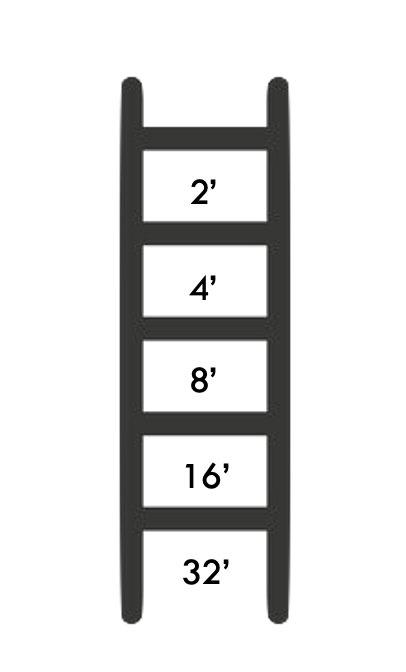
-Don’t be afraid to include multiple stops at each pitch to help achieve richness.
-When registering for a congregational hymn always start with an 8’ and 4’ principal in the manuals with the pedals to balance. Though it may feel too loud, it will provide the necessary support for a congregation. If you still feel it’s too loud, try coupling the 4’ principal from the swell, or additional 4’ flutes to help fill the sound.
-Tremulants are NOT your friend in a chorus registration (unless you’re playing something wild from the repertoire!)
-Do not be afraid to couple the manuals together (Swell to Great) when you’d like to pull additional richness, reeds, or other stops in.
-Mutations (stops with fractions) can be used to help with richness and act as a reed. Use your ear to determine whether your organ is voiced well enough to use this technique.
-If pedal reeds are too much, try pulling the reeds from the manuals using couplers.
-If a stop is no longer “contributing” to the combination, don’t be afraid to remove it. Often an 8’ string becomes obsolete by the time
-Not every step needs to be a principal. Maybe taking a step up using a 2’ flute, and then the following verse adding the principal gives you a more gradual build.
-Try setting up a gradual crescendo over your pistons. Piston 1 would be a combination with 8’ and 4’ balanced with pedal, 2 could be adding a 2’, 3 could be adding a mixture or reed, and so on and so on.
-Don’t be afraid to try things!
-Most of all: Trust your ear! If something sounds “off”, it probably is!
BYU Organ Workshop 2026, Instructor: Dr. Valerie Harris
https://dontstopnoworgan.com | dontstopnoworgan@gmail.com follow me on Instagram #dontstopnoworgan

- Let them play a piano song on the organ
- Add a few pedal notes or pedalpoint to a song they know
- Pick out a song by ear or teach by rote on manuals (i.e.: Bach Toccata in D Minor)
- Pick out a song by ear on pedals
- Explore stops and sounds – how does it change their song? What do they hear?

-Take them to an organ concert/recital or hymn festival or watch one online
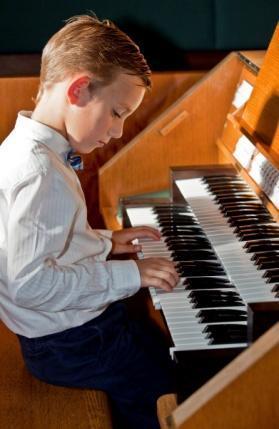
oLook up your local chapter of the American Guild of Organists – https://agohq.org
oVisit churches with pipe organs (locate through AGO chapter or www.pipeorgandatabase.org
-Visit a fun organ i.e. Organ Stop Pizza (Mesa, AZ), or a silent movie theater showing (American Theater Organ Society) – or look for recordings online
-Let them experience well-supported hymn accompaniment
oHymn festival, Hymn Sing, Sacred Music Fireside (ward, stake, any church in your area)
oPlay hymns with solid techniques: well-supported, phrasing, creative introductions, interludes/ modulations, registration changes to highlight text, reharmonize, focus on text
oListen to strong hymn-playing online at another church’s steamed service
-Pedals, Pipes & Pizza – AGO sponsors, but you can design your own
-Summer Organ Camp
-Stake / Ward training
-BYU Organ Workshops
oOnline during BYU Organ Workshop in August: https://organ.byu.edu/organworkshop/youth/
oSummer Festival: https://musicians-summerfestival.ce.byu.edu/
oYouth track of traveling workshops: https://organ.byu.edu/workshops/
-American Guild of Organists chapters
oScholarship programs (i.e. https://cazago.org/scholarships; look for your local chapter)
oActivities for youth (i.e. Pedals, Pipes and Pizza)
oOnline resources (local chapter or national at https://agohq.org/education)
oPipe Organ Encounter: https://www.agohq.org/education/poe/
-Orgelkids Kit: https://orgelkidsusa.org/where-in-the-world/
-Get involved yourself (teach workshops, events, master classes, activities)
-Start your own group
oOffer camps, resources, training, field trips, etc. for youth!
oNeed an expert? Contact your local AGO chapter
- Individuals

o Teach piano students: If you have access to an organ during piano lessons, have a student come early/stay late, give them a small assignment and have them pass it off. If you can overlap 2 students, you can teach them both a concept, then have one work individually while the other has a piano lesson (use headphones if your organ has a jack); if you don’t have an organ, you can work on a digital keyboard with organ sound for weekly lessons, then meet with them weekly, bi-weekly or monthly at church. Give them manageable chunks they can accomplish.
o If you need an organ – check facebook marketplace, ebay, local dealer (used or new – some are quite small – tax deductable expense for your teaching studio)
oTeach workshops on a ward or stake level or any small group
oGive monthly workshop on a regular basis
oGive weekly group classes after church, before youth activities, etc.
-How to teach
oMethods and Learning/Teaching Resources
▪The New Ward Organist: https://organ.byu.edu/the-new-ward-organist/
▪OrganTutor 101 by Don Cook: https://www.ardpublications.com/indexAot.html
▪AGO videos: https://www.agohq.org/lessons-for-the-new-organist/
▪ First Organ Book, published by Wayne Leopold
▪ Suzuki Organ School, published by Alfred Publishing
▪ The New Oxford Organ Method, published by Oxford Publishing
▪ The Church Musician (Glover/Gunther), published by Alfred Publishing
▪ Discover the Organ (Rowley and Leopold), published by Wayne Leopold
▪Fast Track to Organ PlayingComing soon: new method geared specifically for LDS youth (https://dontstopnoworgan.com)
-Give them pedaling
oLübeck, Bach, hymns – anything with pedaling
-Give them pieces that interest them
-Make sure they get organ shoes or wear church shoes (no high spiky heels, though)
-Start with 9 Hymn Studies by D. Kim Croft or easier pieces in OrganTutor
-Show them what you have learned at this workshop
-Teach as part of their studio time or give a summer organ camp or monthly group training
-Meet weekly or monthly as a group: before youth activities, after church, Saturday morning, etc. to present new ideas. Make it fun!
- Staged Approach
o Play a piece for prelude
o Play all of the prelude
o Play prelude and postlude
o Play prelude and one hymn
o Play prelude, one hymn, and postlude
o Play whole service
- Help them build small successes with low-stakes opportunities, then work up
o Play prelude or hymns for small group first, then with someone singing or conducting
o Practice with a recording of the hymn playing: https://www.churchofjesuschrist.org/music/library/hymns
o Adversity training (with distractions, with metronome, on a different instrument)
o Record themselves, listen to themselves, make changes, then record again
- Other thoughts for success
o Make sure they are well-prepared to build confidence
o Work with your music chairman to make sure the music is planned well in advance
Resource list
-A Young Person’s Guide to the Pipe Organ (https://www.agohq.org/young-persons-guide/)
-AGO Achievement Awards Program (https://www.agohq.org/ago-achievement-awards/)
-National Federation of Music Clubs’ Festival Program (find your local Festival at https://nfmc-music.org)
-Anna Lapwood – follow on TikTok or watch her on youtube at https://youtu.be/TzK-tYFGQx4
-How a Pipe Organ Works - https://www.pipedreams.org/page/how-a-pipe-organ-works
-The Story of the Walt Disney Concert Hall Organ - www.aforestofpipes.com/organ-diagram/
Program
Prelude in Classic Style
Gordon Young Lorenz, Sacred Music Press, SM 396-3 1989
Sheep May Safely Graze
J. S. Bach Arr. by Mary Howe, Oxford University Press, 1963
Concerto in A minor Vivaldi/Bach Transcribed by Wendell Nelson, G. Schirmer, 1968
Siciliano
J. S. Bach Arr. by Adolph Steuterman, H. W. Gray 11746, 1946
The Holy City
Stephen Adams Lorenz, O.P. 9-123, 1946
Lord of the Dance
Joel Raney Hope Publishing Co., 1999
Amazing Grace
Charles Callahan MorningStar Music, 1995
America the Beautiful Lani Smith Lorenz, 1989, OP-6-89-81
The Stars and Stripes Forever
John Philip Sousa Arr. by E. Power Biggs John Church Co., Theodore Presser, 1977
Joy to the World
Joel Raney Hope Publishing Co., 2001
Silent Night
In Bock to Bock Christmas Fred Bock Co., BG0821, 1987
What Shall I Give to the Child?
Fred Bock
Douglas Wagner In Come to Bethlehem, Lorenz 70/1646L-3, 2008
Santa’s Wild Ride
Kevin Olson The FJH Music Co., 2011
Le secret (6-hands)
G.Schirmer, G. Schirmer 12355
Instant Concert
Léonard Gautier
Porter Heaps
Email james@welch.net for free copy of score.
Using the 1985 Hymns
Knowledge of musical form makes music faster to learn and easier to memorize.
Three aspects to hymns: notes, rhythm, words
Analysis: look at units (could be quite small as in hymns or fairly large as in a movement of a piece). How long are they? How many are there?
Are the units the same? Almost the same? Completely different? (If almost the same, exactly where are the differences?)
#58 Come, Ye Children of the Lord AABA (but B is really 2 ms. X 2) Total new music: 6 measures. 4 + 4 + 4 + 4
#199 He is Risen 12 measures; 4 + 4 + 4 AAB
#204 Silent Night 12 measures; 3 groups of 4 measures ABC (Note: A ms.1 and 2 the same; ms. 3 and 4 same rhythm. B = 2 + 2, not quite the same. C similar rhythm to B.)
#207 It Came Upon a Midnight Clear 16 measures; 4 x 4; A A’ B A’ (tiny difference). Look at soprano line of B; what is it?
#196 Jesus, Once of Humble Birth 20 measures; 5 x 4. 5th phrase repeats words of 4th phrase. A B A’ C B (one note different in soprano and tenor)
#69 All Glory, Laud and Honor 16 measures; 4 x 4 A A B C Which voice parts sing eighth notes? Where?
#267 How Wondrous and Great 16 measures; 4 x 4 A A’ B A’. Where is there an ascending Major scale? Which part sings the same note for an entire unit? Where is there an arpeggiated triad? Where is there a 5 note scale up and down?
#285 God Moves in a Mysterious Way 8 measures; is it 2 – 4 measure units or 4 – 2 measure units? Is there a clue in the rhythmic pattern?
#2 The Spirit of God 32 measures; are units 8 measures each? If so, A A B C
#106 God Speed the Right 16 measures; 4 x 4. A A B A’ (?) units 1 and 2 the same. B has rhythmic similarities; Unit 4 (called A’ here) is 2 – 2 measure units which are similar to the last 2 measures of A).
Some hymns with AABA form and their meters (see 1985 Hymns pp. 405-409)
#7 Israel, Israel, God if Calling (close) 8787D A A’ B A
#15 I Saw a Mighty Angel Fly (close) CMD (8686D) A A B A’
#21 Come, Listen to a Prophet’s Voice (close) CMD A A’ B A (almost)
#41 Let Zion in her Beauty Rise (close) CMD A A’ B A’ (B is B B’ 2 ms. each)
#48 Glorious Things are Sung of Zion 8787D A A B A
#101 Guide Me to Thee 64646664 A A’ B A’
#163 Lord, Dismiss Us with thy Blessing 8787D A A B A (B is B B’ 2 ms. each)
Brigham Young University – Summer 2026
Instructor: Connor Larsen
Start Here!
So, you’re giving into peer pressure on using technology more, eh? Here’s some tips and tricks as you start down that slippery slope!
1-Acquire…a technology
Most musicians choose to use an iPad for the apps that it uses. There are other options available, but due to the prevalence of the iPad, I’ll keep my instructions there.
iPad (12.9″ or 13″ Pro recommended; 11″ works but tight for dense scores).
Apple Pencil for annotations. (optional)
2-forScore forScore is the most popular music app on the market right now. Lots of features, cheap, and easy to organize. forScore app (~$30 one-time, covers all your Apple devices; requires iPadOS 17+).
Getting Music into forScore
So, you’re giving into peer pressure on using technology more, eh? Here’s some tips and tricks as you start down that slippery slope!
1. From a PDF you already have AirDrop from your Mac, or open in the Files app → Share → forScore.
2. From paper music forScore Tools → Camera → photograph pages → auto-crop → save. Own the paper = personal-use scan is generally accepted; redistribution is not.
3. Buy digital directly Tools → Services → choose provider (Presto Music, Musicnotes, and others integrate directly). Purchases download straight into files that you can open in forScore.
Some Skills
• Build a setlist: Library → Setlists → + → add pieces in order. You can drag them around after placing.
• Annotate: tap the pencil icon → draw, stamp, or type. Use layers so you can hide markings without losing them.
• Annotation options: You can add and remove various features from the toolbar.
If you have questions or problems, just google them! There’s lots of great resources online.

Early Influences:
Presenter:
Dr. Valerie Harris
In 1600s, organs were imported from Mexico into southwestern part of what’s now U.S.
By 1700s, European settlers brought organs to the American colonies.
Early organs:
First builder in the U.S.: Johann Gottlob Klemm, a German immigrant to Pennsylvania.
First builder trained in the U.S.: David Tannenberg, who built for Moravian churches.
Organs mostly used for church services, only occasionally for concert and usually to accompany.
19th Century:
More imports from Germany; more American builders i.e. Hooks, Hall and Erben.
Americans loved the new symphonic sounds incorporated into the organs
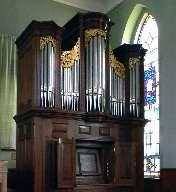
Famous American composers: Chadwick, Parker, Paine. Influenced by German and French.
Organs were used more in solo concert performances; first notable concert organist: Dudley Buck.
Railroad Influence:
Intercontinental Railroad allowed travelers to head west. Many stopped in Utah to hear the Tabernacle organ, starting the free daily organ recital series.
20th Century:
Organs in movie theaters, shopping centers, world exhibitions, homes.
Famous early 20th century American organists: E. Power Biggs, Virgil Fox.
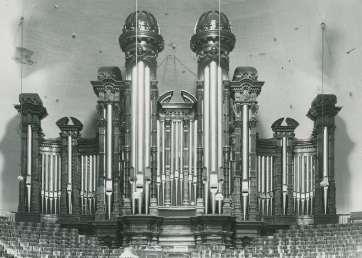
Tonal Director of Aeolian-Skinner: G. Donald Harrison, built new Tabernacle organ in 1948 in American Classic style to facilitate all repertoire styles.
Historically-inspired organs built with a look to Baroque mechanical action style of construction.
Most commonly performed in concert during early 20th century:
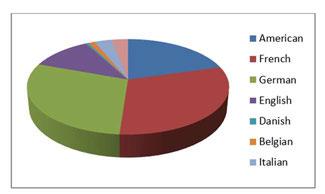
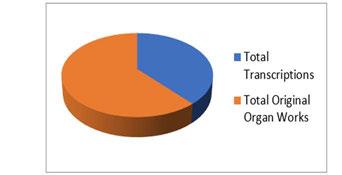
Distinct Styles of American Organ Composition:
Top ten in Tabernacle 1901-1916
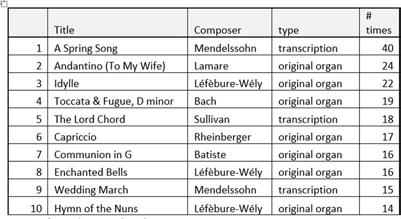
Uniquely American genres influenced organ: ragtime, jazz, blues, multi-cultural.
Jazz - syncopation, blues progressions, call/response, chromaticism, pitch bending, filling in beat: Florence Price, Charles Ives, Carl MaultsBy, Mark Miller.
Ragtime - duple-meter highlighted by syncopation: William Albright.
Incorporating Spirituals - Samuel Coleridge-Taylor, Florence Price, Fela Sowande, William Bolcolm
Multi-cultural styles – Conner Chee (Navajo), Chelsea Chen (Taiwanese).
Later blended a uniquedly American style – Richard Elliott, Paul Manz, Dan Locklair, Margaret Sandresky, Neil Harmon, Clay Christiansen.
Kim Moody
Three Listening Skills
a. Perfect Legato
b. Precise Releases
c. Independence of Line
Division of parts
Generally, soprano, alto and tenor lines are played with hands on the manual. The bass line in played with feet on the pedal board. Typically, there is no reason to double up the bass line with the hands. This only makes manual legato playing trickier.
Bass Line/Pedaling
Mark the bass line with pedal notations.
Manuals
Fingering
Redistribution of alto or tenor voice
Text
Treatment of Repeated Notes
Practice Tips
7 Step Method
1. RH alone
2. LH alone
3. Pedal alone
4.LH/Pedal
5. RH/Pedal
6. LH/RH
7. All three parts
Divide into sections
4 F’s – Find it, Fence it, Fix it, Fit in back in Setting Realistic Goals
Playing vs. Practicing vs. Performing
Registration (see Guidelines for Hymn Registration in Congregational Singing)
Lowell Mason (1792-1872), ed. by Don Cook
This hymn has been modified by adding breaks or ties between repeated notes, and fingering and pedaling marks. Each comma represents an eighth or sixteenth rest.
Using this fingering the left hand is freed to make registration changes between verses
After learning the notes through this final step, transfer to your hymnbook whatever marks are needed to play the hymn directly from the hymnbook. This is necessary in order to “play the text” as you play the music. Transfer textual and musical phrasing marks, add ties between repeated notes as needed, and transfer fingering and pedaling indications. Refer to the appropriate OrganTutor Online lessons for further details, especially “Score Preparation.”
Franz Gruber (1787-1863), ed. by Don Cook
This hymn has been modified by adding rests or ties between repeated notes, and fingering and pedaling markings. Each comma represents an eighth rest.
After learning the notes through this seven-step method, transfer to your hymnbook whatever marks are needed to play the hymn directly from the hymnbook. This is necessary in order to “play the text” as you play the music. Transfer textual and musical phrasing marks, add ties between repeated notes as needed, and transfer fingering and pedaling indications. Refer to the appropriate OrganTutor Online lessons for further details, especially “Score Preparation.”
Don Cook
See the OrganTutor Online lesson “Hymn Playing—Registration” IN GENERAL
1. Support the congregation with confidence, but do not overpower.
2.The principal chorus (especially the 8' principal) should form the basis for registration in congregational singing. Start with the 8' principal and work up from there.
3.In meditative hymns, stops from the flute chorus might be substituted in place of principal stops to minimize sharpness, especially at the 4' and 2' level.
4. 8' and 4' pitches are minimum for the manual; 16' and 8' are minimum for the pedal.
5.The Great to Pedal and Swell to Pedal couplers provide homogeneity between all voices; avoid them if independence in the pedal line is desired.
6.For clarity, build upward with only one stop per pitch.
7.For fullness, build outward then upward in pyramid fashion.
8.Use economy of means; add a stop only if it contributes to the ensemble. Celestes, for example, are not effective for congregational accompaniment.
9.Use 8' (and possibly 4') reeds to add fire to a bright principal chorus, or 8' and light 16' reeds to add gravity to a more foundational principal chorus.
10.The normal position for the expression pedal (“swell pedal”) is fully open. The normal position for the crescendo pedal is fully closed.
11.If the crescendo pedal and the tutti (sforzando) reversible have been regulated properly, use them when appropriate. If not, either have them regulated until they are useful or avoid using them.
12.Generally avoid 16' manual stops, sub-couplers, and thick, heavy 8' stops.
13.Avoid overusing full organ.
14. Never use the tremulant for congregational accompaniment.
15.Note the message of the hymn text in general and the message of each verse. Let them guide the registrational plan for the hymn.
16.Use text-directed changes of registration primarily at ends of verses (or between a verse and chorus). However, a change is not necessary following every verse of every hymn. Occasionally it might even be appropriate to play the entire hymn very simply—with no registration change.
17.If the text fails to suggest a registrational direction, consider one of these standard approaches: 1) build upward gradually as the hymn progresses to encourage increased congregational singing, or 2) diminish the organ after the congregation gains strength, and then build the organ again for the final verse.
18.When using solo lines in congregational accompaniment, avoid softer solo stops or combinations; use large reed or principal stops or combinations to lead out. Be sure the accompanimental combination (as well as the solo combination) is supportive enough for the congregation.
19.Use manual-only playing as a contrast to constant deep pedal tone. When the second-to-last verse is played manual only, the impact of the pedal entrance on the last verse is increased.
Sometimes pianists are called upon to play the organ for a church service before they feel completely ready. They may have no choice but to use one or more “survival skills” (shortcuts) while they take the time to really learn how to play the organ. Following is an easy-to-use plan for selecting stops in either meditative or jubilant hymns for congregational singing. It can be used with most pipe or digital church organs.
1. Support the congregation with confidence, but do not overpower
2.Let the text guide the registrational plan for the hymn
3.Begin with stops from the principal chorus—especially the 8' principal (diapason)
4. 8’ and 4’ pitches are minimum for the manual; 16’ and 8’ are minimum for the pedal
5.In meditative hymns, substitute flutes for principals at 4’ and 2’ levels as needed to reduce sharpness
6.Use changes of registration between verses and/or between verse and chorus
MEDITATIVE HYMNS: Begin with this basic combination:
•Great: Principals 8’ and 4’ (the stops may be called Principal, Diapason, Octave, or Prestant)
•Pedal: The main 16’ stop (may be called Principal, Subbass, Bourdon, or Gedackt), and Great to Pedal
JUBILANT HYMNS: Add the 2’ principal on the Great to the meditative hymn combination, resulting in—
•Great: Principals 8’ 4’ and 2’ (the 2’ stop may be called Super Octave, Fifteenth, or Doublette)
•Pedal: The main 16’ stop, and Great to Pedal
MEDITATIVE HYMNS: Couple the Swell chorus 8’ 4’ 2’ to the Great
•Begin with the Basic Hymn Registration for Meditative Hymns (above). Also, prepare the following: Swell: flutes or principals 8’ and 4’, and flute 2’, resulting in—
-An 8’ stop (Bourdon, Gedackt, Geigen Prinzipal, or Diapason)
-A 4’ stop (Flute, Nachthorn, Spitzprinzipal, Octave, Prestant, or Kloppelflőte)
-The available 2’ stop (Piccolo, Blockflőte, Flute à bec)
•Later, between verses or between a verse and the chorus, add the Swell to Great coupler.
JUBILANT HYMNS: Add the Great chorus mixture
•Begin with the Basic Hymn Registration for Jubilant Hymns (see above)
•Later, between verses or between a verse and the chorus, add the Great chorus mixture (usually called Mixtur[e], and always followed by a Roman numeral)
•For yet another change, you might add a chorus reed 8’ on the Great or Swell (Trumpet, Trompette, Tromba, or Fagott)
Instructor:KymberlyPayne,M.M.,NCTM www.PayneMusicStudio.com/OrganResources
Learn Faster, Perform Better: A Musician’s Guide to the Neuroscience of Practicing byMollyGebrianismy favoritebookonmusic!ReadingitprovidedscientificevidenceformanyofthepracticeprinciplesIhad alreadybeenteachingmystudentsforyears.Evenso,knowing how weshouldpracticeandactuallychanging ourhabitsaretwoverydifferentthings.Thenaturalmanisaliveandwellinthepracticeroom—weoften defaulttopracticinginwaysthatfeelproductivebutaren'tthemosteffective.Asbothaprofessionalmusician andneuroscientist,Gebrianexplainsnotonlywhichpracticestrategiesworkbest,butalso why theyworkand howtoovercomeourlesshelpfulpracticehabits.HerinsightshavechangedthewayIpractice,teach,and prepareperformances,andtheyhavebenefitedmanyofmystudentsaswell.Noneofushaveextratimeto devotetoinefficientpractice.Ihighlyrecommendthisbook,andIhopetheideasinthisclasswillhelpyou,too, learnfasterandperformbetter.
SectionI:BrainBasics
Chapter1:GoodPracticingandHowItChanges theBrain
Chapter2:PracticeLikeaPro
Chapter3:UseErrorstoYourAdvantage
SectionII:UsingYourTimeWell
Chapter4:TheFastestWaytoLearnMusic: TakeMoreBreaks
Chapter5:CanYouLearnMusicinYourSleep?
Chapter6:What'sthePerfectScheduleofBreaks?
Chapter7:BeMoreConsistentinPerformance
Chapter8:WhyExactRepetitionsMayNotBethe BestGoal
SectionIII:ThePoweroftheMind
Chapter9:ThePowerofMentalPractice
Chapter10:MentalPracticeandtheBrain
Chapter11:HowtoFocustoPlayYourBest
Chapter12:TheMostEffectiveWaystoMemorize Music
Chapter13:BoostConfidenceinMemorized Performance
SectionIV:ChallengesSpecifictoMusic
Chapter14:ImprovingRhythmandTempo
Chapter15:ImprovingPitchandIntonation
Chapter16:HowtoPlayFaster Conclusion:BringingItAllTogether
Resources(clickablelinksinthedigitalHandoutPDF):
Complete List of Practice Strategies (Appendix A of her book) - free
Spaced practice summary sheet - free LearnFaster,PerformBetterCompanionWorkbook-$25(notanad)
Courses — Molly Gebrian - $20-$299 (not an ad)
Dr. Molly Gebrian - YouTube - 97 videos
available -MollyGebrian’spresentationtotheAmericanGuildof PedagogySeries:TheNeuroscienceofMemory Organists-nomembershiprequired!
Instructor:KymberlyPayne,M.M.,NCTM
www.PayneMusicStudio.com/OrganResources
AsIread Learn Faster, Perform Better,Ifoundmyselfwondering,"Thesestrategiesmakeperfectsensefor musicianswhoplayonenoteatatime—buthowdotheytranslatetotheorgan?"Whiletheprinciplesof effectivelearningarethesameforeverymusician,applyingthemtoaninstrumentwithmultiplemanuals,a pedalboard,registrationchanges,andcomplexcoordinationrequiresadifferentapproach.Inthisclass,we'll explorepracticalwaystoapplyGebrian'sresearchtoorganpracticesoyoucanmakeyourpracticemore effectiveandyourperformancesmoreconfident.
APDFoftheclassslideswillbeavailablefordownloadfrommywebsiteaftertheclass.
ThesearealistofunhelpfulpracticehabitsfromMollyGebrian. Circle all that apply to you: Startingwitharun-through
Playinguntilyoufindamistake
Startingoverwhenyoumakeamistake
Onlycorrectingamistakeonceortwice [mindlessly]Playingthroughlargesectionsslowly
Doingmindlessrepetitions
Likeningituntoyou
Piece:____________________________________
Composer:________________________________
Currentstageoflearning:
☐ Selected,buthaven’tstarted
☐ Stillworkingoutthefingering/pedaling
☐ Learningnotes(bonuspointsifyou’reusingthe 7steppracticemethod!)
☐ Polishing
☐ Performance-ready
Alwayspracticingthesameway
Playingthroughsectionsyoucanalreadyplaywell
Practicingwithoutbreaks
Gettingstuckononething
Practicingwithoutspecificgoals
Whatmakesthispiecedifficult?
Check/circleallthatapply:
☐ Notes
☐ Fingering/pedaling
☐ Coordination-RH/LH,RH/Ped,LH/Ped, alltogether?
☐ Logistics:manualchanges,registrationchanges, expression,pageturns?
☐ Articulation-legato,non-legato,staccato?
☐ Tempo-steadiness,gettinguptospeed?
☐ Other:________________________
Selectonetroublespotfromyourselectedpieceandlistthemeasuresorsectionhere:
Writedownwhatthespecificproblemisthatyouarestrugglingwith.(Pretendyouareexplainingtheissuetoa friendwhodoesnotplayyourinstrument.)
Breaktheproblemintoindividualstepsandlistthemhere.(Pretendyouarebreakingitdown forsomeoneless skilledthanyou.)
HowwillIknowI’vesolvedthisproblem?(ex.Icanplaym.32-36on5separate occasionsatquarternote=72 withcorrectfingeringsandpedalings.)
Aftertoday’sclass,Ipromiseto(select one):
Startapracticejournal
Pickoneunhelpfulpracticehabittobreak
Ask“WhichpathwayamIreinforcingbyhowI’mpracticing?”
Takemorebreaks
Tryinterleavedpractice
TryouttheRed/Yellow/GreenMethod
Susanna Karrington, Instructor
“Worship in church can provide comfort for those who mourn and a place to rejoice when blessed. As leaders of music ministry, we play a crucial role in spiritually nourishing the people in the pews...organists can regulate the emotional flow of a service, supporting worship” [Jared D. Cook, The American Organist, Jan 2022, pp. 70–71].
From the church handbook, we have several specific guidelines we must keep in mind. An overarching directive for Sacrament meetings says, “Members gather in sacrament meeting to remember Jesus Christ by partaking of the sacrament. They gather to build faith and testimony and to worship Heavenly Father and Jesus Christ. Music should be selected to help achieve these purposes” General Handbook ("19. Music").
Many different issues can arise when working with others to achieve a common objective. This is not limited to our endeavors as musicians
Here are a few important thoughts we can hold in our hearts:
➢ Remember that "...the worth of souls is great in the sight of God" (D&C 18:10) and everyone has intrinsic value. We must treat others with dignity, respect and Christlike care, most especially in a church setting
➢ Keep in mind that each of us is approaching our various callings and discipleship from different backgrounds, context, life situations and training.
➢ While mostdenominations have a paid musicminister, even in a paidministry many laypersons often serve in the choir and other positions
➢ We have in the church people who are called but may not (yet) have the experience needed for the calling. Still, they’re willing to serve and do the best they can
➢ Developing empathy can help - we can all relate in some way to situations outside of our comfort zone!
In his General Conference talk entitled “Try, Try, Try” President Eyring said:
Many years ago, I was first counselor to a district president in the eastern United States. More than once, as we were driving to our little branches, he said to me, “Hal, when you meet someone, treat them as if they were in serious trouble, and
you will be right more than half the time.” Not only was he right, but I have learned over the years that he was too low in his estimate.
He went on to speak tenderly about his wife, saying that the song that seemed to best describe her sentiments was “I’m Trying to Be like Jesus” (Perry, "I'm Trying to Be Like Jesus," Children's Songbook, p. 78).
❖ Interpersonal Concerns - Troubleshooting
o Diplomatic, tactful approaches are best to work together to negotiate a win-win solution.
o Nonconfrontational phrases (there are many we’ll discuss!) can help solve differences to reach common ground together.
o Realizing that it’s not personal but reframing it as a problem to solve together can be useful.
o Don’t assume someone is being critical or rude.
Recall Elder Bednar's counsel in his talk “And Nothing Shall Offend Them” where he says:
One of the greatest indicators of our own spiritual maturity is revealed in how we respond to the weaknesses, the inexperience, and the potentially offensive actions of others. A thing, an event, or an expression may be offensive, but you and I can choose not to be offended—and to say with Pahoran, It mattereth not”.(General Conference, November 2006).
❖ Differences in Musical Taste - Consider the liturgical year, the General Handbook & “Come Follow Me” when tailoring music to each service
o What if the bishop/pastor asks you to play quieter or louder? Faster/slower?
o A member has song requests or wants you to choose different preludes/postludes
o Why is the chorister choosing these difficult/obscure/new hymns?
o The chorister is taking the piece too fast/too slow
❖ Logistics – scheduling the space is helpful; flexibility is necessary
o You came to practice only to find that there’s an event happening in the building
o The special musical number/choir needs to tune warm up during your normal prelude time.
o You’ve played all your prepared prelude, but the bishop is talking with someone, and the Sacrament table isn’t setup on time (Not usually a problem in other denominations as the prelude is timed and its conclusion is the cue to start the service)
o Someone erased my presets!
❖ Last-minute Changes/Requests - Practice & advance preparation can minimize the strain of these special requests
o It’s Sunday and you’re asked to switch the hymn for a different one/add an extra rest hymn/substitute a special number on the organ!
o There’s a funeral in the ward and you’re asked to play in a few days! And the family has some special requests for the prelude/postlude/congregational hymn/processional/recessional
❖ Unrealistic Expectations – This can be tied to proficiency at the instrument but should be approached with discretion & may need to be declined or shared
o What to do if the choir director asks you to accompany the choir on the organ/play with the pianist doubling their parts...?
o You aren’t receiving the hymn selections in time to practice (first ask for them earlier and explain your need to learn & register hymns)
o Can’t I just choose the hymns? (Allowing others to perform in their respective callings shows kindness and respect. Perhaps requesting access to the spreadsheet or asking to be included in the planning could facilitate the process)
o It’s the holidays and you’ve been asked to play a musical Christmas service
❖ Issues with the organ – Familiarity with each organ in advance can mitigate most concerns
o You agreed to play a mostly musical Christmas service, and now the holidays are here, and the organ is out of tune/has a cipher etc.
o Many of these can be handled with a quick trouble ticket request through FM & some registration modifications
o You don’t have enough memory levels/presets on the organ
Resources:
Jared Cook, "Keeping the Church in Church Music," The American Organist, [January2022], 70–71.
The Church of Jesus Christ of Latter-day Saints. "19. Music." In General Handbook: Serving in The Church of Jesus Christ of Latter-day Saints. Salt Lake City: The Church of Jesus Christ of Latter-day Saints, 2026.
https://www.churchofjesuschrist.org/study/manual/general-handbook/19music?lang=eng.
Eyring, Henry B. "In the Strength of the Lord." Ensign or Liahona, May 2004. https://www.churchofjesuschrist.org/study/general-conference/2004/04/in-thestrength-of-the-lord?lang=eng.
Eyring, Henry B. "Try, Try, Try." Ensign or Liahona, November 2018. https://www.churchofjesuschrist.org/study/general-conference/2018/10/try-trytry?lang=eng.
Perry, Janice Kapp. "I'm Trying to Be like Jesus." In Children's Songbook, 78–79. Salt Lake City: The Church of Jesus Christ of Latter-day Saints, 1989. https://www.churchofjesuschrist.org/media/music/songs/im-trying-to-be-likejesus?lang=eng.
Instructor:KymberlyPayne,M.M.,NCTM www.PayneMusicStudio.com/OrganResources
Myideaforthe“MakingtheMostofYourOrgan”classhasbeenmanyyearsinthemaking.Weteachgeneral registrationprinciplesatworkshops,butasIhavetaughtattravelingorganworkshopsacrosstheUnitedStates andworkedwithonlineorganstudents,Ihavenoticedthatmanychapelsusethesamefewmodelsoforgans. Yetmanyorganistsdon’tknowhowtogetthesoundstheywantfromthem!Inthissession,mygoalistohelp youtofigureouttheinsandoutsofyourAllenLD-34BOrgansoyoucangetthesoundyouwantasyou accompanyyourcongregationinpraisingtheLord.
TheAllenLD-34Organ,alsoknownastheAllenProtégé,isacommondigitalorganusedinmanychapelsof theChurchofJesusChristofLatter-daySaints.TheAllenLD-34BOrganhasthesamestoplist,butitincludes anupgradedGeniSyscontrolsystemwithamulti-functioncolortouchscreendisplayandanimprovedsound. Thishandoutprovidesresourcesandhighlightsfeaturesthatwillhelpyoubetterunderstandyourinstrument andmaximizethepossibilitiesoftheorganyouplayeachweek.
Resources:
GettingStartedWiththeAllenLD-34bDigitalOrgan
-Dr.Cook’s20minuteintroductoryvideo
Allen Organ GeniSys Display Operation Guide - walks you through the different menu options on the LD-34B GeniSys™ LD-34b Owner's Manual - 50 page manual from the church’s website
Allen Organ LD-34b Quick Reference Guide - 2 page PDF from the church’s website Protégé™ LD-34 Owner’s Manual - 35 page manual from the church’s website
Allen Organ Model LD-34 QUICK REFERENCE GUIDE - 2 page PDF from the church’s website
Preset Organ Registrations - PDF from the church’s website sharing what is set on memory 15 and 16. (be awarethatnotallofthesuggestionsfollowcurrenthymnregistrationguidelines.)
Carol Dean handout with LD34 Registration ideas
Solvingsomeofthemysteriesoftheconsole:
● “R”piston:RecallLastCombinationpiston.Thispistonrecallsthelastcombinationsetpriortousingany generalordivisionalpiston.
● Pianobutton-activatesapianovoiceontheGreat,butdisablesallotherstopsinalldivisionsontheorgan (includingthepedals).Itisvelocitysensitive.
● “Pianodamper”toestudthatworksasasustainpedalforthepianobutton
● Harpbutton-activatesaharpvoiceontheSwellmanual.Unlikethepianobutton,otherstopscontinueto work.MaybeplayedwithotherSwellstops(suchasViolaandViolaCeleste)
● TheTuttipistonIisafewstopsshortoffullorganandTuttiIIisfullorgan.Botharereversibleandthereis anindicatoriftheyareengaged
● CrescendoBPiston-providesanalternatecrescendosequence.ThesequenceiseditableintheLD-34B
FeaturesonboththeLD34andLD34B(drawnfromthemanuals,withsomecommentaryorclarification)
● 14memorylevelsareavailabletobesavedbylocal organists.Memory1isalwaysunlocked.Memory levels2-14canbeassignedtoindividuals
● Memory15and16(orsometimes1and2)havebeenpre-setbytheChurchMusicalInstrument Selection Committeeandhavelockedregistrations.OpenlinkedPDFabovefordetails.
● SecondVoices-somestopshavealternate2ndvoicesthatareengravedinred.Ifyouwanttousethesecond voiceofastopyoumustalsoengagetheSecondVoicecoupler,alsoengravedinred,inthatdivision.2nd voiceswon’toperateiftheFrenchRomanticvoicingsuiteisselected.
● MelodyCoupler ‐ WhenplayingontheGreatmanual,thehighestkeyplayedwillautomaticallyplayall stopsdrawnontheSwell,inadditiontothosedrawnontheGreat.BychoosingaSwellstopsuchasthe SoloTuba,themelodyplayedbythetopnoteontheGreatismadetosoundlikeitisbeingsoloedout.The lowestnoteitcoversistheBbelowmiddleC.Doesn’tworkperfectly,makesuretotestoutfirst.
● BassCoupler–SimilartotheMelodycoupler,however,inthiscasethelowestnoteplayedontheGreatwill alsoplayallstopsdrawninthePedalDivision.Thisallowsvoicesnormallyplayedfromthepedalboardto beheardwithoutusingthepedalboard.Canbesavedontogeneralpistons.Thehighestnoteitcoversisthe A#belowmiddleC.Doesn’tworkperfectly,makesuretotestoutfirst.
● AllSwellstoSwell ‐ Providescontroloftheentireorgan’svolumefromtheSwellexpressionshoe.
● TubaUnenclosedUncoupled ‐ Whenactivated,theSoloTuba8(2ndVoice)ontheSwellandGreat manualswillbefullvolumeandunaffectedbytheexpressionshoes.Also,theSwellstopwillnotcoupleto theGreatmanualwhenusingtheSwellToGreatcoupler.
● AcousticPortrait-digitallyaddedreverberation. It’saswitchontheLD-34.TheLD-34Bhas10possible AcousticPortraits.
● AlternateTuning-sevenAlternateTunings,plusonestandardtuning.Inaddition,theGlobalTuningfeature allowstheoveralltuningoftheorgantobeadjustedfromthestandardA-440tuning±100cents.
● BarGraphIndicatorsforlevelsofGt/PedExpressionshoe,SwExpressionshoeandCrescendoshoe.
● HymnPlayer ‐ availableonbothLD-34andLD-34B.MucheasiertomanageonLD-34B
● PreludePlayer-thisfeatureplaysacontinuousselection ofhymnssuitableforaprelude.Aseparate instructionsheetisavailabledescribingthePreludePlayer’soperation.
● Transposer-thepitchcanberaisedamaximumoffivehalf-stepsorloweredatotalofsevenhalf-steps. Helpfulwhenthesopranolineofahymnistoohighforacongregationorwhenplayingwithtransposing instruments.
FeaturesspecifictotheLD-34B
● MultipleVoiceSets-twoseparateanddistinctorgansinoneconsole.ChoosefromAmericanClassicor FrenchRomantic.Thespecificationsarecomprisedofuniquepipesamplesfromtheworld’sfinest examplesofeachmajororgan-buildingstyle.Thetouchofabuttonchangestheentireorgantothestoplist ofyourchoice!TheactivevoicespecificationcanbeviewedwithintheGeniSysTMDisplay.
● Lockingcapturememories-Allmemories,exceptMemory1,maybelockedorunlockedindividuallyto preventunintentionalorunauthorizedchangestothatmemory’scontents.Note:Memory1remains unlockedasaconveniencetovisitingorsubstituteorganists.Seep.22ofthemanualifyouneedtoreset memorieslockedbyorganistsnolongerusingtheorgan.
● GeniSys™Recorder-Recorderwillrecordandplaybackanorganist’sperformanceinexactingdetail. Everykey,pedal,piston,stopandexpressionmovementisrecordedandplayedbackasitwasoriginally recordedbytheorganist.TheGeniSys™Recorderislimitedtoasingle-passrecording.
Instructor:KymberlyPayne,M.M.,NCTM
www.PayneMusicStudio.com/OrganResources
Myideaforthe“MakingtheMostofYourOrgan”classhasbeenmanyyearsinthemaking.Weteachgeneral registrationprinciplesatworkshops,butasIhavetaughtattravelingorganworkshopsacrosstheUnitedStates andworkedwithonlineorganstudents,Ihavenoticedthatmanychapelsusethesamefewmodelsoforgans. Yetmanyorganistsdon’tknowhowtogetthesoundstheywantfromthem! Inthissession,mygoalistohelp youtofigureouttheinsandoutsofyourJohannusWM47orWM49organsoyoucangetthesoundyouwant asyouaccompanyyourcongregationinpraisingtheLord.
TheJohannusWM47OrganisacommondigitalorganusedinmanychapelsoftheChurchofJesusChristof Latter-daySaints.In2023,JohannusdiscontinuedtheWM47andbeganinstallingtheWM49.Thestoplistsand consolelayoutaresimilar,butthenewmodelincludessignificantinternalchanges,includingallnewsound samples.Asaresult,thetwoorganssoundnoticeablydifferent.Despitethenewsoundandchangestothe displayinterface,manyofthesameregistrationprinciplesapply.
Thishandoutprovidesresourcesandhighlightsfeaturesthatwillhelpyoubetterunderstandyourinstrument andmaximizethepossibilitiesoftheorganyouplayeachweek.
Resources:
Playlist of YouTube videos on the Johannus WM47 - a collection of 10 videos all about the Johannus WM47, includingregistrationideas.
WM49 Brochure - provides the stoplist and features of the WM-49 organ.
WM49 Quick Start Guide - 2 page quick start guide from the church.
WM49 User's Guide - 46 page user’s guide from the church.
WM47 Quick Start Guide - 2 page quick start guide from the church.
WM47 User's Guide - 39 page user’s guide from the church
Preset Organ Registrations - PDF from the church’s website with the registrations saved by the Church Musical InstrumentSelectionCommittee(beawarethatnotallofthesuggestionsfollowcurrenthymnregistration guidelines.)
Solvingsomeofthemysteriesoftheconsole(drawnfromthemanuals,withsomecommentaryorclarification):
● LDSbutton(WM47)-thisbuttonisnamedLDS,butitisreferringtoanAmericanClassicstyle.The selectionwasdesignedspecificallyforLDShymnplaying,butwasremovedontheWM49
● Exp.Swbutton(WM49)-assignsexpressionofthewholeorgantotheSwellexpressionshoe(handyifyou wanttocontrolthevolumeofbothmanualswithoutoperatingbothexpressionpedals)
● Seqbutton(WM49)-thisbuttonisacombinationactionsequencer.Pressoneofthe‘Generalpistons’to increaseGeneralsmemorypositionwithonestepand-pressoneofthe‘Pedaldivisionalpistons’to decreaseGeneralsmemorypositionwithonestep.
● Chbutton(WM47)-chorustuning.Apipeorganisneverperfectlyintune.Thatispartofwhatgivesapipe organitscharacter.ByactivatingtheCHORUSpiston,thetuningbetweendifferentstopsontheorgan becomesmorevariedtoimitatethischaracteristicofapipeorgan.
FeaturesonboththeWM47andWM49(drawnfromthemanuals,withsomecommentary orclarification)
● WM47has100memorylevelsandWM49has250memorylevels
● Transposer-+/-8halfsteps
● Memory1and2havebeenpre-setbytheChurchMusicalInstrumentSelectionCommittee.OpenPDF abovefordetails.
● BassCoupler-EnablingthebasscouplerduplicatesthelowestnoteplayedontheGreatwithstops registeredinthePedaldivision.
● MelodyCoupler-EnablingthemelodycouplerduplicatesthehighestnoteplayedontheGreatwithstops registeredintheSwelldivision,therebystrengtheningthemelodicline
● HymnPlayer-thehymnplayerhas162hymnsonbothmodels.Youenterthehymnnumberwiththe generalthumbpistons.Adjustabletempo.Havetopressabuttontoplaytheintro,andagaintostarteach verse.VolumeiscontrolledbytheSwellexpressionshoe
● PreludePlayer-twoplaylists-preludesandChristmaspreludes.VolumecontrolledbySwellexpression shoe.Presscanceltostoppreludes.Alwaysplaystheminthesameorder,butbeginswithadifferenthymn. 50hymnsplayedtwiceeach(templeapproved).Can’tchangetheregistration
● 3orchestralvoices
○ Piano-forusewhereapianoisnotavailable.Whenthepianoisactivatedallorganstopsare deactivated.Thepianoisplayablefromthegreatmanual.Themiddlef#onthepedalboardfunctionsas asustainpedal.
○ Harp-engagesaharpsound.Canbeassignedmanualsdeepinthesettings
○ Chimes
● ThegeneralvolumeofyourJohannusWM47/49hasbeensetbytheinstallertosuccessfullyaccompany congregationalsingingwiththeexpressionshoesfullyopenorpressedforward.Ifyourorganisnotloud enoughtosupportcongregationalsinginginthatposition,yourorganneedstobeserviced
● Displaybarsshowexpressionlevels.Crescendobarsarenotshown,butstopsarelitwhencrescendopedal engaged
● Tuning-cantunetheorganforplayingwithotherinstruments(e.g.apianothatisabitflat).Automatically resetsto440whenorganturnedoff
● SampleSets
○ WM47has4:AmericanClassic,FrenchSymphonic,BaroqueorHistoric(availableasbuttonsorinthe menusystem)
○ WM49has3:AmericanClassic,FrenchSymphonicorGermanBaroque
● Externalconnectionsarereachableundertheleftsideofthemanuals.Thisishelpfulifyouwanttouse HauptwerkorGrandOrgueatchurch.
BYU Organ Workshop 2026
Instructor: Laurie
Swain
These embellishments are designed to elevate congregational singing and enhance the spirit of worship without distracting. Use them selectively based on the hymn text, your abilities and the congregation’s confidence. Overuse or poor execution can detract from worship in a sacrament meeting. Be prayerful and use good judgment.
1. Manual Changes- Use manuals with similar registration between verses, phrases or choruses Hymns 195 , 1008
2. Manual Changes – Use manuals with contrasting registrations between verses , phrases or choruses Hymns 2, 78, 196
3. Add or Take Off a particular stop
4. Diminuendo Registration – Depending on hymn text, take away stops between verses or phrases – use combination action (pistons) if poss ible Hymn 143
5. Crescendo Registration - Using the text as the guide, add stops between verses or phrases Hymns 67, 69, 1201
C.Nonharmonic Tones-add to the alto, tenor, and/or bass voices & Pedal Tones
11. Passing tones - Find intervals of a third in the alto, tenor or bass parts. Consider adding a “non chord” or passing tone between the notes. Passing tones are approached and left by step in the same direction. Hymns 72, 133, 174, 1013
12. Neighboring to nes - added above or below two repeated notes-approached and left by step in opposite directions.
13. Suspensions - Approached by the same tone and left downward by step. Use suspensions at the ends of phrase by carrying alto or tenor voice over to the final measure of the phrase.-needs to resolve downward-Look for notes in alto or tenor voice that move downward Hymn 100 , 1019
14. Delay the resolution of the alto voice by a half beat.
15. Could use Anticipations, Cambiata, Escape To nes, Appoggiaturas, or Retardations. (See chart)
6. Manuals Only - Play all four parts with hands on same keyboard without the pedal-watch for the independence of each voice and repeated notes. Meditative hymns work well. Hymn 129
7. Tenor Solo - Play a LH melodically interesting tenor part on another keyboard with a more prominent solo registration. Can be played in written range or octave higher (physically move hand up). Make sure the accompaniment registration is enough to support the congregation. Choose several phrases or a verse to solo the tenor. Hymns: 81, 98, 100, 129, 166
8. Soprano Solo – Play the soprano part alone for a verse, with the RH on a more prominent keyboard with a solo registration. Can be played in the written range (reinforces melody) or an octave lower-solo less dominating but richermore like an alto/soprano counterpoint (physically move hand down). Accompaniment (LH/Pedal) should be enough to support the congregation. Start with hymns that have less movement in the alto and tenor voices. Hymns 3, 19, 72, 125, 133, 143, 152, 1003, 1023, 1049
9. Alto Up an Octave - a melodically interesting alto part is played an octave higher, above the soprano line-Inner part of the RH (Fingers 1, 2, 3) plays the soprano and outer part of the RH (Fingers 3, 4, 5) plays the alto line. Sounds like a descant above the soprano line. Effective on last verse or phrase of a song. Hymn 125
10. Soprano/Tenor switch - Play the soprano part down an octave and the tenor part up an octave. This can be done on one manual or two. Option 1: Cross the LH over the RH, possibly on another manual, to play the tenor up an octave while the RH plays the soprano down an octave and the alto as written. Similar to a tenor solo plus an alto-upan-octave effect, but played lower. Option 2: Play the tenor up an octave and the alto with the RH, and play the soprano with the LH; the soprano could be on a solo registration. It is easiest to write this out. This approaches a free accompaniment, but the harmony remains unchanged, so all parts can be sung. The melody is hidden in the inner voices. Hymn 72
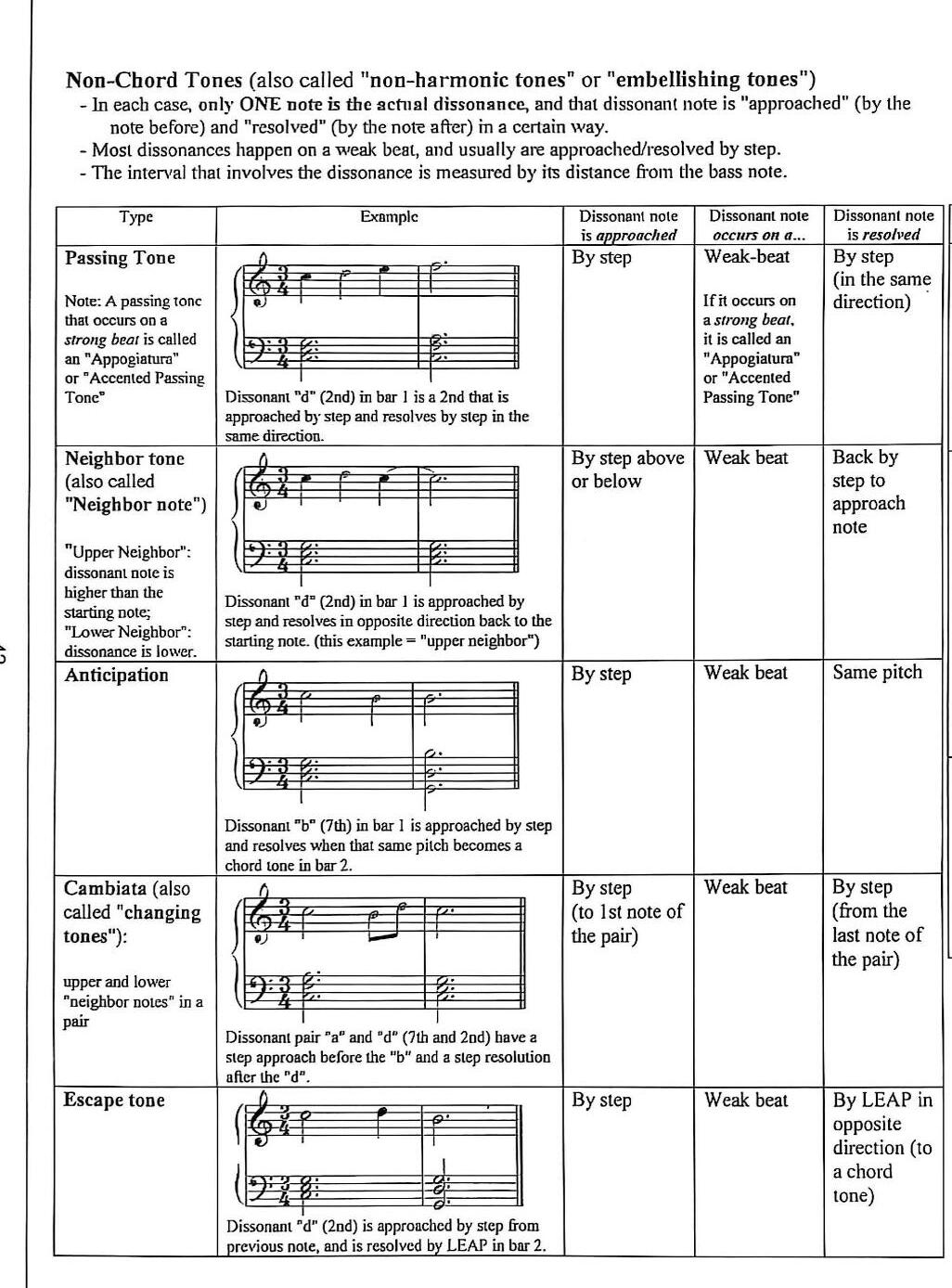
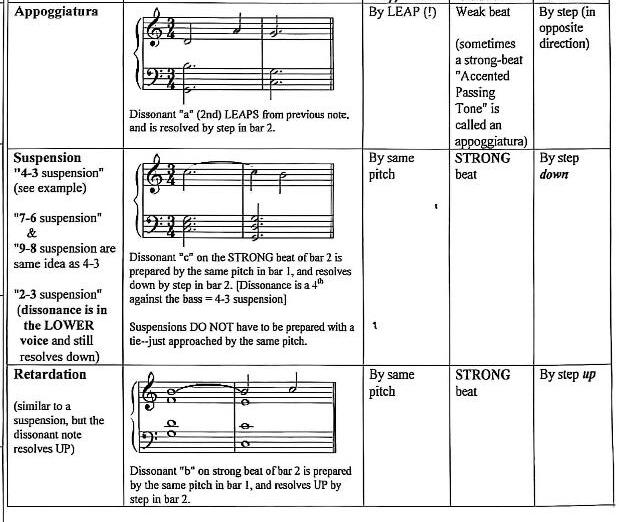
BYU 2024 Organ
Chart used by permission from Jason
16. Pedal Points - usually a tonic or dominant (1st or 5th scale degree note) is held while the rest of the notes continue to be played.
Hymns 3, 19, 41, 100
17. Pedal movement – play the pedal line an octave higher than written to lighten the texture or an octave lower for a more grounded, majestic finish.
18.Articulations – play separate verses with differ ing articulations based on hymn text. Hymn 3
19. Short detached pedal tones – Play short, detached pedal tones (approaching staccato) on a verse or chorus on certain march-like hymns to drive text and beat forward.
Hymns 3, 237, 246, 250 ll ldd

The standard for hymn playing should simply be... A WELL-PLAYED HYMN, WRITTEN AS IT'S WRITTEN.
20. New Bracketed Intro - Create a new bracketed section (not what is listed) End with tonic cadence Hymns 27, 136, 140 , 203, 212, 264
21. Whole Song Intro – Play entire song as intro - great help for unfamiliar hymns Hymn 1031
22. Intro Melody in Octaves -Play melody only in octaves Hymns 7, 18, 25, 199
23. Intro Registration Change – use two contrasting registrations between the intro and the verse Hymn 78
24. Intro Diminuendo Registrations – Take away stops each phrase in intro Hymns 128, 129
25. Intro Crescendo Registrations- Add stops each phrase to build up the introduction Hymns 71, 81, 136
26. Intro Interludes – Create or find an interlude that adds to, but doesn’t distract from the melody (List Below)
27. Build T exture – S-A-T-B - Change texture by adding in voice parts one at a time, beginning with melody only (could include a reed stop). Hymn 8, 22, 174, 277, 267
28. Vary Texture – Change texture by combining different parts. For example, Phrase 1- SATB; Phrase 2- SAT; Phrase 3- ST, Phrase 4- Soprano alone Hymns 98, 295, 287
29. Texture + Unison – Have the texture change include a unison phrase - Phrase 1, soprano alone; Phrase 2soprano in octaves; Phrase 3 and 4 soprano and bass parts, or any other combination with soprano Hymns 20, 113, 116
30. Alternate Octaves and Harmony -Alternate phrases in octaves (manuals only) and four part harmony Hymns 7, 73, 1001
Two-Part Intro Combinations – Using one manual, use the following two-part combos (always with soprano) S/A, S/T, S/B
31. Soprano/Alto parts only
32. Soprano/Tenor parts only
33. Soprano/Bass parts only Hymns 109, 147, 176, 293
34. Intro Pedal Point - Use a tonic or dominant pedal point Hymns 6, 30, 41, 1001
35. Intro Soprano Solo Use a solo/accompaniment registration, solo the intro soprano part on its own manual with the accompaniment on another supportive manual Hymns 58, 67, 1003
36. Intro Soprano Solo + Four Parts -Solo the soprano for a few measures then add four parts on last section Hymns 1, 8, 72
37. Intro Manual Changes + Part Additions or Subtractions - Use manual changes with part additions to create a gradual crescendo or diminuendo: Phrase 1 all four parts on Great & Pedal, Phrase 2, melody on Great-alto and tenor on Swell-no pedal; Phrase 3, soprano and alto only; Phrase 4, play on the Swell: soprano line in unison, manuals only (Can reverse this for a crescendo) Hymns 129, 152
38. Intro Non-H armonic T ones – Add to the introduction passing, neighboring, etc tones Hymns 3, 58, 92
39. Fanfare Intro - Add a fanfare to a praise hymn rhythmic tonic chord or progression Hymn 20
40. Pedal Solo Intro – Play the melody with the feet as a pedal solo
41. Original Intro - Write your own introduction -keep the melody recognizable
42. Intros found in Choral Sheet Music –For example, Mack Wilberg’s choral arrangement of “How Firm a Foundation” intro can be shortened
43. Published Intro - Use already written introduction resources (See list below)
• Signal a change
• Can establish a new key
• Create anticipation
• Provide a break
• Often implemented in the last measure
• Easier if end on a tonic or dominant chord of the new key
• Important to work with conductor
44. Original Interlude - Insert your own interlude between verses keep rhythm of piece but create a melody that works with verse use nonharmonic tones— less is more
45. Published Interlude – Find an interlude to include between hymn verses-often found in prelude or postludes arrangements
46. Harmonic Change -Harmonically change the last chords or chords that can be substituted- know basic chord progressions Hymn 198
47. Key Switch Modulation (Chromatic) – Switch the sharps/flats in printed key (Ab-A) between verses or chorus -c ould use direct modulation, a pivot chord (could be dominant 7 th of new key), chromatic modulation or a modulating chord progression to connect verses Hymns 3, 84, 285
48. Original Modulations – Write your own modulation to a new hymn key that is further away than a ½ step use a modulating chord progression (could be a sequential modulation) to get to new key
harmonizations and accompaniments
Instruct congregation to sing in unison during the free accompaniment be wise too much alteration can lead to confusion
50. Original Reharmonization - Write your own reharmonization substituting diatonic chords ii or IV, dim vii or V, etc.- Major & minor chord progressions Hymn 200
51. Substituting Other Chords -Add chromatic chords , secondary dominants, secondary leading tones, or augmented sixth chords to hymn -if appropriate
52. Prelude or Postlude Verses – Use published prelude or postlude arrangements for one verse Doug Bush Oh, Come All Ye Faithful-last verse; Rick Park Praise to the Lord, the Almighty- last verse
53. Published Books of Reharmonizations- again be careful that the reharmonization doesn’t distract (See List)
54. God, Our Father, Hear Us Pray #170 (adapted from the Workshop Handout “Creating Preludes & Postludes from the Hymnbook) - Whole Song Intro: 1st phrase soprano alone, 2nd phrase add alto, etc.; Verse 1: Play as written; Verse 2: add in alto passing tone C in m. 8, tenor passing tone G in m. 11, and bass passing tone D in m. 12; Verse 3: Tenor Solo
55. Bread of Life #1008 – Intro as written (possible soprano solo); 1st verse as written (employ diminuendo registration between verses); 2nd verse, passing tones and articulation changes; 3rd verse with tenor solo and pedal point on chorus
56. Where Can I Turn for Peace? #129 – Start in Db -Intro – Vary Texture (#29 above); 1st verse as written; 2nd verse registration change followed by original interlude modulating to D; 3 rd verse tenor solo
57. How Firm a Foundation #85 – Intro, soprano solo; 1st verse as written, 2nd verse added passing tones with added registration; Modulation to A Major (watch accidentals when transposing); 3rd verse with added registration and pedal point
58. Oh, Come, All Ye Faithful #202 – Intro-Doug Bush’s; 1st verse as written; 2nd verse soprano/tenor swap, interlude after v. 2; 3rd verse (all sing unison) Doug Bush’s last verse reharmonization
59. Praise to the Lord, the Almighty #72 – Intro – Rick Park’s in F Major; 1st verse as written; 2nd verse soprano solo followed by interlude; 3rd verse (unison) Rick Park’s hymn reharmonization
60. https://organ.byu.edu/freeaccomp.pdf
49. Published Modulations –Several publications contain modulations from all keys that could be adapted Church Book
61. https://wardorganist.com or https://organmusicdownloads.com
62. Carson, Mike. https://www.carsonhymns.com
63. Linker, Janet. The Last Verse: Sixteen Free Hymn Accompaniments for Organ
64.Nisbet, Stephen. Creative Last Verses.
65. Noble, T. Tertius. Free Organ Accompaniments
66. Okley, Harrison. The Ultimate Finishing Touch: Last-verse arrangements of well -loved hymn tunes
67. Parks, Rick Organ Exaltation
68. Rawsthorne, Noel. 200 Last Verses
69. Staten, Chad. https://chadstatenmusic.com
70. Stone, DeeAnn D. A Resource List for Organists, dstone@uvago.org
71. Thompson, Matt. https://hymnharmonizations.com
72. Wood, Dale. Festive Hymn Introductions
MusicTheoryfortheOrganist,Part1
Basic(Level1)
AudreyPickering(aapickering@gmail.com)
I. TheBasicMaterialsofMusic:
A. TimeandSound:soundwavesandpitch
B. TheOvertone/HarmonicSeries:aseriesofintervalsaboveagivenpitch.1 (see diagrambelow)2
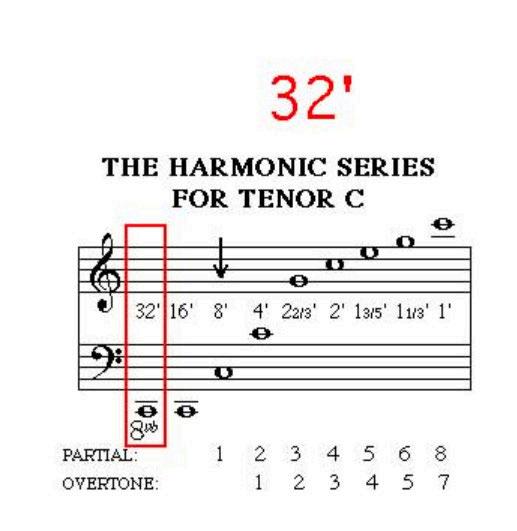
II. TheNotationofPitch:
A. TrebleClef: sometimesknownas“Gclef.” Thisistheclefwheremid-rangeto highpitchesarenotated.
B. BassClef: sometimesknownas“Fclef.” Thisistheclefinwhichmid-rangeto lowerpitchesarenotated.
C. C-Clefs: Clefthatmaybeplacedonanylineorspace,butwhereveritisplacedit locatesmiddleC. ThemostcommonCclefsareAltoandTenorclefs,butthere arealsotwootherCclefsthatexist: SopranoclefandMezzo-Sopranoclef.
D. LedgerLines: anextensionofthestaffusingextralinesandspaces.
E. GrandStaff: Trebleandbassclefstogether.
F. Ottava sign: Signusedtoindicatethatnotesshouldbeplayedoneoctavelower oroneoctavehigher. Usuallyindicatedbythemarking 8ve
G. Halfstep: theshortestdistancebetweentwoneighboringkeysonakeyboard instrument(normallyawhitekeytoablackkeyortwoneighboringwhitekeys suchasE-FandB-C). Thehalfstepisthesmallestcommonintervalinmusic.
H. WholeStep: Equalstwohalfsteps.
1 https://intmus.github.io/inttheory18-19/08-overtones/a1-overtones.html
2 https://organ.byu.edu/organtutor/organ_registration/stop_pitches/harmonic_series/page12.htm
I. ChromaticScale:scalecomposedcompletelyofhalfsteps.
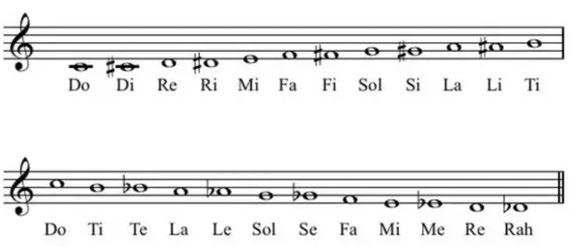
J. Accidentals:
1. Sharp: raisesthepitchofanotebyonehalfstep. Indicatedbythesign (#).
2. Flat: lowersthepitchofanotebyonehalfstep. Indicatedbythesign (b).
3. Natural: cancelsaprevioussharporflatandindicatesthatthenoteis nowatitsunalteredpitch.
K. EnharmonicNotes: Notesthatsoundthesamepitchbutarewrittendifferently. Example: D-flatandC-sharp.
L. PitchDesignations: NotesinthemusicallanguagearenamedA,B,C,D,E,F, andG.
M. PitchNotation:C4=MiddleC(seediagrambelow)3
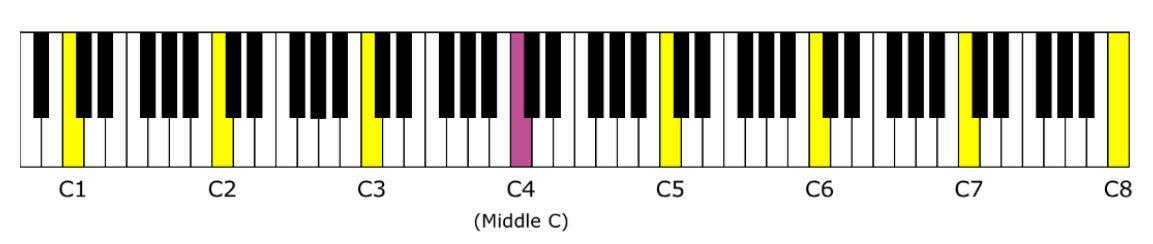
3 https://www.allaboutmusictheory.com/piano-keyboard/music-note-names/
Music Theory for the Organist, Part 2
Basic (Level 1)
Audrey Pickering (aapickering@gmail.com)
I. Rhythm: thetimeaspectofmusic–howsoundsarenotatedsothattheyoccurata predictablemomentandinapredeterminedpattern.
A. Beat: basicpulseofamusicalpassage.
B. Meter:groupingofbeatsthatoccursofteningroupsoftwoorthree.
C. SimpleTime: beatdividesintotwoequalparts.
D. CompoundTime: beatdividesintothreeequalparts.
E. RelativeValuesofNotesandRests:
1. Wholenoteandrest=4beats
2. Halfnoteandrest=3beats
3. Quarternoteandrest=1beat
4. Eighthnoteandrest=½beat
5. Sixteenthnoteandrest=¼beat
F. Dot: addsone-halfvaluedurationofthenote,rest,ordotthatprecedesit. Whennotatedonthestaff,adotisneverplacedonastaffline.
G. TimeSignature: Uppernumberindicatesthattherearetwobeatsinameasure, whilethelowernumberdesignateswhichnoteistheunitbeat.
1. TimeSignaturesinSimpleTime:
a. Thebeatisanun-dottednote.
b. Eachbeatissubdividedintotwocomponents.
c. Thetopnumberisnotdivisibleby'3'.(Exceptfortimesignatures witha'3'ontop,whichareoftensimpletimesignatures!*)
d. Simpletimesignaturesshowthenumberofbeatsineverybar
(i.e., meanstwoquarternotebeatsineverybar.)
2. TimeSignaturesinCompoundTime:
a. Thebeatisadottednote.
b.Eachbeatissubdividedintothreecomponents.
c.Thetopnumberisevenlydivisibleby'3'.(Exceptfortime signatureswitha'3'ontop!*)
d.Compoundtimesignaturesshowthenumberofbreakdown notesineverybar.(i.e., meanssixeighth-notesubdivisionsin everybar.)
*=Timesignatureswitha'3'ontop(like or )mayactuallybe simpletimesignatures,whereeachquarter(inthecaseof )oreach eighth(inthecaseof )issubdividedinto2components. ©1999-2000,GaryEwer,B.Mus.
b.Example:#1020SoftlyandTenderlyJesusIsCalling
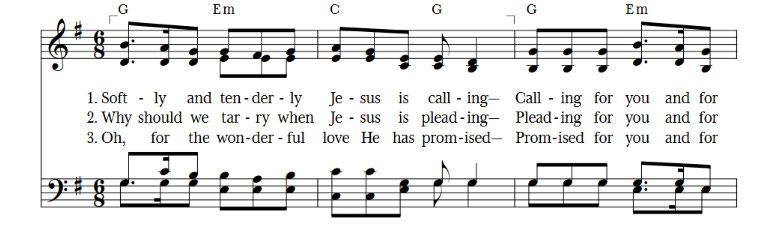
H. Tie: acurvedlinethatconnectstonotesofthesamepitch,creatinganew durationthatisequaltotheirsum.
a. Example:#203AngelsWeHaveHeardonHigh
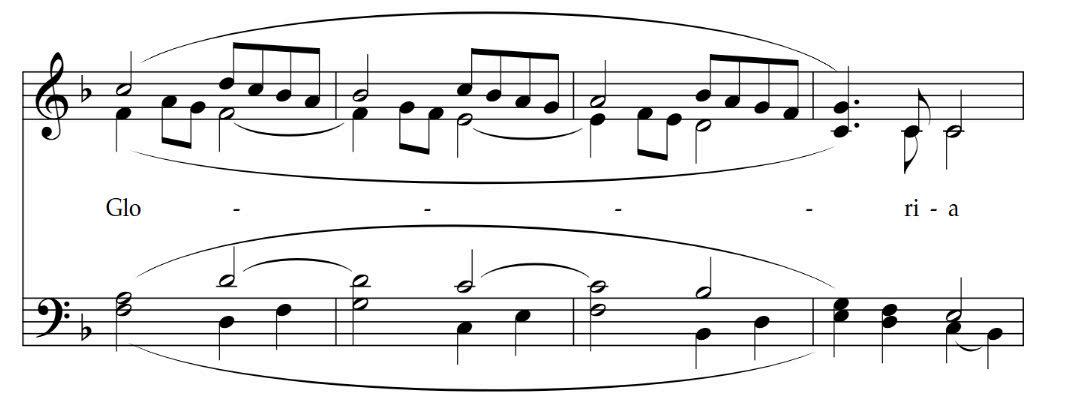

G. Syncopation: rhythmicfigurethatstressnormallyweakbeatsordivisions.
a. Example:#7Israel,IsraelGodisCalling
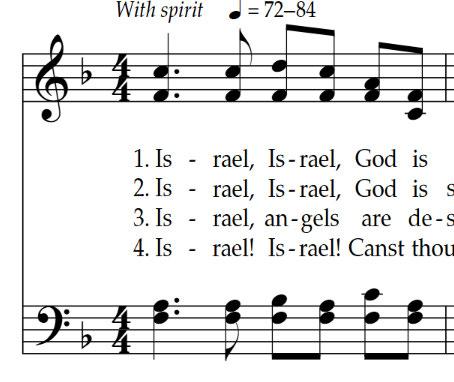
III. Intervals:
Music Theory for the Organist, Part 3 Basic (Level 1)
Audrey Pickering (aapickering@gmail.com)
A.Anintervalisthedistancebetweentwonotes.
B.Intervalsmayoccurbetweennotesplayedsimultaneously(harmonic)andone aftertheother(melodic).
C.Intervalsaretypicallynumberedunison(1)throughoctave(8)andmaybe identifiedasasecond,third,etc.
D.Afurtherwaytodiscriminatebetweenthedifferenttypesofintervalsisto labelthemmajororminorintervals. Aneasywaytodeterminewhetheran intervalismajororminoristousetheintervalchartbelow.
E.IntervalChart:
#1001Come,ThouFount

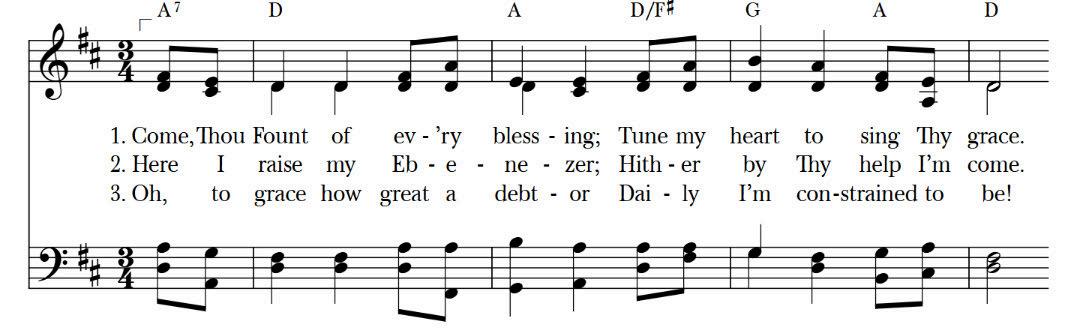
Example:#1004IWillWalkWithJesus

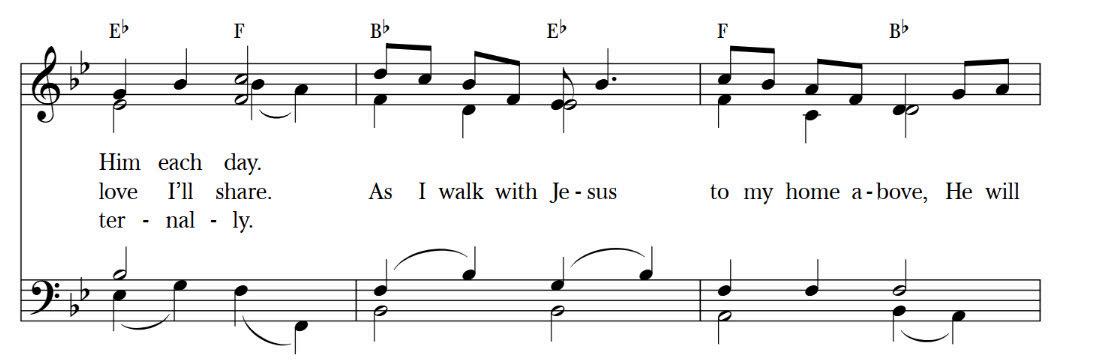
Example:#1013God’sGraciousLove
GtoBbis3halfsteps=minor3rd BbtoCis2halfsteps=Major2nd

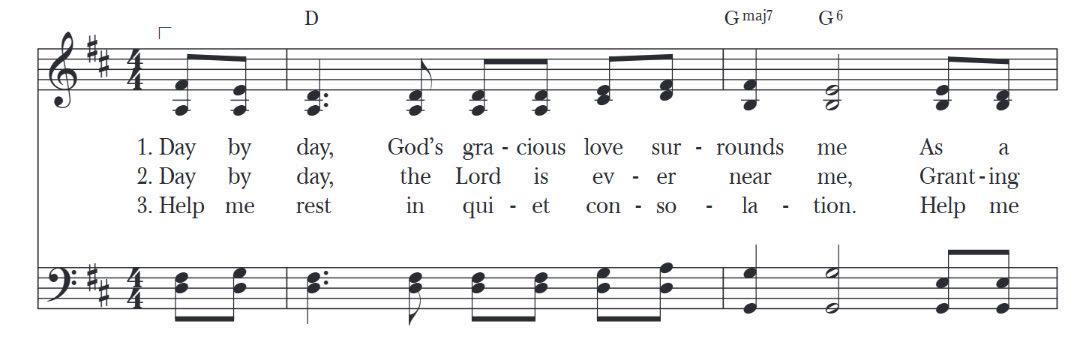
AtoDis5halfsteps=Perfect4th
Music Theory for the Organist, Level 2 Wednesday, August 5, 2026, Part I Dr. David Pickering (dpickeri@ksu.edu)
Intervals:
A.An interval is the distance between two notes.
B.Intervals may occur between notes played simultaneously (harmonic) and one after the other (melodic).
C.Intervals are typically numbered unison (1) through octave (8) and may be identified as a second, third, etc.
D.A further way to discriminate between the different types of intervals is to label them major or minor intervals. An easy way to determine whether an interval is major or minor is to use the interval chart on the next page.
Interval Chart:
B.Key-Signature Centric Identification
1.Pretend that the bottom note of the interval is first note of a major scale. If the second note of the interval is contained in the “major scale” of the bottom note, then the interval is a major interval. If it is not, then if you can get to the note by lowering the top note a half step, then it is a minor interval.
II.Major Key Signatures:
A.There are two ways to determine major key signatures:
a. Memorization: this is really the best way, since key signatures will be subject to instant recall.
b. Know the order of sharps and flats:
i.Order of sharps: FCGDAEB
ii.Order of flats: BEADGCF
iii.Sharped keys: key is identified by going up a half step higher from last sharp in key signature.
iv.Flatted keys: key is identified by identifying the next to last flat in key signature
A.Formed by the following series of whole (W) and half (H) steps between the scale’s eight notes: W-W-H-W-W-W-H OR
B.Simply memorizing the key signatures of each major scale and applying the appropriate sharps or flats to each note of the scale.
A. There are two ways to determine minor key signatures:
a. Memorization: this is really the best way, since key signatures will be subject to instant recall.
b. A second way to figure out minor key signatures is to find the relative major key signature.
1. Relative Key: Major and Minor keys which share the same key signature.
aa. To determine the key signature of B Minor, for example, go up a minor third to D. The key signature of D Major is also the key signature of B Minor. D Major and B Minor are relative keys. D Major is the relative major key of B Minor and B Minor is the relative minor key of D Major. If you are in D Major and want to find which key is the relative minor, just go down a minor third, and you will reach B.
II. The Three Minor Scales
A. Natural: Composed of the following intervals: W-H-W-W-H-W-W. This the unaltered form of minor scale and is the same ascending and descending.
B. Harmonic: Natural minor scale with a raised seventh scale degree. The scale form is the same ascending as descending. This is the most common form of the minor scale.
C. Melodic: Natural minor scale with raised sixth and seventh scale degrees ascending, natural minor scale descending.
Music Theory for the Organist, Level 2 Thursday, August 6, 2026, Part II
Dr. David Pickering (dpickeri@ksu.edu)
I. Circle of Fifths for Major Keys
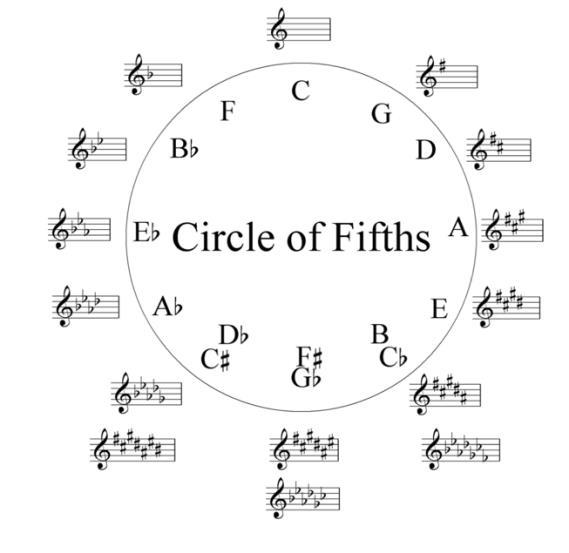
II. Circle of Fifths for Minor Keys
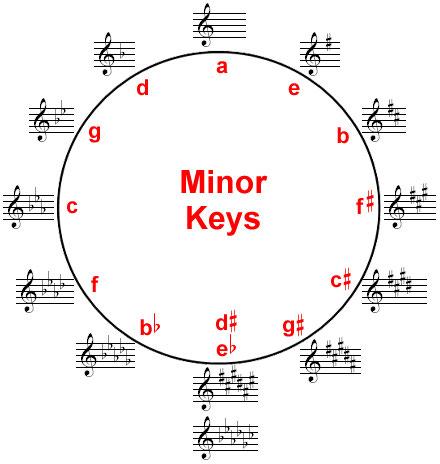
III. What Major and Minor Keys are Found in our Hymnals?
A. Hymns of The Church of Jesus Christ of Latter-day Saints (1985)
B. Hymns for Home and Church (as of July 2026)
IV. Augmented and Diminished Intervals
a. Augmented: half step larger than a major or perfect interval i. Remember that in identifying an interval such as an augmented second, the general interval still has to be a second!
b. Diminished: half step smaller than a minor or perfect interval i. Remember that in identifying a diminished interval such as a diminished fifth, the general interval still has to be a fifth!
Music Theory for the Organist, Level 2 Friday, August 7, 2026, Part III
Dr. David Pickering (dpickeri@ksu.edu)
I. Introduction to Triads:
A. Tonal harmony utilizes tertian chords (chords comprised of thirds).
B. The basic tertian sonority is the triad, a three-note chord comprised of a combination of major and minor thirds. There are four possible ways to combine these combinations of major and minor thirds to produce triads:
1. Augmented Triad (Major 3rd + Major 3rd)
2. Major Triad (Major 3rd + Minor 3rd)
3. Minor Triad (Minor 3rd + Major 3rd)
4. Diminished Triad (Minor 3rd + Minor 3rd)
Augmented Major Minor Diminished
II. Diatonic Chords in Major Keys
A. Triads may be constructed using any degree of the major scale as the root. Diatonic triads consist of notes belonging to the scale. To distinguish the triads built on the various scale degrees of the scale degrees themselves, roman numerals are used instead of Arabic numerals (for example, V). The triad type is indicated by the form of the roman numeral.
Triad type
Major
Roman Numeral
Example
Uppercase I, IV, V
Minor Lowercase ii, iii, vi
Diminished Lowercase with a o sign vii°
III. Common Diatonic Triads in Minor
A. The most common diatonic triads of minor keys are based on notes that belong to the harmonic minor scale (resulting in a raised leading tone for both V and vii0 chords). The leading tone of a III chord (i.e. the fifth) is typically not raised
IV. Voicing a Single Triad (video recap: https://youtu.be/usvzveESYEE)
A. Open Structure: Less than an octave between soprano and tenor
B. Close Structure: An octave or more between soprano and tenor
C. Observe the Following Rules:
1. Follow the traditional arrangement of the soprano voice being the highest voice, the alto the next highest, the tenor the highest bass clef voice, and the bass the lowest ] bass clef voice. Do not cross voices (put the alto above the soprano, bass above the tenor, etc.).
2. Observe the following spaces between voice parts: aa. No more than an octave between the soprano and alto bb. No more than an octave between the alto and tenor cc.More than an octave may exist between the tenor and bass
V.How to Convert a Triad into a Four-Voice Chord
A.The chord root (note upon which the chord can be based and still stacked into thirds, is written twice).
B. For major and minor chords, the chord third and chord fifth are typically written once, thereby yielding four voices (doubled root, third, and fifth).
Dr.JacobHofeling
August2026
Tonality-harmonybasedonthemajorandminorscales. Romannumeralsindicatewhichchordspertain towhichnoteofthemajororminorscale.
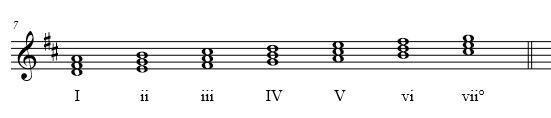
ChordSpacingRules:
1. MaxspacingbetweenSoprano,Alto,and tenor:octave
2. Maxspacingbetweentenorandalto:11th
3. Maxspacingbetweentenorandbass:15th
Closestructure:Novacantchordtonesbetween theuppervoices
DoublingRules
1. Whenachordisinrootposition,doublethe bassnote
2. Whenachordisinfirstinversion,double thesopranonote(usuallytheroot)
3. Whenachordisinsecondinversion, doublethebassnote(the5th)
Openstructure:vacantchordtonesexist betweentheuppervoices,tenorandsopranoare morethananoctaveapart
Typesofrelativemotion:
1.Similarmotion
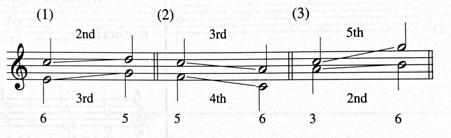
2.ParallelMotion
Triadhorizontalrootmotionrules:
3.ObliqueMotion
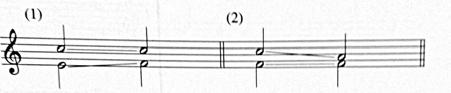
4.Contrarymotion
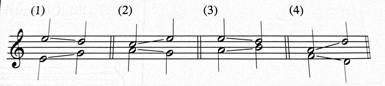
5th:keepcommontoneinthesamevoiceandmoveothervoicestothenearestpossibletonewithcorrect doublingandspacing. Ifnotpossible,movetheshortestdistancepossible.
2nd:Movealluppervoicesincontrarymotiontothebass
3rds:Retaintwocommontones,andmovetheremainingvoicestothenearestchordtone.
Typesof6/4chords:
● Cadential6/4-resolves6-5,4-3
● Passing6/4-usedtoconnect1st inversionchordtosametriadinroot position
● Pedal6/4-thebassnoteusedasapedal tonewhiledissonant6/4moveoverit.
● Arpeggio6/4-Staysstaticwhile basslineplaysanarpeggio
Figuredbassguide:
Rootposition:5/3
Firstinversion6/3
Secondinversion6/4
Finalcadences:
Authentic(V-I),perfect(sopranohasroot)and imperfect
Plagal(IV-I),perfect(sopranohasroot)and imperfect
Nonharmonictones:
1. Passingtone(approachedbystep,left bystepinthesamedirection)
2. Neighboringtone(approachedbystep, leftbystepintheoppositedirection)
3. Appoggiatura(approachedbyleap,left bystepintheoppositedirection)
4. Escapetone(approachedbystep,leftby leapinoppositedirection)
5. Anticipation(approachedbystep,left byrepetition)
6. Suspension(approachedbysametone, resolvedbystep)
Typesofseventhchords:
● Major-minor
● Major-major
● Minor-minor
● Minor-major
● Diminished-minor
● Fullydiminished
● Augmented-major
SeventhChordrootposition7
SeventhChordfirstinversion6/5
SeventhChordsecondinversion4/3
SeventhChordthirdinversion4/2
Non-finalcadences: Half(I-V) Deceptive(V-vi)
ProgressionRules:
● RootsthatmoveDOWNin5ths,UPin 2nds,DOWNin3rds.
● Maysubstituteprimarychords(I,IV,V) forsecondarychords(ii,iii,vi,vii°)
● Movementfromaprimarychordtoits secondarychordisprogression
● Movementfromtonictoanyotherchord isprogression
7. Pedaltone(Toneretainedwhileotherharmonieschange)
HarmonizationSteps:
1. Determinetonality
2. Chooseanappropriatecadence
3. Chooseanappropriateharmonicrhythm
4. Determinethebasicharmonicstructure ofthephrase
5. Selectchordsfornotesthatremain
6. Writethebass
7. Writealtoandtenor
8. Makeadjustmentsasnecessary
Borrowed chords are usually formed when the lowered scale degrees 3, 6, or 7 are borrowed from the parallel minor scale and are used to alter chords in a major mode.
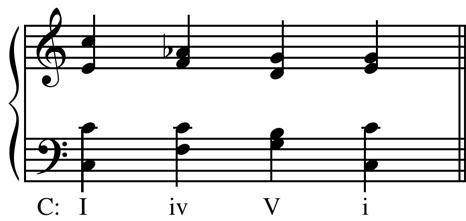
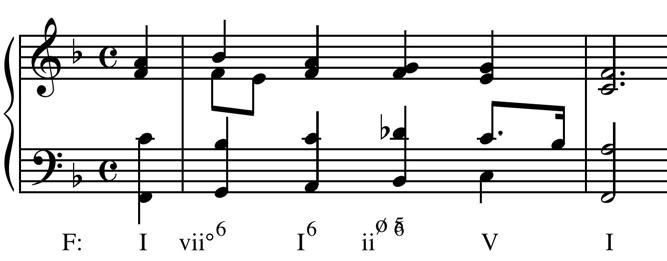
ese are the ve most common seventh chords in the common-practice period. e top label indicates a usual function in a given key; the second label is the technical name that describes ( rst) the triad and (second) the seventh used in constructing the chord; the third label is the common name. In normal resolution, the seventh moves down and the leading tone (if present) moves up by step.

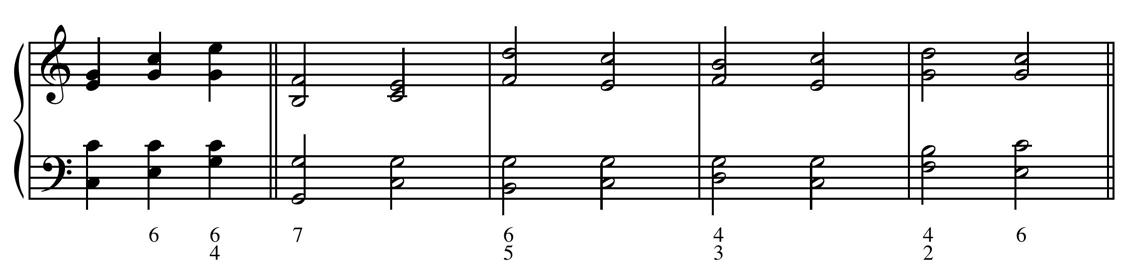
A secondary dominants is a major-minor 7th chord that functions as the dominant of the major or minor chord that follows it (that is not the actual tonic of the prevailing key). A secondary dominant temporarilay “makes tonic” the major or minor chord that follows it, or can signal a modulation into the key they it is tonicizing.
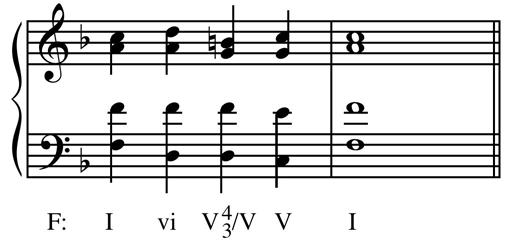
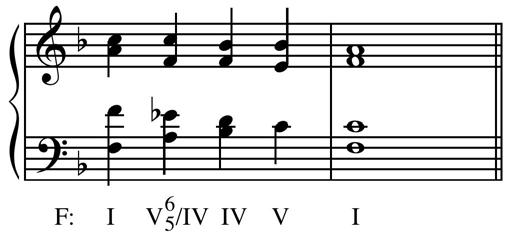
refer to chords that are related in the following ways: their roots are a m3 or M3 apart, and they are either both major or both minor triads. ere will be one common tone between the two chords. e doubly chromatic mediant relationship combines chords of opposite mode and share no common tones.
e fully diminished 7th chord is useful in modulating to distant keys. Each member of this 7th chord can be considered the root of the chord and resolve to the key (either major or minr) that is a half-step above the designated root.
ese pre-dominant chords are de ned by the interval of an augmented sixth that usualy outlines the chord. Each nationalistic “variety” includes the at-6, tonic, and sharp-4 scale degrees of the prevailing key. e French 6th adds the 2 and the German adds a at-3 to the basic recipie.

is series of cadences shows how the V7 chord in C can have various interpretations depending on the resolution and the key that it is functioning in.
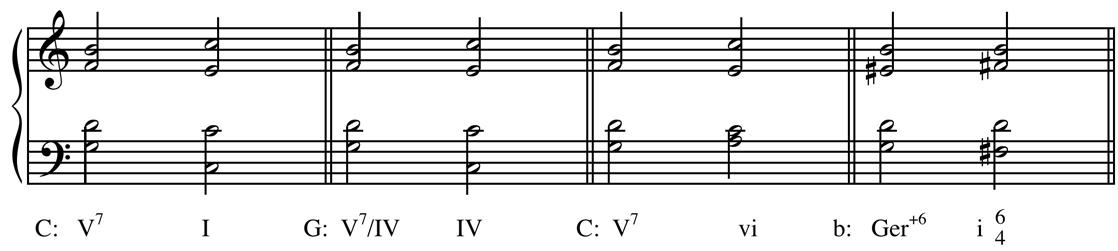
Tertial Tall Chords (9th, 11th, 13th)
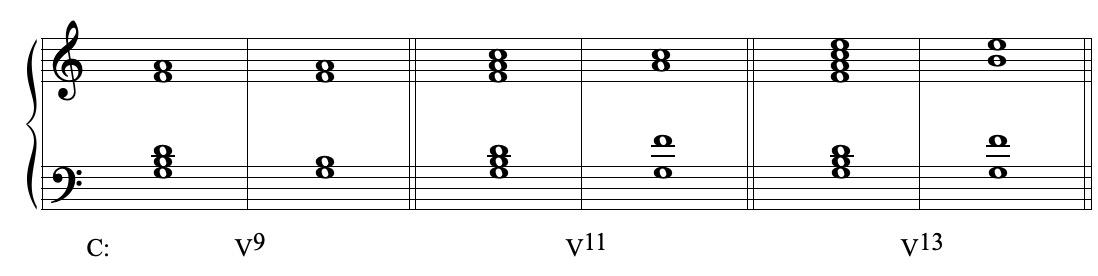
Altered Dominants

The Neapolitan Chord
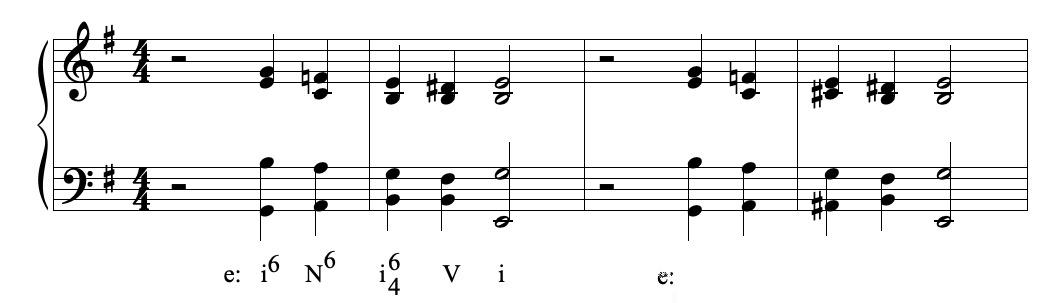
Modulation
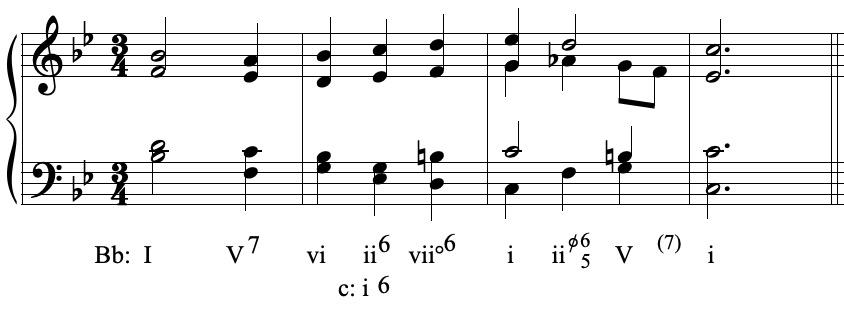
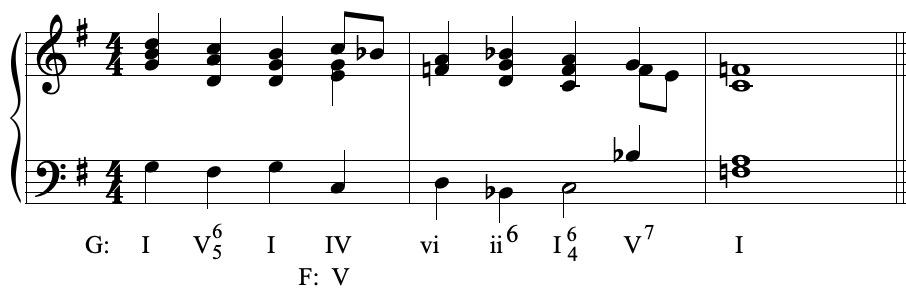
1. The adaptation of a piano score must sound idiomatic to the organ. It needs to sound like it belongs on the organ – that it was meant for the organ. This means that we’ll put the bass line in the pedals, with both 8’ and 16’ stops. We’ll play to the strength of the instrument, which allows for a legato, sustained sound.
2. Simplify! – Some lines may need some adjustment, particularly arpeggiated figures.
3. Divide the notes as comfortably as possible between the hands. The bass line goes to the pedal. And it needs to be the actual bass line – which is not necessarily the bottom line of the piano part. It is usually the root of the chord being played, which is indicated by the guitar chords above the staff.
4. Observe the musical values of the piano score: rhythm, phrasing, characteristic figurations, accents, written instructions.
5.Pianistic effects (like arpeggiated chords) must be adapted. However...
6. Be sure to preserve the motion of the music; do not reduce all pianistic devices to chords.
7. For arpeggio passages, sustain each pitch as the chord ascends, drop out sustained parts as the chord descends (creating the effect of a damper pedal).
8. Where the arpeggio is part of the melodic structure (and needs to be heard as such), play it in one voice as written, and accompany it in the other voice with a corresponding chord sustained on a second manual.
9. Registration should be bright, clear, well balanced, and appropriate to the style of the music.
10. Reeds, mutations, and célestes all have their uses when they are suitable to the character and style of the music.
11. For traditional 4-part hymns that are recast in ‘updated’ harmonizations, busy pedal parts can be simplified by omitting pedal notes that fall on weak beats (or weak parts of beats). The packet of hymn arrangements that exemplify these principles can be accessed at:
https://tinyurl.com/yketk4ee

Brigham Young University – Summer 2026
Instructor: Connor Larsen
Method
Publisher / ID Approx. Price
COMPREHENSIVE METHODS
Organ Technique: Modern and Early
George Ritchie & George Stauffer
The New Oxford Organ Method
Anne Marsden Thomas & Frederick Stocken
OrganTutor Organ 101 Workbook
Don Cook (Belnap, Elliott, contributors)
Oxford University Press (2000)
ISBN 978-0195137453
Oxford University Press (2020)
ISBN 978-0193518322
Ard Publications
BEGINNER-FOCUSED METHODS
First Organ Book
Wayne Leupold
Fingers and Feet: A Journey to the Organ Bench
Drew Cantrill-Fenwick & Robin Harrison; ed. David Pipe
Play the Organ (Vols. 1 & 2)
David Sanger
Basic Organ Techniques
J.J. Keeler & E. Donnell Blackham
Wayne Leupold Editions SKU WL600053
RCO / Diocese of Leeds (2024)
Free PDF or purchase via RSCM
Novello / Music Sales (2004, 1993)
Vol.1: ISBN 978-0853601432 • Vol.2: 978-0853601531
Jackman Music Corporation (4th ed.) SKU JK.00018
SUPPLEMENTS AND ADJACENTS
A Practical Guide to Playing the Organ (Graded Anthology Book 1)
Anne Marsden Thomas
Improvising: How to Master the Art
Gerre Hancock
Complete Organ Method
John Stainer (1877)
Cramer Music (1997) 5-volume set (tutor + Books 2–5)
Oxford University Press (1994)
ISBN 978-0193858817
Dover reprint (2003)
ISBN 978-0486430799
~$70
~$43
~$21 (print) / ~$10 (PDF)
~$25
Use this if…
Free –~$25
…you want the most comprehensive in-print method. Best for a serious student with solid piano background; teaches both legato and early articulated touch in parallel. 140 exercises, 13 studies, 45 integrated pieces.
…you want the newest major method. Repertoirebased lessons systematically develop practice methods, registration, fingering/pedaling, and HIP interpretation. Works with or without a teacher; suits any age from ABRSM Grade 2 upward.
…you’re teaching pianists transitioning to organ, especially Latter-day Saint church contexts. Multimedia tutorial companion at organtutor.byu.edu (subscription $30/6 mo, $50/3 yr) with 140+ video demos.
…you’re transitioning an adult pianist or teen to the organ. Gentle on-ramp developed for AGO Pipe Organ Encounters; ~200 pp. covering intro, method, and easy repertoire.
…your student has NO prior keyboard background. Uniquely designed for absolute beginners, not pianists moving to organ. Video companion at firststoporgan.com.
~$30 each
~$25
…you like a British tutor tradition and want to start directly at the organ without piano prerequisite. Vol. 2 adds national baroque styles, hymn playing, improvisation, and 60+ pieces.
…you’re teaching in a Utah/BYU/LDS context. Meticulously fingered/pedaled exercises from beginning through medium difficulty; still the backbone of many private studios.
~$90 (full set)
~$35
~$22
…you want a thoughtful, integrated tutor + anthology approach. Consider reordering: hands-and-feet work starts late in Book 1. Superseded for most students by the 2020 New Oxford method.
…the student needs improvisation, which most general methods barely touch. Scale → phrase → hymn → hymn prelude → sonata → canon → fugue. Excellent bridge to Dupré’s Cours Complet.
…you want a cheap historical reference or supplemental exercises. All-legato bias and dated registration advice; not a primary modern method, but Stainer’s pedal scales and substitution exercises still teach.
What no current method covers well
• Modern improvisation traditions (jazz, gospel, contemporary hymn-playing) — Hancock helps but is classical/Anglican in orientation.
• Service-playing skills — transposition under pressure, leading congregations, accompanying choirs, cover-the-holes real-time playing.
Out of print but worth knowing
Harold Gleason, Method of Organ Playing (Prentice Hall) — long the American standard. Findable used; many teachers still draw exercises from it. Roger E. Davis, The Organist’s Manual (W. W. Norton, 1985) — effectively out of print; used copies now command steep prices. Still cited on the University of Florida organ pedagogy syllabus. Worth acquiring if you find a reasonablypriced used copy.
Where to buy
OHS Catalog (ohscatalog.org), Wayne Leupold Editions (wayneleupold.com), Jackman Music (jackmanmusic.com), Ard Publications (ardpublications.com), RSCM Music Shop (rscmshop.com), Oxford Sheet Music (oup.com/sheetmusic), J.W. Pepper, Sheet Music Plus, and Organmaster Shoes stock most of these. Fingers and Feet is available as a free PDF at firststoporgan.com.
The Preparatory Level Option offers training for pianists in the most basic skills needed in classical or sacred organ playing. It is designed to be learned, practiced, and completed during the BYU Organ Workshop, while still allowing attendance at the Level One organ instruction and hymn playing instruction classes. As an alternative, the level may be prepared during the year and completed either during the Workshop or during the year.
The Preparatory Level requires playing only one easy three-part piece in legato style, applying the skills described below. The piece may be a three-part hymn setting, an organ piece, or an organ arrangement. Choose the piece from one of the following options (listed below from easier to more difficult):
1.Any of the single-page pieces in Croft, D. Kim. Nine Hymn Studies. Orem, UT: Pioneer (Jackman Music), 1986.
2.The setting of Lawrence Lyon's tune, "Saints, Behold How Great Jehovah," in Cook, Don. The OrganTutor Workbook. Spanish Fork, UT: Ard, any edition.
3.Any one of the three Hymn Project 1 options in The OrganTutor Workbook (see #2 above).
4.Any hymn setting (preferably one of the easier ones near the front of the book), in Cook, Don Easy Organ Hymn Settings Orem, UT: Jackman Music, 1992.
5. Any simple three-part hymn setting, organ piece, or organ arrangement in legato style with a single-line part for the right hand, one for the left hand, and one for the pedal.
Demonstrate the following skills as you play your selected piece (each box should be initialed by an instructor):
1. Apply the three organ listening skills
a.Perfect legato
b.Precise releases (clearly articulated repeated notes, rests accurately observed)
c.Independence of line
2. Use the following elements of good legato pedal technique. Wearing shoes adequate for organ playing is recommended.
a.Position the bench and yourself properly at the console
b.Tip (rock) the feet slightly inward, playing just forward of the ball of the foot (sharp keys) or on the ball of the foot (natural keys)
c.Use ankle motion, not knee motion, when playing pedal keys
d.Use both feet to play the pedal line, keeping the knees reasonably together
e.Use contact between the feet to span the intervals of a second, third, or fourth
f.Keep the eyes up on the music when passing off the piece
Play the following steps in order:
1. INDIVIDUAL PARTS
a.Be able to play either the right-hand or left-hand part on either the Great or the Swell
b. Play the bass part alone in the pedals
2. TWO-PART COMBINATIONS.
a. Play both manual parts on the Great or split between manuals (as specified)
b. Play the right-hand part on one manual in combination with the pedal part
c. Play the left-hand part on one manual in combination with the pedal part
3. ALL THREE PARTS
Play all three parts together, with both hands on the Great or split between manuals (or as specified)
Unless the composer or arranger specifies otherwise, you might use the following stop combination or its equivalent:
Great: Principal 8', Octave 4' (these stops may also be called Diapason, Prestant)
Swell: Flute 8', Flute 4' (these stops may be called Bourdon, Gedeckt, Stopped Diapason, Rohrflöte, Spitzflöte)
Pedal: Flute 16', Flute 8' (these stops may be called Subbass, Lieblich Gedeckt, Bourdon, Gedackt, Stopped Diapason, Rohrflöte, Spitzflöte)
This level may be completed during the BYU Organ Workshop or during the year.
During the Workshop, auditions can occur at one of the following times:
1.during Preparatory Level Supervised Practice (schedule, no fee)
2.private organ instruction (schedule, fee)
3.supervised practice (schedule, no fee)
During the year, the preparatory level may be completed in one of the following ways:
1.a private lesson with any instructor who has taught at the BYU Organ Workshop (fee as arranged)
2.a private lesson with an instructor (fee as arranged) approved by the BYU organ faculty. This instructor should have a degree in organ. Contact Don Cook (doncook@byu.edu) or Neil Harmon (neil_harmon@byu.edu)
3.a video session with a link emailed to a BYU organ faculty member or graduate student (send $30 fee)
A.Laurence Lyon © 1985 LDS (used by permission), arr. Don Cook
With energy q = 88-108
Keep heels in contact with one another.
A COMMA is a phrasing breath, and in this piece it should be treated exactly like an EIGHTH REST.
For each of the practice steps, play at least five repetitions with attention to EACH of the following:
•FINGERING CORRECT
•LEGATO PERFECT
•PRECISELY-TIMED RELEASES AT COMMAS
IF A MISTAKE CREEPS IN:
FIND the problem spot (identify)
FENCE it in (isolate)
FIX it (repetitions)
FIT the pieces back together (context)
I: Trompette 8'
II: Principals 8', 4'
Pedal: Principals 16', 8'
PRACTICE STEPS:
A.For measures 1-4 practice each of the following, SLOWLY AT FIRST:
1.Right hand (RH) part alone
2.Left hand (LH) part alone (meas. 2-5)
3.Pedal part alone
4.LH and Pedal (measures 1-5)
5.RH and Pedal
6.RH and LH
7.All three parts, SLOWLY AT FIRST
B.Repeat the seven steps for measures 5-9, SLOWLY AT FIRST (LH should wait to enter at measure 6).
C.Practice all nine measures— ALWAYS PLAYING SLOWLY ENOUGH TO STAY IN CONTROL
BYU Organ Workshop 2026
Organ Technique and Repertoire, Level 1
Dr. Mark Campbell
Welcome to playing the organ! This class will address basic organ techniques and repertoire featured in Level 1. If you have music scores for Level 1, please bring them to class with you. Participants are invited and encouraged to play technique exercises and repertoire pieces from Level 1 for feedback.
Pedal Technique
• Nearly everyone can learn to play the pedals. With consistent practice you will develop confidence and technique quickly. Avoid procrastination and learn pedals first!
• Adjust the bench
o Up and down: with legs relaxed, one should be able to comfortably play with heels and toes without having to stretch uncomfortably.
o Forward and back: with legs relaxed, toes should fall just shy of the sharp keys.
o Side to side: left foot over C; right foot over F.
• Proper shoes are essential.
• Ankle motion with “quiet” releases: relax ankle to allow pedal key to come back up.
• Organists play with their toes and heels. Play on the inside ball of the foot (toe); center the heel over each note (heel)
o At first, look at feet to make sure technique is correct; eventually find notes without needing to look.
• Pivot body on bench to reach extremities of the pedalboard. Do not scoot from side to side.
• Prepare for the next note to be played by each foot (pre-location).
• Notate, and follow, pedaling in the score.
Manual Technique
• Attack and release
o Precise releases
o “Quiet” releases
• Finger independence
o Tension-free
• Legato fingering
o Finger substitution
o Finger crossing
o Finger glissando
o Thumb glissando
• Notate, and follow, fingering in the score.
BYUOrganWorkshop2026
ElizabethForsyth
“Losenoopportunityofpracticingontheorgan;thereisnootherinstrumentwhichtakesaswifterrevengeon anythingunclearorsloppyincompositionorplaying.” -RobertSchumann
“There’snothingremarkableaboutit. Allonehastodoishittherightkeysattherighttimeandthe instrumentplaysitself.” -JohannSebastianBach
“Ifyouarecalledontoplayachurchservice,itisagreaterhonorthanifyouweretoplayaconcertonthe finestorganintheworld…ThankGodeachtimewhenyouareprivilegedtositbeforetheorganconsoleand assistintheworshipoftheAlmighty.” -AlbertSchweitzer
Tuesday Manual Technique
Legatovs.detachednotes(independenceofline):OrganTutorbyDonCook,Manual16:9a
Fingersubstitution:OTManual3410aand10b
Fingerglissando:OT Manual372aand2b
Thumbglissando:BasicOrganTechniquebyJ.J.Keeler, #33
Threepartmanualstudy: BOT#54
Pedal Technique
Alternatetoesandpivoting:OTPedal16a
Toeandheel:BOT#95-96,OTPedal34aand34c
Crossing:OMp.32#1-2
Glissando:OMp.33#1
Substitution:OTPedal43a,45a
Putting It All Together
Threepartmanualandpedalstudy: “Preludeon‘Converse’” OT Repertoire19
Literature
“Abidewithus,OLordJesusChrist” Seventy-nineChoralesfortheOrganbyMarcelDupré,#1
“AbidewithMe,‘TisEventide” HymnPreludesforOrgan,Book1byRobertManookin,p.25
“Fugato”byJ.G.Albrechtsberger OMp.115,orMethodofOrganPlayingbyHaroldGleason,p.183
Wednesday
Manual Technique
Fingercrossing:BOT#27-28
Thumbglissando: BOT#34
Threepartmanualstudy: BOT#55
Pedal Technique
Glissando: OT Pedal41aand41b
OrganTechniqueandRepertoire,Level2
Putting It All Together
Two and three part studies: BOT #132, #139
Literature
“Herzliebster Jesu, was hast du verbrochen” by Helmut Walcha OM p. 110
“Trio” by Josef Rheinberger OM p. 114
Thursday
Manual Technique
Thumb glissando: OT Manual 39 2c, Manual 40 3c
Three part manual study: BOT #60
Pedal Technique
Alternate toes: BOT #91 (Do this one every day!)
Toe and heel: BOT #98
Putting It All Together
Three part manual and pedal study: BOT #141
Literature
“Glory be to God on high” 79 Dupré, #4
“Canon” by Jacques Lemmens OM, p. 121; or OT Repertoire 7; or Gleason p. 171
“Lord, We Come Before Thee Now” Manookin HP book 1, p. 5
Friday
Questions and Answers!
Ideas for continuing your organ study and staying motivated.
Literature
“Beloved Jesus, here we stand” 79 Dupré, #52
“Litany” by Franz Schubert, OT Repertoire 12-13
“The First Noel” by Wilbur Held Six Carol Settings p. 12
Resources
OM = The Organists’ Manual by Roger Davis, pub. Norton. Currently out of print but used copies sometimes available on amazon.com, ebay and other sites. Highly recommended.
BOT = Basic Organ Techniques by J. J. Keeler, available at sheetmusicplus.com, jackmanmusic.com or amazon.com
OT = Organ Tutor Workbook by Don Cook, organtutor.byu.edu
Six Carol Settings by Wilbur Held, available at Concordia Publishing House (cph.org)
Hymn Preludes for Organ, Book 1 by Robert Manookin, available at jackmanmusic.com or sheetmusicplus.com
Seventy-nine Chorales for the Organ by Marcel Dupré, available on amazon.com & IMSLP: imslp.org/wiki/79_Chorales,_Op.28_(Dupré,_Marcel)
Organ shoes - Organmastershoes.com or www.avriel.com
Tyler Boehmer, DMA (tboehmer14@gmail.com)
A. What is “Ordinary Touch?” (Sometimes referred to as “Baroque touch,” “Articulated touch,” or “Articulate legato”)
a. Ordinary touch is a technique employed in music written before the 1800s. It is characterized by having a space between notes (sometimes referred to as articulation)
b. The easiest comparison to make is to wind and string instruments
i. When a wind instrument is tongued, it puts a slight bit of space between the notes.
ii. When a stringed instrument has alternating bows, it puts a slight bit of space between the notes.
c. Sometimes this space is quite noticeable and distinct, giving the note the feeling of an accent. Other times it is so subtle that the ear can hardly perceive it.
B. Practicing Ordinary Touch
a. The goal here is to get your ears and your fingers/feet to sync up
b. Start by playing a single melodic line with one finger:
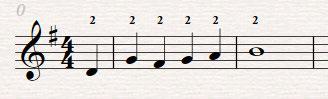
c. Practice this with varying degrees of space in between the notes. First, try to minimize the space as much as possible. Then try some of the following variations:
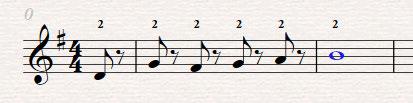

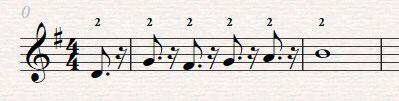
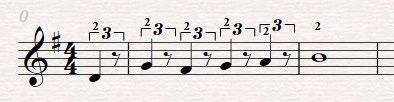
d. Once you have tried these and other variations, try it out with different fingers.
Example:
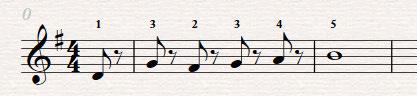
e. Make sure to also practice this with your left hand and your feet in the same way
f. In addition to having space in between notes, we need to consider the relationship between meter and articulation. Think, for example, of a poem with alternating weak and strong syllables:
O God, Thou faithful God, Thou fountain ever flowing, Without whom nothing is, All perfect gifts bestowing, Grant me a healthy frame, And give me, Lord, within, A conscience free from blame, A soul unhurt by sin.
g. See Organ Technique: Modern and Early by Ritchie/Stauffer, pgs. 189-196 for an example
i. Focus on attacking and releasing fingers together. Try to play it in two different ways:
1. Play it with the same amount of space between every quarter note
2. Play it thinking about the meter, emphasizing strong beats by having more space before them (think about the poem above)
h. See Organ Technique: Modern and Early by Ritchie/Stauffer, pgs. 197-199 for an example
i. This piece focuses on having differing touches in each hand
ii. Recommended practice technique: Play hands separately and SLOWLY, listening for good techniques as discussed in our class. Play the hands together after each is comfortable on its own, and begin, measure by measure, from the end
i. See Organ Technique: Modern and Early by Ritchie/Stauffer, pgs. 200-202 for an example
i. The piece focuses on adapting articulation/ordinary touch to a triple meter piece
j. “Christus, der ist mein Leben” by Johann Pachelbel (from 80 Chorale Preludes, #19)
i. See attached score for more information
ii. General concepts:
1. Sharing of a 3rd voice part between the hands
2. Transitioning from a duple meter to a triple meter
k. “Herr Christ, der einge Gottes Sohn” by Johann G. Walther (from 80 Chorale Preludes, #37)
i. See attached score for more information
ii. General concepts:
1. Three-voice contrapuntal texture
2. Handling of unifying motive throughout the work
l. “Vom Himmel hoch” by Friedrich Wilhelm Zachau (from 80 Chorale Preludes, #68)
i. See attached score for more information
ii. General concepts:
1. Three-voice texture, cantus firmus in the bass
2. Two different ways of playing
a. RH and LH play the treble clef, pedal plays the bass clef
b. LH plays the cantus firmus, RH plays the treble clef
3. Independence of each line having their own phrasing and ordinary touch/articulation
C. Most of the techniques you have studied in previous levels are focused on creating a legato technique. Techniques such as glissando, finger-crossing, directfingering/pedaling, etc. will come in extremely handy here.
a. “Andantino” by César Franck (in OrganTutor, Repertoire 18; most likely also available in public domain)
i. Focus on the following techniques:
1. Independence of line
2. Direct Fingering
3. Finger substitution
4. Finger glissando
5. Finger crossing
6. One instance of thumb glissando (measure 12)
b. “Non troppo lento” by César Franck (Organ Technique: Modern and Early, pg. 6162)
i. Focus on legato fingering techniques
ii. Additionally:
1. 4 independent voices in the manuals (usually two voices per hand)
2. Use of the swell expression shoe while playing
iii. Suggested practice ideas
1. Hands separate a lot, and make sure to use the swell shades while playing each hand as well
2. Isolate challenging fingering moments (e.g. measure 1, beat 3, RH; measure 7, beat 3, LH; etc.) and practice through them slowly with good finger indepedence
3. Practice hands together measure by measure, moving slowly between each beat to make sure the fingers are going where they are supposed to go
4. Practice hands together line by line
c. “Prelude in E Minor” by Johann Christian Heinrich Rinck (Organ Technique: Modern and Early, pg. 64)
i. Focus on stretching between the fingers (especially 4-5 in the RH)
d. “Poco allegretto” by César Franck (Organ Technique: Modern and Early, pg. 6566)
i. Similar legato techniques explored here as in previous pieces
ii. Use of the swell expression pedal
e. “Christus, der uns selig macht” by Marcel Dupré (“Christ Jesus Who Maketh Us Glad,” Organ Technique: Modern and Early, pg. 67-68)
i. Practice repeated notes with one finger while keeping other fingers legato, playing independent lines
1. **Note that the staccato in Dupré should be understood to mean half value note length. A quarter note with a staccato mark would turn into a eighth note with an eighth rest**
ii. 4 independent voices in the manuals
f. “Schmücke dich, o liebe Seele” by Johannes Brahms (“Bedeck Thyself, O My Soul, in Gladness,” Organ Technique: Modern and Early, pg. 69-71)
i. This piece requires a great deal of sharing the middle voice between the hands. As each hand is practiced separately, be sure to include those portions of the middle voice which that particular hand plays
1. Example: In the opening half-measure, the RH should play the upper staff as well as the final two 16th notes in the lower staff
ii. Fermatas in this piece simply indicate the end of a phrase, not that the player should actually hold the note for an indeterminate length
g. “Andantino” by Hermann Schroeder (Organ Technique: Modern and Early, pg. 72-73)
i. Similar legato fingering techniques to those in other pieces
ii. Harmonically, this piece might be quite different from the other pieces listed here – it is in a contemporary style. Double check your notes, but also embrace the harmonic complexity
*Pedal exercises are best done without looking at your feet. Learn to use your other senses to guide your pedaling*
A. OrganTutor
a. Group 5, Exercises 13-14
i. When gliding with one foot between two notes, remember these principles:
1. Reduce motion – avoid excess ankle, leg, and knee motion
2. Listen for precise releases
3. Angle the outsides of your feet upward
4. Pre-locate the notes
5. Keep feet in contact with pedalboard, and gently slide across the tops of the keys
b. Group 8, Exercises 18-20
i. Listen for precise attacks and releases as your feet alternate playing
c. Group 13, Exercises 37-40
i. Listen for perfect legato between notes
ii. Keep the heel slides relatively short
iii. Avoid lifting the toes too high (excess ankle motion)
d. Group 15, Exercises 43-49
i. Plan substitutions carefully!
1. Which foot will go behind and which will go in front?
ii. Use the gaps to help you navigate the geography of the pedalboard
e. Group 18, Exercises 59-62
i. Plan crossings carefully!
1. Which foot will go behind, and which will go in front?
f. Group 19, Exercises 63-66
i. Practice pedal scales following the suggested pedaling
B. See the requirements for pedal technique as listed in the Level 3 list for other method books.
A. OrganTutor
a. “Canon” by Jacques Lemmens (Repertoire 9)
i. Strive for great independence of line. I recommend practicing this piece slowly in two-part combinations, marking where one voice needs to lift due to a repeated note and where the other voice needs to maintain the legato line.
1. Example: Measure 3, beats 3 and 4 – the pedal must lift to play the repeated note, but the manual parts must keep the legato line going.
b. “Moderato con moto” by César Franck (Repertoire 22)
i. Note the circled fingerings, which are key moments to remember during practice and performance
B. Organ Technique: Modern and Early
a. Manual and Pedal Study 9 (pg. 96)
i. Note the moments in the pedal marked with an X. These indicate places where you will need to push off with your foot to pivot up or down along the pedalboard
b. Manual and Pedal Study 11 (pg. 107)
i. Work for a clean legato in all parts even though the pedal line is more active
c. Short Trio No. 4 in G Major (pg. 110-111)
d. “Lord Jesus Christ, Turn unto Us” by Marcel Dupré (pg. 127)
i. The pedaling here is a lot of toe-heel thirds
C. Other exercises may be found on the list of Level 3 requirements
Instructor:KymberlyPayne,M.M.,NCTM www.PayneMusicStudio.com/OrganResources
Inthisclass,wewillexploreupper-intermediateorgantechnique,performancepracticeandrepertoirefromthe Level4BYUOrganStudyCourse.Duringourfoursessionstogether,Iwillgiveyouthetoolsyouneedtolearn thetechnique&repertoirefromtheLevel4BYUOrganStudyCoursewithconfidence!Inaddition,youwillbe exposedtowonderfulrepertoireandcomeawaywithconcreteideastoimplementintoyourpracticeassoonas yougethome.
Tuesday(10:00-11:50am)
● Techniquerefreshandperformancepracticereview
● SelectionsfromtheManualandPedaltechniquerequirements
Wednesday(10:00-10:50am)
● Level4OrganMusicbefore1750
Thursday(10:00-10:50am)
● Level4OrganMusicfrom1750-1900
Friday(10:00-10:50am)
● Level4OrganMusicafter1900
● Wrappingup:wheredoIgofromhere?
Organistsusingphysicalscoresarewelcometobringtheirbookstoclass,butIwillhavescoresavailableonthe screenforstudentstofollowalong.Saveroominyourluggagefortheneworganbooksyoufindatthe displays!IwillprovidealinkinclasstopublicdomainscoresforiPad/tabletuserswhowouldliketomarkup musicaswego.
Duringeachclass,in-personparticipantswillhavetheopportunitytoperformselectionsfromtheLevel4list. Onlineparticipantsareinvitedtoparticipateaswell!Ifsubmittingavideo,pleasefollowtheseinstructions:
● Set your camera so that your hands and feet are clearly visible.
● Check that your audio plays back clearly over computer speakers.
● At the beginning of the recording, state your name, the piece you are playing, and the make and type of organ. (If you want to talk about your learning process, I find that helpful to other participants. It is also helpful if you list what stops you are using)
● Upload your video to YouTube as an unlisted video, and send the link to paynemusicstudio@gmail.com Videos submitted after the August 1 deadline may still be incorporated into the presentation, so please don’t be deterred from submitting!
Instructor: Valerie Harris
Technique
Make it part of your daily routine; start your practice with technique.
Use the metronome - vary the speeds; set mini-goals each practice.
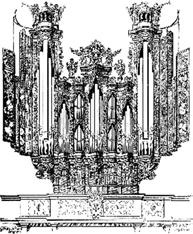
Use a variety of techniques such as rhythm patterns, accenting di erent parts of the pattern, varying the speed, using di erent touches (legato, staccato).
Study the time period, stylistic characteristics, composer, and the piece.
Listen to recordings of the piece but also of other pieces from the composer and the time period. Listen to recordings of other instruments playing similar music.
Look at score before you play. Find the subject or motives. Understand structure by looking for cadential points. What sections do you see? Do you see the main theme return? Are there modulations? What patterns do you see?
Prepare the piece by marking fingerings, pedal markings, manual changes, expressive markings, registrations, sections.
Mark sections and practice by section
o Try starting with the hardest section first
o Try learning the last section first, then work your way back - then you’ll always know the last best, building confidence as you play.
By section, use your metronome, working up the tempo each practice.
For 16th or 8th note patterns, try these: for trick spots, try this per measure:
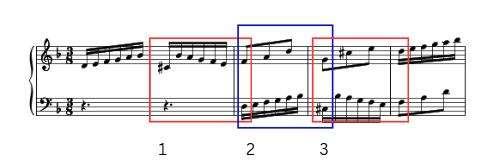
Legato and staccato, 1 measure pattern repeated Practice 1 measure with downbeat of next
Specific forms
Chorale Preludes
o Find chorale tune and decide which voice it’s in
o Is the chorale easily recognizable or is it ornamented? What types of counterpoint?
Fugues
Toccatas
Identify structure: How many voices? In which order do they enter? What is the subject and countersubject? Mark entrances of subject. Identify exposition (all 4 voices have entered). Where else do you see the motives and are they altered? Mark any cadential points. What other structural elements do you see?
Performance Practice - pre-1750 and after
16th, 17th and 18th century works are EASIER to PERFORM and sound more stylistically convincing using the methods of that time. Use the appropriate styles for pre and post 1750 works for greatest success.
Summary of general characteristics:
Pre 1750
19th century and beyond Position at console Like riding a bike Like driving a car
Articulation “ordinary touch”, articulate touch or structured legato
Fingering Not much thumb use, good/bad fingers, finger skipping, hand shifting, adjacent fingers
Phrasing Emphasis on metrical groupings, good/bad or strong/weak beats, breaks before leaps /downbeat
Scale Patterns Note pairing
Repertoire
Legato, slurred legato
Thumb under, glissando, finger crossing, thumbing down, finger substitution
Emphasis on longer phrase structures and lines
Modern scale fingering with thumb under
See Level 5 listing in handout book for complete list of works. Select the appropriate number from a variety of time periods. Find good editions (see section in handout book or at www.organ.byu.edu/materials3-6.pdf for ideas).
Pre-1750: Bach, Buxtehude 1750-1900: Brahms, Franck, Mendelssohn
Since 1900: Boëllmann, Bush, Chamberlin, Dupré, Jongen, Vierne, Walcha, Wood, Wright or other hymn settings from this period
Pre-1750
(Although there are many organ composers, only those represented in the Level 5 repertoire list are specified below)
German: (Buxtehude, Bach)
-Chorale preludes using a chorale (Lutheran hymn) as cantus firmus (main melody) and using a variety of counterpoint techniques
o Ornamented chorale melody
o Cantus firmus in pedal with 4’ stop
o Cantus firmus in any of the voices with other voices in canon, or using figuration
-Freely composed (no cantus firmus):
o Toccatas
o Preludes
o Fugues (subject, countersubject, exposition, motives)
o Passacaglias (repeated bass pattern under other voices)
-Counterpoint common
o Canon – 1 voice follows the other with same melodic and rhythmic content (think“Row, Row, Row Your Boat)
o Fugues
-Pre-Bach works often very sectional with di erent styles
- Stylus Phantasticus “fantastical style”– characterized by dramatic flourishes, sudden pauses, fast passages, interspersed with fugal and strict counterpoint
-Organs in Central and Northern Germany had well-developed pedalboards but not in Southern Germany or other national regions. Organs did not have swell boxes.
Bach:
o Bach used a variety of nationalistic styles (French, Italian, German) into his compositions i.e. French overture or Italian ritornello and concerto.
o Bach’s works were the pinnacle of the Baroque; he developed Baroque forms to a new height by developing motivic material, enabling longer fugues.
o Frequently used patterns modulating through circle of 5ths, motivic material and patterns (sometimes inverted, retrograde, diminution or augmentation), chains of suspensions, motoric movement. Motives can be melodic or rhythmic.
1750-1900
-Not much in the canon of literature for organ during“classical”period
-Organ composition began to develop again during the 19th century
-With the development of the piano, the legato touch also developed on the organ
-Mendelssohn brought a renewed interest in Bach’s music so many composers wrote in the structures of Chorale Preludes and Preludes & Fugues but with 19th century harmonization and phrasing with legato touch.
-Organ Sonata developed during 19th century (multi movement works with each movement indicated by the tempo marking)
-Organs had well-developed pedalboards and crescendo
French: (Franck)
-Symphonic organs started in Paris with the builder Cavaille-Coll – these instruments imitated a symphony with high pressure stops with a variety of tonal colors and the ability to add stops quickly for a crescendo e ect)
-Organ Sonatas were a common structure
-Many important composers during the 2nd half of the 19th century into the 20th century
German: (Mendelssohn, Brahms)
-When asked by an English publisher to compose voluntaries, Mendelssohn instead composed sonatas
-Brahms – wrote op 122 (11 chorale preludes) during an early period of his life as he studied Bach. He then revisited some early sketches and composed new ones of the set later in life, a few on his deathbed.
Since 1900
Organs continued to develop with balanced swell pedal. Interest in reproducing historically inspired instruments prevalent along with the development of organs that allowed an organist to e ectively play a variety of time periods and nationalistic styles.
French: (Boëllmann, Dupré, Vierne)
Boëllmann“Toccata”, Suite Gothique: French toccata with figuration in hands, melody in pedal.
Vierne“Carillon”: sparkling piece, repetitive pedal line; inspired by the bells of Longpont.
Dupré“How Fair and Pleasant”: lyric and flowing in 6/8 time
German: (Walcha)
Belgian: (Jongen)
American: (Wright. Wood, Bush, Manookin, Chamberlin)
Organ Terminology Boot Camp
Elizabeth Forsyth
The pipe organ is a wind instrument controlled by one or more keyboards. Electronic organs try to look and sound like the real thing, and much of organ terminology applies to both pipe and electronic instruments.
Manual - Previously, a booklet you read to get instructions. Starting today, one of the keyboards on the organ.
Great - On a two manual organ, the lower manual.
Swell - On a two manual organ, the upper manual. See how positive and uplifting the organ is?
Choir - the third manual (below the Great) on a three manual organ. On some organs this is called the Positiv!
Pedalboard - The keyboard for your feet. Do not worry, playing with your feet is much easier than it looks.
Rank - a row of pipes of one sound or color, one pipe per key.
Stop - a knob or tablet used to turn a rank on or off. Pushing it in “stops” the pipes of that rank from sounding. Drawknobs, tabs or rocker tabs are all types of stops.
What are all those buttons?
1) Pistons: These remember combinations of stops for you. General pistons remember the entire organ, divisional pistons remember one division (manual or pedal).
2)Cancel button: Look for the piston, usually at the bottom right, with the 0. This cancels your registration. Use in between hymns so no one hears when you accidentally step on a pedal. And at other times.
3)Large buttons that look like doorknobs down by the pedals: these are called “Toe Studs.” We won’t tell them they aren’t all that great looking. They function the same way pistons do, but are used by your feet if your hands are busy playing a toccata.
Memory levels - If you are lucky, your organ will have memory levels. Each level will remember all of your pistons you have set. This is a big blessing when there’s more than one organist.
Couplers - used to connect one division to another, usually found on stop tablets above the top manual. Their name tells you their function. The Swell/Great adds all the stops pulled on the Swell to the Great. The Great/Pedal adds all the stops pulled on the Great to the Pedal.
Reversible - a reversible can be a piston or a toe stud. One push brings something on, a second push takes it off. Some examples are the Great/Pedal and the Tutti which brings on the entire organ. Remember Tutti Fruity gum? All the fruits.
Swell Pedal - This is the thing that resembles a large gas pedal, directly above the pedalboard. In a pipe organ, this opens and closes the “shades” (think vertical blinds) of the swell “box” letting more or less sound out into the room.
Other pedals - All ‘enclosed’ divisions (Swell, Choir) have an expression pedal controlling the volume. On an electronic organ, there are no rooms full of pipes with shutters to open and close, so frequently the Great is also ‘under expression’ and there will be a pedal that controls the Great (often the Great AND the Pedal together).
Generally, the expression pedal on the farthest left will correspond to the lowest manual, and so on, with the one on the far right being the crescendo pedal (see below). Remember this when you play the Tabernacle or Conference Center organs.
Crescendo Pedal - on the far right, this pedal gradually brings on ALL the stops on the organ, regardless of which stops are pulled. Should generally not be used in church.
1. Organ Shoes: Organ shoes help to glide and feel the pedal keys. The shoe needs a heel, strap or lace, leather upper & sole, and arch. Find them at a thrift store, dance store, or online at organmastershoes.com.
2. Preparing Positions: Bench, Body and Feet
Bench buzz words
o Right Left - Right foot is centered over D,E, or Eb. Be consistent Need to be able to pivot not slide to reach extreme ranges and then return to center.
o Forward Back - Bench is forward enough to have feet fall 1 to 2 inches in front of black keys. Be able to rest both your right heel and toe on the expression pedal, and be able to pivot reaching either end of pedalboard.
o Up Down - Arms are close to a right angle on the Great manual Feet are lightly resting but not playing. You are not holding feet up Play and release the key without leaning the torso forward or back or pressing the leg into the bench.
Feet guides
Body cues
o Sit tall. Think of a string attached to your chest.
o Relax shoulders, elbows, and wrists. “Float” over the manuals
o Use naturally curved fingers with a sense of pulling inward, rather than pressing downward when playing a key
o Place half of your thigh on the bench
o Hang legs at a 90-degree angle
o Keep knees and thighs comfortably together when both feet are involved
o Keep eyes up.
o Use ankle motion instead of knee lifts. Head and torso should not move when a pedal is played.
o Use the inside of the foot (ball of foot and big toe) to play white pedal keys Touch the inside corner of the black pedal with the upper edge of the ball of your foot, near big toe to play the black keys
o To play with your heels, center your heel over the pedal just slightly toward the inside edge. Use a limited rocking motion keeping in contact with the keys
o Keep heels touching and hanging downward up to an interval of a fifth. The right toe scissors outward to another note, and the left heel (or heel/arch) should moving to the right to help open the angle between the toes.
o Keep your feet in contact with the pedal keys When the toe depresses a white pedal key, the heel should slightly leave the surface of the key. When the pedal is released, toe and heel are lightly touching the surface of the pedal key. Strive for quiet releases using the toe to control release of key.
3.Mark the score using pedal notation – Use a “carat” shape for the toe and a circle for the heel. Place it above the note or staff to indicate right foot, below for left foot.
Know what the pedal techniques and how they are notated:
Alternate toes
Toe-heel pedaling
Foot Crossing
Substitution
Toe Glissando

Always Practice Slowly Enough to Stay in Control



(See “Legato Pedal Techniques”; “Pedal Technique Checkpoints”; Pedal Basics for Beginners” in this handout booklet for additional information.)
Use in the order of effectiveness - least amount of motion and ease
Find the lowest and highest notes and notate which foot and foot part, or start backwards.
Mark the pedal notation for surrounding notes
Don’t forget to mark in articulations as you mark the pedal notation.
Once the pedal markings are finalized, stick to them!
1.Use intervallic relationships with heels together up to a 4th or 5th
2.Consider gliding using silent notes (notes drawn in and not played).
3. Draw in correct “toe heel” shape.
4. Use navigation points such as Bb & C# or Eb & F# to find notes.
5.For large intervals such as octaves, use the “V” in the knees.
6.Find and mark your pivot spots that will enable your knees to be over the notes you are playing.
GOAL: TRY TO TOUCH THE NOTE BEFORE IT IS TIME TO PLAY!
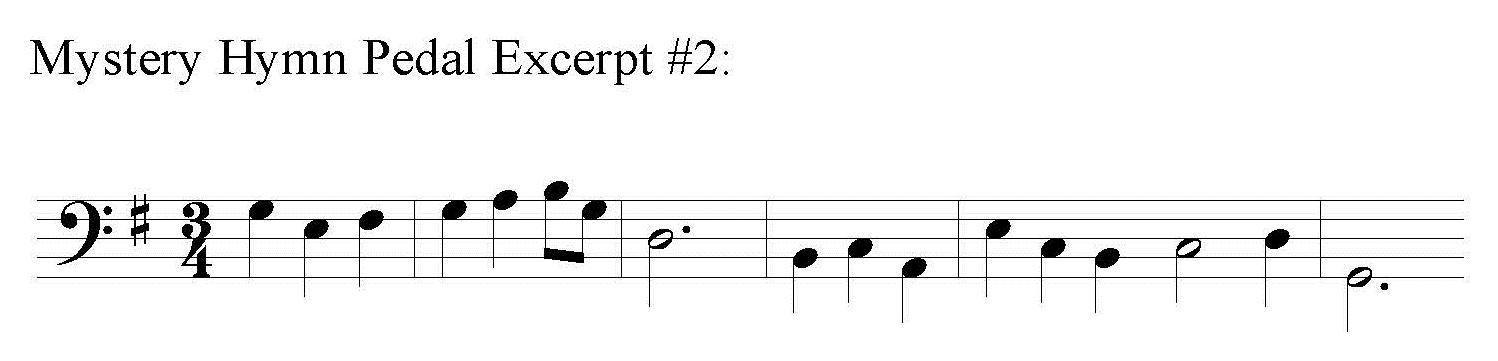
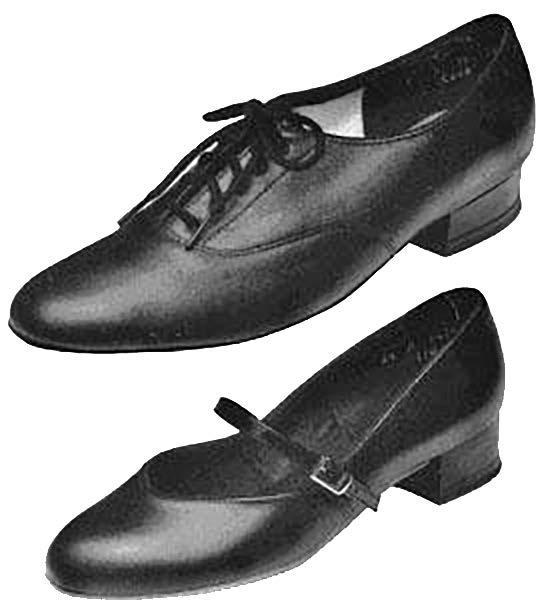
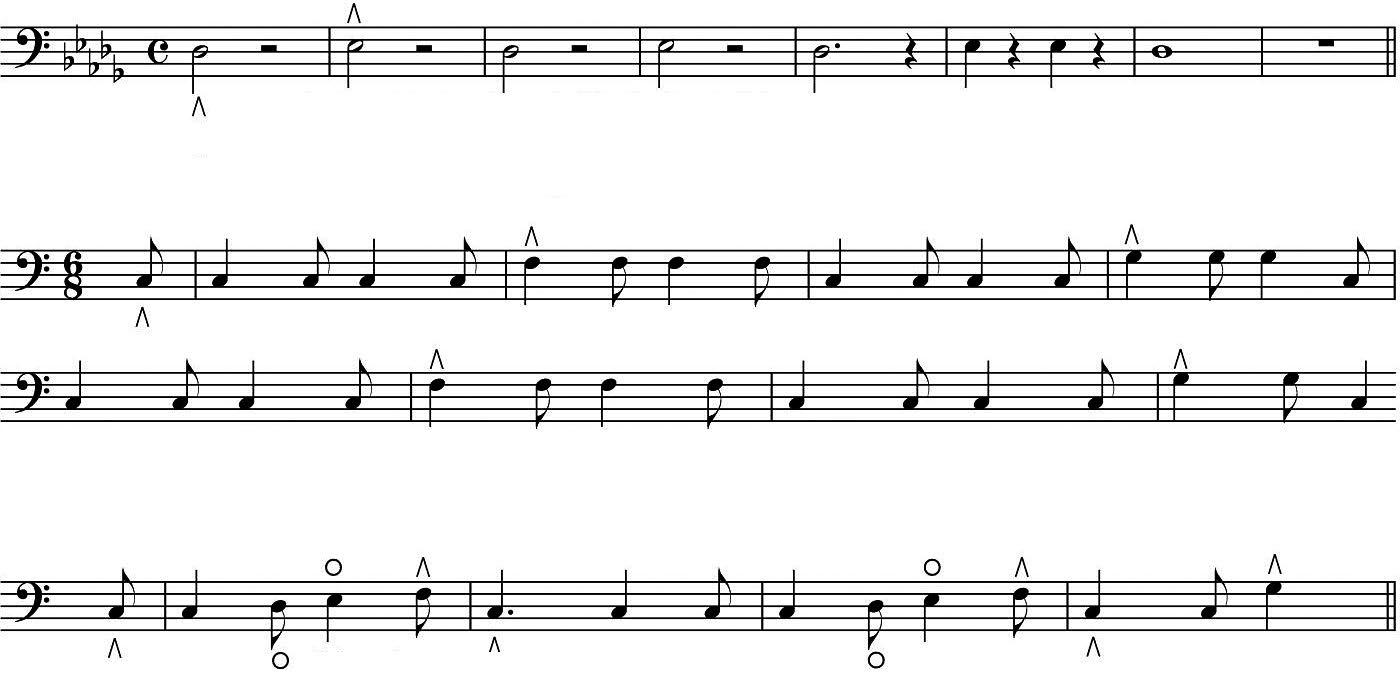
A carat placed below the staff indicates left toe; above the staff indicates right toe
A circle or U-shaped symbol indicates the heel
Continue by learning the pedal line of Hymn 3, Now Let Us Rejoice (simplified for organ in three parts) as found on page 16 of this handout.
The individual foot “gliding” from key to key
•Play natural keys about an inch from the sharps, remembering to tip the foot inside and play on the ball of the foot.
–With the right foot, play back and forth from C to D (steps), expand from C to E (thirds), now C to F (fourths), and C to G (fifths) [farther if you wish]
•Now play some sharps, using the pad of the big toe. Cover no more than half the sharp key.
–Left foot play C to B-flat (steps), down to A-flat (third), now to G (fourth), and F (fifth).
Place the feet in contact with one another, measuring the distance from one key to another. On natural keys, play either the right or left foot slightly forward so that the feet fit together like puzzle pieces. On sharps, this is not necessary.
•Place the toes of the two feet on C and D (a second), with either right or left foot slightly forward, the feet in contact with one another. Play C and D alternately. Make sure you are keeping contact and that your knees are comfortably together as well.
•Now scissor the right foot out to E, keeping the two feet in contact. Knees still together! This is a third.
•Now scissor the right foot out to F, keeping the two feet in contact. This is a fourth. Now break the contact and move the right foot one key out to G. That is how we measure fifths: a fourth plus one.
•Now take the right foot up to C. Keep the knees together. That’s the octave. The muscle tension you feel is valuable: this kinesthetic sense eventually helps us find keys without looking.
•Play the right toe on middle F-sharp, place your right heel on F-natural and rock back and forth between the two notes.
•Use your ears to get a perfect legato between the two tones. No over-legato, and no breaks.
•Now heel/toe it from F clear up to B-flat and back.
– Center the heel on the natural key.
– Keep your toe covering no more than half the sharp key.
The toes and heels can cross over and under one another in many ways.
•The easiest way: using the sharps to cross over. Play left toe on D, right on E, and cross over with the left to F-sharp.
•A more complex way: using heel and toe crossing. Place left toe on A-flat, right on B-flat. Keep the feet close together. Play left toe A-flat, right toe B-flat, swivel around to plan left heel C, (keep feet together) right heel D, cross left toe over to E-flat, right toe on F.
The toes or heels can substitute for one another while the key is being played. Play left toe C, right toe forward on D and immediately substitute left toe underneath on D, right toe plays E and immediately substitute left toe.
The wider foot can rock the toe back and forth on sharps to achieve a legato connection. The more narrow foot must angle the foot over the two keys, and then lift the heel while using a flexible toe to achieve the legato. Try both methods on your imaginary keyboard.
Simply prepare any free foot over the next key to be played as soon as possible. This “buys” peace of mind
Skillful and confident use of the feet in organ pedal playing can be developed in a short period of time if you are able to internalize a few simple “checkpoints” so that you follow them AUTOMATICALLY whenever the feet play. When all the checkpoints operate subconsciously, a dependable reference system is activated that directs the feet to the right keys. Precision, ease of execution, and habit building—NOT SPEED—are of the essence. Observe, as usual, the cardinal rule: Always practice slowly enough to stay in control
ADJUST POSITION Checkpoint 1
✔ LEFT AND RIGHT. Square the bench to the console, then CENTER YOURSELF ON PEDAL D. Be able to pivot—not slide—to reach extreme ranges, then return to center. Some suggest centering on E-flat or E. More importantly, choose one of them on which to center and be consistent.
✔ FORWARD AND BACK. Bench and “person” placement. Sit far enough forward to allow pivoting to reach either end of pedalboard, and to allow the right foot to set flat on the swell pedal. Sit far enough back to allow toes to clear sharps easily when crossing feet. Set the bench in the optimum forward-back position to allow both leg support and clearance of the sharp keys.
✔ UP AND DOWN. Arrange BENCH HEIGHT so that both toes and heels can play and release without leaning the torso forward or back or pressing the legs into the bench, and so that they can refrain from playing without causing leg strain or back discomfort. If the bench is not adjustable, place it on risers or 1" x 4" boards to raise it, and arrange for the bench to be shortened by at least ¾" if necessary. It may then be raised, lowered, or restored to its original height as needed.
✔ POSTURE AND RELAXATION. Keep your back and head in straight but relaxed alignment—as though being suspended at the crown by a string. Relax shoulders, elbows, and wrists—“float” over the manuals. Curve fingers well, with a sense of pulling inward rather than pressing downward when playing a key. For pedal solos or exercises, hands might either rest on the bench, grasp the “key cheeks,” or remain suspended above the keys.
KNEES AND ANKLES Checkpoint 2
✔ KNEES TOGETHER. When both feet are involved, keep knees as close together as is comfortable through the octave.
✔ MOTION LIMITED. Use a quick, decisive attack. The sole of the shoe stays in contact with or very close to the key surface. Heels also stay close to the key surface. When playing toes, use ONLY ANKLE MOTION (knee does not move up and down). Allow minimum knee motion when playing heels. Note: heel playing involves the whole leg, so when choosing between toe and heel, if other factors are equal, use the toe.
✔ KEEP FEET REASONABLY PARALLEL TO THE KEYS. This is made easier when the knees pivot around WITH the feet in extremely high or low ranges. Divide up the angles between the feet when using heel/arch or heel/heel contact—do not let one ankle do all of the scissoring out.
SHARPS Checkpoint 3 play only toes on sharps
✔ COVER NO MORE THAN HALF THE SHARP KEY. The “corner” of the sharp fits between the big toe and the “ball” of the foot.
✔ TOES. Tip (rock) the foot inside and play on the inside of the foot. Exceptions: tip to the OUTSIDE of the right foot on the lowest keys, and to the OUTSIDE of left foot on the highest keys. The main point: AVOID PLAYING FLAT-FOOTED.
✔ CONTACT. Keep the heels together when toes span up to a fourth on sharp keys—“HEEL/HEEL”. Use a ‘scissor’ action to measure 2nds, 3rds, and 4ths. Maintain contact between the feet for these intervals whenever both feet are active. Move one foot slightly forward when playing in extreme ranges.
NATURALS Checkpoint 4 play toes or heels on naturals
✔ PLAY JUST CLEAR OF SHARPS. Avoid playing forward in the gaps or back underneath the bench.
✔ TOES. Tip (rock) the foot inside and play on the ball of the foot. (Note the same exceptions as in Sharps— tipping to the OUTSIDE in extreme ranges.)
✔ HEELS. Center the heel over the key. Place the heel carefully, “feeling” the key before playing. As the heel pivots on the key to allow the toe to move right and left, keep the heel centered.
✔ CONTACT. Keep the feet together when the toes play on natural keys that are separated by a 2nd, 3rd, or 4th. When both feet play natural keys, OFFSET the feet (place the heel of one foot in the arch of the other—“HEEL/ARCH”). Usually, place the RIGHT foot forward (unless the left foot plays a sharp).
IN GENERAL Checkpoint 5
✔ PRE-LOCATE. As soon as a foot finishes playing a key, prepare (pre-locate) the foot over the next key.
✔ EYES UP. Train your mind more quickly by avoiding glancing down at the feet except to check on details of technique during practice. Develop the “reference system” techniques (knees together, heel-arch, heel-heel, gliding from key to key, gaps for large skips), rather than depending on the eyes to locate pedal keys.
ManualsOnly
LunchtimeListening:PreludeandPostludeforBeginners AlenaHall
Come, Follow Me
SW:Principal8’
GT:Flute8’
PED:Flute16’,GreattoPedal
Basscoupleractivated
We Thank Thee, O God, for a Prophet
fromHymnswithEasyorNoPedals(Carson) fromManuals-onlyHymnsforOrgan(Cundick)and Transformations(Cundick)
GT:Principal8’,Principal4',Principal2’,MixtureIV
PED:Principal16’,GreattoPedal
Basscoupleractivated
Love One Another
SW:Flute8’,Flute4’,Flute1 ⅗’
GT:Gemshorn8’
PED:Flute16’,GreattoPedal
Israel, Israel, God is Calling A Poor Wayfaring Man of Grief
SW:Tuba8’
GT:Principal8’,Flute8’,Principal4’,Flute4’
PED:Principal16’,Flute16’,Principal8’,Flute8’
SW:Flute8'
GT:Gemshorn8’,Flute4’
PED:Flute16’,Flute8’
Mary’s Lullaby
SW:Flute8’,Flute4’,Flute2’
GT:ErzahlerCelesteII8'
PED:Flute16’,GreattoPedal
Prayer of Thanksgiving
SW:Principal8’,Flute4’
GT:Posaune8’
PED:Flute16’,SwelltoPedal
Nearer, My God, to Thee
SW:Oboe8’,Flute4’
GT:Gemshorn8’
PED:Flute16’,GreattoPedal
How Gentle God's Commands
GT:Flute8’,Gemshorn8’,Flute4’
SinglelineRH/LH fromEasyOrganHymnSettings(Cook) fromPathwaytoHymnPlaying(Pickering) fromHymnSettingsforOrgan,Volume7(Harmon)
Simplepedalline SinglelineRH/LH fromNineHymnStudies(Croft) fromTheNewWardOrganist(onlinepacket) fromOrganforPrimary,Level2(Swain) fromPreludesSAC*(Lemmon) fromEasyTriosonHymnsofPrayerandComfort(Berghout)
Moreinvolved pedalline
PED:Flute16’,GreattoPedal
Jesus, the Very Thought of Thee
GT:Flute8’
PED:Flute16’,GreattoPedal
Prelude on ‘Deliverance’
SW:Strings8’(Violadigamba8’,VoixCeleste8’)
Simplepedalline 2-part accompaniment byRichardElliotfromOrganTutor(Cook) fromSundayMorning(Cundick)
GT:Principal8’,Tremulant
PED:Flute16’,SwelltoPedal
I’ll Go Where You Want Me to Go
SW:Flute8’
GT:Flute8’,Flute4’
PED:Flute16’,Flute8’
Abide with Me; ’Tis Eventide
SW:Strings8’(Violadigamba8’,VoixCeleste8’)
3partsin2hands or2-part accompaniment fromHymnPreludesforOrgan,Volume1(Manookin) fromTwelvePrimarySongs(Carson)
Moreinvolved pedalline
GT:FluteorErzahlerCelesteII8’,SwelltoGreat
PED:Flute16’,Flute16’,SwelltoPedal
SW:Flute8’
I Love to See the Temple He Sent His Son
GT:Principal8',Gemshorn8'
PED:Flute16’,Flute8’
3partsin1hand or4partsin2 hands fromPrimaryColours(Christianson) fromTheOrganisPraise(Stuart)
Moreinvolved pedalline
SW:String8’,Flute22/3'
GT:Gemshorn8'
PED:Flute16’,GreattoPedal
Father in Heaven, We Do Believe
SW:Principal8’,Flute2⅔,Flute2’,Flute1 ⅗’
GT:Flute8’
PED:Flute16’,GreattoPedal
Brigham Young University – Summer 2026
Instructor: Connor Larsen
The Organ Console
I remember when I first walked up to an organ console. It felt a little bit like this…
Quickly I learned that lots of pieces of the organ console are standard. While this isn’t ALWAYS the case, it gives us some firm ground to stand on. If we hyper focus on organs in Latter-day Saint chapels, we see that most of these standards are upheld.
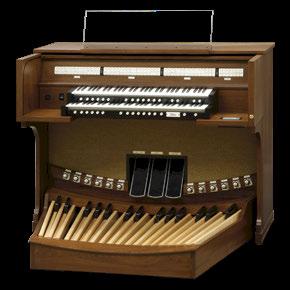
Definitions:
Toe studs
Crescendo pedal
Expression (or swell) Pedals
Pedalboard
The best news is that (for the most part) things are labeled. Even if parts of the organ are in different places, they’ll be labeled or operate similarly. Use the following definitions to help you track things down. This isn’t an exhaustive list but should give you plenty to work from and keep you from getting lost!
General Pistons: These buttons (often found on the left side of the organ beneath the manuals) serve as preset buttons where combinations of stops can be saved. On some organs, these buttons can be located elsewhere, but you can easily tell what they do because they’ll allow you to save combinations for the whole organ.
Stops: Sometimes appearing as knobs on the side of the console, flip tabs above the manuals, or lit tabs as shown in the picture on the previous page, stops are how we control what sounds engage on the organ. Fun fact: The phrase “pulling out all the stops” is an organ influenced term!
Divisional Pistons: These buttons (often found in the middle of the organ beneath the manuals) serve as preset buttons where combinations of stops can be saved, but only for a specific division (like the great or swell.) They are often located beneath their “assigned” division.
The Swell Division: This manual (or keyboard) is connected to the stops grouped near a label that reads “swell”. On a two manual organ, it will be the top manual.
The Great Division: This manual (or keyboard) is connected to the stops grouped near a label that reads “great”. On a two manual organ, it will be the top manual.
Toe Studs: These buttons are located near the pedalboard. Look for labels because they can serve a few purposes. Sometimes they’ll double a general piston (sometimes both hands are busy, so a free foot can press one. These are often found to the left of the expression pedals). Other times they’ll serve as the pedal division’s divisional pistons (often on the right side of the expression pedals).
Crescendo Pedal: Not all organs are equipped with one of these, but it is located near the expression pedals. It will be labeled. This pedal gradually adds stops as it is opened and removes them as it is closed. Its standard position is closed! If left open without being aware, it can confuse an organist!
Expression (or swell) Pedal(s): These pedals often have a label above or below them indicating what division (or set of stops) they control. These operate differently than a crescendo pedal and only adjust the volume of a division by opening and closing shutters (or simulating that action).
Pedalboard: This is the pedal board that we play using our feet. The stops connected to this division are grouped near a label that reads “pedal”.
Other Terms that we’ll learn but I didn’t label in the diagram:
“Cancel” Piston: This piston (often located below the great manual on the far right side) could be labeled with “cancel”, or a “0”. This cancels are stops currently engaged.
“Set” Piston: This piston (often located below the great manual on the far left side) is often labeled “set” and if pressed and held while pressing another piston can save combinations of stops to the selected piston.
Couplers: Can be labeled in a variety of ways and be in several places, but will be formatted like this: “Sw. to Gt.” or something similar. This pulls sounds from one division to another.
Tutti piston: Can be labeled in a variety of ways and can often be found under the swell manual on the far right side. It engages all the stops on the organ. Sometimes there’s two of differing levels.
Pro-Tip from Connor: If you see a button that doesn’t look familiar…try it out! There’s no shame in testing things to figure out what they do. I do it all the time!
One of the most common questions I hear from new organists is “what stops do I use?” and boy do I wish I could just give you a list of exactly what to do! This class will introduce the different families of organ tone, and then we’ll talk about how to being to think about combining them.
To create different sounds from the organ, we build pipes in different ways. The biggest things that change are the materials used, the length, and the shape. These adjusted physical characteristics change how the pipe sounds, and we categorize these sounds and construction methods into several categories.

Families of Organ Tone
Reed Pipes
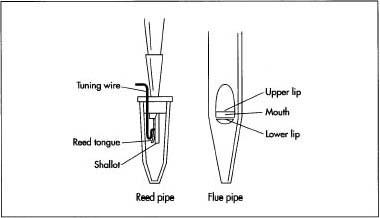
Flue Pipes
This first division we make is between pipes with a reed (like a woodwind instrument) and pipes without one. A diagram showing examples is shown above. Now let’s extend our “family tree”.
Families of Organ Tone
Reed Pipes
Reeds
Flue Pipes
Flutes
Strings
Principals
One of my favorite parts of playing the organ is listening to other organists describe the sounds that different stops make. Here’s some examples using the families listed above.
Reeds: Reedy, Brassy, Trumpety (Look for brass and woodwind instruments in the name)
Flutes: Flutey, Round, Warm (Look for the word flute, flöte, etc. in the name)
Principals: Firm, Full, Clear (Look for diapason, principal, or an interval in the name.
Strings: Thin, Sharp, Stringy (Look for modern and ancient string instrument names.)
One of the other helps in organ registration is the number on the stop. This number represents what octave the stop will sound in.
Our standard concert pitch is 8’. So, an 8’ stop playing a middle c would match middle c on the piano. As we move up and down our “ladder of pitches” we move up and down octaves of pitch so we can layer octaves to support the tone and create new combinations.
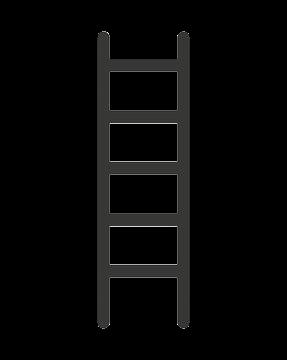
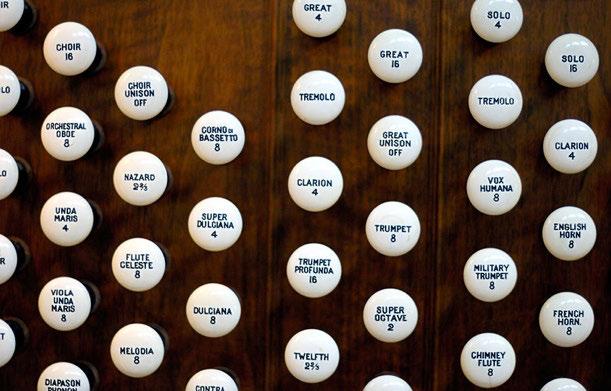


As we build up pitch levels we can build upward for clarity of sound as shown with the ladder or build out for richness with the pyramid. To build “out” we use several 8’ stops, less 4’, and less 2’. From there reeds or mixtures can be added.
Higher pitches create: Brightness, clarity
Lower pitches create: Foundation, thickness
Remember! There are many ways to combine pitches of organ tone. This is just one technique that can be used.
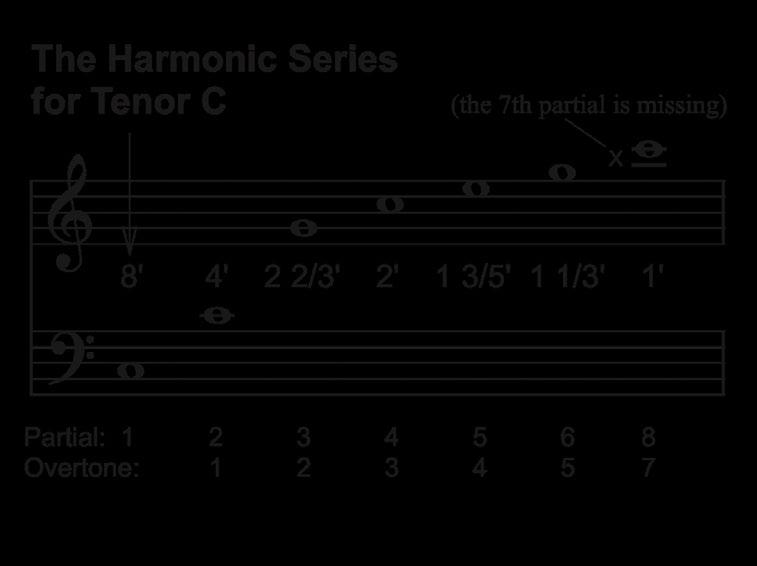
This diagram from Don Cook’s “Organ Tutor 101” helps capture how mutation stops (or those with fractions) are heard by the ear.
Brigham Young University – Summer 2026
Instructor: Connor Larsen
Now we can really get to some orchestration. The biggest complexity we have, is that not only do we have to make the decision, but we must execute the change as well! We’ll now talk about how to make a registration plan, and how to execute it. Some general guidelines.
1-Be true to the composer first: Start where the composer indicates. If performing pieces from the repertoire, additional thought can be given to what their instrument would have sounded like. Even similar stop families don’t sound exactly the same as you get around the world!
2-Use a variety of console devices: Find what’s easiest to reach. Don’t over-set things. If you have a combination, you keep returning to, find a piston that’s easy to reach and set it there. Use the same one for every spot, your accuracy will be better! If you’ve got a really tough change, place it in the easiest to reach place on the console!
3-Don’t set yourself up for failure: If parts of the organ don’t work or get stuck, don’t get surprised if they don’t work when you try to use them!
Here’s a couple of approaches to planning registration for a piece.
1-Front to Back: Sometimes it’s best to just start at the beginning of the piece, and plan each registration and change through to the end.
2-Build-up: Crescendos/Decrescendos can be tricky to successfully execute. Try setting your quietest point and your loudest point and then identifying what you need to bridge those two points and saving them in between.
3-Take-down: This is the opposite of the build-up approach, but it keeps you from going “too big.” This is especially helpful if you’re tastefully avoiding full organ while still maintaining a strong registration.
4-Point to Point: This approach would be helpful in a piece that calls for specific combinations. You’d move from point to point, saving the registration at each point.
Now how do we execute things?
1-By hand: Perhaps you’re only changing one stop. Would it be worth taking up a slot where something else could be saved on a piston? Try grabbing it by hand!
2-Divisional Piston: If you’ve got a big change in one division, try a divisional piston to leave more general pistons for bigger changes.
3-General Piston: These are great for starting points or big changes in a piece.
Don’t forget that expression pedals can be used to help ease changes, provide dynamic shape, and can really change the whole tone of a combination. Expression pedals should generally be used gently and almost unnoticeably but could also be kicked open for quick changes in dynamics. Get used to using them as your pedal or play other passages!
Now, let’s talk the actual changes:
1-Make sure it saved! Check your combinations quickly before you use them. It could be tragic to learn someone had changed your combination on the spot.
2-Get free: Make sure you have a hand, thumb, pinkie, toe, etc available to make the change. Sometimes this could require redistributing chords to make sure your hand is available.
3-Make the Change: Hit it!
3-Get back to the music: Make sure you’ve got a sufficient exit strategy so there’s no lapse in the music.
Connor’s tips:
Here’s some tips to keep in mind:
-Just because we call them thumb pistons doesn’t mean you can only hit them with your thumb. If you’ve got a firm and strong pinkie available that helps you keep you hand more locked where it’ll need to go, do it!
-Be open to saving things differently than you’re used to. Sometimes you need a coveted piston or toe stud to catch a particularly difficult registration change. Be open to that, but mark it clearly so you don’t forget!
-As you jump around organs, try and save things similarly. It’ll help your muscle memory and give you a bit more bandwidth to use while playing!
-Keep your ear open for delays, and other technical difficulties that may arrive. Make note and do your best to navigate around them.
-Don’t get too flustered if you miss something, just make a quick decision on what is the least distracting way to fix it. Sometimes that’s don’t nothing and catching the next piston change!
-Pedal divisional toe studs are your best friend when it comes to adding a rumbling 32’ to a combination. Ped. 1 is one of my most used console devices!
-Sometimes you don’t need a combination change, you can just open/close the expression pedals.
-Get used to using both feet to adjust the expression pedals. They can be incredibly helpful and you don’t want to limit yourself.
-Try things! If one physical layout of pistons doesn’t work, try something else.
-Make careful markings so you don’t forget what your plan is!
Tips 8/4/26 Thursday 3.30 – 4:20 and 4:30 – 5:20 pm
Presented by Dr. Linda Margetts
“In the books on piano playing I have read I have found much dogmatic and ill-humored divergence of opinion…except on one point: sight reading. Without a single exception, the authors took this stand: The best way to develop your sight reading is to sight-read.”
Charles Cooke, author of Playing the Piano for Pleasure”
Or as Bonnie Goodliffe is quoted as saying, “You can pray to the angels, but they can’t do your practicing for you!”
…..So, how about a little help practicing!
This class will discuss research by K. A. Thompson (2004). Thinking in sound: A qualitative study of metaphors for pitch perception. Journal of Music Theory Pedagogy, 18(1), 127-160. https://digitalcollections.lipscomb.edu/jmtp/vol18/iss1/5/
Seven metaphors for pitch perception are presented: 1. Follower 2. Contour singer 3. ButtonPusher 4. Builder 5. Tonal thinker 6. Pitcher and 7. Chunker
Abstract
The mission for aural skills instruction is to enable students to think in sound. Each fall college teachers meet freshmen with varying levels of experience and ability in music reading and listening. Selecting appropriate strategies for teaching students to auralize, to "hear"how notated music sounds in the absence of physical sound, is difficult not only because of students' different skill levels but also because research in aural skills pedagogy has not indicated an ideal sequence of instruction. Most textbooks present a good variety of exercises but little conceptual framework, leaving that to the teacher's discretion. This qualitative study was initiated to help an aural skills teacher with absolute pitch understand how relative pitch skills develops. Participants were 23 undergraduate students enrolled in aural skills classes at a liberal arts university. Based on students' previous experiences, their responses to auralization tasks, and evaluation of their sight-singing, metaphors were suggested to characterize strategies to internalize pitch from musical notation. Students assessed their own strategies and then evaluated the effectiveness of the metaphors for discussing their process for internalizing pitch. Findings provided observations about the development of relative pitch and raised issues about the use of solmization.
“I strongly feel that the basic reason we have so many poor sight-readers at the keyboard, is because the students at the very beginning have been tied to “music spelling” and have not been taught to read by intervals and by direction, as related to the keyboard, the hand position, and the staff..” Evelyn S. Starkey. Clavier VII, No. 4,April 1968 Pg. 4.
In this respect, the presentation last year: “At Ease inAll the Keys” is helpful in sightreading. As I received a piece of music to sight-read from Richard Elliott, he first paused as he handed it to me, took it back, and quickly notated, above the staff, the letter name of each chord (Major chords were capitals and minor or diminished chords were lower case.) Each chord was followed by a slash and the name of the bass note in upper case (i.e. C/E would be C Major in first inversion. c/E would be c minor in first inversion. And c°/E would be c diminished in first inversion and C+/E would be C augmented 1st inversion.)
Brigham Young University – Summer 2026
Instructor: Connor Larsen
The “Rules” of Solo/Accompaniment Registration:
1-Hands will be playing on different manuals
2-We build upon an 8’ set of stops in the manual, and 16’ in the pedal. Pedal will often function as the bass. Theoretically, it could also operate as the solo.
3-One part stands out compared from the rest, while the other provides accompaniment.
What types of music call for chorus registration? Standard hymns played in creative styles, repertoire, hymn preludes, etc.
What score markings should I look for? Manual indications close to one stave (even if they don’t have a line to indicate), Registration indications that indicate one hand apart from another, differing numerals or dynamic markings for different staves.
The point of a solo/accompaniment registration is that one part is a solo, and the other an accompaniment. At it’s heart, one part just needs to stand out from the other. Keep some of the ideas if chorus registration in mind when thinking about dynamics (8’, 4’, 2’ would be louder than an 8’ accompaniment.) My hope is to expand your view of what you could use as a solo. Below I’ll provide some combination ideas at different dynamic levels, and I’ll attempt to translate them into whatever organ you have at your disposal.
Some quick tips:
-Try using different families of tone in your accompaniment/solo so they really stand out from one another.
-Sometimes you’ll need to swap where your accompaniment/solo is depending on where the desired stop is. This can be fun and challenging to make things work in the way you want.
-Trust your ear to decide if things are balanced!
Piano/Pianissimo Combinations
First, one of my favorites…strings as an accompaniment! Here’s some thoughts.
Swell: Strings 8’ (with celeste)
Great: This is where your solo would be. Here’s some options:
8’ flute
All of the 8’ stops (especially effective an octave lower),
8’ & 4’ flute
8’ and 2’ flute (this is called a gap registration. The gap is the lack of a 4’.)
A warm 8’ reed (a clarinet/krummhorn) You could include an 8’ flute for warmth. Chimes
If you have a celeste on the great, you could also pull a solo from the swell!
Swell: Flutes 8’ (and 4’)
Great: This is where your solo would be. You would want to avoid flutes that blend with the accompaniment, our goal is to have it stand out.
All of the 8’ stops (especially effective an octave lower),
8’ and 2’ flute (this is called a gap registration. The gap is the lack of a 4’.)
A warm 8’ reed (a clarinet/krummhorn) You could include an 8’ flute for warmth.
Mezzo-Piano/Mezzo-Forte Combinations
These could be helpful as combinations you could use in most hymns. A registration like this could help a congregation with a new hymn.
Swell: 8’ Trumpet (could add 4’ reed for brightness or 16’ for breadth.)
Great: Principals 8’ and 4’ (could add 2’ for brightness, or 16’ for richness.) You could also use the great trumpet as a solo, and place your accompaniment on the swell with those principals.
Swell: 8’, 4’ (maybe a light 2’)
Great: Principals 8’, 4’, 2’ and mixture. Though from the same family this could provide sufficient brightness to be a solo.
Forte/Fortissimo Combinations
These could be helpful as combinations you could use in loud and energetic hymns.
Swell: Principals 16’, 8’, 4’, 2’, mixture (maybe an 8’ reed)
Great: 8’ Solo Reed (this would be a large reed like a tuba, or sharp trumpet. You could easily swap this manual with the swell if your tuba is located up there!)
This shouldn’t serve as an exhaustive list, but something to give you a start with. Try other combinations!
A dynamic, fast-paced organ program with three workbooks that teach the basics of playing the organ for congregational singing, using organ arrangements of 52 Latter-Day Saint primary songs.
Each Organ for Primary level is divided into six units. Units include the following sections and information:
-how the organ works and functions
-how to use your feet correctly through pedal techniques
• Organ Console
• Organ Stops, Rails, and Jambs
• After Playing the Organ
• Organ Sound vs. Piano Sound
• Families of Organ Tones
• Registrations
• Composer Clues
• Pipe Ranks and Divisions
• Expression Pedals
• Crescendo Pedals
• Organ Shoes
• Bench and Body Positions
• Pedal ABC’s
• Organ Pedaling
• Alternate Toes
• Prelocation, Pivoting and Intervals
• Ostinatos
• Pedal Lines
• Non-Legato Spacing
• Legato and Non-Legato
• Counting A Must!
• Music Blocks
• Direct Fingering
• Redistribution
• Finger Crossing
• “Bottom to the Top”
• The 2 P’s: Prepare Music and Positions and Practice Smart
• Independence of Line
Other tools included are: Extra Mile Challenges; Review Challenges; Fold-out Guide; Families of Organ Tones; Two - Manual Organ Stoplist; Three-Manual Organ Stoplist; For Your Information; Bibliography; and Answer Keys
• The Pipe Organ and How it Works
• Hybrid Stops
• Flue and Reed Pipes
• Harmonic Series
• Mutations
• Solo Registrations
• Compound Stops and Mixtures
• Celeste Stops
• Non-Speaking Stops: Couplers
• Non-Speaking Stops: Tremulant and Unison Off
• Repeated Notes Between Voices
• Gliding
• Toe-Heel Pedaling
• Marking the Pedal Part
• Foot Substitution: One Foot
• Foot Substitution: Toe to Toe
• Fingering Questions
• Finger Glissando
• Common Tone Rule
• Practice Tools Review
• Articulation
• Measuring Non-Legato Spacing
• Adding Voices
• Position Check Review
• Organ Volume Changes
• Ensemble or Chorus Registration
• Tips for Choosing Hymn Chorus Registrations
• Registrations for Louder, Brighter Hymns
• Solo and Accompaniment Registration
• Cornet
• Combination Action: Pistons and Toe Studs
• Combination Action: Setting Pistons and Toe Studs
• Heel Slides
• Finding the Octave
• Gliding using Navigation Points
• Foot Substitution: Foot Options
• Pedal Scale Lines
• Foot Glissando: Black to White
• Using the Expression Pedal
• Foot Crossing: Black Keys
• Foot Crossing in Scale Passages
• Foot Crossing: Two-Plane Pedaling
• Foot Glissando: Black to Black
• Sustaining Notes in the Same Hand
• Finger Substitution: One Note
• Legato Thirds in RH and LH Hands
• Finger Substitution: Two Notes
• Thumb Glissando
• Marking Your Own Music Blocks
• Hymn Texts and Registering between Verses or Choruses
• Accents on the Organ
• Manual Registration Changes
• Playing Legato Between Parts
• Preludes and Postludes
• Page Turns & Introductions
• Tips for Learning a Four-Part Hymn
• When to Tie and Not to Tie
For ordering or questions contact Laurie Swain at
• Start young or old: 6, 7, or 90 years old or about a year or two into piano studies and fairly comfortable with two octaves of music notation (Organ for Primary does not teach music notation. A piano background is a help to any organist.)
• Get access to organ shoes and an organ: church, store, home, used organ, organ builder, etc.; organmastershoes.com for shoes
• Decide when you are going to teach or practice organ: summer camp, monthly group, weekly segment, private lessons, before or after a piano lesson, daily practice time, etc. Remember, consistent organ practice makes the difference in good organ playing
• Find a way to provide accountability: Play for someone, record yourself, go to a workshop, participate in a recital, church service, NFMC festival, etc.
Level 1
Level 2
“Bottom to the Top” practice method; Preparing Music & Positions and Practicing Smart- the 2 P’s; Importance of the Independence of the Line
All songs in Level 1 will implement these concepts
Level 3
Articulations and NonLegato Spacing
Solo Registration & Registration ChangesChanging Manuals
Practice tools Review and More Practice Tools
Registration Changes: By Hand, Combination Action & Text Importance
“A Prayer” (Two-part & Three-part)
“Reverently, Quietly,” “When I Am Baptized”, The Chapel Doors”
“A Prayer” (Three-part), “Father Up Above” (Three-part) “Seek the Lord Early”, “I Want to Live the Gospel”
“Dare to Do Right”, “Can A Little Child Like Me?”, “We’ll Bring the World His Truth”, “Baptism”, “The Holy Ghost”
Additionally use any three part songs focusing on the pedal and LH first going for accurate, independence of line, and precise releases: The New Ward Organist three-part hymns; Croft’s Nine Hymn Studies, Dr. Harmon’s Hymn Settings for Organ, volume 6; Dr. Cook’s Easy Organ Hymn Settings, Organ Tutor Workbook, etc.
Use any three-part hymns listed above
Hymn Text and Accents on the Organ
“I’ll Follow Him in Faith”, “The Church of Jesus Christ”
Marking Music Blocks & Page Turns ”Mary’s Lullaby” (Four-part), “Easter Hosanna”, “Oh, Hush Thee, My Baby”, “The Things I Do”, “If the Savior Stood Beside Me”, “I Know That My Savior Loves Me”, “I Will Follow God’s Plan” When to Tie and Not to Tie “Teach Me to Walk in the Light” (same as in hymnal)
Introductions, Preludes & Postludes “This Is My Beloved Son”, “Families Can Be Together Forever”, “Search, Ponder & Pray”
Start simple four-part hymns such as “Sweet Hour of Prayer”, “I Know My Father Lives”, “Nearer, My God to Thee”
Any Four-part hymn
“How Gentle God’s Commmands”
Any Four-part hymn
BYU Organ Workshop 2026
Elizabeth Forsyth
The Organ Music of Michael Burkhardt
Easy
EasyHymnSettings,General
Set1:ILoveYourKingdom,Lord(LDSComeWeThatLovetheLord);OGod,Our HelpinAgesPast; AshGrove;AMightyFortress. MorningStarMusic(morningstarmusic.com)MSM-10-815
Set2: FortheBeautyoftheEarth;Jesus,theVeryThoughtofThee;ComeThou AlmightyKing(GlorytoGodonHigh,LDS#67);MyCountry,‘TisofThee MSM-10-715
EasyHymnSettings,Advent-Christmas MSM-10-015
HeisBorn;JosephDearest,JosephMine;OnceinRoyalDavid’sCity
EasyHymnSettings,Christmas MSM-10-115
Oh,Come,AllYeFaithful;AngelsWeHaveHeardonHigh;AwayinaManger; SilentNight
Helps with Hymns
Asthoughthewholecreationcried…FiftyHymnHarmonizations Vol1: MSM-10-555, Vol2:MSM-10-606
FestiveHymnSettingsforAdvent,ChristmasandEpiphany MSM-10-178 OCome,OCome, Emmanuel;AwayinaManger;TheFirstNoel;OLittleTownofBethlehem(usesbothtunes!); TheFirstNoel
‘TistheSeason(CarolAccompanimentsandDescants)MSM-10-129 SilentNight,Joytothe World,OLittleTownofBethlehem,ItCameUpontheMidnightClear,OComeAllYeFaithful
Repertoire
PraiseandThanksgiving: HymnImprovisations
Set3MSM-10-753 TheGodofAbrahamPraise(singleavailableonsheetmusicplus)
Set4MSM-10-754 MorningHasBroken,NowThankWeAllOurGod(singleon sheetmusicplus),ForTheBeautyoftheEarth
Set7 OGod,OurHelpinAgesPast;FaithofOurFathers,InTheeisGladness
The Music of Michael Burkhardt
EightImprovisationson20th-centuryHymnTunes
Set1MSM-10-707: IWanttoWalkasaChildoftheLight;ChristmasHasItsCradle Set2MSM-10-533: GodWeepswithUsWhoWeepandMourn;Here,OLord,Your ServantsGather
5LentenHymnImprovisations MSM-10-309 OSacredHead(LDS#197),Hosanna,Loud Hosanna(LDS#41),MySongisLoveUnknown
ThreeHymnImprovisationsforOrgan MSM-10-654 BeautifulSavior,WhenPeaceLikea River
VoluntaryonHymntoJoy MSM-10-729
AmericanFolkHymnSuiteforOrgan MSM-10-835 ShallWeGatherattheRiver;ComeThou FountofEveryBlessing
SixGeneralHymnImprovisations
Set1MSM-10-846 DearestJesus,atYourWord(LiebsterJesu)
SevenHymnImprovisationsandFreeAccompaniments,set2 MSM-10-860 BeThouMy Vision(preludeandFA), WiththeLordBeginYourTask
AriaMSM-10-170
AttheNameofJesus: FourHymnsofDevotion MS-10-747 Preludeon“TheCall”(Vaughan Williams);Come,LaborOn(OraLabora)
TheBalboaParkOrganSuite(ACelebrationofManyPeoples)MSM-10-710 ThemeandVariations(SimpleGifts) Andantetraquillo(BaiandArirang)
CarolMiniature(IsladelEncanto-PuertoRicancarol) FestivalMarch(BattleHymn/LiftEveryVoiceandSing)
* Almost everything is also available on sheetmusicplus.com, either hard copy or download
Page 1 of 2
What does it mean to be a teacher of the Gospel?
Is it possible to “teach” without using words?
If your playing can be considered teaching, what preparation goes into that playing?
Does being more spiritual affect your organ playing?
Is prayer a legitimate part of performance preparation?
Is prayer a substitute for practice?
Can you be a vessel for the spirit? Can the Lord work through you?
What does it mean to “play the text”?
Can the organist bear their testimony with their playing?
Why are we encouraged to use hymns in our organ-only playing?
Do you choose prelude or other music in consideration of the text of the hymns?
What is appropriate for what occasions?
Does it need to be “familiar” to the listener? (One organist always ends prelude with a Primary song which most people in the congregation of all ages will recognize.)
Should we play a given piece of music differently depending on the occasion?
Can tempo and registration affect the way the piece affects the listener?
In a performance setting, what is within your control?
How do you deal with negatives which are outside your control?
Which influences should you seek? Which should you avoid?
Yes, we want to improve the taste of the members of the congregation – does that mean we should impose our own taste on them?
For we know that it is by grace that we are saved, after all we can do. – 2 Nephi 25:23
August 2026
Page 2 of 2
[John] Walker has often quotedAlec Wyton’s maxim that “the church musician should be first, a pastor; second, an educator; and third, a performer. If we keep our priorities in that order, we will be successful.” Walker adds that everyone who works in a church should be a pastor of some sort that the sexton is the “minister of the broom” and the organist is the “minister of music.” He has often spoken of the organist as “preaching from the bench” and ministering to the choir and the congregation through music. He notes that an organist with this vision understands that everything one does as a performer should pass through the lens of ministering to the choir and congregation, first as a pastor and then as an educator.
From “John Walker Church Musician” by Wendy Johnston. TheAmerican Organist, Nov. 2025, p. 62.
John Walker (1941 – ) is anAmerican concert organist, choirmaster and teacher who has held positions at Riverside Church in NYC, Manhattan School of Music, Shadyside Presbyterian Church in Pittsburgh, Brown Memorial Church in Baltimore, and Peabody Institute in Baltimore (2005-2025).
Alec Wyton (1921-2007) was an English organist, choirmaster, composer and teacher whose career included two decades as organist and choirmaster at New York’s Cathedral of St. John the Divine.
Call on God, but row away from the rocks – Old Proverb
The Physics of Music Part 1 Wednesday August 3, 2:30 – 3:20 pm
The Physics of Music Part 2 Thursday August 4, 2:30-3:20 pm
Presented by Dr. Linda Margetts
This class will discuss the physics of our earth and how a “firmament” and a miraculous “cochlea” were designed by God to accomplish “music.”
What Physics Teaches Organists: Better listening. Better registration. Better tuning awareness. Better understanding of instrument design.
We will discuss how the Hall, Human perception and Harmonics (or the types of pipes and ranks) make up the physics of organ registration.
Thinking of the organ pipe as a physics laboratory we can see why pipes sound diQerent, how tuning works, and why rooms matter. With our recent work on the Tabernacle Organ in Salt Lake City, the results of upgrading winding and adjusting for optimal pressure at each pipe is improving the organ’s sound in the room.
Sound begins with motion. Sound is vibration. Every object has natural frequencies. “Moving air ” carries energy and our ears detect pressure changes. Sound travels as pressure variations. Air molecules oscillate and Energy moves forward while matter mostly stays in place. Amplitude relates to sound- energy but loudness perception is not linear and registration aQects perceived loudness. Pipes and their shape reinforce selected frequencies, and controlled resonance, is vital to organ building. We will discuss reeds as vibrating sources and how the harmonic series is present in nearly every pipe. What stopping a pipe adds to the quality of the sound. Why stops sound diQerent and what mixtures are and what they add.
The subject of wave interference and its importance to acoustics and how beats are produced and used for beauty in celeste stops. The reality of temperament and why it matters.
How sound works in buildings and how reflection, absorption, diQusion and direct sound all play their parts as the room becomes part of the instrument. Why fast passages blur and what organists can do to adapt. How registration and acoustic awareness improves performance.
The Key Takeaways: Sound is vibration and resonance. Pipes shape harmonics. Harmonics create tone color Rooms shape what we hear The organ and the building form one instrument.
A respected organ voicer and builder suggested that if he had his way, the stops on his organ would have no notations on the draw knobs. The organist, seated at the organ, would be forced to use her ears and brain to determine each stop’s pitch, tonal color, volume, how the rank spoke and resonated through its range; then combine stops using her knowledge of the PHYSICS OF MUSIC.
OrganTutor Organ 101 helps teach basic organ skills to the pianist. It serves like a “teaching assistant” that the student can call on between lessons to demonstrate and describe manual and pedal techniques and teach organ registration, hymn playing, and other general concepts. This frees up the live instructor to do what he/she does best: hear and see the student play, and then provide the kind of feedback and direction that only a human can offer.
OrganTutor uses a new approach to help teach an old subject – it is an interactive multimedia organ tutorial:
• INTERACTIVE. OrganTutor responds to information provided by the user. Its responses are customized to user needs.
• MULTIMEDIA OrganTutor uses various types of media: text, photographs, drawings, sound, and video.
• ORGAN TUTORIAL. This “Tutor” was created as an aid to ‒ not a replacement for ‒ the live organ instructor.
Students can come to their lessons or classes better prepared and with more confidence with the help of OrganTutor:
• 62 complete lessons
• Over 140 video demonstrations easily accessible with QR codes in the Organtutor Workbook
• Over 250 audio examples that play through the computer speakers or headphones
• Hundreds of photographs and illustrations
• Self testing: Quick Reviews and Lesson Tests with feedback
• Hundreds of hypertext links and pop-up definitions
• Used in college organ courses by over 7100 students since 1996
• Written by Dr. Don Cook (doncook2931@gmail.com), a veteran university organ professor and church organist
• Useful as a complete course or as a reference tool
• Runs through a standard web browser on PC or Mac, on tablets, or smartphones (high-speed Internet required)
• Easy to use, with convenient point-and-click operation
Students can work systematically through all 62 lessons by following the Weekly Preparation Guide. OrganTutor teaches organ registration, hymn playing, and other general concepts in “study lessons.” Lesson Objectives are provided for note taking to help focus on the most important points of each study lesson. It also offers specific direction in legato manual and pedal technique and in hymn playing projects. Exercises and projects are modeled in “Video Demonstrations”. These, along with the Helpful Hints in the workbook, lead to deep learning.
Students may also use OrganTutor as a practical reference on specific topics. The lessons are grouped under six units, each of which contains a series of lessons on that topic that can be studied as needed or in order:
•General Concepts • Manual Technique • Pedal Technique • Organ Registration • Hymn Playing • Projects
Teachers can use OrganTutor as a sort of “teaching assistant” by sending the student from each organ lesson with an assignment, which may include selected lessons in one or more of the units. For example, an assignment from Stage 3 of the Weekly Preparation Guide might include the following lessons:
• Finger substitution (exercises in the Workbook with video demonstrations in the Manual Technique unit of the online tutorial)
• Pedal Group 4: Single Foot on Naturals & Natural/Sharp Combinations (exercises with video demo’s in the Pedal unit)
• Organ Types and Components (a study lesson in the Organ Registration unit of the online tutorial)
• Hymn Playing: Introduction (a study lesson in the Hymn Playing unit of the online tutorial)
Working through these lessons at their own pace, the student can use the following learning aids to prepare for the next organ lesson:
• Video demonstrations and written instructions for the finger substitution and pedal technique exercises
• A helpful list of “Do’s and Don’ts” for those exercises
• Photographs and textual descriptions on Organ Types and Components
• Score examples, audio examples, and textual descriptions on the basics of hymn playing
• Quick Review questions and a Lesson Test in each study lesson to assess their understanding of the concept
Order through the website: organtutor.byu.edu
The OrganTutor Workbook $23.00 + s/h (292-pages), $9.50 in pdf format, digital delivery Discounts for the workbook (20%) are available for organ or piano teachers. Email organtutor@gmail.com OrganTutor Online Tutorial subscription $30 (6 months) or $50 (3 years) (no discounts) (or email organtutor@gmail.com for a free 2-week subscription code). For lesson plans, courses, and other supporting materials, visit the Organ Study at BYU website organ.byu.edu
OT and P Hymn
Project 2. Choose a three-part hymn setting from pp. Hymns 11-13. Continue using the practice steps on p. Hymns 8. Begin practicing single parts and two-part combinations only. Play for your instructor at various stages of your progress. The finished pieces is due by the beginning of Stage 5 .
Pedal Technique (p. Pedal 3: “Naturals”)
P Group 4 (pp. Pedal 11-13)
P Finger Substitution (pp. Manual 29-35)
OT Organ Types and Components (Organ Registration unit) (Intro 11-19 Suppl.)
Stage 3
OT Hymn Playing—Introduction (Hymns 60 Suppl.)
P Group 5 (pp. Pedal 14-15) P LH/Pedal Studies. Learn at least four during the course, LH and pedal parts only. Choose from pp. Hymns 11-13. The first LH/Pedal Study is due by the beginning of Stage 5
P Redeemer of Israel—soprano & tenor (pp. Manual 6-8)
OT Using Console Devices (Organ Registration unit)
dates________
Hymn Project 3. Learn step 13 on p. Hymns 18 or p. Hymns 25. Continue using the practice steps on p. Hymns 8. Begin practicing single parts and two-part combinations only (both hands on the Great). Play for your instructor at various stages of your progress. The finished project is due by the beginning of Stage 7 .
Group 6 (pp. Pedal 16-18)
Blest Be the Tie (How Gentle God’s Commands)—soprano & tenor (pp. Manual 9-11)
OT and W Pitches of Organ Stops (Organ Registration) [Registration 23-25 Suppl.] (Written assignment on p. Registration 3)
Stage 4
dates________
Stage 5 dates________ OT Touch (General Concepts unit) (Intro 21-23 Suppl.)
Hymn Playing—Phrasing (Hymns 60-61 Suppl.)
Susanna Karrington, Instructor
Nicole Keller in her article on Florence Price in The American Organist (Jan 2024) said, “Our responsibility to the craft of organ composition and the legacy of the instrument...includes a vigilant commitment to the continual expansion of the canon.”
Regarding rising interest in Price’s music and the pedagogical organ legacy she says it gives “ear to a voice that lay silent for decades within the familiar world of American organ composition in the early and middle 20th century.” This sentiment might aptly describe so many women organists and composers through the centuries whose voices have been silent.
Swedish organist Elfrida Andrée had as her mantra “the elevation of womankind.” She struggled to find work as a musician and organist She was the first woman to graduate with a diploma from the Royal Swedish Academy of Music as an extramural student since women weren’t allowed admission.
Her organ teacher had engaged her as organist in St James’s Church, Stockholm, but the clergy would not let her play saying:
the sight of a woman on the organ stool [would be] indecorous and disruptive of devotion. Moreover, Paul has said: “Let your women keep silence in the churches.”
She went on to become the first woman organist hired to the post of cathedral organist in Gothenburg, Sweden in 1867. Women were not allowed to lead congregational singing until 1905 when her post was expanded to include organist and Kantor.
Her story is not unlike many women organists who were pioneers in the field. Many women organists composed and arranged pieces for organ while some were primarily performers and teachers.
Here we are not providing an exhaustive list, but rather highlighting just a few, including examples of both technically accessible repertory and that which is more challenging.
When building service playlists or expanding your student repertoire, the Society of Women Organists directory is an excellent resource for discovering underrepresented organ works. The group tracks statistics and reports new achievements and lost works by women organists.
❖ Florence Beatrice Price, celebrated first black American symphonic composer, has several organ compositions including: 15 shorter, more accessible pieces with character type folk idioms she calls “negroid” in character and 4 larger-scale works Her Sonata for organ is patterned after Guilmant’s Sonata No. 1 Op. 42.
❖ Elfrida Andrée left a large body of symphonic, choral and organ works. Her Cantilena for organ is written with orchestral influence and is an accessible short piece and found below along with her biography.
❖ Gillian Weir from New Zealand is known for the Messiaen competition and for introducing his works outside of France. As detailed in her official biography, Dame Gillian Weir became the first organist ever to win the Evening Standard Award for Outstanding Solo Performance following her landmark 1998 Messiaen series at Westminster Cathedral.
❖ Clara Schumann edited her husband’s pedal piano works explicitly authorized for organ performance. Many of her own works are adapted and edited for the organ. This includes the Prelude and Fugue for Organ Op. 16, No. 2 edited and arranged by Dr. Harbach, herself a champion for women composers and organists.
❖ Marie-Claire Alain, one of the great organists of the 20th century, devoted herself to preserving and promoting her brother’s works. She was the interpreter, editor and champion of Jehan Alain. Her recordings of J. S. Bach’s organ works, and “Litanies” are readily available.
❖ Emma Lou Diemer studied with Hindemith (at Yale), Sowerby and Berngard Heiden. A prolific composer, she wrote more than 100 pieces involving the organ. She won the 1995 AGO Composer of the Year award.
❖ Jeanne Demessieux, protégée of French composer and organist Marcel Dupré, known for her improvisation and excellent pedal technique while playing in high heels, left a great legacy. She was a virtuoso concert organist who made her debut
appearances in 1946 at age 25. She left many compositions but is best known for her output for the organ, including the Te Deum, Op. 11.
❖ Mel Bonis, named Mélanie, intentionally adopted the ambiguous pseudonym "Mel" to prevent publishers from dismissing her work out of hand based on her gender. In 1910 she was appointed secretary of the Société des compositeurs de musique, a notable feat for a female artist at the turn of the century (Géliot).
Many organizations and churches internationally are regularly programming works by women, particularly during Women’s History Month and International Women’s Day. In Sweden panelists comprised of all women recently held discussions about concerns and successes experienced by women organists.
Isabelle Demers recently performed live in Salt Lake City in May 2026 at the Tabernacle Virtuoso series with another appearance at BYU in July. She is one of many women organists touring and performing today and being featured as a soloist.
Women organists performing at Temple Square regularly play their own arrangements of hymns and old folk melodies in programmed recitals. Linda Margetts and Bonnie Goodliffe each also contributed a piece commissioned by the Salt Lake Chapter of the American Guild of Organists for the 2017 West Region Conference in Salt Lake City, Utah. Both appear in the anthology Reflections.
Resources:
"The Organ Music of Florence Price: A Pedagogical Perspective" by Nicole Keller. The American Organist (Jan 2024), pp. 50–52.
"Society of Women Organists," Society of Women Organists, accessed July 13, 2026, https://www.societyofwomenorganists.co.uk/.
"Elfrida Andrée (1841–1929)," Swedish Musical Heritage. swedishmusicalheritage.com.
Öhrström, Eva. "Elfrida Andrée (1841–1929)." Swedish Musical Heritage. Royal Swedish Academy of Music. Accessed July 13, 2026.
https://www.swedishmusicalheritage.com/composers/andree-elfrida/.
Weir, Gillian. Official Website. Accessed July 13, 2026. https://www.gillianweir.com/.
Barbara Harbach, "Preludes and Fugues for Piano, Op. 16," Barbara Harbach, accessed July 13, 2026, https://barbaraharbach.com/compositions/preludes-and-fugues-for-pianoop-16.
https://barbaraharbach.com/wp-content/uploads/2021/10/322-Prelude-Fugue-Excerpt1.pdf
https://www.allmusic.com/album/jehan-alain-complete-organ-works-vol-1mw0001837609
Trinkwon, D'Arcy. "The Legend of Jeanne Demessieux: A Study." The Diapason (Nov 2008).
Graham Steed, "The Rise and Fall of a Famous Collaboration: Marcel Dupré and Jeanne Demessieux," The Diapason, accessed July 13, 2026, https://www.thediapason.com/content/rise-and-fall-famous-collaboration-marcel-dupreand-jeanne-demessieux-0.
Géliot, Christine. "Mel Bonis: Biography." Translated by Florence Launay and Michael Cook. Association Mel Bonis. Accessed July 13, 2026. https://www.melbonis.com/EN/Biographie/.
"Organ Virtuoso - Isabelle Demers," The Tabernacle Choir at Temple Square, accessed July 13, 2026, https://www.thetabernaclechoir.org/organ-virtuoso-isabelle-demers?lang=eng.
Reflections: 150 Years of Organ Music in Salt Lake City (Organ Collection, MorningStar Music). Features hymn settings on BETHANY, NEED, TOPLADY, and more.
This is an in-depth organ training program offered through the Brigham Young University organ faculty. The six courses (“Levels”) are designed to provide motivation and instruction for organists to improve their skills by working toward specific goals. An organist who succeeds through Level 6 should feel prepared to move into the Service Playing or Colleague certificates of the American Guild of Organists. Organists may enter at any level for which they feel prepared. Interactive written instruction is offered through books and online lessons, while performance instruction is coordinated with qualified organ instructors in the vicinity of the student. Each course is designed to be completed within one year. THIS SUMMARY COVERS LEVELS 1 AND 2 ONLY 5/2026
Noncredit courses
Levels 1-2 free self-study versions: organ.byu.edu > Off Campus Students > Level 1 or Level 2
Levels 1-6 certificate-only versions ($): organ.byu.edu > Off Campus Students > [select your course]
FYI – The BYU Organ Study Courses are administered through the BYU Organ Department, and are no longer associated with BYU Independent Study. They offer certificates of completion. The College-Credit versions of the courses are no longer offered. For a list of materials needed, visit organ.byu.edu/materials.pdf
For more information, email Dr. Neil Harmon (course instructor) neil.harmon@byu.edu or Elena Brooks (organ outreach administrator) organ@byu.edu
Level 1 – Beginning organ (for pianists who have had little or no formal organ training, or who need help applying what they have learned in their organ playing. Prerequisites: note reading skills; able to play hymn-like pieces fluently at the piano )
Choose an organ method book from which to learn organ technique. The following are recommended. You may choose any one or a combination of more than one from which to play. If you desire, you may use another method book with the approval of the course instructor Any method you choose should develop the concepts and skills listed below using comparable exercises.
The OrganTutor Workbook (required) and The OrganTutor Online Tutorial (optional) are the basic texts for the course, containing materials needed for passing the written assignments and exams for Levels 1-2 and for Unit 1 in Levels 3-6. If you decide also to learn organ technique through OrganTutor, you will not need to purchase the Davis, Gleason, or Keeler books.
Cook, Don, with contributions by Parley L. Belnap and Richard L. Elliott. The OrganTutor Workbook. ("OTW") Spanish Fork, UT: Ard Publications, n.d. (ardpublications.com)
This volume contains the materials developed for the Brigham Young University Group Organ Program and the Organ Study Courses. Its primary strength lies in the written materials, handouts, worksheets, and exercises that cover a wide range of topics. It is revised frequently to meet current needs. Ideally The OrganTutor Workbook is used together with The OrganTutor Online Tutorial.
Cook, Don. The OrganTutor Online Tutorial. Provo, UT: Brigham Young University, 1998/2018. (organtutor.byu.edu)
An online organ tutorial that supports The OrganTutor Workbook. A subscription for the online tutorial can be purchased for 6 months ($30) or 3 years ($50). Free 2-week subscriptions are available by emailing organ@byu.edu. The technique exercises and hymn projects appear in the workbook for practice and are demonstrated through video clips. Registration and other concepts are demonstrated through hundreds of audio clips.
Davis, Roger. The Organist's Manual. New York: W. W. Norton, 1985. (amazon.com availabilities)
This method book is widely accepted in organ teaching circles It provides written instruction on important topics such as part playing, phrasing and articulation, fingering, and ornamentation, with useful appendices. Davis uses a moderately thorough approach to teaching technique. The choice of repertoire and careful editing are particular strengths of this volume. Unfortunately it is out of print and expensive to acquire, even used.
Gleason, Harold. Method of Organ Playing 8th ed. Englewood Cliffs, NJ: Prentice-Hall, 1995. (amazon.com availabilities)
This has been a standard resource in organ instruction for many years. It represents a thorough approach to
teaching technique, and contains generous written instruction on elements of performance practice and other important topics, with a wide range of carefully-edited repertoire. The refinement of this book reflects Harold Gleason's many years of experience during and after his tenure at the Eastman School of Music. Gleason’s wife Catharine Crozier continued with revisions in the editions published since his death. Unfortunately it is out of print and expensive to acquire, even used.
Keeler, J. J., and E. Donnell Blackham. Basic Organ Techniques. 3rd ed. Bryn Mawr, PA: Universe, 1998. (jackmanmusic.com)
Many organists associated with Brigham Young University have benefitted from the meticulous approach of J. J.Keeler. The technical studies in this volume represent a good approach to teaching legato technique. The repertoire section has been omitted in this edition. Some written instruction is included.
The played portions of Level 1 are passed off to an approved evaluator in three played assignments. For the organ technique portion of each assignment (see below), practice the exercises and studies listed under the method(s) you have chosen. Prepare one set of exercises from each technique listed in the table. For example, for Played Assignment 1 below, the Attack & Release technique, choose the exercises listed under Davis, Gleason, Keeler, or OrganTutor Workbook
In preparation for Played Assignment 1, first work through Lessons 1 and 2 on organ technique and take the two Quizzes Then begin practicing the requirements for Played Assignment 1. Either pass them off over time to your instructor (if they are also an approved evaluator), or, when all the requirements are ready, make arrangements to pass them off to an approved evaluator. Prepare Played Assignments 2 and 3 in the same way (but there are no additional lessons or Quizzes). Although not ideal, you may play more than one assignment in a single session Either way, be sure to prepare each item thoroughly.
The Organ Technique portion of Played Assignment 1 (Level 1)
MANUAL TECHNIQUES
Attack & Release p.3: 1-3 p.28: 1-2
p.1: 1-2 p.2: 5
Legato p.4: 1-2 p.3: 6-7
Legato and Detached Notes p.6: 5 p.31: 1, 4 p.2: 4
Finger Independence p.5: 1 p.33: 1 p.4: 11a-b
Finger Crossing p.7: 1, 3 p.45: 7 p.11: 26
Finger Substitution p.9: 1 pp. 35-37: 1-2 p.5: 12
p.6: 15
2+ Parts in 1 Hand – Attack & Release: 1-4
1 Part in Each Hand – The Heavy & Light Hand (all)
1 Part in Each Hand – Redeemer of Israel (soprano & tenor only)
2+ Parts in 1 Hand – Attack & Release: 5-6
2+ Parts in 1 Hand: The Shifting Heavy Part – Exercises: 5a, 6a
Finger Crossing: 1a (all 6 fingerings)
Finger Substitution: 1a-b, 2a-b (all 4 fingerings in each hand)
Finger Glissando p.11: 1 p.40: 1 p.13: 31 Finger Glissando: 1a-b, 2a-b
Two-Part Studies p.68: 1 p.63: 3 p.15: 41 pp. 16-17: 44
PEDAL TECHNIQUES
Alternate Toes pp. 20-21: 1-7 p.111: 1 p.112: 1-2 p.113: 3-7
Toe & Heel p.23: 1-4 p.24: 1 p.112: 2 top p.114: 1-4 top
MANUAL & PEDAL STUDIES
pp. 28-29: 72-75 p.30: 79-82
pp. 33-34: 95-96
Two-Part p.96: 1-2 p.153: 1-3 p.45: 122-123
p.83: 1, 5
p.85: 12
Three-Part Croft (choice) p.155: 10 p.48: 133-134
Repertoire: “Now Thank We All Our God” (2-part version), Elliott
Pedal: ex. 1-8, 15a, 16a, 21
Pedal: ex. 25a, 26a
Repertoire: "Saints, Behold . . ."
play each hand separately with pedal (right hand & pedal, left hand & pedal)
Repertoire: "Saints, Behold . . ." as trio
The Organ Technique portion of Played Assignment 2 (Level 1)
MANUAL TECHNIQUES
DAVIS GLEASON KEELER ORGANTUTOR WORKBOOK
Legato and Detached p.6: 6 p.31: 2 p.2: 4
1 Part in Each Hand: How Gentle God’s Commands (soprano & tenor only) 2+ Parts in 1 Hand Exercises: 9a
Finger Crossing p.7: 2 p.44-45: 4, 6 pp. 10-11: 24, 27 Finger Crossing: 1b (all 4 fingerings), 5 (both fingerings, hands separately)
Finger Substitution p.9: 2-3 p.37: 2-3
Thumb Glissando p.11 bottom – read p.12: 1, 3
p.42: 1-2 p.43: 2
pp. 7-8: 18, 21 Finger Substitution: 2a-b (all 4 fingerings in each hand), 3a-b
p.13: 33-34
Two-Part Studies p.69: 3 pp. 70-71: 12 p.15: 42
Three-Part Studies p.73: 9 p.65: 5 p.22: 58
PEDAL TECHNIQUES
Toes p.21: 8 p.22: 1-4
Toe & Heel p.24: 2-5
p.25: 6
p.114: 1, 2 bottom pp. 115-116: 3-5
p.116: 1, 3
p.31: 84-87 p.32: 88-89
p.29: 76-77
p.34: 97-98
Thumb Glissando: 1a-b, 3a-b
Repertoire: “Duo on 'Lasst uns erfreuen',” Elliott
Repertoire: “Prelude on 'Deliverance',” Elliott (manual only)
Pedal: ex. 22a, 23a-b, 9-12, 18a
Pedal: ex. 34a, 35a-b, 36a-b
Heel Slide p.33: 1 top p.116: 2 pp. 29-30: 78 Pedal: ex. 37a, 38
Glissando Black to Wh p.33: 1 bottom p.136: 1
p.35: 103b Pedal: ex. 42a Crossing p.32: 1-2 p.129: top half (pedal only)
MANUAL & PEDAL STUDIES
Two-Part pp. 96-97: 3-4 pp. 153-154: 4-7
Three-Part Croft (choice) p.155: 11 p.156: 12
p.35: 99 Pedal: ex. 55a-b
p.45: 124-125
p.46: 126-127
p.49: 136-137
Repertoire: “Prelude on 'Dennis',” Elliott
The Organ Technique portion of Played Assignment 3 (Level 1) DAVIS GLEASON KEELER ORGANTUTOR WORKBOOK
MANUAL TECHNIQUES
Legato & Detached p.6: 8 p.31: 3 p.2: 4 (in eb, e) 2+ Parts in 1 Hand – Exercises: 11a-b
Finger Crossing p.7: 4 p.44: 5 pp. 11-12: 28 Finger Crossing: 3a-b
Finger Substitution p.10: 4 p.38: 1 p.39: 3 p.8: 19-20
Thumb Glissando p.12: 2, 4 p.43: 1 p.13: 34 p.14: 36
Finger Substitution: 3a-b, 4a-b
Thumb Glissando: 2a-b
Three-Part Studies p.79: 14 p.64: 4 pp. 22-23: 59 Repertoire: “Prelude on 'St. Catherine',” Harmon (manual only)
PEDAL TECHNIQUES
Toes p.26: 1 pp. 117-19: 1-6 p.32: 90-91
Toe & Heel p.25: 7-8 p.28: 1 p.119: 1-4 p.120: 5-6
p.37: 110-111
Glissando Black to Bl p.34: 1, 3 p.137: 4 p.35: 102
Substitution p.31: 1 p.120: 1-2 p.36: 105 p.37: 109
Crossing p.32: 3 p.132: 5-note scales (pedal only) p.35: 100 p.35: 101
MANUAL & PEDAL STUDIES
Two-Part p.97: 6 p.155: 8-9 p.46: 128
Pedal: ex. 13a, 14a, 19a
Pedal: ex. 39a
Pedal: ex. 41a-b
Pedal: ex. 43a, 44, 45a
Pedal: ex. 56a, 57a
Three-Part p.97: 7, 98: 8 p.156: 13 p.50-51: 139 Repertoire: “Prelude on 'Deliverance',” Elliott (manual and pedal)
Three pieces are required for Level 1. For video or audio examples of selected pieces visit organ.byu.edu/rep-levels. Prepare them as specified below Other pieces may be substituted with the prior approval of the course instructor.
May be played for Played Assignment 1 only (but you may also choose from the rest of the list): From OrganTutor:
Abide With Me by Kim Croft (see contents)
For Played Assignments 2 and 3: Choose TWO different pieces from the following, playing one for Assignment 2 and the other for Assignment 3. Both might be chosen from within a single volume, but a diversity of musical style is recommended. Other pieces may be substituted with the approval of the BYU faculty course instructor.
From Croft, Kim. Nine Hymn Studies. Orem, UT: Pioneer (Jackman Music), 1986: How Great The Wisdom And The Love (p. 8) (do not use this one for Played Assignment 3)
From Harmon, Neil. Hymn Settings for Organ, Book 6. Murray, UT: Day Murray Music, 2020: Prelude on ‘Niblet’ (p. 18)
Prelude on ‘Sweet Hour’ (p. 14)
From Davis: Verset by Léon Boëllmann (Davis p. 103) (play manual only or with pedal)
From OrganTutor or Davis: Moderato con moto by César Franck (Davis p. 113) (in OrganTutor, see contents)
From Manookin, Robert P. Hymn Preludes for Organ, Book One. Orem, UT: Sonos (Jackman Music), 1976: Sweet is the Work (p. 9) In Humility, Our Savior (p. 17)
From Dupré, Marcel. Seventy-Nine Chorales for the Organ, Opus 28. New York: H. W. Gray, 1932. Abide with us, O Lord Jesus Christ (piece no. 1, page 2).
All hymns in this level should be prepared with a sustained legato approach. As described in OrganTutor under "Listening Skills for Practice," pay particular attention to precise releases, perfect legato, and independence of line.
For all levels of hymn playing, the following books are also helpful: Belnap, Parley L. Hymn Studies for Organists Rev. ed. Provo, UT: BYU Creative Works Office, 2003 Lovelace, Austin C. The Organist and Hymn Playing. Rev. ed. Carol Stream, IL: Agape, 1981.
Hymns of the Church of Jesus Christ of Latter-day Saints. Salt Lake City, UT: Church of Jesus Christ of Latter-day Saints, 1985. Most of these hymn tunes may be download without cost from churchofjesuschrist.org/music/index/hymns/number?lang=eng&_r=1 Woolard, Margot Ann. A Mini-Course in Basic Organ Registration. old.agohq.org/mini-course-basic-organ-registration
The following hymns from the hymnbook listed above are well suited to this level. Other hymns of comparable difficulty may be substituted. Before beginning practice, obtain approval from your BYU course instructor.
6 Redeemer of Israel
100 Nearer, My God, to Thee (Bethany)
117 Come unto Jesus
125 How Gentle God's Commands (Dennis) 302 I Know My Father Lives
Played Assignment 1: Play hymn 302 or another easy three-part hymn on a manual only (no pedal).
Played Assignment 2: Play hymn 6 or 100 with the soprano, alto, and tenor parts on the Great and the bass part in the Pedal. Play an introduction and all verses, using a change of registration between verses at least once throughout the hymn.
Played Assignment 3: Play two other easy four-part hymns using the same procedure described for played assignment 2.
The text for the music theory portion of Level 1, which will also be used in Levels 2 and 3, is: Harder, Paul. Basic Materials in Music Theory. 10th ed. Upper Saddle River, NJ: Prentice Hall, 2002, Chapters 1-5 Other editions may be used, but specific frame numbers referenced in this course may not be accurate.
The Paul Harder book is a programmed learning text in music theory, designed for self-study. Chapters 1 through 5 should be completed during Level 1. The following topics are included:
Chapter 1 – The Basic Materials of Music: Time and Sound (time and sound, sound waves, pitch, intensity, timbre, harmonics, the harmonic series)
Chapter 2 – The Notation of Pitch (the staff, notes: symbols for tones, basic scale, treble clef, bass clef, C-clefs, ledger lines, grand staff, ottava sign, half- and whole-steps, accidentals, enharmonic notes, chromatic scale, pitch designations)
Chapter 3 – Time Classification (beat, meter, simple and compound time, borrowed divisions, subdivisions of the beat)
Chapter 4 – Note and Rest Values (relative value of notes and rests, the dot, division of dotted and undotted notes and
rests, subdivision of dotted and undotted notes and rests, the unit in simple and compound time, metronome indications, terms that express tempo)
Chapter 5 – Time Signatures (time signatures in simple and compound time, relation of time signatures to time classification, common time, alla breve, the tie, rhythmic patterns, syncopation)
The organ registration portion of this level is divided into six lessons, each of which culminates in an online-graded Quiz OrganTutor contains the needed study materials. Information may also be found in other resources, including those listed in the bibliography. Each of the following concepts should be thoroughly learned by studying the sections given in OrganTutor. Refer to its table of contents for specific page numbers.
Registration Lesson 1: Organ Types and Components, and The Organ Console
Registration Lesson 2: Classification of Organ Stops by Pitch (Pitches of Organ Stops)
Registration Lesson 3: Classification of Organ Stops by Family (Families of Organ Tone)
Registration Lesson 4: The Three Primary Types of Organ Registration (Introduction)
Registration Lesson 5: Chorus Registration
Registration Lesson 6: Guidelines for Hymn Registration in Congregational Singing (Hymn Playing–Registration)
Sight-read (play at sight) single-line melodies. Use good legato organ technique where appropriate. Practice sight-reading individual soprano, alto, tenor, and bass parts from a hymnbook. For bass parts easier than and equal to the difficulty of the Level 1 hymns, be able to play the bass in either the manual or the pedals.
Sight-reading should be passed off as part of Played Assignment 3. The evaluator will provide music appropriate to this level, and you may take up to one minute to look through the music prior to playing.
Level 2 – Review basics (those with organ training, but who would benefit from a review of basic legato organ technique, repertoire, hymn playing, and registration. Should be able to sight-read single-line melodies. Music Theory prerequisites: an understanding of the music theory topics listed under Level 1.)
See the organ methods recommended and instructions given under Level 1: Organ Technique.
The Organ Technique portion of Played Assignment 1 (Level 2) DAVIS GLEASON KEELER ORGANTUTOR WORKBOOK
MANUAL TECHNIQUES
Attack & Release p.3: 3 p.30: 7 p.2: 5 2+ Parts in 1 Hand – Attack & Release: 2, 3, 7, 8
Legato & Detached Notes p.6: 5 p.31: 1 p.2: 4 2+ Parts in 1 Hand – Exercises: 9a
Finger Crossing p.7: 1 p.45: 6 p.11: 26
Finger Crossing: 1a (all 6 fingerings)
Finger Substitution p.9: 1 pp. 36: 1 p.6: 15 Finger Substitution: 10a-b
Finger Glissando p.11: 1-2 p.40: 1 p.41: 1 p.13: 31-32
Finger Glissando: 1-2
Thumb Glissando p.12: 1-2 (hands sep) p.42: 1-2 p.13: 33 Thumb Glissando: 1a-b, 3a-b
Three-Part Studies p.79: 14 p.64: 4 p.20: 54 Repertoire: “Allegretto,” Raffy
PEDAL TECHNIQUES
Alternate Toes pp. 20-21: 1-6 p.114: 1-2 bottom p.28: 72-75 p.30: 79-82
Toe and Heel p.23: 1-4 p.28: 1 p.116: 1-3 p.119: 1-2 p.29: 76-77 pp. 33-34: 95-96
Pedal: ex. 1-8, 15a, 16a, 21
Pedal: ex. 34a, 34c
Crossing p.32: 1-2 p.129 5-note scale, ped. only p.35: 99 Pedal: ex. 55a
Glissando p.33: 1 bottom p.136: 1 p.35: 103b Pedal: ex. 42a
Substitution p.31: 1 p.120: 1 p.36: 104
MANUAL & PEDAL STUDIES
Pedal: ex. 43a, 45a
Two-Part p.97: 2, 3 p.155: 8 p.47: 131 Repertoire: “Prelude on 'Converse',” Elliott (play right hand and pedal, and left hand & pedal)
Three-Part p.97: 7 p.155: 11 p.49: 137 Repertoire: “Prelude on 'Converse',” Elliott (play all three parts)
The Organ Technique portion of Played Assignment 2 (Level 2)
MANUAL TECHNIQUES
Legato & Detached Notes p.6: 7 p.31: 2 p.2: 4 (in F, F#) 2+ Parts in 1 Hand – Exercises: 11a, 12a
Finger Crossing p.7: 2-3 p.45: 7 p.11: 25, 27, 28 Finger Crossing: 1b (all 4 fingerings)
Finger Substitution p.10: 5-6 pp. 37: 2-3 p.9: 22a-b Finger Substitution: 11a-b
Thumb Glissando p.12: 3 p.43: 3 top p.13: 34 p.14: 36 Thumb Glissando: 1c, 2a-2b
Three- and Four-Part Studies p.81: 17 p.71: 13 p.21: 55 Repertoire: “Anthem, Op. 42, No. 38,” Batiste (manual only, measures 1-16)
PEDAL TECHNIQUES
Alternate Toes p.21: 7-8 pp. 117-19: 1-6 p.31: 83-87 Pedal: ex. 17a, 18a
Toe and Heel p.28: 2-3 p.123: 1-2 p.34: 97 Pedal: ex. 35a-b
Crossing p.32: 4 p.132 5-note scale, ped. only p.35: 100 Pedal: ex. 56a, 59
Glissando p.33: 2 bottom p.137: 4 p.35: 102 Pedal: ex. 41a, 41b
Substitution p.31: 3 p.120: 2 p.36: 105 Pedal: ex. 46
MANUAL & PEDAL STUDIES
Two-Part p.97: 4, 6 p.155: 9 p.48: 132
Three-Part p.114: 11 begin p.156: 12 pp. 50-51: 139 Repertoire: “In dulci jubilo,” J. M. Bach (begin)
The Organ Technique portion of Played Assignment 3 (Level 2)
MANUAL TECHNIQUES
DAVIS GLEASON KEELER ORGANTUTOR WORKBOOK
Legato & Detached Notes p.6: 8 p.31: 3 p.2: 4 (in G,Ab) 2+ Parts in 1 Hand – Exercises: 11b, 12b
Finger Crossing p.8: 5 p.44: 3 p.10: 24 (if reach is impossible, omit long notes) Finger Crossing: 5 (hands separately)
Finger Substitution p.10: 4, 7 p.37: 4 p.38: 1 pp. 9-10: 23a-b Finger Substitution: 12a-b, 14a-b
Thumb Glissando p.12: 4 p.43: 1-2 p.14: 38 Thumb Glissando: 2c, 3a-b-c
Three- and Four-Part Studies p.80: 16 p.65: 5-6 p.23: 60 Repertoire: “Anthem, Op. 42, No. 38,” Batiste (manual only, measures 17-35)
PEDAL TECHNIQUES
Alternate Toes p.26: 2-3 p.121: 1-2 p.32: 90-91 p.33: 92 Pedal: ex. 19a, 20a
Toe and Heel p.29: 2-3 p.123: 3-4 p.34: 98 Pedal: ex. 36a-b, 39a
Crossing p.32: 3 p.132 5-note scale, ped. only p.35: 101 Pedal: ex. 60
Glissando p.34: 4 p.137: 5 p.35: 103a Pedal: ex. 44
Substitution p.31: 5 p.120: 1-2 p.37: 109 Pedal: ex. 47a, 63
MANUAL & PEDAL STUDIES
Three-Part p.114: 11 finish p.156: 13 p.52: 141 Repertoire: “In dulci jubilo,” J. M. Bach (finish)
You will learn four organ pieces in this level. Choose one of the following pieces to prepare and perform for Played Assignment 1. Another piece may be substituted with the approval of the BYU Organ Faculty course instructor. No pieces may be repeated from previous played assignments or levels. For video or audio examples of selected pieces visit organ.byu.edu/rep-levels.
Played Assignment 1: Choose ONE piece from the following: Dupré, Marcel. Seventy-Nine Chorales for the Organ, Opus 28. New York: H. W. Gray, 1932. Abide with us, O Lord Jesus Christ” (piece no. 1, page 2), OR Glory be to God on high (piece no. 4, page 5), OR Beloved Jesus, here we stand (piece no. 52, page 62)
Played Assignments 2 and 3: Choose THREE different pieces from the following, and play one for Played Assignment 2 and the other two for Played Assignment 3. Both might be chosen from within a single volume, but a diversity of musical style is recommended. Other pieces may be substituted with the approval of the course instructor.
From Davis: Herzliebster Jesu, was hast du verbrochen by Helmut Walcha (p. 110)
From Davis or Gleason:
Fugato by J. G. Albrechstberger (Davis p. 115 or Gleason p. 183)
From Davis or OrganTutor: Trio by Josef Rheinberger (Davis p. 114)
From Davis or Gleason or OrganTutor: Canon by Jacques Lemmens (Davis p. 121 or Gleason p. 171)
From Keeler/Blackham Basic Organ Techniques and Repertoire, or OrganTutor: Litany by Franz Schubert (Keeler/Blackham p. 112)
From Manookin, Robert P. Hymn Preludes for Organ, Book One. Orem, UT: Sonos, 1976: Lord, We Come Before Thee Now (p. 5) Abide With Me; 'Tis Eventide (p. 25)
From OrganTutor:
Trio, Op. 49, No. 1 by Josef Rheinberger
From Held, Wilbur. Six Carol Settings. St. Louis, MO: Concordia, n.d. The First Noel (p. 12)
All hymns in this level should be prepared with a sustained legato approach. As described in OrganTutor under "Listening Skills for Practice," pay particular attention to precise releases, perfect legato, and independence of line.
For all levels of hymn playing, the following books are also helpful: Belnap, Parley L. Hymn Studies for Organists. Rev. ed. Provo, UT: BYU Creative Works Office, 2003. Lovelace, Austin C. The Organist and Hymn Playing. Rev. ed. Carol Stream, IL: Agape, 1981. Hymns of the Church of Jesus Christ of Latter-day Saints. Salt Lake City, UT: Church of Jesus Christ of Latter-day Saints, 1985. Most of these hymn tunes may be download without cost from churchofjesuschrist.org/music/index/hymns/number?lang=eng&_r=1 Woolard, Margot Ann. A Mini-Course in Basic Organ Registration. old.agohq.org/mini-course-basic-organ-registration
The following hymns from the LDS hymnbook are well suited to this level. Most of these hymn tunes may be download without cost from churchofjesuschrist.org/music/index/hymns/number?lang=eng&_r=1. Other hymns of comparable difficulty may be substituted, including those from the Examination Hymn Booklet of the American Guild of Organists (request one from exams@agohq.org; no. 12, “Azmon,” is rather well suited to this level). Before beginning practice, obtain approval from your BYU course instructor.
See the list of books recommended under Level 1: Hymn Playing. Understand and apply any concepts pertinent to this level.
3 Now Let Us Rejoice*
19 We Thank Thee, O God, for a Prophet*
67 Glory to God on High* (Italian Hymn)
116 Come, Follow Me* (Invitation)
195 How Great the Wisdom and the Love*
294 There is Beauty All Around
(see the table on the following page)
Normal arrangement
Manual only
Complete hymn
No “normal-arrangement” hymn required for Played Assignment 1
For Played Assignments 2 and 3 play ONE of the hymns listed above, one verse only, in the normal arrangement. Use hymns other than normal-arrangement hymns from Played Assignment 1 and other than complete hymns from Played Assignments 2 and 3.
For Played Assignments 1 and 2 play ONE hymn, one verse only, on the Great manual (no pedal). These may duplicate normalarrangement or complete hymns, but choose a different manualonly hymn for each assignment.
No “complete hymn” required for Played Assignment 1
No manual-only hymn required for Played Assignment 3
For Played Assignments 2 and 3 play one hymn completely, with no more complexity than for a church service (introduction and all verses, using a rearrangement of parts and/or a change of registration between verses at least once throughout the hymn). Use the two hymns not played as normal-arrangement hymns. An evaluator will conduct all or part of the hymn, and you should be able to yield to his/her beat with precision and flexibility. Include with each hymn tenor solo technique as described below:
Tenor Solo. Choose a section of a hymn (at least two phrases) where the TENOR line has melodic interest. (A few hymns that may include such sections are marked above with an asterisk [*]). Solo out the tenor part with the left hand (play tenor on a manual with a more prominent [solo] sound, and play soprano and alto on a different manual with a less prominent [accompanimental] sound). Prepare this "tenor solo" technique in two ways:
a.Play the tenor solo in the normal written range.
b.Play the tenor up an octave. (Move the hand; don't just use higher-pitched stops.)
The text for the music theory portion of Level 2, which is also used in Levels 1 and 3, is: Harder, Paul Basic Materials in Music Theory 10th ed. Upper Saddle River, NJ: Prentice Hall, 2002, chapters 6-11 Other editions may be used, but specific frame numbers referenced in this course may not be accurate.
Chapters 6 through 10 should be completed during Level 2. They are arranged in four lessons, each of which culminates in an online-graded Quiz
Theory Lesson 1:
Harder Chapter 6 – Intervals (harmonic and melodic intervals, numerical classification of intervals, compound intervals, classification of intervals by quality, inversion of intervals, enharmonic intervals)
Theory Lesson 2:
Harder Chapter 7 – The Basic Scales (structure of the basic scales, modes, the keynote)
Harder Chapter 8 – The Major Scale (structure of the major scale, use of accidentals to form major scales on any note)
Theory Lesson 3:
Harder Chapter 9 – The Minor Scale (the natural, harmonic, and melodic minor scales; diatonic and chromatic intervals)
Theory Lesson 4:
Harder Chapter 10 – Key Signatures (key and tonality, major key signatures, relative keys, minor key signatures, use of accidentals to form the various minor scales, the circle of fifths)
Harder Chapter 11 – Triads (Triads (the tertian system, basic [diatonic] triads, major, minor, augmented, and diminished triads, Roman numeral identification, chord symbols)
The organ registration portion of this level is divided into six lessons, each of which culminates in an online-graded Quiz. The OrganTutor Online Tutorial and The OrganTutor Workbook contain the needed materials in organ registration for this level. Information may also be found in the resources on registration listed in the bibliography. Each of the following concepts should be thoroughly learned by studying the sections given in OrganTutor. Refer to its table of contents for specific page numbers.
Registration Lesson 1: Organ Types and Components (review)
Registration Lesson 2: Non-speaking stops
Registration Lesson 3:
Classification of Organ Stops by Pitch (Pitches of Organ Stops) (review) Classification of Organ Stops by Family (Families of Organ Tone) (review)
Registration Lesson 4: The Three Primary Types of Organ Registration (introduction only, review) Chorus Registration (review) Guidelines for Hymn Registration in Congregational Singing (review)
Registration Lesson 5: Solo and Accompaniment Registration
Registration Lesson 6:
Registration Mechanics
Score Preparation (in the OrganTutor Online Tutorial), and Redeemer of Israel – Example of Fully-Prepared Score (in The OrganTutor Workbook)
Sight-read two-part music. Use good legato organ technique where appropriate, and always maintain independence of line. Practice sight-reading the following combinations of easy to moderate four-part hymns: soprano and alto (right hand), alto and tenor (right and left hand, or left hand only), tenor and bass (be able to play tenor with left hand and bass in the pedals, and both tenor and bass with left hand).
In addition to the method books cited above, the following resources might be helpful:
The BYU Organ Study website organ.byu.edu
Engel, James. An Introduction to Organ Registration St. Louis, MO: Concordia, 1986.
Geer, E. Harold. Organ Registration in Theory and Practice Glen Rock, NJ: J. Fischer, 1957. (Out of print)
Goode, Jack C. Pipe Organ Registration Nashville, TN: Abingdon Press, 1964. (Out of print)
Mitchell-Wallace, Sue. The Art and Craft of Playing Hymns. New York: American Guild of Organists, n.d. (videotape)
Ritchie, George and George Stauffer. Organ Technique: Modern and Early. London: Oxford, 2000.
Sumner, William Leslie. The Organ. 4th ed. London: MacDonald, 1973.
Williams, Peter. A New History of the Organ Bloomington: Indiana University Press, 1980. (Out of print)
Woolard, Margot Ann. A Mini-Course in Basic Organ Registration. old.agohq.org/mini-course-basic-organ-registration
The American Organist. (The monthly magazine of the American Guild of Organists, 475 Riverside Dr., Suite 1260, New York, NY 10115) agohq.org
Diapason. thediapason.com/magazine
Educational resources for the new organists: agohq.org/Ago/Ago/Education/The-New-Organist.aspx
The six BYU Organ Study Courses are designed to lead into the more demanding certificates (exams) of the American Guild of Organists (AGO). For information on the Service Playing or Colleague certificates of the American Guild of Organists, visit agohq.org/certification
Additional Certification Resources agohq.org/Ago/Education/Additional-Certification-Resources.aspx 100 Strategies for Successful AGO Certification wp.agohq.org/wp-content/uploads/2019/11/Handout-of-100strategies.pdf
Preparing for AGO Exams. New York: American Guild of Organists, 1997. (Articles reprinted from The American Organist)
Professional Certification Requirements. See the most recent July issue of The American Organist, which includes the times, fees, repertoire, and precise format for each exam. Also, for the most current Chart of Requirements or Detailed Requirements, visit agohq.org/common/Uploaded%20files/Website%20Files/2026/2026%20Certification%20Requirements_Final.pdf
Transposition and Modulation Workshop. old.agohq.org/transposition-modulation-workshop/ Videos Demonstrating Certification Exam Procedures wp.agohq.org/certification-videos
Description
agohq.org/Ago/Ago/Education/Professional-Certification.aspx?hkey=a383501d-e443-4b95-9ee0-209a928ec04a Study Guide for the AGO Service Playing Test (Contains many of the items listed above) wp.agohq.org/wp-content/uploads/2019/09/Service-Playing-Study-Guide.pdf
Description
agohq.org/Ago/Ago/Education/Professional-Certification.aspx?hkey=a383501d-e443-4b95-9ee0-209a928ec04a Colleague Study Guidelines agohq.org/common/Uploaded%20files/Website%20Files/2026/2026%20CAGO%20Study%20Guide.pdf Colleague Exams (Complete exams from previous years) agohq.org/Ago/Education/Additional-Certification-Resources.aspx
This is an in-depth organ training program offered through the Brigham Young University organ faculty. The six courses (“Levels”) are designed to provide motivation and instruction for organists to improve their skills by working toward specific goals. An organist who succeeds through Level 6 should feel prepared to move into the Service Playing or Colleague certificates of the American Guild of Organists. Organists may enter at any level for which they feel prepared. Interactive written instruction is offered through books and online lessons, while performance instruction is coordinated with qualified organ instructors in the vicinity of the student. Each course is designed to be completed within one year.
THIS SUMMARY COVERS LEVELS 3, 4, 5, AND 6 ONLY 5/2026
Noncredit courses
Levels 1-2 free self-study versions: organ.byu.edu > Off Campus Students > Level 1 or Level 2
Levels 1-6 certificate-only versions ($): organ.byu.edu > Off Campus Students > [select your course]
FYI – The BYU Organ Study Courses are administered through the BYU Organ Department, and are no longer associated with BYU Independent Study. They offer certificates of completion. The College-Credit versions of the courses are no longer offered.
For a list of materials needed, visit organ.byu.edu/materials.pdf
For more information, email Dr. Neil Harmon (course instructor) neil.harmon@byu.edu or Elena Brooks (organ outreach administrator) organ@byu.edu
Level 3 – Early Intermediate (those with substantial training and fluency in the basic organ fundamentals listed in Level 2. Should be able to sight-read two-part music. Music Theory prerequisites: an understanding of the music theory topics listed under Levels 1-2, “IV. Music Theory”.)
The following organ method books are recommended. You may choose one of the five from which to play. If you desire, you may use another method book with the approval of your BYU course instructor. Any method used should develop the concepts and skills listed below using comparable exercises.
*Required texts: The OrganTutor Workbook (required) and The OrganTutor Online Tutorial (optional) are basic texts for the course, containing materials needed for passing Unit 1 in Levels 3-6. If you decide also to learn organ technique through OrganTutor, you will not need to purchase the Davis, Gleason, or Keeler books. The Ritchie/Stauffer text is also required for its organ historical/registration information.
Cook, Don, with contributions by Parley L. Belnap and Richard L. Elliott. The OrganTutor Workbook. ("OTW") Spanish Fork, UT: Ard Publications, n.d. (ardpublications.com)
This volume contains the materials developed for the Brigham Young University Group Organ Program and the Organ Study Courses. Its primary strength lies in the written materials, handouts, worksheets, and exercises that cover a wide range of topics. The latest editon – version 4.0 in 2022 – was a thorough revision with repertoire additions Ideally The OrganTutor Workbook is used together with The OrganTutor Online Tutorial.
Cook, Don. The OrganTutor Online Tutorial. Provo, UT: Brigham Young University, 1998/2021. (organtutor.byu.edu)
This online organ tutorial supports The OrganTutor Workbook. The technique exercises and hymn projects appear in the workbook for practice and are demonstrated through video clips. Registration and other concepts are demonstrated through hundreds of audio clips. A subscription is available for 6 months ($30) or 3 years ($50). A free 2-week subscription for trial purposes is available by emailing organ@byu.edu.
Ritchie, George H. and George B. Stauffer. Organ Technique: Modern and Early. New York: Oxford, 2000. (amazon.com availabilities)
This relatively new method book explores two basic techniques that are particularly fitting for Level 3: “modern” and “early,” for music written since and before about 1750. Its greatest strength lies in its coverage of organ historical information, and it serves as the required text for several of the Level 3-6 lessons.
Davis, Roger. The Organist's Manual. New York: W. W. Norton, 1985. (amazon.com availabilities)
This method book is widely accepted in organ teaching circles. It provides written instruction on important topics such as part playing, phrasing and articulation, fingering, and ornamentation, with useful appendices. Davis
uses a moderately thorough approach to teaching technique. The choice of repertoire and careful editing are particular strengths of this volume. Unfortunately it is out of print and expensive to acquire, even used.
Gleason, Harold. Method of Organ Playing. 8th ed. Englewood Cliffs, NJ: Prentice-Hall, 1995. (amazon.com availabilities)
This has been a standard resource in organ instruction for many years. It represents a thorough approach to teaching technique, and contains generous written instruction on elements of performance practice and other important topics, with a wide range of carefully-edited repertoire. The refinement of this book reflects Harold Gleason's many years of experience during and after his tenure at the Eastman School of Music. Gleason’s wife Catharine Crozier continued with revisions in the editions published since his death. Unfortunately it is out of print and expensive to acquire, even used.
Keeler, J. J., and E. Donnell Blackham. Basic Organ Techniques. 3rd ed. Bryn Mawr, PA: Universe, 1998. (jackmanmusic.com)
Many organists associated with Brigham Young University have benefitted from the meticulous approach of J. J.Keeler. The technical studies in this volume represent a good approach to teaching legato technique. The repertoire section has been omitted in this edition. Some written instruction is included.
A. MANUAL TECHNIQUE: In addition to being fluent in basic skills, learn to perform varieties of legato, non-legato, and staccato, as well as articulations and phrasings. Choose one of the following pieces from each of the two time periods: Before 1800:
Ritchie/Stauffer (fully fingered pieces): pp. 189-196; 197-199; 200-202
Bach, J. S. "Gottes Sohn ist Kommen" (in Davis, pp. 82-83; Gleason, pp. 82-83)
Pachelbel, Johann. "Christus, der ist mein Leben" (in 80 Chorale Preludes, ed. Hermann Keller, #19, pub. by C. F. Peters)
Walther, Johann G. "Herr Christ, der einig Gottes Sohn" (in 80 Chorale Preludes, #37)
Zachau, Friedrich Wilhelm. "Vom Himmel hoch" (in 80 Chorale Preludes, #68)
After 1800:
Franck, César. “Andantino” (in OrganTutor)
Any selection from Ritchie/Stauffer pp. 61-73
Alain, Jehan. “Choral cistercien pour une elevation” (in Gleason p. 101)
Dupré, Marcel. “Christus, der uns selig macht” (in Davis p. 80 and Ritchie/Stauffer p. 67)
Elwell, Herbert. “Pentatonic Study” (in Gleason p. 64)
Pinkham, Daniel. “Blest Be the Ties” (in Gleason p. 94)
Pinkham, Daniel. “Voluntary IV” (in Gleason p. 98)
Rorem, Ned. “Serenade” (in Gleason p. 99)
B. PEDAL TECHNIQUE: In addition to being fluent in basic pedal techniques, learn to perform varieties of legato, nonlegato, and staccato, as well as articulations and phrasings. Prepare the indicated exercises/studies from one of the following method books:
OrganTutor: Groups 5, 8, 13, 15, 18, 19
Keeler and Blackham: exs. 111b, 112, 113, 115-117
Gleason: p. 131, no. 1; p. 132, no. 2; p. 133, nos. 1-3; p. 138, nos. 1-2, p. 139, nos. 1-2; p. 142
Davis: p. 30, no. 2; p. 31, no. 6; p. 32, no. 4; p. 34, nos. 4, 5; p. 35, no. 4; p. 37, no. 1
Ritchie/Stauffer: p. 85 ex. 9-10; p. 87 ex. 14-15, p. 97 ex. 20-23; p. 112 ex. 35-36; p. 124 ex. 49-51c; p. 175 ex. 4-6 plus the Fischer, Bach circle, and Fischer examples; p. 185-187
C. COMBINED MANUAL AND PEDAL TECHNIQUE: Play the exercises/studies from one of the following method books:
OrganTutor: Canon (Lemmens), Moderato con moto (Franck)
Keeler and Blackham: exs. 146, 149, 152, 153, 154, 157, 158
Gleason: pp. 164, 166-173
Davis: p. 104, nos. 2-3; p. 106; p. 107; pp. 110-111
Ritchie/Stauffer: p. 96; p. 107; p. 110; p. 127
Learn and polish pieces from the following list as specified. For video or audio examples of selected pieces visit organ.byu.edu/rep-levels You are welcome to propose comparable alternatives to the BYU organ faculty instructor Please do so, however, prior to beginning work on the pieces.
A. PRE-1750
Choose at least two works from the following four during Level 3: 123
Bach, Johann Sebastian, from Das Orgelbüchlein: "Ich ruf zu dir" (BWV 639)
“Christe du Lamm Gottes” (BWV 619) “O Lamm Gottes unschuldig” (BWV 618)
Buxtehude, Dieterich. "Nun komm der Heiden Heiland" (BuxWV 211) (C.F. Peters ed., vol. 2)
Eight Short Preludes and Fugues, attrib. J. S. Bach. Learn at least one prelude and fugue or two preludes during Level 3 – either option counts as one "piece" or “work”:
Prelude in C Major (BWV 553)
Prelude and Fugue in D Minor (BWV 554)
Prelude in F Major (BWV 556)
Prelude and Fugue in G Major (BWV 557)
Prelude in G Minor (BWV 558)
B. 1750-1900
Brahms, Johannes. “Es ist ein Ros' entsprungen,” op. 122 no. 8, from Eleven Chorale Preludes
Karg-Elert, Sigfrid. “Freu dich sehr, o meine Seele, ” in Keeler and Blackham, pp. 110-111.
Mendelssohn-Bartholdy, Felix. Sonata IV, op. 65: Andante.
Rheinberger, Josef. “Trio No. 1 in G Minor,” in OrganTutor, and Ritchie/Stauffer pp. 117-119.
C. Since 1900
Cundick, Robert. "Meditation," from A First Album for Church Organists, or free download organ.byu.edu/cundickmeditation1-4.pdf
Dupré, Marcel. Seventy-Nine Chorales, nos. 2, 12, 22, 28, 44, 48 (choose two – counts as one “piece” or “work”). Peeters, Flor. "O Gott, du frommer Gott," from Ten Chorale Preludes, op. 68 (also useful in Level 6)
Be able to play any hymn you choose with a sustained legato approach in addition to any alternative approaches you might be using. As described in OrganTutor under "Listening Skills for Practice," pay particular attention to precise releases, perfect legato, and independence of line.
The following resources may be helpful in preparation for the performance of hymns: Belnap, Parley L. Hymn Studies for Organists Rev. ed. Provo, UT: BYU Creative Works Office, 2003. Cook, Don. OrganTutor Online (or OrganTutor Workbook). Provo, UT: Brigham Young University, 1998/2021. Lovelace, Austin C. The Organist and Hymn Playing. Rev. ed. Carol Stream, IL: Agape, 1981. Hymns of the Church of Jesus Christ of Latter-day Saints. Salt Lake City, UT: Church of Jesus Christ of Latter-day Saints, 1985. (Free downloads of most hymns from churchofjesuschrist.org/music/index/hymns/number?lang=eng&_r=1 Woolard, Margot Ann. A Mini-Course in Basic Organ Registration. old.agohq.org/mini-course-basic-organ-registration
The following hymns from the hymnbook listed above are well suited to this level. Other hymns of comparable difficulty may be substituted, including those from the Examination Hymn Booklet of the American Guild of Organists (request a pdf copy by emailing info@agohq.org). Before beginning practice on substitute hymns, obtain approval from your BYU Organ Faculty course instructor The tune names of hymns that might be found in other hymnals are given in parentheses below.
2 The Spirit of God
12 `Twas Witnessed in the Morning Sky (Solemn Melody)
15 I Saw a Mighty Angel Fly (Forest Green)
22 We Listen to a Prophet's Voice
24 God Bless Our Prophet Dear
26 Joseph Smith's First Prayer
28 Saints, Behold How Great Jehovah (Edgar)
30 Come, Come, Ye Saints (All Is Well)
31 O God, Our Help in Ages Past (St. Anne)
40 Arise, O Glorious Zion
45 Lead Me into Life Eternal
47 We Will Sing of Zion
49 Adam-Ondi-Ahman (Prospect of Heaven)
50 Come, Thou Glorious Day of Promise
57 We're Not Ashamed to Own Our Lord
66 Rejoice, the Lord is King! (Jubilate)
72 Praise to the Lord, the Almighty (Lobe den Herren)
73 Praise the Lord with Heart and Voice
135 My Redeemer Lives
141 Jesus, the Very Thought of Thee (St. Agnes)
147 Sweet is the Work
153 Lord, We Ask Thee Ere We Part
172 In Humility, Our Savior (Hyfrydol)
175 O God, the Eternal Father (Abschied)
182 We'll Sing All Hail to Jesus' Name
184 Upon the Cross of Calvary
187 God Loved Us, So He Sent His Son
188 Thy Will, O Lord, Be Done
202 O Come, All Ye Faithful (Adeste fideles)
218 We Give Thee But Thine Own (Schumann)
222 Hear Thou Our Hymn, O Lord
247 We Love Thy House, O God
267 How Wondrous and Great (Lyons)
The following items are divided between the three played assignments:
A. SINGLE VERSE. Choose and prepare one verse each of twelve hymns with the soprano, alto, and tenor voices on the Great manual and the bass voice in the pedals. In addition, prepare two hymns (which may be selected from the twelve) to be played on a manual only (no pedal). The score should be prepared as needed for a polished performance.
B. COMPLETE HYMN. Choose two or three hymns from this level to play completely (introduction and all verses, using a rearrangement of voices and/or a change of registration between verses at least once throughout the hymn). The score should be prepared as needed for a polished performance. Include each of the following techniques (soprano solo and tenor solo) at some point in one of the hymns. Use them more than once and/or in more than one hymn if you wish, but do not overuse:
1. Soprano Solo. For an entire verse, solo out the SOPRANO voice with the right hand (play soprano on a manual with a more prominent [solo] sound, and play alto and tenor on a different manual with a less prominent [accompanimental] sound). Use this "soprano solo" technique in two ways:
a. Play the soprano solo in the normal written range.
b. Play the soprano down an octave. (Move the hand; don't just use lower-pitched stops.)
2. Tenor Solo. Choose a section of a hymn (at least two phrases) where the TENOR line has melodic interest. Solo out the tenor voice with the left hand (play tenor on a manual with a more prominent [solo] sound, and play soprano and alto on a different manual with a less prominent [accompanimental] sound). Choose one of the following ways of applying this "tenor solo" technique:
a. Play the tenor solo in the normal written range.
b Play the tenor up an octave. (Move the hand; don't just use higher-pitched stops.)
All information may be found in: Steinke, Greg A. and Paul Harder. Harmonic Materials in Tonal Music Part I 10th ed. Upper Saddle River, NJ: Prentice Hall, 2010, chapters 1-5
Other editions may be used and are even encouraged, but specific frame numbers referenced in the instructor feedback of the Quizzes may not be accurate.
Know the following:
1. Basic terms and definitions of tonal music (tonal, keynote, key, iteration, tonality, tonal center, tonal harmony, intervals, chords, triads, harmonic interval, root, diatonic triads)
2. Names of the degrees of the scale, names and qualities of chords on degrees of the scale, primary and secondary triads, and basic harmonic progressions
3. Triads in root position – doubling and spacing (basic principles, chord spelling, figured bass, voice ranges, close and open structure)
4. Triads in root position – voice leading (practical writing from figured bass, kinds of relative motion, principles of good melodic motion, principles of good voice leading when connecting triads with roots a fifth, second, or third apart)
5. Triads in first and second inversion (identify root, figured bass, chord spelling, proper doubling, part writing, open and close structure, cadential six-four chords, Roman numeral analysis)
The Greg Steinke/Paul Harder books are programmed learning texts in music theory, designed for self-study. Chapters 1-5 should be completed during Level 3. Concepts covered in these chapters will be included in Quizzes 2-4 and in each written examination or review.
Information may be found in the pamphlet Timeline of the Organ: 2600 Years of History (required – request from organ@byu.edu), in The OrganTutor Workbook (required), in the OrganTutor Online Tutorial (optional), in Organ Technique: Modern and Early (required), and in the books on registration listed in the bibliography (optional). Know the following:
Lesson 1 – History & Development of the Organ (Timeline of the Organ)
Lesson 2 – Types of Organ Registration and Musical Texture (OrganTutor)
Lesson 3 – Chorus Registration (OrganTutor)
Lesson 4 – Hymn Registration (OrganTutor)
Lesson 5 – Solo and Accompaniment Registration (OrganTutor)
Lesson 6 – Trio Registration (OrganTutor)
Lesson 7 – The Process of Registrational Decision Making and Registration Mechanics (OrganTutor)
Lesson 9 – Historical Styles in Organ Building and Registration: Seventeenth- and Eighteenth-Century Germany, Austria, and the Netherlands (Organ Technique: Modern and Early)
Lesson 12 – Historical Styles in Organ Building and Registration: J. S. Bach (Organ Technique: Modern and Early)
The Organ Registration portion of this course is in two parts. Lessons 1-7 cover the same basic competencies that are essential for all organists. These are taught in Levels 1-2 and reviewed in every level thereafter. Lessons 9 and 12 are new topics that continue a course of instruction on important style periods in organ construction, composition, and registration.
Practice reading easy four-part vocal scores (choral octavos in open score – where each part is written on its own staff). The voices should move in a hymn-like style. Choose and prepare one vocal score each to play for Played Assignments 2 and 3. These free online downloads for practice are selected from many others available at https://www.cpdl.org/wiki/index.php/Category:SATB: https://www.cpdl.org/wiki/images/c/ce/AdoramusTeChristeDuboisSATB.pdf
https://www.cpdl.org/wiki/images/c/c6/AdmonitionRead1807bpr.pdf
https://www.cpdl.org/wiki/images/5/50/Adoro_Te.pdf
https://www.cpdl.org/wiki/images/4/4e/Auge_Domine_by_Fabio_Solda.pdf
https://www.cpdl.org/wiki/images/e/e2/Galliculus_Aparuit.pdf
https://www.cpdl.org/wiki/images/5/57/AnnapolisRead1785dpr.pdf
https://www.cpdl.org/wiki/images/c/cc/Praetorius-Aus_tiefer_Not_%28mel.1%2C_4vv-2%2C_XLV%29.pdf
https://www.cpdl.org/wiki/images/3/37/Schütz_Becker_Psalm7_1628.pdf
https://www.cpdl.org/wiki/images/4/4b/Heinichen-Ave_Maris_Stella.pdf
https://www.cpdl.org/wiki/images/f/f8/Selig_sind_die_Toten.pdf
https://www.cpdl.org/wiki/images/b/bb/Schütz_Becker_Psalm137_1628.pdf https://www.cpdl.org/wiki/images/d/da/Nh_Aiblinger_VP_01_Dixit.pdf https://www.cpdl.org/wiki/images/1/17/Arcadelt_Amor_tu_sai_pur_fare.pdf https://www.cpdl.org/wiki/images/f/f4/Willaert_Ave_dulcissime_Domine.pdf https://www.cpdl.org/wiki/images/f/f5/Orlando_di_Lasso_-_Anna%2C_mihi_dilecta.pdf
https://www.cpdl.org/wiki/images/3/33/CPDLAbschied_vom_Walde.pdf
https://www.cpdl.org/wiki/images/2/29/Prae-ach_gott.pdf
https://www.cpdl.org/wiki/images/4/4e/Cava-arg.pdf
https://www.cpdl.org/wiki/images/c/ce/Schütz_Becker_Psalm6_1628.pdf
https://www.cpdl.org/wiki/images/d/d3/307.pdf
Practice sight-reading pieces of comparable difficulty to the following very easy three- or four-part pieces, hymns, or hymn arrangements Prepare to sight-read in this way for the evaluator during Played Assignments 1 and 3: From Croft, Kim. Nine Hymn Studies. Orem, UT: Pioneer Music Press (Jackman Music), 1986 (pedal in slow-moving note values with two easy manual parts):
Abide With Me
How Gentle God's Commands
Jesus, the Very Thought of Thee Sweet is the Work
Lauda Anima, Azmon, Tuolon, Amazing Grace; and LDS Hymns 163, "Lord, Dismiss Us with Thy Blessing" (Greenville), and 117, "Come Unto Jesus"
Transpose the soprano voice (only) of two of the following hymns (may substitute) up to and including a major second up and down. Play one each for Played Assignments 1 and 3:
28 Saints, Behold How Great Jehovah
29 A Poor Wayfaring Man of Grief
166 Abide with Me! (Eventide)
172 In Humility, Our Savior (Hyfrydol)
176 'Tis Sweet to Sing the Matchless Love
Level 4 – Intermediate (those with substantial training and fluency in the basic organ fundamentals listed in Level 2. Have training in organ pieces in both legato and articulate styles. Should be able to play easy four-part vocal scores, to sight-read simple three- and four-part organ music and hymns, and to transpose hymn melodies (only) up to and including a major second up and down. Music Theory prerequisites: an understanding of the music theory topics listed under Levels 1-3.)
The following organ method books are recommended. (See full descriptions under Level 3.) You may choose one of the five from which to play. If you desire, you may use another method book with the approval of your BYU course instructor. Any method used should develop the concepts and skills listed below using comparable exercises.
*Required texts: The OrganTutor Workbook (required) and The OrganTutor Online Tutorial (optional) are basic texts for the course, containing materials needed for passing Unit 1 in Levels 3-6. If you decide also to learn organ technique through OrganTutor and/or Ritchie/Stauffer, you will not need to purchase the Davis, Gleason, or Keeler books. The Ritchie/Stauffer text is also required for its organ historical/registration information.
Cook, Don, with contributions by Parley L. Belnap and Richard L. Elliott. *The OrganTutor Workbook. ("OTW") Spanish Fork, UT: Ard Publications, n.d. (ardpublications.com). With its companion resource: The OrganTutor Online Tutorial. Provo, UT: Brigham Young University, 1998/2022 (organtutor.byu.edu)
*Ritchie, George H. and George B. Stauffer. Organ Technique: Modern and Early. New York: Oxford, 2000. (amazon.com availabilities)
Davis, Roger. The Organist's Manual. New York: W. W. Norton, 1985. (amazon.com availabilities)
Gleason, Harold. Method of Organ Playing. 8th ed. Englewood Cliffs, NJ: Prentice-Hall, 1995. (amazon.com availabilities)
Keeler, J. J., and E. Donnell Blackham. Basic Organ Techniques. 3rd ed. Bryn Mawr, PA: Universe, 1998. (jackmanmusic.com)
A. MANUAL TECHNIQUE: In addition to being fluent in basic skills, learn to perform varieties of legato, non-legato, and staccato, as well as articulations and phrasings. Choose one of the following pieces from each of the two time periods:
Before 1800:
Frescobaldi, Girolamo, “Canzona dopo l’Epistola” (in Ritchie/Stauffer pp. 207-210)
Zachau, Friedrich Wilhelm. "Komm, Heiliger Geist, Herr Gott" (in 80 Chorale Preludes, ed. Hermann Keller, pub. by C. F. Peters, #49)
Walther, Johann G. "Ein Feste Burg" (in 80 Chorale Preludes, #24)
Walther, Johann G. "Lobt Gott ihr Christen allzugleich" (in 80 Chorale Preludes, #52)
Bach, J. S. “Was Gott tut, das ist wohlgetan, BWV 1116 (in Ritchie/Stauffer pp. 211-212)
Bach, J. S., attrib. "Es ist gewisslich an der Zeit" (in 80 Chorale Preludes, #28)
After 1800:
Lemmens, Jacques-Nicolas. “Mélodie” or “Pastorale” (in OrganTutor)
Archer, J. Stuart. “Fughetta” (in OrganTutor)
Rinck, Johann. “Lento” (in Davis p. 79)
Boëly, Alexandre-Pierre-François. “Verset for the Kyrie” (in Davis p. 85)
Brahms, Johannes. “Es ist ein Ros’ entsprungen” (in Davis pp. 90-91)
Boëllmann, Léon. “Verset” (in Davis p. 81)
Vierne, Louis. “Berceuse” (in Davis p. 126, and fully fingered in Ritchie/Stauffer p. 156-160)
Schroeder, Hermann. “Andantino” (in Ritchie/Stauffer pp. 72-73)
Dupré, Marcel. “Christus, der uns selig macht” (in Davis p. 80, and Dupré Seventy-Nine Chorales p. 17)
Alain, Jehan. “Choral Cistercien pour une élévation” (in Gleason p. 101)
Rorem, Ned. “Serenade” (in Gleason p. 99)
B. PEDAL TECHNIQUE: In addition to being fluent in basic skills, learn to perform varieties of legato, non-legato, and staccato, as well as articulations and phrasings. Prepare the indicated exercises from one of the following method books: OrganTutor Workbook: Groups 16, 17, 19, 20, and “Pedal Passages from Organ Works of J. S. Bach”
Keeler and Blackham: exs. 118-121
Gleason: p. 129, no. 1; p. 130, nos. 2-4; p. 134; p. 139, nos. 3-5; pp. 143-144
Davis: p. 37, nos. 2-4; p. 38, no. 1; p. 39, no. 3
Ritchie/Stauffer: p. 135; p. 141; pp. 240-241
For each played assignment, play three or four of the ten pieces that you have chosen from the following list (different pieces each time). For video or audio examples of selected pieces visit organ.byu.edu/rep-levels You are welcome to propose comparable alternatives (lower-medium difficulty) to the BYU organ faculty instructor. Please do so, however, prior to beginning work on the pieces.
Bach, J. S. (During Level 4, choose two works from Orgelbüchlein, and one prelude and fugue. For this level a “prelude and fugue” counts as one work.) from Orgelbüchlein:
“Herr Christ, der ein’ge Gottes-Sohn” (BWV 601) (fully fingered in Ritchie/Stauffer pp. 255-256)
"Christ lag in Todesbanden" (BWV 625)
“Jesus Christus, unser Heiland” (BWV 626) (fully fingered in Ritchie/Stauffer pp. 253-254)
"Erschienen ist der herrliche Tag" (BWV 629)
"Alle Menschen müssen sterben" (BWV 643)
from Eight Short Preludes and Fugues, attrib. J. S. Bach:
Prelude and Fugue in E Minor (BWV 555)
Fugue in G Minor (BWV 558)
Prelude and Fugue in Bb Major (BWV 560) (fully fingered in Ritchie/Stauffer pp. 242-247)
Prelude and Fugue in E Minor ("Cathedral") (BWV 533) (in Leupold edition of Orgelbüchlein)
Other composers (for this course, choose one work):
Sweelinck, Jan Pieterszoon, “Toccata” (fully fingered in Ritchie/Stauffer pp. 224-226)
Buxtehude, Dieterich:
"Erschienen ist der herrliche Tag" ("Wir danken dir, Herr Jesu Christ" in Breitkopf & Härtel edition) (BuxWV 224)
"In dulci jubilo" (BuxWV 197)
“Ach Herr, mich armen Sünder,” BuxWV 178 (in Ritchie/Stauffer pp. 227-230)
“Präludium in G Major, BuxWV 147 (fully fingered in Ritchie/Stauffer pp. 248-252)
Pachelbel, Johann:
Toccata in E Minor
"Vom Himmel hoch" (trio)
Couperin, François, “Récit de Cromhorne” (fully fingered in Ritchie/Stauffer pp. 327-330 plus ornamentation info.)
Clerambault, Louis-Nicolas, “Basse et Dessus de Trompette, ou de Cornet separé, en Dialogue” (in Davis pp. 88-89, and fully fingered in Ritchie/Stauffer pp. 220-223)
Stanley, John, “Voluntary in G Minor, Op. 5, No. 9” (fully fingered, in Ritchie/Stauffer pp. 213-220)
Lidon, José, “Sonata de 1o tono” (fully fingered in Ritchie/Stauffer pp. 231-234)
B. 1750-1900 (for this course, prepare three works, or approved alternatives): Brahms, Johannes. "Herzliebster Jesu" from Eleven Chorale Preludes, op. 122, no. 2 Mendelssohn-Bartholdy, Felix.
Sonata III, op. 65: Andante tranquillo
Sonata VI, op. 65: Fugue in D Minor (in Ritchie/Stauffer pp. 151-156)
Rheinberger, Josef.
Pastorale Sonata, op. 88, no. 3: slow movement
Trio No. 6 in E-flat Major (in Ritchie/Stauffer pp. 148-151)
Trio No. 4 in D-flat Major (in Ritchie/Stauffer pp. 132-134)
Rinck, Johann Christian Heinrich, “Postlude in D Minor” (in Ritchie/Stauffer pp. 142-148)
C. Since 1900 (for this course, choose two works):
Dupré, Marcel
"I Am Black but Comely" from Fifteen Pieces Founded on Antiphons, op. 18, no. 3
Seventy-nine Chorales, op. 28, nos. 6, 32, 33, 38, 39 (no. 32 is in Ritchie/Stauffer pp. 127-128)
Schroeder, Hermann. "In stiller Nacht" from Sechs Orgelchoräle, op. 11
Rorem, Ned, “There Is a Spirit That Delights to Do No Evil” (fully fingered in Ritchie/Stauffer pp. 161-163)
Be able to play any hymn you choose with a sustained legato approach in addition to any alternative approaches you might be using. As described in OrganTutor under "Listening Skills for Practice," pay particular attention to precise releases, perfect legato, and independence of line.
The following resources may be helpful in preparation for the performance of hymns: Belnap, Parley L. Hymn Studies for Organists. Rev. ed. Provo, UT: BYU Creative Works Office, 2003. Cook, Don. OrganTutor Online (or OrganTutor Workbook). Provo, UT: Brigham Young University, 1998/2021 Lovelace, Austin C. The Organist and Hymn Playing. Rev. ed. Carol Stream, IL: Agape, 1981.
Hymns of the Church of Jesus Christ of Latter-day Saints. Salt Lake City, UT: Church of Jesus Christ of Latter-day Saints, 1985. (Free downloads of most hymns from churchofjesuschrist.org/music/index/hymns/number?lang=eng&_r=1
Woolard, Margot Ann. A Mini-Course in Basic Organ Registration. old.agohq.org/mini-course-basic-organ-registration
The following hymns from the hymnbook listed above are well suited to this level. Other hymns of comparable difficulty may be substituted, including those from the Examination Hymn Booklet of the American Guild of Organists (request a pdf copy by emailing info@agohq.org). Before beginning practice on substitute hymns, obtain approval from your BYU Organ Faculty course instructor Do not choose hymns for this level that you played in previous levels, or those on the suggested list of simpler hymns. Also, do not play the same hymn in more than one played assignment. The tune names of hymns that might be found in other hymnals are given in parentheses below.
5 High on the Mountain Top
27 Praise to the Man
53 Let Earth's Inhabitants Rejoice
55 Lo, the Mighty God Appearing!
58 Come, Ye Children of the Lord (Spanish Hymn)
59 Come, O Thou King of Kings
62 All Creatures of Our God and King (Lasst uns erfreuen)
63 Great King of Heaven
64 On This Day of Joy and Gladness
65 Come, All Ye Saints Who Dwell on Earth
68 A Mighty Fortress is Our God (Ein’ feste Burg)
69 All Glory, Laud, and Honor (St. Theodulph)
71 With Songs of Praise
81 Press Forward, Saints
83 Guide Us, O Thou Great Jehovah (Cwm Rhondda)
85 How Firm a Foundation
94 Come, Ye Thankful People (St. George’s Windsor)
95 Now Thank We All Our God (Nun danket)
97 Lead, Kindly Light
113 Our Savior's Love
124 Be Still, My Soul (Finlandia)
133 Father in Heaven (Integer vitae)
134 I Believe in Christ
137 Testimony
146 Gently Raise the Sacred Strain
166 Abide With Me (Eventide)
171 With Humble Heart
176 `Tis Sweet to Sing the Matchless Love
183 In Remembrance of Thy Suffering
189 O Thou, Before the World Began
190 In Memory of the Crucified
198 That Easter Morn
199 He is Risen! (Neander)
200 Christ the Lord is Risen Today (Easter Hymn)
206 Away in a Manger (Cradle Song)
209 Hark! the Herald Angels Sing (Mendelssohn)
220 Lord, I Would Follow Thee
246 Onward, Christian Soldiers (St. Gertrude)
262 Go, Ye Messengers of Glory
264 Hark, All Ye Nations
275 Men Are That They Might Have Joy
279 Thy Holy Word
291 Turn Your Hearts
293 Each Life That Touches Ours for Good
The following items are divided between the three played assignments:
A. SINGLE VERSE. Choose and prepare one verse each of twelve of the hymns listed above with the soprano, alto, and tenor voices on the Great manual and the bass voice in the pedals. In addition, prepare two hymns (which may be selected from the twelve) to be played on a manual only (no pedal). The score should be prepared as needed for a polished performance.
B. COMPLETE HYMN. Choose three or four hymns from this level to play completely (introduction and all verses, using a rearrangement of voices and/or a change of registration between verses at least once throughout the hymn). The score should be prepared as needed for a polished performance. Include each of the following techniques at some point in one of the hymns. Use them more than once and/or in more than one hymn if you wish, but do not overuse:
1. Alto Up an Octave. Choose a section of two hymns (at least two phrases) where the ALTO line has melodic interest, and play the alto voice an octave higher. Therefore, the alto will be played an octave higher than written by the upper part of the right hand (fingers 3, 4, and 5), and the soprano will be played as written but with the lower part of the right hand (fingers 1, 2, and 3).
2. Nonharmonic Tones. Where musically effective in the alto, tenor, and/or bass voice(s), add PASSING TONES to fill in melodic skips of a third, and insert NEIGHBOR TONES between repeated notes. Also, use PEDAL POINT effectively in the pedals.
3. Tenor Solo. Choose a section of a hymn (at least two phrases) where the TENOR line has melodic interest. Solo out the tenor voice with the left hand (play tenor on a manual with a more prominent [solo] sound, and play soprano and alto on a different manual with a less prominent [accompanimental] sound). Choose one of the following ways of applying this "tenor solo" technique:
a. Play the tenor solo in the normal written range.
b Play the tenor up an octave. (Move the hand; don't just use higher-pitched stops.)
4. Soprano Solo. For an entire verse, solo out the SOPRANO voice with the right hand (play soprano on a manual with a more prominent [solo] sound, and play alto and tenor on a different manual with a less prominent [accompanimental] sound). Choose one of the following ways of applying this "soprano solo" technique:
a. Play the soprano solo in the normal written range.
b. Play the soprano down an octave. (Move the hand; don't just use lower-pitched stops.)
All information may be found in:
Steinke, Greg A. and Paul Harder. Harmonic Materials in Tonal Music Part I 10th ed. Upper Saddle River, NJ: Prentice Hall, 2010, chapters 6-10.
Other editions may be used and are even encouraged, but specific chapter numbers and the frame numbers referenced in the instructor feedback of the Quizzes may not be accurate.
Know the following:
1. Introduction to seventh chords (diatonic seventh chords, seven types, Roman numeral analysis, figured bass, inversions, close and open structure, active tones, resolution, irregular doubling, dominant seventh)
2. Phrase structure and cadences (phrase, melodic contour, authentic cadence, plagal cadence, half cadence, deceptive cadence, final and non-final cadences, perfect and imperfect cadences, Picardy third, phrygian cadence)
3. Nonharmonic tones (identify and know how to write the following: passing tone – unaccented and accented, neighboring tone, appoggiatura, escape tone, anticipation, suspension, retardation, ornamentation, changing tone, pedal, free tone).
4. Harmonic progression (progression/retrogression, relative strength of various types of root movement, primary triads and their secondary triads in harmonic progression, structural and embellishing harmony, relation of a basic harmonic structure to the phrase as a whole).
5. Melody harmonization (tonality, choice of cadence, harmonic rhythm, tonic emphasis, basic harmonic structure, embellishments of basic harmonic structure, bass line, alto and tenor, adjustments).
The Greg Steinke/Paul Harder book is a programmed learning text in music theory, designed for self-study. Chapters 6-10 should be completed during Level 4. Concepts covered in these chapters will be included in Quizzes 3-4 and in the exams/reviews for Units 2 and 3.
Information may be found in Timeline of the Organ: 2600 Years of History (required – request from organ@byu.edu), in The OrganTutor Workbook (required), in the OrganTutor Online Tutorial (optional), in Organ Technique: Modern and Early (required), and in the books on registration listed in the bibliography (optional). Know the following:
Lesson 1 – History & Development of the Organ (Timeline of the Organ)
Lesson 2 – Types of Organ Registration and Musical Texture (OrganTutor)
Lesson 3 – Chorus Registration (OrganTutor)
Lesson 4 – Hymn Registration (OrganTutor)
Lesson 5 – Solo and Accompaniment Registration (OrganTutor)
Lesson 6 – Trio Registration (OrganTutor)
Lesson 7 – The Process of Registrational Decision Making and Registration Mechanics (OrganTutor)
Lesson 9 – Historical Styles in Organ Building and Registration: Seventeenth- and Eighteenth-Century France (Organ Technique: Modern and Early)
Lesson 12 – Historical Styles in Organ Building and Registration: Nineteenth-Century Germany (Organ Technique: Modern and Early)
The Organ Registration portion of this course is in two parts. Lessons 1-7 cover basic competencies that are essential for all organists. These are taught in Levels 1-2 and reviewed in every level thereafter Lessons 9 and 12 are new topics that continue a course of instruction on important style periods in organ construction, composition, and registration.
A. Score reading. During this level, prepare four four-part vocal scores either manual only or with pedal. Read from the open score, not a two-stave reduction. Choose from the following, or play substitutions of comparable difficulty (no approval required):
From the voice-parts edition of Master Choruses, selected by Hugh Ross, John Smallman, and H. Alexander Matthew. Boston, MA: Oliver Ditson, 1933: "In dulci jubilo," p. 96, verse 1 "Jesu, Word of God Incarnate," p. 191 "O vos omnes," p. 284
From the Internet - free downloads (this list is also used in Levels 5 and 6): Bruckner, “Pange Lingua” https://www.cpdl.org/wiki/images/6/65/Pange_lingua_Bruckner.pdf
Durón, “Negliya que quele” https://www.cpdl.org/wiki/images/0/01/Dur-neg2.pdf
Gounod, “O Divine Redeemer” http://www.musicbyandrew.ca/data/odivine.pdf
Liszt, “Salve Regina” https://www.cpdl.org/wiki/images/a/aa/Ws-lis-salv.pdf
Martini, “Populum humilem” https://www.cpdl.org/wiki/images/7/77/Populem_Humilem_Martini.pdf Mendelssohn, “Three Motets” (selections) https://www.cpdl.org/wiki/images/6/6e/Mendelssohn_ThreeMotetsOp69.pdf
Morales, “Pastores dicite” https://www.cpdl.org/wiki/images/f/f7/Morales1546-11.pdf
Morley, “Now is the Gentle Season” https://www.cpdl.org/wiki/images/0/07/Now_is_the_gentle_season__The_fields_abroad.pdf
Mozart, “Rex tremendae” https://www.cpdl.org/wiki/images/sheet/moz-6264.pdf
Stainer, “O Emmanuel” https://www.cpdl.org/wiki/images/d/d3/O_Emmanuel_Stainer.pdf
Stanford, “Peace; Come Away” https://www.cpdl.org/wiki/images/5/5a/Peace_come_away_Stanford.pdf
B.Accompaniments. Prepare the following accompaniments from The Choirbook, Salt Lake City, UT: Church of Jesus Christ of Latter-day Saints, 1980. (The following resource might be helpful: Campbell, John. Accompaniment and Adaptation Practicum old.agohq.org/accompaniment-adaptation-practicum New York: American Guild of Organists.)
"God So Loved the World," by John Stainer, p. 28
"Beautiful Savior," arr. J. Spencer Cornwall, p. 38
"Most Holy Spirit," by Leroy J. Robertson, p. 41
"Behold a Host Arrayed in White," by Edvard Grieg, p. 15
Works of similar difficulty may be substituted in either score reading or accompaniment sections.
Be able to sight-read pieces of comparable difficulty to the following (very easy pedal, one part in each hand): From Croft, Kim. Nine Hymn Studies. Orem, UT: Pioneer Music Press (Jackman Music), 1986: How Great the Wisdom In Humility Our Savior Israel, Israel, God Is Calling Oh How Lovely Was the Morning Poor Wayfaring Man of Grief
Lemmens, Jacques, “Short Trio No. 1 in C Major,” in Ritchie/Stauffer p. 108 Elliott, Richard L., “Prelude on ‘Converse’,” in OrganTutor Workbook
Four-part hymns: How Gentle God's Commands [Blest Be the Tie] (Dennis) In Humility, Our Savior [Jesus, Jesus, We Adore Thee] (Hyfrydol)
Practice transposing two-part voice combinations from simple hymns and folk tunes into all keys up to and including a major second up and down. You will be asked to transpose into those keys the soprano and alto parts of one of the following hymns (of the evaluator’s choice) for each played assignment:
204 Silent Night (Stille Nacht)
95 Now Thank We All Our God (Nun danket) or 166 Abide with Me (Eventide)
72 Praise to the Lord, the Almighty (Lobe den Herren)
Level 5 – Early advanced (those with substantial training and fluency in the basic organ fundamentals listed in Level 2, and in intermediate organ pieces in both legato and articulate styles. Should be able to play moderately difficult four-part vocal scores and easy choir accompaniments, to sight-read moderately difficult four-part organ music and hymns, and to transpose simple hymns into all keys up to and including a major second up and down. Music Theory prerequisites: an understanding of the music theory topics listed under Levels 1-4.)
Practice the following technical studies hands separately then together at the piano. For each played assignment, choose two of the six items (a different pair of items each time, hands together) to play for the evaluator:
1. Scales: four notes to the beat (M. 112), parallel and contrary motion, 2 octaves up and down in all major and at least one form of minor keys
2. Chromatic scale: four notes to the beat (M. 112), two octaves up and down
3. Arpeggios (four notes to the beat, four octaves up and down):
a. Root position (M. 88), all major and minor keys
b. viio 7 chord (M. 66), starting on C, C#, and D
c. V7 chord (M. 66), starting on all 12 keys
4. Block chords: four notes in each hand, as in 3a, 3b, and 3c above, inverted through a compass of two octaves up and down, each chord being played as a quarter note (M. 88)
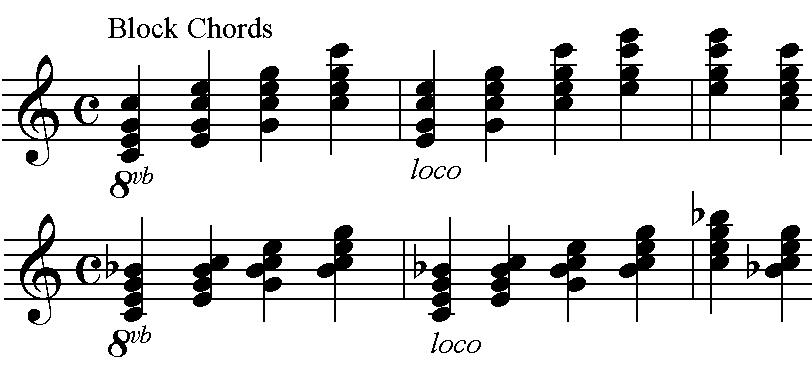
5. Broken chords: all major and minor keys, two octaves up and down (M. 88)
6. Selected studies from any of the following:
a. The Virtuoso Pianist by Hanon
b. 160 eight-measure exercises by Czerny
c. School of Velocity, op. 299, by Czerny
d. Comparable from Bertini, Cramer, Loeschhorn, Dohnanyi, etc.
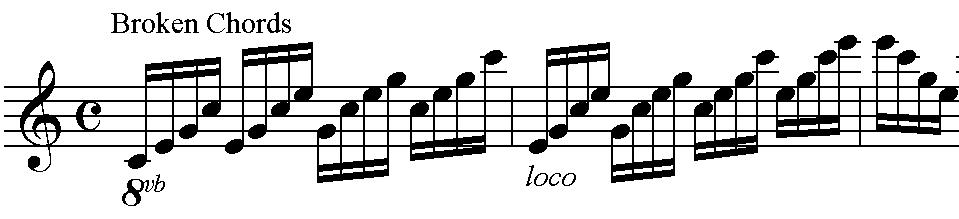
Please choose one organ method from which to review organ technique. (See full descriptions under Level 3.) The following are recommended, but you may use another with the approval of your BYU course instructor. Any method used should develop the same concepts and skills as those listed below using comparable exercises. For Played Assignment 2, be able to play any manual or pedal exercise in the method you have chosen.
*Required texts: The OrganTutor Workbook (required) and The OrganTutor Online Tutorial (optional) are basic texts for the course, containing materials needed for passing Unit 1 in Levels 3-6. If you decide also to learn organ technique through OrganTutor and/or Ritchie/Stauffer, you will not need to purchase the Davis, Gleason, or Keeler books. The Ritchie/Stauffer text is also required for its organ historical/registration information.
Cook, Don, with contributions by Parley L. Belnap and Richard L. Elliott. *The OrganTutor Workbook. ("OTW") Spanish Fork, UT: Ard Publications, n.d. (ardpublications.com). With its companion resource: The OrganTutor Online Tutorial. Provo, UT: Brigham Young University, 1998/2021 (organtutor.byu.edu)
*Ritchie, George H. and George B. Stauffer. Organ Technique: Modern and Early. New York: Oxford, 2000. (amazon.com availabilities)
Davis, Roger. The Organist's Manual. New York: W. W. Norton, 1985. (amazon.com availabilities)
Gleason, Harold. Method of Organ Playing. 8th ed. Englewood Cliffs, NJ: Prentice-Hall, 1995. (amazon.com availabilities)
Keeler, J. J., and E. Donnell Blackham. Basic Organ Techniques. 3rd ed. Bryn Mawr, PA: Universe, 1998. (jackmanmusic.com)
For each played assignment, play five of the fifteen pieces that you have chosen from the following list (a different set of five pieces each time). For video or audio examples of selected pieces visit organ.byu.edu/rep-levels. You are welcome to propose
comparable alternatives (medium difficulty) to the BYU organ faculty instructor. Please do so, however, prior to beginning work on the pieces.
A.PRE-1750
Bach, J. S. (two of the larger works:)
Canzona in D Minor (BWV 588)
“Little” Fugue in G Minor (BWV 578)
Prelude and Fugue in C Minor (BWV 549)
Toccata and Fugue in D Minor (BWV 565)
(two works from Orgelbüchlein:)
"Der Tag, der ist so freudenreich" (BWV 605)
"Herr Jesu Christ, dich zu uns wend" (BWV 632)
"Vater unser in Himmelreich" (BWV 636)
"Es ist das Heil uns kommen her" (BWV 638)
Buxtehude, Dieterich (other German organ composers from this period may be considered) (one chorale-based work:)
"Nun bitten wir den Heiligen Geist" (BuxWV 208 or 209)
"Puer natus in Bethlehem" (BuxWV 217)
“Wär Gott nicht mit uns diese Zeit” (BuxWV 222)
(one other work:)
Fugue in C Major (BuxWV 174)
Toccata in F Major (BuxWV 157, complete)
B.1750-1900
Brahms, Johannes (do both, from Eleven Chorale Preludes, op. 122:)
"Herzlich tut mich verlangen" (op. 122, no. 9)
"O Welt, ich muss dich lassen" (op. 122, no. 11)
Franck, César (choose one:)
Adagio from "Fantaisie in C"
Prelude from "Prelude, Fugue and Variation"
Mendelssohn-Bartholdy, Felix. Sonata II, op. 65 (all four movements).
C.Since 1900 (two of the following:)
Boëllmann, Leon. Toccata from Suite Gothique, op. 25. Bush, Douglas. Hymn Settings for Organ (visit sheetmusicauthority.com and search for “douglas bush”), any piece of medium difficulty.
Chamberlin, David. LDS Hymn Voluntaries. (ChamberlinMusic.com), any piece of medium difficulty. Dupré, Marcel. "How Fair and How Pleasant Art Thou," from Fifteen Pieces founded on Antiphons, op. 18, no. 5. Jongen, Joseph. "Chant de Mai," op. 53, no. 1 (J. & W. Chester)
Vierne, Louis. "Carillon" from Twenty-four Pieces in Free Style, vol. 2 Walcha, Helmut. "Weicht ihr Berge, fallt ihr Hügel" from Fünfundzwanzig Choralvorspiele (C. F. Peters nr. 4850). Wood, Dale. "Let Us Break Bread Together" (Augsburg 11-0856) Wright, Searle. "Carol-Prelude on Greensleeves" (H. W. Gray, St. Cecilia Series 798).
Any hymn setting of medium difficulty from this period may be acceptable
Be able to play any hymn you choose with a sustained legato approach in addition to any alternative approaches you might be using. As described in OrganTutor under "Listening Skills for Practice," pay particular attention to precise releases, perfect legato, and independence of line.
The following resources may be helpful in preparation for the performance of hymns: Belnap, Parley L. Hymn Studies for Organists. Rev. ed. Provo, UT: BYU Creative Works Office, 2003. Cook, Don. OrganTutor Online (or OrganTutor Workbook). Provo, UT: Brigham Young University, 1998/2021. Lovelace, Austin C. The Organist and Hymn Playing. Rev. ed. Carol Stream, IL: Agape, 1981. Hymns of the Church of Jesus Christ of Latter-day Saints. Salt Lake City, UT: Church of Jesus Christ of Latter-day Saints, 1985. (Free downloads of most hymns from churchofjesuschrist.org/music/index/hymns/number?lang=eng&_r=1 Woolard, Margot Ann. A Mini-Course in Basic Organ Registration. old.agohq.org/mini-course-basic-organ-registration
The following hymns from the hymnbook listed above are well suited to this level. Other hymns of comparable difficulty may be substituted, including those from the Examination Hymn Booklet of the American Guild of Organists (request a pdf copy by emailing info@agohq.org). Before beginning practice on substitute hymns, obtain approval from your BYU Organ Faculty course instructor Do not choose hymns for this level that you played in previous levels, or those on the suggested list of simpler hymns. Also, do not play the same hymn in more than one played assignment. The tune names of hymns that might be found in other hymnals are given in parentheses below.
2
The Spirit of God Like a Fire is Burning*
8 Awake and Arise
27 Praise to the Man
41 Let Zion in Her Beauty Rise (Ellacombe)
50 Come, Thou Glorious Day of Promise*
61 Raise Your Voices to the Lord*
63 Great King of Heaven
68 A Mighty Fortress (Ein’ feste Burg)
70 Sing Praise to Him (Mit Freuden zart)
82 For All the Saints (as written) (Sine nomine)
87 God is Love*
110 Cast Thy Burden upon the Lord (Birmingham)
123 Oh, May My Soul Commune with Thee*
138 Bless our Fast, We Pray
151 We Meet, Dear Lord*
155 We Have Partaken of Thy Love
169 As Now We Take the Sacrament*
170 God, Our Father, Hear Us Pray
176 Tis Sweet to Sing the Matchless Love
183 In Remembrance of Thy Suffering
200 Christ the Lord is Risen Today (Easter Hymn)
222 Hear Thou Our Hymn, O Lord
231 Father, Cheer Our Souls Tonight
240 Know This, that Every Soul is Free
243 Let Us All Press On
268 Come, All Whose Souls Are Lighted*
287 Rise, Ye Saints, and Temples Enter
291 Turn Your Hearts
The following items are divided between the three played assignments:
A. SINGLE VERSE. For each played assignment, choose and prepare one verse each of four of the hymns listed above with the soprano, alto, and tenor voices on the Great manual and the bass voice in the pedals. In addition, prepare one hymn (which may be selected from the twelve) to be played on a manual only (no pedal). In all hymn playing, your choice of registration should reflect the spirit of the text.
B. COMPLETE HYMN. For each played assignment, choose one hymn from this level to prepare and play completely (creative introduction and all verses, using a rearrangement of voices and/or a change of registration between verses at least once throughout the hymn). Prepare the score completely, and prepare and execute a registrational plan that reflects the messages in the various verses of text. For each complete hymn, play an effective CREATIVE INTRODUCTION. Make use of one or more creative techniques (pedal point, passing tones, reharmonization, etc.), while at the same time accomplishing the main purposes for the introduction (set the key, meter, tempo, and mood; clarify the hymn melody; encourage members of the congregation to sing). Use short or long introductions, depending on the traditions and expectations of your congregation. Create at least one of these introductions yourself; for the rest you may use those composed by others as long as they are effective.
C. CREATIVE TECHNIQUES. Include each of the following techniques in some hymn (either those in A or B above) at some point in the course. Use them more than once or in more than one hymn if you wish, but do not overuse creative techniques in any one hymn:
1. Alto Up an Octave. Choose a section of a hymn (at least two phrases) where the ALTO line has melodic interest, and play the alto voice an octave higher. In this way the alto will be played an octave higher than written by the upper part of the right hand (fingers 3, 4, and 5), and the soprano will be played as written but with the lower part of the right hand (fingers 1, 2, and 3).
2. Tenor Solo. Choose a section of a hymn (at least two phrases) where the TENOR line has melodic interest. Solo out the tenor voice with the left hand (play tenor on a manual with a more prominent [solo] sound, and play soprano and alto on a different manual with a less prominent [accompanimental] sound). Choose one of the following ways of applying this "tenor solo" technique:
a. Play the tenor solo in the normal written range.
b. Play the tenor up an octave. (Move the hand; don't just use higher-pitched stops.)
3. Soprano and Tenor Switched. Choose a section of a hymn (at least two phrases each) from those marked with an asterisk (*) to play with the SOPRANO AND TENOR SWITCHED. Use one of the following methods:
a. Play the hands on the same manual or two different manuals. With the left hand, play the tenor voice up an octave (as described in the preceding paragraph). With the right hand on another manual, play the soprano voice an octave lower and the alto voice in the normal written range. In this way the soprano will be played by the lower part of the right hand (an octave lower than written), and the alto will be played by the upper part of the right hand (in the normal written range). For the registration of the left-hand (tenor) voice, you may choose either a more prominent (solo) sound, or a sound similar or identical to that of the right hand.
The role of the right hand may be easier understood by thinking of the "alto played up an octave" technique, as described a few paragraphs above, but with the whole right hand played down an octave. This seemingly complicated technique then becomes simply a combination of the "tenor solo" technique (up an octave) for the left hand, and the "alto up an octave" technique (with the hand played down an octave) for the right.
b. Play the hands either on the same manual or on different manuals. With the left hand, play the soprano voice down an octave. With the right hand, play the tenor voice up an octave and the alto voice in the normal written
range. If you choose to play on different manuals, use stops that would give the soprano voice (played by the left hand in the tenor range) a more prominent sound.
4. Soprano Solo. For an entire verse, solo out the SOPRANO voice with the right hand (play soprano on a manual with a more prominent [solo] sound, and play alto and tenor on a different manual with a less prominent [accompanimental] sound). Choose one of the following ways of applying this "soprano solo" technique:
a. Play the soprano solo in the normal written range.
b. Play the soprano down an octave. (Move the hand; don't just use lower-pitched stops.)
5. Nonharmonic Tones. Where musically effective in the alto, tenor, and/or bass voice(s), add PASSING TONES to fill in melodic skips of a third, and insert NEIGHBOR TONES between repeated notes. Also, use PEDAL POINT effectively in the pedals.
6. Suspensions. Choose two of the more meditative hymns in which to add two or three SUSPENSIONS. (If your congregation sings in parts, do not use this technique as part of your complete hymn. It would be more appropriate for prelude-style harmonic embellishment.)
7. Free Accompaniment. Find an appropriate FREE ACCOMPANIMENT (hymn harmonization, reharmonization) for each of two hymns, and play it on the last verse. You may play an interlude prior to the free accompaniment if you wish.
All information may be found in:
Steinke, Greg A. and Paul Harder. Harmonic Materials in Tonal Music. Part II. 10th ed. Upper Saddle River, NJ: Prentice Hall, 2010, chapters 1-6.
Other editions may be used and are even encouraged, but specific chapter numbers and the frame numbers referenced in the instructor feedback of the Quizzes may not be accurate.
Know the following:
1. Seventh chords (dissonance, diatonic seventh chords [major-minor, half-diminished, inverted, etc.], dominant seventh chord
2. Nondominant seventh chords (passive resolution, cadence effect, sequence patterns, regular and irregular resolutions)
3. Altered nonharmonic tones and secondary dominants (foreign tones, tonal color, alteration of scale degrees, chromatic passing tones, false [cross] relation, double neighboring tones, chromatic mediants, tonicization, dominant function, dominant relation, leading tone relation, sequence of chords)
4. Modulation to closely related keys (transcient modulation, tonal reference, change of mode, phrase modulation, modulating sequence, pivot chord modulation, diatonic modulation, chromatic modulation)
5. Borrowed chords (modal mixture, modal exchange, Picardy third, deceptive cadence, ambiguity of modality)
6. Augmented sixth chords [Italian, German, French, English] (chromatic alteration, altered chords [subdominant, subdominant seventh, supertonic seventh], motive/motif)
The Greg Steinke/Paul Harder book is a programmed learning text in music theory, designed for self-study. Chapters 1-6 should be completed during Level 5 Concepts covered in these chapters will be included in the Quizzes and exams/reviews for Units 2-3.
Information may be found in Timeline of the Organ: 2600 Years of History (required – request from organ@byu.edu), in The OrganTutor Workbook (required), in the OrganTutor Online Tutorial (optional), in Organ Technique: Modern and Early (required), and in the books on registration listed in the bibliography (optional). Know the following:
Lesson 1 – History & Development of the Organ (Timeline of the Organ)
Lesson 2 – Types of Organ Registration and Musical Texture (OrganTutor)
Lesson 3 – Chorus Registration (OrganTutor)
Lesson 4 – Hymn Registration (OrganTutor)
Lesson 5 – Solo and Accompaniment Registration (OrganTutor)
Lesson 6 – Trio Registration (OrganTutor)
Lesson 7 – The Process of Registrational Decision Making and Registration Mechanics (OrganTutor)
Lesson 9 – Historical Styles in Organ Building and Registration: Nineteenth Century France (Organ Technique: Modern and Early)
Lesson 12 – Historical Styles in Organ Building and Registration: Seventeenth- and Eighteenth-Century Italy (Organ Technique: Modern and Early)
The Organ Registration portion of this course is in two parts. Lessons 1-7 cover basic competencies that are essential for all organists. These are taught in Levels 1-2 and reviewed in every level thereafter Lessons 9 and 12 are new topics that continue a course of instruction on important style periods in organ construction, composition, and registration.
A. Score Reading. Throughout this level, prepare and play one four-part vocal score (choral music in open score – where each part is written on its own staff) for each of the three played assignments. Read from the open score, not a two-stave reduction. For each piece decide whether to play the bass part in the manual or the pedal. Choose from the following (works of a similar nature may be substituted – no approval required):
From the voice-parts edition of Master Choruses, selected by Hugh Ross, John Smallman, and H. Alexander Matthew. Boston, MA: Oliver Ditson, 1933:
"If Thou but Suffer God to Guide Thee," p. 47
"Cherubim Song," p. 59 "Tenebrae factae sunt," p. 230
From the Internet - free downloads (choose from those that you did not use in Level 4):
Bruckner, “Pange Lingua” https://www.cpdl.org/wiki/images/6/65/Pange_lingua_Bruckner.pdf
Durón, “Negliya que quele” https://www.cpdl.org/wiki/images/0/01/Dur-neg2.pdf
Gounod, “O Divine Redeemer” http://www.musicbyandrew.ca/data/odivine.pdf
Liszt, “Salve Regina” https://www.cpdl.org/wiki/images/a/aa/Ws-lis-salv.pdf
Martini, “Populum humilem” https://www.cpdl.org/wiki/images/7/77/Populem_Humilem_Martini.pdf Mendelssohn, “Three Motets” (selections)
https://www.cpdl.org/wiki/images/6/6e/Mendelssohn_ThreeMotetsOp69.pdf
Morales, “Pastores dicite” https://www.cpdl.org/wiki/images/f/f7/Morales1546-11.pdf
Morley, “Now is the Gentle Season” https://www.cpdl.org/wiki/images/0/07/Now_is_the_gentle_season__The_fields_abroad.pdf
Mozart, “Rex tremendae” https://www.cpdl.org/wiki/images/sheet/moz-6264.pdf
Stainer, “O Emmanuel” https://www.cpdl.org/wiki/images/d/d3/O_Emmanuel_Stainer.pdf Stanford, “Peace; Come Away” https://www.cpdl.org/wiki/images/5/5a/Peace_come_away_Stanford.pdf
B. Accompaniments. Prepare and play one accompaniment for each of the three played assignments. (During this level one of them must be a realization of a figured bass from the Baroque period.) The following resource might be helpful for both the accompaniments and the adaptation (below): Campbell, John. Accompaniment and Adaptation Practicum old.agohq.org/accompaniment-adaptation-practicum New York: American Guild of Organists
Choose from the following (works of a similar nature may be substituted):
From the Internet (free downloads):
Brahms, “Geistliches Lied” https://www.cpdl.org/wiki/images/f/fd/Geistliches_Lied.pdf (easy) Vierne, “Ave Maria” https://www.cpdl.org/wiki/images/6/6e/Vierne_-_Ave_Maria.pdf (easy) Stainer, “Agnus Dei” https://www.cpdl.org/wiki/images/b/b1/Agnus_Dei_in_F_Stainer.pdf (easy) Brahms, “Ave Maria” https://www.cpdl.org/wiki/images/4/4c/Op._12_Ave_Maria-Brahms-SSAA-Org.pdf Buck, “He shall come down like rain” https://www.cpdl.org/wiki/images/7/79/Ws-buck-hes.pdf Buck, “Lord, thou hast been our refuge” https://www.cpdl.org/wiki/images/3/36/Ws-buck-mi1.pdf Dubois, “Ave Maria” https://www.cpdl.org/wiki/images/4/4d/Dubo-ave.pdf Elgar, “Fear not, O land” https://www.cpdl.org/wiki/images/a/a5/Elgar_fear_not.pdf
Franck, “Psalm 150” https://www.cpdl.org/wiki/images/1/14/Franck_Psaume_150.pdf Ireland, “Jubilate Deo” https://www.cpdl.org/wiki/images/f/f0/Ireland-Jubilate_Deo_In_F.pdf Stainer, “Magnificat and nunc cimmitis” https://www.cpdl.org/wiki/images/c/cc/Stainer_magnificat_and_nunc_dimittis_in_b_flat.pdf (long) Stanford, “And I Saw Another Angel” https://www.cpdl.org/wiki/images/0/07/Ws-stan-371.pdf
Stanford, “How Beauteous are their feet”
https://www.cpdl.org/wiki/images/9/93/How_beauteous_are_their_feet_Stanford.pdf
Stanford, “Why seek ye the living?” https://www.cpdl.org/wiki/images/3/31/Ws-stan-why.pdf
From The Choirbook, Salt Lake City, UT: Church of Jesus Christ of Latter-day Saints, 1980: "The Morning Breaks," arr. Hal K. Campbell, p. 4 "A Marvelous Work," by Alexander Schreiner, p. 12 "Jesus, Saviour," by W. A. Mozart, p. 33
"The Lord's Prayer," by B. Cecil Gates, p. 42 "Song of Praise," by Leroy J. Robertson, p. 56
With figured bass (basso continuo) (free downloads): Fawcett, “Lo, he comes with clouds descending” https://www.cpdl.org/wiki/images/2/21/FawcJLoHeComes.pdf (very easy)
Leach, “O love divine, how sweet thou art” https://www.cpdl.org/wiki/images/1/18/LeacJ-OLoveDivine.pdf
Buxtehude, “Cantate Dominum” (any movement) https://imslp.org/wiki/Special:ImagefromIndex/97896/hfhg
Clark, “He that hath made his refuge God” https://www.cpdl.org/wiki/images/4/49/ClarT-HeThatHathLangport.pdf
Clark, “When, overwhelmed with grief” https://www.cpdl.org/wiki/images/1/1f/ClarT-WhenOverwhelmed.pdf
Figured bass resources:
For a quick reference on basso continue playing, visit this YouTube video https://www.youtube.com/watch?v=XEHg-3tVJAo or this Wikipedia article http://en.wikipedia.org/wiki/Figured_bass
For a more thorough discussion of figured bass, search “figured bass derek remes”. Find many more online resources by searching “figured bass”.
See below two examples below of basso continuos that have been realized – for reference only:
Purcell, “Love thou art best of Humane Joys” http://www.drdrbill.com/downloads/music/Purcell/Orpheus/Love/Love.pdf
Purcell, “Sound Trumpet Sound, beat ev’ry Drum” http://www.drdrbill.com/downloads/music/Purcell/Orpheus/Trumpet/Trumpet.pdf
C. Adaptation. In preparation for Played Assignment 3, study and compare the vocal/piano and the vocal/organ scores of “The Lord’s Prayer,” by Albert Hay Mallott. Identify each pianist pattern that was adapted for the organ, and be able to describe how it was adapted. Your understanding of this process will be evaluated as part of Played Assignment 3. (The following resource might be helpful: Campbell, John. Accompaniment and Adaptation Practicum old.agohq.org/accompaniment-adaptation-practicum New York: American Guild of Organists.)
As part of Played Assignments 1 and 3 you will be presented with an example to sight-read that is comparable to those described below (moderately easy pedal, three parts between the two hands). You will have one minute to look through the music before playing.
Practice sight-reading four-part hymns of comparable difficulty to the suggested list of simpler hymns marked with an asterisk (*).
Also, practice sight-reading organ pieces of comparable difficulty to the following pieces composed or edited by Robert Cundick (free download at organ.byu.edu/cundickBookComplete.pdf):
"Andante Espressivo," p. 4, by J. J. Froberger
"Interlude," p. 7, by B. Marcello
"Sarabande," p. 8, by J. J. Froberger
"Andantino in G Minor," p. 12, by A. F. Hesse
“Meditation,” p. 44 (only), by R. Cundick
“Variations on a Ground Bass,” p. 48, 50, 51, 55 (only), by T. Vitali
Practice transposing the simpler hymns (see suggested list) into all keys up to and including a major second up and down. The use of the pedal is recommended but not required. Do both of the following for Played Assignments 1 and 3:
A. Prepared transposition. Transpose one hymn (your choice) as described above. Use a different hymn for each played assignment. No play-through in the original key or written transposition will be permitted.
B. Transposition at sight. Transpose at sight the soprano and alto lines (together) of a simple hymn or folk tune. The music will be provided, and one minute of preparation time away from the keyboard will be permitted.
Level 6 – Advanced (those with substantial training and fluency in the basic organ fundamentals listed in Level 2, and in early advanced organ pieces in both legato and articulate styles. Should be able to play more difficult four-part vocal scores and choir accompaniments, to sight-read more difficult four-part organ music and hymns, and to transpose moderately
difficult hymns into all keys up to and including a major second up and down. Music theory prerequisites: an understanding of the music theory topics listed under Levels 1-5.)
Practice the following technical studies hands together at the piano. For each played assignment, choose two of the six items (a different pair of items each time) to play for the evaluator:
1. Scales: four notes to the beat (M. 120), parallel and contrary motion, two octaves up and down in all major and at least one form of minor keys
2. Chromatic scale: four notes to the beat (M. 120), two octaves up and down
3. Arpeggios (four notes to the beat, four octaves up and down):
a. Root position (M. 96), all major and minor keys
b. viio 7 chord (M. 76), starting on C, C#, and D
c. V7 chord (M. 76), starting on all 12 keys
4. Block chords: four notes in each hand, inverted through a compass of two octaves up and down, each chord being played as a quarter note (M. 96)
5. Broken chords: all major and minor keys, two octaves up and down (M. 96)
6. Selected studies from any of the following:
a. The Virtuoso Pianist by Hanon
b. 160 eight-measure exercises by Czerny
c. School of Velocity, op. 299, by Czerny
d. Comparable from Bertini, Cramer, Loeschhorn, Dohnanyi, etc.
For each played assignment, play five of the fifteen pieces that you have chosen from the following list (a different five pieces each time). For video or audio examples of selected pieces visit organ.byu.edu/rep-levels You are welcome to propose comparable alternatives to the BYU organ faculty instructor. Please do so, however, prior to beginning work on the pieces. They must be of upper-medium difficulty.
A.PRE-1750
Bach, Johann Sebastian (from Orgelbüchlein, at least two:)
"Gott, durch deine Güte" (BWV 600)
"In dulci Jubilo" (BWV 608)
"O Lamm Gottes unschuldig" (BWV 618)
"Christus der uns selig macht" (BWV 620)
"Erstanden ist der heil’ge Tag" (BWV 628)
"Komm Gott Schöpfer" (BWV 631)
"Dies sind die heil'gen zehn Gebot" (BWV 635)
"Wenn wir in höchsten Nöten sein" (BWV 641) (at least one prelude and fugue:)
Prelude and Fugue in A Major (BWV 536)
Prelude and Fugue in C Major (BWV 545)
Buxtehude, Dieterich (other German organ composers from this period may be considered) (one chorale-based work:)
"Ein Feste Burg" (BuxWV 184)
"Herzlich tut mich verlangen" ("Ach Herr, mich armen Sünder") (BuxWV 178) (one other work:)
Passacaglia in D Minor (BuxWV 161)
Präludium in C Major (BuxWV 136)
Other Baroque works (choose one work:)
Couperin, François. "Chromhorne sur la taille" (Gloria, 5th couplet) from Mass for the Convents Or any single verset from Mass for the Convents or Mass for the Parishes.
Frescobaldi, Girolamo. Toccata per l'Elevatione from "Messa delli apostoli," Fiori musicali (1635)
Pachelbel, Johann. Fugue on "Vom Himmel hoch"
Stanley, John.
Voluntary VII, op. 5
Voluntary IX, op. 7
Any piece of upper-medium difficulty from 80 Chorale Preludes.
B.1750-1900
Brahms, Johannes. From Eleven Chorale Preludes, op. 122 (choose both of these works or the Frank work:) "Herzlich tut mich erfreuen" (op. 122, no. 4)
"Herzlich tut mich verlangen" (op. 122, no. 10)
Franck, César. Fugue and variation from "Prelude, Fugue and Variation."
Mendelssohn-Bartholdy, Felix. (choose one): Sonata IV, op. 65: Allegretto Sonata VI, op. 65: Andante (Choose two more pieces from the remainder of the 1750-1900 list:)
Rheinberger, Josef.
Intermezzo, from Sonata 4
Intermezzo, from Sonata 3 Cantilene, from Sonata 11 Saint-Saëns, Camille.
Prélude, op. 99, no. 3
Prélude, op. 109, no. 1
Schumann, Robert.
Studies for Pedal Piano, op. 56, no. 1
Sketches for Pedal Piano, op. 58, No. 1 or no. 4
Fugue on BACH, op. 60, no. III
Samuel Wesley.
Air and Gavotte (from Tallis to Wesley, No. 7, Samuel Wesley: Twelve Short Pieces, no. 8 & 9. [These two count as one piece.])
C.Since 1900 (choose four pieces:)
Bush, Douglas. Hymn Settings for Organ (visit sheetmusicauthority.com and search for “douglas bush”), any piece of upper-medium difficulty.
Chamberlin, David. LDS Hymn Voluntaries. (chamberlinmusic.com/index.php), any piece of upper-medium difficulty.
Gigout, Eugéne. Toccata.
Karg-Elert, Sigfrid. "Abide, O Dearest Jesus," op. 65, no. 1.
Manookin, Robert. "How Gentle God's Commands."
Manz, Paul. "Open Now Thy Gates of Beauty (Neander)." In Ten Chorale Improvisations, Set 1. "God of Grace." In Ten Chorale Improvisations, Set 5.
Parry, C. Hubert H. Chorale Prelude on "Melcombe."
Peeters, Flor. "Wake, Awake, for Night is Flying" ("Wachet Auf"), op. 68, no. 5.
Reger, Max. Melodia, op. 59, no. 11 (bk 2).
Vaughan Williams, Ralph. Prelude on "Rhosymedre."
Vierne, Louis. “Communion, ” Op. 8.
Wesley, Samuel Sebastian. “Choral Song.”
Any hymn setting of upper-medium difficulty from this period may be acceptable.
Be able to play any hymn you choose with a sustained legato approach in addition to any alternative approaches you might be using. As described in OrganTutor under "Listening Skills for Practice," pay particular attention to precise releases, perfect legato, and independence of line.
The following resources may be helpful in preparation for the performance of hymns: Belnap, Parley L. Hymn Studies for Organists Rev. ed. Provo, UT: BYU Creative Works Office, 2003. Cook, Don. OrganTutor Online (or OrganTutor Workbook). Provo, UT: Brigham Young University, 1998/2021. Lovelace, Austin C. The Organist and Hymn Playing. Rev. ed. Carol Stream, IL: Agape, 1981.
Hymns of the Church of Jesus Christ of Latter-day Saints. Salt Lake City, UT: Church of Jesus Christ of Latter-day Saints, 1985. (Free downloads of most hymns from churchofjesuschrist.org/music/index/hymns/number?lang=eng&_r=1
Woolard, Margot Ann. A Mini-Course in Basic Organ Registration. old.agohq.org/mini-course-basic-organ-registration
The following hymns from the hymnbook listed above are well suited to this level. Other hymns of comparable difficulty may be substituted, including those from the Examination Hymn Booklet of the American Guild of Organists (request a pdf copy by emailing info@agohq.org). Before beginning practice on substitute hymns, obtain approval from your BYU Organ Faculty course instructor Do not choose hymns for this level that you played in previous levels, or those on the suggested list of simpler hymns. Also, do not play the same hymn in more than one played assignment. The tune names of hymns that might be found in other hymnals are given in parentheses below
28 Saints, Behold How Great Jehovah
31 O God, Our Help in Ages Past (St. Anne)
35 For the Strength of the Hills
62 All Creatures of Our God and King (Lasst uns erfreuen)
69 All Glory, Laud, and Honor (St. Theodulph)
72 Praise to the Lord, the Almighty (Lobe den Herren)
81 Press Forward, Saints
150 O Thou Kind and Gracious Father
166 Abide with Me! (Eventide)
197 O Saviour, Thou Who Wearest a Crown (Passion Chorale)
203 Angels We Have Heard on High (Gloria)
205 Once in Royal David's City (Irby)
209 Hark! the Herald Angels Sing (Mendelssohn)
215 Ring Out, Wild Bells
218 We Give Thee but Thine Own (Schumann)
246 Onward, Christian Soldiers (St. Gertrude)
The following items are divided between the three played assignments:
A. SINGLE VERSE. For each of the played assignments, choose and prepare one verse each of three of the hymns listed above with the soprano, alto, and tenor voices on the Great manual and the bass voice in the pedals. In addition, prepare one hymn (which may be selected from those you will play in this level) to be played on a manual only (no pedal). In all hymn playing, your choice of registration should reflect the spirit of the text.
B. COMPLETE HYMN. For each of the played assignments, choose one hymn from this level to prepare and play completely (a creative introduction and all verses, using a rearrangement of voices and/or a change of registration between verses at least once throughout the hymn). Prepare the score completely, and prepare and execute a registrational plan that reflects the messages in the various verses of text. For each complete hymn, play an effective CREATIVE INTRODUCTION. Make use of one or more creative techniques (pedal point, passing tones, reharmonization, etc.), while at the same time accomplishing the main purposes for the introduction (set the key, meter, tempo, and mood; clarify the hymn melody; encourage members of the congregation to sing). Use short or long introductions, depending on the traditions and expectations of your congregation. Create at least one introduction yourself; for the rest you may use those composed by others as long as they are effective.
C. CREATIVE TECHNIQUES. Include each of the following techniques in some hymn (either those in A or B above) at some point in the course. Use them more than once or in more than one hymn if you wish, but do not overuse creative techniques in any one hymn:
1. Alto Up An Octave. Choose a section of a hymn (at least two phrases) where the ALTO line has melodic interest, and play the alto voice an octave higher. In this way the alto will be played an octave higher than written by the upper part of the right hand (fingers 3, 4, and 5), and the soprano will be played as written but with the lower part of the right hand (fingers 1, 2, and 3).
2. Tenor Solo. Choose a section of a hymn (at least two phrases) where the TENOR line has melodic interest. Solo out the tenor voice with the left hand (play tenor on a manual with a more prominent [solo] sound, and play soprano and alto on a different manual with a less prominent [accompanimental] sound). Choose one of the following ways of applying this "tenor solo" technique:
a. Play the tenor solo in the normal written range.
b. Play the tenor up an octave. (Move the hand; don't just use higher-pitched stops.)
3. Soprano and Tenor Switched. Choose a section of a hymn (at least two phrases) to play with the SOPRANO AND TENOR SWITCHED. Use one of the following methods:
a. Play the hands on the same manual or two different manuals. With the left hand, play the tenor voice up an octave (as described in the preceding paragraph). With the right hand on another manual, play the soprano voice an octave lower and the alto voice in the normal written range. In this way the soprano will be played by the lower part of the right hand (an octave lower than written), and the alto will be played by the upper part of the right hand (in the normal written range). If you play on two manuals, for the registration of the left-hand (tenor) voice, you may choose either a more prominent (solo) sound, or a sound similar to that of the right hand.
The role of the right hand may be easier understood by thinking of the "alto played up an octave" technique, as described a few paragraphs above, but with the whole right hand played down an octave. This seemingly
complicated technique then becomes simply a combination of the "tenor solo" technique (up an octave) for the left hand, and the "alto up an octave" technique (with the hand played down an octave) for the right.
b. Play the hands either on the same manual or on different manuals. With the left hand, play the soprano voice down an octave. With the right hand, play the tenor voice up an octave and the alto voice in the normal written range. If you choose to play on different manuals, use stops that would give the soprano voice (played by the left hand in the tenor range) a more prominent sound.
4. Soprano Solo. For an entire verse, solo out the SOPRANO voice with the right hand (play soprano on a manual with a more prominent [solo] sound, and play alto and tenor on a different manual with a less prominent [accompanimental] sound). Choose one of the following ways of applying this "soprano solo" technique:
a. Play the soprano solo in the normal written range.
b. Play the soprano down an octave. (Move the hand; don't just use lower-pitched stops.)
5. Nonharmonic Tones. Where musically effective in the alto, tenor, and/or bass voice(s), add PASSING TONES to fill in melodic skips of a third, and insert NEIGHBOR TONES between repeated notes. Also, use PEDAL POINT effectively in the pedals.
6. Suspensions. Choose two of the more meditative hymns in which to add two or three SUSPENSIONS. (If your congregation sings in parts, do not use this technique as part of your complete hymn. It would be more appropriate for prelude-style harmonic embellishment.)
7. Pedal Solo. Choose two hymns in which to treat the soprano voice as a PEDAL SOLO, registered with one or more prominent 4' stop(s). Play the alto, tenor, and bass voices on a manual with a softer accompanimental registration. Rather than using this technique as part of your complete hymn, it is more practical when used as a prelude-style rearrangement of voices.
8. Free Accompaniment. Write an appropriate FREE ACCOMPANIMENT (hymn harmonization, reharmonization) for each of two hymns, and play it on the last verse. You may play an interlude prior to the free accompaniment if you wish.
All information may be found in:
Steinke, Greg A. and Paul Harder. Harmonic Materials in Tonal Music. Part II. 10th ed. Upper Saddle River, NJ: Prentice Hall, 2010, chapters 7-11.
Other editions may be used and are even encouraged, but specific chapter numbers and the frame numbers referenced in the instructor feedback of the Quizzes may not be accurate.
Know the following:
1. Neapolitan sixth chord, altered dominants, and diminished seventh chords (altered supertonic triad, tritone relationship, altered dominants, diminished seventh chords, enharmonic spellings)
2. Chromatic third-relation harmony (tonal instability, tonal expansion, color harmony, functional/nonfunctional harmony, “chromatic stress”, ambiguous tonal effect, tonal fluidity, symmetrical relationships)
3. Modulation to foreign [remote, distant, semirelated] keys (2 chapters)
4. Ninth, eleventh, and thirteenth chords (tertian extension, incidental melodic occurrences, tone cluster, chromatic median seventh chord, dominant [eleventh, thirteenth] chord, polychord, appoggiatura chord, impressionistic music, palindrome, pandiatonicism, atonality, pantonality)
The Greg Steinke/Paul Harder book is a programmed learning text in music theory, designed for self-study. Chapters 7-11 should be completed during Level 6. Concepts covered in these chapters will be included in the Quizzes and exams/reviews for Units 2-3
Information may be found in Timeline of the Organ: 2600 Years of History (required – request from organ@byu.edu), in The OrganTutor Workbook (required), in the OrganTutor Online Tutorial (optional), in Organ Technique: Modern and Early (required), and in the books on registration listed in the bibliography (optional). Know the following:
Lesson 1 – History & Development of the Organ (Timeline of the Organ)
Lesson 2 – Types of Organ Registration and Musical Texture (OrganTutor)
Lesson 3 – Chorus Registration (OrganTutor)
Lesson 4 – Hymn Registration (OrganTutor)
Lesson 5 – Solo and Accompaniment Registration (OrganTutor)
Lesson 6 – Trio Registration (OrganTutor)
Lesson 7 – The Process of Registrational Decision Making and Registration Mechanics (OrganTutor)
Lesson 9 – Historical Styles in Organ Building and Registration: 20th Century (Organ Technique: Modern and Early)
Lesson 12 – Historical Styles in Organ Building and Registration: Seventeenth- and Eighteenth-Century England (Organ Technique: Modern and Early)
The Organ Registration portion of this course is in two parts. Lessons 1-7 cover basic competencies that are essential for all organists. These are taught in Levels 1-2 and reviewed in every level thereafter. Lessons 9 and 12 are new topics that continue a course of instruction on important style periods in organ construction, composition, and registration.
A. Score Reading. Prepare and play one four-part vocal score (choral music in open score – where each part is written on its own staff) for each of the three played assignments. For each piece decide whether to play the bass part in the manual or the pedal. Choose from the following, or substitute works of a similar nature and level of difficulty to those on the lists:
From the voice-parts edition of Master Choruses, edited by Hugh Ross, John Smallman, and H. Alexander Matthews (Boston: Oliver Ditson, 1933):
"In Dulci Jubilo," p. 46
"Ye Watchers and Ye Holy Ones," p. 44
"Holy Art Thou," p. 62
"How Lovely Are the Messengers," p. 90
"Jesu, Word of God Incarnate," p. 100
"Christ the Lord is Risen Today," p. 123
From the Internet (free downloads – do not use any for a played assignment that you played in Levels 4 or 5):
Bruckner, “Pange Lingua” https://www.cpdl.org/wiki/images/6/65/Pange_lingua_Bruckner.pdf
Durón, “Negliya que quele” https://www.cpdl.org/wiki/images/0/01/Dur-neg2.pdf
Gounod, “O Divine Redeemer” http://www.musicbyandrew.ca/data/odivine.pdf
Liszt, “Salve Regina” https://www.cpdl.org/wiki/images/a/aa/Ws-lis-salv.pdf
Martini, “Populum humilem” https://www.cpdl.org/wiki/images/7/77/Populem_Humilem_Martini.pdf Mendelssohn, “Three Motets” (selections) https://www.cpdl.org/wiki/images/6/6e/Mendelssohn_ThreeMotetsOp69.pdf
Morales, “Pastores dicite” https://www.cpdl.org/wiki/images/f/f7/Morales1546-11.pdf
Morley, “Now is the Gentle Season” https://www.cpdl.org/wiki/images/0/07/Now_is_the_gentle_season__The_fields_abroad.pdf
Mozart, “Rex tremendae” https://www.cpdl.org/wiki/images/sheet/moz-6264.pdf
Stainer, “O Emmanuel” https://www.cpdl.org/wiki/images/d/d3/O_Emmanuel_Stainer.pdf Stanford, “Peace; Come Away” https://www.cpdl.org/wiki/images/5/5a/Peace_come_away_Stanford.pdf
B. Accompaniments. Prepare and play one accompaniment for each of the three played assignments. Your choices must include an organ accompaniment for choir, an organ accompaniment for vocal/instrumental solo, and an organ adaptation of a piano score. The following resource might be helpful for both the accompaniments and the adaptation: Campbell, John. Accompaniment and Adaptation Practicum old.agohq.org/accompaniment-adaptation-practicum New York: American Guild of Organists.
Choose from the following, or substitute works of a similar nature and level of difficulty to those on the lists:
1. Organ accompaniments for choir
(The following are composed for organ accompaniment): From the Internet (free downloads):
Stanford, “Ye Choirs of New Jerusalem” http://dovetonmusic.com/PDFfree/StanfordYeChoirsLET.pdf Stainer, “Gloria in Excelsis” https://www.cpdl.org/wiki/images/sheet/stai-glo.pdf
Ireland, “Greater Love Hath No Man” https://www.cpdl.org/wiki/images/sheet/ire-grea.pdf
Faure, “Messe Basse” https://www.cpdl.org/wiki/images/sheet/faure/faur-msb.pdf (long, parts, L6) Vierne, “Kyrie” (Messe Sollennelle) https://www.cpdl.org/wiki/images/1/13/VierneMS.pdf
Bairstow, “Sing Ye To The Lord” https://www.cpdl.org/wiki/images/2/20/Bairstow_Sing_ye_to_the_Lord.pdf
From The Choirbook (Salt Lake City: Church of Jesus Christ of Latter-day Saints, 1980): arr. Christiansen, "Now Let Us Rejoice," p. 54
arr. Manookin, "Sweet is the Work," p. 20
Stephens, "Let the Mountains Shout for Joy," p. 50
(The following require organ adaptation of a piano score, from The Choirbook, described above): Gates, "The Lord’s Prayer," p. 42
arr. Lyon, "Though Deepening Trials," p. 16
Stephens, "Hosannah Anthem," p. 69
Titcomb, "Jesus! Name of Wondrous Love," p. 24
2. Organ accompaniments for vocal/instrumental solo
(The following are composed for organ accompaniment): Fauré, "Il est né le divin enfant" (very easy) https://imslp.org/wiki/Special:ImagefromIndex/26813/hfhg Franck, "Veni Creator" https://imslp.org/wiki/Special:ImagefromIndex/255195/hfhg
(The following require organ adaptation of a piano score): Burleigh, "Deep River" http://conquest.imslp.info/files/imglnks/usimg/a/a0/IMSLP257335-PMLP417359deepRiver_HT_Burleigh.pdf
Chadwick, "Faith" https://imslp.org/wiki/Special:ImagefromIndex/03585/hfhg
Elgar, "Dry Those Fair, Those Crystal Eyes" https://imslp.org/wiki/Special:ImagefromIndex/57404/hfhg Schubert, "Ave Maria" (piano and voice, in B-flat) https://imslp.org/wiki/Special:ImagefromIndex/407797/hfhg Schubert, "Do Not Approach the Urn" (Vier Canzonen von Metastasio, no. 1) https://imslp.org/wiki/Special:ImagefromIndex/481560/hfhg
Sullivan, "The Lost Chord" https://imslp.org/wiki/Special:ImagefromIndex/75214/hfhg
As part of Played Assignments 1 and 3 you will be presented with an example to sight-read that is comparable to those described below (moderate pedal, three to four parts between the two hands). You will have one minute to look through the music before playing.
In addition to those on the suggested list of simpler hymns not marked with an asterisk (*), practice sight-reading hymns of more moderate difficulty.
Also, practice sight-reading organ pieces of comparable difficulty to the following pieces: Pieces composed or edited by Robert Cundick (free download at organ.byu.edu/cundickBookComplete.pdf):
Guilmant, "Andante in F," p. 30
Frescobaldi, "Preambule," p. 39
Pachelbel, "Allein zu dir, Herr Jesu Christ," p. 40
Vitali, "Variations on a Ground Bass," (complete), p. 48
Stanley, "Cornet Voluntary in D minor," p. 56
Cundick, "Prelude on ‘Coventry Carol’," p. 62
Manookin, Robert, Hymn Preludes, vols. 3, 6
Prepare to sight-read a hymn and/or piece provided by the evaluator during Played Assignments 1 and 3 with no more than one minute to scan the example.
For additional sight-reading resources, you can download Service Playing Sight Reading Examples (American Guild of Organists), which includes sight-reading examples from past years’ Service Playing Tests
Practice transposing the simpler hymns (see suggested list) into all keys up to and including a major second up and down. The use of the pedal is recommended but not required. Do both of the following for Played Assignments 1 and 3:
A. Prepared transposition. Transpose one hymn (your choice) as described above. Use a different hymn for each played assignment. No play-through in the original key or written transposition will be permitted.
B. Transposition at sight. Transpose at sight a simple four-part hymn or folk tune. The music will be provided, and one minute of preparation time away from the keyboard will be permitted.
In addition to the method books cited above, the following resources might be helpful:
The BYU Organ Study website organ.byu.edu
Engel, James. An Introduction to Organ Registration. St. Louis, MO: Concordia, 1986.
Geer, E. Harold. Organ Registration in Theory and Practice. Glen Rock, NJ: J. Fischer, 1957. (Out of print)
Goode, Jack C. Pipe Organ Registration. Nashville, TN: Abingdon Press, 1964. (Out of print)
Mitchell-Wallace, Sue. The Art and Craft of Playing Hymns. New York: American Guild of Organists, n.d. (videotape)
Ritchie, George and George Stauffer. Organ Technique: Modern and Early. London: Oxford, 2000.
Sumner, William Leslie. The Organ. 4th ed. London: MacDonald, 1973.
Williams, Peter. A New History of the Organ. Bloomington: Indiana University Press, 1980. (Out of print)
Woolard, Margot Ann. A Mini-Course in Basic Organ Registration. old.agohq.org/mini-course-basic-organ-registration
The American Organist. (The monthly magazine of the American Guild of Organists, 475 Riverside Dr., Suite 1260, New York, NY 10115) agohq.org
Diapason thediapason.com/magazine
Educational resources for the new organists: agohq.org/Ago/Ago/Education/The-New-Organist.aspx
The six BYU Organ Study Courses are designed to lead into the more demanding certificates (exams) of the American Guild of Organists (AGO). For information on the Service Playing or Colleague certificates of the American Guild of Organists, visit agohq.org/certification
GENERAL
Additional Certification Resources agohq.org/Ago/Education/Additional-Certification-Resources.aspx
100 Strategies for Successful AGO Certification wp.agohq.org/wp-content/uploads/2019/11/Handout-of-100strategies.pdf
Preparing for AGO Exams. New York: American Guild of Organists, 1997. (Articles reprinted from The American Organist)
Professional Certification Requirements. See the most recent July issue of The American Organist, which includes the times, fees, repertoire, and precise format for each exam. Also, for the most current Chart of Requirements or Detailed Requirements, visit agohq.org/common/Uploaded%20files/Website%20Files/2026/2026%20Certification%20Requirements_Final.pdf Transposition and Modulation Workshop. old.agohq.org/transposition-modulation-workshop/ Videos Demonstrating Certification Exam Procedures wp.agohq.org/certification-videos
Description
agohq.org/Ago/Ago/Education/Professional-Certification.aspx?hkey=a383501d-e443-4b95-9ee0-209a928ec04a Study Guide for the AGO Service Playing Test (Contains many of the items listed above) wp.agohq.org/wp-content/uploads/2019/09/Service-Playing-Study-Guide.pdf
COLLEAGUE
Description
agohq.org/Ago/Ago/Education/Professional-Certification.aspx?hkey=a383501d-e443-4b95-9ee0-209a928ec04a Colleague Study Guidelines
agohq.org/common/Uploaded%20files/Website%20Files/2026/2026%20CAGO%20Study%20Guide.pdf Colleague Exams (Complete exams from previous years) agohq.org/Ago/Education/Additional-Certification-Resources.aspx
Because the six BYU Independent Study organ levels (courses) build upon one another, some of the books required in one level will be used again in higher levels (see items marked with an asterisk*). Also, you may choose from various options in the Technique, Organ Repertoire, and other sections. Make your final choices in consultation with your organ teacher, who may suggest substitutions as permitted in your course instructions. The following may serve as a starting point (and any given prices are only approximate). For more details about these courses, visit organ.byu.edu/orcert.html)
A few of these items are available for purchase through the BYU Store. However, this document is more reliable than the BYU Store website for distinguishing between required and optional texts. Even more reliable than this document are the played assignment instructions within each course. Be aware that pricing and availability as given below change frequently, and are only given as ballpark estimates.
For more details regarding the requirements for the various levels, follow these links:
Levels 1-2 organ.byu.edu/orgcertlev1-2.pdf
Levels 3-6 organ.byu.edu/orgcertlev3-6.pdf
*Books marked with an asterisk are either required or optional in more than one level.
Play from one or more of the following (also used in all other levels):
*REQUIRED TEXT for this level: Cook, OrganTutor Workbook (Ard Publications, $23.00), and the accompanying OrganTutor Online Tutorial (organtutor.byu.edu, $30 for 6 months or $50 for 3 years).
*Davis, The Organist’s Manual (out of print, available used) or
*Gleason, Method of Organ Playing (out of print, available used) or
*Keeler/Blackham, Basic Organ Techniques (Bountiful, UT: Jackman Music, $16)
Note: if OrganTutor is used to learn manual and pedal technique, any of the other method books would be optional.
ORGAN REPERTOIRE
Three pieces are required for Level 1 – one for each of the three played assignments For video or audio examples of selected pieces visit organ.byu.edu/rep-levels. The pieces might be chosen from within a single volume, but a diversity of musical style is recommended. Other pieces may be substituted with the approval of the BYU faculty course instructor.
From *OrganTutor Workbook:
Prelude on “Abide With Me” by Kim Croft (see contents). This piece can be used for Played Assignment 1 only.
From *OrganTutor or Croft, Kim. Nine Hymn Studies. Orem, UT: Pioneer (Jackman Music), 1986. This piece may be played for Played Assignment 1 or 2 only: How Great the Wisdom by Kim Croft (see contents)
From *Harmon, Neil. Hymn Settings for Organ, Book 6. Murray, UT: Day Murray Music, 2020: Prelude on ‘Niblet’ (p. 18)
Prelude on ‘Sweet Hour’ (p. 14)
From *Davis: Verset by Léon Boëllmann (Davis p. 103) (play manual only or with pedal)
From OrganTutor or Davis:
Moderato con moto by César Franck (Davis p. 113) (in OrganTutor, see contents)
From *Manookin, Robert P. Hymn Preludes for Organ, Book One. Orem, UT: Sonos (Jackman Music), 1976: Sweet is the Work (p. 9)
In Humility, Our Savior (p. 17)
From *Dupré, Marcel. Seventy-Nine Chorales for the Organ, Opus 28. New York: H. W. Gray, 1932.
Abide with us, O Lord Jesus Christ (piece no. 1, page 2).
HYMN PLAYING (same materials in all levels)
Required: *Hymns of the Church of Jesus Christ of Latter-day Saints (1985), or alternative hymnal (4-part vocal). Most of these hymn tunes may be downloaded free from churchofjesuschrist.org/music/index/hymns/number?lang=eng&_r=1
Optional:
*Belnap, Hymn Studies (Published and distributed by BYU Creative Works, $16, or available in BYU Store [text floor])
*Lovelace, The Organist and Hymn Playing. (Agape, ISBN 0-916642-16-X, $6)
*Woolard, Margot Ann G. A Mini-Course in Basic Organ Registration. agohq.org/mini-course-basic-organ-registration
MUSIC THEORY
*Harder, Paul, and Greg A. Steinke. Basic Materials in Music Theory (9th thru 12th editions available used; 13th edition eText from $4.99/mo, or in print for $90.66) (Allyn & Bacon)
ORGAN REGISTRATION
*Cook, OrganTutor Online Tutorial and OrganTutor Workbook (Details in the Organ Technique section above)
SIGHT-READING
From any hymnbook containing traditional 4-part hymns, practice sight-reading (play at sight) individual soprano, alto, tenor, and bass parts (May use the same hymnbook for sight-reading as used for hymn playing)
ORGAN TECHNIQUE
Play from one or more of the following (also used in all other levels):
*REQUIRED TEXT for this level: Cook, OrganTutor Workbook (Ard Publications, $23.00), and the accompanying OrganTutor Online Tutorial (organtutor.byu.edu, $30 for 6 months or $50 for 3 years).
*Davis, The Organist’s Manual (out of print, available used) or
*Gleason, Method of Organ Playing (out of print, available used) or
*Keeler/Blackham, Basic Organ Techniques (Bountiful, UT: Jackman Music, $16)
Note: if OrganTutor is used to learn manual and pedal technique, any of the other method books would be optional.
ORGAN REPERTOIRE
You will learn four organ pieces in this level. Choose one of the following pieces to prepare and perform for Played Assignment 1. Another piece may be substituted with the approval of the BYU Organ Faculty course instructor. No pieces may be repeated from previous played assignments or levels. For video or audio examples of selected pieces visit organ.byu.edu/rep-levels
Played Assignment 1: Choose ONE piece from the following:
*Dupré, Marcel Seventy-Nine Chorales for the Organ, Opus 28. New York: H. W. Gray, 1932. Abide with us, O Lord Jesus Christ” (piece no. 1, page 2), OR Glory be to God on high (piece no. 4, page 5), OR Beloved Jesus, here we stand (piece no. 52, page 62)
Played Assignments 2 and 3: Choose THREE different pieces from the following, and play one for Played Assignment 2 and the other two for Played Assignment 3. Both might be chosen from within a single volume, but a diversity of musical style is recommended. Other pieces may be substituted with the approval of the course instructor.
From *Davis: Herzliebster Jesu, was hast du verbrochen by Helmut Walcha (p. 110)
From Davis or *Gleason: Fugato by J. G. Albrechstberger (Davis p. 115 or Gleason p. 183)
From Davis or *OrganTutor: Trio, Op. 49, No. 1 by Josef Rheinberger (Davis p. 114)
From Davis or Gleason or OrganTutor: Canon by Jacques Lemmens (Davis p. 121 or Gleason p. 171)
From *Keeler/Blackham Basic Organ Techniques and Repertoire, or OrganTutor: Litany by Franz Schubert (Keeler/Blackham p. 112)
From *Manookin, Robert P Hymn Preludes for Organ, Book One. Orem, UT: Sonos, 1976: Lord, We Come Before Thee Now (p. 5)
Abide With Me; 'Tis Eventide (p. 25)
From Held, Wilbur. Six Carol Settings. St. Louis, MO: Concordia, n.d.
The First Noel (p. 12)
HYMN PLAYING (same materials in all levels)
Required: *Hymns of the Church of Jesus Christ of Latter-day Saints (1985), or alternative hymnal (4-part vocal). Most of these hymn tunes may be downloaded free from churchofjesuschrist.org/music/index/hymns/number?lang=eng&_r=1
Optional:
*Belnap, Hymn Studies (Published and distributed by BYU Creative Works, $16, or available in BYU Store [text floor])
*Lovelace, The Organist and Hymn Playing (Agape, ISBN 0-916642-16-X, $6)
*Woolard, Margot Ann G. A Mini-Course in Basic Organ Registration. agohq.org/mini-course-basic-organ-registration
MUSIC THEORY
*Harder, Paul, and Greg A. Steinke. Basic Materials in Music Theory (9th thru 12th editions available used; 13th edition eText from $4.99/mo, or in print for $90.66) (Pearson)
ORGAN REGISTRATION
*Cook, OrganTutor Online Tutorial and OrganTutor Workbook (Details in the Organ Technique section above)
SIGHT-READING
From a hymnbook containing traditional 4-part hymns, practice sight-reading (play at sight) two-part music. Use good legato organ technique where appropriate, and always maintain independence of line. Practice sight-reading the following combinations of easy to moderate four-part hymns: soprano and alto (right hand), alto and tenor (right and left hand, or left hand only), tenor and bass (be able to play tenor with left hand and bass in the pedals, and both tenor and bass with left hand). (May use the same hymnbook for sight-reading as used for hymn playing)
ORGAN TECHNIQUE
Play from one or more of the following (also used in all other levels):
*REQUIRED for this level: Cook, OrganTutor Workbook (Ard Publications, $23.00). The accompanying OrganTutor Online Tutorial (organtutor.byu.edu, $30 for 6 months or $50 for 3 years) is optional for this level
*REQUIRED: Ritchie, George H. and George B. Stauffer. Organ Technique: Modern and Early (Oxford, $47)
*Davis, The Organist’s Manual (out of print, available used) or
*Gleason, Method of Organ Playing (out of print, available used) or
*Keeler/Blackham, Basic Organ Techniques (Bountiful, UT: Jackman Music, $16)
Note: if OrganTutor is used to learn manual and pedal technique, any of the other method books would be optional.
ORGAN REPERTOIRE
Required (or comparable alternatives) (Besides the published editions listed below, many of these titles are available as free downloads in imslp.org, although they vary widely in quality):
*Bach, Eight Short Preludes and Fugues, from the following, choose at least one prelude and fugue or two preludes Either option counts as one “piece” or “work”: Prelude in C Major, Prelude and Fugue in D Minor, Prelude in F Major, Prelude and Fugue in G Major, Prelude in G Minor. (first choice: Wayne Leupold editions WL 600024 $24; less expensive alternative: Kalmus Complete Organ Works vol. 8 $11) (This volume is also required in Level 4)
*Bach, Orgelbüchlein, choose one or two from BWV 618, 619, 639. (first choice: Wayne Leupold editions WL 500006 $36; alternative: Concordia Orgelbüchlein $50; less expensive alternative: Kalmus Complete Organ Works vol. 5 $16) (also required in Levels 4-6)
A possible alternative:
*Buxtehude, “Nun komm der Heiden Heiland.” (In *Gleason method book; first choice: Breitkopf 6664 $30 [also useful for Levels 4-5]; second choice: Hansen 3928 vol. 4 $29 [also useful for Levels 4-6]; less expensive alternative, but uses alto clef heavily in the chorale preludes: Dover 6-256820 $17) [also useful for Levels 4-6]. Also in *80 Chorale Preludes, ed. Hermann Keller, C. F. Peters, $35-$60, which volume is also useful in Levels 4 and 6
Three of the following four pieces are required during Level 3. Other pieces from this period can be substituted with prior BYU Faculty Course Instructor approval:
*Brahms, “Es ist ein Ros’ entsprungen,” in *Eleven Chorale Preludes, Op. 122. (first choice: Mercury 453-00260 $8; an alternative includes Mendelssohn and Schumann, but brief passages in the Brahms are written in the alto clef: Dover 0-486-26828-4 $12) (also required in Levels 4-5 and useful in Level 6)
Karg-Elert, “Freu dich sehr, o meine Seele” (in Keeler and Blackham, pp. 110-111; first choice: *Chorale-Improvisations (66), Op. 65, vol. I, Masters Music $15; alternative: same title, Breitkopf $15) (this volume also useful in Level 6)
*Mendelssohn, Sonata IV, Op. 65: Andante. (first choice: Novello vol. 4 NOV 01 0218 $38; less expensive alternative: Kalmus 3670 $16; another alternative includes Brahms and Schumann: Dover 0-486-26828-4 $12)
*Rheinberger, “Trio No. 1 in G Minor,” in OrganTutor, and Ritchie/Stauffer pp. 117-119.
Three of the following pieces are required during Level 3. Other pieces from this period can be substituted with prior BYU Faculty Course Instructor approval: Cundick Book (free download), “Meditation”
*Dupré, Seventy-Nine Chorales, Op. 28, choose two from nos. 2, 12, 22, 28, 44, or 48. (Gray, $15) (also required in Levels 1, 2, and 4)
*Peeters, “O God, Thou Faithful God” in Thirty Chorale Preludes on Well-known Hymn Tunes, Op. 68, vol 1. (Peters 6023, $19) (also useful in Level 6)
HYMN PLAYING (same materials in all levels)
Required: *Hymns of the Church of Jesus Christ of Latter-day Saints (1985), or alternative hymnal (4-part vocal) Most of these hymn tunes may be downloaded free from churchofjesuschrist.org/music/index/hymns/number?lang=eng&_r=1
Optional:
*Belnap, Hymn Studies. (Published and distributed by BYU Creative Works, $16, or available in BYU Store [text floor])
*Lovelace, The Organist and Hymn Playing (Agape, ISBN 0-916642-16-X, $6)
*Woolard, Margot Ann G. A Mini-Course in Basic Organ Registration. agohq.org/mini-course-basic-organ-registration
MUSIC THEORY
*Harder, Paul, and Greg A. Steinke. Basic Materials in Music Theory (9th thru 12th editions available used; 13th edition eText from $4.99/mo, or in print for $90.66) (Pearson) (was also required in Levels 1 and 2)
*Steinke, Greg A. and Paul Harder. Harmonic Materials in Tonal Music. Part I. (10th ed. or as recent as possible available used;) 10th edition in print for $138.66) (Pearson) (also required in Level 4)
ORGAN REGISTRATION (same in Levels 3-6)
*Cook, OrganTutor Workbook and (optional) OrganTutor Online Tutorial (Details in the Organ Technique section above)
* Ritchie, George H. and George B. Stauffer. Organ Technique: Modern and Early (Oxford, $58)
* Timeline of the Organ: 2600 Years of History (required in Levels 3-6 – request from organ@byu.edu)
ACCOMPANIMENT
Practice reading easy four-part vocal scores (choral octavos in open score – where each part is written on its own staff). The voices should move in a hymn-like style. Choose and prepare one vocal score each to play for Played Assignments 2 and 3. Many free online downloads for practice are listed under Level 3 at organ.byu.edu/orgcertlev3-6.pdf
SIGHT-READING
*Croft, Kim. Nine Hymn Studies. Bountiful, UT: Pioneer Music Press (Jackman Music), 1986 (pedal in slow-moving note values with two easy manual parts) (this volume is also useful for sight-reading in Level 4)
*Use hymnbooks containing unfamiliar hymns for practice, and very simple three-part pieces on three staves. For example: Lauda Anima, Azmon, Tuolon, Amazing Grace; and LDS Hymns 163, "Lord, Dismiss Us with Thy Blessing" (Greenville), and 117, "Come Unto Jesus"
TRANSPOSITION
*One or more hymnbooks for practice.
ORGAN TECHNIQUE
Play from one or more of the following (also used in all other levels):
*REQUIRED TEXT for this level: Cook, OrganTutor Workbook (Ard, $23.00) or OrganTutor OrganTutor Online Tutorial (organtutor.byu.edu, $30 for 6 months or $50 for 3 years)
*REQUIRED: Ritchie, George H. and George B. Stauffer. Organ Technique: Modern and Early (Oxford, $47)
*Davis, The Organist’s Manual (out of print, available used) or
*Gleason, Method of Organ Playing (out of print, available used) or
*Keeler/Blackham, Basic Organ Techniques (Bountiful, UT: Jackman Music, $16)
Recommended: *80 Chorale Preludes, ed. Hermann Keller (C. F. Peters, $35-$60) (also useful in Levels 3, 5, and 6)
Required:
*Bach, Eight Short Preludes and Fugues, prepare one prelude and fugue (E Minor or Bb Major) (first choice: Wayne Leupold editions WL 600024 $24; less expensive alternative: Kalmus Complete Organ Works vol. 8 $11) (also required in Level 3)
*Bach, Orgelbüchlein, choose two from BWV 601, 625, 626, 629, 643. (first choice: Wayne Leupold editions WL 500006 $36; alternative: Concordia Orgelbüchlein $50; less expensive alternative: Kalmus Complete Organ Works vol. 5 $16) (also required in Levels 3, 5, and 6)
*Dupré, Seventy-Nine Chorales, Op. 28, choose 1 or 2 from nos. 6, 32, 33, 38, 39 (Gray, $15) (also required in Levels 13)
Possible alternatives:
*Brahms, “Herzliebster Jesu,” in *Eleven Chorale Preludes, Op. 122. (first choice: Mercury 453-00260 $8; an alternative includes Mendelssohn and Schumann, but brief passages in the Brahms are written in the alto clef: Dover 0-48626828-4 $12) (also required in Levels 3 and 5, and useful in Level 6)
*Buxtehude, at least one chorale prelude or präludium from BuxWV 147 (fully fingered in Ritchie/Stauffer), 178 (in Ritchie/Stauffer), 197, 224 (In *Gleason method book; first choice: Breitkopf 6664 $30; second choice: Hansen 3928 vol. 4 $29; less expensive alternative, but uses alto clef heavily in the chorale preludes: Dover 6-256820 $17) (also useful for Levels 3, 5, and 6)
*Dupré, “I Am Black but Comely,” in Fifteen Pieces Founded on Antiphons, Op. 18. (Gray, $8) (also useful in Level 5)
*Dupré, Seventy-Nine Chorales, Op. 28, choose nos. 6, 32, 33, 38, or 39. (Gray, $15) (also useful in Levels 1-3)
*80 Chorale Preludes, ed. Hermann Keller (C. F. Peters, $35-$60) (also useful in Levels 3 and 6)
*Mendelssohn, Sonata III, op. 65: Andante tranquillo; or Sonata VI, op. 65: Fugue in D Minor (first choice: Novello vol. 4—NOV 01 0218 $38; less expensive alternative: Kalmus 3670 $16; another alternative includes Brahms and Schumann: Dover 0-486-26828-4 $12) (also useful in Levels 3, 5, and 6)
Pachelbel, “Toccata in E Minor.” (In *Keeler/Blackham; Kalmus vol. 1 $9; another alternative: Dover 0-486-27858-1 $14).
Rheinberger, Pastoral Sonata, op. 88, no. 3 (slow movement) (out of print check the Organ Study at BYU website [organ.byu.edu])
Schroeder, Hermann. "In stiller Nacht" in Six Organ Chorales, Op. 11. (Schott 2265 or American Edition A.P. 326 $10; free download at hermann-schroeder.de/downloads/instillernacht.pdf)
Other alternatives are listed in the Level 4 requirements.
HYMN PLAYING (same in all levels)
Required:
*Hymns of the Church of Jesus Christ of Latter-day Saints (1985) $15, or alternative hymnal (4-part vocal).
Recommended:
*Belnap, Hymn Studies. (BYU Creative Works, $16, available from BYU Bookstore or Creative Works Catalogue)
*Lovelace, The Organist and Hymn Playing (Agape, ISBN 0-916642-16-X, $ 6)
*Mini-Courses on Hymn Playing. (American Guild of Organists, $18-$77)
MUSIC THEORY
*Steinke, Greg A. and Paul Harder. Harmonic Materials in Tonal Music. Part I. (10th ed. or as recent as possible) (Prentice Hall, $50-$75) (also required in Level 3)
ORGAN REGISTRATION (same in Levels 3-6)
*Cook, OrganTutor Organ 101 or OrganTutor Workbook.
* Ritchie, George H. and George B. Stauffer. Organ Technique: Modern and Early (Oxford, $47)
* Timeline of the Organ: 2600 Years of History (required in Levels 3-6 – request from organ@byu.edu)
ACCOMPANIMENT
Choose four 4-part vocal scores of medium difficulty, either manual only or with pedal. Include required selections from the following (or approved substitutions):
*Ross, Hugh, and John Smallman and H. Alexander Matthew Master Choruses. P. 1, 100, 124. (Ditson) (also useful for Levels 5-6)
*The Choirbook. (Church of Jesus Christ of Latter-day Saints, $3 Search online, “the choirbook”) (also useful for Levels 5-6)
Many free online downloads for practice are listed under Level 4 at organ.byu.edu/orgcertlev3-6.pdf
SIGHT-READING
Simple three-part pieces on three staves, as in *Kim Croft, Nine Hymn Studies (Jackman, $5) (also useful for Level 3) (very easy pedal, one part in each hand)
*Hymnbooks containing very easy unfamiliar four-part hymns for practice.
TRANSPOSITION
*One or more hymnbooks for practice.
*Technical studies for the piano (also useful for Level 6):
Any resource containing fingering for scales and arpeggios (such as The Virtuoso Pianist by Hanon) would be helpful Hanon, Czerny, Bertini, Cramer, Loeschhorn, Dohnanyi, or similar.
Play from one or more of the following (also used in all other levels):
*REQUIRED TEXT for this level: Cook, OrganTutor Workbook (Ard, $23.00) or OrganTutor Online Tutorial (organtutor.byu.edu, $30 for 6 months or $50 for 3 years)
*REQUIRED: Ritchie, George H. and George B. Stauffer. Organ Technique: Modern and Early (Oxford, $47)
*Davis, The Organist’s Manual (out of print, available used) or
*Gleason, Method of Organ Playing (out of print, available used) or
*Keeler/Blackham, Basic Organ Techniques (Bountiful, UT: Jackman Music, $16)
ORGAN REPERTOIRE
Required:
*Bach, Complete Organ Works, choose two from Canzona in D Minor, Fugue in G Minor, Prelude and Fugue in C Minor, or Toccata and Fugue in D Minor (all four options are in vol. 4 Peters 243 $25 or Kalmus 3073 $11; Toccata and Fugue in D Minor is in Leupold edition of Orgelbüchlein) (also required in Level 6)
*Bach, Orgelbüchlein, choose two from BWV 605, 632, 636, 638. (first choice: Wayne Leupold editions WL 500006 $36; alternative: Concordia Orgelbüchlein $50; less expensive alternative: Kalmus Complete Organ Works vol. 5 $16) (also required in Levels 3, 4, and 6)
*Brahms, “Herzlich tut mich verlangen [#9]” and “O Welt, ich muss dich lassen” in *Eleven Chorale Preludes, Op. 122. (first choice: Mercury 453-00260 $8; an alternative includes Mendelssohn and Schumann, but brief passages in the Brahms are written in the alto clef: Dover 0-486-26828-4 $12) (also required in Levels 3 and 5, and useful in Level 6)
*Buxtehude, one chorale prelude from BuxWV 208, 209, 217, or 222 (first choice: Breitkopf 6664 $30; second choice: Hansen 3928 vol. 4 $29); and one other work from BuxWV 174 or 157 (first choice: Breitkopf 6662 $30; second choice: Hansen 3922 vol. 2 $29) (less expensive alternative, but uses alto clef heavily in the chorale preludes: Dover 6-256820 $17) (also useful for Levels 3, 4, and 6)
*Dupré, Seventy-Nine Chorales, Op. 28, choose 1 or 2 from nos. 6, 32, 33, 38, 39. (Gray, $15) (also required in Levels 13)
Franck, Adagio from “Fantaisie in C,” or prelude from “Prelude, Fugue and Variation.”* (Kalmus 3443, $9) (also useful in Level 6)
*Mendelssohn, Sonata II, op. 65, all four movements (first choice: Novello vol. 4 NOV 01 0218 $38; less expensive alternative: Kalmus 3670 $16; another alternative includes Brahms and Schumann: Dover 0-486-26828-4 $12) (also useful in Levels 3, 4, and 6)
Required (choose six from the following):
Boëllmann, “Toccata” from Suite Gothique, Op. 25. (Kalmus 3234, $8) Bush, Douglas. Hymn Settings for Organ (douglas_bush@byu.edu), any piece of medium difficulty (also useful in Level 6)
Chamberlin, David. LDS Hymn Voluntaries. (http://ChamberlinMusic.com), any piece of medium difficulty (also useful in Level 6)
*Dupré, “How Fair and Pleasant Art Thou,” in Fifteen Pieces Founded on Antiphons, Op. 18. (Gray, $8) (also useful in Level 4)
Jongen, “Chant de Mai,” Op. 53. (Shawnee, $8) Vierne, “Carillon” from Twenty-four Pieces in Free Style, vol. 2. (Masters Music, $10) Walcha, “Weicht ihr Berge, fällt ihr Hügel” from Fünfundzwanzig Choralvorspiele, vol. 1. (Peters 4850, $28)
Wood, “Let Us Break Bread Together.” (Augsburg 11-0856, out of print check the Organ Study at BYU website [organ.byu.edu])
Wright, “Carol-Prelude on Greensleeves.” (Gray St. Cecelia series 798, out of print check the Organ Study at BYU website [organ.byu.edu])
Any hymn setting of medium difficulty from this period may be acceptable
HYMN PLAYING (same in all levels)
Required:
*Hymns of the Church of Jesus Christ of Latter-day Saints (1985) $15, or alternative hymnal (4-part vocal).
Recommended:
*Belnap, Hymn Studies (BYU Creative Works, $16, available from BYU Bookstore or Creative Works Catalogue)
*Lovelace, The Organist and Hymn Playing (Agape, ISBN 0-916642-16-X, $ 6)
*Mini-Courses on Hymn Playing (American Guild of Organists, $18-$77)
MUSIC THEORY
*Steinke, Greg A. and Paul Harder. Harmonic Materials in Tonal Music. Part II. (10th ed. or as recent as possible) (Prentice Hall, $50-$75) (also required in Level 6)
ORGAN REGISTRATION (same in Levels 3-6)
*Cook, OrganTutor Organ 101 or OrganTutor Workbook.
* Ritchie, George H. and George B. Stauffer. Organ Technique: Modern and Early (Oxford, $47)
* Timeline of the Organ: 2600 Years of History (required in Levels 3-6 – request from organ@byu.edu)
ACCOMPANIMENT
Choose three 4-part vocal scores of medium difficulty, either manual only or with pedal. Include required selections from the following (or approved substitutions):
*Ross, Hugh, and John Smallman and H. Alexander Matthew. Master Choruses. P. 11, 27, and 106 (Ditson) (also useful for Levels 4 and 6)
*The Choirbook. p. 4, 12, 33, 42, 56 (Church of Jesus Christ of Latter-day Saints, $2. Available through BYU bookstore or store.churchofjesuschrist.org online distribution) (also useful for Levels 4 and 6)
Many free online downloads for practice are listed under Level 4 at organ.byu.edu/orgcertlev3-6.pdf
SIGHT-READING
Pieces with moderately easy pedal and three parts between the two hands, as in *Cundick Book (free download), p. 4, 7, 8, 12, 44, 48, 50, 51, 55 (also useful for Level 3)
*Hymnbooks containing hymns of comparable difficulty to the suggested list of simpler hymns marked with an asterisk (*)
TRANSPOSITION
*One or more hymnbooks for practice.
TECHNIQUE
*Technical studies for the piano (also useful for Level 6):
Any resource containing fingering for scales and arpeggios (such as The Virtuoso Pianist by Hanon) would be helpful Hanon, Czerny, Bertini, Cramer, Loeschhorn, Dohnanyi, or similar.
There is no specific organ technique requirement for Level 6.
ORGAN REPERTOIRE
Required:
*Bach, Complete Organ Works, choose two Prelude and Fugue in A Major or C Major (both options are in vol. 2 Peters 241 $25 or Kalmus 3071 $11) (also required in Level 5)
*Bach, Orgelbüchlein, choose two from BWV 600, 608, 618, 620, 628, 635, 641. (first choice: Wayne Leupold editions WL 500006 $36; alternative: Concordia Orgelbüchlein $50; less expensive alternative: Kalmus Complete Organ Works vol. 5 $16) (also required in Levels 3-5)
*Buxtehude, one chorale prelude from BuxWV 184 or 178 (first choice: Breitkopf 6663 $30; second choice: Hansen 3928 vol. 4 $29); and one other work from BuxWV 174 or 157 (first choice: Breitkopf 6662 $30; second choice: Hansen
3922 vol. 2 $29) (less expensive alternative, but uses alto clef heavily in the chorale preludes: Dover 6-256820 $17) (also useful for Levels 3-5)
*Mendelssohn, Sonata IV, op. 65: Allegretto; or Sonata VI, op. 65: Andante (first choice: Novello vol. 4 NOV 01 0218 $38; less expensive alternative: Kalmus 3670 $16; another alternative includes Brahms and Schumann: Dover 0-48626828-4 $12) (also useful in Levels 3-5)
Required (choose either both Brahms works or the Franck sections):
*Brahms, “Herzlich tut mich erfreuen [#4]” and “Herzlich tut mich verlangen [#10]” in *Eleven Chorale Preludes, Op. 122.(first choice: Mercury 453-00260 $8; an alternative includes Mendelssohn and Schumann, but brief passages in the Brahms are written in the alto clef: Dover 0-486-26828-4 $12) (also required in Levels 3- 5); or
*Franck, Fugue and Variation from “Prelude, Fugue and Variation.” (Kalmus 3443, $9) (also useful in Level 5)
Required (choose one from the following):
Couperin, François, “Cromhorne sur la taille” from Mass for the Convents. (Kalmus 3315, $10); or any single verset from Mass for the Convents or Mass for the Parishes (Kalmus 3314, $10)
Frescobaldi, Toccata per l’Elevatione” from “Messa delli apostolic” in Fiori musicali. (Bärenreiter 2205, $30)
Pachelbel, fugue on “Vom Himmel hoch.” (Kalmus 3761 vol. 2 $9; another alternative: Dover 0-486-27858-1 $14). Stanley, Voluntary VII, op. 5 (free download https://s9.imslp.org/files/imglnks/usimg/4/4f/IMSLP379648-PMLP10505Stanley_Voluntaries_Op.5.pdf); or Voluntary IX, op. 7 (free download https://s9.imslp.org/files/imglnks/usimg/b/b4/IMSLP379651-PMLP10516-Stanley_Voluntaries_Op.7.pdf)
*Any piece of moderate difficulty from 80 Chorale Preludes, ed. Hermann Keller (C. F. Peters, $35-$60) (also useful in Levels 3-4)
Required (choose two pieces from the following):
Rheinberger, Josef. Intermezzo, from Sonata 4 (free download https://imslp.org/wiki/Organ_Sonata_No.4%2C_Op.98_(Rheinberger%2C_Josef_Gabriel); Cantilene, from Sonata 11 (free download https://s9.imslp.org/files/imglnks/usimg/1/10/IMSLP18122-Rheinberger_Sonata11op148.pdf)
Saint-Saëns, Camille. Prélude, op. 99, no. 3 (free download https://s9.imslp.org/files/imglnks/usimg/6/63/IMSLP01480Saintsaens-Prelude_op99_no3.pdf)
Schumann, Robert.
Studies for Pedal Piano, op. 56, no. 1 (free download https://s9.imslp.org/files/imglnks/usimg/2/21/IMSLP271959PMLP50362-Schumann,_Robert_Werke_Breitkopf_Gregg_Serie_7_Band_5_RS_65_Op_56_scan.pdf); Sketches for Pedal Piano, op. 58, No. 1 or no. 4 (free download https://s9.imslp.org/files/imglnks/usimg/1/16/IMSLP271960-PMLP77932Schumann,_Robert_Werke_Breitkopf_Gregg_Serie_7_Band_5_RS_66_Op_58_scan.pdf)
Fugue on BACH, op. 60, no. III (free download https://s9.imslp.org/files/imglnks/usimg/5/5d/IMSLP279486PMLP64378-Schumann,_Robert_Werke_Breitkopf_Gregg_Serie_8_RS_78_Op_60_scan.pdf)
Samuel Wesley. Air and Gavotte from Tallis to Wesley, No. 7, Samuel Wesley: Twelve Short Pieces, no. 8 & 9. (These two count as one piece.) (free download for Air https://s9.imslp.org/files/imglnks/usimg/7/7c/IMSLP534239PMLP863876-Wesley_Air.pdf; for Gavotte https://s9.imslp.org/files/imglnks/usimg/9/94/IMSLP34663PMLP78058-Wesley_-_Gavotte_in_F_major.pdf)
Required (choose four from the following): Bush, Douglas. Hymn Settings for Organ (douglas_bush@byu.edu), any piece of upper-medium difficulty (also useful in Level 5)
Chamberlin, David. LDS Hymn Voluntaries. (http://ChamberlinMusic.com), any piece of upper-medium difficulty (also useful in Level 5)
Gigout, “Toccata.” (first choice: Ten Pieces, Masters Music, $13; an alternative: French Masterworks for Organ,* J. Fischer, $12)
Karg-Elert, “Abide, O Dearest Jesus,” Op. 65, No. 1. (first choice: *Chorale-Improvisations (66), Op. 65, vol. I, Masters Music $15; alternative: same title, Breitkopf $15) (this volume also useful in Level 3)
Manookin, Robert, “How Gentle God’s Commands” in Organ Book, vol 1, ed. Bush (Jackman, out of print check the Organ Study at BYU website organ.byu.edu)
Manz, Paul. "Open Now Thy Gates of Beauty (Neander)." In Ten Chorale Improvisations, Set 1; "God of Grace." In Ten Chorale Improvisations, Set 5.
Parry, C. Hubert H. Chorale Prelude on "Melcombe." Seven Chorale Preludes, Set 1. (Novello, $14)
*Peeters, “Wake, Awake” in Thirty Chorale Preludes on Well-known Hymn Tunes, Op. 68, no. 5 (vol 1). (Peters 6023, $15) (also useful in Level 3)
Reger, “Melodia,” op. 59, bk. 2. (Kalmus 9092, $8)
Vaughan Williams, “Rhosymedre” in Three Preludes Founded on Welsh Hymn Tunes. (Masters Music, $5)
Vierne, “Communion” in *French Masterworks for Organ.* (J. Fischer, $12) (this volume also useful for the Gigout work above)
Wesley, Samuel Sebastian. “Choral Song” in Wedding Music, Part I. (Concordia, $15)
Any hymn setting of upper-medium difficulty from this period may be acceptable
HYMN PLAYING (same in all levels)
Required:
*Hymns of the Church of Jesus Christ of Latter-day Saints (1985) $15, or alternative hymnal (4-part vocal).
Recommended:
*Belnap, Hymn Studies. (BYU Creative Works, $16, available from BYU Bookstore or Creative Works Catalogue)
*Lovelace, The Organist and Hymn Playing (Agape, ISBN 0-916642-16-X, $ 6)
*Mini-Courses on Hymn Playing. (American Guild of Organists, $18-$77)
MUSIC THEORY
*Steinke, Greg A. and Paul Harder. Harmonic Materials in Tonal Music Part II. (10th ed. or as recent as possible) (Prentice Hall, $50-$75) (also required in Level 5)
ORGAN REGISTRATION (same in Levels 3-6)
*Cook, OrganTutor Organ 101 or OrganTutor Workbook.
* Ritchie, George H. and George B. Stauffer. Organ Technique: Modern and Early (Oxford, $47)
* Timeline of the Organ: 2600 Years of History (required in Levels 3-6 – request from organ@byu.edu)
ACCOMPANIMENT
Choose three 4-part vocal scores of medium difficulty, either manual only or with pedal. Include required selections from the following (or approved substitutions):
*Ross, Hugh, and John Smallman and H. Alexander Matthew. Master Choruses. P. 46. 44, 62, 90, 100, and 123 (Ditson) (also useful for Levels 4-5)
*The Choirbook. p. 16, 20, 24, 42, 50, 54, 69 (Church of Jesus Christ of Latter-day Saints, $2. Available through BYU bookstore or www.lds.org online distribution) (also useful for Levels 4-5)
Many free online downloads for practice are listed under Level 4 at organ.byu.edu/orgcertlev3-6.pdf
SIGHT-READING
Pieces with moderate pedal, three to four parts between the two hands
*Hymnbooks containing hymns of moderate difficulty, comparable to the suggested list of simpler hymns not marked with an asterisk (*)
Pieces with moderate pedal, three to four parts between the two hands, of comparable difficulty to the following: those composed or edited by Robert Cundick, p. 30, 39, 40, 48, 56, 62 (free download at organ.byu.edu/cundickBookComplete.pdf)
Manookin, Robert, Hymn Preludes, vols. 3, 6
Recommended:
Service Playing Sight Reading Examples (free download, American Guild of Organists)
TRANSPOSITION
*One or more hymnbooks for practice.
The Brigham Young University organ faculty offer a variety of organ courses designed to provide motivation and instruction for organists to improve their skills by working toward specific goals. Traditional instruction is offered through books and online lessons, while performance instruction is coordinated with qualified organ instructors in person (in the vicinity of the student) or online.
These courses are a multi-level, in-depth organ training program created by the BYU organ faculty. Six levels/courses are available in non-credit versions that offer certificates of completion (Levels 1-6, $ each plus lessons & materials). Levels 1 & 2 are also available as free versions, offering neither college credit nor a certificate. Visit organ.byu.edu, click “Off Campus Students” then the course you are interested in exploring.
Level 1 begins with basic organ skills for the pianist, and Level 4-6 reach the point of readiness for the Colleague and Service Playing certificates of the American Guild of Organists. Visit agohq.org/certification/ Students, in consultation with their instructors, enroll at the level that best suits their needs. Each course/level allows up to one year to pass the requirements. Upon passing, students may enroll for the next level. In the free versions of Levels 1 and 2, students are welcome to pick and choose the topics that they wish
Each level presents two types of instruction: 1) written assignments and exams/reviews on organ technique, organ registration, and music theory, and 2) played assignments on specified exercises, organ repertoire, hymn playing, sight-reading, transposition, and accompaniment. The written assignments are graded online. Students may pass off the played assignments with an approved evaluator or possibly with a member of the BYU organ faculty Some may be submitted by video recording To see a summary of the requirements for Levels 1-2, visit organ.byu.edu/orgcertlev1-2.pdf. For levels 3-6, visit organ.byu.edu/orgcertlev3-6.pdf.
Seek out a qualified organ instructor to meet with either in person or online as often as needed to help you complete the course requirements. Instruction customized for each level is also offered during the annual BYU Organ Workshop (see below). Other instructional materials are available at organ.byu.edu The cost for the instructor and course materials is in addition to any course fees.
For more information, email organ@byu.edu.
The BYU Organ Workshop offers four days of instruction in organ playing skills. Participants can choose to come to Provo or to participate online. Several classes are scheduled nearly every hour to meet the needs of beginning to advanced organists. Whether you use your skills in the church service, for teaching, or for your own enjoyment, you will be taught and encouraged by more than a dozen seasoned instructors.
Supervised Practice Sessions (no fee) and Private Instruction ($fee) provide an opportunity to play hymns or organ pieces for an instructor and receive personalized feedback, instruction, and motivation. Most organists prepare hymns or organ repertoire pieces from the six BYU Organ Study Courses (visit the website for a detailed list of requirements at each level), but any form of organ performance preparation is acceptable.
Return home from this intensive workshop with the seeds of new skills and with the motivation to follow through with organ study throughout the year. Use this workshop as a springboard for lifelong learning in organ. If you wish, enroll in a BYU Organ Study Course (see above) to help you along during the year. Return the following year and take workshop classes that will prepare you for the next level of study. The fee is approx. $125 (online) - $300 (in person)
For more information, visit organworkshop.byu.edu, call 801-422-7692, or email organ@byu.edu.
The BYU Musicians’ SummerFestival is a workshop for young instrumentalists and vocalists ages 14–18 who want to improve their musical skills and talents. It is a six-day musical experience with instruction in more than 20 instruments. Instruction is by School of Music faculty and guest instructors, and is offered at the beginning level for pianists who want to study organ, and also at the intermediate and advanced levels. Several BYU organ majors began their organ studies with the SummerFestival.
Workshop Package: Approx. $500-600 (includes daily lunch), plus optional food and housing package approx. $300 (housing and all meals). Counselors provide excellent supervision.
For more information, visit summerfestival.byu.edu, call 801-422-7692, or email youthcamps@byu.edu dc 2605
MAIN BYU ORGAN STUDY WEBSITE: organ.byu.edu
BOOKS AND SOFTWARE
OrganTutor Organ 101 (Cook) (visit organtutor.byu.edu and then follow the specific links)
email organ@byu.edu
OrganTutor Online Tutorial (for smartphones, tablets, laptops, desktops) ($50 for 3-year subscription, $30 for 6 months) The OrganTutor Workbook only (no Online Tutorial) (printed version: $23 00+shipping) (pdf $9.50) ardpublications.com
Hymn Studies for Organists (Belnap) ($15.95+shipping) creativeworks.byu.edu > Catalog > search “Belnap”
Three-Stave Hymn Accompaniments (Cundick) (free downloads) organ.byu.edu/3StaveHymns/index.htm
Manual-Only Hymns for Organ (Cundick) (free downloads) churchofjesuschrist.org/bc/content/shared/english/pdf/callings/music/manualonly-100602.pdf?lang=eng and Transformations (Cundick) (use with Manual-Only Hymns to create easy preludes and postludes) churchofjesuschrist.org/bc/content/shared/english/pdf/callings/music/transformations-100618-eng.pdf?lang=eng
All are noncredit courses
Levels 1-2 free self-study versions: organ.byu.edu > Off Campus Students > Level 1 or Level 2 Free Version Levels 1-6 certificate-only versions ($): organ.byu.edu > Off Campus Students > [select your course]
Level 1 – Beginning organ: for pianists with little or no previous formal organ training, or who need help in applying what they have learned in their organ playing.
Level 2 – Review of basics: for those with organ training, but who would benefit from a review of basic legato organ technique, repertoire, hymn playing, and registration. Should be able to sight-read single-line melodies.
Level 3 – Early intermediate: for those with substantial training and fluency in legato organ technique, repertoire, registration, hymn playing, and registration. Should be able to sight-read two-part music.
Level 4 – Intermediate: for with substantial training and fluency in legato organ technique, repertoire, registration, hymn playing, and registration. Have training in playing organ pieces in both legato and articulate styles. Should be able to play easy four-part vocal scores, to sight-read simple three- and four-part organ music and hymns, and to transpose hymn melodies (only) up to and including a major second up and down.
Level 5 – Early advanced: for those with substantial training and fluency in legato organ technique, repertoire, registration, hymn playing, registration, and in intermediate organ pieces in both legato and articulate styles. Should be able to play moderately difficult four-part vocal scores and easy choir accompaniments, to sight-read moderately difficult four-part organ music and hymns, and to transpose simple hymns into all keys up to and including a major second up and down.
Level 6 – Advanced: for those with substantial training and fluency in legato organ technique, repertoire, registration, hymn playing, registration, and in early advanced organ pieces in both legato and articulate styles. Should be able to play more difficult four-part vocal scores and choir accompaniments, to sight-read more difficult four-part organ music and hymns, and to transpose moderately difficult hymns into all keys up to and including a major second up and down.
The New Ward Organist (A “quickstart” organ course in 8 videos & packet) (free online) organ.byu.edu/the-new-ward-organist
Creative Hymn Playing Techniques (Music 116R podcasts audio lessons) organ.byu.edu/116podcasts.htm
ONLINE TRAINING and WORKSHOPS
Online Training Sessions (free - selected Thursday evenings) organ.byu.edu/online-training-sessions
The BYU Organ Workshop (online or in person, for ages 18+, first full week of August annually) organworkshop.byu.edu
The BYU Musicians’ SummerFestival (in person only, for ages 14-20, mid-June annually) summerfestival.byu.edu
BYU Traveling Organ Workshops (free - multi-stake or other) organ.byu.edu/workshops
• American Guild of Organists agohq.org
The New Organist (videos and other resources) agohq.org > Membership > AGO Young Organists Educational Resources agohq.org > Education
Lessons for the New Organist and other educational videos youtube.com/user/GuildofOrganists/playlists
• Wikipedia en.wikipedia.org/wiki/Pipe_organ
• BYU Organ Study at BYU organ.byu.edu
BYU Organ Workshop organworkshop.byu.edu
BYU Musicians’ Summerfestival (ages 14-18) summerfestival.byu.edu
The New Ward Organist organ.byu.edu/the-new-ward-organist
OrganTutor organtutor.byu.edu
BYU Organ Study Courses – Noncredit (administered directly through the BYU organ faculty)
Levels 1-2 free self-study versions: organ.byu.edu > Off Campus Students > Music 71 [or 72] (Level 1 [or 2]) Free Version
Levels 1-6 certificate-only versions ($): organ.byu.edu > Off Campus Students > [select your course]
• Organists of the Church of Jesus Christ of Latter-day Saints Organ Training Resources organ.byu.edu/trainingresources.pdf
Facebook groups:
“BYU Organ Discussion Group” – a great way to get questions answered facebook.com/groups/byuorganworkshops
Latter-day Saint Organists’ Chat facebook.com/groups/200735804094251
Resources for LDS Organists (DeeAnn Stone) LDSOrganists.info
Belnap Hymn Studies for Organists creativeworks.byu.edu > Catalog > search “Belnap”
Carol Dean marked Hymnbook (Available through Printology in American Fork, Utah.)
History of LDS Hymns en.wikipedia.org/wiki/The_Church_of_Jesus_Christ_of_Latter-day_Saints_hymns
Temple Square Organs thetabernaclechoir.org/organs
Jackman Music jackmanmusic.com
Online Music for the LDS Organist organmusicdownloads.com
• Organ Music sheetmusicplus.com, michaelsmusicservice.com, loisfyfemusic.com, theleupoldfoundation.org
• Recordings and broadcasts
Pipedreams Program Archives pipedreams.publicradio.org/listings/2020
JAV Recordings pipe-organ-recordings.com
Pro Organo (Zarex) proorgano.com
Bach Organ Works (free online recordings – Kibbie) smtd.umich.edu/bach-organ-works OrganLive.com (free Internet audio station) organlive.com
• The organ itself
Organ Stop Library organstoplibrary.byu.edu
Encyclopedia of Pipe Organ Stops organstops.org/index.html
Organ History organhistoricalsociety.org/OrganHistory/ A Young Person’s Guide to the Pipe Organ (The Pipe Organ Guide) old.agohq.org/young-persons-guide Anna Lapwood, “How does a pipe organ actually work?” youtube.com/watch?v=TzK-tYFGQx4
• Miscellaneous Facebook pages: AGO Organ Forum (closed group) facebook.com/groups/AGOCG Facebook Organists’ Assoc. (private group) facebook.com/groups/organists AGO Young Organists agohq.org/Ago/Ago/Membership/Young-Organists.aspx?hkey=76aa427b-2c9f-4986-8072-52ebd072c7db
A Wiki resource on organ playing organplayingwiki.byu.edu
Pipe Organs: Remarkable and Historical Instruments from Around the World mypipeorganhobby.blogspot.com
Secrets of Organ Playing: Down to earth tips, advice, and training for organists (Vidas Pinkevicius) organduo.lt Organ Pedagogy Article Database (Myrna Layton) guides.lib.byu.edu/c.php?g=216674&p=1428271
A series of eight video lessons to assist the pianist in getting started as an organist for the Church of Jesus Christ of Latter-day Saints. The free YouTube videos are hosted by Dr. Don Cook of the Brigham Young University Organ Department, with graduate students Samantha Adair, Amber Dahlberg, and Taryn Harding.
Lesson 1 – Introduction (Cook) 2:34
Lesson 2 – How to Start Playing the Organ (Adair) 8:13
Lesson 3 – Choosing Organ Stops (Dahlberg) 9:43
Lesson 4 – How to Play a Hymn (Harding) 10:37
Lesson 5 – How to Play the Pedals (Adair) 10:22
Lesson 6 – Advancing Your Hymn Playing (Harding) 11:14
Lesson 7 – Prelude and Postlude Tips (Dahlberg) 6:04
Lesson 8 – Continuing Your Organ Training (Cook) 10:44
Visit organ.byu.edu/the-new-wardorganist for links to each video and to download and print the free packets (in pdf format).
For questions or more information:
Email – organ@byu.edu
Website – organ.byu.edu
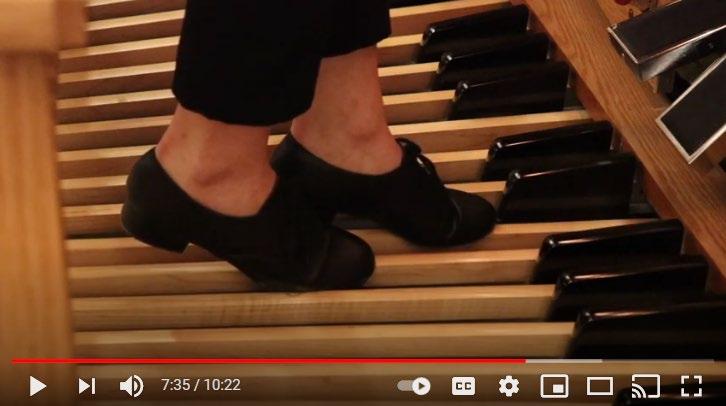
SPECIFICATION for a new PIPE ORGAN for
81 ranks, 66 stops Two 4-manual consoles
Great Swell (expressive) Choir (expressive) Solo (expressive) 16' Double Open Diapason 16' Contra Gamba 16' Lieblich Gedact 8' Flauto mirabilis
8' First Open Diapason 8' Open Diapason 8' Geigen Diapason 8' Viole d'orchestre
8' Second Open Diapason 8' Concert Flute 8' Rohr Flute 8' Viole Celeste
8' Harmonic Flute 8' Gamba 8' Dulciana 8' Clarinet
8' Viola di Gamba 8' Voix Celeste 8' Vox Angelica 8' English Horn
8' Stopped Diapason 8' Bourdon 4' Fugara 16' Contra Tuba
4' Principal 4' Principal 4' Koppel Flute 8' Tuba
4' Open Flute 4' Flauto traverso 2 2/3' Nazard 4' Tuba Clarion
2 2/3' Twelfth 2' Fifteenth
Gemshorn 8' Tuba mirabilis (Ch)
2' Fifteenth 2' Piccolo harmonique 1 3/5' Tierce
1 3/5' Seventeenth 1 1/3' Mixture III-IV 1 1/3' Larigot
2 2/3' Grand Mixture II-III 16' Double Trumpet 1' Mixture III
1 1/3' Mixture IV 8' Trumpet 16' Contra Fagotto
1/2' Sharp Mixture III 8' Oboe
16' Contra Posaune 8' Vox Humana
Trumpet
Cremona 8' Trumpet 4' Clarion
Tuba mirabilis
4' Clarion
8' Tuba mirabilis (Ch)
Great 16’
Great Unison Off
Great 4’
Cymbelstern (digital)
Nachtigale (digital)
Tremulant (not affecting 16’ Double Trumpet, 8’ Trumpet, or 4’ Clarion)
Swell 16’
Swell Unison Off †
Swell 4’
Tremulant (not affecting 8’ Tuba mirabilis)
Great Reeds on Choir
Choir 16’
Choir Unison Off †
Choir 4’
Tremulant (not affecting the 16’-8’-4’ Tuba rank)
Great Reeds on Solo
Solo 16’
Solo Unison Off †
Solo 4’
Chimes (digital)
Harp (digital)
Glockenspiel (digital)
Pedal
32' Double Open Diapason
32' Contra Bourdon
16' Open Wood
16' First Open Diapason (ext.)
16' Second Open Diapason (Gt)
16' Bourdon (ext.)
16' Gamba (Sw)
16' Lieblich Gedact (Ch)
10 2/3' Grand Quint
8' Open Wood (ext.)
8' Principal
8' Spitz Flute
4' Choral Bass
2 2/3' Mixture IV
32' Contra Posaune (Gt ext)
16' Contra Tuba (So)
16' Trombone
16' Fagotto (Ch)
8' Tuba (So)
8' Trumpet
4' Tuba Clarion (So)
4' Clarion
8' Tuba mirabilis (Ch)
Great Reeds on Pedal
Tracker (in façade) and electric (movable, on stage)
Stage console with terraced stopjambs for a low profile
Shared combination action
COMPASSES – Manual: 61 notes (c1 to c61); Pedal: 32 notes (c1 to g32)
INTERMANUAL COUPLERS (not affecting Solo 8’ Tuba mirabilis)
Great to Pedal
Great 4’ to PED
Swell 16’ to GR
Swell to Great
Swell 4’ to GR
Swell 16’ to CH
Swell to Choir
Swell 4’ to CH
Swell to Pedal Swell 4’ to PED
Choir 16’ to GR
Choir to Great Choir 4’ to GR
Solo 16’ to CH
Solo to Choir
Solo 4’ to CH
Solo to Swell Choir to Swell (stage console only)
Choir to Pedal Choir 4’ to PED
Solo 16’ to GR
Solo to Great Solo 4’ to GR
Great to Choir (stage console only)
Great to Solo Choir to Solo Swell to Solo
999 levels of memory and optional libraries
16 general pistons (thumb and/or toe)
8 divisional pistons on Great, Swell, Choir
8 divisional pistons on Pedal (thumb and/or toe)
6 divisional pistons on Solo
General Piston Sequencer – Next (+) thumb (6) and toe (2)
General Piston Sequencer – Previous (-) thumb (4) and toe (1)
Set (with PIN memory lock)
Go To
General Cancel
GR-CH Manual Transfer
Record-playback (wireless, iPad)
Pedal Divide
Pedal Stops on Great Divisionals
All Pistons Next
All Swells to Swell
Bar graphs for expression shades
Sostenutos (manuals I, II, III, IV)
Solo to Pedal Solo 4’ to PED
The BYU organ department has six pipe organs and one digital organ used for practice in the Music Building. Five of these are located in the Organ Suite (corridor 1231), one is located in room 4110, and one in the Choral Hall loft (3225). In addition, two larger pipe organs are housed in the two faculty offices, 1231A and 1231D. All of them were moved from the Harris Fine Arts Building in 2022-2023 These practice and teaching studio organs represent a wide array of organ types: from those reminiscent the organs of the seventeenth century through those that use modern digital technology. The twelve digital organs in the Organ Lab are also used for practice. These organs are available to see and practice on according to the schedules for your event.
1231A (built by RODGERS Instr. LLC in 2009)
Press the top half of the power switch, located under the Solo stops to the right of the manuals. This teaching studio contains a four-manual custom electronic organ console that is fitted with eight ranks of pipework. Both the pipes and speakers are enclosed in a swell box controlled by the left-most “Case” expression pedal. The console features OSI pipe organ keyboards. The organ contains 384 voices, organized into five or more independent stoplists that imitate important historic organ types. It is also equipped will a MIDI sequencer/sound module and other items to allow faculty and students to explore applications of modern technology into the traditional pipe organ world.
1231B (built by CASAVANT in 2006)
This is a two-manual electric-action organ of 6 ranks. There is one expressive division.
1231C (built by Kenneth COULTER in 1988)
Press the power button located to the left of the manuals
Turn on the “light switch” to the right underneath the manuals. This is a two-manual tracker organ of 9 ranks. It features a flat pedalboard and a very sensitive key action.
1231C (Austin, rebuilt by SCHOENSTEIN in 1988)
Press the red power button located to the left of the manuals
This is a three-manual electro-pneumatic organ of 10 ranks. There are two expressive divisions. The console was rebuilt by Mike Ohman in 2022 with a new combination action.
1231D (built by M.L. BIGELOW and Company in 1996)
Pull the "wind" stop to your right to start the blower.
This teaching studio contains a two-manual tracker organ of seven ranks. All but the 8' Principal are located within the swell box. The organ focuses on stops of 8' pitch, offering the student who spends two or more hours in daily practice a wide choice of stops that are easy on the ears. Some of the stops are playable on either the Great or the Swell, but not both at the same time.
1231E (built by RODGERS Instr. LLC in 2000)
Press the top half of the power switch, located under the Great stops to the right of the manuals.
This “traveling organ” is a three-manual digital organ console that is fitted a rolling platform and up to four rolling speaker cabinets. It is moved to spaces where an organ is not usually available for recitals and accompaniments
1231E (built by P & S in 2001)
This is a two-manual tracker organ of 6 ranks. There are no expressive divisions.
Choral Hall, room 3225 (built by Kenneth JONES in 1988)
To power up the organ, turn the key to the left of the manuals.
Turn the key that is located low and to the right, just above the higher pedal keys.
This is a three-manual tracker organ of 22 ranks. In a "tracker" key action such as this, there is a direct mechanical connection between the key and the valve underneath the pipe. It allows the organist greater control over the way the pipe speaks than in an electric or electro-pneumatic key action. This organ is used as a teaching instrument, offering a large variety of stops in a small space, and for rehearsal and performance. There is one expressive division, the Swell. It was revoiced in 2023 to better fill the larger space in its new home
4110 (built by Karl WILHELM in 1987)
The "on" switch for this organ is the white switch just under the right end of the Great manual. This is a two-manual tracker organ of six ranks. It features a flat pedalboard, similar to those commonly found in Europe. The pipework is enclosed behind cabinet-style shutters that can be set in position by the organist. The manuals are coupled by means of a shove-coupler: grasping the small knobs to the right and left of the Great allow you to push the manual in or out. It is coupled to the Swell when it is pushed in. The hook-down pedals near the pedal keys are pedal stops and manual/pedal couplers.
Organ Lab, room 2217 (built by ALLEN in 2021)
The "on" switch is to the lower left of the manuals
Of these twelve digital organs, eleven are model LD34B, and one is an earlier drawknob model donated by Parley and Bona Belnap This room is used for group organ classes and for student practice. A thirteenth LD34B organ, located in Music Library of the Harold B.Lee Library, is available for perusing organ scores.