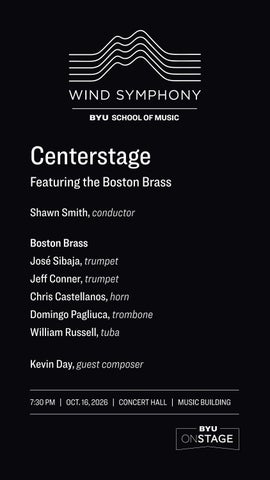
Centerstage
Featuring the Boston Brass Shawn Smith, conductor Boston Brass José Sibaja, trumpet Jeff Conner, trumpet Chris Castellanos, horn Domingo Pagliuca, trombone William Russell, tuba Kevin Day, guest composer 7:30 PM | OCT. 16, 2026 | CONCERT HALL | MUSIC BUILDING
Ecstatic Fanfare . . . . . . . . . . . . . . . . . . . . . . . . . . . . . . . . . . . . . . . . . . . STEVEN BRYANT b. 1972
Amazing Grace . . . . . . . . . . . . . . . . . . . . . . . . . . . . . . . . . . . . . . . . . . . . . . JOHN NEWTON 1725–1807 arr. Benjamin Dean Taylor
Sinfonía Nómada . . . . . . . . . . . . . . . . . . . . . . . . . . . . . . . . . . . . . . . ARTURO MARQUEZ *Western Premiere I. Marcha Natura (Natural March) II. Faro Verde: Sahuaro (Green Lighthouse) III. Looking South
b. 1950
— INTERMISSION —
ru2or3? . . . . . . . . . . . . . . . . . . . . . . . . . . . . . . . . . . . . . . . . . . . . . . . . . . . . . . . STEPHEN JONES b. 1960
Centerstage . . . . . . . . . . . . . . . . . . . . . . . . . . . . . . . . . . . . . . . . . . . . . . . . . . . . . . . KEVIN DAY *Western Premiere I. Precise, in a groove II. Ballad III. Quickly
b. 1996
featuring the Boston Brass
Havana . . . . . . . . . . . . . . . . . . . . . . . . . . . . . . . . . . . . . . . . . . . . . . . . . . . . . . . . . . . . . . KEVIN DAY
Program Notes Ecstatic Fanfare, Steven Bryant From the composer: Ecstatic Fanfare is based on music from movement I of my Ecstatic Waters. One day in May 2012, I mentioned to my wife that it might be fun to take the soaring, heroic tutti music from the earlier work and turn it into a short fanfare someday. She goaded me into doing it “immediately,” and so in a panicked three-day composing frenzy, I created this new work. The work unfolds with a flurry that can best be described as aggressive jubilation that winds down into a quiet, pure, pastoral melody marked by descending fourths in the clarinets. The use of open harmonies and descending fourths provide a sense of innocence and simplicity to this music, giving the listener something familiar to connect with, reminiscent of the music of Aaron Copland. This quiet music is eventually transformed into a powerful statement by the horns, marked “aggressive and celebratory.” This moment of celebration explodes into elation and the work rallies toward an energetic, powerful conclusion.
Amazing Grace, arr. Benjamin Dean Taylor The spiritual, Amazing Grace, was written by John Newton (1725-1807), a slave ship captain who, after years of transporting slaves across the Atlantic Ocean to the New World, suddenly saw through divine grace the evilness of his acts. First published in 1835 by William Walker in The Southern Harmony, Amazing Grace has since grown to become one of the most beloved of all American spirituals. This setting was composed specifically for the BYU Wind Symphony by BYU alum Ben Taylor with a heartfelt tribute to the power of divine grace in our lives.
Sinfonía Nómada, Arturo Marquez Sinfonía Nómada (Nomadic Symphony) is a work centered on migration, approached not as a single narrative but as a series of perspectives. Across its three movements, the symphony moves from the natural world to the human experience, ultimately confronting one of the most urgent issues of our time: immigration. Framing the entire work is a recurring batucada-inspired rhythmic language that opens each movement and returns with heightened meaning in the finale, where its character is revealed in full. The first movement, Marcha Natura (“Natural March”), reflects the vast cycles of natural migration that define life on Earth. Its steady, processional character evokes the movement of species across great distances: caribou traversing the tundra, salmon returning upstream to the waters of their birth, and the arctic tern’s extraordinary annual journey between the poles. The music unfolds with patience and inevitability, suggesting motion not as urgency, but as necessity, embedded in the rhythms of the natural world. The second movement, Faro Verde: Sahuaro (“Green Lighthouse”), draws inspiration from the poem Saguaros by Salvadoran poet Javier Zamora. In Saguaros, Javier reflects on his journey on foot from El Salvador through the Sonoran Desert into the United States. Undertaken in an effort to be reunited with his parents, the journey took two months, with the poem set at the moment of his arrival at the U.S. border. In the Sonoran Desert, the composer's birthplace, the towering saguaro cactus stands as both witness and guide. These behemoths grow slowly, approximately one meter every sixty years, with some living for centuries and reaching heights of over sixty feet. Márquez translates this imagery into sound through a gradual unfolding of musical material: a long crescendo shaped by shifting meters that mirrors the slow growth of the saguaro. This rise is later reversed, the music fading as if the landscape itself is falling away. This expansion and decay can be heard as the life cycle of the cactus, a
reflection on environmental loss, or perhaps the saguaros serving as sentinels, rising before Javier Zamora, only to recede as he leaves them behind. The final movement, Looking South, addresses contemporary human migration directly. Márquez, himself an immigrant during his studies in California, has described this subject as inescapable: “How could I write anything else?” Yet rather than framing the movement in present-day rhetoric, he turns to the words of William Shakespeare, written over four centuries ago. The movement is structured around “The Strangers’ Case” speech from Sir Thomas More, in which Sir Thomas asks his listeners to imagine themselves as the very strangers they seek to expel. Though the text is never spoken, it is embedded musically, first in the trumpets and later in the clarinets. The final word of the speech, “inhumanity,” is revealed as the fundamental motive, not only of the movement, but of the batucada drumming that frames the entire symphony. Here, in the third movement, the drumming is accompanied by whistles, a warning call to the community that dangerous, inhuman forces are descending.
ru2or3?, Stephen Jones From the composer: ru2or3? is dedicated to my daughter Rachel, who turned three just after I began writing the piece. Since Rachel [was] three, I decided the piece had to be about three minutes in length. In the days before her birthday she would come to my study in the morning and I would ask her, "Rachel, how old are you? Are you two or three?" That question created not only the title for the piece, spelled beginning with the first letter of her name, but also provided the idea that the piece could progress from having two beats per measure in the beginning to having three beats per measure by the end. Rachel had a lot of natural rhythm in her singing and movement
and I wanted to capture that in the "groove" that is established at the beginning of the piece. Here the initial phrase is repeated, each repetition adding new layers that accumulate into a large sound using the full ensemble. These opening materials are then developed and new ideas introduced, some of which have three beats per measure as opposed to two. A large climax is reached out of which a second "groove" emerges, this time in 3/4. Using a reworking of the materials from the beginning of the piece, the process of layering starts again. The last layer added is a tune, heard first in the trombones, whose notes are derived from the letters of Rachel's name. This final section of the piece grows quickly to the conclusion.
Centerstage, Kevin Day From the composer: Brass instruments and brass music have been a monumental part of my growth as an artist. Since being a young euphonium/ tuba player growing up in North Texas, I have been inspired for years by what brass instruments can do and how they continue to push the boundaries of audience expectations. When asked to compose a work for the internationally renowned brass quintet the Boston Brass, I was excited at the chance to write for a group of musicians that I truly admired. As my composition process started, I knew that I wanted to write something that would truly capture their virtuosic spirit, while also creating a piece that could be accessible for them to perform with various wind bands. Centerstage is the culmination of these ideas and my love letter to the brass world. It features my influences of contemporary jazz, R&B, and popular music styles. Written in three contrasting and untitled movements, I wanted to showcase how brass instruments can groove together, make beautiful and resonate sounds in melody, and play with technical speed and precision. Though this may appear to be written in a “concertolike” format like some of my past works, I am not calling this
particular composition a concerto due to the composition not having a distinct narrative structure. Rather, I would wish for audiences to take the music at face value and let their own minds create the story, as the brass take centerstage in this moment.
Havana, Kevin Day Havana was a wind ensemble piece that I started working on in 2017, got about 30 measures into writing, and then put on the shelf. I couldn’t think of what to do with it or come up with an idea, so I ended up just putting it aside until I could. I ended up forgetting about it, and while I was searching through my music files on a night in September 2018, I stumbled on this work and found inspiration to write on what I had. I wanted to tell a story with the piece and make it authentic, and so I spent a lot of time carefully writing the work. After messing with a few titles and feeling a good amount of frustration, I decided to go with Havana, despite there being a viral pop song already in existence with the same name (a song that is honestly a guilty pleasure of mine to listen to). This piece, however, has nothing to do with the Camilla Cabello mega-hit. Havana is heavily influenced on Cuban music, rhythms, and percussion. I wanted to highlight different dance genres such as salsa, mambo, and cha-cha, while also making the piece in my own voice. I have a strong love for Latin music, and so this was incredibly fun to write. I sought to paint a mental picture of the city of Havana, the beautiful landscape, and the culture that it is known and beloved for. There are many “Latin-influenced” pieces for band already and so I wanted to make Havana stand out as one that is exciting and memorable. I hope that performers and audiences will tap their foot, bop their heads, and feel the music.
WIND SYMPHONY PERSONNEL
Piccolo
Contrabass Clarinet
Flute
Alto Saxophone
Ruby Knudson Hallie Law* Hannah Davis Indi Lee Emma Algaier
Oboe
Mark Fluckiger
Jonathan Crane* Isaac Arredondo
Tenor Saxophone Hunter Gilette
Rachel Johnson* Miles Moore
Baritone Saxophone
English Horn
Trumpet
Paris Sass
Bassoon
Zach VanSweringen* Andrew Despain
Contrabassoon Zachary Smith
E-flat Clarinet Tristan Carlson
Clarinet
Seth Rugg* Luke Rasmussen Hyehyun Pak Joseph Aguirre Rachel Shurtz Hannah Oman Rachel Pearson Chloe Young
Bass Clarinet Tyler O’Brien James Rich
Hamish Reeves
Caden Randolph* Bennett Anderson Ila Goodrich Katie Myers Calli Luthi Sun-Gyu Lee
Horn
Ian Patterson* Kirstyn Miller (asst) Lydia Wood Ada Niederhauser Lynnea Westwood
Trombone
Hekekiah Bowden* Rees Riska Carson Anderson
Bass Trombone Jeron Charlton
Euphonium
Luke Lehmuller* Joseph Miller
Tuba Conner Hemmert* Jacob Brady
Percussion
Sean Caviness* Connor Chase Cade Buhrer Jared Bateman Mark Hulet
String Bass
Madilynn Adams
Piano
Abbey Burton
Harp
Whitney Jensen *Principal
Boston Brass Since 1986, Boston Brass has set out to establish a oneof-a-kind musical experience featuring colorful classical arrangements, burning jazz standards, and the best of original brass repertoire. Boston Brass treats audiences to a unique brand of musical entertainment that bridges the ocean of classical formality, delighting regular concertgoers and newcomers alike with great music and boisterous fun in performances across all 50 U.S. states and over 30 countries to date. As a Yamaha Performing Group, Boston Brass performs exclusively on Yamaha instruments. Music education is at the core of Boston Brass’s identity and the quintet conducts sessions around the world in the form of masterclasses, residencies and collaborations, everywhere from your local schools to major music conservatories. The quintet has longstanding relationships at many institutions, most notably Yong Siew Toh Conservatory of Singapore and North Dakota State University, both schools having named Boston Brass “Visiting Ensemble in Residence” starting in 2024. Boston Brass is also proud to be a member of the International Artistic Advisory Council to the College of Music at Mahidol University in Bangkok, and in 2023 the group was inducted into the prestigious American Bandmasters Association as associate members. The quintet’s newest album Blues for Sam features a mix of classical and jazz arrangements alongside old favorites and is dedicated to the late Sam Pilafian who can also be heard on Simple Gifts (2018), Reminiscing (2016), and Rewired (2015). Newly released in 2023 is the album Joe’s Tango, which introduces Boston Brass’s world premiere of Jorge Machain’s Five Cities Concerto alongside the UNLV Wind Orchestra.
Other ongoing Boston Brass projects include performances of Gordon Goodwin’s composition Perplexing Times, and premiere performances of Arturo Sandoval’s wind dectet written especially for Boston Brass and Imani Winds.
Composer Kevin Day Praised for his “sweeping” and “lush” orchestrations (Wall Street Journal), Dr. Kevin Day (b. 1996) is an award-winning, multi-disciplinary composer, jazz pianist, and conductor based in San Diego, California. Internationally acclaimed as one of the world’s leading musical voices, Dr. Day’s work is known as a vibrant exploration of diverse musical traditions from contemporary classical, cinematic, jazz, R&B, Soul and more. A unique voice in the world of classical music, Dr. Day takes inspiration from a broad range of sources, including romanticism, late 20th century music, jazz fusion and gospel. Across all areas, his work explores the complex interplay of rhythm, texture and melody across genres. Dr. Day burst onto the musical scene in 2018 with his Concerto for Euphonium, which has since gone on to become a Classic FM sensation. Since then, he has been commissioned and performed by ensembles including the Cincinnati Opera, Cincinnati Symphony Orchestra, Houston Symphony Orchestra, Fort Worth Symphony Orchestra, New Jersey Symphony, Las Vegas Philharmonic, Tokyo Kosei Wind Orchestra, Dallas Winds, Nu Deco Ensemble, U.S. Coast Guard Band, “Pershing’s Own” U.S. Army Band, “The President’s Own” U.S. Marine Band, U.S. Navy Band, U.S. Air Force Band, The Boston Brass, Latitude 49, Lincoln Trio, Capitol Quartet, Tesla Quartet, Castle of Our Skins, Puerto Rican Trombone Ensemble, Sheffield Chamber Players, and many others throughout the United States, Canada, Austria, Taiwan, South Africa, Australia and Japan. His music has also been streamed over a million times across platforms worldwide. Dr. Day is the recipient of numerous awards including the MacDowell Fellowship for Music Composition, the BMI Composer Award, 3rd Prize of the Alexander Zemlinsky Prize in
Chamber Music Composition, the ITEA Harvey Phillips Award for Excellence in Composition, a Copland House Residency Award, the TCU Alumni Outstanding Young Professional Award, a three-time ASCAP Morton Gould Finalist, a finalist for the ABA Sousa-Ostwald Award, a finalist twice for the NBA Revelli Award, and many more. He was also selected as the 3rd Prize Winner of the New Classics International Competition for Young Composers at the Moscow Conservatory. In 2025, Dr. Day was inducted into the TCU Band of Fame. Dr. Day’s first opera with librettist Tifara Brown, Lalovavi, was premiered in July 2026 to much acclaim from audiences and critics alike. Featured in Opera with Opera News Magazine, PBS NewsHour, and PBS’ The Art Show, this work is the first of three commissioned works by the Cincinnati Opera to engage Black creators to tell Black stories. This monumental grand opera marks Dr. Day’s largest musical work to date, while also being recognized as the first grand opera to have an Afrofuturist theme, to incorporate the Black American language known as Tut, and to feature the euphonium as part of its orchestral orchestration. His second opera, For The Love Of Uvalde (based on the acclaimed play by librettist Dr. Ayvaunn Penn), is a chamber opera commissioned by the TCU College of Fine Arts and Urban Arts Initiative, and will be premiering in 2027. Other recent works include his acclaimed Concerto for Wind Ensemble and Echoes (Piano Trio No. 4), as well as Ignition, commissioned by the Boston Symphony Low Brass and Fires Unquiet Within, a double concerto for violin, cello, and chamber orchestra commissioned by a consortium lead by Aperio Music of the Americas for violinist Sasha Callahan and cellist Leo Eguchi. In addition to his work as a composer in demand, Dr. Day also enjoys an active career as a jazz pianist. Passionate about collaborations that reimagine and advance the future of jazz as an art form, he brings his extensive musical background to the stage and studio as improviser and collaborator. His music has been featured on numerous high profile recordings from artists
like Mauro Martins, Hiram Diaz, Seraph Brass, Boston Brass, Sterling Elliot, Thomas Mesa, Michelle Cann, United States Navy Band, Jeremy Wilson, Jarrett McCourt, Nicki Roman, and most recently Latitude 49. Dr. Day serves as Lecturer of Composition at San Diego State University. He holds a Bachelor of Music (BM) degree in Performance from Texas Christian University, a Master of Music (MM) degree in Composition from the University of Georgia, and a Doctor of Musical Arts (DMA) degree in Composition from the University of Miami Frost School of Music. He has studied composition with Dorothy Hindman, Charles Norman Mason, Peter Van Zandt Lane, Emily Koh, Neil Anderson-Himmelspach, and Pulitzer Prize-winning composer Gabriela Lena Frank, as part of the Gabriela Lena Frank Creative Academy of Music.
About the Conductor Shawn Smith serves as the Director of the Brigham Young University School of Music, as well as Professor of Conducting and Director of Bands. Prior to his appointment at BYU, he spent sixteen years as Director of Bands at the University of North Carolina at Charlotte and Texas A&M-Corpus Christi. Smith holds a doctor of musical arts degree in instrumental conducting from Arizona State University, a master of music degree from Louisiana State University, and a bachelor of music education degree from Boise State University. In high demand as a band and orchestra conductor, clinician, and adjudicator, Smith has been invited to conduct professional and educational ensembles throughout the United States, South America, Central America, and Europe, including concerts with world-renowned trombonist Joseph Alessi, Grammy Award-winning chamber ensemble Eighth Blackbird, Tony-nominated Broadway and television star Derek Klena, “The President’s Own” United States Marine Band, and the United States Air Force Band. Equally at home with opera and musical theater productions, Smith has conducted pit orchestras for the Marriage of Figaro and a six-week run of Les Misérables. His performances have been heard numerous times on American Public Media’s Performance Today, the most popular classical music radio program in the United States. In 2015, Smith was awarded second place for the American Prize in Conducting-Professional Band Division. In the area of research, Smith has been published in the Journal of the World Association for Symphonic Bands
and Ensembles and in Alta Musica and he has presented his research at national and international conferences in the United States, Europe, and South America. Smith has also presented numerous educational clinics, workshops, and speeches, most notably at the International Midwest Band and Orchestra Clinic in Chicago, Illinois and at state music conferences throughout the United States. As a public school teacher, Smith served as Director of Bands and Orchestra at one of the largest high schools in Idaho where he administered a very successful comprehensive instrumental music program. An accomplished trumpeter, Smith has performed with the Corpus Christi Symphony (Texas), the Boise Philharmonic Orchestra (Idaho), the Acadiana Symphony (Louisiana), Keith Brion’s New Sousa Band, and with the Temptations. During his tenure as Director of Bands at Texas A&M-Corpus Christi, Smith received the Texas A&M System Teaching Excellence Award twice. Smith holds honorary memberships in Phi Mu Alpha Sinfonia, Sigma Alpha Iota and Kappa Kappa Psi. He also holds memberships in the Utah Music Educators Association, the National Band Association, the College Band Directors National Association, and the World Association for Symphonic Bands and Ensembles.
BYU Wind Symphony The finest woodwind, brass, and percussion players at Brigham Young University perform with the Wind Symphony, under the direction of Shawn Smith. The BYU Wind Symphony maintains an active performance schedule with programming that ranges from wind band classics to some of the newest wind repertoire. Participation in commissioning consortiums and hosting composers and guest conductors on campus offers ensemble members wonderful musical experiences. The BYU Wind Symphony has performed with world-renowned artists including New York Philharmonic principal trombonist Joseph Alessi, Grammy Award-winning chamber ensemble Eighth Blackbird, Tony-nominated Broadway and television star Derek Klena, and the popular vocal trio Gentri. The ensemble has been honored with invitations to perform at national and division conferences of the College Band Directors National Association, the American Bandmasters Association National Conference and the international conference of the World Association for Symphonic Bands and Ensembles. As BYU’s premier wind band, the ensemble has performed throughout the United States and in over twenty countries, including China, Japan, South Korea, Mongolia, Australia, New Zealand, and many European countries. Recent concert tours include Australia (May 2018), Texas (May 2019), Spain/ Portugal (May 2023), South Korea (July 2024) and Brazil (May 2026). Their latest album, Latin Dances, was released in 2024 and is available on all streaming services.
Your donations open doors for BYU School of Music students!
D O NATE N OW