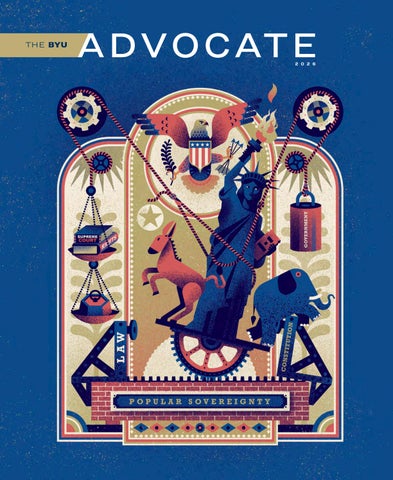
the
advocate 2 0 2 6
Gwen Keraval C O V E R I L L U S T R AT I O N
c o n t e n t s
02
Dean’s Message
04
Features
28
Of Good Report
38
In Practice
40
The Docket
44
From the Field
F E AT U R E
Binding Power: Law and the Foundations of Freedom
04
Melody Barnes
20
David H. Moore, p u b l i s h e r Lynnett Rands, e x e c u t i v e e d i t o r Maren Hendricks, e d i t o r
F E AT U R E
Krista Hanby, a s s o c i a t e e d i t o r
The Powerhouse Tenth Amendment
David Eliason, a r t d i r e c t o r Bradley Slade, p h o t o g r a p h e r
Melissa Holyoak The BYU Advocate is published
27
by the J. Reuben Clark Law School at Brigham Young University. © 2026 by Brigham Young University. All rights reserved. Send subscription inquiries to dbcoord@law.byu.edu. The J. Reuben Clark Law School at Brigham Young University is approved by the Council of the Section of Legal Education and Admissions to the Bar of the American Bar Association, 321 North Clark Street, Chicago, IL
Law School Conferences
60654, 312-988-6738.
To read a digital version, please visit issuu.com /byulawpubs.
32 OF GOOD REPORT
BYU Law’s New Writing Center
Maren Hendricks
3.95 170 U N D E R G R A D U AT E M E D I A N G PA
M E DIAN
79% S PEA K T WO LA NGUAG E S
2
t h e
b y u
a d v o c a t e
bonjour
hej hej
JOHN SNYDER
D E A N'S
M E S S A G E
T
he landscape of US legal education is shifting rapidly. Starting this year, the NextGen bar exam, with its expanded focus on lawyering skills, will replace the legacy exam. Simultaneously, some states, including Utah, are considering or have adopted an alternate path to licensure that involves supervised practice rather than a national exam. Accreditation standards for law schools are under review, as are accrediting bodies themselves. The cost of obtaining a legal education has soared while federal student loans face new caps. Experiential learning opportunities in law school have expanded dramatically, but pressure remains for students to graduate ready to practice. Artificial intelligence (AI) is transforming education and legal practice, generating questions about how and what to teach and raising uncertainties about future employment. At the same time, big firms are interviewing students in their first semester and extending offers before or shortly after first-semester grades are out. In the face of these developments, byu Law is seizing opportunities and navigating challenges. byu Law continues to welcome students with impressive credentials and character. The fall 2025 class entered with a median undergraduate gpa of 3.95, ranking byu Law in the top 10 law schools by this metric. The class of 2025’s median lsat of 170 put byu Law in the top 20. Among lsat takers in the entering class, three-quarters scored in the 91st percentile or above. This means that approximately 75 percent of these students scored higher than the top 10 percent of entering byu Law students only 10 years ago. Of course, byu Law students bring far more than strong credentials; they also come with maturity, integrity, a strong work ethic, compassion, and global perspective. Nearly 80 percent of them speak at least two languages. At byu Law, students learn from faculty who have worked at the highest levels of both public and private practice, who offer interdisciplinary expertise through juris and academic doctoral degrees, and who are influential scholars and dedicated teachers. Faculty members pair high expectations with concern for each individual. Students learn both traditional research methods and innovative tech tools in the first year. Upper-level writing courses and the newly established writing center refine foundational composition skills, while students discover how to draft and evaluate practice documents using AI. Instruction combines theory and doctrine with experiential learning. Through the Law School’s innovative Academies, all first-year students have the chance to experience high-level practice in areas such as deals, trial advocacy, startups, and immigration in legal markets around the country. The outcomes for byu Law students are impressive. In 2025, roughly 97 percent of byu Law students who took the bar exam passed on the first try, ranking byu Law 7th in the nation for first-time passage. byu Law joined only three other schools—Yale, Stanford, and Virginia— for 100 percent ultimate passage (or passage within two years of graduation). byu Law students go on to employment in public and private practice across the nation and beyond. Since 2020, 100 percent of graduates seeking employment have secured employment. Clerkship placements remain especially impressive: byu Law ranked 10th and 11th in recent years for percentage of students landing federal clerkships. During the 2026 term, byu Law professor Tyler Lindley and alumnus Brock Mason, ’22, will clerk at the US Supreme Court. byu Law students make career choices with unrivaled financial freedom. byu Law is routinely ranked as the best value law school in the nation. Thanks to the generous support of The Church of Jesus Christ of Latter-day Saints, tuition for a Church member is less than $16,000 per year and less than $32,000 for all other byu Law students. In addition, all students receive a scholarship, and almost half receive at least a full-tuition scholarship. Not surprisingly, students graduate with little to no debt. More than half of the class of 2025 graduated debt-free. In all of this, byu Law pursues a unique mission that embraces the whole person. The Law School seeks to “develop people of integrity who combine faith and intellect in lifelong service to God and neighbor.” The result is not only impressive statistics but top-notch lawyers of faith, character, and purpose.
d av i d h . m o o r e
Dean, byu Law School
t h e
b y u
a d v o c a t e
3
BINDING
POWER e e e
e
e
e
e
e
e
e e e
e e e
e e e
e e e
L AW A N D T H E FO U N DAT I O N S O F F R E E D O M by
Melody Barnes
Executive Director of the Karsh Institute of Democracy at the University of Virginia
I
t is a privilege to open this conference and to do so in conversation with lawyers and judges who care deeply about the foundations of freedom and the responsibilities that accompany them. I come to this conversation as a lawyer myself. My career has taken me through private practice, the legislative branch, the executive branch, the nonprofit sector, and now academia, but the throughline has always been law: how it structures authority, constrains power, and makes freedom possible. The theme of this conference—“‘Life, Liberty, and the Pursuit of Happiness’1: Foundations of Freedom”—invites us to reflect on both our founding ideals and the institutional conditions that allow those ideals to endure. Those seven words are among the most recognizable in American civic life, but they are also among the most demanding. They ask something of us—not only as citizens but also as participants in and stewards of a constitutional order. As lawyers, we are trained to think in terms of procedures and processes and of the guidance and constraints they provide. That training reminds us that aspirations alone are insufficient; ideals do not sustain themselves. We understand that there are both limitations within those ideals and tradeoffs between them. My individual liberty must be compatible with the liberty of those around me, and the law both captures that principle and helps secure it for each of us. The realization of our founding ideals depends not only on moral judgment but also on institutions, rules, and norms that translate principle into durable practice. It is precisely because ideals require structure and stewardship that I want to reflect on a central insight of the American experiment in self-government—one that shaped the founding, continues to define our constitutional system, and carries particular implications for lawyers and judges today.
illustration
by
gwen
k e r ava l
Democracy and the Problem of Power
This article is adapted from remarks delivered on February 26, 2026, at the J. Reuben Clark Law Society Annual Conference in Washington, DC.
The American experiment in self-government sought to reconcile two powerful ideas: popular sovereignty and the rule of law. The founders believed that legitimate political power flows from the people. They also understood that popular power left unchecked could become as dangerous as any other form of power if it were exercised arbitrarily. Democratic legitimacy is grounded in popular sovereignty. Democracy is of great value for people living in democracies at present while also serving as an aspiration for many around the world. Yet for almost 2,000 years following the fall of democracy in ancient Athens, democracy had been thought of as one of the worst forms of government. It was, as University of Cambridge Professor John Dunn has said, “grossly illegitimate in theory and every bit as disastrous in practice.”2 This was the case until the end of the 18th century, when democracy was reimagined for the modern world. For much of history, democracy was understood as “rule by the many,” which is often equated with rule by the masses, particularly the poor. It was thought to be unstable and turbulent, fickle and unwise. Despite Pericles’s famous funeral oration in which he praised the character of Athenians as marked by a commitment to rule of law,3 democracy itself was not viewed as particularly well-ordered. It is worth noting that much of what we know about democracy from the ancient world is filtered through the lens of its critics, from Thucydides to Plato and Cicero, among others. Nevertheless, their critiques and the concerns they raised continued to be ones that animated and shaped early American political thinkers, especially those engaged in crafting a modern political order that would be based on the previously derided “many.” Rather than equating democracy with simple majority rule, the founders innovated by using lessons from the long republican tradition to design a system in which power flows from the people but is exercised through stable institutions, regular processes, and binding law. We have seen this system play out in our own time during elections when deeply contested results were brought not to the streets but to the courts. Judges across jurisdictions who were appointed by presidents of different parties applied evidentiary standards, ruled by procedure, and settled law. Many claims failed; a very small number succeeded. What mattered for democratic legitimacy was not that every voter was satisfied but that disputes were resolved through law instead of force. In our model, moreover, democracy is judged not merely by who wins power but by whether power remains constrained once it is won. Power lies with the people—and those in positions of political authority are accountable to them. Accordingly, the constitutional project rests on the idea that political power is entrusted to representatives through elections and remains legitimate insofar as it is exercised within the boundaries of the constitutional order. James Madison captured this idea with remarkable clarity in a well-known passage in Federalist no. 51: “In framing a government which is to be administered by men over men, the great difficulty lies in this: you must first enable the government to control the governed; and in the next place oblige it to control itself.”4 Madison’s insight was that legitimate government must be based on popular sovereignty that must also be channeled and constrained. The problem was not simply how to reflect popular will but how to ensure that will—once empowered—would remain bound by law rather than converted into another form of domination.
Republican Tradition, American Innovation
The founders were not inventing from scratch a concern about forms of arbitrary rule or domination, including from popular majorities. They, of course, had their own immediate experience of British colonial rule, but they were also drawing on centuries of republican thought and a repertoire of historical examples, both good and bad. The model of government at the forefront of the colonists’ minds was the mixed constitution, as represented in the British constitution. Formed by a combination of monarchy, 6
t h e
b y u
a d v o c a t e
PORTRAIT OF JAMES MADISON BY GILBERT STUART / BOWDOIN COLLEGE MUSEUM OF ART
aristocracy, and democracy, this model of mixed government had long been considered, since the writings of Aristotle and Polybius, to provide stability and moderation by constraining the worst and drawing out the best of each simple form of government. This balance was more likely to stave off corruption and the decline of freedom. And yet, while this system relied on social hierarchies for its balance, the American experiment rejected that social-class framework. As Thomas Paine argued, America did not need kings or nobles to secure liberty. Indeed, those elements of the mixed constitution, as he argued in Common Sense and Rights of Man, were tyrannical and their power illegitimate—and any continued presence in America would threaten freedom.5 Paine went further, arguing that the only genuinely republican element of the British Constitution was the House of Commons, the body representing the people. The American government ought to be fully popular government—one in which every branch derived its authority from the people.6 The Federalists also removed nobility and monarchy from the republican formula. They bestowed a government based on a single source of power: the people. As Madison would say in Federalist no. 39, a republican form of government “derives all its powers directly or indirectly from the great body of the people.”7 He stated that “the most decisive” proof of the new government’s republican credentials could be “found in its absolute prohibition of titles of nobility, both under the federal and the State governments; and in its express guaranty of the republican form” to the state governments.8 But that choice to ground legitimate government on the basis of popular sovereignty made institutional design even more important, not less. At the same time, the founding vision of popular government was limited and incomplete. Participation was constrained through a range of institutional and legal mechanisms: Senators were originally chosen by state legislatures rather than by popular vote; the Electoral College mediated the selection of the president; and suffrage claims were disregarded while political status was systematically limited for women, white men without sufficient property, many Indigenous people, and Black Americans—enslaved or free. These exclusions reflected both the views of many decision-makers and the prevailing political and social assumptions of the time, narrowly defining what “the people” as a political actor meant. Even so, the challenge that the founders confronted remained the same: how to secure the rule of law and prevent arbitrary power in a political order grounded in popular sovereignty. A mixed government for the modern world was one solution. Securing the rule of law had to come from constitutional architecture: separation of powers, checks and balances, federalism, and representation itself. Both the Federalists and Anti-Federalists fought over the correct interpretation of Montesquieu’s political philosophies and the ways in which his theories served their arguments and not those of their opponents. But what was clear was the influence of Montesquieu’s argument on the importance of the separation of powers to securing liberty. Liberty is lost, he argued, if the same man or same body of men both make the law and then also execute the law, or if both make the law and then adjudicate disagreements over it. As Montesquieu said, “[M]any of the princes of Europe, whose aim has been levelled at arbitrary power, have constantly set out with uniting in their own persons all the branches of magistracy, and all the great offices of state.”9 Montesquieu also conveyed to the founders that democracy is not, by its nature, a free state. Freedom, he argued, is not simply participation in self-rule: “[It] is a tranquility of mind arising from the opinion each person has of his safety.”10 For citizens to possess that security, government must be structured so that no one has reason to fear another. That freedom, in his view, depended on design. The separation of powers—assigning legislative, executive, and judicial authority to distinct institutions—combined with a system of checks and balances in which each branch participates to some extent in the tasks of the others, creates stability through mutual restraint and turf wars. Where legislative, executive, and judicial powers are united, despotism follows—regardless of whether the regime calls
“You must first enable the government to control the governed; and in the next place oblige it to control itself.”
—JAMES MADISON
t h e
b y u
a d v o c a t e
7
Friction Protects Freedom
“A government is only the creature of a constitution.”
—THOMAS PAINE
8
t h e
b y u
a d v o c a t e
Separation of powers was only one structural safeguard. The founders also recognized that even a well-divided government could be vulnerable to sudden swings of popular passion. Representation itself was designed as an additional moderating force. As Madison explained in Federalist no. 14, the American system would not be a direct democracy in which “the people meet and exercise the government in person” but a republic in which “they assemble and administer it by their representatives and agents.”12 The “scheme of representation,” as he called it in Federalist no. 10, would temper the force of majority impulses by extending the republic across a large territory—avoiding some of the instability that had plagued small direct democracies in the classical world.13 Even today, scholars continue to debate over precisely when the word republic became interchangeable, in everyday use, with what we now call a representative democracy. We know that Paine and Hamilton were among the first to use the term representative democracy to describe a republic based on popular sovereignty. As Paine said early on, American government consisted of “representation ingrafted upon democracy.”14 Another goal of representation the Federalists noted was to “refine and enlarge the public views”—the opinions and interests of the republic would be channeled through the medium of their representatives, “whose wisdom may best discern the true interest of their country, and whose patriotism and love of justice will be least likely to sacrifice it to temporary or partial considerations.”15 Yet even here, they wrote, “Enlightened statesmen will not always be at the helm,” and “[m]en of factious tempers, of local prejudices, or of sinister designs” could very well be elected. They also remarked that “auxiliary precautions” would be needed in the design of institutions.16 Constitutional architecture would also help to secure the rule of law and manage the effects of factions—in particular the danger posed by majority factions. Madison noted that choosing freedom meant that people would disagree. Where commerce and industry thrive, there would be differences in property; where people are left to think for themselves, they would inhabit different beliefs and practices.17 A free society, then, will inevitably be marked by competing interests and the formation of factions. And given what the founders understood about human nature, they worried that factions, like individuals, tend to press to secure their own private or sectional interests. If factions, and especially majority factions, were able to secure their own interest, that could be to the detriment of the rights and liberties of others.
THOMAS PAINE, LAURENT DABOS / NATIONAL PORTRAIT GALLERY, WASHINGTON
itself democratic or monarchical. Where those powers are divided and balanced, liberty can endure. These insights profoundly shaped early American political thought and are embedded in our constitutional design. We see this dynamic today whenever courts invalidate executive actions—not because judges oppose the policy aims of administrations but because the actions exceeded lawful authority. These are not signs of democratic failure. On the contrary, they are signs that the separation of powers is doing precisely what it was designed to do: forcing justification, slowing unilateral action, and preserving liberty by requiring cooperation among branches. We saw a very clear example of this just last week when the Supreme Court struck down sweeping tariffs imposed through executive order from President Trump. The Court did not weigh in on the wisdom of tariffs as economic policy. Rather, it held that the authority to levy such broad duties rests with Congress. In a concurring opinion, Justice Neil Gorsuch observed that “it can be tempting to bypass Congress when some pressing problem arises. But the deliberative nature of the legislative process was the whole point of its design.” Legislation, he wrote, allows the nation to draw on “the combined wisdom of the people’s elected representatives,” not simply the will of one branch.11 The ruling frustrated some who favored swift unilateral action, but it also illustrated a core constitutional principle: Even urgent policy goals must move through the channels provided in the Constitution. When courts insist that Congress exercise its own powers, they are not obstructing democracy; they are reinforcing it.
Madison said the great object to which the Constitution is directed is “[t]o secure the public good and private rights against the danger of such a faction, and at the same time to preserve the spirit and the form of popular government.”18 The extent of the American republic and its institutional design means that the factions which would inevitably arise under a free state could counteract each other and be channeled through institutions designed to slow, refine, and discipline one another. The “extent and proper structure” that the Constitution would establish proposed “a republican remedy for the diseases [of faction] most incident to republican government.”19 We see this republican remedy at work in more ordinary—but no less important— moments of governance. Consider the passage of the bipartisan Infrastructure Investment and Jobs Act in 2021.20 Infrastructure had been debated for years, often stalled by partisan divisions and competing priorities. No single faction could simply impose its will. Instead, the bill moved through committee negotiations, cross-party bargaining, and multiple rounds of revision. To clear the filibuster threshold, the bill required support from senators of both parties. Provisions were scaled, refined, and narrowed in order to assemble a durable coalition. That process was not swift. It frustrated people on both sides who wanted more—or less. But that is precisely the point. The constitutional system forces factions to negotiate, compromise, and build broader majorities before exercising power. It slows passion. It disciplines ambition. It channels disagreement through institutional forms rather than allowing a temporary majority to act unchecked. That is Madison’s insight made concrete. The system does not eliminate factions; it channels and controls their effects. That emphasis on institutional design—on how power is exercised rather than where it originates—is not just a historical feature of the founding. It remains a central question of democratic durability. It is something we examine at the Karsh Institute of Democracy. Our work focuses on the conditions that allow democratic institutions to function as intended: the rules, norms, and practices that shape how power is constrained, disagreement is managed, and trust is sustained over time. We know from the study of democracy that there are not only big moments of democratic breakdown but also quieter, less visible ways institutions fail—or succeed—in channeling conflict, disciplining power, and protecting rights in a diverse and pluralistic society. And when those institutional guardrails weaken, democratic decline rarely arrives through dramatic overthrow. More often, it begins with small erosions in process, consistency, and institutional restraint. In those moments, the behavior of political elites matters enormously. Observers of democratic life, from Cicero to contemporary scholars such as Steven Levitsky, have emphasized the outsized role leaders play in sustaining or eroding institutional rules and norms—whether they abide by them or choose to undermine them. Their actions can accelerate erosion, but they can also be decisive in moments of renewal and repair.
Popular Sovereignty Is Not Unbounded Power
This brings us to a critical clarification: In the American political tradition, popular sovereignty does not mean unbounded power. The people are sovereign, but sovereignty is exercised through law—not directly, not impulsively, and not without restraint. The concern about monarchy and aristocracy was that those forms of government simply ruled in the interests of the rulers. However, any form of rule without checks or boundaries, including popular rule, would be a problem for freedom. The idea that democracy would rule in the interest of the many is a necessary but insufficient condition for freedom. Power exercised in the name of the people must still be constrained. The concern about majority tyranny and its threat to freedom reached something like an apotheosis in Tocqueville’s Democracy in America, where he warned that a majority could exercise not only political and legal control but social and moral power as well.21
Democracy, as the founders understood it, was never meant to be a system in which electoral victory authorizes anything that follows. Winning an election confers authority— but not unchecked power. Law mediates between will and action. It slows power down. It demands justification. It transforms power into authority. That is not a weakness of democratic government; it is its strength. The friction that law introduces—the delays, the procedures, the constraints—often protects freedom over time. But that same friction has not always been used to secure liberty. At moments in our history, those mechanisms have been misused—sometimes deliberately—to obstruct freedom’s expansion rather than to protect it. The very structures designed to discipline power can be turned into tools of delay, exclusion, or resistance to change. It is that tension that helps explain why law can feel frustrating. Legal processes can be slow. They can be burdensome. They can be imperfect—and at times, they can be wrong. Yet the answer to those frustrations is not to abandon law but to engage it: to challenge unjust rules through lawful means and to reform institutions without discarding the principles and practices that make freedom durable. We see this tension clearly in moments of emergency—when urgency tempts leaders to treat process as optional. During the covid-19 pandemic, officials at every level of government faced immense pressure to act quickly to protect public health. Emergency powers were invoked to close businesses, restrict movement, and suspend ordinary procedures. Some of those actions were necessary. Others were later narrowed or overturned by courts—not because judges denied the seriousness of the crisis but because even emergencies must operate within legal bounds. Those episodes reminded us how easy it is to reach for extraordinary power—and how essential it is that such power remain temporary, reviewable, and bounded by law. That insight shaped my own experience in public service, from my time on the Senate Judiciary Committee to my work as director of the White House Domestic Policy Council. In those roles, I saw up close how governing t h e
b y u
a d v o c a t e
9
actually works. I saw how the most urgent problems often demand immediate action and how frequently the law insists on deliberation, consultation, and restraint instead. Immigration policy offers a vivid and timely example. During the Obama administration, after years of congressional deadlock on comprehensive reform, the decision to implement the Deferred Action for Childhood Arrivals policy was an effort to respond to the reality of young people who had grown up in this country and knew no other home. It was a policy born of urgency and moral conviction. And yet, from its inception, it was designed within claimed executive authority and immediately tested in court. Judges reviewed it. Later administrations sought to rescind or reshape it. Those efforts, too, were challenged and scrutinized through the legal process. Immigration policy today sits at the center of sustained constitutional and political conflict, in which there is deep disagreement about executive discretion and administrative limitations, particularly regarding border enforcement and interior deportation policy. Each administration faces pressure to act decisively. Each confronts litigation. Each must defend its actions within constitutional and statutory bounds. For those directly affected, that cycle of action and challenge can feel destabilizing. For policymakers, it can feel constraining. For advocates on all sides, it can feel inadequate. But it reflects something fundamental about our system: Even in the face of urgent humanitarian claims or strong political mandates, executive power remains bounded, reviewable, and contestable. The law does not eliminate disagreement—it channels it. It forces justification. It ensures that policies, however passionately supported, must stand up to legal and institutional scrutiny. 10
t h e
b y u
a d v o c a t e
Once that scrutiny runs its course, the decision—whether welcomed or resisted—must be honored. In our system, you may continue to argue, persuade, and seek change through lawful means, but you may not disregard the law simply because you disagree with its outcome. Governing is hard precisely because law forces tradeoffs, accountability, and process. Those constraints can feel burdensome in moments of crisis or political pressure, but that friction is not a flaw. It is the mechanism by which freedom is preserved.
Limited Government and Shared Ends
One of the core commitments of late 18th century American thinkers was that government must operate within a constitution established by a sovereign people. “A constitution is a thing antecedent to a government,” Paine argued, “and a government is only the creature of a constitution.”22 It is important to remember, however, that this constitutional vision was never limited to the federal Constitution alone. From the very beginning, Americans were engaged in forming constitutions at multiple levels. State constitutions—many drafted before the federal Constitution—were sites of intense experimentation, debate, and innovation. A few state constitutions will be 250 years old this year, alongside the Declaration of Independence. This layered constitutional tradition also shapes the work we do at the Karsh Institute of Democracy. For example, through our 50 Constitutions project, we are undertaking a landmark effort to document and digitize in an accessible format the full history of every state constitution in the United States—many for the first time. State constitutions have long been engines of democratic innovation, and this initiative provides tools to learn from that history and apply its lessons to today’s most pressing political challenges. State constitutions are pillars of American constitutionalism. Constitutionalism is the idea of a higher law that is not necessarily immutable but that is meant to frame our precommitments and guide ordinary law around the shared interests and aspirations for political order. The importance of fundamental law to the American experiment is reflected in the friezes on the US Supreme Court building, which depict lawgivers of religious and political orders— Solon, Lycurgus, and Moses, among others. They remind viewers that law continues to stand above rulers and judges, as it did in ancient times. As Paine put it with characteristic bluntness, “Government, like dress, is the badge of lost innocence.”23 If we must have it, and we must, let’s limit its ends to our shared interests. On that note, it is worth pausing here to focus on the phrase “life, liberty, and the pursuit of happiness.” The founders inherited what had been a key aspiration of thinkers like John Locke and others associated with the Glorious Revolution in England (which led to the English Bill of Rights). They inherited a discourse on limited versus arbitrary government—and a conviction that legitimate authority must be constrained, justified, and directed toward the protection of fundamental interests held in common. Locke, in his Two Treatises of Government in the late 17th century, described the origins of legitimate political power as based on consent. He was writing against the arbitrary doctrine
SUPREME COURT OF THE UNITED STATES SOUTH FRIEZE / SCOTUS
Lawgivers on the South Frieze of the Supreme Court (proceeding from left to right): Menes, Hammurabi, Moses, Solomon, Lycurgus, Solon, Draco, Confucius, and Octavian.
of the divine right of kings and argued that government ought to be limited toward the ends to which people could or would consent.24 In this way, limited government’s main contrast is arbitrary government. Limited government does not necessarily mean small government. It does not necessarily mean weak or ineffective government. It means nonarbitrary government—a government that is not directed by the whims of a king or ruling class, or even the whims of the majority. It means power exercised toward shared ends. And what are those ends? They are the fundamental interests we hold in common. Locke famously spoke of life, liberty, and estates. The American founders broadened that formulation, emphasizing both security of property and “happiness,” a term that allowed for a range of conditions and conceptions of the good life necessary for human flourishing. Those shared ends are articulated in the Declaration of Independence itself.25 Regarding the constitutional order that followed, the founders understood that our lives, our freedom, and our happiness require security, fairness, and predictability—the ability to plan, to invest, to speak, to dissent, to follow one’s faith, and to imagine and act on a future of one’s own making. Arbitrary power—or even the threat of arbitrary power—makes that impossible.
Liberty as a Right
This brings us to the meaning of freedom itself and its connection to the rule of law. We often speak of freedom as participation—having a voice in decisions that affect our lives. We speak of freedom as noninterference—the absence of impediments or coercion. We speak of freedom as autonomy—the capacity to act according to one’s own conception of good. The republican tradition adds another dimension: freedom as nondomination. James Harrington, writing around the time of the English Civil War, reintroduced a powerful idea when he insisted on “the empire of laws, and not of men.”26 Thinkers today such as Quentin Skinner and Philip Pettit have drawn on this insight, arguing that what the republican tradition tells us is that freedom is undermined whenever individuals are subject to arbitrary power—even if that power is benevolently or rarely exercised; you can be left unconstrained and still be unfree if your liberty depends on someone else’s discretion.27 One of the clearest examples of this comes from the period of slavery in the United States, particularly in cases where enslaved people were permitted measures of day-to-day autonomy. Some enslaved individuals lived apart from their enslavers, managed households, hired out their labor, traveled with written passes, or made decisions about their daily lives with minimal interference. From the outside, they might’ve appeared comparatively “free.” But that appearance was illusory. Every meaningful choice they made—where to live, whom to marry, how to work, whether their families would remain intact, how to use their bodies—rested entirely on the will of another. At any moment, that autonomy could be withdrawn. A benign master could be replaced. Circumstances could change. Law provided no protection against that reversal. That volatility is why the republican tradition insists that freedom depends not only on how power is exercised but on who wields it. Even extensive latitude does not amount to freedom if it exists only by permission. Where liberty depends on grace rather than right, on discretion rather than law, it is fundamentally insecure. This lesson is not confined to the past. It clarifies the distinction between liberty that is robust and liberty that is contingent, further illuminating why the rule of law, instead of benevolence, is the condition that turns space to act into genuine freedom. Democracy allows us to participate, even if indirectly through our representatives, in the decisions that govern our lives. We may disagree with particular outcomes, but we have had a role in shaping the rules themselves. A simple example makes this concrete. Most of us agree that there should be rules about where people can park downtown and that someone should enforce those rules. Those policies were debated, adopted, and implemented through lawful processes in which we, at least indirectly, had a voice. And yet when we get a parking ticket, we are rarely pleased.
The outcome may frustrate us, but the legitimacy of the rule does not depend on our satisfaction in that moment. It depends on the fairness of the process, the transparency of the rules, and the evenhanded application of the law. When power is arbitrary, security becomes fragile, planning uncertain, and rights contingent. People begin to selfcensor. They adapt in advance. They live in anticipation of interference. Under the rule of law, by contrast, freedom is not a favor—it is a right. The rule of law protects the vulnerable by ensuring that authority is exercised through rules as opposed to discretion, through institutions as opposed to whim. It also provides the basis for claims about unjust treatment. It enables appeals to principles and process rather than patronage. This is why the rule of law is not merely a technical feature of governance but a moral condition of freedom. It substitutes reason and predictability in place of fear. And the rule of law is sustained not only by formal rules but by culture—by shared expectations that laws will be followed and institutions will act consistently. Democracy cannot endure where authority is perceived as unpredictable or selectively applied. This understanding animates the Karsh Institute’s focus on democratic culture. In addition to analyzing formal structures, we study the norms and practices that give them life—because freedom depends as much on how institutions are designed as it does on the ethical expectations we have of each other and of those in positions of authority.
When Law Weakens, Trust Erodes
The danger to the rule of law does not always come through open and abrupt lawlessness; it also comes through slow erosion. When law loses clarity, when standards shift, when enforcement becomes selective, when legal processes are used instrumentally rather than impartially—in those moments, public trust weakens. Legitimacy begins to falter. And freedom itself is placed at risk. People are far more likely to accept outcomes they dislike if they believe the process was fair. The stability of a constitutional t h e
b y u
a d v o c a t e
11
GETTY IMAGES / BETTMANN / CONTRIBUTOR
system depends not on universal agreement with results but on shared confidence in the integrity of the rules. A recent illustration of this comes from federal court proceedings in Minnesota, where earlier this month, a judge—addressing federal agencies’ repeated failures to comply with judicial orders—remarked, “When court orders are not followed, it’s not just the court’s authority that’s at issue. It is the rights of individuals in custody and the integrity of the constitutional system itself.”28 His point underscores a foundational constitutional principle: The separation of powers guards against the concentration of authority in any one branch, but it also requires each branch to honor the constitutional prerogatives of the others—whether it be through legislative oversight of executive action or compliance with judicial orders
The system held . . . because enough individuals within it chose fidelity to law over loyalty to faction.
that protect individual rights. The founders understood that even small shifts like these can impact the integrity of the rule of law and the constitutional order, which can usher in a larger shift from the rule of law to the rule of man and fundamentally change the regime type. Their constitutional design moved the nation away from arbitrary power and toward a democratic republic capable of securing freedom for all. In place of loyalty to a person, faction, or ruling class—in other words, rule by whim—our equal dependence on the law is what makes us free.
Lawyers and Judges as Stewards
This brings us to the role of lawyers and judges. In recent years, we have seen lawyers inside and outside of government face intense pressure to stretch, rationalize, or ignore legal constraints. We have also seen judges asked to approve, resist, or reinterpret exercises of power under immense 12
t h e
b y u
a d v o c a t e
public scrutiny. Some yielded. Others refused. Those refusals rarely made headlines. They are, however, among the quiet acts that keep constitutional government intact. The rule of law often survives not through dramatic heroism but through professional fidelity. The rule of law is not self-executing, and it is more fragile than we assume. Throughout much of history, collective self-government has been the exception, not the rule. Long stretches of human experience have been marked by monarchy and empire, interrupted only occasionally by experiments in free, self-governing republics. The rule of law has always required effort, restraint, and dedication to sustain itself. This is where lawyers and judges come in. Lawyers (as advocates, counselors, and public servants) and judges (as arbiters charged with interpreting and applying the law) are not merely technicians. They are guardians of process and translators between power and principle. They stand at the point where abstract commitments become concrete protections—where authority is either disciplined by law or allowed to drift toward discretion. For lawyers, that may mean advising a client that the law does not permit what is politically convenient. For judges, it may mean issuing a ruling that is unpopular but legally required. In both roles, professional obligations—to fairness, consistency, reasoned judgment, and institutional integrity—are, in the United States, obligations to our constitutional democracy. It will always be tempting to bend the law in service of urgency, popularity, or perceived necessity. Law can always be used to advance power. The question is whether law will be used to bind power on principled grounds—indeed, whether we are willing to accept limits not only when they restrain someone else’s authority but when they constrain those with whom we agree, including ourselves.
The Present Moment
We are living through a period of genuine democratic strain, evidenced by deep polarization, institutional stress, erosion of shared norms, and declining trust—in public institutions and in one another. However, this is not the first such moment in American history. Periods of democratic stress are not anomalies; they are woven into the American story. What distinguishes those moments is how institutions responded to being tested—and whether the people within them chose to defend the rule of law when it mattered most. Consider Watergate in the 1970s. It was a time of profound institutional pressure and visible norm-breaking at the highest levels of government. Public trust faltered. The legitimacy of executive authority was openly questioned. Yet what ultimately defined that era was not the abuse of power itself but the institutional response to it. Career public servants refused unlawful directives. Senior officials resigned rather than violate legal and ethical obligations. Members of Congress, across party lines, concluded that no individual—however powerful— stood above the law. The system did not avoid crisis; it absorbed it. A similar test emerged during the early years of the American civil rights movement. When the Supreme Court decided Brown v. Board of Education,29 massive resistance followed. State and local officials openly defied federal law, this time challenging not executive authority but the binding force of judicial decisions. Once again, the nation did not have unanimity. Despite discord, sustained institutional engagement moved the country forward: Courts issued and enforced orders, Congress enacted civil rights legislation, and executive officials carried out the law—often in the face of fierce opposition. It was the steady assertion of constitutional process, not the absence of conflict, that preserved the rule of law and expanded freedom. In both moments, the system held not because it was immune to stress but because enough individuals within it chose fidelity to law over loyalty to faction. The test before us—especially as democratic pressures intensify globally—is whether we will ensure democracy survives the days in between election days; whether the power entrusted to representatives remains constrained; whether law remains principled and impartial; whether institutions remain worthy of trust. That is the quieter, harder work of democratic endurance.
Keeping the Experiment Alive
The founders understood that self-government is not a destination—it is an ongoing experiment that must be renewed by each generation. Our history bears this out. Progress toward a more perfect union has never come from abandoning law but from insisting that law live up to its highest commitments. From those who pressed the nation to extend constitutional protections more broadly, to those who defended institutional boundaries in moments of crisis, the work of democracy has always required patience, courage, and restraint. Democracy endures when power is constrained, law is trusted, and institutions are respected. These are not abstract ideals. These are the conditions that allow people to plan their lives, speak freely, practice their faith, dissent without fear, and imagine a thriving future for themselves and their children. The rule of law, in this sense, is more than a system of rules. The rule of law is a cultural and moral infrastructure—one that depends on shared commitments, norms, and a willingness to place limits on ourselves as well as on others. That brings us to the charge before us: to both believe in democracy and to steward it; to bind power, even when that power comes from us; to defend law, even when it is inconvenient, unpopular, or slow; to uphold institutions—not because they are perfect but because they are the vessels through which freedom becomes both possible and durable. This is how the American experiment continues: not through certainty but through commitment; not through force but through law; not through the triumph of any one moment or movement but through the steady work of reconciling popular self-government with the rule of law—again and again, in pursuit of life, liberty, and happiness. a
notes 1 See Declaration of Independence (July 4, 1776), paragraph 2. 2 John Dunn, Setting the People Free: The Story of Democracy, 2nd ed. (Princeton University Press, 2019), xix. 3 Thucydides, “Pericles’ Funeral Oration,” trans. C. F. Smith (Hellenic Parliament, 2005), in History of the Peloponnesian War 2.35–46. 4
The Federalist Papers, no. 51 (James Madison).
5 See Thomas Paine, Common Sense (Philadelphia, 1776) and Rights of Man, Part the First (Dublin, 1791). 6
Paine, Common Sense, 16, 31.
7
Federalist, no. 39 (James Madison).
8
Federalist, no. 39 (James Madison).
9 Charles de Secondat, Baron de Montesquieu, The Spirit of Laws, 5th ed., trans. Thomas Nugent (London, 1773), 223. 10
Montesquieu, The Spirit of Laws, 222.
11 Learning Resources, Inc. v. Trump, 607 U.S. ___ (2026). 12
Federalist, no. 14 (James Madison).
13
Federalist, no. 10 (James Madison).
14 Paine, Rights of Man, Part the Second, 2nd ed. (London, 1792), 33. 15
Federalist, no. 10 (James Madison).
16
Federalist, no. 51 (James Madison).
17
See Federalist, no. 10 (James Madison).
18
Federalist, no. 10 (James Madison).
19
Federalist, no. 10 (James Madison).
20 S ee Infrastructure Investment and Jobs Act, H.R.3684, 117th Cong. (2021–2022). 21 Alexis de Tocqueville, Democracy in America, trans. Henry Reeve (Wordsworth Editions, 1998), 98–106. 22 Paine, Rights of Man, Part the First, 22; emphasis in original. 23
Paine, Common Sense, 1.
24 S ee John Locke, Two Treatises of Government (London, 1690). 25
See Declaration.
26 James Harrington, The Commonwealth of Oceana (London, 1658), 2. 27 See Quentin Skinner, Liberty Before Liberalism (Cambridge University Press, 1998), 60–84; see also Philip Pettit, “Keeping Republican Freedom Simple: On a Difference with Quentin Skinner,” Political Theory 30, no. 3 (2002): 339–56. 28 Jerry W. Blackwell, quoted in Alan Feuer, Glenn Thrush, and Hamed Aleaziz, “Prosecutor Fired After Voicing Frustration with Immigration Caseload,” New York Times, Feb. 4, 2026. 29
See Brown v. Board of Education, 347 U.S. 483 (1954).
t h e
b y u
a d v o c a t e
13
by
JUDGE DAVID B. BARLOW US District Court for the District of Utah
This article is adapted from remarks delivered at the J. Reuben Clark Law School convocation on April 23, 2026.
photography by bradley slade
N O T H E AT
D
ean Moore, esteemed faculty, soon-to-be graduates, family, and friends—I am deeply honored to have the privilege of addressing byu Law School’s class of 2026. Graduation from law school is the culmination of many years of hard work and dedication. It is an outstanding accomplishment. You should feel very proud of what you have done to get here—as should all of those who helped you on your journey to and through law school. No one does this truly alone, so today is also a day of celebration for everyone who has supported you along the way. I want to share three pieces of advice with you as you embark on your legal career. I also want to give you the gift of brevity. In the 17th century, French philosopher Blaise Pascal wrote something that roughly translates to “If I’d had more time, I would have written a shorter letter.”1 I hope my words of advice today can measure up to Pascal’s “shorter letter” standard.
REMEMBER YOU ARE READY
First, remember that you are ready to contribute right away, even while your learning continues. I want you to think back to your first day at byu Law, as well as the first few weeks. Beginnings are such exciting and fragile times. I still remember how I felt at the beginning of law school as I met my classmates; I was so impressed with them and what they already had accomplished. As I got to know them at meals and meetings, my sense of their abilities and what they would add to our law school class and to the legal profession only grew. Perhaps some of you, like me, recall sitting in class, observing someone else getting called upon, and then being blown away by the quality of their response. Or maybe you remember being in some other setting, listening to your classmates talk easily about subjects that were new or at least not so easy for you. Then you might have had the creeping feeling that while it was clear enough that these classmates deserved to be there or had chosen their educational path well, you were not quite as sure about yourself. Whether you have had any of those feelings in law school, or if you have similar thoughts as you begin practicing law, I want you to remember that you definitely belong and that you are needed. You were admitted to byu Law School. This was not an accident. You did not win this as a prize in a raffle; you did not pull it out of a box of Cracker Jack. My point is this: You earned your admission here. Being admitted to byu Law School is a tremendous accomplishment. byu Law has long been recognized for its top-notch professors, students, and curriculum. It’s been highly regarded for many years and seems to perpetually accumulate accolades. Of course, you were not just admitted to byu Law. Over the past three years, you have received one of the best legal educations available. I say received, which sounds passive, but you’ve been anything but passive. You participated in the classes. You did the work. You did the reading (okay, if we’re being perfectly candid, you did almost all of the reading). And you passed the tests. Without question, you have earned this degree. So if you ever have doubts about what you bring to the table, remember that you earned your admission to byu Law, you earned this juris doctor, and you will contribute to the profession right away—even as you continue to learn the law and how to practice. In short, you’ve got this. Your ability to be a force for good and make a positive difference does not start when you’ve mastered your craft, nor is it limited to the position you occupy.
ACT WITH INTEGRITY
Second, act with integrity in all that you do. Mark Twain once said, “Always do right. This will gratify some people and astonish the rest.”2 Law is a high-stakes profession. We deal in matters that involve life, liberty, and property. As lawyers, we feel the weight of our client’s situations, and the stress to achieve their desired outcome can be heavy.
16
t h e
b y u
a d v o c a t e
BE A LIGHT SOURCE
Finally, think about what kind of light you will bring to practicing law. Law is such a critically important profession. The making, enforcement, and interpretation of our laws, and the representation of clients within our legal system, is foundational to the common good. You’ll be adding to that good as you use what you’ve learned at byu Law. Of course, the practice of law often involves conflict. In litigation, for example, the parties are before the court precisely because they are in conflict. That conflict can be deep, and it can get heated. Outside the law, we live in contentious times. Anger, distrust, and the vilification of those who may see things differently than we do dominate the headlines. The good news is that those things don’t need to dominate you. You get to choose how you will conduct yourself. I suggest that you consider your words and actions as lawyers to be the light that you bring to the law. References to “light” are many in the language we use to describe how we gain understanding, acquire knowledge, or find truth. For example, we sometimes say that a person or an explanation “illuminates,” “enlightens,” or “elucidates” some important principle or topic. Or when someone elevates important information from the context surrounding it, we might say that the information was “highlighted.” And when we say a person is “lucid,” we mean that they are thinking clearly. Of course, the list goes on. All of these words are based on the word light or its Latin counterpart, lux. Always remember that as you strive to help your clients succeed, you also owe a duty Many dozens of colleges have the word of integrity—to yourself, to your own principles and commitments, and to the legal system light or lux in their motto. It’s little wonder: itself. I challenge you to decide right now that you will not participate in conduct that distorts Universities are places of great learning. the facts or the law. You are not only advocates for your clients but officers of the court and byu itself is one of those colleges that refour system of laws. Your duty to higher principles is not contingent or situational. Remember erences light in one of its mottos, although that you now have this duty and that a big part of your legacy will be how you uphold it in the it has its own particular version. In 1979, various positions in which you will serve over the years. President Dallin H. Oaks, then president As a group, lawyers are good at weighing the advantages and disadvantages, the benefits of byu—and only several years removed and costs, of various competing decisions or actions. This is a valuable skill set. However, from helping found byu Law together with when it comes to doing what is right, I recommend you learn not to count the cost. Rex E. Lee and others—gave a speech in Once you have determined what the right thing is, simply do it. Don’t waste time and which he mentioned one of the unofficial effort determining how much you think it will cost you. Don’t risk conflating the issue of mottos of byu, “The glory of God is intellirightness with the issue of costliness. And don’t worry. Following the admonition to always gence,” and explained, “Light and truth . . . do right will, eventually, inure to your benefit and happiness, often in completely unantici- characterize the word intelligence, which pated ways that are unknowable at the time you make any given decision. is the glory of God.”3 t h e
b y u
a d v o c a t e
17
LIGHT AND
. . . C H A R AC T E R I Z E
T H E WO R D I N T E L L I G E N C E , W H I C H I S T H E G L O R Y O F G O D .
M O R E L I G H T T H A N H E AT
As you leave byu Law and move into the professional phase of your career, it is important to ask yourself, “What kind of light will I bring?” Many years ago, I heard for the first time the saying that someone brought “more heat than light” to a situation. I’ve thought about this phrase many times in my career. I’ve wanted to bring the opposite: more light than heat; more clarity than vehemence. I greatly admire those around me who have done so. I invite you as new lawyers to reflect on bringing light, not heat, in your careers. For a more tangible illustration, think about whether any of the differences between incandescent light bulbs and led light bulbs might unexpectedly have application in your legal work. Consider that the incandescent light bulb gives off light, but it also gives off a lot of heat. There are numerous reasons why this makes it less serviceable than its led counterpart. First, the heat the incandescent bulb gives off is typically unwanted. With a few rare applications, lightbulbs are for producing light, and any heat they produce is undesirable. In certain circumstances, like a small, enclosed space on a hot summer’s evening, a person might even choose to turn off the incandescent lights rather than abide the heat. Second, the heat the incandescent bulb gives off can be dangerous. Have you ever burned yourself on a bulb that was off but had not yet cooled? What if such a bulb were touching something highly flammable? Third, the heat the incandescent bulb gives off also directly interferes with its ability to illuminate. Have you ever seen the dark burn marks on an incandescent bulb? They obscure the light the filaments produce. Finally, the heat the incandescent bulb gives off shortens its useful life. It literally hastens its own burnout, its terminal failure. By contrast, the led bulb gives off lots of light and little heat, so it serves its desired purpose: It is efficient, it does not risk burning other things, its light is not obscured by burn marks created by its own heat, and it has a long life of utility and service. Lawyers who exhibit these led-like characteristics serve their clients, the legal system, our state, and our nation extremely well. Why not choose to be the led? I cannot easily recall a brief I have read or an argument I have heard in which an attorney’s personal accusations or heated anger about the other side helped the truthseeking function. But I can remember briefs and arguments in which the attorney’s performance was clearly hindered by their anger, which obscured or masked whatever light they were bringing. My point is not to put aside passion—we need passionate and zealous advocates. But the people all around you need you to be examples and to model the behavior that supports professionalism, civility, and our society more broadly. Remember that the other side of an 18
t h e
b y u
a d v o c a t e
issue or a case is not your enemy but your counterpart. So as you think about how you are going to practice and what principles will govern the light that you bring, I hope you’ll spare a thought for the qualities of the humble led bulb. I congratulate each of you on this great day. Today is a day of outstanding accomplishment for each of you. You are joining a wonderful profession that has spent countless hours building and upholding civilization, pursuing justice, protecting rights, and helping clients in their times of need. I feel privileged to celebrate you today. You are prepared for what’s next and will contribute right away, even as you continue to learn. You’ll represent your principles, family, friends, and byu Law with integrity. And I cannot wait to see the light you will bring to the law. a notes 1 Blaise Pascal, “Letter XVI: To the Reverend Fathers, the Jesuits,” Dec. 4, 1656, in The Provincial Letters, trans. Thomas M’Crie (New York, 1856), 339. 2 Mark Twain, note to the Young People’s Society, Greenpoint Presbyterian Church, Brooklyn, Feb. 16, 1901. 3 Dallin H. Oaks, “The Formula for Success at byu,” Brigham Young University devotional address, Sept. 1, 1979, speeches.byu.edu/talks/dallin-h-oaks /formula-success-byu; referencing Doctrine and Covenants 93:36 (“The glory of God is intelligence, or, in other words, light and truth.”).
#1 Best Value Private Law School ( B Y N A T I O N A L J U R I S T )
100% Employment Rate
B Y U L AW S TAT S 2 0 2 6
(2025)
Top 10 Law School for Federal Clerkship Placement Top 10 Law Schools for Innovation
(CLASS OF 2023)
(BY BLOOMBERG LAW)
CL A SS OF 2028 PROFIL E
3.95
170
Median LSAT
122
Median GPA
79%
Class Size
Bilingual+
2021–2025 GRADUATE EMPLOYMENT
What They Do
Where They Went New Hampshire
Washington
Vermont Montana
North Dakota
Oregon
Maine
Massachusetts Minnesota
Idaho
Wisconsin
South Dakota Wyoming
Nebraska
Nevada
New York
Iowa
Pennsylvania
Illinois
Utah Kansas
Arizona New Mexico
New Jersey West Virginia
Colorado
California
Missouri
Virginia
North Carolina
8% Business and Industry
District of Columbia
South Carolina
Arkansas
Mississippi
Alabama
Georgia
0.00%
Louisiana
0.00 – 1.00%
Alaska Florida
Hawaii
28% Government
Maryland
Kentucky
Tennessee
Oklahoma
Texas
Connecticut
Ohio
Indiana
56% Law Firms
Rhode Island
Michigan
1.00 – 5.00% 5.00 – 10.00% 10.00 – 50.00%
+10 OUTSIDE CONTIGUOUS UNITED STATES
7% Public Interest 1% Education
>50.00%
INFLUENTIAL INNOVATIONS
Academies
In addition to a rigorous theoretical curriculum, BYU Law offers first-year students the opportunity to participate in one of several Academies—world-class skills trainings delivered by top-flight practitioners working in partnership with BYU Law faculty. Academies employ an intensive, simulation-based approach to help students integrate their academic legal training with the real-world practice of law.
LawX
LawX, BYU Law’s groundbreaking legal design lab, uses design thinking within a classroom setting to tackle some of the most pressing access-to-legal-services issues. Previous projects include SoloSuit (an award-winning online tool to help pro se defendants), Hello Landlord (an online tenant-landlord communication tool designed to reduce evictions), and Goodbye Record (an online resource to assist individuals, legislators, and corporate partners in addressing flaws in the expungement process).
Academies
Law and Corpus Linguistics
BYU Law has been a pioneer in corpus linguistics by producing original scholarship and research tools, including the Law and Corpus Linguistics Technology Platform in 2018. The corpora offer free resources for judges, scholars, and professionals seeking an empirical approach to problems of linguistic ambiguity. Professor Tom Lee and other BYU faculty continue to develop the corpora, elevating corpus linguistics as an essential tool for developing and interpreting legislation and case law.
LawX
t h e
b y u
a d v o c a t e
19
the
POWERHOUSE
tenth
by
amendment
MELISSA HOLYOAK US Attorney for the District of Utah
Before I worked for the State of Utah, almost everything I knew about state and local government I learned from watching the television series Parks and Recreation. Putting her politics aside, I was inspired by Leslie Knope’s commitment to public service; and, like Leslie, I love a good binder.
i l l u s t r at i o n s b y dav i d e b o na z z i
But in all seriousness, when I worked for the State of Utah, I caught the public-service bug. I fell in love with public service. That public-service bug is contagious. I could not help but feel honored and inspired to serve Utah every day when I was surrounded by the dedicated attorneys and staff at the Utah Attorney General’s Office and the many other public servants that I interacted with throughout the state. They are committed to making their neighborhoods, their communities, and our state a safe environment where our families truly can flourish. In my time as solicitor general for the State of Utah, I also gained great appreciation for the Tenth Amendment. A few weeks ago, my son had a test about the Bill of Rights. I was so proud that he received an A on his test, so I asked him, “Tell me about the Tenth Amendment.” And he said, “No idea.” I don’t blame him. Everyone forgets about the Tenth Amendment. There are mnemonics and rhymes to help kids remember the amendments. For example, “Three is house key”—the Third Amendment keeps soldiers out of your house. Not sure if there are any rhymes for the Tenth, but if I were to assign a nickname to the Tenth Amendment to help everyone remember, I would name it “Captain Obvious.” Let me explain. LIMITING FEDERAL POWER This article is adapted from remarks delivered at byu Law’s 44th annual State and Local Government Conference on March 20, 2026.
22
t h e
b y u
a d v o c a t e
When the Constitution was presented to the states for ratification, a debate began among the Federalists (those who wanted a strong federal government for defense and economic growth) and the Anti-Federalists (those who feared a tyrannical central government that would threaten individual rights). Remember, the Articles of Confederation had just failed, mostly because they created a weak central government that couldn’t tax, raise an army, or regulate interstate commerce. The Constitution was proposed to address these failures. The Federalists tried to convince the people that a central government needed these essential functions. A collection of 85 essays—The Federalist Papers—written by Alexander Hamilton, James Madison, and John Jay under the pseudonym Publius were published to persuade New York voters to ratify the Constitution. In response, there were the Anti-Federalist essays. Unlike Alexander Hamilton, the Anti-Federalists did not get a Broadway play, so they aren’t as well known. The Anti-Federalists produced their own essays, including those under the pseudonym Brutus. The essays are generally attributed to Robert Yates, but many have questioned that. The Brutus essays appeared at the same time as The Federalist Papers. Pointing to some of the greatest political philosophers in history, Brutus argued that “a free republic cannot succeed over a country of such immense extent.”1 Brutus explained that at that time (October 1787), the United States was already quite large—“near three millions of souls, and . . . capable of containing much more than ten times that number.” The writer raised the following question: “Is it practicable for a country, so large and so numerous as they will soon become, to elect a representation, that will speak their sentiments, without their becoming so numerous as to be incapable of transacting public business?”2 In 1787 what the Anti-Federalists knew was that large republics failed. They were concerned about a republic 10 times as large. I’m sure they could not even imagine what we have now—a republic that is 100 times that size. How is it possible? What would we say to Brutus and the Anti-Federalists about how we are able to overcome the odds and maintain such a large republic? The answer is to maintain the delicate balance between the very specific enumerated powers of the federal government (e.g., the power to tax, raise an army, and regulate interstate commerce) and all other powers that are reserved for the states (e.g., police power, health, and education) to address the local needs of the people. The Tenth Amendment expressly recognizes that balance. The Tenth Amendment provides: “The powers not delegated to the United States by the Constitution, nor prohibited by it to the States, are reserved to the States respectively, or to the people.”3
The Federalists argued that the Tenth Amendment and the Bill of Rights were unnecessary—some arguing that they were not just unnecessary but dangerous. Alexander Hamilton argued that including a bill of rights suggests that the national government had powers that it had not actually been granted: “For why declare that things shall not be done which there is no power to do?”4 From a textualist perspective, this makes sense to me. This is why the Tenth Amendment is often referred to as a truism or a tautology of the Constitution’s structure. It is simply restating that the federal government only has those powers explicitly granted in the Constitution. So that is why I would refer to the Tenth Amendment as Captain Obvious. The Constitution lists the enumerated powers of the federal government, and the Tenth Amendment says, “And we mean it. That’s all you get, federal government.” Everything else is left to the states. Excluding the Bill of Rights is one argument Alexander Hamilton lost. When the states ratified the Constitution, many states ratified it as it was presented, but some states agreed to ratify only if the Bill of Rights were included. CURBING FEDERAL OVERREACH Why did I come to appreciate the Tenth Amendment when I worked for the State of Utah? As I mentioned, the delicate balance between state and federal powers is critical to maintaining our vast republic, and that balance hinges on the protection and respect of the limits of those powers. And when I was at the Utah Attorney General’s Office, we became engaged in the fight against federal overreach to ensure that those limits were respected. One such example was Utah’s challenge to the vaccine mandate. In September 2021— nine months after covid-19 vaccines became available to the public—President Joe Biden declared that he was going to mandate vaccines because his patience was “wearing thin” with unvaccinated Americans.5 In November 2021 the Occupational Safety and Health Administration (osha) issued an emergency temporary standard that essentially mandated vaccines for employers with 100 or more employees.6 osha began when Congress passed the Occupational Safety and Health Act in 1970 to ensure safe working conditions for workers.7 The act empowered the secretary of labor to create health and safety standards in worksites. But creating these standards is a long and deliberative process—on average, it takes 93 months to finalize a standard.8 In certain situations, however, osha can create an “emergency temporary standard” without going through the typical process. osha can only create this emergency standard if (1) there is a “grave danger from exposure to substances or agents determined to be toxic or physically harmful” and (2) the “emergency standard is necessary to protect employees from such danger.”9 Previously, osha had only ever issued nine emergency standards; six were challenged, and just one of those survived judicial review.10 When osha issued the emergency standard mandating vaccines
for workers, Utah, along with 26 other states, sued the federal government.11 Utah state officials repeatedly maintained that although they supported people getting vaccinated to end the pandemic, they opposed the federal government mandating vaccination.12 In fact, I got my covid shot at the Utah State Capitol where it was being offered to state officials and employees. The question was not whether vaccines were a good idea; the question was whether osha had the authority to issue the mandate. The states argued that covid-19 was not an occupational danger that osha could regulate and did not meet the requirements of the emergency temporary standard.13 Statutes must be interpreted to avoid placing their constitutionality in doubt. The states argued that interpreting the emergency temporary standard to permit vaccine mandates would run afoul of the Constitution.14
t h e
b y u
a d v o c a t e
23
The commerce clause does not authorize Congress to exercise police power.15 Because regulating public health and safety is part of the states’ police power, the commerce clause does not give Congress the authority to regulate private healthcare decisions. The Supreme Court struck down the vaccine mandate. Justice Neil Gorsuch’s concurrence summed it up nicely: The central question we face today is: Who decides? No one doubts that the covid-19 pandemic has posed challenges for every American. Or that our state, local, and national governments all have roles to play in combating the disease. The only question is whether an administrative agency in Washington, one charged with overseeing workplace safety, may mandate the vaccination or regular testing of 84 million people. Or whether, as 27 States before us submit, that work belongs to state and local governments across the country and the people’s elected representatives in Congress. This Court is not a public health authority. But it is charged with resolving disputes about which authorities possess the power to make the laws that govern us under the Constitution and the laws of the land.16 The Court never reached the question of whether Congress could give such authority to osha or whether such delegation violated the commerce clause. It didn’t need to. Instead, it found that Congress never gave that authority.17 In reaching its decision, the Court relied on the major questions doctrine. What is that? The major questions doctrine has become increasingly important at the Supreme Court. It comes into play in cases where there is executive agency action that has vast economic and political significance. In those cases, when interpreting statutes, the Court is reluctant to read extraordinary delegation of power in ambiguous statutory text; instead, the Court expects very clear congressional authorization for such extraordinary powers.18 While I was solicitor general, the State of Utah faced many challenges in which we believed the federal executive lacked the authority it was asserting. Pushback from the states on federal encroachment is what the founders expected. In Federalist no. 46, James Madison argued that the state governments would function as a check on federal overreach, who would resist encroachments on the states’ authority.19 As states, we had a duty to fight back against the federal government encroaching on our powers. Then I joined the federal government. A VIEW FROM THE OTHER SIDE I was appointed by President Biden to serve as commissioner at the Federal Trade Commission (ftc). The experience I had as solicitor general challenging federal overreach in dozens of cases shaped how I approached my role as a commissioner. I had the opportunity to apply those same federalism principles, but from the other side. The ftc is a small but mighty agency. Its mission is to protect consumers and promote competition by preventing anticompetitive, deceptive, and unfair business practices. The ftc accomplishes its mission through law enforcement, research, advocacy, and education. The ftc also has rulemaking authority. There are specific consumer protection statutes authorizing rulemaking by the ftc, but the ftc also has authority under Section 18 of the ftc Act to promulgate rules defining specific acts or practices as deceptive or unfair. As a commissioner, I was presented with several proposed rules for me to vote on. These rules had the force and effect of law. I was now responsible for action that—like the vaccine mandate—could encroach on the reserved powers of the states. One of those rules was the Noncompete Rule, proposed by the ftc in January 2023. A noncompete clause or agreement is a contract between an employer and employee that restricts the employee from working for a competitor or starting a similar business for a certain period of time after leaving the job. The proposed rule provided a complete ban on new noncompete agreements with all workers.20 This was one of the first things I voted on as a new commissioner. I voted no. I issued a dissent in which I argued that “the ftc Act’s text and structure do not support competition 24
t h e
b y u
a d v o c a t e
rulemaking authority” nor the idea that the ftc could issue rules regarding unfair methods of competition.21 Since Congress created the ftc in 1914, Section 5 of the ftc Act has remained relatively unchanged. Section 5 sets forth how the ftc can file and serve a complaint, hold a hearing, prepare reports, and issue orders. It is the only place in the ftc Act where it talks about “unfair methods of competition,” and nowhere in Section 5 is there any mention of rulemaking.22 Without mention of any rulemaking, the ftc’s Noncompete Rule had to look elsewhere. Section 6(g) does allow the ftc to make rules “for the purpose of carrying out the provisions of this [Act].”23 But the question is: What kind of rules? An agency does not have legislative rulemaking authority unless there is clear expression of congressional intent for the agency to act with the force of law. But nothing in Section 6 suggests that Congress intended that rulemaking authority to have the force of law. And nothing in Section 5 suggests that Section 6 rules had the force of law. It’s also quite telling where this rulemaking authority is placed—Section 6(g) is in the middle of the 12-part section outlining the ftc’s investigatory powers.24 Courts are reluctant to find broad claims of power in ancillary provisions—this is the “elephants in mouseholes” canon. As the Supreme Court held, “Congress . . . does not alter the fundamental details of a regulatory scheme in vague terms or ancillary provisions—it does not, one might say, hide elephants in mouseholes.”25 What happened with the rule? On April 23, 2024, the ftc voted 3–2 to approve the rule.26 It was challenged in federal court, and in August 2024 a district court issued an order stopping the ftc from enforcing the rule, largely for the same reasons in my dissent.27 The ftc appealed. Then the administration changed and the ftc took steps to dismiss its appeal.28 QUESTIONING AUTHORITY While I was commissioner, I was committed to ensuring that no matter what action we were taking, that we had the authority to act. It was the question the states litigated in challenging federal encroachment when
PUSHBACK FROM THE STATES ON FEDERAL ENCROACHMENT IS WHAT THE FOUNDERS EXPECTED.
I was solicitor general, and it was the first question I asked when taking any action at the ftc. I wrote: The modern administrative state may be accustomed to the ease and breadth of legislative rulemaking, but an agency . . . [must] approach legislative rulemaking with circumspection—lawmaking is an extraordinary power and agency lawmaking tests the delicate balance of [federalism].29 Interestingly, like the vaccine mandate, I was not completely opposed to the idea of restricting noncompete agreements. Noncompete agreements present complex policy questions. Undoubtedly, there are employees who feel stuck in a job because a noncompete prevents them from seeking other opportunities. I remember when my husband, who is a physician, first finished his residency. We were reviewing one of his first employment contracts, and we pulled up online maps to understand exactly how far his noncompete contract’s geographic limitations would stretch. If this job didn’t work out, would we have to move? But I am equally sympathetic to the small business owner who invests in her new employees, just to watch the employee walk away to her biggest competitor with valuable training and trade secrets. Relatedly, I fear that banning noncompete agreements altogether could potentially deprive employees of critical training—and impede them from progressing in their careers—because a business has no incentive to invest in its employees. The reciprocal nature of these clauses—agreeing to stay with an employer for a period of time in exchange for the employer’s investment in training and related services—just underscores how difficult it is to condemn noncompete contracts generally rather than on a case-by-case basis. There are costs and benefits to noncompete agreements. And that is why states have experimented with limitations on such clauses. Noncompete laws vary significantly by state. Some states, like California and North Dakota, have complete bans.30 Other states, like Colorado and Washington, prohibit agreements for low-wage earners.31 In Utah, courts will generally enforce noncompete clauses that are reasonably necessary to protect legitimate interests—like a company’s innovation, investment, and goodwill.32 If the ftc had successfully promulgated the Noncompete Rule, it would have cut short that state experimentation. But state experimentation of policy is part of the plan. Justice Louis D. Brandeis famously popularized the “laboratories of democracy” metaphor: Federalism creates 50 state “laboratories” that can “try novel social and economic experiments without risk to the rest of the country.”33 States can compete on good ideas, and this competition promotes innovation in developing policy. The federal government can watch as states experiment and see what policies are working and what policies are not.
STRIKING A BALANCE States serve as laboratories because when it comes to legislating, they are nimbler. In 2023 the 118th Congress passed only 34 bills that were signed into law—the lowest output in the first year of a session since the Great Depression.34 (Not that I think a high number of bills should be the measure of a successful legislative session.) Compare that number to this last state legislative session in Utah when over 500 bills were passed.35 The ability to experiment (and correct failed experiments) is greater in the states. Again, the greater difficulty in passing federal legislation is a defining feature of our system, not a bug. As Justice Gorsuch recently reminded us: Admittedly, lawmaking under our Constitution can be difficult. But that is nothing particular to our time nor any accident. The framers believed that the power to make new laws regulating private conduct was a grave one that could, if not properly checked, pose a serious threat to individual liberty.36
t h e
b y u
a d v o c a t e
25
STATES SERVE AS LABORATORIES BECAUSE WHEN IT COMES TO LEGISLATING, THEY ARE NIMBLER.
Commissioner Andrew N. Ferguson, In the Matter of the Non-Compete Clause Rule,” Federal Trade Commission press release, June 28, 2024, 3, ftc .gov/legal-library/browse/cases-proceedings /public-statements/diss enting-statement - commissioner-melissa-holyoak-joined -commissioner-andrew-n-ferguson-matter-non.
With the temptation to bypass the legislative process, it is nearly inevitable that we will see federal overreach. We pushed back against executive overreach when I was serving the State of Utah, and I sought to restrain executive overreach when I was at the ftc. Ensuring that those limits are respected—that the federal government stays in its lane—is critical for preserving the balance that the Constitution strikes between the federal government and the states. It was my experience in the state government that inspired me to exercise circumspection while serving in the federal government. Like I mentioned earlier, I fell in love with public service, and I try to encourage and inspire others to serve. If you are inclined to serve in the federal government, I would also encourage you to spend time in local and state government— to gain invaluable perspective that will enhance your service. Let me conclude with this oft-quoted anecdote that I think cannot be shared enough. Upon exiting the Constitutional Convention, Benjamin Franklin was approached by a group of citizens, and Elizabeth Willing Powel asked, “Well, Doctor, what have we got, a republic or a monarchy?” His answer: “A republic, if you can keep it.”37 We are blessed to live in the greatest country in the world and the greatest state in the republic. We all must be committed—whether serving in state or federal government—to maintain that delicate balance of federal and state powers that has allowed our country to defy history. We have a republic—the greatest republic—so let’s keep it. a
22
Federal Trade Commission Act, 15 U.S.C. § 45.
23
15 U.S.C. § 46(g).
24
See 15 U.S.C. § 46.
25 Whitman v. American Trucking Associations, 531 U.S. 457, 468 (2001). 26 S ee “ftc Announces Rule Banning Noncompetes,” ftc press release, Apr. 23, 2024, ftc.gov /news-events/news/press-releases/2024/04 /ftc-announces-rule-banning-noncompetes. 27 Ryan llc v. ftc, 746 F. Supp. 3d 369, 384 (N.D. Tex. 2024) (“However, after reviewing the text, structure, and history of the Act, the Court concludes the ftc lacks the authority to create substantive rules through this method.”). 28 See “Federal Trade Commission Files to Accede to Vacatur of Non-Compete Clause Rule,” ftc press release, Sept. 5, 2025, ftc.gov/news-events/news /press-releases/2025/09/federal-trade-commission -files-accede-vacatur-non-compete-clause-rule. 29
notes
Holyoak, “Dissenting Statement,” 1.
30 See California Business and Professions Code § 16600 (2025); see also North Dakota Century Code
1 Brutus [pseud.], “Essays of Brutus (New York Jour-
10 National Federation of Independent Business (nfib) v. osha, 595 U.S. 109, 114 (2022).
nal October 1787–April 1788),” in The Complete AntiFederalist, vol. 2, ed. Herbert J. Storing (University of
11
Chicago Press, 1981), 368.
12 See “President Adams and Speaker Wilson Oppose
31 See Colorado Revised Statutes § 8-2-113 (2024); see
See nfib v. osha, at 121. Federal Government Vaccine Mandates,” Utah
2
Brutus, The Complete Anti-Federalist, 369.
3
Tenth Amendment, US Constitution.
State Legislature press release, Sept. 16, 2021, senate
4
The Federalist Papers, no. 84 (Alexander Hamilton).
.utah.gov/president-adams-speaker-wilson
also Revised Code of Washington 49.62.020 (2025). 32
See Robbins v. Finlay, 645 P.2d 623 (Utah 1982).
33 New State Ice Co. v. Liebmann, 285 U.S. 262, 311 (1932) (Brandeis, J., dissenting). 34 Joe LoCascio, Benjamin Siegel, and Ivan Pereira,
-oppose-federal-government-vaccine-mandates.
“118th Congress on Track to Become One of the
ers, “Biden Mandates Vaccines for Workers, Saying,
13
See nfib v. osha, at 117–18.
Least Productive in US History,” abc News,
‘Our Patience Is Wearing Thin,’” New York Times,
14
See nfib v. osha, at 124–25 (Gorsuch, J., concurring).
Jan. 10, 2024, abcnews.com/Politics/118th
Sept. 10, 2021, nytimes.com/2021/09/10/world
15 The Supreme Court has always “rejected readings
-congress-track-become-productive-us-history
/biden-mandates-vaccines-for-workers-saying-our
of the Commerce Clause and the scope of federal
-patience-is-wearing-thin.html.
power that would permit Congress to exercise a
5 Joe Biden, in Sheryl Gay Stolberg and Katie Rog-
6
§ 9–08–06 (2025).
/story?id=106254012. 35 See Sean Higgins et al., “Passes and Fails: Here’s
covid-19 Vaccination and Testing; Emergency Tem-
police power” (United States v. Morrison, 529 U.S.
What Happened in Utah’s 2026 Legislative Ses-
porary Standard, 86 Fed. Reg. 61402 (Nov. 5, 2021).
598, 618–19 (2000) [quotation omitted]).
sion,” kuer, Mar. 6, 2026, kuer.org/politics
7 Occupational Safety and Health Act of 1970, 29
16 n fib v. osha, at 121 (Gorsuch, J., concurring); emphasis added.
U.S.C. § 651.
-government/2026-03-06/passes-fails-heres-what -happened-in-utahs-2026-legislative-session.
8 Scott D. Szymendera, “Occupational Safety and
17
See nfib v. osha, at 120.
Health Administration (osha): covid-19 Emer-
18
See nfib v. osha, at 122 (Gorsuch, J., concurring).
597 U.S. 697, 738 (2022) (Gorsuch, J., concurring)
gency Temporary Standards (ets) on Health Care
19
Federalist, no. 46 (James Madison).
(referencing Federalist no. 48 [James Madison] and
Employment and Vaccinations and Testing for
20 See Non-Compete Clause Rule, 88 Fed. Reg. 3482
Large Employers,” Congress.gov, Mar. 24, 2022, congress.gov/crs-product/R46288. 9
26
29 U.S.C. § 655(c)(1).
t h e
b y u
a d v o c a t e
(Jan. 19, 2023). 21 Melissa Holyoak, “Dissenting Statement of Commissioner Melissa Holyoak, Joined by
36 West Virginia v. Environmental Protection Agency,
Federalist no. 73 [Alexander Hamilton]). 37 James McHenry, The Records of the Federal Convention of 1787, vol. 3, ed. Max Farrand (Yale University Press, 1911), 85; punctuation added.
2 0 2 5 – 2 0 2 6 by u l aw s c ho ol c on f e r e nc e s
J U N E 1 7, 2 0 2 5
Religious Freedom Annual Review
OCTOBER 2–3 , 2025
JRCLS Leadership Conference
O CTO B E R 24 , 2 0 2 5
10th Annual Law and Corpus Linguistics Conference
F E B R U A R Y 2 6 – 2 7, 2 0 2 6
JRCLS Annual Conference, Washington, DC
F E B R UA RY 5 , 2 026
Antitrust Summit
O C T O B E R 5 – 7, 2 0 2 5
ICLRS International Law and Religion Symposium
F E B R U A R Y 6 – 7, 2 0 2 6
Winter Deals Conference
MARCH 20, 2026
State and Local Government Conference
t h e
b y u
a d v o c a t e
27
Flipping the Script
F A C U L T Y
H I G H L I G H T
JANE MITCHELL
--------------
P
OF GOOD REPORT
rofessor Jane Mitchell’s classroom is an environment where students feel her focused attention on them and their experiences. That care stems from a passion she discovered early. “The first thing I wanted to be was a teacher,” says Mitchell. “I was in third grade and . . . I was just really attracted to the calling.” Teaching is a calling that has consistently resurfaced in Mitchell’s life. She began teaching in jails in San Francisco as an undergraduate at Stanford University and later taught in jails in both Utah and New York City. While in law school at Columbia, she also earned a master’s in educational leadership and helped start the ROADS Charter High Schools in New York. Following law school, Mitchell practiced corporate law at Kaye Scholer before leaving to cofound the Reset Foundation, a nonprofit organization that looked to reimagine criminal justice. The organization created an educational and restorative campus as an alternative to prison, thus helping individuals escape the poverty-to-prison pipeline. Mitchell came to BYU Law as a research fellow in conjunction with pursuing a PhD focused on the connection between the learning sciences and leadership. She has found that academia is a place where she can use her strengths and continue
28
t h e
b y u
a d v o c a t e
pursuing her passion for criminal justice reform. When asked about her teaching philosophy, Mitchell pointed to the wall full of books in her office on topics like teaching and leadership. She has found the writings of Brazilian educator Paulo Freire and his ideas about agency to be particularly helpful to her teaching. “I want to create spaces for learners to act for themselves and not be acted upon,” she shares, paraphrasing 2 Nephi 2:26. Mitchell is also focused on backward design, a teaching philosophy that prioritizes learning outcomes. She says this strategy resonates with her soul and guides her toward her goal of helping students become something more. “The most meaningful things for me are students having aha moments or having an experience that changes them in some way,” she says. “That’s what I hope for.” One of the greatest gifts that Mitchell gives her students is a space of mutual elevation. Topher Hill, ’26, explains, “In Professor Mitchell’s class—more than in any other class I’ve ever taken—I felt like I could meaningfully contribute to the class while still learning and making new connections.” Through this comfortable classroom environment, Mitchell helps students both see and reach their potential. Another thing that sets the tone in her classroom is
BRADLEY SLADE
BY ABIGAIL KIME, ’26
Mitchell’s own willingness to learn and change. She will often share her experiences of times not only when things went well but also when she fell short and what she learned. Her candor demonstrates resilience and helps students navigate the difficulties of law school by fostering an environment where growth and learning is prized more than perfection. Mitchell’s academic research focuses on both criminal law and leadership. She brings a unique perspective through an uncommon research method in legal academia: research based around interviewing. “Good professors are learners,” she says. “They learn from their students. They learn from their research. It is a beautiful place to be— continually learning. That is why I love interviewing.” This method reflects the value she sees in everyone around her. In her work interviewing former prisoners, she
explains, “I like to flip the script. It’s not that I am this professor coming in to save you, the former prisoner. No. You are blessing my life by what you are sharing. You have something incredibly valuable to give. Let me learn from you.” This humble approach to her research leads to uncovering valuable knowledge that may otherwise remain hidden. It is also an approach to teaching that makes her students feel valued and confident. With her continuous pursuit of truth and her deep desire to serve, Professor Mitchell represents the best of BYU Law. Her commitment to the school’s unique Christcentered mission permeates her work inside and outside the classroom. Her students appreciate her authenticity, her open nature, and her generosity. She contributes to the Law School in priceless ways as she helps shape future leaders who will go on to share their gifts with the world.
Discipleship in Public Service --------------
B Y L I N D S AY H A D D O C K D E G R AW, 3 L
F A C U L T Y
H I G H L I G H T
DAYLE ELIESON
f you were to sit down with Professor Dayle Elieson, ’94, and ask her about her career successes and highlights, she would smile at you with a twinkle in her eye and gesture toward heaven. Professor Elieson’s relationship with God is fused into her work, woven into every career move and every great idea she has had. In fact, Elieson is convinced that there is a genius trial team in heaven that has given her the support she has needed on numerous occasions. Reflecting on her three eventful decades spent in public service, she says her capacity to receive this heavenly help continued to grow to the point that she now taps into it all the time. With her remarkable depth and breadth of public service experience, Professor Elieson occupies a unique place among BYU Law’s faculty. She regularly draws on her love for public service to inform her work as a professor, and her seminar classes each focus on a different aspect of her varied career. In Criminal Pretrial Skills, she leans on her time spent as the United States Attorney for the OF GOOD REPORT
BYU PHOTO
I
District of Nevada, Assistant United States Attorney for the Northern District of Texas, and Assistant District Attorney for the State of Texas. In her Government Compliance and Oversight course, she harnesses her experience as counsel to the US Senate Committee on the Judiciary, assistant director of the Executive Office for United States Attorneys, and special counsel to a federal judge. And in Advising and Counseling Leaders, she teaches based on one of her favorite roles—chief counsel for the Drug Enforcement Administration and for the Federal Housing Finance Agency Office of Inspector General. Through these classes, Professor Elieson hopes to “shorten the runway” by teaching students skills that took her years to learn. Professor Elieson is an inspiration to students who hope for a career like hers. Her recipe for success includes a willingness to involve God, a dedication to the mission of public service, and a refusal to quit. Although Elieson enjoyed studying legal theory during law school, she really began to love the law when she learned how to apply it. “When I got into practice, it was all about the doing. It was all about using the law to get
you somewhere positive,” she says. This desire to use the law for good is what led her into public service. She recounts, “My initial step into law was all about making my community a good place.” She found that her colleagues in public service largely shared that vision, which made the work enormously rewarding for her. Now at BYU Law, Professor Elieson is grateful for the faculty and students she interacts with. She says the law building is full of colleagues she admires. And she loves that
when she teaches, she gets to observe students grow intellectually and spiritually right in front of her eyes. One of the things students admire most about Professor Elieson is how seamlessly she weaves her faith into her teaching. She notes, “If I didn’t get to talk about God, I’d be a little less interested in teaching, because He’s a big part of my success.” Indeed, Professor Elieson describes God as her “law partner.” And in Professor Elieson’s classroom, that partnership is apparent to all.
t h e
b y u
a d v o c a t e
29
A Year of Perspectives M AT H E U S FA R I A S , L L M ' 2 6
-------------BY MAREN HENDRICKS
A
OF GOOD REPORT
t age 15, Matheus Farias, LLM ’26, left his home in São Paulo, Brazil, to spend a year as a foreign exchange student in upstate New York. He arrived the week after Hurricane Irene devastated the small town of Schoharie, and his first Sunday there was spent not in Sunday School but in sorting debris and helping to clear out flooded homes. For Farias, it was a powerful lesson in how a diverse community can work together on shared problems. Years later, that lesson is still shaping him. After completing a five-year undergraduate law degree in Brazil in 2020 and passing the Brazilian bar exam, Farias joined a corporate litigation firm in São Paulo, where he handles civil and corporate litigation across a range of industries, including securitization, consumer law, and real estate. His firm has allowed him to take a yearlong leave of absence to complete a master of laws (LLM) degree at BYU Law School. He learned about the LLM program when he met the Church’s legal counsel in Brazil at the time, Douglas McAllister, ’77, now a fellow at BYU Law’s International Center for Law and Religion Studies. “He really encouraged me to apply, and I thought back to my great experience in the US during 30
t h e
b y u
a d v o c a t e
high school and decided to go for it,” Farias recalls. One of the most eyeopening aspects of his time at BYU Law, Farias says, has been observing how American legal education approaches the law differently than what he experienced in Brazil: “Here in the US, it’s not just ‘Is this legal?’ It’s also ‘Is this okay in terms of the effects it will have on the rest of society?’” American lawyers, in his observation, are more pragmatic and policy-minded, thinking about implications for public health, government budgets, and the broader social fabric. “That’s not how it is in Brazil,” he says. “Analysis by the courts is very statutory; if your position is supported by a statute, there is really no room for argument about it.” His favorite BYU Law courses have included Introduction to American Law (which all LLM students must take for three weeks before the JD students arrive in the fall) taught by LLM program director Professor Eric Talbot Jensen, as well as a First Amendment course focusing on religious freedom and free speech. Farias appreciates the robust religious freedom laws in the US, including the Religious Freedom Restoration Act and the free exercise clause of the First Amendment, that protect against religious discrimination. Another highlight of Farias’s time at BYU Law was
volunteering as a host for BYU’s annual International Law and Religion Symposium, an event that brings together government, academic, and religious leaders from more than 50 countries. He says, “These leaders can effect meaningful change in their countries, and they find that the camaraderie at the symposium allows them to help one another with problems their countries and communities share.” This experience deepened an ambition that Farias has been developing throughout his LLM year to take his career in a more international direction, whether in the private or public sector. His language skills will surely be an asset; Farias already speaks Portuguese, English, and Japanese (he served a mission in Nagoya, Japan), and he is now learning Spanish. Farias did not make the journey to Provo alone. His wife, Catalina, accompanied him— her second time immigrating,
having previously moved from her home in Argentina to Brazil, where the couple met and got married. She has been studying English at BYU’s English Language Center and making remarkable progress. A surprise came in 2025 when Farias’s father, Elder Ozani Farias, was called as a General Authority Seventy for The Church of Jesus Christ of Latter-day Saints and relocated to Salt Lake City the same week Matheus and Catalina moved to Provo. “The Lord’s timing was perfect,” he says. Farias plans to return to Brazil after graduation and resume his litigation practice with new knowledge and a new network of colleagues and mentors. He believes that he will be a better attorney with a broader perspective on what the law can do and where it can take him. Wherever his career leads, Matheus Farias is ready for the world.
as a professor, Lindley graduated with highest honors from the University of Chicago Law School, after which he clerked for Chief Judge William H. Pryor Jr. of the US Court of Appeals for the Eleventh Circuit and Judge Gregory G. Katsas of the US Court of Appeals for the DC Circuit. Lindley is regarded as an important emerging voice in federal courts scholarship, and Justice Clarence Thomas recently cited his scholarship on the interpretation of 42 USC § 1983. Lindley is looking forward to the camaraderie he will share with other Court clerks. “The Supreme Court is famously congenial and collaborative,” Lindley says, “so I expect that getting to know the clerks and the other Justices Brock M. Mason
Tyler Lindley
--------------
B Y D. G O R D O N S M I T H Ira A. Fulton Chair and Professor of Law at BYU Law
W
hen the US Supreme Court convenes its next term, two members of the BYU Law community will be in the building. A recent graduate and a sitting faculty member will both serve as clerks. Brock M. Mason, ’22, will clerk for Justice Amy Coney Barrett. Mason earned his PhD in philosophy from Fordham University, graduated summa cum laude from BYU Law, and clerked for Judge Steven J. Menashi of the Second Circuit and Judge Jeffrey S. Sutton of the Sixth Circuit. Reflecting on his experience at BYU Law and what lies ahead, Mason shares, “My professors and classmates were exceptionally smart, supportive, and Christlike. I’m honored that my time at BYU Law has now afforded me the opportunity to clerk at the Supreme Court for Justice Amy Coney Barrett, a brilliant and principled jurist committed to upholding the Constitution. I hope to represent BYU Law well at the highest court in the land.” Professor Tyler Lindley will clerk for Justice Neil M. Gorsuch. Before joining BYU Law OF GOOD REPORT
ISTOCK / GETTY IMAGES PLUS / BLUESTOCKING
Two at the Top: BYU Law’s Supreme Court Clerks
will be a great experience, not only for understanding the judiciary but also personally. These are people who care about the country and the judiciary and the law. And we might see things differently, but we are all here trying to do our best and get the answers right as much as we can.” These high-profile clerkships underscore the fact that BYU Law prepares students for the most competitive clerkships in the country. BYU Law’s history of federal clerkship placement reaches back to the Law School’s first graduating class, when Monte Stewart, ’76, clerked for Chief Justice Warren E. Burger. In the 2024 rankings by U.S. News & World Report, BYU Law placed 11th nationally among more than 200 ABAaccredited law schools for the share of graduates entering federal judicial clerkships. The American Bar Association’s annual data consistently place the school among the country’s leaders in this category. Since 2020, between 19 and 25 BYU Law graduates per year have secured judicial clerkships; roughly one-fifth of those positions have been at federal appellate courts. Among the most selective
placements during that time are the four BYU Law graduates who have clerked at the Delaware Court of Chancery, the country’s preeminent forum for the most sophisticated corporate litigation. Behind these numbers is a faculty-driven clerkship program built on individualized support for students and on sustained relationships with judges across the country. The Clerkship Committee, which includes Professors Thomas R. Lee, Bradley Rebeiro, ’17, D. Gordon Smith, and Dane Thorley, guides students through every stage of the application process. Shannon Grandy Larsen, ’11, dean of career development, is thrilled with the program’s success. “[Judicial clerkships] are formative professional experiences that provide law graduates with an unparalleled opportunity to develop as a lawyer and as a thinker,” she says. This year the committee added a Summer Reading Group for prospective clerkship applicants. The six-week program meets once a week over Zoom, with each session led by a guest expert and moderated by a BYU Law faculty member. Sessions focus on federal courts, constitutional law, and other subjects specifically relevant to a federal clerkship. The Summer Reading Group complements the Law School’s clerkship orientation for all first-year students. Mason’s and Lindley’s simultaneous Supreme Court clerkships reflect the caliber of students and faculty at BYU Law and the Law School’s sustained commitment to preparing them for the most competitive opportunities in the legal profession.
t h e
b y u
a d v o c a t e
31
BYU Law’s New Writing Center --------------
BY MAREN HENDRICKS
E
OF GOOD REPORT
mployers expect BYU graduates to have a solid academic foundation, practical real-world experience, and moral grounding. On top of that, BYU Law graduates are exceptional writers, ranking 11th in the nation for federal clerkships. While many law schools have 1L writing curriculums, few schools offer writing courses that build on the basic legal writing skills of the first-year curriculum. BYU Law offers students something more. The newly established BYU Law Writing Center expands 1L writing development to allow 2L and 3L
32
t h e
b y u
a d v o c a t e
students to hone their writing skills and publish legal scholarship. As Dean David Moore, ’96, explains, “Writing is a critical skill for lawyers, and BYU Law is dedicated to helping students develop their writing skills throughout the law school experience, preparing them to be effective at the highest levels of legal practice.” Advancing Beyond 1L Skills The Writing Center offers an advanced core curriculum that focuses on writing skills, targeted seminars, and directed research. Students here also have access to individualized consultations with 3Ls who are trained as writing fellows. In these consultations,
students can receive feedback and instruction on everything from journal articles and writing samples to résumés and cover letters. But the Writing Center is no one-stop shop for quick writing fixes. Professor Catherine Bramble, ’05, the center’s director, clarifies, “Our writing fellows use a teaching model, not an editing model. They will look at a few pages of a student’s writing to identify common errors and teach the student what’s wrong with that error and how to fix it. This is a ‘teach students to fish’ writing center.” BYU Law’s small class size (typically around 120 students in each year) allows for this individualized attention.
Courses offered through the Writing Center include Advanced Litigation Writing, Transactional Legal Drafting, Appellate Writing, Substantial Writing Workshop, and Legal Writing Theory and Practice. These courses focus on essentials such as core grammar, word choice, pacing, style, and tone. Some even delve into the writing styles of Supreme Court Justices, exploring how and why Justices write the way they do. Fostering Student Publication Through the new Writing Center, BYU Law students are also better equipped to pursue publication opportunities. “Students are often surprised
“There is no hack to becoming a good writer— you’ve got to write.” to learn how many law school journals accept scholarship from students at other law schools,” says Bramble. She and other Writing Center faculty help students submit work to publications beyond the BYU Law Review, which has limited space. “Student publishing is a steep hill to climb, but when students do publish, it can significantly impact their career for good,” Bramble observes. The center’s website offers a key resource to support student publishing. Another resource are classmates who have navigated the submission process. Jessica Dofelmire, ’26, recent
editor in chief of the BYU Law Review, shares her advice for law review submissions: “The biggest mistakes I see in law review submissions are unclear organization and poorly constructed theses. You must ask yourself, ‘Does this thesis make sense? Does my introduction clearly communicate my thesis and provide a roadmap for the paper? Do the headings and topic sentences track with the content? Are my citations in Bluebook form?’ Another mistake I see is not spending enough time editing. My rule of thumb is that you should spend just as much time with careful editing as you do with writing.” Catherine Bramble
Writing Across the Curriculum This emphasis on writing extends to the classroom. BYU Law is focused on improving both litigation and transactional writing across the curriculum through writing labs and substantial writing requirements. Since 2025, faculty members have been charged with incorporating some form of writing and accompanying feedback in every course they teach (in addition to a final exam). “We want to elevate our teaching to provide more opportunities for students to practice,” says Bramble. “If you want to be a good runner, you’ve got to run. Likewise, there is no hack to becoming a good writer—you’ve got to write.” BYU Law seeks to upgrade the traditional law school classroom experience, where students sat through a Socratic method lecture each semester and then took an exam. Changing these norms requires time and effort. Dean Moore has instituted faculty workshops to encourage professors to make writing a serious focus; for example, Civil Procedure students benefit from drafting a complaint, while Contracts students draft agreements. In-Demand Graduates Bramble doesn’t worry that AI will replace human writers, insisting that “people who can communicate clearly, effectively, and efficiently—and who can read something, whether generated by AI or another professional, and determine its quality—will always be valued.” BYU Law’s emphasis on writing will ensure that students have practical experience to tackle real-world legal tasks that require them to be precise, proficient writers. t h e
b y u
a d v o c a t e
33
Faculty Notes Clark D. Asay Artificial Creativity, 99 Temp. L. Rev. (forthcoming 2026). --------------Extra-Legal Uses of TM, 14 N.Y.U. J. Intell. Prop. & Ent. L. 120 (2025) (with LaReina Hingson and Stephanie Plamondon). *Selected for the Thomson Reuters 2025 Entertainment, Publishing, and the Arts Handbook as one of the year’s best arts and entertainment law review articles. Kif Augustine-Adams Minor Wives: Married Girls in U.S. Immigration Detention, 14 J. On Migration & Hum. Sec. 189 (2026). --------------Family First: Citizen Children in U.S. Immigration Custody, 79 Rutgers L. Rev. (forthcoming 2026) (with Jane Lilly López, Melissa Alcaraz, and Hayley Pierce). --------------Racialized Unaccompanied Minors: African Children in the United States Immigration Detention, 13 Compar. Migration Stud. 71 (2025) (with Jane Lilly López, Hayley Pierce, and Melissa Alcaraz).
OF GOOD REPORT
Shima Baradaran Baughman A Justice Index, U. Ill. L. Rev. (forthcoming 2026).
34
t h e
b y u
a d v o c a t e
--------------Eradicating Persistent Incarceration, 14 Tex. A&M L. Rev. (forthcoming 2026) (with Jane Mitchell). --------------The Police-Prosecutor Charging Decision, Iowa L. Rev. (forthcoming 2026) (with Alan Cicotte and Kristina Bishop). --------------Prosecution Deferred, 76 Fla. L. Rev. 1139 (2025). --------------Do Prosecutorial Declination Trends Provide Hope for Reducing Mass Incarceration? 60 Gonz. L. Rev. 255 (2025). --------------Jesus Chooses the Unexpected as His Messengers, in Made for This: Inspiring Messages for Women 63 (Deseret Book 2025). William W. Clayton Private Equity for All: The Paradoxical Push to Democratize Private Markets, Duke L. J. (forthcoming 2026) (with Elisabeth de Fontenay). --------------The Reputation Paradox: Private Funds, New Managers, and the Allocation of Investment Capital, J. Corp. L. (forthcoming 2026) (with Jonathon Zytnick). --------------Private Equity Fund Bargaining: What We Know (and Don’t Know), in Research Handbook on the Structure of Private Equity and Venture Capital 2 (Brian Broughman and Elisabeth de Fontenay eds., Edward Elgar Publishing, 2026).
--------------Private Equity Negotiations, in The Palgrave Encyclopedia of Private Equity 938 (Douglas Cumming and Benjamin Hammer eds., 2025). --------------Moelis and Private Equity in the Public Market, 43 Yale J. on Reg. 598 (2026) (with Gladriel Shobe and Jarrod Shobe). Elysa Dishman Multistate Litigation Networks, Tex. A&M L. Rev. (forthcoming 2026) (with Kristina Bishop). J. Clifton Fleming Jr. What’s the Problem That Prompted Pillar Two and Is There a Better Solution? in Taxing Income and Consumption: The Development of International Tax Law and Policy 141 (Kerrie Sadiq et al. eds., Edward Elgar Publishing 2025) (with Robert J. Peroni and Stephen E. Shay). --------------Taxation of International Transactions (6th ed. West Academic Publishing, forthcoming 2026) (with Robert J. Peroni and Karen B. Brown). --------------Federal Income Tax: Doctrine, Structure, and Policy (5th ed. Supp. 2025) (with Joseph M. Dodge, Francine J. Lipman, and Robert J. Peroni). Brook E. Gotberg Employment, Stability, and Dignity: Pillars of Corporate Bankruptcy Policy, in ESG and Bankruptcy (Anthony Casey and Thilo Kuntz eds., Oxford University Press, forthcoming 2026). --------------Governing Debt’s Dominion: Then and Now, Here and Abroad, 51 BYU L. Rev. 637 (2026).
--------------Defending “Second-Party” Releases in Mass Tort Bankruptcies, 41 Emory Bankr. Dev. J. 195 (2025) (with Annette Jarvis). --------------The Forest and the Trees of Preferential Transfers, 86 Ohio St. L. J. Online 1 (2025). Lisa Grow Democratic Resilience and the Supreme Court’s Democracy Problem, Utah L. Rev. (forthcoming 2026) (with Douglas M. Spencer). Iantha Haight Legal Information Literacy Skills for Everyday Life Starts with Statutes, in Teaching Information Literacy for Everyday Life (Anne Diekema and Maralee Carlin eds., forthcoming 2027). Matthew Jennejohn Gender Bias in Federal and State Case Law: A Machine Learning Analysis of Court Opinions, 16 U.C. Irvine L. Rev. (forthcoming 2026) (with D. Carolina Núñez, Sam Nelson, and Lucy Williams). --------------The IPO Gender Gap, U.C. Davis L. Rev. (forthcoming 2027) (with Afra Afsharipour and Kristina Bishop). --------------Introducing a New Corpus of Definitive M&A Agreements, 22 J. Empirical Legal Stud. 130 (2025) (with Peter Adelson, Julian Nyarko, and Eric L. Talley). Eric Talbot Jensen Looking Forward: What Can Courts Do and When, Just Security (Feb. 20, 2026), justsecurity.org/131133/looking -forward-what-can-courts-do -when.
--------------A Century After the S.S. Lotus Case: A Modern Understanding, in International Law Stories 397 (John E. Noyes et al. eds., Foundation Press 2nd ed. 2025). --------------Emerging Technologies and Targeting During Armed Conflict, St. Louis U. L. J. (forthcoming 2026) (with Megan Patterson Hofstetter). Kristin Gerdy Kyle What’s in a Name? The Implications of Strategic Naming Choices in Legal Advocacy, 49 L. & Psych. Rev. 99 (2025). Thomas R. Lee Artificial Meaning? 77 Fla. L. Rev. 2235 (2025) (with Jesse Egbert). Tyler Lindley The Declaration’s Judiciary, 101 Notre Dame L. Rev. (forthcoming 2026). --------------The Takings Clause Cause of Action, Stan. L. Rev. (forthcoming 2026) (with E. Garrett West). --------------The Structure of a Federal Appeal, 79 Vand. L. Rev. (forthcoming 2026). --------------The Law of Certiorari, 94 U. Chi. L. Rev. (forthcoming 2027). Jane Mitchell Eradicating Persistent Incarceration, 14 Tex. A&M L. Rev. (forthcoming 2026) (with Shima Baradaran Baughman). --------------Incarceration Reimagined: A Diversionary Option for Serious Felony Offenders, 113 Ky. L. J. 237 (2025).
Shawn G. Nevers The Treatise and the Code, in New Perspectives on the Legal Treatise 49 (Femi Cadmus and Nicholas Mignanelli eds., William S. Hein & Co., 2025). D. Carolina Núñez Gender Bias in Federal and State Case Law: A Machine Learning Analysis of Court Opinions, 16 U.C. Irvine L. Rev. (forthcoming 2026) (with Matthew Jennejohn, Sam Nelson, and Lucy Williams). --------------“Women’s Language” in Supreme Court Oral Arguments, 97 U. Colo. L. Rev. 1 (2026) (with Lucy Williams, David Wingate, Aerin Christensen, and Anna Mae Walker). Stephanie Plamondon Extra-Legal Uses of TM, 14 N.Y.U. J. Intell. Prop. & Ent. L. 120 (2025) (with LaReina Hingson and Clark Asay). *Selected for the Thomson Reuters 2025 Entertainment, Publishing, and the Arts Handbook as one of the year’s best arts and entertainment law review articles. Bradley Rebeiro Until the Last Yoke Is Broken: The Constitutional Vision of Frederick Douglass (Harv. U. Press, forthcoming 2026). --------------Anti-Slavery and AntiCommandeering, Ky. L. J. (forthcoming 2026). Gladriel Shobe Contractual Control in DualClass Corporations, 42 Yale J. on Reg. 332 (2025) (with Jarrod Shobe). *Top 10 Corporate and Securities Article of 2025.
--------------Moelis and Private Equity in the Public Market, 43 Yale J. on Reg. 598 (2026) (with William W. Clayton and Jarrod Shobe). Jarrod Shobe Contractual Control in DualClass Corporations, 42 Yale J. on Reg. 332 (2025) (with Gladriel Shobe). *Top 10 Corporate and Securities Article of 2025. --------------Moelis and Private Equity in the Public Market, 43 Yale J. on Reg. 598 (2026) (with William W. Clayton and Gladriel Shobe). D. Gordon Smith Unbounded Loyalty, 76 Am. U. L. Rev. (forthcoming 2026) (with Marianna Gracheva). --------------Advanced Introduction to Fiduciary Law (Edward Elgar Publishing, forthcoming 2027) (with Evan Criddle). --------------Concise Encyclopedia of Fiduciary Law (Edward Elgar Publishing, forthcoming 2027) (with Yifat Naftali Ben Zion). Michalyn Steele The Native American Graves Protection and Repatriation Act as a Model of Cultural Sovereignty for Protecting Indigenous Sacred Sites, 94 Fordham L. Rev. 513 (2025). Dane Thorley Grading Machines: Can AI ExamGrading Replace Law Professors? 3 J. L. & Empirical Analysis 2 (2026) (with Kevin L. Cope, Jens Frankenreiter, Scott Hirst, Eric A. Posner, and Daniel Schwarcz). --------------Performative Judging? Measuring the Effect of Video Recording on Judicial Behavior in Circuit Court Oral Arguments, 3 J. L. & Empirical Analysis
127 (2026) (with Aaron R. Kaufman and Lucy Williams). --------------Retrospective Analysis of Legal Documents Using Hybrid AI—A Preliminary Empirical Study of Historical Search and Warrant Processing, 2 Proceedings of the 16th International Conference on Digital Forensics & Cyber Crime 289 (2025) (with Ashiqur Rahman, Gokila Dorai, Thomas E. Kadri, John B. Meixner Jr., Miguel de Figueiredo, and Gagan Agrawal). Lucy Williams Performative Judging? Measuring the Effect of Video Recording on Judicial Behavior in Circuit Court Oral Arguments, 3 J. L. & Empirical Analysis 127 (2026) (with Aaron R. Kaufman and Dane Thorley). --------------Gender Bias in Federal and State Case Law: A Machine Learning Analysis of Court Opinions, 16 U.C. Irvine L. Rev. (forthcoming 2026) (with Matthew Jennejohn, D. Carolina Núñez, and Sam Nelson). --------------“Women’s Language” in Supreme Court Oral Arguments, 97 U. Colo. L. Rev. 1 (2026) (with D. Carolina Núñez, David Wingate, Aerin Christensen, and Anna Mae Walker). --------------Book Review, 23 Perspectives on Politics 756 (2025) (reviewing Hannah Spahn, Black Reason, White Feeling: The Jeffersonian Enlightenment in the African American Tradition (2024)). --------------Book Review, 14 Am. Pol. Thought 301 (2025) (reviewing Peter Charles Hoffer, Reading Law Forward: The Making of a Democratic Jurisprudence from John Marshall to Stephen G. Breyer (2023)).
t h e
b y u
a d v o c a t e
35
A Decade of Innovation L AW A N D C O R P U S L I N G U I S T I C S AT B Y U L AW
-------------BY MAREN HENDRICKS
C
OF GOOD REPORT
ourts often say their job is to interpret the law, not make it. To achieve this, judges have long credited the ordinary meaning—the common or typical way a word or phrase is understood by the public—of legal language. But how should judges determine ordinary meaning? Dictionary definitions? Canons of interpretation? Real-world examples of language usage? Intuition? These myriad sources arguably introduce more problems than they solve. The interpretation of legal words involves highstakes decisions through which individuals’ liberty, property, or constitutional rights may hang in the balance. Judges need a disciplined methodology to determine word meaning. Ten years ago a small group of legal scholars, linguists, and judges gathered at BYU Law School for a groundbreaking conversation about using linguistics tools to more accurately discover the ordinary meaning of legal words. That experimental gathering evolved into the Law and Corpus Linguistics Conference, an influential annual event hosted by BYU Law that has fundamentally changed how courts across America interpret the law. The conference celebrated its 10th anniversary in 2025. Let’s look back at this resource’s 36
t h e
b y u
a d v o c a t e
extraordinary journey over the past decade. Student Insight, Judicial Innovation The story begins not in a courtroom or faculty office but in the mind of BYU Law student Stephen Mouritsen, ’10, who completed a master’s in linguistics at BYU before beginning law school. He was trained in corpus linguistics—a methodology that combs large collections of texts to analyze patterns of language use—and he recognized that the empirical tools that linguists had been developing for more than 150 years could revolutionize how courts determine the ordinary meaning of legal language. Mouritsen published a comment in the 2010 BYU Law Review, proposing that corpus linguistics could bring empiricism, rigor, and transparency to legal interpretation. For example, rather than relying on a judge’s intuition about whether “physically restrained” requires actual physical contact or includes restraint by threat, lawyers could query a corpus— a representative body of naturally occurring language— to identify evidence-based patterns of meaning. In some ways, it is easy to see a natural fit for the use of corpus tools in legal interpretation, but the extension to law wasn’t obvious to everyone. The idea caught fire when Mouritsen became a law clerk for his former professor, Justice
Thomas R. Lee, who had recently been appointed to the Utah Supreme Court. Justice Lee became convinced that judges needed methods for developing concrete empirical evidence of language use, and corpus linguistics fit the bill. During his first term, Lee drafted an opinion proposing the use of corpus evidence to determine whether “custody proceeding” extends to adoption cases. Though his colleagues initially raised objections about judicial capacity and the propriety of conducting such analysis without expert briefing, a seed had been planted. An Interdisciplinary Community A breakthrough came in 2015 with the launch of the first Law and Corpus Linguistics Conference, which gathered together an interdisciplinary community that would prove essential to the field’s development. Linguists joined legal scholars, setting the stage for an explosion in academic publications on the use of corpus tools in legal interpretation. Over the following decade, the conference became an intellectual engine room, generating robust scholarship while providing a forum for working through theoretical challenges and methodological concerns. Critics raised important questions about the limits and proper application of corpus tools in legal settings, and these critiques proved invaluable because they forced
scholars to refine their methods and articulate more precisely when and how corpus evidence should inform judicial decisions. The annual conference has featured increasingly sophisticated discussions. Early gatherings focused on foundational questions about the role of empirical evidence in interpretation. Recent conferences have tackled cutting-edge issues such as the intersection of corpus linguistics and intellectual property law, the use of corpus analysis in expert testimony, and even the potential role of AI-powered large language models in assessing ordinary meaning—a hotly debated topic at recent conferences. COFEA and Beyond Theory alone doesn’t change judicial practice. BYU Law recognized that judges and lawyers needed accessible, reliable tools. Under the leadership of D. Gordon Smith, dean of BYU Law at the time, the Law School embarked on an ambitious project to develop specialized legal corpora. The crown jewel of this effort became the Corpus of Founding Era American English (COFEA), developed through the work of former visiting fellow James Phillips and law library faculty member Scan the QR code to view BYU Law’s documentary on law and corpus linguistics.
Yale Law School professor Abbe Gluck
David Armond, ’04. COFEA is a historical-language corpus for studying ordinary meaning at the time of our nation’s founding and contains over 138 million words from more than 125,000 early American sources. It is an important resource that allows legal professionals to analyze the meaning of words relevant to current cases by providing a window into language as it was understood during the period surrounding the ratification of the US Constitution. For example, COFEA revealed that the phrase “domestic violence” in Article IV of the Constitution almost certainly referred to societal uprisings rather than spousal abuse, as the latter meaning emerged much later through linguistic drift. In 2021, BYU Law publicly released its comprehensive law and corpus linguistics platform at lawcorpus.byu.edu. The platform now provides access to multiple specialized corpora and has been used by thousands of researchers, including federal and state judges and appellate attorneys. In collaboration with Harvard Law
School, BYU also developed the CAPCorpus, encompassing Harvard’s Caselaw Access Project—more than 6.7 million cases representing roughly 12 billion words spanning 360 years of American case law. The platform includes sophisticated analytical tools that go beyond simple word searches. Distribution metrics help researchers distinguish between words that appear frequently but in only a handful of texts versus those that appear broadly across many documents. Frequency measures, dispersion statistics, and collocation analysis (to identify groups of words that frequently occur together in close proximity) provide researchers nuanced insights into patterns of language use. From Theory to Practice The real measure of success came as courts began embracing these tools. Advocates started presenting corpus analysis in amicus briefs and expert reports, offering judges empirical evidence on interpretive questions. Notable examples include analysis of the
ordinary meaning of “officers of the United States” under the appointments clause of the US Constitution; the right to “keep and bear arms” under the Second Amendment; and Congress’s power to “collect taxes on incomes, from whatever source derived,” under the Sixteenth Amendment. More than 146 judicial opinions have referenced corpus linguistics analysis since 2011—a remarkable number for a methodology that was barely known in legal circles a decade ago. Judges, including Amul Thapar of the Sixth Circuit, Kevin Newsom of the Eleventh Circuit, A. Marvin Quattlebaum Jr. of the Fourth Circuit, and Trevor McFadden at the district court level, have incorporated corpus evidence into their reasoning. For example, the recent decision in United States v. Robinson (4th Cir. 2024) used corpus linguistics to support an interpretation of “strangulation.” Of course, corpus tools haven’t displaced dictionaries, judicial reasoning, or traditional canons of interpretation. Rather, they supplement these traditional tools—providing judges with a data-backed means of testing their intuitions about ordinary meaning and resolving empirical questions about language use with transparent, replicable evidence. The merit for judges in employing a data-backed means to check their assessment of the ordinary meaning of legal language is taking deep root in American courts. Looking Forward As the Law and Corpus Linguistics Conference celebrates its 10th anniversary, the field faces new frontiers. Artificial
intelligence and large language models present both opportunities and challenges for understanding ordinary meaning. Questions remain about best practices for presenting corpus evidence, the proper role of expert testimony, and the way to make these tools accessible to judges and lawyers. Yet what is secure is BYU Law’s investment in building specialized corpora and accessible research tools, which has democratized access to powerful linguistic evidence. What began as a law student’s insight has matured into a recognized methodology embraced by courts throughout the United States. The annual conference has fostered an interdisciplinary community committed to improving legal interpretation through empirical rigor and transparent analysis. Reflecting on the 10th anniversary of the Annual Law and Corpus Linguistics Conference, Justice Lee remarked, “Our first conference drew just a few dozen participants. Today, corpus tools are cited in judicial opinions across federal and state courts, and the field is supported by articles in top law and linguistics journals.” With record-high conference registrations this year, BYU Law anticipates that this thriving community of academics, judges, and practitioners will continue to work together to improve how the law interprets language. Corpus linguistics isn’t magic, and it doesn’t always produce clear answers to interpretive questions. However, judges across the country now recognize that it can deliver on the promises of textualism by providing transparent, empirical evidence about how language is actually used.
t h e
b y u
a d v o c a t e
37
L EG A L TECH N OLO GY TIP
Preparing AI-Ready Lawyers By Nick Hafen, ’19, Head of Legal Technology Education, BYU Law -------------The pace of AI development is relentless, and AI is showing up in both new tools and in familiar legal software. For many lawyers, the biggest challenge when it comes to AI is finding the time to keep up and meet their ethical obligations when they’re already buried in the work itself. To address this challenge, our BYU Law Legal Tech Initiative centers on three objectives: competence, excellence, and resilience. The same framework can guide practicing lawyers who want to become more AIready in their own work. Competence. Lawyers’ professional obligations demand that they understand
AI technology, tools, and ethics well enough to ask the right questions. These questions might be: “What am I providing as input, and who is seeing it?” “What is the tool actually doing under the hood— searching, predicting, extracting, or something else?” “What is the nature and quality of the output?” At BYU Law, students in the Legal Tech Initiative training both learn about the issues surrounding AI and practice using it, beginning with low-risk tasks. For practicing lawyers, hands-on CLEs and free online resources are a great place to start. Excellence. AI can give lawyers an edge and help them produce better, faster, and cost-effective work. Lawyers who can translate their expertise into reusable processes— such as checklists, intake scripts, review playbooks, and risk rubrics—are best positioned to take advantage of AI. Students in BYU Law’s LawX
P RACT I T I ONE R TIP
The Truth About Hiring By Richard Salgado, ’06, Partner, McDermott Will & Schulte --------------
IN PRACTICE
There are many roads to a fulfilling law career, and they all have one thing in common: You need to convince someone— whether a firm, a company, or a client—to hire you. My experience working at large law firms has taught me a few essential truths when it comes to hiring: ¢ Law students, the rumors are true: Grades matter. Many big law firms will only 38
t h e
b y u
a d v o c a t e
hire the top students. And yet there is room for applicants with intangibles. If you have life experience and skills that make you a compelling candidate even though you don’t have spectacular grades, apply anyway. Highlight what will make you a good hire as you connect with people. ¢ Stability is a virtue. Get yourself to the geographic market you want to be in and network relentlessly. Set up
AI
course and AI Law and Policy Academy practice breaking down complicated tasks and workflows into scalable instructions. Most lawyers already do this when they delegate tasks. Refining those instructions to include the purpose of the task, the information needed, common mistakes, judgment calls, and final review criteria will yield much higher quality results from AI tools. Resilience. Today’s flashy AI tools may be obsolete next year (or even next week). The durable skill is learning how to evaluate new technology. No CLE, law firm, or law school can prepare lawyers for every product on the horizon; what they can do is build a habit of curiosity, careful
experimentation, and adaptation. At BYU Law, we host a regular Future of Law lecture series where speakers open students’ eyes to the possibilities of applying emerging technology to law. Future and current lawyers can practice these skills by reading broadly, both inside and outside the legal industry, and talking to colleagues and friends about how they are using AI. Lawyers don’t need to become software engineers. But they should seek to become competent in using AI responsibly, excellent in employing AI to better serve clients, and resilient in adapting to changing technology. That is what an AI-ready lawyer looks like.
Zoom meetings. Buy a plane ticket. Make sure your résumé reinforces your connections to the area so a firm perceives you as rooted. Be honest with yourself about your intentions; please don’t burn alumni capital and goodwill on a disingenuous short-term career stint. ¢ Nothing you say in the interview process is ever truly confidential. Everybody talks— to each other and even to lawyers at other firms. ¢ If you have your heart set on working in big law but can’t seem to get there, don’t despair. You can still have a fulfilling career. Many of the most successful attorneys in
my graduating class (and the classes above and below me) do not have careers in big law. They are plaintiff’s lawyers and business owners. Indeed, most who start in big law leave for smaller firms and in-house positions. ¢ Interviewing is an exercise in advocacy. Practice. I sold cars for years before law school, so I went into job interviews and my legal career with real-world experience in making the sale. Find ways to polish how well you sell yourself. This never ends, because you’ll continue “selling” yourself—or at least your services—for the rest of your career.
NEW TO THE LAW SCHOOL
Ben Bates Bates joined BYU Law School as an associate professor of law in July 2026. His research focuses on corporate and securities law, with a particular emphasis on investor protection. He uses empirical methods to highlight the ways legal structures both create and resolve risks to investors in the public and private capital markets. Professor Bates’s scholarship has been published or accepted for publication in the New York University Law Review and the Brigham Young University Law Review. Before joining BYU Law, Bates was a research fellow at the Harvard Law School Program on Corporate Governance. He holds a JD magna cum laude from Harvard Law School, where he was an editor of the Harvard Law Review and won the John M. Olin Writing Prize in Law and Economics. Bates also holds a BS in finance magna cum laude from BYU.
Melanie Brown Brown joined the Law Library faculty after a year as a research fellow at BYU Law. Before entering academia, she practiced in estate planning and small business matters in Southern California. She was previously a staff attorney in the Federal Trade Commission’s Bureau of Competition, where she worked on antitrust enforcement in pharmaceuticals and other healthcare products and services. Prior to attending law school, Brown was a copyright editor for college textbooks. Brown holds a BA from BYU, a JD and LLM from Columbia Law School, and an MA in library and information studies from University College London. Her library scholarship has focused on intellectual freedom policies in academic libraries, particularly from a comparative US/UK perspective. Brown’s research interests include wills and trusts, intellectual freedom, access to information, and the intersection of these areas with religious liberty.
Kelsey Flores Flores joined BYU Law School in 2026 as an associate professor of law and director of the new Religious Liberty Clinic. Her research centers on the free exercise clause, the establishment clause, and the intersection of those clauses: the church autonomy doctrine. Flores’s career has focused on defending religious freedom for people of all faiths. In one role, she led the religious liberty efforts for the chair of the US Senate Committee on the Judiciary’s Subcommittee on the Constitution. Following her time on the Hill, she helped launch the Harvard Law School Religious Freedom Clinic as its clinical instructor, where she supervised students through various aspects of litigation and taught seminars on religious liberty law. Flores later practiced constitutional law at the Becket Fund for Religious Liberty, representing religious clients at both the trial and appellate levels. She also clerked for Judge Don Willett of the US Court of Appeals for the Fifth Circuit and Judge Brantley Starr of the US District Court for the Northern District of Texas. She earned a BA in journalism from BYU and a JD from SMU Dedman School of Law. She loves to cheer on the Cougars with her husband and three young children.
Aaron Mahler Mahler joined BYU Law School as a research fellow in 2026. He was a partner in the consumer financial services practice group at Paul Hastings in Washington, DC. He focused on defending financial institutions, corporate executives, mortgage lenders, and fintechs dealing with government enforcement investigations and litigation conducted by federal banking regulators and state attorneys general. Previously, he clerked for judges on the US Court of Appeals for the DC Circuit and the Arizona Court of Appeals. He holds a JD from the University of Virginia School of Law and a BA in philosophy from BYU. His research interests include administrative law, state and federal enforcement actions, and financial services regulation.
t h e
b y u
a d v o c a t e
39
Anxiously Engaged HIGHLIGHTING THE GOOD WORK OF BYU L AW ’ S S T U D E N T O R G A N I Z AT I O N S
Dynamic Debates The American Constitution Society (ACS) at BYU Law is building a network of students engaged in thoughtful discussion around constitutional law and current events. This year ACS experienced meaningful growth in both membership and the strength of its community while hosting several standout events, including a joint debate with the Federalist Society examining the constitutionality of Second Amendment gun control regulations. ACS also organized a faculty discussion in which Professor Eric Talbot Jensen explored the legal framework surrounding the deployment of troops in American cities, giving students the opportunity to ask questions and engage with timely, real-world issues. Beyond the classroom, ACS prioritized building community across classes by hosting regular game nights. The society’s activities are fostering both intellectual engagement and lasting relationships within the Law School.
THE DOCKET
Community Impact The Government and Politics Legal Society (GPLS) is dedicated to providing students with professional insight into the practice of law within state and local government while cultivating a community 40
t h e
b y u
a d v o c a t e
committed to impactful careers in the public sector. In March 2026 the 44th annual studentrun State and Local Government Conference hosted more than 140 attendees and raised over $12,000 for stipends supporting students in government externships. This all-day event featured a keynote address from Melissa Holyoak, US attorney for the District of Utah, who received the Distinguished Service Award. Attendees also heard from Utah Attorney General Derek Brown regarding the operation of the state’s executive legal office. Expert panels explored critical issues, including coordination for the 2034 Olympics, congressional redistricting, and the future of the Great Salt Lake. Meaningful Mentors Women in Law (WIL) is a student-led organization dedicated to advancing the success and voice of women in the Law School community and legal profession. Through panels, networking events, and group socials, WIL brings together students, professors, and practitioners to share practical guidance and candid experiences. This year the club launched a Women in Leadership series to develop practical leadership skills and empower members to step confidently into positions of influence. The inaugural panel featured Michelle Reed, ’03, a litigation partner at Paul
Women in Leadership Panel Hastings; Lucy Stark, a corporate partner at Holland & Hart; and Erin Kitchens Wong, ’23, a litigation associate at Wilson Sonsini. WIL also cosponsored a women in government panel, hosted a parent panel on career options and work-life balance, and organized a professional clothing drive to provide students with interview-ready attire ahead of recruiting season. Beyond programming, WIL encourages members to engage in community work, promote gender equity, and use their legal training to effect meaningful change. Award-Winning Advocacy This has been a notably successful year for BYU Law Moot Court, marked by significant achievements across the board. Whether competing on campus or around the country, student advocates pushed the team to new heights and grew their capacity as oralists and writers. On campus, Moot Court hosted two exceptional intramural events showcasing high-caliber advocacy. Congratulations to Annie Speers, 3L, for winning the Rex E. Lee Competition and to Braden Thomas, 2L, for winning the 1L Competition. Students also shone in external
competitions, with more teams advancing into qualifying rounds than in past years. Carson Lenox, ’26, Mason Pennock, ’26, Eross Coito-Paz, 3L, and Will Murdoch, 3L, all advanced to the final round in their respective competitions. Additionally, Natalie Gunn, 3L, and Pennock earned prestigious outstanding oralist awards. The team is deeply grateful for the BYU Law community’s support and looks forward to building on this momentum next year. On the Front Lines The National Security Law Student Association (NSLSA) had a banner year, with national security front and center in civic debates. NSLSA hosted three events: a discussion with Army JAG representatives, a joint event with the American Constitution Society examining the federal government’s use of troops in American cities, and a presentation by the legal counsel to the chairman of the Joint Chiefs of Staff. These events provided students with valuable insights into both the legal and practical aspects of national security work. NSLSA supports students pursuing careers in the national security field, with members dedicated to mentoring, collaborating with,
and helping each other. Over the past few years, members have gone on to serve in the JAG Corps of the Army, Navy, Air Force, and Marine Corps, while others have secured positions in federal agencies and the private sector. The Constitution at 250 This year was an eventful one for the BYU Law chapter of the Federalist Society, which joined the nation in commemorating the 250th anniversary of the signing of the Declaration of Independence. The society began the year by hosting Senator Mike Lee, ’97, who spoke about the legislative powers
clause found in Article I of the Constitution. The chapter also welcomed Sheldon Gilbert, president of the Federalist Society national organization. In the spirit of thoughtful debate, the student chapter partnered with ACS to host a Second Amendment debate between Shira Lauren Feldman, senior director of constitutional litigation at Brady, and Amy Swearer, senior legal fellow at the Edwin Meese III Institute for the Rule of Law. Throughout the year, students were fortunate to hear from distinguished federal judges, including Judge Amul Thapar of the Sixth Circuit and Judge Ryan Holte
Judge Amul Thapar
of the Court of Federal Claims. The society also welcomed Idaho Attorney General Raúl Labrador, University of Texas law professor Aaron Nielson, and Institute for Justice senior
attorney Patrick Jaicomo. These speakers explored important constitutional topics, including executive power, federal land rights, the Federal Reserve, and Section 1983.
We Look Forward to Welcoming You Home HAS IT BEEN A WHILE?
Whether it’s been decades or days since you last entered the Law School, we invite you to come visit us. Particularly if you live far away, but even if your home is in Utah County, we’d love to see you—to take you on a tour, share some stories, get you some byu Law swag. Whatever you have time and inclination to do.
One thing nearly all 7,300 byu Law Alumni share are memories of friendships forged and lessons learned surrounded by the Law Building’s unique architecture.
Whenever you’re in Provo, please visit the Law School. You are welcome to bring family and friends to see your 3L picture on the Law School’s walls, to enjoy the original Jorge Cocco art, and to learn about the changes since you graduated.
Scan the QR code to let us know when we can welcome you home!
t h e
b y u
a d v o c a t e
41
BYU Law Forums EXPLORING EXCELLENCE AND INSIGHTS
THE DOCKET
Religion Clauses At this year’s Law and Religion Lecture, Professor Stephanie Barclay of Georgetown Law delivered a whirlwind tour of the establishment clause and free exercise clause in US Supreme Court decisions. Looking ahead to how the Court might apply these in future cases, Barclay emphasized that these constitutional rights are complementary and work together. Indeed, the Court utilized both clauses in Kennedy v. Bremerton School District and Our Lady of Guadalupe School v. Morrissey-Berru, recent decisions protecting religious freedoms. It is clear that the Court has bolstered religious freedom in recent years, leaving Barclay optimistic about the potential for future cases to strengthen these interests. 42
t h e
b y u
a d v o c a t e
A Strong Defense ABA president Michelle Behnke wants BYU Law students to become strong lawyers. Behnke told students, “When we have strong lawyers, we have a strong defense for the rule of law,” which, she added, is the basis for a fair and just society. She encouraged students to get involved in their communities by doing “non-law” things, suggesting
Paradox and Law Practice After dazzling the audience with his jazz piano skills, Utah Attorney General Derek Brown shared advice on grappling with opposing meritorious arguments and options in legal practice and in life. Quoting F. Scott Fitzgerald’s definition of intelligence as the ability to cope with two opposing ideas, Brown pointed to the importance of acknowledging paradox and navigating nuance in making decisions. “This
is probably what leaving the Garden of Eden felt like,” he observed. Citing President Oaks’s remarks at UVA urging attorneys to resolve differences through negotiation and prioritize peace over victory, Brown acknowledged the human tendency to pick a side and dig in on positions. “In the political arena, you’re rewarded for being 100 percent certain all the time,” he said. “I’m skeptical of certainty. Life is complicated.”
that “people will assume you bring the same energy and passion to your law practice.” Behnke also championed working on committees to develop collaboration skills such as learning to negotiate and getting people engaged in a cause. “Your legal career can’t be compartmentalized. Everything you do will affect it—make that a positive!”
AI Improves Access to Justice At BYU Law’s Future of Law forum, Sateesh Nori, senior research fellow at NYU Law and a leader in legal innovation, explained how AI can improve access to justice. Among the factors contributing to the massive unmet need for legal help in America are geography (lawyers congregate in large metropolitan areas, creating legal-services
deserts elsewhere), regulation (rules prohibiting the practice of law by nonlawyers), and complexity (laws are written by lawyers for lawyers). Retrievalaugmented generation (RAG) is an AI framework that enhances outputs from large language models by retrieving relevant, up-to-date data from external, trusted sources before generating a response. RAG can translate complicated legal issues for a user’s specific reading and education level, giving more
people access to guidance on their legal rights and remedies. Nori observed that criticisms of AI hallucination are entirely correct in that the models are predictive, but RAG output is increasingly accurate. He insisted that the future belongs to lawyers who combine human judgment with the power of AI and encouraged students to use it to expand access to justice. Nori declared, “The law will not serve everyone until it belongs to everyone.”
Removal Power Renowned administrative law scholar and University of Texas law professor Aaron Nielson traced the debate over how presidential removal power has been used from the founding era to the present day, focusing on how it now threatens the Federal Reserve’s independence. The Supreme Court progressively refined and scaled back Congress’s ability to shield agency heads from presidential removal. Today, President Donald Trump’s firing of FTC, NLRB, and Federal Reserve Board members has brought these questions to
a head. Nielson argued that the Federal Reserve’s core monetary functions—setting interest rates and conducting open market operations—are constitutionally protected because they mirror the quasi-private structure of the First and Second Banks of the United States, making them private rather than inherently sovereign powers. However, he acknowledged that Congress has layered purely regulatory functions onto the Federal Reserve, which could be severed as unconstitutional, requiring those powers to be relocated to agencies subject to full presidential control.
Unfair Pricing Delivering the 2025 Bruce C. Hafen Lecture, Professor Saul Levmore of University of Chicago Law School connected seemingly disparate economic problems: condominium owners who declined to contribute to the cost of constructing a gym and now seek membership at a lower cost; US patients who pay the full cost of new drugs while foreigners pay much less; and immigrants who seek to enjoy the benefits of a country without having paid the price as taxpayers or soldiers. Levmore pointed out
that all three problems reveal the tension of price discrimination and strategic behavior, yet an unfair result may still be the best result. What if countries with low birthrates halt immigration and their economies shrink dramatically? If the US stops bankrolling drug development, will another country step up, or will drug research and development grind to a halt? “These are the problems of a democracy,” said Levmore, and it is ultimately up to voters to determine when unfair becomes untenable.
Disruption and Antitrust In his Future of Law presentation, Professor Herbert Hovenkamp of Penn Carey Law School examined antitrust law’s complicated relationship with disruptive innovation. When rapid technological or commercial change displaces established firms, those firms often retain enough political influence
to drive antitrust action—even when the disruptor is delivering lower prices and better products to consumers. Hovenkamp traced this pattern across four episodes: the industrial trusts of the Gilded Age, the chain store revolution of the 1920s to 1940s, IBM’s transformation of computing, and today’s big tech litigation. In each case, enforcement was at least partly driven by displaced competitors rather than genuine consumer harm. The true goal of antitrust law, Hovenkamp concluded, is protecting consumers through lower prices, higher output, and uninhibited innovation—not shielding rivals who have simply failed to keep pace. t h e
b y u
a d v o c a t e
43
A Look at Six BYU Law Graduates --------------
BY MAREN HENDRICKS
The Linguist
FROM THE FIELD
Fluent in Russian, Arabic, German, and English, Elena Balkova, ’26, is a linguistic wunderkind. She came to BYU from Vyborg, Russia, at age 19 looking to immerse herself in English. When she realized that she has a facility for languages, she decided to learn two more and double majored in Arabic and German. Hoping to leverage her language skills, Balkova started considering diplomacy, human rights, and international law. “I thought a law degree would be such a good complement to my languages,” she says. Law school also allowed Balkova to extend her time in the US for three years of schooling and one year of postgraduate work. Initially, Balkova faced learning hurdles her classmates did not. She marveled that her peers could type without looking at the keyboard: “I would 44
t h e
b y u
a d v o c a t e
look at them, mesmerized!” She also had to work hard to understand basic case facts. “So many facts are specific to industries I don’t know about,” she explains. “For example, I had no idea what a golf club was!” Balkova excelled despite having to put extra work in. Her favorite classes were international human rights and international law. Another highlight was her internship with the Office of the United Nations High Commissioner for Human Rights in Geneva, Switzerland. Balkova works 20 hours a week at a Utah insurance firm, where she will work fulltime after taking the Utah bar. Diplomacy remains her dream, however, and she is hopeful that in the future she will be able to use her language skills and background in her legal career. After seven years in the US, she misses her family but admits, “I feel at home in the US at this point. I’ve learned so much here. I’m really grateful.”
The Engineer After working as a machinelearning software engineer for several years, Haisley Burbidge, ’26, began to feel restless. “I didn’t feel challenged,” she recalls, “and I couldn’t see a future for myself as a senior engineer or an engineering manager. I just couldn’t imagine
doing it long-term.” As she explored next steps, she found herself drawn to law school. Initially, Burbidge intended to practice patent law, a natural fit with her computer science background. Even before the first day of law classes, opportunities began pouring in. “I posted on LinkedIn that I had been accepted to BYU Law, and firms immediately started reaching out to interview me,” she says. “It was crazy!” The response reassured her that she had made the right choice. Another defining decision came during her 1L year: She chose to start her family. When her son was born, the BYU Law community rallied around her. “I really saw the community come together for me,” she says. “Everyone wanted to help me succeed.” Classmates offered to watch her son during lectures, and faculty and staff greeted her with warmth and understanding when she needed to bring him to class.
Burbidge spent her 3L fall semester near Taipei, Taiwan, working for Taiwan Semiconductor Manufacturing Company, the world’s leading semiconductor manufacturer. It was a remarkable opportunity—one that, on paper, represented the pinnacle of her professional journey. Yet she found her thoughts returning to her family. “I realized that while you can achieve almost anything, you can’t do everything at once,” she says. “My family needs me more right now than any client ever would.” With that clarity, Burbidge made a bold decision. She turned down offers from prestigious law firms and chose instead to build her own practice after graduation. Her goal is to serve small, local inventors—clients often overlooked by larger firms—while maintaining the flexibility to be present for her family. “I’ve proven to myself what I’m capable of,” she says. “I could be a great software engineer. I could work in Big Law. But I’m choosing a different path—one based on my own priorities, not on what others expect of me. I am choosing to be happy.”
The Renaissance Man After four years of community college and two years at the University of California,
“I posted on LinkedIn that I had been accepted to BYU Law, and firms immediately started reaching out to interview me.” —haisley burbidge
Santa Cruz, Anthony BursonThomas, ’26, declared, “I’m never touching another textbook again!” In addition to surfing every day, the father of two worked for NASA and then the Boy Scouts of America as a district executive before licensing Archery Tag (which he describes as dodgeball but with foam-tipped arrows fired with bows). He leveraged Archery Tag for teambuilding training to great success in Silicon Valley. After selling that business, Burson-Thomas returned to the Boy Scouts, overseeing camps and buildings and navigating legal rules during the COVID-19 pandemic. “I realized that I enjoyed the legal aspect of my job,” he says. “I finally listened to my lawyer buddy who had been telling me, ‘You’d be a good lawyer. Just do it.’ So I ended up touching a textbook again.” Burson-Thomas hasn’t felt like an outsider at BYU Law despite not being a member
of The Church of Jesus Christ of Latter-day Saints. Because of his work with local bishops through the Boy Scouts, he already understood Church culture and vocabulary. He chose BYU over Arizona State University, where he had a full scholarship. He explains, “BYU Law wasn’t my first choice because it was more expensive, but I showed up for their Admitted Students Day just to make sure I wasn’t missing something, and they won me over. I don’t regret it!” Another surprise came for Burson-Thomas, who assumed he would join his lawyer buddy in his transactional practice: He fell in love with bankruptcy law. He spent two semesters with the Utah Bankruptcy Court, and after graduation, he will clerk for Judge Hannah L. Blumenstiel of the Ninth Circuit Court of Appeals bankruptcy bench in San Francisco. “Bankruptcy is a mix of transactional and litigation practice where you deep-dive into a business sector,” Burson-Thomas says. “You’re also trying to save a company, so the process moves faster than with other litigation matters. I love that. I want to see results.”
The Professor The first surprise at BYU Law for former English professor Drew Chandler, ’26, was
that he recognized a few of his classmates as his former ace students! After six years of teaching, Chandler decided against pursuing a PhD and pivoted to law school, thinking a legal career would be a better employment gambit and a good fit for his writing skills. He was right on both counts. Chandler has been a lead articles editor for the BYU Law Review, and his future is bright. Initially skeptical that he would enjoy the competitive law school environment, Chandler was delighted with the camaraderie at BYU Law. “It’s kind of like high school in that it’s small and it’s easier to get to know people than on a big undergraduate campus,” he explains. Another surprise was his affinity for Delaware practice. He attended the 1L Chancery Academy in Delaware and was so impressed by the attorneys at sponsor Potter Anderson that he chose Potter for his 2L summer and
is returning to the firm after his clerkship with Ninth Circuit Judge Danielle J. Forrest in Portland, Oregon. After spending a large chunk of his life in Provo pursuing an undergraduate degree, master’s degree, six years of teaching, and a law degree, Chandler is excited for the adventure ahead. Yet at the end of the day, his first love is teaching. Chandler says, “I would love to come back to teach at BYU Law, but right now I’m excited to get some experience and provide for my four kids.” His time at BYU Law has taught him what excellent instruction looks like. “Some of my law professors are extraordinary teachers,” he says. “They know how to talk to us as people and not just as students.” As a student or a teacher, one thing is certain: Chandler excels.
The Pioneer
Jessica Dofelmire, ’26, a firstgeneration college student and the third of eight children, likes to check in regularly with her family in Vernal, Utah, for what she calls “a reality check on my stress.” A standout student and editor in chief of the BYU Law Review, Dofelmire needs this touchstone: “My family grounds me and brings me back to normalcy!” Her father works at a water reclamation plant, and her mother is a baker
t h e
b y u
a d v o c a t e
45
famous for her cinnamon rolls. Initially a dance major at BYU, Dofelmire shifted to political science so she could do more research and writing. She quickly determined that a law degree would help her transition from identifying problems to solving them. Her success in both the Woody Deem Trial Advocacy Competition and the Rex E. Lee Moot Court Competition gave Dofelmire confidence in her public speaking and advocacy skills. “I now know that if I prepare, I can get up and convince someone of something,” she explains. Her work with professors from all over the world has also honed
her writing skills. “I’ve had great mentors who have taught me about what makes writing convincing,” she says. After clerking for Judge Edward H. Meyers of the US Court of Federal Claims in Washington, DC, Dofelmire will join the litigation group at Covington & Burling in DC. Pro bono immigration work remains a priority for her, so the firm’s policy that counts pro bono hours as billable was a draw. Looking back on her BYU Law experience, Dofelmire reflects, “I took everything very seriously. Maybe I should have slept more and structured things less, but I think it paid off.”
The journey MinJae Kim, ’25, took from Korean immigrant to BYU Law graduate was complicated. He joined The Church of Jesus Christ of Latter-day Saints while attending Phillips Exeter Academy, a prestigious New England boarding school, and then headed to the University of California, Berkeley, but he dropped out. After a time of struggle, he realized that he
—jessica dofelmire
t h e
b y u
a d v o c a t e
—minjae kim
The Law Enforcer
“I’ve had great mentors who have taught me about what makes writing convincing.”
46
“BYU Law is no echo chamber.”
needed rules and structure. He began working as a deputy sheriff in California’s San Bernardino County, he returned to the Church, and he met his future wife. They married and now have three daughters. Deciding to pivot and pursue a law degree, Kim was eager to experience immersion in a large community of fellow Latter-day Saints, but he feared he would find a monolith of beliefs and attitudes at BYU Law. Instead, he was delighted to find a diverse spectrum of viewpoints and open discussions on heated topics and sensitive subjects. “BYU Law is no echo chamber,” says Kim. His family has grown
to love Utah, especially the high-trust culture. At times his lawn resembles a yard sale, with his children’s toys strewn across the grass for days at a time; at his previous home in California, those toys might’ve been stolen in broad daylight within minutes of being left unattended. Kim has retained his affinity for police work, sharing, “Some people like golf. My hobby is law enforcement.” He maintains his hobby as a reserve police officer and deputy sheriff in Utah County. While in law school, he was a drone operator for the Utah National Guard and an extern in his unit’s Judge Advocate (JAG) section, where he still contributes to ethics opinions, operational law reviews, and wills and powers of attorney for deploying soldiers. Although this work is rewarding, he is realistic about his time constraints as he begins work as an associate at Spencer Fane in Salt Lake City, his wife completes her PhD, and their children reach school age. He no longer wears a uniform every day, but Kim is still working to enforce the law.
What We’re Reading We asked BYU Law faculty a simple question—“What’s the last good book you read?” The responses span genres, eras, and ideas. Whether rooted in law, history, or fiction, each recommendation offers a window into what’s been capturing our faculty’s curiosity.
The Pursuit of Happiness—Jeffrey Rosen The Infinity Machine: Demis Hassabis, DeepMind, and the Quest for Superintelligence —Sebastian Mallaby Listening to the Law: Reflections on the Court and Constitution—Amy Coney Barrett The Most Powerful Court in the World: A History of the Supreme Court of the United States—Stuart Banner Britt-Marie Was Here—Fredrik Backman
Team of Rivals: The Political Genius of Abraham Lincoln—Doris Kearns Goodwin The Great Contradiction: The Tragic Side of the American Founding—Joseph J. Ellis 1929: Inside the Greatest Crash in Wall Street History—and How It Shattered a Nation —Andrew Ross Sorkin Last Branch Standing—Sarah Isgur Outlive: The Science and Art of Longevity—Peter Attia The Death of Trotsky: The True Story of the Plot to Kill Stalin’s Greatest Enemy—Josh Ireland
A Short Stay in Hell—Steven L. Peck Native Speaker—Chang-Rae Lee Pride and Prejudice—Jane Austen Bel Canto—Ann Patchett Daughter of the Boycott: Carrying On a Montgomery Family’s Civil Rights Legacy—Karen Gray Houston Civil Rights Queen: Constance Baker Motley and the Struggle for Equality—Tomiko Brown-Nagin The Kingdom, the Power, and the Glory: American Evangelicals in an Age of Extremism —Tim Alberta
t h e
b y u
a d v o c a t e
47
BRENT BELNAP (2)
JCRLS Fireside at National Cathedral
FROM THE FIELD
48
t h e
b y u
a d v o c a t e
The Great and Human --------------
BRANDON ASCIONE, 2L
Recipient of the Shawn Bentley Public Service Award at the 2026 J. Reuben Clark Law Society Annual Conference in Washington, DC
achievements are people with parents and children, with morning routines and sleepless nights, with grief and illness and the ordinary hardships of being human. They miss loved ones. They age. They struggle. They are in these basic ways just like all of us. When Justice Thomas spoke, Senator Lee sat next to him and afforded him great respect by listening attentively, speaking up to pay him a compliment, and grabbing water for him. These were quiet gestures of admiration and appreciation. Justice Thomas spoke fondly about his time with the Rehnquist Court and recounted swapping silly jokes
at daily lunches with the other members of the Court. It was a reminder that even at the apex of American legal power, what people remember and cherish are the small human moments— laughter around a table and the friendship of colleagues. When Ambassador Greer spoke about his experience as a Latter-day Saint serving on President Trump’s cabinet, he mentioned how he, the president, and other cabinet members care about and love their children. He talked about their mutual respect as colleagues who have families they love, religious beliefs they hold dear, and lives that extend beyond their titles. As Ambassador
Greer put it, “It is just people we’re working with.” In a world of polarity, politicization, misinformation, and conflict, it can be easy to forget that many of our leaders are trying their best to make the world a better place. I am grateful I could attend this conference and learn about religious liberty, parental rights, innovation in legal education, limited power, and much more. But beyond the substance, I am profoundly grateful for the opportunity to sit alongside remarkable jurists, judges, educators, attorneys, and students who helped me to appreciate the humanity behind some of our country’s greats.
26-094 | 08/26 | Q: 9250 | J179219
T
he J. Reuben Clark Law Society brought together an extraordinary range of voices to illuminate the theme of this year’s annual conference, “Life, Liberty, and the Pursuit of Happiness: Foundations of Freedom.” As I listened to the many distinguished guests and speakers— including US Supreme Court Justice Clarence Thomas, US Senator Mike Lee, ’97, and US Trade Representative Ambassador Jamieson Greer—what struck me most was something simple, almost obvious, and yet easily forgotten: These remarkable leaders, for all their influence and accomplishments, are people like you and me. The law profession is full of individuals—both living and passed—who have risen to the highest echelons of power. That kind of status creates a distance, even a kind of camouflage. It can make it easy to forget that behind the titles and
US Trade Representative Ambassador Jamieson Greer
BRIGHAM YOUNG UNIVERSITY J. REUBEN CLARK LAW SCHOOL 341 JRCB | PROVO, UT | 84602
NONPROFIT ORG. U.S. POSTAGE
PAID
PROVO, UT PERMIT NO. 49