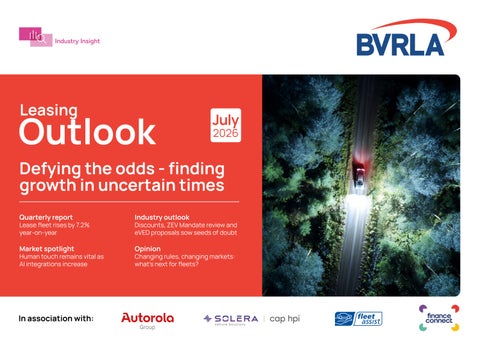
Defying the odds - finding growth in uncertain times
Quarterly report
Lease fleet rises by 7.2% year-on-year
Market spotlight Human touch remains vital as AI integrations increase
Industry outlook
Discounts, ZEV Mandate review and eVED proposals sow seeds of doubt
Opinion
Changing rules, changing markets: what's next for fleets?
In association with:
Craig McNaughton Corporate
Tim Laver
Managing Director, ALD Automotive
David Cooper
Managing Director, Arnold Clark Finance
Market Headlines
Elliott Woodhead Deputy Managing Director, Arval
Andy Bruce CEO, Fleet Alliance
Jon Lawes
Managing Director, Novuna Vehicle Solutions
Matthew Rumble CEO, Kinto UK
Gordon Stephen Chairman, Ogilvie Fleet
Natalia Peralta Silverstone Head of Propositions, Octopus Electric Vehicles
Claire Evans, Consultancy Director
Zenith Intelligent Vehicle Solutions
Market Summary
The total number of cars and vans leased by BVRLA members grew by 7.2% year-on-year in the first quarter of 2026 to a total of 2,052,673 vehicles.
The combination of gently rising business confidence, prior to the conflict in the Middle East, and the price war between OEMs has supported fleet and private car renewal, after a period of contract extensions. The war in Iran may have escalated fuel costs, but it has not stalled business intentions in the way that Russia's invasion of Ukraine brought companies to a standstill.
Canny buyers, both fleet and retail, are abandoning brand loyalty in favour of the best specification and most modern technology available, typically with large discounts attached. New Chinese entrants are frequently winning this battle, rapidly building aftersales networks and support to pass the due diligence tests that leasing companies conduct before adding vehicles to their rate books.
Legacy brands are fighting back with aggressive offers of their own, particularly in return for sole supply agreements, with a number of costconscious fleets now prepared to sacrifice userchooser policies to procure lower rentals.
In the van sector, however, extensions remain common as customers look to sweat their assets for longer and avoid the bottom line impact of substantially higher rentals for new vans, following sharp inflation in new LCV pricing over the past few years. Moreover, leasing companies report that customers are increasingly aligning their new van leases with specific business requirements, waiting for new contract confirmations before replacing vehicles, rather than renewing them at fixed ages and mileages.
The heavy discounting of new cars is also having an impact on the broker market, where the involvement of private equity shareholders is funding an element of market consolidation. Larger brokers are able to negotiate advantageous ‘commit to purchase' agreements with manufacturers, which make trading tougher for any smaller brokers who rely on rate books for orders.
The steep costs of compliance with affordability checks and Consumer Duty also favour larger brokers that are able to amortise the costs across bigger balance sheets. Industry executives suggest standardised, approved wording of contracts would help smaller brokers overcome the compliance costs with new rules, such as the outcome of the Consumer Credit Act.
With margins under pressure across the industry, leasing firms and brokers are exploring the efficiency gains that artificial intelligence might bring. Notetaking after calls and meetings, price analysis, residual value forecasting, and the automation of order updates are all high on boardroom agendas as companies aim to grow their fleet sizes without adding to their headcounts. AI is helping account teams to make decisions more quickly and realise more valuable insights from fleet data.
“We are prospected daily by different companies offering us AI solutions, which are apparently going to be revolutionary, and we have to understand where it will make a real difference,” said one managing director. “Our USP is being able to consult and have a good conversation with the customer, so we don't want to be totally automated. We still want to retain that human element.”
This personalisation is vital to inform and support customers moving from combustion engines to electric powertrains.
Plus, “if you want to retain highly motivated and enthusiastic colleagues who want to develop themselves, you have to embrace AI, or they' ll leave to embrace it at a competitor,” said one leasing managing director.
Salary sacrifice remains the most dynamic sector of the leasing market, with the expanding ranks of cheaper battery electric cars making schemes more accessible and affordable to more employees. Volumes have grown by 165% year-on-year, leading one fleet consultancy to estimate that between 20 and 25% of all new battery electric car registrations are now supplied under salary sacrifice schemes.
There is an element of industry disquiet that April's 22% increase to AMAP (the tax-free Approved Mileage Allowance Payments that an employer can use to reimburse staff for business miles driven in private cars) will rekindle interest in cash-for-car schemes. At 55 pence per mile, the new rate means some drivers will be better off in their own car than one funded through salary sacrifice, depending on their financial circumstances, especially if they do not feel ready to switch to a zero emission model.
On the plus side, the elevated AMAP rate is encouraging business customers to review their reliance on grey fleet, which exposes them to greater safety and reputational risk from uninsured or poorly maintained vehicles. These reviews could nudge firms towards greater use of lease, salary sacrifice and hire cars, all of which would be a boost to BVRLA members.
BVRLA Fleet Focus Q1 2026
Vehicles operated by BVRLA members 1,700,000 1,750,000 1,800,000 1,850,000 1,900,000 1,950,000 2,000,000 2,050,000 2,100,000
Lease fleet grows as replacements restart
The BVRLA lease fleet was up 7.2% year-on-year, in Q1 2026, propelled by an 8.4% increase in the size of the car fleet. The van lease fleet rose by a more modest 3.4%, which still represents something of an achievement given the steady decline in new van sales over the period.
Quarter-on-quarter, the total fleet slipped back by 1.3% in Q1, dragged down by a 1% fall in the number of car leases and a 3% drop in van lease numbers. The period coincided with the start of the conflict in the Middle East, which may have led private motorists and business customers to hold off vehicle replacements, although most Q1 orders will have been placed before the hostilities started. It will be interesting to see which direction Q2 figures turn.
Overall fleet
Total fleet
2,052,673 vehicles
Share of total fleet
Lease car volumes extend lead over vans
Cars have reestablished their dominant position within the BVRLA lease fleet, accounting for 77% of the total number of vehicles. They last achieved this market share in the first quarter of 2020, as the pandemic tightened its grip on the country. In subsequent years, growth in the LCV lease fleet outpaced the car lease fleet, to the point where vans represented 29% of the fleet in Q1 2023. But since the end of that year cars have outperformed LCVs.
The bigger question now is whether both sectors can continue to outstrip year-on-year increases in new car and van registrations, providing evidence that leasing is winning a greater share of new vehicle finance, or whether the quarter-on-quarter slip between Q4 2025 and Q1 2026 indicates that other finance offers are fighting back.
1,574,462 (+8.4% YEAR-ON-YEAR) CARS ON BVRLA LEASE FLEET
478,211 (+3.4%) LCVS ON BVRLA LEASE FLEET
478,211
BVRLA Fleet Focus Q1 2026
Cutthroat market for new cars
Car leasing has become a buyer's market as manufacturers strive to meet the demands of the Zero Emission Vehicle Mandate and new entrants take the battle to legacy brands by offering extraordinary levels of discount. This cutthroat approach has created offers that in pound terms would have been attractive at the turn of the century – an initial payment and monthly rental both below £300. Leasing companies and brokers report steady progress in vehicle renewals, rather than contract extensions, particularly in the company car market where drivers can access greater choice, better technology and more attractive deals for electric cars than their current leases. Private new car sales were up 9.9% year-on-year in Q1, yet personal leasing declined by 1%, a reminder that other OEM-backed finance solutions, such as PCP, are highly competitive with deposit contributions and attractive interest rates.
Car finance alternatives
Salsac overtakes PCH
Salary sacrifice has overtaken personal leasing as a more popular method for private consumers to fund a new car. Greater maturity of schemes and the arrival of cheaper electric cars have made salary sacrifice more accessible to more employees, with used BEVs offering even better terms.
Personal leasing is yet to see an uplift from the increase in the AMAP payments, from 45ppm to 55ppm, that employees can claim for driving their own cars on business. The increase could rekindle interest in cash alternatives to a company car, but leasing companies say employers are keen to minimise ‘grey fleet' miles on both cost and safety grounds.
In the business sector, contract hire rose 6% year-onyear, whereas finance lease was down 25%, indicating a reluctance among fleets to take residual value risk on electric cars.
266,816
BVRLA Fleet Focus Q1 2026
Powertrain mix of BVRLA car lease fleet
BVRLA members lease more than one third of UK’s BEVs
The disconnect between the BVRLA lease fleet and the UK's total car parc is becoming ever wider, as this report's data found 48% of lease cars to be battery electric. This compares to 5.9% penetration of BEVs nationally, according to sources such as the RAC and Zapmap. With over 750,000 BEV lease cars, BVRLA members are now funding about 37.5% of the UK's 2 million electric cars.
Progress towards a zero emission car parc has been propelled by company car drivers and, increasingly, salary sacrifice drivers. But in the personal contract hire sector, petrol still fuels more than half the cars, and until private driver demand for both new and used BEVs rises, leasing companies will continue to suffer heavy depreciation losses when they remarket their used BEVs.
BVRLA fleet CO2 emissions
BCH cars are cleanest on UK roads
The CO2 emissions of new additions to the business contract hire fleet fell to a new low in the first three months of 2026 to a climate-friendly 38.4g/km. Leasing companies report that the battery electric penetration of their order banks for new company cars is typically above 90%, due to supportive benefit in kind taxation. Plug-in hybrids still account for 28% of business contract hire cars, following their reprieve with the easement of benefit in kind tax bills until 2028, although leasing companies expect this percentage to decline as awareness grows of the impending tax rise.
Van emissions jumped sharply in the first three months of the year, but like-for-like comparisons are more complex. SMMT registration figures show sales of 2.5-3.5 tonne vans rose 8.8% year-on-year in Q1 2026, whereas sales of small (and therefore lower emission) vans weighing less than 2 tonnes fell by 44.1%.
38.4g/km
170.7g/km (+3.7% YOY) AVERAGE CO2 EMISSIONS OF
BVRLA Fleet Focus Q1 2026
Maintenance contracts -
proportion of maintained fleet by funding method
Regulated contracts
Pressure on maintenance-inclusive contracts
The percentage of business contract hire agreements that include maintenance is falling. The figure has declined from 73% in Q1 2024 to 65% in Q1 2026, as customers have sought ways to minimise their monthly rentals. The lower maintenance requirements of electric cars may also be persuading fleets to pay for their own maintenance, despite tyre costs rising steadily. Leasing companies report that corporate accounts still want budget certainty and remain wedded to maintenanceinclusive contracts for cars (vans present a more complex picture), so it may be the lease price sensitivity of smaller businesses that accounts for the decrease. In a constant quest to deliver competitive pricing, leasing companies are increasing their use of independent garages, at the expense of franchise dealers, where average hourly labour rates have risen by a third since Covid, according to epyx.
Compliance costs drive broker consolidation
Vehicle leasing had no involvement in the commission disclosure crisis that has gripped auto finance companies in the UK, but ripples from the FCA's proposed multi-billion pound redress scheme have reached the shores of the industry.
The escalating costs of compliance are one of the factors that have persuaded smaller leasing brokers to exit the market or sell to larger groups that have the bandwidth and budget to deal with the regulatory landscape, according to industry leaders.
Consumer Duty is now well established and embedded in business processes, but ahead lies the challenge of the Consumer Credit Act review, which should lead to simpler language in finance agreements, but is also likely to require leasing firms and brokers to collect stronger evidence that they have treated customers fairly.
BVRLA Fleet Focus Q1 2026
Used vehicle leasing
Salsac laps up used BEVs
The volumes may be small compared to new vehicle leasing, but the percentage increases in secondhand cars and vans being re-leased to new customers are astounding.
The business contract hire of used cars was up 50% year-on-year in Q1 2026, and the gains were even more dramatic among private drivers, with personal contract hire up 484%, and salary sacrifice by 474%. The latter is seen as a very promising channel for used electric cars. In a win-win scenario, leasing companies avoid the cliff edge of desperate residual value losses on electric cars, while customers can choose between cheaper rentals compared to a new car, or upgrade to a more desirable used model. The contract hire of used vans has also risen sharply, up 185% year-onyear in Q1, although primarily for diesel vehicles, as customers seek the cheapest lease rentals.
Contract mileage
00050,324
00029,482
00068,455
New BEV technology challenges longer contracts
The average terms of contract hire agreements have shortened slightly over the past year, from 40 to 37 months for business customers, and from 41 to 40 months for private drivers. The rapid improvement in electric vehicle technology and the discounts available for new models create a dilemma for leasing companies. On the one hand, the temptation is to offer shorter contracts to limit the risk of trying to remarket vehicles in danger of looking obsolete in three or four years' time. On the other hand, longer contracts deliver lower rentals by amortising depreciation over an extended period.
In the personal contract hire sector there is a growing market for short mileage contracts of 5,000 miles per year – introduced as headline grabbing deals, but now securing decent volumes.
BVRLA Fleet Focus Q1 2026
LCV customers stall renewals
The BVRLA van lease fleet is up 3.4% year-on-year, but down on the previous quarter. Leasing companies report extensive delays in vehicle replacements as customers choose to hold on to their existing vehicles, rather than face the inflation that has impacted van prices over the past four years. These delays are also being used by fleets to plan their electrification strategies, which are taking months to model in order to guarantee operational effectiveness. Range, charging downtime, and both public charging costs and availability for larger vans all demand meticulous planning. Even larger fleets that electrified their ‘low hanging fruit' use cases are finding it difficult to convert their entire operations to battery power. Leasing companies and OEMs are keenly awaiting the review of the ZEV Mandate, which many regard as unachievable for vans.
478,211
Industry confidence
329,568
Declining margins force efficiency drive
Industry forecasts of rising fleet sizes and shrinking margins expose the pressure on leasing companies to improve their efficiency, in order to protect their profitability and invest in their businesses. The integration of artificial intelligence is enabling leasing companies to prepare the ground for fleet growth without increasing their headcount. Firms have a positive outlook for their fleet size and a neutral view for the prospects of the leasing sector. But their forecasts for the wider UK economy have deteriorated. Geopolitical volatility allied to the uncertainty of domestic politics have sapped business confidence. Vehicle-hungry projects, such as Department for Transport road building schemes and Department for Energy Security and Net Zero power plants and green infrastructure, appeared to be among the bigger losers as the Government sought to fund its Defence Investment Plan.
BVRLA Member Outlook
Following the excitement of the World Cup, it seems appropriate to deploy football analogies of goalposts being moved. For an industry that thrives on certainty and continuity, vehicle leasing faces uncertainty and turbulence.
The Government's review of its Zero Emission Vehicle Mandate appears likely to impact the supply side of the automotive sector, whereas the proposed introduction of a pence-per-mile eVED charge for electric cars jeopardises the demand side.
Both developments risk undermining targets and calculations baked into the business plans of leasing companies.
The ZEV Mandate has forced manufacturers to offer eye-watering discounts in order to boost the share of battery electric cars within their sales. These discounts have reached levels almost equivalent to the fines that OEMs would face for non-compliance with the mandate.
“ZEV Mandate pressure is contributing to instability in the new EV market by encouraging heavy discounting and creating artificial fleet-led demand,” said one industry managing director.
Car and van fleet forecast
These discounts are not unique to electric vehicles, and extend across all powertrains, highlighting the volatile trading conditions that leasing companies face due to a potent cocktail of vehicle oversupply and cutthroat Chinese competition, as well as the ZEV Mandate.
But for battery electric models, leasing companies are faced with the unwelcome challenge that brand new models are available for sums similar to those that they had forecast selling their three and four year old end-of-contract vehicles, maintaining the deflationary pressures on residual values.
The Government insists that it will hold firm on the 2030 ban on the sale of cars with a combustion engine, and 2035 phase out of hybrids, so it's only the trajectory of the percentage of zero emission vehicle sales that can change in the mandate.
The fact that more than one in five new cars registered in Q1 2026 was zero emission has virtually nothing to do with supply, say leasing executives, and everything to do with the demand stimulus of supportive benefit in kind (BiK) taxation, boosted by the arrival of substantially lower priced models.
Company car drivers and salary sacrifice customers account for the lion's share of battery electric car sales, illustrated by the chasm between the average emissions of new cars funded by business and personal contract hire. Leasing firms and brokers say the vast majority of their new company car orders are zero emission, with penetration levels already close to, and in many instances above the ZEV Mandate's 80% target for 2030.
“EV demand remains highly sensitive to affordability and household budgets, which is why fleet buyers and salary sacrifice schemes continue to do much of the heavy lifting,” said one director.
Car fleet forecast by fuel type
BVRLA Member Outlook
But the combination of a weaker understanding of the wholelife cost savings of running an electric car, and the lack of BiK savings, mean private drivers are lagging well behind the trajectory set by the ZEV Mandate for new cars. Only 20% of PCH contracts are full electric, compared to 47% for BCH. Furthermore, despite the rising interest in used BEVs triggered by the spike in pump prices in Q1, any lease contract that started three or four years ago is haemorrhaging losses at disposal.
“The ZEV Mandate would be more realistic if it also had demand factors to balance the equation,” said a leasing director. “The trouble is that you've got this huge driver for supply on one side of the formula, and nothing to drive used demand on the other side. To address this imbalance there are two choices: either support used demand, which the Government isn't doing, or soften the supply side.”
One area where the industry is committing significant investment to drive demand for used BEVs is in the salary sacrifice arena. Firms are now remarketing cars of up to four years of age and in lower NAMA grades, as an ever wider group of customers seize
opportunities to lease an all-inclusive car for even lower monthly rentals. Brokers, however, rue the fact that commissions are lower on used vehicle leases as they try to establish whether this customer base is incremental or substitutional.
Government support to create an offer for any used EV buyer that is as attractive as the incentives for company car and salary sacrifice drivers, remains top of leasing company wish lists. They insist that an uplift in residual value forecasts would cut lease costs and stimulate demand for more new EVs from the private market.
This is especially required by the 40% of households that do not have off-street parking where they could install a wallbox. These drivers will instead be forced to rely on more costly public charging should they ever choose to get behind the wheel of a BEV, a situation that the Government is currently reviewing.
“Stabilising EV RVs is not just about price support; it is about building buyer confidence through policy stability, charging affordability, battery-health transparency and clear reassurance on the specific used EV being sold or leased,” said a leasing director.
Car and LCV fleet forecasts by funding method
This confidence took a serious blow when the Government announced its plans to introduce pence per mile eVED charges for zero emission vehicles.
Treasury calculations show that the suggested fees will still deliver lower energy costs per mile than petrol or diesel, but leasing companies say private motorists are swayed more by mood music than mathematics. Fleet orders for new BEVs have continued uninterrupted since the Chancellor's shock announcement, because the BiK advantages are so compelling, and perhaps because they think there is little chance of the plans being implemented. But lenders and brokers have seen hesitation among private buyers considering the transition to a battery powertrain.
“The risk is a negative feedback loop: higher running costs weaken new EV demand, weaker demand puts pressure on used EV values, lower RVs increase lease rentals, and higher rentals further slow adoption,” said an industry leader.
Moreover, the administrative burden of forecasting and paying for electric miles, followed by verification and reconciliation of actual payments, has drawn
BVRLA Member Outlook
collective criticism from across the leasing industry. Executives understood that the Government would seek to recover lost fossil fuel duties somehow, but had expected a consultation on how this might be achieved, rather than a consultation about how it might operate. Annual mileage checks would be onerous for leasing firms to oversee, and increase vehicle downtime for customers.
Commercial vehicle fleets will be relieved that eVED will not apply initially to electric vans, but eLCV adoption remains well below the targets set by the ZEV Mandate. Leasing firms can now offer rental parity between small electric and diesel vans, but this is insufficient to stimulate demand in the face of the range and charging complications involved in operating eLCVs.
Moreover, the heartland of van volumes lies with larger vehicles that remain more expensive to lease, don't necessarily fit in standard public charging bays, and depending on their payload and daily mileage may require recharging during the working day.
Reaction to the current ZEV Mandate for eLCVs encompasses a thesaurus-worth of adjectives from leasing directors, all signalling the same message –unachievable, unrealistic, unworkable, impractical. They fully expect the Government's review of the mandate to dilute its steppingstone targets.
“The reality is that that it's just not going to happen, and the sooner we start dealing with that reality, the better,” said one director.
For eLCVs to take off among fleets in the way that electric cars have gained traction requires a massive improvement in facilitating conditions – not simply more appropriate vehicles at more affordable prices, but access to low cost public charging, as well as additional power capacity at depots for charging without an eye-watering outlay on grid upgrades. Leasing firms are heavily engaged in helping their customers navigate applications for the £170m Depot Charging Scheme.
But scarred by electric car depreciation, they are wary of eLCV residual values, given the prospect that in four or five years' time new vehicles might be available with double the range or five-minute recharging times, effectively rendering today's vans obsolete.
The Plug-in Van Grant offers welcome support, but more financial assistance either at the front end or disposal is required to make the leases of larger electric vans affordable to more companies.
There is, however, a huge opportunity for leasing companies and large fleets that can influence and control the charging behaviour of their eLCVs. One top 10 leasing company has calculated that the total electricity storage capacity of its car fleet batteries is close to the entire battery storage capacity of the UK as it stands today.
When widescale electrification occurs in the van sector – and the leasing industry thinks this is a question of when, not if, even if the current trajectory is slower than the ZEV Mandate stipulates – the commercial prospects of providing grid flexibility are highly valuable.
“We're going to see a really big trend in crossbusiness collaboration between the fleet sector and the energy sector”
“We're going to see a really big trend in crossbusiness collaboration between the fleet sector and the energy sector,” said a leasing director.
“We can work with our customers to direct, control, understand, and manage the charging behaviour of the fleets we look after. If we are able to channel that into the right places at the right time, that is really important for the ability of the energy companies to deliver energy in the right way, and put infrastructure in the right place, and they will offer a better price.”
A new frontier of cooperative working, with lease fleets at the heart of it, is opening.
Opinion - service, maintenance and repair
Fleet Assist’s garage network is ready to face the challenges of Euro 7 legislation as it redefines fleet management processes through increased regulation reports supply chain director Nikos Kotrozos.
The transition to Euro 7 - the European Union's rules on emission limits and battery durability – replaces Euro 6 and it will apply to new light-duty vehicle models from 29 November 2026 and to new heavyduty vehicle models from 29 May 2028.
Because the emissions legislation regulates the entire vehicle lifecycle across all powertrains, including EVs - it will mean fleet operators will face an increasingly regulated landscape where vehicle procurement, parts sourcing, and real-time data tracking will fundamentally reshape their total cost of ownership (TCO) models.
Software monitoring and compliance enforcement will accelerate the move to a state where emissions data will be automatically gathered, stored and collated on behalf of the operator.
Real world emissions
Emissions compliance is no longer just about the powertrain - brake dust and tyre particle emissions will be regulated for the first time. Onboard systems will capture and measure real-world operating
emissions in real time and then report it back to the vehicle data log.
If a vehicle operates out of its emission window for too long due to poor maintenance, it will impact the vehicle's performance or trigger direct alerts to the driver. Fleets operating high-mileage vehicles will face more complex diagnostics as components age. This further supports our uptime management approach with predictive maintenance being key to ensure timely planned maintenance events which will maximise vehicle availability, safety levels and to ensure they operate within strict emission tolerances.
Access to a managed network of garages offering the breadth of options, technical expertise and scale is key.
Fleets will have to adopt proactive SMR protocols - such as advanced wheel alignment controls, tyre inflation tracking and preventative brake wear inspections - to stay within legal particulate limits. Meanwhile, geofencing software will force hybrid vehicles into electric mode within city centres and low-emission city zones which means drivers must keep hybrid batteries fully charged before urban routes.
Meanwhile, those fleets that continue to operate vehicles for long periods with warning messages are likely to face increased scrutiny around emissions with operators having to modernise their vehicle maintenance parameters.
Nikos Kotrozos
Supply Chain Director, Fleet Assist
The expansion of emission control on multiple components will lead to a greater emphasis on the parts fitted to a vehicle during a service or maintenance regime, including brakes discs, pads and tyres. Fleets will also have to assess the best component combinations to reduce emissions and retain longevity.
All of this puts an increased pressure on fleets delivering additional driver education to ensure vehicles are being operated within compliant parameters and to get the most from these new technologies.
Increased technician upskilling
And with all these additional SMR protocols there will also be an increased pressure on garages to invest in more advanced diagnostic tools to ensure their business advances in line with these new Euro 7 rules. This will certainly lead to increased technician upskilling.
On the positive side, Euro 7 mandates all vehicles feature accessible, real-time On-Board Battery Health Monitors. This will make it easier for fleet managers to accurately audit battery degradation across their fleet and supports stronger resale values due to battery health and longevity being transparent to vehicle buyers.
Opinion – Diesel remarketing performance drops, but still being sold
There have been several impacts from the war between the USA and Iran, and the most obvious one is the impact on oil prices.
Amidst restrictions on ships moving through the Straits of Hormuz, Brent Crude prices rocketed, peaking at over $160 per barrel at the end of April (from $72 before the war started). Fuel prices at the pump obviously increased as well, growing from £1.41 per litre at the end of February to £1.92 in mid-April.
This had a predictable effect on trade demand. Consumers were faced with paying much more to fill their tank with diesel and this has driven some who were changing their cars to consider alternative fuels. It isn't just consumer demand which influences trade prices, however, as dealer demand can also have a significant impact on used values. Some predicted an immediate drop off in customer appetite for diesel and some groups even implemented buying bans.
When we look at remarketing performance (measured against clean on cars up to 5 years old), the graph below shows that there was an almost immediate drop off in performance as fuel prices started to increase. Performance of 100% against cap clean implies values staying flat, so achieving only 98.5% through much of April obviously led to price reductions. There was a sharp increase at the beginning of June, but this was short-lived, dropping back to 98.3% by mid-June.
Interestingly, the proportion of diesels sold in trade has bucked the longer-term trend over the last few months. The graph of the proportion of sold vehicles which are diesel has flattened off; it was down to only 5.5% of the total by the end of March, but has slowly improved since then, most recently standing at 6.5% and trending up slightly over the past three months.
So, there is still some appetite for diesel out in the used market. The biggest change because of those fuel price increases is a sharp increase in demand for electric vehicles. We have seen increases in values in May and June with BEVs outperforming the rest of the market by +3.9% and demand is expected to stay strong.
Brent crude prices are falling, standing at the time of writing at around $73 per barrel, down nearly -55% from the peak and lower than when the war started. Diesel prices have been slower to fall, remaining +20% above pre-war levels and consumers recognise that there is potential for more volatile prices in future. We expect diesel to continue to be the worst-performing fuel type for at least the next couple of months, but used value movements to be only slightly worse than seasonal norms, as a hardcore of drivers maintain their loyalty to the fuel and reductions in prices at the pump look set to continue their slow, downward trajectory.
Dylan Setterfield
Opinion
used vehicle market
Autorola Group UK’s National Client Strategy Manager Abi McCabe says the UK used car industry is entering a period defined by re-pricing.
The UK used vehicle market is sending a clear message to fleet operators in 2026 - demand is returning, but that does not mean risk is disappearing. In fact, many of the biggest risks facing fleets today are emerging in the used market long before they become visible elsewhere.
One of the most significant findings is that the market is not shrinking as much as it is reshaping. While overall used car volumes are lower than in 2024, demand has rotated towards different vehicle segments. SUV segments continue to gain market share, while traditional hatchback and premium segments have generally lost ground. This shift reflects changing consumer priorities and affordability pressures rather than a broad market slowdown.
Our Indicata used car pricing platform uses Market Day's Supply (MDS) as a measure of how quickly vehicles are selling. MDS has improved across the market, falling by around 9%, with D- and C-segment vehicles selling significantly faster than the market average, highlighting healthy underlying demand. Yet despite stronger demand and improved selling speeds, pricing has failed to keep pace. This disconnect continues to create new challenges for fleets and remarketing professionals.
EVs remain price sensitive
The relationship between demand and pricing is particularly evident in electric vehicles (EVs). While demand for EVs certainly exists, it remains highly price sensitive. Unlike Internal Combustion Engine (ICE) vehicles, where supply, demand and pricing tend to move together, the EV market remains volatile and reactive.
Small pricing changes can have a disproportionate effect on buyer demand with EVs continuing to represent the greatest pricing risk within the market.
Supply trends reinforce this challenge. Between 2024 and 2026, used EV and plug-in hybrid vehicle (PHEV) stock both increased by approximately 25%, while diesel stocks fell significantly and petrol volumes began to soften. This highlights a structural shift toward electrification.
Despite a strong demand for used EVs since the beginning of the Middle East conflict, average prices have yet to rise in 2026, remaining flat since July 2025 and still 11% lower than they were in January 2024, continuing the challenge for residual value setters. It will be interesting to see if the demand for used EVs continues or slows down as ICE fuel prices gradually get back to normal.
Interestingly, not all electrified vehicles are performing equally. PHEVs are showing stronger alignment between supply, demand and pricing, behaving more like a transitional technology that offers consumers flexibility while supporting electrification goals. EVs, by contrast, are still searching for their long-term market equilibrium and until the market establishes a consistent clearing price, residual value volatility is likely to remain.
Challenger brands are growing
Another major market trend is the growth of challenger brands. Manufacturers such as BYD, MG and Omoda are rapidly increasing their presence in the UK new car market. Unlike traditional OEMs, many of these brands compete aggressively on price, introducing lower residual value benchmarks and reshaping customer expectations.
Abi McCabe
UK
National Client Strategy Manager, Autorola Group, UK
Brand loyalty is increasingly giving way to affordability-led purchasing decisions, with consumers willing to switch manufacturers if the value proposition is strong enough. The likelihood is that this trend will continue into the used market when volumes from the new brands grow over the next couple of years.
Germany provides a useful glimpse into the future. As a more mature EV market supported by substantial incentives, stronger infrastructure and earlier adoption, Germany demonstrates how sensitive EV demand remains to pricing movements. Evidence suggests that when used prices rise, demand can slow quickly. With the UK typically lagging Germany by 12-18 months, similar patterns may emerge here in the near future.
The biggest risk facing fleets in 2026 is not a lack of demand, it is the collision of supply growth, pricing pressure and consumer affordability. Successful fleets will continuously monitor market signals, adapt pricing strategies, manage fuel and segment mix carefully, and avoid relying on static residual value assumptions. Those that remain agile and data-driven will be best positioned to protect vehicle values in an increasingly dynamic market.
Used
BVRLA DATA HUB
For full data, visit the BVRLA data hub at: https://www.bvrla.co.uk/home/develop/insightsdata/data-hub
This report provides a consolidated view of the Quarterly Leasing Survey and the forwardlooking Leasing Outlook report. In addition to the data highlights provided in this report, you can now access an extensive list of tables as part of the Quarterly Leasing Survey online, by following the link provided above.