1
A Bustle & Sew Publication Copyright © Bustle & Sew Limited 2026 The right of Helen Grimes to be identified as the author of this work has been asserted in accordance with the Copyright, Designs and Patents Act 1988. All rights reserved. No part of this publication may be reproduced, stored in a retrieval system or transmitted in any form, or by any means, without the prior written permission of the author, nor be otherwise circulated in any form of binding or cover other than that in which it is published and without a similar condition being imposed on the subsequent purchaser. Every effort has been made to ensure that all the information in this book is accurate. However, due to differing conditions, tools and individual skills, the publisher cannot be responsible for any injuries, losses and other damages that may result from the use of the information in this book.
First published 2026 by: Bustle & Sew Station House West Cranmore Shepton Mallet BA4 4QP www.bustleandsew.com
2
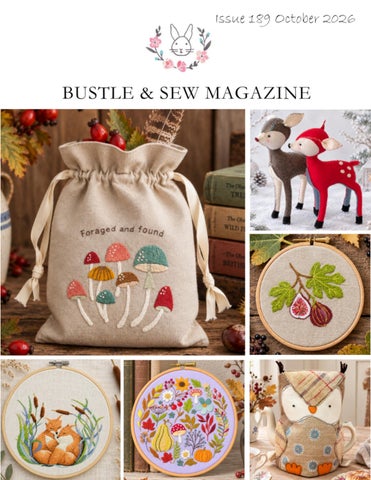
Welcome to the October Magazine October brings a wonderful richness to the countryside as the leaves turn to shades of russet, copper and gold, and the hedgerows are festooned with hips, haws and elderberries - many of which will have disappeared, foraged by hungry birds, by the end of this month. As the evenings are drawing in and Halloween is waiting at the end of the month, this is the perfect time to settle down with a cosy stitching project. In this month’s magazine, I take a closer look at choosing the right thread for your embroidery and explore why fabric frays. There are plenty of seasonal patterns too, including the Foraging and Found Pouch and the Autumn Treasures Hoop. There’s also another Christmas project you might remember which was originally published in November 2013(!) - Holly and Berry, the sweetest pair of baby Christmas reindeer. Finally, our recipe section celebrates the flavours of autumn with a collection of comforting seasonal recipes to enjoy as the nights grow longer. I do hope you enjoy this October edition and find plenty to inspire your stitching throughout the month. The November edition will be published on Thursday 29 October in FIVE weeks time. Until then… Very best wishes
Helen xx
3
14
Nature’s last lovely smile ….
26 49
67
26
62
40
4
October Almanac
5
Hedgerow Treasures Hoop
10
The Coming of Autumn
13
Why do Fabrics Fray?
14
Lovely Idea: Book Page Pumpkin
20
Found and Foraged Pouch
21
The Magic of Mushrooms
26
Embroidering on Clothes
32
Holly and Berry Christmas Reindeer
37
Dahlias: Stars of the Autumn Border
40
The Lost World of English Apples
42
Owl Tea Cosy
46
In the Kitchen: Hedgerow, Field, Orchard
49
The Great British Pudding
55
Perfect Autumn Day
62
Fig Leaf Hoop
63
St Luke’s Little Summer
66
Sew, A Needle Pulling Thread
67
Lovely Idea: Preserving Leaves
73
Two Sleepy Foxes Hoop
74
Your Embroidery Hoop
80
Poetry Corner : Autumn Fires
83
The Countryside in October
84
RSN Stitch Bank
86
Kitchen Conversion Table
87
Templates
88
October October is a month of abundance, but it is a different sort of abundance from that of summer. Gone are the overflowing rose borders and baskets of strawberries. Instead there are apples and pears, pumpkins and squashes, nuts and berries, mushrooms appearing overnight beneath woodland trees and in the dew-soaked fields, while great drifts of leaves gather along the country lanes. But this is a month of texture as much as colour. Seed heads rattle in the garden, leaves crunch beneath our feet, rough bark is suddenly visible through thinning foliage and hedgerows are woven with berries, twigs and the silvery threads of spiders' webs.
At the beginning of the month many trees may still be predominantly green, particularly if we’ve had a mild September. Gradually however, individual leaves begin to change, sometimes almost imperceptibly, until entire woods are glowing with autumn colour. Different trees contribute their own shades to the display. Beech leaves turn warm copper and bronze. Field maples can become wonderfully yellow, while oaks generally take on more subdued shades of brown and gold. The leaves of wild cherry may provide brilliant splashes of crimson and orange, and silver birches brighten woodland edges with clear yellow foliage.
5
No two Octobers are exactly alike. Temperature, rainfall, wind and the conditions of the preceding summer all influence the timing and intensity of autumn colour. A calm October can allow leaves to remain on the trees for weeks, while one night of strong wind may suddenly scatter them across roads, lawns and woodland paths. This makes October particularly rewarding for country walks as a familiar route can appear completely different from one week to the next. Paths that were shaded beneath a dense canopy in August gradually become brighter as leaves fall and sunlight reaches the woodland floor once more.
October light has a character of its own. The sun sits lower in the sky and shadows become longer, even in the middle of the day. On a clear afternoon the countryside can seem to glow, with autumn leaves illuminated against a deep blue sky. On other days mist hangs stubbornly over fields until lunchtime and the landscape seems reduced to a series of softened shapes disappearing into grey. The misty October morning is one of the classic sights of the English countryside. River valleys and low lying meadows are particularly prone to mist, which settles overnight as the air cools. Trees rise like islands above the whiteness and church towers emerge gradually as the sun strengthens. Spider webs become especially noticeable on such mornings. Covered in hundreds of droplets of dew, constructions that would normally be almost invisible are suddenly revealed across gates, grasses, hedges and garden shrubs. October is an excellent month for fungi. Damp conditions and relatively mild temperatures encourage many species to produce their fruiting bodies, and
woods that appeared almost empty a few days earlier can suddenly be dotted with mushrooms and toadstools. Some are tiny and delicate, barely visible among the leaf litter. Others are extraordinary. Bracket fungi grow in shelves from tree trunks, puffballs appear like strange white balls among the grass, and the unmistakable fly agaric, with its scarlet cap and white spots, looks as though it has escaped from the pages of a fairy tale. Fungi perform an enormously important role within woodland ecosystems. Many break down dead plant material, returning nutrients to the soil, while others form relationships with living trees that allow both organisms to thrive. Beneath the woodland floor lies an extraordinary network of fungal threads connecting with tree roots, largely hidden from view. For anyone tempted to gather wild mushrooms, however, identification is essential. Britain has numerous poisonous species and some can be dangerously similar to edible varieties. For most of us, the safest enjoyment comes from simply observing and photographing the remarkable diversity found on an autumn woodland walk. October is also the month when the woodland floor becomes a veritable treasure chest. Acorns lie beneath oak trees in enormous numbers during a good mast year. They provide valuable food for jays, squirrels, mice and other wildlife. Jays are particularly important in the spread of oak woodland because they carry acorns considerable distances before burying them as winter stores. Those that are forgotten may eventually germinate, allowing new oak saplings to grow far from the original tree..
6
“October, crisp, misty, golden October, when the light is sweet and heavy.” Angela Carter: The Magic Toyshop 1967
7
8
The Coming of Autumn When does autumn begin? The astronomers, followed by the almanac-makers, begin it in the third week of September, when the day and night become equal in length, and continue until a few days short of Christmas. Many people are guided entirely by the weather of the year and find usually that what they had thought to be early autumn is followed by another spell of summer. The rambling naturalist knows that you cannot fix dates to our seasons before they come: that they merge one into another gradually, and that a few miles north or south or the two sides of a range of hills may show a marked difference. Some of our bird visitors left us before we began to think of autumn; but when the last of the swifts have gone, the lapwings flock and the starlings move to some other district, we know the season is about to change, and we watch for signs like the thinning of the limes, the yellowing of the elms and the browning of the beeches. As a rules, these changes are gradual; and there is still much of summer shown by the flowers and insects when the wild fruits are getting their tints of ripeness and the early fungi are beginning to appear.
Edward Step (1855-1931)
9
Why Fabric Frays A Practical Guide to Weaves, Fibres and Neat Finishes
Fraying is one of those small sewing problems that can quickly become a large one. A freshly cut piece of fabric may look perfectly neat at first, yet by the time it has been pinned, stitched, turned and pressed, its edges can appear untidy and several precious millimetres may have disappeared into a fringe of loose threads. Some fabrics hardly fray at all, while others seem to begin unravelling the moment they are cut. The reasons lie in the way fabric is made…. Most fabrics used for dressmaking, patchwork and household sewing are woven, ie they are made from two sets of threads that cross each another at right angles. The lengthwise threads are called the warp, while the threads passing from side to side are known as the weft. During weaving, the warp threads are held under tension on a loom. The weft thread is then carried over and under them to create the cloth. Each set of threads helps to hold the other in place, but this arrangement remains secure only while the fabric is intact. When the cloth is cut, the threads along the new edge lose some of their support. Handling and movement can then cause individual yarns to slip free. This is fraying: the gradual separation of threads from the cut edge of a woven fabric. The amount of fraying depends upon the fabric’s weave, the fibres from which it is made, the thickness and smoothness of its yarns and the way it has been finished. There is no single rule that applies to every material, although fabric with a loose or open construction will generally fray more readily than closely woven cloth.
Why some weaves fray more than others Plain weave is the simplest form of woven construction. Each weft thread passes alternately over and under each warp thread. Cotton lawn, calico, gingham, muslin and many linen fabrics are made in this way. A closely worked plain weave can be quite stable because the threads cross one another frequently. However, a loosely woven plain-weave fabric, such as hessian or open linen, may fray heavily. Its threads have room to move and can easily be pulled away from a cut edge. In a twill weave, the threads cross in a regular staggered pattern, creating the diagonal lines seen in denim, gabardine and many wool fabrics. Twill is often strong and flexible, but its cut edges may fray because the yarns travel over several threads before being interlaced again. Once cut, these longer floating sections can work themselves loose. Satin weave contains even longer floats, with each thread travelling over several others before passing beneath one. This creates the characteristically smooth and lustrous surface of satin. It also makes the fabric prone to snagging, shifting and fraying. The smooth yarns can slide past one another surprisingly easily, particularly along a freshly cut edge. Some decorative fabrics, including brocade and loosely woven furnishing materials, contain many different yarns or long floats on the reverse. Once cut, these fabrics may shed threads rapidly and need to be handled with particular care.
12
Mushrooms, Magic and Mystery Exploring the curious folklore and history of fungi
To our ancestors mushrooms and toadstools must have seemed almost magical as they appear overnight. One day the grass is empty and the next it is dotted with pale caps, russet domes or brilliant red toadstools. It isn’t surprising that fungi have gathered so many stories around them. Unlike familiar garden plants, they have no flowers, leaves or seeds that can be easily seen. They spring from rotting wood, old tree roots and damp earth, or the damp grass of autumn fields and vanish almost as quickly as they arrived. For much of history, their mysterious habits have placed them somewhere between the natural and supernatural worlds. Today we know that the mushroom or toadstool we see is the fruiting body of a much larger organism. Beneath the ground, or concealed within wood, lies a network of fine fungal threads called mycelium. Earlier generations could not see that underground web, but they certainly noticed the suddenness with which its fruiting bodies appeared. To people without a modern understanding of fungal biology, a ring of mushrooms forming in a meadow after rain must have seemed less like ordinary growth and more like evidence that something uncanny had taken place during the night. There is no strict scientific division between a mushroom and a toadstool. In everyday British speech, “mushroom” has generally been used for fungi thought edible or harmless, while “toadstool” suggests something poisonous, brightly coloured or strange. The word mushroom entered the English language during the late Middle Ages, and was probably derived from the French . (a type of mushroom) Toadstool is an old English word. The toad was long regarded with distaste and suspicion. Its squat form, warty skin and fondness for damp, dark places linked it in the popular imagination with poison, witchcraft and unpleasant magic. A “toad’s stool” therefore sounded exactly like the sort of object that ought to be avoided. This seems a bit unfair to both fungi and amphibian! Toads do not sit upon toadstools as a rule, and many fungi that look alarming are harmless, while some plain and innocentlooking species are deadly. Of all the beliefs connected with fungi, perhaps the best known is that of the fairy ring. These circles s of mushrooms are produced when an underground fungal colony spreads outwards from its starting point. The older growth at the centre may die away as the active edge continues to expand, leaving a remarkably even ring of fruiting bodies. Grass around the ring can also be unusually green where fungal activity releases nutrients into the soil. Before this process was understood, such perfect circles were said to mark the place where fairies had danced by moonlight, wearing the turf smooth beneath their feet. In some districts the ring was a place of wonder and good fortune; in others it was dangerous ground. A person who stepped inside might be compelled to dance until exhausted, lose all sense of passing time or be carried away into fairyland. What seemed like a single night among the fairies might prove to have been many human years. Traditions varied from county to county and storyteller to storyteller. The circles were sometimes attributed not to fairies but to witches, elves or other spirits. They might be places where supernatural beings held their revels, or marks left by enchanted cattle. Dew gathered from a fairy ring was occasionally credited with special properties, while damaging the ring could invite misfortune. Writers naturally found the image irresistible. Shakespeare refers to fairy circles more than once. In , Prospero addresses the “demi-puppets” who make green ringlets in the grass by moonlight, while in the fairy world is closely aligned to the damp banks, wild plants and moonlit spaces of the countryside. The fairy ring continued to flourish in later poetry, illustration and children’s books. By the Victorian period, fairies had become increasingly tiny and picturesque in popular art. Mushrooms made perfect furniture and architecture for them. A broad cap became an umbrella, table, stool or dancing platform; a hollow stem became a doorway; a cluster of fungi formed an entire fairy village. The unsettling fairy ring of older tradition gradually softened into a charming nursery image, though a faint trace of danger never entirely disappeared. Human beings have eaten fungi since prehistoric times, although evidence for precisely how they were gathered and understood is necessarily incomplete. Ancient Greek and Roman writers discussed edible and poisonous mushrooms, and the Romans prized certain kinds as delicacies. Yet fungi had a dangerous reputation because an error in identification could be fatal. The Roman emperor Claudius was said by ancient authors to have died after eating poisoned mushrooms in AD 54, perhaps as part of a plot by his wife Agrippina to secure the succession of her son Nero. The details are unclear, but the tale strengthened the mushroom’s association with concealed poison. Here in the UK, attitudes towards eating wild fungi were traditionally more cautious than in many parts of continental Europe. Rural knowledge certainly existed, and a few species such as field mushrooms and puffballs were collected, but we didn’t develop quite the same broad culture of mushroom gathering found in parts of France, Italy, eastern Europe and Scandinavia. Fungi also had other uses apart from food. Puffballs were used to help staunch bleeding, as their soft interiors could be applied to wounds. The tinder fungus, which grows on and used to catch a trees, could be processed into a felt-like material known as spark. Ötzi, the prehistoric man discovered in the Alps, carried pieces of fungi, apparently for practical or medicinal purposes, showing just how ancient this knowledge is.e The dark side of fungal folklore owes much to the landscapes in which fungi grow. Woodland floors, rotting stumps and misty autumn fields have long been settings for tales of witches and spirits. Fungi seemed to feed upon death, emerging from fallen trees, dead leaves and buried roots. Their actual ecological importance as decomposers was not understood, so their appearance could be interpreted as corrupt or sinister. The red cap with white spots, so familiar from fairy-tale books and Christmas decorations, belongs to the fly agaric, . It is genuinely striking and has psychoactive as well as toxic properties. Its appearance however makes it the perfect storybook toadstool. Its vivid cap is instantly recognisable in an illustration, while its white warts and neat stem look magical before a word of story has even been written. Nineteenth- and twentieth-century illustrators used it repeatedly, and its image now stands for enchanted woodland even in countries where the reader may never have seen one growing wild. English folk names for fungi include witches’ butter, witch’s hat and devil’s snuffbox, the last sometimes applied to puffballs. When a mature puffball is pressed, it releases a cloud of brown spores like smoke from a tiny chimney. To a child it is entertaining; to an earlier imagination it might resemble a small explosion, a puff of infernal dust or the work of an invisible creature. In Lewis Carroll’s Alice’s Adventures in Wonderland, published in 1865. Alice finds a large mushroom with a blue Caterpillar sitting upon it smoking a hookah. When she learns that eating from one side will make her grow taller and eating from the other will make her shorter, the mushroom becomes an instrument of transformation. The toadstool suits Wonderland perfectly. It is ordinary enough to be recognised, peculiar enough to be magical and divided into portions whose effects cannot be predicted without experiment. Beatrix Potter also had a serious early interest in fungi. During the 1890’s she made many careful watercolours of fungal specimens and studied their growth. She developed ideas about the germination of spores and the relationship between fungi and algae in lichens, and a paper was submitted on her behalf to the Linnean Society of London in 1897, at a time when women could not attend its meetings. Her surviving studies show close observation and considerable skill. Some fungi do have some absolutey delightful names! Earthstar, bird’s-nest fungus, jelly ear, shaggy inkcap, beefsteak fungus, candlesnuff, dead man’s fingers and amethyst deceiver to name but a few, sound as though they have wandered from a book of spells. Many of these names are descriptive. An earthstar opens into pointed rays; tiny bird’snest fungi resemble nests containing minute eggs; dead man’s fingers rise in dark clusters from decaying wood. Others record older comparisons and beliefs.
Stitching Pretty - Some Tips for Embroidering on Clothes
16
The Lost World of English Apples Rediscovering the wonderfully named varieties that once filled our orchards, gardens and market stalls
17
Before commercial fruit growing became standardised, orchards would often contain a remarkable mixture of varieties, chosen not simply for flavour but for when they ripened and their use. There were apples for eating straight from the tree, apples for cooking, cider apples and varieties valued because they would keep well into winter. A carefully planned orchard could therefore provide fruit over a surprisingly long period and for a wide variety of uses. If you walk into a supermarket today there may appear to be a wide choice of apples, but if you look a little more closely the same familiar names tend to appear again and again. Gala, Braeburn, Pink Lady and Granny Smith have become everyday favourites, selected partly because they crop reliably, travel well and remain attractive on the shelf. Yet they represent only the tiniest glimpse of a much larger and more colourful apple heritage. For centuries, England possessed an extraordinary patchwork of orchards filled with hundreds of different varieties. There were apples for eating, cooking, cider making and storing through the winter. Some belonged almost entirely to one county or district, while others were
known only within a handful of villages. They came in every imaginable shade of green, gold, russet and crimson and carried names with as much character as the apples themselves. There were early apples to eat almost straight from the tree in summer and late varieties that could be carefully stored and brought out during winter. Some collapsed into a fluff (today think Brameys) when cooked and were perfect for pies and puddings; others retained their shape. Sharp, tannic cider apples that might be decidedly unappealing eaten raw produced excellent drink once pressed and fermented. Keeping qualities were particularly important. Before refrigeration, a good storage apple was enormously valuable. Late fruit was picked carefully to avoid bruising and arranged on slatted shelves or shallow trays in a cool apple store. Some varieties could remain sound for months, providing fresh fruit long after the trees themselves stood bare. This explains why so many different apples developed. Gardeners weren't simply looking for the sweetest or prettiest fruit. They wanted apples that fulfilled particular purposes.
19
From Orchard, Field and Hedgerow…
20
October is a particularly rewarding month for seasonal cooking. Markets, gardens and allotments offer apples, pears, pumpkins and squash, alongside leeks, beetroot, carrots, parsnips and an increasing variety of sturdy winter greens. It is a time to move away from the lighter dishes of summer and return to soups, pies, crumbles and slow-cooked suppers. Squash can be roasted until the edges caramelise, leeks softened slowly in butter and root vegetables added to generous trays of roasting potatoes, onions and herbs. Cabbage, kale and chard bring colour and freshness to richer meals, while mushrooms add their distinctive savoury flavour to pies, soups and simple dishes served on toast. The English apple harvest is now well under way, bringing an abundance of both eating and cooking varieties. Bramleys remain invaluable for pies, crumbles and sauces, while sweeter apples can be added to cakes or baked whole. Pears are equally useful, whether poached, folded into a sponge pudding or paired with spices and nuts. Quinces, when they can be found, reward patient cooking with their rich fragrance and deep rosy colour. Blackberries may still be gathered from sheltered hedgerows, although their season is drawing to a close, making this a good moment to use the last fresh or frozen fruit in an autumn pudding.
Nuts are also in season now. Walnuts, hazelnuts and sweet chestnuts can be used in both sweet and savoury dishes, adding substance and texture to cakes, stuffings and salads. Chestnuts work particularly well with mushrooms, sprouts and earthy root vegetables, while toasted hazelnuts are delicious with pears, chocolate or autumn greens. There is also the first sense of Christmas waiting just beyond the autumn weeks and some traditional preparations begin now. Christmas cakes and puddings benefit from being made well in advance, allowing their fruit, spices and flavours time to mature. Dried fruits, citrus peel, nuts, dark sugar and warming spices begin to find their way into shopping baskets, bringing the first familiar scents of the festive season into the kitchen. October is a good time to make jars of chutney from apples, pears, onions or the last of the garden tomatoes. These will have several weeks to mature and can later be served with cold meats and cheese or given as homemade Christmas presents. Apples and quinces can also be turned into jellies, while flavoured sugars, bottled fruits and preserved nuts offer other ways to put aside some of the autumn harvest for winter. There is something satisfying about knowing that part of the Christmas table has already been prepared and is only waiting for the day to arrive!
Stuffed Tomatoes Ingredients ● 8 large beefsteak omatoes ● 2 tbsp olive oil plus extra for drizzling ● 1 white onion, finely chopped ● 3 cloves of garlic, peeled and finely chopped ● 200g arborio risotto rice ● 130g pancetta or 200g mushrooms, chopped. ● Small bunch of fresh parsley, finely chopped ● 50g toasted pine nuts ● Salt and pepper, to taste ● 1 tsp sugar ● Grated Parmesan and extra flat leaf parsley to serve
Method ● Preheat the oven to 200C ● Slice the top off the tomatoes, reserving the lid, and use a small sharp knife and a spoon to remove the flesh, juice and seeds into a bowl. Make sure not to scoop too close to the walls of the tomato otherwise they will collapse in the oven. ● Blitz the reserved tomato juice and insides in a blender. Pour into a measuring jug and add enough water or vegetable stock to make it up to 800ml. ● Heat the olive oil in a frying pan on a low heat and cook the onion and garlic. Cook until softened, stirring. Stir in the rice and cook for a minute and then add the blended tomatoes, a little at a time, stirring, until the liquid is absorbed. This should take 20-30 minutes. ● Meanwhile, cook the pancetta or chopped mushrooms in a frying pan with a little olive oil until golden brown. ● Stir the parsley, pine nuts and pancetta or mushrooms into the rice mixture. Have a taste and season as needed, the rice should still have a little bite at this stage. ● Place the tomatoes in a baking dish, nestling them quite close together. Season the insides with salt, pepper and a pinch of sugar. ● Fill the tomatoes with the rice mixture. Cover with the lids. Drizzle the tomatoes with oil and season well with salt and pepper. If you have any leftover filling you can add it to the baking dish.Cook, for around twenty minutes, checking after ten.Cooking time will vary as not all brands of arborio are the same. ● Serve with Parmesan and sprinkle with some fresh parsley.
The Great British Pudding
Apple Pie Wipe, pare, and slice the apples; core with the instrument. Lay a strip of puff-paste round the edge of the dish. Put in a layer of the sliced fruit, then sugar and whatever seasonings you use. A small mixture of quince greatly improves the flavour. Proceed in this manner till the dish is heaped, keeping the fruit highest in the middle. Cover it with puff-paste, ornament the border and the top with leaves, flowers, etc. Obs. A variety of apples besides codlins are used for baking, though russetings, Ribstone pippins, golden pippins, and such as melt equally, and are a little acid, are esteemed the best. Apple pie used to be seasoned with pounded cinnamon and cloves; now lemon grate, quince, marmalade, candied citron, or orange peel, are preferred. If the apples have become dry and insipid, the parings and cores may be boiled with a stick of cinnamon and sugar, and the strained liquor added to the pie. Apple pie is often liked hot. It is eaten with plain cream, made cream or Crème Patissiere … It was wont to be buttered; and this is still the practice in some provincial situations in England, though buttered pease, and buttered apple pie, for reasons which we do not comprehend, have latterly come to be considered ungenteel, if not absolutely vulgar. Buttering is performed by putting a piece of fresh butter into the hot pie when it is cut open. Apples must be thrown into plenty of water as they are pared, or they will become discoloured. Margaret Dods, pseudonym of Christian Isobel Johnstone (1781-1857) from The Cook and Housewife’s Manual, 1826
Perfect Autumn Day Every sort of thing is pulling at my time today, the garden most of all; weather, soil and season everything perfect for work - but the beauty of the day makes work impossible for me; I want to ride off on the downs, which are looking their very best. Our inland downs are wooded, and the old yew trees grow to perfection; the hedges are high, and in the autumn richly coloured, with the red berries of hawthorn and the black fruit of privet shown up by a grey mist of the fluffy seed of Traveller’s Joy. What a puzzle it is to decide how much to fill our lives, one thing so threatens to drive out another, and to be too much thronged with many interests tends to make life a scramble against time, and there is the temptation to be always looking forward instead of living and enjoying the present. To be so busy that one cannot, without twinges of conscience, lie on the grass and watch the clouds or wander alone in the garden or the fields for the mere joy of being out of doors is a mistake. Ethel Case (1913) from Pot-Pourri Mixed by Two
25
26
St Luke’s Little Summer This is St Luke’s summer or the “Indian Summer” as it is called in America. The air is soft and warm and still. The yellow leaves fall from the beeches in countless numbers, but slowly and noiselessly as though reluctant to let go their hold. The rooks come back to us again across the fields, and clamour among the empty nests, which were their homes in spring. The “remontant” roses are putting out their latest blooms, and the Antirrhinums, Mulleins, and some few other flowers, show themselves “remontant” also. There is an aromatic fragrance everywhere from the withering leaves and from the lingering flowers. But there is a sadness with it all. We cannot deceive ourselves, but we know that all is now over, and that any moment the frost may come and leave us nothing but decay and death. Henry Arthur Bright, Lancashire (1875) from A Year in a Lancashire Garden
27
“Sew, a needle pulling thread…” Threads for hand and machine stitching
29
Your Embroidery Hoop
Embroidery hoops developed from the larger frames that stitchers had used for centuries to hold fabric taut while they worked. The small circular form was originally known as a tambour frame, from the French word for drum, since tightly stretched fabric resembled a drumhead. Tambour embroidery is believed to have originated in India and became fashionable in Europe during the eighteenth century, when fine fabric was stretched between two circular wooden rings and worked with a small hook to create chain stitch. These early rings were made from materials including wood, bone and ivory. During the nineteenth century, adjustable hoops resembling those used today became increasingly common, offering a lighter and more portable alternative to a large standing frame. The addition of a metal screw allowed the outer ring to be tightened securely, and although modern hoops are also made from plastic, the basic design has changed remarkably little. Today’s familiar round embroidery hoop consists of two rings. The fabric is laid over the smaller inner ring and held in place by the larger adjustable ring. Embroidery hoops come in various sizes and are generally small enough to hold with one hand and work with the other. Hoops were originally made of wood, bone, or ivory while modern versions are manufactured from wood or plastic. Wooden hoops are traditional, comfortable to hold and widely available. Look for one made from smoothly
finished hardwood, with rings that fit closely together and a screw that turns easily. Rough wood can catch delicate fabric and thread, while poorly fitting rings may allow the fabric to slip. The best hoops are made from a quality close-grain beech wood that’s been steamed and bent into a circle. My preference is for Elbesee hoops made here in the UK. Whatever you use, don’t be tempted by cheap bamboo hoops as these don’t hold your work securely and aren’t very nice to work with. Plastic hoops are light, inexpensive and easy to clean. Some have a ridge and groove that grip the fabric particularly firmly. They can be useful for beginners and for slippery materials, although many stitchers still prefer the feel and appearance of wood. Hoops are available in many sizes. A smaller hoop is usually easier to hold and allows good control of the fabric. A diameter of five or six inches is suitable for many small embroidery projects. A larger design does not necessarily require an equally large hoop, as the hoop can be moved around the work. Ideally, it should be large enough to contain the area currently being stitched without becoming uncomfortable to hold. If your work is smaller than the hoop you have available then don’t despair - there is a good way to make it fit. Simply find some spare fabric that fit your hoop and baste your work into the centre quite firmly. Backstitch works well for this. Place the inner ring of your hoop on a clean flat surface and place your fabric on top face up with the embroidery on the top. Loosen the screw on
the outer ring and press it down over the fabric. Tighten the screw, pulling your fabric taut. Now turn your work over and with a pair of small sharp scissors trim away the spare fabric from the back of the area you want to embroider. You can remove the remaining fabric from your work by snipping the backstitches when your project is finished. Before placing the fabric in the hoop, press it carefully and mark the design. Loosen the screw and separate the rings. Lay the inner ring on a flat surface, position the fabric over it and press the outer ring down. Tighten the screw a little, then gently pull the fabric around the edges until it is smooth and evenly tensioned. The fabric should feel firm, rather like the surface of a drum, but it should not be stretched so tightly that its weave becomes distorted. Tighten the screw securely once the tension is even. During stitching, check the fabric occasionally and adjust it if it begins to slacken. Binding the inner ring of a wooden hoop with cotton tape can improve its grip and protect delicate fabric. Wind narrow cotton tape around the ring, overlapping each turn slightly, then secure the end with a few stitches. The
padded surface is particularly helpful when working with fine linen, silk or fabric that slips easily. When possible, remove the embroidery from the hoop at the end of each stitching session. Leaving it stretched for long periods can create stubborn creases and may mark or crush completed stitches. If the hoop must be moved over an embroidered area, loosen it carefully and avoid trapping raised stitches beneath the rings. Always begin stitching with clean hands, as a hoop is handled constantly and can transfer marks to the fabric. Wooden hoops should be kept dry, while plastic ones can be wiped clean when necessary. Some embroidery is worked without a hoop, particularly when using heavy felt, very firm fabric or techniques in which the material needs to remain flexible. For most surface embroidery, however, a well-chosen hoop provides valuable support. Used correctly, it keeps the fabric under control and allows you to concentrate on your stitching.
Autumn Fires In the other gardens And all up the vale, From the autumn bonfires See the smoke trail! Pleasant summer over, And all the summer flowers, The red fire blazes, The grey smoke towers. Sing a song of seasons! Something bright in all! Flowers in the summer, Fires in the fall! Robert Louis Stevenson (1850–1894)
33
34
The Royal School of Needlework was founded in 1872 with a mission to preserve the art of hand embroidery. To mark its 150th anniversary the RSN launched the RSN Stitch Bank to continue this mission. The RSN Stitch Bank aims to digitally conserve and showcase the wide variety of the world’s embroidery stitches and the ways in which they have been used in different cultures and times. The RSN Stitch Bank is an ongoing project and new stitches are added regularly. The RSN will be working with partners around the world to include stitches from different traditions.
Every year we lose historic textiles through wear, age, and the more aggressive routes of war, neglect and destruction. We know that stitches from history have been lost because they fall out of use. Then, when an older embroidered piece is discovered, curators and museum staff cannot recognise the stitches. Textiles and the knowledge of stitches throughout the world continue to be threatened by wars and other disturbances, as well as changes in manufacturing processes. Stitchers can use the RSN Stitch Bank to find a new stitch to use in a project and learn how to make it using videos, written instructions, illustrations and photographs for each stitch. Researchers, curators, historians and students can use the site to learn about the use, structure and history of each stitch in a range of embroidery techniques and to identify a stitch on a textile. You can browse the stitch wall here You can also create your own folder and save the stitches you are most interested in. It is all completely free and an amazing resource for stitchers!
35
36
Templates