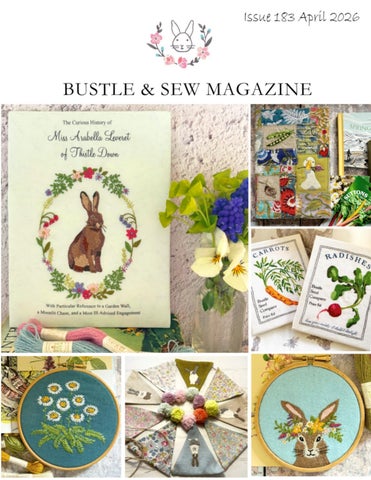
Bustle & Sew Magazine Issue 183 April 2026

Page 1


A Bustle & Sew Publication

Copyright © Bustle & Sew Limited 2026

The right of Helen Grimes to be identified as the author of this work has been asserted in accordance with the Copyright, Designs and Patents Act 1988.

All rights reserved. No part of this publication may be reproduced, stored in a retrieval system or transmitted in any form, or by any means, without the prior written permission of the author, nor be otherwise circulated in any form of binding or cover other than that in which it is published and without a similar condition being imposed on the subsequent purchaser.

Every effort has been made to ensure that all the information in this book is accurate. However, due to differing conditions, tools and individual skills, the publisher cannot be responsible for any injuries, losses and other damages that may result from the use of the information in this book.

First published 2026 by: Bustle & Sew Station House West Cranmore Shepton Mallet BA4 4QP

www.bustleandsew.com

WelcometotheAprilMagazine

As the countryside around Station House returns to life, I have found myself inspired by the beauty unfolding outside my windows. From delicate florals to soft, natural textures, the countryside offers so many ideas for projects that celebrate the season. We are lucky enough to be able to watch the hares in the surrounding fields, and this, together with my enjoyment of the recent season of Bridgerton, inspired the Arabella Leveret project which I do hope you’ll enjoy stitching as much as I did. Another favourite design was the patchwork journal coverperfect for recording the growing season in my Kitchen Garden!

Inside you’ll also find a feature on Indian block printed textiles, exploring their heritage, craftsmanship, and the timeless charm they bring to modern sewing projects. Alongside this, I take a nostalgic look at vintage feed sacks and include a selection of fresh, seasonal recipes to enjoy between projects. Light, comforting, and full of flavour, they’re perfect for bringing a little extra joy to your sewing days.

I do hope you’ll enjoy this issue and the May edition will be published on Thursday 30 April, in five weeks time. Until then…

Very best wishes

The weather in April remains characteristically changeable, giving rise to the well-worn phrase “April showers.” These are rarely days of endless rain; rather they are swift, dramatic interludes. Dark clouds gather, rain falls heavily and then just as quickly the sky clears to reveal startling blue. Sunlight after rain has a particular brilliance, washing the countryside clean and sharpening every colour. Raindrops cling to leaves and spider webs, catching light like fragments of glass. April is a month of contrasts,of sunshine and shadow, and of warmth and, all too often, of days that are grey and chill.

There is an old saying that “Ash before oak, look for a soak, oak before ash, look for a splash,” but on the whole an

April

ash tree will take three weeks longer to come into leaf than an oak. It’s at this time of year that we often experience a “blackthorn winter” - while the hedges are heavily laden with snowy-white blackthorn blossom, the weather turns bitter and, in this changeable month, a day or two of such weather is extremely common.

In our ancient woodlands April is the month of bluebells. Vast carpets of blue spread beneath the trees, transforming familiar paths into something almost otherworldly. Their scent hangs faintly in still air, and their colour deepens under dappled sunlight. Alongside them grow wood anemones and wild garlic, the latter releasing a sharp, unmistakable fragrance when

crushed underfoot. These woodland flowers are perfectly timed, flourishing before the tree canopy closes and claims the light for summer.

On warm days dandelion clocks are already dispersing their seeds in puffs of silver on the spring breezes while the creamy blossom of fruit trees along hedgerows and in orchards is another lovely April sight. In fruit orchards you may see bullfinches feeding on the flower buds, easily distinguishable from other finches by their rosy-pink breast feathers.

The month opens with April Fool’s Day on the first, a tradition of light-hearted trickery that reflects the unpredictable spirit of the season itself. This year Easter falls in April, bringing church

Aprilbringstheprimrosesweet, Scattersdaisiesatourfeet...
Sara Coleridge (1802–1852), "The Months"

AFragrantBorder

Weareinthemidstofseedsowing,andoneoftheyearlyfeaturesinthegardenof thewriterisaborderoffragrantflowers,thosethatsmellsweetlybydayandinthe cooloftheevening. Manyflowersthatopenintheearlyeveningarepoorandeven witheredinappearanceinthedayandoneoftheseisthedelightfullittlenightscentedStock whichshouldbesowninmasses. Noflowerhas amoreunhappylookinthedaytime,buttowardseveningitfreshensanddistilsthe sweetestofodoursfromthelittlepinkblossoms. TheMignonettewillbe,ofcourse, inthisborder,SweetPeainvariety,EveningPrimrose,SweetAlyssum,Sweet Sultan,andamongthetallerthingstheTobaccoplant ,whichis, however,tenderandmustberaisedfromseedsownunderglassorpurchased.Ifseed issowntheremustbenodelay.

Anonymous, 1903, from Country Life

Floriography: TheLanguageof Flowers

Red and yellow tulips symbolise everlasting love and happiness whilst pink tulips bring good wishes

LovelyIdea: EasterTable Centrepiece

Thebeautyofthispieceisthatittakeshumblematerials,suchasheneggsandflowerspickedfrom thegarden,andturnsthemintoagloriousdecorativepiece,'sayscreatorSaraBird.

Free from Homes and Gardens: Easter Table Centrepiece

TheKitchenGarden

The herb garden in the present day is somewhat neglected, and yet the culture and curing of simples was formerly part of a lady’s education. There was not a lady in the kingdom but made her dilltea and diet-drink from herbs grown under her own eye. Thyme, sage, spearmint, and marjoram are all pretty, and a special quarter should be set aside for them in our gardens. This would probably recover, for our soups and salads, some of the neglected tarragons, French sorrel, purslain, chervil, dill, and clary, which are only found now in the pages of old herbals.

Laid out after a simple geometric design, the herb garden might be rather ornamental than otherwise. If a square piece of land be set aside for the herb garden, the beds might be separated by gravel walks with box or tile edgings.

Sweet herbs may be preserved for winter use by being cut when in full growth and dried in the sun. They may then be kept tied in bunches in a dry room or rubbed down, and bottled which is far better.

Scarlet runners may be planted at any time in April or May. The seed should be dropped about four inches apart, and if a line be selected along the two sides of a walk in the kitchen garden, a very pretty shady avenue may be made.

Plant stakes 7 or 8 feet high in the row where the beans are; set 2 or 3 stakes to the yard, and bend them over the top to form arches. In the spaces between the stakes, place pea sticks to which the runners may at first be trained. The stakes should also be tied together by wands arranged longitudinally, one along the top, and one halfway up each side. When this framework becomes covered with scarlet runners, a very pleasant shady walk will be formed.

With a little care in manuring and watering, the runners may be kept green and in bearing till killed by the autumn frosts. The runners will blossom and bear much more freely if the old beans are all removed and they are not allowed to ripen seed.

A mixture of the white Dutch runner with the scarlet runner gives to the avenue a very pretty effect.

Onwatering…

It is not accounted a wise proceeding to begin to water vegetables, for if you begin to do so you will have to continue it. Some vegetables too, will present a very bad appearance under intermittent watering, for example, onions, whose tube-like leaves will turn yellow at the top, if water is given to them and subsequently withheld.

Nevertheless, all transplanted vegetables must be watered plentifully, and even shaded if facilities exist for affording them shelter from the sun’s rays, in order to prevent too great a check to their growth.

A(very)LittleLook atVintageTransfers

Vintage embroidery patterns have enjoyed a rise in popularity over the last few years, as we’ve all embraced the vintage style and they’re great for embellishing all kinds of household linens – and clothing too! They’ve been available from many, many different companies for well over a hundred years. So whether you're looking for breathtakingly intricate motifs for heirloom embroidery, cute kittens for your pillowcases, or a comical design to enliven your kitchen towels, there's a huge assortment of vintage designs waiting to be rediscovered. There is something quietly miraculous about a sheet of fragile paper bearing faint blue lines, soft sepia outlines, or dotted perforations that once guided the stitcher to produce some of the beautiful household linens that survive to the present day. Hand embroidery transfers themselves were never meant to last as they were printed inexpensively, used once or twice, and then very often discarded.

In the early decades of the last century, embroidery continued to occupy a central place in the domestic sphere. It was at this time that companies began producing affordable patterns that could be purchased by ordinary households, allowing women to adorn linens, garments, and household items with decorative stitching.

Some transfers were iron-on designs printed with heat-sensitive ink; others were traced using carbon paper or transferred via perforated pricking and pouncing techniques. This means that the design was composed of small holes in the paper and transferred to fabric by pouncing pushing powder through the holes. Embroidery designs transferred to linens by rubbing and/or moistening the pattern made a brief early appearance, but the hot iron process quickly became by far the most popular.

Hot iron designs were frequently offered in a choice of blue ink (for white or light fabrics) or yellow (to show up on dark fabrics). Many companies eventually switched to a lighter or "electric" blue that would show up on light and dark fabrics. A flat ink transfer, especially if red, may be a multi-stamp pattern that fades as the transfer is used. But if the flat ink is blue, yellow or green, it's probably a singleuse transfer that has been used.

BuildingtheirNest

Inathornhedgeatthebottomoftheorchardapairoflong-tailed titsarebuildingtheirnest,andeverydaywetakethema contributionforitslining,generallypluckedfromthesmall Lakelandterrier,whoismoultingnowandverygladtoberelieved ofsomeofhisshagginess. MrsTitisquiteunconcernedbyour visits,andwhenIlaidanofferingatherdoorthismorningshe hoppeddownatwigortwoandlookeditover,not,Ifelt,very appreciatively. “What!Dogagain?”herexpressionseemedtosay asshejerkedherabsurdlittlefaceroundtowardswhereIstoodin theleaofalilacbush,foralltheworldlikesomanygreyandblack jokeshoppingaboutinthehedgesanddesperatelybusyoversome secretpreparationforAprilFools’Day.

Julian” from 50 Faggots (1944)

FromFlourto Fashion

In the decades between the Great Depression and the years following the Second World War, American women from poor rural areas displayed great ingenuity and creativity in feeding and clothing their families on what were mostly vanishingly tiny household budgets.

One of the most striking examples of their resourcefulness was feed sack fashion. This began as a practical response to economic hardship and later evolved into a widespread cultural phenomenon in which humble cotton sacks that were once used to package flour, sugar, and livestock feed became dresses, shirts, quilts, and household textiles. This practice was especially common during the extreme hardships of the Great Depression (1929-33) and during other material shortages during the Second World War.

In the early nineteenth century food staples were packaged in wooden barrels. By the middle of the century the newly invented sewing machine allowed for more efficient production of rough fabric bags that were then used by sellers of flour, sugar, grain and seed to package their goods, leaving the wooden barrel behind. Early sacks were made from coarse cotton or linen and were stamped with plain labels identifying the product and manufacturer. Once emptied, these sacks did not go to waste. They were reused for everything from polishing cloths to storage bags.

By the 1910’s and 1920’s, some manufacturers began producing sacks made from finer cotton, often called

“percale,” which was smoother and more suitable for clothing. Even then, the sacks still bore large printed product labels. Housewives learned tricks to remove or fade these markings, sometimes soaking the fabric in kerosene or lye before washing.

At the time, many rural families practiced careful thrift. Throwing away useful fabric would have been unthinkable, particularly in farming communities where every resource mattered. Women quickly realized that these cotton sacks could be washed and re-purposed. Early uses included dishcloths, towels, aprons, and children’s undergarments. The fabric wore well and was essentially “free” making it especially suitable for children’s clothing which needed replacing often. By 1925, manufacturers had begun to print labels onto the sacking cloth with water soluble vegetable inks to make them easier to remove and alleviate some of the stigma associated with clothing made from these reused sacks. At that time most bags were still only available in white. In 1925 however, it was reported in magazine that a St

MorethanJustaTextile…

IndianBlockPrinted Fabric

When I was planning my Patchwork Journal Cover project I envisaged using vintage feed sack fabrics, but soon discovered that these are both expensive and hard to source here in the UK. Feeling disappointed I parked this project for a while, and moved onto other ideas and plans - including going back to dressmaking - something I haven’t had time to do for a very long time.

Whilst browsing online for patterns and textiles I came across Cloth Atelier - a UK-based online retailer that, as well as offering lovely (and simplevery important for a very out of practice seamstress) patterns, specialised in Indian block printed textiles. I was entranced - perfect for my planned summer dress I thought - and I also discovered they offered scrap bags too. So, along with my dress fabric I purchased one of their scrap bags for just £5 and used perhaps about half the contents to make my Patchwork Journal Cover.

If you’re interested you can find the Cloth Atelier website here.

All this inspired me to find out a little more about Indian block printed fabric and here’s what I discovered….

Indian block printing is a method of printing on fabric using carved blocks and dyes or inks. Most are printed on a lightweight cotton fabric but they can be used on a wide range of fabrics. They are beautiful and unique due to the tiny variations and imperfections inherent in any hand-crafted product.

The story of Indian block printing stretches back thousands of years, with archaeological evidence suggesting that this technique was practiced as early as the Indus Valley Civilization. Fragments of dyed cotton discovered at archaeological sites reveal that early inhabitants had already mastered the art of applying natural pigments to cloth. Over time, this practice evolved into a highly refined craft, shaped by regional aesthetics, trade influences, and royal patronage. By the time of the Mughal era, block printed textiles had reached extraordinary levels of sophistication, featuring intricate floral motifs, geometric borders, and elaborate narrative scenes.

At the heart of block printing lies a deceptively simple process. Artisans carve designs into wooden blocks, dip them in dye, and press them onto fabric in carefully aligned patterns. Each block must be carved with precision, accounting for how the dye will spread on the cloth and how repeated impressions will align seamlessly. A single design may require multiple blocks

one for outlines, others for different colours, and each must be applied in perfect registration.

The materials themselves are as important as the technique. Traditionally, artisans use natural dyes derived from plants, minerals, and even insects. Indigo yields deep blues, madder root produces rich reds, turmeric offers warm yellows, and pomegranate skins create soft, earthy tones. These dyes are not only environmentally friendly but also possess a depth and subtlety that synthetic colours are often lacking. The fabric, usually cotton or silk, is treated and prepared through a series of washing and bleaching processes to ensure it absorbs the dye evenly.

One of the most renowned centres of block printing is Jaipur, particularly the nearby towns of Sanganer and Bagru. Though geographically close, these regions have developed distinct styles. Sanganeri prints are known for their delicate floral patterns, often set against white or pastel backgrounds. These designs are fine and intricate, reflecting a refined aesthetic historically favoured by royal courts.

Bagru prints, by contrast, are bold and earthy, featuring darker backgrounds and motifs inspired by nature, such as leaves, flowers, and animals. The use of natural dyes and traditional techniques remains especially strong in

Bagru, where many artisans continue to follow methods passed down through generations.

The process of creating a block printed textile begins l with the design, drawn by hand and then transferred onto a wooden block. The carving is done by skilled craftsmen using chisels of varying sizes to achieve different levels of detail. Once the blocks are ready, the fabric is washed to remove impurities and then treated with a mordant to fix the dye to the fibre. This step is vitally important as it ensures the colours remain vibrant and long-lasting.

Printing itself is a rhythmic process. Artisans work at long tables, dipping the blocks into trays of dye and pressing them onto the fabric with practiced precision. Each impression must be aligned carefully with the previous one, requiring a keen eye and steady hand. Even a slight misalignment can disrupt the pattern.

After printing, the fabric undergoes further processing, which may include drying in the sun, washing to remove excess dye, and sometimes additional treatments to enhance colour and texture. In traditional methods, sunlight plays a vital role, helping to develop the hues and set the dyes naturally.

DaffodilSunday

Did you know that the first Sunday in April is known as Daffodil Sunday? This tradition dates back to the nineteenth century when, as part of the Victorian culture of charity and doing-good, families would pick bunches of these lovely golden flowers from their gardens and take them into local hospitals to cheer up the patients.

Today Daffodil Sunday has its roots in the efforts of cancer charities to create a communityfocused fundraising day that would both raise money and increase public awareness of cancer. The tradition is most closely associated with the Irish Cancer Society, which established the event in Ireland during the late twentieth century. Over time it grew from a small fundraising effort into one of the country’s most recognised charity events, drawing thousands of volunteers and supporters each year.

The idea behind Daffodil Sunday was to create a simple but powerful symbol that people could easily recognise and support. The daffodil was chosen because it blooms in early spring, a season that represents renewal and hope after the darkness of winter. This symbolism made it an ideal emblem for a campaign supporting people affected by cancer. The organisers believed that giving the public a meaningful symbol would encourage people not only to donate but also to openly show their support for those living with the disease.

The first Daffodil Day events began in the late 1980’s. Volunteers stood outside shops, on busy streets, and at community gatherings offering fresh daffodils and small pins in exchange for donations. What started as a modest effort quickly gained momentum. Communities embraced the campaign, and the sight of volunteers wearing yellow daffodil badges soon became a familiar sign that spring and a nationwide act of generosityhad arrived.

The funds raised through Daffodil Sunday have helped cancer charities expand their work significantly. Donations support services such as patient help lines, counselling, transportation to treatment, and accommodation for families who must travel long distances for medical care. A significant portion of the money also contributes to research aimed at improving treatments and increasing survival rates.

SunnyDaysat Eastertide….

April arrives with a subtle shift in the air as the heaviness of winter begins to lift, replaced by a freshness that invites lighter cooking and brighter flavours. Across fields and hedgerows, early blossoms emerge. Daffodils often linger into early April, joined by tulips and bluebells, creating pockets of colour that seem to appear almost overnight. This blooming is not just visual; it signals a broader awakening within ecosystems. Pollinators such as bees and butterflies re-emerge, drawn by nectar, and their activity brings a quiet but vital energy back to gardens and countryside alike.

Easter lies at the heart of this seasonal transition, a celebration that blends tradition, comfort, and the first true tastes of spring. Cooking during this time becomes less about necessity and more about expression, colour, and the joy of sharing food that reflects the new season.

Just like Christmas, Easter cooking has its traditions that have been passed down through the generations. Whether it is the slow-roasted lamb or the hot cross buns, these dishes appear on our tables every year. Yet April also encourages subtle reinvention. The same lamb that once appeared with heavy gravies in winter might now be paired with fresh herbs, lemon, and green vegetables, while mint, parsley, and rosemary are now

readily available to the cook, cutting through richness and bringing balance to the meal.

One of the real pleasures of April in the kitchen is the reappearance of fresh produce. After months of root vegetables and stored ingredients, the arrival of asparagus, spring greens, and early peas warrants a celebration all of their own. These ingredients require little intervention. A quick blanch, a drizzle of olive oil, perhaps a squeeze of lemon, and they are ready to shine. Meals this month often centre around this simplicity, allowing the natural flavours of the season to take precedence rather than being masked by heavy sauces or long cooking times. Beyond the traditional chocolate, there is a move towards desserts that feel lighter and more refreshing. Lemon tarts, fruit pavlovas, and delicate sponge cakes begin to replace the dense puddings of winter.

Outdoor cooking also begins to re-enter the picture as the weather allows. Even if it is just a tentative start, the idea of taking food outside whether for a picnic or an early barbecue adds another dimension to April’s culinary experience. Easter itself often encourages this, with chocolate eggs hidden in gardens and meals that might end with drinks on the patio. Spring has really arrived!

TraditionalsayingsfailtoagreeonwhichdayinAprilthe cuckooshouldarrive,butthemonthitselfisnotin dispute…“ThecuckoocomesinApril,andstaysthemonth ofMay;singsasongatmidsummer,andthengoesaway.” Therearenumeroussuperstitionsrelatingtothecuckoogirlsmayaskitwhentheywillmarry,oroldmenwhen theywilldie,andthecallsthatfollowindicatethenumber ofyearseachmustwait. Onhearingthefirstcuckoofor prosperityyoushouldturnorjingleanymoneyinyour pocket,andtoavoidayearofidlenessandillnessyou shouldgtupandrun. Ifthecallcomesfromyourrightyou willhavegoodluck,butifyouarestandingonbareearth youwillbedeadwithintwelvemonths. Itispossibletosee (andhear)cuckoosthroughouttheUK,althoughtheyare morecommonincentralandsouthernEngland. Sadly theirnumbers,likesomanyofournativebirds,have declinedinrecentyears.

TheRoyalSchoolofNeedleworkwasfoundedin1872witha missiontopreservetheartofhandembroidery.

Tomarkits150thanniversarytheRSNlaunchedtheRSN StitchBanktocontinuethismission.

TheRSNStitchBankaimstodigitallyconserveandshowcase thewidevarietyoftheworld’sembroiderystitchesandthe waysinwhichtheyhavebeenusedindifferentculturesand times.

TheRSNStitchBankisanongoingprojectandnewstitches areaddedregularly.TheRSNwillbeworkingwithpartners aroundtheworldtoincludestitchesfromdifferenttraditions.

Everyyearwelosehistorictextilesthroughwear,age,andthemoreaggressiveroutesofwar,neglectand destruction.

Weknowthatstitchesfromhistoryhavebeenlostbecausetheyfalloutofuse.Then,whenanolder embroideredpieceisdiscovered,curatorsandmuseumstaffcannotrecognisethestitches.Textilesandthe knowledgeofstitchesthroughouttheworldcontinuetobethreatenedbywarsandotherdisturbances,aswell aschangesinmanufacturingprocesses.

StitcherscanusetheRSNStitchBanktofindanewstitchtouseinaprojectandlearnhowtomakeitusing videos,writteninstructions,illustrationsandphotographsforeachstitch.Researchers,curators,historians andstudentscanusethesitetolearnabouttheuse,structureandhistoryofeachstitchinarangeof embroiderytechniquesandtoidentifyastitchonatextile.

Youcanbrowsethestitchwallhere

Youcanalsocreateyourownfolderandsavethestitchesyouaremostinterestedin. Itisallcompletelyfree andanamazingresourceforstitchers!

Templates

Turn static files into dynamic content formats.

Create a flipbook