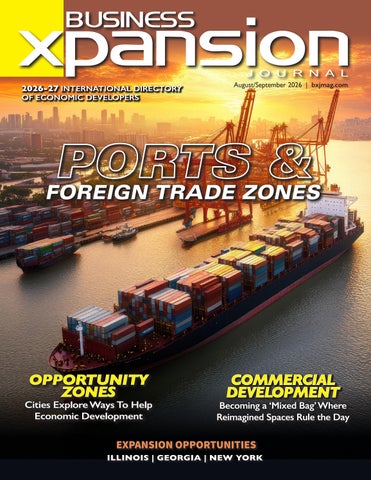
2026-27 INTERNATIONAL DIRECTORY
August/September 2026 | bxjmag.com
OF ECONOMIC DEVELOPERS
PORTS & FOREIGN TRADE ZONES
OPPORTUNITY ZONES
Cities Explore Ways To Help Economic Development
COMMERCIAL DEVELOPMENT
Becoming a ‘Mixed Bag’ Where Reimagined Spaces Rule the Day
EXPANSION OPPORTUNITIES
ILLINOIS | GEORGIA | NEW YORK
TABLE OF
CONTENTS
AUGUST/SEPTEMBER 2026
4
FEATURES INDUSTRY OUTLOOK: Ports Fully Recovered From Pandemic Now Adjusting to Tariff Uncertainty It’s been a rough few years for major U.S. ports but strategic use of foreign trade zones and efforts to automate operations are making a difference By David Hodes
ASSOCIATE PUBLISHER Alan Reyes-Guerra areyes@bxjmag.com 205-862-5175
FEATURES EDITOR David Hodes
CREATIVE DIRECTOR Clint Cabiness clint@dialedinmediagroup.com
14
205-613-5910
INNOVATION AND STRATEGIES: Cities Explore Different Ways Opportunity Zones Help Economic Development OZs getting more popular as a tool for distressed areas of large urban centers to get community help and federal financial relief for redevelopment efforts. By David Hodes
EDITORIAL OFFICE King Publishing, Inc. 1000 Stafford Court Birmingham, Alabama 35242 Tel: 205-862-5175 ONLINE MEDIA ASSISTANT Nick Boliek nick@dialedinmediagroup.com
20
INDUSTRY INSIGHT: Commercial Real Estate Becoming a ‘Mixed Bag’ Where Reimagined Spaces Rule the Day Community connectivity, walkability becoming focus of new developments within dynamic market conditions
SUBSCRIPTION CHANGES & REQUESTS 205-862-5175 or www.bxjmag.com
By David Hodes
King Publishing, Inc., 1000 Stafford Court, Birmingham, AL 35242; www.bxjmag.com. Advertising rates are furnished upon request.
EXPANSION O P P O R T U N I T I E S 26 ILLINOIS:
Why Illinois?
34 NEW YORK:
The Empire State
30 GEORGIA: See. Stay. Grow. See Why Everyone’s Choosing Georgia
Subscriptions are free to those who qualify. Non-qualified subscriptions are $69 in the U.S.; $89 in Canada and Mexico; elsewhere outside the U.S. is $99 for 10 issues. Back issue rate is $6 when available. Payment must accompany order. The views expressed in all articles and advertisements appearing in the Business Xpansion Journal magazine are solely those of the author and advertiser, respectively. © Copyright 2026, King Publishing, Inc. All rights reserved. No partof this publication may be reproduced without written permission from the publisher. POSTMASTER: Send change of address notification to Business Xpansion Journal, 1000 Stafford Court, Birmingham, AL 35242. Subscribers can make address changes by calling 205-862-5175 or by e-mail at www.bxjmag.com.
36 INDUSTRY N E W S 42 2026-2027 International Directory of Economic Developers 2 | BXJ | AUGUST/SEPTEMBER 2026 | bxjmag.com
1000 Stafford Court, BIRMINGHAM, AL 35242 TEL: 205-862-5175 2001
Printed in the U.S.A.
INDUSTRY
OUTLOOK
PORTS & FOREIGN TRADE ZONES
Ports Fully Recovered From Pandemic Now Adjusting to Tariff Uncertainty BY: DAVID HODES
– It’s been a rough few years for major U.S. ports but strategic use of foreign trade zones and efforts to automate operations are making a difference
4 | BXJ | AUGUST/SEPTEMBER 2026 | bxjmag.com
T
he busiest ports in the country have clearly recovered from the effects of the pandemic. But the recovery took time to rearrange shipping destinations and create new ways of doing port business. Those changes are still in progress. ............................................................................................................................................................s The Port of New York gained market share during the pandemic as shippers looked for alternatives to west coast congestion, expanding rail service and making container terminal improvements. The Port of Savannah attracted cargo business that had traditionally moved through southern California and became one of the fastest growing ports in the country after the pandemic. The U.S. Government Accountability Office (GAO) report found that all 10 of the largest U.S. container ports are using some form of automation technology to process and handle cargo as a result of the new efficiencies demanded during the pandemic. But automation efforts have a downside.
making shovel-ready sites, rail access, customs processing, and workforce availability among their offerings.
TARIFF TROUBLES The biggest issue at hand are tariffs. According to the 2026 Global Trade Report by Thomson Reuters Institute, the trade landscape “is increasingly anchored on unstable ground that can shift dramatically overnight. Tariffs have triggered both supply chain volatility and mounting regulatory pressures that are converging to create what may be the most challenging environment trade professionals have faced in decades.” Tariffs are not only causing operational difficulties, according to the report, but are threatening business profitability. Almost four-out-of-ten survey respondents say their companies may absorb the increased costs of tariffs rather than passing them on to customers. Foreign trade zones (FTZ) are increasingly being seen as a way to mitigate the risk of tariffs because they act as secured places for receiving cargo into the U.S. without immediately incurring tariffs. Once the cargo is on U.S. soil, there are multiple ways to reduce tariffs.
THE FOREIGN TRADE ZONE ADVANTAGE
Smaller ports can’t afford to adopt the new technologies because they are generally expensive relative to conventional port equipment, and involve high up-front costs. According to a few stakeholders interviewed for the GAO report, obtaining a return on investment within a reasonable time frame requires large volumes of containers moving through the terminal. A few U.S. ports and terminal operators said it could take 10 to 20 years or more to recover the costs associated with adopting automated cargo handling equipment, at which point the equipment would be reaching or exceeding its operational life expectancy. But beyond the need to update technology, ports after the pandemic have become economic development ecosystems instead of simply transportation assets. They are evolving, changing the perception of economic developers by becoming industrial development platforms, advanced manufacturing hubs, supply chain resilience centers and drivers of foreign direct investment. Developers are now working to market the entire logistics ecosystems of a port, and not just the waterfront acreage and terminal capacity. They are
A special report about trade zones by Thomson Reuters found that, in any FTZ, materials can be kept indefinitely, but the tariff rate can also be locked in at the time goods enter the FTZ or at the time they’re withdrawn, whichever is lower. In either case, no duties are paid until the material is withdrawn from the zone and gets entered into the machinations of the U.S. commerce system. Economic developers have come to better understand the advantages of FTZs and the effect they have on tariffs because they help bring in more automotive suppliers, aerospace manufacturers, pharmaceutical companies, and food processors. There were 199 active trade zones in 2024, according to the 86th annual report about FTZs to Congress. FTZs managed $964 billion in merchandise, supported 381 active production operations, employed about 543,000, and generated $134 billion in exports. The largest industries accounting for FTZ production warehouse and production operations activity include automotive (72,916 products), oil refining and petroleum (48,893 products), machinery/equipment (52,635 products) and pharmaceutical sectors (25,987 products), according to the report to Congress. Warehouse/distribution operations took in over $374 billion in merchandise, while production operations received nearly $590 billion, which was 61 percent of zone activity. California and Texas were both leaders in FTZ warehouse and production activity.
THE BIGGEST U.S. PORT All the volatile tariff news has not slowed down shippers. In fact, some stepped up the pace of business development. The Port of Los Angeles, a $3.4 billion operation ranked as the number 1 container port in the western hemisphere for 26 consecutive years, had one of the busiest container activities in one month in 2026. Dockworkers there moved 1,002,734 twenty-foot equivalent units (TEUs) in June.
CONTINUED ON PAGE 12 bxjmag.com
| AUGUST/SEPTEMBER 2026 | BXJ | 5
INDUSTRY
S I D E B A R
OUTLOOK
PORTS & FOREIGN TRADE ZONES
The hottest port on the east coast is the Port of Baltimore! After many decades, earlier this year Baltimore leaped over a longtime hurdle and began operating double stacked containers on rail through the city’s Howard Street Tunnel following an expansion of that 131-year-old freight tunnel. With the ability to double stack, Baltimore becomes the quickest and most efficient route to Chicago and the Midwest. Double stacking will increase the Port of Baltimore container volumes and add approximately 13,000 new jobs. It will also complement the expansion of the Seagirt container terminal, operated by Ports America Chesapeake. Since 2010, the company has invested more than $600 million in infrastructure, equipment, and technology improvements that have helped to make Seagirt one of the most efficient container ports in the nation. The double stack news follows a record year for container handling at the Port of Baltimore in 2025. Baltimore handled 1.1 million twenty-foot containers and also increased its weekly container ship calls from 12 in 2024 to now 15. In August, Baltimore welcomed its newest container business, MSC’s Dragon service, which opens up another Asia and Mediterranean string for Baltimore. Ports America Chesapeake will also open a new,
6 | BXJ | AUGUST/SEPTEMBER 2026 | bxjmag.com
on-dock grain transload facility at Seagirt in September to allow farmers to directly bring their grains into the Port of Baltimore for export. Baltimore is known in the maritime shipping industry as being one of the most cargo-diverse ports in the U.S. Roll on/Roll off high and heavy cargo is another key focus for Baltimore. In 2025, Baltimore again finished first among all U.S. ports for that commodity and through half of 2026 was tracking ahead of last year’s volumes. Another key targeted commodity in Baltimore’s profile is autos. Last year Baltimore finished second among all U.S. ports in handling more than 726,000 cars and light trucks. With six on-dock auto processors, experienced and skilled labor, and Baltimore’s geographic location as the closest East Coast port to the Midwest, there is no better port for handling autos. Breakbulk or project cargo is also a specialty for Baltimore. From power generation machinery to subway cars to military equipment, Baltimore’s direct-to-rail capabilities make it the best choice for any breakbulk cargo. No matter the cargo, Baltimore can handle it!
DOUBLE STACK CONTAINER RAIL IS HERE! Our new double stack container rail service delivers the quickest and most efficient rail transportation to Chicago and the Midwest. KEY BENEFITS Cargo availability within three days from Baltimore to Chicago Quickest and most efficient route to the Midwest Expanded on-dock intermodal container transfer Highly skilled and experienced labor force On-dock grain transload facility
Marylandports.com
INDUSTRY
OUTLOOK
PORTS & FOREIGN TRADE ZONES
S I D E B A R
Navigating Opportunities at the Port of Long Beach Small and midsized businesses can benefit from the Port’s resources, expertise Moving goods through one of the nation’s busiest seaports could seem daunting for any small or midsized business. But businesses don’t have to navigate it alone. Free of charge, the Port of Long Beach actively assists businesses of all sizes by connecting them to service providers, offering education through trade presentations, providing informational harbor tours and much more. This is one way we are amplifying our impact to support our business community. As part of its mission to become the Port of the Future™, the Port of Long Beach this year unveiled CargoNav, the digital visibility tool that blossomed out of the Supply Chain Information Highway to help cargo owners schedule and track shipments, plan operations and maximize efficiency. The Port knows the vital role small and midsized businesses play in the local and national economy and is committed to supporting their growth. The Port has an award-winning Small Business Enterprise Program that matches vendors and contractors to port-related projects. Additionally, the Port manages Foreign Trade Zone 50, which can help businesses mitigate the impacts of tariffs by allowing shippers to decrease their operating costs and increase cash flow by deferring import duties and eliminating duties on re-exports. The Port invites business owners to reach out and take advantage of the resources provided by the Port of Choice. For more information on Small Business Enterprise opportunities, visit www.polb.com/sbe. To reach the Port’s Business Development Division, email businessdevelopment@polb.com.
8 | BXJ | AUGUST/SEPTEMBER 2026 | bxjmag.com
The Port of Long Beach. Save with FTZ-50. Avoid delays and save money – take advantage of the benefits of a Foreign Trade Zone. Find out how the Port of Long Beach can help your business at polb.com/ftz or contact Lilli Nihipali at FTZ-50@polb.com.
INDUSTRY
S I D E B A R
OUTLOOK
PORTS & FOREIGN TRADE ZONES
Port Tampa Bay is Florida’s Largest and Most Diversified Seaport Port Tampa Bay is Florida’s largest and most diversified seaport, serving as a vital gateway for global trade, logistics and travel. Located in Tampa, the port sits at the heart of the Tampa Bay/I-4 Corridor—one of the fastest-growing distribution hubs in the United States. Located minutes away from Interstate 4, companies can reach key markets, including Orlando, and connect to the broader Southeast. Within a 90-minute drive lies a robust logistics network encompassing more than 550 million square feet of industrial and distribution space, enabling faster cargo movement and reduced transportation costs. Spanning more than 5,000 acres of industrially zoned land with deepwater access, Port Tampa Bay is Florida’s largest port by tonnage and acreage and a leading economic engine for the state, generating approximately $34 billion in annual economic impact and supporting more than 192,000 jobs. The port handles a wide range of cargo, including containerized freight, breakbulk and project cargo, bulk commodities, energy products and roll-on/ roll-off shipments. As one of Florida’s premier cruise homeports and one of the nation’s fastest-growing cruise markets, Port Tampa Bay welcomes more than 1.6 million passengers annually and is a major hub for shipbuilding and repair. Port Tampa Bay offers a compelling combination of flexibility, reliability and growth potential. Its uncongested operations, strong berth availability and efficient inland connectivity allow shippers to move cargo predictably and cost-effectively. As global supply chains adapt to congestion and rising costs, the port has emerged as a strategic alternative, with container volumes growing more than 300% since 2018. Infrastructure investments are underway to support up to 1 million TEUs annually, including the recent arrival of two post-Panamax ship-to-shore cranes to accommodate larger vessel sizes and increase efficiency. These advancements are further supported by recent federal investments to enhance capacity and strengthen supply chain resilience.
10 | BXJ | AUGUST/SEPTEMBER 2026 | bxjmag.com
A key differentiator is Port Tampa Bay’s foreign-trade zone (FTZ), which covers the entire port complex and provides significant logistical and financial advantages. With support from Port Tampa Bay, companies can store, assemble, test or manufacture goods in the FTZ to optimize supply chain efficiency. The FTZ also supports import-for-export operations, making it well-suited for manufacturers, distributors and global logistics providers. Expedited site activation further enables businesses to scale quickly. Beyond port infrastructure, the region benefits from the broader Tampa Bay/I-4 Corridor Foreign-Trade Zone Project (FTZ No. 79), which extends throughout West Central Florida. Through the FTZ, companies can streamline compliance, improve efficiency and expand their global reach. A skilled workforce, business-friendly environment and continued population growth further strengthen the region’s appeal. Port Tampa Bay’s strength lies in its diversification and forwardlooking investment strategy. Through ongoing infrastructure enhancements and a commitment to customer-driven growth, the port continues to position itself as a reliable, flexible and scalable gateway. For companies looking to optimize supply chains, reduce costs and access one of the nation’s most dynamic markets, Port Tampa Bay offers both the location and the resources to succeed. To learn more, visit porttb.com.
EXPANDING PORT CAPACITY FOR
FLORIDA’S FTZ DISTRIBUTION HUB
•• Strategically Strategically located located at at the the crossroads crossroads of of the the growing growing Tampa/Orlando Tampa/Orlando Corridor Corridor
•• Recently Recently expanded expanded terminal terminal capacity capacity and and plenty plenty of of room room for for growth growth
•• More More than than 550 550 million million square square feet feet of of distribution distribution center center space space along along I-4 I-4 and and I-75 I-75
•• Capable Capable of of multiple multiple round-trip round-trip truck truck deliveries deliveries per per day day from from Port Port to to distribution distribution centers centers
•• E-commerce, E-commerce, consumer consumer goods, goods, perishables perishables and and building building materials materials •• The The fastest fastest growing growing region region in in the the fastest fastest growing growing state state
•• Weekly Weekly direct direct sailings sailings from from Asia Asia and and Latin America including Mexico Latin America including Mexico •• Entire Entire port port maritime maritime facility facility is is an an FTZ FTZ Site Site
W WW WW W .. P PO OR R TT TT B B .. C CO OM M
INDUSTRY
OUTLOOK
PORTS & FOREIGN TRADE ZONES green shipping corridors with no fewer than eight ports in Asia. So these three pillars are all important to us. But having a successful port allows those others to rise in success, and that’s what we say around here: A strong community makes for a better port, and when this port is strong, this community thrives.” At the end of July, he said, the port is going to sign an agreement with the state of California to start a project of building a new bridge that connects the Enclave of San Pedro to Terminal Island, replacing the 1,500-foot long Vincent Thomas bridge. “It’s already underway with shovels in the ground, and a half billion dollar cruise center at our outer harbor to handle the biggest ships in the world. There’s a lot of investment happening here, and long-range projects. But we need the best and the brightest private money, as well as the intelligence, whether it be from the financial community, engineers, construction folks, and those that facilitate that all important international trade for us.”
Semi-automated double trolley cranes load containers onto automated guided vehicles. Picture courtesy U.S. GAO. June cargo was 12% higher than a year ago, driven by strong import demand as retailers and manufacturers continued advancing shipments amidst global shipping uncertainty due to geopolitical actions, according to a monthly briefing by port officials. During the first six months of 2026, the port handled 5,122,603 TEUs, which was 3% ahead of the same period last year. “From what I see, given the volatility of the trade policy, importers particularly are looking for windows where they have as much information as possible, and then they’re speeding cargo through to market,” Gene Seroka, executive director of the Port of Los Angeles told BXJ. “So this rush has to do with expiring Section 122 tariffs (a 10% global import surcharge that expired July 24), and the fact that the shipping lines are about to roll out higher fuel surcharges based on their contractual formulas that lag by three months, and also not knowing what the next trade policy statement is going to be,” he said. “But probably the tariffs will be higher. The consumer is still spending. Factories, generally speaking, are doing fairly well. So the cargo flow is good. It just looks like an earlier peak season than maybe in more traditional years.” Seroka said that the LA port has ramped up top line revenue, capital projects and investment in community, focusing first on the business of the port by state law and city charter. “Every dollar we earn must be reinvested in this port. We don’t issue stock, pay dividends, or bonuses to employees. Every dollar goes right back into the port.” Second, he said, regarding community, the port lives in a harbor enclave with about 260,000 residents and millions more along key commerce corridors. “Taking care of those who look after us is of prime importance,” he said. “Many of us have jobs related to this port, whether its dock workers moving the cargo, truckers, or warehouses. But also the hotels, the restaurants, the shops. They all count on us doing good business here, so we can patronize their stores.” Third, they focus on the environmental side. “Our DNA is a little different. Our risk tolerance is higher, and because the port continues to do so well financially, we are stepping out and stepping up in the area of environmental stewardship,” Seroka said. “We’re the only port, along with Long Beach, to have in writing a strategy to go to a zero emissions port operation in 2030 and a heavy-duty truck environment by 2035. We’re the only port that’s activated
12 | BXJ | AUGUST/SEPTEMBER 2026 | bxjmag.com
MANAGING GEOPOLITICAL TENSIONS Seroka said that geopolitical tensions are “front of mind every day.” He lived and worked in the Middle East for five years and has a good sense of what is going on, and what the future could bring. “I’m in contact with people on the ground today, giving me what’s happening in snapshots and time every single day,” he said. “Most of the folks that live in countries inside the Arabian Gulf, the Red Sea, and East Africa are consumers like us. They don’t make a lot of products there. They require and need those imports of finished products, furniture, electronics, clothing. They’re not getting them, and it’s erratic right now. Prices of energy have spiked, and even if this war were to end today, it would take months upon months to get the energy supply chains back to some semblance of normalcy.” There’s still infrastructure work to do at the fueling station at Dubai International, the LNG facility in Qatar (Quatar Energy LNG), and the port terminals at the Port of Shuwaikh (Kuwait’s main commercial seaport) and the Port of Shuaiba, he said, even to extract oil in Iran. “There’s tremendous amount of investment that needs to be done to not only rebuild those derricks but also to future-proof them.” X
Automated cargo handling equipment at TraPac Los Angeles Terminal. Picture courtesy U.S. GAO.
Last year, Quonset Business Park celebrated the opening of the new Terminal 5 Pier at the Port of Davisville — the first new pier built at the port in nearly 70 years. At the time, Quonset talked about what the project would mean for Rhode Island’s economy and the future growth of the Port. Today, the port is beginning to see those benefits in real time. The Terminal 5 Pier welcomed its first ship call: the Viking Odesa, a roll-on/roll-off vessel that delivered more than 1,100 GM and Chevrolet trucks and SUVs. This first berthing represented much more than the arrival of a ship. It was proof that years of planning and investment are already strengthening Rhode Island’s only public port and positioning Davisville for continued growth. The Port of Davisville has long been one of the top 10 auto importers in North America, handling more than 200,000 vehicles in 2025 alone. Terminal 5 expands the port’s ability to accommodate automobile carriers while also creating additional flexibility for other cargoes and emerging industries.
As activity at the port continues to increase, additional capacity is critical. The new pier was designed as a true multi-use maritime facility. In addition to supporting a thriving automobile import business, it can accommodate heavy cargo, offshore wind vessels, submarine components, and other specialized maritime operations. That versatility is important because the maritime industry is evolving quickly, and ports that succeed will be those prepared to handle a wide range of opportunities. Modern infrastructure creates confidence for companies looking to invest and grow. It helps attract private-sector investment, supports good-paying jobs and ensures Rhode Island remains competitive in industries that are shaping future economic growth. The first ship call at Terminal 5 is only the beginning. As activity continues to grow at the Port of Davisville, this project is proving to be an investment that will benefit Rhode Island for decades to come.
bxjmag.com
| AUGUST/SEPTEMBER 2026 | BXJ | 13
S I D E B A R
New Pier Expands Capacity and Opportunity at Quonset’s Port of Davisville
INNOVATIONS & STRATEGIES
OPPORTUNITY ZONES
Erie, PA, Flagship City Commons, a 40,000-square-foot $25 million mixed-use development of restaurants, retail and office space, used opportunity zone assistance. It’s scheduled to open in 2027. Picture courtesy Erie PA Downtown Development.
Cities Explore Different Ways Opportunity Zones Help Economic Development BY: DAVID HODES
OZs getting more popular as a tool for distressed areas of large urban centers to get community help and federal financial relief for redevelopment efforts
14 | BXJ AUGUST/SEPTEMBER 2026 | bxjmag.com
A
n opportunity zone (OZ) designation is more than a tax incentive. It is an economic development tool dependent on location, used generally within an urban area or communities that have struggled to attract investment.
.........................................................................................................
The Tax Cuts and Jobs Act (TCJA) of 2017 created the OZ tax incentive to jump start private investment and economic activity in low-income communities through capital gains tax relief, according to a tax analysis working paper from the U.S. Treasury. The U.S. Treasury recently released new data reporting that federal OZ tax incentives drove more than $112 billion worth of investment capital into more than 6,000 communities through the end of 2024. The incentives program has generally been progressing well, with a few hiccups. The tax analysis paper reported that OZ-related investment has been unevenly distributed, more heavily concentrated in less-distressed areas and other areas already trending toward economic growth.
A SAMPLE OF CURRENT OZ CASES
There are 8,764 OZs in the U.S., many of which have experienced a lack of investment for decades, according to figures from the U.S. Department of Housing and Urban Development. The fed seeks to fix that discrepancy. Future rounds will be made with a better understanding about which tracts attracted capital investment under prior law, and can help inform nomination decisions, particularly around location and rural status, baseline economic distress, comparative income rank within the state, and prior growth trend. The current 2017 OZ map will stay in effect through the end of 2028, and for a period during that time, state’s governors will nominate census tracts for the Treasury to designate, creating a new OZ 2.0 map to be in effect through the end of 2036. New OZ maps with designated census tracts will be chosen every 10 years after that.
The success stories in reclaiming distressed areas using OZ are striking. Take for example the case of Erie Pennsylvania Downtown Development, described as “a poster child for Opportunity Zones,” by the local paper, the Erie Reader. The city designated eight census tracks since 2017, the majority of which are in the downtown area which is the poorest area in the commonwealth. There are now 12 downtown development projects completed or underway, eight historic properties restored, and 100,000 square feet of new office space created. The area’s 40,000-square-foot $25 million Flagship City Commons, a mixed-use development of restaurants, retail and office space is one of the more recent projects using help from OZ. It’s scheduled to open in 2027. Also scheduled to open in 2027 is one of the largest single private development investments in downtown Erie’s history, the $60 million renovation of the Trust Hotel. The renovation, which is actually a conversion of the former Renaissance Center, will feature 195 rooms, a restaurant, ballroom, lounge, gym and other amenities. Building owner Christian Siembieda utilized an OZ fund as part of a layered financial package to invest his own capital gains into the Renaissance Center, using it to attract additional private equity for the project, according to an article in the Erie Times-News. Another OZ success case is in Birmingham, Alabama. The city has 24 designated OZs, the most in the state—Mobile is the next highest with 14. The state OZ total is 158. One of the developments in the city using OZ funds is The Star Uptown. It’s a mixed-use redevelopment of the 52-acre former Carraway Hospital campus in Birmingham, and is anchored by a new amphitheater. It opened in 2025. Another Birmingham project, Market Lofts on 3rd, is a $36 million renovation of a 140,000 square-foot former Red Cross building that sat vacant since 1998. It is composed of 192 units of workforce housing and 5,000 feet of retail space designed to serve residents who make too much income to qualify for subsidized housing but too little to afford much of the available residential areas in the city center. The development received a $19.6 million loan from Fannie Mae; $5 million through the Alabama Historic Rehabilitation Tax Credit, a 25 percent refundable tax credit for historic rehabilitation; and roughly $5 million in nonrefundable federal historic tax credit equity syndicated by Rise Capital Partners. The project’s largest equity investment came through Opportunity Alabama, Inc. (OPAL), a $19 million OZ fund raised by a wholly owned for-profit benefit corporation subsidiary of OPAL. OPAL has been cited as a national leader in OZ-based economic development by Forbes magazine, and has attracted over $5 million in national philanthropy and federal funding, according to its website. bxjmag.com
| AUGUST/SEPTEMBER 2026 | BXJ | 15
INNOVATIONS & STRATEGIES
OPPORTUNITY ZONES
S I D E B A R
Palmdale, CA: A Hub for Growth in Los Angeles County Palmdale, CA, has long been a hub of aerospace and advanced manufacturing in Southern California. Home to industry titans like Lockheed Martin and Northrop Grumman, Palmdale sits squarely at the entrance of the “Aerospace Valley,” an aerospace cluster spanning from Palmdale’s US Air Force Plant 42 to the Mojave Air and Space Port. Situated in northern Los Angeles County, Palmdale is within a 90-mile radius of the Los Angeles International Airport and the Ports of Los Angeles and Long Beach. Convenient freeway access through State Routes 14 and 138 and freight rail access via the Union Pacific Railroad connect Palmdale to Southern California and beyond.
AEROSPACE INCENTIVE PROGRAM
OPPORTUNITY ZONES 2.0
With approximately 15 million square feet of industrial space in the development pipeline, Palmdale’s business community continues to grow. Recent grand openings, such as Precon Products’ concrete manufacturing facility, showcase the region’s ongoing growth. Marketready industrial developments such as the 8.2 million-square-foot Antelope Valley Commerce Center East and the 1.2 million-square-foot Antelope Valley Commerce Center West are available for relocation and expansion projects. The City continues to prepare for the Center for Transportation Technology Excellence, a joint effort with local transit agency Los Angeles Metro to develop an 8.6-square-mile bus and rail development and manufacturing facility. The 1.9 million-square-foot facility will create approximately 116,000 direct and indirect jobs, providing local companies with opportunities to participate in the center’s design, construction, and supply chain. With a business-friendly approach to development, affordable paths to homeownership, and planned regional infrastructure improvements such as the High Desert Corridor, Palmdale is ideal for relocation or expansion. To learn more about Palmdale’s initiatives and get in contact with staff ready to assist you, visit https://www.CityofPalmdaleCA.gov/EconomicDevelopment.
Official Opportunity Zone 2.0 designations are on the horizon, and the City of Palmdale is primed to receive over 64 square miles of designated Opportunity Zone tracts in January 2027. These tracts are in the heart of our planned downtown and adjacent to Air Force Plant 42, making them an advantageous tool for commercial and industrial projects in Palmdale. With major entertainment anchors committed to upcoming commercial centers in development-ready tracts, the City anticipates a surge in regional spending and economic opportunity.
FOREIGN TRADE ZONE #191
The City of Palmdale is the grantee of Foreign Trade Zone #191, which offers inverted tariff relief, tax exemptions, and duty deferral and elimination to businesses in international trade. Free cost-benefit analyses are available to businesses considering operating within the Foreign Trade Zone, which spans the Antelope and Santa Clarita Valleys. Major distribution companies, including Trader Joe’s, Michaels, and SYGMA, take advantage of the region’s streamlined logistics and strategic benefits.
16 | BXJ AUGUST/SEPTEMBER 2026 | bxjmag.com
The City of Palmdale Aerospace Incentive Program offers up to $500,000 for new construction or $125,000 for new leases for businesses in the aerospace and defense supply chain. This unique incentive program complements state tax credit programs and longstanding workforce development programs that produce highly skilled, local talent. The program’s first recipient, AS Aerospace, produces fasteners for a range of aerospace customers. Bringing 150 jobs to the region, AS Aerospace broke ground on its 90,000-square-foot manufacturing facility in October 2025 and is expected to open its doors in December 2026.
CONTINUED DEVELOPMENT AND INNOVATION
INNOVATIONS & STRATEGIES
OPPORTUNITY ZONES
OZ assistance used for the mixed-use redevelopment of 52-acre former hospital campus in Birmingham, AL. Picture courtesy CR Endeavors Yet another case is Baltimore Peninsula, formerly known as Port Covington, a 235-acre tract of land that sits south of the city’s historic Federal Hill neighborhood and had been unused since the mid-1970s. The project is a planned 14 million square foot mixed use development to include hotels, entertainment venues, parks and a waterfront public space. Though it lies within an OZ it was not totally financed by an OZ. Financing was layered with private equity, construction loans, tax increment financing and brownfield incentives making it a unique example of capital stacking using OZ incentives. In 2016, Baltimore approved the project with $660 million tax increment financing, the largest ever awarded in that city. The deal involved a community benefits agreement and memorandum of understanding that included $39 million in direct benefits for six communities around the development and $55 million in citywide benefits spanning workforce development programs,
18 | BXJ AUGUST/SEPTEMBER 2026 | bxjmag.com
education, recreational facility commitments and more. A notable OZ investment came from Goldman Sachs Urban Investment Group, which committed approximately $233 million in equity in 2017 to help launch the redevelopment.
HOW OZ WORKS IN CHICAGO Robin Schabes is the director of the Chicagoland Opportunity Zones Consortium at the Chicago Community Loan Fund (CCLF) that represents an OZ collaborative of about 30 different entities. They are all focused around community development. The CCLF is a community development financial institution, and the idea for creating something like a collaborative had been incubated out of CCLF. “Our members include other community development financial institutions (CDFIs),” Schabes told BXJ. “We have nonprofit partners who are engaged in community development. We have philanthropic partners. We
have representation from the city, county, and state economic development agencies, and some private sector entities that participate as well. That’s our model. We’re not a fund. We were not designed or set up to be a fund. Rather, our goal is to work via this collaborative model and see what we know about potential pipeline opportunities in our footprint, for feasible opportunities, to try to match or interest potentially interested OZ investors in looking at those deals. That’s our role.” Once CCLF has made those introductions, she said, they generally step out of the conversation. “It’s up to the project sponsor or the OZ investor to continue doing deep dive due diligence and see where that goes.” The organization tries to see what’s happening in their own footprint through qualitative research, she said. “And I use that term loosely. It’s based on the relationships we’ve built and the stuff we’ve read in different publications, and following up. We have a general sense of how the OZ tool has been used in our own footprint.” The majority of the OZs are in the south and west side of the city of Chicago (135) and in Cook County in the south and west suburban communities (48). “That’s by virtue of the criteria that was in place at the time that those designations were made,” Schabes said. Rural is a big focus in the new OZ, called OZ 2.0, she said, so states like Illinois that have a lot of rural areas can be eligible for enhanced benefits if the OZ tool is used within what’s considered a designated rural zone. “The state of Illinois has been following a very good process,” Schabes said. “They have made it transparent. They opened up suggestions to the community. They also laid out the criteria that they were looking at, including how this was going to support community and economic development.” The state, the city, and the regional economic development agencies all are aligned around what Illinois considers to be its high growth industries for the future, she said. “That all factored into the equation.” She said that they don’t know yet what the new 2.0 OZs are going to look like—states have until the end of September to get their designations out the door to Treasury for certification, and they can ask for a 30-day extension if they need it. “So we won’t really know what the new zones will look like until toward the end of this year.” CDFIs are by virtue mission-focused entities, she said. “We’re looking at projects that will have multiple benefits at the end of the day for communities. So that means oftentimes we’re intersecting as best we can with impact-oriented investors versus more market-oriented investors that may have different parameters and criteria for the investments they make. “Under OZ 1.0, the tool has predominantly been used for residential,” Schabes said. “We’re hoping that under OZ 2.0, with some regulatory clarifications, the tool can be put to greater use as relates to business investment as well.” X
bxjmag.com
| AUGUST/SEPTEMBER 2026 | BXJ | 19
INDUSTRY INSIGHT
COMMERCIAL DEVELOPMENT
Commercial Real Estate Becoming a ‘Mixed Bag’ Where Reimagined Spaces Rule the Day BY: DAVID HODES
Community connectivity, walkability becoming focus of new developments within dynamic market conditions
C
ommercial real estate development and operations generated $1.4 trillion in direct expenditures and contributed $3.5 trillion to U.S. GDP, $1.3 trillion in personal earnings and 20.4 million jobs nationwide, according to a report by the Commercial Real Estate Development Association (CREDA) research foundation. ............................................................................................................................ It is “a mixed bag today,” according to Richard Peiser, the professor of real estate at the Harvard University Graduate School of Design. “Interest rates are likely to remain high, even though we expect them to come down,” he told BXJ. “The biggest issue has to do with vacant office buildings, many of which will never be used again as office buildings. From a city perspective, that’s very burdensome because the buildings, if they’re empty, aren’t paying taxes. They’re not filled with people who are generating retail sales, and everything else that goes with empty buildings. Transitioning those buildings is a big deal.”
20 | BXJ | AUGUST/SEPTEMBER 2026 | bxjmag.com
Brookings Institution, a think tank, found that a typical data center uses 300,000 gallons of water each day, equivalent to the demands of about 1,000 households. Large data centers can use an estimated 5 million gallons of water each day. Power usage is becoming a bigger issue as time goes on. The largest U.S. data centers currently draw less than 500 megawatts of power. But larger centers either planned or under construction are expected to require up to 2 gigawatts of power. That’s enough to power up to 2 million homes. There are over 3,000 data centers across the U.S. right now, with more than 1,500 new data centers in various stages of development nationwide, according to a Pew Research Center analysis. The analysis further showed that 67% of planned data centers are in rural areas, while 87% of existing data centers are in urban areas. The most active states in data center development are Texas and Virginia, which are also states with some of the largest data centers. For example, Texas Fermi America showed their plans in early July to build the largest combined energy and data campus in the U.S. near Amarillo. They are working in partnership with the Texas Tech University System. The facility will integrate nuclear, natural gas, solar, and wind energy sources in an 18 million square foot data center that will use up to 11 gigawatts. As the data center developments ticks up, more and more local communities are actively resisting development because of the threat to their infrastructure. A recent Gallup poll reported that seven in 10 Americans oppose constructing data centers in their local area—nearly half are strongly opposed.
BUILDING CONNECTIVITY
THE PANDEMIC LEAVES ITS MARK The ghost of the pandemic past still haunts the commercial real estate industry. It was a major macroeconomic event that triggered a recession and is only five years in the past. It left its mark. The dip in commercial retail growth is clearly shown in the direct expenditures figures offered in a report by the CREDA: $83 billion in 2021 compared to $109 billion in 2025. CoStar, a market analytics firm, reported that U.S. office leasing remained steady in the second quarter of 2026. Overall volume has remained close to the pre-pandemic average in large cities such as Dallas, Houston, San Francisco, New York, Miami and Boston.
IT’S A DATA CENTER FUTURE Steady growth in data centers has become the centerpiece of commercial real estate development right now. But it comes with practical issues developers sometimes struggle to manage—electricity and water specifically—within the context of community infrastructure.
The other news in commercial development is the rise in renovations or complete overhauls of both urban retail centers, office spaces, and the downtowns of smaller suburban cities within larger metropolitan areas. Many have completely revitalized the retail shopping center experience to include large marketplace structures and open green spaces around shopping areas for community gatherings in an attempt to make a more walkable, community-connecting experience. Office spaces have also transitioned into mixed use development, where the office building is not a stand-alone structure but part of a development that includes amenities such as grocery stores and entertainment venues. “The key for any urban development is creating a place that people really want to be,” Peiser said. “I would put that as the number one goal. But that’s not so easily accomplished. Retail, and public space, are the two key ingredients to pursue. The third key ingredient is having supportive government, and the fourth key ingredient is having developers with experience and financial capability to pull it off.” One example is The Domain in Austin, Texas, originally conceived as a retail destination but has evolved to include a grocery store, restaurants and bars, hotels, apartments, parks and plaza space. bxjmag.com
| AUGUST/SEPTEMBER 2026 | BXJ | 21
INDUSTRY
S I D E B A R
INSIGHT
COMMERCIAL DEVELOPMENT
Inside Montgomery County, Maryland’s Innovation Driven Economy When it comes to the innovation economy—artificial intelligence, cybersecurity, quantum and frontier technologies, robotics and industrial automation, clean technology and advanced materials, agricultural technology, and food innovation—Montgomery County, Maryland, is the final destination for some of the world’s largest brands changing the world. From AstraZeneca and Marriott International to Lockheed Martin, companies benefit from the County’s strategic location and proximity to the federal government—not only to the Food and Drug Administration (FDA) and the National Institutes of Health (NIH), but to also 28 other government headquarters and 36 federal labs, as well as a highly educated population, with one third of residents aged 25 or older holding an advanced degree (master’s or higher). “Access to the Food and Drug Administration and other federal agencies really sets [Montgomery County] apart from some of the other markets out there,” explained Brett Tunes, Managing Director, Savills North America. David Marriott, Chairman of multinational global hospitality giant Marriott International, agrees that Montgomery County’s location steps from Washington, D.C., is an advantage to companies of all sizes. “Being in Montgomery County is beneficial to us as a company because its proximity to the nation’s capital is absolutely critical for us as an industry to have access to government officials that help our business around the globe,” said Marriott. The County’s proximity to three international airports—Washington Dulles International Airport (IAD), Baltimore/ Washington International Thurgood Marshall Airport (BWI), and Ronald Reagan Washington National Airport (DCA)—is an added bonus for international companies looking to establish a U.S. base. This makes the nearly 500 square miles location, at the heart of the Capital Region, a sought-after destination for foreign companies looking to expand into the U.S. market.
22 | BXJ | AUGUST/SEPTEMBER 2026 | bxjmag.com
For Finnish company Vaisala Xweather, a global leader in weather, environmental, and climate intelligence, this access was an important reason why the company recently opened a location in Gaithersburg. “Looking for a location here in the D.C. region, what was important was easy access. We wanted to have the three airports in the region, and we wanted to have a place that was impressive for people to travel to,” said Peter Sellers, Senior Manager, Engineering, Operations and Technology and Vaisala Xweather. “If somebody’s going to travel halfway across the world, the experience of the office needs to be worth it.” Vaisala Xweather recently opened an office in Montgomery County’s Washingtonian Center, the same building where clean energy start-up X-energy— which just celebrated a historic IPO—will be consolidating its two Rockville offices into a new 125,000-square-foot headquarters.
business ecosystem by providing hands-on training in biomanufacturing and laboratory sciences, helping to ensure employers can find the talent they need at every stage of growth. Meanwhile, Montgomery County’s network of innovation centers and incubators offers start-ups access to flexible space, mentorship, and resources designed to help new companies scale successfully. “The most invaluable resource we benefit from in Montgomery County is its established, collaborative professional network,” explained Dr. Su Hong, Chief Executive Officer of Psomagen, a genomic sequencing and multiomics service provider based in Rockville, Maryland. “A premier biotech hub is defined not just by its corporate footprint, but by an interconnected community of people working together, and this region uniquely provides that environment.”
CAPITALIZING ON TALENT, QUALITY OF LIFE, AND PROFESSIONAL NETWORKS
New opportunities for expansion continue to emerge across the County, including major mixed-use developments and redevelopment sites:
Montgomery County’s deep talent pool of highly educated residents along with an exceptional quality of life offers a unique and vibrant community known for its urban centers, walkable downtowns, welcoming suburban neighborhoods, over 400 parks and trails, award-winning entertainment and cultural venues, top-ranked public schools, and access to world-class healthcare, academic institutions, and transportation. This combination allows companies to not only hire the technical talent that they need but retain them as well. “Montgomery County has the advantages of having the technical skills that we need in terms of recruitment and still being attractive for people to live in as a community. So we’re finding a lot of families enjoy coming to Montgomery County,” said Carol Lane, Senior Vice President at X-energy. Workforce development initiatives such as BioHub Maryland further strengthen the
AVAILABLE SITES
•
•
Viva White Oak was recently approved for $420 million in tax increment financing bonds and features approximately 294-acre of mixed-development adjacent to the FDA headquarters and near the Adventist HealthCare White Oak Medical Center. The former home to the COMSAT research facility, a 204-acre site in Germantown, is also available for development and will feature a mix of commercial, industrial, office, research & development, and retail spaces.
As Montgomery County, Maryland continues to drive innovation across all industries, local companies have access to the talent, connectivity, resources, and opportunities they need to compete globally. Visit thinkmoco.com.
MONTGOMERY COUNTY, MARYLAND
12M
280 Acres
Square feet of mixed-use development
2M Square feet of lab space, office/medical office
VIVA WHITE OAK Just outside Washington, D.C., visionary companies, world-class talent, and breakthrough innovation are defining the future. The Viva White Oak site is a $2.8 billion investment featuring more than 2 million square feet of lab space, office/medical office, retail, and up to 5,000 quality residences.
THINKMOCO.COM
INDUSTRY INSIGHT
COMMERCIAL DEVELOPMENT
The Battery Atlanta is a 3-million-square-foot mixed-use sports and entertainment destination located near Atlanta, Georgia anchored by Truist Park, home stadium of the Atlanta Braves. It operates 365 days a year. Picture courtesy The Battery Atlanta The multi-phased Domain development (phase 1 was completed in 2007) on 300 acres now offers more than 800 residential units, 1.5 million square feet of retail space, and 2 million square feet of Class A office space, including the home of Amazon.com and Facebook, Inc. There are four new hotels in the development—Westin Austin at The Domain, Lone Star Court by Valencia Group, The Archer Hotel and Aloft Austin. Another example is The Battery Atlanta. It’s a $400 million mixed use development located on 74 acres connected to Truist Park, the Braves baseball stadium, in Atlanta, Georgia. It houses the Coca-Cola Roxy, a 3,600-seat entertainment venue, and 531 residences. It opened in 2017. These places offer what economic developers pitch to corporations seeking a broader and more convenient lifestyle offering for their employees: fitness centers, hotels, childcare facilities, access to public transit, entertainment venues, and more.
WHERE TO NEXT On the horizon and gaining traction fast is senior housing development.
24 | BXJ | AUGUST/SEPTEMBER 2026 | bxjmag.com
Senior housing occupancy rose to 89.9% in early 2026, extending a 20-quarter streak of gains, according to the National Investment Center (NIC). Construction remains historically low, with inventory growing just 0.4% year over year and fewer than 16,000 units under development. The NIC lists senior housing occupancy at 89.9% in the second quarter of 2026, up from 89.5% the first quarter. Fifteen of the 31 primary markets tracked by NIC have now surpassed the 90% occupancy threshold, reflecting a market with little excess capacity and limited new inventory. The CRE Daily, a brief published by the NIC, reported that senior housing “remains one of commercial real estate’s strongest-performing property sectors.”
THE SHOPPING MALL RE-DO DILEMMA “I’d say the number one mission of economic development should be to accelerate the redevelopment of the declined shopping mall,” Peiser said. “Often the centers will sit there for a very long time. Now, the conversion of those centers is one of the hottest opportunities everywhere. It does require being in a good
location where there’s natural demand. But adding residential and other uses and downsizing the retail is the approach that has worked in many places, and I think it will definitely work in some of those distressed malls.” One example comes from Flatiron Crossing in Broomfield, Colorado, located between Boulder and Denver. It’s the site of a major shopping mall that has seen some decline over the last few years, losing anchor tenant Nordstrom in 2020, one of 16 Nordstrom’s closed nationwide. But the mall continued to struggle along. Now developers have begun building HiFi, a 25-acre community hub project adjacent to the mall, which they hope will bring 347 multifamily residences, 90,000 square feet of new retail and dining, and 2.5 acres of public green space to the area. It is intended to blend multifamily living, unique shopping, dining and entertainment with green spaces, including Pindustry—a two-level, locally owned entertainment destination—and Novel FlatIron by Crescent Communities, a new, five-story, 345-unit luxury multifamily residential community, now under construction at HiFi. Phased openings are set to begin in 2027, including the openings of Pindustry and Novel FlatIron. According to a trends article in Realtor.com, the development is all about complementing the mall. “In strategic areas where we have the ability to add residential in a peripheral site or adjacent to the mall, that is our focus.” Jacob Knudsen, vice president of real estate development at Macerich, HiFi development owner, told Realtor.com. For any real estate development, or redevelopment, cities have to have a program that provides incentives and tax abatement, Peiser said. “I think the reality is developers respond to incentives. If I am the city manager, I may play one city off another to see who gives them the best deal. I may not like that as an approach, but I think it’s one of the tools. You need to be strategic. You can’t develop every area you want to develop simultaneously because there just isn’t that much demand to go around,” he said. “So I think picking the areas that are most important and focusing on them is the way to go.”
LOOKING FORWARD The outlook for commercial real estate could be shaped by a gradual easing of monetary policy, according to the CREDA report, to include moderating inflation and evolving demand patterns across property types. Growth is expected to remain particularly strong for data centers, logistics-oriented industrial space and well-located multifamily properties, while traditional office may face a slower recovery. The market dynamics at play “suggest a period of possible transition” rather than retrenchment, with commercial real estate positioned to “remain a significant driver of economic activity as market conditions gradually stabilize,” according to the report. X
bxjmag.com
| AUGUST/SEPTEMBER 2026 | BXJ | 25
EXPANSION
OPPORTUNITIES
ILLINOIS:
Why Illinois? W
elcome to the intersection of America— and the world. Where talent, innovation, transportation and infrastructure converge and where many of the nation’s top businesses thrive.
......................................................................................... Strategically located at the heart of the country, Illinois is the crossroads of commerce that puts businesses, people and goods within a four-hour flight of the entire North American market—not to mention the home to the world's most connected airport. On top of that, Illinois companies benefit from a world-class transportation and logistics network, reliable, low-cost energy, abundant water and natural resources and a highly educated workforce supported by more than 247 higher education institutions. Learn why over 30 Fortune 500 companies and more than 2,000 international industry leaders call Illinois home. Illinois’ economic strength begins with its ecosystem of like26 | BXJ | AUGUST/SEPTEMBER 2026 | bxjmag.com
minded pioneers and trailblazers. The 18th largest economy in the world, Illinois has grown and attracted some of the most innovative and iconic companies on the planet including Abbott, AbbVie, ADM, Allstate, Baxter, Motorola Solutions, Exelon, John Deere, McDonalds, Mondelez, State Farm, United, and more. Among the state’s greatest assets are its talent pool of nearly 6.4 million people—about a third of whom hold a bachelor’s degree or higher—and one of the most connected transportation and logistics networks in the country. The state is also home to a supportive business environment that welcomes and fosters growth. Illinois businesses span existing and emerging industries and create good-paying jobs for its residents. Illinois offers unparalleled access to global markets. A hub for transportation, Illinois is home to five international airports, six Class I railroads, the third largest interstate highway system in the country and the third largest inland port in the world.
ILLINOIS’ THRIVING INDUSTRIES
The state’s central location puts businesses, people and goods within a four-hour flight of the entire North American market—not to mention non-stop service to more than 60 international destinations. Chicago’s O’Hare is ranked the WORLD’s most connected airport. In addition, the state offers businesses top-notch digital infrastructure, reliable, low-cost energy and abundant water and natural resources. Illinois is committed to breaking down barriers for businesses looking to locate in the U.S. Home to more than 2,000 international companies, Illinois has proven to be a natural choice for global employers expanding in the North American market. With more than 80 consulates/consuls general, 90 sister cities, eight foreign trade zones and five international airports, Illinois allows international companies to reach their global customers, while also feeling at home.
Illinois’ diverse industry base and thriving economy create a foundation ripe for business growth, regardless of size or sector. The state leads in industries including advanced manufacturing, nextgen agriculture and agtech, clean energy, quantum and emerging technologies, life sciences, and transportation and logistics. Illinois boasts a rich history of industrial excellence that has evolved into an advanced, technology-driven sector. Companies manufacturing in Illinois benefit from reliable energy and deregulation as well as a low-cost, high-quality water supply — not to mention the state’s skilled workforce, central location and world-class air, passenger, and freight transportation network, which offers companies simpler, more costeffective travel and goods distribution. IHome to titans like Ingredion, ADM, Kraft Heinz, and McDonald's, Illinois is at the epicenter of the agribusiness industry with a dynamic ecosystem and Midwest-leading commitment to sustainability. Producing the nation's #1 largest quantity of soybeans and #2 largest quantity of corn, Illinois is best in the U.S. for food processing. The state's skilled workforce, strategic location, and long-standing history in agriculture offer companies fertile ground to plant roots – and grow. Ranked #1 in the Midwest for sustainable development and #2 in the U.S. for clean and low-carbon energy production, Illinois is paving the way toward a cleaner, greener future. Prioritizing business success and sustainability, the state has tremendous assets for clean energy companies to grow, including its qualified workforce, worldclass infrastructure, and reliable power grid — plus access to 100% renewables through a robust energy ecosystem. Home to groundbreaking innovation — including the cell phone, the wireless remote, and the first-ever web browser —Illinois is where ideas become patents and technology drives revolution. The state is among the top 10 for IT jobs and GDP, offers the 1st quantum PhD program in the U.S., and is home to 15 tech unicorns and ~30 Fortune 500s shaping a better tomorrow. Boasting top-tier talent, an exceptional ecosystem, and unparalleled opportunity, tech and innovation companies thrive in Illinois. Home to research supergiants Argonne National Laboratory and Fermilab, plus 15.5K+ life sciences companies employing 642K+ individuals, Illinois is a global leader in pharmaceuticals, medical manufacturing and distribution, and agricultural feedstock and industrial bioscience. The state offers an ideal location for life sciences companies to grow thanks to its unmatched talent, thriving ecosystem, and world-class infrastructure — and at a fraction of the cost compared to the coasts. Located in the heart of the U.S., Illinois is one of the world's most-connected transportation, distribution and logistics (TDL) hubs, offering dynamic distribution via air, rail, road, and port. (Chicago O'Hare is the most-connected airport in the U.S., and Illinois is the only state in which all six Class I railroads meet in two locations.) From major retailers to third-party logistics companies, Illinois is the epicenter of this flourishing industry due to its robust workforce and truly unmatched infrastructure. If you are interested in exploring Illinois for your business expansion or relocation, the Illinois Economic Development Corporation is there to help. Please contact them at 312-667-6010 or visit their website at www.illinoisedc.org. bxjmag.com
| AUGUST/SEPTEMBER 2026 | BXJ | 27
EXPANSION
OPPORTUNITIES
ILLINOIS: Chicago – From Startups To Fortune
500s, Companies Choose Chicago For Its Unmatched Connectivity, Diverse Talent, And World-Class Infrastructure — A City Where Ideas Scale, Industries Converge, And Opportunity Grow
.........................................................................................
Chicago is more than a major U.S. city — it’s a global business hub that drives innovation, trade, and investment across every sector of the economy. Anchored by a central location, a skilled workforce, and a deep legacy of industry, Chicago provides companies with the resources, partnerships, and environment to grow and lead.
1. People, Power, and Place Chicago’s advantage is rooted in people, power, and place: a deep talent base, a diverse and resilient economy, and a central, globally connected location built for scale. World Business Chicago connects companies to the people, data, capital, sites, and networks they need to grow and lead.
2. Talent That Builds the Future Home to more than 150 higher education institutions and a workforce of over 4.8 million, Chicago is powered by talent. From engineers and data scientists to finance professionals and creatives, the region’s workforce is diverse, adaptable, and ready to build.
3. Innovation Across Industries Chicago’s economy is among the most diversified in the world — spanning manufacturing, life sciences, technology, finance, food innovation, and logistics. On the Southeast side, the Illinois Quantum and Microelectronics Park (IQMP) is positioning Chicago at the center of the emerging quantum economy, connecting research, industry, talent, and investment. This convergence across sectors is helping shape the future of global business.
4. Regional Collaboration, Global Impact World Business Chicago is the city and region’s economic development agency and leads the Greater Chicagoland Economic Partnership, uniting Chicago and seven counties around shared business attraction, investment, and growth This collaborative approach gives businesses access to a wider talent pool, streamlined site selection, and coordinated support across the entire metro area — strengthening the region’s position as a premier destination for growth and investment.
5. Cost-Effective and Scalable Companies expanding to Chicago enjoy one of the most competitive business climates among major global cities. With lower operating costs, affordable real estate, and high quality of life, Chicago offers scalability without compromise.
28 | BXJ | AUGUST/SEPTEMBER 2026 | bxjmag.com
6. A City That Invests in Growth Tens of billions of dollars in public and private investment are catalyzing development across Chicago’s 77 community areas, from major infrastructure and neighborhood projects to entirely new districts. At The 78, a new Chicago community is coming online, anchored by McDonald’s Stadium, future home of the Chicago Fire.
EXPLORE THEIR INDUSTRIES Chicago’s financial and insurance ecosystem is one of the most diverse and sophisticated in the world. The region is home to global banking institutions, trading giants, and top-tier insurers — supported by a deep workforce of analysts, actuaries, and technologists who drive innovation across risk management, investment, and fintech. Chicagoland sits at the center of North America’s transportation network — where road, rail, air, and water converge to move goods around the world. The region is home to O'Hare International Airport — the nation’s busiest cargo airport — one of the largest inland ports in the Western Hemisphere, and a logistics workforce more than 200,000 strong. Chicago’s technology sector is one of the fastest-growing in the nation, powered by a diverse talent pool, a robust venture ecosystem, and a deep culture of problem-solving. From enterprise software and AI to fintech, quantum computing at the Illinois Quantum and Microelectronics Park and climate tech, companies here are developing technologies that shape how industries evolve and how communities thrive. As the nation’s hub for food manufacturing and innovation, Chicago has shaped the way the world eats for over a century. Today, that legacy continues with a new generation of companies that continue to redefine how food is produced, packaged, and distributed. Chicago is building the future of life sciences — a dynamic ecosystem where research, technology, and investment converge. Anchored by globally recognized universities, national labs, medical incubators and top hospitals, the Chicagoland region is rapidly expanding its lab space and commercialization capacity. Chicago is where modern manufacturing thrives. From advanced robotics and clean energy systems to aerospace, food production, and precision engineering, the region’s manufacturing base continues to evolve, adapt, and lead. Chicago is home to the thinkers, analysts, and innovators driving one of the largest concentrations of professional, scientific, and technical talent in the nation. From global consulting firms and design studios to emerging AI startups and engineering labs, their ecosystem blends deep domain knowledge with cutting-edge innovation.
Get in touch with World Business Chicago. World Business Chicago is the city and region’s economic development agency, leading Chicago 2050: A Plan for Economic Growth & Jobs. Working across business, government, and civic leadership, WBC drives investment, industry growth, job creation, and the long-term competitiveness of the Chicago region. Learn more at worldbusinesschicago.com.
ILLINOIS: Arlington Heights – Discover A Business-Friendly Environment
......................................................... The Village of Arlington Heights is proud to be a community where businesses can grow, families can thrive, and new opportunities continue to take shape. As one of the region’s dynamic communities, Arlington Heights is focused on creating an environment that supports entrepreneurs, attracts investment, strengthens existing businesses, and enhances the overall quality of life for residents. Economic development is at the heart of this work. The Village’s Economic Development Department works closely with local businesses, developers, property owners, brokers, community organizations, and regional partners to help businesses navigate the process of opening, expanding, or relocating in Arlington Heights. From one-on-one business assistance to financial incentives and connections to available resources, the goal is to make Arlington Heights a welcoming and supportive place to do business. In 2026, the Village continues to see momentum across a variety of industries. New restaurants, retailers, professional services, entertainment concepts, and other businesses are opening their doors throughout the community. At the same time, established businesses are investing in their locations and expanding their operations, demonstrating continued confidence in Arlington Heights as a place to invest and grow. The Village offers a range of economic development tools to help encourage private investment and support business growth. Arlington Heights’ Zero Interest Loan Program provides eligible businesses with access to financing for qualified projects, helping entrepreneurs and existing businesses make investments that might otherwise be more difficult to undertake. The Village also works to leverage available property tax incentive programs, including Cook County’s Class 6b and Class 7 programs, for qualifying properties and businesses. These incentives can help make redevelopment, rehabilitation, and new investment more financially feasible, particularly for projects involving significant improvements or properties that may otherwise face challenges attracting investment. By utilizing these tools strategically, the Village seeks to encourage reinvestment, strengthen commercial and industrial properties, and support long-term economic growth. A strong business environment is also supported by the community’s exceptional quality of life. Arlington Heights offers the amenities and
characteristics that help attract and retain both businesses and talent, including highly regarded schools, an extensive park and recreation system, a vibrant downtown, diverse dining and retail options, community events, convenient transportation access, and a wide range of housing choices. The community’s Metra access and proximity to major highways provide connectivity to downtown Chicago, O’Hare International Airport, and the broader Chicagoland region. Downtown Arlington Heights continues to serve as a gathering place for residents and visitors, with restaurants, shopping, entertainment, outdoor dining, community events, and programming creating an active and welcoming atmosphere. Programs such as Arlington Alfresco and the Downtown Social District “ Sip and Stroll” provide additional opportunities for people to experience the downtown while supporting local businesses. This combination of economic opportunity and quality of life makes Arlington Heights an attractive location not only for businesses, but also for the workforce those businesses need. Companies considering expansion or relocation increasingly look beyond available properties and incentives— they are also looking at whether a community can
attract employees, support families, and provide an engaging place to live and work. Arlington Heights offers that balance. Looking ahead, Arlington Heights remains committed to strengthening its business climate while preserving the qualities that make the community unique. The Village is focused on thoughtful development, strategic partnerships, business retention and expansion, supporting entrepreneurship, and creating opportunities for employers and businesses of all sizes. Arlington Heights understands that economic development is ultimately about people. It is about helping a small business owner take the next step, supporting an established company as it grows, creating new employment opportunities, attracting investment, and building a community where residents want to live, work, shop, dine, and gather. Through continued collaboration and a strong commitment to local businesses, the Village of Arlington Heights is building on its momentum and positioning the community for continued economic success—while maintaining the quality of life and sense of community that make Arlington Heights a place businesses and people are proud to call home. X
bxjmag.com
| AUGUST/SEPTEMBER 2026 | BXJ | 29
EXPANSION
OPPORTUNITIES
GEORGIA:
See. Stay. Grow. See Why Everyone’s Choosing Georgia
F
rom generational opportunities to once-in-alifetime moments, Georgia’s commitment to long-term partnerships sets the stage for thriving industries, communities, experiences – and, most importantly, people. ........................................................................................ Georgia’s decades of excellence stem from engaged leadership at every level, commitment to thinking ahead, and the strategic execution of a shared vision. With the ideal location, talent-ready workforce, and vibrant quality of life, companies benefit from Georgia’s collaborative, personalized approach that helps ensure success before the ground is even broken. Georgia is your partner at every stage, working alongside you to find the right resources for your business or community.
30 | BXJ | AUGUST/SEPTEMBER 2026 | bxjmag.com
Georgia offers one of the most competitive and businessfriendly climates in the United States, making it a premier destination for companies looking to start, expand, or relocate. Georgia’s collaborative approach to economic development makes them a consistent partner in providing solutions for business growth. Georgia connects global markets to the United States – faster. With an extensive rail network, the world’s most efficient airport, and two deepwater ports, businesses are assured their goods and services will be delivered on time. Here, you have direct access to the world. International companies choose Georgia to expand their businesses thanks to our strategic location – offering easy access to the continental United States – and our deep commitment to building strong partnerships. With representation in more than a dozen global markets, Georgia understands what it takes for businesses to enter the
EXPLORE GEORGIA'S LEADING INDUSTRIES
U.S. market. They have all the resources companies look for when they arrive – including their skilled workforce pipeline, low cost of living, and robust infrastructure for moving goods across the world. More than 60 international diplomatic and trade offices find a second home in Georgia. Georgia offers a rare balance of affordability, opportunity, and a strong sense of place. Here, world-class culture, diverse landscapes, and a globally connected economy create a foundation for the future. Georgia’s education and workforce ecosystem offers employer-aligned training, top-tier public and private institutions, and specialized training centers. Their unique advantages give companies an edge in recruiting, training, and retaining talent at all levels.
Aerospace is one of Georgia’s most powerful economic engines: the state’s No. 1 export and one of its largest manufacturing sectors, generating $8.8 billion in GDP in 2024, according to JobsEQ, 2025. Today, more than 500 aerospace-related companies operate in Georgia, supported by a collaborative business environment that unites leaders across industry, academia, and government. Georgia’s automotive industry thrives thanks to their business-friendly environment, extensive infrastructure, and a highly skilled workforce. For more than a century, Georgia has fostered innovative automotive industry practices, encouraged collaboration, and established itself as a leader in emerging technologies for the evolving automotive and mobility sectors. Seven global automotive companies are headquartered in Georgia. Seven of the world’s leading health industry organizations are headquartered in Georgia, and innovative industry giants such as Takeda Pharmaceuticals and UCB, Inc. have established North American hubs and headquarters in the state. With continued investments in infrastructure and resources statewide, life sciences companies can realize vital goals for today and tomorrow in Georgia. New and existing companies have access to a highly educated workforce, renowned research institutions, cutting-edge technological resources, and an established culture of collaboration. Their agribusiness industry is one of the state’s most powerful economic drivers, supported by millions of acres of farmland, leading agricultural commodities, and a strong food-processing and manufacturing base. From Georgia, businesses can quickly and efficiently access the Southeastern United States market, the fastest-growing region in the country. Georgia combines a diverse energy mix, world-class research, and a culture of collaboration to drive innovation across
the state’s clean energy ecosystem. With top solar production, expanded nuclear capacity at Plant Vogtle, waste-to-energy conversion technology, and advanced research in battery, hydrogen, and solar technologies, the state combines world-class infrastructure, talent, and collaboration to drive sustainable, affordable, and reliable solutions for industries. In the heart of the Southeast and on the doorstep of the world, Georgia is a premier distribution and logistics hub. With unmatched multimodal connectivity, extensive infrastructure, and a workforce pipeline ready for today’s challenges and tomorrow’s opportunities, Georgia is a true global gateway for business. Georgia’s logistics strengths have attracted industry leaders including Amazon, Cargill, Hapag-Lloyd, Hyundai Motor Group, SAIA, and UPS. In 2025, the state’s exports reached 213 countries and territories, with total trade hitting $210.7 billion. That momentum is supported by ongoing infrastructure expansions, including increased warehouse space and extensive cold storage development for perishable goods and agricultural sectors. Georgia stands as a national leader in technology and innovation, with strong sectors in fintech, cybersecurity, health IT, and creative technology. A well-established education-to-industry pipeline, including the Georgia Fintech Academy and pioneering research labs, helps prepare a skilled workforce. The state supports hundreds of fintech and cybersecurity companies, alongside worldclass digital infrastructure, and a growing cluster of health IT innovators advancing solutions across payments, data analytics, and telemedicine. Georgia leads in advanced manufacturing by blending innovation, skilled talent, and global connectivity. From electric mobility and aerospace to advanced materials and automation, companies benefit from Georgia’s investments in workforce development, robust logistics infrastructure, and development-ready sites. Supported
bxjmag.com
| AUGUST/SEPTEMBER 2026 | BXJ | 31
INDUSTRY OUTLOOK | INNOVATION AND STRATEGIES INDUSTRY INSIGHT | EXPANSION OPPORTUNITIES INDUSTRY NEWS | DIRECTORY OF ECONOMIC DEVELOPERS
F
or more than 30 years, BXJ magazine has delivered insightful, educational and other useful information to assist companies and their legal representatives with the site search, expansion and relocation process. This is challenging and complicated requiring time, precision and a team of seasoned professionals to aide in making important decisions. BXJ offers comprehensive tools to help understand incentives, workforce development, real estate, education, job training, transportation and much more.
EXPANSION
OPPORTUNITIES
by top research institutions and a probusiness climate, we help manufacturers accelerate innovation and scale globally. For more information on the Peach State, please contact the Georgia Department of Economic Development at www.georgia.org, 404-962-4000 or email contact@georgia.org
GEORGIA: Toombs County – Connecting Lives With Business
.......................................................... Toombs County is a rural, progressive community located in Southeast Georgia just south of Interstate 16 interchanges along U.S. Highway 1 and Georgia Highway 297 and about equidistant between the metropolitan areas of Augusta, Macon, and Savannah with access to domestic and global markets via less than 90-minute transport to both Interstate 95 and Interstate 75, the major Eastern Seaboard and Midwest corridors, and the Port of Savannah, the 2nd largest domestic container port. Casual observers know Toombs County as home to the famous sweet Vidalia® onion, but for business, onions are not the only sweet asset. Toombs County will continue its economic rise and diversification by leveraging our assets of central location; excellent highway, rail and air transportation; modern utilities and telecommunications; diverse, highly skilled workforce; abundant natural resources; access to global markets; available inventory of publicly-owned industrial sites and spec buildings; competitive incentive program; and a superior quality of life to evolve and meet the changing needs for business in the global economy. Toombs County knows that business tends to be more successful when it is connected with people and that the reverse is true. The same people dedicated to each other here are also dedicated to the success of industry here – putting to work their competence, skills, worth ethic, and connection to each other – for everyone’s success. It makes for a progressive and yet simpler, relaxed but purposeful way of life. There is a sense
of urgency and ambition that is much different from that in the congestive, maddening crowd of exceptionally large cities. The value for companies doing business in Toombs County is remarkably high due to the unique “can do” attitude and connectedness to its people. Toombs County has steadily caught the eye of companies in a variety of industries and therefore, already has a strong business base and continues to grow new opportunities. Outstanding industry partners are the strongest references for the business environment. Some of the most well-known companies in the U.S. have already recognized the value and established operations here, including Chicken of the Sea, Dot Foods, East Jordan Plastics, Fillamon, Giro Pack, Trane Technologies, and Tumi. Oxford Industries, Inc., a high-end clothing and apparel company and long-standing corporate citizen of Toombs County, recently invested over $130 million and added over 60 new jobs to already robust
local workforce in Phase 1 of a relocation and expansion project to construct and operate a new state-of-the-art, large-scale distribution facility on an almost 50-acre site in Toombs Corporate Center at U.S. Highway 1, Lyons. The Toombs County Development Authority invites you to experience the location, the assets, the people, and the connected culture of Toombs County for yourself. Let them show you how Toombs Corporate Center at U.S. Highway 1, Lyons, Georgia, or any of their other sweet spots can be the best option for you. To learn more about the potential for your company’s growth and the pro-business assets in Toombs County, the only connection you need to make is the first one. Give them a call at 912.537.4466 or visit us on the web at ToombsConnect.com. X
bxjmag.com
| AUGUST/SEPTEMBER 2026 | BXJ | 33
EXPANSION
OPPORTUNITIES
NEW YORK:
The Empire State
T
here's a reason why the world's most innovative companies are choosing New York State.
..................................................................................... New York is leading by example, investing in people and places as well as in transformational technologies. From life-saving medical treatments to the latest in semiconductors, New York is at the forefront of innovation. Their world-class colleges, universities and workforce development programs are training tomorrow’s leaders. A growing green economy and revitalized downtowns make New York the best place to live, work and play—both now, and for a sustainable future. All of this is supported by historic investments in unrivaled infrastructure to connect their goods and services with the world. From top-tier talent across industries and nation-leading infrastructure to competitive incentives and unparalleled quality of life, there's no place like New York. New York State’s diverse and talented workforce is a key to business success and growth here. That success is reflected in the record number of Fortune 500 companies that have made their home in New York, in the state’s top-tier educational institutions – and in the state’s ongoing investment in the talent of tomorrow. You’ll find an array of Empire State advantages: tax-based incentives, resources and training for entrepreneurs and businesses looking to go global, industry/university partnerships fostering the development of innovative technologies and products, and the financial support needed to help businesses grow. Empire State Development – in collaboration with other NYS agencies, regional EDOs, municipalities, and utility providers – maintains a diverse portfolio of industrial shovel-ready sites and facilities to meet your company’s unique requirements where your business can thrive. Their team of industry experts will guide your business through the site selection process and find the right site, accelerate time-to-market, and ensure that your company flourishes in New York State. New York is investing $800 million in grants for shovel-ready site development.
STRATEGIC INDUSTRIES IN NEW YORK STATE
The Empire State is rich with natural resources and farms that produce nation-leading numbers of field crops, fruits, and an abundance of milk — all of which support a wide array of food manufacturers, New York State’s craft beverage industry and also draw national and global agribusiness industry leaders to New York. Through strategic investment in biopharmaceutical, device and diagnostic research, development and manufacturing, New York fuels the creation of cutting-edge healthcare solutions. New York is growing its life science industry through a broad range of economic development programs and public-private partnerships, supported by the state’s awardwinning research talent. And through its $620 million Life Science Initiative, New York is expanding the state’s ability to commercialize research and 34 | BXJ | AUGUST/SEPTEMBER 2026 | bxjmag.com
spurring the growth of a world-class life science research cluster. New York’s commitment to cleantech and renewable energy is driving tech manufacturing and reinvigorating the state’s economy – while establishing New York State as a business destination for industry innovators looking to access one of the world’s largest markets. With a nation-leading market for clean energy products, best-in-class green incentives, infrastructure and location advantages, easy access to key suppliers, a focus on innovation, and a talented workforce — New York is the ideal location for your business. New York State’s unparalleled market proximity, plus a host of resources and incentives available to distribution centers give businesses a distinct edge over the competition. Speed, flexibility and a strategic location that offers easy access to East Coast markets are key ingredients New York offers to product distributors. With a large, skilled labor pool, a vast network of railways, highways and ports — and an additional $150 billion investment in the most ambitious infrastructure and development program in state history — the distribution industry finds an efficient and cost-effective home here. New York also delivers in working with community partners to help companies find distribution center locations. New York State is supporting a growing cybersecurity industry with increasing demand for products and services that safeguard computers, networks, program and data from digital attack or unauthorized access. Those products and services range from development of software and hardware to increase cyber resiliency to multinational firms with cybersecurity practices. As a key financial center and home to major metropolitan areas that demand top-level security infrastructure, New York is also a sizable market for private-sector homeland security providers that create solutions for and organizations in New York — and beyond — including defense contractors, aerospace companies and manufacturers of defense products, among others. The state’s economic clout, access to venture capital and diversity of affordable areas for companies to locate operations or establish support centers is also driving industry growth. Other leading industries in the Empire State include Craft Beverage, Digital Game Development, Financial Services and Insurance, Industrial Machinery and Systems, Material Processing, Television & Film, and Tourism. Discover how Empire State Development can help you start or grow your business in New York State. Visit their website at www.esd.ny.gov or call 212-803-3100.
NEW YORK: NY SMART I Corridor Brings
Additional Opportunity to Chautauqua County, NY
...................................................................................... JAMESTOWN, N.Y. –Chautauqua County, NY is connecting manufacturers and entrepreneurs to the new NY SMART I-Corridor, a federally supported initiative positioning Upstate New York as a global leader in semiconductor manufacturing, innovation, and workforce development. As the western gateway to the Empire State, Chautauqua County is strategically located for businesses in the Great Lakes and Midwest regions looking to gain a foothold in New York and take advantage of this opportunity. In the NY SMART I-Corridor, “SMART” stands for “Semiconductor Manufacturing and Research Technology.” Backed by the federal CHIPS and Science Act, the federal tech hub consortium spans the Buffalo, Rochester, and Syracuse regions and brings together businesses, higher education institutions, economic development organizations, and community-based partners. The initiative is co-convened by the Buffalo Niagara Partnership, CenterState CEO, and OneROC. “Being part of the NY SMART I-Corridor connects Chautauqua County to one of the most significant advanced manufacturing initiatives in the nation,” said Chautauqua County Executive Paul “PJ” Wendel Jr. “Our county has a skilled workforce, strong manufacturing heritage, attractive quality of life, and innovative businesses, making us well positioned to contribute to this growing industry.” The Tech Hub designation helps existing businesses in Chautauqua County while strengthening the county’s ability to attract startups, expanding companies, and new ventures. Companies locating in the county may benefit from a skilled manufacturing workforce, available development sites, applicable incentives, technical assistance, and business-development programs. “This creates two distinct paths for economic growth,” said Mark Geise, Deputy County Executive for Economic Development and CEO of the County of Chautauqua Industrial Development Agency, which provides incentives and support to businesses that grow the local economy. “We can help established manufacturers evaluate how their capabilities may translate into semiconductor supply-chain opportunities, while positioning Chautauqua County as a competitive location for new ventures entering the New York market.” Geise said the County’s 148-acre I-90 Veterans Memorial Commerce Park could be attractive to semiconductor-related developers because of its Interstate 90 location and position between semiconductor assets in Central Ohio, Western New York, and the Syracuse area. The shovel-ready site is tentatively scheduled for completion by the first quarter of 2027. A second shovel-ready site is being developed outside Jamestown, NY, near Interstate 86. While smaller than the I-90 site, it offers power from a local public utility, providing more affordable rates than other utilities in Western New York. Through the NY SMART I-Corridor initiative, businesses looking to operate in Chautauqua County can connect with three tailored services: the Supply Chain Activation Network, or SCAN; Semiconductor Talent
The soon-to-be completed 148-acre Shovel Ready site on Interstate-90 in Chautauqua County, NY will be prime real estate for any developer, including those looking to tap into New York’s growing semiconductor industry.
and Employer Partnership Upstate New York, or STEP UP; and the Commercialization and Collaboration Center, or C3. “We especially want to thank our partners at Invest Buffalo Niagara and the Buffalo Niagara Partnership for their advocacy and for helping connect Chautauqua County businesses and development opportunities to the corridor,” Geise said. Businesses and organizations interested in learning more may contact the CCIDA at (716) 661-8900 or visit NYSmartICorridor.com. To learn more about the CCIDA’s shovel-ready sites, visit CHQShovelReady.com. X
MAKING CHAUTAUQUA COUNTY, NY
SHOVEL READY I-90 Veterans Memorial Commerce Park Future site in Ripley, NY
145+ ACRE SHOVEL-READY SITE WITH DIRECT ACCESS TO I-90
SCHEDULED FOR COMPLETEION BY EARLY 2027
Visit CHQShovelReady.com or call 716.661.8900 to learn more.
bxjmag.com
| AUGUST/SEPTEMBER 2026 | BXJ | 35
INDUSTRY N E W S PMI U.S. OPENS $1.2 BILLION AURORA CAMPUS, STRENGTHENING U.S. MANUFACTURING AND EXPORT CAPABILITIES
Landmark investment advances U.S. manufacturing leadership, creates high-quality jobs, and positions the Colorado location as a strategic production and export hub
AURORA, CO — Philip Morris International Inc.’s (PMI) (NYSE: PM) U.S. businesses (PMI U.S.) celebrated the opening of its Aurora, Colorado manufacturing campus, a landmark investment representing total capital expenditures of $1.2 billion from 2024-2028. The campus expands the company’s domestic manufacturing capabilities, strengthens supply chain resilience, and positions Aurora as a strategic production and export hub supporting future growth. The site began commercial production in July 2026 and produces ZYN nicotine pouches, joining PMI U.S.’s growing modern nicotine manufacturing network, which includes operations in Owensboro, Kentucky, and Wilson, North Carolina. Situated on a 148-acre site, the approximately 780,000-square-foot campus is PMI’s first greenfield manufacturing and production complex in the United States. Developed using a design-build delivery approach, the project progressed from shovel to commercial-level shipments in approximately 19 months. Originally announced in 2024 as a $600 million project, the Aurora campus continues to advance as part of PMI U.S.’s long-term investment in manufacturing capacity and infrastructure. As the facility enters its next phase of development, PMI U.S. is investing
in additional production capacity, site expansion, and future capabilities to support continued growth of ZYN in the United States and increasing opportunities in international markets. The project now represents approximately $1.2 billion total planned investment between 2024 and 2028, including land, advanced manufacturing equipment, infrastructure, facility development, and future production capabilities. Approximately $1 billion of the investment has been incurred to date. More than a manufacturing facility, Aurora represents a major investment in PMI U.S.’s long-term growth strategy. The Aurora campus integrates production, packaging, warehousing, and distribution operations within a single location, enabling efficient movement of products throughout the United States while supporting future export opportunities. The PMI U.S. Aurora campus is expected to directly employ approximately 500 people, creating a range of high-quality career opportunities across engineering, production, technical, quality control, and support functions. Career opportunities can be found at https://join.pmicareers.com/. At the announcement of the project, construction of the facility was expected to create nearly 5,000 construction-related jobs. An accompanying economic impact study projected that the resulting construction activity would generate nearly $1 billion in economic impact. Once fully operational, the facility is expected to generate approximately $550 million in annual economic impact and support 1,000 indirect jobs.
BRIDGETOWN NATURAL FOODS TO EXPAND IN WILSON COUNTY, TENNESSEE, ADD NEW PRODUCTION LINE
end of the year. Upon completion, the company’s Tennessee presence will grow to more than 450 team members. This announcement follows Bridgetown’s 2024 expansion, which established its first manufacturing facility outside of its Oregon headquarters. Hiring is underway for multiple positions supporting the company’s 24-hour operations. More information is available here. Founded in 2010, Bridgetown Natural Foods designs and manufactures leading natural food products and serves as an innovation and supply chain partner to high-growth, natural foods brands. As a certified B Corporation, Bridgetown is committed to creating a positive and sustainable impact on its team members, customers and communities.
BEONE MEDICINES ANNOUNCES $300 MILLION EXPANSION AT PRINCETON WEST INNOVATION CAMPUS IN HOPEWELL TOWNSHIP, NEW JERSEY
and New Jersey educational institutions. Through the program, eligible manufacturers may receive tax credits of up to $150 million per award. The expansion will add a three-story, 145,000-square-foot manufacturing facility to the campus, bringing new small-molecule manufacturing capacity to a site that currently specializes in biologics production. Once complete, the Princeton West Innovation Campus is expected to encompass 545,000 square feet. The investment is expected to create 120 new high-paying jobs, further strengthening the local economy while supporting BeOne Medicines’ mission of developing and manufacturing life-saving cancer treatments for patients around the world. The Princeton West Innovation Campus officially opened in July 2024 following an $800 million investment, marking one of the largest life sciences investments in the region. This latest expansion represents another significant milestone in the continued growth of the campus and Hopewell Township’s thriving biotechnology sector.
NASHVILLE, TN. — Tennessee Gov. Bill Lee, Deputy Gov. and Department of Economic and Community Development Commissioner Stuart C. McWhorter and Bridgetown Natural Foods officials announced the company will expand operations in Wilson County. Through the project, Bridgetown will create 237 new jobs and install a new $24.1 million food production line at its Lebanon facility. The additional line will begin immediately and increase production through the
HOPEWELL TOWNSHIP, MERCER COUNTY, NJ – Hopewell Township is pleased to announce that BeOne Medicines is making a $300 million investment to expand its Princeton West Innovation Campus, reinforcing the Township’s position as a growing hub for life sciences, innovation, and advanced manufacturing. As part of the expansion, BeOne Medicines has received approval from the New Jersey Economic Development Authority (NJEDA) for a Next New Jersey Manufacturing Program Award. The incentive program is designed to encourage large-scale manufacturers to invest in New Jersey, create high-quality jobs, strengthen key industries—including life sciences and pharmaceuticals, clean energy, advanced manufacturing, defense, and food and beverage manufacturing—and foster long-term partnerships between manufacturers
36 | BXJ | AUGUST/SEPTEMBER 2026 | bxjmag.com
GLOBAL DRONE MANUFACTURER SELECTS FAYETTEVILLE, NORTH CAROLINA FOR FIRST FLAGSHIP MANUFACTURING FACILITY IN THE U.S. FAYETTEVILLE, NC. — Governor Josh Stein announced Skyeton, Inc., a manufacturer of unmanned aerial systems (UAS), will create 162 new jobs in Cumberland County. The company will invest more than $3.1 million in Fayetteville to establish its first flagship manufacturing operation in the United States. “We’re proud to welcome Skyeton to a state with such a proud military tradition and advanced manufacturing base,” said Governor Josh Stein. “By combining our manufacturing workforce, the skillsets of our transitioning military personnel, a central East Coast location, and a strategic transportation infrastructure, North Carolina continues to rise to the top ranks as the best place to do business, especially in the aerospace and defense sectors.” Headquartered in Las Vegas, Skyeton, Inc. is the U.S. subsidiary of Skyeton Holdings, a global manufacturer of UAS for the defense and commercial sectors. Skyeton has more than 350,000 combat-proven flight hours of its long-endurance Raybird platform for intelligence, surveillance, and reconnaissance missions. The company’s expansion will use cutting-edge technologies to design, engineer, manufacture, test, distribute, and support its composite UAS from a 28,500-square-foot production facility. “Expanding our manufacturing footprint in North Carolina is about more than opening a new facility. It’s about strengthening America’s defense industrial base, creating high-quality American jobs, and delivering combat-proven capabilities closer to the warfighters we exist to serve,” said
GOVERNOR ABBOTT ANNOUNCES LITEON EXPANSION IN MCKINNEY
MCKINNEY, TX — Governor Greg Abbott announced Lite-On, Inc. (LITEON) will establish a new North American headquarters for its advanced manufacturing facility in McKinney for the production of AI power and infrastructure-related solutions. The initial phase of the project represents a $307 million capital investment and will create 500 jobs. A Texas Enterprise Fund (TEF) grant of $3.5 million and a $100,000 Veteran Created Job Bonus have been extended to LITEON. “Texas is where the world invests and innovates,” said Governor Abbott. “We congratulate LITEON on choosing Texas as home for their new North American headquarters for its advanced manufacturing facility. This major expansion will create hundreds of good-paying jobs in McKinney and further strengthen Texas’ leadership in advanced electronics manufacturing, research, and development.” The LITEON facility will focus on the design and manufacture of AI power and infrastructure-related solutions. LITEON’s total investment in the McKinney facility is expected to be $919 million and will create more than 600 jobs in total over the life of the project. “LITEON’s expansion in Texas represents a historic milestone for our company,” said LITEON Chairman Tom Soong. “McKinney is a community that shares our values of hard work, innovation, and opportunity, and we are honored to be part of its future. The strong support from the State of Texas and the City of McKinney has made this investment possible, and we are deeply grateful for their partnership. Together, we are investing in Texas communities, and we look forward
Rigoberto (Quito) Sáez, CEO of Skyeton, Inc. “North Carolina is the perfect place to call home, and we’re incredibly grateful for the warm reception and tremendous support we’ve received from the State of North Carolina, the Fayetteville Cumberland Economic Development Corporation, our congressional delegation, and our mission partners from the Department of War. Together, we’re building the next generation of American unmanned systems and helping ensure our nation’s and partner nations’ warfighters, defenders, and first responders have the capabilities they need when it matters most.” Although wages will vary by position, the annual average salary for the new positions will be $70,759, which exceeds Cumberland County’s average of $49,382. These new jobs could potentially create an annual payroll impact of more than $1.4 million for the region. A performance-based grant of $500,000 from the One North Carolina Fund will help the company expand into North Carolina. The OneNC Fund provides financial assistance to local governments to help attract economic investment and to create jobs. Companies receive no money upfront and must meet job creation and capital investment targets to qualify for payment. All OneNC grants require matching participation from local governments, and any award is contingent upon that condition being met. In addition to the North Carolina Department of Commerce and the Economic Development Partnership of North Carolina, other key partners in this project include the North Carolina General Assembly, the Rural Infrastructure Authority, North Carolina Community College System, Fayetteville Technical Community College, Cumberland County, the Fayetteville Cumberland County Economic Development Corporation, and the City of Fayetteville.
to growing alongside this great state as we continue advancing next-generation technologies.” “McKinney is one of the fastest-growing and most dynamic communities in Texas, and today’s announcement is further proof that companies around the world recognize what makes it so special,” said Representative Jeff Leach. “LITEON’s decision to make a significant investment in our community and create hundreds of high-quality jobs is a tremendous vote of confidence in our workforce, our pro-business climate, and our future. I am thrilled to welcome LITEON to McKinney and House District 67.” “McKinney is ready for LITEON,” said Mayor Bill Cox. “Our community offers the skilled workforce, infrastructure, and exceptional quality of life that global companies need to thrive. We’re honored that a company helping shape the future of technology has chosen to invest in McKinney. We appreciate the partnership and support of the Governor’s Office and all who helped make this project possible. This investment creates new opportunities for our residents, strengthens our local economy, and reinforces McKinney’s position as a premier destination for business.” “The infrastructure powering tomorrow’s advanced technology is being built in Texas, and McKinney is proud to be part of that story,” said McKinney Economic Development Corporation President & CEO Michael Kowski. “LITEON is exactly the kind of global leader that will strengthen our position in advanced manufacturing, innovation, and next-generation technology. Their decision to invest in our community sends a clear signal to companies everywhere that McKinney is a serious destination for the industries shaping the future.” bxjmag.com
| AUGUST/SEPTEMBER 2026 | BXJ | 37
INDUSTRY N E W S TRISO-X TO CREATE MORE THAN 1,100 JOBS THROUGH NEW FUEL FACILITY, RESEARCH AND DEVELOPMENT CENTER IN ROANE COUNTY, TENNESSEE NASHVILLE, TN. — Tennessee Gov. Bill Lee, Deputy Gov. and Department of Economic and Community Development Commissioner Stuart C. McWhorter and TRISO-X officials announced the company is expanding its operations in Roane County. TRISO-X plans to create 1,140 new jobs in Oak Ridge, Tennessee, as the company constructs a new fuel facility and research and development center at the Horizon Center Industrial Park, a Select Tennessee Certified Site. While the final scope of the project is still being determined, the company anticipates investing hundreds of millions of dollars in the development. The company became the first to receive a license from the Nuclear Regulatory Commission (NRC) to construct and operate a commercial-scale facility for producing High-Assay Low-Enriched Uranium (HALEU) fuel in the U.S. This announcement follows that licensing and will allow TRISO-X to develop advanced small modular reactors, accelerate commercialization of advanced nuclear technologies and strengthen the U.S. supply chain for critical nuclear fuel. Outlook-1bliyq2b.pngFounded and based in Oak Ridge, TRISO-X
BAUDUCCO GROWS U.S. FOOTPRINT WITH FLORIDA WAFER FACILITY IN PASCO COUNTY PASCO COUNTY, FL — Wafer producer Bauducco has officially opened its largest U.S. manufacturing facility in Zephyrhills, FL. The 160,000-sq.-ft. facility brings double the manufacturing capacity previously available for the American market under one roof—reportedly streamlining the supply chain, shortening lead times, and allowing Bauducco to respond to retail demand with greater speed and precision. The campus is designed to scale beyond 1.2 million sq. ft. of production and distribution capacity as the company’s U.S. footprint grows. Founded in 1952, Bauducco’s U.S. portfolio features wafer cookies available in chocolate, vanilla, strawberry, and coconut flavors, and multiple formats including a 40 g single-serve, a 5-oz multipack, a 9-oz family pack, and a sugar-free line in 5-oz and 4.2-oz. Bauducco’s wafers are made with a proprietary process that has remained largely unchanged since the brand’s earliest days, the company says. The plant brings Bauducco’s full wafer lineup under a Made in USA designation for the first time, reportedly operating at double the production capacity of what the brand previously had available for the American market. The decision to build infrastructure in the U.S. was not made quickly, the company notes. For a family-owned company with deep roots in Brazil, it was a question of identity as much as strategy: was Bauducco ready to make the expansion and build out the portfolio? The answer, ultimately, was yes, it says. And it’s expanding with a bet on Florida.
38 | BXJ | AUGUST/SEPTEMBER 2026 | bxjmag.com
is a wholly owned subsidiary of Maryland-based X-energy and in 2022, broke ground on what was, at the time, North America’s first commercial advanced nuclear fuel facility. TRISO-X is the ninth company to utilize funding from Tennessee’s Nuclear Energy Fund. The $50 million fund was in Gov. Lee’s recommended 2023-2024 budget and approved by the Tennessee General Assembly. An additional $45 million was allocated and approved in the state’s budget during both the 2024, 2025 and 2026 legislative sessions, bringing the fund’s total to $95 million since its inception.
Zephyrhills—a growing community in the heart of Pasco County, northeast of Tampa—offered the combination of infrastructure, workforce, and community character that Bauducco’s leadership was looking for, the company says. Pasco County’s economic development team was a key partner in making the case, helping to connect the company’s expansion vision with the resources and relationships needed to turn it into reality. Bauducco expects the facility will employ over 600 people at full production capacity, making it one of the more significant food manufacturing employers in Pasco County. Bauducco products are available at major retailers across the country, with the Zephyrhills facility expected to support expanded distribution and shelf presence as domestic production capacity grows.
Bauducco International Business Unit CEO and Bauducco family members are joined by the Zephyrhills mayor and state and local officials for a ribbon cutting celebrating the grand opening of Bauducco’s largest U.S. manufacturing facility in Zephyrhills, Florida.
MONIN TO OPEN MANUFACTURING FACILITY IN CITY OF ZEPHYRHILLS, FLORIDA The French-owned company plans to purchase 70 acres on a Pasco Ready Site and will create 100 jobs and invest over $100 million. PASCO COUNTY, FL — Pasco Economic Development Council (Pasco EDC), Florida Commerce, City of Zephyrhills, and Pasco Board of County Commissioners are thrilled to welcome Monin to Pasco County, Florida. Monin plans to purchase 70 acres of the Zephyrhills Airport Industrial Park Ready Site in the City of Zephyrhills. The company is expecting to invest over $100 million in a new state-ofthe-art facility which will produce and distribute its product across the U.S. “As we evaluated potential sites for our new state-of-the-art manufacturing facility, we prioritized locations with a pro-business environment and a growing talent pool. Zephyrhills emerged as the ideal choice. With established Food & Beverage leaders like Zephyrhills Bottled Water and Bauducco Foods already calling the area home, we knew we were joining the right community. The Monin team is thrilled to expand our operations in Pasco County and bring even more quality jobs to the region,” says Bill Lombardo, CEO, Monin. Founded in 1912 in Bourges, France, and family-owned and operated for three generations, Monin is the premier provider of flavoring products for creating specialty beverages and elevated culinary solutions. With manufacturing facilities on four continents (South America, North America, Asia, Europe) and product availability in more than 160 countries, Monin is recognized as the leading global flavor solution provider. “This decision was the result of a disciplined process. We assessed 10 candidate sites across four states before Zephyrhills rose to the top on labor availability, site readiness, and long-term manufacturing potential. Its proximity to our original Clearwater facility is also a meaningful advantage as we ramp up, allowing both locations to share expertise and best practices. The investment reflects our confidence in this market: in the initial phase alone, we
plan to hire over 100 employees and invest more than $111 million, with capacity that supports Monin’s growth over the next 10 to 20 years,” says Greg Grabau, CFO of Monin. Duke Energy and Pasco EDC previously partnered to evaluate and market Zephyrhills Airport Industrial Park through two separate site evaluation programs. “Monin’s investment is about much more than a new manufacturing facility; it’s about building long-term prosperity for our community. This project validates years of collaboration between Pasco EDC, Pasco County, the City of Zephyrhills, Duke Energy, and our partners at the State to prepare and market competitive industrial sites,” shared Bill Cronin, President/CEO, Pasco EDC. “The result is high-quality jobs, significant private investment, and an expanded local and state tax base that will generate economic benefits for years to come.” The City of Zephyrhills approved incentives totaling $3,289,372. The incentive package is based on the company creating 100 new full-time positions which will have average annual wages of at least $46,760. The city’s approved incentive package includes waiving or reimbursing transportation impact fees up to $252,750 and permit fees up to $435,060. Additionally, they will provide a job creation cash grant equal to the amount of 50 percent of ad valorem city property taxes for Years 1-5, and 25 percent for Years 6-10. This project is expected to bring lasting benefits to Pasco County. Construction is projected to generate 564 job‑years locally and $148.4 million in economic output through 2026. Once the facility is fully operational, it’s anticipated to support 173 ongoing jobs and contribute $53.9 million in annual output. Beyond the immediate impact, the project will provide steady tax revenues for Pasco—about $1.09 million during construction and roughly $260,000 each year afterward—creating ongoing value for the community. “Monin’s decision to invest here is a tremendous win for Pasco County,” says Pasco County Commissioner Ron Oakley. “This project brings high‑quality jobs, new opportunities for our residents and continues the momentum we’re seeing across the Zephyrhills area. We’re proud to welcome Monin to our community.”
bxjmag.com
| AUGUST/SEPTEMBER 2026 | BXJ | 39
INDUSTRY N E W S GOV. KEMP: SIEMENS PLANS 1,400+ NEW JOBS IN JACKSON COUNTY, GEORGIA
ATLANTA, GA — Governor Brian P. Kemp announced that Siemens is planning to create more than 1,400 jobs at its new advanced manufacturing facility in Pendergrass over the next three years. The project represents at least $185 million in investment in Jackson County, pending final approvals. “For 140 years, Siemens has been a valued part of Georgia’s business community, and this latest investment decision is another testament to the strong economic partnership between our state and Germany,” said Governor Brian P. Kemp. “We are proud to support this next chapter of growth and look forward to the impact of these quality jobs on the Pendergrass community and the surrounding area.” Siemens is a global technology company and a leader in electrification, automation, and industrial software. Siemens currently supports over 1,700 employees across two manufacturing facilities and six offices in the state, including Siemens’ Peachtree Corners Electrical Products facility. “Georgia was a natural choice for our next manufacturing investment. The state offers a strong business environment, access to a highly skilled workforce, and close proximity to our existing operations and supply chain network across the Southeast,” said Barry Powell, North America President of the Siemens Electrical Products business unit. “Building this facility strengthens our ability to serve customers more efficiently while expanding advanced manufacturing capacity in a region that is already home to many of the technicians, suppliers, and industry expertise that support our business.” Siemens’ new approximately 550,000-square-foot facility will produce low-voltage electrical components and be located at 580 Raco Parkway near
GE VERNOVA EXPANDS PITTSBURGH, PA MANUFACTURING FACILITY TO STRENGTHEN U.S. GRID SUPPLY CHAIN CHARLEROI, PA. — GE Vernova (NYSE: GEV) announced an expansion of its Power Transmission manufacturing facility in Charleroi, Pennsylvania, which produces high-voltage circuit breakers, switchgear products, and instrument transformers. By modernizing and expanding the facility, GE Vernova is helping shorten lead times for critical grid components, enabling utilities to connect new energy-intensive demand, including data centers, to the grid more quickly and reliably. The expansion is part of a $138 million investment in the Charleroi facility and is expected to create approximately 275 new high-skilled manufacturing jobs through 2028, with additional hiring planned through 2030. These new roles include wiring technicians, mechanics, test technicians, logistics coordinators, and supply chain specialists. Combined with other investments, GE Vernova expects to invest $166 million in Western Pennsylvania and create more than 700 new highly-skilled manufacturing jobs across Pennsylvania. “Expanding our manufacturing capacity in Pennsylvania is a cornerstone of our strategy to meet the energy needs of an increasingly electrified world while helping modernize our nation’s grid infrastructure,” said Scott Strazik, CEO of GE Vernova. “By investing in American manufacturing and our workforce, we are strengthening the domestic supply chain and helping deliver the essential technologies our customers need to build a more reliable and resilient grid.” The company commemorated the expansion today at an event with Pennsylvania Governor Josh Shapiro. “From day one, my Administration has worked to make Pennsylvania a leader on economic development, supporting Pennsylvania businesses and workers to keep our Commonwealth moving forward. As part of that work, we identified energy and manufacturing as two key pillars of opportunity – sectors
40 | BXJ | AUGUST/SEPTEMBER 2026 | bxjmag.com
Pendergrass, pending final approvals. Buildout of the facility is expected to begin this November, with plans to begin hiring for engineering, fabrication, assembly, and testing roles in 2027. To learn more about Siemens, including where interested individuals can apply for jobs, visit www.siemens.com/ en-us/company/jobs. “Jackson County, a state leader in economic development, is pleased to welcome the global leader Siemens and their advanced manufacturing facility to our community,” said Chairman Marty Clark, Jackson County Board of Commissioners. “Siemens’ investment will create high-quality jobs, expand our manufacturing base, strengthen workforce opportunities, and support the county’s long-term goals of sustainable economic growth and increased prosperity for our residents.” Assistant Director of Statewide Projects Elizabeth McLean represented the Georgia Department of Economic Development’s (GDEcD) Global Commerce team on this competitive project in partnership with the Jackson County Area Chamber of Commerce, Jackson County Industrial Development Authority, Georgia Power, and Georgia Quick Start. “At the forefront of innovation and a key partner for transportation and other technology solutions, Siemens has played an important role in Georgia’s advanced industries for decades,” said GDEcD Commissioner Pat Wilson. “Our 2025 visit to Siemens’ headquarters in Munich marked another important step in the relationship we have built over many years through regular engagement with the company’s leadership, both in Germany and here in Georgia. We are proud to celebrate this milestone with Siemens and our partners in Jackson County. We look forward to building on our longstanding partnership as Siemens continues to innovate, invest, and grow in Georgia.”
in which we’re poised to lead and continue to grow,” said Governor Shapiro. “It’s clear that strategy is paying off as companies like GE Vernova choose the Commonwealth as the place to expand and invest in, creating good-paying jobs that strengthen our communities and position our Commonwealth to lead the future of energy and advanced manufacturing.” The Charleroi expansion is part of GE Vernova’s broader plan to invest nearly $1.3 billion across its U.S. manufacturing facilities and research centers between 2025 and 2028 to strengthen domestic manufacturing capacity, accelerate innovation, and help meet growing electricity demand. The announcement adds to the growing momentum of energy investment in the Pittsburgh area in recent months: Liberty Energy unveiled plans to build a cutting-edge power generation facility in the Pittsburgh region; Homer City coal plant is transforming into a $10 billion gas-powered data center campus, set to generate 4.5 gigawatts of electricity by 2027; and Mitsubishi Electric Power Products (MEPPI) is building an advanced switchgear factory to produce circuit breakers critical for modernizing the U.S. electric grid and supporting data centers and renewable energy. The region is also at the center of major federal investments in emerging energy technologies. The U.S. Department of Energy recently announced nearly $5 billion in funding for five national hydrogen hubs, including two significant projects with a strong connection to Pennsylvania: the Mid-Atlantic Clean Hydrogen Hub (MACH2) and the Appalachian Regional Clean Hydrogen Hub (ARCH2). Together, the hubs are projected to support more than 41,000 jobs and create significant opportunities across construction, manufacturing, industrial decarbonization and advanced energy deployment. Taken together, these investments – from power generation and grid infrastructure to hydrogen, data centers and advanced manufacturing – underscore Pittsburgh’s emergence as a national hub for the technologies and infrastructure shaping the future of energy.
BRISTOL MYERS SQUIBB ADVANCES U.S. MANUFACTURING INVESTMENT WITH NEW $2.3 BILLION CAMPUS IN HOUSTON, TEXAS
New State-of-the-Art Facility Will Create Nearly 500 Skilled Jobs and Accelerate the Delivery of Next-Generation Medicines Investment Furthers BMS’ $40 Billion Commitment to American Innovation, Manufacturing and Economic Growth
PRINCETON, NJ — Bristol Myers Squibb (NYSE:BMY) announced the selection of Houston, Texas, as the site for a new, state-of-the-art multi-modal manufacturing campus, representing an approximately $2.3 billion investment designed to accelerate the delivery of next-generation medicines to patients. The campus, at Generation Park in Houston, will create nearly 500 skilled jobs and is designed to grow in scale, capability and workforce for decades to come. Rendering of Bristol Myers Squibb’s planned $2.3 billion state-of-the-art manufacturing campus in Houston, Texas. Rendering of Bristol Myers Squibb’s planned $2.3 billion state-of-the-art manufacturing campus in Houston, Texas. The selection of Houston marks a significant milestone in BMS’ $40 billion commitment to invest in the United States over five years across research and development, technology and domestic manufacturing. From day one, the Houston campus will be modular and multi-modal. Its modular design allows BMS to add and reconfigure manufacturing capacity as needed, reflecting BMS’ current and future pipeline. Its multi-modal capabilities allow BMS to manufacture multiple types of medicines - such as small molecules, biologics, and antibody-drug conjugates - across a range of disease areas, supporting drug product and finished goods manufacturing from late development through launch. This flexibility ensures the campus can evolve to meet patient needs well into the future. “This investment reflects our confidence in America’s continued leadership in biopharmaceutical innovation,” said Christopher Boerner, Ph.D., Board Chair and CEO of Bristol Myers Squibb. “As part of our $40 billion commitment to the United States, we’re building the domestic manufacturing capabilities needed to deliver the next generation of medicines and support future scientific breakthroughs. Houston and the state of Texas offer the talent, infrastructure, and partnership needed to help bring that vision to life.” “Texas is a global hub for life sciences, where today’s innovations shape the future of healthcare,” said Texas Governor Greg Abbott. “This $2.3 billion investment by Bristol Myers Squibb in the dynamic biotech ecosystem in Houston is a testament to the depth of our skilled workforce and the pipeline of talent coming through our nation-leading technical colleges and research universities. With lower operating costs and easy access to markets across the U.S. and the world, Texas drives affordability for consumers.” “We are making pharmaceuticals in America again thanks to President Trump’s America First Trade Agenda,” said U.S. Secretary of Commerce Howard Lutnick. “Bristol Myers Squibb’s $2.3 billion investment in Texas will create hundreds of high-paying jobs and strengthen our pharmaceutical supply chains, ensuring America is never reliant on foreign sources for critical medicines.” Built to Grow, Adapt, and Scale Bristol Myers Squibb’s approximately 600,000 square foot manufacturing campus in Houston, Texas will be a modular, multi-modal campus designed for flexibility and long-term growth. Its architecture allows new manufacturing capabilities to be brought online rapidly as pipeline and commercial needs evolve. The campus is also built for adaptability,
with configuration flexibility that anticipates future advances in digital integration and automation, ensuring the site remains at the frontier of biopharmaceutical development and manufacturing technology as capabilities continue to evolve. BMS envisions this site growing in scale and capability well beyond its opening configuration. Strengthening American Biopharmaceutical Leadership This campus is a statement of confidence in American workers, American infrastructure and the nation’s ability to lead the world in biopharmaceutical innovation. Texas’s pro-business environment, commitment to economic development and growing life sciences ecosystem make it an ideal home for an investment of this scale and ambition. The U.S. biopharmaceutical industry drives nearly $117 billion of research annually and employs more than 300,000 manufacturing employees. BMS’ investment strengthens that foundation, reinforcing American pharmaceutical supply chain resilience and supporting U.S. leadership in biopharmaceutical innovation. BMS invested approximately $10 billion in research and development in 2025, fueling the next wave of new medicines. The U.S. biopharmaceutical industry directly employed more than one million workers in 2022, and with its substantial employment multiplier of 4.69, the industry supports more than 3.8 million additional U.S. jobs for a total employment impact of more than 4.9 million jobs supported across the U.S. economy. Through this investment, BMS will expand its domestic manufacturing capabilities and establish a digitally advanced campus that embeds speed, quality and resilience into every stage of how medicines are made and delivered to patients. The Houston campus converts BMS’ domestic investment strategy into jobs, infrastructure and manufacturing capacity in Texas. Commitment to Texas and Its Communities BMS selected Texas and Generation Park following an extensive, competitive evaluation of multiple markets in the Central and Eastern U.S. Key factors in this decision included the emerging strength of the local workforce in life sciences, available incentives, proximity to utilities and transportation infrastructure, and an overall business climate conducive to long-term growth. At 4,300 acres, Generation Park is a curated hub for life sciences and advanced manufacturing. The new BMS campus is projected to employ nearly 500 people initially, with roles spanning operations technicians, production specialists, maintenance and engineering professionals, quality control and assurance experts, and site leadership and administration. These are skilled, well-paying, long-term jobs across a wide range of career pathways. BMS also expects to create approximately 2,000 construction and other indirect jobs between 2027–2030 as the facility is built and brought online, supporting the local economy throughout the construction period. bxjmag.com
| AUGUST/SEPTEMBER 2026 | BXJ | 41
2026-2027
INTERNATIONAL DIRECTORY OF
ECONOMIC DEVELOPERS
ALABAMA
CALIFORNIA Tuscaloosa County Economic Development Authority
58 INC.
Amy Sturdivant 1126 County Services Drive Pelham, AL 35124 205-620-6658 asturdivant@58inc.org www.58inc.org .......................................................................
Justice Smyth Executive Director P.O. Box 2667 Tuscaloosa, AL 35403 205-349-1414 info@tcoeda.com www.tcoeda.com .......................................................................
Salt River Project (SRP) Karla Moran P.O. Box 52025 Phoenix, AZ 85072-2025 602-236-2396 Karla.moran@srpnet.com www.powertogrowphx.com .......................................................................
ARIZONA
City of Surprise Cullman Economic Development Agency
Dale Greer P.O. Box 1009 Cullman, AL 35056 256-739-1891 daleg@cullmaneda.org www.cullmaneda.org .......................................................................
Arizona Regional Economic Develoment
Mignonne Hollis Executive Director 750 E. Bartow Drive Suite 16 Sierra Vista, AZ 85635 520-458-6948 hollism@aredf.org www.aredf.org .......................................................................
City of Flagstaff Economic Development Gadsden-Etowah Industrial Development Authority
David Hooks Executive Director 1 Commerce Square Gadsden, AL 35901 256-543-9423 davidhooks@gadsdenida.org www.gadsdenida.org .......................................................................
Jeff McCormick Economic Development Manager City of Flagstaff 211 W. Aspen Avenue Flagstaff, AZ 86001 Office 928-213-2966 jmccormick@flagstaffaz.gov www.flagstaffaz.gov .......................................................................
Mesa Gateway Airport Authority
Elmore County Economic Development
Cary Cox P.O. Box 117 Wetumka , AL 36092 334-514-5843 cary.cox@elmoreeda.com www.elmoreeda.com .......................................................................
Northwest Alabama EDA
Tom Wisemiller 4020 U.S. Highway 43 Guin, AL 35563 205-468-3213 twisemiller@northwestalabameda.org www.northwestalabamaeda.org .......................................................................
Ryan Smith Director Communications and Government Relations 5835 South Sossaman Road Mesa, Arizona 85212-0919 Office: 480-988-7617 Cell: 480-550-1326 rsmith@gatewayairport.com www.gatewayairport.com......................... ..............................................
Pinal Alliance for Economic Growth
Patti King Executive Mgr. 17235 N. 75th Avenue Suite D-145 Glendale, AZ 85308 520-836-8686 pking@pinalalliance.org www.pinalalliance.org .......................................................................
42 BXJ | AUGUST/SEPTEMBER 2026 | bxjmag.com
Mike Hoover 16000 N Civic Center Plaza Surprise, AZ 85374 623-222-3328 Mike.hoover@surpriseaz.gov www.surpriseaz.gov .......................................................................
Greater Irvine Chamber
Laura Perdew 36 Executive Park Suite 100 Irvine, CA 92614 949-502-4122 lperdew@irvinechamber.com www.irvinechamber.com .......................................................................
City of Ontario Economic Development
ARKANSAS
Jennifer McLain Hiramoto Economic Development Director 303 East B Street Ontario, CA 91764 909-395-2295 JHiramoto@ontarioca.gov www.ontariothinksbusiness.com .......................................................................
Ouachita Partnership for Economic Development
City of Palmdale Economic Development
James Lee Sillman Executive Director 625 Adams Aveune Camden, AR 71701 870-836-2210 870-836-8899 (f) caidcark@yahoo.com www.teamcamden.com .......................................................................
Clarksville Economic Development 205 Walnut Street, Clarksville, AR 72830 479-754-6486 www.clarksvillear.gov .......................................................................
Zach Glynn Economic Development Manager 38250 Sierra Highway Palmdale, CA 93550 661-267-5125 zglynn@cityofpalmdaleca.gov www.cityofpalmdaleca.gov .......................................................................
Port of Long Beach
Stephanie Montuya-Morisky 415 W. Ocean Boulevard Long Beach, CA 90802 562-283-7700 stephanie.montuya-morisky@polb.com www.polb.com .......................................................................
COLORADO Mississippi County Economic Development Clif Chitwood 4701 Memorial Drive Blytheville, AR 72315 870-532-6084 clif@cottontosteel.com www.cottontosteel.com .......................................................................
City of Canon City
Rick Harrmann 128 Main Street Canon City, CO 81212 719-276-5279 rlharrmann@canoncity.org www.canoncity.org .......................................................................
2026-2027
INTERNATIONAL DIRECTORY OF
ECONOMIC DEVELOPERS
City of Fountain Economic Development Commission
Kimberly A. Bailey Economic Development/ Urban Renewal Director 116 S. Main Street Fountain, CO 80817 719-322-2056 kbailey@fountaincolorado.org www.fountaincolorado.org .......................................................................
Grand Junction Economic Partnership
City of Titusville
Nicholas Gow 555 South Washington Avenue Titusville, FL 32796-3584 321-567-3774 economicdevelopment@titusville.com www.YEStitusvilleFL.com .......................................................................
Greater St. Petersburg Area Economic Development Corporation
Curtis Englehart, Executive Director 122 N. 6th Street Grand Junction, CO 81501 970--245-4332 curtis@gjep.org www.gjep.org .......................................................................
J.P. DuBuque, President and CEO 100 2nd Ave N Ste 130 St. Petersburg, FL 33701 727-388-2906 jpdubuque@stpeteedc.com StPeteEDC.com/BurgBiz .......................................................................
Town of Berlin
Haines City Economic Development Council, Inc.
CONNECTICUT
Kevin Bielmeier, Director 240 Kensington Road Berlin, CT 06037 860-828-7005 Kbielmeier@berlinct.gov www.berlinct.gov .......................................................................
DELAWARE
Cyndi Jantomaso, MEDP President/CEO Post Office Box 3845 Haines City, FL 33845-3845 863-422-2525 863-206-0007 cell cyndi@hainescityedc.com www.hainescityedc.com .......................................................................
PortMiami
Lake County, Economic Development
Meg Brew Director 315 W. Main Street Tavares, FL 32778 352-742-3925 megan.brew@lakecountyfl.gov www.businessinlakefl.com .......................................................................
Port Tampa Bay
Orlando Economic Partnership
Destin Wells Senior Vice President, Economic Development 200 S. Orange Avenue, Ste. 200 Orlando, FL 32801 407-902-2420 Destin.Wells@orlando.org InvestOrlando.org .......................................................................
Wilmington Economic Development Sean J. Park 800 N. French St., 3rd Floor Wilmington, DE 19801 302-576-2128 sjpark@wilmingtonde.gov www.wilmingtonde.gov .......................................................................
FLORIDA Enterprise Florida, Inc.
800 North Magnolia Avenue, Suite 1100 Orlando, FL 32803 407-956-5600 www.enterpriseflorida.com .......................................................................
Greg Lovelace Director of Business Development 1101 Channelside Drive Tampa, FL 33602 813-905-7678 Glovelace@tampaport.com www.porttb.com .......................................................................
Santa Rosa County EDO Osceola County
Christina Morris Economic Development Director 1 Courthouse Square, Suite 4400 Kissimmee, FL 34741 407-742-4207 (o) 407-687-8126 (c) christina.morris@osceola.org www.osceola.org .......................................................................
Kent Economic Partnership
Linda Parkowski, Executive Director 555 Bay Road Dover, DE 19901 302-678-3057 info@ccede.com www.choosecentraldelaware.com .......................................................................
Suzy Trutie 1015 North American Way 2nd Floor Miami, FL 33132 305-347-4962 Suzy.trutie@miamidade.gov www.miamidade.gov .......................................................................
Shannon Ogletree Executive Director 6491 Caroline Street, Suite 4 Milton, FL 32570-4592 850-623-0174 Shannon@santarosa.fl.gov www.santarosaedo.com .......................................................................
City of St. Cloud Hernando County Office of Economic Development
Valerie M. Pianta, MEDP, Economic Development Director 15800 Flight Path Drive Brooksville, FL 34604 352--540-6400 vpianta@hernandocounty.us www.hernandobusiness.com .......................................................................
Indian River Chamber of Commerce
Mark Litten Economic Development Director 1216 21st Street Vero Beach, FL 32960 772-567-3491 mark@indianrivered.com www.indianrivered.com .......................................................................
Pasco Economic Development Council
Bill Cronin President/CEO 16506 Pointe Village Drive, Suite 107 Lutz, FL United State 33558 813-926-0827 bcronin@pascoedc.com www.pascoedc.com .......................................................................
Pinellas County Economic Development
GEORGIA
Development Authority of Clayton County
Dr. Cynthia Johnson, EDFP Director 13805 58th Street North, Suite 1-200 Clearwater, FL 33760 727-464-7332 cyjohnson@pinellas.gov www.pced.org ....................................................................... bxjmag.com
Antranette Forbes, Economic Development Director 1300 9th Street St. Cloud, FL 34769 (407)957-7234 antranette.forbes@stcloud.org www.stcloud.org .......................................................................
Maceo Rogers, CEcD President & Chief Executive Officer 1588 Westwood Way, Morrow, GA 30260 770.477.4451 678.479.5385 (f) Maceo.Rogers@claytoncountyga.gov www.InvestClayton.com ClaytonCountyGA.gov .......................................................................
| AUGUST/SEPTEMBER 2026 | BXJ | 43
2026-2027
INTERNATIONAL DIRECTORY OF
ECONOMIC DEVELOPERS
KANSAS City of East Point
Erin Rodgers 2757 East Point Street East Point, GA 30344 404-323-3071 erodgers@eastpointcity.org www.eastpointcity.org .......................................................................
iFAB Tech Hub
Lenora Fisher Director of Business Attraction 1817 S. Neil Street, Suite 100 Champaign, IL 61820 lenora@champaigncountyedc.org ifabtechhub.org .......................................................................
Forward Forsyth
Alex Warner P.O. Box 1799 Cumming GA 30028 770-887-6461 770-842-1170 awarner@forwardforsyth.org www.forwardforsyth.org .......................................................................
Liberty County Development Authority
Brynn Grant, CEO 425 W. Oglethorpe Highway Hinesville, GA 31313 912-977-4147 brynn.grant@comegrow.global www.comegrow.global .......................................................................
Toombs County Development Authority
Michele Johnson, Director 208 East First Street, Suite 100 Vidalia, GA 30474 912-537-4466 Michelej@greatervidaliachamber.com www.toomsconnect.com .......................................................................
Valdosta-Lowndes County Development Authority
Niki Ogletree, President/CEO P.O. Box 5185 Valdosta, GA 31603-1963 229-259-9972 nogletree@buildlowndes.com www.buildlowndes.com .......................................................................
Southern Illinois Now
Deborah Barnett Executive Director 1239 East Main Carbondale, IL 62902 618-353-0100 director@southernillinoisnow.org www.southernillinoisnow.org .......................................................................
City of Litchfield Ecnomic Development
Breann Vazquez 120 E. Ryder Street Litchfield, IL 62056 217-324-8151 cityadm@cityoflitchfieldil.com www.cityoflitchfieldil.com .......................................................................
City of Marshall
Laura Pearce Economic Development Director 201 S. Michigan Ave Marshall, IL 62441 217-826-2034 lpearce@marshall-il.com www.marshall-il.com .......................................................................
Village of Arlington Heights Business & Economic Development Kim Biederman, Business Development Manager 33 S. Arlington Heights Arlington Heights, IL 60005 847-368-5220 kbiederman@vah.com www.vah.com/business .......................................................................
Carly McCrory-McKay, Executive Director 1817 S. Neil Street, Suite 100 Champaign, IL 61820 217-478-0061 carly@champaigncountyedc.org www.champaigncountyedc.org .......................................................................
Joann Knight, Executive Director 101 E. Wyatt Earp Blvd. Dodge City, KS 67801 620-227-9501 620-227-2957 (f) jknight@dodgedev.org www.dodgedev.org .......................................................................
Go Topeka
Ashley Lehman, VP of Business Development 719 S Kansas Ave. Suite 100 Topeka, KS 66603 785-640-4168 Ashley.Lehman@TopekaPartnership.com www.gotopeka.com .......................................................................
INDIANA Adams County EDC
Colton Bickel 313 W. Jefferson Street, Suite 237 Decatur, IN 46733 260-724-2588 cbickel@adamscountyedc.com www.adamscountyedc.com ......................................................................
Russell County Eco Devo & CVB
Mike Parsons, Director 331 E. Witchita, Russell, KS 67665 785-483-4000 rced2@russellks.net www.russellcountyks.org .......................................................................
Carroll County EDC City of Vandalia
Amber Daulbaugh 431 W. Gallatin St. Vandalia, IL 62471 618-283-1152 618-335-9510 (Mobile) adaulbaugh@vandaliaillinois.com www.vandaliaillinois.com .......................................................................
Shannon Telfer Communications P.O. Box 83 Delphi, IN 46923 765-564-2060 Stelfer@carrollcountyedc.com www.carrollcountyedc.com ......................................................................
ILLINOIS
Champaign County Economic Development Corporation
Dodge City/Ford County Development Corporation
Illinois Economic Development Corp
Christy George,CEO 230 W. Monroe St. Chicago, IL 60606 312-667-6013 christy.george@illinoisedc.org www.illinoisedc.org .......................................................................
44 BXJ | AUGUST/SEPTEMBER 2026 | bxjmag.com
Miami County Economic Development Auth.
Jim Tidd 1525 W. Hoosier Boulevard Peru, IN 46970 765-689-0159 jtidd@miamicountyeda.com www.miamicountyeda.com .......................................................................
Salina Economic Development Organization
D. Mitch Robinson, CEcD 120 West Ash Street Salina, KS 67401 785-404-3131 mrobinson@salinaedo.org www.salinaedo.org .......................................................................
Wyandotte Economic Development Council
Greg Kindle, President 727 Minnesota Avenue Kansas City, KS 66101 913-371-3198 gkindle@wyedc.org www.wyedc.org .......................................................................
2026-2027
INTERNATIONAL DIRECTORY OF
ECONOMIC DEVELOPERS
KENTUCKY City of Pikeville
Jill Fraley Dotson, Executive Economic Development Director 243 Main Street Pikeville, KY 41501 606-437-5128 info@whypikeville.com www.whypikeville.com .......................................................................
Be NKY
Kimberly Rossetti VP of Economic Development 300 Buttermilk Pike, Suite 332 Ft. Mitchell, KY 41017 888-874-3365 krossetti@Be-NKY.com www.Be-NKY.com .......................................................................
South Western Kentucky EDC
Carter Hendricks, Executive Director 2800 Fort Campbell Blvd. Hopkinsville, KY 42240 270-885-1499 chendricks@southwesternky.com www.southwesternky.com .......................................................................
LOUISIANA Louisiana Economic Development
Susan Bourgeois, Secretary 100 North Street, 7th Floor Baton Rouge, LA 70802 225-342-3000 800-450-8115 www.opportunitylouisiana.gov .......................................................................
SWLA Economic Development ALLIANCE
Scott Walker 4310 Ryan Street Lake Charles LA 70605 337-433-3632 swalker@allianceswla.org www.allianceswla.org .......................................................................
MAINE Bangor Community & Economic Development
Anne Krieg 262 Harlow Street Bangor, ME 04401 207-992-4280 anne.krieg@bangormaine.gov www.bangormaine.gov .......................................................................
Town of Richmond Community, Economic, & Business Development Jim Chandler Director 26 Gardiner Street Richmond, ME 04357-0159 207-737-4305 x 331 207-737-4306 (f) director@richmondmaine.com www.richmondmaine.com .......................................................................
MARYLAND
Calvert County Economic Development
Julie Oberg, Director 205 Main Street Prince Frederick, MD 20678 410-535-4583 julie.oberg@calvertcountymd.gov www.choosecalvert.com .......................................................................
Carroll County Economic Development
Paige Sunderland Director 225 N. Center Street, Ste. 101 Westminster, MD 21157 410-386-2070 psunderland@carrollbiz.org www.carrollbiz.org .......................................................................
Cecil County Economic Development
Sandra Edwards Director 200 Chesapeake Blvd., Ste 2700 Elkton, MD 21921 410-996-8465 sedwards@cecilcountymd.gov www.cecilbusiness.org .......................................................................
Maryland Port Administration. Richard Scher 401 E. Pratt Street Suite 200 Baltimore, MD 21202 rscher@marylandports.com www.marylandports.com .......................................................................
Dorchester County Economic Development
Susan Banks, Director 104 Tech Park Drive Cambridge, MD 21613 410-228-0155 sbanks@choosedorchester.org www.choosedorchester.org .......................................................................
Economic Development Alliance (EDA) of St. Clair County Dan Casey, CEO 100 McMorran Boulevard 4th Floor, Suite B Port Huron, Michigan 48060 810-982.9511 www.edascc.com stclairhotjobs.com .......................................................................
MINNESOTA Kent County Department of Economic & Tourism Development
Jamie L. Williams, CEcD, Director 400 High Street, 3rd Floor Chestertown MD 21620 410-810-2168 jlwilliams@kentgov.org www.kentcounty.com/business .......................................................................
Montgomery County Economic Development
Jared Smith 1801 Rockville Pike, Ste. 320 Rockville, MD 20852 240-641-6704 jared@thinkmoco.com www.thinkmoco.com .......................................................................
Queen Anne’s County Economic Development
Heather Tinelli, Director 425 Piney Narrows Road Chester, MD 21619 410-604-2100 htinelli@qac.org www.choosequeenannes.com .......................................................................
Talbot County Economic Development
MICHIGAN 300 N. Washington Sq. Lansing, Michigan 48913 888-522-0103 www.michiganbusiness.org .......................................................................
bxjmag.com
Tina Goodroad, Director 20195 Holyoke Avenue Lakeville, MN 55044 952-985-4421 tgoodroad@lakevillemn.gov www.lakevillemn.gov .......................................................................
MISSISSIPPI Madison County EDA
Joseph P. Deason, Executive Director 135 Mississippi Parkway Canton, MS 39046 601-605-0368 Jdeason@madisoncountyeda.com www.madisoncountyeda.com .......................................................................
Hinds County EDA
P.O. Box 248 Jackson, MS 39205-0248 601-353-6056 www.selecthinds.com ........................................................................
MISSOURI
Cassandra M. Vanhooser, Director 11 S. Harrison Street Easton, MD 21601 410-770-8000 Cvanhooser@talbgov.org www.talbgov.org .......................................................................
Michigan Economic Development Corporation
City of Lakeville Community & Economic Development
Sikeston Regional Chamber & Economic Development Corp. Marcie Lawson 128 N. New Madrid Street Sikeston, MO 63801 573-471-2498 marcie.lawson@sikeston.net www.sikeston.net .......................................................................
| AUGUST/SEPTEMBER 2026 | BXJ | 45
2026-2027
INTERNATIONAL DIRECTORY OF
ECONOMIC DEVELOPERS
NEBRASKA
NEW MEXICO
NORTH DAKOTA
Albuquerque Regional Economic Alliance Phelps County Development Corp. Jeff HoFaker, Executive Director 502 East Avenue, Suite 201 Holdrege, NE 68949 308-995-4148 jeff@phelpscountyne.com www.phelpscountyne.com .......................................................................
NEVADA
Northeastern Nevada Regional Development Authority
Sheldon Mudd, Executive Director 1500 College Pkwy McMullen Hall #103 Elko, NV 89801 775-738-2100 775-738-7978(f) smudd@nnrda.com www.nnrda.com .......................................................................
NEW JERSEY
Choose New Jersey
Chad Matheson, CEcD President 201 Third Street NW, #1900 Albuquerque, NM 87102 505-705-3784 cmatheson@abq.org www.abq.org .......................................................................
EDC of Lea County
Jennifer Grassham, CEO 200 E. Broadway Street Hobbs, NM 88240 573-397-2039 jennifer@edclc.org www.edclc.org .......................................................................
Roswell-Chaves County EDC
Michael Espiritu 220 North Main Roswell, NM 88201 575-622-1975 mespiritu@chavescounty.net www.chavescounty.net .......................................................................
NEW YORK Allegany County Industrial
Development Agency Bill Noonan, Craig Clark, Executive Director Chief Business Development Officer CrossRoads Center 11-43 Raymond Plaza W, Suite 1420 6087 State Route 19N, Suite 100 Newark, NJ 07102 Belmont, NY 14813 609-297-2200 585-268-7472 wnoonan@choosenj.com 800-893-9484 www.choosenj.com clarkcr@alfredstate.edu ....................................................................... www.acida.org ....................................................................... City of Vineland Economic Development
Sandy Forosisky 640 E. Wood Street, Fourth Floor Vineland, NJ 08362 856-794-4100 sforosisky@vinelandcity.org www.business.vinelandcity.org .......................................................................
New Jersey EDA
Pat J. Rose 36 West State Street Trenton, NJ 08625 609-858-6705 prose@njeda.com www.njeda.com .......................................................................
Erie County Redevelopment Authority Bismarck Mandan Chamber EDC
Noah Vroman 1640 Burnt Boat Dr., Bismark, ND 58503 701-223-5660 nvroman@bmcedc.com www.bismarckmandanedc.com .......................................................................
Grand Forks Region Economic Development Corporation
Keith Lund, Pres/CEO 120 N 4th St., Grand Forks, ND 58203 701-746-2722 keithl@grandforks.org www.grandforks.org .......................................................................
OKLAHOMA
Ardmore Development Authority
Andrea Anderson 410 West Main Ardmore, OK 73402 580-223-6162 aanderson@ardmore.org www.ardmoredevelopment.com .......................................................................
Bartlesville Development Authority
Jared Patton, Vice President 201 SW Keeler, Bartlesville, OK 74003 918-337-8086 918-337-0216 (f) jpatton@bdaok.org www.bdaok.org .......................................................................
Broken Arrow Economic Development Corp.
Amber Miller 210 North Main, Suite C Tori J.E. Riley, VP Broken Arrow, OK 74012 517 Broadway #203 918-893-2103 Saratoga Springs, NY 12866 518-587-0945 amber.miller@bachamber.com www.brokenarrowedc.com toririley@saratogaedc.com ....................................................................... www.saratogaedc.com ......................................................................
Saratoga EDC
County of Chautauqua IDA
Jason Sample 201 W. 3rd Street, Suite 115 Jamestown, NY 14701 716-661-8302 samplej@chqgov.com www.choosechq.com .......................................................................
46 BXJ | AUGUST/SEPTEMBER 2026 | bxjmag.com
PENNSYLVANIA
Cleveland County Economic Development Coalition
Lawrence McKinney, CEcD, CCE, IOM President and CEO 425 West Main Street Norman, Oklahoma 73069 P: 405-573-1900 C: 405-881-0456 Lawrence@SelectClevelandCounty.com www.SelectClevelandCounty.com .........................................................................
Tina M. Mengine 1314 Griswold Plaza Erie, PA 16501 814-480-0337 x 101 Tmengine@ecrda.net www.ecrda.net .......................................................................
Horsham Township Economic Development
Larry Burns 1025 Horsham Road Horsham, PA 19044 215-643-3131 x 234 lburns@horsham.org www.horsham.org .......................................................................
Penn’s Northeast
John L. Augustine III 1151 Oak Street Pittston, PA 18640 570-883-0504 jaugustine@pennsnortheast.com www.pennsnortheast.com .......................................................................
RHODE ISLAND
Quonset Development Corporation
Steven J. King, Managing Director 95 Cripe Street North Kingstown, RI 2852 401-295-0044 sking@quonset.com www.quonset.com .......................................................................
SOUTH CAROLINA
Charleston Regional Development Alliance Megan Fink 4401 Belle Oaks Drive, Suite 420 North Charleston, SC 29405 843-760-3351 mfink@crda.org www.crda.org .......................................................................
Lexington County Economic Development
Garrett Dragano, Director 212 South Lake Drive Lexington, SC 29072 803-785-6818 gdragano@lexingtoncounty.sc.gov www.LexingtonCountyUSA.SC.gov .......................................................................
2026-2027
INTERNATIONAL DIRECTORY OF
ECONOMIC DEVELOPERS
South Carolina I-77 Alliance
Christopher Finn 3200 Commerce Drive, Suite D Richburg, SC 29729 803-789-3467 chris.finn@i77alliance.com www.i77alliance.com ........................................................................
City of Lebanon
Sarah Haston Economic Development Director 200 North Castle Heights Ave. Lebanon, TN 37087 615-443-2839 EXT. 2120 Sarah.Haston@lebanontn.org www.lebanontn.org .......................................................................
TEXAS SouthernCarolina Regional Alliance
Kay Maxwell 1750 Jackson Street, Suite 100 Barnwell, SC 29812 803-541-0023 kmaxwell@southerncarolina.org www.southerncarolina.org .....................................................................
TENNESSEE
Big Spring Economic Development Corporation Susan Sankey 215 W. 3rd Street Big Spring, TX 79720 432-264-6032 Susansankey@bigspriingtx.com www.bigspringtx.com .......................................................................
Blount Partnership
Bryan Daniels CEcD, CCE, IOM President and CEO 201 S. Washington Street St. Maryville, TN 37804 865-983-2247 865-984-1386 bdaniels@blountpartnership.com www.blountchamber.com .......................................................................
Bonham Economic Development Corp.
Bristol Tennessee Essential Services
Bowie Economic Development Corporation
April Eads Business Development Manager 2470 Volunteer Parkway Bristol, TN 37620 423-793-5532 423-793-5545 (f) aeads@btes.net www.btes.net/index.php/economic-development .......................................................................
William Myers, Executive Director 514 Chestnut St, Bonham TX 75418 903-640-0717 (O) 940-312-3398 (C) wmyers@cityofbonham.org www.cityofbonham.org/163/BEDCO .......................................................................
Janis Crawley 101 E. Pecan, Bowie, TX 76230 940-872-4193 940-531-8201(c) BEDC@BowieTexasEDC.com www.BowieTexasEDC.com .......................................................................
Clyde Economic Development Corp. 222 Oak Street Clyde, TX 79510 325-893-4234 www.clyde-tx.gov .......................................................................
City Development Corp of El Campo
Hamilton Economic Development Corp.
Kayla Schraub 108 North Bell Street Hamilton, TX 76531 254-386-5954 edc@hamiltontexas.com www.hamiltontexas.com .......................................................................
Carolyn Gibson, Executive Director 707 Fahrenthold, P.O. Box 706 El Campo, TX 77437 979-543-6727 979-320-7727 cell cgibson@elcampoeco.org www.elcampoeco.org .......................................................................
Harlingen Economic Development Corp.
Conroe Economic Development Council
Jacksboro Economic Development Corporation
Laura Lea Palmer, Deputy Director 300 W Davis St, Ste 510 Conroe, TX 77301 USA 936-522-3014 palmer@conroeedc.org www.conroeedc.org .......................................................................
Orlando Campos, CEO 2424 Boxwood St, Ste 125 Harlingen, TX 78550 956-216-5085 ocampos@harlingenedc.com www.harlingenedc.com .......................................................................
Brenda Tarpley Executive Director 302 S. Main Street Jacksboro, TX 76458 940-567-3151 btarpley@jacksboroedc.com www.jacksboroedc.com ..................................................................
DeSoto Economic Development
Agustin Garcia Executive Director 211 E. Pleasant Run Road DeSoto, TX 75115 Ph: 972-230-9611 agarcia@desototexas.gov www.dedc.org .......................................................................
Edinburg Economic Development Corp.
Raudel Garza Executive Director 3111 W Freddy Gonzalez Drive Edinburg, TX 78539 956-388-8914 raudel@edinburgedc.com www.edinburgedc.com .......................................................................
Laredo Economic Development Corporation
David A. Stedman, Sr. 302 S. Main Street Laredo, TX 78044 956-722-0563 / (800) 820-0564 info@laredoedc.org www.laredoedc.org .......................................................................
Marble Falls EDC
Christian Fletcher 801 Fourth Street Marble Falls, TX 78654 830-798-7079 cfletcher@marblefallseconomy.com www.marblefallseconomy.com .......................................................................
Cameron Industrial Foundation
Chattanooga Chamber of Commerce Jeremy Henderson 811 Broad Street, #100 Chattanooga, TN 37402 423-763-4347 jhenderson@chattanoogachamber.com www.chattanoogachamber.com .......................................................................
Ginger Watkins, Executive Director 100 S. Houston Ave Cameron, TX 76520 254-697-4970 254-482-1119 (c) gwatkins@cameronindustrialfoundation.com www.cameronindustrialfoundation. com .......................................................................
Gainesville Economic Development Corp.
McKinney Economic Development Corporation
Matt Carlson 311 S. Weaver Street Gainesville, TX 76240 940-665-5241 matt@gainesvilletxedc.com www.gainesvilletxedc.com ....................................................................... bxjmag.com
Michael Kowski President/CEO 7300 SH 121 SB, Ste 200 McKinney, TX 75070 972-547-7687 mkowski@mckinneyedc.com www.uniquemckinney.com .......................................................................
| AUGUST/SEPTEMBER 2026 | BXJ | 47
2026-2027
INTERNATIONAL DIRECTORY OF
ECONOMIC DEVELOPERS
WEST VIRGINIA Mount Pleasant EDC
Nathan Tafoya, Executive Director 1604 N. Jefferson Ave. Mount Pleasant, TX 75455 903-572-6602 nathan@mpedc.org www.mpedc.org .......................................................................
Tomball Economic Development Corp.
Fairfax County Economic Development Authority
Kelly Violette Executive Director 29201 Quinn Road, Suite B Tomball, TX 77377 281-401-4086 kviolette@tomballtxedc.org www.tomballtxedc.org .......................................................................
Victor Hoskins President/CEO 8270 Greensboro Drive, Suite 850 Tysons, VA 22102 703-790-0600 vhoskins@fceda.org www.fairfaxcountyeda.org .......................................................................
Whitesboro Economic Development Corp.
County of Gloucester
Odessa Economic Development Corporation
Tom Manskey 700 N. Grant Ave. Odessa, TX 79761 432-333-7880 tom@odessaecodev.com www.only-odessa.com .......................................................................
Palestine Economic Development Corp.
Christophe Trahan, Director 100 Willow Creek Parkway, Suite A Palestine, TX 75801 903-731-8412 edcdirector@palestine-tx.org www.palestinetexas.net .......................................................................
Pflugerville Community Development
Jerry Jones, Executive Director 3801 Helios Way Suite 130 Pflugerville, TX 78660 512-990-3725 director@pfdevelopment.com www.pfdevelopment.com .......................................................................
Plainview Economic Development Corporation
Kristi Aday, Executive Director 1906 West 5th Plainview, TX 79072 806-293-8536 kaday@plainviewtx.org www.plainviewedc.org .......................................................................
TexAmericas Center
Eric Voyles, Executive Vice President Chief Economic Development Officer 107 Chapel Lane New Boston, TX USA 75570 903-223-9841 (0) 903-306-8923 Cell Eric.Voyles@TexAmericasCenter.com www.TexAmericasCenter.com .......................................................................
Kathy Moore, Director P.O. Box 340 or 111 W. Main Whitesboro, TX 76273 930-564-3311 kmoore@whitesborotexas.org www.whitesborotexas.com .......................................................................
UTAH
Eagle Mountain Economic Development
Abby Ivory Economic Development Director 1650 E. Stagecoach Run Eagle Mountain, UT 84005 801-789-6645 aivory@emcity.org www.eaglemountaincity.com .......................................................................
VIRGINA
Sherry A. Spring Director of Economic Development 6489 Main Street Gloucester, VA 23061 804-693-1414 sspring@gloucesterva.info www.gloucesterva.info .......................................................................
Alex Cooley 1940 Duke Street Alexandria, VA 22314 703-739-3820 703-739-1384 (f) cooley@alexandriaecon.org www.alexandriaecon.org .......................................................................
Bedford County Office of Economic Development
Pam Armstrong, CEcD, Director of Economic Development 122 East Main Street, Suite 202 Bedford, Virginia 24523 540-587-5670 (O) 540-598-2390 (C) parmstrong@bedfordcountyva.gov www.bedfordeconomicdevelopment.com .......................................................................
48 BXJ | AUGUST/SEPTEMBER 2026 | bxjmag.com
Greta Curry, Executive Director 1657 East Fourth Avenue Williamson, WV 25661 304-235-0042 304-235--0043 (f) gcurry@developmingo.com www.developmingo.com .......................................................................
WISCONSIN
New North, Inc
Patti Habeck, President & CEO 2740 W. Mason Street Green Bay, WI 54303 920-676-1960 patti.habeck@thenewnorth.com www.thenewnorth.com .......................................................................
Goochland County Economic Development
Sara Worley Director P.O. Box 103 Goochland, VA 23063 804-556-5862 sworley@goochlandva.us www.goochlandva.us .......................................................................
PortsmouthVA Economic Development Alexandria Economic Development Partnership
Mingo County Redevelopment Authority
Brian Donahue Director 200 High Street, Suite 200 Portsmouth, VA 23704 757-393-8804 donahueb@portsmouthva.gov www.accessportsmouthva.com .......................................................................
WASHINGTON
City of Lakewood Economic Development
Becky Newton Manager 6000 Main Street SW Lakewood, WA 98499 877-421-9126 bnewton@cityoflakewood.us www.buildyourbetterhere.com .......................................................................
Portage County Business Council, Inc. PCB
Michael Witte, Executive Director 5501 Vern Holmes Drive Stevens Point, WI 54482 715-344-1940 715-344-1940 (f) michaelw@portagecountybiz.com www.portagecountybiz.com .......................................................................
WYOMING
Advance Casper, Wyoming
Justin Farley, CEO 139 W. 2nd St., #1D Casper, WY 82601 307-577-7011 justin@advancecasper.com www.advancecasper.com .......................................................................
Cheyenne LEADS
Betsey Hale, Chief Executive Officer One Depot Square 121 W. 15th St. Suite 304 Cheyenne, WY 82001 307-638-6000 betseyh@cheyenneleads.org cheyenneleads.org .......................................................................
2026-2027
INTERNATIONAL DIRECTORY OF
ECONOMIC DEVELOPERS
CANADA
NEW BRUNSWICK
ALBERTA
Ignite Fredericton
City of Guelph
Imagine Chaleur
Christine Chapman 1 Carden Street Guelph, Ontario, Canada N1H 3A1 519--822-1260 ext. 2823 Christine.chapman@guelph.ca www.guelph.ca/business .......................................................................
Calgary Economic Development 500 Centre Street S, 32nd Floor Calgary, Alberta, Canada T2G 1A6 403-221-7831 info@calgaryeconomicdevelopment.com www.calgaryeconomicdevelopment.com .......................................................................
Town of Vegreville
Jamieson Brown 4829-50 Street P.O. Box 640 Vegreville, Alberta T9C 1R7 587-790-0919 jbrown@vegreville.com www.choosevegreville.com .......................................................................
MANITOBA
City of Brandon
Gerald Cathcart Director Main Floor, 410 9th Street Brandon, Manitoba, Canada R7A 6A2 204-729-2131 g.cathcart@brandon.ca www.economicdevelomentbrandon.com .......................................................................
Paula Lehr 40 Crowther Lane, Ste. 100 Fredericton, NB E3C 0J1 506-282-0624 paula.lehr@ignitefredericton.com www.ignitefredericton.com ....................................................................... Shirley de Silva 702 Principale Street, Ste. 2 Petit-Rocher, NB E8j 1V1 506-542-2688 shirley.desilva@csrchaleurrsc.ca www.csrchaleurrsc.ca .......................................................................
Expansion Dieppe
Louis Godbout 333 Acadia Avenue Dieppe, NB E1A 1G9 506-877-7850 louis.godbout@dieppe.ca www.expansiondieppe.ca .......................................................................
ONTARIO
City of Kawartha Lakes Economic Development Lindsey Schoenmakers 180 Kent Street West Lindsay, Ontario, Canada K9V 2Y6 705-324-9411 lschoenmakers@kawarthalakes.ca www.kawarthalakes.ca .......................................................................
Carolyn Krahn, Manager Economic Development And Tourism 450 Sunset Drive St. Thomas, Ontario, Canada N5R 5V1 519-631-1460 ext. 133 ckrahn@elgin.ca www.progressivebynature.com .......................................................................
Christina Kakaflikas, Ec. D. Director, Economic Development 300 City Centre Drive, Mississauga, ON L5B 3C1 Canada 905-615-3200 x 5014 christina.kakaflikas@mississauga.ca www.investmississauga.ca .......................................................................
Town of Aurora Economic Development
Andrew Poray 100 John West Way, Box 1000 Aurora, Ontario, Canada L4G 6J1 905-727-1375 aporay@aurora.ca www.aurora.ca .......................................................................
Vaughan Economic and Cultural Development Middlesex County
Elgin County
Invest Mississauga
Cara A. Finn, BBA, M. Ad.Ed. Director of Economic Development 399 Ridout St. North London, ON N6A 2P1 519-434-7321 cfinn@middlesex.ca www.investinmiddlesex.ca .......................................................................
Raphael Costa Vaughan City Hall, Level 200 2141 Major Mackenzie Drive Vaughan, Ontario, Canada L6A 1T1 905-832-8526 ext. 8891 raphael.costa@vaughan.ca www.vaughan.ca/Business .......................................................................
ADVERTISER & EDITORIAL INDEX
Advertiser
CALIFORNIA
Palmdale Port of Long Beach
FLORIDA
Port Tampa Bay
GEORGIA
Toombs County
ILLINOIS
Arlington Heights Illinois EDC World Business Chicago
AD
Editorial
17 9
16 8
11
10
AD
Advertiser
MARYLAND
Kent County Montgomery County Port of Baltimore
NEW YORK
Chautauqua County 33
33
RHODE ISLAND
Port of Davisville/Quonset 29 BC 1
29 26 28
TEXAS
Frisco EDC
Editorial
IFC 23 7
22 6
35
35
13
13
3
bxjmag.com
| AUGUST/SEPTEMBER 2026 | BXJ | 49