
CRITICAL MINERALS IN FOCUS
BUSINESS TIMES
ROSH PINAH ZINC
PINAH ZINC

CRITICAL MINERALS IN FOCUS
ROSH PINAH ZINC’S
ROLE IN GLOBAL SUPPLY SECURITY
Rosh Pinah Zinc occupies a strategically critical position within the global critical minerals landscape, supplying zinc, a metal essential to industrial development, infrastructure resilience, and energy transition technologies. As global demand for secure and responsibly sourced minerals continues to rise, the operation has become increasingly relevant to discussions around supply chain stability and resource diversification.
Project by: Malvern Kandemwa
Words by: Michelle Duncan
Located in southwestern Namibia, Rosh Pinah Zinc benefits from a geopolitically stable area with a long-standing mining tradition. The operation forms part of a broader regional base metals ecosystem that supports global manufacturing and industrial supply chains. Situated in the Namib Desert, roughly 20 km north of the Orange River, the zinc-lead mine has been operating since 1969, establishing itself as a cornerstone of the lo-
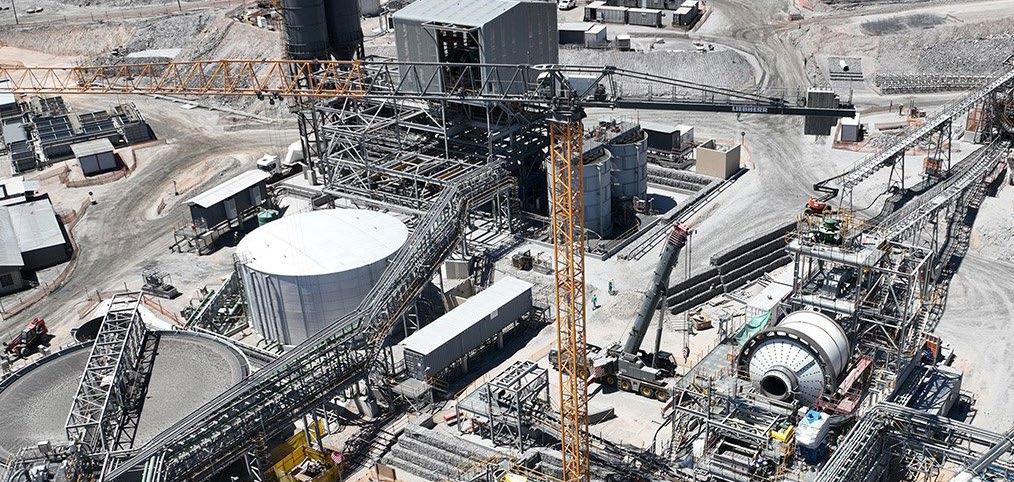
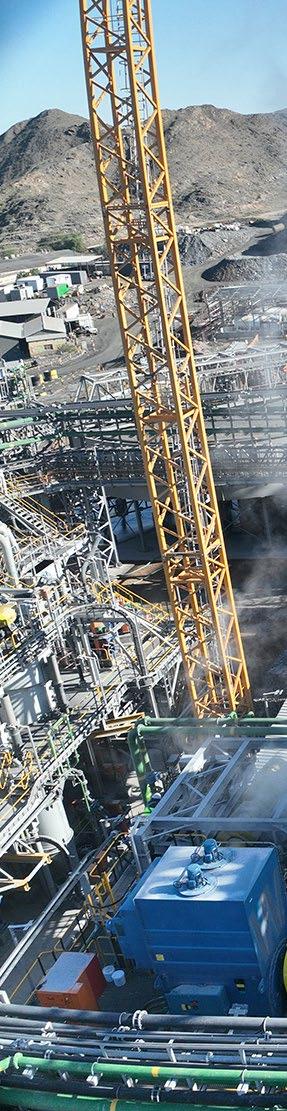
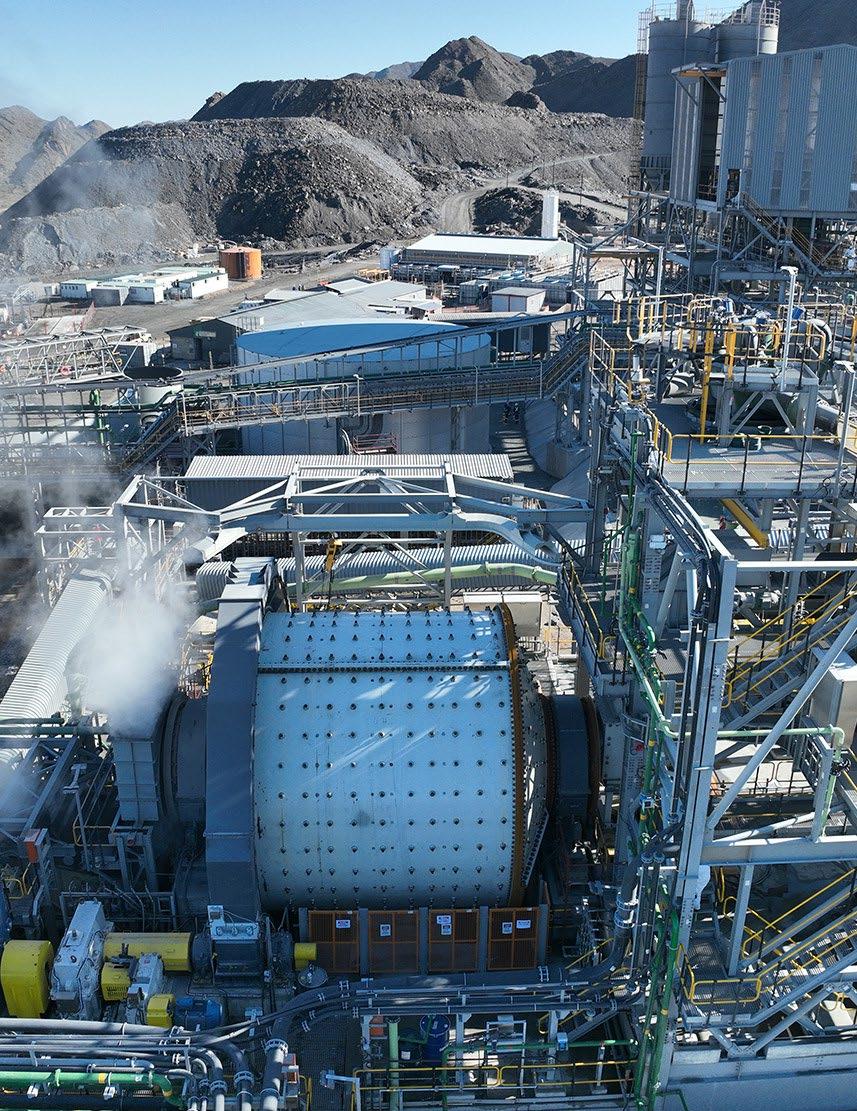
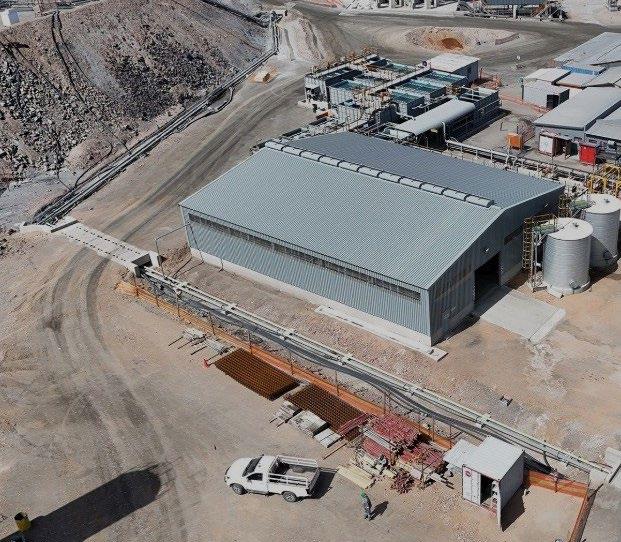
cal mining town. The operation is set to significantly increase its processing capacity following the commissioning of a new semi-autogenous grinding (SAG) mill. This milestone forms a key component of the broader RP2.0 expansion project, which includes continued development of the underground mine, the newly established WF3 portal and decline, as well as the construction of upgraded surface infrastructure. The new SAG mill
replaces the existing ball mill within the processing circuit and is expected to double annual throughput to approximately 1.4 million tonnes of ore, up from the current 700,000 tonnes once ramp-up is completed.
Beyond capacity expansion, the new milling system is designed to improve the plant’s ability to process harder ore types, which are expected to become more prevalent as mining progresses to deeper levels. With commissioning complete, the RP2.0 circuit will run as a fully integrated system, incorporating paste fill and water treatment facilities alongside expanded flotation circuits, including a new zinc processing stream, as well as enhanced thickening and filtration capacity. Collectively, these upgrades are expected to extend the mine’s economic life, improve overall resource utilisation, and reinforce the operation’s position as a long-life base metals asset in Namibia.
Namibia’s mining sector is widely regarded as a cornerstone of the national economy, making a substantial contribution to GDP while continuing to attract significant foreign direct investment. The country has set up itself as a leading global producer of key minerals and precious metals, including diamonds, uranium, gold, zinc, and copper. This diversified mineral base has positioned Namibia as an important player within global commodity supply chains. Beyond its economic output, the mining industry plays a critical social role by generating extensive employment opportunities across the country, providing direct and indirect livelihoods for a sizable part of the population.
In addition, the sector contributes meaningfully to public finances through corporate taxation, royalties, and export-related revenues. These funds are often channelled into national and local development initiatives, in-
cluding education, healthcare, and community infrastructure projects. In many regions, mining-led investment has also functioned as a catalyst for broader infrastructure development, supporting improvements in transport networks, ports, energy systems, and essential utilities helping both industry and local communities alike.
NAMIBIA’S MINING SECTOR IS WIDELY REGARDED AS A CORNERSTONE OF THE NATIONAL ECONOMY, MAKING A SUBSTANTIAL CONTRIBUTION TO GDP
Given the economy’s reliance on mining, the Namibian government has increasingly focused on strategies to ensure the long-term resilience and competitiveness of the sector.



This includes strengthening sustainability frameworks and embedding environmental, social, and governance (ESG) principles into regulatory and operational standards, reflecting a global shift toward more responsible resource development.
However, the sector continues to face structural challenges, including commodity price volatility and the ongoing need to develop a highly skilled workforce capable of supporting increasingly complex mining operations. To address these issues, targeted policy measures such as Namibia’s Minerals Policy are being implemented alongside national skills development programmes and strengthened partnerships with educational institutions aimed at building local technical capacity.
Within this evolving landscape, Rosh Pinah Zinc runs as a key participant in the country’s mining ecosystem. As a zinc-focused producer, its role extends beyond economic contribution, reinforcing Namibia’s position as a stable and resource-rich area within the global mining sector.
The asset is run by Trevali, which holds a 90% interest, while the remaining stake is retained by Namibian broad-based empowerment groups alongside an Employee Empowerment Participation Scheme (EEPS). Trevali initially acquired an 80% interest in the mine from Glencore in August 2017, subsequently increasing its ownership position to 90% in 2018. An expansion pre-feasibility study (PFS), pub-
lished in August 2020, outlined plans to significantly increase the mine’s production capacity by approximately 86%, from 0.7 million tonnes per annum (Mtpa) to 1.3 Mtpa. The proposed development was estimated to require investment of around £70 million (approximately $93 million), reflecting a major step-change in the operation’s long-term growth strategy.
Despite changes in ownership and operational structure over recent decades, RPZ has maintained a comparable production capacity. Appian’s acquisition and investment are now unlocking the asset’s full potential through the RP2.0 expansion project, which is expected to nearly double the mine’s output.
“Throughout periods of transition, RPZ has consistently produced high-grade zinc and lead concentrates, making a meaningful contribution to Namibia’s export earnings and local economic development,” says Alex Mayrick, General Manager at RPZ.
“The RP2.0 expansion will drive innovation, enhance efficiency, and support sustainable growth, positioning RPZ as a leading operation for years to come.
“At the same time, RPZ remains committed to regional development by creating employment, supporting local businesses, and investing in education, infrastructure, healthcare, and youth programmes in surrounding communities,” Mayrick adds.
Partner Focus Access World
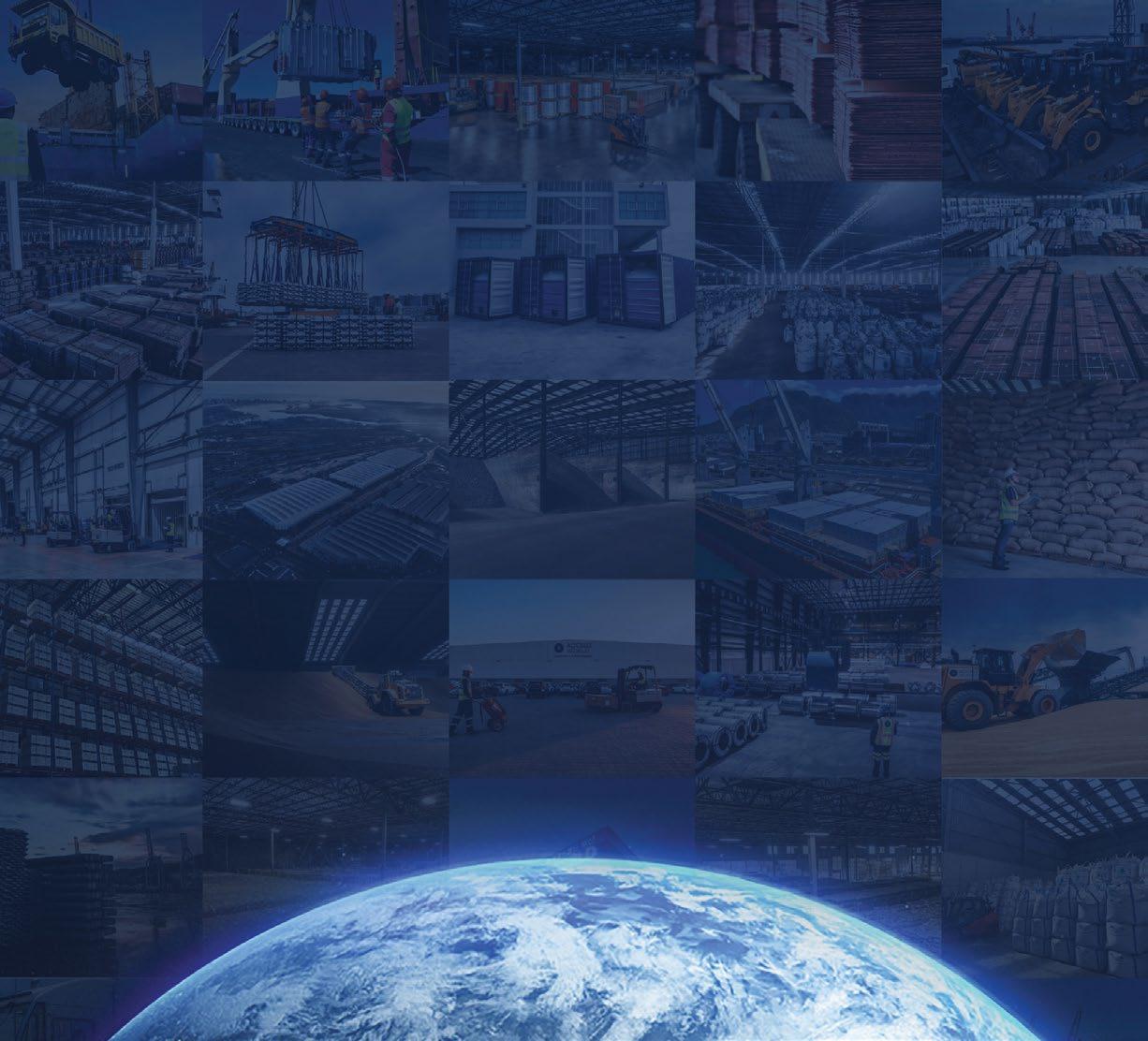
Access World is a leading global provider of integrated logistics, warehousing and supply chain solutions, with more than 90 years of industry experience and operations spanning over 30 countries across Africa, Asia Pacific, Europe, the Middle East and the Americas. Since 1933, we have built a reputation for delivering reliable, flexible and innovative logistics solutions that connect producers, manufacturers and traders with global markets through tailored end-to-end supply chain services.
At the heart of our business is an extensive network of strategically located warehousing facilities, including London Metal Exchange (LME) and Chicago Mercantile Exchange (CME) registered warehouses. These internationally recognised facilities provide secure, compliant storage for exchange-traded commodities while supporting customers with inventory management, warrant handling and value-added warehousing solutions. Our specialist expertise in commodity logistics has made Access World a trusted partner for businesses operating across global metals and commodity markets.
Our comprehensive service offering includes commodity and physical warehousing, exchange warehousing, port and terminal operations, cargo handling, stevedoring, customs brokerage and customs clearance, road, rail, ocean and multimodal transport, freight forwarding, breakbulk and containerised shipping, project logistics, heavy-lift and out-of-gauge cargo management, vessel chartering, inventory
management, cargo surveying, route surveys, lifting and offloading, material cleaning, blending, cutting, reconditioning, packing, repacking and other specialised value-added logistics services. Whether transporting a single shipment or managing a complex international supply chain, our experienced teams deliver solutions that are efficient, safe and tailored to each customer’s unique operational requirements.
Access World serves a diverse range of industries, including metals and minerals, renewable energy, chemicals, oil and gas, soft commodities, agriculture, forestry products, paper and pulp, battery materials, industrial raw materials, manufacturing and large-scale infrastructure and energy projects. Through Access World Projects, our specialist project logistics division, we provide complete turnkey logistics solutions for complex cargo movements, including feasibility studies, engineering support, route planning, specialist transport, on-site logistics coordination and end-to-end project execution for some of the world’s most demanding industries.
Driven by operational excellence, safety, sustainability and innovation, Access World combines global reach with local expertise to deliver dependable logistics solutions that create value throughout the supply chain. By building long-term partnerships and continuously investing in our people, infrastructure and technology, we help customers overcome complex logistics challenges with confidence, efficiency and precision.
At the forefront of one of Namibia’s largest zinc mining operations, Mayrick is quick to emphasise the metal’s importance across a diverse range of industries.
“Zinc’s primary application is galvanisation, where it is used to coat steel and protect it from corrosion, making it essential for construction and infrastructure projects,” he says.
Its versatility extends well beyond this, however. Zinc is a key ingredient in alloys such as brass and is used to manufacture die-cast
components found in everything from household appliances to vehicles, making it a critical material for modern manufacturing.
The metal also plays a key role in healthcare and agriculture. As an essential dietary supplement, zinc supports human health, while its use as a micronutrient in fertilisers helps improve soil quality and increase agricultural productivity.
“It also plays a key role in battery technologies, including alkaline and zinc-air batteries, as
well as in the production of zinc oxide, which is used in products ranging from rubber and paints to cosmetics and sunscreens,” Mayrick notes. RPZ’s orebody is also rich in lead and silver, providing added value through a diverse suite of commercially important minerals.
Lead stays indispensable in energy storage, particularly in conventional automotive batteries, while its density makes it highly effective for radiation shielding in medical and nuclear environments. It also continues to be
used in specialist applications such as cable sheathing, solder and industrial counterweights.
Meanwhile, silver recovered as a by-product of the operation has become increasingly important beyond its status as a precious metal. Its outstanding electrical conductivity and chemical properties make it an essential material for electronics, solar panels and other clean energy technologies. As the global energy transition gathers pace, demand for silver continues to rise, further enhancing
the long-term value of RPZ’s multi-mineral resource base.
Looking ahead, Rosh Pinah Zinc’s future is centred on increasing production, extending the life of the mine and strengthening its position as a key supplier of critical minerals to global markets. The company’s ongoing expansion is expected to unlock greater efficiencies and boost annual output, enabling it to meet rising demand for zinc while enhancing the economic contribution of the operation to Namibia. At the same time, continued in-
vestment in exploration and resource development aims to maximise the value of the existing orebody and identify opportunities for further growth.
As global industries accelerate the transition towards cleaner energy, resilient infrastructure and advanced manufacturing, demand for zinc is projected to remain strong. Combined with the growing importance of silver in renewable energy technologies and lead in energy storage applications, this places Rosh Pinah Zinc in a favourable position to supply minerals that are increasingly vital to the global economy.
Beyond production, the company is expected to continue prioritising responsible mining practices, environmental stewardship and meaningful community development. By investing in local employment, skills development and long-term partnerships, Rosh Pinah Zinc aims to ensure that the benefits of its operations extend well beyond the mine itself, creating lasting value for employees, surrounding communities and Namibia’s broader economy. With a strong resource base, modernised operations and a clear growth strategy, Rosh Pinah Zinc is well positioned to remain one of southern Africa’s leading zinc producers for years to come.
FIND OUT MORE ABOUT ROSH PINAH ZINC