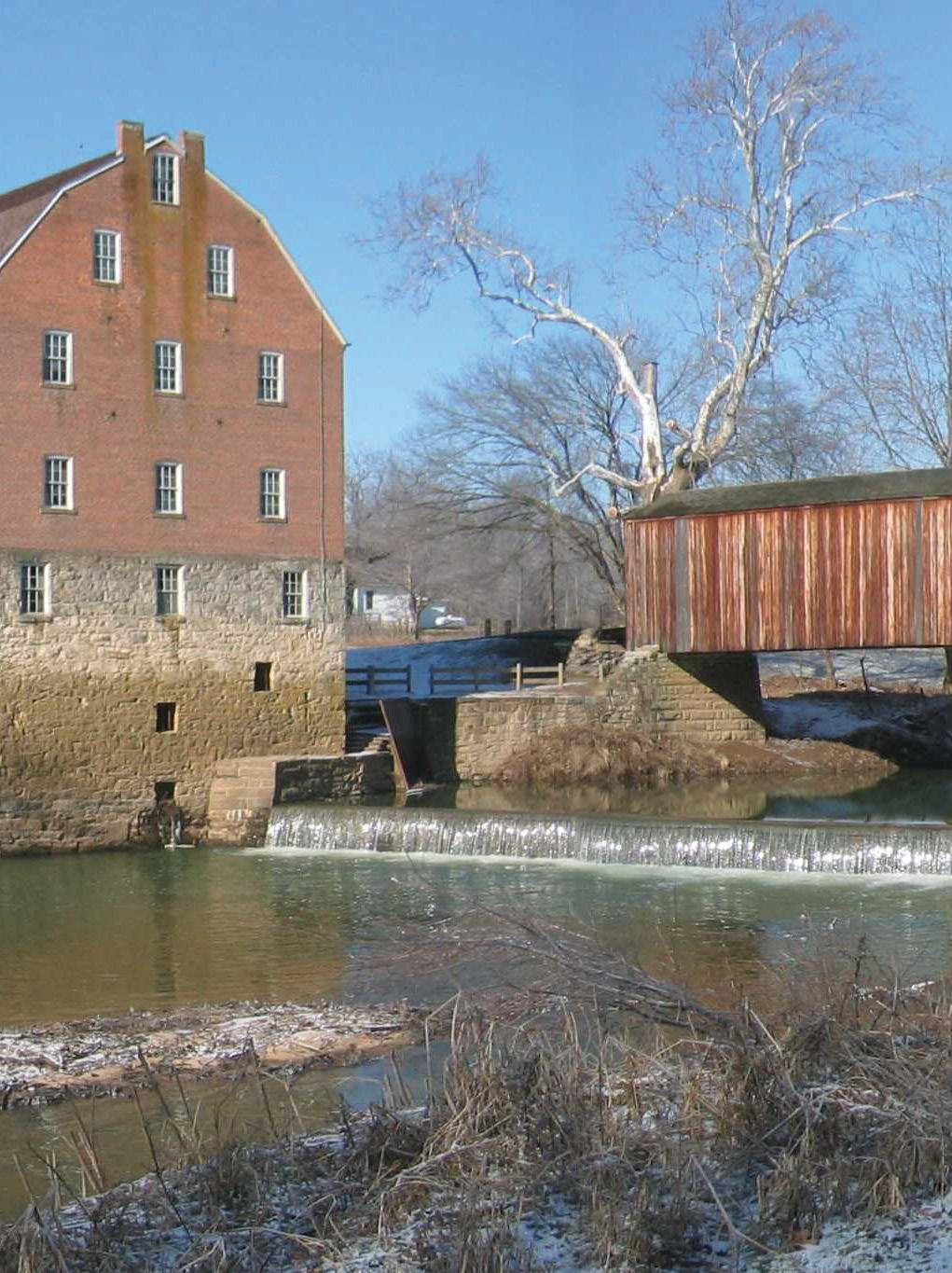
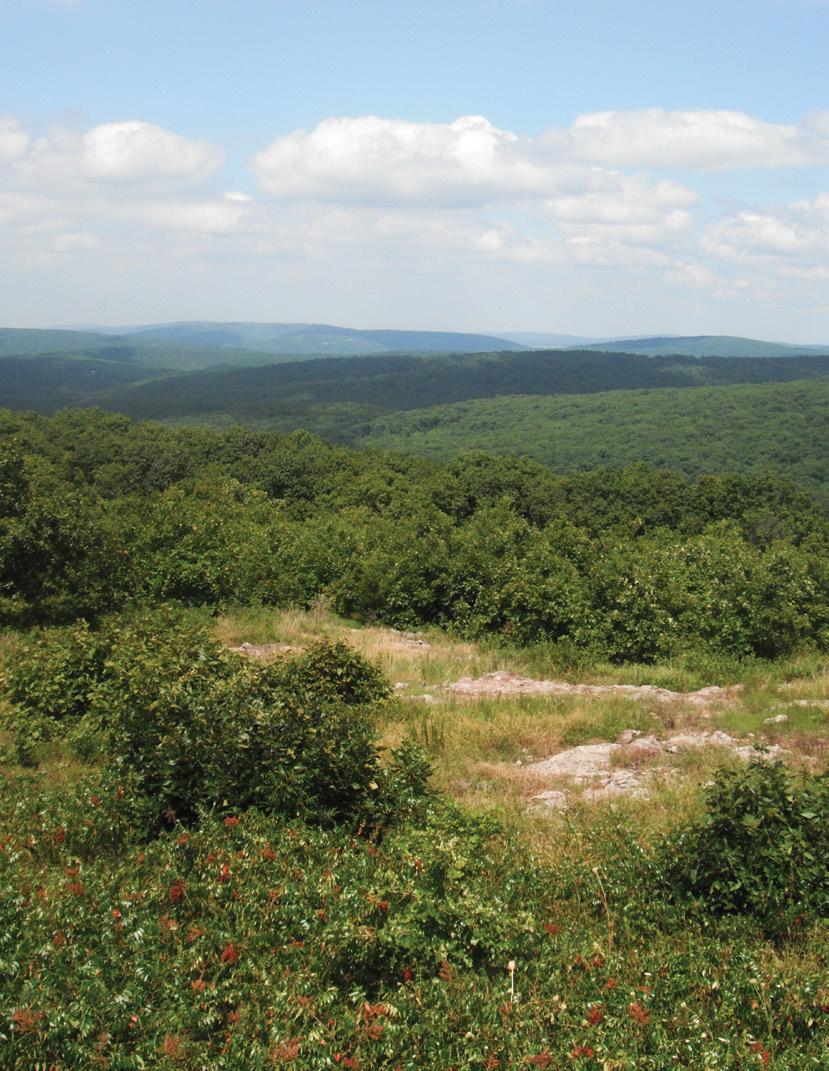
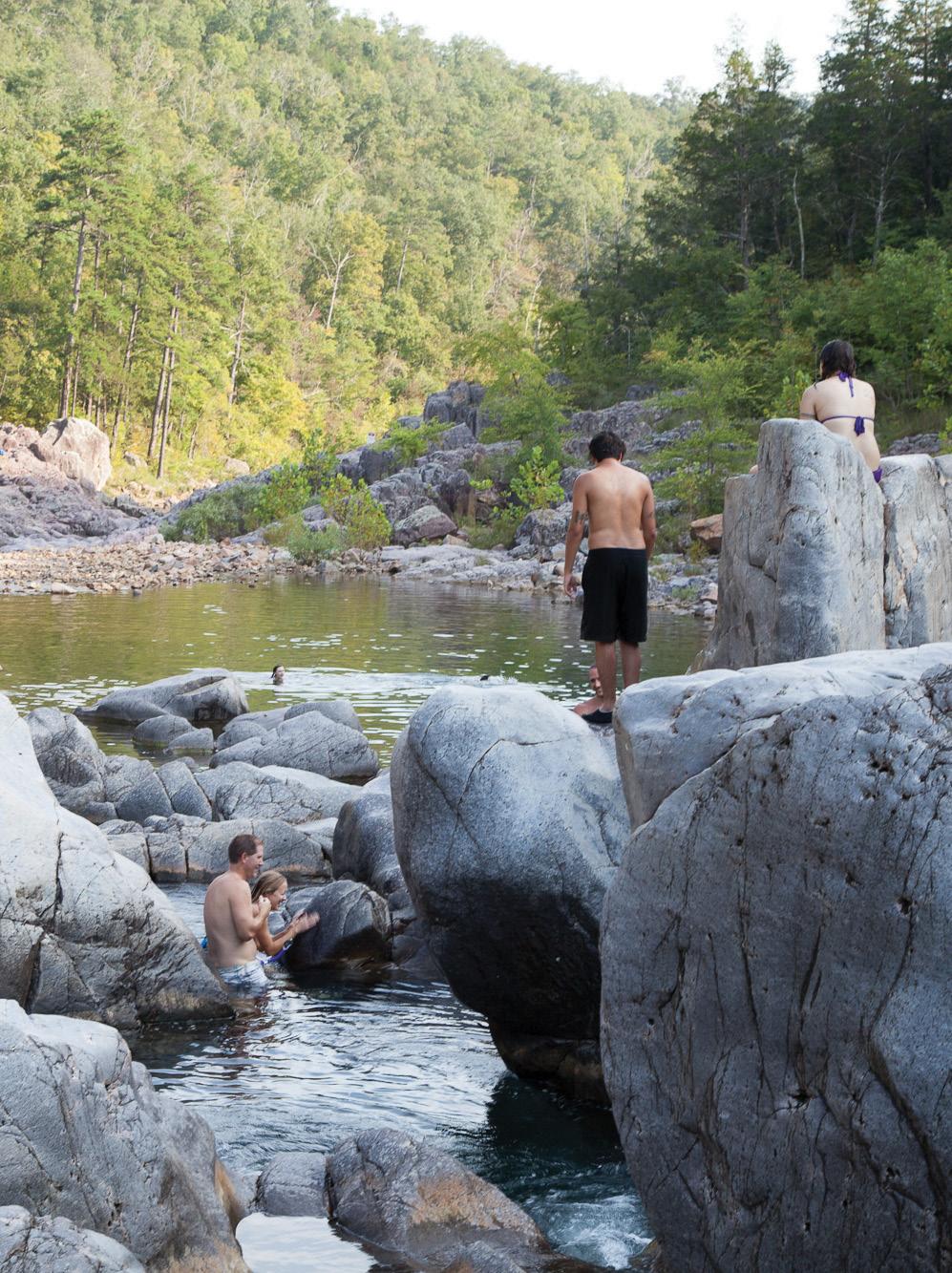
STROKE IS THE LEADING CAUSE OF ADULT DISABILITY AND THE FIFTH-LEADING CAUSE OF DEATH IN THE UNITED STATES
A STROKE occurs when the blood flow that carries oxygen to the brain is cut off by a blockage or ruptured artery. Without oxygen, brain cells begin to die, causing a loss of function and potentially death. Stroke is a medical emergency, but fast treatment can save lives and brain tissue.
If you notice stroke symptoms, call 911 immediately! EMS professionals can start your care before you get to the hospital.
STROKE SYMPTOMS HAPPEN SUDDENLY AND CAN INCLUDE
• Numbness or weakness in your face, arms or legs, usually on one side
• Trouble seeing in one or both eyes, including double vision
• Confusion, trouble speaking or understanding speech
• Loss of balance or coordination, dizziness, and trouble walking
• A severe headache that feels like the worst headache of your life
If you have any of these symptoms, BE FAST!
Balance
Watch for sudden loss of balance
Eyes
Check for vision loss
Face
Look for uneven smile
Arm
Check if one arm is weak
Speech
Listen for slurred speech
Time
Call 911 immediately
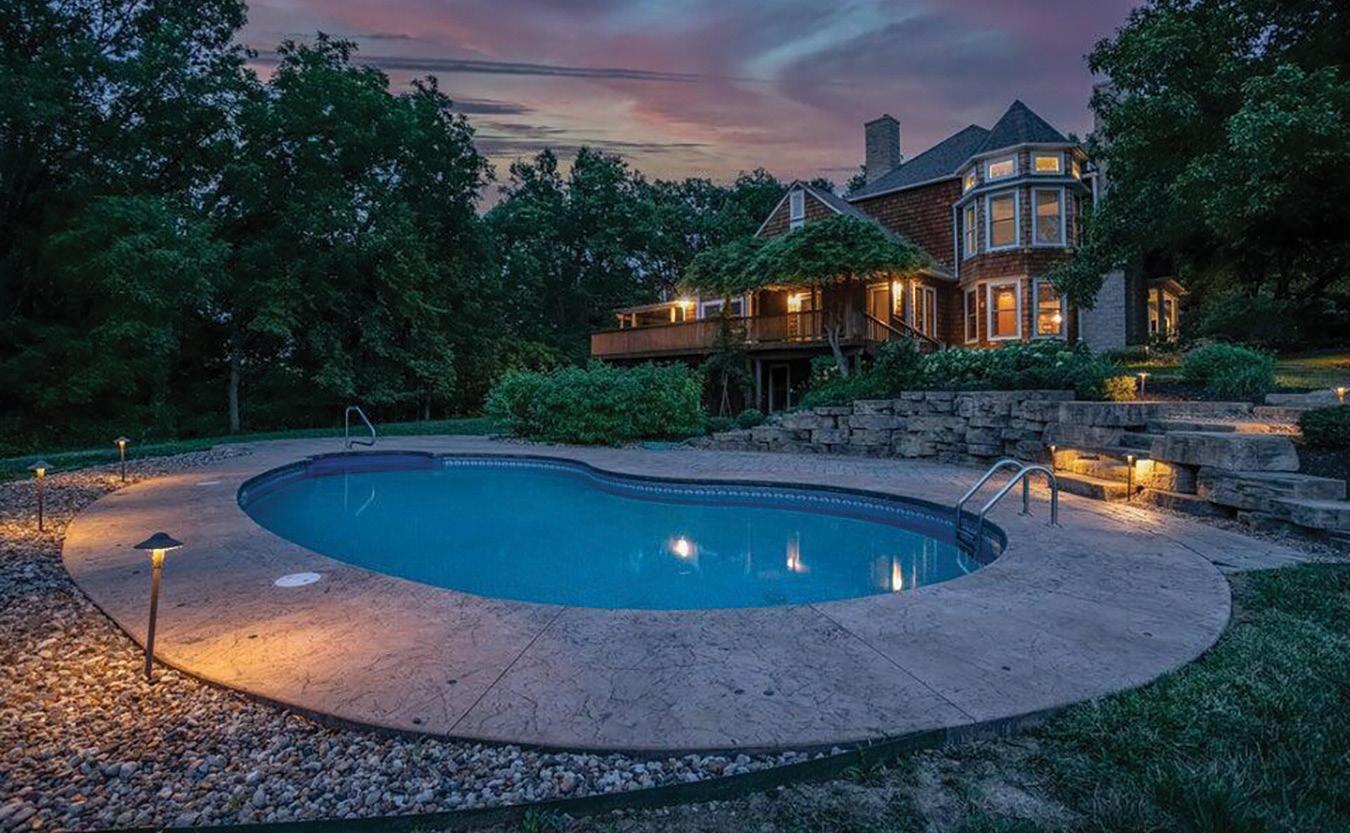
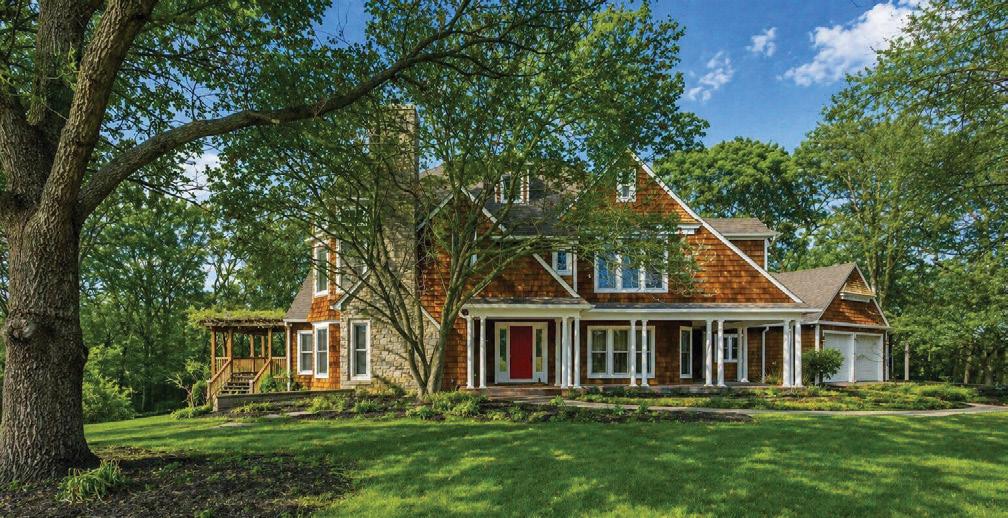
A Private Retreat.
Welcome to a truly special property — where timeless New England Shingle-style design meets thoughtful updates and modern comfort — all set on a private 10.78-acre setting in Columbia, MO.
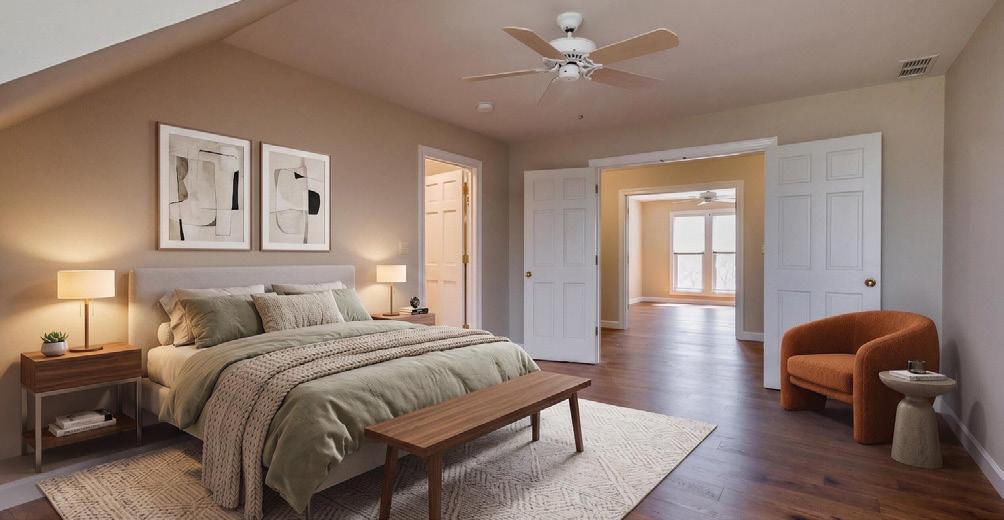
This 6-bedroom, 4.5-bath home has just undergone an extensive refresh, including beautifully remodeled bathrooms, new paint, updated flooring, and exterior improvements, giving it a fresh, move-in-ready feel while preserving its original craftsmanship and character.
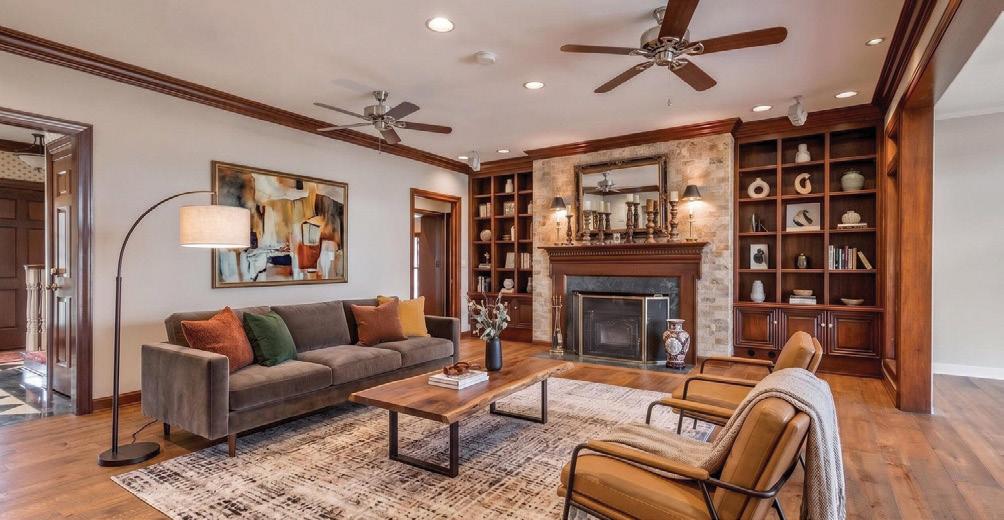
Built by the current owner, the home reflects careful planning and attention to detail throughout. Rich mahogany-stained custom woodwork creates a warm, inviting atmosphere, while the updated finishes bring a clean, elevated look to the living spaces.
A KITCHEN THAT INSPIRES
Granite countertops, custom solid mahogany cabinetry, and GE Monogram appliances blend function and style for everyday living and entertaining.
DESIGNED FOR COMFORT & ENTERTAINING
A lower-level wine room, three wood-burning fireplaces, and seamless indoor-outdoor living spaces invite you to relax and entertain in style.
QUALITY IN EVERY DETAIL
High-end finished such as imported travertine tile and organic barnwood hickory flooring tie everything together with comfort and luxury.
A SETTING LIKE NO OTHER
A private lake anchors the property, surrounded by a mix of wooded areas and open space. The expansive deck and inground pool – complete with chiller, heater, and UV filter — extends your outdoor enjoyment across seasons.
With its recent updates, private setting, and unique design — this is a rare opportunity to own a property with such character and modern livability just minutes from Columbia.
Contributors
July 2026
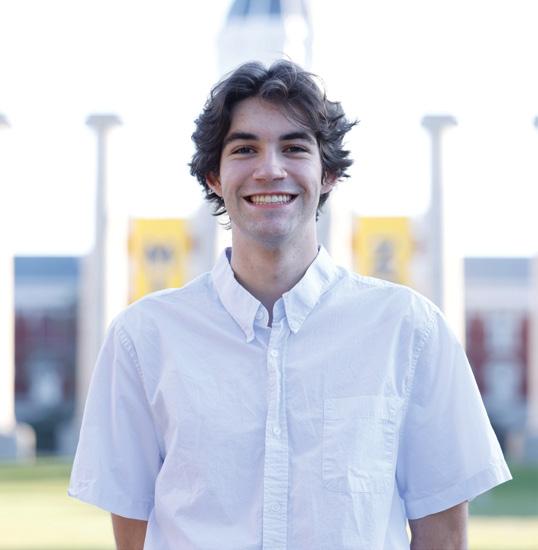
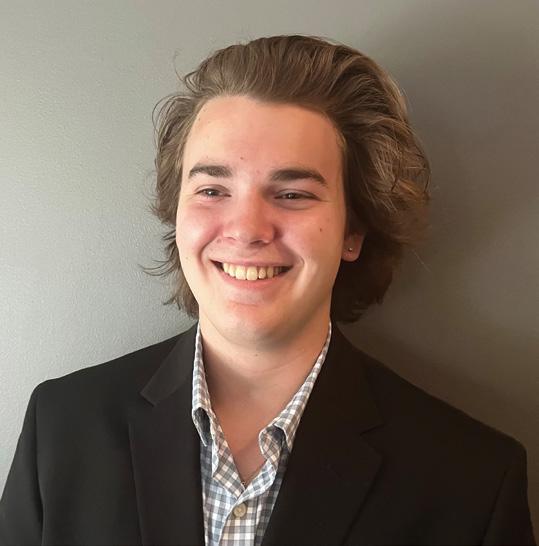
Eric Hughes
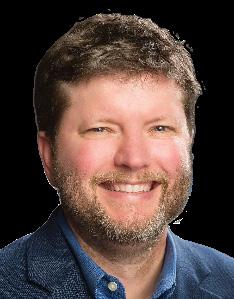
Eric Hughes is from Denver, Colorado, and he came to Columbia to attend the University of Missouri School of Journalism. He is a rising senior emphasizing in reporting and writing, and is pursuing minors in economics and English.
Eric previously reported on health and higher education and state government for the Columbia Missourian and now interns at COMO Magazine and COMO Business Times. He aspires to have a long and fulfilling career in business journalism post-grad.
When not reporting, Eric is likely to be found reading by the pool, playing pool somewhere downtown, or at the movie theater. Fun fact: he has seen 770 movies and counting since 2021, and continues to log every single one of them on the app.
IN THIS ISSUE OF COMO
Relying on ‘Classic American’
PG 10
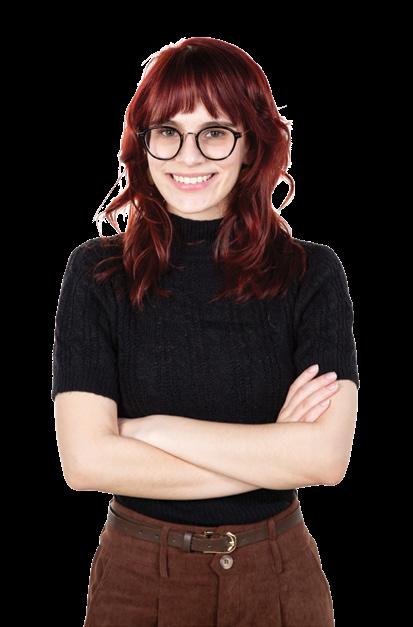
Charlie Westfall
Charlie is a St. Louis native currently living in Columbia while attending the University of Missouri as he pursues an undergraduate degree in journalism.
As a video intern for COMO Magazine and COMO Business Times, his primary interest lies in the world of video production and editing; however, he also enjoys other creative endeavors like writing and graphic design.
He spends much of his free time helping run a filmmaking club that produces multiple short films each year. Apart from that primary interest, he enjoys cooking, mixology, video games, and trying new things. And, for a fun fact, Charlie has never broken a bone.
IN THIS ISSUE OF COMO
Hermann In a Hurry
PG 28
PUBLISHING
David Nivens, Publisher david@comocompanies.com
Chris Harrison, Associate Publisher chris@comocompanies.com
Sunitha Bosecker, Stephen Feilbach, Eric Hughes, Jodie Jackson Jr, Joplin Convention and Visitors Bureau, Travis March, Missouri State Parks, Scouting America, State Historical Society of Missouri, Charlie Westfall, Vantage Consultants, Kelsey Winkeljohn
CONTRIBUTING WRITERS
Alicia Belmore, Sunitha Bosecker, Barbara Bu aloe, Olivia DeSmit, Stephen Feilbach, Eric Hughes, Jodie Jackson Jr, Stephi Smith, Sean Spence, Charlie Westfall, Bradley Williams, Kelsey Winkeljohn
SUBSCRIPTIONS
Magazines are $5 an issue. Subscription rate is $54 for 12 issues for one year or $89 for 24 issues for two years. Subscribe at comomag.com or by phone. COMO Magazine is published monthly by COMO Companies.
OUR MISSION STATEMENT
COMO Magazine and comomag.com strive to inspire, educate, and entertain the citizens of Columbia with quality, relevant content that re ects Columbia’s business environment, lifestyle, and community spirit.
Copyright COMO Companies, 2026
All rights reserved. Reproduction or use of any editorial or graphic content without the express written permission of the publisher is prohibited.
FEEDBACK
Have a story idea, feedback, or a general inquiry? Email our editor at jodie@comocompanies.com.
CONTACT
COMO Companies | 404 Portland, Columbia, MO 65201 573-577-1965 | comomag.com | comobusinesstimes.com
In my work, I cross paths with people from many different backgrounds — The COMO Mojo: What the Road Gave Me Back
interviewees, advisory board members, photography subjects, and more. Some of those encounters have even blossomed into lasting relationships, but no matter who I form these deeper connections with, I tend to hear the same thing: “I hope you don’t take this o ensively, but you seem like an old soul.”
I completely agree. I love physical media, what some might call “dad music” (aka classic rock), and, dare I say it, I enjoy having my peace and quiet by 10 p.m. What people might not realize right away, though, is that I’m also a bit of a wanderlust. My dream career would be to work as a travel writer — either as a freelancer, somehow making enough to sustain herself, or as a novelist who changes locations every few months, drawing inspiration from everywhere, from the rolling hills of Ireland to the sunny beaches of ailand. While I save up for those bigger adventures, I’ve been enjoying exploring closerto-home destinations.
Recently, I went on my rst camping trip in Lebanon, Missouri with my best friend, McKenna, and I can’t pretend I wasn’t nervous going into it. I love air conditioning, and with the uncertain plumbing situation, I felt more than a little hesitant. But McKenna is a seasoned camper, so I felt comfortable putting my life in her hands for the three-day weekend (I didn’t tell her this, though — I didn’t want to put that much pressure on her).
As it turned out, the trip was magnicent. We spent four hours oating on the river, sipping on adult beverages, listening to country music, and watching rafts drift by while people shed from the shoreline and kids skipped rocks across the water. To my relief, there was a bathroom facility, and the evenings were far from the hot, sticky nights I had pictured. e only real hitch came on the rst evening, when heavy rain turned the outside of our tent into a muddy mess.
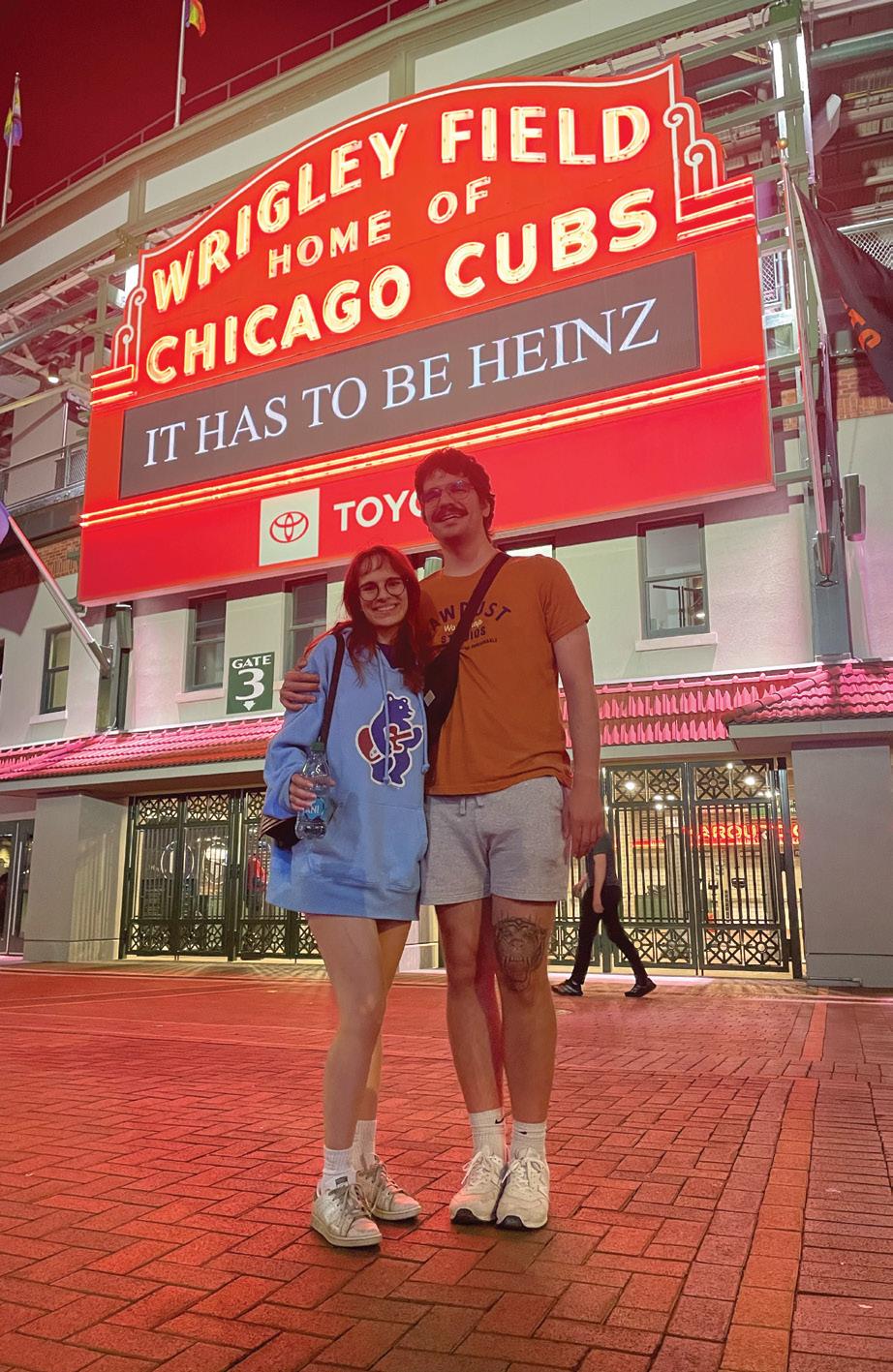
On the ip side, I also recently spent about a week in Chicago. I
had zero anxieties going into that trip because, of course, there would be air conditioning and plumbing — plus no need to build a re or pitch a tent and hope it survived the rain. My partner and I packed our days with adventures: a Cubs game, dim sum and tanghulu in Chinatown, time at the beach, and an escape room. is visit was easily one of the best we’ve had in Chicago, as we explored new areas and experiences despite having visited many times before.
But on the drive home, we encountered a severe thunderstorm that quickly escalated into a hailstorm. Out of nowhere, chunks of ice slammed against my car, shattering the windshield in seconds. I was terri ed, but my partner stayed calm and reassured me that we would be okay.
ankfully, we made it through safely — shaken up mentally, perhaps, but physically unharmed. I was incredibly grateful to have someone beside me who could steady me in that moment.
I’ve realized that the best stories often come from the least expected moments, not just the picture-perfect ones (even if they tend to be a lot funnier in hindsight than they are at the time). No matter where you go, it’s all about who you are with, and I was lucky to be with some great people while on these expeditions.
So maybe this is your sign to pack a bag this weekend — or at least start planning the next adventure. Visit some of the places featured in this issue, whether it’s the Fabulous Fox eatre in St. Louis, Grand Falls in Joplin, or somewhere closer to home like Mt. Nebo Inn in Rocheport along the Katy Trail. What are you waiting for?
Great Rivers Scouting Center is a flurry of summer activity.
BY ALICIA BELMORE
By now, the scene at the Scouting Adventure Center just west of Columbia is familiar. One teen has raved for months about the center’s climbing wall, building the anticipation for her eager friends, who are about to discover the source of that unbridled enthusiasm. Some seem ready to sprint their way to the top; others aren’t quite so sure. After all, the Veteran’s United Foundation Climbing Wall towers 26 feet high.
Since the Scouting Adventure Center opened at 6081 W. Van Horn Tavern Rd. in 2023, thousands of youths from across Missouri have shared similar experiences with the climbing wall and a dizzying selection of other activities available to both scouts and the general public. According to John Fabsits, CEO of Scouting America – Great Rivers Council, some 3,000 scouts or potential scouts visit the center annually, with attendees coming from all corners of the state.
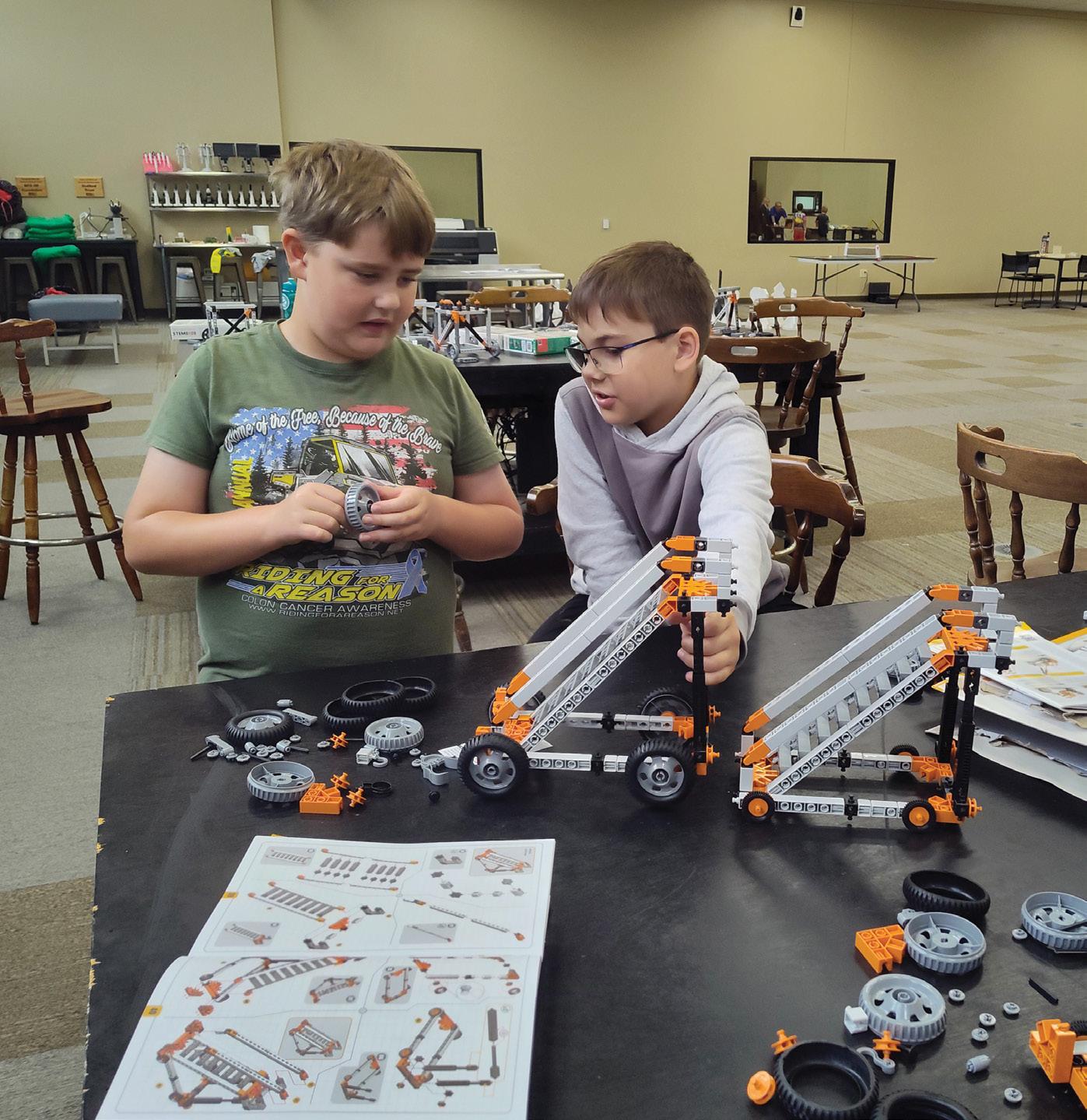
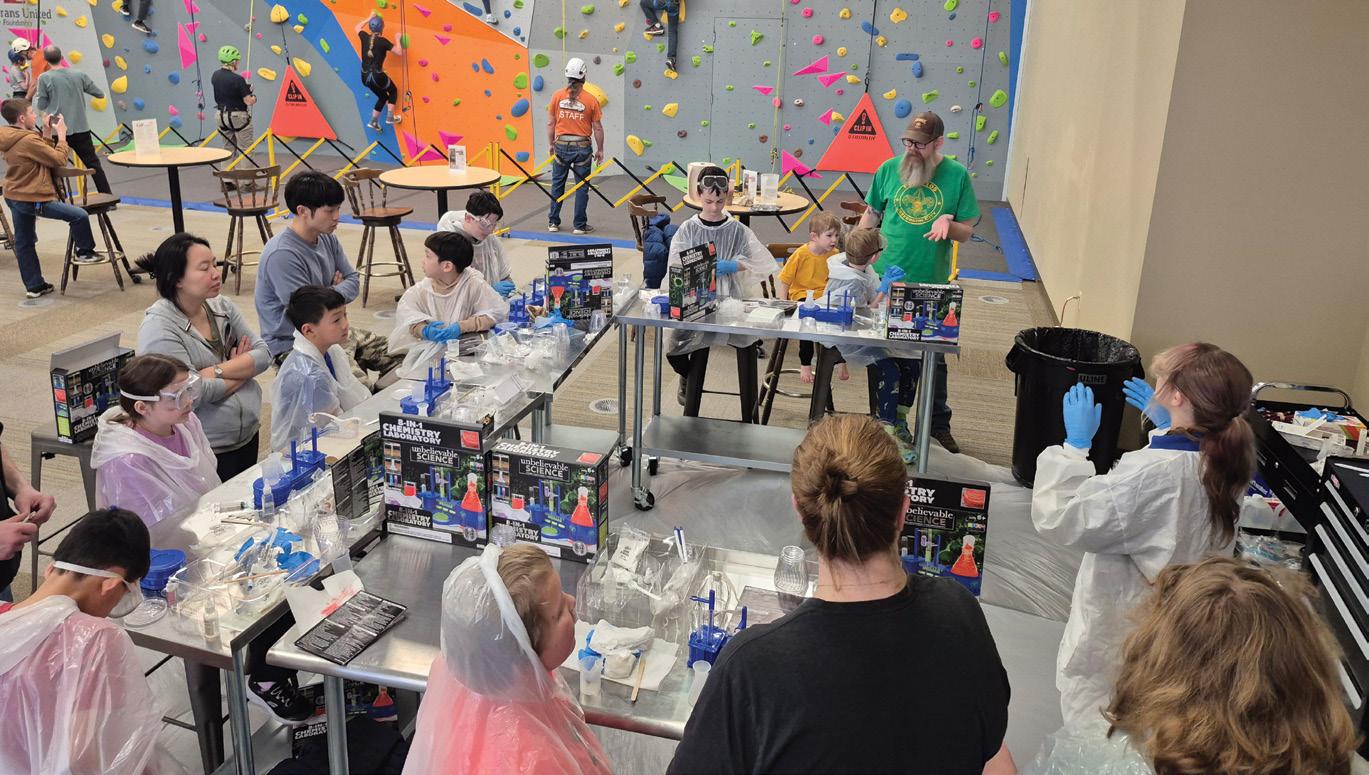
In addition to the 26x53-foot climbing wall, which challenges climbers with 14 “lanes” of increasing di culty — while helping teach communication skills and boost self-con dence — the center is also home to Sinque eld Innovation Space. Named in honor of another donor, the Sinque eld Charitable Foundation, the innovation space is divided into four areas that focus on audio, visual, and design; engineering; health and safety; and science and nature.
“We are thrilled to have this space dedicated to our youth,” said Fabsits. “It’s a place specically designed for scouts.”
REALIZING THE VISION
It wasn’t always that way. Back in 2020, the Great Rivers Council was operating from a small o ce on Fay Street. e Council knew it required a di erent space and that its community needed more, Fabsits said. e council envisioned a centralized location that could accommodate meeting space, large groups, and an array of scouting programs.
Great Rivers Scouting Center
ABOUT THE SCOUTS
Scouting America, formerly the Boy Scouts of America, is the largest Scouting organization and one of the largest youth organizations in the United States, with over 1 million youth, including nearly 200,000 female participants. In Missouri, the Great Rivers Council serves 33 counties in seven districts. Columbia and Boone County are in the Boonslick District.
MISSION
The mission of the Great Rivers Council is to prepare young people to make ethical and moral choices over their lifetime and to achieve their full potential by teaching them life skills and instilling in them the values of the Scout Oath and Law.
VISION
The Great Rivers Council will be nationally recognized and regarded as one of the premier Scout Councils in the Midwest and be considered a leading youth service agency in central and northeast Missouri.
SCOUT MOTTO
Be prepared.
SCOUT LAW
A Scout is trustworthy, loyal, helpful, friendly, courteous, kind, obedient, cheerful, thrifty, brave, clean, and reverent.
SCOUT OATH
“On my honor I will do my best to do my duty to God and my country and to obey the Scout Law; to help other people at all times; to keep myself physically strong, mentally awake, and morally straight.”
LOCATIONS
Scouting Adventure Center
6081 W. Van Horn Tavern Rd., Columbia Lake of the Ozarks Scout Reservation
525 Camp Hohn Drive, Gravois Mills
When Larry and Brenda Potter eld heard about the need in 2021, they donated the former MidwayUSA call center building to the Council, giving the organization the 13,000-squarefoot structure. While most of the space was dedicated for activity and meeting spaces, 5,000 square feet was set aside for o ces. e site is now home to the headquarters of Great Rivers Council, which provides Scouting America day and summer camps and activities for youth and adult volunteers in 33 counties in central and northern Missouri.
ese days, the center hums with activity, especially on the rst Saturday of each month, when most events are scheduled. One such event is the Pathway to Eagle merit badge series. e center provides morning and afternoon opportunities for scouts to earn, per event, two of the 21 merit badges required to become an Eagle Scout.
Fabsits said scouts can earn those merit badges through a variety of hands-on engineering, health and safety, and science programs, which can help them build skills for future careers. He added that the center is a place for scouts to “get a head start in life and be supported by adults, all while having fun and discovering new opportunities.”
FOR THE KIDS, FOR THE COMMUNITY
Along with scouting-speci c programs, Fabsits highlights the adventure center’s science exploration experiences and summer camps as other opportunities for fun and education.
e Unbelievable Science Adventures series o ers monthly half-day science camps that let children learn through hands-on, age-appropriate experiments. When school lets out, summer day camps for kids aged 6-15 cover everything from climbing and coding to innovation and game design. ese weeklong events are open to “scouts, friends of scouts, and those interested in becoming a scout” — or in other words, nearly any kid.
Open Climb days let climbers of all skill levels and ages, including children, try their hand(s) — and feet — on the rock wall. e event is held once a month, with two sessions scheduled per day.
While, understandably, the center’s focus is primarily on child and youth programming, it also o ers services to the community. Each month, individuals 13 and up can receive training in cardiopulmonary resuscitation (CPR), automated external de brillator (AED) use, and other rst aid instruction. e center also rents space to community organizations, such as Big Brothers Big Sisters, and to emergency management services to train and prepare for emergencies.
e newest addition to the facility is the Fleming Family Scouting Museum, where children and adults can learn the history of scouting.
To check out what’s going on at the Scouting Adventure Center, consult the center’s website, which includes a link to subscribe to the center’s free monthly newsletter.
Relying on ‘Classic American’
Lifestyles Furniture celebrates 50 years.
BY ERIC HUGHES
In 1991, Columbia native Jerome Rackers returned to his hometown with a newly minted marketing degree from then-Central Missouri State University. He walked into Lifestyles Furniture at the corner of E. Walnut and N. Seventh streets and got himself a job working in delivery and service. After roughly six months, he was promoted to assistant manager and was elevated to manager just six months after that.
When Rackers began at Lifestyles, it was still operating as mostly a waterbed, ceiling fan, and brass bed store. After about four years of working at the business, Rackers bought it in 1995 with his wife, Cheryl, from its original owner, Dan Neenan.
“I think I’ve always wanted to be my own boss,” Rackers said. “A lot of it is also just being able to nd good people and people that enjoy working. at makes it worthwhile.”
When Rackers and his wife took over the business, it had been selling futons to college students who were moving into unfurnished apartments. He said that that business was one of his favorites, because it made it easy to help customers.
“It was easy to take care of customers, because anything that happened, we in-house could handle xing it,” Rackers said. “Now with upholstery, I have an upholstery repair guy that has to do several things we can’t do.”
Back then, the business sold more ready-to-assemble furniture, which meant each delivery was fairly time-consuming. Rackers noted that each futon delivery usually took about 30 minutes because the delivery crew had to put it together. With the store’s current focus on upholstered items, a crew can be in and out in 10 to 15 minutes.
MOVIN’ ON UP
In August 2004, the Rackers decided to move the store to their current location at First and Broadway.
“I wanted something bigger,” Rackers recalled. “For us to do more volume, we were going to need something a little bigger. I’d been looking around trying to nd something and gured out that this building that was interesting to me was not listed for sale, but I’d reached out to the owners and was able to negotiate with them.”
e building that is now home to Lifestyles Furniture was previously a nightclub. Rackers was drawn to it because of its open design and parking lot. He added that the corner lot made it accessible for loading furniture in and out of the building.
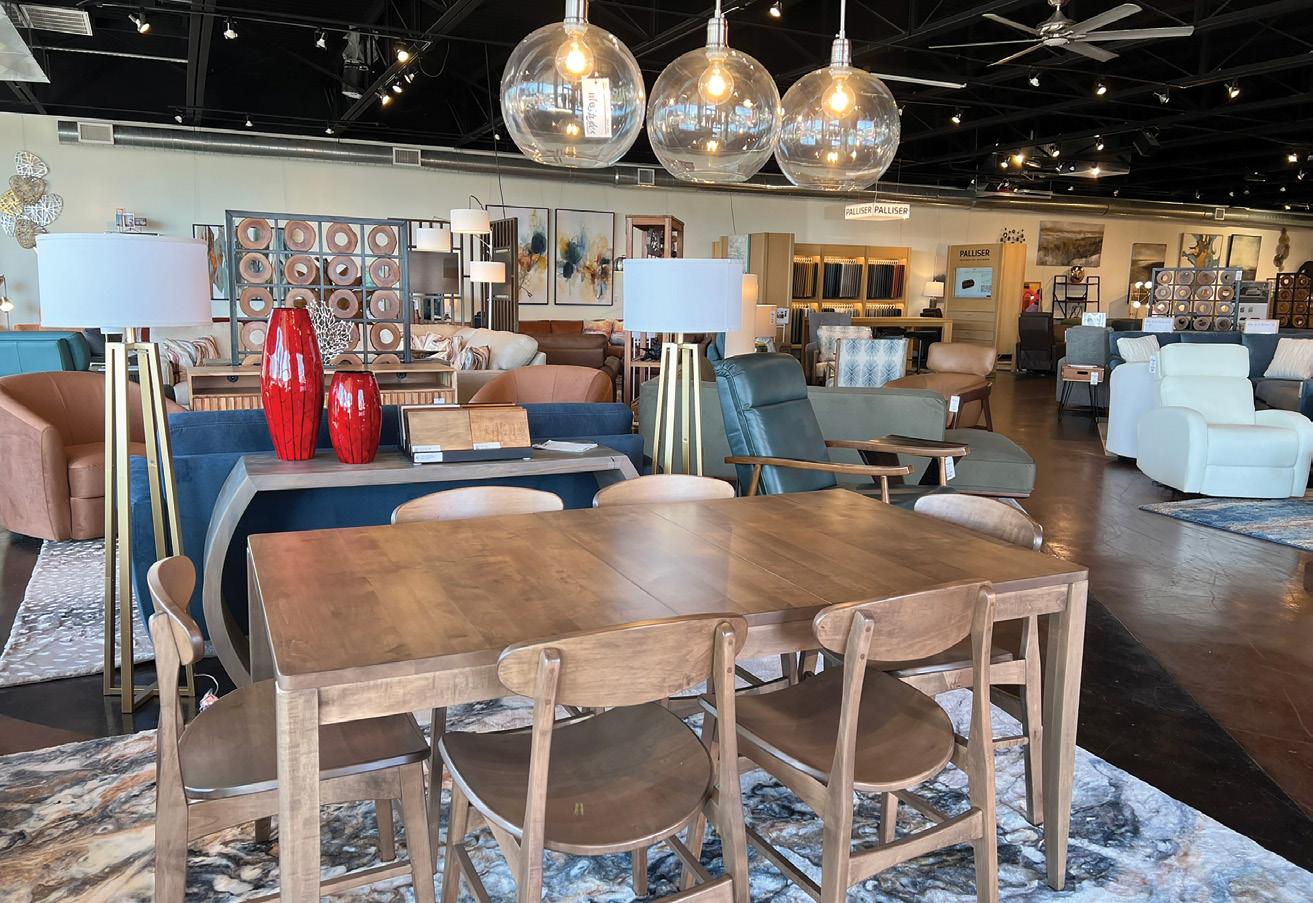
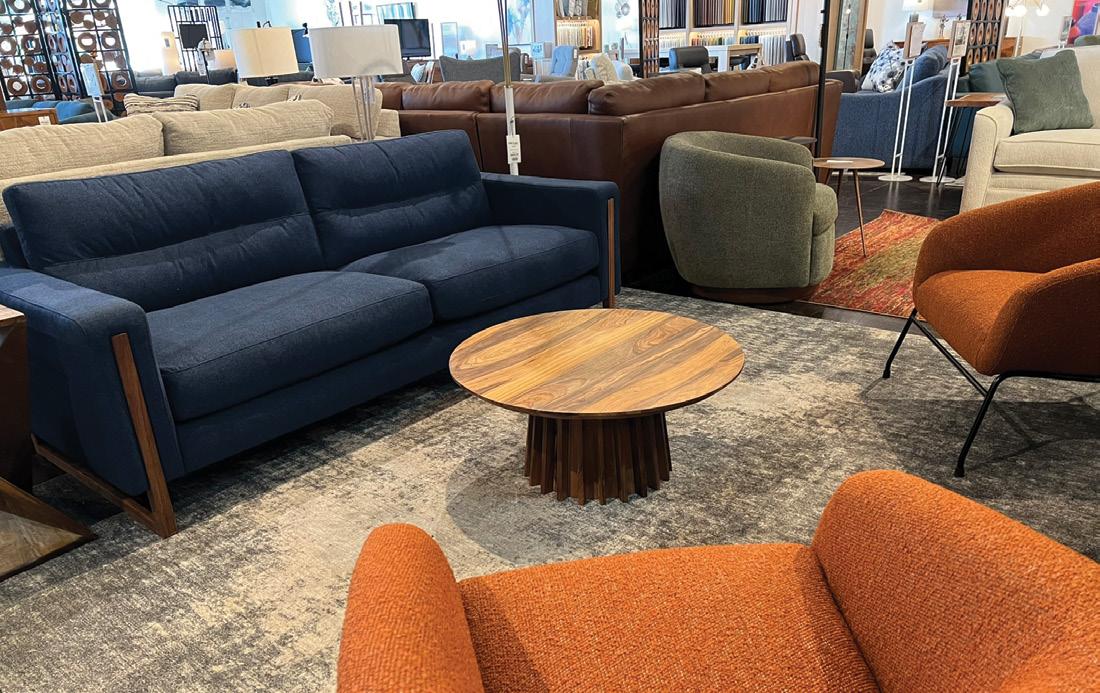
Today the store features a 7,500-square-foot showroom with 40 di erent monthly rotating mock room arrangements that showcase the furniture options that Lifestyles o ers.
“When I bought it, it was a really big deal,” he said. “We were going into debt for more money than I ever thought possible, and yet here we are 22 years later.”
About nine years ago, Rackers added a warehouse to the building, after previously using an o -site facility. e addition made it easier to restock pieces of furniture bought o the oor.
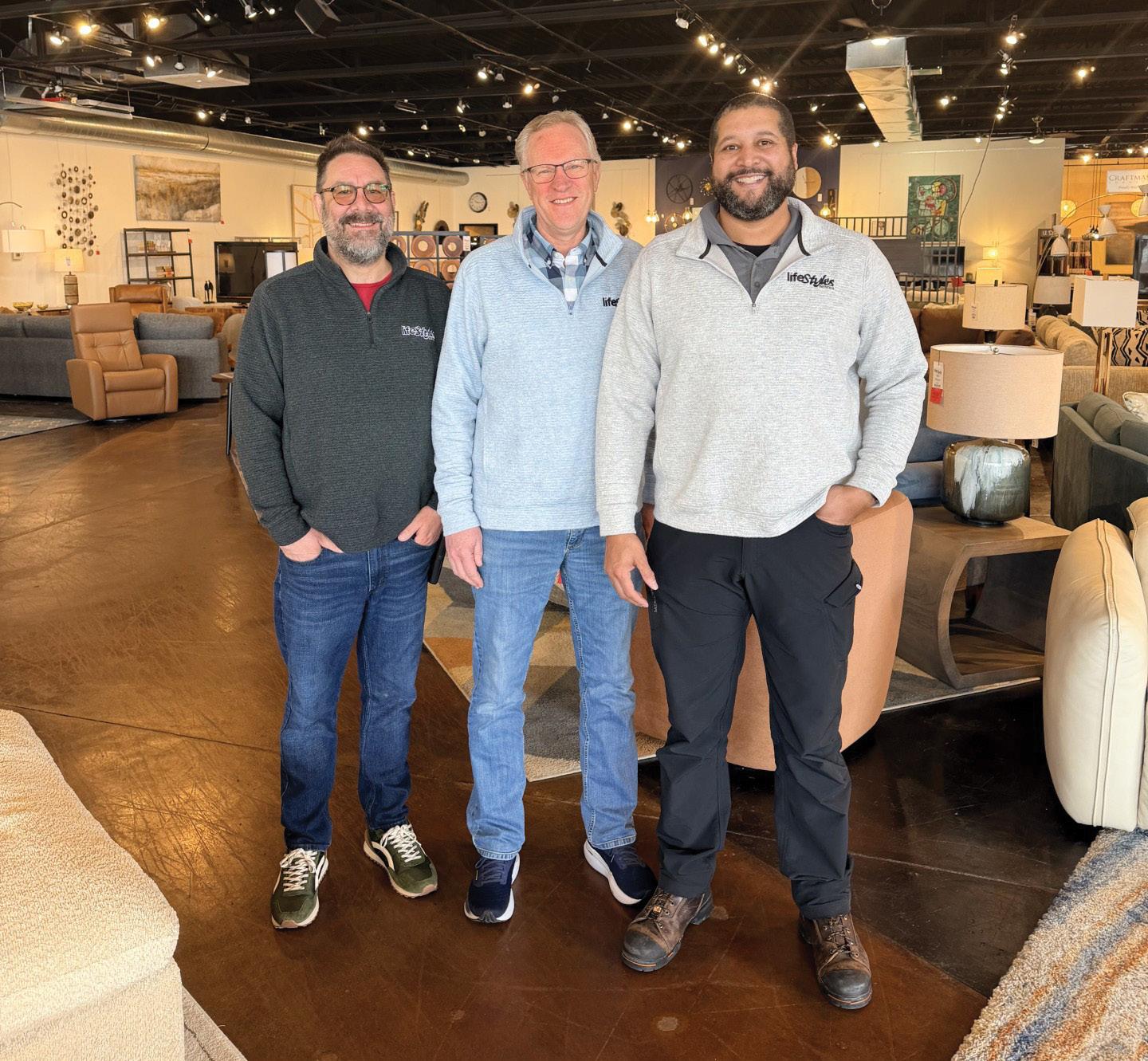
From left: Rob Medcalf, Jerome Rackers, and Mike Tolson.
CHANGING WITH THE TIMES
BY EMBRACING TIMELESSNESS
Rackers said that even though a lot of Columbians still consider Lifestyles a college store, it hasn’t been one for a long time. Now that most college apartments typically come furnished, the store focuses sales more toward homeowners.
“I think part of it is just as you get older, you don’t want your furniture to be as disposable,” he said. “You don’t want to come back and do it again in three years. You want to come back in 10 or 12.”
Rackers observed that small businesses are also relationship oriented, and he loves when repeat customers come back to the store. He has emphasized building relationships with employees and customers, as well as manufacturers, ever since he took over the business.
Rob Medcalf, the store manager, has been with the business for about ve years after seeing an ad posting on Facebook. Medcalf fell in love with the retail furniture business after starting at Lifestyles because of the one-on-one relationships he gets to build with customers.
“For a place where a customer doesn’t come often, maybe once or twice a year, for them to have a name-to-name relationship is pretty special.” Medcalf said. “If you already know the person, the conversation is so much more comfortable and easy.”
Because of Lifestyles’ focus on selling people furniture that will last, Rackers said that sta spend a lot of time helping customers match with furniture they love. He said that if customers are buying furniture they truly want, they will keep it much longer and be more satis ed with it.
Rackers encourages customers to nd items and colors they’re genuinely excited about, rather than just what they see in the showroom.
“We’re looking to get you a sofa that is in the color you want and in the style that you want, not what I have on the oor,” Rackers said. “I’ll sell you what we have on the oor, but really I want to get you something you’re wanting to own.”
When Medcalf is selling some furniture, he likes to listen to customers, nd out what they don’t need, and then narrow down to what will work best for them. Since Lifestyles Furniture is focused on customization, he says there is no reason every customer shouldn’t leave with exactly what they want.
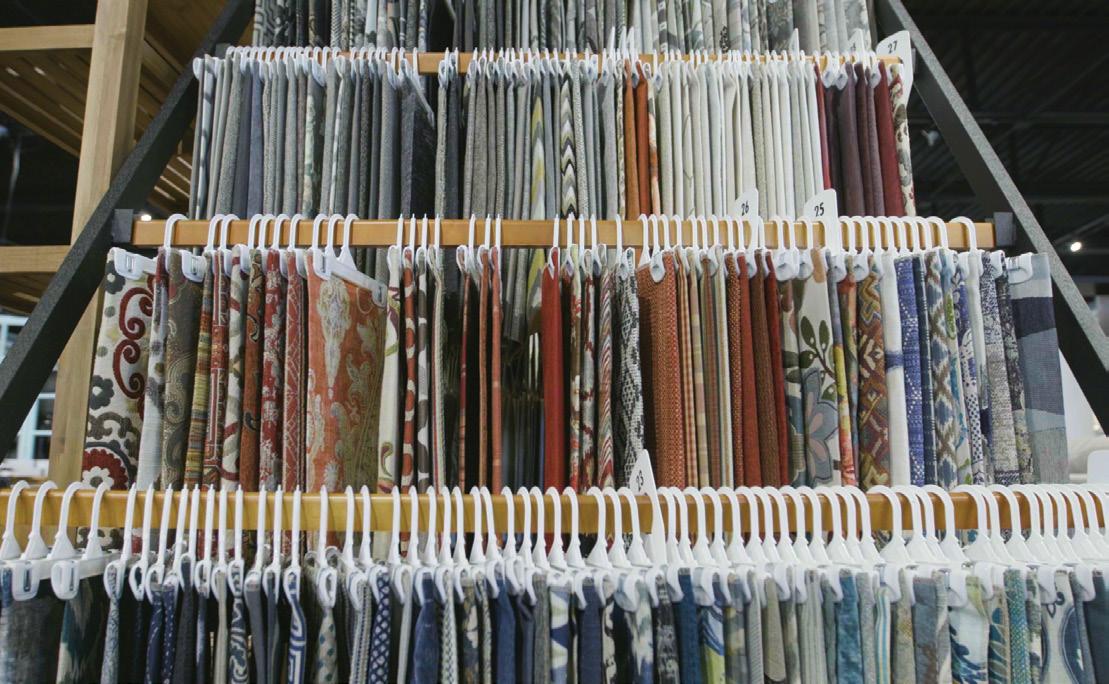
e store uses technology that allows customers to see a piece of furniture they’re considering in di erent fabrics or leathers, ensuring they know what it will look like before they buy it.
“[ e kiosks] have allowed the customer more knowledge and interaction with what they’re building before seeing it for the rst time in their home,” Medcalf explained.
Rackers said that even though the furniture industry is moving toward “smart” furniture — incorporating such features as power-reclining capabilities and charging ports — Lifestyles keeps a majority of its stock in classic American-made furniture. He said that custom upholstery still makes up about 80 percent of the business.
“A lot of that [smart furniture] stu is going to end up being gimmick-oriented,” Rackers said. “It’s gonna be gone so fast, it’ll be here and gone before you know it.”
Rackers thinks that the future of technology in furniture sales lies more in helping customers pick out their furniture, rather than in furniture that features technology.
“Power recliners and things like that would be technology that’s in furniture, but there isn’t anything like the refrigerators with a computer in the door,” he said. “ ere isn’t anything techie in that. What there is is technology to help you go through the process.”
LOOKING TO THE FUTURE
For 50 years, Lifestyles Furniture has built its brand on forging relationships, navigating changing industry trends, and delivering classic custom upholstery. While Rackers isn’t going anywhere in the immediate future, he hopes to be able to pass the business down to someone else.
“I hope I can nd the right person to do what I did, so that it can continue for another 50 years,” he said. “I do believe there’s always gonna be people looking to buy from a local store. I don’t think that’s ever gonna change.”
He added that customers feel good when they walk out of the store having bought a piece of furniture, and he doesn’t think the feeling is the same when people buy from big-box stores. He said that the most important thing for people shopping at his store is that they feel helped.
“You don’t have to buy from us to get help,” Rackers said. “We try to always be helpful.”
COMO N E I G HBORS
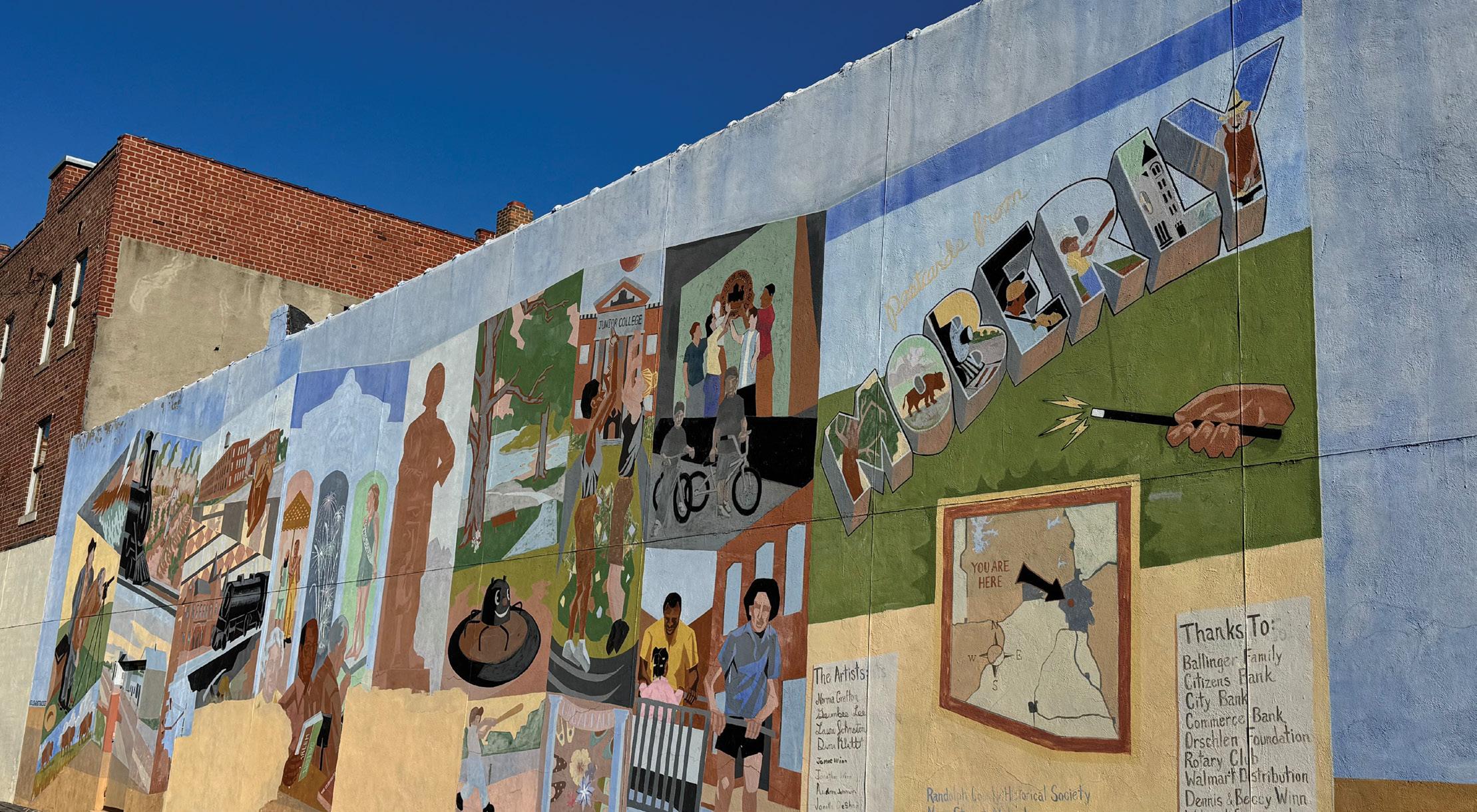
REDISCOVERING MOBERLY
There’s something about growing up in a small town that stays part of you long after you move. For me, that place is Moberly, a town just under an hour north of Columbia. It’s where I learned the meaning of community before I had language for it. It’s a place where Friday mornings meant breakfast with my dad, taking drives down Morley Street to Sonic as a teenager, and making casual stops to visit your favorite people and places.
For those of us living in Columbia, Moberly o ers the kind of pleasant day trip that you can take on a whim.
LET’S TALK ABOUT BUBBA’S
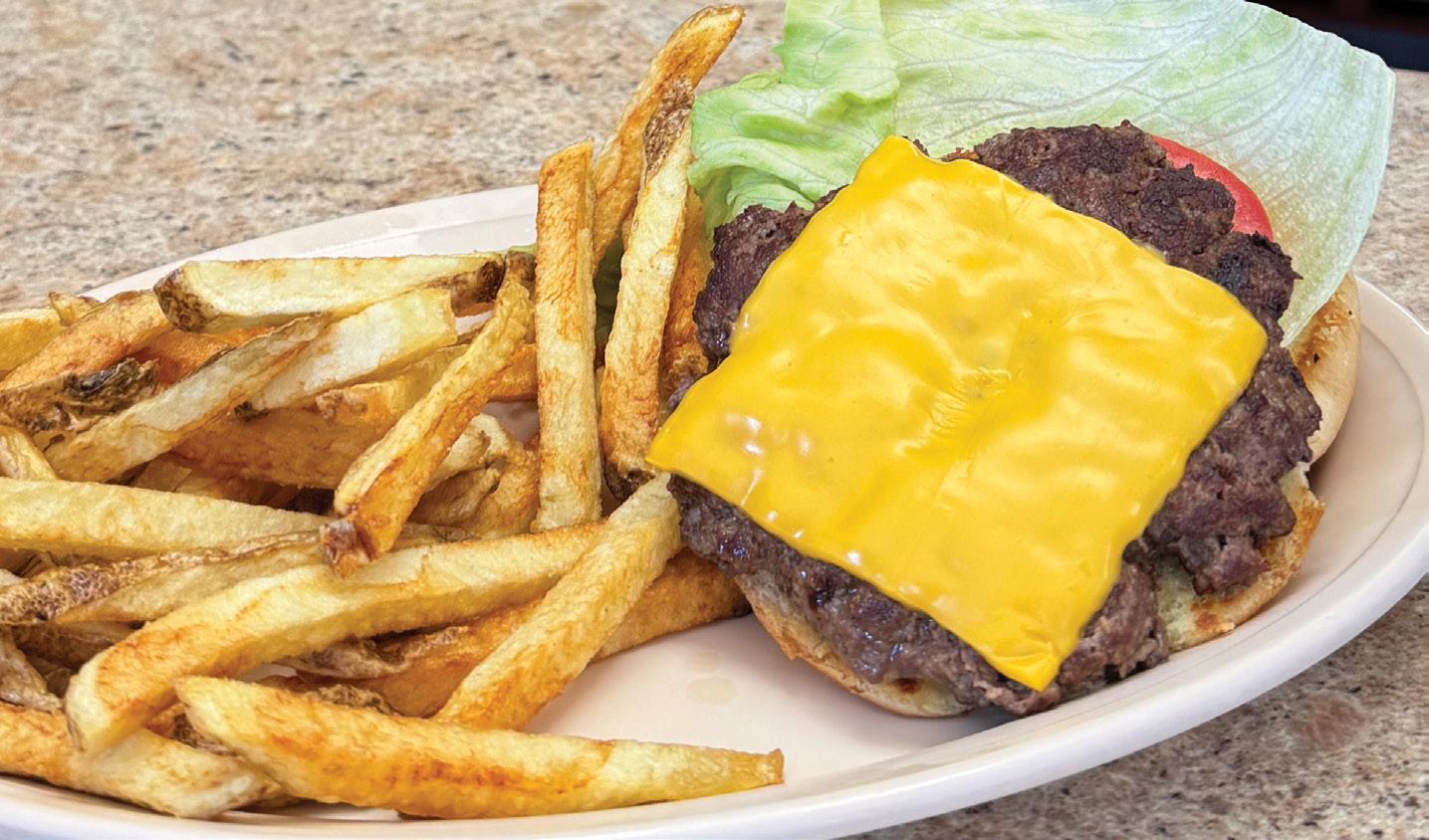
If you’re doing Moberly right, your day will involve a food stop at Bubba’s Burger Bar and Egg Emporium — or as the locals call it, Bubba’s.
ough the building itself has housed restaurants since the 1920s, Bubba’s has been owned and operated by Angela Taylor since 2001. It’s a place that feels unchanged in all the ways that matter. Angela stepped into ownership after years in the corporate restaurant world, looking for something that t better with family life. Decades later, her daughters now work alongside her, and the diner continues to serve as a cornerstone of the community.
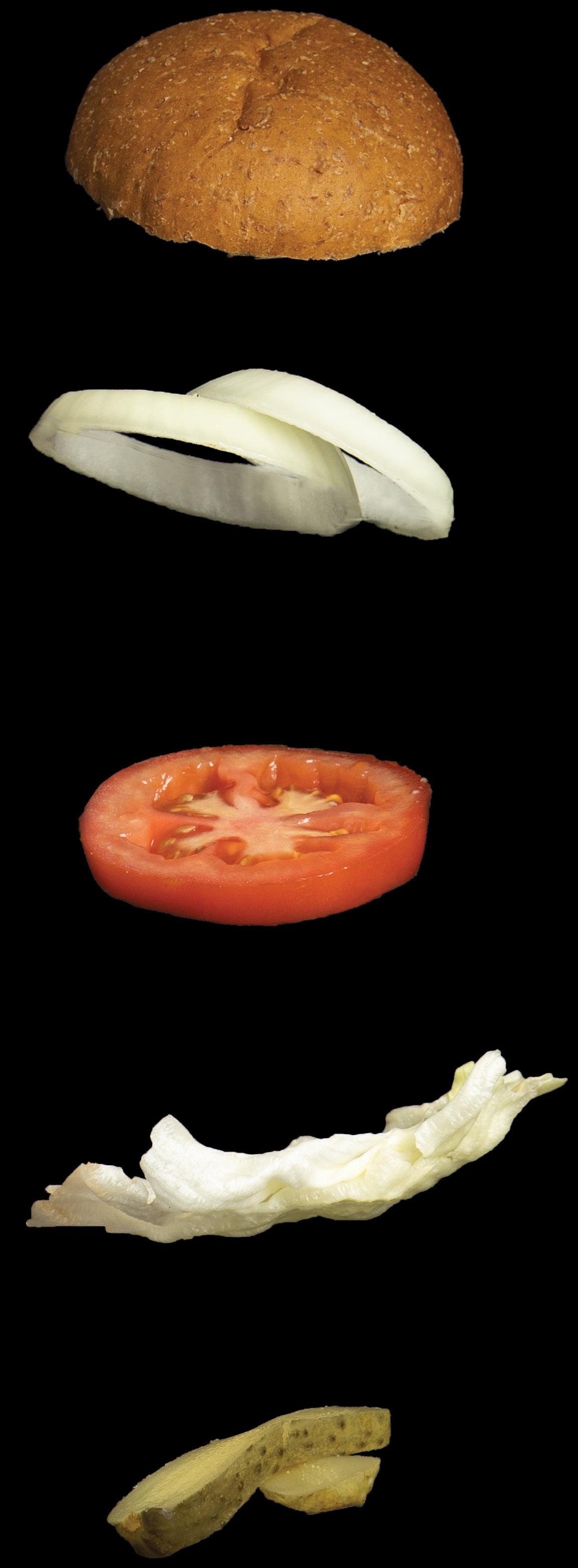
e food is exactly what you want it to be: hand-smashed burgers, crispy fresh-cut fries, and breakfast classics like the beloved Western omelet. But what keeps people coming back isn’t
just the menu; it’s the atmosphere. It’s the essence of a local restaurant in a small town in America. e horseshoe-shaped counter invites conversation. You don’t just eat at Bubba’s — you participate in it.
It’s also where my own employment story starts. My rst job was at Bubba’s, serving as sous chef in the most formative sense, so it holds a special place for me.
Before school, my dad and I would sit down for breakfast at Bubba’s. ose Friday mornings are now etched in memory, with me sitting on a stool at the counter, eating wafes, and sipping hot chocolate before being dropped o at my elementary school. Even now, I nd myself timing visits to make it in before Bubba’s 2 p.m. close.
STORY AND PHOTOS BY SUNITHA BOSECKER
COFFEE THAT BECAME COMMUNITY
Another delicious stop is Bean Café, located in the Depot District downtown.
What began in 2011 as a modest co ee hut in a parking lot across from the post o ce has grown into something much more layered. Owners Renee and Jerry Swartz describe the journey as less of a business plan and more of a calling.
“Of course. We’ll open a co ee shop,” they recall, saying it was “less like ambition than recognition.”
After years of learning, experimenting, and rebuilding, Bean found its home in 2018 in a historic building, one that required more rescue than renovation. But that labor of love shows in every aspect of the business.
e menu is thoughtful and made from scratch, from Bean’s baked goods to savory favorites like the chicken and jam sandwich or Korean beef bowl.
Much like Bubba’s, the real o ering here is something harder to name. “It was never really about the co ee,” Renee re ects. “It’s the community.”
I remember when Bean was still just that small hut in a corner parking lot with only two drive-up windows.
CLOCKWISE FOM TOP TO LEFT:
Randolph Mercantile, Bean Café, and Encore.
It felt like a hidden gem then. Now, it’s something more expansive, proof that growth doesn’t have to mean losing your roots.
TIME TO GO SHOPPING
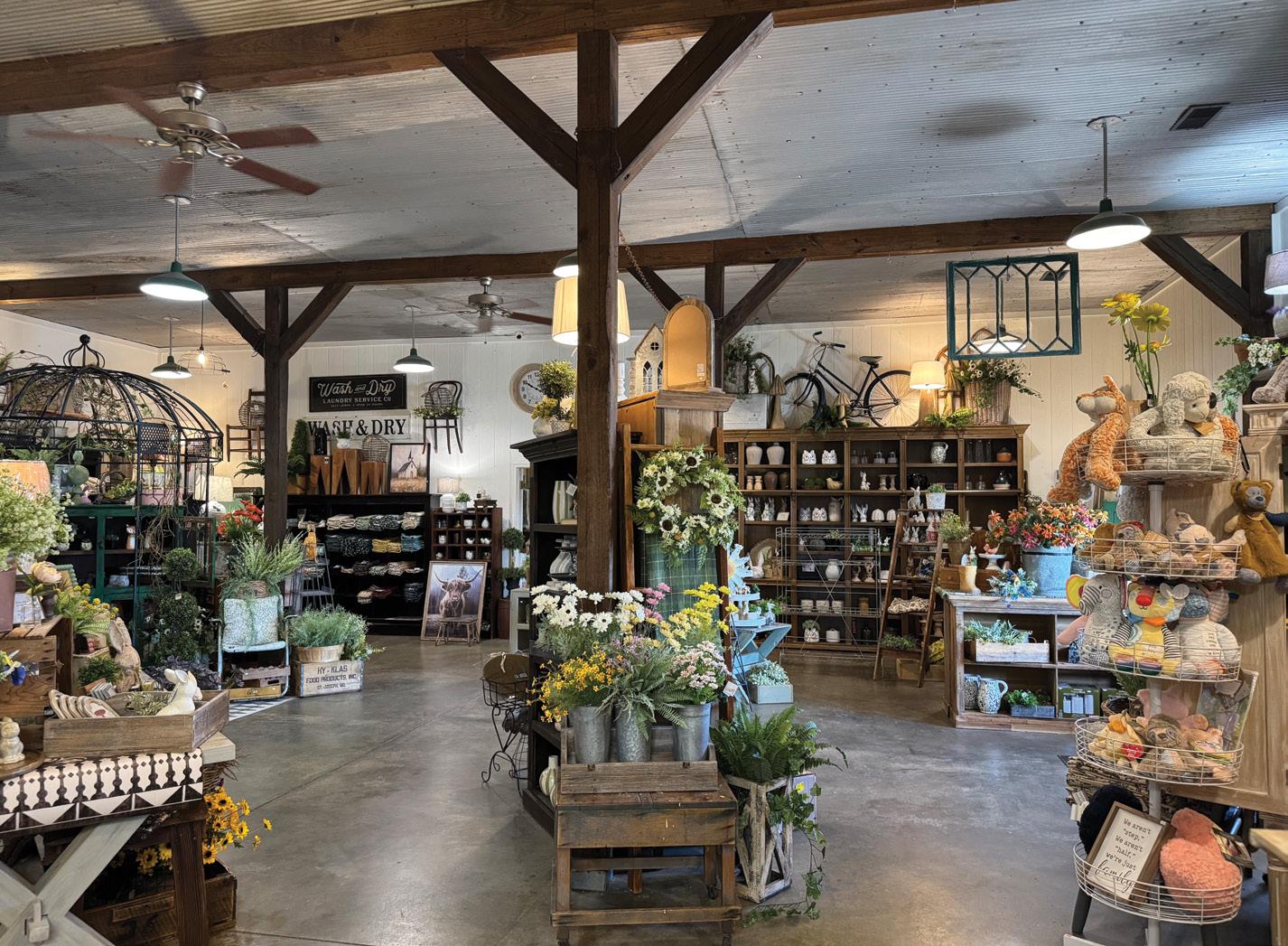
Randolph Mercantile is a fan favorite in Moberly. Opened in 2004 by Sherrie and Sherwood Mann, the shop grew out of something personal, a long-held dream nally given space to become real. Sherrie has always appreciated antiques and home pieces. Today, Randolph Mercantile is a destination in itself, drawing visitors from across Missouri and neighboring states. Walking in feels like stepping into a perfectly curated home. Seasonal displays, thoughtful arrangements, and one-of-a-kind nds make it hard to leave empty-handed. Customers
often describe the space as relaxed and welcoming, and that’s no accident. Sherrie’s eye for design transforms everyday objects into something more intentional, more meaningful. Be sure to visit during their multi-day seasonal Open House events: Fall, Holiday/Christmas, and Spring.
Now, let’s travel back to downtown Moberly. Back in the day, there were classic pharmacies and nationally known department stores; now there are small, charming shops all along Reed Street.
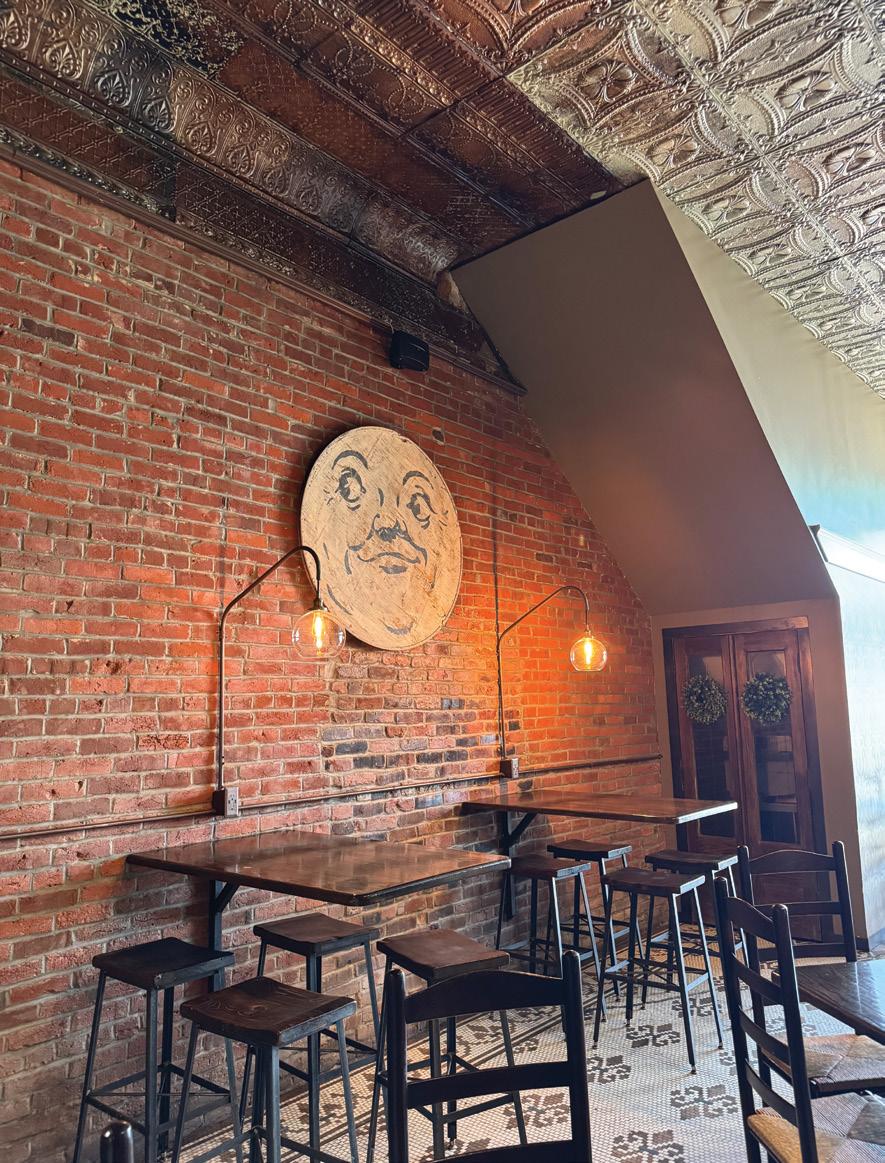
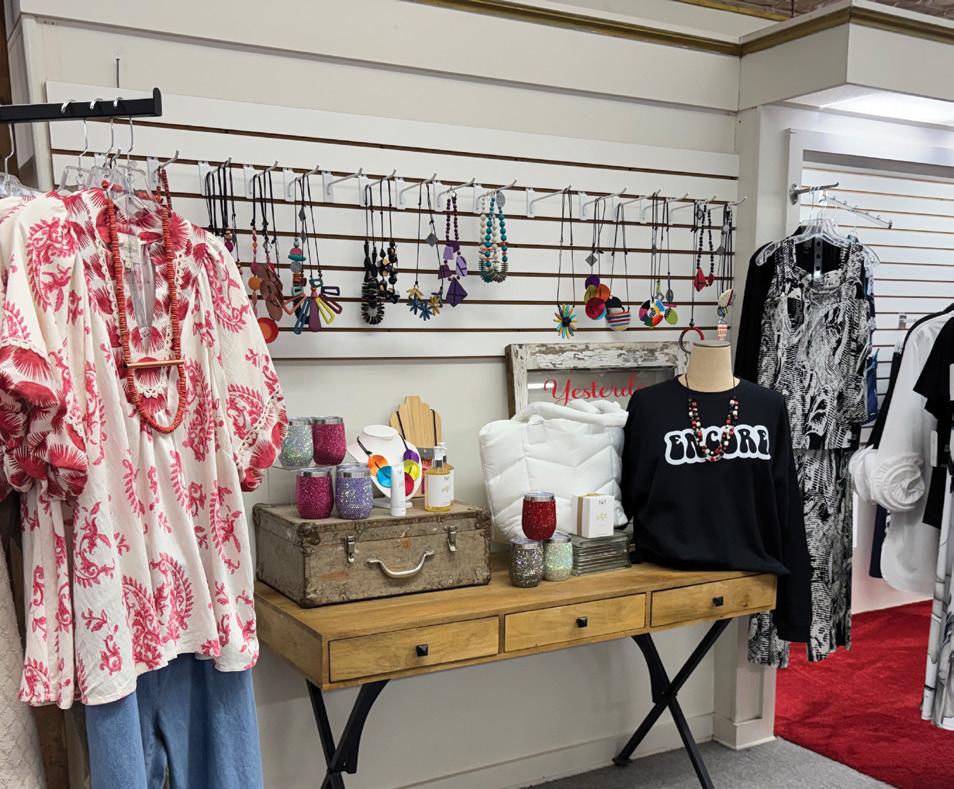
Just down the way, Encore o ers a di erent kind of discovery. Founded by Julie Sharp nearly 14 years ago, the boutique was built on a simple yet powerful idea: Women in small towns deserve access to style, inspiration, and a little boldness in their wardrobe. e result is a space that feels vibrant and unique.
“I love when out-of-towners walk in and say, ‘ is is in a small town?’” Julie says.
It’s that sense of surprise — gently challenging assumptions — that makes Encore not just a boutique, but a fashion statement.
SWEETNESS WITH A STORY
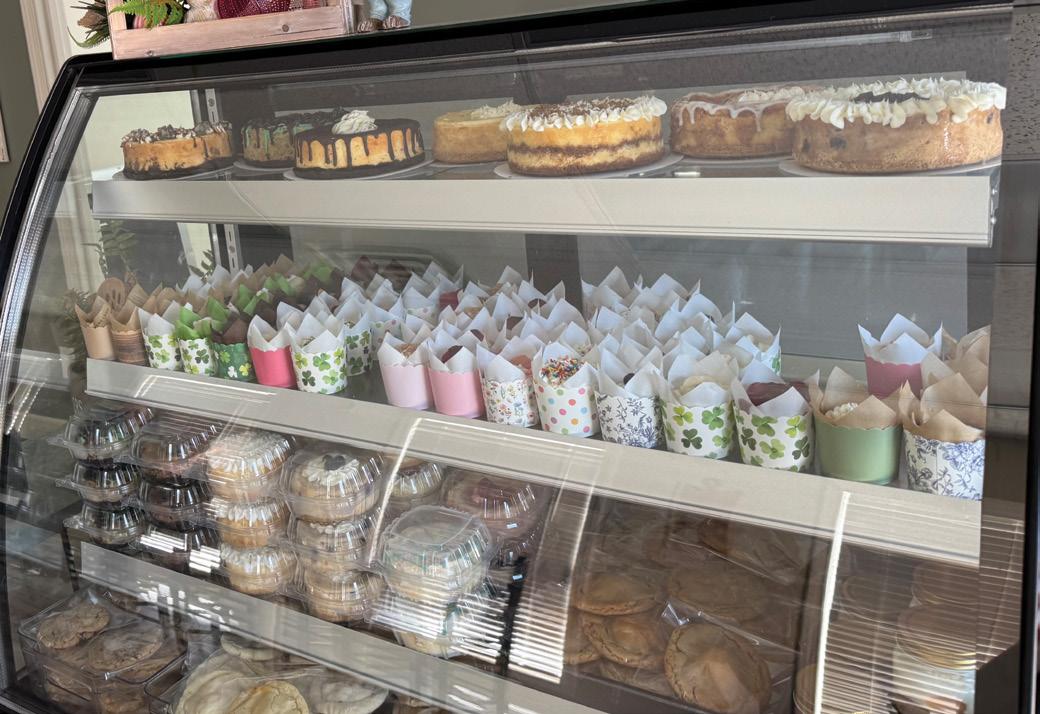
If your day needs a sweet pause (and it will), Cheesecake ART by Baker Company LLC is your next stop.
Owner Raellen Baker opened her storefront in 2023, encouraged by her sisters to turn her talent for specialty cheesecakes into something bigger. But her motivation runs deeper than business; it’s about modeling possibility.
“I wanted to show my adult children that you can always pursue something new,” she says.
Inside, the space feels warm and personal, like being invited into someone’s home. e display case features around 15 avors at any given time, with cherry, Oreo, and strawberry crunch among the favorites, along with gluten-free, sugar-free, and even dairy-free preorders.
Swing by and enjoy a perfectly baked cheesecake cup or place a personal order based on your avor preferences; boozy avors are also available. I personally love the millionaire cheesecake cups, which come with a luxurious layer of chocolate ganache.
THE KIND OF PARK THAT HOLDS EVERYTHING
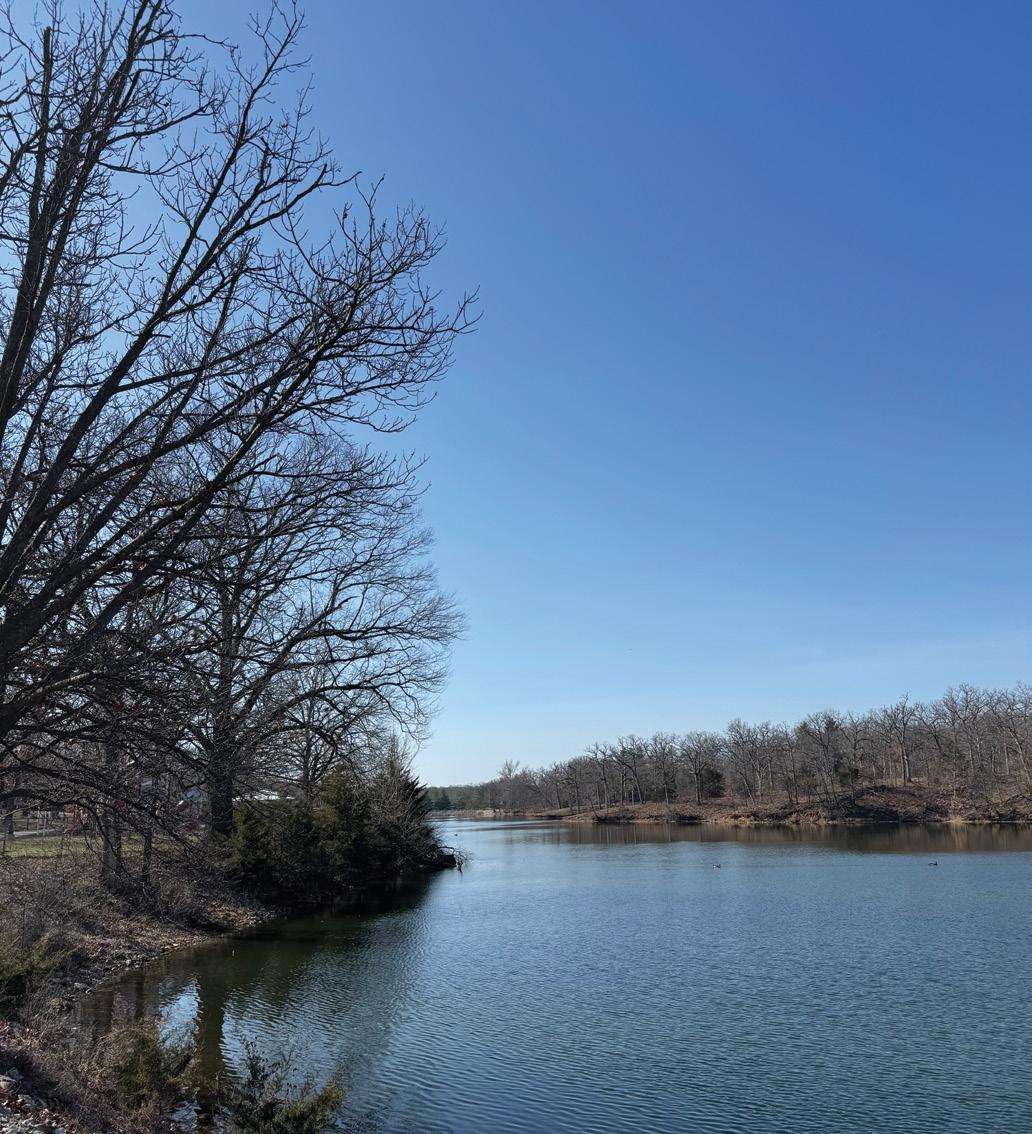
When you’re ready to step outside, Rothwell Park o ers a di erent kind of experience, one that helps keep you grounded.
It’s a gathering place. A memory-maker. A space where everything from quiet walks to family reunions take place. e park comprises 465 acres of pristine forest, water, and maintained recreational areas.
For the athletically inclined, Rothwell o ers eight baseball/softball diamonds and three football/soccer elds. Parents and kids will appreciate the family-friendly aquatic center, playgrounds, and picnic shelters. And those in search of some outdoor tranquility can easily nd a place to stroll by the water or go kayaking.
MOBERLY FIVE AND DRIVE
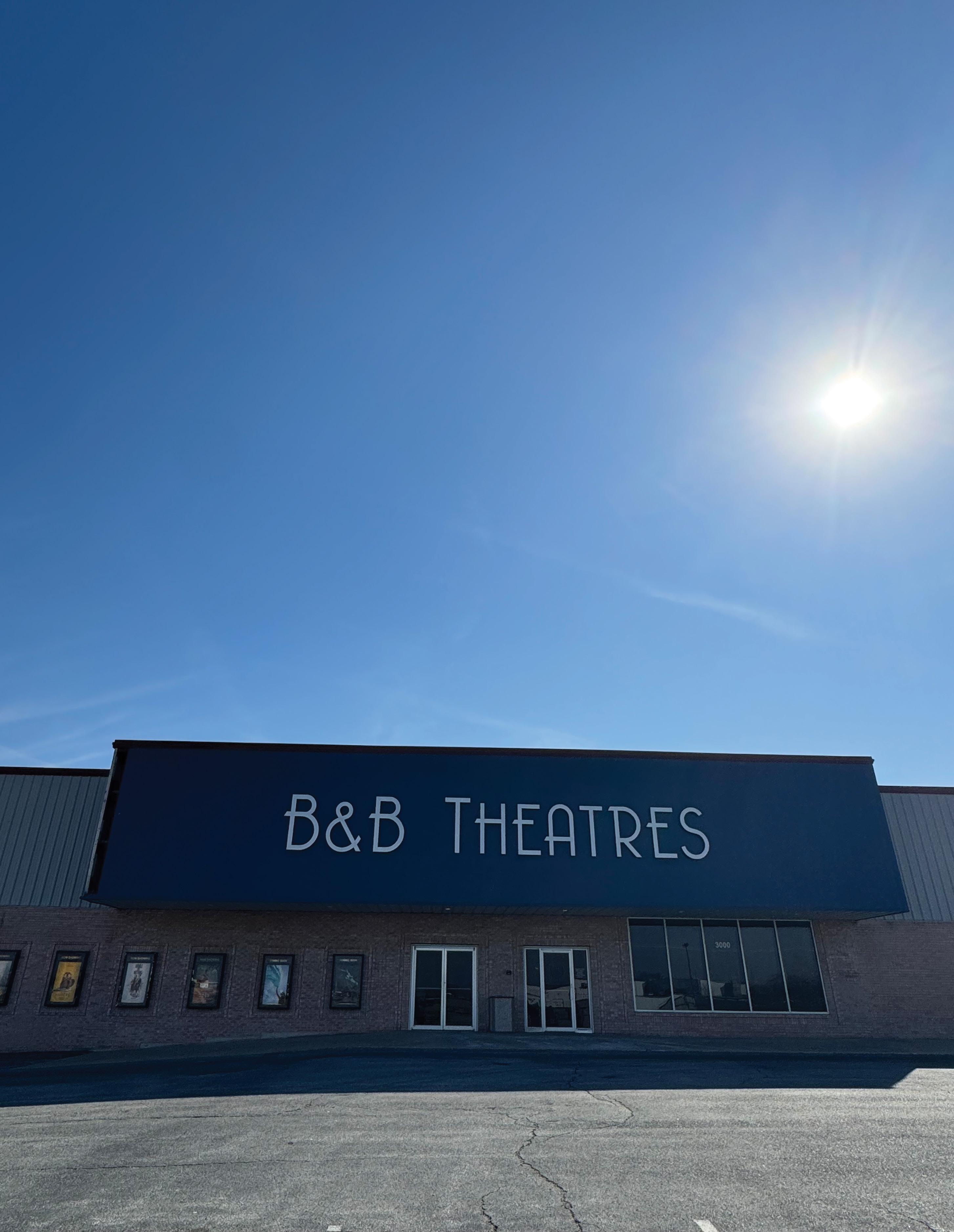
Before heading back to Columbia, there’s one more stop worth making: Moberly Five and Drive/B&B eatres.
Whether you opt for the nostalgic charm of the drive-in or the comfort of indoor recliner seating, this is where the day winds down in the best possible way. Alcoholic beverages are also available for purchase.
People regularly make the trip from Columbia just for the experience, blankets in tow on winter nights and with carloads of friends for summer screenings.
I still remember the night Mrs. Smith came out. e line of people wrapped around the entrance, stretching into the parking lot. It felt like the entire town had shown up. And in a way, that’s the thread that runs through all of Moberly.
SCI-FI THRILLER With a Familiar Setting
Author J.R.
Marzolf
sets debut book in Columbia.
BY OLIVIA D E SMIT
James Marzolf has lived in almost every region of the world and has a storied history in the healthcare industry. But the place he returned — physically and ctionally — after his global adventures? Columbia.
“I was born in Columbia and went to Hickman,” Marzolf says. “My ex-wife was born in Osaka, Japan, and we raised our children in Indonesia, but eventually, all three of my daughters ended up as Kewpies.”
Living here isn’t Marzolf’s only tie to COMO. Under the nom de plume J.R. Marzolf, he recently released his rst novel, Omega Rose, which is partially set here.
“As you’re moving people through space and time in the plot, if you’ve been to the place you’re describing, it makes it more tangible for the reader,” Marzolf says. e main character, Inga, walks through Jesse Hall, grabs a snack at e Heidelberg. and ventures out to a rooftop bar downtown. e o -campus house she lives in really exists, Marzolf says, and he would know — because he lived in it. “You write what you know,” he says. “I’ve gone to quite a few universities, but I went to MU the longest.”
Omega Rose is Marzolf’s rst foray into ction, but he’s wanted to write a novel since he was an undergraduate student at Mizzou.
About the Author
James Marzolf describes himself as an eclectic scholar of medicine, genetics, archaeology, and emerging technologies. Some of his past job titles include medical director of HMSA Blue Cross Blue Shield, resident national advisor of healthcare finance for USAID in Indonesia, and director of services for Hospital Developments International in Australia. Marzolf has worked in almost every region of the globe except for western Europe and subSaharan Africa. His debut novel, Omega Rose, is the first book in the Omega Rose Trilogy.
“I wrote a book on an electric typewriter and had no clue how to get a book published, so I put it in a box somewhere,” he says. “ en I kind of forgot about it, but I’ve always wanted to write. I had a long — and most people think quite interesting — career, and when I wrapped that up, I decided to take a year to decompress before beginning. One year later, I trimmed back my considerable beard and started writing. I found it was so much fun because it allowed me to use all of my experience in travel and education into spinning yarns people would like to read.”
As far as the idea of the book, Marzolf says he was thinking of the genetic test everyone gets for fun. “What if it’s something else instead?” he asks. “So I picked a young adopted college student as the protagonist, which makes it seem pretty normal to start o . en things get progressively weirder.”
One thing that stands out about Omega Rose is its factual accuracy. Several years ago, Marzolf found himself disappointed in a bestselling action thriller with what he calls egregious mistakes.
“You want to make things as accurate as possible because there are neurotic readers like me that pick things apart like that,” he says. “When I was reading and someone gave [the victim] 40 times the lethal dose of a medication, I just couldn’t nish it.” He wanted to make sure that wasn’t the case for Omega Rose
“If you don’t know genetics or cyber stu , you see that in the book and go, ‘Oh, that looks real.’ But if you’re a geneticist, you will nd everything in the book is absolutely correct. Same thing with the space satellites and certain locations. A geneticist in the book walks down to a pub in Bristol, which exists in real life. ere’s a lot of Easter eggs in the book if you know the locations and subjects.”
e book opens with a quote by Marzolf: “Genetics determines the instrument that you are. e Environment determines the music that you play."
e aphorism goes back much further than the book’s release date. He rst coined it while teaching an undergraduate course on developmental biology as he was working toward his master’s at MU in genetics.
“I was trying to teach them the best I could using analogies, and that sort of popped out of my mouth while trying to explain nature vs. nurture. And I was like, ‘Wow, that really sums it up.’ I’ve used it various places since then, and it still holds true.”
Omega Rose is Part 1 of a trilogy, and the second book is scheduled to be released this fall.
“ e second book will blend historical ction and sci- ,” Marzolf says. “ e company that owns everything in the book started the technological advancement of humans 1,000 years ago,” he says. It will follow that series of events while also addressing Inga’s next move.
On a bank of screens elsewhere in the building, Ivan sat with Dr. Swensen and two others, watching Inga as she prowled around her new cage.
“Looks like she’ll settle in ne,” commented Ivan.
Dr. Swensen shook her head, the right side of which was swollen and discolored along the right jaw, extending up into her eye socket. “Don’t be too sure. You didn’t experience her explosive nature. She’s dangerous.”
“What’s she weigh, 100 pounds? Can’t be that dangerous,” Ivan sco ed.
“Erik is still in the hospital with a skull fracture and a concussion, and she fractured my zygomatic arch with one kick. Don’t be fooled; she is about as innocuous as a cobra, and it takes enough tranquilizer to drop a rhino to put her down. She almost came to twice during transport.”
Art from the Inside
The long, creative road from Columbia to the World Series, Eureka Springs, Branson, and back.
BY STEPHEN FEILBACH
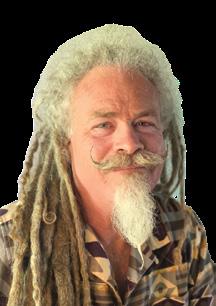
If you were in and around Columbia in 2014, at Roots N Blues or around the art scene, you might remember a giant garden gnome oating about town. Well, that was me. At the time, I was just creating stu because I liked creating stu . I had no clue that goofy giant garden gnome would end up taking me all over the place.
After making a splash in Columbia, the gnome hit the road with me. Next thing I knew, I was standing at the World Series in Kansas City with lines of people wrapped around my sculpture wanting photos with it. e stadium even sent photographers over. Media was lining up wanting interviews. I had never seen anything like that before.
At the World Series, I was merely showing up to see what kind of response my work would get. Boy, was I surprised. It opened my eyes to how much people enjoy interacting with things they recognize. ey like moments. ey like experiences. ey like taking pictures with things that feel larger than life. at was probably my rst real understanding of landmark sculptures and how much people relate to them.
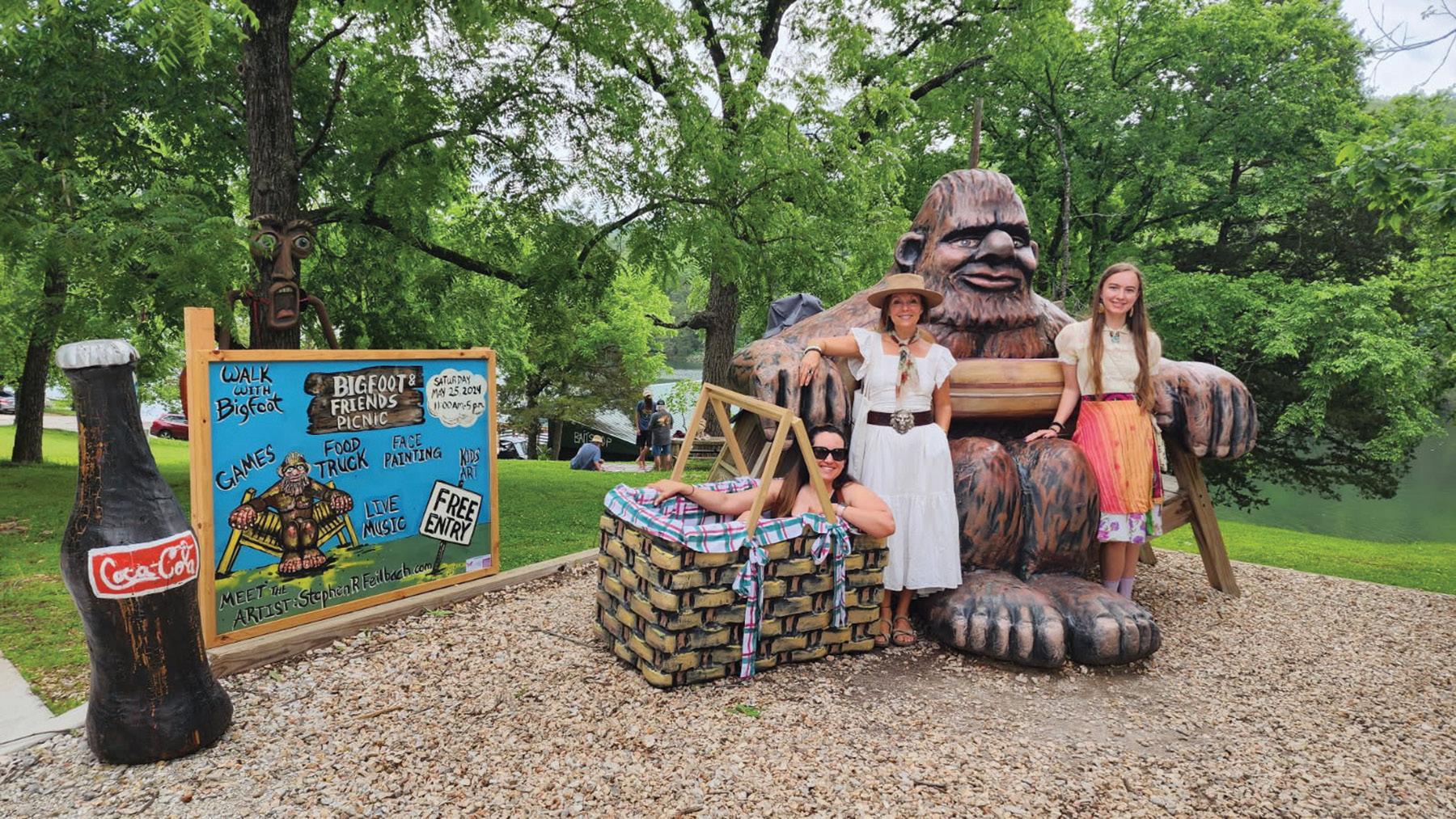
After that, I kept moving. Eventually I landed in Eureka Springs, Arkansas, a quirky little artsy town in the middle of nowhere. I was only planning to stay a short while. But I was wrong. Years later, there are now multiple pieces of mine in and near Eureka Springs. If you have been to Lake Leatherwood, you’ve likely seen Bigfoot. If you’ve walked through Basin Park, you may have seen Humpty Dumpty sitting on the wall. ere are many more scattered throughout town.
Eureka Springs was really where things started taking shape for me. e town was very accepting of big ideas and unusual projects, and because of that, I kept pushing things larger and larger. My most recent installation there is an over 10-foot-tall wooden garden gnome in a park that is being restored. Because of my obsession with creating large pieces and placing them around town, I forged connections with people I would have never otherwise met.
I was then asked to join the Eureka Springs Arts Council, which opened my eyes to a whole di erent side of public artwork and projects. Most people only see the nished sculpture. ey do not see the conversations, planning, materials, deadlines, equipment, sponsors, committees, weather problems, installation days, and all the people it takes to pull these things o .
Ideas are easy. Anyone can have an idea. e hard part is actually bringing them into reality. It takes a lot of people to accomplish large projects. A lot of time. A lot of e ort. A lot of help. ese pieces may begin in my imagination, but by the time they are installed, they belong to everybody involved with making them happen and, in the end, to the people who enjoy them.
While I was in Eureka Springs, my tentacles went out in multiple directions. I got connected with people involved with bike trails and tourism projects. I ended up doing sculptures for Howler Bike Park in Branson, Missouri, along with Bigfoot sculptures for a theme park. In time, that led to projects in Bentonville and Bella Vista, Arkansas.
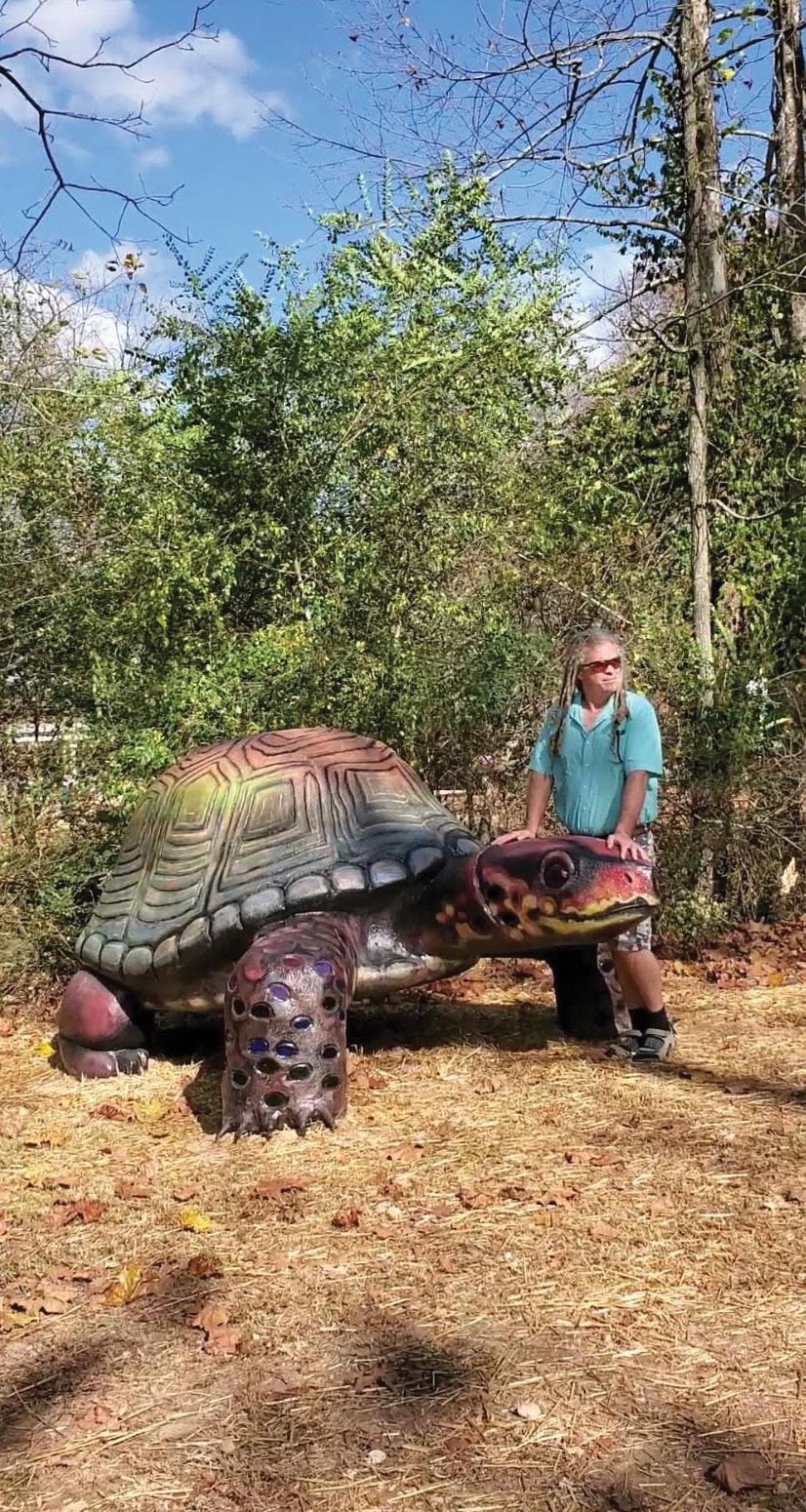
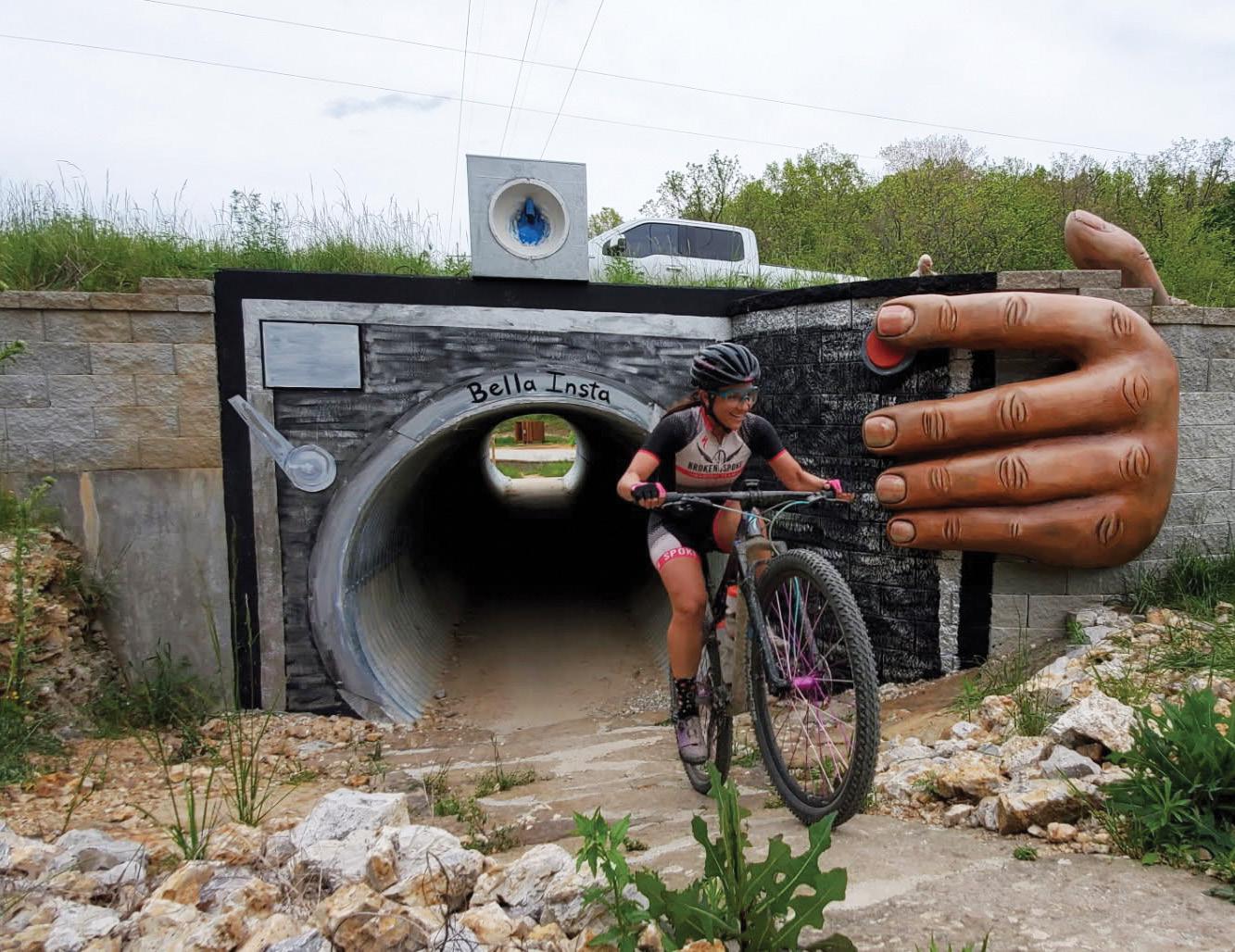
One of my favorite projects is near Crystal Bridges Museum of American Art, where a giant turtle sculpture now lights up the night along the trail system, with giant praying mantis sculptures nearby so the turtle has company. On a trail in Bella Vista, there is also a giant camera sculpture on a tunnel that people can walk or ride through.
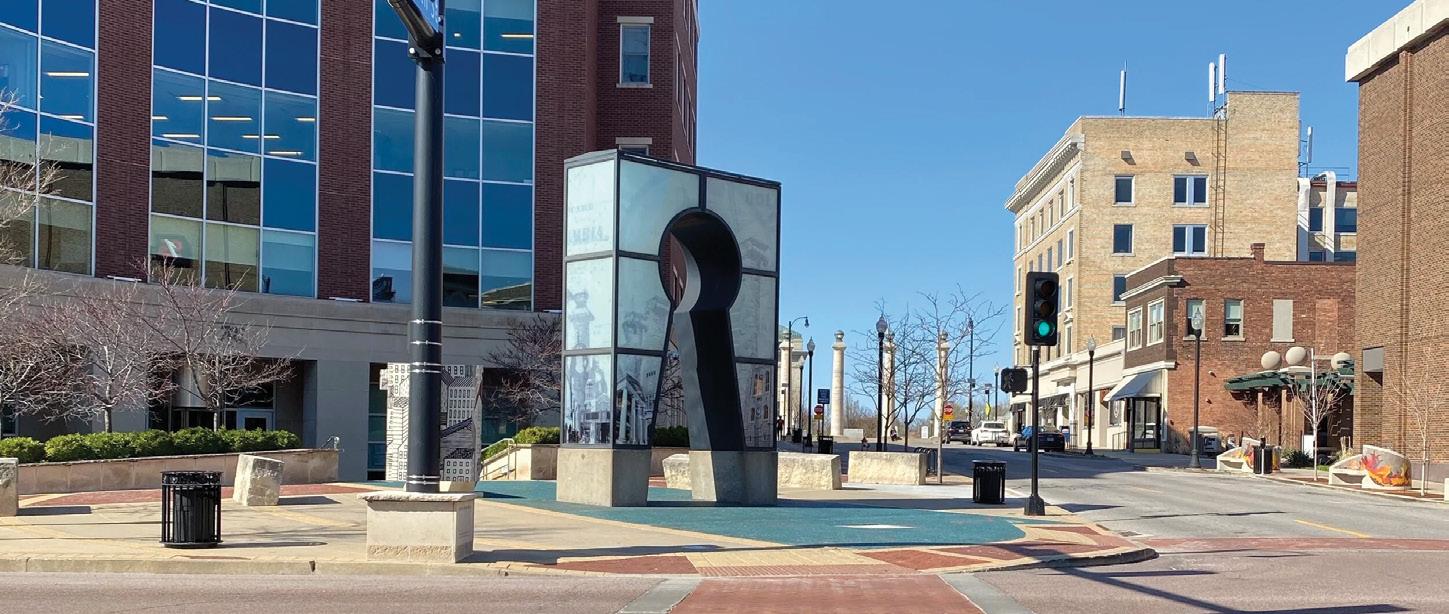
Eventually the road brought me back to Columbia. If you’ve been around Columbia Center for Urban Agriculture or downtown near the Bank of America building, you’ve probably seen some of my work.
More recently, creating a piece for Tiger on the Prowl opened the door to Mizzou. After seeing the response people had to the Tiger piece, I ended up getting o cial licensing through MU to create university logo sculptures. I’m hoping to continue pushing those ideas larger than life as landmark sculptures people can interact with, photograph, and remember.
What has surprised me most over the years is how these pieces slowly take on lives of their own. Once they are installed, they stop belonging only to me. Families take photos with them. Kids climb on them. People build memories around them. ey become part of places, which is honestly the most rewarding aspect for me.
I’ve always had a very imaginative brain, and sometimes I may live in my own little world a bit too much. But if a sculpture can give somebody a moment to stop thinking about stress for a second and just enjoy where they are, take a photo, laugh with friends, or remember a good day later on, then that is a pretty amazing thing.
In my next column, I’ll introduce you to another local creator here in Columbia. Chances are, if you’ve driven down the right street in town, you’ve probably already seen his work, too.
Stephen Feilbach is a Columbia artist with a penchant for turning tiny creatures into bigger-thanlife-size sculptures.
What Are Council Retreats — and Why Are They Important?
BY MAYOR BARBARA BUFFALOE
As mayor, one of the things I value most is the opportunity to create space for thoughtful conversation. In local government, much of our work happens in public meetings that are structured around agendas, motions, timelines, and decisions. ose meetings are important. Transparency matters. Public input matters. Action matters.
But good governance also requires something else: time to re ect, build relationships, and think strategically about the future of our community.
at’s why City Council retreats are so important.
Recently, members of the Columbia City Council and city leadership team spent time together at our annual retreat. No votes were taken, no ordinances were passed, and no ribbon cuttings happened. Instead, we focused on conversations that help us work better together and more effectively serve Columbia residents.
A retreat is an opportunity to pause from the pace of daily operations and focus on the bigger picture. It allows elected o cials and leadership sta to discuss priorities, identify challenges, and improve how we communicate and collaborate as a team. In many ways, it is similar to strategic planning sessions that businesses, nonpro ts, universities, and community organizations regularly hold.
For local governments, that kind of intentional time together matters because the issues cities face today are increasingly complex. Housing a ordability, infrastructure maintenance, economic development, public safety, homelessness, transportation, climate resilience, and scal sustainability are all interconnected. ere are rarely simple solutions or quick xes to these challenges.
Retreats help us step back from reacting to the issue of the day and instead ask broader questions:
• What kind of city do we want to become?
• What investments should we prioritize?
• How do we build trust with residents?
• How do we make sure our decisions today position Columbia well for the future?
ese conversations also strengthen relationships among council members. In a council-manager form of government like Columbia’s, no single elected o cial governs alone. Progress depends on collaboration, respectful disagreement, and the ability to work through di cult issues together. at does not mean everyone always agrees. In fact, healthy debate is an essential
part of democracy. But retreats provide an opportunity to better understand one another’s perspectives, leadership styles, and goals for the community. ose stronger working relationships often translate into more productive public meetings and improved outcomes for residents.
is year’s retreat included conversations about long-term nancial sustainability, strategic priorities, communication, and how we continue improving organizational culture. We discussed the realities facing growing cities like Columbia and the importance of balancing current needs with future investments.
As someone who has lived in Columbia since the late 1990s, I’ve seen rsthand how much our community has evolved. Columbia has grown signi cantly in population, economic opportunity, and regional importance. We are no longer a small town navigating small-town challenges. We are a growing city serving as a hub for healthcare, education, arts, culture, and innovation across mid-Missouri.
Growth brings opportunities, but it also brings pressure on infrastructure, public services, housing, and budgets. Navigating that responsibly requires leadership teams that communicate well, trust one another, and stay focused on long-term outcomes rather than short-term headlines.
One of the things I appreciate most about local government is that the work is deeply human. Behind every budget discussion, zoning conversation, or infrastructure project are real people and neighborhoods. Retreats remind us that relationships matter internally, too. e stronger the collaboration among those serving the public, the stronger the organization becomes.
At the end of the day, residents deserve leaders who are prepared, informed, and willing to do the hard work of governing thoughtfully. While retreats may not always be the most visible part of public service, they are an important investment in e ective leadership and in Columbia’s future.
Barbara Bu aloe is currently serving her second term in o ce as the mayor of Columbia.
What We Don’t Talk About
BY BRADLEY WILLIAMS
Every road trip has elements we love to talk about … and many we don’t talk about.
We’ll talk about the hole-in-the-wall diner where had that homemade slice of pie and the waitress called us darlin’. We love telling the story about the exit we missed and the two hours in the wrong direction that led us to discover some random lookout we didn’t know existed. But we won’t talk about the guy we saw walking on the shoulder somewhere just outside a big city. We won’t talk about the car with the trunk popped, hazards on, that we registered for half a second and passed.
We are good at curating our road trips. I think most of us live this way — not just on the highway. We’re great at the detours that make a story. e unexpected friendship. e exit nobody planned. e afternoon that turned into something. We are considerably worse at the detours that cost us something we don’t want to give. e phone call we keep meaning to make. e relationship that’s hard to repair and easier to let drift. e neighbor whose life makes us uncomfortable enough that we keep things polite and distant.
We are champions of the convenient detours and often resistant to the costly ones. ere’s a story about a rst-century rabbi who, after a long day, tells his friends to get in a boat and cross a lake at night (more unlikely, dangerous, and di cult in the rst century than you might think). e opposite shore, where they’re instructed to go, is the wrong side of the tracks, so to speak. It’s lled with those who don’t think like them, act like them, believe like them. It is enemy territory, culturally. ey don’t want to go. ey go anyway.
When the boat lands on shore, like a plot twist in an action thriller, a man sud-
denly appears from within a cemetery. He lives among the graves. He’s hurting himself. He’s broken every chain people have tried to bind him with. By every category — religion, geography, sanity — he is unreachable, he is untouchable. De nitely not worth pulling over for.
is was an unexpected, unwanted detour for Jesus’ students, but it was the very reason Jesus told them to cross the lake in the rst place. He never told them why, but the why now came into focus. is man needed help. He needed someone to step into the mess of his life, someone who wouldn’t just drive on by, someone willing to take a chance in order to make a change.
is is just one of many stories in the life of Jesus that cause us to pause and consider who might be on the other side of the shore from us and what we would be willing to do to help.
We all have someone, probably more than just one someone, we quietly drive past. Someone too volatile, too messy, too di cult to deal with. We tell ourselves it’s about boundaries, their bad choices, or
the risk being too much for us. ose arguments are honest and important — and sometimes they’re right. But sometimes they’re not.
Beyond crossing a lake or providing roadside assistance, there is a more meaningful kind of “pulling over” — for the friend you haven’t called, the family member you’ve kept at arm’s length, the neighbor whose life looks nothing like yours. It’s the willingness within us to take a kind of detour that costs us something we weren’t planning to give. e willingness to take a chance in order to make a change.
I’ve driven past plenty of people and chalked it up to busyness, boundaries, or safety. Sometimes it was. If I am honest, most times it wasn’t. Maybe the only way to know for sure is to pull over and nd out.
Bradley Williams is the lead minister at Forum Christian Church.
The People Make the Month
BY SEAN SPENCE
Last month I asked, “Starting today, what is one thing you could do to grow older and better?” Here is what I’ve discovered: We may not choose to grow older, but we can choose to keep getting better. Being with others helps make that possible.
For me, an art opening at the Boone County History & Culture Center was a good place to start — with the “others” in question being artists David Spear, Lisa Bartlett, and Jane Mudd.
If you do not know David, x that. He has spent decades making art rooted in Missouri’s landscapes, history, and communities. His paintings hang in the Wabash Station, the Columbia Sports Fieldhouse, and Sophia’s and Addison’s restaurants. He painted a 250-foot mural in Salem. Pretty impressive.
Lisa Bartlett is a painter, assemblage sculptor, and owner of Artlandish Gallery — someone who has been adding to Columbia’s cultural life for most of a lifetime. Her work draws on old photographs, family stories, and the layers of history most of us walk past.
And Jane Mudd, a plein air painter and retired William Woods art professor, has been painting the Missouri River for 50 years. Her work can be found in Columbia Regional Airport, in re stations, and at parks, among other spaces. Jane may be the best living portrait painter any of us will ever see.
At the opening, the room was lled with people who love this city, gathered around things made by people who love it at least as much.
Next up, the Columbia Chamber’s Business in Motion Expo was a good reminder that my professional community is still there — and still glad to see me (and vice versa). Something happens when you get into a room full of people you have not seen in a while. Conversations pick up mid-sentence, as though no time has passed. If you have been drifting — and most of us have, often
more than we realize — nd the next Chamber event and go, or attend your version of it.
For me, there was a fantastic outgrowth of that Business in Motion gathering. Seeing the right people led to the creation, in about 20 minutes, of a new biweekly event: the AI Business Breakfast. For free, local business leaders will get together at REDI to learn and share practical ways to use AI. And it all came about because people who already trusted each other were together. at is the formula.
Also on my docket that month was lunch at Balkan Treat Box in Webster Groves, part of my 2031 life project to road trip to the best restaurant in every state. Missouri has genuine contenders, and this is one. It o ers Old-World dishes — cevapi, pide, spit-roasted döner — with a handmade copper wood- red oven anchoring the center of the room. College friends Katie and Bill
joined me, and it could not have been better. Old friends, good food.
Here’s the throughline: Every good thing that happened to me that month had other people at the center. e artists who keep making things. e Chamber crowd that picked right back up. Food and friends worth a road trip.
Growing older and better is not a solo project. e people around us are doing remarkable things, and most will never say so. ey just keep showing up. We’d all do well to follow their example.
Last month’s question stands. Starting today, what is one thing you could do to grow older and better? Maybe this month, the answer starts with reaching out to someone.
Sean Spence is a 55-yearold Columbia guy, writer, podcast host, and event creator. Find him at growingolderandbetter.com.
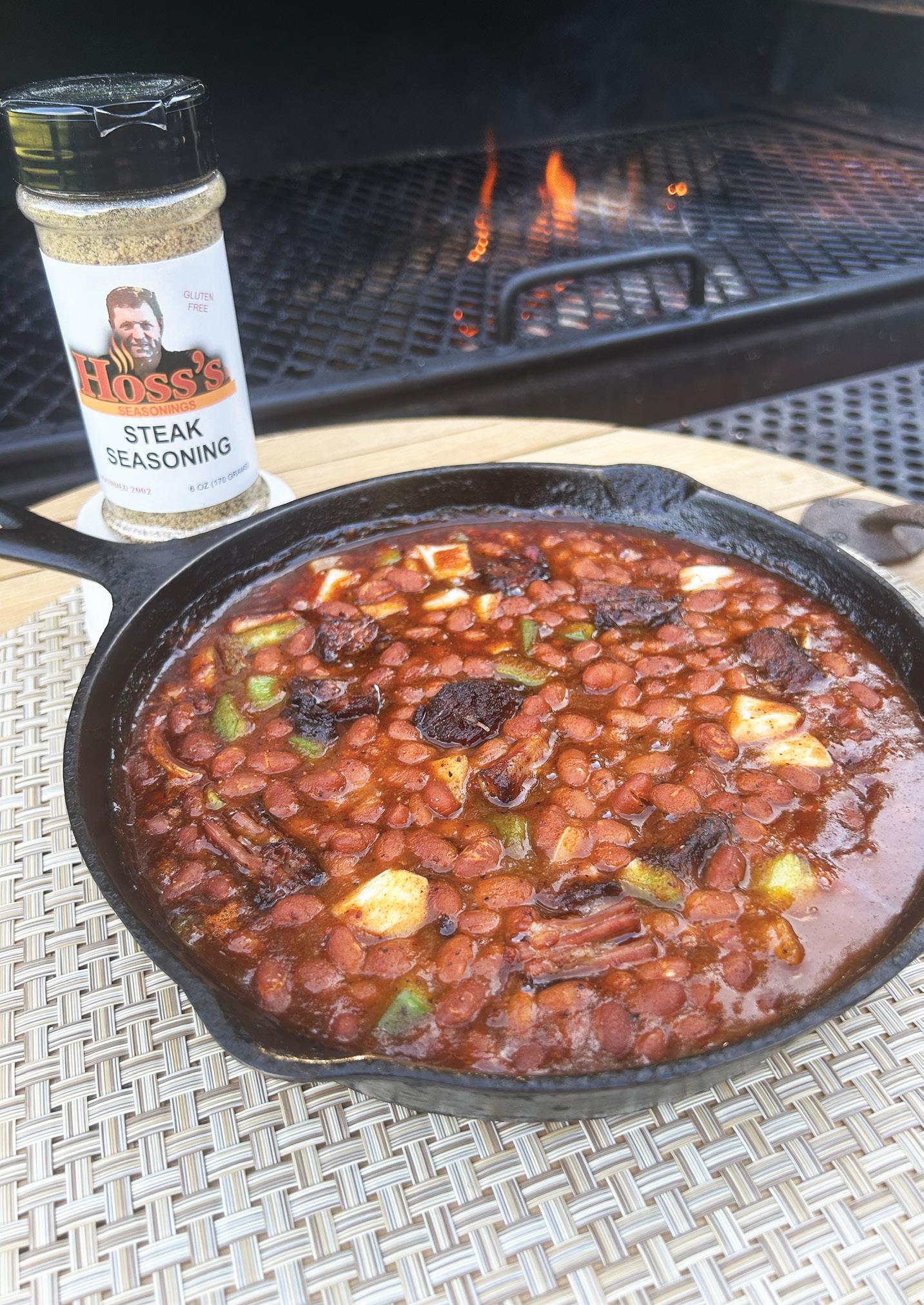
Hoss’s BBQ Beans
BY HOSS KOETTING
Have you had your legumes today? Chances are you have, although you may not know it. Legumes are edible seeds from the Leguminosae family, which are seeds that split in two, as opposed to grains that are seeds from grasses, which have a “one-piece” seed. Examples of grains are wheat, rice, and corn. Examples of legumes are green, navy, pinto, soy, kidney, and black beans; chickpeas (aka garbanzo beans); green, snow, and snap peas; lentils; and peanuts. Legumes are good sources of protein, ber, and minerals, and they are also relatively inexpensive, which makes them fairly popular — especially these days.
e particular legume that we’re going to focus on here is the navy bean. is bean is native to the New World, was cultivated and used by the Indigenous peoples, and was introduced to the Europeans who came over, whom we refer to as “Pilgrims.” ese culinary artists were responsible for the time-honored Boston baked beans, a combination of navy beans, salt pork, diced onions, spices such as salt, pepper, and dry mustard, and molasses or maple syrup.
e traditional method of preparation is to cook them in a “bean hole,” which is a hole in the ground in which stones are laid and a hardwood re is stoked until it is a pile of embers, after which a Dutch oven or similar vessel is placed on the coals and covered, then left alone for 12-24 hours. e beans come out creamy and smooth. I had some genuine “bean hole beans” when a good friend and I worked in Maine one summer. I must admit that I thought it was much ado about nothing, but I guess it doesn’t take much to impress a bunch of lumberjacks!
Where is this going, you may ask? Well, it’s July, it’s BBQ time, and there will be a lot of hoopla around the 250 years of U.S. independence, so I wanted to share our recipe for Hoss’s Market Baked Beans. ese aren’t your basic Bush’s Baked Beans — these are smoky, rich, and spicy. And they are also safe to take to an outdoor event without the worry of being associated with some blah, plebeian o ering. e only caveat is that you must plan ahead to have some smoked meat for the recipe, and for best results, you’ll need to cook them on a smoker.
Jim “Hoss” Koetting is a retired restaurateur/chef who enjoys gardening, good food, good bourbon, and good friends.
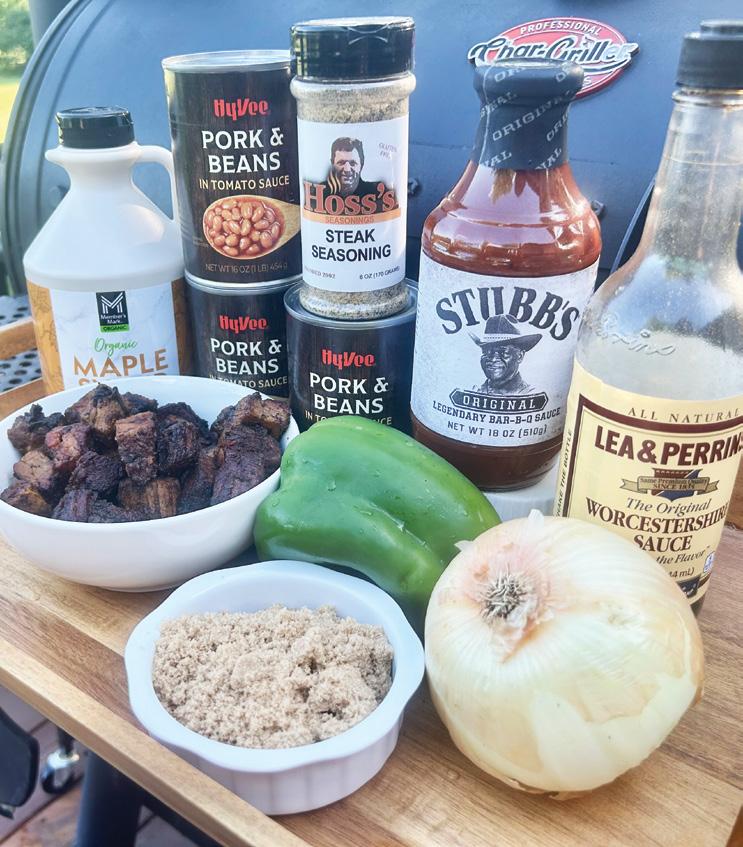
INGREDIENTS
• 3 16-oz. cans of plain pork and beans
• 1 cup chopped yellow onion
• ⅓ cup diced green pepper
• ¼ cup brown sugar
• 1 Tbsp. Hoss’s steak seasoning
• 1 Tbsp. ground black pepper
DIRECTIONS
• 1 Tbsp. Worcestershire sauce
• 2 Tbsp. maple syrup
• ⅔ cup of your favorite BBQ sauce
• 1 cup chopped smoked meat
1. Mix all ingredients
2. Smoke at 250-300 degrees for 2-3 hours.
3. Enjoy!
COOKIN’
Treat Yourself Re
Sometimes the best remedy for burnout is to step away long enough to reconnect with yourself.
STORY AND PHOTOS BY KELSEY WINKELJOHN
All work and no play makes Jack a dull boy.
All work and no play makes Jack a dull boy. All work and no play makes Jack a dull boy.
All work and no play makes Jack a dull boy. All work and no play makes Jack a dull boy.
All work and no play makes Jack a dull boy.
All work and no play makes Jack a dull boy.
t’s the sentence Jack Torrance obsessively types over and over in e Shining, a chilling marker of his irreversible descent into madness. Yet on its own, the phrase feels entirely reasonable. Even in his state of insanity, Mr. Torrance unintentionally stumbles onto a truth about burnout.
According to a 2026 survey by the National Alliance on Mental Illness focused on full-time employees across industries, 53 percent of respondents reported feeling burned out because of their jobs. Another 39 percent said they felt so overwhelmed it became di cult to perform at work, while 38 percent said workplace demands had negatively impacted their mental health.
I’ve dealt with my fair share of burnout — largely due to the creative nature of the work I do. Burnout can happen in any industry; in my experience, the constant need to produce can quickly snowball into overwhelming territory, especially when you’re always trying to raise the bar and create something more substantial than what came before. ere’s a persistent internal pressure and a need to constantly say “yes” because you never know what could lead to the next great story.
Back in November, however, I found a solution that worked well for my situation. Enter the concept of a personal retreat.
Returning to Creativity
Before writing became a full-time job for me, it was merely a hobby. Well, more like a rst love. Some of my earliest memories involve writing poems on my aunt’s desktop computer and lling notebooks with stories while my mom illustrated beside me. I later studied creative writing at Columbia College, immersing myself in the work of astounding novelists and poets while idealizing a future where I would publish my own novel or collection of poems.
Instead, I became a magazine writer. Slightly di erent, but it has nonetheless scratched that creative itch and allowed me to do what I love most. On the ip side, I sacri ced creative writing — because when you write day in and day out as a career, it can feel more like a chore than a creative outlet.
So I was overjoyed when I learned about Midwest (formerly Missouri) Women Who Write, a local group that brings together women from Missouri and neighboring states for an afternoon of learning, community, and, of course, creative writing. Its upcoming gathering would allow me to set aside a designated time, among a pool of other avid writers, both professional and recreational, to hold myself accountable. And, perhaps most importantly, I could disconnect from the career side of writing, lled with deadlines, the chaos of juggling interviews, and the previously mentioned internal pressure, and simply write for pleasure at my pace.
I was also intrigued to learn that the rst retreat I planned to attend would be hosted at Mount Nebo Inn, a cozy restaurant, wine bar, and lodging tucked into Rocheport. ough the small trail town is only about 20 minutes from where I live, booking the Trail Side Suite for the weekend made the experience feel like a world away — a retreat within a retreat.
As soon as I arrived, I noticed that my mind began to slow down. From the parking lot, I could see what awaited me: A relaxing patio extended from the rental unit, overlooking an outdoor dining area adorned with bistro lights and a chicken coop over owing with free-roaming birds. e air felt lighter, and even though it was early November, the warmth of the sun persisted. I was amazed by the beautiful building, which I would later learn had been converted from a 100-year-old church.
e peaceful feeling continued as I brought my bags up to the unit, which was connected to the dining room by a simple windowed breezeway that kept the lodging separate from the liveliness of the evening scene, yet close enough that I could later join in. Inside, the suite included a clawfoot bathtub, a full kitchen with a co ee machine, and a vast collection of mugs featuring sun owers.
A Different Pace
As a feature of Mount Nebo Inn, owner Drew Lemberger o ers guests who book an overnight stay a few experiential activities, including cellar and vineyard tours and tastings in the
neighboring elds and facilities, as well as a boat tour along the Missouri River. Immediately, I knew that excursion would have to be part of my trip, combining an educational aspect with relaxing wine tasting and exploration. I hit “select” on the vineyard tour.
While I had intentionally centered the retreat on reconnecting with creativity and taking a pause from the hustle of daily life, I learned that Lemberger’s journey re ected another side of restoration — recognizing when a long-held career path no longer aligned with the life he wanted to build. Rather than abandoning the hospitality and wine industry to which he had devoted much of his professional life, he reshaped his experience into something slower, more personal, and more connected to place.
Lemberger, who purchased Mount Nebo Inn in 2018, has long been interested in food and wine, and his passion for the business quickly became evident. He started cooking in restaurants in high school, working at family-owned establishments and moving through various roles, from busboy to server to bartender. He attended the University of Missouri’s School of Natural Resources and, after graduating in 1992, enlisted in the army — though he never strayed far from the industry and, in fact, tapped into something a little bit genetic.
“ at wildlife dream kind of ran its course,” says Lemberger. “For whatever reason, I got really into wine. My mom’s side of the family all worked for Anheuser-Busch, so they kind of had that time with alcohol production as a career.”
Lemberger explained more of his journey as he drove us through windy roads, shaded by orange-tinged leaves. I imbibed whatever he had just poured me from the cooler.
“My last bigger job, I was a VP for Les Bourgeois [Vineyards], and I was a partner then, running the retail division,”
says Lemberger. “If it wasn’t wine production, I managed all of the other stu — the catering, A-Frame, e Bistro, and group tastings.”
Lemberger left Les Bourgeois in 2018 when a planned buyout fell through, and he decided to focus more on the smaller businesses he had been running concurrently: a river-guide venture and a wood-milling /boat-building business. At this point, he was able to scale them up further and began scouting a location to build his own winery as well. at is, before the Mount Nebo Inn location became available for purchase.
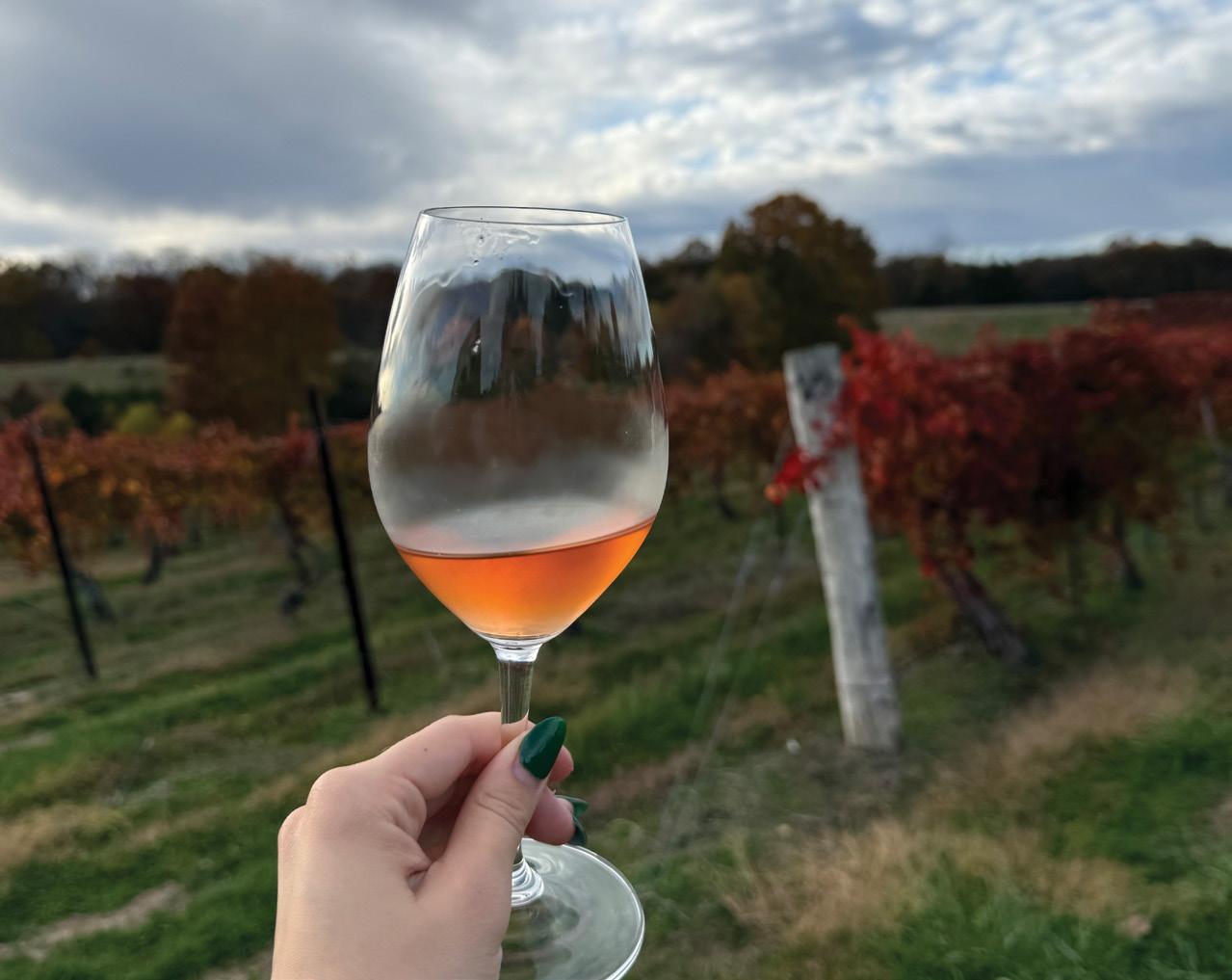
During the vineyard tour, we visited several locations. At each, Lemberger explained grape harvesting and the wine production process, sharing the di erent pruning methods growers use and pointing out how the woody horizontal growth will be trimmed back each year to spurs. All the while, we sipped joyfully on reds and whites and watched the sun begin to set in the distance. Even though we were trying to beat nightfall, there was never a sense of being rushed.
Of course, the drinks played a role in helping me unwind, but really, it was the surroundings and Lemberger’s stories of his entrepreneurial passions that I found most refreshing.
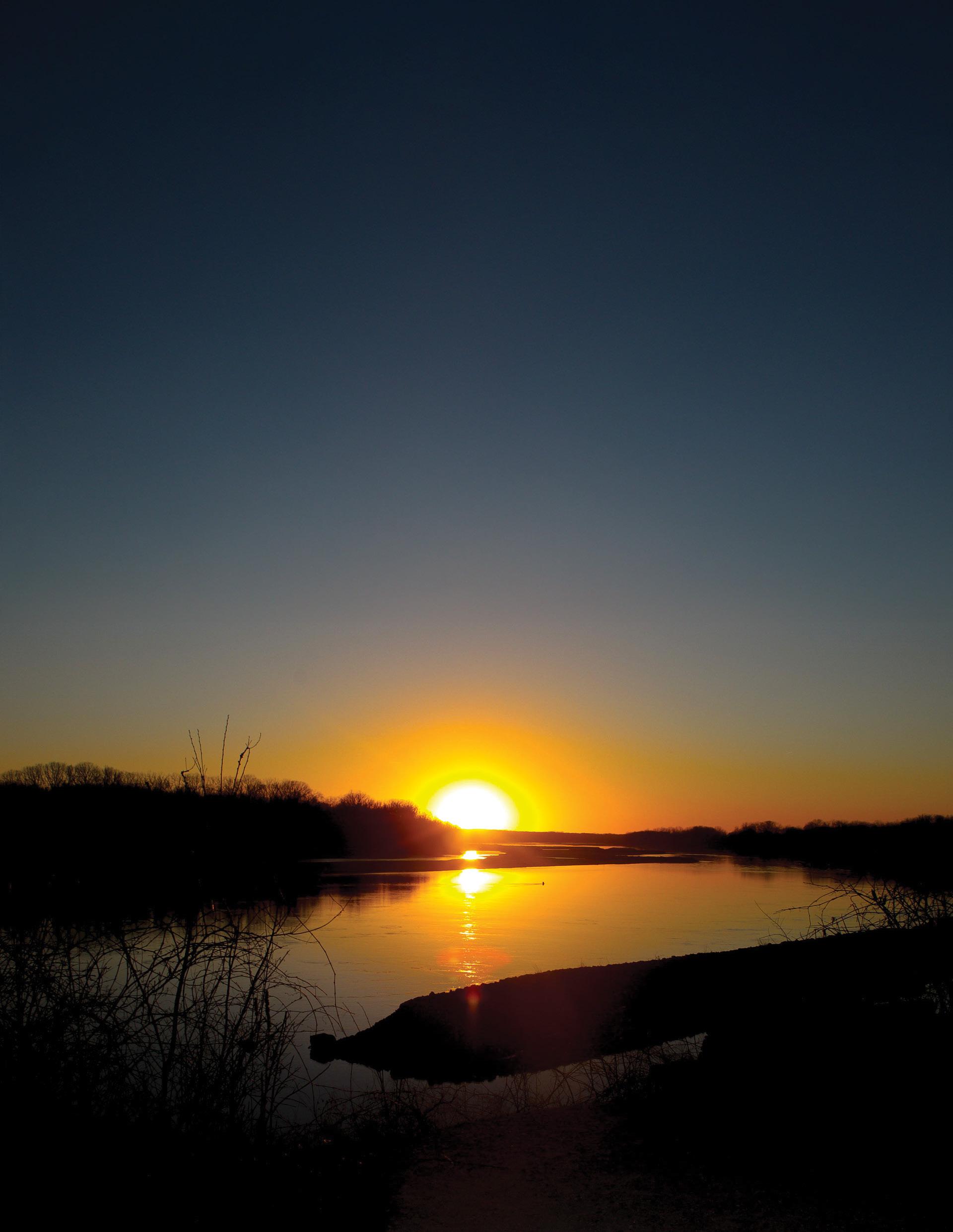
One of my favorite parts of staying at Mount Nebo Inn is that it feels simultaneously removed from the larger Columbia orbit while still providing opportunities for connection. One evening during my second visit, I took a stroll down to the river, where I caught another sunset and was greeted by an orchestra of bird calls. I brought my camera and managed to capture a highlight of the moment, though the photo I took hardly compared to the natural beauty unfolding around me in real time.
I sat for a while on a nearby bench, re ecting on how present I felt — not thinking about the work waiting for me back
at the o ce, but instead watching the sun’s nal rays dance across the water.
Maybe it sounds a little “woo-woo,” but I couldn’t deny the sense of interconnectedness between the world around me and my own being. Gaining perspective on the world around you can certainly make you feel small, but in an empowering way. at email I had been worried about two weeks earlier suddenly seemed insigni cant. Instead, all I could think about was how fortunate we are to play even a small part in this grand, beautiful life.
I followed the tranquil moment by spending the evening listening to a local musician in the inn’s dining space and people-watching between songs. As I sat there, I found myself thinking about the persistence required to pursue any passion creatively or professionally. I wondered what adversities a band might face, yet they continue showing up night after night because making music is what they love.
I thought about Lemberger, too, who told me the path to opening his restaurant and wine bar — packed with guests the evening I visited — was far from easy. e river ooded in 2019, shortly after he opened, and COVID hit in 2020. Yet despite the setbacks, both the musician playing that evening and the inn surrounding me stood as reminders that ful llment rarely comes from a life free of hardship, but from continuing to pursue what makes life feel meaningful.
By the end of the weekend, I realized the retreat hadn’t magically erased stress or responsibility from my life. What it had done, however, was interrupt the endless cycle of productivity long enough for me to reconnect with creativity, curiosity, and presence — the very things that can become dulled when work begins to occupy every corner of your identity.
Hermann in a Hurry
All aboard the Missouri River Runner for a day trip to Missouri’s center of German culture.
STORY AND PHOTOS BY CHARLIE WESTFALL
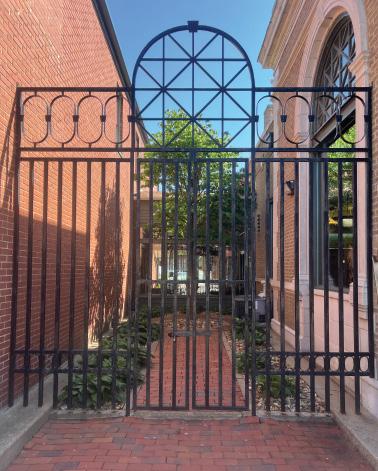
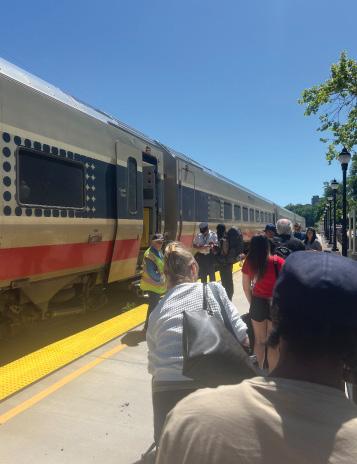
The Amtrak train station in Je erson City lies in the shadow of the grand Missouri State Capitol building, on the ground oor of the former Union Hotel, which was built in 1855 and forms part of the Je erson Landing State Historic Site. e history-steeped atmosphere is tting for a ride on the Amtrak Missouri River Runner, the scenic train route east to one of Missouri’s most distinctive and historic towns: Hermann.
As the train pulled away from the charming station at 11:45 a.m., I let myself picture a nostalgic scene of my one true love running along and waving, handkerchief in hand, o ering a dramatic farewell. (Perhaps she wouldn’t have bothered had she known I was scheduled to be back again by 4:45 p.m.)
e train bustled with travelers of all ages crossing Missouri. My ticket granted me a seat by a window that a orded plenty of room to get comfortable, as well as a drop-down tray table and outlet. Large luggage racks within each car supplied storage free of charge, and a dining car at the front of the train provided snacks, drinks, meals, and even playing cards.
e Missouri River Runner travels parallel to the Missouri River for a large part of the journey, and the short trip between Je erson City and Hermann highlighted the river’s natural beauty particularly well. With both towns claiming a spot along the river, the rushing waters of the Big Muddy were visible for most of my ride. While those waters aren’t crystal clear (as the nickname the “Big Muddy” suggests), the views of the sunlight shimmering o the surface as the train rushes by were certainly enough to make me put down my phone and get lost in the scenery just outside the window.
A Full Itinerary
Once I arrived in Hermann, Anita Watson, a visitor’s guide, handed me a map of downtown. She happily answered my questions about where to go and sights to see, ushering me into the visitor’s center and marking places of interest on my map. Watson’s knowledge and expertise set the stage for the memorable hospitality that would become a hallmark of my stay. Her rst suggestion for all visitors was the Caboose Museum.
Located behind the station, the Caboose Museum is hard to miss, with its bright red, solitary train car and the sign in the front. e free, self-guided museum made for a fun walkthrough before moving on to the next part of my journey.
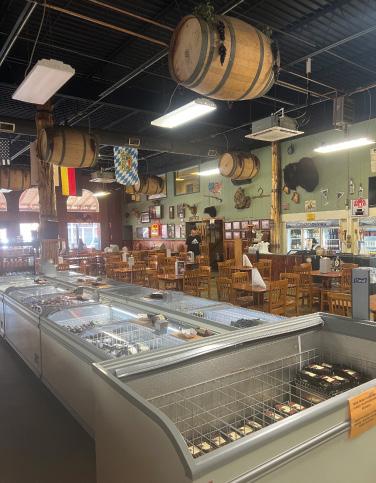
Across from the station is Hermann Wurst Haus, a shop and deli that is best known for its bratwurst. After the sta greeted me and walked me through the menu, I opted for the German Platter, which comes with two bratwursts and two sides of your choice (in my case: Best of Show and Caramelized Pear and Gorgonzola bratwursts, along with smoked gouda pasta salad and loaded potato salad). e food was delicious, and with many other barbecue options available, the Wurst Haus gave me plenty of reasons to come back.
A large selection of handcrafted meats, including bratwursts, are available for purchase to take home and enjoy later. e shop even sells freezer bags to transport perishable goods safely. e Wurst Haus is absolutely worth a visit to fortify oneself for exploring the historically German town.
Across the street from the Wurst Haus, some antique shops then caught my eye. With its vinyl records, military uniforms, and even a collection of old Playboy magazines, Hermann’s Attic Antique Mall o ered a more vintage and eclectic experience. Down the street, Antiques Unlimited II was more of a traditional antique store lled with ornate furniture and dusty glassware. It felt like stepping back in time to the 19th century.
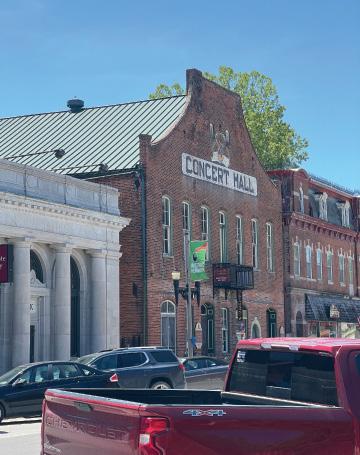
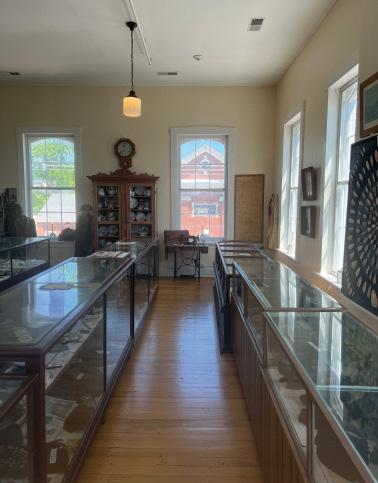
e Historic Hermann Museum, another of Watson’s recommendations, took me to the heart of downtown. e large brick building boasts a clock tower that’s been running since 1890. e museum attendant, Jim Allen, met me inside the large wooden doors, where he was eager to tell me about the museum’s exhibits. A brief video about the town’s founding set me up to explore the museum, which features rooms packed with artifacts and information about Hermann’s rich history. Creaky stairs led up to a particular highlight of the museum: the River Room, a large exhibit dedicated to life along the river.
e museum is engaging for adults and kids alike, and despite its small size, it would be easy to spend hours there learning about the town. On my way out through the gift shop, I picked up some old postcards for a keepsake, and Allen was generous enough to give them to me for free. e shop sells unique souvenirs, such as educational materials and even replicas of some of the museum items.
Plenty of Ways to Wet One’s Whistle
Most folks who have even minimal knowledge about Hermann know that the town is most popular for its wine. When German immigrants settled Hermann in the 1830s, they found the soil and climate was reminiscent of conditions in countries renowned for their wine, such as France and their native Germany. at created a perfect opportunity for a product not yet widely available in the newly expanding United States. And thus, wine country was born. e beautiful vineyards that dot the town will be an experience for another trip, but my thirsty palate wanted to seek out other boozy alternatives.
At Lionheart Whiskey Company, the establishment’s greeter, a large brown puppy named August, provided the welcome. Brandi Lambright, August’s owner, was my bartender, directing me to the menu and o ering a few tastings, whiskey by the glass, and cocktails. I went with the Whiskey Foxtrot Delta cocktail, which was as rich in avor as it was strong. e sunlight streaming through the open doors and fair weather made for the perfect setting to enjoy a cold drink. Lambright proved to be both a great conversationalist and a gifted mixologist, and she even let me taste-test a cocktail she was workshopping.
For my next destination, she recommended Doxie Slush, a restaurant best known for its alcoholic slushies, a fact that, according to Lambright, sometimes overshadows how good the food is. Neon lights illuminated colorful slushy machines behind the counter, setting the decor apart from older architecture around the town. My order of a Cubano-inspired smash burger and a slushy ight was a combination that did not disappoint. e burger was delicious, and the slushies — the Dappletini, Dragonfruit G&T, the Strawberry Amaretto Shortcake — were equally good, though there were around a dozen other options that sounded just as appealing. Finishing my meal, and with my time almost up, it only seemed tting to visit at least one winery before departure.
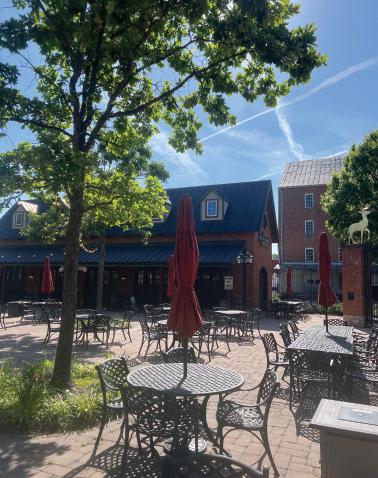
Conveniently located next to the train station, the Hermannhof Winery’s Hofgarten is a large brick courtyard decorated with fountains and golden statues. Several stores surround the courtyard, with tasting rooms o ering wine, beer, and spirits. It also features plenty of seating alongside beautiful views of the vineyards.
At G. Husmann Wine Company, a historic vineyard best known for its blends of wine from Missouri and California, I met with John Cowan, the sommelier, for a tasting of ve di erent wines. Two highlights were the Rosé of Hermann and Blackberry Rhapsody. Cowan con ded that people often come into the store expecting to buy a bottle of red but end up taking home blackberry wine instead.
By a stroke of luck, my train’s departure time was delayed, meaning there was time for one more stop. Both the Tin Mill Brewery and Tin Mill Restaurant serve food and drinks, but following Lambright’s advice, I gave the brewery the nod. ere, the aroma of hops greeted my senses, emanating from the brewing
equipment on display through large windows. From among the pilsners, ales, and marzens, I chose a beer that had been stored in barrels used for aging gin, imbuing it with a unique botanical avor. e brewery also has a beer garden and a massive subterranean beer hall. Dozens of benches run the length of the room, blackboards signed by previous guests line the walls, and sunbeams pour in from a door leading out to the garden.
After I nished my drink, it was time to head back to the Capitol City, ending a brief stay that had been action-packed. My senses were satis ed, and my feet were ready for rest, but the regret that I should have stayed longer lingered.
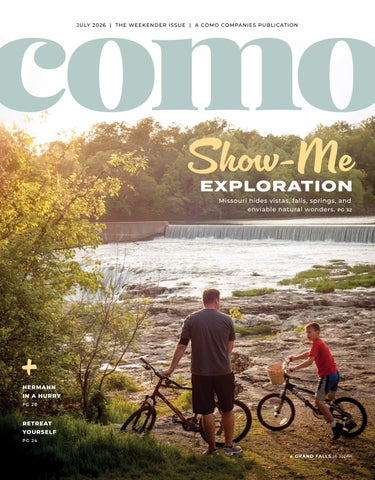
Show-Me Exploration
Missouri hides vistas, falls, springs, and enviable natural wonders.
BY ALICIA BELMORE
PHOTOS PROVIDED BY MISSOURI STATE PARKS
When it comes to natural wonders and majestic scenery, Missouri doesn’t have the Rocky Mountains, the Grand Canyon, or a Mount Rushmore. But the state’s depiction as a yover state makes the mistaken assumption that our natural wonders are easy to ignore. Folks who already embrace the emphasis on our “Show-Me” monicker know better. Not only are Missouri’s natural wonders photo- and visit-worthy, the hills and secrets of the Ozarks and spring-fed river systems are unlike any other landscape around.
Some sights to behold are along the way from one place to another. Some are well o the beaten path and require a bit of determination – and good directions – to see and experience. From the north to the south, east to west, Missouri has many points of beauty and interest to take in. ere is something to be seen and maybe even learned for the visitors and native Missourians alike. Come along on a true Missouri adventure, including distance from Columbia’s central location and a few notes about other things to do in each of the areas.
North
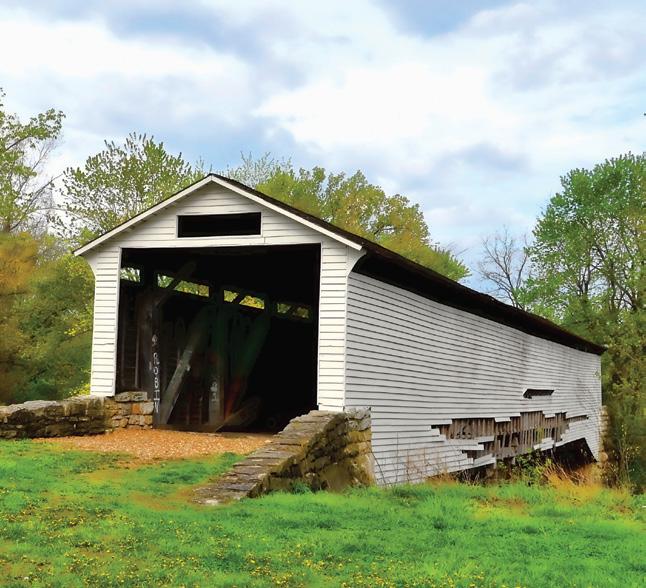
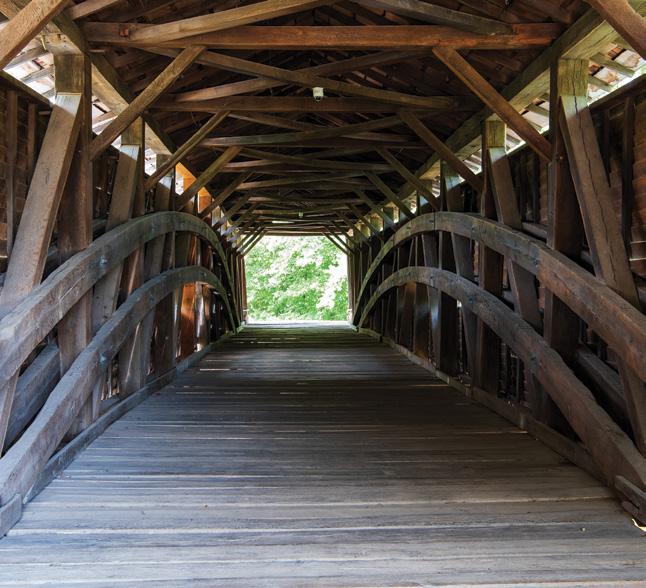
Union Covered Bridge in Monroe County near Paris was built in 1871. With its Burr-arch truss design it is a picturesque place, and one of only four covered bridges left in Missouri. Visitors can take in the natural sights, swim in the stream below, and relax in nature. Located just under an hour from Columbia, it would be a nice afternoon trip. If a longer get away was desired, Mark Twain Lake and Mark Twain’s Birthplace and State Historical Site is a short 35-minute drive east from there.
Union Covered Bridge
State Historic Site
19099 Monroe Rd. 219, Paris, Mo.
50 miles from Columbia
Mark Twain Lake
Main access area near Hwy. J and Route 107, Monroe City.
85 miles from Columbia
Mark Twain Birthplace
State Historic Site
37352 Shrine Rd., Florida, Mo.
75 miles from Columbia
East
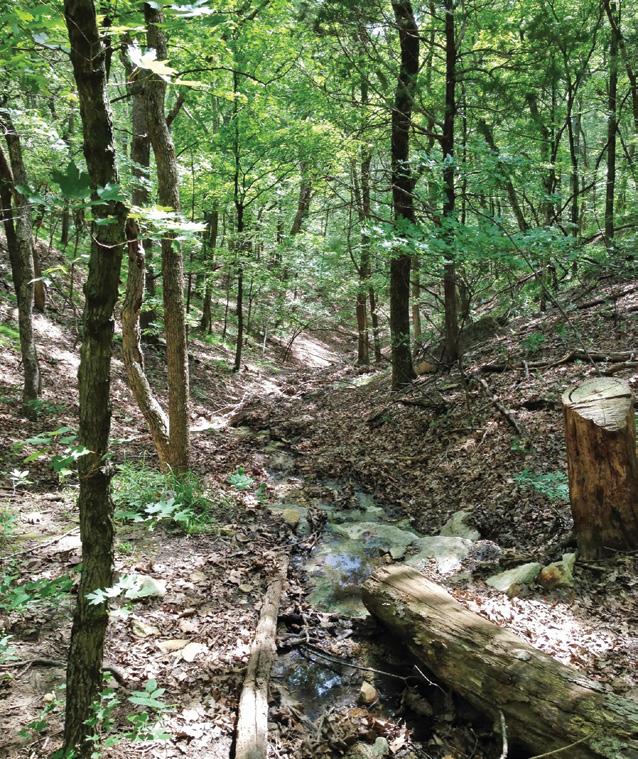
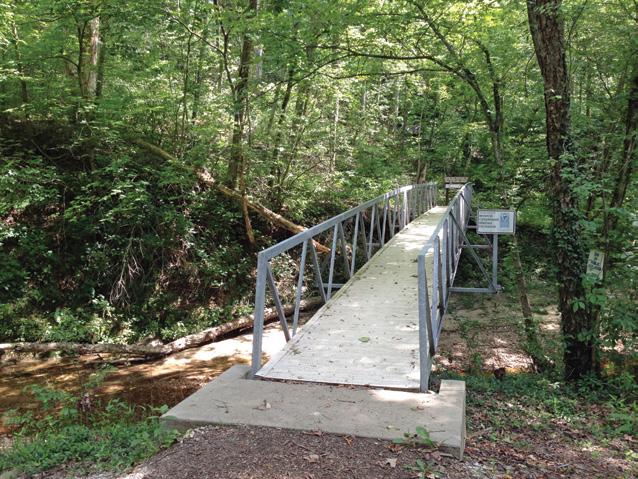
LaBarque Creek Conservation Area is full of Missouri’s natural beauty with hills, forest, valleys, and canyons. A three-mile loop hiking trail lets visitors take in all the beauty, and after rains waterfalls are present through sandstone rock formations. e Missouri Department of Conservation website notes that the LaBarque Creek watershed is “a true aquatic gem, with at least 54 species of sh.” Visitors have many options here including shing, camping, bird watching, and seasonal hunting in addition to the hiking. Only two hours from Columbia and a 40-minute drive on to St Louis, this could be a day or a weekend trip.
1684 Missouri Hwy. FF, Pacific 135 miles from Columbia
West
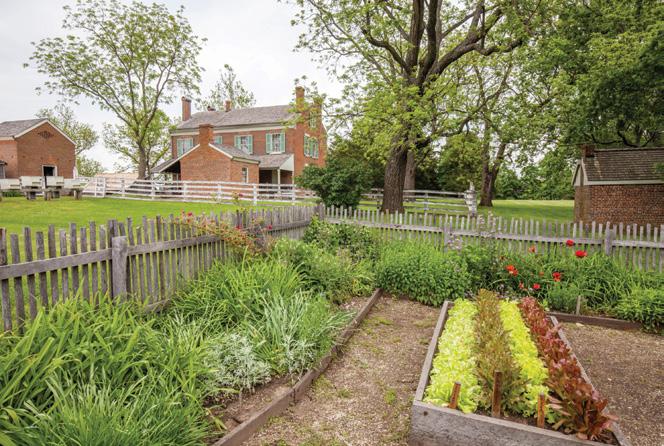
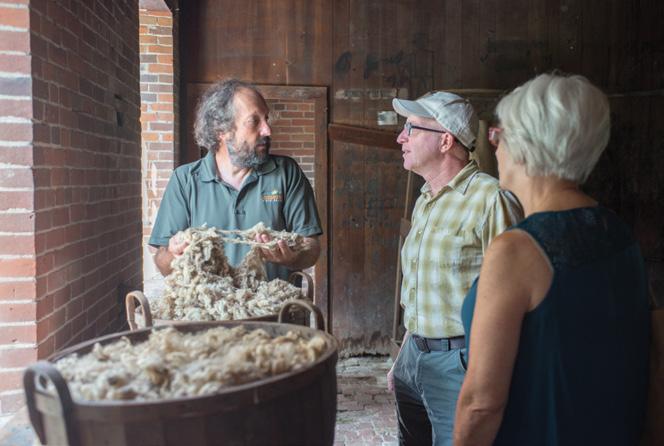
Watkins Woolen Mill State Historic Site is a National Historic Landmark near Lawson. ere is a visitor’s center on site with free entry and for a fee visitors can take tours of the brick mill and the 1870s Classic Revival eight-bedroom Watkins home. According to visitmo. com the mill is the only 19th century American woolen mill with its original machinery intact. Adjacent to the site is the Watkins Mill State Park, adding a 100-acre lake with paved bike path around it as well as camping, hiking, wildlife, and picnics to the list of things to do and see here. At two hours and fteen minutes from Columbia, and just under an hour northeast of Kansas City, this is a destination for a weekend stay or even longer.
Watkins Woolen Mill State Historic Site and State Park 26600 N. Park Rd., Lawson. 165 miles from Columbia
Photos by Paul Orr via Adobe Stock
South
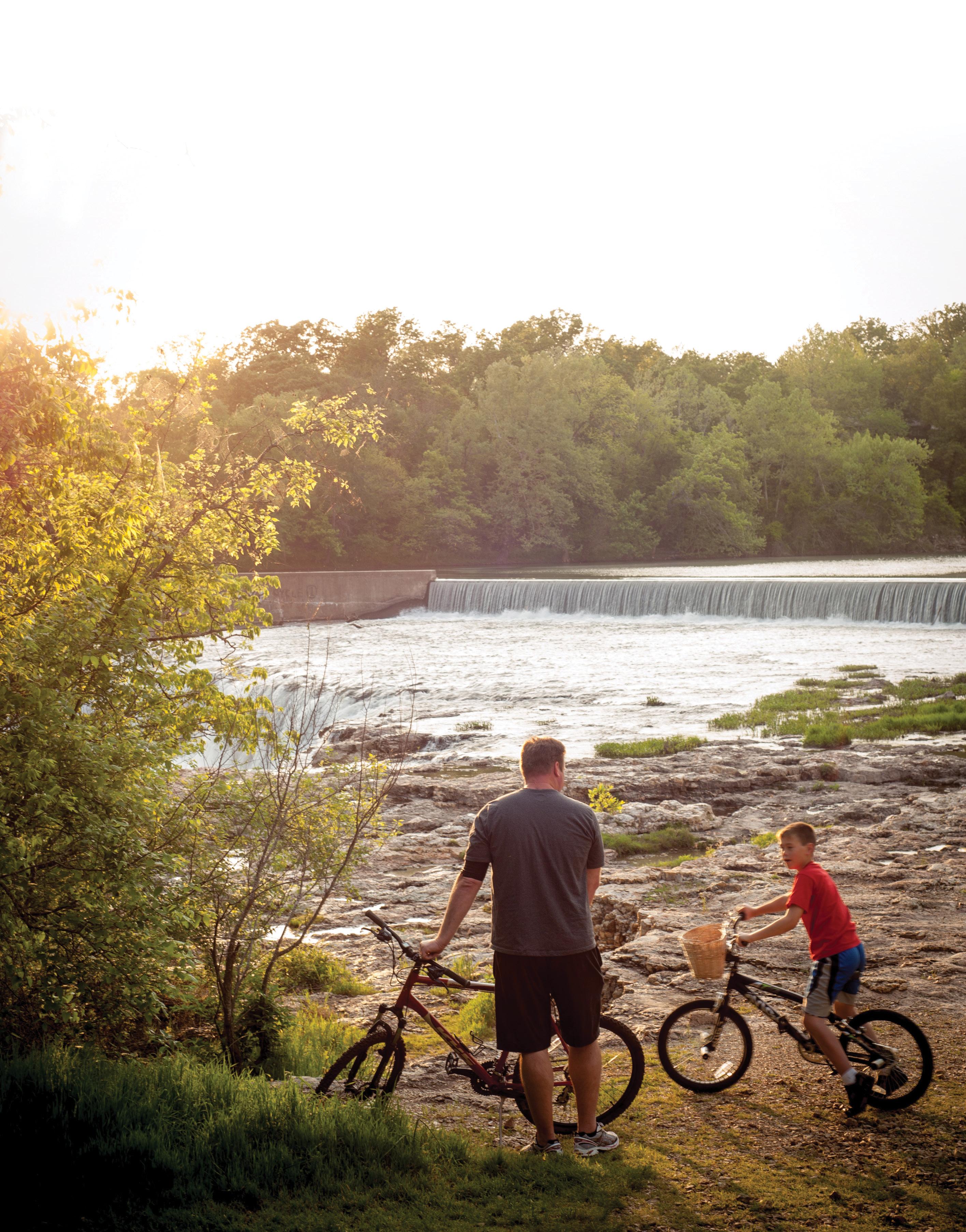
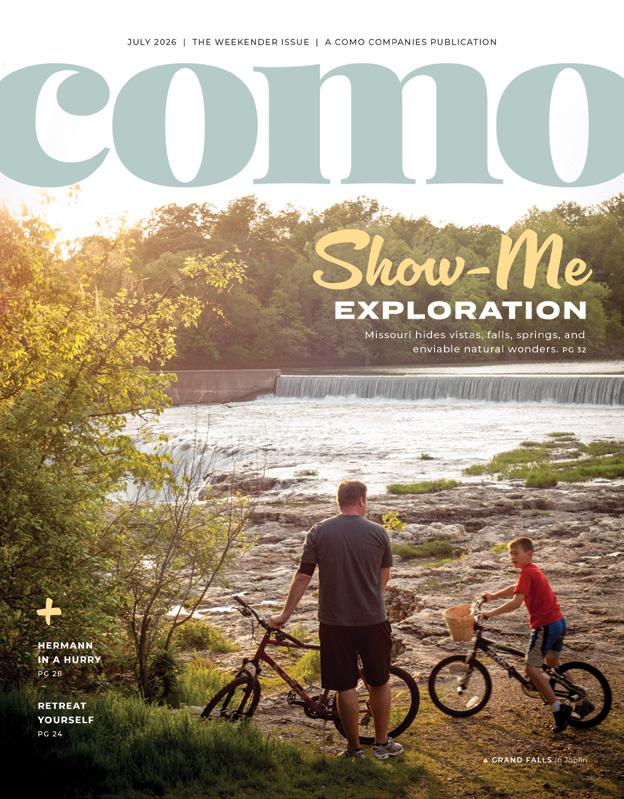
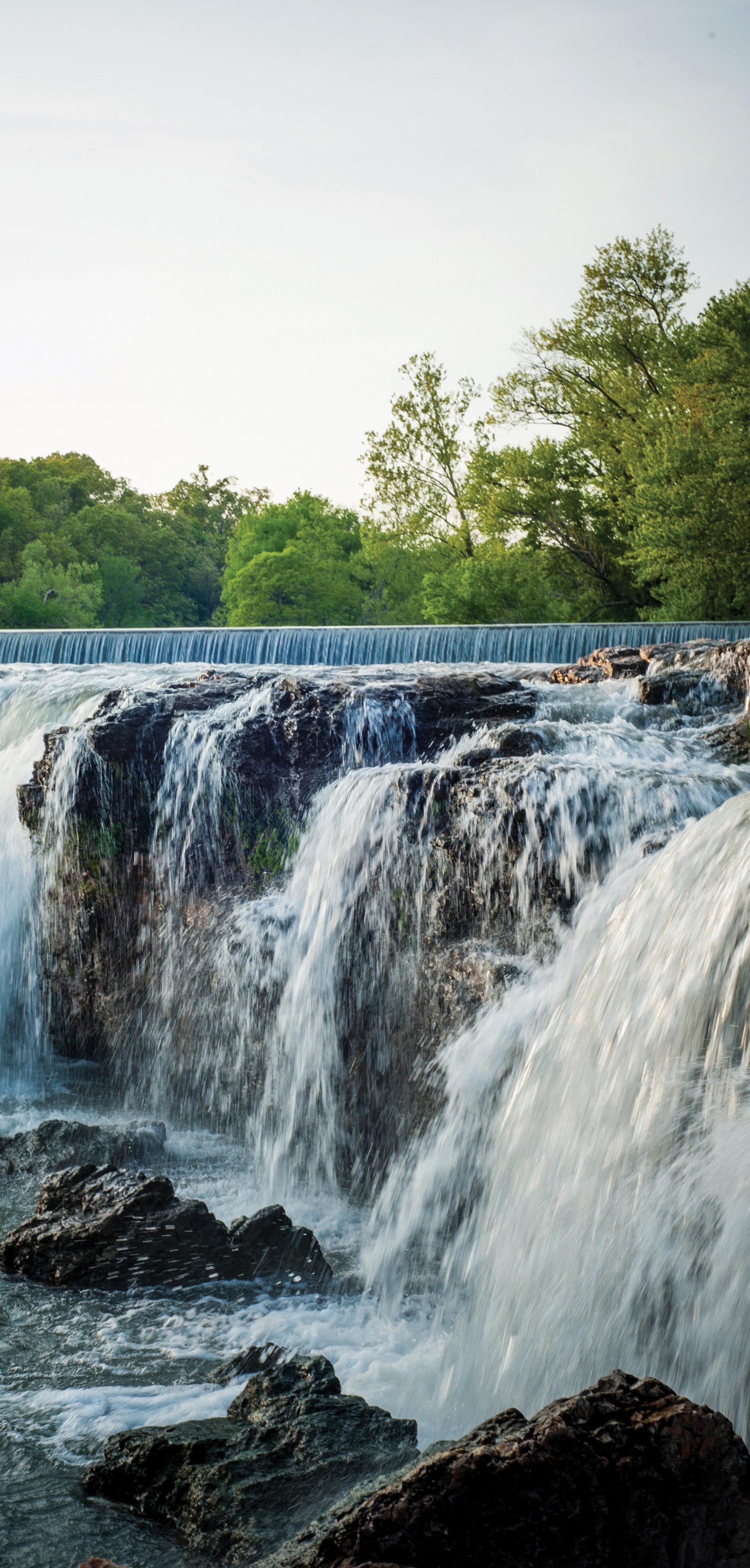
Grand Falls in Joplin is the largest continually owing waterfall in Missouri. According to visitmo.com “‘ e Falls’ plunges 12 feet down a 163-foot-wide ledge of solid chert, and is a must-stopphoto op.” Shoal Creek Conservation Education Center and Wildcat Glade Natural Area are downstream. Visitors can hike, check out wildlife and native plants as well as biking and birdwatching. A further drive at almost four hours from Columbia, this would be ideal for a weekend or longer get away. Nearby, families could also check out Spring eld in just over an hour and Branson almost two hours south.
Grand Falls
Riverside Dr. and Murphy Blvd. area, Joplin
238 miles from Columbia
Shoal Creek Conservation Education Center and Wildcat Glades Natural Area
201 W. Riviera Dr., Joplin
260 miles from Columbia
Ozark National Scenic Riverways is America’s rst congressionally designated national park for the preservation of a wild river system, according to visitmo.com. is park is 80,000 acres and has more than 300 each, caves and springs, and includes the awe-inspiring Current and Jacks Forks rivers. Visitors enjoy camping, swimming, riding the river currents, shing, exploring, equestrian trails, golf, hunting and relaxing in this vast national park. In addition to all of these natural wonders, the park is home to some historic sites and mills as well. With so much to do and with being roughly three hours from Columbia, this park would best be explored over a week’s vacation if possible. ere are many must-visit locations within the park or nearby, and include all of the following, plus more.
Main headquarters
404 Watercress Dr., Van Buren
220 miles from Columbia
Falling Spring is a small waterfall that stands thirteen feet and is year-round (wet falls). It has powered two mills, the second still stands today since 1920. is spring is part of the Mark Twain National Forest that surrounds the Ozark Scenic Riverways.
County Road 317 near Winona
210 miles from Columbia
Mina Sauk Falls near Ironton is the tallest dry (only visible after rains) falls at 132 feet. Visitors can hike a three-mile rugged and rocky loop to view it after rainfall.
Trailhead at Taum Sauk
Mountain State Park
148 Taum Sauk Trail, Middle Brook
185 miles from Columbia
Bollinger Mill is a Civil War era mill on the Whitewater River and runs tours year-round. Adjacent is another covered bridge, Burfordville Covered Bridge, that spans 140 feet. Both are on the National Register of Historic Places. Visitors can picnic and grill in the area.
113 Bollinger Mill Rd., Burfordville 230 miles from Columbia
Taum Sauk Mountain State Park is home to these falls and also to the highest point in Missouri which is Taum Sauk Mountain at 1,772 feet above sea level.
148 Taum Sauk Trail, Middle Brook
185 miles from Columbia
Alley Mill is the 7th largest in Missouri powered by 80 million gallons of water per day from Alley Spring. A short trail circles the spring in this area and according to visitmo.com it is the “most photographed spot in Missouri and part of the US Mint’s America the Beautiful quarter collection.”
12185 Alley Hollow Rd. Eminence
185 miles from Columbia
Rocky Falls is in Rocky Creek. Accessible by a challenging seven mile out and back hike, there is a deep swimming hole at the bottom of the falls that visitors can enjoy.
Rocky Falls Rd., Winona 210 miles from Columbia
Castor River Shut Ins on the Castor River near Fredericktown is accessible on a one-mile loop trail and is Missouri’s only pink granite shut ins.
County Road NN area, Fredericktown 190 miles from Columbia
Johnson’s Shut Ins is a favorite spot in the summer and holds views of the Black River on the Taum Sauk Trail any time of the year. e Elephant Rocks State Park is part of this area and as seen on visitmo.com is “Missouri’s most famous shut-ins and has earned a reputation as Mother Nature’s water park.”
142 Dillard Mill Rd., Davisville 155 miles from Columbia
Ready to go Show-Me Exploring in “ yover” country? With distances ranging from just under an hour’s drive up to four hours from Columbia, Missouri’s abundant beauty and unique historical sites are ready to be rediscovered.
You Can Still
HISTORIC ROUTE
66 MARKS ITS 100 TH ANNIVERSARY
BY STEPHI SMITH
WGet Your Kicks
hether you know it as “ e Mother Road” or “ e Main Street of America,” chances are you’re familiar with Route 66. As Nat King Cole sang, “It winds from Chicago to LA, More than 2,000 miles all the way,” and from St. Louis in the east to Joplin in the west, 317 of those miles are in Missouri.
As the historic highway celebrates the 100th anniversary of its birth this year, the State Historical Society of Missouri (605 Elm St.) is commemorating the occasion with rough the Windshield: Missouri’s Route 66 Exhibition. SHSMO is also hosting a traveling exhibition about Route 66 through July 31 with stops in Spring eld, Carthage, and St. Louis.
Route 66 Shows ‘The Business of America Is Business’
From its conception, Route 66 was a marketing project, according to Stacia Schaefer, senior strategic communications associate at SHSMO. With more people driving, there was
a need for a new highway to connect larger stretches of the country. Before Route 66, Schaefer said, traveling to another state was much less accessible. Missourians across the state wanted Route 66 to run through their community to drive economic development and tourism in their city or town.
“You don’t think in terms of highways having marketers,” Schaefer said, [but] “these people started from the very beginning marketing (Route 66) as the route to take to get west.”
And Missourians still want to claim pieces of Route 66. While Oklahoma businessman and highway commissioner Cyrus Avery is considered the “Father of Route 66,” his business partner was John Woodru from Missouri.
“In Missouri, we claim that we are the birthplace of Route 66 because [of] this guy right here,” Schaefer said, pointing to Avery. “He is an Oklahoma guy, although he spent a lot of time in Missouri. is guy, though,” Schaefer pointed to Woodru , “was a Missouri guy.”
A lawyer in Spring eld, Woodru served as the rst president of the U.S. Highway Association, an organization that pushed for the creation of Route 66. It was the association that promoted the new highway as the Main Street of America, since it connected hundreds of smaller, rural towns to major urban centers.
e roadway also served as a tourist spot in and of itself. e drive was the journey, as Americans took more “road trips” and traveled across the country on Route 66.
“ at is why we still talk about it today because it’s not just one place, but it was always a destination,” Schaefer said. “What other roads can you think of like that?”
Schaefer acknowledged that many Missourians may not consider Missouri a tourist destination, but with the state being at the center of the United States, countless drivers passed through Missouri, encouraging those who lived near the highway to strive for tourists’ attention.
And strive they did. Headquartered in Joplin, the Ozark Playgrounds Association was a multistate e ort to rake in tourism dollars as people traveled through multiple states on road trips across the county. A travel guide featured in the exhibit shows how the “Playgrounds of the Ozarks” aimed to lure visitors with the promise of shing, swimming, gol ng, boating, hiking, and camping activities in Missouri, Arkansas, and Oklahoma.
Four decades have passed since Route 66 was decommissioned in 1985, but its commercial appeal lives on. “Even today, we’re
“You realize this isn’t going to be there forever, and we’ve already lost so many of these places. … We can’t take it for granted that they’re always going to be there,”
still trying to vie for Route 66 because it’s still being marketed,” Schaefer said.
The SHSMO Team Hits the Road
While preparing rough the Windshield, Schaefer and her colleagues traveled the Missouri leg of the historic highway to document where Route 66 is now compared to where it was. She noted that some spots look nearly identical to the photos in the exhibit — like the Wagon Wheel Motel in Cuba — while others have been torn down or renovated to lose the kitschy chrome and mid-century Americana style that characterizes the Route 66 aesthetic.
“You realize this isn’t going to be there forever, and we’ve already lost so many of these places. … We can’t take it for granted that they’re always going to be there,” Schaefer said.
While the exhibit takes a visitor through each county the
highway travels, it doesn’t feature every tourist stop in Missouri, Schaefer added.
“We don’t even have some of the most famous places, … but we have some really fantastic stories.”
During their end-to-end tour of Missouri’s segment of the fabled highway, the exhibit team learned that Route 66 is a popular destination for people visiting the United States. As a result, their videotaped interviews include not only historians and people living or working near Route 66, but tourists from countries as far- ung as Sweden, France, and Japan.
Opportunity Knocked, and Missourians Answered
As Schaefer sees it, the long, winding history of Route 66 showcases Missourians’ entrepreneurial nature. As the Good Roads Movement progressed, and automobile lobbyists pushed for more roads in the United States, Missouri took advantage of the opportunity. SHSMO’s exhibit highlights Missourians who embodied that entrepreneurial spirit, like Arthur Nelson in Lebanon.
Nelson’s family owned an apple orchard, but disease and shipping costs were increasing throughout the country. So Nelson, a Good Roads advocate, donated part of his property for Highway 14 (a Route 66 precursor) and built a service station with restaurants, cottages, and a hotel near Route 66.
en there was the Wells family of Pulaski County, who started making and selling baskets at stores along Route 66 for income during the Great Depression. Later, the Wells would make baskets for the 1939 World’s Fair in New York City and expand the business to ship baskets across the country.
“ ere’s a lot of … what people think of as the American spirit or the American way of life, that’s moving with the punches,” Schaefer said. And that spirit found a place — many places, in fact — along the Mother Road.
A Name That Sells Itself
Even the name of the new highway was marketable. Schaefer said U.S. Highway Association o cials wanted to use the number 66 because “Route 66” was catchy and memorable. And they were right, judging by how often Route 66 shows up in popular culture.
e SHSMO exhibit includes a playlist of Route 66–inspired songs, including the classic “(Get Your Kicks On) Route 66” by Nat King Cole — although the SHSMO sta recommend the cover by St. Louis native Chuck Berry.
Other songs on the Route 66 playlist include “Way Down Watson” by Son Volt, which laments the demolition of Coral Court Motel on Route 66 in St. Louis, and “Chuggin’ on Down 66” by Smiley Burnette, which mentions Spring eld, whose Ozark Jubilee TV pro-
Missouri
gram once made it the musical rival of Nashville.
At the tail end of the exhibit is a picture of the Route 66 Neon Park, an open-air museum in St. Robert that showcases restored, vintage neon signs from real Route 66 businesses.
Schaefer said knowing the history of Route 66 is important to knowing the history behind infrastructure, automobiles, and the tourist economy in the United States.
“ at’s one reason that we exist: to document it and to try to keep something of it alive,” she said.
Route 66 Playlist
Will Rogers Highway
WOODY GUTHRIE, 1940
Chuggin’ On Down Route 66
SMILEY BURNETTE, 1954
(Get Your Kicks on) Route 66
CHUCK BERRY, 1961
Way Down Watson SON VOLT, 1997
King of the Road ROGER MILLER, 1965
Girl on the Billboard DEL REEVES, 1965
Take It Easy EAGLES, 1972
Tulsa Time DON WILLIAMS, 1978
Cadillac Ranch
BRUCE SPRINGSTEEN, 1980
Heartland U2, 1988
It’s time for a road trip. Driving distance from Columbia, maybe a weekend away. Where are you going and who’s going with you?
Not driving distance but still great! We just returned from Yellowstone and Grand Teton and spent the night under the Montana stars in a teepee with my best friend since third grade!
— TONYA HICKAM SCHLEETER
Holland, Michigan for the beach and dune buggy rides or Gatlinburg, Tennessee for the Smoky Mountains, scenic drives, hikes, and kids’ activities.
— BETH BRAMSTEDT
One summer, my husband and I took our three dogs to Bella Vista/ Bentonville area in Arkansas. We stayed in a pet-friendly Airbnb, did a cave tour, and played in a waterfall together as a family.
— LINDSAY ROSE JAMES
I love a summer road trip down to the Johnson’s Shut-ins/Elephant Rock area! It’s a fantastic place to camp with plenty of places to splash and hike around. I’m hoping to bring more friends along this year.
— ASHLEY LASITER
River District in KC with bestie from college.
Explore the quaint villages of Van Buren County, Iowa, just 50 miles north of our border, past the gigantic windmills in northeast Missouri. Don’t miss Misty’s Malt Shop in Keosauqua, Dutchman Store in Cantril, and Milton Creamery in Milton. ree hours from Columbia, yet so far away.
— JODIE JACKSON JR
Funky Town KC!!!
— ASHLEY BURK SWITZER
“Framily” weekend at the Lake of the Ozarks.
— NICOLE SHELBY
Hermann Inn B&B
— SUZANNE ROTHWELL
— BETH LEUENBERGER ORNS
Excelsior Springs. Stay at e Elms, 100-year-old hotel for spa day and lodging. Eat and partake at Casa Di Vita International Wine Cafe and shop at Willow Spring Mercantile. I’m going with my spouse or girl trip. Either way, it’s fabulous.
— TRISH HASSER KOETTING
Hermann with the girls. Eureka Springs, Arkansas, is also great. I’ve been for bachelorette parties and girls weekends!