
Standing the Testof me



Secure your legacy
Is your family prepared to carry on your legacy?
Successful families plan for the future — together. With over $124 trillion in wealth expected to transfer over the next 25 years, you need a team of seasoned private wealth management professionals to help guide you and your family through the in-depth estate planning conversations required to align on family wealth decisions.
Commerce Trust can assist with engaging your next generation on wealth habits crucial to preserving your family legacy. We draw on our deep bench of experience and capabilities to help prepare future generations of your family for the responsibilities that accompany significant, inherited wealth.
Our holistic, team-based approach to servicing clients means your team of estate and tax planning, investment management, and trust administration professionals will collaborate to guide you toward achieving your family’s goals while safeguarding your personal and family legacy.
Discover how Commerce Trust can help to secure your legacy through meaningful, family estate planning conversations and engagement. Contact Lyle Johnson, your dedicated Market Executive for Commerce Trust, at (573) 886-5324 or lyle.johnson@commercebank.com to secure your legacy.


The Benefits of Implementing Family Governance for HighNet-Worth Families
By Richard English, J.D., Managing Director–West Region, Commerce Family Office, and Brian Humes, CPA Managing Director–East Region, Commerce Family Office
Family governance refers to the framework and practices
high-net-worth families can use to align on family wealth decisions. The structure that family governance provides can also help engage the next generation of your family to accomplish your long-term goals together.
Why implement family governance?
Many high-net-worth families use family governance to promote the preservation of generational wealth by instilling values that shape how the next generation thinks about money. Effective family governance measures can also help your family make informed decisions regarding family wealth or plan for asset transfer in a structured manner.
Document
your family mission statement

A mission statement is a brief description of family values that serves as a guidepost for family wealth decisions. For example, if your family values higher education, your mission statement might reflect a commitment to lifelong learning and supporting educational institutions. If your family values charity, you may state that making a positive impact in your community should be part of your family legacy.
The benefit of documenting shared family values lies in aligning on a shared understanding of these matters to inform decisions made as a family.
Meet with family regularly to foster open communication
Holding family meetings allows families to reinforce family values and goals for family wealth, promote financial literacy by discussing strategies for building and preserving wealth, and address changes or upcoming family milestones that may impact decisions going forward.
Often, high-net-worth families have a smaller subset of family members who may form a family council. The family council acts similarly to a board of directors, providing governance and oversight of the family’s wealth and estate.
Some families divide responsibilities by creating committees to handle specific areas such as social events, charitable activities, or investments, promoting more effective decision-making and consistency in these matters.
Implement governance for specific assets
There may be special assets for which you want to implement governance, such as real estate, art, and collectibles.
For example, if your family will inherit personal property or real estate, family governance structures may define use and guest privileges, plan for maintenance expenses, or set guidelines for future ownership and potential sale. Similarly, if you have an art collection, you may want to document a plan for the management of the collection and its potential eventual transfer, as art often requires special care and can be illiquid.
of outright gifts, your family may assess whether establishing a charitable trust or contributing to a donor-advised fund offers advantages for the management and distribution of funds. Informed by these governance structures, families may determine that if income is generated or assets can appreciate in a charitable trust or donor-advised fund may have a more lasting impact than if funds were exhausted by an outright donation
TAILOR FAMILY GOVERNANCE TO
YOUR FINANCIAL GOALS
Effective family governance can establish a structure for high-net-worth families to help preserve wealth through multiple generations by implementing a framework that encourages communication and alignment around your goals for family wealth.
Contact Commerce Trust today at www.commercetrustcompany.com/estateplanning to learn more about how your private wealth management team can assist in the development and implementation of family governance structures aimed at ensuring you have the needed family decision-making, oversight, and communication mechanisms in place to keep family members aligned around the long-term goals of your estate plan.
Commerce Trust does not provide tax advice to customers unless engaged to do so.
The opinions and other information in the commentary are provided as of January 16, 2025. This summary is intended to provide general information only, and may be of value to the reader and audience.
This material is not a recommendation of any particular investment or insurance strategy, is not based on any particular financial situation or need, and is not intended to replace the advice of a qualified tax advisor or investment professional. While Commerce may provide information or express opinions from time to time, such information or opinions are subject to change, are not offered as professional tax, insurance or legal advice, and may not be relied on as such.
Data contained herein from third-party providers is obtained from what are considered reliable sources. However, its accuracy, completeness, or reliability cannot be guaranteed.
Commerce Trust is a division of Commerce Bank.
Investment Products: Not FDIC Insured | May Lose Value | No Bank Guarantee


Contributors
May 2026

Jenn Johnson
Jenn is a Columbia native whose love of writing kicked off with teenage poetry contests and leveled up to freelance gigs that helped pay the bills while she powered through college as a nontraditional student — earning both her bachelor’s in psychology and her master’s in criminal justice from Columbia College.
After graduation, Jenn served her community as a Boone County probation and parole officer, where her writing shifted from academic papers to the fast-paced, detail-driven world of report writing. Today, she brings that same discipline and heart to her role as a real estate coach while rediscovering her creative voice as a freelance writer for COMO Magazine/CBT.
When she’s not working, writing, or cheering on her three fabulous kids, Jenn is a proud dog mom to Archie, her lovable sevenyear-old lab. She enjoys time outside, time in the gym, and good ole time on the couch.
IN THIS ISSUE OF COMO
Building More Than Houses
PG 12
Sunitha Bosecker
Sunitha has written about a variety of lifestyle and food topics for our magazines, and she has shared her expertise as a mental health professional by contributing to our community “Voices” columns. She has been writing for COMO and CBT since August 2024 and has “greatly enjoyed the experience.”
Sunitha started her business, Sunitha Lea, LLC, in 2018 while completing her master’s degree in mental health clinical counseling at Stephens College in Columbia.
“I specialize in helping small businesses and nonprofits improve their marketing through strategy development,” she says. Sunitha is also a licensed mental health professional who is passionate about providing accessible, high-quality counseling services, from individual sessions to workplace mental health education.
In August 2025, she began her Ph.D. program in human development and family science at the University of Missouri.
Sunitha lives in Columbia with a miniature Australian shepherd named Ollie.
IN THIS ISSUE OF COMO
Build Your Bite at Sushi Fajita
PG 14
PUBLISHING
David Nivens, Publisher david@comocompanies.com
Chris Harrison, Associate Publisher chris@comocompanies.com
EDITORIAL
Jodie Jackson Jr, Editor jodie@comocompanies.com
Kelsey Winkeljohn, Associate Editor kelsey@comocompanies.com
Karen Pasley, Contributing Copyeditor
DESIGN
Jordan Watts, Senior Designer jordan@comocompanies.com
Lucia Kuepers, Junior Designer lucia@comocompanies.com
MARKETING
Charles Bruce, Director of Client Relations charles@comocompanies.com
Kerrie Bloss, Account Executive kerrie@comocompanies.com
Allie Teagarden, Account Executive allie@comocompanies.com
CONTRIBUTING PHOTOGRAPHERS
Arise Dwellings, Herman Black, Sunitha Bosecker, Charles Bruce III, Neel Das, Giving Gardens, Doug Hardesty, Ken Hirlinger, Lainey Howard, Randy Hughes, Andy Knoop, Hoss Koetting, Seungah Lee, Sara Mauer, Jim Robertson, Dennis Smarr, Abigail Wade, Kelsey Winkeljohn, Carrie Yonley
CONTRIBUTING WRITERS
Sunitha Bosecker, Olivia DeSmit, Kelly Hill, Lainey Howard, Jodie Jackson Jr, Jenn Johnson, Hoss Koetting, Brian Toohey, Emmi Weiner, Bradley Williams, Kelsey Winkeljohn
SUBSCRIPTIONS
Magazines are $5 an issue. Subscription rate is $54 for 12 issues for one year or $89 for 24 issues for two years. Subscribe at comomag.com or by phone. COMO Magazine is published monthly by COMO Companies.
OUR MISSION STATEMENT
COMO Magazine and comomag.com strive to inspire, educate, and entertain the citizens of Columbia with quality, relevant content that re ects Columbia’s business environment, lifestyle, and community spirit.
Copyright COMO Companies, 2026
All rights reserved. Reproduction or use of any editorial or graphic content without the express written permission of the publisher is prohibited.
FEEDBACK
Have a story idea, feedback, or a general inquiry? Email our editor at jodie@comocompanies.com.
CONTACT
COMO Companies | 404 Portland, Columbia, MO 65201 573-577-1965 | comomag.com | comobusinesstimes.com
The COMO Mojo: Go Touch Grass
Growing up, being outdoors wasn’t something I thought much about. It was just part of my daily routine. It was built into our school schedules, of course — my uniform-clad classmates and I spilling outside at every chance, collecting our fair share of skinned knees, gross bugs, and memories.
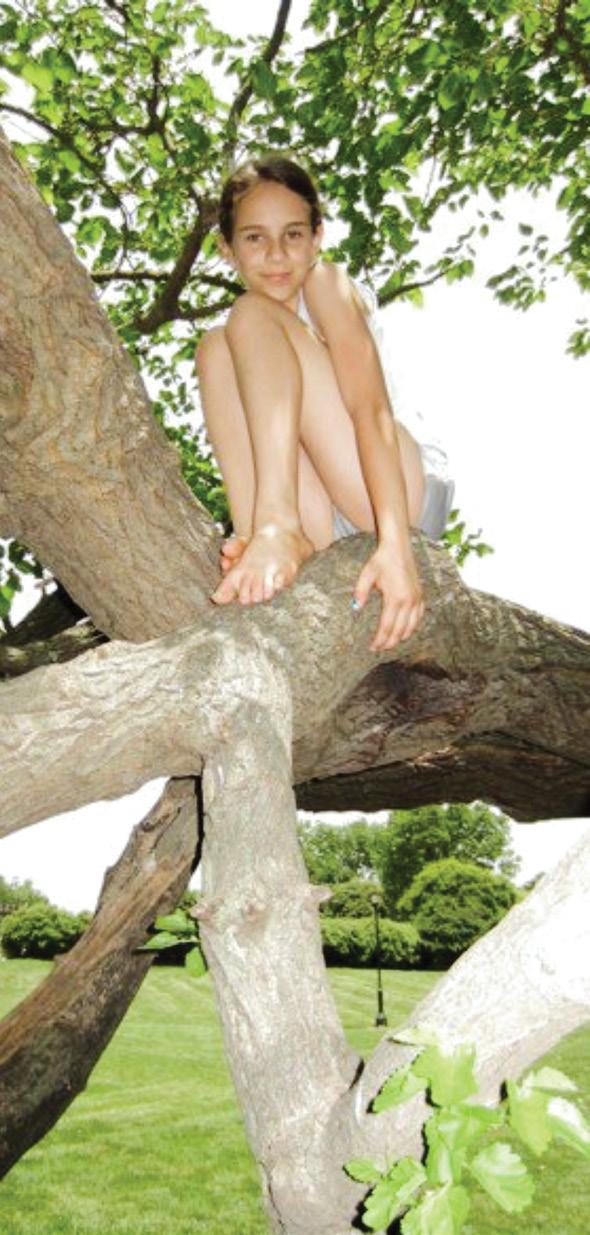
But after school was when the time really felt like mine. I’d rush home to practice my volleyball technique, play goalie for my next-door neighbor (who, remarkably, signed with the KC Comets in 2023), or stir up witches’ brew: a concoction of ower buds on the verge of blooming, water, and whatever sticks I could nd. Despite any warnings re anthills, sharp twigs, etc., I loved running barefoot through the grass, which was almost always a little wet with dew. At least, that’s how I remember it, anyway. And I loved the treehouse my grandma had at her art studio, just across the street from my childhood home, where I could sit, think, and write.
As an adult, being outside isn’t as automatic anymore. Unless your job requires it, you have to choose it intentionally. Even if it’s something you enjoy — biking, pickleball, running the trails — it often becomes secondary to other responsibilities. If you nd yourself up against a work deadline, there’s a good chance (if you’re anything like me) that you’ll chain yourself to your desk until it’s done.
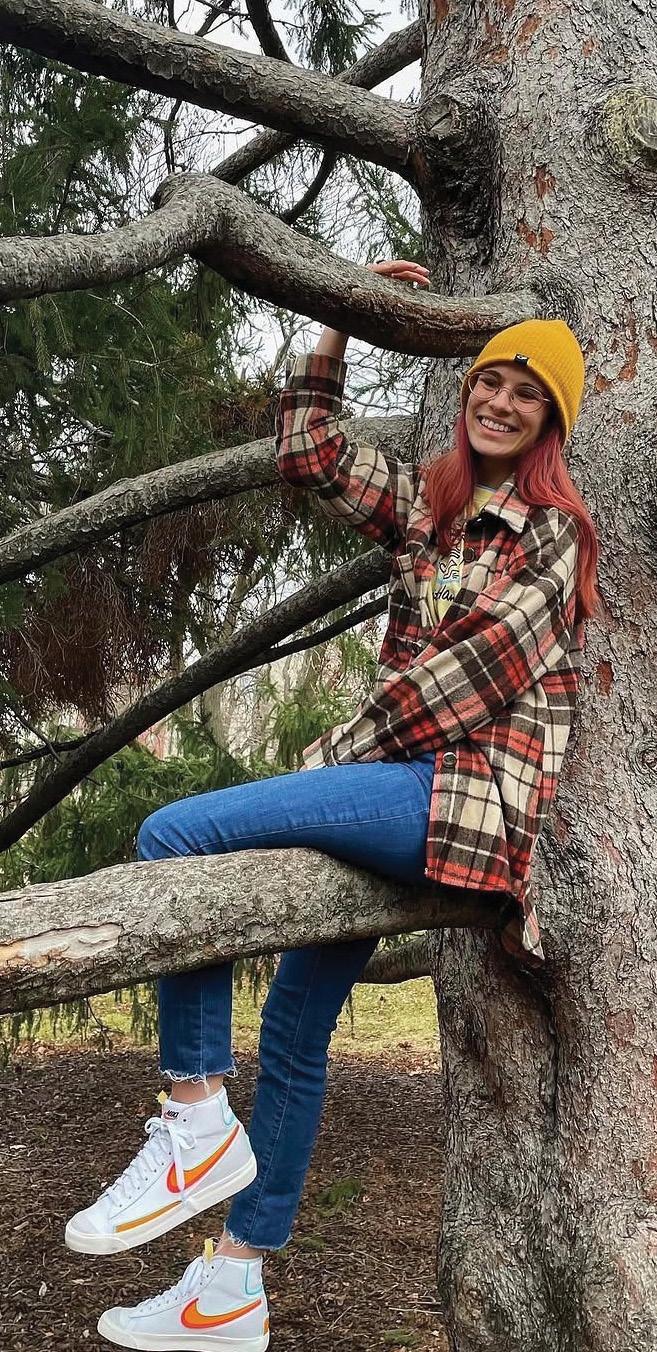
Right now, I’m participating in Leadership Columbia with the Chamber of Commerce. For those who may not be familiar with it, LC is a six-month annual program designed to develop and inspire emerging community leaders. rough a mix of engaging and insightful experiences, participants gain a deeper understanding of the opportunities and challenges shaping the community. What I didn’t realize, though, was how much it also teaches you about leading yourself.
One concept that has stuck with me is the rubber-and-glass-ball priniciple, which is a way to think about how we prioritize our time and energy. Imagine you’re juggling both. e rubber balls are the things that can bounce back if dropped, like emails, deadlines, and the day-to-day churn of work. e glass balls are di erent. ey’re the things that, if dropped, don’t recover so easily, like relationships, family, and health.
Inevitably, there are people who struggle to tell the di erence between the two. Many others instinctively keep their eyes on the obvious glass balls by making time for loved ones. But our own health — especially mental health — is easier to deprioritize. It may not shatter the rst time you drop it, but over time, it wears down, each impact leaving a little more of a fracture until, eventually, it needs real repair.
I’m starting to understand that time outside is one of those glass balls — for all of us. Fortunately, you don’t have to come prepared with an exhaustive list of outdoorsy activities to ful ll this need. Sit out in your yard or on your patio. Let your mind wander a little. Really feel the air, take notice of the season and its beautiful changes, and maybe, for once, allow yourself to do absolutely nothing but breathe.
Every now and then, I catch myself wondering if it was just childhood naivete that made life feel more vibrant and alive. en I catch myself thinking … maybe I just need to go touch some grass.


KELSEY WINKELJOHN ASSOCIATE EDITOR kelsey@comocompanies.com

ON THE COVER
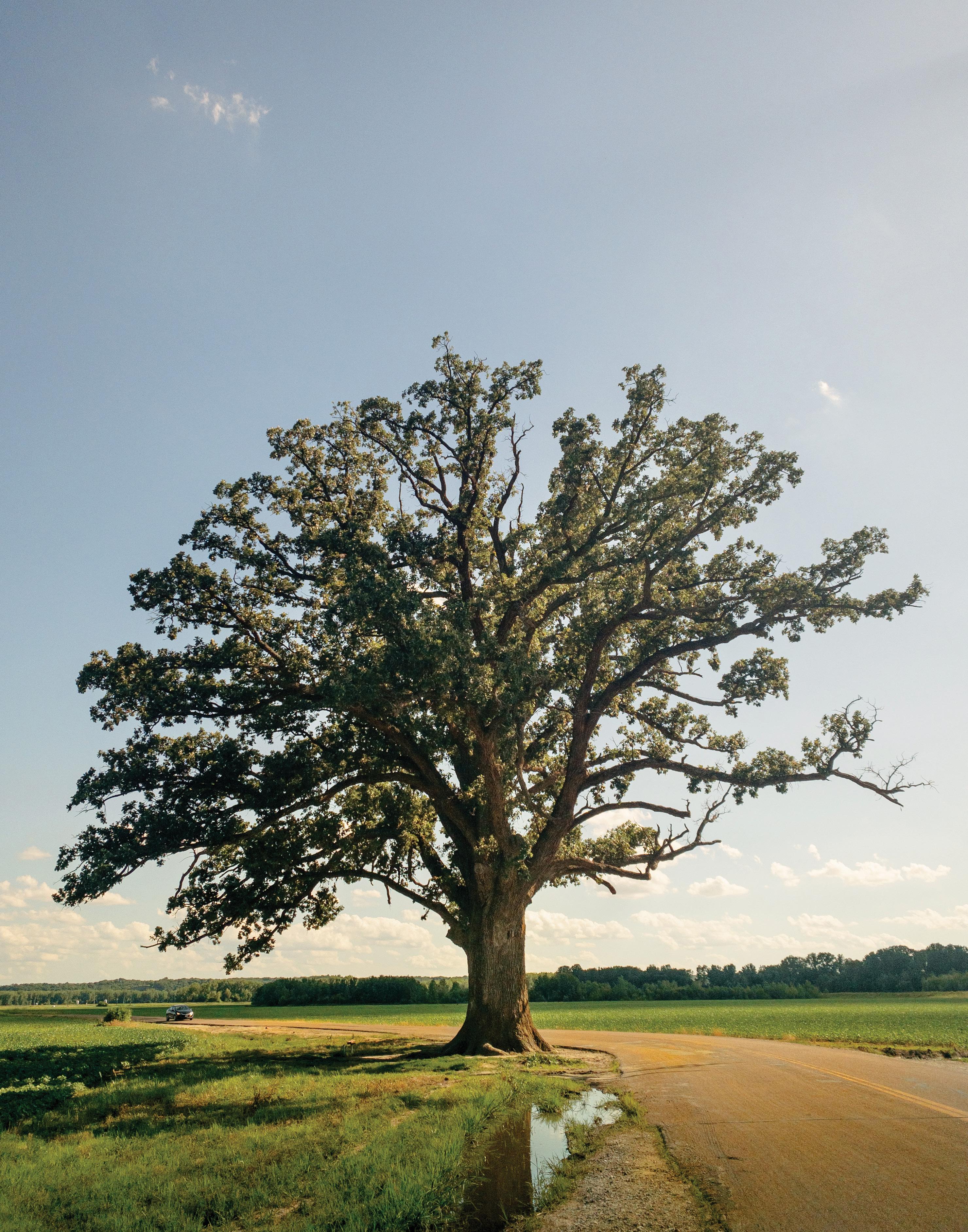
Columbia’s iconic Big Bur Oak stretches its leafy limbs beneath a glowing sun.
Photo by Charles Bruce III
Then vs. Now







Beware the Bugs That Can Really Bug You
How — and why — to keep yourself safe from the creeping, flying menaces of mid-Missouri.
BY LAINEY HOWARD
Suzanne Rothwell, associate vice president for advancement at Columbia College, knew something was wrong when she noticed that she had an itchy rash on her legs that wouldn’t go away. Worse, she’d been experiencing gastrointestinal symptoms that had her semi-convinced she was su ering from colon cancer.
“I’ve been having symptoms for about 10 years and thought, maybe I had colon cancer, but that wasn’t it, and then they thought I had a certain kind of dermatology issue, and that wasn’t it,” Rothwell recalled. After having about 12 blood tests done in one day, she got a call from her doctor’s o ce with some good news and some bad news.
e good news was that she didn’t have cancer. e bad news was that she had been diagnosed with alpha-gal syndrome — and the disease was not curable.
COMING TO GRIPS WITH ALPHA-GAL
In the United States, alpha-gal syndrome is most often caused by the bite

of the Lone Star tick, which can be identi ed by the one white spot on the female’s back. As a dog owner who likes to hike in the woods, Rothwell is sure she was bitten by a tick at some point.
People who get the disease experience mild to intense allergic reactions after eating red meat, dairy, or other products (e.g., gelatin) from mammals. is is due to the alpha-gal molecule that attaches to the tick and causes the human body to react di erently to proteins found in these foods. Alphagal syndrome is diagnosed using a disease-speci c blood test.
“ e good thing about a diagnosis is that you know what to avoid so that the symptoms are not as severe,” Rothwell said. After getting her diagnosis, she was able to identify triggers and learn how to manage her symptoms. A special compound ointment and a prescription antihistamine help relieve Rothwell’s itchy rash, and she manages her gastrointestinal symptoms with food avoidance and knowing what is safe to eat.

Lone Star Tick Mosquito
Although Rothwell can no longer down a juicy cheeseburger and chase it with a chocolate shake, she still nds plenty of dining options. “ e rule is anything that comes from hooves is not OK, but ns and feathers are ne,” Rothwell said. “No matter where I go, I can always nd something to eat.”
While she doesn’t have the breathing issues that can come along with alpha-gal, she has still been advised to carry an EpiPen, as symptoms can come out of nowhere.
“Everyone’s symptoms tend to be a little bit di erent, and everyone’s triggers are also a little bit di erent, and people have di erent severities,” Rothwell said. Her advice to others who have alpha-gal is to “Just hang in there. It’s not the end of the world.”
And while there’s no actual cure for the condition, it’s possible that the allergy could eventually ease up on its own. According to the Missouri Department of Health and Senior Services website, “Some people may be able to eat red meat again if they avoid new tick bites for a long time. is is di erent for everyone, so talk to your doctor about what’s best for you.”
TICKING OFF THE BOXES
While alpha-gal syndrome has been grabbing headlines recently, it’s hardly the only tickborne illness mid-Missouri is home to. Probably the most widely known tickborne illness is Lyme disease, which often — but not always — signals its presence with a bull’s-eye rash near the bite location. Symptoms of Lyme disease are u-like, with enlarged lymph nodes, muscle and joint pain, a sti neck, fever, headache, and fatigue. Other tickborne diseases found in Missouri are Rocky Mountain spotted fever, ehrlichiosis, tularemia, Heartland virus, and Bourbon virus.
e best way to avoid ticks is to use an insect repellent spray that is speci cally formulated to deter them. Apply it thoroughly when you know you are going to be outside for long periods of time.
Another tick-shunning strategy is to watch your step. “If you are going to be out on a trail, hiking or something, make sure you stay as close to the middle of the path as you can,” advised Austin Krohn, public information specialist at Columbia/ Boone County Public Health and Human

Services. It is best to keep a good distance away from the tree line and bushes to avoid picking up any ticks.
SKIRTING THE SKEETERS
Mosquitos are another illness-bearing bug that comes out when the weather begins to warm. West Nile virus is one of the mosquito-related diseases to watch out for. As with Lyme disease, the symptoms are often u-like, such as body aches, headaches, and fatigue. Sometimes even brain swelling called encephalitis can occur.
Even though this disease is something to be on the watch for, Boone County didn’t have a case of West Nile virus last year. “It’s not transmissible once you have it; you can’t give it to another person,” Krohn explained. However, county health o cials are still monitoring this disease — along with other mosquito-borne illnesses, such as the Zika virus — especially in the warmer weather.
As with ticks, it’s best to use a good insect repellent to ward o the mosquitos. is, along with wearing clothes that cover your skin, is the main deterrent for these blood-sucking bugs.
“The important thing is, if you find a kissing bug, do not kill it or crush it. Use gloves or tweezers to place it in a clean container and contact us at the Health Department, and we will be able to send it off for testing at the state to see if it carries that disease.”
— Austin Krohn, Columbia/Boone County Public Health and Human Services
Kissing Bug
KEEPING AWAY FROM KISSING BUGS
Talk about adding insult to injury: After a “kissing bug” climbs onto your face during the night and bites you near your mouth, it will poop on you. If you happen to rub your eyes or mouth upon waking, those parasite-laden feces can give you Chagas disease.
While this illness is still relatively rare in the United States — it’s more commonly found in Mexico and Central and South America — cases have been reported in Missouri. According to a 2024 article published in the Journal of Medical Entomology, the kissing critters that cause it have been found in at least 15 counties in Missouri — and Boone is one of them.
It can be hard to notice Chagas disease for the rst few weeks to months. However, it is known to produce fever, fatigue, body aches, rashes, as well as eyelid swelling. More ominously, the disease can also eventually lead to heart and digestive issues.
“ e problem with Chagas disease is that you may not even know you have it until later when you have these heart or digestive problems,” Krohn said, “so it is good to get it looked at early if you suspect something is wrong with you.” A blood test can reveal whether you’re su ering from this parasitic infection.
Kissing bugs, which are usually between ¾ and 1¼ inches long and have a at, oval-shaped body, crawl into houses through open windows or cracks and crevices in the walls. ey are often found in woodpiles and animal bedding, which causes them to be more prevalent on farms.
To prevent kissing bugs from getting inside your home, seal the areas around your windows, doors, walls, and roof so there are no cracks or gaps. Ensure screens on windows and doors are in good repair. Also keep piles of brush, wood, or rocks away from your home. Finally, direct outdoor lights away from your sleeping areas so as not to attract the bugs at night.
“ e important thing is, if you nd a kissing bug, do not kill it or crush it,” Krohn said. “Use gloves or tweezers to place it in a clean container and contact us at the Health Department, and we will be able to send it o for testing at the state to see if it carries that disease.” If so, you can be treated with an anti-parasite medication.
BANISHING THE BUGS
Summer is just around the corner, and these upcoming months are the best time to enjoy the warm weather. ere are many fun summer activities such as hiking, camping, and swimming that involve being outdoors. But whether you head outside or stay inside, take steps to keep the bugs at bay. You don’t want insect-borne illness to put a crimp in your summer fun.
Codi is a loan service representative at our Centralia branch! She is never apprehensive in taking on new tasks or challenges and always does so with a positive attitude. She is also a problem identifier and solver. She is extremely dedicated and will put in whatever time and effort is required to always get the job done correctly and on time. Codi truly exemplifies Legendary Service!
573-874-8100 • centralbank.net/boonebank







Building More Than Houses
Arise Dwellings offers a new kind of welcome.
BY JENN JOHNSON
On a quiet street in Columbia, a once-forgotten house hums back to life. Fresh paint catches the light, the porch feels sturdy underfoot, and inside, the space holds the promise of something deeply personal: a rst home. For many families, this moment would have felt impossible just months earlier. Credit challenges, rising rents, and uncertainty about the buying process can make homeownership feel like a locked door. Arise Dwellings of Mid-Missouri exists to help open it.
For co-founders Scott Claybrook and Nick Timberlake, the work began not as a formal initiative, but as a response to real stories unfolding around them. Friends, neighbors, and community members were facing sudden evictions, una ordable rent increases, and limited pathways to stability.
“We saw a bottleneck of problems living at the intersection of rising rents, real estate instability for the working class, knowledge gaps, and a lack of upward mobility through quality housing,” Claybrook said. “ ese weren’t abstract issues. ey were a ecting people we knew and cared about.” at urgency led to action. Launched in 2023 with a single home, Arise Dwellings has grown quickly, completing 26 homes by early 2026. Its model is focused: renovate existing homes and prepare them for rst-time buyers with built-in equity from day one.
For many rst-time buyers, the challenge isn’t desire, it’s access. Financial setbacks, limited savings, or unfamiliarity with the process can prevent families from moving forward with homeownership. Arise Dwellings addresses these barriers through a relational approach that prioritizes long-term readiness over quick transactions.
Families connect with Arise in a variety of ways: through referrals from local churches, nonpro t partners, community relationships, or direct outreach. From there, each journey is tailored.
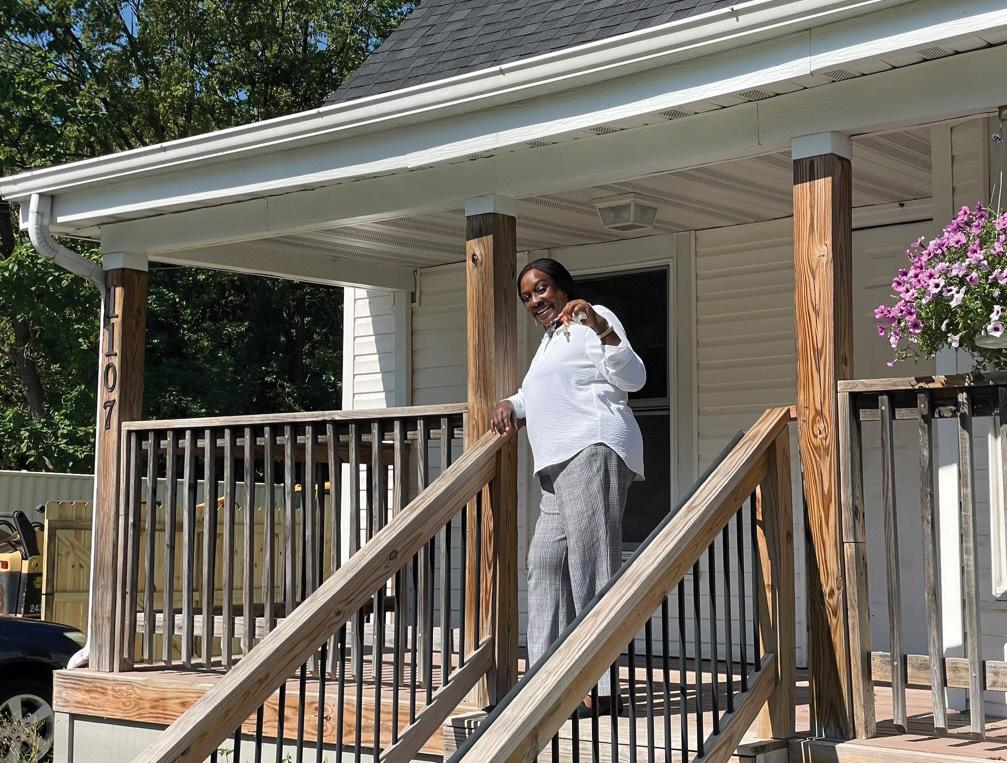
“When a family approaches us, we take a tailor- t approach to see what they need and how we can help,” Claybrook said. “Some families are six, nine, or even 12 months out from readiness, and we walk with them through that.”
Preparation often includes nancial coaching and homebuyer education, particularly through a close partnership with Love Columbia. at organization’s coaching programs and homeowner classes help families build credit, understand the buying process, and access down payment assistance through HUD-supported programs and other grants. Arise Dwellings has also expanded this e ort through its First-Time Homebuyer Collective, a structured, multimonth program designed to equip families for sustainable homeownership.
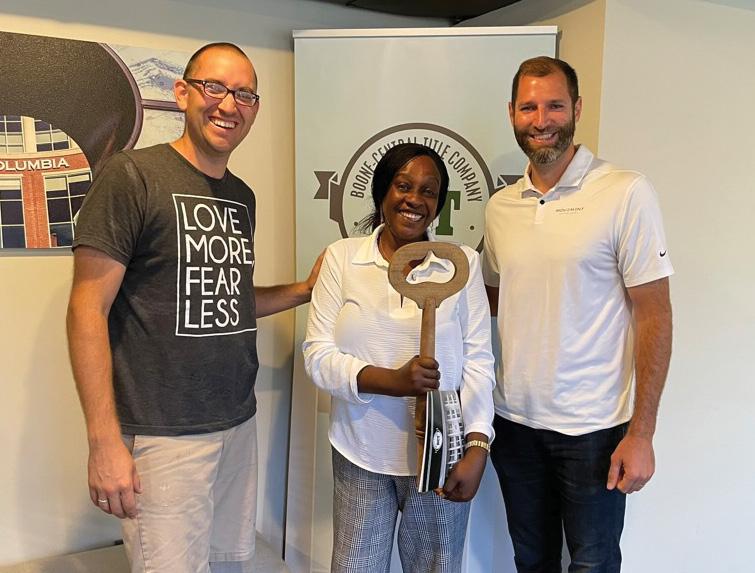
From left, Scott Claybook, co-founder and executive director, and Nick Timberlake, co-founder and board president, stand with new homeowner Caritas Habimana to demonstrate the lifechanging goal of The Arise Dwellings of Mid-Missouri.
Still, the organization’s goal is broader than selling its own homes.
“Our goal is not necessarily to sell one of our homes,” Claybrook said. “Our goal is to help families take the next best step for them.” at might mean purchasing an Arise home, working with another nonpro t developer, or nding the right opportunity in the open market.
Support doesn’t end at closing. Arise continues to check in with homeowners, o ering guidance on maintenance and helping them stay connected to a growing network of rst-time buyers. at longterm investment re ects a commitment not just to access, but to stability.
Arise Dwellings of Mid-Missouri, Inc.
VISION
As a faith-based nonprofit, we’ve set out to build a pipeline of transformation through home renovation capable of touching neighborhoods, generations, business owners, and diverse cultures through the platform of the home.
We are committed to the deep work of restoration. Working deeply into homes, neighborhoods, families to see transformation inside and out.
BOARD OF DIRECTORS
• Nick Timberlake, president, Movement Custom Homes
• Reuutasha Belcher-Harris, secretary, Columbia African American Business Alliance
• Julian Jackman, vice president, Peace Program
• Brandon Kalista, treasurer, Mid-America Bank
• Robyn Lefler, board member, Columbia House of Brokers
• D’Markus Thomas-Brown, board member, city of Columbia
• Scott Claybrook, executive director
BRINGING NEW LIFE TO EXISTING HOMES
A de ning feature of Arise Dwellings’ work is its focus on renovating existing housing stock rather than building new homes. In Columbia’s central neighborhoods, vacant lots for new construction are increasingly rare, while many older homes remain underutilized or in disrepair.
“ e availability of existing housing stock creates a great opportunity for neighborhood stabilization,” Claybrook said. “It allows us to step into a space that isn’t being widely addressed and bring new life to homes that already exist.”
is approach complements, rather than competes with, other local housing e orts. Organizations like the Anderson Homes Foundation, Central Missouri Community Action, Job Point, and the Columbia Community Land Trust are actively building new construction homes throughout the city. Arise Dwellings intentionally focuses on restoring existing properties to expand access to housing and strengthen established neighborhoods.
“ ese are complicated projects,” noted Claybrook. “ ey’re not cookie-cutter, but we’ve built relationships with experienced renovators who help us create consistency and quality while keeping prices accessible.” e impact of this work is especially visible in the North Central neighborhood. In 2023, Arise Dwellings acquired 17 properties in a concentrated area that had long struggled with neglect and safety concerns. Many homes were severely dilapidated, and vacant spaces contributed to instability.
“ e result has been an entirely changed experience for that part of the neighborhood,” Claybrook said. “We’ve seen new homeowners step in and a renewed sense of strength take hold.” e e ort built on existing momentum in the area, including nearby developments like the Cullimore Cottages led by the Columbia Community Land Trust and partnerships with the Anderson Homes Foundation, which continued development on several of the lots.
A COLLABORATIVE MODEL FOR LASTING IMPACT
Collaboration is central to how Arise Dwellings operates. Claybrook emphasizes that the organization’s progress is rooted in partnerships across the community.
“It’s all about relationships,” he said. “None of what’s been accomplished has been because of our own merit. It’s been through community collaboration.”
Local churches provide a backbone of support, o ering volunteers, funding, and relational connections that help identify and support families. Nonpro t partners like Love Columbia play a foundational role in education and mentorship, bringing experience and stability to the homebuyer preparation process.
Arise also works alongside more than 50 local contractors who carry out renovations. ese partnerships extend beyond construction. “We see the building up of local contractors and their businesses as part of the broader transformation,” Claybrook said. “It’s about strengthening the local economy as well as the homes themselves.”
Financial support from donors, investors, foundations, and local banks helps make the model sustainable. As Claybrook noted, “Every time someone contributes, whether it’s materials, funding, or low-interest capital, it directly lowers the cost for rst-time homebuyers.”
As Arise Dwellings continues to grow, its focus remains on steady, sustainable expansion. e organization aims to renovate 10 to 12 homes each year, with plans to increase capacity while maintaining quality and a ordability.
Beyond construction, there is a growing emphasis on education and community impact.
“We believe an equipped community will equip others,” Claybrook said. “When families gain access to homeownership and equity, it creates a ripple e ect through economic development, neighborhood stability, and long-term opportunity.”
For Claybrook, Timberlake, and the broader Arise Dwellings team, the vision extends far beyond individual homes. It’s about creating pathways for families to invest in their futures and contribute to stronger neighborhoods.
In a housing market that often feels out of reach, Arise Dwellings o ers a di erent model — one rooted in relationships, collaboration, and practical care. Each restored home represents more than a renovation; it marks the beginning of a new chapter for families and communities alike.
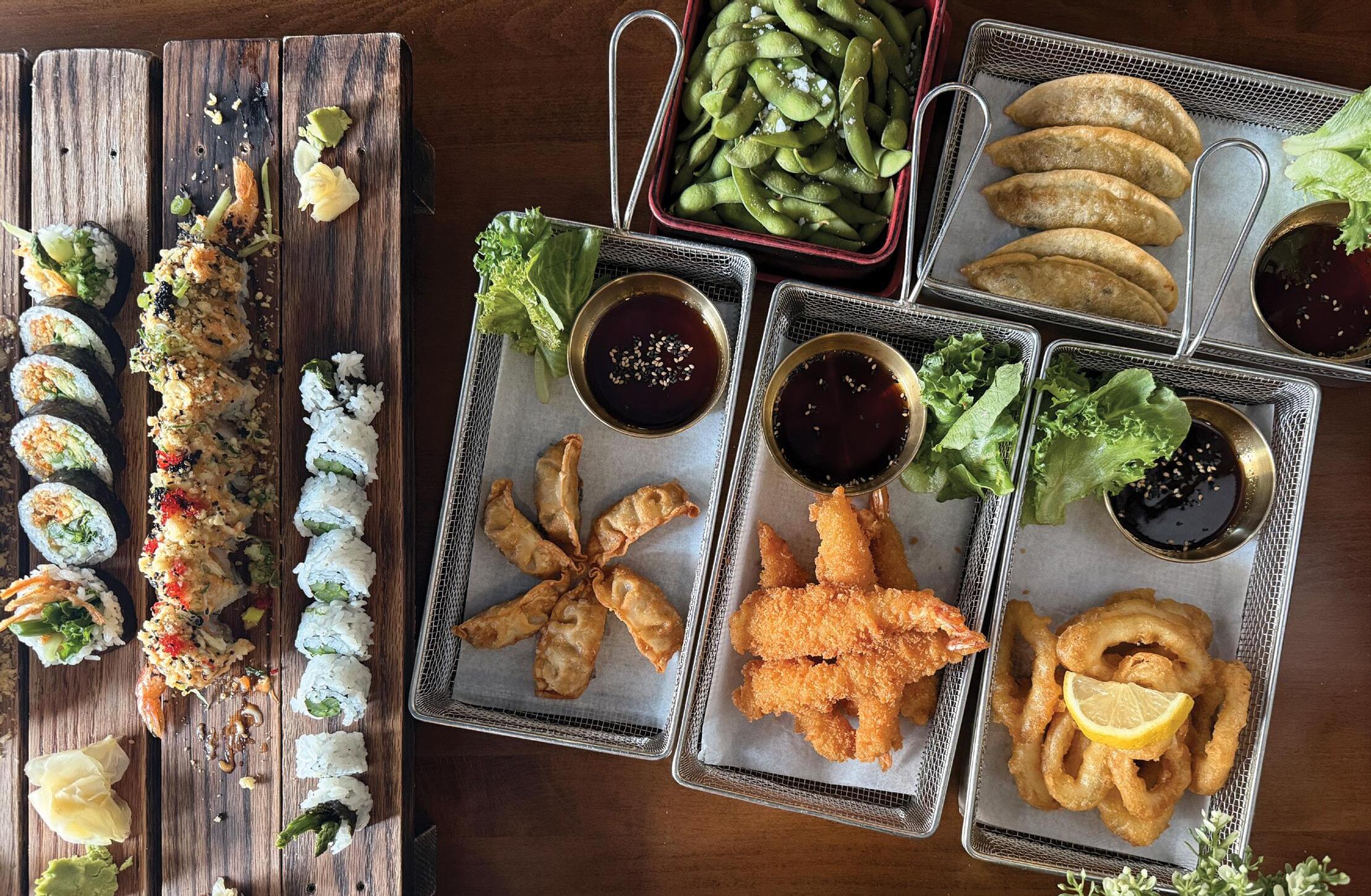
AT SUSHI FAJITA
PHOTOS AND STORY
BY SUNITHA BOSECKER
On a recent evening in Columbia, I found myself stepping into a space that felt both new and oddly familiar. Warm wood panels lined the walls, the design was clean and intentional, and the atmosphere struck that balance between casual and curated. It’s the kind of place you’d expect to stumble upon in Austin, a little tucked-away, a little buzzy, and quietly con dent in what it’s o ering. But this isn’t Texas. is is Sushi Fajita, one of Columbia’s newest restaurant concepts, led by longtime restaurateur Kwang “Kory” Yoo.

Photo by Seungah Lee
At rst glance, Sushi Fajita feels simple. ere’s a large booth section that invites groups to settle in, while smaller tables create a more intimate setting, ideal for date nights or catching up with a friend. e sta is welcoming, and while the beverage menu is still growing, the current o erings — mocktails in mango, grapefruit, and lime — are bright, refreshing, and thoughtfully done.
But it’s the food that shifts your expectations.
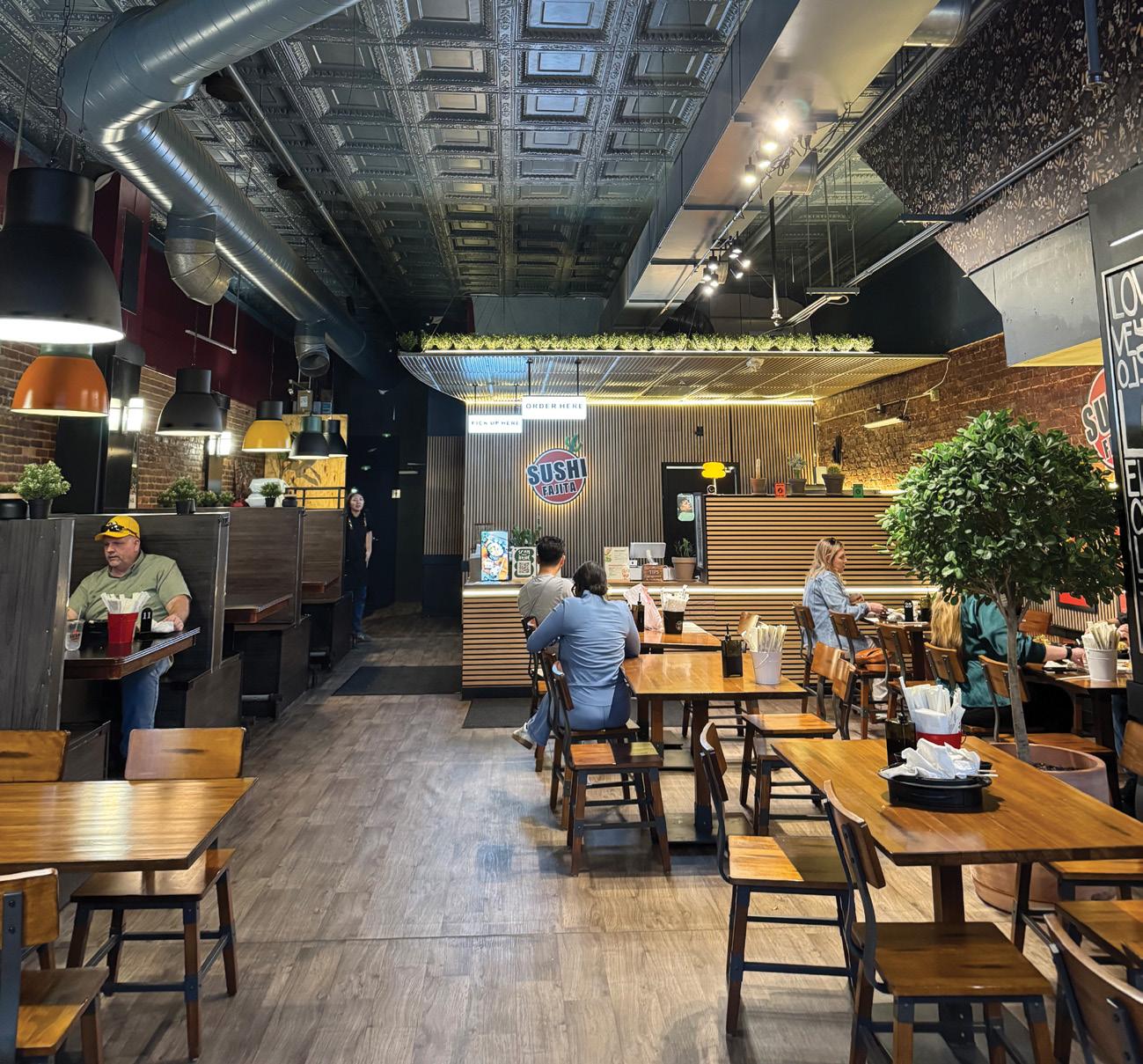
e name “Sushi Fajita” might initially feel like a contradiction, two cuisines meeting in a way that doesn’t quite make sense until you experience it. And then it clicks. Instead of tortillas, you’re handed sheets of seaweed. Instead of pre-rolled sushi, you’re building your own bite. It’s interactive, a little playful, and surprisingly intuitive.
“Sushi Fajita was created as a natural evolution of my journey,” Yoo says. “After operating Geisha for nearly 18 years, I felt it was time to create something new. I’ve always enjoyed challenging myself creatively, and I wanted to build something more interactive, fun, and modern.”
For many in Columbia, Yoo’s name is already familiar. He’s been behind several concepts over the years, including Geisha Sushi Bar, which served the community from 2009 until its closing in late 2025, and I Am Sushi Burrito. Each restaurant re ected a di erent chapter in his career and a di erent way of thinking about how people connect with food.
With Sushi Fajita, the goal is clear: make sushi more approachable.
“My vision is to make sushi more interactive, customizable, and comfortable,” Yoo explains. “It’s not just about eating, it’s about sharing, exploring di erent avors, and enjoying the moment together.” at philosophy comes through immediately when the food arrives.

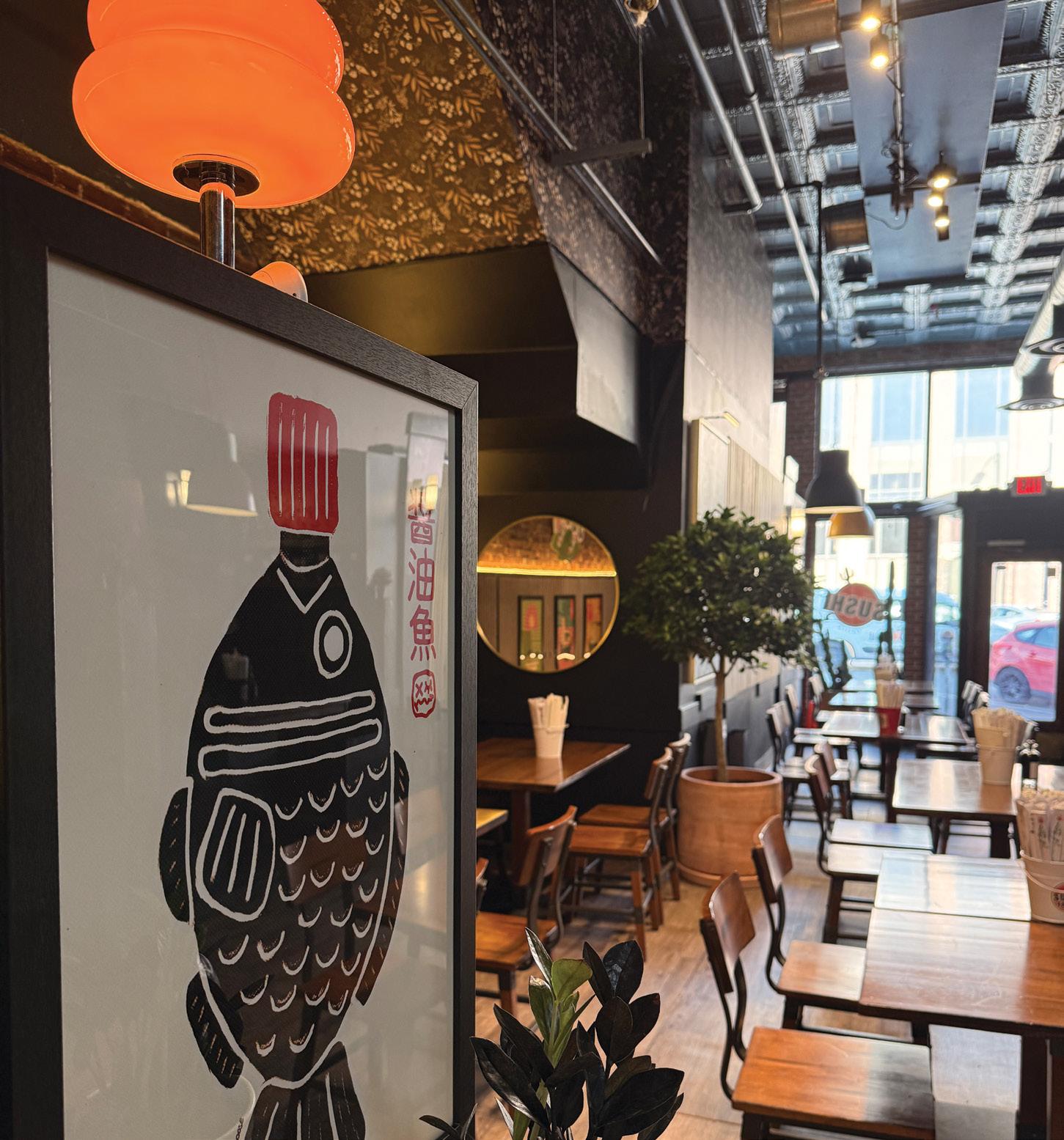
Photo by Seungah Lee


e restaurant’s signature item, the Sushi Fajita, is both the namesake and the experience. You choose your protein (or vegetarian option), and it arrives with a thoughtful spread of ingredients: spring mix salad, sushi rice, fried carrots, pickled radish, shrimp tempura, avocado slices, kimchi, and more. From there, you build. Each bite becomes a small act of creativity, shaped by your own preferences. When you’re done assembling, there are a few sauce options to drizzle on your sush-ita.
I’ll admit, the rst bite surprised me. ere’s a moment of recalibration when you realize your “shell” is seaweed rather
than something warm or familiar. But once your taste buds catch up, it all comes together in a way that feels both balanced and a little addictive. It’s sushi, but it’s also something else entirely. at sense of discovery is exactly what Yoo was hoping for. “To me, ‘Sushi Fajita’ is a very intuitive name,” he says. “It represents the idea of building your own sushi, just like fajitas. It’s about customization and making it your own.”
And it seems Columbia is ready for it.
“What surprised me the most is how quickly people embraced the concept,” Yoo notes. “Customers really enjoy being able to customize their experience and
try di erent combinations. It’s been exciting to see people come back and explore new options each time.”
For those who prefer something more familiar, Sushi Fajita o ers a nod to Yoo’s roots. Traditional rolls, reminiscent of his Geisha days, are still on the menu, with the White Tiger Roll standing out as a recommended favorite for newcomers.
e restaurant o cially held its soft opening on February 5, with a grand opening planned once the nal touches, such as signage, are complete.
And for Yoo, this is only part of what’s ahead. He’s already looking toward his next venture, a steakhouse planned for Columbia’s Arcade District later this year. Still, Sushi Fajita feels like a meaningful moment in his story. It’s not just another restaurant, but a re ection of years of experience, risk-taking, and a willingness to evolve.
Yoo’s journey started, like many in the industry, with a part-time job in a kitchen during college. From there, he worked his way up to head chef, eventually realizing a dream of owning his own restaurant. Now, more than two decades later, that dream continues to shift and expand.
Maybe that’s what stands out most about Sushi Fajita. It’s not just about reinventing sushi; it’s about rethinking how we experience food altogether.
e process invites you to slow down, to build something with your hands, to share the making with the people at your table. It’s familiar and new at the same time. In a city like Columbia, where the food scene continues to grow and surprise, that kind of creativity feels right at home.
SUSHI FAJITA
804 E Broadway, Columbia, MO 65201 sushifajita.com | @sushifajita
Hoss's Creamy Sweet Onion Dressing
BY HOSS KOETTING
It looks like we’re in full-on spring in COMO! ere’s the roller-coaster weather that we’re famous for, but hopefully we are done with the seriously cold temps until October. A true gem of mid-MO, the Columbia Farmers Market, is rocking on Saturday mornings. Where else can one go and enjoy a beautiful morning, listen to live music, nosh on some freshly baked treats, and have a locally roasted co ee, all while getting your knives sharpened and sorting through myriad locally grown, raised, and prepared items for your upcoming meals?
is time of year, there is a copious supply of spring greens: mesclun; oak leaf, Black Seeded Simpson, and Bibb lettuce; spinach — you name it. ere are many ways to present these greens, either solo, as a mixed blend, or tossed with a protein to make a full-meal salad.
Back in the day, when we were trying to come up with new menu items at Hoss’s Market, we would poll our sta for new ideas, and we’d get some o -the-wall suggestions. In 2006, one of these was a salad recipe from our chef, Janet, and although I thought it was pretty odd, we decided to give it a shot.
We started with a base of mixed greens, then added diced fresh tomatoes, red onion slices, toasted sliced almonds, sweetened dried cranberries, and the piece de resistance, four discs of fresh goat cheese — chèvre — breaded and deep fried! Tossed with a sweet onion dressing, the sharp greens, paired with the breaded, gooey goat cheese topping, created the perfect balance of sweet and savory.
is, as with all of our signature salads, had to be served in a Pyrex pie plate, which Trish required so that the salad ingredients didn’t fall o the side of the plate. What I thought was a crazy idea turned out to be one of our best-selling salads: the Hoss’s Fried Goat Cheese Salad, paired with our Creamy Sweet Onion Dressing.

Jim “Hoss” Koetting is a retired restaurateur/chef who enjoys gardening, good food, good bourbon, and good friends.
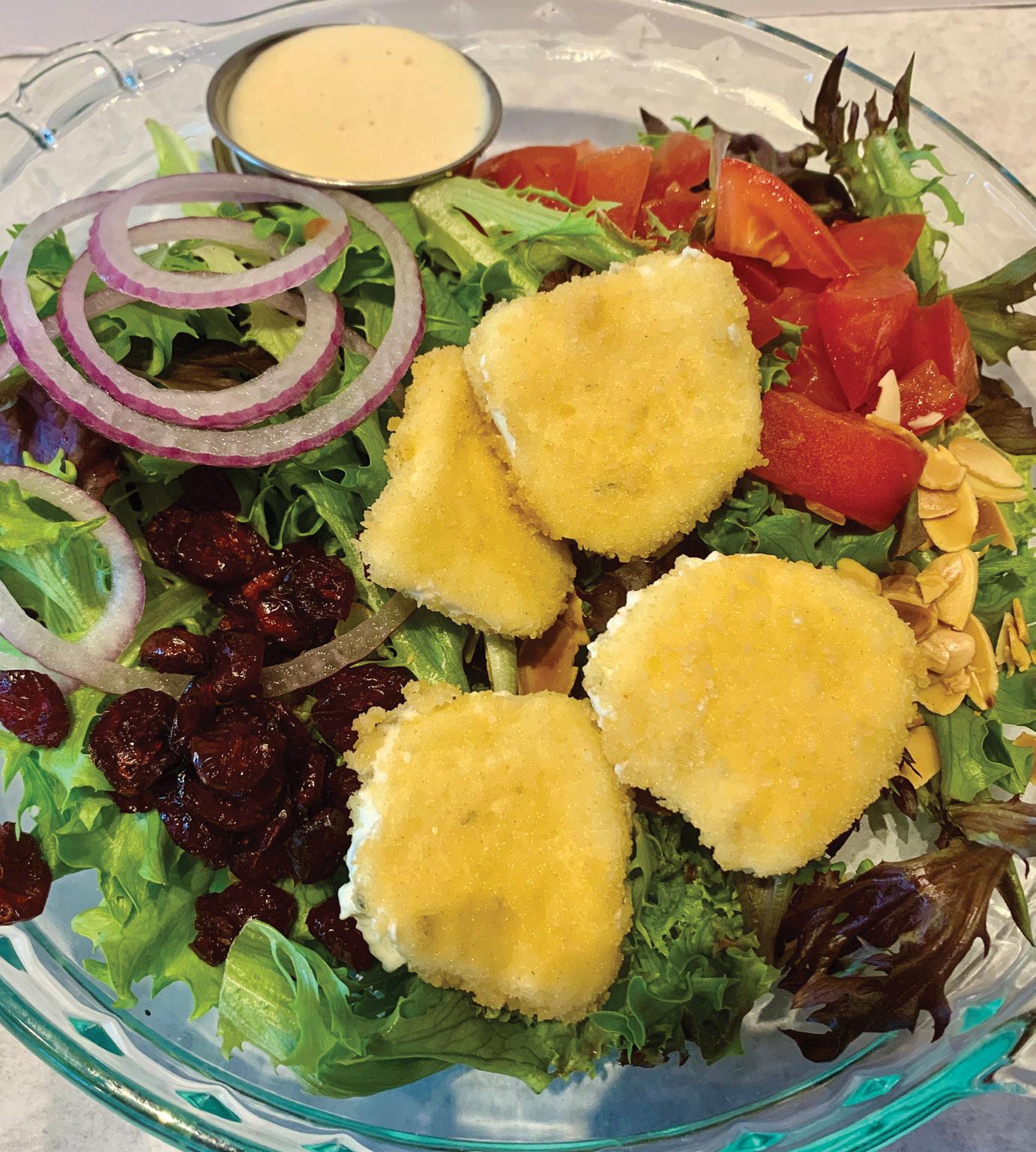
INGREDIENTS
• 1½ cups sugar
• 2½ tsp. ground black pepper
• ⅓ cup Dijon mustard
• 2 tsp. celery seed
• 1 pint pureed yellow onions
• ½ cup white vinegar
• ¾ cup white balsamic vinegar
• 1 tsp. Hoss’s steak seasoning
• 2½ Tbsp. minced fresh garlic
• ¾ quart mayonnaise
DIRECTIONS
1. Blend all ingredients except the mayonnaise, 2. Once blended, incorporate the mayo. Keep refrigerated.
Shared Burden: How Much Do Your Buckets Weigh?
BY BRADLEY WILLIAMS
It’s a gift to live in a place like Columbia. Whether on the trails, at the parks, by the lakes, or beneath the quiet canopy of Stephens Lake Park, we are a community that knows the value of getting outside. ere is something about the springtime air in Missouri that subtly invites us to breathe a little deeper.
But if you’re anything like me, even when we get away from it all, we realize we are carrying way too much.
Imagine walking down Ninth Street carrying two ve-gallon buckets lled to the brim with water. Each weighs about 50 pounds. You’d move slowly, eyes xed on the ground, terri ed of sloshing. Now, picture someone accidentally bumps into you near Shakespeare’s Pizza. You wouldn’t just be annoyed — you’d spill. And because those buckets are heavy, you’re likely to slosh water all over the person who bumped into you. e thing is, those buckets aren’t really lled with water — they’re lled with the heavy burdens we carry. ey contain our insecurity, pride, trauma, false narratives, anxiety, anger, and exhaustion. We don’t actually hold these buckets in our hands; they’re in our hearts. Although people can’t see them outwardly, they de nitely feel their impact when they get spilled onto them.
Ever wonder why someone seemed to snap at you for no reason? at was their bucket sloshing over. Or have you been surprised by someone’s anger or hostility toward strangers? at’s a bucket running over.
Not too long ago, my daughter was quizzing me on some history she just learned, stu I should know like the back of my hand. I found myself not just answering my kid — I was trying to prove I was smarter than a fourth grader. But I blanked and couldn’t answer. My daughter gave me that “Gotcha!” look, and I felt the weight of my own insecurity instantly. I am not proud to admit it: She got sloshed.

is struggle is at the heart of one of the most famous teachings in history. Jesus once summarized an entire way of living with a single principle: “Treat others as you would want them to treat you.”
It’s a profound psychological and spiritual invitation to what I could just as easily call “bucket awareness.”
When my buckets of pride or anxiety spill on someone else, I don’t want a lecture, and I don’t want someone to spill back on me. I want grace. I want someone to see that I’m struggling with a heavy load and o er a bit of space for me to nd my footing or even help me carry my load a bit.
Jesus’ teaching invites us to o er that exact same grace to the people around us. It suggests that the person who just bumped into you at the grocery store or went into a t of road rage on Stadium Boulevard might be carrying a pair of buckets weighing 100 pounds. If we want mercy when we’re heavy-laden, the most transformative thing we can do is o er it rst.
e weight of our buckets makes us move slowly and react too quickly. Yet there’s a relief that comes when we’re honest about what we’re lugging around. In my life, I’ve found that poking holes in my own buckets — that is, admitting when I’m fearful or insecure — actually drains the weight. It makes me lighter. When I am lighter, I am more prone to see the weight others are carrying and at times even have enough strength to help carry their load.
As you nd yourself outside this month, enjoying all that our great city has to offer, look around at the people on the trail or the patio with you. We’re all carrying something. Maybe the best way to enjoy the great outdoors isn’t just to see the view or ride the trail, but to reach out a hand and help someone else carry their buckets.

Bradley Williams is the lead minister at Forum Christian Church.
You Matter to Me. I’m Not Going Anywhere.
BY KELLY HILL
I’ve been reading Wards of the State by Claudia Rowe — an investigative journalist who spent years examining the American foster care system — and a few passages stopped me in my tracks.
On the neuroscience of foster care: Researchers reviewed records from 6,000 former foster youth and found compelling evidence that elevated mental health symptoms were due, at least in part, to the trauma of being constantly uprooted and placed in strangers’ homes, where there was no pretense of lasting connection or deep attachment. For children who didn’t reunify with family, “ e kids were just visitors. Everyone knew those not adopted would be moving on.”
And then this: “ e link that united virtually all wards of the state was the feeling that they mattered to no one. No particular caseworker or foster parent or bureaucrat was to blame; the structure of the system instead guaranteed this experience.”
e structure guaranteed it. Not bad people. Not bad intentions. A system built around impermanence, where children move from placement to placement, and no single adult is positioned to truly know them, ght for them, or simply show up for them over time.
is is exactly why the steadiness and consistency of CASA volunteers are so important — and why the work is so much more than a title or a task list.
A Court Appointed Special Advocate (CASA) is a trained community volunteer assigned to a single child or sibling group in the foster care system. ey learn all they can about the children — visiting them regularly, checking on them in school, talking to teachers, therapists, and caseworkers — becoming experts on these kids and their lives. ey write court reports and attend court hearings and provide a full, objective picture of the children’s lives to the judges who make the ultimate decisions for their future.

CASA volunteers show up consistently for children through all the changes swirling around them, over months and even years, often becoming the one constant adult in a child’s life throughout their time in foster care. In a system that too often leaves children feeling like they matter to no one, a CASA volunteer steps in and says: You matter to me. I’m not going anywhere. I’m here for you.
at’s not a small thing. For many kids, it’s everything.
Right now, Columbia-based nonpro t Heart of Missouri CASA serves nearly 400 of the 650 children in foster care each year in Boone and Callaway counties. e need is signi cant and steady. ere are children in our community — right now — who are moving through the foster care system without a CASA volunteer in their corner.
If you’ve ever felt the pull to help a child in foster care but didn’t know where to start, this is where. One child or sibling group. One relationship. One volunteer who shows up and keeps showing up.
Can’t volunteer but want to help? Consistent, sustained giving is equally critical for this nonpro t. It fuels the mission: equipping volunteers, supporting the professional sta who guide them, and ensuring every child has someone showing up, speaking up, and staying with them.
If this stirred something in you — curiosity, recognition, the quiet sense that maybe you could be that person for a child — I’d love to talk. Visit homcasa.org or contact us at 573-442-4670. is mission advances only as individual, corporate, and foundation investments allow, and partners like you are essential for providing children with the trusted, consistent CASA volunteer they deserve.

Kelly Hill is executive director of Heart of Missouri CASA

Columbia Housing Market Check: Where Things Stand Now
BY BRIAN TOOHEY
AFTER SEVERAL YEARS of turbulent conditions during and after COVID, 2025 proved to be a year of stability in the local housing market, with 5 percent sales growth and sustainable 3 percent price appreciation. Heading into 2026, the market appeared poised for its best performance in years. “Rate-locked” owners of existing homes had begun listing their properties, and mortgage rates were nally inching lower after years of false predictions. en war erupted in the Middle East, roilingnancial markets and reversing that rate trend. So how did Columbia’s housing market hold up in the rst quarter?
SALES
Single-family home sales rose 3.6 percent compared to the rst quarter of 2025. January got o to a rocky start with an unexpected 14 percent decline, but the market rebounded strongly in February and March. Existing home sales led the way,
climbing more than 11 percent, as buyers found greater value there than in new construction, where sales tumbled 26 percent.
PRICES
e median home price rose more than 6 percent to $344,950. e increase was driven largely by renewed activity in the mid- to upper-end price ranges, which had been largely stagnant through most of 2024 and 2025. Buyers took advantage of 30-year xed mortgage rates that dipped below 6% during the rst two months of the quarter — levels not seen since 2022.
INVENTORY
Market inventory has been a persistent challenge for years, reaching its worst levels between 2020 and 2023. Conditions gradually improved in 2024 and 2025 as life changes prompted more existing homeowners to list their properties. However, with buyers energized by lower
rates, inventory tightened again in February and March — a sign of healthy demand, but a continued constraint on the overall market.
DAYS ON MARKET
e average cumulative days on market during the rst quarter was 73 days, up 12 percent year-over-year. While the trend toward longer selling timelines has continued, this gure remains well below levels seen a decade ago, re ecting a market that — despite its challenges — remains relatively active.
CONDOS
Condo sales started the year sluggishly, down 26 percent, with the median price at at $177,000. Boone County still lacks an FHA-approved condo development, which e ectively removes condos as an option for many rst-time buyers and compounds the a ordability challenges facing mid-Missouri.
OUTLOOK
e rst quarter of 2026 started with a stumble but nished on solid footing.
e larger question is what comes next. e con ict in the Middle East has the potential to push mortgage rates higher and reignite in ation — though its impact on the local housing market has been minimal so far. It is still too early to assess the long-term e ects on the broader economy, supply chains, or housing costs.
If those impacts remain contained, 2026 should continue on its current trajectory. If mortgage rates climb back toward 7 percent and in ation resurfaces, sales will likely soften. Prices, however, would probably continue rising — as higher rates tend to discourage existing homeowners from listing, further constraining an already tight supply.

Brian Toohey is the Chief Executive O cer for the Columbia Board of REALTORS ®.
Whether you’re buying your first home, moving up, downsizing, or preparing to list, the details in this update point to one clear truth: strategy matters. The right guidance can help you navigate pricing, timing, and competition, even when inventory stays tight and rates shift. The following Sold on COMO spotlights introduce local agents, teams, and brokerages who know this market inside and out, along with how to reach them when you’re ready to make a move.

The Trusted Choice for Columbia Real Estate
I’ve proudly called Missouri home my entire life, and nothing is more rewarding than helping others find their place here. With over 25 years of experience and a broker’s license, I’ve navigated every type of market imaginable. That perspective allows me to offer steady, expert guidance through the most complex transactions, ensuring my clients move forward with total confidence.
Whether you are buying your first home, downsizing, or looking for a savvy investment, I view myself as your long-term partner. My service doesn’t end at the closing table, being deeply connected and locally trusted in Columbia, I remain a resource for my clients for years to come.
Helping people through these significant life milestones is a privilege I don’t take lightly. It’s no coincidence that many of my clients become dear friends along the way. I believe the best business is built on trust, transparency, and simply showing up for people. I look forward to showing up for you.
My Local Favorites
BRUNCH DONE RIGHT
Irene’s
WHERE TO GO TO RECHARGE
Pickleball at The Kitchen Grill & Games
FIRST STOP FOR NEWCOMERS
Booche’s
DATE NIGHT
Murry’s (always)
WHAT SETS ME APART
• Trusted Local Connections:
I don’t just know the streets, I know the people. My deep-rooted relationships connect you to the right neighborhoods, the right opportunities, and a trusted network of local experts.
• Expert Negotiation: I combine clear communication with a confident, strategic approach, advocating fiercely to turn complex, high-stakes moments into successful outcomes.
• Lifestyle-Focused: I don’t just find houses, I help you find the space that truly fits your life, your goals, and how you want to live.

Aaron Rose
The Rose of Real Estate

Your Real Estate Advisors
We are a former teacher and nurse that have been doing real estate since 2018, and we love it! We love to travel to Wyoming for the mountains and frequently travel to Mexico for the beach. We love to be on the Katy Trail on our bikes or with our beagles. We have three adult children between the two of us, and have been married for almost 10 years.
The core of our business and our personal philosophy about everything is helping people, and being our authentic selves. We love educating people about the home buying process, but also guiding them through their wealth journey. Starting from the beginning with their first home and helping them build generational wealth throughout their lives is our true calling. We frequently visit clients once a year to do a Real Estate Review to make sure they are fully insured, and to make sure they are aware of the value of their home for future financial planning.
Our Local Favorites
FOR LUNCH
Hanging out on the patio at Flatbranch
OUTDOOR ACTIVITY
Biking on the trail
DATE NIGHT
FOOD SPOT
Murry’s
SUMMER MUST-DO Concerts at Rose Music Hall
WHAT SETS US APART
• Education throughout the process and beyond Relationships are the heart of what we do
• Responsiveness and compassion



ABR, HFR Epic Real Estate Group
COMO High-End Realtor with Exceptional Customer Service
Carrie delivers service with a smile. Energetic, professional, and knowledgeable, she works seamlessly with both buyers and sellers, providing exceptional service from start to finish. Since launching her real estate career in 2015, she has built a thriving multi-million-dollar business fueled by repeat clients and referrals—a true testament to the trust and relationships she creates.
A third-generation REALTOR®, Carrie proudly continues her family’s legacy with passion and integrity. She is an active member of Zonta International and serves as a Board Director for the Jefferson City Area Chamber of Commerce, reflecting her deep commitment to her community.
Before real estate, Carrie spent 19 years in hotel and hospitality management, including leadership roles at the Courtyard by Marriott Columbia as Director of Sales & Marketing and later General Manager. Her background sharpened her skills in customer service, marketing, and creative problem-solving.
Megan Walters Broker-Owner
Columbia’s Go-To Team —
Elevating Real Estate Across Mid-Missouri
With nearly a decade in real estate, The Walters Team has built a reputation as one of Mid-Missouri’s top-performing teams, known for delivering results through elevated, strategic marketing. Our approach goes far beyond simply listing homes. We create intentional campaigns designed to maximize exposure, attract the right buyers, and ultimately drive stronger outcomes for our clients.
As a nationally recognized team, we combine proven systems with a boutique, client-first experience, ensuring every seller and buyer feels prioritized and supported. Rooted in Columbia for over 32 years, we bring deep local knowledge paired with a modern, forward-thinking approach.
At The Walters Team, we don’t just sell homes, we position them to stand out.
Break through
the market.
Whether you’re buying, selling, or building your business — this market rewards the prepared. We bring the strategy, data, and experience to move you forward.
Work with the leaders. Build with the leaders.


Perpetuating Pollinators
Helping our smallest neighbors will also help you.
BY EMMI WEINER
PHOTOS BY ALLISON VAUGHN
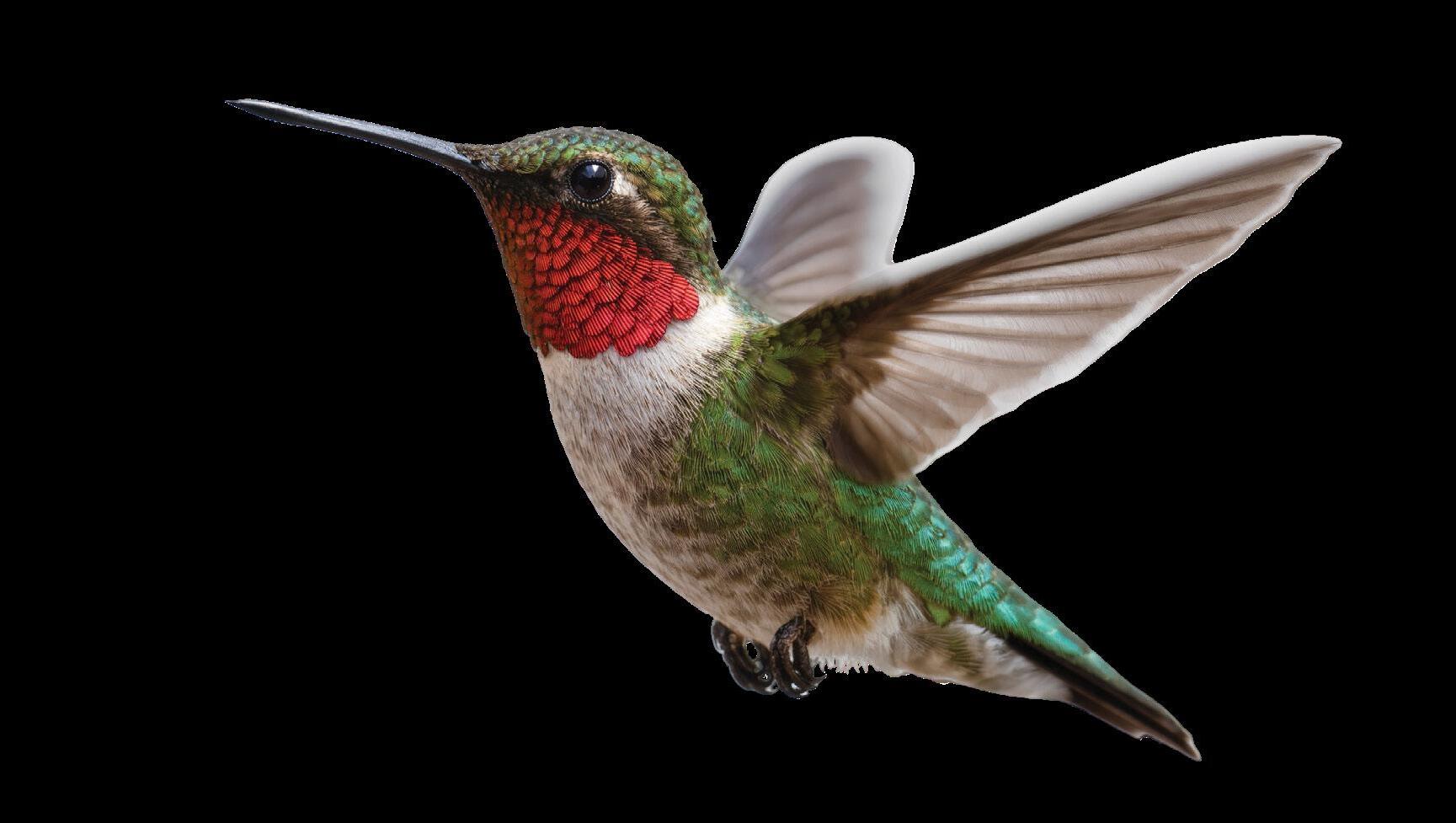
As the sun sets on Missouri’s grasslands and prairies, you can see — if you’re lucky — dozens of tiny ashing lights on the butts of the beloved beetle that is known more commonly as a re y. However, as the Missouri Department of Conservation website notes, globally and locally these populations have declined due to loss of connected habitat.
Missouri was once home to a variety of vast and diverse prairie landscapes. Waist high with native owers, grasses, and shrubs, these dense habitats were a haven for pollinators and a variety of other native bugs, insects, mammals, and birds.
“A lot of the plants that we use in our conventional landscaping are European or Asian varieties that the pollinating insects that we have in the U.S. didn’t co-evolve with,” said Tyler Gerstheimer, a sustainability specialist who manages the CoMo Wild Yards projects for the city. He lamented that native pollinators are often unable to get nectar from non-native plants, citing that factor as a reason pollinators are heavily in decline.

As small towns continue to grow and cities sprawl into the suburbs and surrounding counties, turf grass lawns have come to dominate the landscape. is development has worsened the pollinators’ plight, but fortunately, the city of Columbia is taking steps to mitigate the problem.
“Over time, lawn care shifted toward that uniform turf grass look, and use of broadleaf herbicides increased,” explained John Ogan, public information specialist for the Columbia Public Works Department. “But the Roadside Pollinator Program could lead the way to re ect a shift back toward recognizing the bene ts of more diverse plantings, including those species that provide food and habitat for our pollinators.”

FOREST PHLOX Phlox divaricata
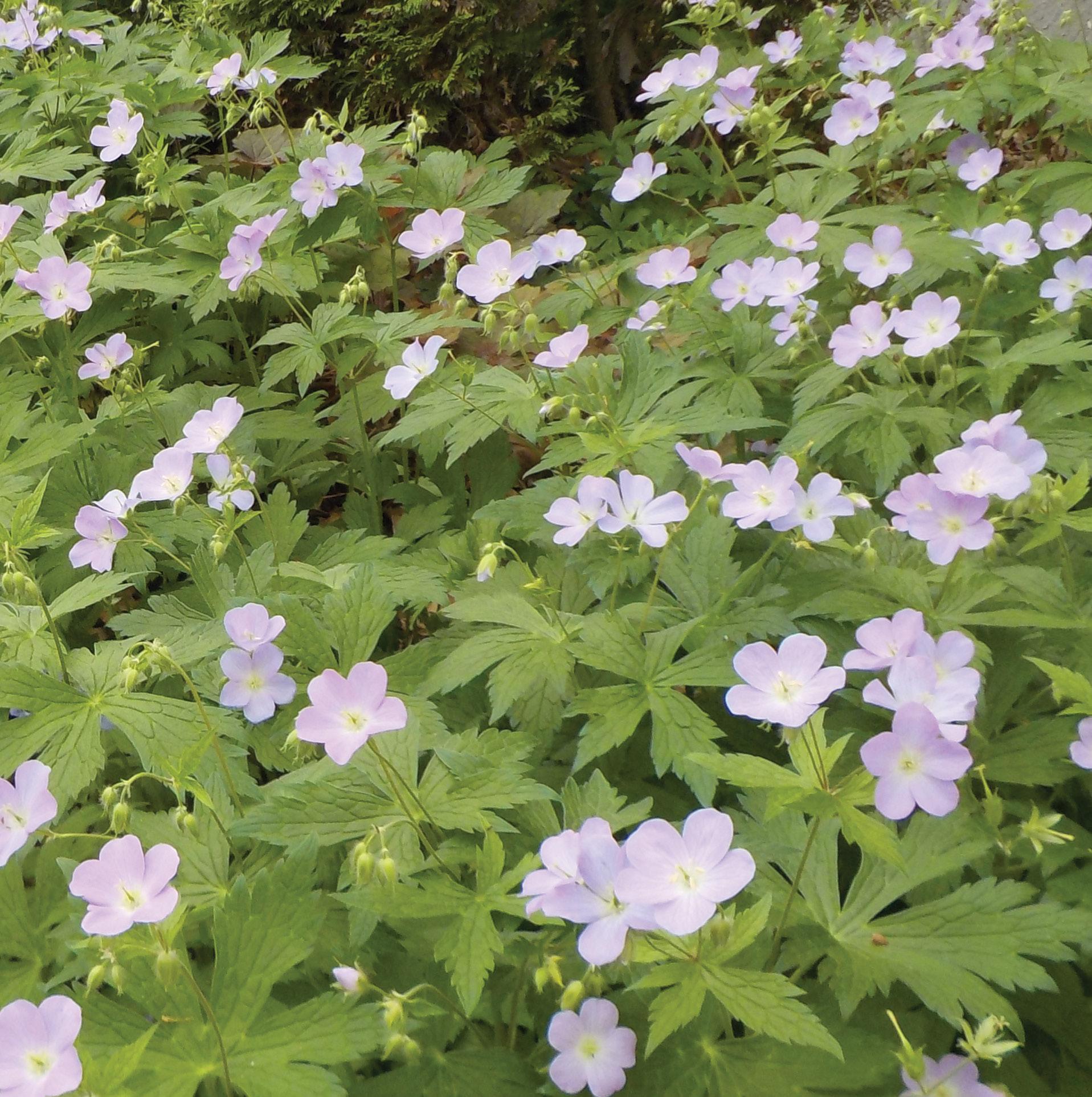
WILD GERANIUM Geranium maculatum
Where to Buy Native Plants
Giving Gardens
4040 S. Bearfield Rd., Columbia SunRise Gardens LLC
5771 E. Richland Rd., Columbia Missouri Wildflower Nursery 9814 Pleasant Hill Rd., Jefferson City
May 19
Native Plant Sale at Bass Pro Shops
3101 Bass Pro Dr., Columbia Saturdays
Columbia Farmers Market at the Agriculture Park
1769 W. Ash St., Columbia
WHAT IS BEING DONE IN COLUMBIA
e Roadside Pollinator Program is run through the Public Works Department and began with “No Mow Zones” established on Scott Boulevard, North Providence, South Providence, Rangeline Street, and Discovery Parkway.
“ e program is about using public space more intentionally,” Ogan said. “It supports pollinators and local ecosystems, while at the same time reducing fuel use and emissions from mowing,” e program also helps limit how often public works crews need to work in high-tra c areas.
Individual homeowners are also tackling the increasing scarcity of pollinator habitat. When Allison Vaughn, communications chair for the Columbia Audubon Society, moved into her house, she was eager to nd out what native plants would start popping up once she removed the invasive Virginia
creeper and bush honeysuckle. She said the previous owners had not installed a turf grass yard, so immediately she started seeing familiar faces in the owers that sprang up. Unfortunately, she said some of her neighbors didn’t share her delight.
“My landlady started getting weed ordinance violations, and so I ended up trimming back the easement and stu like that for the street,” Vaughn said. “And eventually it came to the point where I just called the city and I said, ‘Y’all need to tell me what you’re calling weeds, because the weeds that I see are winter creeper and bush honeysuckle.’”
She o ered to help city sta determine what “weeds” are bene cial to have, and that e ort “snowballed into the development of the CoMo Wild Yards program,” which aids citizens in transforming their turf yards into pollinator habitats.
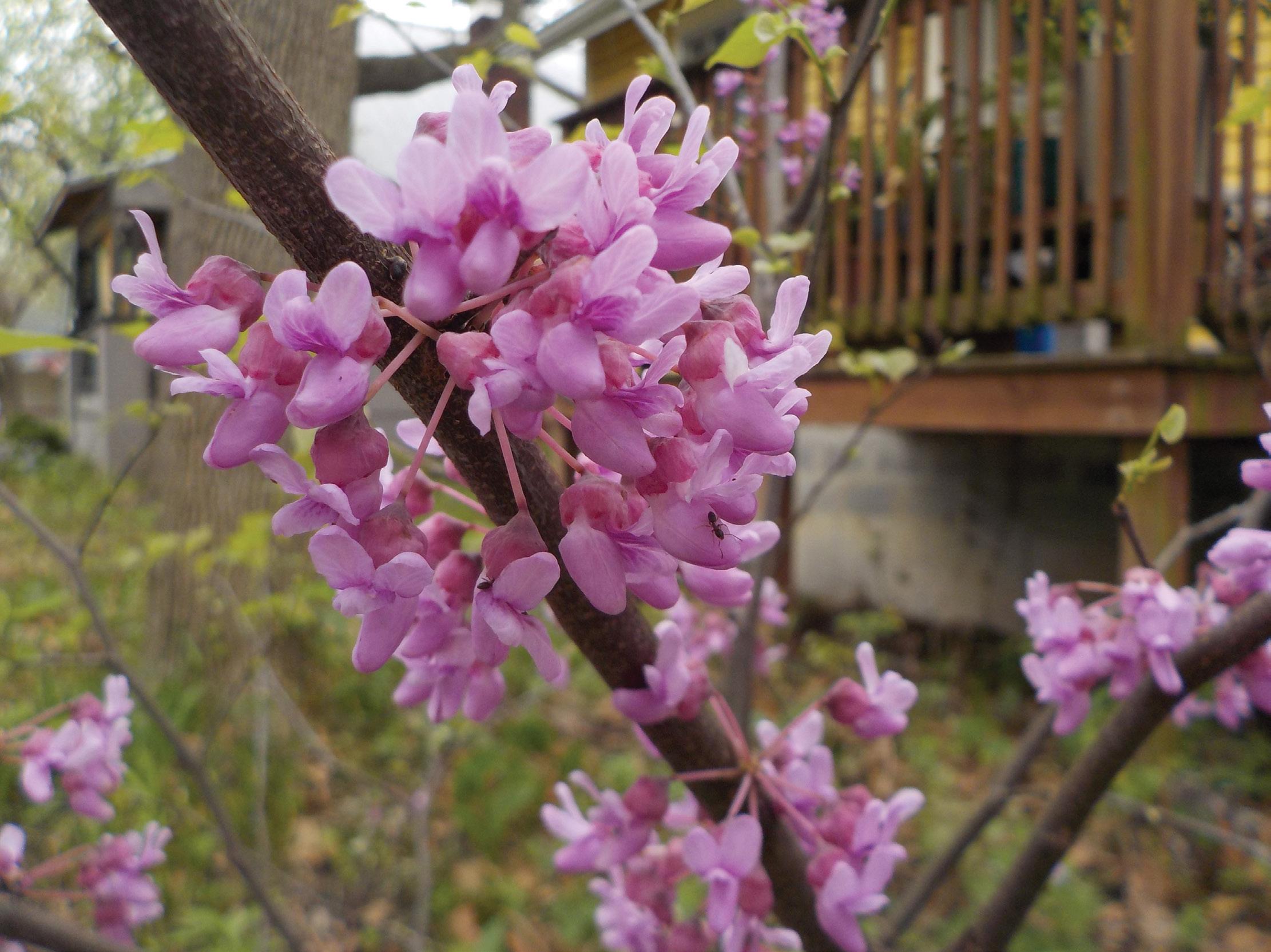
EASTERN REDBUD Cercis canadensis

Vaughn’s yard was the rst one with the program’s o cial sign, “and it’s still up today,” she said.
Gerstheimer said CoMo Wild Yards encourages homeowners and other landowners to reimagine landscaping on their properties through the use of native plants. ose interested apply to the program through an online application. Each year, 75 people are chosen to have a consultation with a member of the city’s O ce of Sustainability sta or the U.S. Fish and Wildlife Service to help identify important ecological features like soil type, drainage, and sunlight. With that information, a plan is developed to help the landowner create a landscape that uses native plants. ere are three certi cation levels: silver, gold, and platinum.
“We have around 350 participants, at least, folks who have gotten a consultation,” Gerstheimer added. “And then I think we have over 50 yards that have been certi ed at the silver, gold or platinum level.” e application period opens in early spring and has closed for this year.
WHAT IF I DON’T CARE ABOUT BUGS?
Maybe the problems of pollinators don’t move you. You consider this wild yards (and medians) concept and ask, “What’s in it for me?”
Along with helping out native wildlife, there are a variety of bene ts to native landscaping. Native plants are uniquely suited for this area. ey have evolved speci cally to survive and thrive in this climate. ey have long roots that go deep into the soil, helping to mitigate rainwater runo and prevent soil erosion. at’s certainly a bene t Vaughn can appreciate.
“We don’t have ooding in the basement anymore. We’re on fragipan clay, and it holds water,” Vaughn explained. “Native plants are good for that, because they’re deep rooted, and that helps absorb some of that water.”
A dense landscape of native plants also o ers relief from the increasingly hot summers. e city’s No Mow Zones not only create a better habitat for plants and pollinators, but for humans as well. e plants can help lower temperatures along sidewalks, such as the No Mow Zone on North Providence.
“Native grasses typically grow taller and more dense, and that provides more shade at the ground level, and less sunlight is re-radiated as heat,” Ogan said. “ e deeper root systems support a natural cooling process where water is released from plants into the air. at lowers the surrounding temperature.” Conversely, shortcut turf grass has less leaf surface and shallower roots, so it tends to dry out more quickly and o ers less cooling bene t.
“Over a larger area, this kind of di erence can absolutely contribute to reducing localized heat buildup along roadways and throughout the city,” he added.
Native landscapes also require less labor-intensive regular maintenance, a boon for both homeowners and taxpayers. For the No Mow Zones in Columbia, that means an annual cost savings of $160,000 to $280,000 per year, Ogan noted. e savings comes from using less labor and less fuel.
“Mowing is labor- and equipment-intensive, and reducing the frequency of mowing is going to lower our fuel use, our equipment wear and tear, and our sta time,” Ogan pointed out. “ at allows us to direct those resources toward other services that residents rely on.”
WHERE CAN I START?
If you’ve been persuaded that native landscaping is the way to go, you might now be wondering how to get started. Instead of sifting through an unmanageable load of resources, head straight to Missouri Prairie Foundation’s Grow Native! website for everything there is to know about plants native to the region. Emily Gustafson, director of operations for Missouri Prairie Foundation and the Grow Native! initiative, said the website has recorded webinars dating back to 2020 that can help would-be native landscapers get up to speed. e recordings cover landscaping challenges, insects and wildlife habitat, and native trees, among other topics.
Gustafson emphasized that there is a resource available to help gardeners at every level and at every
scale, adding that even small actions can have a big impact by providing more native habitat for pollinators and other wildlife. From tending small container gardens to adding native plants to existing exotic beds, she said, every action helps.
“If you add butter y milkweed into your yard, even just a handful of plants, you’re going to see butter ies, and you’re probably going to see Monarch butter ies, and probably you’re going to see Monarch caterpillars,” she said. “Even though it’s great to construct full habitats, individual plants in small numbers can support wildlife and attract pollinators like butter ies to your yard.”
Low-Cost & Impactful Things You Can Do
Make brush piles
Creating a brush pile with fallen limbs and sticks provides a habitat for all kinds of bugs, birds, and fungi.
Reduce the use of insecticides, pesticides, and herbicides
There is no such thing as a speciesselective product when it comes to yard care chemicals. Each of these products creates a variety of undesirable downstream effects.
Leave your leaves

Leaving fallen leaves in place creates habitats for pollinators to overwinter. Fallen leaves can also be used as mulch, and eventually they’ll decompose, improving soil health.
Mow less
Waiting longer between mows gives wildlife more recovery time and less disturbance in general. This also reduces lawn care costs and carbon emissions.
Remove harmful invasives
If your budget prevents you from buying new plants, you can at least remove invasive species like English ivy, Virginia creeper, Japanese honeysuckle, and kudzu.
GEM GEM Summer Camp
June 1st - 5th, 2026 • 9am-4pm
GEM Camp is a FREE 5-day camp for high-school aged women interested in a career in emergency management, public safety, government, and more! Campers will learn about disaster preparedness, develop leadership skills, and meet leaders in government from local, state, and federal agencies.
any questions, please email clewin@boonemo.gov.





• Emergency Management: Handling the Unexpected
• First Aid & Safety: Essential Life-Saving Skills
• Leadership & Public Communication: Speak with Confidence, Lead with Purpose
• Weather & Climate Awareness: Understanding Nature’s Impact
• Resilience & Problem-Solving: Overcoming Challenges with Confidence
• Life & Career Readiness: Exploring Your Future Path.











Gives Back GivingGardens
Local nursery provides more than plants to the community.
BY OLIVIA DESMIT

Mid-Missouri has no shortage of nurseries to supply your yard or business with healthy, beautiful plants. But one nursery, CMSE Giving Gardens, a subsidiary of Central Missouri Subcontracting Enterprises, isn’t only growing plants — it’s fostering relationships and independence, too.
“Our primary mission at CMSE is to provide work opportunities to adults with disabilities,” says Bruce Young, executive director of the 501(c)(3) nonpro t. Between the CMSE sheltered workshop and nursery, CMSE employs around 100 disabled adults.
From Contracting to Horticulture
At rst, it may seem surprising that Giving Gardens is a subsidiary of a nonpro t that provides contract manufacturing services through a sheltered workshop. e jump from being solely a
sheltered workshop to launching Giving Gardens was driven by necessity.
In 2009, CMSE lost a major contract, creating an economic hole the organization needed to ll. “When I got the call, I thought, ‘Oh my god, what are we going to do?’” Young says. e board brainstormed how to make up the funds.
“I just so happened to have a friend in Rotary Club, Bill Regan, who used to run a nursery,” he says. “He gave me the idea to start a retail greenhouse. So, I took the idea to the board, and that’s what we did. We’ve been going strong ever since.” Giving Gardens was founded in 2009 and began operations in 2010.
“Giving Gardens has helped us expand our exposure and help us grow our business. [It] provides work to a number of our folks who really enjoy it — especially those on the autism spectrum — and thrive doing it,” Young says. “ e manu-
facturing area can be loud with some of the equipment, so some people struggle with that but do great in the greenhouse.”
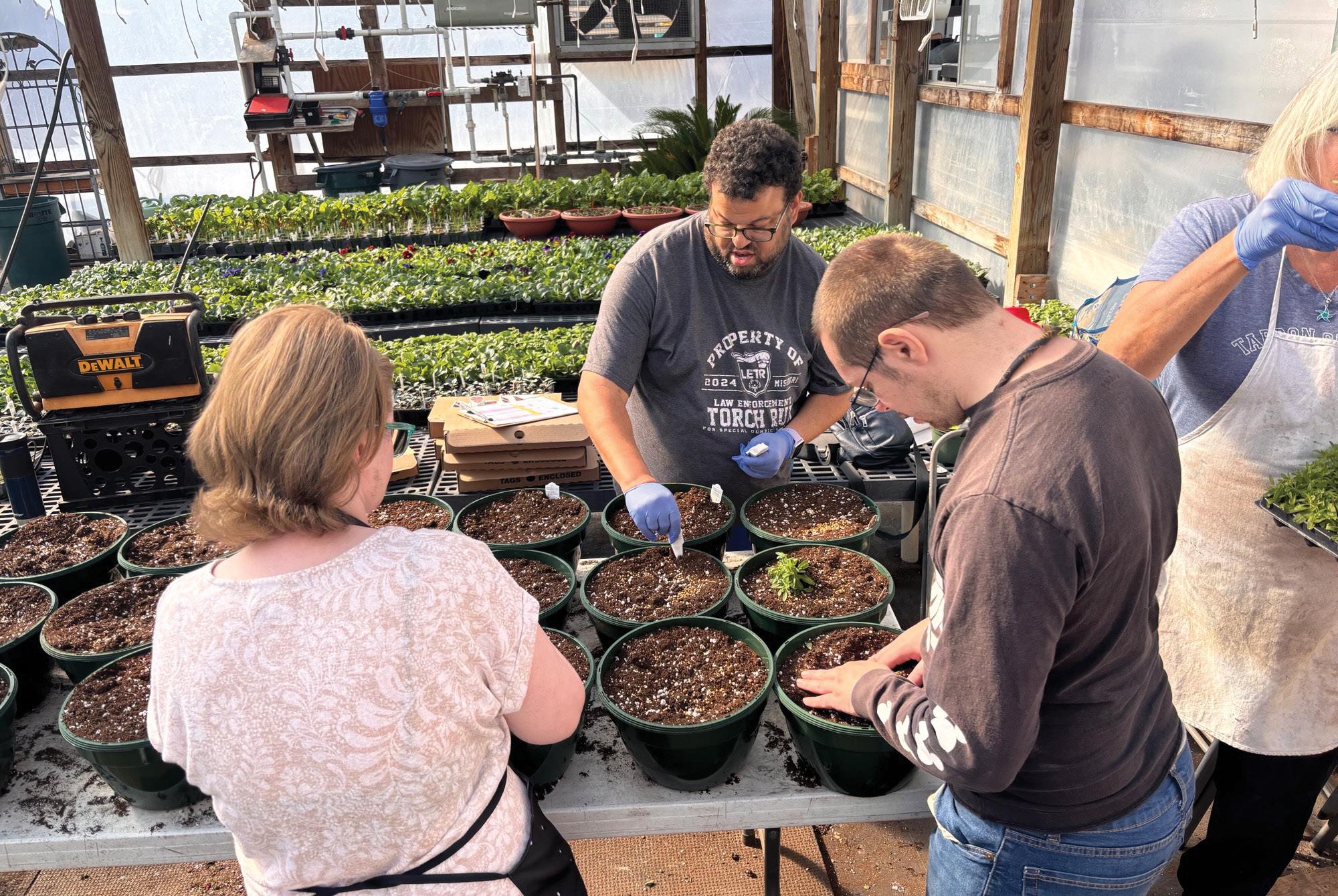
Each year, Giving Gardens employees begin planting in late January and early February, and the greenhouses open to the public on April 1. Young says Giving Gardens employs around 10 people in the greenhouses during the busy growing season, which runs from February to early April. During the selling season, a small number of employees work on watering, manning cash registers, and interacting with the public.
“It’s hard to explain how important the greenhouse work is for our folks, but if you walk through, you can see the self-esteem and dignity they have from working here,” Young says. “ e employees who work at Giving Gardens want to show you their work because it’s very important to them.”
Central Missouri Subcontracting Enterprises
CMSE’s sheltered workshop first opened in 1969, following the passing of Missouri’s Sheltered Workshop legislation, which aims to provide employment opportunities to adults with developmental disabilities.
CMSE was originally founded as part of Woodhaven Learning Center, with only 15 employees and two paid staff members. It changed its name to Central Missouri Subcontracting Enterprises in 2004.
“Even though we’re a nonprofit, a good portion of our revenue comes from contract work with business partners like Schneider Electric,” Young says. “We have a truck that picks up components and supplies at different companies. Our employees build the items and send them back every day.”
As part of CMSE’s contract manufacturing offerings, employees provide assembly, packaging, sorting, salvage, and more. The nonprofit also offers an on-site work program to provide companies with mobile work crews of between two and eight disabled adults, who are managed by a CMSE supervisor.
Outside of its contract manufacturing work, CMSE offers the Next Step Day Program, which is a habilitation program with recreational and life skills activities for adults with developmental disabilities.

Garden mums, which come in a variety of sizes and vibrant colors, are always a best-seller at Giving Gardens.
The Big Picture
When he started at Giving Gardens, Greenhouse Manager Brian Lee had an extensive background in plant science research but was fairly new to the world of horticulture retail operations.
“I didn’t feel well-quali ed, having only been in retail horticulture for two months at Strawberry Hill Farms,” Lee says. “I didn’t have great knowledge of owering or foliage plants grown for atmosphere and decor around homes and businesses.”
Luckily, a friend tipped him o to an online reference book that catalogued various plants according to their uses and horticultural characteristics, the best settings in which to plant them, and how to care for them. With this guidance, Lee quickly got up to speed.
“After reading it, I went back to Bruce and realized I was his most quali ed applicant, which surprised me,” Lee recalls. “I decided I’d give it my best and started in May 2020. I’ve been there almost six years now and turn 68 this year; I’m taking it a year at a time and not really seeking to retire yet.”
“We really lucked out with Brian,” Young says.
As greenhouse manager, Lee works with adults with developmental disabilities on a regular basis. “ ey are very genuine and approachable once you accept
their mannerisms and limitations,” Lee says. “I am blessed to be part of such an operation, but it does have moments of challenge. Every day is an adventure and seldom goes according to my exact plans.” It seems everyone at CMSE Giving Gardens sees the importance in their work. “ e personal bene ts of being involved here are the relationships that are being built and the chance to expose others in Columbia to day-to-day realities of some whose lives are signi cantly di erent than their own,” Lee observes. “For me, I look at the big picture of life more — what really matters — not just business goals and how to achieve them.”
How to Help
Want to support CMSE Giving Gardens’ mission of employing adults with developmental disabilities? e best way you can do that is by shopping at the greenhouses. Giving Gardens has a wide selection of plants, including annuals, perennials, Missouri native plants, shrubs, vegetables and fruits (including berry bushes), and herbs. A majority of the plants are grown from seed or plugs onsite. Missouri native plants are supplied by Prairie Hill Farms in Auxvasse. Some popular plant o erings include annuals such as begonias, dahlias, geraniums, petunias, and snapdragons, as well as perennials like daisies, cone owers, bee balm, and black-eyed Susans. Giving Gardens also has a tropical plant collection of hibiscus, jasmine, palms, and more.
HER DREAMS ARE INFINITE. WHICH IS WHY OURS ARE, TOO.
Every patient has hopes and dreams. Our dreams are to help make theirs come true. That means we never compromise in our pursuit of breakthrough medicine. And we never settle when it comes to your health. Neither should you. NEVER SETTLE
BUILT ON BOLD
Beginnings
Columbia College has spent 175 years expanding access, reimagining itself, and opening doors for generations of students.
BY KELSEY WINKELJOHN | PHOTOS BY ABIGAIL WADE - COLUMBIA COLLEGE
Few in the nineteenth century doubted that grave dangers lurked behind the foolish hopes of some that young women could achieve success in higher education. As late as 1873, Edward Clarke, writing in Sex in Education, stated that higher education would destroy the ability of women to bear children by overtaxing the female body at a critical stage of its development.”
— Paulina Batterson, 150 Years of Courage, Commitment, and Change
A RADICAL BEGINNING
Founded in 1851, Christian Female College — now known as Columbia College — was established with a trailblazing, radical mission: to educate young women in the liberal arts. As the rst state-chartered women’s college west of the Mississippi River, CFC was no nishing school. Students engaged deeply with history, science, mathematics, literature (“belles lettres”), instrumental music, and the ne arts. Within a few years, the curriculum stretched even further — into ancient geography, rhetoric, physiology, trigonometry, and constitutional law — with opportunities to study modern languages, music, and art.
In its early days, CFC functioned as a twoyear institution and, alongside Stephens College (est. 1833), o ered opportunities women could not nd at the then male-only University of Missouri. While the institution re ected the limitations of women’s education at the time, it also re ected a growing shift in what women’s education could be. As noted in Paulina Batterson’s 150 Years of Courage, Commitment, and Change, the school was recognized as a pioneer, predating institutions such as Vassar (1865), Wellesley (1875), and Smith (1875). It also operated at “a truly collegiate level, sharing some texts, faculty, and board members with the University of Missouri.”
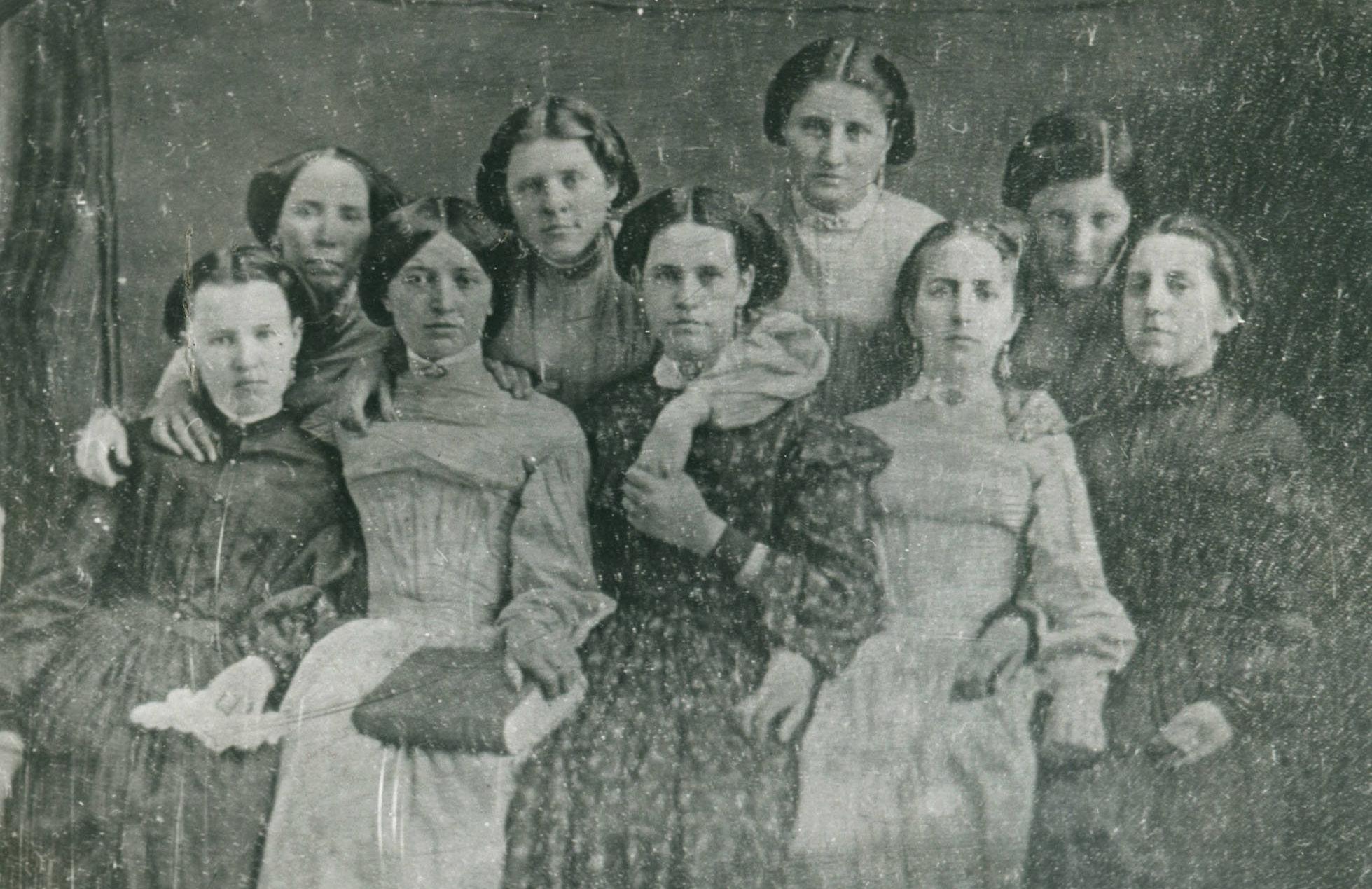
Christian College Class of 1854
Photo provided by State Historical Society of Missouri
CFC began its rst academic year in early April 1851, with a student body of seven aspiring scholars. Six of these students — Sarah Reeds, Adaline Jones, Emma Jameson, Emma Gordon, Martha Shirley, and Sallie Bedford — would eventually make up the rst graduating class in 1853.
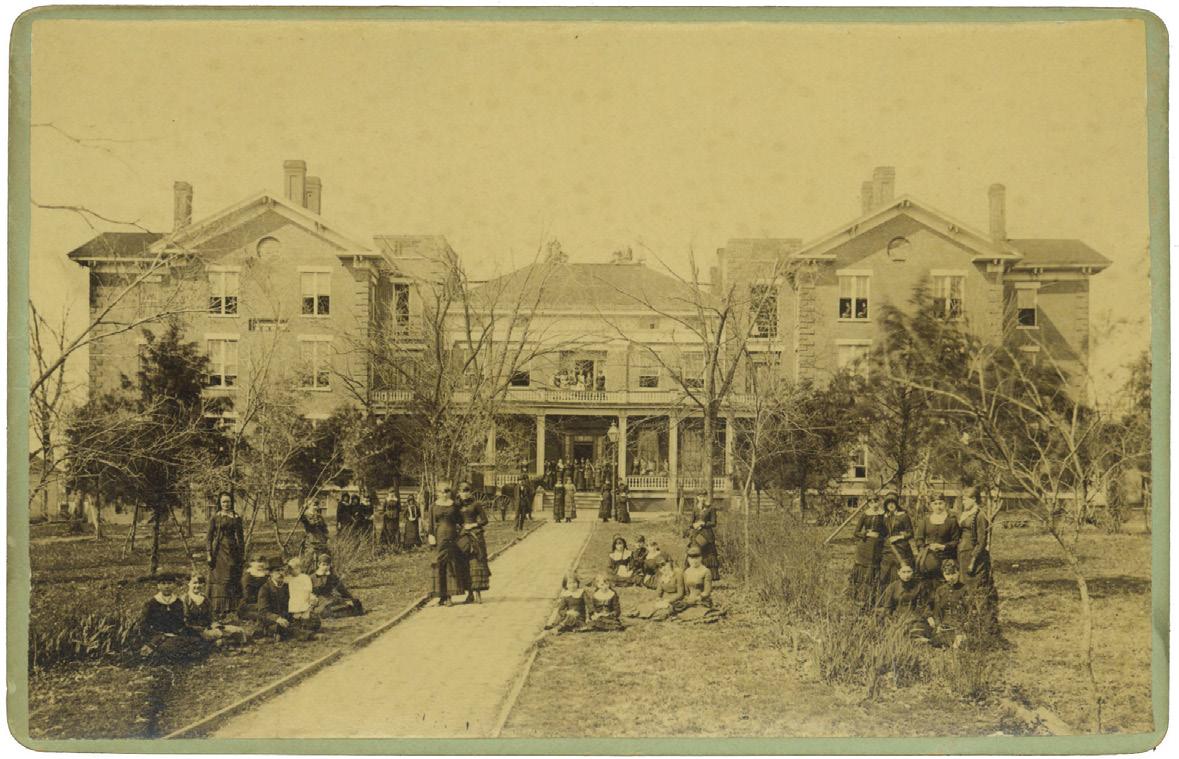
During its rst session, classes took place in the snug, one-room Christian Church on Seventh Street and a two-room storehouse, though the college would go on to secure its future that fall by purchasing the 29-acre estate of local physician and civic leader Dr. James H. Bennett. e un nished house that accompanied this purchase is now recognized as Williams Hall, the oldest collegiate building still used for academic purposes.
Once the structure was completed, it gave CFC’s ambitious vision a more permanent physical home, o ering space for both classes and living quarters. ough modest in size — initially featuring just ve rooms — it conveyed an undeniably strong message of growth and endurance.
e faculty also proved deeply committed to the college’s success. Several presidents were educators themselves, including the rst president, John A. Williams, and later Edgar Lee. roughout the Civil War, teachers remained dedicated to the college despite facing uncertain pay, and during the Great Depression, they pledged one month’s salary to support the construction of Hughes Hall, which was completed in 1939.
Over the decades, CFC continued to evolve, consistently pushing boundaries and reimagining itself beyond its academic strengths. Physical education, for example, became a priority.
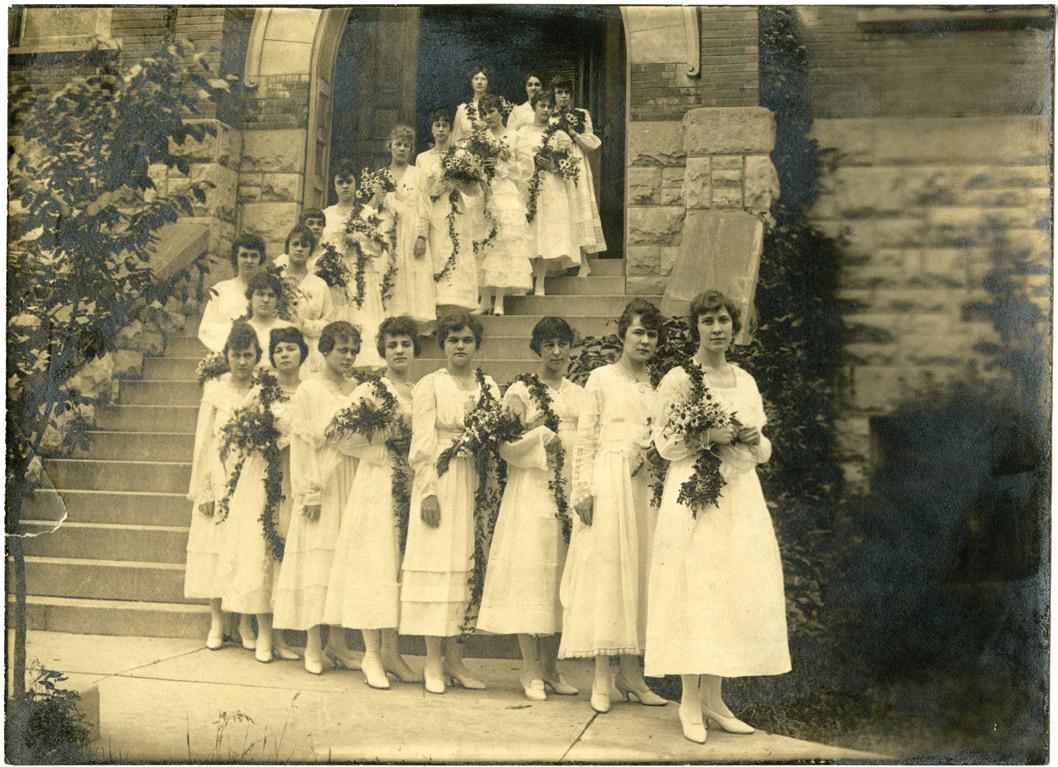
In 1903, President Luella Wilcox St. Clair (later Moss) — the institution’s rst female president — helped establish the college’s rst competitive basketball team. In A Look rough Rogers Gate: A Pictorial History of Columbia College, author Annie Devoy writes, “Filled with a seemingly endless supply of energy herself, [St. Clair] sco ed at the notion of female frailty.” Games were played against neighboring high schools, accompanied by the spirited cheer: “Boom-a-lack! Chick-a-lack! Who are we? We’re the girls from old C.C.”
St. Clair Moss epitomized the strong female spirit on which the college was founded. Batterson notes, “When Luella Wilcox St. Clair Moss nally retired from the college in 1920, the original Bennett building remained, but a completely new campus had been constructed around it during her three terms as president of what had become a respected junior college.”
In the late 1930s, dance transitioned from a recreational activity into a formal discipline when the college (known simply as “Christian College” since 1929) added seven dance courses to its catalog, o cially establishing it as a major. Other signi cant athletic highlights included the construction of an on-campus lake in 1904 for swimming, boating, and skating; the completion of Dorsey Gym in 1911; the addition of a $25,000 swimming pool in 1919; and the swap from a centaur mascot to Scooter the Cougar in 1984. Over the next several decades, the college would expand its varsity o erings, more recently adding eSports in 2016 and men’s lacrosse and women’s bowling in 2017.
Beyond its sports programs, Christian College valued cultivating connections through long-standing traditions, such as the Ivy Chain ceremony, which began in 1900. e custom involves senior students standing in a circle on the lawn of Bass Commons, draped — as the name suggests — in a chain of ivy leaves to symbolize unity. Until recently, the chain was continuous and linked the students; at the end of the ceremony, each student’s portion of the chain would be cut at both ends, allowing the students to break free into the world while still cherishing their established connection to their alma mater. Although the ritual has since been slightly altered to feature individual pieces of ivy, its symbolic signi cance remains intact.
Since 1996, the school has also celebrated a holiday lighting tradition, showcasing over 5,000 lights along the gables of the school’s most beautiful historic buildings, such as St. Clair Hall and the Atkins-Holman Student Commons. is event, celebrating its 30th anniversary in 2026, brings together sta , students, alumni, and community members for a joyous night that marks the beginning of the holiday season.
Left: Exterior of Christian College old main building.
Right: Students forming an Ivy Chain.
Photos provided by State Historical Society of Missouri
New CC President Embraces Columbia College — and Columbia.
BY JODIE JACKSON JR
There was barely time for Toby Arquette to catch his breath in the first week on the job as Columbia College’s new president, which he started on March 1. Arquette dedicated time to meeting oneon-one with media outlets, he connected with faculty and staff, and he made the rounds in student commons area, making his presence known.
“That was my first order of business – randomly introducing myself to students,” he said. “That was really fun.” And then it was on to the next meet-andgreet or media interview.
“I’m a little bit of an energizer bunny,” he told COMO Magazine. “It’s been a whirlwind.”
As he settled into the position as the successor to David Russell, Arquette expressed his quick attachment to not just Columbia College, but the city of Columbia.
“Columbia is just really a fantastic location,” he said. “It’s a lovely college town.” As a cyclist, Arquette was already eager to head to the MKT trail. He added, “It’s just beautiful. The parks to take advantage of, the downtown arts scene, the thriving business scene.”
On the professional side of his experience, Arquette was equally enamored with the new position and what he views as “limitless possibilities” for the college.
“Who can take for granted being the president of a wonderful college?” he said. “This is a once-ina-lifetime chance. I have to pinch myself each day.”
Arquette comes from St. Ambrose University in Davenport, Iowa, where he had been vice president for strategic growth, marketing, and digital transformation. At St. Ambrose, he spearheaded development of AI innovation and added data-driven technologies to support academics, according to a news release.
He is enthusiastic about helping the college not only embrace but become a leader in the AI space. Arquette talks about helping the college “reimagine who they are” with the digital information arena helping guide the way. “This is exactly what I want to do,” he said. “I’m built for this.”
The ultimate goal of any strategic plan or approaches must be helping students thrive, he added.
“In the public and the media, there’s a big concern about the value proposition of higher education,” Arquette explained. “For us, that is part of who we want to be. We want to be the college that delivers on those promises.”
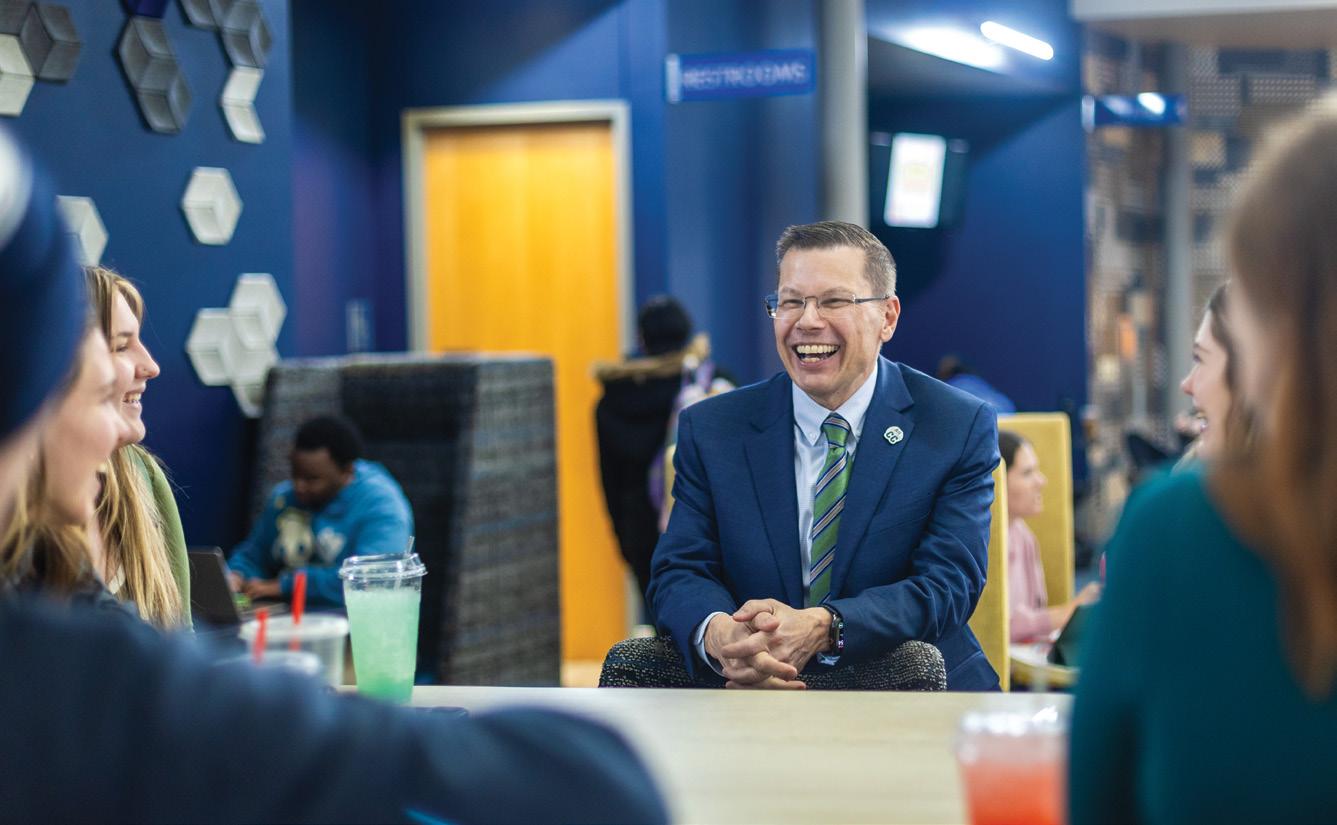
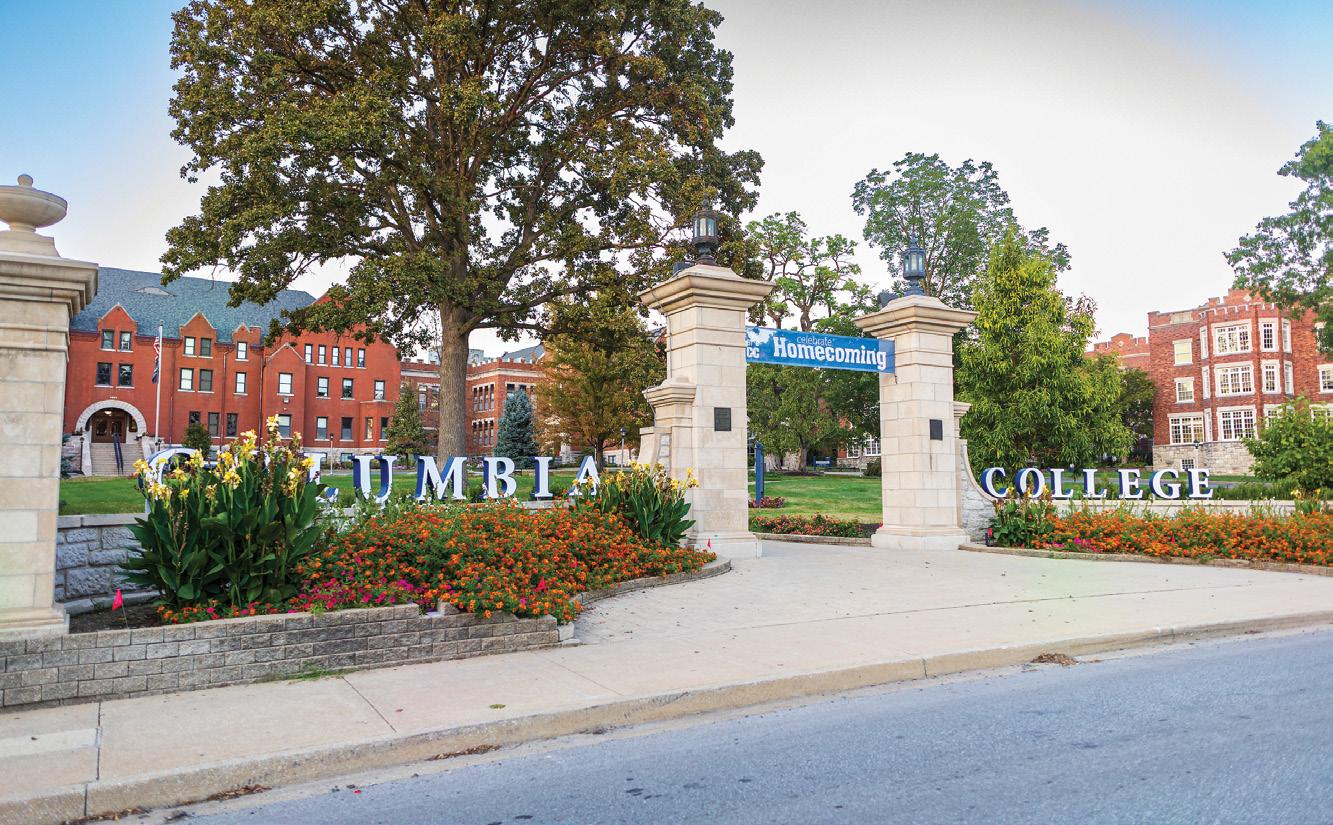
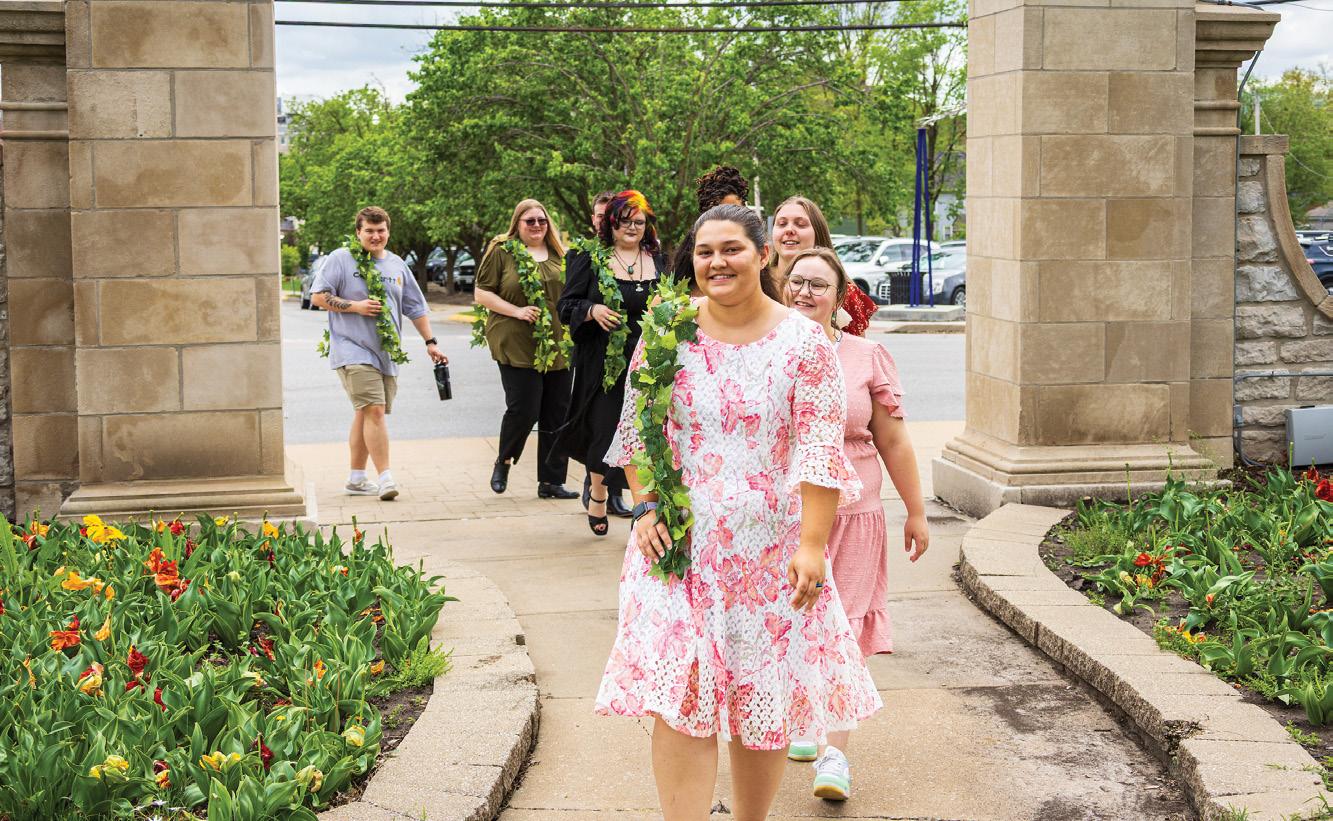
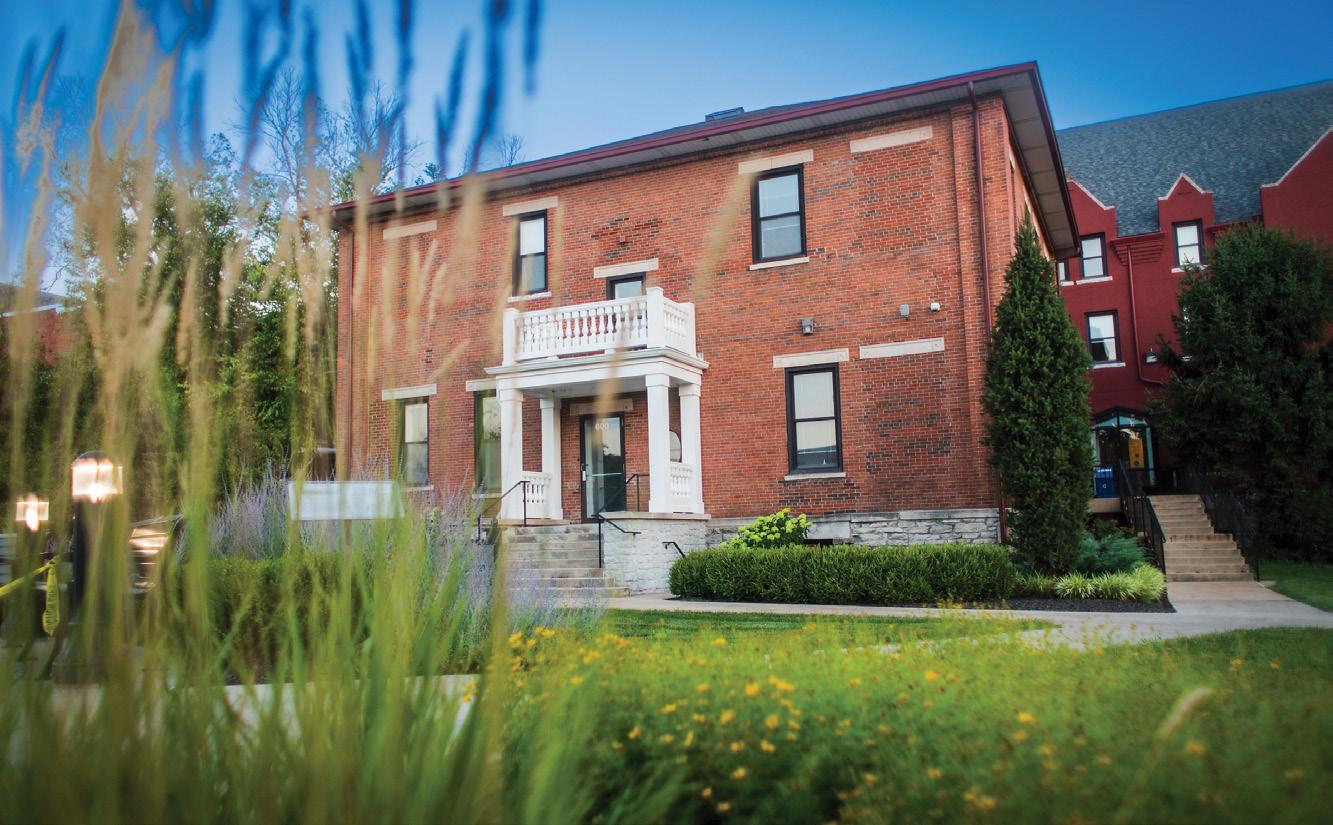
One of the most signi cant changes in the college’s history, though, occurred on July 1, 1970, when Christian College was renamed Columbia College. e institution also transitioned to a four-year, coeducational model and began welcoming students of color. is decision re ected CC’s commitment to progress and indicated a promising future as it sought to expand its programs and adapt to societal changes.
A LOOK INTO THE CRYSTAL BALL
As the school approaches its 175th anniversary, faculty and sta have been re ecting on what it means to be a CC Cougar — and what that identity will look like for future students. e milestone also coincides with the arrival of Toby J. Arquette, who stepped in as the college’s 19th president in March, succeeding David Russell.
“As I think about 175 [years] and then the next 175, it’s a powerful time for the college to re ect on who we’ve been — and to come together to imagine what we want to become,” Arquette says. at vision will take shape through strategic planning this summer, though Arquette is quick to note it won’t be “runof-the-mill.” Instead, he sees it as an opportunity to co-author the college’s story alongside the board, faculty, sta , students, and the broader community. e process will also use backward design, starting with where they want students to be, then asking, “How do we get there?”
In looking ahead, Arquette points to the college’s long history of reinvention as its legacy — one he hopes to maintain.
“I see [invention and reinvention] as an enduring theme of my presidency. When Christian College became coeducational, it was an e ort to reimagine itself,” he says. at spirit has continued in other de ning moments, from CC’s expansion to military bases in 1973 to its launching of online courses in 2000, among the earliest e orts of their kind. Today, the college serves service members, veterans, and military families online and at more than 20 locations nationwide, including 14 on military installations. It also o ers more than 70 online degree programs, reaching approximately 3,200 students each year.
Arquette feels that, in addition to reimagining itself, CC has continued to sustain its mission of serving students’ needs.
“We have roughly 100 various types of degree pathways, which is a testament to
the idea that we want to meet students where they’re at, with the di erent types of educational degrees they want to pursue, from associate’s degrees all the way up to master’s degrees,” Arquette says.
And the new president already has a vision for programs he’d like to see emerge one day — though it will certainly take some time.
“We’re likely going to see doubling down on the business program, growing business beyond where it’s already at now,” he says. “So, expansion into other areas of business — maybe hospitality, maybe AI in the business space, maybe in retail, or insurance.”
He envisions expansion in the healthcare sector as well, particularly to enhance the current nursing program and address workforce demands. Arquette is interested in exploring several potential programs, including physical therapy, occupational therapy, and physician assistant programs. In addition, he aims to establish credentialing for surgical technicians and phlebotomists, as well as advance education opportunities up to a master’s degree in nursing and, potentially, a Doctor of Nursing Practice (DNP) degree. Another area of interest relates to engineering.
“I’m probably going to make the case that we need to create an engineering school in the private space. It could be mechanical, software, or industrial engineering,” says Arquette. “If you think about where we are located in the Midwest, speci cally between Kansas City and St. Louis, it makes a lot of sense to take our supply chain program that we have in our business program and tie it into engineering.”
Even amid the excitement of looking ahead, the president, faculty, and sta have a strong desire to preserve Columbia College’s history, including maintaining connections with alumni — its living history.
In January, the school celebrated its Charter Day with an event in Dorsey Gym, featuring a performance by the Jane Froman Singers, a presentation by Distinguished Professor Brad Lookingbill on the institution’s development over nearly two centuries, and, of course, cake. e event drew in around 200 attendees, in person and virtually, and Chief Strategic Communications O cer Sam Fleury adds that a wide range of alumni were in attendance, from the class of 1957 to the class of 2025.
“We also had a birthday party out at e Kitchen and had about 250 attend-
ees there,” says Fleury. “ en we had two events in St. Louis and Kansas City, which had a total of about 200. So, you’re talking about 700 people coming out to celebrate CC’s birthday over two weeks. It was a really powerful display of how much people care about the college and how much they want to see it succeed in the next 175 years.”
In honor of the school’s history and its alumni, CC has opened its own Heritage Center in Missouri Hall, dedicated on April 23. anks to a generous contribution from former President Russell and his wife, Lee, the Heritage Center will serve as a museum of the college’s history, featuring permanent displays and a section that rotates semi-annually to keep it fresh.
“It’s going to be a place where students, visitors, sta , and faculty can come in and see some of the highlights of what’s happened over the past 175 years,” says archivist Courtney Gillie. “We’ve got things like Ivy Chain, one of our older traditions; a diploma from the valedictorian of the 1854 class, which still has gold ligree on it; and more modern things. I’ve also commissioned some artwork that is going to be reminiscent of the panels we have where you can see ladies dressed in their best to come to college. So now, we’ve got some upgraded imagery that will re ect our student body as it’s changed over the years.”
e Heritage Center will also spotlight famous alumni, such as Brigadier General Charles E. McGee — one of the rst Tuskegee Airmen, who fought in three wars — and the famous singer-actress Jane Froman, who notably performed for troops during World War II.
e Heritage Center will play an important role in preserving these stories and re ecting something deeper about the college itself. Columbia College, regardless of the changes it has undergone, has always been shaped by the people within it: the students, faculty, sta , and actively engaged alumni. What began with just seven students in a cramped church has grown into a community that extends past its mid-Missouri footprint, connecting learners across the country and online. At every stage, that growth has been driven by a belief in access, opportunity, and possibility. As the college looks ahead, that same conviction remains in each new generation, continuing a legacy that once had to ght to exist.

THE BIG BUR OAK
Still Standing
BY JODIE JACKSON JR
Photo by Carrie Yonley
Anyone referring to the state champion bur oak tree in the Missouri riverbottoms in McBaine as “just a tree” is probably asking for a ght. It’s basically the same thing as calling a family’s beloved pet “just a dog.”
e Big Bur Oak has earned a place of sacred respect for its size, longevity, history, and connections to multiple generations of Boone County and Missouri folks who have cooled o in its shade or made it the backdrop — or foreground — of countless photographs.
It’s not “just a tree.” e Big Bur Oak is nearly 400 years old. It stretches 90 feet high with a 130-foot spread and a 287-inch circumference, ranking it as the largest of its species in Missouri and tied for largest in the U.S. (Even suggesting it is tied with a big bur oak in Kentucky can invite unwanted ire from the tree’s protectors and admirers.)


Randy Hughes
e tree became an o cial Boone County Historic Site in August 2021, making it the only tree in the county to hold that designation. A plaque beneath the tree designates the tree as e Williamson Bur Oak Tree, a name so conferred to signify that the tree with a canopy that covers part of Bur Oak Road is on farmland owned by the John Sam Williamson family for six generations. e plaque further states, “ e tree has achieved national and state recognition for its size and age, and has witnessed the entirely of our nation’s history and nearly four centuries of world history. It has become a beloved gathering place for residents and visitors seeking the comfort and solace of nature’s marvels.”

Photo by
Photo by Sara Mauer



Photo by Neel Das
Photo by Jim Robertson
Photo by Andy Knoop
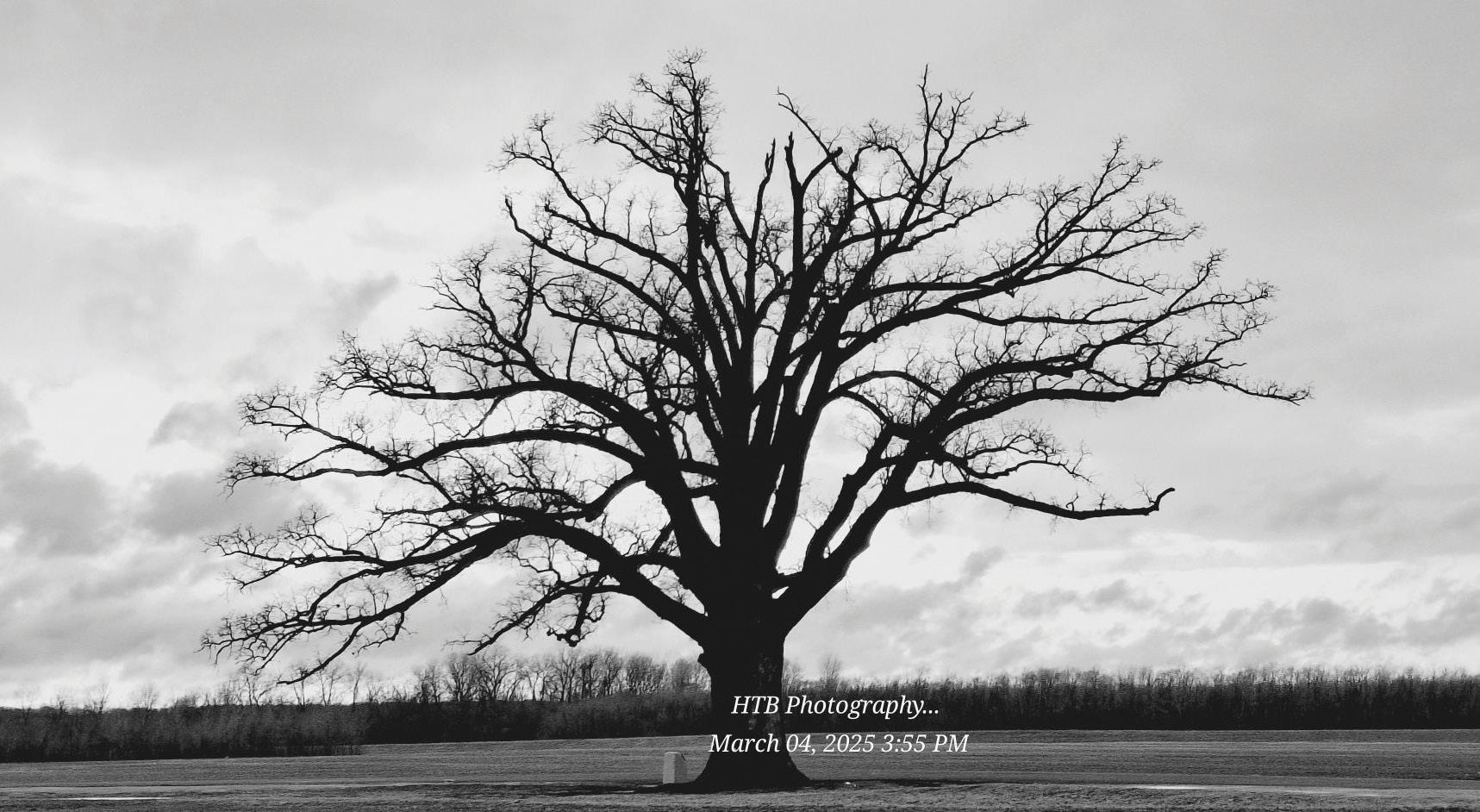
It’s not unreasonable to suggest that a day or two before the Lewis and Clark Corps of Discovery camped along the Missouri River at Rocheport in 1804, the famed explorers would have seen the sprawling bur oak. Local historian and master storyteller Gene Bauman has also noted that, given the tree’s age, the acorn that birthed the e Big Bur Oak would have dropped to the ground in about 1640, just 20 years after the Pilgrims landed. Bauman’s son, Steve, is the primary administrator of e Big Bur Oak Facebook page that now has more than 10,500 followers. (Find the page at facebook.com/groups/thebigburoak.)
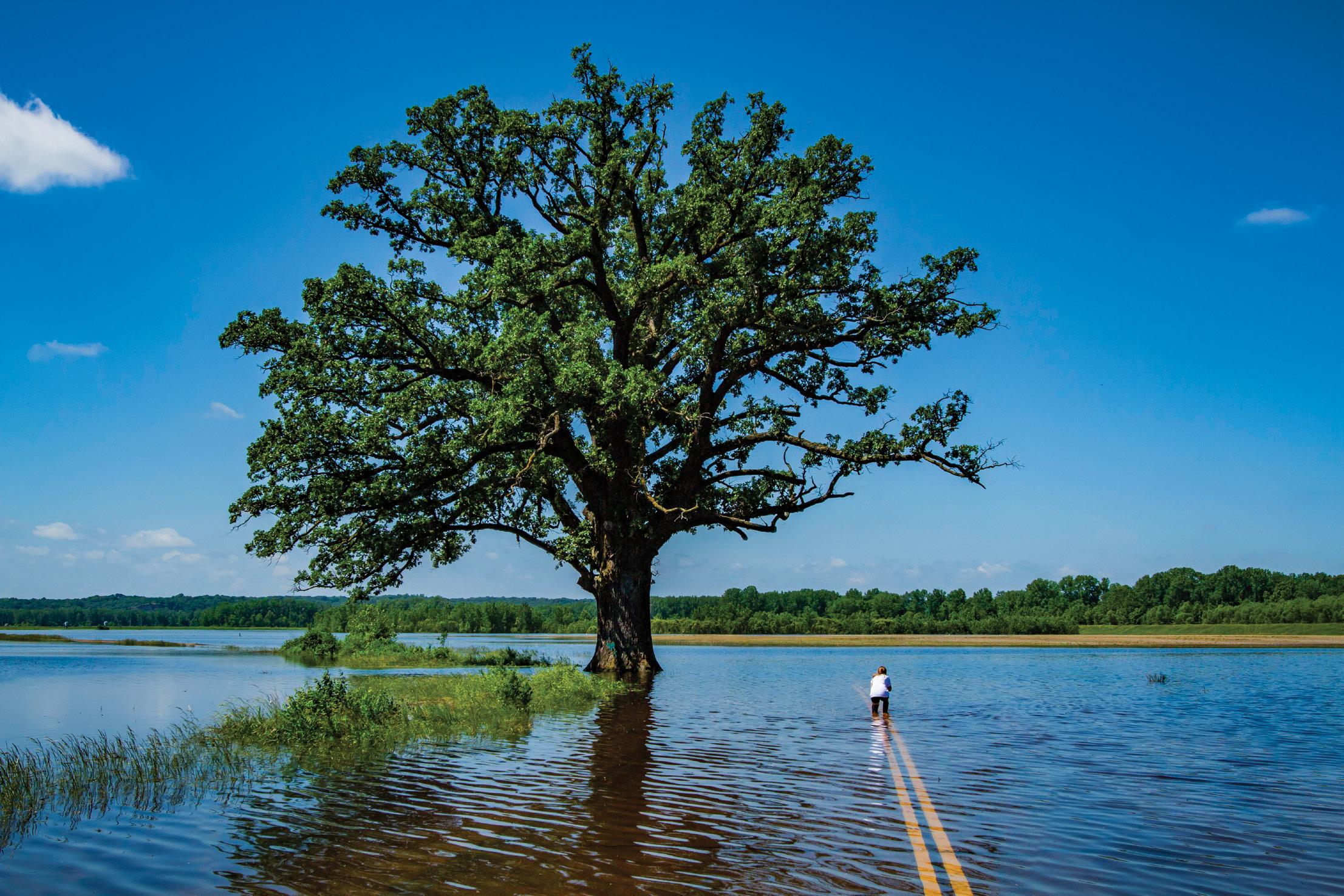
Photo by Dennis Smarr
Photo by Herman Black

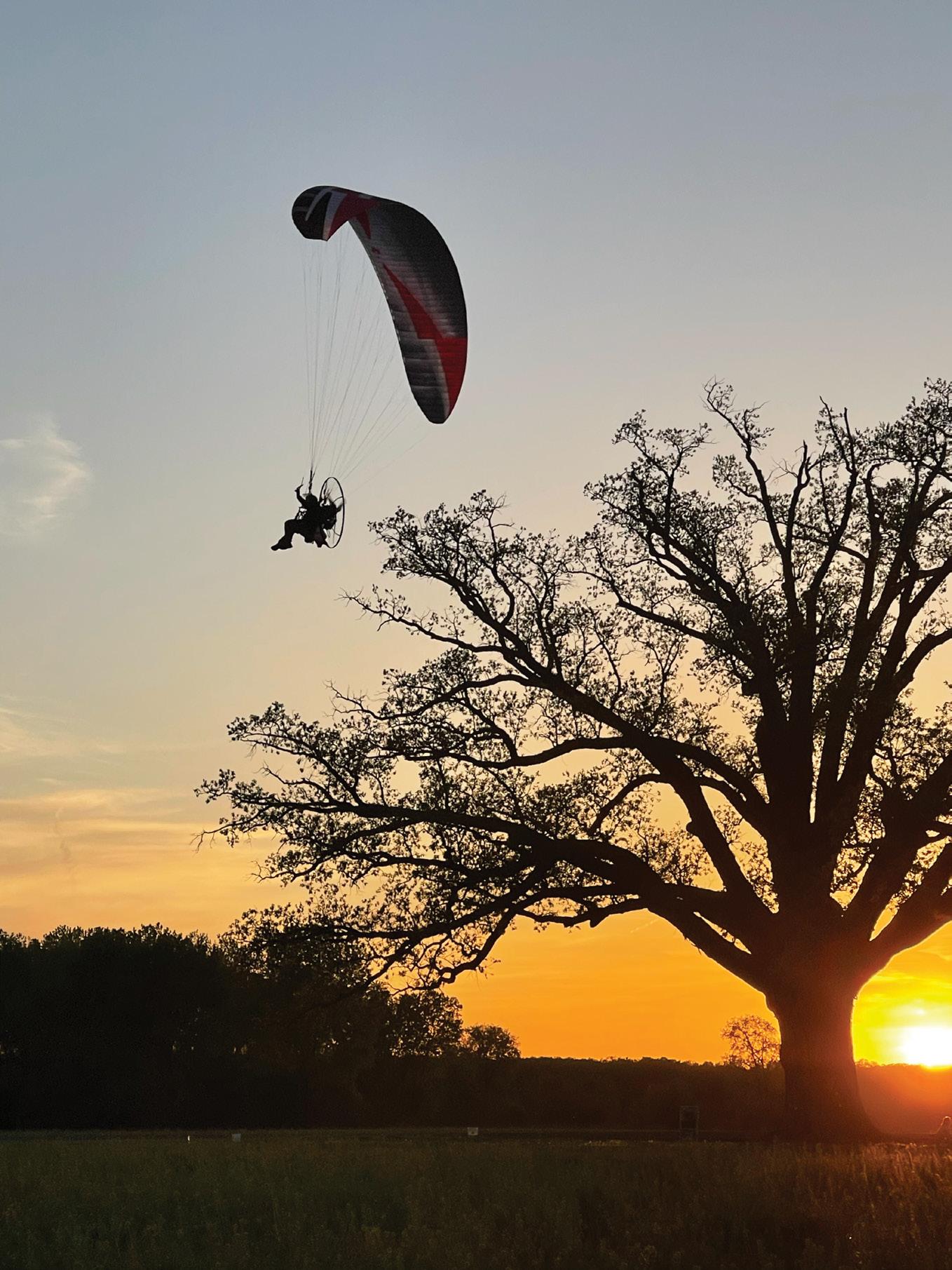
Photo by Doug Hardesty
at page is routinely blessed with photos from both amateur and professional “shooters,” capturing the big tree’s image and, we daresay, personality, in all manner of weather conditions, as part of picture-perfect nighttime celestial events, and as a marker of the passage of time. e tree has endured several lightning strikes, numerous oods — including the disastrous oods of 1993 and 1995 — and, unfortunately, vandalism. Despite the paved road that runs along its south side, the beloved tree remains as healthy as a nearly four-century old tree can be. e grand old tree also gets regular TLC from arborists who are determined to keep its admirers from unintentionally loving it to death.
e photographers, however, are the main sentries who protect and cherish the tree. We asked the Facebook group to consider submitting photos for this pictorial. Fifteen photographers responded, o ering nearly 120 photos for our selection. We are grateful and pleased to present some in this feature as well as online.
Photo by Ken Hirlinger
What is your favorite city park and/or trail and why?

I love all of our parks, but I have a soft spot for Stephens Lake Park. I spent time there in college studying with friends, had a sushi date with my longdistance bestie on one of the benches while people-watching … and my canine companion is a big fan, too.
— KELSEY WINKELJOHN
I agree with Kelsey about how many awesome parks we have! Our favorite is probably the Fairview Park. We go there for the playground (as well as Fairview’s school playground), the wooded nature area with its hidden trails and ponds, the 9-hole disc golf course, and the available shelter/ bathroom. It is such an awesome place to spend time with our boys and get into nature, but right in the middle of town!
— GARRETT WALKER
Rockbridge State Park for hiking and trail running.
— ASHLEY LASITER
Grindstone Nature area has a piece of my heart. I used to walk down to the trailhead from my apartment and wander until I couldn’t walk anymore. e creek and bridge are breathtaking!
— FLEET FEET OF COLUMBIA
e MKT, a roughly nine-mile trail from Flat Branch Park in downtown Columbia to the Katy Trail trailhead at McBaine, is one of the city’s most prized treasures. It intersects some amazing ecosystems along Hinkson and Perche creeks. e 3M wetland is a bird watcher’s haven and the trailhead at the Martin Luther King Jr. Memorial at Battle Gardens is well worth the experience.
— JODIE JACKSON JR
Bear Creek Trail. Lots of full bluebird houses and water life in pond.
— MELISSA VOGT
Hinkson Creek Trail at the Grindstone Nature Area trailhead. All the atness of the MKT but more curves and varying views. A true COMO gem.
— JEREMY BLOSS
Bonnieview!! Beautiful sunsets on a completely paved path through wild owers, beautiful woods, and a bird sanctuary. Can’t beat the accessibility!
— NICHOLE SALAS
All areas of Grindstone Creek trail and grindstone nature area (including waters moss memorial wildlife area)! Family friendly and not too technical plus’s paved portions to the east of old 63. So many beautiful trees and the leaves in the fall are literal lots of wildlife (deer, turtles, snakes, and sh) and there are some great connecting trails. CoMo has an amazing trail system! If I can have two: Probably high ridge trail is tied with grindstone. Super easy hike with lots of habitat variation in a short distance: grasslands, forest creek bottoms, blu s. Lots of great wild owers in the spring. Beautiful views!
— CALEB KNERR
Is Pinnacles out of “city” area? If not, I have lots of reasons why it’s my favorite!
— KATIE BARNES
Capen park o leash area.
— SUZANNE CLAUS ROTHWELL
Editor’s Note: ank you for showing Pinnacles some love, Katie. e 70acre Pinnacles Youth Park is neither a city nor a state park, but is operated and maintained by the Boone County Pinnacles Youth Foundation, using only donations and volunteer labor. It receives no government funding. It has been enjoyed by local folks for more than 50 years now and it is open to the public for day use. Scouts, church and 4-H groups, etc. can camp overnight. Pinnacles is about 12 miles north of Columbia on the east side of Highway 63.