


An era of significant wealth transfer has begun.
Strategic gifting to family members before you pass can be an effective strategy for providing for your family’s needs while creating your lasting legacy. And if done thoughtfully, it can provide tax efficiency benefits for your estate plan at the same time.
Whether leveraging the annual gift tax exclusion, making accelerated gifts to a 529 plan, or using medical and educational income tax exclusions, your seasoned team of private wealth management professionals at Commerce Trust will collaborate to assess various tax-efficient giving strategies and assist with providing an impactful, thoughtfully timed plan for giving to your family that aligns with your long-term wealth goals.
Through our holistic, team-based approach to servicing private wealth clients, your team of Commerce Trust estate and tax planning, investment management, and trust administration professionals can help turn your success into a lasting legacy that starts today.
Connect with Lyle Johnson, your dedicated Market Executive for Commerce Trust, at (573) 886-5324 or lyle.johnson@commercebank.com.
Learn more about securing your legacy at www.commercetrustcompany.com/estateplanning.


By Scott LaPresta, CTFA, Senior Vice President, Director of Private Client Advisors, Commerce Trust, and Amy Stiglic, CTFA, Senior Vice President, Market Executive, Kansas City, Commerce Trust
Gifting to family members provides for their needs while advancing your estate plan. In addition to the benefits your relatives receive, strategically gifting may decrease your transfer tax liability by lowering the value of your estate. Below are five methods to maximize the value of family gifts for donors and recipients.
1. Annual gift exclusion
For tax year 2025, the IRS allows you to gift up to $19,000 tax-free to as many people as you want, and married couples can give up to $38,000 to an individual without triggering a taxable gift.
Both recipients and donors can benefit from annual gifts. In contrast to an inheritance, recipients can enjoy the gift immediately without losing any value to pay transfer taxes. Donors can coordinate annual gifts to achieve estate planning objectives like potentially decreasing their estate tax liability by lowering the value of their estate.
2. 529 accelerated gifting
By making an accelerated gift to a qualified tuition program (QTP) like a 529 plan, you can contribute up to five times the annual exclusion ($95,000 for individuals and $190,000 for married couples in 2025) in a single year tax-free.
This strategy can provide significant value for those aspiring to attend college while lowering the value of the donor’s estate.
3. Lifetime estate and gift tax exemption
The 2025 federal lifetime estate and gift tax exemption amount is $13.99 million for individuals and is effectively doubled to $27.98 million for married couples.
This means the total value of one’s estate plus any taxable gifts can generally be transferred tax-free up to that amount. Using the lifetime exemption now, at its historically high level, may lower your eventual estate tax liability.
4. Medical exclusion
The medical exclusion is another way to give a gift to family members by paying for their medical expenses without triggering a taxable gift.
The payment must be made directly to the care provider and be solely used for qualifying medical expenses as defined by the IRS. Donors can also pay for health insurance under the medical exclusion, but payments for medical care that are reimbursed by the recipient’s insurance company do not qualify.

5. Educational exclusion
Gifts that qualify for the educational exclusion are also not subject to the gift tax. The gift must be paid directly to a qualifying educational institution and exclusively used for tuition.

Gifting to family members may seem straightforward, but care is needed to ensure the value of the gift is not diminished by taxes. If gifting is a priority for you, contact Commerce Trust at www.commercetrustcompany.com/estateplanning to learn how our tax management,* estate planning, and education planning professionals collaborate to execute a customized estate plan that is unique to you.
*Commerce Trust does not provide tax advice to customers unless engaged to do so.
The opinions and other information in the commentary are provided as of January 16, 2025. This summary is intended to provide general information only, and may be of value to the reader and audience. This material is not a recommendation of any particular investment or insurance strategy, is not based on any particular financial situation or need, and is not intended to replace the advice of a qualified tax advisor or investment professional. While Commerce may provide information or express opinions from time to time, such information or opinions are subject to change, are not offered as professional tax, insurance or legal advice, and may not be relied on as such.
Data contained herein from third-party providers is obtained from what are considered reliable sources. However, its accuracy, completeness or reliability cannot be guaranteed. Commerce Trust is a division of Commerce Bank.
Investment Products: Not FDIC Insured | May Lose Value | No Bank Guarantee


March 2026
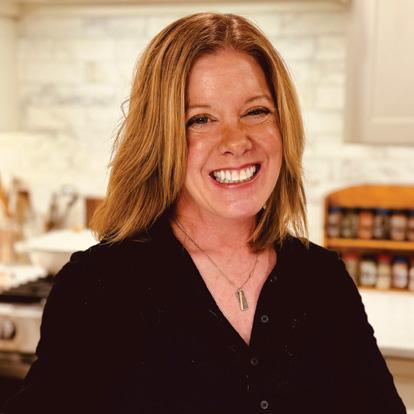
Laura Sche er Johnson is a nearly life-long resident of Columbia. She graduated from Hickman High School and College of Wooster with a bachelor’s degree in English and didn’t quite nish a master’s degree in creative writing at the University of Missouri. She has served as an intern for e Missouri Review and Persea Press and was a contributor to e Columbia Daily Tribune’s Community Kitchen food blog.
She owned a McDonald’s franchise for many years before selling it in 2020. Laura has won several awards for her poetry, including two Academy of American Poets poetry prizes. She’s fascinated with marketing and appreciates it when she’s been successfully targeted and encouraged to try a product or service.
She enjoys writing, reading, cooking, taking photos, gardening, exercising, traveling, thinking, and laughing. Laura lives in Columbia with her husband, Lyle, cats Eddie and Chili, and dogs Daisy and Ellie.
IN THIS ISSUE OF COMO
PG 42
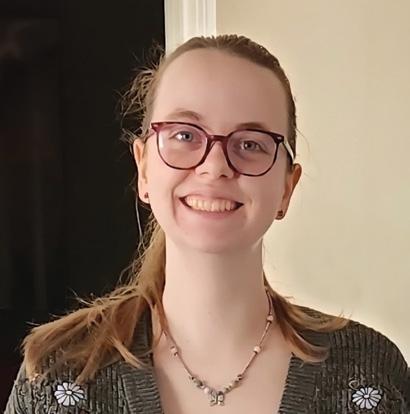
I am currently a senior at Columbia College pursuing a major in creative writing and a minor in studio art. I am also the current president of the Esports and Gaming Club at Columbia College. I have lived in Columbia my entire life, and I graduated from Hickman High School, where I participated in marching band.
In my free time, I enjoy drawing, writing, and playing video games. I also enjoy playing Dungeons and Dragons with my friends and attending comic cons. In the future, I would love to create my own video game or write my own novel, as creating things is my passion.
I am interning this spring with COMO Magazine and COMO Business Times, which involves helping tell the stories about the things that make Columbia such an interesting place to live.
IN THIS ISSUE OF COMO
PG 42
PUBLISHING
David Nivens, Publisher david@comocompanies.com
Chris Harrison, Associate Publisher chris@comocompanies.com
EDITORIAL
Jodie Jackson Jr, Editor jodie@comocompanies.com
Kelsey Winkeljohn, Associate Editor kelsey@comocompanies.com
Karen Pasley, Contributing Copyeditor
DESIGN
Jordan Watts, Senior Designer jordan@comocompanies.com
MARKETING
Charles Bruce, Director of Client Relations charles@comocompanies.com
Kerrie Bloss, Account Executive kerrie@comocompanies.com
CONTRIBUTING ILLUSTRATOR
Adrienne Luther Johnson
CONTRIBUTING PHOTOGRAPHERS
Amber Bradshaw, Doug Elley, Lauren Sable Freiman, Tahlia Heaton, Barbra Horrell, Brittanie Irons, Hoss Koetting, C.J. Levy, Mary Matthews and B. Walters, Roger McKinney, Ashley Shryock, State Historical Society of Missouri, David Spear, McKenna Stumph, Mark Walters, Kelsey Winkeljohn.
CONTRIBUTING WRITERS
Barbara Bu aloe, Mary Kate Hafner, Tahlia Heaton, Lainey Howard, Jodie Jackson Jr, Jenn Johnson, Hoss Koetting, Madeleine Leroux, Roger McKinney, McKenna Stumph, Bradley Williams, Kelsey Winkeljohn
SUBSCRIPTIONS
Magazines are $5 an issue. Subscription rate is $54 for 12 issues for one year or $89 for 24 issues for two years. Subscribe at comomag.com or by phone. COMO Magazine is published monthly by e COMO Companies.
OUR MISSION STATEMENT
COMO Magazine and comomag.com strive to inspire, educate, and entertain the citizens of Columbia with quality, relevant content that re ects Columbia’s business environment, lifestyle, and community spirit.
Copyright COMO Companies, 2026
All rights reserved. Reproduction or use of any editorial or graphic content without the express written permission of the publisher is prohibited.
FEEDBACK
Have a story idea, feedback, or a general inquiry? Email our editor at Jodie@comocompanies.com.
CONTACT
COMO Companies | 404 Portland, Columbia, MO 65201 573-577-1965 | comomag.com | comobusinesstimes.com
Seven years ago, I thought I was going to be a forensic scientist.
As the daughter of an environmental engineer and a teacher, I think I’ve always had at least a little bit of innate curiosity about the natural world around me. In high school, I fell down a rabbit hole learning about crime cases and how, remarkably, science and new technologies — from toxicology screenings to ballistics and ngerprinting — could be used to determine a range of crime scene factors. I thought, “ at sounds pretty dang cool.” If I could combine my interest in experimentation with the ability to help people, I would feel like I’d done a real service to the world.
And then I got to college and realized I couldn’t do calculus or organic chemistry. I’m not sure why that was such a shock to me when I had never been particularly good at math. I didn’t even make it to o-chem. I changed my major mid-second semester of my freshman year to something I not only loved, but also was far better at: English and creative writing. At the time, it wasn’t a con dent decision. It felt more like closing a door I had already pictured my future self walking through.
While chemistry had become associated with long evenings at the tutoring center and anxious walks to o ce hours, I thoroughly enjoyed my biology lectures and labs. One topic that still sticks with me is observing bacterial cultures — the bright-colored splotches blooming on agar plates in strange shapes and spreading patterns. Weirdly, I remember thinking they looked like abstract paintings you might see hanging in a hotel lobby.
Bacteria tend to get an immediate “eww” reaction, but they’re quite fascinating. ese single-celled organisms behave in astonishingly system-like ways in response to the environment, proximity, and time. Some strains grow wildly when given the right conditions. Others stay dormant until something awakens them. And not all bacteria are harmful — some are actually necessary for an ecosystem to function at all.
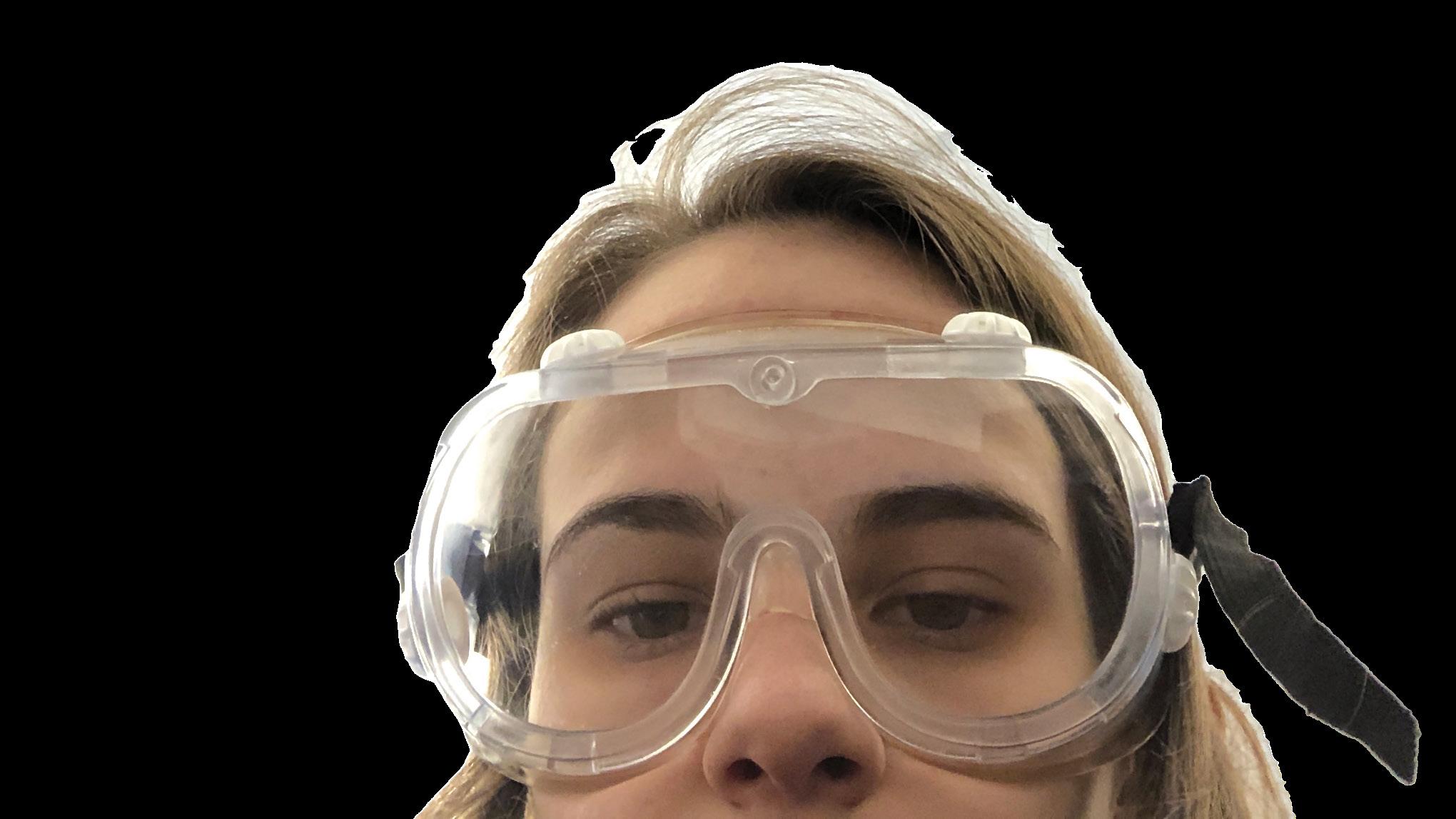
Over time, I realized changing my major wasn’t an indication that I had lost my interest in studying the world around me. I had simply changed the tools I used to explore those topics. I ditched the absolutely atrocious (and uncomfortable) goggles and traded in the lab reports and microscope for interviews, note-taking, and human exchanges.
Art and culture are, in many ways, another form of observation. ey show us how and why a community grows, what it values, and what it chooses to preserve. If this issue represents the agar plate, then the stories within represent the bacteria: colorful and unexpected. You’ll meet people who paint, teach, design, and create. ankfully, we aren’t stuck in a petri dish, and culture isn’t con ned to our galleries or stages; it grows wherever people are willing to share part of themselves with others.
I once imagined analyzing evidence left behind at a scene. Now I get to document it while it’s still alive. And also … I don’t have to use calculus.
KELSEY WINKELJOHN ASSOCIATE EDITOR kelsey@comocompanies.com


Mall walkers strengthen their health — and connections.
BY M C KENNA STUMPH
Most Columbians know the Columbia Mall as a place that comes alive at 11 a.m., a hub for window shoppers, food-court regulars, and determined bargain hunters. But long before the storefronts glow and the rst customers drift in, another community lls the walkways.
eir footsteps echo through the corridors, creating a steady rhythm that has nothing to do with retail. ese are the mall walkers, and for many of them, the Columbia Mall is a center of movement, friendship, and routine.
Angela Shelton, a homemaker and mother of three, is one of the familiar faces in this early-morning crowd. She’s been walking the mall for years, ever since her children were small. As she walks past two young mothers pushing strollers, she smiles. “ at used to be me,” she says, remembering the days when mall walking was her escape from the chaos of raising toddlers.
Now that her kids are grown up and more self-su cient, Shelton walks with a group. Some are relatives, and some are friends she met along the way. e mall walkers are a diverse bunch: retirees, parents, people recovering from injuries, and those simply looking for a safe, climate-controlled place to move. Some arrive as early as six in the morning, long before the rst Eddie Bauer employee clocks in.
Shelton rst encountered mall walkers when she worked at a kiosk as a teenager. “At rst, I thought it was a little funny,” she admits. “What were these people doing just walking around the mall?” Years later, as a young mom searching for a safe and a ordable option for tness, she understood. Mall walking wasn’t just exercise; it was connection.

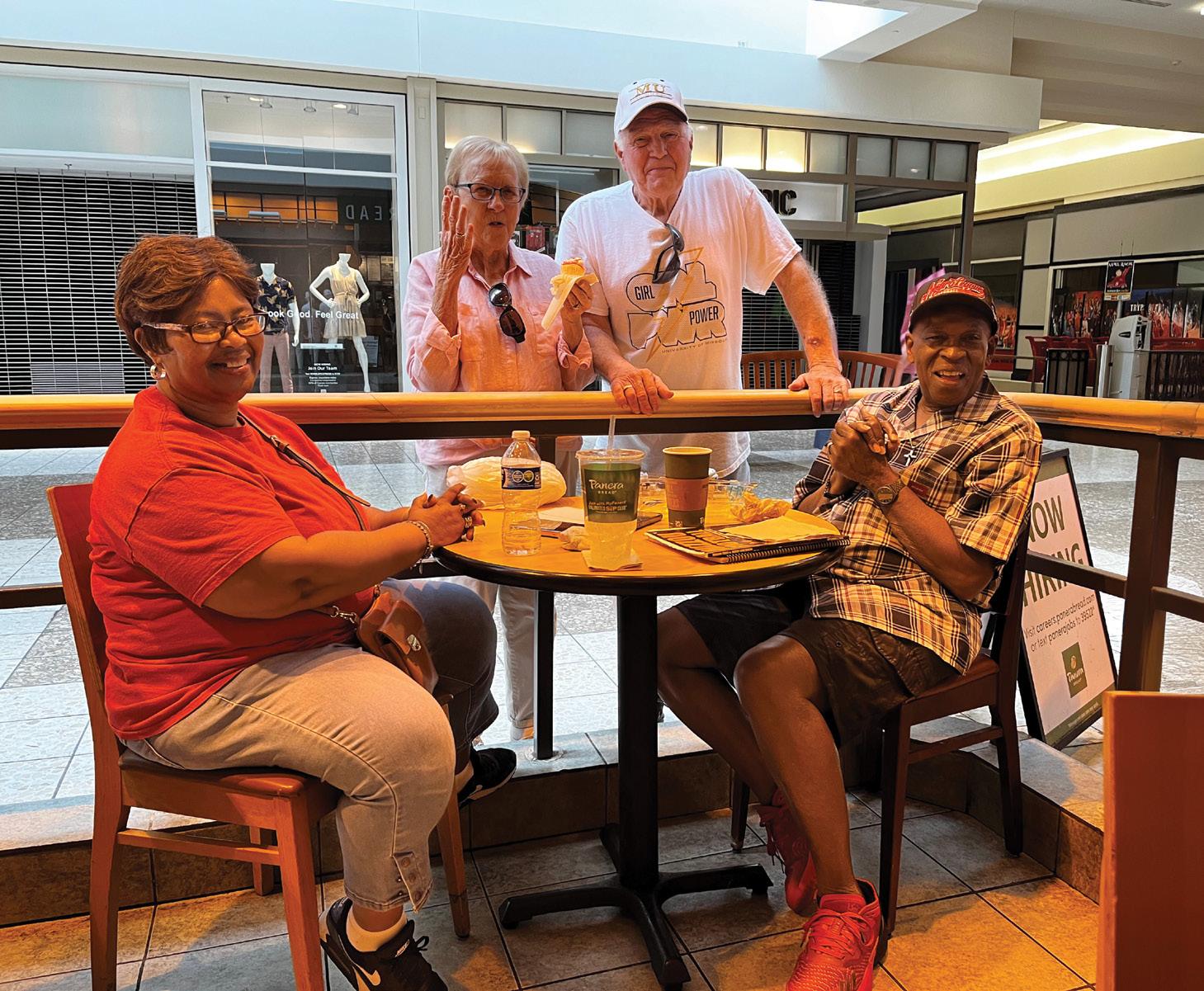
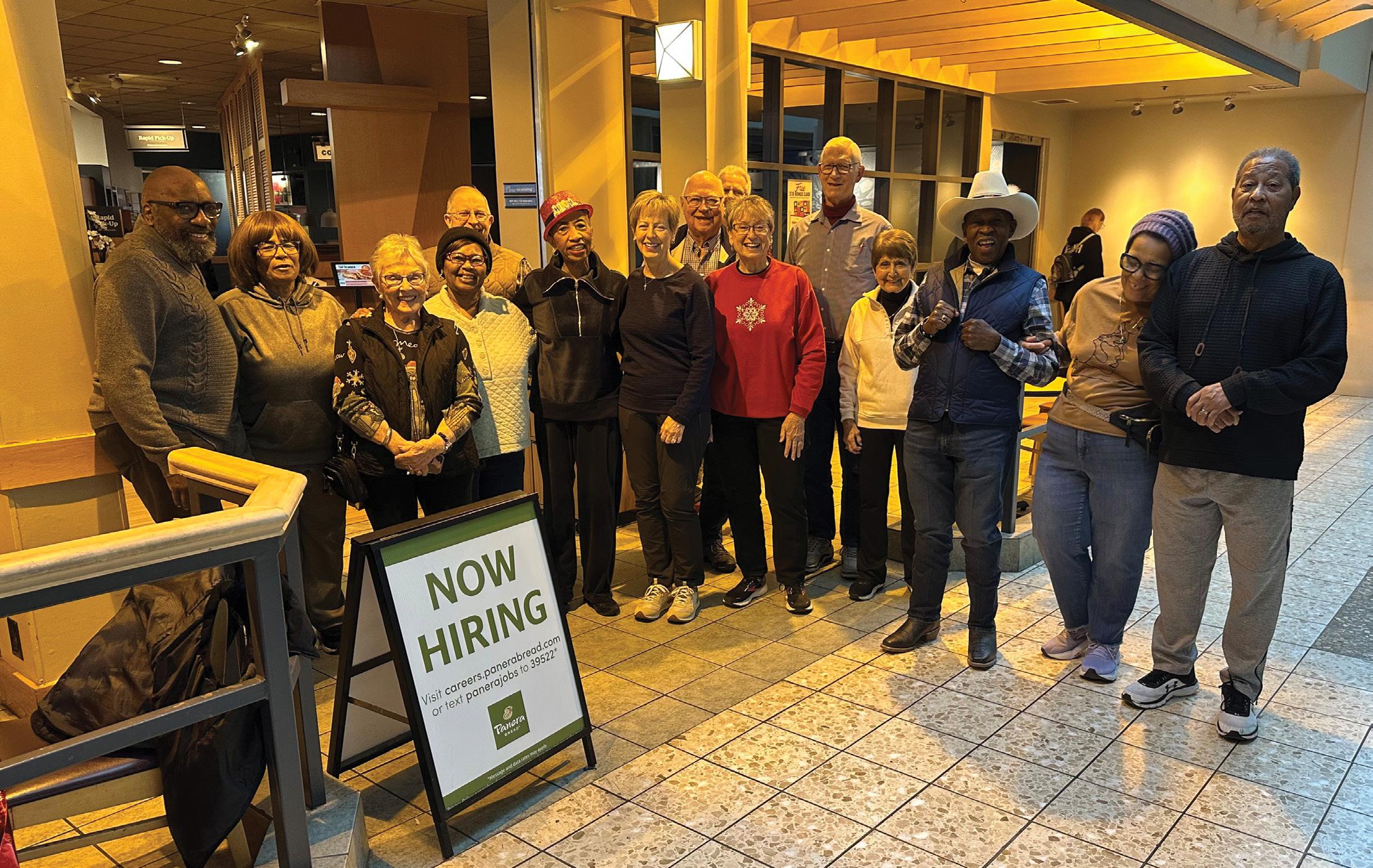
On Friday mornings, you can spot Shelton and her walking group gathered at Panera, bright red shoes propped under the table as they sip co ee and catch up. e shoes are a playful symbol of their shared commitment, but the group itself is what keeps Shelton coming back.
“I wanted to get into tness, but I was never a gym person,” she says. “I needed to get out and start focusing on my health. en it ended up being healthy and social.”
Safety is another reason she prefers the mall. “I feel safe, I really do,” Shelton says. “ ey have security here and cameras. I can walk by myself.”
Outdoor options like Shelter Gardens are beautiful, but the mall’s climate-controlled environment is easier on her asthma and allergies. No pollen, no icy sidewalks, no unpredictable weather, just smooth oors and steady temperatures.
One thing to note is that dogs can accompany early-morning walkers — as long as their business is cleaned up afterward. Any day of the week, you can see many people walking their furry companions up and down the hallways.
For Barbra Horrell, mall walking began as something to get her out and about. Eight years ago, after her husband passed away, she needed something to anchor her days. She found it in the mall’s quiet morning hours.
Horrell walks with a group of four or ve members from Second Baptist Church. Over time, they’ve gotten to know other walking groups, retirees, church friends, widowers, and longtime regulars. “ ere’s other groups too,” she says. “Di erent
churches and di erent retired people that all came together, and we are one big family here.”
One lap around the mall equals a mile, and Horrell’s group is serious about their routine. ey walk fteen miles a week — three laps a day, ve days a week. For Horrell, the mall o ers consistency that outdoor walking can’t. Summer bugs and winter ice are no match for air-conditioning and polished tile.
“ is way, you can walk for as long as you want,” she says. “When you’re nished, you can have co ee with your friends and other groups that are walking. It really is a community that walks here every day.”
e bene ts go beyond physical tness. Horrell’s group, made up mostly of single widowers, has found emotional and mental support in their shared routine. “We’re friendlier,” she says, noting how walking has added happiness and routine to her life.
Mall walking has become a kind of informal therapy for many participants — a way to process grief, combat isolation, and maintain a sense of purpose. e mall’s wide corridors o er space not just for movement, but for conversation.
By the time the mall o cially opens at 11 a.m., most walkers have already nished their miles, shared their co ee, and headed home. Shoppers rarely see the early-morning transformation: the mall as a track, a meeting place, a support system.
But for Shelton, Horrell, and dozens of others, those quiet hours are the best part of the day. Mall walking is free, safe, and accessible, but its real value lies in the small-town community feel, where everyone knows everyone.
The many lives of Columbia’s North Village.
BY TAHLIA HEATON
Cities try to manufacture arts districts all the time. Columbia got lucky — one grew here on its own. Long before anyone branded it the North Village Arts District, the blocks around Ninth, Tenth, and Walnut streets were quietly lling with painters, sculptors, illustrators, musicians, and the kind of resilient energy that thrives in cheap, overlooked buildings. It wasn’t planning that made the North Village Arts District. It was gravity.
But the roots go deeper than the current district. Decades before anyone imagined First Fridays or artist studios, the north side of downtown was already incubating its own o -Broadway ecosystem: a cluster of low-rent, creative, slightly renegade businesses run by young people who were discouraged from joining the downtown establishment.
THE BIRTH OF THE NORTH VILLAGE
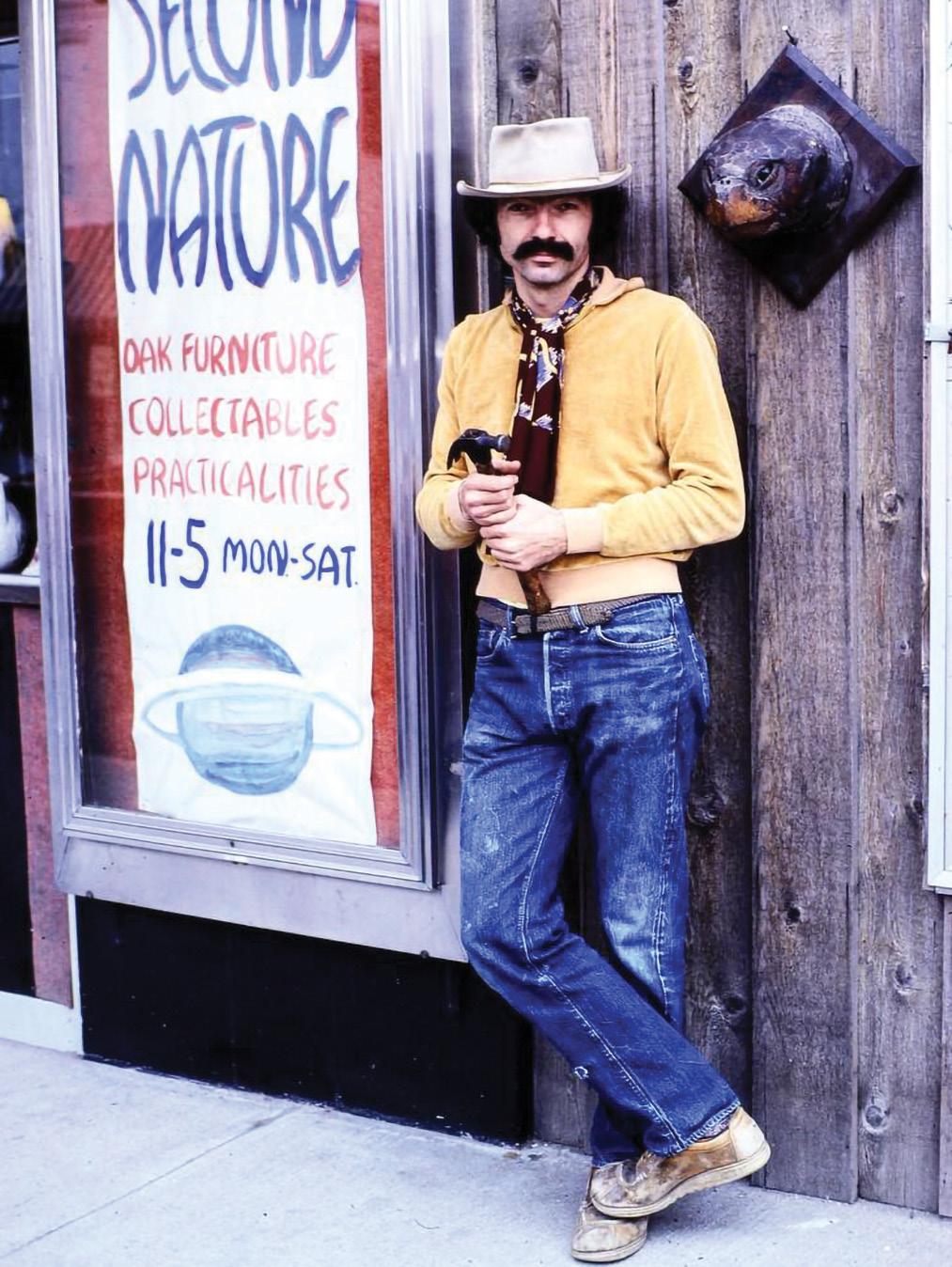
e earliest version of Columbia’s “North Village” took shape in 1973, when a handful of young business owners north of Broadway formed the Uptown Merchants Society. ey weren’t folded into downtown’s mainstream. In fact, according to Michael “Smokey” Cochran — whose Second Nature antique store was nestled in the lobby of the old Varsity eater — they were politely discouraged from joining the Downtown Merchants Association. So they built their own coalition instead.
“ e DMA was composed of many oldguard businesses, the cream of Columbia’s retail establishments in those pre-mall days, and we were, in their eyes, a bunch of undesirable hippies,” Cochran says. “We were told, in the nicest way possible, that we were not invited and would not be allowed to join.
“We were occupying and reviving a business district that had come to be regarded
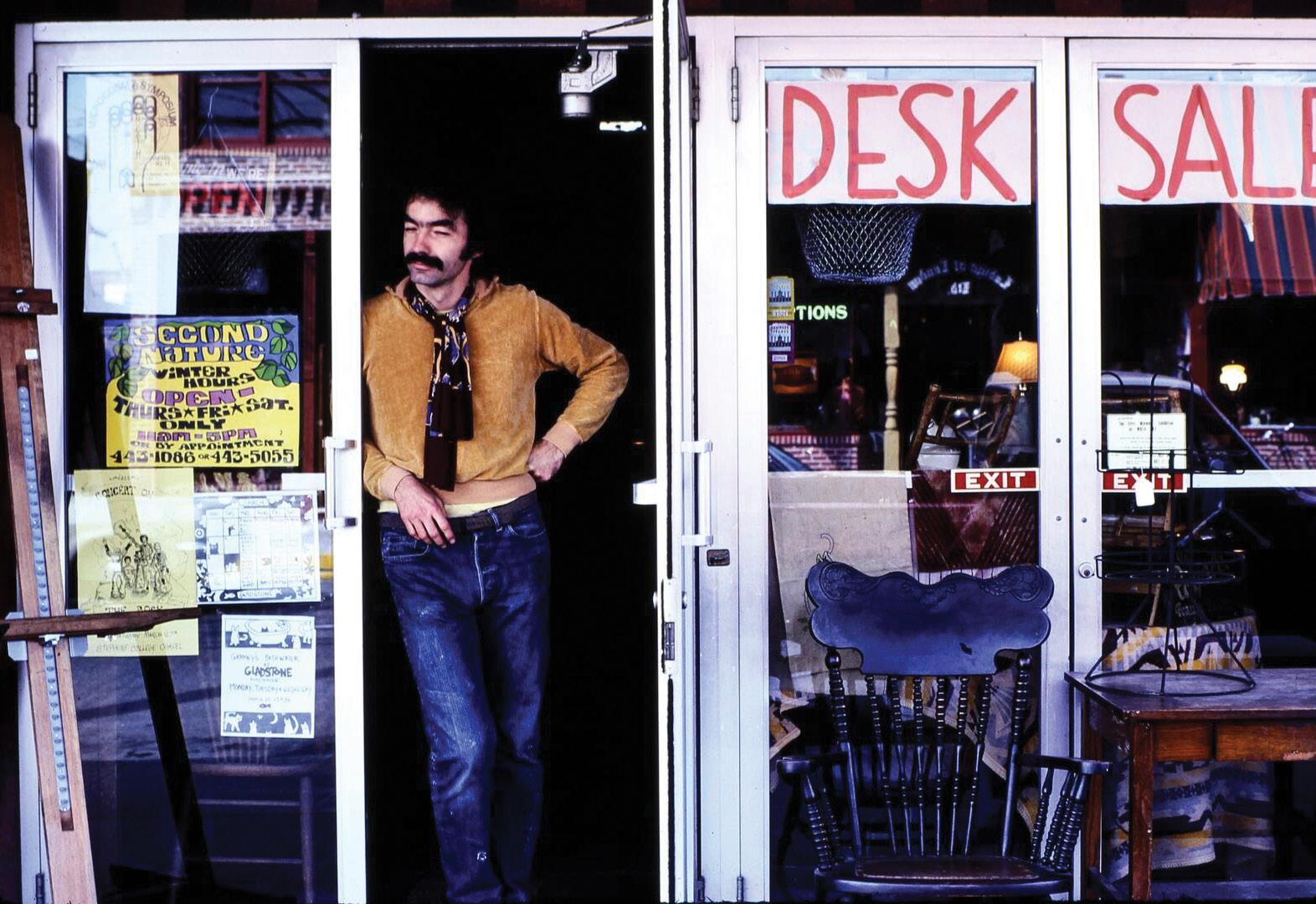
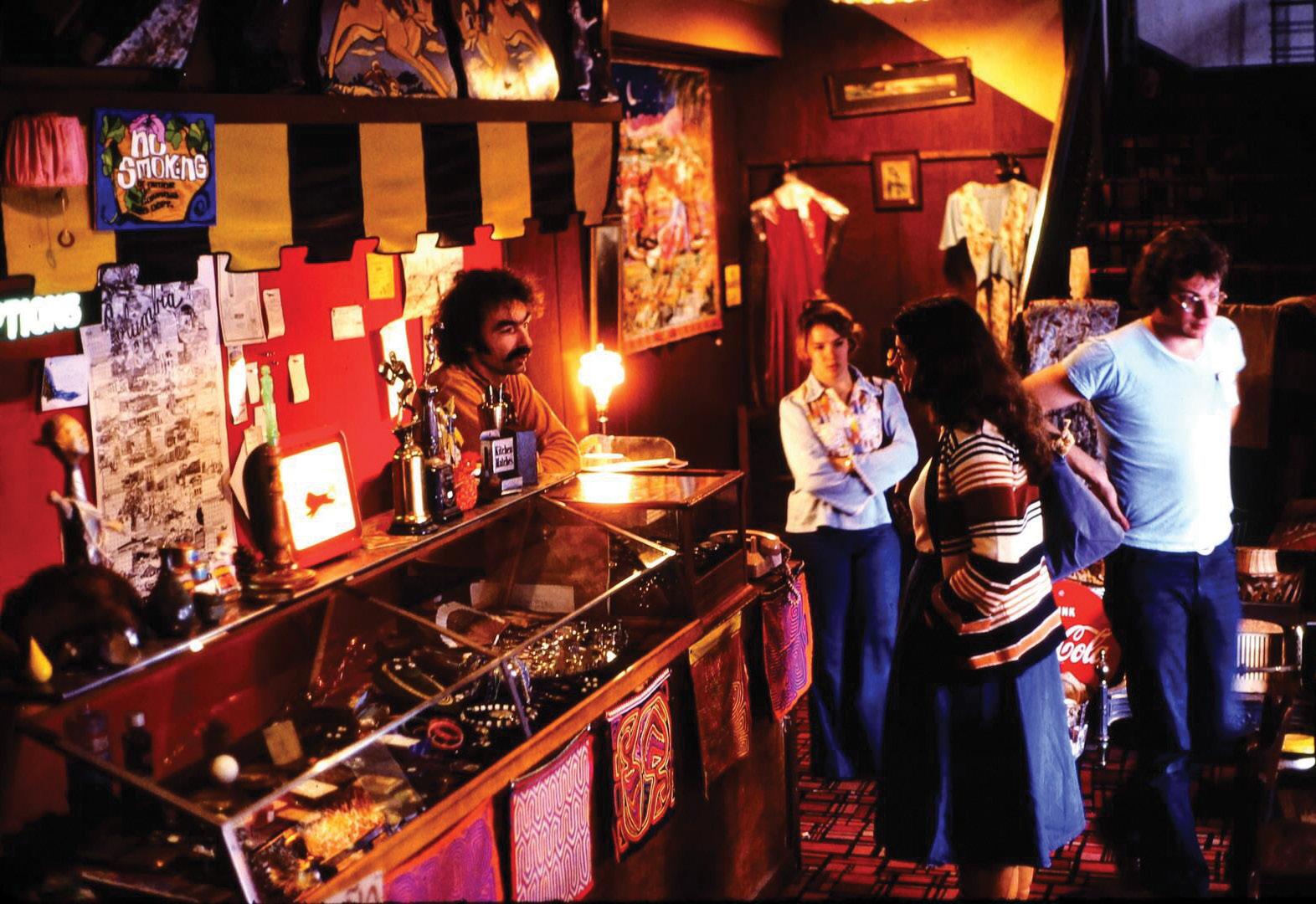

by the mainstream as undesirable, at least partially due to the type of clientele attracted to the Ben Bolt [Hotel], generally regarded as a op house — though it wasn’t,” he says. “ e mantra was ‘don’t go north of Broadway.’ us there were a variety of locations available for minimal rents, in turn attracting a generation of young, good-hearted dreamers and hustlers.”
What emerged was a pocket of counterculture commerce centered around North Ninth Street. In just a few square blocks, you could buy records, antiques, leather goods, clothing, posters — and, of course, there were the head shops. ese businesses gave North Ninth Street a distinct identity long before the Blue Note arrived — one that even today elicits one phrase: “the hippies.”
e group’s idea took o fast. In that rst year, they launched street dances, sidewalk sales, and an annual “Spring Fever” festival.
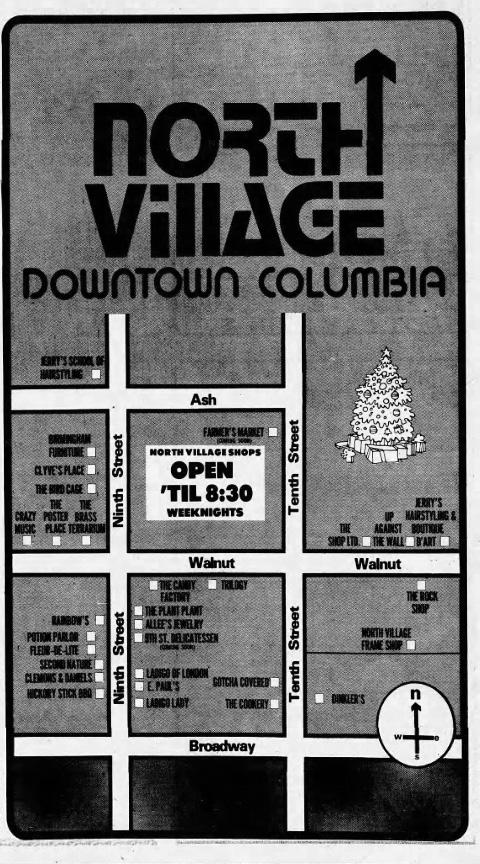
Cochran recalls that at a meeting of about 10 business owners, KOMU sales rep Douglas Edwards pitched a uni ed “North Village” marketing concept to the group — complete with a logo and a modest TV plan — and they adopted it. e momentum snowballed quickly; by 1975, the Columbia Tribune reported that the organization had 25 members. In 1976, it had grown to 45. By 1983, there were more than 70 businesses operating under the North Village banner during the neighborhood’s annual Super Sidewalk Sale.
e energy spilled beyond Ninth Street, giving the entire north side a shared identity. In 1977, the Tribune reported that the North Village had o cially extended its boundaries. Projects like e Marketplace, a mixed-use commercial project housed in the former Long Bell Lumber Company building, brought new life to the neighborhood, signaling the district’s shift from a loose cluster of shops into a recognizable commercial area.
Long before the Uptown Merchants Society put a name to the North Village, the blocks bounded by Tenth, Walnut, Park, and Orr streets were shaped by the railroad. For decades, freight moved through the Wabash yard — groceries, lumber, coal, cattle — into a surrounding landscape of warehouses, yards, and industrial sites arranged around the tracks.
After passenger service ended in 1969 and freight dried up in 1984, the town’s industrial core hollowed out. What remained were large, cheap, underused buildings: the kind of overlooked spaces artists migrate toward long before anyone calls a neighborhood “creative.”
By the late 1970s, artists were ltering into the old industrial belt. Columbia College opened its Art Annex in the former coal-gas plant near the depot in 1978, anchoring one end of a quietly forming creative corridor that stretched from the railyard to the school’s Art Center on Broadway. Students and faculty walked between the Art Center on Broadway, the Annex near the rail tracks, and the main campus, passing through a landscape many Columbians barely noticed. A hodgepodge of shops also sprouted up to serve them — Art Mart, the Clay Hand, e Weavers’ Store, Up Against the Wall — forming a living ecosystem that predated the North Village Arts District era by decades.
By then, the north side had its own rhythm. Neighborhood regulars ducked into Ernie’s for breakfast, grabbed sandwiches at the North Village Sub Shop, and ended nights at the Cork & Dart Pub — everyday xtures that stitched the corridor together long before anyone formalized an arts district.
“Columbia College had a big stake in the area,” says Lisa Bartlett, the Columbia College art student who would later open the foundational Artlandish Gallery in the North Village. “I think that’s when the bohemians and the artists moved in, and they could a ord spaces like that — and every nook and cranny had some cool artist or musician working out of it. And, yeah, it was a whole scene.”
If you weren’t part of that orbit, you could walk right past it and never realize how much was happening in plain sight.
For a scrappy, upstart coalition, the North Village organization had a decent run. e name shows up in ads and local news coverage for roughly a decade, into the early 1980s, before it starts to fade from public view. e last North Village festival took place in 1983. e last North Village ad also appeared in 1983.
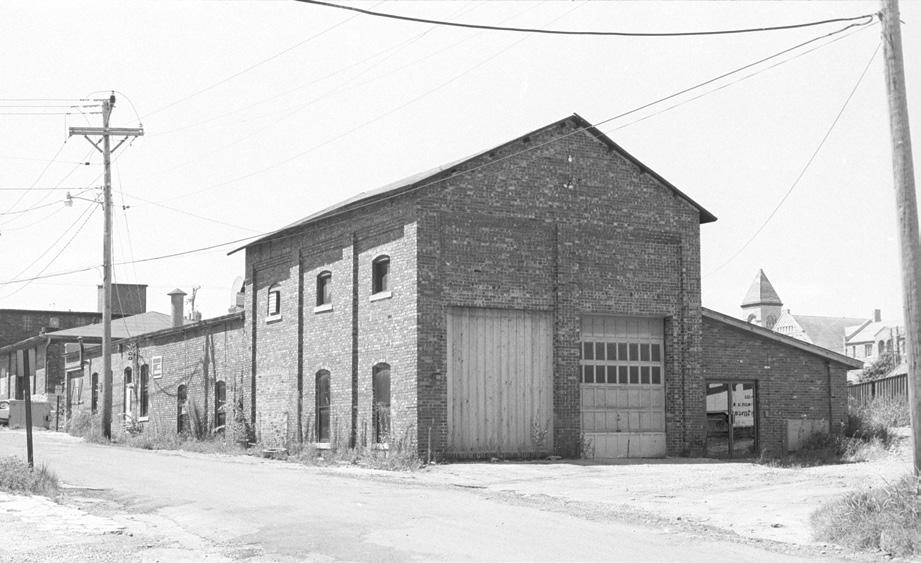
Columbia College Art Annex, at Orr and Ash streets, photographed in 1978.
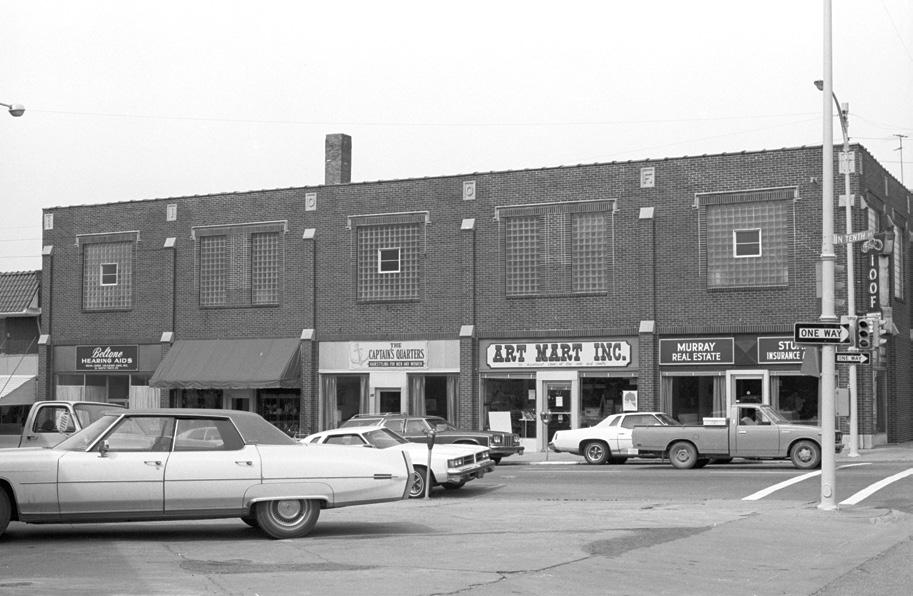
North 10th Street, photographed in 1978. Art Mart Inc. is visible among the storefronts.
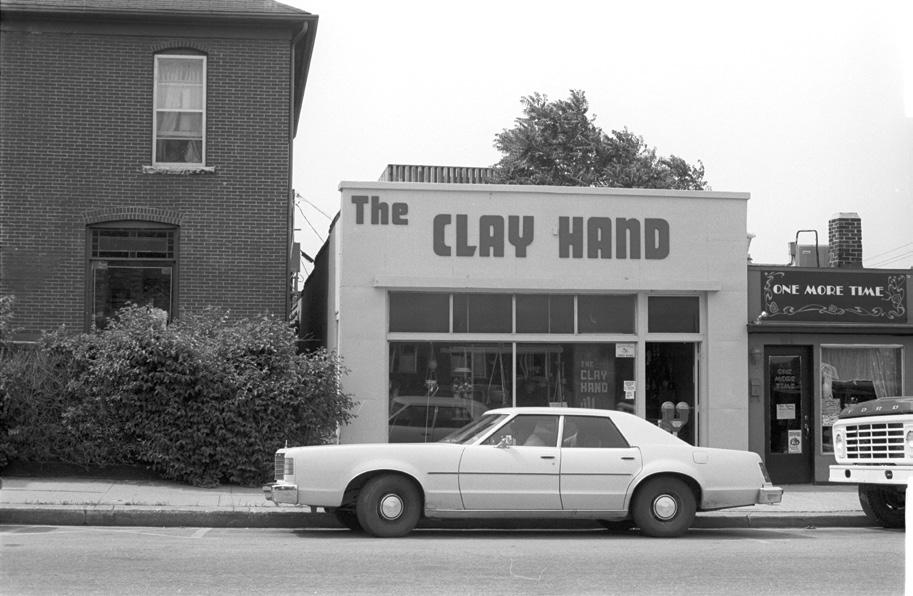
The Clay Hand, 908 E. Walnut St., photographed in 1978. The store sold pottery supplies: clays, glazes, tools, wheels, and kilns.
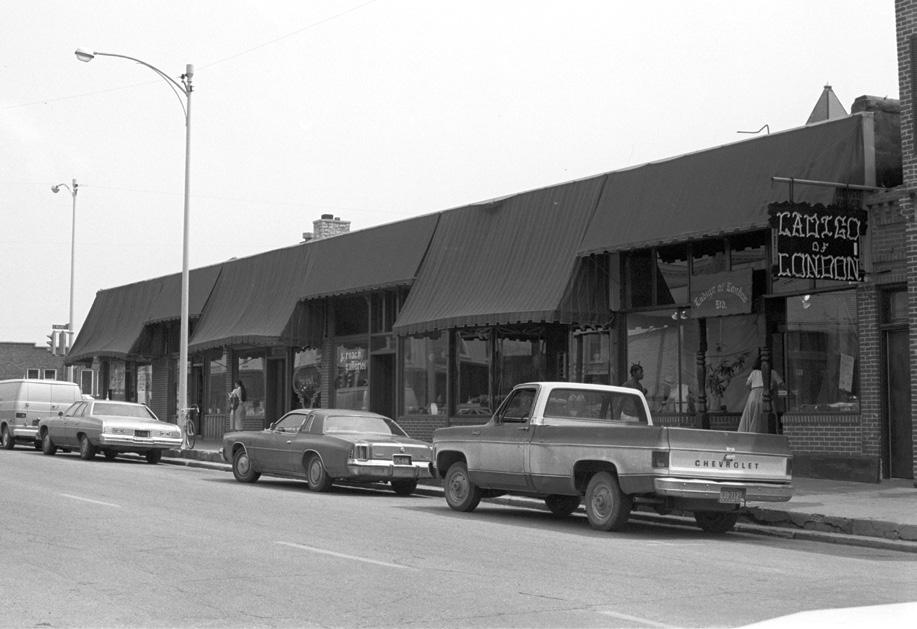
North Ninth Street between Broadway and Walnut, 1978. Ladigo of London is in the foreground.
Credit:
of
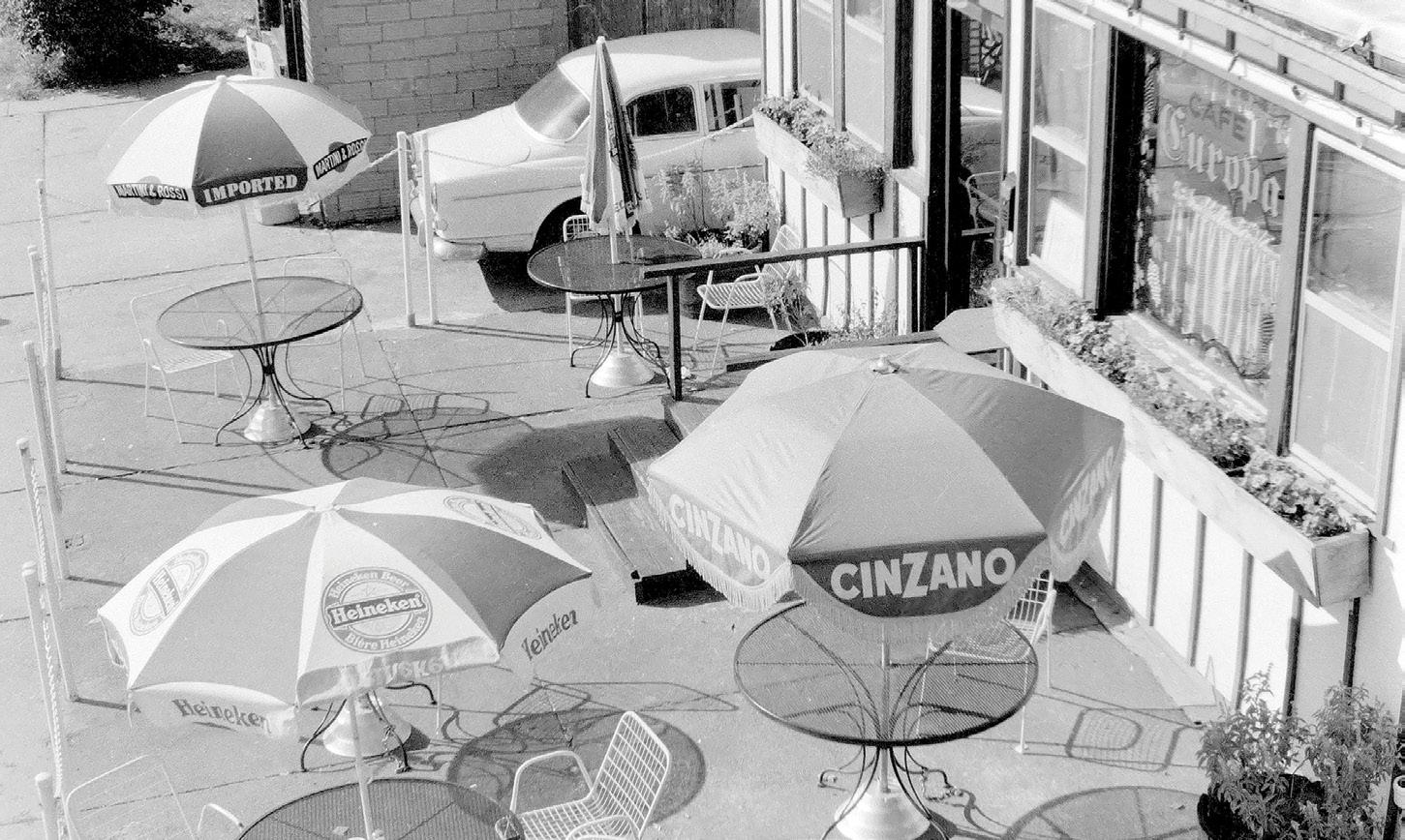
Like the rest of downtown, the North Village entered the 1980s during a period of transition. Public debate around parking, changing shopping habits, and the future of downtown intensi ed in the years surrounding the opening of the Columbia Mall in 1985. While some merchants initially reported minimal impact, the longterm e ects would unfold more gradually, with a wave of downtown business closures following later in the decade. e main strip of the North Village, Ninth Street, became less retail-focused over time, but Leo’s Vintage and Variety held strong in its second- oor outpost for nearly 50 years, nally closing its doors in 2025. Cochran’s store closed after three years. Paul and Barb Mashburn, who had been involved in the North Village organization since the Uptown Merchants Society days, sold Ladigo of London, Ladigo Lady, E. Paul’s, and Mashburns in 1982. Rainbow’s Leather closed in 1985, and a few years later the space started its new life as the popular Italian restaurant Trattoria Strada Nova. By the late 1980s, the rest of the neighborhood began to enter what some considered a period of decline. “We don’t like it over there anymore,” Chris Rappold, owner of the popular restaurant Cafe Europa, stated plainly in the Tribune when the restaurant left Tenth and Walnut in 1990.
A new conventional wisdom began to prevail: that nothing much had ever existed north of Broadway to begin with. e North Village name would slip out of public use by the time the grunge generation
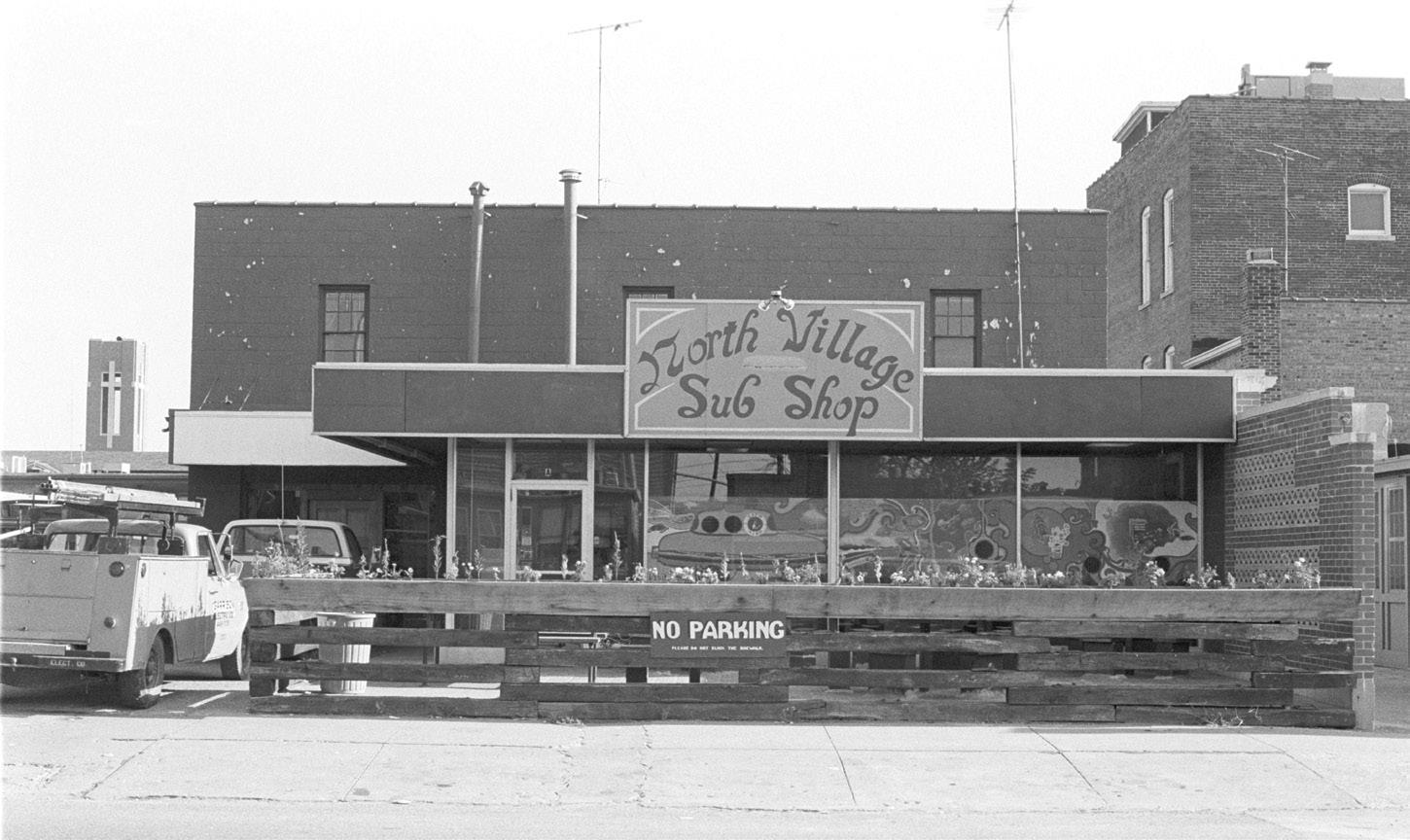
paced the streets downtown. e North Village Sub Shop moved closer to campus and dropped the “North Village” in 1992. And that was that.
e neighborhood, however, did not go quiet after it was written o . It reorganized. rough the late 1980s and into the 1990s, a loose, informal cultural ecosystem began percolating along the industrial edge of downtown, based not in retail but in arts events. e north side became the place for performances, meetings, experiments, and scenes — some anchored in permanent venues, others ickering into being wherever space could be found.
What’s is? opened as a quirky art gallery near the corner of Ninth and Park in
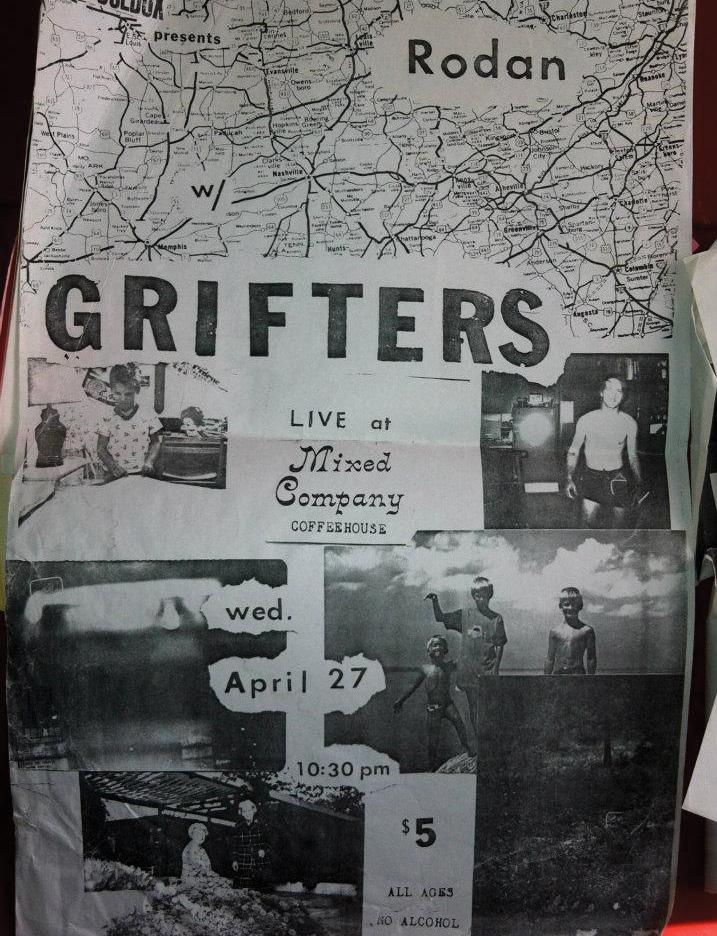
1986, but by 1988 it had somehow become one of the city’s loudest spaces — a storefront where teenagers hurled themselves into mattresses and bands tested how much noise, speed, and politics could t into a small room. It was messy, chaotic, and slightly alarming, but it gave young musicians and audiences a place to exist. No alcohol was served, shows were cheap, and minors were the venue’s lifeblood. en a scrappy little club called the Blue Note moved from the Business Loop into the old Varsity eater in 1990, and suddenly the north side had a real concert hall. e venue came to dominate life on the block the hippies had ocked to years earlier, booking major national rock ’n’ roll acts — Sonic Youth, the Pixies, the Flaming Lips. It became the city’s musical mainstay, a place where people reliably ran into each other and into whatever band was passing through that night. Over time, it made Columbia feel less cut o — like a small town that was part of the larger circuit instead of a detour from it.
At the same time, the north side was also home to quieter, more inward-facing forms of gathering. e Chautauqua Center opened in 1983 in an old brick duplex at 1109 E. Walnut St. as an apolitical, nonpro t space for spiritual, creative, and personal exploration. e center o ered an eclectic mix: computer courses alongside
East Indian concerts, yoga and meditation next to astrology talks and creative writing classes. In a 1983 Tribune article, local artist Jeannie Ramlow Roach described it as “one of the few showcases for local artists.”
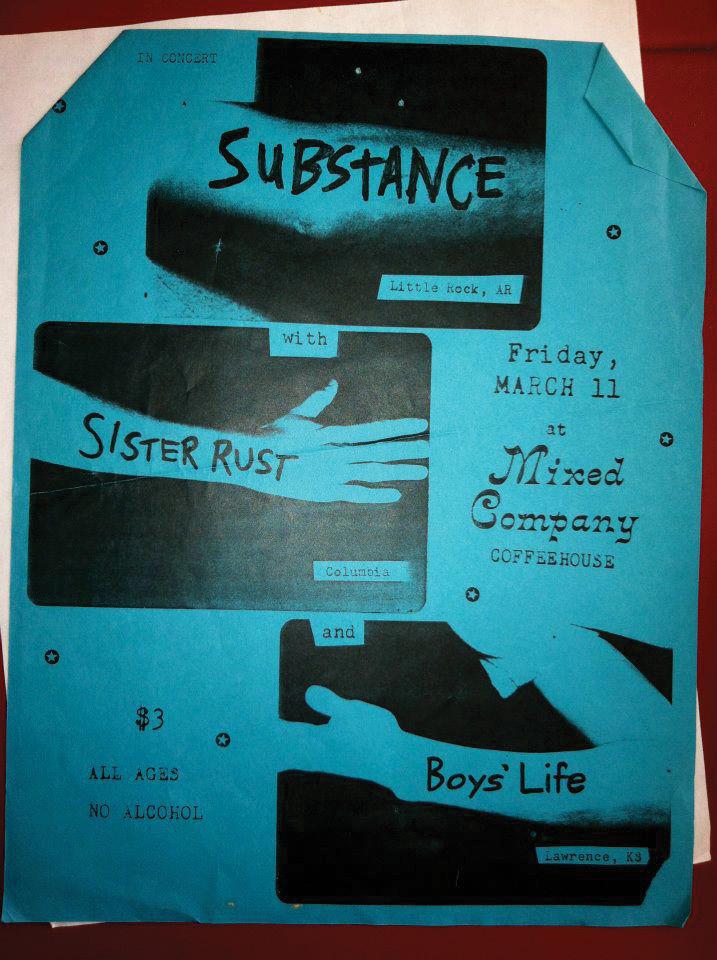
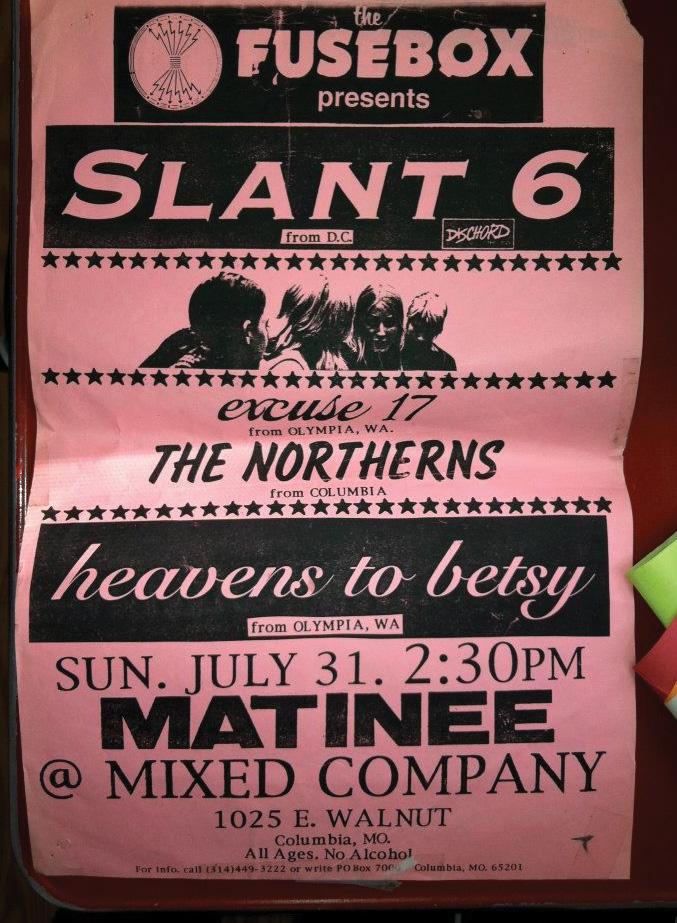
Just down the block in the Berry Building, a humble vegetarian cafe called Mixed Company Co ee House opened in 1990 and functioned as sort of a crunchy small-town community center. In a given week, you might nd a talk about UFOs, a slideshow on alternative communities, or live music spanning a wide range of genres. Political action groups met there. Ethnic drumming groups met there. Yoga classes, poetry readings, and college kids playing board games all shared the same space.
A pop-up venue called e Fusebox, headed by MU journalism student Veronica Del Real, emerged in the early 1990s as a response to the limits of Columbia’s existing music scene. It wasn’t trying to compete with the Blue Note so much as to make room for smaller, more underground acts — the kinds of bands that had nowhere else to go.
“A big reason for doing e Fusebox was we were sick of the homogenous scene in Columbia,” says former Fusebox promoter Mark Walters. “ e Blue Note/ Faye Records stu was cool, but there was nothing for the smaller bands, the underground.”
e Fusebox started out in the basement of Whizz Records, at 23 N. Tenth St., before shifting largely into the back room at Mixed Company. e venue booked small, touring independent bands like Unwound, Heavens to Betsy, Excuse 17, and Bikini Kill.
King bought a second club in 1997, an old Texaco oil shed on the northern end of the North Village called Mojo’s (now known as Rose Music Hall). It had gone through several lives by that time — rst as a beloved oyster bar called SOB before becoming a revered local blues bar known rst as Park Place and then as Deep Blues. Unlike the student-driven venues closer to campus, Mojo’s drew an older crowd — they were there for the blues. King upgraded the space and moved away from that identity. e club became a smaller companion club to the Blue Note, booking early shows with bands like Arcade Fire and the Black Keys.
Elsewhere in the neighborhood, David Wilson and Paul Sturtz were experimenting
with new formats for gathering. Ragtag Film Society, yet another pop-up venture, began hosting independent lm nights around town after the Campus Twin, the town’s only art house theater, closed in 1998. ey started with screenings at the Blue Note and other temp spaces before moving into the former Whizz Records storefront and adding food and booze to the mix. Ragtag was conceived as a place where lm became a reason to gather, not just something to watch.
And then there was the speakeasy. Jim Bradshaw’s semiweekly party — every Wednesday and Sunday — has become the stu of local legend. By Bradshaw’s count, more than a thousand people crossed the threshold of the speakeasy, where local musicians hung out and performed casual jams in a space that existed mostly thanks to word of mouth.
e north side’s grunge-era creative burst didn’t collapse so much as tucker out.
e Art Annex was taken over by MU in the 1980s and demolished in the early 1990s due to contamination from its days as a functioning coal-gas plant. What’s is? didn’t make it into the ’90s. e Fusebox came to an end in 1995 as its organizers graduated or moved on to other projects, and Mixed Company closed that same year. e Chautauqua Center followed in 1999. Ragtag stayed in the neighborhood for eight years before relocating to its current Hittsville home in 2006. Bradshaw moved his company out of the Catacombs in 2007, and the speakeasy was no more.
By the time real estate developers Mark Timberlake and John Ott began creating the North Village Arts District, the north side’s biggest anchors — the Blue Note and Mojo’s — were still standing, but the smaller, more experimental spaces that had once de ned the neighborhood had all closed or relocated.
And that’s how people came to think of the North Village as somewhere nothing was going on. Today, that era is easy to atten into a before-and-after story: a dead zone until the “real” arts district arrived. But when you listen closely to the people who lived through it, what you hear instead is a long, messy middle — a time when the original North Village branding had faded, the mall had gutted downtown’s con dence, and the north side was surviving on patchy, underground momentum.
Sheer neglect is what really led to the birth of today’s North Village Arts District. e late-1800s warehouses had fallen too far into disrepair, and the metal-sheathed industrial buildings nearby frankly didn’t seem to have much intrinsic value. By all accounts, when Timberlake bought the east side of Orr Street between Walnut and Ash, he had no idea what to do with it.
Enter the Village Art Team.
In 2004, as the neighborhood continued to struggle through a period of disinvestment, a small band of artists and homeowners became the North Village’s newest, biggest boosters. Tucked away in the residential area just north of the commercial North Village and inspired by Greenwich Village in New York City, the group printed brochures and launched an aggressive media campaign to pitch the North Central neighborhood as an artists’ paradise. e rst thing they did was rebrand: e North Village, after years without its name, was reintroduced as e Village. ey also substantially expanded the neighborhood’s footprint: A 2005 article in the Columbia Missourian stated the boundaries as Providence Road, Business Loop 70, College Avenue, and East Walnut Street. In 2006, the team launched the Village Art Walk — an ambitious project featuring art by more than 70 artists — including yard art installations by neighborhood locals as well as painting, music, dance, poetry, performance art, and more. And by 2007, local artist and art team member Susan TaylorGlasgow was quoted in the Columbia Missourian saying that more than 100 artists, musicians, and writers were living in the area.
By all measures, their e orts seemed to be working.
At the suggestion of then-downtown Special Business District Executive Director Carrie Gartner, the Art Team — among many others — met with Timberlake.
“I had gotten so many calls from artists looking — ‘Do you know where we can can get sudio space?’ And I was like, ‘No, but I know guy who just bought a warehouse,’” Gartner says with a laugh.
“He was great,” she says. “I sent him to a bunch of people and said do some research. And I sent him some examples in other cities. And God bless him, he did.
He was willing to do that level of research and commitment.”
Suddenly, the buildings Timberlake had purchased seemingly on a whim made sense. Orr Street Studios was conceived, et voilà: An arts district was born. Again. For at least the second time. Or maybe the third.
By now, it should be clear that the North Village Arts District did not appear out of nowhere. It emerged and re-emerged. What people later came to call an “arts district” wasn’t the creation of something new so much as a formalization of something that had already been happening, quietly, for decades.
Gartner calls this a “naturally occurring arts district.”
“You can’t just make that happen,” she says. “You can’t build an arts district from the ground up like that, unless you have a ton of money. You just kind of go with the ow of what the neighborhood’s doing.”
For Gartner, that meant resisting the urge to formalize things too early. “It just kind of made sense, right, that, hey, we don’t need a consultant. We didn’t need formal plans, we don’t need someone to design this. We just need to let these artists kind of run with it.”
In other words, the story of the North Village is not one of top-down planning, but of bottom-up persistence. It formed through accumulation: of people, of practices, of scenes, of memory.
According to Ott, when it came time to name the “new” district, they chose North Village Arts District speci cally as a nod to the former lives of the neighborhood, knowing how dearly Columbia holds its history.
“I pushed North Village, and others did as well, because I knew about the history of North Village,” Ott says. “I was in the North Village in the ’70s, too.”
But is the future of the North Village secure? e story is probably as old as the arts: Artists move into an area; the area becomes more desirable; the artists are priced out. So what’s to prevent this from happening in Columbia’s beloved arts district?
In March 2025, serious conversations about further development of the area arose. e “Feasibility Study for a
Convention Center in Columbia, Missouri,” penned by CSL International, explored different locations in Columbia for a potential 30,000-square-foot convention center. e report discussed siting the development both north and south of Walnut Street in the North Village Arts District. e project would have brought investment, foot trafc, and visibility to the neighborhood, but presumably at the cost of buildings that house a portion of the arts district.
Ultimately, the downtown location was deemed second choice, but the fact that the discussion even happened is a big deal.
“I think it will bring good and bad things,” says Tootie Burns, a local artist who has worked at Orr Street Studios since 2008, about future development of the neighborhood. Burns is also a former president of the North Village Arts District. “I think additional tra c would bring hotel guests or convention center guests who would visit our galleries, restaurants, shops, businesses. at’s a good thing. We don’t have a lot of parking down there, which I think is a major sticking point for the convention center concept, and you can’t create more space. So, you know, I love the idea of additional people down there and additional draw for people. But I don’t know the best way to make that happen.”
Even in the face of future development, the arts district will likely continue to nd its way, much as Shakespeare’s Pizza did when its old building was replaced and the restaurant was rebuilt, remarkably unchanged, inside the new complex at Ninth and Elm.
“ is is not a get-rich-quick scheme,” Ott says. “All we’ve done is, you know, invest and reinvest in these properties.”
e North Village has never been a blank slate. It has always been a place people found when they needed room to experiment, to gather, to make things that didn’t yet have a market or a name. Its value has never been in the buildings alone, but in what people have done inside them.
e Arts District did not replace what came before it. It sits on top of it — layered over the railroad yards, the uptown merchants, the punk clubs, the galleries, the cafes, the half-forgotten rooms where scenes once lived.
It is not one thing, or one era, but the accumulation of many.
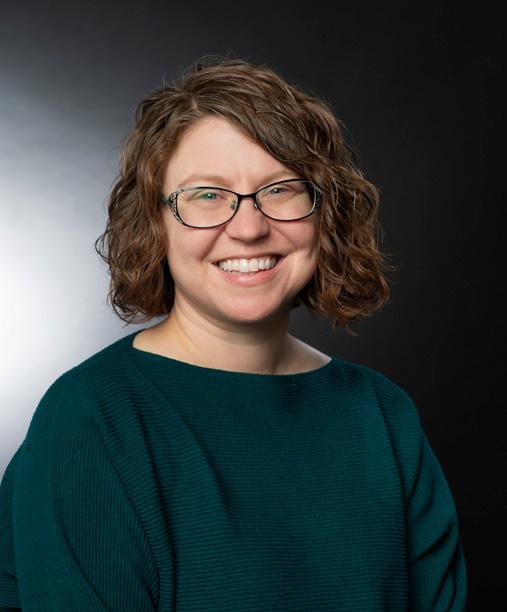
Melissa is a Credit Admin Rep in our Commercial Loan department! She is known as a true go-getter! If she doesn’t know how to fix a problem, she will figure out the answer. She is not afraid to try something new and always steps up to the challenge. Her peers know she is always someone they can count on to get the job done right. She truly embodies Legendary Service!
573-874-8100 • centralbank.net/boonebank


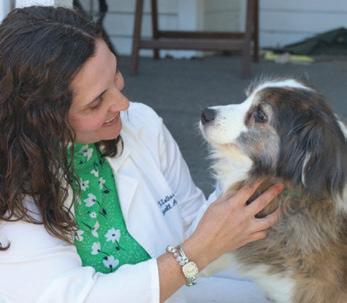
When your pet needs advanced surgical care, ask your local vet about Heartland Veterinary Surgery. Dr. Luther brings nearly two decades of surgical expertise into your local veterinary clinic where you and your pet are known and loved.

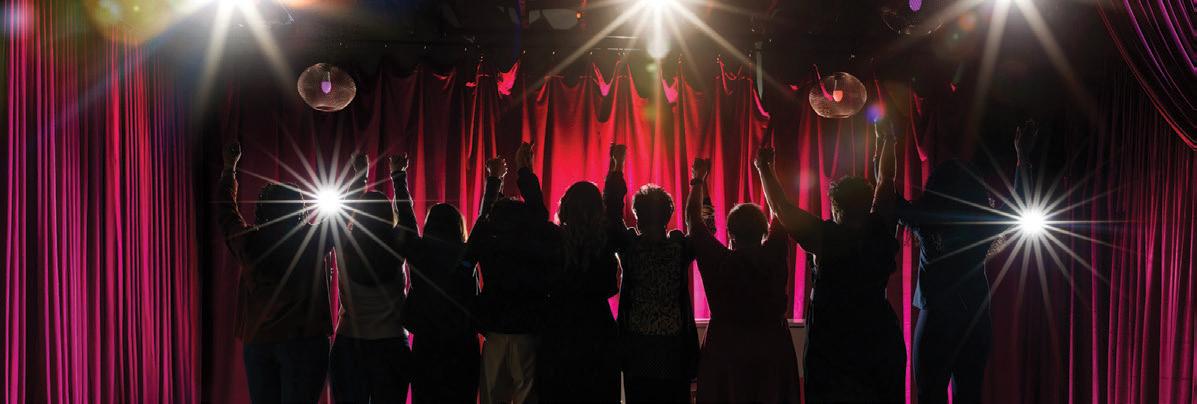
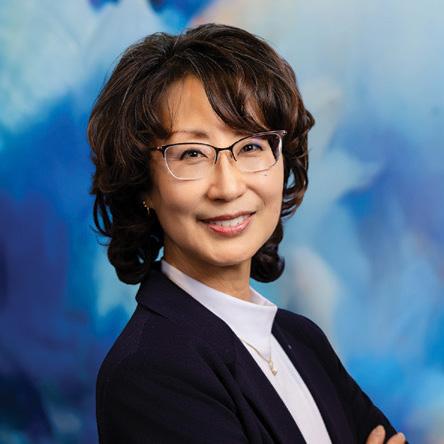
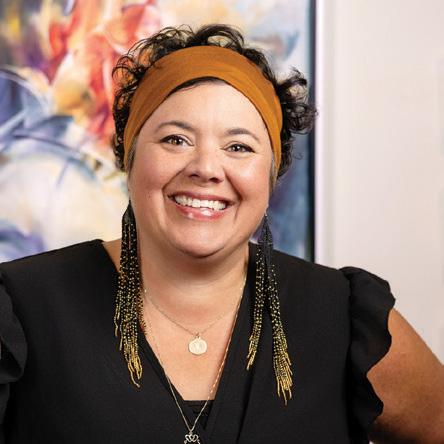



BY BRADLEY WILLIAMS
Maybe you’ve spent a Saturday morning wandering down Broadway or Ninth Street, or you’ve caught a concert at e Blue Note or a lm at True/False. If so, you already know something about Columbia: is is a town that values and loves creativity. We love ideas. We love people who build, curate, and craft a life that feels meaningful and contributes to the beauty of our city.
But there’s a subtle trap hidden inside that impulse.
In our unending search for a well-curated life, success can start to feel like a vertical performance. Like we’re always climbing — always leveling up — always making sure the lighting hits our achievements just right. Careers become ladders. Social circles become rankings. Even the way we talk gives it away: “moving up,” “getting ahead,” “building a platform,” “gaining a following.” It’s as if the goal of life is to end up on some kind of pedestal.
I’m thankful that Jesus shows a di erent way to frame success.
Recently, I was re-reading a scene from one of the last moments in Jesus’s earthly life and ministry. A group of friends is around a table. ey’re with someone truly extraordinary. And what are they doing? Arguing about which of them is the greatest. Comparing impact. Measuring importance. Doing what we all do when we feel the pressure to impress.
Jesus responds with something that feels like holy disruption. He picks up a towel and pours water into a basin. He proceeds to wash his disciples’ feet and wipe them dry.
In this act, he basically says: Among you, it’s going to be di erent. You don’t have to play that game here.
In a world that trains us to seek in uence and protect status, Jesus o ers a different model of accomplishment. If you want to be great, don’t look for the pedestal; look for the oor. Don’t reach for the title; reach for the towel. In the economy

of God’s kingdom, greatness is not being served — it’s choosing to serve.
And in a town like ours — smart, driven, achievement-oriented — that can feel almost backward.
Because we’re often taught to help others, sure, but with the branding of our generosity still visible. To serve, but in ways that keep us in control. To give, but in ways that make us feel needed, appreciated, and impressive.
But Jesus calls that behavior out, not to shame us, but to free us. True greatness is quieter than that. Truer than that. It’s not about being seen — it’s about loving well.
I’ve started thinking about this as a kind of “ ip and nd.”
First, we ip our de nition of success. Instead of asking, “What will this do for my image?” we ask, “How will this help the person in front of me?” We stop measuring our lives by the accolades we collect and start measuring them by the burdens we help carry. We trade the ladder for a towel. en, we nd the places where needs already exist, in the life we already have. You don’t need a new stage to live a meaningful life. You need a new posture in spaces you already occupy. A lab at Mizzou. A local co ee shop. A classroom. Your work-
place. Your living room. e dinner table. e question is the same everywhere: How can I be a source of grace here?
And here’s the theological heartbeat underneath all of it: e most in uential person in the universe didn’t come to be served, but to serve. at is not just an example — it’s the shape of reality in the kingdom of God. When we choose that same path, we aren’t losing something; we’re actually nding everything. ere’s a unique kind of rest that shows up when you stop trying to be the greatest person in the room. When you stop curating your own exhibit. You become free — free to see people again, free to notice what’s happening around you, free to love without keeping score.
So as we celebrate the art and culture of COMO this month, here’s a di erent kind of creativity to consider: Maybe the most enduring work of art you will ever produce isn’t something you build for yourself, but what you give for someone else.

BY MAYOR BARBARA BUFFALOE
Columbia’s annual community survey o ers us a valuable check-in. It’s one of the ways we listen to residents about what’s working, what needs attention, and where expectations are changing. While no single survey can capture every perspective, taken together with public meetings, emails, neighborhood conversations, and daily interactions, it helps us measure whether our e orts are aligning with community experience.
is year’s results give us reason to pause and re ect on the accomplishments we’ve achieved together and the opportunities for improvement. e 2025 survey indicates stability and targeted improvement across many of the areas assessed. Satisfaction with 80 of the 89 categories evaluated either stayed the same or increased compared to last year. at matters. In a time when trust in institutions is declining nationally, maintaining steady con dence while making gains in key areas is not something we take lightly.
Of particular note were the improvements related to public safety. Satisfaction with the city’s e orts to prevent crime increased by more than 12 percent. Ratings for the quality of police and re services rose nearly 10 percent. ese gains re ect intentional work by our sta — work like starting our own in-house police academy and procuring the property for a new re station. It tells us that residents are beginning to see and feel the impact of those e orts in their daily lives.
We also saw a meaningful increase in satisfaction with the city’s e ectiveness in communicating with the public, up more than 6 percent from last year. at
feedback is encouraging, and it reinforces the importance of meeting people where they are with clear, timely, and accessible information. Whether it’s sharing updates online via BeHeard.CoMo.gov, hosting Let’s Talk Locals in every ward with council members and sta , or showing up at neighborhood events, we know communication isn’t a one-way street. It’s about listening as much as it is about sharing information.
Overall, about 70 percent of respondents reported that Columbia is a good place to live or work. While that leaves room for improvement, it suggests that many residents still see strong value in our community, even as we navigate growth, economic pressures, and broader uncertainty at the state and federal levels. A favorite feature of the community survey is when respondents compare our results to other cities in the Midwest and nationally. is could be the competitive athlete in me, but I really liked that Columbia is performing at or above peer and national averages in several core areas at a time when many communities are seeing declines.
At the same time, the open-ended comments reminded us that progress in one area often shifts attention to another. Compared to last year, there were fewer comments centered on public safety and homelessness, and more focused on infrastructure and basic services. Residents raised concerns about road conditions, sidewalk connectivity, maintenance, and
the desire to see investment more evenly distributed across neighborhoods. at shift is important. It tells us that while some concerns are easing, expectations for visible, everyday improvements are rising. is feedback is shaping our next steps. We are re ning how we prioritize road resurfacing and sidewalk improvements, using data to guide investments based on need rather than volume of complaints. We are continuing to pursue outside funding to support infrastructure upgrades, while being transparent about what local dollars can realistically support. And we are expanding opportunities for residents to engage directly with sta and elected o cials about what’s happening in their part of the city.
e survey also reinforces something we know to be true: Lasting progress takes time. Many of the challenges residents care about most, from mental health services to infrastructure funding, require sustained e ort and collaboration beyond city limits. Still, the year-over-year improvements in key areas show that when we stay focused, communicate clearly, and work alongside our partners, our efforts can make a measurable di erence.
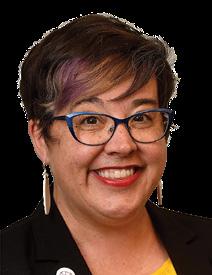
Barbara Bu aloe is currently serving her second term in o ce as the mayor of Columbia.
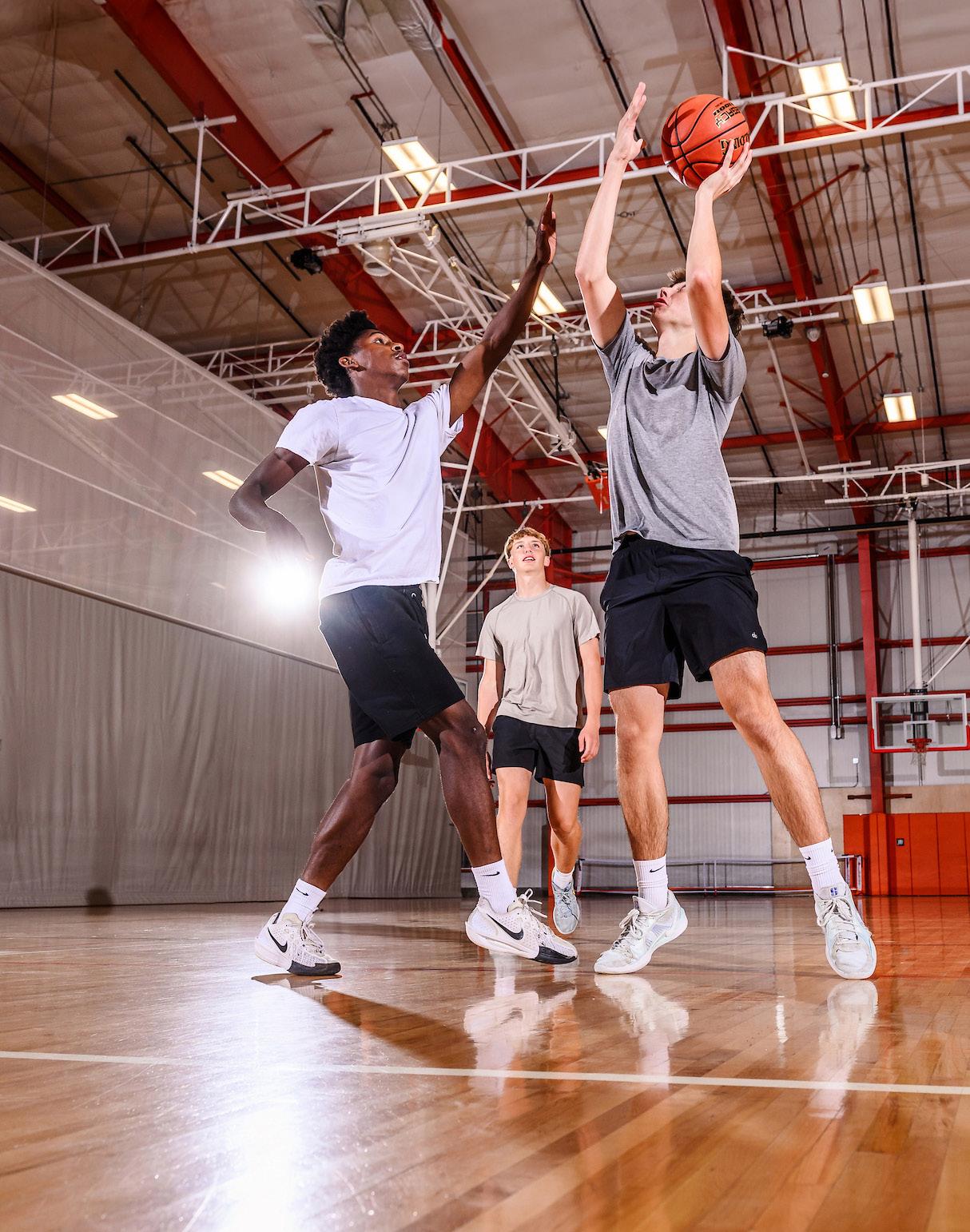
We Know What It Takes to Compete, Because We’re Competitors Too.
Whether competing to be one of only eleven orthopaedic Centers of Excellence in the country, or cheering alongside the Mizzou Tigers as their team physicians, our sports medicine experts know what it takes to level up, day in and day out. From our walk-in injury clinics to the latest treatments and training programs, we’ve got everything Missouri athletes need to be, and stay, at their best.
BY HOSS KOETTING
If you haven’t noticed, some of the harbingers of spring are popping up. Da odils, crocuses, and hyacinths are bravely poking up from their underground hibernation, daring Mother Nature not to freeze them one last time. Songbirds are more prevalent, and optimists — some would say fools — such as me have planted cool weather crops: spinach, lettuces, peas, and broccoli, trying to get a head start on the fresh produce season.
Also, Peter Rabbit is going to be “hoppin’ down the bunny trail” soon. Easter this year is April 5, kind of in the middle of spring, a traditional time of renewal. Why does Easter fall on di erent days each year, you ask? Well, here’s the answer. Easter is tied in with the Jewish Passover, as Christ rose after Passover. Passover begins with the Paschal full moon — the rst full moon after the spring, or vernal, equinox — which falls on March 20 this year.
e Catholic Church established that Easter should fall on the Sunday following, but not on, the Paschal full moon. Fun facts to know and tell.
If you’re planning to have an Easter feast, or any spring get-together with a number of guests, a little preparation can make the ow of the day less hectic. Although dyeing eggs is best accomplished on Saturday evening, there are several tasks that can be dispensed with on Friday or during the day on Saturday.
Try to incorporate some casseroles into your menu that can be refrigerated for a day or two before heating. Clean and trim vegetables so they are ready to go. And for the entrée, a good-quality bone-in ham or leg or rack of lamb that can be made oven-ready ahead of time would be a good option. If ham is your choice, choose one that is a real ham, not “ham, water added” or “ham and water product,” as these will be abby, soggy, and arti cial-tasting. Try a ham from Patchwork Farms, Alewel’s, Frick’s, or Double G. You’ll be happy with any of the above.
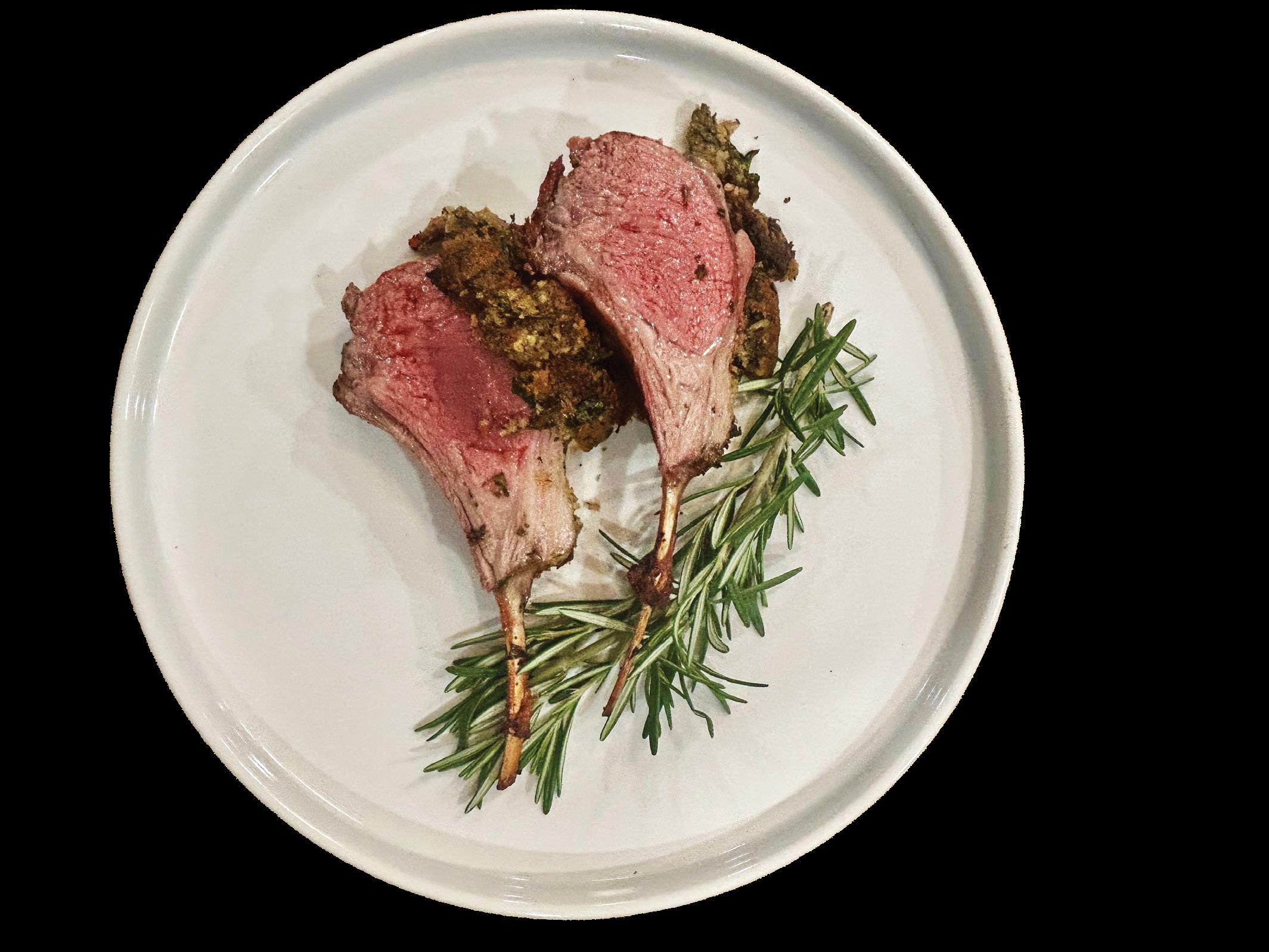
One rack will serve two. Extend this recipe as needed.
If you’re wanting to add a little panache to your meal, lamb is a good alternative. e boneless legs are easy to prepare and serve, but they lack the plate presentation of a bone-in leg, although both are relatively economical. If a gourmet touch is what you’re looking for, then the rack of lamb — my personal favorite — is the way to go. Although a rack of lamb is de nitely pricier than the other choices, the presentation is more eye-catching, and the preparation is surprisingly simple. Try this recipe to impress your guests this Easter or any other time.

Jim “Hoss” Koetting is a retired restaurateur/ chef who enjoys gardening, good food, good bourbon, and good friends.
• 1 ½ Tbsp. olive oil
• ¼ tsp. crushed red pepper
• 1 garlic clove, minced
• 3 Tbsp. thinly sliced scallions
• 1 Tbsp. minced fresh rosemary
• ½ cup fresh breadcrumbs
• ⅛ cup whole grain mustard
• Salt and pepper to taste
• 1 ¼-pound trimmed and frenched single rack of lamb (7 or 8 ribs)
1. Sauté the red pepper, garlic, scallions, and rosemary in the oil; let cool.
2. Add the breadcrumbs and mustard; set aside.
3. Coat the lamb with salt and pepper; brown in a heavy oven-proof pan. Coat the fat side of the racks with the mustard mixture.
4. Roast in a 450-degree oven for approximately 15 minutes or until the middle is 130 degrees (medium rare). Let rest for 5-10 minutes; cut into chops and serve.











Sullivan Farms connects consumers with pasture-raised pork.
BY JODIE JACKSON JR. |
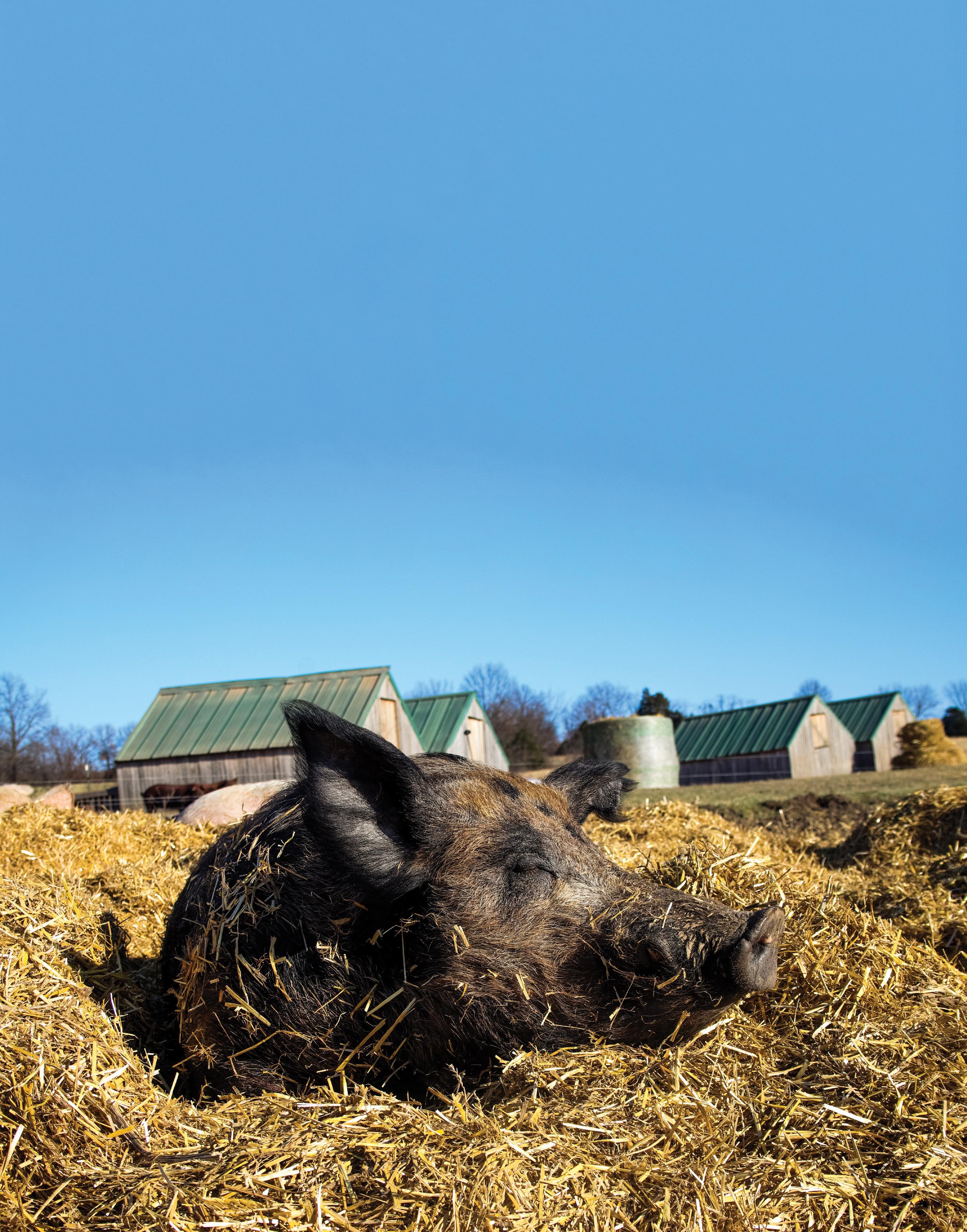
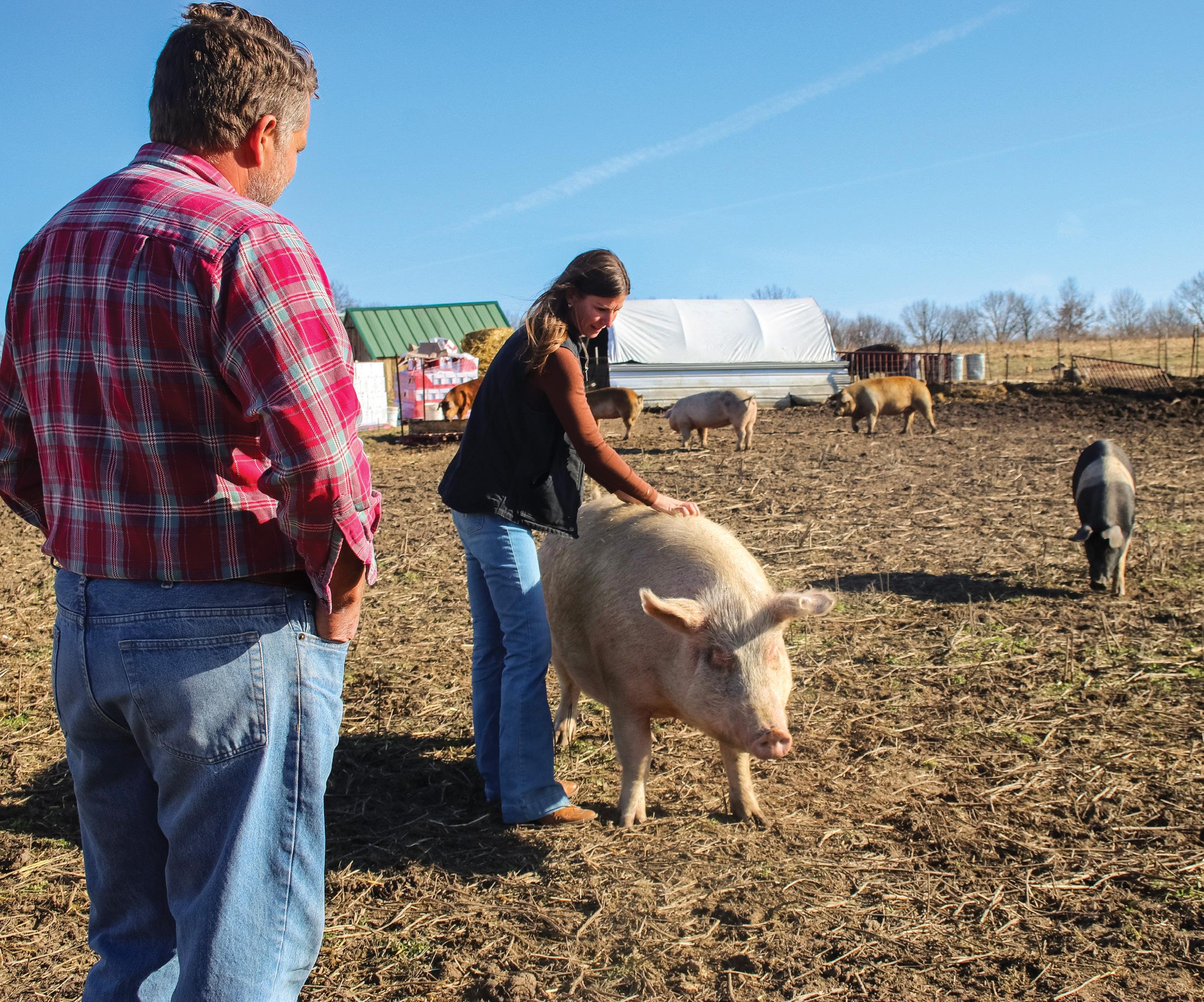
At Sullivan Farms, just 22 miles north of Columbia, Leroy and Mabel never get in a hurry. In fact, Leroy, who tops the scales at about half a ton, is ne with napping most of the day. Mabel is a bit more active, especially if she has some young-uns to care for, and she’s not too shy about getting up close to Bill and Brittany Sullivan — or an occasional visitor — to coax getting her back scratched.
Leroy and Mabel are among the starring pigs in Sullivan Farms' pork-producing operation just outside Fayette. Shoppers at Columbia Farmers Market have gotten acquainted with the farm and its pork. Diners in Columbia might not be aware that when they order a pork dish from Nourish, Barred Owl, Beet Box, Sycamore, Sage, and a few other local restaurants, their palate-pleasing experience is courtesy of Sullivan Farms.
e Sullivans also sell to St. Louis area restaurants, including Katie’s Pizza & Pasta Osteria and Expat BBQ.
“Columbia has such great food, and a great food scene,” Brittany said. “And they’re really supportive of local food producers.”
ere’s also a degree of dining sophistication among Columbia food consumers and the chefs and restaurants that seek out menu options with transparent and traceable food options. It’s not an elitist sort of air, but a discerning choice to select food that has healthy qualities and value.
“ ere is a big disconnect between where the food comes from and what’s on the plate,” Brittany added, explaining that she and Bill became more intentional about their food choices after their daughter was born 20 years ago. “It was really important to me to know where my food was coming from. How it was grown, what was being put in it.”
And at rst glance, Bill and Brittany exude the sort of con dence and knowledge you might expect to nd from seasoned pig farmers.
But this is no typical pig farm, and Bill and Brittany are not the product of a multigenerational agriculture family.
e Sullivans moved in 2010 to rural Fayette from Florida, where Brittany was a physical therapist assistant and Bill had a contracting business. ey are both originally from the Chicago area; it’s safe to say farming wasn’t exactly in their blood. Brittany continued her profession in the physical therapy realm until two years ago, when she made managing the pig farm her full-
time gig. Bill developed a robust vegetable gardening niche at their rst farm, a 20-acre spot just three-quarters of a mile down the road from the house they built ve years ago.
“I always liked gardening,” Bill said. He’s careful to distinguish between having a vegetable garden and full-scale farming, recognizing that the two are different levels of work, but the scope of what he started has blossomed. “We went from vegetable gardening to raising pigs.”
eir quest for home-grown, nonGMO, antibiotic-free meat started with a few laying hens and butcher hens. e Sullivans added a pair of pigs to butcher but decided instead to buy a boar to make it a breeding operation.

AND THEN THERE WERE
“It was a slow transition,” Bill noted. Brittany added, “It was kind of like build your own brand,” as she does all of the farm’s marketing and hers is the farm’s most familiar face at the farmers market, where they also still sell vegetables.
With a cattle operation, it can take a few years for a calf to grow, while pigs are ready for butchering in nine to 11 months, she said. Initially, Sullivan Farms butchered twice a year, then four times a year. Now, they have pigs ready for butchering and processing twice a month.
ey usually have around 200 pigs on the farm at any given time because pigs are born year-round, with as many as 10 or 12 pigs in each sow’s litter. e number, Bill said, is constantly changing, just as the pork and farming industries face constant change as a fact of life.
“We’ve also made changes along the way as the business has grown,” Brittany said.
e Mizzou Meat Market is the butcher and processor for wholesale pigs. Davis Meat Processing in Jonesburg is the butcher for customer sales, grill bundles and other assortments that are sold online, and the farm’s subscription boxes that customers pick up at the farmers market. When customers buy a pig, they can order speci c cuts and processing.
Sullivan Farms has di erent groups of customers, Brittany said. Individual families or groups of families may buy a whole or half hog
processed for the freezer. e farm’s main business is the sale of half and whole hogs and the roster of restaurants that get deliveries every Friday.
Columbia Farmers Market also o ers invaluable visibility for the business, which is as much relational as it is transactional.
“People see you, they see you on social media, they see you at the farmers market,” Brittany explained. “ ey’ve watched our daughter grow up. I’ve watched their children grow up.”
A similar approach is used with the restaurants and chefs the Sullivans count as customers — and friends.
e Sullivan Farms website, just one aspect of their modern farming marketing campaigns, details the Sullivans' goals:
• Healthier, ethically raised meat
• Traceable food source with transparent practices
• Reduces reliance on industrial meat systems
• Promotes animal welfare and humane treatment standards
• Encourages environmentally friendly land use and soil health
• Boosts rural economies and preserves local food traditions
• O ers better taste, texture, and nutritional value through pastureraised practices
• Empowers families to make informed, values-based food decisions
• Stronger connection between consumers and farmers
“We’re not certi ed organic, per se, but we follow all organic practices,” Brittany said. e pigs are fed organic, non-GMO feed, there are no antibiotics or growth hormones in the feed, and part of the feeding regimen includes milk and whey products from Aurora Organic

Dairy, the massive production plant o Route B in north Columbia.
Bill is especially eager to explain the free-range and rotational grazing practices that make the operation more sustainable. ese regenerative practices also create better animal health, because after one area is used, it is tilled and planted to break the parasite cycle that is common to more con ned pig feeding operations. He has also built custom shelters for animal comfort and safety. ose structures are among the examples of how Sullivan Farms is something of a hybrid mix of modern practices and yesteryear pig production.
e shelters — “hog huts” — are similar to what pig farmers used a hundred years ago, Bill said, pointing out that the huts have electricity to keep water from freezing. e electric fencing can be moved and set up, ve acres at a time, in just one day.
e regenerative practices are the biggest nod to pig farming a century ago. Rotate pens and feeding areas, regrow, regenerate.
“It’s not ghting against nature but cooperating with nature,” he said. “It’s a completely di erent mindset. We’re giving more back to the soil than what we’re taking from it.”
e ultimate result is pork with better avor that keeps restaurants and other customers buying what Sullivan Farms produces. Discerning buyers, chefs, and diners can tell the di erence in the marbling — the percentage of fat within the muscle/meat of the pig. e creamy white fat marbled throughout the meat carries more moisture and avor, melting as the meat is cooked.
Buyers will pay more for Sullivan Farms' humanely raised pork versus pork from pigs raised on farms where they are closely con ned to be fattened up on antibiotic- and hormone-laced grain byproducts.
“Our price is obviously higher, but the quality is di erent,” Brittany added. Another di erence is that Sullivan Farms “tries to honor all the animals that are out here. We give them their best life,” she said. “We also try to utilize every aspect of the pig, too.”
Brittany’s face lights up with a smile when she tells about the vegetarian bed and breakfast owner who purchases her pork from Sullivan Farms, citing the farm’s humane treatment of the animals. at relationship is also another example of how the farm aims to bridge the disconnection from agriculture to the dinner table.
e Sullivans said that philosophy is a common denominator among the vendors and producers at Columbia Farmers Market.
“It’s de nitely a community,” Brittany said. “ at’s where we nd our support and friendship. Because we’re kind of all in this together.”


April 3 at 7pm


April 5 at 6:30am
April 5 at 9am and 11am
April 5 at 2pm
Recruiting top talent is easier when the
That’s why we built Columbia, MOre — a new campaign designed to help businesses like yours recruit employees by showcasing everything our city has to offer; from the affordable lifestyle and convenient location to our growing arts scene and thriving job market.
Show your candidates what life looks like beyond the office and turn your next hire into your newest neighbor.
SCAN THE QR CODE TO ACCESS OUR FREE COMMUNITY PARTNER RESOURCES:
• Post the social graphics to your company pages to show off our community.
• Add the video to your recruitment website to help candidates envision life here.
• Use the hashtag #ColumbiaMOre when shouting out your new hires on LinkedIn.



BY MARY KATE HAFNER
Standing half-clothed, staring into the mirror, co ee in hand, with droplets of sweat gathering on one’s cupid’s bow is a morning scene not unfamiliar. Its soundtrack is mutterings of “I have nothing to wear,” often ending with a hurried exit and a day of avoiding mirrors. e relationship we have with clothing is emotional. We turn to clothes for comfort and for power. What we wear helps us answer the question, “Who do I want to be today?” A favorite sweater can be armor against the world, or it can be our spotlight.
Beyond the bene ts of inner condence, beauty has a well-documented impact on job performance and treatment from both strangers and friends. With the increase in virtual meetings and video calls, how we look has become increasingly noticeable.
Seasonal color analysis promises to streamline the dressing process by helping people, mostly women, learn their ideal color palette and therefore look their best.
ME BEAUTIFUL … AGAIN
e rst wave of color analysis frenzy emerged in the 1980s with the publication of color consultant Carole Jackson’s bestselling Color Me Beautiful. e fad never faded away entirely, even showing up in the beloved 2000s dramedy Gilmore Girls, when serious businessman and grandfather Richard Gilmore nds his color season. (He’s an autumn, in case you’re wondering.) Now, seasonal color analysis has returned and is sweeping social media. A single color analysis video can accumulate thousands to millions of views across platforms.

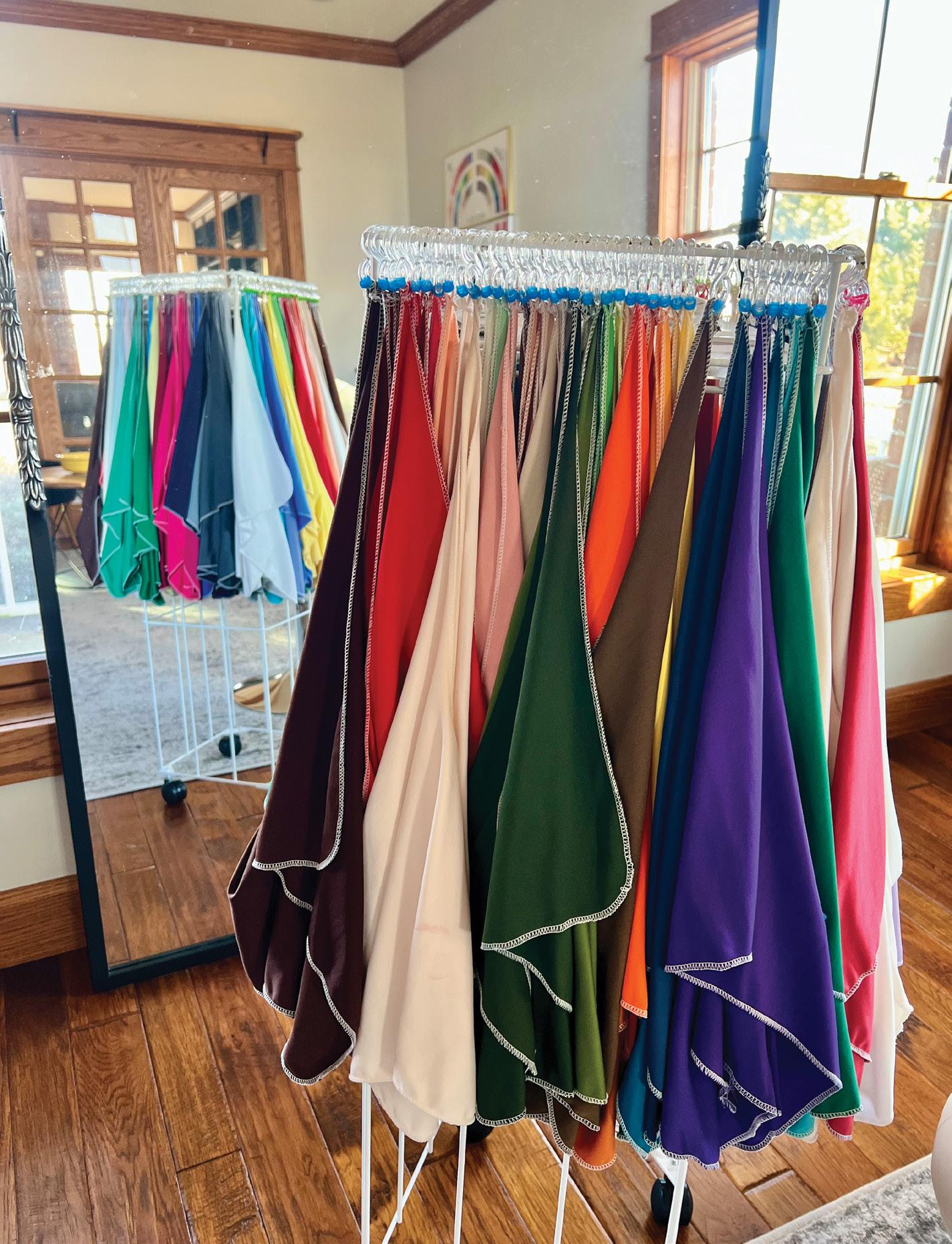
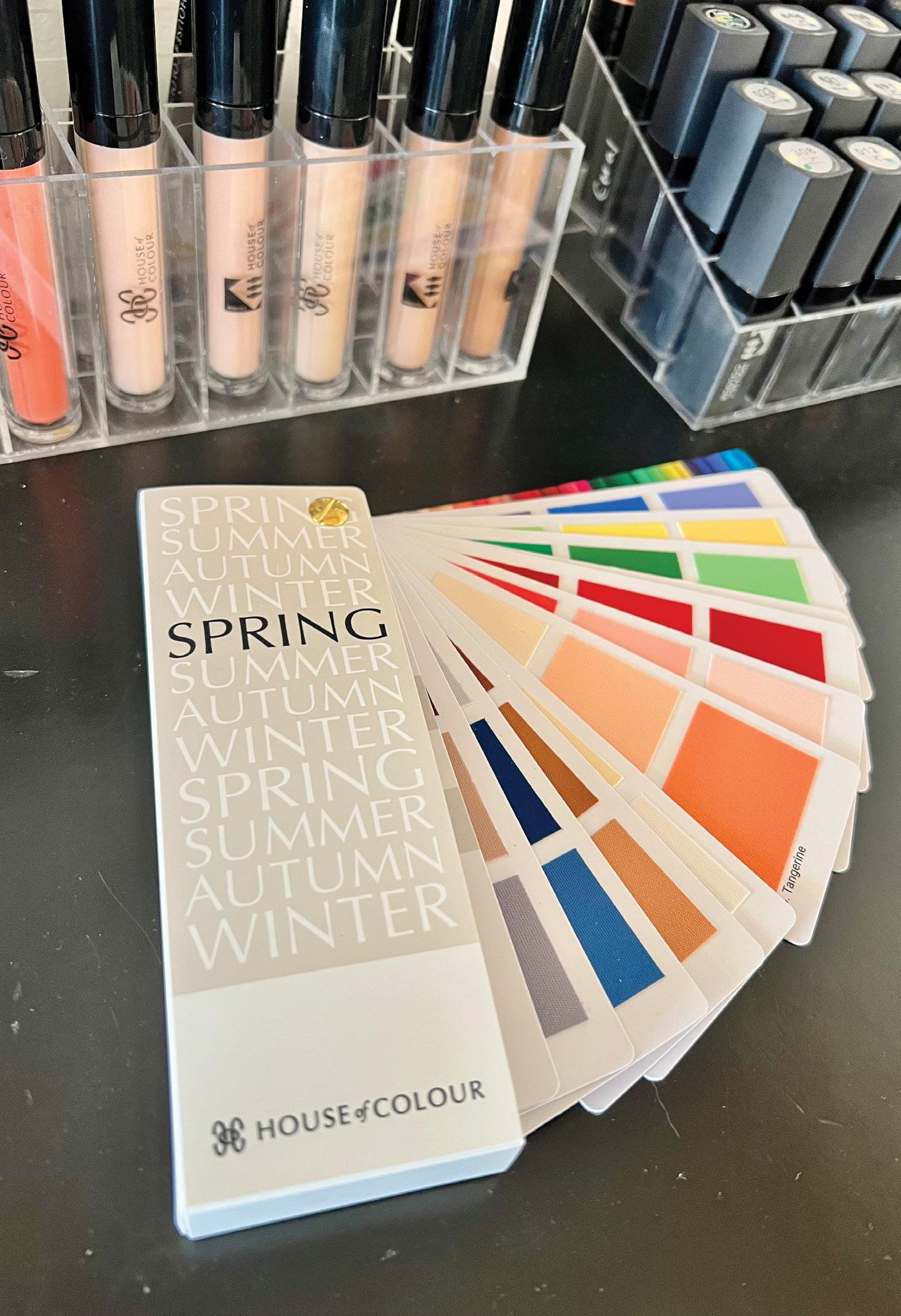
Ashley Shryock has brought color analysis to mid-Missouri with House of Colour, a 40-plus-year-old company originating in London that hopped across the pond in 2010. In her home studio, located just across Columbia’s city line, Shryock leans into her teaching background to explain shifts in color theory, the core component of seasonal color analysis, to her clients.
Shryock recalls being a curious girl at the St. Louis Science Center, unknowingly learning about color theory for the rst time. She experimented with di erent color squares, observing how each color can skew when next to others.
“Everyone has a unique tone to their skin because of the different types of melanin we all have. What you wear will a ect how that makes your skin look,” Shryock said.
“I feel more confident, and I feel more put together without trying harder.”
— RACHEL FLYNN
In social media terms, colors act like a lter for your face, brightening existing features or attening features into an indistinguishable mask.
“ ere’s really nothing better than feeling good in your body. Color and style help you feel better about what you’re working with,” Shryock said.
A SEASON OF SELF-DISCOVERY
e journey of color starts with determining whether a client’s skin has a warm or cool undertone. From there, clients are sorted into one of four seasons: summer, spring, autumn, or winter. Autumn and spring are warm, yellow-based seasons, and winter and summer are cool, blue-based seasons.
Shryock drapes dozens of fabrics around bare-faced clients, looking for speci c color features and harmonies. Skin changes such as pinker lips; more pronounced imperfections; blue, green, or gray circles under the eyes; splotchy pink on the cheeks; and a lack of clarity of facial features cue Shryock as to where a client lands on the color spectrum. When a face looks less like a whole and more textured and separated, the color is not within the client’s season.
Rachel Flynn, owner and marketing director of Betz Jewelers and creator and curator of Flynn & Stone, has sent Shryock’s color analysis business upward of 30 referrals.
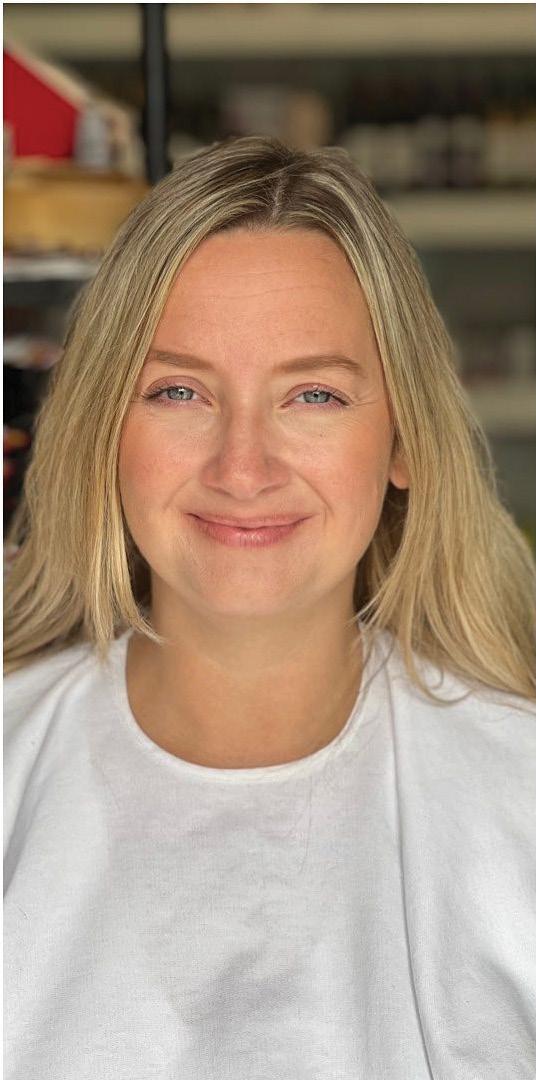
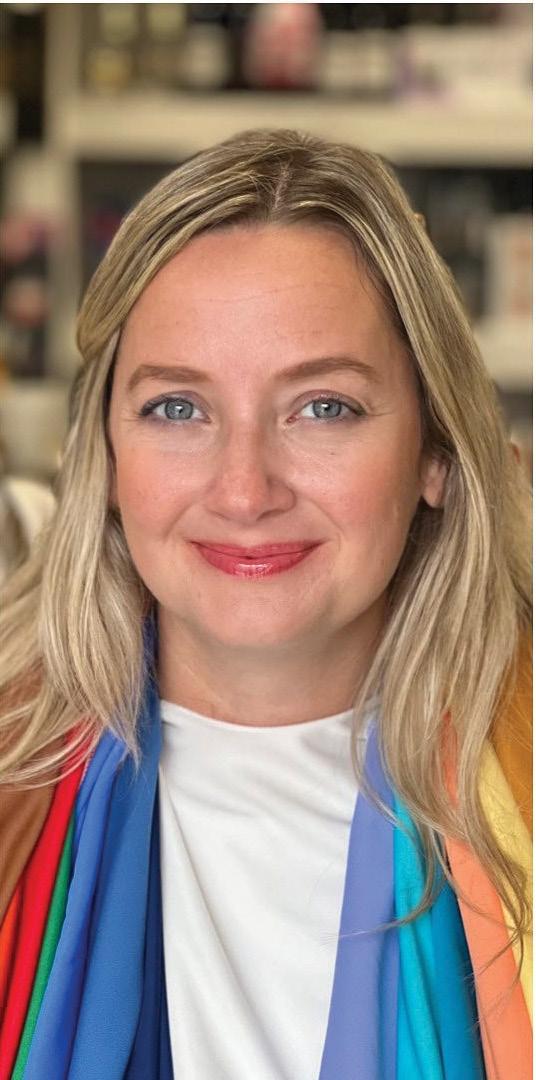
“I tell people it’s life-changing. It has simpli ed how I shop for clothes and how I get dressed,” Flynn said. “I waste less time second-guessing out ts, and shopping is easier because I know what works. Like if a shirt comes in three colors, I always know which one to get now. I feel more con dent, and I feel more put together without trying harder.”
Flynn admitted she was surprised by the clear and objective process. To her, the process felt less like an opinion and more like a science.
“Seeing how certain colors instantly made my skin look brighter and healthier was eye-opening. Some shades I’d avoided for years — brown, for example — turned out to be incredibly attering,” Flynn said.
After a season and sub-season are determined, Shryock explores makeup and hair options with her clients. She said clients often exhibit the characteristics of the colors they’re matched with, such as a warm personality invoking warm, autumnal reds and oranges.
Shryock lives by a “tools, not rules” philosophy. During a session, Shryock is building a color playground to experiment within, not a set of stringent decrees.
“Yes, there are things that will make you look your best, but you don’t always have to [wear them]. I say once you know the rules, you can break them,” Shryock said.

Many of the women Shryock works with are experiencing transitional periods in their lives and may feel stuck and in need of a con dence boost. As emotional and personal as appearance is, Shryock weaves as much empowerment through education as possible into her sessions. Color analysis can act as a reset, helping women see themselves in a di erent light.
“Sometimes people are afraid to embrace change and things that would be good for them. For example, I’ve had redheads say, ‘I can’t wear red,’ and that’s just not true,” Shryock said. “You can see yourself in a totally di erent way than you ever have. … e before and after is a really big thing.”
When asked about following trends, Shryock observed that while trends tap into the desire to belong, the pursuit of what’s “in” can overshadow the more authentic choice of honoring one’s natural features. She stressed the importance of knowing why you’re chasing a trend before going all in. is is advice that her clients have taken to heart.
“Once you understand your colors, you’re not trying to t into someone else’s version of style, Flynn said. “You’re enhancing what’s already there. It’s an investment that pays o every single day when you get dressed.”
So, are you a summer, a winter, a spring, or a fall? It may be time to nd out.
Veterans United Foundation sponsors 20th North Village art installation.
BY JENN JOHNSON
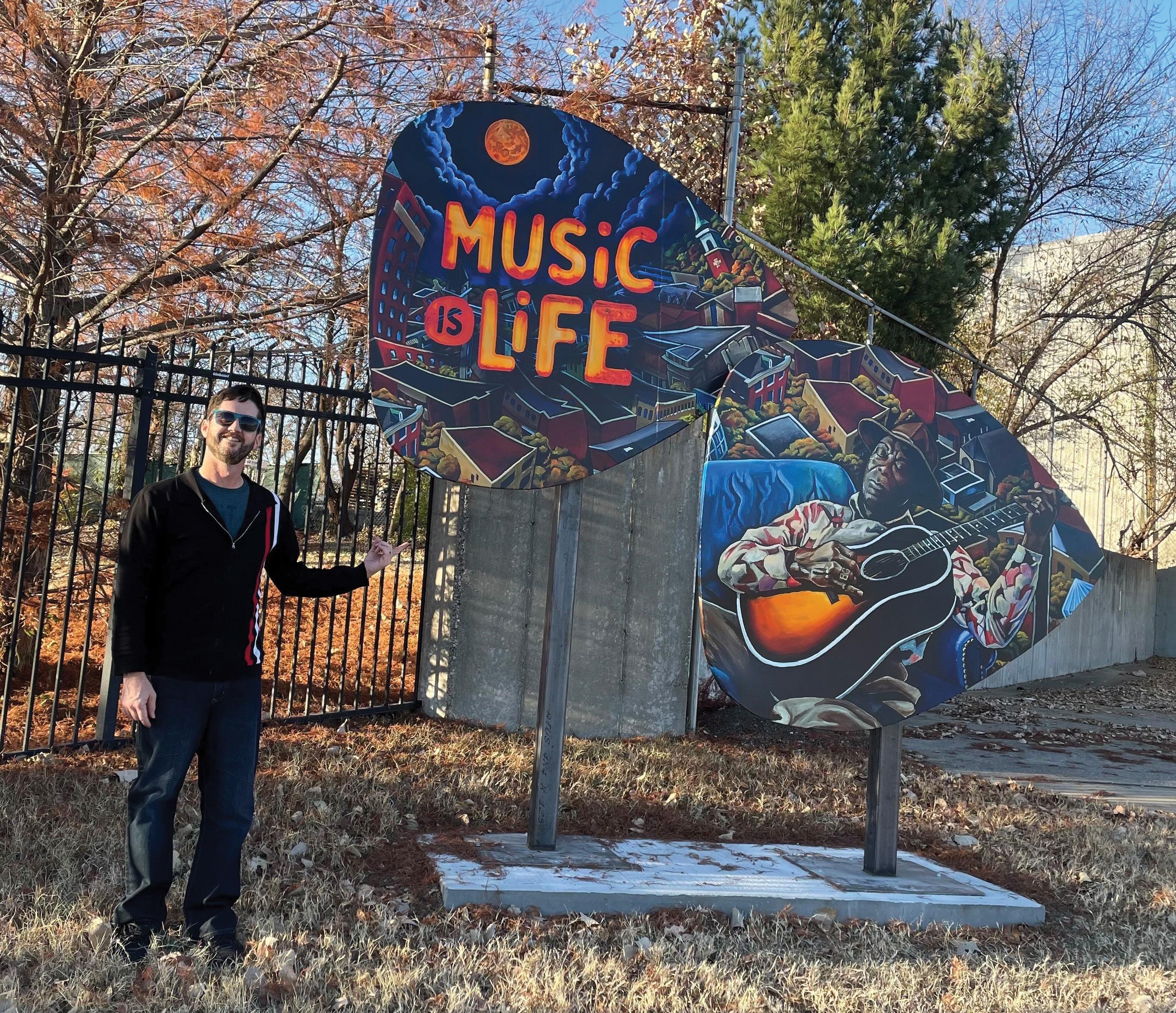
At the corner of Orr and Ash streets, a north-facing brick wall is preparing to become something more than part of the city’s industrial past. is spring, the side of the Balsamo Warehouse will transform into a 100-foot mural celebrating Columbia’s artistic legacy, civic history, and the enduring connection between service and community. Commissioned by Veterans United Foundation (VUF) and created by local artist David Spear, the project marks a milestone moment for both the foundation and the North Village Arts District.
Unlike traditional monuments, this installation is meant to live in the everyday rhythm of the city — looming over the new North Village Park, visible to residents, visitors, and passersby alike. It is VUF’s 20th and nal art installation, closing a decade-long chapter of employee-led community giving.
AN EMPLOYEE-DRIVEN VISION
Erika Pryor, foundation manager of VUF, said the project grew directly from within the organization. e foundation operates through an employee-led model of giving, with team members contributing a portion of their paychecks. Donations that are matched by the company and employee-elected committees help guide where funding goes.
e idea for supporting the North Village Arts District emerged during the foundation’s 10-year anniversary campaign in 2021, when employees nominated and voted on nonpro t projects they believed would make a meaningful local impact.
“Support for the North Village Arts District came directly from that employee-driven process,” Pryor said, noting that the campaign funded nearly 100 nonpro t initiatives nationwide as part of a $10 million commitment.
Behind that process is a broader mission: to enhance the lives of veterans, military families, communities, and the employees who support them by investing in programs that address unmet needs and create lasting impact. VUF’s work spans mental health, housing stability, emergency assistance, education, and community enrichment — often stepping in where resources are limited.
“ is installation holds special significance as the nal piece in a series of 20 art installations supported by Veterans United Foundation,” Pryor explained. “Together, these projects represent a lasting investment in community enrichment and a celebration of 10 years of employee-led giving.”
A MESSAGE ROOTED IN PLACE AND HISTORY
e foundation’s hope is that the mural will serve as both celebration and storytelling device.
“ e mural is a celebration of the arts and of the North Village Arts District itself,” Pryor said, emphasizing its role in honoring both the district’s historical roots and its evolution into a creative hub. Created by Spear, an artist deeply connected to the area, the piece will highlight “the people, places, and stories that have shaped Columbia and the North Village Arts District,” weaving together past and present.
at blend of history and forward momentum mirrors how the foundation approaches its funding decisions. Pryor noted that VUF works closely with community partners to ensure projects re ect real needs and complement existing efforts, rather than duplicating services.
“We rely on employee input and trusted local organizations to guide where funding can make a meaningful, lasting di erence,” she said. “ e goal is to strengthen what’s already happening in the community.”
From the foundation’s perspective, the location is as meaningful as the artwork
itself. Pryor described the North Village Arts District as “the crossroads of art, history, and public space in Columbia.”
With North Village Park opening directly across Ash Street, the mural will act as a visual anchor, helping de ne the park experience while reinforcing the district’s role as a cultural gateway to downtown.
Lisa Bartlett, a board member of the North Village Arts District, has been part of the committee overseeing art installations throughout the district. Bartlett explained that while the committee once included about eight people, it has narrowed as projects near completion.
“ ese decisions have already been made; we’re just following through with the projects,” she said. Bartlett also acknowledged the late Kenny Greene as a major contributor, alongside Tootie Burns, Lois Kay, and herself, who are now carrying out the nal three installations.
Artist selection has evolved over time. “Now our process consists of each person bringing an artist they’ve found and really liked,” Bartlett said. “If they t with our project and budget, we pursue that avenue.”
Bartlett con rmed that the mural will be completed this spring on the side of the Balsamo Warehouse.
“It will celebrate the arts in Columbia,” she added, noting that music, ne art, theater, dance, and literature will all be represented. e unveiling will include live music and art activities, reinforcing the mural’s role as a community gathering point. She described the mural as “a placeholder for past, present, and future events.” She hopes it conveys “a sense of culture and belonging” and helps people recognize the strength of Columbia’s artistic community — especially given its prominent position overlooking North Village Park.
For Spear, the mural is both a creative challenge and a responsibility. He described the work as “historically researched and an artistic transformation” that draws on Columbia’s architectural heritage, notable gures, and collective personality.
Pryor noted that the piece also intentionally honors veterans’ voices. Elements such as Memorial Union — Columbia’s most prominent tribute to those who served — appear in the composition,
alongside references to sculpted soldier and sailor gures and to Columbia native Jane Froman, whose USO work during World War II symbolizes resilience and perseverance.
Rather than standing apart as a formal monument, the mural is designed to exist within daily life — encountered on walks through the park, during community events, or in quiet moments of re ection. In that way, it expresses a broader philosophy shared by Veterans United Foundation and the North Village Arts District alike: that service, creativity, and remembrance are most powerful when woven into shared public spaces.
e mural also re ects who makes the foundation’s work possible. Veterans United Foundation’s
Artist extraordinaire
David Spear shows off his guitar pick creation, which is among the Veterans United Foundation art installations.
largest benefactors are VU employees and the company itself. Together they have fostered a culture of giving that began years before the foundation formally existed, when employees rst pooled resources to support the Heart of Missouri United Way. at early e ort laid the groundwork for what has since become a nationwide model of employee-led philanthropy.
As the nal installation in VUF’s decade-long art initiative, the mural does not signal an ending so much as a transition. It leaves behind a visible reminder that honoring veterans, celebrating the arts, and strengthening community can happen all at once — on a brick wall, in open daylight, where the city continues to move around it.
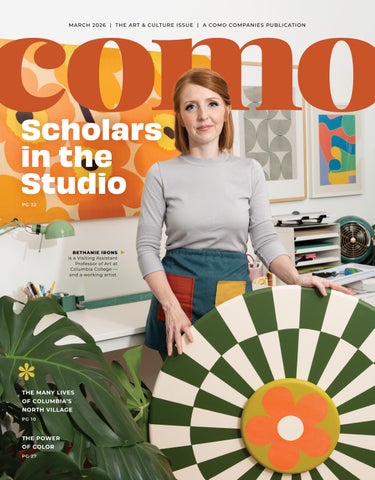
BY MADELEINE LEROUX | PHOTOS PROVIDED BY BETHANIE IRONS
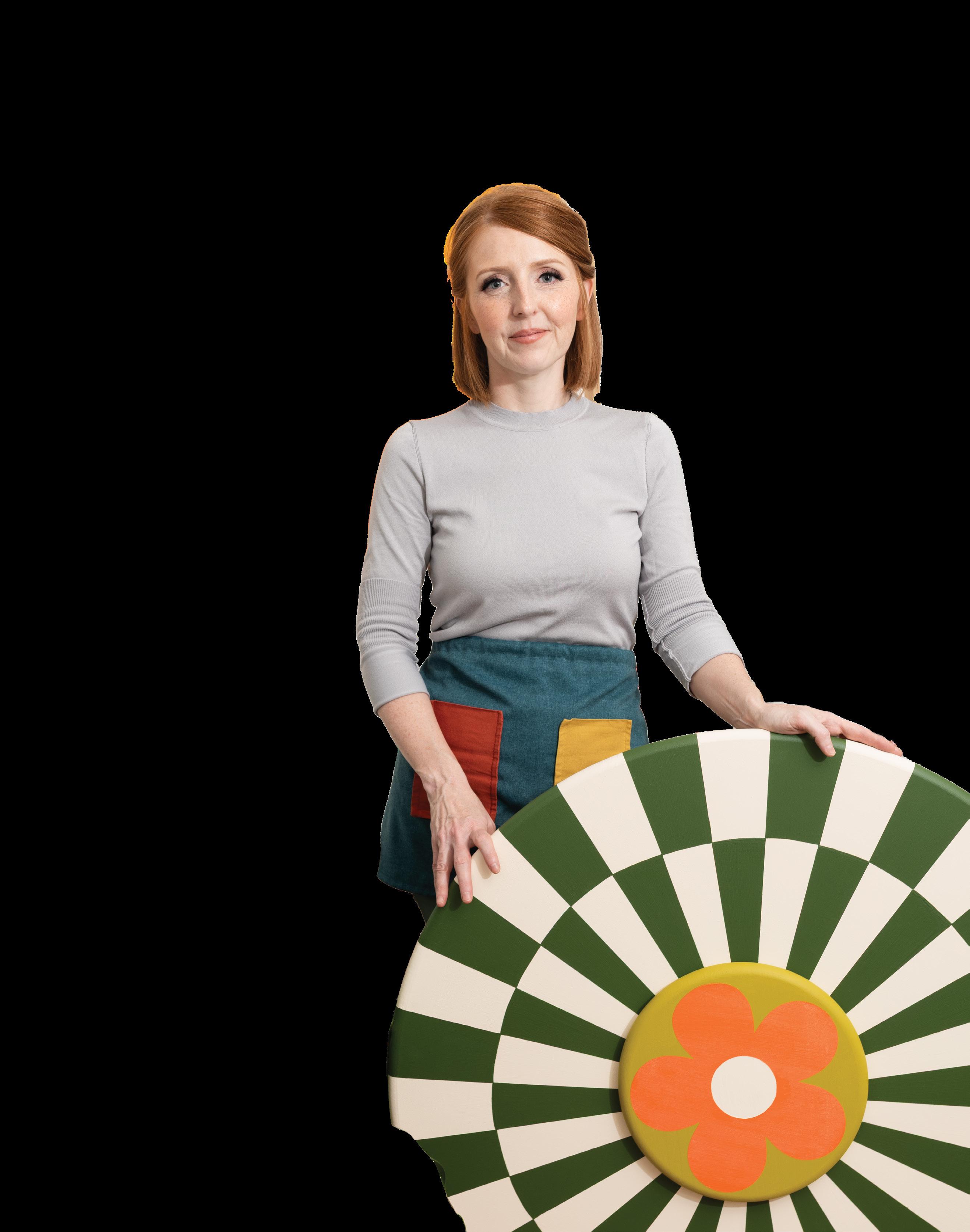
College art faculty don’t stop being artists when class ends, but the work often has to t in wherever it can. Creative projects happen after lectures, between grading, on weekends, or during short stretches of free time that are hard to come by once the semester is underway. Alongside teaching, faculty artists are also preparing critiques, mentoring students, and managing the day-to-day responsibilities of academic life. at work rarely leaves room for long, uninterrupted studio hours.
For Bethanie Irons, that reality isn’t abstract. It’s the practical framework of her creative life.
Irons is a visiting assistant professor of art at Columbia College, where she teaches typography, digital media, and corporate identity. Before joining the faculty there, she taught at other institutions in mid-Missouri, including Stephens College, and earned a doctorate in education alongside her work in the studio.
Irons’s days are structured around classes, critiques, and student support, but her artistic pursuits continue alongside that work. Rooted in graphic design, motion, and participatory installations, her art regularly moves beyond the classroom and into public view through exhibitions, festivals, and community-based projects.
“It’s not easy,” Irons says of balancing teaching and making. “Teaching and making art are very much connected.”
Rather than treating instruction and art-making as competing demands, Irons
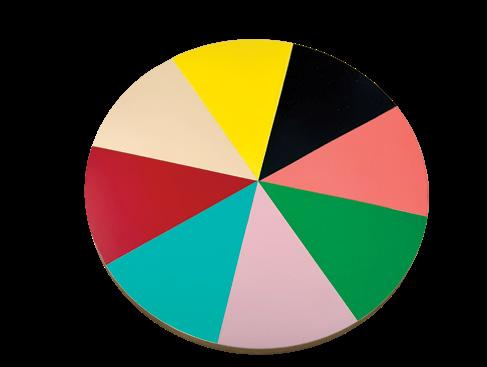
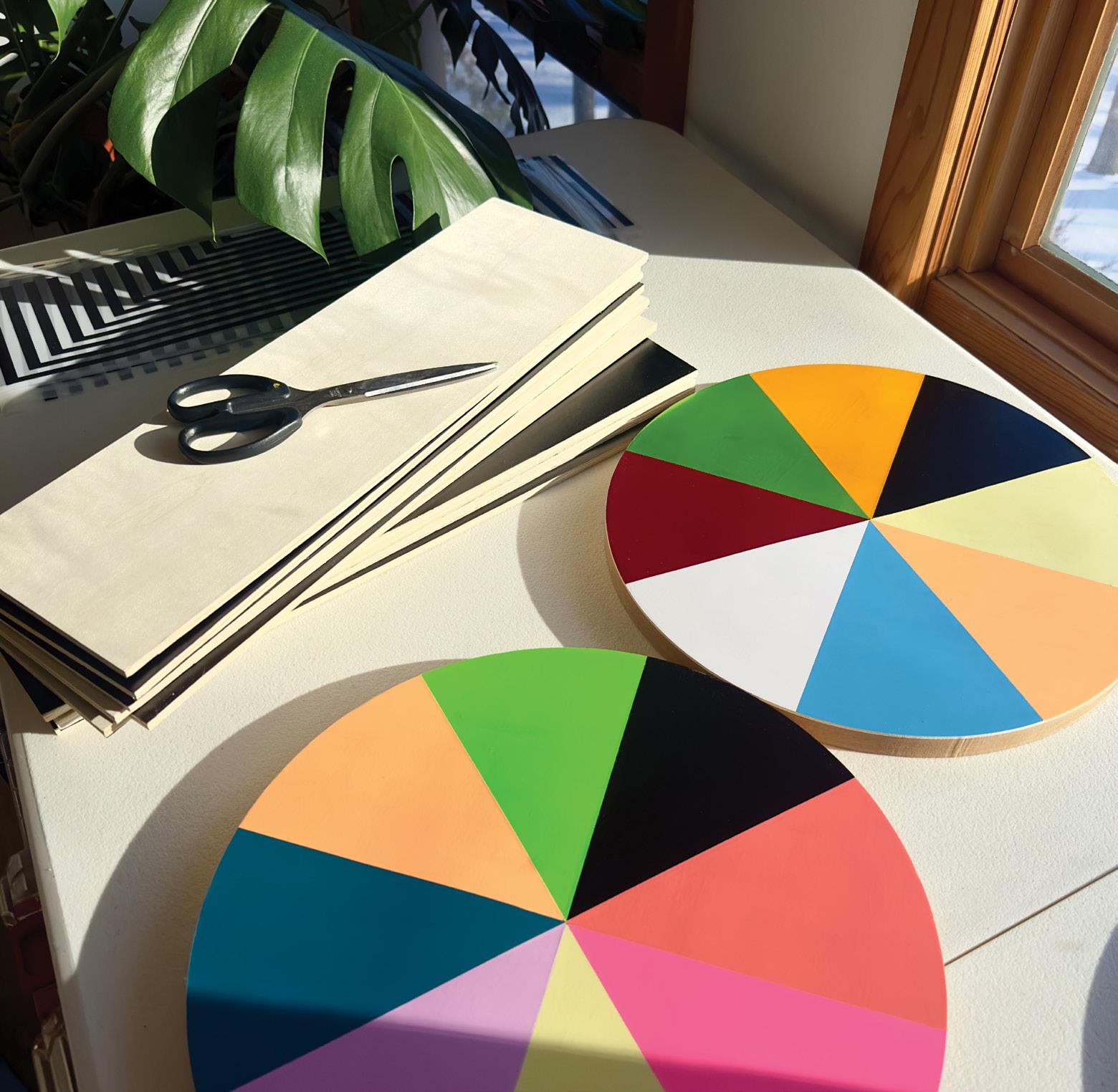
looks for ways they can inform one another. at approach has become especially visible in her recent work with zoetropes, mechanical devices that create the illusion of a moving image when spun. What began as an exploration of movement in her own studio has since become a teaching tool, an exhibition component, and a public installation.
“ ey’re going to be a part of a lesson that I’ll be doing that is all about stop-motion animation,” she says. “So having stu that I can sort of do double duty on is really helpful.”
For faculty artists, that kind of overlap can be essential, given how rarely they get to spend unbroken, distraction-free time in the studio during the semester. What matters most, Irons says, is “making time for it consistently and knowing that sometimes it happens in short spurts rather than really long, uninterrupted days.”
Earlier this year, Irons’s work was on view at Moberly Area Community College as part of Shape/Play, an exhibition that foregrounded process as much as nished form. e show included digital paintings, videos documenting her design process, and several zoetrope constructions. Some of those pieces also functioned as previews for installations she was developing for the True/False



Film Fest, where motion and participation shape how audiences encounter the work. at evolution, from studio experiment to teaching tool to public artwork, re ects how faculty artists often operate, even when audiences don’t recognize it.
“Students sometimes forget that the faculty in the art department, they are artists,” Irons says. “ ey actually like this stu , and they do it in their free time.”
At Columbia College, she says, this visibility matters. All of the art faculty maintain active practices, and that shared momentum shapes both the department culture and the student experience. Faculty exhibitions, conversations about process, and informal sharing through platforms like Instagram help draw attention to that work. at visibility is supported structurally through the college’s public art programming. Columbia College has two professional galleries on campus, the Sidney Larson Gallery and the Greg Hardwick Gallery. Both host rotating exhibitions throughout the academic year. e galler-
ies regularly feature student work alongside exhibitions by visiting and professional artists. Together, they create consistent opportunities for students and the broader community to encounter work made on and around campus.
ose exhibitions help demystify what it means to sustain life as a working artist. For students, seeing faculty and peers show work publicly reframes art-making as something that exists beyond assignments or degree requirements. For the wider community, it reinforces the idea that teaching and making art are parallel pursuits, not separate ones.
“Our practice as artists,” Irons says, “is an integral part of being a teacher and continuing to learn ourselves.”
Irons holds a Ph.D. in education, and she views empathy as a central part of teaching. at empathy extends to the artistic process itself, which she describes as both demanding and rewarding, particularly in digital and design-based elds where tools and platforms change quickly. It re-
quires “being able to learn alongside them and have empathy for the creative process, which can be a very defeating at times, but also a really triumphant process.”
With limited hours available during the academic year, Irons is selective about the projects she takes on. For her, the deciding factor is less about visibility and more about whether a project o ers room to learn.
“Anything that’s going to challenge me is worth my time,” she says. at mindset has led her toward work that emphasizes experimentation, even when outcomes are uncertain. She values the educational dimension of that process, both for herself and for her students.
“Sometimes I fail, sometimes it doesn’t turn out exactly how I want it to,” she says. “But that adds to the next project.”
Outside the classroom, Irons has been involved in a range of community-facing projects and exhibitions connected to True/False, Art in the Park, and other
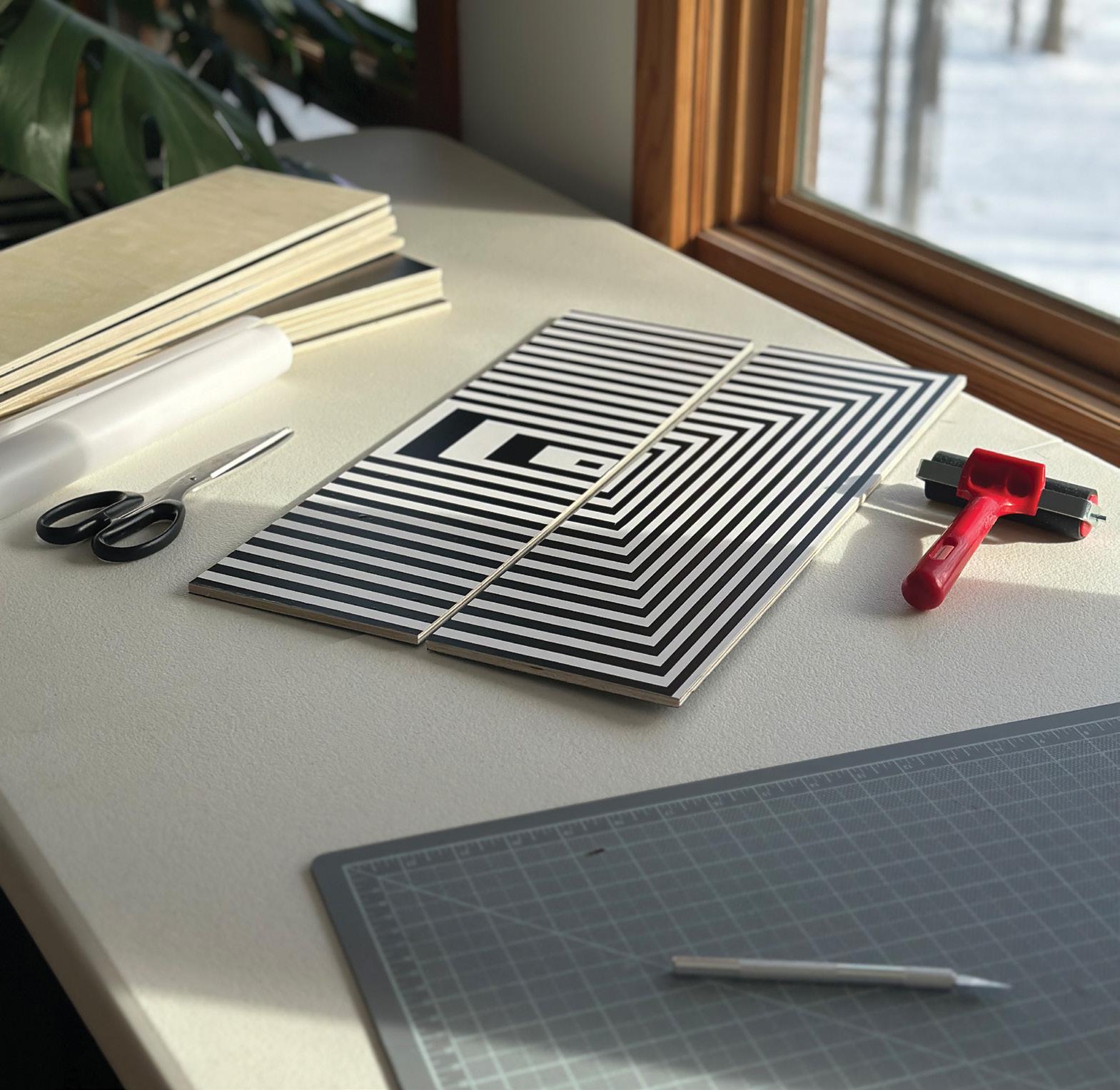
local arts initiatives. What draws her to those spaces is the collective energy behind them.
“ ere’s so many artists in Columbia who are working to make things happen behind the scenes that don’t often get credit,” she says. “Being around those communities and being a part of them has been a really important thing.”
Irons describes Columbia’s arts scene as notably collaborative, a place where people routinely show up for one another’s work. During a previous True/False installation, she recalls needing help moving a 600-pound sculpture onto a atbed truck:
“I had 10 people coming out to my house to help do that. ere wasn’t any competitiveness there. It was all just people who were working toward a shared goal to uplift the arts in our community.”
For Irons, that sense of shared e ort mirrors what happens inside college art departments, where faculty artists often play a quiet but essential role in sustaining local creative ecosystems. In a college town
with multiple institutions focused on artistic inquiry, those faculty positions help bring artists to the area, keep them there, and foster a steady diversity work across galleries, festivals, and informal spaces.
As Irons sees it, sustaining that kind of life is less about balance than about nding workable rhythms. Teaching, making, and community involvement overlap, each shaping the other in ways that shift from semester to semester.
“I’m not sure if I would be as active of an artist if I wasn’t teaching and wasn’t around that,” she says. “Being around students who are excited about creating, that inspires me, too.”
at long-term sustainability is reinforced at home. Irons and her husband, photographer Tony Irons, share a creative life that makes the realities of art-making easier to navigate. While they don’t formally collaborate on many projects, the shared understanding of deadlines, experimentation, and artistic momentum shapes how both approach their work.
Having another artist in the household makes space for ideas to evolve without explanation. Creative work becomes a normal part of daily life rather than something that has to be justi ed or scheduled around other priorities.
For students, that example matters. Faculty artists in uence them not only through instruction, Irons says, but by modeling what it looks like to build an artist’s life over time. rough exhibitions, public installations, and community events, the couple demonstrates that art-making is not con ned to school years or formal spaces.
In Columbia, where faculty artists quietly shape both classrooms and cultural spaces, that in uence could go unnoticed. Yet it shows up in the work itself, in exhibitions that extend beyond campus walls, in installations that invite public participation, and in the steady presence of artists who continue to make even when time is scarce.
Nearly half a century later, The Missouri Review is still introducing writers to readers.
BY KELSEY WINKELJOHN
Through decades marked by scienti c breakthroughs, geopolitical upheaval, economic uncertainty, and a global pandemic, e Missouri Review has stood the test of time as an in uential institution for emerging writers and a channel for ongoing literary conversation worldwide.
Founded in 1978 by University of Missouri English faculty members Marcia Southwick and Larry Levis, TMR’s rst issue featured the work of an up-andcoming Joyce Carol Oates alongside household name writers like Robert Bly, Philip Levine, and William Sta ord.
Since its inception, the publication has maintained a quarterly schedule and found long-lasting momentum under Editor-inChief Speer Morgan, who has been with the magazine for nearly 50 years. Based in McReynolds Hall on the Mizzou campus, TMR provides students with an immersive editorial experience rooted in continuity and care. Its long-lasting success is partly due to its core belief that strong writing is more important than reputation, credentials, or familiarity.
“We’re open to all submitters,” says Morgan. “We don’t care about submission fame, recognition, or how many books you’ve had. We treat all submissions equally.” at openness has helped cultivate a submission pool and readership that extend far beyond mid-Missouri, connecting writers and readers across the United States and around the world. For several contributors, this may be their rst time publishing. TMR is proud to be home to many rst-time and rising authors, such as Susan Ford, Tim Loc, and Jennie Lin.
“ e journal is a magazine of discovery,” adds Kris Somerville, TMR’s marketing coordinator, who also assists with cover design, artwork, and feature editing. “What we do is comb through the slush pile, looking for the best of the best. We’re not looking to publish people with already well-established reputations. at would be an easy thing to do.”
The first issue of The Missouri Review , published Spring 1978.
tutional a liations. A piece is then passed along to other editors for further consideration or declined. And while rejection is not always easy for either editors or writers, it’s treated as a natural part of a work’s life cycle — one that TMR aims to handle with care and timeliness.
“If you’re a writer submitting to other journals, I think that writers nd TMR more responsive, kinder, gentler, and more communicative — and again, open year-round, which is extraordinary,” says Somerville.
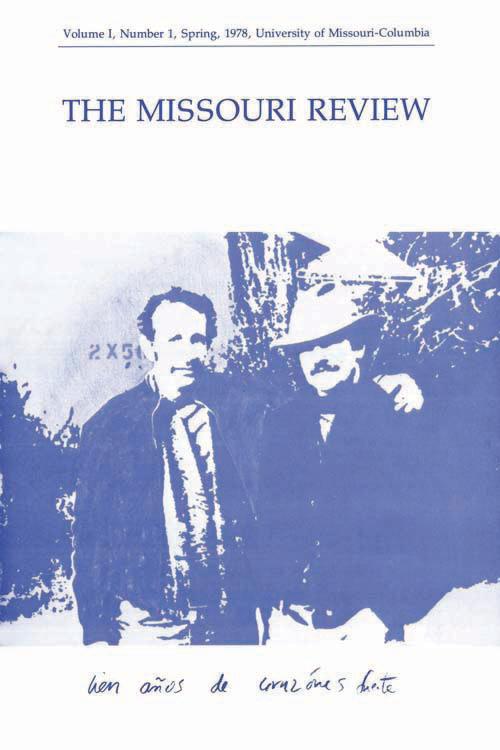
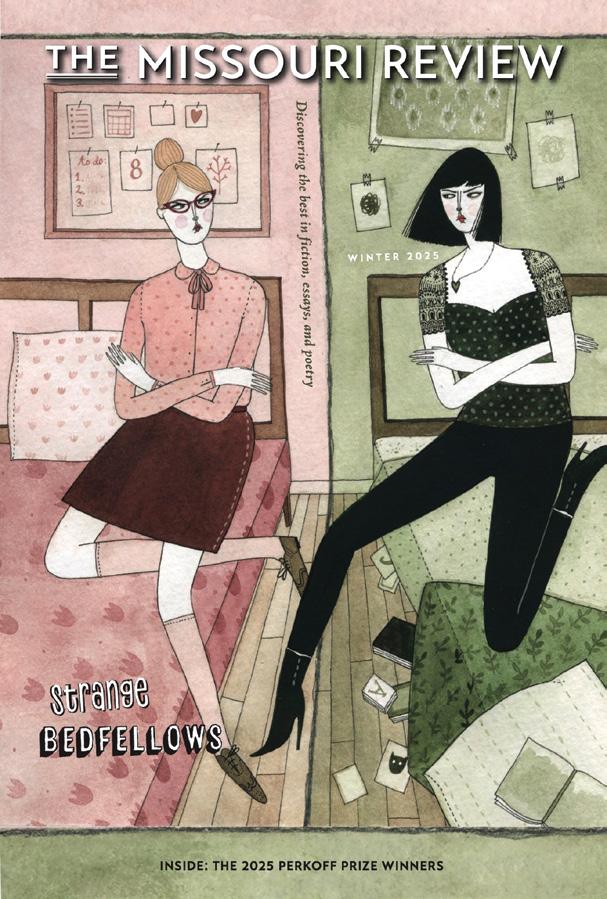
Each issue of TMR comprises roughly ve ction pieces, three poetry collections, and two personal essays, representing a curated coalescence of eager writers. It also hosts contests for print, including the Perko Prize and the Je rey E. Smith Editors’ Prize. When a writer submits work — by mail or digitally — it enters the “slush pile,” the magazine’s incoming submissions queue, organized by genre. To reduce bias, editors read the manuscript before the cover letter, which may reveal prior publications or insti-
The most recent issue of The Missouri Review , published Winter 2025.
Each writer whose work is not accepted receives a thoughtful rejection letter that highlights the piece’s strongest elements and encourages future submissions. Turnaround times for physical submissions typically range from 10 to 12 weeks, while digitally submitted stories often receive a faster response, depending on the season. Comparatively, many journals, according to Somerville, have “exquisitely di cult reading periods,” sometimes resulting in anxiety-inducing waiting periods of six to 12 months.
After months of work, the end result is a magazine shaped less by literary status than by curiosity — and while the magazine’s issues are themed, those topics aren’t predetermined.
“We never have a theme before we have all of the pieces that we’re going to publish in a given issue,” says Managing Editor Marc McKee. “ at theme emerges from how the pieces that have been accepted are in conversation with each other. … e best issues are, in a lot of ways, a lot like the kind of platonic ideal of a party where you have 17 amazing conversations.”
Rather than curating topics, the editors identify relationships between pieces, allowing patterns and shared concerns to surface organically. Some of TMR’s latest themes include “Strange Bedfellows” and “Under the In uence,” the latter of which centers on intoxicated characters or voices. McKee notes that the themes are more often than not a part of broader conversations happening worldwide.
“Without making a conscious e ort to make some sort of political statement, ‘Under the In uence’ re ects both the contemporary period that we’re in and also how the hell artists are feeling about it,” says McKee.
TMR’s commitment to discovery is re ected in the magazine’s year-round submission process, which welcomes work from writers across the globe.
According to Morgan, 59 percent of submissions come from writers in the United States, while the remainder arrive courtesy of international writers.
“ at ‘rest of the world’ has increased over the last few years,” explains Morgan. “Instead of it being the obvious 10 percent Great Britain, et cetera, et cetera, it’s now become everywhere — Africa, Central Europe, China, New Zealand, Australia.”
Non-contest submissions cost as little as four dollars, keeping the barrier to entry low for writers submitting their work.
Readership has also expanded in a similar way, due in large part to Project MUSE, a nonpro t online database of peer-reviewed academic journals and e-books created through a partnership of libraries and publishers. rough the platform, TMR’s full archive is accessible online, and the editorial team says the magazine has remained the top literary magazine on Project MUSE for more than 18 years.
Digital publishing has further broadened what the magazine can share beyond the printed issue, including Poem of the Week; podcasts featuring writers, editors, and agents; and BLASTs — exclusive online prose pieces.
THE SMALL BUT MIGHTY TEAM
Maintaining that reach and the volume of submissions that accompanies it requires a deeply collaborative team working behind the scenes, so it’s no surprise that the TMR team is tight-knit and agile. ey don’t have formal editorial meetings in which they sit down with all considered manuscripts, but rather take it day-by-day, one piece at a time, in a way that is engaging and interactive.
“The magazine is unique in the eye it has for talent. They hold their contributors to a high standard, making sure that we are trained in what they want to see and that everything has multiple sets of eyes on it. One thing that stood out to me when I started was that it was hard to tell what was good and what was great, but at the end, it was distinguishable through the sheer amount of reading, analyzing, and discussion we do.”
— AMELIA BURGESS, Former intern and junior at MU
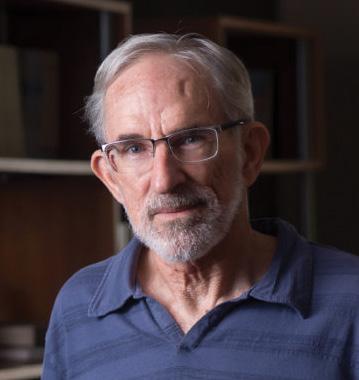
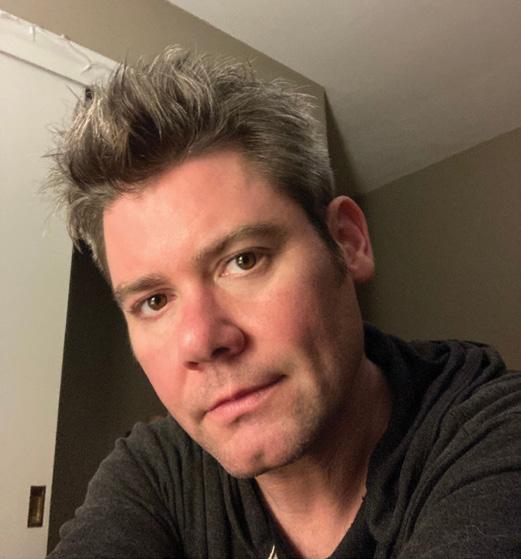
Speer Morgan Editor Marc McKee Managing Editor
Somerville says it helps that they share a similar taste in editorial content. She jokes that “it’s kind of like when married people start resembling each other, or you start looking like your dog.”
Associate Editor Ellen Orner also notes that interns play an integral role every semester in bringing the magazine to life with hands-on involvement.
“ e students have the power to send rejections themselves,” says Orner, “which I think is unusual. It’s necessary because of the volume of submissions we receive, but as a volunteer at other journals, I never had the power to reject anything unless I was the genre editor. So that’s quite a lot of responsibility.”
rough TMR’s internship program, undergraduates and post-graduates across areas of study become active participants in the editorial process, gaining rsthand experience with literary publishing at a national level.
Abby Cahill, an MU junior studying English, rst learned about the opportunity when her advisor mentioned it while helping her develop a graduation plan. Cahill, who took the internship course last semester, found the internship an opportunity to develop both professional skills and personal con dence.
“I’m quite a shy person, so it took me a little while to get out of my shell,” admits Cahill, “but everybody in there was focused on the same goal, and it was never a thing of ‘I’m a better reader than you.’ [Instead,] everybody was like, ‘Did you read this story? It was crazy. Let me send it to you.’ [ e student interns] were super excited to be there.”
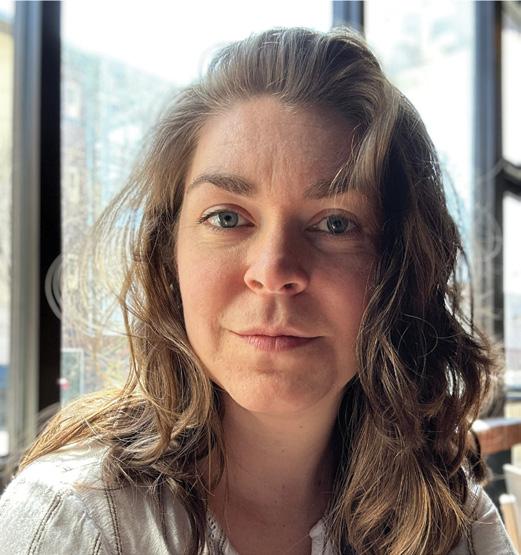
Ellen Orner Associate Editor
During the internship, Cahill chose ction as her genre focus and was assigned approximately 20 manuscripts per week for review. On Tuesdays, she and other interns would take turns pitching the stories they felt were strong enough to be reviewed further.
“I took on the advice Speer gave us of keeping it short, nding a theme, and giving a one-sentence summary,” Cahill says. “I tried to really home in on that very quickly.”
In addition to working on reading submitted stories for print, Cahill gained substantial digital experience by working closely with Orner on the online publications team.
“I would stay after class on Tuesdays, and that’s when I would do a lot of copyediting,” says Cahill. “I worked with authors, reading over their stories, coming up with a quick synopsis, and formatting the pages. I also learned a lot about the ‘Chicago Manual Style’ of writing.”
ursdays were spent in a very collaborative space, with interns discussing previously published works as a team. Cahill says that through the multilayered internship, she learned how to work under pressure and bolstered her copyediting skills for her future career and her current job at the student writing center.
Fellow former intern and junior at MU, Amelia Burgess, also praises the magazine and its immersive program.
“ e magazine is unique in the eye it has for talent,” says Burgess. “ ey hold their contributors to a high standard, making sure that we are trained in what they want to see and that everything

Kris Somerville Marketing Coordinator
has multiple sets of eyes on it. One thing that stood out to me when I started was that it was hard to tell what was good and what was great, but at the end, it was distinguishable through the sheer amount of reading, analyzing, and discussion we do.”
One of Burgess’s favorite memories during the internship was learning that a story she had passed along to Orner was going to be published. It was not only a feeling of secondhand joy for the author who had submitted it, but a validating sense that she knew what good work looked like. ough Burgess plans to swap her area of study from journalism to law school, she believes many of the skills she gained at the magazine — especially time management — will be transferable.
One thing is certainly true for TMR: emes may uctuate, and student interns may come and go each semester, but the editorial process and the attention behind it have remained remarkably consistent.
When the magazine rst spread its bookish wings in 1978, more than 50 percent of new literary periodicals were expected to fail within a few years. Nearly 50 years later, e Missouri Review has beat those odds. e explanation behind its longevity isn’t ashy, dramatic, or coincidental. Editors keep reading, students keep learning how to spot extraordinary work, and writers — many publishing for the rst time — can still nd a home for the work they cared enough about to keep returning to, draft after draft, before nally letting it go.
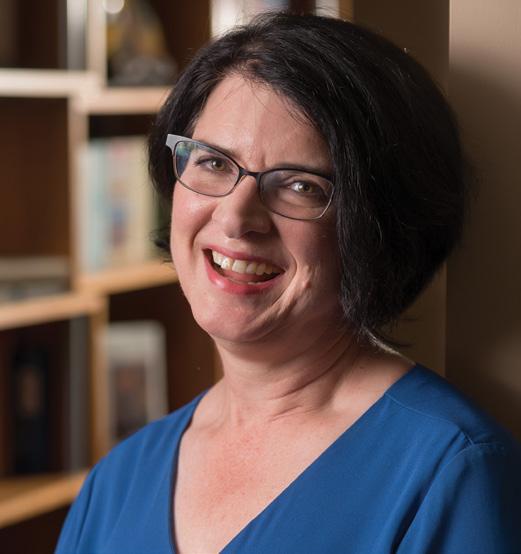
Dedra Earl Assistant Managing Editor
Mizzou Ukrainian students reflect on four years of Russia’s invasion.
BY ROGER M C KINNEY
As Russia continues to punish their homeland, University of Missouri Ukrainian students Vlad Sazhen and Alina Rohulia continue to watch from afar.
Sazhen, 23, arrived at MU in January 2022, the month before Russia invaded. His nowancée, Rohulia, 22, joined him on campus in August 2022. Both earned bachelor’s degrees from Mizzou and are now pursuing doctorates: Sazhen in mechanical engineering, Rohulia in health informatics.
Meanwhile, the students’ families remain in Ukraine. With Rohulia’s father and brother serving in the Ukrainian military, concern for loved ones is never far from their minds.
CIVILIANS UNDER ATTACK
February 24 marked four years since Russia invaded Ukraine. Ukraine pushed back Russia’s initial advances, and the military campaigns have since settled into a stalemate. But as Russia is halted on the battle eld, it launches daily drone attacks on civilian targets in Ukraine.
In the days before an interview with the couple in MU’s La erre Hall, Russian drones struck a passenger train in Kharkiv, killing six. Kharkiv is their hometown, and Rohulia’s parents still live there.
e two are tuned in to what’s happening in Ukraine and proud of their families and the Ukrainian people.
“People are still taking their kids to school,” Rohulia said. “Parents are still helping their children with math homework. Ukrainians are up to anything now.”
All of this as drones fall from the sky regularly. School is underground school, essentially a bomb shelter. Sazhen’s sister, Anya, attends with other children three days a week in Kyiv. A photo Sazhen shared shows his sister near the back of the classroom, wearing a Ukrainian ag on her sleeve.
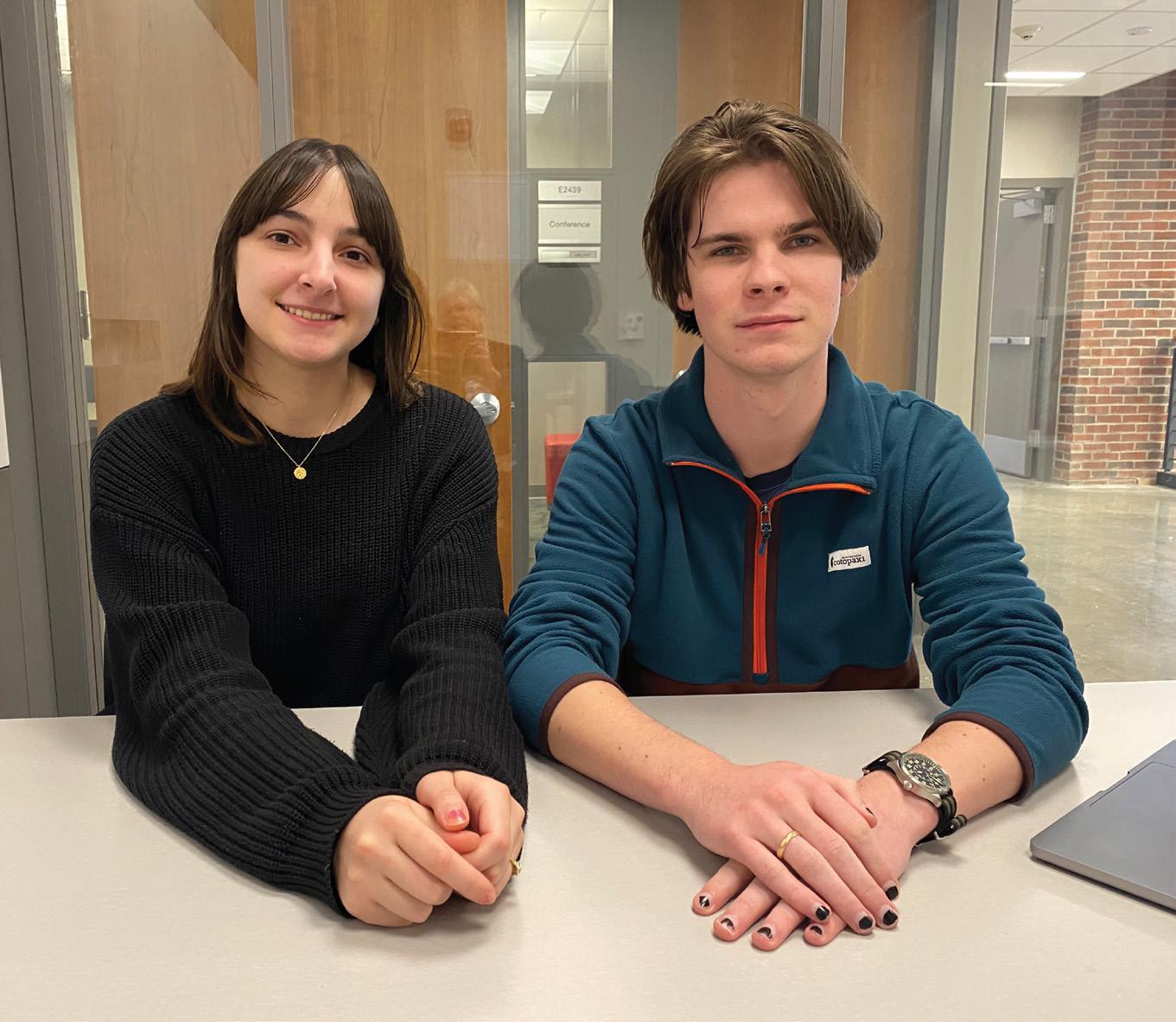

“My mom said that, in Kharkiv, typically they have like six hours of light per day to work and to stay warm,” Rohulia reported. “Most of the time they don’t have light.
ey don’t have heat.”
ings are worse in Kyiv, according to Sazhen.
“My granddad told me that he would have electricity outages,” Sazhen said. “He lives on the 15th oor of the apartment building, and he is 75 years old, so he has to walk downstairs to get groceries because the electricity will be out for 15 or 17 hours, and the elevators are obviously not running.”
e bombardment is nearly constant. “ ey would turn on the electricity for an hour or two, but then Russians will strike again, and electricity will be out again,” Sazhen said. “And no electricity on the 15th oor means no heating, also, because the pumps are not working, and in many houses, there are no backup generators because houses are older. So really, it’s been terrible for the citizens of Kyiv, especially for older and disabled people.”
Rohulia’s grandparents in the more rural Sumer region usually have just four hours of electricity a day. “It’s basically turned into a humanitarian crisis,” she said.
THE GEOPOLITICAL PERSPECTIVE
A January 2026 report by the Center for Strategic & International Studies predicts that Russian and Ukrainian casualties could reach 2 million by spring, with Russia having 1.2 million dead and wounded already.
“Despite claims of battle eld momentum in Ukraine, the data shows that Russia is paying an extraordinary price to minimal gains and is in decline as a major power,” the report’s authors note. “No major power has su ered anywhere near these numbers of casualties or fatalities in any war since World War II.”
e Russians can’t advance on the ground, so they punish Ukrainian civilians, Sazhen said. “ ey’re still producing thousands of drones a day, and all of those drones are ying toward Ukraine to strike infrastructure.”
Stephen Quackenbush, director of Defense and Strategic Studies at MU’s Truman School of Government and Public A airs has also been paying attention to what’s going on in Ukraine.
Russia hasn’t fought within the rules of war, Quackenbush said. It has consistently attacked civilian targets, while Ukraine doesn’t. “In the Russian-occupied areas, we see all sorts of atrocities and war crimes: kidnapping Ukrainian children and taking them to Russia and things of this nature.”
While the U.S. was staunch ally of Ukraine when the invasion started, Donald Trump began his term verbally ambushing Ukrainian President Volodymyr Zelenskyy in the Oval O ce, telling him he didn’t hold any cards and berating him for the way he was dressed.
“ ey seemed to feel that, you know, if Zelenskyy could be brought to reason, then the war would end, and without any real concern about what that meant for Ukrainians or for Europe or for anything,” Quackenbush said.
Following that episode, a summit took place in Alaska with Vladmir Putin, but without Zelenskyy. “Trump seems to have learned somewhat that it’s not actually Ukraine that’s the obstacle to peace,” Quackenbush remarked.
Not that this realization has prompted the president to adopt a more pro-Ukraine position. “Within the past year with the Trump administration, U.S. military support has basically collapsed,” Quackenbush said, with European and NATO allies and Canada picking up the slack.
He added that there have been many issues that have distracted the American people and o cials from focusing on the war since 2022.
“Events in Minneapolis are more pressing,” said Quackenbush. “[ e con ict in] Gaza lasted a long time, but the [Hamas attack on Israel] took place well after the Russian invasion of Ukraine. So a lot of things have happened. Initially there was a lot of attention on Ukraine. at attention, certainly within the United States, has waned over time.”
Now trilateral talks with Ukraine, Russia, and the U.S. are taking place, but Russia’s demands include Ukraine surrendering its Donbas region, which it has been unable to occupy over the four-year war.
“I can’t say I’m particularly optimistic about an end to the war in 2026, but you know, there’s certainly chances,” Quackenbush said. “It’s hard to imagine the war coming to an end with Putin still in power,” he continued, adding that if the
economy fails, the Russian oligarchs may bring him down.
While many in the United States have shifted their focus away from Ukraine, Sazhen and Rohulia remain diplomatically grateful to their host country.
“We appreciate all the support from America and the American people,” Rohulia said. “We appreciate that people want the war in Ukraine to stop, and we really hope that happens.”
at said, Ukraine won’t give up its territory and shouldn’t, Sazhen insisted.
“It’s pretty clear what they want to do,” Sazhen said of Russia’s motives. “Once they get what they want, which is the rest of the Donetsk and Luhansk region, they can move the troops toward the Eastern Front of Europe, so closer to Estonia and Lithuania. is sets up a new platform for the potential Europe invasion that Russian media are talking a lot about. So, if Europe forces Ukraine to give up the territory, it essentially undermines itself, because it helps Russia prepare better for the Europe invasion.”
Along with their studies at MU, Rohulia and Sazhen are active in ShowMe Ukraine Society, a student group they co-founded. Currently, Rohulia serves as vice president, and Sazhen is its treasurer.
Established in 2023, ShowMe Ukraine is open to everyone and has a pro le on Instagram. It has hosted multicultural events and music, potlucks, and fundraisers.
“We’re trying to stay active to now not only support Ukraine, but also share our culture and our language, our traditions with people, Ukrainians and non-Ukrainians,” Rohulia said.
To raise funds, the group sells handmake Ukrainian jewelry at City of Refuge Boutique.
“Since 2023 we fundraised more than $8,000 toward humanitarian aid,” said Rohulia. “Our latest donation was to children [who have had one or two parents die due to military actions]. We sent $1,100 toward support to those children. It was our Christmas donation. So we’re trying to build community here, and we’re trying to support people in Ukraine as much as we can.”
BY LAURA SCHEFFLER JOHNSON

Yesterday I woke up not feeling well, and the thought of enjoying food seemed far away. I skipped breakfast and ate a simple, mild lunch. By dinner, I felt better and I needed to make something soulful.
More than a decade ago, my sister Tracy gave me a binder to keep favorite recipes. I ipped through it and found a recipe I’d created in my twenties. I hadn’t put a date on it for future reecting; back then, time was expansive. Almost everything was present tense.
I hadn’t made the recipe for years. I was drawn to it because it’s a tribute to a favorite childhood comfort food dinner called Chicken a la King, a mellow, mushroom and cream-sauced chicken dish. My binder recipe was a chicken mushroom soup with similar ingredients, gussied up for my early adult years with onion and sherry.
When I tasted the soup, I could feel my twenties. I’ve cooked a lot since that time, so while I mostly followed the recipe, I also incorporated what I’ve learned. I thought of Anthony Bourdain’s advice in Kitchen Con dential. When asked about what makes home cooking taste more like restaurant food, he suggests shallots. So, I added shallots. I thought of French Onion Soup. Slowly caramelizing the onion adds so much avor, so I caramelized the onion-shallot mixture. I thought of my favorite similarly avored savory crepe dish. I chose ingredients to develop that avor.
I’ve written recipes and notes on recipes since starting my cookbook collection in my early twenties. As my courage has grown and been tested, notes have evolved from tiny shy pencil-drawn stars to ball-point penned fully earned phrases like, “GUHH!
Scan the QR code to read more about writing it down — and tasting it again.
BY JOHN L A ROCCA
Jina Yoo, a name that’s become synonymous with innovative Asian-fusion cooking in mid-Missouri, didn’t arrive in Columbia with a culinary degree. She arrived with sheet music. Her path from South Korea to the U.S. Midwest is a story that combines two of her loves: music and cooking.
Born and raised in South Korea, Yoo came to the United States to pursue musical studies. She relocated to get her master’s degree in pipe organ at Indiana University, where classical training sharpened not just her ears for structure and timing, but also taught her patience and discipline. ose skills easily translated into a professional kitchen, though she “never, never, never” thought she would open her own restaurant.
Although Yoo has always loved music, the kitchen called her. She learned to cook by sneaking into the kitchen and experimenting at her home in Korea. Her mother did not approve of her cooking because it could lead to cuts or burnt ngers, which would jeopardize Yoo’s musical talent.
Once Yoo was in the U.S., she began teaching herself to cook more seriously. By the 2000s, she had transformed herself from a classical musician to a self-taught chef and restaurateur, opening Jina Yoo’s Asian Bistro and later Le Bao Asian Eatery in the North Village Arts District. She quickly gained a reputation for boundary-crossing dishes that marry Asian ingredients and Midwestern staples. She feels that in music and food, “if you are not rst, you are last.”
Yoo talks about the similarities between performing a musical score and composing a menu.
“In music, I know how the notes will sound before I play them,” Yoo says. “For me, it’s the same with food.”
Yoo describes how a trained musical imagination helps her assemble avors that will harmonize on the palate. She imagines the nished piece before making it, ensuring everything is balanced.
Scan the QR code to see how Yoo composes flavor like a musical score.
Opening the whole weekend for what would be the very last Roots N Blues event. e whole weekend was a blast, but playing very rst before Jaime Wyatt and the legendary Tanya Tucker and watching Tanya from backstage and going to the other stage and watching Wilco from backstage!! all while ying high from our performance and enjoying some great locally brewed Logboat beer. If nothing that big ever happens again in my career, it was a moment that I will treasure forever, and I am so thankful to the wonderful people who made it happen. So many great performances that weekend, including Jon Batiste (Jon Batiste and Chaka Khan at a park in Columbia, MO?!?!!!) and across the years, many great memories of sitting under the trees watching Jon Prine and Mavis Staples and others, or shoving up close for Brandi [Carlile]. But 2022 will be the most special.
— MEREDITH MUSGROVE SHAW
I’ll never forget seeing the documentary Tickled at True/False 2016. e doc is about the subculture of competitive endurance tickling, and the lmmakers were being sued at the time and were served papers at the festival. It felt like we were part of the documentary! It was crazy!
— SARAH PARKS
Rolling Stones
— KENT FORD
I saw Sleater-Kinney here a long time ago, and Digable Planets, both at the Blue Note and both great shows.
— ROGER M c KINNEY
Red Hot Chili Peppers with Faith No More at e Blue Note.
— SEAN ERICKSON
So many to choose from, but I’d have to say Interstellar Overdrive (Pink Floyd tribute band) is always a great show at e Blue Note! And who doesn’t dig Jason Caton playing guitar?!!
— LORI CATON
In 1986, I won tickets from a radio station by running to a corner of Broadway (I no longer recall the cross street or actual date). I went with my Chi-O sister who, to this day, is still one of my best friends. It was Bon Jovi opening for 38 Special’s “Slippery When Wet Tour” at the Hearnes Center.
— LILLY HERNANDEZWINKELJOHN
Little Shop of Horrors at Columbia Entertainment Company in September 2017. My daughter was the music director, but even cooler: I won the ra e for the post-show experience of getting into Audrey II’s massive maw. (I was strongly encouraged to give my winning ticket to a kid. P t. ere was no bigger kid in the building that night.)
— JODIE JACKSON JR
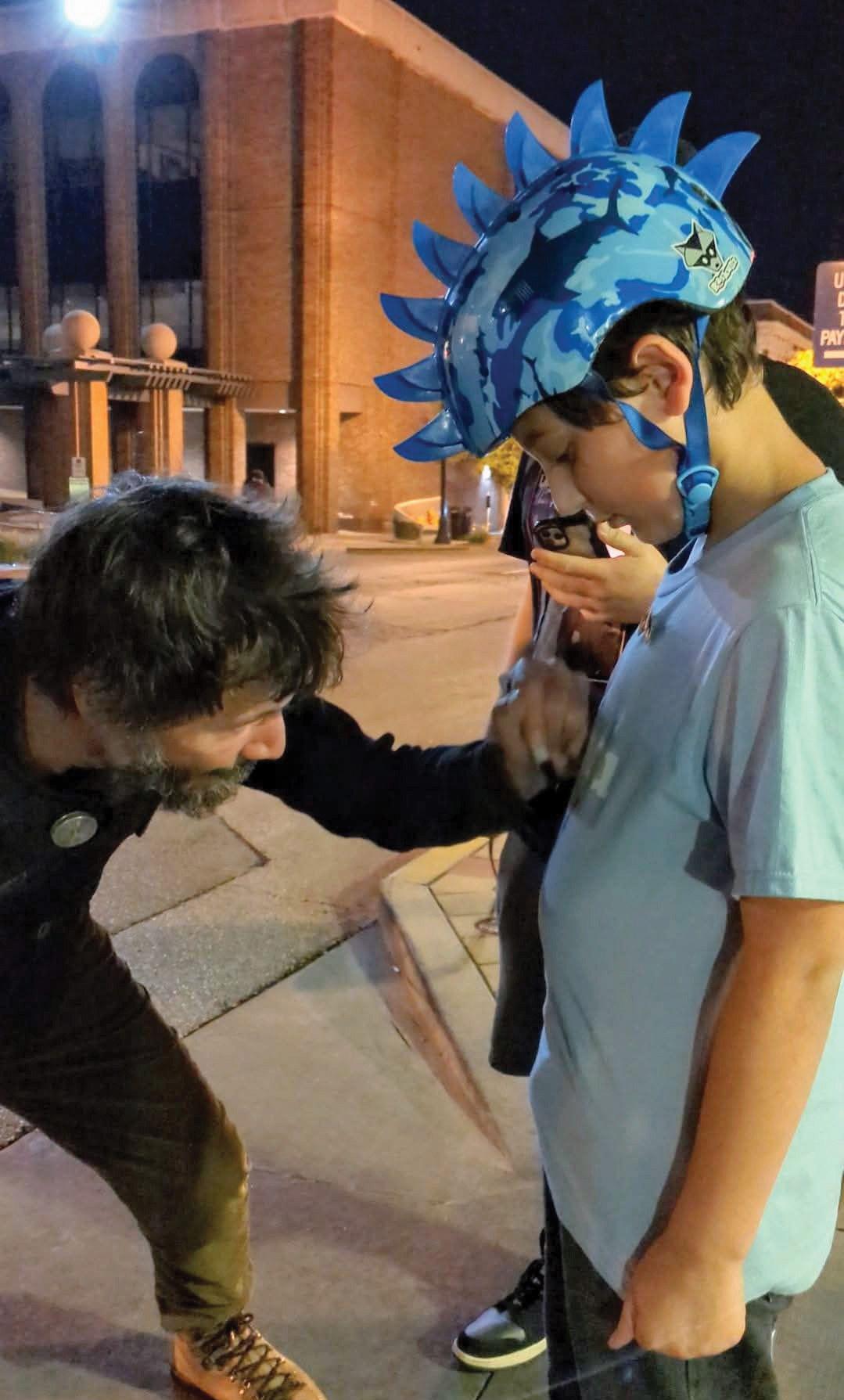
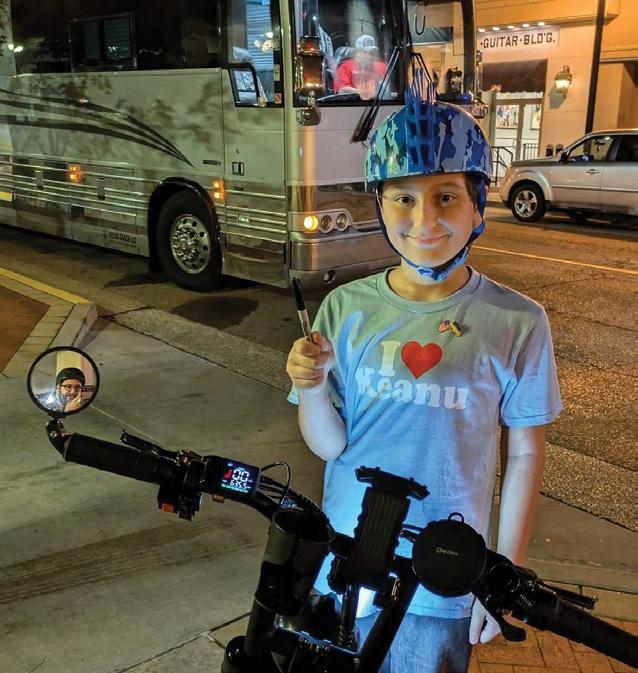
When Keanu Reeves’ band Dogstar played at Rose Music Hall on August 24, 2024. We caught up with Keanu near Eighth and Walnut as he was coming back to his tour bus from dinner. My son Quentin was holding a Sharpie, and Mr. Reeves gladly signed his “I Keanu” T-shirt. Memories we’ll treasure forever.
— C.J. LEVY
Seeing Margo Price and John Prine share the stage at Roots N Blues back in 2017. I’m so glad I got a chance to see him perform live before he passed — what a legend.
— JORDAN WATTS