COMO Business Times | The Weekender Issue | July 2026
For your business to work, the cash has to flow. That’s just the way it is. But there’s more to life than business. When do you find the time for family game night? A dinner with friends? Or even a quiet moment to yourself? You shouldn’t have to choose between bringing value to your business and the things that add value to your life.
The Bank of Missouri knows that the balance in your account is important, but balance in your life is necessary. Our bankers listen to understand your business and help it grow without losing sight of what matters most. Work with a bank that values your time instead of wasting it.
We’re the bank of finding balance. We’re The Bank of Missouri.
Contributors
July 2026
NatalieElizabeth Tan
Natalie is a business and lifestyle journalist who enjoys arts and culture, entertainment and dining. She keeps up-to-date on the latest happenings and is always on the lookout for the next exciting event to attend in town.
Most weekends, she can be found out and about in town or lounging on a patio or with her Great Pyrenees named Meringue. Originally from Singapore, she moved to Columbia to attend Mizzou, and never left. Her love for the Show-Me State compelled her to stay, and Natalie now proudly calls “Missour-uh” her second home.
IN THIS ISSUE OF CBT From Mizzou Dorm to Tesla Supplier
PG 20
Angela Lechtenberg
Angela Lechtenberg is a Columbia native who has been singing, dancing, and storytelling in Columbia’s performing arts community for more than 25 years. You may have seen her on stage at Maplewood Barn Theatre or Columbia Entertainment Company, most recently appearing in CEC’s The Rocky Horror Show. Beyond the stage, she has worked in television, radio, music, and video productions. When she’s not performing, Angela is a REALTOR with Century 21 Community, a freelance marketing consultant, and community volunteer for various creative organizations and nonprofits.
IN THIS ISSUE OF CBT
Let’s Get This Show On the Road
PG 31
PUBLISHING
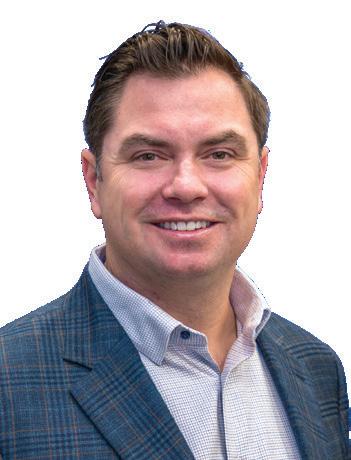
David Nivens, Publisher david@comocompanies.com
Chris Harrison, Associate Publisher chris@comocompanies.com
e Fabulous Fox eatre, Jodie Jackson Jr, Tyler Kemp, Randall Kilgore, Lyceum eatre, Maples Repertory eatre, Presser Performing Arts Center, Ryan Zirngibl/Arrow Rock Lyceum eatre
CONTRIBUTING WRITERS
Khartik Bhavsar, J. Scott Christianson, Ashli Eaves, Jaime Freidrichs, Jodie Jackson Jr, Angela Lechtenberg, Natalie-Elizabeth Tan, Lyceum eatre, Stephi Smith, Wilson Sundvold, Brian Toohey, Kelsey Winkeljohn, Huikai Wu
SUBSCRIPTIONS
Magazines are $5 an issue. Subscription rate is $54 for 12 issues for one year or $89 for 24 issues for two years. Subscribe at comobusinesstimes.com or by phone. COMO Business Times is published monthly by COMO Companies.
OUR MISSION STATEMENT
COMO Business Times and comobusinesstimes.com strive to be Columbia’s leading source for timely and comprehensive news coverage of the local business community. is publication is dedicated to being the most relevant and useful vehicle for the exchange of information and ideas among Columbia’s business professionals.
Copyright COMO Companies, 2026
All rights reserved. Reproduction or use of any editorial or graphic content without the express written permission of the publisher is prohibited.
FEEDBACK
Have a story idea, feedback, or a general inquiry? Email our editor at jodie@comocompanies.com.
CONTACT
COMO Companies | 404 Portland, Columbia, MO 65201 573-577-1965 | comomag.com |
IT’S AN OLD BUT TRUE CLICHÉ (and IYKYK, I loathe most clichés), but this one is, on its face, about travel: It’s not the destination, it’s the journey. The metaphorical and literal saying is aptly applied to many of life’s circumstances. Recently, my bride of 44 years and I traveled to the tiny Iowa village of Keosauqua, which has become a home-away-from home of sorts at least twice a year since 2019.
We’ve developed some traditions for the journey, which always includes browsing at Dutchman’s Store in Cantril, Iowa, and getting brisket or shredded chicken sandwiches at The Red Shed just a few miles north of the Missouri border. Right on Highway 63. You can’t miss it. Sounds boring, maybe, but we count on certain stops, which are now connected to heart strings, memories of our departed Abby the Goldendoodle, and anticipation of future getaways, knowing that unpredictability (weather, health, wildlife, etc.) is the most predictable part of these empty nest road trips. But it’s the we/us that is most important.
As you travel through our travel/weekender issue this month, keep the we/us in mind. The “who” you are traveling with is what makes the “where” even more worthwhile.
The journey our team takes each day, week, and month, to bring you COMO Business Times and COMO Magazine, is a great example of teamwork and collaboration. And some of the names and roles aren’t even mentioned on the magazine masthead. Last month I gushed about the talented roster of freelance writers I’m privileged to work with. Now it’s time to turn our attention to the rest of the dynamic team that brings it all to life.
Marketing team lead, Amanda Iman, is also the resident webmaster, problem-solver, and (when it comes to me), a walk-methrough-it hand holder. Her breadth of experience is fascinating and so applicable to the ways our industry is shifting and changing. There’s also marketing associate
Brooklyn “Brittany” Greaser, the free spirited creative who has been here just eight months, though it seems like it has been as long as I have called COMO Companies home. (Three-plus years.)
Lucia “Lucky” Kuepers is the freshly-minted Mizzou grad, plying her creative genius as our junior designer. Like her roomie Brooklyn, she became an instant, integral asset for the team.
Same with Kyle Gilliland, our video creator who has already lived lifetimes of adventures, now bringing marketing and story visions to life.
Client relations director Charles Bruce III is probably the guy everybody knows, with a larger-than-life personality and a bear hug waiting just for me. Everybody’s friend; no hidden agenda.
Natasha Nivens is the spreadsheet guru nerd who is the magic behind processes and problem-solving. And the aforementioned handholding. Her quiet understanding of human nature is uncanny.
Publisher/owner David Nivens and associate publisher Chris Harrison — who was around back when COMO Business Times was just a toddler — are the business team that every publication should have.
But, ultimately, you don’t read or literally see these magazines without the other-worldly skills and talents — and heart — of senior designer Jordan Watts and contributing copyeditor Karen Pasley. I’ve worked with more designers and copyeditors than I can count. But I know which two are No. 1 on the list. Jordan is simply in a class of her own; Karen is the copyeditor whom all other copyeditors should try to mimic. (Oops, sorry Karen. “Who.”)
And now, this summer, editor Kelsey and I are working with Mizzou J-school interns Eric Hughes and Huikai Wu, gifted journalists who are on the journey with us if only for a short while.
What about you? This summer, your life, the next adventure? Who is along for the ride with you?
JODIE JACKSON JR EDITOR jodie@comocompanies.com
ON THE COVER
What's so Fabulous? This month's issue takes readers on the road, with the Fabulous Fox Theatre in St. Louis as one destination.
provided by The Fabulous Fox Theatre
Photo
A theater gal’s (and performer’s) guide to the best theater in midMissouri — and beyond.
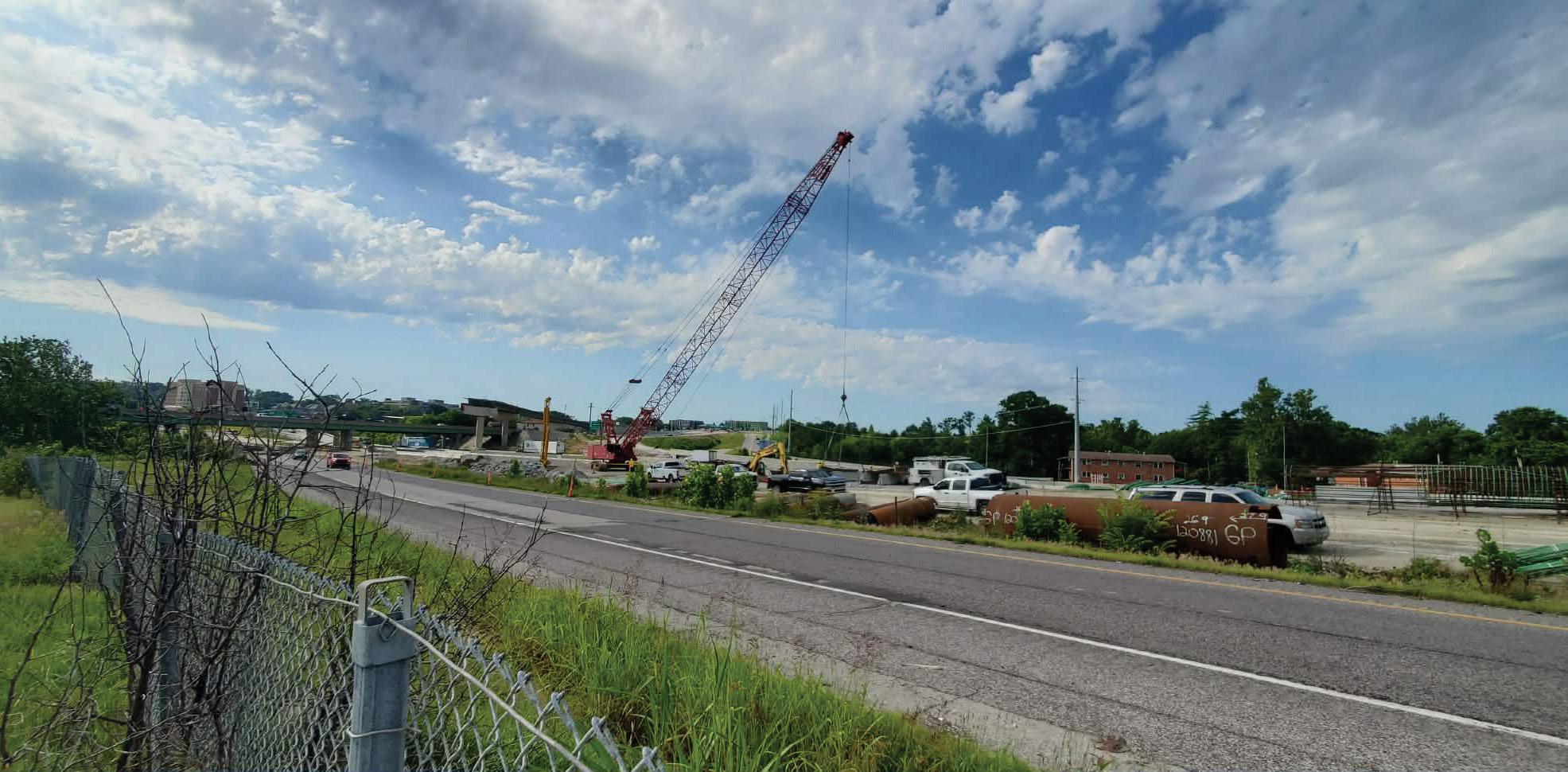
The county is on pace to spend roughly $4.5 million this year housing inmates in out-of-county jails.
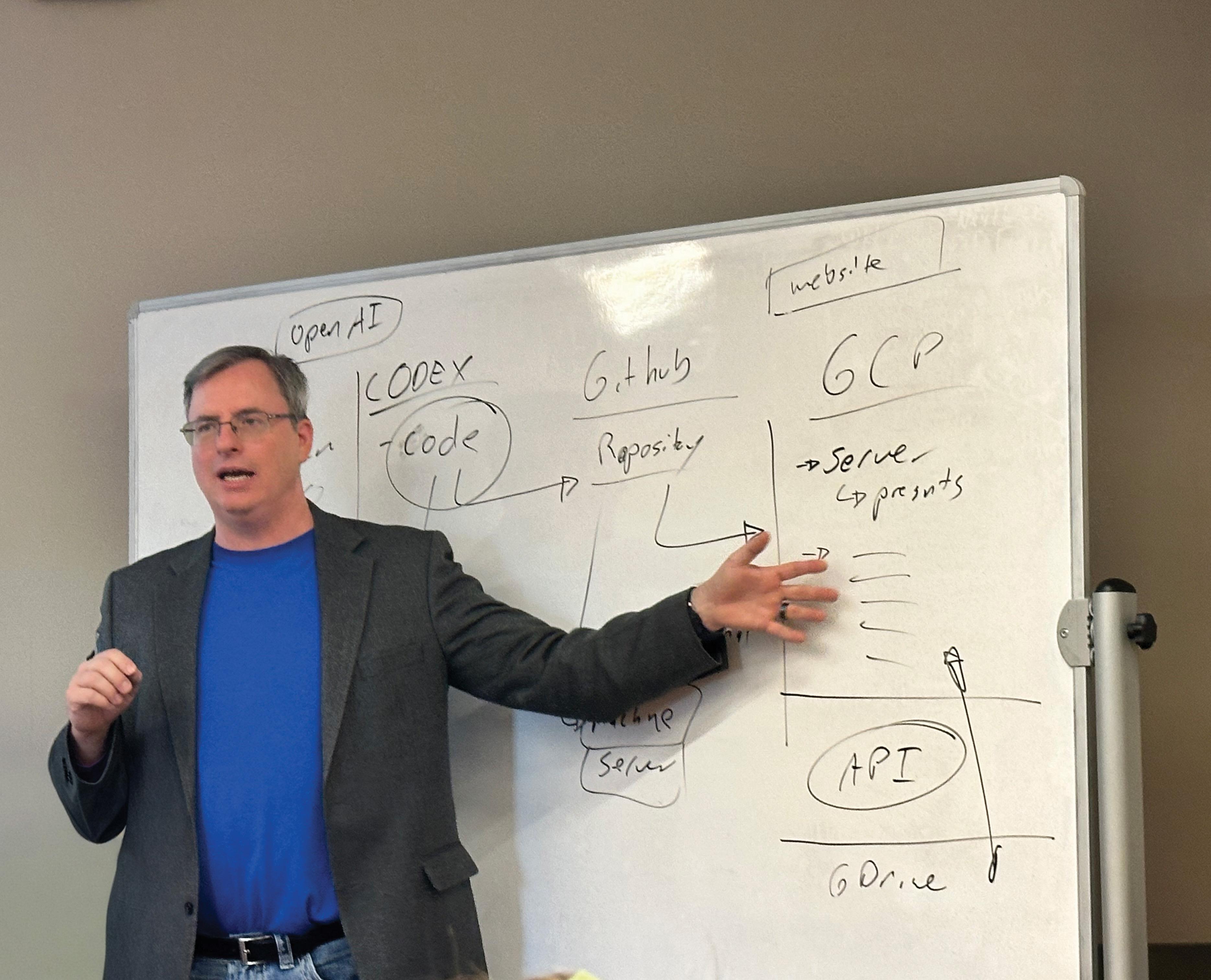
At Columbia AI Breakfast, developer shows the ease of building apps with AI.
Closer Look
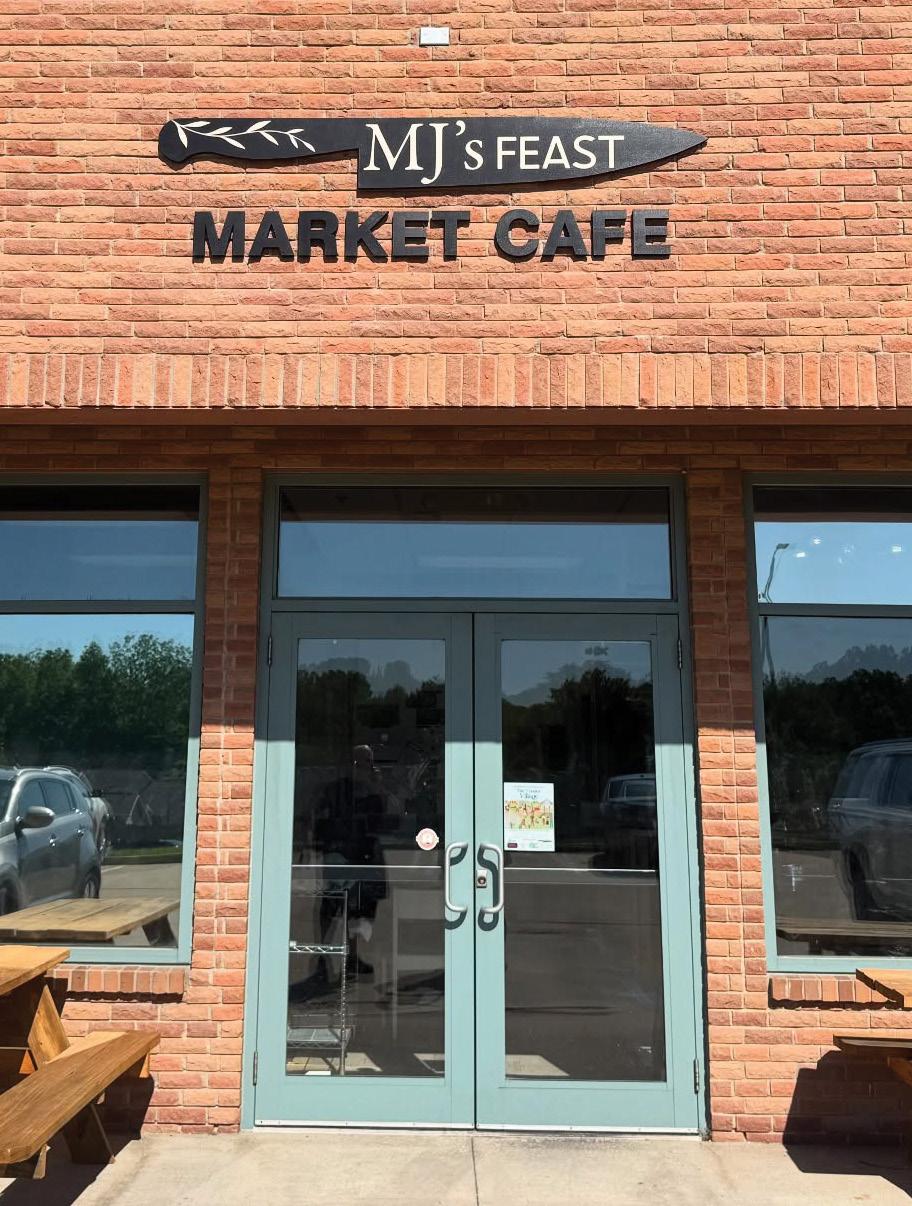
MJ’S FEAST
A former vendor at CoMo Cooks Shared Kitchen, MJ’s Feast o cially put down roots in mid-June in the space formerly occupied by Old Neighborhood Cafe. While the brick-and-mortar location is new, owner and namesake Chef Mindy Jahn has worked as a personal chef and has been o ering catering and meal prep services since 2023.
“I love Columbia,” says Jahn, “and it has always been my dream to open my own little cafe that would help families in the area nd nutrient-dense food that is quick and convenient without sacri cing avor or quality.”
Drawing on her own journey with celiac disease, Jahn created MJ’s Feast, a certi ed gluten-free café serving breakfast and lunch Tuesday through Saturday, providing a safe dining option for individuals with similar diagnoses. She also ensures there will always be delicious options on the menu for picky, gluten-free children.
“I bring close to 30 years of culinary experience to the community, along with a strong background in natural and organic food, gluten-free cooking, allergen safety, and food safety,” Jahn says.
Additional priorities for MJ’s Feast include sourcing local ingredients for its food and beverages — including co ee from Camacho Co ee — and cultivating an inclusive, welcoming environment for patrons and employees alike.
2011 Corona Rd., Suite #101 | 573-970-6113 | mjsfeast.com
HAGS CLOTHING
When Mizzou student and soccer player Tyler Batliner su ered a leg injury, he was forced to step away from the game and focus on recovery. During that time, he found himself developing a local clothing brand centered on connection, optimism, and nostalgia.
“While I was at home, I came across an old yearbook where someone had written ‘HAGS,’ meaning ‘Have a Great Summer,’” Batliner explains. “ at small, nostalgic moment ended up becoming the foundation for the brand.”
HAGS Clothing launched its online store in early summer 2025, built around the idea of having a great “something.” ough the acronym stands for “Have a Great Summer,” the phrase has since evolved to represent any moment — whether it’s a Saturday, a season, or everyday life. e brand o ers streetwearinspired apparel, including hats, tees, knit sweaters, and game-day gear.
“HAGS became a way to turn that moment into something positive,” says Batliner. “I wanted to create a brand that encourages people to stay optimistic and make the most of wherever they are in life, even when things don’t go as planned.”
Balancing HAGS with student life has also become a de ning part of Batliner’s journey. Between academics, athletics, social life, and running a business, he says the experience has “helped me grow and develop discipline over time.”
The city of Columbia has named Christopher Ave as the first director of the city’s recently formed communications department. Ave took over that role on June 22, coming from the position of director of media relations and public affairs at the University of Missouri. He has more than 30 years of experience in journalism and strategic communications, which included director of communications with the St. Louis County Department of Public Health and political and national editor with the St. Louis Post-Dispatch.
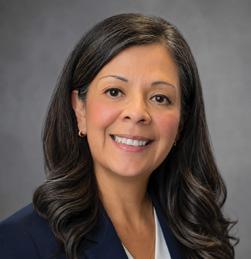
M. FERNANDA BLACKBURN
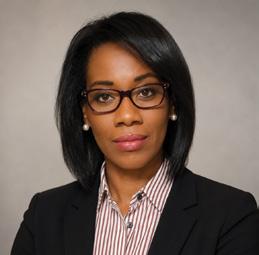
Dr. M. Fernanda Blackburn has been selected as the principal at West Boulevard Elementary School for the 2026-2027 school year. She was the assistant principal at Shepard Boulevard Elementary School. Blackburn, originally from Colombia, South America, replaces Morgan Neale who announced she is moving to Rock Bridge Elementary School as assistant principal earlier this year.
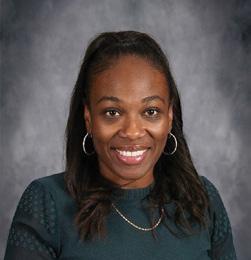
CYNTHIA MARTIN
Dr. Cynthia Martin is the new principal at Cedar Ridge Elementary School for the 2026-2027 school year. Martin will replace current Principal Carlei Wies who announced her departure earlier this year. Martin has spent her entire career with Columbia Public Schools, and was previously the assistant principal at both Grant and New Haven elementary schools. Prior to her roles at Grant and New Haven, Martin was the assistant principal at Cedar Ridge Elementary School.
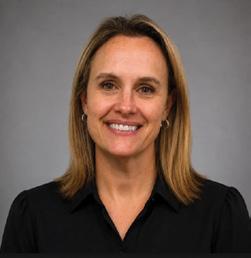
VIRGINIA TATE
Virginia Tate has been selected to be the principal at Hickman High School for the 2026-2027 school year. Tate was previously the assistant principal at Rock Bridge High School. She replaces Mary Grupe who announced she would be moving into a district administrative role in student support services earlier this year. Tate holds a bachelor’s degree in English, a master’s degree in gifted education, a master’s degree, and an educational specialist degree in educational leadership.
SHONDA AMBERS-PHILLIPS
Dr. Shonda AmbersPhillips has been selected to be the chief equity officer for Columbia Public Schools. Ambers-Phillips was previously an assistant superintendent in the Maplewood Richmond Heights School District. She has 25 years of experience in education.
COLUMBIA COLLEGE
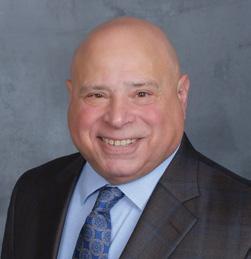
The Columbia College Board of Trustees has announced that Anita Abbott Timmons has been elevated from acting chair to chair of the Board of Trustees, and Joe Nicchetta has been elected vice chair of the board after serving as alumni representative to the board. The appointments will run through June 30, 2027. Timmons had been named trustee emerita in 2015. She is a retired business owner and former educator. She is a 1958 graduate of Christian (Columbia) College. Nicchetta joined the Board of Trustees in July 2025. He recently retired from an extensive career in the shopping center industry, managing and leasing regional malls across the country. CBT
ABBOTT TIMMONS
MARTIN
NICCHETTA
Briefly in the News
JULY 2026
NONPROFIT
VU Foundation Kicks in $50k for Habitat Homes Matching Fund
Show-Me Central Habitat for Humanity has received a $50,000 grant award from the Veterans United Foundation — funded by employees of Veterans United Home Loans — to support the Habitat Homes Matching Funds Kick-O initiative and the continued expansion of a ordable homeownership opportunities in Boone County, according to a news release. e funding will directly support building materials for the rst ve homes in Phase 2 of Habitat’s Boone Prairie subdivision, a transformative housing development designed to help address the growing need for a ordable homes in Columbia. Boone Prairie is a 54-acre subdivision that will ultimately include 143 homes for local families. Currently, 27 families are living in completed homes, with additional homes in various stages of construction. “We’d like to challenge other businesses in our community to match the generosity of the Veterans United Foundation in support of Habitat’s mission through volunteering, donations, sponsorships, or advocacy,” Jennifer James, Show-Me Central Habitat’s executive director, said in the news release. Community members interested in supporting Habitat’s mission through volunteering, donations, sponsorships, or advocacy can learn more at showmehabitat.org.
BUSINESS
Russell Wins ‘Legacy’ Honor, Huebner is Citizen of the Year
e Columbia Chamber of Commerce completed its 2026 award season on June 11 with a banquet at e Broadway Columbia. e annual event was sponsored by the Columbia Housing Authority, which is marking its 75th anniversary this year. e Chamber awards presented at the banquet and throughout this year included:
• Outstanding Citizen of the Year –Brandi Huebner, e Heist
• Chamber Legacy Award – Vicki Russell, Columbia Daily Tribune
• Emerging Professional Award – Tristan John, First State Community Bank
• Debin Benish Award – Jessica Macy, Partner for Better
• Ambassador of the Year –Amanda Jacobs, Jacobs Property Management
• Agriculturalist of the Year – Larry and Ruth Douglas Farms
HOUSING
Upward Mobility Initiative Earns Urban Institute Kudos
e Upward Mobility Initiative, facilitated by the Boone County Community Services Department and driven by community workgroups, has been recognized nationally by the Urban Institute and featured on the “In eir Own Words” section on the Urban lnstitute’s website. Four of the Upward Mobility Initiative leaders were interviewed for the story, which was published May 19, 2026. e story, “How Local Leaders in Boone County, Missouri, Are Advancing Upward Mobility for Residents,” shares information about the Upward Mobility Initiative and insights from Boone County Community Services Department’s Joanne Nelson, director; Gina Jenkins,
data and performance analyst; EnolaRiann White, program coordinator, Upward Mobility Initiative; along with A ordable Housing Coalition workgroup facilitator Jane Williams, Love Columbia executive director.
TRANSPORTATION
COU Begins Shuttle Service From South Parking Lot
Columbia Regional Airport started a shuttle service for its new south parking lot early last month. e south lot, located approximately one-half mile south of the terminal, has capacity for approximately 700 vehicles. Shuttle service between the south lot and terminal operates daily from 4 a.m. to 12 a.m. e shuttle is equipped with 15 passenger seats and rear luggage storage for larger bags. A round trip between the terminal and south lot takes approximately 10 minutes, though travel times may vary based on passenger loading and unloading. Parking rules are now being fully enforced and vehicles parked in prohibited areas will be towed at the owner’s expense.
WORKFORCE
Coil Becomes Certified as Great Place to Work
Coil Construction has become Great Place To Work Certi ed. e award is based on what current employees say about their experience working at Coil. According to a news release, Great Place To Work is a global authority on workplace culture, employee experience, and the leadership behaviors aimed at delivering revenue, employee retention, and increased innovation. e news release pointed out that Coil’s “experienced and collaborative team is central to its culture, which emphasizes treating employees like family.” e company also prioritizes professional growth by o ering ongoing education and development opportunities for both eld and o ce sta . CBT
The Hidden Cost of Showing Up
BY ASHLI EAVES, CHSNC
SHE REARRANGES HER SCHEDULE without a second thought. She leaves a meeting early, declines a promotion that would require more travel, steps away from her career entirely for a season — or two. She does it out of love. For her children. For her aging parents. Sometimes for both at the same time.
And she would do it all again. But here’s what often goes unspoken: at love has a price tag. Not a reason to feel guilty — not even close. But a reason to plan. Because once we name the nancial reality of caregiving, we can actually do something about it.
NAME IT, DON’T SHAME IT
Caregiving isn’t a rare exception for women — it’s a pattern. According to the Transamerica Center for Retirement Studies, 43 percent of women have served as caregivers at some point during their careers, and among those, more than 8 in 10 made some kind of work adjustment as a result: reducing hours, turning down opportunities, or leaving the workforce entirely (Transamerica, 2024).
Caregiving spans every season of life. In our younger years, it centers on children. Later, it shifts to aging parents, an ailing spouse, or both simultaneously — what researchers call the “sandwich generation.” e roles look di erent, but the nancial ripple e ects follow a similar current.
THE NUMBERS BEHIND THE SACRIFICE
Mothers lose an estimated average of $237,000 in lifetime earnings — roughly 15 percent of what they would have earned without caregiving responsibilities — accounting for time out of the workforce, missed promotions, and the wage penalties that follow a career gap (Urban Institute, 2025).
It’s not always as simple as calculating a salary times years away. ere’s the real estate agent who misses a showing because she’s at the pediatrician and loses that client. e woman who passes on a promotion because the travel doesn’t work with school pickup. e commission-based professional who just gets fewer “at bats.” ese are real dollars that never show up on a pay stub but absolutely show up — by their absence — in retirement.
Women who step back to care for aging parents lose a median of $24,500 in wages over just two years, and women in the sandwich generation report the steepest strain — with 55% rating their nancial health as fair or poor, compared to just 20 percent of men in similar situations (Transamerica, 2024).
WHAT ABOUT SOCIAL SECURITY?
Here’s what most people don’t realize: Social Security bene ts are calculated using your highest 35 earning years. Zero-earning years factor into that calculation and pull your bene t down. It’s not a penalty — it’s just math. But it’s math that disproportionately a ects women.
On average, women receive Social Security bene ts equal to about 80% of what men receive (National Council on Aging, 2024). e caregiving gap is one of the primary reasons why (along with the gender pay gap, but that’s a di erent soapbox).
SO WHAT DO WE DO?
e goal isn’t to reverse decisions made out of love. It’s to plan around the nancial reality they create.
If you’re out of the workforce, a spousal IRA may be worth exploring. As long as your household has earned income, you may be able to contribute to a traditional or Roth IRA in your own name, keeping retirement savings growing even during a caregiving season.
When you re-enter the workforce, build a retirement ramp-up plan. Accelerate contributions if you’re able, especially if catch-up contribution eligibility applies. A nancial advisor can help you model what closing the gap looks like.
If you’re self-employed or running your own business, a SEP IRA or Solo 401(k) can allow for signi cantly higher contribution limits than a traditional IRA — which matters when income is variable.
And if possible, have the planning conversation before stepping back. Understanding the long-term impact doesn’t mean you’ll make a di erent choice. But it means you’ll make an informed one. CBT
member FINRA/SIPC. Advisory services though Cambridge Investment Research Advisors, Inc, a Registered Investment Adviser. Cambridge and Aligned Wealth Group are not affiliated.
Ashlie Eaves is an author and financial advisor with Aligned Wealth Group.
What Business Owners Should Know About Their 401(k) Plan
BY WILSON SUNDVOLD
MOST BUSINESS OWNERS don’t hesitate when it comes to responsibility. Something needs to get done? You handle it. A problem comes up? You gure it out. at’s the mindset of a business owner and part of what makes a great business function. Most business owners usually answer the question “Who’s responsible?” with an emphatic “I am!”
When the decision comes to o er a 401(k) plan to your employees, it feels like a natural step. You want to support your employees but also help your company stand out with a well-rounded bene ts package. O ering a retirement plan is not only a matter of providing a bene t, however; it also adds a level of responsibility that’s di erent from most other responsibilities you manage on a daily basis.
If you are involved in overseeing a retirement plan for your employees, you immediately become a duciary of the plan, which adds responsibility for documenting and maintaining items such as an Investment Policy Statement, conducting routine fund reviews, monitoring changes
GLOSSARY
Fiduciary: A person or entity required to act in the best interest of plan participants
ERISA: Employee Retirement
Income Securities Act of 1974, the federal law governing employersponsored plans and duciary responsibilities
Prudent Expert Rule: A standard requiring careful, disciplined decision-making; often considered a due diligence process that can be monitored and recorded
to ERISA law, and looking out for the interests of your employees’ retirement funds. e decision to add a plan goes from offering a bene t for the well-being of your employees to taking a full deep dive into duciary responsibilities.
WHAT BEING A FIDUCIARY ENTAILS
Once your company sponsors a retirement plan, the plan falls under ERISA law. Without getting overly technical, this likely names you (and/or others in your organization) a duciary. You immediately become expected to act in the best interest of your employees when it comes to their retirement money. at responsibility becomes much broader than people expect. is applies to everyday oversight of the plan, including:
• e types of investments o ered in the plan
• e education your participants receive
• e providers and partners being used to help run the plan
Being a duciary is not related to a title you carry within your organization; it’s related to the actions you take. If you have any discretion or control over the retirement o ering, you are responsible forduciary duties.
THE STANDARD ISN’T PERFECTION — IT’S PRUDENCE
Fiduciary responsibility is often tied to the Prudent Expert Rule. In simple terms, this means decisions should be made with the care, skill, and diligence that a knowledgeable person would use.
We live in an imperfect world — not all decisions made will be perfect, but the rule does require that each decision be made using a thoughtful process that is in the best interests of the plan’s participants. A simple framework to help you in these responsibilities is: Organize, Formalize, Implement, and Monitor.
WHAT DOES THIS LOOK LIKE IN PRACTICE?
A well-managed plan usually comes down to creating simple habits:
• Reviewing investments on a routine basis
• Understanding fees
• Documenting decision-making
• Providing employee education
WHAT TO THINK ABOUT
For your plan, whom would you list as current duciaries and what roles are they tasked with in overseeing the plan? is includes members of your team and any outside partners you may work with. CBT
Wilson Sunvold is an investment advisor with Sundvold Financial.
Columbia Voters: It’s Time to Show Up
BY BRIAN TOOHEY
COLUMBIA AND BOONE COUNTY
have a civic engagement problem, and most people know it, even if they won’t admit they’re part of it.
Look no further than this past April’s municipal election. Voter turnout in the Fifth Ward fell below 10 percent. Ten percent! In a rather conservative ward where residents routinely voice strong opinions about city services, development, public safety, and the unhoused population, fewer than one in 10 registered voters bothered to cast a ballot. Meanwhile, the First Ward Council seat went unchallenged — not because the incumbent is universally favored, but because the revolving door of recalls has quietly discouraged good people from even throwing their hat in the ring. is is what civic complacency looks like in practice.
Social media hasn’t helped. Columbia’s community Facebook groups and neighborhood forums are often lled with vague, anonymous complaints about city ocials, elected leaders, and local decisions that are vague, sometimes inaccurate, and rarely constructive. False rumors spread quickly. Nuance gets lost. e people ac-
tually doing the work of governing rarely get credit when things go right, but they receive a ood of criticism the moment anything goes sideways. Over time, this climate makes it harder to recruit thoughtful, quali ed candidates who have no interest in being the target of online scrutiny before they’ve cast a single vote in o ce.
Perhaps most frustrating is what happens, or doesn’t happen, at City Council meetings. e same small group of residents shows up reliably. While their participation is commendable, the dynamic has become predictable: Opposition voices dominate, while the residents who actually support an agenda item stay home. Some may watch online as the drama unfolds, sending particular council members text messages of support. City ocials are left trying to gauge public sentiment based on a room full of people who came speci cally to say no. If you support something, your silence is not neutrality; it’s a vote against it. Sending emails helps, but voices in the room are much louder. e good news? Voters in Columbia and Boone County are about to get multiple chances to make up for lost time.
On August 4, the ballot will include local and state ballot items. A special election will be held to ll the vacant Fourth Ward City Council seat, a direct opportunity to shape local leadership. Proposition 1 will appear before city voters as a 1 percent sales tax increase to fund public safety and support Columbia police o cers and re ghters. e State of Missouri has four constitutional amendment questions on the ballot, including Amendment 1 to renew the .01 percent sales tax for 10 years for parks and conservation, and Amendment 2 to require the Jackson County assessor to be an elected position.
Amendment 4 would change the initiative petition process, while Amendment 5 would start the process of potentially removing the state income tax. I recommend voting no on both of these ballot issues. e November 3 ballot will determine Missouri’s federal elections. Amendment 3 is another Missouri constitutional amendment that would prohibit abortion in most cases and gender transition procedures for minors. Boone County is also asking voters to approve a three eighths-cent sales tax increase for public safety to fund construction of a new county jail.
ese are not abstract exercises in democracy. ey are direct levers of power that Columbia and Boone County residents hold in their hands. e council member you don’t vote for will still make decisions about your streets, your zoning, and your tax dollars. e sales tax you ignore will either pass or fail without you. e constitutional amendments will be decided whether you participate or not, and these amendments change the balance of power.
Columbia is a well-educated, engaged, and passionate community, at least online. e challenge now is translating that energy into action: attending a meeting, reading a local news article rather than a Facebook rumor, and, most importantly, showing up on Election Day.
August 4 is closer than you think. e time to pay attention is right now. CBT
Brian Toohey is the chief executive officer for the Columbia Board of REALTORS®.
What Managers Get Wrong About Developing People
BY KARTIK BHAVSAR
THERE’S A MOMENT that happens in almost every talent review I’ve sat in on.
A manager presents one of their people. Strong performer. Great attitude. Reliable. e room nods. Someone asks, “What’s the development plan?” e manager says something like, “We’re working on her executive presence” or “She’s growing into a more strategic role.”
And then the conversation moves on. Nobody asks what executive presence truly means for this person. Nobody asks what “more strategic” would look like in her next meeting, her next decision, her next conversation with a peer. e plan exists in the abstract, which is another way of saying it doesn’t really exist at all. is is the quiet problem in how most organizations develop talent. It is not that managers don’t care. Most care a lot. It is that caring gets confused with developing, and the two are not the same. Support is what a manager does when they encourage someone, recognize their e ort, send them to training, and tell them they have potential. All of that matters. None of it, by itself, develops anyone. Development is something di erent. It is the work of helping someone build a
capability they don’t yet have and being speci c enough about it that the person knows what to actually do di erently on Monday morning. Too often, these ve patterns get in the way:
1. MISTAKING PERFORMANCE FOR GROWTH. When someone is excellent at their current job, the easiest thing is to keep giving them more of what they’re already good at. e business gets results, the manager looks smart, and the employee gets quietly stuck. Performing well today and preparing for what’s next are two di erent muscles. Strong performers often need to be protected from their own track record.
2. VAGUENESS. “Be more strategic.” “Have more presence.” “Speak up more.” ese sound like development goals, but they’re categories. e work of a real development conversation is translating those categories into something concrete enough to practice. What does it look like when the person has more presence, and what does it look like when they don’t?
3. OVERLOAD. After a tough review or a 360-degree performance assessment, the temptation is to x everything. Communication, in uence, delegation, decision-making, executive presence, all at once. But development plans with eight priorities have zero priorities. Two or three distinct objectives, chosen for leverage, will outperform a long list every time.
4. RELYING ON OVERALL IMPRESSIONS INSTEAD OF EVIDENCE. Good development is built on patterns: What feedback has consistently surfaced? Where does someone get stuck under pressure? What do the people who work with them actually observe? When development conversations are built on impressions instead of evidence, employees can sense it, and they don’t fully commit.
5. NEVER DEFINING WHAT SUCCESS LOOKS LIKE. A development goal without observable signs of progress is just a wish. e managers who develop people well can answer the question, “What would I see or hear if this were really working?” Without that, the conversation happens once and quietly disappears.
None of this requires a program. It requires a manager who is paying attention, is willing to be honest, and stays focused on a small number of things that matter. Here’s the part that doesn’t get said enough. Employees don’t experience development as a strategy or a framework or a competency model. ey experience it as the conversation they had with their manager last Tuesday and whether it was speci c enough to act on, honest enough to trust, and followed by an opportunity to truly try something new. at conversation is the unit of development. And the managers who understand that are the ones whose people keep getting ready for what comes next. CBT
Kartik Bhavsar, Ph.D., founded KB Coaching to develop leaders and prepare for roles.
Trust Is the Most Important Currency for Nonprofits
BY JAIME FREIDRICHS
A FEW YEARS AGO, I received an email from an international nonpro t I support, telling me they were changing how they conduct their core program: providing direct aid to people in poverty. An internal study had revealed that more time between payments would help the recipients better plan for how to use the funds most e ectively.
By openly sharing that their old way was awed and their plan to change it, this nonpro t demonstrated to me that I could trust them. Rather than making them look bad for not being perfect (a standard we shouldn’t expect of anyone, especially nonpro ts), they showed that they were not only willing to learn but also committed to being transparent about their practices.
One of the best questions anyone in a nonpro t can ask is, “How do we build trust with our community?” Whether you’re a sta member, leader, volunteer, board member, or supporter, helping your organization build trust is key to its e ectiveness. Trust is needed for all aspects of nonpro t work, and it is especially important for fundraising, the area I usually work in.
Building trust requires three ingredients: integrity, transparency, and consistency. Among the many nonpro t leaders I know and get to work with, both sta and volunteers, I nd that most are people of high integrity. It’s part of what attracts them to a sector that is dedicated to doing good. How well their donors and the broader community are able to see this is another question. at’s where transparency and consistency come in.
Here are a few questions I like to ask when working with nonpro ts to ensure we’re doing enough to build trust:
• Do we make a point to report back to supporters that we’ve followed through on the plans we shared when we asked for their gifts? Or, as in the
case above, do we say why we adjusted those plans?
• Are our board and sta leaders visible in the community through opportunities to get to know them at events, on tours, and/or through one-on-one visits?
• Do we proactively share information about our nancial situation and program e ectiveness, such as impact reports, audited nancial statements, and the public version of our IRS Form 990?
• Do our communications highlight not just what we do, but also the impact it has on the people we serve and the whole community?
• Do we include our donors and community in celebrating our achievements, while also educating them about the real challenges we face?
When nonpro ts can answer yes to all these questions day in and day out, that
consistent transparency grows the trust needed to increase donations, weather di cult situations, or receive the benet of the doubt when making a change. In the example above, the nonpro t made a brave choice to be open about a past error in judgment. ey could have made any number of valid excuses not to share their shift in thinking: that their donors wouldn’t care, that it might jeopardize future support, that the change was small enough that it didn’t matter. If they had adjusted their programs without saying a word, most donors probably wouldn’t have even noticed.
Instead, they embraced the change as an opportunity to build greater trust with me and their other supporters. at level of transparency is very typical of this cause and why my gifts to them have only increased since that email. (In fact, I’m now a monthly donor.) Nonprofits must be aware that people’s trust in them isn’t about how trustworthy they actually are. It’s about how well they’re able to show it. CBT
Jaime Freidrichs is a fundraising coach who specializes in helping small-and-mighty nonprofits.
When the Robot Writes the Story
BY J. SCOTT CHRISTIANSON
EARLIER THIS YEAR, Chris Quinn, editor of Cleveland.com and the Plain Dealer, set o a pitched debate in journalism circles when he revealed that reporters no longer draft stories in these newsrooms. AI does.
“Because we want reporters gathering information, these jobs are 100 percent reporting. We have an AI rewrite specialist who turns their material into drafts. We fact-check everything. Editors review it. Reporters get the nal say,” wrote Quinn.
Quinn’s argument is that in this shrinking industry, writing is a bottleneck. And if AI can handle drafting articles, reporters can use the time saved to be out in the community doing the work that machines can’t do, hopefully leading to expanded coverage.
As you can imagine, many journalists were not fans of Quinn’s perspective. Lionel Barber, a former Financial Times editor, called the approach “beyond dumb.” Robyn Tomlin of the American Press Institute argued that “e ciency alone is not a journalistic value.”
However, algorithmic story writing isn’t novel. In July 2014, some eight years before ChatGPT, the Associated Press began using algorithms to write corporate earnings reports. Its system pulled data from a structured database, plugged it into journalist-built templates, and produced 150- to 300-word stories. AP went from covering about 300 earnings reports a quarter to more than 3,000. e reporters who used to crank out those stories were redirected to deeper analysis. And interestingly, AP reported that automation cut the error rate on earnings stories from about
7 percent to roughly 1 percent: Algorithms don’t transpose digits or miss decimal points.
e Los Angeles Times, ProPublica, Bloomberg, and many other outlets followed suit with algorithmic story generation in business and sports, and none of those e orts caused much fuss. In these cases, however, AI was applied to a narrow class of content where the inputs were highly structured (for example, numbers from an earnings release), the output was formulaic, and readers didn’t expect literary craft. It was data, reformatted into sentences, and a great example of how AI can be a great “word calculator.”
But most writing isn’t a data delivery exercise. For us humans, it is a thinking exercise.
Decades ago, cognitive psychologists Linda Flower and John R. Hayes established that writing is not the transcription of preformed thoughts. It’s where thoughts get formed in the rst place. Drafting a story is how a reporter discovers contradictions, patterns, and better questions to ask. When the writing is handed o , what will be lacking in the story? What connections will never be made?
e Cleveland.com debate comes at a time when AI is destroying the tra c and ad revenue of many news outlets. When Google began adding AI-generated “overviews” to the top of its search re-
sults, readers stopped clicking through to original sources. Hu Post and Business Insider have reported roughly 40 percent drops in web tra c since the change. e Washington Post’s search referrals fell nearly 50 percent over three years, contributing to the layo s of about 30 percent of its newsroom earlier this year.
A May report from the Open Markets Institute estimates that up to 20 percent of publishers’ annual web revenue now goes just to cover the bandwidth and infrastructure costs of AI bots scraping their sites. ese bots are often training the very products that then summarize that same content and serve it to readers without sending any tra c back to the organization that did the reporting.
So put yourself in an editor’s chair. Your readers are being intercepted by AI summaries before they reach your site. Your ad revenue is collapsing. And the tool that’s eating your lunch is also being sold to you as the productivity tool that will let you do more and perhaps increase readership. Refuse to use it, and you could fall further behind. ere’s no easy answer here, which is part of the reason the industry debate is intense.
But personally, I don’t think Boone County is ready for a robot Jodie Jackson Jr. any time soon. CBT
For links, references, and to contact Prof. C, visit profcnews.com.
J. Scott Christianson — aka “Prof C” — is the former director of Mizzou’s Center for Entrepreneurship and Innovation.
Long-Term Process for Short-Term Rental Approval
Tier system provides some clarity, additional modifications likely.
BY STEPHI SMITH
MORE THAN A DECADE after opening an Airbnb attached to their home near the Columbia Country Club, Randall Kilgore and Gary Smith found themselves navigating a lengthy new city approval process to keep renting the space.
e Columbia City Council approved sweeping regulations for short-term rentals — including Airbnb and Vrbo properties — in February 2024 after months of debate over housing a ordability, neighborhood character, and investor-owned rentals.
City o cials argued the ordinance was intended to prevent large numbers of homes from being converted into short-term rentals instead of longterm housing. Critics, including some hosts and real estate advocates, argued the regulations were overly complicated and injected politics into what had largely been a straightforward business.
e ordinance created a tiered system for shortterm rentals. Owners who live on the property or rent the space for fewer than 210 nights a year face fewer restrictions. Property owners who want to operate a rental for more than 210 nights annually — or owners whose certi cates of compliance have been revoked — must obtain a conditional use permit.
Columbia’s short-term rental ordinance classies short-term rentals into three categories:
• Tier 1 allows up to 30 rental nights per year.
• Tier 2 allows up to 120 rental nights per year without a permit and up to 210 rental nights per year with a permit.
• Tier 3 allows more than 120 rental nights per year.
e conditional use permit process requires public hearings before both the Planning and Zoning Commission and the City Council. e ordinance also limits owners to one short-term rental license per entity, meaning a person or LLC cannot operate multiple licensed short-term rental properties under the same ownership structure.
THE THINKING BEHIND THE ORDINANCE
Patrick Zenner, development services manager with Columbia’s Community Development Department, said the ordinance was designed to address concerns seen in other cities, where investors purchased homes speci cally to convert them into short-term rentals. He said the city’s goal in enacting the ordinance is to “protect a ordable and attainable housing from being lost to short-term rentals.”
Short-term rentals currently account for less than 1 percent of Columbia’s housing stock, according to city estimates. Zenner said o cials viewed the regulations as a way to prevent a larger problem from developing locally. Part of the new ordinance also limits operators to one shortterm rental property per entity, which was meant to ensure there was not an over-concentration of dwelling units becoming short-term rental properties.
“An entity is a person, a corporation, a limited liability corporation, and all of its members,” Zenner said. “So if you obtain a license as an LLC or a corporation, any member of that LLC or corporation is considered to have received their one and only license in the City of Columbia.”
e city has received 136 short-term rental applications, though Zenner estimated there may be about 300 properties operating as short-term rentals in Columbia.
To address that gap, the City Council hired Avenu Insights & Analytics LLC, now called Neumo, in November 2025 to help enforce compliance with the ordinance. A council memo at the time stated only 26 percent of estimated short-term rental properties had met the city’s requirements.
Zenner said the city has focused rst on education and outreach but plans to continue pursuing unlicensed operators.
UNSTICKING THE RED TAPE
For Kilgore and Smith, complying with the ordinance meant applying for a business license, obtaining a certi cate of compliance, and eventually seeking a conditional use permit because their Airbnb exceeds the 210-night threshold.
e pair said the process was time-consuming and frustrating because it required multiple hearings and months of waiting, despite the fact that their rental property has operated for years without neighborhood complaints.
“It just felt like there were a lot of hoops for people who were already doing this responsibly,” Smith said.
e couple’s Airbnb began as an addition built for Kilgore’s mother. After she no longer needed the space, they started renting it through Airbnb in 2015.
Kilgore said he and his husband spoke with neighbors before listing the property online and never received objections. Most of their guests are visiting family members, traveling professionals, or repeat customers staying in Columbia temporarily.
“We like hospitality, but it hasn’t hurt to have a little income in retirement either,” Smith said.
Kilgore and Smith ultimately received their conditional use permit in October 2024. Smith recalled that the Planning and Zoning Commission had few questions, and no residents spoke against the application, though they said the process was largely burdensome because they were some of the rst hosts to navigate the multi-tiered system. Smith said it took him and Kilgore a lot of e ort and time to get the process in order, but the two were dedicated to continuing hosting through Airbnb.
During that same meeting, however, another applicant faced multiple neighbors speaking in opposition over concerns about noise, parking, and changes to neighborhood character. Commissioner Sharon Geuea Jones addressed the seeming discrepancy by observing that although the applications seemed similar, “the neighborhood di erence is notable.” at application was denied due to public comments at the Planning and Zoning Commission.
PUBLIC HEARINGS
PROVE UNPOPULAR
Zenner acknowledged the public hearing process has become one of the ordinance’s biggest points of contention.
“Government rarely moves fast,” he said. “When you add multiple public
bodies reviewing something, it can add months to the process.” He noted the entire process to obtain a conditional use permit for a short-term rental can take up to six months to complete.
While Zenner insists that the Planning and Zoning Commission has generally applied the same standards consistently when evaluating applications, Brian Toohey, CEO of the Mid-Missouri Board of Realtors, said the conditional use permit process makes short-term rental approvals unpredictable. “It makes the decision political when it has to go before the City Council,” he said.
Before the ordinance passed, the Columbia Board of Realtors and the Columbia Apartment Association proposed an alternative version that would have removed the tiered system, eliminated the public hearing requirement for compliant properties, and allowed owners to hold up to ve licenses. e council rejected those recommendations and moved forward with the stricter ordinance.
en-Ward 5 Councilman Donald Waterman likewise attempted to amend the proposal in February 2024 by removing the conditional use permit requirement, eliminating the tiered system, and increasing the number of licenses allowed per entity. Every amendment failed for lack of a second, and Waterman cast the lone vote against the ordinance.
“I thought it was overly complex,” Waterman said. “I didn’t see the need for all of the extra layers.”
THE DEBATE CONTINUES
More than a year after the ordinance passed, debate over the regulations continues.
Some hosts, including Kilgore and Smith, say the rules burden small operators who rent space attached to their homes rather than large-scale investors.
City o cials, meanwhile, maintain the ordinance is necessary to prevent Columbia’s housing market from following harmful trends seen elsewhere.
With hundreds of estimated shortterm rentals still unlicensed and criticism continuing over the public hearing process, city leaders may face renewed pressure to revisit parts of the ordinance in the future. CBT
From Mizzou Dorm to Tesla Supplier
Hallsville-based 3D printing buff earns SBA’s Missouri 2026 Small Business Person of the Year honor.
BY NATALIE-ELIZABETH TAN
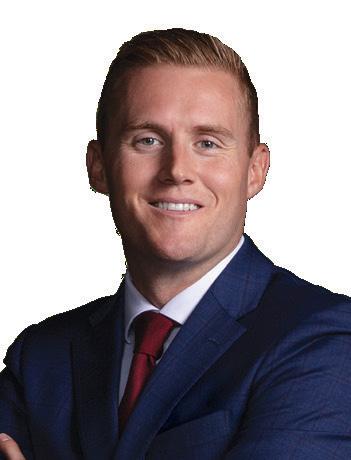
TYLER KEMP GOT HIS START in 3D printing in the early 2010s when he was living in a dorm at the University of Missouri-Columbia.
He had wanted to make a ri e chassis, which is a metallic stock for a rearm. To raise money to pay someone to create a prototype, Kemp decided to sell 3D-printed "doo-dads" that he made himself.
"At that point, this was when consumer printing was just becoming achievable,"
Kemp said. "Anyway, one printer led to two; two led to four. at allowed me to prototype my original product that I wanted to create."
Along the way, his love for 3D printing — or additive manufacturing, as it’s known in the industry — grew. He also learned how to use consumer-grade printers with professional-grade materials, something that was not industry standard at that time.
At school, Kemp initially planned to major in mechanical engineering. However, with advice from his friends, he switched programs and ended up graduating with a bachelor’s in marketing and sales.
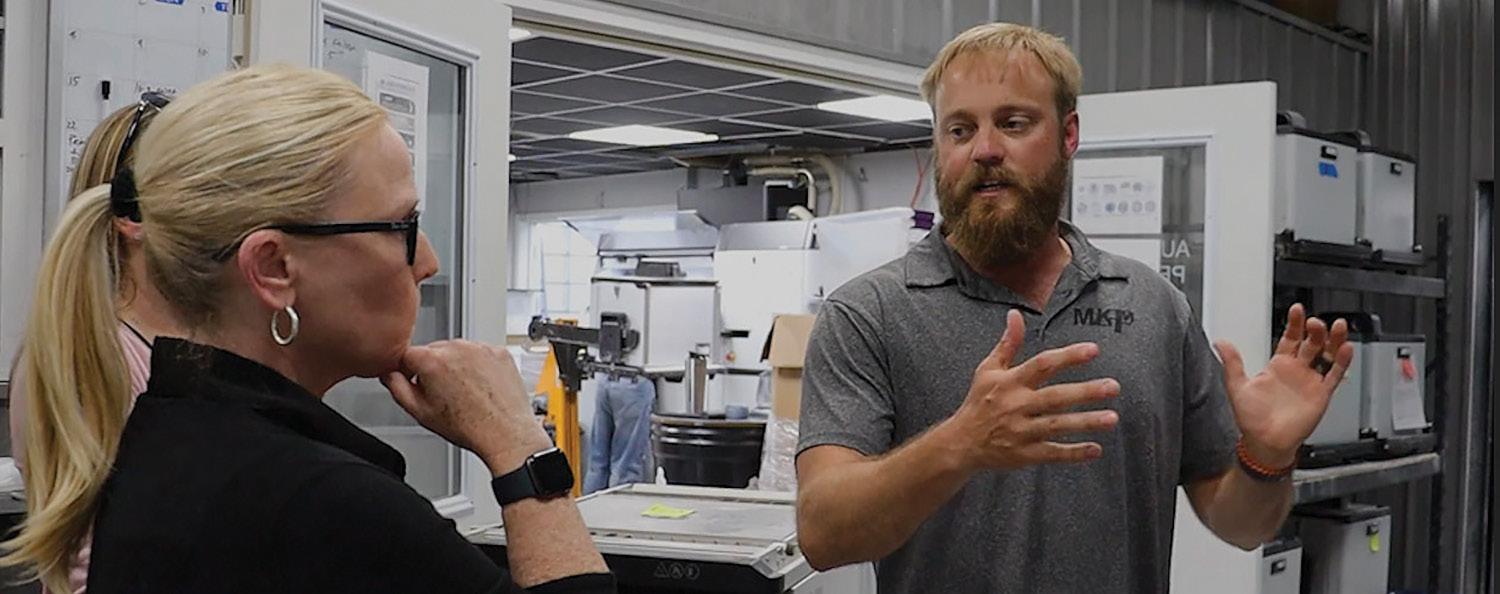
More than a decade later, he is the owner and CEO of MK Machining, a Hallsville-based additive manufacturing company with over 20 full-time employees that counts large global auto companies such as Tesla, Rivian, and Ford as some of its customers.
AN EVOLVING BUSINESS MODEL
One of the rst products that Kemp made in his dorm was a throw lever, a clamp that attaches to ri e scope magnication rings to help with adjustment in adverse conditions. e levers he made could be customized to t virtually any ri e perfectly. MK Machining still manufactures several kinds of throw levers, although these days it does so on "almost million-dollar machines."
On its retail side, it sells a wide range of MK Machining-branded rearm accessories. Among its most popular products, Kemp said, are precision caps, which protect scope lenses on rearms.
While the company’s roots are in the rearms industry, the company’s largest revenue driver is now custom B2B manufacturing. Today it manufactures automotive, aerospace, and general engineering parts, along with athletic gurines, eyeglass frames, and lens holders for virtual reality headsets.
In addition, as a nod to Kemp’s alma mater, MK Machining has even manufactured housing for helmets that SEC football players wear.
THE VALUE PROPOSITION OF ADDITIVE MANUFACTURING
With its 3D-printing technology, MK Machining competes with companies that use injection molding to manufacture parts. At a large-enough scale, it is cheaper to manufacture via injection molding. Companies usually source their tooling overseas to cut costs, but the tradeo is a wait of up to several months.
Kemp said his company can o er customers a faster turnaround, a much smaller up-front cost, easy customization, and a minimum order quantity of one.
“It’s going to be a lot cheaper to (3D) print just one of something than, really, any other method of manufacturing a single item,” he said. “So, it’s excellent for prototyping; … it’s excellent for low-batch production.”
And while companies may want to move to injection molding eventually, additive manufacturing — with its quick turnaround time — can step in to ll orders in the meantime.
"You’re going to make a lower margin during that time, but you can come to market while you’re waiting for your tooling," Kemp observed. "Rather than only being able to sell in a year when your tooling is done and you’re getting molded parts, you can be selling parts that entire time."
FROM BACKGROUND “HUSTLE” TO SBA AWARD WINNER
Kemp founded the company with a partner, whom he bought out about eight years ago. At rst, Kemp said they worked multiple jobs and ran MK Machining in the background "for the love of the hustle."
e founders hired their rst full-time employee in 2017, and Kemp said that the majority of the company’s growth happened within the last ve years, after diversifying its revenue streams with B2B manufacturing.
“My rst employee is still here — he’s been with the company the whole time," Kemp said. "My second employee is still here; my third employee is still here. We have very little turnover.”
Kemp noted that MK Machining gets the vast majority of its business through word of mouth, as the company doesn’t even employ any sales representatives. He added that it was his company’s reputation within the rearms world that has paved the way for its business in other industries.
B2B sales makes up slightly over half of the company’s annual revenue, while the rest comes from retail sales. To date, Kemp said they have received nearly 300,000 retail orders from roughly 100,000 individuals.
Kemp thinks the business could perhaps be a lot bigger than it is if he were a "super business maven" or allowed investors in. However, he enjoys maintaining control over business decisions.
"I get to call my own shots," Kemp said. "Maybe I make the wrong decision sometimes, but I’m not happy to make the decision based upon someone else’s desires, and it gives a lot of exibility in that regard."
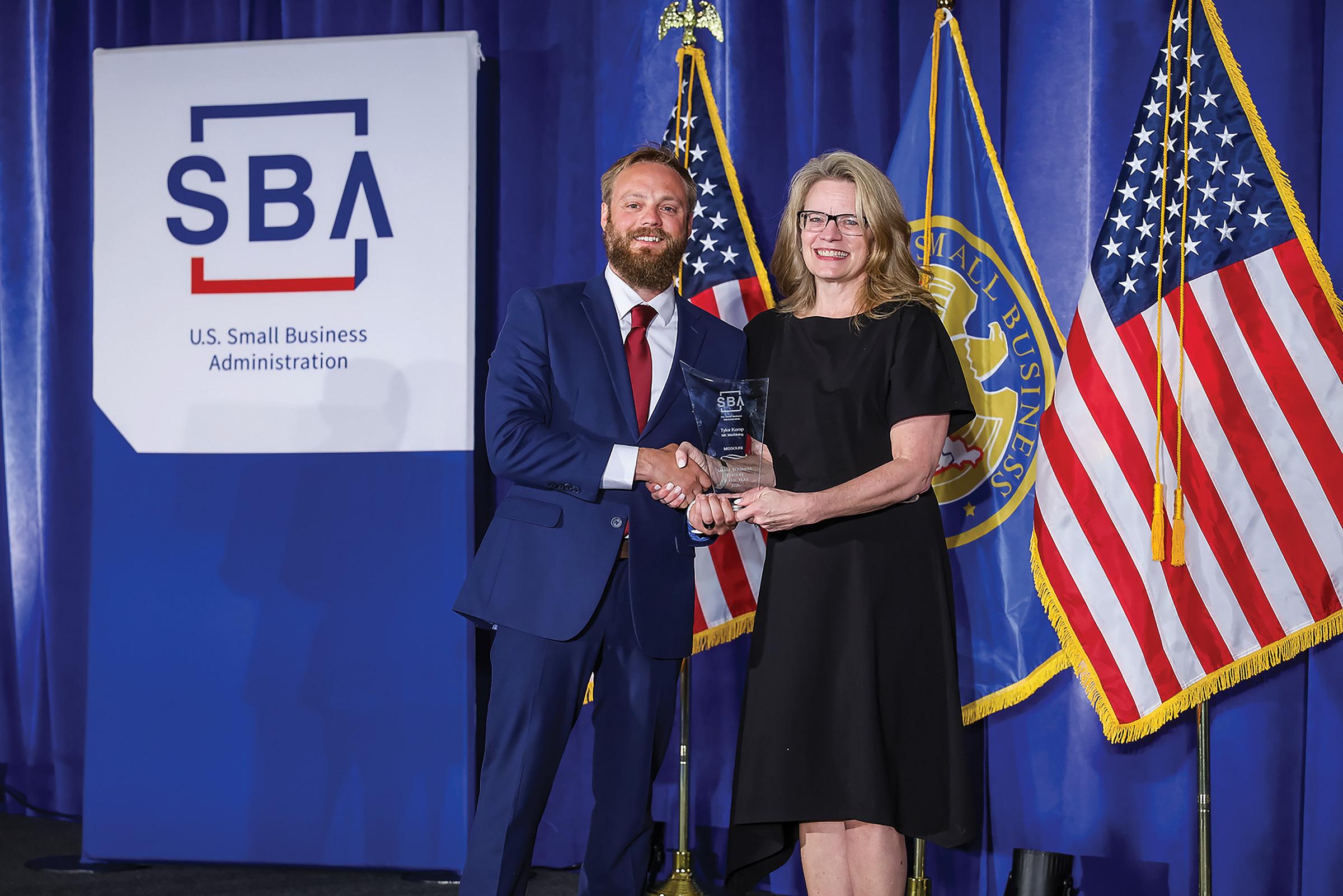
In recognition of his work with his company, Kemp was named the 2026 Missouri Small Business Person of the Year by the U.S. Small Business Administration in April.
MK Machining is still solely operated out of mid-Missouri and is the world’s largest printing facility working with Nylon 11 Multi Jet Fusion, a type of lightweight, durable, and renewable nylon material derived from castor beans as opposed to petroleum. It has two manufacturing and B2B shipping facilities in Hallsville at 208 Elizabeth St. and a ful llment center in Columbia at 3011 David Drive, where the bulk of retail orders are dispatched.
e Columbia location is primarily a fulllment center, but it is also open to customers who may want to see and feel MK Machining’s rearm accessories in person before purchasing.
“A lot of retailers would say you can’t touch X or Y; it’s pretty expensive,” Kemp said. “At our shop in Columbia, that’s probably the biggest draw for folks coming in the store — to get [their] hands on expensive optics.” CBT
WHAT THE PROS KNOW BUSINESS
WHY UNCERTAIN TIMES ARE NOT THE TIME TO GO QUIET ON MARKETING
By Charles Bruce III charles@comocompanies.com
When economic uncertainty rises, it’s natural for business owners to take a closer look at expenses. Budgets tighten, spending is scrutinized, and every investment is expected to prove its value.
Unfortunately, marketing is often one of the first areas businesses consider cutting. While that reaction may feel safe in the short term, history and experience show that going dark can create bigger challenges down the road.
Stay Visible When Others Go Quiet
During uncertain times, visibility matters more than ever. When competitors reduce their marketing efforts, opportunities emerge for brands willing to stay present. Customers are still researching, comparing options, and making purchasing decisions. If your business disappears from their radar, someone else’s will take its place.
The businesses that continue communicating with their audiences during challenging periods often emerge stronger when conditions improve. That’s because marketing isn’t just about generating immediate sales. You want to maintain awareness, build trust, and stay top of mind.
Protect the Foundation You’ve Already Built
Just as importantly, consistency protects the foundation you’ve already worked hard to build. Think about the time and resources you’ve invested in your website, social media presence, search rankings, advertising campaigns, and brand recognition. Those assets don’t stop working when the economy becomes uncertain, but they do require ongoing support.
Marketing momentum is much easier to maintain than it is to rebuild. When businesses pause their marketing entirely, they often find themselves starting over months later—rebuilding website traffic, re-establishing audience engagement, and
CHARLES BRUCE III Director of Client Relations
Charles Bruce is the Director of Client Relations for COMO Companies, which owns COMO Marketing, COMO Magazine, and COMO Business Times. He received his Bachelor’s Degree in Business Administration and his MBA from the University of Dubuque. When Charles isn’t being the life of the party, he can be found climbing a large mountain. In December 2023 he climbed the Imja Tse mountain in Nepal.
regaining visibility that was lost during the slowdown. Maintaining a consistent presence helps preserve the progress you’ve already made and positions your business for future growth.
Don’t Sacrifice Future Growth for Short-Term Savings
That doesn’t mean you should continue spending exactly as you always have. In fact, economic uncertainty is an excellent time to evaluate how your marketing dollars are being used.
One common mistake that businesses make during downturns is pulling budget from top-of-funnel, awareness-based marketing efforts, the activities that introduce new customers to your brand. Because these tactics don’t always produce immediate results or show direct ROI, they can seem like an easy place to cut.
The problem is that new customer growth often slows when those investments disappear. While it’s important to focus on conversions and short-term revenue, businesses still need a steady pipeline of future customers. Eliminating awarenessbuilding efforts may improve efficiency temporarily, but it can create a growth problem later.
Analyze Your Full Marketing Funnel
Instead of making broad cuts, perform
573-577-1965 | comomarketing.co
a full-funnel analysis of your marketing efforts. Look at how prospects discover your business, engage with your brand, and ultimately become customers. Identify where your marketing is producing results and where dollars may be underperforming. Ask questions such as:
• Where are new leads coming from?
• Which channels generate the highest-quality prospects?
• Are there campaigns consuming budget without producing meaningful results?
• Are we investing enough in attracting new audiences?
In many cases, the goal isn’t to spend less but to spend smarter.
Strategy Wins in Uncertain Times
The strongest marketing strategies balance both short-term performance and longterm growth.
Economic uncertainty creates challenges, but it also creates opportunities. Businesses that remain visible, stay consistent, and make informed decisions about their marketing investments are often the ones best positioned to grow when confidence returns.
Now isn’t the time to disappear. It’s the time to be strategic.
INSURING AND SECURING YOUR VACATION HOME
By Mike Messer MMesser@ShelterInsurance.com
Owning a vacation home can feel like having your own personal getaway. Whether you visit occasionally, stay seasonally or plan to use it in retirement, a second property comes with insurance and security considerations that may differ from those of your primary residence. The coverage available to you depends on how the home is used, where it is located and the specific policy you purchase.
VACANCY CONSIDERATIONS
A key factor that can influence coverage is how often the home is occupied. Vacation homes can face the same types of risks as any other property, but when they sit empty for long periods, issues may go unnoticed and cause more extensive damage. Depending on the policy and state, certain types of losses may have limitations or conditions during extended vacancies.1 An agent can explain how vacancy provisions apply to your individual situation and what options may be available.
If you rent out your vacation home— whether occasionally or on a short term basis—your coverage needs may differ from those of a non rental property. Rental related coverage varies by insurer, policy and state, and may require additional endorsements or a different type of policy. Features such as pools or hot tubs may also affect eligibility or require additional review. An agent can help you understand what coverage may be available based on how the property is used.
LOCATION MATTERS
The type and location of your vacation home play a major role in determining the coverage you may need. For example, condos often include some level of protection through a homeowners association (HOA) but the scope of that coverage can vary widely. Reviewing the
With over two decades in the insurance industry, Mike Messer has served as a claims adjuster, supervisor, and underwriter, giving him a well-rounded understanding of how policies work when it matters most — before and after a loss. He prioritizes building relationships based on trust and personalized service, recognizing that every client’s needs are unique. Through annual policy reviews, he helps ensure clients stay informed, confident, and properly covered, providing them with peace of mind and financial security.
HOA documents can help you understand what is and is not included, and where your own policy may need to fill in gaps. Geography also influences the risks your property may face. Homes in coastal, mountainous or wildfire prone areas may require additional policies or endorsements, depending on state regulations and insurer offerings. It’s important not to assume that every hazard is automatically covered. An agent can help you review what coverage your policy includes and what additional options may be available.
KEEP IT SECURE
Because vacation homes are often unoccupied, taking steps to secure the property can help reduce the likelihood of theft, vandalism or unnoticed damage. Consider asking someone you trust
to check on the home periodically, installing a monitored security system or using smart or changeable locks. These measures may help you identify issues sooner and discourage unwanted activity.
PEACE OF MIND FOR YOUR GETAWAY
A vacation home should be something you enjoy—not something that adds unnecessary stress. Discussing how you use the property, how often it is occupied and the risks it may face can help an insurance agent guide you toward coverage options that fit your needs.
1 - Vacancy provisions often include limitations or exclusions for vandalism, water damage or freezing.
The product information contained in this article is informational only and not a statement of contract. All coverage options are subject to the provisions of the policy purchased, and details of the policyholder’s situation. Coverage availability and requirements vary by state and by individual policy.
SAVING FOR EXPERIENCES
By Brad Roling broling@midambk.com
For many people, travel and leisure experiences can feel financially out of reach — especially when social media often highlights luxury vacations and expensive getaways. But financial professionals say meaningful experiences don’t always require a major splurge. In fact, some of the most sustainable travel habits begin with small, consistent saving strategies that make room for spontaneity without creating financial stress.
Small Habits Can Lead to Big Memories
One of the simplest ways to prepare for future experiences is by building small weekly savings habits into your routine. Setting aside even $10 to $25 each week specifically for travel or leisure can grow into a meaningful fund over time. Many people are surprised by how quickly small automatic transfers add up when they’re consistent. Saving just $20 a week, for example, creates more than $1,000 in a year — enough to help cover several weekend getaways, concert tickets, or multiple daytrips. Automating those savings can make the process even easier. Scheduling recurring transfers to a separate savings account removes the temptation to spend the money elsewhere and makes saving part of your regular financial routine rather than an occasional effort.
Rethinking the “Big Vacation”
Another growing trend among financially savvy travelers is the embrace of the “micro-vacation” mindset. Instead of waiting years to afford one large, expensive trip,
many people are choosing shorter, lower-cost experiences spread throughout the year. A micro-vacation could mean a weekend road trip, a staycation near home, a camping trip, or exploring attractions in neighboring towns. These smaller experiences often require less planning, less time away from work, and significantly less money upfront. They can also feel more attainable and less financially overwhelming than trying to fund a large vacation all at once.
From a financial perspective, smaller trips can help people avoid relying heavily on credit cards or financing travel costs they may struggle to pay off later. While there’s nothing wrong with planning for a larger dream vacation, balancing those goals with smaller experiences along the way can create a healthier long-term approach to leisure spending.
The Power of a Sinking Fund
One of the most effective tools for saving toward experiences is something financial experts call a “sinking fund.” Unlike an emergency fund, which is designed for unexpected expenses, a sinking fund is money intentionally set aside for planned future spending.
Creating a travel or leisure sinking fund allows people to prepare gradually for experiences they know they’ll want later. Instead of scrambling to cover costs when opportunities arise, the money is already
Brad Roling is the Columbia Market President for Mid America Bank. Brad has more than 15 years of banking experience that he uses to help businesses in and around Columbia thrive. When he is not helping your business with its financial needs, Brad is serving the community in a variety of capacities. He is proud to serve on the Ronald McDonald House Mid-Missouri Board of Directors as Vice President, the Columbia Chamber Foundation Board as Treasurer, Executive Board for Scouting America, Great Rivers Council, and Beta Theta Pi Advisory Board. Brad is a proud Mizzou grad and loves cheering on the Tigers!
573-998-8900 | midambk.com 4601 Stellar Drive, Columbia MO
waiting. Some people create separate sinking funds for specific goals like concerts, family trips, holiday travel, or seasonal activities.
Keeping these funds separate from everyday checking accounts can also help reduce impulse spending and make progress easier to track. Many banks even allow customers to nickname savings accounts based on goals, making it easier to stay motivated.
Making Experiences Part of the Budget
Experiences are an important part of life, and budgeting for them intentionally can help remove guilt and financial anxiety from the equation. By building small saving habits, embracing lower-cost adventures, and creating dedicated sinking funds, people can enjoy more flexibility and freedom when opportunities for fun arise.
WHY DOES LONGEVITY IN COMMERCIAL CONSTRUCTION MATTER?
By Vaughn Prost info@prostbuilders.com
We always talk about how Prost Builders has been in business since 1949, but do you realize the significance of that longevity for a new project? Experience in commercial construction and historic restoration work is more than branding, or something extra to put on your Request for Qualifications to a potential client. It’s a literal record of proven performance that brings the most value to the table. Prost Builders has almost 8 decades of institutional knowledge and experience, trusted subcontractor relationships, company stability, and a track record of the ability to deliver successful projects over a long period of time. Every construction company must begin at some time, but we’ve been doing this work for so long that we have the process perfected. If you choose an established commercial contractor and design-builder--you’re increasing your likelihood of a project’s success while reducing your risk. Prost Builders has been through volatile economic times of labor shortages, supply chain issues, recessions, and the ever-changing regulations dominating our industry that are proof of our sound business practices and resilience in each circumstance. Prost Builders has proven the ability to execute the project more efficiently than our less experienced competitors just by being successful and consistent in business for 78+ years. We’ve solved many challenges throughout our history, and it gives us the knowledge to identify potential issues early on to solve them. We have experienced project managers, superintendents, estimators, and labor crews due to our depth of institutional knowledge which can’t be duplicated overnight. That means we have more accurate project estimating, better scheduling, safety, and quality control, as well as quicker problem-solving abilities. We have experienced project efficiency,
VAUGHN PROST Owner & President
Vaughn Prost is the owner and president of Prost Builders lnc., a design/build and construction services firm located in Columbia. Vaughn has over forty years of domestic and international design and construction experience as a cost and scheduling engineer, structural engineer, owner’s construction representative, and general contractor.
better project timelines, and maintain strong partnerships with local architects, trade partners, inspectors, local municipalities, subcontractors, and engineers to ensure a smooth process on our projects. Our longevity alone is evidence that our clients trust our company’s professional reputation and workmanship; whereas a new company may exhibit their ambition, they don’t have the extensive project portfolio, nor a long, proven track record we already have. Due to the cost of millions of dollars in commercial constructionmany owners prefer a company that has demonstrated staying power for good reason. Though we are older than most of our competition, we consistently embrace innovation to remain competitive as part of our ability to adapt to new technology and standards in our industry. We add it to our traditional knowledge and practical field experience to create a model that combines sustainable practices, prefabrication
(573) 635-0211 | prostbuilders.com 3305 Crawford Street
methods, energy-efficient buildings, and other enhanced technologies that benefit our clients. Initial construction costs are not the only important factors for a longterm investment in a commercial building, that’s why Prost Builders understands and appreciates the importance of durability, maintainability, operational performance, and lifecycle costs. We focus on how the building will perform for our clients decades after completion-not just during construction. In our industry, what matters most is what Prost Builders is known for: trust, safety, quality, longevity, experience, and our commitment to client satisfaction.
THE HIDDEN WINDOW ATTACKERS ARE WAITING FOR
By Andrew Gilstrap andrewgilstrap@gfidigital.com
Cybercriminals are not random. They are methodical, patient, and highly opportunistic. They study patterns, probe defenses at odd hours, and strike when conditions favor them. One of the most consistent conditions that works in their favor is a business operating with reduced leadership presence. Whether you are on vacation, traveling, or simply less plugged in than usual, that shift in your availability creates a detectable change in how your organization responds to threats.
Slow Response Times Are a Cybercriminal’s Best Friend
Speed is the most important factor in limiting damage from a cyberattack. The difference between containing a threat in ten minutes versus letting it sit unaddressed for hours can mean the difference between a minor disruption and a full-scale data breach. When leadership is less available, escalation paths get murky. Someone spots unusual activity but hesitates to interrupt your time off. Nobody handles it. A phishing email that could have been isolated quickly instead propagates further. Abnormal network behavior goes unreported until Monday morning. These are documented patterns that show up repeatedly in post-incident reviews at small and mid-sized businesses.
Reduced Oversight Gives Attackers Room to Breathe
Most intrusions do not look like a movie. Attackers move quietly, testing permissions,
accessing files gradually, and blending into normal traffic. When leadership oversight drops, scrutiny across the organization tends to follow. Unusual account behavior goes unquestioned longer than it should. The attacker does not need a wide-open door. A slightly unguarded window is more than enough. Effective security environments close this gap by design, with continuous monitoring tools that flag anomalies whether it is 2 PM on a Tuesday or midnight on a holiday weekend.
When Your Team Has to Improvise, Mistakes Multiply
ANDREW GILSTRAP Vice President
Andrew graduated from the University of Missouri, Columbia with a Bachelor’s degree in Finance. Before joining GFI Digital in 2016, he served as Director of Operations for Sangita Capital Partners and brought over eight years of sales and management experience. He has held leadership roles including Sales Manager in St. Louis and Managing Director in Kansas City. Andrew now serves as Vice President in St. Louis, overseeing all aspects of the Technology Services Sales Team and taking pride in coaching and developing his team to achieve their goals.
How GFI Digital Keeps Your Business Protected When You Step Away
The majority of successful cyberattacks begin with human error, not technical failure. And human error increases when people feel uncertain or unsupported. When you are unavailable, employees handle situations outside their comfort zone. Someone clicks a convincing phishing link because there was no one nearby for a quick sanity check. A vendor gets access to a system they should not have because refusing them felt difficult without leadership guidance. The answer is not to always be reachable. It is to build a security culture where your team knows exactly what to do and who to contact without needing you in the loop every time.
If your security coverage depends on your personal availability, that is a structural problem GFI Digital can solve. Through our Managed IT Services, we provide around-the-clock monitoring and response powered by industry-leading tools in our Secure Security Suite, including Rocket Cyber, Datto EDR, SaaS Alerts, Inky, and DARKWEB ID. We also pair our cybersecurity suite with vCIO and Technology Account Management support, so your team always has a trusted point of contact when decisions need to be made.
You’ve earned time away. Make sure your business is protected while you’re gone.
Schedule a cybersecurity discovery call with GFI Digital today.
Overcrowded & Over Budget
The county is on pace to spend roughly $4.5 million this year housing inmates in out-of-county jails.
BY JODIE JACKSON JR
THE BOONE COUNTY COMMISSION
voted unanimously May 27 to place a three-eighths-cent law enforcement sales tax on the November 3 general election ballot, delaying the measure from an earlier August target date to give the county more time to educate voters about severe jail overcrowding, rising detention costs, and a growing judicial backlog.
Sheri Dwayne Carey requested the timeline change shortly after Memorial Day, citing the logistical di culty of presenting the county’s data to 40 to 50 civic groups and municipal groups before a summer election.
“We want people to understand the issue,” Carey said. “ e more you can get factual information out, the better o you are, because there’s so much misinformation that keyboard warriors on social media want to put out there.”
e delay also separates the county measure from a separate Columbia city initiative on the August ballot that seeks funding for additional police o cers and re ghters. By placing the two measures on separate ballots, o cials hope to prevent potential voter confusion regarding the two distinct public safety proposals.
e proposed three-eighths-cent tax would fund a 570-bed correctional
campus designed to replace the county’s current facility, which was built in 1991. Boone County Auditor Kyle Rieman estimated the tax would generate at least $17 million annually, based on 2025 collections from the existing one-eighthcent Proposition L levy. Even with voter approval, county o cials say construction would take four to ve years.
OUT-OF-COUNTY COSTS
NEAR THE BREAKING POINT Boone County spent approximately $499,000 in 2022 to house over ow detainees in neighboring jurisdictions. at gure climbed to more than $2.5
Out-of-County Jail Housing Cost Escalation
$4,500,000
$4,000,000
$3,500,000
$3,000,000
$2,500,000
$2,000,000
$1,500,000
$1,000,000
$500,000
$0
Sources: ABC17/KMIZ, KBIA, KRCG, KOMU; Boone County Sheriff’s Office statements.
million in 2025. Based on rst-quarter 2026 spending of roughly $1.12 million, Carey and Presiding Commissioner Kip Kendrick project full-year costs will reach between $4 million and $4.5 million.
e county houses an average of about 180 to 200 inmates per month in facilities across Missouri, including as far south as Greene County. e daily outsourcing rate runs $50 to $60 per inmate, according to the Sheri ’s O ce. Beyond per-diem fees, the department faces escalating overtime, fuel, and vehicle costs as deputies transport detainees across the state for court appearances.
Carey and Kendrick have explored modular detention units in case voters reject the ballot measure or to use as a stopgap solution during the construction phase. Sometimes called “trailer jails,” such units can be installed in parking lots and connected to existing utilities. Greene County used a similar arrangement during a previous jail expansion.
“ is would be something similar to when the Columbia Public School District brings brown trailers onto a parking lot because they have too many students for the school,” Carey said. “We have to explore all options to help relieve some of this nancial impact.”
THREE DECADES OF OVERCROWDING e Boone County Jail opened on February 28, 1991. Multiple news accounts and county reports have documented persistent overcrowding in the facility in the years since. e county commissioned comprehensive overcrowding studies in 1997 and 2017, both led by former Judge Gary Oxenhandler, which concluded an expanded facility would eventually be necessary.
For years, county administrators determined that paying for beds in neighboring counties cost less than funding a major capital project. e arrival of COVID-19 in 2020 disrupted that calculation, as social distancing
Ci Asks Voters for 1-Cent Sales Tax for Public Safe
Themes of public engagement, collaboration with city initiatives, and transparency were highlights of City Manager De’Carlon Seewood’s recent State of the City address at Columbia City Hall. Public engagement will certainly be at the forefront on Tuesday, August 4, when voters head to the polls to decide the fate of a proposed one-cent public safety sales tax.
The sales tax, if approved by voters, would generate an estimated $38 million annually for the police and fire departments. Specific targets for the dedicated, permanent sales tax have included hiring about 50 additional police officers and 40 additional firefighters, renovating existing fire stations and building new ones, and expanding the police department’s building footprint.
City officials decided to put the sales tax question – Proposition 1 – on the August ballot as the Boone County Commission was considering whether to propose a 3/8-cent sales tax to fund a new county jail. County officials eventually decided to put the jail sales tax on the November ballot.
“I wouldn’t call them ‘competing’ [tax measures], because they address two different needs,” Mayor Barbara Buffaloe told COMO Business Times following Seewood’s speech. “They’re both realities. For us, ours is making sure we have enough police and firefighters to respond to services.” She views the sales tax increase as “a way to create sustainable funding for police and fire.”
Any questions about the city’s budgeting accountability and transparency, she said, are addressed in public listening sessions, at City Council meetings, and on the city’s website, which posts independent financial audits. Public criticism has also fostered social media buzz opposing the proposal. Buffaloe added, “If they’re not reading the audit on the website, they can just say whatever they want on social media … We’re going to have to do a lot of mythbusting over the next couple of months.”
Opposition has focused on the regressive nature of sales taxes, noting that sales tax has more impact on lower-income residents because they spend more on retail and other taxable items. The sales tax rate for Columbia is currently 7.975 percent, which comes from the state sales tax (4.225 percent), Boone County tax (1.75 percent), and city sales tax (2 percent). The 1-cent increase would bump the city’s overall sales tax to 8.975 percent. The city also has several community improvement districts (CIDs) and transportation tax districts (TDDs) with additional taxes ranging from onehalf cent to one cent. At least three of the TDDs would have total sales tax rates of almost 10-cents per every dollar of taxable sales.
“Columbia is a city that shows up,” Seewood said at his State of the City speech. “Progress happens when we all work together.”
The next major opportunity for that community involvement comes August 4 at the ballot box.
requirements capped the jail’s internal capacity at roughly 100 detainees, forcing the county to begin signi cant outsourcing.
According to gures provided by the Boone County Sheri ’s O ce, Columbia Police Department booking data showed an increase from 1,864 in 2024 to 2,464 in 2025, a roughly 32 percent single-year increase, according to gures provided by the Sheri ’s O ce. County o cials project 2026 bookings will match or exceed that pace.
COURT DELAYS AND THE MENTAL HEALTH BOTTLENECK
Housing detainees hundreds of miles away has strained operations in the 13th Judicial Circuit Court. Defense attorneys must travel to distant facilities to consult with clients, slowing case adjudications and extending pretrial stays.
An estimated 70% to 80% of Boone County detainees are held pretrial, meaning they have not been convicted and are awaiting court proceedings or cannot a ord bail.
e jail currently holds 25 detainees who have been found legally incompetent to stand trial and are awaiting placement by the Missouri Department of Mental Health. Because those individuals cannot be housed in the general population, each occupies a two-person cell alone, e ectively removing 25 beds from the facility’s usable capacity.
“Jails and prisons have become the new mental health facilities,” Carey said, attributing the problem to federal and state deinstitutionalization policies stretching back to the 1960s and 1970s. “We have to address this problem at a local level because I am not con dent that the state and federal governments are going to do anything to address this for us.”
CLEARING UP PROP L CONFUSION
County o cials have pushed back against social media posts that incorrectly attribute the county’s existing law enforcement tax to a 1999 ballot measure. County auditor records con rm that voters approved the permanent one-eighth-cent Proposition L sales tax in August 2002; it took e ect on January 1, 2003.
Historical budget documents show the county used those funds to hire 11 new sheri ’s deputies by late 2003 and to purchase in-car video cameras and mobile data terminals, ful lling the commitments made to voters.
e proposed three-eighths-cent measure would carry no sunset clause. e 570-bed facility is designed to accommodate three future expansion phases over the next 15 to 40 years without disrupting operations, allowing the county to fund those expansions from the ongoing tax rather than seeking additional voter approval.
Carey also addressed criticism of other recent capital projects. State records con rm Gov. Mike Parson’s administration awarded a $4 million grant for a regional law enforcement training center in 2022 and $2.5 million for a childcare facility in 2023, funds that were legally restricted to their designated purposes and could not be redirected to jail operations.
To address criminal justice reform concerns, the proposed complex includes a separate Reentry Diversion Center designed to route nonviolent individuals with substance abuse or mental health issues into treatment programs rather than incarceration. CBT
LET’S GET THIS Sh the Road
A theater gal’s (and performer’s) guide to the best theater in mid-Missouri — and beyond.
BY ANGELA LECHTENBERG
Photos provided by Presser Performing Arts Center, Maples Repertory Theatre, The Fabulous Fox Theatre, and Ryan Zirngibl/Arrow Rock Lyceum Theatre
COLUMBIA IS KNOWN FOR ITS THRIVING ARTS AND CULTURE SCENE, including theater companies bringing stories to life on stage. A grown-up “theater kid,” I’ve visited and performed at some of the best and learned that mid-MO — indeed all of Missouri — is packed with hidden gems, history, and passionate performers. From community productions to Broadway tours, many theatergoing choices exist beyond our city limits for day trips, weekend getaways, and memorable date nights.
HISTORIC ROOTS
Moberly’s historic 4th Street eatre was built in 1913 as a vaudeville and motion picture house. is beautifully restored venue remains the oldest theater of its kind in mid-Missouri and hosts live performances throughout the year.
Je erson City has long been a cornerstone of regional theater. e Little eatre of Je erson City has entertained audiences for more than 50 years. e city’s oldest community theater stages everything from classic plays to large-scale
musicals and family favorites at the Etta and Joseph Miller Performing Arts Center. Its 2026-27 season includes Disney Frozen: e Broadway Musical, A Christmas Story, and Calendar Girls
Je erson City’s scene also o ers a unique experience through Capital City Productions. Its o erings include Broadway-style musicals, comedies, and performances in a dinner theater setting, combining live theater with a catered meal. Audience members can choose dinner-and-show packages or show-only tickets for productions
ranging from classic musicals to cabaret-style performances and concerts. Upcoming shows include Rock of Ages, Titanic: e Musical, and Come From Away.
SMALL-TOWN THEATERS = BIG CHARACTER
Some of Missouri’s most memorable theater experiences can be found in its small towns.
Fifty miles west of Je erson City, the Finke eatre in California was originally built in 1885 as the California Opera House. Saved from demolition and restored into a Victorian-style theater, it o ers audiences an intimate performance experience that highlights local talent and visiting productions. Audiences are never far from the stage, making every performance feel personal. Upcoming productions include Elvis, Meet Me in St. Louis, and the annual “Haunted eatre” experience this fall.
In Fayette, Fayette Area Community eatre continues to bring classic American theater to life. Known for its welcoming, community-centered approach, the
group focuses on musicals and plays that encourage participation from performers of all ages. is roaming theater organization stages productions at espian Hall in Boonville and at venues on the Central Methodist University campus. Upcoming productions include e Music Man and ese Shining Lives.
PROFESSIONAL REGIONAL
THEATER IN MISSOURI
Mid-Missouri is also home to nationally recognized professional theater companies that draw talent from across the country.
In Arrow Rock, the Lyceum eatre is one of the state’s most respected professional regional theaters. Founded in 1961 in a restored church building, it welcomes more than 30,000 patrons annually. With a 416-seat auditorium and Equity-level productions, the Lyceum o ers Broadway-caliber performances in an intimate, historic setting. Upcoming productions include 1776, Into the Woods, and Steel Magnolias.
In Macon, Maples Repertory eatre hosts productions at the historic Royal
eatre and is one of only a handful of Equity theaters in Missouri outside Kansas City and St. Louis. e company produces a full season of musicals and plays each year, attracting professional actors, directors, and designers from across the country. is season includes You’re a Good Man, Charlie Brown; Wait Until Dark; and e Diary of Anne Frank, accompanied by the traveling exhibit “Anne Frank: A History for Today.”
In Mexico, the Presser Arts Center has transformed a historic conservatory building into a thriving arts hub featuring both a black box theater and a mainstage auditorium. e center hosts social hours before performances featuring the products of local bakers and other vendors, including beer, wine, and nonalcoholic beverages. Presser produces two mainstage productions and several black box productions annually, along with educational programming and community events. Upcoming productions include e Crucible in the black box theater and Frozen as the holiday mainstage production.
THE BROADWAY EXPERIENCE,
SHOW-ME STATE STYLE
Given the theatrical riches in Missouri’s hinterlands, it should come as no surprise that its largest cities o er some of the Midwest’s most iconic theatrical experiences. Fans can enjoy a true Broadway theater experience without traveling to the Great White Way.
e Fabulous Fox eatre remains unmatched. Known for its ornate architecture and rich history, the Fox hosts top-tier Broadway touring productions in one of the most breathtaking theaters in the Midwest. e experience of stepping inside is as memorable as the performance itself. As a regular Broadway Series season ticket holder, I consider this theater my happy place. e Fox will host the Broadway touring company Wicked in their 2026-27 season.
As a frequent performer at Maplewood Barn eatre, I’m in love with outdoor theater. In St. Louis, e Muny has been a summer tradition for more than a century. As one of the nation’s oldest and largest outdoor theaters, it presents
Broadway-scale productions under the stars in a setting unlike any other. is summer’s productions include South Paci c, Disney Newsies: e Musical, and Ain’t Too Proud: e Life and Times of the Temptations.
Kansas City’s Starlight eatre offers a similar outdoor theater experience. Originally built in 1950 as part of the city’s centennial celebration, it now serves as a premier venue for touring Broadway productions and concerts. Upcoming productions include A Beautiful Noise: e Neil Diamond Musical and Monty Python’s Spamalot.
Kansas City also supports a vibrant professional theater scene through Kansas City Repertory eatre and Music eater Heritage, which produce musicals, contemporary plays, and new works throughout the year. is season includes Come From Away and John Proctor Is the Villain at KC Rep, along with e Wiz, Jesus Christ Superstar, and Bat Boy: e Musical at MTH.
Spring eld’s Juanita K. Hammons Hall also brings major Broadway productions to Missouri audiences through
its “Broadway at the Hall” series. Upcoming shows include Beetlejuice and Disney e Lion King, one of my all-time favorite productions.
From grand historic venues to intimate black boxes, Equity professional companies to volunteer-driven groups, theater is woven into Missouri’s cultural fabric. It exists in restored opera houses, outdoor amphitheaters, and small-town theaters powered by passion and community support. Each venue tells a story — not just through the performances on stage, but through those who keep the lights on, the curtains moving, and the seats lled. Many theaters also host art exhibits, educational programming, and cultural events, creating spaces that extend far beyond the stage itself.
So plan the road trip. Buy the tickets. Take the scenic route. Stay for dessert. (If you have Fox Club tickets at e Fabulous Fox, you can order dessert before the show, and it will be ready at a table at intermission.) Discover just how much theatrical talent, history, and heart are waiting right here in our backyard. CBT
Hype Meets Reality
At Columbia AI Breakfast, developer shows the ease of building apps with AI.
BY HUIKAI WU
“ALWAYS, ALWAYS, ALWAYS KEEP A HUMAN IN THE LOOP.”
ose were words from enterprise architect Dan Hlavac, who demonstrated at an early June AI Breakfast session how non-programmers can build functional arti cial intelligence applications, warning that separating marketing hype from reality requires navigating signicant technical hurdles. Hlavac’s demonstration was the feature of the June 3 AI Breakfast, a bimonthly event at Regional Economic Development Inc. (REDI) at 500 E. Walnut St.
at was the third AI Breakfast. e event occurs on the rst and third Wednesday morning of the month from 7:30 to 8:30 a.m.
e June 3 session focused on building an app that automates receipt parsing for Access Arts, a local arts nonprofit. While promotional material often claims that simple prompts can generate complete software, the event’s speakers emphasized that human intervention, code repository management, and cloud platform con gurations remain critical to the development process.
“ ere’s a lot more to it than what folks say,” said Hlavac, an enterprise architect and digital transformation specialist. “You’re not necessarily going to walk away going, ‘Oh, I can go home and code this,’ but you’ll learn all the pitfalls.”
BRIDGING
THE GAP FROM CODE TO DEPLOYMENT
Hlavac showed how OpenAI’s Codex can write foundational JavaScript les and backend logic based on text prompts. However, the AI cannot deploy or host the software independently.
To make the app functional, developers must manually bridge the gap between AI-generated code and a live environment with one of the following:
• Version control: Developers must link code to an industry-standard repository like GitHub to manage versioning.
• Cloud hosting: e code requires deployment to a cloud service, such as Google Cloud Platform (GCP), to create a public-facing web address.
• Terminal con guration: Rather than navigating a graphical user interface, the presenter used GCP’s terminal interface — similar to a DOS command prompt — to input system-level instructions provided by Codex.
• API integration: Connecting the application to external data storage, such as Google Drive and Google Sheets, requires the manual con guration of application protocol interfaces (APIs).
e project team emphasized the need for security audits before public release. Because AI-generated code can introduce vulnerabilities, the developers kept the application on a local server for testing rather than publishing it immediately.
“ is particular app that we built doesn’t have any sensitive data,” Hlavac said. “But until I get eyeballs on the code from people who actually know what to look for, we’re not ready to publish.”
He also emphasized the rule to “always, always, always keep a human in the loop.”
ADDRESSING OPERATIONAL INEFFICIENCIES
e project began as an e ort to solve operational ine ciencies for Access Arts, a nonpro t with a budget of less than $500,000 and three full-time employees. Executive Director Sarah Catlin informed the development team that manually tracking and coding receipts from hardware and craft stores consumed hours of administrative time each week. Every line item must map to speci c grants or budget categories within QuickBooks.
e team designed a minimum viable product (MVP) that allows users to upload an image of a receipt, utilizes optical character recognition, parses individual entries, and automatically logs the data into a designated Google Sheet. e developers have already presented the initial version to Catlin and plan to rene the software by integrating it directly with QuickBooks accounting elds in future iterations.
“It’s another tool,” another participant from AI breakfast added. “It’s a thing that you need to study and learn if you want to use it properly, safely and responsibly in your workplace.”
e next AI Breakfast sessions in July are scheduled for July 1 and July 15. CBT
Tech enterprise architect Dan Hlavac leads a session at the June 3 AI Breakfast, a new bimonthly event in Columbia.
Deeds of Trust
Worth more than $1,162,500
$24,340,062
R51M8 LLC
First State Community Bank
LT 8A Discovery Apartments Plat No 1
$11,000,000
SFP Lot 4 LLC
Mid America Bank
LT 4A Grindstone Commercial Plat 1A
$4,400,000
Premiere Real Estate Holdings I LLC
Old National Bank
LT 2B Slumberland Furniture Store Sub
LT 2, 1B
$4.080,000
UMB Bank
AEM Diversi ed Investments LLC
STR 2-47-12 //SW SUR BK/PG: 4965/162
AC 20 FF Tract 1 Except
$2,619,950
e Campus Corner LLC
Simmons Bank Watson Place FF PT
$2,387,950 e Broadway Trio LLC
Simmons Bank
Lt 1 Broadway Trio Subdivision
$2,200,000
Ronnie L. Netemeyer
First State Community Bank
Lt 224 e Gates at Old Hawthorne Plat No 2
$2,000,000
Eamon O’Reilly
Stifel Bank & Trust
STR 26-48-14 //S SUR BK/PG: 5779/17
AC 10.04 FF TR C, New Madrid Claim 64
$1,719,950.65
River Birch Apartments West LLC
e Callaway Bank
Lt A-1 River Birch West Condominium
$1,482,000
John Michael Salanski, trustee
Commercial Trust Co.
Lt 510 Creeks Edge Plat No 5
$1,300,715.33
River Birch Apartments West LLC
e Callaway Bank
Lt 101 River Birch West Condominium
$1,263,140.49
Turnberry Properties LLC
e Central Trust Bank
Lt 59 Sunrise Estates Sub
$1,249,750
Gregory D. Holloway, trustee
e Central Trust Bank
STR 34-49-12 //SE SUR BK/ PG: 898/747 FF Tract 10
$1,249,750
Gregory D. Holloway
e Central Trust Bank
STR 31-48-11 /N/SE SUR BK/PG: 5792/169 AC 10 FF TR 9A
$1,200,000
COMO Living Properties LLC
e Central Trust Bank
Lt 14 PT BL 4 Hunthill Sub
$1,200,000
COMO Living Properties LLC
e Central Trust Bank
Lt 201 Alamo Place Plat 2
$1,200,000
Jason G. Buckman, trustee
HNB National Bank
Lt 1A Buckman Sub Pl 1 Lts 1-2
$1,195,000
Silverthorn Properties LLC
Mid America Bank
Lt 167 Old Hawthorne North
Plat No 1
$1,162,500
Frederic A. Ransom, trustee
Commerce Bank
Lot 157 Old Hawthorne North Plat No 1 CBT
Issued by the Boone County Recorder of Deeds in May 2026
New Business Licenses
Issued May 2026
A Better Way Painting
John O’Laughlin
809 Fairway Dr., Columbia
MO Fences LLC
1304 Overhill Court, Columbia
ICB Ventures LLC
Brock Bukowsky
20 E. Southampton Dr., Columbia
Wells Drywall and Construction
Ryan Wells 9010 Bode Ferry Rd., Je erson City
OHG Properties LLC
2531 Bernadette Dr., Columbia
Oakes Edition
460 E. Honey Lane, Columbia
Osei Yanis LLC – Layla Coffee House and Grill LLC
506 Brogan Cellars Lane, Columbia
Rubi Construction and Remodeling LLC
2431 E. Alan Dr., Columbia
Right at Home
Majd Awwadi/MJAL Care LLC
2000 Forum Blvd., Columbia
Kind Harvest LLC
Kind Harvest Pet Bakery
Angie Teel
300 N. Broadview Court, Columbia
The Vessel Club LLC
210 St. James St., Columbia
Basnet Group LLC
Wing It
916 E. Broadway, Columbia
The Atelier Elementary LLC
9 Dorado Dr., Columbia
One Happy Alpha Gal LLC
14 Business Loop 70, Columbia
Lifepath of Mid-Missouri, LLC
3211 S. Providence Rd., Columbia
Stonehouse Entities, LLC
29 N. Tenth St., Columbia
The Gilded Pearl Tattoo and Piercing LLC
711 Vandiver Dr., Columbia
Skin Slayer LLC
1809 Vandiver Dr., Columbia
Ruprecht Foods LLC
McDonald’s – S. Providence
Ryan Ruprecht
200 S. Providence, Columbia
Bee Well COMO LLC
2405 W. Ash St., Columbia
Ascentis Health & Wellness, LLC
2703 E. Broadway, Columbia
Affinite Medical Transportation LLC
201 W. Broadway, Columbia
Marty Enterprises, Inc.
1408 I-70 Dr. SW, Columbia
Go Fresco LLC
3605 S. Providence, Columbia
Becz Shaved Ice, LLC
14 E. Business Loop 70, Columbia
Vapor Mart 2 LLC
601 E. Business Loop 70, Columbia CBT
Issued by the city of Columbia’s Finance Department
What’s Going Up?
Culver’s, MACC Aviation Classroom, Townhomes
Highlight Building Permit Reports.
BY JODIE JACKSON JR
• Residential alteration: 18 permits, $4.37 million
COLUMBIA AND BOONE COUNTY development o ces issued 229 building permits in May with a combined valuation of $45 million. e total included 40 permits for single-family homes with an aggregate valuation of just under $15 million.
e total also included 20 townhomes with a combined valuation of around $5 million.
Columbia’s report also featured a storewide remodel of Schnuck’s, renovation of Moberly Area Community College’s aviation program classroom at Columbia Regional Airport, and a space alteration for a new jewelry store at Columbia Mall.
e Columbia Building and Site Development o ce granted the following building permits in May:
• Auxiliary dwelling unit (ADU): 1 permit, $300,000
• Residential addition: 2 permits, $135,000
• Commercial alteration: 14 permits, $4.6 million
• Residential pool: 1 permit, $100,000
• Commercial pool: 1 permit, $17,828
• Multifamily, commercial: 8 permits, $6.2 million
• New commercial: 4 permits, $4.56 million
• Deck only: 11 permits, $288,256
• Reroof: 49 permits, $1.19 million
• Single family dwelling: 22 permits, $7.62 million
• Solar, residential: 1 permit, $50,000
• Townhome: 16 permits, $4,081,530
Highlights include:
New construction of the CULVER’S Restaurant at 1101 Pebbles Parkway in the Midtown development o Grindstone Parkway. e permit valuation is $1.1 million for the 5,473-square-foot project. McCON Building Corporation is the general contractor. Hulett Heating & Air Conditioning is the general contractor.
SCHNUCKS grocery store at 1400 Forum Blvd. is undergoing an interior remodel. Atlas Building Group is the contractor for the 67,400-square-foot remodel, which has a valuation of $2.32 million.
Phase 2 of an aviation classroom renovation at COLUMBIA REGIONAL AIRPORT (COU) , 11300 S. Airport Dr. comprises just over 3,000 square feet and has a valuation of $250,000. e project is for Moberly Area Community College’s aviation program. e permit listed the MACC Foundation Inc. as the contractor.
PANDORA is the new jewelry store going in at Columbia Mall, 2300 Bernadette Dr., suite 434. A 1,600-square-foot existing space is being remodeled for the store. e permit listed a project valuation of $150,000. D&F Constructors (Destin Reid) is the general contractor. e mechanical contractor is Star Heating and Air.
SIXTEEN TOWNHOMES were greenlighted by the city. Ten will be built in the 5000 block of Derby Ridge and six are being built along Coates
If you see a building popping up and wonder, “What’s going up?”, email jodie@comocompanies.com and let us know!
Street. e Derby Ridge townhomes will be 1,733 square feet, costing around $272,000 each. J. Jones Homes LLC is the builder. e Coates Street townhomes, built by McVey Builders, will range in value from $206,000 to $238,000.
Coil Construction is the contractor for the WOODHAVEN NIFONG APARTMENT renovation project at 2700 E. Nifong. e interior renovation to existing apartments will upgrade nishes and improve accessibility. e project consists of 5,000 square feet with a valuation of $450,000.
COLUMBIA HOUSING
AUTHORITY’S (CHA) continued replacement of downtown public housing units will now include new townhouses or apartments at the following locations:
• 310 Trinity Place. Building A, a 4,147-square-foot, $653,311 structure. e new units are part of a larger 27-unit residential development consisting of ve unique building designs.
The ubiquitous signs of highway construction along Route 63 and I-70 in Columbia will likely remain part of the landscape here for a few years. The $426 million stretch ADDING A THIRD LANE OF I-70 between Columbia and Kingdom City could soon meet the Rocheport to Columbia section of work - a $441 million project.
Photo by Jodie Jackson Jr
new construction will replace housing along E. Worley St. with six residential units in a pair of two-story buildings. E.M. Harris Construction is the contractor for each CHA building.
• 307 N. Providence. Building B, a two-story townhome with a mix of two- and three-bedroom units on a slab foundation.
• 309 N. Providence. Building C for the Blind Boone Apartments will be 6,000 square feet with a valuation of $955,506.
• 305 N. Providence. Building D, valuation of $1.06 million encompassing 6,682 square feet.
• 212 Switzler St. Building E for Providence Walkway Apartments, replacing units on West Worley. Building E will be 3,529 square feet, with a listed valuation of $560,789.
Single family dwellings on the May building permit report ranged from $235,723 (Katy Woods Court) to $622,800 (Walsby Drive). e builders are Worry Free Construction and Spillman Contracting LLC, respectively.
Boone County’s building permit report for May included:
• Single-family attached: 4 permits, $760,000
• Modular/double wide: 4 permits, $519,000
• Other nonresidential: 6 permits, $224,228
• Other structures: 12 permits, $907,000
• Additions/alterations: 15 permits, $465692
• Nonresidential: 2 permits, $1.48 million
• Residential garage: 6 permits, $588,023
• Miscellaneous: 15 permits, $18,055
Single family homes ranged in value from $150,000 o E. Highway HH, Hallsville, Rickey Harvey contractor, to $1.8 MILLION , Fairway Meadows, W. Dothage Rd., Columbia, Anderson Homes contractor.
Other highlights:
An addition to the HALLSVILLE SCHOOL DISTRICT , 6401 E. Highway 124, with a valuation of $1.4 million. Builder S.M. Wilson & Co.
• 312 Trinity Place. Part of the Providence Walkway Apartments, WHAT’S GOING UP?
• Single family residential: 13 permits, $6.61 million
FOUR TOWNHOMES , valued at $190,000 each, along S. Cone ower Ave. in Columbia. Contractor is Timber Ridge Builders Inc. CBT
Street Talk
BY JODIE JACKSON JR
THE UNIVERSITY OF MISSOURI’S new $35 million meat science laboratory is expected to be completed in July, with o cials planning to open the facility in October, according to a university spokesperson. e Columbia Missourian reported that Mizzou broke ground on the Michael L. Parson Meat Science Education and Training Laboratory in April 2025, funded by the Missouri legislature under former Missouri Gov. Mike Parson. e lab is intended to provide new tools and technology for leaders and workers in the meat processing industry. e project is consolidating the Don Naumann Muscle Foods Processing Laboratory, also known as the Mizzou Meat Market, which is run by students in the College of Agriculture, Food and Natural Resources, selling USDA-approved prime cuts of beef, pork, and lamb.
Ahead of Schedule
Roughly two weeks ahead of schedule, East New Haven Road, LeMone Industrial Boulevard, and the northbound U.S. 63 on- and o -ramps reopened on June 12, said Kirsten Munck, MoDOT Central District area engineer. She said that while the closed sections were initially set to reopen in late June, crews were able to fast-track the project despite recent rainy weather, allowing them to “get in and get out.” Portions of East New Haven Road and LeMone Industrial Boulevard closed in early March for electrical work, drainage improvements, roadway widening and reconstruction.
Burnout ThermAvant International
Located o Stephens Station Road northeast of Columbia, recently o ered a tour of its production and shipping facility to
sta from COMO Companies. e company’s primary household product is the Burnout mug, which instantly cools and keeps hot co ee at a perfect drinking temperature for hours. e technology was developed and patented by Hongbin “Bill” Ma, the University of Missouri Curators’ Distinguished Professor of Mechanical and Aerospace Engineering.
New McDonald’s is Ruprecht Family’s 11th McDonald’s owner/operators Ryan and Kristi Ruprecht have o cially opened their new, state-of-the-art restaurant to the public at 200 S. Providence. e new restaurant marks the 11th McDonald’s restaurant locally owned and operated by the Ruprecht family and their fourth location serving the Columbia community. e family also owns and operates restaurants in Fulton, Holt’s Summit, Linn, and Je erson City. e new restaurant features updated technology, drive-thru service, digital ordering options, and McDonald’s newest beverage o erings.
Rapid Fire Takes
SOLUTION-FOCUSED: Columbia tech company Paytient has been recognized by MedTech Breakthrough as the Best Patient Experience Solution for 2026. Company founder Brian Whorley shared that news in a LinkedIn post, giving a nod to his team “and the employers and insurers who have moved past the status quo to make it easier to access care.” Worley added, “To me, this isn’t a trophy on our shelf, it is validation of a market shift from ‘Insuring’ to ‘Ensuring’ healthcare.”
TAKING OFF: e new Columbia Regional Airport route to Charlotte Douglas International Airport took ight in early June, more than a week earlier than expected. COU also started two more new routes in the rst week of June, with Allegiant Air Florida-bound ights to Orlando-Sanford and ights to Destin. Allegiant will add a ight to St. Pete-Clearwater (Tampa Bay) in November.
CONSERVATION EXPO 2026: “All ings Land and Water Environments” is the theme for Conservation EXPO 2026, an event planned for September 12 and September 13 at Cooper’s Landing. e expo is designed for nature and gardening enthusiasts, rural landowners/managers, natural resources students, and families. e Friday, September 12, schedule includes a 7 p.m. reception and 7:30 p.m. lm screening of the new documentary, “ e Trail State,” highlighting the Katy and Rock Island trails. e reception and lm will be shown at the State Historical Society of Missouri at 605 Elm St. e remainder of the expo takes place from 9 a.m. to 4 p.m. Saturday, September 13, at Coopers Landing, located at 11505 Smith Hatchery Rd. CBT
Street Talk is a monthly overview of “word on the street” business and community news. Street Talk is sponsored by e Bank of Missouri.
$ 35 million
The cost of the new Michael L. Parson Meat Science Education and Training Laboratory on the Mizzou campus.
50
Years in business for Lifestyles Furniture.
#11
The new McDonald’s at 200 S. Providence is the 11th McD’s in the Ruprecht family’s fast-food portfolio.
$ 45,039,845
aggregate value of the 229 building permits issued by Columbia and Boone County governments in May.
100
Route 66 is celebrating its centennial birthday this year
1 ¢
The sales tax increase the city of Columbia is asking voters to approve on August 4 to fund additional public safety costs.
26 feet
Height of the climbing wall at the Scouting Adventure Center just west of Columbia.