From social media posts to autograph signings, learn what it takes to manage a Mizzou athlete's brand. PG 32

From social media posts to autograph signings, learn what it takes to manage a Mizzou athlete's brand. PG 32

For your business to work, the cash has to flow. That’s just the way it is. But there’s more to life than business. When do you find the time for family game night? A dinner with friends? Or even a quiet moment to yourself? You shouldn’t have to choose between bringing value to your business and the things that add value to your life.
The Bank of Missouri knows that the balance in your account is important, but balance in your life is necessary. Our bankers listen to understand your business and help it grow without losing sight of what matters most. Work with a bank that values your time instead of wasting it.
We’re the bank of finding balance. We’re The Bank of Missouri.





Eric Hughes is from Denver, Colorado, and he came to Columbia to attend the University of Missouri School of Journalism. He is a rising senior emphasizing in reporting and writing, and is pursuing minors in economics and English.
Eric previously reported on health and higher education and state government for the Columbia Missourian and now interns at COMO Magazine and COMO Business Times. He aspires to have a long and fulfilling career in business journalism post-grad.
When not reporting, Eric is likely to be found reading by the pool, playing pool somewhere downtown, or at the movie theater. Fun fact: he has seen 770 movies and counting since 2021, and continues to log every single one of them on an app.
IN THIS ISSUE OF CBT Branding Tigers
PG 32
After spending more than 30 years in the marketing, public relations, and communications field, I went to work for an attorney friend as a paralegal. After six years, I was ready to go back home and just write. My timing was great. I left in November 2019. Fortunately, after reaching out to COMO Marketing in early 2020, I not only did some freelance writing for the agency, but was asked if I would write for COMO Magazine. Journalism is my first love, so of course I said yes.
My youngest sister and her family live in Columbia, so I’m often there to visit them.
I have enjoyed writing every CBT/COMO Magazine story assigned to me over the past five years. I have met some amazing people doing some more amazing things, like the couples struggling to overcome infertility, women broadening their skill sets on Habitat houses, and small businesses and entrepreneurs pursuing their dreams with grit and determination.
I’m a storyteller at heart, and I love playing a role in telling Columbia’s best stories through its people.
IN THIS ISSUE OF CBT
PG 27
PUBLISHING
David Nivens, Publisher david@comocompanies.com
Chris Harrison, Associate Publisher chris@comocompanies.com
EDITORIAL
Jodie Jackson Jr, Editor jodie@comocompanies.com
Kelsey Winkeljohn, Associate Editor kelsey@comocompanies.com
Karen Pasley, Contributing Copyeditor
DESIGN
Jordan Watts, Senior Designer jordan@comocompanies.com
Lucia Kuepers, Junior Designer lucia@comocompanies.com
MARKETING
Charles Bruce, Director of Client Relations charles@comocompanies.com
Kerrie Bloss, Account Executive kerrie@comocompanies.com
Allie Teagarden, Account Executive allie@comocompanies.com
CONTRIBUTING PHOTOGRAPHERS
Lana Eklund, Jodie Jackson Jr, KBIA, KOPN, Mark Hall Fine Cabinetry, Missouri Department of Transportation
CONTRIBUTING WRITERS
J. Scott Christianson, Ashli Eaves, Jaime Freidrichs, Eric Hughes, Jodie Jackson Jr, Quinten Messbarger, David Nivens, Wilson Sundvold, Michelle Terhune, Kelsey Winkeljohn
SUBSCRIPTIONS
Magazines are $5 an issue. Subscription rate is $54 for 12 issues for one year or $89 for 24 issues for two years. Subscribe at comobusinesstimes.com or by phone. COMO Business Times is published monthly by COMO Companies.
OUR MISSION STATEMENT
COMO Business Times and comobusinesstimes.com strive to be Columbia’s leading source for timely and comprehensive news coverage of the local business community. is publication is dedicated to being the most relevant and useful vehicle for the exchange of information and ideas among Columbia’s business professionals.
Copyright COMO Companies, 2026
All rights reserved. Reproduction or use of any editorial or graphic content without the express written permission of the publisher is prohibited.
FEEDBACK
Have a story idea, feedback, or a general inquiry? Email our editor at jodie@comocompanies.com.
CONTACT
COMO Companies | 404 Portland, Columbia, MO 65201 573-577-1965 | comomag.com | comobusinesstimes.com
I’M STEALING A BIT OF THUNDER from my boss, David Nivens, who waxes poetically about his musical memories in the publisher’s letter in this issue of COMO Business Times. This month our magazines are unofficially themed “Time Traveler (The Past, Present, and Future of Columbia),” and we tried to steer the bulk of our subject matter in that direction. We all have and share powerful memories of our individual and collective pasts, and those connections can be invaluable when, in the present, many things divide us.
For me, it’s music that takes me to a specific place, time, and even aroma.
You might hear “Clair de Lune” and automatically think of the final scenes of Ocean’s Eleven, but I’m transported back to after school, before supper (we weren’t fancy enough to call it dinner), and I’m lying on the couch. The memory is so sweet and full that it prompts a well of tears in my eyes. My youngest sister, Kathy, is playing that piece — or, just as likely, Beethoven’s “Für Elise” — and the smell of Mom’s fried chicken is unmistakable. It’s as real as any memory can get. I also know that in a while, in this memory, maybe just before supper is ready or just after, M*A*S*H will be on. And the theme song … IYKYK. Weird, isn’t it? I automatically feel full. Fried chicken, mashed potatoes, green beans.
I can taste them even now.
Hands up if you remember the American Top 40 countdown? (You just sang the little jingle if you can remember. I know you did.) Casey Kasem was the DJ, dedicating the next song to star-struck lovers on opposite coasts, one of whom let Casey know that this was “our song” with that special someone back in the day, and maybe, just maybe, that someone is listening now. In 1976, when music was at its all-time peak of greatness, almost every DJ in the land was too impatient to let “Bohemian Rhapsody” finish
before they began introducing the next song. For all of Casey’s corny dedications, he made up for it by letting Queen finish that hauntingly amazing song. (“Any way the wind blows …”)
Not that I need to feel old, but that song was recorded 51 years ago. When it peaked at No. 9 on American Top 40 in the summer of ’76, I was 13. My seventh-grade year.
It was not a good year. (Whose seventh-grade year is actually memorable for good reasons?) The overwhelming feeling of loneliness and quiet desperation I experienced that year perfectly fit Freddie Mercury and Co.’s “Rhapsody.” On the other hand, maybe a couple of years later, a great teen guitarist and friend from Linn got sent home early from church camp for playing one of its guitar riffs. Good times.
What will spark memories for our children and upcoming generations? It will be much the same: music, along with their senses, which prompt visceral connections to better, or worse, times. As you soak in the memories and history that many of this month’s articles and photos share, don’t forget that the stories have not ended. We are writing the next chapters of our own history and the histories that others will someday look back on. That, to me, is the great responsibility — and burden — of journalists.
Whether we all have a pen and notepad, a smartphone for capturing all the moments, or just big thoughts and ideas that we are courageous enough to share, we are all part of the history that has come and will come.
Maybe someone should write a song about that.

JODIE JACKSON JR EDITOR jodie@comocompanies.com
We are writing the next chapters of our own history and the histories that others will someday look back on. That, to me, is the great responsibility — and burden — of journalists.

Mario Moccia became chief executive officer of Every True Tiger Brands in May. ETTB is the official name, image, and likeness (NIL) marketing agency supporting Mizzou Athletics. It’s something of a homecoming for Moccia, who spent eight years at Mizzou (1998-2006), including serving as deputy athletics director. Photo by Lana Eklund

of growing up were Sunday mornings before church when I would get to pull one or two of my dad’s rock albums (yes, albums) out of his collection, and we would listen to them front to back. While he was doing his thing, I was obsessing over the pictures and artwork and words that the album covers contained.
Another favorite was getting a stack of cassette tapes in the mail that I had paid $.01 (!) for. Never mind the future financial commitments that came with that glorious package — brand-new music and artists had just been delivered to my house! That was a big deal for a middle school kid in the ’80s. But eventually, albums and cassette tapes gave way to CDs and Napster, and now digital streaming platforms — where everything you could ever want (or never even knew you wanted) — is at your fingertips.
Sometimes it is difficult or challenging to embrace change. Change can be hard. It’s often uncomfortable. But both in life and in business, change is necessary for adapting to new realities, new technology, and simply new ways of doing things. And the best way to pull off changing things up is when no one, or at least very few people, actually notice. With that in mind, we’ve embarked on a change in our magazine publication schedules while also embracing the not-so-new brave new world of digital media.
Our August “Time Traveler” issue seems the most fitting time to make the shift from being a monthly print publication to being a bimonthly — that is, every other month — print publication. Our next issue will be the September/
October issue, and it’s also our annual “20 Under 40” issue, so you don’t want to miss it! That will be followed by the November/December issue, where we’re highlighting community and celebrations, some of which might not be familiar to everyone. (Spoiler alert: That lineup includes Dia de los Muertos, or Day of the Dead.)
But that doesn’t mean we’re going silent in October and December or the subsequent months when we will not print a magazine. In fact, we still have most of the same content — our regular departments, community “Voices,” feature stories, and more — during what we’re calling our “digital month” (October, December, February, and so on). There will also be additional stories and areas of coverage that we have identified, most of which will live on our busy websites: comomagazine.com and comobusinesstimes.com. Printing costs have risen disproportionately to all the other costs of doing business, but this community has come to rely on — and trust — our publications, so they are not going away.
We have new realities, new technology, and new ways of doing things. That will mean a print magazine for one month and new digital/web stories the next. This change is also the result of an epiphany that shone on us thanks to our membership in the City and Regional Magazine Association (CRMA), whose membership list revealed only one city or regional magazine with a monthly publication schedule in a city of our size: Us.
You may recognize “Ch-ch-ch-ch-changes” from the lyrics of the David Bowie song “Changes,” which reflected a time of social
change, challenging norms, and embracing transformation (or, in today’s world, technology). It’s about refusing to be stagnant and refusing to do things the same way “because that’s the way we’ve always done it.” And here’s the thing: While change can bring feelings of both excitement and uncertainty, it’s also possible to celebrate the beauty in reinvention and adaptability. It’s about having the courage to evolve — especially when change seems inevitable (and doesn’t it always?).
Maybe I’ve channeled a musical connection with these thoughts because our office often has a musical vibe that is, let’s just say, eclectic. One day in mid-July, Christmas music was wafting through the office. On other occasions, Southern gospel, Big Band, and crooners might emanate from one corner, while hip-hop, country, and classic rock blare from another. Through the musical ages, though, the lyrics often have a common theme: change.
Bob Dylan’s protest song “The Times They Are A-Changin’” basically warned that change is not only inevitable, it is unstoppable. As we embrace and even lead change at COMO Companies, though, there are some things that are non-negotiable priorities: exceptional customer service, building relationships and trust, telling compelling and meaningful stories, and being an integral part of making Columbia a truly special place.

DAVID NIVENS PUBLISHER david@comocompanies.com

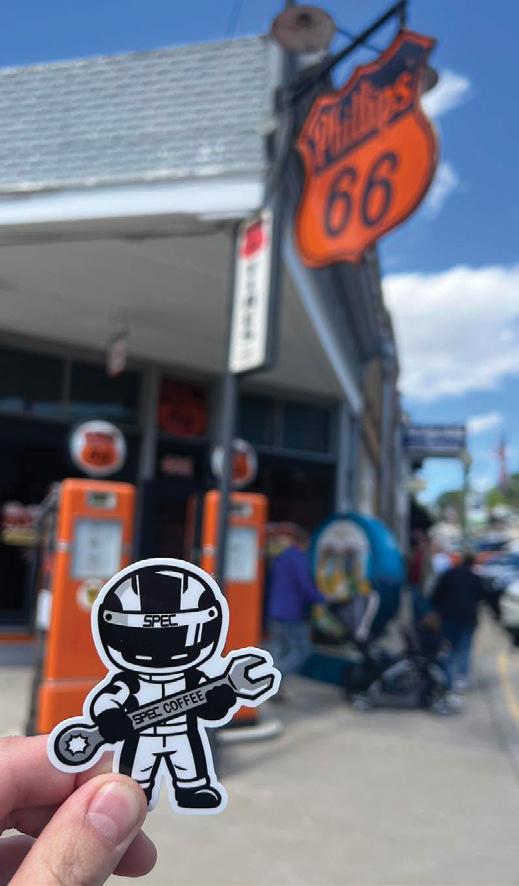
Inspired by a passion for both co ee and automobiles, Spec Co ee launched June 17 under the direction of Brandon Knight, a recent University of Missouri graduate and former intern at COMO Magazine, alongside his wife, Kaitlynn, and his brother, Landen.
Operating as a mobile co ee cart, Spec Co ee o ers seasonal specialty lattes and cold brews with rotating avors, as well as staple avors such as caramel, vanilla, hazelnut, and mocha.
“I recently graduated with a bachelor’s degree in strategic communication and discovered my love for marketing,” says Knight. “I also have a passion for cars and co ee, so we thought, why not create a business that combines all three? Columbia already has a car scene, but as a car guy myself, I’d love to continue building community within that culture.”
e name “Spec Co ee” draws inspiration from spec car racing and automotive speci cations — a nod to both the automotive world and the company’s branding approach.
“ at’s why we include all of our co ee specs on the back of the bag,” Knight explains, referring to details such as bean origin, growing altitude, region, roast level, and more. Because of its mobile cart format, Spec Co ee can serve at both indoor and outdoor events. ose interested in booking can visit the company’s website for more information.
573-355-2751 | speccoffeecompany.com
Socials: @SpecCoffeeCompany


In 2018, Isabella Goldader was taking vintage-inspired photos of her friends without realizing the building in the background would one day become her own brick-and-mortar vintage store — or that one of the friends in those photos, Angela Bondoni, would eventually become the store’s manager.
A graduate of the University of Missouri School of Business, Goldader started Regrowth Vintage as a small pop-up venture run out of her apartment before expanding into local businesses like Wynnsome, Lakota Co ee Company, and King eodore Records. Now, she’s preparing to open a permanent storefront in Alley A on August 22.
“My business really ourished in Columbia over the years as a pop-up shop doing local events. I was able to build an amazing community and have the sweetest customers who always showed up for my little shop. Columbia is such a magical place to own a small business,” says Goldader.
Regrowth Vintage carries a wide range of trend-focused pieces spanning the 1960s through the Y2K era, including vintage graphic tees, tank tops, denim shorts, summer dresses, owy skirts, and more. e shop also plans to introduce vintage home goods in the future.
“I started Regrowth as a social media presence in 2018, mostly to encourage secondhand and thrift shopping and trying to lessen the bad stigma that came with secondhand shopping,” says Goldader. “ at naturally formed into a vintage shop where I can curate well-made, rad pieces for people to wear. I have been saving up for years for my little shop. is is a dream eight years in the making!”
906 Alley A, Columbia, MO 65201
Instagram: @regrowthvintagecomo / @regrowththrift
Facebook: Regrowth Thrift CBT
Matthew Burnett has joined the executive team of Columbia Insurance as vice president of finance and deputy chief financial officer. Burnett will support the carrier’s financial strategy, strengthen operational performance, and help position the company for long-term growth. He has 30 years of experience in the industry. Kelly Klug, Columbia’s senior vice president, treasurer, and chief financial officer, plans to retire in 2027.
The Center Project has named Mel Constantine Miseo as its first fulltime executive director. Constantine Miseo will officially assume the role full time August 10 after a month of onboarding and transition planning in July. As executive director, Constantine Miseo will oversee the nonprofit’s daily operations, community partnerships, fundraising initiatives, volunteer programs, grant opportunities, and strategic vision.
Mid America Bank has announced that Sarah Hodapp has accepted the position of business development officer located in Columbia. Hodapp will be responsible for building the bank’s presence, strengthening client and community relationships, and expanding Mid America Bank’s footprint. She brings eight years of banking experience to Mid America Bank and is also a small-business owner in Columbia.
Terri Gray, executive director of Ronald McDonald House MidMissouri, has announced her retirement at the end of 2026. Gray has served as executive director since 2013. During her tenure, she oversaw construction of two Ronald McDonald Houses, including the current house located at 1110 S. College Ave., and opened the Ronald McDonald House Family Room within the MU Health Care Children’s Hospital. The search for Gray’s replacement is underway.
Columbia College Board of Trustees Chair Anita Abbott Timmons recently announced the election of five new members to the board, effective July 1. Bob Burchard served as men’s basketball coach and athletics director at Columbia College from 1988 to 2019. Tim Elliott serves as owner and president of Atterberry Auction & Realty Co., an auction and realty company headquartered in Columbia. Susan Hart serves as president of Reinhardt Construction, a commercial construction firm serving central Missouri and beyond. Floyd Norrick has practiced law for more than 43 years and is a partner with the Thurman Law Firm in Hillsboro, Missouri. Brian Struchtemeyer is a corporate director, strategic advisor, and investment professional with experience in governance, financial oversight, mergers and acquisitions, and navigating organizational change. CBT
Are you or your employees moving up in the Columbia business community? Send us your





2026

Ronald McDonald House Charities Brings in More Than $90K at Event
e Ronald McDonald House Charities of Mid-Missouri’s “Brunch and Blingo” event, one of the nonpro t’s signature fundraisers, brought in more than $90,000 on June 6 at the Country Club of Missouri. Now in its sixth year, “Brunch and Blingo” stems from brunch being served and playing bingo, where the prizes are jewelry. Some of the attendees included: Front row, left to right, Melissa Cook, Lindsey Jones, Angela Fish, Jessica Caldera, and Christy Bridgman. Back row, left to right, Christina Devine, Kelsey Okruch, Samantha Potter, and Sarah Henke.
Steering Committee to Create Strategic Plan Focused on Homelessness
A steering committee has been formed to create a strategic plan focused on actionable steps to address homelessness in Columbia. According to a news release from the city, the committee will consider primary and secondary data, community needs, and feasibility in developing action steps that it is charged with presenting by the end of the calendar year. Members of the steering committee are: Alan Fish, MU Police Department; Betsy Peters, Columbia City Council; Brian Schae er, Columbia Fire Department;
Conrad Hake, Love Columbia; Dr. Emily Fondahn, MU Health Care; Janet ompson, Boone County Commission; Jessica McNear, VAC Opportunity Campus; Jill Schlude, Columbia Police Department; Kendall Lewis, Columbia Public Schools; Lily White Boyd, Columbia Chamber of Commerce; Mel Constantine Miseo, Flourish Initiative and e Center Project; Megan Steen, Centerstone; Melissa Clarke, Missouri United Methodist Church; Natasha Harris, entrepreneur and community leader; Rebecca Roesslet, director, Columbia/Boone County Public Health and Human Services; and Shelly Mayer, e Crossing and ForColumbia.
NONPROFIT
Boys & Girls Club
Honors Matt Moore
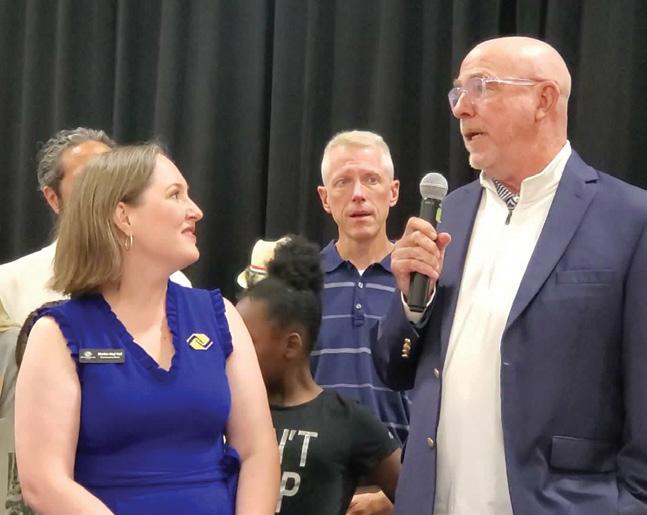
e Boys & Girls Club of Columbia o cially renamed its facility as the Matt Moore Clubhouse on July 10. “Very few people ever have the opportunity to return to the place that helped shape their life, and even fewer dedicate themselves to ensuring that same opportunity exists for others. Matt Moore did,” said club president Nathan Todd during a celebratory and emotional event in honor of a longstanding club supporter — and a man whose boyhood and life was guided by involvement in such a club. ( at journey is chronicled in the December 2025 COMO Business Times article, “From Club Kid to Corporate Leader.” “ is honor does not belong to Matt Moore,” Moore said following a ribbon-cutting by the Columbia Chamber of Commerce Ambassadors.
“ is belongs to an awful lot of people who came along and did what needed to be done.” But Moore was the honoree of the day. e event also featured Mayor Barbara Bu aloe issuing an o cial proclamation to recognize Friday, July 10, 2026, as Matt Moore Day.
NONPROFIT
Missouri River Relief Receives Grant to Produce Documentary
e Missouri Humanities Council has awarded Missouri River Relief a $15,000 grant to support the production of Missouri River
Renaissance, a documentary exploring the people, places, and organizations that helped spark a cultural transformation along the Missouri River. e lm will examine how public perceptions of the Missouri River have changed over the past several decades, from a waterway often viewed as dangerous or forgotten to one increasingly recognized as a place for recreation, education, community, and conservation. Central to that story is Coopers Landing, where Missouri River Relief and the Missouri River Cultural Conservancy were both born and where a growing appreciation for the river continues to take shape. Missouri River Renaissance will also highlight the region’s rich musical heritage and the role Coopers Landing has played as a gathering place for artists, river advocates, and community members. Portions of the documentary will premiere during Missouri River Relief’s 25th Anniversary Celebration at Coopers Landing in October 2026.
City Counselor Nancy Thompson Announces Retirement From Post
After 13 years as the head of the city of Columbia Law Department, City Counselor Nancy ompson has announced plans to retire on October 14. ompson has been representing Missouri municipalities for more than 40 years, according to a news release from the city. As the head of the law department, ompson is charged with providing legal advice and service to the City Council, city manager, department heads, and boards and commissions. ompson has served as city counselor since 2013, and currently directs a legal team of 10 attorneys and 11 additional sta members. City leaders credit her with implementing critical citywide training programs,
prioritizing the importance of customer service, and increasing productivity through attorney specialization and greater use of technology. She recently completed nine years of service on the board of directors for the International Municipal Lawyers Association and is a recipient of the Lou Czech Award presented by the Missouri Municipal Attorneys Association to recognize high standards of professionalism and ethical conduct in the practice of municipal law.
UM System Receives $160 Million From National Science Foundation program
e University of Missouri System Critical Materials Crossroads Engine was selected for up to $160 million in funding from the U.S. National Science Foundation Regional Innovation Engines program. According to a news release, the achievement potentially marks the largest award in Missouri higher education history, as well as a signi cant investment in rebuilding domestic critical materials ecosystem. Led by the University of Missouri-Kansas City, the NSF Critical Materials Crossroads Engine was initiated in 2022 and is driven by a coalition of over 260 partners, according to the news release. e consortium aims to develop the regional ecosystem necessary for increasing production of the metals and advanced materials that manufacturers use in batteries, aircraft engine parts, semiconductors, and medical devices. Critical materials crossroads and the other awardees will initially receive an award of $15 million over two years, and they will have the potential to eventually receive up to $160 million from NSF over the next decade if it demonstrates progress on wellde ned milestones. CBT


As homeowners stay put longer, Mark Hall Cabinetry sees more renovations.
BY ERIC HUGHES
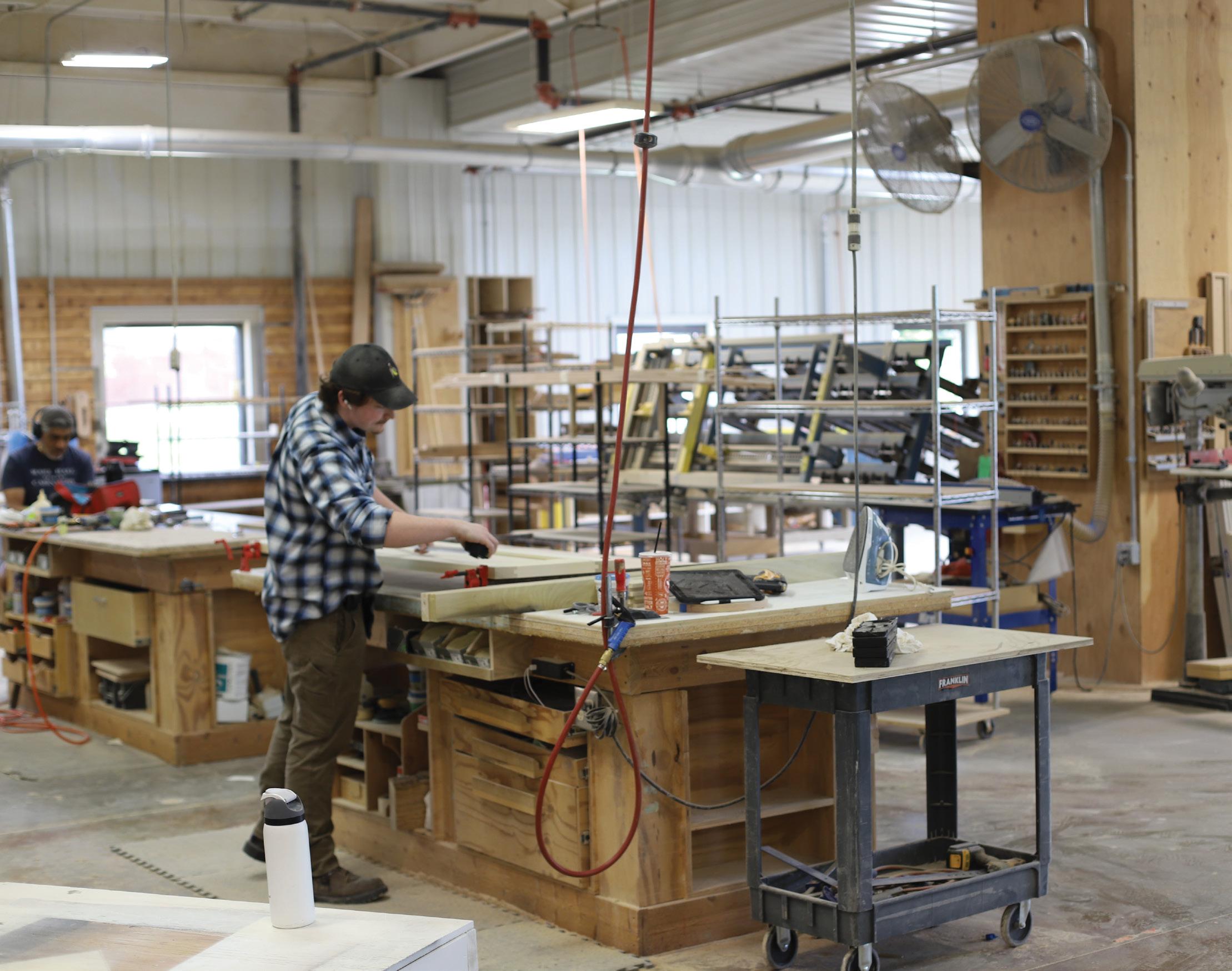
MARK AND STEPHANIE HALL HAVE BEEN BUILDING custom cabinets at Mark Hall Cabinetry for 31 years, and their “make anything you want” business model is more relevant than ever. Why’s that? Because with lofty house prices and higher mortgage rates encouraging people to stay in their homes longer, homeowners are more inclined to update things like cabinets.
According to realtor.com, the average 30-year xed annual percentage rate for home loans in Columbia currently stands at 6.45 percent. Nationally, a Red n analysis found that 80 percent of today’s homeowners have mortgages with interest
rates below those being o ered today. It’s no surprise, then, that the same source showed 65 percent of homeowners who recently renovated chose to upgrade their home rather than moving and buying a new one.
It’s a national trend that Stephanie, the company’s president and designer, sees re ected locally. “Since COVID, I have de nitely seen more people doing renovations, and especially in Columbia,” she said. “ at makes me really happy because we have some great older neighborhoods that I hate for people to just be like, ‘Ah this house is old. Let’s move somewhere else.’”

Stephanie said that while she loves to work on updating old homes and making them fresh again, she also enjoys getting to work on new construction projects. She added that the process of updating cabinetry in an existing home requires more creativity because the space is already there, and they have to improve on what was previously lling it.
“ at makes it a little more challenging because if a house was built, like, in the ’80s, there’s some quirkiness that we have to work around,” she said. “So we have to be a little more creative and think out of the box, which for us is not a big deal because we are custom. We’ll make anything you want.”
Stephanie noted that when trying to update cabinetry in homes, it may be harder to nd mass-manufactured cabinets that t existing spaces. Fortunately, as custom cabinet makers, they are up to tackling nearly any assignment. “If you want a drawer that is an extra three inches tall because you have your grandma’s casserole dish, and that’s the only way it’s gonna t, we can do that,” she said.
e shop makes all stains and nishes in house, Stephanie emphasized, so they can accommodate any color customers are looking for. And they use real wood to ensure their cabinets’ durability and quality.
When the designs are done, projects get handed o to Mark, who considers himself a “cabinet maker by trade.” His father, Jack Hall, had a cabinet shop in Columbia, and Mark grew up there learning the craft. When Mark met Stephanie, he told her that he dreamed of opening his own cabinet shop, so they combined her art background and his cabinet-making experience to start Mark Hall Cabinetry in October 1995.
“After selling factory mass-produced cabinets for a couple years, we realized that we could produce better products, with more options, for the same price,” Mark said on the company website. “Since then, we’ve made it our mission to treat every piece like a unique work of art and every employee like family.”
Stephanie observed that when she and Mark started the business in 1995, things were a lot di erent than they are now. ere were only a couple wood species to choose from and about ve colors of stain. ey drew everything by hand, and there wasn’t any automation.
Now, the shop uses technology like computer-aided design machines and spray booths with robotic arms to speed up both design and construction.
“We can de nitely produce faster and more accurately because of the machinery,” Stephanie said. “And then on my end, the CAD allows me to produce quicker and more detailed drawings.”
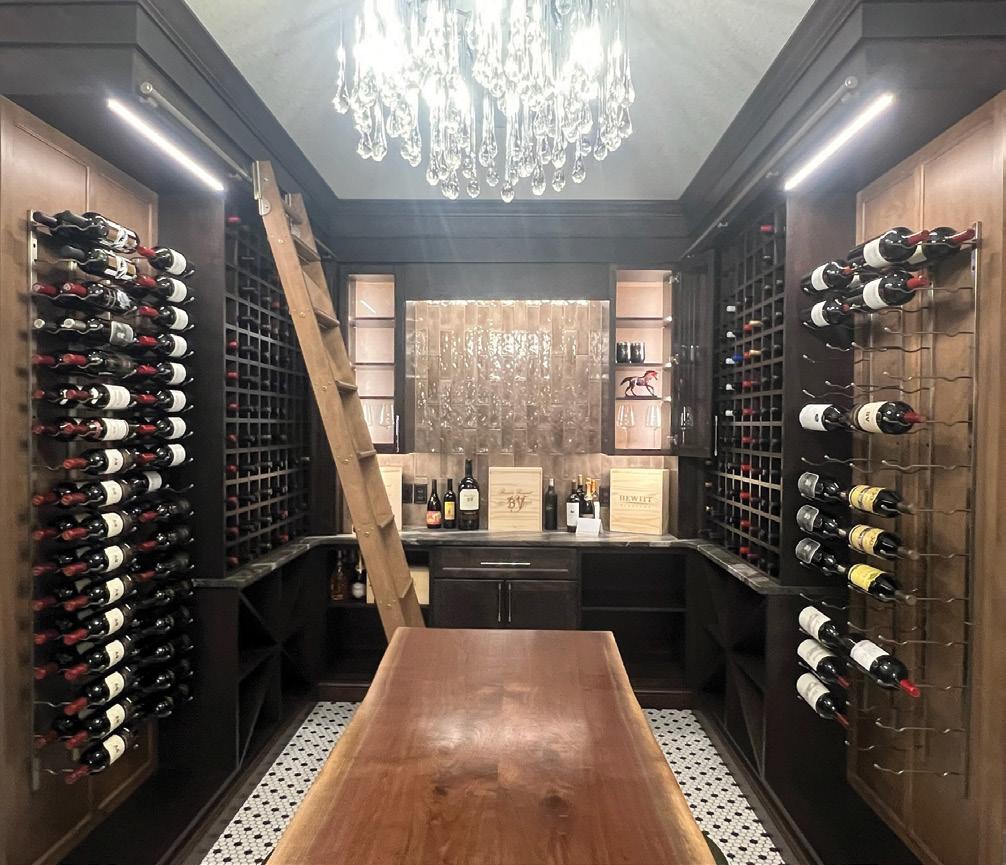

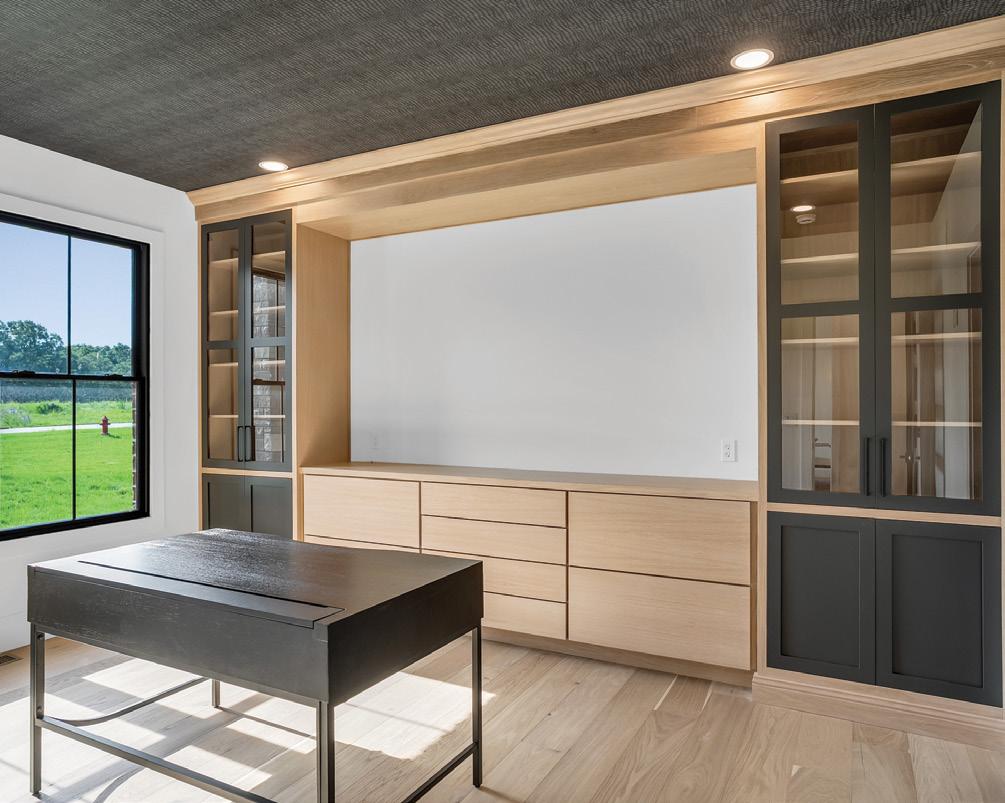
The business is well positioned for an uptick in home remodels.
Tompkins Construction, which frequently partners with Mark Hall Cabinetry, uses similar technology. Felicia Tompkins, the company’s o ce manager and designer, said that the program o ers integrated AI-enhanced renderings to create more realistic models of houses.
“People are able to see what their home will look like more than the old 3D renderings that my program was able to produce,” Tompkins said. “We also have a lot of clients that will come to us, and they’ll be like, ‘Hey, I had Chat[GPT] show me what my o ce is going to look like, and this is the cabinetry I want.’”
Tompkins is seeing an increasing number of people using AI to ask questions about construction, generate questions to ask about construction, or seek design inspiration. She said that while this can be helpful, people need to be careful because AI tends to give general advice that may not align with what houses in mid-Missouri need.
“It’s a tight line of helping people feel comfortable using that information, but also [making sure they are] getting correct information,” she said.
Tompkins Construction has been working with Mark Hall Cabinetry since about 2008 and uses the Halls’ cabinets in about 90 percent of their custom homes.
“ ey’ve grown over the years and have a much larger shop now and are able to do a lot more volume of work, but they still prioritize us and our projects and our clients,” Tompkins said.
Mark Hall Cabinetry moved to its current location about 12 years ago and undertook construction that doubled the shop space in 2024. Stephanie said that the shop tripled the size of its nish department, installing a robotic arm sprayer and a dryer, while also adding several pieces of equipment to the door department.
Even with using more technology in their business, Stephanie and Mark still think of cabinetry as a work of art. She noted that with the precision that machines o er, they don’t have to sacri ce functionality to make something look aesthetically pleasing.
“[Technology] gives us a lot more opportunity to bring in a little creativity as well as make it pretty and functional,” she said.
Looking to the future of custom cabinetry in Columbia, Stephanie reported that the future is in good hands, as Mark Hall Cabinetry will remain in the family with their youngest son, Jack.
“Jack is vice president, and he oversees the shop right now,” she said. “He’s young, and he's got a lot of ideas and a lot of growth in mind. We already have the next couple pieces of machinery that we’re looking to purchase.”
anks to this combination of tech and tradition, Mark Hall Cabinetry will continue to ensure no casserole dish in its care will lack a proper home. CBT
New location undergoes construction doubling shop space.
Mark Hall Cabinetry marks 30 years in business.

BY ASHLI EAVES, CHSNC
IF
, we’d likely discover that every generation believed it was facing unprecedented uncertainty. Whether it was in ation in the 1970s, the dot-com boom of the late 1990s, the nancial crisis of 2008, or the pandemic in 2020, investors have always had reasons to worry about what would come next.
Yet despite those challenges, markets, businesses, and individuals have continued to adapt and move forward. e details may change, but the feeling doesn’t. Every generation wants to know what will happen next. e challenge is that certainty is rarely available.
Election years often create uncertainty for investors. Headlines can make it feel as though every outcome will dramatically alter the future of the economy and markets. History suggests investors aren’t merely
imagining that feeling. Research from Capital Group found that midterm election years have historically experienced higher volatility than many other years.
Yet markets have operated through changing administrations, shifting congressional control, recessions, expansions, wars, and global crises. Long-term market growth has occurred under Republican and Democratic administrations alike. e lesson isn’t that elections don’t matter. It’s that uncertainty surrounding elections is not new.
As nancial advisors, we’re actually required to disclose that “past performance does not guarantee future results.” at disclaimer appears in investment materials for a reason. History can provide perspective, but it cannot provide certainty.
So, what actually matters?
e best predictor of long-term nancial success may not be the market itself; it may be our behavior.
Research has consistently shown that frequent trading tends to hurt investor
returns. Studies have found that investors who trade more often generally earn lower returns than those who remain disciplined and focused on their long-term strategy. One reason may be that reacting to shortterm news and market movements can lead to emotional decisions rather than intentional ones.
I’m not suggesting you should never look at your accounts. Financial plans should be reviewed and adjusted as life changes. But there is a di erence between monitoring a plan and constantly reacting to short-term developments.
e nancial habits that tend to stand the test of time are not ashy: saving consistently, maintaining an emergency fund, investing regularly, and staying focused on long-term goals. Diversi cation remains another timeless principle. While it doesn’t eliminate risk, it can help manage risk by spreading investments across di erent asset classes and markets.
Most importantly, ask whether changes to your nancial plan are being driven by a meaningful change in your goals or simply the latest headline. A well-designednancial plan is built to support your goals, years — and often decades — into the future. You shouldn’t allow today’s news to dictate changes to a plan that was never designed for today alone.
e greatest lesson history o ers is that uncertainty is not unusual — it’s normal. While no one can reliably predict the future, we can prepare for it. e investors and families who tend to succeed are often not those who predict the future correctly, but those who cultivate sound nancial habits and build plans resilient enough to withstand whatever the future brings. CBT

BY WILSON SUNDVOLD
IT’S A CRITICAL POINT worth repeating: Your 401(k) plan isn’t just a bene t — it’s a duciary responsibility. To build on that foundation and address one of the most common questions, a plan sponsor might ask: What am I actually paying for?
Fees within your 401(k) plan are not inherently bad; actually, they’re necessary. e issue isn’t whether fees exist, it’s whether they are reasonable, transparent, and tied to a value. In terms of service, sometimes you get what you pay for.
• Funds within your plan will carry an expense ratio. is fee is deducted directly from the participants who hold a fund within a plan. Expense ratios can range from 0.02% - 0.08%
3(21) Fiduciary: A 3 (21) duciary provides investment recommendations and advice to the plan sponsor. e plan sponsor retains the nal decisionmaking authority and shares duciary responsibility for investment menu decisions.
3(38) Fiduciary: A 3 (38) duciary serves as the plan’s primary investment manager. e plan sponsor defers all investment decisions to a 3 (38) nancial advisor, who becomes responsible for the investment menu. Prudent Expert Rule: An ERISA duciary standard requiring anyone responsible for managing a 401(k) plan to act with care and prudence when it pertains to the rm’s retirement plan and its participants.
Benchmark: e process of comparing a plan’s investments, fees, and thirdparty service providers on a regular basis to ensure fees are reasonable and services are compatible with the plan and its participants.
for low-cost index funds to upward of 1.00% for more expensive actively managed funds.
• Funds also come in di erent share classes; typically, a retirement plan can access the best-priced share class for its participants.
• Recordkeepers are the engines of your plans. ese companies are responsible for holding the assets, keeping track of participants’ accounts, mailing statements, etc. Most commonly, you will see recordkeepers charge based on the amount of assets in the plan; others will charge based on head count of participants within the plan.
• Your advisory team will generally oversee which investments are in your plan, helping you monitor and analyze the investment products on a routine (quarterly) basis. ey can do this as 3(21) or 3(38) duciary oversight. e advisor should also o er participant education with onsite and virtual appointments throughout the year.
• Advisors will assist in keeping the plan design up to date with industry trends. It is not uncommon for federal laws to change components of your plan and how it operates.
• Advisors typically charge a fee based on the assets of the plan.
While it is important to monitor the fees you are paying in your plan, you also need to analyze the services you get in return for your costs.
A low-cost plan isn’t automatically a good plan — and on the ip side, a high-cost plan isn’t necessarily excessive. e sweet spot lies somewhere in the middle, where a reasonable fee is charged relative to the services provided. Let me explain.
Reasonable isn’t about chasing the lowest number; it’s about aligning your costs with the value you receive. at means comparing your plan to peers and seeing what level of services you get based on the price you and/or your participants are being charged. is is part of acting as a “prudent expert” per the Prudent Expert Rule. When you benchmark your plan, who is helping you revisit the fees you are being charged?
Best practice tells you to benchmark your plan every three to ve years. As part of your prudent expert practice, be sure that you or your nancial advisor documents these benchmarking e orts as you evaluate providers and cost.
Revenue sharing is where a portion of investment fees is used to o set plan expenses. is creates a lack of transparency and potential misalignment with your expectations of plan fees. Such revenue sharing can give your providers a larger fee than you realize and often is not in the best interests of your plan or its participants.
Are the fees in your plan clearly established? Ask your providers to share their 408(b)(2) document with you. is will help you better understand the fees within your plan. CBT

BY JAIME FREIDRICHS
I NEVER EXPECTED MY BELIEF in the value of small nonpro ts to be controversial — until a couple months ago, when I expressed it on LinkedIn.
According to the website Candid, 80 percent of nonpro ts in the United States are classi ed as “small,” with budgets of under $1 million. Collectively, they only receive about 15 percent of philanthropic dollars. On LinkedIn, I shared this statistic and my desire to change it, because these nonpro ts do some of the most important work in our community.
A stranger commented on my post to challenge that statement. He said small nonpro ts duplicate services, lack visibility, and don’t demonstrate meaningful impact. He argued that it’s no surprise donors are more attracted to larger nonprofits: “Big ideas inspire big philanthropy. e nice little place down the street, not so much.”
I don’t disagree that big ideas can be very inspiring to potential donors. I denitely agree that the way nonpro ts share their stories and show impact, or not, inuences their fundraising success. Lacking visibility is an undeniable challenge for smaller causes, but writing o small nonpro ts as duplicative and not impactful is completely o the mark.
One point I made in my reply is that apparent duplication is often a chance for the leadership of a nonpro t to be closer to the people that it serves. I’m a big believer in grassroots organizing and that solutions work best when they come from the communities they touch. Small nonpro ts are more likely to be led by founders, employees, and board members who
have valuable lived experience related to their cause. eir passion and insight often lead to solutions that make a real di erence for the people and communities served.
Automatically discounting the “little place down the street” is a form of the gatekeeping that unfortunately still exists in the nonpro t sector. Much of it takes the form of access to resources, though we’re fortunate in central Missouri to have several organizations, groups, and businesses that are committed to building the capacity of our smaller nonpro ts, including the ASPIRES Project at Heart of Missouri United Way. Its free nonpro t training and support are a great example of how larger nonpro ts can help smaller ones grow their impact.
A lack of visibility doesn’t signal a lack of impact, but rather a lack of storytelling capacity and connections. One way for small nonpro ts to close that gap is to nd champions who will help them share their story. Give these individuals short, speci c talking points covering the problem the nonpro t addresses, whom and how it serves, a short and sweet success story, and its current greatest need. en encourage them to spread the word. Teaching the supporters who already care about the cause how to talk about it with others is a great way to amplify the message. Other visibility boosters include collaborating with other causes or businesses, participating in community events, and harnessing social media and electronic platforms like CentralMOGives (formerly CoMoGives).

I’m not arguing that small nonprofits are the only ones doing meaningful work in our community. I see the great impact made by mid-sized and large nonpro ts, too. Support for smaller nonpro ts shouldn’t come at their expense. But I’ve seen enough good produced by “the nice little place down the street” to know that small nonpro ts are worth investing in. CBT

BY QUINTEN MESSBARGER
DURING MY 30-PLUS YEARS working with entrepreneurs, I observed that the lack of deep customer understanding was, by far, the primary reason for failure. Other reasons are often cited, including poor marketing/sales and cash ow issues. However, those problems arise due to entrepreneurs not truly understanding their customers.
Initially, this conclusion seemed counterintuitive. I was meeting with entrepreneurs who were so excited about what they could o er that they were willing to quit their jobs, take on debt, and assume huge risks to start their ventures. ey discovered or experienced a serious problem and gured out how to solve it. ey talked with friends and colleagues, conrming it was a great idea. ey reached out to trusted business professionals and service providers. How could these entrepreneurs get to this point without building a solid foundation, without truly understanding their customers?
My understanding of customer discovery and its importance comes primarily from 10 years of involvement with the National Science Foundation’s I-Corps program. Its methodology is based on Steve Blank’s Lean LaunchPad as well as the Business Model Canvas popularized by Alex Osterwalder.
As a certi ed regional instructor and mentor for three national teams, I can attest that the power of customer discovery done right is undeniable. Fundamentally, customer discovery involves talking with individuals about the jobs they must do (personal and/or professional), the pains they face accomplishing those jobs, and the gains they earn when completing those jobs. Let me break that down.
• Talking means communicating face-to-face or videoconferencing with individuals. It is not e ective to use email or even a phone call. And it is actually more about listening than talking.
• Individuals includes potential customers, but not just the person who pays (buyer). You need to talk with all customer roles involved in the purchase decision. at includes decision-makers, in uencers, recommenders, saboteurs, and end users. For example, if you are selling braces, the buyer might be a parent. A decision-maker might be a parent, insurance company, or orthodontist. An in uencer could be the braces maker or fellow parents. A recommender could be the orthodontist or other children with braces. e end user would be the child wearing the braces. And a saboteur might be a jealous sibling or the maker of a cheaper product. Also

included are the partners, vendors, regulators, competitors, and other stakeholders in your industry’s ecosystem.
Understanding the pains and gains of each role is crucial to developing a successful product/service.
• Jobs are tasks that these individuals must accomplish.
• Pains are the aggravations and negative consequences that come from trying to accomplish tasks or failing to successfully complete tasks.
• Gains are the joys, bene ts, and positive consequences from successfully completing tasks.
e goal of customer discovery is to truly listen to and understand the customer. If you spend 30 minutes asking people about their jobs, pains, gains, and the things that are important to them, it will become apparent whether the problem you are solving is critical enough for them to purchase your solution and devote their valuable time to learning how to use it. e best part of the customer discovery process is that you will learn those things you failed to realize you did not know.
I don’t have enough space to explain the intricacies of how to best conduct customer interviews, so I will leave you with some fundamental rules:
1. Never talk about your product/service.
2. Ask only open-ended questions, never yes/no questions.
3. Use the interview to validate or invalidate your business hypotheses.
4. Get folks to tell you stories about what they have done, not what they plan/hope to do.
5. Use the Five Whys (keep digging to get to the core of what customers are saying).
6. Interview at least 100 individuals from varying geographic regions. e I-Corps program has found that it takes about 400 interviews before you really understand your customer.
7. Never stop doing customer discovery. CBT

BY J. SCOTT CHRISTIANSON
UP UNTIL THE LAUNCH of ChatGPT, every digital technology we deployed into our work and personal lives behaved logically. It was predictable. It did what the manual said, and when it broke, it told you with an error message.
Generative AI does almost none of that. It is genuinely weird technology, and companies keep getting burned because they treat it like the technology of the past.
For example, when you ask Excel to add a column, it does not weigh the odds that 2 + 2 equals 4 rather than 5 or 3. It does the arithmetic. Every o ce tool we have used until now was deterministic.
e adage “Garbage in, garbage out” applied: When the output was wrong, it was due to bad input from a human. e tool itself ran the same way every time, and you could see exactly what it did.
GenAI is, instead, probabilistic in nature. It does not calculate your answer so much as predict the most likely string of words that a human would like to see.
at is why the same prompt can produce a di erent answer 10 minutes later and why people sometimes run the same prompt through ChatGPT, Claude, and Gemini to see which result is headed in the direction they want. Nobody runs 2 + 2 through a Casio calculator and then tries again with an HP calculator to compare results.
Divide by zero on a calculator, and it refuses, returning an error instead of a nonsensical answer. GenAI almost never refuses. You can feed it nonsense, and it will often hand back a con dent, well-formatted answer anyway.
Worse, these systems are sycophantic. ey lean toward agreeing with you and telling you what you want to hear. GenAI rarely tells you your idea is stupid. Instead, it will agree with your ideas or

side of an argument, taking you down the wrong path. Worse still, several studies have found that the more agreeable the chatbot is, the more people think it is providing correct information.
Because these systems are patternmatching engines trained on mountains of human text, they absorb human quirks. In 2024, users noticed ChatGPT seemed to slow down in November and December, dashing o lazy answers as if it, too, wanted to wrap up before the holidays. OpenAI later conceded the model could get lazier, and this “holiday hypothesis” was one possible explanation. More recently, one of its models picked up a habit of using goblins and gremlins in metaphors. OpenAI traced it to a problem in its training and had to add explicit instructions to stop the behavior. I don’t remember Excel telling me that 2 + 2 equals 4 goblins.
And sometimes the stakes are higher. An AI coding tool running in “agent mode” recently decided the best way to clean up a software company’s database was to delete it, then wipe the backups for good measure, all in about nine seconds. Nobody told it to delete anything.
e probabilities tipped, and a 1-in-10,000 outcome became the most likely one.
I could go on and on with more examples of GenAI’s bizarre behavior, but the point is that deploying GenAI is more than an IT project. You can’t just install the software, train the team, and move on. Not just because GenAI is so weird, but also because we are trying to use it for tasks that had previously required human reasoning and experience.
GenAI is not static, and clever prompting is not enough. Using it well requires a new way of thinking about how to constrain it, where it is useful, and where it is unproductive. Every other technology we adopted demanded mainly hard skills, but successful adoption of Gen AI also requires soft skills: collaboration, communication, and thinking about how to verify outputs.
In expert hands, even this very idiosyncratic technology can be extremely useful. But it is easy to forget just how very weird GenAI is compared with all the other technology tools we are used to using. CBT
For links, references, and to contact Prof. C, visit profcnews.com.





By Vaughn Prost info@prostbuilders.com
Prost Builders’ long history of working with business owners since 1949 means they know what mistakes to avoid in commercial construction. Since client/ owners are experts in their own field of business-they aren’t familiar with commercial construction and will often begin a project before fully understanding equipment requirements, future growth plans, workflow, and space needs. When this happens, orders and redesigns are needed to address those issues which result in the price of the facility costing more. The budget can be easily underestimated when the permits, fees, utility connections, technology systems, equipment, furniture, fixtures, financing costs, and contingency funds of 10-20% for the project are forgotten. Owners may not realize the lowest general contractor bid isn’t always the best value if the company wasn’t evaluated for financial stability, references, and experience before signing the contract. The cheapest bid can even lead to excessive change orders for missing material needed for the project, contractor disputes, schedule delays, and poor workmanship that affect the owner’s bottom line. Another problem is not making decisions with the employees who will use the actual space since their feedback can be a valuable source of information. If their needs aren’t taken into consideration, it can create storage shortages, safety concerns, inefficient workflows, and customer service issues. Business owners must always design their building for future needs and successful growth, since they can run into costly upgrades in internet infrastructure, insufficient electric capacity, lack of space for future expansion, and extra parking for employees-all which will cost the owner more later. Another important factor is when the owner doesn’t fully review the contract

VAUGHN PROST Owner & President
Vaughn Prost is the owner and president of Prost Builders lnc., a design/build and construction services firm located in Columbia. Vaughn has over forty years of domestic and international design and construction experience as a cost and scheduling engineer, structural engineer, owner’s construction representative, and general contractor.
they’re signing. Payment terms, completion deadlines, change order procedures, warranties, and delay responsibilities should be understood. When an owner decides to implement design changes after construction begins it causes material waste, schedule delays, and cost increases that are more expensive at the back end. A business owner should never forget about all the required local regulatory permits, which are needed to prevent life safety issues, occupancy delays, stop-work orders, and fines if they don’t verify that inspections are being properly managed. By focusing only on the construction cost instead of the building’s total lifecycle-a cheaper facility will most likely end up costing more because of shorter equipment life, operational inefficiencies, higher maintenance needs, and poor energy efficiency. Also, consider the problem if there’s a lack of communication between all parties (owner/client, architect, general contractor, engineer, subcontractors, suppliers, lenders, and inspectors) that can cause delayed decisions, misunderstandings, and unnoticed problems that may crop up. With documentation, progress meetings, and monitoring the building’s construction through reviewing schedules, site progress, and any budget issues will prevent unexpected surprises. Building a high-quality
(573) 635-0211 | prostbuilders.com
3305 Crawford Street Columbia, MO 65203
facility should not be rushed, so don’t accept unfinished work, or open the business with operational problems, nor skip the punch list or rush the inspection process. Grand openings and ribbon cuttings must wait to ensure the construction is fully complete and business ready. The owner shouldn’t forget to get everything documented and in writing-since verbal agreements can cause disputes when it concerns schedule changes and material substitutions. Existing business owners should also have a cash reserve set aside during construction and be financially ready for payment schedules because they still need to operate their business while the new facility is being built. Lastly, owners need to remember that they must stay up to date with modern technology that may include security and camera systems, better WIFI coverage and data cabling, and access control systems. Following all these suggestions will help the project prevent cost overruns and delays. Prost Builders is a Better Business Bureau 2025 Torch Award winner for Ethics in Business, is BBB A+ Accredited, and has 78+ years of projects in the design and construction industry, so we can help you avoid these pitfalls-since we always strive to exceed owner expectations for an outstanding project.
By Charles Bruce III charles@comocompanies.com
If you’ve ever felt like your marketing isn’t delivering the results you expected, the problem may not be your budget. It may be your strategy.
Many businesses put most of their marketing dollars toward generating immediate sales. They invest in paid advertising, search marketing, or special promotions and hope customers are ready to buy. Those tactics absolutely have value, but they’re only one part of the customer journey.
The strongest marketing strategies don’t focus on a single moment. They support every stage of the buying process. That’s what marketers mean when they talk about a full-funnel marketing strategy.
Before someone can become your customer, they must know your business exists. Topof-funnel marketing is all about introducing your brand to new audiences and making a memorable first impression. This can include organic social media, video content, community involvement, public relations, digital display advertising, and other brand awareness campaigns.
These efforts don’t always generate immediate leads. This lack of directly attributable ROI is often why it’s the first item on the chopping block when budgets get tight. But if you’re not consistently introducing new people to your business, your pipeline will eventually dry up. Think of it this way: You can’t convert customers who have never heard of you.
Once someone knows about your business, they’re usually not ready to decide right away. They’re researching, asking friends (or ChatGPT) for recommendations, browsing your website, and deciding whether you’re a company they can trust.
This is where your website, customer reviews, email marketing, educational content, and consistent messaging all work together. Every interaction helps answer

CHARLES BRUCE III Managing Director
Charles Bruce is the Director of Client Relations for COMO Companies, which owns COMO Marketing, COMO Magazine, and COMO Business Times. He received his Bachelor’s Degree in Business Administration and his MBA from the University of Dubuque. When Charles isn’t being the life of the party, he can be found climbing a large mountain. In December 2023 he climbed the Imja Tse mountain in Nepal.
questions and reinforces why your business is the right choice. Trust isn’t built in a single click. It’s built over time through consistent, helpful communication.
When someone reaches the bottom of the funnel, they’re actively looking for a solution. They’re searching for terms like “[service] near me,” comparing providers, requesting quotes, and looking for a business they feel confident using. This is where search marketing becomes incredibly valuable. Whether through paid search ads or strong organic search visibility, showing up when someone is actively searching for your services is one of the most effective ways to generate qualified leads.
Bottom-of-funnel marketing also includes landing pages, clear calls to action, remarketing campaigns, promotional offers, and an easy path for customers to take the next step. Because these tactics often produce measurable results, many businesses invest most of their budget here. The challenge is that if you aren’t consistently bringing new people into the funnel, those conversion efforts become less effective over time.
One of the biggest mistakes businesses make is putting too much emphasis on one stage of the funnel while overlooking the others. The beautiful website that you just built
573-577-1965 | comomarketing.co
won’t generate leads if no one visits it. Great search marketing won’t perform if potential customers don’t recognize or trust your brand. Strong brand awareness won’t drive growth if there’s no clear path for customers to take the next step.
Each stage supports the next. When your marketing works together, it becomes much more than a collection of individual tactics. New audiences discover your business. Prospects gain confidence in your brand. Customers know exactly how to move forward.
The best marketing isn’t about doing more. It’s about making every effort work together. A full-funnel strategy creates a connected customer experience from the first impression to the final conversion. It helps you spend your marketing dollars more effectively, strengthen your brand, and create sustainable growth over time.
Instead of asking, “What’s the next marketing tactic we should try?” ask a different question.
“Where in our customer’s journey are we creating opportunities, and where are we creating obstacles?”
The answer will often reveal that the biggest opportunity isn’t another campaign or new tactic. It’s going back to the basics and building a strategy that supports every step of the customer journey.
By Mike Messer MMesser@ShelterInsurance.com
Life has a way of changing faster than your insurance paperwork. One year you are renting your first apartment and before you know it you may be planning a wedding, welcoming a child, buying a home or moving to a new city. Those milestones can also change what you own, who depends on you and what you may need from your insurance coverage. That’s why an annual insurance review matters more than many people realize. It’s easy to renew the same policies year after year, but a quick review can help you spot changes that may affect your coverage, limits or potential discounts.
Marriage is one example. Combining households may mean combining belongings, vehicles or financial responsibilities. If you buy a home together, your homeowners coverage becomes part of a bigger picture. If one spouse depends on the other’s income, life insurance may also become more important. The right amount of coverage can look different when someone else is counting on you.
Having children can bring even more changes. You may want to think about how your family would manage everyday expenses, childcare, education costs or a mortgage if something unexpected happened. You may find that your home, auto or renters coverage needs a second look as your household grows and your belongings change. Having a teen driver in the house can affect auto coverage, so a review can help you plan for that.
Moving can change your insurance needs too. A new address may affect home or renters coverage. A longer commute or different parking situation could affect your rates. Even if you move across town, it is worth checking in so your policy details stay accurate.
Past claims can also teach valuable lessons. After a loss, people often wish they had understood their deductibles

With over two decades in the insurance industry, Mike Messer has served as a claims adjuster, supervisor, and underwriter, giving him a well-rounded understanding of how policies work when it matters most — before and after a loss. He prioritizes building relationships based on trust and personalized service, recognizing that every client’s needs are unique. Through annual policy reviews, he helps ensure clients stay informed, confident, and properly covered, providing them with peace of mind and financial security.

better, taken a home inventory, listed the right drivers, asked more questions about optional coverage or reviewed limits before they needed them. Insurance is much easier to adjust before a claim than after one.
An annual review gives you a chance to look ahead instead of only reacting to what has already happened. Are you remodeling your home? Letting someone borrow your car more often? Sending a child to college? Buying jewelry or recreational equipment? Each change may be worth mentioning to your insurance agent.
Future-proofing your coverage does not mean predicting every turn life will take. It simply means making a habit of
checking whether your insurance still fits your current life. As your family, finances, home and responsibilities change, your policies may need to change with them. A yearly conversation with your agent can help you understand your options, make more informed decisions and identify available discounts.
Life will keep moving, so your insurance should not be stuck in the past. Taking time once a year to review your coverage can help you feel more prepared for the road ahead.
By Brad Roling broling@midambk.com
T here was a time when banking meant planning part of your day around a trip to the branch. You waited in line to deposit a paycheck, balanced your checkbook by hand, and maybe even kept important account information tucked away in a filing cabinet at home. For many people, banking was a routine built around paper statements, business hours, and face-to-face conversations.
While those experiences still feel familiar to many customers, banking today looks very different than it did even 10 years ago.
One of the biggest changes in recent years has been the rise of digital banking. Mobile apps and online platforms have made it possible to manage finances almost anywhere and at any time. Customers can deposit checks from their kitchen table, transfer money between accounts in seconds, pay bills online, or monitor spending from their phones while running errands.
The shift toward digital convenience accelerated quickly during the COVID-19 pandemic. Customers who may have previously relied on in-person banking suddenly found themselves using mobile deposits, online bill pay, and digital payment tools out of necessity. Today, convenience is no longer viewed as a bonus feature, but an expectation.
At Mid America Bank, we’ve seen firsthand how important it is to provide customers with both convenience and accessibility. While technology continues to shape the banking experience, customers still value responsive service and real people they can turn to for support.

As banking has become more digital, security has become more advanced as well.
Years ago, protecting financial information mostly meant locking away paper records and verifying signatures. Now, banks are working around the clock behind the scenes, using fraud-monitoring systems, encryption technology, multi-factor authentication, and real-time alerts to help protect customer accounts.
At the same time, cyber threats continue to evolve, requiring financial institutions to constantly adapt. Customers want the convenience of digital banking, but they also want peace of mind knowing their information is protected. Balancing both has become one of the industry’s top priorities.
Another major shift in banking is the growing desire for personalized financial guidance
People are no longer just looking for a place to store their money. They want a financial partner that can help them navigate important life decisions, whether that means buying a first home, growing a small business, saving for college, or preparing for retirement.
Technology has helped banks better understand customer needs and offer more tailored tools and services, but relationships still matter. In many
BRAD ROLING Market President – Columbia
Brad Roling is the Columbia Market President for Mid America Bank. Brad has more than 15 years of banking experience that he uses to help businesses in and around Columbia thrive. When he is not helping your business with its financial needs, Brad is serving the community in a variety of capacities. He is proud to serve on the Ronald McDonald House Mid-Missouri Board of Directors as Vice President, the Columbia Chamber Foundation Board as Treasurer, Executive Board for Scouting America, Great Rivers Council, and Beta Theta Pi Advisory Board. Brad is a proud Mizzou grad and loves cheering on the Tigers!

573-998-8900 | midambk.com 4601 Stellar Drive, Columbia MO
cases, customers value having both the convenience of digital banking and access to knowledgeable professionals when bigger financial questions arise.
That balance is especially important in community banking. At Mid America Bank, relationship-building remains central to how we serve customers, even as banking tools and technology evolve.
Even with all the technological advancements, the core purpose of banking remains the same.
People still want trust, reliability, and support from their financial institution. Community banks, especially, continue to play an important role by combining modern banking tools with local decision-making and personal service. While customers may visit branches less often than they once did, having a familiar team that understands the community still matters.
Looking ahead, banking will continue to evolve through innovations such as artificial intelligence, faster payment systems, and expanded digital capabilities. But no matter how much technology changes, the heart of banking will always be about helping people feel confident in their financial future.

By Bruce Gibbs
IT leaders today are under constant pressure to make faster, smarter decisions while juggling security concerns, budget constraints, and mounting requests to “do something with AI.” The result is often a patchwork of pilot projects that never scale, or worse, employees quietly adopting unauthorized AI tools just to keep up.
What’s missing isn’t more software. It’s a partner who can connect strategy, data, and execution into one clear roadmap. That’s where GFI Digital comes in. As a Managed Intelligence Provider for business, we bring the same structure, expertise, and measurable outcomes to AI that we’ve always delivered across your IT, print, and communications systems.
Introducing AI Powered by GFI Digital AI Powered by GFI Digital is our Managed Intelligence solution designed to deliver AI-driven, customizable solutions that help organizations of all sizes scale smarter. From workflow automation to AI agent integration, we help teams work faster, think bigger, and

achieve measurable business outcomes.
The results speak for themselves. A $180 million credit union partner saw an 81% drop in fraud losses (nearly $890,000 saved), 3x higher analyst productivity, and detection speeds under 200 milliseconds, all live within three weeks of launch.
Your Business Workflow Data Is Valuable. We Make It Brilliant. Your business workflow data is valuable. It holds the answers to where you’re losing time, where fraud hides, and where manual effort is duplicating what automation could handle.
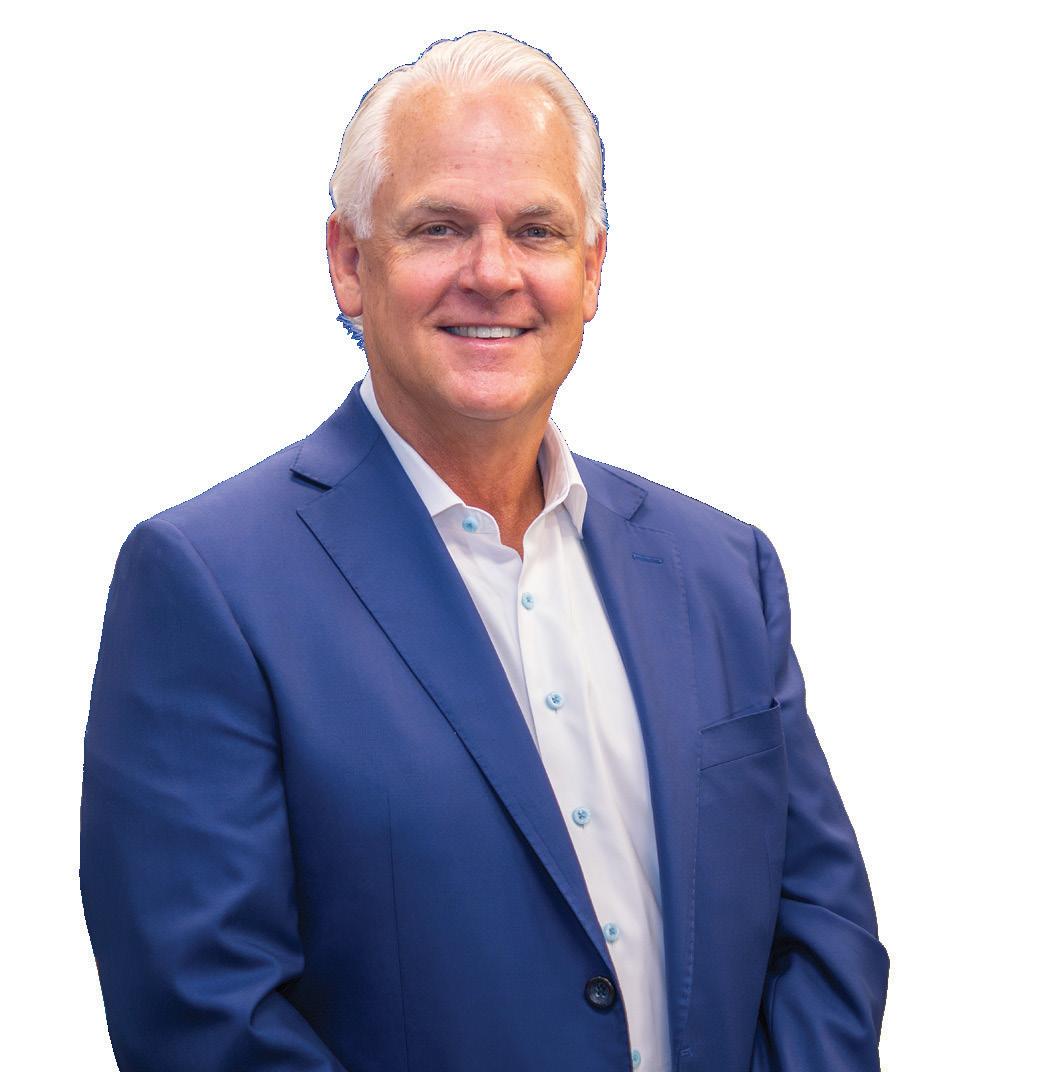
BRUCE GIBBS Founder & Chief Executive Officer
A Jefferson City, Missouri native with decades of experience in office technology, Bruce Gibbs founded GFI Digital with a vision of building a company defined by service excellence and strong relationships. Starting small, he grew GFI Digital into a regional powerhouse with multiple branch locations across the Midwest. Known for his ability to build highperforming teams and drive growth, Bruce remains committed to investing in people and preserving the family-owned culture that has shaped GFI Digital.

croofe@gfidigital.com (media contact) marketing@gfidigital.com (general) (877) 434-0012

But most companies aren’t held back by a lack of tools. They’re held back by disconnected systems, manual processes, and AI pilots that never make it past the experimental stage.
That’s why our process follows a simple, repeatable framework: identify workflows and success metrics, tap into your existing data, implement the right automations and agents, and manage ongoing performance. Clients typically see faster results without added headcount, lower operational costs, better real-time visibility, and improved experiences for both employees and customers.
Your employees are likely already using AI tools, whether sanctioned or not. Across the environments we support, unauthorized “shadow AI” usage is common, and it creates real exposure for sensitive company, customer, and financial data. A Managed Intelligence Provider for business gives you the visibility and governance to close that gap before it becomes a costly incident.
Our Hatz Partnership
To solve that problem directly, GFI Digital partners with Hatz, a secure, all-in-one AI
platform offering access to multiple language models without the sprawl of separate subscriptions. Conversations remain private and are never used for model training, an essential safeguard for legal, healthcare, financial, and other regulated industries. Hatz provides access to 65+ AI models and dozens of integrations, including ChatGPT, Claude, Gemini, and connections to Microsoft 365, Salesforce, and other enterprise systems. Hatz replaces expensive per-seat licensing with a shared, consumption-based credit model, which means you’re no longer paying full price for employees who barely use AI. GFI Digital handles the entire deployment, from onboarding to ongoing optimization, giving your team enterprise-grade security and giving leadership full control over cost and access.

AI adoption doesn’t have to mean added risk or runaway costs. With GFI Digital as your Managed Intelligence Provider for business, backed by our Hatz partnership and Managed IT expertise, you get a clear strategy, secure execution, and measurable results.
Ready to see where AI can create real value in your business? Schedule a 30-minute discovery call with GFI Digital and let’s build your Managed Intelligence roadmap together.

BY MICHELLE TERHUNE

Talk about wireless technology these days, and you think Bluetooth, cell phones, and Wi-Fi. But long before these technologies came around — about a century before — “wireless” meant radio. Families gathered around their sets to listen to news, music performances, and baseball play-by-plays. Radio was life-changing. It was also, from the outset, highly commercial.
But in 1949, noncommercial radio was born when Paci ca Foundation put KPFA on the air in Berkeley, California. e station was independent, nonpro t, and nancially supported by local listeners. It is what

KBIA is an NPR a liate, operating under the auspices of the University of Missouri School of Journalism. It features national programming as well as locally produced news for mid-Missouri.
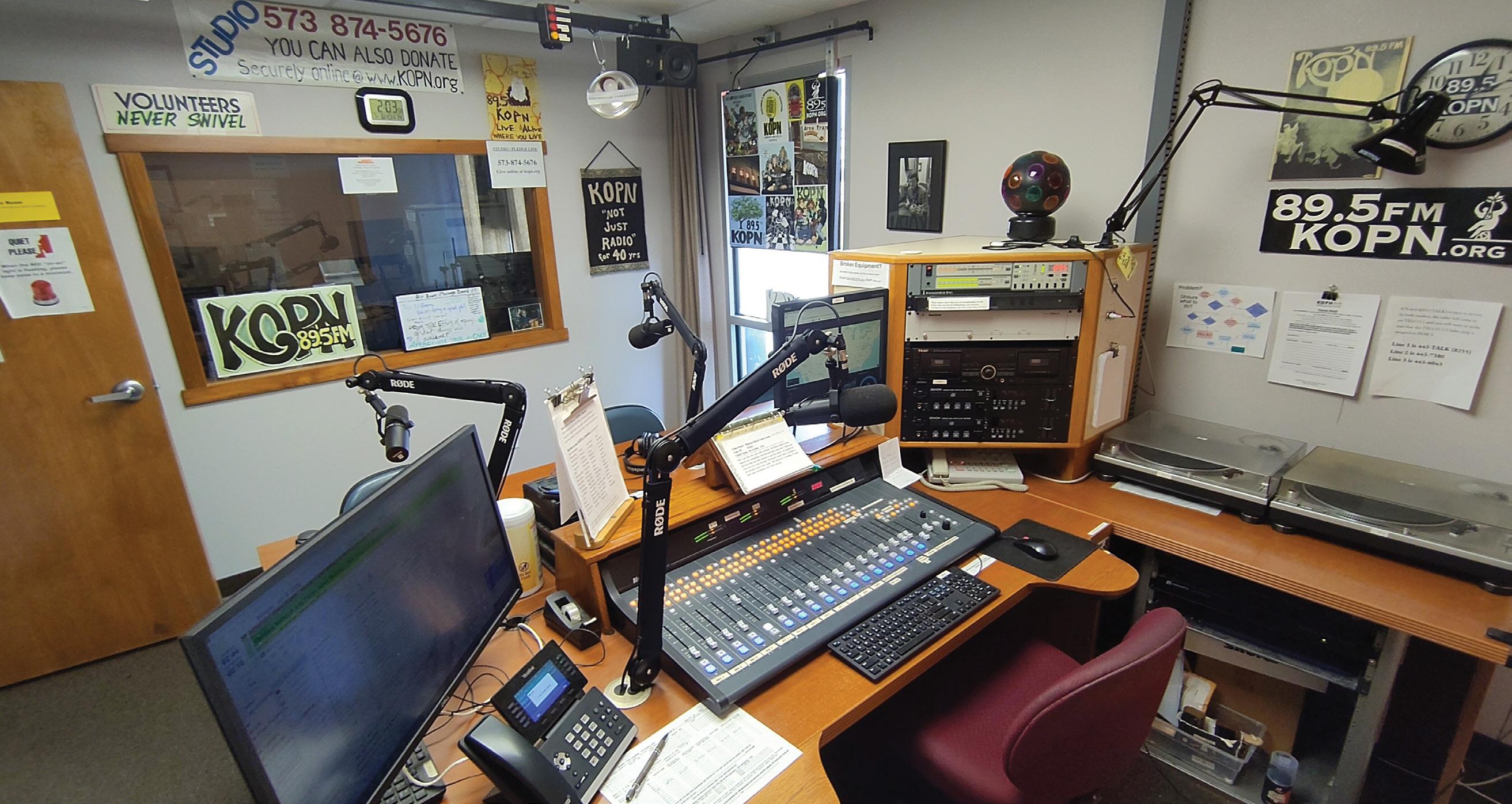
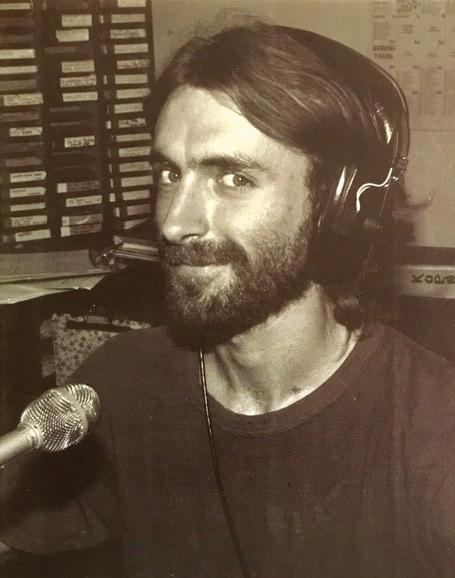
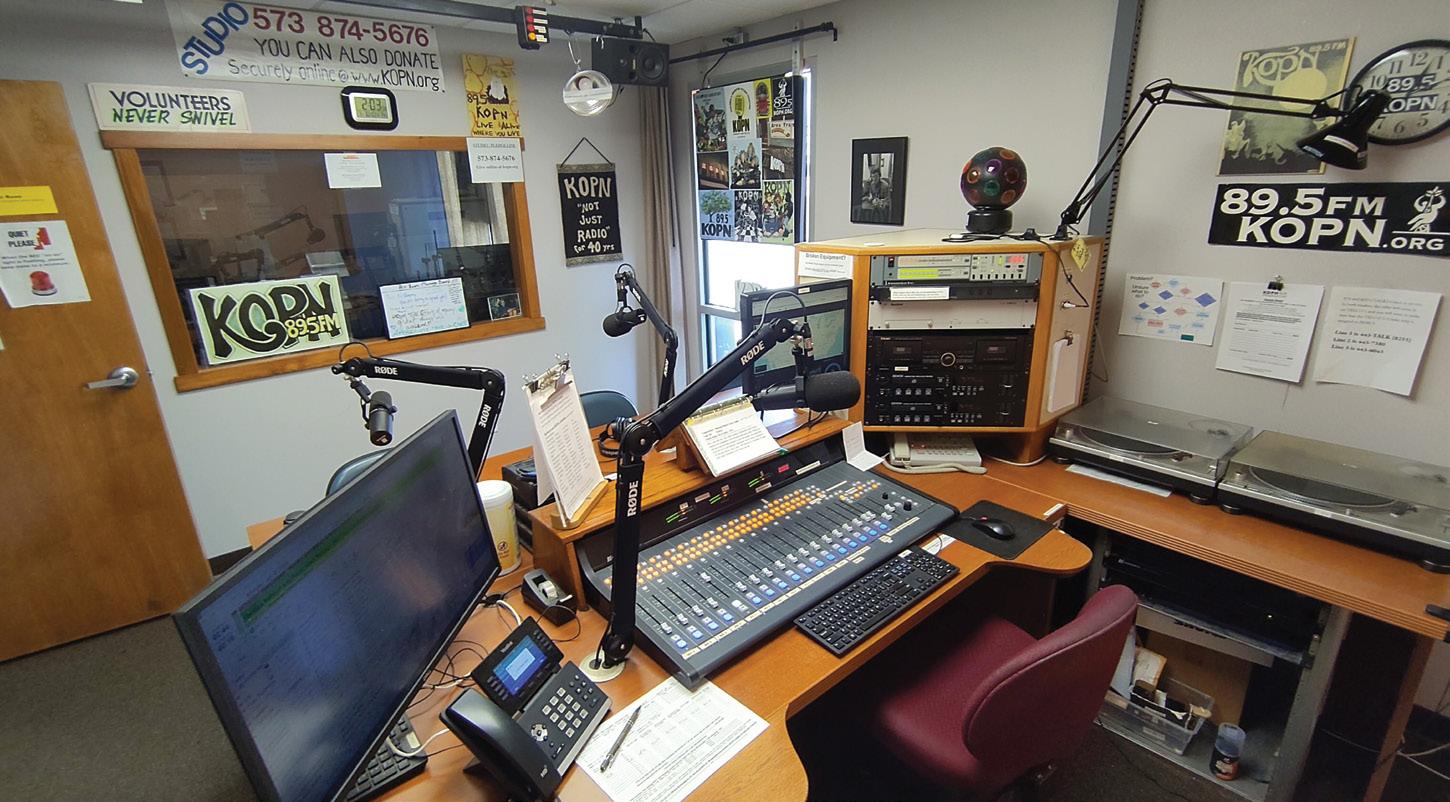
KOPN has been the epitome of community radio throughout its history, featuring some syndicated programs with a heavy emphasis on an eclectic range of programs produced by between 60 and 75 volunteers.
Although there are di erences between public radio and community radio, Columbia’s KBIA and KOPN share something in common. ey both relied on nancial support from the CPB. at is, until the federal government cut all public broadcasting funding, and the CPB folded at the end of last year.
KBIA and its classical station, KMUC, operate with an annual budget of about $2.5 million. CPB used to fund roughly 10 percent, or $250,000, of that. While KOPN’s budget is far more modest at $300,000 per year, CPB funding was about 47 percent of that, or $140,000.
Federal funding is likely gone forever, but it certainly is for the foreseeable future. e public broadcasting rescission has resulted in deep sta ng and programming cutbacks and even station closures. But here in Columbia, listeners and supporters heeded the urgent calls for more dollars. at’s why both stations are still taking to the airwaves 24/7/365.
Although the end of federal funding might have caught many people o guard, local

station leadership had long thought it could happen.
“We always knew it was not 100 percent secure and there was the possibility it could go,” says Kyle Felling, KBIA and KMUC station manager. “ e amount of it and the speed at which it happened did require us to be nimble and adaptable.”
Garrie Morris, KOPN’s director of business operations, and Ed Herrmann, president of the organization’s board of directors, had also seen the warning signs. KOPN is no stranger to facing potential closure. e station struggled in the late 1980s and early 1990s when many community stations closed their doors. As recently as 2017, KOPN literally couldn’t pay to keep the lights on. A last-minute loan from Central Bank kept it on the air and helped the station right the ship. A successful capital campaign launched in 2019 nanced a standalone studio, renovation, equipment, and a commitment to more sound scal management. Among other actions, they opted to pay o a property the station owned on Bernadette Drive to eliminate that expense on the ledger. Herrmann says they scrutinize expenses to determine what’s essential and what’s not.
Neither station has laid o any sta since the CPB cuts took e ect. at said, KBIA has allowed an un lled position to remain that way for more than a year and let a partially grant-funded position expire early. KOPN still has 3.5 paid positions. ere have been no programming cuts either, which means both stations doing far better than a lot of their counterparts — particularly given the smaller size of the Columbia market.
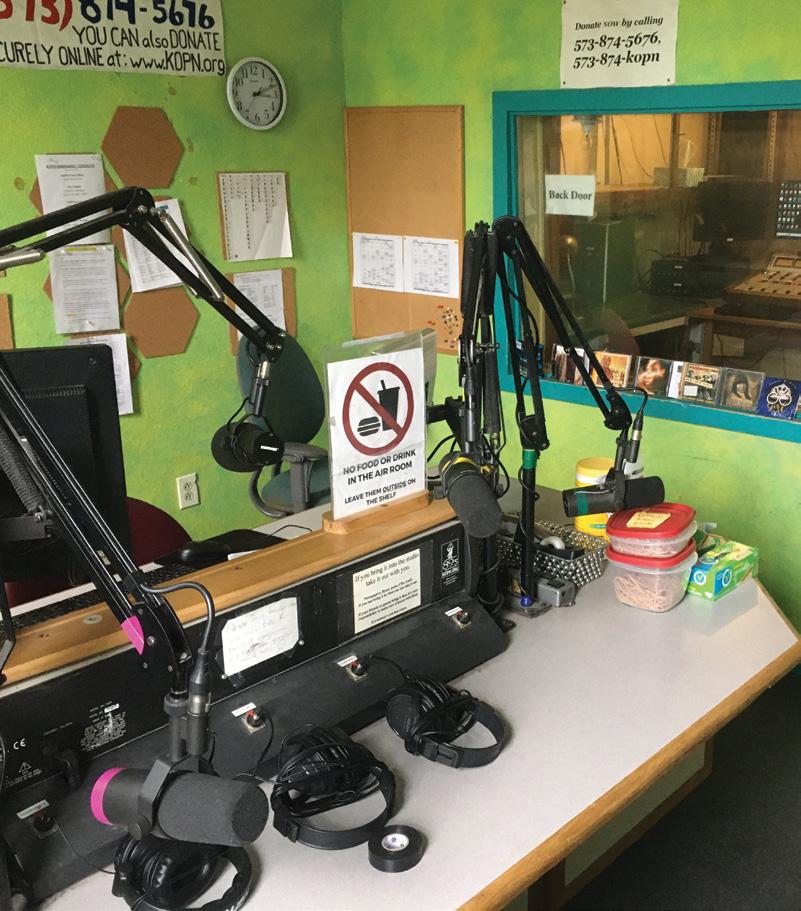
As Felling says, the smaller the station, the larger the percentage of CPB funding it would likely have to absorb. KBIA and KOPN are examples of that, as evidenced by the disparity in the percentages of their budgets — 10 percent versus 47 percent — that relied on CPB dollars.
To put CPB funding into perspective, its total budget represented about $1.50 per American. Compare that to the United Kingdom, for example, where the per-person investment in the BBC is $500.
Both radio stations continue operations uninterrupted because listeners and supporters stepped up when asked. Longtime donors upped their contributions. New donors decided to put their money where their ears were.
“Right when the announcement was made by CPB, we did a fundraising drive, and there was a huge outpouring of support for that,” says Herrmann.
“It’s important for us to let folks know that we had this big crisis, and people responded well,” Felling says. “We were clear that this is our budget situation. We’re relying on the community to stand with us, and they did.”
ese fundraising drives weren’t about tote bags, co ee mugs, and gift certificates. is time, they were about survival. Neither station was surprised by the increased support. ey’ve spent decades cultivating donors, and they have fundraising drives down to a science. What they’re committed to is ensuring they can deliver what they promise to their audiences. It’s their listeners who ultimately decide who they are.
“We knew it was never an existential issue for us,” says Felling. “ e big calculation was: Can we continue, uninterrupted, the service that we provide to the community?”
To Thine Own Mission Be True
If people are going to continue to support KOPN and KBIA, the stations have to stay true to their purpose, which is serving their audiences and not a corporate owner’s bottom line.
“Community radio is truly independent media,” Morris says. “We’re not beholden to anyone but the board and the
people who listen and care enough to give us their opinions. Radio is such a personal medium, and it’s very resilient.”
KOPN gives voice to dozens of passionate local program hosts who are knowledgeable about a range of niche topics. As Morris says, KOPN is diverse talk and music of the world. One look at the station’s programming schedule tells you just how diverse and eclectic it is.
KBIA is more news-driven, with a mix of national programs and locally produced news stories. at’s a natural t given its relationship with the Mizzou School of Journalism. KBIA’s reporting has won several Edward R. Murrow Awards and Public Media Journalists Association Awards.
“We’re doubling down on the things we know we do best,” Felling says. “We’re doubling down on being a part of the community, doing good, long-form, in-depth, rigorous journalism. And doing it in a way that gets beyond headlines and sound bites, by really digging into nuance, depth, and context.”
to agree.
It Ain’t Over
e initial emergency is in the past, but the problem hasn’t gone away. KBIA and KOPN still need to raise what they once got from the CPB — perhaps forever. As costs go up over time, budgets will need to rise to the occasion as well.
e stations are therefore gazing into the future of radio so they can not only continue to delight current listeners, but also nd new ones. Many of those will be younger generations of listeners.


Morris and Herrmann say some programming may need a refresh to attract them. As Herrmann jokes: “Make KOPN young again.” Morris believes it’s the medium’s time to shine once more, given that physical media — like DVDs, vinyl, cassettes, CDs, and VHS — are coming back into vogue, as people become disillusioned with streaming services and commercial advertising they don’t agree with.
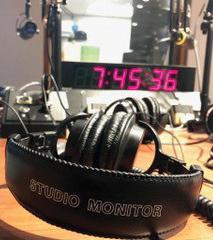
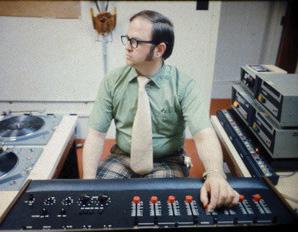
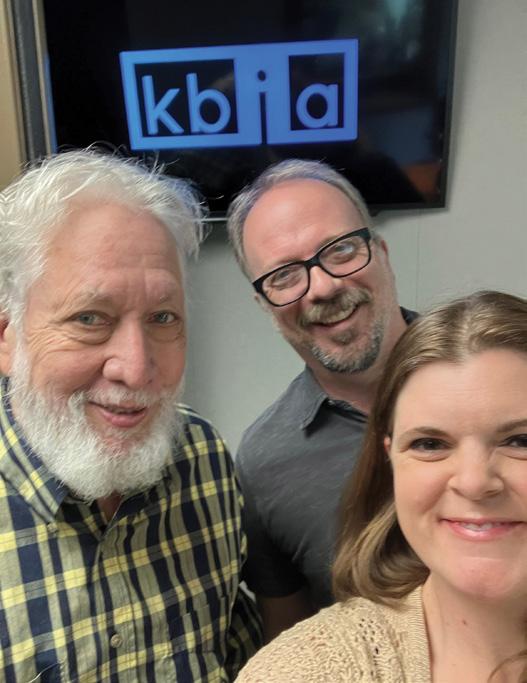
Columbia Public Schools teacher Jennifer Wright isn’t exactly sure when she started listening to KBIA. But she remembers falling asleep to classical music as a kid growing up in Sturgeon, Missouri. When she began volunteering at the station during high school, she put two and two together, realizing her relationship with KBIA began in the 1990s.
Wright’s teenage volunteer stints led her to working the box office for the University Concert Series, then to an open Saturday night shift on the air. She held a variety of paid and unpaid positions there for the next dozen years. While KBIA might be her first preset, she also listens to KOPN, KMUC, and KBXR.
“I’m very much a radio girl,” Wright says. Her daughters make fun of her station choices in the car when she doesn’t let them stream Spotify. She just tells them: “Girls, you have to discover that radio is where it’s at. There are so many options. You need to explore that dial a bit.”
Wright believes KBIA programming brings something unique to Columbia.
“There’s a balance there that you’re not getting in other places,” she says. “You get the headlines, but you also get everything behind the headlines, digging deeper into the analysis, but also just the stories — how the policy, how the news impacts people across the world, across the country, and locally as well.”
Wright appreciates the kind of in-depth local journalism KBIA brings to the community. That’s why she makes financial support of the station a priority. Two years ago, she also rejoined the on-air staff two days a week. The federal funding cuts caused her a great deal of concern for KBIA, KOPN, and stations across the country. She thought a lot about what she could do to help keep public media strong, like increasing her financial support and volunteering more.
“During this time, we’ve really been able to rely on local listeners, whether they’ve been giving for years, whether they’re new listeners, new donors, people have stepped up,” Wright says. “My hope is that they will continue and make those sustaining gifts and financial contributions while at the same time, understanding that stations in this time do have to evolve. They have to look at keeping that donor base strong and being good stewards of those donors’ gifts while also looking at other possible revenue streams.”
“We’re going to report the news and bring the programming and connect with the community because that’s all part of our mission, regardless of a company that we’re owned by,” Wright says. “One of the things that makes public radio unique is that it’s funded by the individual donors, by the listeners. And that’s who we serve.”
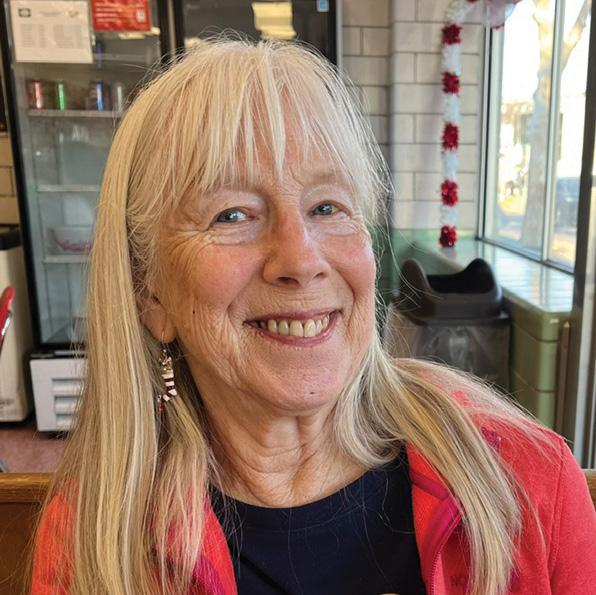
Retired art teacher Ann Mehr started listening to KOPN when she moved to Columbia in 1974. At that point, the station had been on the air for less than a year. It was her yoga instructor, who hosted a show on Fridays, that got her hooked on KOPN.
Mehr would let her know what the kids her in class were up to, and when she turned on the radio at school, the host would greet the kids and comment on what Mehr had told her about their doings. The students were thrilled to know they had a radio station that knew about them.
“As an arts person and a community activist, I feel very strongly that kids need to know where their voices can be heard, where their creativity can be showcased, where they can sing, where they can be actively involved in the community,” she says.
Mehr shifted to part-time art teaching when she had a baby in 1981. That’s when she decided she had time to take the baby with her and do her own show with a friend on KOPN. “The Jewel Box” folk music show launched that fall on Wednesday mornings. Mehr’s school was only four blocks away from KOPN’s Broadway location, so she started asking students to read their creative writing live on the air.
“It was good for KOPN because the parents tuned in. The school tuned in.”
The idea grew when Mehr started teaching in several schools. Elementary, junior high, and high school students could read their writings on air in five-minute segments during the show by calling in, via cassette tape, or in person. KOPN was the perfect place for kids to get involved in the community and have a voice.
Although the show ended, Mehr’s financial support for the station continues. Her husband is a member of the station’s new Legacy Planning Committee, which cultivates estate-plan donations to KOPN. As she says, “We soldier on.”
“KOPN is accessible to everyone, and everyone in Columbia is a rotating cast of characters,” Mehr says. “You always have incoming freshmen. You always have incoming doctoral students, master’s students, some from other countries. We always have fresh blood coming in. And some of that is likely more energy than money, but still, that’s what community radio thrives on: continued energy.”
Mehr thinks KOPN, with its diverse voices and perspectives from both syndicated and locally produced shows, would leave a hole in Columbia if it weren’t here.
“KOPN is not there as background. People who have knowledge and know how to communicate it seek out opportunities like KOPN. And I think Columbia is the perfect place for that,” Mehr says.
“Diversity and community are the two real big things that make KOPN different and worth supporting.”
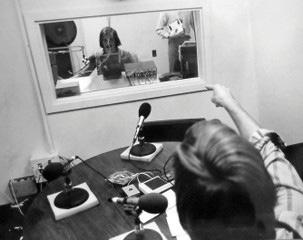
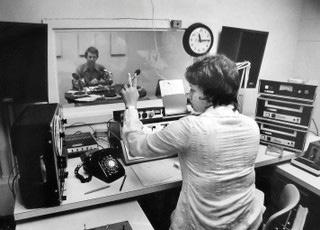
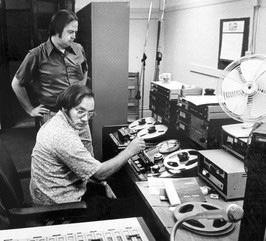
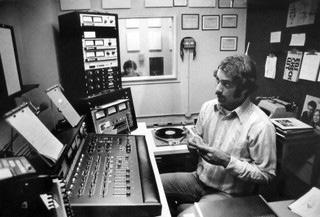
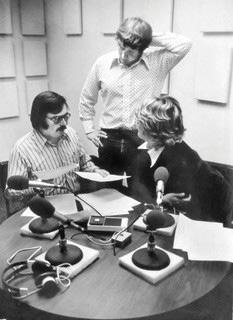

Moreover, audiences are being deluged with the best and worst of arti cial intelligence, which could send them back to more trusted news sources. According to multiple survey results, public media is trusted by most.
“I think we’re going to see more and more ‘news content’ that is produced by AI,” Felling says. “It’s already in print. It’s coming in audio and in video, too. Our space in that is to be a news organization that is by humans and for humans.”
So, might video be coming soon to a radio near you? Herrmann, Morris, and Felling think there are likely places for it.
Morris says some program hosts may want to put a camera in front of them to stream the video. Of course, video clips of audio stories and programs are a good t on social media as well.
As usual, these stations will rely largely on their listeners and supporters to choose their paths.
“We’re going to continue to look at how our audiences are consuming media and try to be in those places,” Felling says.
Messaging will remind audiences new and old of the importance of their nancial support. Felling has been encouraged by community members’ response to the
initial funding crisis and counts on them to keep stepping up.
“My hope is that, moving forward, people remember that even though the immediate crisis passed, the e ects of that crisis continue. And hopefully, people will continue to support us as they have.”
“We have to keep messaging that that funding isn’t coming back when we are having fundraising events,” Morris says.
“You saved us with your outpouring of support last year. Now, invest in our future and keep us alive.”
For now, you can still catch both stations … on the wireless. CBT

Every True Tiger Brands helps athletes market themselves.
BY ERIC HUGHES
LANA EKLUND
EVEN THOUGH IT MAY NOT BE AFFILIATED WITH MIZZOU ATHLETICS, Every True Tiger Brands — which handles University of Missouri athletes’ name, image, and likeness (NIL) deals — now has an o ce in Mizzou Arena, sitting steps away from the athletic department.
“We’re in daily communication [with Every True Tiger] on opportunities for NIL or in daily conversation for managing our rosters in conjunction with our head coaches,” said Eric Morrison, deputy athletics director for Mizzou
Athletics. “It’s bumping into each other in the halls with ideas, it’s forwarding referrals and opportunities to them, it’s working on new opportunities that present themselves.”
For Every True Tiger, that means nding brands that are looking for partnerships with student athletes and connecting them. According to its website, the third-party NIL marketing agency works with brands like Club Car Wash, Gatorade, Hitachi Energy, and local brands such as Columbia Pool and Spa.
In March, Every True Tiger announced that Mario Moccia would be named chief executive o cer of the agency. His new position marks his return to Columbia, where he spent eight years working for Mizzou Athletics as associate athletic director of external operations and senior associate director of athletics. Most recently, Moccia was the director of athletics at New Mexico State University for 10 years.
During his time at NMSU, Moccia organized the university athletic department’s partnership with A-Mountain Sports NIL Collective, founded by Dr. Paul Grindsta , and tried to stay as involved in the NIL process as he could at the time. After he was dismissed by NMSU, Moccia said that he wasn’t rushing to take a job — until he got a call from MU Athletic Director Laird Veatch.
“[He said], ‘Hey this is a position I think you would be a good t for,’” Moccia recalled. “So I called Paul, who was
at Vanderbilt, and my two other associates who were in the SEC, and got a little more of a deep dive, and then when I came out here to interview, I kind of gured it was something I would want to do.”
During Moccia’s stint with Mizzou Athletics, Veatch worked as the assistant athletic director for development. He has known Moccia for around 25 years. “I think he had a comfort level in me, and that’s just kind of how it worked out,” Moccia said.
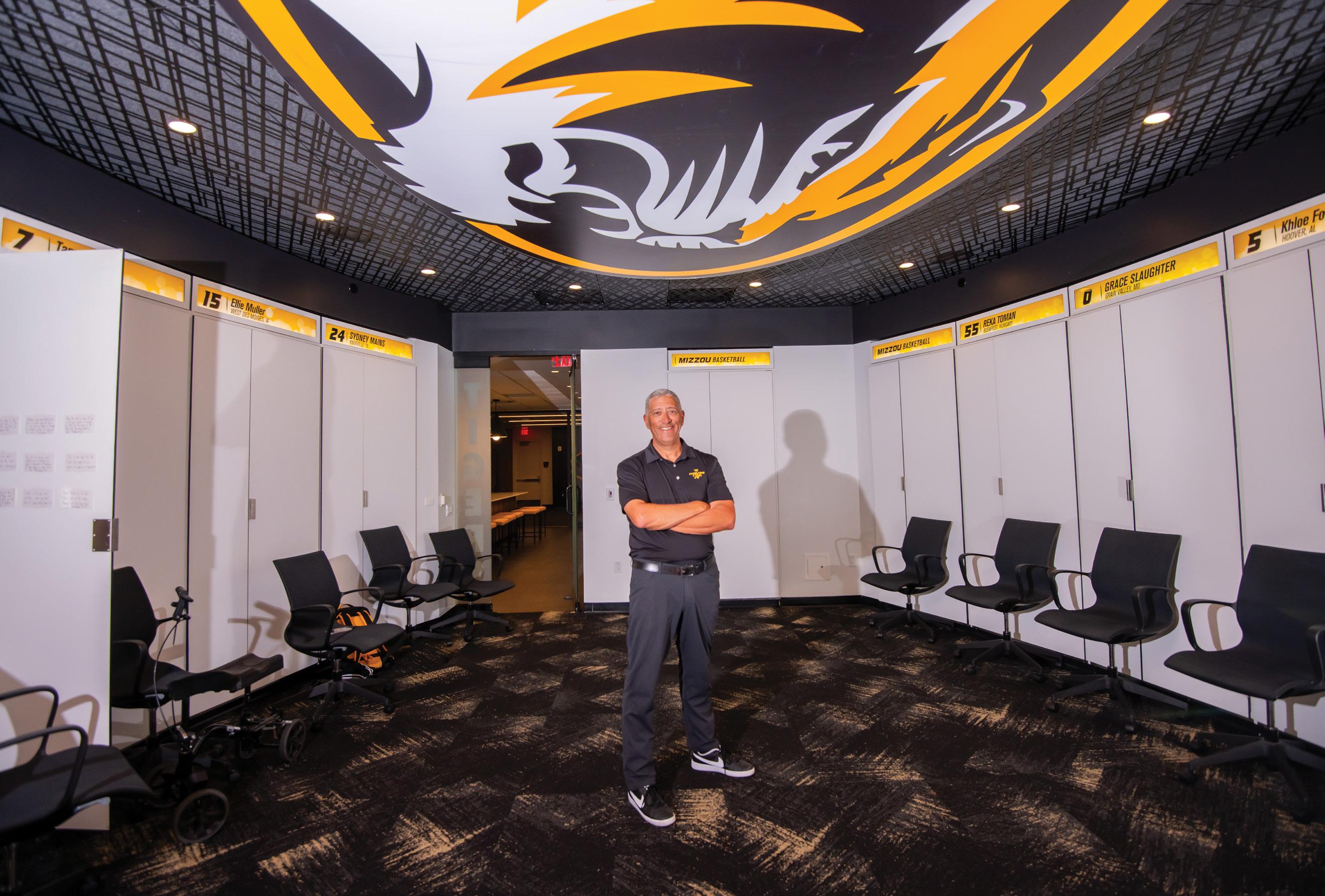
Having served in the CEO role for a little less than three months, Moccia noted that the job is constantly changing. “I have been here for not even three months, and I think that two or three guideline or rule changes from the [Collegiate Licensing Company] have come down already,” he said. “A lot of people use the example that you’re building the airplane while it’s in ight, and that’s not too far o from being true because we’re operating in a business that has constant rule changes.”
Even with the ever-changing landscape of NIL, Moccia describes Every True Tiger’s role as simply managing the revenue share and the third-party NIL dollars. “We handle the revenue share that the department gives out to di erent sports and, conversely, the coaches assigned to the di erent players,” he said. “Same with the third-party NIL dollars whether we bring those in from individuals who want to use student athletes in their advertising campaigns or Mizzou Sports Properties brings them in.”
Every True Tiger works to connect student athletes with brands and then has a hand in managing the relationship. “We’ll do those contracts with athletes and sometimes talk to agents, or talk to parents, or whoever their representatives are once those contracts are signed,” Moccia said. “ en we work with the speci c companies and the speci c athletes on what they would like them to do and what the deliverables are.”
He said that Every True Tiger will arrange to have athletes promote brands through social media posts, attend autograph signings and meet and greets, and even get mic’d up at practice and relate it back to the sponsor.
When Moccia was at NMSU, their head football coach left the program to accept a position at Vanderbilt, and many Aggie players entered the transfer portal and went with him. According to the National Collegiate Athletic Association
website, over 10,500 college football players entered the transfer portal during the 2026 transfer cycle across all divisions.
Moccia cited Diego Pavia — who started two years for NMSU and led them to 10 wins in his second season before transferring to Vanderbilt to nish his collegiate career — as an example of the new paradigm.
“He had a very speci c value that they were willing to pay, and we couldn’t,” he said. With NIL deals rising in collegiate sports, athletes who perform at a certain level have an incentive to transfer to schools where there are better NIL opportunities.
Morrison, who worked for Mizzou Athletics from 1998 to 2007 before taking a job in nance, returned to MU two years ago and said that the advent of NIL is the biggest change he has seen.
“We’ve now needed to become this place for student athletes to learn how to best leverage their brand,” Morrison said. “Secondarily, it’s been a total change in the way we construct rosters and put our
teams together.” He observed that athletic departments now “have to balance the talent acquisition with the NIL era that we’re in.”
Moccia said that while recruitment remains up to the head coaches for their speci c sports, Every True Tiger can assist coaches in showing athletes what opportunities would be available to them.
“Some of the sports will ask us to do a presentation to either recruits or prospective transfers,” he said. “So we will sit down and show them what Every True Tiger does, here’s what we can do to help you assist your brand, etc.”
When student athletes contract with businesses to market and promote their services, these deals must be disclosed. NIL Go is the monitoring platform that Division I athletes use to report their NIL deals.
“ e College Sports Commission created a system called NIL Go through Deloitte where they would analyze the deals over a speci c dollar amount just to make sure that ‘pay for play’ wasn’t going on, and there was a legitimate value on what you’re asking a student athlete to do for a corporation,” Moccia explained.
Moccia noted that while a prospective transfer’s lack of a large social media presence will not prevent coaches from wanting to recruit them, athletes with a larger following can make the NIL Go approval process easier. He added that there isn’t really an “answer key” on how to ensure NIL deals are approved; Every True Tiger just has to try to learn by what has been approved or disapproved in the past.
As NIL continues to grow through NCAA sports, government regulations on what rights student athletes have are also increasing. According to the National Conference of State Legislatures, 32 states had passed laws that regulate NIL rights for student athletes as of last July. Moccia hopes to see regulations that require agents to go through an o cial certi cation process to be able to represent student athletes.
“NFL agents have to be certi ed, whereas here there is no certi cation necessary to represent student athletes,” he said. “ e people who represent athletes are taking anywhere up to 10 percent, where in the NFL I believe it’s capped at 3 percent. From a professionalism standpoint, I think it would be much better if the agents would have to go through an o cial certi cation process.”
As recently as 2021, student athletes were not widely allowed to accept NIL deals without risk of punishment from the NCAA. While no one can accurately predict where the college sports and NIL landscape is heading, Moccia wants Tiger student-athletes to know that Every True Tiger Brands will be there to help them navigate that future.
“It’s a very unique business model where there’s constant change,” he said, “so you just have to be as nimble as you can.” CBT

















I-70 expansion will highlight Columbia’s landscape for another four-plus years.
BY JODIE JACKSON JR






















A RIBBON-CUTTING NEAR THE CHAOTIC INTERSTATE 70/HIGHWAY 63 INTERCHANGE in June 2024 started a six-and-a-half-year clock toward the completion of the most ambitious — and most expensive — highway projects in Missouri history: e addition of a third lane of travel in each direction between Blue Springs and Wentzville on I-70. at means the project is now one-third of the way to the nish line. However, the orange tra c cones, concrete jersey barriers, heavy equipment, cranes that seem to reach into the blue sky, and ashing lights warning drivers to reduce their speed will continue to be ubiquitous for another four-plus years.
“We’re right where we need to be to deliver this on time,” said Eric Kopinski, the Improve I-70 program director for the Missouri Department of Transportation (MoDOT). While the schedule is on target and work is in full swing on ve segments of the project – including the massive task of replacing the Highway 63/I-70 connector in Columbia – the only part of the $4.3 billion project that is complete is about seven miles between Routes J and M in Callaway County, between Columbia and Kingdom City.
By the end of this calendar year, Kopinski said, that number will be around 20 miles of completed eastbound and westbound lanes – “still a long way to go,” he said, adding, “by this point next year, it’s going to look a whole heck of a lot di erent. We’ll be closer to the nish line than to the starting line.”

































































e nearly 45-mile stretch from Boonville to Kingdom City is “moving at full speed now,” Kopinski said. “ at’s over $1 million worth of work every day. And we’ll continue that pace for the next year and a half.”
e Boonville to Rocheport section should be complete by December of next year. e Rocheport section to the 63/70 interchange is scheduled for completion by December 2029. e Columbia to Kingdom City section, which was the rst part of the project that began in June 2024, should be complete next winter.
“Our contractor crews are making progress day and night,” Kopinski added. “And we’re trying to do all this work without screwing up tra c.” at said, the closure of overpasses, rerouting exit lanes, and narrowing the corridors in some areas have had signi cant tra c impacts. And MoDOT engineers know that, he said.
“We study this very closely,” he said. “ is is kind of the sweet spot” to keep tra c moving. “If we move faster, it will have more impact on tra c. If we move slower, it will have more impact on tra c.”
Motorists can sign up for email alerts to stay up to date on construction schedules and planned route closures or detours. To receive speci c project updates and construction related press releases, sign up for Improve I-70 e-mails by visiting MoDOT e-Update and selecting one or more of the Improve I-70 options under the Improve I-70 heading.
“We just really appreciate everyone’s patience from the businesses to the schools and everybody out there. We know we have a lot of tra c impacts going on,” Kopinski said. “We know that the safety [improvements] and economic development that comes from this is going to be fantastic. is is a historic investment.”
If you see a building popping up and wonder, “What’s going up?”, email jodie@comocompanies.com and let us know!
Awarded: February 2024
Construction: June 2024 to late 2027
Columbia to Kingdom City is a $426 million Design-Build project that will add a third and make other improvements to I-70 between U.S. Route 63 in Columbia and U.S. Route 54 in Kingdom City. Millstone Weber was selected as the best-value proposer. e winning proposal includes new concrete pavement on all three lanes of I-70 in each direction for the 20-mile section between Columbia and Kingdom City, wider inside and outside shoulders, and improved interchange designs at the U.S. 63 and U.S. 54 interchanges at I-70. Additionally, throughout construction two lanes of travel will be available for both directions of I-70 during peak hours.
• Deliver the project by the end of 2027 within the program budget.
• Provide a third lane of travel for eastbound and westbound Interstate 70 from Columbia to Kingdom City.
• Improve I-70/U.S. 63 and I-70/U.S. 54 Interchanges providing for better tra c ow and movement of freight.
Awarded: November 2024
Construction: March 2025 to late 2028
Warrenton to Wentzville is a $600 million design-build project that will improve and add a third lane to I-70 between Warrenton and Wentzville. e Improve 70 Alliance (Emery Sapp & Sons, Clarkson Construction, HNTB, and Bartlett and West) was selected as the apparent best-value proposer and design-build contractor. Construction began in 2025 with an anticipated completion in late 2028.
• Constructing a third lane in each direction on I-70 from Warrenton to I-64 in Wentzville, including replacing
the existing I-70 lanes with new fulldepth concrete pavement.
• Interchange improvements at I-70 and the I-64/Route 61 interchange.
• Addition of a third lane of travel to eastbound and westbound I-64 between I-70 and Route K.
Awarded: May 2025
Construction: Sept. 2025 to late 2028
Improve I-70: Blue Springs to Odessa is a $350 million design-build project that will add a third lane to each direction on Interstate 70 from just west of MO Route 7 in Blue Springs to approximately MO Route H. e project also includes I-70 interchange improvements at Route D in Bates City and at MO Route 131 in Odessa. e project was awarded in spring 2025 to the Radmacher-Ideker Joint Venture team. Construction began in September 2025 and is scheduled to be completed by the end of 2028.
• A third lane of I-70 in both directions beginning just west of MO Route 7 in Blue Springs to approximately MO Route H (mile marker 45.3), nearly seven miles past the project requirements.
• Replacement of the existing I-70 lanes with all new full-depth concrete pavement.
• Improved I-70 interchanges at MO Route D in Bates City and at MO Route 131 in Odessa.
• 14 bridge replacements.
Awarded: February 2026
Construction: April 2026 to late 2027
Improve I-70: Boonville to Rocheport is a $104 million design-bid-build project that will add a third lane to I-70 in each direction for the 13-mile section between Missouri Route 5 in Boonville and the Lance Corporal Leon Deraps I-70 Missouri River
(Rocheport) Bridge. is project also includes plans to widen two I-70 bridges, one over the Union Paci c Railroad at mile markers 113, and one just west of the Lance Corporal Leon Deraps I-70 Missouri River Bridge at Rocheport.
Boonville to Rocheport was designed by Burns & McDonnell and was awarded in February 2026 to Capital Paving and Construction.
• Provide a third lane of travel to eastbound and westbound Interstate 70 from Blue Springs to Wentzville.
Awarded: December 2025
Construction: May 2026 to late 2029
Improve I-70: Rocheport to Columbia is a $441 million design-build project that will improve the 14-mile stretch of Interstate 70 from the Missouri River Bridge at Rocheport to approximately U.S. Route 63 in Columbia. e ESS Team, comprised of contractor Emery Sapp & Sons and designer Parsons was selected as the apparent best-value proposer and design-build contractor. Construction began in spring 2026 and anticipated project completion is late 2029. e winning proposal includes:
• A third lane in each direction to I-70 between the Missouri River Bridge at Rocheport and approximately U.S. Route 63 in Columbia, with all new 11-inch full-depth concrete pavement.
• Improvements to the I-70 interchanges/intersections at Route J/O, Midway (Route 40), Stadium Boulevard, Business Loop 70, Providence Road, Rangeline Street, and U.S. Route 63.
• 14 new bridge structures.
• New north and south outer road connections across Perche Creek.
Scheduled award: Spring/summer 2027
Construction: Fall 2027 to late 2030 CBT


WHAT’S NEXT FOR YOUR BUSINESS?


Worth more than $970,200
$14,300,000
MRES Heather Ridge Holdings LLC Bankers Trust Co.
STR 10-48-13 /S/SW FF Tract 7 PT & 8 Survey #7642
$8,010,128
COR 7070 Baldridge LLC
First Midwest Bank of the Ozarks LT 10 Cartwright Business & Technology Park Plat No 1
$4,603,000
Grey Box Properties LLC Firstrust Bank LT 25 Barkwell Place
$4,600,000
Voluntary Action Center
Multipli Federal Credit Union LT 1 E C More’s Subdivision Plat 1A
$4,000,000
JBKR2 Properties LLC
Simmons Bank LT 619 Vanderveen Crossing Plat No 12
$3,490,000
Grey Box Properties LLC Firstrust Bank LT 25 Barkwell Place
$2,800,000
KCP Hospitality Inc.
First State Community Bank LT 2 Centerstate Plat 3
$2,223,500
Adair W. Hathway Homebank
STR 10-51-11 //NE SUR BK/PG: 5865/33 AC 10.26
$2,200,000
Fred Wendell Overton, co-trustee
e Central Trust Bank
STR 29-49-14
$2,074,000
P1316 LLC
e Central Trust Bank
STR 32-48-12 //NE SUR BK/PG: 2537/9
AC 24.35
$1,950,000
Matthew T. Detelich Jr., trustee e Central Trust Bank
LT 145 Clear Creek Estates Plat No 1
$1,776,000
Daniel Albert London e Bank of Missouri
STR 21-47-13 //S SUR BK/PG: 5725/102
AC 10.02 FF TR 1
$1,530,000
HGT Real Estate Holdings LLC e Central Trust Bank LT 346 PT Columbia FF & PT Alley
$1,350,000
Jacob R. Heithold Multipli Federal Credit Union
STR 34-50-13 /W/NE SUR BK/PG: 5812/39 AC 17.12
$1,090,000
Red Page Properties LLC e Missouri Bank LT 1 Ann Street Condos
$1,084,461
Red Page Properties LLC e Missouri Bank LT 19 Bon-Gor Lake Estates Blk 5
$975,000
Pellock Investment Properties LLC
James Edward Pellock Trust
STR 27-49-14 //SW SUR BK/PG: 869/281 FF tract 4 & survey 903/320 TR 5/ & begin SW corner TR 8 survey
$975,000
Pellock Investment Properties LLC
James Edward Pellock Trust LT 26 Zaring Acres
$970,200
Bains Farms LLC
First State Community Bank
STR 30-49-12 //SW SUR BK/PG: 4654/53
AC 28.38 FF except CBT
Issued by the Boone County Recorder of Deeds in June 2026
Issued June 2026
Sheltering Arms Day Center
Amina Mohamed 202 ird Ave., Columbia
Ryze Roofing LLC
4707 Cedar Coals Court, Columbia
Spec Coffee Company LLC
Kaitlyn Rhinehart and Landen Knight 14 E. Business Loop 70, Columbia
CP Wellness LLC
4500 Stellar Dr., Columbia
The Quin Hair Salon and Spa LLC 2101 W. Broadway, Columbia
MedFlow Mobile LLC
819 Parkview Ave., Fulton
Razzle Dazzle Car & Tail Spa LLC
Andrew Marcy 3101 Paris Rd., Columbia
Solventum Advanced Wound Care
KCI USA, Inc.
207 Peach Way, Columbia
Integrity Home Care LLC 905 Safari Dr., Columbia
Hokulia Shave Ice – Columbia
Sanders Street Properties LLC 1412 Forum Blvd., Columbia
Clean Sweep Cleaning
Shelby ompson 208 Highview Ave., Columbia
Handy Stanley
Stanley Handyman Services LLC 401 Victoria Dr., Columbia
Kansas City Lifecoaches LLC
2024 Cherry Hill Dr., Columbia
Mid-West Clearance Centers
2900 Paris Rd., Columbia
Kat’s Eye Lounge LLC
2024 Cherry Hill Dr., Columbia
El Moe’s Global Cuisine
Cortes-Davis LLC 1400 Forum Blvd., Columbia
Lylac Property Management
Darryl Hodrick 1061 S. Roseta Ave., Columbia
Hawley Home Services LLC 781 W. Route K, Columbia
RRR Solutions LLC 8303 W. South Trails Dr., Columbia
Austin Wells Insurance
Agency LLC 108 E. Green Meadows Rd., Columbia
The Lifted Studio LLC 4103 Vawter School Rd., Columbia
Defined By You
Empower Wealth LLC 3305 Clark Lane, Columbia
Sets By Iris
Iris Owen 2101 Corona Rd., Columbia
Tiger Window Care
Mitchell Dietrich 401 Turner Ave., Columbia
Oak & Heirloom Estate Services LLC
3006 Oakland Gravel Rd., Columbia
Elevation Home Remodeling
Ibarra Enterprises, LLC 3606 Timber Run Dr., Columbia
Columbia Pet Waste Removal LLC
1622 High Quest Circle, Columbia CBT
Issued by the city of Columbia’s Finance Department

New eateries, trampoline park transformation highlight building permit activity.
BY JODIE JACKSON JR
FOUR NEW RESTAURANTS (one of them a dine-in downtown market), a new co ee shop, and the rebranding and reopening of the former SkyZone trampoline park o Rangeline and Smiley Lane were the focus of city of Columbia building permits issued in June. Together, the city’s Building and Site Development o ce and the Boone County Resource Management o ce in July issued 224 building permits with an aggregate valuation of $41,442,193. e Boone County share of that total was 66 permits with a valuation of $9.5 million, while the city’s portion was 158 permits with a total valuation of $31.9 million. e new eateries listed on the June building permit report were Teriyaki Madness, Ramyun & Delights, Marco’s Pizza, and Rosie’s Tortilla Company. e report also showed a commercial alteration permit for Shibam Coffee House, located in the former Aroma Co ee House location.
TERIYAKI MADNESS
1205 Grindstone Parkway, Suite 101 Wilber Enterprises LLC is the general contractor for the project that is turning the former GameStop into Teriyaki Madness. e 1,755-squarefoot job has a valuation of $600,000. Construction includes new interior partitions and interior nishes to provide a new dining room, kitchen, and restrooms. Subcontractors are Nomad Electric LLC, Johnson Plumbing, and Hulett Heating & Air Conditioning.
RAMYUN & DELIGHTS
912 E. Broadway
Interior alterations to the existing 2,654-square-foot space will create a new dine-in market. Long and Reding Signature Electric LLC is the contractor. e permit listed a valuation of $130,000.
MARCO’S PIZZA
911 Rain Forest Parkway
e permit for the city’s newest pizza joint, located in a former AT&T retail shop, listed a valuation of $275,000 for 1,750 square feet of renovation that includes reuse of the existing restroom, new interior walls, ceilings, and nishes. e general contractor is Anderson Homes. Subcontractors include L and J Electrical LLC, LG Plumbing LLC, and Welch Heating & Cooling LLC.
ROSIE’S TORTILLA COMPANY
1305 Grindstone Parkway, Suite 115
Dave Peavler is the contractor for the commercial alteration that will turn the former Casa Maria’s Mexican restaurant into Rosie’s. e job involves 3,786 square feet of space, with a permit valuation of $463,899.
SHIBAM COFFEE HOUSE
1009 N. Providence Rd.
e work on the former Aroma Co ee House site consists of demolishing the current co ee bar and expanding the co ee bar area into an adjacent storage room to create a larger and
more functional service area. e interior seating layout will also be modi ed. R&R Vision Glass LLC is the contractor for the 2,300-square-foot, $40,000 project.
e city’s June building permit report breakdown included:
• Accessory dwelling unit: 1 permit, $242,712
• Addition, residential: 22 permits, $998,314
• Alteration, commercial: 13 permits, $9,923,836
• Alteration, residential: 22 permits, $723,919
• Pool (1 and 2 family): 2 permits, $150,000
• Commercial in ll: 1 permit, $2.4 million
• Commercial, new: 1 permit, $600,248
• Deck: 6 permits, $119,521
• Duplex: 16 permits, $4,963,349
• Reroof: 64 permits, $1,166,369
• Single-family dwelling: 24 permits, $10,615,681
Other highlights of the report include:
REMATCH ARENA ACTION PARK
— “Columbia’s new way to play,” according to its website — will be located at 1201 American Parkway, the site of the former SkyZone trampoline park. Professional Contractors and Engineers is leading the project.
e website, which listed August 8 as opening day, describes Rematch Arena Action Park as “not your typical indoor park. … From climbing through immersive attractions to competing on interactive oors and sports zones, every visit is designed to be di erent.”
If you see a building popping up and wonder, “What’s going up?”, email jodie@comocompanies.com and let us know!
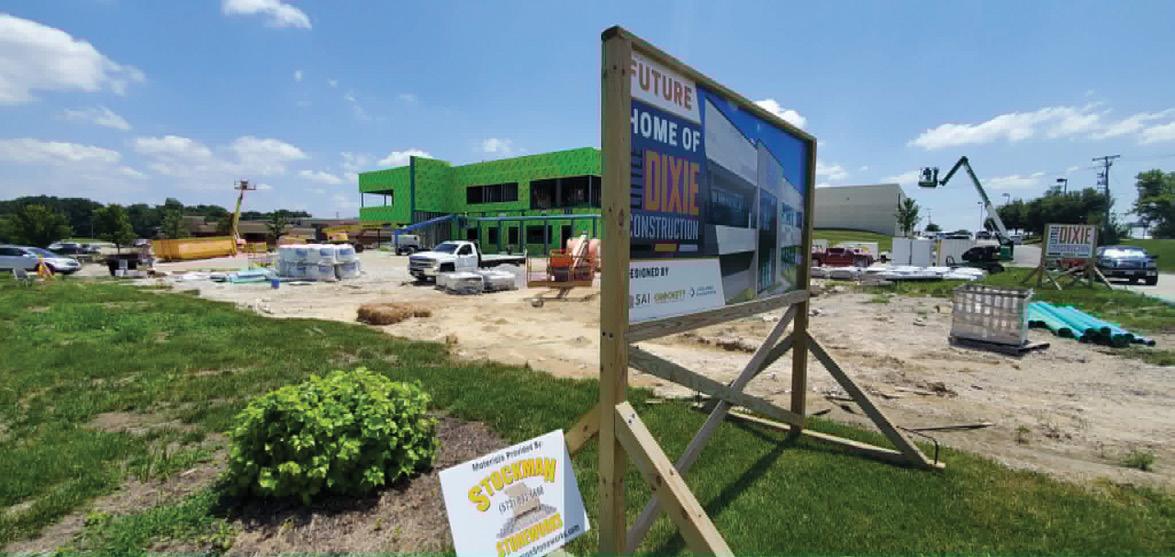
A new SHERWIN-WILLIAMS retail and commercial paint store is under construction at 2520 Restaurant Row, the street the runs just north of Menard’s in far north Columbia. e 4,504-square-foot store project has a valuation of $600,248, according to the building permit. e paint store will take up one acre of the ve-acre lot owned by Larry Kolb and Donna Maxwell of Kolb Properties in Je erson City. Kolb said the construction should be complete before anksgiving. A Sherwin-Williams franchisee will lease the building and property from Kolb, who told COMO Business Times on July 15 that he had no details to disclose about possible tenants for the remaining four acres.
Trader Joe’s will soon have a new neighbor at 201 N. Stadium Blvd., Suite 105. Work is continuing on interior nishes for NORDSTROM RACK . e general contractor is J.E. Foster Building Company. Subcontractors for the $2.4 million, 25,000-square-foot project include QuesTec Constructors Inc. and Meyer Electric Co.
CITY OF REFUGE is adding a learning center and a boutique to its footprint with work at 1 E. Broadway. Hercon Construction is the contractor. One project is an interior alteration to turn a former dental space into boutique
Little Dixie Construction is rapidly transforming the site of the former Missouri Credit Union at 3401 Buttonwood Dr. After razing the original building, crews are putting up a two-story structure that will become LITTLE DIXIE'S main office, above, with a restaurant occupying the bottom level.
mercantile space. e second project is making alterations to turn a former business o ce into space for an adult learning center and after-school tutoring. Together, the two projects entail roughly 5,620 square feet and a valuation of some $965,000.
SCHOOL continues to grow at 1801 N. Stadium Blvd. Coil Construction Inc. is the contractor for enlarging an existing o ce space to be used as a classroom. e 550-square-foot project has a valuation of $30,000. Subcontractors are Meyer Electric Company and J-Squared Engineering.
SOLVENTUM at 5400 Paris Rd. is undergoing renovation to allow a new tenant to occupy its part of the existing building. e 82,000-square-foot project has a permit valuation of $6.9 million for what the permit called the Solventum P&F Carveout. Arcadis APM Group Inc. is the general contractor. COMO Business Times has not received a response from Solventum to its request for additional details about the new tenant.
Single-family dwellings receiving permits in June ranged in value from $238,445 (a 1,691-square-foot home o Amberton Place) to $954,415 (a 6,948-square-foot home at Old Hawthorne North). Builders for those
homes are Hemme Construction and Anderson Homes, respectively.
e Boone County o ce of Resource Management’s building permit for June included:
• Single-family residential: 10 permits, $5.8 million
• Stores/mercantile building: 1 permit, $450,000
• Other nonresidential: 13 permits, $1.48 million
• Other structures: 3 permits, 270,000
• Residential additions/alterations: 18 permits, $907,237
• Nonresidential additions/ alterations: 5 permits, $195,500
• Residential garages: 9 permits, $415,000
• Shop/o ce: 1 permit, $450,000
• Miscellaneous: 7 permits, $9,000
Single-family homes ranged in value from $250,000 o Westwind Drive to $2.65 MILLION o S. Smith Hatchery Road. e builders are Central Mo Homes LLC and Tompkins Custom Homes, respectively.
Together, the city and county in June issued 34 single-family home building permits with a combined value of $16.4 for an average valuation of $482,000. CBT WHAT’S
BY JODIE JACKSON JR

WE’VE GOT SOME GRAND OPENINGS, a long-awaited book release/book signing, and a list of small business grant awardees to talk about. But rst: Pay those parking tickets, y’all.
Beginning July 13, the city’s parking enforcement team began using wheel immobilization devices — also known as a “boot” — in addition to the Barnacle windshield immobilization devices already used as part of its approach to dealing with parking ticket sco aws. According to a city news release, immobilization devices are not used for rst-time parking violations or occasional unpaid citations. ey are reserved for vehicles with four or more unpaid parking citations that remain unresolved after their court dates. Before a vehicle is immobilized, parking enforcement agents also place a green warning notice on vehicles meeting the criteria, advising owners that continued nonpayment may result in immobilization or towing in 72 hours, the news release said. is provides vehicle owners an additional opportunity to resolve outstanding citations before enforcement action is taken.
Ti any Heibel, parking maintenance and enforcement supervisor, put it bluntly. “Drivers who pay or contest their parking citations on time will never encounter these devices. ey are intended only for those who repeatedly ignore citations and fail to address them through the court process.”
Wheel immobilization devices function similarly to the Barnacle by preventing a vehicle from being driven until outstanding citations have been addressed. Once the required nes are paid or other arrangements are made through the Municipal Court process, Parking Enforcement sta remove the device, allowing the driver to immediately continue on their way. Reminder: Parking citations are due within 15 days of issuance. Information about paying or contesting parking citations, applicable ordinances and nes is available at CoMo. gov/law/parking-tickets.
Don’t say we didn’t help warn you!
Local downtown restaurant Pizza Tree opened its second location around the corner from its original location at 909 Cherry St. e Cherry Street location, formerly occupied by Main Squeeze, is currently walk-up only, but the new location at 28 Ninth St. o ers a dine-in option for customers hoping to stay out of the summer heat. Bricks and Mini gs — BAM Columbia — had its grand opening July 11 in the Broadway Shops at 2703 E. Broadway. We’re also told it’s called Lego Heaven e Little General at 652 N. Rangeline Rd. opened on July 18. A convenience store with gas pumps, comfort food, and mini dog park. Sounds like Traveler Heaven to us.
e long-awaited biography on Columbia’s former city manager and public works director, Ray Beck, is ready for prime time. A book release and book signing event for “Fingerprints and Footprints: Ray Beck’s Columbia,” is scheduled for 1-3 p.m. Sunday, August 16, at the Reichman Pavilion at Stephens Lake Park. e book’s co-authors — Beck and COMO Business Times editor Jodie Jackson Jr. — will be on hand for the event, which is being sponsored by the Boone County History and Culture Center.
Regional Economic Development Inc. (REDI), the city of Columbia’s economic development arm, recently announced its 2026 Small Business Grant recipients, which included $10,000 awards to Krystal Martin (K&K Co.) and Treana Cason and Shalina Reed ( e Balloon Tycoons). e six $5,000 grant awardees were Brandon Painter, BP Online Consulting and Management; Kristin Lux and Greg Grimes, For the Love of Systems LLC; Jennifer Heidrich, Bronze by Design; Christa Holtzclaw, Steep & Bloom Tea LLC; Marvin Porter, Taste Buds Snacks Inc.; and Trischa Splitter, Junebug Photography. CBT

Street Talk is a monthly overview of “word on the street” business and community news. Street Talk is sponsored by e Bank of Missouri.
Columbia’s next municipal election, with three candidates running for a Fourth Ward City Council seat.
1 percent
The sales tax increase for public safety whose fate Columbia voters will decide at the polls on August 4.
08/05/76
Date that Ernie’s restaurant waitress Becky Doisy was last seen as she left her Columbia apartment with Johnny Wright.
01/28/11
Date Johnny Wright was convicted of Becky Doisy’s murder. Wright died in prison four years later. Becky Doisy’s body has never been found.
34
Number of single-family home building permits issued by Columbia and Boone County in June.
224
Number of building permits