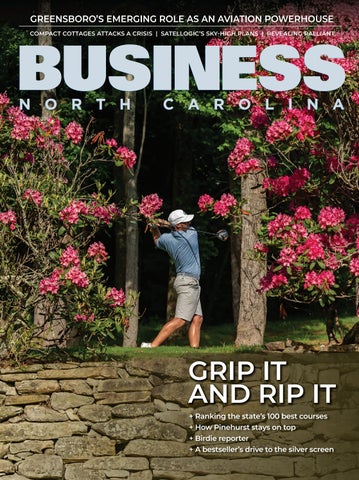
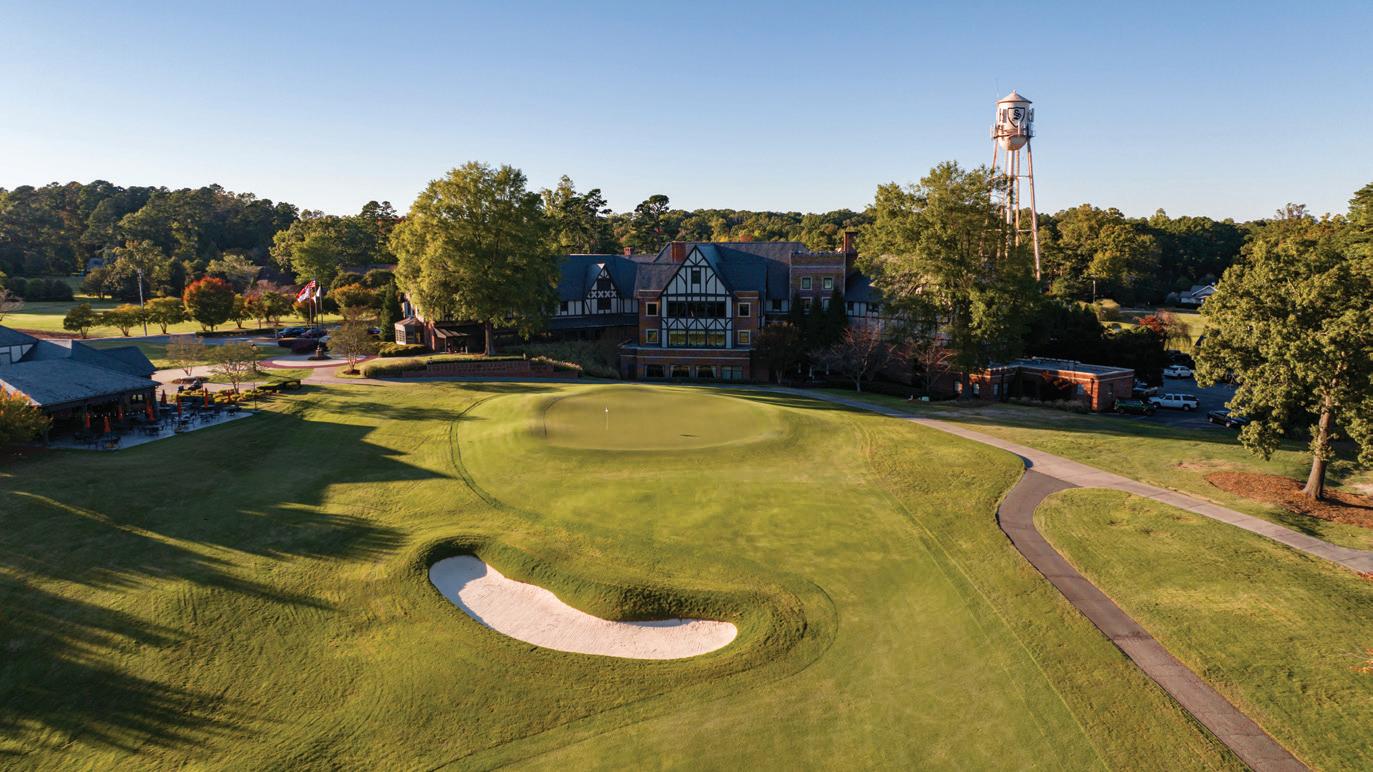
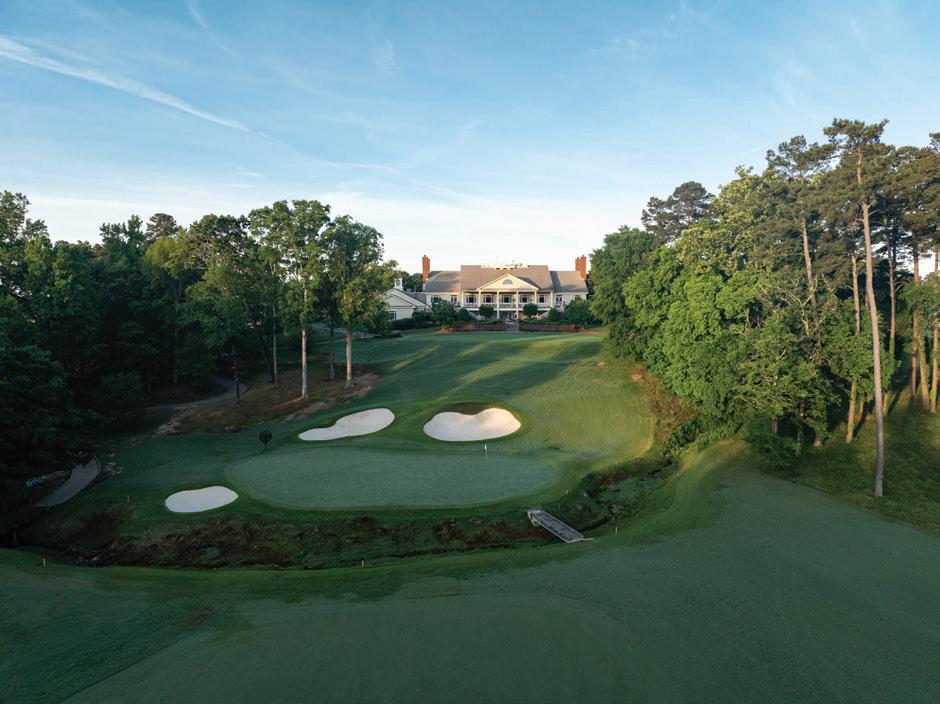
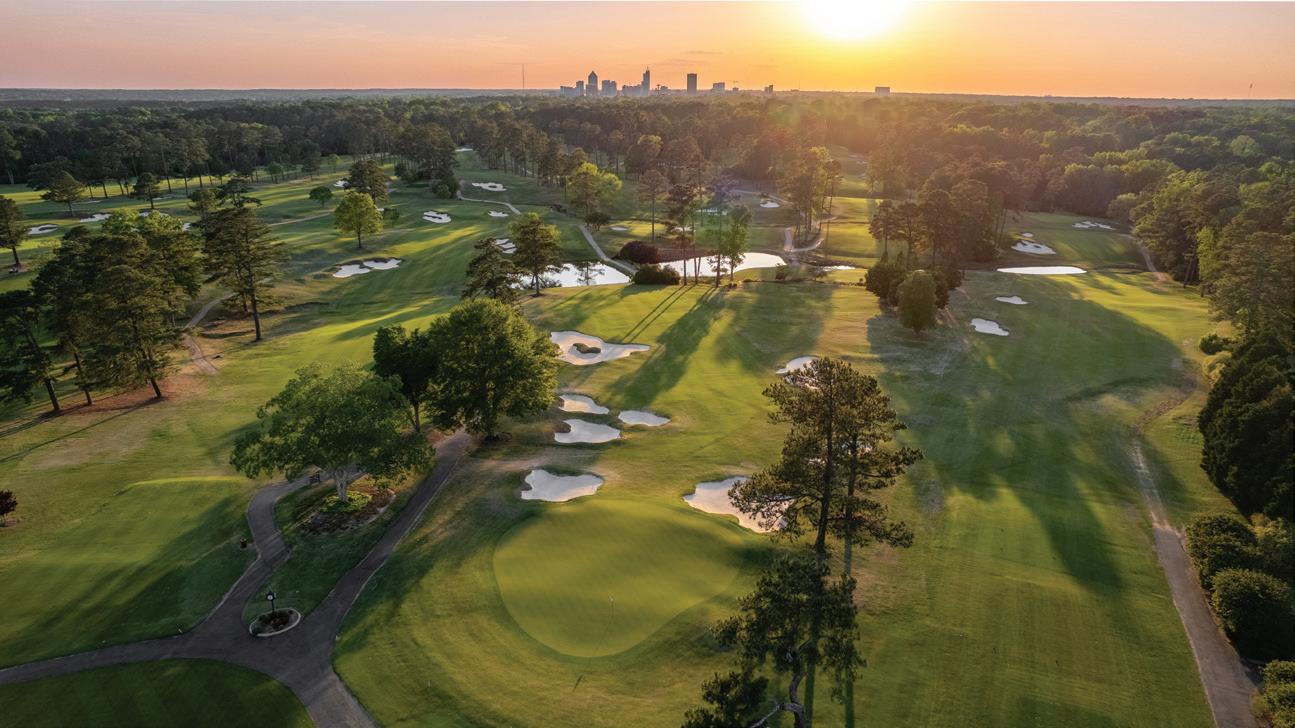
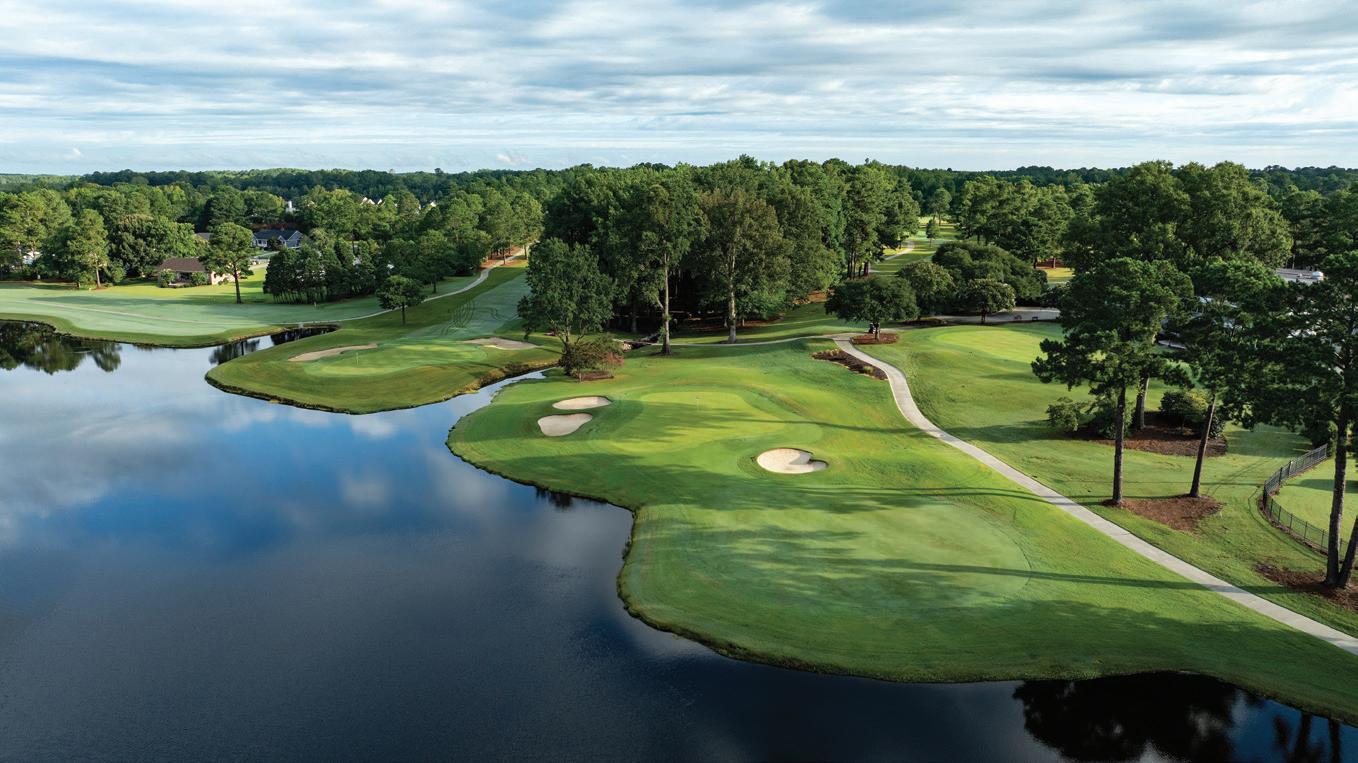
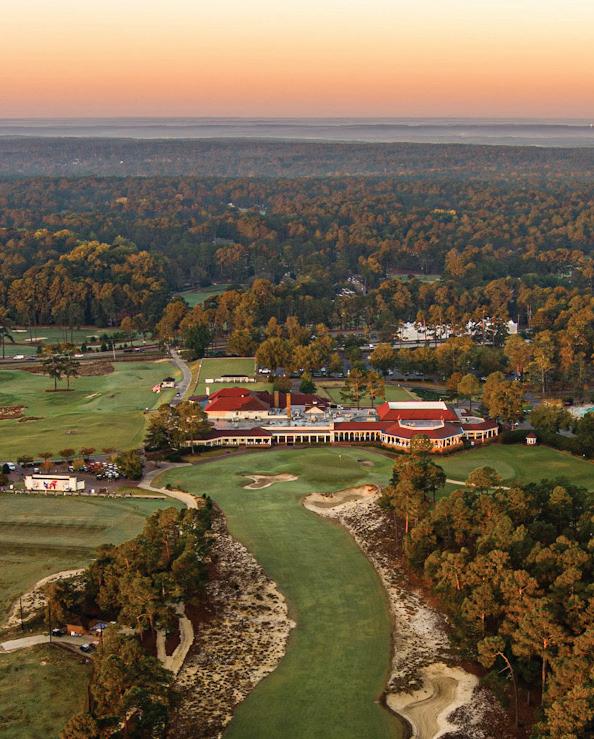
+ Ranking the state’s 100 best courses + How Pinehurst stays on top
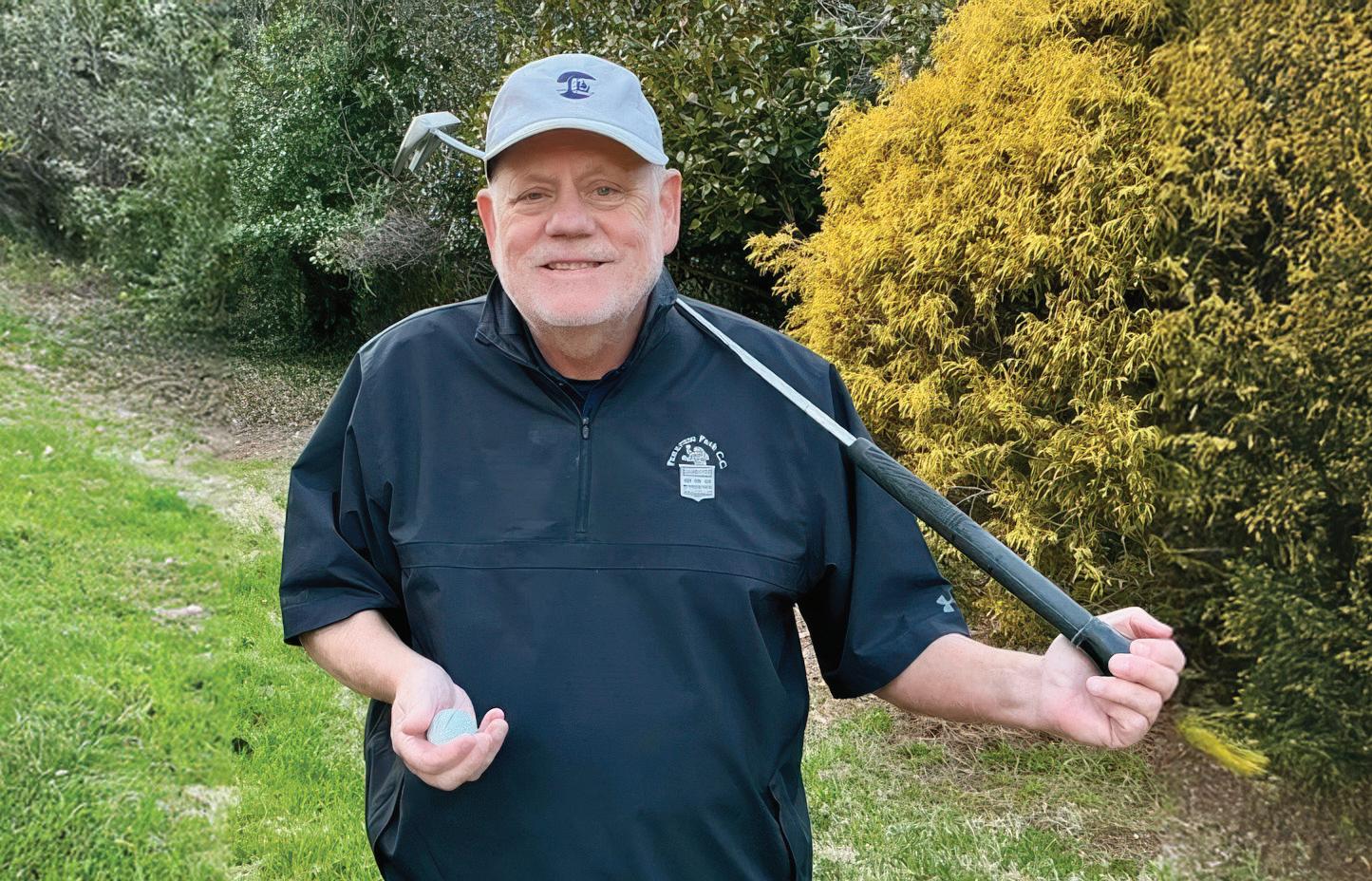
+ Birdie reporter
+ A bestseller’s drive to the silver screen
+ DEPARTMENTS
4 UP FRONT
6 POWER LIST INTERVIEW
The N.C. State Employees’ Credit Union with $57 billion in assets is the secondlargest U.S. credit union with 2.8 million members. CEO Leigh Brady explains why it isn’t a bank.
8 NC TREND
Fairy tale charms translate into tourism cha-ching; Ex-SAS executive drives state’s AI advances; Family books success in library furniture; Fortifying roofs ring up long-term savings; Raleigh suits Ralliant’s precision style.
26 POINT
TAKEN
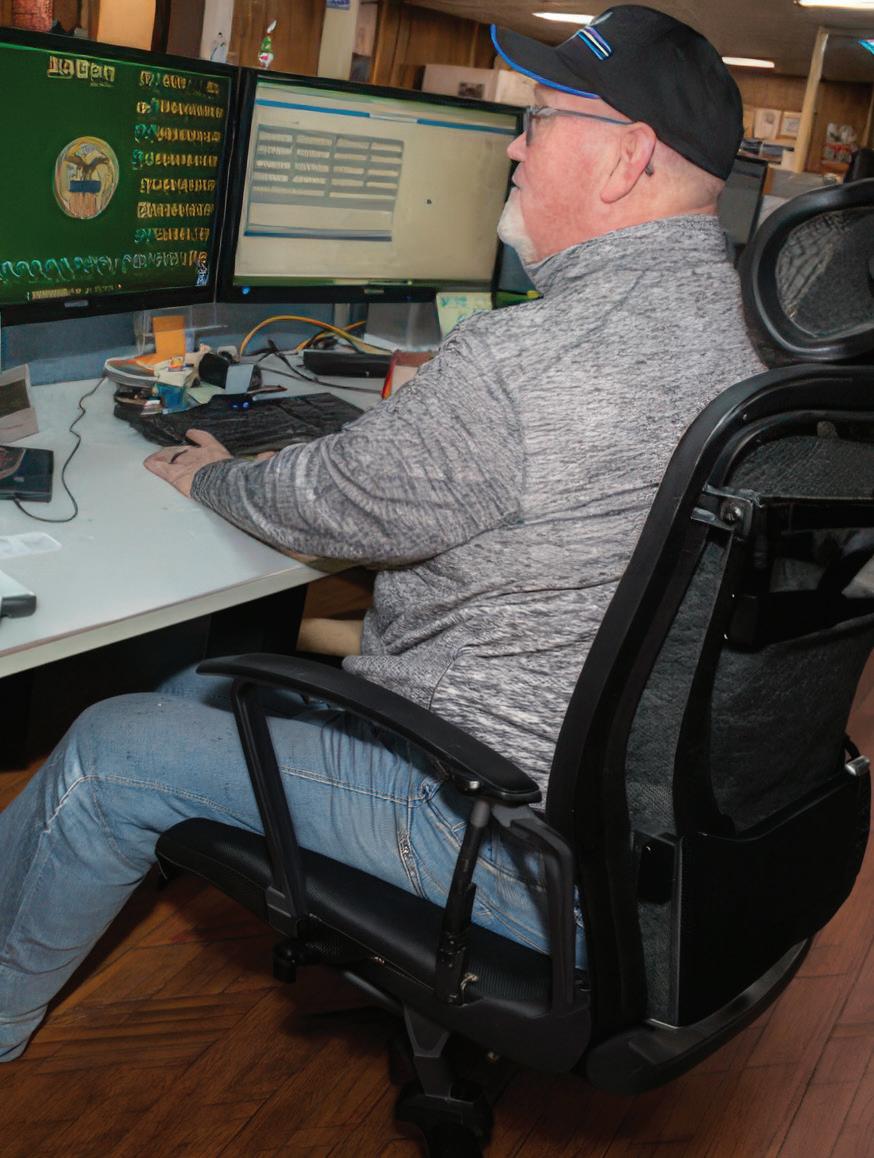
This eastern North Carolina squad’s work keeps the nation’s military jets flying.
100
BRICK + MORTAR
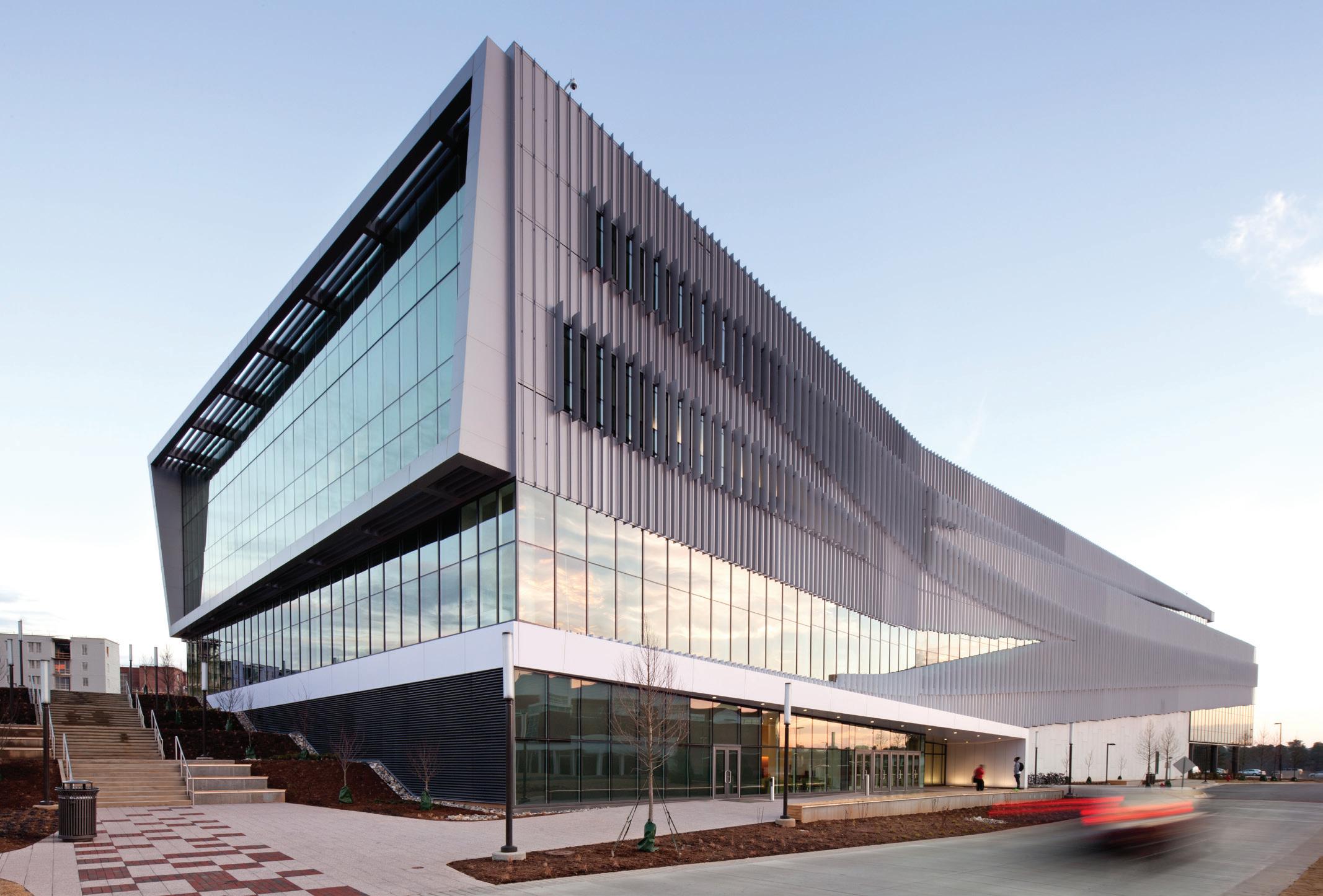
James B. Hunt Jr. Library makes a statement with open design and a connection to its environment.
+ SPONSORED SECTIONS
NC GOLF
28 ROUND TABLE: TRANSPORTATION
North Carolina benefits from good highways, access to airports, railroads and ports. Five experts discuss the challenges of keeping state’s commerce moving.
84
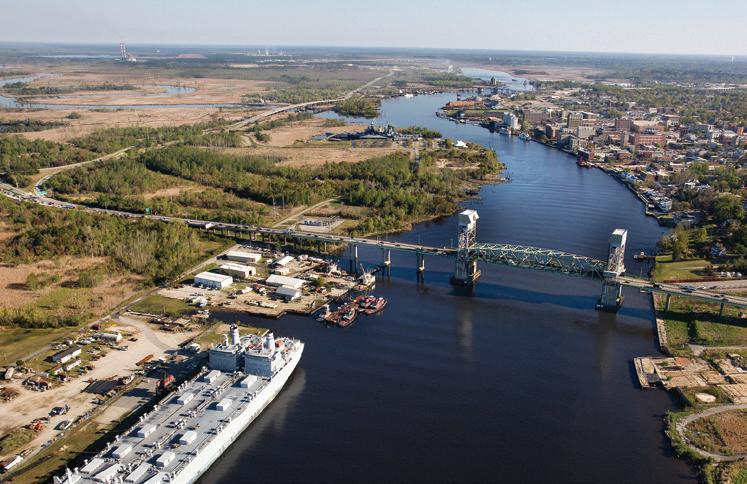
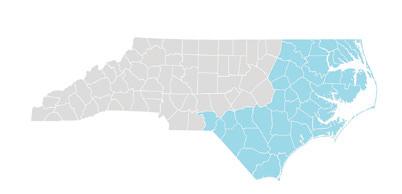
COMMUNITY CLOSE-UP: SOUTHEAST NC
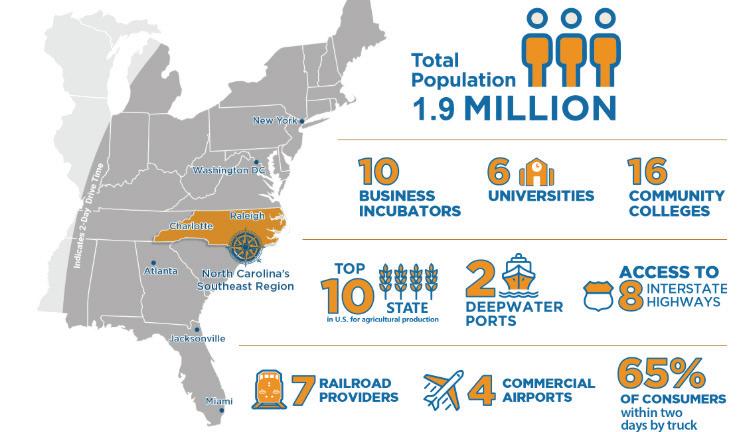
Textiles and agriculture remain economic contributors to the 20 counties that make up southeastern North Carolina. Now, e-commerce, technology, aerospace and defense firms are boosting the region.
88 INDUSTRIAL PARKS
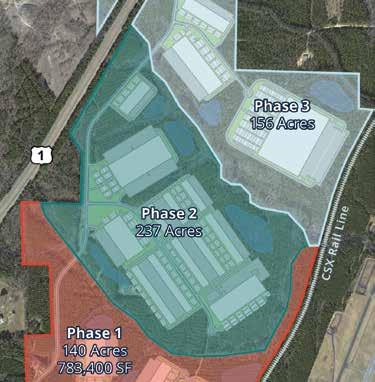
Prepping sites for industrial development across the state can help counties dealing with a shifting economy or overcoming natural disaster.
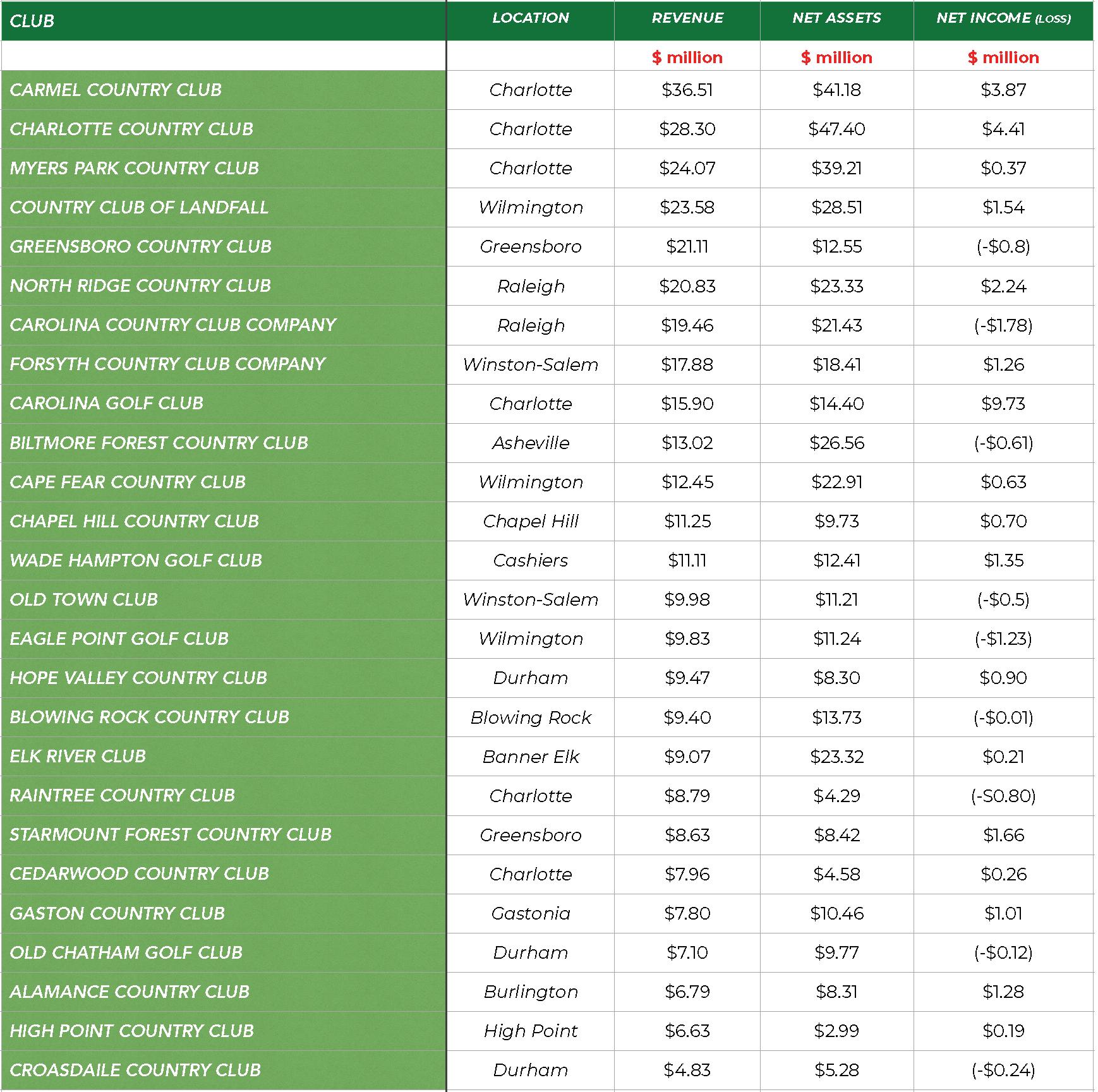
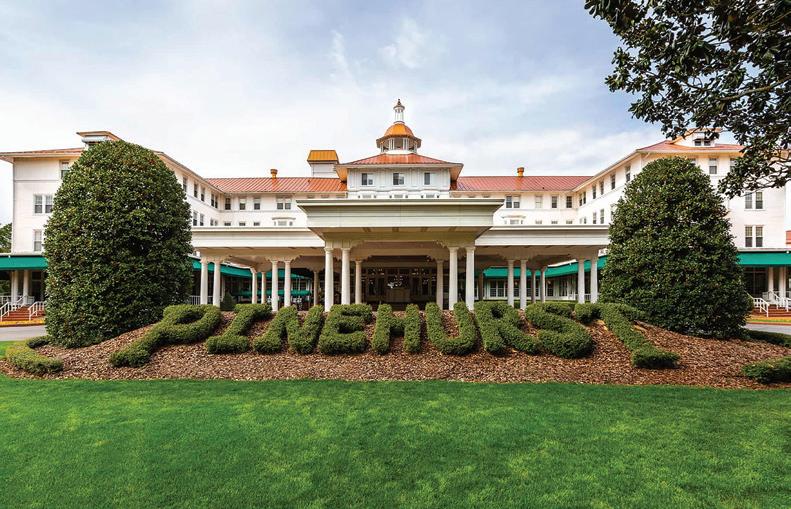
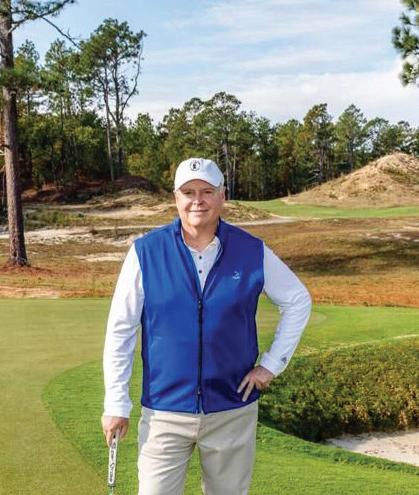
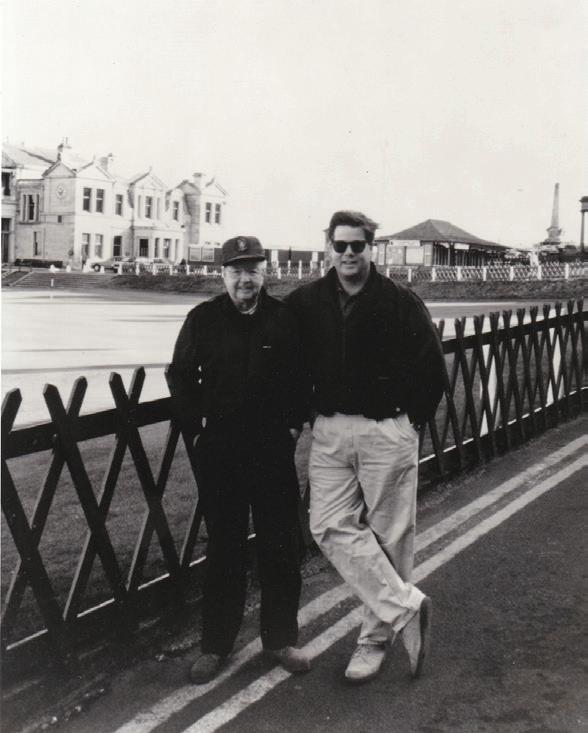
The N.C. Golf Panel presents the state’s best courses; An insider’s look at the rankings; Financials of member-owned golf clubs; A dedicated birdie tracker; Pinehurst and the American Dream; Beloved book “Final Rounds” struggles to reach the silver screen.
BY JIM POMERANZ
AND JAMES DODSON
READY FOR TAKEOFF
Piedmont Triad International Airport finds its way as an emerging major U.S. aerospace manufacturing center.
BY TUCKER MITCHELL
OPEN-MINDED FLIGHT
JetZero CEO Tom O’Leary believes the right work culture is key to building a revolutionary jet factory in Greensboro.
BY CHRIS BURRITT
ORBIT OPPORTUNITY
Financial heavyweights picture success at satellite imagery company Satellogic. Can it fulfill their sky-high expectations?
BY DAVID MILDENBERG
COMPACT COTTAGES
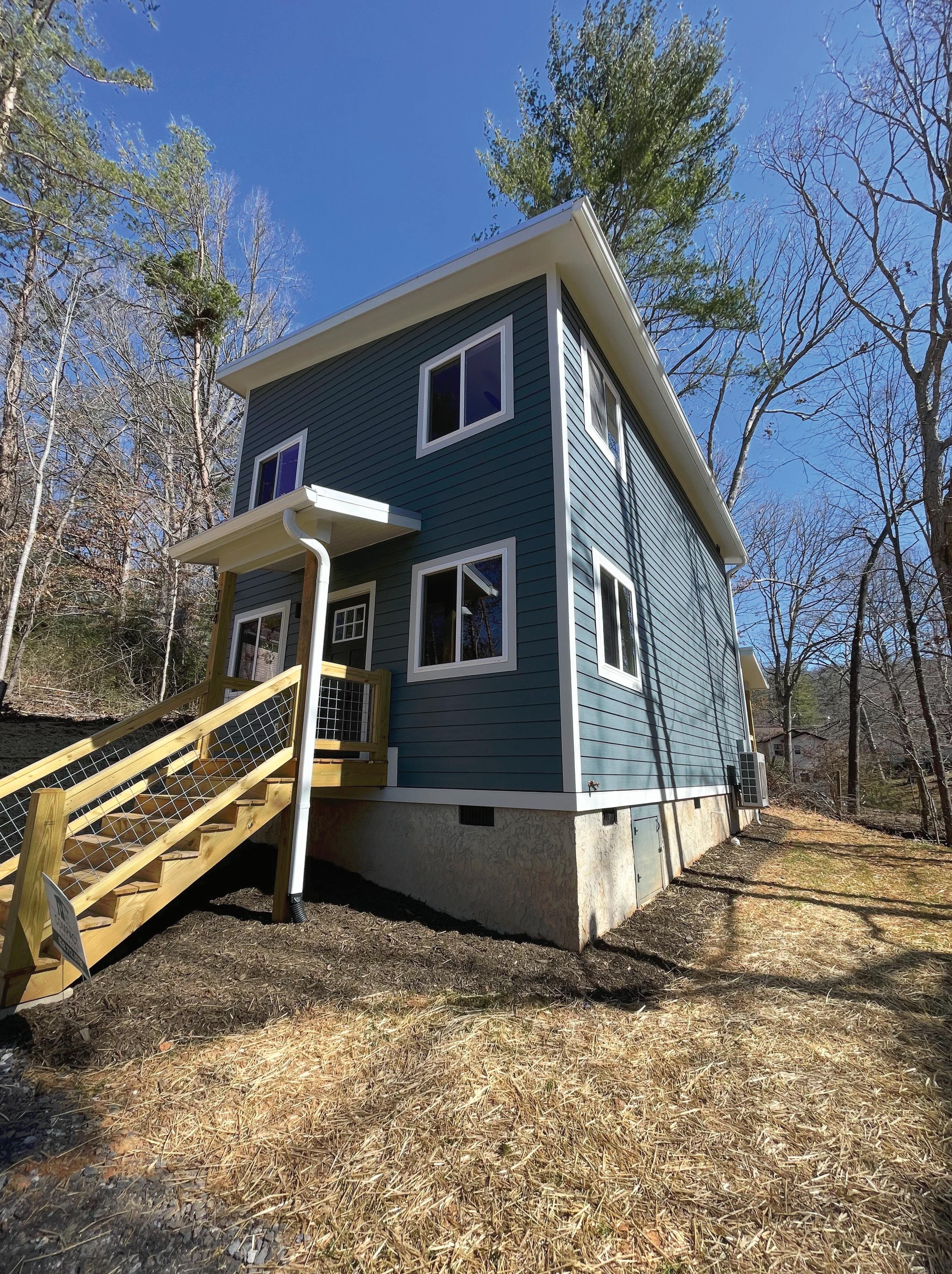
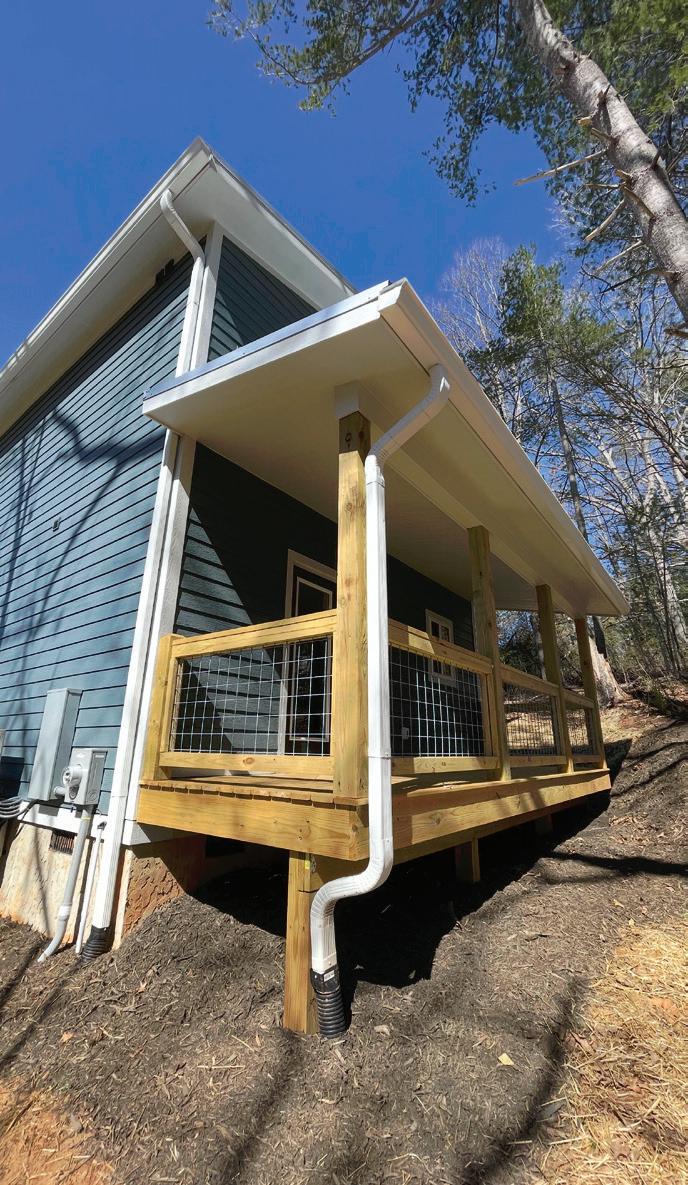
An Asheville company creates smallish homes to help people buy houses, attacking the statewide affordability crisis.
BY KEVIN ELLIS
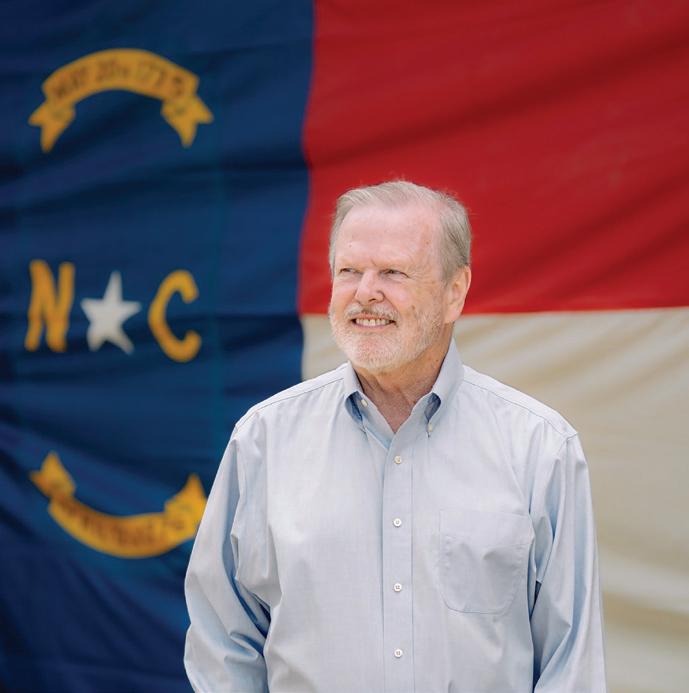
UP FRONT David Mildenberg
FORK IN THE ROAD
It’s been a dozen years since Business North Carolina named Phil Berger its “Man of the Year” in a prophetic story by veteran journalist Jack Betts. The story quoted Democratic strategist Gary Pearce’s description of Berger as the GOP’s MVP, “head and shoulders above the rest.”
Political columnist Rob Christensen told Betts that Berger had become “the new Marc Basnight, the most powerful figure in state government.” The Manteo Democrat had led the Senate from 1993 to 2010.
Even Betts could not have foreseen the dominance Berger assumed in setting North Carolina's agenda over the next decade. Under Berger, North Carolina’s traditional center-right approach to issues became more ideological and conservative. Lower tax rates, less stringent environmental regulations, more school choice, reduced gubernatorial power and less liberal UNC System governance have been championed by the Rockingham County lawyer.
O ur state’s business community has largely cheered on those changes, bolstered by a Raleigh lobbyist-industrial complex that bankrolls, relies on and fears Berger. Progressive influencers have been largely silenced, and even prominent corporate leaders critical of Berger's views keep their lips sealed.
T he state has prospered economically. Few places are more desirable to build a career, start a family or spend retirement than North Carolina. Still, income inequality, ineffective public schools and high healthcare costs remain vexing challenges.
B erger’s record of exerting power is particularly remarkable given his personal story, which Betts explained expertly in 2014. The first in his family to attend college, Berger dropped out of a two-year school in Danville, Virginia, to take a factory job, and later signed on at a Kroger store. He resumed his education, earning a bachelor’s degree at Averett College in Danville while working as a produce manager. No silver spoons.
L aw school at Wake Forest University followed, and then legal jobs in Charlotte and Raleigh before he joined an Eden law firm in 1984 at age 32. Always a Republican, he lost his first primary bid for the state House by seven votes in 1994. In 2000, encouraged by longtime GOP politician Virginia Foxx,
he won a state Senate seat. At the time, Republicans held 15 of the 50 seats.
A decade later, he became the Senate leader. In 2013, Republicans controlled 31 seats in the body. This year, they hold 30.
W hile differing on many issues, Berger fulfilled his agenda in the same style as Basnight, relying on five or six colleagues to make key decisions. Meanwhile, the other 45 or so senators mostly wait to be told what to do.
T hen the March 3 election happened.
At press time, it isn’t clear if Berger will continue to represent N.C. Senate District 26, pending a vote recount and likely litigation as he claws to hang on. Still, it appears Rockingham County Sheriff Sam Page pulled off the biggest political upset in state history. About 26,250 voters took part, affecting a state of nearly 11 million.
Most pundits credit Page’s victory to Berger’s support for a casino to compete with a new gambling hall across the state line in nearby Danville. The senator expected the slots to attract jobs, money and tax revenue. Instead, many folks feared more crime and congestion, blocking the casino.
T here’s more to Berger’s possible loss, however. By raising $10 million-plus from many of the state’s most powerful people and PACs, and securing Donald Trump’s endorsement, the election should have been a slamdunk. His campaign, led by former aides Jim Blaine and Ray Martin, savaged a popular 28-year sheriff, inevitably turning off some voters. Emphasizing Berger’s accomplishments during his 25-year tenure would have been more honorable and effective.
A bout half of District 26 voters decided it's time for decided it’s time for fresh leadership and vision. While respecting Berger’s impactful career, many residents of all political stripes across North Carolina seem inclined to agree in this tumultuous year.
PUBLISHER
Ben Kinney bkinney@businessnc.com
EDITOR David Mildenberg dmildenberg@businessnc.com
MANAGING EDITOR Kevin Ellis kellis@businessnc.com
ASSOCIATE EDITORS
Ray Gronberg rgronberg@businessnc.com
Cathy Martin cmartin@businessnc.com
CONTRIBUTING WRITERS
Dan Barkin, Chris Burritt, James Dodson, Bill Horner III, Vanessa Infanzon, Caroline Khalaf, Tucker Mitchell, Jim Pomeranz, Lori D.R. Wiggins
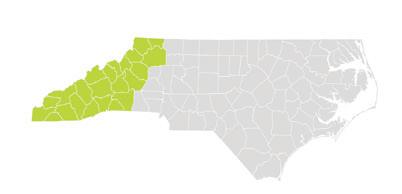
Anne Brundage, western N.C. abrundage@businessnc.com
CIRCULATION: 818-286-3106
EDITORIAL: 704-523-6987
REPRINTS: circulation@businessnc.com
OWNERS
Jack Andrews, Frank Daniels III, David Woronoff, in memoriam Frank Daniels Jr.
PUBLISHED BY Old North State Magazines LLC
PRESIDENT David Woronoff BUSINESSNC.COM
Phil Berger
LEIGH BRADY
GIVING BACK
State Employees’ Credit Union CEO Leigh Brady joined High Point University President Nido Qubein in the Power List interview, a partnership for discussions with influential leaders. The interview was edited for clarity.
Are most of your members employees of the state of North Carolina?
Our core membership base has never changed. We serve state and public school employees and their immediate family members. That includes the UNC system and the community college system as well. Our growth has been in that immediate family membership. Let’s say I’m a member and my parents joined, then my siblings could join, and it balloons from there. So, primarily, membership has increased because of immediate family relationships.
What is the uniqueness of credit unions?
The uniqueness is really more of giving back. We are a not-forprofit cooperative model. Our members come, and they deposit money and make that available to others who might need to borrow money. We operate under the people-helping-people philosophy of
Leigh Brady is president and CEO of State Employees’ Credit Union, the nation’s second-largest credit union with $57 billion in assets, 275 branch offices and 2.8 million members. It started in Raleigh in 1937 when 17 state employees pooled $437 to start the organization. A 37-year employee, the Wilson native was named CEO in 2023 after serving as chief operating officer. She has a bachelor’s degree from NC State University and an MBA from Meredith College. She is on the executive committee of America’s Credit Unions CEO Council.
credit unions. At SECU and really at all credit unions, a big part of our mission is giving back. That might be in the form of giving back to our members and helping them keep money in their pockets. And it’s giving back also to the communities that we serve.
When you say give back to the members, put money in their pocket, what does that mean?
It’s in a model that you get a lower loan rate, maybe a higher deposit rate or low to no fees in a lot of cases. If you are looking at how much, on average, our members pay in a year, it’s $20 in fees. That is across the board for everything. We are probably fourth-lowest in the country in terms of fee structure among credit unions.
Do credit unions look at assets and deposits in the same way banks look at them?
Yes. We also look at deposits, and obviously, you want to have a set amount in capital to show the strength of the organization as well. We are a bit of a different model than banks in terms of risk-based capital.
Banks are for profit, they have shareholders. They are issuing dividends or growing their stock market value, while credit unions pass these on in the form of lower fees or lower rates. What are some other differences?
At SECU, we are strictly focused on consumers at this point. We don’t have business services, which is different than banks. They typically serve commercial clients. And we do not do that. Our members have been asking us to offer small business services. I’m not going to say that we’re not going to do that in the future, but it would be from the standpoint of small business. It is not going out and doing huge commercial lending and huge commercial banking services.
So it is the mom and pop, a state employee retiree, for instance, who wants to have a lawn maintenance business in their retirement years. We’re doing a lot of technology upgrades and things that’ll take the next few years to be able to prepare for something like that.
You’ve seen a lot of change in the financial services industry. How is SECU staying competitive?
We operate in all 100 North Carolina counties, but only in North Carolina. And I think that’s important because that’s also a differentiator from other credit unions. In terms of the financial services industry, and I hate to say this, but after 38 years, that member-owner aspect is not as strong as it used to be.
Most members have more than one financial institution now. And 20 years ago that was not the case. We’re viewed more as a commodity. We may still be what they would consider their primary financial institution, but in essence, most households have relationships with four to seven institutions. That could be anywhere from your credit card relationship to a great rate on a CD or a money market somewhere, or you have investment services held elsewhere.
Obviously that changes the need for us as an institution and what we offer. We actually have a North Carolina domiciled insurance company, SECU Life Insurance, and we have financial advisory services for investment and brokerage services. We’ve been working over the years to fine-tune these things because we’ve seen this happening in the marketplace.
One thing I can tell you that is not changing is that if it’s a bank, it’s a customer. If it’s a credit union, it’s a member. When a member has a problem, they want to either be able to get someone on the phone immediately to help them, or they want to go to a physical location and talk with someone.
Would you say credit unions as a whole nationally have kept up with the times in terms of the competitive terrain, the technological sphere and regulations?
We are a state-chartered credit union. In terms of the regulatory environment, that absolutely has become more stringent, certainly for credit unions and for banks. In terms of what we are doing for the future, you talk about relevance and about what’s happening in the marketplace from the regulatory standpoint, credit unions and banks are competing against fintechs, and they’re not regulated. So you’re not on a level playing field in all cases. So you have to differentiate yourself somehow.
Some credit unions are using AI for loan decisioning completely. While we have a consumer point of sale that may give a yes immediately, it will never deny anyone immediately. We always want a member’s denial to be looked at by an individual. Every human denial that we’re making is also looked at.
How many employees does SECU have?
If you include our part time, interns, contract workers and full time, we have about 8,225. If you look at that compared to where we were three years ago, we are down full-time employees.
Is it because of technology?
Some of it is, and we’re trying to be more efficient with things. We’ve really tried to look at where we are and where we want to be in the future and how do you get there? And some of the tasks that are being done, it’s why are we doing it this way? We figured out a way to eliminate most of our tickets in our branches, and that’s a huge lift for our branch team members. We want them to be able to spend that time helping a member in some way.
Banks for a long time struggled with closing down branches. Now you hear some are building branches. How does that compare with credit unions?
We’re unique in having a branch in all 100 North Carolina counties. In some communities, we may be the only financial institution left. A great example is Columbia, in northeast North Carolina.
We know that not every branch we have is what a bank might consider a profit center. That being said, we are able to subsidize having those locations in those communities.
Ideally it would be great for us to be able to serve tier one communities in North Carolina that don’t have any other options.
Are you keeping up with the technological excellence of the large banks in North Carolina?
I won’t say that we are always keeping up and we are not even at this point what I would consider a fast follower on technology. We are certainly a follower on technology, but we have a wonderful adoption of our digital platform, for instance, on mobile banking. We have mobile check deposits that members utilize. We have 1,100 ATMs in North Carolina, and folks are still using those. In the first quarter of next year, we’re rolling out our new digital platform.
What about cybersecurity?
That is huge. We’ve really beefed up over the last few years in our cybersecurity area. You have to maintain the latest and the greatest in terms of talent and to thwart whatever threats are out there. That has to be top of radar.
If profit is not your primary focus, what is it besides service? Is it efficiency and productivity? How does that compare with banks?
Obviously taxation is an issue for banks and some bankers say, ‘If you’re big, then you’re not doing things right in terms of a credit union.’ I would argue that every single day. If you look at our model, that’s been a consumer-only model. If you look at the low fees that we charge, the great rates that we pay on deposits or that we charge on loans, or if you look at our $1 monthly maintenance fee on our checking accounts.
For about 99% of our members, that dollar a month fee goes to the SECU Foundation. It’s a great example of a cooperative model, and we just celebrated the foundation’s 20-year anniversary, and over $350 million has been given to North Carolina.
You might visit the SECU Cancer Center in Asheville or in New Bern, or you might go to SECU Family House at UNC hospitals or in Winston-Salem or at the coast. Or you might go to numerous hospice houses, or you might visit the SECU education centers at the museums, or you may be one of the recipients of the People Helping People scholarships that we provide on an annual basis for public school folks to attend a UNC System-type school or community college scholarships. ■
TROLLING FOR TOURISTS
Fairy tale charm translates into lots of visitors at four N.C. locations.
By Vanessa Infanzon
Ashort path through High Point’s Southwest Mill District leads to “Little Sally,” Thomas Dambo’s 18foot troll. It’s one of the artist’s 171 trolls across the globe, each made with recycled wood.
“Little Sally’s” hair, a nod to the area’s furniture business, is made from chair leg samples from Wise Living, a custom furniture manufacturer in High Point.
“Dambo’s Trolls are a work of true craftsmanship and artistic imagination — almost like a real-life fairy tale,” says Maxwell Taro, director of operations at Metropolitan Galleries, a High Point-based company that makes bronze sculptures. “People slow down to examine the details of the sculpture. Art grounds us, making us feel small, not in a diminishing way, but in a majestic one — inviting the mind to explore creations beyond its reach.”
Groups in Charlotte, High Point and Raleigh commissioned Denmark native Dambo to design and install semi-permanent trolls, which are meant to last 10 to 15 years outside. In fall 2025, Charlotte and High Point each received one troll, while five landed in Raleigh’s Dix Park.
The seven trolls are connected by a story Dambo shares at each ribbon-cutting: find all the trolls and figure out where the Grandmother Tree is located.
WHIMSICAL CREATURES WITH A PRICE TAG
After starting with sculptures of birdhouses, castles and trees, Dambo created his first trolls, Mr. and Mrs. Limbo, for a Danish music festival in 2014. His work evolved into 15-foot to 36-foot sculptures, seen leaping through the woods, meditating, playing hide and seek, or resting on the bank of a lake. Some sculptures are more than 90 feet long.
His guidelines insist that the creatures appear in natural areas with limited foot traffic. Accessibility isn’t his concern; he wants his trolls to be hidden to encourage visitors to explore nature.
“My mission is Waste No More: our world is drowning in trash while we are running out of natural resources. I choose to spend my life showing the world that beautiful things can be made out of trash,” he said on the website of The River District, a 1,200-acre mixed-use development in west Charlotte that has one of his trolls.
Since 2014, Dambo has built 171 trolls globally, including Mexico, China and 19 U.S. states. Seven more states have plans for installations, including South Carolina, and Dambo says his goal is to build 1,000. Total cost for a troll varies from $50,000 to $350,000.
In North Carolina, private donors have financed the art. Dix Park Conservancy Art Task Force Chair Marjorie Hodges and her husband, real estate executive Carlton Midyette, were the lead donors for the park’s five trolls. In High Point, the David R. Hayworth Foundation provided $300,000 for “Little Sally.” In Charlotte, Crescent Communities funded “Big Pete” at its River District project.
The “Dux” troll is a popular attraction for Raleigh’s Dix Park.
DRAWING A CROWD
The trolls have gained many fans in a hurry.
“We have spent more money on other projects than we’ve spent on Pete, and they will not have nearly the amount of attention and draw and success as Pete,” says Andrew Baysden, Crescent’s marketing director at the River District. More than 100,000 people have visited “Big Pete” since November. “Pete’s return on investment is already accomplished due to his attention.”
At Dix Park, the conservancy estimates 500,000 to 600,000 visits since the October installation, boosting attendance by 300%, officials say.
Meanwhile, the gain in visitors was even greater at the North Carolina Arboretum in Asheville, which hosted a traveling exhibit of 12 Dambo trolls from mid-November through mid-February.
The Visit High Point tourism group used geofencing technology to determine that more than 46,000 visitors saw “Little Sally” between Nov. 7 and Feb. 8. It estimates 11,000 troll fans spent a night in a local hotel. The troll is part of a prospective $32 million greenway project in southwest High Point that is expected to open in late 2028 with more than four miles of trails.
“Sometimes public art is looked at as just an amenity,” says Melody Burnett, president of Visit High Point. “‘Little Sally’ is quite the opposite. [It] is serving as an attractor.” ■
Danish wood sculptor Thomas Dambo’s trolls have made a global mark, perhaps none bigger than in North Carolina, home to his largest permanent collection.
“Little Sally” landed in High Point in November, sponsored by a public-private partnership.
STATE OF MOTION
A SAS veteran revs North Carolina’s push to benefit from AI advances.
By Bill Horner III
Just weeks ago, I-Sah Hsieh reconnected with a friend he’d not seen in years, mentioning his work as deputy secretary for AI & Policy for the N.C. Department of Information Technology.
“Oh, the friend texted. “I guess we have to be mortal enemies. You’re The Terminator, and I’m Kyle Reese.”
Hsieh recalls laughing at the Hollywood trope of an unstoppable, coldblooded cyborg versus a scrappy resistance fighter.
“I told him, ‘I’m really just trying to get people through the DMV faster,’” he says.
“Oh,” well in that case, please! Carry on,” the friend replied.
Before joining state government last year, Hsieh, 50, spent 21 years at Cary-based SAS, becoming the software company’s AI governance and data ethics leader. He helped Fortune 1000 executives, the United Nations and policymakers develop AI solutions. It was data for good, he explains, responding to natural and man-made disasters.
But a paradox nagged him: he advised from the sidelines, not owning outcomes. When Teena Piccione, a former Google executive who is secretary of the N.C. DIT, asked him to lead the state’s AI journey, Hsieh didn’t hesitate.
ACCELERATING AI
Quantitative analysis and advanced math are not new. The base concept of AI — computers solving problems that normally require human judgment — will turn 70 next year. SAS turns 50 in July.
But in 2026, rapidly evolving generative AI is becoming exponentially better and more powerful — and scary, Hsieh acknowledges. He sees his job as innovation and protection. When it comes to AI usage, he wants the state “to drive like our friends down in Charlotte in NASCAR, to be masters of both speed and safety.”
I-Sah Hsieh, an AI governance/ethics expert with more than 25 years’ experience, is the N.C. Department of Information Technology’s deputy secretary for artificial intelligence and policy.
Potential applications are endless. “No shortages of real-world problems,” Hsieh says. State government, by design, is cautious, though he says aligned leadership from Gov. Josh Stein on down gives his team room to move quickly.
The approach is structured around three pillars outlined in Stein’s executive order issued last September: an AI Accelerator to test ideas quickly; agency-level AI oversight committees; and a 27-member governor’s AI Leadership Council drawing expertise from government, academia and the private sector, with a goal of creating mechanisms for innovation.
Chief among the strategies is the AI Accelerator. Functioning as a collaboration hub, it requires each state agency to submit three ideas to the Accelerator and for agencies to explore and pilot AI solutions. Vetted ideas move through a structured 60-day sprint (a strategy deployed by SAS and software companies) and get reviewed, refined, and piloted to determine whether they can measurably improve efficiency, decision-making or service delivery for North Carolinians.
Hsieh thinks mandating submissions from state agencies will create “move-the needle” breakthroughs.
“That essentially nudged everybody into the AI pool,” Hsieh says. “My promise to the governor and to our agencies and our citizens is, ‘We’re going to make sure that with those three submissions, we have thoughtful conversations about whether it’s a good problem [to address].’”
Hsieh acknowledges the palpable fear around AI, particularly among workers. In February, Bank of America CEO Brian Moynihan noted that the second-largest U.S. bank had either avoided hiring or replaced about 2,000 roles because of AIdriven efficiencies. He also said that the bank’s Erica virtual assistant is handling the work of 11,000 people.
To help calm fears, North Carolina is requiring its 70,000plus state employees to become AI certified. That will create more fluency and literacy about trustworthy AI usage, Hsieh says.
“All you see in the media is AI is going to take your job,” he says. “But when we sit down with them and start talking about all the different ways AI can and cannot help that problem, there’s less fear … they’re more grounded in what’s factual versus hype. And so I love in conversations when you see that light bulb moment, where they’re saying: ‘Oh, I get it now.’ It’s ‘Yes, please.’ It helps people react to what’s possible.”
At the N.C. Department of Motor Vehicles, Hsieh’s team built four operational prototypes. One utilized vibe coding, writing 2,200 lines of code in 30 minutes. A programmer might need a month or two to complete a similar job.
Hsieh isn’t ready to share specifics on two tech modernization projects at DMV, but says one prototype will save “at least 3,700 hours a year” for an agency group.
BUILDING TRUST
“I’m incredibly excited about the many ideas we’ve had submitted so far and their potential to generate quick wins for our state,” Piccione says. “My hope for the Accelerator is that it continues to build trust and foster close collaboration across all sectors. We’re pleased with how it has already brought everyone together to further the adoption of trustworthy AI for the benefit and protection of our state.”
While AI is moving faster than state administrations can deploy it, Hsieh says his nimble eight-person office helps.
An example is the potential use of so-called synthetic data, which is statistically accurate data about behavioral patterns without exposing the identities of real North Carolinians.
This application could accelerate medical research by having AI swap real records for mathematically equivalent stand-ins that protect privacy.
North Carolina’s efforts have moved the state’s standing in AI expertise to seventh nationally, according to San Antonio, Texas-based Chadix, an AI consulting firm that studied media and federal government reports.
Hsieh doubts North Carolina will outspend other states on AI, but his goal is a culture of trust. “That’s the bar we set,” he says.
“We want to be the gold standard for trustworthy AI.”
Ultimately, though, it’s about results. Hsieh focuses on impact, cost, speed and accuracy, which can result in shorter lines, faster service, smarter responses, plus guardrails strong enough to keep the tech from going sideways.
The Stein administration “is opening doors and moving roadblocks,” Hsieh says. “What that allows me to do is function like a startup inside state government. And we’re able to move much faster.” ■
I-Sah Hsieh
NC TREND
LIFELONG LEARNERS
A Raleigh family business fills libraries with attractive, hearty furniture.
By Caroline Khalaf
t’s rare to ever think about library furniture — where it comes from, how it is built or who built it. Neither did Raleigh’s Carroll family, until they became one of the category’s leading U.S. manufacturers of shelves, media centers and other products.
I“It’s a very niche industry,” says Abigail Jackson, granddaughter of the founders of Russwood. “Anytime I speak about it, people always chuckle at how they didn’t even know it was a thing.”
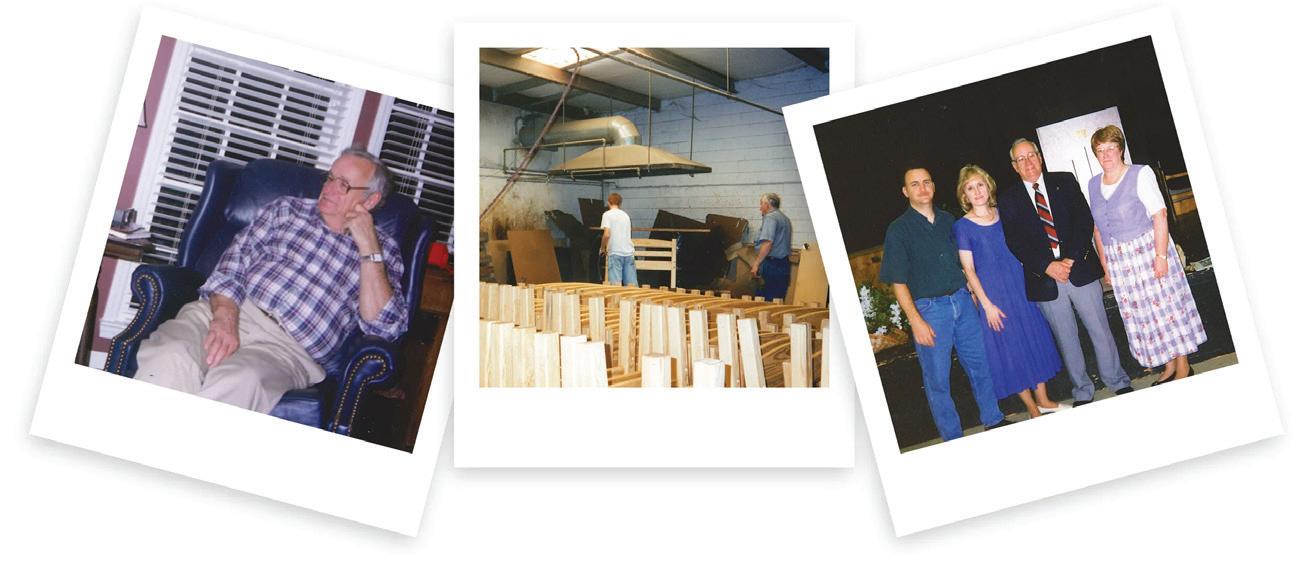
In 1976, Russell and Mozelle Carroll and their son Rusty began building furniture in a tin shelter attached to a pig pen behind their Raleigh house. It wasn’t their rst choice of occupation, but it became their legacy.
“My dad would do odd jobs to help put my sisters and myself through private school. So one Wednesday night at church, our neighbor around the corner told us these two guys in Raleigh were looking for somebody to build these pine boxes,” says Rusty Carroll, who is now president of the business.
By then, the Carrolls had pivoted to library furniture a er hiring a veteran cra sman who was skilled in making shelving. In 1995, they renamed the company Russwood Library Furniture.
By God’s grace, as Carroll tells it, shortly a er the abrupt cancellation from is End Up, Russwood received messages from two dealers wanting to sell library furniture.
e two men were Randall Ward and Steve Robertson, NC State graduates who started is End Up Furniture in 1975. ey told Russell, “If you work for us, we’ll take care of you,” and they did.
While Ward and Robertson sold the business for more than $45 million in 1985, the Carrolls continued to make magazine racks, bunk bed railings and rocking horses for the new owners. e partnership took a turn in February 2000 with a single voicemail, when is End Up told Carroll not to ship any more furniture.
“My rst question was, ‘What did we do wrong to this new owner?’” Rusty said. e answer was ‘nothing.’ ey were ling for bankruptcy.” ( is End Up emerged under new ownership and is now based in Sanford.)
FAMILY TIES
Russwood has about 70 employees in Raleigh and eight in Hudson, where in 2024 it bought a local business, Philmark, which specialized in lounge furniture. Rusty Carroll’s sisters, Donna Watkins and Connie Carroll, are vice presidents. at quali es Russwood as a woman-owned business, which can be helpful when selling to public sector customers.
Watkins’ daughter, Jennifer Durham, is the purchasing o cer and Rusty’s son-in-law, Jon Jackson, is marketing director.
“When we say the Russwood family, we’re not talking about just our family. We’re talking about the employees, the dealers, the school systems, the architects, the designers and anyone else who is a part of us,” Carroll says.
Russell Carroll Sr. with his children Donna, Connie and Rusty
As Abigail grew up around her father’s employees, she recalls thinking of them as her second family. She worked at Russwood for nine years as a project manager, and is now an architectural photographer. “Family is what we’re about, it’s not just about us. It’s about providing jobs so that people can provide for their families,” she says.
Russwood’s longevity is rare for its industry. According to the U.S. Bureau of Labor Statistics, North Carolina’s furniture industry employment declined from 78,000 in 2000 to 28,000 last year.
e company’s success refutes the idea that libraries are going away. Rather, they are evolving with better furniture and technology, Carroll says. Since 2015, Russwood has sold a line called Palette that lets schools select colors for modern, playful pieces.
“Changes have made the library more relaxing for the students, more of a community feel,” Carroll says. “We build a line called Engage tables where you might have three tables that come together and break apart. It’s all very exible.”
One thing that hasn’t changed is that about 70% of Russwood’s shelving is solid wood, with plastic laminate making up the balance. ose shelves need to be durable, with some holding encyclopedias for more than 30 years.
e furniture industry has felt the weight of tari s on imported goods. In September, the Trump administration
announced tari rates would increase by 50% for cabinets and 30% for upholstered furniture. e impact has been minimal at Russwood, which sources 90% of materials in the U.S. and manufactures in North Carolina.
e company that started in a 400-square-foot shed now has more than 100,000 square feet of manufacturing space. “It all began with mom and dad in humble beginnings,” Carroll says.
Now in his 50th year at the family business, Carroll de ects credit. “No, God’s done this. He gives me the breath in my body, my eyesight, my hearing, the ability to walk and work and think. I don’t take the credit for any of this.” ■
Steady demand from libraries has sustained Russwod.
TESTING
1, 2, 3
A new N.C. public company looks for precision results and accelerated growth after a corporate spinoff.
By Chris Burritt
Last June, Ralliant Corp. became among North Carolina’s 25 largest publicly traded companies as it was spun o from Everett, Washington-based Fortive.
So what is a Ralliant?
e short answer is that it’s a producer of testing equipment, sensors and other products, and the latest outcome of a string of nancial transactions involving Fortive. Raleigh gained a corporate headquarters company with annual sales topping $2 billion and is paying its 150 local employees an average annual salary of nearly $189,500. at is more than double the typical Wake County salary of nearly $77,000.
e company concluded Raleigh is an attractive place to live and is part of an innovation culture backed by strong educational resources, according to CEO Tami Newcombe. She joined Fortive in 2017 a er working as vice president of sales at Cisco Systems for eight years.
“We wanted to be a place where we could attract talent and a place that talent wanted to live,” she said in an interview a er the company opened its North Hills o ce in February. “ at was probably No. 1 on the list.”
“No. 2, as a technology company, where is innovation happening?’’ she adds. “And No. 3 and tied to No. 2 and innovation is the education system. I don’t just mean the three big universities here. I mean, the whole ecosystem from really good high school technical talent to community colleges and technical schools — the whole ecosystem of talent that is important to us.’’
Ralliant pledged to invest $2.1 million and create 180 jobs in exchange for $3.4 million in state and county incentives. e state is providing a Job Development Investment Grant of $3.3 million spread over 12 years.
Ralliant designs and makes and highly engineered products: test and measurement for scientists, engineers and technicians, and sensors and safety systems.
e company has about 7,000 employees globally, including about 1,300 engineers, according to a securities ling. It has 90,000 customers in 90-plus countries, with half of sales from outside the U.S. and lots of exposure in the semiconductor, electronics, electric utilities and defense. Its 29 “signi cant facilities” include 17 U.S. operations in 10 states, along with 12 in other nations, including three in China.
Its sole N.C. plant is the Hengstler-Dynapar factory that employs 300 in Elizabethtown in Bladen County. It’s part of Ralliant’s sensors and safety systems group.
A er several years of at revenue and pro t, Ralliant took a goodwill impairment charge of $1.4 billion last year, largely because of expected lower sales in a business unit a ected by slowing adoption of electric vehicles. e larger sensors and safety systems business, which makes up about 60% of sales, reported organic growth of nearly 5%.
So far, investors have shown limited interest. In mid-March, Ralliant shares were trading about 9% lower than the initial price of $47 last June.
Fortive was created in 2016 in a spino by conglomerate Danaher, and then four years later, it split o its transportation businesses into a new company, Raleigh-based Vontier. Its holdings include Gilbarco Veeder Root, a Greensboro-based manufacturer of gas pumps. Vontier had $3 billion in 2025 revenue and a mid-March market valuation of about $5.3 billion.
Last year, Newcombe hired former Wolfspeed Chief Financial O cer Neill Reynolds for the top nance slot. Another key hire was Amir Kazmi as chief technology and growth o cer; he had been chief information and digital o cer at packaging giant WestRock from 2017 to 2024.
“As we look ahead to 2026, we are well positioned with secular growth drivers, a healthy balance sheet and clear strategic priorities guiding where we invest to create long-term value,” Newcombe told analysts in February a er reporting its latest results.■
CEO Tami Newcombe rings the bell at Ralliant’s New York Stock Exchange debut.
NC TREND ›››
PROOF IN THE ROOF
North Carolina’s coastal wind insurer promotes adoption of stronger roofs to reduce hurricane damage and limit claims.
By Kevin Ellis
North Carolina homeowners saw their insurance premiums rise by an average 44% between 2020-25 as storms pummeled the state with increased frequency and severity, a LendingTree study shows. Now, an insurer for homeowners in 18 N.C. coastal counties is trying to solve an underlying issue and make homes safer and less susceptible to hurricane-force winds.
Since 2016, the North Carolina Insurance Underwriting Association has invested $131 million in programs and grants to encourage residents to install “Forti ed” roofs on their homes that can better protect homes from damage caused by high winds and heavy rains. e association was created by the state in 1969 as a nonpro t property insurer of last resort for coastal counties.
So far, more than 22,000 residents have taken part in the Forti ed roof program, which was created by the Insurance Institute for Business and Home Safety, a nonpro t research organization headquartered in Richburg, South Carolina.
“It’s wonderful if you have insurance, but it’s even more wonderful if you don’t have to leave your home for repairs,” says Gina Hardy, CEO of the underwriting association. e group, o en called the Coastal Property Insurance Pool, insures more than 264,000 homeowners in the state. Nearly 80% have “wind only” coverage, which wraps around the insurance provided by private-market companies.
Construction techniques and materials in a Forti ed roof reduce potential water intrusion by more than 95% compared with
a standard roof. e Forti ed roof costs about 10% to 25% more than a standard roof, typically $1,200 to $3,200, o cals say. e higher cost can be o set by NCIUA programs such as Strengthen Your Coastal Roof, which provides grants of as much as $10,000 for policyholders in the Outer Banks and barrier islands to replace an existing roof with a more resilient one. e state contributed $7 million to the program in 2021 and $2 million in 2023. e association uses its surplus, the di erence between assets and liabilities, to fund the grant programs.
Forti ed roofs reduce damage caused by coastal storms, but also can lead to insurance credits and lower premiums, says N.C. Insurance Commissioner Mike Causey. His department has nal say on rate-setting, and he’s a big fan of stronger roofs. He cites research from NC State University’s Institute for Advanced Analytics showing “homes with a Forti ed roof had about 35% fewer claims a er Hurricanes Matthew, Florence, Dorian, and Isaias. When claims were led, the damage was about 23% less severe.”
“We have found storm a er storm a er storm, [forti ed roofs] perform better than even brand-new code roofs. And we save money doing it. We save money as an insurance company,” says Don Hornstein, a UNC Chapel Hill School of Law professor and a member of the NCIUA’s board of directors. He made the comment in a blog by Hope ompson, who tracks disaster insurance for the Washington, D.C.-based Natural Resources Defense Council.
NCIUA’s program is gaining momentum as initially skeptical homeowners understand the bene ts and receive grants, Hardy says. It also takes time for roo ng contractors to train workers how to install the enhanced roofs.
e insurer is better o because they are less likely to pay claims, and the state is better o because people can stay in their homes a er a disaster, which requires fewer public resources, she notes.
“We always encourage all of our policyholders to evacuate in case of a storm,” says Hardy, “but it’s nice to come home to an intact home.” ■
Gina Hardy is CEO of the N.C. Insurance Underwriting Association.
is
A CAPTIVATING SOLUTION
As managing director of PNC Institutional Asset Management®’s Insurance Solutions Group, Charlottebased Wade Meadows helps organizations implement a broad range of strategies, including an increasingly popular vehicle for financing risk: captive insurance programs.
“With risk management costs rising – and with some risks becoming too difficult to insure at all, organizations are increasingly looking to better manage their total insurance costs,” says Meadows. “A hardening commercial insurance market in recent years has contributed to growing interest in captive insurance companies, as organizations consider moving away from traditional insurance profitloading and focus their efforts on their own captive programs.”
Wade Meadows
As Meadows explains, creating a captive formalizes the financing of self-insured risk by creating a licensed insurance company that is owned and controlled by the organization it insures. “The captive structure provides organizations with more risk management and cost control – and the flexibility to choose which risks are self-insured under the captive and which risks are insured externally through commercial insurance,” he says.
In addition to the trending rise in new captive formations, changes within the capital markets and economic pressures have increasingly led existing captive owners to revisit investment strategies for their captive programs to maximize investment income generation.
As the third-largest domicile for captive insurers in the United States, North Carolina has emerged as a leader in the evolving captive insurance space.
Following the 2013 enactment of the North Carolina Captive Insurance Act, the state has attracted a diverse array of captive structures that cater to a wide range of industries such as manufacturing, healthcare, real estate and financial services. According to the N.C. Department of Insurance, more than 1,000 risk-bearing captive insurance entities were under its regulation at the end of 2025.
The potential benefits of a captive include the ability to tailor coverage to the needs of the organization, capitalize on often-predictable insurance market cycles, offer creative risk solutions, provide coverage not available through the commercial markets and consolidate risk management.
“Typically, the primary reason for organizations to create a captive is to provide improved risk management, as captives can make financing risk more cost-effective and ultimately reduce an organization’s total cost of risk,” says Meadows. “As a platform for an organization’s risk management, captives also can help improve cash flow management and provide investment returns which, through proper captive management, can offer overall insurance premium cost savings.”
Additionally, a captive is a fluid tool, so as markets change and needs evolve, owners can move risks into and outside of the captive to best serve their current strategies.
For organizations exploring the prospect of forming a captive for the first time, as well as those actively seeking opportunities to enhance their existing captive programs, Meadows emphasizes the importance of fully understanding the mechanics of a captive’s structure,
This
the forty-second in a series of informative monthly articles for North Carolina businesses from PNC in collaboration with BUSINESS NORTH CAROLINA magazine.
working with an experienced investment manager and connecting with a collaborative team to maximize the impact of a captive program.
“Because every organization is unique, every captive will reflect its own unique set of circumstances,” he says. And because a captive entity is subject to complex regulations, Meadows points to the importance of conducting a feasibility study and analysis before embarking on the formation of a captive.
Meanwhile, the importance of selecting the right investment management provider for a new or existing captive cannot be overstated. “The right investment management firm should understand the complexities of insurance asset management, the underlying liabilities and risk lines, and the unique needs of the organization,” says Meadows.
To create an optimized investment program, the investment manager may lean into actuarial modeling to build out an initial investment strategy. With asset liability modeling analysis, for example, the investment manager
REGIONAL
PRESIDENTS:
Weston Andress, Western Carolinas: (704) 643-5581
Jim Hansen, Eastern Carolinas: (919) 835-0135
can align the organization’s liabilities duration with the investment duration to maintain adequate liquidity to support claims.
With the captive insurance ecosystem’s evolution in recent years, Meadows has played a key role in contributing to the growth of PNC’s capabilities and talent to deliver a personalized, solutions-focused approach for captives.
Today, PNC is one of the only financial institutions with a dedicated captive insurance asset management team that offers comprehensive asset liability modeling, through a dedicated actuarial team, and tailored insurance investment solutions. And in 2025, PNC Institutional Asset Management was recognized by the Captive Review US Awards as Investment Specialist of the Year for the third consecutive year.
“Our captive specialty is a true differentiator for us as an organization, and while we are immensely proud of the team and capabilities we’ve built, we’re focused on the future and continued innovation for our clients,” says Meadows.
in securities recommended and followed by PNC affiliates. Securities are not bank deposits, nor are they backed or guaranteed by PNC or any of its affiliates, and are not issued by, insured by, guaranteed by, or obligations of the FDIC or the Federal Reserve Board. Securities involve investment risks, including possible loss of principal.
The PNC Financial Services Group, Inc. (“PNC”) uses the marketing name PNC Institutional Asset Management® for the various discretionary and non-discretionary institutional investment, trustee, custody, consulting, and
CHARLOTTE
CHARLOTTE
Bank of America has eliminated about 2,000 jobs since mid-2025 through automation and AI, according to CEO Brian Moynihan. AI tools now deliver productivity equal to 11,000 workers, he says. Bank of America has about 213,200 employees as of mid-March, including 22,000 in North Carolina and 19,500 in the Queen City.
Honeywell International will spin off its aerospace business as a Phoenix-based independent company in the third quarter. On a pro forma basis, Honeywell Aerospace had net sales of $17.4 billion in 2025, net income of $1.5 billion and adjusted earnings before interest and taxes of $4.3 billion. Jim Currier will be CEO of the aerospace company.
Volkswagen-backed Scout Motors stuck by its initial projections to have its electric SUV and pickup available for sale by 2027 after a German newspaper reported “technical issues” would delay the multibillion-dollar project until 2028. The company plans to employ 1,200 workers at its headquarters here. It has a $2 billion manufacturing facility under construction in Blythewood, South Carolina, that expects to employ 4,000 workers and make 200,000 vehicles a year.
Carolina Panthers fans will pay about 12% more for season tickets this season, on average. The Panthers ended an eight-season drought of making the playoffs last year, but still haven’t had a winning season since 2017. The team says its research indicates 75% of NFL teams are increasing ticket prices this season.
Atlanta-based Jamestown plans to accelerate development at the 76-acre Camp North End, targeting up to 3.2 million square feet of additional multifamily, hotel, retail and office space. Leaders say construction could begin this year, while pledging to preserve the site’s local-business character amid growth.
Construction began on the $67 million Eastland Sports Campus at the former site of Eastland Mall, which closed in 2010. The project will feature athletic fields, an indoor complex, and event space, with developers projecting 500 jobs and $170 million in annual economic impact. It’s expected to open in late 2028.
Driven Brands Holdings lost $1 billion worth of valuation in one day, as shares dropped than 38% on Feb. 25, after the car repair and service company delayed an earnings release because it discovered errors in its reporting over the past three years. Driven owns brands such as Meineke and Take 5 Oil Change.
Sycamore Brewing, which closed in January after former co-owner Justin Brigham was charged with child sex offenses, is reopening as Club West Brewing. Cofounder Sarah Taylor is selling the business to Brad Bergman, director of brewery operations, pending regulatory approval. Taylor had taken ownership of what had been Charlotte’s largest craft brewery and says she will divorce Brigham.
Shipping giant Maersk is pushing back its plans to make Charlotte its headquarters by one year, but told state officials it remains committed to adding 520 jobs and investing $16 million in support of the move. Maersk will now add the employees from 2027 to 2029, rather than 2026 to 2028, as announced in November.
The Charlotte Knights seek a $40 million renovation to Truist Field, with local governments covering about twothirds of the cost. The Knights, the Triple-A affiliate of the Chicago White Sox, would contribute $13.3 million to the project, which would include upgrades and maintenance at the 12-year-old, 10,000-seat downtown stadium the team owns on land leased from Mecklenburg County. Team officials say the stadium is used more than 200 days per year, including 75 Knights games.
Moore & Van Allen will open a law firm in Atlanta, its first outside of the Carolinas. The firm was established in 1950 and has more than 400 attorneys, including about 360 in North Carolina, making it the state’s largest firm.
CONCORD
Eli Lilly received a building permit for a $77 million investment in additional manufacturing space at its $2 billion campus, supporting installation of a new injectablemedicine production line. The expansion adds to Lilly’s investment at The Grounds, where about 600 employees manufacture diabetes and obesity treatments.
GASTONIA
Southwood Realty paid $41.39 million to buy the 174-unit Laurel View Apartments in Concord from New York City-based Gamma Real Estate. Southwood Realty began in 1977 and now owns more than 100 apartment complexes. Laurel View Apartments was built in 2017 and rental rates range from $1,463 to $2,436, according to the apartments.com website.
MONROE
California-based Boyd Corp. will close its facility here in September, eliminating 63 jobs beginning in April, according to a state WARN filing. The plant produces nameplates and warning labels. Some employees may transfer or work remotely, though details and reasons for the closure were not disclosed.
MOORESVILLE
Lowe’s will cut about 600 corporate and support roles from its 30,000-employee workforce. Those job cuts include 178 workers at its corporate headquarters and 49 at its tech hub in Charlotte.
EAST
COFIELD
US Forged Rings plans to invest $875 million and hire 625 workers here to
manufacture specialty steel products for the energy, infrastructure, defense and aerospace industries. The first phase is expected to be online by the fourth quarter of 2028. It has a supply chain partnership with Charlottebased Nucor, which has had a steel mill in the town of fewer than 300 people since 2000, where about 500 people work.. The Hertford County town is 130 miles east of Raleigh.EDEN
FAYETTEVILLE
Fayetteville Woodpeckers and Mission Roll Call have struck a naming-rights deal for the club level at Segra Stadium. The new Mission Roll Call Club will target military families and premium-event users. The Houston Astros affiliate’s season opens April 3.
GREENVILLE
A Utah-based call center outsourcing company will lay off 94 workers at the end of April. Focus Services will close its operations at 1130 Sugg Parkway. It has been operating in Pitt County for eight years.
BEAUFORT
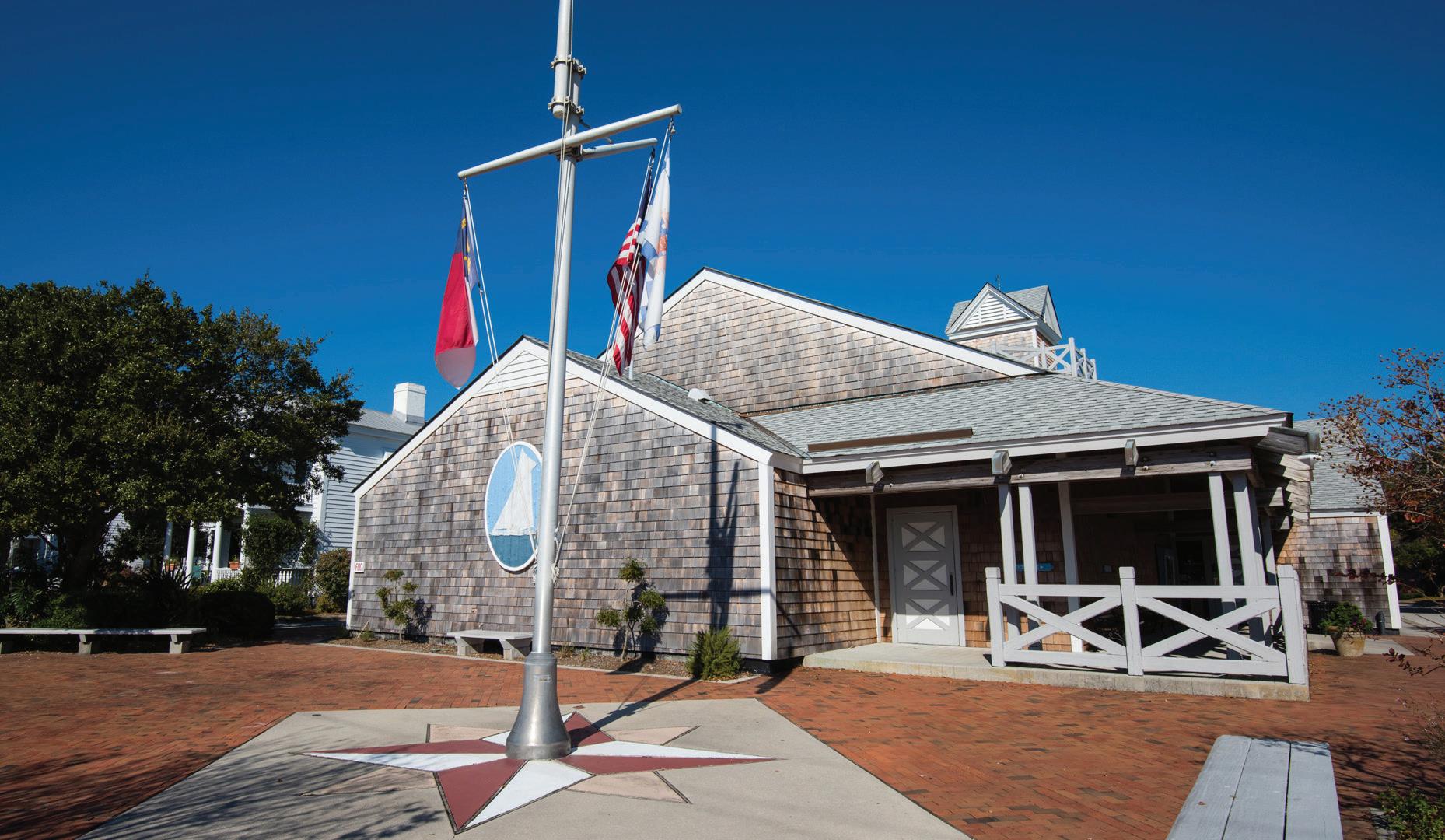
The North Carolina Maritime Museum reopened following a $1.8 million renovation and a yearlong closure that replaced its aging HVAC system and refreshed key exhibits. The upgrades aim to enhance marine education, tourism and economic impact in the region.
NC TREND ››› Statewide
LUMBERTON
A 1.3-mile stretch of Fayetteville Road will be widened and redesigned under a $39 million NCDOT contract awarded to Barnhill Contracting. Improvements include six lanes with a raised median, a new roundabout and safety upgrades. Construction begins in April and is expected to finish by summer 2030.
ROXBORO
Microsoft will develop a data center at the 1,350-acre Person County Mega Park, confirming long-speculated plans following its $27 million land purchase in 2024. Local officials say permitting could begin this year, positioning the project as potentially the largest economic development investment in county history.
TARBORO
Corning will transition management of its 780,000-square-foot distribution center here to Miami-based logistics company Ryder. Some of Corning’s 123 employees are expected to be offered jobs with Ryder before the April 19 transition.
WILMINGTON
Port City Java, which opened its first cafe downtown in 1995 and began roasting its own beans a year later, is now owned by Louisiana-based PCJ Holdings. Company leaders say locations and staffing will remain unchanged. Port City Java has about 20 locations in North Carolina.
Off the Hook Yachts is paying $5.5 million to acquire a South Florida counterpart that controls storage and repair operations along that state’s Atlantic coast. The deal for Apex Marine should close in April. Apex has facilities in Miami, Palm Beach, Stuart and Ocean Reef, Florida. Off the Hook was founded in 2013 and became a public company in November.
Fintech Synply has raised more than $5.5 million since launching in 2024, and acquired DealData’s technology and clients and grown to 11 employees. The Live Oak Bank spinoff develops software that helps community banks manage syndicated lending, with new AI-driven tools aimed at improving loan structuring and workflow efficiency.
GE Aerospace plans to invest more than $160 million in four North Carolina communities this year as part of a $1 billion investment in 30 of its manufacturing sites across 17 states. Its factory here, which makes engine components for aircraft and military ships, will get $60 million of that total to modernize its equipment and facilities. Sites in Durham, West Jefferson and Asheville will get investments of $20 million, $35 million and $48 million, respectively. GE Aerospace employs about 2,000 workers in North Carolina. In 2025, it announced $88 million worth of investment at its facilities in the state.
WILSON
Vollis Simpson Whirligig Park was named Best Sculpture Park in the USA Today Readers’ Choice Awards. The park’s kinetic motion devices, some standing 55 feet tall, attract 200,000 visitors annually and generate approximately $5.3 million in visitor spending, supporting 42 local jobs tied to tourism, hospitality and downtown business activity, according to a 2024 economic impact study.
TRIAD
GREENSBORO
Kontoor Brands’ quarterly results exceeded analysts’ expectations bolstered by a strong showing by its new Helly Hansen division. The apparel company also said Wrangler revenue gained 12% from a year earlier, while the Lee brand showed a 2% sales gain.
HIGH POINT
Textile manufacturer Culp transferred its stock listing from the New York Stock Exchange to Nasdaq on March 6 as part of ongoing restructuring efforts. The company cited peer alignment and lower listing costs, while continuing operational consolidation tied partly to tariffs affecting its China-based production.
High Point University’s Kenneth F. Kahn School of Law received provisional approval from the American Bar Association, marking a milestone for the school that has about 147 students in its first two classes. The first 72 students entered the school in fall 2024, while 75 more started taking classes in August, reflecting full capacity. Law schools typically require three years of classes.
WHITSETT
Prepac Manufacturing will close in May, putting 200 people out of work at its readyto-assemble furniture manufacturing site that opened in 2021. The company blamed the “cost of domestic production” and the continued influx “of low-cost Chinese imports.” In March 2025, Prepac announced it would eliminate 170 jobs and close its Delta, British Columbia, facility, shifting operations away from Canada.
WINSTON-SALEM
Ziehl-Abegg says its plant here helped push annual revenue past $1 billion for the first time, as U.S. demand for industrial fans and motors surged. The company now employs 400 locally and expects to exceed 800 jobs by 2030. The German-based company had been in Greensboro for more than 20 years when it relocated to a larger facility in Forsyth County in 2024.
Reynolds American plans to double its workforce expansion to 2,000 new jobs by 2030 while investing at least $3.36 billion to scale production of Velo synthetic nicotine pouches. The growth reflects surging
NC TREND ››› Statewide
demand for smokeless nicotine products reshaping the U.S. tobacco industry.
Triad Radiology Associates is notifying patients after a 2025 email account breach potentially exposed personal, medical and financial information. The provider says no misuse has been confirmed and is offering free credit monitoring, while class-action law firms have begun soliciting affected patients.
TRIANGLE
BURLINGTON
Food Lion began construction on a 1.1 million-square-foot, temperature-controlled distribution center off N.C. 61 that will use automated picking systems alongside human roles. The $860 million project is slated to open in 2029 with about 500 employees. New York-based investment firm Blackstone will invest $475 million, own the facility and lease it to parent company Ahold Delhaize USA.
CARY
Google will reduce Epic Games app store commissions to 10%–20% for some subscriptions and e-commerce transactions under a proposed settlement, ending a long antitrust fight. The deal also opens Android to certified rival app stores, pending federal court approval.
CHAPEL HILL
Four employees of the East Franklin Street bar Still Life face charges after state alcohol agents said underage Fort Bragg soldiers were served drinks before a Feb. 14 crash in Harnett County that killed three people. Regulators are reviewing possible penalties against the establishment’s ABC permits.
DURHAM
Global life sciences company BASF filed plans for a 157,000-square-foot research building at its Research Triangle Park campus. The project would expand BASF’s developed RTP footprint to 649,181 square feet at what the company calls its largest North American R&D site.
Market on Market Street opened downtown as a retail incubator designed to lower barriers for small business owners. The space debuts with three shops whose operators receive one-year leases and business coaching aimed at helping entrepreneurs establish sustainable downtown retail operations.
MORRISVILLE
Eton Solutions began offering to manage the wealth of multimillionaires with digital tools it already sells to firms managing money for even richer people. In its new platform, Eton is using technology it developed for businesses to manage the assets of billionaires. Swiss bank UBS estimated that the U.S. had 23.8 million people with a net worth of at least $1 million in 2024. That was about 40% of the world’s millionaires.
Charles & Colvard listed $10.5 million in debt in its Chapter 11 bankruptcy filing in March. The public company was founded in 1995 and produces gem moissanite and lab-grown diamonds, which offer a less expensive alternative for jewelry shoppers. It reports $19.2 million in assets. Sales totaled about $22 million in 2024 and $30 million in 2023.
RALEIGH
Cardinal Infrastructure Group acquired Sugar Hill, Georgia-based A.L. Grading Contractors for $245.5 million, its first acquisition since becoming a public company in December.Cardinal had about 1,335 employees before adding A.L. Grading, which has more than 300 employees and annual revenue of about $160 million. Cardinal had revenue of $187.9 million in the first half of 2025.
PINEHURST
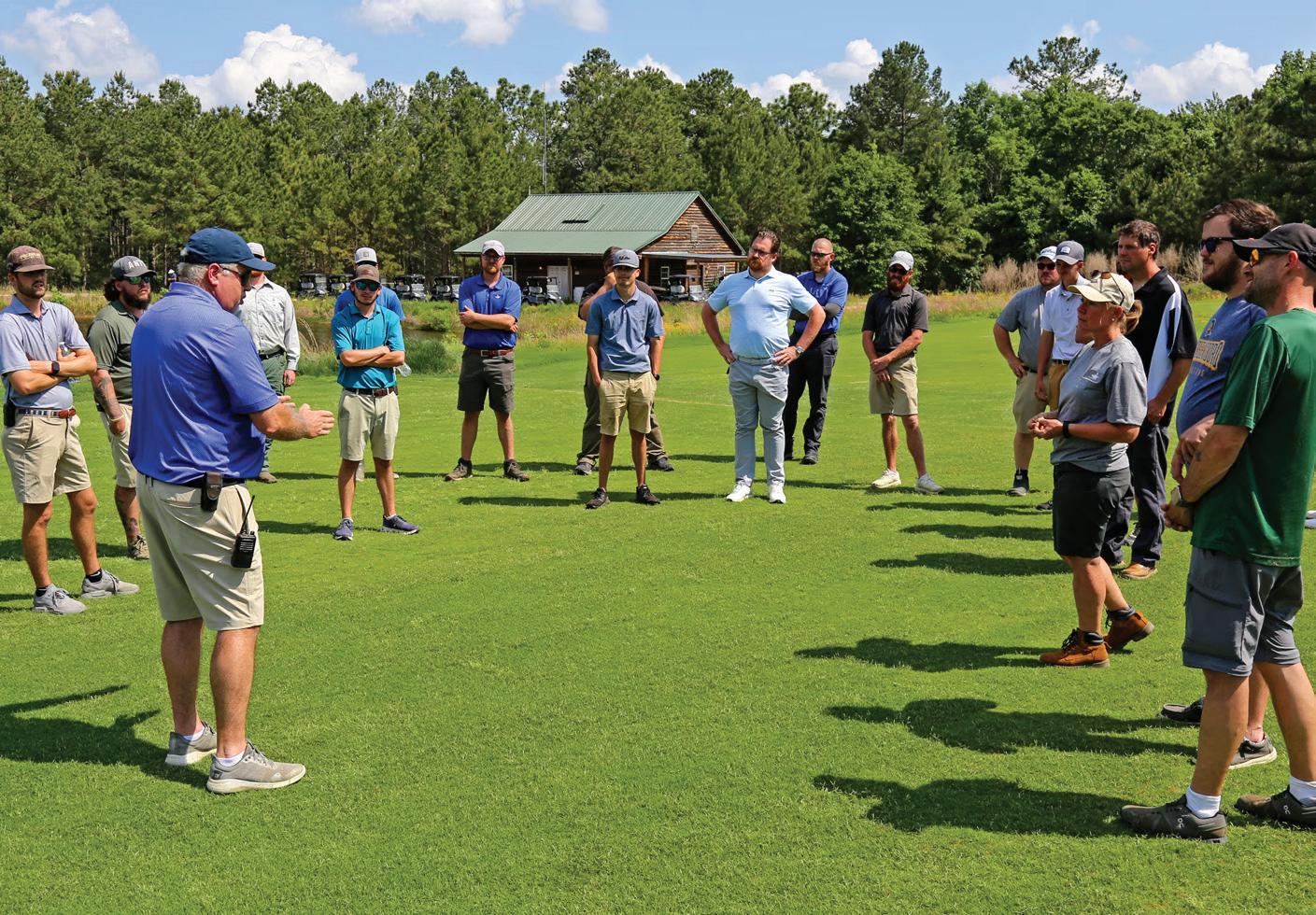
USGA Greenskeeper Apprenticeship Program is expanding its workforcedevelopment impact, with 35 apprentices training through classroom instruction and on-course experience. Since launching in 2022, 68 participants have graduated, with 94% remaining in golf course maintenance careers, helping address industry labor shortages.
Charlotte-based developer Pappas Properties broke ground on a 65-unit forlease townhome community across from Crabtree Valley Mall. It’s the first Triangle project for the firm led by veteran developer Peter Pappas, though he has done apartment projects with a previous partnership.
Carolina Hurricanes owner Tom Dundon plans to sell 12.5% of the team at a $2.66 billion valuation, the Sportico website says, citing people familiar with the terms. The deal includes three new minority partners, not identified by Sportico. Dundon, who lives in Dallas, is leading a separate group that is buying the Portland Trail Blazers in a deal valuing the NBA franchise at $4.25 billion. The seller of the basketball team is the estate of the late Microsoft cofounder Paul Allen.
Developer Jeff Ammons plans an $11.5 million renovation of historic Dorton Arena, aiming to modernize the 1952 State Fairgrounds landmark while preserving its architectural character. Upgrades include HVAC, lighting, accessibility and acoustics improvements, positioning the venue for concerts, sports and corporate events.
UNC Health Rex agreed to pay $150,000 to settle a federal lawsuit filed by the EEOC alleging religious discrimination tied to its 2021 COVID-19 vaccine mandate. The agency claimed the hospital denied a remote employee’s exemption requests and terminated her employment.
Kane Realty purchased a 28-acre site for $72.3 million, positioning the local firm to expand its $1 billion North Hills Innovation District. The property includes The Pointe at Midtown apartments and the Grove Towers office building, both of which are expected to be demolished to make way for a high-rise residential development and a second mixed-use building that could include a hotel, residential or office space. Kane is partnering with Los Angeles-based McCourt Partners on the expansion.
The state’s only Saks Fifth Avenue store will close in May, putting 43 associates out of work. The iconic New York retailer is going through bankruptcy after its merger with Neiman Marcus and is closing 20 stores across the country. The Saks OFF Fifth outlet store in Charlotte will also close.
Technology company Ralliant unveiled its new global headquarters in March, where employees earn nearly 2½ times average wages in Wake County. Ralliant spun off from Everett, Washington-based Fortive in June 2025 to become an independent publicly traded company. It had revenue of $2.07 billion in 2025.
Real estate investment group Person Street Partners paid $26.5 million to acquire 50 single-family rental homes around the NC State campus. It was the first acquisition for the group formed in June by Griffin Py, Jake Jatis and Poojan Mehta, who had worked together at Apollo Global Management.
SMITHFIELD
Town Council denied rezoning for the proposed 1,076-home Bellamy subdivision, citing conflicts with a neighboring hog operation producing up to 12,000 hogs annually. The Johnston County decision marks the second rejection of the project from Clayton-based Rock Tower Partners amid ongoing tensions between rapid residential growth and agricultural preservation.
ZEBULON
The Devil Dogz will be the name of the new Coastal Plain League baseball franchise that debuts May 22 at Five County Stadium. The club will feature an all-Australian roster of college players and coaches through a partnership with Ozball Australia.
WEST
ASHEVILLE
Asheville will host G20 finance ministers and central bank governors this summer as part of the United States’ 2026 G20 presidency. The meetings will take place Aug. 29-Sept. 1, and will bring global economic leaders to western North Carolina as the region continues rebuilding following Hurricane Helene.
NCInnovation announced the first faculty awardees under its Pipeline Grant Program. Four UNC Asheville faculty-led projects will receive $10,000 in early-stage support designed to move promising ideas toward proof of concept and intellectual property development. UNC Asheville is the first UNC System institution to formally activate the Pipeline model.
BURNSVILLE
National Park Service officials say it will take until late this year to repair enough damage from Hurricane Helene to get the entire Blue Ridge Parkway in North Carolina back in service. Remaining closures affect about 60 miles, mostly between Yancey County’s Mount Mitchell and McDowell County’s Linville Falls. It’s part of a $1.7 billion repair effort for the 469-mile parkway. The cornerstone of mountain tourism is the most-visited National Park Service facility, attracting about 16.7 million visitors a year. About half of it is in Virginia.
CANTON
The city approved a deal to buy 52 acres of former paper mill property from Two Banks Development, using $14 million in state funding. The city will use part of the property for a new flood-proof sewer plant. The city also hopes to recruit manufacturing jobs there. ■
NEW GUIDANCE FROM THE DEPARTMENT OF LABOR: What North Carolina Employers Need to Know
by Emily Massey and Genesis Torres
On January 5, 2026, the U.S. Department of Labor's Wage and Hour Division (USDOL) released a batch of opinion letters tackling narrow questions under the Fair Labor Standards Act (FLSA) and Family and Medical Leave Act (FMLA). This article will address four of the opinion letters that we found to be most relevant to North Carolina employers.
EMPLOYERS ARE NOT REQUIRED TO USE FLSA EXEMPTIONS
We often encounter the question of whether an employee is subject to overtime requirements under the FLSA. If an employee's position falls within one of the FLSA's exemptions, then overtime pay is not required. But, if an employee does fall within the exemption, must the employer use it? The USDOL confirmed that the answer is no.
The opinion letter involved a Licensed Clinical Social Worker whose employer reclassified her as nonexempt after a reorganization. The USDOL confirmed that the employee's position likely still qualified for the "learned professional" exemption under Section 13(a) (1) of the FLSA because the position's primary duties required advanced knowledge obtained through specialized instruction.
However, the USDOL made clear that "even if all the criteria for an FLSA exemption are met, it is the employer — not the employee — that claims the exemption." Employers retain full discretion to classify qualified employees as non-exempt. However, switching from exempt to nonexempt means complying with relevant regulations such as timekeeping and overtime calculation records.
CERTAIN PERFORMANCE BONUSES MUST BE INCLUDED IN OVERTIME CALCULATIONS
The next USDOL opinion letter addresses the common topic of whether a bonus must be included in the "regular rate of pay" for purposes of overtime calculations. The short answer: it depends on whether the bonus is discretionary. The USDOL opines that, if the bonus is tied to performance metrics, it is probably not "discretionary," which means the employer must include the bonus when calculating overtime pay.
The letter examined a waste management company's bonus plan rewarding drivers for punctuality, attendance, safety, compliance with traffic laws, proper attire, and performance efficiency. Such bonuses were excluded from overtime calculations. The USDOL said: "not so fast." For a bonus to be excludable under Section 7(e)(3) of the FLSA, both the fact that payment is to be made and the amount must be determined at the employer's sole discretion, not pursuant to any prior promise or agreement. Because the employer's plan used predetermined criteria, it had "effectively 'abandoned' its discretion" and the bonuses could not be excluded.
The takeaway: when a non-discretionary bonus applies to all hours worked, employers must add the bonus to total straight-time earnings, divide by total hours to determine the regular rate, then pay an additional half-time premium for each overtime hour.
FMLA LEAVE CALCULATIONS FOR CLOSURES AND TRAVEL TIME
Is the amount of an employee's FMLA leave impacted when the employer closes unexpectedly for part of the week, or for the employee's travel time to attend an FMLA-covered medical appointment? The next two USDOL opinion letters address these questions.
First, the USDOL addressed a question where a school closed for part of a workweek due to inclement weather. "(Many schools in our state experienced the same this past winter and just this March.)" The key distinction depends on whether the employee was using a full week or less than a full week of FMLA leave. When an employee uses less than a full week of FMLA leave and the employer closes for part of that week, the closure period does not count against the employee's entitlement unless the employee was actually scheduled to work during that time. However, when an employee is using a full workweek of FMLA leave, the entire week counts against the entitlement regardless of any partial-week closure. This is consistent with how FMLA regulations address company holidays.
Second, the USDOL addressed a question regarding travel time to and from FMLA-covered appointments. Because the treatment necessarily requires traveling to the provider, travel time is part of the FMLA leave. In other words, travel time directly related to the covered medical appointment is an excused, job-protected absence and counts against the FMLA leave allotment. This applies to employees attending their own appointments and those accompanying qualifying family members.
Health care providers are not required to certify travel time on medical certifications, as such information is outside a provider's medical knowledge. That said, the protection only covers the direct trip — if an employee swings by the grocery store on the way home, that detour isn't covered.
Conclusion
The USDOL's January 2026 opinion letters address a diverse range of wage and hour and leave issues, but they share a common theme: the details matter. Whether you're classifying employees, calculating overtime, or administering FMLA leave, getting the details right is essential to staying compliant and avoiding costly litigation.
If you need assistance navigating these complex issues, an experienced employment law attorney can help you assess your risks, update your policies, and implement best practices that protect both your employees and your bottom line.
Emily G. Massey egmassey@wardandsmith.com 919.277.9168
Genesis E. Torres getorres@wardandsmith.com 919.277.9165
wardandsmith.com
This article is not intended to give, and should not be relied upon for, legal advice in any particular circumstance or fact situation. No action should be taken in reliance upon the information contained in this article without obtaining the advice of an attorney.
Emily is a North Carolina State Bar Board Certified Specialist in Employment Law.
FAIR SUPPLY
The Defense Logistics Agency at Cherry Point keeps parts flowing to keep military aircraft in the sky.
leet Readiness Center East is a big Navy repair depot located on Marine Corps Air Station Cherry Point. It is one of the largest employers in the state, with 3,600 technicians and engineers in 2.1 million square feet of buildings between U.S. 70 and the Neuse River. It overhauls Navy and Marine jets, helicopters and Ospreys that fly like a plane and a helicopter. Depots like FRC East are crucial to our nation’s air power — particularly the aviation that launches from aircraft carriers and amphibious ships. The depots are under pressure to get all the corrosion, dents, dings and holes repaired and avionics upgraded quickly, and get the aircraft back to the fleet.
The folks who make this possible work for the Defense Logistics Agency, another Cherry Point tenant. The repair parts show up at FRC East because the Defense Logistics Agency’s mission is to get them there on time.
The Cherry Point operation is a small part of the global footprint of the Defense Logistics Agency, which is headquartered at Fort Belvoir in northern Virginia. DLA Weapons Support used to be called DLA Aviation, but aviation is a part of the bigger DLA, which has 25,000 employees and awards 10,000 contracts daily.
Big DLA’s reach is vast because the U.S. has warfighters, equipment and bases around the world. It manages the military’s supply chain, including fuel, clothing, food, medicine and repair parts. It buys about 5 million items and distributes them to its military customers.
Last year, it contracted for $55.8 billion worth of stuff, and a lot of that flowed into North Carolina because we have 95,400 warfighters on bases like Fort Bragg, Camp Lejeune, MCAS Cherry Point and New River and Seymour Johnson Air Force Base. These bases consume lots of food and fuel, and the warfighters need uniforms, body armor and shoes. DLA does business with 8,500 suppliers, and 80% of them are small businesses.
‘BREATHING THE SAME AIR’
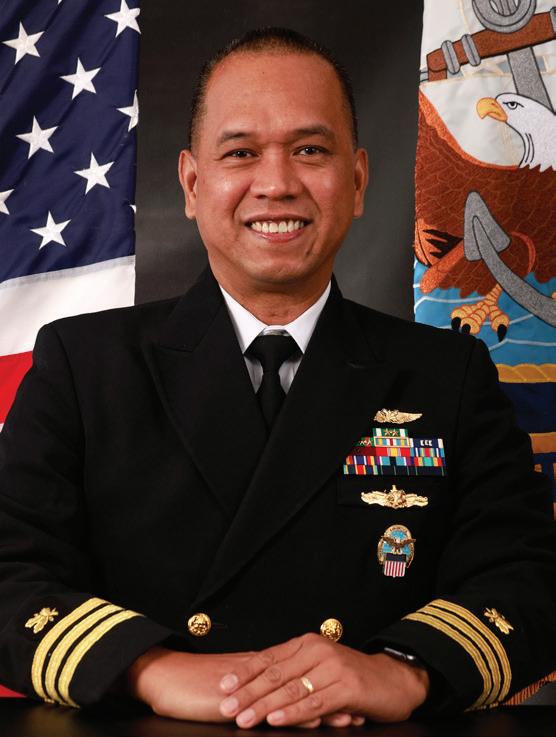
DLA’s Cherry Point operation is unique because it focuses primarily on one customer — FRC East. On Cherry Point, DLA is headed by Cmdr. Edwin Jimenez, a veteran of 20 years of Navy logistics. During a February visit, I expected to walk into a DLA office building. Instead, I was ushered into an FRC East building. (There is a DLA building at Cherry Point, but it is a distribution center that reports up to another site near Harrisburg, Pennsylvania).
“We’re as embedded with FRC as we possibly can be,” says Josh Waller, Jimenez’s deputy director, “to the point sometimes we’re sitting in the same offices and breathing the same air. Because we’re here to support them and their workload.”
“I think that’s the value,” says Jimenez. “We meet the artisans. We meet the production people, the shop on a daily basis, and we discuss material.”
The meetings start as early as 6:30 a.m., and there are a succession of them all morning, involving Clyde Shaeffer’s folks in the Material Management Division. All focused on tiers of urgency, one through five. At any given time, there are around 75 tier items that are worrying folks, because something has gone off plan. Maybe there was a fire or a strike at a manufacturer. Maybe there’s a war in the Middle East that is drawing down inventories.
Every DLA organization around the country has these lists, but if Clothing and Textiles in Philadelphia is having trouble getting enough of a particular type of sock, that’s one thing. If a part shortage is holding up repairs of a $100 million F-35, that’s a bigger deal, and Shaeffer’s folks have to scramble, calling other depots, calling suppliers.
Most of them have been doing it a long time. The average tenure of DLA Weapons Support’s Cherry Point folks, about 115 of them, is 14 years. Gary Odle, a customer support specialist, told me he has been expediting, tracking and chasing stuff down for 26 years. Like Odle, nearly 70% of the folks are veterans.
“In a perfect world, we’re at 100% all the time. But this isn’t a perfect world,” says Shaeffer. “That’s when we have to beg and plead.”
‘WHOSE NAVY?’
The reality is that, as big as the U.S. military is, it isn’t the biggest customer for many suppliers. It isn’t the only military customer, for that matter. One of America’s great business successes has been selling military products to friendly and even semifriendly nations. NATO uses a lot of the same stuff that we do, by design, so we could share ammunition and fuel and gear in a big war with the Soviet bloc and now Russia.
“One time,” says Waller, “I called up an OEM directly, trying to get help.” An OEM is an original equipment manufacturer. “I said, ‘Hey, I’m calling from the Navy.’ And their response was, ‘Whose navy?’”
There is a lot of planning. Depot-level overhauls are scheduled well in advance, because visits to places like FRC East are a big event in the life of an aircraft. It can take 200 days or more to turn around an Osprey. F-35’s, the military’s fifth-generation fighter, are getting constant modifications and upgrades that complicate life for logisticians, artisans and engineers at depots like Cherry Point. The planning is done by Scott Carpenter and his analysts. The Navy is working on a two-year planning horizon, and giving its
forecasts to the depots about what needs repair and when. The depots tell people like Carpenter what repair parts are needed, and when. Then there are new workloads, like the C-130s that FRC East will be repairing soon at its satellite facility in Kinston, at Global TransPark.
“We are involved in that process from the start, so we don’t wait for the aircraft to show up,” says Carpenter. “FRC ordered a bunch of parts, and now I’m trying to get them.”
Jimenez has had a long career in logistics, including a couple of years on an aircraft carrier in the Western Pacific and another couple of years in England.
His experiences have provided an appreciation of his present command at Cherry Point. “These are the people who work behind the scenes and make things possible,” he says. “I remember every time a pilot asked me, ‘Oh, you’re a logistician?’” Jimenez would reply, “You can’t fly without supply.” ■
Veteran journalist Dan Barkin writes the NC Military Report newsletter for Business NC. He can be reached at dbarkin53@gmail.com.
Cmdr. Edwin Jimenez leads the Cherry Point operation.
Customer service specialist Gary Odle helps with DLA Weapons Support to ensure an efficient supply chain.
THE RIGHT TRACK
The discussion was sponsored by:
•Guilford Technical Community College
•N.C. Department of Transportation
•NC Ports
•Piedmont Triad International Airport
•North Carolina Railroad Company
Carl Warren president and CEO
North Carolina Railroad Co.
Brian Clark executive director
North Carolina State Ports Authority
Tony Lathrop chair
North Carolina Board of Transportation
Karen Pentz supply chain instructor
Guilford Technical Community College
The importance of the transportation industry to North Carolina’s economy is highlighted by its recent successes and technological advancements.
Transportation companies keep North Carolina’s economy moving, connecting supply and demand. But getting from Point A to Point B often means navigating obstacles, whether that’s riding the state’s rapid growth, applying the latest technology or ensuring there are enough skilled workers at the controls. Business North Carolina recently gathered four transportation experts to discuss the industry, detailing how recent successes are benefiting the state and offering how the industry’s current challenges could be overcome. Their conversation was moderated by Publisher Ben Kinney. The transcript was edited for brevity and clarity.
HOW ARE CURRENT EVENTS SHAPING NORTH CAROLINA’S TRANSPORTATION INDUSTRY?
LATHROP: Growth, technology and storms are driving change. Growth is creating demand for infrastructure and the need for creative ways to pay for it.
Technology is causing disruptions. Fuel efficiency and electric vehicles are some of the biggest challenges to the revenue model, which uses fuel taxes to fund road construction, maintenance and repair. Autonomous vehicles and drones are creating opportunities and challenges.
We’re seeing more storms, and Hurricane Helene is Exhibit A. Recovery efforts are putting tremendous pressure on the state’s finances and system. But it also spawned creative delivery methods.
CLARK: Shifting international trade patterns are front and center. The country has seen a downturn in import volumes over the last year because of tariffs and port fees. Carriers have shifted tonnage into what they see
as more profitable trade lanes. It has certainly introduced challenges, but there are opportunities as well.
We’ve seen strong trade between Central and South America, new commodities being handled, and new opportunities to support the state and the businesses that depend on international transportation.
While generally volumes are down, particularly on the container side, the value of cargo has increased. We’ve seen opportunities on general and project-related cargo at Wilmington and Morehead City ports, both import and export.
It has been an interesting year, and the ports are in a strong position halfway through the fiscal year.
PENTZ: My responsibility is the supply chain management program. It needs to react to what’s happening in industries. Supply chain changes quickly. We actively work on understanding businesses’ current needs and how to adapt our program to meet them. We’re hosting a series of employer roundtables
this year. They’ll allow employers to share their observations and challenges. Tariffs and artificial intelligence are the two things we hear most from employers.
Several employers want to develop internships with our students on the supply chain side. That’s welcome news, because we want our students to find jobs. An internship is a great way to do that.
WARREN: NCRR thinks well beyond the next quarter, planning 20, 30, 40, 50 years ahead. But looking at the current situation, loaded rail car volumes are down a bit, which is consistent with what’s happening across the industry. There’s discussion of further railroad consolidation: Union Pacific made an $85 billion offer for Norfolk Southern, which operates across North Carolina, including on NCRR tracks. It would create the country’s first transcontinental railroad, merging about 50,000 route miles across 43 states. The federal Surface Transportation Board rejected the merger application earlier this year, stating it was incomplete. But the railroads are expected to submit an updated application by the end of this month.
The bright spot from NCRR and the state’s perspective is we’re still attracting employers, creating jobs.
The railroad and its partners have been working hard, using economic development programs to prepare sites for rail-served industry. We’re starting a project to reconfigure the railroad between Greensboro and Raleigh. It will add passing sidings and increase overall capacity.
It’s gratifying to see passenger trains carrying more people as our state grows. They’re becoming a viable alternative to driving. We’re excited about the railroad’s role in providing a corridor that makes that possible.
I’m optimistic. The transportation environment is a mixed bag, but North Carolina isn’t. We’re honored to play a part in the state’s future growth.
HOW ARE SUPPLY CHAINS? IS THE PANDEMIC STILL AFFECTING THEM?
CLARK: It isn’t the issue that it was during and after COVID, when demand outpaced capacity. There were backlogs at ports, in warehouses and on the rails. International carriers pulling services from the U.S., based on falling demand, remains a challenge, though it’s not to the extent we saw a couple years ago.
PENTZ: Many people already have forgotten how much COVID impacted supply chains and how that affected them. Many lack a clear understanding of supply chains. So, while our program has attracted more students, many of their parents have forgotten.
HURRICANE HELENE DECIMATED WESTERN NORTH CAROLINA’S TRANSPORTATION ASSETS.
WHERE IS THE RECOVERY PROCESS?
LATHROP: Recovery is requiring an amazing and heroic effort by NCDOT’s people and its industry partners. Projects
fall into one of two groups. There are thousands of small ones, which are almost all well underway. And there are a few massive corridor projects, which take more time to crank up. The roads are 99% open. Interstate 40, for example, is open, but traffic rolls at a reduced 35 mph through stretches while repairs continue.
I was North Carolina Transportation Board’s finance chair for eight years before I became board chair. We’re dealing with construction inflation, which is much greater than normal market inflation. The I-40 project’s cost has increased as we’ve gotten into it. It’s now about $2 billion; repairing all roads in the state damaged by Helene will cost about $6 billion. That’s not all because of inflation, but it’s because of the infrastructure that’s needed to protect the interstate from the Pigeon River going forward.
Retaining walls, for example, need to be anchored in bedrock. The state will probably not be reimbursed for $1 billion
of the cost, so that will impact overall funding at the state level. Hopefully we can spread it over five or six years.
PASSENGER-RAIL
SERVICE IS ATTRACTING MORE ATTENTION. IS THAT ORGANIC OR BY DESIGN?
WARREN: There are a few things at work. Thanks to several decades of effort and hard work by NCDOT, the rail division, department leadership and NCRR, we’ve done a good job of proving that passenger-rail service works for traveling certain distances such as Raleigh to Charlotte, and more is possible.
I get the sense that the federal government, which is critical for funding improvements to these corridors, continues to take an interest in making established corridors, such as Raleigh to Charlotte, more successful. Expanding those programs depends on the temperature in Washington, D.C., and the federal Transportation Department’s priorities. Look at the work that continues to be done on the S-Line, which will improve passenger-rail service between Richmond, Virginia, and Raleigh.
I see work that builds off the core system progressing incrementally. There has been a lot done in Charlotte. That paints
a bright picture for the future. You’ll never absolutely cure traffic congestion.
But you can create transportation alternatives for people. I recently ventured into the snowy North, and I didn’t fly or drive. You can guess how I traveled. You must create alternatives to have a livable state. The partnerships we have with the federal Transportation Department, Norfolk Southern and Amtrak are critical to achieving that.
HOW IS TECHNOLOGY AFFECTING THE INDUSTRY?
CLARK: Understanding locations and planning properly requires a robust inventory control system given the amount of cargo the state’s ports handle.
We rolled out our terminal operating system a couple years ago, and we’re looking at opportunities to improve it. These include position detection systems, creating a better understanding of cargo’s location and inventory update.
There are technological opportunities with equipment maintenance, whether it’s our ship-to-shore cranes or some of our rolling stock, to better monitor and understand total cost of ownership.
It’s a journey, and it’s constantly changing at increasing speed. We must
evaluate opportunities, make decisions and invest where best possible.
PENTZ: Our program incorporates technology, focusing on pieces key to supply chain. They include SAP on the enterprise resource planning side and academic versions of MercuryGate, which is a transportation management system. We also teach Excel; everyone says Excel knowledge is essential for students coming out of our program. AI is something new to our program.
We hear it so much, and I read about it so much. Companies want employees who are versed in AI. They need it to enhance their job performance, not replace them. AI is being incorporated into our capstone class starting with this spring semester. We’ll incorporate it into other classes over time. We don’t want our students using it to simply find answers. I want them to be able to evaluate AI’s answers, deciding if they’re current and if they’re appropriate to their job. Verification is our goal.
WHAT’S THE CURRENT DEMAND FOR TRUCK DRIVERS? ARE DRIVERLESS TRUCKS STILL BEING DISCUSSED?
PENTZ: The need for drivers is cyclical. There aren’t enough sometimes, and employers can pick and choose other times. That pattern is seen with most jobs.
In addition to our aviation offerings, GTCC’s Greensboro campus is home to our truck-driving school. It has been successful despite being in place for only a few years. It has produced many graduates, and they’re finding jobs with local companies. Our region is populated with distribution centers. You see trucks driving everywhere.
I serve on North Carolina Trucking Association’s workforce development committee, because I want to understand
Kevin J. Baker
Executive director
Piedmont Triad International Airport Authority
Aiming for the sky
Aviation and North Carolina have been linked since the Wright brothers arrived more than a century ago. It’s an important sector of the state’s transportation industry, from getting passengers where they want to go to developing, building and servicing aircraft. That mix is on full display at Piedmont Triad International Airport and its surrounding industrial sites. Kevin Baker, executive director of the airport’s authority, shared his thoughts on aviation, transportation and how they benefit the state.
What’s PTI’s role in today’s changing economy?
How does the transportation industry deal with growth?
Our predecessors’ foresight, investment and action created a statewide system of roads, rails and ports that enables PTI to be successful. What’s arguably the nation’s best interstate network offers capacity for future growth while bypassing the choking levels of traffic that happen in other markets. We must follow the lessons learned and stay ahead of growth as our predecessors did, ensuring the same observations are made about us in the future.
The airport’s decades-long mission is to create a center of aerospace excellence and employment while continuing to be a place of global transportation that delivers on the promise to be easy for passengers. That vision is coming to fruition.
PTI’s campus is home to three original equipment manufacturers — JetZero, HondaJet and Boom Supersonic. The OEMs, along with companies that are deeply involved in aircraft maintenance, will make PTI the center of aerospace excellence and innovation for the next century.
How is technology shaping aviation?
Its positive impacts can’t be understated. The next generation of aircraft and the technology that enables them are being developed at PTI. Those innovations include HondaJet’s innovative over the wing engine design and next generation of business aircraft, Boom building the first supersonic commercial aircraft in more than 60 years and JetZero transforming the shape of commercial aircraft to a blended wing. They’re revolutionizing air travel. And look for continued development of advanced air mobility systems and propulsion technologies that are rapidly shifting.
Why is collaboration important?
It’s critical to achieving our economic goals. N.C. Department of Transportation’s decades of investment in and around PTI paved the way for the businesses that are here today. The road system, for example, provides efficient employee access and supply chain logistics. Access to deep-water ports and rail service are vital, and both were key to landing Boom and JetZero.
Companies considering North Carolina see the seamless integration and cooperation among partners. That’s made possible by great leaders at NCDOT, including former chair Doug Galyon and current member Mike Fox of North Carolina Board of Transportation. They’re the nexus that brings it all together with a laser focus on winning.
where there are potential jobs for my students. Transportation companies aren’t only looking at truck drivers. They need to fill other positions, too.
Autonomous vehicles are actively used for trips within a given mileage range. Many people feel that they’re good. They won’t completely replace the need for drivers, because trucks without a human driver are just plain scary to many people.
LATHROP: I see a tremendous need for truck drivers, and that affects DOT, which needs equipment operators and other skilled workers.
Autonomous trucks are becoming more popular. That’s a natural evolution of the technology. Eventually these vehicles will communicate with each other and infrastructure. That need for communications will be built out as part of the infrastructure.
Autonomous trucks won’t entirely replace the need for drivers. There’s a growing demand for local drivers who can deliver the ever increasing quantity of products that people purchase online. That change exploded during the pandemic. They may require different training than long-haul drivers, but that dynamic of many local delivery trucks on the road is here.
HOW CAN THE INDUSTRY HELP NORTH CAROLINA DEAL WITH ITS RAPID GROWTH?
WARREN: We continue to plan capacity improvements to the system, whether it be road, rail, water or air. They’re all important. But building capacity alone won’t do the trick. Alliances and efficiency are needed, too. We’ll be successful by facing the challenges from many different angles and working together to solve them.
During the time I’ve been in North Carolina, I’ve enjoyed seeing the ability for multiple stakeholders to see the bigger picture and work together to make something happen, whether that’s the Toyota battery factory in Randolph County or some of the exploratory things that we’ve spoken with the state Port Authority about that would bring together economic development, transportation and rail.
We can do many things to help each other. The whole point of the railroad’s Build Ready Sites Program is getting local communities and others to collaborate to make sites available. We put money on the table, and that’s a catalyst to get others to the table.
LATHROP: Collaboration at the leadership, regional and local levels is the secret sauce. It makes us successful and helps us keep pace with growth.
Growth is driving need across all industries. We must work together to meet it. It doesn’t come naturally from a pure bandwidth standpoint of a vision. It requires effort.
HOW DOES THE INDUSTRY VIEW NORTH CAROLINA COMPARED TO OTHER STATES?
LATHROP: We compare favorably. North Carolina has the country’s thirdfastest growing population. It has more state-road miles than any state except Texas.
The state’s business community understands the need for infrastructure and actively promotes infrastructure solutions. We’re working with businesses to find win-win solutions around transportation.
CLARK: There’s no discounting the state’s recent successes, especially in regard to economic development and business attraction. That requires collaboration. There’s always opportunity for improvement, so we can put forward the best position as a state.
I’ve seen a desire and effort to work closer together during the last number of years. We’re putting the right plans in place and making the right effort to attract investment to the state. But it is a constant dynamic, particularly around the ports. There’s a fine balance of investment, traffic and infrastructure needs versus the local community. So, we try to be as understanding and communicative as possible for those opportunities.
WARREN: North Carolina gets it right. It’s not an accident that it has been repeatedly honored as the best state for business. We recognize that the intersection of economic development and transportation is critical for growth and prosperity.
North Carolina knows what it has or perhaps always had. Agriculture, for example, has more than a $100 billion annual economic impact, and about one in five jobs are connected to agriculture and agribusiness. Our success emanates from what we’ve always done well and improved but also being able to succeed in developing our urban communities and attracting investments and jobs for manufacturing. It’s a complete portfolio when you look at all those elements.
PENTZ: Our program stresses collaboration. Most students who complete it stay in North Carolina, so my focus is local. The more local input we receive, the better our program becomes. That’s our goal. It’s a business department-wide goal. We work together, bringing employers to campus and into classrooms, ensuring we’re on the right track. ■
TAn
insider’s perspective on the list ranking North Carolina’s best courses.
By Jim Pomeranz
here’s more than meets the obvious when it comes to dissecting the North Carolina Golf Panel’s Top 100 golf courses.
The panel includes nearly 200 golfers with handicaps from scratch to, well, who knows how high. There’s a wide range of backgrounds, ages and gender. What is consistent is that the panel takes seriously its duty to golf in North Carolina.
For a course to be considered for this ranking, at least 20% of members must have played there at least once.
Pinehurst No. 2 is a slam-dunk favorite as the best of the best in North Carolina, just as it consistently ranks among the world’s finest courses. Its 7,588 yards of length from the “U.S. Open” tees make No. 2 the longest layout of the Top 100.
Still, each of the top 10 courses could make a case for being No. 1. Some would argue that is true for the first 15 or 20 courses.
An example is Quail Hollow Club in Charlotte, which hosted the PGA Championship in 2017 and 2025, the Presidents Cup in 2022 and annual PGA Tour events dating back decades.
Still, respect for Pinehurst No. 2 supersedes any other course in the state. That’s a definite part of the rankings.
The list’s shortest course is the 6,005-yard Crystal Coast Country Club in Pine Knoll Shores, which ranks 81st this year. There are 59 courses at 7,000 yards or greater, while the average length is 6,981 yards.
The highest slope, which reflects a course’s relative difficulty, is 151 at Old North State in New London. The lowest is 126 at Mid-Pines Inn & Golf Club in Southern Pines, a sneaky difficult and picturesque layout. The list’s average slope is 138.2.
Jim
There is limited volatility on the list from year to year. Still, five courses gained at least 10 slots, including The Country Club at Wakefield Plantation in Raleigh, which moved up from 75th to 94th in a year. One reason is that the course hosted a big turnout of panelists, who were extremely impressed.
Others moving up 10 or more places were Occano Golf & Boat Club, Merry Hill (42nd to 32nd); Crystal Coast Country Club (92nd to 81st); High Point Country Club (44th to 31st); and Morehead City Country Club, Morehead City (99th to 83rd).
Two courses declined by at least 10 spots. Trump International in Mooresville went from 48th to 58th, and Prestonwood Country Club’s Meadow Course in Cary dropped from 69th to 86th.
Five courses in the 2025 ranking fell out this year, including Mountaintop Golf and Lake Club in Cashiers, which had ranked 13th. The course may have lacked the requirements of being ranked by at least 40 ballots and having been played by panelists. To be sure, Mountaintop is widely regarded as an outstanding course.
The 10 ranking categories that panelists use when casting ballots are routing, flow, design, strategy, fairness, memorability, condition, variety, aesthetics and ambience.
Those factors are in sync with how course architects design their layouts. Each course receives a score from 1 (least) to 10 (best).
The 2026 list represents a good cross-section of North Carolina, which has about 550 courses. Sixteen courses on the Top 100 are in Pinehurst or Southern Pines in Moore County, while Greensboro and Charlotte each have seven. Durham and Wilmington have five each, Raleigh has four and the balance are spread widely.
is a Cary-based free-lance writer, a member of the North Carolina Golf Panel since around 2004. He plays about 125 rounds a year, mostly at
Golf Course in Raleigh, where he is a charter partner. Reach him at jim.pomeranz52@gmail.com
Pomeranz
Lonnie Poole
2026 TOP 100 GOLF COURSES
Ranked by the North Carolina Golf Panel, comprised of golf aficionados from around the state. The second number is the previous year’s ranking.
1. 1. PINEHURST NO. 2
PINEHURST
72 7,588 76.5/138
Par Yardage Course rating/slope
2. 2. GRANDFATHER GOLF AND COUNTRY CLUB
LINVILLE
72 7,085 74.3/145
3. 5. PINE NEEDLES LODGE AND GOLF CLUB
SOUTHERN PINES
71 7,015 73.5/135
4. 4. QUAIL HOLLOW CLUB
CHARLOTTE
72 7,396 75.0/140
5. 3. THE COUNTRY CLUB OF NORTH CAROLINA (DOGWOOD)
PINEHURST
72 7,204 75.2/134
6. 7. OLD TOWN CLUB
WINSTON-SALEM
70 7,037 74.4/138
7. 8. SEDGEFIELD COUNTRY CLUB
GREENSBORO
71 7,117 72.9/130
8. 6. ELK RIVER CLUB
BANNER ELK
72 6,826 73.4/141
9. 9. OLD CHATHAM GOLF CLUB
DURHAM 72 7,247 75.3/140
10. 10. PINEHURST NO. 4
PINEHURST 72 7,227 74.9/138
11. 11. OLD NORTH STATE CLUB
NEW LONDON
7,166 75.4/151
12. 15. CAPE FEAR COUNTRY CLUB
WILMINGTON
72 7,005 74.3/139
13. 12. THE COUNTRY CLUB OF NORTH CAROLINA (CARDINAL)
PINEHURST
72 7,212 75.0/141
14. 14. PINEHURST NO. 10
ABERDEEN
7,020 74.1/142
15. 18. RALEIGH COUNTRY CLUB RALEIGH
7,394 75.9/143
16. 19. FORSYTH COUNTRY CLUB WINSTON-SALEM 71 6,784 72.0/136
17. 17. CHARLOTTE COUNTRY CLUB
CHARLOTTE
7,335 75.9/146
18. 16. PINEHURST NO. 8
PINEHURST 72 7,099 74.1/137
19. 21. RIVER LANDING (RIVER)
WALLACE 72 7,009 74.1/141
20. 22. MACGREGOR DOWNS COUNTRY CLUB CARY 72 7,003 73.4/134
21. 20. EAGLE POINT GOLF CLUB
WILMINGTON 72 7,170 74.5/137
22. 23. ROCK BARN COUNTRY CLUB (JONES)
CONOVER 72 7,126 74.4/141
23. 24. GOVERNORS CLUB
CHAPEL HILL 72 7,062 75.1/144
24. 25. MID PINES INN AND GOLF CLUB
SOUTHERN PINES 72 6,732 71.0/126
25. 29. TREYBURN COUNTRY CLUB
DURHAM 72 7,175 74.1/137
2026 TOP 100 GOLF COURSES
26. 30. BILTMORE FOREST COUNTRY CLUB ASHEVILLE 70 6,606 71.5/127
27. 26. COUNTRY CLUB OF LANDFALL (DYE)
WILMINGTON 72 7,026 74.3/132
28. 32. RIVER LANDING (LANDING) WALLACE 72 7,112 74.2/134
29. 28. COUNTRY CLUB OF LANDFALL (NICKLAUS) WILMINGTON
7,100 75.7/144
30. 27. DORMIE CLUB WEST END
6,927 73.7/138
31. 44. HIGH POINT COUNTRY CLUB (WILLOW CREEK) HIGH POINT
6,972 73.9/139
32. 42. OCCANO GOLF & BOAT CLUB MERRY HILL
7,257 76.3/139
33. 31. STARMOUNT FOREST COUNTRY CLUB GREENSBORO
6,648 73.4/140
34. 34. CHAMPION HILLS CLUB HENDERSONVILLE
6,510 71.7/144
35. 33. PRESTONWOOD COUNTRY CLUB (HIGHLANDS) CARY
7,082 74.4/138
36. 35. PINEHURST NO. 9
PINEHURST 72 7,125 75.1/143
37. 36. MID SOUTH CLUB
SOUTHERN PINES 71 7,003 73.8/144
TOP 100
38. 36. FOREST CREEK GOLF CLUB (SOUTH) PINEHURST
39. 40. MYERS PARK COUNTRY CLUB CHARLOTTE
7,120 74.3/138
40. 45. GREENSBORO COUNTRY CLUB (FARM) GREENSBORO
7,302 75.1/140
41. 41. BRYAN PARK (CHAMPIONS) BROWNS SUMMIT
7,255 75.4/140
42. 39. FOREST CREEK GOLF CLUB (NORTH) PINEHURST
7,139 74.7/144
43. 37. THE CLUB AT LONGVIEW
7,065 74.5/140
44. 43. LINVILLE GOLF CLUB
6,946 73.4/139
45. 46. GRANDOVER (EAST) GREENSBORO
7,270 75.7/141
46. 47. FINLEY GOLF COURSE CHAPEL HILL
7,223 74.9/138
47. 50. FOREST OAKS COUNTRY CLUB GREENSBORO
7,212 74.7/141
48. 52. LONNIE POOLE GOLF COURSE RALEIGH
7,358 74.4/142
49. 49. PINEHURST NO. 7 PINEHURST
7,216 75.5/143
50. 53. WAYNESVILLE INN & GOLF CLUB WAYNESVILLE
6,515 71.5/139
51. 51. HOUND EARS CLUB BOONE
6,327 69.9/129
52. 54. COUNTRY CLUB OF ASHEVILLE ASHEVILLE
6,672 72.3/134
2026 TOP 100 GOLF COURSES
53. 56. DUKE UNIVERSITY GOLF CLUB
DURHAM 72 7,105 73.9/141
54. 57. THE CARDINAL BY PETE DYE
GREENSBORO
70 6,821 74.2/139
55. 55. BALLANTYNE COUNTRY CLUB CHARLOTTE 72 7,034 74.1/136
56. 59. MIMOSA HILLS GOLF CLUB
MORGANTON
72 6,750 72.8/137
57. 60. PORTERS NECK COUNTRY CLUB
WILMINGTON 72 7,112 74.8/138
58. 48. TRUMP NATIONAL GOLF CLUB MOORESVILLE 72 7,037 74.2/140
59. 61. BALD HEAD ISLAND CLUB
BALD HEAD ISLAND 72 6,855 73.7/143
60. 62. THE CLUB AT 12 OAKS HOLLY SPRINGS
72 7,093 75.0/146
61. 58. THE HASENTREE CLUB
WAKE FOREST
71 7,074 73.9/139
62. 63 THE CURRITUCK CLUB COROLLA 72 6,888 73.9/136
78. 75. PINEWILD COUNTRY CLUB (MAGNOLIA) PINEHURST 72 7,446 76.4/139
79. 81. CARMEL COUNTRY CLUB (SOUTH) CHARLOTTE
72 7,503 76.5/142
80. 79. ALAMANCE COUNTRY CLUB
BURLINGTON
71 6,900 72.8/128
2026 TOP 100 GOLF COURSES
81. 92. CRYSTAL COAST COUNTRY CLUB PINE KNOLL SHORES 70 6,005 69.7/127
82. 82. KILMARLIC GOLF CLUB POWELLS POINT 72 6,560 72.2/144
83. 99. MOREHEAD CITY COUNTRY CLUB MOREHEAD CITY 72 6,855 73.4/142
84. -- WILSON COUNTRY CLUB WILSON 72 6,883 72.2/130
85. 83. PROVIDENCE COUNTRY CLUB CHARLOTTE 72 7,021 74.6/141
86. 69. PRESTONWOOD COUNTRY CLUB (MEADOWS) CARY 72 7,108 74.6/138
87. -- BEAUFORT CLUB BEAUFORT 72 7,153 75.3/141
88. 84. MILL CREEK GOLF CLUB MEBANE 72 7,004 73.5/144
89. 97. DEEP SPRINGS COUNTRY CLUB STONEVILLE 72 6,936 73.8/136
90. 85. BRIGHT’S CREEK CLUB MILL SPRING 72 7,392 76.1/143
91. -- WOODLAKE COUNTRY CLUB VASS 72 7,255 75.6/139
92. 86. JEFFERSON LANDING JEFFERSON
7,111 73.1/134
93. 88. MOORESVILLE GOLF CLUB MOORESVILLE
6,803 73.0/135
94. 90. THISTLE GOLF CLUB SUNSET BEACH 71 6,898 74.1/135
95. 93. LINVILLE RIDGE LINVILLE
6,775 72.8/136
96. -- BENTWINDS COUNTRY CLUB FUQUAY-VARINA 72 6,770 73.1/137
97. 95. TOT HILL FARM ASHEBORO 72 6,713 72.8/146
98. 98. LONGLEAF GOLF & FAMILY CLUB SOUTHERN PINES 72 6,682 72.4/132
99. -- ROCKY RIVER GOLF CLUB CONCORD 72 6,970 73.1/142
100. 96. BROOK VALLEY COUNTRY CLUB GREENVILLE 72 6,836 73.8/141
UNLOCK ACCESS TO TOP-RANKED COURSES ACROSS NORTH CAROLINA WITH ONE MEMBERSHIP
With the McConnell Golf network, you can tee off at 11 courses from the Blue Ridge Mountains to the Carolina coast, plus six premier properties throughout South Carolina, Tennessee, and Virginia. Experience championship golf, luxury amenities, and a vibrant club lifestyle — no matter where your journey takes you.
Brook Valley Country Club
The Cardinal by Pete Dye
Cobblestone Golf Club
Country Club of Asheville
Holston Hills Country Club
Musgrove Mill Golf Club
Old North State Club
Pete Dye River Course of Virginia Tech
Porters Neck Country Club
Providence Country Club
Raleigh Country Club
The Reserve Golf Club
Sedgefield Country Club
Country Club
The Country Club
The Water’s
Wilson Country Club
2026 REGIONAL RANKINGS
EASTERN
1. River Landing (River), Wallace
2. River Landing (Landing), Wallace
3. Occano Golf & Boat Club, Merry Hill
4. Brook Valley Country Club, Greenville
5. Benvenue Country Club, Rocky Mount
6. Greenville Country Club, Greenville
7. Cypress Landing Golf Course, Chocowinity
8. Cutter Creek Golf Club, Snow Hill
9. Carolina Colours Golf Club, New Bern
10. Wilson Country Club, Wilson
11. Walnut Creek Country Club, Goldsboro
12. Highland Country Club, Fayetteville
WESTERN
1. Grandfather Golf and Country Club, Linville
2. Elk River Club, Banner Elk
3. Rock Barn Country Club (Jones), Conover
4. Biltmore Forest Country Club, Asheville
5. Champion Hills Club, Hendersonville
6. Linville Golf Club, Linville
7. Waynesville Inn & Golf Club, Waynesville
8. Hound Ears Club, Boone
9. Country Club of Asheville, Asheville
10. Mimosa Hills Golf Club, Morganton
11. Springdale Resort, Canton
12. Blowing Rock Country Club, Blowing Rock
TRIANGLE
1. Old Chatham Golf Club, Durham
2. Raleigh Country Club, Raleigh
3. MacGregor Downs Country Club, Cary
4. Governors Club, Chapel Hill
5. Treyburn Country Club, Durham
6. Prestonwood Country Club (Highlands), Cary
7. Finley Golf Course, Chapel Hill
8. Lonnie Poole Golf Club, Raleigh
9. Duke University Golf Club, Durham
10. The Club at 12 Oaks, Holly Springs
11. The Hasentree Club, Wake Forest
12. Carolina Country Club, Raleigh
COASTAL
1. Cape Fear Country Club, Wilmington
2. Eagle Point Golf Club, Wilmington
3. Country Club of Landfall (Dye), Wilmington
4. Country Club of Landfall (Nicklaus), Wilmington
5. Porters Neck Country Club, Wilmington
6. Bald Head Golf Club, Bald Head Island
7. The Currituck Club , Corolla
8. Crow Creek Golf Club, Calabash
9. Crystal Coast Country Club, Pine Knoll Shores
10. Kilmarlic Golf Club, Powells Point
10. Thistle Golf Club, Sunset Beach
11. Morehead City Country Club, Morehead City
12. Beaufort Club, Beaufort
PIEDMONT TRIAD
1. Old Town Club, Winston-Salem
2. Sedgefield Country Club, Greensboro
3. Old North State Club, New London
4. Forsyth Country Club, Winston-Salem
5. High Point Country Club (Willow Creek), High Point
6. Starmount Forest Country Club, Greensboro
7. Greensboro Country Club (Farm), Greensboro
8. Bryan Park (Champions), Browns Summit
9. Grandover Resort (East), Greensboro
10. Forest Oaks Country Club, Greensboro
11. The Cardinal by Pete Dye, Greensboro
12. Grandover Resort (West), Greensboro
CHARLOTTE METRO
1. Quail Hollow Club, Charlotte
2. Charlotte Country Club, Charlotte
3. Myers Park Country Club, Charlotte
4. The Club at Longview , Waxhaw
5. Ballantyne Country Club, Charlotte
6. Trump National Golf Club , Mooresville
7. Cedarwood Country Club , Charlotte
8. Gaston Country Club, Gastonia
9. Carmel Country Club (South), Charlotte
10. Providence Country Club, Charlotte
11. Mooresville Golf Club, Mooresville
12. Rocky River Golf Club, Concord
SANDHILLS
1. Pinehurst No. 2, Pinehurst
2. Pine Needles Lodge and Golf Club, Southern Pines
3. The Country Club of North Carolina (Dogwood), Pinehurst
4. Pinehurst No. 4, Pinehurst
5. The Country Club of North Carolina (Cardinal), Pinehurst
6. Pinehurst No. 10, Aberdeen
7. Pinehurst No. 8, Pinehurst
8. Mid Pines Inn and Golf Club, Southern Pines
9. Dormie Club, West End
10. Pinehurst No. 9, Pinehurst
11. Mid South Club, Southern Pines
12. Forest Creek Golf Club (South), Pinehurst
2026 TOP PUBLIC GOLF COURSES
Panelists’ top picks for the best public and semi-private courses in the state.
1. PINEHURST NO. 2 PINEHURST
2. PINE NEEDLES GOLF CLUB SOUTHERN PINES
3. PINEHURST NO. 4 PINEHURST
4. PINEHURST NO. 10 PINEHURST
5. PINEHURST NO. 8 PINEHURST
6. MID PINES INN AND GOLF CLUB SOUTHERN PINES
7. PINEHURST NO. 9 PINEHURST
8. MID SOUTH CLUB SOUTHERN PINES
9. OCCANO GOLF & BOAT CLUB MERRY HILL
10. BRYAN PARK (CHAMPIONS) BROWNS SUMMIT
11. GRANDOVER (EAST) GREENSBORO
12. FINLEY GOLF COURSE CHAPEL HILL
13. FOREST OAKS COUNTRY CLUB GREENSBORO
14. LONNIE POOLE GOLF COURSE RALEIGH
15. PINEHURST NO. 7 PINEHURST
16. WAYNESVILLE INN & GOLF CLUB WAYNESVILLE
17. DUKE UNIVERSITY GOLF CLUB DURHAM
18. THE CARDINAL BY PETE DYE GREENSBORO
19. THE CURRITUCK CLUB COROLLA
20. GRANDOVER (WEST) GREENSBORO
21. SOUTHERN PINES GOLF CLUB SOUTHERN PINES
22. SPRINGDALE RESORT CANTON
23. TALAMORE GOLF RESORT SOUTHERN PINES
24. CROW CREEK GOLF CLUB CALABASH
25. CRYSTAL COAST COUNTRY CLUB PINE KNOLL SHORES
26. KILMARLIC GOLF CLUB POWELLS POINT
27. BEAUFORT CLUB BEAUFORT
28. MILL CREEK GOLF CLUB MEBANE
29. DEEP SPRINGS COUNTRY CLUB STONEVILLE
30. WOODLAKE COUNTRY CLUB VASS
31. MOORESVILLE GOLF CLUB MOORESVILLE
32. THISTLE GOLF CLUB SUNSET BEACH
33. TOT HILL FARM ASHEBORO
34. LONGLEAF GOLF & FAMILY CLUB SOUTHERN PINES
35. ROCKY RIVER GOLF CLUB CONCORD
36. STONEY CREEK GOLF CLUB WHITSETT
37. TANGLEWOOD PARK (CHAMPIONSHIP) CLEMMONS
38. OAK VALLEY GOLF CLUB ADVANCE
39. WILDWOOD GREEN GOLF CLUB RALEIGH
40. LEOPARD’S CHASE SUNSET BEACH
41. RUMBLING BALD RESORT (APPLE VALLEY) LAKE LURE
42. TIGER’S EYE SUNSET BEACH
43. CYPRESS LANDING GOLF COURSE CHOCOWINITY
44. ROCK BARN COUNTRY CLUB (JACKSON) CONOVER
45. PINEHURST NO. 6 PINEHURST
46. LEGACY GOLF LINKS ABERDEEN
47. NAGS HEAD GOLF LINKS NAGS HEAD
48. CUTTER CREEK GOLF CLUB SNOW HILL
49. TOBACCO ROAD GOLF CLUB SANFORD
50. CAROLINA COLOURS GOLF CLUB NEW BERN
51. BRYAN PARK (PLAYERS) BROWNS SUMMIT
52. THE CAROLINA CLUB GRANDY
53. WILMINGTON MUNICIPAL GOLF CLUB, WILMINGTON
54. RIVERS EDGE GOLF CLUB SHALLOTTE
55. CROSS CREEK COUNTRY CLUB MOUNT AIRY
56. OAK ISLAND GOLF CLUB OAK ISLAND
57. MOUNTAIN GLEN GOLF CLUB NEWLAND
58. GREENSBORO NATIONAL SUMMERFIELD
59. HERITAGE CLUB WAKE FOREST
60. BOONE GOLF CLUB BOONE
MEMBERS ONLY
A list of North Carolina’s largest not-for-profit country clubs.
Dozens of country clubs in North Carolina file tax forms required of nonprofits that are exempt from property tax. They make up part of the state’s golf universe, with most courses owned by private groups, individuals or municipalities.
In addition to being among the state’s most elite institutions, the member-owned private clubs are substantial enterprises. Initiation fees in some cases top $90,000; annual dues can exceed $20,000; and waiting lists may extend for five or more years.
The IRS Form 990 reports include detailed financial information about the clubs, which otherwise operate under the public radar. Revenue includes monthly or annual dues, assessments for course/club improvements, golf shop sales, food and beverage, initiation fees and other income.
Charlotte’s Carmel Country Club tops the list, which is ranked by revenue. Nine Charlotteans each put up $250 to buy an abandoned golf club in 1947. Carmel reopened in 1950 and added a second 18-hole course in 1969. It has more than 1,400 members and employs 539 people, including part-timers.
SOURCE: ANNUAL TAX FILINGS
Data from most recent annual filing, either 2024 or 2023.
BIRDIE GUY
A Reidsville golfer charts decades of his most successful scores.
By Jim Pomeranz
Monday, March 8, 2021, is a major part of Steve Williams’ lore. He was part of a foursome at his home course, Pennrose Park Country Club in Reidsville, a nine-hole Donald Ross-designed track that opened in 1929.
Williams was on the green in two of the par 4, 14th hole, about 12 feet from the cup. He was eyeing his putt as eagles study their prey. Williams hit it square, right on the sweet spot of his Odyssey putter and, a few seconds later, the ball made its way to the bottom of the cup.
Williams was jubilant as he retrieved the ball. He had reached a milestone with his 1-under-par birdie. It wasn’t any ordinary birdie. It was his lifetime 5,000th birdie.
“I’m the only golfer alive that has charted every birdie I’ve ever made,” boasts Williams, an early member of the North Carolina Golf Panel. “It started on notebook paper in 1967 and continues today on a spreadsheet. When I hit the 5,000-birdie mark, I stopped the match and presented myself with the ball. Nobody else cared.”
He was joking about stopping the match, but it makes for good copy.
Fifty-nine years of score-keeping now show 5,878 birdies. Williams, who turned 74 on Feb. 1, has a goal to reach 6,000 this year. A hand injury sidelined him in early February, but he’s looking forward to getting back on the course soon.
▲ Retired Reidsville sportswriter Steve Williams has dutifully tracked his positive golfing results for nearly 60 years.
“The only thing good about 74 is that it should be easier to shoot my age. I’ve done it five times, but only once at age 73. It doesn’t seem to be getting easier,” he says. “My ball doesn’t go anywhere anymore. I never was a long hitter, but this is getting embarrassing. I rely on my short game, and now it’s with every club in my bag.”
In 2025, Williams made 125 birdies while posting 146 rounds to the United States Golf Association handicap site. All but 17 rounds were at the Pennrose Park course.
Keeping up with numbers is a lifetime hobby for Williams. “As a kid, I loved all sports and read the newspaper every day with particular interest in the baseball and football box scores,” he says. “But I don’t remember looking at the golf leaderboards that much.”
A football injury as a Reidsville High School senior ignited his desire to review and store stats. “My football coach, John Morris, asked me to keep statistics. I’ve been helping in that capacity — off and on — pretty much ever since.”
That year, he started writing for The Reidsville Review newspaper. Two years later, he became the sports editor.
As for charting golf birdies, “I don’t recall why I started, but my first was on the second hole at Reidsville’s Wolf Creek Golf Club in 1967.” He isn’t sure of the exact date.
He worked at the Reidsville paper for 16 years, then moved to the Burlington Times-News. In 1992, he went back to Reidsville to work in advertising, while also doing some sports reporting. In 1996, he started writing for the Triad Golf Today publication, and was editor between 2001 and 2021, when it stopped printing.
Williams has his favorites among North Carolina courses, too many to name any in particular, he says. “I haven’t seen many courses I don’t like, but I really love all of the mountain courses,” he says. “I especially like the courses that you can score on, and not those with greens so slick and fast that putting is nearly impossible.”
His love with golf these days involves part-time work in the Pennrose Park golf shop. “My front yard to the first tee at Pennrose used to be a 5-iron, now it’s a 3-wood,” he says.
Williams has made at least 200 birdies in a year six times, with a peak of 254 in 2020. He played more than 200 rounds that year. His goal of averaging a birdie per round is becoming harder to achieve.
He once had 10 birdies in an 18-hole round at Monroeton Golf Club in Reidsville, though he wound up only two under par. Golf is a tough game.
He’s also scored 74 eagles, but none since Jan. 3, 2024. His sole double-eagle came at the par-5 10th hole at Pine Knolls Golf Club in Kernersville.
▲ Tobacco industry leader Charles Penn developed Pennrose Park Country Club in 1929. Famed architect Donald Ross designed the nine-hole course.
While Williams counts the birdies he has made at par-3 courses, perhaps his most memorable birdie came on the 692-yard 17th hole, a par 6, at Black Mountain Golf Course. “I reached the green in three and two-putted for my birdie,” he says.
“I’ve read that ‘good shots lead to better shots and positive thoughts make you better as the course runs past you.’ That’s so true,” he says. “My way of saying that is momentum. If I can get Moe (as in momentum) on my side instead of Shemp (of the Three Stooges fame), I can usually post a decent score.”
Back to March 8, 2021, when Williams made his 5,000th birdie, stopped the match (hah!), and presented himself with the ball. His partners that day call that a slight exaggeration. “That’s my story and I’m sticking with it,” he says. “I’ll make sure that happens at 6,000.”
Fellowship and exercise are the major reasons Williams says he plays the game. Keeping the stats is icing on the cake. ■
A SPECIAL PLACE
How Pinehurst retains its unique role in American golf.
By Bob Dedman Jr.
These are edited remarks delivered by Pinehurst Resort owner Bob Dedman Jr. during a February ceremony in which he and his late father, Robert Dedman Sr., were inducted into the Carolinas Golf Association Hall of Fame.
My father and I do not deserve this honor. Rather, I believe our Pinehurst family does.
Our involvement in restoring and enhancing Pinehurst has been a labor of love for two generations. It is an American Dream come true for our family. Some say, “To live the American Dream, you have to go someplace else,” but I respectfully disagree. You just have to come to Pinehurst.
He and my mother visited Palm Springs, California, in the early 1950s, and he recognized how the land around the Eldorado Golf Club had appreciated 100-fold in value. He contemplated what if you did that in a growth corridor of a major metropolitan market, like Dallas, where they lived. He also reasoned that if you built three golf courses around one clubhouse, the club could have three times the revenue and less operating costs.
In 1957, he started Brookhaven Country Club in far north Dallas, the same year I was born. As an eternal optimist, Robert named the company Country Clubs Inc., emphasizing “clubs” being plural, because he always thought there would be more.
Over the next 50 years, he grew what became known as ClubCorp into the world leader in private clubs and resorts with more than 220 clubs and resorts, 18,000-plus employee partners, and 450,000-plus members. Robert brought professional management to the private club industry and helped raise its standards of excellence. He also democratized the private club experience by making clubs more accessible while still being exclusive, without being exclusionary.
My father’s acquisition of Pinehurst in 1984 was also a dream come true.
Their leadership focused on restoration because they had to. The Carolina Hotel chef actually fell through the kitchen floor into the basement. We often joked that you had to wipe your feet on the Carolina doormat to go outside, not inside. ClubCorp started with one very rundown hotel, the Carolina, and six golf courses that needed more than putting lipstick on the pig. Subsequently, they built two golf courses — No. 7 by Rees Jones and No. 8 by Tom Fazio — to celebrate Pinehurst’s centennial in 1995.
▲ From left: Robert H. Dedman Jr., Rachael Redeker Dedman, Nancy McMillan Dedman, W. Bobby Nail Jr., and Patricia “Patty” Dedman Nail
ClubCorp also acquired the Holly Inn and the Manor Inn. They also built the conference center and spa in 1999 and began the first remodel of the members’ club.
An important accomplishment was bringing back championship golf to Pinehurst. Pat Corso, the president, and Don Padgett Sr., the director of golf, deserve most of the credit. They hosted the 1989 U.S. Amateur, 1994 U.S. Senior Open, two PGA Tour Championships in 1991 and 1992, and the 1999 U.S. Open, famous for the magical “one moment in time” with Payne Stewart winning.
Robert, who passed away in 2002, loved Pinehurst so much. The family buried him in his Pinehurst blazer.
At the 2005 U.S. Open, my daughter, Nancy Jr., who was 3, knocked on his statue and asked, “Granddaddy, are you in there?” My father would have laughed. He would often say, “One day you’re the pigeon, the next day you are the statue the pigeon poops on!”
After the family sold ClubCorp in 2006, the only precondition was that the family buy Pinehurst at fair market value. The next generation of the family has been focused on transformation — that is after we survived the 2008 Great Recession.
Some of our projects have included:
• Restoration of No. 2, which has been the catalyst for so many other positive changes.
• Renovation of the member clubhouse, placing greater emphasis on the member experience and the quality of our food and beverage.
• Creating The Deuce, voted one of the Top 10 Best 19th holes in America. It used to be a storage closet.
• Acquiring the No. 9 Club in 2014, and renovating the clubhouse and the golf course, twice.
• Renovating the Carolina Hotel for the third time.
• Building the The Cradle short course and the large putting green, Thistle Dhu, before the complete renovation of No. 4 by Gil Hanse and Jim Wagner.
• Acquiring and renovating the Magnolia Inn & Villagio Restaurant.
• Restoring the Manor Inn and adding the North & South Bar.
• Renovating the No. 8 clubhouse and Tom Fazio’s golf course, while adding nine new cottages. They are the first Pinehurst hotel rooms overlooking golf.
• The newest project is Sandmines, in Aberdeen, with the new No. 10 golf course by Tom Doak and Angela Moser. It is ranked No. 86 in the Top 100 U.S. courses.
In the last five years, we have invested more than $250 million back into the resort, club and community. We are definitely committed to Pinehurst’s success.
As good stewards, we have supported many local charities, including lead gifts to start two local chapters of the Boys & Girls Clubs of America. We have been involved in helping Habitat for Humanity, Sandhills Food Bank and Sandhills Community College. We helped start the Tip of the Spear and the Trident Cup, which benefit our Army and Navy Special Forces and their families.
Multiple projects are underway, including Coore and Crenshaw’s No. 11 golf course, building new rooms at the Sandmines Lodge & Cabins, the Casino Building renovation, the Holly Inn renovation, to name just a few.
None of these projects would have been possible without great leadership.
We have been fortunate to have other great partners too: the USGA’s last three CEOs — David Fay, Mike Davis and Mike Whan — and senior staffers John Bodenhamer, and local resident Reg Jones. And many USGA presidents: Jim Hyler, Walter Driver, Tom O’Toole, Stu Francis and Fred Perpall.
PINEHURST HISTORY
I was asked recently at our annual fireside chat with industry partners two questions: Tell us something about the 2024 U.S. Open we don’t know, and discuss the transformation of Pinehurst.
The old expression, “history may not repeat itself, but it often rhymes” is similar to my father and Payne Stewart 25 years before. I had a similar relationship with Bryson DeChambeau. I was chairman of the board of Southern Methodist University when Bryson arrived there. The new coach, Josh Gregory, asked me to mentor him. Josh told us, “He has a lot of potential, but he was wound pretty tight and could we help loosen him up a bit.”
We took him, the team and boosters on several golf trips to Pinehurst. Fast forward to the final round of the 2024 U.S. Open, right after Rory McIIroy missed his 4-foot putt. Bryson made a miraculous par out of the bunker 60 yards away to win his second U.S. Open Championship.
We were congratulating him, and he said to me, “I was remembering our SMU golf trips — it helped me with some of my shots out there today. Thank you!”
The second question was, “How has our team been so successful in transforming Pinehurst — what principles could we learn from?”
I have had a chance to reflect on a better answer than I provided at the time. It reminds me of the last stanza in one of my father’s favorite poems, Longfellow’s “Psalm of Life:” “The lives of great men remind us, we can make our lives sublime, and departing leave behind us, footprints in the sands of time.”
Those footprints were principles I learned from my father and how he built ClubCorp and Pinehurst with our partners, and how he treated people:
• Win/win relationships: It all starts with talented people.
• Only partner with the best: The USGA, Titleist, Peter Millar and the great golf architects we have had the opportunity to work with: Coore and Crenshaw, Gil Hanse and Jim Waggoner, Tom Doak and Angela Moser and Tom Fazio. If we are judged by the company we keep, we are doing pretty well.
• Be welcoming and inclusive. Seek people who share our values and ideals. My father used to say, “It is easier to supplement someone’s thinking, than to supplant it.”
• Be authentic: Show a genuine respect for the Spirit of Pinehurst and the “Pinehurst Way” — by telling and re-telling our stories that define our culture.
• Challenge the status quo. Robert used to say, “A leader knows how to comfort the afflicted and afflict the comforted.”
• Remember the past and be intentional about our future: A great example is The Pinehurst Brewery. We could have torn it down. Now 80% of the patronage is from the local community at their own watering hole.
• Put the fun back in golf: The Cradle has been called America’s National Golf Park. When Gil Hanse asked us what we wanted him to accomplish, I told him when people see it for the first time I just want them to think this is “golf heaven on earth!”
• Discipline to say no: Some of our ideas are best left on the drawing room floor.
• Define the horizon: (It’s our) ability to think long term: Are we solving for today or opportunities of tomorrow by making Pinehurst even more relevant for the next 100 years.
• Cash makes a man careless — and its corollary. Don’t bet the cow, only the milk of the cow. Invest strategically, wisely and measurably. Many of the decisions we make, we won’t know the true outcome for 20 years, good or bad.
Most importantly, I want to thank all of our Pinehurst employee partners who have been a part of this journey. Y’all are the ones who create genuine southern hospitality and bring these principles to life. My father and I have often said, “The less we do, the more our people do, the better off we all do!”
I would like to finish with one of my favorite quotes, an inspiration to me for 30plus years, and has shaped how we think about Pinehurst. John Wesley, the founder of Methodism, once said, “Do all the good you can, by all the means you can, in all the ways you can, at all the times you can, in all the places you can, for all the people you can, as long as ever you can.”
Our family’s hope is to be involved with Pinehurst for generations to come and always being a force for good in this community by connecting people with the soul of American Golf and the Spirit of Pinehurst!
I think we take it for granted sometimes, how special this place and people truly are – it is like no place else! ■
▲ Bob Dedman Jr. ‘s family sold ClubCorp in 2006 and simultaneously bought Pinehurst Resort and Country Club. He chaired the Southern Methodist University board of trustees from 2018-22.
THE FINAL ROUND FOLLIES
A beloved book’s difficult journey to the big screen.
By James Dodson
hirty years ago this spring, I received a prepublication copy of “Final Rounds,” in which I told the tale of taking my dying father back to England and Scotland where he learned to play golf as a Carolina airman stationed on the Lancaster coast, shortly before D-Day.
The book was a labor of love, one that inspired actor Jack Lemmon to write to me before its official publication asking to play the part of Opti the Mystic in a film version. That’s the nickname I gave to my eternally upbeat father, a veteran newspaper and advertising man who loved to quote ancient sages and philosophers when you least expected it.
Lemmon was right about Hollywood’s interest. Within days of its official publication, I received several offers to purchase the film rights.
I chose Hallmark Hall of Fame over a couple major studios principally because of its president, David Picker. He was a celebrated producer who made films like “Midnight Cowboy,” “Lenny,” “The Crucible” and the first four James Bond movies. He believed the film needed to represent the spirit and accuracy of the book; he even had a screenwriter in mind who’d written the script for the popular 1993 film, “Free Willy.”
It all sounded promising until we received the script. David phoned me to break the bad news. “It was a nice effort but a complete schmaltz-fest, I’m afraid. This is a serious love story about fathers and sons and the complicated bond they share through the game of golf. It’s a timeless story and needs a better balance of authenticity, humor and emotion. So, on behalf of Hallmark. We’re letting it go – with our thanks, Jim.”
I was surprised, but thanked him and hung up.
Moments later, my phone rang. “Jim, it’s David. You and I are going to make the movie and you’re going to write the screenplay.” I think I laughed. But he was dead serious. “It’s your story,” he said. “You need to write it.”
With Picker’s help and input from a gifted screenwriter named Lee Blessing, who won an Academy Award for “Coal Miner’s Daughter.” I produced a screenplay that told the story with a balance of humor and emotion that captured the spirit of the book. By that point, “Final Rounds” was a bestseller and had snagged a coveted Book of the Year Award.
With Picker’s name attached to the project, a major studio quickly expressed interest. I was flown out to play a round of golf at Bel-Air Country Club in Los Angeles with Picker and actors James Garner and Dennis Quaid.
By this point, two years into the process, Jack Lemmon had passed, a great disappointment because he looked and sounded like Opti the Mystic. In his place, Picker had invited Garner to join us for golf and a conversation over lunch. A star of film and several popular TV series, Garner also seemed ideal for the role of Opti.
We were paired together in a friendly best-ball match with Picker and Quaid. I shared a golf cart with Quaid, who claimed to be a single-digit handicap player. Unfortunately, he was in a sour mood because, as he explained, he was getting divorced from actress Meg Ryan and was in negotiations about starring in a disaster genre film.
Quaid could hit the ball a long way, sometimes even to the right fairway. He wrote down his scores without counting penalty shots. As we finished the match, Garner and I shut them out by hole 14, Quaid begged off lunch.
“I haven’t read the book,” he said with a quick handshake.
“But I would love to be in a movie with Jim Garner.” With a wave, he was off.
I wandered into Bel-Air’s famous dining room.
Joe Namath was seated at a table chatting with actor Jack Wagner. There seemed to be a lunching celebrity in every direction.
Garner waved me over. “Where’s Dennis?” he asked with his sunny Oklahoma drawl. “He’s having a divorce from Meg Ryan and had to go see his lawyer.” I added, “Before we take him to Scotland, however, we’re going to have to teach him the rules of scoring and the importance of counting your penalty shots.”
Garner laughed. “I’m afraid Dennis likes to play movie star golf.”
We had a terrific lunch and Garner assured us he was excited to play Opti the Mystic.
SLIGHT CHANGE
Two years later — everything in Hollywood, I learned, takes “two years later” — the film project of “Final Rounds” was finally rolling along. I was about to officially sign away the rights when David Picker phoned.
“You sitting down? We have a problem.” I was in my office over the barn at our house on a snowy hill in Maine. David explained the original studio executive in charge of the film had left and been replaced by a woman who wanted to “slightly” change the storyline.
“She thinks it’s a better story if the father and son have been estranged for decades and go on this final golf trip together to try and find peace before he dies.”
“That sounds like “Ordinary People,” I said, referring to the 1980 film about a troubled family. “Not ‘Final Rounds.’”
David laughed. “I agree. We can’t do that. Your readers will hate you. We’re gonna pass on this. Trust me, the right group will come along.”
Two years later, a promising group came along. Folks from the USA Network wanted to make “Final Rounds” as their debut film in an effort to compete with HBO. We had several meetings, and created a video of my experiences as a golf writer in a run-up to the 2005 U.S. Open in Pinehurst.
On the first day of the Open, as I ambled into the championship’s vast media center, my mobile phone rings. “Jim? It’s Picker. You sitting down?”
The USA Network executive, who had claimed the book inspired him to finally call his own ailing father, — had reportedly been bumped upstairs by the network. His successor “doesn’t know anything about golf but thinks the film will work better if the father and son are estranged and haven’t spoken in 30 years.”
“I sense a pattern here,” I told David. He laughed. “Keep the faith.” We withdrew a second time.
Flash ahead to early 2007.
Having theoretically learned our lesson with Hollywood types, a group of homegrown filmmakers headed by David Picker that includes myself, North Carolina independent filmmaker Sam Froelich, and my good friend David Woronoff, owner of the publishing group that includes the Pilot newspaper of Southern Pines and Business North Carolin a, formed an independent group called Longleaf Pine Films. We set out to make, and ideally debut, the “Final Rounds” film in North Carolina. The NC Film Commission expressed excitement. The book, still selling well after a decade, was approaching half a million copies sold.
Thus encouraged, we set out to raise the estimated $10 million to finance the project with help from several enthusiastic golf-loving investors around the state. The process took more than a year, yielding promising results until The Great Recession landed like a meteorite on the national economy. That sent our potential investors flying away like frightened birds from a telephone line.
HOPE SPRINGS ETERNAL
I decided to shelve the film project indefinitely. Over the next decade, I occasionally fielded inquiries from filmmakers and former studio types who expressed interest in reviving the project. But David Picker’s death in 2019 took the bloom off any future rose. I resigned myself to enjoying the steady flow of wonderful letters from readers who discovered the book and shared their admiration for it.
One guy, however, was a bulldog. Clif Closterman, is a Hollywood film crew veteran who was obsessed with seeing “Final Rounds” reach the big screen (or small screen since major studios have become almost extinct). Clif never gave up on the project, and by 2024, he’d convinced me that a talented group of independent actors and producers called The Chaos Machine was eager to make the film as envisioned by David Picker and me.
I signed a “shopping agreement” that would allow them to convince a streaming service like Amazon or Netflix to pick up the project. We held several Zoom meetings and they honored my desire for a new screenwriter. My original screenplay was a good one, but I felt that the project needed a fresh eye.
Accordingly, they lined up a trio of top screenwriters to interview on Zoom. Two writers apparently loved golf, but only one had read the book. The third guy was a celebrated screenwriter whose previous work had netted him an Academy Award nomination. He seemed genuinely passionate, and the Chaos gang and I agreed he was our guy. For the first time in almost three decades, I was convinced that the film might finally happen.
Many weeks later, he joined us on Zoom to describe his version of the film. His dramatic script would be nothing like the book admired by millions of readers.
The key plot points of my book included the murder of my girlfriend during college years and a bomber crash — the worst civilian accident during the war — that killed dozens of children and villagers near the Lancaster airbase where my dad was stationed. These separate events, though decades apart, shaped both our lives and are central to the story of our final journey.
None of this made it into the latest version, which again featured a father and son who have been estranged for decades and a “Jim” character who works for the Charlotte Observer instead of Golf Magazine. More problematic, the father character was not a charmingly wise and kind-hearted fellow named “Opti the Mystic,” but, rather, a womanizing con artist who divorced Jim’s mom years ago. She convinces her reluctant son to take his father back to the United Kingdom for a final golf trip with a plan to murder a Nazi soldier residing in Scotland. The reporter also had a Scottish girlfriend, who prevented the old man from committing a pointless act of revenge.
To my everlasting gratitude, my friends from the Chaos Machine and I were on the same page about this latest screenplay. It was not the story fans of the book would expect.
So, off we go again. The team has reportedly engaged a talented new screenwriter who loves golf and wants to do the story justice.
Maybe this fifth time — or is it sixth? — will be the charm. In the meantime, I’m sending a copy of the original screenplay I wrote 27 years ago, hoping to inspire a version we can all be proud of.
This is an old Hollywood story, of course. Films are often nothing like the book that inspired them. I’m still looking forward to the day we may finally make, and debut the movie here in North Carolina, hoping that Opti the Mystic and David Picker will be smiling from some heavenly screening room, pleased that we finally got it right. ■
BLUE SKIES OVER PTI
The Triad’s underutilized airport is poised to become a top aerospace manufacturing hub.
By Tucker Mitchell
The skies over Greensboro’s airport were gray, and the outlook grim, back in 1979 when Winston-Salembased Piedmont Airlines announced it was locating its new operations hub in Charlotte.
e region’s transportation jewel was becoming someone else’s crown, turning Greensboro into an aeronautical backwater. How could that happen, locals asked.
Former Greensboro airport manager Ted Johnson called it a “citywide day of mourning,” recalls Kevin Baker, who is now executive director of Piedmont Triad International Airport.
“Or really, maybe a couple decades of mourning,” Baker says. “Folks were still bringing that up when I got here (in 2008).”
It’s not much of a topic of conversation now. PTI is riding a jet stream of sensational economic news as it transforms into one of the key hubs for aviation manufacturing in the United States.
ree futuristic aircra manufacturers, two major aircra maintenance facilities, and a huge FedEx air hub are now operating or committed to the airport ditched by Piedmont (now American Airlines). In its annual State of Aviation report last year, the North Carolina Department of Transportation put PTI’s employment numbers at 28,990 and its economic impact at almost $10 billion per year.
at’s before Boulder, Colorado-based Boom Supersonic has started making anything in Greensboro, where taxincentivized plans call for 2,400 jobs. Or before Long Beach, Californiabased JetZero starts a factory for its new Z4 ying wing. Over time, JetZero says it will invest more than $4.7 billion and employ more than 14,500 people to produce planes at PTI. Groundbreaking is expected in June, with initial production slated for the mid-2030s. Should those plans pan out, Greensboro would rank among the nation’s leading aerospace manufacturing hubs. Maybe better than the 50-million passenger-a-year hub that Charlotte Douglas International Airport has become?
“Hadn’t really thought of it that way,” says Baker, “but maybe. It’s certainly not the worst thing that could have happened.” Best of all, he says, it's not the end of the growth at PTI.
Less traffic is OK
Piedmont Triad International’s growth is the result of thoughtful long-range planning and a cascade of factors paving the way for the next wave of innovative aerospace manufacturers.
One reason is North Carolina’s burgeoning attractiveness to business, created by improved tax structures, a moderate climate and prime East Coast location. e airport authority’s methodical assembly of about 4,000 acres and associated infrastructure, including a taxiway across Interstate 73 for JetZero, is critical. e educational possibilities in a region packed with universities and technical schools also ticked boxes on everyone’s list. Guilford Technical and Community College recently announced plans for a 100,000-square-foot aviation training building. en there was the airport itself, which has a lot going for it, partly because it didn’t have much going on. at wasn’t an intentional strategy: For years, Triad leaders fought a mostly uphill battle to attract more commercial airlines and ights. But many passengers concluded it was wiser to commute to Charlotte or Raleigh-Durham International Airport, eschewing PTI.
e relatively meager passenger tra c turned into an asset, especially when paired with aggressive upgrades of PTI’s runways, towers, and landing systems. Its 180-foot high control tower, completed in 2022, is as good as they come, Baker says. “We have the highest level of approach lighting and landing systems. We have longer, wider runways that can handle the largest planes … In other words, we have all the sexiness of any other airports without …”
Baker pauses, painfully, “… all the tra c.”
PTI averages 60 ights per day, compared with about 1,400 at Charlotte's airport. e Greensboro airport expects to crack 1 million boardings for the rst time this year. Charlotte is in the 26 million range.
Still, it turns out a technically advanced airport with signi cant capacity is just what the aviation manufacturing doctor ordered.
“When it comes to airports and tra c, well, there's a reason that Air Force One, or Air Force Two is over at PTI all the time to train,” says Andrew Broom, chief nancial o cer for the National Business Aviation Association, a trade group. “ ere’s a reason [Boone-based nonpro t] Samaritan's Purse ies its relief planes out of there. ere are these big, long runways, and nobody’s there. at can’t help but be a draw.”
Says Baker, “It’s like a negative that turned into a positive, right? We wish we had the problems caused by all those ights in a day, but we don’t. However, if you’re Honda and you want to y 10 test ights a day and don’t have to deal with an American Airlines plane coming in every ve minutes, that’s a big bene t.” (Honda started its Greensboro aviation business in 2006.)
▲ Kevin Baker was an industry consultant before coming to PTI in late 2007 to help attract the FedEx hub. He became assistant director in 2008, then executive director in 2010.
BOARD MEMBERS
Graham Bennett, chair retired CEO, Quality Oil, Winston-Salem
Allen Joines, vice chair Winston-Salem mayor
Bill Bencini, secretary former High Point mayor
Chris Dunbar, secretary president, Blue Ridge Cos., Greensboro
Dr. Barney Jackson physician, High Point
Harold Martin retired chancellor, N.C. A&T State University, Greensboro
Paul Mengert attorney, Woodruff Family Law Group, Greensboro
PTI is not in Charlotte’s airspace, so departing planes don’t face those potential constraints. What’s more, a quick flight west from Greensboro, toward the Appalachian Mountains, is in nobody’s airspace. It’s an air traffic control dead zone, a wide open territory for the swooping and looping dreamed up by test engineers.
It won’t last forever. As the Triad grows, demand for commercial aviation will grow. PTI will become a busy airport, a victim of its own aviation manufacturing success.
But that is then. For now, empty can mean full.
Vision and cooperation
When Baker visits air shows or speaks to civic groups, he relies on a master plan PowerPoint with a slide that reads “updated in 2012.” at might sound outdated, but the 14-yearold maps and charts prove a point: long-range vision is essential for airports.
e 2012 (actually, pre-2012) map of the future PTI shows two large spaces reserved for major tenants. ose spaces are now lled by Boom and JetZero.
Baker, 60, says a plan for the next 50 years is on the books. It includes land purchases and infrastructure projects that could eventually unlock nearly as much land (approximately 4,000 acres) as is currently under the airport authority’s purview.
“We’re standing on the shoulders of giants,” says Baker. “You go back 30, 40, 50 years to the people who saw the need to buy land and to expand the footprint here. … It’s our job to make sure that 50 years from now someone sitting here will say, ‘ ank God someone 50 years ago thought strategically, and made the right choices.’ Shame on us if we don’t do that.”
JetZero plans to build its new L4 "flying wing" commercial jet at a PTI factory, with initial deliveries in the mid-2030s.
e airport is testimony to successful regional cooperation, which isn’t necessarily a Triad tradition. ree of the sevenmember airport authority board are appointed by the Guilford County Board of Commissioners, while Forsyth County and the cities of High Point, Greensboro and Winston-Salem each get one slot. e governance structure is similar to RaleighDurham International, while the city of Charlotte operates its airport as an a liated enterprise.
Paging George Jetson
Fans of the 1960s futurist cartoon show e Jetsons know that George Jetson was born in 2022. e birthdate has never been con rmed, but it is inferred in various episodes.
It sounds about right to Baker, who thinks a plan to build “ ying cars” like George drives would be a perfect t for the future expansion of PTI’s aerospace park.
“We do think that eVTOL (Electric Vertical Take-O and Landing aircra ) would be a great t,” says Baker. “It is where a part of the industry is headed, and it would mesh with a manufacturing hub already aimed at the future with companies like Boom and JetZero.”
Flying cars — eVTOLs are generally small capacity vehicles — are still in the prototype stage. It’s not clear what materials will eventually be used, or what the power source will be. But it seems clear that it will be “a thing” long before George Jetson turns 40 in 2062.
PTI o cials are keeping an eye on the eld of would-be manufacturers, and have had conversations with some of the current leaders.
e PTI authority’s adjusted operating budget for 2025 was $38.88 million, and it has a fund balance of $155.35 million. e airport has $493.1 million in projected capital projects. State and federal funds are likely to pay much of that expense.
A er JetZero’s acquisition of almost 1,000 acres, Baker and company have about 300 more acres that can be developed at PTI. But PTI maps show continued expansion to the west, toward Kernersville and Winston-Salem, in the decades to come. Some 2,600 additional acres are in the airport’s crosshairs. A third runaway is sketched into the plans. at won’t happen quickly, nor without signi cant hurdles. Creating a continuous clump of land will require moving a major state road (U.S 68), and a tedious series of acquisitions. e land includes myriad developments such as mammoth postal warehouses and some condo complexes.
On the bright side, moving the road will be easier than might be expected because previous infrastructure work considered the possibility. e authority will have the money needed to acquire the future land, while also continuing to refurbish and enhance the airport’s facilities, Baker says.
“We’re going to continue to buy land whenever we can,” he says. “We’re also going to be good stewards. If a parcel comes up (for sale) and we don’t have the money, well, then we won’t buy it.”
at’s just a small part of the future story. Any eVTOL maker would take up a relatively small amount of space compared with Boom or Jet Zero because its aircra are a fraction of the size.
What may ll the rest of the planned PTI expansion is unclear, but Baker says the momentum in Greensboro is becoming unstoppable. Boom and JetZero are just getting started. Hundreds of suppliers will follow, he believes.
Broom is an aerospace industry veteran who moved to Greensboro several years ago to work at HondaJet’s manufacturing facility at PTI. He says "Greensboro and PTI are clearly on the map now. Anyone who is going to follow their dream and whose dream is a job in aviation and aerospace, then they're going to come here (Greensboro.).
He notes that Honda attracted people from across the world when it entered aviation 20 years ago. “We were really the only manufacturing on site then,” he says. ( e HAECO aircra maintenance company had a major presence at PTI before).
“With all these companies here they’ll be coming from everywhere. If one job doesn’t work out, there will be others. at’s how hubs operate.”
Broom previously worked in Wichita, Kansas, where Clyde Cessna’s company launched an aviation manufacturing hub nearly 100 years ago. Wichita remains a key hub, making 35% of the U.S.-built general aviation planes.
“ is is all new (at PTI) now, like Wichita was when Walter Beech and Clyde Cessna were getting started,” says Broom. “ ere is a lot that still has to happen, but it will happen. It’s going to be big.” ■
Straight from the top
JJetZero CEO promises an open-minded culture as the futuristic jetmaker circles Greensboro.
By Chris Burritt
etZero’s ability to crack the aerospace manufacturing industry with a massive jet factory in Greensboro will require an extraordinary corporate culture, CEO Tom O’Leary says.
News coverage of JetZero has focused on innovative technology that pledges to create a relatively lightweight aircraft that will use 50% less fuel than traditional jets. The potentially largest economic development project in state history, with projections of more than 14,000 jobs, could transform the Piedmont Triad economy.
A posting for an engineering job at its pending factory includes this bold claim: “JetZero is the inevitable solution to sustainable air travel.”
It likely won’t happen, though, without extraordinary collaboration from the CEO to the assembly line. O’Leary took flight on the topic of culture during remarks at Elon University in mid-February. He was blunt, saying JetZero won’t tolerate unbending minds amid increasingly divisive, hostile attitudes and behaviors.
“People are rotting their brains to be thinking that they're so right about being on this side or that side,’’ O’Leary told 175 students and others crowding a lecture hall at the Martha and Spencer Love School of Business. “That's kind of a cancerous thing happening in society, and it doesn’t work in a company. If you're in business and you want to do something productive, listen to all sides. If you want to know the future and predict it, have as diverse and often times uncomfortable perspective as you can get.’’
O’Leary says he’s “inspired to create a company that has a healthy culture.’’
He has an unusual background for someone promising to revolutionize aviation. After earning a bachelor’s degree in political science from Furman University in Greenville, South Carolina, he taught at a private prep school in Potomac, Maryland. He later worked for emerging Internet automotive marketing businesses, including eBay and Autoweb.com.
In his Elon talk, O’Leary described divergent experiences from his jobs as a senior account executive for a supplier to Ford Motor, and as director of sales marketing for Tesla.
Representing Ford in an internet marketing meeting with GM and Chrysler, O’Leary recalled an executive who sharply criticized his secretary for providing a writing pen that was out of ink. Separately, an industry friend told O’Leary of a meeting in which someone was berated so harshly that his nose started to bleed.
That reflected the “toxic culture of Detroit in the early 2000s,” O’Leary says. “Can you imagine being so arrogant while losing market share to the rest of the world?”
His two years at Tesla, in 2006-08, proved to be the opposite. “It was a science project,’’ O’Leary says.” It was a garage full of spare parts, people just trying to figure it out. I was one of maybe three or four people who had worked in automotive before, and we were having a really good time when I got there.’’
O’Leary then spent four years as chief customer officer at Dealer.com, which advises automotive dealers on internet sales. In 2017, he joined a Vermont technology company that is working on an aircraft that can rise vertically.
In 2020, he and veteran jet designer Mark Page started JetZero. It now employs about 225 people, including 100 in southern California. Job postings last month sought five employees in
Greensboro, roughly doubling JetZero’s employment in North Carolina. The company has raised more than $1 billion, including government grants, incentives and commercial pledges. The U.S. Air Force is investing $235 million over four years. Other participants include United Airlines, Northrop Grumman, 3M Ventures and RTX Ventures.
CULTURE CLUB
O’Leary shares his thoughts during monthly ”all hands” meetings, bringing together Long Beach, California, staff with remote employees joining virtually. He and Page have developed a team of executives with decades of aviation experience at the industry’s biggest companies.
His demand for open-mindedness makes sense, according to Jack Ryan, the advisory board chair of Elon’s business school. “It's a mark of a great CEO where they create an environment where constructive conflict and alternative views are celebrated in pursuit of a purpose,’’ says Ryan, who runs a firm advising senior executives after working for about 30 years at GE, including a stint heading the company’s leadership institute.
“They're very clear on that shared purpose, and the great ones make room for others to contribute to that shared purpose,” Ryan says. “They're curious before they're judgmental because they want to understand all sides of a question and an equation before they act. And I think that's what he's trying to create.’’
The next steps at JetZero are critical, according to Sim Sitkin, a leadership professor at Duke University’s Fuqua School of Business. They will anchor “the core principles or beliefs’’ driving expectations and performance for JetZero’s employees.
“First of all, that doesn't mean those anchors are not going to change over time, but odds are they're not going to change easily or frequently, and they shouldn’t,” he says. “On the other side, once you've established what your anchors are, you also need to establish the areas where you think open dialogue is required.
“You may have one part of the organization that's very
innovative, creative, experimenting all the time, willing to take risks, and another part of the organization that is very risk averse. If you're dealing with an airline business, there's certain things you don't want people risking,’’ he says. “But if you're going to be extremely innovative, there are other things where you do need to encourage risk. And if the two parties understand that the other's job is actually to challenge what they do, then they're appreciative of that rather than resentful of it.”
A cultural commitment to collaboration in “a spirit of openness and agreeing to disagree would help predict business success,” adds Christine Porath, a clinical professor of organizational behavior at UNC Chapel Hill’s Kenan-Flagler Business School. “There would be less friction, I would think, and better performance and better retention of employees.”
Recalling how an automotive executive once challenged his industry credentials, O’Leary anticipated he might draw similar criticism from people questioning his lack of aviation knowledge. Still, a liberal arts background “enables you to move through the world and effectively just take shots. If you show up with resilience, you will go far. You'll go far because people aren't expecting it,” he says.
In his first two years at JetZero, the CEO says he got “basically a Ph.D. in aerodynamics’’ by tapping online resources on YouTube and Google and going “deep” in Zoom calls with industry experts. “I came out with more knowledge than most.”
Over his career, O’Leary concluded that “big companies don't learn very well. People say stupid [stuff] all the time in big companies, and they get away with it because it's just like conventional wisdom or corporate logic.’’
He wants to prove wrong the cliche that culture dissipates as small companies expand. “I don’t understand why that has to be true,” he says. “That’s really the quest to architect a company culture so that Jet Zero can come to Greensboro and build a 15,000-person company in Greensboro.”
The company is designing and assembling its demonstrator aircraft in California in partnership with Scaled Composites, a Northrop Grumman subsidiary. A test flight is slated for late 2027, while the first commercial jets are expected to be delivered in the early 2030s.
At this early stage, O’Leary can articulate a fresh culture and win allies to spread the word, says Sean Hannah, a retired U.S. Army colonel who teaches at Wake Forest University’s School of Business.
“You always hear the culture is influenced heavily by tone from the top and the actions of senior leaders, but that is only part of the equation,” Hannah says. “Culture is a collective phenomenon and there has to be champions at multiple levels of the organization to drive culture. He's going to need to get the buy-in of cohort champions across the organization that are going to live it on a day-to-day basis.” ■
JetZero CEO Tom O'Leary specialized in automotive marketing before entering aviation.
EARTHLY EARTHLY VISION VISION
STaking images from on high attracted some high-profile investors to Satellogic.
Will sales growth follow?
By David Mildenberg
atellogic may be one of the most celestial and least-known North Carolina-based public companies. It also ranks among the most international, with a CEO and its research effort based in Argentina and its manufacturing in Uruguay.
Indeed, calling it a North Carolina-based business is a stretch, given that its Tar Heel State office is a coworking space in Davidson.
But Chief Financial Officer Rick Dunn, an Iredell County resident, says he and the company chose the Charlotte area as its base because of quality of life and pro-business factors. More importantly, he’s fired up about Satellogic’s potential to become a key player in the so-called “earth observation” market that increasingly relies on satellite imagery.
Satellogic has 20 satellites that constantly orbit every square mile of the earth, providing images and analysis of ship locations, oil and gas pipelines, agricultural land and countless other potential uses. Earth observation is estimated to be a $3.7 billion industry, with a third of the market related to the defense sector, according to Bashar Issa, a London-based investment analyst who writes for the Seeking Alpha website.
Its sensors now provide a resolution down to 50 centimeters, with its next-generation sensors expected to improve that to 30 centimeters, starting in 2027-28.
Dunn says a key competitive advantage of Satellogic is that its satellites now cost about $1.3 million, including launches at Cape Canaveral, Florida, with longtime partner SpaceX, insurance and other expenses. Producing its own satellites provides cost savings versus competitors, he says.
“We’re about 10 times cheaper than our closest competitor and a small fraction of what it has historically cost for these satellites,” Dunn says. “That’s what got me interested.”
That efficiency relates to the vision of CEO Emiliano Kargieman, an Argentinian who previously started a cybersecurity company and was seeking a Big Data project that could solve some significant problems. He started Satellogic in 2010 while living in California, where his wife was earning a Ph.D. at Stanford University.
“He chose Buenos Aires for the company because of his network and the big cost advantage over the United States,” Dunn says. “But Argentina isn’t an easy place to get goods in and out, while Montevideo, Uruguay, has a Free Trade Zone and a big tech community. So that’s where we manufacture.” A handful of employees live in North Carolina including Dunn, who was CFO at Concord-based multi-level marketing company ACN before moving to Satellogic in 2019.
Emiliano Kargieman
BIG MONEY SHOWS UP
Satellogic’s prospects have attracted some financial industry heavyweights. In 2021, New York-based investment firm Cantor Fitzgerald invested in the company, with majority owner and CEO Howard Lutnick joining Satellogic’s board. Lutnick is now Secretary of the Commerce Department in the Trump administration and has divested his majority stake in Cantor Fitzgerald to his sons and an investor group.
In January 2022, a Cantor Fitzgerald-sponsored special purpose acquisition company merged with Satellogic, with an initial valuation of $850 million. SPACs are so-called “blank check” companies that typically connect well-heeled investors with growth-minded startups. A North Carolina-based example is Kinston-based flyExclusive, a private air charter business that started trading publicly in December 2023 after CEO Jim Segrave secured backing from New York investors Gregg Hymowitz and Gary Fegel.
Satellogic reported no revenue in 2020 and $4.3 million in 2021, but had launched 17 satellites. Kargieman suggested at the SPAC’s inception that 300 would be in the sky by 2025, kicking off revenue of $787 million.
Cantor Fitzgerald and the Japanese investment firm SoftBank, which together invested a combined $100 million, weren’t the only attracted to Satellogic. Liberty Strategic Capital, a private equity firm controlled by former U.S. Treasury Secretary Steven Mnuchin, invested $150 million.
As has been true for many SPACs, Satellogic’s revenue projections proved too aggressive. Revenue totaled $12.9 million in 2024 and $14.7 million during the first three quarters of 2025. The company has posted cumulative losses of nearly $350 million since 2021.
As is also true for most SPACs, initial investors have taken a beating. Shares that opened at $10 in 2022 quickly tumbled. Satellogic has mostly sold for less than $4 since 2023 and was trading for about $3 in mid-March.
“It’s been a tough go because SPACs fell out of favor and we were caught up in that,” Dunn says. “We’ve had to get that stink off of us.”
follow the leader
A rival earth observation company has vastly outperformed Satellogic. San Francisco-based Planet Labs went public in July 2021 in a SPAC deal. It had about 190 satellites in orbit and revenue of $131 million in 2021. Now, it’s on track for about $280 million in the most recent fiscal year and operates 200 satellites.
Shares more than quintupled in the past year to about $25 in mid-March as sales growth picked up. Despite reporting combined losses of about $700 million over the past five years, Planet Labs’ market value is about $8.5 billion, versus $425 million at Satellogic.
Dunn says sales have been tougher than expected because Satellogic “had a belief that our technology, which is spectacular, would sell itself. We underinvested in our sales and market organization.”
Satellogic went public at an earlier stage than is traditional for companies with limited revenue because of the SPAC opportunity, he notes. Officials realized that the capital-intensive nature of its business would require significant fundraising. That has happened, with investors showing continued interest despite the sluggish sales growth.
Since April 2024, the company has raised $145 million, mostly from a few institutional investors. Prices were mainly in the $3 per share range, though an institutional manager paid $4.73 for a $35 million investment in January.
Dunn credits the star power of Lutnick, Mnuchin and Joseph Dunford Jr., a retired U.S. Marine Corps general who is a senior managing director for Mnuchin’s Liberty Strategic Capital and a Satellogic director. “The big names have helped us get more visibility as a public company.”
Now, analysts say Satellogic needs to reach about $60 million in annual revenue to break even, reflecting accelerating demand from government agencies and the private sector. That’s possible, according to projections by The Aerospace Forum, an investment group led by Dhierin Bechai, another Seeking Alpha writer. He expects revenue of nearly $27 million this year, $56 million in 2028 and $81 million in 2029.
Dunn won’t offer sales projections, but emphasizes increasing momentum as insurance, agricultural, energy and defense clients realize potential benefits from Satellogic's data. Existing customers include tech firms based in Australia and India and the governments of Albania, Malaysia and Portugal. Last year, the company moved its official registration from the British Virgin Islands to Delaware to better compete for U.S.-based contracts.
The company’s newest satellite will cover a wider swath at increased speeds, along with improved resolution.
“We’ll need fewer satellites to provide persistent monitoring that can detect changes and zoom in to see what’s going on,” Dunn says.
“We’re very well-positioned to expand our market.” ■
Wall Streeters Howard Lutnick and Steven Mnuchin have been key Satellogic investors.
COMPACT
Barry Bialik, founder of Compact Cottages, details how the Asheville-based company is addressing the state's housing shortage through inventive construction and zoning reform.
Scan for an indepth look into "Building Smart: How Compact Cottages Is Solving NC's Affordable Housing Crises."
Business North Carolina magazine and Bclip Productions partnered to produce "On the Ground," a video series spotlighting innovative companies and entrepreneurs driving North Carolina's economy. The collaboration combines BNC's business journalism with Bclip's storytelling to showcase innovative enterprises.
EXPANSION & SCALE
Originally focused on Asheville and Hendersonville, the company is adding new markets including Durham and other Triangle communities.
SPEED OF CONSTRUCTION
Compact Cottages aims to deliver homes in just 75 days, with a goal of reducing that timeline.
ZONING INNOVATION
Founder Barry Bialik discusses his work with local officials to update restrictive zoning laws, which has unlocked thousands of "backyard" infill housing opportunities.
TARGET MARKET
The company focuses on workforce housing, particularly for teachers and first responders. That differs from affordable housing models subsidizing low-income households.
TECHNOLOGY
A 3D online Home Configurator allows families to families to customize their homes quickly and efficiently.
Compact Cottages are stick-built, on-site constructed, two- and three-bedroom homes ranging from 768 feet to 1,248 square feet. Kitchen designs come from an Asheville vendor and focus on efficient and clean styles. Exposed beams in living areas create architectural interest and give a sense of height, which is important in small spaces. A standard, covered front porch is important because outdoor space matters.
Founder Barry Bialik
NORTH CAROLINA EMBRACES COMPACT COTTAGES
BUSINESS MODEL
The company is a licensed general contractor specializing in high-quality, "stick-built" (not manufactured) small homes.
PRICING
Some one-bedroom backyard homes start at about $100,000, and larger two- and three-bedroom cottages in pocket communities range from $230,000 to more than $400,000.
COMMUNITY IMPACT
Compact Cottages has built more than 300 houses in the Asheville area.
A covered front porch is more than just a standard for Compact Cottages. Outdoor spaces matter because they enhance how people experience living in their home whether they've built on a large country lot or created an urban sanctuary, according to the company.
MOVERS + SHAKERS
The perfect place to showcase your company’s executive news
BNC’s Movers + Shakers offers an exciting way to announce executive hires, promotions, board appointments, special announcements and philanthropic activities. Your news will be published to 17,000+ emails of top executives throughout N.C., seen on Business North Carolina’s website, and printed in our magazine.
Interested? Contact Ben Kinney (704-927-6273 or bkinney@businessnc.com)
CHANGING LANDSCAPE
Southeastern North Carolina’s economic past is tied to textiles and planted in agriculture. While those continue to contribute, its future is blooming with e-commerce, aerospace and defense.
North Carolina, especially its eastern counties, was the country’s leading producer and a major international supplier of tobacco at the turn of the 20th century. Early in the 21st century, it retains that rank with an annual harvest of 260 million pounds, 60% of the national total, according to NC State Extension. But that title hides a more than 13% production decline during the last 20 years.
Tobacco production is one change underway across southeastern North Carolina’s landscape. While agriculture remains vital to its economy, other industries are planting themselves and growing. Distribution centers are being built near interstates and ports. Longstanding military installations and associated businesses are benefiting from $10.3 billion in annual Department of Defense spending. And more than 280 aerospace companies and 450 aerospace suppliers are taking off not far from where the Wright brothers first did in 1903.
These regional economic developments are being shepherded by North Carolina’s Southeast, a publicprivate partnership that encourages economic development in 20 counties.
It’s using what NCSE President Steve Yost calls an “aggressive” model.
“It’s a sign of a changing economy, and North Carolina’s Southeast has strategically worked to help facilitate opportunities in the transition from traditional industry sectors to newer, emerging sectors,” he says. “We’re still a region heavily tied to agriculture development, and we’re proud of that and will continue to view this sector as a priority. But we have regional workforce characteristics that enable our counties to pursue other sectors as well.”
making great progress on its construction at the [North Carolina Global TransPark in Lenoir County] and already has roots in Havelock. Existing companies are also thriving, including Airbus, Aeronautical Systems Inc. and U.S. Cargo Systems. ASI’s real estate firm is actually planning to build out [maintenance, repair and overhaul] space at Coastal Carolina Regional Airport in Craven County.”
The other sectors Yost referenced include e-commerce, thanks to the region’s logistics and transportation assets, defense and aerospace. “The aerospace industry is one of the Southeast’s target industries,” says Kassie Emerson, NCSE marketing communications manager. “The [U.S. Navy’s] Fleet Readiness Center East is
Craven County Economic Development Director Jeff Wood says NCSE’s economic development model leans forward, investing in real estate, infrastructure and workforce development. That makes the region attractive to private sector investments that create jobs. “I have been with Craven County for seven years and was impressed with the level of diversity within the county,” he says. “It has a strong combination of defense, manufacturing, agriculture and tourism. The balance of economies has allowed the county to have strong, steady growth since I’ve been here.”
Jeff Wood
THE AMAZON EFFECT
Richmond County sits on the South Carolina line in the southern Sandhills. Its economy was tightly tied to the textile industry and rolled along the Seaboard Air Line Railroad, now CSX, for decades. But by the 1990s, textile jobs were leaving for Mexico and China, and the railroad wasn’t hiring. Richmond and its neighboring counties began a steady economic slide. Adjacent Scotland County, for example, was classified as the state’s second-most economically distressed in 2024 by N.C. Department of Commerce.
Richmond’s economy took a turn for the better in June, when Amazon Web Services announced it was building a $10 billion artificial intelligence and cloud computing data center campus near Hamlet. It’s projected to create at least 500 jobs. “Nothing like this has ever happened in North Carolina, a small community landing a project of this magnitude,” says Martie Butler, Richmond County management analyst and economic developer. “This is transformative. It’s huge. Now we’re seeing developers want to build subdivisions, and people wanting to move in.”
Butler says home values are increasing, and local utility Pee Dee Electric is getting requests from residents wanting to open businesses. Amazon started a Community Fund, providing thousands of dollars toward developing STEM education and workforce development and reducing hunger and homelessness. “We feel like we’re turning the tide,” she says. “And it’s enabling us to do a lot of quality-of-life initiatives. We’re reversing the trend.”
Workforce development to support the data center will be handled locally. “[Amazon is] doing a holistic workforce approach, and [Richmond Community College] is going to be their cornerstone campus,” Butler says. The Southeast Crescent Regional Commission is a six-state economic development organization that includes 69 North Carolina counties. It announced RCC, which has campuses in its namesake and Scotland counties, would receive $184,800 for “a project that
proposes advanced training simulation units to expand industrial technician training and address critical workforce shortages.”
Amazon’s data center is in Richmond’s Energy Way Industrial Park. The site had been available for about five years, and 47 companies visited it but said no. “We are very rural, so we’d come up second or third as a choice when people were looking,” Butler says. “Amazon fit the bill for us, and they started building right after.”
When Economic Development Partnership of North Carolina publicized Amazon’s Hamlet commitment, its news release promoted the state as a “leading destination for tech industry investment.” It cited infrastructure, talent pool, and strengths in software, life sciences, fintech, defense and entrepreneurship.
Good economic news for Richmond County spreads beyond Amazon. After a 12-year absence, NASCAR returned to Rockingham Speedway in April 2025. It’s bringing back its Craftsman Truck and O’Reilly Auto Parts series this month. “It was a sellout,” Butler says. “We hope to get a Cup race. We don’t really border a metro area. We’re about an hour and a half from Charlotte, Greensboro or Raleigh. We are kind of out here adjacent to Pinehurst, but we’re also in the middle of no-man’sland. Amazon is a lifesaver. The return to Rockingham Speedway is a big deal. People are really excited about it.”
Pender County’s 871.3 square miles makes it the state’s fifth largest
Rockingham Speedway will return to racing this month, hosting two of NASCAR's top series.
Amazon
by area. Included in the Wilmington MSA, its popularity took off about a decade ago, with tourism becoming the economic engine for its oceanside communities of Topsail Beach and Surf City. Efforts are underway to pivot some of the mostly rural county into prime business real estate, starting with 450 acres at Pender Commerce Park, which straddles the Pender-New Hanover line 13 miles from Port of Wilmington.
Amazon broke ground at the Pender park for its robotics fulfi llment center in March 2025. It’ll have four-and-ahalf fl oors and a 650,000-square-foot footprint when it opens this fall, creating more than 1,000 jobs. In October,
Amazon announced it also is building a 142,000 square foot “last mile” robotics sortable delivery station at the park. “Amazon’s presence alone is set to generate a massive impact on the region’s economy,” says Scott Satterfi eld, CEO of Wilmington Business Development, a notfor-profi t organization that works with local government, community leaders, educational professionals and business executives.
"Its $350 million initial capital investment, which we deem a very conservative number, will boost Greater Wilmington’s GDP by some $557 million, according to an analysis by UNC Wilmington’s Cameron School of Business. Once operational, Amazon’s fulfi llment center will ripple more than $67 million in payroll impact through our economy. We celebrate not just the construction of a transformational economic development project but also the creation of a truly unique partnership that has been established between Greater Wilmington and one of the world’s most prominent companies.”
Pender Commerce Park’s fi rst tenant, Acme Smoked Fish, signed on in 2013 and announced a $30 million investment. It was followed by other companies, including Empire Distributors, FedEx Freight, Coastal Beverage and Polyhose. Satterfi eld says the park will soon total more than 3,000 jobs with 4.5 million square feet of space under roof and more than $1 billion
in private investment. “The arrival of one of the world’s most recognizable corporate brands is a fi tting way to close out development of the Pender Commerce Park and celebrate the transformation of a once quiet region into one of North Carolina’s busiest destinations for logistics and distribution operations,” he says.
The International Logistics Park and Mid-Atlantic Industrial Rail Park, which are in Brunswick County near the Columbus County line, are now fully serviced with infrastructure.
“Those sites are now constantly being shown to companies looking to locate in the region,” Yost says.
“The greater Wilmington area fi ts what we’ve dubbed as a ‘near-port economic development model’ for the last 20 years. It’s a growing hub for industry with the Port of Wilmington as the anchor asset. About 50% of the prospective companies we talk to about the region have port requirements, so it’s an incredibly valuable asset for our region.”
Benefi ts derived from industrial park development aren’t expected to slow.
“That momentum is going to continue with Wilmington Business Development and New Hanover County now developing the Holly Shelter Industrial Park in the northern part of New Hanover County, which will bring online hundreds of acres of shovelready industrial sites,” Yost says.
Acme Smoked Fish was Pender Commerce Park's first tenant. Amazon is joining it and other companies, including Empire Distributors, FedEx Freight, Coastal Beverage and Polyhose.
UNC Wilmington's fall 2025 enrollment was nearly 20,000 students.
TAKING OFF
NCSE’s region is home to the largest military presence on the East Coast. It counts seven bases — Cumberland County’s Fort Bragg and Pope Army Airfield, Seymour Johnson Air Force Base in Wayne County, Marine Corps Base Camp Lejeune and Marine Corps Air Station New River in Onslow County, Marine Corps Air Station Cherry Point in Craven County and Military Ocean Terminal Sunny Point in Brunswick County. Their more than 20,000 military personnel are skilled in logistics, aviation, mechanics, leadership and technology. “It’s an excellent area for companies that have defense contracts to locate, because the
skills and values they’re looking for are found easily thanks to the thousands of military families who settle down here every year,” Yost says. “All installations in the region are critical operations under the Department of Defense.”
More than 53,000 people in Craven County are connected to the 29,000 acre Marine Corps Air Station Cherry Point in Havelock, either as active duty, retired, civilian or family. It also is home to Fleet Readiness Center East, the largest maintenance, repair, overhaul and technical services provider in North Carolina with more than 4,000 military, civilian and contract workers. “FRC East’s presence and investment into Craven County is a major economic
engine for the entire region,” Wood says. “Having the largest industrial employer east of Interstate 95 in Craven County adds a massive partner in many avenues, especially education and workforce development.”
Craven County joins Wayne and Lenoir counties in the North Carolina Aerospace Corridor. It has four regional airports, multiple aerospace and aviation workforce development programs, and more than 1.4 million people living within a 60-mile radius. It’s anchored by North Carolina Global TransPark in Kinston. The 2,500 acre industrial park offers its tenants, which include Airbus and Mountain Air Cargo, the second longest civilian runway east of the Mississippi River, a rail spur and short drives to three ports.
Global TransPark Economic Development Region President Mark Pope says the economy within the Corridor is evolving. “With an aggressive and proven economic development model, the North Carolina
Aerospace Corridor has successfully transitioned from traditional tobacco and textile clusters to thriving sectors such as aerospace, food, housing, biotech and pharmaceuticals,” he says. “Its central location enables one-day trucking service to major metropolitan markets, including Atlanta, Baltimore, New York and Philadelphia. Two-day motor freight access extends deep into the Northeast, Midwest and Southeast, connecting the corridor with key cities such as Boston, Miami, Chicago and Pittsburgh.”
Economic development requires a group effort. “Since 2020, the NCGTPEDR has achieved significant success in strengthening state and local relationships, supporting the retention and expansion of existing companies, recruiting new industries and building capacity through the development of shell buildings,” Pope says. “We have also deepened collaboration with our education partners, including community colleges and universities,
to align workforce development with industry needs. Our team has been working hard over the past five years in announcing 36 expansions with the creation of 3,855 new jobs and over $1.077 billion in capital investment. We now have over 127 manufacturers in our region and will continue to support them and their needs.”
Pope says aerospace, food processing and agriculture, and energy-related companies will drive future growth. “The aerospace sector will continue to expand through our existing anchors, FRC East and Airbus, as we work closely with them to attract additional suppliers and contractors to eastern North Carolina,” he says. “New companies in the maintenance, repair and overhaul needs will be targets for recruitment as we develop that culture in eastern North Carolina. Our food and agriculture cluster also has significant upside, supported by emerging partnerships with new companies such as Alianza, Select Genetics and
advanced manufacturing companies such as Pelsan in Wayne County.”
The Global TransPark is growing. The 700,000 square foot Fleet Readiness Center East, which will expand MRO capacity for military aircraft and create almost 450 jobs, is expected to be finished in September. The Senator Jim Perry Aviation Center for Excellence should open this spring. “This 57,024 square foot training facility will include advanced technology, modern classrooms, maintenance labs and a 13,268 square foot heated aircraft hangar,” Pope says. “It will serve as a hub for hands-on learning and career preparation in the aviation industry, supporting existing companies such as Airbus, Draken, FRC East, Mountain Air Cargo and flyExclusive.”
Mark Pope
HOLDING ONTO ITS ROOTS
Agriculture, farming and food processing employ nearly 35,000 people across the region. “We still have a strong agricultural presence in the region, and we’re proud to say that won’t change,” Yost says. “There isn’t a single county in the Southeast that doesn’t have crop producers, and several of our counties are ranked in the top 40 counties nationally for agriculture production. It’s still the largest income producing business sector in the region.”
Bladen County’s 879 square miles make it the state’s fourth largest by area. About 5,000 people work at Smithfield Foods' pork production plant in Tar Heel, which is considered the country’s largest. Sampson County is ranked 14th nationally in agriculture; it’s a top producer of vegetables, melons, potatoes, sweetpotatoes, poultry and hogs. Butterball has operations in Turkey, a small community in Sampson County. And Montgomery County serves as an agribusiness hub, home to companies such as AmeriQual Aseptic, Carolina Dairy and Wright Foods.
Agricultural efforts are supported by seven N.C. Department of Agriculture and Consumer Services research stations. At the 101-acre Border Belt Tobacco Research Station in Columbus County, which partners with the state Agriculture Department and NC State, 60 acres are devoted to crops — tobacco, corn, soybeans, peanuts, stevia and small grains.
LOOKING FORWARD
NCSE’s Product Development Initiative debuted in 2022 with funds from the General Assembly that were supplemented by the legislature in 2023. “That funding has been quite transformative in the Southeast to support industrial site and building readiness across all of our counties,” Yost says. “That funding has helped identify sites, construct shell buildings and improve infrastructure at existing properties in the region.”
Yost says NCSE has leveraged more than $77 million to fund 34 projects, including 10 buildings and 24 sites. Nine properties have commitments from companies.
Through the state’s Selectsite Readiness Program, four industrial sites are being promoted for capabilities to meet demands of modern industries. Energy Way Industrial Park in Richmond County is one. The others are ParkEast Industrial Park in Wayne County, Holly Shelter Business Park in New Hanover County and NC Global TransPark’s north site in Lenoir County, which has 327 ready-to-develop acres with direct access to the runway. “While that program is known for helping smaller sites stand out, there’s nothing small about the impacts that program has had,” Yost says.
Changes to southeastern North Carolina’s economy are taking root. “We have a three-year Strategic Plan that we follow, the latest of which laid out our plans and goals from 2024 to 2027,” Yost says. “We’re following that to a T, and so far, everything is going well. After a strong fiscal year that started in July 2024, we’ve already met our goal for investment, which was $415 million. We’re also more than halfway to meeting our goal of generating 2,000 jobs. The current fiscal year has been going well, too, so we hope to knock those goals out of the park entirely by 2027.”■
— Kathy Blake is a writer from eastern North Carolina.
Smithfield Foods' pork processing plant in Tar Heel stretches across 1 million square feet and employees 5,000 people. It's the world's largest, handling a daily average of 8 million pounds of meat.
AMPLIFYING ATTRIBUTES
North Carolina’s Selectsite Readiness Program prepares small industrial sites for businesses that make major impacts. Communities rely on the program to overcome natural disasters and a shifting global economy.
Nestled in the Appalachian Mountains, Mitchell County is known for its natural beauty, the world-renowned Penland School of Craft and the world’s best source of pure quartz. The mineral is essential to the semiconductor, solar and fiber-optic industries, and it’s within almost every computer chip manufactured. Mining company Sibelco’s 400 workers make it Mitchell County’s largest employer, says Bill Slagle, executive director of
the county’s economic development commission.
Mitchell and 38 other counties in western North Carolina became known for something else in September 2024 — Hurricane Helene. The National Weather Service reported it dropped more than 23 inches of rain in Mitchell County, causing the North Toe River and Cane Creek to overflow their banks, wreaking havoc in Spruce Pine and Bakersville, the county seat. “A
literal wall of water flowed through both towns, causing major damage to their infrastructure, water and sewer systems, and small businesses,” Slagle says. “They suffered devastating losses.” The storm caused more than $50 billion worth of damage in North Carolina.
Last year, the N.C. General Assembly provided an economic recovery boost to five western counties impacted by Helene. It appropriated $15 million to
expand the state’s Selectsite Readiness Program, which identifies and develops industrial sites less than 1,000 acres, making them attractive to advanced manufacturing and other businesses that create jobs. The program launched in 2023, when the General Assembly added $10 million to the state budget to create 15 Selectsites.
Selectsite complements the state’s Megasite Readiness Program, prepping sites larger than 1,000 acres for major
projects such as Toyota’s nearly $14 billion battery manufacturing plant in Randolph County. The five open megasites in North Carolina are the Chatham-Siler City Advanced Manufacturing Site, International Logistic Park in Brunswick and Columbus counties, Kingsboro CSX Select Site in Edgecombe County, MidAtlantic Industrial Rail Park in Brunswick County, and Great Meadows in Burke and McDowell counties.
The Economic Development Partnership of North Carolina administers Selectsite funds, dispersing them in grants to local governments to prepare mid-sized industrial properties for high-impact development, says Garrett Wycoff, the group’s product development program manager. Even sites less than 100 acres are deemed capable of creating jobs in communities across North Carolina. Sites must be zoned for industrial development and
have access to industrial grade utilities to qualify for the program. The county also must own the property or have the option to purchase it.
The original counties in the Selectsite program are Catawba, Chatham, Granville, Guilford, Halifax, Henderson, Lenoir, New Hanover, Pitt, Richmond, Union, Wake, Wayne and Wilson.
The addition of the five sites in western North Carolina increased the targeted Selectsites to 20, and each will have access to a $2 million grant for due diligence, earth moving or infrastructure improvements, which Wycoff says is key to attracting companies.
“We’ve got a plethora of smaller sites across North Carolina, but for the client, site selection is all about time and money,” he says. “So, we’re doing whatever we can to help alleviate those two factors by making sites attractive and shovel ready.”
Mitchell County’s first industrial park, 90-acre Mitchell Business Park in Spruce Pine, is one of the five Selectsites to receive Helene recovery money. Mitchell County Economic Development Commission has entered into a five-year option agreement with Halltown Properties, spending $3.6 million to purchase and develop
the property. Equipped with essential infrastructure, including water, sewer, fiber and natural gas, the site is a desirable location for industrial and business development, Slagle says.
The other four Selectsites, chosen from 18 applications, are Alexander County Rail Sites; a portion of Great Meadows; Project Shift in Jackson County; and ECMD in Wilkes County. EDPNC is working with legislative leadership to secure additional funding to further develop the five sites, although the General Assembly has not passed a budget for the fiscal year that began July 1.
North Carolina’s road network, including Interstate 40, allows businesses to easily move raw materials and finished goods. Access to it, along with rail and the state’s two deep-water ports, makes industrial sites more attractive to expanding and relocating companies.
AMAZON PLUGS IN
Last June, Amazon Web Services announced it was investing $10 billion in Richmond County. It’s building a data center for cloud computing and artificial intelligence operations. It’s expected to create 500 jobs, including information-technology technicians, systems engineers, mechanical technicians, facility and program managers, and security personnel. It will create construction jobs, too.
Twenty buildings will go up on Amazon’s 800-acre campus at Energy Way Industrial Park, one of the state’s original 15 Selectsite properties. But Amazon chose it before it officially joined the roster or received grant funding. The property is about two miles south of Hamlet and near Duke Energy’s Smith Energy Complex, a more than 1,800-megawatt generation station. A generous water supply from Blewett Falls Hydro Station on the Pee Dee River is available to cool the data center’s components. Wycoff calls the site “a unicorn” because of its utilities array. “It was attracting a lot of interest from electric vehicle and battery projects, and it always made the short list but just couldn’t cross the finish line,” he says. “Then Amazon came calling, and it was a perfect match.”
Data centers are tenants at industrial sites across North Carolina. Amazon Web Services is investing $10 billion at Energy Way Industrial Park in Richmond County.
Amazon’s Richmond County project is one of the largest initial investments in North Carolina, trailing only Toyota’s battery plant in Randolph County. Richmond County Management Analyst and Economic Developer Martie Butler says the announcement represents 13 years of hard work, persistence and dedication to bringing industrial development to the county. “We’re not Charlotte or the Triangle or the Triad, and we’re not even one of their halo communities,” she says. “Like many rural counties, we’re somewhat remote, and we’ve had to work hard at making our site stand out.”
Butler and the county secured an option to purchase more land from a local timber company and won about
$2.5 million in grants from the Golden LEAF Foundation and North Carolina Industrial Development Fund to run a water line through Energy Way.
Meeting the workforce needs of prospective businesses is a challenge for Butler, despite Richmond County’s population of almost 45,000 people and more than 100,000 people living within a 25-mile radius. She contracted with VisionFirst Advisors to develop a workforce implementation plan. It was a game-changer. “That plan gave us enough ammunition to go strong after a lot of different companies, and we made more connections in the site selection world,” she says.
In previous generations, Richmond County cashed in on booming textile
mills and a busy railroad. Then technology advances and globalization gutted its manufacturing base and train service declined. But in recent years, the county has started rebounding. Landing Amazon was a major win, and it’s racing ahead with one more.
Richmond County is home to historic Rockingham Speedway, which experienced a revival last year when it hosted its first major racing event in about two decades. International Hotrod Association, which purchased the 0.9-mile oval at the end of last year, is hosting NASCAR’s O’Reilly Auto Parts Series and Craftsman Truck Series on Easter weekend. Both series will draw fans, who will spend money at local businesses.
While the speedway’s comeback and Amazon’s investment are pushing Richmond County toward an improved economic performance, Butler is busy recruiting more business. First on her to-do list is securing more land. “Amazon acquired our entire industrial park,” she says. “We still have a small park with one shell building and a couple of commercial sites, but because costs have escalated so much, I haven’t been able to develop land the way I need to.”
HELP FOR HALIFAX
Halifax County is home to the historic town of Halifax, the county seat, which was founded on the Roanoke River’s southern bank in 1760. It’s where the first
official call for independence from Britain rang out in April 1776. But location may be the county’s best attribute, says Cathy Scott, the county’s economic development commission executive director.
Halifax County is about halfway between New York and Florida. It’s bisected by Interstate 95 and is a 90-minute drive from international airports in Raleigh-Durham and Norfolk and Richmond in Virginia. CSX provides rail service, and the ports of Norfolk, Virginia, Morehead City and Wilmington are nearby. There’s a multimodal facility in Rocky Mount, about 45 miles south of Roanoke Rapids, the county’s mostpopulous city. It also is home to the U.S. 301 Industrial Site in Enfield, part of the Selectsite program.
The Southeast has been nicknamed the “wood basket,” because it’s where more than half of U.S. timber is harvested. Wood-products suppliers, such as Binderholz, Stella-Jones and Roanoke Valley Lumber, have made Halifax County a hub for their industry.
“We have some really strong wood companies here that create lots of jobs and investment in our community,” Scott says. They’re joined by companies from other industries, including PCB Piezotronics, a leader in sensor technologies, Reser’s Fine Foods and Patch Rubber. “We’re focused on building an economy of good jobs and robust investment,” she says.
Scott says existing companies build synergy and create opportunities to
attract more businesses to Halifax County. And Selectsite gives it an important leg up. “The U.S. 301 site was tremendous, because the Binderholz company is located there, and we had already developed the infrastructure for it,” she says. “So, we purchased 250 additional acres to make it a good candidate for the Selectsite program.”
Gov. Josh Stein traveled to Halifax County to announce a $3 million investment package in January. It includes a $2.4 million Selectsite grant. And it has $650,000 in matching funds from the N.C. Department of Transportation to build a dedicated access road to
the U.S. 301 site and improve an adjacent electric substation.
LONG-LASTING CHANGE
The Selectsite program offers a lifeline to some counties. The populations in Mitchell, Richmond and Halifax are declining, and the state Commerce Department has designated them Tier 1 counties, among the among the 40 most economically distressed in the state.
Slagle says Selectsite provides Mitchell County an opportunity to diversify its economy. Businesses that come to these sites bring jobs, allowing residents to work close to home instead of commuting to work in neighboring
Even small industrial sites, such as this one in Hickory, create jobs, starting with the construction workers needed to develop the site.
counties such as Baxter Healthcare in McDowell County or Altec Industries in Yancey County. “We have about 1,000 more workers driving out than coming in,” he says.
Wycoff encourages the sites that haven’t been selected for site readiness programs to not give up. Product development is a never-ending process. “There are many sites around North Carolina that could benefit from our site readiness programs and make our product development
portfolio even more robust,” he says. “And for us to stay as competitive as we’ve been, we need to reach the next stage of site development.”
Business Facilities magazine named North Carolina its State of the Year in 2025, adding an honor to its three Top State for Business titles from business news outlet CNBC and underscoring its reputation for a favorable business climate. Wycoff touts the state’s business-friendly tax structure and incentive packages, good
schools, quality of life, and many other qualities corporations look for when they see a place to locate or expand.
“If we can continue to reduce a company’s timeline for getting permits or completing construction so it can start manufacturing its product, that’s the competitive advantage we need to continue to foster,” he says. ■
— Teri Saylor is a freelance writer in Raleigh.
JAMES B. HUNT JR. LIBRARY
One of the state’s most distinctive academic buildings, the Hunt Library is more than a book repository. It also stands as an architectural statement and a collaboration between research and technology.
Built as the second main library on the NC State University campus, it supports the 72-year-old D. H. Hill Jr. Library. Opened in January 2013, the $115-million Hunt project alleviated insufficient study space at the state’s largest public university. With 221,000 square feet, the five-story library can accommodate about 1,700 students.
The Raleigh building was designed by Snøhetta, a Norwegian firm known for the Oslo Opera House and the National September 11 Memorial Museum & Pavilion in New York.
The Hunt library showcases Snøhetta’s signature principles of openness, daylight and connection to its environment.
The exterior is defined by long, angled solar panels, or fins, that sweep the building and save energy. Inside, wide floor tiles
and bright study spaces create areas for individual or collaborative work. Contemporary furniture and custom seating fuse innovation with functionality.
The aesthetic fits the library’s core purpose of advanced technology in an era emphasizing digital research and collaboration. The “bookBot” is a robotic storage and retrieval system with high-density bins to house up to 2 million volumes. Four robots glide through a 50-foot-tall storage unit to deliver books to staff within minutes. Without traditional shelving, there’s more room for people instead of stacks, including a makerspace, media production rooms and video game and visualization labs.
The building has received notable accolades: top academic library in North America by Library Journal, Architectural Digest Best Designed Building in North Carolina, the ALA Library Interior Design Award, the AIA Education Facility Design Award, and Time magazine’s “Library of the Future.” ■ — Lori D. R. Wiggins