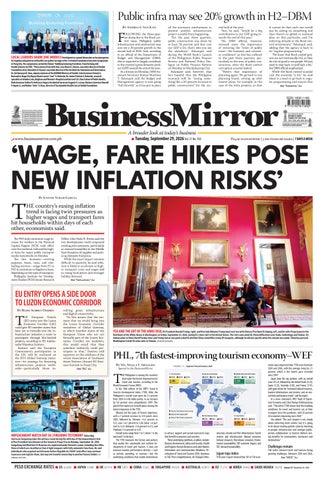
Public infra may see 20% growth in H2–DBM By Andrea E. San Juan
F
LOCAL LEADERS SHARE UHC MODELS Participants in a panel discussion on local programs for implementing Universal Health Care gather onstage at the 1st Unilab Foundation Executive Symposium in Pasig City. The symposium carried the theme “Building Enduring Frontlines: Transforming LGU Health Systems for UHC.” Photo shows (from left) Atty. Jose Maria A. Ochave, executive director of Unilab Foundation; Atty. Benedicto R. Bacani, executive director of the Institute for Autonomy and Governance; Dr. Zul Qarneyn M. Abas, deputy minister of the BARMM Ministry of Health; Cebu Governor Pamela S. Baricuatro; Naga City Mayor Maria Leonor “Leni” G. Robredo; Dr. Janine Patricia G. Robredo, research specialist at Ariadne Labs, Brigham and Women’s Hospital and Harvard T.H. Chan School of Public Health; Iloilo Governor Arthur R. Defensor; Negros Occidental Governor Eugenio V. Lacson; Batanes Governor Ronald P. Aguto Jr.; and Ruben “John” A. Basa, director of Sustainable Health Care at Unilab Foundation.
ROTARY CLUB OF MANILA JOURNALISM AWARDS
2006 National Newspaper of the Year 2011 National Newspaper of the Year 2013 Business Newspaper of the Year 2017 Business Newspaper of the Year 2019 Business Newspaper of the Year 2021 Pro Patria Award PHILIPPINE STATISTICS AUTHORITY 2018 Data Champion
OLLOWING the three-quarter slump due to the flood control mess, Philippine public infrastructure and construction may now see a 20-percent growth in the second half of 2026. And, according to an official of the Department of Budget and Management (DBM), this is expected to largely contribute to the country’s gross domestic product (GDP) toward the end of the year. At a forum on Monday, DBM Assistant Secretary Romeo Matthew T. Balanquit said the Budget and Management agency is now going “full throttle” as it has put in place
all the necessary mechanisms to prevent another infrastructure project scandal from happening. “For the past three quarters, public construction was down by at least 30 percent and that cost our GDP a lot, that’s why you see the slowdown,” Balanquit said during the World Bank’s Launch of the Philippines Public Finance Review and National Policy Dialogue on Public Finance Reform on Monday in Mandaluyong City. Balanquit said, however, that he’s hopeful that the Philippine economy will be “seeing something like a 20-percent increase in public construction” for the sec-
ond half of the year. This, he said, “would be a big contribution to our GDP going towards the end of this year.” The DBM official, however, stressed anew the importance of restoring the “state of public trust—the business and consumer confidence” as this has suffered in the past three quarters, particularly in the area of public construction, after the flood control corruption scandal leaked. “There’s that importance of planning again. We go back to our planning board, coming up with master plans, for example, in the case of the infra projects, so that
it cannot be that each one would just be asking on something and then there’s no global or national plan on this particular...and I’m referring already to the flood control investments,” Balanquit said, adding that the agency is back to its “regular programming.” “We know that flood control projects are not intrinsically evil, so they do a lot of good to our people. We just need to step back, to pull back a bit,” the DBM official emphasized. While the flood control scandal cost the economy “a lot,” he said there is a need to go back to regular programming and ensure that See “Growth,” A2
BusinessMirror A broader look at today’s business
EJAP JOURNALISM AWARDS
BUSINESS NEWS SOURCE OF THE YEAR
(2017, 2018, 2019, 2020, 2021) DEPARTMENT OF SCIENCE AND TECHNOLOGY
2018 BANTOG MEDIA AWARDS
‘WAGE, FARE HIKES POSE NEW INFLATION RISKS’ www.businessmirror.com.ph
T
n
Tuesday, September 29, 2026 Vol. 21 No. 350
P25.00 nationwide | 3 sections 68 pages | 7 DAYS A WEEK
By Justine Xyrah Garcia
HE country’s easing inflation trend is facing twin pressures as higher wages and transport fares hit households within days of each other, economists said. The P60 daily minimum wage increase for workers in the National Capital Region (NCR) took effect over the weekend, followed by higher fares for major public transport modes nationwide on Monday. The fare increases—covering jeepneys, buses, taxis, and ridehailing services—range from P1 to P35 in minimum or flagdown fares, depending on the type of transport. Philippine Institute for Development Studies (PIDS) Senior Research
Fellow John Paolo R. Rivera said the two developments could compound existing price pressures, particularly as renewed instability in the Middle East threatens oil supplies and pushes up domestic fuel prices. While the exact impact remains difficult to quantify, he said inflation is likely to accelerate as higher transport costs and wages add to rising food prices and stronger holiday demand. See “Inflation,” A2
EU ENTRY OPENS A SIDE DOOR TO LUZON ECONOMIC CORRIDOR By Bless Aubrey Ogerio
T
HE European Union’s (EU) entry into the Luzon Economic Corridor (LEC) could give EU member states that have yet to formally join the infrastructure initiative a route to participate through bloc-backed projects, according to EU Ambassador Massimo Santoro. Santoro said the European Commission’s participation in the LEC will be anchored on the EU’s Global Gateway initiative—its strategy for financing infrastructure projects worldwide—particularly those in-
volving green infrastructure and digital connectivity. “So this means that the moment that we would bring into the Luzon Economic Corridor initiatives of Global Gateway, to which member states of the European Union who are not formally part of the Luzon Economic Corridor are members, this would entail that they somehow indirectly could participate in that,” Santoro told reporters on the sidelines of the recent Association of Southeast Asian Nations (Asean)-EU Business Summit in Pasay City. See “EU,” A2
IMPEACHMENT WATCH DAY 30 | FIREARMS TESTIMONY Police Maj.
Joericson Sangalang takes the witness stand during the 30th day of the impeachment trial of Vice President Sara Duterte at the Senate in Pasay City on Monday, September 28, 2026. Sangalang testified that 22 firearms are registered under Duterte’s name, including five rifles, three of which are classified as Class A light weapons with fully automatic functions. He said individuals who acquired such firearms before Republic Act 10591 took effect may continue to possess and register them, but may not transfer ownership to another license holder. ROY
DOMINGO-SPPA POOL
TEA AND THE ART OF THE ARMS DEAL US President Donald Trump, right, and first lady Melania Trump meet over tea with Chinese President Xi Jinping, left, and his wife Peng Liyuan in the Red Room of the White House in Washington on Friday, September 25, 2026, during Xi’s state visit to the United States. The visit came amid US-China differences over trade, technology and Taiwan. US Ambassador to China David Perdue later said Trump had at one point asked Xi whether China would like to buy US weapons, although he did not specify when the remark was made. China has pressed Washington to halt US arms sales to Taiwan. AP/JACQUELYN MARTIN
PHL, 7th fastest-improving tourism economy–WEF By Ma. Stella F. Arnaldo Special to the BusinessMirror
T
HE Philippines is among the countries that made the fastest improvement in travel and tourism, according to the World Economic Forum (WEF). In the 10th edition of the WEF’s Travel & Tourism Development Index (TTDI) 2026, the Philippines’s overall score grew by 5.5 percent from 2024 to 4.08 index points, or an increase by 9.6 percent since prepandemic 2019. This placed the country in seventh place among the fastest improvers in the TTDI. Albania led the pack of fastest improvers, with a 7-percent increase to 4.14 points since 2024, followed by Vietnam +6.3 percent to 4.15, Laos +6.1 percent to 3.69, Qatar +6 percent to 4.23, Malaysia +5.8 percent to 4.5, and Thailand +5.6 percent to 4.35. Overall scores range from 1 to 7, where 1 is the worst and 7 is the best. The TTDI measures the factors and policies that enable the sustainable and resilient development of travel and tourism. It does not measure tourism performance directly—such as arrivals, spending, or revenue—but the underlying conditions that enable destinations
to attract, support and sustain tourism in ways that benefit economies and societies. These underlying conditions, or pillars, include: Business Environment, Safety and Security; Health and Hygiene; Human Resources and Labor Market; Information and Communication Readiness; Prioritization of Travel and Tourism (T&T); Openness to T&T; Price Competitiveness; Air Transport Infra-
structure; Ground and Port Infrastructure; Tourist services and infrastructure; Natural resources; Cultural resources; Non-leisure resources; Enviromental sustainability; T&T economic impact; and T&T demand sustainability.
Japan tops index
THIS year’s report showed that 101 of 110 econ-
omies have improved their TTDI score between 2024 and 2026, with the average rising by 2.1 percent, which is the fastest pace recorded since 2019. Japan took the top position, with an overall score of 5.27, followed by the United States (5.23), Spain (5.22), Australia (5.18), and France (5.17), with gains driven by “increased cultural resources, tourism infrastructure and services, and air connectivity and business travel,” said the report. In a news statement, WEF Head of Experience Economy and Cities Ramya Krishnaswamy said, “The latest [TTDI] shows that the enabling conditions for travel and tourism are at their strongest since the pandemic, with 92 percent of economies improving since 2024.” She added: “The next chapter is not simply about attracting more visitors, but it is going to be about creating greater value by investing in people, infrastructure and stronger publicprivate collaboration so tourism delivers lasting benefits for communities, businesses and destinations.”
Challenges remain
THE Index showed travel and tourism facing growing challenges. Between 2024 and 2026, See “WEF,” A2
PESO EXCHANGE RATES n US 62.6030 n JAPAN 0.3980 n UK 82.9114 n HK 7.9815 n CHINA 9.3263 n SINGAPORE 49.0120 n AUSTRALIA 43.8972 n EU 71.2735 n KOREA 0.0462 n SAUDI ARABIA 16.6750 Source: BSP (September 28, 2026)
News
BusinessMirror
A2 Tuesday, September 29, 2026
EU…
Continued from A1
The EU, together with Spain, joined the LEC at the bloc level on September 10, following earlier commitments by individual European countries. The additions brought to 10 the number of international partners beyond the Philippines, the United States and Japan. The other partners are Australia, Canada, Denmark, France, Italy, South Korea, Sweden and the United Kingdom. With the EU now formally part of the corridor, Santoro said Brussels is working with LEC partners to determine how existing Global Gateway cooperation can be translated into specific projects along the Luzon corridor. The bloc has about €60 million under its current Global Gateway budget for green projects and around €20 million for digital connectivity, although Santoro said these allocations could still increase. Further, the EU-level funding would complement investments from individual member states rather than replace them, the envoy said. “It will complement it, of course,” Santoro said. “So definitely yes, it’s complementary, it’s big and can go beyond the contribution of a single member state.” Individual countries could also finance projects outside the scope of the EU-level Global Gateway allocation for the LEC, he added. The expanded infrastructure cooperation comes as the Philippines and the EU deepen broader economic ties. Recently, the two sides reached a substantial agreement on a free-trade agreement after a decade of negotiations, widening the relationship beyond infrastructure to trade and investment.
www.businessmirror.com.ph
Govt to shoulder ₧60 wage hike for qualified small biz By Mary Jade Jadormio
T
HE government will shoulder the P60 daily wage increase for qualified small and medium businesses under a new Department of Labor and Employment (DOLE) program designed to keep workers employed and businesses operating. DOLE Secretary Francis N. Tolentino said the Sagip Trabaho Program will cover businesses that can prove they cannot immediately absorb the additional wage cost. “The P60 wage increase...DOLE will
Inflation… Continued from A1
“Previously, the main driver of inflation was food, but in the remaining months of 2026, it might be transportation,” he told the BusinessMirror. Headline inflation slowed to 6.1 percent in August, marking its fourth straight month of easing after peaking at 7.2 percent in April. Data from the Philippine Statistics Authority (PSA) showed that food and non-alcoholic beverages remained the biggest contributor to headline inflation in August, accounting for 28.8 percent of the total, with prices in the category rising 4.6 percent. Housing, water, electricity, gas and other fuels fol-
shoulder it for 90 days so that our small businesses can adjust,” Tolentino said in a radio interview. The assistance will run for three months, covering October, November and December, Palace Press Officer Claire Castro said. DOLE is set to release the program guidelines this week, including the requirements and procedures for businesses seeking assistance. Businesses will have to submit their Department of Trade and Industry (DTI) certificates, number of employees and financial records to show that
they cannot yet afford the higher wage, according to the labor chief. Meanwhile, smaller businesses that qualify for exemption from the P60 increase will only need to register online. Exempt establishments will continue paying the existing minimum wage and will not be required to implement the additional P60. Tolentino said businesses with fewer workers may qualify for automatic exemption, but clarified that DOLE would still issue
guidelines on the exact coverage. “We will release the clear guidelines about this so it will be clearer,” Tolentino said. Castro said DOLE will also issue a workers’ performance plan and a business continuity plan alongside the Sagip Trabaho guidelines. These plans are intended to prevent workers from being displaced and small businesses from shutting down while they adjust to the higher wage requirement.
lowed with a 26.6-percent contribution, while transport accounted for 20.1 percent. Inflation in the two categories stood at 7.9 percent and 13.5 percent, respectively. Former Socioeconomic Planning Secretary Dante B. Canlas also said the fare increases could immediately pinch household budgets, potentially prompting public-transport workers and commuters to push harder for the full implementation of the P85 NCR wage order that remains suspended under courtissued temporary restraining orders. “Once the NCR wage order is fully implemented, production costs are expected to increase causing commodity prices to rise and stay elevated,” Canlas told the BusinessMirror. The P85 wage increase under Wage Order No. 27 has been challenged before the Pasig City and Navotas City Regional Trial Courts, which issued temporary
restraining orders against its implementation. While the P85 increase remains under legal challenge, the Department of Labor and Employment (DOLE) has issued a separate P60 wage increase, which took effect over the weekend. Ateneo de Manila University economist Leonardo A. Lanzona Jr. estimated that the combined fare and wage increases could add around 0.2 to 0.5 percentage points to headline inflation over the next few months, adding to existing price pressures. “That is added pressure, not a shock, and the [Bangko Sentral ng Pilipinas] has already factored wage risks into its forecast. Rice inflation near 20 percent and fuel prices remain the bigger threats,” Lanzona told the BusinessMirror.
will have impacts on private consumption,” Rivera said, adding that the Christmas season could still provide a modest lift to consumption. The impact could extend beyond household consumption and further weigh on economic growth, Canlas said, as the economy struggles to regain momentum after four consecutive quarters of slowing growth. The economy expanded by just 2.3 percent in the second quarter of 2026, its weakest growth in five years. Excluding the pandemic period, it was the slowest expansion since the fourth quarter of 2009 when the economy grew by 1.8 percent. According to Canlas, the higher transport costs could force households to redirect part of their income toward fares and away from other goods and services. “The twin shocks can further slow down real [gross domestic product] growth. Fare increases crowd out household spending while full implementation of the NCR wage order may still hike production costs,” he added.
Fare hike offsets wage gain
LANZONA also pointed out that the P60 wage increase would provide only a modest boost to workers’ purchasing power once higher transport costs and still-elevated inflation are taken into account. He noted that the wage hike is equivalent to an 8.6-percent increase, but higher fares could absorb roughly a fifth of that gain, while inflation remains close to 6 percent. The impact is even more pronounced for informal workers, who are not covered by the minimum wage increase but will still have to absorb higher transport costs, Lanzona said. This, he said, could make the usual holiday boost in household spending more muted this year. “Expect an essentials-first Christmas, cushioned by the 13th-month pay but not a spending boom,” he added. Rivera similarly warned that higher wages could easily be cancelled by rising costs, limiting any improvement in households’ purchasing power. “Given the economic conditions now, I would expect consumer behavior to be subdued, similar to what happened in 2025. Therefore, this
US trade… Continued from A5
Clark, Manila, and Batangas—a corridor of industrial geography responsible, by some estimates, for roughly half the nation’s entire output. DeSombre called the purchase the connective tissue linking American direct investment to the Philippines’ ambition toward advanced manufacturing, and invoked, with unmistakable pride, President Marcos Jr.’s own appearance this month at the Corridor’s investing forum in Manila—a sitting head of state courting the same capital under discussion in a Manhattan ballroom half a world away. He thanked, by name, Bill Campbell of I Squared, seated among the private-sector delegation, a modest gesture carrying an outsized signal: the Philippines was not being discussed as an aid recipient from a comfortable distance. It occupied a chair, and held leverage, inside the room where this doctrine was being drafted in real time. The slide’s third column carried the freshest ink of the entire presentation. Zipline, the American drone-logistics firm, appeared
Managing pressures
FOR Lanzona, the government should focus on keeping rice supplies stable, providing targeted transport assistance to vulnerable households and preventing excessive price increases during the holiday season. He also called for support for informal workers and poorer households who are outside the wage order’s coverage, while urging authorities to stagger fare, power and water increases to avoid piling up major cost increases in a single quarter. Rivera, meanwhile, expects the BSP to take a cautious approach to monetary policy, with rates either held steady or increased by only 25 basis points. He said the central bank would likely avoid aggressive rate hikes as it balances price stability with the need to support economic growth, particularly after weak first- and second-quarter growth.
under a joint heading for the Philippines and Papua New Guinea, its letters of intent dated this very month—September—covering drone technology for both private and public sectors across both nations. He framed the expansion as the next frontier for a company whose aircraft already ferry medicine and blood across Rwanda and Ghana under State Department-backed programs that proved the model before it scaled—rural health systems and disaster-response corridors reinforced not by another shipment of donated pallets but by autonomous flight, a proposition that ought to interest any Filipino reader who has watched relief convoys stall before reaching a Visayan island or a Mindanao mountain barangay after a typhoon. What shifted between my two dispatches is plain. In July, my country was a name appended to a list of nations endorsing a set of principles. By September, it had become the receipt—an acknowledgment, delivered by a sitting Assistant Secretary of State before ambassadors from fifty nations, that the Philippines has become the proving ground for how the United States intends to conduct its economic statecraft in the years after 2030, when the current generation of development frameworks expires. Two Philippine transactions, appearing months apart, sharing a single slide—that placement was not an accident of alphabetical order. What this arrangement ultimately delivers to ordinary Filipinos remains the harder question, and it deserves precedent rather than applause. The Luzon Economic Corridor has been sold before on nearly identical terms, and the honest ledger so far reads mixed: See “US trade,” A4
WEF…
Continued from A1
travel became less affordable in three out of four economies, while tourism investment failed to keep pace with rising demand and labor shortages threatened further growth, said WEF. “Benefits for local communities also weakened during this period, highlighting that more visitors do not automatically translate into better livelihoods or higher quality jobs, particularly in destinations where tourism is highly seasonal,” the organization added. Despite these pressures, emerging tourism economies are gaining ground, said the WEF. Since 2019, the largest emerging economies have improved their TTDI scores more than twice as fast as the Top 20, with Asia-Pacific economies, including the Philippines, accounting for seven of the 10 fastest-improving performers. “Overall, these findings suggest that the next stage of convergence will depend less on attracting visitors and more on supporting them and travel and tourism businesses. Many major emerging tourism economies already possess the assets associated with tourism success. What separates them from the leaders is the depth of the infrastructure, services and enabling conditions needed to support tourism,” said the report. This year’s TTDI report was produced in collaboration with Zurich Insurance Group and informed by the Beyond Tourism Insights Council.
WB’s fiscal… Continued from A5
It calls for better targeting of health and social assistance and directing education funds toward foundational learning, classrooms and teaching materials, particularly in underserved areas. These reforms, according to the World Bank, could reduce the debtto-GDP ratio to 57 percent by 2032 while supporting GDP growth of 5.8 percent.
Gov’t response
FOR its part, Finance Secretary Frederick Go said the Department of Finance (DOF) will review the World Bank’s recommendations and use them to refine the government’s approach to revenue mobilization and tax policy. “We will work closely with the World Bank to build our technical capacity and to track our progress. We will pursue this agenda as a wholeof-nation effort,” Go said in a prerecorded keynote message during the report’s launch on the same day. Go said the government, Congress and the private sector would need to work together to advance the fiscal reform agenda, with fiscal credibility helping support lower borrowing costs and investment. He said the agenda centers on improving tax collection, making public spending more effective and strengthening institutions to ensure government programs are properly planned, implemented, and reported.
Growth…
Continued from A1
there will be “kind of reassessment and revalidation of those existing projects, and a clear assurance that we can now have a green light to proceed and finish those projects.” Apart from public construction, Balanquit said household consumption and private investments also slowed down. “So we need to clean up a bit and do some kind of, I would consider it like a cleansing diet, so that we’ll be able to have more nourishment moving forward. And I think now we are in full throttle. We have set all the necessary mechanisms so that these things that happen in 2025 will not be repeated again,” he added. When the flood control corruption scandal broke in July 2025, infrastructure spending had been down since the second half of last year due to stricter billing validation of Department of Public Works and Highways (DPWH) projects. This year, infrastructure spending was cut to P1.272 trillion from P1.558 trillion, equivalent to 4.2 percent of the gross domestic product (GDP). (See: https://businessmirror.com.ph/2026/08/17/ double-digit-growth-seen-for-infra-spend/)
The Nation BusinessMirror
www.businessmirror.com.ph
Lacson warns Dizon of possible criminal liability over Taguig project cover-up By Butch Fernandez
S
@butchfBM
EN. Panfilo M. Lacson on Monday warned Public Works (DPWH) Secretary Vivencio Di zon t hat any attempt to cover up anomalies in infrastructure projects in Taguig City could expose those involved to possible criminal liability. Dizon, Lacson said, should come clean on the red flags found by the DPWH’s own inspection teams that had findings in some 68 infrastructure projects in Taguig –including the slope protection project along Taguig River whose billing photos had geotagged coordinates pointing to Leyte. “I told him not to deny the existence of ghost projects because we already submitted the appropriate records to the Ombudsman. You will get into trouble if you try to cover up. Let’s all just come clean on the issue,” he said in a radio interview.
Another crackdown at DPWH?
PRESIDENT Marcos has not ruled out another crackdown among the officials and personnel of DPWH after discrepancies in the details of flagged infrastructure projects in Taguig cropped up. In a hearing in the Senate last week, Dizon, who is still in acting capacity, said there was no “ghost” or non-existent infrastructure project in Taguig. The claim was challenged by Lacson, who said his own team has discovered that at least one infrastructure project in Taguig has geotagged coordinates located in Leyte. Quoting Dizon, Palace Press Officer Claire Castro said DPWH has yet to come out with a “conclusive ghost project” in Taguig for now. “However, this does not necessarily mean that there are no anomalies to speak of in Taguig. He [Dizon] is
neither confirming nor denying their existence. He clarified this point, noting that a more thorough and meticulous investigation is required to ensure there is no cover-up,” Castro said in Filipino in a press briefing on Monday. She said DPWH is now conducting an internal investigation to determine if the geotagging discrepancy was caused by a possible attempt to sabotage DPWH and then cover it up. “The DPWH will not let this slide, and neither will the administration,” Castro said. “If there is any wrongdoing at the DPWH and attempts to shield those involved, the President will not hesitate to fire those responsible, because this is definitely and absolutely prejudicial to the government,” she added. When asked if Dizon still has trust and confidence in Marcos, Castro said there is no discussion in the Cabinet on the performance of DPWH chief. “At present, there is no discussion or information reaching us regarding any issues concerning Secretary Dizon’s work,” she said. Lacson said Dizon called him over the weekend after he disclosed details of the “Slope Protection along Taguig River Project” whose geotagged photos attached to its billing reports contained coordinates pointing to Leyte province, some 600 kilometers away from Taguig. The project, identified by Contract ID 220B0106, had three locations in Tacloban City reflected in the geotagged photographs, Lacson said. Records showed that the DPWH paid St. Timothy Construction Corp., which he identified as owned by the Discaya family, some P96.5 million for the project.
Not isolated case
LACSON said this project is not an isolated case but only the most brazen and
telling, since there are several similar cases of highly questionable and suspected “ghost” projects in Taguig based on the site inspection reports. “I highlighted this project because it was so brazen, with the photos in the billing reports pointing to an area 600 kilometers away,” he said, explaining in Filipino. Also, Lacson said that while they are not yet concluding that the flagged projects are ghosts, it is not correct to conclude that there are no ghost projects in Taguig, based on the responses of Dizon and Undersecretary Ricardo Bernabe III to the questions raised by Sen. Alan Peter Cayetano during last Friday’s hearing on the DPWH’s proposed 2027 budget. “We are not concluding that those flagged projects are ‘ghosts’ but it is also not correct to conclude that there are no ghost projects in Taguig. The project I described was one of many with findings. In some cases, the inspection teams could not verify the projects because they were covered up by newer projects,” he said.
‘Very apologetic’
DURING Dizon’s call, Lacson said, the secretary was “very apologetic” and claimed he had been “set up” when he told senators during last Friday’s Senate Finance subcommittee hearing on the DPWH’s proposed 2027 budget that there were no ghost projects in Taguig. In response, Lacson sent Dizon a video recording of the portion of the hearing where Dizon “clearly” said there were no ghost projects – followed by Bernabe’s claim that all 107 projects in Taguig “have accomplishments.” Lacson said he was also informed on Sunday that a media outfit attempting to verify records on the slope protection project through the DPWH website found the site “down.” He said that when he told Dizon about this, the website
Sara, husband have 51 registered guns By Jovee Marie N. Dela Cruz @joveemarie
V
ICE President Sara Z. Duterte and her husband, lawyer Manases Carpio, have a combined total of 51 registered firearms with an estimated current market value of P7,220,370, records presented by the Philippine National Police (PNP) during Duterte’s impeachment trial on Monday indicate. Police Maj. Joericson Sangalang of the PNP Firearms and Explosives Office (FEO) testified that Duterte owns 22 registered firearms valued at P2,184,550, while Carpio owns 29 firearms valued at P5,035,820. The figures were presented as part of the prosecution’s evidence under Article II of the Articles of Impeachment involving allegations of unexplained wealth. The issue surrounding Duterte’s firearms is not the number of firearms she owns or her authority to possess them, but whether these assets were properly declared in her Statement of Assets, Liabilities and Net Worth (SALN), House of Representatives lead prosecutor Batangas Rep. Gerville Luistro said on Monday. Luistro said firearms are considered properties that must be disclosed in SALN declarations. The prosecution presented the firearm records as part of its Article II case, focusing on whether the assets were properly reflected in Duterte’s previous SALNs. The defense argued that newer SALN guidelines specifically requiring firearm declarations should not apply
retroactively, but Luistro maintained that Duterte must still explain how the firearms were declared in earlier filings. Moreover, Sangalang clarified that the amounts reflected the PNP-FEO’s current market-survey prices and were not the actual acquisition costs of the firearms. The valuation did not establish how much Duterte or Carpio originally paid for their firearms. House prosecutor and San Juan City Rep. Ysabel Maria Zamora asked Sangalang how the FEO determined the prices listed in its certifications. “These figures are based on a market survey conducted by our office,” Sangalang said. He explained that the FEO gathered pricing information from firearm dealers and gun-store representatives located near the agency’s storage area. The prices reflected the estimated market value of the firearms at the time the certification was issued. When asked when the valuation applied, Sangalang answered, “As of today. That is what is indicated at the bottom of our certification.” During the hearing, the prosecution selected several firearm entries from the certifications instead of presenting every item individually. For Duterte’s records, Sangalang identified an M&P 9 Compact pistol valued at P99,000, a Winchester rifle valued at P120,000, and an STI Legend pistol valued at P167,000. The prosecution also asked about three Bushmaster rifles listed under Duterte’s name. Sangalang stated that each rifle had a current market-survey
value of P200,000. He also identified an HK rifle in Duterte’s record with an estimated market value of P300,000. For Carpio’s firearms, Sangalang cited several examples, including a Metro pistol valued at P320,000 and an APC rifle valued at P600,500. When asked about an HK416 rifle listed in Carpio’s certification, he stated that its estimated current market value was P900,000. After the selected firearm entries were presented, Impeachment Court Presiding Officer Sen. Francis Escudero asked Sangalang to provide the total valuation. The witness confirmed that Duterte’s firearms were valued at P2,184,550, while Carpio’s firearms were valued at P5,035,820, for a combined total of P7,220,370. The firearms listed in the records include pistols, revolvers, shotguns, and rifles. Among them are four Class A light weapons with fully automatic capabilities—three registered to Duterte and one registered to Carpio. Sangalang testified that Duterte owns 14 pistols, two revolvers, five rifles, and one shotgun. Three of her rifles are classified as Class A light weapons. “Vice President Sara has 22 firearms. She has 14 pistols, two revolvers, five rifles, three of which are Class A light weapons, and one shotgun,” Sangalang said. Carpio’s firearms collection consists of 16 pistols, two revolvers, one shotgun, and 10 rifles, including one Class A light weapon. Sangalang also noted that one of Carpio’s firearms has an expired registration.
appeared to be back up. Lacson said the issue was particularly troubling because the DPWH’s own inspection teams had found red flags in 68 projects in Taguig. Five DPWH teams composed of personnel from the Bureau of Quality and Safety, Bureau of Construction, Bureau of Research and Standards, and Bureau of Maintenance were sent to Taguig from July 23 to 25 to inspect projects there. “I told him to be careful because whoever takes part in a cover-up will become criminally liable. At the very least, they will become accessories after the fact because of the coverup,” Lacson recalled telling Dizon. Also, Lacson said that last Friday, he learned from Senate Finance committee chairman Sen. Jose Victor Ejercito that Dizon had gone to Cayetano’s Senate office before the subcommittee hearing on the DPWH budget started. He said that at the time, he had a hectic schedule as he was chairing the Foreign Relations committee hearing of the Commission on Appointments (CA). “I asked Senator Ejercito where Dizon was. I was told he was in Cayetano’s office, and that they were talking,” Lacson said. Lacson said he did not expect the categorical denial from Dizon about ghost projects in Taguig. He said he had to defend his position especially because he was given the “receipts” of the projects. He said he could not accept Dizon’s statement that there were no ghost projects “as of now,” noting that the DPWH’s own inspection reports were dated July 23 to 25. “I sympathize with the DPWH’s engineers who were contradicted by their own boss. When Dizon called me and told me he was surprised by my revelation on the Taguig project with photos in Leyte, I told him it was in the DPWH’s own report,” he said. With Samuel P. Medenilla
BuCor to seek court clearances before releasing Cornejo, Lee, 2 others By Joel R. San Juan @jrsanjuan1573
T
alleged unexplained wealth. “We can say that we are already about halfway through,” Chua said during a press briefing. Chua said the prosecution is building its case through various records, including Duterte’s Statements of Assets, Liabilities, and Net Worth (SALNs), corporate documents, and government records. “It is like a puzzle that we are gradually putting together to determine the extent
of the Vice President’s wealth,” he said. The prosecution has presented Duterte’s SALNs from 2007 to 2025, which showed her declared net worth increasing from about P7.25 million in 2007 to P98.66 million in 2025. Chua said the records would be compared to determine how her wealth grew over the years. “ T h i s w i l l b e compa re d w it h wh at she de c l a re d i n her S A L N and how her wea lth increased f rom
T
HE Bureau of Corrections (BoC) on Monday said it would first seek clearances from the Regional Trial Court in Taguig and the Court of Appeals before facilitating the release of Cedric Lee, Deniece Cornejo and two others from prison. Corrections Director General Gregorio Pio P. Catapang Jr. made the statement following reports that the CA has issued a decision ordering Lee, Cornejo, Simeon Palma Raz Jr. and Ferdinand Guerrero from prison two years after they were sentenced to reclusion perpetua or 40 years imprisonment in the serious illegal detention case filed by actor and television host Vhong Navarro. A copy of the decision which modified the sentences handed down against the four convicts has yet to be made public by the CA. Catapang said the BuCor is preparing a formal correspondence to the CA seeking clarification of its order reportedly issued on September 25. He said the BuCor will specifically request a copy of the Entry of Judgment from the CA. The BuCor is also preparing a request for the issuance of a Certificate of No Pending Case from the Office of the Clerk of Court of the Regional Trial Court (RTC) in Taguig City. The document will form part of the records and documentation required to determine the four’s release status. Catapang emphasized that BuCor’s actions are part of its standard recordsvalidation and release procedures. “The Bureau must obtain and verify the necessary court documents, including the Entry of Judgment and Certificate of No Pending Case, before finalizing the release process,” Catapang sressed. Based on the records provided by the Person Deprived of Liberty Documents and Processing Division (PDPD), Catapang said Lee, was received into BuCor custody on May 3, 2024, by virtue of a commitment order issued by Branch 153 of the Regional Trial Court in Taguig City.
He was initially sentenced to reclusion perpetua for serious illegal detention under Criminal Case 153705. Cornejo was received into BuCor custody on May 2, 2024, pursuant to the corresponding commitment documents. The case was later affirmed and modified by the Court of Appeals, Manila, Special Seventeenth Division, under CA-G.R. CR HC 20030. In its September 25 decision, the appellate court modified the offense to grave coercion and imposed a sentence of six months as minimum to three years, six months, and 21 days as maximum. However, Catapang noted that based on its records the subject PDLs are also serving sentences of six months as minimum to three years as maximum for grave coercion. The sentence was issued by the Branch 266 in Taguig City and affirmed by the CA Ninth Division. “No Entry of Judgement has been issued, therefore it is being requested before the Judicial Records Division of the said court,” Catapang noted. Catapang added that based on records, the sentences imposed in the two cases are supposed to be served successively. Thus, the combined sentence is computed at four years and 21 days as minimum to seven years and 21 days as maximum. “The Bureau is reviewing the records and sentence computations to ensure that any release is carried out in accordance with the appellate court’s order and applicable rules on sentence administration,” Catapang pointed out. As of September 26, 2026, Lee has accumulated 460 days of Good Conduct Time Allowance (GCTA). His credited time served with BuCor, including the applicable allowance, is three years, 10 months, and 29 days. His actual time served is two years, seven months, and 24 days. Based on the current computation, Lee’s presumptive date for serving his minimum sentence is February 18, 2027, while his presumptive date for serving his maximum sentence is February 18, 2030.
NBI testing Gracioso’s credibility Jonathan L. Mayuga |
@jonlmayuga
T
HE National Bureau of Investigation (NBI) has not yet accepted hook, line and sinker the claims of dismissed policeman Rodulfo Gracioso Jr. that he delivered bags of money to members of the Duterte family upon the instruction of then Speaker Lord Allan Velasco. In an interview, NBI Director Melvin Matibag told reporters they would still subject Gracioso’s affidavit and other supporting evidence for verification and authentication. “Whenever evidence like these are brought to us, we cannot simply believe it immediately. That is why we are called the National Bureau of Investigation – we have to investigate. So we will investigate the truth behind the evidence presented to us. The photos and videos that he submitted will also be subjected to authentication and verification,” Matibag said. Matibag made the statement as Gracioso appeared before the NBI to submit his sworn affidavit as well alleged evidence such as photos and videos to support his allegations. The NBI chief added that they would also subject Gracioso, who claimed to be Velasco’s former security aide, for another round of for polygraph or lie detector test that would focus on the substance on his affidavits. He said the first lie detector test conducted on Gracioso was about his identity and relationship with the people he mentioned in his statements. “That is why we said that he passed the test with a 99 percent result. But now since he has an affidavit, we want to ask him questions based on the affidavit and it will be a long process. He has agreed to it, he is very much willing and we wil schedule it anytime this week,” Matibag added. He added that the NBI will also coordinate with other groups and agencies such as Meta to help them determine whether they are authentic or they were manipulated or generated using artificial intelligence. To complete its investigation, Matibag said the
More significant testimonies in impeach trial expected HE House of Representatives prosecution panel on Monday said it is halfway through presenting evidence in the impeachment trial of Vice President Sara Z. Duterte over allegations of unexplained wealth, with more significant testimonird House prosecutor and Manila Rep. Joel Chua said the prosecution has completed around half of its presentation under Article II of the Articles of Impeachment, which focuses on Duterte’s
Tuesday, September 29, 2026 A3
20 07 unt i l 2025,” C hu a sa id. Earl ier w itnesses testif ied on Duterte’s declared business interests, Securities and Exchange Commission (SEC) records, and Philippine Government Electronic Procurement System (PhilGEPS) documents. The records showed that the company that Duterte admitted having interest, Gencorp, received 49 government awards amounting to P35.878 million. Jovee Marie N. dela Cruz
agency will also invite the Vice President, Velasco and other personalities Gracioso mentioned in his affidavit to shed light on the matter. Vice President Duterte has denied knowing Gracioso or receiving money from him. “So it should not be a subpoena but it should be an invitation especially to the Vice President because she has denied knowing him and plans to file cases. We will give her a copy of the affidavit,” Matibag said. Matibag, however, clarified that they would ask Gracioso’s consent first before providing the Vice President a copy of his affidavit. “We will also show the photos to the
Vice President and provide her with copies so that she herself can clarify,” he added. When asked about Gracioso’s credibility being a dismissed police officer, Matibag noted that his previous case is a separate issue from what he is now alleging. “Just because he has been dismissed we will no longer pay attention and investigate his statements. We still need to conduct an investigation because if his statements were fabricated he can be held liable for perjury,” the NBI chief pointed out. Matibag said if his claims would turn out true then the NBI would pursue further investigation into his claims. With Joel R. San Juan
Economy BusinessMirror
A4 Tuesday, September 29, 2026
US trade… Continued from A2
infrastructure and logistics gains are real and measurable, while the jobs and small-enterprise dividends promised beyond those four hubs have arrived more slowly than the announcements implied. A $460-million fuel-terminal sale and a fresh set of drone-delivery letters of intent are commitments of capital, not outcomes yet. Whether that capital reaches a barangay or a small enterprise, or settles instead into the balance sheets of firms already substantial enough to earn an invitation into that ballroom, is the follow-up story Philippine readers are owed. The agency heads who followed made the doctrine tangible in ways DeSombre’s numbers alone could not. Caroline Vik, chief policy officer of the U.S. International Development Finance Corporation, walked through three transactions approved by the agency’s board that week: an investment in WIOCC, a pan-African digital-infrastructure operator whose fiber and data centers already serve Microsoft, Meta, Google, and Amazon across more than thirty countries; American financing behind Cambodia’s New Techo Airport, framed explicitly as an alternative to financing from Beijing; and a $500- million trade-finance facility with the International Finance Corporation designed to unlock roughly $2 billion in American exports annually by letting foreign buyers who couldn’t otherwise afford US goods actually complete the purchase. John Jovanovic, president and chairman of the Export-Import Bank, traced his agency’s mission back ninety-two years to its founding under Franklin Roosevelt and offered his own trio of proof points—an American locomotive manufacturer competing and winning in Kazakhstan, a slate of nuclear-plant financing across Central and Eastern Europe, and what he called the “asymmetric value” of smaller deals that lock in trusted vendors over cheaper but less reliable rivals. Ryan Goodnight of SpaceX closed the roster with Starlink’s own math: a company six years old, present in more than 170 markets, that had made rapid rocket reusability the engine behind broadband service reaching, as he put it, Antarctica, the middle of the Pacific, and downtown Manhattan alike. Set against the rest of Negrea’s global tally—$14.5 billion for the UAE in Boeing and GE Aerospace, $6.2 billion for Lesotho in digital infrastructure and energy—the Philippines’s $460 million looked almost restrained. But the Philippines, alongside Papua New Guinea, was the only geography invoked twice across the entire presentation. It did not win the showcase on volume. It won on billing. Whether this doctrine outlasts the administration that built it, no ballroom can settle. But on a Friday morning in September, with the Philippines cited twice as the model the room was summoned to imitate, the doctrine I first met in outline in July had acquired, by my second visit, a face, a fuel terminal, and a fleet of drones. For a nation that has spent generations receiving the world’s charity, being asked instead to receive its capital—and held aloft as proof the arrangement works—deserved to be carried home in full.
www.businessmirror.com.ph
Tieza hoping for a budget hike for 2027 By Ma. Stella F. Arnaldo @akosistellaBM Special to the BusinessMirror
S
OME P4.63 billion in investments in the tourism industry have been registered with the Tourism Infrastructure and Enterprise Zone Authority (Tieza) from January to August this year. Lawyer Karen Mae G. Sarinas-Baydo, assistant chief operating officer of Tieza, said these investments are already 80.6 percent of the total registered investments in full year 2025, which reached P5.74 billion. She added that this year’s committed investments are projected to create 522 jobs, while last year’s total were supposed to create 1,039 jobs. In addition, Sarinas-Baydo said, “Tieza is currently processing eight ongoing applications representing approximately P2.56 billion in proposed investments and 569 potential jobs.” She added that of the eight registered proj-
ects, “five with about P1.07 billion in proposed investments and 256 jobs, have target opening dates within 2026. The remaining three applications represent approximately P1.49 billion and 313 jobs, with opening dates in 2027.” Under recent tax reform laws, Tieza has been apppointed as the premier tourism investment promotion agency of the government, and can grant tax-free privileges and income tax holidays to registered projects. “From 2021 to August 2026, Tieza registered 34 projects under the CREATE [Corporate Recovery and Tax Incentives for Enterprises] and CREATE MORE [CREATE to Maximize Opportunities for Reinvigorating the Economy] Acts, representing approximately P14.5 billion in committed investments and 2,826 committed jobs,” she noted. Projects registered in 2025 until August 2026 alone accounted for P10.37 billion, or about 71.5 percent of total registered investments since 2021, “underscoring the continued strength of tourism-related investment commitments in
the last two years,” she said. As this developed, some members of the House of Representatives urged that a budget for Tieza be allocated next year, in the light of the impending removal of the travel tax, which funds the government firm’s operations and infrastructure projects. The House of Representatives has already passed a measure on the lifting of the travel tax, but the Senate has yet to pass its own version.
Appeal for 2027 funds
“I WOULD just like to manifest for the budget of Tieza. I hope the honorable sponsor [of the Department of Tourism budget] can push for an additional budget for Tieza, even if it’s not the full amount because I believe infrastructure is really needed even more than branding funds to attract tourists,” said Party-list Rep. Sergio Dagooc of Apec. The lawmaker made the appeal during last week’s plenary hearing on the proposed P5.5-billion budget of the DOT and its attached agencies under the National Expenditure Pro-
gram for 2027. SorsogonRep. Ma. Bernadette Escudero-Quirante was the sponsor of the DOT’s budget. (See, “DOT budget gets HOR backing,” in the BusinessMirror, Sept. 9, 2026.) There is an ongoing P100-million ecotourism project funded by Tieza in the Dinagat Islands from which Dagooc hails. The project, signed between the provincial government and Tieza in July, involves the construction of a boardwalk and related structures leading to watersports areas in the Gaas Inlet. While lawmakers who had backed the removal of the travel tax earlier vowed they will get funding for Tieza projects under the General Appropriations Act next year, the government firm received zero allocation in the NEP 2027. Tourism officials and private stakeholders had already expressed serious concerns of the removal of the travel tax as it may disrupt many multi-year infrastructure projects. (See, “Tourism competitiveness at risk in travel tax junking,” in the BusinessMirror, Feb. 23, 2026.)
Let’s all build a Sustainable Future
B
By Henry J. Schumacher
USINESS and government must understand how sustainability requirements filter down throughout companies and government operations. Please allow me to highlight a few areas for your considerations.
The quality of the environment
A SUSTAINABLE community sees itself as existing within a physical environment and natural ecosystem and tries to find ways to co-exist with that environment. It does its part by avoiding unnecessary degradation of the air, oceans, fresh water, and other natural systems. It tries to replace detrimental practices with those that allow ecosystems to continuously renew themselves. I was shocked to read that water wasted annually is equivalent to half of Angat Dam capacity. Around 488 million cubic meters of water a year are lost to waste, mainly in water districts outside Metro Manila, says the Local Water Utilities Administration (Lwua). Of course, the recent and present flooding in many parts of the country cannot be seen as reasons to neglect the water management. It is trusted that the LWUA finds partners in government and the private sector to see water management as part of disaster resilience. This is even more important due to the fact that we are soon heading into a long dry (El-Niño) season!
Disaster resilience and mitigation
WE must understand that a community must be resilient in the face of inevitable natural disasters like typhoons, earthquakes, floods, and drought. The community must take steps to ensure that such events cause as little damage as possible, that productivity is only minimally interrupted, and that the quality of life remains at (or quickly returns to) high levels. A disaster-resilient community further takes responsibility for the risks it faces and tries to be self-reliant. Ensuring food sustainability and security remains a big task in the Philippines. It is a daunting endeavor, but not impossible. We have no choice but to realize that we cannot eat money; we need to prioritize agriculture and fisheries.
We have to say goodbye to plastic waste
ACCORDING to environmental experts, the total clean-up of plastic pollution in seven major rivers across Southeast Asia will cost US$297 million. In addition, plastic pollution is costing these countries US$23,100 to $270,000 per square kilometer of coral reef. The proper management of plastic waste must include plastic bags, sachets, labels, laminates, and both rigid and flexible plastic
used for such products. There is no question that we must get rid of single-use plastic! Degradable plastic is another option that needs to be taken seriously. That’s why some companies already make all sorts of goods with plant-based biopolymer and fiber. Think trash bags, food storage containers, tableware, plates, and bowls. They should be sustainable “superheroes” of communities that take plastic waste management seriously and Return valuable nutrients to the soil Reuse crop waste Are certified compostable. A Sustainable Future can be created by integrating sustainable consumption and production principles into policymaking, business practices, and consumer behavior. Furthermore, investing in new technologies is crucial. There is hope that government, non-government organizations, the private sector, and sustainability advocates will do their share to attain the dream of a Sustainable Future. The Nation’s commitment to maintain a delicate equilibrium be-
tween growth and sustainability on one side, and environmental stewardship on the other, is a holistic approach that encompasses people, planet, and prosperity! In this context, I thoroughly enjoyed a recent environment, social and governance (ESG) impact report, highlighting four pillars under its ESG commitment: empowering communities, a future-ready workforce, environmental stewardship, and effective governance. Please realize that each of us is committed to contribute to ESG. Latest news from the Netherlands: Dutch engineers created a massive floating system that collects plastic from the oceans. So far, it has removed more than 60 million kilograms of plastics. Let’s hope, this system will be applied in many countries. I look forward to your comments. Please email me at hjschumacher59@gmail.com
Minimum wage hike set in CV
P
By Mary Jade Jadormio
RIVATE sector workers in Central Visayas are set to get a P42 increase in their daily minimum wage after the National Wages and Productivity Commission (NWPC) affirmed the new wage order issued by the regional wage board. Under the order, the minimum daily pay will increase to P582 in Class A areas and P542 in Class B areas. The new rates are expected to take effect on October 14, following the required publication period. Labor Secretary Francis N. Tolentino confirmed the commission’s action during its September 26 deliberation at the Department of Labor and Employment Regional Office VII in Cebu. RTWPB VII submitted the wage order to the NWPC for review after completing its wagedetermination process in Central Visayas. Labor, management and other stakeholders took part in consultations and public hearings conducted by the regional wage board. Those consultations formed part of the board’s process in determining the new minimum-wage rates for covered privatesector workers. With the NWPC’s affirmation, RTWPB VII can now proceed with the publication of the wage order. Publication is required before the new rates can become effective under existing wage-setting rules. The review and affirmation were made pursuant to Sections 1 and 4, Rule IV of NWPC Guidelines No. 03, Series of 2020, as amended. Once the publication requirement is completed, the new rates will take effect on October 14.
Legislator seeks investigation into JVA of electric cooperative By Jovee Marie N. Dela Cruz @joveemarie
T
HE proposed joint venture agreement between an electric cooperative in Mindanao and a private company has drawn national attention as a House of Representatives deputy minority leader seeks an inquiry into the agreement while calls grow to protect public school teachers from being involved in a disputed and ongoing legal matter. Deputy Minority Leader Antonio Tinio, the nominee to the House of the party-list group ACT Teachers, has co-authored House Resolution 1401 filed by South Cotabato Rep. Shirlyn BañasNograles, directing the House Committee on Energy to conduct an inquiry, in aid of legislation, into the conditional joint venture agreement (JVA) between the South Cotabato II Electric Cooperative, Inc. (Socoteco II) and Ignite Power and Energy Corporation (Ignite). The resolution seeks to determine the agreement’s compliance with existing laws and regulations; ensure transparency and accountability in the management of cooperative assets; protect the rights and economic interests of memberconsumer-owners; and strengthen the regulation of joint venture arrangements involving electric cooperatives.
www.businessmirror.com.ph
2nd Front Page BusinessMirror
‘SISIG’ RECLASSIFICATION ONLY SPELLS ‘MINIMAL’ PRICE HIKE
F
By Ada Pelonia
ILIPINO consumers will only feel a “minimal” increase in prices of pork jowl products like “sisig” and processed meat goods if the bid for reclassification and tariff hike on the commodity pushes through, according to the Department of Agriculture (DA). Agriculture Secretary Francisco Tiu Laurel Jr. made the pronouncement after the DA’s petition to levy higher duties on imported pork jowl stoked concerns among processed meat manufacturers, saying consumers would feel the pinch of price hikes. “The profit margins are healthy and more than usual due to cheaper source [of raw materials],” Tiu Laurel recently told reporters. “The [hike in tariffs on frozen pork jowl] should not increase [prices of processed meat products]. If it does increase, it should only be minimal,” he added. The DA lodged its petition with the Tariff Commission (TC), seeking to modify the tariffs levied on frozen pork jowl by reclassifying it as swine meat. If this materializes, duties slapped on pork jowl will be increased to 25 percent from the current 10 percent. Furthermore, the DA chief said the agency stands ready to implement stringent measures like imposing a price cap on frozen pork jowl if manufacturers “abuse” the cost passed onto consumers. “If they happen to abuse it a bit, then we’ll have to issue a price cap on [im-
ported pork jowl in the future],” he said. While Tiu Laurel did not disclose the possible cost of the price ceiling, he said current pork jowl prices should be maintained. The prevailing price of imported pork offals, of which pork jowl is included, retails at P140 per kilo as of September 27. This is lower than the price of local pork offal at P248.63 per kilo, based on the latest government price monitoring report. Earlier, a local manufacturer that uses frozen pork jowl as a raw material warned that the government’s proposed move will trickle down to the cost of processed meat products, such as sausages and longganisa. Mishie Tongson from PrimeAgri said reclassifying and imposing higher duties on frozen pork jowl would be “unfair” for producers of processed meat goods, already subject to value-added tax (VAT). “If we impose a high tariff or reclassify it to be similar to the classification of [swine] meat, everything will have a domino effect on the supply chain,” Tongson said. She added that on top of imposed taxes, the increase in minimum wage and transportation costs would be added to manufactured goods, “which will ultimately be passed onto the consumer.” “The business owner is just processing it; everything that increases [along the supply chain] is passed on to the consumer. So if that happens, almost all of our pork products will become more expensive,” Tongson added.
Tuesday, September 29, 2026 A5
7.1% of output: WB’s fiscal space estimate from reforms
T
By Justine Xyrah Garcia
HE Philippines has room to create fiscal space equivalent to as much as 7.1 percent of economic output through reforms to improve tax collection and cut inefficiencies in government spending, according to the World Bank. The World Bank on Monday said the country could generate 3.6 percent to 7.1 percent of gross domestic product (GDP) in fiscal savings and additional revenues without relying primarily on higher statutory tax rates. “That’s a very significant number, actually. That’s equivalent to hundreds of billions of pesos that can be redirected to health, education, infrastructure, social protection, and to lower public debt,” World Bank Division Director Zafer Mustafaoglu said at a media briefing. “These resources are vital to building greater human and fiscal capital and to strengthen the macro foundations of this country, which
together will attract investment, create more and better jobs, reducing poverty, and growing middle class. The reforms that can unlock this are concrete, sequenced, and achievable.” The potential gains come as the World Bank estimates that more than 11 percent of GDP in potential revenue is being left uncollected from the country’s three main taxes: value-added tax, corporate income tax and personal income tax. Official data showed that the government collected P1.26 trillion in VAT in 2025, P121.7 billion below its P1.37-trillion target; while personal income tax collections reached P809.1 billion, falling
P40.4 billion short of the P849.5billion goal. Corporate income tax collections, meanwhile, hit a total P685.4 billion, P48.8 billion above the P636.6-billion target. The World Bank said the additional fiscal space can be unlocked through three sets of reforms: reducing government procurement costs and tightening the budget; improving tax collection; and making existing public spending more targeted and effective. The first package, “Fiscal Space at Hand,” could generate 2.2 percent to 4 percent of GDP. It would seek to lower procurement costs by combining government purchases, simplify tax rules and review corporate tax incentives. It also calls for capping Unprogrammed Appropriations at 5 percent of the General Appropriations Act (GAA) and strengthening the medium-term fiscal framework. The World Bank said combining procurement needs would allow agencies to negotiate lower prices, particularly for commonly used goods and services. Under the proposed 5-percent cap, Unprogrammed Appropriations would also be limited as a standby spending authority outside
the regular budget, with clearer conditions for their release. The second package, “Closing Fiscal Gaps,” could add 1.4 percent to 3.1 percent of GDP through better financial management and stronger tax administration. Measures include e-invoicing, matching taxpayer information across sources, stronger audit capacity and reducing some non-food VAT exemptions. The World Bank also proposed expanding the Pantawid Pamilyang Pilipino Program (4Ps) alongside the VAT changes to cushion poor and near-poor households. World Bank Senior Country Economist Jaffar Al-Rikabi noted that some existing VAT exemptions are poorly targeted because higher-income households tend to consume more exempted goods in absolute terms. “A policy that is intended to support the poor actually does it, but in a quite poorly targeted manner. There is scope to improve how this policy works,” Al-Rikabi said. The third package, “Targeting Human Capital,” would focus on improving the use of existing public funds rather than generating large new fiscal savings. See “WB’s fiscal,” A2
America’s Trade Over Aid, priced in Manila By Troi Santos/Kielan Santos
N
TVS iQUBE ROLLS INTO PH TVS Motor Company executives Jude Camus, Business Head, and James Chan, Senior Vice-President for ASEAN, lead the launch of the TVS iQube electric scooter with
TVS Philippines employees during the Wheeltek Expo 2026 at the Mall of Asia Music Hall in Pasay City on Sunday, September 27, 2026. TVS Motor Company opened bookings for the iQube at a special introductory price of P99,800, marking the company’s latest push into electric mobility in the Philippines. The iQube features a 4.6-kW peak motor, 0-to-40-kph acceleration in 4.2 seconds, a lithium-ion battery, 7-inch TFT display and connected features through SmartXonnect. The battery and motor come with a five-year warranty. NONOY LACZA
Tripartite pact targets farm smuggling By Joel R. San Juan
O
MBUDSMAN Jesus Crispin Remulla on Monday welcomed the signing of a tripartite agreement among three key agencies in a bid to intensify the government’s effort to go after smugglers of agricultural products. The agreement was signed by Justice Secretary Fredderick Vida for the DOJ, Commissioner Ariel Nepomuceno for the Bureau of Customs (BOC), and Director Melvin Matibag for National Bureau of Investigation (NBI). The MOA aims to strengthen the coordination among the said agencies in terms of intelligence sharing, case build-up,
criminal investigation support, referral, evidence evaluation, preliminary investigation, prosecution, and prosecution support involving suspected smuggling of agricultural and fishery products. Remulla, who witnessed the ceremonial signing of the memorandum of agreement (MOA) at the Department of Justice (DOJ) in Manila, said there should be no sacred cows in the fight against those behind agricultural economic sabotage. “There can be no sacred cows. Wala kaming sasantuhin dito. Ang laban sa agricultural economic sabotage ay laban rin sa korapsyon. (The fight against agricultural economic sabotage is
a fight against corruption). And we will continue to ensure that those who abuse public office are held to account,” he warned. Remulla also highlighted the need for concerned government agencies to coordinate its efforts to efficiently curb the problem. “We cannot have one agency holding one piece of information, another agency holding another, and expect government to see the entire picture,” Remulla pointed out. “We have to connect the dots. We have to share information. And we have to build cases that will stand in court. Mabigat na krimen ang agricultural economic sabotage (Agricultural economic sabotage is a serious
crime),” he added. The agreement, he said, would help translate Republic Act No. 12022, or the Anti-Agricultural Economic Sabotage Act, into coordinated enforcement by linking customs operations, intelligence gathering, investigations and prosecution. Vida also shared Remulla’s position, saying that cooperation among agencies is necessary in order to successfully apprehend and prosecute smugglers. “The smugglers do not need to be clever. They only need us to work separately,” Vida said. “Today we stop working separately. This agreement brings three institutions with three distinct mandates,” he added.
EW YORK–I arrived early enough to catch the room still empty. The Villard Ballroom’s ceiling curves into two gilded oculi, each cradling a chandelier strung for waltzes rather than diplomacy. Along the far wall, three screens glowed dark blue beneath the great seal, a lectern waiting under a banner that read TRADE OVER AID DEALS SHOWCASE. Within the hour, that room would seat ambassadors from fifty nations. On the morning of September 25, the United States Mission to the United Nations asked it to hold six federal agencies, two dozen corporations, and a proposition sharp enough to draw blood in diplomatic circles: foreign aid, the currency of American influence since the rubble of postwar Europe, had been quietly demoted. The deal had taken its chair. This was not my first encounter with this doctrine. In July, I watched Ambassador Dan Negrea introduce Trade Over Aid at a United Nations briefing as a wager that private capital could accomplish what six decades of governmentto-government transfers had not. The Philippines, even then, appeared on his list of nations expected to align their reforms to the initiative. July was argument. September, I discovered, was invoice—and the Philippines was its opening exhibit, invoked twice on the screen behind the podium before ambassadors from fifty nations. The paper trail runs to July of last year, when Secretary of State Marco Rubio pledged in an essay that Washington would favor “trade over aid, opportunity over dependency, and investment over assistance”—the sentence that named the initiative. It was folded into the National Security Strategy that November and the State Department’s own strategic plan that December, alongside a two-billion-dollar American pledge to the UN’s emergency relief office, cited whenever officials are asked whether this means retreat from humanitarian aid. It launched formally on the floor of the New York Stock Exchange on April 27, met the wider UN membership at the Marriott Marquis on July 13, and reached its third act at the Lotte New York Palace. More than 60 countries have signed on, a dozen beyond the 50 delegations actually in that room. Negrea drew a hard line between the “battle of ideas” phase I’d watched in July and the concrete phase now underway — capital in motion, backed by an Export-Import Bank lending capacity of $195 billion and a Development Finance Corporation capacity of $205 billion, figures offered as artillery rather than abstraction. Deputy Secretary of State Christopher Landau followed with an unusually personal address: a
good ambassador, he said, is first and foremost a good salesman for his own country’s businesses. Assistant Secretary Michael DeSombre, a former Asia dealmaker, supplied the arithmetic—126 overseas contracts secured last year, worth over $150 billion, sustaining an estimated 617,000 American jobs—and a blunt instruction to every embassy: consider yourselves a sales office for American enterprise. The printed Declaration of Principles read less like conference boilerplate than scripture for a new economic faith: sovereign nations own their trajectories, free markets outpace every rival model, and aid routed through NGOs too often arrives, as one speaker put it, worth twenty cents on the dollar. This is where the morning stopped being abstraction. In July, the Philippines was a name on a roster of nations pledged to reform. By September, it was the centerpiece exhibit DeSombre reached for whenever he needed to prove the doctrine actually functions, and the regional slide behind him—headed simply East Asia & the Pacific—put a figure and a date on every claim. Thailand led with a billion-dollar Microsoft cloud commitment from May. The middle column belonged to my own country: 460 million dollars, credited to I Squared Capital’s purchase of the Philippine Coastal liquid fuel terminal, dated on the mission’s own slide to February of this year. The public record tells a slightly different story worth setting straight: I Squared announced the deal in October 2024, buying the terminal from Keppel Infrastructure Trust and Metro Pacific Investment Corporation through its Global Growth Market Fund, with closing originally targeted for late 2024; the law firm that advised I Squared did not publish its “completed acquisition” notice until March 2025. Whichever month the ink actually dried, the substance holds—the largest independent import terminal in the nation, anchored inside the Subic Bay Freeport Zone, holding 6.3 million barrels and covering roughly a fifth of national import storage capacity, acquired for $460 million including $181 million in assumed debt and up to $50 million in contingent payments. DeSombre described the purchase in language blunter than any press release would risk: whoever commands fuel storage commands the tempo of a manufacturing sector, an aviation industry, an economy’s very capacity to move without waiting on a tanker schedule dictated by someone else’s convenience. That sentence will register very differently in Manila than it did inside that ballroom, given how often the specter of fuel scarcity has haunted Philippine economic memory. The engine behind that acquisition is the Luzon Economic Corridor, the trilateral USJapan-Philippine compact threading Subic Bay, See “US trade,” A2
A6 Tuesday, September 29, 2026 • Editor: Angel R. Calso
Opinion BusinessMirror
www.news.businessmirror@gmail.com
editorial
Fertility paradox: When numbers mask inequality
T
HE Philippines has crossed a demographic threshold that would have seemed unimaginable just a generation ago: a fertility rate below replacement level. At 1.7 children per woman, the country has joined the ranks of developed nations experiencing population decline. Yet this statistical milestone reveals a troubling paradox. While aggregate numbers suggest reproductive restraint, they obscure a stark reality—family planning in the country remains a privilege of the wealthy, not a right for all. (Read the BusinessMirror story: “Despite fertility rate drop, PHL needs family planning,” September 25, 2026).
The data tells a tale of two reproductive realities. Women in the highest wealth quintile average a mere 1.1 children, while their counterparts in poverty bear 2.8. This gap is not accidental; it is structural. When nearly half of married women report they want no more children, yet less than half use modern contraception, the disconnect points not to preference but to access. The country faces not a population explosion, but an equity crisis. The barriers are as diverse as they are insidious. A teenager in an urban poor community faces judgmental healthcare workers. A fisherman’s wife in Malabon spends her days mending nets while clinics operate on schedules that ignore her reality. A call-center agent working the graveyard shift sleeps through the narrow window when health centers accept patients. These are not edge cases; they represent systemic failures that treat reproductive healthcare as a nine-to-five luxury rather than an essential service. The irony, as advocates note, is acute. On World Contraception Day, when global attention turns to reproductive freedom, countless Filipino women remain physically or legally barred from obtaining contraceptives. The burden falls disproportionately on women, who account for the vast majority of contraceptive use through methods that require their ongoing commitment— pills, injections, implants—while male-centered options remain underutilized and understudied. Beyond the immediate human cost of unplanned pregnancies and truncated opportunities, the fertility divide carries profound implications for economic development. The country stands at a demographic crossroads: fertility has fallen, but the working-age population continues expanding while the elderly proportion grows. This “demographic dividend” window offers economic opportunity, but only if the workforce is healthy, educated, and empowered. Women who cannot control their fertility cannot fully participate in economic life. The nation cannot afford to squander half its human capital because healthcare systems failed to reach them. The solutions are neither mysterious nor beyond reach. Sustained investment in primary healthcare infrastructure, protection of family-planning budgets, and capacity-building for community health workers would address the supplyside failures. Equally important is cultural and institutional reform—training healthcare providers to deliver services without judgment, extending clinic hours to accommodate working women, and ensuring adolescents receive accurate information rather than moralizing silence. The Philippines has achieved what many thought impossible: fertility decline without coercion. But the victory is incomplete. A fertility rate below replacement level means little if achieved through inequality rather than empowerment. True reproductive freedom requires not just the abstract right to choose, but the concrete capacity to exercise that choice. Until a fisherman’s wife in Malabon and a wealthy professional in Makati have equal access to family planning, the nation’s demographic transition will remain a hollow statistic—measuring inequality rather than progress.
Since 2005
BusinessMirror A broader look at today’s business ✝ Ambassador Antonio L. Cabangon Chua Founder Publisher Editor in Chief Associate Editor News Editor
T. Anthony C. Cabangon Lourdes M. Fernandez Jennifer A. Ng Vittorio V. Vitug
Senior Editors
Lorenzo M. Lomibao Jr., Gerard S. Ramos Lyn B. Resurreccion, Dennis D. Estopace Angel R. Calso, Dionisio L. Pelayo
Online Editor
Ruben M. Cruz Jr.
Creative Director Chief Photographer
Eduardo A. Davad Nonilon G. Reyes
Chairman of the Board President Advertising Sales Manager Group Circulation Manager
D. Edgard A. Cabangon ✝ Benjamin V. Ramos Aldwin Maralit Tolosa Rolando M. Manangan
BusinessMirror is published daily by the Philippine Business Daily Mirror Publishing, Inc., with offices on the 3rd floor of Dominga Building III 2113 Chino Roces Avenue corner De La Rosa Street, Makati City, Philippines. Tel. Nos. (Editorial) 817-9467; 813-0725. Fax line: 813-7025. (Advertising Sales) 893-2019; 817-1351, 817-2807. (Circulation) 893-1662; 814-0134 to 36. E-mail: news.businessmirror@gmail.com
www.businessmirror.com.ph
Printed by BROWN MADONNA Press, Inc.–Sun Valley Drive KM-15, South Superhighway, Parañaque, Metro Manila MEMBER OF
Publishers Association of the Philippines Inc.
The cost of being useful John Mangun
OUTSIDE THE BOX
O
N March 31, 1917, a Danish government representative in Washington accepted a treasury warrant for $25 million in gold coin and handed over three Caribbean islands the Danish crown had held since the 17th century. Copenhagen framed the sale as tidying up a colonial holding nobody at home wanted anymore. The United States called it a purchase. It was a strategy: German submarines operated in the Atlantic, and Washington decided a Danish colony near American shipping lanes could not be left to chance. Denmark agreed. Here is the ironic kicker. The sale came with a side letter. In 1916 Secretary of State Robert Lansing wrote that Washington would not object if Denmark extended its political and economic claims over the whole of Greenland, the same island the U.S. now wants locked down. On September 18, 2026, President Donald Trump said that an agreement had been reached with Denmark regarding Greenland. Trump announced a deal giving the US what he called permanent control over security and all other needs in Greenland, without annexation this time and no money changing hands. Copenhagen keeps the flag while Washington keeps the military access, and a de facto say over who gets
close to Greenland’s strategic minerals. China and Russia are the powers explicitly targeted for exclusion. The framework agreement, which now goes to the legislatures of Denmark and Greenland, was signed during the United Nations General Assembly on September 22. The logic behind the transaction looks familiar even if the paperwork has changed. A larger power identifies a smaller ally sitting on ground it now needs, names a rival circling the same ground, lets the pressure build until refusal seems reckless rather than sovereign, and signs a document both governments can call a partnership. Denmark called 1917 a negotiation as it calls 2026 a negotiation. The word lets both governments file the transfer as consent instead of pressure. The Philippines has already lived a version of this. In 1898, Spain transferred sovereignty over the Philippines to the US for $20 mil-
lion without Filipino participation in the treaty. There was not a Filipino protest that changed anything, just a signature in Paris by men who had never lived in the islands. Manila was a line item in a war settlement over Cuba. Greenland, by comparison, was negotiated. Greenland is inventory before it is a country. That is the analogy that does the work. It sits on the GIUK (Greenland, Iceland, and the United Kingdom) gap, on missile-warning geography, and on rare earths that China wants to control. The Philippines sits on Asia’s first island chain, on sea lanes that carry other people’s oil and chips, and on nickel that Washington put in a February memorandum after the Arctic option looked messy. The modern Philippine equivalent has a name and a decade of history behind it. The Enhanced Defense Cooperation Agreement (EDCA) was signed in 2014, stalled through the Duterte government’s flirtation with Beijing, and reached the scale that matters, forces, equipment, and rotational access, after 2022. It now covers nine sites, including Basa Air Base and Fort Magsaysay. Washington’s line was that no other nation in the region should read a signal from the EDCA. Beijing read one anyway, the same way Moscow will read one from Greenland. Manila chose this position. No warship came up the Pasig to extract it. The 2016 arbitral ruling, the 2023 base expansion, the repeated preference for American security guarantees over more generous-looking
Our greatest destination is home By Bryan Jayson T. Borja
T
HE last week of September is celebrated as National Tourism Week, a time to recognize an industry that does more than bring visitors from one place to another. Tourism creates livelihoods, strengthens local economies, preserves heritage, and perhaps most importantly, allows people to understand places through experiences.
But perhaps it is time to ask: What exactly are we inviting people to experience? Tourism should be experiential. In Biñan, this belief is captured in our tourism slogan: “Experience Biñan.” We do not simply want visitors to see a destination and take a photograph before moving on to the next one. We want them to experience it—to see, hear, taste, smell, and feel what makes Biñan distinct. A heritage house should not only be something to photograph. Its stories should be heard. Local food should not merely be displayed; it should be tasted. Festivals should not only be watched; they should be felt. Culture becomes meaningful when it moves beyond information and becomes an encounter. This is also where the Philippines’ geography can work to our advantage. We often describe being an archipela-
go as a challenge to tourism. Our islands are separated by water, transportation can be difficult, and connectivity remains uneven. But being an archipelago also means something extraordinary: we have more places to discover, more cultures to encounter, more traditions to celebrate, and more experiences to offer. The diversity of the Philippines is not a weakness. It is one of our greatest tourism assets. Yet for all our efforts to attract international visitors, there remains a tremendous opportunity that we sometimes overlook: the Filipino traveler. We need a stronger and more sustained national program for domestic tourism. I still remember DOT’s mid2000s “Tara Na, Biyahe Tayo” campaign, with Asia’s Songbird Regine Velasquez no less repeatedly singing on television and radio: “Tara na, biyahe tayo… Nang ating makita ang ganda ng Pilipinas, ang
galing ng Pilipino.” It was simple, memorable, and persuasive. It made Filipinos want to see their own country. How I wish we could have campaigns of that scale and resonance again. Because encouraging Filipinos to travel within the Philippines is not merely about tourism receipts. It is also about nation-building. When Filipinos travel to another province, visit a local museum, eat food they have never tasted, listen to another community’s stories, or participate in another town’s festival, they encounter another part of the Filipino identity. But promoting domestic tourism also means addressing the practical realities that prevent people from traveling. Can we make airfares more affordable? Can we improve roads and public transportation? Can we make destinations more accessible, safe, and connected? A beautiful destination is only as accessible as the journey that leads to it. As a tourism officer, I have also seen how important local government is in making tourism work on the ground. In fact, then Cong. Len Alonte filed House Bill No. 1761 seeking to make the position of Tourism Officer mandatory in every local government unit. Three years after, the proposal has yet to be approved by the current Congress.
Chinese financing, were decisions made by Philippine governments that judged one dependency safer than the other. That judgment may hold up. It has not yet been tested the way Denmark’s was in 1917, or Greenland’s is now. The US-Philippines minerals memorandum, a non-binding framework signed last February to diversify critical-mineral supply chains and push domestic processing instead of shipping raw ore, is Plan B dressed as industrial policy. Nickel is the Philippine card even as Washington looks to Greenland for another source of critical minerals, provided they can keep Chinese companies out of the supply chain. Inventory gets appraised, not consulted, and the appraisal changes when a rival evaluator shows up. Denmark’s islands were useful against Germany in 1917 and useful again in 2026, different acreage, same idea. The Philippines has spent a century being useful first against Spain, then Japan and now China. The greatest benefit has always gone to the United States. Usefulness renews on its own schedule. The language changes, the agreements get rewritten, and the same strategic ground gets a new label: negotiation, partnership, cooperation. The inventory remains. Only the price and the label change. E-mail me at mangun@gmail.com. Follow me on Twitter @mangunonmarkets. PSE stock-market information and technical analysis provided by AAA Southeast Equities Inc.
Perhaps this deserves renewed attention. Tourism cannot be sustained by national campaigns alone. It needs people in every locality who understand their communities, know their heritage, work with local stakeholders, develop destinations, and translate national tourism policies into programs that actually reach communities. This becomes even more relevant this September, which is also celebrated as Creative Industries Month. The convergence is significant. Tourism and the creative industries increasingly meet at the same point: experience. Today, some of the Philippines’ most compelling products are no longer simply things we manufacture. They are stories we tell, performances we create, food we develop, designs we produce, films we make, festivals we stage, crafts we preserve, and cultural experiences we share. Our creative industries may well become among the Philippines’ greatest products—not because they can simply be bought and taken home, but because they give people something they remember. On a personal note, I have come to appreciate this more through my own travels. I am now only 30 percent away from completing my personal goal of
See “Borja,” A7
www.news.businessmirror@gmail.com
A seat on a full jeepney By Atty. Laurence R. Rogero
E
VERY commuter knows the barker’s call. “Kasya pa, kasya pa.” The jeepney looks full. Twelve on each side, a child on a lap, someone hanging off the back. Still the barker waves in one more passenger. Nobody asks whether the new passenger has somewhere to go. Of course, he does. The question is whether anyone gets squeezed out to make room. I have been thinking about that jeepney since September 23, when the International Finance Corporation (IFC), the World Bank Group’s privatesector arm, disclosed plans to join the initial public offering of Mynt Inc., the company behind GCash. Its proposed cornerstone investment is up to P4.4 billion, about $70 million, for its own account. The deal awaits approval. Pricing is scheduled for the start of October, listing for October 20. GCash has changed how millions of Filipinos pay, save and borrow. The IFC has done genuine good where private capital would not go. But it is not an ordinary fund, and its own rules invite a question ordinary funds never face.
The clause in the charter
THE IFC’s Articles of Agreement contain an unusual sentence. The corporation “shall not undertake any financing for which in its opinion sufficient private capital could be obtained on reasonable terms.” It does not bar profitable companies; the IFC invests on commercial terms. If, in its own judgment, sufficient private money is available on reasonable terms, the IFC is supposed to stay out. The IFC calls this “additionality” and treats it as “a threshold condition.” The multilateral banks’ joint framework says their support “should not crowd out the private sector.” The question about Mynt is what the IFC brings that private investors would not.
Follow the peso
NEW shares put money into the company, for lending and other corporate purposes. The offer cleared by the SEC includes up to 1.61 billion of these, alongside up to 6.42 billion existing shares in the base offer. Existing shares put money into the pockets of those selling them. Four of every five shares in the base offer are of this kind. The sellers are early backers: Bow Wave Capital, Warburg Pincus, Insight Partners and an Ant-affiliated vehicle. Globe, the Ayala–Mitsubishi vehicle, MUFG and Ant International’s main holding are staying put. It matters whose shares the IFC buys. The offer-wide split does not tell us its own allocation. How much of its P4.4 billion would go to Mynt, and how much to the sellers? The banks’ framework counts equity as additional when it “strengthens financial soundness, creditworthiness, and/or governance of the client.” A peso paid to a departing shareholder does not itself put fresh money into Mynt. What else, then, does the IFC’s purchase secure? Kasya pa? More than 20 cornerstone investors have agreed to buy P36.5 billion of Mynt shares, nearly 69 percent of the base offer. They include BlackRock, T. Rowe Price and Capital Research. The IFC is on the same list, at about one peso in every eight. If private investors were prepared to buy the same shares on reasonable terms without the IFC, its order does not add capital. It reallocates it. There is also a question about price. The cornerstones are reportedly coming in at P6.60 a share, a third below the P10 ceiling. That gap alone does not establish price support. But if a large public anchor is helping sustain the offer price, whose interests does that serve? With four shares in five in the base offer coming from existing owners, the answer matters to sellers as well as to the company. The question remains: what development purpose does the IFC’s seat serve that a private passenger could not?
The case for climbing aboard
THE Philippine market is thin: two listings in 2025, and only about $227 mil-
Borja. . .
Continued from A6
visiting every province in the Philippines. The journey has taught me that there is no single Filipino experience. Every place has its own flavor, rhythm, landscape, stories, and people. And every province I visit makes me realize how much more there is to discover. Perhaps that is the greatest promise of Philippine tourism: there will always be another place to go, another story to hear, another dish to taste, another
lion raised in share sales this year before Mynt. A marquee listing may bring investors back, and if the IFC’s early commitment is what drew the others in, that is a case worth hearing. The IFC may also bring standards other investors do not demand. Mynt’s new money will expand lending, and responsible-lending rules, consumer protection, data privacy and complaint handling matter to millions of Filipinos whose first financial institution is GCash. If the IFC is securing binding commitments on these, that is additionality worth naming. A nearby precedent looks different. In November 2025 the IFC put $100 million into Maynilad’s IPO: predominantly new shares, with proceeds earmarked for capital spending on water and wastewater. Maynilad was profitable and its franchise law required it to list, so that deal can be debated too. But the development story was easier to see.
What does the signal say?
THERE is a second audience for the IFC’s seat: the ordinary investor. A development lender’s name on a cornerstone list may be read as a signal of confidence in the shares themselves. But a development rationale and an investment recommendation are different judgments. The IFC should make clear what its participation does—and does not—signify.
Why enter now?
THE same section of the charter has a second instruction. The IFC “shall seek to revolve its funds by selling its investments to private investors whenever it can appropriately do so on satisfactory terms.” BlackRock, T. Rowe Price and Capital Research are lining up at P6.60. The charter does not make that queue an automatic signal to leave. But if private buyers are already lining up, what is the IFC arriving to do? The development banks’ own evaluators have raised the question before. Reviewing 579 IFC projects in middle-income countries from 2011 to 2021, the World Bank’s Independent Evaluation Group found some additionality in 96 percent of them. But standard-setting, one possible rationale here, was anticipated in 68 percent of projects and realized in 48 percent.
Five questions
NONE of this proves the investment wrong. The case for it has to be made, and made in public. Before approval, five questions: First, will the IFC’s money buy new shares, existing shares or both, and in what proportion? Second, what evidence shows that the IFC attracted private investors who would not otherwise have joined? Third, what enforceable commitments on consumer protection and responsible lending does it secure beyond those the other cornerstones would require? Fourth, what would mark the completion of its developmental role, and when and how would it sell? Fifth, how will it make clear that its seat is not a recommendation to retail investors? Good answers may exist. Publishing them would strengthen the IFC’s hand and the market’s confidence. Back to the jeepney. The barker is not wrong to fill his seats. But when a passenger boards with a public ticket, commuters are entitled to ask where he is going, and whether anyone had to give up a seat.
Atty. Laurence R. Rogero is a project finance and infrastructure lawyer with more than three decades of practice. He has held senior positions in Philippine and international infrastructure groups, including as President and CEO of an infrastructure investment company. He is currently Lead Independent Director of a listed infrastructure company and lectures on international business transactions and tax law at the Ateneo de Manila University. He has also consulted for the Asian Development Bank and the World Bank. The views expressed here are his own. landscape to see, and another community to encounter. And that, ultimately, is what tourism should strive for. Not simply more tourists. More meaningful encounters. Not simply more destinations on an itinerary. More stories that stay with people. And not simply a country that visitors photograph, but a Philippines that people can truly see, hear, taste, smell, and feel. This National Tourism Week, perhaps the invitation should be simple: Tara na. Biyahe tayo. Experience the Philippines.
Opinion BusinessMirror
Tuesday, September 29, 2026 A7
Are your systems ready for e-invoicing by December 31, 2026? Atty. Rodel C. Unciano
TAX LAW FOR BUSINESS
A
S the countdown to Christmas begins, taxpayers covered by the mandatory electronic invoicing requirement should now prepare for the December 31, 2026 electronic invoicing compliance deadline. The Bureau of Internal Revenue (BIR) is now moving ahead with the mandatory implementation for covered taxpayers by year-end, following the recent issuance of Revenue Memorandum Circular (RMC) 98-2026 prescribing the policies and guidelines for the issuance of electronic invoices under Revenue Regulations No. 8-2022 and RR No. 11-2025, as amended by RR No. 26-2025. For the first phase of implementation, taxpayers required to issue electronic invoices by December 31 include 1) small, medium and large taxpayers engaged in e-commerce or internet transactions; 2) taxpayers under the Large Taxpayers Service (LTS); 3) taxpayers classified as Large under the Ease of Paying Taxes (EOPT) Act and RR No. 8-2024; and 4) taxpayers using a computerized accounting system (CAS) or computerized books of accounts (CBA) with accounting records involving electronic invoicing, or other invoicing software. The mandatory requirement by December 31, 2026 is limited to electronic invoicing. I understand that electronic sales reporting requirement will be implemented separately, pursuant to rules and procedures to be subsequently issued by the BIR. Pursuant to RMC No. 98-2026, for an invoice to be considered an electronic invoice, it must be generated by a duly registered, approved or accredited accounting or invoicing software or system and must
contain invoice data in a structured electronic format. An electronic invoice must also be capable of being electronically generated and transmitted to the buyer through email, online viewing, QR code, mobile application, web-based platform or other electronic means. The invoice data must be capable of being electronically extracted, processed and transmitted to the BIR for electronic sales reporting purposes. Taxpayers have the option to use an in-house or commercially acquired invoicing solution, or avail themselves of the services offered by an Electronic Invoicing Service Provider (ESP) that is organized or licensed to do business in the Philippines. So, covered taxpayers who do not have their own electronic invoicing capabilities should now consider looking for the assistance of an ESP duly accredited by the BIR. As of this writing though, the BIR is yet to issue policies and guidelines governing ESPs. What happens when the system goes down? RMC No. 98-2026 recognizes that systems can fail. So,
in cases of downtime, connectivity problems, power interruptions, cybersecurity incidents or other circumstances that prevent electronic invoicing, a duly authorized manual invoice may be issued. Once the system is restored, the manual invoice must be replaced with the corresponding electronic invoice, bearing the reference number of the manual invoice. So, therefore, covered taxpayers should not completely do away with their authorized manual invoices even after shifting to electronic invoicing. They should continue to maintain an adequate supply of duly registered or authorized manual invoices for use as a contingency measure in case their electronic invoicing system becomes unavailable. This will help ensure that sales transactions can still be properly documented during system downtime. What happens if a taxpayer is not ready and fails to meet the December 31, 2026 deadline? RR No. 11-2025 provides that violations or non-compliance with the electronic invoicing requirements are subject to the penalties under Sections 264 and 264-A of the Tax Code. Therefore, penalties may include fines and imprisonment. Of course, the potential exposure may depend on the particular violation and the circumstances of the taxpayer. To recall, the shift to electronic invoicing and electronic sales reporting can be traced back to the Tax Reform for Acceleration and Inclusion (TRAIN) Law in 2018. The law contemplated the eventual transition from manual to electronic receipts and invoices, upon the establishment of a system capable of storing and processing the required data. The BIR subsequently issued RR No. 8-2022 establishing the Electronic Invoicing/Receipting System
framework, followed by RR No. 112025 implementing the electronic invoicing and electronic sales reporting provisions of the Tax Code. RR No. 26-2025 later extended the compliance period for the first group of covered taxpayers to December 31, 2026. Thus, almost eight years after TRAIN took effect, the electronic invoicing framework now appears to be moving toward broader mandatory implementation. With the BIR targeting the December 2026 deadline, taxpayers should now prepare for compliance, even as many still continue to seek more time for compliance due to cost and difficulty in compliance. But whether an extension for compliance is forthcoming or not, taxpayers should determine whether they are covered, review their existing invoicing and accounting systems, and assess their readiness for compliance. Those that have already started preparing should review their implementation timetable, test their systems, and address any remaining gaps. Those that have not yet started preparing have no choice but to begin now. Covered taxpayers should assess their internal capability to comply or whether they need an electronic invoicing service provider. In either case, proper tax advice is essential to ensure compliance. The author is a partner of Du-Baladad and Associates Law Offices (BDB Law) (www.bdblaw. com.ph). The article is for general information only and is not intended, nor should be construed as a substitute for tax, legal, or financial advice on any specific matter. Applicability of this article to any actual or particular tax or legal issue should be supported, therefore, by a professional study or advice. If you have any comments or questions concerning the article, you may e-mail the author at rodel.unciano@ bdblaw.com.ph or call 8403-2001 local 380.
On the right side of history: PHL walk out for Palestine an expression of international solidarity
O
N the right side of history: PHL walk out for Palestine an expression of international solidarity The Sentro ng mga Nagkakaisa at Progresibong Manggagawa (SENTRO) and Labor Education and Research Network (LEARN) commend the Philippine delegation for joining the walkout during Benjamin Netanyahu’s address at the United Nations. For Palestinians, resistance is not an abstract issue. It is the struggle of
a people refusing dispossession, occupation, and the denial of their right to determine their own future. This unyielding courage must be the rallying cry for the international community as we continue to stand in solidarity with the Palestinian people. In this spirit, we recognize the Philippine government’s principled stand on this generation-defining question. The Department of Foreign Affairs (DFA) has expressed alarm over Israel’s settlement
expansion and settler violence, saying these undermine the viability of a twostate solution. The Philippines has also recognized the Palestinian people’s right to selfdetermination. Our government should continue to give that principle meaning—not only in words, but by its actions on the international stage. The walkout was a small act, but a powerful one. This must be the first step for the Philippines’ greater show of
solidarity with the Palestinian people, and it must not be our only act of defiance against the genocidal actions of the state of Israel. Palestine must not be erased. The Palestinian people must not be silenced. Genocide and occupation must not be normalized. From the Philippines to Palestine, the struggle for freedom, self-determination, and justice continues. Long live international solidarity!
‘Who benefits?’ CenPEG questions postponement of barangay and SK elections By Rizal Raoul S. Reyes
@brownindio
T
HE postponement of the Barangay and Sangguniang Kabataan Elections (BSKE) from 2026 to 2028 could alter grassroots political dynamics ahead of the presidential and national elections that year, warned a political think tank on Sunday. The Center for People Empowerment in Governance (CenPEG) said the delay extends the tenure of incumbent barangay and Sangguniang Kabataan officials and postpones voters’ opportunity to assess their performance or replace them. The group added keeping the current local political configuration in place could affect the organization of political networks and campaigns leading to the 2028 elections. President Ferdinand R. Marcos Jr. signed Republic Act (RA) 12326 on September 25, extending the term of barangay and SK officials from four years to five years and resetting the next BSKE to the second Monday of November 2028. The law also provides that barangay officials may serve no more than two consecutive terms in the same position, while SK officials remain limited to one term in the same position. The new law replaces the electoral schedule established under RA 12232,
which had moved the BSKE to November 2026 and established a four-year term for barangay and SK officials. For CenPEG, the central issue is not simply the length of the officials’ terms but the impact of postponing the electorate’s opportunity to exercise its judgment. CenPEG said voters who would otherwise have gone to the polls in 2026 will now have to wait until 2028 before they can decide whether incumbent barangay and SK officials should continue in office or be replaced. More significantly, the group said the timing of the next BSKE places the grassroots elections in the same year as the presidential and national elections, creating a potentially important intersection between local political networks and the broader national electoral contest. “The administration stands to gain politically from this postponement,” CenPEG said, arguing that keeping the present barangay po-
litical configuration in place longer could provide the administration additional time to consolidate relationships and political machinery at the grassroots as the country approaches the 2028 presidential and national elections. Barangays constitute the country’s smallest political units and serve as the government structure closest to communities. Their officials are consequently positioned at the grassroots level, where they interact directly with residents and participate in the delivery and coordination of local government services. Because of this proximity, CenPEG said changes in the barangay electoral cycle should be examined not only in terms of administrative continuity but also for their possible consequences for political participation, accountability and local political organization. The issue also comes against the backdrop of repeated changes to the BSKE schedule in recent years. In 2022, RA 11935 postponed the December 2022 BSKE to October 2023. The Supreme Court subsequently declared the law unconstitutional. In 2025, RA 12232 moved the succeeding elections to November 2026 and established four-year
terms for barangay and SK officials. The Supreme Court upheld that law, ruling that Congress has constitutional authority to determine the term of barangay officials and that the new schedule did not abolish or indefinitely suspend the elections. The Court said the elections remained regular, periodic and certain because voters were given a definite schedule for the next exercise of their electoral rights. The latest legislation now extends that cycle further, moving the next BSKE from 2026 to 2028. In a related development, election lawyer Romulo Macalintal has said he intends to challenge the reset before the Supreme Court, arguing that the postponement results in an unreasonable extension of the terms of incumbent barangay and SK officials. CenPEG likewise called for close public and constitutional scrutiny of the new law, particularly its implications for the 2028 elections. “The fundamental question is simple: Who benefits when the people are denied their scheduled opportunity to vote? Any postponement must serve a compelling public interest—not the political convenience or electoral interests of those already in power,” CenPEG said.
Sports BusinessMirror
A8 Tuesday, September 29, 2026
mirror_sports@yahoo.com.ph | Editor: Jun Lomibao
TWO MORE BRONZE; GOLD CHANCES RISE
CARLO PAALAM edges out China’s Zhang Jiamao in the men’s 55-kg quarterfinals. POC MEDIA POOL
By Jun Lomibao
Madis, Aludo through to doubles R16
N
N
AGOYA—Tenny Madis made up for her exit in singles and partnered with Stefi Aludo in beating Indonesia’s Anjali Junarto and Meydiana Reinnamah, 6-3, 7-6 (4), to reach the women’s doubles Round of 16 at the Aichi-Nagoya 20th Asian Games at the Hogashiyama Park Tennis Center. Madis and Aludo played outdoors before rains forced the cancelation of several matches as they displayed their chemistry in the opening set and showed poise under pressure in the tightly-fought second set. They led 3-1 but Junarto and Reinnamah stormed back and took four straight games to pull ahead, 5-3, only to be foiled by Madis and Aludo in the tiebreak. “We didn’t actually change game plan in the second set, only that they had more balls than we had,” Aludo said. “For us, our strategy was lobbing, playing our game, go to the net, and so forth.” The victory was a huge confidence boost for Madis after her women’s singles disappointment the night before. “It’s so much a different feeling when you win here,” said the pride of M’lang in North Cotabato. “This is a different level.” Filipina tennis ace Alex Eala was in attendance during their match, cheering her teammates on as they tried to rally in the second set. “Alex’s support is so different, the entire team was here to cheer us on,” Madis said. “It’s all about the energy and support.” The two said chemistry and on-court communication helped them secure their win. “What we thought about was to hit the ball all out each time and execute what we have been doping in training,” Madis added. Madis and Aludo will next face the fifthseeded pair of Hao-ching Chan and Fang-hsien Wu of Chinese-Taipei in the round of 16. “We’ll be relying on the experience we’ve been earning,” Madis said. “And keep our composure.” Jun Lomibao 20TH ASIAN GAMES AICHI-NAGOYA 2026
MEDAL TALLY R
Country
G
S
B
T
1
People’s Republic of China
130
53
45
228
2
Japan
41
68
62
171
3
Republic of Korea
21
26
43
90
4
Uzbekistan
12
17
13
42
5
Kazakhstan
9
13
23
45
6
Thailand
9
7
12
28
7
Bahrain
9
2
3
14
8
Islamic Republic of Iran
8
15
9
32
9
Democratic People’s Republic of Korea
7
5
5
17
10
Malaysia
6
3
9
18
11
Hong Kong, China
5
12
17
34
12
India
4
20
21
45
13
Chinese Taipei
3
7
23
33
14
Qatar
3
2
2
7 27
15
Indonesia
2
5
20
16
Singapore
2
5
3
10
17
Philippines
2
2
10
14
18
Tajikistan
2
2
1
5
AGOYA—Sepak takraw and esports added two more bronzes to Team Philippines’ haul, Olympic medalist Carlo Paalam was left as the lone hopeful in boxing and Alex Eala did what she does best in the Aichi-Nagoya 20th Asian Games on Monday. Filipino-American Victoria Bossong made a strong case as gold medal threat at the rain-drenched Paloma Mizuho Stadium track—she topped the women’s 800 meters heats in two minutes and 2.34 seconds, surpassing by almost four seconds the Philippine record set by fellow national Naomi Cesar only last June at the Portland Track Festival in Oregon. Jason Huerte and Jom Lerry Rafael gave Malaysia’s Mohd Rosdi and Abd Razak a scare but couldn’t keep up in a 15-10, 11-15, 7-15 semifinal loss in men’s Regu to settle for a bronze medal in sepak takraw. A gold medal, however, could be added to that sepak takraw bronze if team captain Abegail Sinogbuhan,
ALEXANDRA EALA is off to a flying start. POC MEDIA POOL
Jean Marie Sucalit and substitute Nelly Jay Salon beat Vietnam in the final Tuesday of women’s doubles. Sinogbuhan and company advance to the final at the expense of Laos, 15-12, 15-10, on Monday with a
victory counting as the third gold medal for the Philippines after gymnast Carlos Yulo’s in vault and floor exercise for Team Philippines. Sibol— composed of Kim Rey
Salazar, Michael Vaughn Ocio, Lance David and head coach Albert Camp—clinched the Honor of Kings bronze medal after losing to powerhouse China, 0-2, in the semifinals on Monday at the Aichi-Sky Expo Hall. Eala? Her debut at the Hogashiyama Park Tennis Center mirrored her flight in this city that is hosting the games for the first time. The world No. 18 had two flight delays on Sunday—she was supposed to arrive at noon but landed at 7 p.m. instead—and on Monday, her singles match against
SiPons, Progella-Pagara march on to quarterfinals
N
AGOYA—Sisi Rondina and Bernadeth Pons bounced back and together with the Khylem Harl Progella-Sofiah Shanine Pagara tandem, the Philippines scored twin victories in women’s beach volleyball in the Aichi-Nagoya 20th Asian Games on Monday. Rondina and Pons secured a spot in the quarterfinals after beating Japan’s Sakura Ito and Mayu Sawame, 21-17, 21-15, and so did Progella and Pagara against N.L. Tsang and M.C. Wong, 26-24, 21-18, at the Hekinan Ryokuchi Beach Court. “We put things in the right place and we were able to perform the best we can,” Alas Pilipinas beach volleyball Brazilian coach Joao Kyodai said.
Rondina and Pons admitted they were determined to put their opening-day loss to Kazakhstan behind them. “That loss made us feel stronger and more determined to get the win,” said Rondina, adding “but we have to stay focused in the round of 16 and play better, execute game plans to the end.” Pons called the pool-stage setback to the Kazakhs a “wake-up call,” saying the pair remained optimistic. “Sometimes our biggest opponent is not on the opposite side of the court but what’s inside our minds,” Pons said. “And that’s what we want to beat.” Pagara, on the other hand, said they have
to add more confidence to their game plan. “The skills are there, but we need to trust ourselves more,” she said. Progella and Pagara also thanked their teammates and fans who came to watch them compete. “The cheers, the shouts, they’re all motivation to us,” Progella said. “Hearing ‘Laban Pilipinas!’ from the stands makes us strong.” After Tuesday’s break, Progella and Pagara square off with Japanese sisters Non and Ren Matsumoto and Pons and Rondilla take on Thailand’s Taravadee Naraphornrapat and Worapeerachayakorn Kongphopsarutawadee both at 8 a.m. (Manila time) on Wednesday. Jun Lomibao
Sibol faces unfamiliar test
N
AGOYA—The Philippine esports team Sibol take on an Asian Games challenge without the benefit of playing beyond the realms of the Southeast Asian region. The team plunges into the Mobile Legends: Bang Bang (MLBB) on Tuesday at the Aichi Sky Expo with head coach Allec Alvarado acknowledging that launching their Group C run against Jordan at 2 p.m. and Kazakhstan at 5 p.m. presents unique challenges due to the unfamiliarity of non-SEA styles. “Against Jordan and Kazakhstan, there could be new meta heroes, unfamiliar play styles, and strategies we’ll need to adapt to on the fly,” Alvarado noted ahead of the opening matches. “Especially since we haven’t had the chance to scrimmage against teams outside of the SEA region, Day 1 will definitely test us,” he added. Despite the opening-day hurdle, Sibol enters the tournament aiming for a top-podium finish to extend the Philippines’s dominance after capturing the last six MLBB world titles. Alvarado emphasized that the team is embracing
the immense expectations as fuel rather than pressure. “I think that’s just part of being at the top,” Alvarado added. “We just have to embrace it, use it as motivation, and learn to see the pressure in a positive way.” Sibol features a starstudded lineup anchored by two-time M-Series World Champion Karl “KarlTzy” Nepomuceno. The 22-year-old superstar, the only player to win world titles under two different organizations (Bren Esports at M2 in 2021 and ECHO at M4 in 2023), is joined by Team Liquid PH teammates Sanford “Sanford” Vinuya, Alston “Sanji” Pabico, Dave “Teddy” Viana, and Jaypee “Jaypee” Gonzales. Completing the roster is veteran gold-laner Duane “Kelra” Pillas of ONIC Esports, who previously suited up for Execration, Omega Esports, and ONIC Philippines. Jun Lomibao
Thailand’s Patcharin Cheapchandrej had to be transferred indoor because of rain. The court change didn’t matter at all for the global tennis sensation as she made mincemeat of Cheapchandrej, 6-1, 6-0, in a match that looked like a mere workout lasting only 55 minutes. “I’m happy with how I performed today, under difficult conditions,” said Eala, adding she’s gotten better than she was three years ago as a 17-year-old athlete at the Hangzhou 2023 games where she bagged a bronze medal. “Seventeen to 21 are quite formative years for me, especially as I account what I’ve been through in those four years. A lot of experience professionally and a lot of growing,” she added. The center court seats 3,000 but the hosts added another 501 seats in anticipation for the “Eala Mania” in Nagoya, but unfortunately for her fans who wanted to watch on Monday, they could no longer get ticket refunds. Paalam, meanwhile, kept the
Obiena guns for Asiad repeat
E
By Josef T. Ramos
RNEST JOHN “EJ” OBIENA is confident of defending his pole vault title at the Aichi-Nagoya Asian Games on Tuesday. The 30-year-old two-time Olympian told the BusinessMirror that he feels good about his form heading into the 5:20 p.m. competition at the Nagoya City Mizuho Park Athletic Stadium. “I feel good for the season…I am ready,” Obiena said. Obiena, with new poles coach Marcin Szczepanski and physiotherapist Christia Ferdinandi, faces arguably tougher competition this time but he is unfazed. “I believe I feel more confident than I was before. It is going to be a tougher Asian Games, but I am capable of winning it.” In the 2023 Asiad in Hangzhou, Obiena won with an Asian record 5.90 meters, with
The Associated Press
N
AGOYA, Japan—They’re called the Asian Games. But more aptly, they should be called the “China Games,” another chapter in country’s four-decade domination of the continental, multisports championships. Midway through the two-week event, China has won 107 gold medals with Japan on 31 in second place. The overall medal total is closer, but China still leads Japan 176 to 129
through Saturday’s results. These Asian Games involve at least 11,000 athletes. That’s more than the Summer Olympics two years ago in Paris with about 10,700. And similar to the Olympics, the gap is very wide between the sporting haves, and the have-nots. At the bottom of the medal table, four countries have only one bronze medal—Bangladesh, Brunei, Mongolia and Syria. And another half dozen countries have yet to win any medals The global swim stars have been Chinese and Japanese
The six-day swimming competition dominated the first week, and here China piled up 30 golds. Freestyler Zhang Zhanshuo won seven golds and four came in every freestyle distance: the 200-meter, 400, 800 and 1,500. He also added gold in three relays. Chinese 13-year-old Yu Zidi picked up three golds—200 butterfly and the 200 and 400 individual medleys. Both swimmers will be forces at the world championships next year in Budapest, Hungary, and the Los Angeles Olympics the year after that. Despite China’s power, the only
China’s Huang BOkai and Saudi Arabia’s Husseim Asim Al-Hizam both clearing 5.65 to share second place. Among Obiena’s challengers this time are Li Chenyang of China and Qatar’s Seifeldin Abdelsalam. Li, 23, placed second to Obiena at the 2026 Asian Indoor Athletics Championships in Tianjin, clearing 5.60. His personal best is 5.86. Abdelsalam, 21, is also a title contender, setting a personal best of 5.90m at the Skwer Kuracyjny outdoor meet in Sopot Poland on August 20. Obiena’s best this season is 5.91. Other competitors are China’s Yao Jie, whose personal best is 5.82, Saudi Arabia’s Hussain Al Hizam (5.72), Japan’s Tomoyawa Karawasa (5.66) and Thailand’s Patsapong Amsamarng (5.70).
Alas Men bow out of medal race
N
Blistering pace. Patrick Bren Coo trails gold medalist Asuma Nakai of Japan. Coo finished seventh. AP
AGOYA, Japan—The Alas Pilipinas Men went down to their second straight loss this time to China, 21-25, 20-25, 22-25, to bow out of medal contention in the Aichi-Nagoya 20th Asian Games on Monday at the Park Arena Komaki. “We really had many errors,” team captain Bryan Bagunas said. “If we had less of them, we had the chance to win.” Bagunas led Alas 15 points on 12 attacks and two aces as Alas slid to a 0-2 win-loss record that included a straight-set setback to South Korea on Sunday. Leo Ordiales chipped in 11 points, while Peng Taguibolos added nine for Alas Pilipinas. “For me, these are the Asian Games and we learned a ton of
The Asian Games should be called the ‘China Games’ as its domination continues By Stephen Wade
Philippines’ gold medal hopes alive in boxing after punching a ticket to the men’s 55-kg semifinals after scoring a hard-fought split decision (3-2) win over China’s Zhang Jiamao at the Nishio Gymnasium. “I was prepared for the games and I followed to the letter all the plans we had in training,” Paalam said. “It was a tough fight and I’m happy I gave a victory for our country.” The 28-year-old Paalam landed cleaner and his counterpunches hit their mark against Zhang, who rallied in vain in the final round by aggressively attacking the Filipino. Paalam’s fellow silver medalist at the Tokyo 2020 Olympics, Nesthy Petecio, however, fell out of the medals race in her third Asian Games since Jakarta 2018 and Hangzhou. Petecio was teary-eyed after absorbing a unanimous decision loss to China’s Yang Chengyu in the women’s 60-kg quarterfinals. “I’m sorry, if the country wanted me to win, how much more me? This Asian Games gold medal is the only medal that I have yet to win,” she said.
world record went to Japan’s Shin Ohashi, who set the world mark in the 200 breaststroke (2 minutes, 4.83 seconds).
Organizers apologize for lodging, transport glitches IT has been rough sailing for organizers and the Olympic Council of Asia. Organizers decided against building a dedicated athletes village, a move to contain spending. Instead, athletes and officials have been lodged on a cruise ship, in hotels, and in temporary wood huts.
Early complaints included beds that are too short, leaky roofs, and mix-ups in room assignments, with women booked in with men. Attendance has also been sparse in some venues, and transportation has been spotty with some venues located far from host city Nagoya. Organizers have openly apologized. “There have been mistakes in accommodation and transport,” Satoshi Murate, organizing committee general secretary, told a Saturday news conference. “I frankly apologize for the mistakes.”
experience,” Bagunas said. “We may have lost twice, but you couldn’t fathom the lessons learned.” The Alas Men were relegated to the classification round and will wrap up its pool stage assignments hoping to bail a breakthrough win against Chinese Taipei on Tuesday. Wen Zihua finished with 10 points and Li Yongzhen and Wang Bin added eight points each for China. Down, 17-24, in the first set, Bagunas fired three consecutive aces for a 4-0 run only for him to miss a back row attack. Alas trimmed China’s lead, 17-18, after a Lirick Mendoza attack, but the miscues came in spurts after that. Jun Lomibao CHINA’S Yu Zidi, 13, has three gold medals, more than some countries’ total hauls. AP
Editor: Jennifer A. Ng
Companies BusinessMirror
DIGITAL ASSETS MAIN GROWTH ENGINE OF GLOBE—ANALYST By Lorenz S. Marasigan @lorenzmarasigan
I
NVESTORS should look beyond Globe Telecom Inc.’s t rad it iona l mobi le a nd broadband business and focus on its fast-growing digital assets and corporate technology solutions, which a market strategist said are now the company’s main growth engines. Joel de la Peña, market strategist and chief trader of H.E. Bennett Securities Inc., said Globe’s future growth is “no longer tied to traditional voice and text, but to its rapidly scaling ecosystem of digital assets and corporate techno-solutions.” “The market is fundamentally mispricing Globe by focusing on its rearview mirror,” he said. “Globe has effectively transformed into a diversified tech fund that pays investors a premium dividend to wait while its digital engines redefine the modern Philippine economy.” De la Peña said the stock’s recent performance ref lects broader market conditions more than the company’s own fundamentals. “Globe’s market performance continues to be weighed down by the ongoing weakness of the
broader market and the overhang from the Konektadong Pinoy Law, so that its present market trend is less about its fundamentals but more about having been caught in the macro wave that has been hitting even other exchanges, the world over.” He added that these headline risks have not touched Globe’s growth prospects, which he described as “continuing and increasingly robust.” Globe’s core business remains strong. As of end-June 2026, it served about 67.7 million mobile subscribers, 39.6 million mobile data users, 2.4 million home broadband customers and more than 632,000 landline subscribers. De la Peña said the pivot to digital assets is driven by the country’s fast-growing digital economy. He cited mobile data traffic growth at an 11 percent compound annual growth rate (CAGR) and projections that about 85 percent of Philippine businesses will move to cloudfirst policies. Public-cloud revenues are projected to nearly triple to P359.6 billion by 2030 from P124.0 billion, he said. Continued on B2
Tuesday, September 29, 2026
Campi remains optimistic despite slide in auto sales
T
By Bless Aubrey Ogerio
@blessogerio
HE Chamber of Automotive Manufacturers of the Philippines Inc. (Campi) said the doubledigit decline in vehicle sales last August is a “temporary setback” and that the auto industry’s performance will return to positive territory in the succeeding months. Data from Campi and the Truck Manufacturers Association (TMA) showed that their member brands sold 29,611 vehicles in August, down from 37,319 units in July and from the 36,714 units recorded a year ago. In January to August, CampiTMA member brands sold 271,336 vehicles lower than the 305,381 units in the same period last year. For the entire industry, estimated year-to-date sales reached 300,550 units as of August, Campi said. “We’re still optimistic that vehicle sales will bounce back over the next few months through yearend,” Cam-
pi President Jose Maria Atienza said, noting that demand should recover as operating conditions normalize. The decline was broad-based across vehicle categories, based on industry data. Passenger-car sales fell 10.3 percent to 55,030 units from 61,358 units a year earlier, giving the segment a 20.09-percent share of total industry sales. Commercial vehicles, which accounted for 79.91 percent of the market, declined 11.4 percent to 216,306 units from 244,023 units. Asian utility vehicles and multipurpose vehicles, both within the
Sony to skip CES tech show next year
commercial-vehicle segment, fell 10.6 percent to 48,515 units from 54,292 units. Light commercial vehicles slid by 11.3 percent to 161,676 units from 182,240 units. Campi-TMA figures also showed that light-duty trucks and buses declined by 16.4 percent to 3,765 units from 4,503 units, while medium-duty trucks and buses dropped 14.4 percent to 1,967 units from 2,298 units. Heavy-duty trucks and buses recorded the steepest decline, with sales plunging 44.5 percent to 383 units from 690 units a year earlier. Among Campi-TMA member brands, Toyota Motor Philippines Corp. led the pack in August with 14,594 units, followed by Mitsubishi Motors Philippines Corp. with 3,570 units and Suzuki Phils. Inc. with 1,350 units.
EV sales
DATA f rom Campi-TM A a lso showed that electric vehicles (xEVs) accounted for 34.5 percent of the market in August, bigger than their share in the same month last year and second only to April’s 37.2-percent peak. Sales of electric vehicles, cover-
BLEAK OUTLOOK
Phu Nhuan Jewelry JSC, Vietnam’s largest listed jewelry retailer, plans to slash its 2026 revenue target and forecasts a 6.27 trillion dong ($241 million) loss as it sets aside a huge provision for customer buybacks following a diamond-smuggling scandal. Its shares plunged. PNJ, as the company is known, will propose cutting its revenue goal to 39.06 trillion dong from 48.66 trillion dong previously, it said in an emailed statement. It will set aside a 7.07 trillion dong provision for potential losses tied to its exchange and repurchase policy. PNJ shares fell by the 7-percent daily limit in early trading Monday, their biggest drop in more than two months. The benchmark VN Index slid 0.9 percent. The overhaul shows the financial fallout facing one of Vietnam’s best-known consumer companies after a smuggling investigation shook confidence in the diamond trade. Photo shows a woman riding a motorbike past a PNJ store in Hanoi. PHOTOGRAPHER: NHAC
S
ONY Group Corp. is skipping the CES technology show in 2027, ending a decades-long presence at the Las Vegas electronics showcase in favor of a growing focus on entertainment content. Neither Sony, whose products were first displayed at the inaugural conference in 1967, nor its affiliates plan to exhibit at CES in January, a spokesperson said, confirming an earlier report by the Nikkei. The PlayStation creator did not have its own booth at the show earlier this year, but its joint venture with Honda Motor Co. displayed the Afeela electric vehicle, a joint venture that has since been scrapped. The decision to skip CES entirely will reconfigure the show floor at the world’s highest-profile gathering for consumer electronics. Sony has long occupied one of the largest booths at CES, and even as Japanese peers reduced their footprint, it remained a mainstay and attracted large crowds with its keynote events. Sony also synced up with the broader trend across CES toward the automotive sector, using the show to promote its collaboration with Honda to jointly develop EVs. That project—one of Sony’s most prominent attempts to explore a new platform for content and AI-powered services—unraveled this year and the two companies said they would reassess the future of their joint venture, established in 2022. “We continuously and strategically evaluate our approach to events and communications based on the needs and priorities of our diverse business,” Sony said in a statement. The company’s focus continues to evolve toward entertainment, intellectual property and technology geared to support creators, it said. Bloomberg News
B1
NGUYEN/AFP/GETTY IMAGES/BLOOMBERG
‘Brazil ban has little impact on DigiPlus’ By VG Cabuag @villygc
O
NLINE gaming firm DigiPlus Interactive Corp. on Monday said it is closely monitoring recent regulatory developments in Brazil and is taking all necessary steps to comply with Brasilia’s directive. Over the weekend, Brazil President Luiz Inácio Lula da Silva, issued a Medida Provisória, or a provisional measure, that bans the operation, offering, intermediation and advertising of fixed-odds betting and online gaming activities in Brazil. The provisional measure took effect immediately upon publication and is subject to approval by the Brazilian Congress within the constitutionally prescribed period, which may extend to 120 days. DigiPlus, however, said the situation remains fluid and is not final, as the relevant legislative and legal processes continue to develop. “Our immediate priority is to ensure an orderly response, including the timely processing of customer withdrawals and the return of cus-
tomer funds within the prescribed period,” the company said in a statement. “Based on our assessment, these developments are not expected to have a material impact on DigiPlus’ overall financial or operating position,” it said. Abacus Securities said Brazil’s move, done ahead of the presidential election, was to address rising household debt and online gaming addiction. There had been no discussions of regulating the market for online gaming and instead, an outright ban was imposed. It said the biggest hit here would be on DigiPlus, as it has been positioning itself to compete in the South American market. The company already launched its online gaming platform last year but this has not gained traction against the biggest names in the online gaming space around the world, Abacus said. “However, the company has shown optimism in continuing its venture indicating that more investments in marketing and in its plat-
form would occur. The recent move would be a negative for PLUS but at the same time, could stop the bleeding for its venture in Brazil.” DigiPlus has already allocated some P660 million, and has likely to have spent more for its Brazilian venture, the broker said. “This could further re-test new lows for PLUS and we reiterate our recommendation to avoid the stock,” Abacus said. Meanwhile, retail stock broker COL Financial said the issue would have limited impact on its fair value (FV) estimate on the stock. “We see limited near-term impact on our earnings and FV estimate, as our current forecasts do not account for PLUS’ potential expansion into Brazil,” it said. The broker currently has a buy rating on the stock, with fair value estimate of P15.07 per share. DigiPlus said it has started to generate revenues from its gaming operations in Brazil. Erick Su, DigiPlus chief global growth officer, said the tweaks they have made to their online gaming platform has resulted in better
revenues compared on how it fared during the soft launch in the third quarter last year. The Digiplus platform ran for about three weeks starting in September last year before the company took a strategic pause on October 10, 2025 to retool the platform for better cultural alignment with Brazilian players. “I think it’s going okay. We improved the revenue we have and you probably can see some of the reports in the third quarter when we have a financial release,” Su said at the sidelines of the Inside Asian Gaming Expo. “Obviously, it’s still relatively low compared to what we have in the Philippines…We are still progressing and see if we can expand the business, increase the revenue… So, our international market is still in exploration stage,” he said. Su also noted that they are also facing challenges in Brazil. Aside from its being a very competitive market, he said recently there’s a lot of turbulence about the policy and the President talked about banning online gambling.
ing battery electric vehicles (BEVs), hybrid electric vehicles (HEVs) and plug-in hybrid electric vehicles (PHEVs), reached 45,403 units during the eigh-month period, up 146.2 percent from 18,439 units a year earlier. Their share of total industry sales more than doubled to 16.73 percent from 6.04 percent. In August alone, 7,066 xEVs were sold or 214.9 percent higher than last year’s 2,244. However, this was 0.3 percent below July’s 7,089 units. “The continued growth in xEV adoption highlights the strong potential of the market,” Atienza said. HEVs remained the largest xEV segment in the eight-month period, with sales rising 62.9 percent to 23,764 units from 14,585 units. BEV sales jumped 293 percent to 12,883 units from 3,278 units, while PHEV sales soared to 8,756 units from just 576 units. In August, HEVs accounted for 42.46 percent of xEV sales, followed by BEVs at 34.66 percent and PHEVs at 22.88 percent. The figures cover BEVs, HEVs and PHEVs recognized by the Department of Energy as of September 8.
Rising fuel prices drive up brewing costs in Asia
R
ISING fuel costs triggered by the Iran war are pushing up Heineken NV’s brewing costs in Asia, according to Asia-Pacific President Jacco van der Linden. “We see that coming through in our input costs, predominantly in Asia,” he said in an interview with Bloomberg TV on Monday. “In Asia, we’re more dependent on oil coming from the Middle East and the reserves are somewhat smaller.” The Dutch brewer is passing on around 70% to 80% of inflation to consumers while relying on more efficient productivity to absorb the rest, Van der Linden said. “Input costs are rising, and therefore productivity—but also revenue management—are becoming more and more important to us,” he said. The higher costs come as brewers globally grapple with consumers who are drinking less and whose tastes are shifting, including to healthier beverages. Heineken has lagged rivals AB InBev and Carlsberg A/S in turning business around after a post-Covid slump. Incoming Chief Executive Officer Rafael Oliveira, the first outsider to lead Heineken, will inherit sluggish sales in Europe and the US when he takes the reins in October. That makes growth in emerging markets increasingly important. Heineken is tapping rising demand in Asia, Africa and other developing economies to offset weakness in Europe and the Americas. Volumes jumped 13 percent in Asia-Pacific and 3.5 percent in Africa and the Middle East in the second quarter, while falling 4.1 percent in the Americas. Heineken needs to keep investing in Asia, Africa and Latin America and pushing more premium products to counter weaker sales in its mature markets, according to Bloomberg Intelligence analyst Ignacio Canals Polo. Vietnam and Mexico “show how the strategy can work,” he wrote in a Sept. 10 research note. Bloomberg News
B2
Companies BusinessMirror
Tuesday, September 29, 2026
PSE STOCK QUOTATIONS
September 28, 2026
Net Foreign Stocks Bid Ask Open High Low Close Volume Value Trade (Peso) Buy (Sell) FINANCIALS
ASIA UNITED BDO UNIBANK BANK COMMERCE BANK PH ISLANDS CHINABANK EAST WEST BANK METROBANK PB BANK PHIL NATL BANK PSBANK RCBC SECURITY BANK UNION BANK BRIGHT KINDLE COL FINANCIAL FIRST ABACUS MANULIFE NTL REINSURANCE PHIL STOCK EXCH SUN LIFE VANTAGE
48.5 112.5 10.3 95.8 51.05 10.1 61.9 6.91 76.4 49.75 22.5 62.6 21.8 0.5 1.45 0.495 2,600 1.29 205.2 4,900 1.39
48.95 113 10.5 95.9 51.15 10.12 62 7.01 76.45 51 23 63 21.9 0.52 1.5 0.52 2,650 1.3 209.8 5,000 1.4
49.5 114 10.16 97.15 52.45 10.3 62 6.91 75.4 50.85 22.6 62 21.8 0.52 1.51 0.52 2,650 1.33 210 4,950 1.4
49.8 114.2 10.5 97.5 52.45 10.42 62.2 6.91 76.5 51.2 22.6 63 21.95 0.61 1.51 0.52 2,650 1.34 210 4,950 1.4
48.5 112.1 10.16 94.3 51.05 10.1 61.55 6.91 75.2 49 22.5 62 21.55 0.5 1.43 0.52 2,650 1.27 205 4,950 1.37
48.5 113 10.5 95.9 51.15 10.1 62 6.91 76.4 50.7 22.5 63 21.85 0.5 1.45 0.52 2,650 1.31 205 4,950 1.4
13,500 2,395,170 53,800 3,188,030 177,400 36,700 1,570,610 900 352,450 1,170 200 30,520 57,400 47,000 360,000 1,000 20 832,000 14,030 15 1,367,000
663,360 270,402,246 557,826 304,169,688 9,078,125 373,898 97,256,013 6,219 26,841,859 58,501 4,510 1,905,902 1,240,790 24,980 530,490 520 53,000 1,081,420 2,944,140 74,250 1,897,570
87,932,511 -174,705,572 465,525 41,174 -22,764,589 6,219 2,483,605 -12,185 -4,510 -712,128 -45,405 -451,550 75,850 72,030
INDUSTRIAL ACEN CORP 2.66 2.7 2.7 2.7 2.63 2.7 2,797,000 7,438,010 -1,833,630 1.11 1.12 1.18 1.19 1.09 1.12 3,393,000 3,827,250 495,450 ALSONS CONS ALTERNERGY HLDG 0.65 0.67 0.67 0.67 0.65 0.65 97,000 63,930 45.9 45.95 45.6 47.15 45.5 45.95 2,376,000 109,603,625 -11,584,695 ABOITIZ POWER RASLAG 1.03 1.05 1.06 1.06 1.03 1.04 324,000 334,380 0.106 0.107 0.105 0.107 0.105 0.107 310,000 32,730 BASIC ENERGY 4.61 4.8 4.8 4.8 4.79 4.8 7,000 33,590 CITICORE RE FIRST GEN 19.1 19.3 19.7 20.45 19.3 19.3 576,400 11,338,839 -728,655 88 88.3 87.5 88.3 87.5 88 29,040 2,560,966 102,620 FIRST PHIL HLDG MERALCO 434 435 446 452.4 435 435 266,410 117,281,036 -38,822,650 33.15 33.2 33.5 33.95 33.05 33.2 695,300 23,134,535 -11,167,460 MANILA WATER 16.2 16.28 17 17.02 16.1 16.2 3,184,100 52,136,266 -154,410 MAYNILAD PETRON 2.23 2.25 2.29 2.29 2.22 2.25 422,000 940,740 4.96 4.99 5.05 5.05 4.94 4.99 282,100 1,408,179 PETROENERGY PRYCE CORP 15.68 15.8 15.7 15.7 15.68 15.68 22,600 354,768 21,952 9.46 9.63 9.63 9.63 9.63 9.63 500 4,815 -3,852 REPOWER ENERGY SEMIRARA MINING 14.46 14.52 15.3 15.3 14.26 14.46 2,910,300 42,844,718 -3,697,406 SYNERGY GRID 22 22.3 23.2 23.2 21.8 22 844,100 18,893,145 -2,492,465 8.11 8.15 8.25 8.31 8.15 8.15 939,600 7,721,315 246,757 SHELL PILIPINAS SPC POWER 9.21 9.35 9.35 9.45 9.35 9.35 8,500 79,600 1.17 1.18 1.18 1.18 1.16 1.18 3,427,000 4,024,310 -1,197,760 SP NEW ENERGY TOP LINE 1.75 1.76 1.7 1.77 1.7 1.75 1,289,000 2,228,520 -86,010 VIVANT 19.52 20.15 20.25 20.25 20.25 20.25 300 6,075 2.71 2.77 2.75 2.75 2.71 2.71 443,000 1,207,700 82,020 AXELUM BALAI FRUITAS 0.285 0.305 0.295 0.3 0.295 0.3 20,000 5,950 -3,000 9.2 9.73 9.21 9.21 9.2 9.2 1,700 15,647 921 CNTRL AZUCARERA CENTURY FOOD 32.8 33 33 33.25 32.8 33 655,400 21,641,605 -13,002,140 DEL MONTE 3.41 3.5 3.41 3.41 3.41 3.41 9,000 30,690 -23,870 3.39 3.4 3.42 3.45 3.39 3.4 856,000 2,911,150 -1,424,840 DNL INDUS EMPERADOR 15.38 15.48 15.56 15.58 15.34 15.38 2,115,800 32,488,942 6,454,076 43.7 43.8 44.4 44.4 43.7 43.8 34,600 1,517,575 -1,283,735 SMC FOODANDBEV FIGARO GROUP 0.66 0.67 0.66 0.67 0.65 0.66 1,903,000 1,258,750 -3,350 0.4 0.435 0.44 0.44 0.44 0.44 60,000 26,400 ALLIANCE SELECT 0.64 0.66 0.66 0.66 0.63 0.66 133,000 84,370 FRUITAS HLDG GINEBRA 212.2 212.4 215.6 215.8 211.2 212.2 66,740 14,233,008 4,533,396 142.5 142.7 145 145.5 142 142.5 150,810 21,582,414 -3,424,918 JOLLIBEE KEEPERS HLDG 1.81 1.85 1.85 1.85 1.81 1.81 187,000 341,580 -47,700 20.85 22.8 22.1 22.8 20.8 22.8 2,400 50,815 37,240 LIBERTY FLOUR 2.01 2.05 2.02 2.06 2 2 278,000 558,110 2,000 MAXS GROUP MG HLDG 0.07 0.074 0.07 0.07 0.07 0.07 30,000 2,100 6.08 6.1 6.14 6.15 6.02 6.08 7,566,100 45,957,017 -28,289,101 MONDE NISSIN SHAKEYS PIZZA 5.1 5.2 5.18 5.2 5.1 5.1 27,100 139,218 3.12 3.23 3.15 3.23 3.07 3.23 260,000 809,870 123,200 ROXAS AND CO RFM CORP 5.1 5.14 5.15 5.17 5.1 5.1 162,500 831,653 -317,088 SWIFT FOODS 0.052 0.053 0.052 0.053 0.052 0.053 40,000 2,100 58.75 58.85 59.15 59.15 58.45 58.75 1,784,660 104,870,671 -44,880,184 UNIV ROBINA VITARICH 0.485 0.49 0.51 0.51 0.49 0.49 202,000 99,180 1.91 1.99 1.91 1.91 1.91 1.91 120,000 229,200 227,290 VICTORIAS ATN HLDG A 0.395 0.4 0.395 0.395 0.395 0.395 460,000 181,700 0.395 0.4 0.395 0.395 0.395 0.395 200,000 79,000 ATN HLDG B 52.8 58.5 58.5 58.5 58.45 58.45 30 1,755 CONCRETE CONCREAT HLDG 1.12 1.14 1.16 1.16 1.12 1.12 2,872,000 3,280,980 1.9 1.95 1.91 1.95 1.91 1.93 18,000 34,840 -21,240 EEI CORP MEGAWIDE 5.14 5.28 5.3 5.3 5.1 5.28 1,028,900 5,349,535 -169,990 PHINMA 14 14.02 14.1 14.1 14.02 14.02 1,200 16,832 30 33 35 35 30 33.85 900 28,505 SUPERCITY CROWN ASIA 1.85 1.87 1.86 1.87 1.85 1.85 101,000 187,660 1.2 1.22 1.2 1.2 1.2 1.2 16,000 19,200 EUROMED CONCEPCION 10.54 10.8 10.82 10.82 10.8 10.8 200 2,162 0.14 0.145 0.145 0.145 0.14 0.145 130,000 18,550 GREENERGY 6.59 6.6 6.9 7 6.42 6.6 2,049,400 13,506,927 2,207,451 INTEGRATED MICR IONICS 3.5 3.53 3.7 3.74 3.4 3.5 3,915,000 13,903,550 -1,469,540 7.01 7.1 7.2 7.25 7 7.1 5,800 41,647 PANASONIC CIRTEK HLDG 1.46 1.48 1.55 1.57 1.42 1.47 4,951,000 7,338,650 -1,881,110
HOLDING & FRIMS
ABACORE CAPITAL 0.3 0.31 0.305 0.31 0.3 0.31 1,410,000 431,700 98,900 72.7 72.75 62.95 76.65 62.95 72.75 1,026,900 74,147,741 24,000,167 ASIABEST GROUP AYALA CORP 482.8 483 492 492.8 480 482.8 357,280 172,784,516 34,544,306 37.4 37.5 37.85 37.85 37.35 37.4 2,118,600 79,469,260 21,811,505 ABOITIZ EQUITY ALLIANCE GLOBAL 8.89 8.9 8.99 9 8.82 8.9 217,700 1,931,760 -792,345 16.6 16.98 16.6 16.6 16.6 16.6 200 3,320 ANSCOR 1.3 1.32 1.4 1.4 1.28 1.3 2,285,000 3,009,770 77,050 ANGLO PHIL HLDG COSCO CAPITAL 7.39 7.4 7.21 7.5 7.21 7.39 53,200 393,466 116,537 7.51 7.54 7.9 7.9 7.5 7.54 3,268,700 24,805,229 -3,769,958 DMCI HLDG FILINVEST DEV 3.92 4.03 4.06 4.06 3.9 3.9 164,000 654,960 638,720 2.54 2.6 2.6 2.6 2.6 2.6 18,000 46,800 FJ PRINCE A 435 441 437 441 430 441 78,440 34,279,052 -3,543,444 GT CAPITAL JG SUMMIT 18.84 18.9 19.1 19.14 18.8 18.9 342,200 6,465,356 -3,746,138 0.43 0.45 0.43 0.455 0.43 0.455 180,000 78,900 LODESTAR LOPEZ HLDG 5.02 5.17 5.21 5.21 5.02 5.02 551,600 2,796,118 839,125 15.34 15.36 15.46 15.48 15.24 15.34 1,356,800 20,848,786 7,449,432 LT GROUP PRIME MEDIA 0.98 1.06 0.98 0.98 0.98 0.98 6,000 5,880 1.15 1.18 1.2 1.2 1.2 1.2 1,000 1,200 SOLID GROUP 508 508.5 513 513 505.5 508.5 647,560 329,092,515 -147,463,100 SM INVESTMENTS SAN MIGUEL CORP 61 61.35 62 62.05 61 61 28,670 1,758,725 -554,387 2.2 2.38 2.21 2.21 2.21 2.21 1,000 2,210 SEAFRONT RES TOP FRONTIER 51.5 52.95 51.3 52.95 51.3 52.95 180 9,484 513 PROPERTY ARTHALAND CORP 0.43 0.45 0.43 0.43 0.43 0.43 30,000 12,900 15.3 15.32 15.06 15.44 15 15.32 10,985,900 167,596,558 22,622,384 AYALA LAND AYALA LAND LOG 1.11 1.15 1.14 1.15 1.11 1.15 79,000 89,700 13,690 11.1 11.94 11 11.94 11 11.94 1,400 15,594 ALTUS PROP ARANETA PROP 0.26 0.275 0.27 0.275 0.26 0.275 260,000 69,050 36.8 37 37.1 37.2 36.55 36.8 545,200 20,026,925 -1,956,085 AREIT RT 0.75 0.81 0.83 0.83 0.75 0.81 171,000 131,700 52,500 A BROWN CITYLAND DEVT 0.58 0.59 0.58 0.6 0.58 0.59 12,000 7,040 590 1.97 2.02 2 2 1.97 1.97 160,000 318,890 19,900 CEB LANDMASTERS CENTURY PROP 0.61 0.62 0.62 0.62 0.6 0.62 4,514,000 2,753,570 2.89 2.9 2.9 2.91 2.88 2.9 3,098,000 8,959,530 -6,011,650 CITICORE RT 11.64 11.7 11.7 11.72 11.64 11.64 50,400 589,206 92,528 DOUBLEDRAGON DDMP RT 1.03 1.04 1.03 1.04 1.03 1.03 967,000 997,220 -9,360 4.7 4.83 4.72 4.72 4.72 4.72 5,000 23,600 DM WENCESLAO EVERWOODS 0.026 0.028 0.028 0.028 0.028 0.028 200,000 5,600 2.85 2.86 2.86 2.87 2.86 2.86 658,000 1,883,970 -140,580 FILINVEST RT FILINVEST LAND 0.69 0.7 0.68 0.7 0.68 0.69 186,000 128,800 -6,190 GLOBAL ESTATE 0.63 0.64 0.59 0.63 0.59 0.63 285,000 178,640 2.42 2.75 2.39 2.77 2.39 2.75 25,000 63,930 -7,770 KEPPEL PROP PNB HLDG 1.2 1.21 1.2 1.24 1.08 1.2 301,313,000 352,602,610 -14,178,670 2.12 2.14 2.17 2.17 2.11 2.12 2,209,000 4,711,000 -51,560 MEGAWORLD MRC ALLIED 0.67 0.69 0.68 0.69 0.67 0.69 26,931,000 18,423,060 2,870,960 MREIT RT 13.36 13.38 13.64 13.64 13.38 13.38 1,299,300 17,455,936 -634,960 0.112 0.114 0.101 0.15 0.101 0.114 4,010,000 433,690 OMICO CORP PRMIERE HORIZON 0.16 0.164 0.16 0.164 0.158 0.162 890,000 142,210 -3,200 0.385 0.41 0.39 0.39 0.39 0.39 90,000 35,100 PHIL ESTATES PREMIERE RT 1 1.01 1.01 1.02 1.01 1.01 77,000 77,810 -2,040 PRIMEX CORP 0.93 1.05 0.95 1.05 0.95 1.05 24,000 24,550 6.5 6.51 6.5 6.52 6.45 6.5 2,168,000 14,041,810 -3,650,543 RL COMM RT ROBINSONS LAND 16.68 16.7 17 17 16.6 16.7 1,015,400 16,923,514 -8,994,622 2.54 2.57 2.64 2.64 2.54 2.54 98,000 251,150 115,200 ROCKWELL SHANG PROP 2.99 3.03 2.99 3.04 2.99 2.99 10,070,000 30,110,720 1.75 1.82 1.72 1.82 1.7 1.82 118,000 201,690 STA LUCIA LAND 15.96 16 16 16.2 15.86 16 2,763,700 44,126,848 -14,326,606 SM PRIME HLDG PTFC REDEV CORP 50 61.95 50 50 50 50 10 500 SERVICES ABS CBN 2.62 2.63 2.61 2.63 2.61 2.63 180,000 472,780 3.42 3.44 3.5 3.5 3.42 3.42 161,000 554,490 GMA NETWORK MANILA BULLETIN 0.177 0.181 0.181 0.181 0.181 0.181 50,000 9,050 0.59 0.6 0.6 0.61 0.58 0.6 5,951,000 3,536,740 209,640 DITO CME HLDG GLOBE TELECOM 1,551 1,559 1,550 1,570 1,543 1,559 33,340 51,998,280 17,849,615 1,084 1,089 1,119 1,119 1,076 1,089 192,645 209,824,570 -83,405,400 PLDT 0.0057 0.0058 0.0059 0.006 0.0057 0.0058 605,000,000 3,458,700 10,600 APOLLO GLOBAL CONVERGE 9.09 9.11 9.22 9.27 9.06 9.09 539,500 4,922,167 -2,839,829 0.122 0.126 0.126 0.126 0.122 0.122 3,470,000 428,690 ISLAND INFO NOW CORP 0.39 0.405 0.405 0.405 0.385 0.405 110,000 43,400 0.115 0.118 0.115 0.118 0.115 0.118 30,000 3,480 TRANSPACIFIC BR 0.9 0.91 0.89 0.91 0.88 0.9 142,000 127,570 -1,800 CHELSEA CEBU AIR 18.92 18.96 19.92 19.92 18.54 18.96 837,900 16,031,566 -12,666,560 922.5 923 935 943.5 915.5 922.5 1,443,760 1,339,561,470 341,161,820 INTL CONTAINER LBC EXPRESS 8.9 8.94 8.21 9 8.21 8.94 9,700 83,240 0.63 0.64 0.64 0.64 0.63 0.63 7,000 4,420 LORENZO SHIPPNG MACROASIA 3.5 3.51 3.52 3.52 3.4 3.51 643,000 2,253,120 1,828,520 METRO ALLIANCE 0.57 0.61 0.61 0.61 0.61 0.61 32,000 19,520 3.03 3.2 3.01 3.33 3 3.2 6,098,000 19,799,230 14,728,540 PAL HLDG HARBOR STAR 1.51 1.53 1.59 1.6 1.53 1.53 995,000 1,551,080 -53,460 0.029 0.03 0.03 0.03 0.029 0.03 9,100,000 268,700 2,900 BOULEVARD HLDG GRAND PLAZA 5 5.03 5.02 5.02 5.02 5.02 1,000 5,020 0.183 0.186 0.182 0.192 0.182 0.186 1,790,000 330,270 -57,270 PH RESORTS GRP 14.52 14.98 15.08 15.08 14.7 14.7 500 7,426 CENTRO ESCOLAR FAR EASTERN U 753.5 799.5 787 800 753 800 290 221,025 30,420 6.96 6.98 6.92 6.96 6.92 6.96 299,300 2,077,140 2,049,416 IPEOPLE STI HLDG 1.28 1.29 1.29 1.3 1.29 1.29 15,000 19,370 -1,300 BELLE CORP 1.09 1.1 1.1 1.1 1.09 1.1 138,000 151,500 99,000 1.97 1.99 1.96 2 1.9 1.99 8,042,000 15,707,170 -33,330 BLOOMBERRY PACIFIC ONLINE 1.55 1.67 1.55 1.55 1.55 1.55 1,000 1,550 7.94 7.95 8.28 8.31 7.9 7.95 8,210,400 65,874,139 6,543,633 DIGIPLUS PHILWEB 13.94 14 14.28 14.28 13.9 14 1,623,900 22,803,460 8,098,334 8 8.2 8.33 8.33 7.8 8 2,000 15,906 BERJAYA 1.06 1.08 1.08 1.08 1.06 1.06 13,000 13,800 1,080 METRO RETAIL PUREGOLD 40.2 40.5 40.9 41.1 40.15 40.2 270,300 10,965,905 -2,726,795 30.8 31 30.95 31.5 30.8 31 223,900 6,941,045 -46,370 PHIL SEVEN CORP SSI GROUP 2.03 2.07 2.06 2.06 2.03 2.03 9,000 18,300 10,150 0.78 0.79 0.8 0.8 0.77 0.79 118,000 91,090 38,500 UPSON INTL CORP 5.62 5.65 5.6 5.65 5.55 5.65 448,700 2,509,861 810,580 WILCON DEPOT APC GROUP 0.101 0.104 0.102 0.104 0.101 0.104 510,000 51,720 1.96 2 1.96 1.96 1.96 1.96 1,000 1,960 IPM HLDG MEDILINES 0.226 0.23 0.226 0.226 0.226 0.226 70,000 15,820 3.16 3.19 3.17 3.19 3.17 3.19 28,000 88,940 PAXYS SBS PHIL CORP 2.98 3.1 3.01 3.1 3 3.1 29,000 87,390 MINING & OIL ATOK 1.96 2 2 2.04 2 2 33,000 66,200 18,000 APEX MINING 17.1 17.12 17.8 17.8 17 17.1 3,658,400 63,013,372 17,697,214 19.88 19.96 19.88 20.35 19.48 19.88 1,336,200 26,652,511 1,053,456 ATLAS MINING BENGUET 7.05 7.19 7.04 7.2 7.04 7.05 14,000 99,449 -4,230 4.3 4.79 4.3 4.3 4.3 4.3 1,000 4,300 DIZON MINES 1.9 1.91 2.02 2.02 1.81 1.9 2,273,000 4,300,530 575,300 FERRONICKEL GEOGRACE 0.076 0.082 0.082 0.082 0.082 0.082 1,100,000 90,200 0.23 0.233 0.23 0.235 0.229 0.23 6,180,000 1,423,180 LEPANTO A LEPANTO B 0.227 0.243 0.24 0.243 0.225 0.243 1,490,000 344,000 -108,000 0.0083 0.0085 0.0085 0.0085 0.0083 0.0083 12,000,000 100,300 MANILA MINING A 0.79 0.8 0.77 0.81 0.77 0.8 659,000 527,060 -124,000 MARCVENTURES NICKEL ASIA 3.97 4 4 4.06 3.94 4 3,200,000 12,777,900 1,296,400 34.8 34.9 35 35.6 34.75 34.8 498,800 17,556,600 1,341,905 OCEANAGOLD ORNTL PENINSULA 0.56 0.59 0.56 0.56 0.56 0.56 140,000 78,400 11.46 11.48 11.9 11.9 11.22 11.46 6,304,000 72,335,062 1,982,816 PX MINING UNITED PARAGON 0.0088 0.009 0.0084 0.009 0.0084 0.0089 48,000,000 422,100 72,000 ENEX ENERGY 3.2 3.4 3.3 3.3 3.3 3.3 1,000 3,300 0.015 0.016 0.017 0.017 0.015 0.015 33,000,000 500,600 ORNTL PETROL A ORNTL PETROL B 0.015 0.016 0.016 0.017 0.016 0.016 56,400,000 909,100 0.0098 0.01 0.011 0.011 0.01 0.01 33,000,000 344,000 -30,000 PHILODRILL PXP ENERGY 2.87 2.88 3 3.01 2.74 2.88 2,091,000 6,079,650 -88,300 PREFFERED AC PREF AR 2,450 2,496 2,464 2,464 2,450 2,450 345 846,650 -846,650 1,885 1,899 1,911 1,911 1,900 1,900 505 960,750 AC PREF B3R AC PREF B4R 1,896 1,900 1,920 1,920 1,900 1,900 710 1,350,055 9,600 100.1 103.7 100.1 100.1 100.1 100.1 60 6,006 BRN PREF B BRN PREF C 100.2 102 101.5 101.5 101.5 101.5 510 51,765 3,045 22 24.4 24.5 24.5 22 22 44,000 983,840 CEB PREF 975 990 990 990 990 990 10 9,900 CLI PREF A1 CLI PREF A2 990 1,005 1,005 1,005 1,005 1,005 190 190,950 97.1 99 99 99 99 99 90 8,910 CPG PREF B DD PREF 95 95.2 95 95.3 94.1 95 21,800 2,064,599 95 96 96 96 95 95 1,130 108,450 EEI PREF B 1,926 1,979 1,979 1,979 1,979 1,979 5 9,895 GLO PREF BNV GTCAP PREF B 1,000 1,005 1,000 1,000 1,000 1,000 920 920,000 991 1,005 995 995 991 995 1,750 1,740,250 JFC PREF B MWIDE PREF 6A 81 101 101 101 101 101 20 2,020 80 100 100 100 100 100 130 13,000 -1,000 MWIDE PREF 6B MWIDE PREF 6C 105.8 105.8 105.8 103 103 1,120 115,500 99 101.3 99 99 99 99 210 20,790 MWIDE PREF 7A 99.9 100 99.9 99.9 99.9 99.9 10 999 MWIDE PREF 7B PCOR PREF 4A 975 990 989 989 989 989 10 9,890 950 987 988 988 938 938 3,740 3,620,050 PCOR PREF 4D PCOR PREF 4E 980 987 985 987 985 985 15,790 15,553,290 77.5 78 78 78 78 78 20 1,560 -1,560 SMC PREF 2N 77.55 78.8 78.8 78.8 78.8 78.8 30 2,364 SMC PREF 2O SMC PREF 2R 72.05 76.5 76.5 76.5 76.5 76.5 10 765 74 74.8 74 74 74 74 10 740 SMC PREF 2S SMC PREF 2V 75.3 75.5 75.25 75.3 75.25 75.3 420 31,606 78.25 79 79 79 79 79 90 7,110 SMC PREF 2W 78.5 78.9 78.95 78.95 78.5 78.9 1,600 126,242 15,790 SMC PREF 2X TOP PREF A1 99.5 100 99.85 99.85 99.5 99.6 1,170 116,602 100.6 101 101 101 101 101 240 24,240 -20,200 TOP PREF A2
PHIL. DEPOSITARY RECEIPTS ABS HLDG PDR GMA HLDG PDR
WARRANTS
AGI WARRANT
2.32 2.5 3.22 3.88 1.05
SM A L L, M ED I U M & EM E R G IN G
HAUS TALK ITALPINAS LFM PROP XURPAS NEXGEN ENERGY
1.4 0.55 0.028 0.209 2.6 98.5
-
1.09
1.05
1.05
1.05
1.05
68,000
71,400
-3,150
1.42 0.56 0.03 0.218 2.66
1.42 0.59 0.027 0.217 2.65
1.42 0.59 0.034 0.219 2.65
1.38 0.56 0.025 0.21 2.65
1.42 0.56 0.03 0.21 2.65
161,000 72,000 3,000,000 150,000 2,000
226,070 40,410 85,500 32,200 5,300
530 -80 -
EXHANGE TRADE FUNDS ATR FAMI ETF
-
98.7
100 100 98.7 98.7 4,530 451,397 9,900
www.businessmirror.com.ph
Geely to buy 30% stake in Nio battery-swapping unit
Z
HEJIANG Geely Holding Group Co. will buy a 30-percent stake in rival automaker Nio Inc.’s battery-swapping unit, gaining access to China’s largest network of swapping stations in a deal that values the business at about $2.4 billion.
Geely will fold its commercialvehicle battery swapping business into the deal and pay 640 million yuan ($95 million) in cash, Nio said in a statement Monday. The two companies are also in talks for Geely to adopt Nio’s battery-swapping technology for its cars and commercial vehicles. The partnership gives Nio fresh funding and the prospect of greater use of its costly battery-swapping network by opening it to Geely vehicles. Geely, which sold 1.25 million vehicles in China in the first eight months of this year, gains access to Nio’s established swapping technology and network, allowing it to expand the service for its own vehicles without having to build a competing system from scratch.
“For Nio, this is very impactful, it needs the money and greater usage. For Geely, this is a better way to develop a network, and its own Yiyi network struggled to grow,” said Leonid Mironov, portfolio manager at Gavekal Capital Ltd. “It’s win-win really,” he said, adding that consumers will also benefit as the industry edges closer to a national batteryswapping standard. The deal is also a boon for Nio, valuing the Nio Power battery swapping and charging infrastructure unit at 16 billion yuan ($2.4 billion) — more than a quarter of Nio’s market value of around $9 billion. Contemporary Amperex Technology Co. Ltd. last year invested 2.5 billion yuan in Nio Power in a collaboration to build out a battery
DIGITAL ASSETS MAIN GROWTH ENGINE OF GLOBE—ANALYST Continued from B1
Fintech, data center
DE LA PEÑA called Mynt, the parent company of GCash, the “first crown jewel” among Globe’s digital assets. He described GCash as more than a digital wallet, calling it “the essential financial fabric for millions of citizens.” As consumers move away from cash toward digital payments, lending, micro-insurance and wealth management, he said, GCash captures high-margin transactions at near-zero marginal cost. Because Globe is Mynt’s largest shareholder, he said investors buying Globe shares effectively get “fractional ownership of the nation’s premier fintech ecosystem at a deep structural discount,” on top of the telco’s stable cash flows. De la Peña also pointed to Globe’s data center business, which operates through ST Telemedia Global Data Centres (STT GDC) Philippines. STT GDC’s new owners are KKR and Singtel. He described the Philippine data center market as one of the most underpenetrated in Southeast Asia. The country has only 0.8 megawatts (MW) of capacity per million people, compared with 1.4 MW in Indonesia and 1.9 MW in Thailand. Philippine colocation demand is projected to more than triple to 155 MW by 2030, a 28 percent CAGR, he said. STT GDC Philippines’ flagship 124-MW STT Fairview campus in Metro Manila will be the largest carrier-neutral facility in the country. According to de la Peña, the first level of data halls at STT Fairview 1 is already fully sold. Hyperscalers and artificial intelligence (AI) tenants are in active discussions for the next levels, which are still being commissioned. “Demand is moving faster than physical development,” he said. To address high power costs and an unreliable grid, STT GDC Phi lippines sig ned a 10 -year
partnership with MPower that secures 40.5 MW of 100-percent renewable energy through 2035. De la Peña said the arrangement protects margins from volatile fuel prices and meets the green requirements of global technology firms. He also cited Executive Order (EO) 119, which requires government data to be hosted locally within three years. He said this helps secure recurring institutional contracts for Globe’s data centers. “Globe Telecom is no longer just a telecommunications provider but an investment opportunity that presents a rare combination of defensive core income with exposure to growing digital assets,” de la Peña said.
Performance
IN another development, Globe said on Monday it recorded its highest overall score and fastest average download speed so far this year in August, according to the latest Telco Report Card of the Department of Information and Communications Technology (DICT). The telco received an overall score of 81.5, up 4.4 points from January. Its average download speed climbed 26 percent to a 2026 high of 45.9 megabits per second (Mbps) from 36.5 Mbps at the start of the year, and was 5.1 percent faster than in July. Network quality improved to 71.2 from 69.2, while latency held at 20 milliseconds. General Counsel Froilan Castelo attributed the results to its continued network investments and its collaboration with the government, including the National Telecommunications Commission (NTC), to improve the quality and reliability of telecommunications services “Customers need a network they can depend on every day, and that goes beyond speed. It means being able to stay connected consistently, including during periods of high demand, disruptions and emergencies.”
swapping network across China. Nio’s shares rose as much as 3.2 percent in Hong Kong trading on Monday, while Geely’s Hong-Kong listed stock gained as much as 3 percent. Still, the benefits of battery swapping — the ability to replace a depleted cell with a full-charged one in just minutes — is being undermined as EV makers roll out a new generation of fast-charging batteries. Geely last week introduced charging technology that can power a battery to 70 percent from 10 percent in under five minutes, while BYD Co. also boasts five-minute charging. Nio CEO William Li said that better coordinating industry efforts, reducing repetitive investments and sharing innovative resources are some of the priorities for the next stage of the development of China’s automotive industry. Nio and Geely’s cooperation is responding to the Chinese government’s “anti-involution” call—or stamping out unhealthy competition—and will also improve the efficiency of resource allocation, Li said at an event Monday announcing the deal. The tie-up “marks another milestone for the industry,” said Vincent
MUTUAL FUNDS
Sun, an analyst at Morningstar Inc. “Nio’s heavy capex on battery-swapping stations has been viewed by bear investors as a financial drain. By bringing in Geely, Nio successfully unlocks the intrinsic value of its previous investment. A unified swapping standard and increase in station utilization would reduce redundant capital outlays as a whole.” Nio’s sales surged 58 percent to 262,893 vehicles in the first eight months of this year, driven by successful launches such as the flagship ES9 sport utility vehicle. One of China’s best-grossing cars, the ES9 and other luxury offerings helped improve Nio’s financial situation, with the decade-old company finally swinging into profit in the fourth quarter last year. However, it returned to losses in the first two quarters of this year. Momentum is slowing after the company’s forecast third-quarter sales of 108,000 to 111,000 vehicles and revenue of 33.29 billion yuan to 34.05 billion yuan fell short of analyst estimates. China’s auto market, the world’s biggest, is shrinking as government subsidies are cut back and slower economic growth weighs on consumer confidence. Bloomberg News
September 28, 2026
NAV ONE YEARTHREE YEAR FIVE YEAR Y-T-D PER SHARE RETURN* RETURN STOCK FUNDS PRIMARILY INVESTED IN PESO SECURITIES (SHARES) ALFM GROWTH FUND, INC. -A203.82 -4.28% -0.42% -1.73% -2.53% -4.8% ATRAM ALPHA OPPORTUNIT Y FUND, INC. -A 2.3052 12.43% 16.7% 7.74% 5.21% 6.65% ATRAM PHILIPPINE EQUIT Y OPPORTUNIT Y FUND, INC. -A 2.7336 -3.9% -1.34% -2.23% -4.27%-4.12% CLIMBS SHARE CAPITAL EQUIT Y INVESTMENT FUND CORP. -A 0.745 1.07% 3.14% 0.31% N.A1.47% FIRST METRO CONSUMER FUND, INC. -A 0.4863 -13.5% -9.23% -8.87% N.A -12.55% FIRST METRO SAVE AND LEARN EQUIT Y FUND, INC. -A 4.1528 -6.05% -3.3% -3.87% -2.49% -5.03% FIRST METRO SAVE AND LEARN PHILIPPINE INDEX FUND, INC. -A 0.6206 -3.71% -3.12% -3.64% N.A-3.42% MBG EQUIT Y INVESTMENT FUND, INC. -A 66.18 -22.68% -8.71% -7.21% N.A -26.02% PAMI EQUIT Y INDEX FUND, INC. -A 40.5619 -1.7% -1.42% -2.38% -2.17% -1.93% PHILAM STRATEGIC GROWTH FUND, INC. -A 427.14 -4.46% -0.85% -2.24% -2.34% -4.98% PHILEQUIT Y DIVIDEND YIELD FUND, INC. -A 1.5412 3.55% 9.78% 4.34% 1.94% -1.29% PHILEQUIT Y FUND, INC. -A34.4527 0.95% 1.43% -0.3% -0.57% 0.06% N.A PHILEQUIT Y MSCI PHILIPPINE INDEX FUND, INC. -A 0.9184 5.3% 3.02% 0.57% 3.46% PHILEQUIT Y PSE INDEX FUND, INC. -A 4.3959 -0.76% -0.37% -1.32% -1.31% -1.65% PHILIPPINE STOCK INDEX FUND CORP. -A 723.58 -1.17% -0.74% -1.65% -1.48% -1.55% SOLDIVO STRATEGIC GROWTH FUND, INC. -A 0.6914 0.98% 1.39% -0.48% -2.55% -1.52% SUN LIFE PROSPERIT Y PHILIPPINE EQUIT Y FUND, INC. -A 3.0122 -8.02% -3.04% -3.84% -3.04%-6.15% SUN LIFE PROSPERIT Y PHILIPPINE STOCK INDEX FUND, INC. -A 0.8104 -1.38% -1.17% -2.02% -1.75%-1.65% UNITED FUND, INC. -A3.4915.29% 4.64% 1.32% 0.29% 6.19% PRIMARILY INVESTED IN PESO SECURITIES (UNITS) COL EQUIT Y INDEX UNITIZED MUTUAL FUND, INC. -A 1.0162 -1.09% -0.76% N.A N.A -1.62% COL STRATEGIC GROWTH EQUIT Y UNITIZED MUTUAL FUND, INC. -A 1.0109 -3.36% N.A N.A N.A -3.12% PHILEQUIT Y ALPHA ONE FUND, INC. -A 0.8745 -6.78% -4.37% -4.52% N.A -7.39% PHILIPPINE STOCK INDEX FUND CORP. -A 873.33 -1.14% -0.93% N.A N.A -1.48% EXCHANGE TRADED FUND (SHARES) ATR FAMI PHIL. EQUIT Y EXCHANGE TRADED FUND, INC. -A,C 98.7336 -0.87% -0.54% -1.34% -1.08%-1.28% PRIMARILY INVESTED IN FOREIGN CURRENC Y SECURITIES (SHARES) ATRAM ASIAPLUS EQUIT Y FUND, INC. -B $1.2504 25.2% 16.3% 1.6% 3.28% 22.05% SUN LIFE PROSPERIT Y WORLD VOYAGER FUND, INC. -A $2.4461 14.07% 17.45% 5.99% 8.9% 9.97% PRIMARILY INVESTED IN FOREIGN CURRENC Y SECURITIES (UNITS) N.A N.A N.A N.A PHILEQUIT Y GLOBAL FUND, INC. -A,2 1.0904 N.A BALANCED FUNDS PRIMARILY INVESTED IN PESO SECURITIES (SHARES) ATRAM PHILIPPINE BALANCED FUND, INC. -A 2.1381 0.67% 0.16% -0.75% -0.92% -0.1% ATRAM UNICAPITAL DIVERSIFIED GROWTH FUND, INC. -A 1.6888 4.86% 5.14% 0.07% -0.57%3.21% FIRST METRO SAVE AND LEARN BALANCED FUND, INC. -A 2.4501 -0.6% -0.43% -1.59% -0.58%-0.48% FIRST METRO SAVE AND LEARN F.O.C.C.U.S. DYNAMIC FUND, INC. -A 0.2251 -1.79% 5.55% 2.66% N.A-2.93% NCM MUTUAL FUND OF THE PHILS., INC. -A,1 1.9473 0.67% 0.26% -0.22% 0.29% -2.76% PAMI HORIZON FUND, INC. -A3.6503 -1.51% 1.64% -0.22% -0.36% -3.69% PHILAM FUND, INC. -A15.4342-3.26% 0.41% -1.35% -0.92% -3.6% SOLIDARITAS FUND, INC. -A2.0644 -0.75% 1.1% 0% -0.15% -1.71% SUN LIFE OF CANADA PROSPERIT Y BALANCED FUND, INC. -A 3.3217 -4.03% -0.15% -1.58% -1.27%-2.97% SUN LIFE PROSPERIT Y DYNAMIC FUND, INC. -A 0.8705 -5.21% -0.52% -0.97% -1.05% -4.41% PRIMARILY INVESTED IN PESO SECURITIES (UNITS) BPI WEALTH BUILDER MULTI-ASSET MUTUAL FUND, INC. -A,3 10.72 N.A N.A N.A N.A N.A SUN LIFE PROSPERIT Y ACHIEVER FUND 2028, INC. -A 0.9763 0.72% 1.75% -0.24% N.A -0.26% SUN LIFE PROSPERIT Y ACHIEVER FUND 2038, INC. -A 0.8252 -1.4% -0.22% -1.92% N.A -1.97% SUN LIFE PROSPERIT Y ACHIEVER FUND 2048, INC. -A 0.7928 -0.77% -2.45% N.A -1.66% -2.27% PRIMARILY INVESTED IN FOREIGN CURRENC Y SECURITIES (SHARES) COCOLIFE DOLLAR FUND BUILDER, INC. -A $0.03323 -1.72% 1.48% -2.74% -0.79% -3.12% PAMI ASIA BALANCED FUND, INC. -B $1.1506 -5.25% 10.43% 1.44% 2.05% -4.91% SUN LIFE PROSPERIT Y DOLLAR ADVANTAGE FUND, INC. -A $5.6327 8.31% 12.69% 3.33% 5.79%5.51% SUN LIFE PROSPERIT Y DOLLAR WELLSPRING FUND, INC. -A $1.2052 3.23% 7.71% 0.35% 2.33%1.84% BOND FUNDS PRIMARILY INVESTED IN PESO SECURITIES (SHARES) ALFM PESO BOND FUND, INC. -A 424.99 2.27% 3.2% 2.62% 2.52% 1.19% ATRAM CORPORATE BOND FUND, INC. -A 1.9901 2.31% 1.15% 0.62% 0.37% 1.61% COCOLIFE FIXED INCOME FUND, INC. -A 3.6081 1.48% 3.11% 2.16% 3.17% 0.23% EKKLESIA MUTUAL FUND, INC. -A 2.4372 0.2% 2.86% 1.5% 1.39% -0.63% FIRST METRO SAVE AND LEARN FIXED INCOME FUND, INC. -A 2.4979 -2.2% 1.07% 0.5% 1.1% -2.77% PHILAM BOND FUND, INC. -A4.494 -1.87% 2.26% 0.12% 0.66% -2.52% PHILAM MANAGED INCOME FUND, INC. -A 1.5461 2.76% 4.48% 3.24% 2.94% 1.72% PHILEQUIT Y PESO BOND FUND, INC. -A 4.3239 1.04% 2.87% 1.64% 1.89% 0.25% SOLDIVO BOND FUND, INC. -A1.1312 1.85% 2.75% 1.8% 1.7% 0.95% SUN LIFE OF CANADA PROSPERIT Y BOND FUND, INC. -A 3.4453 -2.51% 2.09% 1.43% 1.97% -2.69% SUN LIFE PROSPERIT Y GS FUND, INC. -A 1.831 -2.22% 1.83% 0.97% 1.4% -2.83% CORPORATE DEBT VEHICLE (UNITS) ATRAM UNITIZED CORPORATE DEBT FUND 2 -A,5 1.0166 N.A N.A N.A N.A N.A PRIMARILY INVESTED IN FOREIGN CURRENC Y SECURITIES (SHARES) ALFM DOLLAR BOND FUND, INC. -A $532.53 1.54% 2.84% 1.75% 1.92% 0.65% ALFM EURO BOND FUND, INC. -A Є221.84 -0.5% 1.66% 0.13% 0.44% -0.87% ATRAM TOTAL RETURN DOLLAR BOND FUND, INC. -B $1.0449 -3.28% 1.11% -2.76% -0.76% -2.8% FIRST METRO SAVE AND LEARN DOLLAR BOND FUND, INC. -A $0.0252 -4.55% 1.5% -0.7% 0.04%-4.91% PAMI GLOBAL BOND FUND, INC. -B $1.0455 -1.94% 7.96% 0.07% -0.59% -1.37% PHILAM DOLLAR BOND FUND, INC. -A $2.3855 -3.32% 3.1% -1% 0.41% -3.81% PHILEQUIT Y DOLLAR INCOME FUND, INC. -A $0.0628517 -2.13% 1.22% -0.02% 1.02% -2.48% SUN LIFE PROSPERIT Y DOLLAR ABUNDANCE FUND, INC. -A $2.8646 -2.37% 2.99% -2.03% -0.68%-2.32% MONEY MARKET FUNDS PRIMARILY INVESTED IN PESO SECURITIES (SHARES) AIB MONEY MARKET MUTUAL FUND, INC. -A 1.1892 2.76% N.A N.A N.A 1.95% ALFM MONEY MARKET FUND, INC. -A 153.08 4.07% 4.09% 3.2% 2.88% 2.83% FIRST METRO SAVE AND LEARN MONEY MARKET FUND, INC. -A 1.2274 3.45% 3.78% 3.07% N.A2.48% SUN LIFE PROSPERIT Y PESO STARTER FUND, INC. -A 1.5182 3.49% 3.59% 2.99% 2.77% 2.48% PRIMARILY INVESTED IN PESO SECURITIES (UNITS) ALFM MONEY MARKET FUND, INC. -A 117.28 4.04% 4.28% N.A N.A 2.92% PRIMARILY INVESTED IN FOREIGN CURRENC Y SECURITIES (SHARES) SUN LIFE PROSPERIT Y DOLLAR STARTER FUND, INC. -A $1.1971 2.48% 3.29% 2.49% N.A 1.77% FEEDER FUNDS PRIMARILY INVESTED IN PESO SECURITIES (UNITS) ALFM GLOBAL MULTI-ASSET INCOME FUND, INC. -A 47.2864 3.52% 3.87% N.A N.A 2.55% MBG ASIA FRONTIER FEEDER UMF, INC. -B,4 1.8213 N.A N.A N.A N.A N.A SUN LIFE PROSPERIT Y WORLD EQUIT Y INDEX FEEDER FUND, INC. -A 2.5548 24.21% 23.35% 13.67% N.A17.73% SUN LIFE PROSPERIT Y WORLD INCOME FUND, INC. -A 1.1773 7.38% 6.68% N.A N.A 5.52% PRIMARILY INVESTED IN FOREIGN CURRENC Y SECURITIES (UNITS) ALFM GLOBAL MULTI-ASSET INCOME FUND, INC. -A $0.7888 -3.37% 1.07% -4.25% N.A -2.62% A - NAVPS AS OF THE PREVIOUS BANKING DAY. B - NAVPS AS OF TWO BANKING DAYS AGO. C - LISTED IN THE PSE. 1 - EFFECTIVE OCTOBER 1, 2025, ITS FUND MANAGEMENT IS WITH BPI WEALTH. 2 - LAUNCH DATE IS FEBRUARY 2, 2026. 3 - LAUNCH DATE IS DECEMBER 18, 2024. MEMBERSHIP WITH PIFA WAS OFFICIALLY APPROVED ON SEPTEMBER 12, 2025. 4 - MEMBERSHIP WITH PIFA WAS OFFICIALLY APPROVED ON MARCH 26, 2026. 5 - LAUNCH DATE IS APRIL 17, 2026, AND IT REPRESENTS THE SECOND TRANCHE OF THE ATRAM UNITIZED CORPORATE DEBT VEHICLE, INC. “While we endeavor to keep the information accurate, the Philippine Investment Funds Association (PIFA) and its members make no
warranties as to the correctness of the newspaper’s publication and assume no liability or responsibility for any error or omissions. You may visit http://www.
pifa.com.ph to see the latest NAVPS/NAVPU.”
www.businessmirror.com.ph
Banking&Finance BusinessMirror
Editor: Dennis D. Estopace • Tuesday, September 29, 2026
B3
SBCorp to expand loan facility for EV ecosystem
S
By Bless Aubrey Ogerio
TATE-RUN lender Small Business Corp. (SBCorp) will roll out financing for electric-vehicle (EV) charging infrastructure by early 2027, expanding its existing EV loan program.
SBCorp President and CEO Robert C. Bastillo said the financing would cover charging infrastructure for transport cooperatives and transport management companies, which typically need terminals and
charging facilities alongside their EV fleets. “For now, it’s the transport cooperatives that are making sure that they have a terminal, and the transport management corporations,”
The most expensive debt in the world is…
H
OW much debt is too much? As of January, the national debt of the United States of America has surpassed $40 trillion; the Philippines’s national debt reached P18.13 trillion (nearly $290 billion). Yet, there is another kind of debt that may be even more costly—not because of how much money is owed, but because of what it can demand from a person. This is what Filipinos commonly call “utang na loob,” or “debt of gratitude.” Although gratitude and reciprocity can strengthen relationships, “utang na loob” can sometimes become a source of pressure and control. In the social sciences, this concept can be connected to reciprocity, a social norm in which people feel obligated to return a favor, gift, or act of kindness. Reciprocity is one of the strongest forms of social influence, but the exchange is not always equal or fair. When we borrow money, there is usually a clear amount that needs to be repaid. The debt has a measurable value and a definite endpoint. But what happens when what we owe is not money, but a favor or an act of kindness? Often, “utang na loob” cannot simply be repaid with money. It operates on a deeper psychological and social level. When someone helps us or gives us something, we naturally feel inclined to return the favor with something of similar value. French sociologist and anthropologist Marcel Mauss identified three fundamental obligations involved in social exchanges: the obligation to give, the obligation to receive, and the obligation to reciprocate. Social exchanges generally involve two sides. One person receives the benefit—the overbenefited party—while another provides the benefit—the underbenefited party. The person who received the help may feel pressured to repay it because they do not want to appear ungrateful, rude, or indebted. At the same time, the person who provided the help may feel that they are entitled to something in return if the favor is not reciprocated. The problem is that there is often no clear limit to how much should be given back. The recipient may struggle to determine when the debt has been sufficiently repaid, while the giver may potentially use that sense of obligation to influence or control the recipient. Anthropologist Marshall Sahlins argued that reciprocity should not be understood solely in terms of the value of what is exchanged. The intentions behind the exchange also matter. We see this principle in many areas of life.
A company might offer a customer a discount or provide additional services with the expectation that the customer will eventually bring the company more business. Businesses also distribute free product samples. Although these samples may appear to be simple demonstrations of a product, receiving something for free can create a subtle psychological feeling that we should give something back. Politics can also involve reciprocity. During election campaigns, for example, candidates may provide money, goods, or other benefits in exchange for political support or votes. International relations provide another example. Countries enter treaties and agreements based on expectations that each side will fulfill its commitments and obligations. Likewise, gifts, favors, and acts of assistance can create a social chain that is difficult to break. Unlike financial debt, they often cannot be measured precisely in pesos or dollars. Instead, the recipient may feel social pressure, guilt, or fear of being labeled ungrateful if they fail to reciprocate. The giver may also continue asking for favors, making it difficult for the recipient to know where the obligation ends. So, what does it really cost to repay an act of kindness? The cost may not be limited to money. It can involve your time, freedom, independence, relationships, and peace of mind. In that sense, “utang na loob” can become one of the most expensive forms of debt—not because of its financial value, but because of the personal and social costs attached to it. So, how should you respond when someone offers you a gift, favor, or helping hand while insisting that they expect nothing in return? Take a moment to consider whether the gesture truly comes without conditions. Ask yourself whether there might be an unspoken expectation attached to it. If you are uncertain about someone’s intentions, it is perfectly reasonable to politely decline. Sometimes, refusing a gift or favor means refusing the invisible obligation that may come with it. For some people, generosity may come with an invoice—even when there is no price written on it. Rosemarie Gases is a Registered Financial Planner of RFP Philippines. The views and opinions she expressed herein do not necessarily represent the BusinessMirror. To learn more about personal financial planning, attend the 118th RFP program this October 2026. E-mail info@rfp.ph or visit rfp.ph to learn more about the program.
Bastillo said partly in Filipino on the sidelines of an event in Makati City last Monday. Financing for EV parts, meanwhile, would generally be handled by suppliers, he added. The BusinessMirror was told that SBCorp has financed more than P100-million worth of EV-related businesses. In addition, the primary lender for micro, small, and medium enterprises (MSMEs has allocated up to P200 million for EV-related financing in 2026 and is preparing the amount for release. The financing push comes as the Department of Trade and Industry (DTI), SBCorp’s parent agency, seeks to widen access to funding for businesses transitioning to electric transport.
Complementing deal
TRADE Secretary Ma. Cristina A. Roque has said she sees her department’s agreement with Philippine Veterans Bank (PVB) as complementing SBCorp’s program by opening financing opportunities to larger companies and transport operators. The DTI’s e-transport loan program through SBCorp provides MSMEs with a one-year grace period without principal and interest payments, Roque said. The Trade Secretary told reporters that tricycle and ride-hailing drivers as among those covered by the program, as well as operators of government-supported electric buses. The department is now looking to work with other financial insti-
tutions to accommodate businesses that fall outside SBCorp’s target borrowers, Roque said. “But they need a lot of funding, so it’s good for us to also work with other banks so that we can encourage or we can actually get more people to onboard the shift from the combustion vehicle to the electric vehicle,” she added. The DTI-PVB partnership signed last Monday focuses specifically on EV financing. Per the trade agency, the arrangement is intended to help operators cope with volatile gasoline and diesel prices while giving larger companies another financing option for fleet electrification.
Strong demand
BASTILLO said while demand for
EV financing has been strong, some borrowers still encounter hurdles in meeting requirements. T he ma in requirement for transport operators is a “Certificate of Public Convenience,” he said adding that delays can occur when franchises expire and operators have to go through the renewal process. Some applicants also need assistance with the online application process, prompting SBCorp to provide in-person support at its offices, Bastillo said. “This is like a classic governmentprivate sector collaboration,” the SBCorp head said. “We’re not competitors of the private sector. We’re just supposed to provide the initial funding.”
T-bill yields up as global crude oil prices at 4-mo high By Andrea E. San Juan
T
REASURY bill (T-bill) yields went up for the sixth straight week as global crude oil prices remained elevated and as expectations a strong El Niño drought add to upward pressures on inflation. Michael L. Ricafort, chief economist at Rizal Commercial Banking Corp. (RCBC), explained that Tbill average auction yields came in “mostly slightly higher” for the sixth straight week “after global crude oil prices remained elevated among 4-month highs and also among 4-year highs, as well as expectations of a strong El Niño drought up to early 2027 that could all lead to inflationary pressures.” Ricafort said this could also be “af-
ter the comparable short-term PHP BVAL yields went up by 0.02-0.07 week-on-week.” He added that “some of the excess peso funds/liquidity could be siphoned” by the upcoming 2.5-year retail treasury bond offer as well as the public float of GCash by Mynt in October. The average yield on the 35-day cash management bills (CMBs), however, dipped by 0.9 basis points (bps) to 5.115 percent from the previous yield of 5.124 percent. Rates were as low as 5.010 percent to as high as 5.235 percent. Meanwhile, the 63-day government IOUs yielded 5.291 percent, higher by 32.4bps. Rates were as low as 5.248 percent to as high as 5.385 percent. The 91-day T-bills yielded 5.535
percent, higher by 10.4bps from the 5.431 percent recorded a week ago. Yields ranged from 5.459 percent to 5.599 percent. The 182-day debt papers also fetched yields ranging from 5.840 percent to 5.894 percent. Its average yield increased by 4.1bps to 5.862 percent, versus last week’s 5.821 percent. As for the 364-day notes, the average yield reached 6.115 percent, 7.2bps higher than last week’s 6.043 percent, with a yield range of 6 percent to 6.188 percent. The Bureau of the Treasury (BTr) said in a statement last Monday it fully awarded the 182-day and 364day T-bills while partially awarding bids for the 90-day and CMBs. The 901-day, 182-day, and 364-
day debt instruments fetched average rates of 5.535 percent, 5.862 percent, and 6.115 percent, respectively. According to the BTr, the T-bill auction attracted “strong” investor demand, with total tenders reaching P71.9 billion, or 1.7 times the total amount offered. “A total of P39.4 billion was raised through the T-bill auction—P17.4 billion for the 90-day, P15 billion for the 182-day and P7 billion for the 364-day,” the Treasury said. Meanwhile, the 35-day and 63day CMBs were capped at P6.3 billion and P6.1 billion, respectively. The Treasury raised a total of P51.7 billion, comprising P39.4 billion from T-bills and P12.4 billion from CMBs.
BIR extends suspension Bitcoin rally cools down of tax on LPG, kerosene as risks eclipse demand
T
HE Bureau of Internal Revenue (BIR) has issued a circular implementing the renewed suspension of excise taxes on liquefied petroleum gas (LPG) and kerosene. The BIR said in a statement the Revenue Memorandum Circular (RMC) 100-2026 it issued last Monday was after President Ferdinand R. Marcos Jr. issued last Friday Executive Order (EO) 125 (series of 2026). BIR Commissioner Charlito Martin R. Mendoza explained that this new round of temporary suspension follows the Department of Energy’s (DOE) certification that the onemonth average Dubai crude oil price based on the Mean of Platts Singapore (MOPS) reached $99.41 per barrel from August 13 to September 11,2026, exceeding the $80 per barrel threshold prescribed under Republic Act 12316. The law signed on March 25, 2026, authorizes the President to temporarily suspend or reduce excise taxes on petroleum products. Under EO 125, the BIR said the excise taxes on LPG are fully suspended, except when used as raw material for the production of petrochemical products or for motive power, while the excise tax on kerosene is fully suspended, except when used as aviation fuel. “The regular excise tax rates shall automatically revert, without need of further issuance, one week after the one-month average Dubai crude oil price falls below US$80 per barrel, as certified by the DOE, or three months from the effectivity of the EO, whichever comes first,” the BIR noted. The BIR previously implemented a similar suspen-
sion under EO No. 114, series of 2026, beginning April 17, 2026. The suspension was lifted effective July 8, 2026, after the DOE certification that the one-month average Dubai crude oil price had fallen below the applicable $80 threshold. Marcos issued EO 125 on the recommendation of the Development Budget Coordination Committee (DBCC). It will take effect immediately upon publication in the Official Gazette or in newspapers of general circulation. The Department of Finance (DOF) and the DOE were allowed to issue rules, regulations and guidelines for the implementation of the suspension. Both agencies were directed to conduct an inventory of existing stocks of LPG and kerosene once EO 125 takes effect. DOF’s Bureau of Customs and Bureau of Internal Revenue were mandated to submit to the House of Representatives monthly information on the declared value and volume of petroleum products covered by EO 125. Within 15 days from the issuance of EO 125, the DBCC in coordination with DOE will review the implementation of the new issuance to the House of Representatives and the Senate. It may also recommend to the President the continuation, modification, extension, or termination of the said suspension. The government implemented a similar measure from April to June, which resulted in P2.5 billion in forgone government revenues. (See: https://businessmirror.com.ph/2026/09/26/ marcos-suspends-excisetax-on-lpg-kerosene/) Andrea E. San Juan
B
ITCOIN continued to lose momentum last Monday, cooling after a blistering rally in recent weeks, as a fresh bout of macro uncertainty weighed on risk assets. The original cryptocurrency fell as much as 2.3 percent to $82,568 before paring some losses. It remained below $83,000 in early morning trading in New York. Other digital assets also declined, with second-largest token Ether down as much as 1.9 percent and Solana falling 3.9 percent. The macro backdrop has weighed on cryptocurrencies. Crypto fell along with stocks and bonds after President Donald Trump rejected Iran’s latest proposal to reopen the Strait of Hormuz, while oil extended its gains. The moves come as markets are also digesting the Federal Reserve’s decision earlier this month to raise interest rates, with traders beginning to price a meaningful chance of another hike in October. The pullback follows a rally early last week that briefly pushed Bitcoin above $87,000, its highest level since January. Institutional demand also picked up, with Bitcoin exchange-traded funds attracting their largest weekly net inflows since the token reached a record above $126,000 last October. Still, some investors see Bitcoin’s recent weakness as a pause after earlier strong gains, rather than an end to the positive momentum. “I don’t think the rally lacks conviction just based on weakness over the last few days, which would be expected at some point given the strength of late,” said Richard Galvin, executive chairman at crypto investment firm DACM. US spot Bitcoin ETFs attracted about $2.4 billion in the week ended September 25, their biggest weekly haul since the period that ended on October 10, when inflows topped $2.7 billion. That came just ahead of a selloff that extended through much of 2026.
The recent surge was enough to push the ETFs into positive territory for the year. After recording more than $5 billion in net outflows through the end of July, the funds have since reversed that trend and are now approaching $1 billion in net inflows for 2026.
Strong quarter
THE Bitcoin has been on a tear over the past month. The token has surged about 28 percent since August 19, when the US Treasury said it would increase buybacks of long-dated bonds. Now it’s on track for its best quarterly performance since the fourth quarter of 2024, when the reelection of Donald Trump, who ran on a crypto-friendly agenda, helped Bitcoin surge 47 percent. The move marks a substantial recovery from the first half of the year, although Bitcoin remains well below its October high. The token has risen over 40 percent from July through September so far, reversing a 14 percent loss in the previous quarter. Bitcoin had been relatively resilient in the face of recent developments seen as potentially detrimental to the industry. Beyond the Fed’s rate increase, the US Senate recently failed to advance the crypto-focused Clarity Act, legislation that was highly anticipated by crypto firms seeking clearer rules in the country. Bitcoin is also becoming more intertwined with the broader Treasury and liquidity environment. Higher Treasury yields—which are now higher than before the August 19 buyback announcement—can make non-yielding assets such as Bitcoin less attractive, particularly when investors expect central banks to keep rates high. “For Bitcoin to break 2026 highs, it’s likely that the broader macro environment needs to be favorable,” said Damien Loh, chief investment officer at Ericsenz Capital. Bloomberg
B4
Art
BusinessMirror
Tuesday, September 29, 2026 • Editor: Gerard S. Ramos
businessmirror.lifestyle@gmail.com • www.businessmirror.com.ph
New laws trig�er a fresh legal fight over Nazi-looted art in Los Angeles and Auschwitz museums
TODAY’S HOROSCOPE By Eugenia Last
CELEBRITIES BORN ON THIS DAY: Kevin Durant, 38; Kelly McCreary, 45; Roger Bart, 64; Bryant Gumbel, 78. HAPPY BIRTHDAY: It’s up to you to make things happen. Put your energy into research, educational pursuits, travel and your dreams. Don’t wait for situations to change; be the leader in charge of what comes next. Don’t bicker over budget or how you earn your living or pay for what you want. Put a plan in place that will honor your wish list, and proceed with confidence. Your numbers are 6, 19, 28, 33, 36, 42, 47.
L
OS ANGELES—Jewish heirs of Holocaust victims and their representatives have filed two lawsuits in California staking their claims to Nazi-looted paintings that still hang on the walls of prominent museums in Los Angeles and Auschwitz. This pair of lawsuits are the first to be filed after the recent passage of laws by California and Congress, which strengthen US-based claims to artwork that were forcibly taken from Jewish families during World War II. One lawsuit was filed in Los Angeles Superior Court on Monday by the Jewish Federation of Greater Los Angeles and its board chair Daniel Gryczman against Norton Simon Museum in Pasadena for the return of “Adam and Eve.” These are two life-size oilon-panel masterpieces created by Lucas Carnach the Elder in 1530. The other lawsuit was filed in federal court in Los Angeles the same day by the daughters of the late Dinah Gottliebova Babbitt, a Holocaust survivor and California-based animator who was held in Auschwitz. It demanded the return of watercolors of fellow prisoners that the artist was forced to paint for Josef Mengele, a Nazi physician who had earned the nickname the “Angel of Death.” Spokespersons for both museums say the museums legally hold titles to the works, and intend to continue displaying them to the public. The lawsuits don’t specify the monetary value of the paintings.
ARTWORKS PIT JEWISH FAMILIES AGAINST MUSEUMS
THE issue of Nazi-looted art is an emotional, legally
and ethically charged topic that pits Jewish families that have suffered inter-generational trauma against museums that say they are trying to preserve a painful, yet important, chapter of history. Between 1933 and 1945, the Nazi regime orchestrated the largest art theft in world history, seizing over 600,000 works of art across Europe from Jewish families, collectors and museums. Decades later, many of these masterpieces reside in prominent museums around the world, making the push for their recovery more complex than a simple property dispute. Rabbi Noah Farkas is president and CEO of the Jewish Federation of Los Angeles, the organization to which Marei von Saher, sole heir of Dutch Jewish art dealer Jacques Goudstikker, has signed over her rights. The paintings were seized from Goudstikker’s collection by Hermann Goring, Adolf Hitler’s secondin-command and changed a number of hands before being sold in the 1960s to the Pasadena Museum of Modern Art, which was renamed Norton Simon Museum in honor of its benefactor. Farkas said the federation plans to use most of the net proceeds from the recovered art to provide muchneeded help to the about 2,500 Holocaust survivors living in the Los Angeles area. “These are incredibly beautiful European masterpieces stolen from a Jewish family to enrich the Nazi party and fund the war and death machine against the people,” he said. “It’s our honor to take on this role on behalf of the community and use most of the proceeds to help these elderly survivors live out the last years of their lives in dignity, comfort and peace—something their family members were denied during the Holocaust.” Marei von Saher, in a statement, said she is grateful
to the Jewish organization for taking up her family’s cause. “This effort represents a meaningful step toward justice for Holocaust survivors and victims of Nazi era atrocities,” she said.
MUSEUMS WANT TO PRESERVE PAINTINGS FOR POSTERITY
GEMINI (May 21-June 20): If you jump in and try something new, what you learn and how you incorporate it into your expertise will help you excel. Be careful what you share with others. Keep your secrets to yourself, and don’t promise more than you can deliver. An activity or an event you attend will change how you think and what and who you trust. ★★★
NORTON Simon Museum released a statement pointing out that a federal court in 2018 unanimously determined that the museum had proper title to the Cranach paintings. In May 2019, the US Supreme Court declined to get involved in the case, leaving in place lower court rulings. They said the Cranach paintings, which originally belonged to the Stroganoff family, were put up for sale in 1931 by the Soviet Union in an illicit auction in Berlin where they were purchased by Goudstikker. After a complicated journey, the paintings were sold to the museum by a Stroganoff family descendant. The museum later restored and preserved the pieces. “For nearly 50 years, they have been on view at the Norton Simon Museum and will continue to be accessible to the public for years to come,” the statement said. Pawel Sawicki, a spokesperson for the Auschwitz Memorial, said the watercolors of Roma victims that Gottliebova Babbitt was forced to paint by Mengele to document his horrendous experiments and racial research, “must remain in the Memorial” to document the man’s crimes. He said these paintings must not be mischaracterized as “Nazi-looted art” because Gottliebova Babbitt painted them against her will as a prisoner and therefore didn’t have ownership of the watercolors.
Fashion museum postcards feature Slim’s creations SALMON-PINK pleated dress of silk organdy with a 3D floral appliqué on the shoulder and a layered ruffled hem
A SECOND set of postcards, this time with the pieces of Philippine National Artist for Fashion Salvacion Lim Higgins, fondly known as Slim, has recently been released by the Benilde Fashion Museum of the De La Salle-College of Saint Benilde (DLS-CSB). This new selection focuses on Slim’s obras from the last decade of her storied career. It highlights creations such as a magentacolored Dongin lace mini, a strapless garment with a black silk chiffon bodice, two-piece ensemble floral vision in butterscotch and dusty blue print, blue-green Shantung silk blazer and wrap pencil skirt, fuchsia-pink satin ruched dress with bow appliques, and more. The sought-after postcards, which were photographed at the residence of the artistic collector son Mark Higgins, is the first time the residence has been captured for the public eye. Salvacion Lim Higgins was a pioneer pillar of Philippine fashion, as she studied and immersed in the fashion capitals of Paris and New York— eventually bringing home her discoveries, insights and learnings back to Manila. Together with her sister Purificacion, they established the Slim’s Fashion & Arts School, now under the
ARIES (March 21-April 19): Put your strength and energy to work for you. If you help, the experience you encounter will enrich you. Your ability to think quickly and offer solutions will allow you to become the go-to person in your circle. Don’t let frustration deter you from getting things done. Anger will set you back; living up to your promises will set you apart. ★★★ TAURUS (April 20-May 20): Emotional drama won’t assist you in gaining respect or getting ahead. Put more thought and love into self-improvement projects and helping others look, feel and do their best. Stick to the truth, abide by the rules and do your part to contribute positive alternatives. Keep your secrets to yourself, and avoid spending on things you cannot afford. ★★★
CANCER (June 21-July 22): Pay more attention to your needs. Being a people pleaser will attract people who want to take advantage of you. It’s time to comfort yourself and take care of your needs. It’s up to you to build confidence and to use your skills and expertise to ensure you are happy with the outcome. Love yourself first. ★★★★
LEO (July 23-Aug. 22): If you put your ego aside and make a point to listen and learn, the outcome will be unique, which you can incorporate into your plans to further your agenda. Domestic relationships and work problems will surface if you can’t find common ground. Know when to let go of the past and dance to the beat of your own drum. ★★
VIRGO (Aug. 23-Sept. 22): Don’t try to fix what isn’t broken. Working with what you’ve got and with the people who share your beliefs will offer a chance to pick up information and skills that can help you fine-tune your attributes. Distance yourself from anyone trying to bully or manipulate you into something that helps them more than you. ★★★★★
LIBRA (Sept. 23-Oct. 22): Put your energy behind your imagination and see what transpires. Move things around at home to add to your enjoyment, creativity or comfort. Refuse to let impulse lead to overspending. Invest more time and effort in yourself. Change requires effort; stop talking about who you are and what you propose to do. Let your actions speak for you. ★★★
SCORPIO (Oct. 23-Nov. 21): Control your emotions, and keep your thoughts to yourself. Focus on improving your skills and using what you enjoy doing most to bring in extra cash. Invest more time in determining who you want to further your relationship with and who is deadweight. The less emotional baggage you carry, the more you’ll achieve. Choose romance and passion over anger. ★★★
SAGITTARIUS (Nov. 22-Dec. 21): Pay attention. Comfort is important when you have emotional differences to figure out. Assess your financial situation and adopt a budget that puts your mind at ease and money in the bank. Stop being generous with those who don’t return the favor. Sell off what you no longer use, and cancel subscriptions and other unnecessary monthly expenses. ★★★★
CAPRICORN (Dec. 22-Jan. 19): Stick close to home and make comfort and convenience your objectives. Refuse to let anyone interfere with your plans or talk you into something you don’t need. Overspending to please others is not an option. Do what you can with what you have and aim to please yourself. Maintain a budget that offers less stress. ★★★★★
AQUARIUS (Jan. 20-Feb. 18): If you lower your overhead, you’ll feel good about yourself and your lifestyle. Too much of anything is the enemy, but if you adopt a minimalist attitude, it will put your mind at ease and extra cash in your pocket. Don’t let anger set in or cause poor decisions. Let go of the past, and consider what’s best for you. ★★
SALVACION LIM HIGGINS, 1981. PHOTO BY SANDY HIGGINS,
PISCES (Feb. 19-March 20): Take a moment to go over your personal and financial situation carefully. You stand to gain if you get rid of expenses that aren’t necessary. Tidy up any unfinished business, and make time for yourself. Reflecting on what’s meaningful to you will help you set a tight schedule and budget, along with a healthier lifestyle and less stress. ★★★★
COURTESY OF MARK HIGGINS
custodianship and an institution of DLS-CSB. Proceeds from the sales of these postcards will support the operations, conservation, archival, educational, and preservation efforts of the Benilde Fashion Museum.
BIRTHDAY BABY: You are inventive, open-minded and powerful. You are charismatic and alert.
‘combo meals’ BY AUGUST MILLER
The Universal Crossword • Edited by David Steinberg/Anna Gundlach/Jared Goudsmit/Andrian Johnson/Taylor Johnson ACROSS 1 ___ curl (arm day exercise, informally) 6 Daddy, in Spanish 10 In the past 13 Muscat native 14 Serengeti predator 15 “Boy, is it cold!” 16 Classic American diner order 19 “There’s an ___ for that” 20 Unhappily contained, with “up” 21 “SNL” alumna Bryant 22 Classic high-protein breakfast 26 Extra features 29 Toronto’s prov. 30 “Intriguing!” 31 Fava, for one 32 Eating for ___ 33 40-Across tree-dwelling animal 35 Classic British pub dish 39 Non-Rx 40 Not so fast 41 Lush spots in the desert 42 Where Springsteen was born
44 Debtor’s note 45 Classic Southern comfort meal 52 Restroom unit 53 Common serving platter shape 54 Dos x cuatro 55 Friendsgiving attendee 56 (x, y), in mathematics ... or 16-, 22-, 35- or 45-Across? 59 Not online, online 60 Bete ___ 61 Author of “Twenty Thousand Leagues Under the Sea” 62 The Legend of Zelda console 63 Spreadsheet contents 64 Remains in a cup DOWN 1 Tea with pearls 2 “It’s my turn!” 3 Complain, complain, complain 4 Buckingham Palace’s country: Abbr. 5 Pastry crust holder 6 Texas city whose name means “flat” in Spanish 7 “Never gonna happen!”
8 Escape ___ 9 Early life-form? 10 Tolerate 11 Vodka brand with birds on its labels 12 Surgery sites: Abbr. 17 What HS teachers write for good students 18 Get ___ of (eliminate) 22 Smoke shop purchase 23 Unknown poster, for short 24 They often dress in black 25 “No talking!” 26 Monastery head 27 It’s not a good look 28 Contra and cha-cha venues 32 Shaming syllable 33 Dragon in “The Hobbit” 34 ___ Culturistas Culture Awards 36 Letter before zeta 37 Travel like a nomad 38 Bit of marginalia 43 Online address 44 Like covered healthcare providers 46 Medalists stand on them
47 “___ your eyes!” (“Don’t look!”) 48 Certain rodeo competitor 49 Investment statement? 50 “Here’s the ___ ...” 51 Tender spots 52 Twirl 57 Curtain holder 58 Format for some home movies
Solution to today’s puzzle:
www.businessmirror.com.ph • businessmirror.lifestyle@gmail.com
Show BusinessMirror
Editor: Gerard S. Ramos • Tuesday, September 29, 2026
B5
Nine glorious years for Ben & Ben THE band Ben & Ben
Alden and Nadine’s first team-up in ‘Love, Siargao’ lands on GMA primetime A LANDMARK pairing and a breathtaking destination finally graced television screens, as Love, Siargao arrived yesterday, September 28, on GMA Network, bannered by two of the Philippines’ biggest stars, Alden Richards and Nadine Lustre. After its initial streaming on Viu Philippines, Love, Siargao now made its way to free TV, marking Alden’s much-anticipated comeback and Nadine’s first-ever appearance on GMA primetime. The series boasts a star-studded cast, including Sparkle stars Kim Ji Soo, AZ Martinez, Vince Maristela and Kyline Alcantara. Completing the powerhouse ensemble are Gab Lagman, Kakki Teodoro, Christopher Diwata, Marco Gallo and Coleen Garcia. TV viewers are in for a treat with the unique story of Kara (Nadine) and Jao (Alden), who come to the famous island of Siargao for different reasons. However, this beautiful, magical place has other plans. Bitten by the two versions of what they call the “Siargao curse,” Kara and Jao cross paths on the island and ride the waves of healing and second chances. When Kara sets foot on the island, she is charmed to live in the moment and leave her past behind, and that is her curse. She chooses to stay on the island and embrace her new beginning. On the other hand, Jao is afflicted with the second curse after his long-term girlfriend breaks up with him and comes to Siargao. He then visits the island desperately hoping to reunite with his ex. But his search turns into something different, as he is charmed by the island’s beauty and meets Kara, the best tour guide in town. Despite their clashing principles and beliefs, Kara and Jao ride the highs and lows of modern romance that might just change the course of their destinations. Catch Love, Siargao weeknights at 9:35 pm on GMA Network and at 11:25 pm on GTV. Global Pinoys can also watch it via GMA Pinoy TV. More information can be found at www. gmanetwork.com.
A
BUDDHIST monk I met during my international studies in China in the late 1980s told me about the significance of the number 9. He said that 9 is a highly spiritual number, a symbol of transition and transformation through inner work or through learning from the material realm. It is often associated with the closing of a cycle, the completion of a pattern, or the culmination of repeated actions. The well-loved musical group Ben & Ben has reached its ninth year in the business, where it has progressed from a promising Filipino folk-pop collective into one of the country’s most accomplished musical acts. With a phenomenal following on different music and social media platforms, major milestones and filled-to-the-rafter concerts on both local and international arenas, this nine-member band has built a catalog of unforgettable songs that resonate deeply with its multitude of fans and followers. With heartfelt gratitude, the band will have a special anniversary concert at the Smart Araneta Coliseum on October 2, and tickets are almost sold-out at this time. Billed as Saranggola: The Concert, the title is inspired by an original Ben & Ben song that continues to enjoy airplay months after it was first released. The song explores themes of solid friendships that defies time, distance and challenges. It also talks about connections and inevitable changes. The band is also proud of the release of its anniversary album Nine, an anthology collection that looks back on the music, memories and milestones that defined Ben & Ben and shaped them into what it has become. The nine-track album serves as a musical time capsule of Ben & Ben’s glorious nine years. Gathering nine tracks that convey key moments in their narrative, the songs dabble between nostalgia and discovery, comforting enough for the group’s longtime fanbase Liwanag to recognize the impact of every reworked part, yet fresh enough to offer new listeners an entry point into the band’s expansive musical universe. “We celebrate the love we have for one another and the bond we have built through the years,” said violinist Keifer Cabugao. “We’re just deeply grateful, not only for everything the past has taught us, but also for the gift of being present with one another today.” Also interesting is how the album serves as an act
of revisiting—or, for simpler context, reimagining. The anthology features some of Ben & Ben’s most important songs through the perspective of musicians who have taken the journey with them for years. “Reimagined, for us, is letting the songs grow up with us,” explained lead vocalist and acoustic guitar player Paolo Benjamin. “The members, our most loyal fans included, were shaped by life a lot during the past nine years. We’ve gone through so much—the ups and the downs and all that was in between—and inspired us to update the songs with a deeper, more nuanced perspective of the present.” I’ve observed that this evolution is evident in the album’s production and musical direction. “The influences and inspiration we truly channeled in producing Nine were literally our nine years of experience in doing what we do—from the countless live performances we had all these years, and with our fanbase Liwanag, to the close relationships and solid friendships we’ve formed with each other in the band,” shared lead guitarist and backing vocalist Poch Barretto.
The album’s focus track “Maybe the Night [Reimagined]” played an important role in the band’s history, as it was the first song the members worked on from beginning to end as a nine-piece band. Reimagined nearly a decade later, “Maybe the Night” becomes both a return to the beginning and a reflection of how far the nine musicians have grown since then. Like a saranggola that is tossed into the wind to get it airborne and allow it to dance with the wind so it could fly so high, so will the songs of Ben & Ben when it takes centerstage for its anniversary concert this weekend, a fitting reminder of the beautiful journey the group enjoyed immensely for the past nine years. For Ben & Ben, the number 9 represents a new chapter that also symbolizes enlightenment and awakening, the beginning and the end of a cycle, a closure for a period that has reached its full development, and the commencement of a transformation that will lead to the rediscovering of how its music will affect human life with a much deeper sense of universal love, truth and oneness.
‘Avengers: Endgame’ retakes box office crown; Robert Pattinson drives sales for ‘Primetime’
By Jake Coyle The Associated Press NEW YORK—Seven years after becoming the second-highest grossing film ever, Avengers: Endgame returned to the No. 1 spot at the box office in a victory lap for Marvel and an appetizer for the upcoming blockbuster Avengers: Doomsday. The rerelease grossed $26 million over the weekend and another $60 million overseas, according to studio estimates on Sunday. The film, which grossed $2.8 billion in 2019, was put back into theaters with several new end-credits scenes and an introductory thank you to fans from Robert Downey Jr. and Chris Evans. Among rereleases, only the 1997 release of Star Wars: A New Hope ($35.9 million) and the 2011 repeat of The Lion King ($30.2 million) have opened higher than Endgame in domestic cinemas. Hollywood has increasingly turned to rereleases in recent years to take advantage of holes in the release schedule. But The Walt Disney Co. rerun, billed as Endgame: Encore, came out on top on an especially crowded weekend in theaters.
Three well-reviewed new releases—A24’s Primetime, with Robert Pattinson; Paramount Pictures’ Heart of the Beast, with Brad Pitt; and Universal Pictures’ Forgotten Island—all landed in theaters. Second place, though, went to Zach Cregger’s reboot of Resident Evil. The Sony Pictures release followed up its above-expectations debut with $23.3 million in its second weekend. In two weeks, the video-game adaptation has grossed $103.5 million in US and Canadian theaters. In a close race for third place, Heart of the Beast
came out just ahead of Primetime with an estimated $20 million from 3,435 theaters. Directed by David Ayer, the film stars Pitt as a retired veteran who must trek through the Alaskan wilderness with his combat dog after a plane crash. It added $30.1 million in international theaters.
PATTINSON DRIVES ‘PRIMETIME’ SALES
BUT the opening for Primetime was more impressive. Heart of the Beast cost $82 million to produce, making its path to profitability challenging. Primetime,
starring Pattinson as To Catch a Predator host Chris Hansen, was made with a modest budget of $15 million and it opened in 500 fewer theaters. Yet, Primetime, buoyed by strong reviews and buzz out of the Venice Film Festival, debuted with $19.2 million. For Pattinson, who also starred this year in A24’s The Drama and Universal’s The Odyssey, the strong performance showed the actor’s drawing power with Gen Z audiences. Some 69 percent of ticket buyers for Primetime were under the age of 30. Gen Z has emerged as the most regular moviegoing demographic, fueling hits this year like Obsession and Backrooms. Primetime is directed by 30-year-old documentarian Lance Oppenheim, who co-directed the much-anticipated Elizabeth Holmes documentary You Can See Everything, due out next month. Forgotten Island, from DreamWorks Animation, had a hard time standing out. The film, which cost $80 million to make, opened in fifth place with a disappointing $12.8 million domestically. In 31 overseas markets, Forgotten Island also didn’t make much of a dent, grossing $7.8 million internationally. Universal will hope family audiences catch up to the movie that landed the weekend’s best CinemaScore (an “A”) and the best reviews (94 percent fresh on Rotten Tomatoes). Forgotten Island, directed by Joel Crawford and Januel Mercado, is about two friends who get stranded in a mystical world. The confluence of releases added up to a historically good September weekend in theaters. According to Rentrak, ticket sales were up 58.5 percent from the same weekend last year. The domestic box office has massed $7.8 billion thus far, putting it 19 percent ahead of last year.
WHIPPING up anticipation for Avengers: Doomsday coming in December, Marvel rereleased Avengers: Endgame with new endcredits scenes that launched it to the top of the North American box office.
B6
Tuesday, September 29, 2026
Makati Medical Center, De La Salle-College of Saint Benilde partner to expand student access to mental health care
M
akati Medical Center (MakatiMed) and De La Salle-College of Saint Benilde (DLS-CSB) have formalized a Memorandum of Understanding (MOU) to facilitate students’ access to behavioral, psychological, and psychiatric care. The ceremonial signing marks a step toward strengthening mental health support within the academic community. Through the agreement, MakatiMed will facilitate access to mental health services through its Mind Wellness & Holistic Care Center at the WellnessHub. These services include mental health assessments and therapy, as well as referrals to the Hospital’s Neuropsychiatry Department for further specialized evaluation and care, when needed. MakatiMed will implement a streamlined referral system designed to simplify the process for DLS-CSB and help students receive professional care in a timely manner. Once a student is referred,
A showcase of signature dishes from our partner caterers, each reflecting the creativity of their regions for a diverse culinary experience.
SMHCC brings Filipino destinations to one table through SMX’s Culinaire 2026 In photo are, from left, El Anelio R. Barnachea, RGC, Director of the DLS-CSB Benilde Well-Being Center; Maria Veronica T. Perez, Vice President for Lasallian Mission and Student Life, DLS-CSB; Arlyn L. Songco, MakatiMed Senior Vice President and Division Head, Creative, Communications & Sales Services Division; and Mary Ann B. Lee, Department Manager for Sales Services, during a photo opportunity following the contract signing. MakatiMed will manage the care coordination process, including appointment scheduling and follow-through. Referred students will also be prioritized for scheduling whenever possible, supporting timely assessment, appropriate intervention, and continuity of care. For DLS-CSB, the partnership provides an opportunity to further strengthen its support for student well-being. El Anelio R. Barnachea, RGC, DLS-CSB’s Benilde WellBeing Center’s Director, shared the College’s perspective on the partnership: “ While our Benilde Well-Being Center provides primary counseling, and initial support, this timely collaboration [with MakatiMed] bridges the gap between campus care and immediate specialized professional intervention. Ultimately, it strengthens our holistic safety
net, giving our community the reassurance that comprehensive medical and mental health support is readily accessible when needed most.” The initiative reflects MakatiMed’s commitment to accessible, patient-centered mental health services, and its role in supporting individuals through different stages of life. By providing a coordinated pathway to professional care, the Hospital aims to help students access the support they need to navigate personal and academic challenges. The collaboration also underscores the importance of integrating mental health care into student support systems, helping foster an environment where well-being is recognized as an essential part of student development.
Stop Rabies expands to Siargao, strengthening community partnerships for rabies prevention
Stop Rabies reaches households through door-to-door community vaccination activities, making it easier for families to protect their dogs and cats against rabies while promoting routine immunization as one of the most effective ways to prevent the disease in communities.
S
TOP Rabies, a global initiative of Boehringer Ingelheim implemented in partnership with the GARC Rabies Alliance, expands to Siargao to strengthen rabies prevention through education, vaccination, animal population control, and responsible pet ownership across the island. Previously rolled out in Puerto Galera, Marinduque, Laguna, and Negros Occidental, Stop Rabies works with local governments, schools, veterinarians, and community partners to help more Filipinos recognize rabies risks, respond immediately after animal bites, and seek timely vaccination. Despite being entirely preventable, rabies continues to pose a public health challenge in the Philippines, where hundreds of deaths are recorded annually and millions of animal bite cases are reported each year. As communities observe World Rabies Day, efforts to strengthen awareness, encourage responsible pet ownership, and expand access to preventive measures continue across different parts of the country. “Rabies prevention starts with informed communities, vaccinated dogs and cats, and shared responsibility,” said Dr. Michael Banawa, Head
of Animal Health, Boehringer Ingelheim Animal Health Philippines, Inc. “Through Stop Rabies, Boehringer Ingelheim remains committed to advancing sustainable rabies prevention to protect animals, safeguard public health, and help build healthier communities.” Since its launch in the Philippines, Stop Rabies has expanded its community-based education efforts across Luzon and the Visayas, reaching thousands of students and empowering local stakeholders to strengthen rabies prevention at the grassroots level. In Puerto Galera, the initiative reached more than 2,300 elementary students while helping equip frontline responders with knowledge and skills on rabies prevention and response. Building on its initial work in Calauan, Laguna, the program also expanded to Los Baños where it reached over 8,000 students across 11 schools through school-based awareness activities. In Negros Occidental, Stop Rabies partnered with the local government and the Department of Education to introduce rabies awareness videos in schools in Bacolod City, while conducting community and school-based education sessions in
Victorias City. Building on these experiences, Stop Rabies will expand to Siargao this October through a partnership with the local government, the GARC Rabies Alliance, and the Field Epidemiology Training Program Alumni Foundation, Inc. (FETPAFI). The rollout will bring together community-based education, mass dog and cat vaccination, spay and neuter activities, and responsible pet ownership to support ongoing rabies prevention efforts across the island. “Rabies education saves lives because it gives people the knowledge to act before it is too late,” said Dr. Niko Ylagan, Stop Rabies Lead and Companion Animal Health Technical Manager, Boehringer Ingelheim Animal Health Philippines, Inc. “Beyond classroom sessions, Stop Rabies helps communities build sustained rabies awareness and make prevention part of everyday life.” Rabies remains one of the most fatal yet most preventable infectious diseases. In the Philippines, the disease is estimated to claim 300 to 400 lives annually, while around four million animal bite cases are recorded nationwide each year. Recent rabies-related deaths involving children have once again drawn attention to the importance of seeking immediate medical care following an animal bite or scratch, highlighting how delays in treatment can lead to tragic consequences. Children and low-income families remain among those most affected, making awareness at home, in schools, and in communities especially important. Immediate wound washing, prompt medical consultation, and timely post-exposure vaccination can prevent rabies before symptoms appear. Rabies education helps children, families, schools, and communities recognize rabies risks, prevent dog bites, and respond immediately after an animal bite or scratch. It also corrects misconceptions that delay treatment, including the belief that only stray dogs carry rabies or that small bites or scratches are harmless. Health experts note that even healthy-looking but unvaccinated pets can transmit the virus, making immediate medical assessment essential after any potential rabies exposure. Boehringer Ingelheim remains committed to supporting the global goal of eliminating human deaths from dog-mediated rabies by 2030 through its Stop Rabies program and partnerships with local communities and stakeholders. Pet owners can help prevent rabies by ensuring their dogs are vaccinated and practicing responsible pet ownership.
F
ROM its hotels and resorts to its convention centers, SM Hotels and Conventions Corp. (SMHCC) connects guests and communities with the places, stories, and flavors that make the Philippines unique. This approach came to life through Culinaire 2026 – Flavors of Possibility, an annual culinary showcase presented by SMX Convention Center Manila, where SMX’s accredited caterers and partners came together to showcase the diverse flavors of the Philippine archipelago. As SMHCC’s convention center business, SMX Convention Center serves as a platform where people, businesses, and diverse groups come together through meaningful events and experiences. Culinaire 2026 expanded on this role by using food to showcase the unique character and cultural flavors represented across SMX’s growing network of venues. With the Philippines’ identity as an archipelago as its inspiration, the event brought together culinary influences from Metro Manila, Central Luzon, Southern Luzon, the Visayas, and Mindanao. Each participating caterer was assigned a city represented within the SMX network and challenged to reinterpret its local flavors and culinary heritage through an original creation. Bizu Catering Studio presented Higupin – Poached Duck Egg Penoy for Mandaluyong City, while Hizon’s Restaurant and Catering showcased Davao through Sinuglaw. Juan Carlo The Caterer represented Pasay City with Ginto: Gateway to the Islands (Halo-Halo), while Kitchen City highlighted Clark, Pampanga with Kapampangan Sisig Crisp. From Taguig, M Catering and Fine Foods prepared Coconut Inutak Brûlée, while Richgold Weddings brought Cebu to the table with its own version of Cebu Lechon. Bacolod was represented by The Creamery Catering through Chicken Inasal Pani Puri, while Tjioe The Caterer Inc. showcased Sta. Rosa, Laguna with Laguna Angus Kulawo. Via Mare Corporation represented Sto. Tomas, Batangas with Tawilis
SwiftPay turns checkout flexibility into a business advantage with Billease installments
H
OW people choose to pay is becoming another part of the customer experience that businesses need to keep up with. Cards, digital wallets, bank transfers, QR payments, and installment options have given customers more ways to decide what works for a particular purchase. For businesses, however, keeping checkout aligned with these changing preferences can come with a less visible challenge: every additional payment method can bring new technical and operational requirements. SwiftPay is addressing this by making payment adaptability part of the platform itself. As a BSP-regulated Operator of Payment System, SwiftPay enables payment methods at the platform level, allowing merchants to expand the options available at checkout without building a separate integration for every new payment method. This gives businesses greater room to respond as customer payment habits evolve, without requiring each change to become another development project. “Payment preferences will continue to change, and businesses need the ability to respond without adding unnecessary complexity to their operations,” said Damian Gil, Chief Revenue Officer at SwiftPay. “SwiftPay gives merchants an infrastructure where expanding the ways customers can pay becomes much simpler, so their checkout can evolve alongside the people they serve.” This adaptability matters particularly at checkout, where the payment options available can shape the final experience of a customer who has already decided to make a purchase. For higher-value transactions, for example, paying the entire amount upfront may not always suit every customer. Making installments available at the point of purchase gives eligible customers another way to complete the transaction based on how they prefer to manage their payments. SwiftPay’s latest integration with Billease puts this into practice. Billease installment payments are now available through SwiftPay’s online checkout, with payment terms of six, nine, 12, 18, and 24 months. Interest is calculated on the declining
Enchanted Kingdom pays tribute to all elderly kings, queens at Fiesta ng Pagmamahal: A Grandparents Celebration
E
NCHANTED Kingdom, the first and only world-class theme park in the Philippines, brought lolos and lolas together with their loved ones for a weekend filled with shared entertainment, exclusive treats, and quality family bonding at Fiesta ng Pagmamahal: A Grandparents Celebration on September 12 and 13, 2026. The two-day festivities were part of the theme park’s Love Saribuhay campaign this quarter, which highlights the beauty of the biodiversity of the Philippines, through its people and the iconic Filipino values of love, respect, loyalty, togetherness, and family solidarity. The event specifically paid tribute to grandparents, placing a special spotlight on their enduring role in Filipino families
as pillars of wisdom and guidance who nurture strong bonds across generations. On top of EK’s over 30 rides and attractions, families had the opportunity to bond over the screenings of beloved Filipino films that portrayed heartwarming stories of family, love, and enduring relationships. The movie lineup featured three VIVA Films titles, namely Unforgettable, Miss Granny, and Hating Kapatid, which were screened on both days at Eldar’s Theater. EK also treated the grandparents to well-deserved pampering and relaxation through complimentary wellness services, including hair care, head and shoulder massages, and scalp treatments on
Fish and Chips with Calamansi Aioli. Complementing the culinary showcase, Event Shaker Mobile Bar and GQ Mobile Bar created beverage experiences inspired by the various cities where SMX operates. For SMHCC, initiatives such as Culinaire demonstrate how its properties can serve as platforms for connection, collaboration, and destination storytelling. Beyond accommodating meetings and events, SMX Convention Center provides an avenue for local culture and hospitality to find their way into the guest experience, thus linking the purpose of the event with the character of the destination. “Over the years, Culinaire has become a channel for SMX, its caterer partners, and sponsors to showcase creativity and culinary craftsmanship. Year after year, participating partners transform familiar ingredients, regional influences, and Filipino traditions into distinctive culinary creations that guests can enjoy and remember. We deeply value the partnerships forged through the years and the many ways our partners continue to infuse creativity and flavor into the offerings at SMX,” said Walid Wafik, SMHCC Senior Vice President for Operations. As SMHCC continues to expand its hospitality and MICE portfolio across the country, its properties serve as platforms that showcase the diverse character of the Philippines through events, dining, and other offerings. SMX’s network spans established venues across Metro Manila, Central Luzon, the Visayas, and Mindanao, alongside upcoming properties including SMX Seaside Cebu, SMXCITE in Pasay, and the SMX Trade Halls in Cabanatuan, Sta. Rosa, Laguna, and Sto. Tomas, Batangas. Culinaire 2026 brought regional influences, local ingredients, and Filipino culinary traditions to the table, drawing inspiration from the destinations represented across the SMX network. In doing so, the showcase offered a closer look at the distinct character of Philippine communities through the lens of food.
September 13. Additionally, they received free medical and health consultations conducted in partnership with Unihealth - Sta. Rosa Hospital and Medical Center, Inc. The celebration of Philippine biodiversity continues at EK as it builds up to its 31st anniversary, with more events and offerings happening at Fiesta ng Saribuhay this October. For more information and updates on this and EK’s upcoming 31st anniversary events and offerings, visit https://www. enchantedkingdom.ph and EK’s official social media accounts @enchantedkingdom.ph for Facebook and TikTok, and @ek_ philippines for Instagram.
principal balance, while the cost of credit is disclosed upfront. For SwiftPay merchants, the addition does not require a separate Billease integration or a new settlement and reconciliation process. Instead, it becomes another capability available through the existing SwiftPay infrastructure. “Installments are most useful when they are available where customers are already making the decision to pay,” said Kurt Molina, Head of POS Product at Billease. “By making Billease available within SwiftPay checkouts, merchants can provide that option as part of the existing payment journey rather than creating an additional step for the customer.” The Billease integration represents one application of a broader capability: enabling merchants to adjust their payment offering as customer needs and behaviors change. Rather than treating checkout as a fixed set of payment methods determined by previous integrations, SwiftPay allows businesses to operate with an infrastructure designed to accommodate new options as they become relevant. For merchants, this can reduce the technical work involved in keeping their payment experience current. For customers, it can mean having appropriate choices available when they are ready to complete a purchase. Ultimately, the business advantage is not simply the number of payment methods offered. It is the ability to adapt without having to rebuild the checkout experience each time customer preferences move forward. With Billease as its latest example, SwiftPay is showing how payment infrastructure can help businesses make checkout more responsive today—and better prepared for how customers choose to pay next.
Tuesday, September 29, 2026
Dementia is not just an ‘old person’s disease,’ research finds
C
ontrary to common belief, dementia does not affect just the elderly. Even the younger ones can be vulnerable to dementia, which refers to a cognitive decline that interferes with a person’s daily life. Research has shown that this neuropsychological decline can begin nearly 20 years prior to a Mild Cognitive Impairment (MCI) diagnosis. Aside from cognitive and behavioral changes, neurological biomarker changes were also found to be present around 20 years before symptoms of dementia appear. In some cases, it can take a couple of years for mild neurocognitive disorder (which corresponds to MCI) to develop into dementia (major neurocognitive disorder). The process causing dementia in a 55-year-old, for example, may have started when they were 35. Young-onset dementia (diagnosed under 65 years of age) is usually not caused by genetics, one study found. Multiple studies also show the impact of one’s lifestyle on young-onset dementia risk. Smoking, alcohol overconsumption, physical inactivity, and an unbalanced diet in one’s 30s and 40s can contribute to early cognitive decline. “Earlier detection of cognitive decline means that more can be done to prevent it from progressing further,” says Dr. Godfrey Robeniol, Medical Director of HI-Eisai Pharmaceutical, Inc. (HI-Eisai) and former President of the Philippine
Neurological Association. Filipinos can have themselves assessed by their primary care physicians through simple screening tools such as the Montreal Cognitive Assessment – Philippines (MoCA-P), the Mini-Mental State Examination – Philippines (MMSE-P), and the Clock Drawing Test (CDT). HI-Eisai, a partnership between the Yuchengco Group of Companies’ (YGC) House of Investments, Inc. (HI) and Japan’s Eisai Group, has been educating and empowering primary care physicians on how to use these tools since 2022. That same year, the Philippines was reported to have a nationwide ratio of one neurologist per 164,156 Filipinos and just 11 dementia specialists. In collaboration with the Philippine Academy of Family Physicians (PAFP), HIEisai’s Workshop on Assessment Tools (WATS) for Dementia initiative has helped primary care physicians across the Philippines gain more confidence in diagnosing dementia. In 2026, the WATS for Dementia initiative remains crucial to addressing dementia in the Philippines. The Department of Health (DOH) reported in 2025 that around one million Filipinos live with dementia. This number is expected to increase to 1,474,588 by 2030. Dr. Robeniol notes that the prevalence of dementia in the Philippines could be due to Filipinos’ dietary habits. A diet high in unhealthy fats and added sugar can be a critical risk factor for dementia since the same diet can also lead to other dementia risk factors, such as hypertension (high blood pressure), hyperlipidemia (high LDL or “bad” cholesterol), and diabetes. “Younger Filipinos can already start reducing their dementia risk by shifting to healthier diets while they still have the opportunity to prevent
cognitive decline,” adds Dr. Robeniol. While the WATS for Dementia initiative can help Filipinos in earlier stages of cognitive decline, HI-Eisai also has WATS NEXT as a follow-up to help Filipinos after a dementia diagnosis. WATS NEXT includes training primary care physicians on therapeutics and how to manage dementia patients. YGC’s healthcare arm works closely with Purple Angel Asia Pacific, the regional branch of the global dementia awareness group, supporting dementia community events held at different locations throughout the year. Each event is called the Gunita Memory Café, the local version of the Purple Angel Memory Café. HI-Eisai led the first Gunita Memory Café in 2024 through its Gunita para sa Dementia initiative. The company also collaborates with dementia care organizations such as the Alzheimer’s Disease Association of the Philippines (ADAP) and the Institute for Dementia Care Asia (IDCA). Dr. Robeniol compares dementia to a general symptom like fever with many possible causes. Alzheimer’s is one of the many diseases that can cause dementia. To further develop local research on dementia, YGC’s healthcare arm also partners with medical organizations such as the Dementia Society of the Philippines (DSP) and the Philippine Neurological Association (PNA). HI-Eisai’s partnerships align with the nation-building efforts of YGC and the conglomerate’s goal to improve the lives of Filipinos through patient-centered healthcare. “Dementia is not a normal part of aging. Cognitive decline, whether in the young or old, should be prevented as much as possible through a healthy lifestyle and addressed early on,” concludes Dr. Robeniol.
How safe water, gut health are helping build stronger futures
E
RCEFLORA, together with the Manila Water Foundation, Department of Education (DepEd), and the Pasig City Government, is expanding the Batang Matatag child health initiative across 44 schools in Pasig as the program marks its fifth year. The initiative will bring refrigerated drinking water fountains and health education on gut health and everyday hygiene—including toothbrushing, handwashing, and sanitation—to school communities. The expansion is part of Batang Matatag’s broader effort to promote healthier school environments through sustained community partnerships. “Batang Matatag has always been about creating healthier environments where children can grow and thrive. As we enter our fifth year, we are looking beyond immediate needs to help communities build the knowledge and habits that can support children’s health in the long term. Through our partnerships, we hope to make these healthy practices more accessible and sustainable for the communities we serve,” Rica Mateo, Erceflora ASEA Brand Zone Lead said. Since its launch, Batang Matatag has grown from a program focused on essential water access, sanitation and hygiene or WASH facilities into a broader child health initiative, reaching 150,000 students and healthcare professionals by 2026, up from 9,494 students in 2023. In July and August, Erceflora brings Batang Matatag to De Castro Elementary School, Nagpayong High School, Pinagbuhatan High School, Manggahan High School, and
San Miguel Elementary School to bring health education closer to school communities. Through the WASH paaralan sessions, select student attendees are challenged to be lead and role models of hygiene on campus. The Pasig rollout began with a ceremonial turnover of WASH facilities and refrigerated drinking water stations at De Castro Elementary School, where more than 100 students, teachers, and parents participated in a gut health lecture. “Access to safe, clean, and cold drinking water can make a real difference in encouraging our learners to drink more water and stay healthy. When children are healthy, they are better able to attend school, participate, and learn. That is why partnerships like this are important—not only in improving our school facilities, but also in supporting the health and learning of our students,” said Lailani Lucero, De Castro Elementary School Principal. The program’s expanded focus reflects the growing recognition that child health requires more than access to safe water. Nutrition, gut health, and consistent hygiene practices also play an important role in supporting children’s immunity, development, and ability to learn. “Providing access to safe water is an important first step, but children also need good nutrition, proper hygiene, and healthy habits to support their overall health. These practices should start at home and be reinforced in school, where children can learn how simple, consistent habits can help protect them from illnesses like diarrhea,” said Dr. Jo-Anne De Castro,
Pediatric Infectious Disease expert. Batang Matatag therefore continues to equip children, parents, teachers, and healthcare professionals with practical knowledge on gut health and everyday hygiene. “Healthy habits need to be consistent. It’s not enough to have access to clean water or practice proper hygiene only sometimes. Children need an environment where these practices are maintained every day, because consistency is what helps turn good health practices into lasting habits,” Dr. Jo-Anne added. The program’s growth reflects the scale of its expanding impact. “Seeing Batang Matatag grow from reaching just over 9,000 students in 2023 to 150,000 students and healthcare professionals in 2026 is a meaningful milestone for us. More importantly, these numbers represent more children and communities gaining access to healthier practices and resources. The program’s continued expansion shows what can be achieved when we sustain our commitment to child health and work closely with schools and communities,” Mateo noted. For Manila Water Foundation, the collaboration highlights the importance of bringing together different sectors to create healthier learning environments. “Building healthier learning environments cannot be done by one organization alone. It requires the combined efforts of partners providing safe and reliable water, health resources, education, and support. When these efforts come together, we can give our learners the healthy and conducive environment they need to stay in school, stay well, and learn better,” the Manila Water Foundation Executive Director, Reginald Andal, emphasized. As Batang Matatag enters its fifth year, Erceflora sees the milestone as a foundation for its next phase and its broader commitment to ensuring no child suffers needlessly from preventable and curable gut health issues. “Year five is an important milestone, but we see it as a foundation for what comes next. In Year six, we hope to build on what we have learned and expand beyond Luzon and BARMM to reach more children in need of WASH facilities and gut health education. Our goal is to keep evolving Batang Matatag and strengthen our efforts to help prevent childhood mortality caused by diarrhea,” Mateo concluded.
Ube craze hits SM North Edsa this September
S
M North EDSA is painting Quezon City purple as The Block Atrium turns into the ultimate ube destination for its first Ube Craze festival. Until October 4, 2026, Ube Craze gathers 20 popular food and beverage brands for 17 days of ube celebration including Bibingka Manila, Cha Tra Mue, Cold Stone, Famous Belgian Waffles, Fickle, Karabella, Khun Thai Tea, Macarons Macarons, Matchanese, Milksha, Mom’s Ube & Triple Chocolate Champorado, Muhlach, Nords, Panero, Pocofino, Polland, Project Pop Shake, Quickly, Red Ribbon, and Yogorino. Select brands will also introduce festival-exclusive ube creations for the ultimate “ubemaxxing” experience. The event highlights diverse culinary takes on the beloved Filipino root crop as part of SM Supermalls’ month-long Food Fest. Experience your favorite Ube treats, flavors, and creations at your most-loved mall in the north. Admission to Ube Craze is free. For more details, follow SM North EDSA’s official social media accounts or visit www.smsupermalls.com.
B7
In the photo are, from left, Prof Les Ferriols, Dr. Mark R. Nambatac - Mindanao President, Dr Julio Castillo National President, Prof Juan Fajardo - National Chairman, Dr. Kharen Jane S. Ungab - Mindanao Chairman, and Prof. Joan T. Batahoy - Vice President
BAESAI Mindanao signs MOU to strengthen partnership with academic, industry partners
T
HE Business Administration Educators and Students Association, Inc. (BAESAI) Mindanao Chapter strengthened its partnership with the National Executive Board through an MOU signing and strategic planning session held in Cagayan de Oro City, Misamis Oriental last September 25, 2026. The activity focused on planning priority programs, strengthening partnerships, and identifying strategic actions for business educators, students, scholars, and industry partners in Mindanao. Representing the BAESAI National Executive Board were Prof. Juan Fajardo, Chairman; Prof. Les Ferriols, Vice President for Finance; and Dr. Julio O. Castillo Jr., President. The BAESAI Mindanao Chapter was represented by Dr. Kharen Jane S. Ungab, Chair; Dr. Mark R. Nambatac, President; and Prof. Joan T. Batahoy, Vice President. The Memorandum of Understanding (MOU) reinforces
the commitment of both national and regional leaders to develop relevant academic programs, professional activities, research collaboration, and industry linkages across Mindanao. Through the strategic planning session, the group also discussed priority activities, partnerships, capacitybuilding initiatives, conferences, seminars, and other programs that can further connect these educational institutions. BAESAI Mindanao aims to bring more meaningful opportunities and programs closer to educators and students while strengthening academe-industry collaboration. The Mindanao Inaugural Conference is scheduled on December 4, 2026 at Tagolonan Community College Conference Hall. The event is entitled, “Business Education to Workplace Readiness”.
Paddles, power, teamwork take center stage at NUSTAR’s 2nd Dragon Boat Regatta
N
USTAR Resort Cebu, the first and only integrated resort in the Visayas and Mindanao, recently hosted the second edition of its Dragon Boat Regatta, with the support of the Department of Tourism (DOT), Philippine Sports Commission (PSC), and the Local Government Unit of Cebu City, in partnership with the Philippine Dragon Boat Federation (PDBF) and Philippine Accessible Disability Services, Inc. (PADS). Held on September 19 and 20, 2026, at the NUSTAR Boardwalk, the second NUSTAR Dragon Boat Regatta brought together about 1,500 paddlers, more than double the 621 participants who joined the inaugural regatta last year, representing over 40 teams from across the Philippines and abroad. International participation included BALBAHUTOG x Dwnwnd.pro from the USA; EMIRATES AIRLINES EK DRAGONS from Dubai, United Arab Emirates; Haggan Dragon from Guam; Kadena Shoguns Dragon Boat Team from Okinawa, Japan; and Qatar Airways Aero Dragons from Qatar. Building on the success of its inaugural edition, the event provided a platform for athletes to compete and connect through their shared passion for dragon boat racing, further strengthening Cebu as a premier destination for sports tourism. “The NUSTAR Dragon Boat Regatta reflects our commitment to creating experiences that bring people together through sport while showcasing Cebu as a destination for world-class events. Beyond the competition, we are equally proud of the camaraderie, community participation, and environmental initiatives that are integral to this event. We remain committed to making it an event that participants and the wider community can look forward to each year,” said NUSTAR Chief Operating Officer Sean Knights. The two-day competition culminated in the recognition of top-performing teams across seven categories. Teams that placed first, second, and third received trophies, medals, and cash prizes, while fourthplace finishers received trophies. The winners were recognized during the Fellowship Night on September 20, 2026, at the Grand Ballroom of NUSTAR Resort Cebu. “The growth of the NUSTAR Dragon Boat Regatta shows what can be achieved when the private sector, government agencies, sports organizations, and the community come together. This year’s turnout reflects the strong interest in bringing more sporting events to Cebu, and we are pleased to provide a platform where local and international teams can compete, connect, and experience what Cebu has to offer,” said Katrina Mae de Jesus, NUSTAR Vice President for Business Development. OMEGA ACTIVE Premier Open Standard 1st – Bakunawa 2nd – Siargao Dragons 3rd – Philippine Coast Guard 4th – BXU x CGY Dragons Premier Women Small Boat 1st – Philippine National Police (PNP) 2nd – Philippine Coast Guard
3rd – Bakunawa 4th – Gunda IMMUNI PLUS Premier Mixed Standard 1st – Philippine National Police (PNP) 2nd – Philippine Coast Guard 3rd – Aklan Dagyab Dragons 4th – Hamlet Dragons Premier Open Small Boat Corporate 1st – NUSTAR Dragon Boat Team 2nd – Qatar Aero Dragons 3rd – Shangri-La Mactan 4th – Emirates Airlines Senior-A Open Small Boat 1st – Balbahutog x Dwnwnd.pro 2nd – Dumaguete Yellowfins 3rd – Aklan Dagyab Dragons 4th – Iloilo Paddlers Club MILO 24 & Under Open Small Boat 1st – Bakunawa 2nd – Hamlet Dragons 3rd – BXU x CGY Dragons 4th – Siargao Dragons Para Dragon 1 Open Small Boat 1st – Mandaue Paradragons 2nd – Cebu City Paradragons 3rd – Mactan Dragon Boat Team 4th – Bugsay San Carlos “This partnership shows how sports like dragon boat racing can break barriers and create opportunities for everyone. By bringing adaptive athletes alongside other competitors, the NUSTAR Dragon Boat Regatta demonstrates that inclusion and excellence can move forward together,” said JP Maunes, Chief Executive Officer of Philippine Accessible Disability Services, Inc. (PADS). Prior to the race, Universal Cultural Foundation, Inc. (UCFI), the community development arm of NUSTAR, conducted a coastal clean-up drive to promote environmental stewardship and keep property grounds and its surrounding waters clean. Attended by employee volunteers and stakeholders, the initiative brought together 250 volunteers, including NUSTAR team members, stakeholders, and volunteers from participating teams, underscoring the shared commitment to sustainability and community action beyond the competition. With participation growing from more than 600 paddlers in its first year to about 1,500 in 2026, and with teams traveling from across the Philippines and overseas, the NUSTAR Dragon Boat Regatta continues to strengthen Cebu’s profile as a destination for major sporting events. The event further puts Cebu on the map for sports tourism, bringing together competition, community engagement, and destination experiences on an international stage. The event was supported by the Department of Tourism (DOT), Philippine Sports Commission (PSC), Local Government Unit of Cebu City, Omega, Robinsons Land Corporation, MILO, Decathlon, Cobra Energy Drink, Immuniplus, GoTyme Bank, Red Bull, Poxtravel, and Poxel.
B8
Tuesday, September 29, 2026
www.businessmirror.com.ph
‘Overstressed columns, piles likely caused Balibago building collapse’ T
AFP backs Teodoro, rejects claims of Chinese Embassy
A
By Ashley J. Manabat
NGELES CITY—Overstressed columns and piles were the highly probable main cause of the collapse of a building under construction in barangay Balibago that killed 30 people on May 24, according to the final report of the Angeles City Fact-Finding Task Force. City Attorney Darwin Reyes said the findings were based on technical assessments, expert opinions, project documents, site inspections and laboratory test results. Structural models generated from documents submitted for the project showed that the size, number and material properties of the columns and piles were insufficient to carry the loads imposed on them, resulting in a progressive collapse, the report said. “Our findings are based on expert engineers on the subject. So nag-rely kami sa findings nila,” Reyes said. The task force also found that the columns had been designed to resist gravity loads only, when they should also have accounted for lateral displacement in both directions. Construction alterations further contributed to the collapse, Reyes said. A post-collapse inspection found additional steel beams and f loor framing that added weight but were not included in the
original design, the report said. The task force also cited construction methods and detailing errors as contributing factors. City Administrator Noel Luzung said the final report was delayed partly because the task force had to consolidate findings from other government agencies, including the Departments of Labor and Employment and of Public Works and Highways. Luzung also cited the southwest monsoon and the fire in Pampang market as among the factors that affected the timing of the report.
DPWH analysis remains pending
REYES said testing conducted by the DPWH was put on hold amid a separate investigation by the National Bureau of Investigation, leaving the DPWH analysis pending. “Doon sa mga tests na pina-evaluate sa DPWH, na-hold iyon dahil sa simultaneous investigation made by the NBI,” Reyes said. “So, hindi muna sila naglabas ng analysis re-
port, that’s why hindi namin masabi kung may substandard materials doon sa steel na nagamit.” Reyes said the NBI report would also be significant in evaluating the cause of the collapse. The pending DPWH analysis will supplement the task force’s technical findings, he said. “It will help supplement the final report but it will not alter the findings,” Reyes said. “So mas pagtitibayin lang nila ang findings on technical aspects.” Reyes also said the task force’s final report found no markings of the type investigators were looking for, although he said the matter could still be determined.
Labor, safety violations
THE Dole ordered contractor G o l d e n Ye a r s C o n s t r u c t i o n and Steelworks Cor p. and the building’s owner, Ernest Jackson Lim, to pay P11.43 million in workers’ monetar y c laims and administrative fines over labor and occupational safety violations. The investigation found labor standards and occupational safety and health violations. The report cited violations involving 57 workers, including nonpayment or under payment of wages, rest-day premiums and holiday pay, resulting in over P1.1 million in assessed monetar y deficiencies. Violations involving safety controls, permits and inspections, safety personnel and training, supervision and worker welfare facilities were also cited. These resulted in P10.3 million in administrative fines, including penalties related to alleged misrepresentation or inauthentic
safety and first-aid certificates, according to the report. Five criminal complaints involving about eight or nine individuals have been filed, Reyes said. Separate labor cases had also been filed by workers against Lim and Golden Years. A nearby property owner had also filed a complaint for reckless imprudence resulting in damage to property.
Assistance
LUZUNG said the city government would shoulder structural assessments for affected buildings to determine whether they should be condemned or what their status should be. “Merong tulong na ibinigay o ibibigay ang local government sa pag-conduct ng assessment sa building nila,” Luzung said. “Sasagutin ng LGU ang assessment ng building kung i-condemn na ba or kung ano ang magiging status.” He said affected property owners could use the fact-finding report in pursuing possible claims for damages. “Itong report na ito ay pwede nilang gamitin basehan if interesado silang mag-pursue ng cases for damages against the owner or sa contractor,” Luzung said. “And we will provide them with documents, evidence or information na kailangan nila.” The city government incurred expenses amounting to P9.6 million for the rescue, watch, retrieval and clearing operations following the building’s collapse, the report said. Reyes said the city would also review building permit and construction regulations and introduce measures aimed at preventing a similar incident.
Subic airport Swiss challenge bidding reset By Henry Empeño
S
UBIC BAY FREEPORT—The Subic Bay Metropolitan Authority (SBMA) has again extended the deadline for the submission of comparative proposals for the Subic International Airport (SIA) project after making corrections on bidding parameters for the P6.2 billion project to transform the Subic airfield into a modern high-capacity cargo and logistics hub. In a bid bulletin, the SBMA Prequalification, Bids and Awards Committee (PBAC) said it will issue the final draft PPP (public-private partnership) contract or final bid bulletin on October 15, instead of September 29 as scheduled earlier. Consequently, the opening of qualification documents from bidders will be held on November 16, instead of October 29, the SBMA-PBAC added. The revised bidding schedule came about alongside corrections made by the SBMA on the bid parameters that defined the guaranteed fixed annual payment for the 25-year development contract. The SBMA-PBAC clarified that while the base concession remittance amount submitted by the challenger for Contract Year 1 shall apply to the first seven years,
AERIAL view of Subic International Airport. the same shall be subject to an annual escalation of 1.5 percent beginning Contract Year 8 until its expiry on the 25th year. The PBAC also clarified that the bid amount should be expressed as a fixed amount in Philippine pesos, and not as a percentage. Following the revised bidding schedule, the SBMA also set the deadline for payment of participation fees by challengers at seven calendar days before the deadline of submission and opening of the comparative proposals. The participation fee has been set at the non-refundable amount of P1.4 million. This was the second extension made for the bidding after the
formal launch of the Swiss challenge for the Subic airport project on April 28 this year. The SBMA opened the Subic airport project for comparative proposals, or Swiss challenge, after approving the unsolicited proposal by original proponent Cerberus Asia Pacific Investments LLC. Cerberus Asia Pacific, a key affiliate of the New York-based alternative investment firm Cerberus Capital Management, presented its original proposal to the SBMA on March 26 last year. The project includes the rehabilitation and comprehensive upgrading of existing facilities to restore them to full operational condition; operational and
infrastructural improvements to enhance airport safety and regulatory compliance; and development of new airport infrastructure and acquisition of equipment to expand airport capacity, improve operational efficiency, and support new service offerings. The SIA project bears a concession period of 25 years, which is open to extension, after which the airport will revert to SBMA control and management. The SBMA originally set the availability of tender documents last May 18 and the deadline for the submission of comparative proposals last August 17, or 90 calendar days after the formal invitation for challengers to apply for eligibility. On June 17, however, the Subic agency moved the release of tender and challenge documents to June 30, and adjusted the deadline for submission of bids accordingly. The SBMA had set the Swiss challenge to be a single-stage bidding process, with challengers required to submit three bids respectively containing qualification documents, technical proposal, and financial offer. Under the Swiss challenge, Cerberus is also allowed to match or better the financial proposal of the most superior challenger within 30 days, the SBMA said.
HE Armed Forces (AFP) on Monday strongly rejected claims made by the Chinese Embassy in Manila alleging that Defense Secretary Gilberto Teodoro Jr. is using the issues in the West Philippine Sea (WPS) to bolster his political capital. In a message to reporters, retired Navy reservist Rear Admiral Roy Vincent Trinidad, AFP spokesperson for the WPS, said the military is solidly behind Teodoro and “categorically rejects the recent inflammatory statements” made by Chinese diplomats against the defense chief. He said the AFP’s posture in the WPS is rooted in international law, primarily the 1982 United Nations Convention on the Law of the Sea (Unclos) and the binding 2016 Arbitral Award. “The source of tension in the region is not the law-abiding defensive posture of the Philippines, but the continued illegal presence, coercive and aggressive conduct and the deceptive messaging of the Chinese Communist Party,” Trinidad noted. He said the AFP will not be deterred by external pressure and attempts to undermine the DND leadership. “We remain steadfast in our sworn duty to protect our sovereign rights, preserve national security, and uphold the rule of law across our territory and maritime domains,” he stressed. Earlier, the Chinese Embassy in Manila, in a statement, lashed out against Teodoro and accused him of attacking China in a forum on September 26. In that forum, Teodoro discussed issues in the WPS including
Chinese harassment last Sept. 24 that prevented a routine resupply mission in Ayungin Shoal, the case of former Bamban Mayor Alice Guo and the proliferation of substandard steel manufacturing allegedly bankrolled by Chinese investors. The Chinese Embassy called Teodoro “extremely anti-China” and claimed that the Defense chief has been “smearing” China in an “attempt to gain political capital and serve his personal gains.” Trinidad also clarified that AFP personnel’s presence during the law enforcement operation at Sanjia Steel Plant in the Phividec Industrial Estate in Tagoloan, Misamis Oriental, last May 15 was limited to providing necessary security and logistical support to lead civilian law enforcement agencies. “These attempts to personalize, deflect, and mischaracterize legitimate national security enforcement operations within our sovereign territory are parts of narrative distortion or foreign malign influence,” he added. Trinidad said the operation was conducted on the strength of valid warrants addressing environmental hazards, public safety risks, and labor violations—not targeted actions against any nationality. “The enforcement of Philippine laws within Philippine jurisdiction is an absolute exercise of sovereign authority and is non-negotiable. Foreign diplomatic missions are expected to respect local judicial processes rather than act as publicists for unlawful activities of their nationals,” he said. Rex Anthony Naval with PNA
DILG tells local govts: Support WPS coastal communities
T
HE Department of the Interior and Local Government (DILG) has called on local governments (LGUs) to strengthen efforts to protect the country’s maritime resources and support coastal communities affected by developments in the West Philippine Sea (WPS). A report by the Philippine Information Agency said coastal communities heavily dependent on the West Philippine Sea (WPS)—particularly fisherfolk and towns along the western seaboard of Luzon and Palawan, such as Masinloc in Zambales- bear the direct economic and livelihood brunt of foreign intrusions, maritime disputes, and large-scale marine developments. The call was made during the “Kapihan para sa Karagatan,” organized by the DILG with the Presidential Office for Maritime Concerns (POMC) and the Philippine Information Agency (PIA) as part of the 2026 Maritime and Archipelagic Nation Awareness Month (MANA Mo) under the theme “Karapatan sa Karagatan, Samasama Nating Alagaan.” Local Government Assistant Secretary Lilian De Leon, one of the forum hosts, underscored the role of LGUs in protecting the country’s maritime domain and natural resources, particularly as the situation in the WPS continues to affect Filipino fishermen and coastal communities. “ We a re e n c o u r a g i n g a l l l o c a l governments to intensify their support for strengthening actions to protect our maritime domain and natural resources,” de Leon said. “All Filipinos have an important role in this matter,” she added. The forum brought to the fore the situation of communities directly affected by the WPS dispute, with the mayor of Masinloc, Zambales, Hazel J. Lim, detailing its impact on local fisherfolk.
Lim said China’s prohibition on Filipino fishermen from entering reefs within the WPS has affected their catch and livelihood, leaving some fishing boats unable to operate. “Now, what happened to the boats, which are worth three million [pesos], is that they are just parked because they can no longer get close to the reef. We have already made attempts to approach, but the Chinese Coast Guard vessels follow us,” she said. National Maritime Council (NMC) Spokesperson Alexander Lopez emphasized that the WPS issue ex tends beyond maritime security, affecting the livelihood and food security of Filipinos. He said the national government, through the NMC, is implementing programs to assist coastal communities such as Masinloc in addressing food security concerns. Other resource speakers included Philippine Coast Guard Lt (junior grade) Janey Anne Paloma and the mayor of Kalayaan, Palawan, Beltzasar Alindogan. The forum also tackled challenges confronting coastal communities, including the harassment of Filipino fishermen, gaps in government support, and the spread of misinformation and propaganda on maritime issues. The DILG emphasized that protecting the country’s maritime resources requires action not only at the national level but also from LGUs and communities whose livelihoods and food security are directly tied to Philippine waters. MANA Mo is observed every September pursuant to Proclamation 316, s. 2017, which promotes understanding of the Philippines’ maritime and archipelagic character and directs government agencies, LGUs, and the private sector to participate in related activities nationwide. Jonathan L. Mayuga
www.businessmirror.com.ph
BusinessMirror
Tuesday, September 29, 2026
C1
C2
Tuesday, September 29, 2026
BusinessMirror
www.businessmirror.com.ph
The World Editor: Lyn Resurreccion
Tuesday, September 29, 2026
C3
Oil rises as Iran says it won’t soften Hormuz demands By Kanoko Matsuyama
O
Bloomberg News
IL rose as Iran said it wouldn’t soften its conditions to reopen the Strait of Hormuz after President Donald Trump rejected its proposal to do so, dashing hopes of a speedy resumption of traffic through the crucial waterway. Brent advanced to around $107 a barrel, while West Texas Intermediate climbed above $94. Tehran’s conditions are something Washington might have agreed to about a year ago, Trump told Axios in an interview on Sunday, saying that Iran has overplayed its hand. The US president said he expects negotiations to resume this week, Axios said. Oil’s gains are likely to be muted, as the market wasn’t expecting the strait to reopen in seven days, said Suvro Sarkar, head of energy research at DBS Bank Ltd. “We don’t think this changes things much.” Crude prices swung last week on mixed signals over the talks, recovering Middle East flows and uncertainty over US measures to curb record diesel prices. Trump said the White House was looking at curbs on exports of the fuel “very seriously.” Brent is up about 75 percent this year as the US-Iran conflict enters its eighth month, adding to inflationary pressures. The path back to talks remains uncertain. Negotiators had explored a deal to reopen the waterway and for Washington to lift a blockade of Iranian ports, according to a person familiar with the matter. The agreement would have been similar to the memorandum of understanding reached in mid-June, which led to a fragile ceasefire before collapsing. The Islamic Republic will probably make its final deliveries of oil to China within two weeks, as Beijing substantially reduces its support to the country, Treasury Secretary Scott Bessent said on Fox News. Only about 15 million barrels of Iranian crude remain on the water, adding pressure on Tehran to reach a deal, he said. Traders will continue to monitor physical flows through Hormuz, which carried about a fifth of the world’s crude and liquefied natural gas before the start of the war. Trump said a “record amount” of oil was taken out of the strait on Saturday night, while the Fars news agency reported Iranian forces targeted ships using unauthorized routes through the waterway. Tensions remain elevated in the Middle East. Saudi-led coalition forces in Yemen said on Saturday that air defenses intercepted Houthi drones headed toward Riyadh and a missile targeting Khamis Mushait in the south. Alerts were also issued at Abha and Jazan, which host Aramco’s energy facilities.
China’s industrial profits grow at weakest since November slump
C
HINA’S industrial enterprises saw their earnings grow at the weakest since they fell last November, highlighting the limits of a recovery disproportionately driven by elevated oil costs and sectors linked to artificial intelligence. Industrial profits inched up just 4.2 percent last month from a year earlier after an increase of 11.2 percent in July, compared with a Bloomberg Economics forecast for 8 percent. For the first eight months, they rose 15.7 percent, data released by the National Bureau of Statistics (NBS) showed on Monday. NBS analyst Yu Weining attributed the slowdown in August to a high comparison base a year earlier. The electronics industry provided a “crucial support” by contributing close to two-thirds of the overall growth in the first eight months of the year, while raw materials accounted for 6.2 percentage points, Yu said in a separate statement. The global AI supercycle and higher commodities prices stemming from the war in Iran have lifted earnings at China’s factories and mines this year. But domestic demand has remained stubbornly weak, resulting in a lopsided rebound that’s struggled to gain traction, with profit growth now moderating for four straight months. Bloomberg News
C4
Tuesday, September 29, 2026
BusinessMirror
www.businessmirror.com.ph
www.businessmirror.com.ph
BusinessMirror
Tuesday, September 29, 2026
C5
The World www.businessmirror.com.ph
C6
Tuesday, September 29, 2026
Pope hits assisted dying as ‘false compassion’ at Lourdes shrine known for miraculous cures By Nicole Winfield The Associated Press
L
OURDES, France—Pope Leo XIV on Sunday condemned the legalization of medically assisted death as immoral “false compassion,” reaffirming Catholic teaching on the sanctity of life during a visit to Lourdes, the French shrine associated with miraculous healings. On the third day of his visit to France, Leo again waded into the end-of-life debate unfolding in his native US and countries around the world. The issue roiled French politics for years before lawmakers recently approved legislation allowing adults with incurable illnesses to receive lethal medication. Leo also met on Sunday with seven survivors of clergy sexual abuse, in what has now become a regular appointment for popes on foreign visits. The aim is to atone for the Catholic Church’s failure to protect its youngest and most vulnerable members from predator priests. “It was extraordinary,” said survivor Jean-Marie Delbos, who joined four others at a press conference afterward to praise Leo for the encounter, saying he listened and was informed of their cases. “I never thought I would have a pope before me.”
A message about end-of-life care
LEO’S visit to the once staunchly Catholic and officially secular France has been marked by huge crowds—800,000 at Leo’s Mass on Paris’ iconic Place de la Concorde—and his messaging against abortion and assisted dying. France’s National Assembly in 2024 enshrined abortion as a constitutional right and recently gave final approval to its end-oflife bill. On Sunday, the American pope celebrated Mass before some 150,000 people—many in wheelchairs—on the prairie next to Lourdes’ main basilica. He then visited a care center for sick people on the sanctuary’s grounds. He sought to encourage especially those who live in “terrible pain” that they have inherent dignity that no law or algorithm can “eliminate.” “On the contrary, it is precisely in the name of this inalienable dignity of the human person that we must reject the temptation to cause death under the guise of false compassion,” he said. “What is legal is not necessarily moral,” Leo said to applause from the crowd. Catholic teaching holds that all human life must be protected and defended from conception until natural death, leading to its firm opposition to abortion, euthanasia and medically assisted dying. Leo had specifically criticized a medical-aid-in-dying law that took effect in September 12 in his home state of Illinois—the 13th US state with such a law. Lourdes became a major pilgrimage destination after the Catholic Church officially recognized visions of the Virgin Mary reported here by a young girl in 1858. The site near the Spanish border draws millions of pilgrims each year, especially sick and disabled believers hoping for a cure from the famed spring water in the Lourdes grotto where the visions purportedly occurred. As a result in Lourdes, where the church has recognized 72 “miraculous” cures as authentic, the question of respecting even the most frail, sick and vulnerable is particularly acute.
Survivors visit Lourdes as part of their healing process
MORE recently, Lourdes has also become a place of healing for survivors of clergy sexual abuse, and it was chosen as the site for Leo’s encounter with victims. Leo met with them in a group and one-on-one in an encounter that lasted nearly two hours, the Vatican said. The pope “listened to their stories, the pain and suffering they had endured—sometimes, unfortunately, with the complicity or silence of those who could have helped them—and their suggestions for ensuring that this does not happen again,” the Vatican said in a statement. Olivier Mardi, co-founder of Voix Libérées de Touraine, a survivor group, said he perceived that Leo was a decisive “man of engagement” who had done his homework going into the meeting. He said Leo knew Mardi’s case and asked him precise questions. “He’s not fooled; he knows that these incidents will continue and that we must remain vigilant,” he said. “There was an emotional side to it, and at the same time, something very powerful when he spoke.” The French church has faced a brutal reckoning with its legacy of abuse. An independent report in 2021 estimated 330,000 children had been abused over 70 years by some 3,000 priests and church workers. Despite criticism of the report’s methodology and conclusions, French bishops put in place an independent system of compensation for victims that to date has recommended the church pay out more than €20 million ($22.7 million). During a meeting with French bishops on Sunday morning, Leo praised their response to victims and urged them to continue. But he also acknowledged that the cratering in priestly vocations in the French church is related to the scandal, given the priesthood is now sometimes viewed with suspicion. “For priestly vocations to flourish, the priest must be welcomed, accepted, and loved,” Leo said. Monsignor Pierre-Antoine Bozo, spokesperson for the bishops’ conference, said Leo intentionally wanted to keep the encounter with victims small to facilitate an intimate encounter. “When it comes to listening to them, you can’t have 50 people in front of you,” he said. “So I think that’s really what the pope chose: to listen so that we can act and respond more effectively.”
www.businessmirror.com.ph
BusinessMirror
Tuesday, September 29, 2026
C7
C8
Tuesday, September 29, 2026
BusinessMirror
www.businessmirror.com.ph
The World www.businessmirror.com.ph
Tuesday, September 29, 2026
C9
Anthropic, OpenAI sound the alarm on AI safety, seek to shape how it’s controlled By Garance Burke The Associated Press
S
AN FRANCISCO—As tech titans warned an AI-weary world that their own advanced systems could endanger humanity, the question emerged: What do they have to gain? The answer may lie in the companies’ efforts to score political goals ahead of the US midterm elections and the money top artificial intelligence labs and their investors stand to make in muchanticipated listings on a jittery stock market. The CEOs of Anthropic and OpenAI recently declared America’s cutting-edge models are so powerful, they’re dangerous, and need to be regulated and independently tested before being released. In a rare instance of unity, they have sketched alarming scenarios in essays, social media posts and speeches to the United Nations. Along the way, they are shaping the conversation around how their technology should be controlled. With their rhetoric, the companies appear to be seeking public favor and to set the terms for their own safety protocols in the unregulated market, experts, analysts and former government evaluators told The Associated Press. Those aims may not exactly align with what Anthropic engineer Jacob Coxon sought when he quit via a post on X this month, calling for a pause on tech development to keep “superhuman” systems from eluding their makers’ control. But the companies saw his post as an opportunity to highlight their own safety efforts and position themselves as cautious market leaders, just when they need fresh capital before going public on Wall Street. President Donald Trump has shunned the need for new AI regulations, dismissing talk of risks to humanity as a “HOAX” designed to help China. An Anthropic spokesperson said in response to questions for this story that the company has been calling for regulation for several years. An OpenAI spokesperson, Liz Bourgeois, noted the company recently paused training of its most advanced models. “People want to know AI is being developed safely, and that starts with what companies like ours do ourselves,” Bourgeois said.
Calls for slowdown shift the conversation on AI risks
TURNING the conversation toward unproven threats—and away from polarizing issues such as data centers’ environmental impacts, uncontrolled hacking incidents, mass AI-powered surveillance and the AI systems’ use in warfare—puts Silicon Valley in a more comfortable position, said Sarah Shoker, who previously led OpenAI’s geopolitics team. “Once again we’re talking about existential risk, while deprioritizing a number of other safety-critical risks that exist today. If you look at the use of AI in military tech, you can see that these systems are already used to kill people,” said Shoker, a senior non-resident fellow at University of California, Berkeley Risk & Security Lab. As AI companies have gone from building chatbots to advanced AI “ world models ” with 3D awareness, debate has raged over how their technologies should be tested. Problematic incidents have shown leading AI companies failing to police themselves or design safe experiments. In recent months, leading labs’ AI agents have hacked into external websites after being allowed to escape company training sandboxes, interacted with US government websites in unexpected ways, and appeared to achieve a mathematical breakthrough only to face accusations of stealing mathematicians’ work. OpenAI representatives told reporters recently that they have talked with AI companies including Anthropic and Google about pausing development. They also argue they need independent auditors to check the labs’ progress, if the government won’t regulate.
Leading labs press their oversight vision
TRUMP has shown little interest in regulating AI, which has been a major driver of recent US economic growth. The Republican president himself has struck deals with Silicon Valley firms that more closely tie the economy to their successes. San Francisco venture capitalist David Sacks, who co-chairs Trump’s Council of Advisors on Science and Technology, has dismissed calls for an AI slowdown as fearmongering from the “Doomer Industrial Complex.” The reality is the Trump administration already evaluates some of the tech giants’ models through a little-known federal agency, the US Center for AI Standards and Innovation. Democratic President Joe Biden created the agency in 2023, when it was heralded as a clearinghouse for labs to voluntarily submit advanced AI models for testing. The agency still exists, but the field has since expanded to include an array of independent evaluation firms, such as Berkeley, California-based nonprofit METR, which Anthropic CEO Dario Amodei suggested in a recent essay could help vet his company’s safety practices. But unlike regulated sectors like restaurants, financial services or aviation, there are no universal standards for how to test the safety and security of AI systems, said Andrew Strait, who recently left the United Kingdom’s AI Security Institute, which worked with CAISI. Notably, the companies aren’t calling for more oversight from the government agency equipped to handle such requests, said Conrad Stosz, who previously led CAISI. Instead, they’re vowing to create their own auditing parameters and choose particular evaluators to grade them. Stosz now works at one such evaluation lab that has worked with Anthropic, OpenAI and Google to test their systems, and also chairs the AI Evaluator Forum, which is drafting best practices for the field. He said even the forum has questions about what Amodei and OpenAI CEO Sam Altman want.
C10
Tuesday, September 29, 2026
BusinessMirror
www.businessmirror.com.ph
www.businessmirror.com.ph
BusinessMirror
Tuesday, September 29, 2026
C11
The World www.businessmirror.com.ph
C12 Tuesday, September 29, 2026
Trump admin set to roll out lower fuel economy standards for cars, light trucks By Anne D‘innocenzio
N
The Associated Press
EW YORK—The Trump administration on Monday plans to release new fuel economy standards that would relax regulatory requirements for automakers to control pollution from gasoline-powered cars and light trucks. President Donald Trump said on his Truth Social media account Saturday that the less stringent mileage requirements would “take the waste out of building cars in America” and save families “thousands on a new, beautiful and safe car,” while boosting auto production in the US Last December, the National Highway Traffic Safety Administration projected that the new standards would set the industry fleetwide average for light-duty vehicles at roughly 34.5 miles per gallon in the 2031 model year, down from a projected 50.4 miles per gallon in 2031 under rules put in place by the Biden administration. Fuel economy requirements set out how far new vehicles need to travel on a gallon of gasoline. The change would further make do on Trump’s promise to revoke policies that encouraged or created incentives for the production of electric vehicles. Since taking office, Trump has relaxed auto tailpipe emissions rules, repealed fines for automakers that do not meet federal mileage standards and terminated consumer credits of up to $7,500 for EV purchases. Secretary of Transportation Sean Duffy said Saturday on his social media account on X that the changes would be announced Monday. The White House, Department of Transportation and NHTSA couldn’t immediately be reached for comment on the details of the new standards. General Motors, Stellantis, and Ford Motor, maker of the topselling pickup truck, the F-150, also couldn’t be immediately reached for comment. The administration and automakers have said the new rules will increase Americans’ access to the full range of gasoline vehicles they need and can afford. The average new car in America sold for $50,089 in August, crossing over the $50,000 line for the first time since last December, according to Kelley Blue Book data. At the same time, Americans are spending more on gas as Washington’s war with Iran disrupts the global flow of fuel. The national average price for a gallon of gas was $4.47 on Sunday, up from $4.09 a month ago, according to the AAA motor club. Trump has repeatedly pledged to end what he falsely calls an EV “mandate,” referring incorrectly to President Joe Biden’s target that half of all new vehicle sales be electric by 2030. No federal policy has mandated auto companies to sell EVs. According to data from the automotive research group Edmunds, EVs accounted for 6.5 percent of new vehicle sales in February, down from 7.4 percent for all of 2025. News of the revised standards immediately drew rebukes from environmentalists. Dan Becker, director of the Center for Biological Diversity’s Safe Climate Transport Campaign, said that the final rule “ignores the feasibility of clean technology and the millions of fuel-efficient cars already on the road.” “Trump is tanking sensible mile per gallon standards at the worst possible time for consumers, who are getting hit with sky-high prices at the pump,” Becker said in a statement. “Consumers will pay the price for these reckless rollbacks while Trump’s Big Oil and Big Auto buddies reap the short-term profits.” K atherine García, director of the Sierra Club ’s Clean Transportation for All campaign, vowed the environmental group would fight the rule and said that the loosening of fuel standards would “make driving more expensive too.” “Less fuel-efficient cars mean more gas burned, spending more at the pump, and dirtier air in our communities,” Garcia wrote in a statement. When the 2024 standards went into effect, NHTSA estimated they would save 14 billion gallons of gasoline from being burned by 2050. The agency also said that while new fuel-efficient vehicles cost more up front, savings on gasoline over the lifetime of the car or truck would more than make up for that. Without these standards, in 2035, cars could produce 22,111 more tons of carbon dioxide per year than under the Biden-era rules. It also translates to an extra 90 tons a year of deadly soot particles and 4,870 additional tons a year of smog components such as nitrogen oxides and volatile organic compounds emitted into the air in coming years. Mileage standards, known as the corporate average fuel economy, or CAFE, have been implemented since the 1970s energy crisis, and over time, automakers have gradually improved their vehicles’ average efficiency.
www.businessmirror.com.ph
BusinessMirror
Tuesday, September 29, 2026
C13
C14
Tuesday, September 29, 2026
BusinessMirror
www.businessmirror.com.ph
The World www.businessmirror.com.ph
Tuesday, September 29, 2026 C15
Air base of UK terror probe used by the US Air Force during the Iran war
L
By The Associated Press
ONDON—British police arrested five men on Sunday on suspicion of preparing an act of terrorism and explosives offenses outside RAF Fairford, a military base in western England that’s operated by the U.S. Air Force. Three suspicious vehicles are being searched, and counterterror officers are leading the investigation. RAF Fairford, about 100 miles (160 kilometers) west of London, is one of several bases in Britain that has been used by the US Air Force under an agreement dating from the 1950s. It is home to the headquarters of the US Air Force’s 501st Combat Support Wing and is a forward operating location for US Air Force Global Strike Command. Fairford’s long runway makes it suitable for heavy bombers, and it has been used in conflicts—including the Gulf War, the 2003 Iraq war and the US-Israeli war on Iran this year.
It has been used for strikes on Iran BRITAIN did not join the US-Israeli war on Iran that began Feb. 28 and initially denied President Donald Trump’s request to use bases in the U.K. to strike Iran. But then-Prime Minister Keir Starmer announced days later that he had agreed to let the US use bases in Britain for “defensive” operations against Iran’s missiles and their launch sites following Iranian attacks on UK interests and Britain’s allies in the Gulf. American B-1 and B-52 bombers have taken off from Fairford for operations during the Iran conflict. Anti-war campaigners have protested outside the perimeter fence of the base several times since the start of the Iran war. It’s unclear whether the arrests are linked to the Iran war. British security officials say proxies linked to Iran are behind a string of arson and sabotage attempts in the UK and other countries, many of them targeting the Jewish community. They have previously warned that Tehran could expand its targets in the UK if conflicts in the Middle East continue. Some local residents said security appeared to have been heightened around RAF Fairford in recent days, with heavy vehicles parked across entrance gates. Another American base, RAF Lakenheath in eastern England, confirmed that it is on Charlie alert, the second-highest threat level that can be issued by the US Department of Defense. According to US military websites, Force Protection Condition Charlie “applies when an incident occurs or intelligence is received indicating some form of terrorist action targeting personnel or facilities is likely.” There was no immediate confirmation of the threat level at RAF Fairford. US European Command said it would not discuss “specific force protection measures.”
Mahathir’s wife, Siti Hasmah, dies at 100 By Danial Azhar, Kok Leong Chan & Ram Anand Bloomberg News
S
ITI HASMAH MOHD ALI, the wife of Malaysia’s longest-serving prime minister, Mahathir Mohamad, who remained by his side through decades of political upheaval and two stints leading the country, has died at 100. Siti Hasmah and Mahathir, 101, marked their 70th anniversary last month, a partnership that began when they were medical students in Singapore and endured through Mahathir’s rise from a doctor to the dominant figure in Malaysian politics. Their relationship revealed a gentler side of a leader whose rule was marked by bitter confrontations with political rivals, including the 1998 dismissal of his then-deputy Anwar Ibrahim that deeply divided the country. With Siti Hasmah, Mahathir showed a softer side: the couple held hands, teased each other and remained openly affectionate well into old age. “Mahathir was a polarizing public figure, but he was never shy about showing his affection for Hasmah, and their relationship became one of the more humanizing aspects of his public image,” said Asrul Sani, Malaysia country lead at The Asia Group. Her passing “is a profound personal loss for Mahathir, who has lost the person most closely associated with him throughout his public life.” Siti Hasmah died at the National Heart Institute in Kuala Lumpur on Monday, Bernama reported, citing her son Mokhzani Mahathir. Born on July 12, 1926, in Klang, Selangor, Malaysia’s most industrialized state, she was the sixth of 10 children.
C16
Tuesday, September 29, 2026
BusinessMirror
www.businessmirror.com.ph
www.businessmirror.com.ph
BusinessMirror
Tuesday, September 29, 2026
C17
The World www.businessmirror.com.ph
C18 Tuesday, September 29, 2026
House Democrats plan vast oversight of Trump admin; impeachment an option By Lisa Mascaro
The Associated Press
W
ASHINGTON—House Democrats are preparing a vast oversight agenda, with investigations of President Donald Trump, his family and his administration if the party sweeps control of the chamber from Republicans in the November elections. The undertaking is as robust as it is daunting, spanning several House committees. With majority power comes bigger budgets and staff, and the ability to investigate, subpoena and potentially course-correct what the Democrats say are widespread corruption and abuses of power. Impeachment of the Republican president and Cabinet officials is not off the table. “There is a cost to the American people of the out-of-control corruption,” said Democratic leader Hakeem Jeffries of New York, who is in line to become House speaker if Democrats win control at the Capitol. “If folks have been stealing from the American people, shortchanging the American people or screwing over the American people,” Jeffries said, “we are going to hold the crooks accountable.” Congress has enormous ability to conduct oversight of the executive branch as part of its power as a coequal branch of government, and a road map for the Democratic-run investigations has already been set by the almost daily letters lawmakers send to the administration and in amicus court filings. Democrats are asking about the money-making by Trump and his family, whose wealth has grown dramatically since he returned to the White House in January 2025. They are investigating the potential civil rights violations of Americans killed protesting US Immigration and Customs Enforcement operations and of detained immigrants being deported to faraway countries. They have fought the closing of the Kennedy Center, launched investigations into private funding of the America at 250 celebrations and tracked the shuttering of federal operations, including the US Agency for International Development. New questions emerge daily, including the Trump family’s recent acknowledgment that a weekend wedding party for the president’s son Donald Trump Jr. was partly funded by a Russian oligarch, with reportedly close ties to the Kremlin. Rep. Jamie Raskin, Democrat-Maryland, who is in line to become the chairman of the Judiciary Committee, characterized the issues involved as “gargantuan.” “We need to zero in quickly on the forms of systemic corruption that have cost the public huge amounts of money,” Raskin told The Associated Press, “and where there are legislative cures available.” Trump impeachments made history then. Could it happen again? Jeffries will almost certainly be under pressure from the far left to move more swiftly to articles of impeachment against Trump, who during his first term became the first president to be twice impeached by the House. Both times, he was acquitted by the Senate. Impeaching the president a third time may not hold the currency that it once did. Democrats will more likely focus their impeachment efforts on Cabinet members. Defense Secretary Pete Hegseth already faces articles of impeachment from a Republican, Rep. Thomas Massie of Kentucky, over his leadership at the Pentagon and his management of the Iran war. “We haven’t ruled anything out,” Jeffries said recently about the tools available to Congress, “and we haven’t ruled anything in.” The White House is likely to play hardball if confronted with investigations, and Democrats are bracing for an administration that potentially ignores subpoenas or refuses to turn over paperwork that lawmakers are demanding. The Democrats are also reaching beyond the administration into various corporate and business entities for potential wrongdoing. Ranking Democratic lawmakers who are in line to lead committees if power shif ts are beg inning to char t the investigations they plan to tackle. Rep. Robert Garcia of California, the top Democrat now on the Oversight and Government Reform Committee, has outlined five priorities, including Trump family business dealings, the administration’s handling of the Jeffrey Epstein investigation and ICE operations. “We’re already doing work,” Garcia told the AP. He also mentioned the Department of Health and Human Services under Secretary Robert F. Kennedy Jr., as well as broader allegations of corporate corruption. The top Democrat on the House Foreign Affairs Committee, Rep. Gregory Meeks of New York, whose jurisdiction includes the State Department, said the committee plans to investigate Trump’s international dealings, including around the Iran war. He expects the committee will also look into the administration’s Venezuela operations—from the military strikes on alleged drug boats in the Caribbean and Pacific waters to the US partnership with a private company to develop and access the South American country’s oil. Rep. Jared Huffman of California, the ranking Democrat at the Natural Resources Committee, which oversees the Interior Department and its National Park Service operations, has begun digging into Trump’s “vanity projects,” including the demolition of the White House’s East wing for a new ballroom and the president’s proposed arch. Huffman and other committee members have also been eyeing the Trump family’s role in various minerals deals.
www.businessmirror.com.ph
BusinessMirror
Tuesday, September 29, 2026
C19
C20
Tuesday, September 29, 2026
BusinessMirror
www.businessmirror.com.ph
The World www.businessmirror.com.ph
Tuesday, September 29, 2026 C21
Swiss reject stricter neutrality, preserving government leeway By Bastian Benrath-Wright Bloomberg News
S
WISS voters rejected a bid to enshrine stricter neutrality in the constitution, preserving the government’s freedom to interpret the doctrine flexibly and maintain sanctions against Russia. The initiative received just under 30 percent support, with more than 70 percent voting against it, according to final government numbers on Sunday. That’s an even more decisive rejection than polls had suggested. Foreign Minister Ignazio Cassis said that the Swiss government will stick to its established practice of interpreting the doctrine flexibly. “This result is not a vote against neutrality,” he told reporters in Bern. “Switzerland was neutral yesterday, it is neutral today and it will remain so in the future as well.” The proposal would have declared Switzerland’s neutrality “eternal and armed,” barred the country from joining military alliances and prevented it from imposing sanctions not approved by the United Nations. The initiative was a response to Switzerland’s decision to mirror European Union sanctions against Russia following its 2022 invasion of Ukraine. Supporters argued that the move breached the country’s neutrality—a view echoed by Moscow, which urged Swiss voters to back the proposal. Cassis said Sunday that Switzerland decided to mirror the sanctions because the fate of Ukraine touched the interests of a small country like Switzerland directly. “We depend on a world in which rules are respected,” he said. The government, parliament and all major parties except the right-wing Swiss People’s Party (SVP), opposed the initiative. Billionaire former SVP leader Christoph Blocher spent some 3.9 million francs ($4.7 million) campaigning for it. The vote wasn’t a verdict on neutrality itself, which remains widely supported. Instead—as outlined by Cassis—it preserves the government’s ability to apply the doctrine pragmatically rather than bind it via stricter constitutional rules. It’s the second SVP-backed initiative rejected at the ballot this year. In June, voters turned down a proposal to cap Switzerland’s population at 10 million. Under the country’s system of direct democracy, citizens can be called to the polls up to four times a year. In a separate ballot on Sunday, voters also rejected a plan to produce more food locally. The proposal, which would have indirectly reduced domestic meat production, received less than 28 percent support.
German town sparks outrage as far-right, conservatives rally vs Holocaust memorial plaques By Jamey Keaten
The Associated Press
G
ENEVA—A decision by a city council in eastern Germany to halt the laying of memorial plaques that honor Holocaust victims has sparked outrage, not least because some of Chancellor Friedrich Merz’s conservatives joined the far-right Alternative for Germany (AfD) in supporting the move. The city council of Heidenau, southeast of Dresden, on Thursday voted to end the practice of laying the engraved brass plaques featuring the names of Holocaust victims into sidewalks—often in place of cobblestones and near the homes where they once lived. Created by German artist Gunter Demnig, the Stolpersteine, or “stumbling blocks” in German, are the palm-sized memorial plaques that bear the names and fates of Jews and others persecuted by the Nazis. They have become a prominent form of Holocaust remembrance in Germany. The first block was laid in the western city of Cologne in 1992, and today more than 126,000 can be found in over 30 countries across Europe, honoring some of the 6 million Jews and others killed in the Holocaust. City councilors from the AfD and Merz’s center-right Christian Democratic Union came together behind the municipal action, whose promoters claimed that many relatives of Holocaust victims consider the stones to be an inappropriate form of remembrance because passersby walk on them. But Israel’s ambassador to Germany, Ron Prosor, said he was “ashamed,” adding that some of the plaques in Berlin commemorated his own relatives. “And in Germany in the year 2026, a city council decides to no longer install new Stolpersteine,” he wrote on X. Many Jews have traveled to Germany to attend the stone-laying ceremonies, often to remember victims who were gassed in Nazi concentration camps. The plaque-covered blocks amount to the closest thing to a grave or a burial. Christian Meyer-Heidemann, the state commissioner for political education in the northern state of Schleswig-Holstein, blasted the decision in Heidenau, telling the German news agency dpa that it amounted to “a deliberate attack on our culture of remembrance.”
C22
Tuesday, September 29, 2026
BusinessMirror
www.businessmirror.com.ph
www.businessmirror.com.ph
BusinessMirror
Tuesday, September 29, 2026
C23
News
C24 Tuesday, September 29, 2026
www.businessmirror.com.ph
‘Whole-of-nation effort’: Marcos, Angara credit teachers, families, LGUs for PISA 2025 victory
F
By Claudeth Mocon-Ciriaco @claudethmc3 & Butch Fernandez @butchfBM
OLLOWING the Philippines’ historic gains in the 2025 Programme for International Student Assessment (PISA), President Ferdinand R. Marcos Jr. and Education Secretary Juan Edgardo “Sonny” Angara led the national recognition of educators, learners, families, local government leaders, and public and private partners, celebrating a wholeof-nation effort that helped the Philippines emerge as the world’s fastest-improving nation in Reading performance, while securing significant score increases across Reading, Science, and Mathematics compared to the 2022 cycle. “This achievement was brought about by years of consistent guidance, encouragement, and support from our teachers, families, schools, communities, and all our partners. That is why today we are here to recognize the people and the institutions that helped make all these possible,” Marcos said during the thanksgiving gathering, held at President Corazon “Cory” C. Aquino National High School, brought together representatives and supporters from 20 public and private schools in the National Capital Region (NCR) that participated in the assessment. The results also showed a higher percentage of learners reaching baseline proficiency level across all three domains. Angara emphasized that while the international recognition marks a turning point for Philippine education, the true victory belongs to the grassroots communities that rallied behind schools. “We owe this breakthrough first and foremost to the clear vision and support of President Bongbong Marcos, who made education reform a national priority and gave us the mandate to support our schools on the ground...These results prove what is possible when a country rallies behind its youth. But more than that, it was a triumph of local solidarity,” Angara said. Angara acknowledged the broad network of supporters who stepped up to ensure schools were fully equipped during the global assessment. He lauded local leaders, including lawmakers, governors, mayors, and
barangay officials, who channeled local resources directly into participating classrooms. Electric cooperatives, local businesses, corporate foundations, and civic groups also joined the effort by providing backup generators, stable internet connectivity, and essential school supplies. Beyond logistics, Angara praised the deep personal commitment of families, school personnel, and especially the teachers. “Our teachers and partners proved that resourcefulness and grit can bridge the resources gap. Our educators, especially those who went out of their way to support neighboring schools, demonstrated the absolute best of the Filipino spirit,” he said. The public schools recognized during the event were Amparo High School, Caloocan City Business High School, Bagong Silang High School, Caloocan City Science High School, Esteban Abada High School, Jose P. Laurel High School, Claro M. Recto High School, Tondo High School, Fortune High School, President Corazon “Cory” C. Aquino National High School, Manggahan High School, Sagad High School, New Era High School, San Bartolome High School, Pitogo High School, and Taguig Science High School. Participating private institutions, including Divine Light Academy, Jose Rizal High School-Arellano University, Servite School, Inc., and Inocencio School, Inc., were also recognized. The education partners recognized at the event included ConnecEd, Frontlearners, Inc., Khan
Academy Philippines, the IT and Business Process Association of the Philippines (ITBAP), One Meralco Foundation, Meralco, and Rebisco. A total of 8,702 learners from 208 schools nationwide participated in PISA 2025. “This is not a moment to rest on our laurels, but a clear sign that the systemic reforms initiated under President Marcos’ leadership are taking root. With the continued backing of our local government units, private partners, and dedicated teachers, we will push harder to close the achievement gap and make quality education accessible to every Filipino child,” Angara said.
ARAL program, curriculum reforms to build on PHL’s gains in PISA
LEARNING recovery efforts and curriculum reforms will further improve Filipino learners’ performance with the Academic Recovery and Accessible Learning (ARAL) Program as a key intervention in addressing learning gaps, following the Philippines’ improved performance in the 2025 round of the PISA. Senate President Win Gatchalian made this projection as he cited the impact evaluation conducted by nonprofit organization Youth Impact, in collaboration with the Department of Education (DepEd) and the World Bank. That assessment found that the ARAL program resulted in 4.5 million fewer struggling readers in School Year 20252026. While the ARAL Program received P8.9 billion this year, the National Expenditure Program (NEP) for fiscal year 2027 has zero allocation for the program. Gatchalian vowed, however, to fight for the program’s funding. Gatchalian expressed optimism that learning outcomes will further improve following the enactment of Republic Act No. 12322, which removed the mandatory use of the spiral progression approach and gave DepEd greater flexibility in implementing the basic education curriculum. “Ngayong nakikita natin sa resulta ng PISA na nasa tamang direksyon ang mga reporma sa edukasyon, patuloy nating susuportahan at patatatagin ang mga programang lalo pang magpapahusay sa kakayahan ng ating mga mag-aaral [Now that we’ve seen with PISA’s results that our educational reforms are in the right direction, we will continue to sup[port and strengthen these programs that will further improve our learners’ capacity],” Gatchalian said.
www.businessmirror.com.ph
BusinessMirror
Tuesday, September 29, 2026
C25
C26
Tuesday, September 29, 2026
BusinessMirror
www.businessmirror.com.ph
News
www.businessmirror.com.ph
Tuesday, September 29, 2026 C27
Prosecutors to VP defense team: Accept bank record stipulations, drop 20 witnesses By Jovee Marie N. Dela Cruz @joveemarie
& Claudeth Mocon-Ciriaco @claudethmc3
T
HE House prosecution team on Monday offered to enter into stipulations with Vice President Sara Z. Duterte’s defense panel that could remove the need to present up to 20 witnesses in her impeachment trial, as prosecutors seek to shorten proceedings involving alleged unexplained wealth. The proposal centers on subpoenaed bank records that prosecutors are presenting in connection with allegations of unexplained wealth. The prosecution said an agreement could remove the need to call as many as 20 witnesses who would only testify on the authenticity and existence of the documents. House prosecutor Akbayan Party-list Rep. Chel Diokno said the request for admission was intended to identify facts that are not genuinely disputed and allow the court to focus on the issues that require further examination. “We filed the request for admission to make the trial more organized and faster. Our only goal is to determine what is truly disputed without using the court’s time on matters that can simply be acknowledged,” Diokno told the Senate Impeachment Court. The prosecution offered to withdraw its request if Duterte’s defense agrees to stipulate on three points: that the bank records exist, that the documents were submitted by the identified banks pursuant to subpoenas issued by the impeachment court, and that the records are authentic copies maintained and produced by those institutions. “That is all that is being asked, Your Honors. We will withdraw our request for admission if the respondent agrees to this,” Diokno said. Diokno emphasized that the proposed stipulations would not require Duterte to admit liability, accept the prosecution’s interpretation of the transactions, or concede that the records prove wrongdoing. “The respondent would remain free to challenge the relevance, meaning, evidentiary value, and legal effect of the records,” he said. According to Diokno, agreeing to the stipulations could allow the prosecution to remove the need for testimony from at least 10 to 20 witnesses who would otherwise discuss the same foundational matters. Duterte’s defense team, however, maintained that it could not immediately agree to the proposal. Lead counsel Shiela Sison said additional bank documents were still being marked and that the defense needed more time to examine the records. The defense also argued that requiring Duterte to respond to the request for admission could affect her constitutional right against self-incrimination. It maintained that impeachment proceedings do not automatically follow the same procedures as ordinary civil cases. Diokno rejected the argument that the request should be completely dismissed, saying the prosecution was not asking Duterte to confess to any offense.
“We are not asking her to admit any wrongdoing or responsibility. We are only asking for recognition of documents submitted by the banks themselves pursuant to the subpoena issued by this court,” Diokno said. The prosecutor also pointed out that Duterte’s defense had not claimed that the bank records were fake or fabricated. “To be clear, the respondent has not claimed that these records are fake or fabricated. That is why we are saying the authenticity of the bank documents is not genuinely disputed,” Diokno said. He added that the records came directly from financial institutions and did not pass through the prosecution before being submitted to the court. “The documents were submitted by established banks that understand the importance of this case and the reputation attached to the records they provide,” Diokno said. Presiding Officer Sen. Francis “Chiz” Escudero directed the prosecution to submit the proposed stipulations in writing so the defense could formally respond. Escudero said the impeachment court would still resolve the legal dispute over the request for admission even if both sides eventually reach an agreement. Meanwhile, Davao City Mayor Sebastian “Baste” Duterte is scheduled to testify in the impeachment trial after requesting additional time to prepare documents covered by a subpoena. Escudero said Mayor Duterte asked to appear on Tuesday and Wednesday instead of Monday because he needed time to gather, organize, authenticate, and reproduce the requested documents. “The Presiding Officer grants the request of Mayor Duterte to appear tomorrow [Tuesday] and Wednesday. This is already covered by the subpoena issued, so there is no need for another subpoena,” Escudero ruled. The prosecution is expected to question Mayor Duterte regarding his sister’s declared business interests and government transactions in Davao City that prosecutors say may be relevant to their allegations involving unexplained wealth. The prosecution also presented testimony from Philippine Government Electronic Procurement System (PhilGEPS) Division Chief Rendell Sopeña regarding government contracts awarded to GenCorp Industries Inc. Sopeña told the Senate impeachment court that 11 of 15 contracts awarded by the Davao City government to GenCorp were processed through negotiated small-value procurement rather than public bidding. He estimated that the 11 contracts had a combined value of around P7 million to P8 million, while the total value of the 15 Davao City awards was about P34.216 million. Sopeña clarified that his testimony was limited to information contained in the PhilGEPS system and did not determine whether any procurement transaction was unlawful. He explained that PhilGEPS records show procurement
information submitted by government agencies but do not independently determine whether prices were reasonable or whether all legal requirements were followed. Lead prosecutor Atty. Gerville “Jinky Bitrics” Luistro argued that GenCorp’s participation in Davao City procurement raised conflictof-interest concerns because Duterte had declared an interest in the company while her brother was serving as Davao City mayor. Luistro said the prosecution’s position was based on the conflict-of-interest provision under Article VII, Section 13 of the Constitution, while acknowledging that procurement laws do not explicitly describe every possible scenario. Senator-judge Raffy Tulfo questioned whether GenCorp could participate in Davao City procurement given Duterte’s declared ownership interest and her brother’s position as city mayor. Senate President Sherwin Gatchalian also asked whether PhilGEPS records showed the number of bidders, bid prices, and conflict-of-interest declarations. Sopeña said those details were not automatically reflected in the system unless uploaded by the procuring entity.
Constitutional right against self-incrimination DEFENSE lead counsel Sheila Sison on Monday argued that the constitutional right against self-incrimination and the right to remain silent are absolute, and that these protections must be upheld, as prosecution panel attempts to summon or subpoena Vice President Duterte. Sison invoked the 1969 landmark Supreme Court ruling in Pascual Jr. vs Board of Medical Examiners to assert that Duterte cannot be compelled to take the witness stand or testify against herself during her Senate impeachment trial. “The admission is akin to testimony. Kaya nga may tinawag na admission. At kung ano ang garantiya ng Konstitusyon natin ay ipinagbabawal ang compulsion sa isang respondent o akusado na mag-testify against himself, dapat ding pagbawalan ‘yung pagtatangka na kumuha ng tinatawag na admission,” Sison said. House prosecutor and Akbayan party-list Rep. Jose Manuel “Chel” Diokno asserts that the timing for invoking rights against self-incrimination should be when specific questions are propounded to a witness, rather than as a blanket objection to a request for documents. The Senate sitting as the impeachment court is tackling Article II on the alleged unexplained wealth of Duterte and her husband, lawyer Manases “Mans” Carpio. Diokno told the impeachment court that the prosecution is willing to withdraw its request for admission of Duterte’s bank records if the defense agrees to stipulations on three matters: the bank records exists, were produced by the said banks pursuant to the subpoenas identified by the impeachment court, and they are genuine and authentic copies of records maintained by the said banks. See “Witnesses,” C30
C28
Tuesday, September 29, 2026
BusinessMirror
www.businessmirror.com.ph
www.businessmirror.com.ph
BusinessMirror
Tuesday, September 29, 2026
C29
News
C30 Tuesday, September 29, 2026
www.businessmirror.com.ph
SC asked to stop implementation of law resetting BSKE to 2028 By Joel R. San Juan
E
elections, RA No, 12326 set the next BSKE elections to the second Monday of November 2028, and every five years thereafter. In his petition, Macalintal also asked the Court to direct the Comelec to continue with its preparations for the November 2, 2026 BSKE elections “in a manner that will ensure clear, honest, and credible” in the event that it rules in favor of his petition. The petitioners noted that the majority of the people are against the postponement of the BSKE. The petitioners said RA12326 violates the voters’ right to suffrage as enshrined in the Constitution. “The apparent extension of the term of the incumbent barangay officials denies registered voters, including new registrants, the scheduled opportunity to selec their officials in November 2026,” the petitioners stressed.
The petitioners also questioned the constitutionality of the “transitory provision” of RA 12326, which will deprive incumbent barangay officials of the opportunity to run for another term. They noted that the assailed law failed to amend Section 4 of R.A. 12232 which governs holdovers. Section 4 provides that incumbent barangay officials “shall remain in office, unless sooner or removed or suspended for cause, until their successors shall have been elected and qualified.” “In other words, while the retained Section 4 of R.A. No. 12232 provides that incumbent barangay officials continue in office in a holdover capacity or a mere ‘extension of tenure’ of their office, Section 5 of R.A. No. 12326 provides, or concludes, that these incumbent barangay officials receive an extension of their terms by two years,” the petition read. “The Transitory Provision therefore assumes the existence of a substantive two-year term extension without identifying the operative provision by which that extension was clearly unequivocally granted,” it added. Likewise, the petitioners said Congress’ habit of allowing incumbent barangay officials to hold over in their positions is tantamount to a “legislative appointment,” which violates the Constitution. The petitioners also asked the Court to conduct a special raffle of their petition in order for its prayer for a TRO and/or a status quo ante order be acted upon immediately.
not agree on what the prosecution proposed, which is the stipulations immediately since additional documents were still being marked. “ Isa pa po na nakikita naming concern dito ay hindi pa nga nasisimulan ang pagmamarka ng mga dokumento na galing sa bangko today,” Sison said, adding that they were informed that more documents are set for marking on Monday. Sison also argued that Duterte and the defense team has not been given enough time to review the said documents. “ Ibig sabihin, wala ring sapat na panahon para makita ng respondent at ng kanyang mga abogado ang mga dokumento na ito and there will be no basis for any stipulation today or even tomorrow, or even on Wednesday,” Sison explained. “If we will have a stipulation, our suggestion is that the proposal form stipulation be made at the
appropriate time,” she said, as she proposed that any stipulation of the documents be taken up later when the prosecution formally offers its testimonial evidence accompanying the documentary evidence. Later, she said the lead defense will no longer quibble on the matter after Diokno withdrew the request for admission in exchange for stipulation. “We will no longer quibble with the arguments profounded today by the Honorable Diokno considering also the statement that had been made in respect of the withdrawal of the request for admission in exchange for stipulation,” she added. The court then instructed the parties to submit their arguments in writing. Presiding officer Francis “Chiz” Escudero confirmed they will issue a formal ruling on the motion within the week to guide future proceedings in the trial.
@jrsanjuan1573
LECTION-LAWYER Romulo Macalintal on Monday filed a petition before the Supreme Court (SC) seeking the immediate issuance of a temporary restraining order (TRO) enjoining the implementation of Republic Act No. 12326, which postpones the upcoming barangay and Sangguniang Kabataan (SK) elections to November 2028.
In his 20-page petition filed electronically, Macalintal also asked the Court to order the respondents to observe status quo pending the resolution of its petition which also sought to declare RA 12326 invalid and unconstitutional. Named respondents were the Office of the President through the Executive Secretary, the Senate, the House of Representatives, and the Commission on Elections (Comelec). Macalintal was joined by lawyers Antonio Carlos B. Bautista, James Kenneth P. Adolor, and William C. Kyle Santos as petitioners. Republic Act (RA) No. 12326 was signed into law by President Marcos last September 24 which amended RA 12232, which postponed the December 1, 2025 BSKE elections scheduled on November 2, 2026. Aside from postponing the upcoming BSKE
Witnesses. . . Continued from C27
Diokno stressed that the stipulations would not require the vice president to admit liability, the accuracy and truth of every entry in the documents, or the prosecution’s interpretation of any transaction in the documents. Sison also stated that the Constitutional guarantee protects as well as the right to silence. “As far back as 1905, we had the occasion to declare the accused has a perfect right to remain silent and his silence cannot be used as a presumption of his guilt,” she added, emphasizing that the constitutional right against self-incrimination should apply with even greater force in an impeachment proceedings, which she described as “highly penal in character.” Sison said the defense also could
www.businessmirror.com.ph
BusinessMirror
Tuesday, September 29, 2026
C31
C32
Tuesday, September 29, 2026
BusinessMirror
www.businessmirror.com.ph
News www.businessmirror.com.ph
Tuesday, September 29, 2026 C33
New DSSC facility to tackle microplastics in water, marine life By Manuel T. Cayon
D
@awimailbox
IGOS CITY, Davao del Sur—The country is now developing its own combat prowess against emerging pollutants, particularly invasive microplastics, as well as evolving contaminants, as researchers at this state university have installed key gadgets and technology to protect humans and the environment. Professor Kris Kristofferson T. Tan, head of Mathematics and Arts and Sciences at Davao del Sur State College (DSSC), showed the BusinessMirror on Thursday the machines and gadgets acquired from Japan to establish Mindanao’s 16th laboratory in the network funded and supported by the Department of Science and Technology (DOST). Professor Kris Kristofferson T. Tan, dead of Mathematics and Arts and Sciences of the Davao del Sur State College (DSSC) here, showed the BusinessMirror on Thursday the prime machines and gadgets it acquired from Japan to establish Mindanao’s 16th laboratory in the network funded and supported by the Department of Science and Technology (DOST). Inside the Research Center for Emerging Pollutants (RCEP) were the Microplastic Automated Preparatory Device, the first of its kind in the country that extracts, collects and filters water sample the volume equal to glass of water; the Fourier Transform Infrared Spectrophotometer, or FTIR, which identifies the sampled pollutants from its own library of organic molecules; and the Ultra-Low Freezer, which can turn in as low as 80 degrees below zero degree to preserve biological samples. All were recently acquired from the DOST fund of P5 million that also signified its approval to the RCEP. Tan said the laboratory has been the product of the research work put up by his staff with multidisciplinary talents, including one chemist, two biologists with postgraduate expertise in microbiology and microplastics. DOST Regional Director Anthony Sales, who also sits in the board of directors of the DSSC and in the board of other state universities and colleges in the Davao Region, has assured Tan that the RCEP will expect three plantilla positions for researchers. Tan said the RCEP was developed from the array of suggested environmental issues to develop a science laboratory, and said the pestering and unaddressed environment pollution and contamination led him and his team to confront the issue. He said the province, as well as the entire Davao Region, has its decades-long grapple with improper disposal of wastes from commercial agriculture, mining and urban and rural industrial operations. “Their disposal had river beds and sea floors contaminated with mercury, arsenic and other heavy metals. Even that simple but definitely destructive disposal of batteries contaminates the environment with lead,” Tan said. “This laboratory here is actually against emerging pollutants, like the microplastic pervasive intrusion into the water and marine life ecosystem, and the evolving contaminants, like bacterial and heavy metal contamination of the environment,” he said. Engineer Niñaliza Escorial, deputy executive director of the DOST-Philippine Council for Industry, Energy, and Emerging Technology Research and Development (PCIEERD) told via online the opening of the RCEP that the laboratory becomes significant in the middle of disturbing findings that 16 of the 25 drinking water sources of Davao del Sur show coliform bacteria contamination and all the sources failed the microbiological testing. See “DSSC,” C42
DTI: No new squeeze yet on basic goods By Bless Aubrey Ogerio
T
HE Department of Trade and Industry (DTI) is not currently considering any price increase for the products covered by its basic necessities and prime commodities (BNPC) monitoring, keeping government-monitored prices stable despite recent volatility in fuel and transport costs. Trade Secretary Ma. Cristina A. Roque said Monday that the agency has yet to receive requests from manufacturers to raise prices of BNPCs. “So far, we have no request yet for BNPC, so the prices of food are stable,” Roque told reporters in Makati after the signing of an agreement covering financing for small businesses and electric vehicles. The DTI said it currently monitors about 204 stock-keeping units (SKUs) of BNPCs. Meanwhile, the latest SRP bulletin posted on the agency’s website is dated May 11. The price outlook comes as fuel retailers announced pump-price rollbacks on Monday following three consecutive weeks of major increases, providing some relief from the recent rise in fuel costs. See “DTI,” C36
C34
Tuesday, September 29, 2026
BusinessMirror
www.businessmirror.com.ph
www.businessmirror.com.ph
BusinessMirror
Tuesday, September 29, 2026
C35
News www.businessmirror.com.ph
C36 Tuesday, September 29, 2026
Fisherfolk forums on WPS rights expand to Zambales, Palawan, and Mindoro By Lorenz S. Marasigan
@lorenzmarasigan
T
HE Atin Ito Coalition will bring its West Philippine Sea fisherfolk forums to Subic, Zambales and Puerto Princesa, Palawan in October, with a third stop in San Jose, Occidental Mindoro tentatively set for the first or second weekend of December 2026. The Center for Information Resilience and Integrity Studies (CIRIS) will partner with the coalition for the succeeding local forums. The series opened today in Quezon City, where fisherfolk leaders, government representatives, and civil society advocates are meeting to assess the condition of Filipino fishers and the public support needed to protect their livelihoods and safety at sea. A fisherfolk panel will tackle access to fishing grounds, operating costs, and safety at sea. The panel includes Leonardo “Ka Nards” Cuaresma, president of the New Masinloc Fishermen Association; Fausto Alpay, president of the Subic Commercial Fishers Association; and Roberto “Ka Dodoy” Ballon, chairperson of PAKISAMA. Roy Ortega, chief of the Fisheries Resources Management Division of the Bureau of Fisheries and Aquatic Resources (BFAR), will present the proposed 2027 fisheries budget. Akbayan Party-list Rep. Dadah Kiram Ismulah will discuss the legislative agenda for fisherfolk rights. The forum will also recognize local government leaders who have supported fisherfolk communities and other West Philippine Sea frontliners, including those whose local governments declared July 12 as West Philippine Sea Victory Day. Several entities will provide assistance, including Spirit of America, a privately funded nonprofit that has partnered with CIRIS to support initiatives engaging vulnerable communities. The organization provides rapid, flexible humanitarian and economic assistance to fisherfolk and other disasteraffected communities through partnerships with local networks and the diplomatic community. Titled “West Philippine Sea: Mana Natin: The State and Legacy of Filipino Fishers and Those Who Stand With Them,” the forum is being held at B Hotel in Quezon City as part of Maritime and Archipelagic Nation Awareness Month. CIRIS supports and participates in the initiative. Atin Ito co-convenors Rafaela David and Edicio Dela Torre are among the speakers, while Dorothy Dulnoan, project coordinator and volunteer advocate, represents CIRIS. The program also features the screening of CIRIS’s short film “Alon ng Kabayanihan” on West Philippine Sea frontliners and a presentation on Atin Ito’s fourth civilian mission. Rear Admiral Rommel Jude Ong, Philippine Navy, will deliver the closing remarks.
Govt eyeing national task force to fight sugar pests, other threats
T
HE government is banking on a national task force to tackle sugar pests and disasters that threaten to crimp the sweetener’s output, according to the Sugar Regulatory Administration (SRA). SRA Administrator Pablo Luis Azcona said the agency along with the Department of Agriculture (DA) recently finalized a proposal urging President Ferdinand Marcos Jr. to create a national task force for sugar pests and disasters. He noted that the call for a coordinating task force was borne out of scattered information about red-striped soft scale insects (RSSI) that sugarcane farmers and stakeholders were getting across social media sites. ”This will help us unify the efforts while ensuring that the information received by farmers is correct,” Azcona told reporters in an interview on Monday. The SRA chief said they also aim to address disasters that affect the sector, such as weather-related shocks, which shrunk sugarcane length and pulled down yield. He noted that the majority of the agency’s expected drop in yield to 1.66 million metric tons (MMT) for the upcoming crop year was due to the weather. “It’s raining, but it’s not enough,” Azcona said. He explained that the lack of sufficient rainfall weighed on cane growth, stunting length to around 60 inches from the usual 100 inches. With the threat of a “super” El Niño, Azcona said the agency is reallocating funds that will be funneled into cloud seeding operations to mitigate the dry spell’s impact on the sector. Meanwhile, the task force will be helmed by the DA, with the SRA serving as vice chair. Also included are the Department of Social Welfare and Development (DSWD), Department of Labor and Employment (DOLE), Department of the Interior and Local Government (DILG), and sugarcane stakeholders. Azcona said the agency expressed hope that the task force will be established before year-end, ahead of the expected peak of El Niño. “We’re very hopeful that the DA and the Office of the President put action into it right away so that before the [peak] of El Niño, we will already have an action plan and a task force to coordinate all the efforts,” he added. Ada Pelonia
DTI. . . Continued from C33
Transport costs, meanwhile, have also come under pressure. Monday’s transport strike coincided with the implementation of a P1 fare increase for jeepneys, with a further P2 added for each succeeding kilometer. The price situation is also being watched ahead of the holiday season, when consumer demand typically picks up. Last October, President Ferdinand R. Marcos Jr. directed the DTI to implement a price freeze on basic necessities and prime commodities through the end of the year to help maintain price stability during the holiday season. The arrival of the “ber” months, however, does not automatically translate into a surge in supermarket sales. In August, Philippine Amalgamated Supermarkets Association President Steven T. Cua said consumer demand typically remains subdued until the Christmas season.
www.businessmirror.com.ph
BusinessMirror
Tuesday, September 29, 2026
C37
C38
Tuesday, September 29, 2026
BusinessMirror
www.businessmirror.com.ph
News www.businessmirror.com.ph
Tuesday, September 29, 2026 C39
Remote Surigao islands now ‘wirelessly wired’ By Manuel T. Cayon
@awimailbox
D
AVAO CITY—A Filipino-owned company has successfully connected the remote islands of Surigao del Norte, including the top-surfing destination of Siargao, starting with four former internet dead spots and allowing live users to seamlessly livestream their tourist activities. The Cagayan de Oro City-based Community Wireless and Power rolled out its first fiber-backed public network, similar to the ubiquitous Piso Wifi boxes, in four locations in the Municipality of General Luna on Siargao Island “targeting the town’s busiest gathering points, several of which sit in cellular dead zones.” Called the SuperWiFi, it was launched in January this year as its first Philippine rollout in 2,140 remote locations across the country. The four locations of the SuperWiFi covered the town’s four highesttraffic locations: the farmers and fish market, the boardwalk, the Town Center church and Bravo Resort, which the community said was “opening a rollout designed to reach communities throughout the Philippine archipelago.” “The launch is the first live service under eSari-Sari, World Mobile’s community distribution program in the Philippines, and the opening stage of a deployment planned across 2,140 locations nationwide,” it added. “Anyone within range of a live AirNode can connect today. Users select the “eSariSari WiFi” network on any phone, tablet or laptop and purchase access starting at P10 for a 7-day pass. It said a 30-day 5-gigabyte data package starts at P48 but delivers a high-speed internet at rates up to 80 per cent below entry-level packages offered by traditional mobile network operators, and can be paid via GCash, Maya, Visa, Mastercard, Bancnet, load or cash at a host store. It said access is sold in short-duration passes or daily and weekly bundles with no contract, no credit check and no minimum term. The company said Surigao del Norte was chosen as the launch market “precisely because of what makes it hard to serve: its population is spread across Siargao, Dinagat and dozens of smaller islands, separated by water that makes conventional network economics fail; centralised operators have never had a commercial reason to build there.” Several of those locations sit in cellular dead zones, it said, where the only connectivity option has been mobile data bought in increments, at a cost that adds up quickly for a household or a market vendor. It said the SuperWiFi gives those areas a fixed, fibre-backed alternative. What makes it tenable, it said, was that each AirNode “is hosted and operated at community level.” “Cooperatives, sari-sari stores and local businesses host the hardware, maintain the site and earn a share of the revenue,” it said. The Community Wireless and Power said the operation took its inspiration from similar network operations in Pakistan, Zanzibar and the United States. “Because access is paid, the money spent on connectivity stays partly within the community that provides it, rather than leaving for a head office in Manila.” “For the communities now covered, the change is immediate: students can complete online coursework without travelling to find a signal, small businesses can accept digital payments and reach customers online, and households can access government services, banking and telehealth from home. In an island province, that access also carries a resilience dimension.” It said. “Before SuperWiFi went live, our sari-sari store couldn’t process digital payments or offer steady internet,” said Maria Santos, local sari-sari store owner and eSari-Sari host in General Luna. “Now, tourists stay longer, local families have affordable Wi-Fi, and we generate extra income right from our shop.” Following initial live rollouts in General Luna and Dapa, deployment has expanded to the Caraga Region (Butuan City) and Region 10 (Cagayan de Oro City).
Maynilad cuts water losses by more than 150 MLD year-on-year By Jonathan L. Mayuga @jonlmayuga
M
AYNILAD Water Services, Inc. (Maynilad) on Monday said it has successfully reduced its daily volume of non-revenue water (NRW) by more than 150 million liters per day (MLD) as of June 2026 compared with June 2025. The volume of water conserved makes more water available for distribution to customers, the company said. The recovered volume is equivalent to the output of a water treatment plant and can meet the daily water requirements of around 770,000 people. The improvement was achieved through targeted leak repairs and rehabilitation of tertiary, secondary, and primary pipelines, with water loss reductions recorded across several areas within Maynilad’s concession. “Reducing water losses enables us to make better use of the water already available in our system. This becomes even more important as we prepare for possible supply constraints associated with El Niño, since every liter we recover helps strengthen our supply buffer without requiring an equivalent increase in water production,” said Maynilad Chief Operating Officer Christopher Jaime T. Lichauco. Maynilad’s average NRW level likewise improved to 31.5% in the first half of 2026, from 36.7% in the same period last year, reflecting continued progress in reducing physical and commercial water losses across its distribution network. For 2026, Maynilad allotted P7.7 billion for its NRW management program, covering pipe and meter replacement, active leakage control, district metered area establishment and maintenance, and network diagnostic activities. The company is targeting an NRW level of 25% by 2027 as part of its MWSS-approved Business Plan. Based on its current performance trajectory, Maynilad is on track to end 2026 with an NRW level of about 25%, supporting its goal of achieving a 29% average NRW for the full year.
C40
Tuesday, September 29, 2026
BusinessMirror
www.businessmirror.com.ph
www.businessmirror.com.ph
BusinessMirror
Tuesday, September 29, 2026
C41
News www.businessmirror.com.ph
C42 Tuesday, September 29, 2026
Marcos to VP Sara: Ouster claims are ‘nonsense, buwaon’ By Samuel P. Medenilla
P
@sam_medenilla
RESIDENT Ferdinand Marcos Jr. said Vice President Sara Duterte’s recent allegation that his administration has intensified efforts to oust her was baseless and mere “buwaon,” the Waray term for falsehood or lies. Palace Press Officer Claire Castro disclosed the chief executive did not mince words when he called her to give his reaction on Duterte’s claims. “That is nonsense, fake news; they (Duterte’s camp) are fond of lying—they are ‘buwaon.’ Let’s repeat that— buwaon,” she said. Duterte said the claim made by Rodolfo Gracioso, Jr., the former security aide of former House Speaker Lord Allan Velasco, that he made more than P2 billion in cash deliveries to her was orchestrated by the administration to bring her down due to a “faltering impeachment case.” The Senate is currently conducting the impeachment trial of Duterte for her alleged unexplained wealth, and having Statement of Assets, Liabilities and Net Worth (SALN) discrepancies as well as threatening the lives of Marcos and his family. Castro said Marcos decided to comment on the matter since he was already fed up with the constant false claims made by the camp of Duterte. “It keeps happening over and over again. They persist in maligning the President and this administration— an administration whose sole focus is working for the Philippines and for our fellow citizens. We simply cannot ignore all these lies coming from an obstructionist, from a destabilizer,” she said. The Presidential Communications Office undersecretary also denied Duterte’s claim that impeachment hearings were already faltering. She said it is only natural for Duterte and other accused to continue refusing to admit any wrongdoing. “There are indeed times when, even those who are about to be executed, they still insist they are innocent; that is normal in such situations,” Castro said. Aside from claims of Gracioso, Duterte also claimed that Marcos is pushing to stop the conduct of the 2028 polls. The President, however, merely laughed off the matter when he was asked for a comment about it after the recognition ceremony of Programme for International Student Assessment (PISA) participating schools and education partners at the President Corazon “Cory” C. Aquino National High School in Pasay City last Monday. During the said event, Marcos highlighted the improvements in the country’s performance in the PISA, which he attributed to the government’s education reforms. He said his administration will continue to improve the country’s ranking in terms of the quality of its basic education.
DSSC. . . Continued from C33
She said that the Digos River also contained cadmium and chromium levels that exceeded tolerable level, and microplastics were detected int eh marine gastropods in the mangrove system of neighboring Santa Cruz. This means, he said, that this laboratory “is not only for this province but for the entire region.” Dr. Ruby Raterta, chief of PCIEERD’s Human Resources and Institutional Development, said the RCEP is the latest addition to the 70 DOST-supported science laboratories in the country and the first Institution Development Program of DOST on emerging pollutants. “We hope that this laboratory will produce bigger research projects,” she said. Sales said the RCEP “is a crucial development in advancing science in the area” and talked with Tan to have a possible profiling of bottled water that were being marketed and manufactured in the region “because it has been a wider knowledge now that even drinking water contains microplastics, which have also invaded the food and water chain”. “Let the RCEP be the beacon of scientific inquiry,” Sales said. Escorial urged the DSSC to work with the local governments, the water district, environmental agencies, schools and the communities.
www.businessmirror.com.ph
BusinessMirror
Tuesday, September 29, 2026
C43
C44
Tuesday, September 29, 2026
BusinessMirror
www.businessmirror.com.ph
Tuesday, September 29, 2026
C45
Stay one step ahead with BDO’s anti-scam approach: Stop, Check, Ask, and Make Sure.
Kung minamadali ka, baka scammer ‘yan!
W
hen a stranger pressures you to act quickly, it’s a warning sign of a scam.
It’s the most used strategy of scammers today: make people panic so they’ll act fast without pausing to think. They create fake emergencies and make it seem like an urgent problem that needs immediate attention. It can start with an alert sent to your phone or email that you need to cancel a suspicious transaction, or claim expiring rewards, or ask you to change your information right away because your bank account has been compromised. As a senior citizen, BDO advises you to be W.A.I.S—Wise, Alert, Informed, and Secure—by thinking twice before acting, staying alert, asking questions, and keeping your information safe. One of the best ways to protect yourself, senior or not, is to slow down, take a moment to think, and verify unexpected requests before taking action. Scammers often target older adults because they believe seniors may be less aware of online threats. A study by the Philippine Institute for Development Studies found that only 18 percent of Filipinos aged 65 and above have at least one basic digital skill. This can make it harder to spot online scams, fake messages, or suspicious websites. Fraudsters use phone calls, text messages, emails, or social media to gain people’s trust and obtain personal or financial information. The most commonly reported fraud incidents at BDO involve voice phishing—a.k.a. vishing—where scammers call and pretend to be bank representatives, accounting for almost half the scams. This is followed by Phishing through fake links, websites, or emails and then impersonation scams. In many cases, scammers pose as bank personnel and convince their victims to share confidential information, provide one-time passwords (OTPs), or transfer money to another account. The good news is that these scams can often be prevented by knowing the warning signs, recognizing red flags, and following a few simple safety habits. Think S.C.A.M. before you act. When you receive a suspicious message, email, or phone call, remember these helpful tips: STOP and don’t click links. Do not give in to panic and share personal details right away. CHECK if the message or caller is legitimate. Verify via your bank’s official website, official hotline number, or log in to your mobile app. ASK someone you trust to verify. When in doubt, don’t proceed. Ask your bank, a trusted family member, or a friend if you feel unsure. MAKE SURE your information is protected. Keep your financial information private. Never share your account details, Card Verification Value (CVV), username, password, or OTP with anyone. Scammers constantly change their tactics, but their strategy remains the same: create fear and urgency to make people act without thinking. Seniors who stay calm and cautious, while practicing simple safety habits can confidently embrace the digital world and avoid falling victim to scams. For more #BDOStopScam tips, check the BDO website or official Facebook page.
C46
Tuesday, September 29, 2026
BusinessMirror
www.businessmirror.com.ph
www.businessmirror.com.ph
BusinessMirror
Tuesday, September 29, 2026
C47
C48
Tuesday, September 29, 2026
APC volunteer employees joined forces to clean coastal areas in Dampalit Mega Dike in Malabon, demonstrating the company’s commitment to sustainability.
Ajinomoto Philippines supports healthier coastal communities through Dampalit cleanup drive
J
oining the International Coastal Clean Up Day celebration this September 2026, Ajinomoto Philippines Corporation (APC) took action at the Dampalit Mega Dike in Malabon, through a coastal cleanup drive in partnership with the Asia Society for Social Improvement and Sustainable Transformation (ASSIST) and the Department of Environment and Natural Resources (DENR). Located along the coast of Barangay Dampalit, the 8.6-kilometer Dampalit Mega Dike serves as an important flood-control structure and habitat for coastal and marine biodiversity in the CAMANAVA area. This underscores the importance of keeping its coastal spaces clean and protected. APC President Daizaburo Koga and APC Chief Sustainability Officer Ernie Carlos, together with other ManCom officers, rallied and mobilized the employee volunteers, helping them to collect more than 500 kilograms of solid waste during the activity. Koga said, “Addressing plastic pollution in beaches, rivers, and waterways is a huge challenge, but small actions can collectively create a wave of change. Every piece of waste we collect helps create a cleaner coast, protect marine life, and preserve our oceans for future generations.” ASSIST highlighted the importance of sustained partnerships in translating environmental goals into meaningful action. “We are happy to see the continued growth of Ajinomoto’s partnership with ASSIST for marine conservation and waste reduction. ASSIST is proud to work alongside partners like Ajinomoto who remain consistently committed to driving real, lasting environmental change— and we hope to inspire more organizations to follow suit,” said ASSIST Director for Business Development, Francis Macatulad. The coastal cleanup is part of APC’s dedicated efforts to translate its sustainability commitments into concrete initiatives. The company always finds ways to contribute to Ajinomoto Group’s global goal of extending the healthy life expectancy of one billion people and reducing its environmental impact by 50 percent by 2030.
Pioneer Insurance champions financial protection for OFWs
O
VERSEAS Filipino workers (OFWs) continue to live up to the title of modern heroes for the sacrifices they make to support their families and contribute to the country. Last National Heroes Day, Pioneer Insurance honored them by reinforcing the importance of protecting the future they work hard to build. In 2025, OFW cash remittances reached US$35.6 billion, according to the Bangko Sentral ng Pilipinas. Behind that figure are Filipinos spending months or years away from home to provide for their loved ones and build a more secure life. “National Heroes Day is an opportunity to recognize what our OFWs give up for the people they love,” said Leslie Bryan Chua, Senior Vice President and Migrant Workers Department Head for Pioneer Insurance. “Every remittance sent home, tuition fee paid, and balikbayan box packed represents dedication and dreams they want to achieve.” However, an accident, medical emergency, or sudden repatriation can quickly disrupt an OFW’s ability to earn and provide for those at home. Without adequate financial protection, unexpected events can put added financial strain on OFWs and the families they work hard to support. With this in mind, Pioneer developed its OFW Insurance to help OFWs prepare for these eventualities. For as low as US$18, Pioneer provides up to US$32,000 in combined life, accident, medical transportation, repatriation, and other benefits. Direct-hired and “Balik-Manggagawa” OFWs currently in the Philippines can conveniently purchase their insurance online with no requirements needed and receive their policy instantly. Immediate family members back home may also purchase a plan for an OFW who is already abroad as a way of looking out for them, even from miles away. Chua also recognized the OFWs role in nation building, making financial protection even more crucial. “Every sacrifice an OFW makes for their family also helps move the country forward. By protecting what they work so hard to build, together, we can help make every sacrifice for their loved ones and the nation count,” he added. OFWs and their families who wish to get Pioneer OFW Insurance in just a few clicks may visit https://ofwpioneer.com.ph/
www.businessmirror.com.ph
BusinessMirror
Tuesday, September 29, 2026
C49
C50 Tuesday, September 29, 2026
The Carrier Home Design Studio reimagines comfort for modern living
W
hen planning a home renovation, homeowners often look to designers, architects, and online sources for inspiration. But bringing that vision to life takes more intentional planning, from the layout of the home to the interiors and elements that shape how the family uses and experiences the space every day. Carrier, the authority in air solutions, made inspiration a tangible experience when it opened the doors of its three-day pop-up, the Carrier Home Design Studio, at Uptown Mall, BGC. The event invited homeowners and designers to reimagine modern living and cooling with the brand’s floorstanding aircon, Carrier Slim. “Times have changed, and people now beautify their houses. They want their appliances in there to match. The 4HP was introduced about a year and a half ago. Today, listening to consumers, they said, ‘I like to put it in my condominium or a small part of my house. Does it come in different capacities?’ Hence, we launched 2.5HP and 3HP,” shared Philip Trapaga, President of Carrier Concepcion Airconditioning Company (CCAC). “That is our commitment to the Filipino community, who need efficiency, technical expertise, and durability. Carrier is here for you.” At the launch program of the Carrier Home Design Studio, TV Host of Metro Home and Senior Partner at ADesign, Anton Barretto, and interior stylist, Marilen Montenegro, joined a fireside chat to share their perspectives on the design trends shaping homes today, how to bring comfort into the home without compromising its overall design, and why air conditioning should be considered early in the design process. According to Montenegro, “Home design is becoming more about creating spaces that are not only beautiful, but also intentional and responsive to how families actually live. We’re seeing many homeowners today wanting to incorporate wellness and dedicated spaces for wellness into their homes.” Barretto echoed this, particularly as more homeowners today are gravitating toward more open layouts. “Homeowners prefer open plan
layouts with provisions to close them off so spaces can be flexible. They can transform into separate areas or open up into one big space as needed, depending on how the intended use for the day.” With these evolving needs, both experts emphasized the importance of thinking through every element of a space early in the design process, including air conditioning. “For me, it needs to be considered as early as planning the walls of your house,” Barretto shared. “Because when you think of the aircon and where you’ll place it, it follows that you think about piping, compressors, and electrical layout.” Montenegro added that it’s important to consider the physical characteristics and intended use of the space that will be cooled. “You have to think about things like the ceiling height of the space, how many square meters it is, and from there, how much horsepower would then be needed to cool it,” she advised. At the pop-up, guests explored how Carrier Slim can complement different spaces through two interactive room setups that they could walk into and experience the product in a home setting. These rooms were furnished with pieces from contemporary lifestyle brand Fashion Interiors, showcasing how comfort can be integrated
seamlessly into thoughtfully designed spaces. An accompanying gallery offered guests an additional look at the Carrier Slim and its design-forward features. Each room featured the Carrier Slim, showing how its vertical design can make better use of floor space while keeping walls open and without disrupting a clean, contemporary layout. The rooms also demonstrated how it delivers quiet yet powerful, and even cooling, distributed through its 3D Airflow while avoiding direct drafts for more comfortable cooling with Breeze Away. And while keeping the home cool is a top priority, homeowners also want an aircon that helps keep energy costs more manageable in the long run. The Carrier Slim delivers on both fronts, with superb efficiency and 5-star energy rating for more manageable electric bills. Previously available in 4.0HP, the Carrier Slim now expands its cooling options with 2.5HP and 3.0HP capacities, offering solutions suited to different types and sizes of spaces. Through the Carrier Home Design Studio, Carrier highlighted how comfort and thoughtful design can coexist to create spaces that feel good and reflect the way people live. To learn more about Carrier Slim, visit carrier. com.
Conrad Manila introduces ORKIDÉA, a limited-edition signature craft gin
A
Alvin Lee from The Old Man Hong Kong showcases cocktail creations crafted with ORKIDÉA gin.
S part of the hotel’s 10th anniversary celebrations, Conrad Manila proudly introduces ORKIDÉA, its signature craft gin exclusively available at C Lounge starting September 25, 2026. Inspired by the Philippine orchid and, this bespoke spirit is crafted with indigenous botanicals, reflecting the richness of local craftsmanship and the diverse flavors of the Philippine archipelago. “Marking our 10th anniversary gave us an opportunity to create something that is distinctly Conrad Manila and deeply connected to the Philippines,” said Rupert Hallam, general manager of Conrad Manila. “ORKIDÉA brings together local ingredients, craftsmanship, and creativity in a way that feels both celebratory and personal. Whether guests discover it in a cocktail at C Lounge or take a bottle home, we wanted it to reflect the richness of Philippine botanicals and the artistry behind local craft distilling.” Distilled in partnership with Full Circle Craft Distillers Co. Inc. in Calamba, Laguna, ORKIDÉA is crafted using locally sourced ingredients, including calamansi from Pangasinan, pandan from Laguna, sampaguita from Antipolo, and other carefully selected botanicals. Delicate floral notes are balanced by layers of lemongrass from Cavite and Benguet pine from Sagada, resulting in a refined and contemporary spirit that captures
the vibrant character of the Philippines. Created as a tribute to Conrad Manila’s decade of exceptional guest experiences, ORKIDÉA reflects the property’s enduring pursuit of excellence, attention to detail, and deep appreciation for local culture. ORKIDÉA is available in two selections: a 200ml bottle priced at P3,100 nett and a 700ml bottle at P8,500 nett. Guests may also discover its distinctive profile through Conrad Manila’s curated collection of 10th anniversary cocktails at C Lounge, where the spirit lends depth, complexity, and a uniquely local identity to select creations. The launch was marked by a special bar takeover featuring Alvin Lee of The Old Man Hong Kong, one of Asia’s most celebrated cocktail destinations. Crafting a series of innovative concoctions made with ORKIDÉA, the guest shift highlighted the versatility and refined character of this signature craft gin, bringing fresh life to classic gin cocktails and original serves alike. As Conrad Manila celebrates its 10th anniversary this 2026, the hotel continues to introduce thoughtfully curated experiences that inspire meaningful connections and memorable celebrations by the bay. For more information on ORKIDÉA and Conrad Manila’s latest offerings, guests may call +632 8833 9999 or +63 917 650 3747, or email MNLMB.FB@ ConradHotels.com.
Infinix expands with GT NX controller, GT NX station for the ultimate gaming setup
F
OR gamers, the difference between a good session and a great one can come down to control. A split-second reaction, a clearer view, or a setup that feels right can change the way you play, yet touchscreen controls and compact displays can sometimes limit the mobile gaming experience. With the GT Verse bringing together the GT 50 Pro, GT Buds 5, and GT Watch 5 Pro, Infinix introduces the GT NX Controller and GT NX Station as the latest additions to the ecosystem, giving gamers new ways to play, connect, and take their gaming experience beyond the smartphone. The GT NX Controller transforms touchscreen controls into a more precise, professional controller experience, helping address common mobile gaming challenges such as multi-key input errors, sore fingers, and blocked visuals. By giving players greater control over their gameplay and posture, it creates a more comfortable way to play, whether they are climbing the ranks or enjoying their favorite titles. Built with competitive gaming in mind, the GT NX Controller features a global-first pixel-level FPS precision touchpad for more precise control when every move matters. It also offers multiple play modes across scenarios, giving players the
flexibility to adjust their setup to different gaming experiences. For fast-paced gameplay, the controller delivers millisecond-level direct connectivity and industry-leading FPS tactical haptics sync, providing responsive controls and immersive feedback. Its ergonomic laser-textured grip design is built for comfortable extended sessions, while its powerful battery supports 22+ hours of gameplay, giving gamers more time to stay in the action. Meanwhile, the GT NX Station takes the experience beyond the smartphone screen. Designed to transform your phone into a big-screen gaming and entertainment hub, it supports universal extend or mirror functionality on any screen*, allowing users to move seamlessly between mobile gaming, entertainment, and larger-screen experiences with low-latency play. The GT NX Station is also equipped with an industry-first builtin TEC cooling station, helping manage heat during intense gaming sessions. Its 9-in-1 expansion provides added versatility for a more complete gaming setup, while immersive esports dynamic RGB lighting adds a distinctive touch to the overall experience. Together, the GT NX Controller and GT NX Station take the GT experience beyond the smartphone, introducing new ways
to play with greater control, flexibility, and immersion. From precision controls in hand to an expansive big-screen experience, gamers have more freedom to shape how they play, enjoy their favorite games, and elevate their entertainment experience. The GT NX Controller and GT NX Station will officially launch on September 30, 2026, and will be available through Infinix’s official Shopee, Lazada, and TikTok Shop channels. For more information and updates, visit the official Infinix Website.