ROTARY CLUB OF MANILA JOURNALISM AWARDS
2006 National Newspaper of the Year 2011 National Newspaper of the Year 2013 Business Newspaper of the Year 2017 Business Newspaper of the Year 2019 Business Newspaper of the Year 2021 Pro Patria Award 2026 National Newspaper of the Year PHILIPPINE STATISTICS AUTHORITY 2018 Data Champion
BusinessMirror
www.businessmirror.com.ph
A broader look at today’s business n
Sunday, September 27, 2026 Vol. 21 No. 348
EJAP JOURNALISM AWARDS
BUSINESS NEWS SOURCE OF THE YEAR
(2017, 2018, 2019, 2020)
DEPARTMENT OF SCIENCE AND TECHNOLOGY
2018 BANTOG MEDIA AWARDS
P25.00 nationwide | 3 sections 16 pages | 7 DAYS A WEEK
FROM NANAY TO NANNY…
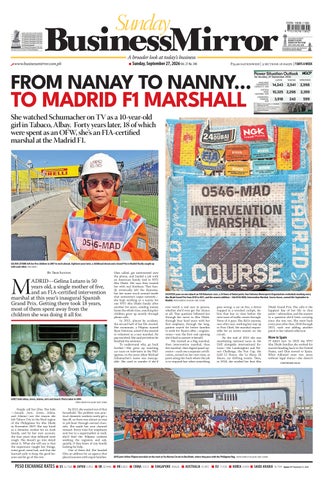
TO MADRID F1 MARSHALL She watched Schumacher on TV as a 10-year-old girl in Tabaco, Albay. Forty years later, 18 of which were spent as an OFW, she’s an FIA-certified marshal at the Madrid F1.
GELINA LUTARO left her five children in 2007 to work abroad. Eighteen years later, a childhood dream and a Grand Prix in Madrid finally caught up with each other. TROI SANTOS
M
By Troi Santos
ADRID—Gelina Lutaro is 50 years old, a single mother of five, and an FIA-certified intervention marshal at this year’s inaugural Spanish Grand Prix. Getting there took 18 years, most of them spent away from the children she was doing it all for.
Ghie called, got interviewed over the phone, and landed a job with an American family tied to NYU Abu Dhabi. She says they treated her with real kindness. That family eventually left the Emirates, but her name stuck around inside that university’s expat network— she kept working as a nanny for one NYU Abu Dhabi family after another for years, sending money home the whole time, watching her children grow up mostly through phone calls. In 2015, almost by accident, the second half of her life started. Her roommate, a Filipino named Ryan Doloroso, asked if she wanted to volunteer as a race marshal. No pay involved. She said yes before he finished the sentence. To understand why, go back further—She grew up watching car races on television in the Philippines, in the years when Michael Schumacher’s name was inescapable. She used to wonder if she’d
EIGHTEEN years on one tabard: an FIA Volunteer crest, a 24 Hours of Dubai patch, four Emirates Motorsports Organization credentials marking every Abu Dhabi Grand Prix from 2018 to 2021, and the newest addition—bib 0546-MAD, Intervention Marshal, Course Access, earned this September in Madrid. PHOTO COURTESY OF GELINA “GHIE” LUTARO
ever watch a real race in person, whether she’d ever get the chance at all. That question followed her through her move to Abu Dhabi, through four hard years with her first employer, through the long, patient search for better families to work for. Ryan’s offer—unglamorous—was the first real opening she’d had to answer it herself. She trained as a flag marshal, then intervention marshal, then fire marshal, then digital panel operator—each one a separate certification, earned on her own time, at posts along the track where the job is to respond fast when something
goes wrong: a car on fire, a driver trapped in a wrecked cockpit, debris that has to clear before the next wave of traffic comes through. None of it pays. She did it anyway, race after race, working her way up to Post Chief, the marshal responsible for an entire station on the circuit. By the end of 2015 she was marshaling national races in the UAE alongside international fixtures—the Lamborghini and Ferrari Challenge, the Fun Cup, the Gulf 12 Hours, the Le Mans 24 Hours, car drifting events. Then, in 2018, she worked her first Abu
Dhabi Grand Prix. She calls it the happiest day of her life to that point—adrenaline, and the answer to a question she’d been carrying since she was ten. She went back every year after that, 2018 through 2021, each one adding another patch to her tabard collection.
Move to Spain
IT didn’t last. In 2023 the NYU Abu Dhabi families she worked for started heading back to the United States, and Ghie moved to Spain. What followed were two years without legal status—she doesn’t Continued on A2
GHIE’S kids Jolina, Joven, Jelaine, Jeric and Jonard. Photo taken in 2009. PHOTO COURTESY OF GELINA “GHIE” LUTARO
People call her Ghie. Her kids —Jonard, Jeric, Joven, Jolina, and Jelaine—are the reason she left Tabaco City in the Bicol region of the Philippines for Abu Dhabi in November 2007. She was hired as a domestic worker for an Arab family, and by her own account, the four years that followed were rough. She doesn’t go into detail about it. What she will say is that the experience taught her things, some good, some bad, and that she learned early to keep the good lessons and let go of the rest.
By 2011 she wanted out of that household. The problem was practical: domestic workers rarely get a day off, so there was almost no way to job-hunt through normal channels. She made her own channel instead. Every time her employers sent her to a supermarket or mall, she’d find the Filipino cashiers working the registers and ask, quietly, if they knew of any family looking for help. One of them did. She handed Ghie an address for an agency that placed nannies with expat families.
GHIE joins fellow Filipino marshals on the track at Yas Marina Circuit in Abu Dhabi, where they pose with the Philippine flag. PHOTO COURTESY OF GELINA “GHIE” LUTARO
PESO EXCHANGE RATES n US 62.7560 n JAPAN 0.3952 n UK 82.9446 n HK 8.0025 n CHINA 9.3515 n SINGAPORE 49.0626 n AUSTRALIA 43.9857 n EU 71.4101 n KOREA 0.0459 n SAUDI ARABIA 16.7144 Source: BSP (September 25, 2026)
News BusinessMirror
A2 Sunday, September 27, 2026
www.businessmirror.com.ph
In their words: From across the world, leaders call for action on climate change at the UN
N
By Jennifer Mcdermott The Associated Press
EW YORK—UN SecretaryGeneral Antonio Guterres said the world cannot “allow countries and cultures to vanish beneath the waves” on Thursday as the General Assembly approved its first declaration on sea-level rise. This statement is meant to shift the international response to the rise in sea level driven by humans from fragmented initiatives to sustained, coordinated and adequately-funded action. It comes as country after country has lamented the toll of climate change in speeches this week and called for collective action. Contrarily, US President Donald Trump repeatedly calls climate change a hoax, a con job or a scam. Here are the world leaders in their own words:
“U
ntil recently, the response to climate change was firmly established at the center of the international agenda. This year, however, the topic disappeared from the debates of the G7 and G20, forums that bring together the largest carbon emitters. It is time to resume the offensive and in-
flict a defeat on denialism. Nature reminds us every day that we live on one planet. The glaciers in the Himalayas are melting. The super El Nino may cause torrential rains, droughts and forest fires in different parts of the globe.”— Luiz Inácio Lula da Silva, president of Brazil
SOUTH Korean President Lee Jae Myung. AP/FRANK FRANKLIN II
THE SITUATION: Human-caused global warming thinned glaciers and thawed mountain permafrost, likely helping to destabilize the Himalayan slope that collapsed last month and unleashed catastrophic flooding across Nepal, according to a World Weather Attribution report. More than 1,300 people were killed and over 5,000 remain missing.
THE SITUATION: Climate change and deforestation threaten the Amazon. A strong El Nino, a cyclic warming of the equatorial Pacific, causes higher temperatures and drier weather in the rainforest, conditions that worsen wildfires.
“W
hat we experienced in Nepal was Himalayan tsunami. But the larger looming threat is even more consequential. It is not only the devastation we mourn today; it is for greater danger that lies ahead if the world continues to look away... I call upon you to treat
Ghana’s President John Dramani Mahama. AP/SETH WENIG
“T
JAPAN’S Prime Minister Sanae Takaichi AP/JULIA DEMAREE NIKHINSON
climate action not as a charity, but as a matter of justice.” — Shisir Khanal, minister of foreign affairs for Nepal
o protect the lives of present and future generations, all states must take serious action to tackle global warming. I believe that climate action and economic growth can go hand-in-hand.”— Sanae Takaichi, prime minister of Japan THE SITUATION: Japan is working to protect communities from warming and has pledged to slash emissions, but extreme heat remains a threat in the short term.
“I
think this summer was a summer of truth. The recent summer months have been, as we heard from the scientists, the hottest on record, but may be the coolest for the years to come.” — Ursula von der Leyen, president of the European Commission THE SITUATION: Europe is heating up twice as fast as the global rate, making it the fastest-warming continent.
“B
y the end of this century, 12 to 18% of our coastal areas could be submerged by sea level rise, affecting the livelihoods of tens of millions. Climate change has caused loss and damage equivalent to 1% of our GDP. And our food security is at serious risk.” — Tarique Rahman, prime minister of Bangladesh THE SITUATION: The low-lying geography of Bangladesh makes it one
of the countries most vulnerable to climate change.
“C
abo Verde speaks with the same voice as other countries that are also living the climate crisis every day. For us, climate change is not a distant risk. It is an existential reality affecting our economies, our food and water security, our coastlines and ultimately our people’s future.”— Francisco Carvalho, prime minister of Cape Verde THE SITUATION: Cape Verde, like other small island developing states, is grappling with rising sea levels and increasingly powerful storms that erode shorelines, submerge land and threaten homes and livelihoods.
“N
early a third of the world’s tuna is caught in Pacific waters. And it’s moving east into the high seas. More than a quarter of our people live within a kilometer of the shore. Six of our communities have already moved. Two more are moving now. And half a degree is not a rounding error. For us, it is the difference between adaptation and relocation.” — Naiqama Lalabalavu, president of Fiji THE SITUATION: Lalabalavu cited projections that by 2050, the fish available to each Fijian is projected to fall by nearly a quarter, from 41 kilograms (90 pounds) a year to about 31. And more than half of that loss comes from climate change, he said.
“T
he climate crisis is often referred to as a ‘global group project shared by all 8 billion people on Earth.’ A single country cannot tackle this challenge alone. At the same time, abandoning growth cannot bring everyone on board.”— Lee Jae Myung, president of Korea
THE SITUATION: The impact of extreme weather worsened by climate change is far-reaching in South Korea. Farmers face higher costs and must use more labor to produce the same or lower yields.
“W
e live in a fragmented world. Nations are turning inward. Promises are made loudly and kept quietly, if at all. Each country is tempted to say: It is not my storm, not my coastline, not my problem. The ocean does not recognize that thinking. It is one body of water. What warms in one hemisphere breaks upon another. The sea has never been fragmented. Only we are.” — Philip Davis, prime minister of the Bahamas THE SITUATION: Like many other countries in the Global South, Bahamas has a lot of debt from warmingconnected weather disasters. Hurricane Dorian, the strongest storm to hit the country on record, caused $3.4 billion in damage in 2019.
“F
or those who have declared climate change a hoax perpetrated by geopolitical opponents, the warnings of recent times cannot have been clearer. Melting glaciers, flash flooding, droughts, record-breaking heatwaves, brush fires, hurricanes and other extreme weather phenomena are unmistakable signals of an overburdened planet. Climate change is the ultimate test of global equity.” — John Dramani Mahama, president of Ghana THE SITUATION: Ghana faces erratic rainfall, erosion of its coastal towns and accelerating desertification. In June, Mahama said Ghana and coastal West Africa were hit with unprecedented torrential rain that killed 39 people.
From nanay to nanny… Continued from A1
dress that period up. It would have been reason enough for most people to drop an unpaid hobby in a country they weren’t cleared to stay in. Ghie did the opposite. She spent those two years running the same play she’d run in the supermarkets years before: reaching out to every marshal she’d ever crossed paths with, especially the international ones, keeping those relationships alive so she could get back on a track once her papers came through. She’d already decided, long before she had any legal right to act on it, that she was going to marshal in Spain. This month, at the first-ever Spanish Grand Prix in Madrid, that decision finally paid off. She worked the race wearing an Intervention Marshal, Course Access tabard. She calls Madrid just the beginning. I should explain how I ended up hearing any of this. I got to Madrid by way of the Monza Grand Prix and the Venice Film Festival, landing the evening of September 9.
I’d missed an early-morning track tour I’d come a day ahead of schedule to catch, so rather than waste the morning, I walked the circuit a different way, from the photographers’ wall along the fence. Somewhere along that walk, past a stage where drivers were being interviewed in front of a growing crowd, I noticed a woman whose face I recognized before I could say why. “Are you Filipino, ate?” I asked. She said yes. That’s how it started. Hearing her full story afterward hit me harder than I expected, and the part that has stayed with me the longest isn’t the marshal training or the bib or even Madrid. It’s this: Ghie hasn’t seen her five children in three years. Jonard, Jeric, Joven, Jolina and Jelaine have grown up mostly on video calls, raised at a distance by a mother trying to give them a better shot than she got. Her hope, she told me, is to see her youngest graduate next year—one more milestone she’s missed in person, and one she’s
now counting down to. That is what perseverance actually costs. Ghie’s version ran for eighteen years, through a bad employer, through unpaid weekends spent training to fight fires and pull people out of wrecked cars, through two years without legal papers in a country not her own, through birthdays and report cards and ordinary Tuesdays she wasn’t there for. The dream she’d been chasing since she was ten years old finally caught up with her in Madrid this September. But it caught up with her without her kids beside her, because keeping them fed and in school was the whole reason the dream had to wait as long as it did. She got the marshal’s tabard in the end. She earned every patch the same way—piece by piece, year by year, on her own time, thousands of miles from home. What she is still waiting on is the one she wants most: to be in the stands, not on a circuit, when her youngest walks across a stage next year.
The World
www.businessmirror.com.ph
Sunday, September 27, 2026
A3
US weighs new limits on Cuban travel at the UN as Havana decries Trump’s economic squeeze By Farnoush Amiri & Matthew Lee
U
The Associated Press
NITED NATIONS—The Trump administration was considering imposing new restrictions on Cuban officials who travel to the United Nations, another step to squeeze the government in Havana as its top diplomat accused the United States on Thursday of unleashing collective punishment on Cuba’s people with its intensifying measures.
Even as a sizable Cuban delegation was approved to come to the UN General Assembly this week, the State Department is now weighing “strict controls” on the officials who plan to return next month for an annual UN vote on the decadeslong US economic embargo on Cuba. That is according to US officials
and an internal document obtained by The Associated Press. The officials spoke on condition of anonymity because a decision on the details of what the restrictions will entail has not yet been finalized. Potential plans to further restrict officials in New York for diplomatic work come as Cuban Foreign Minister Bruno Rodríguez
bemoaned the “lack of progress” in negotiations between Havana and Washington. He also blasted the oil blockade that the Trump administration imposed on the Caribbean island nation in January. “What defines the present status of the Cuba-US relations is the brutal tightening of the economic and financial blockade and the total oil siege imposed on our country, which is equivalent to a naval blockade,” Rodríguez said in Spanish during an AP interview on the sidelines of the annual UN General Assembly gathering of world leaders. His comments, made through a translator, follow President Donald Trump’s wide-ranging UN address Tuesday, when he again called Cuba a “failed state” and said he was “seeking a fundamental change in the situation in Cuba.” His administration has been trying to force changes to Cuba’s political system by cutting off fuel to the island, leading to massive power outages that affect basic activities such as cooking, water supply, and internet and telephone service. “Communism will never be coming to America, but freedom
will be coming to Cuba,” Trump said at the UN.
US-Cuba negotiations once again reach an impasse
RODRÍGUEZ, who has served as foreign minister since 2009, said that while no meetings now are scheduled with US officials, “Cuba remains willing to keep these channel of contacts open.” He refused to say when the last talks took place, noting that while past conversations have been “respectful,” the public statements and policy decisions made by US officials afterward have been “extremely aggressive.” Millions of people have lost access to electricity as Cuba’s power grid has collapsed at least six times since the US energy blockade began at the start of the year. The restrictions prevent Cuba from importing fuel needed to operate its thermoelectric power plants or replacement parts to maintain infrastructure that in many cases has become obsolete. Other US measures have included imposing more economic penalties on industries in the already heavily sanctioned country and broadening enforcement of
Israel’s Netanyahu, at UN, calls accusations of genocide in Gaza ‘the biggest lie of the century’
L
ASHING out at his country’s critics, Israeli Prime Minister Benjamin Netanyahu angrily dismissed allegations of Israeli genocide in Gaza as “the biggest lie of the century” in a defiant speech to the UN General Assembly that asserted his nation’s right to wage war against Iran. Scores of delegates trooped out of the hall in protest. Netanyahu addressed the plenum after days of speeches by world leaders condemning Israel’s war in Gaza and accusing him of orchestrating a genocide against the Palestinian people. At times, the Israeli leader, facing a tough race for re-election next month, became emotional and indignant as he lectured his critics, among them New York’s mayor. Netanyahu, his voice rising in emphasis, said attacking Iran “was one of the easiest decisions I’ve ever had to make” and denounced as “moral cowards” a mass of delegates who walked out of the hall when he took the podium to speak. “In defending itself, Israel is also defending many of the countries whose delegates just left this hall,” Netanyahu said. “In fact, I want you to know that many of their leaders even thank us privately for taking out Iran’s nukes.” When Netanyahu walked to the rostrum, a mix of cheers, boos and mass walkouts erupted. Scores of delegates marched out and a majority of visible seats sat empty afterward. “Order in the hall, please,” General Assembly President Khalilur Rahman said repeatedly. “If there are any other moral cowards who have not yet left this hall, please do so now,” Netanyahu said.
A speech aimed at a domestic audience
NETANYAHU’S remarks—which at times sounded like a stump speech—were aimed largely at the audience at home as the country prepares for elections on Oct. 27. It was delivered during the evening prime time in Israel and filled with stan-
dard talking points used to defend policies in the occupied West Bank and treatment of the Palestinians. Netanyahu reminded the assembly of the scale of the Oct. 7, 2023, attack in which Hamas militants killed about 1,200 people. “This is equal to 40,000 innocent Americans slaughtered in less than 24 hours,” he said, or 16 times the death count of the 9/11 attacks that left nearly 3,000 people dead in New York and more in Pennsylvania and at the Pentagon. Netanyahu said the attack left Israel with no choice but to hit Hamas hard. Many governments have accused Israel of committing war crimes, and Netanyahu himself faces an arrest warrant by the International Criminal Court accusing him of crimes against humanity.
He predicted the fall of Iran’s government
WHILE the war in Iran has been inconclusive and caused havoc on the global economy, Netanyahu insisted he had made the right decision. He thanked US President Donald Trump for taking decisive action against Iran, and predicted Iran’s theocratic gover nment would fall. Trump made a similar assertion at the outset of the war that began nearly seven months ago, but the Iranian government appears to remain firmly in charge. Netanyahu, known for using visual aids during his General Assembly speeches, at one point held up a pager while reminding the audience of the Sept. 17, 2024, attack in which Israel remotely detonated thousands of pagers that had been distributed to the Iran-backed Hezbollah militant group in Lebanon. The pager attack wounded more than 3,000 people and killed 12, including two children.
He says reports of settler violence in the West Bank are distorted
NETANYAHU dismissed incidents of Israeli settler violence against Palestinians in the West Bank as a “handful of young juvenile delin-
quents” throwing stones, chopping down olive trees and lighting fires. “I can’t stand that. I won’t stand for vigilantism,” the prime minister said before accusing foreign leaders and the international press of distorting the scale of violence in the West Bank. Netanyahu’s government is dominated by settlers and their allies, and has made few arrests in the wave of settler violence. Israel captured the West Bank and east Jerusalem in the 1967 war, and the Palestinians want both as part of their future state. The Palestinians and most of the international community view the settlements as illegal and as an obstacle to creating a viable, contiguous Palestinian state. The UN Office for the Coordination of Humanitarian Affairs has reported more than 1,600 settler attacks this year. At least 104 Palestinians have been killed by Israeli settlers or soldiers this year, according to the Ramallah-based Palestinian Health Ministry. Four Israelis have been killed by Palestinians over the same period. This week, a settler was killed and the son of Israel’s ambassador to the U.S. badly wounded in separate Palestinian attacks.
trip to the United States as Israel has grown increasingly isolated throughout the war in Gaza. The war in Gaza began on Oct. 7, 2023, when Hamas-led militants attacked Israel, killing around 1,200 people and kidnapping 251. At least 73,922 Palestinians have been killed in Israel’s subsequent offensive, according to the Gaza Health Ministry, part of the Hamas-run government whose numbers are generally considered reliable by the international community. A ceasefire agreed to by Israel and Hamas last October halted the heaviest of the fighting and led to the release of the remaining hostages yet further steps have since stalled. Israel maintains control of most of Gaza and continues to carry out airstrikes on Palestinians near military-held zones. Hamas not disarmed or relinquished power and there has been no progress toward reconstruction in the mostly destroyed territory. Netanyahu has said no Palestinian state will be established while he is Israel’s leader and has argued that the Palestinian Authority is not a partner for peace.
Israel is increasingly isolated on the world stage
PALESTINIAN President Mahmoud Abbas also addressed the UN General Assembly earlier Thursday, delivering prerecorded remarks from his office in Ramallah after the United States denied him a visa to attend the gathering for the second year in a row. Though world leaders have repeatedly invoked the plight of Palestinians in speeches throughout the week, Abbas urged the international community to take more tangible action against Israel. “How long will some countries continue to remain silent about Israel, or continue supplying it with weapons that it uses against our people?” Abbas said. “What, then, is the international community waiting for before it acts to protect the Palestinian people?” AP
NETANYAHU also accused New York City Mayor Zohran Mamdani of spreading lies about Israel and endangering Jewish New Yorkers with his criticism of the country’s military actions in Gaza. Before the prime minister arrived in New York, Mamdani called him a “war criminal” and pushed for his arrest. The mayor has acknowledged that New York does not have the authority to execute an International Criminal Court warrant but urged federal authorities to do so. In past years, Netanyahu has used his General Assembly speech to both denounce the United Nations as biased and make Israel’s case to world leaders. His address is the cornerstone of an abbreviated
Netanyahu followed the Palestinian president’s remote speech
laws that bar Americans who visit the island from dealings with government-owned or -affiliated businesses. “These measures hamper some processes that could lead to discussion of things in the common interests of both nations,” Rodríguez said. Havana has recently integrated historic economic reforms, opening up the island to the private sector. Officials, including Rodríguez, have said these are not concessions to the US, but they are moving in the direction the Trump administration wants.
Cuban delegation could face new obstacles to visit United Nations
RODRÍGUEZ and other members of his government are planning to return to New York next month for the annual UN General Assembly vote on the US economic embargo against Cuba—a vote that has historically condemned American policy toward the island by overwhelming margins. Cuban officials already face heav y restrictions in New York and Washington due to their US designation as a state sponsor of terrorism, with travel and
commuting limited to a 25-mile radius of the UN headquarters in Manhattan. But any new US travel restrictions could make it more difficult or impossible for Cuban officials to attend the vote, which has been taking place for more than three decades. Last year, Washington’s isolation on the issue was softened as countries like Argentina, Ukraine and Hungary—all closely allied with the Trump administration— rejected the Cuban-backed effort even as friction has grown in the region around American military actions there. While General Assembly resolutions are not legally binding, they reflect world opinion. Rodríguez told the AP last year that the US had mounted a pressure campaign to influence the vote. He said then that Havana had heard from other countries, mainly in Europe, that the State Department was encouraging them to vote against the resolution. In response, a State Department spokesperson said last year that “the Cuban regime does not deserve the backing of America’s democratic allies.”
Anthropic’s gene editing discovery isn’t yet a breakthrough, scientists say By Robert Langreth Bloomberg News
A
N T H ROPIC PB C ’s a n n o u n c e m e nt t h a t i t s Claude AI model discovered an enzyme system that resembled an earlier breakthrough gene editing technology was met with caution by some experts in the field, who suggested the company oversold its significance. In a blog post Wednesday, the AI giant touted a new life sciences group that aims to use Claude to comb through massive DNA datasets to identify proteins for scientists to test in the lab. Anthropic said its agents, working on their own, discovered a novel enzyme system linked to DNA sequences that is reminiscent of Crispr, the Nobel Prize-winning breakthrough that allowed scientists to edit the human genome. Shares of gene editing companies Crispr Therapeutics AG and Editas Medicine Inc. fell Wednesday after Anthropic’s news, though Editas gained 2.2% Thursday and Crispr was little changed. The announcement raised the prospect of AI accelerating biological discoveries, generating the building blocks of new medical innovations. Some scientists, though, called the findings more preliminary than the company’s rollout suggested. Human researchers have made similar discoveries before, Lucas Harrington, a scientist and biotech entrepreneur who cofounded multiple gene editing companies, said in a post about the announcement on X. “Announcing these very early, incremental findings with the framing of a major discovery doesn’t help,” he wrote. The company’s announcement Wednesday was published on its blog, with details provided in an accompanying technical paper, but hasn’t been published in a peer reviewed journal. In an email, Eric KaudererAbrams, Anthropic’s head of life sciences, acknowledged that the company’s researchers “don’t yet know” the significance of the enzyme finding, but he said the company likes
to publicize early research findings from its AI so that the public and other companies can get a sense of its capabilities. “The report that we shared this week is as much about how the research was performed as it is about the content of the underlying discovery itself,” he said. “We plan to follow up with in-depth experiments trying to understand its function and potential relevance as a tool.” The drug industry aims to harness AI for drug discovery. Companies hope to improve the low success rate in testing potential new drugs in order to find cures for deadly diseases. Historically, much of this work has been done at biotechnology startups, often in collaboration with big drug company partners. But increasingly the big tech firms are getting directly involved. In January, Nvidia Corp. said it plans to invest $1 billion over five years in a new laboratory with Eli Lilly & Co., aiming to speed up the use of AI in the pharmaceutical industry. And earlier this month, Novo Nordisk A/S said it would work with Anthropic to speed drug development. Anthropic said its agents’ discovery showed the power of AI for sifting through giant databases of genetic code to identify biologically interesting findings. “Many scientific discoveries originated when a scientist looked closely at the data and recognized something unusual as worth pursuing,” Anthropic researchers said in a technical paper accompanying the blog post. “Here, these steps were taken by AI agents working together without human supervision.” That potential for AI agents to make biological discoveries with little direction may be more significant than the current findings. Steven Salzberg, who heads the center for computational biology at Johns Hopkins University, said there are lots of existing computer tools for finding Crispr-like enzymes, and that other such enzymes have been discovered over the years. See “Anthropic,” A4
A4
Sunday, September 27, 2026
The World
Europe uses subsidies, taxes and policy pauses to offset pain of high fuel prices By Sam Mcneil
B
The Associated Press
RUSSELS—Wars in the Middle East and Ukraine are driving governments across Europe to craft subsidies, taxes and policy revisions that might shield their economies, companies and increasingly aggrieved citizens from record gasoline and diesel prices.
industries like agriculture, transportation and fishing. They also offered limited leeway from EU spending rules for investments that strengthen energy security and reduce the bloc’s long-term reliance on imported oil and natural gas. “The pressures from higher energy prices and borrowing costs are biting for people and for businesses,” European Commission President Ursula von der Leyen said in her annual State of the European Union address last week. “We need to double down on our affordable, homegrown, clean energy, be it renewables and nuclear, or biomethane and others” to “give us independence and drive down energy prices.”
French President Emmanuel Macron has asked von der Leyen to promote a relaxation of EU fuel quality regulations on density, sulfur content and other criteria to help increase diesel and kerosene production in Europe. The EU took a similar step during the COVID-19 pandemic. In a letter to the EU executive seen by The Associated Press, Macron warned that the global oil market would soon see “strong increases in prices” if the Strait of Hormuz off Iran’s coast did not reopen to tanker traffic and Saudi Arabia’s East-West pipeline to the Red Sea was not repaired. He also called for raising the EU limit on conventional biodiesel content in standard diesel fuel from 7% to 10%.
automatic mechanism would increase it to 20 cents per liter if fuel-price inflation exceeds 15% year-on-year. The government also extended fuel subsidies for transportation companies, farmers, livestock producers and fishermen.
The US has become one of the EU’s most important energy suppliers
ALONGSIDE national relief programs, EU nations have tapped their strategic reserves as part of an agreement by the International Energy Agency’s 32 member countries to make 400 million barrels of oil from their emergency stockpiles available to the market. The EU has worked to reduce its reliance on energy imported from Russia through renewable energy production and converting systems and industries to run on electricity instead of fossil fuels. Von der Leyen said greater electrification could reduce the EU’s annual bill for imported oil, gas and other fossil fuels by 260 billion euros ($296.6 billion) by 2040. As the EU tried to wean itself off Russian energy, it became more dependent on the United States. Von der Leyen personally struck a deal with President Donald Trump last year that included a commitment for the EU to buy $750 billion worth of American energy over three years. The Iran war has made the relationship both more vital and more complicated for the EU, which has increasingly turned to the U.S. for diesel. The support Trump expressed this week for banning diesel exports to drive down U.S. prices worries the bloc, which would have to find alternative sources of the fuel.
Countries around the world have intervened to limit the economic impact of diminished energy supplies and soaring fuel prices since the start of the Iran war, according to the Organization for Economic Cooperation and Development. Seven of the 10 nations working most actively to contain the economic damage are in the European Union, the OECD said in a report published Wednesday. Lithuania cut train ticket prices in half. Greece is taxing gambling more to fund public relief efforts. Italy delayed the scheduled demolition of coal-fired power plants and slashed the required paperwork for oil and natural gas projects. The Netherlands increased funding for a program that provides free energy-saving services in homes. Poland has proposed heavily taxing the record profits of certain fuel producers and sellers. Before the United States and Israel attacked Iran, Russia’s war in Ukraine disrupted global energy supplies and caused turmoil in Europe. The EU imports nearly all of
the oil it uses and 85% of its natural gas. Overall, imports supply 57% of the bloc’s energy needs, with much of its domestically produced energy coming from renewable and nuclear sources, according to the EU’s statistical office. Europeans are becoming more incensed as pump prices surpass the equivalent of $12 a gallon in some countries. EU citizens are spending an extra 203 million euros ($231 million) a day just for diesel fuel, according to the European advocacy organization Transport & Environment. “It’s a cruel irony that the U.S. is the least vulnerable to a crisis of its own making, while Europe’s economy again takes the hit,” Antony Froggatt, an analyst at the organization, said. Some European governments are spending billions to help their countries weather the current energy crisis. EU leaders in Brussels gave member nations temporary discretion to provide state aid to households and energy-intensive
Anthropic. . .
Italy decrees limits on non-Italian speakers and veils in school classrooms
Continued from A3
“What most biologists don’t do is to announce an unproven, preliminary finding as if it’s the next Crispr, suggesting that they have something revolutionary,” Salzberg said. “That’s the behavior of a profit-seeking, attention-seeking company, not a scientist.” Other scientists were enthusiastic about the potential for AI to mine viral and bacterial DNA data, but noted that the finding was at the earliest stages of exploration, with unclear significance. “This is a really exciting beginning observation,” said Philip Kranzusch, a biochemist at Harvard Medical School. “It is not what we would describe as a breakthrough in biology.” In the long run, he said mining genomes of bacteria and viruses was an ideal application for using AI in biotechnology. Enormous datasets exist already, and are expanding at an exponential rate. Anthropic unveiled its biological findings weeks after top rival OpenAI said it found a solution to the Navier-Stokes Millennium Prize Problem, considered to be one of the hardest problems in mathematics. OpenAI faced similar pushback from the mathematics community, because while technically correct, some said it didn’t serve to deepen understanding of fluid mechanics. In recent months, Anthropic has hired both established and up-and-coming young biology researchers. In June, it hired Nobel Laureate John Jumper from Google DeepMind. He shared in the prize for creating AlphaFold, an AI program for predicting protein structures. And the lead author on the Anthropic work unveiled this week was Peter H. Yoon. He’s a former researcher in the laboratory of UC Berkeley biochemist Jennifer Doudna, who shared the Nobel Prize for her work on Crispr.
R
OME—Italy’s government passed a decree Thursday to place an upper limit on the number of students in each school classroom who have only limited Italian language skills and to ban face-covering Islamic veils in schools. Premier Giorgia Meloni’s conservative government said the package is aimed at strengthening integration through language learning and has drawn support from right-wing allies. Opponents including some educators, unions and opposition parties warn that new rules could force students to attend schools far from their neighborhoods, while critics accuse the government of turning immigration into a political issue. With elections possible as early as next spring, analysts say the measures allow the premier to reassert her credentials on issues central to her conservative base, even though their impact is likely to be limited and significant questions remain about how they would be enforced. Under the plan, a limit of 30% of foreign students lacking sufficient Italian proficiency would be allowed in any individual classroom. The government decree goes into effect immediately but needs to be endorsed within 60 days in parliament, where Meloni’s coalition commands a majority. Meloni wrote on social media that they are “common-sense measures that do not divide but help foster genuine integration, avoiding ‘ghetto’ classrooms and giving all students equal opportunities.” The decree comes as Meloni faces mounting pressure on her right
France rolls out subsidies for diesel and “big drivers”
FRANCE has adopted an expanding array of targeted measures to cushion consumers and fuel-intensive businesses from higher prices. The French government on Tuesday announced a 450 millioneuro package to expand its relief measures. It broadened meanstested aid for people who drive more than 30 kilometers round trip to work or more than 8,000 kilometers annually for professional purposes. The expansion makes 5.5 million workers eligible for 100-euro payments to defray fuel costs through the end of the year, the government said. The new package also extended fuel subsidies for farmers, fishermen and construction companies until the end of the year, and will make energy vouchers of 48 euros to 277 euros available three months early to help 5.8 million families pay their winter energy bills.
flank from a new hard-line challenger, retired army Gen. Roberto Vannacci, who has been seeking to capitalize on voter concerns over immigration and national identity.
A limited number of classrooms are affected
EDUCATION Minister Giuseppe Valditara said local school authorities will coordinate student placements to avoid concentrations of non-Italian-speaking pupils, while schools unable to comply would be eligible for exemptions and additional language-support funding. The minister says it would affect around 1,000 classrooms, about 0.3% of the total nationwide, and primarily those with high concentrations of recently arrived students with little or no Italian-language proficiency. School principals questioned how the measure could work in areas with large migrant populations. “From an educational perspective, the issue is well-founded and valid, but it’s difficult to turn it into a practical solution,” said Antonello Giannelli, president of the National Association of Principals. “We have situations in which there is a district, a neighborhood that is mainly inhabited by immigrants and maybe there is only one school. So, since these are children, presumably young children in primary school, it is evident that they will hardly be able to go kilometers from their home,” Giannelli added. Teachers’ unions criticized what they called a lack of both consultation and resources for the measure. They argued that the government’s 14-million-euro ($16 million) funding package would not be enough to
Germany and Spain cut fuel taxes to give motorists some breathing room
A TWO-MONTH round of fuel tax cuts in Germany expired at the end of June. The government agreed last week to renew the tax cuts, which will lower gasoline and diesel prices by 17 cents per liter, from Oct. 1 until the end of the year. The German government said the new reduction will cost 2.5 billion euros. The government also said it would hold talks with the oil industry about introducing a fuel price cap by Jan. 1. Neighboring Belgium and Luxembourg have had similar price caps in place for decades. Spain’s government also extended gasoline and diesel tax cuts it introduced in March as part of a 5 billion-euro ($5.7 billion) package to counter the effects of the Iran war on local energy prices. The tax break amounted to 5 cents per liter this month. An
hire specialized language teachers and cultural mediators needed to support students. “Differences mean opportunities, and as with every opportunity one must be able to catch it. In most cases they (foreign students) allow the class to enrich their view of the world,” said Giovanni Castagno, a 52-year-old primary school teacher in central Rome. According to Education Ministry data, students without Italian citizenship accounted for 11.2% of Italy’s school population in the 2022-23 academic year, while classes with more than 30% foreign students represented 7.6% of the total. Foreign students who were born in the country would be exempt from the cap, along with those who attended Italian preschool or have already progressed through the school system.
Burqas and niqabs banned from schools
THE decree also bans burqas and niqabs in schools while continuing to allow hijabs. The measure is narrower than restrictions adopted in some other European countries. France banned full-face veils in public spaces in 2011, citing public security concerns, despite the small number of women affected. France a lso prohibits students from wearing conspicuous religious symbols, including Islamic headscarves, in public schools under its strict secularism doctrine. Critics in Italy said the provision addresses a phenomenon rarely seen in Italian classrooms. E duc ator s not e d t h at w h i le headscarves are common among
some Muslim students, full-face veils are seldom seen in schools, and they argued that the provision risks becoming a symbolic political issue rather than an educational one. Opposition parties also said the 30% threshold largely mirrors guidance already introduced by the Education Ministry in 2010, noting the government was repackaging an existing policy rather than investing in struggling schools. Center-left leader Elly Schlein accused the government of using schools to advance a political message on migration. Valditara, the education minister, rejected those criticisms, saying the goal is integration through language acquisition and stronger educational support.
Parents asked to attend Italian-language courses
THE decree provides additional teaching resources for schools where newly arrived foreign students exceed 20% of enrollment and additional language-learning funds for schools exceeding the 30% threshold. It also would require some parents of foreign students to attend Italian-language courses when language barriers within families contribute to educational or behavioral difficulties. Schools would refer eligible families to social services, which could enroll them in a tailored support program through adult education centers. Parents who fail to attend the courses could face fines ranging from 200 to 1,000 euros, although exemptions are included for those with certified age-related, medical or disability-related barriers to language learning. AP
www.businessmirror.com.ph
3 US news outlets return to White House after judge orders Trump to lift ban
N
EW YORK—Three news organizations banned from the White House for days were back Thursday after a judge handed CNN, MS NOW and Politico a reprieve in an extraordinary showdown between President Donald Trump and outlets whose coverage he dislikes. But media coverage of Trump’s White House was hardly normal. On a highprofile day when Chinese leader Xi Jinping was visiting Washington and attending a state dinner, no major American network was airing live coverage. After the White House banned CNN from a rotation of five major US broadcast outlets who take turns shooting and sharing video, the other four—in a show of solidarity—were still declining to participate in the so-called video pool. Though CNN and MS NOW were back on the White House grounds Thursday, both news outlets said their journalists were denied access to Xi’s state dinner arrival. CNN wrote in a blog post that the White House said it would only allow a photojournalist and an audio technician to the event, and refused to allow a reporter and a producer entry. MS NOW reported that journalist Laura BarrónLópez was also denied entry to the arrival ceremony on the portico ahead of the state dinner. Barrón-López was one of the journalists whose press credentials were reinstated under the judge’s order. Reporters and producers from other networks were allowed in, CNN wrote. The president posted online that TV networks “refused to cover one of the Biggest and Most Beautiful Events to take place in many years ... because they knew how good it would be, they didn’t want credit to be given to “TRUMP.” It was a chaotic day for the media at the White House and in court. Initially, in the morning, CNN, MS NOW and Politico journalists were denied entry. A Secret Service agent had confiscated their credentials as part of the ban. After the ruling for the outlets in the early hours Thursday, White House operations officials were notified to restore access to the affected reporters, but said they needed time to find, reactivate and deliver their entry badges. The process took over two hours, according to an administration court filing. In his decision to provisionally lift the ban, US District Judge Timothy Kelly ordered the White House to “immediately return, reinstate, and restore” the three outlets’ access. He said they had met the legal thresholds to obtain a temporary restraining order and were likely to succeed in showing that their press passes were revoked without due process. The ruling did not address CNN’s removal from the White House video pool. The White House did not respond to an email seeking comment. AP
www.businessmirror.com.ph • Editor: Lyn Resurreccion
Sunday, September 27, 2026 A5
Yarn worker shortage disrupts handloom supply chain
A
Story & photo by John Eiron R. Francisco
SHORTAGE of workers in yarn production is disrupting the country’s handloom textile supply chain, which has led some farmers to stop planting fiber crops and left weavers struggling to secure yarn, according to the Philippines’ Science chief.
During the recent opening of the 2026 Philippine Handloom Weaving Festival (PHWFL) at a mall in Araneta City, Cubao, Science Secretary Renato U. Solidum Jr. said the lack of machinery and workers for yarn production has weakened demand for agricultural materials that can be processed into fibers. As a result, some farmers in areas that previously produced fiber crops have stopped planting because there is no viable market for their output, he said. Solidum said the situation points to a broader gap in the country’s innovation ecosystem, where producers of raw materials are not sufficiently connected to industries capable of processing
them into textile inputs. “We can clearly see that this is necessary. It is important that not only the national government but also the private sector step in and play a role in this effort, because this is what our country needs: an organization that can scale up the processing and manufacturing of the necessary materials so that more of our fellow Filipinos can produce them,” he explained. “If there are better facilities that can be established to produce more yarn, then production can be done on a larger scale,” Solidum added, noting that this would not only support handloom weaving but also expand the production of locally made garments.
CLOTHES from Philippine handloom textiles are displayed at the recent 2026 Philippine Handloom Weaving Festival at a mall in Araneta City, Cubao.
He said a stronger yarn manufacturing sector could also generate jobs beyond weaving, including positions in yarn-production facilities, garment manufacturing and retail. “It would be better if the private industry would takeover to make it more profitable,” he noted.
Bridging the yarn gap
PART of the government’s efforts to address the supply gap is the establishment of Regional Yarn
Production and Innovation Centers (RYPICs), which are intended to process locally available fibers into yarn for weaving and textile production. Among these is the RYPIC in the Ilocos Region, which can produce up to 13 metric tons of yarn annually under an eight-hour operating schedule, with the potential to increase output by extending operating hours. The facility at Isabela State University-Ilagan Campus can
PHL scientists discover possible uranium resource in Camarines Norte
A
S the Philippines prepares to introduce nuclear power and moves to build a highervalue critical minerals industry, Filipino researchers are revisiting a resource the country has studied for decades: uranium in Camarines Nor te, the Depar tment of Science and Technology-Philippine Nuclear Research Institute (DOST-PNRI) announced. Researchers from the University of the Philippines Diliman, the DOST-PNRI, and Akita University in Japan have developed an integrated mineral-processing method for uranium-bearing materials. Their study focused on Bessemer, Larap, Jose Panganiban, Camarines Norte, a historic center that has long been associated with uranium exploration in the country. Their work confirmed that uraninite is the main uranium-bearing mineral on the surface deposits examined in the study. The study also revealed that the material can be processed into a product with higher uranium content. This finding is an impor tant step toward further research on producing uranium concentrate, commonly known as “yellowcake,” an intermediate material used in the nuclear fuel cycle. The study arrives at a timely moment as the country moves forward to include nuclear power in the future energy mix. The Philippine Energy Plan targets the entry of at least 1,200 megawatts of nuclear power capacity by 2032. Meanwhile, Executive Order 122, issued in August 2026, established a national framework for developing the Philippine critical minerals industr y, emphasizing investment, local mineral processing, value addition, and downstream industries. Together, these national directions highlight a growing need for Philippine
expertise not only in nuclear energy, but also in understanding and developing the country’s mineral resources.
Returning to Larap with modern science
THE Larap–Paracale district has been explored for uranium for decades. The material used in the new study came from Bessemer, Larap, a newly-identified area for uranium mineralization. The sampled mineralized zone was about half-meter wide where 180 kilograms of material were collected for laboratory testing, the DOST-PNRI said. Using techniques—such as microscopy, X-ray diffraction and modern elemental analysis—the researchers confirmed the presence of uraninite grains among copper-, molybdenum- and iron-bearing minerals. Identifying the minerals that contain uranium is important because their physical and chemical properties determine how the uranium can be separated and recovered. According to the researchers, the original material contained 244 parts per million (ppm) of uranium, along with 0.57 percent copper, 0.49 percent molybdenum and 13.5 percent iron. The researchers first used flotation, a method that separates materials such as copper- and molybdenum-bearing sulfides. Then they processed the remaining material through magnetic separation, which removed magnetite, an ironrich magnetic material, and fur ther concentrated uranium in the non-magnetic fraction. The combined process increased the uranium concentration from 244 ppm to 305 ppm, while recovering about 73 percent of the uranium in the final product. Microscopic examination after processing also revealed that some uraninite grains had been separated from
the surrounding mineral matrix. This indicates that the process can effectively improve the concentration of uraninite and produce a material suitable for further uranium recovery. However, the resulting material is not yet yellowcake or nuclear fuel. Rather, the study showed that it can serve as a starting material for the next stages of processing, such as leaching and purification to produce yellowcake, the DOST-PNRI explained.
A resource question that only drilling can answer
THE study confirms that uranium mineralization is present at the surface and that the uranium-bearing material c a n b e u p g r a d e d. W h a t i t c a n n o t determine yet is how much uranium exists underground. Because the present work examined only the surface, it does not establish the depth of the deposit, how thick it is, or how deep and widespread the uranium-bearing zones are. Determining whether Larap has enough uranium resource to be considered as having potentially economic significance will require a much larger exploration program. Such work will include detailed geological, radiometric, and geophysical surveys followed by systematic drilling and analysis of drill cores. It would need geologists to map the mineralization in a three-dimensional way and estimate the extent of the deposits as well as the uranium content. Only after such work can geologists confidently assess the area’s resource potential. This represents a clear opportunity for the next phase of the work. Government agencies, research institutions, mining and exploration companies, and potential private-sector investors could help move forward the investigation from surface studies to full-scale exploration of what
RESEARCHERS make froth flotation of the ground mineralized sample (left) and magnetic separation of flotation tailings. DOST-PNRI PHOTOS
lies underground. If drilling establishes a significant resource, more studies would still be needed to assess mining and processing economics, environmental and radiological impacts, regulatory requirements, and community considerations before any possible development.
produce about 50 kilograms of yarn per day, while the RYPIC in Cotabato has an annual production capacity of up to 40 metric tons. However, Solidum said the existing capacity remains insufficient because demand for yarn extends beyond handloom weavers. He pointed to the government’s own requirements for locally produced textiles under Republic Act 9242, or the Philippine Tropical Fabrics (PTF) Act, which requires
government agencies and offices to use locally produced Philippine tropical fabrics for official uniforms and attire. Beyond increasing production and demand, the Department of Science and Technology-Philippine Textile Research Institute has also been working to connect local weavers with consumers. This was among the aims of the three-day PHWF, which featured 30 weaving communities from across the country. Last year’s PHWF in Ilocos generated more than P3.3 million over four days, with more than 120 weavers from 40 communities participating. The HIBLA Weavers’ Fair held in Araneta City in May generated another P4.1 million. “These numbers are important. But behind every peso is something even more important: A weaver who earned. A family who is assured of food on the table, sent their children to school, and accessed health care, a skill and tradition that is sustained,” Solidum said. He said the handloom sector demonstrates how an innovation can become a tradition while creating opportunities for further innovation and income generation. “That is the kind of impact that we want Philippine science and technology to have,” Solidum said.
Rizal upland communities get bamboo-based technology, livelihood prospect from DOST
More than a uranium story
THE material found in Larap contains several valuable minerals, not just uranium. During processing, the researchers were able to separate different minerals—such as copper and molybdenum in one part of the process, as well as iron-bearing magnetite. Uranium, meanwhile, became more concentrated in the final nonmagnetic material. This multi-resource approach is relevant to the direction of EO 122, which seeks to move the Philippines beyond raw mineral ex trac tion toward greater domestic processing and value creation. The government is still developing the official Philippine Critical Minerals List, so the study does not presume which of these resources will ultimately be formally designated as critical minerals. The findings help determine the geological, analytical, and mineralprocessing capability the country will need to properly evaluate complex domestic mineral resources and determine how more of their value can be captured in the Philippines. The broader significance of the research is therefore not that the Philippines is ready to produce its own nuclear fuel. More so, the study proves that Filipino scientists are rebuilding the capability to understand a domestic uranium occurrence, determine how its uranium can be concentrated, and identify the next scientific questions needed to establish whether the resource warrants further development, the DOSTPNRI pointed out. For Larap, that next question is now clear: what lies beneath the surface, and is there enough of it to justify the next stage of exploration? The paper, “Integrated magnetic separation-flotation process for uranium preconcentration from Cu–Mo sulfidic and magnetite-bearing sample,” was published in the 2026 Special Issue of Nuclear Science and Technology of the SciEnggJ ( https:// scienggj.org/2026-special-issue-18 /). The research was funded by the Department of Science and Technology Grants-in-Aid Program through the NuCycle Program–NuMER Project, and implemented jointly by UP Diliman’s Department of Mining, Metallurgical and Materials Engineering and DOST-PNRI.
THE partnership was launched through the signing of a Memorandum of Agreement for the project “Green Livelihoods: Bamboo-Based Charcoal Processing for Briquette Production in Rodriguez, Rizal.” DOST-FPRDI PHOTOS
I
N Rodriguez, Rizal, bamboo is becoming more than a natural resource—it is opening doors to new livelihood opportunities and more sustainable fuel production, with support from the Department of Science and Technology (DOST). The partnership among DOST-Forest Products Research and Development Institute (DOST-FPRDI), Department of Environment and Natural Resources, Brgy. Puray Upland Farmers Association Inc., and the Tribal Council Association of Puray Inc. aims to establish a community-based enterprise that will convert locally available bamboo into charcoal briquettes in Barangay Puray. “Livelihood and environmental protection do not have to be competing goals. With the right technology, communities can use resources, such as bamboo, while reducing reliance on wood for charcoal. This project shows that economic opportunities and environmental protection can go hand in hand,” said Science Secretary Renato U. Solidum Jr. Through the initiative, the people’s organizations will be trained to produce and potentially market bamboo charcoal briquettes.
Livelihood meets sustainability
Charcoal briquetting converts carbonized biomass and charcoal fines into compact fuel by mixing them with a binder and compressing the mixture using a briquetting machine. DOST-FPRDI has developed both manual and hydraulic briquetting machines. The resulting briquettes are compact and easy to handle, burn more slowly, and can produce more intense heat per unit volume than ordinary charcoal. Besides bamboo, the technology can also process coconut shells, coconut husks, coffee bean hulls, sawdust, and other agroforest wastes. “This gives communities greater flexibility in sourcing materials and creates opportunities to turn agricultural and forest residues into useful fuel products rather than allowing them to go to waste,” explained DOST-FPRDI Director Rico J. Cabangon.
Rodriguez, Rizal provides a strong foundation for the initiative, with about 1,642 hectares of bamboo plantations in Barangay Puray. The participating organizations are also managing substantial bamboo areas, including 167 hectares under Remontado Balik Kalikasan Inc., 197 hectares under the Brgy. Puray Upland Farmers Association Inc., and nearly 300 hectares under the Tribal Council Association of Puray Inc. The project reflects DOST-FPRDI’s broader efforts to promote technologies that help communities make productive use of locally available biomass. By providing alternatives to traditional wood charcoal and creating value from bamboo and other agro-forest wastes, charcoal briquetting can support both livelihood development and more sustainable resource use. According to Cabangon, transferring the technology does not simply mean providing equipment. Instead, the project was built around the resources, facilities, and capabilities that each organization already has. DOST-FPRDI conducted site assessments and recommended facility layouts and equipment arrangements suited to the communities’ existing spaces and resources. To make the technology manageable, the project will begin with small-scale production using manual briquetting machines. The equipment will be provided to the three participating organizations as they build the skills needed to operate the technology. “Delivering the equipment is only the first step. What matters is whether communities can operate it, build the skills to use it, and eventually make it part of a viable livelihood. That is why we are starting with equipment and production scale suited to what these organizations already have, so they can grow their capabilities and expand as they gain experience,” he said. Through continued collaboration with local partners, DOST-FPRDI seeks to ensure that technologies are not only transferred to communities, but adapted to their needs and developed into opportunities they can sustain. Maria Greatchin Brucal/S&T Media Services
Faith
Sunday
A6 Sunday, September 27, 2026
Editor: Lyn Resurreccion • www.businessmirror.com.ph
Cardinal Ambo: In age of AI, embrace imperfections that make us human
A
By Malou Talosig-Bartolome
HANDWRITTEN correction on a page, a voice that trembles while speaking, or a mistake openly acknowledged may be among the strongest proofs of humanity, Cardinal Pablo Virgilio “Ambo” David said as he urged educators to resist machine-like standards of perfection in the age of artificial intelligence (AI). Spea k ing before the g raduating class and faculty of De La Salle Araneta University (DLSAU) at the Philippine International Convention Center on September 19, David said schools must focus not only on producing competent graduates but also on forming people capable of growth, compassion, and moral courage. The Kalookan bishop delivered the message as DLSAU conferred on him the degree of Doctor of Humanities, Honoris Causa, recognizing his contributions to biblical scholarship, pastoral leadership, social justice, and the promotion of human dignity. David acknowledged that artificial intelligence has become one of the most transformative developments confronting modern education. AI systems can now summarize texts, organize research, generate polished prose, and solve complex problems in seconds, he noted. Yet even as technolog ica l capabilities advance, he said machines remain incapable of moral discernment, genuine empathy, and the
human capacit y for conscience. “Even some of the people developing the most advanced AI systems are
warning us that these technologies are progressing faster than our institutions can adequately evaluate, regulate, and supervise them,” he said. “Technological power can advance much faster than human wisdom,” he added. The greater challenge, according to David, is not the prospect of machines becoming more human but the possibility of people trying to become more like machines. “The greater danger may be that human beings will try to become too much like machines, obsessed with optimization, efficiency, productivity, performance, and perfection,” he said. Rather than pursuing flawless performance, David encouraged educators and students to embrace vulnerability and imperfection as essential features of authentic humanity. “What reveals our humanity are
CARDINAL Pablo Virgilio “Ambo” David (center), Kalookan bishop, receives Doctor of Humanities degree, Honoris Causa, from De La Salle Araneta University President Br. Bernard S. Oca FSC (right). With them is DLSAU Chancellor Dr. Marie Allison Parpan (left). PHOTO CREDIT DLSAU
often our imperfections,” he said, pointing to hesitations, handwritten corrections, cracked voices, and mistakes honestly acknowledged as signs of a person willing to learn and grow. He pointed out that while machines can process vast amounts of information and provide answers with remarkable speed, education has a deeper purpose. “Let artificial intelligence become better at being artificial, and let education help human beings become better at being human,” David said. True education, he added, forms the conscience, cultivates critical thinking, and teaches people how to build meaningful relationships. A m ac h i ne m ay a n a ly z e d at a a nd re co g n i z e p at t e r n s , but it c a n not look at a st r u g g l i ng st udent w it h genu i ne concer n a nd of fer encou ra gement. Drawing from the Lasallian mission of faith and ser v ice, Dav id challenged graduates to use their education not merely as a pathway to personal success but as a means of uplifting others. He also offered a broader interpretation of the honorary degree bestowed on him, saying honoris causa should inspire people to make their education, influence, and privilege a “cause for the dignity of others.” Ending his address with a challenge to the graduates, David urged them to become the kind of people no technology can replace. “Form human beings whom artificial intelligence can never replace,” he said. “People capable of compassion, of moral courage, of solidarity and wonder, of loving, acknowledging a mistake, asking for forgiveness, beginning again, and sacrificing themselves for something greater than themselves,” he pointed out.
Famed radio, TV priest Fulton Sheen is beatified By Peter Smith
The Associated Press
S
T. LOUIS—As tens of thousands of Catholic worshippers stood Thursday in a football stadium-turned-temporary cathedral, all eyes focused on a teenage boy walking solemnly toward the makeshift altar, accompanied by his parents and siblings. James Fulton Engstrom carried an ornate vessel containing the relics of his namesake, the man whom the Catholic Church credits with his miraculous survival as a newborn—Archbishop Fulton Sheen, who died in 1979. It was a highlight of a lengthy ceremony of beatification for the famed 20th century TV prelate, who will now be known as Blessed Fulton Sheen—one step away from sainthood. Catholic devotees converged on St. Louis for the afternoon ceremony, taking place at the Dome at America’s Center after years of delays. The indoor stadium was chosen because there wasn’t a venue large enough in his home Diocese of Peoria, Illinois, to accommodate the anticipated crowd. The ceremony comes 16 years to the month since James was born at home without a pulse and was rushed to the hospital, even as his parents and others prayed earnestly and asked Sheen to add his heavenly prayers, following the Catholic tradition of seeking the intercessions of departed holy people. After a formal inquiry, the Catholic Church determined that James’ resuscitation— when medical workers were about to declare him dead—was a miracle attributable to Sheen’s prayers. To qualify for beatification, the Vatican typically requires one miracle attributed to the candidate. James’ mother, Bonnie Engstrom, said before the ceremony that she expected it would feel like a “foretaste of heaven.” She said she’d been praying to Sheen throughout her pregnancy, and “it was just a very natural thing in the hardest hour of our
life” to seek his help. The presentation of the relics, placed on a pedestal by the altar, was a highlight of a lengthy service that began with a formal procession of hundreds of priests and scores of bishops, lasting more than half an hour and accompanied by robust organ, choral and orchestral music.
“To have an American pope, to have an American beatified man, is amazing to see. Look around. You see kids, you see young families, you see college kids,” he said. Other attendees, such as Mary Chalupsky of Milford, Connecticut, recalled watching Sheen’s original TV programs. “He brought so many to the faith,” she said.
A 20th century bishop draws a new audience
Sheen’s journey from Peoria to primetime
ABOUT 50,000 tickets were distributed, according to organizers. The halls and exhibit areas were thronged in the morning by pilgrims—priests in cassocks, nuns in habits, families with young children in tow, elderly worshippers who recalled watching Sheen on TV. Scores of bishops, a thousand priests and hundreds of religious order members, seminarians and deacons participated. Many thronged exhibit booths or stood in long lines to give confession. Others quietly meditated throughout the morning in a makeshift chapel in front of a Eucharist displayed on an altar, including some who knelt on the concrete floor. Bishops have been seeking to promote this traditional devotion, which Sheen practiced regularly. The Vatican’s top evangelization official, Filipino Cardinal Luis Tagle, the lead celebrant for the Mass, brought greetings from Pope Leo XIV, calling him Sheen’s “fellow Illinoisan.” Tagle called Sheen a model for evangelization, or sharing the faith. Sheen was once a regular presence in the living rooms of millions of Americans— including that of the future pontiff, who says he watched Sheen’s broadcasts while growing up in Chicago. Attendees, many too young to have seen Sheen’s broadcasts, said they’ve taken inspiration from his books and online videos. “There’s just a revival in the American church as a whole,” said Joseph Punswick, a seminarian from the Diocese of Kansas City, Kansas.
SHEEN was a pioneering radio priest who quickly adopted the burgeoning medium of television in the 1950s, when he began hosting the Emmy-winning program, “Life is Worth Living.” Dressed in a cassock, cape and skullcap, he stood at a chalkboard and delivered moral and religious lessons without a narrow Catholic focus. Sheen was born in 1895 in the small town of El Paso, Illinois, and raised in Peoria. After becoming a priest and earning a doctorate in philosophy, he became a professor at The Catholic University of America in Washington, D.C. He became known for his academic lectures and his plainspoken addresses from the pulpit and the broadcast studio. He often signed off with the benediction, “God love you.” Sheen appeared in a Time magazine cover article, and he guided celebrities and others converting to Catholicism. He met with popes and spoke at the reformist Second Vatican Council. He railed against communism, though he opposed the Vietnam War. Sheen raised funds and traveled the world on behalf of Catholic missions. He served as a bishop in New York State, retiring as an archbishop. After his death at 84, he was buried at St. Patrick’s Cathedral in New York until his niece won a court battle in 2019 to move his body to Peoria’s Cathedral of St. Mary of the Immaculate Conception, which now draws pilgrims to his tomb.
The Illinois teen tied to Sheen’s path to sainthood
T H E late Pope Francis approved the beatification, attributing to Sheen the miracle of James’ resuscitation. Bonnie Engstrom said she and her husband chose Sheen for James’ patron after discovering the prelate’s old videos, adding that Sheen’s Midwestern-accented voice reminded her of her grandfather and greatgrandfather. “He’s like a local boy,” she said at a news conference. James, who just turned 16, has a devotion to Sheen, but he’s largely avoiding the media spotlight. “He’s a delightful young man, but he’s still just a teenage boy, and he needs to be given the space and the grace to have his own journey of life,” his mother said.
Sheen’s beatification backstory
THE beatification was originally scheduled for 2019, but the Vatican delayed the ceremony. The Diocese of Rochester, which Sheen briefly led in the 1960s, requested the delay out of caution, due to legal investigations taking place then into the oversight of priests accused of sexual abuse across New York State. Church officials later concluded that Sheen’s record gave no cause for further delay, and plans for the ceremony resumed. Pope Leo approved the beatification earlier this year. Monsignor Jason Gray, executive director of the Archbishop Fulton J. Sheen Foundation, said church investigators review records and interview witnesses before determining whether a healing qualifies as a miracle. He said there are now six more cases under investigation; a second miracle would qualify Sheen for sainthood under Vatican rules. Peoria Bishop Louis Tylka said he believes the wait for canonization will be shorter than for the beatification, especially with an Illinois-born pope who’s “very much aware of who Sheen is and how he influenced his own life.”
CBCP President Archbishop Gilbert Garcera of Lipa and other bishops gather before Mass for the declaration of the Shrine of Saint Padre Pio in Sto. Tomas City, Batangas, as an international shrine on September 23. ROY LAGARDE
‘Global status brings greater mission to Padre Pio shrine’ By CBCP News
S
TO. TOMAS CITY, Batangas—Archbishop Gilbert Garcera of Lipa said the international status of the Padre Pio shrine brings greater responsibility to serve the sick, poor and marginalized. “This recognition by the Holy See is both a profound blessing and a solemn responsibility,” Garcera said at a news conference on September 23 before Mass marking the shrine’s elevation and the feast of St. Padre Pio. Garcera said the designation recognizes how a local devotion has grown into a major pilgrimage site drawing Catholics from across Asia to the 17-hectare sanctuary.
Greater responsibility to serve the suffering
HE said the shrine’s mission must remain centered on people facing illness, poverty and other forms of suffering, through its monthly Healing Masses and pastoral care. Garcera also called on the shrine to become a place of peace and reconciliation amid political divisions, social anxiety and religious tensions. “Padre Pio’s timeless message of trust in God and radical charity offers a direct antidote to contemporary despair,” he said. The archdiocese said it is continuing a long-term master plan for the shrine, focusing on prayer, pilgrimage and service to the poor and weary. “As an international shrine, we are called to welcome pilgrims from every corner of the world,” said Garcera, who also heads the Catholic Bishops’ Conference of the Philippines.
Vatican status gives shrine a global mission
THE elevation ceremony came nearly four months after the Vatican approved the Lipa archdiocese’s petition to declare the Batangas shrine an international shrine. The Dicastery for Evangelization issued the decree on May 25, coinciding with Padre Pio’s 139th birthday. The designation also formalizes the shrine’s spiritual bond with the Sanctuary of Saint Pio of Pietrelcina in San Giovanni Rotondo, Italy, where the Capuchin friar lived and is buried. Under the Vatican’s Code of Canon Law, international shrines are pilgrimage sites whose designation and statutes require approval from the Holy See. Local bishops approve diocesan shrines, bishops’ conferences approve national shrines, and the Holy See approves international shrines and their statutes, including their purpose and governance. The Vatican says shrines should provide opportunities for prayer, worship, spiritual guidance and Christian formation while promoting charity toward people in need. The Shrine of St. Padre Pio is the Philippines’ second international shrine, after the Shrine of Our Lady of Peace and Good Voyage, or the Antipolo Cathedral, received the designation in March 2023. Archbishop Rino Fisichella, then pro-prefect of the Dicastery for Evangelization’s section for new evangelization, said in February 2024 that international shrines should welcome people from around the world, especially the poor. “Being an international shrine is not just a privilege that is granted, but a mission that must be shared,” Fisichella said during Mass at the Antipolo shrine.
Indian cardinal to Padre Pio pilgrims: ‘Let this shrine change you’
MEANWHILE, the head of India’s Catholic hierarchy has challenged pilgrims to allow the experience of the new international shrine dedicated to Saint Padre Pio to change how they live. Cardinal Anthony Poola, president of the Catholic Bishops’ Conference of India, said the shrine’s international status should inspire pilgrims to embrace reconciliation, hope and compassion. “Let us not leave this shrine unchanged,” Poola said during the Mass on September 23. Poola, who is also archbishop of Hyderabad, said the shrine should become “a home for all people,” especially the sick, poor, families, young people and elderly. He described the celebration as “a day of grace” for the Church, devotees and pilgrims who come seeking renewed faith and spiritual consolation. “A shrine is a place where heaven touches earth, where wounded hearts find consolation, where tears become prayer,” Poola said. “Let this celebration renew our faith.” The cardinal said Padre Pio’s life of prayer, suffering, humility and surrender to God shows that holiness can be found even amid human pain. The Italian Capuchin friar, who died in 1968, was known for his devotion to prayer, the Eucharist and reconciliation, as well as for bearing the stigmata, or wounds resembling those of Christ’s crucifixion. Poola recalled Padre Pio’s familiar advice, “Pray, hope and do not worry,” saying it remains relevant in a world marked by anxiety, division, sickness, loneliness and fear. He urged pilgrims to follow Padre Pio’s example by embracing the Eucharist, seeking reconciliation, carrying suffering with hope and serving others with compassion. More than 40 bishops concelebrated the Mass, which was presided over by Cardinal Pablo Virgilio David of Kalookan, vice president of the Federation of Asian Bishops’ Conferences. The shrine’s new international character was also reflected in the presence of devotees from across Asia and bishops who lead episcopal conferences in the region.
Biodiversity Sunday BusinessMirror
Asean Champions of Biodiversity Media Category 2014
Sunday, September 27, 2026 A7
Editor: Lyn Resurreccion
Zamboanga City’s Bambusetum: Cultivating ‘green gold’
T
By Jonathan L. Mayuga
HE Bambusetum is becoming a mini bamboo forest in Zamboanga City from what began in 2001 as a one-hectare demonstration site within the Pasonanca Natural Park in Barangay Pasonanca. The bamboo forest has assorted species ranging from native species like kawayan kiling and kawayan tinik to the towering botong, or giant bamboo, along with anos or bagakay, and the unfamiliar yet equally popular Thailand bamboo, iron bamboo, black bamboo, kayali, laak, and running bamboo. The Bambusetum, established by the Department of Environment and Natural Resources - Ecosystems Research and Development Bureau (DENR-ERDB) Region IX now serves as a center for research, education, and ecotourism.
Growing recognition WHILE the importance of bamboo is often overlooked, the development of the Bambusetum demonstrates the growing recognition of the plant’s social, economic, cultural, and ecological importance for Filipinos. The Philippine government has integrated bamboo into its National Greening Program (NGP) since its inception in 2011. Executive Order 26, which established the NGP, listed bamboo among the preferred species for propagation and reforestation across eligible development areas. That same year, the DENR issued Department Administrative Order 2011-11, which laid out the guidelines for producing nursery planting materials, specifically incorporating bamboo. Globally, the recognition of bamboo is galvanized by the declaration of September 18 as World Bamboo Day to raise global awareness of bamboo’s economic, environmental, and social benefits and to promote its sustainable use.
Planting hope through a versatile plant BEHIND the concept of establishing the Bambusetum is the noble idea that not everything is about today. Beyond what can be made from it, bamboo offers something less tangible: Continuity. A way to plant hope for people we may never meet. Bamboo is not a tree, but a giant grass—and one of nature’s most versatile plants.
By Ralph Ryan Garcia
COMMENTARY
B
EFORE the Sierra Madre becomes a headline, it is already speaking. On September 26, the Prelature of Infanta, through its Social Action Center, gathered communities for Mass at St. Mark and Infant Jesus Cathedral, followed by a motorcade toward the General Nakar boundary bridge. People’s organizations, youth, Indigenous Peoples, clergy, and lay leaders joined. This was more than an observance. It was a public act of memory and participation. It asked whether affected communities are genuinely heard. We have learned to remember the Sierra Madre in fragments. We remember it when storms arrive or flooded streets appear on our screens. But the mountain does its work when the sky is clear. Its forests and terrain help moderate winds, regulate water, hold soil, and sustain communities. For Infanta, General Nakar, and neighboring areas, it is water, food, work, protection, and ancestral home. September 26 is not arbitrary. Proclamation
Its roots can help hold soil and support watersheds. Its rapid growth makes it a renewable material, while its ability to store carbon gives it a role in climate action. It can also provide habitat, contribute to biodiversity, and create livelihood opportunities through products made from it.
Ecotourism destination THE Zamboanga City Bambusetum has now become an ecotourism destination for visitors and nature lovers, who come to marvel at the different types of bamboo and its potential aesthetic value in gardening and modern landscapes. It also serves as a venue for environmental education, research demonstrations, and public awareness activities related to bamboo conservation and sustainable resource management. Over the years, the facility has welcomed students, researchers, government personnel, environmental advocates, local communities, and other visitors who have participated in various educational, extension, and conservation-related activities. These visits ref lect the Bambusetum’s growing role as a center for learning, environmental awareness, and nature appreciation, while providing opportunities for visitors to gain a deeper understanding of the ecological, economic, and environmental importance of bamboo resources.
Green gold BAMBOO has earned the tag “green gold” as it represents a highly lucrative economic asset while being exceptionally renewable and environmentally friendly. T here are 61 bamboo species in the Philippines, a third of which, about 20 species, are endemic to the countr y. Early Filipinos have used bamboo for shelter, firewood, furniture, handicrafts, and countless other things. The traditional nipa hut (bahay kubo) makes use of bamboo for posts, flooring, walls, framing and trusses, windows, and doors.
VISITORS pose for a photo with giant bamboos at the background inside the Bambusetum in Pasonanca Natural Park in Zamboanga City, that was established by the DENR-ERDB. PHOTO CREDIT TO DENR-SCIS Bamboo is also used extensively in farms—for fences, livestock pens, harvesting baskets, traditional irrigation pipes, trellises, and fruit-trees support. In fisheries, it is used for fish corals (baklad), pens and cages; outriggers of fishing boats; rafts; fish and crab traps; and fishing poles. Bamboo byproducts continue to evolve over the years. It is now used for interior design in hotels and homes; furniture made of bamboo is now exported worldwide. Engineered bamboo f loor tiles abound, and what used to be a basic table and chair at home, are now turned into export-quality, elegant furnitures for big hotels and restaurants.
Carbon sink BAMBOO is extremely important as a fast-growing, highly renewable natural resource that protects the environment, fights climate change, among the other benefits from it. Most of its species mature in just three years to five years without needing replanting. Clumping bamboo is similar to a “bunch grass” that expands, forming a separate bunch near the original bunch. It acts as a carbon sink and absorbs a large amount of carbon dioxide and produces clean oxygen. Because of its strong root network, it is effective in preventing soil erosion, regulates water flow in rivers and streams. Being fast-growing, it is now being considered as an alternative fuel wood and charcoal wood.
Expanding bamboo forest CIDUR S. JULSADJIRI, assistant protected area manager of the Pasonanca National Park, told the BusinessMirror on September 20, that they intend to increase the number of bamboo species in the Bambusetum from 10
to 20 in the next few years, with focus on conserving commercially viable species, including those that are considered ornamentals. Since the Bambusetum covers just around 1 hectare, he said they intend to promote its cultivation—encouraging every local government unit in Zamboanga to start their own bamboo plantation. Besides its environmental uses, bamboo serves as food and home to endemic animal species. Long-tailed macaques are known to feast on bamboo leaves. Monitor lizards use its thick bunch as protection against other predators. Bamboo shoots (labong) are also a favorite dish in the Philippines. “Bamboo is economically important,” he said, citing its many uses from furniture to floor tiles.
Nature-based solutions against biodiversity loss EXECUTIVE Director Jerome Montemayor of the Asean Centre for Biodiversity (ACB) commended the ERDB-Forest and Wetland Research, Development and Extension Center (FWRDEC) in establishing the Bambusetum within the Pasonanca National Park, one of the region’s 71 Asean Heritage Parks (AHPs). “A well-managed bambusetum maximises the impact of nature-based solutions to combat biodiversity loss, foster sustainable livelihoods, provide a living laboratory for research and development, and empower communities to safeguard natural wealth,” he told the BusinessMirror via email on September 21. According to Montemayor, the usefulness of bamboo species was evident in the results of the Biodiversity-based Products Project of the ACB. It was able to establish a bamboo furniture and handicraft value chain for nearly a hundred households in
four villages surrounding Nam Ha National Protected Area, an AHP in Lao PDR. Montemayor shared that the ACB’s Small Grants Programme also empowered women’s groups in Gunung Leuser National Park, an AHP in Indonesia, by assisting the establishment of three women-led credit cooperatives, providing them with loans and other financial products that enabled the production and sales of various bamboo crafts. “In addition to its contributions to research and in increasing public awareness, we hope that this initiative will truly complement and inspire more people-driven ecologically sound ecosystem restoration efforts for a shared sustainable future,” he said.
Avoid ‘exotic’ species FOR her part, international biodiversity expert Theresa Mundita S. Lim, executive director of Miriam College’s Environmental Studies Institute, also lauded the initiative of the DENRERDB to establish the Bambusetum. However, she took note that managers of the facility should always put a premium on planting native species only. “I welcome initiatives that highlight the ecological, economic and livelihood potential of bamboo. I hope, however, that the continuing development of the Bambusetum will start to put more emphasis on our native Philippine bamboo species, many of which also have considerable potential for sustainable utilization and value-added products,” said Lim, a former DENR-Biodiversity Management Bureau director and executive director of the ACB, via Messenger on September 21. “This [use of native Philippine bamboo species] is particularly important because the Bambusetum
The mountain we remember only after the flood 413 declared September 26 Save Sierra Madre Day and called the society and government to protect the mountain. It reminds us of what the Sierra Madre does for the country, and what the country continues to do to it. The memory of late November 2004 remains impossible to dismiss. Heavy rains associated with Tropical Depression Winnie and succeeding weather systems triggered landslides and flash floods across Infanta, General Nakar, and Real. One documented account records 165 deaths in Infanta alone. Rainfall may trigger disaster, but vulnerability is shaped by terrain, watershed condition, exposure, and decisions made long before the water rises. Yet national attention often arrives only after disaster. Once the images disappear, the communities disappear with them. Many places carry environmental burdens that never enter the national conversation. This indifference is a social cancer. Environmental questions are not secondary to politics or economic hardship. Ecology is the ground on which public life stands. Participation must therefore mean more
than a hearing held for compliance. Under applicable environmental and Indigenous-rights rules, participation requires timely information, accessible documents, a genuine chance to question and respond, and a process that can take people’s concerns seriously. A consultation that begins after decisions have hardened may satisfy paperwork while failing the democratic purpose of participation. The concern over the Kaliwa Dam must not be reduced to a contest between progress and opposition. The need for water is real. The project is intended to provide an additional 600 million liters of raw water per day for Metro Manila. But so are the questions involving its watershed, its project area in General Nakar and Infanta, and the rights and welfare of DumagatRemontado communities. Water security cannot treat the watershed’s people as an afterthought. The same seriousness must be brought to quarrying. The first thing people see is the trucks: dust, traffic, danger on public roads, and the burden placed on communities. But the trucks are not the beginning of
the story. They are the visible consequence of decisions made long before they appeared on the roads. The deeper questions concern clearances, consultation, environmental and engineering assessments, enforcement, and whether agencies act before harm becomes ordinary. This is not a rejection of legitimate business or development. Communities need water, energy, jobs, and investment. What must be rejected is greed disguised as development, consultation reduced to ritual, and bureaucracy bent toward convenience. A permit may show that a legal step was taken. It does not, by itself, settle the larger question of legitimacy. The same standard must apply to wind energy. Renewable does not mean impactfree. Environmental Management Bureau records list approved Environment Compliance Certificates for wind projects in the wider area, including a proposed 200-megawatt wind farm in Minahan Sur, General Nakar, and a 600-megawatt project covering parts of Infanta, Real, and General Nakar. These records begin public questions about
ecological compatibility, cultural practices, cumulative impacts, and the common good. These concerns can be held together by three Filipino words: “Kalikasan, Kamalayan, and Kalooban.” Kalikasan is the living world that sustains us. Kamalayan is the capacity to see what is happening, remember beyond disaster, and allow affected people to participate. Kalooban is the moral condition of those who speak, organize, oppose, and decide. Indignation has its place. It shows that conscience is alive. But it cannot be reduced to noise or become hatred. A movement that refuses to listen to disagreement may reproduce the closedness it condemns. This is not a search for enemies. It is an invitation to remain open, including to those who differ from us. We do not claim to be right all the time. Our process and intentions must also be examined and purified. A movement is measured not only by the volume of its protest, but by its fidelity to truth, willingness to listen, and capacity to seek justice without losing charity.
is located within Pasonanca Natural Park,” she said. Lim explained that under the Expanded National Integrated Protected Areas System Act, protected areas are intended primarily for the conservation of native plants and animals and their habitats, and the establishment or introduction of exotic species within protected areas is prohibited. “ T he Bambusetum, therefore, presents a wonderful opportunity not only to demonstrate the many uses of bamboo, but also to showcase our own native bamboo diversity—and how conservation, research, education and sustainable livelihoods can reinforce one another. Where ‘exotic’ species are already present, appropriate measures should also be taken to ensure that they do not spread into the surrounding natural ecosystem,” she said.
Premium alternative “WE have always considered bamboo as a premier alternative to metal or plastic,” said Gregg Yan, executive director of Best Alternatives, an organization that promotes eco-friendly solutions to industries that impact the environment. “Bamboo is a raw material that’s as strong as steel and as versatile as plastic. It absorbs carbon dioxide as it grows, and since it is completely biodegradable, it generates zero waste at the end of its life cycle…it is affordable, it’s rugged, and honestly, it just makes sense to use it to replace many of the metal or plastic products we’re using today.” Climate advocate John Leo Algo of Aksyon Klima Pilipinas said initiatives like the Bambusetum are welcomed to emphasize the significance of bamboo, and, by extension, nature and nature-based solutions.
Science-based expansion “THE Bambusetum can provide a template on how to further raising awareness and understanding of nature conservation, research, environmental education, and public engagement. While more “bamboo forests” are eyed down the line, “we cannot emphasize enough that expansion should remain science-based and consistent with the ecological objectives of a protected area, especially the use of native and locally appropriate bamboo species and protecting natural forests from invasive species and destructive practices,” Algo said. “The DENR must also strengthen on-the-ground ecological monitoring and its cooperation with local stakeholders, especially local communities, in conducting relevant activities. Lessons must have already been learned from what happened with the NGP,” he said.
The Church’s role is not to manufacture an enemy or sanctify one side. It is to accompany communities, awaken conscience, widen dialogue, and help citizens and institutions listen more honestly. Here lies the double betrayal. First, society weakens the natural defenses that protect communities. Then the institutions meant to hear warnings and protect those exposed fail to act with courage and responsibility. The first wound is ecological. The second is institutional. The September 26 movement is, therefore, not noise for its own sake. It is a knock on the doors of government, a call for records to be opened, decisions examined, communities heard, and action taken while prevention is still possible. We cannot remember the Sierra Madre only when floods make it national news. We must defend it while the sky is clear, beyond the camera’s gaze. It is not a backdrop, but an active condition of life. To defend it is to defend water, homes, livelihoods, cultural survival, and the right of communities to shape their future. The mountain remembered only after the flood is one we have failed to hear. On Save Sierra Madre Day, may Kalikasan, Kamalayan, and Kalooban taught us to listen before the next flood.
Sports BusinessMirror
A8 Sunday, September 27, 2026
N
AGOYA, Japan—The easy part for Fariba Hashimi was winning a silver medal in the women’s cycling road race at the Asian Games. The nearly impossible part for the female cyclist from Afghanistan was trying to train in her country. To do that, she dressed as a man in a place where women have few rights. “All the time when I was going to training,” she said, “I was dressing as a guy.” She said she also hid her face when she could in order to not be recognized. “Because sometimes when they recognized me, they were trying to throw...stone[s] or hitting me,” she said. Hashimi, who is 23, won silver Tuesday in a time of 2 hours, 50 minutes, 5 seconds, which marked another leg in a journey that began in 2021 when she left Afghanistan. “In 2021, when the Taliban moved into my country, I escaped my country because I wanted to follow my dream,” she said. “I want to show the Afghanistan women in the world that... we can have an opportunity.” Hashimi talked about having many dreams for women in Afghanistan, dreams for herself and dreams that may take time to be realized. “I’m really, really happy and I’m full of emotion. I don’t know how I can explain it for you,” she said.
BREAKING THE CYCLE Afghan female cyclist disguises
mirror_sports@yahoo.com.ph | Editor: Jun Lomibao
MMA seeks place in Olympics
FARIBA HASHIMI narrowly misses gold, beaten in a tight sprint finish by Li Guo of China. AP
as man to train, bags silver at Asian “I hope one day I come back in my country and ride the streets of Kabul—and riding with the women side by side to share the same passion,” she explained. “And I hope in the future changing some things,” she added. “I think we are really tired of the situation of our country and I hope the Taliban is watching. I know how much one woman can be powerful and that’s why Taliban is scared [of] women.”
Coventry lauds Asiad lodging
KIRSTY COVENTRY, the president of
the International Olympic Committee, on Sunday toured the wooden cabins lodging athletes at the Asian Games and, despite some athletes’ criticism, said she was “really impressed.” Japanese organizers of the Asian Games are lodging athletes on a cruise ship, in hotels and in wooden cabins. At least 11,000 athletes are participating, although the number is likely to be in the range of 12,000. The Summer Olympics in Paris in 2024 featured about 10,700 athletes. Japanese organizers have yet to
offer an official number as the games opened a two-week run on Sunday. The Japanese opted out of building a dedicated athletes village, a move to control costs after Japan officially spent $13 billion on the Tokyo Olympics, delayed a year by the pandemic until 2021. “The cabins here are really nice,” Coventry said. “They’re a little tight so, you know, if you want something negative it’s a little smaller but I don’t think it is a negative thing I love the village.” Coventry is a two-time Olympic swimming gold medalist (2004 and 2008) and a former sports official in her native Zimbabwe. She took over the IOC presidency 15 months ago after Thomas Bach’s term ended. “I am always going to positivity,
about having athletes all together because I think it’s a part of an experience that you don’t ever get anywhere else,” she added. “But the cabins are quiet, they’re very cool, the air conditioning is working well, the flooring and the walls are beautiful. It’s better than some of the villages I’ve ever stayed in.” Coventry attended the opening ceremony on Saturday with Emperor Naruhito officially raising the curtain and Sheikh Joaan Hamad Al Thani, the president of Olympic Council of Asia, delivering opening remarks. The Asian Games run through October 4. This is the 20th edition with the first games held in New Delhi, India, in 1951. AP
Sports in motion: Connecting communities, inspiring progress in Asia
CARLOS YULO, Ernie Gawilan and five other Global Team Toyota Athletes from six markets see action in the Aichi-Nagoya 2026 Asian Games and Asian Para Games. AP
W
ITH the Aichi-Nagoya 2026 Asian Games taking place, and the Asian Para Games to follow in October, Toyota Motor Asia underscores its long-standing commitment to sport and its belief in the power of movement to bring people and communities together. This year, seven Global Team Toyota Athletes have qualified to represent their respective nations at the Aichi-Nagoya 2026 Asian Games and Asian Para Games. The participating athletes will compete across six sporting disciplines: Carlos Yulo, The Philippines, Gymnastics; Ernie Gawilan, The
Philippines, Para Swimming; Muhammad Fadli Imamuddin, Indonesia, Para Cycling; Muhammad Ammar Aiman Nor Azmi, Malaysia, Para Athletics; Toh Wei Soong, Singapore, Para Swimming; Kunlavut Vitidsarn, Thailand, BadmintonLê Văn Công, Vietnam, Para Powerlifting. Yulo has won two gold medals, topping the men’s floor exercise and vault. Their participation represents Toyota Motor Asia’s continued partnership with athletes across the region, supporting them not only as they pursue sporting excellence, but also as they inspire others through their journeys on and beyond the field of play.
Through its partnerships with athletes and sporting communities, Toyota Motor Asia seeks to support this spirit of progress across the region. Since 2018, Toyota has partnered with more than 20 Global Team Toyota Athletes in Asia, supporting athletes across different markets, abilities and sporting disciplines as they work towards their goals on the international stage. Toyota Group will also support the Games through a range of mobility solutions, providing more than 1,900 rental vehicles to transport athletes and officials, alongside 15 eco-vehicles and more than 100 small mobility units to support movement across competition venues. “At Toyota Motor Asia, this belief is central to Move Your World and to our continued partnership with the Global Team Toyota Athletes. As they represent their countries at Aichi-Nagoya 2026,
Moving people forward
SPORT has long been an important part of Toyota Motor Asia’s Move Your World promise, reflecting the belief that movement is not only about travelling from one place to another, but also about having the opportunity to participate, pursue ambitions and progress. Across moments of victory and defeat, the journeys of Toyota’s athletes reflect this in various ways, from adapting to new sporting pathways and reaching new levels of competition, to inspiring the next generation and creating impact within their communities.
Tough race Raven Faith Alcoseba, left, of the Philippines and other athletes compete during
the women’s individual triathlon at the Asian Games in Gamagori, Japan. Alcoseba placed ninth. AP
The Presidents Cup NOW on it’s 16th staging, The Presidents Cup is a biennial event pitting 12 of the best American golfers against the world’s 12 (except Europeans). The games are very similar in format to the Ryder Cup, with foursome and fourball matches contested during the first two or three days, and a culminating singles day, pitting all 12 team members against the opposing side’s own 12. The Presidents Cup came a few decades after the Ryder Cup, but filled a much-needed void. While the Ryder Cup has witnessed epic battles between the US and GB&I, initially, and the entire Europe since the 80s, there was no opportunity for nonEuropeans golfers to experience the same electric atmosphere of the Ryder Cup. International legends like Gary Player never had the chance to play in a similar event. But starting in 1994, professionals like South African icon Ernie Els, Australian greats like Greg Norman began to have the chance to face the Americans head to head, just like in the Ryder Cup. Today, Asian major champions like Hideki Matsuyama, recent major winners like New
Zealand’s Ryan Fox, and PGA Tour mainstays like Si Woo Kim, Sungjae I’m, and Min Woo Lee, all of Korean heritage, finally have a chance to test their skills against the Americans. The inaugural President’s Cup in 1994 came at a time when golf was gaining popularity, but hasn’t experienced the explosive growth brought about by Tiger Woods. The exhibition, created by the PGA Tour and hosted by heads of state of the host country, filled an important void in extending golf’s reach to a worldwide audience. No longer were audiences limited to watching American pros and European pros battle it out in unique formats. Since the Presidents Cup was established, any golfer from any corner of the globe can, if he gets high enough in the world golf rankings, be part of the team. As much as the previous editions of the
Presidents Cup were a treat to watch, most years weren’t as nail-biting as hoped for. Of the 15 stagings, the US team came out on top 13 times, with one loss and one tie. Unlike in the Ryder Cupwhere the competition is much closer, the International team just hasn’t been able to stand toe to toe with the Americans except for one win in 1998 and a draw in 2003. Still, seeing the top international players trade swings and putts against the USA’s best makes for great watching. This year’s line-ups seem competitive, maybe more than other years’.
Team USA 2026 Captain: Brandt Snedeker Automatic Qualifiers: Scottie Scheffler, Wyndham Clark, Russell Henley, Cameron Young, Sam Burns, Collin Morikawa Captain’s Picks: Chris Gotterup, Xander Schauffele, Jackson Koivun, Justin Thomas, Patrick Cantlay, Jacob Bridgeman
Team International 2026 Captain: Geoff Ogilvy Automatic Qualifiers: Si Woo Kim, Ryan Fox, Min Woo Lee, Hideki Matsuyama, Tom Kim, Adam Scott Captain’s Picks: Sungjae Im, Casey Conners,
we are proud to stand alongside them, celebrate their journeys and support the communities they inspire,” said Preston Tan, Vice President, Toyota Motor Asia.
Moving through a shared beat
SPORT is one of the most powerful ways to move people, but the feelings it creates—hope, excitement, belonging and shared pride—can extend beyond the sporting arena. Music carries a similar ability to transcend language, bring together different voices and create shared experiences across communities. As part of Toyota Motor Asia’s regional Move Your World brand platform, Move Your World Beat is a music-led activation that brings together six musicians from across Asia to explore self-expression, connection and collective identity through sound. Toyota Motor Asia is bringing this idea to life through six original tracks, each created by a different artist using sounds sampled from Toyota vehicles and blending them with the musical influences, instruments and cultural identities of their respective markets. The result is six distinct interpretations of what it means to move, each shaped by a different voice and sense of place. These individual tracks will ultimately come together in one regional collaboration, bringing different sounds and perspectives into a shared beat. By combining their individual contributions into one composition, Move Your World Beat shows how different voices can retain their distinct identities while contributing to something greater together.
Christian Bezuidenhout, Nico Echevarria, Nick Taylor, Ryo Hitatsune By the time this article comes out, it’ll be Singles Sunday. On the outset, Team USA is up in the major winners’ count 5-3 for the Internationals. Both teams have depth, as well as unknowns. While there won’t be any guarantees, but just looking at the team compositions, it would seem pretty even, if a bit advantageous for the USA, but only slightly. Here’s hoping for an action-packed and close Presidents Cup this week!
N
AGOYA, Japan—Mixed martial arts—without the wire cage and with less blood and mayhem— could be coming to the Olympics. It’s a long shot. However, a version of the sport—let’s call it “MMA Light”—is being contested at the two-week Asian Games. The campaign to get the sport into the Brisbane Olympics in 2032 is being led by Chinese billionaire Gordon Tang. “We have developed a rule set specifically focused on the safety and well-being of athletes, and aligned with Olympic values,” Tang said. “The debut of MMA at the Asian Games is an important step in that journey.” Tang heads the Federation of International Mixed Martial Arts, one of many groups lobbying to represent a very fractured global sport.
The cage must go for any chance of IOC approval
REMOVING the cage is a must for any chance to gain entry. But cage or no cage, it’s a rough road to get the approval of the International Olympic Committee. “We think without the cage we will have a better alignment with the Olympic values and hopefully recognition from the IOC,” Galastein Tan, the director general of the FIMMA, told The Associated Press. First, the IOC would have to approve a governing body of the sport—there are many—and then Brisbane organizers would have to put it on their schedule. So far the Australians have not announced what sports they might add and, of course, it’s too late to get into the Los Angeles Games in 2028. The IOC, in an email to The Associated Press, clarified that as of now “mixed martial arts does not meet...eligibility criteria” for the Olympics. The top issue is the sport’s violent image. The IOC has had issues with violence depicted in esports, so that rub is clear. This version at the Asian Games looks more like judo or boxing, set on an open mat. No wire cage. Both men and women fight, and there are two styles—traditional with more grappling and modern with more striking. Safety measures include: no elbows can be thrown; contestants wear small gloves and shin pads; no knees or kicks to the head are allowed when a fighter is on the ground. “It takes time to change a perception,” Tan said. “We hope to be able to share that there is a new from of MMA, and this form is more aligned with the Olympics.”
Moving MMA into ‘normal’ range of sports
ALEX ENGELHARDT, the executive vice president of FIMMA, suggested this was an attempt to bring MMA into the “normal” range of sports and concentrate less on spectacle. “It’s very challenging in the sense that the whole mind set in the sport is so focused on promotions,” Engelhardt said. He might have been referring to a UFC fight three months ago on the grounds of the White House. Tan argues that MMA could be a draw for the IOC as it tries to stay relevant with new sports. MMA is popular, youth oriented, and would not require any unique venue construction. It could share venues with other combat sports. However, that could be a negative. MMA is yet another combat sports and the Olympics already have boxing, wrestling, judo and taekwondo. “MMA is popular globally, able to engage the fans at a gut level and attract fans at a youth level,” Tan replied. JEAN CLAUDE SACLAG of the Philippines battles Japan’s Daisuke Maruyama. The Filipino advanced to the -65kg title bout, falling to Otabek Rajabov of Tajikistan. POC MEDIA POOL
BusinessMirror
September 27, 2026
In ‘Avengers: Endgame Encore,’ we all travel back in time
2
BusinessMirror SEPTEMBER 27, 2026 | soundstrip.businessmirror@gmail.com
MAKING HIS MOVE
YOUR MUSI
Nigel Tay sings about the awkward thrill of a new crush
A
Story by Bless Aubrey Ogerio
CRUSH can make even the most ordinary day feel a little more special.
There’s breakfast, traffic, a walk by the beach, something cold to drink, and a few hours spent wondering if the other person feels the same. Then comes the question: will there be a kiss before the sun goes down? Malaysian R&B singer-songwriter Nigel Tay taps into that kind of attraction in his new single, “Manhattan Beach”—the kind that doesn’t come with grand declarations, but stays on your mind from morning until sunset. The song turns a day in Los Angeles (LA) into a nostalgic summer memory, following a couple through food, traffic and beachside wandering before arriving at the possibility of a kiss. “When I was writing ‘Manhattan Beach,’ definitely I was picturing it as a whole-day event,” Nigel told SoundStrip in an exclusive interview earlier this month. “When that kiss—you’re
Publisher : T. Anthony C. Cabangon Editor-In-Chief : Lourdes M. Fernandez Concept : Aldwin M. Tolosa Y2Z Editor : Jt Nisay SoundStrip Editor : Edwin P. Sallan Group Creative Director : Eduardo A. Davad Graphic Designers : Chow Jarlego Niggel Figueroa Contributing Writers
: Tony M. Maghirang Rick Olivares Jingo Zapata Reine Juvierre S. Alberto John Eiron R. Francisco Patrick Villanueva Ana Zoe V. Davad
Justine Xyrah Garcia
Ginger Franz S. Ocampo Trixzy Leigh Bonotan Bless Aubrey Ogerio Photographers
: Bernard P. Testa Nonie Reyes
Y2Z & SOUNDSTRIP are published and distributed free every Sunday by the Philippine Business Daily Mirror Publishing Inc. as a project of the
The Philippine Business Mirror Publishing, Inc., with offices on the 3rd Floor of Dominga Building III 2113 Chino Roces Avenue corner Dela Rosa Street, Makati City, Philippines. Tel. Nos. (Editorial) 817-9467; 813-0725. Fax line: 813-7025 Advertising Sales: 893-2019; 817-1351,817-2807. Circulation: 893-1662; 814-0134 to 36. www.businessmirror.com.ph
already thinking about it from the morning.” The anticipation, rather than the kiss itself, becomes the song’s emotional center. “It’s kind of like that moment is going on in your mind the whole day,” he said. “The sunset would be the best time, when you’re waiting for the right moment, when it feels perfect to go in for that kiss.”
A much quieter LA
THE song takes its name from Manhattan Beach, one of several LA locations mentioned in its lyrics. Nigel, who lived in LA, said the choice was deliberate. Venice Beach and Santa Monica are among the city’s better-known coastal destinations, but their popularity also means crowds. He wanted somewhere more serene. “Manhattan Beach is that perfect spot,” he said, describing it as a more relaxed place where two people could simply spend time together. The setting also gave the song a convenient romantic detail: stronger wind and waves. “And when girls are cold, you have that opportunity to keep them warm,” Nigel said. “So it’s part of my master plan.”
Mundane as big things
“MANHATTAN Beach” is filled with details that could easily disappear from a bigger love song: eggs, chopsticks, cold drinks and sitting in traffic. The young artist kept them because, to him, memory tends to work that way. “As humans, we remember small details,” he explained. “Even though sometimes big events, obviously, we remember them, but it’s these small little things.” Nigel recalled noticing the small physical habits of someone he once knew—the way she moved her eyes when uncomfortable or scratched her nose. “That’s what makes me remember this person a little bit more deeply,” Nigel said. Nigel said that sweetness came naturally, especially because the kiss had been on his mind since the start of the day. “Maybe it’s just me, but I feel like all boys are like that,” he said. “I think it’s just naturally sweet. The song is just naturally sweet.” Simplicity above all FOR Nigel, the uncomplicated quality of “Manhattan Beach” is also a return to an earlier relationship with music. A graduate of Berklee College of Music, he first gained wider recognition as a Top 7 finalist on The Voice of China in 2018. He later worked as a producer, arranger, instrumentalist and bandleader on Mango TV’s Me to Us in 2020, eventually becoming vocalist and leader of MiLK. His career eventually expanded across Greater China. His latest album, CRÉMA, came out in 2025, followed by a headline tour in Shanghai,
Nigel Tay Guangzhou and Beijing. That background could have pushed the song toward a more elaborate production. Instead, Nigel found himself stripping things back. “After being in Berklee, you have all this knowledge, all this music knowledge,” he said. “You want to put it in your music. You want to add these chords, vocal runs, crazy stuff.” “Manhattan Beach,” however, reminded him of his early days in LA and of why he started making music in the first place. “Everything is simpler,” he said. “The production is not as crazy. The melody is a little bit more simple and singable.”
Finding an audience
NIGEL arrived in Manila on September 10 for a performance at the Music Museum, opening for Jesse Barrera and Albert Posis, before continuing to Jakarta and Bangkok on September 12 and 13, respectively. He is scheduled to perform in Singapore on November 19, opening for Jesse Gold. The Manila audience was new territory. Nigel said it was his first time performing in the city, but the reception surprised him. “They didn’t know me, but they were so interactive, they were so warm,” he said. “It was really like a warm, fuzzy moment.
I really felt at home.” The response is significant for an artist whose career has largely developed across Asian markets outside his home country. Following “Manhattan Beach,” Nigel said more music and collaborations are already being developed, with projects involving artists in Southeast Asia, China and Taiwan.
IC
SEPTEMBER 27, 2026 | soundstrip.businessmirror@gmail.com
HOME FREE
3
BUSINESS
James Reid reveals vulnerable side on new album
“W
Story by Angelique Cortez
hat if nothing was really missing in the first place? What if I just wasn’t home with myself?”
The words of James Reid struck a chord as he shared the story behind his third studio album, Honey I’m Home, during an intimate listening party with members of the media at Careless Music Studio in Makati. His words resonated with me as a trentahin who also got caught up in the tiresome cycle of chasing deadlines, only to find myself with a lingering sense that something is still missing. It was only when I began finding peace within myself that realizations started to sink in. Perhaps that is why the lyrics in his new album feel particularly comforting and relatable, reflecting the quiet clarity that comes with finally learning to be at home with oneself.
James is finally home
AFTER years of being known as a television heartthrob while navigating his ambitions, expectations, controversies, and his own identity, Reid seems to have arrived somewhere quieter. Honey, I’m Home reflects that shift. The 10-track album explores surrender, intimacy, moments of joy, and the people who make him feel at home. “As I was finishing the album, it became something different. My idea of home became more about learning to be just comfortable in my own skin. At first I thought home was a person, and then I found that home was myself,” Reid shares. Some of the songs were written during a songwriting camp Reid attended in 2024. And just like our thoughts of a “home,” the album feels warm, cozy, and soulful. The sound is honestly a perfect background in the mundane. Instead of elaborate wordplay or lyrics meant to impress, Reid’s lyricism relied on nuanced simplicity and honest songwriting. He wanted the words to sound conversational, like something he would genuinely say to another person. Reid adds, “It feels warm and easy on the surface, but there’s something deeper underneath if you pay attention.”
Image courtesy of Careless Music
Image courtesy of Careless Music Sonically, Honey, I’m Home draws from Reid’s love of R&B and soul while folding in funk, soft rock, yacht rock, and classic pop influences, recorded with an emphasis on warmth and human imperfection over polish. The album is also his most collaborative project to date, featuring Arthur Nery, Luke April from PLAYERTWO, and Issa Pressman, each lending a distinct voice to different tracks. On “All Night,” Nery’s wispy R&B vocal style complements the song’s nocturnal atmosphere, adding dimension to its beat switch, while April’s laid-back rap and R&B flow bring an irreverent, carefree energy to “Sunny Side.” Pressman’s sultry, textured vocals create a natural contrast with Reid’s clean and precise singing on “On My Way.” He proudly mentioned that Pressman wrote the song and loved it so much he convinced her to include it in the album.
Getting intimate, vulnerable, and unbecoming
FOR what it’s worth, Honey, I’m Home represents a different kind of emotional maturity in Reid’s discography. It shows an artist who is less concerned with proving himself or conforming to a particular sound, and more willing to follow what feels honest. “I think this is probably the most comfortable I’ve ever sounded in my music,” Reid shares. “A lot of my older projects were me exploring and figuring out what kind of artist I wanted to be. With this one, I don’t feel like I’m trying to prove anything or chase a certain sound. It just feels more instinctive.”
James Reid during the listening party event at Careless Music Studio. The album’s exciting arc expands through “Sunny Side” and “Blessed,” both produced by Luke April (who also produced most of the record) which contribute to the album’s warmth and sense of gratitude. Reid shares “Sunny Side” is a fun track where he experimented a bit of his genre with a simple message about not letting anyone mess with your peace. “The haters can keep on hating and I’ll just be here on the sunny side,” Reid quips. He shares a time when the demands of showbiz and bashing on social media had affected his wellbeing, but figuring himself out and being surrounded with loved ones had helped him through that phase. A standout is “Indiana,” one of the album’s most personal songs with a touch of folk and country vibe. The song is co-written with his girlfriend, Issa Pressman, and it’s about their future child. Reid opens up about their plans on starting a family, which is a topic that gets him vulnerable when sharing it with others. He says the song was meant to convey the love that transcends through generations. “It’s a very emotional song for me,” he admits. Reid’s tone softens when he talks about
Pressman, whom he describes as the album’s main inspiration. “She made my music mean something more than myself.” For Reid, the final track “Unbecoming” completed the whole concept of the whole album. “I feel like this whole journey of self-discovery became less about trying to be more, but actually becoming less. To undo a lot of ideas and roles I had to play in my life. This was kind of undoing everything to realize that nothing is missing in the first place,” he adds. His aura just radiates as he explains the song’s message, revealing how deeply personal the album has become. More than a collection of songs, Honey, I’m Home became a therapeutic channel for Reid to return to himself. Even the album’s launch reflected that intimacy. Instead of a huge press conference, he opened his creative space at Careless Music Studio to select media guests, while the listening party at Open House World brought together people close to his heart. James Reid’s new album Honey, I’m Home under Careless Music is out now on all digital music platforms worldwide via Sony Music Entertainment.
In ‘Avengers: Endgame Encore,’ we all travel back in time By Jt Nisay Y2Z Editor
W
hen I was assigned a media trip to Iloilo in April 2019, my first concern was finding a local movie house. The tour’s official agenda was to experience a property of a growing hotel chain in its hometown, including having a taste of the province’s rich offerings, from its treasure trove of culinary wonders to its captivating cultural stops and tourist spots. Exciting stuff, sure, especially for a first-time visitor, but the schedule happened to fall right smack of Avengers: Endgame’s opening day. I was locked in to watch and thought no amount of authentic, steamy batchoy in La Paz market could keep my mind off the epic conclusion of Marvel Cinematic Universe (MCU)’s Infinity Saga. It was serious business, to say the least. Since 2008, I tried to catch each one of MCU’s past 22 films on opening day, so it would almost feel unholy to miss Endgame—THE Endgame—on Day 1. When I asked our tour organizer if I could excuse myself early from the welcome dinner, he instantly caught my drift. He knew that I was going to run to the cinemas because, apparently, he was an MCU fan, too. He got excited and asked to tag along, and we instantly felt a strong bond over catching some movie, despite only having met each other at the airport earlier that day. And that’s how my first watch of Endgame went: In a far-away movie theater without the company of familiar people, I didn’t feel alone. There was a strong, beautiful, pulsating sense of camaraderie, where it felt like we were all as animated as we had ever been in a cinema. We all gasped audibly when a web-swinging Spider-Man fumbled the Infinity Gauntlet, and cheered with air fists when Tony Stark managed to steal the Infinity Stones in the nick of time from a surprised Thanos. All these years later, we get a do-over of the experience with Avengers: Endgame Encore. Directors Joe and Anthony Russo
DISNEY+ DEBUTS TRAILER, KEY ART FOR ‘THE KARDASHIANS’ SEASON 8 AHEAD OF PREMIERE ON OCTOBER 8
“[WATCHING the premiere of Avengers: Endgame in 2019], in a far-away movie theater without the company of familiar people, I didn’t feel alone.” ] PHOTO FROM GETTYIMAGES.COM/THEWALTDISNEYSTUDIOS labeled the extended cut, now showing in cinemas, as required viewing for Avengers: Doomsday, one of the most anticipated MCU movies in years that’s slated for this December. Critics, however, view the rerelease as nothing more than a cynical cash grab for a title that’s already second on the all-time worldwide box office chart, with a gross of approximately $2.8 billion, next only to 2009’s Avatar. Whatever the case may be, lines need to be drawn and expectations set for the Encore audience. Are the four minutes of additional scenes intended to bridge the two Avengers films seven years apart worth the full ticket price on IMAX® and Infinity Visioncertified screens? Probably not, since those scenes are already—and unfortunately— uploaded online anyway, despite recent anti-spoiler pleas by the Russo brothers on their social media pages. That said, Avengers: Endgame Encore, in all its glorious threeplus-hour entirety, especially on today’s modern big screens, proves to be quite the visual spectacle and cinematic experience that’s well worth anyone’s time and money. The difference lies in the intention. It’s best not to go into Avengers: Endgame Encore expecting it to be a full-blown, fleshedout preview of Doomsday, because it’s not, despite the additional scenes. Rather, one should enjoy the ride for what it really is: an encore, a rerun of what for many was an unforgettable movie experience. Encore’s value lies in getting to relive that magic on the big screen once again, seven years later, seven years wiser, with a fresh perspective. It’s almost poetic, then, that a major plot for Endgame is time travel. In Encore, it feels like there are two teams traversing time simultaneously. First,
the heroes we see on screen, out to retrieve the Infinity Stones at different points in time. Second, is us watching them from our cinema seats all over again. Encore takes us back to the first time we saw Endgame, somehow reminding us what life was like in 2019, and how it has progressed since. That includes the meteoric rise of AI in recent years that has made Tony Stark’s F.R.I.D.A.Y. less sci-fi and more “coming soon.” Or how the emotional climax of Chadwick Boseman’s Black Panther walking through the portal on Cap’s left means infinitely more, following the beloved actor’s demise, only a year after Endgame premiered. From a personal standpoint, watching Encore brought me back to that Iloilo cinema, among a crowd of not-so-strangers. That media trip became one of the most memorable in my career, not because of the agenda, but because of that Avengers side quest, and I’m sure most of us have our own Endgame stories. The Russo brothers acknowledged as much on their social media post, sharing a video of a crowd reaction at an Endgame premiere in a cinema they snuck in. “We stood in the back and watched a thousand strangers react—the gasps, the cheers, the tears. We got chills,” they wrote in the caption. “Just so you know, we’ll be sneaking into theaters again for Avengers: Endgame Encore. There’s a generation that only ever saw this movie in their living room. And we want to hear what it sounds like when they finally get to see it in a theater.” n Cover photo from gettyimages.com/thewaltdisneystudios
D
ISNEY+ introduced the trailer and key art for season eight of fan-favorite Original series The Kardashians. “The latest season premiers on October 8 on Disney+ Philippines, with seasons 1 to 7 now available to stream.” For the Kardashian-Jenners, a new chapter starts now. This season is all about love, reinvention, and what comes next. Kris, Kourtney, Kim, Khloé, Kendall, and Kylie balance empire-building with something far more personal, from unexpected sparks and new relationships, to healing old wounds and embracing independence. As the family steps into this new era, they’ll discover that love, whether it’s self-love, family, or something new, might be the most powerful journey of all. “The Kardashians” stars Kris Jenner, Kourtney Kardashian Barker, Kim Kardashian, Khloé Kardashian, Kendall Jenner and Kylie Jenner. Fulwell Entertainment partner Ben Winston executive produces alongside Danielle King, Emma Conway, Elizabeth Jones, and Erin Foye. Kris Jenner, Kourtney Kardashian Barker, Kim Kardashian, Khloé Kardashian, Kendall Jenner and Kylie Jenner also serve as executive producers.
UNIQLO : C 2026 Fall/Winter Collection presents ‘Precision in Softness’
G
LOBAL apparel retailer UNIQLO announced the launch of the 2026 Fall/Winter UNIQLO : C, the special line from renowned British fashion designer Clare Waight Keller. Created on the theme of “Precision in Softness,” this latest collection reimagines everyday essentials through refined proportions, tactile textures, and precise layering, bringing an urban sensibility to familiar pieces. Denim, wool, cashmere and corduroy are expressed through generous yet controlled volumes, while rich bordeaux and brown are balanced with charcoal and softer touches of lemon, blush pink and green, bringing subtle contrasts throughout the collection.
softness of the fiber. Exceptionally soft against the skin, their textured surface gives the pieces an immediate sense of refinement. Shallow V-neck styles, crew neck cardigans and turtleneck vests are presented in soft, muted shades of pink, lemon, oatmeal, charcoal grey and cream. Corduroy trousers made from a newly developed fabric create a light, fluid drape and are completed with a premium leather belt finished with a metal tip. Vibrant new shades of HEATTECH Cashmere Blend add color to layered Fall/Winter styles. For more information and to get all the latest updates on UNIQLO, follow @uniqlo on Facebook, @uniqlophofficial on Instagram, and @uniqlophofficial on TikTok.
“I think there is a real desire now for clothes that bring comfort and ease without losing their sense of character,” Keller said. “For this collection, I wanted to give that softness greater definition, through proportion, texture and the way each piece moves on the body. Everything is very considered, from the warmth and tactile quality of the new fluffy cashmere to the unexpected lightness and fluidity of corduroy. It is about creating a sense of refinement you can feel, with clothes that have a strong point of view yet remain completely natural to wear.” A new cashmere series conceived by Keller introduces long-pile fluffy knits that enhance the natural warmth and
4 BusinessMirror
SEPTEMBER 27, 2026
Wine&Dine
BusinessMirror
www.businessmirror.com.ph
Editor: Anne Ruth Dela Cruz | Sunday, September 27, 2026 C1
COMING HOME TO THE SEA
Chef Oliver “Oli” Buenviaje brings his global culinary journey home with Seafood 8 by Olio’s
Chargrilled Japanese Octopus with marble potato, chorizo, calamansi and gambas roja
Baby Pusit in olive oil and garlic confit
Tiger Jumbo Prawn
By Anne Ruth Dela Cruz
T
HERE are chefs who travel the world to discover new cuisines, and there are those who eventually realize that the flavors they were looking for had been part of their story all along. For Chef Oliver “Oli” Buenviaje, that realization has brought him home. Born in Sorsogon, Buenviaje left the Philippines as a teenager and went on to build an international culinary career that took him through some of the world’s most respected kitchens, from Alain Ducasse’s Le Meurice in Paris to Al Mahara at Dubai’s Burj Al Arab, Le Normandie at Mandarin Oriental Bangkok and Caprice at Four Seasons Hong Kong. He eventually established Olio’s Fine Food in Perth, Australia, where he built a reputation for refined dining and premium catering. Now, after years abroad, he is bringing that experience back to the country with Seafood 8 by Olio’s, his first restaurant venture in the Philippines. Located at Gateway Mall 2 in Araneta City, the restaurant opened its doors in August 2026 as a contemporary interpretation of the Filipino dampa experience. And while the restaurant may be polished and modern, its inspiration is surprisingly familiar.
From the market to the table
THE premise behind Seafood 8 is simple: choose your seafood, choose how you want it cooked, then choose one of eight signature sauces. But the experience is designed to be anything but ordinary. The restaurant brings the energy of a seafood market into a contemporary dining space, with live seafood, displays on ice and an open kitchen allowing diners to see their food being prepared. The concept is designed to accommodate approximately 130 guests. It is essentially the dampa brought into a more polished, restaurant setting—retaining the sense of discovery and choice while adding the precision and technique that Buenviaje has developed through his international career. The restaurant’s name is built around its defining element: eight signature sauces. The lineup includes Kalamansi Hollandaise, Chili Caramel, Asian Sweet and Sour, Olio’s Chili Supreme XO, Miso Butter, Inasal Citrus Ginger & Soy, Latin Chimichurri and Gambas Roja. That combination of familiar Filipino flavors and international influences is very much at the heart of Buenviaje’s approach. “Seafood has always been at the heart of my culinary journey,” he said. “Seafood 8 by Olio’s is my way of celebrating the incredible seafood we have in this country while presenting it through the lens of everything I’ve learned
Chef Oliver “Oli” Buenviaje, owner of Seafood 8 by Olio
around the world.”
A taste of the journey
THAT philosophy came through clearly during the media lunch held at the restaurant. The tasting menu moved comfortably between Filipino flavors, European technique and Asian influences, offering a glimpse of how Buenviaje approaches seafood without making it feel overly complicated. The meal began with a selection of starters including Seafood 8 Bouillabaisse Soup, Pacific Oysters, Baby Pusit, Chargrilled Japanese Octopus and Roxas Tanigue Kinilaw. The
kinilaw, prepared with fermented Ilocos vinegar, coconut milk emulsion and pickled shallots, was particularly telling: a distinctly Filipino preparation presented with the kind of refinement expected from a contemporary restaurant. The chargrilled Japanese octopus, meanwhile, paired the seafood with marble potato, chorizo, calamansi and gambas roja—a combination that reflected the restaurant’s broader philosophy of bringing different culinary influences together without losing the character of the main ingredient. The main seafood courses continued that exploration. Dover
Seafood 8 Signature Bouillabaisse Soup
Sole Meunière brought classic French technique to the table, while Branzino with emulsified lemon butter sauce kept things elegant and restrained. Baked Batangas Tiger Prawns were paired with mirin and miso den sauce, while Grilled Gen San Tuna Belly came with Latin chimichurri and herbs. The Tiger Lobster with calamansi hollandaise perhaps summed up the concept best: a luxurious ingredient meeting a flavor that feels unmistakably at home in the Philippines. There was even room for a Filipino classic reimagined through the lens of pasta: Bicol Express Crab Linguine. And that pairing feels particularly appropriate for Buenviaje. After all, his roots are in Bicol, a region whose cuisine is known for its bold use of coconut and chili. The restaurant’s broader menu carries that spirit into dishes such as Bicol Express Crab, Singapoorean Chili Crab, Grilled Tuna Panga in Miso and Soy, Suahe Garlic Chili Butter and Chili Garlic Mussels. The menu isn’t exclusively about seafood, either. Signature house meats include grilled pork lechon and braised beef rendang short ribs with coconut sambal, while desserts include banana and jackfruit croustillant and coconut panna cotta.
Tiger Lobster with calamansi hollandaise
The Filipino lesson behind the chef
PERHAPS the most meaningful part of Seafood 8, however, isn’t found on the menu. It is found in Buenviaje’s memories of growing up in Sorsogon. He credits much of his philosophy of hospitality to his late grandfather, Jose Aviles, who taught him about generosity, community and the importance of sharing meals. That idea gives the restaurant’s dampa concept a deeper meaning. For many Filipinos, seafood isn’t simply food. It is something gathered around a table. It is a weekend meal, a family celebration, a feast shared with friends. It is the pleasure of choosing what looks freshest at the market and then deciding how you want it cooked. Seafood 8 takes that familiar ritual and gives it a more contemporary setting. Its official concept is essentially “choose, cook, sauce, enjoy”—allowing diners to select their seafood, preparation and sauce rather than simply ordering a finished dish from a menu. In that sense, the restaurant isn’t trying to replace the dampa. It is preserving what makes the experience enjoyable while making it more accessible to today’s diner.
A homecoming served on a plate
THERE is something fitting about Buenviaje’s first Philippine restaurant being centered on seafood. His career may have taken him across six countries and through kitchens associated with some of the world’s most celebrated culinary names, but the foundation of his story remains Filipino. And perhaps that is what makes Seafood 8 more interesting than simply another new restaurant. It represents a chef taking everything he learned abroad— technique, discipline, international influences and an appreciation for exceptional ingredients—and bringing it back to the flavors and traditions that shaped him in the first place. At Seafood 8, a familiar Filipino dining ritual gets a new setting. The seafood is fresher, the sauces more globally influenced and the techniques more polished. Yet the essential experience remains wonderfully familiar: choose what you want, gather around the table, share the food and enjoy the company. For Buenviaje, it seems, coming home was never about leaving the world behind. It was about bringing the world home.
Chef Gale Tan Sun puts his own spin on Spanish cuisine Text and photos by John Eiron R. Francisco
menu gave him space to explore a broader side of his cooking.
A
BALONE, pigeon and Wagyu are not the first ingredients that come to mind when one thinks of a Spanish tasting menu. But Chef Gale Tan Sun of Asador de Manila was never aiming for the usual. With French training, Chinese heritage and a repertoire that spans several cuisines, he brings a perspective to Spanish cooking shaped by influences beyond the cuisine itself. That approach was evident in Vino y Fuego, a four-course tasting menu at World Cellar, World Kitchens in Gateway Mall 2 in Araneta City, where familiar techniques and ingredients were given room to move beyond their usual culinary associations. “It’s exciting. At the same time, I’m very nervous. I’m not sure how the guests would take our food,” Tan Sun told BusinessMirror after the dinner. The chef said he wanted the menu to be different, using Spanish and imported ingredients while drawing from his experience across cuisines. “I want something different. Something different. Not the usual,” he said.
A Spanish menu with familiar influences
THE meal began with Abalone & Mushroom, a dish that perhaps best reflected the chef’s Chinese roots. Abalone was paired with wild mushroom duxelles, truffle, saffron paella, abalone jus and a crisp tuile. The shellfish is a familiar ingredient in Chinese cuisine, but here it was placed within a dish that leaned into Spanish flavors, particularly through the saffron paella. It was a subtle introduction to the idea behind the
Growing carefully, staying hands-on
Abalone & Mushroom
menu: rather than keeping culinary traditions in separate boxes, Tan Sun allowed them to meet on the same plate. The course was paired with Clos Montblanc Cava Brut Rosé, whose gentle sweetness and bubbles provided a light start to the meal. From there, the menu moved to Pigeon & Fig, pairing roasted pigeon breast and confit leg with cauliflower purée, glazed fig, Marcona almond, sherry vinegar and pigeon jus. Pigeon may be familiar in Chinese cooking, but Tan Sun approached it differently. Instead of deep-frying the bird, the leg was slow-cooked in its own fat, while the breast was roasted to retain its tenderness and develop a crisp exterior. The pigeon’s gamey character was balanced by fresh French figs, which brought sweetness and juiciness to the dish. Sherry vinegar added acidity, while Marcona almonds contributed texture and nuttiness. The wine pairing, Collefrisio “In & Out” Montepulciano d’Abruzzo 2010, brought darker fruit flavors, including black cherry and blackcurrant, along with mineral notes that worked with the richness of the pigeon.
Pigeon & Fig
The third course shifted from game to beef with Wagyu Beef & Bone Marrow. Charcoal-grilled Wagyu beef rump was served with potato bravas, caramelized onion, bone marrow, smoked paprika and Rioja jus. The beef was rubbed with bone marrow before hitting the grill, giving it added richness, while the charcoal supplied a smoky character. The potato component was prepared with thinly sliced potatoes cooked with butter, compressed and cut into shape, while caramelized onions added sweetness. Smoked paprika and shoyu brought another layer of savory depth. It was paired with Bosio Boschi dei Signori Barolo, a wine with enough structure to stand alongside the richness of the beef and bone marrow. The final course, Pavlova & Spanish Peach, offered a lighter finish. Crisp pavlova was paired with Spanish peach, vanilla mascarpone cream, salted latik and calamansi. The combination brought together sweetness, creaminess and acidity, with calamansi keeping the dessert from becoming too heavy. A glass of Brilla Moscato NV completed the meal.
From French training to Spanish cooking
WHILE Vino y Fuego was presented as a Spanishinspired experience, Tan Sun’s route to Asador de Manila was shaped by a much broader culinary journey. He studied culinary arts and trained in French cuisine, but eventually worked across different styles of cooking. Before joining World Kitchen, he ran a small commissary in Manila and worked in food consultancy. His restaurant journey also took an unexpected turn during the pandemic. “I was always into food,” he said. When the pandemic pushed much of the food industry toward delivery, Tan Sun began offering food through the emerging delivery market. His focus on cochinillo eventually caught the attention of World Kitchen, which later invited him to join its dining concepts. That became Asador de Manila, his first restaurant branch. Cochinillo remains one of his specialties, although it did not take center stage during Vino y Fuego. Instead, the tasting
FOR Tan Sun, however, expanding the restaurant is not simply a matter of opening as many branches as possible. He hopes to expand next year but plans to remain within Metro Manila for now. “If you open up a restaurant, you should be hands-on. It’s hard if it’s far,” he said, noting that maintaining consistency is part of the reason he prefers to keep the operation within reach.
A different take on Spanish food
FOR diners discovering Asador de Manila for the first time, his invitation is simple: try something outside the expected. “Experience something different,” Tan Sun said. “It’s our take on what Spanish food should be. But a different take.” And perhaps that is the most fitting description of Vino y Fuego. It is not an attempt to make every ingredient unmistakably Spanish. Instead, it gives a chef with multiple culinary influences room to interpret Spanish cooking in his own way across the four courses. The dinner was part of World Cellar’s Saturday series at World Kitchens, where different themes are featured each week and selected wines are paired with menus created by chefs across its dining concepts. World Cellar houses around 4,000 bottles across 400 labels from around the world and has been recognized by Wine Spectator with an Award of Excellence.
Wine&Dine
BusinessMirror
C2 Sunday, September 27, 2026
www.businessmirror.com.ph
FROM THE JUDGES’ TABLE | WHEN AWARD-WINNING DISHES LEAVE THE COMPETITION KITCHEN
The award-winning chefs of Hilton Manila
Humba Pata na may Pulang Kan-on
By Bless Aubrey Ogerio
A
WARDS can make a dish sound better than it tastes. That is why the more interesting test for Hilton Manila’s winning creations was not the plaque, the competition they came from or the chefs behind them, but what happened when the dishes were finally placed in front of a diner. At Hilton Manila Newport World Resorts, four winning dishes from the hotel’s local and Western selections were served as part of a special lunch featuring chefs Gianpaulo Climaco, Eljon Panahon, AJ Chua and Marjorie Dionisio. The menu, available from September 15 to November 15, 2026, brings together Sinurol na Molong Manok and Humba Pata from the local selection, and Hamachi Kama Farce and Braised Beef Intercostal
from the Western selection, followed by the Summer Sonata dessert. Familiar comfort with a twist THE strongest impression came from the Sinurol na Molong Manok, which was immediately aromatic, with coconut milk providing the first noticeable scent. The “molong” refers to the chicken dumpling, which sits in a broth that borrows the familiar comfort of tinola while adding the richness of coconut milk. The combination worked. The ginger-forward broth had the savory, warming character of tinola, while the coconut milk brought a restrained sweetness and a faint spicy note. It was comforting without becoming overly rich. The weak point was the dumpling wrapper. Some pieces had a noticeably thick, slightly tough exte-
Hamachi Kama Farce
rior that interrupted the otherwise smooth experience of eating the dumpling with the soup. A thinner, softer wrapper would have made more sense here, allowing the dumpling to disappear into the broth rather than making it feel like a separate component. Sweet, unapologetically fatty HUMBA Pata went in more predictably but executed the basics well. It smelled distinctly sweet, and the sauce carried enough garlic to keep the sweetness from becoming one-dimensional. The pork itself was very soft, as pata should be, although the cut leaned heavily toward fat. It is the kind of dish that does not necessarily surprise you, but understands what people expect from humba—and delivers it.
Sauce does the heavy lifting PERSONALLY, the Hamachi Kama Farce was the least convincing to this palate. Visually, it was perhaps one of the more polished dishes, but its flavor was comparatively restrained. The fish had a slightly sour profile and, on its own, came across as somewhat bland. That may be intentional—the dish relies on its accompanying olive-oil-based sauce to give the fish more character—but diners who prefer bolder seasoning may find themselves reaching for salt and pepper. It is, however, not a bad dish. It is simply one where the sauce becomes necessary rather than optional. The beef that needs no intro THE Braised Beef Intercostal was more layered.
The sauce was the first thing that stood out aromatically, while the red wine component worked particularly well with the pumpkin puree. The beef itself was properly seasoned and tender, requiring little effort to cut or eat. The truffle risotto was another good supporting element. Its truffle character was noticeable without becoming overpowering, which matters because too much truffle can quickly turn a dish from elegant to exhausting. Here, the components made sense together: soft beef, smooth puree and creamy risotto, with enough seasoning to keep the plate from tasting flat. Dessert understood the assignment THE Summer Sonata was arguably the easiest crowd-pleaser of the meal. It looked the part: mangoforward, colorful and neatly assembled, with the kind of presentation that makes you want to take a photo before disturbing it. More importantly, the flavor had enough contrast to keep it from becoming merely decorative. The tartness of the mango cut through the sweetness of the custard-like filling, while mango puree and caramel tucked inside the sponge added another layer of sweetness.
More than bread and butter: Buddy Trinidad on building a bakery that lasts
C
By Carmel Pedroza Contributor
EBU CITY — A good bakery may begin with flour, butter, sugar and a recipe. But for veteran chef and entrepreneur Buddy Trinidad, building one that lasts requires something less tangible: patience, discipline and a genuine understanding of the people who walk through its doors. After more than four decades in the baking business, Trinidad has learned that the heart of a food business is not necessarily found in its ovens or equipment. It is in the relationship between the baker and the community. “The purpose, see, I always believe in purpose over profit,” Trinidad said in an interview on the sidelines of Bakery World 2026 in Cebu City on September 10, 2026. For aspiring bakers and food entrepreneurs, it is advice that runs counter to the instinct to grow quickly, offer more products and chase as many customers as possible. Trinidad believes the better path can be slower—and much more personal.
Understand the neighborhood
A bakery owner, he said, needs to understand the neighborhood where the business operates. Different communities have different tastes, purchasing power and lifestyles. What sells well in one area may not necessarily work in another. “You get to know more about not only your client but your culture and your community,” he said. That knowledge eventually becomes part of the product itself. He paints a picture of the neighborhood
bakery where regular customers do not have to explain what they want because the staff already knows: the usual coffee, the favorite bread, perhaps even the family occasions that call for a cake. That familiarity, he said, is more valuable than a customer who visits only once or twice a year. “The one that will really make my business thrive are the people that go three, four times a week,” Trinidad said. And food, he believes, is particularly suited to creating those connections because people rarely buy it simply for its practical value. “We buy through emotion,” he said. “We don’t buy because it’s practical. We buy because of what it makes me feel when I buy it or when I give it to someone.”
Master one thing
FOR home bakers and micro-bakeries trying to find their footing, Trinidad has another piece of advice: Resist the urge to make everything. Focus on one product—and make it exceptional. “Focus on one product. But when they focus on that one product, they have to master it. It has to be the best,” he said. He remembers learning this lesson during the early years of Park Avenue Desserts, which he started in 2000. At hotel bazaars, Trinidad would arrive with an assortment of cakes, cookies, brownies, macarons and other treats. Then there was the neighboring seller whose table carried essentially one message: cheese rolls. The difference was impossible to miss. The seller would arrive at the bazaar, sell out and go home. By the third bazaar, Trinidad knew the name behind the product. “Mary Grace. That’s
The discipline behind the craft
During his demonstration, Chef Buddy Trinidad brought the audience into the process, inviting them to pinch and feel the texture of the sample dough he had prepared.
their bestseller,” he recalled. For Trinidad, the lesson was clear: Customers remember products that give them a reason to return. For a small bakery, that can mean becoming known for one loaf, one pastry, one cake or one signature item rather than trying to satisfy every possible craving.
Learn before you leap
TRINIDAD is equally direct when asked what young entrepreneurs should do before opening their dream food business. Work in one first. “If they want to open a cafe, work in a cafe. If they want to open a fried chicken restaurant, work in a fried chicken restaurant,” he said. For culinary students, he believes an intern-
ship should be more than simply completing a requirement. The experience should connect to the business they eventually hope to build. Someone planning to open a coffee shop, for example, will learn more by working in one than by spending an internship doing tasks unrelated to the operation they intend to establish. For Trinidad, there is no substitute for seeing a business from the inside. And the learning does not stop once the doors open. He prefers slow, steady growth because it gives him time to invest in employees through training and continuing education. “Learning never stops,” he said. Machines can improve production, but they cannot replace the people who give a bakery its character. “The backbone of any shop is your people.”
THE romance of baking can sometimes obscure the hard arithmetic behind it. Ingredient prices rise. Portions have to be controlled. Inventory has to be monitored. Products have to be costed properly. Trinidad’s answer is simple: Measure. “You cannot manage what you don’t measure,” he said. For a food business, that means weighing ingredients, calculating costs and understanding how much customers actually consume. He cautions against the tendency to make portions increasingly large in the belief that customers will see greater value. If much of the food regularly comes home unfinished, the business may simply be spending money on food that never gets eaten. Modern point-of-sale systems can help operators track recipes, ingredients and inventory, but technology only works when owners are disciplined about entering accurate information. The objective is not merely to cut costs. It is to understand the business well enough to make better decisions.
A changing bakery landscape
TRINIDAD’S lessons come as the Philippine baking industry navigates a challenging business environment. During the Bakery World 2026 press briefing, Bien Enrico Ah of the International Federation of Chinese Bakery and Confectionery Association described the current business environment as relatively slow and warned that the coming months could become more challenging because of the stronger dollar and higher logistics costs.
STEAK BREAK | Can LongHorn make the weekday lunch worth splurging on? By Bless Aubrey Ogerio
Wild West Shrimp, which costs an extra P145. Its red bell peppers and green chilis make the dish more visually lively, while the chilis give off a noticeable hint of spice even before taking a bite. The shrimp remains crunchy despite the sauce, and the pieces are properly cooked rather than rubbery. The medium heat is also enough to keep the dish from becoming cloying, while the ranch dip does not overpower the pickled green chili.
A
STEAKHOUSE lunch can go one of two ways: a quick, satisfying break that leaves you full enough to survive the rest of the workday, or an unnecessarily expensive meal dressed up with Western-themed flair to feel more substantial than it is. LongHorn Steakhouse is betting on the first. Its new Wild West Steakhouse Plates, available Monday to Friday from 10 a.m. to 5 p.m., start at P595 and let diners build a meal from a starter, entrée, side and drink, with dessert available as an add-on. The proposition is straightforward: more than just a main dish, but not quite a full steakhouse splurge.
Start with soup or shrimp
THE starter selection ranges from the relatively predictable Mixed Greens Salad to the more indulgent Loaded Potato Soup, with Wild West Shrimp and Buffalo Chicken Bites available for an additional charge.
The entrees
The salad is exactly what it sounds like: crisp greens with house dressing, but little that makes it particularly memorable. The Loaded Potato Soup, meanwhile, leans heavily into cream and cheese. For an additional P50, it is thick and comforting, although the potato itself takes a back seat to the milky, cheesy base. It works better as a comfort-food choice than as something particularly distinctive. The more interesting starter was the
Main event? Not always steak
THE entrées are where the lunch set becomes more interesting and where personal preference matters. The Garlic Herb Pork Cutlet arrives with a crunchy exterior and tender meat that is easy to eat. The cutlet itself is well-seasoned, but its orange-colored sauce leans tangy and was less convincing. A little more visual contrast on top of the sauce would also help diners see what they are getting. The Oak-Smoked Barbecue Pork was more
successful. Its sides give the plate some color, while the barbecue sauce delivers a deeper, richer flavor. The pork is soft and tender, and the barbecue profile comes through more clearly than the seasoning of the cutlet. The Pork Spare Ribs were the standout among the pork dishes. Their dark, toasted exterior immediately suggests the grilled treatment, while the meat is genuinely tender enough to fall from the bone. The seasoning is balanced rather than overwhelmingly sweet, and the carrots and corn help cut through the richness of the barbecue glaze. The Wild Golden Barramundi, which costs P150 extra, was less memorable. It has the expected contrast of a crisp exterior and soft fish, but for someone who is somewhat fond of fish, the experience was difficult to distinguish from a more typical fish-and-chips preparation. The 7 Pepper Sirloin, meanwhile, delivered what a steakhouse lunch should: a visible seared crust, pink meat and a pronounced pepper aroma. The different pepper notes are noticeable without completely masking the meat,
and the steak remains juicy and tender. Some entrées carry additional charges, including the P160 Pork Spare Ribs, P140 Smokey Glazed Bacon Steak and P160 Braised Beef Shortplate.
Sides keep the plate from being too much
DINERS can pair their entrée with Sautéed French Beans and Onions, Corn Riblets, or Glazed Carrots and Baby Corn. The vegetables are important here because several of the main dishes already lean rich, smoky or sweet. The corn and carrots, in particular, provide a sweeter counterpoint to the meat, while the green beans offer a less sugary option. Each plate also comes with iced tea or lemonade. Hand-crafted drinks can be added for P115.
Dessert—where the value gets debatable
FOR those still hungry or simply unwilling to end
Further, the almond crumble was particularly useful because most of the dessert was soft. Its crunch provided the textural break the dish needed, while adding a little more sweetness and nuttiness. Now, repeat orders FOR diners approaching the menu without the benefit of a chef explaining what went into each plate, the Sinurol na Molong Manok and Braised Beef Intercostal stand out as the more memorable choices. The Sinurol succeeds because its flavors are familiar but not entirely predictable. It takes the comforting profile of tinola and gives it another dimension through coconut milk and the chicken dumpling. The Braised Beef, meanwhile, is the more substantial plate, pairing tender meat with a flavorful red wine sauce, pumpkin puree and a risotto where the truffle remains noticeable without taking over. On the other hand, the Humba Pata is better suited to diners who already enjoy sweet, garlicky and fatty pork, while the Hamachi Kama Farce may appeal more to those who prefer lighter, more restrained seasoning. But still, even if a competition can identify what deserves recognition, the plate still has to convince the person actually eating it. With reports from and photos by Julian Michael Gulles.
Yet he also saw an opportunity for the industry to become more creative and collaborative, particularly with the festive season approaching. Bakery World 2026 reflects that push. The third edition features 122 booths representing 74 exhibitors, with organizers expanding beyond traditional baking suppliers to include packaging companies and coffee suppliers. The event also features cake competitions and seminars for bakers and food entrepreneurs. For Kelie Ko, chairman of Bakery World 2026, innovation and efficiency are increasingly important as businesses try to absorb higher costs without simply passing every increase on to consumers. The Mandaue Chamber of Commerce and Industry, which organized the event as part of Mandaue Business Month, also sees baking as part of a wider ecosystem involving manufacturers, suppliers, packaging companies, farmers, retailers, restaurants, hotels and logistics providers. But amid all the equipment, ingredients, competitions and business discussions, Trinidad brings the conversation back to something much simpler. Know your craft. Know your customer. Know your community. And give people a reason to come back. Because a bakery, at its best, is not simply a place where something is baked and sold. It can become part of the rhythm of a neighborhood—a familiar counter, a favorite loaf, a birthday cake ordered year after year, a cup of coffee shared before work. For Trinidad, that is where the real business begins. Not with profit alone, but with purpose—and with the emotional connections that turn customers into regulars and a shop into part of the community.
a steakhouse meal without something sweet, dessert can be added for P275, with choices including Strawberry Shortcake and Chocolate Stampede. The Mango Magic drink, meanwhile, was pleasant but hardly a reason to visit the restaurant by itself. Its mango puree and probiotic flavors were relatively balanced, without either one overwhelming the other. The latte was similarly straightforward: cold, relatively strong and less milky than sweet. For a restaurant built around Western comfort food, there is nothing particularly surprising about these flavors. That is not necessarily a flaw, but it does make the higher-priced add-ons harder to justify if the goal is novelty.
So, is P595 worth it?
FOR the food alone, yes, provided the diner chooses wisely. Would I return? Yes—but probably without ordering everything on the menu. The strongest argument for the new offering is its flexibility. Pick a good entrée, add a side that cuts through the richness, and stop there if that is enough. With reports from Julian Michael Gulles
Wine&Dine
BusinessMirror
www.businessmirror.com.ph
Sunday, September 27, 2026 C3
Hikiniku to Come opens second Philippine branch at SM Megamall
Hikiniku To Come’s unique counter-seating and open-kitchen design
By Candy P. Dalizon Contributor
Freshly grilled hamburg steak over steaming hot Japanese rice, topped with grated daikon and signature ponzu sauce
The opening of its second Philippine location within a year, with a third store already confirmed for Q1 2027, reflects Standard Group’s deliberate approach: expansion paced by operational readiness and consistency, not just demand. “Hikiniku to Come lives by three principles: just ground, just grilled and just cooked,” shared Nicole Concepcion-Salud, group brand manager at The Standard Group. “‘Just ground’ pertains to the quality of the meat. We use choice cuts of Wagyu beef, ground fresh every morning and portioned right in front of you; it is never kept overnight. ‘Just grilled’ speaks to the theatricality of cooking right before your eyes. They are probably one of the most meticulous and perfectionist brands I’ve ever known. The meat has to be cooked at a high temperature and at a precise angle to the grill. If there is even a single crack on the patty or if it isn’t cooked to perfection, it is discarded.” Concepcion-Salud added that “just cooked” focuses on the rice. “Rice is definitely not an afterthought. We use Niigata shortgrain rice cooked in traditional
hagama pots every 20 minutes. Every bowl of rice you eat is truly ‘just cooked.’”
LEAF AND BARREL | A beginner’s night of smoke and whisky
peach and vanilla followed by lemon curd, toasted malt and honey. The differences can sound excessively technical on paper. At the table, however, having someone point out what to smell and taste made the process considerably easier to follow.
H
IKINIKU translates to “minced” or “ground meat” in Japanese, a fitting name for Hikiniku to Come, the global dining phenomenon that has gained a following in Japan and the Philippines. Famous for its signature concept of freshly ground, charcoal-grilled beef patties served over steaming hot rice, the restaurant relies on a remarkably simple single-set menu. Yet foodies are eagerly lining up at its newest branch in SM Megamall. Given the irresistible aroma and theatrical dining experience, it is hard not to fall in love with the concept. The popular Japanese restaurant officially expanded
its Philippine presence with the opening of its second branch on September 18, 2026. Located on the third floor of Mega Fashion Hall in SM Megamall, the opening marks the brand’s first venture into an SM shopping center. By bringing its theatrical, freshly grilled dining format to one of Metro Manila’s premier retail hubs, the concept is now accessible to a broader audience. This follows the successful launch of its flagship
Philippine store at Uptown Mall in Bonifacio Global City last year.
The original “on-the-rice” experience
FIRST introduced in Japan in 2020, Hikiniku to Come pioneered a dining format centered on a simple but distinctive idea: freshly grilled Hamburg served directly over freshly cooked rice. This “on-the-rice” style quickly gained popularity, expanding across Japan and other parts of Asia. At Hikiniku to Come, the experience is built around enjoying Hamburg at its freshest, grilled to order, served immediately and paired with hot, freshly prepared rice. At the heart of the restaurant is the simple belief that food is best enjoyed at the exact moment it is made, a philosophy that shapes everything from ingredient preparation and kitchen operations to restaurant layout and service. This commitment is embodied in the brand’s signature ThreeFresh Principle. First, the restaurant serves freshly ground
100-percent beef, which is ground on-site every morning under strict temperature and timing controls to preserve optimal flavor, texture and freshness. The freshly ground meat is then shaped into Hamburg patties and cooked directly in front of guests, allowing each portion to be enjoyed within seconds of leaving the grill. Finally, the experience is completed with freshly cooked Japanese short-grain rice, which is prepared in small batches every 20 minutes throughout the day, ensuring that every bowl is served steaming hot from first to last. Together, these elements deliver the signature Hikiniku to Come experience at its freshest.
Brought to the Philippines by The Standard Group
HIKINIKU to Come’s Philippine expansion is led by The Standard Group, whose portfolio is built around scaling concepts anchored on a single dish done right. Standard’s model is to protect what makes a dish work—from sourcing and technique to timing—and replicate that discipline branch by branch.
Five glasses of whisky for tasting
Text and photo by Bless Aubrey Ogerio
W
Hamburg patties sizzling on the grill right in front of the customers
HISKY and cigars have a reputation for being intimidating, even prestigious. Especially nowadays, there are unfamiliar terms, elaborate tasting rituals, expensive bottles and, in this case, a cigar that costs thousands of pesos a stick. For someone who only occasionally smokes and knows little about whisky, the combination can easily feel like a club with a vocabulary of its own. At Leaf & Barrel, however, that vocabulary became part of the evening’s lesson. The whisky-and-cigar pairing series on August 25, 2026, at Solaire Resort Quezon City brought together five
expressions from The Macallan and the limited-edition Solaire UNCUT Grand Cru Robusto cigar by Davidoff, alongside guided tastings, entertainment and conversations about the two. The setting certainly looked the part: warm lighting, an oval bar and an atmosphere designed around slow pours and cigars. Yet underneath the formality was a tasting experience that was less difficult to enter than it initially appeared.
What the puff?
THE cigar for the evening was the Solaire UNCUT Grand Cru Robusto, a limited-edition cigar crafted by Davidoff. For an occasional smoker, the first draw was anything but casual. The smoke came with
a distinct intensity, but the more interesting discovery was that cigar tasting has its own vocabulary. Like wine and whisky, cigars are described through different stages of flavor and aroma, with characteristics changing as they are smoked. The Grand Cru Robusto presented woody notes at first, followed by a lighter, more citrus-like character as the cigar progressed. Its profile included creamy cedar and delicate floral notes, according to the tasting notes presented during the evening. There was also a practical lesson for newcomers: The cigar does not simply burn indefinitely. When the draw slows down, it can go out and needs to be relit. That part of the experience
was made considerably less intimidating by the staff, who walked guests through how to handle and taste the cigar rather than assuming prior knowledge. At more than P2,000 per stick, the cigar is firmly positioned as a premium product. Its price also reflects the kind of experience Leaf & Barrel is offering—not necessarily a casual smoke, but an introduction to a category where craftsmanship, provenance and presentation are part of the appeal.
And for the lady, perhaps an alcohol?
THE whisky side of the evening followed a similarly detailed approach. Rather than simply pouring five glasses and leaving guests
to figure them out, the host explained the aroma, palate and finish of each expression, giving even first-time tasters a framework for identifying what they were drinking. The Macallan 12 Years Old Double Cask opened with fudge, creamy vanilla and apple before moving toward candied orange peel, honey and oak spice. Its palate leaned toward butterscotch, baking spices, raisins and citrus, finishing with dry oak spice and vanilla. Then, A Night on Earth in Scotland went in a richer direction, with vanilla, baked apples, dark plum and almond biscotti on the nose. Its buttery shortbread character was joined by dried orange peel, cinnamon and toasted marshmallow. The third expression, A Night on Earth in The Journey, was brighter. Toasted coconut, citrus blossom and rice pudding appeared on the nose, followed by mandarin, lime zest, candied ginger and toasted coconut on the palate. Then came A Night on Earth in Jerez, the heavier of the group. Dark raisins, dried figs and orange marmalade led into flavors of poached pear, anisette, cinnamon, nutmeg and dark berries. Its long finish carried the influence of sherry and seasoned European oak. The final pour, A Night on Earth: The First Light, offered a lighter profile, with citrus, yellow
Menu and dining setup
THE Hikiniku to Come set costs P850 and includes three 90-gram hamburger steaks, unlimited refills of freshly cooked rice, miso soup, homemade ponzu with grated daikon, various condiments and pickles, and one raw egg. Designed as a shared culinary showcase, the location replaces traditional dining tables with four U-shaped communal counters. At the center of each counter is an open charcoal grill where chefs prepare the signature patties directly in front of guests. Directly in front of each seat is a personal wire-mesh grill where the chef places the cooked patties to keep them warm until they are transferred to a rice bowl. Large industrial overhead ducts hover closely above each station to capture smoke instantly, allowing guests to enjoy the immersive grill experience without leaving smelling like they have come from a barbecue pit.
Better together
FOR newcomers, the guided format mattered.The event did not require guests to arrive already knowing the difference between a nose and a finish or understanding why one whisky might work better with a particular cigar profile. The hosts explained the pairings throughout the evening, turning what could have been an exclusive-feeling ritual into something easier to participate in. That accessibility, however, existed alongside the unmistakable prestige of the setting and products. The Macallan is a luxury whisky name, the cigar was a limited-edition release, and the event took place inside a premium resort setting. The atmosphere therefore remained deliberately polished, even as the hosts explained the basics. Between tastings, performers Fay Castro and dancing duo Jane and Alex of the Lucky Stars provided entertainment, adding movement to an evening otherwise built around sitting, sipping and smoking. Moving forward, Leaf & Barrel is set to continue at Quezon Club every month, with its next edition scheduled for September 29, 2026.
Wine&Dine
BusinessMirror
C4 Sunday, September 27, 2026
A taste of Filipino Yuletide | Savoy Hotel Manila brings signature Christmas merienda this ‘Ber’ months Text and photos by Vincent Peter Rivera
A
SIDE from the well-known Jose Mari Chan songs that play when September hits and the bright decorations put up in alleyways and malls, Filipinos look forward to the staple Christmas foods that fill tables during the Yuletide season. While these are usually served during the latter part of the “Ber” months, a local hotel is bringing the Christmas craving earlier than expected. On September 15, 2026, Savoy Hotel Manila hosted “Puto Bumbong, Bibingka, Merienda at Pika-Pika,” an afternoon tasting session featuring the hotel’s own versions of traditional Filipino kakanin (rice cakes). Led by General Manager Den Navarro, the tasting featured six delicacies—three versions each of puto bumbong and bibingka— along with Savoy Hotel’s signature merienda offerings. In an exclusive interview with Executive Chef Christian “Kit” Carpio, he said the Christmas tradition has been part of the hotel’s offerings for the past six years, with the festivities usually starting as early as September.
www.businessmirror.com.ph day, we ground them up, add the ube flavoring, and then we steam it,” he said. To complete the experience, Chef Carpio recommended pairing the kakanin with a warm, comforting cup of either the hotel’s hot chocolate made from local tablea, a coffee of choice, or its salabat tea.
The inspiration behind the creations
The bibingka and puto bumbong offerings at the Puto Bumbong, Bibingka, Merienda at Pika-Pika event.
But this year, the hotel decided to launch the offerings as early as August. “I want this to be memorable… kasi [kapag] nakikita mo na ‘yung mga puto bumbong at bibingka, this signals Christmas time,” Chef Kit told BusinessMirror. “‘Yung iba gusto magcrave nito daily or once in a while, but they cannot access it kasi tuwing December lang.” With Savoy Hotel Manila located right beside Ninoy Aquino International Airport (NAIA), Chef Kit also wanted to bring these traditional Filipino foods closer to balikbayans (returning overseas
Filipinos). To bring this mission to life, Savoy Hotel Manila intentionally curated diverse flavors of the two kakanin, offering a mix of familiar tastes complemented by innovative twists.
Traditional, reimagined desserts served at the table
AMONG the three distinct bibingka versions was the traditional baked rice cake that Filipinos grew up eating, usually enjoyed after Simbang Gabi. Made with rice flour or glutinous rice batter, it is topped with salted egg, cheese, sugar, and freshly grated
The three bibingka and three puto bumbong creations.
coconut, and traditionally cooked or served with dahon ng saging. “And then, we made a twist for the other two. One with leche flan and makapuno,” shared Chef Kit. “The other one was a Christmas-y ensaymada wherein we added butter, queso de bola, and Christmas ham.” At the same time, the hotel brings an equally inventive approach to its three puto bumbong offerings. Alongside the traditional purple rice cake—steamed inside a bamboo tube and served with margarine, muscovado, and fresh-
ly grated coconut—Chef Carpio showcased two distinct creations. One is inspired by suman ng Antipolo, traditionally paired with ripe mango, sprinkled with sesame seeds, and drizzled with white coconut caramel. “The last flavor was inspired by the Cainta bibingka, having a latik on top. So it’s latik and coconut jam and, again, the freshly grated coconut,” explained Chef Carpio. Behind these unique creations, Chef Carpio proudly revealed that all their puto bumbong are made from their own fermented rice. “We soak it, and then the next
WHEN shaping these creations, Chef Carpio drew inspiration from shared culinary roots across neighboring Asian cultures. “Most of the Asian countries, most of their desserts are also ricebased,” he noted, pointing to mochi in Japan and rice cakes in Thailand and Vietnam. Building on the Philippines’ long history of rice-based treats, his team used this inspiration to give the classic kakanin a contemporary twist while keeping them familiar to Filipino diners. Aside from the two rice cakes, the gathering also featured other merienda offerings, including palabok, turon, and barbecue, recreating the spirit of a Filipino Noche Buena and the joy of sharing food around one table. As Christmas draws closer, Savoy Hotel Manila will serve all these flavors of puto bumbong and bibingka until January 2027, giving guests an opportunity to experience the Filipino warmth and festive spirit that bring families and communities together during the Yuletide season.
A ‘diamond’ in the sky: JAAN by Kirk Westaway feted in Trip.Gourmet’s 2027 Fine Dining List
L
ONG before gastronomy tourism became a thing, Singapore was already known for its cavalcade of dining options. Hence, I was not at all surprised when the Lion City earned a whopping 27 selections on Trip.Gourmet’s recently unveiled 2027 Fine Dining List. It was even less surprising to learn that the multi-awarded, two-Michelin-star JAAN by Kirk Westaway, a prestigious fine dining restaurant located 70 floors above the iconic Swissôtel The Stamford, was again given the coveted Diamond status in the much-anticipated annual list. Ng Guo Lun, Head Chef of JAAN by Kirk Westaway, was on hand to receive the citation and later talked to BusinessMirror about the restaurant’s storied odyssey and his personal association with it.
From French roots to modern British
DEFINED by a longtime collaborative partnership, steady culinary evolution, and a common passion for contemporary British cuisine, JAAN by Kirk Westaway has developed a distinctive identity over the years. Guo Lun shared that the restaurant originally specialized in French cuisine, but when its namesake Executive Chef Kirk Westaway took over in 2015, Guo Lun helped craft a new identity that moved beyond traditional French boundaries
Snack Selection
toward modern British gastronomy. Drawing from Chef Kirk’s British heritage, JAAN by Kirk Westaway built a culinary style rooted in comfort, familiarity, and fine ingredients. Treating their collaboration as more of a close partnership rather than a strict hierarchy of approval, their creative process usually involves Chef Kirk providing specific seasonal ingredients, with Guo Lun working to craft and translate them into refined dishes. Through constant tasting, testing, and tweaking, they continue to evolve the restaurant’s set menu together. “I wouldn’t say there’s approval, but
Kirk and I work together like a partnership. He comes up with ingredients that he might want to incorporate; I try to put them together. It’s a continuous effort to put them together to create dishes,” Guo Lun shared.
The Hen’s Egg and other signatures
ASKED about their popular dishes, Guo Lun said they have a range of good dishes that are constantly evolving. Among the most sought-after, not only by Singapore diners but also by an increasing number of visiting tourists, is the Hen’s Egg.
Hen’s Egg Cornish Yarg Custard with Kristal Caviar.
Often offered in several variants, JAAN by Kirk Westaway’s Hen’s Egg is a runny, slowcooked organic egg paired with complementary gourmet ingredients such as Kaviari or Oscietra
Chef Fhred Batalona’s homecoming through Palay+ brings Filipino chefs from home and abroad together in a culinary exchange
F
OR Filipino chef Fhred Batalona, coming home was never simply about bringing his Melbourne cooking back to the Philippines. It was about sitting down at the table again— and discovering what he could learn. That spirit came to life at Palay+, an immersive 10-course dining experience held on September 26, 2026, at Eastwood Café + Bar, featuring Batalona and the culinary team of Megaworld Global Hotels & Resorts (MGHR). The event marked the first collaboration under Salo-Salo, MGHR’s new culinary initiative that brings Filipino chefs from around the world together with chefs in the Philippines.
It’s about exchange
THE concept goes beyond the traditional guestchef format. “This is not just your guest chef program,” MGHR Corporate Chef Franco “Panky” Lopez said during the launch of Salo-Salo. “Salo-Salo is about exchange.” A Filipino chef working abroad, he explained, brings experiences shaped by another market and another kitchen culture. Local chefs, meanwhile, bring direct knowledge of the country’s regions, ingredients, traditions and the way Filipino hospitality is lived every day.
“When those perspectives meet, both sides should leave with something new,” Lopez said. That exchange is at the heart of Palay+. For Batalona, it also represents a particularly meaningful homecoming. He moved to Melbourne 11 years ago, initially focused on becoming better at his profession. Living away from the Philippines eventually made him look at his own culture differently, particularly the food he had grown up with.
Simple experiences
HE recalled simple experiences—from street food and fried bread to his mother’s cooking— that took on greater significance when viewed from a distance. “Your mom’s cooking,” he said, became part of his understanding of food as something that nourishes, something eaten every day, and something shared with family. That realization eventually found expression in his culinary work in Australia. Beginning in 2021, Batalona developed events that showcased Filipino food and culture to Melbourne audiences. His work eventually led to Palay, his restaurant in Fitzroy, where he draws from his Filipino roots while incorporating techniques and influences acquired from
Chef Fhred Batalona, Melbourne based chef who owns Palay
Chef Franco “Panky” Lopez, Corporate Chef, Megaworld Global Hotels & Resorts
cooking other cuisines. Yet even after establishing himself in Melbourne, Batalona remained curious about Filipino food and the ways he could continue to reinterpret it. That curiosity brought him home. “Coming home to the Philippines and having the opportunity to share Palay+ with
Filipino diners is something I’m truly grateful for,” Batalona said. “Palay was created from my love for Filipino food and culture so bringing this experience back home feels especially meaningful.” But Palay+ was not simply a homecoming performance. It was a two-way exchange.
“We feel that it’s not just about the view, but also about the whole atmosphere that we create. What we like to do is a lot more welcoming and homely feel so everybody’s being welcomed to the restaurant itself,” he pointed out.
A taste that travels
OF course, anyone who has dined at JAAN by Kirk Westaway will attest that while the aforementioned offerings and more contribute to its popularity, the overall ambiance is an equally big part of its appeal. Beyond the food and the floor-to-ceiling panoramic views of Marina Bay Sands and the rest of Singapore’s breathtaking skyline, Guo Lun said he places more emphasis on building a warm, welcoming, and almost home-like atmosphere where guests feel genuinely cared for through thoughtful hospitality.
HIS philosophy resonates with a wide variety of international patrons, including many Filipino diners who come to JAAN by Kirk Westaway to discover unique takes on British cuisine they can’t and won’t find anywhere else. “Our guests enjoy our food, and most of them will admit that they have never encountered British cuisine to be such a unique experience,” Guo Lun further enthused. Outside of his 70th-floor kitchen, Guo Lun still manages to find a healthy work-life balance as a dedicated family man and father of two while staying active through running and playing tennis. JAAN by Kirk Westaway, however, remains the heart and soul of his professional life. His passion and dedication to his craft, as well as his collaborative partnership with Kirk Westaway, are key to the numerous accolades the restaurant has been showered with over the years. It’s also why it literally and figuratively towers head and shoulders above just about every other dining option.
Collaboration and reconnection
Elevating Filipino food?
More than the view
A bigger table for Filipino cuisine By Anne Ruth Dela Cruz
caviar, Cornish Yarg cheese wrapped in nettles, wild mushrooms, onions, or a cauliflower base, then served with truffled or Parmesan brioche “soldiers” for dipping. Aside from the Hen’s Egg, other signature dishes on JAAN by Kirk Westaway’s current menu include the Kagoshima Wagyu, described as an exquisitely tender beef glazed in a concentrated, rich jus with chopped black truffle and accompanied by seasonal roasted white asparagus; the Violin Courgette, a lengthy, trumpet-shaped Italian climbing squash prized for its delicate, nutty flavor, fine texture, and tender bite; and its Charred Leek and Potato Soup, a British classic fine-tuned with whipped potato foam, chives, and crispy croutons, and served in a cup specially designed for sipping.
BATALONA worked alongside MGHR’s chefs, whose own culinary practice is rooted in Filipino ingredients, regional traditions and the experience of cooking for local diners. The collaboration allowed him to reconnect with flavors he knew from home while encountering ideas and approaches from chefs working here. “I’m also thankful to Megaworld Global Hotels & Resorts for opening its doors to this collaboration and allowing us to create something together with their chefs,” Batalona said. “I look forward to sharing our stories through food, learning from the team, and hopefully giving Filipino diners a fresh perspective on the flavors and traditions we all grew up with.” For MGHR, that kind of exchange represents the next stage of its culinary platform. LaMeza began in 2022 as a tasting-menu concept and evolved into a platform where MGHR chefs could reinterpret Filipino dishes while exploring the stories and traditions behind them. Salo-Salo expands that conversation by inviting Filipino culinary voices from overseas to the table. “The mesa became both a way to reawaken culinary artistry and to ask, how do we create a modern Filipino table that the world can discover while staying connected to where our food comes from?” Lopez said. With Salo-Salo, that question has become broader: Who else should be part of the table, and what can the Philippines contribute to the global conversation about Filipino cuisine? For Batalona, the answer is not necessarily about making Filipino food conform to someone else’s definition of sophistication.
DURING the launch of the collaboration, he challenged the familiar idea that Filipino food always needs to be “elevated.” “I don’t want to elevate Filipino food anymore,” he said. “I think elevation is how open our mouth is.” For him, the more important question is: “What can be Filipino food?” It is a question that leaves room for evolution without losing one’s roots. Filipino cuisine can travel from Manila to Melbourne and back again. It can absorb new techniques, respond to different audiences and take on new forms, while remaining connected to the ingredients, memories and traditions that shaped it. That is what makes a culinary exchange like Palay+ more than a one-night dining experience.
Same culinary heritage
IT creates a conversation between Filipino chefs who have taken different paths but remain connected by the same culinary heritage. And perhaps that is the real meaning of Salo-Salo: not simply gathering around a table, but making the table big enough for different experiences, perspectives and possibilities. As Lopez put it, the measure of success is not only the dish that eventually reaches the table, but what the collaboration leaves behind—“new thinking, stronger relationships, and new opportunities for Filipino culinary talent.” For Filipino cuisine, the conversation continues.