Alex Eala makes it look so easy advancing to the third round of women’s singles tennis action in the Hangzhou 19th Asian Games with her 6-0, 6-0 rout of Pakistan’s Sarah Ibrahim Khan on Monday at the HOC Tennis Centre in Hangzhou, China.


Alex Eala makes it look so easy advancing to the third round of women’s singles tennis action in the Hangzhou 19th Asian Games with her 6-0, 6-0 rout of Pakistan’s Sarah Ibrahim Khan on Monday at the HOC Tennis Centre in Hangzhou, China.
INVESTORS looking to park their funds in the Maharlika Investment Fund (MIF) will find that some of these investments will find their way into the Infrastructure Flagship Projects (IFPs), according to the National Economic and Development Authority (Neda).
In a budget hearing at the Senate on Monday, Socioeconomic Planning Secretary Arsenio M. Balisacan said 52 projects are undergoing preparation and another 40 are currently in pre-preparation stages such as going through pre-feasibility studies.
T his already represents more than half of the 197 IFPs, which also include 68 projects from the previous administration’s list; 28 which have been approved for implementation; and nine that are seeking government approval.
“ Maharlika can participate and that’s the decision of the Board, the management of Maharlika. It’s a potential [investment of MIF],” Balisacan said.
I n a presentation, Balisacan said efforts to boost the IFPs have been supported by the Neda through the Investment Coordination Committee (ICC) which evaluates projects and programs before submitting to the Neda Board for approval.
I n the first semester of 2023, the ICC and Neda Board approved a total of 16 projects and requests for restructuring with an estimated cost of P468.2 billion.
O f these, 12 are infrastructure projects, four are non-infrastructure projects. Of the 12 infrastructure projects, nine are financed through Official
Development Assistance (ODA), two through Public Private Partnership (PPP), and one is locally funded. The four non-infrastructure projects are all financed through ODA.
Apart from the ICC, Neda said that together with the Department of Finance, it has spearheaded efforts to amend the Build-Operate-Transfer (BOT) Law, as well as its Implementing Rules and Regulations (IRR).

Neda also released the updated ICC guidelines on processing PPP proposals for Neda Board/ICC evaluation and approval. The new procedures aim to significantly reduce processing time for the evaluation and approval of Neda Board/ICC projects. Neda also submitted the 2022 Official Development Assistance (ODA) Portfolio Review to Congress. Based
on the data, active ODA portfolio amounted to $32.4 billion, which is a marginal 0.50-percent increase from $32.24 billion in 2021. For 2024, Neda’s proposed budget is P12.21 billion. Broken down, the lion’s share of the budget goes to the Philippine Statistics Authority (PSA) at P8.94 billion, followed by the Neda Office of the Secretary at P2.06 billion.
T he remaining P1.21 billion or 9.94 percent of the Neda is shared by six attached agencies—the Commission on Population and Development; the PPP Center; Tariff Commission; Philippine National Volunteer Coordinating Agency; Philippine Statistical Research and Training Institute; and the Philippine Institute for Development Studies. Cai U. Ordinario

O n Monday, Oxford Economics said based on its trackers, the country’s GDP growth may slow to a range of 4 to 5 percent in the third quarter of this year.
T he think tank said the data from its trackers is near Oxford Economics’ own growth forecast of 4.3 percent in the third quarter.
The Philippines and Indonesia are Asean’s two more domestically focused economies and the two where policy rates have been hiked well above the neutral rate. Our trackers suggest the impact on growth of tight policy continues to be more severe in the former than the latter,” Oxford Economics said.
W hile the Philippine economy’s growth on a quarter-on-quarter basis may represent a reversal from the contraction posted in the second quarter, the impact of high interest rates may extend beyond the third quarter, the think tank said.
“ We think it will struggle to regain much more momentum, as the lagged impact of monetary tightening weighs further,” Oxford Economics said.
Moody’s Analytics
MEANWHILE , Moody’s Analytics said the Philippines, Indonesia, and Japan all maintained interest rates last week but all of the monetary authorities in these countries have given an “uncertain outlook.”
ROLLBACK, FINALLY Industry experts anticipate a decrease of less than one peso per liter in diesel and kerosene prices, marking the first rollback in nearly 11 weeks. Diesel and gasoline prices are poised to decline by P0.20 to P0.40 per liter, while kerosene prices are estimated to drop by P0.50 to P0.70 per liter. Story in A4 Economy, “11-week oil price hike streak ends, but increases still possible until December.” ROY DOMINGO

IT will take three to four decades more before the Philippines becomes what is called “an aging society,” according to the National Economic and Development Authority (Neda).
I n a budget hearing at the Senate on Monday, Socioeconomic Planning Secretary Arsenio M. Balisacan said an aging society means a country has more seniors compared to the labor force.
T he median age of Filipinos is 25.3 years old, based on data from the 2020 Census of Population and Housing released by the Philippine
Statistics Authority (PSA).
[Aging occurs] when you have all these above 60 will grow much faster than the working population,” Balisacan said.
“That [aging Philippines] will take a long time. The median age now is just in the 20s, low 20s so we can worry about that three decades, four decades from now when we are much richer.”
T he opportunity that a young population presents to economies, Balisacan said, is faster economic growth. Based on the history of the country’s peers, when they started reaping the demographic dividend, their economic growth increased by
2 to 3 percentage points.
B alisacan said this rate of growth was sustained not only for a number of years but at least two to as long as four decades, depending on the country.
What’s happening now is, Mr. Chair, [what we call the] working age group is now growing faster, [it] started to grow faster than the overall population which means that in our population there are now more working class. Now, in the history of our neighbors, when that is happening, [that’s what they call the] demographic dividend,” Balisacan explained.
By Jasper Emmanuel Y. Arcalas @jearcalasTHE Marcos Jr. administra -



tion plans to raise at least $200 million from its first sale of retail dollar bonds (RDBs)— the second for the Philippines—to meet the state’s financing needs.
T he Bureau of the Treasury (BTr) issued a notice of offering on Tuesday for the country’s issuance of 5.5year RDBs due 2029. The Treasury disclosed that its minimum target amount is set at $200 million.
F inance officials have earlier disclosed that the national government is eyeing to raise at least $1 billion from the second round of RDBs to be offered by the country.
In its maiden sale of RDBs in October 2021, the Philippines raised a total of $1.593 billion, almost four times bigger than its initial target amount.
T he Treasury has scheduled the auction date and start of public offer for the RDBs on September 27. The public offer would end on October 6 with the issue date scheduled on October 11, according to the notice of offering.
THE tight monetary policy of the Bangko Sentral ng Pilipinas (BSP) is expected to adversely affect the economy’s performance in the third quarter, according to a United Kingdom-based think tank.
T he poll body made the assurance amid reports some of the said BSKE candidates have yet to receive
stated in the COC [Certificate of Candidacy],” Comelec spokesperson John Rex C. Laudiangco said in a Viber message to reporters.
If the email bounced due to ‘invalid email address,’ the SCO will be sent via personal service through the Office of the Election Officer, ensuring due process,” he added.
I n its latest data, the poll body reported it issued SCOs to 1,955 candidates as of September 23, 2023.
eering activities for the upcoming BSKE are prohibited until the start of its campaign period on October 19, 2023.
I n a related development, Comelec Chairman George M. Garcia said barangays with no candidates for the next BSKE on October 30, 2023 will be assigned an officerin-charge by the Department of the Interior and Local Government (DILG).
“ Because that added additional growth to their GDP, usually in the order of another 2 percentage points or 3 percentage points apart from the usual sources of growth.
A nd that can fuel the country’s growth for several decades, two decades, three decades, four decades,” he added.
O ne of the conditions in meeting the demographic dividend is to have a low fertility rate, at least 2.1 percent which is considered as the replacement rate. This means an average of two children are born to every woman.
implement a catch-up plan and deliver 94 million IDs by September 2024.
The finish line is to register everyone, all Filipinos and to provide them with the with the ID. The ID could be in the form of physical card which is being printed by the Bangko Sentral ng Pilipinas or in the form of ePhil ID or the digital ID that is being issued by the by the DICT,” Mapa said.
“The Republic, through the BTr, reserves the right to revise the timetable and other mechanics of the issue before the Auction Date,” read the notice published on Monday.
I n the past five days, the Treasury has been teasing to the public the second RDB offering on its Facebook page, garnering thousands of reactions, shares and comments from interested investors.
their Show Cause Order (SCO).
“ The Show Cause Orders were sent via the email address they
I nterested investors can purchase the RDBs at a minimum amount of $200 in increments of $100. The Treasury said the interest rate will be a fixed rate based on the prevailing 5.5-year Republic of the Philippines (ROP) bond yields.
M ichael L. Ricafort, Chief Economist at Rizal Banking Commercial Corp., said the rates for the RDBs could settle around 5.2 percent to 5.5 percent in line with the prevailing rates of bonds with nearly similar maturity dates as the RDBs. R icafort noted that the dollar-
O f these, 66 are facing disqualification charges, while 104 others had the complaints against them dropped for lack of “factual basis.” Under Comelec rules, election -
denominated ROP bond due January 14, 2029 has a yield-to-maturity of 5.24 percent while another batch maturing on February 2, 2030 is now at 5.46-percent yieldto-maturity.
R icafort is optimistic that the RDBs would be met with a “strong demand” as the minimal investment requirement with “higher interest rates” would be “attractive” to retail investors.
“ The relatively higher interest rates/yields for the US$ RDBs could be attractive for retail investors, with a minimum investment of US$200 and incre -
OICs will be appointed. It is possible for the incumbent to be retained,” Garcia told reporters in a separate Viber message.
T he poll official said they will be releasing the number of areas with no BSKE candidates.
ments of US$100, and could lead to strong demand given the low minimum amount to enjoy the higher interest rates, especially if the investors hold the bonds until maturity to prevent market risk and enjoy the relatively higher coupon/interest rate income,” he told the BusinessMirror in an e-mail interview.
“ The comparable US Treasury yields already hovered among 16-year highs or since August 2007, thereby providing higher yields/coupon for investors,” he added.
T he RDBs would also be taxfree as the national government would shoulder the taxation involved in the issuance of the debt papers. The RDBs will also yield quarterly coupon dividends.
N ational Treasurer-OIC Sharon Almanza said the national government will not exceed its full-year programmed borrowing of P2.207 trillion. Almanza explained that the RDBs would be counted as part of the domestic borrowings of the state, which has been lagging behind in terms of its programmed amount.
A lmanza added that the Treasury will adjust its domestic borrowings, either by reducing the amount per tender or reducing the number of its remaining auctions of peso-denominated government securities, should the amount raised by the national government through the RDBs exceed the state’s initial expectations.
N ational Statistician Claire Dennis S. Mapa said the rate recorded by the country in the last Census of Population and Housing was 1.9 percent. This means, less than two children are born for every woman. Some of this can be explained by the Covid shock but we will have other data from our civil registration service, [our] vital statistics [so we can see] moving forward [if the] downtrend is going straight or still climbing slowly],” Mapa said, partly in Filipino.
National ID, surveys
APART from the discussion on the demographic dividend, Neda and its attached agencies, which included the PSA, also gave updates on the National ID implementation.
B ased on the presentation of Balisacan, the PSA was able to register 80.6 million Filipinos and distributed a total of 39 million National IDs and 40.8 million e-PhilIDs as of September 8.
E fforts to fast-track the printing of the National IDs, the PSA said, hinges on the commitment of the Bangko Sentral ng Pilipinas (BSP) to
Mapa said this number indicates that the PSA has already registered around 81 percent of the country’s population aged five years old and above. He said the data showed about 85 percent of the 15 years old and above have been registered and 65 percent of Filipinos aged 5 to 14 years old.

FLEMMS
MEANWHILE , Senator Sherwin Gatchalian sought the more frequent and granular conduct of the Functional Literacy, Education and Mass Media Survey (FLEMMS).
Currently, the FLEMMS is conducted every five years and covers national and regional data. However, Gatchalian is requesting that the granularity be extended to cities and municipalities.
T he PSA and Neda responded that this can be included in the agenda for the next meeting of the PSA Board. Mapa noted that the more frequent conduct of surveys such as FLEMMS can be done as this was also done for poverty data.
T his only means a higher budget given that more data need to be conducted. Mapa said the usual conduct of the FLEMMS costs P60 million and expanding this to cities and municipalities will mean a budget of P240 million.
Cai U. Ordinario
Moody’s Analytics noted that the BSP maintained its 6.25-percent interest rate for the fourth consecutive meeting despite higher inflation in August.
T he Philippine Statistics Authority (PSA) earlier reported that headline inflation averaged 5.3 percent.
However, Moody’s Analytics said this remained 3.4 percentage points below the 8.7 percent rate in January, a 14-year high.
T he BSP’s Target Reverse Repurchase (RRP) Rate was maintained at 6.25 percent. Accordingly, the interest rates on the overnight deposit and lending facilities were retained at 5.75 percent and 6.75 percent, respectively.
A sked whether the BSP is considering hiking rates in November, Remolona said “Well, honestly, yes.”
A ccording to the MOU, the DTI shall facilitate cooperation between PCCI and relevant government instrumentalities in the establishment of international trade assistance centers/help desks in key regions and cities.
PCCI, on the other hand, commits under the MOU to “promote, support and cascade information on FTAs, PTAs, EPAs and similar and related instrumentalities among its members, local chambers, industry associations and business councils with the aim of raising awareness of the business sector on the same.”
P CCI is also tasked to assist DTI in organizing consultative dialogues, roadshows, webinars/ seminars and participate in such activities.
T he business group shall also identify pilot local chambers and/or industry associations that can set up international trade assistance centers/help desks in their secretariat offices, the MOU noted.
T he funding of programs, projects and/or activities shall be subject to the agreement of the parties, the availability of funds, and applicable laws, rules and regulations, the MOU noted.
BSP said that moderating core inflation implied easing in underlying price pressures. It expects headline inflation will return to its target range of 2 percent to 4 percent in the fourth quarter of the year,” Moody’s Analytics said.
L ast week, BSP Governor Eli M. Remolona Jr. said the central bank intends to raise interest rates anew in its next meeting and maintain this rate until the end of the first semester of next year.
A s for the expanded centenarians law, mainly sponsored by Sen. Imee Marcos, elderly Filipinos reaching the age of 80 and 90 will soon have the chance to enjoy benefits earlier: a cash gift of P10,000 and P20,000, respectively, as the Senate approved on third and final reading Senate Bill No. 2028. The bill seeks to expand the coverage of the Centenarians Act of 2016 which currently grants P100,000 to those who reach the age of 100.
U nder the present law, only those who reach the age of 100 enjoy the benefit of the P100,000 cash gift. The proposed measure
T he Monetary Board decided to maintain key policy rates for now but raised its inflation outlook for this year and next year. Only the inflation expectation for 2025 was kept at 3.4 percent.
Average inflation is now seen to reach 5.8 percent in 2023 from 5.6 percent previously, while the forecast for 2024 likewise rose to 3.5 percent from 3.3 percent.
B SP said the upward adjustments in the 2023 and 2024 projections reflect the spillovers from weather disturbances, rising global crude oil prices, and the recent depreciation of the peso.
stipulates that beneficiaries are eligible to receive their cash gifts within one year from reaching the ages of 80, 90, and 100.
L iving to reach 80, 90, or even a hundred years has become a rarity, thus not too many Filipinos enjoy the benefits afforded by the Act Recognizing The Octogenarians, Nonagenarians, And Centenarians, said Gatchalian. Ph ilippine Statistics Authority (PSA) data counted 7.5 million senior citizens in the country in 2015 and around 10 percent or around 790,000 are estimated to be aged 80 to 90 years old.
THE Commission on Elections said on Monday it will also be sending personal notices to Barangay and Sangguniang Kabataan Elections (BSKE), who are facing possible election offences due to premature campaigning.
THE Department of Justice (DOJ) and the Commission on Elections (Comelec) on Monday signed a memorandum of agreement (MOA) for the immediate prosecution of election-related offenses under the poll body’s Kontra Bigay program for the 2023 Barangay and Sangguniang Kabataan Elections (BSKE), which will be held on October 30.
Justice Secretary Jesus Crispin Remulla said the DOJ has agreed to work hand-in-hand with the Comelec to address the long-standing problem of vote buying and vote selling during elections.
“By combining the investigatory prowess of the Comelec and the prosecutorial power of the DOJ we aim to ensure those who commit election offenses face the full force of the law,” Remulla said.
The DOJ chief assured that prosecutors would be made available on the ground starting the BSKE election period to handle election-related complaints.
He added that legal assistance desks will be set up to handle election violations in various parts of the country but reminded prosecutors to enhance its cooperation and coordination with law enforcers on the matter.
For his part, Comelec chairman George Garcia said the creation of the Committee against Kontra Bigay (CKB) instead of a mere task force institutionalizes the resolve of the poll body together with other concerned government agencies to address vote buying and vote selling activities during elections.
Garcia said having the National Prosecution Service (NPS) of the DOJ on the Comelec side would not only
discourage vote buying and selling activities, but would also send a message to election offenders that the government is very serious in filing charges against them once they are caught.
“If the prosecutorial arm of the government is on our side, we can ensure—not only to scare—we can ensure that we will strictly monitor the campaign on this new cancer against democracy,” Garcia said.
The Comelec announced the creation of the CKB last April, whose main task is to coordinate with law enforcement agencies to prevent vote buying and vote selling during elections.
Garcia said the Comelec has so far issued show-cause orders against at least 2,000 individuals for alleged premature campaigning.
He said out of this number, the poll body is eyeing to file 60 disqualification cases soon based on its initial assessment.
Garcia also warned that vote buying and selling usually take place during the campaign period or 10 days before and on the actual day of the election.
In Mindanao, the Bangsamoro government assured barangay candidates and voters that it would always uphold its status as a nonpartisan entity in next month’s barangay elections, and to help calm down the bloody political heat that has built up since a few months ago.
Interior and Local Government Minister Atty. Naguib Sinarimbo said Chief Minister Ahod B. Ebrahim has issued a public statement about the Bangsamoro Autonomous Region in Muslim Mindanao as nonpartisan.
This was intended to assure Bangsamoro voters that the autonomous government “is emphasizing the right to suffrage of the Bangsamoro citizens” and ensuring “an upright and violence-free BSKE this coming October 30.” With Manuel T. Cayon
NATIONAL Security Adviser (NSA) Eduardo M. Año
on Monday condemned
the latest Chinese effort to block Filipino fishermen from fishing in Bajo De Masinloc (BDM), and emphasized that the Philippine government will take the necessary action to remove these floating barriers.
“We will take all appropriate actions to cause the removal of the barriers and to protect the rights of our fishermen in the area,” he stressed.
Año, who is also head of the National Security Council, said the placement of these floating barriers by the People’s Republic of China (PRC) violates the traditional fishing rights of Filipino fishermen.
“We condemn the installation of floating barriers by CCG [China Coast Guard] in BDM. The placement by the People’s Republic of China of a barrier violates the traditional fishing rights of our fishermen whose rights have been affirmed by the 2016 Arbitral Ruling,” he added.
“It [2016 Arbitral Ruling] ruled categorically that such action by the PRC violated the traditional fishing rights of our fishermen in the shoal who have been fishing there for centuries. Any State that prevents them from doing artisanal fishing there violates UNCLOS and international law, in general,” the
THE Department of Migrant Workers (DMW) is set to launch later this year a mobile-based monitoring system to keep track of returning overseas Filipino workers (OFW) who may need to avail of reintegration services.
In an interview with reporters last week, DMW Assistant Secretary
Venecio V. Legaspi said they plan to integrate the system in the second phase of the DMW Mobile App by the end of the year.
Once implemented by DMW’s Management and Information Technology Service (MITS) in coordination with the Bureau of Immigration (BI), returning OFWs will be asked if they will stay permanently in the country
The data from the new Reintegration Management System (RMS)
NSA stressed.
Año also said that the President is always informed on all developments in the West Philippine Sea, particularly in the areas surrounding BDM and Ayungin Shoal.
The Philippine Coast Guard (PCG) earlier slammed the CCG for the installation of a floating barrier at BDM that prevented the entry of Filipino fishing boats (FFB) and their crews.
“The floating barrier with an estimated length of 300 meters was discovered by the PCG and BFAR [Bureau of Fisheries and Aquatic Resources] personnel onboard BRP Datu Bankaw when they conducted routine maritime patrol on September 22, 2023 at the vicinity of BDM,” it added.
It was also learned that three CCG rigid hull inflatable boats (RHIBs) and Chinese Maritime Militia’s service boat installed the floating barrier upon arrival of the BFAR vessel in the vicinity of the shoal.
It was reported by the Filipino fishermen that the CCG vessels usually install floating barriers whenever they monitor a large number of Filipino fishermen in the area.
During the routine maritime patrol, the BFAR vessel observed more than 50 FFBs engaged in fishing activities in the area.
THE Department of Foreign Affairs said the Philippine government would take “all appropriate steps to protect our country’s sovereignty and the livelihood of our fisherfolk.”
He said determining the number of their OFWs, who need reintegration, will help in their planning and policy making initiatives.
“Bajo de Masinloc is an integral part of the Philippines over which we have sovereignty and territorial jurisdiction according to UNCLOS. The 2016 Arbitral Award affirms it as a traditional fishing ground of Filipino fisherfolk,” DFA said.
“China’s reported installation of barriers and its negative impact on the livelihood of Filipino fisherfolk or any other activity that infringes upon the Philippines’ sovereignty and jurisdiction in Bajo de Masinloc are violations of international law, particularly UNCLOS and the Arbitral Award,” Teresita Daza, the DFA added in a statement.
However, the DFA did not say that the Arbitration Tribunal also ruled that Chinese fishermen—not only Filipino fishermen—have the right to engage in traditional fishing in Scarborough Shoal, regardless of who ultimately has sovereignty over the shoal.
The European Union Delegation, for its part, expressed “deep concern” over the installation of floating barriers by China.
“Deeply concerning news. The installation of the floating barrier is dangerous, detrimental to the livelihoods of fishermen, and disregards the peace-driven objectives of UNCLOS,” Ambassador Luc Veron said in a tweet.
THE Pambansang Lakas ng Kilusang Mamamalakaya ng Pilipinas (Pamalakaya) confirmed China’s installation of a 300-meter floating barrier off Panatag Shoal, preventing Filipino fishermen
from accessing the area, a traditional fishing ground of Luzon fishermen.
Pamalakaya reported that even before the buoys were installed, Filipino fishermen had been restricted by CCG from accessing their traditional fishing grounds.
“Even before these buoys, we are unable to return to the lagoon inside the Panatag Shoal due to the permanent presence of at least two Chinese Coast Guard vessels in its passage. The said lagoon is crucial for Filipinos, especially in times of turbulent weather and rough seas, because it serves as a safe harbor for our fishing vessels,” Pamalakaya national chairman Fernando Hicap said in a statement.
Bobby Roldan, Pamalakaya vice chairman for Luzon, for his part, said that installation of the buoys will further impede fishing activities and consequently affect fish production.
“We assert that China has no legal basis to put up any objects in our traditional waters that will obstruct our freedom of navigation and fishing rights,” Hicap said.
“Moreover, we are expecting more from our maritime authorities, such as enforcing the basic rules of engagement in a situation like this. The Philippine Coast Guard or Navy could just eject the buoys right away, as it is against international law. The Marcos administration must go beyond lodging diplomatic protests and take necessary steps to have these nuisance floating objects immediately removed from our territorial waters,” he suggested.
will be complemented by those from DMW’s One Repatriation Command Center and OFW Monitoring System.
“This will be a big help in profiling OFWs,” Legaspi said.
The DMW official noted those who will no longer seek overseas employment extended their comprehensive list of reintegration services, which will include local employment facilitation, reskilling or upskilling, and entrepreneurship among others via referral system.
The RMS will serve as the foundation of the DMW’s five-year plan to help improve the government’s reintegration programs for OFWs.
In preparation for the launch of the new system, Legaspi said they are currently cleaning the database of the National Reintegration Center for OFWs, which contains the information of 40,000 OFWs.
“So this will be uploaded so we will have a starting point [for the RMS],” Legaspi said.

THE Department of Education (DepEd) and the Government Service Insurance System (GSIS) sealed a partnership that aims to unburden teachers and non-teaching personnel with “emotional distress.”
Vice President and Education Secretary Sara Z. Duterte said that the GSIS and DepEd’s “Partnership to Provide Ultimate Customer Experience to Teachers and Other DepEd Personnel” would also promote efficiency and effective service delivery in all GSIS transactions in all its branches.
The memorandum of agreement (MOA) will institute streamlined
procedures and provide technical assistance to DepEd personnel in the Central and Regional Offices.
In her speech, Duterte recalled that the problem of teachers and other DepEd employees is one of the matters that she acted with “urgency” when she assumed office last year.
“I raised this with GSIS President and General Manager Jose Arnulfo ‘Wick’ Veloso in September 2022 during his oath taking,” Duterte recalled.
Duterte said that the MOA is part of their continuing effort in their partnership with GISIS “to address the concern of our employees.”
“This memorandum of agreement confirms our commitment to provide solution to the concerns of our
employees and to move forward with our renewed institutional collaboration to best serve Filipinos and our country,” she said.
She stressed that some of employees’ concern are “older” than their children.
“ Matagal na po talaga ang paulit-ulit nila na reklamo kaya tayo nag request ng dedicated hotline para masagot ang reklamo nila . Today, we take steps to unburden our employees from emotional distress. Nagpapasalamat kami kami sa mahabang period at mababang interest,” Duterte said.
The MOA, she said, highlights the mutual recognition of teachers “as our nation builders.”
Duterte said that the following
SENATOR Christopher Lawrence “Bong”
Go, in coordination with Mayor Lando Villasencio, provided additional assistance to 315 displaced workers who attended an occupational safety and health orientation conducted by the Department of Labor and Employment (DOLE) in Merida, Leyte on Friday, September 22.
The orientation, which was held at the municipal recreational gymnasium, was aimed to educate workers about the importance of workplace safety and
health standards. The training was not only informative but also a significant step towards ensuring the welfare and security of local workers.
During the said event, Go’s team handed out shirts, snacks, and balls for basketball and volleyball to the identified displaced workers.
To ensure that those who reside in rural areas lacking job opportunities are taken care of, Go also filed Senate Bill No. 420, which seeks to offer temporary employment
to eligible members of low-income rural households who are ready to perform unskilled physical labor for a period of time.
The senator likewise encouraged those with health concerns to seek the assistance of any of the 159 Malasakit Centers nationwide, five of which are established in the province.
T he Malasakit Center brings all relevant agencies under one roof, such as the Department of Social Welfare and Development (DSWD), Department of
are the initial steps toward facilitating easier and more direct access to GSIS services for teachers, and other DepEd personnel:
n GSIS is establishing express lanes for them
n GSIS will look into adding DepEd personnel specific option to their hotline
n GSIS will designate account officer exclusively working on DepEd issues
“DepEd personnel are composed of more than half of the GSIS membership that is why we are really passionate about pursuing with dialogues and coming up with solutions to the problems that we see in our school level,” Duterte stressed.
Health (DOH), Philippine Health Insurance Corporation, and Philippine Charity Sweepstakes Office, to ensure poor and indigent patients can conveniently access medical assistance programs to cover their hospital-related expenses.
A Malasak it Center has been opened each at the New Western Leyte Provincial Hospital in Baybay City, Eastern Visayas Regional Medical Center (EVRMC) in Tacloban City, Ormoc District Hospital in Ormoc City, and Leyte Provincial Hospital and Governor Benjamin T. Romualdez General Hospital and Schistosomiasis Center (GBTRGHSC) in Palo.
ASENIOR vice chairperson of the House Committee on Appropriations is pushing for the creation of a special oversight committee for confidential and intelligence funds (CIFs) to boost transparency and ensure that people’s money is spent properly.
Senior Vice Chairperson of the House Committee on Appropriations and Marikina Rep. Stella Luz Quimbo said the proposed oversight committee would increase transparency in the use of CIFs by government agencies seeking these special allocations.
“I hope you will support me in my call for the creation of a special oversight committee,” said Quimbo, who, in her opening speech to endorse the 2024 spending plan request of the COA, sought the creation of a special panel to be composed of the House Speaker, three members of the majority, and one from the minority.
Under the current setup, only the President, the Senate President, and the Speaker of the House have access to
information pertaining to CIFs. According to Quimbo, the P125 million in confidential funds allocated to the Office of the Vice President (OVP) by the Office of the President (OP) was spent in 11 days and not in 19 days, citing information from the Commission on Audit (COA).
Quimbo made this disclosure in the course of plenary debates for the 2024 budget request of COA, during which the Marikina lawmaker revealed that, as per state auditors’ information, the multimillion-peso confidential fund granted to the office of Vice President Sara Duterte for the year 2022 by the OP had been obligated in just 11 days. As per COA, Quimbo said the OVP has submitted its liquidation report in January 2023 and has been issued an audit observation memorandum, or AOM, on September 18, 2023, by state auditors.
Quimbo said the COA assured Congress that a full report would be submitted on November 15, 2023, as the audit is still ongoing. Jovee Marie N. Dela Cruz
THE Philippines and Turkey are looking at the possibility of beefing up their defense industry collaboration.
This was after Ambassador of Turkey to the Philippines Niyazi Evren Akyol paid a courtesy call on Department of National Defense (DND) Secretary Gilberto C. Teodoro Jr. on September 11.
“The two officials reaffirmed the Philippines and Turkey shared commitment to a long-term partnership, particularly in advancing defense industry cooperation and greater security of supply chains in light of today’s geopolitical and environmental challenges,” the DND said in a Facebook post over the weekend.
Turkish defense companies have been an active participant in the ongoing Armed Forces of the Philippines Modernization Program (AFPMP).
Some of the equipment so far provided
to the AFP includes the six TAI T-129 “Atak” helicopters, and the 30mm ASELSAN remotecontrolled weapons station fitted on the two Jose Rizal-class missile frigates.
Earlier, the AFP said it is keen on expanding its military ties with Türkiye.
This was after Akyol met with then AFP chief Gen. Andres Centino this January.
Centino noted that because the existing memorandum of understanding with Turkey only covers defense industry cooperation, the ongoing talks should proceed to expand the relations of both countries “by forging a broad military cooperation framework to explore other areas which are not covered under the existing defense agreement.”
Akyol, meanwhile, extended Turkey’s commitment to continually assist the AFPMP as he touted his country’s competence in the defense industry. Rex Anthony Naval
Rep. Quimbo pushes creation of oversight committee on CIF
AFTER more than two months of pump price increases, oil firms announced Monday they will bring down prices of their petroleum products this week.
Gasoline and diesel prices will each be reduced by P0.20 per liter, while kerosene price will be slashed by P0.50 per liter.
Despite the small amount of price rollback, motorists welcomed the reprieve from the 11 consecutive weeks of price increases in diesel and kerosene, and 10 straight weeks of increases for gasoline prices.
Based on data, this week’s price adjustment resulted in a year-to-date net increase of P17.30/liter for gasoline, P13.40/liter diesel and P9.45/ liter for kerosene.
Local oil firms adjust prices every week to reflect movements in the world oil market. Since the Philippines is a net oil importer any spikes in international oil prices push up local pump prices.
The series of upward price adjustments were triggered by global
production cuts recently implemented by the Organization of the Petroleum Exporting Countries (OPEC). Saudi Arabia and Russia have extended their oil export cuts by one million daily and 300,000 barrels per day, respectively.
For the remaining weeks up to the end of the year, the Department of Energy (DOE) - Oil Industry Management Bureau Director Rino Abad said there could be “both increases or decreases” in local fuel prices.
“Since there is no change of OPEC+ production cut policy until the end of the year hence by implication we still expect that the international price of crude oil will stay at the current level of around $90/ barrel,” added Abad.
However, Abad said it is not expected that the decrease will go at the low level of $77 per barrel for crude oil that was seen way back March before the implementation of this year’s new sets of production cut.
Prior to this week’s price adjustment, there were proposals to suspend the fuel excise tax for three months to mitigate the impact of soaring fuel prices.

Earlier this month, the Department of Budget and Management (DBM) announced that it had approved the

release of P3 billion for the fuel subsidy program, targeting 1.36 million beneficiaries in the transport sector affected by the fuel price surge.
Oil industry calculations show that a suspension could reduce fuel prices by around P10 per liter and bioethanol by P4 per liter. The move will, however, result in an estimated revenue loss of approximately P4.9 billion per month or around P14 billion over the next three months.
“The P14 billion is a small price to pay to provide immediate relief to millions of Filipino consumers who would instantly be able to buy fuel at P10 less per liter,” Infrawatch PH Convenor Terry Ridon said, adding that the proposed tax relief “invariably increases disposable income, stimulating consumer spending and, by extension, the economy.”
However, Finance Secretary Benjamin Diokno said tax suspension proposals could harm the economy and government finances.
“Any of the proposals will adversely affect our economic and fiscal recovery, our international credit ratings, and our overall debt management strategy, while benefiting primarily the rich and without providing lasting inflation relief,” he reportedly said.
Based on estimates, the Department of Finance said if value added tax (VAT) and excise taxes on fuel are suspended, the government will lose around P72.6 billion in the last quarter of this year—P41.4 billion on excise tax and P31.2 billion on VAT.
Diokno said these figures were

already programmed under the 2023 budget to fund priority projects and programs.


However, Infrawatch said, “Secretary Diokno’s assertion that such a move would solely benefit the wealthy overlooks that removing—or even simply suspending—taxes invariably raises disposable income. Cutting taxes puts more money in everyone’s pocket, enabling them to buy more goods and services, ultimately stimulating the economy,” Ridon, former House energy committee member, said.
DOE Undersecretary Sharon Garin said last week that there could be no immediate measure—other than the government’s Pantawid Pasada Program—to help ease the impact on consumers. “An immediate solution that government can do is spend for Pantawid Pasada to support the drivers. The rest, basically, they are advised [to adopt] cost cutting measures…Let’s bear it out ‘till next three months,” she said.
The local oil industry uses Mean of Platts Singapore (MOPS) which is the daily average of all trading transactions between buyer and seller of petroleum products as assessed and summarized by Standard and Poor’s Platts, a Singaporebased market wire service.



For every $3 change in MOPS, the DOE said there is a P1 per liter increase or decrease in domestic oil price. However, this rule of thumb has many assumed variables, including peso-dollar exchange rate range, such that a significant change in any variable would no longer make the formula reliable.
By Henry J. SchumacherTHERE is plenty of news
about entrepreneurship
these days, encouraging people to start their own companies. Admittedly, I did not achieve that goal. Today, I want to write about the fact that I was a happy intrapreneur throughout my business life and share with you how successful intrapreneurship can be.
In this process, it may make sense to look at some realities of entrepreneurship: starting your own business is hard, with plenty of uncertainty and worry.
But instead of convincing yourself that you need to make a great leap towards your entrepreneur dream, you can actually start right where you are.
If you want to be a self-made person, you can start by thinking of ways to improve the skills you’ve got right now. You can do that by looking around you in your current place of work and asking yourself: “what skills would I need to enhance this place?”
You can become an entrepreneur within your current place of work with just a shift of mindset. Why not use your time to think about business ideas you’ve got in your head?
Why not use that time to search for a better way of doing things. If you would do something different if you run the place, test it out in this place. Try out your meeting facilitation skills, your negotiating skills or your managerial skills right where you are.
Build a mindset of productivity and growth; think about what annoys you today. That’s all an entrepreneur is, he is someone who solves problems. You can do that right now. Build a mindset of finding problems and solving them.
If you’re a manager, figure out how to build an environment where people feel good about innovation and contribute actively. If you’re a team member, figure out a way to add more value to your team. Practice your presentation skills, practice your ability to teach, practice everything and anything you will need to be a successful entrepreneur. If you can prove value, well you’re pretty much set. Use the time to build your way of working. Of course, it is trusted that management will appreciate your endeavors and will guide you up the value-chain.
And here’s the thing. Use it all to add incredible value to the place you work right now. Find the problem and work on building something that will successfully solve it. Practice being an entrepreneur right where you are, that’s an intrapreneur. It’s a shift in mindset.
You want to get better at creating ideas? Start every morning off by writing down three random ideas. The point is to get your brain thinking in different ways. Build your creative muscle. Work like you are working for yourself but instead stay right where you are.
Becoming an intrapreneur gives you time, takes on lower risks and it might be just enough to scratch your entrepreneurial itch.
I would be delighted to see how you successfully manage the important transition to intrapreneurship and—at the same time—decide to add integrity to your tasks, leaving corruption and other unfair business practices behind.

I look forward to your responses; you can reach me at hjschumacher59@gmail.com
Electric
Association
I n a statement released on Monday, EVAP said it held a crucial meeting with Assistant Commissioner of the Bureau of Customs (BOC) Jet Maronilla to address and clarify the BOC’s policies concerning the
importation of EVs. “ The meeting, which took place last September 23, was pivotal in ensuring a seamless and efficient process for importing electric vehicles into the Philippines,” EVAP said.
D uring the meeting, Maronilla emphasized the significance of correct classification as he acknowledged the unique challenges faced by the BOC amid the emerging EV industry in the Philippines.
He said that the BOC is in the middle of overcoming these “initial challenges,” as the EV industry is rapidly expanding, thanks to the recent implementation of the Electric Vehicle Industry Development Act, or the EVIDA law.
E VAP President Edmund Araga said EVAP is committed to working towards the exemption of EVAP member-companies from the BOC’s Import Assessment System (IAS).
This initiative aims to streamline the clearance process, making it more efficient for EVAP members.
Subject to the usual post clearance audit process,” EVAP said.
For his part, EVAP Chairman Rommel Juan expressed optimism
that the electric vehicle group and the BOC will take a “proactive approach” to clarify importation policies at this “early stage” of the EV industry’s growth.
E VAP emphasized that this collaboration aims to pave the way for a “smoother and more efficient” importation process for electric vehicles, ensuring that this “transformative” industry continues to flourish in the Philippines.
The EVIDA law or Republic Act No. 11697 became effective last April 2022.
T his law aims to provide an “enabling” environment for the development of EVs, including options for micro mobility as an attractive and feasible mode of transportation to reduce dependence on fossil fuels.
L ast May 2023, EVAP announced backing the removal of import duties for two-wheeled vehicles, saying
the move would make EVs more affordable and help the country achieve its goal of reducing greenhouse gas emissions.
E VAP President Edmund Araga said the association has been working “tirelessly” to promote and advance the adoption of EVs in the country.
T he industry group’s earlier statement read that its advocacy has always been zero-tariff for all EVs, especially two-wheeled vehicles.
The group excludes e-Jeeps and eTrikes as EVAP said these have local manufacturing and assembly.
In particular, EVAP said it has been advocating for the implementation of supportive policies, such as tax incentives and charging infrastructure development, to encourage the adoption of electric vehicles. (Full storyhere:https://businessmirror. com.ph/2023/05/02/removing-evimport-duties-gets-evap-nod/)
A LAWMAKER on Monday strongly backed the plan by President Ferdinand R. Marcos Jr. to issue an executive order (EO) that would fast track the processing of licenses, permits, and other requirements for infrastructure flagship projects (IFPs).
Bicol Saro Party-List Rep. Brian Raymund Yamsuan said this is a significant step in minimizing costs and ensuring the success of the Build Better More (BBM) program.
Yamsuan said the issuance by the President of this directive would help expedite the implementation of the project to revive the Bicol Express, the once-famed Philippine National Railways (PNR) line that ran from Manila to Bicol.
The revival of the Bicol Express, or the South Long Haul Project, is
among the infrastructure projects that the President has committed to implementing as part of his administration’s BBM program.
Among the foreseen issues in the revival of the Bicol Express is the long process of securing permits, clearances, licenses, and other documentary requirements to get the project going. The soonto-be issued EO by the President will certainly streamline all these once-tedious processes and shorten the timeline for the completion of the Bicol Express,” Yamsuan said.
He recalled that during the previous administration, the Department of Public Works and Highways (DPWH) had cited the long permit application process that contractors had to undergo as among the causes
of delays in the implementation of infrastructure projects.
Yamsuan has long been pushing for the revival and modernization of the Bicol Express.
He said the rail line would not only provide commuters with an affordable, safe, and comfortable travel option but would also help transform Bicol into the fastestgrowing economy among the country’s regions.
“ The Bicol Express was Southeast Asia’s oldest train service. Its rebirth has long been awaited by Bicolanos, who long for the day when the Bicol Express would again provide them with more access to employment and educational opportunities,” Yamsuan said.
Yamsuan has proposed that
the government adopt the publicprivate partnership (PPP) mode in implementing the project.
L ast week, Secretary Arsenio Balisacan of the National Economic and Development Authority (Neda) confirmed that the Neda Board, which is chaired by the President, has approved the issuance of an EO that would expedite the processing of permits and other documentary requirements for the Marcos Jr. administration’s IFPs.
B alisacan said the EO would require all government offices, agencies, and instrumentalities, including the local government units (LGUs), to streamline the standard procedures and requirements for IFPs. The simplified requirements will be applicable to both pending
Senate bills seek to create 5 more schools to avert doctor shortage
and new applications within the Neda Board-approved list of IFPs, as well as any additions to the updated IFP list, Balisacan said.
The EO also encourages a wholeof-government approach by directing national government agencies and urging LGUs to automate and computerize their databases, Balisacan said.
A ccording to Balisacan, this would promote data sharing among government agencies in order to eliminate the unnecessary duplication of document submissions and would facilitate the electronic submission of applications to the concerned agencies and LGUs, including the payments and issuance of receipts.
Jovee Marie N. Dela Cruz By Butch Fernandez @butchfBMSENATE Majority Leader Joel Villanueva, principal sponsor and author of the Doktor Para sa Bayan law, assured the timely passage of related bills creating five additional medical schools expected to mitigate a looming “shortage of doctors” in order to address future health needs of the Filipinos, “especially in the regions.”

W ith more schools producing doctors, Villanueva is optimistic that the Philippines will be closer to achieving the ideal ratio prescribed by the World Health Organization (WHO) of 10 doctors per 10,000 population by making quality medicine courses affordable and accessible to the students.
By Cai U. Ordinario @caiordinarioDHSUD adjusts ’28 housing goal PHL gets funding to upgrade PS-DBM’s procurement process
THE Department of Human Settlements and Urban Development (DHSUD) does not expect to complete all six million housing units it intends to build by the time the President steps down from office in 2028.
At a Senate budget hearing on Monday, DHSUD Undersecretary Emmanuel Pineda said it might take three to four years before projects are completed. This takes into consideration the government’s procurement process, site development, and actual construction of the units.
The projection is based on the estimate that a 4 storey housing development will take 8 to 18 months to complete; a medium rise with 5 to 10 storeys, 18 to 36 months; and high rise or 10 to 30 storeys, 36 to 48 months.
“Meron naman pong makikita kasi within four years eh may makikita pong patapos,” Pineda said in response to the clarification of Senator Cynthia Villar who raised the issue that the President may no longer be able to see the completion of the housing units within his term.
Pineda clarified that while the completion will extend beyond the term of the President, the DHSUD intends to begin the construction of all six million housing units within the term of the President.
Da ta from DHSUD showed that the government’s housing program had a slow start with only 500 housing units launched in 2023. This, however, will gradually increase to 800 by next year creating a total of 1.3 million housing units launched.
This will be followed by 1 million housing units launched per year in 2025 and 2026 such that by the end of 2025, a total of 2.3 million units have been launched and 3.3 million in 2026.
The data also showed that 1.1 million housing units would be launched in 2027 and 2028 such that by the end of 2027, a total of 4.4 million housing units have been launched and 5.5 million housing units are launched in 2028.
T he remaining 500 housing units will be launched in the first year of the next administration. To this end, Pineda said ef -
forts are already underway to institutionalize the housing program, including the subsidies from the government.
With this, around 61,000 units should be completed by the end of next year; 546,000 by 2025; 1.459 million in 2026; 2.373 million in 2027; 3.246 million in 2028; 4.2 million in 2029; 4.886 million in 2030; 5.571 million in 2031; and all six million units in 2032.
“Based sa aming estimates, by the end of the term of the current administration, makakagawa po tayo ng around 4 million units, matatapos po the rest by the year 2032,” Pineda assured.
Meanwhile, the DHSUD reiterated its appeal for an additional budget of around P13.856 billion. The bulk of this will be allocated to the Social Housing Finance Corporation (SHFC) worth P6.92 billion.
This will cover the 4PH projects of SHFC, Crystal Peak Estate and People’s Ville HOA, each receiving seed money of P2 billion each. The additional budget will also be allocated for the Community Mortgage Program (CMP) worth P1.21 billion and High Density Housing Program (HDH), P1.7 billion.
A dditional funds will be allocated to the National Home Mortgage Finance Corporation (NHMFC) worth P3.33 billion; National Housing Authority (NHA), P2.63 billion; and DHSUD, P975.7 million.
Some of the funds under DHSUD will finance the requirements to follow Executive Order 34 on the inventory of available and suitable lands for the 4PH worth P50 million and Executive Order 35 on the Inter-Agency Council for the Pasig River Urban Development worth P230 billion.
DHSUD officials noted that both Executive Orders were released after the Department of Budget and Management budget call period and thus were not included in the agency’s budget request for 2024.
A nother priority program is the Integrated Disaster Shelter Assistance Program (IDSAP) which will corner P381.5 million of the DHSUD budget. This is part of the mandate of the DHSUD to chair the disaster shelter chair of the government.
THE Philippines could be receiving up to $35,000 (nearly P2 million at current exchange rate) in funding to improve the state’s procurement services and ensure that taxpayers’ money are used properly, according to an attached agency of the budget department.
T he Procurement Service - Department of Budget and Management (PS-DBM) disclosed that its collaboration with WeSolve Foundation Philippines (WeSolve PH) was selected among the 10 “outstanding teams” that gained financial support and training from the Open Contracting Partnership (OPC).
T he support is being made under OPC’s Lift impact accelerator program that aims to “create fair, inclusive and greener communities” through advancement of procurement reforms.
“ Of the 150 proposals from 70 countries worldwide, the Philippines joins Brazil, Chile, Lithuania, Senegal, Thailand, Uganda, United Kingdom, and the United States in this year’s list of grantees eligible to receive financial support and tailored technical assistance from OCP,” the PS-DBM said in a recent statement.
The Philippine team, represented by PS-DBM and WeSolve PH, aims to increase transparency and accountability around government purchases and improve value for taxpayer money,” the PS-DBM added.
T he PS-DBM said they applied for the Lift program to “improve” its public integrity and anticorruption initiatives after the agency was marred by corruption allegations at the height of Covid-19 pandemic.
When the Lift applications opened in March 2023, OCP simply posed this question: How can open contracting be used to (i) fight corruption and strengthen democratic institutions; (ii) protect the environment or improve climate resilience; and (iii) promote economic and social inclusion?” it said.
Due to the controversies that hounded PS-DBM at the height of the Covid-19 pandemic, including alleged anomalies in the procurement of personal protective equipment for health-care workers and laptops for teachers, the Philippine team zeroes in on improving public integrity and anti-corruption initiatives,” it added.
T he PS-DBM and WeSolve PH are planning to “institute” socalled “transformational” reforms and policies in the state that would address the gaps in the state’s current procurement process with the goal of preventing “alleged anomalous and irregular transactions from happening again.”
T he solutions proposed by the Philippine team include the adoption of best practices in identifying red flags for corruption, improvement of market price analysis and
developing cost estimates, and improvement in packaging or unbundling contracts, according to the PS-DBM.
Apart from problem identification, solution overview, potential impacts, and challenges, the presenters also elaborated on how OCP through the Lift program will aid in the attainment of goals by providing financial and technical assistance, communicating experience and lessons with international audiences, and building public support and trust for the incumbent leadership and management,” it added.
I n a separate statement, OPC said the chosen teams would receive up to $35,000 of financial support and about 200 hours of “tailored” technical assistance on improving their state’s procurement system.
“Over the next 18 months, the Open Contracting Partnership will support the selected teams as they open and strengthen their procurement systems and build their capacity to deliver on their goals,” the OPC said.
The PS-DBM earlier disclosed that it is implementing reforms to improve its services following the procurement issues, particularly of Covid-19 pandemic supplies, it faced in recent years. (Related story: https://businessmirror. com.ph/2023/08/18/ps-dbm-noncse-deals-until-reforms-done/) Jasper Emmanuel Y. Arcalas
Marami pong nangangarap maging doktor pero walang pampaaral ,” the senator noted. Kailangang bigyan daan po ng gobyerno na maabot ang pangarap ng ating mga kabataang kapos ngunit may kakayahan,” Villanueva said, assuring mitigating measures are available and being lined up.
T he Senate Majority leader cited, for instance, Republic Act No. 11509, the Doktor Para Sa Bayan Act, which Villanueva principally sponsored and authored, adding that 17 State Universities and Colleges (SUC) in 13 regions are now offering courses under their College of Medicine from eight SUCs in seven regions prior to the passage of the law.
Under the law, each region must have at least one SUC offering medical education within five years from the effectivity of the Act. It also seeks to produce more physicians by offering qualified students free tuition, book, living and other allowances.
The law requires the scholars to serve in public health facilities for at least one year for every scholarship year availed. “When we passed the Doktor Para Sa Bayan law, we did not aim only to have more scholars, but also to increase the number of SUCs that will offer medical courses, and this is what we are pursuing now,” Villanueva said.
V illanueva said the country is in dire need of medical professionals to attend to its growing population and to future-proofing the country against diseases following the Covid-19 pandemic.
T he Department of Health earlier said at least 114,000 more physicians and 127,000 nurses are needed to be able to provide optimal healthcare to the Filipinos.
THE
Vehicle
of the Philippines (EVAP) is pushing for the exemption of its member companies from the Bureau of Customs’ (BOC) Import Assessment System (IAS) to streamline the clearance process for the importation of electric vehicles (EV).

science/ or other related discipline. With Master’s degree is an advantage and highly proficient in Chinese and English language.

NOUR SHAMS REFUGEE
CAMP, West Bank—Israeli airstrikes struck militant sites in Gaza on Sunday for the third straight day, the Israeli military said, after Palestinian militants near the border fence launched incendiary balloons into Israel and threw an explosive at soldiers. The strike came on the heels of an Israeli military raid in the northern West Bank that Palestinian health officials said killed two Palestinians.
It was the latest bloodshed in a surge of violence during a sensitive Jewish holiday period. A series of violent escalations on the border between Israel and Gaza over the past week has raised the specter of an escalation for the first time since a brief round of conflict last May between Israel and the Palestinian Islamic Jihad militant group.
It comes at a fraught time.
Jews are set to mark Yom Kippur, the holiest day on their calendar, on Sunday night followed by the
weeklong Sukkot festival later in the month.
There were no reported casualties from the strikes in Gaza.
Earlier on Sunday, the Israeli military shot and wounded five Palestinians who were rallying at the separation fence along the Israeli frontier with the crowded enclave. It’s a familiar tactic for Palestinians in Gaza protesting a 16-year blockade imposed by Israel with Egypt’s help. Israel says the blockade is needed to prevent the ruling Hamas militant group
ABOARD THE PAPAL PLANE—Pope Francis
on Saturday labeled the weapons industry as being a key driver of the “martyrdom” of Ukraine’s people in Russia’s war, saying even the withholding of weapons now is going to continue their misery.
Francis appeared to refer to Poland’s recent announcement that it is no longer sending arms to Ukraine when he was asked about the war during brief remarks to reporters while returning home from Marseille, France.
Francis acknowledged he was frustrated that the Vatican’s diplomatic initiatives hadn’t borne much fruit. But he said behind the Russia-Ukraine conflict was also the weapons industry. He described the paradox that was keeping Ukraine a “martyred people”—that at first many countries gave Ukraine weapons and now are taking them away.
Francis has long denounced the weapons industry as “merchants of death,” but he has also asserted the right of countries to defend themselves.
“I’ve seen now that some countries are pulling back, and aren’t giving weapons,” he said.
“This will start a process where the martyrdom is the Ukrainian people, certainly. And this is bad.” It was an apparent reference to the announcement by Prime Minister Mateusz Morawieck that Poland was no longer sending arms to Ukraine as part of a trade dispute.
“We cannot play with the martyrdom of the Ukrainian people,” Francis said. “We have to help
resolve things in ways that are possible.”
“Not to make illusions that tomorrow the two leaders will go out together to eat, but to do whatever is possible,” he said.
In other comments, Francis spoke about his two-day visit to Marseille, where he exhorted Europe to be more welcoming to migrants.
Francis said he was heartened that there is greater consciousness about the plight of migrants 10 years after he made his first trip as pope to the Italian island of Lampedusa, ground zero in Europe’s migrant debate. But he said the “reign of terror” they endure at the hands of smugglers hasn’t gotten any better.
Francis recalled that when he became pope, “I didn’t even know where Lampedusa was.”
The Sicilian island, which is closer to Africa than the Italian mainland, is the destination of choice for migrant smugglers and has seen frequent shipwrecks off its shores. Last week, the island was overwhelmed when nearly 7,000 migrants arrived in one day, more than the resident population.
Francis, who was elected pope in 2013, said he had heard some stories about the problems on Lampedusa in his first months as pope “and in prayer I heard ‘You need to go there.’”
The visit has come to epitomize the importance of the migrant issue for Francis, who has gone on to make some memorable gestures of solidarity, including in 2016 when he brought back a dozen Syrian Muslim migrants on his plane after visiting a refugee camp in Lesbos, Greece.
from arming itself.
The Israeli army said Sunday it had targeted two posts belonging to Hamas, the militant group that rules Gaza, just east of the Bureij refugee camp and Jabaliya. The posts were close to the fence separating the territory from Israel, where dozens of Palestinians have been holding daily demonstrations for the past week.
For the third time in as many days, media outlets posted photos of militant protesters sending a barrage of balloons attached to incendiary devices over the eastern border. The Israeli army said the balloons set two fires in Israel.
Rising tensions were also pal -
pable in the West Bank.
Earlier in the day, the Israeli military said it moved into the Nour Shams refugee camp, near the town of Tulkarem, to destroy what it described as a militant command center and bomb-storage facility in a building.
It said that engineering units detonated a number of bombs planted under roads and that militants opened fire and hurled explosives, as troops responded with live fire.
The Palestinian Health Ministry said two men—Asid Abu Ali, 21, and Abdulrahman Abu Daghash, 32—were killed by Israeli fire. The raid caused heavy
damage to the camp’s main road, severing water pipes and flooding parts of the street. The ground floor of the targeted building was heavily damaged, while part of the exterior wall of the second floor collapsed.

The Hamas militant group claimed Abu Ali as a member.
Elsewhere in the West Bank, Birzeit University, a major Palestinian institution, said the Israeli army carried out a rare raid on its campus near the city of Ramallah and arrested nine students, including the head of the student council. It said the students were all supporters of the Hamas militant group. The university denounced the raid, which it said caused damage to university property.
The Israeli military claimed the suspects were plotting an attack on Israeli targets.
Israel has been carrying out stepped-up military raids, primarily in the northern West Bank, for the past year and a half in what it says is a campaign to root out Palestinian militants and thwart future attacks.
But Palestinians say the raids entrench Israel’s 56-year occupation over the West Bank. The raids have shown little sign of slowing the fighting and contributed to the weakening of the Palestinian Authority, the self-rule government that administers parts of the Israeli-occupied West Bank.
Some 190 Palestinians have been killed in the West Bank since the start of the year, according to a tally by The Associated Press. Israel says most of those killed have been militants, but youths protesting the incursions and others not involved in the confrontations have also been killed.
At least 31 people have been killed in Palestinian attacks against Israelis this year.
On Saturday, Israeli airstrikes hit a militant site for the second time in two days, after Palestinians sent incendiary balloons into Israeli farmland and Palestinian protesters threw stones and explosives at soldiers at the separation fence.
The spike in violence comes during the Jewish New Year holiday season. Jews are set to mark Yom Kippur, the holiest day on their calendar, on Sunday night followed by the weeklong Sukkot festival later in the month.
During Sukkot, large numbers of Jews are expected to visit Jerusalem’s most sensitive holy site, revered by Jews as the Temple Mount and Muslims as the Noble Sanctuary. The compound, home to the Al-Aqsa Mosque, is often a focal point for violence.
Israel captured the West Bank, east Jerusalem and the Gaza Strip in the 1967 Mideast war. The Palestinians seek those territories for their hoped-for independent state.
SOUTH Korea is seeking to have Chinese President Xi Jinping visit for the first time in about a decade, seeing a trip as turning a page in relations between the two that have shifted as Seoul more closely aligns itself with the US.
The office of President Yoon Suk
Yeol is working to arrange a visit, a senior government official said over the weekend. The comments came after Xi met South Korean Prime Minister Han Duck-soo on the sidelines of the Asian Games on Saturday and said he will “seriously consider” visiting South Korea, Yonhap News agency reported.
Yoon’s national security adviser Cho Tae-yong said in an interview with MBN cable TV Sunday that Xi’s visit would be difficult this year but possible next year.
“It is expected that this will be a turning point in Korea-China relations,” Cho said. “This is the goal we must achieve.”
The movement for a possible visit comes as the US for months has been pressuring security partners including South Korea, the Netherlands, Taiwan and Japan to comply with sweeping curbs on the sale of advanced chips— a move seen as targeting China’s tech sector.
Xi last visited South Korea in July 2014, becoming the first Chinese leader to visit Seoul ahead of Pyongyang since China established diplomatic ties with South Korea in 1992. During his trip, he discussed ways on curbing North Korea’s atomic ambitions with then President Park Geun-hye and setting up direct won-yuan trading.
South Korean cosmetics stocks rallied Monday amid expectations of improved ties with China. Kolmar Korea Co. rose as much as 7.5 percent, the most since August 11. Cosmax Inc. soared as much as 5.4 percent and Amorepacific Corp. climbed as much as 3.1 percent. South Korean travel-related stocks including Hana Tour Service Inc.
jumped as much as 4.6 percent on the back of the news.
On Saturday, Xi said China and South Korea are close neighbors and inseparable partners, and the advancement of bilateral ties serves the common interests of both countries and bodes well for regional peace and development, state-owned Xinhua News reported.
South Korea is also working to revive a three-way summit with Japan and China—those talks last happened in 2019 and then stalled, initially due to the Covid-19 pandemic and then amid political tensions. South Korea’s ambassador to Tokyo said in an interview last week that high-level talks are underway for the summit to happen this year, noting that this wouldn’t affect Seoul’s ties with Washington.
The foreign ministers from South Korea and Japan met on the sidelines of the United Nations General Assembly to help advance a three-way summit and senior officials from the three
nations are set to meet in Seoul on Tuesday.
Yoon, a conservative, has worked with US President Joe Biden to bolster security cooperation to take on threats such as North Korea’s nuclear program and Chinese assertiveness in the IndoPacific region. Yoon has sought a delicate balancing between China, his country’s biggest trade partner, and the US, his country’s main security ally.
He’s also shown support for Biden administration calls to restructure global supply chains to reduce dependence on China, drawing criticism from Beijing. Beijing has found itself under pressure in the wake of revived cooperation among South Korea, Japan and the US that has bolstered joint military drills, including missile-defense exercises and information sharing. Their improving relations also led to a historic summit of Biden, Yoon and Japanese Prime Minister Fumio Kishida in August. With assistance from Akshay Chinchalkar/Bloomberg
BEIJING—The European Union’s trade commissioner called for a more balanced economic relationship with China on Monday, noting a trade imbalance of nearly 400 billion euros ($425 billion), while also warning that China’s position on the war in Ukraine could endanger its relationship with Europe.
Valdis Dombrovskis, in a speech at China’s prestigious Tsinghua University, said that the EU and China face significant political and economic headwinds that could cause them to drift apart.
“The strongest, yet not the only, headwind is Russia’s war of aggression against Ukraine, and how China positions
itself on this issue,” he said, according to a prepared text of his remarks.
Dombrovskis is in China to co-chair highlevel economic and trade talks on Monday with Chinese Vice Premier He Lifeng. EU leaders have expressed concern about the bloc’s growing trade deficit with China, which reached 396 billion euros last year. European Commission President Ursula von der Leyen recently announced an investigation into Chinese subsidies to electric vehicle makers, saying a flood of cheaper Chinese cars is distorting the European market.
The Chinese government has called the investigation a protectionist act aimed at distorting the supply chain. Dombrovskis, in his Tsinghua address, said it would follow well-established rules and be done in consultation with Chinese authorities and
stakeholders.
The EU trade commissioner urged China to address the lack of reciprocity in the economic relationship, saying “the figures speak for themselves.”
He said that China has created a more politicized business environment to protect its national security and development interests, resulting in less transparency, unequal access to procurement, and discriminatory standards and security requirements.
Dombrovskis cited as examples a new foreign relations law and an updated antiespionage law that has European companies struggling to understand their compliance obligations.
“Their ambiguity allows too much room for interpretation,” he said about the laws, adding they deter new investment in China.
Chinese officials have been trying to lure back foreign investment to help the economy emerge from a sluggishness that has persisted despite the lifting of pandemic restrictions last December.
The Chinese government has tried to remain neutral in the war in Ukraine rather than joining the United States and much of Europe in condemning the Russian invasion. Dombrovskis, who is Latvian, noted that territorial integrity has always been a key principle for China in international diplomacy. “Russia’s war is a blatant breach of this principle,” he said, according to his prepared remarks. “So it’s very difficult for us to understand China’s stance on Russia’s war against Ukraine, as it breaches China’s own fundamental principles.”
Carbon dioxide in the atmosphere warms the planet, causing climate change. Global energy-related Co2 emissions in 2022 reached a new high of more than 36.8 billion tons, according to the International Energy agency. Unfortunately, most of this pollution comes from just a few countries.
For most of us, carbon dioxide remains an abstract notion. But experts say one ton of CO2 equals “the average emission of one passenger on a return-flight from Paris to New York,” or the emission created by driving 6,000 kilometers with a diesel car. Experts in climate metrics at Ecometrica said one ton of CO2 is equivalent to 138 meat-based meals.
Globally, the five countries that produced the most carbon dioxide emissions in 2022 are China (33 percent), the United States (13 percent), India (7 percent), Russia (5 percent), and Japan (3 percent). Collectively, these nations account for over 60 percent of worldwide emissions.
If the global shipping industry were a country, it would be the sixth largest producer of greenhouse gas emissions, according to the World Bank. Oceangoing ships account for more than three percent of global CO2 emissions. This is comparable to Japan’s—and the shipping industry is still growing.
About 90,000 marine vessels carry across the world’s oceans more than 80 percent of global trade. Like all modes of transportation that use fossil fuels, ships produce CO2 emissions that significantly contribute to climate change. Nevertheless, carbon dioxide emissions from these vessels are currently unregulated.
“Ships carrying everything from consumer goods to food and fuel in and out of the European Union will soon face hefty emissions bills. The maritime industry will join the bloc’s Emissions Trading System in January, meaning big ships will start paying for carbon emissions. Some major freight firms— such as MSC Mediterranean Shipping Company SA and A.P. Moller-Maersk A/S—could see costs run into hundreds of millions of dollars,” according to BloombergNEF.
Bloomberg said the incoming system is the world’s first large-scale carbon charge for international shipping, and part of the bloc’s green push to tackle climate change.
“The EU ETS will increase the freight rates,” said Tore Longva, decarbonization director at ship classification society DNV. But vessel supply and demand is likely to have a bigger impact on shipping rates, he said.
For a single container ship sailing between Europe and Asia, the emissions cost could total about €810,000 ($864,500) next year, assuming a carbon market price of €90 a ton, according to DNV. Firms will have to cover a greater share of emissions in the following two years—meaning costs should go even higher.
Bloomberg showed how it will work: “A vessel carrying 5,000 standardsized containers between the EU and Asia over a year generates about 40,000 tons of CO2. But because the journeys stretch outside Europe, only half the emissions need to be covered. That means incurring a cost for 20,000 tons of CO2, plus an extra 2,500 tons while the ship is in European ports. In the first year, 40 percent of the qualifying emissions are chargeable, so that ship would face costs for 9,000 tons of CO2. Assuming a carbon price of €90 a ton, that’s €810,000. That would rise to €1.4 million in 2025 when 70 percent of emissions must be covered, and €2 million in 2026 when all emissions are chargeable (assuming a €90 carbon price). The regulation covers ships of 5,000 gross tonnage and above and applies to vessels going into—and out of—EU and European Economic Area ports.”
The integration of the shipping industry into the EU ETS represents a significant milestone in the pursuit of a sustainable maritime sector. By imposing emission monitoring and introducing economic incentives, the EU ETS facilitates transparency, accountability, and environmentally responsible practices within the shipping industry.
The bloc hopes this will incentivize companies to reduce emissions, encourage innovation, and contribute to the global effort to combat climate change.
Will the global shipping industry go green all the way in 2024?
“It could take a while for the program to really cut emissions. At a carbon price of about €90, it would still be cheaper to use polluting oil-based fuels and pay for the emissions rather than use more expensive marine biofuels,” DNV’s Longva said.
Pundits agree that while the additional costs are notable, shippers have seen big swings in fuel prices in recent years that far outstripped the looming carbon charges. One thing is certain, though: They will go green when they feel the pain.


oUr economic growth story is intertwined with inflation. rising prices curb consumer spending and make a dent on economic growth. Such adverse economic data serve as fodder for critics and naysayers of the administration.
Detractors of the government, however, are in for a disappointment. The economy is still expanding and is not pausing, as some cynics would like to believe.
Several multilateral banks have readjusted their 2023 growth forecasts for the Philippines amid the global headwinds, but it is important to note that we still have one of the fastest-growing economies in the Asia-Pacific region.
The Asian Development Bank (ADB) says while our gross domestic product (GDP) growth would moderate to 5.7 percent this year from its previous estimate of 6.0 percent, it is still impressive compared with the rest of Asia.
The forecast for the Philippines is in fact faster than 5.0 percent for Indonesia, 4.5 percent for Malaysia, 3.5 percent for Thailand and 1.0 percent for Singapore, and just a tad lower than 5.8 percent for Vietnam.
The Philippines is expected to
grow 6.2 percent in 2024, still one of the highest in the region.
What these figures tell me is that the Philippines continues to exhibit strong macro-economic fundamentals despite the threat of elevated inflation and interest rates, which are affecting advanced economies such as the United States and the European Union.
Per the ADB, the Philippines’ growth story remains strong despite an expected moderation in 2023.
ADB Philippines Country Director Pavit Ramachandran says public investment and private spending fueled by low unemployment rate, sustained increase in remittances and buoyant services including tourism will support growth this year, while large infrastructure projects will stimulate consumption, boost jobs and spur more investment.
Challenges remain, including geopolitical tensions and a sharperthan-expected slowdown in major
 John Mangun
ThE first transaction I made in the Philippine stock market was buying shares of San Miguel Corp. on the Makati Stock Exchange 34 years ago, one week before the 1989 coup attempt. Timing is everything.
Of the total number of current retail accounts, some 1.6 million individuals, 75 percent were either unborn or had not reached puberty in 1989. Not to worry. If you are a member of that demographic, you have not missed much. The local stock market is about the same as it was then. Except that a seat on the exchange was then priced at P1.5 million.
The Philippine stock market was considered an “Old Boys Club” and based on the composition of the current Philippine Stock Exchange, Inc. Board, you might say that it is now an even older “Old Boys Club” with
Per the ADB, the Philippines’ growth story remains strong despite an expected moderation in 2023. ADB Philippines Country Director Pavit Ramachandran says public investment and private spending fueled by low unemployment rate, sustained increase in remittances and buoyant services including tourism will support growth this year, while large infrastructure projects will stimulate consumption, boost jobs and spur more investment.
advanced economies, according to the ADB’s Asian Development Outlook. Economists are particularly worried over the weaknesses in China’s property sector, the wide-ranging effects of the El Niño dry spell on food security and financial stability risks in vulnerable economies.
In the Philippines, however, the property sector is still growing because of the huge demand for housing. The government is also focusing on addressing food security issues, while the Bangko Sentral ng Pilipinas said the Philippine banking sector remains strong and stable.
I am confident that growth would pick up in the fourth quarter of 2023 because of greater mobility in the days leading to the Christmas season. Consumers are back, and tourists are coming in droves, filling hotels,

Every organism, living and institutional, must go through a “purge” from time to time. “Purge: to get rid of whatever is undesirable; to make free of something unwanted.” It is healthy even if difficult. The “PSE Purge” may have started when the “gurus” started to disappear.
resorts, restaurants and shopping malls across the country.
Power consumption is on the rise, reflecting more active business and household activities this year. These positive indicators present opportunities for the private sector to invest in more generation facilities, especially in the renewable energy sector. Our balance of payments (BOP) is also improving, thanks to remittances, business process outsourcing receipts and tourism revenues that began to trickle this year. A more balanced BOP position translates into a stable foreign exchange rate, which is good for the economy. The peso has been relatively stable within a range of 56 to 57 against the US dollar in recent weeks.
Meanwhile, our gross international reserves (GIR) are forecast to stay at a range of $99 billion to $100 billion, which are adequate to cover our import requirements for over seven months. It is seen rising to $102 billion in 2024.
There is room for improvement in the export sector, which has been in the doldrums this year because of weaker global demand. Hopefully, our electronics sector will rebound in the coming months to meet the demand of the growing electric vehicle industry and the rapid rise of the artificial intelligence (AI) technology that would require faster computer chipsets.
But the key to propping up the export sector is finding more niche
See “Villar,” A11
profitable opportunities no matter what general market conditions happen to be. Not everyone can do that even as not everyone can paint a picture for sale. My sons are also in the “family business.”
the average age of 67. Eleven of the 15 members are probably beyond the compulsory retirement age for most corporations.
Back then, the “float”—the percentage of public ownership of a listed company—was pathetically small. Nothing has changed. There was no viable common “margin trading,” borrowing funds to buy stocks, the same as today. “Short-selling” of issues is still not allowed.
Note that I am not recommending either “margin trading” or “short selling.” This is part of the reason. According to the PSE, investors with an annual income of less than P500,000

make up 54 percent of retail accounts and 73 percent of online accounts. Those who earn up to P1 million have a 25 percent share. Investors whose annual income is above P1 million comprise 21 percent.
I am a firm believer in the words of COL Financial founder Edward K. Lee that “every Filipino deserves to be rich.” I am absolutely against the idea offered by some of the “WhereAre-They-Now?” stock market gurus who preached that “everyone should invest in the stock market.” I also believe that some people singing karaoke publicly should do so only in the privacy of their own homes.
I am a professional stock market trader using my own funds. It is my “day job” and as such I must find
Every organism, living and institutional, must go through a “purge” from time to time. “Purge: to get rid of whatever is undesirable; to make free of something unwanted.” It is healthy even if difficult. The “PSE Purge” may have started when the “gurus” started to disappear.
I said on “ANC Market Edge” two months ago that the delisting of Metro Pacific Investments would not harm the market. In fact, it gave retail investors some much-awaited profits. There may be more issues to follow the delisting path. From last week: “Toshiba Corp. said more than half of its shareholders participated in a $15 billion buyout, meeting the threshold to take the electronics group private and end a 74-year-long run as a listed company.”
The PSE is always “looking for innovations” to attract “foreign funds that would boost liquidity and modernize an exchange whose product
See “Mangun,” A11
UNDer existing rules, tax assessments are ordinarily based on the returns and documents submitted by the taxpayer during the examination. however, when a report required by law as basis of the assessment is not forthcoming within the time fixed by laws, or when there is reason to believe that the taxpayer’s reports are false, incomplete or erroneous, the Tax code of 1997, as amended, authorizes the assessment of the correct amount of tax based on the “best evidence obtainable” rule.
There is so far no definitive rule on what constitutes valid assessment based on the “best evidence obtainable” rule. Pursuant to Revenue Memorandum Circular (RMC) 23-00, an assessment based on best evidence obtainable is justified when the reports or records requested from the taxpayer are not forthcoming, such as when the records are lost or in case of refusal of the taxpayer to submit such records. Assessment based on best evidence obtainable is also justified in cases where the reports submitted are false, incomplete, or erroneous.
In a case, an assessment based on estimate was held to be valid in the absence of proof of any irregularities in the conduct of the examination. Even an assessment based on estimates is prima facie valid and lawful where it does not appear to have been arrived at arbitrarily or capriciously. The burden of proof is upon the complaining party to show clearly that the assessment is erroneous. Failure to present proof of error in the assessment will justify the assessment as valid.
The assessment based on “best evidence obtainable” rule was likewise held to be valid in case of nonpresentation of taxpayer’s books of accounts. In this case, the taxpayer was found to have willfully and consistently neglected to file its corporate returns for four calendar years (GR L-11875). In another case, the Supreme Court likewise ruled that the assessment based on the “best evidence obtainable” applies when a tax report required by law for the purpose of assessment is not available or when the tax report is incomplete or fraudulent (GR 81446).
Also, in another case, the assessment of tax based on “Best Evidence Obtainable” rule was likewise held to be valid as there was showing that expenses have been incurred, but the exact amount thereof cannot be ascertained due to the taxpayer’s absence of documentary evidence. Here, the taxpayer was unable to present any accounting records or receipts to substantiate his expenses. Thus, the revenue officers were justified in making an assessment based on “Best Evidence Obtainable” rule where the disallowance of 50% of the claimed expenses was upheld (CTA Crim. Case Nos. O-287, O-288, O-289, O-290, and O-291, October 21, 2019).
However, while the law allows the Commissioner to assess based on “Best Evidence Obtainable” Rule, such power is not without limitation. If the assessment is barren of factual basis, arbitrary and illegal, such
Continued from A10
markets for our tropical fruits, such as bananas, pineapple and mangoes. Australia recently welcomed a new shipment of Philippine mangoes, which could open more opportunities for our exports. Hopefully, we could also ship more high-value crops to more nations to lift the income of Filipino farmers and reduce their reliance on subsistence crops. The adoption of free trade agreements like the one President Ferdinand Marcos Jr. signed with South Korea will give us
In fine, taxpayers are reminded that assessments based on the “best evidence obtainable” rule and based on “presumptive income level of assessment approach” can stand the test of judicial scrutiny in the absence of proof of irregularity in the taxman’s examination and in the absence of justifiable grounds of failure to present pertinent documents for the taxman’s examination.
failure cannot serve as a basis for a finding that the taxpayer is liable for the amount of tax contained in the said assessment (GR L-13656). The presumption of correctness of an assessment, being a mere presumption, cannot be made to rest on another presumption (GR 136975).
In local taxation, the Presumptive Income Level of Assessment Approach (PILAA) may be used in computing the local business tax if the taxpayer is unable to provide proof of its gross sales or receipts.
The PILAA may be used in estimating the gross sales or receipts provided that the PILAA is in the local tax ordinance and has undergone public hearings and publications. This is to ensure that the taxpayers are properly informed of the factors used in determining the presumptive income and for the taxpayers to agree such level of presumptive income applicable to their industry. Absent such ordinance authorizing the use of the PILAA embodying the presumptive income levels to be used by the Local Treasurer, the collection of additional local business taxes based on such PILAA is illegal.
In fine, taxpayers are reminded that assessments based on the “best evidence obtainable” rule and based on “presumptive income level of assessment approach” can stand the test of judicial scrutiny in the absence of proof of irregularity in the taxman’s examination and in the absence of justifiable grounds of failure to present pertinent documents for the taxman’s examination.
The author is a partner of Du-Baladad and Associates Law Offices (BDB Law), a member-firm of WTS Global.
The article is for general information only and is not intended, nor should be construed as a substitute for tax, legal or financial advice on any specific matter. Applicability of this article to any actual or particular tax or legal issue should be supported therefore by a professional study or advice. If you have any comments or questions concerning the article, you may e-mail the author at rodel.unciano@ bdblaw.com.ph or call 8403-2001 local 140.
more markets to explore. Stronger exports will help narrow our BOP and current account deficits and provide more livelihoods to farmers, fishers and manufacturers.
While GDP growth is expected to moderate this year from a record 7.6 percent in 2022, it remains very respectable given the external challenges coming from the pandemic. It is still one of the fastest-expanding economies in the world—and I’m sure economists and analysts will find our growth narrative worth retelling.
For comments, send e-mail to mbv_secretariat@vistaland.com.ph or visit www.mannyvillar. com.ph
Quo vadis, Philippine agriculture?
LABOREM EXERCENS
IN 1990, agriculture accounted for 27 percent of the country’s gross domestic product (GDP) and 45 percent of the employed labor force. Trade-wise, the Philippines in 1990 was a net agriculture-exporting country, meaning the country was exporting more than it was importing agricultural products.
And yes, the Philippines, a net agriculture-importing country since 1995, has become a major player in the global agricultural market—not as an exporter but as an importer of rice and a whole range of agricultural commodities: corn, sugar, meat, vegetables, fruits, garlic, onion, salt and so on and so forth. The agricultural sector, on a downward path from the 1980s to the present, is unable to produce enough to feed the people.
Today, the spectacular collapse of agricultural production is now complemented by a policy fog, that is, the vivid lack of clear and coherent policy directions on how the government can save, let alone modernize a collapsing sector. Quo vadis? Where is the road map to agricultural revival, recovery and expansion?
The crisis in agricultural policy directions is clearly reflected in the recent issuance by Malacañang of EO 39 fixing the price of well-milled rice at P45/kilo and for the regular rice, P41/kilo. The economic technocrats publicly declared that they were not consulted on the EO. This declaration
was obviously meant to deflect the criticisms of their colleagues in the academe that putting a price cap on commodities is abhorrent because the cap violates the law of supply and demand in a free market. The EO cannot be associated with them.
However, the criticisms of the EO by the organized farmers’ groups are more direct and nuanced. Why issue the EO on the eve of the harvest season? Why put the whole burden of reducing rice inflation on the small retailers? Can the EO really protect the rice consumers?
The answer to question Number 1 is that the EO would aggravate the suffering of the rice farmers because of bad timing. The EO, issued just weeks before the harvesting period, would push traders to lower the farmgate prices for palay. On question Number 2, the organized farmers explain that stabilizing rice prices at a reasonable level requires a holistic approach to price stabilization that has the support of all the players in the industry (farmers, retailers, traders-viajeros, millers, wholesalers, importers). The small retailers who bought their stocks at higher prices are bound to lose and close business. Above all, price stabilization can only happen if a development-oriented government is able to inspire and nudge local rice producers to produce more, to police and push the importers and big distributors to stabilize the domestic rice market without hurting the pa-
The crisis in agricultural policy directions is clearly reflected in the recent issuance by Malacañang of EO 39 fixing the price of well-milled rice at P45/kilo and for the regular rice, P41/kilo. The economic technocrats publicly declared that they were not consulted on the EO. This declaration was obviously meant to deflect the criticisms of their colleagues in the academe that putting a price cap on commodities is abhorrent because the cap violates the law of supply and demand in a free market. The EO cannot be associated with them.
lay farmers at home, and to haul to prison the hoarders and smugglers.
As to the protection of the rice consumers, the EO is ineffective in many places. Retailers will not sell at a loss, while discerning consumers will not buy the sub-standard rice, especially the smelly ones, that retailers are offering to comply with the EO. To make the retailers comply with the EO, the government is now providing each retailer the usual “ayuda” (P15,000), which obviously is not enough for the non-sari-saristore retailers.
In summary, EO 39 has exposed the absence of a clear and coherent policy road map on how the rice industry and the whole ailing agricultural sector can be revived and modernized. In this connection, a new battle on policy directions has arisen. The government economic technocrats have sided with those espousing the all-out liberalization of the rice industry such as the Foundation for Economic Freedom. They want to lower the rice tariffs from 35 to 10 percent based on the argument that lower tariffs means lower cost of importation and cheaper rice for the consumers.
On the other hand, the organized farmer groups are appalled. Is the
present rice crisis not the outcome of earlier “disarmament” measures pushed by the technocrats such as limiting the role of the National Food Authority to limited buffer stocking of rice and surrendering the government power to engage in the importation of rice to the private sector under the 2019 Rice Tariffication Law? Is the continued decline of agriculture from the 1980s to the present not due to the previous disarmament measures such as the phasing out of government subsidies to farmers under the “agricultural deregulation” program of the World Bank and IMF in the 1980s and in the wholesale opening up of the sector to private importers through the government commitments to the World Trade Organization in 1995 (i.e., “tarrification” of agriculture and gradual reduction of tariffs)?
The organized farmer groups are shocked. As they see it, agricultural deregulation, import liberalization and limited government assistance are the main culprits for the decline of the sector. Now Secretary Ben Diokno of Finance and Secretary Arsenio Balisacan of Neda are supporting the further liberalization of an already liberalized sector.

So the big question: who will get the ears of President Bongbong Marcos?
The other question, a bigger one, is: who is right? Those who advocate for more liberalization of the economy, including the freer importation of rice and other agricultural commodities such as pork, chicken and so on? Or those who seek a stronger government support for the upgrading of local production capacity and government stabilization of prices at both the harvesting and retailing ends of the market for the benefit of both the farmers and consumers?
More in the next issue – the battle between free market and fair market.
Dr. Rene E. Ofreneo is a Professor Emeritus of the University of the Philippines.
For comments, please write to reneofreneo@ gmail.com.
NIccolo MachIavellI was an Italian statesman and strategist born in Florence in 1469. his writings about statecraft belong to a school of international relations theory known as realism. his ideas were revolutionary in his day. even today, there are some people who are uncomfortable with portions of his writings.
Machiavelli wrote “The Prince” to serve as a manual for the Medici ruling family in their management of affairs of state. For purposes of this piece, the word “Prince” means any Head of State or Government. What strikes readers of Machiavelli is his separation of morality from politics. In fact, cruelty, to him, can be an element of leadership, as in a leader should be cruel to be kind (Chapter 17). He appeared “unchristian” in his era, when the Catholic Church dominated social and political life. To Machiavelli, the end justifies the means (Chapter 18). “Hence, it is necessary to a prince, if he wants to maintain himself, to learn to be able not to be good, and to use this and not use it according to necessity.” (Chapter 15). Above all, Machiavelli believes that it is better to be feared than to be loved (Chapter 17).
The West Philippine Sea situation is a very serious affair of state. “The Prince” seems relevant in conceptual approaches dealing with the
issues at hand. In fact, I argue that Machiavelli’s prescriptions are long overdue. His suggestions should have been read by all leaders, starting with President Quezon. President Quezon was at the helm when Philippine boundaries were starting to take shape as independence loomed on the horizon. As we all know, the Treaty of Paris on December 10, 1898 delineated the metes and bounds of Philippine territory. Machiavelli’s advice relating to territory is for the Prince “...to learn the nature of sites, and recognize how mountains rise, how valleys open up, how plains lie, and understand the nature of rivers and marshes—and in this invest the greatest care.” (Chapter 14).
Machiavelli says that a head of state must master his territory and its terrain. Since we in the Philippines are blessed with big bodies of water, internally and externally, we should gain expertise in, and if necessary, satisfactorily defend, our natural endowments.
For leaders, Machiavelli submits
REIT investor performance. Here are the best and the worst total returns based on stock price Profit/Loss and the cash dividend.
Machiavelli echoes a commonsensical view when he states that “...there is no proportion between one who is armed and one who is unarmed, and it is not reasonable that whoever is armed obey willingly whoever is unarmed...” (Chapter 14). In this statement, it follows that the state has to have modern armed forces to improve its “proportion” of capability with respect to potential adversaries.
that “...armed republics make very great progress. Rome and Sparta stood for many centuries armed and free. The Swiss are very well armed and free.” (Chapter 12). Machiavelli decrees that there is nothing better than a well-armed state. He makes the point that a self-reliant defense posture is indispensable.
Along with the preceding concepts, Machiavelli stresses the need for autonomy and sufficiency in the management of national security. He says, “I conclude, thus, that without its own arms, no principality is secure; indeed it is wholly obliged to fortune since it does not have virtue to defend itself in adversity.” (Chapter 13). Machiavelli believes that a state’s armed force should not depend on any other armed force. And,
there should only be one armed force that serves the state. This is the same principle that President Estrada relied on when he declared that there was only one Armed Forces of the Philippines when Camp Abubakar was taken by government forces. Machiavelli echoes a commonsensical view when he states that “...there is no proportion between one who is armed and one who is unarmed, and it is not reasonable that whoever is armed obey willingly whoever is unarmed...” (Chapter 14). In this statement, it follows that the state has to have modern armed forces to improve its “proportion” of capability with respect to potential adversaries.
These are just a few among the many words of wisdom on statecraft that Machiavelli left to us. His legacy of realism continues to ring constantly, especially for countries like ours. Let us take heed in order to remedy the less than optimal position that we find ourselves in the West Philippine Sea.
Ambassador Generoso Calonge served as Philippine ambassador to Israel from 2011 to 2014, and to Iraq from 2020 to 2022. He is a member of the Philippine Bar, a graduate of the UP College of Law in 1985. He earned an LL. M. from Harvard in 1988. He finished his Ph. D. in Development Administration from the Philippine Christian University in 2022. His academic interest is in the realist school of international relations.
offerings lag behind its Southeast Asian peers.” That’s fine.
“Finance Secretary Benjamin Diokno is urging the private sector to tap more REIT offerings involving a wider variety of assets in a bid to revitalize the economy.” I seriously doubt if Sec. Diokno has looked at the

AREIT: +42 percent, RCR: +15 percent and DDMPR: -31 percent, and FILRT minus 45 percent. Had you bought an equal amount of all the REITs, your investment would be an “unrevitalized” negative 0.60 percent. No magic bullets, I’m afraid. So where are we? Nowhere pleas-
cipline, and Focus to trade the shortterm movements, you can make a reasonable profit. If not, take a vacation and come back when the market stops going down and starts going higher. You should know by now to stay away from The Purge. E-mail me at mangun@gmail.com. Follow me
@mangunonmarkets.
A12 Tuesday, September 26, 2023
 By Andrea E. San Juan @andreasanjuan
THE Philippine Chamber of Commerce and Industry (PCCI) has inked an agreement with the Department of Trade and Industry (DTI) to establish a partnership between the government and the business community to leverage on free trade agreements (FTAs), preferential trade agreements (PTAs), Economic Partnership Agreements (EPAs), among others, of the Philippines with other countries.
T he objective of the Memorandum of Understanding (MOU) between the DTI and PCCI is to “create a strategic and institutional partnership between the government and the business community to increase public knowledge of the Philippines’s initiatives on FTAs, PTAs, EPAs and similar or related accords, including but not limited to the Regional Comprehensive Economic Partnership (RCEP) Agreement, and thereby increasing utilization of such agreements through the conduct of collaborative trade education, advocacy and related activities.”
PCCI noted that this agreement also aims to provide net -
working and linkage opportunities for businesses and industry associations seeking to participate in global value chains (GVCs), and share resources and related information necessary.
A mong the areas of cooperation under this agreement is to “undertake capacity-building activities and mentorship programs for business leaders and technical staff members of the PCCI and industry associations to strengthen their capability to effectively and efficiently utilize FTAs, PTAs, EPAs and other similar accord.”
B ased on the MOU, one commitment of DTI is to provide PCCI access to available data and information necessary for the conduct of collaborative activities, subject to relevant laws, rules and regulations, such as on confidentiality and data privacy.
T he agreement also noted that the DTI shall assist PCCI in disseminating relevant information material on FTAs, PTAs, EPAs, and pertinent government regulations to business stakeholders and the public.
D TI shall also participate in collaborative activities as resource persons, or co-organizers or contributors.
THE Senate on Monday voted on third and final reading to approve five key national bills and a dozen measures of local application, following a commitment made by Senate President Juan Miguel Zubiri to approve at least four priority measures before Congress goes on recess on September 27.
T he chamber approved the Internet Transactions Act, the PPP (Public-Private Partnerships) bill, Ease of Paying Taxes Act, and the New Philippine Passport Act. See related story in B3, Banking.
T he Senate also approved on third and final reading Senate Bill No. 2028, expanding the coverage of the Centenarians Act of 2016 which currently grants P100,000 to those who reach the age of 100, by allowing them to draw down pro-
rated funding earlier, when they reach 80 and 90 years old.
O ver the weekend, Zubiri had reported that the Senate approved last week these bills of national application on second reading: Senate Bill No. 2001 or the New Philippine Passport Act; SB 2224 or the Ease of Paying Taxes Act; SB 2028 or An Act Recognizing the Octogenarians, Nonagenarians, and Centenarians; and SB 2233 or the Public Private Partnership Act.
O nly Minority Leader Koko Pimentel cast the dissenting vote on the Internet Transactions Act (ITA), a measure that had been filed first in the 18th Congress, and which was sponsored by Sen. Mark A. Villar in the current Senate.
P imentel called an “unfortunate turn of events” that the Senate yet again is trifling with the strict constitutional provision on presidential certifications, limiting such only for measures that respond to a public emergency or calamity. While the ITA is a laudable measure – to protect both consumers and merchants transacting on the internet -- not even a “wild imagination” would suffice to cast it as a measure responding to an emergency or calamity, said Pimentel.
T he outnumbered Pimentel in his motion to stop the third reading vote on the same day as the second reading – the same stand he took in opposing the Maharlika Invest -
ment Fund (MIF) a few weeks ago.
M ain sponsors of the approved measure thanked their peers and all stakeholders who helped in crafting a good final version: Sen. JV Ejercito for the PPP Act, Villar for the ITA, Sen. Sherwin Gatchalian for the Ease of Paying Taxes bill.
Passports bill
GATCHALIAN said migrant workers and senior citizens will soon have the chance to renew their passports virtually with Senate clearance of the New Philippine Passport Act.
O ne of President Marcos’ priority measures, the proposed legislation authorizes the Department of Foreign Affairs (DFA) to allow senior citizens and migrant workers to renew their passports virtually, without having to go to any Consular Affairs office, said Gatchalian, the bill’s co-author.
WITH China’s recent installation of floating barriers in Scarborough Shoal, which is unjustly blocking Filipino fishermen from accessing their traditional fishing grounds, a senior lawmaker revealed on Monday that Beijing is the Philippines No. 1 source of imported fish.
D eputy Speaker Ralph Recto said some of the fish that China feeds its 1.412 billion citizens are poached from Philippine waters and vacuumcleaned from the country’s rich reefs. If harassing fishermen were a water sport in the Asian Games, China would sweep all the medals. It treats the entire WPS [West Philippine Sea] as its exclusive practice area,” said Recto.
And it has fenced off Bajo de Masinloc, claiming it as a backyard fishpond and declaring it off limits to its true owners, the Filipinos,” he added. A ccording to Recto, the value of this stolen fish is in the billions of pesos, not annually but monthly.
The Chinese fishing militias help pull off this great ocean robbery by serving the dual purpose of harassing Filipino boats and ships and by harvesting the bounty of the seas, both done in illegal and dangerous manners,” he said.
Because of this Chinese blockade, the share of our fish catch in the WPS, according to BFAR, has dwindled to 7 percent of total national fisheries production,” he added.
C hinese constriction of WPS, he stressed, cripples a pillar of the Philippines’ food security, as that area contributes almost 30 percent of commercial fisheries output.
“And as we grapple with a fish shortage, partly due to the fact that our access to WPS has been denied, we resort to imports. And the painful irony is that we buy fish from China—the very source of our discontent,” he said.
By value, Recto said China is the number one source of our imported fish, accounting for a robust one-third (32.92 percent), valued at $247 million, or about P12.145 billion in 2021.
B y volume, the lawmaker said China’s share is 30.58 percent, or 158,088 MT out of the 516,898 MT imported during the same year.
“ That means, from what is imported from China, each Filipino can be given about 1.5 kilos of fish,” he
said. “The question is: Is this a case of balikbayan fish? Caught here illegally, but sold and returned legally?
If true, this is the worst kind of fish migration,” he added.
Since 2016, Recto has said the volume and value of the Philippines’s fish imports have been growing. In 2021, he said import volume jumped 31.48 percent from the previous year.
It cost P36.89 billion. Every day, P101 million worth of fish is imported into our country. In this story, smuggled goods are not yet included,” he said.
By cutting our access to a major protein source, China is playing a different kind of hunger game, making fish scarce for us while satiating its people’s large appetite for seafood. China must be called out for what it is really doing in the WPS: a food blockade that is a crime against humanity,” he said.
For her part, House Deputy Minority Leader and ACT Teachers Partylist Rep. France Castro said China’s act is a blatant violation of the country’s sovereignty and an infringement on the rights and livelihood of Filipino fishermen.
The installation of these barriers is a clear display of China’s aggressive and expansionist actions in the West Philippine Sea. It is a deliberate attempt to assert dominance and control over the maritime resources that rightfully belong to the Filipino people,” Castro said.
“Our fishermen have been fishing in Scarborough Shoal for generations, relying on it for their sustenance and livelihood. By obstructing their access, China is not only depriving them of their right to earn a living but also undermining our national sovereignty,” she said.
W ith this, Castro urged the government to diplomatically protest China’s actions, seek international support, and utilize all available legal means to protect the rights and interests of Filipino fishermen.
“Our fishermen are not pawns in a geopolitical game. They deserve our full support and protection. We stand in solidarity with them and demand that China immediately remove these barriers, allowing our fishermen to exercise their rights and livelihood without hindrance,” Castro added. Jovee Marie N. dela Cruz
JUSTICE Secretary Jesus
Crispin Remulla said on Monday a panel of prosecutors is now being formed to handle pending and future complaints in relation to the alleged illegal activities of the so-called Socorro cult (Socorro Bayanihan Services Inc. or SBS) in Sitio Socorro, Surigao del Norte.
At a press briefing, Remulla also turned down the request of SBS members and officers for authorities to conduct the preliminary investigation of the complaint lodged against 13 of them before the Office of the Provincial Prosecutor in Surigao del Norte for their alleged involvement in sexual exploitation of children in the province.
The 13 SBS members and officers including its alleged leader Jey Rence Quilario, alias Senior Agila, have been charged with qualified trafficking under Section 4, in re -
lation to Section 6 of Republic Act 9208 or the Anti-Trafficking in Persons Act of 2003, kidnapping and serious illegal detention under Article 267 of the Revised Penal Code (RPC), violation of R.A. 11596 also known as an Act Prohibiting the Practice of Child Marriage and Imposing Penalties, thereof, violation of R.A. 7610 also known as Special Protection of Children Against Abuse Exploitation and Discrimination.
R emulla earlier directed the transfer of the case to the DOJ in Manila to prevent the cult from influencing the outcome of the preliminary investigation.
“ The process is that we conduct the preliminary investigation here. We call everybody here. If they don’t want to come, it’s their problem, not our problem,” Remulla said. Remulla also belittled the claim of the cult officers and members named in the complaint that they don’t have funds to go to Manila and participate in the proceedings
before the DOJ. “It’s their problem, not our problem. What we can shoulder are the expenses of the victims,” Remulla said.
I n a separate interview with CNN Philippines, Remulla said the DOJ is just waiting for the official transmittal of the records of the case from the Office of the Provincial Prosecutor in Surigao del Norte before it forms a new panel of prosecutors that would handle the complaint.
He, however, assured the respondents that they would be accorded due process once the preliminary investigation starts.
He explained that “we are stepping in and resuming the preliminary investigation in Manila [because] the people there are unable to function properly due to threats and intimidation. There is fear on the part of a lot of people.”
L ast week, DOJ spokesperson, Assistant Secretary Jose Dominic Clavano disclosed that the
preliminary investigation of the cases against the respondents led by Quilaro have encountered obstacles due to multiple motions for the inhibition of local prosecutors, prompting the DOJ to take jurisdiction over the cases.
C lavano also disclosed that a task force composed of representatives from the DOJ and Department of Social Welfare Department (DSWD) is being formed to assist the minor victims of the cult and to ensure their welfare while the investigation is ongoing.
T he National Bureau of Investigation-Caraga Regional Office in Butuan City recommended the filing of charges against Quilario and 12 others based on the complaint filed by Municipal Mayor of Socorro, Surigao del Norte Riza Rafonselle Timcang, Municipal Social Welfare and Development Officer Chien Cen Dizon, and the NBI-Caraga regional Office represented by agent Ace Ramoso.
‘Balikbayan fish’: China top source of imported fish, including from PHL?THE German Federal Police Liaison Office (BKA), in collaboration with the German Embassy of the Federal Republic of Germany, donates various equipment to support the National Bureau of Investigation (NBI) in its anti-human trafficking efforts. The items include a Hyundai van, laptop computers, shirt vests, tactical lights, cameras with lenses, body cameras, drones with remote controls, electric scooters, binoculars, heavy-duty bolt cutters, an aluminum ladder, battering ram, mini GPS trackers, wireless wifi mini-cameras, and wireless wifi mini-camera bottle and wallet cameras. In photo, NBI Director Medardo G. De Lemos (left) and German Ambassador Dr. Andreas Pfaffernoschke are seen in the handover. . NONOY LACZA
Tuesday, September 26, 2023
EDC has over 1,484.13 megawatts (MW) of total installed capacity and accounts for 20 percent of the country’s total installed renewable energy (RE) capacity. Its 1,189.34-MW geothermal portfolio accounts for 62 percent of the country’s total installed geothermal capacity, making the Philippines the third largest geothermal producer in the world.
EDC Vice Chairman Francis Giles Puno said the company is pursuing a 3-year plan that will not only increase the output of its geothermal wells but also add more capacity in its portfolio by drilling new wells.
“(Geothermal) is a 24-hour basel -
oad source of RE. Having said that, over the next 3 years, we’re in a campaign to make sure that it’s in fact sustainable,” said Puno during the “Zeroing In On Net-Zero” forum organized by the Net Zero Carbon Alliance.
“The main focus of EDC over the next 3 years is to make sure that we can continue to deliver the amount of renewable source of geothermal for our customers.”
To fulfill this goal, Puno said EDC will drill “close to 40 wells over the next three years,” mostly in Leyte and Mt. Apo.
“Roughly, when you think about it, P30 billion is for the drilling op -
erations and roughly another P30 billion to finish. Over the next 3 years, that’s a lot of capital for the operations. All of that is to be able to sustain the operations of EDC and to make sure that we can continue to extract sustainable steam from the ground,” said Puno.
EDC’s integrated geothermal power stations include the 123MW Tongonan, 180MW Mahanagdong, 134MW Upper Mahlao, 232.5MW Matibog, 110MW BacMan 1, 20MW BacMan II, 112.5MW Palinpinon 1, 60MW Palinpinon II, 52.3MW Mindanao I, 50.93MW Mindanao II, 49.37MW Nasulo, 3.6MW Mindanao III, 57.2MW Optimization Leyte.
Aside from geothermal, EDC also has a portfolio of solar, 11.99MW; wind, 150MW; and hydro, 132.8MW.
During the forum, NZCA, a pioneering consortium of Philippine enterprises committed toward collective net-zero carbon in local business, developed a Zero Carbon Gateway to help partners track their progress, including computing their carbon emissions.
“As always, climate action is a matter of urgency as we continue to experience the ever-increasing impacts of our warming planet around the world, most especially in the Philippines. NZCA aims to contribute practical measures toward decarbonization that Philippine businesses can take, starting with interventions such as renewable energy,” said Allan V. Barcena, NZCA Executive Director and EDC Assistant Vice President and Head of Corporate Relations and Communications. NZCA, which is led by EDC, aims to engage with corporations in the Philippines to achieve carbon neutrality as a transition to net zero by 2050.
An analysis released in June found that almost half of the 2,000 largest publicly listed companies in the world have committed to a net-zero strategy. However, the report also revealed that many of these companies either do not count emissions produced by their supply chains, or depend on unreliable strategies to offset their carbon production.
THE S ecurities and Exchange Commission (SEC) has advised the public not to deal with two firms offering investment schemes to the public that are posing as an online job platform and a retail outlet.
In its advisory, the SEC said the operations of Ariamall/Amelia Mall Philippines Inc. and Eatcited Pasalubong Center are similar to that of a Ponzi scheme, where money from new investors are used in paying fake profits to prior investors and is designed mainly to favor its top recruiters.
According to its report, Ariamall is using a fake certificate of incorporation. It is engaged in
AMA z O N C OM I nc. will invest as much as $4 billion in Anthropic, bagging a crucial partner in its effort to become a major player in generative artificial intelligence and offering a vote of confidence in the hot startup.
As part of the deal, Anthropic will move most of its software to Amazon Web Services data centers, and use the cloud computing company’s homegrown chips to train the models it uses to power chatbots and other applications. Besides getting access to Amazon’s computing power, Anthropic will gain a financial infusion that will help it pay the huge costs required to train and run massive AI models. Amazon will have a minority position in Anthropic, the companies said in a statement on Monday.
The e-commerce and cloud computing giant has long taken stakes in partners in areas it deems a priority, including cargo airlines, a grocery distributor and an electric truck manufacturer. But if the investment in Anthropic lands anywhere near $4 billion,
See “Amazon,” B2
a scheme known as tasking and recharging, where the public is invited to online jobs by performing certain tasks for a promise of receiving monetary rewards. These are called commissions, the agency said.
Once the tasks are completed, the investor will be given another task to perform for the same promise of receiving commissions which can only be withdrawn upon payment of what they call a tax charge.
“An investment contract exists in tasking and recharging scheme as there is an investment or placement of money in a common enterprise with a reasonable expectation of profits to be derived from the efforts of others,” the SEC said.
As such, the Securities Regulation Code requires that the said
offer and sale of securities must be duly registered with the agency and that the concerned entity and/or its agents should have the appropriate registration and/or license to sell such securities to the public.
“Further, tasking and recharging scheme, has the characteristics of a Ponzi scheme,” the SEC said.
Eatcited Pasalubong Center, meanwhile, is registered with the Department of Trade and Industry as a sole proprietorship. It operates in Tayabas, Quezon.
As appearing in its social media posts, the company claims that it is looking for partners or silent investors for a short- or long-term contract with the possibility of earning money up to 120 percent for a period of 12 months.
“Accordingly, the minimum in -
vestment for their food delivery services is P20,000 with a guaranteed 5 percent earnings per month; and the maximum investment is P500,000 for a guaranteed 10 percent earnings per month,” the SEC said.
The agency said its business activity falls within the purview of an investment contract. “As to the kind of business structure they are engaged in, Eatcited through its Facebook advertisements impliedly admitted that it is in partnership with other local investors and are willing to expand or merge with other people/group in other areas,” the SEC said.
The agency said the company’s operation is also akin to a Ponzi scheme and the firm is not registered with the SEC.
Special to the BusinessMirror
‘AN online travel agency (OTA) on steroids.”
This was how AirAsia Chief Executive Officer Tony Fernandes described the rebranding of the carrier’s Superapp to airasia MOVE, as it establishes a travel business separate from its airline.
In an email to customers on Monday, Fernandes said, “During Covid, we were reinventing ourselves, and we thought we could make our Super App much more than just selling AirAsia tickets. So today, we announced airasia Superapp becomes airasia MOVE, an OTA plus-plus-plus….”
He added, “It’s kind of built by people who have been traveling for the last 22 years. So it’s just not flights and hotels, but it’s ecommerce. It’s rides around the destination you are. It is helping you get the best value in food and shopping, and also trying to use AI [artificial intelligence] to make sure you don’t make mistakes and waste money by making the best choices.”
The new features on airasia MOVE will be rolled out in the “next six months,” he said. “On top of providing great value, we’re also going to provide you services to save money for your hotel
and save money for your whole holiday. And also to give you some loans to help you make that dream come true. And finally, everything you spend collect points, which helps you to save money for your future trips,” Fernandes said.
Partnership
Just recently, Capital A announced a collaboration with UnionDigital Bank, a subsidiary of Union Bank of the Philippines across three of the former’s key units—AirAsia, airasia Superapp (now airasia MOVE), and BigPay, its financial technology arm.
Under the partnership, UnionDigital will provide embedded finance to BigPay within the airasia Superapp, the main booking platform of AirAsia flights in the Philippines. This will allow BigPay, a leading mobile wallet in Malaysia and Singapore, to expand in the Philippine market, making its financial services more accessible to Filipinos.
“For Capital A, the vision has always been to provide low cost, best value services, connecting people and realizing dreams, for people of Asean and beyond. With UnionDigital as our proud partner, we are now on our way to create a future where travel meets innovative financial solutions that facilitate everyone’s dream journeys with unparalleled ease. We look forward to working with Union -
Digital to redefine travel coupled with fintech as an accessible and enriching experience,” said Fernandes, also CEO of Capital A, at the APEC Business Advisory Council meeting news briefing in Cebu on July 30.
New tagline
He noted that “7 out of 10 of our customers in the Philippines save up for their travel plans, carefully budgeting to ensure they can explore the world comfortably. It is this inspiring dedication that fuels our determination to break down barriers and create a more connected and inclusive global community.”
With the rebranding is the change in the Superapp’s color from red to “‘action green’. “It marks a jubilant ‘Independence Day’ for our travel platform business from its airline partner, AirAsia,” he said, dubbing airasia MOVE as the “best travel companion.”
Fernades also encouraged the public to submit a tagline for airasia MOVE, promising the best tagline will be rewarded “one year’s worth of travel experiences.” As a way to encourage participants in the contest, he said he conceived AirAsia’s tagline Now Everyone Can Fly “while I was in the shower. Inspiration can come from anywhere.” Participants can check the carrier’s website or online platform for details.
SAN Miguel Corp. (SMC) said
Monday its power business remains “financially sound” and fully compliant with all regulatory requirements, dismissing a report that its “worsening financial profile” could trigger a cross-default on the conglomerate.
“We advise that the business of San Miguel Global Power Holdings Corp. (SMGP) and subsidiaries remain viable and meet its financial obligations,” SMC said.

SMGP’s combined installed capacity is approximately 19 percent of the national grid, 25 percent of the Luzon grid and 7 percent of the Mindanao grid, as of June 30, 2023.
Since it started operations in 2011, SMGP said it remained profitable even as coal and fuel prices skyrocketed to unprecedented levels in 2022. During the period, SMGP’s consolidated revenues stood at P221.4 billion and EBITDA reached P42.32 billion which were both on a par with results in prior years, as it implemented various costoptimization strategies combined with viable commercial arrangements with its existing bilateral customers.
More importantly, SMGP said it continues to have access to financial institutions for its funding requirements.
While certain loan maturities this year have been refinanced, SMGP added that it is about to financially close a project financing arrangement for its battery energy storage systems (BESS) project that will allow the safe integration of renewal energy to the
grid. When completed, SMGP expects the BESS business to contribute meaningfully to its revenues.
“SMGP remains confident of its ability to tap the local market as proven by its successful issuance of the P40-billion retail bonds.”
The bond offering was initially targeted to raise P30 billion. However, the strong demand from investors and confidence on the company’s ability to continue providing reliable power nationwide prompted the company to exercise its oversubscription option of up to P10 billion.
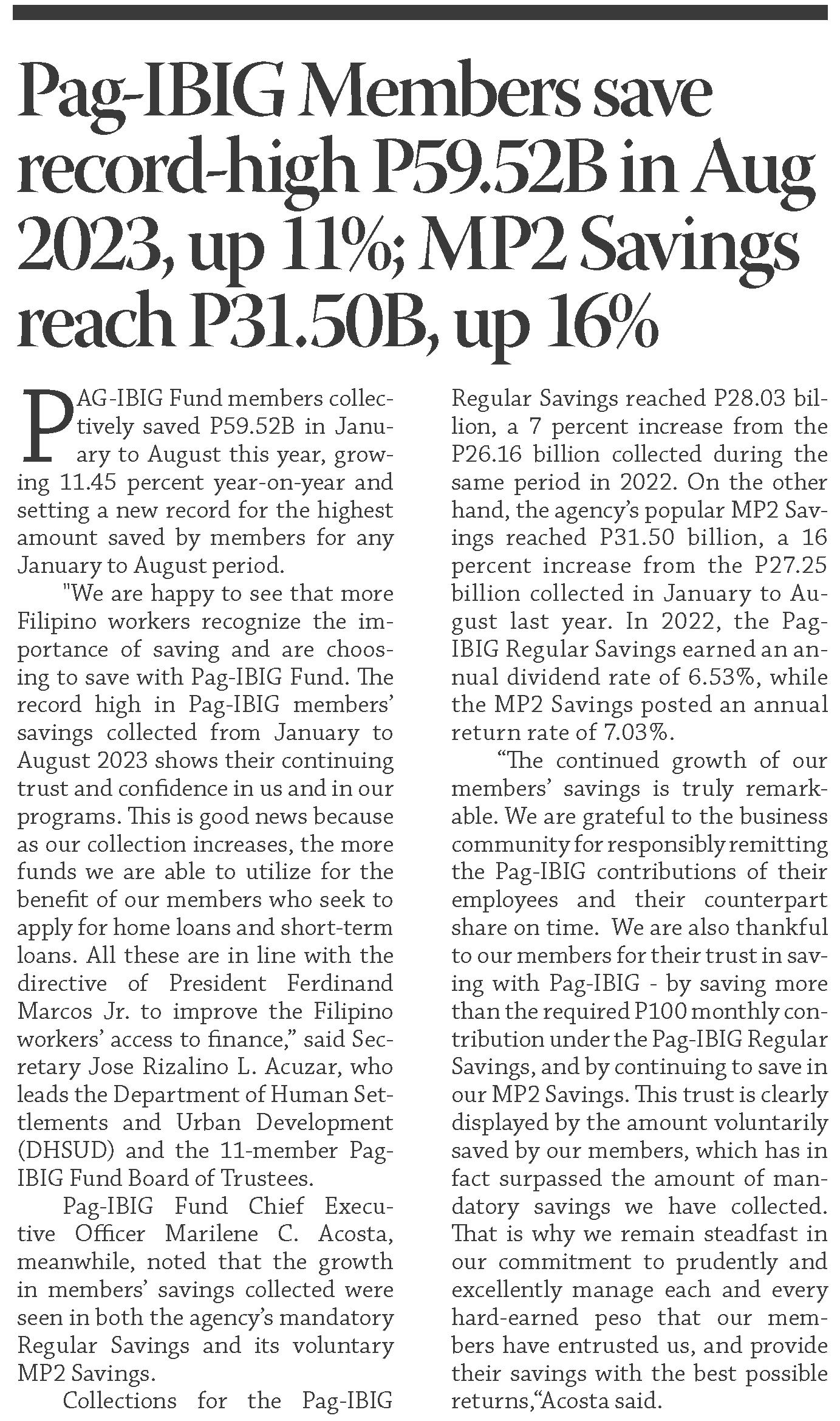
The power firm said it is committed to pursue business and expansion strategies that are aligned with the national and regional energy policies and needs.

“SMGP is committed to the diversification of its power generation portfolio as it continues to undertake the development of solar-based power generation projects. SMGP remains fully compliant with existing local and international environmental requirements, laws, and regulations, protects the biodiversity surrounding its project sites, and actively reduces emissions in the supply chain and in its operations.”
Recently, the Energy Economics and Financial Analysis (IEEFA) released a report saying SMGP’s heavy reliance on fossil fuels in its portfolio has negatively impacted its financial metrics in recent years.
Authored by Senator Sherwin T. Gatchalian, Senate Bill (SB) 2224, or the Ease of Paying Tax Act, aims to establish a tax-administration system that “will not only encourage taxpayers to pay their taxes truthfully and promptly but also facilitate a more efficient tax collection to fund various government programs.”

“It’s important to legislate a process by which we can make easier the lives of taxpayers because the funds we need to carry out vital programs for national progress come from them,” Gatchalian said in Filipino.
The measure, once enacted into law, will introduce administrative reforms that are expected to sim-
plify tax compliance and strengthen taxpayer rights by amending certain provisions of the National Internal Revenue Code of 1997.
It also aims to “revolutionize” the current process of filing tax returns and paying taxes by allowing taxpayers to have the flexibility to file their returns and make payments at any Revenue District Office, or any authorized agent bank, regardless of whether it’s located within the jurisdiction of the RDO where they are registered.
According to Gatchalian, taxpayers must be allowed to settle estate tax and donor’s tax in any RDO. The latter is expected to “alleviate the burden placed on taxpayers who have
to travel long distances or encounter logistical challenges to fulfill their tax obligations.”
The measure will also pave the way to institutionalize the use of digital filing and payment through any accredited payment channels or platforms. Gatchalian emphasized that the digitalization of filing tax returns and payment of taxes is expected to enhance compliance as it would make it easier and more convenient for taxpayers to fulfill their obligations.
Internet Transactions Act
ALSO on Monday, the Senate approved on third and final reading the Internet Transactions Act (ITA). The proposal intends to address several uncertainties encountered by both online consumers and businesses when buying and selling online.
The measure is also expected to provide an effective regulation for consumer protection in business-tobusiness and business-to-consumer Internet transactions.
With this, Gatchalian, its main sponsor, said both customers and merchants alike are expected “to
ILLICIT tobacco trade in the country may continue to prosper despite the proposed Anti-Agricultural Economic Sabotage Act as it has “insufficient” provisions to curb smuggling of the commodity, Sin Tax Coalition (STC) said.
The non-government group argued that tobacco, in the first place, should not have been included in Senate Bill (SB) 2432 (Anti-Agricultural Economic Sabotage Act) since it is not “essential to food security.”
What should have been done by lawmakers, the organization pointed out, was to draft and file a separate bill addressing the smuggling of tobacco products in the country.
That way, the legislative measure would have enough teeth to address the intricacies of illicit tobacco trade and “avoid illegal infirmities.”
“We are one with the government’s intent to seriously address illicit tobacco trade in the country. However, it would be most ideal for the illicit trade of tobacco products, especially manufactured tobacco products, to be tackled in a separate measure to avoid
legal infirmities,” read the statement the group issued last Monday.
“Tobacco, after all, is not essential to food security, which is the main focus of RA 10845,” the STC said citing the recent case of Department of Health v. Philippine Tobacco Institute (GR 200431).
In that case, the Supreme Court reiterated that tobacco is a hazardous product [that] affects public health and requires regulation, the organization explained.
The organization claims that SB 2432 must be “enhanced” to “sufficiently” address illicit tobacco trade in the country. For one, the group argued that the current form of the proposed legislative measure, which relies “heavily” on deterrence through stiffer penalties, is “insufficient” to curb tobacco smuggling.
The STC emphasized that a trackand-trace system would be the “most effective” measure in curbing illicit tobacco trade. The system involves realtime recording and monitoring of the movement of tobacco throughout its entire value chain, according to the group.
The system, according to the STC, is aligned with the World Health Organization Framework Convention on Tobacco Control (WHO FCTC) Illicit
CITY—Inflation
DAVAOin the region dipped further to half of the average rate since the beginning of the year, the Philippine Statistics Authority (PSA) has reported.
The PSA said inflation in the Davao Region slowed down to 3.9 percent, half of the average monthly inflation print of 6.9 percent from January to August this year.
Inflation in July was recorded at 4.3 percent.
Davao del Norte has the lowest August inflation print at 1.6 percent while Davao City posted a higher 4.7 percent. Davao Oriental, however, remained high at 7 percent.
The PSA identified the main drivers for the slowdown of inflation rate as housing, water, electricity, gas and other fuels.
PSA-XI OIC Regional Director Randolph Anthony B. Gales said these drivers tallied a 2.4-percent inflation print, which is a 96.3-percent share to the downtrend of inflation in the region.
The restaurants and accommodation services group had the largest contribution to general inflation in the region at 6.8 percent inflation rate. Food and non-alcoholic beverages at 6 percent inflation also fueled the brisk pace of price increases in the region.
Alcoholic beverages and tobacco was the third contributor to the overall inflation in the region for August, at 14.7 percent.
At the opposite end of the commodity groups were furnishing, household equipment and routine household maintenance, with 6-percent inflation and education services with 3.9 percent inflation.
Nonetheless, the PSA said the inflation rate for August for the bottom 30-percent income household dropped to a level of 3 percent, lower than the 4.3 percent in July. This was an improvement to the 10.5-percent inflation rate in August last year.
The average inflation rate for the bottom 30-percent income household from January to August this year was 8 percent, the PSA data showed.
enjoy better protection” when shopping online.
“It’s important to boost the confidence of our consumers and small businessmen through adequate protection mechanisms when they undertake various internet transactions because this is key to growing
Trade Protocol. The group proposed that the Bureau of Internal Revenue should be the one overseeing the track-andtrace system.
“A track-and-trace system would be more effective if it ran atop a licensing regime, such as that implemented under the Food and Drug Administration, to ensure effective regulatory capture of legally manufactured and imported tobacco products,” it said.
“We also believe that record-keeping should be implemented hand-in-hand with mandatory public disclosures, especially from the tobacco industry, covering the volume of tobacco products produced, imported and kept in storage. Such measures will enable more accurate estimates of illicit trade activity and inform policy on illicit tobacco trade,” it added.
Without the creation of the trackand-trace system, the group claimed that the proposed amendments to the Anti-Agricultural Smuggling Act of 2016 through SB 2432 would “simply be ink on paper.”
“We call on our legislators to pass a bill [that] will sufficiently address illicit tobacco trade, thereby protecting public health and preventing tax collection erosion,” the STC said.
GLOBE Telecom Inc. announced last Monday it signed single-term loan facilities with Metropolitan Bank & Trust Co. (Metrobank) amounting to P15 billion.
“The loans shall be used to finance the company’s capital expenditures (capex), debt refinancing and/or general corporate requirements,” the listed telecommunications company (telco) said in a disclosure to the Philippine Stock Exchange.
As of the first half of 2023, the firm has spent P37.7 billion in capex. The amount represents a 25-percent reduction in capital outlays and is “consistent with the company’s efforts to bring free cash flow back to more sustainable levels,” the telco said Globe Telecom reported it has set aside $1.3 billion (or about P73.8 billion) in capex this year from $1.9 billion (or about P107.9 billion) in 2022. Globe is further reducing its capex to $1 billion (or about P56.8 billion) in 2024.
“Majority or about 90 percent of the capex spending was allocated to data network builds to meet the consumer’s escalating demand for data,” Globe said.
The telco reported it has built 542 new cell sites and upgraded 5,087 mobile sites to 4G in order to meet the rising data demands of its customers during the first six months of the year. The Ayala-led telco also deployed around 148 thousand fiber-to-the-home (FTTH) lines, significantly lower than last year’s rollout to maximize the utilization of its existing fiber inventory.
Globe Telecom also said in its disclosure that it fired up 356 new 5G sites across the Philippines, increasing its 5G outdoor coverage to 97.44 percent of the National Capital Region and 91 percent of key cities in Visayas and Mindanao.
our economy,” Gatchalian said, partly in Filipino, following the chamber’s approval of SB 1846.
The measure, which creates an Electronic Commerce Bureau under the Department of Trade and Industry, was certified urgent by President Ferdinand R. Marcos Jr.
Gatchalian explained that the measure specifically intends to promote and maintain a robust e-commerce environment in the country by building trust between online merchants and consumers, recognizing the value and potential of the digital economy and the need to establish secure and reliable e-commerce platforms.
The lawmaker added that the measure lays down the rights, obligations and liabilities of the parties in Internet transactions, including the online consumer, online merchant and the digital platform or e-marketplace. It also empowers the DTI to take appropriate actions in response to any violations of the law’s provisions, particularly in the use of the internet for conducting e-commerce by e-marketplaces, online merchants, e-retailers, digital platforms and third-party platforms. It also provides for the establishment of an online dispute resolution mechanism for all stakeholders involved in Internet or e-commerce transactions.
The House of Representatives approved its own version of the proposed measure last December.
HOW do you raise the startup capital for your business? This question is probably the biggest problem faced by those who want to become an entrepreneur.
Some of my friends have said if they had enough capital, they would quit their jobs and put up their own business. I also faced this obstacle as an employee years ago.
Through the years and several businesses later, I’ve discovered there are actually many ways to do this. Some are easy; others are not. Some are quite obvious while others require creativity and due diligence.
I hope the following ways can help you raise the capital you need to become an entrepreneur.
1. Your own savings. The most obvious way to get your start-up capital is to save money. Be frugal, live below your means and pay yourself first. The advantage of this method is that if your business fails, you’d owe nothing to anybody; and you have no financial burdens to worry about.
This method could take a long time before you finally have enough money saved to start. This approach is recommended for those with very low-risk tolerance and are not in a hurry to start a business.
2. Liquidate assets. A friend of my father sold their old family car to put up a photocopying business. Depending on the amount of capital you need, simply look around the house and sell whatever you have like gadgets, jewelries, furniture or appliances. You can also ask your broker if you can liquidate some of your paper assets or withdraw from your mutual fund or time deposit accounts.
3. Earn extra income. We often look for ways to earn extra income only when we are in financial need. What many people don’t realize is that finding a second job or working on a sideline is a great way to raise capital for your dream business.
Assuming that your current employment can cover all your financial requirements, then the profits from your extra ventures can all go straight to your start-up fund. Going this route can be time consuming and exhausting but it’s relatively faster than the previous methods.
4. Take out a personal loan. A personal loan is something you can leverage on, especially if you are employed. Depending on your credit history and employment status, some banks and almost all credit card companies are willing to offer these types of loan without much hassle and without collateral. Additionally, these salary loans are available through the Government Service Insurance System and the Social Security System. Meanwhile, microfinance institutions can also provide non-collateral per-
sonal loans to those who can present to them a sound business plan. Inquire from government agencies about these micro-financiers.
5. Apply for a bank loan. Bank loans are also a viable option to raise capital for your business. Although the interests are much higher than personal loans, the financial strength of banking institutions allows them to provide you with a larger loan amount for your medium scale business ventures. Be ready to give them a good business plan and collateral for the loan. Ask your bank if they offer business loans. Do a brief research to identify SME-friendly banks.
6. Use credit cards. Credit cards can easily be used to gain some business capital. Avail a cash advance or make the necessary purchases for your startup venture. If you always pay your credit card bills in full every month, your credit limit could go as high as P250,000 in a couple of years.
However, purchase what you need after your cut-off date so you’ll have more time to save. Likewise, remember your due date and not forget to pay your bills.
And since you’ll be paying around 3.5-percent interest per month on your credit balance, it’s essential that your business generates enough income to cover for the payments and these charges.
7. Check rediscounting. Lenders that offer check rediscounting are easy to find. This method requires you to issue post-dated checks in exchange for its amount in cash less the interest. For example, at 5-percent interest, you’ll receive P19,000 if you issue a check worth P20,000. Rates and length of payment dates vary for different lenders.
Although less advantageous than using credit cards, check rediscounting is a good option for shortterm business cashflow needs and small-business capital requirements. Again, make sure that you’ll be able to generate enough money to clear the check on time.
It’s also good practice to have backup plans just in case you don’t earn enough money to cover the check amount. You can prepare frozen assets for selling or ask friends for help.
8. Borrow money from family and friends. One advantage of doing this is that most family members and friends are usually willing to lend money without or with very little interest. You can also enjoy more flexibility on your payment terms.
Remember though that you are putting your reputation on the line if you go for this method. So do your best to pay on time and, if your business earns more income than expected, give back a little extra as gratitude for their trust.
When talking to them, be straightforward and honest with your intentions. Do it professionally and present a business plan. Produce a contract stating the agreed terms for the loan and payment. Be clear that you’re merely borrowing money from them and they will not legally own part of the business. Some people might think that because they lent you money, they instantly become investors and can actively participate in the business.
9. Form a joint venture. You can also consider making family members and friends a part of the business. Create a team whose strengths and expertise complement each other: a partner can have good accounting skills; another is proficient in sales and marketing; and, one is a legal expert.
Unfortunately, many friendships have also been strained when things go wrong or become difficult. It’s important that from the very start, each one understands the amount of work that needs to be done and is willing to go the extra mile to make the business successful. Also, be sure to clearly define the responsibilities, boundaries and jurisdiction of each partner in the business. Lastly, write everything on paper including the options and terms if ever one partner chooses to leave the business.
10. Seek a venture capitalist. Also called an “angel investor,” a venture capitalist (VC) is willing to pay for your startup in exchange for part ownership or royalty fees from the business.
One major advantage of doing this is that you could further tap the VC’s extensive network of partners to help enhance your business. However, do remember that you’ll most likely lose free rein over running your business because certain decisions will need to be consulted to the VC before they can be implemented.
Always have an elevator pitch ready just in case you bump into one. You can find VCs in online forums and websites.
Whichever way you choose among these ten, having a good business plan is always an essential tool. It will help you ensure that your business will be able to pay your creditors on time and, more importantly, convince investors to join your venture.
Fitz Villafuerte is registered financial planner of


THE Senate on Monday approved on third and final reading a proposed measure that would simplify the process of paying taxes and strengthen taxpayers’ rights.
WORKS of art by Austrian expressionist artist Egon Schiele are on display at the Manhattan District Attorney’s Office, on September 20, 2023, during a ceremony returning the pieces to the heirs of Fritz Grünbaum, a well-known cabaret performer who was arrested in 1938 and later died in the Dachau concentration camp. AP


NEW YORK—During his abbreviated lifetime, a cabaret performer named Fritz Grünbaum amassed a trove of artwork—more than 400 pieces, including 80 sketches and paintings by the Austrian expressionist Egon Schiele that were ultimately plundered by the Nazis. For a while, many of those disappeared until they began to resurface over the years in auction houses and prominent museums.
On Wednesday, seven of those pieces were returned to Grünbaum’s heirs, who have been fighting for decades to reclaim the looted art.
The seven Schiele pieces, valued collectively at $9.5 million, were handed over to the family during a ceremony at the Manhattan District Attorney’s office, which has taken a leading role in tracking down stolen art and antiquities.
“Your recovery of these artworks reminds us once again that history’s largest mass murder has long concealed history’s greatest robbery,” Timothy Reif, Grünbaum’s great-grandnephew and a federal judge in New York City, said of the state and federal authorities who made the handover possible.
By some estimates, the Nazis stole 650,000 works of art from 1933 to 1945, many from Jewish families who were arrested and then killed in concentration camps during the Holocaust. Some of the stolen pieces were created by some of the world’s most heralded artists, including van Gogh, Picasso and Chagall.
The modern style of many of the pieces was deemed “degenerate” by Adolf Hitler. He ordered some destroyed, while others he sold off to help finance his invasions across Europe.
Grünbaum, who was also an actor and music writer, used the stage to throw barbs at the Nazi regime. Arrested in 1938, he was sent to the Dachau concentration camp, where he died
three years later.
The return of the seven pieces of sketches and watercolor paintings follows a court victory in 2018 when a New York judge ruled that two works by Schiele had to be turned over to Grünbaum’s heirs under the Holocaust Expropriated Recovery Act, passed by Congress in 2016.
All of the seven pieces, like the two recovered earlier, will be auctioned off to raise money to support scholarships for underrepresented performing artists. The nine works of art
CELEBRITIES BORN ON THIS
DAY: Manny Montana, 40; Christina Milian, 42; Serena Williams, 42; Jim Caviezel, 55.
HAPPY BIRTHDAY: Don’t hesitate; get the ball rolling and finish what you start. Keep life simple and doable. Refuse to be led by those pushing lies. It’s up to you to think for yourself and make decisions you can live with moving forward. Put your energy where it counts. Personal growth will be gratifying and point you in a positive direction. Your numbers are 6, 19, 22, 25, 34, 39, 48.
ARIES (March 21-April 19): Pay attention and act fast. Monitor what’s happening and refuse to let situations get blown out of proportion. It’s up to you to change what isn’t working for you and to gravitate toward what soothes your soul. Take a deep breath and do what’s necessary. ★★★★
TAURUS (April 20-May 20): Don’t skirt issues. Be honest with yourself and others, do what’s best for you and have no regrets. Discipline will pay off, and intelligence will help you choose where you want to go. ★★
GEMINI (May 21-June 20): If you aren’t cognizant of what’s happening, someone will blindside you. Keep an open mind but a closed wallet. Protect your emotions and your reputation from those trying to outdo you. Network, stay current and honor your promises. ★★
CANCER (June 21-July 22): Put your energy into whatever offers the highest returns. Getting upset won’t solve anything, but discussing matters in depth will help you put things in perspective and find common ground. An opportunity will come with change; don’t miss out for fear of trying something new. ★★★
are just a small fraction of the artwork being sought. The whereabouts of much the collection remains unknown.
Two of the pieces returned Wednesday to Grünbaum’s family were voluntarily given back by New York City’s Museum of Modern Art.
Another, “I Love Antitheses,” which is valued at $2.5 million on its own, had been part of the Ronald Lauder
❶ SISTERS (Ingrid and Zoe) Yasmin Sison, 2023

❷ 676-4., Maya Muñoz, 2023
SET to open next Thursday, October 5, at Silverlens Manila is a pair of solo exhibitions featuring midcareer artists who captivate with visual narrations of personal experiences.
Yasmin Sison presents yet again autobiographical paintings as she has done for over two decades in shows here and abroad. In her upcoming exhibit, titled Time is a Restless Sea, the artist illustrates fleeting, intimate moments with her subjects set against a grand backdrop of vast sea and sky. The theme alludes to the notion of eternal recurrence by German philosopher Friedrich Nietzsche, who posits the never-ending looping of time.
“The cosmos is constantly roiling like a tempestuous sea,” says Sison, who graduated from the University of the Philippines with a Bachelor’s Degree in Humanities and then in Fine Arts with a major in Painting.
The artist was a member of the collective Surrounded by Water, and is the recipient of the Cultural Center of the Philippines Thirteen Artists Award

in 2006. She was also shortlisted for the Ateneo Art Awards the following year. Sison has exhibited her works in both solo and group formats in the Philippines, Malaysia, Singapore, and New York. She has participated in international group exhibitions in Belgium (2000), Singapore (2002) and Italy (2009).
Opposite Sison’s presentation is that of Bicol-based painter and printmaker Maya Muñoz. Her show, titled Drift and Vapor, figures as the artist’s fourth solo with Silverlens Manila. Muñoz takes the audience to the landscapes and communities that fill her every day. The new series of
works explores expanded printmaking combining a screen-print process with painting and photography, resulting in a textured effect that mimics a faint memory.
The unique mixed treatments of Muñoz are the results of two years’ worth of experimentation, wherein the medium becomes the art in itself.
Time is a Restless Sea by Yasmin Sison, and Drift and Vapor by Maya Muñoz will begin its month-long run at Silverlens Manila next Thursday, October 4. The gallery accepts walk-ins from Tuesday to Saturday, from 10 am to 6 pm.
The Universal Crossword


LEO (July 23-Aug. 22): Speed up and make things happen. Be the one to make a difference and lift the morale of those around you. A couple of changes at home will be conducive to new beginnings and better relationships with those you love. ★★★
VIRGO (Aug. 23-Sept. 22): Be the one to open doors instead of waiting for others to go first. A change will influence how you think and what you can accomplish. Put some muscle behind your thoughts, and you’ll change the dynamics of your relationships and direction. ★★★
LIBRA (Sept. 23-Oct. 22): Be aware and monitor what’s happening. Don’t take sides; staying neutral will allow you to see both sides and conduct what’s necessary to keep the peace. Be the mentor, not the one who stirs the pot. ★★★★★
SCORPIO (Oct. 23-Nov. 21): Don’t let a change of plans disrupt your day. Use your resources to reconstruct a path that works for you and keep moving forward. Refuse to let emotional issues affect your work or your reputation. Maintaining composure will lead to an unusual opportunity. ★★
SAGITTARIUS (Nov. 22-Dec. 21): Concentrate on what brings you joy. Travel, educational pursuits and time spent with supportive people will keep you grounded. Activities that require physical action will boost your morale and initiate more time spent doing things conducive to health and fitness. Romance is favored. ★★★★

CAPRICORN (Dec. 22-Jan. 19): Redefine what’s important to you and adjust your schedule to suit your needs. A change of attitude will help deter anyone from putting pressure on you to do things that don’t interest you. Make your position clear and be vocal about your plans. ★★★
AQUARIUS (Jan. 20-Feb. 18): Pay attention to where your money goes. Manage paperwork to ensure you get what you want and be sure to take advantage of a good deal. Refuse to follow someone tempting you with pie-in-the-sky ideas. Choose common sense over being polite. ★★★
PISCES (Feb. 19-March 20): Drift in a direction that offers more freedom to do what brings you joy. Consider matters thoroughly and contact those you trust, and an opportunity to put positive changes in place will come your way. Be reasonable, but protect your interests. ★★★
BIRTHDAY BABY:
You are passionate, creative and dramatic. You are kind and friendly.
‘themeless tuesday 52’ BY ADRIAN JOHNSON
• Edited by David Steinberg/Anna Gundlach
A tale of two recollections

THERE is so much happening in the colorful lives of the children of actress Sylvia Sanchez these days and the proud mom couldn’t find the right words to describe her emotions.

“It’s definitely a good mix of feelings, but I don’t think there is a specific word that would perfectly match how I feel as a mom right now. I am certainly in full support of the paths my children have chosen to take, and as parents, my husband Art and I are just there for them, like we always have been ever since. If they are happy, then we are certainly happier,” Sanchez intoned.
Sanchez’s youngest daughter Gela is the latest Atayde to join show business. She is part of the cast of Senior High, a modern-day drama series produced by Dreamscape Entertainment that delves into the lives of the younger generation and the intricacies of the modern Filipino family.
The 21-year-old dancer-turned-actress admitted that she had jitters when she realized that the cameras were starting to roll. “The fact remains that I am, and will always be, in the shadow of those that came ahead of me—mom, my brother Arjo and my sister Ria, all of whom have proven their worth in terms of the work they have done all these years.”
She added, “It will take years of output for me to even come near their achievements. But I am not pressured, especially not by my family, because I have been advised time and again to just enjoy the ride, absorb as much as I can, and allow myself to grow at the pace that is comfortable to me—and that’s what I am doing.”
Gela shared that someday, she wants to be part of a movie or a series that has dance as a main thread in the narrative. “As a dancer, that’s my ultimate dream.”
Actor-turned-politician Arjo Atayde got married recently and his mom was prepared. “As a mother, I know that soon all of my children will have their own families—that is inevitable, and that is also why you have to make the most of your time when they are still with you and you are all living in one house. Kids grow up very fast these days and before you know it, they are adults already, and they will spread their wings and fly.”

Lately, Sanchez gets to travel with Arjo and his wife Maine because the movie their company Nathan Studios produced, titled Topakk, is going around the festival circuit. “I am fascinated being a movie producer. It’s a totally different world and I am learning the ins and outs of it.”

Sanchez’s eldest daughter Ria is also making bold strides in drama. She is one of four lead actors in the ongoing TV series, Nag-aapoy na Damdamin
WHAT if the one that got away returns to your life? Will you give love a second chance, or will it really be a goodbye. Two of the country's biggest and brightest stars Bea Alonzo and Dennis Trillo come together in an extraordinary story about lost love and missed chances in Love
Before Sunrise.
The romantic drama series is the latest collaboration between Philippine broadcast giant GMA Network and leading panregional over-the-top (OTT) video streaming service Viu.
This also marks the reunion of Bea and Dennis. Joining them are Sparkle leading lady Andrea Torres and award-winning actor Sid Lucero.
Streaming 48 hours in advance on Viu Philippines starting September 23, and premiering on September 25 on GMA’s prime-time block, Love
Before Sunrise tells the story of ex-lovers Atom (Dennis) and Stella (Bea). They separated after realizing they had found the right love at the wrong time.
Years later, their paths cross again, and they regret losing each other after both ended up in unhappy marriages. Things become more complicated as they give in to their rekindled feelings
SEOUL, South Korea—Suga, a member of K-pop supergroup BTS, began fulfilling his mandatory military duty on Friday as a social service agent, an alternative form of military service in the country. Suga, 30, became the group’s third member to start carrying out their military duties. The two others, Jin and J-Hope, are already performing active service at army bases.
“I’ll faithfully serve and come back...Please stay healthy and let’s meet all again in 2025!” Suga wrote in a message posted on the online fan platform Weverse.
BTS’s management agency, Big Hit Music, said that Suga later began commuting to a workplace designated under the country’s alternative military service system.
In South Korea, all able-bodied men must serve in the army, navy or air force for 18-21 months under a conscription system established due to threats from rival North Korea. Individuals with physical and mental issues can instead carry out their duties at non-military facilities such as welfare centers, community service centers and post offices for 21 months.
Local media reported Suga’s alternative service was likely related to a shoulder surgery that he underwent in 2020.
alongside some of the most competent actors we have today. I continue to keep the learning door wide open because this is the career I have chosen for myself, a decision I made many years ago, setting aside any pressure from my family members who are also actors,” Ria shared.
Her romantic relationship with actor Zanjoe Marudo is an open book in showbiz circles and she has always been proud of her boyfriend. “He’s a wonderful guy, and he takes his job seriously, too.
Right now, we are okay to be working on our own projects. If some great material comes up in the future that will put us together, that will be nice, too.”
Ria lives on her own now, away from the Atayde residence where she grew up in. “I’m enjoying being on my own. I am transforming into a responsible,
of activities together pa rin.” She has also joined forces with her mom Sylvia and their family friend Lorna Tolentino in exploring film distribution. As the CEO of Nathan Studios, Ria calls the shots and vows to push the boundaries with every new acquisition they make. When the three took part in the Film Market section of the Cannes Film Festival a few months ago, they saw the Korean film Monster and thought it will be best to bring the movie for the Filipino audience to see.
Sylvia Sanchez has always advised her children to follow their hearts, and use their hearts in every performance they do and every task they will be assigned to. We had a recent chat with her and when we asked her about her children, she replied quickly:
“I guess the kids are alright.” n
Continued from B4
Collection housed by the Neue Galerie in New York. Two of the works were being held by the Vally Sabarsky Trust. A self portrait of the artist was returned by the Morgan Library & Museum in New York, and a portrait of his wife, Edith, was given back by the Santa Barbara Museum of Art in California.
The DA’s office said the museums agreed to let go of the pieces “after they were presented with evidence that they were stolen by the Nazis.”
Active duty soldiers are required to begin their service with five weeks of basic military training at boot camps. Those performing alternative service are subject to three weeks of basic military training and can choose when to take it, according to the Military Manpower Administration.
It wasn’t known in which facility Suga began serving. In a statement earlier this week, BTS’s management agency, Bit Hit Music, asked Suga fans to refrain from visiting the signer at his workplace during the period of his service.

“Please convey your warm regards and encouragement in your hearts only,” Big Hit Music said. “We ask for your continued love and support for [Suga] until he completes his service and returns.”
Last year, intense public debate erupted over whether BTS members should receive special exemptions to their compulsory military duties. But the group’s management agency eventually said all seven members would fulfill their obligations.
South Korean law grants exemptions to athletes, classical and traditional musicians, and ballet and other dancers, if they are deemed to have enhanced the country’s prestige. K-pop singers aren’t eligible for the special dispensation. AP
are Sparkle stars Sef Cadayona, Rodjun Cruz, Vaness del Moral, Vince Maristela, Jose Sarasola and Cheska Fausto.
The Love Before Sunrise cast also includes some of the country’s most respected artists in film and television: Tetchie Agbayani, Ricky Davao, Jackie Lou Blanco, Isay Alvarez, Nadia Montenegro and Matet de Leon. The drama is produced by the award-winning GMA Entertainment Group headed by senior vice president Lilybeth G. Rasonable, supported by the creative team led by creative
Ricky Lee. The series is directed by Mark Sicat dela Cruz, together with associate director Carlo Cannu.
Love Before Sunrise begins airing on September 25 on GMA, Mondays to Fridays at 8:50 p.m. Global Pinoys can also catch the program via GMA Pinoy TV. Viewers may catch the advanced episodes 48 hours ahead on Viu Philippines from Saturdays to Wednesdays beginning September 23.
The Viu app is available on App Store, Google Play, select Smart TVs, and on the web at www.viu.com.
Last week, Manhattan authorities notified three museums of intent to seize three Schiele pieces, one each from the Art Institute of Chicago, the Carnegie Museums of Pittsburgh and the Allen Memorial Art Museum at Oberlin College in Ohio. Combined, the artwork are valued at nearly $4 million. Those works will remain at the museums until they can be transported to the district attorney’s office at a later date, they said.
David Schaecter, the president of the Holocaust Survivors Foundation USA, lauded Manhattan District Attorney Alvin Bragg for his efforts to find stolen artwork. The son of an Austrian Jewish art dealer, Grünbaum became a prolific art collector himself, amassing more than 400 pieces, including 80 of them sketches and paintings by Schiele.
Nazi forces took Grünbaum into custody in 1938 during Germany’s invasion of Austria. While he was imprisoned at Dachau, he was forced to give his wife power of attorney, who then was forced to surrender the art collection to the Third Reich.
“The Nazis systematically murdered most of the Grünbaum family members,” Reif said.
“By recovering these long-lost artworks,” he said, “our law enforcement authorities have today achieved a measure of justice for the victims of murder and robbery.” n
‘Berlin’
NETFLIX will release Berlin on December 29. The spinoff for La Casa de Papel follows one of the most extraordinary heists of the iconic character played by Pedro Alonso, who returns to the role of the hedonistic and clever Berlin.
Alongside him is his new gang: Michelle Jenner (Isabel) plays Keila, an eminence in electronic engineering; Tristán Ulloa (Fariña) goes into the skin of Damián, a philanthropic professor and Berlin’s confidant; Begoña Vargas (Welcome to Eden) plays Cameron, a kamikaze who always lives on the edge; Julio Peña Fernández (Through My Window) brings to life Roi, Berlin’s faithful squire; and Joel Sánchez plays Bruce, the relentless man of action in the gang. Itziar Ituño (La Casa de Papel) and Najwa Nimri (La Casa de Papel) come back to their roles as policewomen Raquel Murillo and Alicia Sierra, respectively.
Samantha Siqueiros (Lady of Steel), Julien Paschal (One Year, One Night), Masi Rodríguez and Rachel Lascar (Through My Window) complete the cast for Berlin

NOBODY parties like Newport World Resorts and its first-ever Oktoberfest is here to prove it.
Together with Hilton Manila, the country’s premier lifestyle and entertainment destination elevates the yearly German fest to three nights of free-flowing German food, beers, and music from October 19 to 21, 2023 starting every 6 pm at the Grand Ballroom, 3F Hilton Manila.
Beer lovers get to enjoy a selection of classic Bavarian draft beers such as Helles and lager, and high-quality special brews like the Korbinian dark beer in bottles from the Weihenstephan Brewery, the world’s oldest continuously operating brewery.

All the while, guests indulge in authentic German favorites prepared by awardwinning chefs. The family style spread includes freshly baked Laugen pretzels and soft rolls; Munich-style sausage salad; an assortment of Bratwurst, Sauerkraut, and regional sausages; pork knuckle and chicken schnitzel; and finally, baked apple strudel and shredded pancake served with vanilla
ice cream and berry compote - with even more to look forward to.
“For our very first Oktoberfest, we are more than delighted to deliver an epic party that evokes the thrilling spirit of Germany right here in the city,” Newport World Resorts’ Chief Marketing Officer David Jorden shares, “This festival marks the get-together of culinary masterminds and service excellence from the country’s pioneer integrated resort for an unparalleled authentic experience.”
The hotel’s Grand Ballroom transforms with the classic long benches and checkered tablecloths for guests to gather round. Along with all-night performances from the worldrenowned AnTon Showband all the way from Austria, the best Oktoberfest beats make the whole place drum with excitement in celebrating an authentic German festival at Newport World Resorts.
Early birds can still avail of the discount promo rate of P4,800 nett per head until September 17. The regular price of P5,200 nett starts from September 18 to October

21. For tickets and inquiries, contact the Newport World Resorts Sales Team: Jimmy Iglesias at 0917 872 8734 and JD Dionio at 0917 878 8568; or the Hilton Manila Sales Team: Arianne Mae Rodelas at 0917 848 6404 and Jhocar San Mateo at 0917 811 0731; or email hiltonmanila_events@hilton.com. Escape the ordinary at Newport World Resorts, you know you want to. For more information on Oktoberfest, visit https://www.newportworldresorts. com/oktoberfest2023 and follow @ newportworldresorts on Facebook and Instagram, and @nwresorts on Twitter. Make the most of your visit and sign up for an Epic Membership or download the Epic Rewards Mobile App for free at the Apple App Store and Google Play Store.
PASEO de Roxas in Makati City came alive with the vibrant colors, flavors, and cultural richeness of Malaysia as the much-anticipated Malaysia Week 2023 kicked off on September 16, 2023.
Themed “Endless Discoveries: This is Malaysia,” the two-day event provided an immersive experience into the heart of Malaysia’s diverse culture, showcasing its traditions, cuisine, products, and more.
The event’s Opening Ceremony last September 16 started with the resonating notes of Malaysia’s national anthem “Negaraku,” setting the stage for a day filled with excitement and cultural
extravaganza.
Suhaimi Abu Hassan Shari Deputy Director of International PromotionsASEAN Tourism Malaysia, opened the program and shared insights into the rich tapestry of Malaysian tourism. This was followed by the welcome address given by His Excellency Dato’ Ambassador Abdul Malik Melvin Castelino Anthony, the Malaysian Ambassador to the Republic of the Philippines, reinforcing the strong bonds between the two nations. Tourism
Undersecretary Shereen Gail C. YuPamintuan represented the Philippines and shared her thoughts on the significance of cultural exchange events
like Malaysia Week. This was followed by a captivating performance of a multi-cultural dance by Seri Cindai Tari and Cindai Cilik Tari, an in-house cultural dance group, followed by a tour of the event site.
Malaysia Week’s Program was packed with exciting activities for visitors to experience throughout the day. Apart from the usual offerings of delicious Malaysian food, patrons also found various authentic Malaysian products on offer.
Attendees had the chance to witness the art of making Teh Tarik, a Malaysian “special-tea,” through a live demo by staff from Berjaya Hotel Makati. Lucky visitors went home with special prizes in the Ultimate Teh Tarik Challenge.

The afternoon brought more excitement with fun games and culinary demonstrations, including the making of the ever-popular Roti Canai. This was followed by a fashion show which showcased the elegance of Malaysian attire, followed by a unique Batik Sarong Styling competition.
In the evening, visitors took part in fun quizzes, cultural dance showcases, and participated in the Just DanceCultural Dance Challenge.
Malaysia Week 2023 is an opportunity for everyone to explore and experience the essence of Malaysia, its traditions, and its people. With a captivating blend of culinary offerings, entertainment, interactive activities, and cultural performance, the fun-filled event promises to be a memorable occasion for visitors of all ages.
MEGAWORLD Lifestyle Malls and Lucky Chinatown are leading the grand community celebration of the Mid-Autumn Festival with a week-long event starting from September 24 until October 1. This year’s grand cosmic-themed event named Moonrise Marvels is poised to be a culmination of art, culture, and traditions, serving as a beacon of unity for the thriving Filipino-Chinese (Fil-Chi) community.
“For years, the Mid-Autumn Festival has held a special place in the hearts of our community, and this year, we’re excited to give the people a celebration that honors the customs of the past while pushing art and culture forward,” shared Lucky Chinatown General Manager, Ms. Norico Mizoguchi.
Here’s everything to look forward to at the event:
Moonlit Treasures
MOONLIT Treasures beckons visitors to embark on an enchanting journey through a wide selection of items to shop for, from delectable mooncake delights, enchanting charms, collectibles, and so much more. September 25-30 - Atrium, Lucky Chinatown Mall

Moonlit Marvel: A Creative Lantern Parade
GUESTS are invited to embark on a magical journey through a world of illuminated creativity by taking part in a mesmerizing lantern parade that showcases the cultures, artistry, and unity of the Fil-Chi community. September 27 - Atrium, Lucky Chinatown Mall
Galaxy Canvas
GALAXY Canvas is a celebration of artistic innovation and self-expression, encouraging participants to let their imaginations shine as they step into an exhilarating drip painting competition. September 29 - Atrium, Lucky Chinatown Mall
Galactic Drip Hues
ASIDE from the competition, attendees are invited to hop into their creative spirit and embark on an imaginative journey through a bunny-themed drip painting workshop, held in an exciting partnership with ALL About Art PH. September 30, Atrium of Lucky Chinatown Mall
Moonlit Creations: A Mooncake Making Workshop
GUESTS can discover the art of crafting China’s iconic dessert pastry, the mooncake, through this interactive and engaging workshop, offering a hands-on mooncake making activity guided by expert instructors who have mastered the age-old tradition. September 30Atrium, Lucky Chinatown Mall
The Cosmic Dice Game
THE Cosmic Dice Game provides an inclusive space for friendly competition and camaraderie among the community, bringing people together to foster a sense of unity and shared enjoyment in the cosmic realm of chance and strategy. October 1 - Atrium, Lucky Chinatown Mall.
JEHOVAH’S Witnesses in the Philippines will be joining an international campaign which will feature a special edition of The Watchtower magazine focusing on the solution to several challenges that are putting intense pressure on millions of people today.

A special edition of The Watchtower magazine with theme “What Is God’s Kingdom?” will be distributed globally and in the Philippines in various languages within this month of September. Known as having the largest monthly circulation of any magazine in the world, The Watchtower has been published continuously since 1879.

With the use of the Bible, the magazine will provide clear explanations on what millions of Jesus’ followers have been praying about when they utter the words “thy Kingdom come” as contained in what is commonly known as the “Lord’s Prayer”. The said model prayer provides guidance as to how Christians should pray and what they should pray about.
“It’s no secret that many people feel we need better rulership, but few can agree on how to achieve this. The good news is, Jesus will be the perfect ruler who can and will solve all the problems we are facing here on earth. Our campaign will bring this much-needed message of hope to our communities,” said James Morales, national spokesperson for Jehovah’s Witnesses.
This issue of The Watchtower will help readers find answers to important questions such as Why do we need God’s Kingdom?; Who is the King of God’s Kingdom?; When will God’s Kingdom rule the earth?; What will God’s Kingdom accomplish?; and What is God’s Kingdom?
About 250,000 Jehovah’s Witnesses from the Philippines will distribute this specialedition magazine which is currently available
in over 780 languages in print and online via their official website, jw.org.
Seventy-five-year-old Josefina Buco are among those sharing in the special campaign in the country. A stroke patient and currently confined in a hospital in Cagayan Valley, Josefina is taking the opportunity to speak with the medical staff about the hope being offered by God’s Kingdom.
“I am happy that I am a part of this campaign. While I cannot move my body because of my health condition, there is no reason for me to stop preaching because I can still speak,” she said in Ilocano.
In Metro Manila, Donalyn Capillan is actively going from house-to-house, writing letters as well as visiting business establishments to share the special-edition magazine in Tagalog, English and Japanese languages.
“I am very excited knowing that I am taking part in this global special campaign. I realize that by being part of this campaign, I can tell the people about God’s government. I can also bring comfort to the people by sharing with them what God’s Kingdom would accomplish,” she said.
At the height of the COVID-19 pandemic, Jehovah’s Witnesses distributed millions of this special-edition magazine through letters, even sending copies to thousands of government officials worldwide. Now that they have returned to their door-to-door public ministry post-pandemic, this will be the first in-person campaign where they will have the opportunity to discuss the important and very timely subject with their neighbors.
A free digital copy of this special issue of The Watchtower is available in over 1,070 languages. There are 8.6 million Jehovah’s Witnesses in 239 lands participating in the said special campaign.
In the US, the annual core metric that strips out food and energy from the Federal Reserve’s preferred inflation measure may have fallen below 4 percent in August for the first time in nearly two years.
Meanwhile the euro region’s own annual gauge of underlying price growth is expected to have slowed to 4.8 percent in September—a 12-month low.
Such coinciding evidence would reassure officials from the Fed and the European Central Bank after a week when each signaled monetary tightening may be done or at least paused for now, shifting focus to keeping interest rates durably high to fully squash inflation.
They do have reason for caution, however, with the prospect that crude oil heading toward $100 barrel could yet fuel further price growth.
Some recent increases in energy costs are already having an effect. The overall personal consumption expenditures price index that the Fed favors is expected to pick up on a monthly basis to one of the strongest readings this year when that report is released on Friday.
Headline euro zone inflation, which will be released the same day, is still likely to have weakened drastically however—reaching 4.5 percent, a two-year low.
“The Fed’s optimism isn’t likely to be dented by data in the coming week. Even as income and spending rose at a decent clip, August PCE inflation likely continued at a pace close to the Fed’s 2
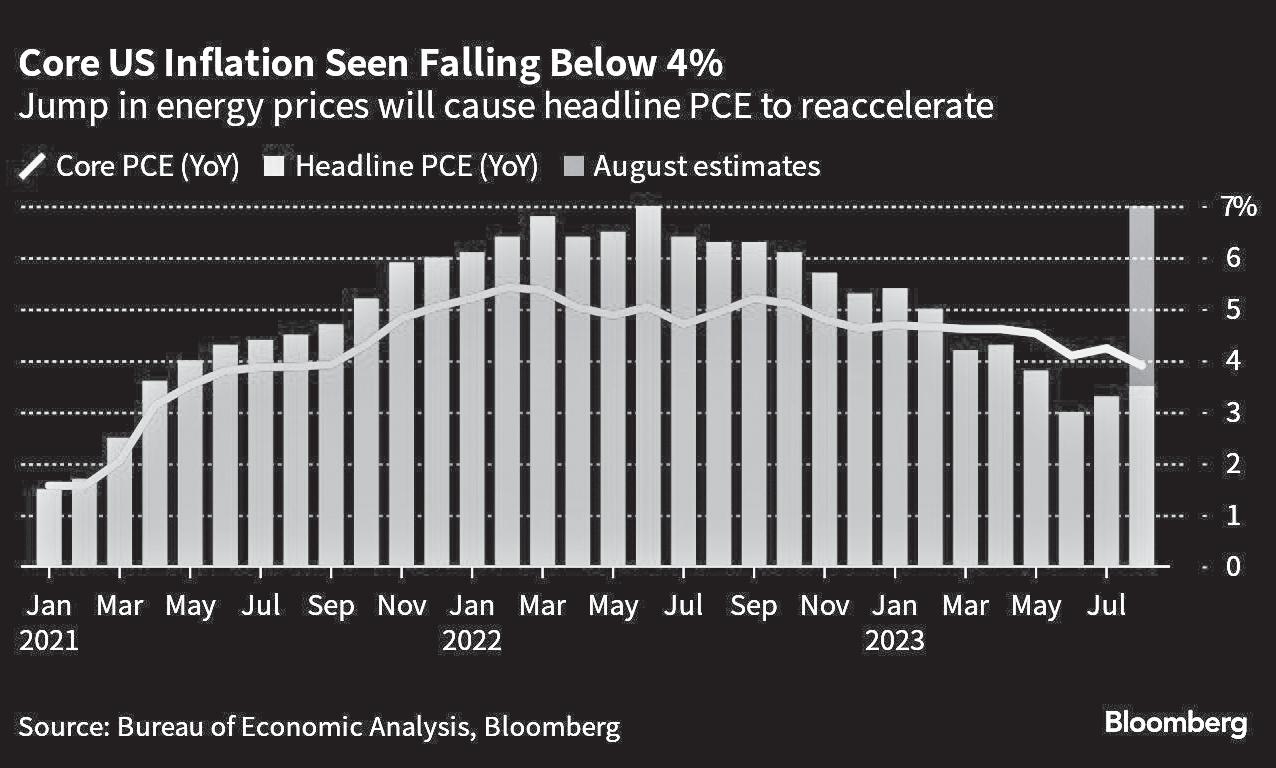
percent target for a third straight month. That said, we do expect to see further signs of labor-market weakening in the consumer confidence report,” said Bloomberg economists Anna Wong, Stuart Paul and Eliza Winger.
Elsewhere, appearances by the Fed and ECB chiefs, along with rate decisions from Hungary to Mexico, will keep investors busy.
US and Canada
IN the US, the PCE report may be the last government figures that policymakers see for some time ahead of a likely shutdown that would start October 1. When the government was closed in 2013, figures like the employment report and others were delayed.
Other data this week include those on new-home sales, consumer sentiment and durable goods orders. The Census Bureau will publish its third estimate of second-quarter growth as well as benchmark revisions.
Fed Chair Jerome Powell will host a town hall with educators, while his colleagues Neel Kashkari, Austan Goolsbee, Thomas Barkin and John Williams are scheduled to speak at separate events.
In Canada, gross domestic product data for July will be released after preliminary data earlier suggested the economy was flat that month, supporting the central bank’s decision to hold rates steady at 5 percent.
Payroll and job vacancy data is expected to show the labor market continues to ease although wage growth remains strong.
THE Bank of Japan’s Governor Kazuo Ueda and his deputy Shinichi Uchida will both be speaking on Monday following the central bank’s latest policy decision Friday.
This week the world’s third largest economy will also be reporting on a host of data on Friday, including Tokyo inflation, retail sales, industrial production and labor market related figures.
In a week when the European Commission’s Vice President Valdis Dombrovskis will be visiting China, investors will also be closely watching the country’s PMI data starting Friday to parse the latest state of China’s economic slowdown.
Australia reports on its latest inflation figures Wednesday and retail sales data Thursday—both will feed into the Reserve Bank of Australia’s policy decision the following week. Meanwhile Thailand’s central bank is expected to continue to raise rates on Wednesday, after which the country is expected to show slightly better trade results Friday.
Elsewhere, Singapore has inflation data due Monday that is likely to show a further slowdown, while Hong Kong reports on trade Tuesday.
Europe, Middle East, Africa
ECB President Christine Lagarde will testify in the European Parliament on Monday, in a session likely to touch on last week’s close-run decision to raise rates again.
Other colleagues scheduled to speak in coming days include Bank of France Governor Francois Villeroy de Galhau and ECB Chief Economist Philip Lane. While national inflation numbers from around the region will draw attention before the release of the euro-zone report, another data highlight will be Germany’s latest Ifo business confidence reading.
Europe’s biggest economy may be contracting at present, and the index—due Monday—will show whether there’s any sign of optimism of growth improving.
In the UK, meanwhile, which last week surprised investors by keeping rates on hold instead of an increase, final GDP data for
the second quarter will be released on Friday.
Turning east, Hungary’s central bank is poised to cut its key rate by a full percentage point for a fifth month on Tuesday. The next day, Czech officials may stay on hold.
In Russia, macroeconomic data is published Wednesday including industrial production figures that will likely show a strong rebound as Putin’s war economy intensifies defense output to support his invasion of Ukraine.
The next day, the Bank of Russia’s Governor Elvira Nabiullina, Kremlin economic aide Maxim Oreshkin and Finance Minister Anton Siluanov are scheduled to speak at the Moscow Financial Forum.
Looking south, an unexpected slowdown in August annual inflation and expectations that foodprice base effects will drive disinflation in the fourth quarter will probably see the Bank of Ghana keep its key rate unchanged on Monday.
On Tuesday, Morocco’s central bank makes its first rate decision since a devastating earthquake.
Despite inflation running at 5 percent, above the base rate of 3 percent, the bank may choose against hiking.
Saudi Arabia’s foreign reserves fell to the lowest level since 2009 in July. Investors will on Thursday be closely watching the numbers for August to see if the trend’s continued or if the government has opted to prop up the reserves.
Latin America
IN Brazil this week, the central bank on Tuesday posts the minutes of its Sept. 20 rate decision to cut the key rate to 12.75 percent. On Thursday, the quarterly inflation report will update key scenarios, forecasts through year-end and into 2024.
Also out of Brazil, the midSeptember inflation reading will likely jump close to 5 percent as last August’s -0.73 percent print falls out of the data series. Analysts expect August unemployment to come in near an eight-year low amid nearrecord employment levels—all of which have yet to stoke wage pressures.
In Argentina, the July GDPproxy reading will likely post a fourth straight negative print as South America’s second-biggest economy slides into recession.
A host of indicators including industrial production and retail sales out of Chile for August should remain negative though may offer signs of what’s seen as a regionbeating rebound in 2024. Winding up the week, Banco de Mexico and Colombia’s Banco de la Republica are all but certain to keep their key rates unchanged.
Neither is quite ready to begin unwinding record hiking cycles, though Colombia Finance Minister Ricardo Bonilla says he’ll argue for a cut. Local economists see a reduction from 13.25 percent next month while Banxico’s expected to hold at 11.25 percent into 2024. With assistance from Tony Halpin, Monique Vanek, Robert Jameson, Paul Wallace, Paul Jackson, Laura Dhillon Kane and Milda Seputyte/Bloomberg
NASA’s first asteroid sam -
ples fetched from deep space parachuted into the Utah desert Sunday to cap a seven-year journey.

In a flyby of Earth, the OsirisRex spacecraft released the sample capsule from 63,000 miles (100,000 kilometers) out. The small capsule landed four hours later on a remote expanse of military land, as the mothership set off after another asteroid.
“We have touchdown!” Mission Recovery Operations announced, immediately repeating the news since the landing occurred three minutes early.
Officials later said the orange striped parachute opened four times higher than anticipated—around 20,000 feet (6,100 meters)—basing it on the deceleration rate.
To everyone’s relief, the capsule was intact and not breached, keeping its 4.5 billion-year-old samples free of contamination. Within two hours of touchdown, the capsule was inside a temporary clean room at the Defense Department’s Utah Test and Training Range, hoisted there by helicopter.
The sealed sample canister will be flown on Monday to NASA’s Johnson Space Center in
Houston, where it will be opened in a new, specially designed lab.
The building already houses the hundreds of pounds (kilograms) of moon rocks gathered by the Apollo astronauts.
“We can’t wait to crack into it. For me, the real science is just beginning,” said the mission’s lead scientist, Dante Lauretta of the University of Arizona. He’ll accompany the samples all the way to Texas.
Lori Glaze, NASA’s planetary science division director, added:
“Those are going to be a treasure for scientific analysis for years and years and years to come.”
Scientists estimate the capsule holds at least a cup of rubble from the carbon-rich asteroid known as Bennu, but won’t know for sure until the container is opened in a day or two. Some spilled and floated away when the spacecraft scooped up too much material, which jammed the container’s lid during collection three years ago.
Japan, the only other country to bring back samples, gathered about a teaspoon during a pair of asteroid missions.
The pebbles and dust delivered Sunday represent the biggest haul from beyond the moon. Preserved building blocks from the dawn of our solar system, the samples will help scientists better understand how Earth
and life formed, providing “an extraordinary glimpse” of 4.5 billion years ago, said NASA Administrator Bill Nelson.
Osiris-Rex, the mothership, rocketed away on the $1 billion mission in 2016. It reached Bennu two years later and, using a long stick vacuum, grabbed rubble from the small roundish space rock in 2020. By the time it returned, the spacecraft had logged 4 billion miles (6.2 billion kilometers).
At a news conference several hours later, Lauretta said he broke into tears of joy upon hearing that the capsule’s main parachute had opened.
“I knew we had made it home,” he said, so overwhelmed with emotion when he arrived at the scene that he wanted to hug the
capsule, sooty but undamaged and not even bent.
Flight controllers for spacecraft builder Lockheed Martin stood and applauded the touchdown from their base in Colorado. NASA camera views showed the charred capsule upside down on the sand with its parachute disconnected and strewn nearby, as the recovery team moved in via helicopters.
“Boy, did we stick that landing,” Lauretta said. “It didn’t move, it didn’t roll, it didn’t bounce. It just made a tiny little divot in the Utah soil.”
British astronomer Daniel Brown, who was not involved in the mission, said he expects “great things” from NASA’s largest sample return since the Apollo moon landings more
than a half-century ago. With these asteroid samples, “we are edging closer to understanding its early chemical composition, the formation of water and the molecules life is based on,” he added from Nottingham Trent University.
One Osiris-Rex team member was stuck in England, rehearsing for a concert tour. “My heart’s there with you as this precious sample is recovered,” Queen’s lead guitarist Brian May, who’s also an astrophysicist, said in a prerecorded message, “Happy Sample Return Day.”
Engineers estimate the canister holds 250 grams (8.82 ounces) of material from Bennu, plus or minus 100 grams (3.53 ounces). Even at the low end, it will easily surpass the minimum requirement of the mission, Lauretta said.
It will take a few weeks to get a precise measurement, said NASA’s lead curator Nicole Lunning.
NASA plans a public showand-tell in October.
Currently orbiting the sun 50 million miles (81 million kilometers) from Earth, Bennu is about one-third of a mile (one-half of a kilometer) across, roughly the size of the Empire State Building but shaped like a spinning top. It’s believed to be the broken fragment of a much larger asteroid.
During a two-year survey, Osiris-Rex found Bennu to be a chunky rubble pile full of boulders and craters. The surface was so loose that the spacecraft’s vacuum arm sank a foot or two (0.5 meters) into the asteroid, sucking up more material than anticipated.
These close-up observations may come in handy late next century. Bennu is expected to come dangerously close to Earth in 2182—possibly close enough to hit. The data gleaned by OsirisRex will help with any asteroiddeflection effort, according to Lauretta.
Osiris-Rex is already chasing after the asteroid Apophis, and will reach it in 2029.
This was NASA’s third sample return from a deep-space robotic mission. The Genesis spacecraft dropped off bits of solar wind in 2004, but the samples were compromised when the parachute failed and the capsule slammed into the ground. The Stardust spacecraft successfully delivered comet dust in 2006.
NASA’s plans to return samples from Mars are on hold after an independent review board criticized the cost and complexity. The Martian rover Perseverance has spent the past two years collecting core samples for eventual transport to Earth.
POLICYMAKERS on each side of the Atlantic are likely to take comfort this week from a slowdown taking hold in key underlying measures of consumer-price growth.RECOVERY team members carry a capsule containing NASA’s first asteroid samples to a temporary clean room at Dugway Proving Ground in Utah on Sunday, September 24, 2023. The Osiris-Rex spacecraft released the capsule following a seven-year journey to asteroid Bennu and back. AP/RICK BOWMER
HANGZHOU—Jones

JONES LLABRES INSO saves the day for Team Philippines with his medal in wushu. “ It’s really a challenge to perform here,” said Inso, who’s bound for the World Combat Games and the World Wushu Championships after the Asiad. “I only used to watch my opponents here perform in the past, now I competed against them.”
Llabres Inso gave the Philippines its second bronze medal from wushu in the 19th Asian Games on Monday when setbacks came one after the other in many fronts and the women’s 3x3 basketball team had to withdraw because it only had two accredited players.
A Taolu specialist, the 26-year-old
Inso, competing out of La Trinidad in Benguet, salvaged third place in wushu men’s taijiquan-taijijian allaround event for the second bronze medal after Patrick King Perez bagged the same medal in men’s individual poomsae of taekwondo on Sunday.

I prepared very hard for the Asian Games,” said Inso, who missed a medal in the Cambodia Southeast Asian Games last May. “I reviewed by past performances and this is the result—a bronze.”
Inso scored 9.746 points in barehand taijiquan and 9.470 in swordplay of taijijian for a total of 19.216 in the event dominated by China’s Gao Haonan with 19.666 points and Hong Kong’s Hui Tak Yan with 19.494 points.
I nso’s bronze bore the burden of Agatha Wong’s failure to repeat as bronze medalist after she ranked fourth in the same discipline Sunday.
The day, however, started sour for Team Philippines whose participation here is supported by the Philippine Olympic Committee and Philippine Sports Commission after games organizers denied an appeal by the Samahang Basketbol ng Pilipinas for two replacement players in the women’s 3x3 squad.
Coach Pat Aquino said they had no choice but to withdraw because they’re only left with Camille Nolasco and Louna Ozar after last-minute replacements Cielo Pagdulagan and Marga Villanueva were thumbed down.
They were supposed to take the place of veterans Camille Clarin and Angel Surada.
A quino apologized saying he felt sorry for the players who were supposed to see action in the Philippine women’s 3x3 debut in the Asiad. The Philippines was scheduled to play Jordan for its first game.
The country lost another top
HANGZHOU—The men’s 5x5 team that flew with unnessacry extra baggage wrought by accreditation issues take on Bahrain at the start of the basketball competitions Tuesday in the 19th Asian Games.
It will be a tough battle for head coach Tim Cone and Gilas Pilipinas as the all-pro squad takes on a Bahrain facing a “challenge” from major adversities in the last two weeks leading to the continental showpiece.
I think they are going to be a challenge out there,” the most successful coach in Philippine Basketball Association history said of Bahrain. The match is set at 1:30 p.m. at the Zijingang University inside the Zhejiang University.
medal hopeful when Tokyo Olympics veteran Kurt Barbosa dropped his opening round match to Uzbekistan’s Omonjon Otajonov in taekwondo’s Kyorugi (free sparring).
Barbosa started tentatively but rallied furiously to tie the count at 14-all at the end of the exciting two-round contest in the men’s -58-kilogram division at the Lin’an Sports Culture and Exhibition Centre here.
But to Team Philippines’ disappointment, the Uzbek was declared winner due to superiority.
Suffering the same fate were Veronica Garces in women’s -49 kgs as she lost to taller third seed Mobina Nematzadeh of Iran in the round-of-16 after beating Tajikistan’s Shirinmohi Mirshakarzoda.
The men’s boxing team suffered its first casualty, Aaron Jude Bado, who lost his Asian Games debut to Thitisan Panmot of Thailand in a 51-kg match that ended in an RSC-L (Referee Stopped Contest-Injury) in the second round.
The Filipino suffered a huge cut on his left eyebrow that prompted ring official to stop the fight with 16 seconds remaining in the round.
POC president Rep. Abraham “Bambol” Tolentino, meanwhile, said felt that JR Francisco got the raw end of the judging as the Filipino
month which it dominated with five straight wins.
A s champion of the pre-OQT, Bahrain became the first country to secure a berth in the OQT for the Paris 2024 Olympics.
skateboarder missed the podium also Monday in men’s park.
Francisco ended up fourth with an 83.58 at the QT Roller Sports Centre after a solid second run, but China’s Ye Chen bagged gold with 84.41 on his second run while Japan’s Yuro Nagahara and Kensuke Sasaoka took the silver and bronze with 84.00 and 83.66.

We were robbed of the bronze,” said Tolentino, who cheered for nine-yearold Mazel Paris Alegado as she made heads turn despite finishing seventh in the girls’ side.
ANGZHOU—Alex Eala was clinical in a 6-0, 6-0 domination of Pakistan’s Sarah Ibrahim Khan—her first opponent here who’s 14 years older at 32—in the 19th Asian Games women’s singles event of tennis at the Hangzhou Olympic Sports Centre. E ala needed only 39 minutes to warm up for her Asiad campaign, a lopsided victory she highlighted with two aces and 12 points on her serves.

“It was a great game and it was good for my confidence,’’ said Eala, 18 and currently ranked No. 191 in the world. She will face either Kazakhstan’s Aruzhan Sagandykova or India’s Rutuja Bhosale in the next round.
I think I came in with a great attitude and a great mindset,’’ said Eala, who will also see action in mixed doubles with Ruben Gonzales.
Francis Alcantara is also competing hoping to end a medal drought in tennis that started after Filipino-American Cecil Mamiit clinched two bronzes in the 2006 Doha edition. Jun Lomibao


ALEX EALA shuts out foe from Pakistan.
NONIE REYES (CANON EOS R6)
Gilas will enter the venue despite the absence of an official confirmation from the Hangzhou Asian Games Organizing Committee is Kevin Alas, Marcio Lassiter, Chris Ross, Arvin Tolentino and CJ Perez will be allowed to play.
They took over the spots of Terrence Romeo, Calvin Abueva, Mo Tautuaa and Jason Perkins who were denied accreditation and Roger Pogoy who’s injured.
Gilas viewed videos on Monday and held practice at the Dongzan Arena Olympic Sports Shop for the second straight time since arriving Sunday.
B ahrain, which joins the Philippines, Thailand and Jordan in Group C, is coming off a rousing campaign in the FIBA Olympic Pre-Qualifying Tournament (OQT) in Damascus last
HANGZHOU—Kiyomi Watanabe couldn’t summon the form that clinched her a silver four years ago in Jakarta as she and four others crashed out of the judo competition of the 19th Asian Games Monday at the Xiaoshan Linpu Gymnasium.

Watanabe, 27, lost to twotime world championships silver medalist Miku Takaichi of Japan in the women’s -63-kilogram class via ippon in the first 12 seconds of their quarterfinal-round match.
Watanabe was relegated to the repechage but lost to Esmigul Kuyolova of Kazakhstan also via ippon in the first 13 seconds of their encounter.
“Our athletes are in good condition,” Philippine Judo Federation Secretary General Dave Carter said.

“But we got unlucky in the draw. Our athletes got paired against the top seeds in Asia. We will work hard and be more prepared next time.”
A lso bombing out early were
Keisei Nakano, Rena Furukawa, John
Ferrer and Ryoko Salinas.
T he 26-year-old Nakano lost to Jakarta Asiad silver medalist Behruzi Khojazoda of Tajikistan via ippon in the round of 16 of the men’s -73 kgs class, while Furukawa bowed to Momo Tanaoki of Japan also via ippon in the women’s -57 kgs event.
HUNDREDS of students from Tondo who served as mascots or player escorts during the FIBA World Cup were honored during a ceremony that also marked the fourth year of San Miguel Corp.’s (SMC).
The Better World Community Center is a food bank and learning institution that caters to more than 500 families in the area.
Students from General Vicente Lim Elementary School received FIBA kits containing headbands, shoes, t-shirts, shorts, socks and basketballs as well as products from San Miguel Purefoods during the FIBA Wanda Little Champions event organized together with the San Miguel Foundation.
FIBA local organizing committee (LOC) officials Eric Altamirano and Wanda Little Champions Project Lead Josh Paulite, Magnolia Chicken
Timplados Hotshots coach Chito Victolero and Hotshots forward Rome De la Rosa graced the event.
We are very happy with the participation of Better World Tondo and the Gen. Vicente Lim Elementary School,” said Altamirano, head of the National Basketball Training Center, who once coached Purefoods in the Philippine Basketball Association (PBA). V ictolero, whose two young sons were among the children who walked with players from the various World Cup teams during entrance parades, praised the rare opportunity given the grade school boys and girls, some of whom were from the Better World community and Gen. Vicente Lim.
Former Philippine Basketball Association import Dwayne Chism leads Bahrain’s campaign, along with Mustafa Rashe, and Muzamil Ameer Hamooda.
Cone and his coaching staff are familiar with both players.
They are going to pose some problems because they shoot the ball really well. They put a lot of pressure out there,” Cone said. “They are not a big team which is unusual for a Middle East team.”
“ Usually, Middle East teams are really big, but they [Bahrain] are a little different that they are quick and they can shoot,” he added.
A fter Bahrain, Thailand bannered by Tyler Lamb, and the Rondae HollisJefferson-led Jordan are up next for Gilas. Jun Lomibao
Ferrer beat Janga Bahadur Saru of Nepal in the round of 32 of the men’s 81 kgs but yielded to BolorOchir Gereltuya of Mongolia in the round of 16.
Salinas defeated Garima Choundhary of India in the round of 16 in women’s 70 kgs but surrendered to Shiho Tanaka of Japan via ippon in the first 45 seconds of their battle.
Salinas lost to Liao Wun Jung of Chinese Taipei in the repechage.
C arl Dave Aseneta and Dylwynn Gimena will still compete Tuesday. Jun Lomibao
ANCILLA MANZANO competes in floor exercise on Monday night. PHOTO BY NONIE REYES (CANON EOS R6)
HANGZHOU—The absence of former two-time world champion and Tokyo Olympian Carlos Yulo was sorely missed in men’s artistic gymnastics as Miguel Besana and Ace de Leon bowed out of their 19th Asian Games campaigns.
B esana and De Leon nursed foot injuries and competed just the same but missed the podium floor exercise and vault—events where Yulo won world titles in 2019 and 2021, respectively—at the Huanglong Sports Centre Gymnasium late Sunday.

Our boys did their jobs despite their injuries,” said Gymnastics Association of the Philippines (GAP) Deputy secretary-general Rowena Bautista.
But we still have other gymnasts who will compete here,” she added.

Yulo will compete in the world artistic championships set September 30 to October 8 in Antwerp, Belgium, a Paris Olympics qualifier.
A s ix-time Asian championships winner and nine-time gold medalist in the Southeast Asian Games, is with GAP president Cynthia Carrion-Norton.
O nly nine among the 40 sports in the Hangzhou program— archery, artistic swimming, boxing, breaking, hockey, modern pentathlon, sailing, tennis and water polo—are Olympic qualifiers. B esana, gold medalist in vault and silver medalist in team allaround in the Cambodia SEA Games last May, was 10th (14.044) in his favorite vault at the Huanglong Sports Centre Gymnasium. De Leon, silver winner in Cambodia in the team all-around, wound up 13th in vault (13.783) and 23rd in floor exercise (13.000). Only the top eight in each apparatus made it to the finals on Wednesday.
Kursten Rogue Lopez in floor, vault, uneven bars and balance beam; Ancilla Manzano in floor and balance beam; and Samantha Ann Macasu in uneven bars saw action in women’s artistic action late Monday. We will keep trying here,” added Bautista, still counting on John Ivan Cruz, Jhon Romeo Santillan, Jan Timbang, Lucia Gutierrez, Emma Malabuyo, Breanna Labadan and Daniela dela Pisa in the days ahead. Jun Lomibao
ANGZHOU—Joanie Delgaco was fifth in the final of the 19th Asian Games women’s singles scull of rowing where height determines who wins and who doesn’t. anged against grizzled rowers who all stand close to 6 feet, the 5-foot-5 Delgaco, the only Southeast Asian in the final round, clocked eight minutes and 5.93 seconds to finish 27 seconds behind gold winner, 5-foot-11 Anna Prakaten, who clinched silver for Russia in the Tokyo Olympics but is now racing for Uzbekistan.
hina’s Liu Ruiqi (5-foot-10) and Japan’s Shiho Yonekawa (5-foot-10) were 11 and 13 seconds off Prakaten for the silver and bronze medals, respectively.
hinese Taipei’s Huang Yi Ting, who’s 5-foot-7, was nine seconds

faster than Delgaco at fourth place in the 1,000-meter race held at the Fuyang Water Sports Centre.
Hongkong’s Leung Wing Wun, also 5-foot-5, was sixth and last in the final. She crossed five seconds after Delgaco.
Philippine Rowing Association president Patrick Gregorio said the federation remained proud of what the 25-year-old pride of Bicol accomplished.
We should all be proud of Joanie’s feat,” Gregorio said. “Asian rowing final is a world-class field. To achieve a fifth-place finish is truly commendable.”
Gregorio added that their goal is to make it to the Paris Olympics in 2024.
We will continue to focus,” he said.
“The Paris 2024 single sculls will have five Asian qualifiers and Cris Nievarez

[Tokyo Olympian] also has a good chance of returning to the Olympics following his eighth place finish in the men’s single sculls event.”
Nievarez clocked 7:19.45 to emerge second behind Mahamed Riyadh Jasim Al-Khafaji of Iraq (7:16.72) in the Final B. According to our coach, both Joanie and Cris will have a good chance of qualifying for the Paris Olympics 2024 if we prepare and train well,” Gregorio added. The PRF employed Uzbekistan’s Shukrat Ganiev as foreign coach. R owing at the Asian Games is not a qualifier for Paris, but nine sports are—archery, artistic swimming, boxing, breaking, hockey, modern pentathlon, sailing, tennis and water polo.
Jun LomibaoMAZEL PARIS

ALEGADO, only 9 years old, gets tons of experience in Hangzhou. PHOTO BY NONIE REYES (CANON EOS R6)
LREADY in the midst of a historic year, the Filipinas Under-17 squad produced another milestone by qualifying for the Asian Football Confederation Under-17 Women’s Asian Cup for the first time in history after a stunning 1-0 win over host Vietnam in Hanoi on Sunday night. sabella Preston struck a wellplaced free kick from a tight angle in
the 56th minute for the only goal of the match at the Vietnam Football Federation Training Center as the Young Filipinas, now handled by Australian coach Sinisha Cohadzic, advanced as the second team from their group after Australia.
The young Filipinas needed to get past Guam and Lebanon in the first round of qualifying last April in Guam, before beating Bangladesh,
3-1, last Friday, setting the stage for a do-or-die game with Vietnam. V ietnam only needed a draw to qualify for the Asian Cup, but the Filipinas turned the tables on the hosts, constantly opening up their backline with pace and slick passing, while holding firm defensively as they denied them an equalizer late on. The Filipinas, who were in training camp in Manila for a month, more than matched Vietnam’s technical abilities.