ROTARY CLUB OF MANILA JOURNALISM AWARDS
2006 National Newspaper of the Year 2011 National Newspaper of the Year 2013 Business Newspaper of the Year 2017 Business Newspaper of the Year 2019 Business Newspaper of the Year 2021 Pro Patria Award 2026 National Newspaper of the Year PHILIPPINE STATISTICS AUTHORITY 2018 Data Champion
BusinessMirror A broader look at today’s business
EJAP JOURNALISM AWARDS
BUSINESS NEWS SOURCE OF THE YEAR
(2017, 2018, 2019, 2020)
DEPARTMENT OF SCIENCE AND TECHNOLOGY
2018 BANTOG MEDIA AWARDS
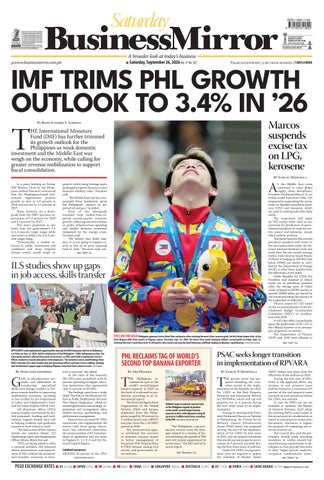
IMF TRIMS PHL GROWTH OUTLOOK TO 3.4% IN ’26 www.businessmirror.com.ph
T
n
Saturday, September 26, 2026 Vol. 21 No. 347
P25.00 nationwide | 3 sections 26 pages | 7 DAYS A WEEK
Marcos suspends excise tax on LPG, kerosene
By Reine Juvierre S. Alberto
HE International Monetary Fund (IMF) has further trimmed its growth outlook for the Philippines as weak domestic investment and the Middle East war weigh on the economy, while calling for greater revenue mobilization to support fiscal consolidation.
By Samuel Medenilla
In a press briefing on Friday, IMF Mission Chief for the Philippines Andrea Pescatori announced that the Washington-based multilateral organization projects growth to slow to 3.4 percent in 2026 and recover to 5.1 percent in 2027. These, however, are a downgrade from the IMF’s previous expectations of 3.9 percent for 2026 and 5.5 percent for 2027. This year’s projection is also lower than the government’s 3.5 to 4.5 percent target range, while next year’s is within the 5 to 6 percent target range. “Domestically, a weaker rebound in public investment and confidence and more frequent climate events would weigh on
A
growth, while rising leverage and a prolonged property downturn pose financial stability risks,” Pescatori said. “The Middle East war has compounded these headwinds, given the Philippines’ reliance on imported oil and gas,” he added. Most of the downgrade stemmed from weaker-than-expected second-quarter economic growth, reflecting execution delays in public infrastructure spending and weaker business sentiment dampened by the energy crisis, Pescatori said. “We believe that didn’t happen, or is not going to happen exactly in line as we prior expected back in June,” Pescatori said, notSee “IMF,” A2
ILS studies show up gaps in job access, skills transfer
EYES ON THE GOLD Philippine gymnast Carlos Edriel Yulo celebrates after winning the men’s floor exercise gold, his first Asian Games title, at the
Aichi-Nagoya 20th Asian Games in Nagoya, Japan, Thursday, Sept. 24, 2026. The three-time world champion added a second gold on Friday, Sept. 25, winning the men’s vault final with 14.599 points after nearly missing the final following a difficult landing in Monday’s qualification. AP/EUGENE HOSHIKO
APPLICANTS seek employment opportunities during the DOLE Kalayaan Job Fair at Robinsons Las Piñas on June 12, 2026, held in celebration of the Philippines’ 128th Independence Day. The nationwide job fairs offered thousands of vacancies, as DOLE and Public Employment Service Offices worked to connect jobseekers with employers. The initiative comes amid findings from DOLE’s Institute for Labor Studies that job-placement offices continue to face staffing, funding and institutional-support gaps in helping Filipinos transition from school to work. ROY DOMINGO
By Mary Jade Jadormio
G
APS in job-placement networks and difficulties in transferring specialized skills from foreign workers to Filipinos remain hurdles to improving employment outcomes, according to two studies by the Department of Labor and Employment’s Institute for Labor Studies (DOLE-ILS). Job placement offices (JPOs) remain largely constrained by limited personnel, funding and institutional support despite their role in helping students and graduates transition from school to work. “The data across all five clusters reveals one common theme,” ILS Supervising Labor and Employment Officer Athena Marie Son said. “JPOs are being asked to solve a national problem, the educated jobless phenomenon, and improvement of PES, without the standardized mandate, resources, or struc-
ture to succeed,” she added. At the time of the research, 383 JPOs were accredited, with 61 percent operating in higher education institutions that represented only 11 percent of all HEIs. The findings came from a study titled “The Role of Job Placement Offices in Public Employment Services: Five-Cluster Diagnostics,” which examined governance and strategy, organization and management, labor market services, partnerships, and performance management. Researchers surveyed 83 JPOs nationwide and supplemented the survey with focus group discussions, key informant interviews, document analysis of 82 memorandums of agreement and site visits in Regions 5, 11, 9, 8 and the National Capital Region.
Limited resources
AROUND 30 percent of the JPOs Continued on A2
PHL RECLAIMS TAG OF WORLD’S SECOND TOP BANANA EXPORTER By Ada Pelonia
T BANANA cargo is loaded at a port in Cebu as the Philippines regains its position as the world’s second-largest banana exporter in 2025, with shipments rising 30 percent to 3 million metric tons, according to the FAO. HUGO MAES | DREAMSTIME.COM
“The Philippines…saw production recover from the damages related to a variety of factors including the spread of TR4 and civil unrest experienced in recent years,” the FAO said in its recent report. See “Banana,” A2
See “LPG,” A2
PSAC seeks longer transition in implementation of RPVARA By Samuel P. Medenilla
T
HE Philippines reclaimed its spot as the world’s second-largest banana exporter in 2025 on the back of a rebound in production, according to an international report. The Food and Agriculture Organization of the United Nations (FAO) said banana shipments from the Philippines surged by 30 percent to 3 million metric tons (MMT) last year, from the 2.33 MMT posted in 2024. The international agency attributed the recovery in domestic banana output to better management of Fusarium Wilt Tropical Race 4 (TR4) disease, easing civil unrest, and government interventions.
S the Middle East crisis continued to cause global supply chain disruptions, President Ferdinand Marcos Jr. on Friday issued Executive Order 125 temporarily suspending the excise taxes on liquified petroleum products (LPG) and kerosene, which are used in cooking and other daily needs. The suspension will apply on LPG except when used as raw materials for production of petrochemical products or used for motive power and kerosene, except when used for aviation. The excise taxes for the covered petroleum products will revert to the rates prescribed under the National Internal Revenue Code one week after the one-month average Dubai crude oil price based Means of Platts of Singapore (MOPS) falls below US$80 per barrel as certified by the Department of Energy (DOE), or after three months from the effectivity of the order. Under Republic Act 12316, the President may suspend or reduce excise tax on petroleum products when the average price of Dubai crude oil based on MOPS reaches or exceeds US$80 dollar per barrel for one month preceding the issuance of the suspension or reduction. Marcos issued EO 125 based on the recommendation of the Development Budget Coordination Committee (DBCC) in coordination with DOE. It will take effect immediately upon the publication of EO 125 in the Official Gazette or in newspapers of general circulation. The Department of Finance (DOF) and DOE were allowed to
HE private sector has proposed extending the transition period in the implementation of the Republic Act (RA) No. 12001 or the Real Property Valuation and Assessment Reform Act (RPVARA), which will cap real property tax to 6 percent during the first three years of its implementation. During its meeting with President Ferdinand Marcos on Tuesday in Malacañang, the Private Sector Advisory Council Infrastructure Sector (PSAC-Infra) has proposed moving the start of the implementation of RA 12001 by four years to 2031 and the phased transition that would cap real property tax increases at 6 percent annually during the first three years of said law. Under RA 12001, local government units are required to update the Schedule of Market Values
(SMV) within two years from the effectivity of the said law in 2024. During the first year of effectivity of the approved SMVs, any increase in real property taxes shall be limited to a maximum of 6 percent of the real property taxes assessed on such properties before RA 12001 was enacted. In case the SMVs are not yet available or updated, the Bureau of Internal Revenue shall adopt the existing SMVs, zonal values or the actual price in consideration as stated in real property transaction documents, whichever is higher, for purposes of computing any internal revenue tax. The Council also said the government should study providing incentives or credits toward balanced housing requirements to developers so they provide discounts to their “higher-priced, ready-foroccupancy condominium units,” See “PSAC,” A2
PESO EXCHANGE RATES n US 62.7560 n JAPAN 0.3952 n UK 82.9446 n HK 8.0025 n CHINA 9.3515 n SINGAPORE 49.0626 n AUSTRALIA 43.9857 n EU 71.4101 n KOREA 0.0459 n SAUDI ARABIA 16.7144 Source: BSP (September 25, 2026)
A2 Saturday, September 26, 2026
News BusinessMirror
ILS studies show up gaps in job access, skills transfer Continued from A1
surveyed were classified as highperforming in governance, while 45 percent were still developing their governance systems. Only half had a standard manual of operations, while just six had reporting systems for their activities. Staffing was another major constraint, with 86 percent of JPO personnel performing placement functions as an additional responsibility and 51 percent of offices having only one to two staff members. More than half also had annual budgets below P100,000 or no dedicated budget, while only 34 percent rated their office space as fully sufficient. “JPOs should be completely institutionalized for them to effectively provide quality public employment service,” Son said. JPOs provide services such as job fairs, career development assistance, job matching and referrals, labor market information, employer engagement, alumni mentoring, livelihood and entrepreneurship support, and assistance for vulnerable youth. Digital tools were used by 67 percent of the offices, although Son noted that online job postings can also expose students and graduates to unverified opportunities. “You can only apply for jobs
you know about,” Son said, stressing the importance of making employment opportunities more visible to young jobseekers. The study recommended institutionalizing JPOs, creating a national manual of operations, establishing a development fund, strengthening capacity-building programs and developing better systems for tracking outcomes. Son said stronger partnerships among JPOs, DOLE offices and other stakeholders could also help improve employment services and labor-market alignment.
Foreign skills hard to localize
A SEPARATE ILS study found that companies transferring specialized knowledge and technology from foreign nationals to Filipino workers face challenges involving language barriers, limited training time, advanced skills requirements and succession planning. ILS Senior Labor and Employment Officer Chelsea Nicole Pineda presented the findings from “Technology and Skills Transfer through the Understudy Training Program and Skills Development Program: Good Practices and Lessons Learned.” Under the Understudy Training Program, two Filipino workers next in rank are expected to eventually assume the foreign national’s position and disseminate the knowledge acquired, while the Skills Development Program does
not impose the same next-in-rank requirement. Only 39 percent of the 140 enterprises surveyed had implemented a UTP or skills development program, with nearly 70 percent of those implementers coming from the manufacturing sector. Language emerged as one of the more difficult areas of skills transfer, particularly for BPO positions requiring Japanese, Korean, Mandarin, French or German. “Imagine for you to have a native level proficiency, it would take you more than 5 to 10 years and you need exposure to practice this language,” Pineda said. Some jobs also require cultural knowledge, including culinary positions where authenticity matters and casino roles involving VIP clients.
Coaching, succession key to skills transfer
COMPANIES commonly use coaching and mentoring, job shadowing, practical application, peer-to-peer learning, simulations, product demonstrations and rotational assignments to transfer specialized skills. “The most effective way of transferring knowledge, skills, or technology is through a coaching and mentoring approach,” Pineda said. About 48 percent of respondents reported having transition frameworks for localizing posi-
www.businessmirror.com.ph
Banana…
IMF…
tions previously held by foreign nationals, including succession planning, job-readiness assessments, transition timelines and formal turnover documents. Turnover among understudies, insufficient training periods, enterprise-specific skills, staffing requirements and regulatory compliance were among the difficulties reported by participating companies. Pineda said human-resource personnel also need to incorporate skills transfer into workforce planning to ensure that Filipino workers are prepared to assume positions eventually vacated by foreign nationals. “It is very important for these Human Resource personnel to really have a workforce planning and to plan how to train the other workers and at the same time how to facilitate the training to achieve their key performance indicators within the company,” she said. The study recommended creating a subcommittee under the Interagency Task Force on Employment of Foreign Nationals to identify specialized skills lacking in the local workforce and determine appropriate transfer methods and training periods. Researchers also proposed a standardized UTP template identifying the skills, technology or knowledge to be transferred, proficiency levels, training methods, assessment mechanisms and target evaluation periods. Both studies underscored the need to better connect employment services, education, employer demand and skills development to address labor-market mismatches.
Citing industry sources, the FAO noted that “substantial” investments were funneled into boosting banana production in Cagayan Valley, including the Department of Agriculture’s (DA) provision of farm inputs like fertilizers. With the recovery in local output, the Philippines officially returned to the previous export ranking it held for six years until 2022, as it slipped to third place in the subsequent years after being dislodged by Guatemala. The FAO said China and Japan remained the key export markets of Philippine bananas. While shipments of bananas to China posted a double-digit growth, the international report noted the disparity in quotations of its leading suppliers. Imports from Vietnam, the leading supplier to China in 2025, averaged $407 per metric ton (MT), while those from the Philippines and Cambodia were around $600 per MT. Imports from Ecuador stood at $755 per MT. The Philippines continued to corner 75 to 80 percent of Japan’s banana imports, but the FAO pointed to the 38-percent increase in the East Asian nation’s imports from Vietnam. Despite this, the FAO said the global banana market continues to be subject to uncertainty from several risks that could disrupt trade. “With ongoing conflicts and wars weighing on the global economy, the risks of further disruptions to local and global supply chains, fertilizer markets, energy prices, transport routes and access to export markets heighten the uncertainty surrounding the outlook,” the FAO said. “Rising living costs, high interest rates and exchange rate fluctuations may affect demand in domestic and export markets, especially for consumers in lower-income segments.”
ing that the IMF hoped for a faster rebound in public investment for the second half of 2026. For 2027, the IMF lowered its growth outlook as the renewed escalation in the Middle East is expected to weigh on oil and food prices and household purchasing power, compounded by a weaker rebound in public investment, Pescatori added. Despite the IMF’s gloomier growth outlook, Pescatori identified several pockets of strength for the Philippine economy, including the global technology cycle supporting exports, room to attract more foreign investment and the country’s young population as a potential source of longer-term growth.
LPG…
PSAC…
issue rules, regulations and guidelines for the implementation of the suspension. Both agencies were directed to conduct an inventory of existing stocks of LPG and kerosene once EO 125 takes effect. DOF’s Bureau of Customs and Bureau of Internal Revenue were mandated to submit to the House of Representatives monthly information on the declared value and volume of petroleum products covered by EO 125. Within 15 days from the issuance of EO 125, the DBCC in coordination with DOE will review the implementation of the new issuance to the House of Representatives and the Senate. It may also recommend to the President the continuation, modification, extension, or termination of the said suspension. The government implemented a similar measure from April to June, which resulted in P2.5 billion in forgone government revenues. Marcos issued EO 125 after DOE announced there can be a rollback in the price of diesel and kerosene next week amid renewed diplomatic engagement between the United States and Iran, which can allow more ships carrying oil and gas to pass through the Strait of Hormuz.
to help address the country’s estimated 3.7-million-unit housing backlog. It further recommended adjusting the socialized housing price ceilings this year, ahead of the scheduled December 2027 review, due to rising construction costs, which is slowing down the launches and construction of such projects. This as real estate’s contribution to GDP dropped to 5.8 percent in the first quarter of 2026, compared with the 6.65 percent prepandemic average in 2018 and 2019. “Through these recommendations, PSAC seeks to support a balanced approach that considers housing affordability and manageable property costs while sustaining investment, construction and jobs across the economy,” PSAC said. Aside from real estate-related matters, PSAC also tackled in its latest meeting with the President the proposed National Artificial Intelligence Implementation Task Force and the lifting of the moratorium for information technology (IT) centers and IT parks in Metro Manila. Among the firms which participated in the meeting were Aboitiz, Alliance Global Incorporated, Ayala Corporation, Ayala Land Incorporated, Robinsons Land Corporation, and SM Prime Holdings, Inc. Malacañang earlier said that Marcos wants the suspension of any increase in real property taxes so it will not become an additional financial burden for property owners amid rising cost of living.
Continued from A1
Continued from A1
Continued from A1
Continued from A1
‘Rely more on revenue measures’
WHILE the country’s mediumterm consolidation path remains appropriate, the IMF said it must be anchored on concrete tax and expenditure measures. IMF projects the fiscal deficit to fall slightly by 0.2 percentage points to 5.4 percent of gross domestic product in 2026 and by an additional 0.3 percentage points in 2027. “The composition of mediumterm fiscal adjustment, however, should be rebalanced toward revenue mobilization to protect priority social spending and create space for higher public investment than currently envisaged by the authorities,” Pescatori said. The government is being prodded to broaden the value-added tax (VAT) base, impose excises on luxury goods and products harmful to health and the environment, and improve the governance and design of tax incentives. Pescatori said the Philippines’s 12-percent VAT rate generates revenue equivalent to only about a 5-to-6 percent effective rate, partly due to compliance gaps and exemptions. Accelerating public financial management reforms, such as streamlining procurement, appraisal and project selection and adopting the draft Philippine Budget Code, is key to executing planned capital spending and restoring business confidence, the IMF said. To execute planned capital expenditures and rebuild business confidence, the IMF said accelerating public financial management reforms, such as simplifying procurement, appraisal, and project selection and adopting the draft Budget Code, is essential. The IMF also urged the government to avoid tax amnesties as it may undermine compliance over time, as well as to think of other revenue measures to offset planned tax exemptions for individuals and small businesses.
Inflation, rate cut
THE IMF expects headline inflation to average 5.6 percent in 2026, slightly below its previous 5.7-percent forecast, before easing to 4.1 percent in 2027, up from its earlier 3.3-percent estimate, reflecting higher oil and food prices. This is below the government’s 6 to 7 percent inflation range for 2026, while the 2027 forecast is within the 4 to 5 percent target range. Pescatori said the Bangko Sentral ng Pilipinas (BSP) may raise the key policy rates by an additional 25 basis points this year, broadly in line with market expectations, as higher oil prices feed into headline inflation toward year-end. “The BSP’s tightening has kept inflation expectations anchored, and the current monetary policy stance is approximately neutral,” Pescatori said. “Given pervasive uncertainty, policy should remain nimble and data-dependent, with further tightening conditional on headline inflation staying elevated or second-round effects intensifying.”
News
www.businessmirror.com.ph
AI reshapes PH hiring, putting entry-level recruitment in focus By Mary Jade Jadormio
A
RTIFICIAL intelligence (AI) is moving deeper into Philippine recruitment, with 39 percent of employers already using the technology in hiring, according to Jobstreet by SEEK. The adoption rate puts the Philippines ahead of the 27 percent recorded across Southeast Asia, as employers turn to AI amid lowquality applicants, limited time, increasingly complex hiring workflows and rising cost pressures. For entry-level applicants, the shift means AI can increasingly shape who gets matched, screened and moved forward before a human recruiter enters the process. Employers that have adopted AI reported faster and more efficient hiring, more precise job matching and less time spent on administrative tasks, according to Jobstreet. Jobstreet by SEEK unveiled its seek Ai platform during its Jobstreet Connect hirer convention, which gathered more than 200 business leaders, human-resources practitioners and industry decision-makers. “We believe that AI should make hiring better, not busier,” Jobstreet by SEEK Managing Director Dannah Majarocon said. “By combining employmentspecific data with agentic AI built directly into the workflow, seekAi is designed to reduce friction, improve talent matching, and give leaders more time so they can focus on what matters most: their people,” the job platform said.
AI in early hiring stages
SEEK AI Personalised Targeting feature uses role requirements, employer preferences and historical hiring activity to identify highfit talent instead of relying mainly on broad keyword matching.
The system also incorporates real-time candidate-intent data, with Jobstreet saying candidates reached through targeted matching are up to five times more likely to apply. Meanwhile, the Seek Ai Assist feature covers several recruitment tasks, including AI pre-screening voice interviews, applicant ranking, next-bestaction guidance and automated reference checks. Jobstreet said SeekAi draws on more than 25 years of employment-market intelligence and 750 million daily candidate and employer signals across Asia-Pacific.
Governance remains a human job
AS AI takes on more recruitment tasks, Kin Enriquez stressed that companies should first establish sound hiring processes before deciding which parts should be automated. “The process has to be right first before you decide which part of the process you want to make into AI,” Enriquez said. R a lph Rega lado likew ise pointed to data governance as a critical condition for effective AI adoption. “If you don’t have good data governance, then it’s not going to work very well,” Regalado said. Majarocon also underscored transparency and accountability as AI becomes more involved in hiring. “We feel extremely strongly about this, the job transparency,” she said. “Someone has to be accountable. A human really should be accountable in the AI,” Majarocon said. Jobstreet said final hiring decisions in AI-assisted recruitment remain firmly under human control.
Residential property prices post slowest growth since Q1 2019 By Andrea E. San Juan
N
ATIONWIDE residential property prices in the second quarter of 2026 saw the slowest growth pace since the start of the Residential Property Price Index (RPPI) series in the first quarter of 2019, according to the Bangko Sentral ng Pilipinas (BSP) showed. Based on the central bank’s RPPI report for Second Quarter of 2026, prices of residential property grew by only 0.4 percent in the April to June 2026 period. Sustained price growth in the National Capital Region (NCR) was largely offset by the first year-on-
year decline in Areas Outside the NCR (AONCR), the report noted. Data showed that while residential property prices in NCR grew by 5.2 percent year-on-year in the second quarter of 2026, prices in areas outside NCR contracted by 2.7 percent. On a quarter-on-quarter basis, price growth was also “subdued,” as residential property prices in NCR dipped by 2 percent compared to the prices in the first quarter of this year. Prices in AONCR in the second quarter, meanwhile, inched up by 1.6 percent compared to the previous quarter.
NFA can only buy 75% of target procurement if El Niño hits hard
T
By Ada Pelonia
HE National Food Authority (NFA) can only purchase 75 percent of its 790,000 metric tons (MT) palay procurement target in 2026 if El Niño “severely” strikes the local rice sector. NFA Administrator Larry Lacson expressed confidence that the grains agency could purchase 500,000 MT of unmilled rice in the wet season harvest. On top of the 92,032 MT that the NFA already procured as of September, its paddy rice purchase could reach 592,032 MT. The projected figure, however, only constitutes 75 percent of the grains agency’s total target of 790,000 MT for 2026.
“If the El Niño is severe, I cannot hit 790,000 MT,” Lacson told reporters in a press conference on Friday. “As long as everything [farmers] sell [to the NFA] is clean and dry, we can absorb up to 500,000 MT,” he said. The NFA currently purchases wet palay at P22 per kilo and dry palay at P27 per kilo. Meanwhile, Lacson said the NFA will earmark at least P500 million annually from its corporate receipts to bankroll the modernization of its warehouses starting next year. “Starting next year, whether the national government provides a See “NFA,” A10
Saturday, September 26, 2026
A3
9-mo BIR refunds rise 90.6% to ₧23.67B as claims rushed
T
By Reine Juvierre S. Alberto
HE Bureau of Internal Revenue (BIR) released P23.67 billion in tax refunds in the first nine months of the year to aid taxpayers and businesses amid higher operating costs and a prolonged energy crisis.
Refunds from January to September 2025 rose 90.6 percent from P12.42 billion in the same period last year, according to a BIR statement issued on Friday. Under the National Internal Revenue Code and various BIR issuances
and regulations, the Commissioner of Internal Revenue may credit or refund taxes that are erroneously or illegally paid, as well as excess payments and statutory relief or incentive. R e f u nd a ble t a x e s i nc lud e
value-added taxes, withholding taxes, income tax, excise taxes and other internal revenue taxes. “These are lawful refunds due to our taxpayers. Once a refund has been properly evaluated and approved for release, we see no reason to unnecessarily delay it,” Internal Revenue Commissioner Charlito Martin R. Mendoza said. The refunds could provide businesses with additional cash for operating expenses and working capital, Mendoza said, as the government seeks to ease pressures on companies while maintaining tax collection efforts. “We want to put that money back in the hands of our businesses so they can use it for operating expenses, preserve cash flow, and keep their businesses moving, es-
pecially during this energy crisis,” Mendoza said. “Tax administration is not only about collecting what is properly due to the government. We must also return what is properly due to the taxpayer once the claim has been evaluated and approved,” he added. For t he mont h of Aug ust, the BIR recorded a 0.70 percent year-on-year decline in its collection, down to P248.4 billion from P250.1 billion, mainly due to the higher ta x refund paid for the month amounting to P10 billion. From January to August this year, the BIR collected a total of P2.238 trillion in revenues, up by 4.60 percent from P2.139 trillion in the same period a year earlier.
Malampaya Gas returns to Ilijan power plant
I
N DIGE NOU S n at u r a l g a s from the Malampaya field is once again supplying the 1,200 -megawatt I lijan Power Plant, restoring a key link in the countr y’s gas-to-power infrastructure and strengthening the role of domestic gas in supporting energy security and electricity affordability. Department of Energy Secretary Sharon Garin, Prime Energy President and CEO Donnabel Kuizon Cruz, and LNGPH President and CEO Yari Miralao led the ceremonial admission of Malampaya gas into Ilijan on September 24, alongside representatives from the DOE, PNOC Exploration Corp. (PNOC-EC), Power Sector Assets and Liabilities Management Corp. (PSALM) and the Service Contract 38 Consortium. Under an Interim Natural Gas Supply Arrangement, Prime Energy, the operator of Service Contract 38, is supplying Malampaya gas to South Premiere Power Corp. (SPPC) for the Ilijan power plant. The return of indigenous gas to Ilijan was made possible through the collaborative efforts of Prime Energ y and SPPC, as well as PNOC-EC and PSALM, to restore the Tabangao-Ilijan Pipeline. The companies worked together to ensure that the infrastructure was restored and brought back into service with safety as a priority. Ilijan was among the facilities that established the Philippines’ first indigenous gas-to-power value chain following the development of the Malampaya field. Its original gas supply arrangement dates back to 1997, before Malampaya began commercial production in 2001. “What we are celebrating today is not just the admission of Malampaya gas and the beginning of a new gas supply arrangement,” Cruz said. “It is also the continued use of critical energy infrastructure that was built decades ago and maintained to serve the country’s
DEPARTMENT of Energy Secretary Sharon Garin (fifth from left), Prime Energy President and CEO Donnabel Kuizon Cruz (sixth from left), and LNGPH President and CEO Yari Miralao (fourth from left) led the ceremonial admission of indigenous Malampaya gas into the 1,200-megawatt Ilijan Power Plant in Batangas on Sept. 24, marking the return of local gas supply to the facility.
evolving energy needs.” T he c u r re nt a r r a n ge me nt covers a six-month period from September 1, 2026, to February 25, 2027. The return of Malampaya gas also demonstrates the value of indigenous fuel in reducing exposure to international energy price volatility. The use of indigenous Malampaya gas at Ilijan is expected to contribute about 36 centavos per kilowatt-hour in lower generation charges beginning September 1, providing potential relief to electricity consumers. Over the past decade, indigenous gas has maintained a price advantage over imported spot LNG, with the difference reaching more than $4 per million British thermal units (mmBtu) at various points. Using
domestic gas can help power generators manage exposure to fluctuations in international fuel markets. Beyond price, indigenous gas contributes to energy security by providing a domestic source of fuel for power generation. It complements imported LNG and other energy sources while helping diversify the country’s fuel supply. Malampaya has also generated significant economic value for the country. Since production began in 2001, Service Contract 38 has contributed more than $14 billion in revenues to the Philippine government. T he si x-month interim arrangement provides a platform for continued collaboration between Prime Energy and SPPC as
the companies explore opportunities for a longer-term gas supply relationship. At the same time, Prime Energy continues to invest in extending the productive life of the Malampaya field and developing additional indigenous resources. Malampaya Phase 4 is targeted to deliver additional domestic gas in the fourth quarter of 2026, supporting the country’s efforts to strengthen indigenous energy supply. “Price stability, affordability, reliability and energy security — these are among the benefits of using our own Malampaya gas,” Cruz said. “Today, we celebrate this new chapter and our shared commitment to a more secure, resilient and affordable energy future for the Filipino people.”
Islamic bank offers financing to help LGUs close services gap By Reine Juvierre S. Alberto
A
L-AMANAH Islamic Invest ment Ba n k of t he Philippines (AAIIBP) will extend financing to local government units (LGUs) next year beyond its traditional borrowers to close the gap in basic public services. AAIIBP Chairperson and Chief
Executive Officer Amenah F. Pangandaman announced in a forum that the state-owned Islamic bank will initially focus on Mindanao and eventually expand the program nationwide, according to a news release. “We all know that Mindanao’s LGUs have long faced underfunding and infrastructure deficits compared to the rest of the nation,”
Pangandaman said. “By providing the support and investment these communities deserve, we can close the gap in basic public services and pave the way for a sustainable climate-resilient future.” A A I I BP pl a n s to ba n k rol l re ve nue - ge ne r at i n g proje c t s such as hospitals and health facilities, water systems, public markets and slaughterhouses,
cold storage facilities, transport terminals and solar and power generation facilities. It will also support service-enhancing projects including heavy equipment, farm-to-market roads and bridges, municipal halls and capitol buildings, school buildings and convention centers, solid See “Islamic,” A10
Saturday, September 26, 2026
A4
News
Law extending bgy, SK terms, moving BSKE to 2028 signed
T
By Samuel Medenilla
O give incumbent barangay and Sangguniang Kabataan (SK) officials more time to wrap up their programs and improve their services, President Ferdinand Marcos signed on Friday Republic Act 12326, extending the term of these public servants to five years and postponing their next elections to 2028. “This is not additional time in office [for the incumbent officials]. This is additional time for accountability to the people,” Marcos said in Filipino in a social media post. He said he hopes the officials will use their extended term to
complete their programs and improve their services. “I hope they will be able to use this time to further improve service delivery, complete ongoing programs, and focus more closely on the needs of every community, family, and youth [in their juris-
dictions],” Marcos said. In a press briefing in Ilocos Norte on Friday, Palace Press Office Claire Castro said RA 12326 will help enhance ongoing efforts of the national government against crimes and proper waste management at the grassroot level. She said barangay and SK officials are at the forefront in implementing both programs. “Preventing crime starts at the barangay level; when barangay officials themselves conduct rounds and enforce rules strictly [in their jurisdictions], the rise in the crime rate can be curbed,” Castro said in Filipino. “Barangay officials can also help us organize proper waste disposal,” she said. RA 12326 amended RA 12232, which extended the term of barangay and SK officials from four to five years. However, it reduced from three
to two the consecutive terms that barangay officials can hold the same position. For SK officials, they can still not serve for more than one term in the same position. The date of the next Barangay and SK Elections (BSKE) was also moved from November 2, 2026 to the second Monday of November 2028. The transitory provisions of RA 12326, banned incumbent barangay officials fom running in the same position in 2028, since the new law already extended their term by two years. Marcos signed RA 12326 on Thursday, days before the Commission on Elections is scheduled to hold the filing of Certificates of Candidacy for BSKE from September 28 to October 5. The poll body already spent P8 billion for its BSKE preparations, which it said was already 90 percent complete.
Marcos pardons Mary Jane Veloso By Samuel Medenilla
F
ORMER death row convict Mary Jane Veloso, who was detained in Indonesia for nearly 15 years in Indonesia for drug trafficking charges, will soon be free after President Ferdinand Marcos granted her an absolute pardon. The chief executive made the announcement when asked if he had already issued the pardon after inspecting the Felipe Abrigo Memorial Hospital in Eastern Samar on Friday. “Pinirmahan ko na....Pinirmahan ko na ‘yung pardon (I’ve already sig ned it...I’ve a lready sig ned t he pa rdon),” Ma rcos told reporters. Veloso was arrested by authorities at an Indonesian airport in 2010 after 2.6 kilograms of heroin wwere found in her luggage.
The former overseas Filipino worker (OFW) claimed her employer tricked her to carry the suitcase, without her knowledge that it had a secret compartment hiding the drugs. She was able to get a last-minute reprieve in her death sentence in 2015 amid frenzied interventions by the Philippine government under President Benigno Simeon Aquino III, with the call to stop execution coming just minutes before midnight. After the Indonesian government approved the request of the Philippines government to allow Veloso to serve her prison sentence in the Philippines in 2024, she was transferred to the Correction Institution for Women in Mandaluyong City. Last February, the family of Veloso submitted a letter to the Palace urging Marcos to grant
her clemency. The Office of the Executive Secretary conducted a review of the possible legal impediments on the request. Executive Secretary Ralph G. Recto said Veloso’s pardon was the result of all of the diplomatic efforts of the government in over a decade. “Today, those efforts culminate in President Ferdinand Marcos Jr.’s grant of an absolute pardon,” Recto said in a statement. He said he hopes the pardon will allow Veloso to spend time with her family. “We cannot give Mary Jane back the 16 years she spent away from her family. But today, perhaps, we can give her back the future,” Recto said. In a statement, Migrante International welcomed the announced granting of pardon to
Veloso, which it said was the result of her family and stakeholder’s relentless campaign to secure her freedom. “We celebrate this as a historic victory for the global people’s movement that has long fought for freedom and justice for Mary Jane as a victim of human trafficking,” Migrante International said in a statement. However, it noted that the Marcos administration committed injustice for “prolonging her detention.” “Mary Jane’s freedom is long overdue. While he ultimately heeded the relentless call of the people to free Mary Jane, let us not forget that Marcos has committed a grave injustice by prolonging her detention in Philippine prison for one year and nine months, when no charges have been brought against her in Philippine courts,” it said.
Sara-Robin ‘ticket’ narrows lead over Leni-Bam tandem By Rizal Raoul Reyes
T
HE hypothetical 2028 tandem of Vice President Sara Duterte and Sen. Robinhood “Robin” Padilla continues to lead the pairing of Naga City Mayor Maria Leonor “Leni” Robredo and Sen. Paolo Benigno “Bam” Aquino IV. Nonetheless, its advantage has narrowed substantially, according to the latest Tugon ng Masa (TNM) survey of OCTA Research. The Duterte-Padilla tandem registered 48 percent of the national voter preference, compared
with 36 percent for the RobredoAquino tandem, giving the former a 12-percentage-point lead. Another 16 percent of respondents remained undecided. OCTA pointed out that the 12-point gap is the narrowest recorded between the two hypothetical tandems to date, pointing to a continuing tightening of the potential 2028 matchup. In prev ious commissioned surveys conducted in 2025, the gap between Duterte-Padilla and Robredo-Aquino ranged from approximately 20 to 25 percentage points. The latest result therefore
represents a substantial reduction in the lead enjoyed by the Duterte-Padilla tandem, according to OCTA. The survey results provide an early indication that the hypothetical contest could become more competitive as the 2028 elections approach. However, the figures remain a snapshot of voter preferences nearly two years before the scheduled elections and should not be treated as an election forecast. The latest findings also come amid other signs of movement in the Duterte-Robredo political matchup. In a separate Q2 2026 TNM survey, Duterte led Robredo in a hypothetical presidential head-to-head matchup by 43 percent to 34 percent, a nine-point margin that was down from 11 points in the first quarter. OCTA said the national movement was modest, with Duterte’s support declining while the undecided or uncommitted bloc increased. The survey data also showed that voter preferences vary depending on the vice-presidential partner paired with each potential presidential candidate. Earlier Q2 results involving Robredo and Sen. Raffy Tulfo versus Duterte and Sen. Imee Marcos, for example, showed Robredo-Tulfo at 45 percent and Duterte-Marcos at 42
percent, a three-point difference that OCTA described as statistically a toss-up given the survey’s margin of error. For the Duterte-Padilla versus Robredo-Aquino matchup, however, the latest national figures remain separated by 12 points. The Q2 2026 TNM survey, according to OCTA, was conducted through face-to-face interviews from July 4 to 11 among 1,200 male and female probability respondents aged 18 and above. It has a national margin of error of plus or minus three percentage points at a 95-percent confidence level. Subnational estimates for Metro Manila, Balance Luzon, the Visayas and Mindanao have a margin of error of plus or minus six percentage points. OCTA described the TNM as an independent, non-partisan and non-commissioned nationwide survey that it conducts regularly and releases as a public service. With 16 percent of respondents still undecided in the Duterte-Padilla versus Robredo-Aquino hypothetical matchup, OCTA said the latest survey leaves a substantial portion of the electorate outside either tandem. It said the narrowing from the 20-to-25-point margins recorded in 2025 nevertheless marks a notable shift in the relative standing of the two pairings.
www.businessmirror.com.ph
Chinese interference reported in latest resupply mission to Ayungin Shoal By Rex Anthony Naval
C
HINESE interference has been reported again in the Sept. 24 rotation and resupply (RoRe) mission for the personnel manning the BRP Sierra Madre (LS-57) in Ayungin Shoal, West Philippine Sea (WPS), the Armed Forces of the Philippines (AFP) said on Friday. “The AFP confirms that three People’s Liberation Army Navy (PLAN) warships and five (5) China Coast Guard (CCG) vessels, including two Houbei-class missile boats, interfered during the conduct of a routine humanitarian RoRe mission to Ayungin Shoal,” AFP spokesperson for the WPS retired Navy reservist Rear Admiral Roy Vincent Trinidad said in a message to reporters. He added Chinese interference against Philippine ships took place approximately 60 nautical miles from Ayungin Shoal. “M/ V Lapu-Lapu and three Philippine Navy and Philippine Coast Guard support vessels were hindered by the PLAN and CCG vessels. In doing so, they prevented the conduct of a sovereign
and legitimate mission to deliver supplies and rotate the personnel manning BRP Sierra Madre,” Trinidad said. He added that these actions are irresponsible, are reckless and are inconsistent with applicable provisions of The International Regulations for Preventing Collisions at Sea (ColRegs) and United Nations Convention on the Law of the Sea (Unclos) as well as the Philippines’ rights affirmed by the 2016 Arbitral Award. “Given the possibility of escalation that could endanger our personnel and vessels, the RoRe mission was temporarily suspended,” Trinidad noted. Likewise, he added that the AFP will continue to fulfill its mandate to sustain our personnel aboard BRP Sierra Madre and exercise the Philippines’ lawful rights in its maritime zones. “We call on the PL AN and CCG to cease these dangerous actions and exercise restraint. The safety of our personnel remains paramount, nevertheless these actions will not deter the AFP from performing its mission,” Trinidad said.
Loren-Leandro lawyer pushes back vs accusers, urges DOE to review records, withdraw cases
T
HE lawyer-spokesperson of Senator Loren Legarda has rejected allegations that the senator and her son, Batangas First District Representative Leandro Leviste, profited unjustly from the mega solar franchise his company secured years ago, and called the case pending against them with the Ombudsman as baseless and ridiculous. Atty. Antonio “Tony” La Viña maintained that the accusations are contradicted by the documentary and financial records. Speaking before members of the media on Wednesday, La Viña challenged the Department of Energy (DOE) to review its own correspondence, distinguish the companies involved, and correct what he described as fundamental errors underlying the complaint against Legarda and Leviste. He also questioned the Office of the Ombudsman’s basis for pursuing the allegations of plunder and graft, urging it to examine the documentary evidence. “Una sa lahat, walang pera galing sa gobyerno na kinuha at binulsa ni Senator Loren o ni Representative Leandro. Walang plunder, walang government funds na kinuha in any of the projects. Dapat very clear sa atin yan [Firstly, no government money was pocketed by Senator Loren or Representative Leandro. There was no plunder, no government funds taken in any of the projects. That should be clear to us all] ,” La Viña said. The renewable energy projects under scrutiny were privately funded and the failure of a project to proceed does not, by itself, constitute plunder or graft, he asserted. Addressing the multibillion-peso financial obligations publicly attributed to Leviste, La Viña clarified that the amounts involved different corporate entities. He maintained that the financial obligations legitimately assessed against Leviste’s companies had already been fully settled. La Viña identified a DOE demand letter addressed to Mr. Emmanuel Rubio of SP New Energy Corporation (SPNEC), which has been majority-owned and controlled by Meralco’s generation company, MGen, since 2024. He urged the DOE to distinguish SPNEC from Solar Para sa Bayan Corporation and the other Solar Philippines companies, emphasizing that the financial obligations of one corporate entity cannot simply be attributed to another. “It is clear that their letter asking for twenty-four billion to be paid, which was later changed to 10 billion, is for Mr. Emmanuel Rubio and not Leandro Leviste, and not the latter’s companies,” La Viña said, partly in Filipino. He also clarified that the Solar Para sa Bayan franchise was non-exclusive and had ceased to exist under the law’s automatic revocation provision after it failed to become operational. He attributed its non-implementation to the DOE’s failure to issue the necessary implementing rules and identify the areas where the franchise could operate. “It wasn’t implemented because the government, the Department of Energy, failed to issue the rules and regulations to implement the solar franchise. The government, or DOE, also did not release a list of the places where it can be implemented,” La Viña said. See “Loren,” A10
www.businessmirror.com.ph
OurTime BusinessMirror
Specific policy solutions to address the global elderly social care crisis By Jona C. Redondo
A
DDRESSING the impending shortage of care for older adults requires coordinated action across workforce development, financing, support for informal carers, prevention, technology, and system redesign. Drawing on recommendations from the OECD, WHO, national experiences in high-aging countries (Japan, South Korea, Germany, Nordic nations), and expert analyses, the following policies target the core drivers: rising demand, workforce shortages, funding pressures, and over-reliance on unpaid family care. 1. Strengthening the formal care workforce The most immediate bottleneck is the shortage of paid carers. OECD analyses emphasize that without better job quality, recruitment and retention will fail even with expanded training. n Raise wages and improve working conditions: Higher pay relative to hospital or other sectors, reduced physical strain, better scheduling, career progression pathways, and stronger occupational health protections. Countries have used sectoral minimum wages (e.g., Scotland and Wales) and public funding increases to support this. Collective bargaining and recognition of care work as skilled employment are key. Evidence shows poor conditions drive high turnover; improving them is essential for retention. oecd.org n Expand training and recruitment pipelines: Subsidized or free training for unemployed people, career changers, students, and underrepresented groups (including efforts to attract more men). Japan increased its long-term care (LTC) workforce substantially in earlier years through targeted programs. Accelerated training with work placements (as in Canada) and standardized curricula help scale supply quickly. Long-term workforce planning with better forecasting is needed to align education capacity with demand. oecd.org n Ethical international recruitment: Targeted migration pathways with visas, language training, and pathways to longer-term residency, paired with bilateral agreements that support origin countries (to avoid “brain drain”). Japan uses multiple schemes (economic partnership agreements, specified skilled worker visas, and student-to-worker pathways). South Korea has launched universitybased programs for foreign students to train as caregivers with settlement incentives. Germany and Denmark have similar recruitment measures. Migration is a near-term bridge but is not a complete substitute for improving domestic attractiveness. straitstimes.com 2. Sustainable financing mechanisms Public spending on long-term care must rise in most countries, but new structures can improve equity, adequacy, and fiscal sustainability. n Mandatory or expanded LTC insurance: Japan’s long-term care insurance (introduced in 2000, with contributions starting at age 40) provides a transparent, universal-risk-sharing model focused on maintaining dignity and independence. Germany and Luxembourg incorporate pre-funding elements. Slovenia introduced LTC insurance in 2023. These systems pool risk better than pure tax-based approaches in some contexts and clarify entitlements. theguardian.com n Diversify funding and improve targeting: Expand beyond labor taxes (e.g., broader bases or pre-funding), while prioritizing benefits for those with the greatest needs and fewest resources. Caps on out-of-pocket costs scaled by need and income can protect the most vulnerable without universal over-coverage. Some countries explore hybrid public-private models or life/ LTC insurance products. n Increase public investment linked to broader goals: Treat LTC as a priority tied to gender equality, labor force participation, and economic growth. Higher spending can create jobs while reducing unmet needs and hospital pressures.
3. Supporting informal and family caregivers Informal care still provides the majority of support in most places. Policies should reduce burnout and enable workforce participation (especially for women). n Paid or flexible carer leave, cash allowances or benefits, respite care services, and free training/support programs. n Recognition of carers’ contributions and measures to prevent them from exiting the labor market permanently. n OECD and WHO frameworks stress integrating support for unpaid carers into formal systems. 4. Prevention, healthy ageing, and demand management Reducing the intensity or onset of care needs can ease future pressure. n Invest in prevention, early diagnosis, rehabilitation (“reablement”), and healthy ageing programs (e.g., home visits in Denmark and Norway, lifestyle interventions). OECD modeling suggests healthy ageing strategies could lower future LTC expenditures significantly (around 13 percent in some scenarios). n Promote age-friendly environments, home adaptations, and community support so more people can live independently longer. n Research into dementia and age-related conditions, supported by public funding. 5. Technology, productivity, and service redesign n Assistive technology and robotics: Japan has subsidized care robots and digital tools in nursing homes. Studies link adoption to better retention, higher employment of flexible workers, reduced physical strain, and improved care quality indicators (e.g., fewer restraints or pressure ulcers). Productivity gains from technology and task-shifting (e.g., advanced nursing roles) can moderate workforce needs. worldcommercereview.com n Shift toward home- and community-based care: Most older people prefer ageing in place. Expand home care hours, integrated community services, and “hospitals at home” models while ensuring quality. Nordic countries and others demonstrate stronger community orientation. WHO advocates person-centered, integrated health and social care packages as part of universal health coverage. n System integration and governance: Better coordination between health and social care, clear quality standards, staffing ratios where appropriate, and transparent regulation. Long-term national strategies with monitoring of workforce wellbeing and unmet needs are essential.
Implementation considerations and country examples
NO single package fits all contexts. High-income super-ageing societies (Japan, South Korea, parts of Europe) prioritize workforce attractiveness, technology, and insurance expansion. Rapidly ageing middle-income countries (China and others) focus on building basic formal infrastructure, community services, pilot insurance schemes, and training at scale, often with international support (e.g., World Bank projects in China expanding community-based care and workforce training). Lower-income settings emphasize supporting family carers while gradually formalizing services. Challenges include fiscal constraints, political prioritization, and the time lag between training and workforce impact. Success requires sustained commitment rather than short-term measures. OECD reports repeatedly stress that improving job quality and recognition of care work is foundational—without it, other reforms underperform. These solutions are mutually reinforcing: better-paid, better-supported workers deliver higher-quality care; prevention and technology moderate demand; robust financing enables expansion; and support for families prevents system overload. Countries that treat elderly care as a strategic investment in social cohesion and economic resilience—rather than a residual cost—are better positioned to manage the demographic transition with dignity for older people and fairness for carers.
Editor: Angel R. Calso • Saturday, September 26, 2026 A5
1.3K Antique senior citizens receive financial assistance
S
By Annabel Consuelo Petinglay
AN JOSE DE BUENAVISTA, Antique—The provincial government here has released P3.7 million in financial assistance to 1,314 senior citizens in Antique under its Kabalaka sa Lolo kag Lola sa Probinsya (Concern for Grandfather and Grandmother in the Province) program. Provincial Social Welfare and Development Office (PSWDO) Social Worker Jason Alagos, in an interview on Thursday, said the initiative aims to provide recipients with cash assistance they can use to buy food, medicines, and other needs. “The annual financial assistance is being given to senior citizens, 85 years old and above,” he said. The amount released covered the distribution from Sept. 10 to 17.
The amount varies depending on their age group. Those 85-89 years old receive P2,000; 90-94 years old, P3,000; 95-99 years old, P5,000; and 100 years old and above, P10,000. This local financial assistance comes on top of the newest major legislation for senior citizens, or the Expanded Centenarians Act (Republic Act No. 11982), which expanded cash incentives to include older age
A SENIOR citizen in Antique receives financial assistance as an initiative of the provincial government on September 16, 2026. As of Thursday, September 17, a total of P3.7 million in financial assistance has been released to 1,314 senior citizens in the province. PHOTO COURTESY OF ANTIQUE PSWDO
milestones rather than just waiting until age 100. Key provisions of the Expanded Centenarians Act include milestone cash gifts: Senior citizens who reach the ages of 80, 85, 90, and 95 now receive a cash gift of P10,000 at each milestone. Those who reach 100
years old receive P100,000 along with a congratulatory letter from the President. Meanwhile, the provincial government released P1.3 million in aid to individuals in crisis situation to 239 individuals in Antique over the same period. PNA
Nothing keeps a mind sharp like an intelligent crime drama
I
N retirement, I spend most of my time at home. One pleasure I allow myself is watching episodes of good crime drama series, together with my wife, when household chores allow her to do so. Thanks to streamers, there’s plenty to choose from. My wife prefers crime documentaries, notably “Dark Asia with Megan”, which explores Asia’s most heinous criminals and infamous serial murders, cold cases, and many more. We also like to click on old ones from the FBI Files series from time to time. Many times, we would patiently sit through true crime documentaries told through actual police body cam footage, including lengthy interrogations inside the police station. These episodes keep us mentally nimble as we observe the way suspects talk and move. They provide minute clues and telling signs that betray the guilt of the persons being interrogated. My wife and I would exchange notes while watching, and most of the time we arrive at the same conclusion, although there are a few times when our choice suspect turns out innocent at the end. From top rating podcasts to documentaries, crime dramas, especially true crime, have become one of the most popular genres in modern media. In fact, our local networks have joined the trend with their own web channels featuring crime documentaries. I don’t know if a survey has been done on local viewers, but in the US, recent research shows that approximately 50 percent of Americans enjoy the true crime genre, and about 13% say it’s their favorite. Personally, I avoid the ones with bloody scenes. I prefer watching the more quiet, sedate ones, like British and European crime drama series. I’ve never quite been able to put my finger on it, but perhaps it’s because the British and European crime shows rely on a solid storyline that focuses on character development and give the audience time and space to think and feel they can really solve it on their own. My best example is “Wallander.” It was originally a Swedish series, adapted from Henning Mankell’s Kurt Wallander novels. Sometime in 2004, a British television series was made with no less
than the acclaimed Shakespearean actor Kenneth Branagh playing the title role of the police inspector. I have a collection of DVDs of the English version. Some episodes of the European and British “Wallander” series can also be watched on YouTube. Unfortunately, “Wallander” doesn’t appeal to a wide audience. In the Philippines, it is virtually unknown. But if you have the liking and the patience for something that is intelligent and realistic, slow paced but still gripping, then it’s worth your time. W h at I l i ke about Kurt Wallander is that he is not a caricature of the typical hero detective. He is a deeply sympathetic man. He cares about the victims and the state of the modern world. Seniors in advanced age can relate to him. With each new case, Wallander trudges another step towards retirement, irrelevance and oblivion. He is also afflicted with a health issue that old folks are familiar with—diabetes, memory lapses, signs of Alzheimer’s dis-
ease, inherited from his father. But still he plugs away, stubbornly committed to doing what’s right, even as he knows the damage it’s doing to his life. What I find personally appealing is the show’s more introspective style of crime investigation. The pacing is quiet, keeping the focus on observation, persistence, and the emotional wear of the job. Wallander is also a silent operator, he thinks more loudly than he talks.
Why are we fascinated by crime dramas? Probably because crime shows have a unique way of captivating us, often blending suspense, intrigue, and a dash of procedural order that can be oddly comforting. Another reason perhaps is that crime investigation dramas offer a sense of justice. A crime happens, it gets investigated, and the perpetrator is usually caught. At the end of each episode, we are left with a sense of satisfaction afterward, as if we played a role in bringing justice. Then there’s the intellectual challenge they present. Watching detectives piece together clues and evidences can feel like a mental workout. It involves as-
similating all the available evidence and clues combined with relentless prodding and questioning. To do that, the eyes and even the ears must be alert, noting all the small details. It’s like a puzzle that unfolds with each episode, satisfying our innate curiosity and love for problem-solving. Science tells us that an active mind is the most effective immunity against early dementia and brain atrophy. This is why a good and intelligently presented crime drama like “Wallander” is good exercise for the brain. It helps foster mental agility. It also sharpens our critical thinking process by helping develop the habit of questioning the obvious answers and our assumptions, seeing more beyond what everyone can see, and go to where the evidence points. But they also have some educational value. They equip viewers with skills of observation, analytical thinking, and even an interest in forensic science or law. Over time, I’ve picked up on investigative techniques, forensic science basics, and even some legal jargon. Viewers get exposed to the use of advanced forensic methods, lab tests, and cutting-edge tools. This knowledge, while not always practical, makes us feel more informed and aware. For women, crime shows offer survival tips and a way to navigate fears about personal safety. What I like about dramas like “Wallander” is their complexity. They go beyond the conventional “who dunnit” police investigation drama. Every episode gives the viewer some insight into human nature or the state of society. Art is meant to disturb as someone puts it.
That’s exactly what a good intelligent crime series should do, make us think critically and jolt us from our apathy and complacency about the world we live in. I wish our Filipino creative artists would come up with this type of crime investigation dramas, which have the elements of police procedural, legal info bits, tension buildup, puzzle solving, bits of action, personal dilemmas and conflicts and most of all, a social and moral advocacy. Manila or any major city in the Philippines is an extremely rich source of gripping crime stories. All it needs is a Pinoy version of Kurt Wallander and a masterful writer and director to make a real splash among international audiences in the crime entertainment world. The only problem is we don’t have a high regard for police authorities, so it would be difficult for Filipino audiences to empathize with a Filipino hero-police like the highly ethical and dedicated Wallander. Some time ago we had a film based on a book entitled “Smaller and Smaller Circles.” It was an attempt to be a more substantial crime drama film with Metro Manila slums as the setting. To my recollection, it was the first police procedural thriller from the Philippines, slower, quieter and more intelligent than the action driven shallow crime dramas our local audiences are used to. It bravely tackled the abuse of power in every area of Filipino society, be it in the law enforcement, politics, academe and even in the Catholic church. I would still give it an A for “a-ffort” even if I was dismayed when I saw it, because it fell below my “Wallander” level of expectations. Meantime, to my fellow senior travelers who are all whiling away their time at home, watch “Wallander” or search “Inspector Morse” or any other mentally and emotionally engaging crime dramas and documentaries. It’s healthful neurobics for your brain while you get entertained. May our think-outside-the box educational authorities find the perceptiveness and insightfulness to employ intelligent crime dramas as classroom tools to foster critical thinking and social awareness among our young who will soon take part in building our society. Our nation is a victim of so many crimes. It badly needs real life young Wallanders who think intelligently and have the sagacity to catch these criminals and bring them to justice.
A6
Saturday, September 26, 2026 • Editor: Gerard S. Ramos
BusinessMirror
businessmirror.lifestyle@gmail.com • www.businessmirror.com.ph
It’s the season of foldables New child safety
feature for Apple devices
THE iPhone Duo foldable
BY PATRICK VILLANUEVA
M
Y first “foldable” was an orange Sony Ericsson gifted by my husband maybe 15 or so years ago. I loved it so much and used it for two years before passing it on to my mom. I know this phone wasn’t a real foldable in the strictest sense of the word but I had a fascination for devices that when unfolded, could show a bigger screen. This Sony Ericsson did not because once unfolded, what you’d see is a screen of the same size as the one outside and a keypad. But to me, it was still a foldable. After that, the next foldable I used was the Samsung Galaxy Z Flip3. I enjoy using foldables because they have a unique form factor that adds fun to the mobile experience. I have used every Z Flip phone from 3 to 7. This year, I skipped the Flip for the Z Fold8 (a story for another time). I never owned one but Motorola Razr was definitely one of the for the popular foldable pioneers. But the first foldable phone was said to have been commercially made available by Kyocera in 2011. The Echo featured a pair of 3.5-inch touchscreens. When folded, the top screen still faced the user while the secondary screen was covered. The displays could show two apps while “a single app could span across them, while specific apps also featured “optimized” two-pane layouts,” said Wikipedia. The development of a true foldable phone required OLED display technology, whose extremely thin make opened up possibilities for displays that could curve
and fold as we experience them now. Aside from thin OLED display technology, foldables also use specially-designed hinge systems that give them the capacity to bend the display without damaging it. The Samsung Galaxy Z Fold8 has a redesigned dual-rail mechanical hinge paired with an aluminum alloy housing and Flex Titanium technology. Samsung rates the hinge for 200,000 fold cycles, which equates to roughly 5.5 to 10 years of use depending on daily folding habits. This mechanism is engineered for a tighter, more decisive opening and closing action compared to older generations. Meanwhile, Apple claims to use a matte nanotexture display for its new iPhone foldable that will make the crease less visible over time. This finish will help scatter reflections and make changes around the
hinge less visible to the eye than on a glossy panel. Apple’s aim is to make the crease less apparent, not get rid of the physical fold entirely. The iPhone Duo’s has a 7.6-inch inner display that allows for the simultaneous use of multiple apps. Chinese maker Huawei recently introduced the Mate XT2 with its in-house Kirin 9050 Pro chip, a redesigned hinge, stronger water resistance, and a privacy display designed to limit side viewing for about $3,725. Xiaomi also unveiled the 18 Fold, which stays passport-sized when closed and supports three apps side by side when opened (price is about $2,100). The device weighs 219 grams, measures 5.02 mm when unfolded and uses Xiaomi’s XRing O3 AI processor with DRAM supplied by Chinese memory maker CXMT.
Lisa x PlayStation collaboration brings the music icon to gaming BEING a world-renowned musician does not stop Lisa from enjoying one of her pastimes, which is gaming. That’s why she decided to pair with gaming giant Sony’s PlayStation to bring a new cosmetic to the DualSense Controller, making her presence known more in the gaming world. This is not the first time that Lisa and PlayStation have worked together, as the K-pop star joined last year for the PS5’s global campaign. This time, however, both parties worked together
further by introducing the Lisa Limited Edition DualSense controller. As a global icon herself, she had iconic figures that fans would know about, especially her “dynamic stage presence and her bold approach to fashion.” With that in mind, PlayStation made sure that her controller skin looks just as glamorous and iconic as the Blackpink member. The controller uses her favorite color—the Chroma Pearl colorway. The design, meanwhile, is straight up
a reference to Lisa, as it includes her iconic bangs and eyes in the DualSense wireless touchpad. Her signature “LL” is also written in the controller. “Gaming is something I do whenever I have time to relax, so getting to create this collection with PlayStation was very exciting. I had a lot of fun adding in little details that I knew my fans would notice, and I wanted the fans to have something they can connect with. I’ve always loved expressing myself
through music and fashion, so this collaboration gave me a new way to be creative and show a different side of myself. I hope everyone enjoys it as much as I do,” said Lisa in the PlayStation blog post. In Southeast Asia, participating retailers would have this on highly limited stock by October 30, as preorders for the controller would start by October 2. For the Philippines, the suggested retail price is P5,411.
PATRICK VILLANUEVA
ACROSS the internet space, child safety remains a priority among the tech giants. This time, Apple launched an update that will help parents monitor and control their child’s phone screen and experience. In its latest patch for iOS 27, iPadOS 27, and macOS 27, the Screen Time update for Apple products now includes an easy-to-use and intuitive interface tool that aims to create a safer and regulated digital experience, according to a blog post by Apple. “These updates give parents more flexibility to manage the content their children see, who they can communicate with, and when they have access to apps,” the blog reads. The features were previewed in June and were launched in September. It includes: simpler setup experience with essential apps; parents permission for browsing, blocking gore contents with Expanded Communication Safety; adjusting their screen time with Time Allowances; and a redesigned Screen Time that allows the parents to make changes in one tap. This new rollout has been a part of Apple’s initiative to create a safer environment for children within their ecosystem. To access this, a parent is required to set up a child account. In doing so, they can freely use the new initiative remotely. It is required for children 13 below, but also available up to 18 years old. To do so, you may: visit Settings and tap Family; tap the Add Member button; tap Create Child Account; and sign in to the Child Account on their device. Apart from the aforementioned safety protocols inside the app, parents can also manage when their child can access certain apps. For example, they can schedule which app they can use on a certain part of the day, especially during school days and homework hours. They can also pause device access during meals to promote a healthy family relationship. This latest initiative from Apple was guided by online safety and health experts, including the American Academy of Pediatrics.
Avocado Broadband expands enterprise presence in SBFZ BY RIZAL RAOUL REYES
AVOCADO president Francisco “Paco” Magsaysay
EMERGING local telco player Avocado Broadband Telecoms Inc. (Avocado) is on a roll. This materialized when the company recently strengthened its enterprise presence after securing its first 10 commercial accounts in the Subic Bay Freeport Zone (SBFZ), one of the Philippines’ key business, logistics, industrial and tourism hubs. “As we continue to expand our enterprise connectivity business, we consider Subic an important market due to its strategic location, accessibility, and a wide range of businesses and industries operating in the area,” said Avocado president Francisco “Paco” Magsaysay in a press statement. Among its key new customers are MNS Impex, Subic Riviera Hotel, Horizon Hotel, The Reef, and The Lighthouse, representing businesses across the hospitality, trading, tourism, and commercial sectors. Additional customers include companies involved in customs brokerage, corporate services, food and beverage, fitness, and other commercial
activities. Magsaysay said Avocado can further expand its market presence through opportunities to serve the SBFZ’s growing community of businesses requiring reliable, high-capacity connectivity. Furthermore, he said the company plans to continue strengthening its presence in Subic while also expanding its enterprise and carrier-grade connectivity services across other strategic business and industrial locations in the Philippines. “Our nationwide infrastructure, highcapacity backbone, and focus on network resiliency allow us to provide businesses with the dependable and scalable connectivity they increasingly require. This first batch of clients has given us a strong foundation for continued growth, not just within the freeport, but also in the surrounding areas,” Magsaysay added. Avocado operates a 200G-capacity nationwide subsea fiber network, with major nodes strategically located in Bacolod, Panay, Cebu, Davao, and Cagayan de Oro. The network is supported by a healing-loop redundancy architecture designed to enhance network resiliency and service continuity
through alternative fiber routes that allow network traffic to be rerouted when a primary route is disrupted.
This redundancy helps reduce the impact of fiber cuts, equipment failures, construction incidents, natural disasters, and other network disruptions. For customers, Magsaysay said this means more reliable connectivity, reduced risk of prolonged downtime, and greater continuity for business-critical operations. Organizations can maintain more dependable access to cloud platforms, data centers, communications systems, digital applications, and other services that rely on continuous connectivity. For businesses operating across multiple locations, Avocado’s resilient network also provides a stronger foundation for keeping offices, branches, and facilities connected. Complementing its subsea infrastructure is a 200G-capacity NorthSouth Luzon backbone providing highcapacity and redundant connectivity across Luzon and supporting nationwide enterprise and carrier-grade services. He said the integration of its 200G-capacity nationwide subsea network and 200G North–South Luzon backbone delivers both the capacity and geographic reach to support connectivity
across Luzon, Visayas, and Mindanao, reinforcing Avocado’s position as a nationwide telecommunications provider. Combined with Avocado’s network presence in two major Luzon data centers (Equinix and Digital Edge), and strategic industrial and economic locations, Magsaysay said the infrastructure gives customers access to a high-capacity and scalable nationwide connectivity platform that can support and improve their operations while providing room for future digital growth. “At Avocado, our mission goes beyond connecting locations. We are building a resilient nationwide network that helps businesses stay connected, grow with confidence, and participate in the Philippines’ digital future,” Magsaysay stressed. He said its current network serves several of the country’s major industrial and economic locations, including Subic Bay Freeport, Aboitiz LIMA Estate, Laguna Technopark, and Carmelray Industrial Park, as well as other key enterprise locations. Avocado is a wholly Filipino-owned company and holds a congressional franchise under Republic Act 10895.
www.businessmirror.com.ph • businessmirror.lifestyle@gmail.com
BusinessMirror
Editor: Gerard S. Ramos • Saturday, September 26, 2026
The best things in life are Unli each service may not be the only way to save. It may make more sense to stop paying for everything separately.
WHAT IS PLDT HOME FIBER UNLI
A
FEW weeks ago, I wrote about the best and worst parts of living alone—including the undeniable pleasure of having complete control over the television, my viewing schedule and, perhaps most importantly, the remote. But there is one downside I forgot to mention. When you live alone, every bill has your name on it. There is nobody to split the internet bill with. Nobody else is paying for the streaming services. Your mobile plan, cloud storage, apps and all those subscriptions that seemed inexpensive when you signed up are yours, yours, yours and yours. Apparently, I have collected quite a few. I realized this while reviewing my monthly expenses and seeing how many separate services had become part of my routine. There was my internet connection, mobile plan, streaming subscriptions, cloud storage and the apps I regularly use—plus a few recurring charges I could no longer immediately identify. You know the ones. A charge appears on your statement, and you stare at it for a few seconds thinking, “Ano nga ulit ito?” Then there are the passwords, renewals and verification codes that come with maintaining all those accounts. Now that I have officially entered what people politely call their “golden era,” I have developed a greater appreciation for simplicity. I can remember the lyrics to a song I have not heard since the 1980s, but ask me which variation of a password I used two months ago and we are in trouble. Was it the one with the capital letter? Did I add an exclamation point? Or did I use my old password and attach another number because the app insisted that I create a “new” one? That is why I have become less impressed by technology that gives me another thing to manage. I appreciate services that take something off my plate. And I am managing all these accounts for only one person. Imagine doing it for an entire family.
ONE HOME, MANY DIGITAL LIVES
CONSIDER what happens inside a Filipino home on an ordinary evening.
Someone is watching television in the living room while another family member catches up on a series using a tablet. One child is gaming with friends. Another is scrolling through videos on a phone. Someone else has a laptop open for work or school. Several screens and devices may be running simultaneously, all relying on the same internet connection. Other devices remain connected in the background and are barely noticed—until the internet stops working. Once everyone steps outside, another set of digital needs takes over. Mobile data is needed for messages, maps, social media, music, video calls and practically everything else people expect to access wherever they go. I remember when having internet at home meant connecting one computer. You went online, did what you needed to do and logged off. Everyone had a schedule because everyone had to share limited bandwidth. Today, I could not tell you how many things in my
home are connected without walking around and counting them. The internet is no longer something we occasionally use. It runs through work, school, entertainment, communication and much of everyday family life. That also means connectivity is no longer represented by a single bill. There is home internet, mobile data, streaming and cable television. None of these expenses may appear unreasonable on its own. It is only when you see them together that you realize how many separate services are competing for a share of the household budget. For years, choosing a home internet plan largely came down to two questions: How fast is it, and how much does it cost? Both remain important. But there is now a third question worth asking: What else am I getting for my money? If a household is already paying separately for internet, entertainment, calls and mobile connectivity, finding a slightly cheaper version of
How to master your workflow with AI in your pen IDEAS often move faster than tools can keep up with them. A meeting finishes, people leave the room, and the whiteboard stays behind, filled with arrows, half-written notes, and shapes that only made sense a few minutes earlier. You take a photo because you have to. What comes next is usually the time-consuming part. Someone needs to redraw the chart. Someone else has to type up notes. Feedback gets split between screenshots, messages, and follow-up explanations. The Oppo AI Pen is designed for this inbetween space, where work slows down not because ideas are weak but because translating them takes effort. This article walks through two practical ways the Oppo AI Pen can streamline your everyday work on the Oppo Find N6: converting hand-drawn meeting notes into clear charts and adding direct, visual feedback to documents. SCENARIO 1: TURNING MEETING CHAOS INTO CLARITY WITH AI CHART. A whiteboard is brilliant for thinking out loud. It’s less brilliant once everyone’s left the room. The usual routine is: take a photo, then spend time recreating the content later so the team can actually use it. The transition from brainstorming to execution shouldn’t be chaotic. With the Oppo AI Pen, you can start with an image and move straight to a polished chart.
When the meeting wraps up, take a clear photo of the whiteboard with your Oppo Find N6. If a teammate has already sent you an image of their hand-drawn notes, use that instead. Either works. Open the image that contains the hand-drawn diagram. This is where your Oppo AI Pen does the heavy lifting: press and hold the pen button, circle the area you want to convert, and activate AI Chart. You don’t need perfectly drawn lines. AI Canvas can pick up the structure even when shapes are uneven or spacing is inconsistent. In just a few moments, the system reads the sketch, pulls out what matters, and builds a clean wireframe. Your Oppo AI Pen helps you turn hand-drawn notes into polished charts, converting rough elements into standard diagrams. Your logic
stays intact, just easier to read and share. When you’re ready, export your chart as an image, PDF, PPT, Excel, or XMind file, depending on the chart type. Drop it into a meeting summary, add it to a deck, or send it along to colleagues. SCENARIO 2: STREAMLINING FEEDBACK WITH GLOBAL ANNOTATION. While AI Chart helps you transform brainstorming chaos into structured clarity, Global Annotation makes it easier for you to
provide seamless feedback. On a phone, feedback usually requires multiple screenshots and separate explanations, which reduces efficiency and clarity. With the Oppo AI Pen’s Global Annotation feature, feedback is added directly to the page, making reviews faster, clearer, and more intuitive. Open the document or image you need to review. Press the button on your Oppo AI Pen to bring up the Stylus Palette, then tap annotate to start full-screen handwriting mode. Your Oppo AI Pen transforms your screen into a seamless annotation space. Global Annotation lets you scroll through long pages while you keep writing. Circle a point, add a note, and keep moving. Add notes wherever you like, all while staying in the original layout. Change pen strokes and ink colors so your feedback is easy to scan. When you’ve finished reviewing, tap “Share.” You don’t need a folder of screenshots. Share as a PDF or JPG in a snap, and send the annotated file straight away. Your feedback lands neatly and in context. More details about the Oppo AI Pen is available at the brand’s official website (www.oppo.com/ph) ( or social media pages on Facebook, YouTube, and TikTok.
THAT is the idea behind the new PLDT Home Fiber Unli All plans. Take Fiber Unli All 1499. For ₱1,499 a month, subscribers get speeds of up to 200 Mbps, unlimited fiber internet, more than 60 live Cignal channels, HBO Max Standard, Unli Calls and a total of 9GB of Smart mobile data every month. That is a long list for something we traditionally think of as an internet plan. The Cignal inclusion provides households with live television channels, while HBO Max Standard allows two people to stream simultaneously in Full HD. Subscribers may also download up to 30 titles for offline viewing. The included landline comes with unlimited calls to five nominated Smart, Sun or TNT numbers. The Smart mobile data allocation is distributed among as many as three registered Smart or TNT numbers, with each receiving 3GB valid for 30 days. These numbers must be included among the five mobile numbers nominated for Unli Calls. The benefits are therefore not intended for one person to keep. They can be distributed among members of the household. For families that need more bandwidth, Fiber Unli All 1899 offers speeds of up to 400 Mbps, while Fiber Unli All 2599 goes up to 800 Mbps. All three plans carry the same basic proposition: combine home internet, entertainment, calls and mobile data under one subscription. Now the “All” in Fiber Unli All makes considerably more sense.
ONE DIGITAL LIFE, MULTIPLE SCREENS
WHAT makes the bundle practical is that it reflects how people actually use technology. I could begin the morning working at home, stream something during lunch, leave to cover an event and use mobile data for navigation, messages and social media, then come home and finish the day watching something on HBO Max. I have not developed three different digital lives. It is still me moving from my laptop to my phone to my television—and from home to somewhere else and back again. Multiply that behavior by three, four or five people in one household, and connectivity becomes much bigger than “home internet.” Speed still matters, particularly when several people are using the connection at the same time. But value should also be measured by how much of the household’s actual digital routine is covered by the monthly payment. Does the plan support how the family works, studies and relaxes? Does it provide useful services beyond the home connection? Can it reduce the number of separate subscriptions and bills that somebody must remember to pay? For households already paying for several of these services, a bundle can provide a simpler alternative. The actual savings will depend on which services the family currently uses, so it still pays to compare the plan with existing monthly expenses. But if Cignal, HBO Max, landline calls and mobile data are already part of the household routine, getting them together may be more convenient than maintaining them separately.
FEWER THINGS TO REMEMBER
PEOPLE always say the best things in life are free. Love. Friendship. Family. A beautiful sunset. That is true enough. But many of the things that keep us connected, productive and entertained now come with a monthly bill. I do not mind paying for services that make my life easier, help me stay productive or give me something good to watch at the end of a long day. What I mind is the administrative burden that comes with them: different bills, separate subscriptions and another set of account details to remember. A bundled plan will not eliminate every subscription or solve every household expense. But if it gives a family services it already uses while leaving fewer separate accounts to monitor, that is a practical form of convenience. Perhaps the old saying simply needs a digital update. The best things in life may be free. But when it comes to my digital life, I will happily take Unli. More information is available at tinyurl.com/ yc8javrz.
PHOTO BY ERIK MCLEAN ON UNSPLASH
A7
Education BusinessMirror
A8 Saturday, September 26, 2026
Editor: Mike Policarpio
CHED and British Council expand access to global qualifications for Filipino learners
T
HE Commission on Higher Education (CHED) and the British Council have taken a significant step toward boosting the country’s Transnational Higher Education (TNHE). Earlier this month, CHED and the British Council convened more than 70 representatives from government agencies, higher education institutions, development partners, and international institutions to refine the Philippines’ TNHE National Strategy and its implementation roadmap through to 2030. The strategy aims to connect Filipino learners with globally benchmarked education and industry-relevant skills in areas including technology, healthcare, engineering, and business services. It supports the Philippines’ development priorities such as workforce competitiveness and growth of the digital economy. The TNHE National Strategy positions international education partnerships as a tool to strengthen Philippine higher education and talent development. By collaborating with institutions from the United Kingdom and drawing on the strengths of a globally recognized higher education sector that includes three of the world’s top 10 universities, Philippine universities can provide students with access to global expertise, innovative teaching approaches, and internationally recognized qualifications, while remaining responsive to local industry and community needs. Workshop participants also identified priority actions, governance arrangements, financing approaches, and monitoring mechanisms to guide implementation of the strategy over the next four years. “The TNHE National Strategy supports CHED’s Achieve Agenda 2030, particularly our commitment to internationalization,” said Chairperson Shirley C. Agrupis of CHED in a recorded message. It creates global opportunities for Filipino students and faculty, brings quality international education to the Philippines’ human capital development, keeps higher education responsive to industry and workforce needs, and vitalizes governance that protects quality while enabling innovation.”
INVENTORS Andrew Jacob Buensalido and Allyson Cabrestante
UP-Diliman grads win James Dyson Award for home-based dialysis treatment machine OFFICIALS from CHED and the British Council TNHE also expands pathways for Filipinos seeking international qualifications. By bringing UK education opportunities closer, it can widen access while helping develop the skills needed for a technology-driven economy. “[TNHE] is most impactful when it is aligned with national priorities,” shared Country Director Lotus Postrado of the British Council Philippines. “By connecting Philippine institutions with leading international partners and drawing on the UK’s experience in international education partnerships, [it] brings new knowledge, expertise and opportunities into the country, helping Filipino learners build the capabilities they need to participate and succeed in a changing global economy.”
Demand for international education continues to grow among Filipino learners. In Academic Year 2024–25, 1,225 Filipino students enrolled in UK higher education institutions, while 655 studied through UK TNHE programs delivered in the Philippines. According to the British Council, this reflects the appeal of the UK higher education system, widely recognized for its focus on employability and close collaboration with industry, which helps prepare graduates with the skills needed to succeed in an increasingly competitive global workforce. The figures highlight strong interest in international learning and the growing potential for partnerships between UK and Philippine institutions.
“Education remains at the heart of the UK’s partnership with the Philippines,” said Ambassador Sarah Hulton. “Through Chevening scholarships and education, science and cultural partnerships, we are helping create opportunities, strengthen skills and deliver tangible benefits for communities. This strategy marks an important step in ensuring that Filipino learners can access world-class UK qualifications while building the skills their country needs for the future.” In a statement, the British Council said it will continue to work with CHED and partners to support the implementation and advance the role of TNHE in the Philippines’ long-term education and talent development agenda.
The invention
NO SCREENS Young residents of Barangay Kaunlaran, Cubao,
Quezon City, participate in various games and recreational activities during Project LARO: Digital Detox Day at Pedro Tuason Senior High School. The program encourages less gadget time and more physical activities alongside social interaction. PNA/ROBERT OSWALD P. ALFILER
Never too late to become a chef or baker with CCA Manila’s programs
A
NEW career in food does not always mean starting from scratch. For aspiring chefs and bakers, career shifters, entrepreneurs, and home cooks, top culinary school CCA Manila offers two pathways to turn passion into professional skills: the Professional Chef Program (ProChef) and the new Professional Baking Program (ProBaking). Designed for those who want professional training without committing to a full diploma, both programs combine structured coursework with hands-on learning at CCA’s satellite campus in Bonifacio Global City (BGC). Classes ensure students receive meaningful time in the kitchen or at the baking bench, along with focused mentorship. The six-month ProChef Program gives aspiring chefs and career shifters a strong culinary foundation, moving from essential kitchen skills to professional application. Students begin with foundations such as kitchen safety, ingredients, knife skills, and essential cooking methods, then progress to culinary techniques and global cooking principles. The program also focuses on what happens beyond the recipe: timing, workflow, plating, quality standards, and pro kitchen discipline. Career preparation, certification, and optional internship experience round out the training. Coursework is integrated with Rouxbe online learning, while face-to-face practi-
A
LUMNI of the University of the Philippines (UP)-Diliman Andrew Jacob Buensalido and Allyson Cabrestante were recently named the Philippine national winners of the James Dyson Award 2026 for BiDaKidney: a low-cost, semi-automated peritoneal dialysis machine designed to make home-based treatment simpler, safer, and more accessible for Filipino patients. This year’s national runners-up include Sentinel: a building damage sensor designed to detect cracks in concrete remotely, and OrthoFlex: a portable robot-assisted elbow device designed to support post-stroke rehabilitation. The inventions will progress to the global stage of the James Dyson Award for a chance to win P2,390,230. The international design competition fetes young problem-solvers who use engineering and design to address real-world challenges. For many Filipino patients and families living with kidney disease, dialysis is not a one-time procedure but a demanding part of everyday life. Regular treatments can mean recurring costs, repeated travel to dialysis centers, hours spent receiving care, and sustained support from family members and caregivers. The burden is growing: the number of people undergoing dialysis treatment in the Philippines reached 64,845 in 2024—a 22-percent increase from 53,296 in 2023—according to the National Kidney Transplant Institute, as reported by Philippine News Agency. BiDaKidney addresses this challenge by improving home peritoneal dialysis management. Unlike hemodialysis, which typically filters blood through a machine in a dialysis center, PD uses the lining of the abdomen as a natural filter and can be carried out outside a clinical setting. This gives patients greater flexibility, but it still requires fluid exchanges, monitoring, and record-keeping. The invention automates key parts of this process, making PD treatment easier for patients and caregivers to manage at home.
At CCA Manila, she discovered that professional cooking involved much more than recipes. The training strengthened her understanding of kitchen discipline, organization, food safety, flavor development, presentation, consistency, and technique.
cal sessions at CCA BGC enable students to put those lessons into action.
New path for aspiring bakers LAUNCHED in September 2026, the sevenmonth ProBaking program brings the same professional approach to baking, with an added focus on entrepreneurship. Students build their foundation in ingredients, technique, and food safety before progressing into artisan baking. They then move into production, learning workflow, costing, yield, and quality standards. The program culminates in a complete bakery business plan: from concept and menu creation to costing and bringing the business to life. With Rouxbe-integrated coursework and hands-on classes, ProBaking is designed to give aspiring bakers both the technical foundation and practical business thinking needed to take their ambitions further.
Experience as an advantage FOR two recent ProChef graduates, returning to school wasn’t about starting over: It was about building on years of experience and gaining the professional training to take their passion further. Entrepreneur Joanna Ledesma had been cooking since Grade 2 before pursuing Business Administration at Saint Louis University in Baguio City. Her entrepreneurial career eventually brought
From learning to building
RESTAURANT owner Jeremaine Sze (lower right) learned to apply the right skills and attitude to her food business. her back to food and hospitality, where she developed and managed several concepts, including Simone’s Original Snacks, The Blue Mikey Bar and Restaurant, Ramenshakku, among others. Despite her extensive experience, Ledesma wanted stronger culinary foundations and professional techniques. “I wanted proper culinary training, stronger foundations, and professional techniques that would help me grow as a chef,” she said. “Enrolling in the CCA ProChef Program was my way of investing in myself and finally giving formal education to a passion I had carried with me for so many years.”
FELLOW ProChef graduate Jeremaine Sze shared a similar motivation: the desire to keep learning. While completing the program, she started NamJai Thai Noodle House, applying her training to food preparation, sanitation and safety, cooking methods, staff training, and menu standardization. “Obtaining a professional culinary certification significantly boosted my confidence as a leader,” she said. For her, the program’s blended format also made it possible to pursue formal culinary education while managing a busy schedule. The ladies’ experiences show that professional culinary education is not limited to young students choosing their first careers. It can help experienced professionals sharpen their skills, entrepreneurs strengthen their businesses, and passionate cooks and bakers finally pursue a longheld ambition. For inquiries, email talktous@ccamanila.edu.ph, visit cca-manila.edu.ph, or follow @ccamanila for updates.
BIDAKIDNEY is designed for people with chronic kidney disease who can receive PD at home but must still manage a process that is highly manual, repetitive, and susceptible to error. The team’s exposure to the realities of dialysis care in public healthcare settings shaped the idea, where patients often face long-term treatment costs, frequent clinic visits, and the need for careful support at home. The machine automates key steps in managing dialysis fluid flow. It works with standard PD supplies, using a controlled pump and built-in weight sensors to move dialysis fluid and track fluid volume during treatment. This reduces the need for patients and caregivers to manually manage dialysis fluid flow, repeatedly handle tubing, and record fluid volumes by hand, lowering manual work, contamination risk, and recordkeeping burden at home. For the inventors, BiDaKidney is about easing PD’s dayto-day demands, while giving patients and caregivers a more manageable way to continue treatment at home. Buensalido shared: “When we started BiDaKidney, we were thinking about how we could help patients spend less of their lives managing dialysis and more of their time living it. If treatment at home can become simpler, safer, and cheaper, patients may be able to continue their care with greater confidence and independence, while easing some of the responsibility their families carry. Winning the James Dyson Award national prize allows us to keep working toward that goal.”
Inventors and judges
BIDAKIDNEY received the P398,280 James Dyson Award national prize to support its next steps in development and commercialization. Following positive feedback from PD nurses and nephrologists at a tertiary government hospital, the inventors plan to refine its usability and safety features, explore batterypowered operation for local power interruptions, and prepare for formal clinical testing and broader patient evaluation. Cabrestante added: “The award means a lot because it helps us continue building BiDaKidney with the people who may need it one day in mind. There are still many things we want to improve, and the prize gives us room to do that work properly. [We hope] that BiDaKidney can eventually give families another way to manage dialysis care with more confidence at home.” According to Dr. Joel Joseph S. Marciano, who is UP’s vice president for Research and Innovation and James Dyson Award Philippines national judge, “BiDaKidney demonstrates how innovative engineering can help address practical challenges in healthcare. By rethinking how PD can be managed at home, Andrew and Allyson are developing an approach that responds to a real challenge faced by patients and their families while supporting the wider healthcare system. It is an example of innovation grounded in real-world needs and focused on improving healthcare outcomes for Filipinos.” Senior Engineering Manager at Dyson and James Dyson Award Philippines national judge Michael Recinto said: “BiDaKidney shows disciplined problem-solving. The team looked closely at how PD is managed at home, then used engineering to reduce manual steps and boost monitoring without moving away from supplies patients already use.” Recinto added: “That practical thinking, supported by repeated testing and refinement, is exactly the kind of design process the James Dyson Award aims to recognize.”
Tourism&Entertainment BusinessMirror
Tourism Editor: Edwin P. Sallan
Saturday, September 26, 2026 A9
WALKING AROUND BANGKOK
20,000 steps and a lot of food T
Photos by Marky Ramone Go
HERE is a particular way I like to experience Bangkok: on foot, with no real plan beyond whatever interesting places I happen to find on Google Maps and an appetite. I wander through alleys, past sizzling woks and food carts, and keep walking until the streets light up with neon signs. I stop whenever something smells too good to walk past. On my most recent trip, I averaged around 20,000 steps a day while exploring historic neighborhoods, food streets, night markets, shopping districts, and, yes, even meeting someone I matched with on Bumble. One night, I ended the day with 26,000 steps. A 50-baht bowl of tom yum from a roadside stall. Mango sticky rice in a hidden alley. Coffee in a century-old shophouse. A late-night meal at a night market. That is Bangkok for me: walk, eat, walk some more.
TALAT Noi murals
BAN thot road
MOTHER Roaster Cafe
PAD Thai
AUNT Nid
Talat Noi and Song Wat
I SPENT time walking the approximately one-kilometer Song Wat Road, one of Bangkok’s most interesting stretches for food and cafés. Historic Chinese shophouses have been converted into coffee shops, restaurants, galleries, and creative spaces, while nearby Talat Noi remains packed with murals, workshops, small eateries, and old family businesses. At Mother Roaster Cafe, the entrance is almost comically un-café-like. The ground floor doubles as a scrap-metal yard and souvenir shop, while the small coffee shop is hidden upstairs, above all the clutter. In Song Wat, I stopped at Bukowski & Co., partly because the name reminded me of Charles Bukowski. It turned out to be more than a literary reference. It serves coffee by day and cocktails by night, with a vintage-inspired interior. For mango sticky rice, Wanjai Cafe House tells another neighborhood story. A poster inside traces its roots to Je Sa, who began selling mango sticky rice from a cart 45 years ago in Talat Noi before passing the tradition to her eldest daughter. That is the kind of Bangkok food story I find more interesting than another influencer recom-
WANJAI Cafe House
CHENG Sim Ei
mendation.
still have enough left for dessert.
Chinatown after Dark
Siam and Banthat Thong road
IF Bangkok has a switch for its appetite, Yaowarat flips it after sunset. Neon signs light up the street as vendors fire up their grills and charcoal burners. Seafood, crispy pork, noodles, desserts and everything in between compete for attention while diners crowd the sidewalks. For me, the fun in exploring Chinatown is not knowing exactly where I will eat next. You see something interesting, stop, order, eat, and continue walking. Instead of sitting down for one big meal, you can have a little of this, a bite of that, and
AROUND Siam and Chulalongkorn University, the food scene shifts toward younger crowds, busy restaurants, dessert shops and cafés. I was about to call it a night and work on my laptop at my hostel around 8 p.m. when the receptionist told me about a food market nearby. I checked Google Maps. It was just 1.2 kilometers away. Of course, I decided to add a few hundred steps to the day. Banthat Thong Road becomes livelier at night, packed with young diners moving between res-
ON Lok Yun
taurants, dessert shops and cafés. The area is also home to several Michelin-starred and Bib Gourmand establishments. The easiest way to spot some of them is simply to look for the queues. And then there are the cafés. As someone who occasionally needs to open a laptop and chase a deadline while traveling, I appreciate Bangkok’s digital-nomad-friendly cafés almost as much as the coffee.
Old and new Bangkok
AROUND the Grand Palace, history and food remain intertwined. On Lok Yun, established in 1933 by a Chinese immigrant, is a kopi tiam-style coffee shop
that has survived generations of Bangkok’s changes. Then there is Auntie Nid, who has become something of a social-media darling. Wearing her signature blue “Teapot” apron, red lipstick and a different headband each day, the 68-year-old serves 40-baht Thai milk tea and milk coffee from 6 a.m. to 3 p.m. She has followed the same traditional brewing method for more than 30 years, using strong black tea, a muslin cloth and sweetened condensed milk. In the Ari neighborhood, NANA Coffee Roasters Ari, Porcupine Café and Yellow Lane show just how far the city’s café culture has evolved. But I keep coming back to the old places. One of those meals was near Patpong. And yes, I was just walking by Patpong. Promise. After my fancy lunch at the La Petite Maison pop-up at Anantara Siam, Waan, one of the restaurant’s staff members, recommended Thipsamai to me. “Best pad Thai in Bangkok,” she said. I hadn’t even planned to look for it. But that’s the point of exploring Bangkok’s gastronomic scene on foot. You start the day thinking about 20,000 steps. Then Google Maps tells you something is only another kilometer away. You walk. And in Bangkok, that extra kilometer usually comes with something worth eating.
Ancient grottoes, Kung Fu fighting and then some
V
Story & photos by Joshua Berida
ICTOR Wembanyama made headlines when news of him training in a Shaolin Temple in China spread in 2025. When I first heard the story, I was thinking about one particular temple I went to, but I was unsure if that was the same place. Then I got more details of the story then I realized that it was. It took me back to the time I visited Luoyang.
The Longmen Grottoes
LUOYANG is an important historic city because it used to be one of the capitals of China’s ruling dynasties centuries ago. It also served as a center of Buddhism back in its heyday. A walk around the city center’s historic district reminded me of similar places in Beijing, but on a smaller scale with its traditional houses and shops lining the streets. However, one of my main destinations in this part of the country was to see the Longmen Grottoes. True to its status as a former Buddhist center, the Longmen Grottoes showcase an impressive display of artistry. As you walk up to the main carvings, you’ll see detailed (from miniscule to massive) carvings and
MAKE sure to add the Shaolin Temple to your Luoyang itinerary.
depictions of Buddha and treatments for illnesses. The area has more than 2,000 caves, over 100,000 Buddhist statues, and over 2,800 inscriptions. Some of the earliest carvings date to the 5th century. Various artists from all over China imitated the style they saw during their visits. It’s also an open-air museum that displays the changes in aesthetics over the centuries. Its setting along the Yi River and amid the mountains create a serene and grandiose ambiance. If you’re ticking off UNESCO World Heritage Sites, you might want to add the Longmen Grottoes whenever you visit China. You can access this spot by public transportation or just hire a car to take you there.
Train like a Shaolin
I TRIED different martial arts when I was growing up; from Taekwondo to Wushu to Arnis. Even if it has been years (decades) since the last time I practiced, the interest has remained. That’s why when I was in Luoyang, I had to include a stop at the Shaolin Temple. The temple dates to 495 A.D. when Wei Emperor Xiaowendi ordered its construction. It then became the birthplace of Zen Buddhism. The sprawling complex lies along Mt. Song. The latter is one of the country’s most sacred mountains. Its cultural and histori-
cal significance earned it a UNESCO World Heritage Site designation. You wouldn’t think of it as a place of solitude for meditation because of its popularity with locals and the crowds coming and going. I could imagine Victor Wembanyama towering over all of the monks and their masters during his time here. One of the highlights of a visit was watching the monks perform martial arts. I remembered the hours and years my brothers and I spent kicking, punching, sparring, practicing forms and defensive techniques, stretching (sitting or standing in a front or side split felt like an eternity even if it only lasted for a few minutes), acrobatics, and anything related to the martial art we practiced at the time. I was particularly fond of Wushu because of its ballet-like and smooth movements that just looked cool. The monks lined up as the host called them to the stage. They were of varying heights and ages, some of which still looked like young boys. They displayed their prowess with splits, flips and acrobatic movements. They showed intense focus when they started using weapons, one of which was a spear that a monk bent using his neck. It was a fascinating display of martial arts that also took me down memory lane. Seeing Wembanyama’s name attached to the
MARTIAL arts practitioners showcasing their focus and strength.
LONGMEN Grottoes
THE bustling historic center is a remnant of Luoyang’s rich past.
Shaolin Temple initially felt like a clash of two different worlds, but experiencing the temple firsthand makes it entirely understandable. Luoyang isn’t just a city frozen in its dynastic past; it’s a living testament to dedication, whether through the painstaking, centuries-old carvings of the Longmen Grottoes
or the lifelong discipline of the Shaolin monks. My trip down memory lane reminded me why these ancient traditions still captivate us today. Whether you are an NBA superstar looking to sharpen your focus or a traveler seeking awe-inspiring history, Luoyang leaves an unforgettable impression.
THE gigantic carvings in the UNESCO-listed Longmen Grottoes.
A10 Saturday, September 26, 2026
News
Govt uses 92.7% of cash allocations as of end-Aug, ₧3.360T, a slight dip
T
By Reine Juvierre S. Alberto
The year-to-date utilization rate was lower than the 93.8 percent recorded in the same period last year, when P3.147 trillion of the P3.356 trillion in NCAs released had been utilized. NCAs are disbursement author-
ities issued by the DBM to cover the cash requirements of the operations, programs and projects of government agencies. A higher NCA utilization rate reflects the capacity of state agencies to timely disburse their allocated funds and implement their programs and projects. Broken down, line departments deployed P2.214 trillion of the P2.471 trillion in NCAs released to them from January to August, equivalent to an 89.6 percent NCA utilization rate. No agency recorded a 100 percent utilization rate as of end-August. T he Commission on Aud it a nd Com m i s s ion on Hu m a n R ights posted the highest utilization rate among departments at 99.6 percent, while the Office
of the President had the lowest utilization rate at 68.4 percent. Among the biggest NCA recipients, the Department of Education received P569.197 billion and utilized 93.2 percent of the amount, while the Department of Public Works and Highways received P413.689 billion and posted a 78.4 percent utilization rate. As for NCAs released as budgetary support to governmentowned and -controlled corporations amounting to P199.195 billion, P197.786 billion was utilized, translating to a 99.3 percent utilization rate. Moreover, NCAs released for allotment to local government units reached P953.114 billion, of which 99.5 percent or P948.108 billion was utilized.
Priority will also be given to LGUs that designate AAIIBP as their national tax allotment depository. “Every time we make one LGU financially sustainable, we are getting one step closer to a country that is economically-resilient and truly self-reliant,” Pangandaman said. W h i le LGU development plans are ready with annual budgets funding them one year at a time, Pangandaman said providing financing can expedite
projects with payment matched to the revenue the project itself generates. The bank plans to structure financing around the revenue cycle of an LGU or the project being financed, rather than requiring repayment on a fixed calendar, Pangandaman added. “At Al-Amanah, we do not lend money and charge for its use. Instead, we build, buy, or lease the actual asset the LGU needs, then is paid for that asset at a price fixed in advance,” she said.
“We have no riba (unjustified excess), as all transactions are structured to be free of interest in any form. There is no f loating rate as the profit or rental rate is fixed for the entire term and does not change. Lastly, the total cost will be agreed upon and disclosed to the LGU before signing,” she added. The bank currently provides Shariah-compliant financing to individuals, agricultural workers, cooperatives and micro, small and medium enterprises.
just a few,” Lacson said. He added that the agency will prioritize modernizing NFA warehouses in geographically isolated, disadvantaged areas (Gida), such as Polillo, Lubang, Batanes, and Casiguran, among others. “We really need to do something.
It’s expensive to transport there, so the stocks should have been there a long time ago.” Lacson said the NFA will also build the succeeding warehouses that use renewable energy and equip these with air conditioning systems to prevent the quality of
rice stocks from deteriorating. “From this time on, we will be building warehouses that use renewable energy, plus the [quality] of stocks won’t deteriorate much because we’ll be building airconditioned or low-temperature warehouses.”
HE government utilized 92.7 percent of its cash allocations as of the end of August, slower than a year ago, according to the Department of Budget and Management (DBM).
Of the P3.624 trillion in notice of cash allocations (NC As) released by the DBM from Januar y to August, P3.360 trillion was used by the entire government, latest data from the DBM showed.
Islamic. . . Continued from A3
waste management facilities and real property tax collection systems. All provinces, cities, municipalities and barangays may apply provided that they have balanced or surplus actual income for the last three years and have maintained efficient collection of real property and other local taxes with steady growth over the same period.
NFA. . . Continued from A3
subsidy or not, I will allot at least P500 million from our corporate receipts so we can build and modernize [warehouses], even if it’s
www.businessmirror.com.ph
Loren. . . Continued from A4
He rejected allegations that Leviste had monopolized renewable energy service contracts, explaining that the 42 solar contracts awarded to him represented only a portion of the 518 solar service contracts nationwide. A Senate Energy committee hearing in 2024 had elicited from the DOE a report that nearly half of the companies issued showcause orders for failure to have operational projects longer after the usual period of 1-3 years belonged to Leviste. La Viña emphasized that a renewable energy service contract involves exploration and predevelopment and that projects may not proceed because of land availability, grid connectivity, and other feasibility concerns. Investors bea r t he f i n a nc i a l risks and must settle applicable obligations when projects do not proceed. He questioned whether the failure of a privately funded renewable energy project to proceed could constitute plunder
or graft, stressing that the nature of service contracts must be properly understood in evaluating the allegations before the Ombudsman. La Viña separately rejected allegations linking Legarda to her son’s renewable energy ventures, maintaining that the senator neither participated in the management of Leviste’s companies nor used her public office to advance their business interests. He stressed that Legarda’s relationship with her son does not establish her participation in the transactions or contractual obligations of his companies. “There’s nothing in the charges of the Ombudsman that involves Senator Loren Legarda. So, why was she dragged into it?” La Viña said. He questioned the basis for including Legarda in the complaint and challenged the authorities to identify evidence establishing her personal participation in any alleged wrongdoing. He said both had submitted their counter-affidavits within the prescribed period, disputing claims that their submissions had been delayed.
The World www.businessmirror.com.ph
Saturday, September 26, 2026 A11
Taiwan backs early plan to restart nuclear power in policy shift By Sing Yee Ong
T
Bloomberg News
AIWAN has approved a preliminary plan to restart an idled atomic power plant, marking a reversal of the ruling party’s anti-nuclear stance as the island pursues greater energy security. The Nuclear Safety Commission has cleared its review of an initial proposal to restart the Maanshan Nuclear Power Plant, it said in a statement. Taiwan Power Company will still need to carry out follow-up work including safety inspections, before submitting another report on implementation for review, the commission said. The earliest the plant may resume operations is 2028, according to previous reports in local media, citing Economic Minister Kung Ming-hsin. Maanshan was the last of three Taiwanese nuclear plants to cease operations when its 40-year operating license expired in May 2025. By moving to restart the facility, Taiwan is walking back a decision taken a decade ago to phase out nuclear power generation. The rethink mirrors a wider revival of nuclear power globally, as governments shed much of the caution that followed the 2011 Fukushima disaster due to the need to reduce emissions while also dealing with surging electricity demand from data centers. Japan is restarting reactors, while China, South Korea, India, and Bangladesh are among Asian countries building new atomic plants. The war in the Middle East has also prompted Asian governments
to try and reduce their dependence on imported fossil fuels, with prolonged supply disruptions driving natural gas prices to the highest in years and draining public finances. In Taiwan—home to some of the world’s biggest chipmakers— the government has softened its stance on nuclear power. Last year, lawmakers revised a bill to allow atomic plants that could previously only operate for 40 years to renew or extend licenses. Premier Cho Jung-tai also signaled support for the industry earlier this year, saying that the government embraced advanced nuclear technologies from around the world and would assess whether atomic power might offer greater reassurance to industry. Chipmakers such as Taiwan Semiconductor Manufacturing Co. are increasingly in search of clean and stable electricity supplies. Around the world, tech giants such as Meta Platforms Inc. and Alphabet Inc.’s Google have signed deals to tap power from nuclear reactors to feed demand from the artificial intelligence boom. In an islandwide referendum in August 2025, about three-quarters of those who voted backed the reopening of Maanshan, although the result was ultimately discounted due to insufficient turnout.
Trump administration moves to limit fixes for systemic racism in schools
W
ASHINGTON—For decades, a key principle underpinned civil rights enforcement in American schools: Not all discrimination was intentional. Even if a school policy was written without overt racial bias, it might unfairly hurt one group of students over another, the understanding went. The concept is known as systemic racism, and Republican and Democratic administrations agreed: Schools and universities that received federal funding had an obligation to address it. Under President Donald Trump’s administration, that’s no longer the case. One by one, the administration has limited the remedies schools can use to address systemic racial injustice. This summer, the Education Department rescinded a regulation that allowed schools to gauge potential discrimination by comparing outcomes across races, such as the racial breakdown of students in advanced classes. Then, it issued a letter to American schools, emphasizing it’s illegal to consider race when crafting discipline policies—even if one particular racial group ends up suspended or expelled more often. At the same time, Trump’s Justice Department has stepped away from many
school desegregation cases. In a news release Thursday, the department boasted of successfully working through the courts to close more than 50 desegregation cases since Trump took office, with motions to dismiss in the works in many other cases. Previous administrations had used these federal court cases to hold schools accountable when students of color had worse outcomes than white students—high rates of discipline, worse school facilities or reduced access to extracurriculars and advanced coursework. While Trump’s first administration deprioritized enforcing racial justice, his current administration has gone further—threatening to punish schools for any consideration of race in their policies and practices. To the administration, the practice of examining different outcomes for particular groups of students, sometimes known as “disparate impact,” was itself a form of racial discrimination. “The Obama and Biden Administrations weaponized disparate impact by effectively coercing schools to discipline students differently based on race in order to engineer See “Trump,” A12
A12 Saturday, September 26, 2026
TheWorld
www.businessmirror.com.ph
Tech titans, Trump fete China’s Xi at lavish state dinner By Hadriana Lowenkron & Kate Sullivan
L
Bloomberg News
UMINARIES from Wall Street and Silicon Valley joined President Donald Trump for a state dinner honoring his Chinese counterpart Xi Jinping, in a demonstration of US technological and financial might. Trump has welcomed Xi with fanfare this week, affording rare state visit honors to a counterpart considered one of America’s biggest industrial and military rivals. The race to dominate in artificial intelligence has emerged as a growing flashpoint, with Chinese companies rapidly closing the gap with US models. Even as they compete, both governments are agreed on pushing ahead with AI’s development despite mounting concerns over the technology’s impact on jobs, the environment and even the future of humanity. Thursday’s dinner brought together some of the most influential names in that sphere. Xi was seated with Trump at a table with Nvidia Corp.’s Jensen Huang,
whose best semiconductors the US has banned from being exported to China. Others at that table included Apple Inc.’s Tim Cook and Lisa Su of memory chip giant Advanced Micro Devices Inc. By contrast, at the banquet Beijing held for Trump earlier this year the American guest of honor was seated exclusively with relatives as well as officials from the US and Chinese delegations. Treasury Secretary Scott Bessent and other top Trump advisers on trade and the economy, including Commerce Secretary Howard Lutnick, Energy Secretary Chris Wright and US Trade Representative Jamieson Greer, were on the guest list, as was Federal Reserve Chairman Kevin Warsh. Other invitees on Thursday included tech
icons Mark Zuckerberg, Jeff Bezos and Elon Musk as well as OpenAI’s Sam Altman. Trump’s warm welcome for Xi, however, has also drawn criticism, including from a Republican senator, Roger Wicker of Mississippi, who questioned the administration’s decision to salute China’s leader. As guests arrived on Thursday, protesters near the White House could be heard chanting, including calls to “Free Hong Kong” and “Free Tibet.” Trump and first lady Melania Trump welcomed Xi and his wife, Peng Liyuan. The US first lady wore what appeared to be a white top with a large bow and black pants, while Madame Peng wore a red long-sleeved dress. Finance executives on the guest list for the evening included Jane Fraser of Citigroup Inc., Jamie Dimon of JPMorgan Chase & Co., Stephen Schwarzman of Blackstone Inc., David Solomon of Goldman Sachs Group Inc. and Mastercard Inc.’s Michael Miebach. Other business titans invited included Kelly Ortberg of Boeing Co. and David Ellison of Paramount Skydance Corp. Noticeably absent however was the presence of any Chinese business leaders. Xi’s delegation was not expected to include many CEOs, highlighting potential differences in expectations between
the countries about the summit, even as Trump said he expected to secure many business deals. Of the more than 130 names on the guest list, only 19 were part of the Chinese delegation—and none were business figures. Before the soiree, Trump cast the dinner as the hottest ticket in town, saying “everybody wanted to be there,” and describing the guest list as encompassing “the entire tech world, the entire banking world, and a lot more.” State dinners are a grand White House tradition for honoring foreign leaders. It’s the second such celebration of Trump’s current term, following a dinner in April for King Charles III and his wife, Queen Camilla. Guests will be ser ved three c ou r s e s , i nc lu d i n g a y e l lo w squash velouté, sesame-crusted sea bass and vanilla crémeux ser ved a longside honey ice cream. The first lady’s office described the menu as showcasing “A merican ingredients with subtle Chinese inf luence.” It will open with a toast of Schramsberg “Blanc De Noirs,” a California sparkling wine, the White House said. A wine from the vineyard was also served at President Richard Nixon’s groundbreaking visit to Beijing in 1972. Attendees will be entertained by Christopher Macchio, a tenor
who also performed at Trump’s 2025 inauguration, as well as military bands. The decor for the lavish dinner highlighted the color red, an auspicious color in Chinese culture, with urns topped with red blossoms and red linens dressing tables also adorned with seasonal dahlias and ranunculus. While expectations for breakthroughs were low going into the summit, the countries will extend a trade truce—that was set to expire in November—until Jan. 10. Trump said before Thursday’s meetings that he and Xi would discuss issues related to security, technology and AI. Xi later told Trump their countries could continue to have a dialogue on AI and jointly guard against misuse of the technology, according to the official Xinhua News Agency. Both Trump and Xi cited the long history of US-China ties and what they cast as a friendship that has endured—remarks that resonated following a turbulent stretch in the relationship between the two nations. The US president in his toast said the two countries had “never gotten along better since the first trade ships from New York left the harbor to arrive on the banks of the Pearl River,” and expressed optimism that they could both find “prosperity and security for future generations.”
Xi referenced the cooperation between the US and China during World War II, noting that the Chinese people rescued hundreds of American pilots at the cost of many lives. “Such a friendship, forged in blood and fire, will surely live on through the generations,” he said. Earlier: US-China Truce Extended as Xi Gets Rare Welcome From Trump Trump’s efforts to ban three news organizations also affected coverage of the summit. Even after the White House restored access to the outlets, though, the White House did not say publicly if it planned to reinstate CNN to a rotating pool of networks that handle presidential coverage, a sticking point in a media boycott. The president had made his anticipation for Xi’s visit clear for months—and regularly cited events such as the state dinner as justification for plans to construct a massive ballroom on the W hite House grounds. Trump has claimed the W hite House lacks the space to host such large events. In his toast, the president invited the state dinner attendees to visit the still-under-construction ballroom, calling it a “special treat” in honor of Xi’s visit. “You’ll be the first people,” on the ballroom floor, Trump said.
US, Iran said to be exploring phased deal to open Hormuz Trump admin turns to SC
U
NITED STATES and Iranian negotiators are exploring a phased deal that would see Tehran reopen the Strait of Hormuz and Washington lift its blockade of Iranian ports, according to a person familiar with the discussions. T he t wo countr ies—which have both refused to make similar agreements in recent months— were making a push for a breakthrough Thursday on the sidelines of the United Nations General Assembly, the person said, declining to be named discussing private matters. Qatari officials are mediating the negotiations. A sequenced deal would be similar to the memorandum of understanding that the US and Iran struck in mid-June, which led to a fragile ceasefire that collapsed
just weeks later. A White House official said President Donald Trump remains open to talking with Iran but stressed the US didn’t need to negotiate because it was in a strong position as a result of an escalating sanctions campaign and an ongoing naval blockade pressuring Iran’s economy. Ta l k s a b o u t a p o t e n t i a l phased dea l were repor ted e a r l ie r T hu r s d ay. Iranian Foreign Minister Abbas Araghchi told a group of journalists and academics in New York that his country offered the US a new seven-day proposal to reopen the Strait of Hormuz if certain conditions were met, the Financial Times reported. Oil fell on reports that US and Iranian negotiators were explor-
ing a phased deal, with global benchmark Brent sliding toward $106 a barrel after rising more than 7% over the previous two days. Off-and-on negotiations between Washington and Tehran have broken down numerous times since the war began, mostly over disagreements related to the Strait of Hormuz and when Iran would get access to billions in funds frozen by the US. Ira ni a n President Masoud Pezeshkian, who was in New York for the UN summit, used his speech to stress Tehran wouldn’t allow freedom of navigation through the Strait of Hormuz while sanctions and a US naval blockade remain in place. Araghchi represented Tehran in the talks and outlined its “firm
positions” on reopening Hormuz, according to Iranian state media. Those conditions include the US immediately lifting a naval blockade, unfreezing Iranian assets and ending the war “on all fronts,” according to Iranian reports, an apparent reference to Israel’s campaign against Iran-backed Hezbollah militants in Lebanon. “We have not closed the Strait of Hor muz,” Pezeshk ian said in an interview with Fox News broadcast Thursday evening. “It was open without any legal justification or framework. They attacked us.” Trump told reporters on Tuesday that US and Iranian officials had spoken in New York amid the flurry of UN meetings. His comments lifted stocks and pushed down oil prices. Bloomberg News
as 3rd-country deportations are thrown into question
W
ASHINGTON—A ruling to halt deportations of people to countries other than their own threw a core immigration policy of the Trump administration into question, at least temporarily, and prompted a desperate appeal to the Supreme Court on Thursday. The administration said the ruling by the 1st US Circuit Court of Appeals came Wednesday just minutes before midnight, forcing the cancellation of a flight with 70 people that was headed to three countries. It said justices needed to step in to “halt that chaos” and said the flight cancellation “required a new round of diplomatic engagement with each of the three countries,” which it did not name. Plaintiffs for immigrants sought emergency relief from the appeals court Wednesday night, saying they heard from “multiple sources” that a deportation flight was scheduled the next day from Alexandria, Louisiana, to Burundi, Rwanda and the Central African Republic. Within hours of that request, the appeals court said it was clarifying a ruling against the policy last week and said a previous order allowing flights to continue while legal challenges play out was no longer in effect. Administration officials reacted furiously. Attorney General Todd Blanche said the order “in the dark of night” robbed authorities of “an entirely legal and valuable tool to stem the tide of illegal immigration.” The vast majority of people deported to countries other than their own have been sent to Mexico, but under a series of
often-secret agreements, the administration has deported thousands of others to more than two dozen countries, from Liberia to Guyana. Some have found themselves in countries they’d never heard of before their arrivals and held there against their will. Some also face serious safety risks, and are left with little choice except to return to the home countries they were fleeing. This month, lawyers for two men deported to Equatorial Guinea said they were beaten and held at gunpoint in a hotel-turned-detention center by police who covered their heads with bags. The government asked for an immediate halt to lower court orders finding that people must have the chance to object before the US government deports them to countries other than their homelands. The justices previously allowed the deportation flights to temporarily continue when the case came before them last year. Since then, an appeals court has upheld a Bostonbased judge’s final ruling that migrants must have a meaningful chance to argue a third-country deportation would put them in danger of persecution or torture. The ruling didn’t prohibit those deportations outright but it lengthens the process. The government argues it has already led to the cancellation of a flight carrying 70 people with criminal convictions to three different countries. “The government has been able to remove thousands of aliens to third countries in recent months, and thousands more are eligible for such removal,” Solicitor General D. John Sauer wrote. AP
TheWorld
www.businessmirror.com.ph
Saturday, September 26, 2026 A13
Trump-Xi summit goes big on pomp but small on substance By Jordan Fabian & Mario Parker
D
of undercutting the US at home and abroad. Trump alleged in a July primetime address that China carried out the “largest compromise of election data in history.” Weapons inspectors discovered evidence that Iran-backed Houthi militants have used components shipped from China to manufacture weapons in Yemen. China continues to buy Iranian crude and is holding F-35 stealth aircraft parts shipped to Hong Kong under unclear circumstances. But throughout the day, Trump repeatedly cast Xi as a friend rather than the US’s foremost geopolitical rival despite their nations’ intensifying competition on AI and divides over trade. K icking off three hours of events at the White House, Trump hailed his “truly great friendship” with Xi, saying “there’s much we can achieve.” Still, expectations were low going into the summit that it would produce breakthroughs on major disagreements. Xi was less effusive, focusing on policy objectives, including pushing Trump to consider more collaboration to ensure AI remains “under human control.” Trump has dismissed the notion that AI
poses a threat. “China keeps its door wide open, welcomes American companies wanting to invest and do business there. We hope Chinese companies are treated fairly here in the United States,” Xi said. The Chinese leader also prodded Trump to change Washington’s longstanding position on Taiwan, according to Beijing. The White House has yet to release its own official description of the meeting. The summit thus far has been a gift to Xi, as he received a warn welcome from a US president who thus far has struggled to regain leverage since the two countries’ trade war last year. The two leaders are scheduled to have tea and tour the National Archives on Friday before Xi’s departure. Also on display at the White House were myriad controversies and distractions that have marked Trump’s second year back in power. No major US television network aired live footage of the leaders meeting. Typically, such a summit would dominate the airwaves, but networks have mostly declined to broadcast video of Trump since the president banned cable channels CNN, MS NOW and online outlet Politico from the White House. Reporters from those outlets were reinstated under a federal judge’s order after they filed a lawsuit alleging the ban violated their constitutional rights. The T V-obsessed president groused about the blackout on social media, accusing the outlets of declining to air footage of the “magnificent” summit because “they didn’t want credit to be given to ‘TRUMP.’” Among those not broadcasting footage was Trumpfriendly Fox News. Trump also mocked his predecessor Joe Biden in front of Xi while showing him gold-framed photos of past presidents that
he had installed on the historic White House colonnade. In place of Biden’s photo is an autopen. Critics called the move inappropriate. After their meeting, Trump showed Xi the stone helipad he had installed on the South Lawn and said Xi “loves good granite.” He even brought the Chinese leader inside the presidential helicopter. During an afternoon gap in the schedule, construction crews’ heavy machinery clanged in the distance as they worked on the ballroom. The contrast to Xi’s last state visit, in 2015, was stark. ThenPresident Barack Obama held a press conference with Xi, at which he painstakingly described their agenda. The American leader said that included a “frank discussion” on human rights. Trump made no mention of that topic on Thursday and ignored journalists’ shouted questions about jailed Hong Kong democracy activist Jimmy Lai. In Trump’s first term, his team worked on plans to address allegations of Chinese intellectual property theft and far-reaching trade agreements involving a broader swath of issues than the current truce. Trump blamed China for the spread of Covid-19 in 2020 and called it the “China virus.” This week, he praised Xi for the redcarpet treatment he received in Beijing in May and has offered him the same in Washington. Some of Trump’s fellow Republicans criticized the president’s approach, saying it undercuts the promises he made during his 2024 campaign to get tough on China. “The president campaigned on an anti-China policy,” said North Carolina Senator Thom Tillis. “You go look at those MAGA rallies and look at everybody cheering when he said he’s going to take it to China.”
to one group over another. Those policies had been examined for possible discrimination, regardless of their intent. In education, that analysis had most often been applied to school discipline— especially to removing students from the classroom, such as through suspensions, expulsions and referrals to law enforcement. Federal and state data have long shown students of color, particularly Black students, are more likely than their peers to be pulled from the classroom for similar infractions. Research shows that students who are suspended are more likely to become disengaged from school and to have worse academic outcomes. In 2021, the Education Department began investigating a complaint alleging Black male students with disabilities in Denver Public Schools were being disproportionately pushed out of the classroom. Progress on the case halted after Trump took office in 2025. Advocates had also filed the complaint with state authorities, who found violations
of civil rights laws and ordered the district to mandate new training. Meanwhile, families have heard nothing from the federal Education Department. The silence gives school districts permission to continue with business as usual, said Pam Bisceglia, executive director of Advocacy Denver, which filed the complaints. “I’d like to say that we have overcome and that marginalized communities are enjoying equal protections. We see that, in fact, that isn’t true,” she said. Under Trump’s first administration, the Education Department continued to investigate and resolve cases of racial discrimination against minority students. In 2018, the Education Department reached a settlement agreement with Durham Public Schools in North Carolina, after examining whether the district’s discipline policies, or their effects, were racially discriminatory. The investigation found Black students were disproportionately given out-of-school suspension—especially in
instances involving subjective decisions on matters like disobedience. For a time, Jovonia Lewis, a parent and former Durham school board member, constantly received calls about her son being kicked out of the classroom. She was told he couldn’t sit still. But the federal settlement agreement helped Black parents see their children’s experiences were not occurring in isolation, Lewis said. AP
Bloomberg News
ONALD Trump’s fete for China’s Xi Jinping has been heavy on pageantry and platitudes but light on substantive announcements, with the events shadowed by the US president’s preoccupation with construction projects and personal grievances. Through Thursday evening in Washington, the most significant news tied to the gathering was announced before it even began, when Treasury Secretary Scott Bessent said just as Xi’s plane landed that the two sides had extended a trade truce for another two months. A nticipated agreements on tariff cuts and a new line of communication on artificial intelligence have yet to be announced, and Chinese stocks in Hong Kong dec l i ned , sug gest i ng t raders saw a lack of progress. The day was capped off by a state dinner featuring a three-course menu, attended by American tech and financial titans. Trump gifted Xi a statue of a bald eagle—a national symbol of the US—and declared he and Xi have “never gotten along better.” He then appeared to venture offscript, inviting dinner guests to tour the construction site of his White House ballroom. Xi offered a gauzy history of US-China ties in his dinner toast that papered over historic tensions. It’s not as if the two leaders lacked contentious issues to iron out. In the months before the summit, China has been accused
Trump. . . Continued from A11
equitable disciplinary outcomes across racial groups,” Education Department spokesperson Sabin Sidney said. “These practices unfortunately led to unsafe classrooms and undermined student learning.” Critics worry the administration’s actions will make it easier to get away with racial discrimination. “When they talk about returning it to the states and making America great again, they’re talking about returning to how it was before 1954,” when school segregation was legal, said US Rep. Bobby Scott, Democrat-Virginia. Since Trump’s return to office, the administration has set its sights on school discipline. In May 2025, the president signed an executive order directing federal agencies to stop looking for “ disparate impact,” or policies that appear neutral but result in outsized impact
Thai exports surge most in 4 years on AI, China demand
T
HAILAND’S exports grew at the fastest pace in more than four years, powered by electronics tied to the global artificial-intelligence boom and surging Chinese demand for Thai durians and mangosteens. Outbound shipments jumped 24.3% in August from a year earlier, the strongest growth in 56 months and up from 21.6% in July, Commerce Ministry data showed Friday. Imports rose 25.1%, slowing from a 36.7% increase the previous month. The trade deficit narrowed to $2.5 billion from $3.6 billion in July. Export growth was slightly below the 24.8% median estimate in a Bloomberg survey of economists, while imports increased less than the 30% forecast. Economists had expected a $3.6 billion trade deficit. The latest figures reinforce the Commerce Ministry’s forecast that Thailand’s exports will reach a record this year. Electronics, which account for nearly a third of shipments, are expected to remain a key driver as global technology companies ramp up spending on AI infrastructure. The export boom comes alongside a surge in foreign investment. Applications for investment incentives reached a record last year and are on track to surpass that level in 2026, adding capacity in data centers, electronics and other technology industries as Thailand benefits from a broader shift in global supply chains. The Commerce Ministry expects exports to remain strong through the rest of the year, supported by electronics demand and greater clarity over US tariffs. With shipments up 18.9% in the first eight months, full-year growth could reach 15%, Nattiya Sujinda, deputy director of
the Trade Policy and Strategy Office, said at a briefing Friday. But the strength may prove difficult to sustain. Exports could contract next year as high oil prices, elevated inventories and earlier frontloading of orders weigh on demand, Nattiya said.
US tariffs “ TA R IFF uncertaint y prompted many companies to front-load orders, pushing imports to record levels this year,” she said. “As a result, they may reduce or halt new orders next year.” The US has been a major source of this year’s growth. Thai exports to the country surged 48.7% in August from a year earlier, the 35th consecutive monthly increase, driven partly by electronics. About 60% of Thai shipments to the US aren’t subject to the current Section 301 tariff, Nattiya said. Thailand faces a 12.5% US tariff on most covered exports under a Section 301 action tied to restrictions on imports made with forced labor. Bangkok is seeking treatment comparable with Indonesia and Malaysia, which face a lower 10% levy. The two countries remain in “serious” tariff negotiations, with market access among the key unresolved issues, Foreign Minister Sihasak Phuangketkeow said this week. Thailand is also under US scrutiny over goods potentially routed through the country to evade tariffs. Shipments found to have falsely claimed Thai origin and destined for the US amounted to about 0.04% of Thailand’s total exports to the country, according to the Customs Department. Bloomberg News
Sports BusinessMirror
A14 Saturday, September 26, 2026
mirror_sports@yahoo.com.ph | Editor: Jun Lomibao
DOUBLE DELIGHT: YULO BROS DELIVER N By Jun Lomibao
AGOYA—It was a day to remember not only for Philippine sports on Friday in the AichNagoya 20th Asian Games, but also for brothers Carlos and Karl Eldrew Yulo. After Carlos Yulo won his second gold medal and the country’s in vault in men’s artistic gymnastics, the younger Karl Eldrew clinched bronze in the horizontal bars to make the campaign a historic family affair at the Nagoya City General Gymnasium. “Atin na ‘to!” shouted Carlos Yulo from the Athletes Seating section of the cavernous arena as he and partner Chloe San Jose jumped in joy for the 18-yearold Asian Games first-timer. Those medals softened the impact of a losing golden campaign in women’s 3x3 basketball and a bronze medal that escaped the male dribblers on the sixth day of the games where the Philippine medal tally improved to two gold, two silver and five bronze medals. With that haul, the Philippines sat in 14th spot in the medal tally with China already a runaway overall winner with 96 golds and host Japan collecting 26 golds to keep closest pursuer South Korea comfortably at bay with 13 mints. “This is for the country and thank God
head-on by a fiery Japanese crew which shoved the Filipinas to the silver medal, 21-11, in Friday’s final at the Kinjo Futo Station Square Venue. “Honestly, I feel bad because I couldn’t lead them to the gold,” said Gilas women coach Anton Altamirano. “They really deserved to win that. All the sacrifices, all the hard work, I really
CARLOS EDRIEL YULO notches twin wins. POC MEDIA POOL and thank you to the Filipinos for this second gold medal,” said Carlos Yulo, who, as expected, didn’t make the podium of the parallel bars, which is not his forte. Hope was raised for a gold medal from the 3x3 team of Kacey De la Rosa, Amyah Espanol, KA Kennan and Maria Pasilang, but they were met
believe they deserved it.’’ “But we’re still happy to bring a medal home for the country. I believe we gave our best in the tournament, we just really fell short in this gold-medal match,’’ he added. The men’s 3x3 squad, however, missed the podium after losing to South Korea, 21-9, in the bronze medal match. The Philippines has never won a gymnastics gold—men or women—in the Asian Games, until the past two days and it came in a package from the Yulo brothers. “This one is really from God, it’s a blessing,” the elder Yulo said. Yulo’s second gold medal didn’t come on a silver platter—he won both vault and floor exercise in the Paris Olympics and in the world championships. Carlos Yulo was fifth to take on the vault and immediately popped up front with scores of 14.733 and 14.466 for a 14.599 average that looked pretty solid, until Iran’s Mahdi Olfati took his turn second to last at seventh spot. Olfati’s no pushover and the
SiPons, Progella-Pagara advance
N
AGOYA—Cherry Ann “Sisi” Rondina and Bernadeth Pons opened their campaign with a 17-21, 21-10, 10-15 loss to a towering pair from Kazakhstan but hope is not lost in the Aicho-Nagoya 20th Asian Games for the Philippines most popular and No. 1 tandem. “We missed the opportunity, that’s all I can say,” Rondina said after the match at the Hekinan Ryokuchi Beach Court. “We could have done better, but we remain on the bright side.” The duo joined compatriots Sofiah Shanine Pagara and Khylem Harl Progella in the last 16, but the men’s pair of Lerry John Francisco and Alnakran Abdilla went winless after setbacks to Qatar and Oman and didn’t get past the pool play. The two Filipina pairs are in the knockout round and a victory would push them to the
medal play for a chance to improve on the fifthplace finish in the games Dij Rodriguez and Gen Eslapor booked in Hangzhou three years ago. James Buytrago and Ronniel Rosales, meanwhile, fight for survival against Vietnam’s Lam Toi Nguyen and Van Viet Tran—both teams are 1-1 won-lost in Pool C behind Indonesia (2-0). “We’re looking positive for the coming days,” Rondina said. “It’s saddening and at the same time exciting to see what happens next.” She added: “We need to prepare for the coming matches, the games are far from over.” They’re now focusing on recovery and making adjustments and cleaning up their execution before their next match on Monday—they await Sunday’s results for their next opponent. Jun Lomibao
N
AGOYA—Japan went all out when it mattered most and dismantled the Philippines, 21-11, in the women’s 3x3 final of basketball in the AichiNagoya 20th Asian Games at the Kinjo Futo Station Square Venue
vault is his pet event, just like Yulo—the Iranian was Asian champion in 2025 and twice silver medalist in the apparatus. He gave Yulo, his team and everyone inside the stadium the scare when he became the only athlete among the eight finalists to break 15 at 15.100.
But the Iranian caved in his second run as he skipped twice in the dismount resulting in a disappointing 13.966 for the silver medal and finishing ahead of Hong Kong-China’s Ng Ka Ki. And each and every Filipino erupted in victory. Karl Eldrew Yulo? His bronze came with drama, too. He was second in the order of competition, scored 13.666 and momentarily led the pack as the next performers fell from the high bar one after the other, until China’s Tian Hao and Japan’s Shinnosuke Oka put Karl Eldrew back to earth with 14.700 and 14.033, respectively. Milad Karimi of Kazakhstan also scored 13.666 but missed the bronze with an inferior execution. “Thank God for our second gold medal, thank you Caloy,” Philippine Olympic Committee president Abraham Tolentino said. “I believe we’ll be on a roll from now on.” Tolentino predicted Team Philippines to win more than the four gold medals won in Hangzhou two years ago and set his expectation to eight gold medals.
Mentor, student share Asiad skate center stage
COACH Jericho “Kiko” Francisco Jr. and student Mazel Paris make the most of their continental competition experience. POC MEDIA POOL
N
AGOYA—Jericho “Kiko” Francisco Jr. and Mazel Paris, the country’s youngest athlete at 12, missed the podium in a highly technical competition of the Aichi-Nagoya 20th Asian Games at the Aichi Sky Expo in Friday’s final. Francisco finished fourth in Men’s Park Final with 84.41 points, just 1.62 points short of the bronze medal, while Paris posted her best mark of 80.65 points in her fourth and final run in the women’s contest. Francisco said the result was part of the story Filipino skateboarders etched in the games. “I am beyond happy with my performance. I could not be any happier,” said the 24-year-old Francisco. “I came into this with literally no expectations.” Japan’s Izuru Nagahara claimed the gold medal with 88.96 points, followed by Chinese Taipei’s Ku Yong-yan with 87.33 and Japan’s Shiji Gunji with 86.03.
Japan beats Gilas women for 3x3 gold
Japan’s Mizuho Hasegawa, 15, clinched the women’s gold medal with 94.03 points, Chinese-Taipei’s Lin Yi-fan, 14, got silver with an 85.15 and 20-year-old Japanese star Misugu Okamoto clinched bronze with 82.86. Francisco admitted he only had 10 hours of practice, including his preparation for the Asian Games. “I’ve put in maybe 10 hours of practice, including the practice time to prepare for this,” he said. “So I was not expecting much.” “Everything I did out there on that course was something I wanted to do, and it felt amazing,” he added. Francisco said his Asian Games
KARL ELDREW YULO joins in the fun. POC MEDIA POOL
20TH ASIAN GAMES AICHI-NAGOYA 2026
MEDAL TALLY R
Country
G
S
B
T
1
People’s Republic of China
98
37
24
159
2
Japan
28
43
44
115
3
Republic of Korea
13
17
34
64
4
Kazakhstan
8
8
14
30
5
Uzbekistan
7
15
9
31
6
Islamic Republic of Iran
6
11
7
24
7
Thailand
6
6
8
20
8
Hong Kong China
4
11
11
26
9
Democratic People’s Republic of Korea
4
4
3
11
10
Bahrain
4
2
2
8
11
Malaysia
4
1
5
10
12
India
2
9
12
23
13
Chinese Taipei
2
5
16
23
14
Philippines
2
2
5
9
15
Qatar
2
2
1
5
16
Kuwait
2
1
2
5
17
Tajikistan
2
1
1
4
18
Singapore
1
5
3
9
campaign carried a special significance because of his connection with Paris, who he has been coaching for the past four years through First Class Skate, his coaching business. “Mazel was actually one of my second students ever, and I’ve been a professional skateboard coach for the past four years now,” he said. Seeing both himself and his student compete on the Asian Games stage was a moment of pride for Francisco. “To see that we are competing at the top level of skateboarding, it’s really incredible,” he said. Jun Lomibao
on Friday night. Yuki Hirashita buried the dagger with 31.2 seconds left to seal the gold medal and deny the Philippines what could have been its first Asian Games women’s basketball gold medal. Kacey Dela Rosa was a force in the middle as the Gilas women fought with unmistakable grit, but Japan’s precision proved too sharp and steady in front of a sizeable hometown gallery at the Kinjo Futo Station Square Venue. Dela Rosa had six points, three blocks and three rebounds and Amyah Espanol and KA Kennan added three and two points each as the Philippines settled for its second silver medal in the Games. “Honestly, I feel bad because I couldn’t lead them to the gold. They really deserved to win that. Sa lahat ng sakripisyo, lahat ng hard work, I really believe they deserve it,” said Gilas women coach Anton Altamirano. “But we’re still happy to bring a medal home for the country. I believe we gave our best in the tournament, we just really fell short in this gold-medal match,” he added. Hirashita, calm and calculating, orchestrated the offense with veteran poise, finishing with nine points and five rebounds. Equally devastating was Sakura Horiuchi, whose eight points and seven rebounds provided Japan with a bruising interior anchor. Together, Hirashita and Horiuchi formed a punishing one two punch that dictated the tempo from start to finish. Japan’s dominance was no surprise to those who witnessed its semifinal demolition of Korea, a 19 8 masterclass that underscored its status as the continent’s 3x3 powerhouse. Gilas, meanwhile, earned its place in the finale with a gritty victory over Thailand in the other semis clash. The men’s 3x3 squad missed the podium after South Korea ruled their bronze-medal match, 21-9, earlier Friday. Jun Lomibao MARIA PASILANG and the Gilas 3x3 Women’s Team add silver to the Philippines’ haul. POC MEDIA POOL
Ando places fifth; Wagdos pulls out of marathon
N ELREEN ANDO winds up 13kg off the third placer. POC MEDIA POOL
AGOYA—The country’s brightest hope in weightlifting, Elreen Ann Ando, wound up fifth in the women’s 61kgs while Sonny Wagdos won’t start in marathon start because he fell sick on Friday in the Aichi-Nagoya 20th Asian Games. In boxing, Riza Pasuit bowed to Thailand’s Natnicha Chongprongklang, 0-5, in women’s 54-kg class, while Junmilardo Ogayre made up for her loss on Friday by eliminating Nepal’s Khagendra Roka Magar, 5-0, in men’s 60 kgs class. Ogayre joined Olympic medalists
Nesthy Petecio and Carlo Paalam as the last boxers standing in the games where the Filipino athletes’ participation is supported by the Philippine Olympic Committee and Philippine Sports Commission. Ando lifted 101kgs in the snatch and 123 kgs in the clean and jerk and fell short by 13 kgs for the bronze, which Chinese Taipei’s Kuo Hsing-Chun took with 237 kgs total lift behind gold medalist Yang Liuyue (251 kgs) of China and silver medalist Pak Jin Hae (248 kgs) of North Korea. Wagdos, meanwhile, was withdrawn from Saturday’s marathon because of high fever on Friday. “I’m backing out of the marathon category due to high fever. I don’t know why, maybe it’s hard to adapt to
the weather from hot to cold,” Wagdos said in social media. Philippine Athletics Track and Field Association secretary-general Jasper Tanhueco said that Wagdos had already been dealing with illness and taking medication even before arriving in Nagoya. “He’s feeling better now, but we consulted with the coaches but the priority if the well-being ng athlete,” Tanhueco said. “It’s the marathon, it’s a tough race.” With the 32-year-old Philippine Air Force sergeant out, Richard Salano will be running as the lone Philippine representative in the race. Athletics officials are hoping Wagdos will be well in time for the men’s 5,000 meters on September 29. Jun Lomibao
Saturday, September 26, 2026 B1
www.businessmirror.com.ph • Editor: Tet Andolong
GLOBALLY AWARDED ALL-NEW KIA
EV3 DEBUTS IN THE PHILIPPINES
K
Story & photo by Randy S. Peregrino
IA Philippines has expanded its electric vehicle line-up with the official launch of the AllNew EV3, a subcompact SUV that has already earned global acclaim. Crowned World Car of the Year in 2025, and further distinguished with Red Dot “Best of the Best” and iF Design awards, the EV3 arrives with futuristic proportions and sharp geometric surfacing that redefine the compact SUV segment. Building on this recognition, Kia positions the EV3 as a stylish, practical, and technologically advanced option for Filipino buyers ready to embrace electrification. “Our goal is to make electric driving a natural upgrade to daily life,” said Jay Lopez, Managing Director of Kia Philippines. “The Kia EV3 pairs world-class technology with daily utility, giving drivers a quieter, smarter, and more comfortable way to experience the future of mobility.”
Futuristic proportions and sharp detailing
THE EV3’s exterior look showcases Kia’s evolving design language. Its compact dimensions—4,300 mm long, 1,850 mm wide, and 1,560 mm tall—are balanced by bold geometric surfacing that emphasizes strength and modernity. The upright stance, boxy tailgate, and crisp character lines give the EV3 a distinctive silhouette. Up front, the SUV features Kia’s signature “Tiger Face” reinterpretation, highlighted by slim LED headlamps and daytime running lights that extend into the fenders. The rear is equally striking, with vertical LED combination lamps framing the tailgate. Functional elements such as roof rails, a rear spoiler, and 17-inch alloy wheels add utility while reinforcing the EV3’s adventurous character.
THE all-new Kia EV3 showcases futuristic proportions and sharp detailing
The EV3’s aerodynamic efficiency is enhanced by flush door handles and carefully sculpted panels, ensuring reduced drag while maintaining visual appeal. Kia’s designers have successfully merged futuristic aesthetics with practical crossover proportions, making the EV3 stand out in crowded city streets and suburban roads.
Spacious, connected, and versatile
INSIDE, the EV3 offers a cabin that blends comfort, technology, and adaptability. Premium leather upholstery and an eightway power-adjustable driver’s seat with lumbar support set the tone for refinement. Dual-zone automatic climate control keeps passengers comfortable, while the sliding console table and 60:40 split-folding rear seats add versatility for families and active lifestyles. The cabin’s centerpiece is a panoramic 30-inch display that integrates a 12.3-inch digital instrument cluster, a 5.3-inch climate control panel, and a 12.3-inch infotainment touchscreen. This seamless layout emphasizes clarity and ease of use. Connectivity is comprehensive, with wireless
THE rear end is equally boxy, defined by sharp profiles that emphasize its bold stance
Apple CarPlay and Android Auto, two wireless charging pads, and five USB-C ports. Practical touches include seatback pockets, a tonneau cover for cargo, and ambient lighting that enhances the cabin’s atmosphere. The EV3’s interior is designed not only for comfort but also for intuitive interaction, ensuring that technology supports rather than overwhelms the driving experience.
Balanced performance and range
THE EV3 is powered by a permanent magnet synchronous motor delivering 201 hp and 283 Nm of torque. This ensures brisk acceleration and confident
performance across varied driving conditions. Its 58.3 kWh lithium-ion battery provides a maximum range of 511 km under the NEDC cycle, positioning the EV3 as a capable long-distance EV. Charging options are equally versatile. Using AC charging (11 kW) can achieve 10 to 80 percent in just over five hours. Meanwhile, DC fast charging (350 kW) gets the battery from 10 to 80 percent in just 29 minutes. This dual charging capability addresses range anxiety and makes the EV3 practical for both daily commutes and long journeys. Regenerative braking further improves efficiency, helping drivers maximize range in urban traffic.
Comprehensive protection
The cabin’s centerpiece is a panoramic 30-inch display that integrates a 12.3-inch digital instrument cluster, a 5.3-inch climate control panel, and a 12.3-inch infotainment touchscreen
SAFETY remains a cornerstone of Kia’s EV3. The SUV is equipped with multiple airbags—front, side, and curtain—to protect occupants in a collision. Electronic stability control, anti-lock braking, and hill-start assist provide stability across varied terrains. Additional features include downhill brake control, high beam assist, and rain-sensing wipers, all designed to enhance safety in unpredictable conditions. Isofix child seat anchors ensure family-friendly utility, while an anti-theft system adds peace of mind. Kia’s approach to safety in the EV3 reflects its commitment to delivering not just performance, but also security for Filipino motorists.
DriveWise technology for everyday confidence
THE EV3 integrates Kia’s DriveWise suite of advanced driver assistance systems, designed to elevate everyday driving with a blend of convenience and safety. Smart Cruise Control adapts speed to maintain a safe distance from vehicles ahead, while BlindSpot Collision-Avoidance Assist actively alerts the driver and intervenes to prevent potential side impacts. Lane Keeping and Lane Follow Assist help keep the SUV centered on highways, reducing fatigue on long drives. Forward Collision-Avoidance Assist adds another layer of protection by detecting vehicles and pedestrians, applying brakes when necessary to avoid accidents. Rear Cross-Traffic CollisionAvoidance Assist proves invaluable when reversing, warning of approaching vehicles from either side. Safe Exit Warning enhances passenger safety by alerting occupants to oncoming traffic before doors open, while Autonomous Emergency Braking provides last-line protection in critical scenarios. Front and rear sensors, a rear-view monitor with dynamic guidelines, and parking collision-avoidance assist simplify parking. Together, these technologies create a comprehensive safety net that reduces stress, enhances confidence, and makes the EV3 a reliable companion in congested urban environments.
Pricing, colors, and warranty
THE All-New Kia EV3 enters the Philippine market bundled with an included wall charger at P1.898 million, though buyers can take advantage of a special introductory offer of P1.868 million until October 31. This represents P30,000 in savings, complemented by an EV3-exclusive five years of free Preventive Maintenance Service. Ownership confidence is reinforced by a fiveyear/160,000 km vehicle warranty alongside an eightyear/160,000 km high-voltage battery warranty, ensuring long-term support for both mechanical and electrified components. Color choices are equally diverse, with Aventurine Green, Snow White Pearl, Aurora Black, Terra Cotta, Frost Blue, Shale Grey, and Ivory Silver available to suit varied preferences. Reservations officially opened last September 21, with unit deliveries scheduled to begin by October 1, marking the EV3’s timely arrival for Filipino buyers eager to embrace Kia’s expanding electric future. “The Kia EV3 marks an essential step as we expand our EV lineup in the Philippines,” said Jay Lopez, Managing Director of Kia Philippines. “By bringing award-winning global design, proven electric technology, and long-range efficiency to an accessible price point, the EV3 serves as our primary vehicle to lead the market’s shift toward electric mobility.”
B2 Saturday, September 26, 2026
POWER UP THE BER MONTHS WITH GAC PHILIPPINES:
FREE WALL CHARGER AND TWO YEARS OF FREE PMS WITH THE AION UT AND AION V
G
AC Philippines is driving the future of electric mobility to new heights with an exciting new value-adding program for its cutting-edge electric vehicle lineup. From September 1 to December 31, 2026, customers who purchase and take delivery of a brand-new GAC AION UT or GAC AION V will receive a complimentary 7-kW Wall Charger alongside a Free TwoYear Preventive Maintenance Service (PMS) program.1 Each included 7kW unit operates at 32 Amps and is engineered to draw safely from standard Philippine residential 220V lines. This highefficiency charger refuels a standard 60kWh EV battery from low to full in about 8 hours, making it ideal for overnight home charging, and features a connector type compatible with GAC AION vehicle ports. Designed to elevate the overall EV
ownership experience, this limitedtime promotional offering ensures that transitioning to a sustainable, electric lifestyle is more seamless, rewarding, and worry-free than ever before. Under the program, PMS benefits may only be redeemed at the authorized service center of the selling dealer. Customers are required to present the PMS Voucher and vehicle records during each PMS visit, and services must be performed according to GAC's prescribed maintenance schedule and intervals. The free PMS program shall cover only the PMS labor and parts specifically prescribed under standard maintenance. "We are thrilled to introduce this special program to our Filipino
customers," shared GAC Philippines President Calvin Cheng. “We want to make EV ownership as convenient and worry-free as possible for our Filipino customers. Offering a free wall charger and two years of free PMS with the AION UT and AION V is also our way of thanking them for the strong support they have shown for both models.”
With manufacturing expertise shaped by over two decades of collaboration with Toyota and Honda, and growing strength in electrification and intelligent mobility, GAC brings
together proven craftsmanship and next-generation technology—Where Craft Meets Technology. GAC Philippines supports its owners through a nationwide network
of 30 dealerships, a dedicated parts warehouse, two years of free roadside assistance, and tailored warranty coverage. ICE models (EMZOOM and AllNew GN6) include a 5-year or 150,000 km warranty, whichever comes first. EV models (HYPTEC HT, AION UT, and AION V) carry an 8-year or 160,000 km basic warranty, along with an 8-year or 200,000 km plan for the traction battery and electric drive, applicable up to the specified milestone. PHEV and HEV models (GS4 Max HEV, E8 HEV, GN8 PHEV, and GS8 HEV) offer a 5-year or 150,000 km basic warranty, complemented by an 8-year or 150,000 km policy covering the power battery, driving motor, and motor control unit. Visit a GAC dealership near you or explore the new energy lineup of GAC Philippines gacgroup.com/en-ph/testdrive. For the latest news and updates, follow @gacmotorph on Facebook and Instagram.
XPENG NORTH EDSA WELCOMES FIRST VIP GUESTS TO EXCLUSIVE X9 AND L03 TEST DRIVE AHEAD OF OCTOBER OPENING Test drive registrations and pre-orders are now open, with early customers eligible for exclusive gifts worth up to P20,000
Isuzu CDO Powers Mindanao Business Growth with Transport Solutions at Trucxpo 2026
I
M
ANILA, Philippines. September 14, 2026: XPENG North EDSA brought its first group of VIP customers and invited guests to an exclusive testdrive experience at Mount Malarayat Golf and Country Club in Batangas, giving them an early opportunity to experience the XPENG X9 and L03 ahead of the opening of the North EDSA flagship store this October. The activity was held as part of XPENG’s first major test-drive program in the Philippines. Guests were able to learn more about the X9 and L03 through a product walkthrough and firsthand driving experience, allowing them to explore the vehicles’ technology, comfort, design and driving capabilities on the road. The XPENG X9 brings together the space and practicality of a premium multi-purpose vehicle with intelligent technology, while the XPENG L03, positioned as a next-generation AI SUV coupe, combines sporty aerodynamic styling with a technology-led driving experience. Following the exclusive VIP experience, customers can also take part in XPENG North EDSA’s pre-
SUZU Philippines Corporation (IPC), together with dealer partner Northmin Auto Dealers, Inc. (NMADI), successfully gathered fleet operators, cooperatives, non-government organizations, bank partners, business leaders, and industry stakeholders during the Isuzu NMADI Trucxpo 2026, held on September 14-15 at the Isuzu Cagayan de Oro Showroom. The two-day event showcased Isuzu’s opening customer program. Customers who place a pre-order with XPENG North EDSA can receive an exclusive gift package worth up to P20,000, with each eligible pre-order receiving all three gifts: an SKG S500 Eye Massager, NEXAL Sports Watch, and Laifen P3 PRO Shaver. The offer provides an added privilege for early customers as XPENG North EDSA prepares to welcome its first customers this October. The preorder gift offer is subject to applicable campaign terms and availability. For XPENG North EDSA, the event was an opportunity to begin building relationships with customers who are considering XPENG as their next vehicle, ahead of the dealership’s opening mid-October 2026.
XPENG North EDSA Flagship Store Opening in October
XPENG North EDSA dealership is expected to open around mid-October 2026 at: Unit 1005 Epifanio de los Santos Ave. Veterans Village, Quezon City Metro Manila 1105, Philippines Located along one of Metro
Manila’s key automotive and commercial corridors, the dealership will provide customers with a dedicated location to discover XPENG vehicles, speak directly with the North EDSA sales team and experience the X9 and L03 firsthand. Further information on the official opening date and opening activities will be announced through XPENG North EDSA’s social media channels.
Test Drives Open for Registration, Pre-Orders Now Available
CUSTOMERS interested in experiencing XPENG do not need to wait for the flagship store opening. XPENG North EDSA is now accepting test-drive registrations for the X9 and L03, with pre-orders already available for interested customers. Customers may register online at https://xrunmotors.com/ or contact the XPENG North EDSA sales team directly at +63 966 172 8860 for test-drive appointments and pre-order inquiries. Customers can also follow and message XPENG North EDSA through its official Facebook, Instagram, and TikTok accounts.
comprehensive lineup of commercial vehicles alongside trusted body builders and equipment suppliers, allowing attendees to explore transport solutions tailored to various business applications. By bringing together transport solution providers, industry experts, and business decision-makers, the expo served as a platform for collaboration, knowledgesharing, and business development across Mindanao.
“At Isuzu, we understand that businesses require transport solutions that are reliable, efficient, and aligned with their operational requirements. Through the Isuzu NMADI Trucxpo, we provide customers with access not only to our commercial vehicle lineup, but also to the expertise and specialized solutions of our trusted partners, See “Isuzu,” B4
Editor: Tet Andolong • Saturday, September 26, 2026 B3
SUZUKI ERTIGA SPORT:
STYLE THAT MOVES WITH YOU
F
AMILY life does not have to mean settling for an ordinary look. For those who want practicality with a touch of personality, Suzuki Philippines brings a sportier expression to its trusted family vehicle with the Ertiga GLX AT-Hybrid Sport. Designed for families, young professionals, and active individuals who are always on the move, the Ertiga GLX ATHybrid Sport brings together everyday versatility and a more dynamic exterior that matches the lifestyle of drivers who want their vehicle to look as ready for adventure as they are. The upgraded look comes through a set of sporty exterior accessories, including the Front Under Spoiler, Side Under Spoiler, Rear Under Spoiler,
Rear Upper Spoiler, and Suzuki Sport Emblem. Together, these enhancements give the Ertiga a bolder and more athletic presence, turning a practical family vehicle into one that makes a statement wherever it goes. Available in Magma Gray Metallic for a bold, sophisticated look and Snow White Pearl for a clean, timeless appeal, the Ertiga GLX AT-Hybrid Sport lets drivers choose a style that matches their personality.
More than its refreshed appearance, the Ertiga GLX AT-Hybrid Sport is made for life beyond the daily routine. From bringing the family to weekend destinations and carrying everything needed for a getaway, to making a confident impression when arriving at work or meeting friends, it fits seamlessly into different sides of modern life. For young professionals, its
VINGROUP RISES NEARLY 500 PLACES TO RANK AMONG THE WORLD’S TOP 350 COMPANIES
sportier styling complements a lifestyle that values individuality and style without compromising practicality. For families, it offers the flexibility needed for everyday errands, family outings, and road trips. And for travelers who are always packing for the next destination, it delivers the space and versatility to bring along the essentials and then some. Because looking good should
not come at the expense of being ready for what comes next. With the Ertiga GLX AT-Hybrid Sport, Suzuki Philippines gives drivers another way to make every journey feel more like their own, sporty, confident, and ready for wherever life takes them. It reflects Suzuki’s commitment
to being “By Your Side” in every chapter, from the everyday school run and work commute to spontaneous weekend escapes and memorable family adventures. With the Ertiga GLX AT— Hybrid Sport, bring your style wherever life takes you.
iCAUR V27 WINS BEST INTERIOR DESIGN AWARD AT 2026 TADA
International design recognition highlights iCAUR’s “Future-Classic” design language, intelligent technology, and userfocused approach
O
V
INGROUP has been ranked 340th in TIME’s World’s Best Companies 2026, placing the Group among the world’s Top 400 companies. Compared with 2025, Vingroup has risen nearly 500 places and remains the only Vietnamese company to be recognized on the prestigious ranking. The World’s Best Companies 2026 ranking is jointly conducted by TIME, a globally recognized magazine, and Statista, a leading global data and market research company. Companies are evaluated across three comprehensive dimensions: revenue growth, employee satisfaction, and sustainability transparency, supported by in-depth analysis of environmental, social and corporate governance (ESG) factors. As the first and only Vietnamese company to be included in the ranking for two consecutive years, Vingroup achieved positive results across all three dimensions, receiving an overall score of 81 and ranking 340th among the Top 1,000 companies worldwide, up 477 places from its 817th ranking last year. In terms of Revenue Growth, Vingroup received an “Outstanding” rating. In the first half of 2026, the Group recorded consolidated net revenue of VND 222.9 trillion, up 72% year on year from the same period in 2025, driven by strong growth in industrial manufacturing and real estate businesses. Consolidated profit after tax reached VND 20.904 trillion, 4.6 times higher than the same period last year and equivalent to 60% of the full-year target.
In terms of Employee Satisfaction, Vingroup ranked 398th globally, up 496 places from 2025. The Group has developed a dynamic working environment that encourages dedication, innovation and employee engagement, while placing a strong focus on individual development. Over more than three decades of development, Vingroup has continuously expanded into new areas, established new growth drivers and progressively expanded its ecosystem into international markets. Today, companies across the Vingroup ecosystem operate in 12 countries, creating employment for approximately 400,000 people worldwide. In terms of Sustainability Transparency, Vingroup continues to make important contributions through green transition initiatives, infrastructure development and the development of sustainable urban and living ecosystems. Alongside economic growth, the Group focuses on creating long-term value for society. VinFast, the all-electric vehicle brand within the Vingroup ecosystem, has become the leading automotive brand by sales volume in Vietnam, while setting a target of delivering 300,000 cars and 1 million electric motorcycles globally in 2026. Meanwhile, Vinhomes has pioneered the development of the ESG++ urban model, adding Regeneration and Resilience to the three core ESG pillars of E—Environment, S—Social and G— Governance, thereby raising the standard for sustainable development across
large-scale urban developments spanning thousands of hectares. In particular, in 2025, Vingroup officially expanded into two new strategic areas: Infrastructure and Green Energy. Through VinSpeed, with the Ben Thanh—Can Gio (Ho Chi Minh City) and Hanoi—Quang Ninh high-speed railway projects now under construction, as well as energy projects developed by VinEnergo across multiple localities, Vingroup is progressively contributing to stronger regional connectivity, the expansion of economic space and the acceleration of the green transition. Previously, Vingroup became the first and only Vietnamese company to qualify for and be included in the World’s Best Companies 2025 ranking. Brands across the Vingroup ecosystem have also received recognition from numerous international organizations. VinFast was previously recognized by TIME in two prestigious rankings: the TIME100 Most Influential Companies 2024 and Asia-Pacific’s Best Companies of 2025. In the latter ranking, VinFast was recognized among the companies shaping the region’s position on the global economic map. TIME is a leading global magazine headquartered in New York, the United States, with a history spanning 101 years. With a global presence and indepth, independent analysis of political, economic, cultural and scientific developments, TIME has established a strong voice and influence capable of shaping public discourse. Its rankings are widely recognized for their value and credibility worldwide.
N September 11, the iCAUR V27, an all-round hybrid SUV, won the Best Interior Design Award winner in the Premium Car Category at the 2026 Torino Automotive Design Award (TADA), recognizing its distinctive interior design and reinforcing iCAUR’s “Future-Classic” design language. Presented on September 11 in Turin, Italy, the recognition highlights the V27’s approach to combining timeless design, intelligent technology, functionality, and user-focused innovation—key elements of iCAUR’s vision for premium new-energy mobility.
Design Recognition from Turin
TURIN is widely recognized for its automotive design heritage and industrial roots, with renowned design houses such as Pininfarina and Italdesign having longstanding ties to the city. Organized by Salone Auto Torino, the TADA celebrates innovation in automotive design, aesthetic expression, and future mobility. Entries are evaluated by an international jury based on key aspects including creativity, functionality, and overall design expression. The award also highlights the importance of integrating design with functionality, user experience, and the evolving needs of future mobility—areas reflected in the V27’s interior concept.
An “Interstellar Cockpit” Designed Around the User
AT the heart of the V27’s award-winning interior is its “Interstellar Cockpit” design philosophy. Rather than focusing solely on the rugged characteristics traditionally associated with boxy SUVs, the V27 combines its commanding driving position, expansive visibility, and practical proportions with a more open and refined cabin environment. Clean lines, a restrained layout, and premium materials create a cabin designed to balance comfort and functionality. This
approach reflects iCAUR’s “Future-Classic” design language, bringing together distinctive SUV character with modern expectations for premium mobility. The V27’s interior is designed to provide a sense of openness and calm across different driving situations, from daily commutes and family journeys to long-distance road trips. Its “Interstellar Porthole” dual panoramic sunroof allows more natural light into the cabin, enhancing the feeling of space and openness. The laminated glass is designed to block 99.9% of ultraviolet rays, helping provide a more comfortable environment for occupants during extended journeys.
Intelligent Technology with AIMOGA
THE V27’s design is complemented by iCAUR’s approach to intelligent mobility, including AIMOGA, which forms part of the brand’s vision for a more intuitive and connected vehicle experience. AIMOGA represents iCAUR’s exploration of intelligent interaction between users and their vehicles, bringing technology closer to everyday mobility. Its integration into the brand’s broader vehicle ecosystem supports iCAUR’s goal of creating experiences that go beyond conventional automotive functionality. This intelligent approach works alongside the V27’s digital interface and cabin technology. The vehicle features a 15.4-inch 2.5K HD central control screen powered by the Qualcomm Snapdragon 8155 chip, placing key functions such as navigation, infotainment, and climate control within easy reach. By bringing together intelligent technology and thoughtful interior design, the V27 demonstrates how iCAUR aims to make technology an integrated part of the driving experience rather than simply an added feature.
Designed for Everyday Versatility
BEYOND its technology and styling, the
V27’s cabin places emphasis on practical details designed around everyday use. Eco-friendly soft-touch materials are used throughout the interior, while 49 storage compartments provide flexible space for personal belongings. The rear seats can also fold completely flat, adding versatility for passengers, luggage, and other cargo. Together, these details reflect iCAUR’s approach to premium design—where visual appeal is combined with comfort, functionality, technology, and usability. Continuing iCAUR’s Global Design Journey The V27’s TADA recognition adds to the growing list of international design accolades for iCAUR’s V Series. Earlier this year, the iCAUR V23 received recognition at the Red Dot Award: Design Concept 2026, highlighting its distinctive boxy design. From the V23 to the V27, iCAUR continues to develop its “Future-Classic” design language by combining a distinctive SUV silhouette with contemporary design, intelligent technology, and user-focused functionality. The latest recognition further reflects iCAUR’s efforts to establish a distinctive global design identity as the brand expands its presence in international markets. As iCAUR moves forward, the brand remains focused on bringing together Future-Classic design, intelligent technology, and a sustainable mobility ecosystem, with the aim of delivering distinctive new-energy mobility experiences to users around the world. About iCAUR iCAUR is a new-energy vehicle brand focused on combining distinctive design, intelligent technology, and modern mobility experiences. With its “Future-Classic” design philosophy, the brand seeks to reinterpret familiar automotive forms through contemporary technology and user-focused innovation.
www.businessmirror.com.ph
B4 Saturday, September 26, 2026
20 SIM RACERS HEAD TO TOYOTA GAZOO RACING PHILIPPINES ESPORTS
GT CHAMPIONSHIP 2026 NATIONAL FINALS ON SEPTEMBER 27
T
OYOTA Motor Philippines (TMP) is thrilled to announce the top 10 Sporting Class players and top 10 Junior Class players who will be competing in the upcoming National Finals of the 2026 TOYOTA GAZOO Racing Philippines Esports GT Championship. This season, more than 400 sim racers across the country participated in the qualifiers, where players put in their fastest lap time around the Laguna Seca racetrack using the stock Toyota GR 86. The TGR Philippines Esports GT Championship is the country’s premier sim racing tournament, which aims to provide aspiring racers with an avenue to kickstart their racing careers, as well as gather sim racing enthusiasts together to celebrate the thrill and joy of motorsports. Participants compete wheel-to-wheel in the
game Gran Turismo. Since it was launched in 2020, the TGR Philippines Esports GT Championship (formerly known as the GR GT Cup), has been pioneering competitive sim racing in the country, offering attractive prizes, and the opportunity to face against other sim racers in Asia and the world. As a grassroots tournament, the series also bridges the gap between sim racing and real-life racing by transitioning winners of the competition to TMP’s premier racing series, the TGR Philippine Cup (formerly known
VYING FOR A CHANCE TO MAKE THEIR RACING DREAMS COME TRUE ARE THE FOLLOWING PLAYERS: TOP 10 SPORTING CLASS
as the Vios Cup). The champion of each class will be receiving a cash prize of PHP 100,000 and a slot in the Asia Finals, where they will go head-to-head with other sim racers in the region as part of Team Philippines. The runner-up of each class will be receiving PHP 75,000 and a chance at the third and final slot in Team Philippines. The final slot will be given to the runner-up with the higher number of points at the end of the National Finals. Aside from the thrilling competition, fans can try their
KOBE PARAS ON LIFE, FAMILY, AND FINDING AN UNEXPECTED ALLY IN BAIC’S LINEUP
W
HEN BAIC Philippines set out to find its next brand ambassador, the goal was never just to put a familiar face behind the wheel. For Kobe Paras, what sealed the partnership was something more personal: the chance to stand alongside his father, Benjie Paras, and brother, Andre Paras, as part of the BAIC family. “The fact that our BAIC family wanted to get not just me, but my brother and dad, to be a part of it. Being able to work with them is always a dream of mine,” Kobe shared. For someone who has an active lifestyle, owning a BAIC felt natural. The brand’s growing lineup, spanning efficient electric and hybrids built for the city and rugged, adventureready models built for the terrain beyond it, mirrors the same restless, always-moving spirit Kobe brings to everything he does.
A Self-Described Skeptic, Turned Convert
KOBE is candid about where he started. Like many Filipinos still weighing the switch to hybrid, he admits he once approached the category with hesitation, largely because he simply hadn’t been exposed to it. “I used to be very hesitant about hybrid and electric vehicles because I wasn’t educated enough on it. But now that I am a proud hybrid owner, I can wholeheartedly say that it was the best decision for me and my family. You save a lot on gas, and you also get to drive a beautiful car.” That shift began the moment he got behind the wheel of his own BAIC vehicle. “I was really impressed. It was my first time driving a hybrid vehicle, and it honestly made me realize that I was missing out this whole time.”
Sport Mode, Style, and Rewriting Electric and Hybrid Stereotypes
ASKED what feature left the biggest impression, Kobe points to something that pushes back on a common misconception about hybrid and electric vehicles, one he sees echoed
hand at the public sim racing rigs, and check out displays of the GR Yaris, GR Corolla, GR 86, and Tamaraw one-make-race car. The new GR merchandise lineup will also be available for purchase at the event for those who want to show off their brand love. “The esports community has grown a lot since last season, where we only had 250 participants for the qualifiers. We are thrilled to see that there a more people getting into motorsports through sim racing, and we look forward to finding out who will be coming out on top at the National Finals,” shared First Vice President for Vehicle Sales Operations Elijah Marcial. “We are especially encouraged by the strong participation in our Junior Category, which plays a vital role in our esports program by giving young racers an avenue to develop their skills, gain competitive experience, and pursue their passion for motorsports from an early age. Through initiatives like this, we hope to continue nurturing the next generation of Filipino racing talent,” Marcial added. The 2026 TOYOTA GAZOO Racing Philippines Esports GT Championship National Finals will also be livestreamed on the TOYOTA GAZOO Racing
What “Drive Big” Means to Him FOR Kobe, BAIC’s “Drive Big” platform extends well past the vehicle itself. “To DRIVE BIG means to THINK BIG, and that means to stay curious at all times. To drive big means to live big, and for me that means to live life to the fullest no matter what. And to drive big means to love big, and it doesn’t matter what we go through in life, we always have to love everything around us.” Asked what he’d tell someone weighing BAIC against other brands, Kobe kept it simple. “People usually choose comfort over style, or style over comfort. But with BAIC, you have the best of both worlds. You can have comfort and style at the same time.” For Kobe, the appeal of BAIC was never just about one car in his garage. It is a lineup built for the many directions his life pulls him in, from quiet city errands to the next unplanned adventure, all carrying the same promise of comfort, style, and confidence behind the wheel. As BAIC continues to expand its presence in the Philippines, Kobe joins his father and brother in showing Filipino drivers that the brand has something built for however big they choose to live.
Russel Reyes
1:40:258
2
Luis Antonio Moreno
1:40:862
3
Russo Gabriel Formoso
1:40:869
4
Corwin Josiah Mercado
1:40:966
5
Michael Vincent Velasquez
1:41:013
6
James Patrick Lopez
1:41:181
7
Victor Lorenzo Ancheta
1:41:184
8
Arlie Jophen Matubis
1:41:262
9
Stanley Golez
1:41:327
10
Kendrick Asensi
1:41:368
TOP 10 SPORTING CLASS
BEST LAP TIME
1
Enzo Ison
1:40:751
2
Zeph Marcelo
1:41:152
3
Alanzo Matteo Gonzaga
1:41:207
4
Chester Jordan Ilog
1:41:470
5
Luth Ifamy
1:41:472
6
Reign Alojado
1:41:820
7
Theo Gabriel Pangan
1:41:901
8
Jo Hashimoto
1:42:093
9
Prince Von Erico Contreras
1:42:350
10
Samuel Rey Icalia
1:42:559
Witness these players push their limits for the better at the National Finals happening on September 27 at Function Room 1, 2nd Floor, SMX Convention Center in Pasay City. The event is FREE and open to the public. Philippines products and events, follow TGR Philippines on Facebook, Instagram, X, TikTok and YouTube.
helping them make informed decisions for their businesses,” said IPC President Mikio Tsukui. As Northern Mindanao continues to grow as an important center for commerce, logistics, agribusiness, and various industries, the Isuzu NMADI Trucxpo 2026 underscored IPC’s commitment to supporting regional economic development through dependable commercial vehicles and comprehensive customer support.
operations. These medium-duty truck applications help businesses transport perishable goods such as food products, pharmaceuticals, and other temperaturesensitive cargo while maintaining product quality throughout the delivery process. Completing the display lineup was the Isuzu NQR Dropside, a practical transport solution for businesses requiring efficient loading and unloading of cargo. Its dropside body configuration makes it suitable for transporting construction materials, agricultural products, hardware supplies, and various commercial goods.
Business-Ready Mobility Solutions for Mindanao Enterprises
Driving Business Growth Through Knowledge and Collaboration
comply with NMIS standards but also address their specific business needs. Reflecting the event’s focus on enabling business growth through transport solutions, NMADI General Manager Nyle Balasabas underscored the importance of supporting the industries that drive the entire Mindanao economy. “We don’t just sell trucks. We help businesses move. And when businesses move, industries move. When industries move, communities move. And when communities move, Mindanao moves forward,” said Balasabas. The Trucxpo concluded with the Isuzu NMADI Partners’ Recognition Night, which recognized fleet customers, government and local business enterprises as well as bank and insurance partners for their continued trust in Isuzu products and services. Awards were presented across several categories, including Corporate Sales Excellence Award, Government Sales Excellence Award, and Fleet Aftersales Excellence Award, among others. The recognition program reflected IPC’s commitment to building long-term partnerships with businesses across Mindanao. By honoring organizations that continue to rely on Isuzu vehicles and aftersales support to drive their operations, the awards highlighted the important role that customer partnerships play in sustaining business growth and operational success. Through the Isuzu Trucxpo 2026, IPC reaffirmed its commitment to being a Responsible Partner to Filipino businesses by bringing together transport solutions, technical expertise, and trusted industry partners to help customers drive productivity, compliance, and business growth.
Continued from B2
for electric cars, I was blown away with the futuristic and advanced models that BAIC has to offer in the near future. I can’t wait for them to be in the Philippines one day.”
1
Philippines Facebook Page. For more information on the TGR Philippines Esports GT Championship and other TGR
Isuzu. . . across BAIC’s range, from the dailydriver hybrids to the more rugged, adventure-built models made for going further off the beaten path. “I love the sport mode. When we talk about hybrid and electric vehicles, people usually belittle them, but the sport mode in my BAIC car makes me feel like I’m driving a sports car, not because it’s fast, but because the interior is also so stylish.” Beyond the appeal of performance, Kobe finds his car most valuable in the moments that make up ordinary life in the city. “Living in Manila means you have to accept the fact that you will be stuck in traffic no matter what. So when I’m going out to do my errands, I find peace and comfort in knowing that it will be such a pleasant drive, and also I get to save money on gas because I have a hybrid vehicle.” That day-to-day reliability, he says, has held up against even his highest expectations. “It definitely exceeded my expectations. My brother, Andre has this quote: “Your expectations, your disappointment.” And I have not been disappointed once with my BAIC.” A trip to a major auto show in China with his brother Andre gave Kobe a preview of where the brand is headed globally, further reinforcing his confidence in the partnership. “When my brother and I were invited to go to the auto show in China
BEST LAP TIME
THE Trucxpo’s vehicle displays highlighted Isuzu’s ability to support a wide range of business applications, from people mobility and cargo delivery to coldchain logistics and more. Featured with specialized body configurations from trusted partners, the lineup demonstrated how Isuzu vehicles can be customized to meet the evolving requirements of businesses across Northern Mindanao. Leading the display were the three configurations of the Isuzu TRAVIZ, demonstrating the vehicle’s versatility as a light-duty transport solution. These included a Utility Vehicle (UV) configuration for equipment and passenger mobility, a Refrigerated Van for temperature-sensitive deliveries, and an Aluminum Van designed for enclosed cargo transport. Also featured were the Isuzu FVR Refrigerated Van and Isuzu FRR Refrigerated Van, highlighting Isuzu’s capabilities in supporting cold-chain
BEYOND the vehicle showcase, the Isuzu NMADI Trucxpo 2026 provided attendees with opportunities to gain valuable industry insights through a series of breakout sessions, technical consultations, and networking activities. One of the event’s highlights was a technical forum facilitated by the National Meat Inspection Service (NMIS), which discussed cold-chain standards and transport regulations relevant to businesses involved in temperaturecontrolled logistics. The session provided participants with practical guidance on regulatory compliance, operational best practices, and emerging industry developments. Throughout the event, attendees also engaged directly with Isuzu representatives, body builders, equipment suppliers, bank and loan institutions, and industry experts to discuss transport solutions that not only
www.businessmirror.com.ph
BusinessMirror
Saturday, September 26, 2026
C1
C2
Saturday, September 26, 2026
BusinessMirror
www.businessmirror.com.ph
www.businessmirror.com.ph
BusinessMirror
Saturday, September 26, 2026
C3
C4
Saturday, September 26, 2026
BusinessMirror
www.businessmirror.com.ph
www.businessmirror.com.ph
BusinessMirror
Saturday, September 26, 2026
C5
C6
Saturday, September 26, 2026
BusinessMirror
www.businessmirror.com.ph
www.businessmirror.com.ph
BusinessMirror
Saturday, September 26, 2026
C7
C8
Saturday, September 26, 2026
BusinessMirror
www.businessmirror.com.ph