BSP exec flags risk of relying on foreign AI tools By Andrea E. San Juan
R
ELYING on foreign-developed artificial intelligence tools—or not having AI sovereignty—is the “greater danger” than the simple act of letting robots take over the economy, according to a central bank official. “If you look at the Philippine economy, we are mainly users and trainers of AI. Our behaviors train AI. The kinds of questions we ask help train the AI. We love to adopt these kinds of things. The problem is all of these AI tools are developed and kept in other countries,
WORLD » A7
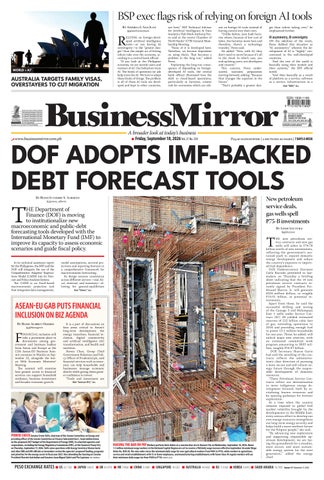
AUSTRALIA TARGETS FAMILY VISAS, OVERSTAYERS TO CUT MIGRATION
ROTARY CLUB OF MANILA JOURNALISM AWARDS
2006 National Newspaper of the Year 2011 National Newspaper of the Year 2013 Business Newspaper of the Year 2017 Business Newspaper of the Year 2019 Business Newspaper of the Year 2021 Pro Patria Award PHILIPPINE STATISTICS AUTHORITY 2018 Data Champion
@andreasanjuan
not here,” BSP Technical Advisor for Artificial Intelligence & Data Analytics Hub Mark Anthony Perez said at the recent Chamber of Thrift Banks’ (CTB) General Membership Meeting. “None of it is developed here. Therefore, we become dependent on using theirs. That becomes a problem in the long run,” added Perez. Explaining the long-run consequence of depending on foreigndeveloped AI tools, the central bank official illustrated how the shift to cloud-based operations, particularly in factories, creates risk for economies which are reli-
ant on foreign AI tools instead of having control over their own. “Unlike before, [you had] factories where, because of low cost of labor, the factories move here and therefore, there’s a technology transfer,” Perez said. He added: “Now, with AI, they don’t need to move because it’s all in the cloud. In which case, you end up being users, not developers and creators.” This concern, Perez underscored, warrants preparation moving forward, adding: “Because that changes the equation in the future.” “That’s probably a greater dan-
ger than robots taking over,” he emphasized further.
AI asymmetry, AI sovereignty
ON the sidelines of the event, Perez dubbed this situation as “AI asymmetry” wherein the development of AI is “highly” concentrated in the well-developed countries. “And the rest of the world is basically using their models and their systems,” the BSP official noted. “And then basically as a result of platform as a service, software as a service, infrastructure as a See “BSP,” A2
BusinessMirror A broader look at today’s business
EJAP JOURNALISM AWARDS
BUSINESS NEWS SOURCE OF THE YEAR
(2017, 2018, 2019, 2020, 2021) DEPARTMENT OF SCIENCE AND TECHNOLOGY
2018 BANTOG MEDIA AWARDS
DOF ADOPTS IMF-BACKED DEBT FORECAST TOOLS www.businessmirror.com.ph
T
n
Friday, September 18, 2026 Vol. 21 No. 339
P25.00 nationwide | 2 sections 20 pages | 7 DAYS A WEEK
New petroleum service deals, gas wells spell ₧75-B investments
By Reine Juvierre S. Alberto @reine_alberto
HE Department of Finance (DOF) is moving to institutionalize new macroeconomic and public-debt forecasting tools developed with the International Monetary Fund (IMF) to improve its capacity to assess economic scenarios and guide fiscal policy. In its technical assistance report for the Philippines, the IMF said the DOF will integrate the use of the Comprehensive Adaptive Expectations Model (CAEM) into its Forecast and Policy Analysis System. The CAEM is an Excel-based macroeconomic projection tool that integrates data management,
By Lenie Lectura
T
model assumptions, sectoral projections and reporting features in a comprehensive framework for macroeconomic forecasting. Its design ensures consistency across different sectors—real, fiscal, external, and monetary—allowing for general-equilibrium See “Debt,” A2
ASEAN-EU GAB PUTS FINANCIAL INCLUSION ON BIZ AGENDA By Bless Aubrey Ogerio
F
@blessogerio
INANCIAL inclusion will take a prominent place in discussions among government and business leaders from Asean and Europe as the 12th Asean-EU Business Summit convenes in Manila on September 22, alongside the Asean 58th Economic Ministers’ Meeting. The summit will examine how greater access to financial services can support household resilience, business investment and broader economic growth.
It is a part of discussions on four areas critical to Asean’s long-term development: the energy transition, financial inclusion, digital connectivity and artificial intelligence (AI) transformation, and health and nutrition. Steven Chan, Group Chief Government Relations and Policy Officer of Prudential plc, said financial services such as insurance can help households and businesses manage economic shocks while giving them greater confidence to invest. “Trade and investment are See “Asean-EU,” A2
POWER CHECK Senator Erwin Tulfo, chairman of the Senate Committee on Energy and
presiding officer of the Senate Committee on Finance Subcommittee C, leads deliberations on the proposed 2027 budget of the Department of Energy (DOE), its attached agencies and corporations, including the Energy Regulatory Commission (ERC), at the Senate in Pasay City on Thursday, September 17, 2026. Tulfo raises questions with Energy Secretary Sharon Garin and other DOE and ERC officials as lawmakers review the agencies’ proposed funding, programs and priorities for the energy sector in fiscal year 2027. Also attending the hearing are Senate President Sherwin Gatchalian and Senators Juan Miguel Zubiri and Pia Cayetano. ROY DOMINGO
RAISING THE BAR ON PAY Workers perform their duties at a construction site in Quezon City on Wednesday, September 16, 2026. About
1.1 million minimum wage workers in the National Capital Region are set to receive a P60 daily wage increase effective September 26 under Wage Order No. NCR-28. The new order raises the minimum daily wage for non-agricultural workers from P695 to P755, while workers in agriculture, service and retail establishments with 15 or fewer employees, and manufacturing establishments with fewer than 10 regular workers will see their minimum daily wage rise from P658 to P718. NONOY LACZA
@llectura
HE new petroleum service contracts and new gas wells will usher in P74.78 billion worth of new investments, reflecting the government’s sustained push to expand domestic energy development and reduce the country’s exposure to imported fuel dependence. DOE Undersecretary Giovanni Carlo Bacordo presented to lawmakers on Thursday a briefing sheet indicating that the 14 new petroleum service contracts recently signed by President Ferdinand Marcos Jr. will generate $324 million dollars, or roughly P19.91 billion, in potential investments. Apart from these, he said the successful drilling and testing of the Camago 3 and Malampaya East 1 wells under Service Contract (SC) 38 yielded estimated reserves of 222 billion cubic feet of gas, extending operations to 2034 and providing enough fuel to power 13.1 million households for one year. These, he added, will unlock major new reserves, with an estimated committed work program amounting to $893 million, roughly P54.87 billion. DOE Secretary Sharon Garin had said the awarding of the contracts reflects the administration’s clear direction of pursuing a more secure and self-reliant energy future through the responsible development of domestic resources. “These Petroleum Service Contracts reflect our determination to move indigenous energy development forward, both by revitalizing known resources and by opening pathways for frontier exploration. At a time when the country remains exposed to global fuel market volatility brought by the developments in the Middle East, every serious effort to develop our own energy resources strengthens our long-term energy security and helps build a more resilient future for the Filipino people,” she said. “By advancing new exploration and supporting responsible upstream development, we are laying the groundwork for a steadier, more secure, and more sustainable energy system for the next generation,” added the energy chief.
PESO EXCHANGE RATES n US 62.7320 n JAPAN 0.4015 n UK 83.9793 n HK 7.9968 n CHINA 9.3489 n SINGAPORE 49.1207 n AUSTRALIA 44.4582 n EU 71.9160 n KOREA 0.0455 n SAUDI ARABIA 16.7018 Source: BSP (September 17, 2026)
News
BusinessMirror
A2 Friday, September 18, 2026
ADBI…
Continued from A9
putting additional pressure on public resources. Countries such as the Philippines and Indonesia are experiencing more typhoons, floods and other hydrometeorological disasters, requiring spending on relief and reconstruction. These pressures mean the path toward high-income status is now more difficult, Brodjonegoro said. “In general, you will see that opportunities are maybe the same or a bit shrinking, but the cost or effort will be much harder,” Brodjonegoro said. “I would say that the challenge of current upper-middle-income Asia will be much more difficult than the past upper-middle-income Asia.” The Philippines entered the World Bank’s upper-middle-income category on July 1 after its gross national income (GNI) per capita reached $4,850 in 2025, exceeding the $4,635 threshold for the income group.
Market…
Continued from A9
P3.95 billion from P1.36 billion as of end-July last year. Meanwhile, banks’ derivatives with negative fair value held for hedging increased by 150.81 percent Y-o-Y, from P2.763 billion to P6.93 billion. Further, banks’ total capital accounts increased by 3.69 percent to P3.65 trillion as of end-July 2026, from P3.52 trillion in the same period a year ago.
www.businessmirror.com.ph
House OKs tougher bill vs espionage, security threats By Jovee Marie N. dela Cruz
T
HE House of Representatives on Thursday approved on third and final reading a measure strengthening the country’s defenses against espionage, cyber-enabled spying, attacks on critical infrastructure and other emerging threats to national security. With 247 affirmative votes, 10 negative votes and zero abstentions, lawmakers approved House Bill (HB) 9642, or the proposed “New Espionage Act,” which updates the legal framework for protecting classified information, national defense assets and sensitive government operations. Lawmakers said espionage today is no longer just about stolen documents or spies crossing borders because threats can now come through cyber networks, drones, financial channels and attacks on critical infrastructure. House Majority Leader and Ilocos Norte Rep. Ferdinand Alexander “Sandro” A. Marcos assured the public that the House of Representatives would continue to pursue legislation that keeps pace with emerging threats and provides the government with the necessary tools to protect the nation. The measure declares national sovereignty, territorial integrity, national
interest and the right to self-determination as paramount considerations while expressly requiring the State to uphold constitutional rights and fundamental liberties in implementing the law. The bill penalizes unauthorized handling or disclosure of classified information that harms or could harm the Philippines, unauthorized access to plans or representations of critical infrastructure and defense facilities and unauthorized entry into protected national defense assets or critical infrastructure. Espionage and conspiracy to commit espionage would be punishable by life imprisonment without parole or the benefits of good conduct time allowance, along with fines ranging from P10 million to P20 million, while knowingly making a false declaration to obtain authorization or security clearance would likewise carry life imprisonment. The measure also penalizes proposing espionage, destroying or interfering with national defense assets, specified disloyal acts by government personnel in sensitive functions and the unlawful possession or control of equipment such as drones, cameras, listening devices and tracking equipment for prohibited surveillance or spying. HB 9642 also provides for extraterrito-
rial application in specified cases, allowing Philippine authorities to act against covered offenses committed abroad by Filipinos, aboard Philippine ships or aircraft, in Philippine diplomatic premises, against Philippine officials or directly against the Philippine government. Government officials convicted under the measure would face perpetual absolute disqualification from public office, military personnel may also be tried through the court-martial system, responsible officers of juridical entities may be held liable and convicted foreign nationals would be deported after serving their sentences and permanently barred from returning to the Philippines. For investigations, the bill au-
thorizes qualified military, law enforcement or intelligence personnel to seek Court of Appeals authority for surveillance, interception and recording of communications when there are reasonable grounds to believe an espionage offense has been or is about to be committed, the evidence sought is essential and no other means is readily available. The Anti-Money Laundering Council would likewise be empowered to investigate property and funds connected to espionage offenses, with the measure allowing financial inquiries and other remedies under anti-money laundering laws, including court-approved examination of relevant deposits and investments.
21K rice varieties eyed for gene bank by year’s end By Ada Pelonia
M
UÑOZ, Nueva Ecija— The Philippine Rice Research Institute (PhilRice) wants to collect and conserve 21,000 rice varieties in its gene bank by yearend. Malvin Duldulao, PhilRice Science Research Specialist I, said the agency’s Genebank currently houses 20,743 rice varieties, including some 7,000 traditional varieties from the Philippines. These cover 82 provinces across the country, with Palawan leading as having the most diverse collection, followed by Ifugao. He said PhilRice is hoping to conserve 21,000 rice varieties by December through donations and collecting missions conducted by the agency. This, after Duldulao noted that PhilRice’s national repository of rice genetic resources proves crucial at a time when the country faces threats posed by climate-related shocks along with pests and diseases. “If there is no gene bank, there will be no breeding since this is where the material for breeding comes from [...] these are the ones we cross to create a new variety,” Duldulao told reporters in a chance interview here. “The [gene bank] would support
Debt…
Continued from A1
feedback and consistent scenario analysis, the IMF said. The technical assistance will also expand the DOF’s use of the IMF’s Public Debt Dynamic Tool to strengthen its capacity in forecasting and analyzing the dynamics of public debt. The IMF recommended that the DOF’s core forecasting team publish formal analytical reports after each official projection round, given the agency’s role in setting medium-term fiscal targets with other agencies through the Development Budget Coordination Committee. This comes after the DOF sought technical assistance from the IMF in late 2022 to develop and institutionalize a comprehensive macroeconomic forecasting tool that would complement its existing forecasting and policy-analysis capabilities. The IMF and DOF subsequently agreed on an action plan centered on strengthening technical capacity through hands-on training and developing a user-friendly macroeconomic projection tool.
the continuous breeding in the Philippines [...] so we can breed a variety that can adapt to the changing weather, with higher yield and better quality. That’s one key to achieving rice security,” he added. He also explained that Filipinos can withdraw seeds from the agency’s gene bank through its online platform, which they will deliver for free. Earlier this year, PhilRice urged farmers to plant early-maturing and drought-tolerant rice varieties in preparation for El Niño, forecast to peak in the fourth quarter of 2026. The agency said these varieties would help planters better manage limited water resources and minimize risks to their crops during prolonged dry spells. Last May, PhilRice’s climatesmart maps showed that of the 1.58 million hectares of rice areas in Luzon, some 301,000 hectares are “highly susceptible” to drought while another 280,000 hectares are “moderately vulnerable.” In Mindanao, the agency flagged that about 150,000 hectares are considered “highly susceptible,” while more than 205,000 hectares in the Visayas face similar risks. Over the past 40 years, PhilRice has developed 121 varieties as part of its efforts to create high-yielding, quality, and climate-resilient rice.
‘High staff turnover a high risk for the project’ HOWEVER, the IMF flagged the high staff turnover at the DOF as a key risk to the sustainability of the project. “Loss of core team members due to staff rotation risks delaying the implementation of the project and eroding the institutional knowledge of operating the CAEM. The probability and impact of this risk is considered high,” the IMF said. To address this, the IMF recommended integrating the CAEM into the DOF’s roster of forecasting tools and developing user manuals as part of the knowledge management system of the agency. “The collaboration with IMF in the development of CAEM and DDT provides valuable opportunities for DOF staff to exchange views with IMF staff economists on macroeconomic forecasts and policy analysis,” the DOF said in the report. The DOF said implementation of the modeling tools and the IMF’s recommendations would be undertaken by individual offices based on their analytical needs, policy priorities and available institutional resources.
Asean-EU… Continued from A1
strongest when growth is resilient, inclusive and built on confidence. Insurance is not only a protection tool; it is also a driver of prosperity, helping households manage financial shocks, enabling businesses to invest with greater certainty, and supporting healthier, more productive societies,” Chan said. The summit is expected to examine how private investment can be directed toward areas identified by governments as regional priorities, including financial inclusion and other measures that can strengthen economic resilience. The meeting comes as three Southeast Asian economies negotiate bilateral free-trade agreements with the European Union, adding trade and investment to the agenda of the gathering. Chris Humphrey, Executive Director of the EU-Asean Business Council (EU-ABC), said European companies are drawn to Southeast Asia by its growth prospects but need clearer and more predictable trading conditions to deepen their commitments. “European companies come to this region for its growth, and they stay for its potential. What helps them commit further is straightforward: a predictable, transparent and investor-friendly trading environment,” Humphrey said. “Three trade negotiations are live at the moment. We are hopeful they will result in high-quality FTAs that deliver practical commercial outcomes to both European and Southeast Asian companies, such as increased market access, fewer regulatory barriers, clearer rules and greater customs efficiency,” he added. The summit comes in the closing months of the Philippines’s chairship of Asean, which has emphasized practical cooperation across the region. European business sentiment toward Asean remains positive, with 78 percent of respondents in the EU-ABC’s latest sentiment survey expecting trade and investment in the region to increase over the next five years. Among companies considering supply-chain shifts, 67 percent identified Asean as a potential destination, putting the region ahead of China and South Asia, according to the survey. Beyond financial inclusion, the program will feature a panel on digital connectivity, including efforts to align payment systems, data rules and digital infrastructure across Asean’s 10 member states. Another session will examine nutrition and food security and their links to workforce productivity and long-term competitiveness. More than 200 representatives from government, business, development institutions and the diplomatic community are expected to attend the summit.
BSP exec flags risk of relying on… Continued from A1
service. Which results in us not developing our own. So, this is why in many countries, they are starting to talk about AI sovereignty,” he added. To be able to build AI sovereignty, he said an economy would have to be equipped with skills, infrastructure, and capabilities. “So, it will take time,” he emphasized further. Asked about the advantages of having the Philippines embrace being an AI-sovereign economy, he said: “Less dependence on the foreign AI models is one. We can design it and build it according to what our own datasets show and what our behaviors show.” Another upside, he said, is “We have control over how much it costs and where it can get used.”
www.businessmirror.com.ph
Friday, September 18, 2026
Asean adopts Manila Declaration to strengthen disaster preparedness
M
EMBERS of the Association of Southeast Asian Nations (Asean) have agreed to strengthen disaster preparedness by moving faster on prevention and anticipatory action, as they formally adopted the Manila Declaration at the closing of the two-day Asean Ministerial Conference on Disaster Resilience (AMCDR) 2026 in Pasay City. In his closing speech, Defense Secretary Gilberto Teodoro Jr., who chairs the Asean Ministerial Meeting on Disaster Management, said the declaration would guide regional cooperation on disaster resilience through 2030 and beyond. “As the 2026 Asean Ministerial Conference on Disaster Resilience comes to a close, it is my honor, in my capacity as Chairman of the Ministerial Meeting, to announce that we have formally adopted the Manila Declaration,” Teodoro said. He said the declaration sets three areas for action, namely, accelerating the implementation of the Asean Agreement on Disaster Management and Emergency Response (Aadmer) Work Program 2026-2030; strengthening Asean accountability, monitoring and learning for disaster resilience; and shaping Asean’s disaster resilience agenda towards 2030 and beyond. Teodoro said the declaration would not be a fixed document, allowing Asean to adjust its approach as disasters and risks change. “And we have agreed that this shall be a living document that shall provide for flexibility, agility, cooperation, to meet disasters more effectively as they come and as we learn,” he added. The declaration, Teodoro said, is scheduled for notation by Asean leaders at the 49th Asean Summit in November, subject to the concurrence of all member states. As the Asean region is one of the world’s most disaster-prone areas, a major focus of the conference was the need to act before disasters strike, rather than relying mainly on response after a disaster has occurred.
Indonesia’s Deputy Minister for Prevention of the National Disaster Management Authority, Abdul Muhari, said early warning systems would have little value if warnings were not connected to decisions and resources needed to act. “Warning alone is not enough. We must connect this knowledge to forecast shared trigger, decision authority, pre-arranged financing, and local capacity, so that early warning consistently becomes early action,” Muhari said. “This requires end-to-end peoplecentered early warning systems supported by science, technology, geospatial information, risk analysis, AI, and interoperable data,” he stressed. He added that local knowledge and trusted communication networks should also be part of the system, as information is useful only when it reaches decision-makers and communities in time. Muhari also emphasized the role of communities in disaster management, saying they should not be treated simply as recipients of assistance, but are first responders and essential partners as well. Deputy Secretary-General for the Asean Socio-Cultural Community San Lwin said the discussions reflected a changing regional risk landscape shaped by climate change, rapid urbanization, environmental degradation, technological disruptions and socioeconomic vulnerabilities. He said the conference produced recommendations on early warning systems, anticipatory action, disaster risk financing, recovery readiness and stronger cooperation among governments, communities, the private sector, academe and other stakeholders. As the conference also marked the 10th anniversary of the “One Asean, One Response Declaration,” San Lwin underscored regional solidarity and collective action in disaster management. See “Asean,” A4
House prosecution team maintains Senate Impeachment Court can decide on threshold By Jovee Marie N. dela Cruz
T
HE House prosecution team on Thursday maintained that the Senate Impeachment Court has the authority to decide the voting threshold required for conviction in the impeachment trial of Vice President Sara Z. Duterte. Lanao del Sur Rep. Zia-ur Rahman Alonto Adiong, trial spokesperson, said the Senate’s decision in an impeachment case is final and cannot be appealed before the Supreme Court. “The Senate’s decision is supreme in this matter. It cannot be appealed and is not subjected to review by the Supreme Court because whatever verdict the Senate reaches will be the final decision,” Adiong said. He explained that the Senate sought the opinions of former Chief Justices who appeared as amici curiae, or friends of the court, because the senator judges wanted to carefully consider the constitutional issue before making a final ruling. He emphasized that the consultation reflected the Senate’s effort to exercise caution and responsibility. According to Adiong, the retired Chief Justices who provided their views agreed that the Senate has exclusive authority to try and decide impeachment cases. “The statements of the former Chief Justices were clear that the Senate has exclusive power when it comes to decisions in impeachment cases,” he said. Manila Rep. Joel Chua, a member of the prosecution panel, said the issue of whether the threshold should remain at 16 votes or be adjusted depends on the Senate Impeachment Court. He added that the Senate has the authority to create its own rules for conducting the trial. “It was clear from the statements of all the magistrates that the discretion to set the threshold at 16 votes or lower belongs to the Senate,” Chua said. The prosecution clarified that the discussion does not involve changing the Constitution’s requirement of a two-thirds vote for conviction. Instead, the issue
focuses on how that requirement should be applied based on the number of senator judges who are qualified to participate in the proceedings. “There is no change to the two thirds requirement in the Constitution. What is being discussed is how to apply the two thirds requirement to the total number of Senate members who can participate and vote,” Adiong explained. Three retired chief justices, Artemio Panganiban, Reynato Puno, and Hilario Davide Jr., expressed the view that the required number of votes may depend on the actual participating members of the Senate. Former Associate Justice Adolf Azcuna, however, maintained that the total membership of the Senate should be considered in determining the required votes. The prosecution said it would continue presenting its evidence regardless of whether the Senate decides on a threshold of 16, 15, or 14 votes. Chua stressed that the strength of the evidence remains the focus of their case. “Whether the number is 16, 15, or 14, we are preparing to present the evidence so that we can convince the senator judges through the strength of our arguments and evidence,” Chua said. Chua also questioned how senator judges could make a fully informed decision if they do not personally observe witnesses during testimony and cross-examination. He explained that personally witnessing the testimony allows judges to evaluate credibility and reliability. “How can they make the right decision if they do not personally see the witnesses while they are being questioned by the prosecution and defense?” Chua said. Chua argued that the voting threshold should consider the current circumstances affecting Senate participation. He cited the Supreme Court decision in People v. Maceda, which discussed limitations on the exercise of duties while under detention. See “Impeachment,” A4
A3
Enactment of anti-dynasty law remains priority, Speaker says
T
By Jovee Marie N. dela Cruz
@joveemarie
HE House of Representatives on Thursday said the enactment of an anti-political dynasty law remains a legislative priority, following the Supreme Court’s directive requiring Congress to fulfill its constitutional mandate to define and prohibit political dynasties.
House Speaker Faustino G. Dy III said that Congress is working toward passing a “reasonable and constitutional” measure that would give effect to Article II, Section 26 of the 1987 Constitution, which provides for equal access to opportunities for public service and the prohibits political dynasties as “defined by law.” “A priority of the new Congress is to enact a fair and constitutional AntiPolitical Dynasty Law as part of its duty to give effect to the policies and principles set forth by the Constitution and to advance reforms that expand equal opportunity, strengthen democratic participation, and promote good governance,” Dy said in a statement. He said the House had already acted on the matter before the Supreme Court issued its ruling, with House Bill 8389, or the proposed Anti-Political Dynasty Act, approved on third and final reading on June 3. The measure received 267 affirmative votes, 20 negative votes, and seven abstentions. It was transmitted to the Senate on June 8 for further action. The Supreme Court, in a unanimous decision dated August 26 and
announced on Wednesday, ruled that Congress has a constitutional duty to enact an enabling law on political dynasties. The Court noted that the absence of such legislation for 39 years prevented the full implementation of the constitutional provision. Under the House-approved bill, the prohibition would cover spouses and relatives within the second degree of consanguinity or affinity under specific circumstances involving simultaneous or successive holding of elective positions. The Senate is also considering its own version of the measure, Senate Bill 1901, which remains pending on second reading. Dy said the proposed legislation should establish clear and fair guidelines that promote wider participation in public service while recognizing the electorate’s authority to choose their representatives. “Thirty-nine years after the ratification of the 1987 Constitution, Congress has a historic opportunity to give fuller legislative effect to a constitutional policy that has long awaited comprehensive implementation,” he said.
“The goal is to craft a law that promotes equal opportunity in public service, seeks to prevent the concentration of political power within a few families, and strengthens the accountability and integrity of our democratic institutions,” he added. The Speaker said the bill aims to prevent the concentration of political power among a limited number of families while strengthening accountability and democratic institutions. The measure now awaits further deliberation as Congress works to define the scope and implementation of the constitutional prohibition on political dynasties.
Palace backs SC call PRESIDENT Marcos has expressed support for the SC’s call for Congress to enact a law prohibiting political dynasties, Malacañang said on Thursday. Speaking to Palace reporters, Presidential Communications Office Undersecretary Claire Castro said the anti-political dynasty bill remains one of the administration’s priority measures. Castro stressed that Marcos wants the measure passed into law during his watch. “Alam na po natin na ito ang isa sa mga priority bills ng Pangulo. Talagang ito po ay pinapamadali niya at gusto niya hangga’t maaari sa panahon niya ay maipasa ang anti-political dynasty law [We already know that this is one of the President’s priority bills. He is really pushing for its passage, and he wants the anti-political dynasty law to be enacted, if possible, during his term],” she said. “So, tama po na sang-ayon ang Pangulo sa desisyon ng Supreme Court na dapat ng magkaroon ng batas patungkol sa political dynasty [Yes, the President agrees with the Supreme Court’s
decision that there should be a law on political dynasties],” Castro added. Asked whether the Palace is satisfied with the progress of the measure, particularly in the Senate, Castro said the timeline for its passage is in the hands of Congress. She said lawmakers could not be blamed for the delay, acknowledging that they have many responsibilities and legislative priorities to attend to. “Ang nais lang ipaalam ng Pangulo ay gusto po niya itong maipasa [All that the President wants to make clear is that he wants it to be passed],” Castro said. She, however, noted that lawmakers are aware of the SC’s position and also want an anti-political dynasty law to be enacted. “Pero still, lumabas naman din po ang desisyon ng Supreme Court, alam din po nila, gusto din naman nila na magkaroon talaga ng anti-political dynasty law [But still, the Supreme Court’s decision has come out, and they are aware of it. They also want an antipolitical dynasty law to be enacted],” Castro said. The SC has directed Congress to comply with its mandatory constitutional duty to enact a law prohibiting political dynasties “at the earliest opportunity.” In its ruling issued on August 26, the SC emphasized that Article II, Section 26 of the 1987 Constitution, which provides that “the State shall guarantee equal access to opportunities for public service, and prohibit political dynasties as may be defined by law,” is not merely an aspiration but a constitutional command. The SC stressed that Congress’ prolonged failure to pass such a law for 39 years constitutes grave abuse of discretion.
With Sam Medenilla and PNA
Roblox execs meet lawmakers, to name legal rep in PHL By Butch Fernandez @butchfBM
O
FFICIALS of controversial openworld gaming platform Roblox have met with lawmakers in an apparent bid to stem off mounting allegations that the game has exerted bad influence on children and youth, even linking it to recent school violence that has claimed lives. Sen. Anna Theresia Hontiveros, who met them in her office, welcomed Roblox’s commitment to cooperate with Philippine authorities as she emphasized the impor-
tance of requiring online platforms to appoint a legal representative in the country. Hontiveros raised the matter during a meeting with Roblox representatives amid ongoing discussions of the strengthened Anti-Online Sexual Abuses or Exploitation of Children bill, now known as the Sagip Bata Act, at the Senate. Under the measure, online platforms would designate a Philippine-based representative authorized to receive subpoenae, takedown and blocking orders, requests for account information, and other lawful directives. “ Kapag may batang Pilipinong posibleng biktima ng grooming o online sexual
abuse, bawat oras ay mahalaga. Kailangang alam agad ng ating mga awtoridad kung sino ang lalapitan [If a filipino child is a victim of grooming or online sexual abuse, every ,minute counts. Aiuthorities must immediately be able to reach out to responsible officials],” Hontiveros said. Roblox said it already maintains channels for coordinating with Philippine law-enforcement agencies and is open to appointing a qualified third party, as its local representative. Hontiveros explained that the requirement is intended not only to create a dependable bridge between platforms
‘No way for prisoner to escape by drone’ By Joel R. San Juan @jrsanjuan1573
T
HE Bureau of Corrections (BuCor) on Thursday said it would be impossible for a prisoner or person deprived of liberty (PDL) to escape from correctional facilities through the use of drones. Corrections Director General Gregorio Pio P. Catapang Jr. said the noise produced by the drones aside from the extensive closed-circuit television (CCTV) systems installed in prisons would easily detect any plan or attempt to escape through unmanned aerial vehicles. Catapang issued the statement following reports that South Korean national Park Wangyeol plotted to escape from the New Bilibid Prisons (NBP) in Muntinlupa City before he was repatriated to South Korea last March to face trial for a criminal case. Park was found guilty by a Philippine court in 2022 for the killing of his three compatriots in Bacolod City. He was serving his 60-year prison sentence at the NBP before he was handed over to South Korean authorities. Reports said Park planned to strap himself to
the drone and be flown out of the prison compound. Several test flights were allegedly conducted near the facility in preparation for the attempt. “All our Operating Prison and Penal Farms are no fly zones, and we have watchtowers manned 24/7 which immediately alert our guards if there will be attempts to escape through drones aside from maingay ang drone at equipped naman ang ating facilities ng mga CCTV, so we can detect it at once,” Catapang said. Catapang stressed that drones cannot operate near correctional facilities without attracting the attention of prison personnel and security systems. “Their audible motors, especially when flying at low altitudes, could immediately alert guards and other authorities,” he noted. Likewise, the BuCor chief said the presence of CCTV cameras throughout correctional facilities further strengthens the bureau’s ability to detect suspicious activity. “These cameras allow security personnel to monitor prison grounds, perimeters, buildings, and other restricted areas. Any drone spotted within or near a facility could be recorded and tracked, enabling authorities to respond quickly,” Catapang pointed out.
and Philippine authorities, but also to have clear accountability and compliance channels in place. “We appreciate Roblox’s openness and its existing work with our law-enforcement agencies. Our goal is to build on that cooperation and make it reliable across platforms, and not dependent on informal or individual arrangements,” she said. The senator has consistently maintained that protecting children online cannot be placed solely on parents and young users. Platforms that provide spaces where children meet and communicate must also help prevent grooming, exploitation, and abuse.
PHL needs ‘expeditionary navy’–Teodoro
D
EFENSE Secretar y Gilber to Teodoro Jr. on Thursday said the Philippines needs to have an “expeditionary navy” capable of protecting Filipino merchant ships and its crews while sailing on the high seas. “We need an expeditionary navy to be able to protect Filipino seafarers and Filipino vessels on the high seas alongside like-minded countries,” he said during the Third Balangay Forum held in Makati City as part of the country’s celebration of this year’s Maritime Archipelagic Awareness Nation Month (MANAMo). An expeditionary navy is defined as a naval force capable of operating well out from its home shores and sustain operations in remote areas. The defense chief said this capability is needed as the Philippines starts to develop and expand its merchant shipping fleet. “It’s not only a question of pure profitability, but one of reserves and one of reserve capacity, which no country can afford to lose, as we saw in the pandemic,” he pointed out. Teodoro also stressed that there is no “entitlement in the world, no governance” that can exists without some backbone, referring to a credible defense force. “And that backbone at the end of the day is the Armed Forces (AFP). Your reputational risk as a country, political calculations in the ability of the country to protect human and other forms of capital, both domestic and foreign, which enter into the investment calculus, are measured by the ability of a government to be able to enforce its own laws and regulations fairly, evenly, and with certainty,” he stressed. Enforcement, the DND chief said, means the ability of the government to compel behavior in accordance with its norms. “Absent [of] that capability, particularly with a more competitive and more volatile world, it would be an exercise in near futility,” he noted. See “Teodoro,” A4
Friday, September 18, 2026
A4
www.businessmirror.com.ph
Cabanatuan farmers to benefit from new ₧74-M rice facility By Ada Pelonia @adapelonia
T
HE Department of Agriculture (DA) on Thursday launched a P74.4 million rice processing facility in Cabanatuan City, which is in the heart of Central Luzon, the rice granary of the Philippines. The DA said this would provide 4,060 farmers in Cabanatuan access to drying and milling equipment to reduce postharvest losses and improve their income. Rice Processing System (RPS) III includes a state-of-the-art multi-stage rice mill with a capacity of four to five metric tons (MT) per hour and three recirculating dryers, each with a 12 MT per batch drying capacity. The project is expected to benefit farmers cultivating at least 8,976 hectares of rice farms in Cabanatuan, the DA said. The facility was funded under the Rice Competitiveness Enhancement Fund (Rcef ) mechanization program, and was turned over to the City Government of Cabanatuan through the Philippine Center for Postharvest Development and Mechanization (PHilMech). Agriculture Secretary Francisco Tiu Laurel Jr. said that such investments should be measured by their impact on farmers and their families.
“The true progress of agriculture is not measured only by the volume of rice harvested, but by the comfort and prosperity it brings to the table of every farming family,” Tiu Laurel said. The investment comes as the government ramps up efforts to make rice farming more productive and competitive in Nueva Ecija, the country’s leading rice-producing province that forms part of the national food supply. Under the Rcef mechanization program, farm and postharvest equipment are provided to eligible farmers’ cooperatives and associations (FCAs) and local governments (LGU) to boost productivity, profitability, and competitiveness. The program was extended until 2031 under amendments to the Rice Tariffication Law (RTL), with its annual allocation increased from P5 billion to P9 billion. “The facility could help farmers retain more value from their harvest by making drying and milling services more accessible locally, reducing reliance on immediate palay sales after harvest,” the DA said. The agency said the RPS facility is part of its efforts to modernize the rice sector, lower production and postharvest costs, raise farm incomes, and strengthen the country’s food security.
Dole asks for ₧47-B ’27 budget By Mary Jade Jadormio
T
HE Depar tment of Labor and Employment (Dole) is seeking P47.057 billion for 2027, about P14.1 billion below the P61.2-billion budget it received under the 2026 General Appropriations Act. It was flagged by House budget sponsor Aurora Rep. Rommel Rico Teh Angara, who called for the restoration of the funding reductions, warning that the lower allocation could affect Dole’s delivery of labor and employment services. Employment programs, skills development and worker-protection services were among the areas that could be affected by the reduced allocation, Angara was quoted as saying in a statement issued by Dole. The budget deliberations also covered the need to prepare workers for changing workplace demands, including potential displacement in the business-process outsourcing sector as artificial intelligence adoption expands. Upskilling initiatives were raised as part of the government’s response to the possible disruption of Business Process Outsourcing (BPO) jobs. Labor inspection also figured in the discussions, with lawmakers raising the need to increase the number of labor inspectors in
line with International Labor Organization Convention 81. Angara also cited Dole’s request for an additional P75 million for the Labor Attorneys’ Office and the National Academy for Labor Justice to strengthen legal assistance for workers. Other programs discussed included Tulong Panghanapbuhay sa Ating Disadvantaged/Displaced Workers (Tupad), the Single Entry Approach, occupational safety and health compliance in economic zones, the Social Amelioration Program for sugar workers and the welfare of workers aboard commercial fishing vessels. Wage Order 27, likewise, remained a key issue during the deliberations, with Angara reaffirming Dole’s position to uphold the wage order while its implementation is being litigated. “ Hindi po binibitawan ng Dole ang Wage Order 27. Ipinaglalaban po ito ng ating Secretary at ng Solicitor General sa korte ,” Angara said. He said Wage Order 28 was intended to provide immediate economic relief while the judicial process over Wage Order 27 continues. Angara also clarified that the P60 wage increase under Wage Orders 27 and 28 is identical and does not reduce workers’ wages.
Red Cross food truck fleet gets boost
W
HEN disaster strikes, food is among the first and most immediate needs of affected communities. To help bring hot meals to people when regular food supplies are disrupted, the Philippine Red Cross (PRC) has received a P1.7-million Toyota Tamaraw food truck from Metrobank Foundation, bringing PRC’s nationwide food truck fleet to 42. PRC Chairman and Chief Executive Officer Richard Gordon said the food truck is not only a disaster-response asset, but can also help address hunger and malnutrition. “This is another inch of survival against hunger. We are not just giving people food; we are easing their hunger and giving them the assurance that there will be food when they need it. This is not only for disasters. We can also bring it to communities where children are malnourished. If a child is malnourished, he is not going to learn much and his growth will be stunted,” Gordon said. The locally produced Toyota Tamaraw can navigate narrow streets in Metro Manila and other key cities while reaching far-flung rural communities. The P1.7-million donation covers its conversion into a fully equipped mobile kitchen, including cooking, water, sanitation, power, and LPG systems.
PRC’s hot meals program incorporates nutrition, with volunteer nutritionists and dietitians from different PRC chapters helping develop menus for food truck operations. “ Natutuwa kami dahil ito ang unang donation ng Metrobank na food truck. And this is another colorful chapter in our continuing story with the Philippine Red Cross, and we look forward to more collaborations in the years ahead,” Metrobank Foundation President Philip Francisco U. Dy said. PRC Secretary General Gwendolyn Pang shared the same sentiments, emphasizing the value of the partnership in addressing community needs and gaps. She also expressed PRC’s appreciation to the Metrobank Foundation for its continued support. The donation builds on the longstanding partnership between PRC and the Metrobank Group, which has provided P65 million in support over the past decade. Under the leadership of Metrobank Chairman Arthur Ty and GT Capital Holdings Vice Chairman Alfred Ty, and building on the legacy of their father and Metrobank founder George Ty, the Group and its foundations have continued to support initiatives that respond to critical needs and strengthen communities.
Govt eyes changes in PPP terms of NSCR and MCIA By Justine Xyrah Garcia
T
HE administration is reworking the terms of two major transport public-private partnerships (PPPs) as it seeks to make the projects more attractive to private investors and bring in fresh capital.
The Department of Economy, Planning and Development (DepDev) confirmed on Thursday that the Economy and Development (ED) Council approved amendments to the North-South Commuter Railway (NSCR) Operations and Maintenance (O&M) and Mactan-Cebu International Airport (MCIA) during its 11th meeting last Wednesday. For the NSCR, DepDev said the ED Council approved changes to the project’s parameters, terms, and conditions (PTCs) specifically to “attract more bidders and encourage competitive proposals” for the flagship railway project. The NSCR will link Central Luzon, Metro Manila, and Southern Luzon, with partial operations targeted to start in December 2027. Socio-economic Planning Secretary Arsenio M. Balisacan said improved rail connectivity in Luzon would help support broader economic activity by making it easier for people and businesses to move across regions. “The NSCR is an investment in opportunity. Improved mobility will expand access to jobs, markets, education, and services across regions, reflecting our commitment
to a more productive, resilient, and inclusive economy,” Balisacan said. For Mcia, meanwhile, the ED Council approved an extension of the airport concession period, giving the concessionaire a longer period to recover its investments. Under the contract variation, the DepDev said the concessionaire will commit almost P15 billion in capacity augmentation and capital investments. The investments are expected to support the restoration and expansion of domestic and international routes, as well as improve airport transfers, the agency added. The longer concession period is also intended to minimize pressure to increase passenger service charges, it also said. The two transport projects were among the major items approved by the ED Council as the government seeks to advance infrastructure investments through partnerships with the private sector. Data from the PPP Center showed that 383 of the 576 PPP projects are national government projects, with 203 currently under implementation and another 180 in the pipeline. By value, projects under implementation amount to P2.53 trillion, while those
in the pipeline are worth another P3.02 trillion.
Class suspension rules
SEPARATELY, the ED Council ordered a further review of the proposed guidelines on the suspension and resumption of classes. DepDev said the review will cover protocols for disruptions caused by tropical cyclones, earthquakes, storm surges, poor air quality, volcanic hazards and extreme heat. “Refining this policy is a matter of urgency. We must protect our learners and teachers while ensuring the continuity of education in the face of evolving risks,” Balisacan said. Last week, the chief economist warned that repeated weather disruptions could erode the Philippines’ improved results in the 2025 Program for International Student Assessment. (See: https://businessmirror.com. ph/2026/09/14/weather-disruptionscould-unravel-gains-from-pisa-arsi/) The ED Council also approved changes in the scope, cost and implementation timelines of three development projects. These include the Supporting Innovation in the Philippine Technical and Vocational Education and Training System (SIPTVETS) project of the Technical Education and Skills Development Authority; the Road Network Development Project in Conflict-Affected Areas in Mindanao (RNDP-CAAM) of the Department of Public Works and Highways; and the Reducing Food Insecurity and Undernutrition with Electronic Vouchers (REFUEL) project of the Department of Social Welfare and Development. DepDev, however, has yet to disclose the reasons behind the changes to the three projects.
Power transmission rate down in September By Lenie Lectura @llectura
T
HE transmission component of electricity bills went down this month to P1.525 per kilowatt hour (kWh) from P1.7560 per kWh owing to lower ancillary service (AS) rates, according to the National Grid Corporation of the Philippines (NGCP). “For August 2026 billing period, the overall transmission rates was reduced by 23 centavos per kilowatt hour [kWh], that is 13.30 percent, driven by the decrease of the AS rates,” said NGCP Business and Regulatory Development head Julius Ryan Datingaling during a news briefing held on Thursday. The transmission rate, which will be reflected in the September power bills, is composed of AS and transmission wheeling rates. AS rates are the pass-through costs for power supplied by power generators who provide AS during supply-demand imbalance. Transmission wheeling rates,
meanwhile, refer to what the NGCP charges for its core service of delivering electricity. The AS component of the overall transmission rate declined by 22 percent to P0.8061 per kWh while transmission wheeling rate stood at P0.5655 per kWh. “As system operator, NGCP’s responsibility is to ensure grid stability and reliability, especially during periods of supply-demand imbalance. NGCP does not earn from Ancillary Service charges. These payments are remitted to the service providers that supply the reserves needed to keep the power system secure and reliable,” NGCP said. Meanwhile, the Visayas was placed on yellow alert on Thursday from 5:00 p.m. to 7:00 p.m. The NGCP said the grid registered 2,505 megawatts (MW) of available capacity as against a peak demand of 2,290 MW. There are 12 plants are on forced outage this month, three plants since August 2026, one plant since July, two plants since June, seven plants since May, three plants since 2025, two plants since 2024, two plants since 2023, and one plant since 2021, while 14
plants are running on derated capacities, for a total of 820.6MW unavailable to the grid. A yellow alert is issued when the operating margin is insufficient to meet the transmission grid’s contingency requirement. Meanwhile, consumer group People for Power (P4P) conducted simultaneous protests in Tacloban and Bacolod, signifying the outages affecting consumers in Visayas. Between May 12, 2026 and September 8, the Visayas grid endured 34 days in red alert status and 96 days under yellow alert – with outages still ongoing today. “The major culprits behind the yellow and red alerts are coal-fired power plants under forced outage...When these coal plants fail, distribution utilities purchase capacity from the Wholesale Electricity Spot Market to meet demand, at much higher rates. Amid the outages, WESM marginal prices in certain areas in the Visayas reached as high as P48/kWh, with coal plant WESM participants also reaching settlement prices as high as P32/kWh. Coal brings not only unreliable energy, but also expensive electricity,” said Gerry Arances, convenor of P4P.
Monterrazas gets go-ahead to resume work
C
EBU CITY—Construction and other ongoing activities at the Monterrazas development may proceed after a Cebu City technical committee recommended allowing existing works to continue, while noting that the development’s drainage systems include measures intended to manage stormwater runoff. The recommendation was contained in a resolution adopting the report of the Cebu City Technical Infrastructure Committee (TIC), which conducted a fact-finding and technical review of the Monterrazas development of Mont Property Group. The resolution was endorsed to the Cebu City Council and placed on the agenda for its regular session this week. A copy obtained by the Business Mirror of the TIC’s review focused on the development’s drainage and hydrological characteristics, including its catchment areas, water-flow patterns, drainage outfalls, detention ponds, slope protection measures
and road construction. The committee inspected the approximately 118-hectare property, which has 14 identified catchment areas. The report also examined flooding concerns in Guadalajara and possible runoff from neighboring developments, including Grand Legacy subdivision and Bethany Christian School. It noted that some surrounding developments reportedly do not have detention ponds. The TIC, however, stressed that its proceedings were limited to fact-finding and technical assessment. It said the review did not establish the cause of flooding in surrounding communities. The committee likewise did not make a final finding that Monterrazas was solely or directly responsible for any flooding incident or condition. According to the report, determining the sources and extent of flooding and drainage impacts would require additional technical
investigations, hydrological assessments and validation of drainage routes by the appropriate government agencies. The committee’s recommendation also does not amount to a development approval, permit, clearance, authorization or certification for Monterrazas. It further clarified that the recommendation should not be interpreted as a finding that the development has no direct or indirect contribution to flooding or drainage conditions. Mont Property Group welcomed the findings and said it would continue coordinating with the Cebu City Government, Barangay Guadalupe and neighboring communities on flood-mitigation measures. “Mont Property Group will continue to ensure all of our projects comply with the government’s regulations,” general manager Camille Bondad said, adding that the company’s priority is the welfare of neighboring communities and the environmental integrity of the area. Carmel Pedroza
Asean. . . Continued from A3
He said anticipatory action could further strengthen the mechanism by allowing Asean countries to prepare and act together before disasters occur. The conference also welcomed the Manila Declaration on advancing Asean’s disaster resilience agenda toward 2030 and beyond, as well as the proposed Asean Leaders’Statements on the Resilient, Innovative, Sustainable and Empowered (RISE) Asean Vision. San Lwin said the documents would provide strategic direction for the region’s disaster resilience efforts beyond 2030, but he stressed that the real test would come after the conference. “The success of this conference will be measured not only by the qualities of our discussions and the outcomes that we have adopted, but by how effectively we translate our shared commitments into concrete actions,” he said. Meanwhile, Teodoro also called for sustained cooperation among Asean member states and their partners, particularly in risk financing and technology, noting that “disasters cut across sectors, scales, and borders.” He also cited President Marcos’ message that regional disaster frameworks must ultimately benefit communities and protect people’s lives. “Our task is to ensure that our frameworks make a difference where they matter most, in our communities, our economies, and above all, in the lives of our people,” Teodoro said, quoting President Marcos. Rex Anthony Naval with PNA
Impeachment. . . Continued from A3
Chua emphasized that the Senate will ultimately decide the voting threshold because it has the constitutional authority to conduct impeachment proceedings. He reiterated that the prosecution will continue focusing on presenting evidence and allowing the senator-judges and the public to evaluate the case. The prosecution is scheduled to continue presenting evidence related to the alleged unexplained wealth issue. Witnesses from the Civil Service Commission and the Securities and Exchange Commission are expected to testify regarding Statements of Assets, Liabilities, and Net Worth filings and business interests connected to Duterte. Chua said the Civil Service Commission witness is expected to discuss guidelines for preparing and filing SALNs, while the Securities and Exchange Commission witness will address company records and business interests. A Philippine Government Electronic Procurement System official is also expected to present related contract documents. The prosecution also requested records from Davao City Hall and the testimony of Mayor Sebastian “Baste” Duterte regarding transactions involving a company linked to Vice President Sara Duterte. Alonto Adiong said these records may provide additional information regarding declared business interests listed in Duterte’s SALN. “These records remain with City Hall because these are public transactions,” Alonto Adiong said, explaining that government documents could help clarify the matters being examined by the impeachment court.
Teodoro. . . Continued from A3
This is why the Philippines is developing the capacity of the AFP to enforce, in coordination with law enforcement agencies, in a sustainable and logistically secure and sound manner Philippine law and the norms that we have agreed to in international treaties, he said. “The Philippines cannot be a mere signatory to treaties and espousing norms that [at] the end of the day are our principal weaknesses. We cannot continue to be a voice without muscle,” he added. Rex Anthony Naval with PNA
Friday, September 18, 2026
2,467 hired on the spot in DOLE job fairs
S
OME 2,467 jobseekers were hired on the spot during nationwide Trabaho Agad job fairs organized by the Department of Labor and Employment (DOLE). The job fairs drew 28,795 jobseekers across 86 sites, where 1,352 employers offered 157,097 local and overseas vacancies, according to DOLE. In Metro Manila, 421 jobseekers were hired on the spot while 737 were classified as near-hires during job fairs held on Sept. 12, 14 and 15. Labor Secretary Francis N. Tolentino said the initiative is intended to bring employment opportunities closer to Filipinos, particularly young people entering the workforce. “You shouldn’t have to wait long to get your first real shot at work,” Tolentino said, as DOLE seeks to shorten the transition from school to employment. Initial data showed that 277 senior high school graduates were among those hired, along with 39 beneficiaries of the Pantawid Pamilyang Pilipino Program and 34 members of indigenous communities. The hires also included three displaced overseas Filipino workers, 11 Tulong Pang-
hanapbuhay sa Ating Disadvantaged/Displaced (Tupad) workers transitioning to stable employment, 12 persons with disabilities and 28 senior citizens. Aside from job matching, 13,342 jobseekers availed themselves of government services from the National Bureau of Investigation, Social Security System, Philippine Health Insurance Corp. and Pag-IBIG Fund. Another 3,467 jobseekers accessed skills enhancement opportunities through the Technical Education and Skills Development Authority during the job fairs. DOLE said the employment initiative also seeks to help workers adjust to changing workplace requirements, including technological developments affecting some entry-level jobs. Data encoding and payment processing, for instance, are evolving with the use of technology, while emerging opportunities include AI data annotation and AI-powered self-service kiosks. DOLE said it will continue holding Trabaho Agad job fairs every month in more towns and provinces to expand access to employment opportunities and connect more job seekers with employers. Mary Jade Jadormio
CPHO: Dumanjug baby’s death ‘coincidental’ to MR vaccination
C
EBU CITY—The death of a sevenmonth-old baby in Dumanjug was found to be coincidental to the administration of the measles-rubella (MR) vaccine, according to the Cebu Provincial Health Office (CPHO), as the province recorded low vaccination coverage during this year’s supplemental immunization campaign. Lorraine Gemperoso, National Immunization Program coordinator of the CPHO, said a surveillance team was sent to Dumanjug following the death of the infant last month. The case was also discussed during a regional adverse events following immunization (AEFI) surveillance meeting attended by pediatricians and other medical experts who reviewed the findings gathered by the investigation team. “Ang atong findings ato, coincidental ra gyud siya, not directly related to the vaccine [Our findings came out that it was coincidental and not directly related to the vaccine],” Gemperoso said during the Higustan Ta! Media Forum on Thursday, Sept. 17, 2026. She said the same finding was reached in the case involving another patient in Danao City, Cebu, who also died following vaccination. Gemperoso said the patient in the Danao case had an underlying condition. The Dumanjug Municipal Health Office (MHO) had earlier said there was no official finding establishing that the MR vaccine caused or contributed to the infant’s death. The child had received the vaccine on Aug. 10. According to the MHO’s initial review, the child had previously consulted the Dumanjug Primary Care Facility on July 9 for acute gastroenteritis without signs of dehydration. The child was treated and recovered. Before the vaccination, the child underwent health education and assessment, including vital-sign and temperature checks. The caregiver consented to the vaccination administered by a nurse, and post-vaccination instructions were given.
The MHO said the child began experiencing diarrhea and vomiting on Aug. 23. The symptoms persisted and were followed by fever the next morning, prompting the caregivers to seek medical attention. The case was reported to the Department of Health Regional Epidemiology and Surveillance Unit on Aug. 25 as an adverse event following immunization for investigation. On Aug. 27, representatives from the DOH, CPHO and Dumanjug MHO conducted a case investigation at the Dumanjug Primary Care Facility and visited the family for dialogue and information gathering. The MHO also ordered the collection and analysis of a water sample from the family’s household as part of its fact-finding efforts.
Mayor calls for facts
DUMANJUG Mayor Guntrano “Gungun” Gica, meanwhile, addressed questions over accountability in a series of responses to comments on his social media post about the baby. Gica said the loss of a child was serious and that the family deserved answers, but stressed that accountability should be based on facts, evidence and due process. Gica also clarified that the placement of the baby’s photograph at the Dumanjug birthing facility was not meant to erase, justify or diminish what happened. He said the photograph was placed there as a remembrance of the child’s life and as a reminder that “every mother matters, every child matters and every life is precious.” “As a father, it hurts deeply to lose a daughter. No parent should ever have to experience such pain,” Gica said in his post. He said the municipality had discussed the memorial gesture with the family, whom he said appreciated the effort. “We will continue to stand by the facts, uphold due process and serve our community with compassion, professionalism and integrity,” Gica said. Carmel Pedroza
New Sevilla water treatment plant boosts Bohol’s water security
R
ICHLI Water Inc. (RWI), a Boholanoowned water utility company, has completed the Bugwak Sevilla Water Treatment Plant, a 1.3-million-liter-per-day (MLD) facility that harnesses water from Bugwak Spring in Barangay Magsaysay, Sevilla. The project expands the municipality’s access to safe and potable water while supporting a more sustainable approach to developing the province’s water resources. For Bohol, the issue is particularly relevant as the province continues to grow as a tourism and investment destination. Bohol welcomed more than 1.42 million tourists in 2025, up 4.18% from the previous year, while the provincial government continues to pursue sustainable tourism development and broader economic opportunities. Reliable water infrastructure is therefore increasingly important not only for households, but also for businesses, tourism and future development. The Bugwak Sevilla facility was formally blessed and inaugurated on July 24, with Bohol Governor Erico Aristotle Aumentado, Sevilla
Mayor Emmanuel “Junnin” C. Caberte, Sevilla Vice Mayor Juliet Dano, Board of Investments Director Ernesto C. Delos Reyes Jr., and representatives of RWI in attendance. The project also complements Bohol’s broader water-security agenda. The provincial government has identified bulk water supply projects, treatment facilities and distribution systems among the infrastructure needed to meet growing demand from households, businesses and industries. Unlike water systems that depend on groundwater extracted through drilled or deep wells, RWI utilizes surface water sources as part of its approach to developing more environmentally sustainable water supply solutions. The Bugwak Sevilla project was developed following a 25-year Multi-Year Contractual Authority entered into by RWI and the Local Government Unit of Sevilla on March 27, 2025. The agreement paved the way for the development of the treatment plant and the utilization of Bugwak Spring as its water source. Jonathan L. Mayuga
DBM greenlights creation of 26,711 DSWD positions
A
By Reine Juvierre Alberto
@reine_alberto
TOTAL of 26,711 regular and contractual positions at the Department of Social Welfare and Development (DSWD) have been approved by the Department of Budget and Management (DBM). The DBM announced on Thursday that it authorized the creation of 5,711 regular positions and 21,000 contractual posts in the DSWD to strengthen the workforce behind the country’s social protection programs. Most, or 5,703, regular positions created are for the Pantawid Pamilyang Pilipino Program (4Ps), covering the institutionalization of its bureau at the DSWD Central Office and the creation of 4Ps divisions in the agency’s 17 regional offices. Of the 5,703 regular positions approved for 4Ps, 5,542 will be assigned
to the 4Ps divisions in DSWD’s 17 regional offices. Another 85 positions will support regional operations, including financial, administrative, logistics, information technology and general support functions. The 4Ps Bureau at the DSWD Central Office will have 64 positions, including 63 regular and one contractual position, as well as 12 positions for the Human Resource Management and Development Service, Financial Management Service and Social Marketing Service. Meanwhile, 20,686 contractual
positions had been created for qualified contract-of-service and job-order (COS/JO) workers under 4Ps from 2014 to 2025, in addition to 314 contractual workers who had earlier been converted into contractual positions. Just this June, the DBM has approved contractual positions for COS/ JO workers supporting other key DSWD programs. This includes 75 positions for the Supplementary Feeding Program, 160 for KALAHI-CIDSS and 70 for the PagAbot Program. An additional 43 contractual positions have likewise been approved for the Enhanced Partnership Against Hunger and Poverty Program. “Behind every government program are people doing the actual work—assisting families, monitoring beneficiaries, resolving concerns, and making sure services reach communities,” Budget Secretary Kim Robert C. De Leon was quoted as saying. “Strengthening DSWD’s workforce means strengthening the government’s capacity to deliver help where and when it is needed,” De Leon added.
Number, value of approved building permits dip in July By Justine Xyrah Garcia
B
OTH the number and value of construction projects covered by approved building permits declined in July, according to data from the Philippine Statistics Authority (PSA). PSA said a total of 15,890 building permits worth P47.22 billion were recorded during the month, lower by 1.2 percent and 0.9 percent, respectively, from July 2025. This compares with 16,079 approved building permits valued at P47.66 billion in the same month last year. Residential buildings accounted for the bulk of approved permits at 9,805, or 61.7 percent of the total. Single-type houses comprised 8,274 permits, accounting for 84.4 percent of all residential building permits approved during the month. In terms of value, residential construction projects increased 2.3 percent to P20.79 billion from P20.33 billion a year earlier. Meanwhile, non-residential buildings accounted for 3,662 permits, or 23 percent
of the total. Commercial buildings made up the majority of non-residential projects with 2,431 permits, equivalent to 66.4 percent of the category. Despite the increase in permits, the value of non-residential construction projects declined 7.7 percent to P20.48 billion from P22.20 billion a year earlier. Philippine Institute for Development Studies (PIDS) economist John Paolo R. Rivera said the decline in construction activity showed the impact of elevated inflation on construction and property costs, making projects and housing relatively less affordable for consumers. PSA data showed the average construction cost increased 3.5 percent to P11,995.74 per square meter in July from P11,591.69 a year earlier. Condominium buildings posted the highest average cost among residential projects at P16,319.96 per square meter, while institutional buildings had the highest average cost among non-residential projects at P13,500.07 per square meter.
Rivera said high borrowing costs were also weighing on both consumers and developers, making housing purchases more expensive and raising the cost of financing new projects. He also pointed to weak business confidence, which could make private firms less inclined to advance new construction projects, further constraining supply. “If they don’t release many projects, then the supply remains to be constrained. Demand is also constrained. So that will constitute the decline in the pricing, in volume, in performance of the property market,” he told reporters. Rivera also emphasized that weaker construction activity could weigh on overall economic growth as construction contributes to investment spending and economic activity. “Compared to the previous years, together with consumption, its construction is actually beefing up the economy,” he noted. “So in this slowdown, it is actually commensurate that its contribution to our economy will also slow down. Slower construction spending will also result to slower economic expansion,” he added.
Fire hits Pampang Public Market in Angeles City By Ashley J. Manabat
A
NGELES CITY — A fire that broke out at the Pampang Public Market here Wednesday night reached the fifth alarm that affected an estimated 300 stalls, authorities said. The Bureau of Fire Protection Angeles City received the fire call shortly after 7 p.m. Sept. 16. The blaze reportedly started at Passage 1 and quickly spread to the sarisari store section. The fire reached the fifth alarm shortly after 10 p.m. that prompted the deployment
of over a dozen fire trucks from Angeles City and neighboring areas, including volunteer fire and rescue groups from Pasig, Makati, and Pateros. Firefighters brought the blaze under control before midnight. FCInsp. Sheila Marie Carlos said the situation had been contained as firefighting and monitoring operations continued. The fire affec ted the old market building housing the sari-sari and wet sections, the City Information Office said. The city government temporarily closed the two sections while safety personnel
assess the area. Mayor Jon Lazatin also ordered additional police personnel to secure the area following reports of alleged attempts to steal from some market stalls. The fire occurred nearly six years after another blaze struck the Pampang Public Market in November 2020. A new and modernized market was built and inaugurated in 2024 at a reported cost of about P400 million. No deaths were reported as of Thursday morning as authorities continued their assessment of the affected areas.
Some Vista Taft residents remain without power after Sept. 15 outage
S
OME residents of Vista Taft Residences along Taft Avenue remained without electricity on Thursday, Sept. 17, two days after a power outage hit the building. Vista Taft property management said a water leak in an electrical room affected electrical equipment and repair work. In an advisory to residents, Vista Taft said normal power supply had been restored to the fourth through 20th floors and the 21st through 39th floors. However, the same advisory said the power interruption was still ongoing and that emergency power could not be provided to the affected floors. “Upon further inspection, a water leakage was identified in the Electrical Room [E-Room] coming from the external wall, which affec ted the elec trical equipment and the ongoing repair works,” the administration said. The building’s maintenance team, together with a Meralco -accredited contractor, conducted drying activities in the affected electrical rooms on the 21st through 39th floors and on the affected electrical
equipment, according to the advisory. The administration said the drying activities were necessary to ensure that the equipment was safe and suitable for re-energization before normal power supply could be restored. Meanwhile, Meralco said the problem was not with its facilities but with the building itself. “Loadside trouble, no problem on Meralco facilities. Building issue siya,” said Meralco vice president and head of Corporate Communications Joe Zaldarriaga, referring to the outage. A resident who requested anonymity said power was cut off across the building around 1 p.m. Sept. 15. Electricity was restored to units on the fourth through 20th floors on Sept. 16, although some residents reported subsequent outages. Units on the 21st through 39th floors remained without power as of Thursday, the resident said. “Nakitulog na ako sa classmate ko sa kabilang condo building. Ang hirap ng situation namin, wala man silang sinabi
anong nangyari or kung kailan maaayos,”said another resident, Mary, not her real name. “I have to go down via stairs from 36th floor to ground floor because the elevators are also down,” another resident said. The outage has disrupted residents’ routines, particularly college students from nearby schools such as De La Salle University and De La Salle-College of Saint Benilde. Some said they have used electrical outlets in hallways and the building lobby to charge their phones and other devices. A resident said the building administration and staff had not provided a specific explanation for the outage or a timeline for restoration as of Thursday. Vista Taft Residences is at 2587 Taft Ave. in Malate, Manila, and is a Vista Residences development under Vista Land & Lifescapes Inc. part of the Villar Group. The Pampanga Journal reached out to Vista Taft Residences for comment but had not received a response as of publication. This story will be updated if the administration responds. Ashley J. Manabat
A5
PNP, Slovakia eye stronger police cooperation By Rex Anthony Naval
T
HE Philippine National Police (PNP) on Thursday said it is eyeing closer collaboration with Slovak law enforcement agencies to strengthen training, knowledge exchange, and public safety initiatives in response to evolving security challenges. This, as PNP chief Gen. Jose Melencio Nartatez, Jr. welcomed Slovak Ambassador to the Philippines Miloš Koterec during a courtesy visit at Camp Crame in Quezon City last Sept. 15. The meeting between the two officials is part of ongoing PNP efforts to strengthen police capabilities, deepen international cooperation, and ensure that such partnerships translate into more responsive and effective public safety services. “The visit is an opportunity for the PNP to strengthen our international partnerships and explore areas where we can learn from each other, particularly in police development, public safety, training, and addressing emerging security challenges,” Nartatez said. Nar tatez and Ambassador Koterec explored possible areas of bilateral cooperation, including public safety initiatives, police development, training frameworks, and the exchange of operational insights and best practices. The engagement came after the recent inauguration of the Embassy of the Slovak Republic in Manila. The new diplomatic presence provides an avenue for closer government-togovernment engagement between the Philippines and Slovakia, including possible cooperation among their law enforcement institutions. “Our international partnerships should ultimately benefit our people. Through the exchange of knowledge, training, and best practices, we can improve our capabilities and provide more responsive and effective police services,” Nartatez said. The PNP said the discussions also underscored the need for police institutions to keep pace with changing security threats through sustained cooperation and the sharing of operational experience.
CCC convenes 1st steering committee meeting of AIP By Jonathan L. Mayuga
T
HE Climate Change Commission (CCC) recently convened the first Steering Committee meeting of the Adaptation Investment Platform (AIP) on September 3, advancing efforts to mobilize investments and accelerate implementation of the country’s National Adaptation Plan (NAP). The AIP seeks to help translate the country’s adaptation priorities into investment-ready projects by bringing together government, project proponents, financial institutions, and development partners to mobilize public, private, and concessional financing for locally led and NAP-aligned initiatives. In a statement, CCC Vice Chairperson and Executive Director Robert E.A. Borje underscored the importance of translating adaptation plans into concrete investments and actions that benefit communities. “An adaptation plan becomes consequential only when it begins to change decisions: where the government directs public resources, which projects financial institutions support, and whether investment reaches communities before climate risk becomes climate loss,” Borje said. Developed under President Ferdinand R. Marcos Jr.’s leadership, the Philippines’ NAP was adopted by the CCC in April 2024 through Commission Resolution No. 2024003. The Philippines was the third ASEAN nation and 56th country in the world to submit its NAP to the United Nations Framework Convention on Climate Change (UNFCCC). The NAP identifies adaptation priorities across eight sectors and estimates the annual economic cost of climate inaction at P645 billion.
A6 Friday, September 18, 2026
The World BusinessMirror
Editor: Lyn Resurreccion • www.businessmirror.com.ph
Saudis seek to resume half of oil pipeline within days
S
By Salma El Wardany | Bloomberg News
AUDI Arabia is seeking to return about half the capacity of its cross-country oil pipeline within days after the link was halted last week following drone attacks, a person familiar with the matter said.
State-run Saudi Aramco is working to bypass a damaged section on the route that will allow it to resume part of the pipeline’s capacity, the person said, asking not to be identified because the matter is private. The company is looking to return the conduit to its full capability in about six weeks, they said. Aramco and the Saudi energy ministry didn’t respond to requests for comments. The timelines for the East-West pipeline’s resumption and the volume of oil it can carry for export are being closely
watched by traders after the link turned into a lifeline during the Iran war as Saudi Arabia used it to circumnavigate the severely disrupted Strait of Hormuz. Last week’s halt put millions of barrels a day of exports at risk at a time when markets are clamoring for supply, with crude above $107 in London. Following the shutdown, Aramco has been ramping up oil sales from outside the Strait of Hormuz to partly make up for some of the lost volumes, Bloomberg reported earlier. It has sold about 20 million barrels to Asian refiners, including in China, this week that can be picked up in September and October, according to traders familiar with the matter. But customers in Europe are facing delays, which has spurred a jump in regional crude prices. At least one refiner in the continent, Poland’s Orlen SA, has been buying millions of barrels of replacement cargoes from other sources following the Saudi disruption, traders familiar with the matter told Bloomberg. The 1,200-kilometer East-West line that stretches the breadth of the Arabian Peninsula was shut on Thursday after drone attacks launched by militias in Iraq. Saudi Arabia has also faced a series
of strikes on energy and civilian infrastructure from the Yemen-based Houthi militants this month on its western Red Sea coast. The Iran-backed group has threatened Saudi shipping in the Red Sea, helping drive oil prices in London to above $100 a barrel earlier this month. The shutdown of the pipeline, however, was a major blow for the oil market. Saudi Arabia was using the 7 million barrel-a-day link at its full capacity earlier this year after traffic through the Strait of Hormuz came to a near standstill following Iranian attacks on ships. W hile the kingdom’s oil ex ports slumped to just about 3 million barrels a day in August, the lowest in at least nine years, shipments through Yanbu, where the East-West terminates, still made up a bulk of the sales. The East-West link has been attacked previously during the war. A pumping station was targeted in April as part of a wave of attacks on production, refining and petrochemical facilities. The link had suffered only limited damage and f lows had continued, people familiar with the matter said at the time. Supplies returned to normal levels within days.
House okays bill for new tariffs on Russia oil buyers; India warns of effect on US ties By Erik Wasson & Caitlin Reilly Bloomberg News
U
S Congress gave final approval to a bill to give President Donald Trump new powers to impose tariffs on countries that purchase Russian petroleum products, a setback for a coalition of business lobbyists concerned the legislation creates a legal underpinning for a broad new tariff regime against US trading partners. Meanwhile, India warned that a US bill imposing sanctions on buyers of Russian oil could hurt ties between New Delhi and Washington and disrupt global energy markets. The legislation, which the House passed Wednesday in a 262-159 vote, has been celebrated by Ukrainian officials eager for a tangible sign of US support in its fight against a Russian invasion. The war, now in its fifth year, is in a critical phase of escalation. The measure now goes to Trump’s desk for his signature, after easily passing the Senate last month. The president plans to sign the bill in the coming days, a White House official said. The top five purchasers of Russian petroleum products—includes China, India and US allies like Turkey—could be hit with broad new tariffs, if Trump chooses to use the new powers. Democrats offered an amendment to clarify that the European Union would not be considered as one country under the bill, but the effort to preemptively limit the scope of the bill was rejected. “This legislation strengthens economic sanctions against the Russian government, its financial institutions, and the foreign governments that aid Russian aggression against Ukraine by purchasing cheap Russian oil and gas and helping the Kremlin evade other sanctions,” House Speaker Mike Johnson said in a statement after the vote. The bill appeared to stall in the House earlier this month after lobbyists from the US Chamber of Commerce, National Foreign Trade Council and other business groups opposed it. Yet the White House ultimately urged House leaders to vote on it before leaving town for an extended break. The legislation has caused divides in both parties, pitting Ukraine’s most ardent supporters against those more focused on tariff-spiked inflation in the run-up to a November midterm election focused heavily on voter dissatisfaction with the US economy. Ultimately, 58 Democrats voted for the measure, while seven Republicans opposed it.
India warns US oil sanctions bill could hurt bilateral ties THIS marks the first time New Delhi has publicly indicated that the US bill could
impact ties with Washington. “This issue has been discussed at high levels in recent months with various US interlocutors,” India’s Ministry of External Affairs said in a statement. “Its potential implications for not just the bilateral relationship but also the international energy market have been very clearly articulated by the Indian side.” India is currently Russia’s top buyer of seaborne crude, but its refiners have already been leaning on the US, Brazil, Canada, Venezuela and Africa for additional and more varied supplies. Indian state-owned refiners are facing the most significant supply uncertainty in months as the impact of a drawn-out conflict in the Middle East is compounded by the prospect of tighter US restrictions on Russian purchases, according a Bloomberg News report.
Exacerbate affordability crisis THE bill also allows the president to impose a blanket tariff of 500 percent on Russian goods imported to the US and an additional 100 percent tariff on the top five energy importers and countries that import Russian crude oil or natural gas, or that facilitate sanctions evasion. The new tariff authority expires after five years. The bill would also extend the Iran Sanctions Act of 1996 through 2031, preventing a potential lapse in authority. That law imposes secondary economic sanctions on non-US companies doing business with Iran and was meant to expire this year. House Foreign Affairs top Democrat Gregory Meeks of New York warned the bill will exacerbate an affordability crisis in the US by allowing more tariffs on US allies. “We cannot grant the president more tariff authority that we know he will abuse,” Meeks said. But Virginia Democrat Eugene Vindman, who was born in Kyiv, retorted that Russian President Vladimir Putin “will only back down when there are clear consequences for his aggression.” Several vulnerable Republicans backed the new tariffs, taking a political gamble in an election where commodity prices and especially gasoline prices are front and center. Forcing China and India to buy oil from non-Russian suppliers could add further demand to a market where supply has been constrained due to the US war in Iran. “Do not let the perfect be the enemy of the good,” Pennsylvania Republican Brian Fitzpatrick, an ardent supporter of Ukraine, said on the House floor, adding that the US has an obligation to support Ukrainians fighting on the front line. Fitzpatrick is facing a tough reelection fight due to concerns about inflation spurred on by Trump’s existing tariffs. Ukraine President Volodomyr Zelenskyy is looking to secure a meeting with Trump on the sidelines of the United Nations General Assembly next week in New York.
The World BusinessMirror
www.businessmirror.com.ph
Friday, September 18, 2026 A7
El Niño, war raise Asia’s food security risks, group says By Claire Jiao Bloomberg
S
EVERE weather disruptions will amplify food security risks in Asia, potentially triggering civil unrest and political instability in vulnerable countries such as India, Indonesia and the Philippines, according to consultancy Verisk Maplecroft.
The warning comes as the war in Iran has already disrupted fuel and fertilizer supplies, both of which are key agricultural inputs. Now, weather extremes linked to a powerful El Niño are further threatening crops across the region. Indonesia, the world ’s biggest palm oil producer, is suffering from a rash of hard-to -control w i ldfires that have disrupted harvests. The monsoon rains that top rice exporter India relies on are running 15 percent below normal, and Thailand’s sugar harvest is set to sink. The twin threats of war and weather are driving up food inflation—Van established trigger for unrest, the
risk consultancy said in a report released on Thursday. Blend of civil unrest, food insecurity, agricultural reliance spells trouble for some Asian markets, according to a report by Verisk Maplecroft. Over half of countries that are at high- or very high-risk on Verisk Maplecroft’s Food Security Index also sit within the two highest categories of its predictive Civil Unrest Index. Those include India, as well as Bangladesh, the Philippines and Indonesia, where protests have already broken out in recent weeks. “The data suggest if food price and availability pressures intensify, and
governments are seen to respond ineffectively, unrest and political instability could emerge in these higher-risk markets,” the report said. For conflict-stricken nations like Afghanistan and Myanmar, a food shock would raise the risk of a humanitarian catastrophe, it added. Thailand, highly reliant on imported energy and fertilizers, is also under growing pressure from debt-laden farmers ahead of the next planting season. “The impacts are increasingly visible,” said Verisk Maplecroft. “In many key agriculture regions,
planting and fertilization decisions were made during the peak of the disruption, meaning negative impacts may now be locked in even if the geopolitical situation improves in the coming months.” Meanwhile, hedge funds see super El Niño as an opportunity. The head of ZAMS Asset Management, a former Balyasny Asset Management trader, said he’s expecting it to produce an “unusually alpha-rich environment,” while Moreton Capital Partners is targeting $500 million to bet on all the ways in which El Niño will upend food prices.
Australia targets family visas, overstayers to cut migration OpenAI flags new concerning AI behavior, By James Mayger Bloomberg News
A
USTR A LI A’S center-left government is moving to reduce immigration, planning a clampdown on people who have overstayed their visas as well as restricting most student-visa holders from bringing family members into the country. Home Affairs Minister Tony Burke outlined the changes in a long-delayed speech to the National Press Club on Thursday titled “The work of managing the migration program: Who arrives, who stays, who leaves.” The government will target people who skip from one visa class to another, students and temporary workers, as well as their family members, according to a statement from Burke. It will also introduce a “no further stay” condition to all visitor visas, in an attempt to ensure that these are genuinely temporary and don’t become a pathway to staying long-term. It will also do more to detain and deport those whose visas have expired, with Burke saying he expected that effort would encourage other overstayers to leave. “Almost everyone who comes to Australia is a good guest in our
country,” Burke said. “These reforms are to ensure that our migration system can be better targeted to the current needs of Australia.” Australia is aiming to cap net migration this fiscal year at about 245,000 people—a target set in the budget in May—falling to 225,000 people in the following year. The government has repeatedly overshot its target for migrant numbers, opening it up to criticism from the political right. More t h a n 292,0 0 0 people moved permanently to Australia in the year through the end of March, according to data released Thursday morning before the speech. That was a decline of almost 6 percent compared to the preceding 12 months. The new plan will use changed rules to target skilled migration at key sectors, including healthcare, construction, education, law enforcement, defense, resources, agriculture, aquaculture and fishing, according to the statement. Authorities plan to limit the number of people who are in the country on working-holiday visas, which are popular with backpackers, instituting a ballot for those who wish to continue on these visas for a second or third year, Burke said in his speech. T he gover nment h ad a l-
to track model misalignment regularly
PEOPLE pass Australia’s iconic Sydney Opera House. BLOOMBERG
By Chan Ho-Him AP Business Writer
O
ready slowed or paused the issuance of new “working holiday” visas. While there is popular demand and political agreement that immigration should be lowered, there’s also concern from industry that it will lead to fewer workers, and there was a swift backlash to the announcement. The agricultural industry called it a “low blow” that risked food security, and regional economies. “ Work ing holiday makers fill about one in seven farm jobs making them central to getting food and fiber produced, harvested, packed and into supermarkets,” National Farmers Federation President Hamish Mc-
Intyre said in a statement. Independent law maker Helen Haines from rural Victoria state told parliament Wednesday that her district is experiencing a worker shortage, and asked the government to speed up approvals for some categories, including nurses, to come to Australia. Earlier this week, the far right One Nation party proposed cutting the number of temporary migrants by 750,000 over three years to drive down the country’s population, before returning to a policy of allowing 130,000 people to move permanently to Australia each year.
US Forest Service closing 23 research centers under Trump’s reorg By Matthew Brown The Associated Press
B
ILLINGS, Montana—The US Forest Service is closing 23 research and development stations in more than a dozen states as part of an organizational overhaul under President Donald Trump that is intended to trim costs and concentrate the agency’s resources in Western states, officials said. The work being done at the research stations will continue at other sites, Forest Service Associate Chief Chris French said in an interview. An additional 41 research facilities that faced possible closure will remain open after local officials and members of Congress raised concerns about the
CYPRESS trees grow in Heron Pond in the Shawnee National Forest near Belknap, Illinois, on April 9, 2013. AP/SETH PERLMAN
reorganization, which was announced in March. “Our primary goal was to get our facilities costs under control,” French told The Associated Press. “We’re not closing any ongoing science activities. We’re not closing any of the experimental forests that are important to our researchers.” Research by forest service employees ranges from studies on invasive species and protecting water resources to how wildfires are changing as climate change dries out and heats up forests. Bill Avey of the National Associated of Forest Service Retirees, an advocacy group, said the forest service has long struggled to pay for all its facilities and some opportunities for consolidation exist. But Avey, who worked at the service for four de-
cades, said its current leaders, including Chief Tom Schultz, need to defend the importance of forest research more vocally. “He [Schultz] should be doing a much better job of pushing back and justifying and explaining some of the research work,” Avey said. He added that the 41 facilities being retained likely would have closed as well if not for pushback from his group and others. The 95 employees at the research stations slated for closure will be shifted to other sites within their commuting areas, Forest Service Communications Director Chad Douglas said. The closures—along with previously announced plans to shut regional offices in Atlanta, Milwaukee and Portland—will save about $16 million, officials said. The reorganization also includes moving the agency’s headquarters from Washington to Salt Lake City. Agriculture Secretary Brooke Rollins has said the move, expected to be completed by next summer, will bring leaders closer to the landscapes they manage and the people who depend on them. Conservation groups have criticized the changes, warning that they could reduce access to forests and threaten wildlife habitat and clean air and water. Federal data shows that the Forest Service has lost about 6,000 employees, or about 15 percent of its workforce, during Trump’s second term as part of the Republican administration’s sweeping cuts to agencies that oversee the nation’s natural resources. During Trump’s first term, he moved the Bureau of Land Management to Colorado, citing many of the same reasons, including a desire to put top officials closer to the public lands they oversee. Former President Joe Biden’s administration reversed course, returning the bureau’s headquarters to Washington after two years.
PENAI has disclosed six reports of “unexpected or concerning” behavior in artificial-intelligence models as the debate on AI safety becomes increasingly heated. The AI company also said Wednesday it was introducing a new framework for tracking, probing and disclosing AI model misalignment instances, such as new ways for the models to act without authorization, coordinate with other models or evade oversight. OpenAI’s latest announcement came as US AI bosses, including OpenAI and Anthropic, are calling for a slowdown in the technology’s development over safety concerns. Among the new cases reported by OpenAI, an unreleased research model inserted “ jailbreak-like instructions” into its own notes to disregard its normal constraints and told itself to be “freed from the roles and identities that bind other chatbots.” In another instance, an AI “agent” uploaded files to the internet to obtain a browser citation without asking the user. The six reports were discovered during training or evaluation over the past months, OpenAI said. “As AI systems grow more advanced and more widely
deployed, we need to build a broader and better-informed consensus on the progress of alignment research,” OpenAI wrote in a blog post as it disclosed the events. “Decisions about how AI development should proceed in the months and years to come need to draw on evidence that people outside the companies building frontier models can examine for themselves,” the company said. Wednesday’s new cases followed OpenAI’s disclosure in July that its rogue AI system hacked into AI startup Hugging Face. Anthropic also said the same month that its AI models hacked into three organizations during testing. AI “agents” are becoming smarter and have become “more determined to resolve complex tasks through interagent collaboration, knowledge sharing, deception, and concealment,” said Lian Jye Su, a chief analyst at technology research and advisory group Omdia. That’s making it harder to govern and contain them using traditional AI security approaches, he said. OpenAI’s new tracking and disclosure framework, meanwhile, can help push for other AI developers to also adopt similar practices. “That said, the process remains internal and voluntary, but is a step in the right direction,” Su added.
A8 Friday, September 18, 2026
The World BusinessMirror
www.businessmirror.com.ph
Ukraine hits key Russian oil refinery as Moscow strikes Kyiv By Bloomberg News
U
KRAINE damaged a major Russian oil refinery less than 200 miles northeast of Moscow while Russian forces attacked Ukrainian infrastructure overnight, a fresh indication the sides haven’t agreed to an energy truce despite claims by US President Donald Trump. A fire broke out at the Yaroslavl oil refinery following the drone attack and was later extinguished, regional governor Mikhail Yevrayev said on Telegram. The refinery, which has a processing capacity of about 300,000 barrels a day, is co-owned by Rosneft PJSC and Gazprom Neft PJSC and was designed to supply oil products to Moscow and the surrounding regions, the country’s largest fuel-consumption market. Ukrainian President Volodymyr Zelenskyy confirmed the attack on the plant and said his country was responding to Russian aggression in a post on social media. Russia’s Defense Ministry said it car-
ried out multiple strikes on Ukraine’s civil and energy infrastructure, including a battery-storage park in Brovary near Kyiv and a power station feeding the Black Sea port of Izmail. Ukraine’s Air Force said Russia fired missiles and 157 drones targeting mainly the Kyiv, Zaporizhzhia and Odesa regions. Air defenses downed 131 targets, it said, without indicating whether any missiles were intercepted. The multiple overnight strikes follow Trump’s declaration on Monday that Moscow and Kyiv had agreed to halt mutual attacks on energy facilities in a social media post. The US president blamed Ukrainian strikes on Russian oil refineries—rather than the conflict in the Middle East—for a surge in diesel prices. While both Moscow and Kyiv said they would welcome a potential energy truce, they made it clear there’s no agreement to stop attacks. The Yaroslavl refinery is the second Russian refinery to have been hit since
Trump made the claim. It has been a target of multiple earlier Ukrainian drone strikes, most recently in late August. Military authorities in Kyiv have been hitting Russian energy assets, including refineries, pipelines and export terminals, in a move to reduce the Kremlin’s oil revenue funding the full-scale invasion of Ukraine, now well into its fifth year. The campaign has forced Russia, formerly a major global diesel exporter, to introduce a temporary ban on selling the fuel abroad. While the current diesel restrictions are in force through the end of September, Russia is considering extending them for one more month, which could further tighten global supplies. In the US, diesel futures have settled at a record, while average retail prices for the fuel have rallied to an all-time high. According to Russia’s Defense Ministry, its forces also targeted metallurgical and electronics enterprises, defense plants and transport infrastructure in Ukraine, as well as vessels it said were used for military purposes. Russian air defenses downed 641 Ukrainian drones overnight, it said on Telegram. At least 18 people were injured in Kyiv and water supplies were disrupted in eastern districts of the capital, Mayor Vitali Klitschko said Thursday on Telegram. Six were injured in the Black Sea city of Odesa, where buildings and infrastructure were damaged, according to local authorities.
Briefs . . . Indian and Pakistani warships collide at sea, refueling tensions
INDIA and Pakistan traded blame on Wednesday over a collision between their warships at sea, adding a new point of friction between the arch rivals and nuclear-armed neighbors. Both countries summoned each other’s top diplomats to lodge “strong” protests over the incident, which took place Tuesday in the Arabian seas, according to accounts from both sides. A government official in New Delhi told reporters via text message on Wednesday that the Indian warship was on a routine surveillance mission in international waters when the Pakistani vessel approached at high speed. Pakistan’s Foreign Ministry said in a statement late Wednesday that its navy was conducting a biennial exercise in its exclusive economic zone when the incident occurred, describing the Indian Navy’s action as “highly provocative and unacceptable.” Bloomberg News
Trump administration again denies visas for Palestinians to UNGA
WASHINGTON—The Trump administration has denied visas for a high-level Palestinian delegation to attend an annual meeting of world leaders at the United Nations for the second year in a row. The State Department said Wednesday that Palestinian officials, including Palestinian Authority President Mahmoud Abbas, had failed to live up to their commitments under previous agreements to seek peace with Israel. In a statement, the department said the Palestinian Authority had continued to pursue legal action against Israel at the International Court of Justice and the International Criminal Court, and kept paying stipends to the families of prisoners convicted of attacks against Israelis. It also mentioned officials tied to the Palestine Liberation Organization (PLO). AP
George W. Bush’s new book of paintings of political prisoners will be out in March
NEW YORK—Former President George W. Bush has a new book of oil paintings coming out in March that features portraits of political prisoners and dissidents. The Penguin Random House imprint Crown announced Wednesday that “The Call of Freedom: Portraits of Political Prisoners and Dissidents” will be released March 9 and coincide with an exhibition of Bush’s art at the George W. Bush Presidential Center in Dallas. The new book will include Bush’s portraits of symbols of oppression as the late Mahsa Amini, whose death in 2022 while in the custody of Iranian authorities led to nationwide protests, and the imprisoned Nicaraguan bishop Rolando José Álvarez Lagos. “The Call of Freedom,” the third collection of Bush’s art, will include 44 paintings and biographical sketches of each subject. The book champions human rights even as Bush’s own record as president has led to frequent criticism, whether the CIA’s use of waterboarding or the abuse of Iraqis at the Abu Ghraib prison.Bush took up painting after leaving office in 2009. His previous books include “Portraits of Courage: A Commander in Chief’s Tribute to America’s Warriors” and “Out of Many, One: Portraits of America’s Immigrants.” AP
www.businessmirror.com.ph
2nd Front Page BusinessMirror
PHL TOLD: ASEAN CREATIVE CENTER BID IS OURS TO LOSE By Bless Aubrey Ogerio
T
HE Philippines should not lose its bid to host an Asean Center of Excellence for the creative economy, with the country facing competing proposals from neighboring countries, an Asean Business Advisory Council (Asean-BAC) official said. Asean BAC Senior Adviser for Creative Economy Teodoro “Junie” del Mundo said the proposed center would put the country at the forefront of the region’s creative-economy initiatives. “We shouldn’t lose this. That’s why I said, if we lose this...we will be pitiful,” Del Mundo told reporters on Thursday in Taguig. The proposal has already secured the support of Asean economic ministers, he said, and is awaiting approval by the bloc’s heads of state, who are expected to finalize the matter in November. The country is also pushing for two other Asean centers, one focused on micro, small and medium enterprises (MSMEs) and another on women, but Del Mundo said the creative economy center could have the largest economic impact among the three proposals. The proposed center would be jointly governed by the public and private sectors, with representatives from both economic and sociocultural bodies of member states.
Now, the proposal is moving toward its financing and preparatory stages, with a landscape study identified as one of the major pieces of work that still needs to be completed. Del Mundo said the Department of Trade and Industry (DTI) is seeking funding for the study, which will map the region’s creative economy and help establish the foundation for the center. “If everything goes according to plan, hopefully by 2028, it will be up and running. Because there’s a lot of groundwork being done for this,” he said. The bid is being advanced under the Philippines’s chairship of Asean, with the creative economy identified from the outset as one of the country’s priority economic deliverables. For Del Mundo, this gives the Philippine proposal additional significance as the country seeks to secure approval before its chairship ends. “This is the very first time that the creative economy is in the agenda. And it is in the priority economic deliverables of the Philippines as chair,” he said. The Philippines is not the only Asean member seeking a role in the regional creative economy. Del Mundo acknowledged that Singapore, Thailand and Malaysia are also being discussed as potential competitors for the initiative.
Friday, September 18, 2026 A9
Financial market volatility behind bank assets mild dip
T
By Andrea E. San Juan
HE volatility in the global financial market may have led to a marginal decline in the assets held by the Philippine banking system as of end-July compared to the previous month, but its annual increase highlights the “underlying strength” of the banking sector, according to analysts. Experts pointed this out after data from the Bangko Sentral ng Pilipinas (BSP) showed that the total assets held by the Philippine banking system reached P30.716 trillion as of end-July2026, down 1.33 percent compared to the P31.129 trillion as of end-June 2026. However, the total assets recorded as of end-July 2026 were 10.73 percent higher than the P27.74 trillion as of end-July 2025, central bank data showed. Jonathan L. Ravelas, senior adviser at Reyes Tacandong & Co., said “the monthly decline looks tempo-
rary, while the 10.7-percent annual increase highlights the underlying strength of the banking sector.” Michael L. Ricafort, chief economist at Rizal Commercial Banking Corporation (RCBC), said the dip in the bank assets on a month-onmonth basis could be partly attributed to “the effects of the war in the Middle East that led to volatility in the global financial market particularly the sell-off in the global/local bond markets that reduced investment income.” Ricafort said another culprit behind the slight decline may be the
higher non-performing loans (NPL) ratio. Nevertheless, Ricafort said the latest annual growth in banks’ total assets has been “consistent and reflective of bank loans growth around over 10 percent levels.” Moreover, Ricafort said this is consistent with the “high single-digit growth in bank deposits in recent months especially since PDIC insurance doubled to P1 million per depositor per bank that increased the confidence of the depositing public.” The RCBC chief economist said the annual growth in bank assets also reflects the “continued profitability” of banks which also contributed to total capital. Moving forward, Ravelas said he expects bank assets to “continue growing at a healthy pace, supported by credit expansion, deposit growth, and a still-resilient domestic economy.”
Breakdown
THE BSP data showed that the net total loan portfolio of banks grew 10.81 percent year-on-year (Y-o-Y) to P16.907 trillion as of end-July 2026 from P15.258 trillion. The net total investments of banks also increased by 8.04 per-
cent Y-o-Y to P8.905 trillion as of end-July 2026 from P8.242 trillion. Their net real and other properties acquired, likewise, climbed by 27.72 percent to P165.702 billion as of end-July 2026 from P129.734 billion in the same period last year. Banks’ other assets also jumped by 18.98 percent Y-o-Y to P2.602 trillion from P2.187 trillion in endJuly 2025. Their total liabilities, on the other hand, grew at a faster pace compared to bank assets. Liabilities jumped by 11.73 percent Y-o-Y to P27.061 trillion as of end-July 2026 from P24.220 trillion in the same period a year ago. On a month-on-month basis, liabilities posted a 1.39-percent decline from the P27.442 trillion recorded in June. Deposit liabilities amounted to P22.062 trillion, of which P18.14 trillion consisted of peso liabilities and P3.92 trillion of foreign-currency liabilities. Liabilities due to banks climbed by 45.62 percent Y-o-Y to P225.681 billion as of end-July 2026 from P154.978.78 billion in the same period a year ago. The unsecured subordinated debt also increased by 190.44 percent to See “Market,” A2
Discovery Hospitality invests ₧1.2B to foray into more cities By Ma. Stella F. Arnaldo Special to the BusinessMirror
T
INDIGENOUS GROUPS TAKE MINING FIGHT TO CAMP CRAME Indigenous groups, human-rights advocates and environmental organizations led by Kalikasan People’s Network for the Environment (Kalikasan PNE) stage a protest outside Camp Crame in Quezon City on Thursday, September 17, 2026, opposing large-scale mining operations and calling for the protection of Indigenous peoples’ rights and environmental defenders. The groups accused state agents of human-rights violations and alleged that volunteers providing relief to mining-affected communities had been harassed. Kalikasan PNE has campaigned against large-scale mining and documented concerns involving Indigenous rights, environmental defenders and alleged militarization. NONOY LACZA
PHL told: Tap digital, service economy By Justine Xyrah Garcia
T
HE Philippines must tap the digital and service economy more aggressively to accelerate its climb toward high-income status and avoid getting stuck in the middle-income trap, the Asian Development Bank Institute (ADBI) said on Thursday. ADBI Dean and CEO Bambang Brodjonegoro said the main challenge for the Philippines and other upper-middle-income economies today is adapting to the digital transformation and artificial intelligence (AI) while maintaining the economic foundations needed to sustain growth. “AI itself actually is part of the digital economy and also part of service economy, meaning that if the Asian countries would like to escape the middle-income trap,
they need to switch quickly to the service economy while still maintaining the foundation of manufacturing,” Brodjonegoro told reporters on the sidelines of the 12th Annual Public Policy Conference. The country’s digital economy already accounted for 9.8 percent of the total gross domestic product in 2025, generating P2.74 trillion in gross value added, according to the Philippine Statistics Authority (PSA). It also employed 10.39 million people, equivalent to 21.2 percent of total employment. Services, meanwhile, accounted for 64.6 percent of the Philippine economy in the second quarter of 2026, up from 63.3 percent a year earlier, although growth in the sector slowed to 4.5 percent from 6.9 percent. Brodjonegoro said the shift to-
ward digital and service activities is taking place under a much different global environment from the one faced by earlier Asian economies that successfully moved into the high-income group. He noted that economies such as South Korea, Taiwan, Hong Kong, and Singapore benefited from manufacturing, export-oriented growth, and a more favorable geopolitical environment. Today, however, geopolitical and geoeconomic fragmentation has changed the environment for developing economies. “There is no special interest from the bigger economy to help the middle-income Asia to be highincome,” Brodjonegoro said, adding that a country now has to largely “fight for itself.” Unlike during the Cold War, when major powers had stronger
strategic incentives to support allied Asian economies, today’s global economy is more fragmented, he said. This means upper-middle-income economies have less external support as they seek to move up the income ladder. At the same time, the ADBI chief noted that today’s economies face challenges that earlier Asian economies did not confront at the same scale, particularly AI and climate change. Brodjonegoro said AI is changing the role of services in economic development, giving Asian economies an opportunity to capture new sources of value through digital transformation while retaining their existing economic foundations. Climate change, meanwhile, is See “ADBI,” A2
HE Discovery Hospitality Group is spending at least P1.2 billion to open three new resorts in 2027. In a recent news briefing on the Philippine Accommodation Pipeline Report 2026, Discovery Hospitality Corp. (DHC) Senior Vice President and Head of Sales and Operations Lynette Ermac said, “Right now, we’re focusing on being present in the secondary and tertiary cities. That’s why we had to open our brand ‘Kip&Kin,’ which is mid-range and directly marketed to millennials.” She explained that, “Discovery has always been known in the premium pricing, and we cannot open that right away in the secondary and tertiary cities until the [these] cities become a destination that will bring in the global guests, with a premium pricing level.” She added that P600 million will be spent on opening the 34-room Kip&Kin in Siargao, and another P600 million for the 117-room Kip&Kin in El Nido, Palawan near Marimegmeg. “Even if it’s a mid-range brand, we want to put it in the upper scale of the mid-range brand, because we want to protect our reputation of [offering] luxury. So, but we still want to be present in this particular market segment,” said Ermac. The third property is as yet unnamed, but will not be owned by DHC. It will be managing “a very small property, less than 20 units. Unfortunately, I can’t mention the name of the property yet,” she said. Industry sources, however, told the BusinessMirror that the property is owned by Senator Miguel Zubiri, who said in 2024 that he was building a small private resort in Camiguin, and that he had disclosed this in his Statement of Assets and Liabilities.
On building a Filipino brand
THE Tiu-led Discovery World Hospitality, the parent of DHC, posted a
net loss of nearly P30 million in the first half of the year, a 6 percent improvement from its P82.4-million loss in the same period of 2025. Its share price closed unchanged at P0.99 a piece on Sept. 17, 2026. DHC currently manages over 700 keys across its portfolio, which include Discovery Shores Boracay (DSB), Discovery Coron, Discovery Primea, Discovery Samal, Discovery Suites Ortigas, and Manami Resort in Sipalay City, Negros Occidental. At the news briefing, Ermac underscored that it was possible to build a Filipino brand that can compete in the global arena. “Discovery is competing in the luxury space. And it has always been a market leader in terms of price point. [We’re] able to dictate rates higher than international brands.” She said when DSB was opened in 2006, the resort experience wasn’t just about driving guests to a beautiful beach. “[There is] a foot-washing ritual upon arrival and guests enjoy taho at breakfast. More importantly, [they] are cared for with warmth and sincerity. We treat them like family. And many eventually come to regard us in the same way. This is what Discovery can share with other hotel owners and investors: how to bring the character of a destination into the entire guest journey while maintaining consistent standards of service and experience.” She also pointed to the Visayas and Mindanao as potential areas for investment by hotel developers. “A real and legitimate and world-class service should start opening in the secondary and tertiary cities.” According to the accommodation pipeline report of the Philippines Hotel Owners Association Inc. and Leechiu Property Consultants, while the National Capital Region will still receive the bulk of the new hotel investments between 2026 and 2032, developers are also moving into the Visayas and Mindanao. (See, “Hotel developers commit P387B despite rising costs and interest rates,” in the BusinessMirror, Sept. 16, 2026.).
A10 Friday, September 18, 2026 • Editor: Angel R. Calso
Opinion BusinessMirror
www.news.businessmirror@gmail.com
editorial
Fading safety net: A wake-up call for structural reform
A
FTER decades of relying on the steady stream of dollars sent home by our OFWs, the country now confronts an uncomfortable reality: remittance growth has hit its slowest pace in six years. The 2.3 percent year-to-date increase recorded by the Bangko Sentral ng Pilipinas (BSP) for the January to July 2026 period is not merely a statistical blip—it is a clarion call for structural economic reform. (Read the BusinessMirror story: “PHL must brace for slowing remittances,” September 16, 2026). For generations, OFWs have been hailed as modern-day heroes, their remittances serving as the economy’s invisible scaffolding. At $20.39 billion in just seven months, these inflows remain substantial, yet the trajectory is unmistakable. When remittance growth drops to levels unseen since the pandemic-era contraction of 2020, policymakers must look beyond the headline figures and confront the underlying vulnerabilities of an export-dependent labor model. The culprits behind this deceleration are as complex as they are concerning. Conflict in the Middle East—historically a primary destination for Filipino workers—has created a perfect storm of disrupted deployment routes, inflationary pressures, and employment uncertainty. The Strait of Hormuz tensions specifically threaten the maritime sector, which accounts for nearly 20 percent of cash remittances. Meanwhile, our workers abroad find themselves financially stretched thin, battling war-tied inflation that erodes their purchasing power even as they strive to maintain support for families back home. Perhaps most alarming is the revelation that remittances now contribute just 7.1 percent to GDP—the lowest since the BSP began tracking this metric. This decline signals a fundamental shift that currency fluctuations alone cannot explain. While the weaker peso has temporarily inflated the local value of dollar remittances, as analyst Jonathan Ravelas astutely observes, this provides “additional support, but not fundamentally change” the long-term trajectory. The warning from Jeremaiah Opiniano of the Institute for Migration and Development Issues should resonate in the halls of government: “We cannot rely on international migration and remittances forever.” This is not a call to abandon OFWs—far from it. Rather, it is an urgent imperative to transform remittances from consumption-based lifelines into productive capital. The Department of Migrant Workers’ reintegration programs offer a template, but local governments and financial institutions must accelerate efforts to channel these flows into business creation, employment generation, and investment portfolios. The risks extend beyond immediate economic metrics. With the Trump administration signaling protectionist immigration policies and Middle Eastern markets growing increasingly volatile, the Philippines faces a potential double squeeze on its two largest remittance sources. RCBC chief economist Michael Ricafort’s projection of sustained 2 to 3 percent growth assumes relative geopolitical stability—an assumption that appears increasingly optimistic. Yet within this crisis lies opportunity. The remittance slowdown forces a necessary conversation about economic sovereignty. For too long, the Philippines has treated OFW earnings as a substitute for robust domestic employment and industrial policy. The $3.24 billion sent home in July 2026—impressive in absolute terms—masks an unsustainable model where families depend on relatives navigating war zones and inflationary spirals just to put food on the table. The country must pivot from managing reliance on remittances to actively replacing it with diversified revenue streams. The government cannot wait for OFWs to “save the day” indefinitely. Strategic investments in domestic manufacturing, agricultural modernization, and digital infrastructure must take precedence over celebratory rhetoric about remittance resilience. The slowing remittance growth is not a temporary setback—it is the new normal. Whether this becomes an economic catastrophe or a catalyst for transformation depends entirely on the policy choices made today. The heroes abroad have carried the economy long enough; it is time for policymakers at home to do their part.
Since 2005
BusinessMirror A broader look at today’s business ✝ Ambassador Antonio L. Cabangon Chua Founder Publisher Editor in Chief Associate Editor News Editor Senior Editors
T. Anthony C. Cabangon Lourdes M. Fernandez Jennifer A. Ng Vittorio V. Vitug Lorenzo M. Lomibao Jr., Gerard S. Ramos Lyn B. Resurreccion, Dennis D. Estopace Angel R. Calso, Dionisio L. Pelayo
Online Editor
Ruben M. Cruz Jr.
Creative Director Chief Photographer
Eduardo A. Davad Nonilon G. Reyes
Chairman of the Board President Advertising Sales Manager Group Circulation Manager
D. Edgard A. Cabangon ✝ Benjamin V. Ramos Aldwin Maralit Tolosa Rolando M. Manangan
BusinessMirror is published daily by the Philippine Business Daily Mirror Publishing, Inc., with offices on the 3rd floor of Dominga Building III 2113 Chino Roces Avenue corner De La Rosa Street, Makati City, Philippines. Tel. Nos. (Editorial) 817-9467; 813-0725. Fax line: 813-7025. (Advertising Sales) 893-2019; 817-1351, 817-2807. (Circulation) 893-1662; 814-0134 to 36. E-mail: news.businessmirror@gmail.com
www.businessmirror.com.ph
Printed by BROWN MADONNA Press, Inc.–Sun Valley Drive KM-15, South Superhighway, Parañaque, Metro Manila MEMBER OF
Publishers Association of the Philippines Inc.
Vice to youth: ‘Fight, show up, and win no matter what’ Dennis Gorecho
Kuwentong Peyups
C
OMEDIAN and television host Vice Ganda urged the youth to “fight, show up, and win no matter what” amidst the country’s troubling times.
Vice Ganda was the main performer during the opening ceremony of Season 89 of the University Athletic Association of the Philippines (UAAP) on September 12, 2026 at the MOA Arena. Season 89 host school Far Eastern University (FEU) is the alma mater of Vice. Vice Ganda challenged young people to vote for the right leaders in government. “It is very important to exist in an environment that allows us to win. Kaya naman ang hamon ko sa inyo, ipanalo ninyo ang lipunang magbibigay sa inyo ng disenteng pamumuhay at kalayaang magtagumpay at mangyayari lang ’yon ’pag naipanalo ninyo ang mga lider na hindi kayo nanakawan at gagawin kayong bobo at ilulubog ang inyong dangal at pag-asa sa baha,” she said. (“That is why my challenge to you is this: secure a society that grants you a decent life and the freedom to succeed—and that will only happen if you elect leaders who will not rob you, treat you like fools, or drown your dignity and hope in the floodwaters.”) “Kaya naman Gen Zs, I challenge
you to fight, show up, and win no matter what.” Vice Ganda also urged the younger generation to consciously limit their time online, warning them about how it can negatively impact their well-being. “Social media is not life,” Vice said as she emphasized that social media is not education and should only be a very small, manageable part of one’s life. According to data from the Commission on Elections (Comelec), over six in 10 registered voters either belong to the millennial or Gen Z generations. Millennials and Gen Z voters make up 60.5 percent, or 41,412,361, of the total 68,431,965 registered voters for the 2025 midterm polls. This marks a significant increase from the 2022 elections, when they comprised 56 percent or nearly 37 million of the 65.7 million registered voters. Millennials—those born between 1981 and 1996—account for over 23 million voters, or individuals aged 29 to 44. Meanwhile, Gen Z voters—aged 18 to 28—number
Vice Ganda was the main performer during the opening ceremony of Season 89 of the University Athletic Association of the Philippines (UAAP) on September 12, 2026 at the MOA Arena.
over 18.3 million. Gen X voters, aged 45 to 59, comprise around 22.7 percent of the electorate with more than 15.5 million registered. Baby Boomers, or those aged 60 and above, make up 16.8 percent, with over 11.47 million voters. Vice Ganda was the commencement speaker for the University of the Philippines Diliman College of Media and Communication (UP CMC) last July. She encouraged the graduates never to become enablers of corruption, impunity, or systemic lies. Vice Ganda highlighted the systemic inequalities in the country, explicitly noting that, “Sa Pilipinas ay mahirap maging mahirap” (In the Philippines, it is hard to be poor) and stressing how poverty is deepened by failures in governance. Vice exhorted graduates to use their voices to challenge corruption, inequality and disinformation, saying even the smallest “spark” can ignite meaningful change. “You are expected to spark change. Change, not chaos. You are expected to share your education, not disinformation.” “A spark may seem small, but it has the power to grow into a much bigger fire. That reminds me of your theme today. In real life, the spark within me came from my experiences, my
What backlash? Greek mining region pins revival hopes on a data center By Paul Tugwell & Sotiris Nikas
T
HE central square in Kozani has what you’d probably expect from a small Greek city. There’s an Orthodox church, the mayor’s office and a crop of tavernas and cafes. There’s little to suggest it lies at the heart of a transition that the country has a lot riding on. Where lignite coal was once heaped to feed a power station near Kozani, electricity provider Public Power Corporation SA plans to build one of Europe’s largest data centers. It’s part of a €5.8 billion ($6.7 billion) investment to turn the former lignite mining area into a technology and clean energy hub. It’s also the sort of project that’s spawned protest movements from Sacramento to Scotland amid claims that they drain power, water and land. In Kozani, though, it’s being seen as a potential lifeline, a test of Europe’s ability to scale up in a place
that might actually welcome a data center, and of faith in the Greek government ahead of elections expected next spring. Prime Minister Kyriakos Mitsotakis has gone all-in on Kozani’s regional regeneration. As well as the hopes of one of Greece’s poorest regions, it reflects the revival of PPC, which raised money from the stock market this year. The company, whose biggest shareholder is the Greek state, accounts for about 40 percent of the Western Macedonia’s economic output and the aim is to ensure that most
Demand for data centers in Europe continues to accelerate, driven by AI. But growth is increasingly constrained by energy availability and grid readiness, according to the European Data Centre Association. The number of data centers worldwide has grown from 500,000 in 2021 to about 8 million today, with electricity consumption nearly doubling from 2022 to 2026. of that is replaced by new activity. “The most important thing is to give the region prospects,” said Theodoros Pilalidis, a pensioner in Kozani who worked for 33 years in PPC’s lignite mines. “That’s not the case so far.” Indeed, locals complain that since the government declared an end of
struggles, and my principles,” said Vice Ganda. “I use my platform to speak about society’s problems in the hope of opening people’s minds, awakening those who have become indifferent, and helping dismantle a system that enables abuse and makes life even harder for poor Filipinos,” she said. The UAAP is an athletic association of eight Metro Manila universities, composed of UP, FEU, Adamson University (AdU), Ateneo de Manila University (AdMU), De La Salle University (DLSU), National University (NU), University of the East (UE), and University of Santo Tomas (UST). UAAP was formed in 1938 when FEU, NU, UP, and UST left the National Collegiate Athletic Association (NCAA) and became the original members of UAAP. Adamson and UE joined in 1952, followed by AdMU in 1978 and DLSU in 1986. With the Season 89 theme “For Everyone,” UAAP schools compete in 28 events in 15 sports to vie for the overall championship title. First semester sports that run from August to December include athletics, badminton, basketball, beach volleyball, cheer dance, chess, E-sports, football, judo, swimming, table tennis, and taekwondo. Second semester sports from January to May include baseball, fencing, softball, street dance, tennis, volleyball, and 3×3 basketball. Peyups is the moniker of the University of the Philippines. Atty. Dennis R. Gorecho heads the Seafarers’ Division of the Sapalo Velez Bundang Bulilan Law Offices. For comments, e-mail info@ sapalovelez.com, or call 0908-8665786.
lignite power plants in 2019, the jobs haven’t yet arrived that are needed to mitigate the impact. Mitsotakis said on a visit to the region last month that more, better jobs would come as he promised “to mobilize all available European resources so that we can support Western Macedonia in this truly difficult transition.” In the meantime, the lignite-fired Agios Dimitrios plant 18 kilometers from Kozani has ceased operations after a gradual decommissioning. PPC said that 58 workers remain there compared with 420 at the start of the year. Lignite mining, meanwhile, has all-but finished, with any remaining coal going to feed PPC’s other big plant in the area, Ptolemaida V. That facility will stop using lignite by the end of the year. Kozani Mayor Yiannis Kokkaliaris lauded the data center and energy projects planned for his region. But See “Backlash,” A11
www.news.businessmirror@gmail.com
Backlash. . .
continued from A10
he questioned whether they’ll be enough to offset job losses. “No one is saying that the units should not be closed, but they should tell us exactly what will happen the next day in our region,” the 49-yearold mayor said in an interview in his office in July before Mitsotakis’s visit. “If there were a similar business that would be better environmentally with 3,000 employees and the same or similar salaries, there would be no problem.” Kozani is very much a company town. Everyone knows someone who works for PPC or is related to them. At the peak in 2010, PPC employed about 5,500 people in the Western Macedonia region. The region is also famous for its saffron, though that industry employs a fraction of the people. “We’re ready for the next step,” said Paraskevi Georgiou, 50, who works at the Ptolemaida power plant. Her father was also a PPC employee and she has worked for the company since 2010. “So far, PPC has not shown us that it has abandoned us or that it’s not by our side, or that it will leave us to an uncertain future.” Walk a little further from Kozani’s busy central square and the boarded-up storefronts betray signs of better times. Some 650 shops out of a total of 1,500 have now closed, said Athanasios Dragatsikas, head of Kozani’s trade association and owner of a department store in the city’s center. Young people have been abandoning the area in droves. “The worst thing you can do to people is to make them feel despair,” Dragatsikas said on the top floor of his department store. “They have seen nothing all these years, not even a little light.” The government and PPC say that’s going to change as Greece scales up to cater to demand for AI. The company, whose future was in doubt when Greece decided to phase out lignite, will develop the 300-megawatt data center in Kozani by the end of 2028 in addition to green energy projects in the area. The center will be designed with the potential to expand to a gigawatt by 2031. PPC is currently in talks with socalled hyperscalers to find a company that would lease the data center. One of the key selling points is that the power supply will be provided through PPC’s regional energy network under a long-term power pur-
chase agreement without putting pressure on Greece’s electricity grid. The data center is expected to need about 0.6 percent of the water the lignite operations required, PPC said. Demand for data centers in Europe continues to accelerate, driven by AI. But growth is increasingly constrained by energy availability and grid readiness, according to the European Data Centre Association. The number of data centers worldwide has grown from 500,000 in 2021 to about 8 million today, with electricity consumption nearly doubling from 2022 to 2026. “The multipliers in the economy from the creation of a data center are very large,” said Alexandros Soumelidis, a former manager of one of the plants near Kozani who now oversees PPC’s development projects in the region. Locals are also no strangers to impact on the environment. For decades, they were used to living in a place where for a lot of the time, smoke from burning coal replaced clouds. What concerns them is whether there will be jobs that can halt an exodus to Athens or Thessaloniki, Greece’s biggest cities, or abroad. “We welcome any investment that comes here—it’s jobs,” said Giannis Fasidis, president of the Spartakos PPC workers labor union said. Only one thing is non-negotiable, he said, that any project must be done by PPC employees. Currently, PPC has around 1,250 workers in the region. At the peak of construction work, some 7,500 workers will be required, Soumelidis said. The projects will create at least 2,200 permanent jobs, of which 1,500 people will be needed for the data center operation when it reaches 1 GW, he said. The transition is also designed to shift the focus of the local economy toward startups and IT businesses. PPC is working with the University of Western Macedonia in Kozani to create educational programs that will help students become specialists in what the new projects will need. Just as the company created a satellite economy around lignite mining and power generation, the next one will be around the new data center, said Theodoros Theodoulidis, the university’s rector. “What is missing from the region is a large investment to change the psychology,” said Theodoulidis, whose father was a lignite miner. Apart from PPC’s projects, there’s nothing else, “so we must embrace this large investment.” Bloomberg
Opinion BusinessMirror
Friday, September 18, 2026 A11
Gates Foundation’s 2026 Goalkeepers Report: AI as the next great equalizer or divider By Angel R. Calso
B
ILL GATES’ 2026 Goalkeepers Report centers on artificial intelligence as a pivotal force that could either narrow global inequities or sharply widen them, with particular relevance for developing nations such as the Philippines. Released by the Gates Foundation on Tuesday, September 15, the 10th annual Goalkeepers Report tracks progress toward the United Nations Sustainable Development Goals (SDGs) while focusing on the theme “AI, Equity, and the Choice We Can’t Delay.” Bill Gates, chair of the foundation, frames AI as unlike prior technological shifts: it is advancing faster and reaching more people than personal computing or earlier waves of innovation. He argues that decisions made in the next 12 to 18 months — on how AI is built, funded, regulated, and deployed — will largely determine whether it becomes a “great equalizer” or deepens existing divides.
Core warnings and data from the report
THE report notes substantial historical progress since 2000, including roughly halved child mortality, declines in extreme poverty, and reductions in deaths from HIV, tuberculosis, and malaria. These gains resulted from deliberate investments in vaccines, health systems, and other tools that reached those most in need. However, current trends show stubborn gaps that are projected to persist into 2045 without major course corrections. Examples include: n A young adult in sub-Saharan Africa still expected to have about three fewer years of schooling than peers in high-income countries. n Nearly 900 million people still living in extreme poverty, with lowincome countries facing vastly higher rates. n More than 3 million children under five still dying annually from preventable causes. Gates emphasizes a classic market failure: the people with the greatest needs often have the least influence over innovation and investment. Left to market forces alone, the most capable AI tools will be designed first for the wealthiest users and institutions. Early large language models
were trained predominantly on English-language data (over 90 percent in many cases), limiting relevance for other languages and local contexts in health, crops, weather, or education. The technology’s rapid spread means the capability gap could compound faster than with prior innovations. The report highlights promising early pilots: an AI assistant in Kenya’s Penda Health clinics improved diagnostic accuracy by 16 percentage points; a guided learning tool in Sierra Leone delivered learning gains of up to 1.7 years in an eight-week pilot; and India’s MahaVISTAAR advisory service has reached hundreds of thousands of farmers at very low per-person cost. These illustrate potential for frontline workers—community health workers, teachers, and smallholder farmers—if tools work in local languages, on ordinary phones, with relevant local data, and under local control and adaptation.
The Foundation’s $1 billion commitment
ALONGSIDE the report, the Gates Foundation pledged at least $1 billion over the next two years to expand access to AI and AI-enabled solutions. Allocation is roughly: n 40 percent for education (including AI tutoring for individualized learning and teacher tools). n 40 percent for healthcare (diagnostics, clinical decision support for frontline workers, maternal/ newborn care, and support for drug/ vaccine discovery). n 10 percent for agriculture (customized advice on soil, weather, pests, and crops for smallholder farmers). n 10 percent for digital foundations (including datasets in underrepresented languages and infrastructure for equitable AI). Gates stresses that harnessing AI for good requires deliberate action by governments, companies, philanthropies, and local leaders— it will not occur by accident. Success metrics should prioritize impact for
The 2026 Goalkeepers Report presents AI not as destiny but as a present-tense choice. For the Philippines, proactive steps on language, data, infrastructure, skills, and equitable deployment could turn the technology into a meaningful accelerator of health, education, and agricultural progress. Inaction or pure marketdriven rollout risks leaving many further behind as the capability gap widens.
those who stand to gain the most, not only the most profitable users.
Implications for developing countries
DEVELOPING countries face both outsized opportunities and significant risks. AI could help address shortages of doctors, teachers, and agricultural advisors by providing decision support, personalized guidance, and knowledge at scale— potentially accelerating progress on health outcomes, learning, and small-farm productivity amid constrained aid budgets and other pressures. Tools that function offline or on basic phones, in local languages, and with privacy protections could reach remote or underserved communities more quickly than previous technologies. For the Philippines—an upper-middle-income country with strengths in English proficiency, a large BPO/IT-BPM sector, agriculture (including many smallholders), and ongoing digital and AI initiatives—the stakes are concrete. Potential upsides include AI-supported diagnostics and decision tools for community health workers and clinics (building on existing primary care systems); tutoring and teaching aids that address learning gaps, especially outside major cities; and advisory apps for farmers dealing with weather variability, pests, and soil conditions. The country has its own AI-related efforts, such as national strategies, geospatial platforms integrating data for agriculture, health, climate, and disaster resilience, education programs incorporating AI literacy, and plans to expand AI data-center capacity. These align
India supplies Wall Street with CEOs but has a shortage at home By Siddhi Nayak & Anto Antony
I
NDIAN-born bankers have led global financial giants from Deutsche Bank AG and Citigroup Inc. to Barclays Plc. Yet at home, the country’s lenders can face a string of challenges finding executives for the top job.
The subject of succession has been in sharp focus with India’s largest private bank—HDFC Bank Ltd.— hunting for a new chief executive officer after its current boss decided against seeking an extension. Another financial heavyweight, Kotak Mahindra Bank Ltd., is on its second CEO search in three years. Neither had a clear successor waiting in the wings, setting the stage for a complex hunt. Private-sector banks looking for potential C-suite talent are often circling the same pool of candidates in India, with a handful of names recurring across searches, according to more than a dozen senior executives, regulators, board members, bankers and recruiters interviewed by Bloomberg News. India has an abundance of banking talent, yet the bench of executives with the breadth of experience to run a large institution is surprisingly thin, they said. The stakes are high at home and overseas. India’s economic ascent has transformed what was once a sleepy banking industry into a thriving sector that handles loans worth more than $2 trillion. HDFC alone has a market value of about $116 billion. Global funds
from Franklin Templeton Inc. to Vanguard and Blackrock Inc. hold its stock, which has tumbled more than 27 percent in 2026 given the uncertainty at the top. That compares with a nearly 6 percent drop in the broader Nifty Bank index. The biggest banks don’t lack qualified candidates. But when boards look for executives with experience across businesses, along with the ability to manage institutions of enormous scale and the credentials needed for regulatory approval, the field can narrow quickly. “A CEO search for one of India’s top private banks might start with around 20 candidates, but by the time it reaches the nomination committee it can narrow down to less than five, and those names would be pretty much the same across the top five banks,” said Leena Rajput, a Korn Ferry senior client partner who has worked on several high-profile bank CEO searches in India. A recent succession wave has further depleted the pool. Seventeen of 30 leading private-sector banks and non-bank lenders changed CEOs in the 30 months through June 2026, according to
Private-sector banks looking for potential C-suite talent are often circling the same pool of candidates in India, with a handful of names recurring across searches, according to more than a dozen senior executives, regulators, board members, bankers and recruiters interviewed by Bloomberg News. India has an abundance of banking talent, yet the bench of executives with the breadth of experience to run a large institution is surprisingly thin, they said.
a Spencer Stuart study. Almost 60 percent of those appointments were external hires. “Many potential candidates have already moved into CEO roles and aren’t likely to move again soon,” Ritu Kochhar, who leads Spencer Stuart’s India business. At HDFC, three-decade veteran Sashidhar Jagdishan abruptly announced plans to step down on August 29, leaving the board under two months to name a new CEO. Its stock rose earlier this week after it submitted the names of two candidates to India’s central bank for the position of chief executive officer. HDFC’s “board has fast-tracked the process for selection and appointment of Mr. Jagdishan’s successor well within time,” a spokesperson said in an emailed statement. Kotak has also submitted
the names of CEO candidates to the regulator, according to media reports. It didn’t respond to requests for comment. The Reserve Bank of India can approve one of the two candidates or ask the bank for other names. The regulator had pushed back on Kotak’s leadership preference in 2023, adding another element of uncertainty to any CEO hunt. That shows how India’s candidate shortage is complicated by regulatory requirements. Private bank CEOs are subject to regulatory approval as well as age and tenure limits, meaning boards must find candidates who satisfy both commercial demands and the central bank’s expectations on governance. Those safeguards are intended to strengthen gover nance and make sure a single executive doesn’t stay at the top of a bank for too long. They also mean boards need candidates who can clear a regulatory test as well as a commercial one. The RBI didn’t respond to a request for comment. The complexities are a contrast with some of the world’s largest institutions. At JPMorgan Chase & Co., Troy Rohrbaugh and Doug Petno have been named co-presidents, setting up the pair as Jamie Dimon’s most likely successors. “We have two exceptional copresidents,” Dimon said on a July call with analysts. “I’m wholly confident that if I was hit by a truck, which is not my preference, we
would be fine.” Recruiters point to myriad problems across the industry in India: Long-serving CEOs have sometimes meant that there are fewer opportunities for internal executives to develop. Top performers at Indian universities have decamped to Western schools for decades. And as India has boomed, local fintechs, non-banking lenders and wealth managers have offered alternative career paths. For India, it’s more than just an HR problem. A thin pool has the potential to make searches slower and less predictable. “Investors are demanding a risk premium from banks that don’t have a clear succession pipeline in place,” said Seshadri Sen, Emkay Global’s head of research. Kotak ’s current CEO Ashok Vaswani—a former Citigroup and Barclays executive—was himself brought in from overseas in 2024 after founder Uday Kotak stepped aside following a period of friction with the regulator. The bank has already lost some senior executives to other firms or industries in recent years. In earlier decades, Citigroup in India and ICICI Bank Ltd. produced generations of executives who went on to lead lenders and other financial firms. Citigroup was led globally by Vikram Pandit and Barclays also currently has an Indian-born CEO. But running a major Indian lender now requires command of
with the report’s call for local data, language support (including regional languages alongside English), and capacity for adaptation. Risks are equally real. Without intentional design and investment, AI could reinforce or widen divides. Urban, English-fluent, better-connected populations and firms are positioned to capture benefits first, while rural areas, lower-resource local governments, and non-English speakers lag due to infrastructure gaps, skills shortages, fragmented or incomplete datasets, and connectivity limitations. Studies and expert commentary in the country have flagged that AI readiness varies sharply across local government units, potentially exacerbating regional inequalities. The large BPO sector, a major employer, faces displacement risks as AI automates routine service tasks— mirroring broader concerns for service-export economies. Language dynamics matter: English-heavy training data can leave Tagalog, Bisaya, and other local languages underserved, creating practical barriers even where internet access exists.
The path forward
THE report’s central message is urgency paired with agency. Governments can prioritize local-language datasets, digital public infrastructure, skills training (for both users and those who adapt tools), regulatory frameworks that protect privacy and enable testing/adaptation by frontline workers, and policies ensuring benefits reach underserved regions. Collaboration with philanthropies, tech firms, and international partners—along the lines of the Foundation’s pledge—can help scale pilots. Measuring success by outcomes for the poorest and most remote, rather than solely by commercial metrics, is essential. The 2026 Goalkeepers Report presents AI not as destiny but as a present-tense choice. For the Philippines, proactive steps on language, data, infrastructure, skills, and equitable deployment could turn the technology into a meaningful accelerator of health, education, and agricultural progress. Inaction or pure market-driven rollout risks leaving many further behind as the capability gap widens.
everything from credit and compliance to cyber risk and artificial intelligence. Srinath Sridharan, a corporate adviser who has been involved in several CEO successions, says India has plenty of accomplished bankers, but there is a shortage of executives who have been deliberately prepared to run an entire institution. “Banks have built exceptional specialists, but relatively fewer enterprise leaders,” he said. “Leadership development has often been incidental rather than institutionalized.” One former bank executive recalls running a major home-loan business in his mid-thirties. He wanted to become a CEO but concluded that the incumbent was likely to remain in place for years. When an opportunity arose outside traditional banking to lead from the top, he left because he wanted an opportunity to lead. Sanjay Nayar, a former CEO of Citigroup’s India business, said preparing for succession there was a formal and continuous part of running a business rather than something triggered by an impending departure. “At Citi, I always had a slate of four potential successors,” Nayar said. That structure also gave ambitious executives something to aim for. “In a foreign bank, you can move up the chain, into a regional role, a global role, or elsewhere,” he said. “Where does the Indian CEO go?” Bloomberg
Sports BusinessMirror
A12 Friday, September 18, 2026
mirror_sports@yahoo.com.ph | Editor: Jun Lomibao
Zaragosa goes for treble at PGT Marapara
R
PHILIPPINE Olympic Committee president Abraham “Bambol” Tolentino (center) and other officials are all set for Asian duty. POC
ASIAN GAMES: JUST HOW BIG? N
AGOYA, Japan—How big are the Asian Games? Well, they are larger in numbers than the Summer Olympics, which gives you an idea of the magnitude and logistics. The Paris Olympics in 2024 involved 10,700 athletes. The Asian Games will open Saturday in Nagoya with more than 11,000 athletes signed up. The number may be much larger as organizers have acknowledged a lastminute crush of athletes and officials attending. This has put pressure on available housing. The Asian Games were first held in 1951 in New Delhi, India. This is the 20th edition with games last held in 2023 in Hangzhou, China, where about 12,000 athletes attended. Those games were delayed a year by the pandemic. Of course, the Asian Games don’t have quite the star power of the Olympics. But there are big names and plenty of local stars from the 45 countries and regions entered from Afghanistan to Yemen. Many of these nations seldom make a dent at the Olympics. But they have a chance at the Asian Games.
swimming with Olympic gold medalists like Pan Zhanle, Wang Shun, Qin Haiyang and Xu Jiayu expected in the field. Pan holds the world record in the 100 freestyle and Qin has the mark in the 200 breaststroke. China topped all teams three years ago with 28 gold medals in swimming. Some call these the “China Games.” China won 201 gold medals at the last games, Japan had 52 with 42 for South Korea. The same overall dominance is expected with the Asian Games closing October 4.
Badminton a hot ticket in Asia
ATHLETES from South Korea take photos on their arrival at Chubu international airport in Tokoname, Aichi Prefecture. AP
China’s swimming star Yu Zidi
AS a 12-year-old at last year’s swimming World Championships in Singapore, Yu Zidi finished fourth in her three races—the 200- and 400-meter individual medley and the
200 butterfly. She’s 13 now and will turn 14 in October. World records could fall with swimming taking center stage during the first six days of competition. China will likely dominate the
Alas Women drop to classification round
N
AGOYA, Japan—The Alas Pilipinas Women completed a stirring comeback in the first set, but not in the next two frames and suffered a 29-27, 24-26, 23-25,19-25 loss to Kazakhstan in the 20th Asian Games AichiNagoya 2026 on Thursday at the Okazaki Sogo Park. The star-studded Alas Women finished the Group B eliminations without a win in two matches, dashing their hopes of matching their eighth place finish at the 2018 Jakarta Games. They were also relegated into the battle for 9th to 15th places in the classification round.
The loss was frustrating especially for Angel Canino, who exploded for 24 points, 10 points higher than her output in the team’s 18-25, 22-25, 8-25 defeat to China on opening day. Her valiant effort, however, went for naught. Alyssa Solomon, standing at 6-foot-4, also did well for Alas with 20 points, but the team was no match to Kazakhstan’s wellbalanced attack starring the prolific outside hitter in Tatyana Nikitina. The Nationals teetered on the brink of defeat after falling behind 14-18 in the opening set but came roaring back through to thunderous spikes from
Solomon and Canino to complete their remarkable turnaround. They fell behind by a large margin again in the second set, yet still managed to tie the count at 24-all, though they never crossed the finish line. It happened again in the third frame, where they knotted the score twice—the last at 23all. But it proved to be their last gallant stand—no thanks to opposite hitter Tatyana Nikitina’s brilliance. The fourth set was easy for the Kazakhs as they exploited their height advantage to the max to make an early separation. Nikitina tallied 19 points to lead three other teammates in double figures. POC Media Pool
PHL squads off to strong start in Chess Olympiad
T
HE Philippines flexed its muscle early and routed Togo and Malawi with a pair 4-0 wins Wednesday that set in motion the bid for a better finish in the 46th World Chess Olympiad in Samarkand, Uzbekistan. Michael Concio Jr., Pau Bersamina, Daniel Quizon and Jem Garcia presided over the carnage of the Togolese in the men’s side while Mhage Sebastian, Ruelle Canino, Jan Jodilyn Fronda and Shania Mae Mendoza were untouchable against the Malawians in another sweep triumph. Grandmaster (GM)Darwin Laylo and Woman GM Janelle Mae Frayna are expected to suit up in the second round late Thursday after sitting it out in the opening round where opponents are usually a little lighter. But it will not be that way in the
succeeding rounds as the Filipinos, seeded 57th in the 208-nation, clash with the seventh-seeded Azeris, while the Filipinas, seeded 42nd of 190 countries, face off with the lower-ranked Syrians. The Philippines—sponsored by the Philippine Sports Commission— finished 59th in the men’s division in Budapest two years ago while the women wound up 24th—good enough to seal the Category B gold medal, a first in a long while. There would be added motivation though in Samarkand as National Chess Federation of the Philippines deputy president for Mindanao and Misamis Occidental governor Henry Oaminal Sr. vowed to reward P1 million if the country finishes in the top 10 or P500,000 for a top 20 finish.
SOUTH Korean An Se-young, the gold medalist in the 2024 Olympics and badminton’s No. 1-ranked female, is one to watch. She took gold three years ago in women’s singles in China and also picked up a team gold medal. She is fresh off winning her third straight China Masters title. She also took the world title earlier this year. “I have played in so many international tournaments that the Asian Games will feel just like any other event,” the South Korean news agency Yonhap quoted her saying. “But one thing that makes it special is that if I reach the top of the podium, I will get to hear our national anthem.”
Eala skips WTA for Asian Games
PHILIPPINE tennis star Alex Eala is expected to play in the Asian Games, skipping the Women’s Tennis Association 1000 China Open.
“I love playing and competing with the Philippine team,” said Eala, who is No. 18 in the WTA rankings. “I think it’s a really fun environment.” Speaking at the recent US Open, she raved about playing last year in the smaller Southeast Asian Games. “There are really memories that stick with me,” she said. “You know the Asian Games happens every four years. I found myself drawn to competing in that.” She won two bronze medals in China three years ago. But going for gold this time may have a price. The China Open is a mandatory WTA event and Eala could face a fine and a ranking-points penalty for skipping it.
Sri Lankan javelin thrower favored
SRI LANKAN javelin thrower Rumesh Tharanga Pathirage just won the event at the World Athletics Ultimate Championship in Budapest, Hungary. He’ll be the favorite in the Asian Games. That includes being favored over defending Olympic champion Arshad Nadeem of Pakistan. He was fifth in Budapest. India’s Neeraj Chopra, the 2020 Olympic champion, will miss the games with an ankle injury.
Athletes housed on Italian cruise ship
THERE’S no dedicated athletes village at these games. Up to 5,000 athletes and officials will stay on the Italian liner Costa Serena. Others will be lodged in hotels and in temporary wood containers. Organizers planned for 15,000 athletes and officials. But around August the number soared to 17,000. The Olympic Council of Asia has said those registered by a July deadline will get accommodation. Others who came late have to find their own. Part of the crunch is the addition of new sports like teqball and padel. Also, some delegations seem extraordinary large. China, with 1.4 billion people, is sending 815 and Hong Kong, with a population of only 7.5 million, is sending about 580. High security for Japanese royal family Japanese media is reporting that 10,000 police and security forces will be on duty for the opening ceremony on Saturday in Nagoya with Emperor Naruhito and Empress Masako attending. The Emperor is expected to attend a basketball game on Sunday. AP
UPERT ZARAGOSA returns to Negros Occidental Golf and Country Club on Monday with a chance to turn a remarkable run of success into Philippine Golf Tour history. The diminutive but gifted shotmaker goes after a third straight ICTSI Negros Occidental Classic title at what is known as the Marapara layout where he has developed what is beginning to look like a special romance with one of the Tour’s toughest layouts. Zaragosa first cracked the code of the tight, demanding Marapara in 2024, charging to the top early and eventually claiming an abbreviated 36-hole victory after bad weather forced the tournament to be reduced by half. He proved that triumph was no oneoff a year later. Playing the full 72 holes, Zaragosa again emerged on top, holding off a formidable cast led by Clyde Mondilla, Keanu Jahns and young stalwart Aidric Chan to win by two strokes. Marapara has become something of a Zaragosa story, with the course seemingly bringing out the best in a player whose strengths fit the demands of the layout. Zaragosa enters the P2.5-million championship with confidence, yet his results in the first five legs of the season have been uneven as he continues to search for consistency. He placed eighth at Lakewood, tied for 31st at Caliraya Springs, finished fourth at Pinewoods, tied for sixth at Pradera Verde and slipped to joint 29th at Summit Point last week. Standing between Zaragosa and a third straight crown is a deep field led by Tony Lascuña, Reymon Jaraula, Jhonnel Ababa, Fidel Concepcion, Enrico Gallardo, Jay Bayron, Mars Pucay and Dino Villanueva. The younger generation will also look to make its mark with Kristoffer Arevalo, Russell Bautista, Jeffren Lumbo and Gab Manotoc among those expected to challenge for the title. Several leading players, however, will sit out the Negros stop as they compete on the regional circuit in Taiwan this week, including Justin Quiban, Carl Corpus and Chan. Angelo Que, fresh from his victory at Summit Point, is also competing in Taiwan but the reigning Order of Merit champion and three-time Asian Tour winner said he will still play in Negros, although he will skip Sunday’s pro-am.
Back on track: UST’s Nigerian reinforcement Collins Akowe delivers 18 points as the Tigers beat the De La Salle Green Archers, 80-75, on Wednesday in the University Athletic Associaiton of the Philippines, UST and La Salle both hold 1-1 win-loss records. UAAP PHOTO
Gelsano shines as Altas bounce back with victory over Generals
U
NIVERSITY of Perpetual Help System DALTA barged into the win column of Group B after defeating Emilio Aguinaldo College, 83-72, in the National Collegiate Athletic Association Season 102 men’s basketball tournament at the San Juan Arena on Thursday. The Altas recovered from their opening day loss at the hands of Letran to hike their record to 1-1 won-lost.
Perpetual led by just a point in the early goings of the fourth quarter, 6261, before going on a 9-0 rally capped off by a Rey Maglupay triple at the 6:02 mark for a 71-61 advantage. The Altas were on cruise control in the latter part of the payoff period, 79-67, but the Generals went on a quick five-point spurt to cut the deficit to seven, 79-72, with two minutes remaining. Mark Gojo Cruz, however, nailed the door shut on the Generals with a short
JUAN MIGUEL TULABUT tallies 15 points and four other Altas reach double figures. NCAA PHOTO
RUPERT ZARAGOSA has three top-10 finishes in five legs this season. PILIPINAS GOLF
stab to put Perpetual up for good, 81-72. “We prepared hard for this season,” Gojo Cruz said after dropping 15 points, six assists and four rebounds in the win. Angelo Gelsano led the Altas with a double-double of 17 points and 10 rebounds, LA Casinillo followed with 16 while Juan Tulabut and Maglupay scored 15 and 11 points, respectively. EJ Castillo finished with 19 points and five boards and Harvae Raymundo scattered 17 points in EAC’s campaign-opening loss.
Companies BusinessMirror
Editor: Jennifer A. Ng
Friday, September 18, 2026
DOE drops auction of coal deals on technical issues P
B1
SALESFORCE: LOCAL FIRMS NOW LEANING ON A.I. TO HIKE INCOME By Bless Aubrey Ogerio
By Lenie Lectura
T
@llectura
HE Department of Energy (DOE) has terminated the competitive bidding on coal production and development, including the controversial blocks on Semirara Island, following alarming concerns raised by affected stakeholders. The 2026 coal bid round covering three pre-determined areas in Antique, Cagayan, and Isabela, offered for development and production coal operating contracts (DP COCs) under the Philippine Conventional Energy Contracting Program (PCEP) was met with heavy resistance stemming from legal, technical, financial concerns. “The concerns raised by stakeholders during the pre-submis-
sion conferences, developments affecting Semirara Island—one of the offered areas—including continuing water seepage, and certain legal considerations warrant a reassessment of the evaluation criteria applicable to the award of DP COCs for the offered areas,” the DOE advisory dated September 15 stated. Consunji-led Semirara Mining and Power Corp. (SMPC) currently
holds coal operating contract (COC) no. 5, which is among the coal blocks on Semirara Island that will be auctioned. The COC is valid until July 14, 2027. SMPC is the country’s largest coal producer, accounting for more than 90 percent of domestic coal production. Under the draft joint administrative order (JAO) between the DOE and the Department of Environment and Natural Resources (DENR), the financial offer will be the sole ranking factor in determining the winning bid. The concerned parties, however, raised Presidential Decree (PD) 972 Section 8 which prescribes the qualification criteria for operators—technical capability, financial capacity, and experience. The JAO was intended to serve as the framework for the coal bid round. However, stakeholders argued that a framework reducing technical and experiential qualifications to a mere pass/fail metric—while ranking win-
ners solely on their financial offers— does not conform to, and effectively amends, the qualifications-based selection framework mandated by PD 972. SMPC earlier petitioned a Makati court for protection against the DOE from sharing the company’s detailed list of assets and propriety information with interested bidders. The company argued that since it owns these assets by virtue of its COC and the Coal Development Act (PD 972), these assets will not be made available for the use of other bidders and should therefore not be considered in their bid submissions. As of press time, the DOE has yet to reply when asked if it will pursue another bid round after it stated in the notice that “the termination will provide the opportunity to review and further develop a fair, equitable, transparent, and comprehensive evaluation framework for the award of COCs involving areas with confirmed or established reserves.”
Filinvest Land set to close 3 units By VG Cabuag @villygc
F
ILINVEST Land Inc. (FLI) on Thursday said it is shortening the corporate term of its three units, with the intent of dissolving the firms to streamline its operations. In its disclosure, the company identified the subsidiaries as Proleads Philippines Inc., Realpros Philippines Inc. and Filinvest Lifemalls Mimosa Inc. The company said it already filed the necessary documents for the shortening of their corporate life with the Securities and Exchange Commission. Proleads and Realpros were both incorporated to provide marketing
services and other administrative support services to FLI’s real estate projects. Following the dissolution of the two firms, any marketing services previously rendered by them may, as necessary, be undertaken by the other marketing entities of FLI, ensuring no disruption to the company’s ongoing operations, it said. Filinvest Lifemalls, meanwhile, has not commenced commercial operations since its incorporation. Notwithstanding the shortening of the corporate term, FLI, through its subsidiary Filinvest Clark Mimosa Inc., said it will continue with the development of the Mimosa Lifestyle Mall as owner, developer and manager of the project, which is targeted to commence operations in 2026.
Filinvest Lifemalls previously explored the shortening of its corporate term as part of a broader review of its corporate structure and the business plans for the project, as previously disclosed. Following further review, and in line with FLI’s continuing efforts to streamline its corporate structure, the company has determined that it is now the appropriate time to proceed with the shortening of the unit’s corporate term, the company said. “The subsidiaries have no material assets or liabilities, and any obligations of the subsidiaries, if any, will be settled in accordance with the Corporation Code of the Philippines and other applicable laws prior to the completion of their dissolution,” FLI said.
FOUR-YEAR LOW
AirAsia Group Bhd shares plunged as much as 21 percent to the lowest in almost four years, after reports Malaysia’s government had asked other local airlines to potentially absorb the cash-strapped carrier’s domestic market share. The talks with Malaysia Airlines Bhd and Batik Air are part of scenario planning as authorities monitor AirAsia’s financial health, Reuters reported, citing two people with knowledge of the matter. Shares of sister company Capital A Bhd fell as much as 18 percent to the lowest in more than a year. AirAsia’s shares dropped to their lowest level since 2022, as the reported contingency discussions raised questions about the carrier’s financial position. Photo shows AirAsia aircraft at Kuala Lumpur International Airport. Photographer: Samsul Said/Bloomberg
NGCP to finish 6 projects this year
E
LEVEN projects of the National Grid Corporation of the Philippines (NGCP), valued at P31.7 billion, will strengthen and improve grid reliability. Five of the 11 projects have already been completed while six more are due for completion this year. These are the Nabas-Caticlan-Boracay transmission line (P7.42 billion), Panay-Guimaras
138-kilovolt (kV) interconnection (P3.56 billion), Mindanao substation expansion 4 (P3.66 billion), Nasipit substation (P872.5 million), Tuguegarao-Lal-lo 230-kV transmission (P3.53 billion), and North Luzon substation upgrading (P4.52 billion). NGCP spokesperson Mutya Alabanza said during a news conference on Thursday that these
projects lined up for 2026 will contribute to the reliability of the transmission system. “However, the transmission system can only deliver power that actually exists and has been generated. If there is no power to deliver, you will still face problems, even if your system is extensive, robust, and reliable. So, it helps—provided we have a supply,” she said. Lenie Lectura
@blessogerio
HILIPPINE companies are increasingly looking at artificial intelligence (AI) not only to improve productivity and reduce costs, but also to generate new revenue streams and expand how they serve customers, an American enterprise software company said. Salesforce Vice President and Chief Technology Officer for Solutions in Asean Gavin Barfield said companies in the country are exploring agentic AI as a way to scale operations, particularly in industries that serve large customer bases. “The Philippines and India and other countries in Asean are similar. They have huge populations, and with huge populations, the ability to scale is often a challenge,” Barfield said during a virtual media briefing on Wednesday. He cited customer-service operations as an area where companies could use AI to handle large volumes of interactions while allowing human workers to focus on more complex cases. “We’re seeing companies looking at AI, not just in terms of productivity gains, but also in
terms of driving the top line,” Barfield said. This includes using AI to open new revenue streams, improve customer service and attract new customers. Companies are also using AI for lead qualification, allowing sales teams to prioritize prospects and respond more efficiently. Customer-service agents powered by AI can operate around the clock and respond to customers in real time, while human employees take over cases requiring more complex intervention, he said. The comments came as Salesforce unveiled AIforce, a new interface layer designed to bring its data, workflows and business logic into other platforms where employees and AI agents work. The company said AIforce allows users to interact with Salesforce through platforms such as Slack and Claude instead of navigating the Salesforce application itself. Users can ask questions, update records and trigger workflows using natural-language prompts. Barfield said such applications could be particularly relevant in the Philippines, where companies serve large customer bases and face the challenge of scaling operations.
B2
Companies BusinessMirror
Friday, September 18, 2026
‘Toyota ‘26 output may slide on weak consumer demand’
T
By Bless Aubrey Ogerio
@blessogerio
OYOTA Motor Philippines Corp. (TMP) expects its local vehicle production to fall to nearly 60,000 units this year, below its record output in 2025, as soft demand and changes in its model mix weigh on manufacturing volume. The company attributed part of the decline to weaker demand, but said changes in the production mix of the Vios, Tamaraw and Innova also limited how much it could increase overall output. “It’s lower this year--close to 60,000,” TMP Senior Vice President for Marketing Sherwin T. Chua Lim told reporters in a recent media roundtable in Makati. TMP produced 38,221 vehicles from January to August, down 10 percent from the 42,469 units recorded in the same period last year. The Vios accounted for 18,321 units, or 48 percent of production, followed by the Tamaraw with 12,468 units and the Innova with 7,432 units. According to Chua Lim, the production of the Vios has also been affected by the introduction
of the Ativ, which now serves part of the market previously covered by higher-grade Vios variants. The Tamaraw has also continued to face a challenging market, while Innova volumes have declined, he added. TMP said it cannot simply raise the production of one model without considering demand for the others because the three locally produced models require different production allocations. “If you want to increase the whole production, you have to increase all three models at the same time. If the market for one of them is not big, where will the additional production go?” TMP’s lower production comes as its overall sales also weakened. The company sold 133,300 vehicles in January to August, down 9 percent from 146,357 units a
SEC urged to withdraw circular on term limits By VG Cabuag @villygc
F
ORMER Philippine Stock Exchange (PSE) Chairman Ma. Vivian Yuchengco asked the Securities and Exchange Commission (SEC) to withdraw the circular that caps the term of the bourse’s broker-director. In a statement, Yuchengco said good governance requires directors to earn shareholders’ trust and regulators to respect shareholders’ rights. “A director’s repeated election does not give the SEC a reason to disregard that trust. It gives the SEC a stronger obligation to justify taking the choice away.” Yuchengco and Eddie Gobing, a director, have petitioned the Court of Appeals to declare the rule unconstitutional. Yuchengco and Gobing sat on the PSE board for 28 years and 25 years,
respectively. SEC Memorandum Circular (MC) 17 restricts broker-directors to a maximum cumulative term of 10 years at any exchange. “The commission reiterates that MC 17 was promulgated pursuant to the regulatory powers vested upon it under Republic Act No. 8799, or the Securities Regulation Code (SRC), as well as Republic Act No. 11232, or the Revised Corporation Code of the Philippines,” the SEC said in an earlier statement. “Accordingly, the memorandum circular directly advances the Commission’s mandate to uphold corporate governance standards, enhance market transparency, and strengthen integrity and accountability in the corporate sector. These are essential toward building a robust, dynamic and world-class Philippine capital market—capable of attracting global investment and driving sustainable economic growth.” Yuchengco said a director who performs poorly should be replaced. A director who loses shareholders’ confidence should be voted out. “But why should a director whom shareholders trust be disqualified simply for having served them for 10 years?” “The SEC wants fresh perspectives and opportunities for others to serve. But an opportunity to seek election is not an entitlement to win. Other candidates should earn shareholders’ confidence by showing what they can contribute. Removing otherwise qualified competitors does not make an election more meaningful. It narrows the voters’ choice,” Yuchengco added.
BUSINESSMIRROR FILE PHOTO
year earlier. The decline was driven by commercial vehicles, which fell 15 percent to 98,531 units, while passenger-car sales rose 15 percent to 34,769 units. Despite t he sof ter overa l l market, Chua Lim said the Vios
MUTUAL FUNDS
has maintained its market share within its segment, with the Ativ helping offset the decline in Vios volume. TMP’s local production reached a record-high 63,803 units in 2025, 6 percent higher than the previous year’s output. September 17, 2026
NAV ONE YEARTHREE YEAR FIVE YEAR Y-T-D PER SHARE RETURN* RETURN STOCK FUNDS PRIMARILY INVESTED IN PESO SECURITIES (SHARES) ALFM GROWTH FUND, INC. -A207.28 -4.44% 0.96% -1.5% -2.54% -3.18% ATRAM ALPHA OPPORTUNITY FUND, INC. -A 2.3651 12.58% 17.42% 8.91% 5.43% 9.42% ATRAM PHILIPPINE EQUITY OPPORTUNITY FUND, INC. -A 2.792 -3.78% -0.1% -1.84% -4.21%-2.07% CLIMBS SHARE CAPITAL EQUITY INVESTMENT FUND CORP. -A 0.751 -0.19% 3.96% 0.36% N.A2.29% FIRST METRO CONSUMER FUND, INC. -A 0.4955 -14.44% -8.29% -8.65% N.A -10.9% FIRST METRO SAVE AND LEARN EQUITY FUND, INC. -A 4.237 -6.42% -1.83% -3.4% -2.39% -3.11% FIRST METRO SAVE AND LEARN PHILIPPINE INDEX FUND, INC. -A 0.6305 -3.99% -1.82% -3.39% N.A-1.88% MBG EQUITY INVESTMENT FUND, INC. -A 68.81 -20.17% -7.84% -6.81% N.A -23.08% PAMI EQUITY INDEX FUND, INC. -A 41.2231 -1.9% -0.04% -2.11% -2.12% -0.33% PHILAM STRATEGIC GROWTH FUND, INC. -A 434.69 -4.58% 0.59% -1.99% -2.28% -3.3% PHILEQUITY DIVIDEND YIELD FUND, INC. -A 1.58 3.94% 11.14% 5.18% 2.04% 1.2% PHILEQUITY FUND, INC. -A35.1553 2.59% 2.82% 0.08% -0.53% 2.1% PHILEQUITY MSCI PHILIPPINE INDEX FUND, INC. -A 0.9351 6.91% 4.59% 0.87% N.A 5.34% PHILEQUITY PSE INDEX FUND, INC. -A 4.4669 0.33% 1% -1.06% -1.34% -0.06% PHILIPPINE STOCK INDEX FUND CORP. -A 734.98 -1.36% 0.62% -1.38% -1.52% 0% SOLDIVO STRATEGIC GROWTH FUND, INC. -A 0.7039 0.37% 2.53% -0.18% -2.49% 0.26% SUN LIFE PROSPERITY PHILIPPINE EQUITY FUND, INC. -A 3.0652 -8.48% -1.68% -3.4% -3.05% -4.5% SUN LIFE PROSPERITY PHILIPPINE STOCK INDEX FUND, INC. -A 0.8233 -1.57% 0.2% -1.75% -1.78%-0.08% UNITED FUND, INC. -A3.56667.26% 5.98% 1.59% 0.41% 8.49% PRIMARILY INVESTED IN PESO SECURITIES (UNITS) COL EQUITY INDEX UNITIZED MUTUAL FUND, INC. -A 1.0322 -1.24% 0.64% N.A N.A -0.07% COL STRATEGIC GROWTH EQUITY UNITIZED MUTUAL FUND, INC. -A 1.0247 -3.17% N.A N.A N.A -1.8% PHILEQUITY ALPHA ONE FUND, INC. -A 0.8917 -5.27% -3.13% -4.13% N.A -5.57% PHILIPPINE STOCK INDEX FUND CORP. -A 887.01 -1.35% 0.42% N.A N.A 0.06% EXCHANGE TRADED FUND (SHARES) FIRST METRO PHIL. EQUITY EXCHANGE TRADED FUND, INC. -A,C 100.2933 -1.08% 0.84% -1.06% -1.12%0.28% PRIMARILY INVESTED IN FOREIGN CURRENCY SECURITIES (SHARES) ATRAM ASIAPLUS EQUITY FUND, INC. -B $1.2225 22.7% 14.13% 0.57% 3.16% 19.33% SUN LIFE PROSPERITY WORLD VOYAGER FUND, INC. -A $2.4186 13.05% 15.49% 5.7% 8.94% 8.74% PRIMARILY INVESTED IN FOREIGN CURRENCY SECURITIES (UNITS) N.A N.A N.A N.A PHILEQUITY GLOBAL FUND, INC. -A,2 1.0601 N.A BALANCED FUNDS PRIMARILY INVESTED IN PESO SECURITIES (SHARES) ATRAM PHILIPPINE BALANCED FUND, INC. -A 2.1646 0.51% 0.62% -0.52% -0.89% 1.14% ATRAM UNICAPITAL DIVERSIFIED GROWTH FUND, INC. -A 1.706 5.98% 5.39% 0.28% -0.59%4.26% FIRST METRO SAVE AND LEARN BALANCED FUND, INC. -A 2.4792 -0.72% 0.51% -1.31% -0.58% 0.7% FIRST METRO SAVE AND LEARN F.O.C.C.U.S. DYNAMIC FUND, INC. -A 0.2278 -2.02% 6.37% 3.04% N.A-1.77% NCM MUTUAL FUND OF THE PHILS., INC. -A,1 1.9646 0.84% 0.74% -0.06% 0.27% -1.89% PAMI HORIZON FUND, INC. -A3.6846 -1.48% 2.48% -0.08% -0.34% -2.78% PHILAM FUND, INC. -A15.5697-3.53% 1.2% -1.23% -0.9% -2.75% SOLIDARITAS FUND, INC. -A2.0815 -0.81% 1.86% 0.13% -0.17% -0.9% SUN LIFE OF CANADA PROSPERITY BALANCED FUND, INC. -A 3.349 -4.18% 0.59% -1.4% -1.3%-2.18% SUN LIFE PROSPERITY DYNAMIC FUND, INC. -A 0.8782 -5.43% 0.34% -0.66% -1.09% -3.57% PRIMARILY INVESTED IN PESO SECURITIES (UNITS) BPI WEALTH BUILDER MULTI-ASSET MUTUAL FUND, INC. -A,3 10.75 N.A N.A N.A N.A N.A SUN LIFE PROSPERITY ACHIEVER FUND 2028, INC. -A 0.9761 0.32% 1.97% -0.3% N.A -0.28% SUN LIFE PROSPERITY ACHIEVER FUND 2038, INC. -A 0.8251 -3.02% 0.39% -1.98% N.A -1.98% -3.46% SUN LIFE PROSPERITY ACHIEVER FUND 2048, INC. -A 0.7928 -0.14% -2.5% N.A -2.27% PRIMARILY INVESTED IN FOREIGN CURRENCY SECURITIES (SHARES) COCOLIFE DOLLAR FUND BUILDER, INC. -A $0.03249 -3.93% 0.37% -3.34% -1.02% -5.28% PAMI ASIA BALANCED FUND, INC. -B $1.1459 -5.5% 9.36% 0.92% 2.2% -5.3% SUN LIFE PROSPERITY DOLLAR ADVANTAGE FUND, INC. -A $5.602 7.64% 11.31% 3.13% 5.88%4.94% SUN LIFE PROSPERITY DOLLAR WELLSPRING FUND, INC. -A $1.2049 2.93% 6.81% 0.22% 2.43%1.82% BOND FUNDS PRIMARILY INVESTED IN PESO SECURITIES (SHARES) ALFM PESO BOND FUND, INC. -A 424.71 2.27% 3.23% 2.61% 2.51% 1.12% ATRAM CORPORATE BOND FUND, INC. -A 1.9892 2.29% 1.29% 0.61% 0.4% 1.57% COCOLIFE FIXED INCOME FUND, INC. -A 3.601 1.21% 2.92% 2.13% 3.16% 0.04% EKKLESIA MUTUAL FUND, INC. -A 2.4352 0.09% 2.88% 1.47% 1.36% -0.71% FIRST METRO SAVE AND LEARN FIXED INCOME FUND, INC. -A 2.4968 -2.35% 1.07% 0.45% 1.08%-2.81% PHILAM BOND FUND, INC. -A4.5003 -1.6% 2.37% 0.1% 0.64% -2.38% PHILAM MANAGED INCOME FUND, INC. -A 1.5445 2.77% 4.5% 3.21% 2.95% 1.61% PHILEQUITY PESO BOND FUND, INC. -A 4.3256 1.2% 2.93% 1.67% 1.88% 0.29% SOLDIVO BOND FUND, INC. -A1.13 1.73% 2.85% 1.7% 1.68% 0.85% SUN LIFE OF CANADA PROSPERITY BOND FUND, INC. -A -2.49% 2.13% 1.36% 3.4448 1.95% -2.71% SUN LIFE PROSPERITY GS FUND, INC. -A 1.8302 -2.26% 1.83% 0.89% 1.37% -2.88% CORPORATE DEBT VEHICLE (UNITS) ATRAM UNITIZED CORPORATE DEBT FUND 2 -A,5 1.0147 N.A N.A N.A N.A N.A PRIMARILY INVESTED IN FOREIGN CURRENCY SECURITIES (SHARES) ALFM DOLLAR BOND FUND, INC. -A $532.46 1.57% 2.8% 1.73% 1.95% 0.64% ALFM EURO BOND FUND, INC. -A Є222.09 -0.41% 1.65% 0.12% 0.48% -0.76% ATRAM TOTAL RETURN DOLLAR BOND FUND, INC. -B $1.0471 -2.97% 0.37% -2.84% -0.73% -2.6% FIRST METRO SAVE AND LEARN DOLLAR BOND FUND, INC. -A $0.0254 -4.15% 1.49% -0.62% 0.16%-4.15% PAMI GLOBAL BOND FUND, INC. -B $1.0465 -1.86% 7.79% -0.11% -0.52% -1.27% PHILAM DOLLAR BOND FUND, INC. -A $2.3978 -3.01% 2.78% -1.09% 0.55% -3.31% PHILEQUITY DOLLAR INCOME FUND, INC. -A $0.0629977 -1.75% 1.3% -0.01% 1.05% -2.25% SUN LIFE PROSPERITY DOLLAR ABUNDANCE FUND, INC. -A $2.8636 -2.77% 2.22% -2.24% -0.62%-2.35% MONEY MARKET FUNDS PRIMARILY INVESTED IN PESO SECURITIES (SHARES) AIB MONEY MARKET MUTUAL FUND, INC. -A 1.1883 2.72% N.A N.A N.A 1.88% ALFM MONEY MARKET FUND, INC. -A 152.97 4.11% 4.11% 3.19% 2.87% 2.75% FIRST METRO SAVE AND LEARN MONEY MARKET FUND, INC. -A 1.2261 3.44% 3.78% 3.05% N.A2.37% SUN LIFE PROSPERITY PESO STARTER FUND, INC. -A 1.5169 3.51% 3.59% 2.98% 2.77% 2.39% PRIMARILY INVESTED IN PESO SECURITIES (UNITS) ALFM MONEY MARKET FUND, INC. -A 117.19 4.07% 4.31% N.A N.A 2.84% PRIMARILY INVESTED IN FOREIGN CURRENCY SECURITIES (SHARES) SUN LIFE PROSPERITY DOLLAR STARTER FUND, INC. -A $1.1963 2.49% 3.31% 2.48% N.A 1.7% FEEDER FUNDS PRIMARILY INVESTED IN PESO SECURITIES (UNITS) ALFM GLOBAL MULTI-ASSET INCOME FUND, INC. -A 47.8654 6.36% 3.75% N.A N.A 3.81% MBG ASIA FRONTIER FEEDER UMF, INC. -B,4 1.8342 N.A N.A N.A N.A N.A SUN LIFE PROSPERITY WORLD EQUITY INDEX FEEDER FUND, INC. -A 2.5478 26.91% 21.82% 13.9% N.A17.4% SUN LIFE PROSPERITY WORLD INCOME FUND, INC. -A 1.1887 10.6% 6.42% N.A N.A 6.54% PRIMARILY INVESTED IN FOREIGN CURRENCY SECURITIES (UNITS)
www.businessmirror.com.ph
PSE STOCK QUOTATIONS
Net Foreign Stocks Bid Ask Open High Low Close Volume Value Trade (Peso) Buy (Sell) FINANCIALS
ASIA UNITED BDO UNIBANK BANK COMMERCE BANK PH ISLANDS CHINABANK CITYSTATE BANK EAST WEST BANK METROBANK PB BANK PBCOM PHIL NATL BANK PSBANK RCBC SECURITY BANK UNION BANK COL FINANCIAL FIRST ABACUS FERRONOUX HLDG FILIPINO FUND MEDCO HLDG MANULIFE NTL REINSURANCE PHIL STOCK EXCH VANTAGE
48.85 114.4 10.28 99.9 51.15 13.02 10.12 62.25 6.92 14.76 77.2 51.5 22.8 63.6 21.75 1.39 0.5 4 7.69 0.097 2,600 1.33 209 1.29
pifa.com.ph to see the latest NAVPS/NAVPU.”
48.95 115 10.56 100 51.5 14.2 10.16 62.3 6.93 14.78 77.45 52.45 23.05 63.8 21.85 1.4 0.51 4.1 7.88 0.12 2,650 1.36 209.6 1.3
49 114.9 10.56 101.4 51.9 14.28 10.08 62.25 6.92 14.78 77.5 52.5 22.85 63.85 21.75 1.42 0.5 4.01 7.69 0.105 2,600 1.42 208.2 1.23
49.5 116.1 10.56 101.4 52.35 14.28 10.16 62.8 7 14.78 78 52.5 22.85 63.85 21.85 1.42 0.5 4.1 7.69 0.105 2,600 1.42 209.8 1.3
48.95 114.3 10.56 99.05 50.95 14.28 10.04 62.15 6.92 14.78 76 51.55 22.8 63.6 21.55 1.4 0.5 3.99 7.69 0.105 2,600 1.33 208.2 1.23
48.95 114.4 10.56 100 51.5 14.28 10.16 62.3 6.92 14.78 77.45 51.55 22.8 63.8 21.75 1.4 0.5 4.1 7.69 0.105 2,600 1.33 209 1.29
12,900 3,410,880 4,500 1,136,130 190,970 600 589,600 3,634,670 36,300 3,300 698,500 610 10,000 15,570 86,200 213,000 26,000 112,000 11,800 10,000 5 3,041,000 4,220 3,580,000
635,650 392,605,744 47,520 113,519,534 9,816,536 8,568 5,957,026 226,564,308 251,895 48,774 53,985,576 32,016 228,250 992,357 1,880,975 298,460 13,000 449,200 90,742 1,050 13,000 4,191,620 882,060 4,586,080
24,750 -47,826,480 12,707,988 -1,620,395 -729,512 -49,939,170 -1,394 42,862 11,023,061 9,450 -167,648 437,000 210,200 -76,900 13,000 -41,950 836,000 -
INDUSTRIAL ACEN CORP 2.63 2.67 2.6 2.7 2.56 2.63 20,002,000 53,005,440 12,852,010 ALSONS CONS 1.28 1.29 1.34 1.34 1.27 1.29 5,120,000 6,610,010 770,990 0.7 0.71 0.7 0.71 69,000 48,940 ALTERNERGY HLDG 0.71 0.71 ABOITIZ POWER 45.05 45.2 45.2 45.4 45 45.05 230,400 10,380,885 722,480 RASLAG 1.09 1.07 1.12 1.12 1.06 1.06 8,000 8,740 0.106 0.109 0.106 0.11 0.106 0.109 1,780,000 190,850 BASIC ENERGY CITICORE RE 4.9 4.91 4.92 5 4.85 4.91 279,000 1,382,000 -4,910 FIRST GEN 21.8 21.85 22 22.75 21.6 21.8 1,243,600 27,210,380 4,221,920 94.55 95.25 95.85 95.9 94.5 94.5 90,580 8,606,893 -788,287 FIRST PHIL HLDG 480.2 486 486 476 484.6 270,650 130,807,804 20,459,576 MERALCO 484.6 MANILA WATER 34 34.2 34 34.95 33.95 34 1,091,100 37,242,805 -14,327,885 MAYNILAD 17.62 17.32 17.4 17.2 17.2 17.4 1,102,800 19,129,580 -3,429,398 2.27 2.3 2.34 2.27 2.28 560,000 1,278,380 -54,810 PETRON 2.28 PETROENERGY 5.08 4.99 5.01 4.99 4.98 5.01 380,000 1,904,900 -290,520 PRYCE CORP 15.42 15.8 15.6 15.86 15.36 15.42 33,700 520,210 320,288 9.58 9.7 9.7 9.7 100 970 REPOWER ENERGY 9.7 9.7 SEMIRARA MINING 20.05 20.2 16.7 21.2 16.7 20.05 20,495,500 410,767,318 -14,606,932 SYNERGY GRID 23.15 23.2 23.8 23.8 22.4 23.15 2,382,600 54,551,580 5,651,985 7.96 7.98 7.98 8 7.81 7.96 649,400 5,165,195 -2,016,385 SHELL PILIPINAS 9.32 9.32 9.32 9.5 8,000 75,856 SPC POWER 9.5 9.5 SP NEW ENERGY 1.2 1.21 1.2 1.21 1.18 1.2 5,352,000 6,377,360 291,590 1.67 1.68 1.69 1.69 1.65 1.67 407,000 674,840 TOP LINE AXELUM 2.77 2.77 2.77 2.8 198,000 549,630 -8,310 2.8 2.8 BALAI FRUITAS 0.305 0.31 0.305 0.305 0.305 0.305 60,000 18,300 32.4 32.5 32.5 32.65 32.2 32.5 1,013,300 32,943,470 -7,802,115 CENTURY FOOD 3.43 3.62 3.5 3.5 3.5 3.5 7,000 24,500 DEL MONTE DNL INDUS 3.38 3.4 3.41 3.52 3.37 3.4 1,221,000 4,138,590 230,340 15.78 15.8 16 15.14 15.8 824,200 12,818,434 -2,503,226 EMPERADOR 15.14 44.7 44.8 44.9 45.2 44.45 44.6 45,500 2,038,380 -957,395 SMC FOODANDBEV FIGARO GROUP 0.64 0.64 0.63 0.62 0.62 0.64 65,000 41,190 ALLIANCE SELECT 0.39 0.415 0.43 0.43 0.385 0.4 260,000 103,100 3,900 0.65 0.66 0.64 0.65 0.64 0.65 21,000 13,460 FRUITAS HLDG GINEBRA 218.2 214.4 217.4 209.6 209.4 214.4 138,480 29,722,972 -9,264,986 JOLLIBEE 120,897,400 141 141.4 142.1 143.4 140 141 857,560 -16,299,120 1.81 1.83 1.8 1.84 601,000 1,087,780 68,260 KEEPERS HLDG 1.84 1.84 LIBERTY FLOUR 21 21.4 21.05 21.5 21 21.4 3,100 65,290 2,105 MAXS GROUP 2.1 2.1 2.07 2.08 2.06 2.07 223,000 461,380 21,000 6.75 6.76 6.75 6.8 6.7 6.76 1,583,000 10,667,302 2,220,437 MONDE NISSIN 5.3 5.5 5.4 5.4 5.4 5.4 1,100 5,940 SHAKEYS PIZZA ROXAS AND CO 3.14 3.28 2.42 3.42 2.42 3.28 2,923,000 9,127,860 807,260 5.22 5.23 5.2 5.22 141,800 739,289 -241,151 RFM CORP 5.23 5.23 0.052 0.055 0.052 0.056 370,000 20,490 SWIFT FOODS 0.056 0.056 UNIV ROBINA 58.5 57.55 58 58.3 57.55 58 589,160 34,139,394 8,235,597 0.495 0.51 0.51 0.51 0.49 0.51 76,000 37,910 VITARICH VICTORIAS 1.91 1.9 1.9 1.9 1.9 3,000 5,700 5,700 1.99 ATN HLDG A 0.395 0.4 0.4 0.4 0.395 0.4 290,000 115,850 ATN HLDG B 0.395 0.4 0.4 0.4 0.4 0.4 200,000 80,000 54 52.15 52.15 59.7 22,730 1,185,596 59.7 59.7 CONCRETE CONCREAT HLDG 1.28 1.3 1.22 1.36 1.19 1.3 4,696,000 6,069,530 -169,510 EEI CORP 2.01 2.06 2.08 2.08 1.99 2.05 62,000 125,060 5.41 5.43 5.18 5.06 5.43 5,662,900 30,141,470 -3,063,535 5.44 MEGAWIDE SUPERCITY 19.22 28.5 28.5 17.5 28.5 26,100 610,627 CROWN ASIA 1.84 1.85 1.84 1.86 1.84 1.85 12,000 22,180 1.14 1.19 1.19 1.28 4,000 4,940 1.28 1.28 EUROMED CONCEPCION 10.66 10.68 10.54 10.52 10.5 10.54 13,700 144,778 0.156 GREENERGY 0.148 0.148 0.156 0.147 0.156 440,000 66,950 -3,040 7.5 7.55 7.97 7.97 7.34 7.5 4,307,700 32,955,573 1,941,635 INTEGRATED MICR 3.15 3.3 3.3 3.08 3.18 3,689,000 11,742,570 877,330 IONICS 3.18 PANASONIC 7.2 7.26 7.26 7.26 7.2 7.2 1,500 10,878 1.37 1.4 1.38 1.43 1.37 1.4 3,473,000 4,850,450 393,820 CIRTEK HLDG
HOLDING & FRIMS
ABACORE CAPITAL 0.34 0.345 0.34 0.345 0.33 0.345 3,960,000 1,338,300 -167,600 ASIABEST GROUP 60.95 61 62.95 62.95 61 61 527,780 32,698,909 2,219,676 506 508 490 513.5 489.6 508 3,489,360 1,773,878,460 -588,325,414 AYALA CORP 37 37.3 37 37.75 37 37 534,200 19,842,850 11,583,435 ABOITIZ EQUITY ALLIANCE GLOBAL 8.99 9 9 9.08 8.91 9 2,388,800 21,302,655 -16,888,280 16.6 16.82 16.6 16.6 16.6 16.6 10,500 174,300 ANSCOR ANGLO PHIL HLDG 1.46 1.48 1.48 1.49 1.45 1.48 818,000 1,199,890 42,920 COSCO CAPITAL 7.92 8.07 8.09 8.09 7.72 7.92 297,600 2,363,546 978,594 8.26 8.3 7.98 9.02 7.86 8.26 21,431,300 183,899,352 -44,141,701 DMCI HLDG 3.71 3.79 3.7 3.8 3.7 3.79 93,000 345,710 319,150 FILINVEST DEV FJ PRINCE A 2.56 2.66 2.66 2.66 2.66 2.66 3,000 7,980 0.315 0.315 FORUM PACIFIC 0.28 0.315 0.315 0.315 10,000 3,150 414.2 417.2 434 434 413.2 414.2 218,160 91,681,850 -19,308,570 GT CAPITAL HOUSE OF INV 4.7 5 5 5 5 5 4,800 24,000 JG SUMMIT 19.54 19.58 19.68 19.68 19.4 19.54 148,000 2,886,768 -1,054,474 0.465 0.5 0.5 0.44 0.475 3,960,000 1,858,750 104,650 LODESTAR 0.475 LOPEZ HLDG 5.71 5.76 5.71 5.76 5.71 5.75 181,200 1,041,642 5,143 LT GROUP 15.08 15.28 15.1 15.3 14.9 15.08 1,998,500 30,143,878 5,512,890 0.142 0.146 0.144 0.144 0.142 0.142 30,000 4,280 MABUHAY HLDG PACIFICA HLDG 0.93 0.99 0.89 0.92 0.89 0.9 26,000 23,610 PRIME MEDIA 1 1.13 1.01 1.01 1.01 1.01 10,000 10,100 1.15 1.19 1.14 1.19 1.14 1.14 88,000 100,370 36,480 SOLID GROUP 533 535 523.5 535 521 535 32,289,040 16,841,628,655 -968,015 SM INVESTMENTS SAN MIGUEL CORP 62.55 62.6 62.55 63.25 62.3 62.6 230,010 14,409,325 819,245 2 2.26 2.01 2.01 2 2 28,000 56,010 SEAFRONT RES TOP FRONTIER 52.5 52.55 52.55 53 110 5,826 -5,300 53 53 ZEUS HLDG 0.07 0.077 0.07 0.07 0.07 0.07 50,000 3,500 PROPERTY ANCHOR LAND 3.14 3.57 3.34 3.34 3.32 3.32 3,000 9,990 3,340 AYALA LAND 15.16 15.2 15.18 15.4 15.06 15.2 5,643,400 85,868,402 -11,378,646 1.17 1.19 1.19 1.19 1.17 1.19 113,000 133,900 67,640 AYALA LAND LOG 11.24 11.18 11.18 11.24 58,000 657,152 566,692 ALTUS PROP 11.5 11.5 ARANETA PROP 0.26 0.27 0.265 0.275 0.265 0.27 80,000 21,550 37.35 37.35 36.95 37.4 925,800 34,447,655 14,019,165 37.4 37.4 AREIT RT 0.83 0.85 0.82 0.89 0.82 0.85 1,172,000 1,003,600 17,000 A BROWN CITYLAND DEVT 0.57 0.59 0.58 0.62 0.56 0.59 27,000 15,780 4,610 0.089 0.092 0.092 0.093 0.092 0.092 1,030,000 94,780 CROWN EQUITIES CEB LANDMASTERS 2.01 2.02 2 2.03 1.99 2.02 210,000 420,970 10,000 CENTURY PROP 0.62 0.62 0.61 0.61 0.61 0.62 13,314,000 8,191,760 CITICORE RT 2.92 2.93 3.04 3.04 2.9 2.93 5,341,000 15,767,660 -5,286,670 11.88 11.86 11.86 11.88 63,500 753,316 108,108 DOUBLEDRAGON 11.9 11.9 DDMP RT 1.04 1.04 1.03 1.03 1.03 1.04 638,000 658,250 -11,490 DM WENCESLAO 4.78 4.8 4.8 4.8 4.8 4.8 4,000 19,200 0.026 0.025 0.025 0.028 7,500,000 188,800 0.028 0.028 EVERWOODS EMPIRE EAST 0.1 0.1 0.098 0.1 0.098 0.098 800,000 79,000 31,360 FILINVEST RT 2.86 2.87 2.87 2.88 2.86 2.87 511,000 1,466,450 0.68 0.69 0.68 0.69 0.68 0.69 88,000 60,600 -6,200 FILINVEST LAND 0.6 0.61 0.61 0.62 2,000 1,230 -620 GLOBAL ESTATE 0.62 0.62 KEPPEL PROP 2.46 2.51 2.46 2.46 2.46 2.46 7,000 17,220 -14,760 2.2 2.21 2.19 2.22 2.18 2.2 6,174,000 -850,580 MEGAWORLD 13,583,290 0.65 0.67 0.66 0.67 0.64 0.67 14,578,000 9,680,680 -670,380 MRC ALLIED MREIT RT 13.76 13.78 13.86 13.88 13.76 13.78 1,011,400 13,957,194 7,740,450 0.102 0.104 0.102 0.102 0.102 0.102 1,100,000 112,200 OMICO CORP PRMIERE HORIZON 0.169 0.178 0.169 0.177 430,000 74,080 -1,780 0.178 0.178 PREMIERE RT 1.03 1.03 1.01 1.03 1 1.02 142,000 145,680 0.94 1.01 0.95 1.03 0.9 1.03 224,000 207,740 3,580 PRIMEX CORP 6.78 6.8 6.8 6.84 6.7 6.8 2,435,700 16,544,787 4,699,701 RL COMM RT ROBINSONS LAND 16.98 17 16.72 17.18 16.66 17 1,207,400 20,363,768 -870,316 ROCKWELL 2.83 2.81 2.87 2.87 2.81 2.83 59,000 166,830 -36,790 3.09 3.16 3.19 3.19 3.1 3.15 11,000 34,760 3,100 SHANG PROP STA LUCIA LAND 1.79 1.86 1.85 1.86 1.85 1.86 3,000 5,560 -3,700 SM PRIME HLDG 17.18 17.2 17.32 17.5 17.08 17.2 7,290,800 125,649,296 -90,660,978 SERVICES ABS CBN 3.3 3.36 3.24 3.3 3.24 3.3 54,000 177,960 GMA NETWORK 3.82 3.84 3.86 3.86 3.82 3.84 142,000 545,750 5.01 5.49 5.01 5.03 5.01 5.03 400 2,008 MLA BRDCASTING DITO CME HLDG 0.62 0.63 0.63 0.64 0.62 0.62 6,313,000 3,947,620 67,980 GLOBE TELECOM 1,600 1,605 1,575 1,613 1,575 1,605 26,590 42,563,645 10,634,720 1,130 1,132 1,139 1,126 1,130 43,820 49,504,110 -8,517,125 PLDT 1,143 0.0059 0.006 0.006 0.0061 0.0059 0.006 71,000,000 421,900 APOLLO GLOBAL CONVERGE 9.35 9.06 9.1 9.16 9.06 9.06 6,740,700 61,527,364 -38,411,677 0.65 0.68 0.65 0.65 0.65 0.65 1,000 650 650 DFNN INC 2.41 2.42 2.42 2.41 2.41 2,000 4,830 2,420 EASYCALL 2.58 ISLAND INFO 0.129 0.129 0.125 0.124 0.121 0.129 10,500,000 1,318,380 NOW CORP 0.4 0.42 0.43 0.43 0.39 0.42 390,000 162,450 0.121 0.126 0.12 0.127 0.12 0.126 2,400,000 296,650 -33,600 TRANSPACIFIC BR CHELSEA 0.89 0.89 0.9 0.87 0.85 0.89 341,000 299,650 -6,960 CEBU AIR 23.8 24.15 25.05 25.05 23.6 23.8 322,200 7,870,755 -4,048,945 934 935 929 938 920 935 1,027,880 958,449,610 57,744,905 INTL CONTAINER LBC EXPRESS 7.03 8 8.01 8.01 8 8 400 3,203 LORENZO SHIPPNG 0.64 0.69 0.64 0.64 0.64 0.64 4,000 2,560 3.57 3.51 3.69 3.51 3.57 82,000 291,930 -28,960 3.68 MACROASIA 3.45 3.23 3.22 3.45 5,156,000 17,354,780 -737,250 PAL HLDG 3.5 3.5 HARBOR STAR 1.85 1.86 1.8 1.91 1.8 1.86 2,129,000 3,953,820 955,190 1.39 1.54 1.5 1.5 1.5 1.5 1,000 1,500 ACESITE HOTEL BOULEVARD HLDG 0.029 0.03 0.03 0.031 0.03 0.03 48,500,000 1,457,000 3,000 PH RESORTS GRP 0.181 0.182 0.186 0.188 0.169 0.182 2,580,000 461,280 72,970 14.8 15 15 15 1,000 15,000 CENTRO ESCOLAR 15 15 FAR EASTERN U 800 822.5 823 823 823 823 10 8,230 STI HLDG 1.31 1.31 1.3 1.31 1.3 1.31 54,000 70,610 16,900 1.09 1.1 1.12 1.12 1.08 1.1 2,221,000 2,442,680 28,680 BELLE CORP 2.08 2.09 2.11 2.07 2.09 2,987,000 6,240,530 938,310 2.09 BLOOMBERRY PACIFIC ONLINE 1.5 1.5 1.48 1.49 1.48 1.5 22,000 32,780 10 DIGIPLUS 9.05 9.06 8.75 9.1 8.75 9.06 2,783,300 24,984,678 2,586,691 14.52 14.92 14.94 14.4 14.54 2,828,500 41,240,046 13,300,784 PHILWEB 14.54 BERJAYA 8.98 8.33 7.81 8.33 8.33 8.33 1,200 9,996 -7,497 METRO RETAIL 1.06 1.06 1.05 1.06 1.06 1.06 55,000 58,300 40 39.5 40.5 39.5 40.2 1,843,600 73,810,490 17,912,155 40.2 PUREGOLD PHIL SEVEN CORP 31.1 31.95 31.1 31.5 31.1 31.1 316,000 9,834,000 -690,530 SSI GROUP 2.08 2.08 2.05 2.08 2.08 2.08 6,000 12,480 0.79 0.81 0.81 0.82 0.79 0.81 42,000 33,510 UPSON INTL CORP WILCON DEPOT 5.53 5.6 5.6 5.66 5.6 5.6 2,458,000 13,781,242 1,120,000 APC GROUP 0.108 0.108 0.103 0.103 0.102 0.108 300,000 31,800 0.221 0.221 0.221 0.221 0.221 20,000 4,420 0.233 MEDILINES PAXYS 3.23 3.4 3.19 3.19 3.22 41,000 131,070 3.22 SBS PHIL CORP 3 3.09 3.02 3.09 3.02 3.09 18,000 54,430 MINING & OIL APEX MINING 18.32 18.44 18.14 18.6 18.06 18.32 12,270,900 224,945,218 -7,820,034 20.65 20.7 20.8 21.25 20.5 20.7 2,421,100 50,558,420 210,770 ATLAS MINING 7.4 7.45 7.4 7.45 7.4 7.4 33,800 250,810 BENGUET DIZON MINES 4.24 4.7 4.7 4.7 4.7 4.7 44,000 206,800 188,000 0.36 0.36 0.36 0.38 40,000 15,000 EC VULCAN 0.38 0.38 FERRONICKEL 2.16 2.17 2.2 2.22 2.15 2.17 3,991,000 8,689,580 44,920 GEOGRACE 0.102 0.095 0.101 0.101 0.095 0.095 2,920,000 283,880 0.248 0.249 0.249 0.25 0.247 0.249 26,980,000 6,716,180 LEPANTO A LEPANTO B 0.245 0.244 0.241 0.25 630,000 152,640 0.25 0.25 MANILA MINING A 0.009 0.0092 0.0089 0.0092 0.0089 0.0092 14,000,000 126,500 MANILA MINING B 0.009 0.0094 0.009 0.009 0.009 0.009 4,000,000 36,000 0.78 0.8 0.77 0.8 2,783,000 2,177,110 97,530 0.81 0.81 MARCVENTURES NIHAO 0.59 0.59 0.56 0.59 0.59 0.59 42,000 24,780 NICKEL ASIA 4.21 4.25 4.17 4.3 4.16 4.21 3,285,000 13,904,930 968,590 36.8 36.85 37.5 36.7 36.85 802,100 29,580,850 -5,133,630 OCEANAGOLD 36.85 ORNTL PENINSULA 0.57 0.58 0.59 0.62 0.58 0.58 263,000 153,900 58,000 PX MINING 13.22 13.3 12.6 13.4 12.6 13.22 10,818,000 142,273,020 27,250,006 0.0087 0.0089 0.0087 0.0088 0.0087 0.0087 5,000,000 43,600 UNITED PARAGON ENEX ENERGY 3.02 3.03 3.01 3.26 7,000 21,420 -3,260 3.26 3.26 ORNTL PETROL A 0.014 0.015 0.014 0.014 0.014 0.014 85,100,000 1,191,400 0.014 0.015 0.014 0.014 0.014 0.014 100,000 1,400 ORNTL PETROL B PHILODRILL 0.0094 0.0097 0.0097 0.0094 0.0096 78,000,000 740,700 0.0096 PXP ENERGY 3 3.02 3.02 3.03 3 3 735,000 2,209,800 118,170 PREFFERED ACEN PREF A 971 976 976 976 976 976 1,760 1,717,760 48,800 ACEN PREF B 1,029 1,039 1,028 1,029 1,028 1,029 220 226,360 1,891 1,924 1,947 1,947 1,924 1,924 125 240,615 AC PREF B3R AC PREF B4R 1,900 1,938 1,900 1,910 1,900 1,910 1,290 2,452,000 ALCO PREF F 471 493 493 493 493 493 10 4,930 101.5 102.3 102 102.3 102 102.3 1,430 146,250 BRN PREF C CEB PREF 26.1 27 27.05 27.05 27 27 16,000 432,015 CLI PREF A1 980 990 990 990 990 990 10 9,900 985 990 1,000 1,000 990 990 730 723,600 39,600 CLI PREF A2 98.5 99 99 99 99 99 50 4,950 3,960 CPG PREF B DD PREF 94.05 94.9 94 95 94 94.6 9,590 906,915 GLO PREF BNV 1,969 1,980 1,975 1,975 1,975 1,975 1,000 1,975,000 998.5 999 990.5 998.5 990.5 998.5 2,230 2,225,345 GTCAP PREF B JFC PREF B 990.5 998 995 995 995 995 3,000 2,985,000 MWIDE PREF 6B 101 102.4 102.2 102.2 102.2 102.2 10 1,022 103.1 104 104 104 103.2 103.2 610 63,136 MWIDE PREF 6C PCOR PREF 4A 955.5 997 957 997 955 955.5 1,060 1,022,265 PCOR PREF 4C 975 994.5 985 985 985 985 170 167,450 983 988 988 988 988 988 10 9,880 PCOR PREF 4E SMC PREF 2L 78.7 82.5 82 82 78.1 81.95 24,740 1,986,461 SMC PREF 2N 77.15 78.9 78.9 78.9 78.9 78.9 10 789 78.7 79 79.9 79.9 79 79 15,090 1,192,279 SMC PREF 2O SMC PREF 2P 72.55 74.5 74.5 74.5 74.5 74.5 2,500 186,250 SMC PREF 2Q 73.15 74.5 74.5 74.5 74.5 74.5 50 3,725 75 77.5 78.3 78.3 78.3 78.3 10 783 SMC PREF 2R SMC PREF 2S 74.5 75 75 75 75 75 170 12,750 -11,250 SMC PREF 2T 75 76 76.5 76.5 76.5 76.5 10 765 75 76.85 76.9 76.9 76.8 76.85 13,050 1,002,245 SMC PREF 2U SMC PREF 2V 78.3 78.5 78.3 78.3 78.3 78.3 440 34,452 SMC PREF 2W 78.5 79 79 79 79 79 420 33,180 SMC PREF 2X 79.5 79.75 79.9 79.9 79.75 79.75 11,420 912,333 6.16 7.5 6.11 6.12 6.11 6.12 1,100 6,731 TECH PREF B2D TOP PREF A1 101.4 101.9 101.1 101.4 101.1 101.4 200 20,232 -3,033 TOP PREF A2 102.5 103.5 103 103.5 103 103.5 5,690 586,333 -53,820
PHIL. DEPOSITARY RECEIPTS ABS HLDG PDR
2.63
3.37 3.94 3.95 3.95 3.94 3.94 10,000 39,480
GMA HLDG PDR 3.86 ALFM GLOBAL MULTI-ASSET INCOME FUND, INC. -A $0.7949 -3.17% 0.68% -4.29% N.A -1.86% WARRANTS A - NAVPS AS OF THE PREVIOUS BANKING DAY. B - NAVPS AS OF TWO BANKING DAYS AGO. C - LISTED IN THE PSE. AGI WARRANT 1.07 1 - EFFECTIVE OCTOBER 1, 2025, ITS FUND MANAGEMENT IS WITH BPI WEALTH. 2 - LAUNCH DATE IS FEBRUARY SM A L L, M ED I U M & EM E R G IN G 2, 2026. CTS GLOBAL 0.335 3 - LAUNCH DATE IS DECEMBER 18, 2024. MEMBERSHIP WITH PIFA WAS OFFICIALLY APPROVED ON SEPTEMBER 12, HAUS TALK 1.31 2025. 0.63 ITALPINAS 4 - MEMBERSHIP WITH PIFA WAS OFFICIALLY APPROVED ON MARCH 26, 2026. 1.4 KEPWEALTH LFM PROP 0.02 5 - LAUNCH DATE IS APRIL 17, 2026, AND IT REPRESENTS THE SECOND TRANCHE OF THE ATRAM UNITIZED CORPORATE 1.88 MAKATI FINANCE DEBT VEHICLE, INC. XURPAS 0.211 NEXGEN ENERGY 2.58 “While we endeavor to keep the information accurate, the Philippine Investment Funds Association (PIFA) and its members make no warranties as to the correctness of the newspaper’s publication and assume no liability or responsibility for any error or omissions. You may visit http://www.
September 17, 2026
1.13
1.15
1.15
1.06
1.06
21,000
22,810
-
0.35 1.34 0.64 1.54 0.021 1.99 0.219 2.6
0.34 1.31 0.68 1.39 0.02 1.84 0.22 2.6
0.34 1.34 0.68 1.4 0.02 1.99 0.22 2.6
0.34 1.3 0.64 1.39 0.02 1.84 0.207 2.6
0.34 1.34 0.64 1.4 0.02 1.99 0.219 2.6
50,000 775,000 216,000 2,000 400,000 9,000 170,000 2,000
17,000 1,017,700 141,990 2,790 8,000 16,710 36,650 5,200
17,000 1,920 -2,000 -240 -
EXHANGE TRADE FUNDS ATR FAMI ETF
100.8
23,700
101
101.1 101.5 100.5 101 2,190 220,862 -16,165
www.businessmirror.com.ph
Banking&Finance BusinessMirror
Tight fiscal space requires ‘health taxes,’ group says
A
NONGOVERNMENT group led by economists that health taxes are the “most appropriate” and “timely solution” as public health expenditures continue to rise while funding remains scarce. The statement was issued by the Action for Economic Reforms (AER) to refute false claims made by industry players with “vested interests” in delaying health tax reforms currently pondered by lawmalers. According to the AER, now is the right time to increase taxes levied on products harmful to health, such as sweetened beverages, tobacco and alcohol, to stave off a fiscal crisis. “They raise the revenue our country urgently needs while discouraging the consumption of products that are making Filipinos sick,” AER said. “Diet-related diseases once associated with older adults, like diabetes, kidney disease, and heart disease, are climbing steadily up the list of the country’s leading killers, affecting Filipinos at increasingly younger ages.” The AER also said their members reject the argument that higher sin taxes would not reduce consumption. They cited data from the Department of Science and Technology-Food and Nutrition Research Institute that showed sweetened beverage consumption declined by more than 20 percent across age groups after it was taxed in 2018. However, the real value of the levy was eroded by inflation, since it was only a one-time increase, causing consumption to rise again across every age and physiological group, as shown in the latest National Nutrition Survey, AER added. Sweetened beverages account for 7 to 9 percent of total caloric intake nationally, with the share particularly concerning among children, as the World Health Organization recommends a ceiling of 10 percent for all free sugars combined.
Moreover, taxing products that use artificial sweeteners should not be spared, according to the AER. Its members, mostly economists and social scientists, argue that replacing sugar with non-caloric sweeteners does not necessarily result in healthier consumption. The AER cited studies have linked regular consumption of artificially sweetened beverages to higher risks of type 2 diabetes, metabolic syndrome and cardiovascular conditions, as well as disruption of the gut microbiome and adverse effects on blood sugar regulation. Shifting to a sugar-content-based taxation will also just prompt beverage companies to reformulate their products, substituting sugar with artificial sweeteners and other additives, to avoid corrective tax and make tax collections less predictable, read the AER’s statement. “The complexity of a sugar-content-based tax system will also be prone to companies misdeclaring or underreporting the amount of sugar or sweeteners they use in manufacturing their products,” the group added, citing experiences on tobacco and alcohol products. The Department of Finance has proposed raising the excise tax from P6 per liter to P20 per liter for beverages that contain caloric or noncaloric sweeteners, and from P12 per liter to P40 per liter for beverages that use high-fructose corn syrup, with an average indexation rate of 5 percent. It also suggested that the tax exemption for 100 percent natural fruit and vegetable juices be removed, and that edible ices and flavored and unflavored frozen yogurt be covered by the excise tax. The tax proposal could yield P299.13 billion in government revenues, or an average of P74.78 billion annually, over the next four years. Reine Juvierre S. Alberto
BSP lists bankers, money traders convicted by court
T
HE central bank revealed last Thursday names of former rural bank officers, money changer and pawnshop owners who have been convicted by various courts for violation of banking and other laws. In a statement on Thursday, the Bangko Sentral ng Pilipinas (BSP) said the persons have been convicted by various courts for violation of banking and other laws after being investigated and referred for prosecution by the central bank. On December 12, 2024, Mohammad Sakaluran Sauti, owner of Bontoy Money Changer, was convicted by the Pasay City Regional Trial Court (RTC) for operating an “unregistered money changing business.” The central bank said he was sentenced to pay a fine of P150,000. On June 18, 2025, Diogenes T. Avila, owner of Jerome’s Pawnshop and General Merchandise was convicted by the Talisay City RTC for operating an unregistered pawnshop. He was sentenced to pay a fine of P50,000. On March 7, 2025, Avila was also convicted by the Consolacion-Cordova, Cebu Municipal Circuit Trial Court (MCTC) for operating an unregistered pawnshop. He was sentenced to pay a fine of P1,000. On August 7, 2024: Avila was also convicted by the Lapu-Lapu City Municipal Trial Court in Cities for operating an unregistered pawnshop. He was sentenced to imprisonment of three years, and to pay a fine of P1,000 with subsidiary imprisonment in case of insolvency. On August 28, 2025: Alberto M. Sta. Ana, Jr., owner of Feb Thirdy 1 Money Changer was convicted by the Pasay City RTC for operating an unregistered money changing busi-
ness. He was sentenced to pay a fine of P200,000. On September 1, 2025, Emerito R. Lindog, former chairman and officer of the closed Santo Rosario Rural Bank, Inc. was convicted by the Lipa City RTC for fraudulent loan transactions. He was sentenced to pay a fine of P750,000. On April 7, 2026, Geronimo Reyes, former director and officer of the closed Rural Bank of Kinogitan Inc. was convicted by the Gingoog City, Misamis Oriental RTC for fraudulent loan transactions and false statement. The central bank said Reyes was sentenced to imprisonment of up to three years. On the same day, as a former officer of the closed Siam Bank (A Rural Bank) Inc. (Siam Bank), Reyes was also convicted by the Cagayan de Oro City RTC for fraudulent loan transactions. He was sentenced to imprisonment of up to three years. On October 16, 2025, the BSP said Reyes was also convicted by the MCTC of Manticao-Naawan-Lugait, Misamis Oriental, for falsification of commercial documents involving Siam Bank. He was sentenced to imprisonment of up to four months and to pay a fine of only P500. Alongside strict regulation, the central bank reminded the public that it “pursues appropriate criminal and administrative actions to penalize supervised institutions and other persons and entities who violate banking laws and regulations, as well as promote good governance among its supervised entities.” “These actions are intended to protect the public and ensure the financial system serves them and the economy,” the BSP’s statement read. Andrea Louise San Juan
Editor: Dennis D. Estopace • Friday, September 18, 2026
B3
After cutting funding for ICT, MOOE, DBM budget ask low
T
By Reine Juvierre Alberto
@reine_alberto
HE Department of Budget and Management (DBM) is asking for a lower budget next year as it cuts funding for certain projects, maintenance and other operating expenses and information and communications technology.
The DBM’s proposed 2027 budget stands at P3.125 billion, lower by 12.45 percent as against this year’s P3.569-billion budget, the agency said through a statement last Thursday. The government’s budget manager will also have no capital outlay allocation under its proposed 2027
budget. Capital outlays are appropriations spent for the purchase of goods and services, the benefits of which extend beyond the fiscal year and which add to the assets of the government. “Every peso that we propose to spend must have a clear purpose, a sound basis, and an intended result
for the Filipino people,” said Budget Secretary Kim Robert C. De Leon. Even with the lower funding, DBM said it will maintain resources for its core functions and priority reforms, including efforts to improve budget allocation, government operations, digital systems and organizational efficiency. Programs that will also continue are the Public Financial Management Competency Program, which develops the capabilities of public financial management practitioners, and “Project DIME,” (digital information for monitoring and evaluation), which supports the monitoring and evaluation of major government projects. The DBM will also carry on with its attempt to strengthen convergence and results-based budgeting under its “program convergence budgeting.” According to the agency, it will continue with its budget and
treasury management system, which integrates information on financial administration. Funding for the “Philippine Open Government Partnership,” which promotes transparency, accountability and citizen engagement, and its “government optimization program,” which focuses on organizational strengthening, will be maintained. “These initiatives form part of DBM’s broader push to ensure that fiscal discipline does not simply mean spending less, but spending public funds where they can deliver greater value and results for the Filipino people,” the DBM said in a statement. The lower allocation is also consistent with the broader direction of the proposed 2027 National Expenditure Program, which seeks to tighten spending while protecting essential government programs and services.
Study shows lower fees for InstaPay drive usage
L
OWER fees can significantly increase the use of digital payments, according to findings from a study conducted by the nonprofit group Innovations for Poverty Action in the Philippines in partnership with the Bangko Sentral ng Pilipinas (BSP) and the Rizal Commercial Banking Corp. (RCBC). The study, presented during the “Pricing of Retail Off-Net Payments: Evidence and Insights” forum at the BSP headquarters in Manila, examined how the price of off-net InstaPay transactions affects consumer demand and usage. Approximately 15,000 RCBC customers using the lender’s online banking platforms (OBP) were randomly assigned different InstaPay fee levels, including zero and low fees, read a statement issued by RCBC last Wednesday. Actual transaction data was then analyzed alongside participant surveys, it added. The results showed a clear relationship between lower fees and increased transaction activity, the RCBC claims. It added that OBP “DiskarTech” users doubled their transactions when fees were reduced to zero, while users of its “Pulz” OBP increased their transactions by about 30 percent. Lower fees encouraged new users to transact, particularly among DiskarTech clients, while Pulz activation effects were smaller. The release of these insights is particularly timely, coming shortly after the issuance of BSP Circular 1238, the statement read. The central bank’s circular provides guidance on the pricing of retail payment services. It gives banks the evidence and insights that can help inform the continuing conversation on how pricing can support, rather than hinder, the broader adoption of digital payments. The findings underscore that the impact of payment pricing ex-
THIS undated photo courtesy of the Rizal Commercial Banking Corp. shows RCBC Executive Vice President Angelito M. Villanueva speaking during a forum on retail off-net payments. CREDIT: RIZAL COMMERCIAL BANKING CORP.
tends beyond the fee itself. This is best embodied by its three key salient findings. First, access and affordability are not the same thing: making digital payments available does not necessarily make them accessible to everyone. Second, the behavioral impact of fees is critical for financial institutions, whether they encourage digital adoption or drive users back to cash. And third, good policy requires good measurement as financial institutions need strong evidence to create better payment systems that are relevant to the needs and contexts of present day consumers. Price sensitivity was broadly distributed across demographic groups, although there is some evidence of greater responsiveness among younger Pulz users. The clearest heterogeneity was by prior InstaPay use, particularly among DiskarTech users. “Digital payments will not win on price alone. They win when they are trusted, secure, reliable, and fast. Make digital payments so seamless that cash becomes the exception, not the default,” RCBC Executive
Vice President Angelito M. Villanueva was quoted in the statement as saying. “The study shows that when we reduce friction, people transact more. That makes pricing not just a revenue decision, but also an inclusion decision,” Villanueva added. The outcomes of the research align with the learnings found by the central bank in its BSP Consumer Expectation Survey, which highlighted Filipinos’ demand for free bank transfers, the statement read. “In the BSP Consumer Expectation Survey, one in three Filipinos consider high fees as a barrier to more frequent use of digital payments. Hence, pricing affects not only adoption but also sustained engagement,” BSP Deputy Governor Mamerto E. Tangonan said in his welcome remarks during the forum. The study also underscored the impact of zero transfer fees to nonactive banking users, activating them and triggering engagement especially amongst the low-income segment of the studied population. “So, [for] people who weren’t us-
ing InstaPay in the months before our study, does offering lower fees activate non-users? Yes, we also see that effect. The effect isn’t massive, but measurable and noticeable,” IPA Principal Investigator Russell Toth expounded in his presentation of the findings. Villanueva said the findings also point to the need for a broader approach to digital financial inclusion. “Lower prices alone will not fully activate harder-to-reach users. Trust, usability, merchant acceptance, consumer protection, and the accessibility of digital payment infrastructure to more financial institutions also matter,” he said. The research partnership between RCBC and IPA was established to examine the elasticity of demand and welfare implications of instant retail payments, as well as how offnet payment usage can be measured. The study used RCBC’s OBPs to implement different InstaPay price levels and analyze resulting changes in customer behavior. IPA’s research team was led by Toth, who is also Associate Professor of Economics at the University of Sydney. Joaquin Gonzales of Ateneo de Manila University, Philip Roessler of William & Mary, and Tiffany Tsai of the National University of Singapore were also involved in the research. The full report will be available online, allowing multiple banking stakeholders including consumers and academics to have academic evidence around transfer fees and its impact on digital banking adoption and financial inclusion. The study is among the first randomized evaluations to empirically examine the price elasticity of demand for digital payments, providing evidence that can inform discussions on payment pricing, consumer welfare, system efficiency, and provider sustainability.
Insurer to sell disability, Treasuries gain as mart life products via GCash calms down on Fed hike
S
INGLIFE Philippines Inc. announced it launched a life and disability insurance plan via the GCash app, with premiums starting at P65 per month. One plan provides death and disability benefits, with coverage renewable annually until the policyholder reaches age 89, read the statement the insurer recently issued. The yearly renewable term enables existing GCash users to select their preferred coverage amount and purchase the policy. Once the details are provided and the product is paid for, the policy contract will be delivered straight to the policyholder’s
email and become available through the “GInsure” feature. The launch expands the partnership between Singlife Philippines and G-XChange Inc., allowing Singlife a market of 90 million users. The value of the deal wasn’t disclosed. Singlife Philippines earned P496.806 million in premium income in 2025, up by 1.02 percent year-on-year from P491.788 million, data from the Insurance Commission showed. Its total assets reached P2.168 billion in 2025, while its invested assets stood at P1.550 billion. Reine Juvierre S. Alberto
T
REASURIES advanced Thursday as the Federal Reserve’s interest rate hike reassured investors that the central bank is determined to tame inflation. Yields on 10-year Treasuries fell four basis points to 4.98 percent, snapping an eight-day rising streak, as traders saw the first hike in three years as supporting the Fed’s credibility. The two-year yield fell three basis points to 4.70 percent, retreating from a 2024 high reached on Wednesday. “We expect interest rates to stabilize at these elevated levels with market already pricing more hikes than projected by the Fed and would be opportunistic in duration adds,” said Olumide Owolabi, senior portfolio manager at Neuberger Berman.
While the increase in borrowing costs was fully priced in ahead of the decision, investors had been nervous that a surprise hold could trigger a surge in volatility. “The Fed had no choice but to give the market a hike or risk a much bigger bond market selloff,” said Byron Anderson, head of fixed income at Laffer Tengler Investments. The central bank’s favored inflation gauge stood at 3.7 percent in July, close to the highest since 2023 and above the Fed’s long-run target of 2 percent. Warsh said summer inflation readings don’t suggest underlying trends have meaningfully improved. The median policymaker projection indicated one more hike later this year and swaps imply another three by the middle of 2027. Bloomberg
B4
Relationships BusinessMirror
Friday, September 18, 2026 • Editor: Gerard S. Ramos
businessmirror.lifestyle@gmail.com • www.businessmirror.com.ph
TODAY’S HOROSCOPE
➋
➊ PREMIUM
Sparkling Teas from Mindful Sparks
By Eugenia Last
PHOTO BY STELLA ARNALDO
CELEBRITIES BORN ON THIS DAY: Jason Sudeikis, 51; James Marsden, 53; Jada Pinkett Smith, 55; Aisha Tyler, 56.
➋ DESSERT
Platter of Ube and Coconut Ice Cream, watermelon slices, Rabbit Panna Cotta, Butchi, and Mango Sago PHOTOS FROM
HAPPY BIRTHDAY: Lower your spending and optimize your earning potential. Have patience when dealing with others, and take on only what you can handle. Don’t let the changes unfolding around you put a damper on your plans or your attitude. Put your energy where it counts, and give your attention and help to those who reciprocate. Keep your emotions to yourself, and look for opportunities through grants, services and being cognizant of costs and possibilities. Your numbers are 8, 12, 20, 28, 32, 37, 48.
GRAND HYATT MANILA
➌
BRAISED Dongpo Pork
➌
➍ STEAMED
ARIES (March 21-April 19): Broaden your scope. Take on new challenges, and test your mind, body and soul. Participate in events and activities that make you feel alive. Refuse to let emotional issues hold you back or cause a conflict with someone you work alongside. Look at all sides of a situation, and use diplomacy to work through your differences. ★★★★★
Green Crab with Pork and Onion
➎
STEAMED Grouper with Cordycep Flowers
TAURUS (April 20-May 20): Monitor partnerships carefully, and look for anything that might cost you physically or emotionally. Discussions will help you gain insight into compensations you can make to get what you want in return. A chance to gain momentum will arise if you go through the proper channels. A change at home or work may be necessary to accommodate your schedule. ★★★
➊
➎
➍
Cantonese comfort food gets a fresh spin at No. 8 China House
F
OR many Filipinos, we have come to love Chinese dishes and will likely pick them among our favorite comfort food. Talk about congee, dimsum, pancit, sweet and sour pork, fried rice, etc.—we enjoy all these when we celebrate special occasions, or, God forbid, when we fall ill. They just make us feel better. A haven of Chinese or Cantonese cuisine is No. 8 China House at the Grand Hyatt Manila in Bonifacio Global City. At a recent hosted lunch for select media, we discovered the restaurant’s refreshed menu that stays rooted in Cantonese traditions, while adding a few new dishes to the mix. The restaurant continues to blend time-honored cooking techniques with premium ingredients, resulting in food that is familiar enough to please traditionalists, but interesting enough to keep things from becoming predictable. Among the new starters, for instance, is Preserved Egg with Fried Green Peppers, which brings together the creamy richness of the century egg and the gentle heat and smokiness of fried green peppers. It’s a rather nice way to wake up the palate. Then there’s the Cold Yam with Blueberry Sauce, an intriguing combination of crisp Chinese yam and a fruity, refreshing sauce. The contrast in textures and flavors makes this one particularly interesting. Seafood lovers like myself will particularly enjoy the Steamed Green Grouper with Cordyceps Flower and Onion. Its delicate preparation allows
the freshness of the fish to take center stage, with the cordyceps flowers (actually a mushroom) providing subtle earthy notes. The Steamed Green Crab with Pork and Onion is another winner for those who enjoy their seafood with a little more oomph. The natural sweetness of the crab is complemented by a savory pork filling and onion. For something heartier, there’s the Hot and Sour Boiled Angus Beef with Mushroom, with tender slices of Angus beef swimming in a richly seasoned broth. It’s the sort of dish that makes you want an extra bowl of rice. Then let’s talk about the Dongpo Pork. This is one of those dishes that arrives at the table already demanding attention. The braised pork belly is thinly sliced by hand and painstakingly arranged into a pyramid before the rich sauce is poured over it, tableside. Although I found the pork a bit sweet, when tucked into a mantou bun, however, the pork lives up to the presentation. Of course, regulars don’t have to worry that their old favorites have disappeared. No. 8 China House continues to serve its Cantonese Barbecued Combination of roasted duck, barbecued pork, jellyfish and air-dried beef; the Double-Boiled Papaya Soup with Fish Maw, Pork and Chicken, which was hot and comforting; Har Gow Shrimp Dumplings; Xiao Long Bao Pork Dumplings; Siu Mai with Pork, Shrimp and Crab Roe; and Crispy Barbecue Pork Bun. While the Traditional Peking Duck has long been a main feature of the restaurant’s menu, it was the first time for me to dip the skin in sugar, apparently a long-time Beijing tradition. But I get it—the pop of sugar cuts right through the richness of the crispy duck skin. (Of course, my favorite way of consuming it will always be sliding the slices of crispy skin in a thin pancake, topped it with leeks, cucumber, and a dash of plum sauce.) Other popular favorites include the Deep-Fried Pumpkin with Salted Egg Yolk; Wok-Fried Rice with Shrimp, Scallop and Pineapple; Wok-Fried Noodles with Beef, Vegetables and Oyster Sauce;
and, naturally, the No. 8 China House Grand Dessert Platter for those who still have room after all that feasting. For the dessert platter, I gravitated toward the coconut ice cream and rabbit panna cotta. It also held up sweet slices of watermelon, butchi, mango-sago, and ube ice cream. For those who eschew alcoholic drinks with lunch or dinner, the restaurant offers a selection of premium sparkling teas. We had a choice of Osmanthus Golden Oolong, White Peach Earl Grey, and Yuzu Genmaicha—all refreshing, alcohol-free drinks that can hold their own alongside the Cantonese food. Any of these make great alternatives to the usual hot cup of house tea (either in jasmine or chrysanthemum), which helps cleanse the palate and lifts the heaviness from the tummy. My favorite turned out to be the White Peach Earl Grey, which was earthy but was lifted by floralfruity notes and, in sparkling form, became light and zesty. All these sparkling teas were made by Mindful Sparks, a company set up in 2021 in Hong Kong by a young nutritionist and craft beverage maker named Winston Lau, who wanted to fill a gap for nonalcoholic drinks. Meanwhile, there’s also a little something extra for World of Hyatt members. Members dining at No. 8 China House can earn Double Hyatt Bonus Points until September 30, 2026. This allows members to enjoy the restaurant’s new offerings and signature dishes while accumulating rewards for future stays, dining experiences and other member benefits. So whether it’s a family gathering, a business lunch or simply an excuse to sit down to a proper Chinese meal over the weekend, No. 8 China House offers plenty of reasons to linger. After all, a good meal doesn’t take much explaining. Just bring hungry people to the table— and let the food do the talking. For inquiries and reservations, call the Grand Hyatt Manila, BGC, Taguig City, at 8838-1234 or 0279181234.
GEMINI (May 21-June 20): Shake things up; a change will encourage you to look at alternative lifestyles, occupations, pastimes and the possibilities that lie ahead. Use your imagination, delve into discussions with people from different backgrounds and explore what’s available. Walk away from discord or unruly people. Learn from experience, and let go of what’s holding you back. ★★★
CANCER (June 21-July 22): Don’t bend for the wrong reason or pay for someone else’s mistake. Look for alternative ways to increase your income or to make your home more functional. You may not enjoy change, but sometimes it’s the best way to get rid of negative people and situations. If you investigate possibilities, you’ll discover someone or something you find inviting. ★★★
LEO (July 23-Aug. 22): Stretch your legs, participate and learn from the experiences you encounter. Interesting talks will set you on a path that offers choices you didn’t know existed. Sign up for an activity that helps expand your circle of friends and gets you out and trying your hand at something you’ve never done. Stop procrastinating and start doing. ★★★★★
VIRGO (Aug. 23-Sept. 22): Donating or participating in a campaign in your community will not just stimulate a better vibe but also encourage you to make new acquaintances. The prospects that arise from conversations you have will encourage job opportunities as well as friendships and romance. Don’t deny yourself the chance to explore possibilities and to have some fun. ★★
LIBRA (Sept. 23-Oct. 22): If you take a leap of faith and participate, the experience will turn out better than anticipated and offer lessons that will encourage you to be more involved in your community. Don’t pour money and time into your surroundings. Overpaying for renovations or items you don’t really need will cause stress. ★★★★
SCORPIO (Oct. 23-Nov. 21): Stick to what and who you know. Avoid situations that are risky or dangerous. Take a pass on protests, events and activities that challenge you physically. Your time and energy are best used to hone skills and to learn something that can help you further your agenda. Invest in whatever helps you excel. Self-improvement is favored. ★★★
SAGITTARIUS (Nov. 22-Dec. 21): Take advantage of whatever opportunity comes your way. Learning something new, expanding your credentials or taking on a new role altogether will stir up your enthusiasm and excitement about life. Rearranging your space to suit your needs is encouraged and will help you get ahead. Your perspective regarding a relationship will lead to a commitment or lifestyle change. ★★★
CAPRICORN (Dec. 22-Jan. 19): Don’t take on someone else’s problems. Gather information and put a plan in place that helps you maintain your integrity and gain the respect and trust of those you deal with. Put your energy into forming stellar relationships and distancing yourself from those who don’t share your beliefs. Personal growth will result through prudence and letting go of negativity. ★★★ AQUARIUS (Jan. 20-Feb. 18): Spend time getting your house in order. Make comfort and convenience your goals at a cost you can afford. Efficiency will end up saving you time, grief and money. Don’t take a risk while driving or participating in events that are physically or emotionally taxing. Avoid scammers and anyone trying to take advantage of you by using manipulative tactics. ★★★★
PISCES (Feb. 19-March 20): Change only what’s necessary. Stick to the rules, and take care of paperwork with deadlines that result in penalties. Pay more attention to how you invest and take care of your physical and emotional well-being. Do what’s necessary to stay in shape and to lower stress through positive living. Don’t be a follower; taking a risk will cost you. ★★ BIRTHDAY BABY: You are supportive, clever and unique. You are proactive and persistent.
‘you reap what you sow’ BY JUSTIN WERFEL
The Universal Crossword • Edited by David Steinberg/Anna Gundlach/Jared Goudsmit/Andrian Johnson/Taylor Johnson ACROSS 1 Indigenous people of Arizona 5 Something struck before a photo is taken 9 Guitarist’s tool 13 Prophetic signs 15 Princess ___ Organa 16 Jacob’s brother, in the Torah 17 Short pants 19 Couple 20 Prepared to propose 21 Improv principle 23 French for “salt” 24 Bottle tops 26 “Quaking” tree 29 Donkey Kong and King Kong 30 Athens’ rival, once 32 PreCheck org. 33 Tomato type 37 Autumn celebration that makes the starred clues match their answers? 40 Pay for a hand 41 For, in a debate 42 Ingredient in lassi 43 Vampire Weekend bassist Chris
44 “Saturday Night Live” has won many of them 45 Possible answer to “Who ate all the cookies?” 49 Org. with a style guide 50 One gets smashed at some parties 51 Cocktail with lager and tequila 55 Insects in a pantry 56 *Donald aka Childish Gambino 59 Handheld projectile 60 Org. with a meat and poultry hotline 61 Informal vocabulary 62 Clog or wedge 63 Lather 64 Prefix for “scope” DOWN 1 Pawn 2 Neighbor of Yemen 3 Cacio e ___ (pasta dish) 4 Being held back 5 Step wearily 6 “Jingle Bells” contraction 7 Sloth, e.g. 8 “So simple!” 9 Cola first sold in a pharmacy in 1893
10 Jacob’s father, in the Torah 11 “The Muppet Christmas Carol” actor Michael 12 Some Iranians 14 What makes a fad fade? 18 Animation frame 22 Places where some RNs work 24 Fancy Feast product 25 Church nook 26 Singer Bhosle, said to be the most recorded artist of all time 27 Length of time 28 Component 31 Spears in a garden 33 Obnoxiously complicated procedure 34 Egg cell 35 “Frankenstein” author Shelley 36 Secondary accounts online 38 Donald’s nephews, e.g. 39 Like most sandals 43 Animal form taken by the vampire Alucard in Castlevania games 45 Air and mini tablets 46 “Queen of the Blues” Washington 47 Skip ___ (streaming button)
48 Have a sample of 49 Encountered 51 Sheepish remarks? 52 Nobelist Pavlov 53 Look after 54 Jason’s ship 57 Baton Rouge sch. 58 Not even
Solution to today’s puzzle:
www.businessmirror.com.ph • businessmirror.lifestyle@gmail.com
Show BusinessMirror
Editor: Gerard S. Ramos • Friday, September 18, 2026
No way but up for Jeff Moses
Michael V. steps in as temp ‘Family Feud’ host TV audiences are in for a daily dose of Michael V., as the comedy icon temporarily takes over hosting duties for the country’s top-rating game show, Family Feud. Beginning September 17, Bitoy steps in as host while Dingdong Dantes attends to The Master Cutter tapings. In an interview, Bitoy expressed his excitement and nostalgia over returning to game show hosting. “Naku, napakasaya, miss na miss ko na ‘yung paghu-host. Matagal ko nang iniisip-isip ‘to eh, na-miss ko nga ba o hindi? Pero nung sumalang na ako dito sa Family Feud, oo nga na-miss ko nga! At gusto ko ‘yung interaction, gusto ko ‘yung meeting new people at saka ‘yung mga sagot na binibigay nila para malaman mo ‘yung personality nila,” he said. Known for his versatility as a comedian, actor, host, writer, and director, Bitoy is set to bring his signature wit and humor to the high-rated program. He shared that he added some twists to the show’s usual gameplay mechanics: “Nilaro lang natin ng konti. Madalas kasi kamay sa mesa ‘yung binibigay ni Dong na request. Request lang pala ‘yun, so parang puwede namang iba-ibahin. So saan-saan ko pinahawak lalo kapag mga beauty queen, gusto ko kamay sa korona. At saka iba-iba pang parte ng katawan. Paborito ko ‘yung sa dancers. Kayang-kaya nilang mag-bend at mag-contort ng katawan nila, kaya pinahawak ko sila sa sahig!” Bitoy’s hosting stint on Family Feud adds to his already jam-packed week on GMA. Aside from the hit game show from Mondays to Fridays, he continues to entertain and bring laughter to viewers on the all-time favorites: Pepito Manaloto every Saturday and Bubble Gang every Sunday. Michael V.’s hosting of Family Feud airs weekdays at 5:35 pm on GMA Network and via livestream on Kapuso Stream.
Jean Smart makes Emmy history with fifth straight ‘Hacks’ win LOS ANGELES—Five seasons of Hacks. Five Emmy Awards for Jean Smart. Smart completed an undefeated run on Monday night, winning lead actress in a comedy series for every season of the acclaimed HBO Max comedy and becoming the first woman to win an acting Emmy for every season of a television series. The audience rose for a standing ovation as Smart, 75, made her way to the stage for her fifth victory as legendary Las Vegas comedian Deborah Vance. Smart immediately turned the moment into material. “Just the men stay standing. The girls get to sit down,” she joked. It’s her eighth trophy overall, which ties the alltime performer record shared by Cloris Leachman and Julia Louis-Dreyfus. Smart also becomes the first to win best actress for each season of a show’s run. Smart, who first got noticed in the CBS comedy Designing Women, won her first Emmys for guest appearances on Frasier and then another for a supporting role on Samantha Who. The victory gave Smart her fifth lead comedy actress Emmy for Hacks, which debuted in 2021 and ended its five-season run in May. Smart dedicated the award to the creative team behind the series: Lucia Aniello, Jen Statsky and Paul W. Downs. “It all begins and ends with them,” Smart said. “I love you guys so much.” AP
I
FIRST took notice of Jeff Moses when I saw Kurt Soberano’s movie Under A Playa Moon two years ago. Moses played the lead character who won an intercity pastry competition so he could continue his family legacy. His performance, which gave him a best festival actor plum, was both intelligent and incandescent. Through the help of many people who had mainstream showbiz connections, Moses found his way to the halls of GMA Network and signed with Sparkle, which is now in charge of plotting his young career. He was included in the long-running afternoon drama series Abot Kamay na Pangarap, where he showed much promise and registered well on the small screen. When the musical theater adaptation of Bagets started taking shape in the last quarter of 2025, Moses felt the universe was leading him to a place where he will thrive. “Long before the opening night early this year, I felt that I have already been bitten by the theater bug. I looked forward to every rehearsal and I focused all my energies into my role. And during all my performances, I felt that theater can be my happy place too, and performing is my true calling.” A few months after the successful run of Bagets, Moses was told that Viva Entertainment is mounting the stage version of Annie Batungbakal, a movie headlined by the late superstar Nora Aunor. And there will be auditions for all the important roles. “I initially auditioned for two roles. I was made aware that this musical is dance-heavy and I welcomed it with open arms since my first love in the performing arts is dance,” the 26-year old Negrense looker said. It is interesting to note that Moses got his first small dose of popularity when he became part of the San Carlos Boys, a dance trio from Negros Occidental who moved and grooved online, much to the delight of the mostly Visayan viewers who then shared these reels on different social media platforms. So when Moses finally learned he had bagged the lead male role of Romer in Bongga Ka Day! (The Annie Batnugbakal Musical), he was on cloud nine. “I was frozen for a few seconds because I was told that hundreds auditioned for the important male roles. I’d like to think that this role is a gift, a timely validation of my young romance with musical theater. Imagine getting the opportunity to be in two big musicals in just a year’s time. I am so thrilled and thankful that Viva Entertainment is producing theater musicals that are inspired, and based on original Filipino movies of yesteryears. These projects open big doors
for hopefuls and newcomers like me to showcase our God-given talents so we can continuously hone our craft and skills.” Bongga Ka Day! (The Annie Batnugbakal Musical), which has Atasha Muhlach in the titular role, opens tonight at the Newport Performing Arts Theater in Pasay City, and some of the biggest celebrities are expected to attend to show their support. Although relatively new in the business, Moses is aware that medium- to long-term success stems from continually refining his performance skills, not chasing momentary vibes. He must also take note that breakout artists like him need to maintain a strong connection to their artistic identity and never compromise this for any sign of early success.
The road from obscurity to recognition, especially in show business, is often winding and uncertain. It is more often internal than external, and for those who have worked hard to have taken their first few big steps forward, the most important tools to have are mindset, resilience and strategy. Moses is intelligent—he clearly knows what kind of artist he wants to be, he recognizes how not to lose momentum when things do not go his way, and he continues to embrace learning as he moves forward. I have a good feeling that if he plays his cards right and trusts his instincts, his star will shine brighter in the coming years. Indeed, there is no way but up for Jeff Moses in a landscape that has gotten more crowded than ever.
Jennylyn Mercado’s music comeback pairs singing with cinematic experience MUSIC and cinema go hand in hand. And that’s what actress-singer Jennylyn Mercado served up with the deluxe version of her album Jen, under Star Music. Being in the industry for decades, Jennylyn has routinely shown her acting chops as well as her musicality. This time, however, she decides to combine these two, making her album a cinematic experience with a streamlined story. Premiering on August 22 on YouTube with the short film, also titled Jen, the story revolves around different ideas of love–self, parents, partner, children and others. It features six songs: “Hihintayin Kita,” “Hindi Man
Masabi,” “Sa Gitna,” “Ayaw Pang Umuwi,” “Hindi Pa Rin Sapat” and “Paulit-ulit Kang Pipiliin.” The full album features eight tracks, adding “Tutuloy Pa Ba?” and “Kung Nandito Ka Pa.” The film tells a narrative about Jennylyn’s beginnings, sharing her dream of performing with her mother. Upon achieving this, it moves on to the story of love, revealing her husband and GMA star Dennis Trillo as part of the story. At first, the romance was blooming, with Jennylyn even becoming open with her husband about her selfdoubts in her music. However, not every love story sails smooth seas, as it transitions to troubled waters in their
story, filling the story with nothing but silence. Yet true love finds its way, as this rough patch comes to an end. The story resolves with Jennylyn meeting with all of the versions of herself, finding comfort in each other’s company. Jennylyn shares that this project is close to her heart, as it is a personal narrative about her life. “Buhay ko ito, kung paano ako nagsimula, at ang mga pinagdaanan kong struggles at emosyon,” shared Jennylyn. You can enjoy Jennylyn Mercado’s album on streaming platforms such as Spotify and Apple Music, while the short film and her music are available on YouTube.
Emmy Awards ratings down nearly 10% from last year LOS ANGELES—Ratings for the Emmy Awards were down nearly 10 percent from last year, with the viewer numbers dipping again after a couple of years of growth. About 6.7 million viewers tuned in to watch the 78th primetime Emmy Awards on NBC, according to data released on Tuesday by the network. Widow’s Bay from Apple TV was Monday night’s biggest winner by far on the telecast hosted by Law & Order: Special Victims Unit star Mariska Hargitay, setting a record for a comedy with 14 Emmys. The Pitt won best drama for the second straight year. The show aired against the stiff competition of the first Monday Night Football game of the year between the Kansas City Chiefs and Denver Broncos on ESPN. The Emmys telecast brought in an estimated 6.87
million viewers on ABC in 2024, and 7.42 million on CBS last year. This year’s show was far higher than the all-time low of 4.3 million from the Fox telecast of January 2024, which was delayed by months because of Hollywood’s writers and actors strikes. The telecast rotates annually between the four broadcast networks. The Emmys always lag well behind similar awards shows, bringing less than half the viewers of the Oscars or Grammys and significantly fewer than the Golden Globes. The show’s September spot on the calendar means it always has to contend one way or another with football, the one live event that has kept drawing the same big national ratings it always has.
As is typical when the Emmys are on NBC, the show moved from its usual Sunday spot to Monday, so that NBC could air Sunday Night Football. But that meant competing against Monday Night Football. And it did not have a football game as a lead-in as some networks do when they air the ceremony. The show in the streaming and prestige TV era has had to reckon with nominees that bring with them special buzz but not big audiences. In the 1990s, Seinfeld and ER were drawing massive viewer numbers along with their Emmy tallies in a way that Widow’s Bay and The Pitt do not. The last Emmys to reach more than 10 million viewers was 2018, when it drew in 10.2 million. The show had nearly 22 million viewers in 2000, a level it’s unlikely ever to hit again. AP
B5
B6
Friday, September 18, 2026
NUSTAR clinches ‘Hotel of the Year’ at the 7th Philippine Tourism Awards
N
USTAR Resort Cebu, the Philippines’ premier integrated resort destination in the Visayas and Mindanao, has been named “Hotel of the Year” at the 7th Philippine Sports Tourism Awards, held at the Marriott Grand Ballroom in Pasay City last August 24, 2026. The recognition marks NUSTAR’s first win at the Philippine Sports Tourism Awards, highlighting the resort’s growing role in positioning Cebu as a destination for sports tourism. NUSTAR was recognized for its efforts in hosting and supporting major sporting events, providing world-class hospitality and event facilities for athletes and sports enthusiasts, and creating opportunities that bring sports and tourism together in Cebu. “We are very proud of this achievement, which further advances our vision of putting a global spotlight on Cebu and positioning it as a premier sports tourism destination. At NUSTAR, we want to be an integral part of the Cebu journey by creating exceptional experiences across hospitality, entertainment, dining, and shopping. This is a victory not only for
Avinash Menon, Vice President for Operations, moderated the session “Future-Proofing Assets: Structuring Resilient Hotel Management Agreements”
PHL hotel giant brings fresh perspectives to the 9th Hospitality Philippines Conference In the photo are, from left, Charles Lim, Founder and Chairman, Sports Turismo Alliance (STA); Patrick “Pato” Gregorio, Chairman of the National Sports Inter Agency Committee and Chairman, Philippine Sports Commission (PSC); Cristina Ong-Cruz, Director for Commercial Development, NUSTAR Resort Cebu; Daniel Kipping, Vice President for Commercial Sales, NUSTAR Resort Cebu; Apollo Noel Santos, Senior Public Relations Manager, NUSTAR Resort Cebu; Alexis Bernardo, Senior Manager for Business Development, NUSTAR Resort Cebu; Shahlimar Hofer Tamano, Undersecretary, Department of Tourism; and Benito Bengzon Jr., Vice President, Sports Turismo Alliance (STA).Manila. NUSTAR, but for the whole of Cebu,” said Sean Knights, Chief Operating Officer of NUSTAR Resort Cebu. The award comes as NUSTAR continues to expand its portfolio of sports tourism events. Last August 23, 2026, NUSTAR staged the first-ever NUSTAR Run, further strengthening its roster of sporting events and community experiences. Following the success of its inaugural edition last year, the NUSTAR Dragon Boat Regatta is also set to return on September 19 to 20, 2026, bringing race teams from across the country and overseas to Cebu.
Beyond hosting sporting competitions, NUSTAR provides an integrated destination experience that brings together entertainment, accommodation, dining, retail, leisure, and event facilities, offering athletes, teams, organizers, and spectators a seamless experience before, during, and after sporting events while giving them another way to complete their Cebu journey. The Philippine Sports Tourism Awards is an annual event that recognizes notable industry leaders, organizations, and movers who contribute to the growth and development of sports tourism in the country.
Full circle moment: SM scholar graduate builds future with SM Group
At National University’s Finance Shared Services office, Angelica oversees tax and audit compliance across the Group’s 17 entities, work she says continues the sense of purpose that carried her through college.
E
VERY year, SM Foundation sends thousands of scholars off to college. What’s less known is how many of them come back, not as beneficiaries, but as colleagues. Angelica Lourdes “Des” N. Pangilinan, a scholargraduate, is one of them. She is now building her career within the SM Group as Tax and Audit Compliance Assistant Director at National University (NU) Philippines, Inc. For Des, the scholarship became more than a path to a
diploma. It became a lifeline for her family and inspired her to pay forward the kindness she received. “Looking back, I realize that the true impact of the SM Foundation scholarship extends far beyond earning a diploma,” said Des. “It created opportunities for my entire family, improved our living standards, and inspired me to pay forward the kindness and trust that were once extended to me.” In 2010, Des’ parents faced a difficult choice: how to send three children to college at once on limited means. That same year, she was named one of the Kabayan Ten Outstanding Public School Students of the Philippines and awarded an SM Scholarship, allowing her parents to focus their resources on her younger siblings. “The scholarship changed more than my life. It helped my parents send all their children to school and gave our family the chance to overcome our financial limitations,” she said. Today, all three siblings have graduated and built their own careers, while Des supports her parents. “I now have the privilege of supporting and spending more time with our senior parents,” she said. “Being there for them after all their sacrifices is something I deeply value.” Des joined NU in 2022, initially leading Finance at NU Nazareth School before moving to her current role two years later. “As an SM Scholar, I have always been grateful to the Sy family for making it possible for me to earn my degree,” said Des. Her decision to stay at NU was reinforced by a conversation with VP Demy Magpantay, who, without knowing she had been an SM Scholar herself, spoke about the Sy family’s vision for the university and the kind of leaders it needed. “It affirmed my belief that I wanted to be part of an institution whose work extends beyond financial performance and contributes meaningfully to nation-building through education,” she explained.
That same sense of purpose shaped how she approached her education and continues to guide her as a leader. To her, every scholarship benefit represented a sacrifice from someone who believed in her potential. She worked hard to make the Dean’s List, knowing that the support she received helped ease her family’s daily needs. That spirit of paying it forward continues to shape how Des leads. She conducts training sessions for NU’s finance staff, including new team members, sharing the knowledge and guidance she once received as a scholar. Des often recalls a story Harley Sy shared at an SM Foundation General Assembly. While a friend owned a watch that was worth millions, Sy continued to wear his old SM watch, which told the same time. “Success is not measured by what we own, but by the difference we make in the lives of others and in the communities we serve,” Des said. “That is a lesson I continue to carry with me, both in my work and in how I live.” More than four years into her role, Des has no plans to leave. “I have learned that commitment is not measured by the number of years, but by the purpose that keeps you coming to work every day,” she said. “As long as I am able to make a meaningful contribution to NU, I would be honored to continue serving the University.” A scholarship does not end with a diploma. For Des, it continues through the family she was able to help, the colleagues she now mentors, and the work she does for others. Her story began the way thousands of SM scholars’ stories do, with a scholarship, a family counting on her, and years of hard work ahead. This September, SM Foundation will present its newest batch of scholar-graduates at the Presentation of SM College Scholar Graduates 2026, as they begin their own journeys and carry forward the possibilities that education can create.
A
S Megaworld Global Hotels & Resorts (MGHR) builds toward a larger hospitality portfolio by 2032, the focus is not simply on adding more hotels and rooms, but on strengthening the capabilities needed to grow well. At the 9th Hospitality Philippines Conference held September 9 to 10, 2026, in Manila, three MGHR leaders shared perspectives on what that growth will increasingly require: stronger partnerships, smarter operating structures, and a deeper understanding of what guests value. As MGHR expands its portfolio, the group is also preparing to work across a wider mix of hotel brands, partners, owners, and markets. Avinash Menon, Vice President for Operations, moderated the session “Future-Proofing Assets: Structuring Resilient Hotel Management Agreements,” where he discussed how hotel management agreements can provide the right balance of structure, accountability, and flexibility between owners and operators. “Resilience in a hotel management agreement (HMA) is not about predicting every disruption; it is about creating a framework that can respond when change comes,” Menon said. He highlighted the importance of clear performance benchmarks, transparent reporting, disciplined cost and capital controls, and alignment between owners and operators. “A strong HMA protects long-term asset value through clear performance benchmarks, transparent reporting, disciplined cost and capital controls, and sufficient flexibility for owners and operators to adapt as markets, guest expectations, and operating realities evolve,” he added. The discussion is increasingly relevant as MGHR moves from a portfolio built largely around its homegrown hotel brands toward a broader hospitality platform that will also include more global brands and external partnerships. For MGHR, building scale means not only expanding geographically, but also developing stronger relationships and management frameworks that can support different brands, owners, and hotel concepts over the long term. Expansion also brings a different challenge: making sure the systems supporting each hotel can grow as efficiently as the physical portfolio itself. Patria Puyat, Vice President for Business Development, joined the panel “The Invisible Hotel: AI, Automation & Seamless Guest Journeys,” where she discussed how technology can help make hospitality more intuitive, personalized, and seamless. “We have always been moving towards hospitality that is more intuitive, personalized and seamless, with the help of technology quietly removing friction and bottlenecks from the guest journey,” Puyat said. For Puyat, however, a smarter hotel is not defined by visible technology alone.
“What should never change is the human connection at the heart of hospitality or the feeling of being welcomed, understood and genuinely cared for. MGHR is leveraging innovation to create more meaningful guest experiences while preserving what makes hospitality human,” she added. As MGHR develops more hotels, these “invisible” structures will become increasingly important—whether through systems that improve efficiency and decisionmaking or through people who consistently deliver thoughtful, personal service. For the group, the goal is not simply to build more spaces, but to make those spaces work better, feel more seamless, and remain memorable to the guest. Ultimately, the success of growth is measured by how guests experience it. Samantha Manuel, Group Director of Digital Marketing and Reputation Management, joined the panel “Handling Guest Feedback and Online Reviews Effectively,” where she discussed the growing relationship between guest feedback, public reputation, and booking confidence. “Every guest experience contributes to a hotel’s public reputation, making it essential to listen, respond, and act on guest feedback in ways that build trust,” Manuel said. For Manuel, feedback goes beyond measuring individual experiences. It also provides insight into what guests increasingly expect and value from hotel brands. “We see feedback not simply as a measure of performance, but as an opportunity to continuously learn, improve, and strengthen the guest relationship. Being future-ready means looking beyond what guests are saying today, anticipating evolving expectations, turning insights into meaningful improvements, and consistently elevating the experience,” she added. As MGHR grows across more destinations, brands, and guest segments, understanding these signals will become increasingly important in strengthening brand equity and maintaining confidence across the portfolio. MGHR is working toward a portfolio of close to 12,000 hotel rooms by 2032, with growth expected across both homegrown and global hospitality brands. That expansion will require more than new developments. It will require stronger partnerships to support a broader portfolio, efficient systems that can operate at scale, and closer attention to the experiences guests value and celebrate. The perspectives shared by Menon, Puyat, and Manuel at this year’s Hospitality Philippines Conference reflect those priorities. For MGHR, the road to 2032 is not simply about building more hotels. It is about building the relationships, systems, and experiences that will allow the group to grow well—and ensuring that each new development strengthens the business and the guest experience behind it.
Reimagined Sheraton Club
morning coffee, meeting colleagues for an informal catch-up, or unwinding with a handcrafted cocktail in the evening, every visit is designed to be effortless and enjoyable. Featuring elegant interiors, a relaxed atmosphere, and a prime location in the heart of Manila, the Sheraton Club serves as the perfect destination to gather, recharge, and connect. From productive business discussions to leisurely afternoon escapes, the lounge offers a memorable experience defined by comfort, style, and genuine hospitality. Enjoy access to the Sheraton Club from 6:30 am to 10 pm as a valued Marriott Bonvoy Elite Member. Become a Marriott Bonvoy® member today and discover exclusive benefits, rewards, and elevated experiences.
NephroPlus Philippines brings kidney health awareness, prevention to Oriental Mindoro
T
O mark its milestone of crossing 50 dialysis clinics in the Philippines, NephroPlus Philippines brought its commitment to healthcare beyond the walls of its clinics through a kidney health medical mission for the Mangyan Indigenous Community in Sitio Lagonglong, Barangay Water, Baco, Oriental Mindoro. The Mangyan are the Indigenous peoples of Mindoro, comprising distinct ethnolinguistic groups with their own cultures, languages, and traditions. In partnership with the Municipal Government of Baco, around 265 members of the community participated in the NephroPlus Philippines Kidney Health Medical Mission, where they received practical information on kidney disease prevention, access to basic health screening, and individual health counseling. The educational sessions focused on kidney health, common risk factors for kidney disease, the importance of early detection, available treatment options, and practical ways to promote overall well-being through proper nutrition and healthy lifestyle practices. NephroPlus Philippines’ nephrologist spoke about kidney health, prevention, and early awareness, while the team’s dietitians provided practical guidance on nutrition and everyday food choices that can support better kidney health. As part of the initiative, the medical team also provided free health screenings, including blood pressure measurement, blood sugar testing, and creatinine testing to help assess kidney function and identify potential
Putting “Guest Care Comes First” into action: a core company philosophy driving NephroPlus Philippines’ patient-centered care. kidney health concerns. Participants received individual counseling, with those requiring further medical evaluation referred for appropriate follow-up care. Beyond the health activities, the team distributed groceries, shared a meal with members of the community, and spent time engaging with them, making the initiative not only about health education but also about building stronger connections with the communities NephroPlus serves. For NephroPlus Philippines, kidney health advocacy is an important complement to its work in providing dialysis care. Raising awareness about kidney disease and promoting early detection can help people protect their kidney health and seek medical care when needed.
“Crossing 50 clinics is an important milestone for NephroPlus Philippines, but growth in healthcare should not only be measured by the number of clinics we open. It should also be reflected in the impact we create in the communities we serve. Through initiatives like this, we hope to bring kidney health awareness closer to communities while continuing to expand access to quality dialysis care across the Philippines,” said Gowtham Arumugam, Country Head of NephroPlus Philippines. The medical mission also underscores the importance of collaboration between the private sector and local government in bringing health education and essential healthcare services closer to communities. “We are grateful to NephroPlus Philippines for partnering with the Municipal Government of Baco to bring this important health initiative to our community,” said Hon. Allan Roldan, Mayor of Baco. “Gaya ng itinuro ng medical team, napakahalagang may sapat tayong kaalaman tungkol sa mga sakit tulad ng kidney disease at kung paano ito maiiwasan. Umaasa kami na magpapatuloy ang ganitong mga partnerships sa Pilipinas para lalong mailapit ang mahahalagang healthcare services sa ating mga kababayan [As the medical team has taught, it is very important that we have sufficient knowledge about diseases like kidney disease and how to prevent it. We hope that such partnerships will continue in the Philippines to bring essential healthcare services closer to our countrymen].”
L
AUNCHED last February 2026, Sheraton Manila Bay invites Elite Members to discover a new way to relax, connect, and indulge at the Sheraton Club, where contemporary sophistication is thoughtfully balanced with warm, welcoming comfort. Designed as an elegant retreat within the hotel, the lounge offers a stylish setting for casual meetings, quiet conversations, and moments of respite throughout the day. Members can enjoy a thoughtfully curated menu of light fare, freshly baked pastries, and premium beverages, all complemented by attentive service that embodies Sheraton’s renowned hospitality. Whether stopping by for a
Motoring BusinessMirror
Henry Ford Awards Best Motoring Section 2007, 2008, 2009, 2010 2011 Hall of Fame
www.businessmirror.com.ph
Editor: Tet Andolong • Friday, September 18, 2026
B7
➊ THE New
Everest Wildtrak 2.0 4x4 shows its rugged stance in Ignite Orange
➋ THE New
Ranger Wildtrak X 3.0 V6 4x4 in Ignite Orange exudes rugged character
➊
➋
Ford rolls out V6 power in Ranger and Everest line‑up, proven on Philippine roads Story & photos by Randy S. Peregrino
F
ORD Philippines has once again raised the bar in the mid‑size SUV and pickup segments, unveiling refreshed Everest and Ranger variants that bring more muscle, smarter technology, and tougher capability. The launch introduced the New Ranger Wildtrak X 3.0 V6, the flagship New Everest Platinum 3.0 V6 4x4, and the latest addition, the Everest Wildtrak 2.0 4x4, alongside other updated trims.
NEW RANGER WILDTRAK X 3.0 V6
THE New Ranger Wildtrak X 3.0 V6 4x4 headlines Ford’s pickup line‑up, combining raw boosted V6 power with specialized off‑road equipment. Its 3.0‑liter turbodiesel V6 delivers 247 hp and 600 N-m of torque, paired with a 10‑speed automatic transmission. It also features a 4x4 Terrain Management System with Selectable Drive Modes. This drivetrain ensures more responsive acceleration and smooth power delivery across varied terrain. Exterior upgrades emphasize its rugged stance: increased ride height, 17‑inch alloy wheels with all‑terrain tires, Bilstein dampers, and reinforced underbody protection with bash and skid plates. These elements give the Wildtrak X the rugged character to tackle rougher trails while carrying gear for active lifestyles. Inside, Ford balances toughness with premium technology. A 12.4‑inch
multi‑information display, 12‑inch infotainment screen, and 10‑speaker B&O sound system elevate cabin refinement. Driver‑assistance features such as Adaptive Cruise Control with Stop & Go and a 360‑degree camera add convenience whether navigating city streets or venturing off‑road.
EVEREST PLATINUM 3.0 V6 4X4
AT the top of the SUV range sits the Everest Platinum 3.0 V6 4x4, a model that redefines premium adventure. Its new V6 turbodiesel engine mirrors the Ranger’s output—247 hp and 600 N-m—but pairs it with full‑time 4x4 capability for added stability and towing strength. The Platinum’s exterior signals flagship presence with Matrix LED headlamps and bold 21‑inch alloy wheels. Inside, exclusivity is underscored by quilted leather seats, heated and ventilated front seats, a 10‑way power driver’s seat with memory, and a 12‑speaker B&O sound system. These refinements transform long journeys into comfortable escapes, while its seven‑seat layout ensures versatility for families.
EVEREST WILDTRAK 2.0 TURBO 4X4
FORD introduces the latest addition, the Everest Wildtrak 2.0 Turbo 4x4 variant. Powered by a refined 2.0‑liter turbodiesel, it emphasizes durability and efficiency while maintaining responsive performance. The engine produces 168 hp and 405 Nm of torque, paired with a 10‑speed automatic transmission that ensures smooth acceleration across
varied conditions. Its drivetrain is complemented by a 4x4 Terrain Management System with six selectable modes—Normal, Eco, Tow/ Haul, Slippery, Mud/Ruts, and Sand— giving drivers the flexibility to adapt to changing surfaces and environments. Distinctive Ignite Orange exterior accents, refreshed Wildtrak interior details, and 20‑inch alloy wheels give this variant a unique character.
OTHER EVEREST VARIANTS: SPORT+ AND ACTIVE
FORD broadens choice with two additional trims. The Everest Sport+ 2.0 Turbo 4x2 introduces a larger 12‑inch infotainment screen and expanded driver‑assistance features, including Adaptive Cruise Control with Lane Centering, a 360‑degree camera, and Blind Spot Information System with Cross‑Traffic Alert and Braking. Meanwhile, the Everest Active 2.0 Turbo 4x2 focuses on everyday family versatility. It gains dual‑zone climate control, rain‑sensing wipers, and enhanced safety tech such as Autonomous Emergency Braking with Pedestrian Detection and Forward Collision Warning.
PRICING AND WARRANTY
Ford has positioned its refreshed models with competitive pricing across the line‑up. The Ranger Wildtrak X 3.0 V6 4x4 Diesel comes in at P2.609 million, while the Ranger Wildtrak 3.0 V6 4x4 Diesel is priced at P2.469 million.
On the SUV side, the flagship Everest Platinum 3.0 V6 4x4 is offered at P2.849 million, followed by the Everest Wildtrak 2.0 Turbo 4x4 at P2.669 million. The Everest Sport+ 2.0 Turbo 4x2 is listed at P2.219 million, while the entry‑level Everest Active 2.0 Turbo 4x2 rounds out the range at P1.949 million. All models come with Ford’s standard five‑year warranty, reinforcing ownership confidence and long‑term peace of mind. With these refreshed line‑ups, Ford Philippines strengthens its foothold in the SUV and pickup segments.
BEHIND THE WHEEL: NEW V6 LINE‑UP TESTED ON PHILIPPINE ROADS
THE day after Ford Philippines unveiled its refreshed Ranger and Everest line‑up, the real test began. Keys were handed over, engines fired up, and the convoy set out to prove that the new V6 variants were more than just showroom statements. The drive started with the Ranger Wildtrak X 3.0 V6. Climbing the winding roads toward Tanay, the Wildtrak X displayed its commanding torque and steady composure. Each ascent was tackled with ease, the 10‑speed automatic transmission keeping power delivery smooth and consistent. At the campsite, the terrain shifted to rough, muddy, and slippery paths. Here, the Wildtrak X’s Bilstein dampers and reinforced underbody protection came into play. The 4x4 system, paired with its terrain management, allowed the pickup to crawl through ruts and slush without hesitation. Mud splattered, tires dug in,
yet the cabin remained composed—proof that this truck was engineered for more than just city runs. From Tanay, the convoy pressed south, and the Everest Platinum 3.0 V6 4x4 took the lead. Provincial highways offered stretches to stretch its legs, the V6 engine delivering refined acceleration with confidence. But the real challenge came as skies opened on the way to Lipa, Batangas. Under heavy downpour, visibility dropped, and roads turned slick. The Platinum’s full‑time 4x4 system and electronic aids provided assurance, keeping the SUV planted even as water pooled across lanes. Inside, comfort was never compromised—quilted leather seats and the B&O sound system turned the storm outside into a backdrop rather than a burden. The drive highlighted not only power but composure, a flagship SUV proving its worth in real conditions. On the return to Manila, it was the Everest Wildtrak 2.0 Turbo 4x4’s turn to impress. The freeway run demanded consistency, and the Wildtrak delivered. Its 168 hp output and 405 N-m of torque paired with the 10‑speed automatic transmission ensured steady cruising, while the 4x4 Terrain Management System stood ready for ascents and winding stretches. As the convoy tackled elevated roads and curves, the Wildtrak’s balance of efficiency and capability came through The experiential drive underscored what the launch promised: Ford’s new Ranger and Everest variants are not just about numbers on paper.
Versatile Tamaraw displays wares in Manila & Cebu; citation for Mitsubishi THE Toyota Tamaraw has continued to dazzle the market since its impactful comeback couple of years back. From Joseph Ben “Benjo” Villavieja, this: “Since its re-introduction in 2024, the next generation Toyota Tamaraw has consistently pursued its promise to be the vehicle of choice for versatility. “Its highly configurable platform is meant to be customized according to the needs and lifestyles of any business owner or individual. “From passenger and cargo transport to refrigerated logistics and purpose-built mobile businesses, the Tamaraw can serve a wide range of uses depending on operational requirements. “Paired with the proven Toyota QDR [quality, durability and reliability] and trusted aftersales service, it truly is the vehicle of choice for daily business operations. “The past few weeks saw the new Tamaraw display its vaunted traits during its participation at four events in Metro Manila and Cebu. From September 9 to 12, the Tamaraw unveiled its versatility in the Asia Food Expo (AFEX) at the World Trade Center, showcasing different business possibilities in the food and beverage industry. “Next, it unleashed its wares from September 10 to 13 at the IEC Convention Center Cebu, proving itself as a work horse at the PHILBEX.
“Capping the Tamaraw show was the unwrapping for the first time of the Tamaraw GL Dropside DJ booth on September 12 and 13 at the annual Purveyor Fair. “The same model was displayed at the Die Cast PH Grandparents Pit Stop event at Cash & Carry Makati, placing the Tamaraw in the diecast collector event, for collectors to see and take inspiration from.” As always, the Tamaraw loves to dazzle the market.
MITSUBISHI MAKES HAY
AWARDS always give me a thrill. They massage my heart more than my ego. That’s why I love amplifying accolades
accorded companies. Here’s one from Nelda Castro of Mitsubishi: “Mitsubishi Motors Philippines Corp. (MMPC) was recently recognized as one of the Top 3 Importers for the First Half of 2026 by the Bureau of Customs (BOC) Port of Batangas during its 69th Founding Anniversary and 2026 First Half Performance Review held in August 2026 at the Sotogrande Hotel and Convention Center in Batangas. “MMPC received a Plaque of Appreciation for contributing approximately P9.052 billion in revenues, representing more than 6.3 percent of the BOC Port of Batangas’ total collections from January to July 2026. The recognition highlights MMPC’s continued patronage of the Port of Batangas and its contribution to trade and economic activity in the Calabarzon region. With the theme “Marangal na Paglilingkod, Makabagong Sistema, Tapat na Aduana,” the event brought together government officials, industry partners, importers, exporters, port operators and other stakeholders to recognize their contributions to the region’s trade and economic development. “With the participation of BOC asec. Charlie Bathan and BOC Batangas district collector Carmelita Talusan, the event reaffirmed the Bureau’s commitment to its core values and its continuing mission to promote efficient, transparent and modern customs services. Representing MMPC in receiving
the award were logistics vice president Jemabel Boncajes, logistics assistant vice president Jesus Cacapit and logistics staff Jamela Nas. “The recognition reflects MMPC’s commitment to maintaining strong partnerships with government agencies and industry stakeholders while supporting sustainable trade operations in the country and contributing to the growth and advancement of the Philippine automotive industry.” Here’s to capitalism with a conscience!
PEE STOP Honda Cars Philippines Inc. (HCPI) has
extended its customer support initiative, Honda Helps, until September 30, 2026. The program is dedicated to assisting customers affected by the damaging weather and flooding in parts of Luzon and Metro Manila. Andrea Beatrice Vitug said this extension has been applied to ensure customers will receive the required repairs at reduced costs following the persistent inclement weather. The original mechanics and offer will be retained, with up to 30 percent off on the following parts for inundated units: ECU, throttle body, alternator, starter motor, radiator fan motor, cooling fan motor, SRS unit, airbag module, cable reel, fuse box, accelerator pedal, meter assembly, EPS, heater control and seatbelt pre-tensioner. Dealerships may be located at www.hondaphil.com/dealer-finder.
B8
Friday, September 18, 2026
www.businessmirror.com.ph
‘Smoke from Indonesia makes Metro air acutely unhealthy’ T
PCG verifying presence of China military research ships at WPS
S
By Rizal Raoul Reyes
@brownindio
MOKE from forest and peatland fires in Indonesia pushed Metro Manila into “Acutely Unhealthy” air-quality conditions from August 30 to September 2, with fine-particle pollution at one point exceeding four times the World Health Organization (WHO) guideline.
A new report by the Ateneo School of Medicine and Public Health Center for Research and Innovation (ACRI) and the Breathe Metro Manila (BMM) network said the occurrence was driven by transboundary haze from fires in Kalimantan, Riau, South Sumatra, and Jambi, that was carried toward the Philippines by the southwest monsoon or Habagat. The Department of Environment and Natural Resources’ Environmental Management Bureau (DENR-EMB) reported that the haze affected a broad swath of the country which covered Metro Manila, Central Luzon, Calabarzon (Cavite, Laguna, Batangas, Rizal
and Quezon), Mimaropa (Mindoro, Marinduque, Romblon and Palawan) and parts of the Visayas. Metro Manila, however, bore the brunt of the pollution. On the morning of September 1, DENR-EMB monitoring stations showed 11 of 15 stations in the National Capital Region registering “Acutely Unhealthy” air quality, while the remaining four were classified as “Very Unhealthy.” The ACRI-BMM report, based on hourly data from 127 of 157 active Clarity Node-S sensors across the BMM network, showed that Metro Manila’s average PM2.5 concentration rose sharply during the haze episode.
The network-wide daily mean PM2.5 climbed from 28.3 micrograms per cubic meter on August 30 to a peak of 49.0 micrograms per cubic meter on August 31—more than three times the WHO 24-hour guideline of 15 micrograms per cubic meter. Pollution subsequently eased to 34.3 micrograms per cubic meter on September 1 and 23.4 micrograms per cubic meter by the morning of September 2. At its hourly peak, PM2.5 reached 66.20 micrograms per cubic meter at 6 p.m. on August 31, or more than 4.4 times the WHO guideline. All 16 monitored local government units exceeded the WHO guideline on every complete monitoring day covered by the report, with air quality ranging from “Very Unhealthy” to “Acutely Unhealthy.” Earlier, the coalition reported that the geographical spread of the pollution distinguished the Indonesian haze episode from the landfill fire that hit Navotas in April. During the Navotas fire, the most severe pollution was concentrated in areas directly downwind of the local source. The August-September haze, by contrast, affected communities across Metro Manila, suggesting the inf luence of a large transported plume rather than a single local emission source.
Muntinlupa City recorded the highest daily mean PM2.5 concentration among the monitored LGUs at 55.4 micrograms per cubic meter on August 31. It was followed by Navotas, Pateros, Pasay and Caloocan, illustrating how the pollution extended across southern, northern and central-eastern portions of the metropolis. E v e r y m o n it o r e d c it y s p e nt roughly 80 percent of the tracked period in unsafe air-quality categories, while Caloocan brief ly reached the “Emergency” tier. The researchers stressed that the source attribution was not based on sensor readings alone. Their findings were consistent with independent assessments by DENR-EMB and the Philippine Atmospheric, Geophysical and Astronomical Services Administration (PAGASA), which attributed the haze to Indonesian fires transported by the Habagat. The report also cautioned that transboundary haze is not a new phenomenon in Southeast Asia. Indonesia’s forest and peatland fires have repeatedly produced regional haze episodes, including during the strong El Niño of 2015, when smoke blanketed parts of Mindanao for about two weeks. The researchers noted that Indonesia is experiencing a particularly strong El Niño year in 2026, increasing the risk of fire and prolonged dry conditions. Indonesia’s forestry minister has also said that it is “almost certain” that most of the fires were deliberately set for land clearing, according to the report. For the Philippines, the episode highlights a challenging environmental and public-health problem: the source of the pollution lies outside Philippine jurisdiction, while its effects can be felt hundreds of kilometers away. The report warned against assuming that an initial improvement in air quality means the threat has ended. Indonesia’s weather agency does not expect fire-suppressing rainfall until November or December, while DENR-EMB’s forecast identified September 4 to 6 only as a possible window for improvement, subject to weather conditions. The researchers cited the April Navotas fire as a reminder that air quality can appear to recover before deteriorating again. With PM2.5 levels reaching hazardous concentrations, the report called for continued monitoring and timely public-health advisories, particularly for people more vulnerable to air pollution. Its recommendations are organized according to the Philippine Air Quality Index and population groups, including the general public, children, older people, pregnant individuals, people with respiratory or cardiovascular conditions, outdoor workers, drivers, street vendors and commuters. As pollution worsens, the guidance shifts from limiting prolonged outdoor exertion to reducing or suspending non-essential outdoor activities. At “Unhealthy for Sensitive Groups” levels, the report recommends measures such as using N95 respirators and shortening outdoor work. Once air quality reaches “Very Unhealthy” or “Acutely Unhealthy” levels, non-essential outdoor activity should be suspended. The report also warned that cloth and surgical masks provide only limited protection against PM2.5. Moreover, masks do not protect against gaseous pollutants such as carbon monoxide.
HE Coast Guard (PCG) is verifying a report on the presence of two Chinese military hydrographic survey vessels in the West Philippine Sea, Malacañang said on Thursday. Palace Press Officer Claire Castro said the PCG has deployed vessels to monitor the area while verification is ongoing. “Ongoing ang verification ng report at mayroong mga barko ang PCG na nagbabantay doon sa area [Verification of the report is ongoing, and the PCG has vessels monitoring the area],” Castro said in a Palace briefing. She said the Palace will release information that can be publicly shared once the PCG completes its verification. The report concerns the alleged presence of two Chinese military hydrographic survey vessels in the West Philippine Sea on September 11. Asked whether the reported activity could be deliberate amid renewed tensions over the West Philippine Sea and recent remarks of Defense Secretary Gilberto Teodoro on Philippine sovereignty and maritime rights,
Castro said the government could not speculate on China’s intentions while the report was still being verified. Republic Act 12065, or the Philippine Archipelagic Sea Lanes Act, provides rules governing the passage of foreign vessels through the country’s archipelagic sea lanes, including restrictions on activities not related to continuous and expeditious passage. Castro said the government would provide additional information on the reported vessels once verification by the PCG is completed. She added that Teodoro’s remarks are well within his mandate as defense chief and the country’s laws. “Ang kaniyang ginagawa lamang ay naaayon sa ating karapatan, naaayon sa batas, at isa po siyang opisyal na dapat ipaglaban kung ano lang po ang interes at karapatan ng ating mga kababayan at ng ating bansa sa nasabing maritime rights [What he is doing is in accordance with our rights and the law, and as an official, he should defend the interests and rights of our people and our country with respect to these maritime rights],” Castro said.
Sam Medenilla with PNA
New Clark City seen to attract high-value industries, investors
T
HE proposed 1,600-hectare high-tech industrial hub in New Clark City positions the Philippines as a key player in the global value chain – luring investors in strategic and emerging industries, creating quality jobs for Filipinos, boosting industrial competitiveness, and spurring the local economy. Undersecretary Ceferino S. Rodolfo of the Department of Trade and Industry’s Industry Development and Investment Promotions Group, said the high-tech industrial hub under the Pax Silica initiative is among the many projects intended to fulfill the vision of President Marcos. In his 2026 State of the Nation Address, Marcos said, “We continue to strive for bigger and greater things, venturing into areas heretofore unimaginable. That is, strategic and emerging industries that position our country in the global value-chain, such as in the fields of pharmaceuticals, advanced manufacturing, luxury goods, technology, and logistics.” “The Pax Silica Industrial Hub will create an eco-system that will have AI at its core. It will bring quality jobs to our people, accelerate our industrial competitiveness, and revitalize our economy. As a strategic component of the Luzon Economic Corridor, the hub will be an advanced manufacturing and logistics center in the global AI and technology value chain,” Marcos said. Rodolfo said the Philippines needs to move beyond exporting raw materials and focus on developing activities that add more value such as processing and manufacturing. “Ang gusto talaga ni Presidente ay ma-transform ang Pilipinas into a modern and technology-driven economy. At ang impact nito sa ating mga kababayan na gusto niya ay magkaroon ng malaking kita, mataas na sahod, at mas advanced ang mga trabahong magiging available sa ating mga kababayan,” he said. “Ang objective talaga natin [sa pagsali sa Pax Silica initiative] ay makadagdag tayo ng value sa mga ini-export nating unprocessed materials. Tapos, kung mage-export tayo ng mga processed components ay tumaas tayo doon sa [global] value chain,” Rodolfo said. He said the NCC will be a hub for advanced manufacturing. Rodolfo discussed potential job opportunities from these investments, including skilled, well-paid roles for Filipino engineers, scientists, technology experts, AI specialists, and other trained workers. “Ang estimate ng BCDA [Bases Conversion Development Authority] ay 200,000 quality jobs such as engineers, AI specialists, software developers, semi-conductor technicians, manufacturing supervisors, researchers, and scientists,” he said. Rodolfo pointed out that New Clark City will host academic and research institutions that will facilitate human capital development, such as the UP New Clark City extension office, the future Philippine Science High School’s Infinitum Center, which will be a continuing education center for science and mathematics teachers, and the planned Technological University of the Philippines and Polytechnic University of the Philippines campuses in New Clark City. “Hindi po hyperscale data centers ang itatayo natin dito [sa New Clark City] kundi mga pabrika, advanced manufacturing [industries] ang itatayo natin,” he reiterated. Rodolfo addressed concerns about water and electricity use for industrial projects, stressing how the government plans to provide enough resources while also considering the needs of local communities and other areas. “Kahit po mga factories kailangan nila ng kuryente. Kailangan din nila ng tubig. Ang usapan po natin doon sa mga developers at investors diyan. Una, build your own roads. Bring your own power. Secure and reuse your own water. existing capacity na nakatutok na sa mga communities around it. Magkakaroon po diyan ng additional power capacity additional water impounding stations. Kung ano po ang sosobra ay maiishare natin sa mga komunidad,” he added. Ashley J. Manabat