HOW DOABLE ARE RENEWABLE GOALS?
By Lenie Lectura
W hile industry stakeholders make the shift to RE, more new green technologies are making waves in other countries, thus the need to accelerate the transition to hit the RE target. But can we achieve those targets? Are the RE technologies mature enough to scale as a viable replacement for current energy sources?
R ight now, the country’s RE share in the mix is approximately 22 percent. The Philippines and the US— the world’s largest national economy—have almost the same RE percentage share at 22 and 23 percent, respectively, and yet the Philippines’s carbon emission share represents 0.4 percent of global carbon emissions versus the US at 13.9 percent of carbon emissions.

The country’s goal is to increase the RE share to 35 percent by 2030 and 50 percent by 2040. The numbers could be higher, possibly up to 70 percent by 2050, once the updated Philippine Energy Plan (PEP) is completed.
Department of Energy (DOE) data showed that the 2040 target would mean a total of 52,826 megawatts (MW) of new-build capacities from RE on top of the 2020 existing and committed power plants in the country, and almost seven times than the 2020 level at 7,914 megawatts (MW).
Based on the breakdown of the 2040 target, 27,162 MW and 16,650 MW will comprise solar and wind, respectively, followed by hydro at
6,150 MW, geothermal at 2,500 MW and biomass at 364 MW.
W hile the target numbers appear to be promising, some of the industry players wonder if it could be done right away.
“By our estimation, if we are to reach 35 percent by 2030, on top of the 5 to 6 percent annual demand growth, our estimation—given that most of [those] renewable technologies will come from solar and wind, which . . . have relatively lower capacity factor than geothermal, hydro and biomass, which will no doubt happen albeit on a lesser scale—our estimate is, we would need to build around 18,000 MW or 18 gigawatts (GW) of renewables between today and 2030. That is an astounding task ahead of us,” said ACEN Corp. President Eric Francia.
The RE capacity target does not even include offshore wind (OSW) power, which is heralded as the next big thing in the RE space.
The World Bank (WB) group has issued a roadmap showing the Philippines has the potential to develop 21 GW, or 21,000 MW, of OSW by 2040 in line with the country’s goal to increase the share of renewables in the energy mix.
OSW was not part of the equation when the 50-percent RE share target by 2040 was envisioned. “But then we have that as an additional source and the potential is also great even if the gestation period is even beyond the life of this administration. We hope we will be able to see already the fruits of us -
ing offshore wind before the end of the President’s term,” DOE Secretary Raphael Lotilla commented.
The DOE plans to conduct an auction for OSW technology next year and possibly commercial operations by 2028. There are already two OSW developers committed to carry out their proposed projects within the Marcos administration, according to DOE Undersecretary Rowena Guevarra.
In Taiwan, developers of OSW estimate that it will take roughly eight years to finish construction of some their projects. In Japan, the “next-generation floating axis wind turbine” will take three years to conclude tests, while commercialization could happen by 2032.

Support infrastructure
THE current political will of the government shows that these target goals are possible but there is so much more that needs to be done.
For instance, industry players cited significant transmission backbone expansion; support infrastructure, such as roads and ports that are ready to accommodate the expected influx of materials needed to build transmission facilities; rate implication; reinforcement of policies; and prioritization of the development of Competitive Renewable Energy Zones (CREZ) to synchronize generation and transmission projects.
The 35 percent and 50 percent targets are certainly achievable provided government enables all these projects to be completed by building necessary infrastructure—transmission lines, ports, roads, logistics,” said energy expert Jay Layug, president of Developers for Renewable Energy for Advancement Inc. (DREAM), in an interview. Layug previously served as DOE undersecretary and chairman of the National Renewable Energy Board.
A n expert in Taiwan noted
that for OSW projects, ports should have a minimum capacity of 40 tons to accommodate incoming equipment. Supposedly, the largest port in the Philippines can only accommodate five tons.
For the DOE’s part, Guevarra said the agency is working on policies that would minimize roadblocks, especially for OSW installations. It is also in close coordination with concerned government agencies, local government units and the transmission concessionaire to implement the directives of President Ferdinand Marcos Jr. under Executive Order (EO) 21.
Under EO 21, the DOE is directed to publish the policy and administrative framework for the efficient and optimal development of OSW resources in the country within 60 days from its issuance. It seeks to harmonize and streamline permitting processes and leasing fees under a whole-of-government approach and fully implement the Energy Virtual One-Stop Shop (EVOSS) system to cover all relevant government agencies and bureaus. The concerns on roads and ports will be addressed by the EO.
We are also coordinating with the DOTr [Department of Transportation] and PPA [Philippine Ports Authority],” added Guevarra.
Strengthening the grid
EVEN if RE developers act more aggressively and more urgently, their efforts would probably go to waste if the transmission grid is not yet capable of integrating high levels of variable RE. Industry experts often point out that building new transmission lines and expanding substation capacity are equally important as increasing power supply.
International energy policy group Institute for Climate and Sustainable Cities (ICSC) said there is a need to modernize the transmission grid. “We welcome the announcement of NGCP [Na-
tional Grid Corporation of the Philippines] to integrate RE projects in the Philippine grid,” said ICSC energy transition adviser Alberto Dalusung III.
Simply integrating RE in the current transmission setup is not enough,” he pointed out.
The NGCP recognized this. While its partnership with State Grid Corp. of China (SGCC) made sure that it was “more than capable” of accommodating the increasing integration of RE into the grid, the grid operator needs the support of the Energy Regulatory Commission (ERC) in utilizing capital expenditures (capex) to fund transmission projects. Capital-intensive projects require regulatory approval from the ERC.
The ERC, among all agencies, will be centrally crucial to the success of all this. The DOE itself has recognized, through Undersecretaries Rowena Cristina Guevarra and Sharon Garin, that transmission projects to support their recent off-shore wind projects have not been included in NGCP’s 5th regulatory period application with the ERC,” the company stated. “Access to funding was never a problem for NGCP. If the ERC will allow us to spend the capital expenditures needed to support this laudable push towards green energy, we are very confident that NGCP will be able to deliver,” the company had said.
There had been delays in the resolution of applications filed not only by NGCP but even distribution utilities, power generation companies, among others. The ERC came to its defense, citing public interest as to why it is taking a long time before it can issue a resolution. After all, most of the proposed tariff adjustments are subsequently passed on in the electric bills of consumers.
We expect to complete the transmission rate reset review for NGCP for the years 2016 to 2020
in the next few days, and this will cover the fourth regulatory period for the transmission operator. We are also completing the review for the fifth regulatory period. So we are trying to catch up,” said ERC Chairperson Monalisa Dimalanta. The last transmission reset completed by the ERC was for the five-year regulatory period covering 2010 to 2015.
On that note, the private sector is indeed ready and is more than willing to put in all capital investments.
Holistic approach, quick action THE Philippine Independent Power Producers Association Inc. (PIPPA), a group of 28 generator members with 18,132-MW grid installed capacity, stressed the importance of aligning policies and regulation with the needs of the investors and developers for more players to enter the market.
“Our industry is growing and learning. PIPPA looks forward to the eventual implementation of all the planned grid infrastructure, CREZ, penetration study for new RE investments, grid code review, a strengthened EVOSS, additional markets, proper interpretation of the public offering requirement. [These] are some of the items which, if addressed, will send the proper signals to developers that we are ready for new capacities,” said PIPPA President Atty. Anne Escoro Montelibano in an interview.
“As we have always emphasized, the more players in the market, the more competitive the prices will be for all,” she added.


A side from infrastructure and policies, Layug cited other concerns that should be addressed parallel to achieving the targets. He said the government should also facilitate with ease all pertinent permits, both national and local, without any delays; ensure the needed

PESO EXCHANGE RATES n US 56.7160 n JAPAN 0.3847 n UK 70.4072 n HK 7.2450 n CHINA 7.7941 n SINGAPORE 41.6172 n AUSTRALIA 36.5194 n EU 60.3742 n KOREA 0.0427 n SAUDI ARABIA 15.1222 Source: BSP (September 15, 2023) SGV230 DREAMSTIME.COM Continued on A2 A broader look at today’s business EJAP JOURNALISM AWARDS BUSINESS NEWS SOURCE OF THE YEAR (2017, 2018, 2019, 2020, 2021) DEPARTMENT OF SCIENCE AND TECHNOLOGY 2018 BANTOG MEDIA AWARDS ROTARY CLUB OF MANILA JOURNALISM AWARDS 2006 National Newspaper of the Year 2011 National Newspaper of the Year 2013 Business Newspaper of the Year 2017 Business Newspaper of the Year 2019 Business Newspaper of the Year 2021 Pro Patria Award PHILIPPINE STATISTICS AUTHORITY 2018 Data Champion www.businessmirror.com.ph n Sunday, September 17, 2023 Vol. 18 No. 335 P25.00 nationwide | 2 sections 14 pages | 7 DAYS A WEEK
THERE is a big push for renewable energy (RE) to dominate the country’s energy mix as the Philippines seeks to strengthen energy security.
The current government’s political will shows that target goals for increasing RE share in the energy mix are possible, but much more needs to be done, starting with adopting a holistic approach.
Special mosquitoes are being bred to fight dengue
By María Verza & Maddie Burakoff The Associated Press
W hich explains why a dozen people cheered last month as Tegucigalpa resident Hector Enriquez held a glass jar filled with mosquitoes above his head, and then freed the buzzing insects into the air. Enriquez, a 52-yearold mason, had volunteered to help publicize a plan to suppress dengue by releasing millions of special mosquitoes in the Honduran capital.
The mosquitoes Enriquez unleashed in his El Manchen neighborhood—an area rife with dengue—were bred by scientists to carry bacteria called Wolbachia that interrupt transmission of the disease.
W hen these mosquitoes reproduce, they pass the bacteria to their offspring, reducing future outbreaks.
Th is emerging strategy for battling dengue was pioneered over the l ast decade by the nonprofit World Mosquito Program, and it is being tested in more than a dozen countries. With more than half the world’s
population at risk of contracting dengue, the World Health Organization ( WHO) is paying close attention to the mosquito releases in Honduras, and elsewhere, and it is poised to promote the strategy globally.
In Honduras, where 10,000 people are known to be sickened by dengue each year, Doctors Without Borders is partnering with the mosquito program over the next six months to release close to 9 million mosquitoes carrying the Wolbachia bacteria.
There is a desperate need for new approaches,” said Scott O’Neill, founder of the mosquito program.
Dengue defies typical prevention
SCIENTISTS have made great strides in recent decades in reducing the threat of mosquito-borne diseases, including malaria. But dengue is the exception: Its rate of infection keeps going up.
Models estimate that around 400
million people across some 130 countries are infected each year with dengue. Mortality rates from dengue are low—an estimated 40,000 people die each year from it—but outbreaks can overwhelm health systems and force many people to miss work or school.
“When you come down with a case of dengue fever, it’s often akin to getting the worst case of influenza you can imagine,” said Conor McMeniman, a mosquito researcher at Johns Hopkins University. It’s commonly known as “breakbone fever” for a reason, McMeniman said.
Traditional methods of preventing mosquito-borne illnesses haven’t been nearly as effective against dengue.
The Aedes aegypti mosquitoes that most commonly spread dengue have been resistant to insecticides, which have fleeting results even in the bestcase scenario. And because dengue virus comes in four different forms, it is harder to control through vaccines.
A edes aegypti mosquitoes are also a challenging foe because they are most active during the day—meaning that’s when they bite—so bed nets aren’t much help against them. Because these mosquitoes thrive in warm and wet environments, and in dense cities, climate change and urbanization are expected to make the fight against dengue even harder.
“ We need better tools,” said Raman Velayudhan, a researcher from t he WHO’s Global Neglected Tropical Diseases Program. “Wolbachia is definitely a long-term, sustainable solution.”
Velayudhan and other experts from the WHO plan to publish a rec -
ommendation as early as this month to promote further testing of the Wolbachia strategy in other parts of the world.
Scientists surprised by bacteria
THE Wolbachia strategy has been decades in the making. The bacteria exist naturally in about 60 percent of insect species, just not in the Aedes aegypti mosquito.
We worked for years on this,” said O’Neill, 61, who with help from his students in Australia eventually figured out how to transfer the bacteria from fruit flies into Aedes aegypti mosquito embryos by using microscopic glass needles.
A round 40 years ago, scientists aimed to use Wolbachia in a different way: to drive down mosquito populations. Because male mosquitoes carrying the bacteria only produce offspring with females that also have it, scientists would release infected male mosquitoes into the wild to breed with uninfected females, whose eggs would not hatch.
But along the way, O’Neill’s team made a surprising discovery: Mosquitoes carrying Wolbachia didn’t spread dengue—or other related diseases, including yellow fever, Zika and chikungunya.
And since infected females pass Wolbachia to their offspring, they will eventually “replace” a local mosquito population with one that carries the virus-blocking bacteria.
The replacement strategy has required a major shift in thinking about mosquito control, said Oliver Brady, an epidemiologist at the London School of Hygiene and Tropical Medicine.
Everything in the past has been about killing mosquitoes, or at the very least, preventing mosquitoes from biting humans,” Brady said.
Since O’Neill’s lab first tested the replacement strategy in Australia in 2011, the World Mosquito Program
has run trials affecting 11 million people across 14 countries, including Brazil, Mexico, Colombia, Fiji and Vietnam.
The results are promising. In 2019, a large-scale field trial in Indonesia showed a 76-percent drop in reported dengue cases after Wolbachiainfected mosquitoes were released.
Still, questions remain about whether the replacement strategy will be effective—and cost effective— on a global scale, O’Neill said. The three-year Tegucigalpa trial will cost $900,000, or roughly $10 per person that Doctors Without Borders expects it to protect.
Scientists aren’t yet sure how Wolbachia actually blocks viral transmission. And it isn’t clear whether the bacteria will work equally well against all strains of the virus, or if some strains might become resistant over time, said Bobby Reiner, a mosquito researcher at the University of Washington.
It’s certainly not a one-and-done fix, forever guaranteed,” Reiner said.
Special mosquitoes bred in Colombia
MANY of the world’s mosquitoes infected with Wolbachia were hatched in a warehouse in Medellín, Colombia, where the World Mosquito Program runs a factory that breeds 30 million of them per week.
The factory imports dried mosquito eggs from different parts of the world to ensure the specially bred mosquitoes it eventually releases will have similar qualities to local populations, including resistance to insecticides, said Edgard Boquín, one of the Honduras project leaders working for Doctors Without Borders.
The dried eggs are placed in water with powdered food. Once they hatch, they are allowed to breed with the “mother colony”—a lineage that carries Wolbachia and is made up of more females than males.
A constant buzz fills the room where the insects mate in cubeshaped cages made of mosquito nets. Caretakers ensure they have the best diet: Males get sugared water, while females “bite” into pouches of human blood kept at 97 degrees Fahrenheit (37 degrees Celsius). We have the perfect conditions,” the factory’s coordinator, Marlene Salazar, said.
O nce workers confirm that the new mosquitoes carry Wolbachia, their eggs are dried and filled into pill-like capsules to be sent off to release sites.
Doctors enlist help in Honduras
THE Doctors Without Borders team in Honduras recently went door-todoor in a hilly neighborhood of Tegucigalpa to enlist residents’ help in incubating mosquito eggs bred in the Medellin factory.
At half a dozen houses, they received permission to hang from tree branches glass jars containing water and a mosquito egg-filled capsule. After about 10 days, the mosquitoes would hatch and fly off.
Th at same day, a dozen young workers from Doctors Without Borders fanned out across Northern Tegucigalpa on motorcycles carrying jars of the already hatched denguefighting mosquitoes and, at designated sites, released thousands of them into the breeze.
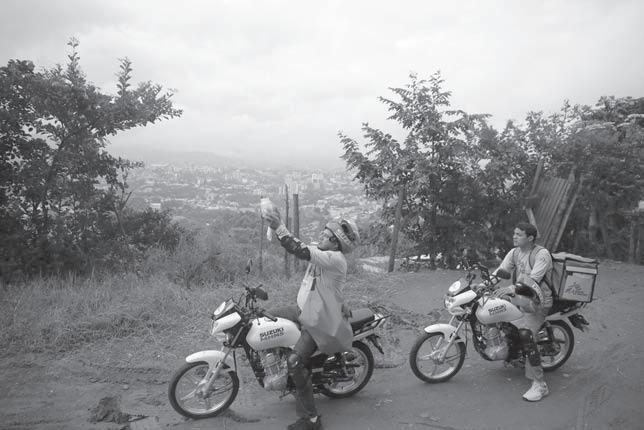
Because community engagement is key to the program’s success, doctors and volunteers have spent the past six months educating neighborhood leaders, including influential gang members, to get their permission to work in areas under their control.
Some of the most common questions from the community were about whether Wolbachia would harm people or the environment. Workers explained that any bites from the special mosquitoes or their offspring were harmless.
María Fernanda Marín, a 19-year-old student, works for Doctors Without Borders in a facility where Wolbachia-infected mosquitoes are hatched for eventual release. She proudly shows neighbors a photo of her arm covered in bites to help earn their trust.
L ourdes Betancourt, 63, another volunteer with the Doctors Without Borders team, was at first suspicious of the new strategy. But Betancourt— who has been sickened by dengue several times—now encourages her neighbors to let the “good mosquitoes” grow in their yards. I tell people not to be afraid, that this isn’t anything bad, to have trust,” Betancourt said. “They are going to bite you, but you won’t get dengue.”
How doable are renewable goals?
Continued from A1
baseload power to allow large-scale intermittent renewables in the system; and, to the extent possible, grant resource-specific incentives and issue enhancing policies, rules and regulations to further attract investments in the RE sector. Government can do it if it has the political will to do it. So far, the Marcos administration has led the way and has signaled to the sector that indeed it prefers renewable energy investments. We laud the government for its efforts now and it needs to follow through all these recent policies with efficient and wholeof-government approach and quick action,” Layug pointed out.

The DOE noted that permitting agencies are guided by the different stages of an OSW development project and the activities necessary for the successful and efficient implementation of said projects.
To speed up the proposed projects and deliver these on time, Lotilla h ad said these could be built in parallel to the transmission lines as well as t he tollways that are going to be built.
With the help of international financial organizations, the energy chief also said the government could facilitate the upgrade and modernization of the country’s power grid. “We also look forward to the upgrading completion with adequate funding from our devel-
opment partners of the backbone in the major islands,” Lotilla said.
He did not elaborate, but he mentioned that the DOE wants to partner w ith the WB and the Asian Development Bank in achieving it. “ . . . Once t he government has fiscal space, it will revisit and re-evaluate financing investment in transmission....
Financing investment will be separate from the regulatory structure of t ransmission tariffs.... Investment in transmission expansion offers enormous potential benefits for efficiency by increasing access to low-cost generation, improving reliability, and mitigating counterbalancing market power,” Lotilla said during an event hosted by the World Bank in June.
‘There should be a valid reason’ NGCP holds a 25-year concession and a 50-year congressional franchise to expand and operate the country’s power transmission grid. If this task is to be assigned to the owner of the country’s transmission assets, which is the National Transmission Corp. (TransCo), this may send mixed signals to the private sector that government is again taking over the asset.
The Presidential Communications Office said in an earlier statement that President Marcos agreed with the proposal of Sen. Raffy Tulfo, chairperson of the Senate Committee on Energy, to
conduct a comprehensive study to determine NGCP’s alleged violations and, “ if necessary, the government will take back control of the entity.”
The President, however, made it clear that there has to be a “good reason” to withdraw the NGCP franchise.
So, [supposing] you withdraw the franchise and remove everyone there, where will we get their successors? We will have to find a way to absorb the others into it. In other words, we will have a gap somehow because of the absence of management experience. We still need to train people,” he said.
Whoever will take over, the problem remains the same. The problem is that we will have to replace the personnel who will operate and we still have to build [infrastructure]. That’s the same problem, whatever option we choose to exercise,” the President told reporters in May.
TransCo operated the power grid from March 1, 2003, to Jan. 15, 2009, then turned over the management and operation of its nationwide transmission system to NGCP.
It’s no secret that there is a “power struggle” between TransCo and NGCP, but they need to work together, along with other agencies and industry stakeholders, so that the goals set would be achieved because the move towards a greener and more sustainable energy requires a holistic approach.
NewsSunday BusinessMirror www.businessmirror.com.ph Sunday, September 17, 2023 A2
TEGUCIGALPA, Honduras—For decades, preventing dengue fever in Honduras has meant teaching people to fear mosquitoes and avoid their bites. Now, Hondurans are being educated about a potentially more effective way to control the disease—and it goes against everything they’ve learned.
A DOCTORS Without Borders worker releases laboratory-bred mosquitoes in Tegucigalpa, Honduras, August 24, 2023. AP/ELMER MARTINEZ
The World
www.businessmirror.com.ph • Editor: Angel R.
 Calso
Calso
Saudi Arabia sets its sights on new, but less glamorous source of wealth
By Matthew Martin, Fahad Abuljadayel & Thomas Biesheuvel
IN scorching summer heat, Renier Swiegers marches through the desert toward a drilling rig. He’s not looking for oil though, the dynamo of Saudi Arabia’s economy the past 80 years. It’s another potential source of wealth and influence the kingdom now has its eye on.
Having already used its energy riches to upend the worlds of sports, tourism and movies, Saudi Arabia’s Crown Prince Mohammed bin Salman is prepared to pour billions of dollars into tapping the more than $1.3 trillion of metals his government says is buried in places like this.
The plan may be among the less glamorous components of his grand Vision 2030 to transform the Saudi economy. The prospect of turning the country into a metals hub that can make a dent in a global industry also has no shortage of skeptics. But Saudi Arabia’s 38-year-old de-facto leader has no shortage of wealth or ambition. Key will be convincing international mining companies it’s worth their while.
If only partially successful, the dream would have implications beyond the Middle East, not just for metals mining but also Saudi Arabia’s relations with the US, China and the emerging markets the kingdom is inching closer to.
Swiegers, a Namibian who works for British mining firm Moxico Resources Plc, is a believer. He’s helping establish a new zinc and copper open pit mine about 200 kilometers (125 miles) west of the Saudi capital, Riyadh.
“I’ve done projects all over Africa, and I know the geology and where is good to mine,” said Swiegers, extracting earth samples from
the rig from as deep as 200 meters and pointing to copper deposits glittering in the sun. This site is just like those.”
If everything comes to fruition, by 2025 the Khnaiguiyah site he’s working on will be producing metals including 100,000 tons a year of zinc and 10,000 tons of copper in its first phase. That’s miniscule by global standards— equivalent to Chile’s copper output in about 18 hours—but the aim is to double the volume. It’s one of several projects in the kingdom.
As well as developing local mines, there’s also another element to the plan that industry insiders say is less speculative and quicker to get up and running. Saudi Arabia wants to buy up resources from elsewhere to be refined and processed at new facilities inside the kingdom.
In July, the country announced its first big push into international mining. It took part in a $3.4 billion deal in Brazil, buying a stake in Vale SA’s base metals unit alongside investment fund Engine No. 1.
The transaction was the first by Manara Minerals, a vehicle established by Saudi Arabia’s powerful sovereign wealth fund— the Public Investment Fund, or PIF—and Saudi Mining Co., also known as Maaden. The agreement gives the kingdom, which beat off competition from Japan and Qatar, a 10 percent slice in one of the world’s crucial suppliers of nickel and copper—essential metals needed to decarbonize.
T here will be more. Manara’s two shareholders will initially provide about $3 billion for two or three international deals a year, and more funding will be provided if needed, people familiar with the strategy said. It’s part of Maaden’s aim to ramp up its role in domestic production, while also buying access to global resources.
Pillar of new Saudi economy
USING government subsidies and lending by state-controlled funds, the overarching goal is to position Saudi Arabia as an alternative supplier to China for the metals and minerals vital to the global energy transition, such as batteries for electric cars. In short, dirty old mining is one of the pillars of the clean new future.

“Saudi Arabia needs more than one engine to achieve its vision,” Khalid Al Mudaifer, vice minister of mining affairs, said in an interview. The kingdom’s plan is to transform itself into an economic and industrial powerhouse, he said. “For that we need minerals.”
The main metal of interest to companies is copper, but Saudi Arabia also wants to mine uranium and phosphates for its nascent nuclear program. That’s drawn the attention of Western powers and the United Nations, who are wary of nuclear proliferation in the Middle East.
Saudi Arabia has repeatedly pledged that its atomic program is strictly for peaceful purposes, but Prince Mohammed has said the kingdom would develop a bomb if the other big Middle Eastern power, Iran, did so.
Some executives and advisers at the world’s biggest miners, though, have doubts about the kingdom’s domestic mining plans and point first to its geology. Its uranium reserves have been called “severely uneconomic.” The copper deposits—the most desirable metal for most miners—were mainly formed by volcanic activity.
That means they will likely only be found in small to medium-sized areas. It makes them less attractive to mine than the deposits that stretch down through the Andes in
Latin America and provide the bulk of the world’s supplies or the sedimentary-rock formations in places like Central Africa.
These jurisdictions—and even the largely undeveloped copper crescent that runs through Iran and Pakistan—are seen as much more prospective for the large, long-life mines many of the major global companies are looking to develop.
There’s also the problem of water, something in scarce supply in Saudi Arabia, which is around 95 percent desert. “There is also the challenge of availability of infrastructure, particularly for deposits located in remote desert areas,” said Carole Nakhle, founder and chief executive officer of London-based consultancy Crystol Energy.
Much of the Saudi plan will hinge on how successful projects like the one at Khnaiguiyah are at getting from identifying specific locations of mineral deposits to commercial production. Ajlan & Bros, the local investor developing Khnaiguiyah along with UK-based Moxico Resources, has earmarked $14 billion to invest in developing mines and processing facilities by 2030.
The firm, controlled by a wealthy Saudi family that built its fortune on selling traditional Arab headdresses, is betting that “Saudi Arabia can become a new source of minerals and rare earths away from China,” said Fahad Alenezi, CEO for the metals and mining group at Ajlan & Bros. As China and the US compete for access to resources “this is healthy for us,” he said.
Ajlan is planning to develop the largest zinc and copper processing plant in the Middle East at Yanbu on Saudi Arabia’s west coast. Most of the focus will be domestic demand, but the firm is already getting offers from
Chinese and European trading houses to take any commodities it can produce.
Saudi Arabia is partnering with the Chinese Geological Survey on a $207 million contract to help identify minerals in the so-called Arabian Shield area of the kingdom where most deposits are, officials said at a Saudi-China business conference in June. The government in Beijing has also led efforts to identify the kingdom’s uranium deposits.
“The bottom line is that Saudi is exceptionally prospective,” Mark Bristow, CEO of Barrick Gold Corp., said in an interview during a visit to Riyadh in January. As for the estimate of more than $1 trillion of metals in the ground, “Whatever that number is, it’s worth an investment,” said Bristow, whose company took a risk on Mali more than 25 years ago and helped to turn it into a top African gold producer.
Canada’s Barrick operates a copper mine on Saudi Arabia’s southwestern coast near the Red Sea. It’s also been in talks with the PIF about a potential stake in a copper project in Pakistan, which would bring in Saudi money and political influence, people familiar with the matter said recently.
Vision 2030 eyes $75 billion
THE government is offering big incentives for companies to start mining. The Saudi Industrial Development Fund will offer financing for up to 75 percent of a project. There’s a five-year grace period on royalty payments, a cap on taxation levels, and a commitment not to levy windfall taxes. All government income from mining will go into a special fund to be reinvested in the industry.
Mining is the so-called “third pillar” of the economy in Vision 2030. The others are
petroleum and petrochemicals, meaning mining would become the biggest part of the economy after oil and gas. The industry would eventually employ more than 250,000 people and contribute some $75 b illion to Saudi gross domestic product by 2030, according to the targets.
A metals refining and processing industry could have potential to draw interest from international partners looking to provide more competition with China, which currently dominates minerals processing and battery manufacturing. That, of course, is if it all goes to plan.
So far, Saudi auctions for exploration licenses in the country have attracted only smaller players. The kingdom in August announced another bid round for investment and development of eight mining areas across the country.
Doubts among the big miners, though, don’t mean they aren’t closely following the Saudi efforts. Under the crown prince, Saudi Arabia is willing to take the kind of commercial risks other countries with mining ambitions might balk at, and his futuristic new city in the desert, called Neom, and the recent lavish spending on football shows the kingdom’s belief in its aims.
Others in the industry were telling me that this is real and it’s something you need to get closer to,” Mike Henry, CEO of BHP Group Ltd., the world’s biggest mining company, said during a trip to Saudi Arabia. “It’s definitely the real deal.” That was in January when he attended the country’s annual mining conference. Whether giants like BHP get involved remains to be seen. With assistance from Anthony Di Paola, Tiffany Tsoi, Paul Wallace, Jonathan Tirone and Samuel Dodge/Bloomberg.
September
2023 A3
Sunday,
17,
Sunday, September 17, 2023
Amigos PArA siemPre
Story & photos by Bernard L. Supetran
The opening song for the 1992 Barcelona Olympics “Amigos Para Siempre” performed by Jose Carreras and Sarah Bright sang about world peace and enduring friendships among peoples from all nations. But beyond the Games, the first in the post-Cold War era, the Andrew Lloyd Weber composition has become a music theme for friendships—old and new, of people and of places which have occupied a special place in our heart.
One such place which has become known for its warm hospitality and friendly people is i l oilo City, one of the largest urban hubs and tourism havens in the central Philippines. The recent hits and misses in its public branding efforts did not at all dampen the eagerness travelers to discover and rediscover the wonders of this eclectic city which can easily be your second home because of its solicitous populace.

But first, settle in a hotel which will be your homebase and frontliner for all the pleasant surprises about to unfold. A homey dwelling place in the so-called City of Love is Citadines Amigo i loilo, the globalized reincarnation of Amigo Terrace Hotel, an iconic heritage establishment in the Western Visayas Region.
One of the newest properties of The Ascott Limited’s international chain, the hotel has decided to retain the word Amigo not only for nostalgia, but also to capture the essence of the hospitality industry where a stranger will arrive as a guest and depart as a friend.
The 121-room serviced residence offers modern apartment hotel surrounded by home-grown shops and restaurants so guests can immerse in the local community. Situated in the old business district which has undergone urban renew -
al and architectural restoration in the recent years, Citadines Amigo is walking distance away from the must-see spots in downtown and adjoining districts—the numerous museums, Spanish-era churches, ancestral houses, and the soughtafter restaurants serving batchoy, pancit Molo, siopao and homestyle heirloom dishes.

As a serviced residence, the “home away from home” phrase isn’t a figure of speech, but an actual experience because of the homey atmosphere and comfort that selected one-bedroom deluxe units offer—fully-equipped kitchen and
washing machine with dryer. it also has a self-service launderette, the only one of its kind in the city.
Fitness buffs can sweat it out at the gym, swim in the lap pool or borrow bicycles from the hotel and explore i l oilo, which has positioned itself as a bike-friendly city with its extensive network of bike lanes.
The meandering i loi lo River, which has a masterfully-landscaped e s planade wrapped around it, is a belt for physical fitness, recreation or simply gazing at its marvelous resuscitation from urban decay.
A new culinary must-try which recently opened is The Boathouse Grill, Dining and Bar by 8 Villa, the adjunct resto of The Boat Club at the i loi lo River’s Drilon Bridge. The latest masterful creation of local restaurateur-hotelier i an Varona,

Anya Resort Tagaytay wins prestigious World Travel Awards 2023
Any A R esort Tagaytay, a relaxed, elegant, and premier resort hotel under the management of Anya Hospitality Group (AHG) and a member of the Small Luxury Hotels of the World (SLH), is thrilled to announce that it has been awarded as the Philippines’ Leading Boutique Resort in this year’s World Travel Awards.

This award is a testament to the brand’s exceptional service, outstanding facilities, and commitment to delivering a heartwarming guest experience.
“We are truly honored to be recognized as the country’s leading boutique resort, especially that the Philippines houses the best resort properties that are on par with international brands,” says Mikel Arriet, hotel general manager. Adding that, “This award is a reflection of the hard work, passion,
and dedication of our entire organization to go above and beyond to ensure that our guests have memorable and extraordinary experiences with us.”
The annual World Travel Awards is renowned for celebrating hospitality excellence and recognizing the best of the best in the industry. Anya Resort Tagaytay is proud to join the ranks of esteemed hotels and resorts that have received the same accolade.
nestled in 7.2 acres of breathtaking views and lush landscapes, this Tagaytay resort is a sanctuary inspired by nature and wellness, welcoming guests with signature Filipino hospitality through warm gestures and services tailored to their varying needs and preferences. All 72 suites uphold the same warmth and comfort, making it an ideal place for solo and family getaways.
Unwinding and relaxation will
come easy to guests with the resort’s variety of wellness, recreation, and pampering services. A perfect complement to the cool breeze, spend a quiet afternoon lounging in the sun by its heated pool with delectable treats and refreshing concoctions. For those wishing to work out, Anya Resort features a fully equipped fitness studio to boost those endorphins. After moving around, head to niyama Wellness Center for some of the best massages and revitalizing treatments.

The resort also offers incredibly comforting and remarkable culinary encounters, from the distinctive and captivating flair of Samira by Chele Gonzalez’s signature dishes to poolside grub and the perfect nightcap at Anila Poolside.
For inquiries and reservations, please visit https://www.anyaresorts. com/.
the dining haunt caters not only to power boat owners, but also to everyone seeking to plunge into classic gourmet Filipino and international specialties by the scenic and revived i loi lo River.

A two-month-old baby, The Boathouse is still a work in progress but already boasts of a vaunted menu curated by veteran globetrotting chef-slash-architect Ramon Antonio who has poured in his decades of kitchen experience in this riverine experiment.
Outside the city, an intriguing town to visit is Sta. Barbara which was the cradle of the 1898 revolution against Spain and seat of the short-lived Visayas Republic led by General Martin Delgado as president. Known as the Cry of Sta Barbara, the revolt will mark its 125th anniversary on no v. 17 and will focus on the libertarian

ideals of the i longgos.
The town hosts a remarkable museum, the historic baroque church and convent, and an i n stagrammable plaza named after Delgado, and takes pride in its own tasty rendition of the signature batchoy.
Before heading home, swing by Damires Hills Farm and Spa Resort in Janiuay town, just 18 kms away from the airport. One of top farm tourism sites in the province, it is a sprawling 16-hectare mixed-use property, with an extra 30 hectares for future development.
To cater to more tourists yearning for a pastoral feel, the 28-room boutique resort is expanding with additional 16 executive rooms and 8 villas, one of which is a presidential suite. it s countryside setting will keep guests occupied with recreational facilities, such as all-
terrain vehicle, swimming pools, zipline, and hanging bridge and catwalk, and get pampered at the i l aya Retreat Spa which offers an array of traditional Filipino massage treatments. Aside from the usual resort stuff, visitors can also experience farm tours, demonstrations on vermi soil concoction and cacao drafting, and pick and pay harvesting of fruits and crops in season. it s native-themed Balay Uma is a must-try food trip for its i longgo dishes, namely KBL (kadyos, baboy, langka), chicken binakol, and its signature desserts—ube macapuno spring roll and Cabatuan tablea chocolate drink. With its cuisine, culture, and character of its people, i loilo City can be your new-found friend and the proverbial amigo para siempre—a friend for always.
Kada-kada Like A Panda at Davao’s 38th Kadayawan Festival
On L i ne food and grocery platform foodpanda adds its trademark shade of pink to Davao’s colorful Kadayawan festival.
The Kadayawan Festival is a celebration of gratitude for nature’s offerings, the richness of culture, the abundance of harvest, and the peace of life, showcasing the 11 tribes of Davao. This year marks the 38th of the annual celebration and has the theme of “Colors of Abundance, Vibrance of Diversity, Festival of Festivals.”
During the Kadayawan Festival, foodpanda offered extraordinary experiences for its loyal app users as well as potential subscribers. They unveiled delightful surprises and engaging activities designed to enhance the festive atmosphere through their Kada-kada Like A Panda initiative.
(Check out the highlights of foodpanda at the Kadayawan Festival in this video: https://


www.facebook.com/100064418483195/videos/276398205146972)
Patricia Jacinto, foodpanda Philippines Growth & Marketing Director, expressed her enthusiasm to the company’s involvement in the weeklong celebration. “foodpanda was thrilled to have immersed ourselves in the vibrant Kadayawan festivities. By actively participating in various Kadayawan events, we hope we were able to bring added joy and a slew of prizes to both the Dabawenyos and loyal app users.”
foodpanda also played a significant role in some of the festival’s competitions. They served as a special judge in events such as i ndak i ndak, Hiyas ng Kadayawan, and Hudyaka sa Kadayawan. With this involvement, foodpanda awarded special prizes to individual or group contenders who showcased outstanding performanc -
es, further deepening its connection with the community and the festival’s traditions.

Starting strong with the Kadayawan festivities, foodpanda partnered with local favorite Mamastill Atbp. for the “Paying it Forward Free Pastil” project held in the bustling Roxas ni ght Market. Pastil, a famous local delicacy, was given away to everyone who gives life to the night market, from the hardworking vendors, vigilant police officers, special task force members, and the tireless street sweepers. enjoy a gastronomic video from Mamastill Atbp., here.
For more information about foodpanda and the incredible offers available, visit the official website at https:// www.foodpanda.ph. Also like and follow the official social media accounts on Facebook, i n stagram, Twitter, Tiktok and youtube.
BusinessMirror Journey»life on the go
A4
Editor: Tet Andolong
BiK in g at iloilo River Esplanade
Ci TAD in E s Amigo iloilo third floor lobby
Ci TAD in E s Amigo iloilo Th E Boathouse grill, Dining Bar by 8 Villa
AnyA Resort Tagaytay Facade
DA m iR E s h lls in Janiuay
Th E author with a historical impression of gen mar tin Delgado
Editor: Lyn Resurreccion
EARTH’S CLIMATE, BIODIVERSITY, LAND, FRESHWATER, NUTRIENT POLLUTION AND ‘NOVEL’ CHEMICALS ARE OUT OF THE BOUNDS
Study: Earth outside its ‘safe operating space for humanity’
EARTH is exceeding its “safe operating space for humanity” in six of nine key measurements of its health, and two of the remaining three are headed in the wrong direction, a new study said.
Earth’s climate, biodiversity, land, freshwater, nutrient pollution and “novel” chemicals (human-made compounds like microplastics and nuclear waste) are all out of whack, a group of international scientists said the other day in journal Science Advances.
Only the acidity of the oceans, the health of the air and the ozone layer are within the boundaries considered safe, and both ocean and air pollution are heading in the wrong direction, the study said.
“We are in very bad shape,” said study co-author Johan Rockstrom, director of the Potsdam Institute for Climate Impact Research in Germany.
“We show in this analysis that the planet is losing resilience and the patient is sick,” Rockstrom added.
In 2009, Rockstrom and other researchers created nine different broad boundary areas and used scientific measurements to judge Earth’s health as a whole.
The paper was an update from 2015 and it added a sixth factor to the unsafe category.
Water went from barely safe to the out-of-bounds category because of worsening river runoff and better measurements and understanding of the problem, Rockstrom said.
These boundaries “determine the fate of the planet,” said Rockstrom, a climate scientist. The nine factors have been “scientifically well established” by numerous outside studies, he said.
If Earth can manage these nine factors, Earth could be relatively safe. But it’s not, he said.
In most of the cases, the team uses other peer-reviewed science to create measurable thresholds for a safety boundary.
For example, they use 350 parts per million (ppm) of carbon dioxide in the air, instead of
DOST-PCAARRD, PCA launch 7 coconut hybridization R&D projects
COCONUT hybridization research and development (R&D) aims to help the local coconut industry by sustaining the supply of quality planting materials in order to produce high-value products.
To support this, the Philippine Council for Agriculture, Aquatic and Natural Resources Research and Development of the Department of Science and Technology (DOST-PCAARRD) partnered with three Philippine Coconut Authority (PCA) research centers in launching seven projects under the Coconut Hybridization Program of the Coconut Farmers and Industry Development Plan.
This was held recently during an inception meeting in Zamboanga City.
The council is strengthening its collaboration with PCA by providing fund support to the latter’s existing R&D capacities and technical expertise.
Six of the seven projects focus on varietal improvement and selection of palms with outstanding traits, profiling hybrids and breeding cultivars that are resistant to biotic or ecological and abiotic or nonliving stresses.

Meanwhile, one project aims to enhance the science-based integrated pest management of coconut rhinoceros beetle, a widespread coconut insect pest that damages fruit-bearing palms.
The Crops Research Division (CRD) of DOST-PCAARRD facilitated a discussion to
clarify and refine project details, including the role of PCA as the implementing agency.
The monitoring and evaluation plan of each project and grant guidelines were also presented to the project teams.
“This inception meeting will lay the groundwork for our projects’ successes,” said DOST-PCAARRD OIC-Deputy Executive Director Juanito T. Batalon, for Research and Development.
Batalon added that a collaborative environment is the key to a smooth project implementation.
Meanwhile, CRD Director Leilani D. Pelegrina reiterated the importance of close coordination and open communication.
She said, “I want you to remember that the success of these projects depends on every one of us. We are a team, and our collective effort will determine the outcome of this endeavor.”
The meeting was attended by then-PCA R&D Branch Deputy Administrator Ramon
L. Rivera, Director Leonilo B. Abella of the Western Mindanao Agriculture, Aquatic and Natural Resources Research and Development Consortium, and DOST Region
IX’s Judilyn E. Alvarez.
Following the meeting, the CRD team visited several DOST and PCAARRDsupported laboratories, facilities and field setup at PCA-Zamboanga Research Center. Rosemarie A. de Castro and Edmerson
Z. Calungsod/S&T Media Service
the Paris climate agreement’s 1.5 degrees of warming since pre-industrial times. This year carbon in the air peaked at 424 ppm.
The nine factors are intermingled. When the team used computer simulations, they found that making one factor worse, like the climate or biodiversity, made other Earth environmental
issues degrade, while fixing one helped others.
Rockstrom said this was like a simulated stress test for the planet.
The simulations showed “that one of the most powerful means that humanity has at its disposal to combat climate change” is cleaning up its land and saving
forests, the study said.
Returning forests to late 20th century levels would provide substantial natural sinks to store carbon dioxide instead of the air, where it traps heat, the study said.
Biodiversity—the amount and different types of species of life— is in some of the most troubling shape and it doesn’t get as much attention as other issues, like climate change, Rockstrom said.
“Biodiversity is fundamental to keeping the carbon cycle and the water cycle intact,” Rockstrom said. “The biggest headache we have today is the climate crisis and biodiversity crisis.”
University of Michigan environmental studies Dean Jonathan Overpeck, who wasn’t part of the study, called the study “deeply troubling in its implications for the planet and people should be worried.”
“The analysis is balanced in that it clearly sounds a flashing red alarm, but it is not overly alarmist,” Overpeck said. “Importantly, there is hope.”
14 new career scientists take their oath

FOURTEEN newly conferred and upgraded career scientists, who were added to the roster of Philippine scientists, took their oath at a ceremony held at a hotel in Quezon City on September 13.
The Scientific Career System (SCS), co-implemented by the Department of Science and Technology (DOST) and the Civil Service Commission (CSC), awards scientist rank to qualified research personnel in the government service.
The oath-taking, with the theme “Empowering and Promoting our World Class Filipino Scientist in the Government Service,” was administered by CSC Chairman Atty. Karlo A.B. Nograles, also the chairman of the SCS.
The newly conferred and upgraded career scientists were: Dr. Ma. Cecilia R. Antolin, Scientist I; Department of Agriculture (DA)
Philippine Center for Postharvest Development and Mechanization; Dr. Alvie A. Astronomo, Scientist I, DOST- Philippine Nuclear Research Institute (DOST-PNRI);
Dr. Rodolfo G. Idago, Scientist I, DA-Philippine Center for Postharvest Development and Mechanization; Dr. Juanito P. Jimenez Jr., Scientist I, DOST-Forest Prod -
DOST, MMSU launch ₧12.7M tech biz incubator
BATAC, Ilocos Norte—The creative industries and the business incubators of Region 1 have a promising future as the Department of Science and Technology (DOST) and the Mariano Marcos State University (MMSU) launched the Bannuar Technology Business Incubator (TBI).
Under the auspices of the DOSTPhilippine Council for Industry, Energy and Emerging Technology Research and Development, the DOST-MMSU Bannuar TBI is another vital phase in the journey of spurring innovation and empowering creative manufacturing industry in the Ilocos Region, the DOST PCIEERD said.
DOST-PCIEERD Executive Director Dr. Enrico C. Paringit expressed hope for the 57,989 micro, small and medium enterprises
(MSMEs) in the region through the Bannuar TBI.
Bannuar TBI is one of the 47 TBIs that DOST-PCIEERD has been supporting.
“The Bannuar TBI comes on the heels of the upward trajectory of the creative industries. We are looking at this facility as a germination pod for future technologybased creative startups and spinoffs,” he said.
Paringit emphasized Bannuar TBI’s mission, which links distinctive cultural legacy and genuine entrepreneurship.
“We anticipate local partnerships [among] DOST, other government agencies, local incubators and other players in the startup scene to be forged in the Bannuar TBI. We hope that they find their North in the startup scene through this launch,” Paringit added.
British scientist, who cloned Dolly the Sheep, dies at 79
LONDON—Ian Wilmut, the cloning pioneer whose work was critical to the creation of Dolly the Sheep in 1996, has died at age 79.
The University of Edinburgh in Scotland said Wilmut died on Sunday after a long illness with Parkinson’s disease.
Wilmut set off a global discussion about the ethics of cloning when he announced that his team at the university’s Roslin Institute for animal biosciences had cloned a lamb using the nucleus of a cell from an adult sheep.
Initially referred to as “6LL3” in the
academic paper describing the work, the lamb was later named Dolly, after the singer Dolly Parton. The lamb’s cloning was the first time scientists were able to coax a mature adult cell into behaving like a cell from a newly fertilized embryo in order to create a genetically identical animal.
While Dolly’s creation was heralded as a revolution by some scientists, it unnerved many, with critics calling such experiments unethical.
The year after Dolly’s creation, US President Bill Clinton imposed a ban on
the use of federal funds for human cloning but stopped short of banning all cloning research.
Dolly’s creation prompted other scientists to clone animals including dogs, cats, horses and bulls.
Dolly also spurred questions about the potential cloning of humans and extinct species.
In recent years, scientists have proposed bringing back the woolly mammoth by using a mix of gene editing and cloning.
Dolly’s creation was part of a broader project by scientists to create genetically
The fact that ozone layer is the sole improving factor shows that when the world and its leaders decide to recognize and act on a problem, it can be fixed and “for the most part there are things that we know how to do” to improve the remaining problems, said Carnegie Mellon chemistry and environment professor Neil Donahue.

Some biodiversity scientists, such as Duke’s Stuart Pimm, have long disputed Rockstrom’s methods and measurements, saying it makes the results not worth much.
Amounting to P12.7 million, the TBI project also aims to provide resources and guidance to startups, including individuals with viable tech products.
Prof. Armie C. Sabugo, the lead person in the Bannuar TBI project, said that it will make use of the university’s existing infrastructure, facilities and tools to promote the local enterprises, particularly in the creative sectors.
Among those on the list is the looming weaving center of the College of Industrial Technology in Paoay Campus, which served as a location for several universitysponsored and collaborative trainings, the DOST-PCIEERD said.
It can also help the bamboo processing plant at the Crops Research Laboratory complex, which produces engineered kawayan (ekawayan, or e-bamboo) goods.
modified sheep that could produce therapeutic proteins in their milk.
About six years after Dolly’s birth, it was euthanized by scientists after she developed an incurable lung tumor.
Wilmut, a trained embryologist, later focused on using cloning techniques to make stem cells that could be used in regenerative medicine. His work was critical to research that aims to treat genetic and degenerative diseases by helping the body repair damaged tissue.
The Roslin Institute said Wilmut was knighted in 2008 and retired from the university in 2012. He later researched Parkinson’s disease after he was diagnosed with the condition, it said.
“We are deeply saddened to hear of the
But Carnegie Mellon environmental engineering professor Granger Morgan, who wasn’t part of the study, said, “Experts don’t agree on exactly where the limits are, or how much the planet’s different systems may interact, but we are getting dangerously close.” “I’ve often said if we don’t quickly cut back on how we are stressing the Earth, we’re toast,” Morgan said in an e-mail. “This paper says it’s more likely that we’re burnt toast.” Seth
Borenstein/Ap Science Writer

ucts Research and Development Institute; Dr. Jordan F. Madrid, Scientist II, DOST-PNRI; Melissa P. Montecalvo, MSc., Scientist I, National Crop Protection Center University of the Philippines Los Baños (UPLB); Dr. Rodney H. Perez, Scientist I, UPLB-National Institute of Molecular Biology and Biotechnology; Jazelyn M. Salvador, MSc., Scientist I, UP Diliman-Natural Sciences Research Institute (UPD-NSRI); Dr. Rene C. Santiago, DVM, MSc., Scientist I, DA-Bureau of Animal Industry; Joy Ann P. Santos, MSc., Scientist I, UPD-NSRI; Dr. Andres M. Tuates Jr., Scientist I, DA-Philippine Center for Postharvest Development and Mechanization; Dr. Fe M. de la Cueva, Scientist II, UPLBInstitute of Plant Breeding; Dr. Danilda Hufana-Duran, Scientist II, DA-Philippine Carabao Center; and Dr. Manuel Jose C. Regalado, Scientist II, DA-Philippine Rice Research Institute.
The university’s Research and Development (R&D) Station and the Center for Innovative Materials in Emerging Applications (CIMEA), which will focus on the conduct of R&D toward material innovation using local sources, were also intended to benefit from and be served by it, Sabugao said.
The DOST-PCIEERD’s Higher Education Institution Readiness for Innovation and Technopreneurship Program (Heirit) provided funding for the Bannuar TBI.
The Heirit Program was initiated to assist universities in meeting the council’s TBI financing requirements and to provide managers with the skills they need to operate TBIs connected with DOST efficiently.
The growing need for earlystage entrepreneurial support, particularly in various locations across the Philippines, is something that Heirit aims to solve.
passing of Sir Ian Wilmut,” Bruce Whitelaw, the institute’s director, said in a statement on Monday.

Whitelaw described Wilmut as a “titan” of science and said his work in Dolly’s creation transformed scientific thinking at the time.
He said the legacy of Wilmut’s work in cloning Dolly continues to be seen.
“This breakthrough continues to fuel many of the advances that have been made in the field of regenerative medicine that we see today,” he said.
Wilmut is survived by his wife, three children and five grandchildren, the University of Edinburgh said. Funeral arrangements have not yet been announced. AP
Science Sunday BusinessMirror Sunday, September 17, 2023 www.businessmirror.com.ph •
A5
A WOMAN is silhouetted against the setting sun as triple-digit heat indexes continue in the Midwest on August 20 in Kansas City, Missouri. AP/CHARLIE RIEDEL
CIVIL Service Commission Chairman Atty. Karlo Nograles (right), also the chairman of the Scientific Career Council, administers the oath of the newly conferred and upgraded career scientists at a hotel in Quezon City. They are: Dr.Alvie Asuncion-Astronomo, Scientist 1; Dr. Juanito Jimenez Jr., Scientist 1; Dr. Jordan Madrid, Scientist II; Dr, Ma.Cecilia Antolin, Scientist 1; Dr. Rodelo Idago, Scientist 1; Dr. Rene Santiago, Scientist 1; Dr. Andres Tuates Jr., Scientist 1; Dr. Danilda Hufana-Duran, Scientist II; Dr. Manuel Jose Regalado, Scientist II; Dr. Melissa Montecalvo, Scientist 1; Dr. Rodney Perez, Scientist 1; Jazelyn Salvador, MSc., Scientist 1; Joy Ann Santos, MSc., Scientist 1; and Dr. Fe de la Cueva, Scientist II. ROY DOMINGO
Coconut hybrid with somatic embryogenesis technology is planted at the PCA-Zamboanga Research Center. CROPS RESEARCH DIVISION, DOST-PCAARRD
Scottish scientist Ian Wilmut at Saint Paul’s Church in Frankfurt, central Germany, on March 14, 2005. Wilmut, the cloning pioneer whose research was critical to the creation of Dolly the Sheep, has died. He was 79. AP/MICHAEL PROBST
Malaysia, Indonesia show strong support for strict Islamic laws
CBCP working on creation of prelature for OFWs
THE migration arm of the Catholic Bishops’ Conference of the Philippines (CBCP) hopes that the proposed establishment of a personal prelature for Filipino migrants will come to fruition.
Bishop Narciso Abellana of the Episcopal Commission for the Pastoral Care of Migrants and Itinerant People believes that the idea will enable the Church to effectively carry out its work.

He emphasized that the prelature will be particularly beneficial in reaching out to overseas Filipino workers, especially those in territories without Catholic chaplaincies.
study of the proposal.
Some 86 percent of Malaysians said they are in favor of making Shariah regulations, which applies to Muslims, as the country’s official law.
With Indonesia, nearly two out of three people surveyed were in favor of implementing Islamic regulations over the current secular laws.
The strong support for Shariah laws—which include banning alcohol and punishing adultery—reflect a growing dilemma for the leaders of these Muslim-majority nations that also have sizable religious minorities.
This, in turn, is influencing policymaking in Malaysia and Indonesia, where incomes and economic growth were checked by the pandemic and a global slowdown.
The Pew findings published a few days ago found that most of the Malaysian Muslims polled were in favor of religious leaders entering politics, while close to half of the respondents surveyed in Indonesia embrace this.
While the survey was carried out between June and September 2022, national and state elections in Malaysia and political decisions in Indonesia echo the findings and show the rising clout of the Muslim conservatives.
Malaysia’s state elections in August saw a far-right Islamist group strengthen its hold on three of six states up for grabs, while wresting more seats in the country’s wealthiest state of Selangor.
Last November, Parti Islam SeMalaysia won most seats of any
single party in the national vote and was supporting a conservative candidate to defeat Anwar Ibrahim in the race to become the next prime minister.
Home to the world’s largest Muslim population, Indonesia enacted a sweeping criminal code that punishes people who have sex outside marriage in the most significant example of conservatives’ power in influencing state policies.
Indonesia’s presidential elections next year could see religion come to the fore as well. One of the candidates, a former governor of Jakarta, who is viewed as pro-Muslim, has
sought to burnish his credentials by picking the leader of Indonesia’s largest Islamic party as his running mate.
The study also examined the role of Buddhism, the main religion in Cambodia, Thailand and Sri Lanka. Among the three, Cambodian respondents were more in favor of religious leaders joining politics as well as revealing their political leanings and joining protests.
Pew Research polled 13,122 adults across six Asian countries that include Malaysia, Indonesia, Singapore, Cambodia, Thailand and Sri Lanka.
Faris Mokhtar/Bloomberg News
“So it becomes the work and responsibility of the prelature to provide services to these migrants. We hope that this idea of prelature for migrant workers prospers,” Abellana said.
“This may have a wider scope in reaching our migrant workers since it does not depend solely on the present chaplaincies,” he said.
The bishop made the statement in his message for National Migrants’ Sunday, which falls on September 24 this year.
The discussion within the CBCP on the proposed prelature responsible for the spiritual and pastoral welfare of Filipino migrants has been ongoing for at least three years now.
The CBCP established a special committee to conduct further
Caritas PH Academy to launch course for bishops

CARITAS Philippines Academy, the Catholic Church’s learning and training institute, is launching its first course on servant leadership and pastoral management for bishops.
The course, titled “Servant Leadership and Pastoral Management in Our Times,” will run from September 18 to 23 at the Caritas’ Development Center in Tagaytay City.
According to Caritas, the program aims to equip the bishops with the necessary skills and knowledge “to navigate the complexities of their leadership roles and promote the Church’s mission of social justice, development and compassion”.
“The Church is called to be a servant leader in society, and this course will help our bishops to better understand and embody this calling,”
By Patrick V. Miguel
FOLLOWING Vatican’s approval, the statue of the patron saint of Korea was installed at the Saint Peter’s Basilica on September 16, the anniversary of his beheading by the Korean Joseon Dynasty.
Canonized in 1984, Saint Andrew Kim Taegŏn is known as the first native Korean priest and also as their earliest martyr, according to the Catholic Bishops’ Conference of the Philippines’ News.
T he statue was proposed by Cardinal Lazzaro You Heung-sik, a Korean prelate and prefect of the Dicastery for the Clergy. It was also approved by Pope Francis, who has pointed to Kim’s missionary zeal as a model for all Christians to follow.

“S aint Andrew Kim and the other Korean faithful have demonstrated that the testimony of the Gospel given in times of persecution can bear many fruits for the faith,” said Pope Francis in a homily.
The statue of the patron saint is made from six-ton marble. It was installed in a niche circle outside Saint Peter’s Basilica, and was blessed by the archpriest Cardinal Mauro Gambetti.
A ccording to You, the dedication of Saint Kim’s statue is “a great honor for [their] Korean church.”
“ We believe and hope that he can be increasingly loved and his intercession invoked by the faithful all over the world,” You said.
The saint converted to Catholicism at the age of 15, eventually trained for priesthood in Macao and ordained in 1836 by French Bishop Jean Joseph Jean-Baptiste Ferréol, the first bishop of Seoul.
He then returned to Korea to evangelize his homeland. However, he was tortured and ultimately beheaded at the age of 25 for the crime of being a Catholic.
Writing to his fellow Christians shortly before his death, Kim encouraged them to stay true to the faith. He said: “We have received baptism, entrance into the Church, and the honor of being called Christians. Yet what good will this do us if we are Christians in name only and not in fact?”
In his last words before he was executed, according to Macao News research, Kim urged his compatriots to convert to the one true faith.
“This is the last hour of my life,” Kim reportedly said. “Listen to me attentively. If I have held communication with foreigners, it has been for my religion and for my God. It is for him that I die. My immortal life is on the point of beginning. Become Christians if you wish to be happy after death, because God has eternal punishments in store for those who have refused to know him.”
Along with 102 other Korean martyrs, Kim was canonized on May 6, 1984, by Pope John Paul II during his visit to Korea.

An estimated 10,000 Korean Christians were martyred for the faith before Christianity became tolerated in South Korea in 1884.
There are currently more than 5 million Catholics in South Korea, making up about 11.3 percent of the country’s total population, according to Agenzia Fides.
Meanwhile, Pope Francis announced at the conclusion of World Youth Day, in Lisbon, Portugal, last month that the next event would take place in Seoul, South Korea, in 2027.
During the CBCP plenary assembly in July, the bishops renewed their agreement on the need for additional time and further study before submitting the matter to the Vatican for a decision.
“This extension was deemed necessary to give for more consultation with the other episcopal conferences, especially in countries where Filipino migrants and itinerants are present,” said CBCP President Bishop Pablo Virgilio David.
“The working committee was also asked to anticipate such concerns as logistics and the formation of priests for ministry to OFWs as well as the formation of migrant Catholics as missionaries, especially in countries where Christians are a minority,” he said. CBCP News
said Bishop Jose Colin Bagaforo, president of Caritas Philippines.
The course will cover topics—such as pastoral management, governance, communications and organizational sustainability.
It will also draw from corporate business principles and community development approaches and will be lined with relevant social teachings of the Church, the agency said.
The course, it added, will help in improving and strengthening the processes, services, advocacies and accountability mechanisms implemented in the dioceses.
This will also help in professionalizing the management of pastoral affairs in the church, Caritas also said.
“We believe that this course will be a valuable resource for the bishops as they continue to lead the Church in its mission of love and service,” Bagaforo said. CBCP News
How religious leaders without religion tend to patients’ needs
IN times of loss, change or other challenges, chaplains can listen, provide comfort and discuss spiritual needs. These spiritual caregivers can be found working in hospitals, universities, prisons and many other secular settings, serving people of all faiths and those with no faith tradition at all.
Yet a common assumption is that chaplains themselves must be grounded in a religious tradition. After all, how can you be a religious leader without religion?
In reality, a growing number of chaplains are nonreligious: people who identify as atheist, agnostic, humanist or “spiritual but not religious.”
I am a sociologist and research manager a t Brandeis University’s C haplaincy Innovation Lab, where our team researches and supports chaplains of all faiths, including those from nonreligious backgrounds.
O ur current research has focused on learning from 21 nonreligious chaplains about their experiences.
A changing society
THIRTY percent of Americans are religiously unaffiliated. Research suggests that people who are atheists or otherwise nonreligious sometimes reject a chaplain out of wariness, or shut down a conversation if they feel judged for their beliefs.
But this research has not accounted for a new, increasingly likely situation—that the chaplain might also be nonreligious.
No national survey has been done, so the number of nonreligious chaplains is unknown. But there is plenty of reason to think that as more Americans choose not to affiliate with any particular religion, so too do more chaplains.
Nonreligious chaplains have been a part of hospital systems and universities for years, but they came into the national spotlight in August 2021 when Harvard University’s organization of chaplains unanimously elected humanist and atheist Greg Epstein as president.
Humanists believe in the potential and goodness of human beings without reference to the supernatural.

Other recent reporting on humanist chaplains has also focused on school campuses, but nonreligious chaplains are not limited to colleges and universities.
Eighteen of the 21 nonreligious chaplains we spoke with in our study work in health care, including hospice.
The F ederal Bureau of Prisons a llows nonreligious chaplains, but we were unable to find any of them to participate in the current study.
Not all settings allow nonreligious chaplains, however, including the US military.
Authentic calling
THE idea of a “call” from God is central to many religious vocations: a strong impulse toward religious leadership, which many
people attribute to the divine.
Chaplains who are atheists, agnostics, humanists or who consider themselves spiritual but not religious also can feel called. But they do not believe that their calls come from a deity.
Joe, for example, an atheist and a humanist whom we interviewed, has worked as a chaplain in hospitals and hospices.
He says that his “light bulb moment” came after a history professor told him that beliefs are the source of a community’s power.
While atheists do not believe in God or gods, many do have strong beliefs about ethics and morality, and American atheists are more likely than American Christians to say they often feel a sense of wonder about the universe.
Joe’s call was not “from a divine source,” but nonetheless, he says this experience “kind of filled me with a sense of control, and confidence, and presence” in his life that grounded his sense of a calling.
Sunil, another chaplain our team interviewed, was inspired by his college chaplain, whom he calls “a really influential presence.”
The chaplain helped Sunil answer questions about identity and values without “necessarily having any religious or spiritual leanings to it,” and encouraged him to go to divinity school.
Today, Sunil tries to help others answer those same questions in his work as a health-care chaplain—and to offer deeply thoughtful, meaningful spiritual care to
people who aren’t religious.
Education and training
MOST chaplaincy jobs require a theological degree. Along with coursework in sacred scriptures and religious leadership.
Chaplaincy training usually involves clinical pastoral education, where students learn about hands-on, care-oriented aspects of their profession.
This involves learning to provide care to everyone, regardless of their religious background.
Although coursework is broadly the same for all students, religious or nonreligious, the actual experience of earning a degree is very different for nonreligious students.
In the United States, Christian students are easily able to enroll in a seminary or divinity school that shares their faith identity and spend their years of study learning about their own tradition.
Chaplaincy programs that focus on nonChristian traditions are available, but scarcer, and our team does not know of an overtly nonreligious chaplaincy program.
In recent years, more seminaries have welcomed nonreligious students, but nonetheless, nonreligious students often find themselves focusing their study on traditions to which they have no personal connection.
Yet there is a surprising bright side.
Faith Sunday A6 Sunday, September 17, 2023 Editor: Lyn Resurreccion • www.businessmirror.com.ph
THE majority of Muslims in Indonesia and Malaysia are in favor of making strict Islamic rules the official law of these multireligious countries, polling from the Pew Research Center showed in a sign of the rising influence of religious conservatism.
FRIDAY prayers at Istiqlal Mosque in Jakarta on March 31, 2017. JOHNSTAD DI MARIA/WIKIPEDIA CC BY-SA 4.0
THE
Tagaytay
CBCP NEWS
Caritas Philippines Academy in
City
THE statue of the patron saint of Korea, Saint Andrew Kim Tae-gŏn KOREAN BISHOPS’ CONFERENCE
Korea’s patron saint statue installed at Saint Peter’s Basilica
BISHOP Narciso Abellana of Romblon, chairman of the CBCP Episcopal Commission for the Pastoral Care of Migrants and Itinerant People CBCP NEWS
Asean Champions of Biodiversity
Media Category 2014

Biodiversity Sunday
Editor: Lyn Resurreccion
Sunday, September 17, 2023
Overfishing, unsustainable tourism threaten Tañon Strait
By Jonathan L. Mayuga
LAST month, the University of the Philippines-Diliman College of Science (UPD-CS) reported the declining population of dolphins in Tañon Strait, a body of water in the Visayas that is known to harbor a variety of amazing mammals, including rare whales and dolphins.
This was based on the survey the UPD-CS conducted in the strait from July 20 to 23, focusing on dolphin populations within its southern part.
“The initiative revealed deeply concerning trends, such as a decrease in dolphin numbers, a reduction in species diversity and evasive behavior possibly linked to increasing human activity in the area,” the UPD-CS reported.
Fewer, more elusive dolphins
IN a news release, Dr. Lemnuel Aragones, head of the UPD-CS Marine Mammal Research and Conservation Laboratory (MMRCL) that conducted the survey, said the number of spinner dolphins recorded by the team was fewer compared to past their years’ undertakings.
Earlier surveys witnessed vibrant gatherings of diverse species of cetaceans—including numerous kinds of dolphins and species of whales, with groups of as many as 100 individuals spotted in a single day.
However, the recent survey was starkly different, showcasing only three species—spinner dolphins, common bottlenose dolphins and dwarf sperm whales.
Only between 80 and 90 individual spinner dolphins were encountered throughout the four-day survey, compared to 100 in just one day.
Aragones added that the team observed the evasive behavior of the dolphins—which is a sign of possible stress or disturbance due to the persistent presence of aggressive dolphin-watching boats.
Overfishing
BY the definition of the Fisheries Code and Amended Fisheries Code, Tañon Strait—that separates the islands of Negros and Cebu in the Visayas—is a
municipal fishing ground, hence offlimits to commercial fishing.
Municipal fishing grounds are the areas between the shorelines and 15 kilometers (km) toward the sea.
The areas are for the exclusive use of small, mostly subsistence fishermen, who have limited capacity to fish in distant waters.
Protectors of Tañon Strait have complained against overfishing in the area, a very important fishing ground both for Negrenses and Cebuanos.
Oceana Philippines, an international nongovernment organization advocating for sustainable fishing practices to conserve the world’s oceans, said commercial fishing vessels have been frequenting the Tañon Strait in the past.
The group is also pushing for the implementation of the Amended Fisheries Code and the enforcement of monitoring devices in commercial fishing vessels to detect the behaviors of commercial fishers.
Tourism woes
TO generate jobs and livelihood opportunities, local governments in Negros and Cebu promote ecotourism in Tañon Strait, including whale and dolphin watching.
Lately, Aragones said his team observed a notable change in the behavior of dolphins, a possible sign of stress or disturbance, probably due to the persistent presence of aggressive dolphin-watching boats.
Aragones and his team, who have been monitoring the region since 1997, observed a significant increase in the number of dolphin-watching boats.
Although he noted that the area now hosts around 60 boats, down from the original 260, he still fears that this may still be too much.
“Too many dolphin-watching boats in the area disrupt the cetaceans’ habits,” he said. Marine mammals like dolphins and whales belong to cetacean family.
Less fish, less dolphin food
ARAGONES suspected that overutilization of the area’s resources is a contributing factor to the decline in
the dolphin population.
“There should also be a comprehensive assessment of fisheries resources in the entire strait as there is clearly less food now for these creatures,” he explained.
To preserve the delicate ecosystem and to safeguard the remarkable marine mammals in Tañon Strait, the scientists have proposed several measures, including a moratorium on adding more boats to the already existing fleet.
They also underscored the need for a comprehensive assessment of fisheries resources, including fishing activities in Tañon Strait, as a decline in food availability may be exacerbating the dolphins’ struggles.
Furthermore, strict monitoring and regulation of illegal unreported and unregulated fishing practices in the area are necessary.
Sustainable tourism practices needed
THE marine mammal expert emphasized the importance of educating boat operators on responsible dolphinwatching protocols.
He said a certification process that trains operators to navigate around dolphins without causing stress could play a pivotal role in protecting the charismatic animals.
Research also suggests that previous ecotourism activities negatively impacted dolphin behavior,
reinforcing the need for responsible and sustainable tourism practices.
Tañon Strait is not the only area affected by unsustainable tourism practices.
Beach resorts like Boracay, El Nido, Puerto Galera and other popular tourist spots have experienced environmental degradation.
Not far from Tañon Strait, the Cebu whale shark watching in Sorsogon and Oslob have led to disturbances of ecosystems and altered behaviors of the whale sharks.
In Sorsogon, tourists on boats chase whale sharks to get a glimpse of the huge docile creature, and swim close to them for photo opportunities.
In Oslob, Cebu, whale sharks are fed to make them stay in the area, altering their supposedly “wild” behavior of filter-feeding plankton in coastal areas, and later on migrate to other areas as they tend to be more dependent on the food provided by tourist operators in the name of “eco-tourism.”
Protected area
KNOWN as the Tañon Strait Protected Seascape, it is a Protected Area by virtue of Proclamation 1234 of 1998.
The area is about 160 km long. It connects the Visayas Sea in the north to the Bohol Sea in the south. Its width varies from 5 km to 27 km, with the narrowest point in the south. With an area of more than 5,000 sq
Asean celebrates 18 years of biodiversity cooperation
Biodiversity Programme.
“I want to thank the active role of ACB in promoting Asean and our collective actions at the CBD [Convention on Biological Diversity] fora. With the Kunming-Montreal Global Biodiversity Framework adopted by the CBD COP-15 in 2022, the role of ACB is increasingly important in facilitating cooperation among the [AMS] to achieve the global and regional objectives on biodiversity, including green economy and blue economy,” he added.
New AHPs
ONE of the highlights of the event was the awarding of the certificates to the two newly recognised AHPs in Thailand which were approved during the 17th Asean Ministerial Meeting on the Environment in August in Lao PDR.
Thai Ambassador to the Philippines
km, it is the largest marine protected area in the country and is supposed to be protected by the Department of Environment and Natural Resources (DENR), which implements the Expanded National Protected Areas System (E-Nipas) Act.
Demystifying dolphin population decline
THERESA MUNDITA S. LIM, executive director of the Asean Centre for Biodiversity (ACB), said there are several reasons that may cause the decline of cetacean populations.

“Pollution is one. Marine debris, such as plastics can be ingested by dolphins, which mistake them for jellyfish and other sea creatures that they feed on,” Lim told the BusinessMirror in an interview via Messenger on August 21.
Lim, a biodiversity expert, said ghost nets can also entangle large marine wildlife like dolphins, and cause them to drown.
Worse, she said oil spills may also suffocate large marine wildlife, driving them away, the same way that noise pollution can also drive them away.
“Noise can disorient them, thus, affecting their normal movement, driving them away, and could even result in strandings,” Lim said.
Meanwhile, she said severely polluted waters due to chemicals, or high levels of bacteria from domestic waste, can cause various diseases.
Lastly, any form of disturbance, such as irresponsible tourism can drive away their populations and they may choose to travel through other routes.
According to Lim, Asean is known to host an assortment of dolphin species. Spinner dolphins, she said, naturally occur in other parts of Southeast Asia.
“They migrate across the waters of Indonesia, Malaysia, and the Philippines, as they are found within the Coral Triangle area,” she said. Alarming, sad REACTING to the UPD-CS report, Oceana Philippines Vice President Gloria Estenzo-Ramos said the declining population of dolphins and what
supa), red lauan (Shorea negrosensis), hairy leaf apitong (Dipterocarpus scaber), apitong (Dipterocarpus grandiflorus), tailed-leaf apitong (Dipterocarpus caudatus), white lauan (Shorea contorta) and kalingag (Cinnamomum mercadoi).
The seedlings were planted around the ACB headquarters located in Mount Makiling Forest Reserve, an AHP, symbolising seeds of hope for a sustainable and greener Asean.
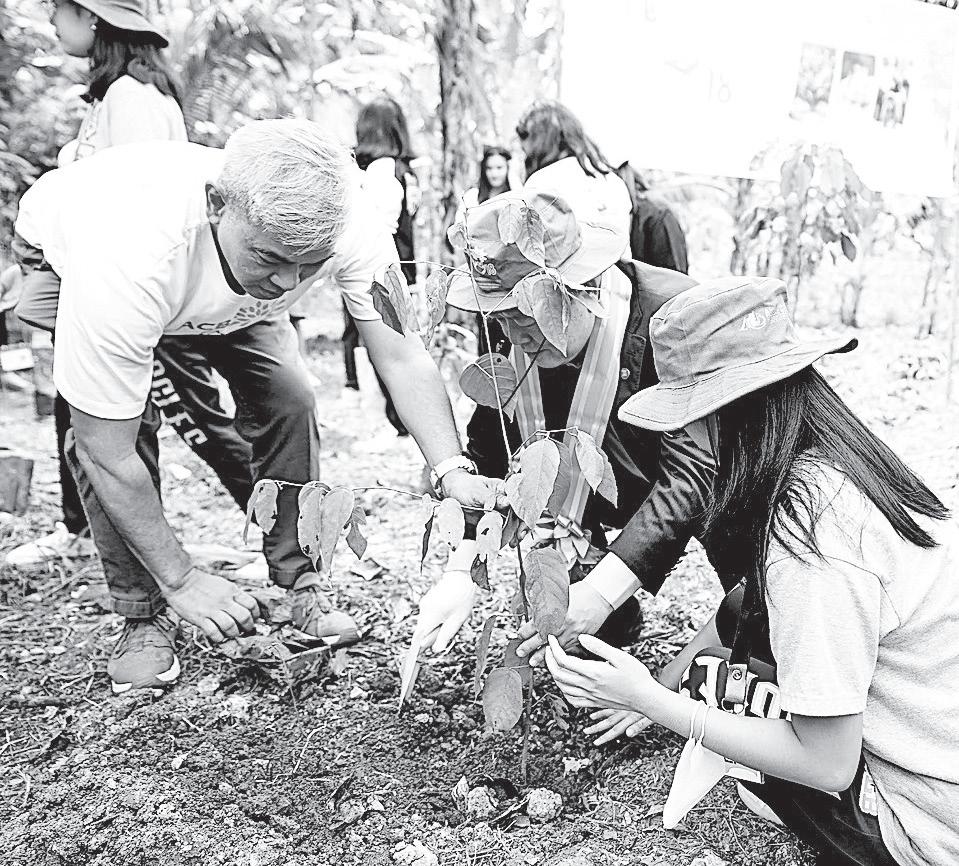
T he Department of Environment and Natural Resources believes the event is not only a celebration of the Asean’s shared commitment to biodiversity conservation, but also underscores a resolute dedication to achieving the vision of an Asean region, where biodiversity is effectively preserved, sustainably managed, and utilised to enhance the well-being of the people.
”The journey toward biodiversity
is happening now in Tañon Strait is both alarming and sad, but said it is not surprising.
“I am not surprised by this development. There still seems to be no sense of stewardship and genuine sense of responsibility to enforce the Enipas Act, and Fisheries Code, to name a few, and the management plan duly approved by DENR under the sterling leadership of then-BMB [Biodiversity Management Bureau] Director Mundita Lim and DENR 7 Regional Director [Isabelo] Montejo,” Ramos, an environmental lawyer, told the BusinessMirror on August 21.
Stronger law enforcement
RAMOS said there’s a need to revive policies and programs that strengthen protection in Tañon Strait.
“We would like to see the Coastal Law Enforcement in Region 7 [CLEAR 7] to be active again. The Tañon Strait Protected Area Management Board met regularly and approved the resolution to require vessel monitoring measures for all commercial fishing vessels transiting in Tañon Strait,” Ramos said.
Ramos’s leadership in Oceana saw the creation of many Bantay Dagat (Sea Patrol) volunteer groups in Negros and Cebu, among its various initiatives to protect this very important body of water.
According to Ramos, Cebu province under then-Gov. Hilario Davide III became the first province to require vessel monitoring.
She added that climate change aggravates the impacts of “human indifference, apathy and greed in illegally, shamelessly and recklessly exploiting our declining marine resources.”
Ramos agreed that plastics and water pollution abound.
She said, “Sadly, the ecological dots are still to be connected, especially by the duty holders, the government, except for a few.”

Ramos pointed out: “The call now is not to wait for duty holders to do the right thing. We have to be that society that we long to be and future generations deserve—less talk, more action—a mantra for all who still cares.”
conservation remains an ongoing endeavour. We are confident that as the [AMS] strive to navigate the complex areas of conservation, capitalise on the current technological and financial solutions, and advocate for policies that prioritise the protection of our natural heritage, we will be guided by the able leadership and workforce of the ACB,” said Jhorace Tupas, senior ecosystems management specialist of the Coastal and Marine Division of the DENR-Biodiversity Management Bureau.
Meanwhile, Permanent Representative of the Philippines to the Asean, Ambassador Hjayceelyn Quintana said, “The Philippines proudly hosts the ACB—the centre of excellence for biodiversity—and we remain dedicated to supporting the efforts of ACB and fellow [AMS] in preserving our natural heritage.”
LOS BAñOS, Laguna—Asean SecretaryGeneral Dr. Kao Kim Hourn graced the 18th Founding Anniversary of the Asean Centre for Biodiversity (ACB) together with the ambassadors of the Asean member states (AMS), Philippine government officials, Asean dialogue and development partners, University of the Philippines Los Baños officials and youth representatives at its headquarters in this town on September 10.
A CB Executive Director Dr. Theresa Mundita Lim, in her opening remarks, expressed her gratitude for the support of its partners, the Asean Secretariat, and the AMS in the almost two decades of regional cooperation for biodiversity through the ACB. The anniversary’s theme is “ACB@18:
Nurturing Seeds of Hope for a Sustainable Asean, the Epicentrum of Growth.”
”The ACB has come a long way since its establishment 18 years ago...The Centre has made significant strides in terms of facilitating regional cooperation and crosssectoral collaboration to guard Southeast Asia’s web of life,” Lim said.
“We affirm our commitment to nurturing seeds of hope through working hand-in-hand with the next generation of biodiversity champions and future leaders of Asean,” she added.
Kao shared his priorities and plans for the effective management of the region’s natural wealth. He thanked the government of the Philippines for its unwavering support to the ACB, being the host of the regional center.
“ The [ACB] is Asean’s own dedicated regional center of excellence on biodiversity. Since its establishment back in 2005, ACB has developed to becoming an essential and integral part of Asean cooperation on environment and an effective coordinating body for the [AMS] on biodiversity conservation,” Kao said.
With the pandemic recovery and climate change in the forefront, the secretary general pointed out that Asean will need to step up its efforts to promote nature-based solutions, best practices, and greening initiatives.
He underscored the relevance of ACB’s work to meet such objectives through its flagship programmes, such as the Asean Heritage Parks (AHPs), the Asean Green Initiative (AGI) and the Asean Youth
Tull Traisorat received the certificates from Kao and Lim for the Phu Khieo Wildlife Sanctuary-Nam Nao National Park and the Phu Kradueng National Park, as the 56th and 57th AHP, respectively.
Planting seeds of hope:
Native trees
YOUTH representatives from Los Baños joined the tree planting, together with the ambassadors of Brunei Darussalam, Cambodia, Indonesia, Lao PDR, Malaysia, Myanmar, Thailand, Singapore and Vietnam. Th activity was in line with the AGI, a flagship greening program of the region that aims to encourage the planting of at least 10 million native trees in 10 Asean member states in 10 years.
T he seedlings endemic to the Asean region are yakal (Shorea astylosa), katmon (Dillenia philippinensis), supa (Sindora
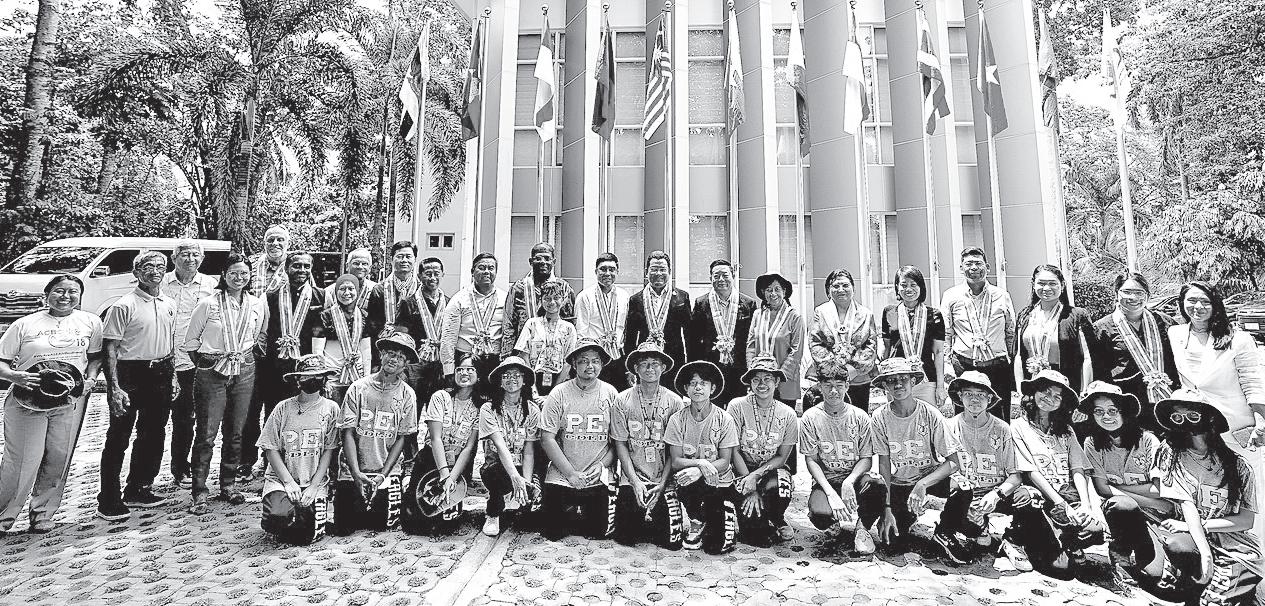
A7
BusinessMirror
THESE dolphins were chanced upon Tañon Strait by underwater photography expert Danny Ocampo, a senior campaigner of Oceana Philippines, during his visit to the area.
ASEAN Secretary General Dr. Kao Kim Hourn, ACB Executive Director Dr. Theresa Mundita Lim and officials lead the celebration of the 18th founding year of ACB, together with ambassadors and representatives from embassies of Asean member states, dialogue and development partners, the Philippines’ Foreign Affairs and Environment and Natural Resources officials, and the youth. ACB PHOTO
SENIOR Director Dr. Arvin Diesmos (left) of the Biodiversity Knowledge Management Department of ACB, assists Asean Secretary-General Dr. Kao Kim Hourn (center) in the ceremonial tree planting at ACB’s headquarters in Los Baños, Laguna. ACB PHOTO
Ancajas battles Inoue’s brother for WBA crown
JERWIN “THE PRETTY BOY”
ANCAJAS gets a chance to become world champion again when he fights World Boxing Association (WBA) bantamweight champion Takuma Inoue of Japan on November 15.
I noue, 27, is the younger brother of unbeaten unified super bantamweight champion Naoya Inoue.
I nternational matchmaker
Sean Gibbons confirmed to BusinessMirror the Ancajas-Inoue fight on Thursday. The venue will be announced at a later date.
Jerwin’s camp and the people behind Takuma have agreed to fight on November 15 in Japan,” Gibbons said. “It’s going to be a great fight and awesome opportunity for Jerwin to be a two-division champion.”
A ncajas, 31, held the International Boxing Federation super flyweight champion for some time but lost it in three consecutive fights. He moved up as a bantamweight and defeated Wilner Soto of Colombia via fifthround technical knockout last June 24 in Minneapolis, Minnesota.
His win-loss-draw record stands at 34-3-2 with 23 knockouts.
Takuma, on the other hand, is said to be not as tough as his elder brother but is a tactical fighter with good counterpunching skills and head movement.
Takuma owns an 18-1 won-lost record with four knockouts. He lost to former World Boxing Council bantamweight champion Nordine Oubaali of France in 2019.
Two years later, the Frenchman fighter lost to Nonito Donaire Jr. via fourth round knockout.

I noue won his last five bouts, including a unanimous decision win over Venezuela’s Liborio Solis last April in Japan for the vacant WBA bantamweight belt. Josef Ramos
BARCELONA, Spain—A day before Spain’s new women’s coach announces her first squad, the players who won the Women’s World Cup have yet to say if they are ready to come back to the team after rebelling against their disgraced former federation president Spain’s women have had little chance to celebrate their greatest soccer achievement because Luis Rubiales caused an uproar when he kissed player Jenni Hermoso on the lips without her consent at the awards ceremony last month in Sydney.
The 23 players, plus more than 50 others, responded to his subsequent refusal to step down in the days after the kiss by announcing that they would not play for their nation again until the federation underwent deep reforms and had new leadership.
I n the whirlwind of events since, the federation has been in upheaval. Rubiales was first suspended by soccer governing body FIFA, then his interim replacement fired the women’s national team coach that was unpopular with his players, and Rubiales himself eventually
PLDT Inc. (PLDT) and its wireless unit Smart Communications Inc. (Smart) celebrated the Philippines’ successful co-hosting of the FIBA Basketball World Cup 2023 (FIBAWC).
SPAIN WOMEN’S FOOTBALL TEAM STILL IN REVOLT
M any expected that the firing of coach Jorge Vilda and the exit of Rubiales would clear the path for the return of the players. But so far, with hours ticking down to the squad announcement, the best the federation can say is that talks are still ongoing.
The players said through their FUTRPO union on August 25 that they would not return to play for Spain “if the present leadership continues” and asked for “real structural changes that help the
national team continue to grow.”
It is not known if the players want more personnel changes as well as material improvements. We are asking for changes so no woman, inside or outside of soccer, should ever have to experience again situations of disparagement, disrespect, or abuse,” Spain midfielder Alexia Putellas, a two-time Ballon d’Or winner, said Wednesday. “We need consensus, courage and leadership from the institutions, please. This is why we
will not stop here.”
L ast year, 15 players similarly rebelled , asking for more “professional” coaching from Vilda. The federation firmly backed Vilda, and only three relented and were eventually included in this year’s Women’s World Cup squad.
Q uietly, however, the player revolt did appear to lead to some changes for the better. The staff was increased to more than 60 members to accompany the team to Australia and New Zealand, the team flew on chartered
flights, and players were given money to help bring their families along, with time guaranteed for the mothers to spend time with their children.
A nd after this second rebellion by the entire team, and with Rubiales— Vilda’s biggest supporter—on his way out, the federation this time sided with the players. In Vilda’s place, the federation named his former assistant, Monste Tomé, to become the first female coach of Spain’s women’s team.

R afael del Amo, the head of women’s soccer at the federation, said this week that he is hopeful the players will come back. He said the improved conditions the players enjoyed at the Women’s World Cup will remain in place and that he felt bridges had been mended with the removal of Vilda and the exit of Rubiales.
FUTPRO union president Amanda Gutiérrez, whose union is representing the players, said Wednesday that the situation is “complicated.”
It is true that the federation has listened…and that they are making structural changes,” Gutiérrez told Cadena SER radio. “Now it is the players’ turn to determine if those structural changes are sufficient or if there need to be more. I think it is a difficult decision for them, both for the players and for the people in the federation who are trying to resolve the conflict.”
It is not clear what Tomé will do if there is no deal between the players and the federation before she announces her list in Madrid on Friday. In theory, a player is obliged to answer the call by a national team. She could also call up others players to take their places.
Spain is set to play at No. 1-ranked Sweden in the Women’s Nations League on September 22. Spain, ranked second in the world, beat Sweden 2-1 in the Women’s World Cup semifinals before edging England 1-0 in the final. The squad announcement will come on the same day that Rubiales testifies in front of a Spanish judge investigating accusations by state prosecutors that he sexually assaulted Hermoso with his kiss. He says the kiss was consensual. Hermoso has denied that. AP
PLDT, Smart celebrate successful hosting of FIBA World Cup 2023
success of this global event.
PLDT and Smart President and CEO Alfredo Panlilio looked back at the two-week-long global showpiece, which kicked off at the Philippine Arena with a record-breaking opening day crowd of 38,115 fans.
two days of the tournament into a family affair by enabling their employees to experience the World Cup with their families at the Smart Araneta Coliseum and cheer for other international teams who were in the country to compete on the hardcourt.
PARIS—France’s top financial prosecutor said Wednesday that investigations into the organization of the 2024 Paris Olympics have not revealed any serious corruption or influence peddling, and that his goal is not to disrupt the event.
S peaking in an interview with RTL radio, Jean-Francois Bohnert said the potential infractions currently investigated by the financial prosecutor’s office are “mainly formal.”
It’s about favoritism, of illegal interest-taking,” he said. “It’s about the way certain contracts have been distributed, the arrangements...
But I don’t see any elements, at least not at this stage, that would lead the investigation towards the most serious cases of corruption or influence peddling.”
French police searched the Paris Olympic organizing committee headquarters in June as part of corruption investigations into contracts linked to the event. T he search and other
A s FIBA’s official global partner, Smart powered the FIBAWC experience with enhanced network by boosting Smart LTE and 5G networks at FIBAWC venues, hotels of delegates and international media guests, practice locations, and the FIBA World Congress, in partnership with technology partners Huawei and Ericsson.

Together with PLDT, Smart also established a Command Center in its headquarters and mobilized dedicated teams to monitor network
performance during the tournament. Employees from PLDT and Smart also shared their talents, tireless efforts and dedication either as
part of the FIBA Local Organizing Committee or of the FIBA Volunteers Program, passionately collaborating with various groups to ensure the
Paris Olympics ongoing probe: So far, so good
related raids were linked to two preliminary investigations of the Paris Olympics. One probe was opened in 2017—the year Paris was picked by the International Olympic Committee as the 2024 host—and the other began last year.
A sked whether arrests could take place during the Olympics, Bonhert said the office wants to “ensure the smooth running of what is going to be a global event” and a “universal party.” It’s not up to us to come and disrupt that order,” he added. “And that’s why we started early enough. The searches that took place were carried out more than a year before the start of the Games.”
The probe, opened in 2017, is looking into suspected embezzlement of public funds and favoritism, and concerns about an unspecified contract reached by Paris organizers, the prosecutor’s office said in June.

The 2022 investigation followed an audit by the French AntiCorruption Agency. The prosecutor’s office said that case targets suspected conflict of interest and favoritism involving several contracts reached by the organizing committee and Solideo, the public body in charge of Olympic infrastructure.
T he US Olympic and Paralympic Committee, meanwhile, officially endorsed Salt Lake City on Thursday as the American bid city for an upcoming Winter Olympics, with the committee’s chairman saying that while the US bid remains flexible, it would prefer hosting in 2034 over 2030.
The move to put Salt Lake City up as a candidate for “targeted dialogue” with the International Olympic Committee about an upcoming Winter Games was expected, but still marked a major milestone for the bid, said the city’s bid-committee
president, Fraser Bullock.
B id organizers have touted Salt Lake City, which hosted the Winter Games in 2002, as the most ready and most flexible candidate to host in either 2030 or 2034. The 2030 bid process has been muddled, with Canada and Japan pulling out of the running, but Sweden, Switzerland and France all more recently discussing a possible bid with the IOC.
T he 2034 Games would be less of a logistical and business challenge for both Salt Lake City and the USOPC, since 2030 would come only two years after Los Angeles hosts the Summer Games.
T he 2030 host was originally supposed to be selected at an annual IOC meeting in Mumbai next month, but that has been changed and is now expected to be chosen at a meeting on the eve of next year’s Olympics in Paris. AP
“ I’m extremely proud of all the Local Organizing Committee staff and volunteers, and feel extreme joy for the coming together of the FIBA community to make this World Cup a memorable one,” said Panlilio, who also sits as president of the Samahang Basketbol ng Pilipinas (SBP) and Second Vice President of the FIBA Asia Central Board.
“I learned many things in this FIBA World Cup 2023 and there is one lesson that got me through heart and mind: there are no big or small roles—every role is important,” said AJ Morales, Employee Relations Assistant at PLDT, who volunteered as a courtside personnel during the games.
“ I may not remember all the details, but I will definitely remember the experience of being part of this historic event that I can share with my children up to the next generation,” Morales added.
The MVP Group also turned
A t the close of the country’s monumental hosting of this global basketball tournament, PLDT Chairman Manuel Pangilinan, a key figure in bringing the FIBA Basketball World Cup to the Philippines, emphasized that this was a chance to show the Filipino culture and unique hospitality to the world, and “a gift to the Filipino people who adore the sport.” For Pangilinan, FIBAWC was a chance for Philippine basketball to plow more fertile ground for legends to grow.
To have our hard courts, our backboards and hoops, our fans bear witness to the story of Philippine basketball as it is written—to emphasize that this basketball-crazy country of our belongs to the league of basketball nations and for the Philippines to be a cradle of enduring legends,” Pangilinan said. Jakarta in Indonesia and Okinawa in Japan also co-hosted the World Cup.
Sports A8 Sunday, September 17, 2023 mirror_sports@yahoo.com.ph | Editor: Jun Lomibao
LUIS RUBIALES stands with Spain’s Women’s World Cup team at the La Moncloa Palace in Madrid.
PLDT and Smart President and CEO Alfredo Panlilio gets the feel of the Fan Zone during the World Cup.
CHIEF financial prosecutor says investigation into Paris’s hosting of the 2024 Olympics did not uncover no serious corruption. AP
European Union’s enforcer wants big technology firms to play by his rules
By Jillian Deutsch
Breton was in California to meet with the heads of big US tech firms. With the European Union’s content moderation rules set to go into effect in a mere two months, the internal market commissioner wanted to get a sense of how prepared the tech titans were to take down illegal content, moderate their platforms in each EU language and open up their algorithms, among other requirements. The leadership at Meta, he said proudly, had done its homework: Chief Executive Officer Zuckerberg had referenced specific acts of the law and had even asked Breton’s advice about how best to comply.
It was a remarkable change from their first encounter in Brussels more than three years earlier, when the company then known as Facebook had taken a more high-handed approach. At that time, the EU was drafting what would become the bloc’s landmark content moderation and competition rules, and executives had come to present their perspective.
Back then in February, Zuckerberg sat in silence while his chief lobbyist Nick Clegg fielded questions for the CEO and walked through a 22-page white paper detailing how Facebook envisioned government regulation. Breton, new to his job, asked Zuckerberg to answer for himself, then rebuked the company for not doing enough to oversee its platforms, said three people in the meeting who weren’t authorized to discuss it. And then, in a move companies would soon learn was typical Breton, the commissioner went off-script and surprised the CEO by asking him to speak with the reporters assembled outside. He did, briefly.
At the time, the world’s biggest tech companies—Meta and also Amazon.com Inc., Apple Inc., Alphabet Inc.’s Google and Microsoft Corp.—didn’t really think that European legislators could regulate them, the commissioner reflected. Years of US attempts to rein in these companies had largely failed, and tech companies thought they could successfully thwart oversight in Europe. But now, Breton boasted, the most powerful companies in the world were taking Brussels seriously.
Whether that proves to be true could be the defining question of the commissioner’s tenure. This story is based on conversations with dozens of people who’ve worked with Breton on tech policy issues or companies that have been in conversation with Breton, who requested anonymity to recount private
meetings and views they aren’t authorized to speak about.
The EU’s Digital Services Act (DSA) and the Digital Markets Act (DMA), the EU’s two landmark Big Tech laws, have just gone into effect and give the European Commission unprecedented power to tell tech bosses how to manage their businesses—and to levy steep fines if they step out of line. The DSA dictates how social media platforms and online marketplaces must respond to illegal and harmful content, while the DMA restricts dominant tech firms from engaging in anticompetitive behavior.
Before Breton, tech companies feared Margrethe Vestager, the EU’s two-term competition chief. Vestager became something of a celebrity in regulatory circles a decade ago when she dragged Google and Apple to court for allegedly abusing their dominance and not paying taxes. While some of her more ambitious cases ultimately fell flat, the EU has in the past decade become the world’s watchdog for tech thanks to groundbreaking data protection rules and a series of major antitrust and tax rulings that happened under her watch. To keep up with the rising tide of misinformation and emerging technologies such as artificial intelligence, the bloc is moving ahead with more regulation.
Enforcing these rules will be a challenge, and Breton—formerly CEO of French software maker Atos and France Telecom, France’s finance minister and a bestselling sci-fi writer—is making himself the face of this effort. That’s put center stage the two, sometimes conflicting, sides of Breton’s public persona: the assertive regulator who likes to tweet provocative warnings to the likes of Elon Musk, and the former CEO who wants to maintain chummy relations with those very same tech giants.
This, in practice, has meant vying for the title of EU digital enforcer previously held by Vestager. It’s well known the two don’t get along, clashing over their regulatory approaches and personalities. While Vestager advanced her carefully crafted lawsuits with intimidating calm, Breton acts more like a bold—often brash—CEO. Vestager worries big companies would only benefit the EU’s largest economies, while Breton thinks governments should help create European champions to compete globally. Vestager is wary of subsidies; Breton thinks they’re often needed to attract private investments. And while Vestager wants to make sure all companies play by
the rules, Breton wants to write new ones that favor European businesses. To Brussels bureaucrats, Vestager is emblematic of northern, laissez-faire values long dominant in town, while Breton embodies a French interventionist mindset gathering momentum as the EU tried to limit its dependence on China and the US.
These differences were exacerbated by a convoluted hierarchy that put Vestager in charge of the competition portfolio and also had her overseeing digital portfolios alongside Breton, who was technically her subordinate. Vestager, however, stepped aside from her role last week to seek a different job with the European Investment Bank, while Breton is angling for a second term in the commission.
Not that Breton has ever let technicalities stop him. Regardless of the industry or whether the topic falls within the confines of his job, Breton is constantly advocating for more regulation, more government intervention, and more generous state aid. His 2022 Chips Act unlocked EU funding for semiconductor production (a first) and stipulated that in the event of an emergency (like, say, a pandemic) companies had to prioritize regional orders. He has pushed for subsidies to encourage investments from companies such as Intel Corp. and Taiwan Semiconductor Manufacturing Co. (TSMC), backed procurement rules that would favor European businesses and advocated for provisions that would let governments intervene in company supply chains. To some, this legislation is visionary; to others, it’s a protectionist nightmare. With an assertiveness that can border on arrogance, Breton likes to say the bloc can “no longer be naive” about what he calls the “geopolitics of supply chains” and must cultivate its own resources. It’s all about rapports de force, or balance of power, Breton often says. If the EU can’t stand on its own, it’ll be bossed around by everyone else. Breton’s vision is to “build a future in Europe, with European workers, with European companies, with European made products” as he described recently in a speech. While his views were once dismissed as too protectionist, too French and anti-American—charges that particularly rile him given
that he lived in the US for years and almost got a green card—the world has changed in his favor. The Covid-19 pandemic, a war on Europe’s borders and a race among Western governments to create domestic supply chains have given Breton his moment.
Breton has a reputation for unpredictability—he once inserted himself on a trip to Senegal that was intended to be only for the commission president and a handful of Nordic female EU commissioners, according to people familiar with the mission. He also has a habit of making off-the-cuff comments that sometimes become policy. Google CEO Sundar Pichai learned this firsthand when he sat down with Breton for a one-on-one conversation during a spring trip to Brussels. While discussing AI regulation, Breton asked Pichai to support the “AI Pact,” which Pichai had never heard of but nonetheless agreed to, according to people familiar with the meeting. By the time Breton tweeted that Pichai had committed to some set of voluntary obligations, there was no way to back out. It was later clarified they had to do with mitigating AI use in risky contexts and labeling deepfakes.
Pichai wasn’t the only one caught off guard—as Vestager made clear to two of Breton’s cabinet members during a heated exchange in an elevator, according to people familiar, she was the one who came up with the plan.
Breton’s approach in Brussels, a town notorious for bureaucracy and caution, has been controversial. The commissioner has been accused by non-EU business interests and liberal critics of being a mouthpiece for France, both its companies and government. Tech companies argue that his efforts to force large streaming sites like YouTube and Netflix to help pay for Internet infrastructure are nothing more than a gift to telecoms providers such as Orange, which Breton used to run. They also point out that a cybersecurity certification proposal he’s backed would mainly benefit French cloud companies. An aide to Breton called these accusations false and prejudiced, as the telecom legislation hasn’t yet been proposed, and the cyber plan would help all European companies be competitive. The commissioner’s frequent meetings with CEOs have also
with the company’s oversimplified explanations, according to people in the room. A demo of ChatGPT, its flagship generative AI product, did not bolster confidence. The chatbot claimed that Breton had worked for fellow politician Nicolas Sarkozy—he hadn’t, and had previously been highly critical of Sarkozy—and programmers demonstrated how the software would refuse to tell users how to build a bomb, only to have Roberto Viola, one of the commissioner’s chief civil servants, then trick it into providing instructions.
drawn criticism. Some argue that Breton is too close to the CEOs he regulates. (Pat Gelsinger, the new CEO of Intel and the biggest beneficiary of Breton’s Chips Act, is a longtime friend.) Others say that these relationships are more for his own benefit than that of the regulation. Before Musk purchased Twitter, Breton flew to Texas and got the world’s richest man to film an awkward video saying he agreed with the EU’s ideas about content moderation. In contrast with Musk’s contentious relationship with US regulators, Musk and Breton have developed a rapport over the past year, in part through their shared affection for semiconductors and satellites.
“I find it problematic that he considered the balance of power with Musk was going to be est ablished with a handshake and a gentleman’s agreement following a discussion behind closed doors,” Jean Cattan, secretary general at the French National Digital Council, a policy research group that advises the French government. “That’s the best way to be fooled.” Breton’s aide said the commissioner has been publicly critical of Musk and that while relations are cordial with Gelsinger, Breton has no problem making a strong point to the CEO.
Breton used meetings with CEOs to become the center of the EU’s efforts to persuade companies to take the bloc seriously. He paid a visit to X, then known as Twitter, on his tour of Silicon Valley in June and greeted Linda Yaccarino, less than three weeks on the job as CEO. She offered Breton a coffee, the only amenity available at Twitter HQ, before a very tired-looking Musk popped up on the big screen for a “stress test” of Twitter’s ability to comply with the DSA. Musk kicked things off by saying that Tesla—er—Twitter, he corrected himself, planned to comply with the EU’s content laws and that the company seemed to be on the right track.

In addition to content moderation, AI regulation is likely the last big issue Breton will work on during his five-year term, which wraps up next year. As a trained engineer, the commissioner has claimed he’s uniquely well suited to understand AI’s technical complexity and the regulatory challenges it could present. During a presentation at OpenAI’s headquarters, Breton grew irritated
The EU is years ahead of the US in regulating AI. While US lawmakers just got major tech companies to agree to voluntarily invest in cybersecurity and share safety information with governments, Breton is pushing the EU to move faster in setting mandatory rules that could require companies to audit AI use in “high risk” situations, such as for hiring or in law enforcement, and to label deepfakes and AI-generated content as such. He’s told EU negotiators the AI Act needs to be passed by the end of the year and has stood firm on Europe setting its own rules. At a May meeting in Sweden, according to people familiar, Breton told US Secretary of State Antony Blinken that he needed to respect the EU’s democratic process after Blinken criticized the European Parliament’s proposals for overseeing generative AI.
But continued regulation comes with a price. Companies are increasingly delaying the EU rollouts of their products. The bloc was one of the last places to get access to Google’s Bard chatbot, and Meta has no plans to launch Twitter rival Threads in the EU because of questions about how competition rules will play out. Two tech companies, Amazon.com Inc. and Zalando SE, have already sued for allegedly being singled out by the Digital Services Act, and in June more than 150 European companies signed a letter expressing concern that too much AI regulation could jeopardize their competitiveness.
“If the EU starts embracing digital protectionism, there is a risk that techno-protectionism will become the global norm,” Columbia Law School professor Anu Bradford warned in her book Digital Empires. “After all, EU regulators should keep in mind that the Brussels Effect—the EU’s ability to externalize its regulations—is a potent mechanism for exporting both good and bad regulations alike.”
After slightly more than 24 hours in the US, the last stop on Breton’s whirlwind tour of tech company headquarters was Nvidia Corp., which was first valued at $1 trillion about a month earlier. Energized after spending nearly two hours talking about industry—his favorite topic—Breton was all smiles when he walked out to speak to the press with CEO Jensen Huang. Wearing his signature leather jacket, Huang commended Breton’s “great passion and expertise” in supercomputers, and Breton, in a matching EU pin and blue Dior tie, praised Nvidia for paving the way on “everything we do on AI.” Breton said he had invited Huang to visit him in Brussels, and the CEO brought up Breton’s “wonderful idea” that Nvidia invest more in Europe. “Et voila,” Breton said, turning to Huang. “Come quickly.”
Sunday, September 17, 2023 www.businessmirror.com.ph • Editor: Angel R. Calso A9 Features BusinessMirror
THIERRY BRETON was visibly pleased after meeting with Mark Zuckerberg. The 68-yearold Frenchman was suppressing a smile, his feathery white hair still perfectly in place following a late June stroll through the rooftop gardens of Meta Platforms Inc.’s sprawling Menlo Park complex.
Bloomberg News
THE Nvidia headquarters in Santa Clara, California. Breton praised the company for paving the way on “everything we do on AI.” MARLENA SLOSS/BLOOMBERG
Café Lupe Antipolo Offers a Perfect Escape from Metro Manila’s Hustle and Bustle
THE picturesque stretch of Juan Sumulong Highway from Marikina City ascending towards Antipolo has always been a haven for those seeking respite from the relentless buzz of Metro Manila. It’s the closest one can get to savoring a panoramic view of the city skyline while relishing a delectable meal and perhaps sipping on a cold brew, especially as the night casts its enchanting glow.
For those yearning for a brief escape from the metropolitan chaos, the Sumulong Highway in Antipolo is an idyllic destination for a night out with friends, a delightful family dinner, or a romantic date enveloped in the embrace of fresh air. Whether one arrives in the late afternoon to witness Manila’s sunset or during the evening, when the city lights come to life, the strip has something magical to offer.
While most restaurants in the area welcome guests from dawn till the early hours of the morning, the influx of diners typically begins in the afternoon, steadily escalating until midnight, particularly during weekends.

Among these charming restaurants, Café Lupe Antipolo stands out, not only as a latecomer but as the first dining establishment in this lively stretch, starting from Marikina. This prime location undoubtedly provides Café Lupe with a competitive edge.

True to its name, Café Lupe is a Mexican-themed restaurant with a unique twist – it boasts a fusion of Mexican and Filipino cuisines. The menu tantalizes taste buds with an array of offerings, including tacos, nachos, quesadillas, kare-kare, crispy pata, pinakbet, and even Ilonggo specialties like kadyos and inasal. Café Lupe caters to the most discerning palates among its walk-in diners.
The restaurant’s name, Café Lupe, pays homage to its owner, Alvin M. Carranza, a religious devotee of Our Lady of Guadalupe. This devotion is beautifully symbolized by the imposing statue of the religious icon gracing the entrance of Café Lupe Antipolo.

Antipolo is also regarded as an international pilgrimage destination in Asia because of the Our Lady of Good Voyage in the heart of the city as well as the Our Lady of Guadalupe, adding more to the strength of Café Lupe.
The journey of Café Lupe began in 2003 with its first branch nestled within the Guadalupe Seminary in Makati City. Notably, it was housed beneath the largest billboard structure adorning the EDSA Guadalupe Bridge, a fascinating detail considering that Alvin Carranza also wears the hat of CEO at Digital Out-of-Home Philippines (DOOH PH), a leading billboard company in the country.
DOOH PH manages the colossal 34,200-square foot billboard, often hailed as the ‘Mother of All Billboards’ due to its colossal size, dominating not only the local landscape but possibly Southeast Asia’s billboard scene.
Café Lupe continued to expand its footprint with two more branches in Tagaytay and Boracay in 2005.
In 2009, its fourth branch found a home in Barangay Mambugan along Sumulong Highway in Antipolo
City. While the other branches have since faded away due to operational complexities, Café Lupe Antipolo remains as a testament to its enduring appeal.
Café Lupe Antipolo caters to various preferences with its variable operating hours, which reflect its popularity. On Sundays and Mondays, it opens its doors from 11 am until 1 am the following day. From Tuesdays to Thursdays, it extends its hours from 11 am to 3 am the next morning. Fridays and Saturdays, the busiest days, see Café Lupe Antipolo operating from 11 am until an impressive 4 am the following day.
Beyond being a restaurant and bar, Café Lupe Antipolo offers family KTV rooms for those who relish singing with friends while enjoying a more private setting. The spacious al fresco music lounge area boasts a large stage for live performers, especially on weekends. Additionally, a colossal LED video wall adjacent to the al fresco music lounge keeps patrons entertained with sports programs, MTVs, or occasional payper-view sports spectacles.
Café Lupe Antipolo goes above and beyond, with spacious function rooms available for private and corporate events and parties. It has 12 rooms that rival the comforts offered by five-star hotels in Metro Manila, making it an ideal weekend getaway, not just for friends but also for families.
Interestingly, Café Lupe Antipolo doubles as Casa Alegria Bed and Breakfast, offering staycation opportunities that let you stay close to the Metro Manila skyline. Much like its sister hotel, Casa Alegria, located along Ligaya Drive in Tagaytay City, where rooms overlook the breathtaking Taal Lake and volcano, Café Lupe / Casa Alegria in Antipolo provides scenic views of the Metro Manila skyline, which come to life at night.
To complete the staycation experience, Café Lupe Antipolo boasts a small infinity pool that offers a stunning view of the Metro Manila skyline, providing a truly relaxing and soothing

dip. For those seeking privacy and indulgence, there’s a jacuzzi and spa located on the topmost deck of Café Lupe Antipolo, exclusive to hotel guests.


Fitness enthusiasts can maintain their routines at the basement bodybuilding gymnasium, where an instructor is readily available to offer guidance and tips for those looking to break a sweat and shed some calories.
What truly elevates the Café Lupe Antipolo experience is its exceptionally warm and accommodating staff, from waiters to chefs. They excel in attending to patrons’ needs, ensuring that every customer and guest feels like royalty.
Jimmy Delfin, one of the chefs at Café Lupe Antipolo, who also serves as the chef and hotel manager of Casa Alegria in Tagaytay, emphasizes their commitment to providing not just great value for money but also unforgettable dining and staycation experiences.
According to Jimmy, the unique fusion of flavors offered by Café Lupe sets it apart and keeps customers coming back.
Customers and guests should not miss the opportunity to savor Café Lupe Antipolo’s homemade beer, Lupe Lada, a delightful blend of beer and pina colada. It’s one of their signature offerings that keeps patrons returning for more.

With its cozy ambiance, festive atmosphere, excellent amenities, and captivating views of the Metro Manila skyline, Café Lupe Antipolo is the epitome of an ideal weekend getaway. All this comes at reasonable prices, making it an unbeatable deal.

For those looking for an escape that combines culinary delights, scenic beauty, and relaxation, Café Lupe Antipolo beckons. It’s a promise of an unforgettable experience that should not be missed.
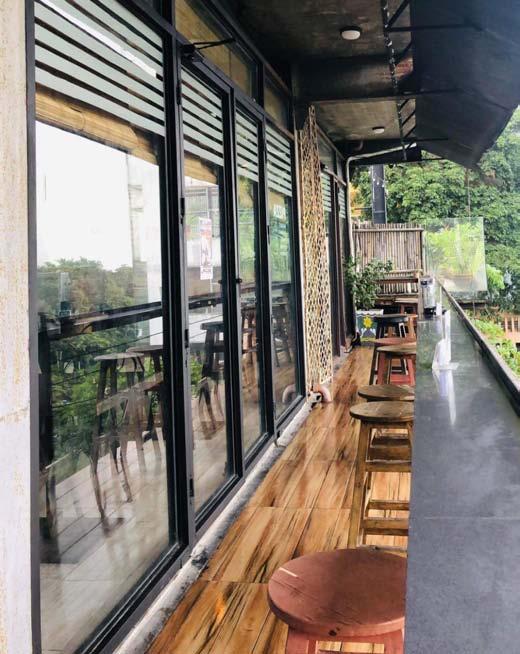
Sunday, September 17, 2023 A10 Special Feature A



BusinessMirror September 17, 2023
‘Final
Final run? Underwhelming
Fantasy XVI’ costs maker billions in market value
SWIPE RIGHT FOR ‘MR. RIGHT’ Mae Stephens on the pitfalls of online dating
By Reine Juvierre S. Alberto
You’ve probably stumbled upon this viral song titled ‘If We Ever Broke Up’ by breakout star Mae Stephens on TikTok and Facebook Reels, where people, including K-pop idols ITZY and ENHYPEN, dance to it with just their hands and facial expressions.
It’s catchy and funky—definitely an “LSS” (last song syndrome) type that will linger in your head for days. Now, Mae, the 19-year-old viral sensation from Kettering, is back with another equally
Publisher :
Editor-In-Chief :
Concept :
Y2Z Editor :
SoundStrip Editor :
Group Creative Director :
Graphic Designers :
Contributing Writers :
infectious single, ‘Mr. Right,’ featuring American popstar Meghan Trainor.

‘Mr. Right’ is glittery disco—more colorful and groovy but with the same catchy melodies. It’s the kind of pop song that’s meant to be danced with your friends after an online dating mishap.
Talking about her new single, Mae told SoundStrip in an interview that during the process of writing the song with Meghan, they “were just giggling about the little awkward moments you go through when you’re were a date,” which she noted the comedic side of online dating.
“You will find the right person, but you just have to go through trials and tribulations first,” she stressed.
had looked up to since she was a child. Speaking about Meghan, Mae stated, “She’s been really lovely to work with,” with her team being “so accommodating” to her.
To have her first collaboration with someone she regarded as “so humble and down to Earth, so high up industry,” she never imagined it to happen.
In a statement, Meghan shared that when Mae’s team reached out to her, she was ecstatic. “I am beyond honored that Mae asked me to be a part of this song,” and was quick to add, “I cannot wait for more and more people to discover her and to hear her incredible songwriting and vocal skills.”
With email and texts as their only means of communication from halfway across the world, the duo never met each other personally.
Mae explained that between getting the recordings done and sending verses back and forth, Meghan was also on the verge of having a child at that time, which Mae complimented Meghan on doing “really well.”
as well, Mae admitted, “I never expected it to reach this kind of height.”
“To be able to turn someone’s life around but also to give someone that amount of exposure that quickly, [TikTok] is an incredible platform, and I kind of was glad it happened for TikTok as opposed to in a different way,” Mae added.
The reason she joined TikTok is that she has seen artists post their songs, and it changed their lives, but for her, she revealed it was harder than it seems to be. She spent a long time trying to figure out how the system works, and eventually, she made it happen.
She recounted the moment when she was sitting next to her partner, and both of them were in disbelief, and couldn’t believe it happening at all.
“This does not just happen. This is fake!” she beamed.
To her, it was the “most shocking moment” of her life, something that she had waited for so long, and it finally happened.
T. Anthony C. Cabangon
Lourdes M. Fernandez
Aldwin M. Tolosa
Jt Nisay
Edwin P. Sallan
Eduardo A. Davad
Niggel Figueroa
Anabelle O. Flores
Tony M. Maghirang
Rick Olivares
Patrick Miguel
Jill Tan Radovan
Reine Juvierre Alberto
John Eiron R. Francisco
Pocholo Concepcion
Francine Y. Medina
The song is straightforward: after all the swiping in a dating app, and if that person does not pass her test, then she’ll swipe left, swiping on to the rest until she finds her Mr. Right.
I know what I deserve
I deserve the whole damn world
And if you can’t provide it
Then I’ma keep swipin’
Childhood idol
AS a newcomer in the industry, Mae declared she was lucky to have the opportunity to create music with someone she
Despite the distance and writing the song virtually, both of them have come up with a new anthem for those who are single and finding “Mr./Ms. Right,” and looking forward to shooting the music video for this song.
“It would be nice for us to meet after all of this,” Mae noted.
Dreaming big dreams
WITH Mae’s single, ‘If We Ever Broke Up,’ has racked up more than 350 million streams worldwide, with over 132 million streams and over 10 million monthly listeners on Spotify and 3.3. million YouTube views, she has earned her track a certified Silver in the UK, with a certified Gold in the US soon.

Gaining massive success on TikTok
“It didn’t feel like reality at all,” she quipped.
Now, Mae has been playing live shows and has performed with PINK in London, at the Glastonbury festival, and opened for K-Pop sensations, BLACKPINK.
Currently, she’s working on getting her next single ready, and hopefully, a music video for ‘Mr. Right.’
“There’s quite a lot going on in different aspects, but it’s all very exciting, and when it all comes, it’s going to be really cool,” she mused.
Photographers :
Y2Z

Bernard P. Testa
Nonie Reyes
Tel. Nos. (Editorial) 817-9467; 813-0725.
Fax line: 813-7025
Advertising Sales: 893-2019; 817-1351,817-2807.
Circulation: 893-1662; 814-0134 to 36. www.businessmirror.com.ph
With her humble beginnings, Mae used to work at a local supermarket Asda, and has quit her day job to do something that she “really loves” and gets to do every day. But before it happened, she was also a target of bullying in her school for being the “loud and quirky” kid.
Rising above those, Mae has channeled all her pent-up emotions through music, turning it into something creative, and in the process is fast becoming the voice of her generation going through the same thing.
Speaking to her fans she calls “misfits,” Mae encouraged that if they’re going through a period in their life, figuring out who they are, what they’re good at, and what they want to do with their life, “if you find something that gives you that little spark, go and do it. Mine was music,” she said.
“Go and do what you want to do because otherwise, you’ll never catch it you have to go. Do what you enjoy,” she concluded.
BusinessMirror YOUR MUSIC SEPTEMBER 17, 2023 | soundstrip.businessmirror@gmail.com 2
are published and distributed free every Sunday by the Philippine Business Daily Mirror Publishing Inc. as a project of the
Business Mirror Publishing,
with offices on the 3rd
of Dominga
2113
& SOUNDSTRIP
The Philippine
Inc.,
Floor
Building III
Chino Roces Avenue corner Dela Rosa Street, Makati City, Philippines.
“I
F we ever broke up, I’d never be sad Thinking about everything we had If we ever broke up”
SITTI–‘Sakto’

ON her new single “Sakto,” bossa nova queen Sitti is grateful she’s still high on the list of the music niche she’s associated with, Bossa Nova. Sitti said, “The thing about singing a very niche genre is that it taught me not to have expectations, but to just be grateful that I still get to sing and perform my kind of bossa nova.”
“Sakto,” a song co-written by Itchyworms drummer and main songwriter Jazz Nicolas, and Wally Acalola, is something she found to be “so cute and beguiling and innocent” that she hopes it grows on people and becomes a favorite,” “With every song I am blessed to perform,” Sitti noted, “I try my best to approach and infuse it with my truth. Sometimes in the course of recording, I do depart from how it is usually sung in the demo, but with ‘Sakto,’ I think the vocal arrangement was super on point already there was no need for me to embellish. I just enjoyed the recording ride and the playfulness of the lyrics.”

A SEPTEMBER TO REMEMBER
With these new releases
SHOTI–“LDR”
PAOLO
“Someone New”
JED BARUELO – “Nahuhulog”

FILIPINO pop-rock sensation Jed Baruelo continues to gain significant traction in the Philippines with the success of “Nahuhulog,” a song that the singer-songwriter claims to tackle confessional love that overflows with excitement and genuine appreciation infused with altrock melodies, ‘80s synths and lush arrangements,

“It really started with the ‘AUs’ on TikTok, wherein people used “Nahuhulog” as a sound for their made-up stories that entertained a particular community or fan base,” Baruelo said. “And perhaps the ‘eye trend’ really helped a lot in the recognition of the song. Apart from this, the catchy chorus and intro of “Nahuhulog” must have really caught their attention.”
YOUNG
Filipino
singer/producer Shoti is making waves with his crossover hit “LDR” topping various streaming charts in Southeast Asia. The laid-back tune recently went viral thanks to its sped-up version, which inspired countless dance covers on TikTok.

With the song delivered in English and Cebuano lyrics, Shoti continues the tradition of asserting cultural and geographical identity to mainstream music, while remaining current and true to his vision as an artist. The 16-year-old bedroom pop sensation shared, “My record label treats me not like a business partner but as a member of the family. They’ve been guiding me in terms of putting my music out there and reaching as many people as I could. Shoti’s latest single, “LDR” is accompanied by a music video which showed the young artist and his friends in a happy, carefree state
THE new song by Paolo Sandejas featuring Martti Franca stands out as a poignant reflection on the so-called “situationship” in a world where relationships are increasingly nuanced. According to the artists, their song delves into the complexities of a situationship, where the narrator longs for more despite knowing the relationship’s casual nature. In fact, the song’s lyrics, seamless blend of evocative melodies and soulstirring vocals from Pao and Martti should pull at the heartstrings of any listener.
“Our song lets you feel the desperation to hold on, even when the knowledge of an impending end looms, and when everything’s undefined and unsure,” Paolo said. “Ultimately, the song encapsulates the universal experience of yearning for more in a relationship till they find someone new,” he added.

THE INSEKTLIFE CYCLE

Omnibuzz Panofly Album
ICEMAN
bob describes himself as a solo sonic experimenter making music at home with keyboard, synth, electric guitars, and lap steel. He lives in Panabo, Davao. On the inspiration behind his jazzy latest recording, Bob told Sound Sampler, “If you’re a musician, writer, or painter you have to practice your craft consistently in order to develop. You can’t wait for inspiration. The main inspiration is to continue making music As for the album title, there is the basic definition of salvation. Also, salvacion is an area of my town. Lastly, there’s the concept of music as salvation; I’ve always been very fond of John McLaughlin’s idea of music as a spiritual practice.”
THE Pinoy band is an instrumental psych rock group formed in 2013 by members of Hateure & Barabbas. Their latest release is their 10th Year Anniversary Special-an exclusive collection of tracks and singles. Insektlife’s music has been variously described as “intricate math rock with subtle shoegaze tones” that are “they’re more convoluted than a brace of X-Files and Lost box sets.” Record Collector describes their previous album as “a heavyweight beast..full of groaning bass tones, riffs like monster trucks and drums like monster hangers beaten by telegraph poles.”
The foregoing music can be accessed on various digital music platforms such as bandcamp.
soundstrip.businessmirror@gmail.com | SEPTEMBER 17, 2023 3 BUSINESS MUSIC
SANDEJAS AND MARTTI FRANCA
ICEMAN BOB - Salvacion Album
Underwhelming ‘Final Fantasy XVI’ costs maker billions in market value
by takashi mochizuki & Kotaro Hara Bloomberg
Mid and forgettable games?
“Squ A r E Enix has problems with their games output,” said Serkan Toto, a Tokyo-based industry consultant, who said too many of the company’s games are “kind of conventional” and don’t aspire to become blockbusters. “These titles get a 70 percent rating on Metacritic, are kind of OK and are just very forgettable.”
A Square Enix spokesman did not respond to a request for comment.
The Tokyo-based firm has long relied on its feted franchise to supercharge growth— a formula that lifted its value five-fold in the decade leading to the launch of the latest Final Fantasy in June. But the game’s sales underwhelmed, and things got worse in August after the company reported a sharp profit decline. Shares plummeted by double digits, a dozen analysts tracking the stock cut their price target and long-term investor Sumitomo Mitsui Trust Asset Management Co. slashed its holdings in the game company.
One of the most recognized names among console and mobile gamers, Square Enix is on a streak of misfires in attempts to build another hit series to buttress sales, and it’s fallen behind rivals like Capcom Co. and Activision Blizzard Inc. in terms of market value. The company’s fall from grace offers hard lessons for the industry about the importance of quality control and product planning, said fans, analysts and developers who have done business at or with the studio.
“Flooding the market with unfinished,
bad or untested games is a bad move,” Tokyo-based developer and gamer Michael Prefontaine said, listing Marvel’s Avengers, Forspoken and The DioField Chronicle as examples of poorly-thought-out games. “The company has overstretched itself on too many titles without proper oversight.”
‘A single producer’s fiefdom’
GA MEr S have complained about mobile titles that seemed to have been rushed out the door and then shut down in a year or so, such as Bravely Default: Brilliant Lights and Echoes of Mana. Current and former Square Enix employees, asking not to be named as they’re not authorized to speak publicly, pin the blame for that on the company’s approach of making every game project a single producer’s fiefdom.
Producers are given full reign over the scope and direction of projects, and there’s a shortage of proper documentation and team structure, the people said. Contractors who’ve done work for Square Enix describe an ad hoc process where project goals can shift without warning.
The outcome is a high degree of volatil-
ity in the quality of the final product: some recent Square Enix games have earned rave reviews while others, such as multimilliondollar flop Forspoken, have failed to find an audience.
Newly appointed Chief Executive Officer Takashi Kiryu, a 48-year-old Massachusetts Institute of Technology graduate who previously worked at Japan’s biggest advertising agency, has said he intends to whittle down the number of smaller titles and decrease outsourcing to focus on big-budget games with higher potential to improve the company’s profitability. The studio that made Forspoken was integrated into Square Enix after that title’s underwhelming performance.
But analysts question how effective any changes in product strategy would be without altering internal practices.
“We remain concerned with the company’s game development structure and game quality control, which could limit the longer-term performance,” Macquarie Capital Securities Japan analyst Yijia Zhai wrote in a letter to clients, while maintaining an outperform rating on the company.
The company has begun overhauling how it assigns producers, one of the contractors said. While game quality management remains a risk, the studio can bank on its legacy franchises for the time being, according to MST Financial analyst David Gibson. Square Enix has a loyal following of fans for its established titles and it can keep churning those out across new platforms to maintain sales for a while, Gibson said.

The company released a new mobile Final Fantasy VII game last week, but sales fell short of investor expectations. Square Enix’s stock has lost about 30 percent from its peak this year and on Wednesday was on track to close at its lowest since May last year.
rebuilding the storied maker of roleplaying games would take years and there’s little hope of large upside potential on earnings in the near term, said uBS Securities analyst Kenji Fukuyama. The company has rested on its laurels for too long and may have already exhausted the patience of loyal fans, who are growing tired of seeing old games reissued on mobile platforms, he said. The failure to spark a third major franchise beyond Final Fantasy and Dragon Quest is key to this skepticism.
“Even if we look five years ahead,” Fukuyama said, “there isn’t much that can make investors confident about the company’s future.”

‘Star Wars’ video-game director leaves Electronic Arts
VIDEO - GAME d irector Stig Asmussen, who led efforts to rebuild Electronic Arts Inc.’s Star Wars game franchise, is leaving the company.
Asmussen, a leader at the EA subsidiary respawn, oversaw two hit games. The first, Star Wars Jedi: Fallen Order, was released in 2019 to critical and commercial success and reached 20 million players. The sequel, Star Wars Jedi: Survivor, came out in April and has topped sales charts.

“After careful thought and consideration, Stig Asmussen has decided to leave respawn to pursue other adventures, and we wish him the best of luck,” an EA spokesperson said in a statement. “Veteran re-
spawn leaders will be stepping up to guide the team as they continue their work on
Star Wars Jedi: Survivor.”
The games were widely seen as a triumphant comeback after a shaky decade for Star Wars video games under EA. Their success helped turn respawn into one of EA’s top studios and even led the company to pull back on a mandate to add multiplayer to other games.
In April, Asmussen spoke to Bloomberg News about the company’s remote work policies and the new game’s relatively speedy development time. He said in March that he always saw the sci-fi series as a trilogy. Bloomberg
BusinessMirror September 17, 2023 4
Square enix Holdings Co. has shed nearly $2 billion of its value since Final Fantasy XVI, the latest installment of its global hit series, came out to mixed reviews. Now investors wonder whether one of the games industry’s most remarkable runs is coming to an end.
Cover photo from Square Enix
Final run?
Final Fantasy XVi main protagonist Clive Rosfield wields the Onion Sword, a recurring powerful weapon in one of gaming’s most celebrated series. Given the underwhelming sales of its newest game, however have we seen the last of Final Fantasy? Photo from Square enix
a SCREEnShOt of Star Wars Jedi: Survivor, which came out in april and topped gaming sales charts. Photo from StarwarS com
