DOE expects volatile oil prices to continue By Lenie Lectura
T IMPEACHMENT WATCH | SALN RECORDS TAKE CENTER STAGE Attorney Karen
Batu, officer-in-charge of the Records Division of the Office of the Ombudsman, takes her oath as a witness before the Senate Impeachment Court during the impeachment trial of Vice President Sara Duterte at the Senate of the Philippines in Pasay City on September 15, 2026. Batu testified on Duterte’s Statements of Assets, Liabilities and Net Worth (SALNs) as the court began hearing Article II of the impeachment case, which alleges unexplained wealth and failures to fully and truthfully disclose assets and financial interests. ROY DOMINGO-SPPA POOL
ROTARY CLUB OF MANILA JOURNALISM AWARDS
2006 National Newspaper of the Year 2011 National Newspaper of the Year 2013 Business Newspaper of the Year 2017 Business Newspaper of the Year 2019 Business Newspaper of the Year 2021 Pro Patria Award PHILIPPINE STATISTICS AUTHORITY 2018 Data Champion
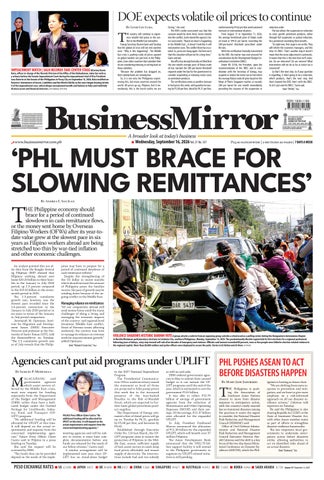
HE country will continue to experience volatile fuel prices as the conflict in the Middle East intensifies. Energy Secretary Sharon Garin said Tuesday that the global oil crisis will not end anytime soon. “Why is this happening? The Middle East crisis is pushing crude oil prices upward on global markets not just here in the Philippines. Even other countries that subsidize their oil are considering reducing or cutting back on those subsidies. “Because the problem has dragged on, their subsidy funds are running low. So, it is not only the Philippines experiencing this, but many countries around the world. Oil prices go up, Filipinos feel it immediately; this is the harsh reality we are
facing,” she said. The DOE’s earlier assessment was that this scenario would be short-lived. Seven months into the conflict, Garin shared the agency’s latest assessment. “Based on what is happening in the Middle East....It doesn’t look like it will end anytime soon. The conflict there has escalated. So, prices are rising again. Our forecast is that this situation will persist for a long time,” Garin warned. Her office has already formally certified that the one-month average price of Dubai crude oil has reached the $80-per-barrel threshold required under the law for the government to consider suspending or reducing excise taxes on petroleum products. The certification comes as another increase in fuel prices this week, with gasoline increasing by P5.68 per liter, diesel by P4.31 per liter,
and kerosene by P4.62 per liter amid sustained increases in international oil prices. From August 13 to September 11, 2026, the average benchmark price of Dubai crude oil stood at $99.41 per barrel, exceeding the $80-per-barrel threshold prescribed under the law. With the certification formally transmitted by the DOE, the matter may now proceed for consideration by the Development Budget Coordination Committee (DBCC). Under RA 12316, the President, upon the recommendation of the DBCC and in coordination with the Secretary of Energy, may suspend or reduce the excise tax on fuel when the average Dubai crude oil price based on the Mean of Platts Singapore reaches or exceeds $80 per barrel for one month immediately preceding the issuance of the suspension or
reduction order. The law allows the suspension or reduction to cover specific petroleum products, either through full suspension or partial reduction, for a period not exceeding three months. “So right now, first stage is we certify. They will inform the economic managers, and this time it’s DBCC. That’s another step.It doesn’t mean that the excise adjustment is automatic. It means that this is the time that we’ll evaluate. Do we intervene? Do we remove? What intervention will we do as far as excise tax is concerned? So that’s the next step. So if your question is regarding, is there going to be a reduction, which products, that’s the next step. And that’s beyond the DOE, that’s with the DBCC. So let’s just wait for DBCC,” Garin said. See “DOE,” A2
BusinessMirror A broader look at today’s business
EJAP JOURNALISM AWARDS
BUSINESS NEWS SOURCE OF THE YEAR
(2017, 2018, 2019, 2020, 2021) DEPARTMENT OF SCIENCE AND TECHNOLOGY
2018 BANTOG MEDIA AWARDS
‘PHL MUST BRACE FOR SLOWING REMITTANCES’ www.businessmirror.com.ph
T
n
Wednesday, September 16, 2026 Vol. 21 No. 337
P25.00 nationwide | 2 sections 20 pages | 7 DAYS A WEEK
By Andrea E. San Juan
HE Philippine economy should brace for a period of continued slowdown in cash remittance flows, or the money sent home by Overseas Filipino Workers (OFWs) after its year-todate value grew at the slowest pace in six years as Filipino workers abroad are being stretched too thin by war-tied inflation and other economic challenges.
An analyst pointed this out after data from the Bangko Sentral ng Pilipinas (BSP) showed that Filipinos working abroad sent home $20.39 billion to their families in the January to July 2026 period, up 2.3 percent compared to the $19.93 billion in the sevenmonth period in 2025. The 2.3-percent cumulative growth rate, however, was the slowest pace recorded since the 2.4-percent contraction in the January to July 2020 period or in six years in terms of the January to July period comparison. Jeremaiah M. Opiniano, Institute for Migration and Development Issues (IMDI) Executive Director and professor at the University of Santo Tomas (UST), told the BusinessMirror on Tuesday: “The 2.3 cumulative growth rate as of July reveals that the Philip-
pines may have to prepare for a period of continued slowdown of cash remittance inflows.” Despite the strengthening of the US dollar in recent months which should increase the amount of Philippine pesos the families receive, the pace of growth may be winding down because of the ongoing conflict in the Middle East.
Managing reliance on remittances
“AS our compatriots abroad still send money home amid the many challenges of eking a living and managing the economic impacts of the country- and regional-level situations [Middle East conflict, Strait of Hormuz issues affecting seafarers], the country may have to manage its reliance on overseas work for macroeconomic growth,” added Opiniano. See “Remittances,” A2
VIOLENCE SHADOWS HISTORIC BARMM VOTE A group attacks a vehicle from an opposing group outside a school used as a polling center during the Bangsamoro Autonomous Region in Muslim Mindanao parliamentary elections in Cotabato City, southern Philippines, Monday, September 14, 2026. The predominantly Muslim region held its first elections for a regional parliament following years of delays, a key step toward self-rule after decades of insurgency and violence. Officials said turnout exceeded 80 percent, even as five people were killed in election-related violence in the regional capital. More than 20,000 soldiers and police officers were deployed to secure the polls. Stories in A3 Nation and A5 News. AP PHOTO
Agencies can’t put aid programs under UPLIFT PHL PUSHES ASEAN TO ACT By Samuel P. Medenilla
M
ALACAÑANG said government agencies which assist sectors affected by the Middle East crisis, must now request for funding separately from the Department of the Budget and Management (DBM) rather than have a dedicated budget under the Unified Package for Livelihoods, Industry, Food, and Transport (UPLIFT) program. “No additional funding will be allocated for UPLIFT at this time. It will depend on the actual requirements and requests from the concerned implementing agencies,” Palace Press Officer Claire Castro said in Filipino in a press briefing on Tuesday. She said the request will be screened by DBM. “The funds that can be provided depend on the needs of the imple-
PALACE Press Officer Claire Castro: “No additional funding will be allocated for UPLIFT at this time. It will depend on the actual requirements and requests from the concerned implementing agencies.”
menting agencies and will be subject to review; it must have complete documentation before any funds are released for the needs of our fellow citizens,” Castro said. A similar arrangement will be implemented next year since UPLIFT has no stand-alone budget
in the 2027 National Expenditure Program. The Presidential Communication Office undersecretary issued the statement as local oil firms are projected to hike pump prices this week due to the increased presence of the Iran-backed Houthis in the Bab el-Mandeb Strait, which are expected to further limit global petroleum product supplies. The Department of Energy estimated a liter of diesel prices will go up on Tuesday by P4.31, gasoline by P5.68 per liter, and kerosene by P4.62. Established through Executive Order No. 110 last March, the UPLIFT programs aims to ensure the protection of Filipinos in the Middle East, ensure sufficient supply of fuel, assist sectors in need, keep food prices affordable and ensure supply of electricity. The interventions include fuel and rice subsidy
as well as cash aids. DBM ordered government agencies in May to submit their unused budget so it can sustain the UPLIFT programs until the end of the year, which is estimated to cost the government P155 billion. It was able to collect P22.79 billion of savings of government agencies from the reduction of Maintenance and Other Operating Expenses (MOOE) and their savings. Of the savings, P12.37 billion were allocated for the expanded UPLIFT. In July, President Ferdinand Marcos announced the allocation of P12.38 billion for the expanded UPLIFT, which will benefit over 37 million Filipinos. The Asian Development Bank announced that the US$1.75-billion support facility it will extend to the Philippine government to augment its UPLIFT-related initiatives is still pending.
BEFORE DISASTERS HAPPEN By Mary Jade Jadormio
T
HE Philippines is pushing the Association of Southeast Asian Nations (Asean) to move from disaster response to anticipatory action, with the country’s newly enacted law on imminent disasters among the practices it wants the region to consider, the National Disaster Risk Reduction and Management Council (NDRRMC) said. Office of Civil Defense Administrator and National Disaster Risk Reduction and Management Council Executive Director Harold Cabreras said the shift is a key focus of the two-day Asean Ministerial Conference on Disaster Resilience (AMCDR), which the Phil-
ippines is hosting as Asean chair. “We are shifting from mere response to prevention and mitigation, and we have to give more emphasis on a risk-informed approach on all our disaster resilience actions,” Cabreras told reporters on Tuesday. He said the Philippines is also sharing Republic Act 12287, or the State of Imminent Disaster Act, with other Asean member states as part of efforts to strengthen disaster-resilience frameworks. The law empowers local governments to undertake anticipatory action before disasters strike, allowing authorities to act on identified risks ahead of an actual disaster. See “Asean,” A2
PESO EXCHANGE RATES n US 62.8380 n JAPAN 0.4072 n UK 84.8690 n HK 8.0121 n CHINA 9.3669 n SINGAPORE 49.4671 n AUSTRALIA 44.8412 n EU 72.6093 n KOREA 0.0466 n SAUDI ARABIA 16.7318 Source: BSP (September 15, 2026)