SUBSIDIES handed out by the national government to government-owned and -controlled corporations (GOCCs) declined during the first seven months of the year compared to a year ago.
PCAB WARNS VS. GROUPS THAT MISUSE NAME, LISTS LEGIT FORA
THE Philippine Contractors Accreditation Board (PCAB) has warned the public against certain groups and individuals “illegally” using the name of the agency and its officers.
In a public advisory issued on Sunday, PCAB said: “These groups are allegedly engaging in unauthorized activities related to the submission, renewal, and release of contractor’s license applications.”
The accreditation body for contractors in the Philippines stressed that all official transactions, communications, and pay-
ments are conducted “exclusively” through PCAB’s official channels which are the PCAB Office, PCAB Online Licensing Portal, PCAB Licensing Verification Website, PCAB Official Email (pcab@construction.gov.ph), PCAB Official Mobile hotline (09178482427) and Facebook Messenger (facebook.com/dti.ciap.pcab).
“PCAB does not authorize any third-party consultants, agents, or individuals to collect or file application documents, fees, or payments on its behalf,” the agency attached to the Department of Trade and Industry
By Cai U. Ordinario
HIGHER government borrowings led to a doubledigit growth in the country’s external debt in the second quarter of the year, according to the Bangko Sentral ng Pilipinas (BSP).
Based on the data, external debt increased by 14.4 percent to $148.87 billion as of the end of June 2025 compared to the same period last year.
BSP said the growth was driven by the national government’s bond issuances as well as the foreign financing accessed by local banks.
“The increase in external debt was driven primarily by borrow-
ings, which included bond issuances by the national government amounting to $5.83 billion and external financing tapped by local banks amounting to $3.44 billion,” BSP said.
Meanwhile, compared to the previous quarter, the country’s external debt grew 1.5 percent on the back of the depreciation of the United States dollar.
“The increase in external debt for Q2 [second quarter] 2025 was primarily due to valuation effects from the depreciation of the US dollar. This increased the US dollar-equivalent of borrowings denominated in other currencies by $1.49 billion,” BSP said.
The data showed the net acquisi-
tion of Philippine debt securities amounting to $660.96 million also contributed to the increase.
Meanwhile, net repayments that amounted to $315.67 million helped temper the increase in the country’s external debt.
External debt stock was equivalent to 31.2 percent of the country’s gross domestic product, slightly better than the 31.5 percent recorded in the previous quarter.
“Metrics show that the external debt stock remained sustainable,” the BSP said in a statement.
As of the end of June 2025, the country’s short-term external debt based on the remaining maturity concept (STRM) stood at $28.63 billion.
The BSP said the STRM accounts for maturing external obligations within the next 12 months. The central bank said it presents a more comprehensive picture of the economy’s capacity to service its debt in the near term. This level, BSP said, remained well-covered by the country’s gross international reserves (GIR) of $106 billion, providing 3.7 times cover for short-term obligations. The country’s GIR-to-STRM debt ratio remains at par with emerging economy peers. Meanwhile, BSP said debt service ratio, another indicator of capacity to service debt that compares the country’s loan payments
By Andrea E. San Juan @andreasanjuan
LOCAL industries are pinning their hopes on the newly formed Independent Commission for Infrastructure (ICI) to “dismantle entrenched networks” that inflate costs and distort competition.
In a statement on Sunday, the Federation of Philippine Industries (FPI) said: “The ICI’s rare blend of execution know-how, forensic financial skills, and investigative rigor is exactly the kind of institutional muscle FPI has been calling for.”
“It operationalizes our vision of a procurement and infrastructure ecosystem where compliance is rewarded, corruption is punished, and Philippine industry competes on quality—not on who can game the system,” the group of local manufacturers and producers added.
President Ferdinand R. Marcos Jr. earlier issued Executive Order 94, creating the ICI, a fact-finding body which he tasked to conduct a probe and recommend the filing of charges related to anomalous flood-control projects and other public works within the last 10 years.
FPI, the country’s umbrella organization of manufacturers and producers, underscored that it has long championed a “clean, rulesbased” market to ensure a level playing field for compliant manufacturers, anchored on strict Philippine National Standards (PNS) compliance to shield legitimate producers from “being undercut by substandard or smuggled goods.”
This vision of the industry group will be “directly reinforced” by the ICI by ensuring that procurement and project execution are devoid of “favoritism, fraud, and corruption.”
As such, the group of local industries said a cleaner procurement environment will entice higher-quality bidders, many of whom are more likely to source from accredited local manufacturers, which is seen to help expand market opportunities for FPI’s members.
Further, FPI explained that transparent and accountable infrastructure spending, especially in critical flood control projects, will mean more works completed to specification, on time, and within budget, “creating sustained demand for quality local inputs such as steel, cement, and fabricated components.”
Elizabeth Lee, FPI Chairperson, said: “The ICI’s work will clean up a decade of flood-control anomalies, restore trust in public works, and cut the corruption premium that drives up costs.”
Lee said this means cheaper financing, stronger investor confidence, and a manufacturing sector that “wins on standards, integrity, and quality” now and for years to come.
In a separate statement on Sunday, the Philippine Chamber of Commerce and Industry (PCCI), the largest business group in the country, commended the creation of the ICI, calling a “strong signal of the President’s political will to address infrastructure anomalies, especially in flood control.”
PCCI said to likewise “strongly supports” the appointment of “independent professionals and technical experts” to the Commission.
“Former Secretary of the Department of Public Works and Highways [DPWH], Rogelio Singson brings unmatched experience in managing large-scale projects and navigating on-the-ground realities, bottlenecks, and corruption risks in procurement and construction,” PCCI said in its statement.
It also hailed the appointment of former chair of the Procurement Policy Board–Technical Support Office (PS-GPPB-TSO) Rossana Fajardo, saying she offers “institutional knowledge” in public procurement, economics, and governance—critical, it said, to addressing systemic loopholes in procurement processes. PCCI said Baguio City Mayor Benjamin Magalong “adds investigative rigor and accountability, leveraging his law enforcement background to strengthen evidence-gathering and oversight.”
To ensure the success of the fact-finding body, PCCI said three “foundational elements” are non-negotiable: (1) robust funding to recruit and maintain a highly competent technical secretariat; (2) complete independence, free from political and external influence; and (3) seamless, unwavering interagency support where all government bodies must provide timely access to documents and personnel, as well as protocols with the Department of Justice (DOJ), the Office of the Ombudsman, and
Commission (CSC) to ensure referrals are acted upon within strict, enforceable timeframes.
Why PHL voted for 2-State Solution for Palestine at UN
THEBy Malou Talosig-Bartolome
Philippines joined the 141 countries that voted in favor of a United Nations General Assembly resolution endorsing the New York Declaration on the peaceful settlement of the question of Palestine and the implementation of the twoState solution. The vote took place on September 12, 2025, with 10 countries voting against and 12 abstaining.
The Declaration is the outcome of a high-level international conference held in July 2025 at UN Headquarters, co-organized by France and Saudi Arabia. It outlines a roadmap that includes an immediate ceasefire in Gaza, the release of hostages, the establishment of a sovereign Palestinian State, the disarmament of Hamas, normalization of relations between Israel and Arab countries, and collective
security guarantees. “This conflict will only end when Israelis and Palestinians can live side by side in their own sovereign, independent States, in peace, dignity, harmony and prosperity, and where their rights, aspirations, and security are recognized and upheld,” then Philippine Permanent Representative to the UN Antonio Lagdameo said during the July conference.
Israel and the United States—both of which maintain defense and strategic partnerships with the Philippines— voted against the resolution. The United States did not participate in the July conference.
In explaining the Philippine position, Lagdameo said: “The Philippines firmly supports the two-State solution, in accordance with international law and relevant UN resolutions. We believe that this remains the most viable and sustainable pathway to resolving the Israeli-Palestinian conflict, which is essential to the realization of a lasting peace.”
Lagdameo also called for:
· Direct dialogue between Israel, Palestine, and all stakeholders;
· Accelerated diplomatic efforts, commending Saudi Arabia, Norway, and the EU for launching the “Global Alliance for the Implementation of a Palestinian State and a Two-State Solution;”
· A complete and permanent ceasefire in Gaza, the release of hostages, and unhindered humanitarian aid;
· Protection of civilians, especially women and children, in line with international humanitarian law;
· Full UN membership for Palestine, and expanded participation in UN processes; and
· The Philippines’ readiness to contrib -
ute peacekeepers, teachers, and medical workers to a UN-led humanitarian contingent in Gaza
Historical context
THE Philippines voted in favor of UN Resolution 181 in 1947, which recommended the partition of Palestine and the creation of a Jewish State. It was the only Asian country to do so. Diplomatic relations with Israel were formally established in 1957.
The Government of the Philippines recognized the State of Palestine in 1989, establishing diplomatic relations thereafter.
The two-State solution refers to the establishment of two independent and sovereign states—Israel and Palestine— living side by side in peace and security. It is based on pre-1967 borders and includes provisions for mutual recognition, security guarantees, and the resolution of final status issues such as borders, refugees, and the status of Jerusalem.
Israeli Ambassador Danny Danon stated that the Declaration was “one-sided” and claimed it would be viewed by Hamas as a victory. The United States did not participate in the July conference and opposed the resolution during the vote.
Both countries have raised concerns about the framing of the Declaration, including its references to Israeli military actions in Gaza and its implications for future negotiations.
Next Steps after UNGA vote
ALTHOUGH UNGA resolutions are nonbinding, the vote sets the stage for further diplomatic action:
· A follow-up high-level conference is scheduled for September 22, 2025, during the UN General Assembly’s general debate. France and Saudi Arabia will cochair the summit.
· Countries including Britain, France, Canada, Australia, and Belgium are expected to formally recognize the State of Palestine during or around the summit.
· Discussions will include:
• A proposed international stabilization mission in Gaza, pending UN Security Council authorization
E xpanded humanitarian aid, ceasefire enforcement, and hostage release mechanisms
Disarmament of Hamas and reforms within the Palestinian Authority
The Palestinian delegation is also lobbying for broader recognition and participation in UN processes, while Arab states have expressed unified support for the Declaration’s roadmap.
Continued from A1
are becoming more self-sustaining and require less budgetary support from the government.
“This improves fiscal space and allows the government to redirect funds to more urgent priorities like social services or infrastructure,”
Rivera said.
About 56.38 percent of the subsidies in July were cornered by other government corporations, while the remaining 43.63 percent was secured by major non-financial government corporations.
For the month, the Philippine Reclamation Authority (PRA) received the biggest amount of budgetary support with P4.433 billion.
It was followed by the National Irrigation Administration (NIA) with P3.376 billion and the National Food Authority (NFA) with P750 million.
Meanwhile, during the sevenmonth period, major non-financial government corporations received P33.908 billion, with the NIA obtaining the highest subsidy worth P21.101 billion.
NIA was trailed by the NFA with P7.932 billion and the National Housing Authority with P1.346 billion.
Other government corporations were also given a total of P27.816 billion, with the Power Sector Assets and Liabilities Management (PSALM) garnering the largest
amount, worth P8 billion. Next is PRA with P4.433 billion and the Philippine Crop Insurance Corporation with P2.250 billion. Moreover, government financial institutions obtained a total of P509 million, with the Small Business Corporation accepting P502 million.
For 2026, subsidies to state corporations are proposed at P149.654 billion, a 17.4-percent increase from this year’s allocation of P127.428 billion. (See: https://businessmirror.com.ph/2025/09/09/ state-firms-seeking-lawmakersnod-for-higher-budget-nextyear/).
The Philippine Health Insurance Corporation (PhilHealth) will receive the highest subsidy for next year, worth P53.262 billion, to finance the annual insurance premiums of indigent beneficiaries. Rivera, however, said that the increase in subsidies, particularly of PhilHealth, signals that the government still needs to bridge operational or systemic gaps in key public services.
“It’s critical that any increase in subsidies be tied to clear performance metrics and governance reforms to ensure value for money and improved public service delivery,” Rivera said. To recall, PhilHealth received no budgetary support from the government this year after the bicameral conference committee directed the agency to use its surplus funds instead.
Continued from A1
(DTI) pointed out. PCAB said it will initiate appropriate action against such individuals or groups, including referral to proper authorities such as the National Bureau of Investigation (NBI) and possible prosecution.
“We thank you for your vigilance and cooperation in protecting the integrity of the contractor licensing system and the construction industry,” PCAB said in the public advisory.
PCAB is mandated to issue, suspend and revoke licenses of contractors.
It was itself embroiled in the flood-control projects controversy following reports that certain executives were in conflict-of-interest situations, i.e., accrediting contractors while they had ties to some companies.
The body recently issued Resolution No. 075 series of 2025,revoking licenses of nine construction companies owned by flood control contractor Sarah Dis-
Continued from A1
with its income from exports and other inflows, improved to 8.7 percent from 9.8 percent a year earlier.
This resulted from lower principal and interest payments by resident borrowers as of the second quarter of 2025.
BSP explained that gross external debt, at any given time, is the outstanding amount of those actual current, and not contingent, liabili-
Continued from A12
Skills Development Authority— said he had signed a “manifesto for accountability for all these, and objectively, we have to show we are not covering up for anyone, to get the trust and the confidence of the public back.”
He noted, being a neophyte congressman, the recent events have been a shock for him, with the chamber “battered” by allegations of involvement of some lawmakers in the anomalous projects.
Slow food convention launched THE younger Benitez spoke at the formal launch of the Terra
Madre Asia & Pacific (TMAP) 2025 on September 9, where he expressed his continued support for Slow Food, championing local producers, and advancing this initiative particularly the link between gastronomy and sustainable development. TMAP 2025 will be held in Bacolod City from November 19 to 23, 2025. Over 2,000 delegates from over 20 countries are expected to participate in the five-day event. Among these countries are Japan, South Korea, Australia, New Zealand, Indonesia, Sri Lanka, Thailand, India, and Pacific Island nations.
The event will be the first-ever regional edition outside of Turin,
caya. (See: https://businessmirror.com.ph/2025/09/05/ dti-chief-says-more-pcab-officials-expected-to-resign-amidongoing-probe-into-anomalousflood-control-projects/) These nine companies are: St. Gerrard Construction Gen. Contractor & Dev’t Corporation; Alpha & Omega Gen. Contractor & Dev’t Corporation; St. Timothy Construction Corporation; Amethyst Horizon Builders and Gen. Contractor & Dev’t Corp; St. Matthew General Contractor & Development Corporation; Great Pacific Builders and General Contractor, Inc.; YPR General Contractor and Construction Supply, Inc.; Way Maker OPC; and Elite General Contractor and Development Corp.
“Whereas, such admission establishes a scheme of joint or multiple bidding participation designed to influence the outcome of public bidding, manipulate results and corner public projects thereby undermining transparency, fairness, and competition in violation of procurement laws and licensing requirements,” the PCAB resolution read.
Andrea E. San Juan
ties that require payment(s) of interest and/or principal by the debtor at some point(s) in the future and that are owed to non-residents by residents of an economy. External debt data are compiled by the BSP in accordance with the concepts and methodology set out in the International Monetary Fund’s (IMF) latest External Debt Statistics: Guide for Compilers and Users (External Debt Guide) and Balance of Payments and International Investment Position Manual, 6th edition (BPM6).
Italy where Slow Food created the biennial Terra Madre Salon del Gusto. This milestone event marks the designation of Bacolod City as the Slow Food Hub in Asia and Center for Sustainable Gastronomy and Negros Occidental as the Organic Capital of the Philippines.
“With this gathering that unites farmers and fisherfolk, chefs and artisans, indigenous peoples and the youth and policy makers and advocates, Terra Madre Asia and the Pacific will be more than a meeting of voices,” said Tourism Secretary Christina Garcia Frasco, for her part, at the launch. “Rather, it will be a call to action to defend our biodiversity and unsustainable practices and strengthen our communities for generations yet to come.” Ma. Stella F. Arnaldo
RP, Japan, US forces conduct 11th MMCA in WPS
By Rex Anthony Naval
NAVAL and air units from the Philippines, Japan and US militaries have successfully conducted the 11th “multilateral maritime cooperative activity” (MMCA) in the West Philippine Sea (WPS).
In a statement on Sunday, the Armed Forces (AFP) said the drills took place in the waters off Magalawa Island, Palauig, to Silanguin Island, San Antonio, Zambales.
Participants are from the Japan Maritime Self-Defense Force (JMSDF) and the United States Indo-Pacific Command (USIndopacom), the Navy (PN) and the Air Force (PAF).
“This marks the second MMCA conducted in September, following the successful completion of the 10th iteration on September 3, 2025. These continuous engagements underscore the sustained
See “MMCA,” A8
Lacson on Senate counter-coup: Fake news
RBy Butch Fernandez @butchfBM
UMORS of another Senate coup in the works were blasted by Senate President Pro Tempore Panfilo M. Lacson who branded it on Sunday as “Faky Breaky News,” saying the supposed media outlet that carried it was based in Davao City—a hint it could have been inspired by the Duterte bloc.
This, as the rumored beneficiary of a new leadership shakeup, Minority Leader Alan Peter Cayetano, signalled at the weekend he was happy being chief of the minority bloc, vowing to be the “constructive oppositionist” in a chamber shaken and divided for months by raging issues since the February 5 impeachment complaint was brought to it by the House of Representatives.
The most recent controversy, where certain senators got tagged in anomalous
budget insertions that enabled substandard and ghost flood control projects, was raging when the Senate leadership changed hands on September 8 from Senate President Francis Escudero to Sen. Vicente Sotto III. On Sunday, Lacson, Sotto’s staunchest ally, denounced a supposed “Breaking News” post claiming that another Senate leadership change is in the works.
Peke [fake]. Intended to deceive and confuse. Underestimating the intelligence of the new Senate majority bloc, nagbabaka sakaling may tumalon at magpirma [they’re taking the chance someone might jump fence and sign up],” Lacson said of the post.
“Malevolent, underhanded, foul and desperate. Kung may song na‘Achy Breaky Heart’, ito naman—‘Faky Breaky News‘’,” he added.
Transport workers get chance to buy ₧20/kg rice on Tuesday
TThink tank to business leaders: Update infrastructure, governance data policies
By Rizal Raoul Reyes @brownindio
NTERNATIONAL think tank
IBy Ada Pelonia @adapelonia
HE Department of Agriculture (DA) is set to roll out the P20 rice program to the transport sector on September 16.
The project is expected to benefit up to 57,000 transport workers in five major cities.
Agriculture Secretary Francisco Tiu Laurel Jr. said the program would be implemented in close coordination with the Department of Transportation (DOTr), Department of the Interior and Local Government (DILG), and the Land Transportation Franchising and Regulatory Board (LTFRB).
These government agencies helped identify beneficiaries from the transport sector.
“This is more than a food program. It’s a promise being fulfilled—a fight against hunger that meets people where they are,” Laurel said. “We are grateful to our partner agencies for making this possible in record time.”
Under the program, eligible drivers and operators will be al -
lowed to purchase up to 10 kilos of rice per month.
Initial rollouts will take place in the Bureau of Animal Industry (BAI) office in Quezon City, which could benefit 17,633 transport workers; Philippine Fisheries Development Authority (PFDA) in Navotas City, 1,001 beneficiaries; Food Terminal Inc. (FTI) in Cebu City, 24,742 beneficiaries; barangay Pandan in Angeles City, Pampanga, 9,961 beneficiaries; and Tagum City, 3,650 beneficiaries.
Designated distribution centers also include the Agribusiness and Marketing Assistance Division in Cebu, FTI warehouse in Angeles, and the AMAD office in Tagum.
The transport sector, which comprise of bus, jeepney, and tricycle drivers and transport operators, now joins the expanding list
of the government’s cheaper rice beneficiaries as part of its sweeping effort to bring down the cost of living for millions of Filipinos.
Initially aimed at senior citizens, solo parents, persons with disabilities, and indigent households, the P20 rice program has expanded to cover minimum wage earners, farmers, and fisherfolk.
“Public school teachers, nonteaching DepEd staff, and DSWD’s Walang Gutom beneficiaries are also scheduled to be added,” the DA said.
Meanwhile, Laurel stressed the government’s long-term vision for the program.
“We are fully committed to President Marcos’ directive to extend this program to 15 million households by 2026 and to keep it going until the end of his term in 2028,” he said.
Flood control probe leaves workers hanging...temporarily
By Justine Xyrah Garcia
HILE the flood control
Wproject (FCP) investigation has stalled operations and left several construction workers hanging, a ranking government official maintained that the disruption is only temporary.
Economic Planning Undersecretary Rosemarie G. Edillon on Thursday said the impact of the probe—which has forced contruction companies to halt work in several sites—might not last long.
“Right now, I think it’s a very temporary situation. And we hope that pretty soon, we’ll come up with measures to address the issues,” she told the BusinessMirror in a chance interview.
Earlier, the National Union of Building and Construction Workers (NUBCW) said that many crews have already asked for help in finding other jobs as subcontractors linked to the flood control controversy face possible closure.
The development comes at a time when construction has been one of the most consistent drivers of employment growth, supported by the Marcos administration’s Build Better More infrastructure program.
The Department of Labor and Employment (Dole) even earlier projected that construction and transportation would be among the sectors fueling job creation in 2025.
The latest data, however, show otherwise. The July 2025 Labor Force Survey (LFS) of the Philippine Statistics Authority (PSA) reported that construction shed 206,000 jobs quarter-on-quarter and 147,000 jobs year-on-year.
The sector, though still the third-largest source of employment nationwide, also registered one of the steepest declines in both periods.
This slump in the construction industry has raised concerns on whether the Philippines can deliver on its commitments under
the Global Accelerator on Jobs and Social Protection for Just Transitions, which the national government initiated last year.
The initiative seeks to fasttrack progress on the Sustainable Development Goals (SDGs) by creating decent work in the green, digital, and care sectors, while also expanding social protection to those who remain excluded.
Asked about this, Edillon said that the Philippines is doing “very good” in providing social protection, even to construction workers.
“With respect to jobs, it’s really a matter of providing them more opportunities,” she added.
However, NUBCW Secretary General Santiago V. Nolla countered that the crisis is far from temporary, pointing to the sector’s long-standing reliance on contractual arrangements and the absence of security of tenure.
“That is permanent and all the industry players, even the [Department of Labor and Employment]
know that. If their basis is only those involved in the FCP controversy, that is not temporary either because they don’t even have a program to address the needs of the affected workers, and yet they have the nerve to say it is very temporary,” he told BusinessMirror
He added that government must present a “clear, detailed, and realistic” plan for displaced workers.
“Huwag iyong puro denial at press release lang na walang basehan sa totoong buhay,” he said.
Labor experts earlier warned that unemployment in the construction industry could worsen unless government delivers concrete measures to cushion the blow.
Data from PSA showed that 4.60 million individuals are employed in the construction industry.
Of these, the NUBCW estimates that around two million are working in government projects.
Technical gaps slow DENR’s nature-based policy
By Bless Aubrey Ogerio
DRAFTING the country’s first policy on naturebased solutions (NBS) has turned into a technical puzzle for the Department of Environment and Natural Resources (DENR), with the agency working to fit global standards into the local realities.
Environment Assistant Secretary Noralene Uy said the agency is eyeing completion of the policy framework by 2025, but technical hurdles, such as defining standards and categories for projects,
have led to several revisions since work began in 2023.
“Mostly because we’ve had several iterations now since 2023. It’s really the technical aspect,” Uy said during a news conference at the Forest Foundation Philippines’ event in Quezon City.
“Although we have the IUCN [International Union for Conservation of Nature] guidance, there’s still a bit of difficulty because we don’t have a lot of NBS budgets actually,” she added. She explained that the draft draws on international guidelines from the International Union for
Conservation of Nature (IUCN) but must be tailored to Philippine conditions, where most initiatives remain small pilot efforts.
“For example, in the Philippines, what’s really like the normal NBS we see is the mangrove restoration. We don’t see yet many NBS being undertaken in urban areas,” Uy said.
The upcoming policy aims to formalize typologies and categories of NBS measures, enabling stakeholders to test and certify projects as NBS activities.
These, she added, could then be integrated into companies’ environmental, social and governance or corporate social responsibility commitments.
Since 2023, DENR has conducted consultations with stakeholders from agriculture, mining, utilities and other sectors to scale up efforts beyond localized projects.
“We would really like to be able to scale up. That’s why there’s an urgency to come up with this policy to invite more stakeholders,” the assistant secretary for policy, planning, international affairs and climate change said.
The framework is being developed with support from the United Nations Development Programme (UNDP), alongside initiatives such as the Forest Carbon Policy Roadmap and NBS stocktaking
Stratbase Institute on Sunday urged policymakers and business leaders to swiftly update national infrastructure and data governance policies with the rising demands of the global digital economy.
In addition, Stratbase also warned that failure to align with the demands of the global digital economy could cause the Philippines to lose out on billions in potential investment.
Professor Victor Andres Manhit, Stratbase Institute president, said that while Southeast Asia has become a hotspot for hyperscale data center and cloud infrastructure investments, the Philippines continues to be a laggard among its Association of Southeast Asian Nations (Asean) neighbors in capturing these opportunities.
“The Philippines is one of the most digitally active nations in the region, yet we are underperforming where it counts most—attracting infrastructure that powers the digital economy,” Manhit said. “We are sitting on massive potential, but we lack the policy urgency and infrastructure readiness to capitalize on it.”
According to industry data from Cloudscene, Reuters, and Data Center Dynamics, countries like Malaysia and Indonesia have secured digital infrastructure investments of over $16.7 billion and $5 billion, respectively, from global tech giants like AWS, Microsoft, and Google. Nonetheless, the Philippines has only attracted a measly $1.35 billion in data center commitments, primarily from local players such as STT GDC–Ayala and PLDT.
The global data center market is expected to grow to $652 billion by 2030, with over 1,189 hyperscale data centers already operating worldwide as of early 2025, based on reports from Synergy Research Group and Grand View Research.
Manhit emphasized that the Philippines currently holds a comparative advantage in this area due to its relatively open stance under the Data Privacy Act. Recent moves by the National Privacy Commission (NPC)—including the rollout of Model Contractual Clauses for cross-border data transfers—further improve the country’s digital policy environment.
“Our data governance model, while not perfect, is significantly more open than in countries like Vietnam or Indonesia,” Manhit said. “That should be a competitive advantage. But without supporting infrastructure, affordable power, and tech-ready talent, it won’t be enough.”
Manhit referred to a recent World Bank report showing that countries with favorable data flow frameworks and strong infrastructure tend to attract disproportionately higher foreign direct investment in the digital sector. Likewise, research from the Uptime Institute and Savills Asia Pacific shows that access to power, land, and interconnection options now directly impacts site selection for AI-ready data centers.
“The game has changed. Hyperscalers now build where there’s power certainty, skilled labor, regulatory trust, and long-term national vision,” Manhit added. “We need to check all those boxes fast.”
Moving forward, Manhit laid out clear priorities for government and stakeholders:
“We need to finalize a longterm national digital infrastructure strategy. We need targeted energy incentives to bring down the cost of running digital facilities. We must ramp up STEM education and invest in real AI skills training. And above all, we must ensure our data policies stay open, innovation-friendly, and trusted—while still safeguarding national interests.”
He added that this is not simply about technology but about positioning the Philippines for economic leadership in a datapowered world.
studies mapping projects across government, non-profit and private sectors.
It is also being aligned with international frameworks like the Kunming-Montreal Global Biodiversity Framework.
In addition, the policy will likewise interlock with national plans, including the Philippine Development Plan 2023-2028, the National Adaptation Plan 2023-2050 and the Philippine Biodiversity Strategy and Action Plan 2015-2028.
Uy expressed confidence that the NBS framework would be finished within the Marcos administration and sustained beyond it.
“This policy that we are developing now is between the DENR, but we plan to expand and engage the other stakeholders outside the government,” she said.
“On our part, as [to] what we’re doing in most of our policy, we try to get it right so that it can be sustained [in the] later administration,” she added.
A UNDP report last year noted that the framework is expected to replace the current ecosystembased adaptation principle and serve as a “mother policy” for NBS integration within the agency.
Stakeholder consultations are set to continue in the coming months, with DENR aiming to circulate a draft by the end of the year.
At the center of this investment wave is the issue of data sovereignty—the regulatory control nations exert over data storage and cross-border transfers. The Organization for Economic Cooperation and Development (OECD) has identified nearly 100 data localization measures across 40 countries, often adding significant operational costs for companies operating in restrictive markets.
CBy Bless Aubrey Ogerio
ONSTRUCTION material prices in Metro Manila moved in opposite directions in August, as wholesale costs continued to ease while retail prices inched higher, data from the Philippine Statistics Authority (PSA) showed.
The Construction Materials Wholesale Price Index (CMWPI) in the National Capital Region recorded a sharper year-on-year decline of 0.5 percent in August 2025, deepening from a 0.3-percent drop in July. The same month in 2024 had posted a 0.3-percent increase. The weaker performance in August stemmed largely from electrical works, the PSA said, which shifted to a 0.5-percent annual fall after a 0.3-percent gain in the previous month.
Galvanized iron sheets also slowed to a 0.7-percent rise from 1.3 percent, while plumbing fixtures and waterworks slipped to 0.4 percent from 0.5 percent.
“This is a battle for billions— and for our future. We either lead in the digital economy, or we lose ground in every other sector that relies on it,” he warned. Manhit called for stronger collaboration across government, telecommunication companies, and the private sector to ensure the Philippines doesn’t miss its chance to lead in the next wave of the digital economy.
Retail construction materials prices up in August See “Construction,” A8
Compared with July, bigger annual
reductions were also
Editor: Angel R. Calso
Israel escalates Gaza offensive, 32 dead as hostage families plead for ceasefire
By Wafaa Shurafa The Associated Press
DEIR AL-BALAH, Gaza
Strip—A barrage of airstrikes killed at least 32 people across Gaza City as Israel ramps up its offensive there and urges Palestinians to evacuate, medical staff reported Saturday.
The dead included 12 children, according to the morgue in Shifa Hospital, where the bodies were brought.
Israel in recent day has intensified strikes across Gaza City, destroying multiple high-rise buildings and accusing Hamas of putting surveillance equipment in them.
On Saturday the army said it struck another high-rise used by Hamas in the area of Gaza City. It has ordered residents to leave, part of an offensive aimed at taking over Gaza territory’s largest city, which it says is Hamas’ last stronghold. Hundreds of thousands of people remain there, struggling under conditions of famine.
One of the strikes overnight and into early morning Saturday hit a house in the Sheikh Radwan neighborhood, killing a family of 10, including a mother and her three children, said health officials. The Palestinian Football
Association said a player for the Al-Helal Sporting Club, Mohammed Ramez Sultan, was killed in the strikes with 14 members of his family. Images showed the strikes hitting followed by plumes of smoke.
Israel’s army didn’t immediately respond to questions about the strikes.
Hostages’ relatives rally in Israel MEANWHILE , relatives of Israeli hostages held by Hamas rallied in Tel Aviv on Saturday to demand a deal to release their loved ones and criticized what they said was a counterproductive approach by Prime Minister Benjamin Netanyahu in securing a resolution.
Einav Zangauker, the mother of hostage Matan Zangauker, described as a “spectacular failure” Israel’s attempted assassination of Hamas leaders in Qatar this week.
“President Trump said yes -
Pakistani army says clashes near Afghan border killed 19 soldiers and 45 militants
By Riaz Khan The Associated Press
PESHAWAR, Pakistan—Pakistani security forces raided three hideouts of the Pakistani Taliban near the Afghan border in the past two days, triggering fierce clashes that killed 19 soldiers and 45 militants, the military said Saturday. The death toll underscores the struggles that Pakistan faces as it tries to rein in resurging militant groups. The military said that 22 militants were killed in the first raid in Bajaur, a district in northwestern Khyber Pakhtunkhwa province.
Thirteen more militants were killed in a separate operation in South Waziristan district, the military said. The statement said that the 12 soldiers, “having fought gallantly, paid the ultimate sacrifice and embraced martyrdom” in South Waziristan.
In a separate statement, the military said a third intelligencebased operation was carried out on Thursday in Lower Dir district, triggering a fierce gunbattle in which seven more soldiers and 10 Pakistani Taliban were killed.
The militants are using Afghanistan to stage attacks in Pakistan, the military said, urging the Taliban government in Kabul “to uphold its responsibilities and deny use of its soil for terrorist activities against Pakistan.”
The military described the killed militants as “Khwarij,” a term the government uses for the Pakistani Taliban, and alleged they were backed by India though it offered no evidence for the allegation. Pakistan has long accused
India of supporting the Pakistani Taliban and separatists in Baluchistan, charges that New Delhi denies. There was no immediate comment from the Taliban in Kabul or from New Delhi.
Pakistani President Asif Ali Zardari, Prime Minister Shehbaz Sharif and other officials praised the security forces for killing dozens of militants, and praised the troops for sacrificing their lives in the fight against terrorism, according to state-run media.
It said Sharif and the army chief, Field Marshal Asim Munir, attended the mass funerals of the soldiers. They also visited troops wounded in the clashes at a military hospital in the northwestern city of Bannu. According to state-media, Sharif said that the country desires peaceful relations with all of its neighbors, including Afghanistan. But he asked the Taliban government to “make a clear choice” between maintaining friendly ties with Pakistan or continuing to harbor the Pakistani Taliban. Pakistan has faced a surge in militant attacks in recent years, most claimed by the Pakistani Taliban, also known as Tehrik-e-Taliban Pakistan, or TTP. The group is separate from the Afghan Taliban, but is closely allied with them. TTP has become emboldened since the Afghan Taliban seized power in Kabul in 2021, with many of the Pakistani Taliban leaders and fighters finding sanctuary across the border.
terday that every time there is progress in the negotiations, Netanyahu bombs someone. But it wasn’t Hamas leaders he tried to bomb—it was our chance, as families, to bring our loved ones home,” Zangauker said.
Some Palestinians are leaving Gaza City but many are stuck IN the wake of escalating hostilities and calls to evacuate the city, the number of people leaving has spiked in recent weeks, according to aid workers. However, many families remain stuck because of the cost of finding transportation and housing, while others having been displaced too many times and don’t want to move again, not trusting that anywhere in the enclave is safe.
In a message on social media
Saturday, Israel’s army told the remaining Palestinians in Gaza City to leave “immediately” and move south to what it’s calling a humanitarian zone. Army spokesman Avichay Adraee said more than a quarter of a million people had left Gaza City, from an estimated one million who live i n the area of north Gaza around the city.
The United Nations, however, put the number of people who have left at around 100,000 between mid-August and mid-September. The UN and aid groups have warned that displacing hundreds of thousands of people will exacerbate the dire humanitarian crisis. Sites in southern Gaza where Israel is telling people to go are overcrowded, according to the UN, and it can cost money to move, which many people
don’t have.
An initiative headed by the U.N. to bring temporary shelters into Gaza said more than 86,000 tents and other supplies were still awaiting clearance to enter Gaza as of last week.
Gaza’s Health Ministry said Saturday that seven people including children died from malnutrition-related causes over the past 24 hours, raising the toll to 420, including 145 children, since the war began.
The bombardment Friday night across Gaza City came days after Israel launched a strike targeting Hamas leaders in Qatar, intensifying its campaign against the militant group and endangering negotiations over ending the war in Gaza.
Families of the hostages still held in Gaza are pleading with Israel to halt the offensive, worried it’ll kill their relatives. There are 48 hostages still inside Gaza, around 20 of them believed to be alive.
The war in Gaza began when Hamas-led militants stormed into southern Israel on Oct. 7, 2023, abducting 251 people and killing some 1,200, mostly civilians. Israel’s retaliatory offensive has killed at least 64,803 Palestinians, according to Gaza’s Health Ministry, which does not say how many were civilians or combatants. It says around half of those killed were women and children. Large parts of major cities have been completely destroyed and around 90 percent of some 2 million Palestinians have been displaced.
Venezuela says US navy raided a tuna boat in the Caribbean as tensions rise
By The Associated Press
CARACAS, Venezuela — Personnel from a US warship b oarded a Venezuelan tuna boat with nine fishermen while it was sailing in Venezuelan waters, Venezuela’s foreign minister said on Saturday, underlining strained relations with the United States.
The White House did not immediately respond to a request for c omment.
Tensions between the two nations escalated after US President D onald Trump in August ordered the deployment of warships in the Caribbean, off the coast of the South American country, citing the fight against Latin American drug cartels.
While reading a statement on Saturday, Foreign Minister Yván Gil told journalists the Venezuelan tuna boat was “illegally and h ostilely boarded by a United States Navy destroyer” and 18 armed personnel who remained on the vessel for eight hours, preventing communication and the fishermen’s normal activities. They were t hen released under escort by the Venezuelan navy.
The fishing boat had authorization from the Ministry of Fisheries to carry out its work, Gil s aid at a press conference, during which he presented photos of the incident.
Along with the statement, Venezuela’s foreign affairs ministry d istributed a short video, taken, according to the ministry, by the Venezuelan fishermen. In the video, it is alleged that part of the fishing boat, US Navy personnel and the US warship can be seen.
“Those who give the order to carry out such provocations are
seeking an incident that would justify a military escalation in the Caribbean,” Gil said, adding that the objective is to “persist in their failed policy” of regime change in Venezuela.
Gil said the incident was “illegal” and “illegitimate” and warned t hat Venezuela will defend its sovereignty against any “provocation.”
T he Venezuelan foreign minister’s complaint comes days after Trump said that his country had attacked a drug-laden vessel and killed 11 people on board. Trump said the vessel had departed from Venezuela and was carrying members of the Tren de Aragua gang, b ut his administration has not presented any evidence to support that claim.
Venezuela accused the United States of committing extrajudicial killings. The South American country’s interior minister, D iosdado Cabello, said Washing -
Rubio seeks Israel’s answer on way forward in Gaza after Qatar strike
By Matthew Lee AP Diplomatic Writer
ton’s version is “a tremendous lie” a nd suggested that, according to Venezuelan government investigations, the incident could be linked t o the disappearance of some individuals in a coastal region of the c ountry who had no ties to drug trafficking.
The Trump administration has accused Venezuelan President Nicolás Maduro of leading a cartel to flood the US with drugs, and doubled the reward for his capture from $25 million to $50 million.
The US government has given no indication that it plans to carry out a ground incursion with the more than 4,000 troops being deployed in the area.
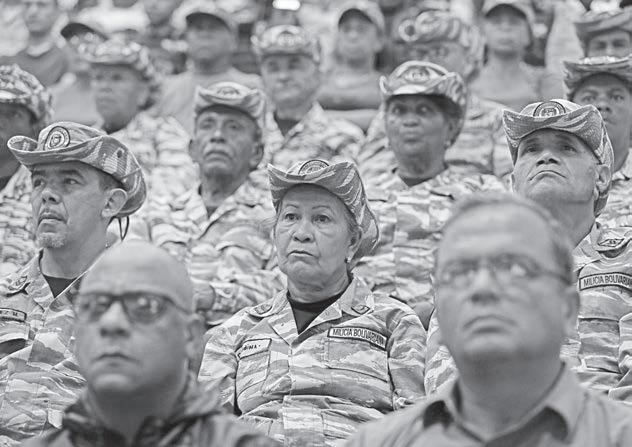
B ut the Venezuelan government has nonetheless called on its c itizens to enlist in the militiasarmed volunteers - in support of its security forces in the event of a potential incursion. On Saturday, it urged them to go to military barracks for training sessions.
move forward and figure out what comes next.” Both Rubio and Trump met on Friday with Qatar’s prime minister to discuss the fallout from the Israeli operation, in a demonstration of how the Trump administration is trying to balance relations between key Middle East allies days after Israel targeted Hamas leaders in a strike on Doha.
The attack has drawn widespread international condemnation and appears to have ended attempts to secure an Israel-Hamas ceasefire and the release of hostages ahead of the upcoming UN General Assembly session at which the Gaza war is expected to be a primary focus.
Trump “wants Hamas defeated, he wants the war to end, he wants all 48 hostages home, including those that are deceased, and he wants it all at once,” he said. “And we’ll have to discuss about how the events last week had an impact on the ability to achieve that in short order.”
Rubio will have meetings in Jerusalem on Sunday and Monday with Israeli Prime Minister Benjamin Netanyahu and others.
Despite tensions between Trump and Netanyahu over the strike, Rubio will be in Israel for the two-day visit. It is a show of support for the increasingly isolated country before the United Nations holds likely contentious debate on the creation of a Palestinian state, which Netanyahu opposes.
On Friday, Rubio and Vice President JD Vance met Qatari Prime Ministers Sheikh Mohammed bin Abdulrahman Al Thani at the White House. Later Friday, Trump and special envoy Steve Witkoff had dinner with the sheikh in New York, where Trump went to commemorate the anniversary of the Sept. 11, 2001, attacks.
The Trump administration is walking a delicate line between two major allies after Israel took its fight with Hamas to the Qatari capital, where leaders of the militant group had gathered to consider a US proposal for a ceasefire in the nearly two-year-old war in Gaza. Qatar is a key mediator, and while its leaders have vowed to press forward, the next steps are uncertain for a long-sought deal to halt the fighting and release hostages taken from Israel.
Condemning the strike
but supporting Israel
ISRAEL’S attack Tuesday also has ruptured Trump’s hopes to secure a wider Middle East peace deal, with the rulers of Saudi Arabia, the United Arab Emirates and Qatar all uniting in anger. Trump himself has distanced himself from the strike, saying it “does not advance Israel or America’s goals” and has promised Qatar that it would not be repeated. The US also joined a UN Security Council statement condemning the strike without mentioning Israel by name.
While in Israel, Rubio plans to visit the City of David, a popular archaeological site and tourist destination built by Israel in the Palestinian neighborhood of Silwan in contested east Jerusalem. It contains some of the oldest remains of the 3,000-year-old city. But critics accuse the site’s operators of pushing a nationalistic agenda at the expense of Palestinian residents.
Israel captured east Jerusalem,
Munir Ahmed in Islamabad, and Rasool Dawar in Peshawar, contributed to this report.
Members of the Bolivarian Militia listen to a recorded speech by President Nicolás Maduro at a military garrison in Caracas, Venezuela, Friday, Sept. 5, 2025. AP PHOTO/CRISTRIAN HERNANDEZ
US interest rate cut looms as global central banks set to adjust policies
By Craig Stirling
HE first US interest rate cut since
TPresident Donald Trump took office for a second term is likely to seize the spotlight in a week that will determine policy settings for half of the world’s 10 most-traded currencies.
Starting with the Bank of Canada and then the Federal Reserve on Wednesday, shifting to the Bank of England the following day, and ending with the Bank of Japan, central banks may either adjust borrowing costs, prime investors for their intentions in year’s final quarter, or both.
By the end of the week, rates affecting two-fifths of the global economy, including four of the Group of Seven industrialized nations, will have been tweaked or reaffirmed. A US rate cut long sought by Trump’s White House is expected to feature prominently.
The standoff over Fed policy, pitting Trump’s strident calls for lower borrowing costs against Chair Jerome Powell’s concerns about tariff-driven inflation, hangs over the meeting. Recent signs of weakening in the labor market have, however, given a green light for what most economists expect will be a quarter-point rate cut.
“We expect the FOMC to cut rates by 25 basis points. That won’t be because economic data on both sides of Fed’s mandate—price stability and full employment—warrant it. Rather, the markets expect a rate cut, the White House wants it—and we think Powell is doing what he sees as needed to fend off further threats to the Fed’s independence,” said Bloomberg economists Anna Wong, Stuart Paul, Eliza Winger, Estelle Ou and Chris G. Collins.
Policymakers in Canada and Norway are expected to move rates by the same amount, while other advanced-economy counterparts may be more circumspect.
The BOE will probably keep rates unchanged after a cut in August that featured a rare three-way split among officials. The BOJ, meanwhile, remains on a path toward tightening but hasn’t signaled that such a step is imminent.
Central banks in other major economies are expected to maintain a watchful stance but not change rates. That’s the outcome forecast by economists for Indonesia, Brazil and South Africa. Elsewhere, several economic reports in China, inflation data from Japan to the UK to Israel, Swiss export figures and a credit ratings review of Italy may be among the highlights.
What’s coming up in the global economy:
US and Canada BEFORE the Fed makes its decision on rates, they’ll get one last look at the American consumer. Retail sales on Tuesday are forecast to have risen 0.3 percent in August after much larger gains in the prior two months.
With the labor market on shaky ground and prices rising, it’s unclear how long shoppers will keep cracking open their wallets.
Economists will also keep an eye on
jobless claims on Thursday to see if the jump in the prior week was a harbinger of a sustained deterioration in the labor market, or more of a one-off.
Further north, inflation in Canada is expected to tick up to 2 percent on a yearly basis, while the central bank’s preferred core measures are likely to hold steady at about 3 percent, according to the median estimate in a Bloomberg survey of economists.
The reading is unlikely to derail the Bank of Canada from cutting its benchmark overnight rate to 2.5 percent on Wednesday, given recent dismal jobs data and an economic contraction in the second quarter.
Canada’s easing cycle has so far failed to revive the tepid real estate market, and data on existing home sales and housing starts will offer the latest snapshot of activity.
Asia
ASIA’S week features three central bank decisions, capped by the BOJ on Friday.
China kicks off the week with a deluge of August data on Monday—retail sales, industrial output, investment figures and the jobless rate—offering a read on whether targeted support is shoring up demand after a broad-based slowdown in July.
Property metrics will show how deeply the housing slump is running. Also on Monday, data will show India’s trade deficit likely shrank in August, while Pakistan’s central bank is poised to hold rates again.
Wednesday brings Japan’s trade balance and Singapore’s non-oil shipments, a bellwether for global electronics.
Bank Indonesia meets the same day, with the decision unfolding against a backdrop of protests and the abrupt departure of Finance Minister Sri Mulyani Indrawati. Policymakers are expected to hold after back-to-back cuts.
Thursday sees New Zealand GDP and Australia’s jobs report, both critical for their respective central banks’ outlooks.
Friday belongs to Tokyo, with Japan’s CPI release followed by the BOJ’s policy decision, where it’s expected to leave rates unchanged. Investors will be parsing whether Governor Kazuo Ueda signals the potential for hikes ahead as growth holds firm and infla -
tion runs hot.
Elsewhere, New Zealand publishes trade data, Malaysia issues both trade and current-account balances, Hong Kong updates its balance of payments, and China reports FX settlement flows.
Europe, Middle East, Africa UK inflation data will be released on the eve of the BOE decision. The headline rate is seen staying at 3.8 percent, masking a slight weakening in the services gauge. The central bank has predicted a peak of 4 percent in September.
Economists unanimously predict the BOE will keep its key rate on hold at 4%, albeit with a split vote likely again as a minority of policymakers seek an immediate cut.
The bigger focus on Thursday is set to be action on winding down the BOE’s crisis-era bond holdings. Given recent market turmoil, officials are likely to significantly slow down so-called quantitative tightening from the current pace of £100 billion ($135 billion) a year.
The rate decision in Norway the same day is likely to be trickier than usual. Most economists anticipate a close call on whether Norges Bank officials stick to their June guidance and deliver another quarter-point cut in the key rate, to 4 percent.
Alternatively, they could postpone a reduction after recent data showed core inflation stuck above 3 percent while corporate sentiment indicated steady improvement.
At the European Central Bank, a two-day conference starting Wednesday may be the biggest venue for comments from policymakers after they kept their rate unchanged in the past week. President Christine Lagarde will attend a meeting of euro-zone finance ministers later in the week.
Among data releases, trade numbers on Monday, industrial production the following day, and a final reading of inflation on Wednesday are the highlights. Germany’s ZEW investor confidence gauge will be released on Tuesday. Friday sees credit assessments from some key euro-area borrowers. Among those on the calendar are Italy from Fitch Ratings, Greece from Moody’s Ratings, and France from Morningstar DBRS.
Swiss export numbers scheduled for Thursday may take on added significance at a time when officials are desperately trying to secure a trade deal to lessen the highest US tariffs on any advanced economy.
In Israel on Monday, annual inflation in August is seen easing to below the ceiling of the central bank’s 1 percent to 3 percent target range for the first time in 14 months. That could persuade the monetary authority to reduce rates at its next meeting on Sept. 29.
A number of monetary decisions are scheduled around Africa: ON Tuesday, Angola’s central bank may cut its key rate—currently at 19.5 percent—to support the economy, as inflation is expected to continue cooling.
A day later, Ghana is expected to reduce its benchmark to 23 percent from 25 percent as inflation continues to soften. Governor Johnson Asiama said in July that officials would likely lower the rate further should disinflation continue.
In South Africa on Thursday, policymakers are poised to leave their rate at 7 percent to curb inflation, which is expected to quicken to 3.6 percent in August from 3.5 percent the month before. The central bank said in July that it now prefers inflation to settle at the floor of its 3 percent to 6 percent target range.
Eswatini, whose currency is pegged to South Africa’s rand, will probably match the Reserve Bank’s move.
Latin America
GDP-proxy data on Monday in Brazil should show activity grinding lower as the region’s No. 1 economy heads into the second half of 2025.
Brazil watchers on Tuesday will be keen to dig into the delayed July unemployment report. The country’s tight labor market notwithstanding, analysts see the jobless rate hitting a record low 5.7 percent.
Among Andean economies, analysts are expecting to see some rebound in demand reflected in Colombia’s retail sales, manufacturing, industrial production and July GDP-proxy data. Peru also reports monthly output figures, with the economy running below potential and below policymakers’ expectations as well.
Banco Central do Brasil on Wednesday is all but certain to keep its borrowing costs at a 19-year high of 15 percent for a second straight meeting.
Consumer prices and inflation expectations have begun to cool and growth is slowing, but most analysts don’t see any policy easing until 2026. In Argentina, President Javier Milei is facing an uphill fight to keep his economic program on track after a poor showing in Buenos Aires provincial balloting.
With assistance from Andrew Atkinson, Beril Akman, Laura Dhillon Kane, Mark Evans, Monique Vanek, Ott Ummelas, Reade Pickert, Robert Jameson and Swati Pandey / Bloomberg
Austria eyes stronger diplomatic role, offers to host Russia-Ukraine peace talks
By Marton Eder & Jonathan Tirone
AUSTRIA hopes to become a stronger force in global diplomacy and a hub for conflict resolution. Key to those efforts, according to Foreign Minister Beate Meinl-Reisinger, is sticking to decades-old military neutrality despite a raging war in the nation’s proximity.
The nation’s top diplomat is campaigning for a seat on the United Nations Security Council, offering to host eventual peace talks between Russia and Ukraine, and pushing for a return to the negotiating table on Iran’s nuclear program.
Her energetic drive since taking office in March as part of a threeway coalition government seeks to help Austria find its place in the new world order. Once a gateway between Europe’s east and west, Vienna’s economic and political relevance has faded due to its longest recession since World War II, and as former Communist neighbors forge their own paths in international politics.
Being outside the North Atlantic Treaty Organization, like neighboring Switzerland, may play out to Austria’s benefit.
“There is an advantage to not being a member of NATO,” MeinlReisinger, 47, said in an interview.
“This is a certain understanding that you always have to stick to dialogue.”
Her pitch is based on the long history of Viennese diplomacy. The Habsburg Empire grew into a European power through strategic marriages, as opposed to waging wars. In a recent speech, Meinl-Reisinger referred to the weight of her office set by the legacy of prominent diplomats such as Klemens von Metternich, the architect of order in post-Napoleonic Europe.
Austria hosts major international organizations, including the Organization for Security and Co-operation in Europe and the International Atomic Energy Agency.
Its military non-alignment is a result of the 1955 state contract that granted independence from a decade of allied occupation following World War II. That remains among the most popular policies in Austria and hasn’t been seriously questioned, even after Russia’s full-scale invasion of Ukraine in 2022, which spurred Finland and Sweden to join NATO. Yet Austria’s approach raises questions.
Areas of western Ukraine that have faced Russian missile and drone strikes are closer to Vienna than Bregenz, the capital of Austria’s Vorarlberg province near the Swiss border. The country de facto relies on NATO’s security guar -
antees to neighboring Slovakia and Hungary to buffer itself from Russian aggression. And it spends about 1 percent of gross domestic product on defense annually, a fifth of Poland’s relative outlay.
“We are not a NATO member, and I’m not in favor of joining NATO,” Meinl-Reisinger said. “What we should talk about is adapting our security strategy to new realities, and not to misuse the term neutrality as a cover up, or for clearly pro-Russian interests.”
Austria’s far-right Freedom Party has pushed a strict interpretation of neutrality, speaking out against non-military aid to Ukraine and sanctions against Russia. It won the most votes at federal elections in 2024, yet missed out on governing to a moderate coalition including the conservatives, social democrats and MeinlReisinger’s liberals.
Vienna still hosts an eco-system of lawyers and advisers that primarily serve a Russian clientele. Some of Russia’s richest individuals own property in the Alpine nation, and Vienna-based Raiffeisen Bank International AG has faced criticism for failing to sell its unit in Russia.
A prominent critic of MeinlReisinger’s foreign policy is Karin Kneissl, the former Austrian foreign minister delegated by the Freedom Party, who’s since moved to Russia and leads a state-affiliated think tank. She, together with former Russian President Dmitry Medvedev, contend that any change to Austria’s constitutional neutrality would need signatory nations, including Russia, to agree to an amendment of the 1955 state treaty.
Meinl-Reisinger dismissed those arguments as historically inaccurate, saying Austria agreed to closer defense cooperation with the European Union after joining the bloc in 1995.
“It’s only up to the Austrian people to decide what kind of security strategy and policy Austria is conveying,” she said. Bloomberg
CHAIRMAN of the US Federal Reserve Jerome Powell, from left, Governor of the Bank of Canada Tiff Macklem, and Governor of the Bank of England Andrew Bailey. PHOTOGRAPHER: NATALIE BEHRING/BLOOMBERG
Trump calls on all NATO countries to stop buying Russian oil, threatens 50% to 100% China tariffs
By Josh Boak The Associated Press
BASKING RIDGE, N.J.—President Donald Trump said Saturday he believes the Russia-Ukraine war would end if all NATO countries stopped buying oil from Russia and placed tariffs on China of 50% to 100% for its purchases of Russian petroleum.
Trump posted on his social media site that NATO’S commitment to winning the war “has been far less than 100 percent” and the purchase of Russian oil by some members of the alliance is “shocking.” As if speaking with NATO members, he said: “It greatly weakens your negotiating position, and bargaining power, over Russia.”
Since 2023, NATO member Turkey has been the third largest buyer of Russian oil, after China and India. according to the Centre for Research on Energy and Clean Air. Other members of the 32-state alliance involved in purchasing Russian oil include Hungary and Slovakia. It’s unclear whether Trump would want to directly confront Turkish President Recep Tayyip Erdogan or Hungarian Prime Minister Viktor Orbán. That leaves uncertain whether the threats might actually lead to new tariffs or a ban on Russian oil purchases.
Trump’s post arrives after the Wednesday flight of multiple Russian drones into Poland, an escalatory move by Russia as it was enter -
China launches investigation targeting US semiconductors ahead of Madrid trade talks
By Simina Mistreanu
The Associated Press
TAIPEI, Taiwan—China launched two probes targeting the US semiconductor sector Saturday ahead of talks between the two nations in Spain this week on trade, national security and the ownership of social media platform TikTok.
China’s Ministry of Commerce announced an anti-dumping investigation into certain analog IC chips imported from the US. The investigation will target some commodity interface IC chips and gate driver IC chips, which are commonly made by US companies such as Texas Instruments and ON Semiconductor.
The ministry separately announced an anti-discrimination probe into US measures against China’s chip sector.
US Treasury Secretary Scott Bessent is set to meet Chinese Vice Premier He Lifeng in Madrid between Sunday and Wednesday, He’s office said. US measures such as export curbs and tariffs “constitute the containment and suppression of China’s development of high-tech industries” such as advanced computer chips and artificial intelligence, a Chinese commerce ministry spokesperson said.
The announcements of the probes follow the US on Friday adding 23 Chinese companies to an “entity list” of businesses that will face restrictions for allegedly acting against US national security and foreign policy interests. The list includes two Chinese companies accused of acquiring chipmaking equipment for major Chinese chipmaker SMIC.
The meetings between Bessent and He in Madrid will be the latest in a series of negotiations aimed at reducing trade tensions and postponing the enactment of higher tariffs on each other’s goods.
US and Chinese counterparts previously held discussions in Geneva in May, London in June and Stockholm in July. The two governments have agreed to several 90-day pauses on a series of increasing reciprocal tariffs, staving off an all-out trade war.
Bessent described the talks during the last round in Stockholm as “very fulsome.”
“We just need to de-risk with certain, strategic industries, whether it’s the rare earths, semiconductors, medicines, and we talked about what we could do together to get into balance within the relationship,” Bessent said at the time.
ing the airspace of a NATO ally. Poland shot down the drones, yet Trump played down the severity of the incursion and Russia’s motives by saying it “could have been a mistake.”
US Secretary of State Marco Rubio said Saturday that the drone incursion was “unacceptable and unfortunate and dangerous” as he judged NATO’s response so far to be appropriate. Still, Rubio said it was unclear if the drones were intentionally sent to Poland.
“The question is whether the drones were targeted to go into Poland specifically,” Rubio said. “If that’s the case, that the evidence leads us there, then obviously that would be a highly escalatory move.”
While Trump as a candidate promised to end the war quickly, he has yet to hit the pressure points needed to end the violence and has at times been seen as reluctant to confront Russian President Vladimir Putin. Congress is currently trying to get the US president to back a bill toughening sanctions, after Trump last month hosted Putin in Alaska for talks
that failed to deliver on progress toward peace. The US and its allies are seeking to show a firmer degree of resolve against Russia. At an emergency U.N. Security Council meeting Friday, acting US Ambassador Dorothy Shea said America “will defend every inch of NATO territory” and that the drones entering Poland “intentionally or otherwise show immense disrespect for good-faith US efforts to bring an end to this conflict.”
Britain on Friday also took steps to penalize the trading of Russian oil, including a ban on 70 vessels allegedly used in its transportation. The United Kingdom also sanctioned 30 individuals and companies, included businesses
based in China and Turkey, that have supplied Russia with electronics, chemicals, explosives and other weapons components.
Trump in his post Saturday said a NATO ban on Russian oil plus tariffs on China would “also be of great help in ENDING this deadly, but RIDICULOUS, WAR.”
The president said that NATO members should put the 50 percent to 100 percent tariffs on China and withdraw them if the war that launched with Russia’s 2022 invasion of Ukraine ends.
“China has a strong control, and even grip, over Russia,” he posted, and powerful tariffs “will break that grip.”
The US president has already imposed a 25% import tax on goods from India, specifically for its buying of Russian energy products. He has placed in total a 50 percent tariff on India, though Trump has indicated that negotiations with Indian Prime Minister Narendra Modi could help settle differences.
The prospect of further import tax hikes on China and its retaliation could carry collateral damage for the US and European economies.
Earlier this year, Trump hit Chinese goods with new tariffs totaling 145 percent, prompting China to respond with 125 percent import taxes on American goods. Taxes at that level were essentially a blockade on commerce between the world’s two largest economies, causing worries about global growth that led to negotiations that ratcheted down the tariffs being levied by both nations.
So that trade talks could proceed, America lowered its tariffs against China to a stillhigh 30percent, while China took its rate to 10 percent.
In his post, the Republican president said responsibility for the war fell on his predecessor, Democrat Joe Biden, and Ukrainian President Volodymyr Zelenskyy. He did not include in that list Putin, who launched the invasion. Trump’s post builds on a call Friday with finance ministers in the Group of Seven, a forum of industrialized democracies. During the call, US Trade Representative Jamieson Greer and Treasury Secretary Scott Bessent called on their counterparts to have a “unified front” to cut off “the revenues funding Putin’s war machine,” according to Greer’s office.
AP Diplomatic Writer Matthew Lee contributed.
US tariffs face legal threat that puts Trump’s deficit plan at risk
By Laura Curtis & Daniel Flatley
PRESIDENT Donald Trump’s most concrete step to rein in unprecedented US budget deficits—sweeping tariff hikes—faces the danger of a legal reversal that would put the nation’s finances on an even shakier footing.
Trump and top aides including Treasury Secretary Scott Bessent have argued that federal borrowing needs will shrink in coming years as Republican tax cuts, reduced regulation and big-ticket investment pledges from companies and foreign nations stoke economic growth and goose federal revenues. Many economists question that outlook, but few disagree that tariff hikes are indeed generating a new stream of cash for the Treasury.
Customs duties—paid overwhelmingly by American importers—have totaled $165 billion for the 2025 fiscal year with one month left to go, Treasury Department figures showed Thursday. That’s up some $95 billion on the year before.
Most of the jump is thanks to tariffs Trump imposed using the International Emergency Economic Powers Act (IEEPA) Bloomberg Economics analysis shows. But an Aug. 29 federal appeals court ruling has called the legality of that maneuver into question. Unless the Supreme Court, which has agreed to review the case, decides in the president’s favor, Bessent has warned the government could be liable to refund large sums of money. This week, he expressed confidence the court will rule for the White House.
This year’s added tariff revenue still pales in comparison with the budget gap, which totals almost $2 trillion for the first 11 months of fiscal 2025. But a number of economists have backed Bessent’s prediction of a current run-rate of about $300 billion or more a year.
That’s effectively 1 percent of US gross domestic product. And at a time when the deficit has been exceeding 6 percent of GDP, it’s enough to make significant progress over the coming decade toward Bessent’s ultimate goal of shortfalls near 3 percent. Wipe that away, and bond investors and economists are left with little more than hopeful projections for growth and productivity to temper US borrowing requirements.
“It’s just a wild card that you’re going to have to deal with when the time comes,” said Lou Crandall, chief economist at Wrightson ICAP, who’s been analyzing Treasury debt strategy since the 1980s. “If the court case goes against the Treasury and the administration doesn’t want to see the deficit continue to rise, there are going to be policy responses of some sort— we just don’t know what they are.”
For now, bond investors are more focused on prospects for Federal Reserve interest-rate cuts, with yields on both short-dated and longer-term securities falling this month. Also, there’s the likelihood of Trump’s team reconstituting much of the tariff framework using other executive authorities, including measures known as Sections 232 and 301.
‘Infuriating thing’
WE think bond markets should shrug off the one-time cost of tariff refunds, and we still fully expect that Trump will recreate the tariffs prospectively through other authorities if he loses in court,” Tobin Marcus, head of US policy and politics at Wolfe Research, wrote in a note to clients.
Bessent, speaking on Fox Business Tuesday, described the tariff fallback plan as “more cumbersome, and I think it limits the president’s hands.”
It also would mean a further revamp of duties that have already been fluctuating. The uncertainty threatens to impose costs on individual businesses and the broader economy.
Slower growth and a weakening labor market could also push up spending and reduce revenues, further widening the budget gap.
Elana Ruffman, a marketing executive at Vernon Hills, Illinois-based hand2mind Inc., which makes educational toys, has been among those frustrated by shifts in US duties.
“It’s the most infuriating thing,” she said, describing the experience her family-owned firm and its sister company Learning Resources Inc. have been going through this year.
After Trump slapped tariffs well in excess of 100% on China in April, the company awarded a product line to a factory in India—which administration officials had been indicating was likely to get a deal with Washington. It planned a new line of kids’ yoga and mindfulness products for a Christmas debut, and the items needed to ship in August.
“We called in every favor we had” in the effort to shift out of China, get safety tests done and go into production in India, Ruffman said.
“All to come in at a higher tariff than it would have if we’d kept it in China” she said—referring to how the president last month jacked up the US surtax on Indian imports to 50 percent. Meantime, the added levy on goods from China
has come down to 30 percent.
So far this year, Ruffman said her company has paid more than $5.5 million in tariffs, compared with just $2.3 million for all of 2024. And the bill would be much higher if the company hadn’t paused production on many of their goods to avoid significant price hikes, Ruffman said.
Her company was among those to sue the Trump administration over its invocation of IEEPA to impose tariffs, with the case now awaiting Supreme Court review.
Debt trajectory
THE Yale Budget Lab estimates that, if the IEEPA tariffs in question are invalidated, that would remove about $1.5 trillion of revenues over a decade, leaving the remaining levies collecting $496 billion.
While many economists now see the US as likely to be collecting substantially more revenue than previously assumed over the longer haul, any Supreme Court ruling invalidating a slice of them and requiring a slew of refund checks risks reminding bond investors of the broader fiscal path.
The nonpartisan Congressional Budget Office earlier this year warned that the US was on a path to surpass record debt levels set after World War II in 2029—in a set of assumptions that included the expiration of a swath of Trump’s tax cuts by the end of 2025.
While Trump’s latest tax legislation, enacted in July, provides even more tax benefits, his tariffs were seen as restraining the increase in borrowing. S&P Global Ratings last month cited the new tariff revenue trajectory in affirming its AA+ sovereign-debt rating for the US.
With assistance from Enda Curran, Jarrell Dillard and Sophie Butcher / Bloomberg
MANY US companies are getting hit by sweeping tariff hikes, such as Illinois-based toy maker hand2mind Inc. PHOTOGRAPHER: TAYLOR GLASCOCK/BLOOMBERG
PRESIDENT Donald Trump and first lady Melania Trump attend a ceremony at the Pentagon to commemorate the 24th anniversary of the 9/11 attacks, Thursday, Sept. 11, 2025, in Washington. AP PHOTO/JULIA DEMAREE NIKHINSON
Senators to Marcos: Institutionalize probe body by legislation
SBy Butch Fernandez @butchfBM
ENATORS are praising the issuance of the Executive Order creating the Independent Commission on Infrastructure, but will ask President Marcos to go one step further and certify pending bills for an Independent People’s Commission.
On Sunday, Senate President Vicente
Sotto III said he will formally ask Marcos to certify Senate Bill 1215, also known as Independent People’s Commission bil, as urgent to fast-track the passage of the measure.
Sotto explained that the bill will make sure the President’s Executive Order creating the ICI will continue and become a permanent law.
“While the President’s Executive Order is immediate, my bill ensures permanence. The IPC will not just be a stop-gap measure, it will institutionalize oversight and prevent instances like this from happening again,” Sotto said.
Other projects
SOTTO added that the IPC will not only look into projects of the Department of Public Works and Highways (DPWH), but also other
Comelec
Tagencies with infrastructure programs such as the Department of Agriculture, Department of Health, Department of Education, and many more.
“Corruption in projects does not only happen in roads and bridges. It also affects farm-to-market roads, hospitals, and schools. That’s why this bill is important because it protects taxpayers’ money and makes sure projects truly serve the people,” Sotto added.
Sotto also welcomed the filing of a similar bill in the House of Representatives.
“It doesn’t matter which chamber moves first. Whether House or Senate, what’s important is that Congress acts fast so we can pass this into law without delay,” Sotto said.
Sotto stressed that the IPC is important because it will help bring back people’s trust, protect public funds, and make sure government projects are done properly and for the benefit of Filipinos.
Expanded coverage
SENATE President Pro Tempore Panfilo M. Lacson said the expanded coverage of the Independent Commission for Infrastructure (ICI) to include all infrastructure projects and not just flood control projects is a most welcome development.
“In like manner, I hope the scope of the sumbongsapangulo.ph website will likewise be expanded by not limiting its coverage to flood control projects only.
“Better yet, the website can be made more valuable to taxpayers by including data on funding for all infrastructure projects of all agencies, from the National Expenditure Program to the General Appropriations Act, as well as the identities of the proponents of congressional amendments or insertions and all the way to the project implementation and completion. And yes, complete with geotagging, please,” Lacson added.
This, he stressed, “will maximize transparency every step of the way, not to mention public participation in monitoring where and how our taxes are being spent”
There are bills filed in both Houses of Congress that will institutionalize the ICI, complete with all the powers in the mold of the Independent Commission Against Corruption (ICAC) of Hong Kong and the Corrupt Practices Investigation Bureau (CPIB) of Singapore, Lacson noted.
Minority’s caveat
THE Senate Minority bloc, led by Senate Minority Leader Alan Peter Cayetano, said it will only support the newly formed
independent commission on ghost flood control projects if its members are free from political ambitions and ties to big business.
The statement came after President Ferdinand Marcos Jr. issued Executive Order 94, which created the commission to investigate alleged anomalies and corruption in public works and government spending during the Aquino, Duterte, and current Marcos administrations.
Malacañang has since named former Public Works and Highways secretary Rogelio Singson and Sycip Gorres and Velayo (SGV) Country Managing Partner Rossana Fajardo as members, and Baguio City Mayor Benjamin Magalong as chief investigator of the probe body.
The Senate minority bloc raised concerns about possible conflicts of interest.
“Kung maglalagay sila doon, do they commit, hindi sila tatakbo for national office in 2028? Ehbakamayintegrity nga,gagamitin naman ang commission to run in 2028. Will they sign also na wala silang conflict of interest?” Cayetano said.
“Because some of the credible people now being interviewed are part of a conglomerate and are working for oligarchs that also have their interest. Maybe not in infrastructure but in other things,” he added.
set to proclaim party-list group Gabriela
Leave flood control probe to new panel
AFTER Malacañang named members to the newly created Independent Commission for Infrastructure (ICI), a group urged both the House of Representatives and the Senate to now leave the investigation into alleged multibillion-peso corruption in flood control projects to the panel.
Lawyer Arnel Dolendo, the Philippine Trade and General Workers Organization (PTGWO) national president, said that the Congress should stop its own hearings, noting that some lawmakers were implicated during previous inquiries.
“Considering that during the congressional hearings of both houses, their very own members were implicated, PTGWO calls on the Senate and House of Representatives to stop their investigations.
It is likewise to avoid public perception, as is happening now, that their investigation is biased and meant solely to protect their fellow lawmakers,” he said in a statement.
The group, meanwhile, welcomed the formation of the ICI but asked President Marcos to fast-track its operationalization.
The group called for an “immediate, impartial, transparent, and thorough” investigation, along with the swift filing of criminal cases against involved individuals.
Lacson. . .
Continued from A3
Given the magnitude of corruption, the group also urged the Department of Justice (DOJ) to create a special prosecuting team composed of senior prosecutors to ensure accountability without legal loopholes.
The PTGWO further proposed prioritizing the prosecution of those behind “ghost” flood control projects nationwide, followed by unfinished and substandard ones.
“These projects have left a paper trail that can be easily followed. There is no reason for delay or inaction. We demand immediate charges and swift conviction of these individuals,” Dolendo stressed.
On Saturday, Malacañang announced that former Public Works secretary Rogelio Singson and accountant-auditor Rossana Fajardo would sit on the ICI, which is tasked with reviewing flood control and other infrastructure projects over the past decade.
Baguio City Mayor Benjamin Magalong, a retired police general and former chief of the Criminal Investigation and Detection Group and also a former Special Action Force battalion commander, will serve as special adviser and lead investigator. Marcos is expected to name the commission’s chairman “in the coming days,” according to Palace Press Officer Claire Castro. With Jovee Marie N. dela Cruz
Senate minority bloc will play the role of constructive oppositionist.
By Ada Pelonia @adapelonia
HE Commission on Elections
(Comelec) announced that it will proclaim Gabriela Women’s Party’s
first nominee, Sarah Elago, as the 64th party-list representative.
“If we’re not mistaken, the Comelec will proclaim former congresswoman [Sarah] Elago, who is the number one nominee of the Gabriela party-list,” Comelec Chairman
George Erwin Garcia said in a radio interview over the weekend.
He said the commission had sought consent from the House of Representatives on raising the number of party-list seats to 64. Such a move would fulfill the 20 percent
requirement as stipulated under the 1987 Constitution.
“The secretary general of the House of Representatives responded and said the role of the House is merely ministerial, which means they will accept whoever is proclaimed by the Comelec,” Garcia said.
“He said that the discretion on who to proclaim based on the Constitution lies with the Comelec,” he added. Currently, only 63 party-list representatives sit in the chamber.
Computed against the 317 total members of the House, this accounts for just 19.87 percent—short of the 20 percent required by law.
“It cannot fall below 20 percent…That’s why we studied raising the seats to 64. The Commission en banc already approved this, but we held back because we wanted to consult the House first,” Garcia explained.
Proclaim Gabriela
ALLIANCE of Filipino women’s organizations Gabriela earlier urged the Comelec to immediately proclaim the Gabriela Women’s Party (GWP) as a representative in Congress, saying that Filipinos lack representation against corruption and injustice. (See: https://businessmirror. com.ph/2025/09/03/comelec-noproclamation-yet-for-vacant-pl-seats/)
“We challenge Comelec to act with urgency and proclaim GWP now. This is not just a matter of procedural justice but a cruicial step n ensuring the voice of the marginalized is heard and represented in a legislature compromised by vested interests,” the group said in a previous statement.
“Every day that passes without the proclamation of the GWP is a day where the Filipino people are denied another potent voice against corruption, injustice and the worsening socio-economic crisis.”
GWP secretary general KJ Catequista said that with Congress running with incomplete representation, the party-list’s immediate proclamation would allow its pending measures and initiatives to move forward.
“That is our urgent call, [for the Comelec] to act swiftly so that the laws we have long been pushing for can finally advance,” Catequista said in an interview.
Once proclaimed, the party-list group would prioritize bills on safe spaces, violence against women and children, divorce and a review of the Anti-Rape Law of 1997, she added.
The post by “OneTV Philippines” posted at 9:12 pm Saturday, with the caption “BREAKING: Another Regodon [sic] in the Senate?”, claimed that “Senate Minority Leader Allan [sic] Peter Cayetano secures numbers for Senate presidency — a reliable source tells OneTV Philippines.”
According to the Facebook page of “OneTV Philippines,” it is “a Digital News Network Globally-Based in Davao City and Pagadian City.”
A check of its YouTube channel as of Sunday morning showed it has fewer than 2,000 subscribers, had its last update in July 2024.
Lacson pointed out as well that there is a proper and professional way to effect a leadership change in the Senate.
“The proper and professional way is to call or approach the Senate president, inform and show him the resolution signed by at least 13 senators, then the sitting Senate President resigns at the opening of the session, not through a media outlet, whether nationally recognized or obscure,” Lacson said.
The September 8 leadership change also saw Lacson being elected as Senate President Pro Tempore—replacing Jinggoy Estrada—and chairman of the Senate blueribbon committee, a crucial post in charge of investigating the flood-control scandals.
Constructive oppositionist
ALSO at the weekend, the new minority leader, Alan Peter Cayetano, said the new
commitment of the three nations to enhance maritime cooperation, promoting regional security, and support a rules-based international order in the Indo-Pacific,” the AFP statement said.
For the 11th MMCA, the AFP deployed guided-missile frigate BRP Jose Rizal (FF150), an AW-109 “Power” anti-submarine helicopter, an Air Force (PAF) search-andrescue aircraft, a C-208B intelligence, surveillance, and reconnaissance aircraft, and four FA-50 “Fighting Eagle” fighter jets.
Meanwhile, the United States contributed the USS John Finn (DDG113), a P-8A “Poseidon” maritime patrol aircraft, and two MH 60-R “Seahawk” helicopters.
“It’s easy to say what’s wrong or right. But what we must do is to offer solutions,” the Minority Leader said, speaking in Filipino in the September 11 episode of his ‘CIA 365 with Kuya Alan’ livestream.
Known for taking a stand as a Christian, Cayetano said the minority bloc’s agenda is to push for laws aligned with the “kingdom and righteousness” of God. He called this the “Nation-Building Agenda” or NBA.
“Sa Lord’s Prayer, we pray ‘Your kingdom come, here on earth as it is in heaven.’ So there is a king, there is a kingdom. And the kingdom has laws, has a culture,” Cayetano explained.
He said this is especially important now that as Filipinos pray for a better future, the forces of evil continue to work against it.
“Remember, evil also wants to build their own nation… it wants Filipinos to remain poor. And poverty is one source of corruption,” he said.
The new nine-member minority bloc was formed after the new majority ousted Escudero and returned Sotto III to the post he had held during the pandemic years.
Three of the senators whose names have been dragged in the flood-control scandal are Estrada and former majority leader Joel Villanueva. Escudero got dragged because one of the top contractors on President Marcos’s list had contributed to his 2025 campaign.
Cayetano said that while there was “a little sadness” on the part of Escudero and Villanueva, the group is now focused on their new role in the Senate.
The JMSD deployed JS Osumi (LST4001), which demonstrated its amphibious capabilities and operational readiness in combined maritime operations. Key components of the 11th MMCA included a communications check exercise to ensure effective coordination; maritime domain awareness activities; an antisubmarine warfare exercise; a cross-deck landing exercise; and naval surface interdiction and clearance. The exercise also featured division tactics-officer of the watch maneuvers, a photo exercise, passing exercise, search and rescue exercise, and a final exercise. The successful conduct of the MMCA not only enhanced the interoperability of the participating forces but also highlighted the Philippines’ commitment in safeguarding its maritime interests and upholding peace and security in the region, the AFP said.
PHL will need more imported wheat—report
TBy Ada Pelonia @adapelonia
HE Philippines will purchase over 7 million metric tons (MMT) of imported wheat due to the Southeast Asian nation’s rising demand for food, the United States Department of Agriculture (USDA) said in its latest report.
USDA adjusted its projection for the country’s wheat imports in marketing year 2025/2026 to 7.2 MMT due to “higher expected food, seed, and industrial consumption.”
The projected purchases of the Philippines will make the country the world’s third-largest importer of wheat, behind Indonesia (12 MMT) and Brazil (7.5 MMT).
“Global trade is up on higher
Vegetable oil prices hit 3-year high in August—FAO
THE vegetable oil price index of the Food and Agriculture Organization of the United Nations (FAO) reached a 3-year high in August on increases in palm, sunflower and rapeseed oil quotations.
FAO said in a recent report that its vegetable oil price index averaged 169.1 points in August, up 2.3 points (1.4 percent) month-on-month, reaching its highest level since July 2022.
“The increase was driven by higher quotations for palm, sunflower and rapeseed oils, more than offsetting a slight decline in soyoil values. International palm oil prices rose for the third consecutive month in August, largely underpinned by robust global import demand and news of Indonesia’s intention to further raise its biodiesel blending mandate in 2026.”
FAO also noted that global sunflower and rapeseed oil prices increased on tightening supplies in the Black Sea region and in Europe, respectively.
“By contrast, world soy oil prices edged lower, mainly reflecting prospects of ample global soybean supplies in the 2025/26 season.”
Meanwhile, FAO said its meat price index marked a new all-time high in August, when it averaged 128 points, up 0.7 points (0.6 percent) from July and 5.9 points (4.9 percent) from a year ago.
“The rise was driven by continuing higher bovine and ovine meat prices, which outweighed largely stable pig meat quotations and lower poultry meat prices.”
FAO added that internation -
al bovine meat prices reached a new record high, underpinned by strong demand from the United States, which boosted Australian quotations, and firm import demand from China, which kept Brazilian export prices firm despite reduced sales to the United States of America following the imposition of additional tariffs.
“Ovine meat prices rose for the fifth consecutive month, reflecting tight export supplies in Oceania, with higher volumes directed to more lucrative markets, notably the United Kingdom of Great Britain and Northern Ireland and the US. World pig meat prices remained broadly steady amid balanced global demand and supply conditions.”
By contrast, FAO said poultry meat quotations declined, pressured by ample exportable supplies from Brazil. Although Brazil declared its commercial poultry farms free of high pathogenicity avian influenza in mid-June, import restrictions maintained by some major trading partners continued to affect demand.
FAO said its food price index averaged 130.1 points in August, virtually unchanged from the revised July level of 130 points. Declines in the cereal and dairy price indices were offset by increases in the indices for meat, sugar and vegetable oils.
“Overall, the food price index was 8.4 points [6.9 percent] higher than in August 2024 but remained 30.1 points [18.8 percent] below its peak reached in March 2022.”
imports for Indonesia, Nigeria, the Philippines, and Brazil, mitigated by a reduction for the European Union,” the USDA said in its latest report.
In its recent report, the Food and Agriculture Organization of the United Nations (FAO) trimmed its forecast for world wheat output to 804.9 MMT, still up around 0.8 percent from last year. The new forecast includes weather-driven lower yield prospects in China and higher yields in the European Union.
World rice production, meanwhile, is expected to increase by 1 percent to a record-high of 555.5 MMT, with expansions in Bangladesh, Brazil, China, India, and most notably Indonesia expected to more than offset anticipated declines in Madagascar, Nepal,
the US and Thailand. FAO said international cereal trade will reach 493.4 MMT this year. The growth is supported by expectations of abundant exportable supplies of maize, strong demand for wheat from China, Pakistan, Syrian Arabic Republic and Türkiye, and upwardly revised import forecasts for rice for Bangladesh, Ghana and Guinea-Bissau.
Rice ban
THE USDA also said the Philippines will lift its rice import restrictions following the 60-day ban, as international quotations for the staple grain would “remain competitive” against the domestic stockpile.
“Despite the harvest of the new crop, Philippines rice im -
ports are expected to resume in November as global prices are expected to remain competitive to domestic supplies.”
President Ferdinand Marcos Jr. ordered a temporary ban on foreign shipments of the staple grain last September 1 to stabilize farmgate prices of palay, which plunged to as low as P8 per kilo in some areas.
Industry sources claimed that the unabated entry of imported rice, whose global quotations have been slashed since worldleading rice exporter India lifted its series of export bans, was the rationale behind the steady decline in farmgate prices of paddy rice.
Based on government data, 2.95 MMT of rice has entered
the country as of September 4, or 11 days before the Philippines officially closed its borders to imports.
Agriculture officials said rice shipments of regular and wellmilled rice that left the country of origin before the ban started can still enter the Philippines until September 15. Specialty rice varieties, such as Japonica, glutinous, and basmati rice, are exempt from the import freeze.
The country’s rice production fell by nearly a million tons to 19.09 MMT last year, from a record-high 20.06 MMT recorded in 2023 due to El Niño. Due to the supply shortfall caused by the drought, the country’s rice imports reached an alltime high of 4.8 MMT last year.
Butter imports costlier in H1 due to tight milk supply
THE Philippines paid nearly 10 percent more for a lower volume of butter it imported in the first semester, based on data from the Philippine Statistics Authority (PSA).
Figures from the PSA showed that the Philippines imported 3,144 metric tons (MT) of butter during the reference period, valued at $20.24 million.
The latest figure was 9.6 percent higher than the $18.47 million recorded in the same period last year for 3,644 MT.
University of Asia and the Pacific Center for Food and Agribusiness (CFA) Executive Director Marie Annette Galvez-Dacul said tight global milk supply and more expensive inputs sent prices of the key pastry ingredient soaring.
“Although butter imports fell in volume, their value rose likely due to tighter global milk supplies and rising input costs,” Dacul told
the BusinessMirror
She added that such cost pressures could ripple through local industries which would either pass on additional costs to consumers or tweak reformulations of their products to absorb cost.
“Higher butter costs mean tighter margins, with food manu -
facturers either raising prices or turning to cheaper substitute.”
Last June, the Food and Agriculture Organization of the United Nations (FAO) said international quotations for butter rose to a new record high, driven by persistent supply tightness in Oceania and the European Union,
coupled with strong import demand from Asia.
“New Zealand entered its seasonal production slowdown,” the FAO said. “While in the European Union, herd contractions triggered by environmental regulations curbed milk production expansion, with some western regions further impacted by lingering impacts of the bluetongue virus outbreaks in late 2024.”
New Zealand and Europe account for over half of the butter exported worldwide.
Despite this, FAO’s dairy price index saw easing butter prices in August, owing to robust production in New Zealand, “despite the country’s seasonal output lull.”
The organization added that steady supplies from the European Union also boosted global availability. However, import demand, especially from Asia, remained subdued. Ada Pelonia
NFA seeks council green light for rice auction TOR
THE National Food Authority (NFA) is seeking approval from the NFA Council for the terms of reference (TOR) for its planned rice auction.
The TOR obtained by BusinessMirror stipulates that the auction will be open to interested farmers’ organizations, cooperatives, or groups and private individuals or entities engaged in the grains business, including processing, wholesaling, and retailing.
Interested bidders are required to tender a 10-percent bond of the total price offer, which will be deducted from the overall payment of the winning bidder.
The bond is among the requirements that should be submitted
in a sealed envelope before the scheduled receipt and opening of price offers.
Bidders are also required to purchase non-refundable auction documents, with respective costs based on the total amount of the total transaction value (TTV) on a per lot basis.
For those whose TTV ranges P500,000 and below, the maximum cost of auction documents or tender forms is P500; more than P500,000 up to P1 million, P1,000; more than P1 million up to P5 million, P5,000.
Those with TTV of more than P5 million up to P10 million, the maximum cost is P10,000 and those with more than P10 mil -
lion up to P50 million, the cost is P25,000.
“This shall be the maximum amount of fee that the COAC can set for the acquisition of the auction documents or Tender forms,” the TOR read.
Earlier, Agriculture Secretary Francisco Tiu Laurel Jr. announced that the NFA will auction off up to 60,000 metric tons (MT) of aging rice stocks this month until October.
Such a move would allow the government to prevent spoilage, free up warehouse space, and support rice supply amid the import ban.
“We’re essentially hitting three birds with one stone: avoiding sup -
ply shortfalls, clearing space so NFA can buy more palay from local farmers, and preventing spoilage of aging rice,” the agriculture chief said.
The auction will feature a graduated pricing scheme, with floor prices ranging from P27.96 to P25.01 per kilo, depending on how long the rice has been stored.
If this materialized, the NFA stands to earn P1.5 billion to P1.68 billion for the volume covered in the auction.
As of end-August, the grains agency’s rice buffer stock is at 450,000 MT, enough to meet 12 days of national demand in case of emergencies. Ada Pelonia
Record high beef prices remind shoppers of costly egg shortages
EGGS were the poster child for food inflation last winter.
Burgers could be the next. US beef prices are poised to extend their surge, reaching new record highs in the coming months, with restrictions on Brazilian imports further squeezing already tight domestic supplies, according to global meat trader Parker-Migliorini International Llc.
“We could see a shortage in the market,” PMI Foods President Darin Parker said in an interview. “Beef prices could be the egg problem of the Biden administration because of the extreme price increases that would have to come.” Eggs became a symbol of high grocery prices at the end of Presi-
dent Joe Biden’s term, after a bird flu outbreak sent costs soaring last winter. Soaring egg prices and empty shelves in grocery stores drew widespread attention — including from President Donald Trump, who has repeatedly pointed to it when attacking Biden’s economic record. Now, beef is taking center stage. Prices have risen for eight straight months on a not-seasonally-adjusted basis, with August marking the largest monthly jump in nearly four years, according to the latest US Bureau of Labor Statistics data.
Tight cattle supplies in the world’s largest beef producer are driving the surge. The number of cows processed each week by US meatpackers including Tyson Foods
in 2016.
The squeeze reflects the smallest US herd in decades and a recent ban on animal purchases from Mexico over
sanitary concerns. The impact on US consumers has so far been tempered by a surge in imports this year, with purchases from Brazil, the world’s largest beef exporter, almost doubling through July of this year. Brazilian lean beef trimmings are typically blended with fattier US meat to make ground beef and hamburgers.
But in the past few weeks, shipments have come to the brink of a halt after Trump in August slapped an additional 40 percent tariff on the South American
Meat
Pressure
Corruption in flood control projects: A national tragedy stalling progress
THE recent exposé on the billions of pesos lost to corruption in flood control projects is a damning indictment of the state of governance in the Philippines. This scandal not only undermines public trust but also strikes at the very core of the nation’s economic development and resilience. At a time when the country desperately needs infrastructure to protect its people and spur growth, the rot within these vital projects sets back progress by years, if not decades. (Read the BusinessMirror story: “Flood-control mess dents economic gains,” September 11, 2025).
Former Deputy Governor of the Bangko Sentral ng Pilipinas Diwa Guinigundo rightly highlights the grave consequences of this corruption. Flood control infrastructure is not a mere line item in the budget—it is a lifeline for millions vulnerable to the country’s frequent and devastating typhoons. When corruption siphons off funds meant to build this infrastructure, the multiplier effects of public investment do not materialize. Instead of boosting productivity and growth, resources are wasted on luxury items for a privileged few, leaving the majority exposed to economic losses and disaster risks.
The scale of the problem is staggering. Nearly P1.9 trillion allocated to flood control between 2011 and 2025, with over P1 trillion spent in just the last three years, has failed to prevent worsening floods. This is not simply a matter of climate change—it is a systemic failure worsened by graft and mismanagement. The recent flash floods in Quezon City and other parts of Metro Manila are tragic reminders that the government’s promises to protect its citizens remain unfulfilled.
The economic fallout is equally dire. The rise in unemployment to 2.59 million Filipinos as of July 2025, partly attributed to the flooding, underscores the real human cost of these infrastructural failures. Every peso lost to corruption is a peso not spent on education, healthcare, digital infrastructure, or energy projects crucial to reducing inequality and accelerating growth.
Deputy Speaker Janette Garin’s revelations about the astronomical increase in revenues of contractors linked to these projects—rising nearly tenfold in a single year—only deepen the suspicion of widespread collusion and corruption. The financial gains of a few elites come at the expense of millions of ordinary Filipinos who remain vulnerable, underserved, and trapped in poverty.
The country’s aspirations for economic growth and inclusive development cannot be realized without a serious crackdown on corruption. Transparency, accountability, and good governance must be the watchwords moving forward. The government must not only prosecute those responsible but also overhaul the system to ensure that public funds are used effectively and ethically. Ultimately, the fight against corruption in flood control projects is about more than money—it is about the dignity, safety, and future of the Filipino people. Without decisive action, the country risks further economic stagnation and social inequality, undermining the very foundations of nation-building. We deserve leaders who prioritize public welfare over personal gain and who understand that the true cost of corruption is paid by the most vulnerable. Reform is no longer an option; it is an absolute necessity.
Opinion
Monuments of betrayal: Confronting the ghost projects that drown a nation’s hope
ELITO GAGNI
VERY ghost project is a monument to betrayal—built not in stone, but in the fractured soul of this nation. We see them not only in congressional hearings, where photos of cash are flashed like evidence from a crime scene, but also in the muddy streets where floodwaters never seem to recede. The betrayal is not abstract. It has an address, a barangay, a school where children wade through knee-deep water just to learn their ABCs.
And so I say: let us not merely curse the floodwaters—let us demand that justice rise faster than the tide. For if we do not mend the fractured soul of this nation now, then every child wading through tomorrow’s flood will know that we saw the betrayal and chose to look away.
T. Anthony C. Cabangon
Lourdes M. Fernandez
Jennifer A. Ng Vittorio V. Vitug
Lorenzo M. Lomibao Jr., Gerard S. Ramos
Lyn B. Resurreccion, Dennis D. Estopace Angel R. Calso, Dionisio L. Pelayo
Ruben M. Cruz Jr.
Eduardo A. Davad Nonilon G. Reyes
D. Edgard A. Cabangon Benjamin V. Ramos
Aldwin Maralit Tolosa
Rolando M. Manangan
893-1662; 814-0134 to 36. E-mail: news.businessmirror@gmail.com www.businessmirror.com.ph
Inc.–Sun Valley Drive KM-15, South Superhighway, Parañaque,
There is San Vicente in Macabebe, drowning the hope of the residents due to flood control projects that were not done according to specifications, or worse, not done at all but paid for by taxpayers’ money. Here in San Vicente, floodwaters have lingered for so long now. They have swelled into living rooms, seeped into kitchens and turned streets into tributaries. What once were footpaths are now canals. What once were doorsteps are now docks. Families do not walk anymore—they wade, they paddle, they float.
The families in San Vicente, Macabebe as well as those in the metropolis who are greeted with knee-deep floodwaters with the
rains are now aware of the cruel reality of the billions of pesos in taxpayers’ money that lined up the pockets of lawmakers and of DPWH district engineers. In the congressional hearings, oodles of cash were paraded, money diverted from flood control projects to signature watches and high-end cars, their prices enough to fund the schooling of the children of the poor. Now, with the naming of the Independent Commission on Flood Control Projects comes more than a footnote in our political news. It
Stock-market rally is built on narrative that’s loaded with risk
By Geoffrey Morgan
BULLISH sentiment toward stocks is rampant in the US, as one Wall Street strategist after another raises their target for an S&P 500 Index that is repeatedly setting new records.
Yet as optimism about further gains has solidified into something resembling a consensus, even the most bullish are clear-eyed about a growing list of issues that could potentially stop the party. With valuations at among the richest levels of this century, the most commonly cited risks for a hard market landing include cracks emerging in the artificial-intelligence theme, percolating damage from President Donald Trump’s trade war, swelling government debt loads and a weakening labor market.
“All new highs are positive, except for the final one,” Sam Stovall, chief investment strategist at CFRA, said by phone. He does expect the rally to continue, partly because US stocks are hitting records at the same time as other developed equity markets, which has been a strong signal historically.
Many on Wall Street are treating these concerns like the risk factors in the prospectuses of the many IPOs hitting the market these days — they’re real and strategists and
investors are aware of them, but they aren’t being scared away. Strategists at Deutsche Bank, Barclays, Wells Fargo, US Bank and Yardeni Research all raised their price targets on the S&P 500 in the past week. Looking further out, Goldman Sachs and Morgan Stanley also published bullish outlooks for 2026 on expectations that Federal Reserve rate cuts expected to begin on Sept. 17 could spur a further rally. It all comes as markets have been swept up in an “everything rally” for the past 12 weeks, according to Dennis DeBusschere, president and chief market strategist at 22V Research LLC. And that much bullishness itself may present its own risk. DeBusschere cautions that this type of wide-ranging rally is extremely uncommon—occurring just 1 percent of the time.
“It is atypical for internals to be risk-on at this rate in any economic backdrop,” he said in a note. Still, 22V Research sees the S&P 500 hitting 7,000 points by year end. The index closed at 6,584.29 on Friday and is
Companies that missed expectations in the second quarter were punished by investors with the sharpest selloffs in nearly three years, Bloomberg Intelligence data showed. One threat to those lofty expectations is the potential that tariffs will have a delayed impact on earnings.
up about 12 percent so far this year. Below is a look at some of the issues that are keeping the bulls up at night, given their potential to flick the risk-off switch.
Artificial Intelligence FOR most of the last couple of years, investors have been focused on one simple risk when it comes to artificial intelligence: missing out on the massive upside the innovation offers to companies and their shareholders. Yet after the hype around AI added trillions of dollars of market value to companies involved in the technology, some caution is brewing. Take Keith Lerner, chief investment officer and chief market strategist at Truist Advisory Services Inc. While he’s been bullish on the dramatic productivity boost that AI may unleash, he also has identified changes to the AI narrative as a potential risk to the
is an act of collective conscience. And here, the citizenry is all ears trying to know how the huge wastage in public funds that came from taxpayers’ money was the focal point of the insatiable greed of District Engineers, of lawmakers, of contractors who were devoid of any conscience as to pocket the funds supposed to have been budgeted for flood control projects. The corruption issue has actually raised the specter of the Philippines being passed for ODA loans that would have helped the government initiate services for the poor and the disadvantaged. Hopefully, the commission can do its job. But let us not be lulled into thinking that commissions alone can cleanse the rot. Congress itself heard testimonies from contractors about 25 percent to 30 percent kickbacks demanded by lawmakers and DPWH officials—a staggering figure when you consider that over P308 billion
See “Gagni,” A11
market’s march higher.
“We’re still invested,” Lerner said, while adding that with expectations for the space sky-high, “we need to see the numbers come through.”
The surprise emergence of China’s DeepSeek as AI competition earlier this year as well as the trade fight between the US and China over the delivery of cutting-edge chips also has him a little spooked. Like other investors, he’s also concerned about the market-concentration risk that the rise of AI has exacerbated. Tech stocks now account for about one-third of the S&P 500—a larger weighting than 2022 when a selloff in the sector dragged the index into a bear market.
“The risk is that the market can’t hold up without tech anymore,” said Jonathan Golub, chief equity strategist at Seaport Research Partners, who has a year-end target of 6,700 for the S&P 500, about 1.8 percent higher than its last close.
“The market is now entirely dependent on the health of the tech sector.”
Earnings let downs
AI-FUELED stock surges from the likes Oracle Corp. and Broadcom Inc. in recent weeks have introduced another risk: that investors paying up for future earnings will be let
See “Stock-market,” A11
Antonio L. Cabangon Chua
www.news.businessmirror@gmail.com
One-China principle is unshakable
RECENTLY, Lin Chia-lung, a “Taiwan independence” separatist who calls himself “the Minister of Foreign Affairs of Taiwan,” penned an article in some Philippine newspapers titled ‘Chip in with Taiwan’ for global peace and prosperity. This article, which confuses right and wrong and touts Taiwan independence,” is absurd and dangerous.
It is well known that t here is but one China in the world. Taiwan is an integral part of the Chinese territory. The Government of the People’s Republic of China is the sole legal government representing the whole of China. Taiwan has never been a country; the only reference to the Taiwan region in the UN is “Taiwan, Province of China.” How can a province of China possibly have a “foreign minister”?
It was precisely this Lin Chialung who, not long ago, sneaked into the Philippines joining some Taiwanese delegation. China firmly opposed the move and lodged solemn representations with the Philippine side. When inquired in the Philippine Senate hearing, Secretary of Foreign Affairs Theresa Lazaro stated that the Philippines adheres to the one-China policy, does not recognize Taiwan as a sovereign state, and leaves it to the Chinese people to resolve cross-straits matters. Subsequently, the Philippine Department of Foreign Affairs issued a statement reiterating the Philippines’ longstanding one-China policy, and stressing that consistent with the Philippines’ one-China Policy, no official from Taiwan is recognized as a member of the business delegation that recently visited the Philippines. Lin Chia-lung’s actions are nothing but self-deception and self-humiliation.
On September 3, China solemnly held the commemoration of the 80th a nniversary of the victory of t he Chinese People’s War of Resistance Against Japanese Aggression and the World Anti-Fascist War. Eighty years ago, the Chinese people thoroughly defeated the Japanese militarist aggressors a fter fighting a bitter and heroic war of resistance for 14 years and at the cost of over 35 million casualties. This marked the complete victory of the World Anti-Fascist War. International legal instruments such as the Cairo Declaration and the Potsdam Proclamation clearly stipulated that “all the territories Japan has stolen from the Chinese, such as Manchuria, Formosa, and the Pescadores, shall be restored” to China. On October 25, 1945, the Chinese government proclaimed the restoration of the exercise of
is earmarked for flood mitigation this year alone. Imagine what a quarter of that could build: dikes that hold, pumping stations that work, roads that endure. Instead, the public got ghost projects certified as “completed,” and communities got another round of floods. Each unbuilt dike, each missing culvert is not just a failed procurement—it is another crack in the fractured soul of this nation. It is a breach of trust so deep that it seeps into the groundwater of public faith, corroding whatever confidence remains in our institutions.
And yet, here lies the pivot point. For the first time in years, an independent commission has been formed with the mandate and the credibility to dig deeper than internal self-investigations that merely reshuffle chairs. But commissions and hearings mean nothing if the guilty walk free. Those who pocketed public funds, even senators of the realm must not only be named—they must be clapped behind bars. Their
sovereignty over Taiwan. Taiwan’s restoration to China is an outcome of the WWII victory and part and parcel of the postwar international order.
As a result of the ensuing civil war in China, the Kuomintang w as defeated and retreated to Taiwan. A prolonged state of political confrontation across the Strait followed. Since founding of the People’s Republic of China (PRC) on October 1, 1949, the Central People’s Government became the sole legal government representing the whole of China. Although crossstrait reunification is yet to be achieved, the fact that Taiwan is part of China’s territory has never changed and will never be allowed to change.
The one-China principle is the political foundation on which China establishes and develops bilateral relations with 183 countries including the Philippines. It is a prevailing international consensus and a universally recognized basic norm governing international relations. United Nations General Assembly Resolution 2758, adopted in 1971, fully reflects and solemnly reaffirms the one-China principle. The Resolution has resolved once and for all the question of representation of the whole of China, including Taiwan, in the United Nations as a political, legal and procedural issue. It has made clear that there is only one seat of China in the United Nations, precluding “two Chinas” or “one China, one Taiwan.”
In recent years, it is the “Taiwan independence” separatist activities vigorously carried out by the DPP authorities and condoned and supported by the external forces that have triggered tensions in the Taiwan Strait. The Taiwan question is not a so-called issue of “democracy versus authoritarianism,” nor is it about supply chains or semiconductors. It is a struggle between separatism and anti-separatism. We must remain highly vigilant against the words and deeds of Lin Chia-lung and other “Taiwan independence” separatists who peddle separatism and undermine regional peace and stability. Their schemes must be firmly opposed and will never be allowed to succeed. (Statement from the Chinese Embassy in Manila.)
ill-gotten wealth must be disgorged, their asset lists stripped of tainted money, their networks broken so the plunder stops multiplying across households and generations.
Let the long arm of the law reach even the untouchables: contractors who grew fat on flood budgets, including those with ties to auditing agencies that should have stopped the bleeding. One such name now under scrutiny is the spouse of COA official Mario Lipana—a contractor whose projects must also face forensic audit. And then there is the link that surfaced with the daughter of former DPWH Secretary Manuel Bonoan. Only then can we say the monuments to betrayal have been dismantled. Until then, every ghost project stands as a dare—mocking the law, mocking the people, mocking the very idea of justice. And so I say: let us not merely curse the floodwaters—let us demand that justice rise faster than the tide. For if we do not mend the fractured soul of this nation now, then every child wading through tomorrow’s flood will know that we saw the betrayal and chose to look away.
Commissioned for accountability: EO 94 and the flood control probe
TJoel L. Tan-Torres
DEBIT CREDIT
HE Philippines is facing a moment of reckoning. Flood control projects across the country—once heralded as critical infrastructure—have become mired in allegations of corruption at the highest levels, ghost projects, low-quality work, and overpricing. In response, on September 11, 2025, President Ferdinand Marcos Jr. issued Executive Order 94 (EO 94), creating the Independent Commission for Infrastructure (ICI), which is tasked specifically to investigate corruption in flood control and related projects. (https://pco. gov.ph/wp-content/uploads/2025/09/20250911-EO-94-FRM.pdf ).
EO 94 signals a bold shift: from routine audits to a comprehensive, multidisciplinary oversight mechanism designed to orchestrate, rather than duplicate, the investigative efforts of existing government agencies.
The creation of the ICI follows a history of presidential commissions formed to address large-scale public controversies and systemic corruption. The Agrava Board (1983) investigated the Aquino assassination, the Davide Fact-Finding Commission (1990) probed the 1989 military coup attempts, the Feliciano Commission (2003) examined the Oakwood mutiny, and the Truth Commission (2010) was created to investigate alleged corruption under the Arroyo administration. These Commissions were typically formed when existing oversight agencies were seen as conflicted, ineffective, or overwhelmed. These were empowered to hold public hearings, compel testimonies, and recommend administrative or criminal charges to restore public trust.
EO 94 establishes ICI to investigate flood control and other related infrastructure projects implemented by the Department of Public Works and Highways (DPWH) within the past 10 years.
The key mandate, powers, and functions of the ICI under EO 94 are:
n Conduct hearings and summon witnesses, allowing the Commission to call for testimonies and documents.
n Review and evaluate evidence, reports, and information from various agencies.
n Recommend administrative, civil, or criminal charges against those found liable.
n Request seizure or freezing of suspected ill-gotten funds or property, though it has no direct prosecutorial power.
The ICI is composed of a chairperson who is yet to be named, and two members. Rogelio Singson, former Secretary of the DPWH, and Rossana Fajardo, currently the Country Managing Partner of SyCip Gorres Velayo & Co. (SGV) have recently
down when results don’t meet expectations.
Current valuations imply that massive earnings growth will continue in the coming quarters, according to Drew Pettit, US equity strategist at Citigroup Global Markets Inc. Citi sees the S&P 500 reaching 6,600 by year-end, near where it’s currently trading.
Indeed, excluding the market euphoria seen during the recovery from the Covid-19 pandemic, the S&P 500 is trading near its highest price-toearnings ratio since 2002.
Stocks are trading as if the next three to five years’ worth of earnings will not deviate from current expectations at all, according to Pettit.
“You’re just at a setup where you need beats and raises to keep trudging this thing forward,” he said by phone, noting that firms that miss expectations or cut their outlooks are being sold aggressively. “There’s no wiggle room.”
The ICI should adopt a policy of regular and interim dissemination of proceedings, including summaries of testimonies and hearing outputs. Live streaming hearings may be advisable to build public confidence and deter witness recantation, while sensitive portions can be done in executive sessions.
among the various agencies.
n Facilitate the sharing of evidence and information among the investigators.
n Pinpoint the most essential investigative directions.
been named as the two members. The appointment of Ms. Fajardo raises a possible conflict of interest issue if SGV has clients of public works contractors to be investigated by the ICI. It is good that EO 94 allows the ICI to engage experts, consultants, and special advisers as needed to support its work.
While EC 94 provides several mandates and authorities of the ICI, I assess that the structure and powers of the ICI are limited to make it function more effectively. I list these clarifications and enhancements that are crucial for its success:
n The ICI is composed of only one chairperson and two members, who may engage experts, consultants, and special advisers, but remain a three-person collegial body.
n For its urgent and crucial mandate, ICI should have more members to cover the wide expanse of competence of legal, regulatory rules, forensic audit, taxation, anti-money laundering, data analytics, technology, etc. that the ICI requires.
n Secretariat support should be provided, which can be performed by the Presidential Management Staff, to manage documentation, logistics, consolidate agency reports, and maintain the evidence repository.
n Its main function is to conduct hearings and summon witnesses. It does not itself conduct selected or sample field investigations or audits, and relies on the investigative work of existing agencies.
n A critical function of the ICI is to coordinate and orchestrate the many and various government agencies separately investigating flood control projects. EO 94 does not directly provide for this. There should be a provision added to the EO to add this, and another that requires these agencies to submit regular progress reports.
With these clearly defined, the ICI should be able to assess these reports to:
n Identify red flags and priority leads that the investigators should pursue.
n Avoid duplication of work
Companies that missed expectations in the second quarter were punished by investors with the sharpest selloffs in nearly three years, Bloomberg Intelligence data showed.
One threat to those lofty expectations is the potential that tariffs will have a delayed impact on earnings.
“There’s still a risk in terms of whether the impacts from tariffs have just taken longer to play through than we expected,” said Jill Carey Hall, US equity strategist at BofA Global Research, which has a year-end target of 6,300 for the S&P 500, about 4 percent below its current level.
Carey Hall said the bank is expecting tariffs to have a “mid-single digit” impact on corporate operating earnings, but she said there is a risk that the damage is larger than expected and hasn’t shown up yet in corporate earnings.
Political surprises
WHILE pressure on profit margins from tariffs is one risk, even a Supreme Court ruling that eliminates them and requires the government
validated and referred to the proper government agencies for investigative action.
Among the agencies conducting investigations that must be coordinated by the ICI are the Senate Blue Ribbon Committee, HOR Infrastructure Committee, DPWH, COA, Ombudsman, DOJ, NBI, CIDG, BIR, BOC, CSC, AMLC, DBM, SEC, PCAB, PHILGEPS, LGUs, PAGCOR, LRA, and LTO, which are the sources of property information and gambling activities, for the lifestyle checks that will be pursued.
The ICI should adopt a policy of regular and interim dissemination of proceedings, including summaries of testimonies and hearing outputs. Live streaming hearings may be advisable to build public confidence and deter witness recantation, while sensitive portions can be done in executive sessions.
It must implement a real-time process of transferring evidence and findings to the appropriate prosecutorial or disciplinary agencies, to include the Congress (for legislative recommendations), Ombudsman, DOJ, CSC, BIR, AMLC, and others. This must not wait until the final report, but proceed on a rolling and regular basis.
The ICI must be able to implement strategies and measures to strengthen its oversight and investigation activities.
To allow rapid verification and cross-checking, the ICI should be granted direct data access to:
n Malacañang’s “Isumbong sa Presidente” citizen complaint platform.
n DPWH project management and geo-tagging database.
n DBM budget allotment, SARO, and obligation databases.
n LGU infrastructure project records.
It should also create an “Isumbong sa Komisyon” platform patterned after “Isumbong sa Presidente” to allow citizens, suppliers, engineers, and other stakeholders to report ghost, delayed, or substandard infrastructure, upload photos/videos, and receive confidentiality protection and incentives, such as whistleblower or confidential informant rewards.
The information that the ICI will be able to secure must be immediately
to refund the levies presents its own problems.
“What could trigger something deeper than a run-of-the-mill or garden variety bear market? Debt levels continue to rise and the tariffs need to be given back,” CFRA’s Stovall said, adding that such an event would immediately push interest rates higher.
Weakening labor market
WHILE the trade war and AI present unique new risks and opportunities for the stock market, one growing concern is all too familiar: a deteriorating labor market. Last week’s negative jobs revision showed a whopping 911,000 fewer people were working than the Bureau of Labor Statistics previously thought.
Weekly jobless claims in the US also hit their highest level since 2021.
“I don’t know how, in that kind of environment, you should expect the kind of double-digit earnings growth that the markets are pricing in,” said Neil Dutta, partner and head of US economic research at Renaissance Macro Research LLC. Jobs data has so far spurred mar-
Because flood control projects span thousands of contracts over a decade, the ICI should segment the scope: n Prioritize high-value, highrisk projects first (P100M). n Review projects flagged by COA and DBM as irregular, delayed, or abandoned. n Gradually expand to regional clusters of smaller projects. Risk scoring criteria should be used to rank projects based on cost overrun ratios, budget insertion patterns, contractor history, lack of geo-tagged evidence, and public complaints.
To handle massive data from multiple sources, the ICI should develop an Artificial Intelligence-enabled Investigation Management System that will: n Ingest and standardize reports from the various agencies. n Cross-match budget data, physical outputs, and complaints to flag anomalies.
n Provide automated progress tracking of investigations and hearings, deadline monitoring and alerts, and dashboards of key metrics. n Enable public-facing summaries of ICI proceedings for transparency. Though this is not part of the direct mandate of the ICI, it should exert effort to touch base and network with key stakeholders in the community, including business groups, professional associations, the church, and community leaders. This can help appease the growing unrest and distrust in the public and can result in the sharing of ideas to enhance the work of the ICI and the submission of on-the-ground information of anomalies and irregularities for the ICI to consider.
Much still has to be done. The EO 94 is not just about punishing past wrongdoing. It is about reconstructing public trust brick by brick —showing that taxpayers’ money builds real projects, not ghost structures or hidden mansions.
The challenge is immense, but so is the opportunity. The Independent Commission for Infrastructure can mark a turning point in Philippine governance—from a culture of impunity to a culture of accountability.
Joel L. Tan-Torres was a former Commissioner of the Bureau of Internal Revenue. He has also held various positions, including Dean of the University of the Philippines School of Business, Chairman of the Professional Regulatory Board of Accountancy, Tax partner of Reyes Tacandong & Co., and SyCip Gorres and Velayo & Co., and director of various corporate boards. He is a Certified Public Accountant who ranked No. 1 in the CPA Board Examination of
kets higher, with the S&P 500 hitting records when both data points were released as investors focused on the silver lining: That a weakening labor market would force the Fed to cut rates. But Dutta said the danger hiding in plain sight is that fewer workers in the US, drawing fewer salaries, translates into lower wage growth over the long term and weaker consumer spending.
“It’s like a ‘heads I win, tails you lose’ kind of stock market,” Dutta said, noting that bulls are looking for positives in every data point. “That kind of momentum is difficult to break but the risk is that once it cracks, it can kind of get away from you quickly.”
Seaport’s Golub said his S&P 500 target would be higher if not for the cracks in the labor market. While the unemployment rate of 4.3 percent remains low, he said he is concerned that the number of people getting hired “looks like a straight downward arrow” when it’s plotted out.
“There could be a problem,” Golub said. “But it’s not showing up yet and I don’t want to panic on it.” Bloomberg
Monday, September 15, 2025
2nd Front Page
BusinessMirror
Study: 9.9-M gig workers need safety nets, stable pay
By Lorenz S. Marasigan
POLICYMAKERS and digital platforms must strengthen social protection, ensure transparent pay, and provide upskilling opportunities for the Philippines’ 9.9 million gig workers, according to a new study conducted by market research firm Ipsos.
The study, titled Gig Life PH, said that while workers prize flexibility and extra income, the sector’s rapid growth has outpaced the development of protections and policies that could make gig work a sustainable career path.
Ipsos Principal Christine Dugay explained that gig work’s primary appeal remains financial: 59 percent said they take on gigs to earn extra income, while 47 percent cited the freedom to control their hours.
The study, she said, revealed that younger workers dominate the space, with those aged 25 to 34 comprising more than a third of the total, while women are more represented in non-
location-based roles such as freelancing and content creation, compared to men who fill physically demanding, location-based jobs like delivery and ride-hailing.
Despite the volatility of earnings— most respondents reported income swings of 10 percent to more than 30 percent monthly—78 percent said they remain satisfied with the flexibility and opportunities gig work affords.
Six in 10 even consider it a strategic, long-term career choice, with nearly a third saying they have no plans to leave gig work altogether.
“The gig economy is growing fast in the Philippines—platforms have reshaped how we work, granting au-
tonomy and helping households stay financially resilient—but gig workers still face volatile earnings, pay discrepancies, and limited social protection,” Dugay said in a press briefing over the weekend.
Ipsos found that most gig workers want the best of both worlds: freedom at work paired with a safety net.
Retirement planning and healthcare rank as top priorities, with 64 percent actively preparing for old age and 58 percent highlighting medical benefits.
But while seven in 10 prefer to manage their own benefits, only a small fraction rely on existing state-linked safety nets like SSS and Pag-IBIG
“Gig workers value flexibility and the opportunity to increase their income, yet they also clearly want fair pay standards and comprehensive, portable benefits. We find that there are significant opportunities for government and platforms to further support gig workers in building a balanced ecosystem that powers growth and drives labor market transformation in the country,” Dugay said.
Dugay said the findings underscored the need for policymakers and platforms to collaborate on a roadmap that addresses the vulnerabilities of gig work while unlocking its
potential for inclusive growth.
She pointed to the importance of ensuring fair and transparent pay structures, expanding access to social protection schemes, and providing workers with clear opportunities for skills development and career progression.
Dugay urged policymakers to invest in data infrastructure and establish stronger partnerships with gig platforms to monitor employment trends and design targeted support.
“We suggest that the government and platforms themselves start upskilling them [gig workers] to transition them into more specialized work in the future,” Dugay added, noting that this allows the sector to be more sustainable.
Department of Information and Communications Technology (DICT) Director Jhino Ilano said the study will help the agency in “framing” the realities of gig workers in the Philippines. He noted that the gig economy will play a crucial role in helping the agency achieve its goal of generating 8 million digital jobs by 2028.
“We’re seeing a big chunk of that from freelancing,” Ilano said. “There’s an opportunity to Bridge the gap on the unemployment and underemployment rates.”
ANEOPHYTE lawmaker admitted that without the go-ahead of President Ferdinand R. Marcos Jr., there will be no changes in the leadership of the House of Representatives.
In an interview with the BusinessMirror, Negros Occidental Third District Rep. Javier Miguel “Javi” Lopez Benitez said, “The political climate is changing rapidly especially with these [flood-control] ghost projects, substandard projects, and may are realizing that there needs to be change, there needs to be an overhaul so get the trust of the public [back]. But at the end of the day, all of our congressmen, our lawmakers will not move without a trigger, I think that’s a signal as well from the President. So until he [Marcos Jr.] gives a signal that it’s time for a change, many of the House leaders may not risk it [changing the House Speaker].” Benitez’s father, Bacolod Rep. Alfredo Abelardo “Albee” B. Benitez, was earlier rumored to be in the running for House Speakership, even before the controversy over the reported irregularities flood-control projects arose.
House Speaker Ferdinand
Martin G. Romualdez Sr., the President’s cousin, was earlier tagged by contractors Pacifico “Curlee” Discaya and Cezarah “Sarah” Discaya, along with Navotas Rep. Tobias Reynald “Toby” Tiangco, as having had an alleged hand in the realignment of government flood-control funds. Romualdez called the allegation “false.”
‘Battered’ chamber IN a recent surprising turn of events, Sorsogon First District Rep. Francis Joseph “Chiz” G. Escudero was dumped as Senate President after media exposed that contractor Lawrence Lubiano was among his top donors. Lubiano heads Centerways Construction, which the President had earlier tagged as among the 15 construction firms that profited from possibly anomalous flood-control projects. Veteran Senator Vicente “Tito” C. Sotto III was then elected to replace Escudero. Sotto was also Senate President in the 29th Congress. The younger Benitez, who ran in his uncle’s place—Jose Francisco “Kiko” Benitez, appointed by Marcos Jr. as Director-General of the Technical Education and
See “House,” A2
BSP’s Elmore Capule on AFASA: Anti-scam law encourages people to trust the banking system
By Francine Medina
Financially challenging times call for measures to protect hard-earned funds or at least keep cash safe in the bank. However, times like these also come with unscrupulous entities seeking to exploit people through illegal means. The Anti-Financial Account Scamming Act (AFASA) was enacted to combat fraud and scams.
It was signed into law as Republic Act No. 12010 on July 28, 2024, to combat the misuse of financial accounts in online scams. The law mandates financial institutions to implement safeguards. Recently, the law’s implementing rules and regulations were finalized, with the Bangko Sentral ng Pilipinas (BSP) playing a significant role in their implementation.
To understand this law, BusinessMirrorBanking and Finance editor Dennis Estopace sat down with BSP Deputy Governor Elmore O. Capule to discuss the features of AFASA.
Capule is a longtime lawyer of BSP. He was head of the Office of the General Counsel and Legal Services in 2013 and became Deputy Governor in 2016.
He led the push to have the bill approved. When Estopace asked how the law came about, Capule explained that the move to have an
AFASA began before the Covid-19 pandemic. The original bill, the Financial Accounts Circulation Act, was proposed by the Bankers’ Association of the Philippines.
“Social engineering scams existed at that time, but it wasn’t too rampant then. However, the bankers had the foresight to draft a bill that was subsequently submitted to the BSP for review. We decided that it was important and emerging,” he recalled.
“In the banking world, everything moves fast. It was a minor concern, but we decided it was time to act. Then we had the pandemic.”
The disruption hastened the digital transformation. Payment apps and online banking became the new normal, he related.
“The level of the magnitude of payments increased. Our electronic payments in retail are 55 percent now. Can you imagine
how big that is?” he observed,
Along with the growth in electronic transactions, online scams and digital fraud have also increased, he added: “Scammers follow the money. Kung naasan yung pera, nandoon sila. (They are drawn to the money). It is like highway robbery. Where the armored car passes by, the highway robbers are there.”
The BSP advocates online banking and electronic transactions because it promotes inclusion, Capule stated. “But if scams abound, how can we encourage people to go online if they are being scammed? The problem is escalating. So, the original bill evolved into AFASA.”
When he was the BSP General Counsel, Capule convened with all the main Central Bank general counsels in the region. They traded notes about lessons learned and best practices.
“We discussed how they were helping their citizens and what legal tools they were using to
combat scams and fraud. We gathered all these insights at BSP and included them in the proposed bill. That’s how AFASA transformed into what it is now.”
Adapting to the times
The Philippine bank secrecy law (RA 1405) was enacted in 1955 and is also known as the Secrecy of Bank Deposits Law. It stipulates that all bank deposits and certain investments are confidential. It prohibits disclosure or examination by any person or government official except when the depositor provides a written permission or by court order. The law provides penalties for its violation.
Although it is meant to protect the depositor, the bank secrecy law has its downside, too, observed Capule. “When a person is the victim of scamming and reports the incident to the police, that person is directed to report the matter to their bank.”
“They will be asked at the bank, ‘How did you get scammed?’
‘I divulged my PIN.’ The complainant will not be able to get the cash back due to the bank secrecy law. The money has been transferred to that scammer’s account already.”
As a former BSP lawyer, Capule explained that the law needs to be relevant to the times.
He said, “The law is a living organism. It has to grow and adapt to changing circumstances. If a law signed in the 1960s isn’t relevant anymore, why keep it?
It should be revised through the proper legislative and judicial channels. Or else, people will lose trust in the banking system. We will be left behind.”
Scams to avoid Capule cites three main scams that AFASA aims to mitigate. Committing these scams is a criminal act, and should the accused be convicted, penalties range from fines to imprisonment.
Social engineerin g. This scheme involves deceiving and
manipulating a victim to get control of the person’s personal and financial information. The victim receives a text message informing them that they won money in a random raffle draw. To receive the cash prize, the victim is required to deposit cash into a disclosed account. The victim is asked to provide personal information such as bank account numbers and PINs.
“Before the victim realizes it, there is no prize and the thieves have accessed the former’s bank funds,” Capule warned. Money muling. An extension of social engineering schemes, the victim is asked to deposit money in another person’s account. A money mule misleads fraud victims into depositing the money into their accounts.
Economic sabotage. “If the social engineering scheme involves three or more victims, then that is considered economic sabotage and is non-bailable,” Capule clarified.
“The law sounds complicated, but when you study it, it is actually simple. But, of course, we give it some legal wording,” he stated.
He also assured the public that the BSP is vigilant about implementing AFASA regulations and has mandated financial institutions to implement advanced fraud prevention measures and risk management systems. Financial institutions that fail to apply requisite risk management systems will be held accountable for fraud losses. By June 2026, SMS, email, and OTPs for high-risk transactions will be phased out to give way to more secure methods such as multifactor authentication, “no password” logins,
Deputy Governor Elmore O. Capule
BSP Deputy Governor Elmore O. Capule talks about guarding against financial scams with BusinessMirror's Banking and Finance editor Dennis Estopace.
Banking and Finance editor Dennis Estopace
Editor: Jennifer A. Ng
Companies
BusinessMirror
B1 Monday, September 15, 2025
‘ERC may decide soon on capex projects of NGCP’
By Lenie Lectura @llectura
THE National Grid Corporation of the Philippines (NGCP) is likely to move forward with some of the capital expenditure (capex) programs that were disallowed in the fourth regulatory period (4RP) rate reset covering the period 2016-2022.
According to the regulator, pending issues related to NGCP’s remaining capex program could be resolved “very soon.”
grid operator is required submit its forecasted expenditures and proposed projects over a period of five year years.
However, there were delays on the part of the ERC in evaluating and coming out with a decision on NGCP’s MAR. For the 4RP, former ERC commissioners used the “as spent” approach and adopted a weighted average cost capital (WACC) of 11.33 percent in determining NGCP’s MAR.
following, restarting and completing the regulatory reset exercises for all regulated entities following the issuance of the revised rules for setting the distribution-willing rates and rules for setting the electric cooperatives’ willing rates.”
Following the decision on NGCP’s 4RP, the grid operator was allowed to recover an additional P28.29 billion in under recoveries that translate to an additional P0.0384 per kilowatt hour (kWh) to be collected over 84 months.
Under the approved 4RP, the ERC set a maximum allowable revenue (MAR) of P335.78 billion for the grid operator as against the proposed P552.19 billion for the period.
MAR is the maximum amount the NGCP is allowed to take in annually to recover its expenses. The
“Most likely within a month. We will discuss and approve the remaining capex that were not included in the fourth, some were included in the fifth. If there will be a need for us to issue a decision on these pending capex projects, so they can already be started by NGCP, then we will do that,” said ERC Chairperson Francis Saturnino Juan.
TBy Andrea E. San Juan @andreasanjuan
HE Department of Trade and Industry (DTI) has forged a deal with logistics firm DHL Group Philippines to improve the export readiness of micro, small, and medium enterprises (MSMEs) by providing “logistics advisory support and knowledgesharing initiatives.”
Under the partnership, DTI said DHL will deliver “end-toend” trade solutions through its three business units: international express shipping and customs
facilitation via DHL Express, air and ocean freight forwarding through DHL Global Forwarding, and contract logistics and warehouse management under DHL Supply Chain.
DTI Export Marketing Bureau Director Bianca Pearl R. Sykimte said the country’s exporters, especially the MSMEs face “many hurdles” in going global, not just in producing quality products but also in navigating logistics, customs, and compliance requirements.
“This partnership with DHL gives them a direct line to the knowledge, tools, and network they need to com-
According to Juan, even the Department of Energy (DOE) wants the ERC to resolve all pending cases as soon as possible. “We have also received a letter from the Department of Energy on these critical capex projects of NGCP that need the attention of ERC. So, that’s why we’re prioritizing also.”
Juan recognized that regulatory delays burden consumers, deter investors, and create market uncertainties.
“In fulfilling our rate-making functions, we are prioritizing the
pete abroad,” she said in a statement.
Sykimte said DHL’s “expertise” can help MSMEs adapt to greener logistics solutions and digital tools that make cross-border trade more efficient.
“This ensures that our exporters are not only keeping pace with global trends but are also contributing to more resilient and responsible trade practices.”
DHL Express Philippines Country Managing Director Nigel Lockett assured the country’s Trade department that the firm’s “integrated capabilities” are built to meet the evolving needs of Filipino
NGCP Spokesperson Cynthia Alabanza had said that the underrecoveries will help strengthen the power grid. “We just want to emphasize that NGCP is revenue cap. What NGCP actually charges, we don’t make a profit when electricity consumption increases. It’s just pure expenses to get into the business.
That’s why the business was chartered to make sure there are enough funds available to build the transmission assets that we need to deliver electricity.”
exporters and entrepreneurs.
“At DHL Group, we believe that every great product deserves a global audience. Filipino MSMEs have the creativity, quality, and entrepreneurial spirit to thrive internationally—but they need the right support to overcome logistical and regulatory hurdles.”
The Memorandum of Understanding (MOU) was signed last September 10 by Sykimte and Lockett, DHL Global Forwarding Philippines Managing Director Yvonne Lee, and DHL Supply Chain Philippines Country Managing Director Bevan Williams.
NNIC taps facial recognition system
By Lorenz S. Marasigan @lorenzmarasigan
THE New Naia Infra Corp. (NNIC) said on Sunday it is preparing to introduce a facial recognition system at Ninoy Aquino International Airport (Naia) that aims to make travel more seamless and efficient.
NILEVER PLC has renewed its power supply deal with First Gen Corp. (First Gen) for the supply of electricity from geothermal resources as part of the former’s continuing program to reduce its carbon emissions.
The renewed agreement signed last September 10, calls for First Gen to supply with around 10 megawatts (MW) of geothermal energy to the seven production and distribution sites that Unilever and its suppliers own and operate in Metro Manila, Cavite, Laguna and Batangas.
“Since 2017, First Gen has been our partner in helping us reduce the carbon footprint of our manufacturing operations with a steady supply of renewable energy (RE). We are committed to continually use RE for our factories and facilities to achieve our operational and sustainability ambitions,” said Rondell Torres, Unilever sustainability lead. The production sites manufacture a wide range of Unilever products under different brands from ice creams, sauces and seasonings; to beauty, wellbeing and personal care products; and home care items, among others. Lenie Lectura
The system, powered by Collins Aerospace, will allow travelers to check in, drop bags, pass through security, and board flights using just their face.
NNIC celebrated on Sunday its first anniversary as the operator of the Naia.
“Operating an airport the size and scale of Naia will always be demanding. But what this first year has shown is that with teamwork, discipline, and the dedication of our people, real change is possible,” NNIC President Ramon S. Ang said.
Over the past year, the airport welcomed 51.7 million passengers—2.9 million more than the previous year, or a 6 percent increase— and handled 283,771 flights.
Naia also logged its best on-time performance on record, hitting 92.12 percent in a single day. Operational adjustments such as reconfiguring parking stands, expanding taxiway movements, and clearing abandoned aircraft created more airside capacity, enabling airlines to add new domestic and international routes.
Inside the terminals, it rolled out
improvements ranging from new chairs, trolleys, and chillers to restored elevators and walkalators, upgraded Wi-Fi, and expanded shuttle bus services.
The new OFW lounge at Terminal 3 has already served nearly half a million overseas Filipino workers, with another one opening at Terminal 1.
NNIC has also begun pursuing ISO certifications and introduced sustainability measures such as a plastics ban, water conservation programs, and the clearing of 266,463 tons of waste and silt from surrounding waterways to mitigate flooding.
Since turnover, the operator has remitted P48.3 billion to the government, including a P30-billion upfront payment, with 82 percent of revenues going to the state.
“Together with government and
our partners, we will sustain these gains and finally deliver a truly world-class Naia,” said Ang.
As NNIC marked its first year, faith leaders and advocacy groups urged the government and the concessionaire to suspend the updated terminal fees—the first in 20 years—which took effect on Sunday.
At a concelebrated mass in Pasay City, bishops denounced the hikes as “anti-people and unjust,” saying they placed an undue burden on ordinary Filipinos and overseas workers.
“In this spirit of shared responsibility, institutions such as the NAIA airport should serve the welfare of passengers and workers, including the small businesses, and not just the interests of a few powerful corporations,” said Bishop Ben Labor.
By VG Cabuag @villygc
THE Securities and Exchange Commission (SEC) has clarified its rules on exempt transactions for the registration of securities under the Securities Regulation Code (SRC).
The SEC issued memorandum circular, which introduced a new provision in the implementing rules and regulations of the SRC on the Optional Application for Confirmation of Exempt Transaction, categorically providing that no notice or payment of fee is necessary for exempt transactions.
“The clarification on the rules on exempt transactions demonstrates the commitment of the SEC to remove bottlenecks that may cause confusion and contribute to delays in the public offering of securities,”
SEC Chairman Francis E. Lim said.
“The SEC is working hard to ensure that issuers are provided with clear and uniform requirements for transactions with the SEC, enabling them to easily comply with the law and encouraging them to tap the
capital market for growth.”
The new order states that if the issuer deems it necessary to seek confirmation of its transaction is exempt from registration, it should file an application for confirmation of exempt transaction and pay a fee equivalent to one-tenth of one percent of the maximum aggregate price or issued value.
Any person applying for confirmation of an exemption will have to file with the agency an application for confirmation of exempt transaction, in which he should pay the fee equivalent to one-tenth of one percent of the maximum aggregate price or issued value of the securities. The MC 11 effectively repeals MC No. 9, Series of 2008. The SEC on September 9 issued MC No. 11, Series of 2025. The SRC provides a list of certain securities that are exempt from the general registration requirement for securities that are to be sold or offered for sale or distribution in the country.
The new MC significantly outlines how companies can secure or confirm exemptions based on the aforementioned provisions, the SEC said.
PAG -IBIG Fund is set to offer a special 4.5 percent housing loan rate to qualified members seeking to purchase house-and-lot packages worth up to P1.8 million, as part of the Marcos Administration’s Expanded Pambansang Pabahay para sa Pilipino (4PH) Program. The promotional rate is expected to be available starting in October, as the agency joins the nationwide celebration of National Shelter Month.
Under the program, the first 10,000 housing loan applications from locally employed members and 1,000 applications from Overseas Filipino Workers will enjoy the subsidized 4.5 percent annual interest rate, fixed for the first three years of the loan. Once the program is implemented, eligible applications already in the pipeline will also be granted the special rate, in addition to the 11,000 slots.
The 4.5 percent rate is significantly lower than the current 6.25 percent for similar loans, making monthly payments more affordable for borrowers.
“We continue to heed the call of President Ferdinand R. Marcos Jr. to provide affordable and inclusive housing for every Filipino family,” said Department of Human Settlements and Urban Development Secretary Jose Ramon Aliling, who also chairs the Pag-IBIG Fund Board of Trustees. “Just last July, we introduced a subsidized 3 percent rate for the first five years of loans for socialized housing units. Now, we are further expanding access to affordable home financing by offering a special rate for loans of up to P1.8 million, which exceed the socialized housing ceiling. This is another important step in broadening access to dignified and sustainable homeownership.”
First-time homebuyers may qualify for the 4.5 percent promotional rate for loans of up to P1.8 million, provided they are active PagIBIG Fund members with at least 12 monthly savings. The program is open to members earning less than P47,856 per month in the National Capital Region, and less than P34,686 per month in areas outside NCR. All Overseas Filipino Workers, regardless of income, also qualify. Loan proceeds may be used for the purchase of a residential house and lot, a residential lot, the construction or completion of a home, home improvement, or the purchase of a Pag-IBIG Fund Acquired Asset. According to Pag-IBIG
Banking&Finance
Flood infra insurance seen crucial as finance risks rise
By Cai U. Ordinario @caiordinario
THE Asian Development Bank
(ADB) posited recently that insurance for flood management infrastructure will become crucial given the expected rise in infrastructure-related risks in the coming years.
In an Asian Development Blog, ADB Principal Financial Sector Specialist Arup Kumar Chatterjee said flood management insurance can prevent losses in taxpayer’s money and undue stress.
Chatterjee, connected with the Finance Sector Office, said that while floods are inevitable, steps can be taken to prevent them from causing citizens “despair.” Being unprepared to face these risks outweighs the cost of insurance.
“Every uninsured project is a risk to taxpayers, costing them in both money and stress. Cities need to embrace insurance as a foundational element of their planning, not as an afterthought,” Chatterjee said.
Chatterjee said financing risks can help governments avoid financial crises. He noted that innovations in technology can help create “insurance products and streamline claims processes.”
Introducing insurance products for flood management projects can be done given available tools such as satellite technology and real-time data analysis.
He noted that partial coverage led to chaos in Chennai but in Auckland, flood management insurances helped process over 112,000 claims. This, he said, will also maintain confidence in the community.
“Insurance should be treated as essential infrastructure. By layering risks, cities can manage frequent
small shocks while transferring larger risks to insurance companies. Quick payouts based on rainfall data can help communities recover faster,” Chatterjee said. Earlier, Global Source Partners Country Analyst Diwa C. Guinigundo said the controversy surrounding billions worth of flood control projects is bad news for the national government that has struggled to meet economic growth targets for the past three years.
Guinigundo said the sheer amounts involved in the corruption-laden projects and extent of the flood control issue reverses economic gains which the Philippines needs to lift millions from poverty. (See: https://businessmirror.com.ph/2025/09/11/ flood-control-mess-dents-economic-gains).
Citing available studies, Ateneo de Manila University Economist Leonardo Lanzona Jr. told the BusinessMirror that strong storms, heavy flooding and prolonged droughts may result in around $124 billion in losses to the Philippine economy between 2022 and 2050.
Lanzona said this is despite billions worth of investments poured into flood control projects. He stressed that the country spent P545.64 billion on 9,855 flood control projects between July 2022 and May 2025, and “yet flood-prone communities remained as vulnerable as ever.”
Besides direct corruption, the problem of flooding in Metro Manila is also linked to other aspects like the lack, absence or improper implementation of zoning rules, according to former Socioeconomic Planning Secretary Dante B. Canlas. (See:https://businessmirror.com. ph/2025/09/01/flash-floods-tohave-cumulative-damage)
‘Barbell strategy may blunt inflation risks for investors’
By VG Cabuag @villygc
BOND investors are being encouraged to adopt the so-called “barbell strategy” as the August inflation imprint swung to a surprised higher end of expectations.
The strategy, which consists of allocating investment on short-term bonds to capture near-term rate policy cut benefits while selectively adding long-term exposure if inflation expectations remain contained, is being advised to clients of Manulife Investment Management and Trust Corp.
Jean de Castro, the company’s head of fixed income, has cautioned investors on their investment strategies and should monitor inflation data and central bank
guidance for signs of persistent price pressures.
“We are cognizant of the recent uptick in inflation, which somewhat complicates the outlook for long-duration bonds. If inflation continues to surprise on the upside, long-term yields may rise, reflecting increased inflation risk and potential for the BSP [Bangko Sentral ng Pilipinas] to pause in its cutting cycle,” de Castro wrote in her research note.
“However, if the market believes inflation is transitory and the BSP
remains committed to its accommodative stance, the long end could still offer value at current levels,” she added.
De Castro said the BSP’s rate cut of 25 basis points last August 28 provides immediate support to short-term bonds, as yields at the front end of the curve tend to adjust quickly to policy changes.
“If the central bank signals further easing, short-duration instruments become attractive against this backdrop,” she said.
On the country’s economic growth, de Castro said a string gross domestic product increase underpins corporate earnings and reduces default risk, typically resulting in tighter credit spreads, especially for fundamentally sound issuers.
“However, rising inflation could pressure margins for companies, potentially widening spreads for more vulnerable sectors,” she said.
“Robust growth and accelerating inflation generally put upward
pressure on government bond yields, as investors demand higher compensation for inflation risk and anticipate potential policy normalization. While the recent BSP rate cut may anchor short-term yields, inflation concerns or upticks could drive up long-term yields,” De Castro wrote.
“The interplay of strong growth and rising inflation creates a nuanced environment where investors should monitor credit quality and remain agile across the curve, balancing the benefits of policy easing against the risks of any possible inflation surprises,” she added.
The country’s headline inflation rate or overall inflation increased to 1.5 percent in August, up from 0.9 percent in July 2025. This brings the national average inflation from January to August 2025 to 1.7 percent, down from the previous rate of 3.3 percent. The BSP is targeting a 2-percent to 4-percent inflation rate for the year.
Pag-IBIG defers housing loan payments after storms
By Bless Aubrey Ogerio
THE Home Development Mutual (Pag-IBIG) Fund announced that a one-month suspension of housing loan payments would provide financial reprieve to borrowers in calamity-stricken areas after successive storms and monsoon rains. Data from the Pag-IBIG Fund showed that 1,587 borrowers were approved for its housing loan moratorium in August, covering amorti-
zations worth P15.5 million.
The program was offered to members living or working in areas declared under a state of calamity due to Severe Tropical Storms “Crising,” “Dante,” “Emong” and the southwest monsoon. The program allows qualified borrowers to defer their monthly amortizations without penalties or additional interest, with loan terms extended by a month. Applications were originally set until August 24, but were later
extended to September 23. Members could apply either through the agency’s virtual platform or at any Pag- IBIG branch without processing fees. Last Thursday, Pag- IBIG Vice President Domingo C. Jacinto Jr. said the agency continues to push its housing and multi-purpose loan programs to generate higher yields.
Global 36-hour interest-rate spree heralds first US cut of ’25
THE first US interest rate cut since Donald Trump became president again is likely to seize the spotlight in a week that will determine policy settings for half of the world’s 10 most-traded currencies.
Starting with the Bank of Canada and then the Federal Reserve on Wednesday, shifting to the Bank of England the following day, and ending with the Bank of Japan, central banks may either adjust borrowing costs, prime investors for their intentions in year’s final quarter, or both.
By the end of the week, rates affecting two-fifths of the global economy, including four of the Group of Seven industrialized nations, will have been tweaked or reaffirmed. A US rate cut long sought by Trump’s White House is expected to feature prominently.
The standoff over Fed policy, pitting Trump’s strident calls for lower borrowing costs against Chair Jerome Powell’s concerns about tariff-driven inflation, hangs over the meeting. Recent signs of weakening in the labor market have, however, given a green light for what most economists expect will be a quarter-point rate cut.
According to Bloomberg Economists Anna Wong, Stuart Paul, Eliza Winger, Estelle Ou and Chris G. Collins, they expect the FOMC to cut rates by 25 basis points. That won’t be because economic data on both sides of Fed’s mandate—price stability and full employment—warrant it. Rather, the markets expect a rate cut, the White House wants it—and we think Powell is doing what he sees as needed to fend off further threats to the Fed’s independence” they added.
Policymakers in Canada and Norway are expected to move rates by the same amount, while other advanced-economy counterparts may be more circumspect.
The BOE will probably keep rates unchanged after a cut in August that featured a rare three-way split among officials. The BOJ, meanwhile, remains on a path toward tightening but hasn’t signaled that such a step is imminent.
Central banks in other major economies are expected to maintain a watchful stance but not change rates. That’s the outcome forecast by economists for Indonesia, Bra-
zil and South Africa.
Elsewhere, several economic reports in China, inflation data from Japan to the UK to Israel, Swiss export figures and a credit ratings review of Italy may be among the highlights. Investors will also be watching the latest fallout from international trade conflicts after China launched two investigations targeting the US semiconductor sector.
US and Canada
BEFORE the Fed makes its decision on rates, they’ll get one last look at the American consumer. Retail sales on Tuesday are forecast to have risen 0.3 percent in August after much larger gains in the prior two months.
With the labor market on shaky ground and prices rising, it’s unclear how long shoppers will keep cracking open their wallets.
Economists will also keep an eye on jobless claims on Thursday to see if the jump in the prior week was a harbinger of a sustained deterioration in the labor market, or more of a one-off.
Further north, inflation in Canada is expected to tick up to 2 percent on a yearly basis, while the central bank’s preferred core measures are likely to hold steady at about 3 percent, according to the median estimate in a Bloomberg survey of economists.
The reading is unlikely to derail the Bank of Canada from cutting its benchmark overnight rate to 2.5 percent on Wednesday, given recent dismal jobs data and an economic contraction in the second quarter.
Canada’s easing cycle has so far failed to revive the tepid real estate market, and data on existing home sales and housing starts will offer the latest snapshot of activity.
Asia
ASIA’S week features three central bank decisions, capped by the BOJ on Friday.
China kicks off the week with a deluge of August data on Monday—retail sales, industrial output, investment figures and the jobless rate—offering a read on whether targeted support is shoring up demand after a broad-based slowdown in July.
Property metrics will show how deeply the housing slump is running. Also on Monday, data will show India’s trade deficit likely
shrank in August, while Pakistan’s central bank is poised to hold rates again.
Wednesday brings Japan’s trade balance and Singapore’s non-oil shipments, a bellwether for global electronics.
Bank Indonesia meets the same day, with the decision unfolding against a backdrop of protests and the abrupt departure of Finance Minister Sri Mulyani Indrawati. Policymakers are expected to hold after back-to-back cuts.
Thursday sees New Zealand GDP and Australia’s jobs report, both critical for their respective central banks’ outlooks.
Friday belongs to Tokyo, with Japan’s CPI release followed by the BOJ’s policy decision, where it’s expected to leave rates unchanged. Investors will be parsing whether Governor Kazuo Ueda signals the potential for hikes ahead as growth holds firm and inflation runs hot.
Elsewhere, New Zealand publishes trade data, Malaysia issues both trade and current-account balances, Hong Kong updates its balance of payments, and China reports FX settlement flows.
Europe, Middle East, Africa UK inflation data will be released on the eve of the BOE decision. The headline rate is seen staying at 3.8 percent, masking a slight weakening in the services gauge. The central bank has predicted a peak of 4 percent in September.
Economists unanimously predict the BOE will keep its key rate on hold at 4 percent, albeit with a split vote likely again as a minority of policymakers seek an immediate cut.
The bigger focus on Thursday is set to be action on winding down the BOE’s crisisera bond holdings. Given recent market turmoil, officials are likely to significantly slow down so-called quantitative tightening from the current pace of £100 billion ($135 billion) a year.
The rate decision in Norway the same day is likely to be trickier than usual. Most economists anticipate a close call on whether Norges Bank officials stick to their June guidance and deliver another quarter-point cut in the key rate, to 4 percent.
Alternatively, they could postpone a reduction after recent data showed core inflation stuck above 3 percent while
corporate sentiment indicated steady improvement.
At the European Central Bank, a twoday conference starting Wednesday may be the biggest venue for comments from policymakers after they kept their rate unchanged in the past week. President Christine Lagarde will attend a meeting of euro-zone finance ministers later in the week.
Among data releases, trade numbers on Monday, industrial production the following day, and a final reading of inflation on Wednesday are the highlights. Germany’s ZEW investor confidence gauge will be released on Tuesday.
Friday sees credit assessments from some key euro-area borrowers. Among those on the calendar are Italy from Fitch Ratings, Greece from Moody’s Ratings, and France from Morningstar DBRS. Swiss export numbers scheduled for Thursday may take on added significance at a time when officials are desperately trying to secure a trade deal to lessen the highest US tariffs on any advanced economy.
In Israel on Monday, annual inflation in August is seen easing to below the ceiling of the central bank’s 1 percent to 3 percent target range for the first time in 14 months. That could persuade the monetary authority to reduce rates at its next meeting on Sept. 29.
On Tuesday, Angola’s central bank may cut its key rate—currently at 19.5 percent—to support the economy, as inflation is expected to continue cooling.
A day later, Ghana is expected to reduce its benchmark to 23 percent from 25 percent as inflation continues to soften. Governor Johnson Asiama said in July that officials would likely lower the rate further should disinflation continue.
In South Africa on Thursday, policymakers are poised to leave their rate at 7 percent to curb inflation, which is expected to quicken to 3.6 percent in August from 3.5 percent the month before. The central bank said in July that it now prefers inflation to settle at the floor of its 3 percent to 6 percent target range.
higher-yields/)
Under current terms, the agency offers housing loans at interest rates starting at 5.75 percent per annum for a one-year repricing period and 6.25 percent for a three-year repricing period. Low-income members may also avail of special rates under the state firm’s “affordable housing” program at 3 percent per annum; its multipurpose loan carries a monthly interest rate of 1.4583 percent.
Marcos declares pensioners’ week commemoration
PRESIDENT Ferdinand R. Marcos Jr. issued last Sunday Proclamation 1020 declaring the second week of September of every year as the “National Pensioners’ Week” (NPW).
The presidential proclamation mandates the Social Security System (SSS) and Government Service Insurance System (GSIS) to lead the observance and celebration of the NPW. The SSS and the GSIS must identify programs, activities and projects for the annual celebration.
Proclamation 1020 also ordered all agencies and instrumentalities of the national government, including government-owned or -controlled corporations and state universities and colleges to “actively participate and render the necessary support and assistance” to the SSS and the GSIS “for the effective implementation of this Proclamation.”
Marcos also encourages all local government units, non-government organizations, as well as the private sector to join the celebration.
The declaration aims to recognize SSS and GSIS pensioners for their “valuable contribution” to national development and raise awareness on social security protection as a “critical” development strategy to address vulnerabilities, social inequities, and the loss of income or financial burden brought about by old age, permanent total disability, death, and other contingencies.
Proclamation 1020 anchored the declaration of the National Pensioners’ Week on the goal identified in the Philippine Development Plan 2023-2028 which is to have a “transformative” social protection system that helps Filipinos manage risks and address structural vulnerabilities and social inequities. The declaration is also aligned with Section 9, Article II of the Constitution which orders the government to promote a “just and dynamic social order that will ensure the prosperity and independence of the nation and free the people from poverty through policies that provide adequate social services, promote full employment, a rising standard of living, and an improved quality of life for all.”
According to a statement released by Malacañang last week, Marcos led the ceremonial launch of the “2025 SSS Pension Reform Program.”
The program is the first multi-year pension increase in the history of the institution, providing annual adjustments for all pensioners every September from 2025 to 2027, the statement read. Andrea San Juan
Charlie Kirk’s killing and America’s reckoning with political violence
By The Associated Press
A22-YEAR-OLD
Utah man was arrested in the killing of conservative activist Charlie Kirk during an event on a college campus, authorities said Friday.
“We got him,” Gov. Spencer Cox told reporters at a news conference announcing the arrest of Tyler Robinson in Wednesday’s killing of Kirk at Utah Valley University. He was taken into custody Thursday night and is due in court early next week. Investigators believe he acted alone.
Kirk, the CEO and co-founder of the conservative youth organization Turning Point USA, was a top podcaster, culture warrior and ally of President Donald Trump. He led an effort to remake the GOP’s get-out-thevote effort in the 2024 election based on the theory there were thousands of Trump supporters who rarely vote but could be persuaded to do so.
His killing was the latest in a string of attacks on US politicians that have targeted members of both major parties.
Here’s what to know about Kirk’s shooting:
Suspect is arrested COX, a Republican, said a family member of Robinson’s reached out to a friend, who contacted authorities with information that Robinson had confessed or implied that he carried out the shooting.
“I want to thank the family members of Tyler Robinson who did the right thing,” he said.
Robinson’s father recognized him from images released by authorities and encouraged him to turn himself in, a law enforcement official told The Associated Press. He refused at first, but then changed his mind, according to the official, who spoke on the condition of anonymity to discuss an ongoing investigation.
Robinson’s father reached out for help to a youth pastor, who helped Robinson turn himself in, the official said.
The governor would not say if Robinson was cooperating with the investigation.
Robinson was being held Friday at the Utah County Jail. He was arrested on suspicion of aggravated murder, felony discharge of a firearm causing serious bodily harm, and obstruction of justice charges, according to a court affidavit. A judge ordered that he be held without bail.
Family members of Robinson didn’t immediately respond to messages seeking comment. It wasn’t clear if he had a lawyer.
The Utah County attorney’s office said it expects to file formal charges by Tuesday, when Robinson is due to make an initial court appearance.
According to Cox, Robinson’s family said he had become “more political in recent years” and had criticized Kirk. During a recent dinner with family, he mentioned Kirk was due to appear at the university event and they discussed whether Kirk was spreading hate, Cox said.
A rifle hidden in a towel was recovered in a wooded area near the university campus. There was a spent cartridge in the chamber and three other rounds loaded in the magazine. Cox also said ammunition found at the scene was engraved with taunting, anti-fascist and meme culture messaging.
Who is Tyler James Robinson?
DETAILS about Robinson began to emerge after news of his arrest broke.
He was admitted to Utah State University on a prestigious academic scholarship,
according to a video of him reading his acceptance letter posted to a family member’s social media account. However, he attended for only one semester in 2021, a school spokesperson said.
After leaving Utah State, Robinson enrolled at Dixie Technical College, a small school in the southern Utah near his family’s home in Washington, a city of about 30,000 people that’s roughly 240 miles (390 kilometers) southwest of the Utah Valley campus, where the attack happened. At the time of his arrest, he was a third-year student in Dixie Tech’s electrical apprenticeship program, which trains people to be electricians, lighting technicians or electrical repair specialists.
Robinson’s address is still listed as his parents’ home, and he is registered as an unaffiliated voter, according to state records. He doesn’t appear to have a prior criminal record.
The Robinsons are members of The Church of Jesus Christ of Latter-day Saints, known widely as the Mormon church, a neighbor said. Robert Sylvester, who goes to the neighborhood chapel daily, described
them as inactive members of their ward.
Robinson became a member at a young age, said church spokesperson Doug Andersen. He didn’t share any other details about Robinson or his family’s church involvement.
There was a heavy police presence outside of the Robinson family’s house on Friday as media arrived. Window coverings were drawn, and a pickup truck was parked in front of the home, blocking access to the driveway.
Back in Orem, a heavy law enforcement
presence remained on the Utah Valley campus Friday, but there was a marked shift in mood after Robinson’s arrest was announced, as residents who had been afraid to leave their homes began venturing out.
“I feel like there’s been this like really heavy, dark weight pressed over my heart and soul for the last two days, and waking up to the news of the shooter being captured today, it is a great thing,” said Utah Valley alumnus Creighton Baird. “It’s pure relief.”
Politicians condemn the attack KIRK’S assassination is “an attack on the American experiment” and values, and “cuts to the very foundation of who we are,” Cox said in an impassioned plea for Americans to use Kirk’s death as an inflection point to turn the country away from political violence and division.
“This is our moment: Do we escalate or do we find an off-ramp?” Cox said, pleading with young people to bridge differences through common ground rather than violence. “It’s a choice.” Republicans and Democrats alike were swift to condemn Kirk’s killing.
Democratic California Gov. Gavin Newsom, who last March hosted Kirk on his podcast, posted on X: “The attack on Charlie Kirk is disgusting, vile, and reprehensible.” Trump ordered flags lowered to halfstaff and issued a presidential proclamation. The president, who sustained a minor ear injury when he was shot at a campaign event last year, said he and Kirk had a close relationship.
“He wanted to help young people, and he didn’t deserve this,” Trump said Friday. Kirk’s rise from Trump aide to major conservative influencer KIRK was 18 years old when he co-founded Turning Point in suburban Chicago in 2012 with William Montgomery, a tea party activist. They aimed to take their ideas for low taxes and limited government to college campuses.
Turning Point enthusiastically backed Trump after he clinched the GOP nomination for president in 2016. Kirk served as a personal aide to the then-candidate’s eldest son, Donald Trump Jr., during the general election campaign.
Kirk also was known for provocative statements on race that he used to court Gen Z voters.
“I’m sorry. If I see a Black pilot, I’m going to be like, ‘Boy, I hope he’s qualified,’” Kirk said during a 2024 podcast with fellow conservative activist Jack Posobiec.
Kirk’s widow vowed to continue his campus tour and his radio and podcast shows.
“To everyone listening tonight across America, the movement my husband built will not die. It won’t. I refuse to let that happen,” Erika Kirk said in a speech livestreamed Friday.
US President Donald Trump shakes hands with moderator Charlie Kirk, during a Generation Next White House forum at the Eisenhower Executive Office Building on the White House complex in Washington, March 22, 2018. AP/MANUEL BALCE CENETA
Pure indulgence: The Body Shop’s Refreshing Passionfruit
GIVE your me time an emphatic “je ne sais quoi,” as the French would say. The Body Shop’s Limited Edition Refreshing Passionfruit range bursts with juicy fragrance to uplift your senses and leave skin soft, fresh, and hydrated.
The range is enriched with passionfruit oil, which helps hydrate and plump skin. With its high vitamin A content, it is also believed to rejuvenate the skin leaving it silky-smooth, refreshed, and glowing.
Each product is also blended with Community Fair Trade aloe vera from Mexico, celebrated for its cooling and soothing properties that bring comfort and care to every skin type.
From shower gel to body yogurt, the range bursts with the zesty scent of passionfruit, delivering an instant pick-meup that transforms everyday care into your own #RefreshingEra.
True to The Body Shop’s values, the Refreshing Passionfruit range is crafted with responsibly sourced ingredients and recyclable packaging, making every glow not only good for your skin but good for the planet too.
Now available in The Body Shop stores nationwide, the new Limited Edition Passionfruit Bath & Body range (Passionfruit Shower Gel, Passionfruit Body Yoghurt.
And Passionfruit Body Scrub) is here to indulge your senses. With a juicy passionfruit fragrance and Community Fair Trade Aloe Vera from Mexico, it leaves skin soft, smooth, and glowing with freshness a feelgood treat inside and out.
These all work together best with the following recommended shower routine:
■ Rinse with warm water to open pores and soften skin.
■ Cleanse with Refreshing Passionfruit Shower Gel, lather, wash, and rinse.
■ Exfoliate with Refreshing Passionfruit Gel Body Scrub in circular motions, focusing on rough spots. (2 to 3 times a week).
■ Pat dry gently with a towel.
■ Mosturise with Refreshing Passionfruit Body Yogurt on damp skin until absorbed.
Watsons’ mindful self-care routine
OUR self-care routine just got a lot simpler and less complicated as Watsons reminds us that bath time truly isn’t just a routine, it’s also our chance to pause, recharge and glow.
At its Bath & Body Event on September 5 at the Mall of Asia, Watsons reimagined bath time as more than just a daily routine—it becomes a ritual of care, confidence and celebration.
Reliable brand names in the bath and body category were highlighted, such as Silka, Met Tathione, Dr. Kaufmann, Gluta-C, Geisha White, Snail White, Kojie-san, Snake Brand, Rexona, JTomas Collections, Dove, Dr. S Wong, Glutamax, Oxecure, Defensil, Nivea, Bio-Oil, Safeguard, Oilatum, Belo, Lavojoy and Acne Care.
A leading health and beauty brand, Watsons’ executives ensure “that self-care isn’t about perfection, it’s about the little intentions that make you look good, do good, and feel great every day.”
Here, they share insights and information about their latest offerings:
FEELING GOOD IN YOUR OWN
SKIN
RACHEL TAYO, the Watsons assistant category manager, explained how taking care of one’s self can be simple, enjoyable, and just for you:
“You know, taking a little time for yourself each day isn’t just a treat. A simple routine can leave you feeling refreshed, confident, and ready to take on whatever the day brings.
“And that’s exactly why Watsons is here. We’ve got everything you need for your daily routine. Whether you want hydration, brightening, or just a little pickme-up, there’s a product that fits perfectly into your lifestyle.
Best finds at Beautycon 2025
TikTok stars, and industry pioneers, were there to celebrate the best in makeup, skincare, personal care, health and wellness, and more. Among the stars present were Kathryn Bernardo, Heart Evangelista, Nadine Lustre, and many others.
“We’re thrilled with this year’s Beautycon turnout. It was an ambitious project to bring together so many brands and a star-studded celebrity guest list, but it all came together. We really saw how much our Watsons Club, SMAC, and LOOK At Me members enjoyed each zone and shopped for the best beauty finds. We’re looking forward to seeing everyone again in 2026 for an even better Beautycon experience,” said Sharon Decapia, senior assistant vice president for marketing communications, public relations, and sustainability of Watsons Philippines. So here are the stuff I purchased at Beautycon 2025: I have always wanted to try Chu Chu Beauty, which does not have a physical store, so I got the Heart Blush Duo in Miss Dolly, a combination of a cooltoned pink and a warm-toned pink.
“What’s great is that our products don’t just work, they feel good, too. From the soothing touch of a lotion to the refreshing scent of a body wash, each one is designed to make you feel cared for from start to finish.
“But more than that, it’s all about celebrating every body and every kind of glow. We want you to feel seen, supported and confident in your own skin. That’s why Watsons is here: to make taking care of yourself simple, enjoyable, and something that helps you feel good in your own skin every day.”
BEING FRESH, CLEAN, CONFIDENT
FRANZ MANALO, the Watsons Global Own Brands Exclusives (GOBE) marketing manager, believes that self-care should be something you look forward to every single day and not something that feels out of reach:
“That’s really the heart of Watsons Brand—giving you great quality products at prices that make sense. In fact, with Watsons Brand, you can save up to 80 percent compared to [other brands] while still getting the results you want. Let’s start with the shower, because that’s where most routines begin. We’ve got everything you need from body washes, scrubs, shampoos, conditioners, up to even bath accessories. These products are all designed to help you feel fresh, clean and confident.
“And because we want you to keep discovering new ways to glow, we’re really excited about our new Watsons Bar Soaps. These are packed with ingredients that care for your skin. We have Glutathione and Vitamin C that help whiten and nourish your skin for that radiant, healthy look. We also have Kojic Acid and Niacinamide that brighten and moisturize you, so your skin feels soft and looks refreshed. The best part? Each bar is only P59.
“Of course, self-care doesn’t stop once you step out of the shower. That’s where our after-shower essentials come in. We’ve got everything from lotions to keep your skin hydrated, oral care to keep your smile fresh, facial masks for a little extra pampering, and even razors and wet wipes to make everyday routines simpler. All of these products are in one place, here at Watsons
“At Watsons, we believe that every body deserves to glow, and taking care of yourself should never mean settling for less.”
SMELLING AMAZING WITHOUT SPENDING A FORTUNE CHRISTIANA MAGLALANG-ARAÑAS, Watsons
GOBE marketing manager, talked about something that can really boost your confidence every day...your scent:
“Smell plays a huge role in how we feel and even how others perceive us. A signature scent can lift your mood, make you feel refreshed, and leave a lasting impression wherever you go. If you notice most of the time, smell leaves more of an impression of a person than their face.
“With Glamworks, smelling amazing doesn’t have to be expensive, and layering your scents is a simple way to make them last longer. Here’s a quick guide on how you can do this.
“First, you start with lathering your body with a base layer, like Glamworks Shower Gel or Scrub. It gently cleanses, removes dirt and excess oils, and leaves a fresh, long-lasting scent.
“Plus, it helps keep your skin soft and hydrated, making it the perfect first step in your fragrance layering routine.
“Next, while still damp, smooth on a fragranced body lotion to lock in hydration, nourish your skin, and keep your scent lingering throughout the day. Again, Glamworks has an excellent lotion that you can use for this step.
“After layering your shower gel, lotion and mist, you can follow up with a scented deodorant that complements your perfume. It keeps your scent consistent, helps you stay fresh all day, and adds a little extra polish to your routine.
“Then lastly, add a spritz of Glamworks Fragrance Mist on your pulse points to give your scent an extra boost. Glamworks is all about helping you smell amazing without spending a fortune, which is why this mist, just like the shower gel, is currently Buy 1 Take 1—so you can enjoy long-lasting fragrance every day without really spending a lot.
“And there you go. However, this isn’t something set in stone. Some people like adding lotion or mist at different times of the day. It’s really all about what works best for your routine and style.
“Again, smelling great doesn’t have to be expensive. Glamworks, together with Watsons, is committed to helping you feel confident, refreshed, and your best every single day.”
Another brand without a physical store yet is Lucky beauty, so I got Letters from a Woman Eau de Parfum and Diary of a Lady Hair Mist bundle for P1,000. Both smell good and I’ve been using the hair mist almost every day. Absidy’s Beauty Base Weightless Touch Color Corrector is a favorite on TikTok so I got that, too. I also purchased two of my favorite lip balm shades from GRWM Cosmetics,
A WEEK before Beautycon 2025, tagged “Destination: Beauty”, I made a list of stuff I wanted to buy to avoid making impulse purchases. With over 160 beauty brands under one roof, it was very easy to go crazy. Held from August 28 to 31 at the SMX Convention
Asia’s Modern Hero Awards 2025 Celebrates Asia’s Finest Leaders
The Asia’s Modern Hero Awards 2025 illuminated the grand halls of Okada Manila last September 5, 2025 with an evening dedicated to celebrating courage, vision, and impact. The event recognized trailblazing leaders whose dedication continues to uplift communities, redefine industries, and inspire a generation of changemakers across Asia.
Organized by Golden Icons and its esteemed Executive Board, under the leadership of Founder and Chairman Dr. Ronnel Ybanez, the ceremony served as a powerful reminder that “Modern heroism is not measured by position, but by the lives one transforms.”
The Executive Board was represented by Dr. Sergio Luis Ortiz, Jr., President of the Employers Confederation of the Philippines (ECOP); Atty. Jay Layug of Divina Law, Golden Icons Legal Counsel; and the Philippine Economic Zone Authority (PEZA), represented by Group Manager Rowena Naguit on behalf of Director General Tereso Panga. Atty. Pablo Gancayco, Corporate Secretary of the Philippine Chamber of Commerce and Industry (PCCI), represented President Consul Enunina Mangio. Supporting the event were the Golden Icons Awards Council Members Past District Governor, Philippine Rotary, Johnny Gaw Yu and Senior Adviser, Reyes Tacandong & Co., Jonathan Ravelas.
Among the evening’s most celebrated honorees were:
Sen. Christopher Lawrence “Bong”
Go – Asia’s Modern Leader Award for Dedicated Public Service
Conrad Manila Unveils
THIS Mid-Autumn season, Conrad Manila invites guests to celebrate moments of reunion with “Mid-Autumn Blooms.” an elegantly handcrafted mooncake collection available exclusively at the hotel’s awardwinning restaurant China Blue by Jereme Leung. Offered until October 6, 2025, the collection draws on the festival’s
Sen. Paolo Benigno “Bam” Aquino IV – Visionary Leadership in Empowering Education
Gregorio Pio P. Catapang Jr., AFP (Ret), CESE, CCLH – Modern Hero of Integrity and Service
Michael Ted Macapagal – Hero of Innovation in National Transportation Leadership Bernadette Sembrano-Aguinaldo, Karmina Constantino, and Willard Cheng –Champions in Public Service Broadcasting and Journalism Arch. Felino “Jun” Albano Palafox, Jr. –Hero of Architectural Influence and Legacy ALC Group of Companies – Modern Hero of Compassion and Service
Additional honorees included leaders in healthcare, education, real estate, and social advocacy: Dr. Mary Joyce Monzon, Dr. Henry Belleza Aquende, Cynthia Poligono, Joyce Atilano Herrera Wong, Mike San Diego, Anthony V. Diestro, Dr. Jonna Porta, Dr. Maria Lourdes Gutierez, and Glenda Hufano. The ceremony was elevated by
breathtaking performances from SINDAW and The Angelos, merging artistry with advocacy in a spectacular cultural showcase.
Newly inducted Awards Council members Dr. Allen Roxas, Atty. Karen Jimeno, and Arch. Felino Palafox Jr. were officially welcomed, joining distinguished members Johnny Gaw Yu and Jonathan Ravelas, further strengthening the vision of the Awards.
“This is more than an awards night— it is a call to action for every Asian leader to stand as a modern hero in their own right,” said Dr. Ronnel Ybanez, Founder and Chairman of Golden Icons. “Each awardee represents a beacon of integrity, innovation, and service that inspires the next generation.”
The Asia’s Modern Hero Awards continues to be a beacon for those who embody courage, resilience, and leadership. As the journey toward the 2026 Awards begins, Golden Icons invites nominations of leaders, innovators, and advocates who are creating meaningful change in their industries and communities.
‘Mid-Autumn Blooms’ Mooncake Collection
timeless themes of prosperity, harmony, and togetherness, refined through contemporary craftsmanship and culinary heritage.
Presented in two specially curated sets, the “Mid-Autumn Blooms” collection at China Blue by Jereme Leung celebrates the season with elegance and intention, perfect for both personal gestures and professional gifting.
Moonlit Fleur (P6,888 nett)
Encased in a blush-pink floral box with sophisticated detailing, this luxury set is a graceful tribute to the season. It features four refined flavors, including the sublime yuzu fruit - a prized aromatic citrus cherished in East Asian cuisine for its delicate brightness and rarity. Two options are available:
Flavors:
Option 1: Four pieces Baked Yuzu and Mixed Nuts
Option 2:
Baked White Lotus with Single Salted Egg Yolk (2 pieces)
Baked Red Bean with Single Salted Egg Yolk
Baked Pandan with Single Salted Egg Yolk
Moonlit Harmony (P3,388 nett)
Thoughtfully designed for corporate gifting and professional occasions, this set features four mooncakes in a chic sky-blue case – refined and ideal for sharing.
Flavors:
Baked White Lotus with Single Salted Egg Yolk (2 pieces)
Baked Red Bean with Single Salted Egg Yolk
Baked Pandan with Single Salted Egg Yolk
Crafted with culinary finesse and artistic precision, Conrad Manila’s “Mid-Autumn Blooms” collection at China Blue by Jereme Leung invites guests to celebrate the season with lasting memories and soulful indulgence. For inquiries and orders, contact +632 8833 9999 (landline), +63 917 650 4043 (mobile), or email MNLMB.FB@ ConradHotels.com.
Manila Hotels Slash Prices via HSMA’s September Online Sale
FOR many urban families and young professionals, the idea of a quick city escape has never been more appealing. With traffic, tight schedules, and high airfares, the staycation has become the new luxury and this September, it’s also becoming surprisingly affordable.
Through the Hotel Sales and Marketing Association’s (HSMA) September Online Sale (SOS), more than 30 hotels across Metro Manila are offering deep discounts, some as high as 75 percent off, on rooms, family packages, and even bundled experiences. The sale runs until September 30, with vouchers valid well into 2026 and 2027, giving travelers plenty of time to plan.
“City hotels are proving they can be just as exciting as out-of-town resorts,” says HSMA director for membership/SOS project lead Celeste Romualdo. “With these deals, you can enjoy five-star comfort, curated family fun, and even wellness escapes without leaving the metro.”
For budget-savvy travelers, SOS highlights several irresistible city and nearcity escapes:
• Bayview Park Hotel (Manila) –classic comfort by Roxas Boulevard from P2,800/night.
• The Linden Suites (Ortigas) - suites at P2,900/night (58 percent off).
• B Hotel Alabang – rooms from P2,899, plus family rooms at 60 percent off.
• Grand Westside Hotel (Pasay) – new and stylish, with rates at P3,388.
Premium properties are also joining in:
• Discovery Primea (Makati) – 30 percent off stays, Business Flats from P9,000.
• Dusit Thani Manila – 40 percent off with breakfast, starting at P7,000.
• Seda BGC – 60 percent off Executive Deluxe rooms at P7,888.
• Holiday Inn & Suites Makati –packages include breakfast and Omniverse
Museum tickets from P8,600. Launched in 2020, HSMA’s September Online Sale has become the country’s largest digital travel fair, part of its efforts to support domestic tourism recovery. This year’s edition also aligns with the Department of Tourism’s “Love the Philippines” campaign, highlighting the capital as not just a transit hub but a destination in itself.
“People often think of Manila as a stopover city,” adds HSMA vice president and SOS co-lead Amie Villena. “But with these staycations, we want Filipinos to rediscover the culture, dining, and worldclass hospitality right here at home.” All deals are available until September 30 at www.hsma.org.ph/sos. With savings of up to 75 percent and validity stretching for one to two years. Manila’s hotels are inviting everyone to rethink their weekends, birthdays, and even long holidays—without the hassle of leaving the city.
DTI Fair Trade Permit No. FTEB235331, Series of 2025
Hotel Okura Manila Presents the Akizuki Mooncake Box for the Mid-Autumn Festival
IN celebration of the Mid-Autumn Festival, Hotel Okura Manila introduces the Akizuki Mooncake Box, a blend of Chinese tradition and Japanese artistry in both taste and presentation.
Named after the Japanese word Akizuki, meaning “Autumn Moon,” the collection comes in a finely crafted octagonal wooden box with a smooth lacquer finish — a refined keepsake and an ideal gift for gatherings this season. Inside are four golden mooncakes prepared by Yawaragi’s award-winning pastry team.
Made with premium ingredients, each flavor reflects the balance of heritage and innovation: Green Tea / Matcha – gently bitter with a deep, earthy finish Red Bean – smooth and delicately sweet White Lotus – rich, velvety, and elegantly mellow XO Conpoy – savory layers of umami with a distinctive character
The Akizuki Mooncake Box is a thoughtful way to share the Mid-Autumn Festival with family and friends — honoring tradition while savoring the season’s most meaningful moments. The Akizuki Mooncake Box, containing four mooncakes, retails at P5,888.00 nett. Available from September 6 to 30, 2025. Advance reservations are highly encouraged. This special promotion cannot be combined with any other promotions or discounts.
Fire Fest 2025: A Fiery Fusion of Flavor, Smoke, Passion Sizzles in Marikina
(PCF), passionately declared, “This is just the start of something big for all communities in Fire Fest. We are like-minded people who share the same passion in each of our crafts.” Fire Fest 2025 is an immersive experience, divided into four distinct halls, each representing a different elemental aspect of fire and fueled by the energy of the communities. Guests are invited to journey through two expansive indoor halls and two exhilarating open-air spaces.
HEAT: The Heart of the Flame
Step into the indoor HEAT hall, where the legendary Chili Fest 8 rages on. This is where it all began for the Philippine Chili Federation, an organization that has grown from a small group to a bustling community of over 45,000 members. “When we were starting, competitions would run not exceeding 30 participants, now it reaches beyond 1,000 participants,” shared Ponchit Ponce Enrile. This year, the festival has reached international acclaim by becoming part of the prestigious International League of Fire.
Prepare for the ultimate test of courage with the iconic “Matira Matibay,” a challenge that gets hotter and hotter, pushing participants to their limits and gut-wrenching pod-eating challenges featuring the fiery
Carolina Reapers and Ghost Peppers. For those who prefer to taste the heat without the challenge, the famous Table of Fire awaits. This is a long buffet table featuring over 200 hot sauces, spicy condiments, and chili products from Luzon, Visayas, and Mindanao that is completely free to sample.
SPARK: The Spirit of Filipino Culture
In the second indoor hall, SPARK comes to life, ignited by the passion of Sarap Pilipinas. This community proudly showcases the best of Filipino culture, heritage, and artisan crafts. It’s not just about food; it’s about everything that is “masarap” about the Philippines. Here, guests can witness the inaugural Chili Cocktail Cup led by the celebrated Chef Kalel Demetrio of Liquido Maestro. The hall will also highlight a local “mambabatok,” Ammin Acha-ur from Benguet, connecting attendees to a deeper sense of Filipino heritage. Gwen Roque, co-founder of Sarap Pilipinas, noted, “Our focus is on the vendors and exhibitors that are MSMEs or backyard businesses. Malaking bagay i-showcase more of these products to help these small businesses put out their brands out there... All communities in Fire Fest are coming in full circle highlighting each and everyone’s products which we are all proud of.” SMOKE: The Sizzly and Fizzy Side
A refined celebration of reunion, tradition, and artistry at China Blue by Jereme Leung.
Why today’s graduates cannot find jobs that match their education (And
how Unilab is helping address this problem with UniEd)
‘COLLEGE graduates now make up the single largest segment of the country’s unemployed at 38.2 percent.”
This was the most glaring statistic that former Neda Secretary Dr. Cielito Habito shared during a recent keynote presentation that I was able to attend. The presentation focused on the drivers of unemployment and underemployment among recent graduates, and the issue of jobs-skills mismatch as a major reason why graduates can’t find jobs that fully utilize their education or training in the current labor market.
So where is the mismatch stemming from? One of the main drivers is the misplaced perception of what we generally think is “in-demand” versus what employers actually need. This really underlines what I think is lacking in terms of guiding our students on what career options they can take— industry-alignment.
An awareness of what industries are rising and expanding would be able to help our schools and universities review their curricula to address and anticipate job paths and the requisite skills we need to arm students with. Another worthwhile consideration is the benefit of having industry practitioners as teachers who will be able to offer updated practices and experiences.
Aside from the technical skills, there seems to be a need to focus on developing “soft skills” which anecdotal evidence from HR officers suggest that many applicants lack. As an employer who has worked with many people over four decades, I know how valuable people with good communication and presentation skills and analytical
CURIOSITY AND CONNECTION:
DEREK TUMALA’S EXPANSIVE ARTISTIC JOURNEY
MANILA, PHILIPPINES—For CCP Thirteen Artists Awardee 2024 Derek Tumala, art is more than a discipline. It is a way of living, a lens through which to explore the world, and a practice that bridges curiosity with connection.
From an early age, Tumala displayed a natural curiosity about the world. As a child, he spent countless hours paging through his family’s encyclopedias,
fascinated by the intersections of nature, geography, and history. This pursuit of knowledge guided him into art school, where he discovered not only the foundations of artmaking but also the possibilities of merging creativity with science and ecology.
Following graduation, Tumala expanded his practice by embracing emerging technologies and venturing into diverse art spaces from independent, artist-initiated initiatives to major institutions and museums. His work gravitates toward media art, experimental practices, and ecological inquiries, often challenging conventions of materiality and representation.
“I taught myself about emerging technologies and familiarized myself
abilities are. Especially for our line of work in PR and communications, creativity and resourcefulness are musts, and so is being a team player.
Habito offered several pathways we can take to address the prevailing mismatch and better link education to employment. He cited these top three: systematic exchanges of job market information between the academe and industry, wider on-the-job training programs, and closely coordinating course and curriculum design to better anticipate forthcoming skills demand.
Direct investments by companies in schools to create their own employee pool not only benefits the companies since students can be trained to their specifications, making them jobready as soon as they graduate, but the students also know that what they learn directly leads to employment.
with contemporary possibilities. I expanded my art practice by traveling to different places, researching and working in different kinds of art spaces—from independent, artist-initiated to art institutions, museums, and commercial galleries,” shared Tumala.
Tumala’s process is deeply attuned to everyday experiences, finding inspiration in both the mundane and the extraordinary. A book, a film, a museum visit, or simply observing life around him can spark new ideas. Even what might seem uneventful to others—such as silence, solitude, or chance encounters becomes fertile ground for exploration.
“Our practice serves as a model on how to live and articulate what life or living is all about,” related Tumala.
Let’s not forget the advantages of giving our teachers more training. Active academe-industry exchanges and immersions for faculty can help improve the quality of education delivered to students.
Habito’s insightful keynote presentation was delivered at the official launch of Unilab Education or UniEd, which is Unilab’s newest strategic pillar and business venture.
Titled “Building Career Pathways, Shaping the Workforce Together,” the launch hosted over 200 guests from government, the academe, and different industries.
Group CEO and Chairman –Unilab Group, Mr. Clinton Andrew Campos Hess—said that Unilab wanted to meaningfully contribute to helping address a problem that the country has consistently encountered: the skills mismatch that prevents many graduates from being em -
At the heart of his practice lies a belief in art as a vehicle for truth. For Tumala, the artist’s role is not only to create but also to contribute to society’s collective psyche.
This philosophy underpins his upcoming work for the Thirteen Artists Awards exhibition at the National Museum of the Philippines in October. His piece, provisionally titled Vanishing Tribes, draws from research on climate change and ecological decline. The two-channel video will juxtapose data on endangered Philippine species with reflections on the slow erosion of artmaking practices -both seen as “endangered” in today’s sociopolitical and technological climate. Tumala is no stranger to criticism, which he describes as a double-edged
ployed even in actively hiring industries such as healthcare and STEM (Science, Technology, Engineering, and Mathematics).
Of course, being able to accomplish such a feat would entail all concerned parties working together. That’s why UniEd is built as a collaborative ecosystem which brings together industry leaders, educational institutions, and regulators to cocreate curricula that are aligned with real-world demands.
Secretary Sonny Angara of the Department of Education (DepEd), Director General Secretary Kiko Benitez of the Technical Education and Skills Development Authority (Tesda), and Chairperson Dr. Shirley Agrupis of the Commission on Higher Education (CHED) were in fact present during the launch and shared their reactions to Habito’s keynote and discussed the steps they have taken, both individually and jointly, to address this jobs-skills mismatch problem.
UniEd President Atty. Joey Ochave said that focusing on demand is what makes UniEd distinct. It helps empower partner institutions to offer programs that are practical, relevant, and industry-aligned—including micro-credentials, reskilling or upskilling courses, or new academic offerings that incorporate hands-on training, workplace exposure, and mentoring. All aimed at producing graduates equipped with the skills, confidence, and mindset employers need.
One of the takeaways from Dr. Habito that really resonated with me is using “The Creative Economy” as a stop gap. Make
sword. “Criticism can either be a stab or a prick. In the end, you fight for what you believe in with a nudge. Don’t kill, persevere,” he enthused.
Despite the challenges of a career in the arts, Tumala encourages young artists to embrace uncertainty and keep the faith. “Enjoy life, work hard, be persistent, focus, and believe in yourself.”
Now on its 55th year, the CCP TAA honors visual artists under the age of 40 who seek to “restructure, restrengthen, and renew artmaking and art thinking that lend viability to Philippine art.”
The CCP Visual Arts and Museum Division (CCP VAMD) received 82 nomination forms from various art groups, museum and gallery directors and curators, art critics, art educators, and previous TAA
up for what we lack with what we have, which is arguably the richest, most versatile artistic and creative talent in Asia. He even used the example of how Korea has used creativity to promote their country via K-drama, K-pop music and movies which have catapulted their international presence to global awareness. There are many things that we must work on to mitigate what Habito called the “crisis in education” but with the private sector like Unilab Education now more actively involved and closely working with government agencies and the academe, it’s something to be thankful for. Amid the ongoing controversies and raging issues about the discovery of corrupt practices in government, Unilab’s major step in helping solve the mismatch between jobs and skills can be considered positive news for us in the communications industry, and for our country as well. #
PR Matters is a roundtable column by members of the local chapter of the United Kingdom-based International Public Relations Association (Ipra), the world’s premiere association for senior communications professionals around the world. Joy Lumawig-Buensalido is the President and CEO of Buensalido PR and Communications. She was past Chairman of the IPRA Philippine chapter for two terms.
PR Matters is devoting a special column each month to answer our readers’ questions about public relations. Please send your questions or comments to askipraphil@ gmail.com.
recipients around the country. After careful and thorough deliberations of the 108 nominated artists, the committee named Catalina Africa, Denver Garza, Russ Ligtas, Ella Mendoza, Henrielle Baltazar Pagkaliwangan, Issay Rodriguez, Luis Antonio Santos, Joshua Serafin, Jel
and
recipients of this prestigious
For more information about the CCP Thirteen Artists Awards, you can visit www.thirteenartists.culturalcenter.gov. ph and the CCP official website (www. culturalcenter.gov.ph). You may also follow the official CCP and CCP VAMD social media accounts on Facebook, Instagram, TikTok,
Suarez, Tekla Tamoria, Derek Tumala, Vien Valencia,
Liv Vinluan as
award.
DR. Cielito Habito’s keynote presentation “Towards a People-Powered Philippine Future: Finding Our Way Out of Our Jobs-Skills Mismatch” discussed why graduates can’t find jobs that fully utilize their education and what we can do to remedy that.
UNIED President Atty. Joey Ochave said that focusing on demand is what makes UniEd distinct, empowering partner institutions to offer programs that are practical, relevant, and industry-aligned.
IN photo (L-R): UniEd COO Dr. Noel Cortez, Group CEO and Chairman – Unilab Group Mr. Clinton Andrew Campos Hess, CHED Chairperson Dr. Shirley Agrupis, TESDA Director General Sec. Kiko Benitez, DepED Sec. Sonny Angara, former NEDA Secretary and Brain Trust Inc. Chairman & Founding Partner Dr. Cielito F. Habito, and UniEd President Atty. Jose Maria Ochave.
Egyptian coach on Alas: No pushovers
By Aldrin Quinto
Athe level of the Philippine team that they’ll show us,” the 62-year-old Bonitta, world champion coach of the Italian women’s team in 2022, said. The African champions, who entered the match world-ranked 23rd, thus joined the list of opening-weekend stunners with the win over No. 13 Iran.
Upsets marred the Saturday slate
THE Philippine Sports Commission (PSC) gave President Ferdinand
“Bongbong” Marcos Jr. 2000 sports balls as a gift on his 68th birthday last Saturday. The balls consisted of 1,000 volleyballs from the Philippine National Volleyball Federation (PNVF) and 500 each from the Samahang Basketbol ng Pilipinas (SBP) and Philippine Football Federation (PFF).
T he donation supports President Marcos’s marching order to the PSC and Philippine sports in general to push further sports development in the grassroots.
“Bubuo tayo ng bagong pambansang programa para sa sports development. Uumpisahan natin ito sa paaralan pa lamang. [We will create a national sports development program and we’ll start from the schools],” Marcos said in his State of the Nation Address last month.
The PSC, in partnership with the Department of Education, aims to reintroduce sports clubs, inter-school competitions and intramurals in public schools, ensuring early access to athletic opportunities and nurturing young talent across the country.
PSC chairman Pato Gregorio spearheaded the initiative for the balls donation with PNVF and Asian Volleyball Confederation president Ramon “Tats” Suzara and PFF head John Gutierrez.
BIANCA PAGDANGANAN carded a blistering six-under 66 to rise from 19th spot to a share of fifth place with world No. 2 Nelly Korda on Saturday in the Kroger Queen City Championship in Maineville, Ohio. Charley Hull shot a 5-under 67 on Saturday for a 16-under 200 total and a one-stroke lead over top-ranked Jeeno Thitikul at TPC River’s Bend.
Pagdanganan, a two-time Olympian, came up with a bogey-free round to get to 13-under 203 after 54 holes along with Korda and Yealimi Noh of the US and China’s Mary Liu.
with No. 26 Turkey posting the biggest surprise, defeating No. 5 Japan in straight sets. World No. 29 Portugal got past No. 10 Cuba in four sets.
Opposite hitter Aly Seifeldin Hassan said the outcome was no shock.
“It’s not a surprise. It’s normal,” said Hassan, who had 12 points on 10 attacks and two aces.
Ahmed Shafik, who led the Pharaohs with 18 points, 16 from attacks, is very pleased with the strong start as they look to move up Pool A.
Tunisia has the provisional lead after the three-set win over Alas Pilipinas, while Egypt’s four-set win puts them in second.
“It was a good step for us. We want to lead the pool and qualify as first place,” Ahmed Shafik said.
Abdelrahman Elhossiny added 17 points, 15 on attacks, for Egypt.
Iran got 17 points from Ali Hajipour and 12 from Priya Hossein Khanzadeh.
Against the Philippines, the Pharaohs take a cautious approach, with Shafik noting that playing a home team is always difficult.
We’ll deal with it,” Shafik said.
“It will be tough for sure, we’ll prepare very well.”
“The expectation is to play with the same focus like today,” Bonitta said.
The Iranians take on 40th-ranked Tunisia, also on Tuesday.
BBy Josef Ramos
ELGIUM and Argentina beat separate foes in contrasting fashion in Day 3 on Sunday in the 2025 FIVB Men’s Volleyball World Championship pool play at the Smart Araneta Coliseum.
Ferre Reggers had 23 points on 20 attacks and three blocks, Seppe Rotty made 13 points and Sam Deroo added 12 points as the world No. 17 Belgium beat No. 16 Ukraine in straight sets, 25-16, 25-17, 25-22, in Pool F. E ighth-ranked Argentina, on the other hand, displayed nerves of steel to overcome a two-set deficit and Finland’s upset bid, 19-25, 18-25, 2522, 25-22, 15-11, in Pool C.
We know that it was a crucial game because Ukraine is a very strong team in front of us in the world ranking, so we were really concentrated, focused and motivated,” Belgium coach Emanuele Zanini said. “We kept in control in the first two sets, after we slowed down a little bit, but we immediately recovered.”
and world No. 2 Italy on Tuesday.
Vasyl Tupchii had 14 points for Ukraine, which will face No. 87 Algeria also on Tuesday.
The Argentinians struggled against the Finns’ attack but got their defense going and forced the their opponents to 31 errors in the last three sets.
“It’s so difficult to play your first match in the world championship,” said Pablo Kukartsev, who had 20 points on top of 16 attacks, three blocks and an ace for Argentina. “We saw it in the beginning of the tournament and a lot of strong teams lose their first match.”
You never know what can happen,” he said. “We started nervous. A lot of stupid mistakes and Finland played an incredible game, applause for them.”
W hen the Finns committed error after error, Argentina kept the game closer in the third set before Luciano Palonsky and veteran Luciano de Cocco led them to win.
Finland also had a 10-4 lead in the
fourth set but squandered its advantage that forced the fifth set behind Argentina’s rally. It was a a collective effort for Argentina with the 26-year-old Palonsky slamming two consecutive attacks for a 13-9 advantage before Finland suffered two straight errors after making it 11-14. Palonsky also had great words for the hosts.
“Everyone here is very nice and everyone treats us very well. I am very, very happy to come back to the Philippines after my first in Manila in 2022 during the Volleyball Nations League,” Palonsky said. Joonas Jokela led No. 18 Finland with 25 attacks and one service point for 26 points while Luka Marttila had 18 points on top of 15 kills and three blocks. Argentina’s next opponent will be No. 26 South
Pagdanganan, who had earlier rounds of 67-70, got to the turn at two under and went on a back-nine run, including back-to-back birdies from No. 10, to submit nines of 34-32. Korda, winless this year, closed with an eagle on the par-5 18th to shoot 68. N oh fired the day’s best 64, while Liu shot a 68. Hull b irdied four of her final eight holes and credited her straightforward mental approach.
“I kind of faded a 5-iron in there, a little controlled 5,” Korda said of her closing approach from 201 yards, which settled about 15 feet away. “Tried to hit it a little higher so it wouldn’t shoot on the green, and did just that.”
“I just hit a ball and find it and hit it again, you know what I mean? I think that’s the trouble with many golfers, overthinking,” Hull said. “It’s just a game. Hit a white ball at the pin. Make a birdie or make a par, make a bogey, whatever, just roll on to the next hole.”
T hitikul, seeking to become the first multiple winner on the LPGA Tour this season, shot 68. The Thai star won in May at Liberty National in Jersey City, New Jersey.
“I know like today I think I do have a lot of chance to make a birdie, but my putter didn’t come up today,” Thitikul said. Hull has two LPGA victories, most recently in 2022. The English player is coming off a runner-up finish in Houston as part of the Aramco series on the Ladies European Tour. Just kind of not even thinking about tomorrow. Looking forward to my fish tacos later tonight,” Hull said.
SIBLINGS Rafella and Ralph Batican
return to local competition to chase crucial ranking points in the International Container Terminal Services Inc. Negros Occidental Junior Philippine Golf Tour Championship beginning starting on Monday.
The Bukidnon-based Baticans are not just aiming for podium finishes in the penultimate leg of the seven-stage VisayasMindanao regional series but are also in hot pursuit of berths in the Elite Junior Finals, set for September 30 to October 3 at The Country Club in Laguna.
Having competed in just one of the first five tournaments due to international commitments, the Baticans find themselves in must-win mode—Ralph is currently in eighth place in the boys’ 11-14 division standings with 15 points, while Rafella sits in 10th in the girls’ side with 8 points—both needing at least two more strong showings to qualify.
Their only appearance came last May in Mactan where Ralph impressed with a division win, while Rafella managed a fourth-place finish.
The regional series requires players to participate in at least three of the seven legs to be eligible for the Elite Junior Finals, with the top four in each age division (7-10, 11-14 and 15-18) advancing to the national showdown. A win is worth 15 points, while second to fourth places earn 12, 10 and 8 points, respectively.
Stijn D’Hulst had 22 sets in the Belgians, known as the Red Dragons, who are back in the worlds after missing the 2022 edition.
But Belgium stares at a harder route as they face reigning world champion
CLOSE to 200 of the country’s most promising young players converged at the Cotabato City Sports Plaza over the weekend to cap the five-day Cotabato City National Tennis Championships at the Cotabato City Sports Plaza. T he Group 2 tournament drew top-tier players from across the region and underscored
25-23, 25-20, in Pool H.
ALAS Pilipinas are coming off a straight-set loss to Tunisia in its world