ROTARY CLUB OF MANILA JOURNALISM AWARDS
2006 National Newspaper of the Year 2011 National Newspaper of the Year 2013 Business Newspaper of the Year 2017 Business Newspaper of the Year 2019 Business Newspaper of the Year 2021 Pro Patria Award 2026 National Newspaper of the Year PHILIPPINE STATISTICS AUTHORITY 2018 Data Champion
BusinessMirror
www.businessmirror.com.ph
A broader look at today’s business n
Sunday, September 13, 2026 Vol. 21 No. 334
EJAP JOURNALISM AWARDS
BUSINESS NEWS SOURCE OF THE YEAR
(2017, 2018, 2019, 2020)
DEPARTMENT OF SCIENCE AND TECHNOLOGY
2018 BANTOG MEDIA AWARDS
P25.00 nationwide | 2 sections 12 pages | 7 DAYS A WEEK
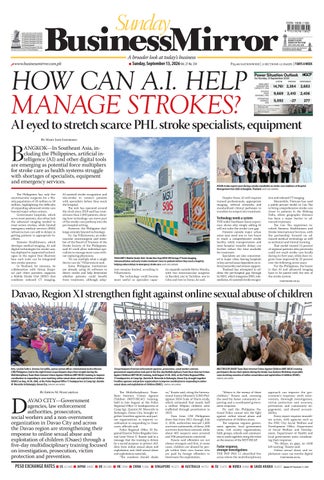
HOW CAN A.I. HELP MANAGE STROKES?
AI eyed to stretch scarce PHL stroke specialists, equipment
B
By Mary Jade Jadormio
ANGKOK—In Southeast Asia, including the Philippines, artificial intelligence (AI) and other digital tools are emerging as potential force multipliers for stroke care as health systems struggle with shortages of specialists, equipment and emergency services.
The Philippines has only five neurovascular surgeons for a Manila population of 20 million to 30 million, highlighting the difficulty of expanding advanced stroke care beyond major urban centers. Government hospitals, which serve most patients, also often lack the advanced imaging needed to treat severe strokes, while limited emergency medical services (EMS) infrastructure can add to delays in getting patients to appropriate facilities. Siemens Healthineers, which develops medical-imaging, AI and digital technologies for stroke care, has deployed or supported technologies in the region that illustrate how such tools can be integrated into stroke systems. In Thailand, for instance, its collaboration with Siriraj Hospital and other partners supports a Mobile Stroke Unit (MSU) that combines onboard CT imaging,
AI-assisted stroke recognition and tele-stroke to connect patients with specialists before they reach the hospital. The unit has operated around the clock since 2018 and has treated more than 2,900 patients, showing how technology can move part of the stroke-care pathway into the pre-hospital setting. However, the Philippine challenge extends beyond technology. Dr. Jay Villavicencio, an endovascular neurosurgeon and member of the Board of Trustees of the Stroke Society of the Philippines, said AI could allow individual specialists to manage more cases without replacing physicians. “AI can multiply what a single doctor can do,” Villavicencio said. Some Philippine institutions are already using AI software to detect stroke and help determine whether patients could benefit from treatment, although adop-
ASEAN stroke experts pose during a media roundtable on stroke-care readiness at Hospital Management Asia 2026 in Bangkok, Thailand. MARY JADE JADORMIO
Despite these, AI still requires trained professionals, appropriate imaging, referral networks and standardized clinical pathways to translate its output into treatment.
Technology needs a system
THAILAND’S Mobile Stroke Unit–Stroke One Stop (MSU-SOS) brings CT brain imaging, teleconsultation and early stroke treatment closer to patients before they reach a hospital, helping reduce delays in emergency stroke care. MARY JADE JADORMIO
tion remains limited, according to Villavicencio. The technology could become more useful as specialist capac-
ity expands outside Metro Manila, with two neurovascular surgeons in Bacolod, one in Tacloban, one in Cebu and two in Davao, he said.
THE wider Southeast Asian experience shows why simply adding AI will not solve the stroke-care gap. Patients outside major urban areas may need one to two hours to reach a comprehensive stroke facility, while transportation and inter-hospital transfer delays can further reduce the time available for treatment. Specialists are also concentrated in major cities, leaving hospitals in less-served areas dependent on referral networks and remote support. Thailand has attempted to address the pre-hospital gap through its MSU, which integrates EMS, telemedicine, AI-assisted stroke recogni-
tion and onboard CT imaging. Meanwhile, Vietnam has used a public-private model in Can Tho to bring comprehensive stroke care closer to patients in the Mekong Delta, where geographic distance has been a major barrier to advanced treatment. The Can Tho experience involved Siemens Healthineers and Stroke International Services, with the partnership focused on advanced medical technology as well as technical and clinical training. That model treated 13 percent of regional patients who previously could not reach stroke care locally during its first year, while door-togroin time improved by 25 percent over the following seven years. For the Philippines, the lesson is that AI and advanced imaging have to be paired with the rest of the stroke system. Continued on A2
Davao, Region XI strengthen fight against online sexual abuse of children
Atty. Lovelie Faith G. Entoma-Forcadilla, justice system officer, International Justice Mission (IJM) Philippines (2nd to the right) listens to participants share their insights during the Multidisciplinary Team-Basic Internet Crimes Against Children (MDT-BICAC) training to improve coordination in responding to cases involving online sexual abuse and exploitation of children (OSAEC) on Aug. 24-28, 2026, at the Police Regional Office 11 headquarters at Camp Sgt. Quintin M. Merecido in Buhangin, Davao City. ERWIN M. MASCARIÑAS
D
By Erwin M. Mascariñas
AVAO CITY—Government agencies, law enforcement authorities, prosecutors, social workers and a non-overnment organization in Davao City and across the Davao region are strengthening their response to online sexual abuse and exploitation of children (Osaec) through a five-day multidisciplinary training focused on investigation, prosecution, victim protection and prevention.
154 participants from law enforcement agencies, prosecutors, social workers and nongovernment organizations took part in the five-day Multidisciplinary Team-Basic Internet Crimes Against Children (MDT-BICAC) training, held August 24-28, 2026, at the Police Regional Office 11 headquarters at Camp Sgt. Quintin M. Merecido in Buhangin, Davao City, brought together frontline agencies and partner organizations to improve coordination in responding to online sexual abuse and exploitation of children (OSAEC). ERWIN M. MASCARIÑAS
MULTIDISCIPLINARY Team-Basic Internet Crimes Against Children (MDT-BICAC) training participants discuss their options during the Intake Case Analysis Workshop on possible cases involving scenarios of online sexual abuse and exploitation of children (OSAEC).
The Multidisciplinary TeamBasic Internet Crimes Against Children (MDT-BICAC) training, held in late August at the Police Regional Office 11 headquarters at Camp Sgt. Quintin M. Merecido in Buhangin, Davao City, brought together frontline agencies and partner organizations to improve coordination in responding to Osaec cases, officials said. Police Regional Office XI Regional Director Police Brigadier General Leon Victor Z. Rosete said in a message that the training is driven by a sacred purpose: to protect children from online sexual abuse and exploitation and child sexual abuse and exploitation materials. “The numbers should shake
“Silence is the enemy of these children,” Rosete said, stressing the need for faster community reporting and a coordinated government response. He said the Philippine National Police cannot win the fight against online sexual abuse and exploitation of children alone. The response requires government agencies, local government units, civil society organizations, faith groups, schools and communities to work together citing the event as the essence of the MDT-BICAP.
us,” Rosete said, citing the International Justice Mission’s (IJM) Philippines 2024 Scale of Harm study, which estimated that nearly half a million Filipino children were trafficked through prostitution in 2022. Data from IJM Philippines show that from 2011 through July 3, 2026, authorities rescued 1,689 survivors nationwide, of these, 568 survivors have been restored, while about 465 suspects were arrested and 296 perpetrators convicted. Rosete said offenders are not always strangers and that, in some cases, children are abused by people within their own homes who are paid by foreign offenders to livestream the exploitation.
ERWIN M. MASCARIÑAS
Faster response, stronger investigations
THE PNP PRO 11 identified five areas where the multidisciplinary
approach can improve the government’s response: swift intervention, thorough investigation, victim protection and recovery, prevention and community engagement, and shared accountability. Every report requires immediate action, with agencies such as the PNP, City Social Welfare and Development Office, Department of Social Welfare and Development, Department of Health and local government units coordinating their response. “No delays, no gaps, no child left waiting,” Rosete said. Online sexual abuse and exploitation cases can involve digital Continued on A2
PESO EXCHANGE RATES n US 62.5420 n JAPAN 0.4052 n UK 84.5380 n HK 7.9764 n CHINA 9.3186 n SINGAPORE 49.3273 n AUSTRALIA 44.7551 n EU 72.6175 n KOREA 0.0463 n SAUDI ARABIA 16.6557 Source: BSP (September 11, 2026)