PHL, Australia begin a new chapter in decades-long alliance amid evolving geopolitical developments


ABOND forged by the horrors, slaughter and devastation of the last global war further strengthened as Filipino and Australian troops for the first time ever conducted military exercises aimed at enhancing the interoperability and readiness of the participating forces aside from increasing their team capability to respond to any security challenges.
Dubbed “Exercise Alon” between the Armed Forces of the Philippines (AFP) and the Australian Defense Force (ADF), the war drills formally opened aboard the Royal Australian Navy’s landing helicopter dock, HMAS Canberra,
at Darwin on August 14, and formally ended in Camp Aguinaldo, Quezon City, on August 31.
Alon” is part of Australia’s Indo-Pacific Endeavor (IPE) 2023, which aims to promote security, stability, and stronger partnership
through bilateral and multilateral engagement training, capacity building and humanitarian efforts.
A nd its name (alon means waves in Tagalog), according to AFP public affairs office chief Lt. Col. Enrico Gil Ileto, connotes the prime characteristic of amphibious warfare.
“ The term ‘waves’ signifies the characteristics of amphibious warfare and emphasizes the projection of ground and air power onto a hostile or potentially hostile shore,” he explained.
A lon aims to enhance regional security through cooperation and partnership aside from enhancing interoperability and readiness to respond to shared security challenges of Filipino and Australian units.
Th is year’s iteration included an air assault exercise in Palawan conducted on August 21, combined amphibious assault exercise in Zambales on August 25, and live-
fire training as the final phase in Capas, Tarlac, on August 31.
“Exercise Alon” participants included an initial 560 personnel from the AFP, and 1,200 from the ADF, with support from 120 United States Marine Corps (USMC) personnel.
Participating assets included the HMAS Canberra and frigate HMAS Anzac, with the Tarlac-class BRP Davao del Sur, close air support from Royal Australian Air Force (RAAF) F-35A “Lightning II” aircraft, Australian Army M-1A1 “Abrams” main battle tanks and two PMC amphibious assault vehicles along with the USMC’s MV-22 tiltrotor “Osprey” aircraft.
“Exercise Alon” enhanced the forces’ capability in conducting combined operations and improved their tactics, techniques and procedures on amphibious operations.


A resounding success
AND with the first-ever “Exercise Alon” being a resounding success,

Long-standing military partnership
THE Philippines and Australia enjoy a deep bilateral relationship in the field of defense, dating back to World War II.
Australia’s military involvement in the liberation of the Philippines began in June 1943, when eight Australian servicemen who had escaped from Sandakan in Sabah joined the Filipino guerrillas fighting in Tawi-Tawi.
The Royal Australian Air Force or RAAF contributed to the Philippines’ liberation, beginning with photographic reconnaissance missions over the Philippines starting August 1944.

The Royal Australian Navy (RAN) contributed cruisers, destroyers, hydrographic survey and landing ships, while Australian Army soldiers served as analysts in the RAAF signals intelligence unit and as bombardment liaison teams and landing detachments aboard Australian warships.
its exercise director, PMC deputy commandant Brig. Gen. Jimmy Larida, is pleased to note that the strategic objectives of the AFP and ADF for the drills have been met.
So it is indeed a very successful exercise even though this is the first and big amphibious exercise between the ADF and the AFP, the planners and the training audience were able to jell immediately that [this] resulted in the success of the exercises both in the air assault in Punta Baja in Palawan and the amphibious assault in Zambales,” he said at the closing ceremonies on August 29.
L arida also stressed that they will be able to improve the succeeding iterations, as they have identified areas where Filipino troops are proficient, and those where further improvements are needed.
The PMC official also stressed that the next iteration of “Exercise Alon,” scheduled for 2025, will definitely be bigger than the first.
R AN ships also participated in the Battle of Surigao Strait on October 25, 1944, when the Japanese fleet was defeated while attempting to destroy the Leyte landing forces.


No less significant was the Australian contribution to the second Allied landing in the Philippines on December 15, 1944.
To guard against Japanese Navy interference from nearby Manila Bay, 24 RAAF “Catalina” bombers mined the entrance to Manila Bay on the eve of the landing.
I n the third and final major landing in the Philippines, 46 RAN sailors were killed in three separate attacks while Allied ships were approaching and in the Lingayen Gulf.
R AN cruisers, destroyers, hydrographic survey and landing ships together with their Army detachments participated in the operation.
Many prospective dog or cat owners only focus on the positive aspects of bringing a furry friend into their lives. And there are countless reasons why pets are great. But it’s also important to have realistic expectations so you don’t face sudden expenses that could hurt your financial stability.
“It’s important to be able to choose a pet that is going to fit your budget and your lifestyle the best,” said Dr. Wendy Hauser, a veterinarian who founded her own consulting company.
W hen Melissa Chavez decided to get a toy poodle named Milo in the summer of 2020, she had an idea of the costs but was surprised by how fast they added up. Like many others during the pandemic, she saw her stay-at-home schedule as a perfect opportunity to get a puppy.
I’ve never had any dogs before, so I think everything was a learning opportunity for me,” Chavez said.
If you are considering getting a pet, or looking for ways to cut costs, here are some things to consider:
Research basic costs for your pet INITIAL costs for a dog or cat go beyond the fee to adopt or buy them.
First, you need to visit a veterinarian to get them vaccinated or do a routine wellness check, which can cost around $200 to $300.
Once you get them home, pets need a bed, food, leashes and harnesses and grooming supplies, among other things. While these items are fairly inexpensive individually, they can quickly add up.
On average, you can expect to spend $1,400 a year for a dog and $1,200 for a cat, according to Kerry
O’Hara, chief insights officer at APPA, the American Pet Products Association, a trade group.
K nowing how much you will initially need to spend when you get a pet will help you budget.
If you want to know which items are a must, the American Society for the Prevention of Cruelty to Animals offers dog and cat supply checklist for first-time pet parents.
Take a look at your lifestyle
IF you are a frequent traveler or are away from home for many hours at a time, you might need to spend some extra money on boarding or daycare.
Recently, Lauren Gelber, 44, went on a family trip for two weeks and paid around $1,800 to board her two dogs. Gelber, who lives in Marin, California, said the cost was high because she has two pit bull mixes and her dog hotel charges more for large dogs.
W hen Sharon Simon, 64, and her husband want to go on vacation, they ask their adult children to look after their dogs.
We couldn’t afford to board two dogs and go to Europe for two weeks,” said Simon, who lives in Salinas, California.
If you don’t want to board your pet, you could take them with you on vacation, but you will have to pay for the pet’s flight and any hotel fees.
If you need to leave your house every day for work, you might also need to invest in daycare or dog walking services. When Gelber’s children were younger, she used to take her dogs to daycare so they
could be walked and socialized. That added around $800 a month to her expenses.
Consider the breed DOING research on the breed of pet that you will adopt is important, not only because it will help determine if they fit your life but also whether you can afford them, Hauser said.
“An example are Maine coons, they are amazing cats but they have a high incidence of heart disease so you are going to have to pay for ultrasounds and cardiac consults once or twice a year,” Hauser said.
A nother example of an expensive breed is French bulldogs, which tend to develop many health issues, Hauser said.
Gelber used to have two French bulldogs that each had their own health complications that required emergency care at a cost of $4,000 and $6,000.
Gelber ended up paying a small fraction of those amounts because she had pet insurance, which she got knowing that French bulldogs are prone to getting sick.
Aside from medical issues, it’s
important to consider the energy levels of the pets or if they require a specific diet that could be costly. While Gelber’s pit bull mixes are healthy and haven’t required as much medical care as her French bulldogs, she does spend more on food and boarding because of their size.
Prepare for the unexpected A FEW months ago, Milo suffered a case of pancreatitis and Chavez had to pay thousands of dollars in the emergency room, which affected her budget for a while.
I had to limit myself. I was just staying home and telling my friends ‘I’m sorry, I just spent almost $3,000 on my dog, I cannot go out to eat,’” she said.
W hile it’s impossible to know what the future will bring, Hauser says that there are some things pet parents can do to limit the possibility of health issues. The main one is consistently taking your pet for wellness checks.
We would much rather detect diseases early and manage them and have the pet live a longer, better quality life than to put out a fire,” Hauser said. Two important
things to keep track of are dental care and weight, she added.
Pet owners can also get health insurance, though some feel it’s not worth the cost.
C havez’s recent emergency bill made her second guess her decision to not get pet insurance for Milo.
Gelber also benefited from pet insurance for her dogs’ emergency bills. But Simon, who has had dogs for 25 years, has never gotten pet insurance and has not needed it during that time.
W hether you have pet insurance or not, it’s good to have some savings in case you need to pay for an unexpected vet visit.
Look for ways to cut costs
THERE are ways to cut the cost of caring for pets. Chavez recommends that other new pet owners not get impulsive about buying everything they see online.

Don’t get influenced to get things that you might not need because it will add up,” Chavez said.
To save some money, she joined Facebook groups in her area where people give out pet items for free. She’s gotten things like a pet carrier but also sold or gifted things that she ended up not needing, like a car seat for her dog. Chavez also got her dogs’ vaccines through Petco’s affordable veterinary care clinics, which offer vaccines at a lower cost.
You can cut some daycare costs by asking family members or friends to take care of your pet. If you need help with pet food, you can search pet food pantries around the country at Pet Help Finder.
Regardless of how much they have spent on their dogs, Chavez, Gelbert and Simon agree they don’t regret having them in their lives.
“The cost is 100 percent worth it, they are members of our family. I would just say you have to know [the cost] going into it,” Gelber said.
Continued from A1
Both countries’ defense engagement continues to this day, underpinned by an Enhanced Defence Cooperation Program (E-DCP), with key pillars of maritime security and counterterrorism, in addition to training and education, humanitarian assistance and disaster relief, a nd Gender, Peace and Security.
Defense engagement occurs under the provisions of the long-standing Memorandum of Understanding on Defence Cooperation (1995) and the Australia-Philippines Status of Visiting Forces Agreement (2012), offering a comprehensive legal and operational framework for defense cooperation.
Iterations
MEANWHILE, Department of National Defense (DND) Undersecretary Erineo Espino, who represented DND Secretary Gilberto C. Teodoro Jr. at the August 29 closing ceremonies, said they look forward to having more iterations of “Exercise Alon.”
The DND thus looks forward to the succeeding iterations of ‘Exercise Alon’ while sustaining existing bilateral and multilateral exercises,” he added.
Espino also said the just-concluded exercises allowed the AFP a nd ADF, with support from US troops, to successfully conduct complex operations in response to simulated security threats, aside from opening more “avenues for more interoperability and deeper people-topeople cooperation.”
“Australia’s Indo-Pacific Endeavour or the IPE [this 2023], of which ‘Exercise Alon’ is a part, presents a unique opportunity for the DND and the AFP to participate in
and gather insights on regional security initiative,” he added.
Espino said this venue is also ideal for the Philippine Navy to strengthen its capabilities on maritime security, while enhancing interoperability and linkages with its Australian counterparts.
“Considering that Australia is one of the only two defense partners within which the Philippines has a status of Visiting Forces Agreement, the IPE also advances our bilateral defense correlations,” he noted.
Top brass flown to SCS
IN another related development, ranking military officials from the Philippines, United States, Japan and Australia flew over the South China Sea (SCS) on board a US maritime patrol aircraft last week.
The US Indo-Pacific Command identified the military leaders as:
• Vice Adm. Toribio Adaci Jr.; Philippine Navy Flag Officer in Command;
• Commodore Juario Marayag, Philippine Navy Naval Air Wing Commander;
• Brig. Gen. Erick Quijada Escarcha, Philippine Air Force Tactical O perations Wing West commander.
• Vice Adm. Karl Thomas, US 7th Fleet;
• Lt. Gen. Greg Bilton, Australian Defence Force Chief of Joint O perations; and
• Vice Adm. Saito Akira, Japan Maritime Self-Defense Force Commander-in-Chief Self-Defense Fleet.
These military commanders embarked on a flight over the SCS on board a US Navy P-8A maritime patrol aircraft on August 26.
“During the flight, they were able to observe the maritime environment and discuss ways to increase interop-
erability, preserve regional stability, and maintain a free and open Indo-Pacific,” the US Indo-Pacific Command said in a statement.
The navies of the US, Australia and Japan also held port calls in Manila—Australia’s landing helicopter dock ship HMAS Canberra, Japan’s helicopter-carrying destroyer JS Izumo and the US’ amphibious assault ship USS America
Prior to the overflight, the four met in Manila to “further grow the cooperation” among the four armed forces.

During the meeting, Thomas emphasized the importance of likeminded nations working together in the air and on the sea to support a peaceful, secure and prosperous region.
Further, he opened the engagement by explaining he was “honored to sail and operate side-by-side each of you here today.”
“Our relationship with the Philippines is one of our most enduring,” Thomas said.
There’s no country more aware of the threats being posed in the South China Sea. Every nation benefits from a free and open Indo-Pacific. We will continue to strengthen our partnerships and look for more creative ways to operate together,” he stressed.
“Australia, Japan, the Philippines, the United States, and the rest of the Pacific partner nations are committed to maintaining peace and stability in the Indo-Pacific region while adhering to the Law of t he Sea,” Thomas said.
“When we operate together, we demonstrate the importance of the freedom of navigation and reinforce the prosperity of all nations who rely on these critical waterways,” he added.
EW YORK—Pets provide joy and companionship, but costs can add up quickly, especially if you’re a first-time owner and don’t know what to expect.MELISSA CHAVEZ feeds a treat to her toy poodle Milo, Thursday, August 24, 2023, in New York. Chavez decided to get a dog in the summer of 2020. She had an idea of the costs but was surprised by how fast these added up. AP
THE Philippines’s outstanding debt, as of end-July, is now at P14.24 trillion, about
10.5 percent higher than the P12.887trillion obligation level recorded in the same month of last year, according to the Bureau of the Treasury (BTr).

The Treasury attributed the increase in the country’s debt stock to higher domestic borrowings to meet the national government’s (NG) financing needs.
“The NG’s total debt stock increased by P96.44 billion or 0.7 percent month-overmonth, primarily due to the net issuance of domestic securities,” the Treasury said on Friday. The country’s outstanding debt at the
end of June was P14.147 trillion.
Treasury data showed the NG’s latest outstanding obligation is already 97.33 percent of its projected P14.63-trillion debt level for the end of the year.
The Treasury explained that 68.9 percent of the country’s outstanding debt was domestic borrowings, while the remaining 31.1 percent were sourced externally.
The NG’s domestic debt amounted to P9.81 trillion, higher on a monthly and yearly basis. The NG’s domestic debt in June was at P9.702 trillion; while in July 2022 it stood at P8.832 trillion, according to the Treasury.
“The increment in the domestic portfolio was attributed to the P110.39 net issuance
of government bonds driven by the NG’s financing requirements, offsetting the P0.85 billion effect of local currency appreciation against the US dollar on onshore foreign currency-denominated securities,” it said.
External debt
MEANWHILE , the NG’s external debt was estimated at P4.43 trillion, which was slightly lower than the P4.445 trillion it recorded in June. On an annual basis, it remained higher by 9.3 percent over July 2022’s P4.055 trillion external debt.
“For July, the reduced debt was due to the effect of peso appreciation against the US dollar amounting to P42.87 billion. This
more than offset the P9.97 billion net impact of third-currency fluctuations against the US dollar and P19.81 billion net availment of foreign loans,” the Treasury said.
Furthermore, the Treasury said the State’s guaranteed obligations in July fell by 10.9 percent to P363.39 billion from last year’s P408 billion. Likewise, it was lower than June’s P369.73 billion.
“For the month, the decline in guaranteed debt was attributed to the net repayment of both domestic and external guarantees amounting to P5.30 billion and P0.21 billion, respectively. In addition, peso appreciation against the US dollar further trimmed P1.67 billion, offsetting adjustments on third-currencydenominated guarantees amounting to P0.84 billion,” the Treasury said.
“From the end-December 2022 level, NG guaranteed debt has decreased by P35.65 billion or 8.9 percent,” the Treasury added.
THE country’s export earnings and import receipts both posted contractions in July and in the seven-month period this year, according to the latest data released by the Philippine Statistics Authority (PSA).
Export earnings contracted 1.2 percent in July 2023 to $6.14 billion from $6.22 billion in the same month of the previous year. Between January and July this year, exports declined 8.2 percent to $41.09 billion from the $44.75 billion in January to July 2022.
Import receipts, meanwhile, posted a 15.3-percent decline to $10.35 billion in July 2023 from $12.22 billion in the same month of the previous year. With this, imports contracted 9.1 percent to $73.27 billion in the January to July period this year, compared to $80.59 billion in January to July 2022.
By commodity group, electronic products continued to be the country’s top exports in July 2023 with total earnings of $3.65 billion or 59.4 percent of the country’s total exports during the period.
This was followed by other manufactured goods with an export value of $275.74 million or 4.5 percent of the total; and other mineral products, which amounted to $219.41 million or 3.6 percent of the total.
By major type of goods, exports of manufactured goods contributed the largest to the country’s total exports in July 2023, amounting to $5.06 billion or
a share of 82.4 percent. This was followed by mineral products with a share of $500.2 million or 8.1 percent of total; and total agro-based products, which contributed $441.78 million at 7.2 percent of the total.
Meanwhile, the data showed the commodity group with the highest imported value in July 2023 was electronic products, which amounted to $2.26 billion or a share of 21.9 percent to the country’s total imports.
This was followed by mineral fuels, lubricants and related materials at $1.53 billion, or 14.8 percent of total imports and transport equipment at $997.16 million, at 9.6 percent.
By major type of goods, according to PSA, imports of raw materials and intermediate goods accounted for the largest share of the country’s total imports in July 2023, amounting to $3.71 billion or 35.9 percent of the total.
Imports of capital goods ranked second with a share of $2.99 billion or 28.9 percent of the total, followed by consumer goods with an import value of $2.07 billion or 20 percent of the total.
MEANWHILE the country’s top export market in July 2023 was the United States of America (USA), which comprised the highest export value of $1.04 billion or a share of 16.9 percent to the country’s total exports in July 2023.
Other top markets were Japan with $861.5 million worth of exports and accounting for
MALACAÑANG on Friday said Finance Undersecretary Cielo Magno was removed from her office allegedly for constantly bringing her “anti-administration” sentiments before the public.
“She has been against the policies of this administration and made it known to the public on social media long before the President even assumed office,” Executive Secretary Lucas P. Bersamin said in a brief statement.
However, nongovernment advocacy group Action for Economic Reforms (AER) said “Magno’s forced departure from the DOF means that the administration is jeopardizing and forgoing the opportunity to enact positive reforms,” in contrast to the clear intent of President Marcos to have a Cabinet of “diverse” political backgrounds but with proven expertise.
AER said, “The administration has lost a reformer with technical expertise who can reach out to sectors with varying persuasions—politicians, investors and businessmen, people’s organizations, academics, and the international community. It has lost a reformer who has the technical grasp and the political acumen to shepherd the reforms.
Against the backdrop of rising inflation, a ballooning fiscal deficit, and lackluster growth, the loss of good reformers makes the work at the Department of Finance all the more challenging.”
B ersamin issued the statement after Magno announced her resignation and said she planned to resume teaching at the University of the Philippines’s School of Economics (UPSE), where she is an alumna.
P rior to leaving her post as the lead to the Department of Finance’s Fiscal Policy and Monitoring Group, Magno posted a graph depicting the Law of Supply of Demand on September 1, 2023.
T his was a day after President Ferdinand R. Marcos Jr. issued Executive Order No. 39, which imposed a price cap for regular- and well-milled rice.
B ersamin noted that while they recognize such opposition as part of everyone’s right of free speech, including that of Magno’s, they would have opted for such matters to be raised privately with colleagues so it can be addressed by the administration.
T he Executive Secretary, while still wishing Magno the best in her future endeavors, described her as someone who is “clearly set on maligning” the administration.
The termination of her appointment could only be expected as she clearly does not support the administration and its program for nationbuilding,” Bersamin said.
But AER described as “baseless and unfair” the accusation that Magno “clearly does not support the administration and its program for nation building” and “was clearly set on maligning [the administration].”
“Undersecretary Magno is most professional and competent. During her stint as DOF Undersecretary, she worked for good policies, including: the reform of the military and uniformed personnel [MUP] pension regime which, according to DOF Secretary Ben Diokno, will prevent a ‘fiscal collapse;’ reforming the mining fiscal regime not only to generate additional revenues but to clear the uncertainty that deters investments; health taxes to fund President Marcos’ food stamp program and other social protection measures; the re-entry of the Philippines into the globally prestigious Extractive Industries Transparency Initiative [EITI]; and the improvement in the fiscal incentive rationalization system by adopting firm but non-dogmatic rules on the Value Added Tax [VAT],” AER pointed out.
All of these, it stressed, “[translate] into better economic performance and investor confidence. Thus, Undersecretary Magno’s reform effort[s], in line with the President’s statements and Finance Secretary’s directives, are in the best interest of the country and of the Marcos administration.”
14 percent of the total; followed by Hong Kong, $797.91 million, 13 percent; People’s Republic of China, $758.22 million, 12.3 percent; and Netherlands, $325.83 million or 5.3 percent.
For imports, the country’s top source in July 2023 was the People’s Republic of China where $2.64 billion or 25.5 percent of the country’s total imports in July 2023 were sourced.
Other top sources of imports for the Philippines were Japan, where $865.03 million worth of imports came from and which represented 8.4 percent of the total; Indonesia, $810.2 million or 7.8 percent; USA, $687.53 million or 6.6 percent; and Thailand, $644.44 million or 6.2 percent.
By Butch FernandezSENATOR Sherwin Gatchalian urged the Marcos government Friday to “step up spending” as the lawmaker prodded State agencies to promptly come up with a strategic spending catch-up plan to enable the Marcos government to spend budget allocations faster to quickly pump prime the economy.
The senator made the call, noting that the country’s slower 4.3 percent economic growth in the second quarter of the year was brought in part by government’s underspending, as its spending contracted by 7.1 percent in the second quarter of 2023 from a year earlier.

Gatchalian said it would have been “forgivable if the headwinds were coming from the outside,” such as a slowdown in the growth of China or the Ukraine invasion.
But, he noted “looking at the components of our GDP [gross domestic product] growth [and] government spending is something that we can control.”
However, the lawmaker lamented, “We are not spending fast enough and it affected our growth.”
G atchalian griped, “We are talking about increasing the budget by 9 percent but we cannot even spend as quickly as possible and has affected our growth.”
At the same time, the senator conveyed his message to members of the Executive branch’s economic team during a Development Budget Coordination to Committee (DBCC) briefing as the Senate tackled the proposed P5.768 trillion national budget for 2024.
Moreover, the lawmaker likewise grilled the administration’s plan to catch up on its spending to help propel the domestic economy to grow by at least 6.6 percent in the second half of the year so that full-year GDP expansion could reach the 6 percent target.
“This catch-up plan, are these hard commitments by implementing agencies or just loose conversation?” the senator asked. “Because if it’s a written document, I would like to see Budget Secretary Amenah Pangandaman reply that the budget department has already issued a circular directing all government agencies to submit by September 15 this year their respective catch-up plans to address bottlenecks and reach their respective financial targets for the year.”
The senator added: “Submit to us the document so we can push them to spend faster. We want to push the different agencies to implement faster because it’s affecting the entire economy,” he told the Budget Secretary.
Sen. Gatchalian urges Marcos admin to ‘spend more’ to prime economy
OVER a million Filipinos looked for additional sources of income, while nearly two million dropped out of the labor force to focus on family duties in July 2023, according to the Philippine Statistics Authority (PSA).
In July 2023, the number of unemployed Filipinos reached 2.27 million, lower by 329,00 compared to July 2022 but higher by 17,000 compared to April 2023. This translated to an unemployment rate of 4.8 percent.
In terms of the underemployed, there were 7.1 million in July 2023, higher by 562,000 than July 2022 and by 900,000 compared to April 2023. This represented an underemployment rate of 15.9 percent.
“Ang malaking nag-contribute dito in terms of classification of underemployment, talagang nagpataas yung invisible underemployment [A big contributor here in terms of classification of underemployment,




is the invisible underemployment],” National Statistician Claire Dennis S. Mapa said in a briefing on Friday.
Based on classification, there were 3.585 million visible underemployed Pinoys and 3.519 million who were considered invisibly underemployed.
Mapa said between July 2023 and July 2022, year-on-year, there was a 1.25-million increase in invisible underemployment.
On a quarterly basis, Mapa said there was a 1.9-million increase in invisible underemployment in July 2023 compared to April 2023.
“There are two classes of underemployed. One is the visible underemployed who works for less than 40 hours and so wants to add more work hours,” Mapa said.
“But there is another one, the invisible underemployed who works for 40 hours and above, but the person wants to have more hours or more jobs,” he added.
Meanwhile, the country’s labor force declined to 46.9 million, translating to a labor
force participation rate of only 60.1 percent. This was 3.09 million lower compared to July 2022 and 3.41 million lower than April 2023. Mapa said this was largely due to the 1.99 million who declared that they dropped out of the labor force to focus on household duties such as chores and caring for family members; while 1.08 million said they were still too young to work, largely from the new entrants. The data also showed that 365,000 Filipinos dropped out of the labor force because they believed there were no available jobs for them. These constitute what are called “discouraged workers.”
“These three categories, the increases, formed the substantial reasons for that drop in the numbers,” Mapa said.

Government efforts
THE National Economic and Development Authority (Neda) stressed that the government’s priority remains creating highquality and high-paying jobs to address
DESPITE some Chinese harassment, the Philippines on Friday successfully resupplied its troops manning the BRP Sierra Madre (LS-57), which is stationed at Ayungin Shoal in the West Philippine Sea (WPS).
This was reported by the National Task Force for the West Philippine Sea (NTF-WPS) in a statement to reporters.
The resupply was conducted by the Armed Forces of the Philippines’ Western Command with assistance from the Philippine Coast Guard.
The last resupply to the BRP Sierra Madre took place last August 22. The delivery was partially accomplished following the August 5 resupply, which was blocked and water cannoned by the Chinese.
“The Task Force is also informed that the harassment, dangerous maneuvers,
and aggressive conduct of the vessels of the China Coast Guard [CCG] and Chinese Maritime Militia [CMM] against our public vessels took place again during the conduct of routine and regular operations well within our nation’s exclusive economic zone [EEZ],” NTF-WPS reported.
It also noted that these operations are part of the Philippine government’s legitimate exercise of its administrative functions and jurisdiction over the WPS that is firmly anchored on the United Nations Convention on the Law of the Sea (UNCLOS) and the final and binding 2016 Arbitral Award.
“The Task Force strongly deplores and condemns the continued illegal, aggressive, and destabilizing conduct of the CCG [China coast guard] and the CMM [Chinese maritime militia] within our nation’s EEZ [exclusive economic zone]. We reiterate what President
Ferdinand R. Marcos Jr. said during the recently concluded 43rd Asean Summit regarding the South China Sea: ‘Practical cooperation in the maritime domain can only flourish with an enabling environment of regional peace, security, and stability anchored in international law.’ We call on all to do their part in ensuring a peaceful and rules-based international order in the oceans,’” it added.
‘Without permission’ FOLLOWING the successful resupply mission, the Chinese Coast Guard accused the Philippines of entering Ayungin Shoal illegally, “without the permission of the Chinese government.” China claims the entire South China Sea, including Ayungin Shoal (which they refer to as Ren’ai Reef) in the Spratly Islands (which they call Nansha Islands).
PRESIDENT Ferdinand R. Marcos Jr. on Friday led the country’s forging of a new “elevated” partnership with Australia on defense, people-to-people exchange and soil health.
T he said agreements were finalized during Marcos’ bilateral talks with Australian Prime Minister Anthony Alabanese in Malacañang.
It was the first time an Australian prime minister visited the country in 20 years.
F ollowing the said bilateral talks, both countries signed a Joint Declaration and Strategic Partnership, which will elevate their existing cooperation and agreed to formalize an annual defense minister meeting.
“I’m confident that these partnerships will drive innovation, create opportunities, and foster deeper understanding between our peoples,” Marcos said.
“L et the elevation of our relations, of our relations to a strategic partnership, usher in
a brighter and more prosperous future for both our peoples,” he added.
Albanese said through the new joint declarations, they are seeking partnerships with the Philippines on agriculture, education, resources and the green energy transition.
Two memorandum of understanding (MOU) were also signed during the bilateral meeting.
T he first was on a new work and holiday visa arrangement, which “further strengthened by the new reciprocal work and holiday visa arrangements.”
Also signed was an MOU concerning furthering cooperation on national soil health strategy, where both countries agreed to co-develop initiatives supporting soil health strategy through joint research, capacity building, experts and knowledge exchange and science-based support to policy.
“I’m pleased that we’ve signed today a memorandum of understanding backed by $4.4 million in Australian funding, focused on collaborative research to assist the Philippines to develop its own National Soil Health Strategy,” Albanese said.
H e said their decision to improve relations with the Philippines is part of Canberra’s thrust to deepen its engagement with Southeast Asian countries.
“ Our economic future is also with Southeast Asia and we’re determined to grow trade and investment for our shared economic prosperity. And just earlier this week in Jakarta at the East Asia Summit, launched, Invested: Australia’s Southeast Asia economic strategy to 2040 which is aimed at increasing our two way trade and investment,” Albanese said.
Albanese also announced a number of initiatives for Filipino youth as well as added its financial support to the peace process in Mindanao.
He also invited President Marcos to Australia in March 2024 to attend a Special Summit to Commemorate the 50th Anniversary of Asean-Australia Dialogue Relations.
According to the office of Prime Minister Albanese, the scholarships offered to Filipinos to Australia will be increased to more than double the number this year.
the rising issue of vulnerable employment, particularly among self-employed and unpaid family workers.
Neda Secretary Arsenio M. Balisacan reiterated the importance of fast-tracking the implementation of the FY 2023 budget and the government’s infrastructure programs bannered by the “Build-Better-More” infrastructure flagship projects that aim to strengthen the country’s competitiveness and create more job opportunities for workers.
He also expressed the Marcos administration’s priority to roll out programs enhancing the skillsets of Filipino employees.
“We will focus on expanding upskilling and retooling programs to improve the country’s labor market performance. These are critical to assisting members of the workforce, particularly those in vulnerable employment, to improve their employability and allowing them to move across industries and occupations,” he added.
“The China Coast Guard strictly warned the Philippine vessels in accordance with the law, tracked and monitored the vessels all the way and effectively regulated them,” the spokesperson of the Chinese Coast Guard said in a statement.
Beijing insisted that the Philippine resupply ships carried construction materials to fortify the grounded World War II vessel BRP Sierra Madre.
“China has indisputable sovereignty over the Nansha Islands, including the Ren’ai Reef, and its adjacent waters, and firmly opposes the illegal transportation of construction materials by the Philippines to the illegal grounded warship,” the Chinese Coast Guard said.
“The China Coast Guard will continue to carry out law enforcement activities in the sea areas under China’s jurisdiction according to law,” it added. Rex Anthony Naval & Malou Talosig-Bartolome
In 2024, over scholarships will be awarded to Filipinos to study Masters and PhD programs in Australia. This would “build invaluable connections” between Filipinos and Australians.
Albanese also said Australia will also allow young Filipinos aged 18-30 who are on holiday in Australia to extend their stay and work legally to help them fund their trip. This Work and Holiday visa is also extended for Australian young tourists travelling to the Philippines.
The reciprocal visa arrangement “support[s] stronger economic, cultural and people-to-people links,” he added.
Canberra will also re-establish a Philippines Institute at the Australian National University as part of its commitment to “boost ties with Southeast Asia, build partnerships between our institutions and deepe shared understanding of each other’s perspectives and interests.”
Australia likewise committed to contribute another $64.5 millilon (P3.6 billion) to peace-building in conflict areas in Mindanao. The fund will help reduce violent conflict, reintegrate former combatants, support community development particularly for women.
KOREAN cars and auto parts and Philippine bananas and canned pineapples will be among the first products that can enjoy free tariffs with the newly signed free trade agreement (FTA) between Seoul and Manila.
Korean-made products, which have become popular due to K-Dramas such as ginseng, processed food, pearl and mackerel may soon be more affordable and accessible in the Philippines with the new FTA.
On Thursday, the Philippine-Korea FTA was signed by trade ministers Ahn Duk-geun and Trade Secretary Alfredo Pascual at the sidelines of the Asean Summits in Jakarta.
President Ferdinand R. Marcos Jr. and South Korean President Yoon Suk Yeol witnessed the historic signing.
The Korean Embassy in Manila said under the FTA, Korea would open 94.8 percent of its market to the Philippines, while the Philippines would allow Korean products to enter 96.5 percent of the Philippine market.
By “achieving a high level of liberalization,” Korean-made cars and green cars can be exported to the Philippines at zero tariff rates.
The Philippines is the top car importer among Asean countries. Japan-made cars like Toyota, Mitsubishi and Isuzu are the dominant brands last year in the $36.6 million car market.
Korean cars Hyundai and KIA have so far only cornered 2.5 percent of the Philippine car market as of 2022. Under the Economic Partnership Agreement (EPA) between the two countries, the tariff rate on Korean cars and car parts have been lowered to 5 percent, but passenger cars are still being imposed 20 percent tax.
Upon entry into force of the agreement, the Philippines will remove the tariffs on Korean cars. Tariff on car parts as well as eco-friendly
vehicles like electric and hybrid cars will be removed within five years.
Parliaments of both countries need to ratify the FTA to implement it. This is the second bilateral FTA of the Philippines with another country. The first one is with Japan in 2008. Manila has multilateral FTAs such as the Asean Free Trade Area (AFTA) and Regional Comprehensive Economic Partnership (RCEP).
Korea, on the other hand, now has 22 FTAs with 59 countries. This is the fifth FTA with a key member of Asean, its third largest export destination.
Aside from cars, the FTA will also pave the way for the removal of tariffs of Korean agricultural and fishery products within 15 years. Tariffs on Philippine bananas, on one hand, will be removed within five years.
“However, the safeguard measure will be implemented to avoid a surge in imports, if required. Based on recent import volumes, measures can be taken to re-impose the tariff of up to 30 percent if imports exceed the annual threshold, beginning in the first year of the FTA (for 10 years),” the Embassy added.
The signing of the FTA “created a foundation” for both countries to explore on other economic cooperation such as vaccine, climate change and culture with the adoption of the agreement of economic and technical cooperation in the FTA.
“Based on this groundwork, the mutuallybeneficial bilateral discussions will be pursued through a variety type of cooperation in promising areas, including healthcare, rare metal processing, innovation ecosystem, culture industry, film, e- commerce and intellectual property rights,” it added.
Talosig-BartolomeMalou
THE Armed Forces of the Philippines’ (AFP) plan to acquire multi-role fighters (MRFs) in its ongoing modernization program was among the key issues discussed during a meeting on Friday between AFP chief Gen. Romeo Brawner Jr. and Swedish Ambassador to the Philippines Annika Thunborg.
The meeting took place following the courtesy call of the Swedish envoy to the AFP headquarters in Camp Aguinaldo, Quezon City, military public affairs office chief Lt. Col. Enrico Gil Ileto said in a statement.
“The CSAFP [Chief of Staff, AFP] and Ambassador Thunborg discussed the acquisition of MRFs,” Ileto said.
Incidentally, the Sweden’s Saab JAS-39 “Gripen” was one of the two top contenders for the PAF MRF Acquisition Project with the other jet fighter being the US Lockheed Martin F-16V “Viper,” the latest version of the American-made aircraft now being supplied in quantities in many air forces in the world.
The JAS-39 is classified as the most reliable “swing-role combat aircraft” available in the world.
The Swedish-made fighter jet requires minimal personnel and ground support equipment for dispersed operations and can
operate from small and unprepared roads. It is also equipped with sophisticated radar and sensors and weapons.
Ileto said the two officials also discussed “the role of like-minded nations both in building a credible armed force for the Philippines and in pursuing the rulesbased international order in the WPS [West Philippine Sea].”
“The Ambassador likewise expressed that Sweden stands firmly behind the Philippines in the protection of its territory and territorial integrity as well as the international rulesbased order and the 2016 Arbitral Award,” he added. Brawner also expressed hope that China will cease its illegal activities in the WPS even as he maintained that the Philippines has a right in maintaining the integrity of BRP Sierra Madre, which is serving as the country’s outpost in Ayungin Shoal.
“The CSAFP said that the AFP will not allow China to dictate on us on what we want to do in that post that has become a symbol of our dedication to our mandate as protector of the people and the state and our commitment to our soldiers who are stationed there,” Ileto added. Rex Anthony Naval
Associated Press
By Terry Tang | ThePHOENIX—Andrea Nissen is trying to prepare her 65-yearold husband, who has Alzheimer’s disease, for a solo flight from Arizona to Oklahoma to visit family. She worries about travelers and airport officials misinterpreting his forgetfulness or habit of getting in people’s personal space, and feels guilty about not being able to accompany him.
“People say, ‘He has dementia. You can’t let him go by himself,’” Nissen said.
But attending a dementia-friendly travel workshop in July helped ease some of those fears. She learned about the resources available at Phoenix Sky Harbor International Airport and what assistance airlines can offer when asked.
It was the first time the city of Phoenix hosted such a workshop, making it the latest US city pledging to make flying friendlier for people with dementia.
Over 14 million people are expected to check into airports nationwide for Labor Day weekend and, inevitably, some will be travelers with dementia or another cognitive impairment. Nearly a dozen airports — from Phoenix to Kansas City, Missouri—in the last few years have modified their facilities and operations to be more dementia-friendly, advocates say. They’ve added amenities like quiet rooms and a simulation center where travelers with dementia can learn about flying or get a refresher.
Looking for a gate, trying to remember flight times or following terse commands from Transportation Security Administration agents while in line with others can overwhelm someone with dementia.
Symptoms like forgetting words can be mistaken for being under the influence of alcohol or drugs.
But most large US airports are behind the curve on serving travelers with dementia when compared with some airports in Australia and Europe. Dementia isn’t covered by the Americans with Disabilities Act, so nobody is compelled by law to make changes, said Sara Barsel, a former special education teacher and founder of the Dementia-Friendly Airports Working Group, which lobbies for airports and airlines to enact dementia-inclusive policies.
Part of the reason she suspects there aren’t more quiet rooms or family restrooms with adult changing tables is because that doesn’t generate revenue, she said.
“I don’t know what their constraints are in terms of economics.
I know what the impact is and the impact is that there’s less for people who need quiet spaces,” said Barsel, who is based in Roseville, Minnesota.
The group, which was founded in 2018 by experts in dementia and Alzheimer’s, helped add lanyard and other programs to airports. London’s Gatwick Airport created the Hidden Disabilities Sunflower lanyard program in 2016, which is now in over 200 airports globally. Light green lanyards with a sunflower pattern are issued to anyone who wants to subtly indicate they or a travel companion has dementia or a notas-visible disability. The lanyards let airport and airline personnel know the traveler may need more attention and information repeated.
One of the first airports the group reached out to was the Missoula Montana Airport, which became certified as a “sensory inclusive” facility in March. The group went over issues that can arise with lighting, floor design and noise. It also incorporated the sunflower lanyards.
“It’s already a high-stress, anxiety-driven environment for anyone not suffering from a hidden disability,” said airport Deputy Director Tim Damrow. “One reason people come here to Montana is for friendly people and obviously for the amazing scenery. We wanted to make
sure that everyone is welcomed and treated with the dignity and respect they deserve.”
Candice Kirkwood, of Indianapolis, experienced what she said was her worst nightmare in 2001 when her parents were flying through the Dallas Fort Worth International Airport. Her mother, Marjorie “Margie” Dabney was wearing a badge to signal she needed extra help because she had Alzheimer’s, and the couple was being helped by an airline attendant. The attendant helped Kirkwood’s father, who used a wheelchair, to the restroom, and when they returned, Dabney was gone.
“It played every day in my mind,” Kirkwood said. “What could I have done differently? I didn’t get to say goodbye to her.”
Human remains that were found six years later and 15 miles (24 kilometers) away in a remote area were identified as Dabney through the use of DNA. Local police said she died of blunt force trauma, which could have been caused by a fall or an object striking her. The case remains unsolved.
Dabney’s now late husband, Joe, settled a lawsuit with American Airlines for an undisclosed sum in 2003.
Kirkwood said she still harbors distrust of airlines.
“I don’t want anybody to ever have to go through what I went through,” she said. “It’s like once my mother faded away, nobody seemed like they ever cared to talk about it.”
Representatives for the airline did not immediately respond to requests for comment on any changes to accommodate travelers with cognitive impairment.
Dallas Fort Worth International Airport, however, is launching the sunflower lanyard program in midSeptember. All frontline employees who interact with customers and volunteer ambassadors will receive formal training on how to engage with travelers donning the lanyards. Its inception has been a long time coming, according to airport spokesperson Heath Montgomery.
“We’re continuing to evolve the way we interact with customers from all walks of life,” Montgomery said.
Jan Dougherty, a registered nurse who has written a book on traveling with dementia and led the Phoenix workshop, said it’s unfortunate that people with dementia have gone missing. With the right support, she said they can travel safely.
“So many people early on [after diagnosis] are capable of travel with some accommodation,” she said.
“We’re still an ageist society.”
The need for accommodations will become more prevalent as more Americans move into retirement age. The Centers for Disease Control and Prevention predicts nearly 10 million adults among those 65 years or older will have dementia by 2060. Experts, however, say dementia often is under diagnosed.
Similarly, more than 6 million people nationwide have Alzheimer’s disease, which is expected to hit 13 million by 2050, according to the Alzheimer’s Association. Overall, 55 million worldwide are currently living with Alzheimer’s and other forms of dementia.
Carol Giuliani, who is part of the airports working group, can testify to the growing need. For the past eight years, she has worked as a travel companion for senior citizens with dementia. She has accompanied seniors on flights, vacations or relocations in 42 states and 12 foreign countries. Giuliani wears a company jacket and has a sunflower lanyard for her client. She also has explanation cards for security agents to “put a little TLC in the TSA.”
“Ninety percent of the time it’s a family member that hires me,” said Giuliani, while seated at Phoenix Sky Harbor after escorting an elderly man on a flight. “The one I did today, [the wife] was like ‘thank you, thank you, thank you!’...I know how to pace it so that he gets safely and comfortably back home.”
In an interview on Wednesday, Christina Llanto, Albay Provincial Social Welfare and Development Office (PSWDO) focal person for senior citizens’ affairs said the distribution started on September 4 and subsequently, on September 5-9, 11, 12 and 13.
She said they are fast-tracking the distribution since the election ban on the grant of “ayuda” or monetary assistance will start on September 15.
“We have a total of 16,599 indigent senior citizens beneficiaries and at least 5,000 of them already received the social pension in the province of Albay. We started last
September 4 in Manito town and Legazpi City; September 5 in Daraga and Camalig and Wednesday, personnel of PSWDO were in RapuRapu, Guinobatan, and Jovellar,” Llanto said.
“The beneficiaries are indigent senior citizens who do not receive any pension from the national government. Each pensioner receives P1,500 for three months. The program involves a total of P24.8 million funded by the provincial government,” Llanto said. She said that the beneficiaries were validated by the PSWDO, Office for Senior Citizens Affairs and
Municipal Social Welfare and Development Office (MSWDO) of the area where they reside.
“They are not pensioners of the Social Security System, Government Service Insurance System, and DSWD regional office since there is a separate list of indigent pensioners that are already receiving social pension. This is to ensure that no
duplication of beneficiaries will occur,” she said.
On Thursday, PSWDO personnel are scheduled in the towns of Oas and Libon; September 8 in Polangui and Pio Duran; September 9 in Ligao City and Bacacay; September 11 in Malilipot and Sto. Domingo; September 12 in Tiwi and Maliano and September 13 in Tabaco City. PNA


contented. Bob Dylan composed a song that had a line saying “He who is not busy being born is busy dying.” Albert Einstein said something along that line: “When you stop learning, you start dying.”
By Nick TayagGraduation from college does not mean you’re done with learning. To be agile, adaptable, always relevant and in-demand, you need to adapt to the cycle of a lifelong learner: learn, do, unlearn—rest —learn, do, unlearn—repeat, and on and on. There is no end point to learning. Think of yourself as being on a conveyor belt; you need to keep moving and learning.
The AI technology that is underway will create more jobs in different sectors as experts predict. The question is not whether AI will make you obsolete, but whether you will rise to the challenge of learning what it takes to stay relevant and on top of the game.
questioning and challenging dominant paradigms and existing orthodoxies and destroying illusions. This is the only way for fresh ideas and new insights to emerge, which are necessary for our advancement.
Sadly, growing a learning culture may be a sisyphian effort.
The KIA (Know It All) attitude and the “alam ko na iyan ” mindset are our biggest obstacles. Then it seems that Filipinos in general suffer from learning phobia, compounded by Filipino children’s poor comprehensive reading ability, based on recent assessments by OECD’s Program for International Student Assessment (PISA.)
Ev ERY modern organization has these fancy titles for those at the top: CEO, COO, CFO and CIO.
Now there’s a new executive title that everyone here in the Philippines hasn’t heard of: Chief Learning Officer or CLO.
A CLO is the highest-ranking corporate officer who oversees the learning and development of a company’s employees at an organizational level. In the US, the role came about in the late 1980s to align a company’s learning strategy.
It seems that learning as a growth strategy has still not caught on among local organizations. The local equivalent of CLO is v i ce President for Human Resources Development whose job description includes such tasks as overseeing personnel/employee orientation and training.
To me more than all the other titles, the CLO is today the most vital person in any organization. But I’m afraid the original idea of confining his job to scheduling and implementing personnel trainings is outmoded. That’s because there is this growing notion that learning should be continual, not planned or scheduled.
More importantly, it should involve the entire organization, including the top honchos. How I love to see the day when the CEO or
COO of a local organization erases away the “executive” part of his job title and replaces it with “learner.” A good leader must be a good learner.
A long time ago, one mentor I deeply respect said to me: “You know why I carry on these conversations with you? You think I’m teaching you but you are the one teaching me. I’m also learning from you.” In one episode of the interesting Korean series I’m now watching about sparring characters in an advertising agency, the senior Chairman tells a young driven executive on the rise: “I’ve just taught you a good lesson, now what can you teach me?”
Come to think of it, every one in an organization should put on the hat Learner in Chief. Each executive and each employee, including contractuals and temps, should adopt a growth mindset and make it his responsibility to learn and grow. Every person and every little thing that goes on in or outside the organization can in fact be a learning opportunity for those who have perceptive antennas.
Many people have a feeling of career contentment the first time they land a good job or when they get appointed to an executive position. They prop their feet up on the desk and say, “I’ve arrived!”
But in life, things happen rapidly when you’re busy feeling too
When you set your mind on continual learning of new knowledge, enhanced skills, you pave the way for new opportunities and possibilities that empower you to face the future confidently and successfully.
In the process of learning, you will discover not only your true passion but also how to incorporate it into even the most mundane jobs. Passion in turn fuels your love of learning even more.
I once had a subordinate whose passion drove him to go beyond being just a utility man to learning to use a video camera and landing a job as a highly skilled camera man for a Japanese T v news network, going on assignments around the world.
Why not infuse this love of learning into every Filipino and slowly turn our society into a learning culture? Most of our problems are rooted in our failure to lead by learning. It must start with lead learners such as parents and teachers. They must spark the love and fun and thrill of lifelong learning as early as in childhood. Only when we have a learning culture in place, will we stop blaming everything else for our personal and national stagnation and struggles.
The Filipino needs to understand that learning is not just about passively receiving knowledge from the past. It is about

My senior friends just while away the days. They just shrug their shoulders without interest when I tell them to share and pass on the little insights they’ve gleaned from their respective life journeys. I have tons of books I have collected through the years but my children and grandchildren never bother to open them. Once, when my group organized what was supposed to be an exciting talk about the human side of our heroes, we were disheartened by the lack of interest even among the so-called highly educated.
What is that Filipino saying: “mahirap gisingin and nagtutulug-tulugan .” (You can’t wake up someone pretending to be asleep.) If you are not willing to learn, no one can help you learn.
Like Juan Tamad, our sleeping minds will starve to death as a result of our stubborn phobia for learning.
So it may take a couple of generations to transform the Filipino society into a learning culture. But let us begin now by cultivating a learning habit. Let’s all become self-appointed learner in chiefs . Let’s become pre-disposed to impart and exchange learnings everywhere we find ourselves.
Think of the world, no, the universe, as one great learning place. Wherever you go, carry a sincere and open heart and mind with you. Who knows what learning moments you might encounter just around the bend.
Bear in mind what Confucius said: “He who thinks but does not learn is in great danger.”
LEGAZPI CITY—More than 5,000 indigent senior citizens from six towns and one city in Albay province have received their pension from the provincial government covering April to June this year.
my sixty-zen’s WORtHSenior citizens in Daraga town receive on Tuesday, September 5, 2023, their three-month social pension from the Albay Provincial Social Welfare and Development office (PSWDo) covering April to June this year. A total of 16,599 indigent elderly beneficiaries will receive the pension until September 13. Photo courtesy of AlbAy PsWDo
Saturday, September 9, 2023
THE United States government on August 24 announced a P283million ($5 million) project to help the Department of Education (DepEd) address education challenges.
The US Agency for International Development (USAID) created t he program to boost DepEd’s capacity in assessing education quality among Filipino learners.
W ith various implementing partners’ support, USAID’s fiveyear project “Improving Learning Outcomes for the Philippines” or ILO-Ph will aid DepEd in designing, implementing, and evaluating the latter’s full range of e ducation programs from early childhood education to laborforce development.

By way of ILO-Ph, USAID will provide DepEd with on-demand technical assistance, regular consultations, as well as training sessions to boost its strategic communications and data-analysis
s ystems. These will enable the department to better track Filipino learners’ progress in standardized examinations, and measure learning recovery from the pandemic.
I LO-Ph will also aid DepEd in policy-relevant research to help Filipino educators enhance their teaching methods and positively impact learning outcomes.
“As…enduring friend, partner, and ally, the US government, t hrough USAID, will continue to work with local partners to make quality education accessible to… educators and learners [everywhere] in the Philippines so we can b uild stronger, more prosperous communities,” Deputy Education Director Yvette Malcioln of USAID Phils. said.
Vice President and Education Secretary Sara Duterte called the new linkage a “significant milestone” that would bolster DepEd’s g oal of addressing basic learning challenges under the “MATATAG: Bansang Makabata, Batang Makabansa” agenda. “ The impact of policy-relevant research and technical assistance on educators and young learners can be profound. These can
a lter the fate of their future and consequently, the course of our nation,” Duterte said, in remarks delivered by DepEd Assistant Secretary G.H. Ambat during the launch. “In the face of challenges and changes, initiatives like ILOPh offer hope and inspiration. I wholeheartedly support this noble project, and encourage… stakeholders to tap into its transformative potential.”
STUDENT-FILMMAKERS from the Mapúa University School of Media Studies hosted a competition and screening of 24 student projects during the third “VanGarde Experimental Film Festival” with the theme: “Clairvoyance Meeting” at the Mapúa Cardinal Cinema in Makati City.
When the dust had settled, Pearl Barcos and Franz Bautista bagged the “Best Experimental Film” award for “Who Let the Dogs Out?” The film discusses that “choices are to be determined by blindly following the inducing mechanisms of money and power” in the eyes of a new civilization.
“Glitters,” a film following a fish that “seeks through the sea of plastic waste that is now blending in with marine life and finds itself trapped in its own habitat,” won first runner-up for director Darryl Villafuerte.
He also took home second prize and “Best Regional Entry for Glitters” under the Experimental Film category, and honorable mention for his documentary “Daíng” at the “35th Gawad CCP for Alternative Film and Video” or “Gawad Alternatibo.” The Bulakenyo filmmaker previously won “Best Picture,” “Best Film Editing,” and “Best Sound De -
sign” for Glitters at the 11th Sine Bulacan Film Festival.
The Mapúan filmmaker revealed that his work was inspired by the litter he saw in the waters of Pamarawan in Malolos City, Bulacan while filming his documentary “Daíng,” which also won honorable mention at “Sinepiyu.”
Kimi Crisostomo bagged the second runner-up prize for “Mga Manikang Pinipilipit,” which portrays a man slowly exposing the inner workings of a Matryoshka Doll and in turn, inflicting dangers upon himself.
The “Special Jury Award” went to “Strain” directed by Jericho Jeriel. In the film, “nightmare envelopes the great strain lurking within ourselves” in an era of great stress
and anxiety.
Johan Gonzales received the “honorable mention” for “Ilusyon.”
The film focuses on ways “a higher power that once swore to serve us” has silenced people “in order to hide the greater truth.”
Other works shown during the festival, which was divided into four clusters, were “Ad Visum” by Elias Pernecita III, “Altschmerz” by Alexandra Dungca, “Black/White” by Jera Sombrero, “Eye Globe” by Angela Isabelle Colada, “Frayed” by Kaye Celine Abat, “Frosh Lie” by Angelo Oliveria and Elijah Enero, “Handa nang Hindi na” by Reizel Caballero and Reyana Velasquez, “He Does It” by Nolz de la Cruz, “Hold (Fast)” by Hansel Jimenez and Vince Maliksi, “Imaginari” by
Patrick Pregonero, “Pangamba” by Maria Juliana Villar, “Playing God” by Bianca Villanueva, “Reseta” by Jo Javier, “Tak-tak” by Christian Stephen Espiritu, “Take That Man” by Hassmir Kier Silos, “Tanganan ‘yan” by Yvon Kate Arcal, “The Blocks” by Via Kaye, “The Five Stages of Bro Split” by Ryem Panganiban, “The Reverie” by Rei Cordero, and “Too Much” by Justine Carl Villoso. Interdisciplinary artist and advocacy filmmaker Richard Soriano Legaspi; director/editor Maria Estela Paiso; as well as photographer, filmmaker, and advertising director Arjanmar Rebeta served as members of the jury.
The Film Festival Management class of Kristine Camille Sulit organized this year’s event.
 Editor: Mike Policarpio
THE Japan Information and Culture Center (JICC) of the Embassy of Japan, in cooperation with the National Youth Commission (NYC), announces its acceptance of applications for the JENESYS 2023 Asean-Japan Art Exchange: 16th Asian International Children’s Film Festival (AICFF).
Japan’s Ministry of Foreign Affairs, through the NYC, will organize the art exchange. Marking its 16th year, the AICFF promotes friendship and goodwill among Asian youths through filmmaking. Young Asian filmmakers are invited to the East Asian country for a competition and days of cultural exchange activities that culminate in an awarding ceremony for winning film entries.
Filipino high-school students Grades 10 to 12 who are 15 to 18 years old, except those who have already been to Japan as part of previous AICFFs, are encouraged to join and submit their own 3-minute
PAGES AND PUBLICATIONS
videos under this year’s theme: “What I Want.” Deadline for submission of video entries and other requirements has been extended to September 15, 2023 at 11:59 PM.
Top three teams composed of nine Filipino junior- or senior-high school youth delegates will fly to Japan to compete in the contest’s international leg. It will be held on October 10, 2023 as part of the online pre-exchange program, and December 12 to 19, 2023 in Tokyo and Hyogo, Japan. All expenses will be borne by the government of Japan through the JENESYS 2023 Programme.
Interested parties can send queries to internationalprograms@nyc.gov.ph with the subject heading: ”JENESYS 2023 Asean-Japan Art Exchange (Attending the 16th Asian International Children’s Festival).” For more information, visit the NYC’s web site for the full guidelines and mechanics.
Book, docu-series launch reveals Asian icons’ pathways to success
SERIAL entrepreneur and host of business reality TV show “The Final Pitch” John Aguilar has launched his latest book “Methods to Greatness: Lessons of the Mind, Body, and Soul from Asia’s Top Entrepreneurs, Athletes and Icons,” which coincided with a press event for the docu-series “Methods to Greatness” slated to air on CNN Philippines
Aguilar initially embarked on his pursuit of knowledge and inspiration through his eponymous pandemic-born podcast, where he engaged in insightful conversations with renowned Asian personalities. He delved into the mindset, habits, and methods that have propelled them to triumph in their professional and personal lives. The immediate effects of the podcast on his own life fueled the creation of both the book and forthcoming docu-series.

“Methods to Greatness” delves deep into the approaches, strategies, and principles that can guide individuals toward achieving greatness in various aspects of life. The book features interviews with notable Filipino entrepreneurs and icons: ONE Championship heavyweight champ Brandon Vera, Toby Claudio of Toby’s Sports and RUNNR, Coach Vincent “Chot” Reyes of Gilas Pilipinas, Jose Magsaysay Jr. of Potato Corner, Olympian pole vault champion EJ Obiena, Nameeta Mahtani Dargani of The Art of Living Phils., Dennis Anthony Uy of Converge ICT, and Miss Universe 2015 Pia Wurtzbach.
Published internationally by worldleading publishing company Penguin Random House-SEA, the book presents inspiring anecdotes alongside Aguilar’s thoughtful reflections, equipping readers of all backgrounds and ages with practical tools to enhance their overall well-being and thrive in their endeavors.
“Everyone’s journey is personal and
diverse. Through this book, I hope that people will not only learn the methods, but also discover their unique paths toward greatness, be it in physical or mental well-being, or in shaping their visions for the future,” Aguilar said. His aspiration for this book is to serve as a guide, inspiring action toward continuous self-improvement and encouraging individuals to dream bigger than their current realities.
Describing the book and docu-series as a practical “blueprint” for individuals facing challenges in various facets of life, Aguilar emphasizes the shared struggles, insecurities, and setbacks that entrepreneurs, athletes, and icons have harnessed to elevate their lives. Such narratives serve as an inspiring call for individuals to embark on their unique paths to greatness.
According to him: “In delving into this book and the upcoming docu-series, we are given a moment to ponder the ‘whatifs’ within our lives. It teaches us to cherish our achievements and setbacks alike, understanding that each step—whether a success or stumble—shapes our own unique paths to greatness.”
THE De La Salle-College of Saint Benilde (DLS-CSB)
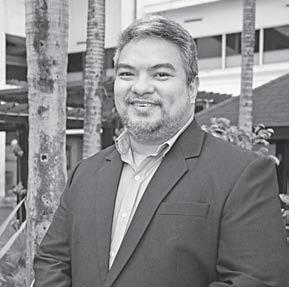
recently appointed veteran academician Geronio G. Ulayao as provost for its Antipolo Campus effective September 1, 2023.
According to DLS-CSB, Ulayao possesses decades-worth of experience, knowledge, and wisdom, having been a full-time faculty member in his 23 years at Benilde-Manila.
The new provost has likewise served in various administrative positions, where he headed the Personnel Management and Development Office of the institution. He was the chair of the Hospitality Management and Travel and Tourism Programs, then later served as its dean.
Ulayao was vice chancellor for Academics from 2014 to 2021. During his term, the Commission on Higher Education (CHED) granted Benilde an “autonomous status,” while the Business Administration and Hotel
and Restaurant Management programs were classified as “Centers of Excellence.”
In 2017, the Philippine Accrediting Association of Schools, Colleges and Universities or PAASCU conferred Level-4 accreditation status to the School of Hotel, Restaurant, and Institution Management, and the Export Management and Human Resource Management programs of the School of Management and Information Technology.
At the peak of the pandemic, Ulayao was a management team member who immediately shifted the classes to an online modality, while ensuring faculty capacitybuilding. He also worked on acquiring the Flexible Learning Blueprint, Motion-Capture Facility and Virtual Reality Technologies for the former School of Design and Arts.
The provost was a first responder to the CHED’s “HI-ED Bayanihan”—
a virtual and free cooperative learning environment for training, capacity-building, and resource-sharing among Philippine higher educational institutions.
Part of the team which led to Benilde offering its pioneer graduate program and the country’s first transnational double-degree program, he was key to the launch of the college’s expanded “Tertiary Education Equivalency and Accreditation” program.

Ulayao concurrently is the Center for Quality Management and Accreditation’s director, and an active member of the PAASCU’s Commission on Tertiary Education.


Story & photos by Benjamin Locsin Layug
Back then, the park seemed bare, with only the Quezon Memorial breaking the monotony. Since then, in order to lure in more tourists, both local and foreign, the “Circle,” as locals call it, has undergone significant changes and, due to these beautification efforts of the local government, the number of visitors is continuously increasing.
These days, the “Circle” has public facilities for events such as the Seminar Hall, Century Hall, People’s Hall, and a stage, as well as covered courts. Also within the park grounds are a children’s playground; major dining outlets (Max’s, Aristocrat, Tropical Hut, Bacolod Inasal and New Kamemeshi House); food kiosks; plant stalls; a flea market, a multi-purpose field for football, baseball, frisbee and softball; a skate trail; basketball, volleyball, and tennis courts; exercise areas; bike lanes; and jogging paths, among others. A dancing fountain was also renovated by the city government which is illuminated with colors at night. The park will soon host an eponymous station of the Manila Metro Rail Transit System Line 7 (MRT-7), which is under construction.
The Circle’s focal point is still the majestic, 66-meters. (representing Quezon’s age when he died from tuberculosis) high, triangle-shaped and Art Deco-themed Quezon Memorial Shrine, a mausoleum containing the remains of Manuel L. Quezon, the second official president of the Philippines and the first of an internationally recognized independent Philippines, and his wife, Aurora Quezon. The remains of both were transferred
here from the North Cemetery, the president on August 1, 1979, and his wife on April 28, 2005 (the 26th anniversary of her assassination).

At the top of the shrine are three towering, connected pylons with The Three Muses, stone mourning winged angels (representing the three main island groups of the Philippines - Luzon, Visayas and Mindanao), sculpted by Italian sculptor Francesco Riccardo Clementi Monti, with their heads bowed (as if mourning Quezon) and holding sampaguita (Jasminum sambac, the national flower) wreaths.
The three pylons would, in turn, circumscribe a drum-like, two-storey structure containing a gallery from which visitors could look down at Quezon’s catafalque (modeled after Napoleon Bonaparte’s in the Les Invalides), elevated on a marble plinth in the center. The gallery and the catafalque below are lit by an oculus (in turn reminiscent of Ulysses S. Grant’s Tomb) surrounded by three heads of carabaos believed to have also been sculpted by Monti and mounted in 1958. The tomb of his wife is in a niche on the side of the room. On the second level, above the circular crypt, is a 3.35-m. high statue of Quezon (originally located outside the memorial) atop a 4.26-m. high marble pedestal sculpted by the late National Artist Guillermo Tolentino and installed in 1978.

The park also hosts three museums which, even better, could be visited for free, two of which concentrate on Quezon. The Museo ni Manuel L. Quezon, at the base of the shrine, focuses on the former president’s political
career while the nearby Quezon Heritage House, across the Quezon City Hall, serves as a museum focusing on the personal life of former president.
The Museo ni Manuel L. Quezón has a collection of art works, relics and memorabilia related to the former president as well as his wife. Opened on August 18, 1978, the museum underwent a renovation by the National Historical Commission of the Philippines and was reopened on August 19, 2015. It houses five galleries. Gallery 1 talks about Quezon’s early life, Gallery 2 exhibits Quezon’s early political career, Gallery 3 the country under the Americans, Gallery 4 shows his leadership and Gallery 5 relates the story on Quezon’s death due to tuberculosis. There is also a gallery featuring his wife Aurora (a replica

of her bedroom) and another featuring Quezon’s office when he was the Commonwealth president.

The Quezon Heritage House, originally located at 45 Gilmore Street in Hacienda Magdalena (now New Manila), was where the Quezons moved to in 1927 when the president contracted tuberculosis as the Santol Sanitarium was just nearby. In 2013, Mayor Herbert M. Bautista had the house disassembled and reconstructed in the Circle. A new foundation was laid for the house and then the house in Gilmore was disassembled (about 60% of the parts of the house were removed with care and used for restoration). The Quezon family also donated some furniture and fixtures for the house. In 2015, the Quezon Heritage House was designated as a


Local Heritage Site of Quezon City by virtue of Ordinance No. SP-2428 passed by the Quezon City Council.

Beside the Quezon Heritage House is he Philippine–Israel Friendship Park. Inaugurated in August 2018, it commemorates President Quezon’s efforts to accept 1,000 Jewish refugees in the Philippines during the World War II era and the Philippines’ support for the United Nations Partition Plan for Palestine and the establishment of the State of Israel.
The Presidential Automobile Museum, the third museum within the Circle, houses the largest collection of state cars in the country. Inaugurated on August 19, 2018, it displays the National Historical Commission of the Philippines (NHCP) collection
of 12 interesting and unique cars used by 13 former presidents of the Philippines during their term of office. One car in the display is not the actual unit but similar to the one used by President Diosdado Macapagal from 1961–1965. Only the presidential car of Carlos P. Garcia is missing as it was never recovered. Four other cars in the collection are classified as “other vehicles of historical value” including a kalesa used, until 1940, by judge and revolutionary León Apacible. Also within the Circle is the World Peace Bell, a donation (the Philippines was the first Southeast Asian nation to receive a bell from the association) of the World Peace Bell Association, a Japanese organization promoting awareness on the world peace movement.

ON e o f the most pleasant surprises in our recent travels was rediscovering Misibis Bay Resort in Albay, Bicol, which became the venue for the celebrated beachfront fashion show of emerging designer e l lis Co.
Long before its facilities were recently updated, the secluded resort located in Cagraray Island was already considered as one of the country’s ideal hideaways and top tier tourist destinations. A TV mini-series was even named after it.
Set amidst the dramatic backdrop of the equally scenic Mayon Volcano, Misibis Bay promises a tropical escape like no other with its sprawling five hectares of pristine waters, lush foliage and “modern nature” vibe.
While there are at least three ways to get to Misibis Bay, the fastest way to enjoy its promise is of course by air. Upon touching down at Bicol International Airport where guests are immediately greeted by the magnificent sight of Mayon Volcano, road transfer from airport to resort takes
only around 90 minutes.
A dream luxury vacation
C L ASS a nd elegance is written all over Misibis Bay Resort the minute you enter its doors. The high-ceiling grand lobby and the rooms, for instance, house luxury home décor from big brands like Dior and Hermès. Accentuating the design are well-curated deluxe pieces. And that’s just a start. With wide-ranging accommodation options that cater to every type of guest and are classified into four main categories, each presenting a premier island experience. The Garden View rooms come alive with a quaint vibe while the Pool View rooms prove perfect for those ready to take a splash. For those who can’t get enough of the sea’s stunning views and calming waves, there are also the Seaview (where our group stayed) and Beachfront rooms.
An ideal wedding destination
A S IDe from its well-earned reputation as a popular tropical getaway,
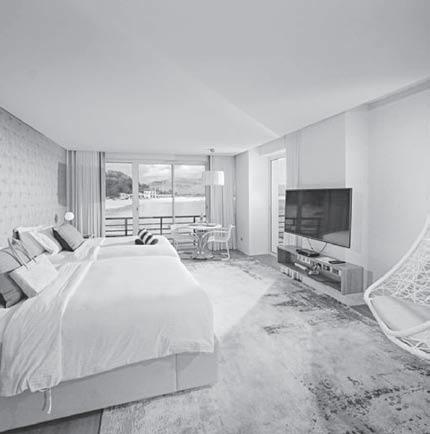
Misibis Bay Resort is fast becoming an equally sought after luxury wedding destination.

Situated high atop a hill with stunning panoramic views of both the Albay Gulf and even Mayon Volcano sits the Stella Maris Chapel. Only a few minutes away from the resort, this place of worship has become witness to many couples saying their I do’s.
An amphitheater that offers equally picturesque sights that completes the dream wedding experience is also near the venue.
To help couples plan their big day, Misibis Bay Resort also offers several wedding packages for every requirement. And soon, right smack within the resort’s premises will rise a new, full-glass chapel.
Good food and fun activities
O F c ourse, the perfect getaway won’t be complete without good food and fun activities to not just remember it but to always keep it in mind when deciding to come back.
And in this regard, Misbis Bay Resort does not disappoint. A lavish dining experience awaits guests with what I personally thought was an impressive selection of Asian dishes fused with Bicol’s native spices. Those who prefer a filling bite of local, Bicolano flavors and international favorites, including the freshest sea food, there’s the Spice Market that offers all-day dining. At Sula Bar, there’s a fine selection of spirits and cocktails of the month.
These and more regular fare can also be enjoyed through special dining setups such as packages for a peaceful sunrise breakfast, a delectable picnic lunch, and even romantic sunset cocktails.
For adventurous types, there are also numerous options like windsurfing and kayaking sessions. Snorkeling allows for direct interaction with the diverse marine life in the resort, including giant clams and vibrant corals and schools of fishes. For those looking for something with a little more thrill, there’s a Jet Ski package that gives guests a chance to drive the limited-edition, 1800cc Yamaha WaveRunner FX Limited SVHO.
And what better way to cap your eventful day than go to The e s senses
Spa and avail of traditional massage techniques with the ancient Filipino art of healing called Hilot, using a special, first-class line of oils from e u rope. As we were here for the fashion show, there was simply not enough time to personally experience all these adventures. What we did experience in our brief stay was more than to convince me that Misibis Bay Resort checks all the boxes in terms of what one would expect from a “luxurious tropical luxurious island getaway.” Here’s looking forward to coming back here soon, hopefully for an even longer stay.
For more information or to book your stay at Misibis Bay Resort, please visit www.misibisbay.com.
During my college years, my bus would always traverse the Quezon Memorial Circle during the long and tedious commute from my house in Parañaque to the university of the Philippines in Diliman.INFINITY Pool O FFI c e of Quezon at the Quezon Museum The Quezon Memorial Shrine The cars used by former Philippine presidents The World Peace Bell Ph IlIPPINe–Israel Friendship Park Pre SId eNTIAl car Museum QuezO N heritage house QuezO N ’S catafalque with his wife's tomb on the right lOBBY PreMIere Seaview
No, we’re actually seeing it now in some of the award entries,” said Cynthia Dayco, chairman of the Boomerang Awards and head of content at Metrobank. “We actually have a category called Crystal Boomerang for which a lot of performance campaigns that use Google AI have been submitted. Using Google AI, you have greater reach, greater conversions and more incremental revenue.”
How can media agencies and creative professionals get ahead of the curve in AI?

LOCAL digital automation provider Red Circle Global (RCG) plans to provide local schools more access to the latest computing technologies to boost digital learning.
“RCG wants to position itself as an alternative and democratize the access to advanced school technologies even to smaller schools. Currently, the market is virtually dominated by oligopolists and overpriced vendors through their agents who directly talk to the school administrators,” said RCG president and CEO Edwardo Miguel Roldan.

“We want to close the gap, go straight to the schools, and disrupt the market by offering a nofrills, straightforward offering similar to purchasing Microsoft software straight from the provider,” Roldan added.


According to Roldan, RCG provides an end-to-end school automation system that can assist any K12 school in the country from enrollment to graduation. While most industry players make money from charging per student headcount, he added RCG charges differently by only charging a one-time fee for a lifetime license.
ARTIFICIAL intelligence, a vague concept we would see in movies and TV shows, is now upon us and it’s real.
“AI is a technology you can use. Think of it as a tool that you can use instead of something that should be feared,” said Google data and insights lead Nikki Del Gallego during the Imagine AI with Marketing forum.

Del Gallego acknowledged that “creatives fear AI.”

ChatGPT is a frequently used phrase these days among writers and editors. Sometimes, it is used with fear. If you’ve ever been on a brand website and started a conversation with a chatbot, that chatbot must have been powered by AI. And, yes, AI is what makes ChatGPT what it is.

ChatGPT is an AI chatbot that uses natural language processing to create humanlike conversational dialogue. It can not only respond to questions but also compose written content, including articles, social-media posts, essays, and e-mails.

I have tried ChatGPT once and this may sound defensive but I did it out of curiosity. It’s not something I would use regularly because one of the reasons why I continue to write is to exercise my brain but it would be useful to someone who is writing a research paper or a dissertation. It’s also useful for non-writers who need to do some writing for work. For creatives, I see ChatGPT as a guide.
So, can ChatGPT and other AI replace humans in the workplace? I really am not sure about the answer to this, honestly.
“I’m a data analyst and I work with data a lot. So, it’s a tough question to ask myself, but then I think about how I can use AI to benefit me. I cannot process large amounts of data in a matter of seconds. AI can do that better. So, it’s that partnership of human and machine that brings out the best of what we can achieve,” said Del Gallego. “Instead of fearing what would replace us, we can look at what AI can do to enrich us.”

“I’m an AI optimist. I see AI as a brainstorm buddy that helps open up creative portals—a creative right hand, a deck builder and presentation maker, an illustrator, and voiceover,” said Raymund Sison, partner and chief creative officer at Agency Propel Manila and IMMAP chairman for Digital Young Creators. Sison swears by Google’s new TextFX experiment, which helps writers come up with creative copy in a few prompts. TextFX uses Google’s PaLM 2 large language model. According to Google, TextFX is an “experiment to demonstrate how generative language technologies can empower the creativity and workflows of artists and creators.”
“Some people think that AI is still in the future.
Sison said automation involves delegating tasks to machines so humans can do tasks that require higher level thinking. Assistance boosts creativity, and innovation allows humans to explore uncharted territories. As part of its commitment to be responsible AI, Google, together with Anthropic, Microsoft and OpenAI announced the formation of the Frontier Model Forum, a new industry body focused on ensuring safe and responsible development of frontier AI models. The forum will draw on the technical and operational expertise of its member companies to benefit the entire AI ecosystem by advancing technical evaluations and benchmarks, and developing a public library of solutions to support industry best practices and standards.
Capture the Imagine AI with Marketing discussion and find out how AI can help today by watching the event on YouTube. You can also see what you’re capable of with the help of generative AI by trying out Google Bard.
And AI is not just in the creative workplace.
The Industrial Engineering course gives the graduate a holistic perspective of engineering and economics, plus ergonomics or design (design), as it is related to productivity.
Industrial engineers can benefit from AI because it can help increase efficiency by automating certain tasks and processes. Production times can be sped up with AI finding and fixing problems faster.
Some sectors have, in fact, said that automation is a game-changer in the industrial engineering field as AI has helped industrial engineers design and develop new products. These engineers are longtime users of computer-aided design software but AI can help them create more sophisticated and complex designs.
Some of the specific aspects of the IR mindset are return on investment, business case modeling, quality control, supply chain management, and time-motion studies. And here’s something that’s not surprising: Women often comprise close to 60 percent of the enrollees in the academic institutions offering industrial engineering courses.
Since 2010, the Philippine Institute of Industrial Engineers (PIIE) has established a Certification Exam so that the status of Certified Industrial Engineer (CIE) could be bestowed on IE graduates. The CIE process is a baseline competency examination that’s blended with peer recognition and it’s the next best thing to a national board examination.
After five years as a CIE, one can even submit oneself for consideration, and a panel of one’s peers can accept your credentials as a Professional Industrial Engineer (PIE). The PIIE also helps in granting the status of Asean engineer, a title that carries impact in terms of desirability and salary scale when on the hunt to work in other Asean nations.
On October 27, the PIIE will be celebrating its 25th year anniversary at the New World Hotel in a face-toface format. The last time this took place was in 2019 in Cebu. There will be an 18th PIIE Plenary Congress and 9th Research Conference during the day and a Gala Dinner in the evening, during which this year’s PIIE luminaries will be presented.
“Of special interest for the PIIE this 25th year is highlighting the role of the IE mindset when it comes to Digital Transformation, Sustainability, and Artificial Intelligence—three of the hottest trends and buzzwords of the day,” said Roberto Bontia, chief transformation officer of the Metro Pacific Tollways who is the committee chairman for the PIIE 25th anniversary. “The digital transformation we hear so much about today often goes hand in hand with the generative Artificial Intelligence, whose exponential growth, development, and applications are often the discussion of social commentators and techobservers,” said Bontia.
The PIIE views AI as a tool to improve processes and be helpful in problem analysis and constructing strategies. The IE mindset is ideal here, as the symbiotic relationship requires a qualified mind to sift through and decide which data has to be fed and, if not useful, be thrown out, Bontia explained.
Then, the IE will also be the best qualified to evaluate the output generated by the AI bot.
“The industrial engineer stands on the cusp of what our tomorrow will look like, and it’s heartening to find that the Filipino IE is well represented by the institute,” said PIEE president Jerry Lim. ■

“The academic institution can now save money and recoup the investment in just one school year,” he said. Roldan said using the RCG platform will enable a school to generate huge savings in its operations. An average school with a population size of 1,000 students is spending P1 million to 2 million annually on various technologies alone, Roldan said.
RCG can offer a product to any K12 school needing to spend only one-fourth of the cost. “We start at P500,000 and they can automate almost every department in the institution. Also, this is a one-time fee,” Roldan stressed. Further, RCG’s school clients also showed an average increase in enrollment population by 20 percent and tuition by 10 percent.
Parents’ and students’ satisfaction also went high as digitalization is always well-accepted and appreciated by the stakeholders. Currently, RCG is assisting 20,000 students from 17 schools nationwide. Roldan said a major reason why RCG survived the pandemic was because it overhauled their business model.
Previously known as a Software as a Service (SaaS) company where it charged per student, RCG shifted to a one-time capital outlay. It resulted in huge savings and tripled its sales growth.

Roldan said RCG will embark on an expansion this year by tapping overseas-based companies. “We are currently in active exploratory talks with a merger and acquisition group from Singapore and a family office in Silicon Valley that invested early in SpaceX, Bitcoin, Tesla and Twitter.”



He said RCG is on track to achieve sales growth through its multiple sales and marketing partnership initiatives. “This year, we are on target to hit P10 million in revenues, a five-fold increase from our 2022 revenue,” he said.

PLANNING to enjoy visa-free travel to Taiwan? Savor that mouthwatering xiao long bao, stroll through vibrant night markets, and explore its beautiful ancient temples while keeping your loved ones up to date with Globe’s latest roaming offer, GoRoam Taiwan.
As a leader in transforming mobile roaming services, the telco infuses convenience and affordability into wanderlust-driven adventures.
The expanded GoRoam offering is the perfect digital companion to your Taiwan escapades, offering competitively priced data packages nearly at par with local SIM rates.
You can avail of the Taiwan-exclusive GoRoam package for just P550, which comes with 2.4GB of data valid for 30 days. No need to swap SIMs—keep your home contact number and let your Taiwan story unfold seamlessly.
“We’ve been listening, we understand the traveler’s desire for unhampered connection at rates close to what they’d find in the country they are visiting,” said Coco Domingo, vice president of postpaid and international business at Globe. “Our vision is to redefine roaming by putting customer convenience at the forefront. GoRoam Taiwan is another exciting chapter in our journey.”
But the globe-trotting does not stop at Taiwan.
GoRoam has got you covered in other popular Asian destinations. Get GoRoam Thailand with 15GB of data at P500, usable for 8 days when you go to Thailand. If
you want to explore Hong Kong, stay connected with GoRoam Hong Kong’s 3GB of data for P600, good for 5 days. Access the GlobeOne app to register to these offers at never-before-seen roaming rates.
“We’re changing the game. We’re making roaming more affordable and worry-free for our customers. With GoRoam, our customers can fully immerse themselves in their travels without sacrificing their need for connection,” added Domingo.
To enjoy seamless data browsing while abroad, ensure your device’s APN is set to internet.globe.com. ph. Track your GoRoam data usage via the GlobeOne app.
To learn more about Globe Roaming, visit tinyurl. com/mr36jsac.

NEW YORK—Kelly McKernan’s acrylic and watercolor paintings are bold and vibrant, often featuring feminine figures rendered in bright greens, blues, pinks and purples. The style, in the artist’s words, is “surreal, ethereal...dealing with discomfort in the human journey.”
The word “human” has a special resonance for McKernan these days. Although it’s always been a challenge to eke out a living as a visual artist—and the pandemic made it worse—McKernan now sees an existential threat from a medium that’s decidedly not human: artificial intelligence.
It’s been about a year since McKernan, who uses the pronoun they, began noticing online images eerily similar to their own distinctive style that were apparently generated by entering their name into an AI engine.
The Nashville-based McKernan, 37, who creates both fine art and digital illustrations, soon learned that companies were feeding artwork into AI systems used to “train” image-generators—something that once sounded like a weird sci-fi movie but now threatens the livelihood of artists worldwide.

“People were tagging me on Twitter, and I would respond, ‘Hey, this makes me uncomfortable. I didn’t give my consent for my name or work to be used this way,’” the artist said in a recent interview, their bright blue-green hair mirroring their artwork. “I even reached out to some of these companies to say ‘Hey, little artist here, I know you’re not thinking of me at all, but it would be really cool if you didn’t use my work like this.’ And, crickets, absolutely nothing.”
McKernan is now one of three artists who are seeking to protect their copyrights and careers by suing makers of AI tools that can generate new imagery on command.
The case awaits a decision from a San Francisco federal judge, who has voiced some doubt about whether AI companies are infringing on copyrights when they analyze billions of images and spit out something different.
“We’re David against Goliath here,” McKernan says. “At the end of the day, someone’s profiting from my work. I had rent due yesterday, and I’m $200 short. That’s how desperate things are right now. And it just doesn’t feel right.”
The lawsuit may serve as an early bellwether of how hard it will be for all kinds of creators— Hollywood actors, novelists, musicians and computer programmers—to stop AI developers from profiting off what humans have made.
The case was filed in January by McKernan and fellow artists Karla Ortiz and Sarah Andersen, on behalf of others like them, against Stability AI, the London-based maker of text-to-image generator Stable Diffusion. The complaint also named another popular image-generator, Midjourney, and the online gallery DeviantArt.
For now, both artists are throwing themselves into the legal fight—a fight that centers on preserving what makes people human, says McKernan, whose Instagram profile reads: “Advocating for human artists.”
“I mean, that’s what makes me want to be alive,” says the artist, referring to the process of artistic creation. The battle is worth fighting “because that’s what being human is to me.”
IN 2019, realme began collaborating with awardwinning industrial designer Naoto Fukusawa for the realme X Master edition, which became quite memorable for its colors “Onion” and “Garlic.”
They would again partner with the legendary Muji designer to create the “suitcase” design of the realme GT master edition followed by the “Paper Tech Master Design” of the realme GT 2 Pro.
This year, realme collaborated with former Gucci designer Matteo Menoto for the realme 11 pro lineup. This is a first for its flagship number series and personally, I think it’s brand’s most gorgeous smartphone ever — and easily a contender for bestlooking phone of the year.
But is it more than just eye-candy aesthetics?
I’ve been using the realme 11 Pro+ 5G for the past month and I was very impressed by this phone’s performance, charging speed and for possibly having my favorite set of cameras in this price point.
LET’S begin by discussing the design. While the realme number series has been praised for offering competitive specifications and pricing, their designs haven’t shown much innovation. Despite their attempts to experiment with various finishes and bold color choices, many of their previous phones look a lot like their competitors, thus failing to make a distinctive mark.
The realme 11 Pro+ 5G is totally different. The first time I saw photos of the phone, I knew I wanted to get one—even without looking at the specs. Even though we’ve seen that large circular camera module before, that vegan leather finish, gold frame, and that zipper-like stich design that runs down the center of the phone makes it a headturner. Its distinctly realme even without the branding on the bottom left side.
Co-created with former Gucci Prints and Textile Designer Matteo Menoto, the inspiration behind the smartphone’s back design was Milan, Italy, the city where he was born. The camera module was modeled after the rising sun in the middle of the city’s buildings. The line in the middle is made with a 3D Couture Level Seam that took inspiration from the city roads stretching into the distance. The phone is one of the first to use an Industry-First 3D Woven
Texture that is reminiscent of what was used on highclass fashionable clothing. The rest of the back of the phone makes use of Premium Lychee Vegan Leather (both for the Sunrise Beige and Oasis Green variants). Vegan leather finishes are often reserved for premium flagships, so I’m glad realme is pioneering it for the midrange segment.

The effect is remarkable, besides looking classy— the texture provides a better grip and finally gets rid of those annoying smudge marks. The arrangement of the camera bump is also very centered giving the phone greater stability when placed on a flat surface.


While this is a phone that is meant to be used without a case, I have my fingers crossed, hoping that this faux leather won’t fade, turn yellow or be tough to clean when stained. Just to be sure, I still have the free jelly case ready when needed.
Moving over to its display, the realme 11 Pro+ 5G utilizes a 6.7-inch OLED panel with a 93.65 percent screen-to-body ratio and a ton of other premium specs such as 10-bit color depth, 120Hz refresh rate, 360Hz touch response, 2160Hz PWM dimming, and even HDR10+ support. The display has been precision-curved at a 61-degree angle that’s designed to immerse you in vibrant visuals and it does a pretty good job.
The display houses Hypervision Mode with Video Color Boost that can convert SDR to HDR through making colors in videos more vivid; as well as Video HDR Boost that can boost and adjust the phone’s brightness when playing videos with high dynamic range, allowing more brightness when the scene
should be bright, and have it as dark as can be when it should be dark. The display is so good, you’ll probably end up watching more videos on this screen than your TV or PC. According to realme, the display is made of 0.65mm DoubleReinforced Glass and can survive a 1m drop test. Eye care has become a priority for smartphones and the realme 11 Pro+ 5G comes with TÜV Rheinland Certification for Low Blue Light and Flicker Free Certification. It gets an edge in the audio department with its Dolby ATMOS Dual Speakers compared to the single loudspeaker of other smartphones.
THE realme number series has established a reputation of having the best-inclass cameras and that remains true with the realme 11 Pro+ 5G. It boasts of an impressive triple camera setup headlined by a 200MP main camera complemented by an 8MP ultrawide lens and a 2MP macro lens. For selfies, you get a 32MP shooter. Besides having the highest megapixel count in the series, it’s also designed with Samsung’s 200MP HP3 Isocell Sensor which allows high-resolution shots at 200 million pixels and a full resolution of 16320 x 13992. For context, Samsung’s top-end flagship is using an HP2 sensor, which makes its cameras all the more impressive.
Daylight snaps from the primary shooter are rich in detail, colors are true to life, and the overall presentation is superb. I do like how vivid each photo comes out without being too oversaturated. The dynamic range is on par with flagship offerings and the sensor’s large size allows for more light to correctly illuminate any situation. Since I use my phone for event coverage, the 4x zoom is a very useful addition. I was able to get very good closeups of celebrities without having to elbow my way all the way to the front.
The 2x in-Sensor Zoom is also utilized for Portrait Mode so you get a tighter shot that’s enhanced with specialized Portrait Algorithms. I am also such a fan of Street Mode and this time, realme has partnered with Lonely Planet giving us several dedicated filters such Crisp, Cinematic and Tranquil plus you also get to use the exclusive Lonely Planet watermark on your photos. Street Mode 4.0 also introduces auto Zoom which automatically zooms and crops on a subject to keep it centered in the frame, simplifying photography.

POWERING the realme 11 Pro+ is a Mediatek Dimensity 7050 5G 6nm chipset with a Mali G68 GPU. It comes with 12GB RAM that can be virtually expanded by an additional 12GB for a total of 24GB plus a whopping 512GB of internal storage. This processor may not be much of a giant leap but in our day-to-day use, I didn’t encounter any lag
whatsoever, or apps suddenly closing even when I had a lot running in the background. It also makes multitasking easier which is great, especially if you are using this phone for work.
This chipset is powerful enough to run even the most demanding games like Call Of Duty and Genshin Impact, and will breeze through Mobile Legends and other popular games. Take note that you might need to set the graphics lower for smoother gameplay and avoid overheating.
The realme 11 Pro+ 5G runs on Android 13 with realme UI 4.0 interface. If you’re used to realme UI, then you’ll feel right at home giving you lots of multitasking and personalization options. One thing I also noticed is that compared to the realme 10 Pro+, which we reviewed earlier this year, there is less bloatware and app suggestions this time around.
As for the battery, it comes with the now standard 5000mAh capacity. The brand says the phone can last up to 29 hours on calls or 18 hours on video. In real world use, it lasted an entire day of using mostly the cameras for event coverages. But what gives the realme 11 Pro+ 5G the advantage over the competition is that 100W wired fast charging using the presupplied charger. That 100W charger can fully charge the phone in less than 30 minutes.
FINAL WORD: The realme 11 Pro+ 5G is a terrific phone. It looks unique, luxurious and that vegan leather back makes it feel premium. Other more expensive brands could actually pick a thing or two from realme when it comes to designing their midrange phones. You also get an amazing set of cameras with a lot of fun modes, but hopefully they’ll ditch that macro lens for a more useful one. The display is among the best in this category, that 512GB storage is bigger than other flagships, and the 100W charging speed is almost overkill. Now you are probably asking, is it better than the previous phone we reviewed with the same price tag? The answer is—it all depends on your preference. Both phones are excellent choices and you’ll be getting your money’s worth whichever you choose. ■
sia from carrying out illegal strikes against civilian vessels transporting grain,” it said.
The food security summit has been organized in partnership with Bill & Melinda Gates Foundation, the Children’s Investment Fund, and the governments of the UAE and Somalia, according to Downing Street.
grain elevators since July, reducing Ukraine’s export capacity by one third. That’s enough grain to feed more than 1 million people for an entire year, the UK said.
HOUSE Speaker Kevin McCarthy blasted the volatile economic policies of China’s ruling Communist Party, and called on the US to reduce its reliance on the world’s secondlargest economy.
China’s sovereignty and territorial integrity” and ordered large-scale military drills around the archipelago of 23 million people, which it claims as its own territory.
The event, slated for November 20th, will bring together government representatives, charities and businesses “to help vulnerable people and economies” impacted by rising food prices, Sunak’s office said late Thursday in a statement as the premier traveled to India for a summit of the Group of 20.
The proposal comes days after Russian President Vladimir Putin said he wouldn’t revive a deal
that had safeguarded the passage of Ukrainian grain through the Black Sea. That’s raised concerns about the future of supplies from Ukraine, one of the world’s largest grain exporters, and contributed to weeks of volatility in global wheat prices.
The UK military is carrying out surveillance flights to monitor Russian activity in the Black Sea, Sunak’s office also confirmed. These aimed to “deter Rus
Since Russia pulled out of the Black Sea Grain Initiative, it’s carried out drone attacks damaging storage and industrial facilities as well as agricultural equipment. It has also targeted river ports that are the main alternative export routes to the Black Sea.
According to the UK government, Russia has damaged or destroyed at least 26 civilian port facilities, warehouses, silos and
THE US government has begun an official probe into an advanced made-inChina chip housed within Huawei Technologies Co.’s latest smartphone, a revelation that’s set off a debate in Washington about the efficacy of sanctions intended to contain a geopolitical rival.
The Commerce Department, which enacted a series of restrictions against Huawei and China’s chip industry over the past two years, said it’s working to get more information on a “purported” 7-nanometer (nm) processor discovered within the Mate 60 Pro.
The chip was made by China’s Semiconductor Manufacturing International Corp., which like
Huawei, is blacklisted by the US and restricted from accessing American technology.
Huawei’s quiet reveal of a mobile phone utilizing technology the US has sought to keep out of Beijing’s hands, threatens to derail recent efforts of outreach by the Biden administration. The phone went on sale online while Commerce Secretary Gina Raimondo was on a trip to China last week, the latest in a series of high-level diplomatic visits to Beijing.
The debate now centers around whether it represents a failure of US efforts—led by Raimondo’s department—to hamstring China’s tech sector, which Washington fears will give it a military edge.
It’s also raised questions about whether the main US mechanisms to do that—controls on exports of key materials, tools and knowhow—need to be tightened.
“We are working to obtain more information on the character and composition of the purported 7nm chip,” a Commerce spokesperson said in a statement. “Let’s be clear: export controls are just one tool in the US government’s toolbox to address the national security threats presented by the PRC. The restrictions in place since 2019 have knocked Huawei down and forced it to reinvent itself—at a substantial cost to the PRC government.”
The Mate 60 Pro smartphone
Sunak would “use any opportunity” to tell Russian foreign minister Sergei Lavrov “to his face” about the “critical damage their illegal war is doing both in Ukraine and globally,” his spokesman, Max Blain, told reporters in London. Lavrov is attending the G-20 in the place of Putin.
“Once again, Vladimir Putin is failing to show his face at the G20,” Sunak said in remarks sent by his office. “He is the architect of his own diplomatic exile, isolating himself in his presidential palace and blocking out criticism and reality.” Bloomberg News
employs an unusually high proportion of Chinese parts, in addition to its main processor, an ongoing teardown by TechInsights conducted for Bloomberg News revealed, a sign of the country’s progress in developing domestic tech capabilities.
US National Security Advisor Jake Sullivan has said he would withhold comment until the US gets more information.
“There’s a number of different methods to try to sort of come to an understanding of what exactly it is that we’re dealing with here,” Sullivan told reporters aboard Air Force One on Thursday. “I can’t give you an exact number of days but this is not going to be months down the road. We’re going to want to look at this carefully, consult with our partners, get a clearer sense of what we’re looking at, and then we’ll make decisions accordingly.” Bloomberg News
NEW YORK—The MacArthur Foundation is leading a group of donors that have pledged $500 million to help the struggling local news industry, hoping to seed outlets that can make up for those that have closed or been hollowed out over the past two decades.
Led by $150 million donations by the journalism-focused Knight Foundation and MacArthur, the Press Forward initiative is focusing on the importance of news in communities and is bringing in funders whose primary mission hasn’t necessarily been journalism.
“This is hugely important, both
practically and symbolically,” said Tim Franklin, director of the Local News Initiative at Northwestern University’s Medill journalism school.
The Carnegie Corp., the Democracy Fund, the Ford Foundation, the Robert Wood Johnson Foundation and MacArthur are among a group of 20 initial funders. (The Associated Press receives grant funding from several sources for some journalism coverage, as well.)
Philanthropies that recognize the need to strengthen democracy are beginning to see that progress on many different issues depends on the public’s understanding of
facts, said John Palfrey, MacArthur Foundation president. Driven largely by a collapse in advertising markets, the number of newspapers in the United States dropped from 8,891 in 2005 to 6,377 last year, according to a Northwestern study. Papers are continuing to close at a rate of two a week, Franklin said. Many that survive, particularly in larger markets, are shells of themselves.
The estimated 75,000 journalists who worked at newspapers in 2005 was down to 31,000 last year.

While there are many experimental efforts to fill the news void, there is still no clear path to making news a thriving business again.
“I don’t think we have the answer,” said Alberto Ibarguen, president of the John S. and James L. Knight Foundation. “I don’t think we have the next thing.”
The $500 million in pledges pale in comparison to the $1 billion investment goal Ibarguen publicly identified last month.
That initial “aspirational” goal wasn’t met because some hopedfor pledges by some corporations and individuals did not come through, he told the AP. He said he expected other funding will be added in the coming months to boost the commitment beyond $500 million. AP
“You watch the attack on the private sector,” McCarthy told a gathering of reporters during a visit to Tokyo on Thursday. “They shifted their policies, they shifted their beliefs, allowing the Communist Party to control more.”
McCarthy said the House committee he’s formed to examine China’s economic behavior is “really looking at areas that America and our allies shouldn’t be dependent upon them,” citing sectors such as medical supplies and critical minerals.
McCarthy has drawn China’s ire in the past, most notably for meeting Taiwan President Tsai Ing-wen in California in April. Beijing said that sit down “damages
Chinese President Xi Jinping has used his decade in power to reassert the Communist Party’s authority in many walks of life. That’s included crackdowns on the education, technology and property sectors that wiped billions of dollars off the market value of some of its biggest companies, spooking foreign investors. It has only recently started easing its campaign targeting the private sector, which included reining in internet giants such as Tencent Holdings Ltd. and Alibaba Group Holding.
Chinese Premier Li Qiang warned governments in a speech in June that “politicization of economic issues” would only fragment the world, comments that came as the US and Europe move to “derisk” supply chains. Bloomberg News
HONG KONG’S heaviest rainstorm since records began in 1884, flooded the financial hub’s streets and sent torrents of water rushing through subway stations, bringing much of the city to a standstill and forcing the stock market to scrap trading on Friday.
The downpour, which caught many residents off guard and came just a week after a super typhoon shut the city, caused the observatory to raise its highest rainstorm alert. Schools were suspended and workers stayed home as bus operators halted services. Extreme weather conditions were expected to last until 6 p.m.,the government warned.
The short notice of official warnings meant businesses and residents had little time to prepare for the deluge, which tore up roads, flooded shopping malls and submerged vehicles. At least 85 people were injured, including two in serious condition, the government said. Insurance claims may exceed $100 million and could be comparable to typhoon Mangkhut’s $470 million in 2018, according to Bloomberg Intelligence.
The topography of Hong Kong—roads and buildings built into steep hillsides—makes the city vulnerable to flooding and landslides from torrential summer rains that have steadily intensified over time. This particular downpour was caused by the remnants of typhoon Haikui. Yet the scenes recorded show damage on a scale the city hasn’t seen in recent decades.
The observatory raised the highest “black” rainstorm warning at 11:05 p.m. local time Thursday. The warning means more than 70 mm of rain has fallen in an hour and is likely to continue, while residents should avoid travel. The warning was still up at noon. A record 158.1 mm (6 inches) of rain was recorded at the observatory headquarters in Tsim Sha Tsui between 11 p.m. Thursday and midnight. More than 600 mm of rain was recorded over much of Hong Kong island in the past 24 hours, according to the observatory.
All trading was suspended on the city’s stock market for the duration of Friday, the local exchange operator said in a statement at midday.








At Wong Tai Sin subway station in Kowloon, videos circulating widely on social media showed waterfalls of rain pouring into concourses as trains continued running. The lower floor of a nearby shopping mall filled with water as furniture floated on the surface. MTR Corp. said it suspended part of its Kwun Tong Line due to flooding at the station.
The city’s leader John Lee told government departments to respond with all-out efforts to deal with the “severe” flooding in most parts of the finance hub. The lack of forewarning contrasted with the approach of super typhoon Saola, when the city’s chief secretary held a press conference flanked by department heads to address potential risks. Bloomberg News
BAMAKO, Mali—Two attacks by alQaeda linked insurgents in the restive north of Mali on Thursday killed 49 civilians and 15 government soldiers, the country’s military junta said.
A passenger boat near the city of Timbuktu on the Niger River and a Malian military position in Bamba further downstream in the Gao region were targeted, according to a statement from the military junta read on state television. It said the attacks have been claimed by JNIM, an umbrella coalition of armed groups aligned with al-Qaeda.
The Malian government killed about 50 assailants while responding to the attacks, the announcement said. It said also declared three days of national mourning from Friday to honor the civilians and soldiers killed in the attacks.
Al-Qaeda affiliated and Islamic Statelinked groups have almost doubled the territory they control in Mali in less than a year, the United Nations said in a report last
month, as they take advantage of a weak government and of armed groups that signed a 2015 peace agreement.

The stalled implementation of the peace deal and sustained attacks on communities have offered the IS group and al-Qaeda affiliates a chance “to re-enact the 2012 scenario,” they said.
That’s the year when a military coup took place in the West African country and rebels in the north formed an Islamic state two months later. The extremist rebels were forced from power in the north with the help of a French-led military operation, but they moved from the arid north to more populated central Mali in 2015 and remain active.
In August 2020, Mali’s president was overthrown in a coup that included an army colonel who carried out a second coup and was sworn in as president in June 2021.
He developed ties to Russia’s military and Russia’s Wagner mercenary group whose head, Yevgeny Prigozhin, was killed in a plane crash in Russia on August 23.
Timbuktu has been blockaded by armed groups since late August, when the Malian army deployed reinforcements to the region.
The insurgents are preventing the desert city from being supplied with basic goods.
Over 30,000 residents have fled the city and a nearby region, according to an August report by the United Nations’ humanitarian agency.
The deadly attacks come as the UN prepares to withdraw its 17,000-strong peacekeeping mission MINUSMA from Mali at the government’s request. The pullout is scheduled to be completed by the end of the year.
The UN deployed peacekeepers in 2013 and MINUSMA has become the most dangerous UN mission in the world, with more than 300 personnel killed.
T he growing insecurity in Mali has increased instability in West Africa’s volatile Sahel region. Mali has had two coups since 2020 in which the military vowed to stop the jihadi violence. AP
THE UK plans to host a summit for countries hit by rising food prices due to Russia’s war in Ukraine, Prime Minister Rishi Sunak said.
EUROPEAN health officials warned that the new, highly mutated Pirola coronavirus variant is circulating on the continent and may be behind an uptick in Covid-19 cases.
The strain, officially called BA.2.86, was detected sporadically during August and could be a factor in the recent noticeable increase in infections, the European Centre for Disease Prevention and Control said in a statement.
Officials from Europe and elsewhere are encouraging countries to re-double Covid vaccination efforts—especially for people at risk of serious illness—as the fall and winter approach in the Northern Hemisphere. There’s no evidence that emerging variants are associated with more severe disease or a reduction of vaccine effectiveness, ECDC Director Andrea Ammon said in the
statement.
Still, the recent rise in infections comes at a time of increased travel and large gatherings—and coincides with reports of waning immunological protection against infection, the agency said.
Europe has also seen a drop in Covid surveillance efforts this year, potentially making it harder for policymakers to respond quickly to emerging threats from the virus.
Scientists are watching the new strain closely because it has many new mutations, raising the possibility it could spread. However, it’s too soon to know how transmissible it is, or whether it produces more severe symptoms than older variants, according to a statement from the US Centers for Disease Control and Prevention last week. Bloomberg News
and you look at China’s economy, if you look at the US’s alliances and the strength that we have built up in the Indo-Pacific and beyond, we feel very good about the strategic position of the United States, in terms of the unfolding competition,” National Security Adviser Jake Sullivan told reporters.
will likely struggle until the last minute to find compromise on language describing Russia’s war in Ukraine—risking the first time that the group doesn’t put out a joint communique since its 1999 founding.
CANADIAN Prime Minister Justin Trudeau said there’s no room for “rapprochement” with China as President Xi Jinping’s muscular foreign policy has made a normal relationship between the countries impossible, for now.
China has made decisions over the past years that have made it more difficult—not just for Canada but for other countries—to engage,” Trudeau said in an interview Thursday.
T he prime minister acknowledged that when he came to power in 2015, he had hoped to work toward a free trade deal with China. But the relationship between the two nations turned hostile in 2018 when Canada arrested Huawei executive Meng Wanzhou on a US extradition request, prompting China to detain two Canadians and impose embargoes on some Canadian food exports.
“Obviously we’ve had a challenging few years, as many people had. The arbitrary detention of two Canadians for political reasons put a real chill on the relationship,” Trudeau said. “But China is one of the most important economies in the world and it’s not a country that anyone can simply ignore.”
Trudeau made the comments during an interview in Singapore, which he visited as part of a trip through Asia to further trade ties and attend the Group of 20 leaders’ meeting. Trudeau visited Jakarta this week and met with President Joko Widodo, and he said Canada is on track to sign a trade agreement with Indonesia in the next 12 months. His government plans to open a “trade gateway” in Singapore.
Expanding tr ade with a number of Asian economies and reducing reliance on China is one of the goals of Canada’s Indo-Pacific strategy. China is Canada’s second-largest trading partner, after the US.
Trudeau said the relationship between Canada and China is “probably stable” right now, but there’s lots of room for improvement.
“It’s not deteriorating right now, but it
has not gotten as much better as perhaps we would’ve liked after the Michaels situation was revolved,” he said, referring to the two detained Canadians, Michael Kovrig and Michael Spavor, who were released in 2021. A US federal judge dismissed the charges against them at the Justice Department’s request.
Election interference
TRUDEAU’S government has been dogged by allegations that it mishandled or ignored evidence of China interfering in Canada’s federal elections. The claims prompted Canada and China to expel diplomats earlier this year.
T rudeau appointed a watchdog to investigate the allegations, but that person resigned amid opposition criticism that he held too many personal ties to Trudeau to be objective.
A fter weeks of negotiations with opposition parties, Trudeau’s government announced Thursday that it will launch a public inquiry into foreign meddling.
Marie-Josée Hogue, a Quebec Court of Appeal judge, will chair the probe into alleged interference by China, Russia and other state and non-state actors, it said.
In the interview, Trudeau also said his government was moving forward with a foreign agent registry, similar to ones that exist in the US and Australia. But he said his government is approaching it carefully, concerned about the risks and referencing “moments in our history” when such tools have been misused.
Trudeau’s government has responded to the US-led effort to accelerate the development of cleaner technologies, including electric vehicles. Canada hopes to become a global supplier of critical minerals and a crucial piece of the North American EV supply chain, but that dream comes with a cost: matching the billions in subsidies offered by the US Inflation Reduction Act.
Trudeau said industrial policy was “smart policy,” up to a point. Canada began deliberately investing in the green transformation of its economy well before the US, he argued. Bloomberg News
Russian President Vladimir Putin and Chinese President Xi Jinping both opted to skip this year’s gathering, giving Biden an opening to re-establish the US as the polestar of the international system. He’ll take the US case to nations such as Brazil, South Africa and Indonesia—not to mention the host, India—that are eager for closer ties with China and have declined to take sides after Russia’s invasion of Ukraine.
Central to that effort is a push to boost the funding and scope of the World Bank and other development banks, in a bid to deepen ties with the world’s emerging economies and offer an alternative to China’s state-backed lend -
ing. The US also plans to push for debt relief for poor countries and announce funding for new infrastructure projects. Biden will then visit Vietnam to announce commercial deals deepening ties with the country’s emerging technology sector.

The White House sees this funding as crucial on multiple fronts: as a form of soft-power diplomacy, to make sure projects maintain high labor standards and consider the climate, and as a counterweight to Chinese and Russian efforts to build influence in countries that will only grow in strategic and economic importance.
“If you look at the US economy
Biden’s ability to make that pitch will depend, of course, on his own ability to attend. First lady Jill Biden tested positive for Covid-19 on Monday, and if the infection spreads to the President he will scrap his planned travel. On Wednesday, he said that he was tested and “clear across the board.”
Biden’s effort also hinges on whether other participating powers see the G-20 as a still-relevant gathering to steer the global economy. Tensions over the war in Ukraine are only the latest wedge in the diverse and often chaotic multilateral coalition, while China and Russia have sought other forums to exert their influence.
Putin is set to meet North Korea leader Kim Jong-Un in Russia’s Far East, in what could further undermine international efforts to isolate Pyongyang. Leaders
BANGKOK—Myanmar’s imprisoned former leader, Aung San Suu Kyi, is suffering from symptoms of low blood pressure including dizziness and loss of appetite, but has been denied treatment at qualified facilities outside the prison system, a medical worker said Thursday.
Suu Kyi, 78, who was arrested in February 2021 when the army seized power from her elected government, fell ill late last month, said the medical worker, who spoke on the condition of anonymity for fear of being punished by the military authorities.
Separately, a military officer who also insisted on anonymity confirmed a report by the BBC’s Myanmar-language service that Suu Kyi was suffering a severe toothache that left her unable to eat and caused vomiting.
However, the ruling military council’s spokesperson, Maj. Gen. Zaw Min Tun, said Suu Kyi was in good health, the report said.
The BBC said Suu Kyi’s son Kim Aris, who lives in Britain, responded to the report with a text saying, “To deny a sick prisoner
access to recommended medical care is callous and cruel.”
Phone calls by the AP to Myanmar’s prison department for comment went unanswered.

Suu Kyi is serving a combined 27-year sentence after being convicted of a string of criminal charges that her supporters and independent analysts say were concocted to discredit her and legitimize the military’s seizure of power.
She initially received a total sentence of 33 years but Senior Gen. Min Aung Hlaing, the head of the military government, granted her clemency in five cases and cut her sentence by six years as part of a broader amnesty for more than 7,000 prisoners to mark a Buddhist religious holiday in August.
Suu Kyi receives full-time medical care from a doctor assigned to the main prison in the capital, Naypyitaw, whose duties included taking her blood pressure at least three times a day when she fell ill last month, the medical worker said.
She also receives a monthly medical checkup from more senior
physicians from the military hospital in Naypyitaw.
Not only are details about Suu Kyi’s health unclear, but even her exact whereabouts are not publicly known.
There were reports in late July that Suu Kyi might be transferred from Naypyitaw prison to house arrest as part of the clemency action, but the military authorities have not confirmed that.
Suu Kyi’s lawyers have not been able to meet with her this year, said a legal official who asked not to be identified because he is not authorized to release information about her cases. Her lawyers have been forbidden to reveal information about her by a gag order issued in late 2021.
They have applied five times
China, meanwhile, has seen its influence on energy markets grow after inviting three of the world’s biggest oil and gas powers – Saudi Arabia, Iran, and the UAE – into the BRICS forum, giving Beijing an important alternative to the G-20.
Wendy Cutler, vice president at the Asia Society Policy Institute, said the composition of this year’s summit in New Delhi makes it even harder to prove its relevance.
“The absence of Xi Jinping at this year’s G-20 meeting underscores how this grouping, once the shiny dime among its competitors, now is struggling to produce meaningful outcomes in the midst of geopolitical tensions,” she said.
Xi also faces growing challenges at home, where his Communist Party is battling a struggling economy and rising youth unemployment. Biden last month called China a “ticking time bomb,” citing its economic woes. Bloomberg News
for permission to meet with Suu Kyi since they last saw her in person in December but have not received any response, though they are allowed to deliver food and other essentials for her to the prison, the legal official said.
The official said her legal team filed arguments to the Supreme Court on Tuesday asking it to accept six special appeals filed on Suu Kyi’s behalf to further reduce her sentences. The six cases include allegations of abuse of authority in renting parcels of land and property in Naypyitaw and Yangon, the country’s biggest city, at below-market prices for a foundation named after her mother that she chaired.
Appeals of Suu Kyi’s convictions are still being processed on charges, including election fraud, breaching the official secrets acts and six other corruption allegations, legal officials have said. AP

PRESIDENT Joe Biden aims to seize on the absence of two key adversaries at this week’s Group of 20 leaders meeting in New Delhi to make fresh inroads with countries that China and Russia have previously courted.
Myanmar’s ex-leader
is ailing but denied care
Europe warns of new, highly mutated coronavirus strain as cases increase
No room for political ‘rapprochement’ with China, says Canada PM Trudeau
TOURISTS visiting the Westlake pass near official mascots of the 19th Asian Games in Hangzhou in eastern China’s Zhejiang province. AP

PARIS-BOUND Japan, Lebanon, China, Iran, Jordan and FIBA World Cup absentee South Korea potentially stand in the way of the Tim Cone-coached men’s basketball team in the 19th Asian Games in Hangzhou.
C hina bouncing back hard at home is a no-brainer—the hosts will surely seek vengeance against Gilas Pilipinas that beat them by a mile in the World Cup on top of retaining the games gold medal at home.
Japan will play inspired after having secured the continent’s Olympic berth after emerging as the best Asian team with three wins and two losses in the World Cup.
L ebanon wound up a rung better at No. 31 over the Philippines in the World Cup to pose the same threat as those flashed by Iran and Jordan, who landed in the last two places in the FIBA tournament.
Cone’s aware of what lies ahead in Hangzhou but is unfazed.
TOKYO—The Asian Games are set to go in China, the first multi-sport international event in the country since pandemic restrictions were lifted there about nine months ago.
Th is giant sports festival in the eastern city of Hangzhou involves more athletes than the Olympics with 12,417 entered, according to organizers.
A bout 11,000 participated two years ago in the scandal-filled Tokyo Olympics, and about 10,500 are headed to next year’s Paris Games.
Unmatched for size, the Asian Games may even surpass the Olympics for controversy, power politics, and intrigue.
The games begin on September 23 amid an open power struggle between International Olympic Committee (IOC) President Thomas Bach and Kuwait’s Sheikh Ahmad Al-Fahad AlSabah, a long-time IOC member who is often described as the “kingmaker” who helped Bach win election in Buenos Aires in 2013.
B ach is due to step down in 2025 because of IOC term limits and hardball politics are in play around who succeeds him.
I n a rare move, the Switzerlandbased IOC openly intervened in early July to invalidate the presidential election of the Olympic Council of Asia (OCA), which oversees the Asian Games and Olympic sports on the continent. The July 8 election was ostensibly
IT boiled down to a finish that wins big-time championships as Clyde Mondilla delivered from the clutches of defeat to top the International Container Terminal Services Inc. (ICTSI) Del Monte Championship with a 69 in a riveting duel of skills and nerves at Del Monte Golf Club in Bukidnon on Friday.
Mondilla blew a one-shot overnight lead with a mediocre frontside but fought back from three strokes down in the last four holes of a daylong battle of shotmaking, iron play and putting and stole the victory on a blazing closing three-birdie splurge in sweltering conditions.
He edged Reymon Jaraula and Justin Quiban by one with a tap-in birdie on the final hole to the delight and cheers of the hometown gallery.
This win is very special,” said Mondilla, whose 18-under 270 total on his home course, worth P437,500, matched his output in essaying a fiveshot romp over Angelo Que and Dino Villanueva at Forest Hills last June.

It’s actually my goal to win here
MULTI-TITLED 5150
campaigner Bea Quiambao and three-time Southeast Asian Games gold medalist Kim Mangrobang gird not just for a furious battle for overall honors in 5150 Dapitan but also for the Bagong Bayani award when the OIympic-distance race is held Sunday in Zamboanga del Norte.
Formerly known as Filipino Elite, the Bagong Bayani is offering P40,000
won by Kuwait’s Sheikh Talal Fahad Al-Ahmad Al-Sabah, the younger brother of Sheikh Ahmad. The elder sheikh is the former 30-year president of the OCA, an organization that was created by his father.
Sheikh Talal defeated another Kuwaiti, Husain Al-Musallam, the veteran director general of the OCA and Sheikh Ahmad’s loyal aide. Since 2021, Al-Musallam has also been the head of swimming’s governing body World Aquatics.
A few weeks after the election, the IOC suspended Sheikh Ahmad for three years for influencing the result of the election after he was cautioned not to be the IOC.
He was already self-suspended as an IOC member since 2018 after he was indicted in Switzerland for forgery that led to his conviction two years ago. He has appealed the ruling.
This is all about raw power and wielding influence through titles, money, and privilege,” said Jules Boykoff, a political scientist at Pacific University and the author of “Power Games: A Political History of the Olympics.”
If the IOC doesn’t figure out a way to allow Bach to extend his tenure beyond the 12 allotted years—and I would not be surprised if the group in fact did that—space will open up for someone new at the reins at the IOC,” Boykoff told Associated Press.
Sheikh Ahmad has also revived his political career in Kuwait and is now its defense minister and deputy prime minister. Despite the IOC’s moves, he is unlikely to be sidelined.
As this battle for the [IOC presidency] job heats up, Sheikh Ahmad could wield significant influence,” Boykoff said.
I n July, addressing the Kuwaiti legislature, Sheikh Ahmad gave no indication he would back down. And he carries more power now as the representative of a sovereign government.
“ I am personally the president of the Olympic Council of Asia,” he told the body. “This is my second hat.” The IOC has said it will continue to recognize Randhir Singh of India as interim president of the OCA until new elections are held. The IOC has said Bach will attend the opening ceremony in Hangzhou. B ach and the IOC have distanced themselves from the sheikh since an indictment by Geneva prosecutors was revealed in November 2018. The forgery case was unrelated to sports and involved a factional rivalry in the Kuwaiti royal family and government. AP
“ The Japan team in the World Cup scored big points, scored a lot but we can go out and try to outscore them,” said Cone of the Japanese who averaged 83.2 points and 10.2 three-point
shots in five games at the World Cup. Gilas, Cone said, won’t be having Jordan Clarkson who has to return to his Utah Jazz duties and so are the Gilas players in the World Cup, who also have to return to their commitments in Japan and Korea where they play professionally. But again, Cone’s not worried. He said Phoenix Suns’ Yuta Watanabe won’t be around for Japan, and so will the Minnesota Timberwolves’ Kyle Anderson for China in Asian Games basketball that starts three days after the September 23 opening ceremony. Iran’s 7-foot-2 center Hamed Haddadi announced his retirement, leaving behind a FIBA World Cup rebounding record. Jordan, on the other hand, is expected to parade its World Cup team in Hangzhou led by their naturalized player, former TNT Tropang Giga import Rondae HollisJefferson. The Philippines opens its Asian Games campaign against Bahrain on September 26. They are in Group C with Jordan and Thailand.
Josef RamosSERBIA IN FINAL
Canada’s Kelly Olynyk (left) and Serbia’s Bogdan Bogdanovic battle for the ball during the FIBA World Cup semifinal which the Serbians won, 95-86, on Friday night at the SM Mall of Asia Arena. AP


CHELSEA BERNALDEZ will have everything going for her as she sets out for a sweep of the girls’ 18-and-under titles in the Davao Region swing of the Palawan Pawnshop-Palawan Express Pera Padala (PPS-PEPP) national junior
at home, where I learned to play the sport,” he said. “So I’m really, really very happy and thankful.”
Unlike in his Forest Hills triumph, however, Mondilla needed to rally in the stretch, capping his startling comeback with a chip shot in front of the 18th green which he has probably mastered while growing up, the ball bouncing once before rolling two feet left of the cup.
Jaraula, who also grew up here, chipped way past the hole and missed a playoff-clinching birdie putt from six feet and also finished with a 69 while Quiban reached the green in two but three-putted also for a threeunder card.
I was 3-down with four holes left, so I thought I should at least fight for second although I had to do better,”
Mondilla said. “But after birdying Nos. 16 and 17, I found myself tied at the lead and I knew I had the edge
to go for a closing birdie after I hit a solid drive on No. 18.”
“ There was pressure. But I was excited, the feeling’s great knowing many are cheering for you,” added Mondilla, who thanked the Del Monte Golf Club and cited his father-caddie Arsenio’s tournament-long help.
My dad’s really the best,” he said in jest.
Jaraula, who took control with a solid four-under card after 10 holes, bogeyed No. 15 and failed to match any of Mondilla’s closing birdies, missing forcing a playoff with a flubbed birdie putt on the 72nd hole.
The runaway Valley leg winner also wound up with a 69 marred by a bogey on No. 15 as he pooled a 271 for second after limping to 21st at Forest Hills. He received P287,500.
Q uiban, two behind Mondilla after 54 holes, fueled his own title drive, also in late fashion as he
and trophy to the Olympic 5150 male and female winners on top of the P175,000 prize staked in the overall championship put up by the host city led by Mayor Seth “Bullet” Jalosjos. The second and third placers will also pocket P20,000 and P10,000 plus
trophies, respectively. Out to foil Quiambao of The Next Step Tri and TRI SNB Barracuda’s Mangrobang for the Bagong Bayani award are Diana Gellane of Tri-Ice and Santé Fitness Lab’s Erika Burgos, the recent winner of Sun Life 5150 Bohol.
D isputing the Bagong Bayani trophy in the men’s side are Fernando Casares, Maynard Pecson, Satar Salem, Raymund Torio, Josh Gellane and Jacob Taylor. The 5150 Dapitan, also held to promote local tourism, also features
rattled off three birdies in a four-hole stretch from No. 11 to tie Jaraula at 17-under. But he came undone with a costly bogey on the tight par-4 No. 17 following a missed drive. He also finished with a 69 and took third place with 272 worth P162,500.
I loilo leg runaway winner Rupert Zaragosa also closed out with a threeunder card and placed fourth at 277 while Jhonnel Ababa, who nipped Jaraula by two here in 2019, struggled for an even-par 72 and ended up fifth with a 278.
Sean Ramos also carded a 69 for sixth at 281 while Jay Bayron rallied with a 68 to tie Elmer Salvador, who shot a 71, at 282, while Art Arbole likewise charged back with a 69 for joint ninth at 283 with Tony Lascuna and Dino Villanueva, who matched 71s, and Zanieboy Gilaon, who matched par 72.
the Go for Gold Sunrise Sprint, set over 750-meter open-water swim, 20km bike ride and a 5-km run distance.
The Noli Run, a 4-km fun run, will usher in the main event Saturday.
The Sunrise Sprint top three placers, on the other hand, will get P20,000, P10,000 and P5,000 plus trophies, respectively, aside from the top P75,000 prize, according to the organizing The Ironman Group/Sunrise Events Inc.
tennis series at the DavNor Tourism Sports Complex courts in Tagum City, Davao del Norte.
B ernaldez topped the girls’ premier age group category in Maragusan, Davao de Oro and in Mati, Davao Oriental the past two weeks and added the 16-and-under trophy in the last leg, making her A-ready for another shot at the crown in her side of the Gov. Edwin Jubahib tournament beginning Saturday. W hat bolsters her confidence is that Bernaldez will be playing on her home turf although she remains guarded of her bid with a host of others going all-out to stall her charge, including Sanschena Francisco, Jasmen Kadalum, Dhea Cua, Faith Lazaro, Sittie Manangking and Samantha Gilhang, among others.
Meanwhile, Francisco, Bernaldez, Cua and Lazaro also top-bill the 16-and-under cast with Camille Clar, Aika Salahudin, Wendelyn Anino, Angela Casanova and Jamaica Jawod spicing up the title chase in the Group 2 tournament presented by Dunlop.
O ver 200 entries are vying for top honors in various divisions and ranking points in the weeklong event, which serves part of the country’s longest talent-search put up by Palawan Pawnshop president and CEO Bobby Castro to discover talents, particularly in the countryside.
For details, contact event organizer Bobby Mangunay at 09154046464.
H ostilities in the boys’ 18-andunder actually got under way Friday with Cebu’s RB John Lataza, Randy Pausanos, Kristofer Espinoza, Bench Neri, Duane Batad, Jolimar Prado, Vanzidrick Rosalinda and Jason Battad tipped to slug it out for the championship.