CEOs handle multiple disruptions with ME war
IMPEACHMENT WATCH | DAY 22
Philippine Statistics Authority Assistant National Statistician Marizza Grande takes the witness stand on the 22nd day of Vice President Sara Duterte’s impeachment trial at the Senate in Pasay City on September 7, 2026. House private prosecutor Atty. Mae Divinagracia conducts the direct examination, questioning Grande on official PSA records and statistical data presented as part of the prosecution’s evidence. The trial continues as the prosecution examines documents and testimony supporting its case. Story in A3 Nation, “‘Even long-dead infants received confidential funds from Duterte.’” ROY DOMINGO/SPPA POOL
ROTARY CLUB OF MANILA JOURNALISM AWARDS
2006 National Newspaper of the Year 2011 National Newspaper of the Year 2013 Business Newspaper of the Year 2017 Business Newspaper of the Year 2019 Business Newspaper of the Year 2021 Pro Patria Award PHILIPPINE STATISTICS AUTHORITY 2018 Data Champion
P
By VG Cabuag
HILIPPINE corporate leaders are not simply preparing for a single disruption as they are learning to navigate multiple shifts simultaneously, according to the 2026 Philippine CEO Survey. Philippine CEOs, the study said, need to steer their company through rough waters as a result of the war in the Middle East, that affected their operations, from high oil prices to disruption of supply chain.
The local leaders, it said, remain confident about their near-term business prospects, underpinned by confidence in the country’s economic growth and human capital. The organizations, Isla Lipana and Co./PwC Philippines in collaboration with the Management Association of the Philippines, surveyed 176 CEOs and conducted 11 interviews from top corporate leaders. “The only positivity can see [will come in] 2027, due to 2028 elections. Half of the CEO should manage the business well, the
PNL [profit and loss]. The problem is there’ll be no innovation there,” MAP president Donald Patrick Lim said. The survey examines how Philippine business leaders are navigating an increasingly complex environment shaped by multiple inflection points, from geopolitical developments such as the war in the Middle East and supply chain shifts to accelerating technological change or the challenge of artificial intelligence. Philippine CEOs continue to express strong confidence in their
industries’ prospects and their companies’ revenue growth amid an unpredictable business environment. About 83 percent of respondents are confident about their industries’ prospects over the next 12 months, while 81 percent are confident that their companies will experience revenue growth during the same period. Some 91 percent of the CEOs are confident that their companies will experience revenue growth over the next three years. See “Disruptions,” A2
BusinessMirror A broader look at today’s business
EJAP JOURNALISM AWARDS
BUSINESS NEWS SOURCE OF THE YEAR
(2017, 2018, 2019, 2020, 2021) DEPARTMENT OF SCIENCE AND TECHNOLOGY
2018 BANTOG MEDIA AWARDS
‘INFLATION MAY SPIKE ANEW BEFORE YEAREND’ www.businessmirror.com.ph
A
n
Tuesday, September 8, 2026 Vol. 21 No. 329
P25.00 nationwide | 2 sections 20 pages | 7 DAYS A WEEK
‘Pax Silica could whet PHL’s data ctr appetite’
By Andrea E. San Juan
RESURGENCE of inflation may occur towards the latter part of the year with upside risks seen building up such as the renewed spike in Brent crude oil prices, Japan-based Nomura Global Markets Research warned. Among the developing risks flagged by Nomura is the Brent crude oil prices which has been averaging $95.4 per barrel in September, way above its assumption of $72 per barrel in the second half of 2026.
By Bless Aubrey Ogerio
T
“In addition, we have yet to take into account the impact of El Niño, if a strong episode materializes later in the year,” Nomura said in a commentary on Monday. See “Inflation,” A2
PESO SLIDE RELATIVELY RAPID, SHARP; WORRIES ECONOMISTS By Andrea E. San Juan
A
Palace shoots down Sara’s blaming of PBBM on peso
NALYSTS fear that the persistent weakness of the Philippine peso, which plunged to a series of record lows recently, can reignite inflationary pressures, affect market sentiment and the broader economy. In separate responses to the BusinessMirror, analysts said the peso’s slide from 60.93 in early August to an intraday low of nearly 62.80 on Monday can be characterized as “relatively rapid” and “sharp.” “The peso’s slide from 60.93 in early August to nearly 62.80 today can already be considered both sharp and fast by historical
MALACAÑANG rejected the claims made by Vice President Sara Duterte linking the weakening of the peso to the alleged mismanagement of the Marcos administration. Duterte claimed that the historic drop in the value of the peso to 62.77 against the dollar is another burden caused by
See “Peso,” A2
See “PBBM,” A2
SAILING INTO HISTORY The balangay replica Sama Tawi-Tawi is anchored at the boatbuilding site in Luna Compound, Barangay Bading, Butuan City. Fifty years after the first ancient balangay remains were discovered in Butuan, the National Museum has resumed excavations to search for more boats and shed light on the Philippines’s maritime heritage. Conclusion of special report on the Butuan find in Second Front Page, A9. ERWIN MASCARIÑAS
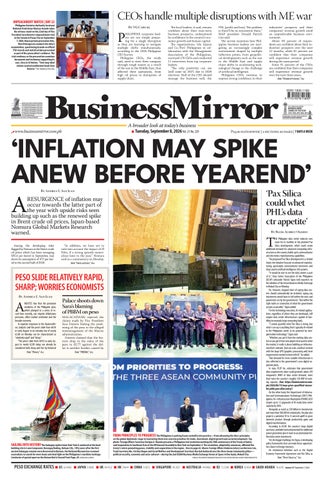
FROM PRINCIPLES TO PROGRESS The Philippines is putting Asean centrality into practice—from advancing the bloc’s principles on the global diplomatic stage to translating them into concrete priorities for trade, investment, digital growth and social development. Top photo: Foreign Affairs Secretary Enrique A. Manalo presents a Philippines-led resolution marking the 50th anniversary of the Treaty of Amity and Cooperation in Southeast Asia at the UN General Assembly in New York on September 4. The resolution, adopted by consensus, affirmed the treaty’s role in promoting peace, stability and cooperation in the region. Story in page A2. Above: Foreign Affairs Undersecretary Leo Herrera-Lim, Trade Secretary Ma. Cristina Roque and Social Welfare and Development Secretary Rex Gatchalian discuss the three Asean Community pillars— political-security, economic and socio-cultural—during the 2nd ASEAN Business Media Exchange forum at Space in One Ayala, Makati City. PHOTOS: PHILIPPINE PERMANENT MISSION TO THE UNITED NATIONS IN NEW YORK/NONIE REYES
HE Philippine data center industry sees room for its facilities in the planned Pax Silica development, which could create additional demand for advanced computing infrastructure as the country builds up its semiconductor and electronics manufacturing capabilities. The proposed Pax Silica development is a United States-led initiative focused on advanced manufacturing, particularly semiconductor electronics and chips used in artificial intelligence (AI) systems. “It would be nice to see the data centers a part of it,” Data Center Association of the Philippines (DCAP) cofounder Patrick Signo told reporters on the sidelines of the Asean Business Media Exchange in Makati City on Monday. He, however, stopped short of saying data centers should automatically be included, saying any investment would have to fall within the rules and parameters set by the government. “But within the right realm or constraints of what the government accepts as possible,” Signo added. For the technology executive, AI-related applications, regardless of where they are developed, will require data center infrastructure capable of handling increasingly large computing loads. “I cannot quantify what Pax Silica is doing. But what I can say is anything that’s typically AI-related in the Philippines needs to be powered by nextgeneration technology,” Signo said. “Whether you get it from the existing data centers or you get it from new players that want to enter the market, it really is about building an infrastructure that’s relevant, that can scale, and that can deal with the large GPU [graphics processing unit]-level requirements needed to deal with AI,” he added. That demand for more scalable infrastructure is also reflected in the government’s own digital expansion plans. In June, PLDT Inc. estimates that government data requirements alone could generate about 270 megawatts (MW) of data center demand, more than twice the country’s roughly 120 MW of existing capacity. (See: https://businessmirror.com. ph/2026/06/15/mvp-gives-qualified-stancefor-pldts-pax-silica-entry/) On the other hand, the Department of Information and Communications Technology’s (DICT) Philippines AI+ Infrastructure Masterplan (PAIIM) 2033 targets up to 1.5 gigawatts of AI-ready data center capacity by 2033. Alongside as much as $30 billion in investments and more than 500,000 AI-related jobs, the plan also projects a potential 10 to 12 percent uplift in gross domestic product through productivity gains and digital transformation. According to DCAP, the country’s large digital user base, available land and potential for additional power generation give it room to accommodate further data center investment. Yet, the bigger challenge, for Signo, is developing policy frameworks that can make those opportunities clearer to foreign investors. He mentioned initiatives such as the Digital Economy Framework Agreement and Pax Silica as See “Pax Silica,” A2
PESO EXCHANGE RATES n US 62.4460 n JAPAN 0.4000 n UK 84.4332 n HK 7.9644 n CHINA 9.3053 n SINGAPORE 49.3021 n AUSTRALIA 44.9486 n EU 72.5248 n KOREA 0.0464 n SAUDI ARABIA 16.6310 Source: BSP (September 7, 2026)