

MORE MONEY FOR HEALTH, BUT SERVICES FALL SHORT
A comprehensive study may account for why Filipino families’ out-of-pocket spending for health remains high, despite UHC
By John Eiron R. Francisco
LOCAL governments are allocating more funds for health under the Universal Health Care (UHC) law, but a new study warns that bureaucratic bottlenecks, weak fiscal autonomy and misaligned priorities are preventing these budgets from translating into better services for communities.
Dr. Maria Eufemia C. Yap, Senior Research Fellow at the Ateneo Policy Center, pointed out that the 5-percent increase in local governments’ National Tax Allotment (NTA) for health is not being maximized as intended.
“Ideally, the process should be: this is our target, this is our plan based on our needs, this is how much will be allocated, and this is how it will be spent. That’s where it falls short,” Yap told the BusinessMirror in an interview at the sidelines of the 2nd Universal Center for Health Policy (UCHP) Executive Symposium on Universal Health Care in Makati City.
Yap explained that health is just one of many competing priorities for LGUs, and when plans within the sector are not aligned, execution becomes fragmented, creating “budget leakages” that blunt the impact of spending.
The Ateneo study, Maximizing Local Government Fiscal Performance of the Health Budget, reviewed the entire budgeting cycle from 2022 to mid-2025, tracing how funds move from planning to actual payment. The research distinguished between money obligated and appropriated versus what was ultimately spent or reimbursed—revealing the gaps between paper allocations and actual services delivered.
To illustrate this, the research team studied five “archetypes,” or typical LGU settings:
• Odiongan, Romblon—a small, rural health unit-led system with tight referral pathways.
• Quezon City—a cross-LGU hub serving both residents and non-residents, stressing the need for shared cost mechanisms.
• Antique province—showing how provincial pooling of funds contrasts with municipal service delivery.
• Belison, Antique—a town with working primary care but weak financial management, revealing gaps in procurement and accountability.
• Isabela City, Basilan—outside BARMM but interacting with it, serving as a laboratory for intergovernmental coordination.
The study found that heavy NTA dependence leaves municipalities vulnerable to cash flow delays, while misaligned planning schedules often turn health plans into “wish lists” rather than actionable budgets. PhilHealth reimbursements and DOH grants provide support, especially for provinces and cities with hospitals, but these are not always reflected in LGU planning.
More critically, Yap emphasized that the main issue is not the amount of money, but the slow movement of funds due to procure-
ment delays, poor absorptive capacity, and mismatched schedules.
In smaller towns, per capita health spending was just P228 to P745 per person, nearly nine times lower than the national average for primary health care. Meanwhile, bigger LGUs with hospitals spend more due to PhilHealth inflows, but still face constraints in payments and utilization.
“The biggest bottleneck is the process itself—timing, transparency and execution. Fixing these will make a bigger difference than just adding more funds,” Yap said.
Short of WHO benchmark DESPITE per capita health spending rising to P8,658 in 2022 from P2,542 in 1991, the country still falls short of the World Health Organization’s benchmark of 5 percent of GDP. Out-of-pocket costs continue to climb, reaching P615.16 billion in 2024, up 11.8 percent from the previous year, while PhilHealth’s share of spending peaked at just 17 percent in 2019, well below its 30 percent target.
“Kalahating trilyong piso mula mismo sa bulsa ng pamilyang Filipino [Half a trillion pesos from the pockets of Filipino families [is spent on health care], yet local government health spending continues to lag behind. Unless these gaps are addressed, universal health care will remain a promise: magandang pakinggan pero hindi dama ng karamihan [nice to hear but not felt by most],” Atty. Jose Maria A. Ochave, executive director of Unilab Foundation, noted.
Yap said reforms like the Special Health Fund can improve the system, but only if fully utilized.
“There are opportunities that could be lost if we don’t use the mechanisms that would improve the system,” she noted, speaking partly in Filipino.
She stressed that “the future of UHC is local,” but warned that multiple funding streams—local revenues, NTA, DOH grants, PhilHealth reimbursements, and the Special Health Fund—have made financial management increasingly complex.
To succeed, Yap said LGUs must strengthen public financial management across treasurers, budget teams, health officers, and local councils. Without this, inefficiencies will persist and the Philippines risks missing its health targets.
“The constant refrain is always, ‘ wala kaming pera [We don’t have money].’ I’m not saying that’s entirely untrue—there are indeed deficiencies. But I also think there is money that is either not being used or not properly planned and disbursed,” Yap




said. “What matters now is turning allocations into real, tangible outcomes for communities.”
DBM reports on health spending MEANWHILE , the Department of Budget and Management (DBM) reported that the proposed 2025 national budget has been set at P6.326 trillion, equivalent to 22 percent of the country’s gross domestic product (GDP) and 9.7 percent higher than this year’s appropriation.
DBM Undersecretary Margaux Marie V. Salcedo, speaking on behalf of Secretary Amenah F. Pangandaman, said the Department of Health (DOH) and its attached agencies—including the National Nutrition Council and the Philippine National AIDS Council—will receive P253.36 billion under the proposed spending plan.
“The budget of the DOH has consistently increased annually since 2022. This upward trend reflects lessons from the pandemic and the government’s resolve to meet the growing needs of our healthcare system,” Salcedo said.
She added that allocations are aligned with the Philippine Development Plan 2023–2028, aiming to secure sustainable and equitably
distributed health infrastructure and human resources.
Significant portions of the DOH budget are designated for hospital operations, with Metro Manila hospitals receiving P23.06 billion and regional hospitals and facilities, P78.9 billion. The funding also supports Bagong Urgent Care and Ambulatory Service (BUCAS) centers, free essential medicines, and basic health services to help reduce out-of-pocket expenses.
The Health Facilities Enhancement Program receives P35.37 billion for the construction, rehabilitation, and upgrading of government healthcare facilities, including equipment and medical transport services. An additional P500 million is earmarked for the Quick Response Fund, ensuring immediate post-disaster rehabilitation of facilities and equipment.
Local health systems are prioritized through the Local Health System Support Program, allocated P74.4 billion. The Human Resources for Health and Institutional Capacity Management (HRHICM) Program has seen a 74.6-percent increase to P463 million, providing training and scholarships for healthcare professionals in LGUs.
The National Health Workforce Support System is allocated P17.97 billion to retain healthcare workers in the country.
Salcedo highlighted that PhilHealth continues to provide benefits to all members despite not receiving government subsidies this year. Coverage for the top 10 most burdensome diseases has expanded, and case rates for 9,000 packages increased by 50 percent.
She added that the Zero-Balance Billing Policy ensures free hospitalization for basic accommodation in select DOH-run hospitals, supported by P41.6 billion under the Medical Assistance to Indigent and Financially Incapacitated Patients Program. The proposed 2026 national budget, currently under deliberation, totals P6.793 trillion, with the DOH allocation increasing to P260.57 billion.
“This has yet to be approved by Congress, but we hope Congress will support our goal of strengthening the healthcare sector so that every Filipino can access hospitals, doctors, consultants, and free medicines,” Salcedo said.
“The national government is doing its best to make quality healthcare inclusive, equitable, and
affordable for all Filipinos,” she added. However, she stressed that LGUs must also play an active role in advancing this mission through strategic planning, fund mobilization, and collaborative partnerships.
Salcedo outlined key steps for LGUs to optimize their contribution to national health spending:
1. Align local plans with the National Health Expenditure Program to access complementary funds and maximize resources.
2. Leverage the Special Health Fund by pooling DOH transfers, PhilHealth payments, and local appropriations to create a more resilient and responsive local health financing system.
3. Forge strategic partnerships with the DOH through memoranda of agreement to implement programs such as the Health Facilities Enhancement Program, Human Resources for Health deployment, and Patient Assistance Programs. She added that while these measures lay the foundation for a stronger health system, turning plans into lasting change requires evidence-based reforms and collaborative efforts.
MORE MONEY FOR HEALTH, BUT SERVICES FALL SHORT
“We cannot transform the country’s healthcare system alone. A whole-of-society approach is necessary to achieve our shared vision,” she emphasized.
‘Fixing systems, fighting corruption’
PATRICK ALAIN AZANZA , governor of Catanduanes, laid bare the severe challenges facing his province’s health system, citing both structural deficiencies and entrenched corruption.
“Catanduanes is an island, ranked ninth from the bottom in terms of poverty incidence. Malnutrition here is the highest in the country. Most of our hospitals, especially the Eastern Bicol Medical Center (EBMC), are decades old, and the situation is really bad,” he said.
He stressed that corruption continues to drain resources allocated to the island. “Fifteen million medicines were allegedly bought and distributed, but they’re still being sold. This shows how corruption acts as an open faucet that depletes resources meant for our people,” Azanza said.
He described a workforce heavily reliant on contractual staff, with positions often filled through


political patronage. “A farmer, a leader’s son, was put in a position with no knowledge of healthcare services. Our hospitals have more job orders than doctors and nurses,” he said.
Of Catanduanes’s P1.5-billion budget, about P300 million goes to health—roughly P444 per capita for its 270,000 population, within the national median. “But because of the many holes in the system, the services that should reach our fisherfolk and farmers often do not,” he added.
“Health is everything for us,” he emphasized. “For our fisherfolk and farmers, the moment they get sick, there’s no one to take care of them or feed their families. Even if corruption faucets are not blamed, almost no one receives the benefits intended for our constituents.”
Azanza also detailed how corruption affects hospital operations, noting that even well-meaning doctors often have to find ways to generate income.
“PhilHealth may bring income to hospitals, but services are outsourced to private pharmacies and laboratories. Even something as small as a glass of medicine can be diverted for personal gain. There’s always someone who ends up buying from outside. The zero-balance bill is not true for us,” he said.
To address these, he reallocated P30 million from confidential funds to healthcare and is exploring how the province’s eight district hospitals could operate as self-sustaining enterprises. EBMC alone, he said, loses P60 million annually despite potential gains of P20 million if PhilHealth collections were fully realized.
“Until corruption disappears—from equipment and food to staffing—our hospitals cannot operate at full potential. This is what makes it hard for our people, and this is what needs to be fixed,” Azanza said.
Former vice president and now Naga City Mayor Maria Leonor Robredo echoed the call for systemic reform, stressing that hospitals must move away from operating in silos. She said a full rollout of universal health care
could encourage resource-sharing rather than competition.
Robredo cited Naga City’s ordinance creating a global health fund to pool PhilHealth benefits, describing it as a model for strengthening systemic resilience. She stressed that resilience should not be confined to disaster response, but must also be anchored on strong and effective leadership.
“In Naga, we have the Naga City People’s Council, which helps ensure that even with changes in top leadership, operations at the local level continue with minimal disruption,” Robredo said.
Citing Catanduanes, which is frequently battered by typhoons, Robredo stressed that the challenge is not resource scarcity but inefficient allocation.
“Resources are not lacking; what is missing is a system for proper allocation and guidance on how these resources should be spent. Health is, of course, the most affected sector, but for communities like Catanduanes, health is everything,” she added.
Both leaders underscored that political will and integrity determine whether resources reach those most in need. Azanza recalled cancelling about P100 million in ineffective projects upon assuming office and realigning them with the provincial board to fund a new EBMC.
“If your decisions show that you’re serious and corruption will not be tolerated, then people will follow. At the end of the day, we need to make sure that 100 percent of our budget truly benefits the people and the health sector. For me, health is everything.”
‘Health must be right’
THE lead convenor of the People’s Budget Coalition, Kenneth Isaiah Abante, urged the government to treat health as a basic right and strengthen oversight of allocations, particularly amid reports of reduced funding for PhilHealth and hospital assistance programs.
He said political leadership is crucial to ensure that patients do not have to “beg” for services, and called for broader representation
in local health boards by including the academe, people’s organizations, patient groups, and barangay health workers.
Abante added that the health budget should prioritize a shift from hospital-based curative care to preventive and primary care, with more resources for rural health units and barangay facilities.
He also recommended funding local health monitoring systems that empower universities and civil society groups to provide datadriven recommendations to local governments.
To address gaps in planning, he suggested developing digital tools that help local government units prepare Annual Investment Plans based on key health indicators, such as tuberculosis prevalence, to support frontliners and improve efficiency in budgeting.
Asked how soon Filipinos could feel the benefits of the UHC law once administrative hurdles are resolved, Yap said meaningful change would depend on consistent implementation despite frequent leadership transitions in government.
She noted that patients could immediately experience improvements through the rollout of the outpatient benefits package, now called YAKAP, which provides accessible primary care services.
“If finances are managed better and resources are maximized, the impact will be felt sooner,” she said.
Yap added that strengthening frontline and primary care delivery, alongside improving access to data for planning, would significantly ease the burden on hospitals.
“Let’s give our people a chance to experience what they’re supposed to be experiencing,” Yap said. “Also an opportunity to make the delivery of health services rational.”
She urged policymakers to treat health as both a service and a political tool that, if used well, could directly demonstrate the government’s commitment to its people.
FROM left: Jean S. Encinas-Franco, professor and assistant chair of the Department of Political Science, College of Social Sciences and Philosophy, University of the Philippines Diliman, serving as panel moderator; Lawrence John Paulo Trinidad, project development manager at the Union of Local Authorities of the Philippines; Kenneth Isaisah Abante, lead governor of the People’s Budget Coalition; Franciz Lianne Ramos, Medical Officer IV at the Rural Health Unit of Odiongan; Maria Leonor Robredo, mayor of Naga City; Mohrein Ismael VI, city health officer of Isabela City, Basilan; Patrick Alain Azanza, governor of Catanduanes province; Austere Panadero, executive director of the Zuellig Family Foundation; and Maria Eufemia Yap, senior research fellow at the Ateneo Policy Center, during the panel discussion organized by the Unilab Center for Health Policy (UCHP) on Wednesday in Makati City. JOHN EIRON R. FRANCISCO

September 7, 2025
Editor: Angel R. Calso
Fading US reliability deepens Australia, Japan security ties
By Bloomberg News
AUSTRALIA and Japan are tightening military and economic bonds as the region grows more volatile and long-time security guarantor US demands allies spend more on defense.
Canberra’s recent decision to buy 11 warships from a Japanese manufacturer is the clearest sign yet of the growing trust, enabling Tokyo to export cutting-edge weapons systems and share the related defense secrets for the first time. The deal also means more investment in Australia as Japanese firms set up shop to build most of the ships.
The move comes as both nations boost their defense budgets to counter China’s military rise, and respond to US President Donald Trump’s pressure on allies to shoulder more responsibility for their own defense and swallow higher tariffs to access America’s markets.
“In all but treaty language we
are allies,” Kazuhiro Suzuki, Japan’s ambassador in Australia, said recently in Melbourne. The ship deal, he added, would create “major opportunities for collaboration” and economic spillovers.
The two countries set the stage for closer military ties through a 2023 Reciprocal Access Agreement—allowing troop deployments to each other’s territory— Japan’s first defense pact since its 1960 US alliance. Tokyo has since signed similar agreements with the UK and the Philippines.
On Friday, the two nations will sign a pact on evacuating each other’s citizens during third-country conflicts, Japanese Foreign Minister Takeshi Iwaya told reporters after a meeting with the Austra -
lian foreign and defense ministers in Tokyo.
“We shared our recognition of the increasingly tense strategic environment in the Indo-Pacific region, and confirmed that we will further strengthen security cooperation between Japan and Australia, and trilaterally among Japan, the United States, and Australia,” Iwaya said. “In particular, we agreed to further strengthen our joint deterrent capabilities.”
The US has been the primary formal treaty ally of both nations for decades, with Japan and Australia key spokes in a regional alliance system with America at its hub. The firming ties now between Canberra and Tokyo is emblematic of an emerging realization that Trump’s indifference to the postWorld War II, US-led order leaves them without a reliable central coordinator, both in Europe and Asia.
“We do face very difficult, challenging strategic circumstances, and as we face them we know our strategic alignment and our strategic trust have never been stronger or deeper,” Australia’s Foreign Minister Penny Wong said after the meeting. “Australia and Japan face similar challenges. We know Australia and Japan share common interests, and we know now more than ever that we look to each other.”
Trump has demanded Ja -
pan and South Korea pay more to maintain US troops in their countries and some officials have called into question the so-called Aukus pact, which is meant to ensure Australia can procure new nuclear-powered submarines from the US. On Thursday, Trump and Australian Prime Minister Anthony Albanese talked by phone, discussing shared security interests and cooperation on trade and critical minerals.
Australia plans to lift defense spending to 2.4% of GDP by 2034, while Japan targets 2% by 2027. Currently Australia spends about 1.9% of GDP, compared with about 1.4% in Japan, according to data compiled by the Stockholm International Peace Research Institute.
The US is also no longer the
unchallenged hegemon of the region, with China’s navy exceeding it in size and Beijing rapidly arming with planes, missiles and other weapons. China’s President Xi Jinping showcased his country’s military might this week with a parade of its latest hardware, while earlier this year, his navy rattled Canberra with unexpected livefire drills off Australia’s eastern coast.
Still, the US remains central to both Australia and Japan, highlighted by a July logistics pact among their three navies that could turn the hub-and-spoke model into a more balanced triangle. It also has far more money and weapons, including nuclear deterrence.
Even before Australian crews sail on Japanese-built ships, the
two militaries have stepped up cooperation, with Ambassador Suzuki touting nearly 40 joint drills in the past year. Japan also joined a large-scale exercise in Australia with the US and 18 other nations in July, plus drills in the South China Sea that drew Chinese criticism. There has been “a mutual upgrading of the sense of risk and of threat in the Asia Pacific arising from China’s obvious rise as a strategic power and as a foreign policy actor,” according to Sam Roggeveen, director of the international security program at Australia’s Lowy Institute. However, “the threats that China and Russia pose to Japan, are simply not the same threats that they pose to Australia, because

Diamonds are not forever: Botswana’s economy in shambles as lab-grown gems gain popularity
By Mbongeni Mguni & Matthew Hill
ACROSS Botswana the lines of patients outside government clinics are lengthening, construction companies dependent on state jobs are firing workers and university students are threatening to boycott lectures after not getting the allowance increases they were promised.
The economic slowdown is a sharp reversal from just a few years ago when the world’s richest diamond deposits allowed the sparsely-populated desert nation of 2.5 million people to invest in free and efficient healthcare and plow money into funding tertiary education for students both at home and abroad. Its robust finances allowed it to provide for
its citizens in a way that made it the envy of southern Africa.
The discovery of gems in 1967 transformed what was a rural backwater with, at the time of independence from the UK a year earlier, only a few miles of tarred road into the richest nation per capita on the sub-Saharan African mainland. Six decades later a diamond-market crisis has turned that find into an affliction and a cautionary tale of what can happen to an economy that becomes overly reliant on one commodity.
“For decades, we have leaned and relied heavily on diamonds. While they served us well, we know painfully today that this model has reached its limits,” President Duma Boko, 55, said in an August speech. “This is no longer an economic challenge alone; it is a national social existential threat.”
The market for natural diamonds is in crisis, with cut-price lab-grown equivalents hitting demand particularly hard in the US, the biggest market for the gems. They accounted for almost half of engagement ring purchases last year compared with 5% in 2019, according to jewelry insurer BriteCo Inc. The collapse of the luxury retail sector in China and the impact US tariffs have had on trade have also hurt the industry. While lab gems can be produced in weeks or months, the formation of natural diamonds, made of crystallized carbon formed under extreme pressure and heat deep beneath the earth’s
A NATION made wealthy by the discovery of diamonds in 1967, Botswana is now facing an economic crisis. WALDO SWIEGERS/BLOOMBERG
See “Diamonds,” A5
See Fading,” A6
Norway’s $2 trillion wealth fund has become an election football
By Heidi Taksdal Skjeseth & Ott Ummelas
KEEPING Norway’s sovereign wealth fund out of politics has been a central tenet of the Nordic nation since the fund— the world’s biggest—was set up in the early 1990s to manage the surplus revenue from North Sea oil production.
That strategy is unexpectedly in question as the $2 trillion fund’s investment choices run into contentious territory over divestments relating to Israel’s
surface, can take billions of years before volcanic eruptions propel them upwards to depths where they can be mined or found on ocean or river beds. They also cost many times as much as their synthetic rivals. Their increasing popularity is creating the biggest disruption in the market since abundant alluvial diamonds were discovered on Namibia’s beaches early last century, causing prices to plunge, according to mining historian Duncan Money.
It’s choking off the revenue that accounts for 80% of Botswana’s exports and a third of government income. After repeated write-downs of its value Anglo American Plc is looking to sell De Beers, the world’s biggest diamond company that mines almost all of Botswana’s gems in a venture with the government.
Boko’s administration, which in October displaced a political party that had ruled since independence, is scrambling.
In July, the government engaged Malaysia’s PEMANDU Associates to advise on accelerating economic diversification and on Aug. 21 Boko took to Facebook to announce a plan for a littleknown Qatari group, Al Mansour Holdings, to invest $12 billion. There was scant information about how the capital will be deployed and the same group has in recent weeks promised more than $100 billion in investment across six African countries, raising questions about the credibility of the pledge.
The president on Aug. 25 declared a public health emergency and implored pension funds and insurers to help fund the response. Government has fro -
war in Gaza—triggered by the October 2023 attack by Hamas militants—drawing domestic criticism over its politicization during an election campaign and
zen recruitment and there are shortages of medication, medical supplies and equipment, according to Kefilwe Selema, president of the Botswana Doctors Union.
“The situation is very bad,” said Galeemiswe Mosheti, a 42-year-old diabetes-sufferer who arrives at a government clinic in the capital Gaborone, at 8 a.m. and can wait as long as eight hours for his medicine compared with just an hour a year ago. “We’re spending long periods in the queue and our jobs suffer,’’ said the taxi driver who loses income every time he fetches waits to be attended to.
For construction companies dependent on government work the situation is no better.
“Most of our members have had to retrench workers,” said Tshotlego Kagiso, chairman of the Tshipidi Badiri Builders Association, the country’s largest building contractors organization, which before the current downturn had more than 800 members, some of whom can no longer afford their membership fees. “The majority have suspended operations and many have closed altogether due to slower government spending,” he added, saying thousands of workers have lost their jobs without being able to be more specific.
The country’s economic statistics tell a story of rapid decline and belie De Beers’ marketing catchphrase, ‘A diamond is forever.’
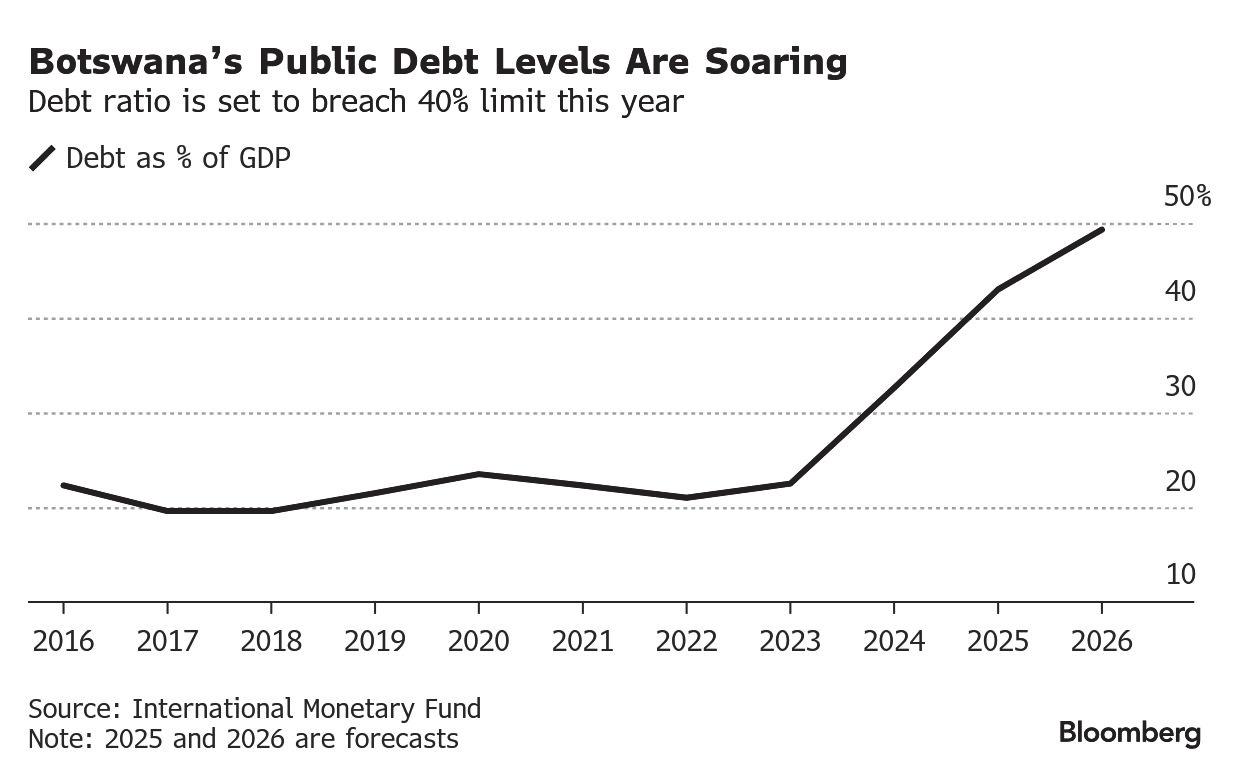
The International Monetary Fund forecast Botswana’s 2025 fiscal deficit climbing to 11% of gross domestic product. That’s the largest budget gap since the global financial crisis in 2009, and the biggest in sub-Saharan Africa this year. Government debt will rocket to 43% of GDP in 2025, about doubling the ratio
attracting the unwanted attention of President Donald Trump’s MAGA camp.
The question now is how the controversy plays out in Norway’s national vote on Monday—and whether threats of US retaliation translate into concrete action. Either way, with several other points of friction looming, there’s a sense that Norway risks falling seriously foul of the Trump administration whatever the next government’s make-up.
“There are good reasons to fear reprisals from a US that has gone from being a stable foreign policy and trading partner to an unpredictable and unstable ally,” Lise Rakner, professor of political science at the University of Bergen in Norway, said in an interview.
The war in Gaza has raged for almost two years since Hamas
in just two years, according to data from the Washington-based lender, and exceeding a legislative limit.
In June, the finance ministry abandoned a forecast of 3.3% growth in 2025 and instead said the economy may contract 0.4%, foreign reserves have slumped 27% over the last year and Citigroup Inc. in July forecast Botswana will need to keep devaluing its managed currency, the pula. A first ever mid-term budget review is planned for as early as next month and Debswana, the country’s joint venture with De Beers, is operating at about 60% of capacity.
Botswana is “experiencing a significant decline in revenue inflows resulting in massive liquidity challenges that threaten financial stability and sustainability of government business operations,” Finance Ministry Permanent Secretary Tshokologo Kganetsano told a parliamentary committee in June.
Already, after years of limited borrowing, the country is turning to debt. It secured $304 million from the African Development Bank in May and $200 million from the Opec fund in July and plans a domestic bond roadshow for investors on Tuesday. Its investment grade credit rating, the highest in Africa, is under threat with both Moody’s and S&P Global Ratings this year cutting its outlook to negative.
“The diamond sector is under severe pressure — both prices and volumes,” Ravi Bhatia, director and lead analyst at S&P Global Ratings, said in an interview. “They’re doing a combination of trying to diversify, fiscal consolidation and also austerity.”
While Botswana’s governments have been talking about economic diversification since the country’s
militants launched a deadly attack on Israel, killing some 1200 and taking hostages. More than 63,000 Palestinians have since been killed in the enclave, according to the Hamas-run Health Ministry, while a United Nationsbacked body last month declared a famine in Gaza, an assessment rejected by Israel.
Norwegian elections tend to lack the kind of fireworks seen in US elections, and the campaign was proceeding much as expected, with bread-and-butter issues like education, health care and taxes dominating the debate— until public uproar over the fund’s investments in Israel put the center-left Labor government of Prime Minister Jonas Gahr Store on the defensive.
The trigger was an August report in the Aftenposten newspaper about the fund’s holding in
first president, Seretse Khama, set up the Botswana Development Corp. in 1970 to develop copper mining and beef production, little progress has been made. Tourism, focused on luxury safaris in the country’s Okavango Delta wetlands and a wilderness that boasts the world’s largest elephant population, is the second-biggest contributor after diamonds, accounting for just 12% of GDP. Some copper mines are being developed while huge coal deposits, barely exploited, can no longer attract the funding needed for extraction.
That’s left more than two fifths
an Israeli company, Bet Shemesh Engines Ltd., which it said repairs Israeli fighter jets used to bomb Gaza. The company did not reply to requests for comment made by phone and e-mail. Bet Shemesh says on its website it has many years’ experience of working with the Israeli Air Force.
Finance Minister Jens Stoltenberg, a former Norwegian prime minister and NATO chief whose return to government earlier this year drove a surge in Labor’s popularity, immediately ordered the fund to review all its investments in Israel.
Several divestments followed. According to a letter sent to the Finance Ministry on Aug. 18, the fund—known as Norges Bank Investment Management—sold off 23 companies in the period June 30 to Aug. 14, representing a decrease of 4 billion kroner ($400 million).
of the population under the age of 24 unemployed, according to the International Labor Organization, with the diamond mines only employing a few thousand people, and reliant on government largesse. That’s a situation Boko described as “a huge risk,” in a January interview with Bloomberg.
“We must now focus on job creation,” Boko said as he laid out ambitious plans for investment in renewable energy, technology and agriculture.
What he hadn’t bargained for was that there would be no money to pay for it.
Seeing an opening, the opposition pressured Stoltenberg to respond to parliament’s constitutional control committee about the whole process. When he did send a response, it was so vague that it failed to satisfy the committee’s Conservative chairman, Peter Frolich, who characterized it as “the most arrogant reply I have received.”
Karin Thorburn, a professor of finance at the Norwegian School of Economics, says the issue has only blown up because of the impending election, with various political parties “using this to advance their own interests and define themselves.”
“It’s a storm in a teacup that at any other time would have been dismissed by the Finance Ministry,” she said.
Continued on A6
While many other countries are reliant on a single commodity for the bulk of their earnings and go through cyclical downturns, for example oil-reliant Nigeria and Angola, for Botswana the outlook is bleaker.
“The difference with the oil cycle is that diamond prices are unlikely to ever come back,” said Charlie Robertson, author of The Time Travelling Economist, a book on how developing economies industrialize. “Its economic model is likely to cease being one of the shining lights on the African continent.” With assistance from Gordon Bell and Thomas Biesheuvel /Bloomberg

Sunday, September 7, 2025
Norway’s $2 trillion wealth fund has become an election football
The storm spread across the Atlantic, however. On Aug. 25, the fund issued a brief statement announcing that six further stocks would be offloaded, due to “an unacceptable risk that the companies contribute to serious violations of the rights of individuals in situations of war and conflict,” breaching its mandate. Among them was Irving, Texas-based Caterpillar Inc.
Republican Senator Lindsey Graham, a Trump ally, expressed outrage at an action he described in a post on X addressed to the fund as “beyond offensive.”
“Your BS decision will not go unanswered,” he said Aug. 27. The next day, he suggested that US tariffs might be an appropriate response.
It later transpired that Graham was in Jerusalem at the time, where he met with Prime Minister Benjamin Netanyahu. The Israeli prime minister’s office declined to comment.
Norway’s prime minister reached out to Graham by text to clarify the fund’s status.
“I appreciate the input,” Graham told Bloomberg News Tuesday, when asked in Washington about Store’s message. “But the conduct of the sovereign wealth fund is outrageous.”
Reiterating that it “will not go unanswered,” Graham said he’d informed the Trump administration of the case. “I think they were as stunned as I was,” he said. “What I’ll do is work on restricting visas for the wealth fund.”
Trump has yet to weigh in publicly on the matter.
Caterpillar didn’t respond to requests for comment. In a statement, the fund said that it is “a strictly non-political financial investor.”
As a fossil-fuel giant—it’s Europe’s largest oil producer after Russia—Norway isn’t an obvious target for the Trump administra -
tion. It runs a modest trade deficit with the US, with its main exports gas and seafood.
Store and Stoltenberg were among the first European leaders to get a White House audience in April, a fact hailed by Norwegian media as a sign of their clout with Trump. The subsequent imposition in August of US tariffs of 15% were lower than some, but still an unpleasant surprise.
Oslo’s choice, meanwhile, of the UK over the US, France and Germany to supply it with naval frigates, made public on Aug. 31, risks going down badly with Washington, while Trump’s decision to stop a wind farm development by Danish company Orsted A/S a week earlier is alarming to Norway, a fellow Nordic nation that promotes its green image abroad. What’s more, the wealth fund owned a 3.17% stake in Orsted as of June 30.
Nobel Prize?
THEN there’s Trump’s obsession with winning a Nobel Peace Prize. Several governments have nominated him for the award, among them Israel’s. The five-member Norwegian Nobel Committee which awards the Peace Prize is selected by the Norwegian parliament, but does not answer to lawmakers or the government. How clear that distinction is would inevitably come to the fore in the event that Trump doesn’t get his wish.
Perhaps the most striking difference is over the war in Gaza. Where Norway has been critical of Israel and recognized Palestinian statehood in May last year, the Trump administration said it will deny visas to the Palestinian delegation to attend the UN General Assembly this month, at which the UK, France and Canada have signaled they’ll announce recognition of a Palestinian state.
Polls show those geopolitical tensions are weighing on Norwegians ahead of the election, with a “substantial increase” in vot -

ers ranking foreign policy issues as very important, according to Halvard Leira, research director at the Norwegian Institute of International Affairs (NUPI).
That sentiment is allied with more skepticism toward the US under Trump than ever before, Leira said, citing polling showing 78% of respondents saying they want NATO to be less dependent on the US.
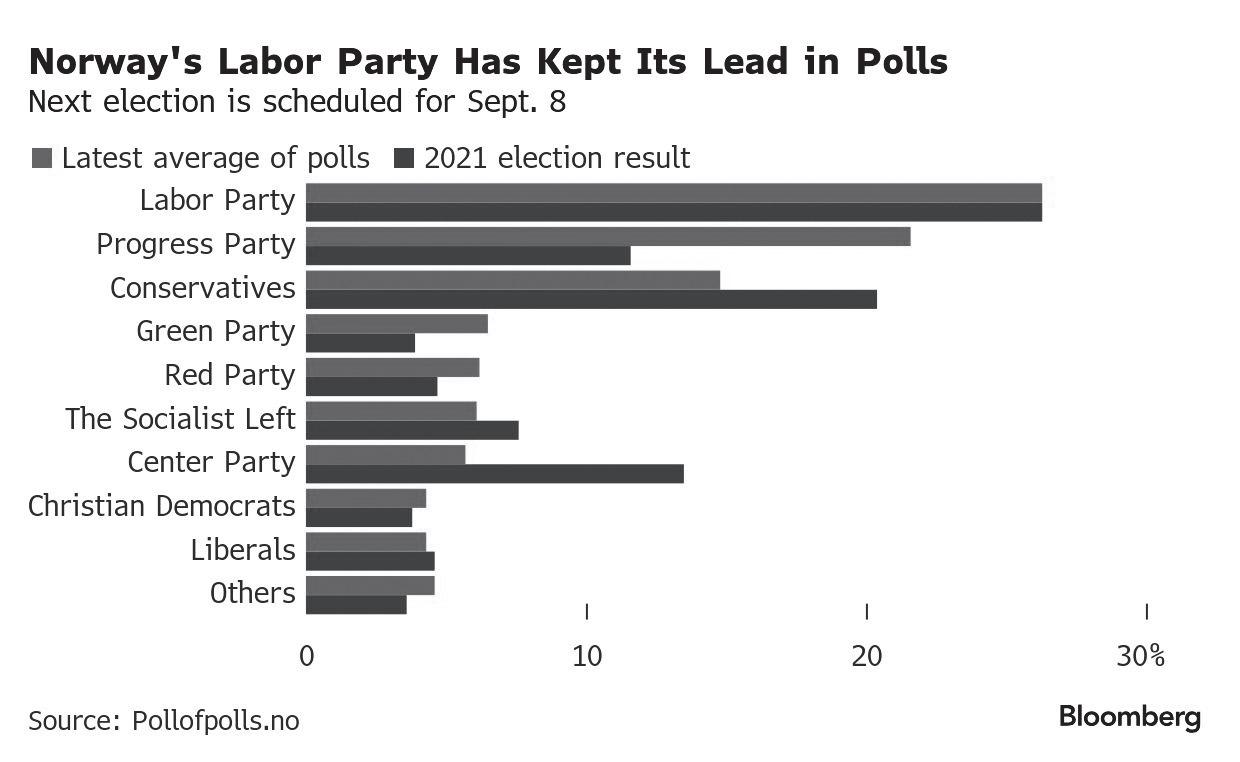
It’s a dynamic that’s helping Labor, which leads surveys with 26% support, ahead of the populist Progress Party on 22% and the Conservatives with 15%, according to pollofpolls.no. Whether smaller parties especially on the left can make the 4% threshold to win seats is increasingly seen as key to determining the balance of power.
The controversy over the wealth fund has been thrown into that mix.
The fund invests Norway’s oil and gas profits abroad and owns
Norwegian elections tend to lack the kind of fireworks seen in US elections, and the campaign was proceeding much as expected, with bread-and-butter issues like education, health care and taxes dominating the debate—until public uproar over the fund’s investments in Israel put the centerleft Labor government of Prime Minister Jonas Gahr Store on the defensive. The trigger was an August report in the Aftenposten newspaper about the fund’s holding in an Israeli company, Bet Shemesh Engines Ltd., which it said repairs Israeli fighter jets used to bomb Gaza. The company did not reply to requests for comment made by phone and email. Bet Shemesh says on its website it has many years’ experience of working with the Israeli Air Force.

about 1.5% of the world’s stocks. Questions over whether Norway is politicizing it have arisen before, yet not during election campaigns.
In 2019, then-opposition leader Store suggested a more political role for the fund to shape the global agenda on green investing. After Moscow’s full-scale invasion of Ukraine in 2022, his government ordered the fund to divest from all its Russian holdings following European Union sanctions. The same year, a white paper commissioned by the government warned about a creeping politicization that could threaten the fund’s credibility and performance.
The fund is overseen by the central bank and its ethical parameters are set by the Finance Ministry, after consultation with parliament. An external ethical council advises on exclusions, and often engages with the companies in question.
There’s been a general consensus among Norway’s politicians to leave the fund to invest as it sees fit. It follows a benchmark index set by the Finance Ministry, with some room for active management.
While none of the main parties are planning to overhaul how the fund is run, both the Conservatives and the Progress Party want to change the ethical guidelines to allow the fund to buy shares in companies that make nuclear weapons.
The prime minister insists it shouldn’t be used as a foreign policy tool. Debates around the fund’s role in Israel have been building regardless, with multiple protests by activists blocking the entrances to the Finance Ministry and the central bank, calling for divestments.
“When it comes to exclusions and observations, all compa -
Australia is so much further away,” he said, adding that “geographical distance places limits on the

nies—regardless of country—are assessed according to the same ethical criteria by an independent Council on Ethics,” the fund said in its statement. “Decisions are made impartially based on those recommendations.”
Stoltenberg and Store have both rejected the option of selling the fund’s entire Israeli portfolio, a line shared with the main opposition. Divestments should be for violations of international law and not over where companies are based, they’ve said.
The fund’s first head, Knut Kjaer, disagrees, arguing the “extreme situation” in Gaza is testing the high degree of trust that’s required for running a sovereign wealth fund in a democracy.
“Israel is just a tiny part of the index,” Kjaer said in an interview. “In other words, this isn’t important for the financial project, but as we see now it is important for democratic trust.”
More than 30 Israeli companies had been sold off so far this year, according to the fund.
Chief Executive Officer Nicolai Tangen has called the furor his “worst crisis.” At a news conference presenting the fund’s results
on Aug. 12, the former hedge-fund billionaire received no queries at all about earnings, the best since 2023, and instead was peppered with questions about Israeli investments. He stressed the importance in keeping the fund distinct from politics, because otherwise, he said, “where will it end?” Stoltenberg, too, has rejected any notion of the fund being politicized.
“These are all divestments made within the existing rules and framework,” he said, adding that the war in Gaza “is challenging the almost 30 year-old framework.” In truth, it’s always been a delicate balancing act. The fund has previously pulled out of companies producing palm oil, and has requirements on gender, inclusion, transparency and environmental standards—another provocation for the Trump administration.
Leira of NUPI says he can’t recall the fund ever playing such a prominent role in elections.
“The government can say the fund is apolitical,” he said. “But it’s not for them to decide how it’s being perceived.” With assistance from Alicia Diaz, Kari Lundgren and Galit Altstein/ Bloomberg
depth of the strategic partnership because neither side will judge the threat to be as acute as the other will.”
Economic ties
THE upward trend in relations contrasts with a decade ago, when Japan lost an Australia submarine contract to France—only for Canberra to later scrap the deal in favor of the Aukus deal. It was seen as a double blow to Japan: a missed chance to open its defense industry and a setback to then–Prime Minister Shinzo Abe’s push for closer ties.
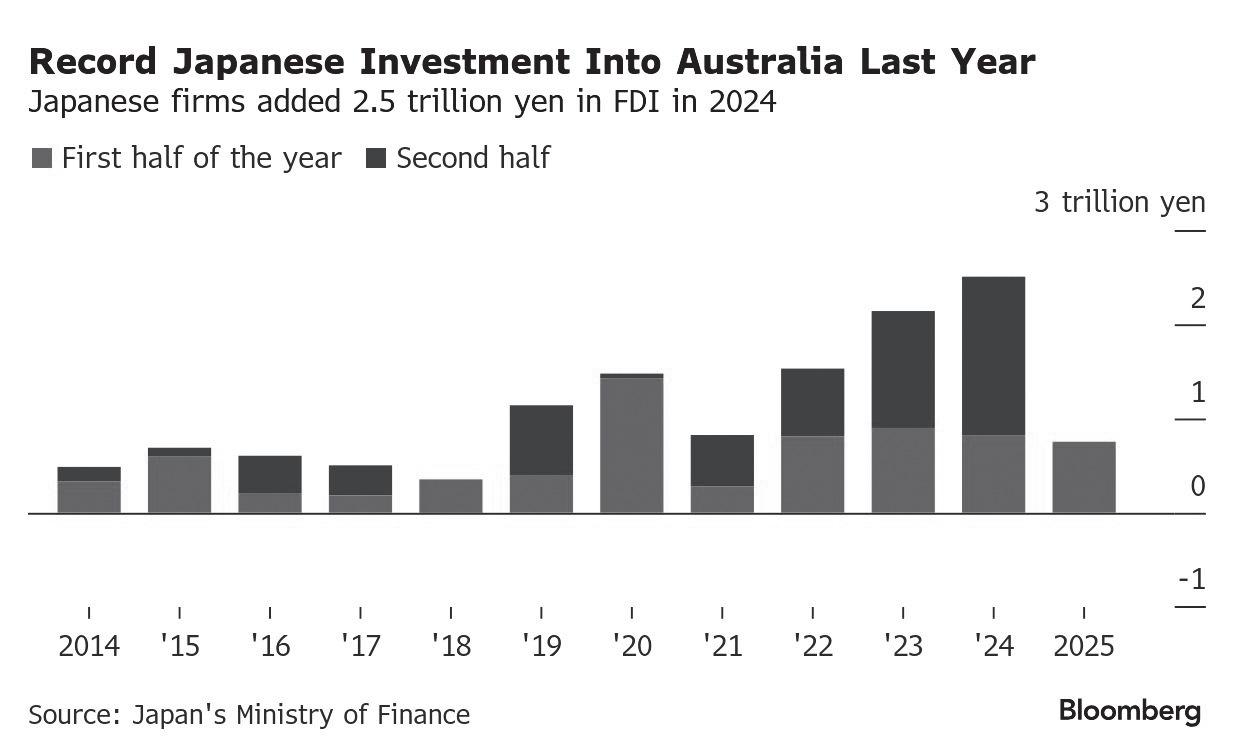
Since then, ties have rebounded on the back of strong trade and bilateral business links. Japanese companies are the third-largest investors in Australia, with record flows of 2.5 trillion yen ($17 billion)
last year, and nearly matching levels so far this year.
Japan has been a key trading partner since a 1957 commercial treaty, reinforced by a 2015 free-trade deal and joint membership in major regional pacts. It was pivotal in developing Australia’s iron ore and liquefied natural gas industries, with Australia still its primary source of energy and a major supplier for commodities such as rare earths.
“The commitments that we’ve made to each other, particularly in our trade agreements, but also in our near alliance-like defense arrangements, are absolutely ironclad commitments,” said Jan Adams, the head of the Australian Department of Foreign Affairs and Trade. With assistance from Sakura Murakami/Bloomberg
Fading. . .
PROTESTORS wave Palestinian flags outside Norges Bank’s headquarters in Oslo, on March 27. NAINA HELÉN JÅMA/BLOOMBERG

SUSTEX 2025:
Sustainability expo pushes businesses to rally on climate resilience
By Bless Aubrey Ogerio
OVER the last 50 years, the Philippines has experienced around 565 disasters, which have claimed 70,000 lives and resulted in $23 billion in economic losses, according to World Bank data.
These numbers highlight the country’s dual exposure: the physical toll of natural hazards and the economic challenge of adapting to global sustainability standards.
Seeking to address these risks, the Department of Science and Technology (DOST), in partnership with SM Prime Holdings and Arise Philippines, launched the inaugural “Sustainability Expo [SUSTEX] 2025: Innovation Toward Environmental Stewardship” on August 29 at the SMX Convention Center Aura in Taguig City.
The event brought together tenant-partners of SM, micro, small, and medium enterprises, multinational firms, government
agencies, and international organizations in a collective call to integrate resilience, innovation and sustainability into their business growth strategies.
Science Secretary Renato U. Solidum Jr. said innovation should not be confined to breakthrough technologies or new products but must also serve as a safeguard for the future.
”It is about ensuring that the growth we pursue today does not come at the cost of tomorrow,” Solidum said, pointing to the Philippines’ high ranking in Germanwatch’s Climate Risk Index 2025, which listed the country among the top 10 most affected by extreme weather events from 1993 to 2022.
He added that businesses must embed sustainability into their operations alongside financial performance to stay competitive in the long run.
Showcasing solutions
THE two-day expo featured over 50 exhibitors presenting
Study: Hot days make for icy weather in PHL
THE Philippines, like other tropical countries, is known more for its balmy climate than for hailstorms. But a new Philippine study has found that the country’s hottest days are, in fact, more likely to produce hail. Hailstorms are so few and far between in the Philippines, even in an age of pervasive social media updates, that they are met with amazement and astonishment.
“Most people are surprised when hail happens because it is relatively rare in the Philippines,” said Dr. Lyndon Mark P. Olaguera, senior author of the study.
“Many take photos or videos and share them online. Some are scared since it’s unusual, while others just treat it as a strange kind of rain. People usually explain it as part of strong thunderstorms, and some interpret hail as a warning or sign of climate change,” Olaguera added.
The study “Spatiotemporal Analysis of Hail Events in the Philippines” is published on archium.ateneo.edu, said a news release from Ateneo de Manila University (AdMU).
The largest hailstones ever recorded in the country fell in Cabiao, Nueva Ecija, on May 8, 2020. The ice balls reportedly reached up to 5 centimeters in diameter— larger than golf balls.
High surface temperatures on that day provided the ideal conditions for temperature-driven air movements or convection. Using satellite and radar data along with high-resolution weather modeling, the researchers confirmed the presence of strong updrafts and favorable conditions for hailstorms at the time.
Ice born from hot air
THE counterintuitive connection between heat near the ground and ice falling from the sky is partly explained by a meteorological factor known as Convective Available Potential Energy (CAPE), a measure of how much energy is available to fuel rising air.
High CAPE values indicate conditions favorable for convective activity, wherein hot air near the Earth’s surface rapidly rises and carries moisture into towering thunderclouds. Within these clouds, powerful updrafts can carry water droplets high enough into much colder layers of the atmosphere, where they freeze and eventually grow into hailstones.
Also, the presence of dry air in the mid-troposphere can actually increase the likelihood of hailstones surviving to reach the ground.
Dry air enhances evaporative cooling, which strengthens downdrafts and accelerates the descent of hail. Because the hailstones spend less time passing through warmer air on their way down, they are less likely to melt completely before hitting the ground.
Groundbreaking study of tropical ice
SPANNING nearly two decades worth of data, from 2006 to 2024, the Philippine study is the first ever comprehensive analysis of hail occurrences in the country.
The researchers found that hail events were most frequent during the dryseason months of March, April, and May—precisely the period when surface temperatures peak and the atmosphere is primed for thunderstorms. Most hailstorms were found to have occurred during the mid to late afternoon, the hottest part of the day.
Interestingly, while Luzon recorded the most hail events overall, relatively larger hailstones were more observed in the Visayas and Mindanao.
The study attributes this to the weaker influence of the Southwest Monsoon in those regions, which allows localized convective storms to persist later into the year.
Invaluable importance of citizen science FOR the study, the researchers relied on a wide range of sources—not just instrument data, but also local government records, news media, and geotagged social media posts.
This multi-source, crowd-informed approach proved especially valuable given the country’s sparse ground-based hail detection capabilities. This shows the invaluability of citizen science and public reporting in monitoring hailstorms and other severe weather hazards.
As climate change increases the likelihood of extreme weather, empowering the public to participate in data gathering may prove essential for the development of early warning systems in the Philippines. Looking ahead, the researchers stress the need to expand the country’s weather monitoring and forecasting capabilities. They recommend that local disaster preparedness focus not only on typhoons and floods, but also on less familiar hazards which can catch communities off guard— such as tornadoes and waterspouts, as well as hailstorms.
Besides Olaguera of the AdMU and the Manila Observatory, among the authors of the study are Marco Polo A. Ibañez, John A. Manalo, and Generich H. Capuli of Department of Science and Technology-Philippine Atmospheric, Geophysical and Astronomical Services Administration.

advancements in waste management and recycling, energy and water efficiency, disaster resilience, carbon reduction, clean air technology, and electric vehicles. Government representatives
from the Departments of Environment and Natural Resources, and of Energy joined international partners from the European Union and Denmark in expressing support for the initiative.
From pledges to proof
THE private sector was challenged to go beyond symbolic participation in sustainability events and commit to measurable results.
“Enough talk. We’ve had summits, forums, and declarations that fill up shelves and inboxes.
What we need now is proof,” Solidum said, emphasizing the need for collaboration across industry, government, academe, and communities.
SM Prime Holdings Chairman
Hans T. Sy highlighted how partnerships with the DOST have already taken shape through projects—such as the Waste Analysis and Characterization Study (WACS), which has helped improve waste management practices in SM malls.
“Public-private partnerships like this demonstrate how science and business can unite to address some of the most pressing environmental challenges of our time,” Sy said, urging other corporations to support local
scientific initiatives.
SM Supermalls President Steven T. Tan echoed this, framing sustainability as both a responsibility and an opportunity.
“It’s mind setting. Somebody has to push the envelope, somebody has to start it, and it is not just a role but the responsibility of companies to pursue sustainability for the benefit of our environment,” he said. He noted that SM was the first company in the country to install electric vehicle charging stations in its malls nationwide, proving skeptics that the investment was worth it.
Organizers hope the expo will evolve into a continuing platform for collaboration and action.
“May this Expo be more than an event—may it serve as a catalyst for collaboration, a hub for practical solutions, and a reminder that business can be a force for good when guided by purpose, discipline, and partnership,” Sy added.
Protein-enriched copra meal promises healthier aquaculture with lower feed inputs,
production costs
FEEDS for fishes are very costly that bring equally expensive fishes in the market. Thankfully, a locally developed feed ingredient, Protein Enriched Copra Meal (PECM), is creating a sustainable and affordable aquaculture production in the Philippines.
Designed as an alternative to costly imported soybean meal, PECM uses copra meal, a by-product in coconut oil production.
With the country’s abundant coconut supply, this technology can significantly lower production costs and reduce reliance on foreign feed inputs.
In aquaculture industry, feeds can account for up to 70 percent of total production expenses. Thus, finding efficient and affordable protein sources is crucial.
Soybean meals, currently the dominant plant-based protein in fish diets, are mostly imported, making feed prices vulnerable to global market shifts.
PECM addresses this challenge by providing a protein-rich, locally sourced alternative that has reduced feed intake while maintaining healthy fish growth.
This is being explored through the two-year project,“PECM in Aquaculture Diets for Gut Health Modulation,” funded by the Philippine Council for Agriculture, Aquatic and Natural Resources Research and Development of the Department of Science and Technology (DOST-PCAARRD).
The University of the Philippines Los Baños (UPLB) is implementing the project.
The researchers discovered that the feed also supports gut health in farmed fish by

positively influencing their gut microbiota, the community of beneficial bacteria in the digestive system. A balanced gut microbiome is linked to better digestion, disease resistance, and overall immune strength in aquatic animals.
To explore these effects in greater depth, scientists use advanced tools like metagenomics and metabolomics.
Metagenomics is the analysis of the genetic material of the entire microbial communities, while metabolomics studies the small molecules or metabolites, found within cells, biofluids, tissues, or organisms.
These two “omics” technologies have recently become important in fish research, helping scientists understand how environmental factors, such as diet, affect fish health, nutrition, and welfare.
These tools provide a deeper and more precise understanding of how feeds like PECM influence fish health at the molecular level, which then offer insights that traditional measurements like growth rate and feed efficiency might miss.
By identifying how nutrients and bioactive compounds in the feed interact with fish metabolism and gut bacteria,

researchers can optimize the diet to support long-term fish health and performance. With these advancements, PECM is seen to improve local aquaculture productivity, ensure a more stable supply of animal feed proteins, and help bring down the cost of fish products for Filipino consumers.
By turning coconut by-products into a valuable feed, PECM represents another strategic solution that can potentially increase farmers’ income while promoting more resilient and self-reliant food systems. Rizza B. Ramoran/S&T Media Services
Asian grad students tackle sustainable food systems at intensive academic, field program
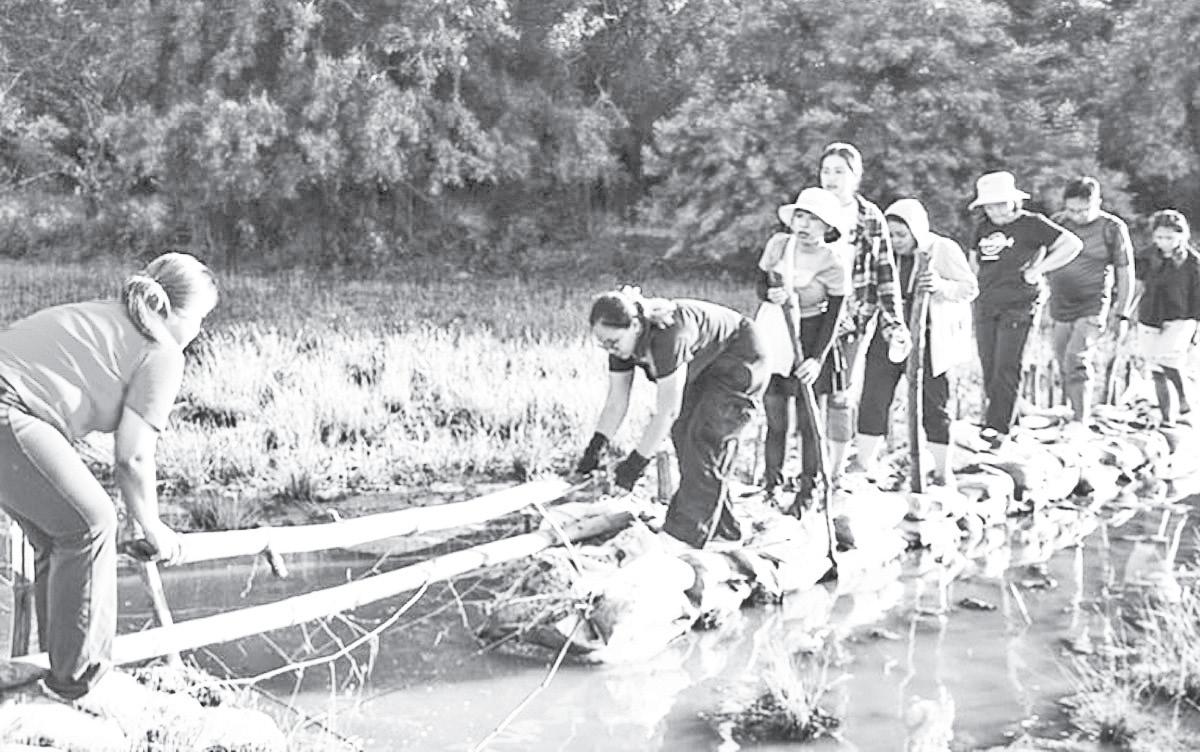
MUÑOZ, Nueva Ecija—Twenty-six graduate students from across Southeast Asia, Iran, Japan, Taiwan, and Turkey recently engaged in a 12-day program at a university and two provinces in Central Luzon for an intensive academic and field-based project.
The the graduate students participated in the ninth University Consortium Summer School (UC SS) hosted by Central Luzon State University (CLSU), in partnership with the Southeast Asian Regional Center for Graduate Study and Research in Agriculture, and the Southeast Asian University Consortium for Graduate Education in Agriculture and Natural Resources (UC), said Searca in a news release.
With the theme “Ridge to Reef: Integrated Management for Sustainable and Resilient Food Systems,” the program aimed to provide a holistic understanding of resource management. The participants engaged in a blended learning format, combining online lectures with in-person activities at the CLSU campus and field visits to the coastal and marine ecosystems of nearby Aurora province. They also learned ecosystem-based resource management, integrated pest man -
agement, and coastal zone rehabilitation.
A highlight of the program was the community homestay on San Salvador Island in Masinloc, Zambales, where the participants mingled directly with residents in conducting interdisciplinary assessments and co-creating a Community-Based Resource
Management Plan.
The hands-on approach allowed the students to apply their knowledge to real-world challenges, offering sustainable solutions tailored to the community’s needs.
CLSU President Dr. Evaristo Abella and Searca Senior Program Head for Education
and Collective Learning Dr. Maria Cristeta Cuaresma lauded the students for their commitment and enthusiasm. Abella highlighted the students’ courage in stepping outside their comfort zones. For her part, Cuaresma praised the resilience of the organizers and host families who ensured the program’s success despite the challenges of back-to-back typhoons during the period.
They emphasized that the program’s true value lies not just in its academic rigor but also in the relationships forged and cultural exchanges fostered. The participants, in their testimonials, underscored a shared takeaway: the importance of human connections over material possessions. Their collective message was that the program deepened their knowledge while strengthened bonds among peers, facilitators, and host communities. The annual Summer School is an initiative of the UC to enhance the understanding of rural development, agriculture, and natural resource management. It provides a unique opportunity for students to gain diverse perspectives and practical skills for promoting sustainable land and water use across Southeast Asia.
SM Prime Holdings Chairman Hans T. Sy (left) and Science Secretary Renato U. Solidum Jr. seal their partnership for sustainability with handshake at the opening of the inaugural “Sustainability Expo 2025: Innovation Toward Environmental Stewardship” held on August 29 at the SMX Aura Convention Center, Taguig City. PHOTO FROM DOST
Faith Sunday
A8 Sunday, September 7, 2025

Editor: Lyn Resurreccion • www.businessmirror.com.ph
Priest’s Magsaysay win shines light on mission of healing, dignity
By Justine Xyrah Garcia
WHEN the Ramon Magsaysay Award Foundation announced its 2025 laureates last August 31, one of the names on the list was Fr. Flaviano “Flavie” Villanueva, a priest known for his work with the homeless and with families of those killed in the country’s bloody drug war. His work, often carried out far from public view, has made him a leading voice in the Church’s response to state violence and neglect of the poor.
A few days later after the announcement of the award, in a media roundtable, the Filipino priest explained how he saw the award—as recognition not of him, but of those he serves.
“I receive this, I accept this in behalf of the thousand homeless and those victims of social injustice, particularly the [extrajudicial killing] victims, that they may have a face in this fast-changing world,” he said.
“The greatness of spirit is something that we are called to celebrate. And in celebrating, we celebrate it by a mission called ‘Kalinga’ and ‘Paghilom,’ that is to care and to offer healing.”
For Villanueva, the award was never about prestige. It was about visibility for those who have long been left invisible—the homeless who line up for showers and meals at Arnold Janssen Kalinga Center, and the widows and orphans who gather each week for Paghilom Program to confront grief and begin healing.
Radical care, demanding justice AT the Kalinga Center, guests are
welcomed first with showers—not a bucket and pail, but running water that many of them associate only with the rich.
After washing up, they are served a buffet meal of vegetables, meat, and unlimited rice. Each visit costs the center around P115 per person, covering food, hygiene, and a few hours of rest.
“The bathing itself is not the usual thing, which is bucket and pail. It’s showers—‘only for the rich,’ as they say,” Villanueva said.
“What I have is also what I wish my brother, my sister, the homeless under our care would also have and partake. You come here, we remind you that you are a human person, a beloved of God,” the priest explained.
The meals, served four days a week, are more than just sustenance. They are meant to restore dignity to people often reduced to handouts or leftovers on the street.
Beyond meals and hygiene, the center also runs programs that help guests pursue education and livelihood opportunities. This phased approach is designed not only to provide immediate relief but to give the homeless a way to move forward—ensuring they are not left at the margins of opportunity.
As Villanueva recalled, even Luis Antonio Cardinal Tagle once told him he hoped that one day there would be no need for Kalinga anymore—because the homeless would already have been empowered and their lives rebuilt.
If Kalinga restores dignity through food and hygiene, Paghilom offers healing through voice.
The program was born out of the country’s drug war, which left more than 30,000 people dead

both in police operations and vigilante-style killings.
For widows and orphans left behind, the trauma is not only grief but silence.
Paghilom provides seven to 12 psycho-spiritual interventions every Saturday, creating space for families to process their pain.
At first, Villanueva required affidavits at the start of the program. But fear enveloped participants, so he moved the legal documentation to the end.
“I recognized that when I placed it at the beginning of their psychospiritual intervention, it still enveloped them with fear,” he said.
“So I decided to place it at the end. Lo and behold, there have been and it’s been a constant thing that halfway through the process, they are the ones volunteering themselves.
‘Father, I’m ready to speak. Father, I would like to narrate what I saw.’”
For Villanueva, this shift showed how healing and justice are inseparable.
“Healing is always synonymous to justice…When a person slowly begins to accept that ‘I have become
Filipino Catholics join in prayer, fasting for political change, corruption
THE Philippines is currently in the midst of political challenges. These include the impeachment proceedings against Vice President Sara Duterte, which were recently blocked by the Supreme Court and archived by the Senate; the “phantom” projects dedicated to flood control around the country; licenses given to multinational firms to mine in territories of irreplaceable environmental significance; and corruption.
According to Fides, the Vatican news agency, as a response, several Filipino Catholic groups, communities, and associations created spiritual initiatives based on fasting and prayer for the common good of the country. The goal is to educate the faithful on good governance, electoral reforms, and the need to end political dynasties in the Philippines.
Initiatives for change
FROM the Diocese of Cubao, Fr. Robert Reyes—a member of the Clergy for Good Governance (CGG)—brought a group of priests together to lead a penitential service at the Nuestra Señora de los Remedios Parish.
This event highlighted the group’s commitment to “morality in public service.”
Additionally, the priests addressed the Senate, stressing their dedication “to genuine change.”
A number of participants have been calling for an official review of the Supreme Court’s and senators’ decision to block the impeachment process against the vice President.
Moreover, the work of this group of priests also included a week of prayer so “government officials, especially senators and judges, defend and strive for truth and justice for the good of the nation.”
A system which has shaken people’s faith
THE founders of the CGG shared their goal to “defend what is just, what is true, and what promotes the common good.”
In an open letter from the group, they stressed that “in these difficult times, when the truth is distorted and justice is threatened, we are called not only to raise our voices, but also to pray, fast, and offer ourselves for the good of our beloved country.”
They argued the Supreme Court’s ruling has “shaken our people’s faith” in democratic institutions. Acknowledging that people have risen up in protest, the priests expressed that their response will be one “rooted in

faith, repentance, and sacrifice.”
Other religious groups, including the Institute for Studies in Asian Church and Culture (ISAC) and the Church Café, have joined in with their own initiatives, like hosting prayer meetings.
Catholic academic institutions such as the Ateneo School of Government and De La Salle University expressed their support and participation in the various events as well.
Joining for justice RECENTLY, Caritas Philippines also joined in calling on institutions to show “moral courage, the highest integrity, and a strong commitment to the rule of law” and challenged them to stay steadfast in justice to serve the “well-being of the Filipino people, especially the poor, the marginalized, and those whose voices often go unheard.”
Joining these other organizations, the Justice, Peace, and Integrity of Creation Commission of the Conference of Religious Superiors of the Philippines is encouraging everyone not to remain silent in the face of corruption.
The Conference reiterated that honesty is not useless. “Do not lose hope in the future of our country. This is the witness of our consecrated life. This is the mission we must not abandon.”
A Supreme Court ruling IN July this year, the Supreme Court declared the impeachment proceedings against Vice President Sara Duterte unconstitutional. Duterte was accused of misuse of public funds and conspiracy to assassinate President Ferdinand Marcos Jr.
Three priests and two lay people have filed a petition with the Supreme Court for a review of the ruling and for Duterte to be removed from office. Kielce Gussie/Vatican News
that is contrary to the gospel,” the priest said.
Asked what Filipinos fail to see about the widows and orphans of the drug war, he answered: “They fail to see that they are human persons. They fail to see that each human person is a reflection of God’s image. Not all people who were killed during the drug war are drug addicts.
A lot of them are innocent ones.”
For Villanueva, proclaiming the gospel is inseparable from denouncing injustice.
a victim but refuses to remain a victim,’ that is healing already,” he said.
The narratives that families now willingly share have become testimonies of survival and resistance.
As Villanueva described it, “the desire to relay their narratives comes from them and that spells empowerment, which is equal to justice.”
In Villanueva’s view, healing should not be passive. It must be an active resistance against being silenced.
Justice, in this context, is not only the pursuit of accountability but also the empowerment of the living to reclaim futures that violence tried to erase, according to Villanueva.
Faith that refuses silence CRITICS argue that priests like Villanueva should keep the Church out of politics, even in the face of state violence.
He has heard the charge often, but for him, silence is complicity.
“They fail to see that to proclaim the gospel is also synonymous to denouncing anything
He blames the nation’s crisis on what he calls the “dichotomy of one’s faith and daily living.” Too many, he said, are content with Sunday rituals but resist prophetic witness.
“If we are called to give witness, if we are called to a prophetic action, that is another question. And that is what we are not only failing but blinded, sadly blinded with,” he said.
Undeniably, the Magsaysay awardee’s strength is largely anchored from what he sees every week: the widows refusing to remain victims, the homeless remembering their dignity, or the children daring to dream of education despite losing parents to violence.
A ‘wounded healer’ carrying hope
VILLANUEVA’S capacity for empathy is not abstract. He began using drugs at 14. By 25, he had spiraled into addiction, until a cold-turkey withdrawal in a Tagaytay monastery forced him to confront himself.
“It was there that I realized that there must be something better or higher or more valuable than what
I have been doing…I would point to that as one of the catalysts or Damascus in my life’s journey,,” the priest recalled.
That history shapes his view of drug dependents as people in need of care, not condemnation. Villanueva believes that recovery is possible when compassion replaces stigma.
“As a drug dependent myself, I believe that drug addicts are people who are in need of mental and health care, and most importantly, they need hope. They should never be killed,” he explained.
This lived scar explains why he embraces the homeless and the families of the slain. He calls himself a “wounded healer,” one who knows that healing and justice are inseparable.
His ministry, shaped by both personal wounds and the wounds of the nation, became a way of turning brokenness into service. Each threat, each loss, each scar only deepened his resolve to walk with those who had been abandoned.
For Villanueva, the Magsaysay award is not about prestige but more of an affirmation.
“The award is not about me. It speaks of the mission… reminding them that the word love has a face. It is a verb, and that word is called to care,” he said.
Villanueva is the 14th Catholic priest to receive the award.
First given in 1958, the Ramon Magsaysay Award is regarded as Asia’s “premier prize and highest honor.”
For his human rights advocacy, Villanueva also won the Human Rights Tulip Award from the Dutch government in 2021.
Faithful in Brazil venerate relic of Carlo Acutis in Campo Grande
CAMPO GRANDE, Brazil—Campo Grande is experiencing days filled with intense faith and emotion with the arrival of the blue sweater of Carlo Acutis—a relic worn by the young Italian who will be canonized this September 7 at the Vatican.
The item was escorted by the Fire Department to the São Sebastião Parish on the evening of Monday (1 September), marking the official opening of the Canonization Week. According to organizers, more than a thousand people took part in the celebration.
Displayed in an acrylic case before the altar, the sweater is expected to remain at the parish after the canonization.
“The relic will be present at Masses through this September 2. Afterwards, it will be taken to the Chapel of the Miracle in Vila Margarida and will return to the parish on Sunday for the Mass of Thanksgiving,” explained Father Marcelo Tenório.
According to Dulce de Morais, coordinator of the Canonization Week preparations, the relic will not be open for general visitation during the day—only during evening services.
“After the canonization, a team will prepare everything necessary so that the sweater can remain available at São Sebastião Parish, though no official date has been set,” she added.
First Lady Mônica Riedel attended the celebration and

emphasized the significance of the event.
“It’s a truly special, very emotional moment. We are overjoyed to have Carlo’s relic with us, ready to bring about more miracles. Seeing this reality, with a 15-yearold young man, is incredibly powerful and strengthens our Catholic faith,” she said.
The path to sainthood
THE canonization of Carlo Acutis comes after five months of anticipation.
Initially scheduled for 27 April, during the Jubilee for Adolescents, the ceremony was postponed due to the death of Pope Francis.
The recognition of sainthood follows two miracles attributed to the young man. The first occurred in 2010 in Campo Grande, when Matheus Lins Vianna— then 6 years old—was
healed of a severe pancreatic malformation after prayers before an image of Carlo in the Chapel of São Sebastião. The second, confirmed last year, involved the healing of Valerie Valverde, a 21-year-old student who suffered a brain haemorrhage.
Canonization Week schedule CELEBRATIONS continued through Saturday (September 6) with activities at the Chapel of the Miracle. On Sunday (September 7), the day of the canonization, programming begins at 4 a.m. (local time in Mato Grosso do Sul) at the São Sebastião Parish, with a live broadcast of the canonization ceremony from the Vatican. Activities will continue until 11:30 a.m., concluding with a public fellowship lunch at Clube Estoril. Vinicius Bracht/Vatican News
FR . Flaviano Villanueva blesses urns containing the remains of drug war victims at the Dambana ng Paghilom (Shrine of Healing) in Caloocan City on March 12, 2025. ROY LAGARDE/CBCP NEWS
CATHOLIC communities dedicating events of prayer and fasting for political change in Philippines. ANSA
THE relic of Carlo Acutis is a dark blue pullover sweater—one of the most wellknown garments associated with the young Italian. The relic was gifted by his own mother, directly from Assisi. It arrived on September 1 at São Sebastião Parish for the canonization of Carlo Acutis on September 7 at the Vatican. VATICAN NEWS

Asean
Editor: Lyn Resurreccion
PANAON ISLAND PROTECTED SEASCAPE:

Biodiversity Sunday
An island with diverse marine ecosystem

By Jonathan L. Mayuga
THE Panaon Island in Southern Leyte is known for its stunning dive sites and scenic beaches. But more than its aesthetic beauty, the waters surrounding this small island are a stunningly biodiverse marine ecosystem that deserves to be conserved and protected.
To this end, President Ferdinand Marcos Jr. signed a law declaring Panaon Island Protected Seascape (PIPS) on August 29 that designates the island’s surrounding waters as a protected seascape under the National Integrated Protected Areas System (Nipas).
The law mandates a science- and community-based management plan for biodiversity conservation and sustainable development.
It aims to protect the island’s diverse marine ecosystems, including coral reefs, seagrasses, and mangroves from natural and human-induced threats and enlists the strong support of local and national stakeholders.
Diverse marine ecosystem CONSERVATION advocates describe the signing of the PIPS Act as a victory not only for Southern Leyte but for the entire country, saying its protection and conservation will boost the country’s goal of expanding its network of marine protected areas. Panaon Island is within the Coral Triangle, a region in Southeast Asia with exceptionally diverse marine ecosystems.
The island’s diverse marine ecosystems are considered one of the world’s “50 reefs” most likely to survive climate change impacts.
Four towns, one island PANAON lies in Southern Leyte, bordered by the Surigao Strait to the east and the Mindanao Sea to the southwest. The island that spans over 612.04 sq km covers the four municipalities of Liloan, San Francisco,
Pintuyan, and San Ricardo. With its relatively intact marine ecosystem, it has become a tourist magnet in Southern Leyte.
The island’s surrounding waters have some of the best diving and snorkeling spots in the region because of its remarkably wellpreserved coral reefs.
Marine sanctuary, whale sharks
AMONG the attractions of Panaon is the Napantao Marine Sanctuary, a popular dive site famous for its impressive coral walls and abundant marine life, including sea turtles.
It is also home to whale sharks, making whale shark watching from the months of November to April perfect for explorers and adventurers, as the animals gather in the waters of Sogod Bay, with Pintuyan being a key area for the tours.
Another popular dive site is the Canyons, known for schooling fish, while the Sinandigan Wall offers a colorful reef wall perfect for macro photography.
Beautiful beaches, perfect hiking
landscapes
PANAON also offers beaches with serene white sands, to coves with unique rock formations namely the Malopolo White Beach, a long clean beach with white sand and calm, shallow water.
There is Tangkaan Beach with its beautiful white sand, stunning rock formations and crystalclear water; and the Mahaba Beach, which quiet atmosphere and great sunset views.
The island is likewise popular among nature lovers who love hiking. The island’s forested hills offer a number of trails that lead to scenic views and waterfalls, perfect both for nature walks and trekking.
Natural buffers
ACCORDING to Oceana, an international ocean protection organization, coral reefs, mangroves, and seagrasses in Panaon serve

as natural buffers, protecting coastlines from storm surges and flooding while storing significant amounts of blue carbon.
These ecosystems sequester carbon at rates far higher than terrestrial forests, playing a crucial role in mitigating climate change and supporting national commitments to the global blue carbon agenda, Oceana said.
The healthy marine habitats of the seascape also underpin small-scale fisheries, a crucial source of income and food for thousands of families living near Panaon.
A welcome development
OCEANA welcomed the declaration of Panaon Island’s surrounding waters as a protected seascape as “a landmark move for marine conservation, food and livelihood security, and climate resilience.”
It said the government’s move brings national focus to the island, which faces various threats.
Oceana has been pushing for the enactment of the PIPS Act for its protection and conservation for years.
“The PIPS [Act] was forged by years of scientific research, persistent advocacy, local organizing, and community participation. This policy milestone defends marine biodiversity, enhances food security, and fights poverty,” said Von Hernandez, Oceana vice president, in a statement.
“In essence, this law is a declaration that the protection of our oceans is an investment for our future and collective survival. Empowering communities to manage their seas sustainably should be part of the nation’s blueprint against poverty and hunger,” Hernandez added.
Far-reaching impact
HERNANDEZ said the law’s passage is also a strategic investment in climate resilience.
It should be noted that Panaon Island’s coral reefs were found to have 60 percent of
very good coral cover, three times above the national average of around 20 percent.
The island is not only home to endangered species, such as whale sharks and the Philippine duck, but also serves as a crucial breeding and nursery ground for fish that sustain the local communities’ food and livelihood security.
Unsustainable fishing, management plan
PANAON Island is not oblivious to unsustainable fishing, Oceana said. It has become a fishing ground not only for locals, but also for other fishers who “raid” its municipal waters for commercially viable fish, including corals.
“Many outsiders are encroaching in our area. Last year, we caught three fishermen from a different area, engaging in illegal fishing,” Pintuyan Mayor Ricarte Estrella, said in a statement.
Liloan Mayor Jonna C. Adan believes that the declaration of Panaon as a protected Seascape will greatly help improve the livelihood of coastal communities on the island.
“At first, there will naturally be apprehension because people will be more concerned about their daily income and livelihood,” she told the BusinessMirror in a telephone interview on September 3.
Communication is key SPEAKING in a mix of her dialect and Filipino, the Liloan chief executive said she is confident that with proper education, and communication, people would soon understand that it is beneficial to the entire town and the entire island.
“If our source of food is protected, people will have more fish to catch. The declaration of Panaon as a protected seascape will protect our mangroves and our corals from destructive activities,” she said.

She expressed hope that help from the national government and other stakeholders like nongovernment organizations will continue to provide an alternative source of livelihood, especially to those heavily dependent on fishing as a way of life, for the protection and conservation effort to succeed.
Multi-stakeholder partnership
THE new law mandates the creation of a comprehensive management plan, engaging local stakeholders, scientists, and government agencies to ensure that conservation efforts yield tangible benefits for both people and nature.
This approach aligns with the country’s broader blue economy strategy, which aims to strike a balance between sustainable resource use and the protection of vital ecosystems.
“We will be more biased toward environmental protection because we want not only the benefits but also to sustain our advocacy to make our province progressive,” said Southern Leyte First District Rep. Roger Mercado in a statement.
“For me, tourism and environmental protection should go hand in hand. It should already be accepted that the environment should be taken care of. We should not debate on that,” Mercado added.
“With Panaon Island’s protection strengthened, the Philippines takes a significant step toward meeting global biodiversity targets and building a resilient, inclusive blue economy that benefits both people and the planet,” he pointed out.
Legal assurance
SOUGHT for reaction, Theresa Mundita S. Lim, an international biodiversity expert and conservation advocate, said Panaon Island deserves to be declared a Protected Seascape.
“Panaon Island, with its rich marine ecosystems that serve as habitat for charismatic species such as whale sharks and marine
turtles, and as a vital source of livelihood for coastal communities, deserves to be declared a protected seascape,”Lim told the BusinessMirror via Messenger on September 2.
“[The] legislation as a marine protected area under Nipas provides legal assurance that the national government will take an active role in ensuring effective enforcement of the law, including through the provision of technical expertise, financial support, and manpower resources,” she said.
“Such support is crucial to sustain protection efforts at the local level until the LGUs and communities themselves can fully assume this responsibility, harnessing and operationalizing the financial mechanisms established under the Expanded Nipas Act and the authority vested in them through the PAMB [Protected Area Management Board],” said Lim, a former director of the Biodiversity Management Bureau of the Department of Environment and Natural Resources and a former executive director of the Asean Centre for Biodiversity.
Interconnected systems LIM added that at the same time, it must be recognized that islands are interconnected systems where terrestrial and marine ecosystems are closely linked.
“Protecting Panaon’s terrestrial habitats is equally essential to safeguarding its coastal and marine areas. Ensuring that the island’s steep slopes are adequately covered with the appropriate vegetation to help prevent erosion, siltation, and landslides—threats that not only can damage beach areas, coral reefs, and mangroves, but also endanger lives and property,” she explained.
“While the legislation’s primary goal is to conserve Panaon’s marine biodiversity, protection must adopt a‘ridge-to-reef’approach that engages society at various levels, and across sectors and disciplines, ensuring a holistic, lasting, and impactful implementation of the Republic Act 11961,” she said.
‘Perches attract birds that poop out seeds to heal degraded forests’
REFORESTATION involves planting trees in degraded areas. However, tree planting is resource-intensive. It requires labor for the planting and in the nurturing of the seedlings, and may be expensive and limited by seedling supply.
Moreover, there is always a question of whether the right plant species (i.e., native rather than non-native species) are being planted to benefit biodiversity.
Thankfully, forests have builtin processes to regenerate or heal. Reforestation activities can work with natural systems to accelerate natural forest recovery through Assisted Natural Regeneration (ANR).
One strategy under the ANR approach targets the increase of the seed supply to the degraded areas.
“The idea is simple: add bird perches to degraded areas near the forest and attract the fruit-eating birds. While on the perch, they poop out seeds and plant the future forest! Easy, but is it really effective?”
said Dr. Jelaine L. Gan of University of the Philippine Diliman Institute of Biology in a news release.
Previous studies found varying results on the effectiveness of perches to increase seed arrival and seedling establishment.
Some say it is, some say not, the study said.
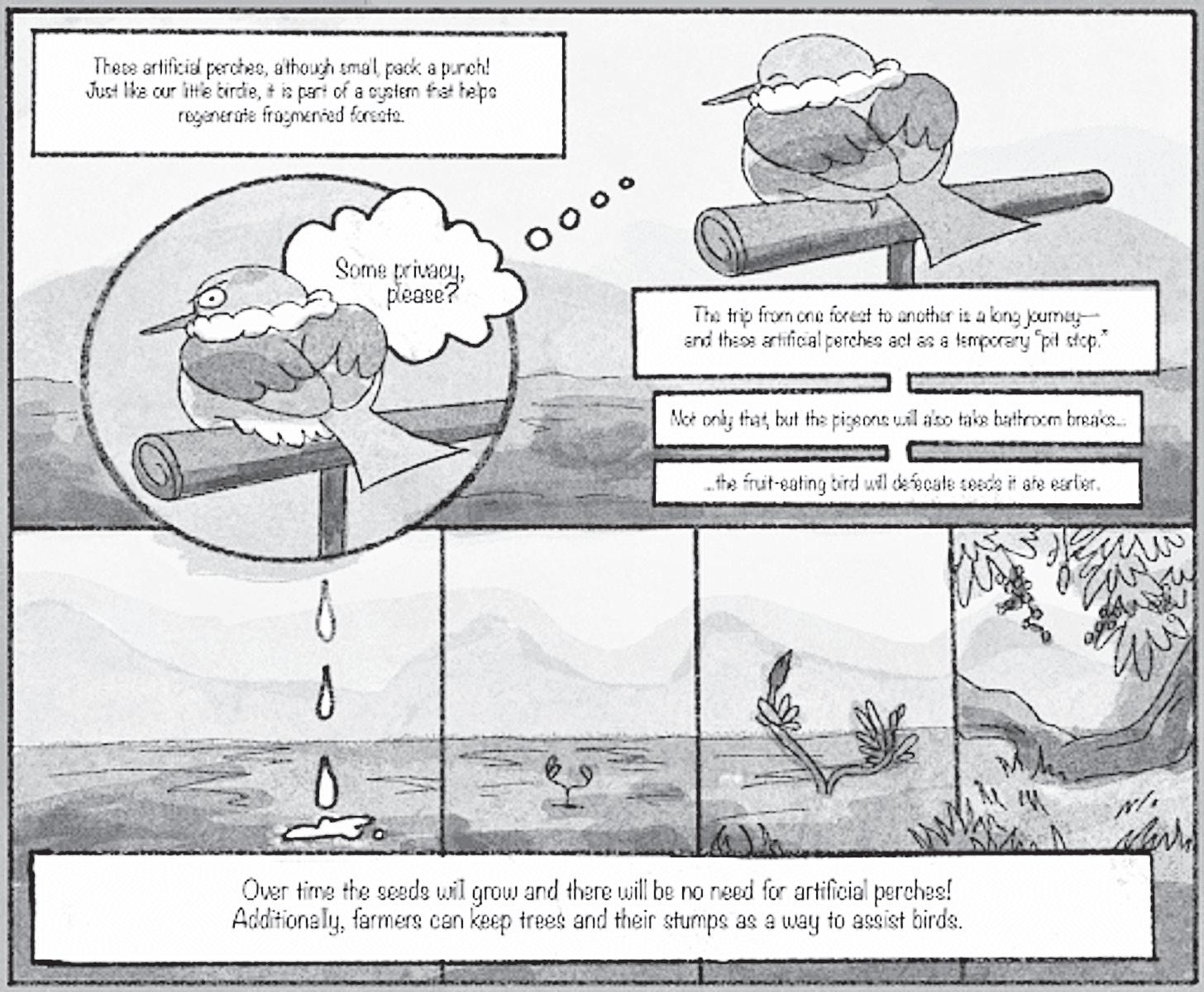

To resolve the issue, an international team of scientists, led by Gan, with researchers from United Kingdom (Newcastle University and the University of St Andrews) and Norwegian Institute for Nature Research, conducted a systematic review of the literature and combined the data from different studies to find a consensus through a method called meta-analysis.
After months of searching and carefully screening studies, they reviewed 396 relevant publications.
“We noted different types of artificial, semi-natural, and natural perches. Artificial perches [i.e., man-made] were mainly straight poles made from wood or PVC pipes with horizontal bars and crossbars, while some examined live fences [i.e., living trees tied with wire], and wood piles,” Gan said.
Natural perches, which came in a variety of types from shrubs to trees, to tree
islands, as well as rock, were examined. The scattered trees in agricultural fields are also considered natural perches.
“We have also noted semi-natural perches, which are those made from dead branches/snags propped up with support,” she noted.
The verdict THE study found that all three types—
natural, artificial, semi-natural perches—
had a significant positive effect of increasing the number of seeds that arrive in the degraded areas. More seeds from more species were found under perches than the control sites (i.e., areas without perch), signifying their effectiveness, said Gan.
However, it is not enough that seeds arrive in the area, she added.
“We need them to germinate and grow into seedlings,” she said.
“When we examine the effect of perches on seedling establishment, only natural perch was found to have a significant effect on seedling density and richness. Hence, the presence of natural perches increases not only the number of seedlings in the area, but also the diversity of seedling species,” Gan explained.
The scientists recommend that natural perches be preserved—such as the shrubs and scattered trees in the agricultural farms, but in areas lacking these natural features, to explore the use of artificial and seminatural perches to increase seed rain and follow it up with additional treatments, such as soil amelioration and weeding, to improve seedling establishment. Gan said the researchers partnered with the Massachusetts College of Art and Design to develop the comic book titled How Birds Can Help Farms and Forests in Northern Philippines. It was designed by Stutman and co-developed with Dr. Caroline Hu. The link to the comic book is: https://blogs. ncl.ac.uk/marionpfeifer/2024/07/19/howbirds-can-help-farms-and-forests-in-the-
Empowering youth through tennis

in gender equality, and was started in 2023 in honor of the 50th anniversary of King securing equal pay for women at the US Open. The event also recognized members from across the USTA’s 17 sections for their dedication to advancing inclusivity in the sport.
“It was beautiful to be thought of.
Certainly Billie Jean King is an icon way beyond the sport,” Duvernay told The Associated Press before the awards ceremony. “Anytime I have an opportunity to be around her or to be associated with her, it’s an honor.” Duvernay is a filmmaker who has directed films like “Selma” and “A Wrinkle in Time.” She was the first Black woman to direct a film nominated for best

N-FORM 2025 tournament winners
IDean Burmester and Marc Leishman headline the latest wave of LIV Golf stars confirmed for International Series Philippines, one of the region’s most anticipated events.
South African Burmester brings the momentum of a breakthrough victory at LIV Golf Miami, where he defeated heavyweights Jon Rahm and Joaquin Niemann in a dramatic playoff. His stellar 2025 season also included a runner-up finish at LIV Golf Hong Kong and two additional top three results, helping him secure fifth place in the season standings and lift Stinger GC to third overall. Leishman, a member of the all-Australian

Kozuma’s former teammate, Scott Vincent, will also join the line-up in excellent form following a commanding victory at International Series Morocco. On top of that, the Zimbabwean has also secured three additional top-10 finishes on the Asian Tour this season, putting him in strong contention and marking him as one of the players to watch.
Asian Tour rising star Danthai Boonma will also be in action at Sta. Elena Golf Club this October. The Thai talent has enjoyed a standout season, currently ranked fifth on The International Series Rankings and eighth on the Asian Tour Order of Merit, bolstered by a runner-up finish at International Series Morocco.
Last year’s Asian Tour Order of Merit champion John Catlin will also be in the mix for what promises to be a thrilling week in the Philippines. The American enjoyed a standout season in 2024 with back-to-back wins at International Series Macau presented by Wynn and Saudi Open presented by PIF, as well as two narrow play-off losses. The trio will be chasing the vital rankings points that could ultimately earn a place on the LIV Golf League next season.
Four major champions playing on LIV Golf have already been confirmed: Range Goats GC captain Bubba Watson, 4Aces GC’s Patrick Reed, and the Stinger GC duo of Charl Schwartzel and Louis Oosthuizen, along with home hero Miguel Tabuena.
International Series Philippines presented by BingoPlus is the seventh of 10 elevated events on the Asian Tour schedule that form a pathway onto LIV Golf for players from around the world via the season-long Rankings race. The tournament will take place at Sta. Elena Golf Club from 23–26 October, bringing a dynamic entertainment experience with headline concerts, exclusive hospitality, live music, gourmet dining, and immersive fan activities throughout tournament week.
picture at the Academy Awards and to win Best Director at Sundance Film Festival.
Allaster is the first woman to be the US Open’s tournament director, and will be leaving the position at the end of this tournament. She has previously served as the chairman and CEO of the Women’s Tennis Association, where she led a team that helped secure equal prize money at the French Open and Wimbledon. The prior two recipients of the award are tennis legend Venus Williams and television producer Shonda Rhimes, who joined Duvernay in a panel discussion about their careers and equality at the ceremony.
A14-MAN team will carry the country’s colors in the coming World Mountain and Trail Running Championships in Canfranc, Spain.
Led by veteran team captain Arnie Macarenas, the Filipinos are competing in the long trail (men and women), short trail (men and women) and in the Under-23 and Under-20 categories in the September 23 to 28 meet.
The delegation is set to leave on September 10 for training, preparation, and acclimatization, according to Philippine Trail Running Association Vice President and Secretary-General Tin Ferrera.
The Philtra official said the team is tempering expectations as almost half of its members are competing internationally for the first time.
“For most of the athletes, this will be their first time to get exposed in an international competition. Their performance [in training] I think kapag tiningnan natin, nasa Top 20 and Top 30,” said Ferrera in the Philippine Sportswriters Association Forum on Tuesday at the conference hall of the Rizal Memorial Sports Complex.
Members and officials of the team were with Ferrera in the session
BUENOS AIRES—Lionel Messi made sure he had good memories of playing a home qualifier with Argentina’s national team for the last time in his illustrious career.
Messi scored twice Thursday in Argentina’s 3-0 victory over Venezuela in front of a raucous sellout crowd that had gathered at estadio Monumental to bid him farewell.
“Being able to finish this way here is what I’ve always dreamed of,” Messi said.
“I’ve experienced a lot of things on this pitch, both good and not so good, but it’s always a joy to play in Argentina, in front of our fans.”
Messi is yet to give any clues about when he will retire from the top level of the sport. But the qualifiers for the 2030 World Cup will begin in 2027, when he’s 40.
The Argentina captain scored in the 39th and 80th minutes, and Lautaro Martinez added a goal in the 76th.
Messi now has 36 goals in South American World Cup qualifiers and remains as the all-time scoring leader.
His Inter Miami teammate Luis Suarez has 29 goals in continental qualifying, but he has retired from Uruguay’s national team. Bolivia’s Marcelo Moreno Martins is third with 22. Looking ahead, Messi clarified that he will only compete in next year’s World Cup if he feels physically fit.
“I’m excited, eager. It’s day by day, feeling the sensations. If I feel good, I enjoy it; if not, I’d rather not be there,” he said, adding that the nine months until the tournament kicks off “is a long time.”
“When you deny equity, you make your own world smaller,” Williams said. “The world is so big. There’s so many things to experience and to know and to understand.... It’s an incredible world, if you allow it to be.” after the match, which begins at 2 p.m. No. 1 seed and defending

presented by San Miguel Corp., Philippine Sports Commission, Philippine Olympic Committee, MILO, Smart/PLDT, and ArenaPlus, the country’s 24/7 sports app. Macarenas banners the entries for the long trail that also include Larry Apolinario, Joebert Elmaguin, Elizabeth Dangadang, and Angelie Cabalo, while
the short trail team is consists of Randolf Gonzales, Romnick Tongkaling, John Ray Onifa, Joy Beltran, and Noime Fernandez. The mountain classic-junior (Under-20) meanwhile, has Ken Olver Libo-on and Evan Dian Sitoy, and the mountain-classic-senior (Under-23) is composed of Samuel Manuel and Charlotte Muyco.

The officials are consists of Ferrera, team manager Gerald Tipones, team coordinator Mandreza Lyra Valles, support crew Manuel Magbanua, and physical therapist Ann Camille Jacinto.
The 34-year-old Macarenas is among the most experienced in the group, having been part of the Philippine delegation to the 2023 edition of the same meet in Austria where the country finished in 12th place. He also won a silver medal in the last Asia Pacific Trail Running Championships.
A total of 75 countries are seeing action in the six-day competition, with United States led by Jim Walsh, France, Italy, Germany, and Spain among the top contenders for the gold medals.
“USA really prepared for this kasi may mga professional trail runners sila ,” said Ferrera.
As for Asian countries, she mentioned the likes of China, Japan, South Korea, and Nepal to crowd out the Philippines for top honors.
MEMBERS of the Philippine Trail Running Team bound for the World Mountain and Trail Running Championships in Canfranc, Spain. PHOTO BY PHILTRA
BURMESTER


Ever dream of having an entry in the Guinness World Records? Here’s how to do it.
SEPTEMBER 7, 2025 | soundstrip.businessmirror@gmail.com
PUSHING, PUSHING, PUSHING
Indonesian indie rock band Reality Club proves day one never ends
Story by John Eiron R. Francisco
Day one or one day.”
It’s a simple phrase, but for Indonesian indie rock band Reality Club, it carries the weight of their journey.
Since 2016, the band has lived by those words, fueling their craft with the belief that every rehearsal, every song, every show could be the beginning of something greater.
What started as a dream in the corners of Jakarta’s music scene has, almost a decade later, begun to unfold into reality. Their sound, earnest, restless, and unafraid, has carried them beyond borders, finding its way into the hearts of listeners who recognize in their music both intimacy and ambition.
But even as their name gathers weight, Reality Club refuses to grow comfortable.
“We just keep pushing, pushing, pushing,” Fathia Izzati, the band’s vocalist told Soundstrip during an exclusive interview as part of their Manila visit in July 2025 and it’s clear they mean it.
Nine years in, they don’t count the miles behind

Publisher :
T. Anthony C. Cabangon
Lourdes M. Fernandez
Editor-In-Chief :
Concept :
Aldwin M. Tolosa
Y2Z Editor :
SoundStrip Editor : Group Creative Director : Graphic Designers :
Jt Nisay
Edwin P. Sallan
Eduardo A. Davad
Niggel Figueroa
Chow Jarlego
Contributing Writers :
Tony M. Maghirang
Rick Olivares
Jill Tan Radovan
Reine Juvierre S. Alberto
John Eiron R. Francisco
Pocholo Concepcion
Francine Y. Medina
Justine Xyrah Garcia
Bea Rollo
Trixzy Leigh Bonotan
Bless Aubrey Ogerio
Photographers :
Bernard P. Testa Nonie Reyes
Y2Z & SOUNDSTRIP are published and distributed free every Sunday by the Philippine Business Daily Mirror Publishing Inc. as a project of the
The Philippine Business Mirror Publishing, Inc., with offices on the 3rd Floor of Dominga Building III 2113 Chino Roces Avenue corner Dela Rosa Street, Makati City, Philippines. Tel. Nos. (Editorial) 817-9467; 813-0725.
Fax line: 813-7025
Advertising Sales: 893-2019; 817-1351,817-2807. Circulation: 893-1662; 814-0134 to 36. www.businessmirror.com.ph
them; they look only at the road ahead. To the band, every stage feels like the first, every song like an opening act, every moment another chance to choose day one over one day.
Guitarist and vocalist Faiz Novascotia Saripudin admitted that, for years, they hardly allowed themselves to believe in their achievements. “For a long time, we just kept moving forward without really stopping to acknowledge them,” he said. “But now, we’re learning to claim those moments. Whatever we’ve accomplished so far, I feel like we do deserve it—all the work we’ve put in, we’ve earned it.”
He explained that staying hungry has reshaped the way they approach each show. The nervousness that once gripped them has faded—not because the band values their performances any less, but because their vision has grown even bigger. It is that dream, vast and unrelenting, that keeps them grounded.
For bassist Nugi Wicaksono, perspective also comes from outside the spotlight. “I appreciate other musicians, especially the newer ones,” he shared. “Meeting them, listening to their struggles—it kind of grounds us. At least for me, it makes me reflect and just be present.”
His bandmates agree: learning from others and staying connected to the wider music community has humbled them, reminding Reality Club that growth isn’t only about moving upward, but also inward.
And so, nearly a decade on, the band carries themselves not as veterans but as dreamers still at the starting line—hungry, grateful, and always ready to begin again.
Their rise reached new heights in 2022 with the viral success of “Anything You Want.”
The single exploded across TikTok and Instagram, racking up more than 100 million streams on Spotify and cementing their place in the global indie scene.
By the following year, Reality Club was clutching two Anugerah Musik Indonesia (AMI) Awards (Best Alternative Album and Best Alternative Group), milestones that affirmed what fans had long known: this was a band built to last.
Fresh off their recently concluded Reality Club Presents… Asia Tour, with stops in Singapore, Thailand, Taiwan, Malaysia, the Philippines, and a triumphant solo concert at Balai Sarbini in Jakarta, the band is stepping into yet another defining chapter.
Just this August 2025, they unveiled their fourth studio album, “Who Knows Where Life Will Take You?” A 13-track odyssey that stretches far beyond the themes of love that colored their earlier records, the album dives into the many messy, beautiful corners of life: corporate burnout, the sacred bonds of motherhood, moments of spiritual doubt, even the humor in falling for “a Catholic man.”
“I want to be remembered for our lyricism, maybe. Whenever they need a song to accompany them, whether they’re feeling sad or feeling happy, we always just want our songs to help them feel all the feels. And that’s been a thing since day one,” Fathia said.





Reality Club
CYCLE OF ROUTINE
Flow G breaks pattern with debut solo album
Story by Bless Aubrey Ogerio
A“lam ko na isa ’to sa na-miss niyo / ’Yong ako’y magpaka-beast / Pero at least, lagi pa ring nasa list / Kahit walang ni-release.”
Those bars from ‘G Wolf’ now have their follow-through. On August 15 at Brooklyn Warehouse, Flow G—Archie dela Cruz in real life—unveiled 247, his debut solo album.
The Muntinlupa-based rapper has long been a prominent figure in the local rap scene, known for his signature fast-paced, complex rhymes.
Now, 247 pushes that further, dropping 12 new tracks that carry both the weight of his reputation and the rising expectations around him.
“Still, kahit parang ang dami ko nang nagawa, parang ang layo ko pa rin, araw-araw akong nagsisimula,” Flow G told reporters in a chance interview during his double celebration in Manila City.
“Pero siyempre, hanggang dumadami yung naniniwala, alam ko naman yung risk, may mas maraming expectation,” he added. “Hindi ko man ma-meet madalas, at least ako mismo sa sarili ko, ginagawa ko talaga yung best ko para mapunan.”
Beautifully difficult process
FLOW G has been around long enough to know
the grind. From his breakout with Ex Battalion to collaborations that blurred the line between street rap and mainstream, he’s now carving his own lane with 247.
But making the album was anything but easy. “Matagal na talaga ako nagpaplano ng album, hindi ko siya alam paano sisimulan,” he admitted.
At its core, 247 turns on the idea of time—24 hours, seven days a week—as a cycle of routine. The tracks stretch that theme into different directions: motivation anthems, love songs, and personal narratives tied together by the recurring use of the word “routine.”
The soundscape was secured with Flip D as producer, who handled recording for eight tracks and took charge of the overall mix and mastering.
Originally, the record was meant to hold 14 songs, but only 12 made it to press when the vinyl couldn’t take more. “Ako na bahala paano makakarating sa tenga nila yung dalawa,” Flow G promised.

The album itself is split into two sides. Side A features “Sargo,” “Telebabad,” “Amat Na,” the title track “247,” “Big Dreams,” and “Gotchu.” Side B includes “8080,” “Lokal,” “Huh?,” “Reply,” and “Ayos Ba?” with “Una Lagi” standing out as a tribute to his longtime partner, Angelica Jane Yap.
The process was painstaking. He lived with the songs for two months, shaped the concept for two weeks, wrote for another two, and spent three weeks on the mix.
Even the vinyl itself carried weight: a limited run of just ten copies at P100,000 each, bundled with a custom turntable designed by Austrian audio firm Pro-Ject Audio Systems. Each buyer he met personally to give thanks. Unsurprisingly, they sold out.
“Na-enjoy ko yung process niya pero after ko mabuo, parang ang sarap pala gawin nito at naadik ako gawin ito,” he said with a grin.
If he had to pick a favorite, it would be the closer, Ayos Ba?—a track he described as a casual check-in with listeners, but one he had been quietly shaping for two years. “Lahat ng pwedeng ilagay, in-adjust ko para lang maging panapos,” he revealed.
Risky gamble
IT took seven years for Flow G to put out a follow-up.
Asked about the long silence, his answer carried the weight of maturity. “Siguro mas marami akong gustong i-push dati, pero this time, dahil mas gusto ko piliin sarili ko, nagawa ko siya,” he explained.
Back then, as a rising name, he admitted

to riding the wave. He jumped on trends, chased fame and said yes to everything. Now, with more footing and perspective, he decided the timing had to be different. This time, he chose himself.
That choice defined 247. For his first solo album, he deliberately stripped away collaborations, a bold move in a scene where features often drive momentum. The intent was simple: to be heard as himself, unfiltered.
“Pag single na naman yung ilalabas ko, baka mainis na sila sa akin. So ayan, dose,” Flow G joked.
Legacy
FOR all the swagger in his verses, Flow G’s offstage presence tells a different story.
Beneath the punchlines and bravado, humility threads through his words. “Kapag minsan, lumalaki na ulo ko, may isang lugar akong pinupuntahan para mag-ground ulit,” he said.
With 247, his hopes are high, but he leaves the judgment to listeners. “Hindi ko hawak opinion nila,” he said plainly.
What comes next is already taking shape. Together with Angelica, he revealed that collaborations will finally appear on his second album.
The thought excites him, he added, because he thrives in the company of peers. “May barkada ako sa industriya. Sila yung dahilan bakit hindi ako takot sumubok,” Flow G said.
And as he marked both album launch and birthday, his wish was telling: not for himself, but for everyone. “Sana manalo lahat.”


Ever dream of having an entry in the Guinness World Records? Here’s how to do it.
By Mark Kennedy The Associated Press
NEW YORK—
Achieving the title of youngest driver to win a Formula One World Championship is really hard. Or having the most ascents of Mount Everest. But what about most soda cans crushed with your feet in a minute?
Guinness World Records is celebrating its 70th anniversary by giving regular folks a way to get into a list of their famous accomplishments—offering some unclaimed potential titles and creating an online quiz to help readers match personality types to possible records.
Do you stay calm and pace yourself? Or are you all about getting it done quickly? Answers to five questions like that online lead to world record options to attempt— like most eggs stacked in one minute or farthest distance bottle flip.
There’s also a list of 70 unclaimed titles, like fastest time to make a bur -
rito, longest marathon playing air guitar and most anchovies eaten in a minute. They’re sorted by headings: speed, power, precision, passion, patience, one for under-16s and another with a friend or pet, like most items caught by a cat in a minute.
“I am completely of the opinion that we’re all amazing in our own way, it’s just discovering what that thing is and celebrating it,” says Editor-in-Chief Craig Glenday. “I want to see kids in the same book as Usain Bolt.”
ery, was invited to go game bird hunting in Ireland. He and his companions soon began to squabble over which was Europe’s fastest game bird. There was no quick way to solve the dispute.
Beaver dreamed up a pamphlet that could be sold to pubs alongside barrels of Guinness stout. He asked twins Norris and Ross McWhirter, who were fact-finding researchers, to compile something that would be different from the day’s encyclopedias, which were dry and very highly academic.
Glenday has been in charge of the books
‘There a list of 70 unclaimed titles, like fastest time to make a burrito, longest marathon playing air guitar and most anchovies eaten in a minute.’
It started with a pub dispute
FIRST published in 1955, the annual book—initially conceived to settle pub arguments—has developed into an international phenomenon, selling 155 million copies in more than 40 languages. The publication itself is listed as the world’s bestselling copyrighted book.
It started when Sir Hugh Beaver, then managing director of the Guinness Brew-
since the 50th anniversary and has been democratizing the record-keeping, opening up entries for things like the most sweaters worn and the loudest burp. He believes striving for goals is an innately human thing.
“The more open and free it is to everyone to have a go, I think the more we all collectively benefit,” he says. “It’s not like there’s a piece of cake that’s going to be eat-
A Nigerian group attempts a 431-hour
IT’S a bookworm’s idea of heaven: 18 days of non-stop reading.
In a restaurant in Nigeria’s Lagos, three men and two women have been reading books for over 431 hours in an attempt to set a Guinness World Record for the longest marathon of reading aloud, part of a campaign to promote literacy in Africa’s most populous country.
Throughout the daunting task, dozens joined the group, some online via a live stream, cheering them on.
By Saturday, when the attempt ended, the reading marathoners had read 79 books authored by Nigerians, taking turns to continuously read out loud literary works and self-help books to give the other team members a chance to catch their breath.
An attempt to promote inclusive education
IN the country of more than 210 million people, “most people don’t have access to books (and) I participated to encourage inclusive education,” Precious Ukachi told The Associated Press. The 30-year-old was one of the reading marathoners. Others were John Obot, 37, Stephen Oyelami, 23, Temitope Ogunremi, 28, and Ketura Heman, 27. Obot said the hardest part of the attempt was reading at night. “We had lim-

ited time to rest, but what kept me going was the goal.”
The current record holders for the longest reading aloud marathon are a group of five people from the Dominican Republic, who clocked 365 hours and 39 seconds in 2011. This time in Nigeria, the last word was uttered when the timer showed: 431 hours, 31 minutes and 25 seconds.
The Guinness World Record is yet to confirm the new record, a process that sometimes takes weeks. The nonprofit behind the event, the Naija ReadFest, says it will forward all evidence needed to the organization.
“We did this to celebrate Nigerian literature,” said Kingsley Sintim of the Naija ReadFest.
The nonprofit said the event aimed at
en and it’s all gone. We can just keep adding and adding.”
‘Officially
amazing’
UNLIKE the Olympics, which decides what is and what is not a proper sport, Guinness World Records embraces all kinds of achievement, as long as they’re meaningful, interesting and a degree of effort has been made. “Otherwise, it’s official, but it’s not amazing. And we have to be officially amazing,” he says.
Guinness World Records is where you’ll find Ashrita Furman of New York City, who jumped the 1,899 steps of the CN Tower in Ontario, Canada, on a pogo stick in a record time of 57 minutes and 51 seconds.
“He is a real athlete,” says Glenday. “Who else is celebrating these people and accrediting them and validating their amazing thing? No one, apart from us. So I can see why after 70 years we’re still relevant.”
To those critics who say Glenday is making a mistake by elevating, for instance, the men’s high jump world record holder in the same pages as the fastest person to ever push an orange for one mile using their nose, he disagrees. Both require concentration, training and dedication.
“To me, it is the same discipline, the same mindset. It’s just society’s been sort of programmed to think one is more impressive than the other.”
reading marathon

highlighting books by local authors to young and old alike. The books the group read also covered issues like migration and finance—both major concerns for the West African country.
Nigeria’s literacy dilemma
BESIDES having one of the world’s highest numbers of children out of school, with more than 10 million affected, Nigeria also has a literacy rate of around 63 percent in 2021, which advocates say has barely improved in recent years.
Oyelami, one of the reading marathoners, said: “It was difficult to get books because of the kind of environment I grew up in.” He attended a public school where new books and education tours were mostly out of reach.

A major challenge has been the poor investment and policies in the education sector, Irene Okon, executive director of Lead-Out nonprofit that seeks to improve learning in public and low-income schools, told the AP
The poor investment in literacy in Nigeria has made things more difficult for writers, said Carol Yaakugh, an Abuja-based author.
“While we have numerous tech startups addressing finance, health, and other areas, the literacy space remains underdeveloped,” Yaakugh said.
The deep-rooted issue is illustrated in the capital, Abuja, where the National Library project, launched in 2006, remains unfinished while public officials fund a lifestyle of luxury. AP
JOHN OBOT (from left), Keturah Heman, Preciouslight Ukachi, Stephen Oyelami, and Ogunremi Temitope Timothy, a team of five Nigerians who read aloud nontstop for over 400 hours in an attempt to break the Guiness world record, pose for a photo in Lagos, Nigeria on August 30. PHOTOS FROM AP
KETURAH heman contributes to the break the Guinness record of “longest marathon reading aloud by a team.”