Despite Mideast war, remittances seen to grow By Andrea E. San Juan
E
VEN as the weaker peso is expected to propel cash remittance flows to Filipino households’ coffers, it should be in the “best interest” of the country to ensure the safety of overseas Filipino workers (OFWs) amid the renewed tensions in the Middle East, according to money transfer firm Western Union’s head for the Philippines. “As an economy, we rely a lot on our overseas Filipinos. So I think it’s in the best interest of the country to take care of these overseas Filipinos,” Western Union Country Director for the Philippines Ricardo Alair said Wednesday.
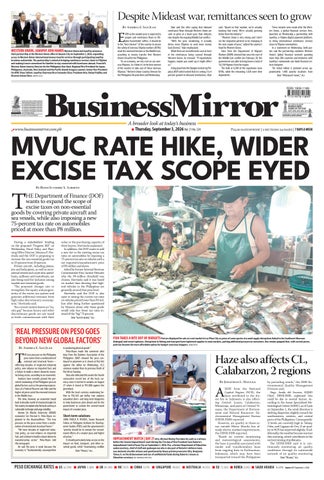
WESTERN UNION, JUANPAY JOIN HANDS Western Union and JuanPay announce
their partnership at the Western Union office in Quezon City on September 2, 2026, expanding access to Western Union international money transfer services through participating JuanPay locations nationwide. The partnership is aimed at bringing remittance services closer to Filipinos and making it more convenient for families to stay connected with loved ones abroad. From left: Western Union Country Director for the Philippines Don Alair; Regional Vice President for Japan, Philippines, Australia, New Zealand and the Pacific Islands Gregory Laurent; Senior Vice President for APAC Vince Tallent; JuanPay Chairman Rico Fernando Chico; President Atty. Rafael Padilla; and Director Arlene Chico. NONOY LACZA
ROTARY CLUB OF MANILA JOURNALISM AWARDS
2006 National Newspaper of the Year 2011 National Newspaper of the Year 2013 Business Newspaper of the Year 2017 Business Newspaper of the Year 2019 Business Newspaper of the Year 2021 Pro Patria Award PHILIPPINE STATISTICS AUTHORITY 2018 Data Champion
Alair said this after saying that inbound remittance flows through Western Union are seen to grow at a faster pace than industry rate despite the ongoing Middle East conflict. “With the peso weakening, it actually drives more Filipinos to send more money back [home],” Alair emphasized. While there are no bottlenecks seen at least in the remittances being coursed through Western Union, he stressed: “If repatriations happen, maybe you could say it might affect us.” Citing data from the Bangko Sentral ng Pilipinas (BSP) which noted that it is seeing 3 to 4 percent growth in inbound remittances, Alair
said: “Based on that number, we’re actually bucking that trend. We’re actually growing better than the industry.” “Western Union is very strong and I don’t see the migration patterns to be changing in the next couple of years,” added the country’s head for Western Union. Data from the Department of Migrant Workers (DMW) showed that since the start of the Middle East conflict last February 28, the government was able to bring home a total of 10,218 Filipinos from the region. The bulk or 8,390 of the repatriates were OFWs, while the remaining 1,828 were their dependents.
These remarks were made after the Western Union, a global financial services firm, launched on Wednesday a partnership with JuanPay, a Filipino digital payment platform, to bring international remittance services closer to Filipino communities. In a statement on Wednesday, both parties said the partnership combines Western Union’s global financial network spanning more than 200 countries and territories with JuanPay’s nationwide non-bank financial services footprint. “An initial rollout is planned across approximately 1,400 priority locations from See “Mideast war,” A2
BusinessMirror A broader look at today’s business
EJAP JOURNALISM AWARDS
BUSINESS NEWS SOURCE OF THE YEAR
(2017, 2018, 2019, 2020, 2021) DEPARTMENT OF SCIENCE AND TECHNOLOGY
2018 BANTOG MEDIA AWARDS
MVUC RATE HIKE, WIDER EXCISE TAX SCOPE EYED www.businessmirror.com.ph
T
n
Thursday, September 3, 2026 Vol. 21 No. 324
P25.00 nationwide | 2 sections 24 pages | 7 DAYS A WEEK
By Reine Juvierre S. Alberto
HE Department of Finance (DOF) wants to expand the scope of excise taxes on non-essential goods by covering private aircraft and sea vessels, while also imposing a new 75-percent tax rate on automobiles priced at more than P8 million.
During a stakeholders’ briefing on the proposed “Progress Bill” on Wednesday, Fiscal Policy and Planning Office Director Johanna P. Hortinela said the DOF is proposing to increase the non-essential goods tax to 25 percent from 20 percent. Private aircraft, including planes, jets and helicopters, as well as recreational vessels such as jet skis, speedboats, sailboats and motorboats, are also being eyed for inclusion among taxable non-essential goods. “The proposed changes aim to strengthen the equity and progressivity of the excise tax system and generate additional revenues from high-value discretionary consumption,” Hortinela said. The current system leaves an “equity gap” because luxury and other discretionary goods are not taxed at levels commensurate with their
value or the purchasing capacity of their buyers, Hortinela explained. In addition, the DOF wants to add a new tier in the existing excise tax rates on automobiles by imposing a 75-percent tax rate on vehicles with a net importer’s/manufacturer’s price of P8 million and above. Asked by former Internal Revenue Commissioner Kim Jacinto-Henares why the P8-million threshold was chosen, Hortinela said it was based on market data showing that highend vehicles in the Philippines are generally around that price level. Hortinela said the DOF is also open to raising the current tax rates on vehicles priced lower than P8 million after being further questioned by Henares about why these goods would only face lower tax rates instead of the “big” 75 percent. See “rate hike,” A2
‘REAL PRESSURE ON PESO GOES BEYOND NEW GLOBAL FACTORS’ By Andrea E. San Juan
T
HE true pressure on the Philippine peso comes from a combination of external and structural forces— reflecting decades of neglected industrial policy, over-reliance on imported fuel, and a failure to build a robust domestic manufacturing sector, according to an economist. Analysts have recently pinned the persistent weakening of the Philippine peso on global factors such as the growing expectations of a Federal Reserve rate hike and the higher oil prices amid the renewed tensions in the Middle East. This time, however, an economist traced back to decades worth of structural neglect in the country to explain why the local currency is vulnerable to foreign exchange volatility. Ateneo De Manila University (ADMU) economist Ser Percival K. Peña-Reyes explained to the BusinessMirror: “The true pressure on the peso comes from a combination of external and structural forces.” “We have decades of neglected industrial policy, an over-reliance on imported fuel, and a failure to build a robust domestic manufacturing sector,” Peña-Reyes told this newspaper. He said the peso is weak because the economy is “fundamentally uncompetitive
in producing physical goods.” Peña-Reyes made this comment after data from the Bankers Association of the Philippines (BAP) showed the peso continued to plummet as it closed at P62.565 against the dollar on Wednesday, 16.5 centavos weaker than its previous finish of P62.40 on Tuesday. Data also indicated this marks the fourth consecutive record low of the local currency since it started to weaken on August 27 when it closed at P61.888 against the greenback. With the local currency weakening further to P62.565 per dollar, two analysts unraveled short- and long-term blueprints to help businesses plan ahead and for the government to contain the second-round impact of a weaker peso.
FISH TAKES A BITE OUT OF BUDGETS Fish are displayed for sale at a wet market in Las Piñas City as prices of some species rise amid supply disruptions linked to the Southwest Monsoon (habagat) and recent typhoons. Disruptions to fishing and transport have tightened supplies in some markets, putting additional pressure on consumers. One vendor quipped that, with current prices, pork has become the more affordable option for budget-conscious shoppers. NONIE REYES
Haze also affects CL, Calabarzon, 2 regions By Jonathan L. Mayuga
A
Short-term solutions
JOHN PAOLO R. RIVERA, Senior Research Fellow at Philippine Institute for Development Studies (PIDS) said the government’s “priority should be to contain the secondround effects of a weaker peso and higher oil prices.” It should particularly keep an eye on the impact on food, transport, and other essential goods, while “maintaining credible See “Peso,” A2
IMPEACHMENT WATCH | DAY 21 Atty. Michael Wesley Poa takes his oath as a witness
before the Senate impeachment court during the 21st day of Vice President Sara Duterte’s impeachment trial in Pasay City on September 2, 2026. Poa, a former Department of Education undersecretary, chief of staff and spokesperson who is also part of Duterte’s defense team, was declared a hostile witness and questioned by House private prosecutor Atty. Benjamin Tolosa Jr. on the disbursement and use of confidential funds during Duterte’s tenure as Education secretary. ROY DOMINGO/SPPA POOL
SIDE from the National Capital Region (NCR), the haze attributed to the forest fire in Indonesia is also affecting Central Luzon, Calabarzon, Mimaropa, and parts of Central Visayas, the Department of Environment and Natural Resources- Environmental Management Bureau (DENR-EMB) reported. However, air quality in these areas outside Metro Manila has already shown marked improvement, the DENR-EMB reported. “Based on current monitoring and meteorological assessments, the haze is possibly associated with smoke and transboundary haze from ongoing fires in Kalimantan, Indonesia, which may have been transported toward the Philippines
by prevailing winds,” the EMB Environmental Quality Management Division said. Engr. Jundy del Socorro, EQMD Chief, DENR-EMB, explained this could be due to several factors. According to the Asean Specialized Meteorological Center (ASMC), as of 5 pm on September 1, the wind direction is shifting dispersion slightly toward the southwestern, western, and central parts of the Philippines. Consequently: 1) levels are currently high in Talisay, Cebu, and Cagayan de Oro; 2) air quality in NCR has improved slightly; 3) additionally, the weather became warmer this morning, which contributes to the vertical mixing of pollutants. The DENR-EMB said it is continuously monitoring air quality conditions through its nationwide network of air quality monitoring See “Haze,” A2
PESO EXCHANGE RATES n US 62.3590 n JAPAN 0.3894 n UK 84.3405 n HK 7.9535 n CHINA 9.2793 n SINGAPORE 49.0013 n AUSTRALIA 44.5555 n EU 72.3053 n KOREA 0.0453 n SAUDI ARABIA 16.6096 Source: BSP (September 2, 2026)